EP4458317A2 - Verfahren, vorrichtung und system zur korrelation von mindestens einem zusätzlichen 2d-bild mit einer 3d-darstellung von mindestens einem zahnteil - Google Patents
Verfahren, vorrichtung und system zur korrelation von mindestens einem zusätzlichen 2d-bild mit einer 3d-darstellung von mindestens einem zahnteil Download PDFInfo
- Publication number
- EP4458317A2 EP4458317A2 EP24200731.8A EP24200731A EP4458317A2 EP 4458317 A2 EP4458317 A2 EP 4458317A2 EP 24200731 A EP24200731 A EP 24200731A EP 4458317 A2 EP4458317 A2 EP 4458317A2
- Authority
- EP
- European Patent Office
- Prior art keywords
- representation
- images
- image
- tooth
- interface
- Prior art date
- Legal status (The legal status is an assumption and is not a legal conclusion. Google has not performed a legal analysis and makes no representation as to the accuracy of the status listed.)
- Pending
Links
Images

Classifications
-
- G—PHYSICS
- G06—COMPUTING OR CALCULATING; COUNTING
- G06T—IMAGE DATA PROCESSING OR GENERATION, IN GENERAL
- G06T7/00—Image analysis
- G06T7/0002—Inspection of images, e.g. flaw detection
- G06T7/0012—Biomedical image inspection
- G06T7/0014—Biomedical image inspection using an image reference approach
-
- A—HUMAN NECESSITIES
- A61—MEDICAL OR VETERINARY SCIENCE; HYGIENE
- A61C—DENTISTRY; APPARATUS OR METHODS FOR ORAL OR DENTAL HYGIENE
- A61C9/00—Impression cups, i.e. impression trays; Impression methods
- A61C9/004—Means or methods for taking digitized impressions
- A61C9/0046—Data acquisition means or methods
- A61C9/0053—Optical means or methods, e.g. scanning the teeth by a laser or light beam
-
- A—HUMAN NECESSITIES
- A61—MEDICAL OR VETERINARY SCIENCE; HYGIENE
- A61B—DIAGNOSIS; SURGERY; IDENTIFICATION
- A61B34/00—Computer-aided surgery; Manipulators or robots specially adapted for use in surgery
- A61B34/70—Manipulators specially adapted for use in surgery
- A61B34/74—Manipulators with manual electric input means
-
- A—HUMAN NECESSITIES
- A61—MEDICAL OR VETERINARY SCIENCE; HYGIENE
- A61B—DIAGNOSIS; SURGERY; IDENTIFICATION
- A61B5/00—Measuring for diagnostic purposes; Identification of persons
- A61B5/0059—Measuring for diagnostic purposes; Identification of persons using light, e.g. diagnosis by transillumination, diascopy, fluorescence
- A61B5/0062—Arrangements for scanning
-
- A—HUMAN NECESSITIES
- A61—MEDICAL OR VETERINARY SCIENCE; HYGIENE
- A61B—DIAGNOSIS; SURGERY; IDENTIFICATION
- A61B5/00—Measuring for diagnostic purposes; Identification of persons
- A61B5/0059—Measuring for diagnostic purposes; Identification of persons using light, e.g. diagnosis by transillumination, diascopy, fluorescence
- A61B5/0082—Measuring for diagnostic purposes; Identification of persons using light, e.g. diagnosis by transillumination, diascopy, fluorescence adapted for particular medical purposes
- A61B5/0088—Measuring for diagnostic purposes; Identification of persons using light, e.g. diagnosis by transillumination, diascopy, fluorescence adapted for particular medical purposes for oral or dental tissue
-
- A—HUMAN NECESSITIES
- A61—MEDICAL OR VETERINARY SCIENCE; HYGIENE
- A61C—DENTISTRY; APPARATUS OR METHODS FOR ORAL OR DENTAL HYGIENE
- A61C13/00—Dental prostheses; Making same
- A61C13/0003—Making bridge-work, inlays, implants or the like
- A61C13/0004—Computer-assisted sizing or machining of dental prostheses
-
- G—PHYSICS
- G06—COMPUTING OR CALCULATING; COUNTING
- G06F—ELECTRIC DIGITAL DATA PROCESSING
- G06F3/00—Input arrangements for transferring data to be processed into a form capable of being handled by the computer; Output arrangements for transferring data from processing unit to output unit, e.g. interface arrangements
- G06F3/01—Input arrangements or combined input and output arrangements for interaction between user and computer
- G06F3/048—Interaction techniques based on graphical user interfaces [GUI]
-
- G—PHYSICS
- G06—COMPUTING OR CALCULATING; COUNTING
- G06T—IMAGE DATA PROCESSING OR GENERATION, IN GENERAL
- G06T19/00—Manipulating three-dimensional [3D] models or images for computer graphics
-
- G—PHYSICS
- G16—INFORMATION AND COMMUNICATION TECHNOLOGY [ICT] SPECIALLY ADAPTED FOR SPECIFIC APPLICATION FIELDS
- G16H—HEALTHCARE INFORMATICS, i.e. INFORMATION AND COMMUNICATION TECHNOLOGY [ICT] SPECIALLY ADAPTED FOR THE HANDLING OR PROCESSING OF MEDICAL OR HEALTHCARE DATA
- G16H30/00—ICT specially adapted for the handling or processing of medical images
-
- A—HUMAN NECESSITIES
- A61—MEDICAL OR VETERINARY SCIENCE; HYGIENE
- A61B—DIAGNOSIS; SURGERY; IDENTIFICATION
- A61B18/00—Surgical instruments, devices or methods for transferring non-mechanical forms of energy to or from the body
- A61B18/18—Surgical instruments, devices or methods for transferring non-mechanical forms of energy to or from the body by applying electromagnetic radiation, e.g. microwaves
- A61B18/20—Surgical instruments, devices or methods for transferring non-mechanical forms of energy to or from the body by applying electromagnetic radiation, e.g. microwaves using laser
- A61B2018/2035—Beam shaping or redirecting; Optical components therefor
- A61B2018/20351—Scanning mechanisms
- A61B2018/20353—Scanning in three dimensions [3D]
-
- A—HUMAN NECESSITIES
- A61—MEDICAL OR VETERINARY SCIENCE; HYGIENE
- A61B—DIAGNOSIS; SURGERY; IDENTIFICATION
- A61B2560/00—Constructional details of operational features of apparatus; Accessories for medical measuring apparatus
- A61B2560/04—Constructional details of apparatus
- A61B2560/0487—Special user inputs or interfaces
-
- G—PHYSICS
- G06—COMPUTING OR CALCULATING; COUNTING
- G06T—IMAGE DATA PROCESSING OR GENERATION, IN GENERAL
- G06T2207/00—Indexing scheme for image analysis or image enhancement
- G06T2207/10—Image acquisition modality
- G06T2207/10048—Infrared image
-
- G—PHYSICS
- G06—COMPUTING OR CALCULATING; COUNTING
- G06T—IMAGE DATA PROCESSING OR GENERATION, IN GENERAL
- G06T2207/00—Indexing scheme for image analysis or image enhancement
- G06T2207/20—Special algorithmic details
- G06T2207/20024—Filtering details
-
- G—PHYSICS
- G06—COMPUTING OR CALCULATING; COUNTING
- G06T—IMAGE DATA PROCESSING OR GENERATION, IN GENERAL
- G06T2207/00—Indexing scheme for image analysis or image enhancement
- G06T2207/30—Subject of image; Context of image processing
- G06T2207/30004—Biomedical image processing
- G06T2207/30036—Dental; Teeth
Definitions
- This invention generally relates to a method, a device, and a system for correlating at least one additional 2D-image to a 3D-representation of at least a part of a tooth. More specifically, the invention relates to correlating the at least one additional 2D-image within the 3D-representation, wherein said 2D-image is recorded in a second recording mode that differs from a first recording mode being used to form the 3D-represention. Even more specifically, the invention relates to hand-held devices such as 3D-scanners used in dental healthcare.
- 3D scanners are known to be configured for illuminating a tooth using both white light, for example from a white LED, and light of different color, for example from a red laser diode.
- 2D-images are thus acquired using white light illumination and red-light illumination.
- the 2D-images acquired with the red-light illumination may be used for forming a 3D representation of a tooth, and the 2D-images acquired with the white light may be used in obtaining colors of the tooth.
- the colors from the 2D-images are associated to the surface of the 3D representation, for example by a color-mapping algorithm.
- color-mapping is related to mapping of colors from 2D images to the outer surface of the 3D representation of for example a tooth.
- the color of the outer surface of a tooth represents the actual color of the tooth.
- a dental restoration such as a crown, an inlay, an onlay and/or a bridge.
- color images of for example teeth are important not only for visualization of teeth but also for dental restorations.
- bacteria and tooth decay can be imaged using violet or ultraviolet (UV) light, causing the bacteria and tooth material to fluoresce.
- UV-light The 2D-images acquired with UV-light is also known to be correlated to the outer surface of for example a tooth.
- an overlay of a 3D structure with fluorescence information is known in the art.
- the inside of a tooth i.e. approximal caries lesions in enamel
- IR infrared
- a 3D-representation of the inside of a tooth can be obtained by acquiring a set of 2D-images during IR-light illumination.
- the 3D-IR-represenation of the inside of the tooth may be correlated to the outside of the tooth by various techniques. For example, the correlation of a 3D-IR-representation to a 3D-representation recorded using white light or red light can be achieved by matching features in the two representations.
- obtaining a first 3D-representation and correlating that within a second 3D-representation may require a long time to record and process, making it cumbersome to scan a mouth. Further, the information of the first 3D-representation within the second 3D-representation may be difficult and/or time-consuming to further analyze.
- Disclosed herein is a method to provide a more efficient recording and correlation method of information within a tooth. Further disclosed is how to provide information within a tooth such that this information can be further analyzed more easily.
- the present disclosure provides a computer-implemented method for correlating at least one additional 2D-image to a 3D-representation of at least a part of a tooth, comprising the steps of: obtaining a first set of 2D-images, wherein the first set of 2D-images are recorded in a first recording mode using a hand-held device; forming a 3D-representation of the at least a part of the tooth from the first set of 2D-images; defining a single 2D-representation-surface within the 3D-representation; obtaining at least one additional 2D-image, wherein the at least one 2D-image is recorded in a second recording mode different from the first recording mode using the hand-held device; and correlating the at least one 2D-image to the 3D-representation such that the at least one 2D-image lies in the single 2D-representation-surface in the 3D-representation.
- the method may obtain a combined 2D/3D-representation.
- the combined 2D/3D-representation may comprise the 3D-representation correlated with the at least one 2D-image only in the single 2D-representation-surface within the 3D-representation.
- the at least one 2D-image lies inside the 3D-representation of the tooth, but the at least one 2D-image may in other embodiments lie on top of the 3D-representation of the tooth. Regardless of the orientation and position of the at least 2D-image, the 2D image is within the 3D-representaion.
- the present disclosure provides a processing unit for correlating at least one additional 2D-image to a 3D-representation of at least a tooth, wherein the processing unit is configured for performing the steps of: obtaining a first set of 2D-images, wherein the first set of 2D-images are recorded in a first recording mode using a hand-held device; forming a 3D-representation of the at least a part of the tooth from the first set of 2D-images; defining a single 2D-representation-surface within the 3D-representation; obtaining at least one additional 2D-image, wherein the at least one 2D-image is recorded in a second recording mode different from the first recording mode using the hand-held device; and correlating the at least one 2D-image to the 3D-representation such that the at least one 2D-image lies in the single 2D-representation-surface in the 3D-representation.
- the method may obtain a combined 2D/3D-representation.
- the combined 2D/3D-representation may comprise the 3D-representation correlated with the at least one 2D-image only in the single 2D-representation-surface within the 3D-representation.
- the present disclosure provides a 2D/3D-scanning-system for correlating at least one additional 2D-image to a 3D-representation of at least a part of a tooth, comprising: a hand-held device comprising: at least a first light source configured for transmitting light in a first optical domain and light in a second optical domain; a detector configured for recording 2D-images, wherein the hand-held device is configured for being operated in at least two recording modes: a first recording mode, wherein a first set of 2D-images are recorded onto the detector by illumination of light in the first optical domain, a second recording mode, wherein the at least one additional 2D-image is recorded onto the detector by illumination of light in the second optical domain; and a processing unit for correlating the at least one additional 2D-image to a 3D-representation of at least a tooth, wherein the processing unit is configured for performing the steps of: obtaining a first set of 2D-images, wherein the first set of 2D
- the method may obtain a combined 2D/3D-representation.
- the combined 2D/3D-representation may comprise the 3D-representation correlated with the at least one 2D-image only in the single 2D-representation-surface within the 3D-representation.
- the present disclosure provides a computer-implemented method for correlating at least one additional 2D-image to a 3D-representation of at least a part of a tooth displayed in a graphical user-interface on a screen, comprising the steps of: obtaining a first set of 2D-images, wherein the first set of 2D-images are recorded in a first recording mode using a hand-held device; forming a 3D-representation of the at least a part of the tooth from the first set of 2D-images in the graphical user-interface; defining a single 2D-representation-surface within the 3D-representation using a manipulator displayed in the graphical user-interface; obtaining at least one additional 2D-image, wherein the at least one additional 2D-image is recorded in a second recording mode different from the first recording mode using the hand-held device; and based on input as provided by the manipulator, correlating the at least one 2D-image to the 3D-re
- the present disclosure provides a computer-implemented method for correlating at least one additional 2D-image to a 3D-representation of at least a part of a tooth displayed in a graphical user-interface on a screen, comprising the steps of: obtaining a first set of 2D-images, wherein the first set of 2D-images are recorded in a first recording mode using a hand-held device; forming a 3D-representation of the at least a part of the tooth from the first set of 2D-images in the graphical user-interface; defining a single 2D-representation-surface within the 3D-representation; obtaining at least one additional 2D-image, wherein the at least one 2D-image is recorded in a second recording mode different from the first recording mode using the hand-held device; correlating the at least one 2D-image to the 3D-representation such that the at least one 2D-image lies in the single 2D-representation-surface in the 3
- the present disclosure provides a computer-implemented method for correlating at least one infrared 2D-image to a 3D-representation of at least a part of a tooth displayed in a graphical user-interface, of a hand-held scanning device, on a screen, comprising the steps of: obtaining a first set of 2D-images of the at least part of the tooth; forming a 3D-representation of the at least a part of the tooth from the first set of 2D-images; displaying, in the graphical user-interface, the 3D-representation; obtaining a second set of 2D-images, wherein the second set of 2D images are infrared 2D-images acquired within the at least part of the tooth; displaying, in the user-interface, at least one of the 2D-images from the second set of 2D-images; displaying, in the user-interface, a manipulator configured to change between 2D-
- the combined 2D/3D-representation may comprise the 3D-representation correlated with the at least one 2D-image only in the single 2D-representation-surface within the 3D-representation.
- a plane or the single plane of the 3D-representation may refer to a plane formed by one or more triangles, wherein the triangle(s) are defined between points in a point-cloud.
- the herein disclosed method may therefore be much more efficient than recording a plurality of 2D-images in the second recording mode. Further, accordingly, the herein disclosed method may be much more efficient than correlating a plurality of 2D images.
- Recording only one 2D-image and correlating only that one 2D-image in only the single 2D-representation-surface within the 3D-representation is advantageous because it allows for quick intra-oral scanning and/or examination of a patient thereby providing the patient with more comfort, at least because the patient does not need to have the mouth open for a long time. Further, recording only one 2D-image and correlating only that one 2D-image within the 3D-representation is advantageous because it allows the dental practitioner to observe only that one 2D-image in relation to the 3D-representation of the at least a part of the tooth.
- the dental practitioner may quickly record one 2D-image in the mouth, for example by recording only one 2D-image of the tooth using the second recording mode on the hand-held device, rather than recording a series of 2D-images per tooth.
- the single 2D-image is quickly correlated in the single 2D-representation-surface within the 3D-representation.
- the practitioner may be allowed to further analyze, using various techniques, the combined 2D/3D-representation.
- the combined 2D/3D-representation may in some embodiments be a representation as appearing on for example a display, such as a screen or touch-screen. Accordingly, the combined 2D/3D-representation may in some embodiments refer to a representation being two separate data-sets, for example two separate files, linked together by the correlation.
- the combined 2D/3D-representation may accordingly also be two separate representations, for example displayed separately in a user-interface, wherein the two separate displays are correlated to each other. For example, by inspecting the 2D representation, the correlation may allow the user of the user-interface to see where on the 3D-representation the 2D representation belongs.
- the combined 2D/3D-representation may refer to a representation being a single data-set, for example obtained by correlating two separate data-sets and combining them into a single data file.
- the present invention provides a computer-implemented method, where it is possible to record more than one 2D-image and correlate these 2D-images within the 3D-representation.
- the present invention does not provide a combined 3D/3D-representation, where for example a first 3D-representation is correlated with multiple 2D-images that form another 3D-representation.
- Correlating more than one 2D-image to a single 2D-representation surface may be much faster than correlating more than one 2D-image to multiple 2D-representation surfaces.
- the herein disclosed method may therefore be much more efficient than recording a plurality of 2D-images and correlating these to multiple 2D-representation-surfaces within the first 3D-representation.
- Recording more than one 2D-image and correlating these 2D-images in only the single 2D-representation-surface within the 3D-representation is further advantageous because it allows for quick intra-oral scanning and/or examination of a patient thereby providing the patient with more comfort, at least because the patient does not need to have the mouth open for a long time. Further, recording more than one 2D-image and correlating these 2D-images in only the single 2D-representation-surface within the 3D-representation is advantageous because it allows the dental practitioner to observe only 2D-images in one surface in relation to the 3D-representation of the at least a part of the tooth.
- the dental practitioner may quickly record more than one 2D-image in the mouth, for example by recording only one 2D-image per tooth using the second recording mode on the hand-held device, rather than recording a series of 2D-images per tooth.
- these 2D-images are quickly correlated in the single 2D-representation-surface within the 3D-representation.
- the practitioner may be allowed to further analyze, using various techniques, the combined 2D/3D-representation.
- the step of defining the single 2D-representation-surface is performed before the step of correlating the at least one additional 2D-image to the 3D-representation.
- the step of defining the single 2D-representation-surface is performed after the step of correlating the at least one additional 2D-image to the 3D-representation.
- the single 2D-representation-surface may first be defined before the step of corelating the at least one additional 2D-image to the 3D-representation, where-after the single 2D-representation-surface may be re-defined. This may allow for various options for the representation of the at least one 2D-image within the 3D-representation.
- the single 2D-representation-surface is a planar surface.
- a representation-surface may provide a rapid correlation of the at least one additional 2D-image to the 3D-representation.
- the planar surface may show details that can all be seen from a single perspective.
- the single 2D-representation-surface is a curved surface.
- a representation-surface may for example be used when the at least one additional 2D-image is a set of 2D-images, each of the 2D-images acquired at different focal planes.
- the different focal planes may not necessarily form a single focal plane, and thus may not necessarily lie in a corresponding single planar 2D-representation plane in the 3D-representation. Accordingly, if the different focal planes correspond to a single 2D-representation-surface, an optimal surface may be curved.
- the different focal planes do not correspond to a single 2D-representation-surface, it may be possible to define a single planar 2D-representation-surface as described before that best matches all the different focal planes, for example by a least square method. Also, it may be possible to project the set of 2D-images to a single planar 2D-representation surface.
- the single 2D-representation-surface is an intersection-surface through the 3D-representation of the at least a part of the tooth.
- a focal plane within the tooth or a part thereof i.e. related to the physical world
- this embodiment corresponds to a situation where the at least one additional 2D-image is acquired within the tooth. This may be possible using for example infrared or x-ray imaging techniques.
- the single 2D-representation-surface is re-defined, for example, the single 2D-representaiton may be moved from its initial position, based on input from a user-interface or input from the hand-held device. For example, in relation to input from a user-interface, the input may be provided after a user clicks on a touch-screen. In relation to input from the hand-held device, the input may be provided after a user clicks and/or moves the hand-held device.
- the step of defining the single 2D-representation-surface is based on spanning a fitting-surface relative to the 3D-representation of at least part of the tooth, preferably relative to the cusp of the 3D-representation of at least said tooth.
- a definition-step is preferably automatic.
- the cusp of the 3D-representation of at least said tooth may automatically be found using a method that relies on estimating an occlusal direction based on scan direction, and from the occlusal direction, finding local maxima corresponding to the cusps of the teeth.
- Such a method may be an iterative process.
- the above embodiment may depend on determining properties of the 3D-representation, such as the cusp(s).
- the fitting-surface may then be determined by a least-square algorithm, for example in relation to the determined properties of the 3D-representation.
- the step of defining the single 2D-representation-surface is based on selecting a focal plane within the first set of 2D-images.
- the step of selecting the focal-plane may be based on input from a user-selected 2D image.
- the focal plane may be manually selected based on viewing the first set of 2D-images.
- the step of selecting the focal plane may be automatic, such as selected based on a selection-algorithm, for example a focusing measure of the first set of 2D-images, or at least a part of the first set of 2D-images, for example based on a part an image within the first set of 2D-images.
- the step of obtaining the at least one additional 2D-image is based on the at least one additional 2D-image being recorded after and/or before recording at least one 2D image in the first set of 2D-images being recorded in the first recording mode.
- all the teeth in a mouth may be scanned in the first recording mode.
- all the teeth may be 2D-imaged in the second recording mode, for example by acquiring a single 2D-image for each of the teeth. This process may also be the other way around.
- all the teeth may be scanned and imaged in a process where each tooth is firstly partly scanned using the first recording mode, secondly 2D-imaged using the second recording mode, and thirdly partly scanned again using the first recording mode.
- Each tooth may then be scanned and 2D-imaged in a process where the recording mode is alternating between the first and the second recording mode, for example as described above, or in many steps, such that the above process is repeated several times, thereby recording more than a single 2D-image in the second recording mode for each tooth.
- the at least one additional 2D-image is a second set of 2D-images, such as a focus-stack of 2D-images recorded perpendicular to a single 2D-physical-surface corresponding to the single 2D-representation-surface, and/or such as a series of 2D-images recorded along a single 2D-physical-surface corresponding to the single 2D-representation-surface.
- recording more than a single 2D-image may be realized by recording a set of 2D images for one or more teeth, for example alternating between recoding in the first and the second recording mode during scanning, thereby recording a focus stack for each tooth.
- the series of 2D-images along the single 2D-physical surface may also be recorded by moving the hand-held device along a path of all the teeth in the mouth.
- the user may record the series of 2D-images along the single 2D-physical surface by physically moving the scanner over the all the teeth in the mouth, for example with a substantial fixed distance to the teeth.
- the user may record the series of 2D-images along the single 2D-physical surface by physically moving the scanner over the all the teeth in the mouth, for example with a non-fixed distance to the teeth, and then rely on a projection algorithm which then projects the series of 2D-images into the single 2D-representation surface.
- the single 2D-representation surface is fitted to the position and orientation of the images in the second set of 2D-images, preferably when the set of 2D-images is recording along a path which defines a surface.
- the position and orientation of the images may be derived from the hand-held device, for example using motion and/or position sensors residing inside the hand-held device.
- the fitting may be done algorithmically.
- the step of obtaining the at least one additional 2D-image is based on filtering the second set of 2D-images.
- a selection algorithm may be applied to the set of 2D-images to select the single 2D-image.
- filtering may be various filtering techniques such as noise filtering, and/or color filtering.
- the step of obtaining the at least one additional 2D-image is based on the at least one additional 2D-image being recorded when the hand-held device is focused within a selected distance from a single 2D-physical surface corresponding to the single 2D-representation-surface.
- the selected distance may be determined using an optical focusing system in the hand-held device.
- the step of obtaining the at least one additional 2D-image is based on the at least one additional 2D-image being recorded when the hand-held device is focused on at least a part of a tooth within a selected angular position at a single 2D-physical surface corresponding to the single 2D-representation-surface.
- the selected angular position may be determined using a gyroscopic system in the hand-held device.
- the step of correlating the at least one additional 2D-image to the 3D-representation is based on projecting the at least one additional 2D-image to the single 2D-representation-surface within the 3D-representation.
- the step of correlating the at least one additional 2D-image to the 3D-representation further comprises obtaining a second set of 2D-images in the second recording mode and stitching said 2D-images in the 2D-representation-surface using an image fusion algorithm.
- a set of 2D-images, or a series 2D-images may be recorded along a single 2D-physical surface by moving the hand-held device along all the teeth in the mouth.
- the first recording mode is based on illuminating the tooth with light in the visible domain, preferably with one or more wavelengths in the range between 400 nm to 700 nm, more preferably in the range between 400 nm to 600 nm. In some embodiments, the one or more wavelengths is in the range between 600 nm to 700 nm.
- a laser diode operating at around 682 nm may be used to provide 3D information from the first set of 2D-images for the 3D-representation of at least the part of the tooth, i.e. for providing geometry of at least part of the tooth.
- Another wavelength range for example originating from a white LED, may be used to provide only color information of at least the part of the tooth and overlay that color information on the geometry of the 3D-represenation.
- the one or more wavelengths in the visible domain for example centered around 550 nm, may be used to provide both 3D information and color information from the first set of 2D-images for the 3D-representation of at least the part of the tooth.
- the first recording mode comprises a step of illuminating the tooth with light in the ultraviolet (UV) domain, preferably light below 400 nm, such as between 200 nm and 400 nm, such as around 400 nm or around 300 nm.
- Light in the UV domain is suitable for providing information about surface caries on teeth.
- the first recording mode may be an alternation between recoding in the visible domain and the UV domain.
- Light in the visible domain may be used primarily in forming the 3D-representation, comprising geometry information and/or color information, whereas light in the UV domain may be used primarily in forming additional information to the 3D-representation, such as surface caries or dental plaque of at least a part of the tooth or gingiva.
- light in the UV domain may be used primarily in forming the 3D-representation, particularly for providing only geometry information. In some preferred embodiments, light in the UV domain may be used primarily in forming the 3D-representation, particularly for providing both geometry information and additional information, such as surface caries of at least a part of the tooth.
- the second recording mode is based on illuminating the tooth with light in the infrared (IR) domain, preferably with one or more wavelengths in the range between 700 nm to 2500 nm, more preferably in the range between 800 nm to 1000 nm, most preferably around 850 nm.
- Light in the IR domain is suitable for providing information about caries inside the teeth.
- the first recording mode and the second recording mode are alternating in scanning operation of at least the part of the tooth.
- the first recording mode may be in the visible domain and the second recording mode may be in the IR domain. Thereby, information related to color, geometry, and caries inside at least the tooth may be provided.
- the first recording mode may be both in the visible domain and the UV domain, whereas the second recording mode may be in the IR domain.
- UV light may provide information related to color, geometry, and caries outside of at least the tooth.
- the second recording mode is based on illuminating the tooth with light in the visible domain, preferably with one or more wavelengths in the range between 600 nm to 700 nm.
- This wavelength range may in some cases provide caries information of inside the teeth.
- the first set of 2D images is recorded in the visible domain, for example the 400-600 nm range
- the second set of 2D images is also recorded in the visible domain, but for example in the 600-700 nm range.
- the combined 2D/3D-representation is displayed on a screen. This allows a dental practitioner to observe the 2D/3D-representation as provided by using the hand-held device inside the oral cavity.
- the combined 2D/3D representation according to the present disclosure is efficiently obtained.
- the present invention provides information about at least the tooth in a comprehensive manner that is visually understandable.
- an image-based metric of the caries of at least the tooth that is based on both the 3D-representaion recorded in the first recording mode, and the 2D-representation recorded in the second recording mode, may be more precise than only relying on purely 2D-information that is not linked to 3D-information.
- Providing an image-based metric of the caries based on the combined 2D/3D-representation may be a way to analyze the combined 2D/3D-representation.
- image-based metrics of at least part of the tooth are able to be implemented in an easy manner, which allows a dental practitioner to obtain information about at least the tooth.
- Specific examples of such information may be related to caries and/or cracks.
- the processing unit is configured for performing the computer implemented method according to the first aspect.
- the features of the method as described in this disclosure may be implemented in software and carried out on a data processing system or other processing means caused by the execution of computer-executable instructions.
- the instructions may be program code means loaded in a memory, such as a RAM, from a storage medium or from another computer via a computer network.
- the described features may be implemented by hardwired circuitry instead of software or in combination with software.
- the processing unit is located externally to the hand-held device, such as located in a separate computer. In another embodiment of the 2d/3D-scanning system, the processing unit is located internally in the hand-held device. In some embodiments, the processing unit is shared between the hand-held device and an external device. Thus, in some embodiments the processing unit may be two or more processing units. Thus, in further embodiments, there may be a processing unit in both the hand-held device and externally to the hand-held device.
- the first and second optical domain are identical to The first and second optical domain
- the first optical domain is in the visible domain, preferably with one or more wavelengths in the range between 400 nm to 700 nm, more preferably in the range between 400 nm to 600 nm.
- a first light source that transmits light in the visible domain ranges from white light emitting diodes (LEDs) to white laser sources.
- the first optical domain is in the ultraviolet or violet domain.
- the second optical domain is in the infrared domain, preferably with one or more wavelengths in the range between 700 nm to 2500 nm, more preferably in the range between 800 nm to 1000 nm, most preferably around 850 nm.
- the second optical domain is in the visible domain, preferably with one or more wavelengths in the range between 600 nm to 700 nm.
- the at least first light source is a first light source and a second light source.
- the first light source may be a white LED and the second light source may be an IR light source.
- the at least first light source may in some embodiments be a wavelength tunable light source.
- the at least one additional 2D-image is recorded after and/or before at least one 2D image in the first set of 2D-images being recorded in the first recording mode.
- the hand-held device is configured for being operated in at least two recording modes: a first recording mode, wherein a first set of 2D-images are recorded onto the detector by illumination of light in the first optical domain, and a second recording mode, wherein the at least one additional 2D-image is recorded onto the detector by illumination of light in the second optical domain.
- the first recording mode is provided by the hand-held device further comprising a first removable tip, which optically connects to the at least first light source, thereby guiding the light from the at least first light source towards at least a part of the tooth.
- the second recording mode is providing by the hand-held device further comprising a second removable tip, replacing the first removable tip, which optically connects to the at least first light source, thereby guiding the light from the at least first light source towards at least a part of the tooth.
- the at least first light source is separately located from the first removable tip.
- the at least first light source may be a first light source and a second light source.
- the at least first light source is located in or on the first removable tip and/or the second removable tip.
- the first removable tip may comprise a first light source.
- the second removable tip may comprise a second light source.
- the first removable tip comprises no first light source
- the second removable tip comprises the second light source.
- the first light source may for example reside inside the handheld device, such that the light from the first light source is only guided via the first removable tip, for example by a mirror located in the first removable tip.
- the second light source may for example be an IR light source placed on/in the second removable tip.
- the first removable tip comprises no first light source
- the second removable tip comprises no second light source.
- Both the first and second light source may for example reside inside the handheld device, such that both the light from the first and second light source is only guided via the first removable tip and the second removable tip, respectively.
- the first removable tip comprises the first light source
- the second removable tip comprises the second light source. Both the first and second light source may for example reside in or on the first removable tip and the second removable tip, respectively.
- the hand-held device further comprises an aperture optically connected to the detector, the aperture comprising an outer annular disc configured for blocking the light in the second optical domain, such that the at least one additional 2D-image is recorded with extended depth-of-field compared to the first set of images recorded in the first recording mode.
- This embodiment would be able to for example provide the at least one additional 2D-image, preferably in the IR-domain, would show more details of for example caries inside the teeth along the direction of acquisition.
- no focus stack of 2D-images within a tooth would be needed, and consequently no selection of a single 2D image within such a focus stack would be needed.
- extending the depth-of-field would provide a faster recording and forming of the combined 2D/3D-representation of at least a tooth.
- the manipulator is configured to change between 2D-images in the second set of 2D-images. Further, based on input as associated to the manipulator, one can change between the 2D-images in the second set of 2D-images until a desired 2D-image is displayed. Once this is achieved, the user observes, in the user-interface, how the desired 2D image is correlated to the 3D-representation as also displayed. The correlation of the desired 2D image to the 3D-representation itself needs not to be calculated once the manipulator is positioned. For example, in the second set of 2D-images, one or more of the 2D-images may have been correlated to the 3D representation before they are displayed in the user-interface.
- One advantage of having the manipulator is to see wherein or whereon the 3D-representation the selected 2D image belongs.
- Another advantage of the manipulator is to display a correlated image once a location on the 3D-representation is defined.
- the correlation of the desired 2D-image to the 3D-representation may be calculated once the manipulator is positioned, for example on the 3D-representation. In other words, the correlation may only be calculated once the manipulator is positioned at a desired location on the 3D-representation.
- the user-interface may in one embodiment be configured such that the manipulator can be moved relative to a fixed 3D-representation. In another embodiment, to position the manipulator at a desired location on the 3D-representation, the user-interface may be configured such that the 3D-representation is moved relative to a fixed manipulator. Moving the manipulator or the 3D-representation may in some embodiments be done using a handheld scanning device.
- the manipulator displayed in the graphical user-interface is a scrollbar.
- the manipulator may however also be the single 2D-representation surface itself.
- the user may for example click on the single 2D-representation surface, and then move the single 2D-representation surface, for example by moving a cursor, by a touch-input on a screen, or by using the hand-held device.
- the user may specify where the user wants to see a correlation between a desired 2D-image and the 3D-representation or the other way around. Since the desired 2D-image is an infrared 2D-image acquired within the at least part of the tooth, the user is provided with the relationship between image-information inside the tooth and surface geometry-information of the tooth. This has the advantage that if the image information inside the tooth relates to carries, then the user can identify in which tooth the carries belongs, and then further, the user can identify where inside the tooth the carries is present.
- the step of correlating the desired 2D-image to the 3D-representation is based on comparing information in the first set of images with information in the second set of images.
- the information in the first set of images i.e. recorded with white visible light
- the information in the second set of images, i.e. recorded with infrared light may also be similar features of the images, such as the edges.
- the information is related to the acquisition-time of the images. This is advantageous over for example feature-detection, because the acquisition time is always present, but this is not always true for image-features such as edges.
- a scanner acquiring the images and communicating with the user-interface may in one embodiment be configured to rapidly shift between acquisition modes, for example between a white light illumination/acquisition mode and an infrared illumination/acquisition mode.
- the step of correlating the desired 2D-image to the 3D-representation is represented in the user-interface such that only the desired 2D-image is shown in relation to the 3D-representation of the at least a part of the tooth.
- the user when the user has selected the desired 2D-image, the user is able to observe whereon or wherein the desired 2D-image relates to the 3D-representation.
- the desired 2D-image inside the tooth is selected, using the manipulator, the same tooth may be represented as a separate 3D-representation, and a correlation-indicator may for example show the location of where the desired 2D-image relates and/or correlate to the 3D-representation.
- this has the advantage that if the image information inside the tooth relates to carries, then the user can identify in which tooth the carries belongs, and then further, the user can identify where inside the tooth the carries is present.
- the step of correlating the desired 2D-image to the 3D representation is represented in the user-interface as a combined 2D/3D-representation.
- the combined 2D/3D-representation may be two separate representations, for example displayed separately in a user-interface, wherein the two separate displays are correlated to each other.
- the correlation may allow the user of the user-interface to see where on the 3D-representation the 2D representation belongs.
- the combined 2D/3D-representation comprises two separate datasets linked together by the correlation such that the combined 2D/3D-representation further comprises two separate representations.
- the combined 2D/3D-representation may refer to a single representation, where both the 3D-representation and the 2D-image are simultaneously displayed. This has the advantage that the user needs not to look at two separate representations in the user-interface at the same time.
- the combined 2D/3D representation comprises a single dataset obtained by correlating two separate datasets.
- a first dataset may originate from the first set of 2D-images, and a second dataset may originate from second set of 2D-images, the i.e. the infrared 2D-images.
- the step of forming the 3D-representation is such that each tooth or the at least part of the tooth in the 3D-representation uniquely identifies a second set of images belonging to the respective tooth or the at least part of the tooth.
- the second set of 2D-images acquired within the tooth or within the at least part of the tooth is displayed as an image-by-image in the user-interface.
- the role of the correlation-indicator is to show the location of where the desired 2D-image relates and/or correlate to the 3D-representation - either from the 3D-representation and to the 2D-image or the other way around.
- the user may for example select a tooth and by inspection of the corresponding 2D infrared images determine whether there is carries inside a tooth or between the teeth.
- the second set of 2D-images is a focus-stack of 2D-images recorded along a perpendicular axis with respect to a single 2D-physical-surface. This may for example allow a user to check for carries within a tooth at varios distances from the cusps.
- the second set of 2D-images is a focus-stack of 2D-images recorded along a single 2D-physical surface.
- the second set of 2D-images is both a focus-stack along a perpendicular axis with respect to a single 2D-physical-surface and along the same single 2D-phyiscal surface. In this manner, the user is presented with most information of carries within a set of teeth.
- the manipulator displayed in the graphical user-interface is a scrollbar and/or a location-indicator to show images from selected positions and/or orientations inside a tooth or a part thereof.
- the manipulator displayed in the graphical user-interface is based on clicking on the 2D-image and wherein the desired image is obtained by moving a cursor, by touch input on the screen, or by using the hand-held scanning device.
- the step of obtaining a second set of 2D-images is based on filtering the second set of 2D images. For example, if a set of infrared 2D-images are acquired as a focus stack, the filter may be configured to select only a part of them, for example based on image quality of location. In this manner, the correlation may not require correlating all of the 2D-images to the 3D-representaion, and therefore a more efficient correlation may be provided.
- the infrared images are obtained by, in the user-interface, selecting that the handheld scanning device is operating with one or more wavelengths in the range between 700 nm to 2500 nm. This may allow the user to manually acquire an infrared image, for example when the handheld scanner is positioned above a specific tooth of interest.
- a handheld scanning device is in communication with the graphical user-interface as described above.
- Example 1 more than one 2D-image correlated to a 3D-representation
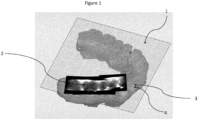
- Fig. 1 shows an example of a single 2D-representation-surface 1 with a set of additional 2D-images 2 correlated to a 3D-representation 3 of a tooth 4, obtained using the herein disclosed computer-implemented method.
- the single 2D-represenation-surface 1 is within the 3D-representation 3 of all the teeth 4 present in a lower jaw.
- the single 2D-representation-surface 1 is a planar surface, particularly an intersection-surface that passes through approximately the center of the teeth 4.
- the set of 2D-images 2 are in this example six 2D-images, which all lie in the single 2D-representation-surface.
- the six 2D-images are stitched together using an image fusion algorithm. Further, the set of 2D-images are recorded in the second recording mode that is based on illuminating the tooth with light in the infrared domain, in this case a wavelength around 850 nm.
- Example 2 more than one 2D-image correlated to a 3D-representation
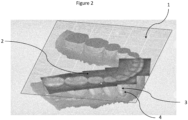
- Fig. 2 shows an example of a single 2D-representation-surface 1 with a set of additional 2D-images 2 correlated to a 3D-representation 3 of a tooth 4, obtained using the herein disclosed computer-implemented method.
- the single 2D-representation-surface 1 is within the 3D-representation 3 of all the teeth 4 present in a lower jaw.
- the single 2D-representation-surface 1 is a planar surface, particularly an intersection-surface that passes through approximately the center of the teeth 4.
- the set of 2D-images 2 are in this example six 2D-images, which all lie in the single 2D-representation-surface.
- the six 2D-images are stitched together using an image fusion algorithm. Further, the set of 2D-images are recorded in the second recording mode that is based on illuminating the tooth with light in the visible domain.
- Example 3 A user-interface
- Fig. 3 shows an example of user-interface according to the present invention.
- the user-interface here a graphical user-interface
- UI is based on a computer-implemented method for correlating at least one infrared 2D-image to a 3D-representation 3 of at least a part of a tooth 4 and displayed.
- the user-interface displays the correlation.
- the user-interface is in communication with a hand-held scanning device and the UI is displayed on a screen.
- the correlation, as displayed in the UI is obtained by the following steps.
- the III or the computer-implemented method, i.e. the algorithm, obtains (by receiving from a handheld device) a first set of 2D-images of the at least part of the tooth 4.
- This first set of 2D-images is acquired by the hand-held scanning device using white light.
- the handheld device transfers the image data to a processing device, whereon the algorithm reads the image data.
- the III then forms a 3D-representation 3 of the at least a part of the tooth 4 from the first set of 2D-images. This 3D-representation is then displayed in the UI.
- the UI obtains (by receiving from a handheld device) a second set of 2D-images 2 of the at least part of the tooth 4.
- This second set of 2D-images 2 is acquired by the hand-held scanning device using infrared light. Accordingly, the second set of 2D images 2 is infrared 2D-images acquired within the at least part of the tooth 4.
- the handheld device transfers the image data to a processing device, whereon the algorithm reads the image data. At least one of the 2D-images from the second set of 2D-images 2 is displayed in the UI. In this example, four of the infrared 2D-images 2 are displayed in the UI.
- the UI displays a manipulator 5 configured to change between the infrared 2D-images in the second set of 2D-images 2.
- the user is able to change between the 2D-images in the second set of 2D-images 2 until a desired 2D-image 6 is displayed.
- the user can move the manipulator 5.
- the infrared 2D-images are changed as a function of the position of the manipulator 5.
- the UI displays how the desired 2D-image 6 is correlated to the 3D-representation 3.
- the correlation itself has continuously been made by the computer implemented method running in the background of the UI as the first set of images and second set of images are acquired.
- the manipulator 5 displayed in the graphical user-interface is in the form of a scrollbar.
- the scroller or the scroll box inside the track of the scrollbar is in the form location-indicator to show images from selected positions inside the tooth 4.
- a correlation-indicator 7 shows the location of where the desired 2D-image 6 relates and/or correlate to the 3D-representation 3.
- the step of correlating the desired 2D-image 6 to the 3D-representation 3 is represented in the user-interface such that only the desired image 2D-image 6 is shown in relation to the 3D-representation 3 of the at least a part of the tooth 4.
- both the 2D-image (the desired infrared 2-image 6 ) of inside the tooth 4 and the 3D-representation 3 are displayed as two separate representations.
- the two separate representations are combined in a combined 2D/3D-representation by the correlation, here combined with the manipulator 5 and the correlation-indicator 7.
- the correlation-indicator 7 is moved correspondingly. It also works the other way around - by moving the correlation indicator 7, the manipulator 5 is also moved correspondingly.
- the correlation-indicator 7 is configured like the manipulator 5.
- the correlation-indicator 7 is also configured to change between the infrared 2D-images in the second set of 2D-images 2.
- the correlation-indicator 7 is another manipulator 5.
- the combined 2D/3D-representation comprises the 3D-representation 3 correlated with the at least one 2D-image 6 in a single 2D-representation-surface 1 within the 3D-representation 3.
- each tooth 4 or the at least part of the tooth 4 in the 3D-representation 3 uniquely identifies the second set of images 2 belonging to the respective tooth 4 or the at least part of the tooth 4.
- the second set of 2D-images 2 acquired within the tooth or within the at least part of the tooth is displayed as an image-by-image 6 in the user-interface.
- the second set of 2D-images 2 is a focus-stack of 2D-images recorded along a single 2D-physical surface.
Landscapes
- Health & Medical Sciences (AREA)
- Engineering & Computer Science (AREA)
- Life Sciences & Earth Sciences (AREA)
- General Health & Medical Sciences (AREA)
- Public Health (AREA)
- Physics & Mathematics (AREA)
- Animal Behavior & Ethology (AREA)
- Veterinary Medicine (AREA)
- Medical Informatics (AREA)
- Surgery (AREA)
- Dentistry (AREA)
- Oral & Maxillofacial Surgery (AREA)
- Theoretical Computer Science (AREA)
- Molecular Biology (AREA)
- Biomedical Technology (AREA)
- Heart & Thoracic Surgery (AREA)
- Nuclear Medicine, Radiotherapy & Molecular Imaging (AREA)
- Epidemiology (AREA)
- General Engineering & Computer Science (AREA)
- General Physics & Mathematics (AREA)
- Radiology & Medical Imaging (AREA)
- Biophysics (AREA)
- Pathology (AREA)
- Audiology, Speech & Language Pathology (AREA)
- Quality & Reliability (AREA)
- Robotics (AREA)
- Human Computer Interaction (AREA)
- Computer Vision & Pattern Recognition (AREA)
- Primary Health Care (AREA)
- Computer Graphics (AREA)
- Computer Hardware Design (AREA)
- Software Systems (AREA)
- Optics & Photonics (AREA)
- Dental Tools And Instruments Or Auxiliary Dental Instruments (AREA)
- Endoscopes (AREA)
Applications Claiming Priority (3)
| Application Number | Priority Date | Filing Date | Title |
|---|---|---|---|
| EP18179027 | 2018-06-21 | ||
| EP19730780.4A EP3810028B1 (de) | 2018-06-21 | 2019-06-14 | Verfahren, vorrichtung und system zur korrelierung mindestens eines zusätzlichen 2d-bildes mit einer 3d-darstellung mindestens eines zahnteils |
| PCT/EP2019/065747 WO2019243202A1 (en) | 2018-06-21 | 2019-06-14 | Method, device and system for correlating at least one additional 2d-image to a 3d-representation of at least a part of tooth |
Related Parent Applications (1)
| Application Number | Title | Priority Date | Filing Date |
|---|---|---|---|
| EP19730780.4A Division EP3810028B1 (de) | 2018-06-21 | 2019-06-14 | Verfahren, vorrichtung und system zur korrelierung mindestens eines zusätzlichen 2d-bildes mit einer 3d-darstellung mindestens eines zahnteils |
Publications (2)
| Publication Number | Publication Date |
|---|---|
| EP4458317A2 true EP4458317A2 (de) | 2024-11-06 |
| EP4458317A3 EP4458317A3 (de) | 2025-01-08 |
Family
ID=62873131
Family Applications (2)
| Application Number | Title | Priority Date | Filing Date |
|---|---|---|---|
| EP24200731.8A Pending EP4458317A3 (de) | 2018-06-21 | 2019-06-14 | Verfahren, vorrichtung und system zur korrelation von mindestens einem zusätzlichen 2d-bild mit einer 3d-darstellung von mindestens einem zahnteil |
| EP19730780.4A Active EP3810028B1 (de) | 2018-06-21 | 2019-06-14 | Verfahren, vorrichtung und system zur korrelierung mindestens eines zusätzlichen 2d-bildes mit einer 3d-darstellung mindestens eines zahnteils |
Family Applications After (1)
| Application Number | Title | Priority Date | Filing Date |
|---|---|---|---|
| EP19730780.4A Active EP3810028B1 (de) | 2018-06-21 | 2019-06-14 | Verfahren, vorrichtung und system zur korrelierung mindestens eines zusätzlichen 2d-bildes mit einer 3d-darstellung mindestens eines zahnteils |
Country Status (6)
| Country | Link |
|---|---|
| US (3) | US11983873B2 (de) |
| EP (2) | EP4458317A3 (de) |
| KR (1) | KR102755393B1 (de) |
| CN (1) | CN112584793A (de) |
| ES (1) | ES2998119T3 (de) |
| WO (1) | WO2019243202A1 (de) |
Families Citing this family (6)
| Publication number | Priority date | Publication date | Assignee | Title |
|---|---|---|---|---|
| EP4458317A3 (de) | 2018-06-21 | 2025-01-08 | 3Shape A/S | Verfahren, vorrichtung und system zur korrelation von mindestens einem zusätzlichen 2d-bild mit einer 3d-darstellung von mindestens einem zahnteil |
| KR102637419B1 (ko) * | 2019-06-12 | 2024-02-16 | 엘지전자 주식회사 | 이동 단말기 및 그의 3d 영상 변환 방법 |
| KR102583414B1 (ko) * | 2021-05-31 | 2023-10-04 | 주식회사 메디트 | 3차원 스캐너의 스캔 이미지 처리 방법 및 장치 |
| WO2024039547A1 (en) * | 2022-08-17 | 2024-02-22 | Align Technology, Inc. | Augmentation of 3d surface of dental site using 2d images |
| US20240115196A1 (en) * | 2022-10-06 | 2024-04-11 | Align Technology, Inc. | Severity maps of dental clinical findings |
| US12465456B2 (en) * | 2022-11-16 | 2025-11-11 | AiCAD Dental Inc. | System and method for augmented intelligence in guided dental surgery |
Family Cites Families (25)
| Publication number | Priority date | Publication date | Assignee | Title |
|---|---|---|---|---|
| IL126838A (en) * | 1998-11-01 | 2003-04-10 | Cadent Ltd | Dental image processing method and system |
| US7717708B2 (en) * | 2001-04-13 | 2010-05-18 | Orametrix, Inc. | Method and system for integrated orthodontic treatment planning using unified workstation |
| US7698068B2 (en) * | 2004-06-17 | 2010-04-13 | Cadent Ltd. | Method for providing data associated with the intraoral cavity |
| CA2615017C (en) * | 2005-07-18 | 2015-06-02 | Andreas Mandelis | Method and apparatus using infrared photothermal radiometry (ptr) and modulated laser luminescence (lum) for diagnostics of defects in teeth |
| US8442283B2 (en) * | 2006-08-30 | 2013-05-14 | Anatomage Inc. | Patient-specific three-dimensional dentition model |
| ES2724115T3 (es) | 2007-06-29 | 2019-09-06 | Midmark Corp | Interfaz gráfica de usuario para el marcado de márgenes asistido por ordenador sobre dentaduras |
| US8830309B2 (en) * | 2008-01-04 | 2014-09-09 | 3M Innovative Properties Company | Hierarchical processing using image deformation |
| US9710603B2 (en) | 2008-11-12 | 2017-07-18 | Softech, Inc. | Dental charting system |
| WO2011140664A2 (en) * | 2010-05-13 | 2011-11-17 | Quantum Dental Technologies Inc. | Handpiece with integrated optical system for photothermal radiometry and luminescence measurements |
| JP2013531531A (ja) * | 2010-06-29 | 2013-08-08 | 3シェイプ アー/エス | 2d画像配置 |
| ES2922376T3 (es) | 2010-07-12 | 2022-09-14 | 3Shape As | Modelación en 3D de un objeto usando características texturales |
| EP3431921B1 (de) | 2010-12-06 | 2020-02-05 | 3Shape A/S | System mit 3d-benutzeroberflächenintegration |
| DE102013006636B4 (de) * | 2013-04-18 | 2019-02-21 | Dürr Dental SE | Dentalkamera zur Kariesdetektion |
| US9510757B2 (en) * | 2014-05-07 | 2016-12-06 | Align Technology, Inc. | Identification of areas of interest during intraoral scans |
| FR3021518A1 (fr) | 2014-05-27 | 2015-12-04 | Francois Duret | Dispositif de visualisation pour faciliter la mesure et le diagnostic 3d par empreinte optique en dentisterie |
| DE102014219784B4 (de) | 2014-09-30 | 2016-06-02 | Siemens Aktiengesellschaft | Betrieb eines bildgebenden medizinischen Untersuchungsgeräts mit einer Mehrzahl an Teilsystemen |
| US10074178B2 (en) | 2015-01-30 | 2018-09-11 | Dental Imaging Technologies Corporation | Intra-oral image acquisition alignment |
| US20170007359A1 (en) | 2015-07-07 | 2017-01-12 | Align Technology, Inc. | Direct fabrication of orthodontic appliances with variable properties |
| EP3383311B1 (de) * | 2015-12-04 | 2024-07-31 | 3Shape A/S | Ableiten von zahnzustandsinformationen zur befüllung von digitalen zahnkarten |
| GB2548341A (en) | 2016-03-10 | 2017-09-20 | Moog Bv | Movement tracking and simulation device and method |
| JP2017221329A (ja) | 2016-06-14 | 2017-12-21 | 医療法人社団秀信会 | 2次元画像を用いて生体の下顎開閉軸とバーチャル咬合器の開閉軸を一致させる方法 |
| CN109414307B (zh) | 2016-06-30 | 2021-08-17 | Dws有限公司 | 用于制造牙齿假体的方法和系统 |
| EP4252698B1 (de) | 2016-07-27 | 2025-04-30 | Align Technology, Inc. | Intraoraler scanner mit zahnmedizinischen diagnosefähigkeiten |
| EP3529553A4 (de) | 2016-10-18 | 2020-06-17 | Dentlytec G.P.L. Ltd. | Intraorale scanmuster |
| EP4458317A3 (de) | 2018-06-21 | 2025-01-08 | 3Shape A/S | Verfahren, vorrichtung und system zur korrelation von mindestens einem zusätzlichen 2d-bild mit einer 3d-darstellung von mindestens einem zahnteil |
-
2019
- 2019-06-14 EP EP24200731.8A patent/EP4458317A3/de active Pending
- 2019-06-14 ES ES19730780T patent/ES2998119T3/es active Active
- 2019-06-14 WO PCT/EP2019/065747 patent/WO2019243202A1/en not_active Ceased
- 2019-06-14 US US17/253,710 patent/US11983873B2/en active Active
- 2019-06-14 EP EP19730780.4A patent/EP3810028B1/de active Active
- 2019-06-14 KR KR1020217001816A patent/KR102755393B1/ko active Active
- 2019-06-14 CN CN201980054848.3A patent/CN112584793A/zh active Pending
-
2023
- 2023-12-07 US US18/531,925 patent/US12236601B2/en active Active
-
2024
- 2024-11-20 US US18/953,664 patent/US20250086798A1/en active Pending
Also Published As
| Publication number | Publication date |
|---|---|
| EP4458317A3 (de) | 2025-01-08 |
| EP3810028B1 (de) | 2024-10-16 |
| US20240185421A1 (en) | 2024-06-06 |
| US12236601B2 (en) | 2025-02-25 |
| WO2019243202A1 (en) | 2019-12-26 |
| KR20210022691A (ko) | 2021-03-03 |
| US20210264600A1 (en) | 2021-08-26 |
| CN112584793A (zh) | 2021-03-30 |
| EP3810028A1 (de) | 2021-04-28 |
| ES2998119T3 (en) | 2025-02-19 |
| US20250086798A1 (en) | 2025-03-13 |
| US11983873B2 (en) | 2024-05-14 |
| KR102755393B1 (ko) | 2025-01-14 |
Similar Documents
| Publication | Publication Date | Title |
|---|---|---|
| US12236601B2 (en) | Method, device and system for correlating at least one additional 2D-image to a 3D-representation of at least a part of tooth | |
| US12357433B2 (en) | Intraoral scanning apparatus | |
| US12114960B2 (en) | 3D intraoral scanner measuring fluorescence | |
| JP7657276B2 (ja) | 歯科診断機能を有する口腔内スキャナ | |
| JP2022122867A (ja) | デジタル歯科カルテに記入するための歯部状態情報を導出する方法 | |
| EP3938997A1 (de) | System und verfahren zur erzeugung von digitalen dreidimensionalen zahnmodellen |
Legal Events
| Date | Code | Title | Description |
|---|---|---|---|
| PUAI | Public reference made under article 153(3) epc to a published international application that has entered the european phase |
Free format text: ORIGINAL CODE: 0009012 |
|
| STAA | Information on the status of an ep patent application or granted ep patent |
Free format text: STATUS: THE APPLICATION HAS BEEN PUBLISHED |
|
| AC | Divisional application: reference to earlier application |
Ref document number: 3810028 Country of ref document: EP Kind code of ref document: P |
|
| AK | Designated contracting states |
Kind code of ref document: A2 Designated state(s): AL AT BE BG CH CY CZ DE DK EE ES FI FR GB GR HR HU IE IS IT LI LT LU LV MC MK MT NL NO PL PT RO RS SE SI SK SM TR |
|
| PUAL | Search report despatched |
Free format text: ORIGINAL CODE: 0009013 |
|
| AK | Designated contracting states |
Kind code of ref document: A3 Designated state(s): AL AT BE BG CH CY CZ DE DK EE ES FI FR GB GR HR HU IE IS IT LI LT LU LV MC MK MT NL NO PL PT RO RS SE SI SK SM TR |
|
| RIC1 | Information provided on ipc code assigned before grant |
Ipc: A61C 13/00 20060101AFI20241202BHEP |
|
| STAA | Information on the status of an ep patent application or granted ep patent |
Free format text: STATUS: REQUEST FOR EXAMINATION WAS MADE |
|
| 17P | Request for examination filed |
Effective date: 20250623 |