EP4456486B1 - Verfahren zur datenverteilung an clients bei einer iterativen datenverarbeitung - Google Patents
Verfahren zur datenverteilung an clients bei einer iterativen datenverarbeitung Download PDFInfo
- Publication number
- EP4456486B1 EP4456486B1 EP23169743.4A EP23169743A EP4456486B1 EP 4456486 B1 EP4456486 B1 EP 4456486B1 EP 23169743 A EP23169743 A EP 23169743A EP 4456486 B1 EP4456486 B1 EP 4456486B1
- Authority
- EP
- European Patent Office
- Prior art keywords
- data
- subset
- determined
- multicast
- clients
- Prior art date
- Legal status (The legal status is an assumption and is not a legal conclusion. Google has not performed a legal analysis and makes no representation as to the accuracy of the status listed.)
- Active
Links
Images




Classifications
-
- H—ELECTRICITY
- H04—ELECTRIC COMMUNICATION TECHNIQUE
- H04L—TRANSMISSION OF DIGITAL INFORMATION, e.g. TELEGRAPHIC COMMUNICATION
- H04L12/00—Data switching networks
- H04L12/02—Details
- H04L12/16—Arrangements for providing special services to substations
- H04L12/18—Arrangements for providing special services to substations for broadcast or conference, e.g. multicast
- H04L12/1886—Arrangements for providing special services to substations for broadcast or conference, e.g. multicast with traffic restrictions for efficiency improvement, e.g. involving subnets or subdomains
-
- H—ELECTRICITY
- H04—ELECTRIC COMMUNICATION TECHNIQUE
- H04L—TRANSMISSION OF DIGITAL INFORMATION, e.g. TELEGRAPHIC COMMUNICATION
- H04L12/00—Data switching networks
- H04L12/02—Details
- H04L12/16—Arrangements for providing special services to substations
- H04L12/18—Arrangements for providing special services to substations for broadcast or conference, e.g. multicast
- H04L12/189—Arrangements for providing special services to substations for broadcast or conference, e.g. multicast in combination with wireless systems
-
- H—ELECTRICITY
- H04—ELECTRIC COMMUNICATION TECHNIQUE
- H04W—WIRELESS COMMUNICATION NETWORKS
- H04W4/00—Services specially adapted for wireless communication networks; Facilities therefor
- H04W4/06—Selective distribution of broadcast services, e.g. multimedia broadcast multicast service [MBMS]; Services to user groups; One-way selective calling services
-
- H—ELECTRICITY
- H04—ELECTRIC COMMUNICATION TECHNIQUE
- H04W—WIRELESS COMMUNICATION NETWORKS
- H04W76/00—Connection management
- H04W76/40—Connection management for selective distribution or broadcast
Definitions
- the present disclosure relates to methods for distributing data to clients in an iterative data processing.
- data needs to be distributed to the clients in each iteration.
- multicast may be used for the data transmission.
- the publication WO 2021/261611 A1 describes federated learning and the usage of multicast for transmission of downlink traffic.
- a method for distributing data to clients in an iterative data processing including establishing a multicast session with a multiplicity of clients in a wireless communication system, wherein the multicast session is provided by means of one or more data replication components for replicating multicast data and, for each of multiple iterations of the iterative data processing, determining, by a server of the wireless communication system, a subset of the multiplicity of clients for the iteration, determining data to be distributed to the determined subset of clients, notifying the one or more data replication components about the determined subset, providing, by the server, the determined data to the one or more data replication components and controlling the one or more data replication components to replicate the data according to the determined subset and to transmit the determined data to each client of the determined subset within the multicast session.
- Figure 1 illustrates federated learning
- Federated learning is a decentralized machine learning (ML) technique that trains a ML model 101 (e.g. a deep neural network DNN) across multiple (FL) clients 102 using, for each client, a local training dataset 103 under the control of a central server (denoted as FL server) 104 (e.g. implemented by a 5G or 6G cloud).
- ML machine learning
- the resulting version (i.e. new version of the last iteration) of the ML model 101 may then be used by a model consumer such as the NWDAF(AnLF) (Network Data Analytics Function (Analytics Logical Function)) which may use it to make predictions from data obtained from an environment (such as communication resource need).
- NWDAF Network Data Analytics Function (Analytics Logical Function)
- Dynamic member selection may be used to:
- the FL server 104 may be an application function and the clients 102 are applications in UEs (User Equipments).
- UEs User Equipments
- Federated Learning is a decentralized application such that there is considerable communication between the FL server 104 and the FL clients 102. Accordingly, communication efficiency specifically in the case of a large number of clients is desirable.
- the same data i.e., the current version of the (global version of the) ML model 101
- the server 104 receives the same data from the server 104 to multiple clients 101, i.e. there may be redundant data transmission over the respective communication network that is used for the FL data transmission.
- a FL is assumed which uses dynamic member selection, i.e. the FL server 104 selects a subset of the clients 102 for each iteration (i.e. there is a "dynamic selection" of clients).
- communication networks For transmitting the same data to multiple devices, communication networks typically have a multicast functionality.
- FIG. 2 shows a radio communication system 200, in this example configured according to 5G (Fifth Generation) as specified by 3GPP (Third Generation Partnership Project), with respect to multicast, in particular the various interfaces involved.
- 5G Fifth Generation
- 3GPP Third Generation Partnership Project
- the radio communication system 200 includes a mobile radio terminal device 202 such as a UE (user equipment), a nano equipment (NE), and the like.
- the mobile radio terminal device 202 also referred to as subscriber terminal, forms the terminal side while the other components of the radio communication system 200 described in the following are part of the mobile radio communication network side, i.e. part of a mobile radio communication network (e.g. a Public Land Mobile Network PLMN).
- a mobile radio communication network e.g. a Public Land Mobile Network PLMN
- the radio communication system 200 includes a radio access network 203, which may include a plurality of radio access network nodes, i.e. base stations configured to provide radio access in accordance with a 5G (Fifth Generation) radio access technology (5G New Radio). It should be noted that the radio communication system 200 may also be configured in accordance with LTE (Long Term Evolution) or another mobile radio communication standard but 5G is herein used as an example. Each radio access network node may provide a radio communication with the mobile radio terminal device 202 over an air interface. It should be noted that the radio access network 203 may include any number of radio access network nodes.
- the radio communication system 200 further includes a core network (CN, here 5GC) including an Access and Mobility Management Function (AMF) 201 connected to the RAN 203 and a Unified Data Management (UDM) 204.
- CN core network
- AMF Access and Mobility Management Function
- UDM Unified Data Management
- the UDM may further consist of the actual UE's subscription database, which is known as, for example, the UDR (Unified Data Repository).
- the core network one or more PCFs (Policy Control Functions) 205.
- the core network further includes a Session Management Function (SMF) 206 and multiple a User Plane Functions (UPF) 207.
- SMF Session Management Function
- UPF User Plane Functions
- the SMF 206 is for handling PDU (Protocol Data Unit) sessions, i.e. for creating, updating and removing PDU sessions and managing session context with the User Plane Function (UPF).
- PDU Protocol Data Unit
- the core network further includes an application function (AF) 208 (or application server AS).
- AF application function
- the AF 208 is connected to other core network components such as the PCF 205 via an NEF (Network Exposure Function), in particular in case the AF 208 is maintained by a third party (i.e. a party other than the operator of the mobile radio communication system 200).
- NEF Network Exposure Function
- the communication system includes an MBSF 212 (Multicast/Broadcast Service Function) and MBSTF 213 (MBSTF Multicast/Broadcast Service Transport Function.).
- MBSF 212 Multicast/Broadcast Service Function
- MBSTF 213 MBSTF Multicast/Broadcast Service Transport Function.
- MBS data (i.e. "traffic"), e.g. from the FL 104, is received by the communication system's core network 301.
- the MBS data should be transmitted to a plurality of UEs 302, 303 via the communication system's radio access network (RAN) 304.
- the core network 301 may use separate PDU sessions 305 for multiple UEs 203 or may use a shared transport 306 to each base station of the RAN 304 for multiple UEs 302 (served by the base station to which the base station then transmits the data using radio point-to-point or radio point-to-multipoint transmission). These two options are referred to transmission via 5GC individual MBS traffic delivery and transmission via 5GC shared MBS traffic delivery, respectively.
- the communication system includes are one or more data replication components which replicate the data such that there is a version of the data for each UE (or at least each for each base station (or radio cell): within a radio cell, it is possible that data is only transmitted once to multiple UEs).
- Federated Learning is used as use case but embodiments may also be applied to other applications that iteratively transfer the same data to a dynamic group of UEs, i.e. for other types of iterative data processing (such as distributed graph processing or MapReduce applications).
- Figure 4 shows a flow diagram 400 illustrating traffic in a more general application example.
- a server 401 and multiple clients 402 are involved in the flow.
- a target client e.g. target UE
- filtering in each iteration 403 in the multicasting e.g. a filtering of UEs in a multicast group which contains all the clients 102).
- QoS Quality of Service
- Figure 5 shows a flow diagram 500 illustrating an FL procedure, in particular with respect to data transmission using multicast via a filtering mechanism provided according to various embodiments.
- An FL server 501 (e.g. corresponding to FL server 104) and FL clients 505 (e.g. UEs, numbered 1 to N, e.g. corresponding to FL clients 102) are involved in the flow. Communication between the FL server 501 and the FL clients 505 is performed, in this example, via a 5G communication system, in particular an MF-SMF 502, an MB-UPF 503 and a data replication component 504 which may be a UPF, an MB-UPF or a RAN (see figure 2 as well as figure 3 which illustrates the two options where data replication takes place).
- MF-SMF 502 an MB-UPF 503
- a data replication component 504 which may be a UPF, an MB-UPF or a RAN (see figure 2 as well as figure 3 which illustrates the two options where data replication takes place).
- data is filtered in a multicast session, i.e. in each training iteration, data is transmitted to the client subset selected (or defined) for that training iteration.
- the FL server 501 establishes a "filtered" multicast session (i.e. a multicast session which has this filtering feature) by means of the communication system's core network.
- the Filtered Multicast Indicator (i.e. an indicator which indicates that the multicast session is a filtered multicast session) may for example be included in the Nmbsmf_MBSSession_CreateRequest message sent from NEF or MBSF to MB-SMF (e.g. according to 3GPP TS 23.247 version 17.3.0 Release 17 clause 7.1.1.2, Figure 7.1.1.2-1).
- the data volume of periodic traffic i.e. size of data for the global model
- the FL clients 505 register with the FL server 501 (for participation in the training) and the FL server 501 initializes the FL clients 505 for the training, including informing them about the identification of the multicast session (in this example an MBS Session ID).
- the FL clients 505 join the multicast session.
- the training loop is then performed, which includes, in each iteration 509
- the FL server 501 may share, in each iteration, a list of UEs of the respective FL client subset (i.e. list of target UEs) with the replicating entities (i.e. replication components), e.g. MB-UPF, UP, RAN (specifically base stations, e.g. gNBs) either before or while transmitting the multicast data (i.e. for example in or before the steps of multicast data transmission in TS 23.247, clause 7.2.1.3, Figure 7.2.1.3-1, see figure 6 steps 619, 621 and 624).
- the replicating entities i.e. replication components
- RAN specifically base stations, e.g. gNBs
- Figure 6 shows a flow diagram 600 where the FL server indicates the FL client subset by means of a target UE list in user plane to the replication components (found by control plane signalling).
- a UE 601 (representing the FL clients), a RAN 602, an AMF 603, an SMF 604, a UPF 605, an NRF 606, a PCF 607, an MB-SMF 608, and MB-UPF 609 and an AF 610 (corresponding to the FL server) are involved in the flow.
- UE 601 joins a multicast session.
- the AF 610 provides multicast data (e.g. the specification of a current version of the ML model to be trained). With the multicast data, the AF 610 provides a target UE list (i.e. a list of UEs corresponding to the FL clients selected for the current iteration).
- multicast data e.g. the specification of a current version of the ML model to be trained.
- the AF 610 provides a target UE list (i.e. a list of UEs corresponding to the FL clients selected for the current iteration).
- the core network control plane determines the target base stations (i.e. the base stations serving the target UEs).
- the MB-UPF 609 transmits the multicast data as well as the target UE list to the determined base stations of the RAN 602 which transmit the data to each target UE 601 (e.g. using an MBS Radio Bearer) in 622.
- the core network control plane determines the target UPFs (i.e. the UPFs serving the target UEs).
- the MB-UPF 609 transmits the multicast data as well as the target UE list to the determined UPFs which transmit the data via the RAN 602 to each target UE 601 in 625 using a PDU session per UE 601.
- Figure 7 shows a flow diagram 700 where the FL server indicates the FL client subset before transmitting the multicast data to the replication components (via control plane signalling).
- the multicast data is associated to the list either implicitly via a time slot in which it is sent (which is associated with the list) or explicitly via a ID tag (which is associated with the list) included in the user plane transmission (i.e. together with the multicast data).
- a UE 701 (representing the FL clients), a RAN 702, an AMF 703, an SMF 704, a UPF 705, an NRF 706, a PCF 707, an MB-SMF 708, and MB-UPF 709 and an AF 710 (corresponding to the FL server) are involved in the flow.
- UE 701 joins a multicast session.
- the AF 710 transmits the target UE list for the current iteration as well as the indication of a time slot or ID tag associated with the target UE list to the MB-SMF 708.
- the core network control plane determines the target base stations (i.e. the base stations serving the target UEs).
- the MB-SMF 701 then informs the MB-UPF about the target base stations in 721 and transmits the target UE list and the associated time slot or ID tag, respectively, to the target base stations in 722.
- the core network control plane determines the target UPFs (i.e. the UPFs serving the target UEs).
- the MB-SMF 701 then informs the MB-UPF about the target UPFs in 724 and transmits the target UE list and the associated time slot or ID tag, respectively, to the target UPFs in 725.
- the AF 710 provides multicast data (e.g. the specification of a current version of the ML model to be trained). The AF 710 does this in a certain time slot associated with the target UE list or provides, with the multicast data, the ID tag of the target UE list (the latter case is illustrated in figure 7 ).
- multicast data e.g. the specification of a current version of the ML model to be trained.
- the AF 710 does this in a certain time slot associated with the target UE list or provides, with the multicast data, the ID tag of the target UE list (the latter case is illustrated in figure 7 ).
- the MB-UPF 709 forwards the multicast data to the target base stations (possibly indicating the ID tag of the target UE list) which transmit the data to each target UE 701 (e.g. using an MBS Radio Bearer) in 728.
- the MB-UPF 709 forwards the multicast data to the target UPFs (possibly indicating the ID tag of the target UE list) which transmit the data via the RAN 702 to each target UE 701 in 730 using a PDU session per UE 701.
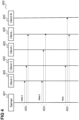
- Figure 8 illustrates the transmission of the target UE list in an extension header (e.g. of GTP-U or IPv6) from the AF 801 via the MB-UPF 802 to the target base station 803 serving the target UEs 806 ("UE-1" and "UE-2" in this example) for the case of shared MBS traffic delivery (option 1 above).
- an extension header e.g. of GTP-U or IPv6
- the MB-UPF 802 may determine the target base station 803 by consulting the MB-SMF 804 which in turn may consult the AMF 805.
- Figure 9 illustrates the transmission of the target UE list in an extension header (e.g. of GTP-U or IPv6) from the AF 901 via the MB-UPF 902 to the target UPF 903 serving the target UEs 904 ("UE-1", “UE-2” and “UE-3" in this example) for the case of individual MBS traffic delivery (option 2 above).
- an extension header e.g. of GTP-U or IPv6
- Figure 10 illustrates the transmission of multicast data for the case of shared MBS traffic delivery in the CP assisted case.
- the AF 1001 first transmits (via control plane) the information to the MB-SMF 1004 that a certain set of UEs ("UE-1" and "UE-2" in this example), is associated with a certain time slot.
- the time slot implicitly thus associates multicast data (that is sent in the time slot) with the target UE list.
- the AF 1001 may transmit multicast data in the respective time slot to the MB-UPF 1002.
- the MB-UPF 1002 is informed about the target base station 1003 by the MB-SMF 1004 which determines (for the time slot) the target UE list and consults the AMF 1005 for the target base station 1003.
- the MB-UPF 1002 may then send the multicast data to the target base station 1003 serving the target UEs 1006 during the given time slot.
- the MB-SMF 1004 may also inform the RAN about the association of target UEs 1006 with the time slot. It should be noted that the complete control plane signalling (shown hatched) may be completed before the user plane signalling (i.e. the transmission of multicast data).
- Figure 11 illustrates the transmission of multicast data for the case of individual MBS traffic delivery in the CP assisted case.
- the AF 1101 first transmits (via control plane) the information via the MB-SMF 1102 to each target UPF 1103 that a certain set of UEs 1105 ("UE-1", "UE-2" and "UE-3" in this example) served by the UPF is associated with a certain time slot.
- the time slot implicitly thus associates multicast data (that is sent in the time slot) with the target UEs served by that UPF 1103.
- the AF 1101 may transmit multicast data in the respective time slot to the MB-UPF 1104 which forwards it to each target UPF 1103.
- the target UPF 1103 then transmits the multicast data to the target UEs 1105 (using individual PDF sessions) during the time slot.
- the complete control plane signalling shown hatched
- the user plane signalling i.e. the transmission of multicast data.
- Figure 12 illustrates the transmission of multicast data for the case of shared MBS traffic delivery in the CP-UP combined case.
- the AF 1201 first transmits (via control plane) the information to the MB-SMF 1004 that a certain set of UEs ("UE-1" and "UE-2" in this example), is associated with a ID tag.
- the AF 1001 may transmit multicast data including the tag ID to the MB-UPF 1202.
- the tag ID is for example carried in the extension header (GTP-U, IPv4, IPv6) of the multicast data and explicitly associates multicast data with the target UE list.
- the MB-UPF 1202 is informed about the target base station 1003 by the MB-SMF 1204 which determines (from the tag ID) the target UE list and consults the AMF 1205 for the target base station 1203.
- the MB-UPF 1202 may then send the multicast data to the target base station 1203 serving the target UEs 1206.
- the MB-SMF 1204 may also inform the RAN about the association of target UEs 1206 with the tag ID.
- the complete control plane signalling shown hatched
- Figure 13 illustrates the transmission of multicast data for the case of individual MBS traffic delivery in the CP-UP combined case.
- the AF 1301 first transmits (via control plane) the information via the MB-SMF 1302 to each target UPF 1303 that a certain set of UEs 1305 ("UE-1", “UE-2” and “UE-3" in this example) served by the UPF is associated with a certain ID tag.
- UE-1 UE-1
- UE-2 UE-2
- UE-3 UE-3
- the AF 1301 may transmit multicast data including the tag ID to the MB-UPF 1304 which forwards it to each target UPF 1303.
- the tag ID is for example carried in the extension header (GTP-U, IPv4, IPv6) of the multicast data and explicitly associates multicast data with the target UE list.
- the target UPF 1303 then transmits the multicast data to the target UEs 1305 (using individual PDF sessions).
- the complete control plane signalling (shown hatched) may be completed before the user plane signalling (i.e. the transmission of multicast data).
- an MB-SMF service extension may be introduced, e.g. the Nmbsmf_MBSSession_ContextUpdate message may be extended such that it allows to . pause or resume of multicast data reception.
- the N4 (specifically the N4mb interface) may be extended with an extension to update the FAR IE (Forwarding Action Rule Information Element) within the PFCP Session Modification Request to include only the current target UE list.
- FAR IE Forwarding Action Rule Information Element
- Figure 14 illustrates a multicast of data from an AF 1401 via MB-UPFs 1402 and base stations 1403 to UEs 1404.
- the multicast data travels over the N6 (specifically N6mb) interface and the N3 (specifically N3mb interface) as well as over dedicated radio bearers.
- the approaches described herein allow using a multicast session to distribute global model from FL server to FL clients such that the number of transmissions of multiple replicas of the global model from AF to the core network (e.g. 5GC) is reduced.
- target UE list for the multicast data eliminates unnecessary replication of data for the clients that have not been selected for this iteration of FL training, thus including transmission and resource consumption efficiency and eliminating MBS session creation and join procedure per FL cycle (thus increasing signalling efficiency).
- the transmission and resource consumption efficiency that can be achieved is especially high if a small number of (MB-)UPFs and base stations server the selected clients, UEs do not handover during an iteration.
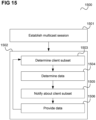
- a method is provided as illustrated in figure 15 .
- Figure 15 shows a flow diagram 1500 illustrating a method for distributing data to clients in an iterative data processing.
- a multicast session (also denoted as "filtered” multicast session) with a multiplicity of clients is established, wherein the multicast session is provided by means of one or more data replication components for replicating multicast data.
- steps of figure 15 do not necessarily be performed in the illustrated order (e.g. the one or more data replication components are notified about the determined subset before the data is determined or the data may be determined before the subset is determined).
- an approach for efficiently distributing (exchanging) data to clients is provided. This is achieved by using the same multicast session (over multiple iterations, i.e. avoiding establishing a multicast session for each determined subset of clients) but controlling, within the multicast session, the subset of clients to which data is sent. So, the data is sent for multiple operations within the same multicast context.
- each iteration has an associated (determined) data set to be sent in the iteration and the data sets of multiple iterations are sent within the same multicast session (i.e. the same multicast (session) context).
- the clients may for example correspond to mobile terminals in a mobile communication system (e.g. each client may correspond to a respective mobile terminal).
- Transmitting the data within the same multicast context may for example include
- the subset changes from iteration to iteration.
- the size of data may be the same for all iterations.
- the one or more data replication components may be notify about the respective subset via id tag, time slot, control plane or user plane, i.e. the data replicating entities may be instructed to apply target client (e.g. UE) list filtering by
- target client e.g. UE
- a communication system arrangement e.g. a server or server system configured to perform the method of figure 15 .
- the communication system arrangement includes components such as one or more communication interfaces (e.g. for communication with core network components, radio access network components and/or mobile terminals), one or more processors and memories.
- components such as one or more communication interfaces (e.g. for communication with core network components, radio access network components and/or mobile terminals), one or more processors and memories.
- a “circuit” may be understood as any kind of a logic implementing entity, which may be special purpose circuitry or a processor executing software stored in a memory, firmware, or any combination thereof.
- a “circuit” may be a hard-wired logic circuit or a programmable logic circuit such as a programmable processor, e.g. a microprocessor.
- a “circuit” may also be a processor executing software, e.g. any kind of computer program. Any other kind of implementation of the respective functions described above may also be understood as a "circuit”.
Landscapes
- Engineering & Computer Science (AREA)
- Computer Networks & Wireless Communication (AREA)
- Signal Processing (AREA)
- Multimedia (AREA)
- Mobile Radio Communication Systems (AREA)
- Data Exchanges In Wide-Area Networks (AREA)
Claims (14)
- Ein Verfahren zum Verteilen von Daten an Clients (402, 505) in einer iterativen Datenverarbeitung, aufweisend:Aufbauen (1501) einer Multicast-Sitzung mit einer Mehrzahl von Clients (402, 505) in einem Funk-Kommunikationssystem (200), wobei die Multicast-Sitzung mittels einer oder mehrerer Datenreplikationskomponenten zum Replizieren von Multicast-Daten bereitgestellt wird; undfür jede von mehreren Iterationen der iterativen DatenverarbeitungBestimmen (1503) einer Teilmenge der Mehrzahl von Clients (402, 505) für die Iteration durch einen Server (401, 501) des Funk-Kommunikationssystems (200);Bestimmen (1504) von Daten, die an die bestimmte Teilmenge von Clients (402, 505) verteilt werden sollen;Benachrichtigen (1505) der einen oder mehreren Datenreplikationskomponenten über die bestimmte Teilmenge; undBereitstellen (1506) der ermittelten Daten durch den Server (401, 501) für die eine oder mehreren Datenreplikationskomponenten und Steuern der einen oder mehreren Datenreplikationskomponenten, um die Daten gemäß der ermittelten Teilmenge zu replizieren und die ermittelten Daten an jeden Client (402, 505) der ermittelten Teilmenge innerhalb der Multicast-Sitzung zu übertragen.
- Das Verfahren nach Anspruch 1, das ferner in jeder Iteration die Verarbeitung der bestimmten Daten durch jeden Client (402, 505) der bestimmten Teilmenge aufweist.
- Das Verfahren nach Anspruch 1 oder 2, das ferner in jeder Iteration aufweist, dass der Server (401, 501) ein Verarbeitungsergebnis der bestimmten Daten von jedem Client (402, 505) der bestimmten Teilmenge empfängt.
- Das Verfahren nach Anspruch 3, wobei der Server (401, 501) ferner die Verarbeitungsergebnisse zusammenführt.
- Das Verfahren nach einem der Ansprüche 1 bis 4, wobei die iterative Datenverarbeitung ein föderiertes Lernen ist und die ermittelten Daten bei jeder Iteration eine Spezifikation einer aktuellen Version eines maschinellen Lernmodells für die Iteration sind.
- Das Verfahren nach einem der Ansprüche 1 bis 5, wobei die eine oder mehreren Datenreplikationskomponenten eine oder mehrere Funkzugangsnetzkomponenten und/oder eine oder mehrere Kernnetzkomponenten des Funk-Kommunikationssystems (200) aufweisen.
- Das Verfahren nach einem der Ansprüche 1 bis 6, wobei die eine oder mehreren Datenreplikationskomponenten eine oder mehrere Basisstationen und/oder eine oder mehrere Benutzerebenen-Funktionen (503) aufweisen.
- Das Verfahren nach einem der Ansprüche 1 bis 7, wobei die eine oder mehreren Datenreplikationskomponenten eine oder mehrere Multicast-Broadcast-Benutzerebenen-Funktionen (503) aufweisen.
- Das Verfahren nach einem der Ansprüche 1 bis 8, das das Zuordnen der bestimmten Teilmenge zu einem Zeitschlitz einer Folge von Zeitschlitzen, das Benachrichtigen der einen oder mehreren Datenreplikationskomponenten über die Zuordnung und das Benachrichtigen der einen oder mehreren Datenreplikationskomponenten über die bestimmte Teilmenge durch Übertragen der bestimmten Daten zu der einen oder den mehreren Datenreplikationskomponenten in dem Zeitschlitz aufweist.
- Das Verfahren nach Anspruch 9, das die Benachrichtigung der einen oder mehreren Datenreplikationskomponenten über die Zuordnung der ermittelten Teilmenge zu dem Zeitfenster auf der Steuerungsebene aufweist.
- Das Verfahren nach einem der Ansprüche 1 bis 8, das das Zuordnen der bestimmten Teilmenge zu einer Teilmengenidentifikation, das Benachrichtigen der einen oder mehreren Datenreplikationskomponenten über die Zuordnung und das Benachrichtigen der einen oder mehreren Datenreplikationskomponenten über die bestimmte Teilmenge durch Übertragen der Teilmengenidentifikation an die eine oder mehreren Datenreplikationskomponenten aufweist.
- Das Verfahren nach Anspruch 11, das das Benachrichtigen der einen oder mehreren Datenreplikationskomponenten über die Zuordnung der ermittelten Teilmenge mit der Teilmengenidentifikation auf der Steuerungsebene aufweist.
- Das Verfahren nach Anspruch 11 oder 12, das das Benachrichtigen der einen oder mehreren Datenreplikationskomponenten über die bestimmte Teilmenge durch Übertragung der Teilmengenidentifikation zusammen mit den bestimmten Daten an die eine oder mehreren Datenreplikationskomponenten aufweist.
- Ein Funk-Kommunikationssystem, das so konfiguriert ist, dass es das Verfahren nach einem der Ansprüche 1 bis 13 ausführt.
Priority Applications (3)
| Application Number | Priority Date | Filing Date | Title |
|---|---|---|---|
| EP23169743.4A EP4456486B1 (de) | 2023-04-25 | 2023-04-25 | Verfahren zur datenverteilung an clients bei einer iterativen datenverarbeitung |
| PCT/EP2024/053163 WO2024223091A1 (en) | 2023-04-25 | 2024-02-08 | Method for distributing data to clients in an iterative data processing |
| JP2024529479A JP7809806B2 (ja) | 2023-04-25 | 2024-02-08 | 反復データ処理におけるクライアントへのデータ分配方法 |
Applications Claiming Priority (1)
| Application Number | Priority Date | Filing Date | Title |
|---|---|---|---|
| EP23169743.4A EP4456486B1 (de) | 2023-04-25 | 2023-04-25 | Verfahren zur datenverteilung an clients bei einer iterativen datenverarbeitung |
Publications (2)
| Publication Number | Publication Date |
|---|---|
| EP4456486A1 EP4456486A1 (de) | 2024-10-30 |
| EP4456486B1 true EP4456486B1 (de) | 2025-04-23 |
Family
ID=86226369
Family Applications (1)
| Application Number | Title | Priority Date | Filing Date |
|---|---|---|---|
| EP23169743.4A Active EP4456486B1 (de) | 2023-04-25 | 2023-04-25 | Verfahren zur datenverteilung an clients bei einer iterativen datenverarbeitung |
Country Status (3)
| Country | Link |
|---|---|
| EP (1) | EP4456486B1 (de) |
| JP (1) | JP7809806B2 (de) |
| WO (1) | WO2024223091A1 (de) |
Family Cites Families (2)
| Publication number | Priority date | Publication date | Assignee | Title |
|---|---|---|---|---|
| US11831458B2 (en) * | 2019-11-19 | 2023-11-28 | Intel Corporation | Provisioning of multicast and broadcast services with different quality of service levels |
| WO2021261611A1 (ko) * | 2020-06-23 | 2021-12-30 | 엘지전자 주식회사 | 무선 통신 시스템에서 연합 학습을 수행하기 위한 방법 및 장치 |
-
2023
- 2023-04-25 EP EP23169743.4A patent/EP4456486B1/de active Active
-
2024
- 2024-02-08 JP JP2024529479A patent/JP7809806B2/ja active Active
- 2024-02-08 WO PCT/EP2024/053163 patent/WO2024223091A1/en not_active Ceased
Also Published As
| Publication number | Publication date |
|---|---|
| WO2024223091A1 (en) | 2024-10-31 |
| EP4456486A1 (de) | 2024-10-30 |
| JP2025519988A (ja) | 2025-07-01 |
| JP7809806B2 (ja) | 2026-02-02 |
Similar Documents
| Publication | Publication Date | Title |
|---|---|---|
| CN114651482B (zh) | 在无线通信系统中控制网络切片的方法和装置 | |
| EP3216305B1 (de) | Verfahren und vorrichtungen zur übertragung von gruppennachrichten an einem endgerät | |
| WO2021156771A1 (en) | EXTENSION OF Npcf_EventExposure WITH USAGE MONITORING EVENT | |
| US12309691B2 (en) | Method and device for management and access control of network slice in wireless communication system | |
| CN114303347A (zh) | 通信网络中与机器学习相关的方法、装置和机器可读介质 | |
| CN115699824A (zh) | 无线通信网络中用于支持收集和分析网络数据的移动性的方法和装置 | |
| CN111526552A (zh) | Ue执行的方法及ue、以及smf实体执行的方法及smf实体 | |
| CN101272520A (zh) | 在系统架构演进中支持多媒体广播组播业务的方法和装置 | |
| CN107852669B (zh) | 利用vnf的mtc服务管理的方法和系统 | |
| WO2020240265A1 (en) | Towards robust notification mechanism in 5g sba | |
| EP3915014A1 (de) | Flexible datenanalyseverarbeitung und exposition in 5gc | |
| US20230135667A1 (en) | Method and apparatus for providing network slice in wireless communication system | |
| WO2021028435A1 (en) | Mechanism for nef discovery relative to pfd management | |
| US20230337326A1 (en) | Method and apparatus for network switching | |
| EP3903449B1 (de) | Verbessertes pfcp-assoziationsverfahren zur sitzungswiederherstellung | |
| EP4456486B1 (de) | Verfahren zur datenverteilung an clients bei einer iterativen datenverarbeitung | |
| CN115696213A (zh) | 多播广播业务的处理方法、装置及计算机可读存储介质 | |
| WO2025167266A1 (zh) | 一种指示信息发送、接收方法、装置、用户设备及存储介质 | |
| US12052638B2 (en) | Reporting of multicast MAC addresses | |
| WO2025011161A1 (zh) | 一种会话管理方法和装置 | |
| CN117354780A (zh) | 数据传输方法、装置、网络功能及存储介质 | |
| CN102685761B (zh) | 蜂窝网络架构实现方法及装置 | |
| WO2018133755A1 (zh) | 会话处理方法及装置 | |
| CN120499841A (zh) | 模型传输方法、设备及存储介质 | |
| GB2624956A (en) | Method and apparatus for AI/ML data transfer |
Legal Events
| Date | Code | Title | Description |
|---|---|---|---|
| PUAI | Public reference made under article 153(3) epc to a published international application that has entered the european phase |
Free format text: ORIGINAL CODE: 0009012 |
|
| STAA | Information on the status of an ep patent application or granted ep patent |
Free format text: STATUS: REQUEST FOR EXAMINATION WAS MADE |
|
| 17P | Request for examination filed |
Effective date: 20231116 |
|
| AK | Designated contracting states |
Kind code of ref document: A1 Designated state(s): AL AT BE BG CH CY CZ DE DK EE ES FI FR GB GR HR HU IE IS IT LI LT LU LV MC ME MK MT NL NO PL PT RO RS SE SI SK SM TR |
|
| GRAP | Despatch of communication of intention to grant a patent |
Free format text: ORIGINAL CODE: EPIDOSNIGR1 |
|
| STAA | Information on the status of an ep patent application or granted ep patent |
Free format text: STATUS: GRANT OF PATENT IS INTENDED |
|
| RIC1 | Information provided on ipc code assigned before grant |
Ipc: H04W 76/40 20180101ALI20241028BHEP Ipc: H04W 4/06 20090101ALI20241028BHEP Ipc: H04L 12/18 20060101AFI20241028BHEP |
|
| INTG | Intention to grant announced |
Effective date: 20241113 |
|
| GRAS | Grant fee paid |
Free format text: ORIGINAL CODE: EPIDOSNIGR3 |
|
| GRAA | (expected) grant |
Free format text: ORIGINAL CODE: 0009210 |
|
| STAA | Information on the status of an ep patent application or granted ep patent |
Free format text: STATUS: THE PATENT HAS BEEN GRANTED |
|
| AK | Designated contracting states |
Kind code of ref document: B1 Designated state(s): AL AT BE BG CH CY CZ DE DK EE ES FI FR GB GR HR HU IE IS IT LI LT LU LV MC ME MK MT NL NO PL PT RO RS SE SI SK SM TR |
|
| REG | Reference to a national code |
Ref country code: GB Ref legal event code: FG4D |
|
| REG | Reference to a national code |
Ref country code: CH Ref legal event code: EP |
|
| REG | Reference to a national code |
Ref country code: DE Ref legal event code: R096 Ref document number: 602023003015 Country of ref document: DE |
|
| REG | Reference to a national code |
Ref country code: IE Ref legal event code: FG4D |
|
| PGFP | Annual fee paid to national office [announced via postgrant information from national office to epo] |
Ref country code: DE Payment date: 20250611 Year of fee payment: 3 |
|
| PGFP | Annual fee paid to national office [announced via postgrant information from national office to epo] |
Ref country code: AT Payment date: 20250721 Year of fee payment: 3 |
|
| REG | Reference to a national code |
Ref country code: NL Ref legal event code: MP Effective date: 20250423 |
|
| PG25 | Lapsed in a contracting state [announced via postgrant information from national office to epo] |
Ref country code: NL Free format text: LAPSE BECAUSE OF FAILURE TO SUBMIT A TRANSLATION OF THE DESCRIPTION OR TO PAY THE FEE WITHIN THE PRESCRIBED TIME-LIMIT Effective date: 20250423 |
|
| REG | Reference to a national code |
Ref country code: AT Ref legal event code: MK05 Ref document number: 1788895 Country of ref document: AT Kind code of ref document: T Effective date: 20250423 |
|
| PG25 | Lapsed in a contracting state [announced via postgrant information from national office to epo] |
Ref country code: PT Free format text: LAPSE BECAUSE OF FAILURE TO SUBMIT A TRANSLATION OF THE DESCRIPTION OR TO PAY THE FEE WITHIN THE PRESCRIBED TIME-LIMIT Effective date: 20250825 Ref country code: FI Free format text: LAPSE BECAUSE OF FAILURE TO SUBMIT A TRANSLATION OF THE DESCRIPTION OR TO PAY THE FEE WITHIN THE PRESCRIBED TIME-LIMIT Effective date: 20250423 Ref country code: ES Free format text: LAPSE BECAUSE OF FAILURE TO SUBMIT A TRANSLATION OF THE DESCRIPTION OR TO PAY THE FEE WITHIN THE PRESCRIBED TIME-LIMIT Effective date: 20250423 |
|
| REG | Reference to a national code |
Ref country code: LT Ref legal event code: MG9D |
|
| PG25 | Lapsed in a contracting state [announced via postgrant information from national office to epo] |
Ref country code: GR Free format text: LAPSE BECAUSE OF FAILURE TO SUBMIT A TRANSLATION OF THE DESCRIPTION OR TO PAY THE FEE WITHIN THE PRESCRIBED TIME-LIMIT Effective date: 20250724 Ref country code: NO Free format text: LAPSE BECAUSE OF FAILURE TO SUBMIT A TRANSLATION OF THE DESCRIPTION OR TO PAY THE FEE WITHIN THE PRESCRIBED TIME-LIMIT Effective date: 20250723 |
|
| PG25 | Lapsed in a contracting state [announced via postgrant information from national office to epo] |
Ref country code: PL Free format text: LAPSE BECAUSE OF FAILURE TO SUBMIT A TRANSLATION OF THE DESCRIPTION OR TO PAY THE FEE WITHIN THE PRESCRIBED TIME-LIMIT Effective date: 20250423 |
|
| PG25 | Lapsed in a contracting state [announced via postgrant information from national office to epo] |
Ref country code: BG Free format text: LAPSE BECAUSE OF FAILURE TO SUBMIT A TRANSLATION OF THE DESCRIPTION OR TO PAY THE FEE WITHIN THE PRESCRIBED TIME-LIMIT Effective date: 20250423 |
|
| PG25 | Lapsed in a contracting state [announced via postgrant information from national office to epo] |
Ref country code: HR Free format text: LAPSE BECAUSE OF FAILURE TO SUBMIT A TRANSLATION OF THE DESCRIPTION OR TO PAY THE FEE WITHIN THE PRESCRIBED TIME-LIMIT Effective date: 20250423 |
|
| PG25 | Lapsed in a contracting state [announced via postgrant information from national office to epo] |
Ref country code: AT Free format text: LAPSE BECAUSE OF FAILURE TO SUBMIT A TRANSLATION OF THE DESCRIPTION OR TO PAY THE FEE WITHIN THE PRESCRIBED TIME-LIMIT Effective date: 20250423 |
|
| PG25 | Lapsed in a contracting state [announced via postgrant information from national office to epo] |
Ref country code: RS Free format text: LAPSE BECAUSE OF FAILURE TO SUBMIT A TRANSLATION OF THE DESCRIPTION OR TO PAY THE FEE WITHIN THE PRESCRIBED TIME-LIMIT Effective date: 20250723 |
|
| PG25 | Lapsed in a contracting state [announced via postgrant information from national office to epo] |
Ref country code: IS Free format text: LAPSE BECAUSE OF FAILURE TO SUBMIT A TRANSLATION OF THE DESCRIPTION OR TO PAY THE FEE WITHIN THE PRESCRIBED TIME-LIMIT Effective date: 20250823 |
|
| PG25 | Lapsed in a contracting state [announced via postgrant information from national office to epo] |
Ref country code: LV Free format text: LAPSE BECAUSE OF FAILURE TO SUBMIT A TRANSLATION OF THE DESCRIPTION OR TO PAY THE FEE WITHIN THE PRESCRIBED TIME-LIMIT Effective date: 20250423 |
|
| PG25 | Lapsed in a contracting state [announced via postgrant information from national office to epo] |
Ref country code: LU Free format text: LAPSE BECAUSE OF NON-PAYMENT OF DUE FEES Effective date: 20250425 |
|
| REG | Reference to a national code |
Ref country code: BE Ref legal event code: MM Effective date: 20250430 |
|
| PG25 | Lapsed in a contracting state [announced via postgrant information from national office to epo] |
Ref country code: DK Free format text: LAPSE BECAUSE OF FAILURE TO SUBMIT A TRANSLATION OF THE DESCRIPTION OR TO PAY THE FEE WITHIN THE PRESCRIBED TIME-LIMIT Effective date: 20250423 Ref country code: SM Free format text: LAPSE BECAUSE OF FAILURE TO SUBMIT A TRANSLATION OF THE DESCRIPTION OR TO PAY THE FEE WITHIN THE PRESCRIBED TIME-LIMIT Effective date: 20250423 |
|
| PG25 | Lapsed in a contracting state [announced via postgrant information from national office to epo] |
Ref country code: BE Free format text: LAPSE BECAUSE OF NON-PAYMENT OF DUE FEES Effective date: 20250430 |
|
| PG25 | Lapsed in a contracting state [announced via postgrant information from national office to epo] |
Ref country code: CZ Free format text: LAPSE BECAUSE OF FAILURE TO SUBMIT A TRANSLATION OF THE DESCRIPTION OR TO PAY THE FEE WITHIN THE PRESCRIBED TIME-LIMIT Effective date: 20250423 |
|
| PG25 | Lapsed in a contracting state [announced via postgrant information from national office to epo] |
Ref country code: EE Free format text: LAPSE BECAUSE OF FAILURE TO SUBMIT A TRANSLATION OF THE DESCRIPTION OR TO PAY THE FEE WITHIN THE PRESCRIBED TIME-LIMIT Effective date: 20250423 |
|
| REG | Reference to a national code |
Ref country code: DE Ref legal event code: R097 Ref document number: 602023003015 Country of ref document: DE |
|
| PG25 | Lapsed in a contracting state [announced via postgrant information from national office to epo] |
Ref country code: SK Free format text: LAPSE BECAUSE OF FAILURE TO SUBMIT A TRANSLATION OF THE DESCRIPTION OR TO PAY THE FEE WITHIN THE PRESCRIBED TIME-LIMIT Effective date: 20250423 |
|
| PG25 | Lapsed in a contracting state [announced via postgrant information from national office to epo] |
Ref country code: IT Free format text: LAPSE BECAUSE OF FAILURE TO SUBMIT A TRANSLATION OF THE DESCRIPTION OR TO PAY THE FEE WITHIN THE PRESCRIBED TIME-LIMIT Effective date: 20250423 |
|
| PG25 | Lapsed in a contracting state [announced via postgrant information from national office to epo] |
Ref country code: MC Free format text: LAPSE BECAUSE OF FAILURE TO SUBMIT A TRANSLATION OF THE DESCRIPTION OR TO PAY THE FEE WITHIN THE PRESCRIBED TIME-LIMIT Effective date: 20250423 |
|
| PLBE | No opposition filed within time limit |
Free format text: ORIGINAL CODE: 0009261 |
|
| STAA | Information on the status of an ep patent application or granted ep patent |
Free format text: STATUS: NO OPPOSITION FILED WITHIN TIME LIMIT |
|
| REG | Reference to a national code |
Ref country code: CH Ref legal event code: L10 Free format text: ST27 STATUS EVENT CODE: U-0-0-L10-L00 (AS PROVIDED BY THE NATIONAL OFFICE) Effective date: 20260304 |
|
| PG25 | Lapsed in a contracting state [announced via postgrant information from national office to epo] |
Ref country code: RO Free format text: LAPSE BECAUSE OF FAILURE TO SUBMIT A TRANSLATION OF THE DESCRIPTION OR TO PAY THE FEE WITHIN THE PRESCRIBED TIME-LIMIT Effective date: 20250423 |
|
| 26N | No opposition filed |
Effective date: 20260126 |
|
| PG25 | Lapsed in a contracting state [announced via postgrant information from national office to epo] |
Ref country code: IE Free format text: LAPSE BECAUSE OF NON-PAYMENT OF DUE FEES Effective date: 20250425 |
|
| PG25 | Lapsed in a contracting state [announced via postgrant information from national office to epo] |
Ref country code: FR Free format text: LAPSE BECAUSE OF NON-PAYMENT OF DUE FEES Effective date: 20250623 |