EP4456479A1 - Vorrichtung, vorrichtung, verfahren und computerprogramm für ein netzwerkelement - Google Patents
Vorrichtung, vorrichtung, verfahren und computerprogramm für ein netzwerkelement Download PDFInfo
- Publication number
- EP4456479A1 EP4456479A1 EP23216333.7A EP23216333A EP4456479A1 EP 4456479 A1 EP4456479 A1 EP 4456479A1 EP 23216333 A EP23216333 A EP 23216333A EP 4456479 A1 EP4456479 A1 EP 4456479A1
- Authority
- EP
- European Patent Office
- Prior art keywords
- server
- data connection
- encrypted data
- request
- response
- Prior art date
- Legal status (The legal status is an assumption and is not a legal conclusion. Google has not performed a legal analysis and makes no representation as to the accuracy of the status listed.)
- Pending
Links
Images




Classifications
-
- H—ELECTRICITY
- H04—ELECTRIC COMMUNICATION TECHNIQUE
- H04L—TRANSMISSION OF DIGITAL INFORMATION, e.g. TELEGRAPHIC COMMUNICATION
- H04L63/00—Network architectures or network communication protocols for network security
- H04L63/04—Network architectures or network communication protocols for network security for providing a confidential data exchange among entities communicating through data packet networks
- H04L63/0428—Network architectures or network communication protocols for network security for providing a confidential data exchange among entities communicating through data packet networks wherein the data content is protected, e.g. by encrypting or encapsulating the payload
-
- H—ELECTRICITY
- H04—ELECTRIC COMMUNICATION TECHNIQUE
- H04L—TRANSMISSION OF DIGITAL INFORMATION, e.g. TELEGRAPHIC COMMUNICATION
- H04L63/00—Network architectures or network communication protocols for network security
- H04L63/08—Network architectures or network communication protocols for network security for authentication of entities
- H04L63/0823—Network architectures or network communication protocols for network security for authentication of entities using certificates
-
- H—ELECTRICITY
- H04—ELECTRIC COMMUNICATION TECHNIQUE
- H04L—TRANSMISSION OF DIGITAL INFORMATION, e.g. TELEGRAPHIC COMMUNICATION
- H04L63/00—Network architectures or network communication protocols for network security
- H04L63/08—Network architectures or network communication protocols for network security for authentication of entities
- H04L63/083—Network architectures or network communication protocols for network security for authentication of entities using passwords
-
- H—ELECTRICITY
- H04—ELECTRIC COMMUNICATION TECHNIQUE
- H04L—TRANSMISSION OF DIGITAL INFORMATION, e.g. TELEGRAPHIC COMMUNICATION
- H04L63/00—Network architectures or network communication protocols for network security
- H04L63/16—Implementing security features at a particular protocol layer
- H04L63/166—Implementing security features at a particular protocol layer at the transport layer
-
- H—ELECTRICITY
- H04—ELECTRIC COMMUNICATION TECHNIQUE
- H04L—TRANSMISSION OF DIGITAL INFORMATION, e.g. TELEGRAPHIC COMMUNICATION
- H04L63/00—Network architectures or network communication protocols for network security
- H04L63/16—Implementing security features at a particular protocol layer
- H04L63/168—Implementing security features at a particular protocol layer above the transport layer
-
- H—ELECTRICITY
- H04—ELECTRIC COMMUNICATION TECHNIQUE
- H04L—TRANSMISSION OF DIGITAL INFORMATION, e.g. TELEGRAPHIC COMMUNICATION
- H04L9/00—Cryptographic mechanisms or cryptographic arrangements for secret or secure communications; Network security protocols
- H04L9/40—Network security protocols
-
- H—ELECTRICITY
- H04—ELECTRIC COMMUNICATION TECHNIQUE
- H04W—WIRELESS COMMUNICATION NETWORKS
- H04W12/00—Security arrangements; Authentication; Protecting privacy or anonymity
- H04W12/03—Protecting confidentiality, e.g. by encryption
-
- H—ELECTRICITY
- H04—ELECTRIC COMMUNICATION TECHNIQUE
- H04W—WIRELESS COMMUNICATION NETWORKS
- H04W12/00—Security arrangements; Authentication; Protecting privacy or anonymity
- H04W12/06—Authentication
- H04W12/069—Authentication using certificates or pre-shared keys
Definitions
- Application detection is a mechanism in which a communication between a client and a server is detected (including the start and stop of said communication) and a unique classification is applied to all packets in that communication. It is, for example, a function of the 5G (3 rd Generation Partnership Project, 3GPP, 5 th Generation cellular network) UPF (User Plane Function), which enables forwarding and/or quality enforcement of users' data and many other functionalities within the 5G core network.
- 5G 3 rd Generation Partnership Project, 3GPP, 5 th Generation cellular network
- UPF User Plane Function
- Transport Layer Security (TLS) 1.3 a cryptographic protocol that is used to establish a secure connection between a client and a server, application detection is made more difficult, as some of the communication performed during the TLS handshake that was previously in clear text is now also encrypted. In some cases, application detection was performed using information included in the previously unencrypted communication, such as the Server Certificate message of the TLS handshake. Therefore, TLS 1.3 traffic often cannot have application detection performed on it as defined by 3GPP standards.
- a full-forward proxy may be used, which sits in the middle between the client and server to allow decryption of the client connection to extract the relevant information.
- firewalls sometimes employ a full-forward proxy in order to decrypt the traffic between a client and a server.
- this mechanism it is possible to decrypt and parse the Server Certificate for the purposes of performing application detection.
- a trust Certificate would be required to be installed on the client machines to allow establishment of the connection with the intermediate proxy.
- the proxy might have to handle all the packets in the uplink and downlink directions from the client /server during the lifetime of the flow, doubling the amount of encryption/decryption operations (once by client/server once by proxy), which increases the compute resources required.
- such a proxy would have access to all information in the TLS connection, which may be open to abuse, and which would degrade the cryptographic security levels of the end points.
- there may be windows of cleartext data which are vulnerable to various attacks. In such an approach, just for policing and classification, a huge amount of compute and accelerator resources may be wasted by such a proxy.
- the terms "operating”, “executing”, or “running” as they pertain to software or firmware in relation to a system, device, platform, or resource are used interchangeably and can refer to software or firmware stored in one or more computer-readable storage media accessible by the system, device, platform, or resource, even though the instructions contained in the software or firmware are not actively being executed by the system, device, platform, or resource.
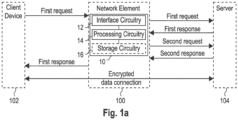
- Fig. 1a shows a schematic diagram of an example of an apparatus 10 or device 10 for a network element 100.
- the apparatus 10 comprises circuitry to provide the functionality of the apparatus 10.
- the circuitry of the apparatus 10 may be configured to provide the functionality of the apparatus 10.
- the apparatus 10 of Fig. 1a comprises interface circuitry 12, processing circuitry 14, (optional) storage circuitry 16 and (optional) memory circuitry 18.
- the processing circuitry 14 may be coupled with the interface circuitry 12, with the storage circuitry 16 and with the memory circuitry 18.
- the processing circuitry 14 may provide the functionality of the apparatus, in conjunction with the interface circuitry 12 (for exchanging information, e.g., with other components inside or outside the network element 100 comprising the apparatus or device 10, such as a client device 102 and a server 106), the storage circuitry 16 (for storing information, such as machine-readable instructions) and the memory circuitry 18 (for caching or buffering information).
- the device 10 may comprise means for providing the functionality of the device 10.
- the means may be configured to provide the functionality of the device 10.
- the components of the device 10 are defined as component means, which may correspond to, or implemented by, the respective structural components of the apparatus 10.
- the 1a comprises means for processing 14, which may correspond to or be implemented by the processing circuitry 14, means for communicating 12, which may correspond to or be implemented by the interface circuitry 12, (optional) means for storing information 16, which may correspond to or be implemented by the storage circuitry 16 and (optional) memory 18, which may correspond to or be implemented by the memory circuitry 18.
- the functionality of the processing circuitry 14 or means for processing 14 may be implemented by the processing circuitry 14 or means for processing 14 executing machine-readable instructions.
- any feature ascribed to the processing circuitry 14 or means for processing 14 may be defined by one or more instructions of a plurality of machine-readable instructions.
- the apparatus 10 or device 10 may comprise the machine-readable instructions, e.g., within the storage circuitry 16 or means for storing information 16.
- the processing circuitry 14 or means for processing 14 is to obtain a first request to establish an encrypted data connection between the client device 102 and the server 104 from the client device.
- the processing circuitry 14 or means for processing 14 is to forward the first request to the server.
- the processing circuitry 14 or means for processing 14 is to obtain a first response from the server, with the first response being based on the first request.
- the processing circuitry 14 or means for processing 14 is to provide a second request to establish an encrypted data connection to the server.
- the processing circuitry 14 or means for processing 14 is to obtain a second response from the server, with the second response being based on the second request.
- the processing circuitry 14 or means for processing 14 is to determine an application categorization for the encrypted data connection between the client device and the server based on the second response.
- the processing circuitry 14 or means for processing 14 is to handle the encrypted data connection between the client and the device based on the application categorization.
- Fig. 1a further shows the network element 100 comprising such an apparatus 10 or device 10, and a system comprising such a network element 10 and at least one of the client device 102 and the server 106.
- the network element may be a network element (or network element) performing a user-plane function in a 5G network.
- the network element may be one of a firewall, a load balancer, a security gateway, or a lawful interception entity (for lawfully intercepting network traffic).
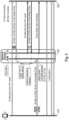
- Fig. 1b shows a flow chart of an example of a corresponding method for a network element, such as the network element 100.
- the method comprising obtaining 120 the first request to establish an encrypted data connection between the client device 102 and the server 104 from the client device.
- the method comprises forwarding 130 the first request to the server.
- the method comprises obtaining 135 the first response from the server, with the first response being based on the first request.
- the method comprises providing 160 the second request to establish an encrypted data connection to the server.
- the method comprises obtaining 165 the second response from the server, with the second response being based on the second request.
- the method comprises determining 170 the application categorization for the encrypted data connection between the client device and the server based on the second response.
- the method comprises handling 180 the encrypted data connection between the client and the device based on the application categorization.
- the method may be performed by the network element 100, e.g., by the apparatus 10 or device 10.
- the functionality of the apparatus 10, the device 10, the method and of a corresponding computer program is illustrated with respect to the apparatus 10.
- Features introduced in connection with the apparatus 10 may likewise be included in the corresponding device 10, method and computer program.
- Various examples of the present disclosure relate to application detection, which is the process of identifying the applications that are being used in a network. It can be done by examining network traffic or by analyzing network activity. Application detection is deemed important because it allows network administrators to determine which applications are in use, which can be used improve network performance, enforce security policies, and monitor network usage.
- application detection is being used as part of the 5G UPF.
- application detection is, for example, used for setting up or reusing communication bearers, applying Quality of Service (QoS) settings, and for charging functions.
- QoS Quality of Service
- application detection can also be performed by firewalls, load balancers, security gateways or lawful interception appliances.
- application detection is a technique that has long been performed, it is made more difficult by the use of encrypted data connection.
- transport encryption e.g., transport encryption based on Transport Layer Security (TLS) makes application detection harder.
- the encrypted data connection between the client device and the server may be a Transport Layer Security, TLS, encrypted data connection.
- TLS 1.3 has made it harder to perform application detection, as the TLS Server Certificate message, which was previously a clear-text message, and which is commonly used for application detection, is now encrypted as part of the TLS 1.3 handshake.
- the Server Name Indicator (SNI) of the Client Hello message, the Subject Common Name of the Server Certificate message and the Subject Alternative Name of the Server Certificate message are used for application detection.
- the Server Certificate message is now encrypted in TLS 1.3, which hinders extraction of the relevant fields.
- similar tendencies exist in other transport encryption schemes, so that the application of the proposed concept is not limited to TLS connections.
- the proposed concept is applied at time of connection establishment, i.e., when the client attempts to establish the encrypted data connection to the server.
- the relevant messages i.e., the first and second request, and the first and second response, are part of the handshake to establish the respective encrypted data connection.
- the first request and the second request may be TLS Client Hello handshake messages (or similar messages of other transport encryption protocols).
- the process starts by obtaining the first request to establish the encrypted data connection between the client device 102 and the server 104 from the client device, which triggers the application detection procedure.
- the client device 102 may be any type of device that communicated with the server 104 via the network element 100.
- the server 104 may be any kind of (physical or virtual) server or server function that offers to serve a functionality to client devices via encrypted data connection.
- the initial handshake message (after Transmission Control Protocol session establishment, see Fig. 4 ) of the TLS handshake may be intercepted to obtain the first request.
- the processing circuitry may intercept a handshake message of the TLS encrypted data connection to obtain the first request. Accordingly, as further shown in Fig.
- the method may comprise intercepting 110 the handshake message of the TLS encrypted data connection to obtain the first request. This may be done at layers 4/5 (transport layer/session layer) of the ISO/OSI model.
- the handshake message may be a layer five Secure Sockets Layer (SSL)/TLS, handshake message.
- SSL Secure Sockets Layer
- TLS Transport Layer Security
- the handshake message may be intercepted at layer 4 of the communication between the client device and the server.
- the processing circuitry may process the first request, in particular to extract the relevant information for preparing the subsequent second request, such as a destination internet protocol address, a destination port and a destination server name indicator (SNI) included in the first request.
- the first request is forwarded to the server, which may trigger setup of a session for the encrypted data connection between the client device 102 and the server 104 at the network element 100 (see session 43 in Figs. 4a-1 , 4a-2 , 4b ).
- the server responds with the first response, which is based on the first request.
- This first response may comprise one or more messages, such as, in TLS 1.3 communication, clear-text Server Hello and Server Change Cipher Spec messages, and encrypted Server Certificate, Server Certificate Verify and Server Finished.
- the Server Certificate message would be of interest for the purpose of application detection. However, since it is encrypted, it cannot be used for the purpose of application detection. In other words, the first response may be at least partially encrypted, and cannot be decrypted by the server entity.
- the TLS version used by the server 106 may be determined.
- the processing circuitry may determine a TLS version of the encrypted data connection, and to provide the second request if the TLS version matches a criterion. Accordingly, as shown in Fig.
- the method may comprise determining 140 a TLS version of the encrypted data connection, and providing the second request if the TLS version matches a criterion.
- the TLS version of the encrypted data connection may be determined based on the first response (e.g., based on the Server Change Cipher Spec message) and/or based on the first request (e.g., based on the Client Hello) message.
- the second request may be provided if the TLS version is at least TLS 1.3.
- Providing the second request and obtaining the second response may be foregone if the TLS version is at most TLS 1.2.
- the application categorization i.e., the application detection
- the application detection may be determined based on at least one of the first request and the first response.
- the second request is provided to the server 106.
- the second request may be based on the same TLS version as the first request. Accordingly, at least the second request may be based on TLS having a version of at least 1.3.
- the second request may be generated by "cloning" the first request.
- the processing circuitry may generate the second request based on at least one of (e.g., the combination of) the destination internet protocol address, the destination port and the destination server name indicator included in the first request, which have been extracted from the first request.
- a separate Transmission Control Protocol (TCP) and separate TLS session may be established between the network element 100 (e.g., the apparatus 10/device 10) and the server 104, which is separate from the TCP session and TLS session established between the client device 102 and the server 104.
- TCP Transmission Control Protocol
- a separate TCP connection and a separate encrypted data connection may be established for providing the second request and obtaining the second response.
- the determination of the application categorization for the encrypted data connection between the client device and the server may be based on the separate encrypted data connection.
- this connection is also denoted “child connection” or “child TLS session”, with the TCP connection/TLS session between the client device and the server being the "parent connection” or “parent TLS session”.
- the encrypted data connection between the network element 100 (e.g., the apparatus 10/device 10) and the server 104 is different from the encrypted data connection between the client device 102 and the server 104.
- the term encrypted data connection may refer to the TLS session between the respective entities.
- the second response is obtained (e.g., received) from the server 104, which is based on the second request.
- This second response is similar to the first response (in terms of messages contained therein, see Figs. 3 and 4a-1 , 4a-2 ).
- the processing circuitry is to determine the application categorization for the encrypted data connection between the client device and the server based on the second response.
- the processing circuitry may determine the application categorization for the encrypted data connection between the client device and the server based on a server certificate (e.g., the TLS Server Certificate message) included in the second response.
- a server certificate e.g., the TLS Server Certificate message
- the processing circuitry may determine the application categorization for the encrypted data connection between the client device and the server based on a subject common name and/or subject alternative name of the server certificate included in the second response.
- the processing circuitry may (gracefully) close the encrypted data connection between the network element 100 (e.g., apparatus 10/device 10) and the server 104.
- the first response may then be forwarded to the client device based on the application categorization (e.g., handled according to the application categorization). Accordingly, as shown in Fig. 1b , the method may comprise forwarding 190 the first response based on the application categorization.
- the second response may also be used to determine the authenticity of the server.
- the processing circuitry may determine the authenticity of the server based on the second response, e.g., by checking/validating the server certificate.
- caching may be used.
- the processing circuitry may cache the application categorization for a given combination of two or more of the destination internet protocol address, the destination port and the destination server name indicator (e.g., combination of internet protocol address and server name indicator, or internet protocol address, port and server name indicator) included in the first request using memory circuitry 18 of the apparatus 10.
- the method may comprise caching 175 the application categorization for a given combination of two or more of the destination internet protocol address, the destination port and the destination server name indicator included in the first request using memory circuitry.
- the application categorization of subsequently established encrypted data connections may be determined (further) based on the cached application categorization (e.g., to avoid having to establish the child connection).
- the application categorization may be desirable to know the application categorization before any payload data is transmitted via the encrypted data connection, e.g., for bearer management or for charging the traffic. Therefore, establishment of the encrypted data connection between the client device 102 and the server 104 may be delayed by the network element 100 (e.g., the apparatus 10/device 10), by forwarding the first response only after the application categorization is determined and the encrypted data connection can be handled accordingly. To avoid loss of data, the packets/messages transmitted by the server 104 may be buffered by the network element 100 (e.g., apparatus 10), e.g., using the memory 18 of the network element 100/apparatus 10.
- the network element 100 e.g., apparatus 10
- the processing circuitry may buffer the first response, and forward the first response after determining the application categorization.
- the method may comprise buffering 150 the first response, and forwarding 190 the first response after determining the application categorization. More generally, the processing circuitry may buffer and/or delay the delivery of messages of the server provided for the client device until the application categorization is determined. Accordingly, the method may comprise buffering and/or delaying 150 the delivery of messages of the server provided for the client device until the application categorization is determined.
- the messages/packets can be unbuffered (i.e., forwarded, removed from the buffer after they have been sent on), without alterations. Accordingly, as shown in Fig. 1b , the method may comprise unbuffering 158 messages provided by the server for the client device once the application categorization is determined without altering the messages.
- both the client device 102 and the server 104 may become confused, as both client and server expect responses by the respective other parties within a pre-defined time interval. If the setup of the child connection and determination of the application categorization takes longer than this time interval, both the client device 102 and the server 104 may attempt to retransmit their respective messages, as they assume that packet loss has occurred. When the respective messages finally arrive after buffering, the timeouts or retransmission may be at odds with the forwarded messages. For this reason, some additional measures may be taken. For example, to avoid timeouts, additional acknowledgement message(s) may be provided by the network element 100 (e.g., apparatus 10/device 10).
- the processing circuitry may provide one or more additional acknowledgement messages to at least one of the client and the server while buffering the first response to avoid a TCP timeout or retransmission at at least one of the client and the server.
- the method may comprise providing 152 one or more additional acknowledgement messages to at least one of the client and the server while buffering the first response to avoid a TCP timeout or retransmission at at least one of the client and the server.
- ACK acknowledgenowledgement
- the processing circuitry may detect duplicate messages sent between the client and the server while and after buffering the first response and filter the duplicate messages to avoid degradation of a TCP state machine at at least one of the client and the server.
- the method may comprise detecting 154 duplicate messages sent between the client and the server while and after buffering the first response and filtering 156 the duplicate messages to avoid degradation of a TCP state machine at at least one of the client and the server. For example, in Fig. 4 , this is shown in connection with the ACK (acknowledgement) message sent at 415.
- the processing circuitry then handles the encrypted data connection between the client and the device based on the application categorization. While handling the encrypted data connection, the integrity of the encrypted data connection may be preserved, as the network element 100 has been able to determine the application categorization without decrypting the encrypted data connection. Accordingly, the processing circuitry may handle the encrypted data connection without decrypting the encrypted data connection.
- various parameters of the underlying data connection e.g., TCP connection, bearer
- the act of handling the encrypted data connection may comprise applying one or more data connection parameters to the encrypted data connection between the client and the server based on the application categorization.
- the one or more data connection parameters may be selected based on the application categorization.
- the act of handling the encrypted data connection may comprise selecting at least one of a connection bearer, a Quality of Service, QoS, setting, and a charging function (primarily relevant for the context of 5G UPF) for the subsequent communication based on the application categorization.
- the interface circuitry 12 or means for communicating 12 may correspond to one or more inputs and/or outputs for receiving and/or transmitting information, which may be in digital (bit) values according to a specified code, within a module, between modules or between modules of different entities.
- the interface circuitry 12 or means for communicating 12 may comprise circuitry configured to receive and/or transmit information.
- the processing circuitry 14 or means for processing 14 may be implemented using one or more processing units, one or more processing devices, any means for processing, such as a processor, a computer or a programmable hardware component being operable with accordingly adapted software.
- any means for processing such as a processor, a computer or a programmable hardware component being operable with accordingly adapted software.
- the described function of the processing circuitry 14 or means for processing may as well be implemented in software, which is then executed on one or more programmable hardware components.
- Such hardware components may comprise a general-purpose processor, a Digital Signal Processor (DSP), a micro-controller, etc.
- DSP Digital Signal Processor
- the storage circuitry 16 or means for storing information 16 may comprise at least one element of the group of a computer readable storage medium, such as a magnetic or optical storage medium, e.g., a hard disk drive, a flash memory, Floppy-Disk, Random Access Memory (RAM), Programmable Read Only Memory (PROM), Erasable Programmable Read Only Memory (EPROM), an Electronically Erasable Programmable Read Only Memory (EEPROM), or a network storage.
- a computer readable storage medium such as a magnetic or optical storage medium, e.g., a hard disk drive, a flash memory, Floppy-Disk, Random Access Memory (RAM), Programmable Read Only Memory (PROM), Erasable Programmable Read Only Memory (EPROM), an Electronically Erasable Programmable Read Only Memory (EEPROM), or a network storage.
- a computer readable storage medium such as a magnetic or optical storage medium, e.g., a hard disk drive, a flash memory, Floppy-Disk, Random Access Memory (RAM), Programm
- the memory circuitry 18 may be random access memory, such as dynamic random-access memory (DRAM), e.g., DRAM being part of a Dual Inline Memory Module (DIMM) or DRAM being part of High Bandwidth Memory.
- DRAM dynamic random-access memory
- DIMM Dual Inline Memory Module
- the memory circuitry 18 may be persistent memory, e.g., persistent memory being part of a DIMM.
- the apparatus, device, method, computer program, network entity and system may comprise one or more additional optional features corresponding to one or more aspects of the proposed concept, or one or more examples described above or below.
- Various examples of the present disclosure relate to a mechanism for decrypting and decoding server certificate in TLS 1.3 by a MIM (man in the middle) user-plane function for the purpose of application detection.
- MIM man in the middle
- the proposed concept provides a methodology for evaluating an encrypted part of a TLS 1.3 (or later) connection handshake for the purposes of identifying the application or servers that the connection will be established to.
- the proposed concept may negate the need to establish a form of full forward proxy by the entity attempting to do application detection. It may further negate the need to install trust certificates for the entity doing application detection on all client machines. Moreover, no attempt is made to degrade the security level of the original TLS session.
- the proposed concept provides a means for performing application detection on TLS 1.3. It may be detected using network interface monitoring (e.g., using Wireshark).
- the proposed concept allows for application detection to be performed by a network element, without comprising the security of the connection.
- Year on year more traffic across the internet is encrypted using TLS 1.3 (or later), so the proposed concept is a valuable mechanism for providers wishing to perform application Detection on their network traffic.
- the proposed concept While an area of focus of the proposed concept is the 3GPP 5G UPF, the proposed concept has broader applications in the areas of firewalls, load balancers, security gateways and lawful interception.
- identifiers present in the handshake phase of the connection establishment that can indicate what the service is or where the connection is being established to. This forms a fundamental part of "application detection".
- these identifiers are contained, for example, in the following fields: In the Server Name Indicator (SNI) of the Client Hello message, in the Subject Common Name of the Server Certificate message and in the Subject Alternative Name of the Server Certificate message.
- SNI Server Name Indicator
- the Server Certificate message is "in cleartext", i.e., it is not encrypted while travelling through the network, and therefore these identifiers may be extracted by a Network Element (NE), also denoted network element in connection with Figs. 1a to 1b , doing "Application Detection".
- NE Network Element
- the handshake is encrypted and by the time the Server Certificate is sent, the NE doing Application Detection has no means to view the required identifiers within the Server Certificate message.
- Fig. 2 shows a diagram of a conventional communication between a TLS 1.3 client and a TLS server via a network element.
- Fig. 2 shows a client device 210 (e.g., a smartphone), a network element 220, which includes an application detection management (ADM) functionality and a TLS functionality, and a server 230.
- the client device 210 sends a Client Hello message (according to tls:// ⁇ sni> ⁇ IP (Internet Protocol address)>: ⁇ port>) to the server 230, of which the ADM functionality intercepts and stores the SNI (Server Name Indicator).
- SNI Server Name Indicator
- the server 230 responds with the clear-text Server Hello, and Server Change Cipher Spec messages, and with encrypted Server Certificate, Server Certificate Verify and Server Finished messages (indicated by the cursive font). As the Server Certificate message is encrypted, no application detection can be performed.
- the client device 210 responds with the clear-text Client Change Cipher Spec message and the encrypted Client Finished message, followed by an exchange of payload between the client device 210 and the server 230.
- a duplicate TLS connection to the same server is created with the NE as the client in the communication.
- the NE can decode the Server Certificate information as it uses the Certificate as part of the connection establishment.
- Fig. 3 shows a diagram of a communication between a TLS 1.3 client and a TLS server via a network element according to an example of the proposed concept.
- Fig. 3 also a client device 310, a network element 320, which includes an ADM functionality and a TLS functionality, and a server 230.
- the client device 310 sends a Client Hello message (e.g., the first request discussed in connection with Figs. 1a and/or 1b) according to tls:// ⁇ sni> ⁇ IP>: ⁇ port>) to the server 330, of which the ADM intercepts and stores the SNI (Server Name Indicator).
- SNI Server Name Indicator
- the server 330 responds with the clear-text Server Hello, and Server Change Cipher Spec messages, and with encrypted Server Certificate, Server Certificate Verify and Server Finished messages (which may comprise the first response).
- the ADM functionality verifies that the TLS version is 1.3 (or later), e.g., based on the clear-text Server Change Cipher Spec message and buffers the packets/messages.
- the Network Element 320 uses relevant information from the original Client Hello, namely the destination IP address, (optionally) the destination TCP port, and the Server Name Indicator to create a child duplicate connection to the server.
- the TLS functionality then creates the child connection, using the same tls:// ⁇ sni> ⁇ IP>: ⁇ port> (e.g., the second request) that was used by the client device 310 to establish the parent connection.
- the server 330 responds with the clear-text Server Hello, and Server Change Cipher Spec messages, and with encrypted Server Certificate, Server Certificate Verify and Server Finished messages (e.g., the second response).
- the ADM functionality uses the Server Certificate message of the child connection to perform application detection. In this manner, using the information obtained in the decrypted child connection, the NE can apply the result of the "Application Detection" from the child connection to the original connection.
- the ADM applies the results of the application detection, and un-buffers the packets, forwarding the Server Hello, Server Change Cipher Spec, Server Certificate, Server Certificate Verify and Server Finished messages of the parent connection (e.g., the first response) to the client device 310.
- the client device 310 responds with the clear-text Client Change Cipher Spec message and the encrypted Client Finished message, followed by an exchange of payload between the client device 310 and the server 330.
- mapping of SNI to server certificate is guaranteed to be the same between subsequent certificate downloads while the certificate is still valid (according to RFC (Request for Comments) 8446), so the information obtained in the "child" connection is valid and usable for the parent connection.
- the proposed concept negates the need for a full forward proxy, does not compromise the security of the connection between client and server, does not require a trust certificate to be installed on client machines, and saves a large amount of compute and accelerator resources.
- Fig. 3 shows a high-level flow diagram of the Network Element in the middle, which does Application Detection, and which pauses the flow between the client device and the server and resumes it after application detection through its included TLS library.
- TCP Transmission Control Protocol
- the TCP connection some additional actions may be taken, which are described in the following and in connection with Figs. 4a-1 , 4a-2 and 4b , which includes the corresponding TCP stream sequences along with TLS handshake events.
- the NE may take care of the TCP_ACK of the byte streams transmitted from either end.
- the receipt of the Server Hello and subsequent packets/streams may be acknowledged by a MITM App (42 in Figs. 4a-1 , 4a-2 and 4b ) to the server end point to stop retransmission from the server.
- a MITM App 42 in Figs. 4a-1 , 4a-2 and 4b
- the Client Hello stream nay be acknowledged, too, by the MITM App, using a separate ACK only event.
- a reordering of multiple streams may be done for Hello detection and other subsequent packets, and necessary acknowledgements may be transmitted.
- any TCP ACKs generated by the client for which ACKs are generated may be dropped to stop any sequence mismatch at the server end point.
- a graceful closure of the child flow may be performed to clear the TLS context resources used.
- Other abnormal state changes like RST (Reset), FIN (Finished) during flow pause state may be handled properly, including corner cases.
- RST Reset
- FIN Finished
- Figs. 4a-1 , 4a-2 and 4b show a more detailed diagram of a communication between a TLS 1.3 client and a TLS server via a network element according to an example of the present disclosure.
- a TCP SYN packet is sent by a TLS 1.3 Client 41 to a TLS Server 46.
- a TCP SYN_ACK packet is sent by the TLS Server 46 to the TLS 1.3 Client 41.
- a session 43 is established by Man-In-The-Middle (MITM) App 42.
- MITM App 42 may, in combination with Helper TLS library 44, correspond to or be implemented by the apparatus 10 or device 10 introduced in connection with Figs. 1a to 1b .
- an ACK packet is sent by the TLS 1.3 Client 41 to the TLS Server 46.
- a TLS 1.3 Client Hello is sent by the TLS 1.3 Client 41 to the TLS Server 46, based on cryptographic certificate (a).
- a CH ACK packet is sent by the TLS Server 46 to the TLS 1.3 Client 41.
- a TLS 1.3 Server Hello message sent by the TLS Server 46 is intercepted by the session 43 of the MITM app 42, and a timer is started (e.g., for 100 msec) for reassembling and buffering, as the MITM App 42 cannot decrypt the server-finished handshake.
- the Server Hello packet (and subsequent packets) is/are buffered by the MITM app 42.
- all packets may be buffered (until timer expiry) if the Server Hello is correct or until the event returns.
- a Change Cipher Spec message by the TLS Server 46 is intercepted by the session 43 of the MITM app 42 and buffered.
- an ACK packet is sent by the MITM App 42 to the TLS 1.3 Client 41 (e.g., if the TLS Server 46 sent out a CH ACK).
- the TCP_ACK may be created (on behalf of client Internet Protocol Port) for the last byte received.
- a Server Certificate, Certificate Verify message which is based on cryptographic certificate (b), by the TLS Server 46 is intercepted by the session 43 of the MITM app 42 and buffered.
- a Finished message by the TLS Server 46 is intercepted by the session 43 of the MITM app 42 and buffered.
- SAN Server Alternative Name
- WK Server Name Indication
- a TCP SYN packet is sent by the session 45 of the TLS library 44 to the TLS Server 46, thereby establishing a separate session 47 at the TLS Server 46.
- TCP SYN_ACK packet is sent by session 47 at the TLS Server 46 to session 45 at the helper TLS library 44.
- an ACK packet is sent by session 45 at the helper TLS library 44 to session 47 at the TLS Server 46.
- a TLS 1.3 Client Hello message is sent by session 45 at the helper TLS library 44 to session 47 at the TLS Server 46, based on cryptographic certificate (c).
- an ACK packet is sent by session 47 at the TLS Server 46 to session 45 at the helper TLS library 44.
- a TLS 1.3 Server Hello message is sent by session 47 at the TLS Server 46 to session 45 at the helper TLS library 44, based on cryptographic certificate (d).
- a Change Cipher Spec message is sent by session 47 at the TLS Server 46 to session 45 at the helper TLS library 44.
- a Server Certificate message is sent by session 47 at the TLS Server 46 to session 45 at the helper TLS library 44.
- the Server Certificate information (with the Server Alternative Name as cleartext) with Wk core information is returned asynchronously to the session 43 at the MITM App 42.
- a Finished message is sent by session 47 at the TLS Server 46 to session 45 at the helper TLS library 44.
- the Helper TLS library 44 can clean up the child TLS session.
- an optional Certificate Verified message at 4111, a Finished message, at 4112, an Alert(close_notify) message is sent by session 45 at the helper TLS library 44 to session 47 at the TLS Server 46.
- the session 47 at TLS Server 46 responds with a TCP FIN_ACK packet at 4114 and a TCP_FIN packet at 4115, followed by an ACK at 4116 sent by session 45 at Helper TLS library 44. After that, sessions 45 and 47 are terminated.
- the Server Certificate message sent at 4108 Based on the Server Certificate message sent at 4108, application detection is performed, a corresponding policy is applied, and the buffered packets are flushed to the TLS Client 41 as is.
- the TLS 1.3 Server Hello, Change Cipher Spec, Server Certificate, Certificate Verify and Finished messages received at 406, 407, 409 and 410 are unbuffered and forwarded, by the session 43 at the MITM App 42 by the TLS 1.3 Client 41 at 411, 412, 413 and 414.
- an ACK packet is optionally sent by TLS 1.3 Client 41 and discarded (e.g., filtered out) by session 43 at the MITM App 42 if the session 43 has already sent an ACK message after receiving the Finished message at 410 (indicated by the dotted line below the Finished message at 410).
- Fig. 4b (which continues the flow of Figs. 4a-1 , 4a-2 , albeit without showing the MITM App 42 and the Helper TLS library 44), at 416, a Client Certificate Verified, Finished message, and, at 417, a Client Application Data message is sent by TLS 1.3 Client 41 to TLS Server 46, which responds with Server Application Data 418.
- session 43 at MITM App 42 persists during the communication at 416-418 between the TLS 1.3 Client 41 and the TLS Server 46.
- the mechanism for decrypting and decoding server certificate in TLS 1.3 by a MIM user-plane function may comprise one or more additional optional features corresponding to one or more aspects of the proposed concept, or one or more examples described above or below.
- Examples may further be or relate to a (computer) program including a program code to execute one or more of the above methods when the program is executed on a computer, processor, or other programmable hardware component.
- steps, operations, or processes of different ones of the methods described above may also be executed by programmed computers, processors or other programmable hardware components.
- Examples may also cover program storage devices, such as digital data storage media, which are machine-, processor- or computer-readable and encode and/or contain machine-executable, processor-executable or computer-executable programs and instructions.
- Program storage devices may include or be digital storage devices, magnetic storage media such as magnetic disks and magnetic tapes, hard disk drives, or optically readable digital data storage media, for example.
- Other examples may also include computers, processors, control units, (field) programmable logic arrays ((F)PLAs), (field) programmable gate arrays ((F)PGAs), graphics processor units (GPU), application-specific integrated circuits (ASICs), integrated circuits (ICs) or system-on-a-chip (SoCs) systems programmed to execute the steps of the methods described above.
- FPLAs field programmable logic arrays
- F field) programmable gate arrays
- GPU graphics processor units
- ASICs application-specific integrated circuits
- ICs integrated circuits
- SoCs system-on-a-chip
- aspects described in relation to a device or system should also be understood as a description of the corresponding method.
- a block, device or functional aspect of the device or system may correspond to a feature, such as a method step, of the corresponding method.
- aspects described in relation to a method shall also be understood as a description of a corresponding block, a corresponding element, a property or a functional feature of a corresponding device or a corresponding system.
- module refers to logic that may be implemented in a hardware component or device, software or firmware running on a processing unit, or a combination thereof, to perform one or more operations consistent with the present disclosure.
- Software and firmware may be embodied as instructions and/or data stored on non-transitory computer-readable storage media.
- circuitry can comprise, singly or in any combination, non-programmable (hardwired) circuitry, programmable circuitry such as processing units, state machine circuitry, and/or firmware that stores instructions executable by programmable circuitry.
- Modules described herein may, collectively or individually, be embodied as circuitry that forms a part of a computing system. Thus, any of the modules can be implemented as circuitry.
- a computing system referred to as being programmed to perform a method can be programmed to perform the method via software, hardware, firmware, or combinations thereof.
- any of the disclosed methods can be implemented as computer-executable instructions or a computer program product. Such instructions can cause a computing system or one or more processing units capable of executing computer-executable instructions to perform any of the disclosed methods.
- the term "computer” refers to any computing system or device described or mentioned herein.
- the term "computer-executable instruction” refers to instructions that can be executed by any computing system or device described or mentioned herein.
- the computer-executable instructions can be part of, for example, an operating system of the computing system, an application stored locally to the computing system, or a remote application accessible to the computing system (e.g., via a web browser). Any of the methods described herein can be performed by computer-executable instructions performed by a single computing system or by one or more networked computing systems operating in a network environment. Computer-executable instructions and updates to the computer-executable instructions can be downloaded to a computing system from a remote server.
- implementation of the disclosed technologies is not limited to any specific computer language or program.
- the disclosed technologies can be implemented by software written in C++, C#, Java, Perl, Python, JavaScript, Adobe Flash, C#, assembly language, or any other programming language.
- the disclosed technologies are not limited to any particular computer system or type of hardware.
- any of the software-based examples can be uploaded, downloaded, or remotely accessed through a suitable communication means.
- suitable communication means include, for example, the Internet, the World Wide Web, an intranet, cable (including fiber optic cable), magnetic communications, electromagnetic communications (including RF, microwave, ultrasonic, and infrared communications), electronic communications, or other such communication means.
Landscapes
- Engineering & Computer Science (AREA)
- Computer Security & Cryptography (AREA)
- Computer Networks & Wireless Communication (AREA)
- Signal Processing (AREA)
- Computer Hardware Design (AREA)
- Computing Systems (AREA)
- General Engineering & Computer Science (AREA)
- Data Exchanges In Wide-Area Networks (AREA)
Applications Claiming Priority (1)
| Application Number | Priority Date | Filing Date | Title |
|---|---|---|---|
| US18/308,699 US20230262033A1 (en) | 2023-04-28 | 2023-04-28 | Apparatus, Device, Method, and Computer Program for a Network Element |
Publications (1)
| Publication Number | Publication Date |
|---|---|
| EP4456479A1 true EP4456479A1 (de) | 2024-10-30 |
Family
ID=87558245
Family Applications (1)
| Application Number | Title | Priority Date | Filing Date |
|---|---|---|---|
| EP23216333.7A Pending EP4456479A1 (de) | 2023-04-28 | 2023-12-13 | Vorrichtung, vorrichtung, verfahren und computerprogramm für ein netzwerkelement |
Country Status (3)
| Country | Link |
|---|---|
| US (1) | US20230262033A1 (de) |
| EP (1) | EP4456479A1 (de) |
| CN (1) | CN118869229A (de) |
Citations (3)
| Publication number | Priority date | Publication date | Assignee | Title |
|---|---|---|---|---|
| US7778194B1 (en) * | 2004-08-13 | 2010-08-17 | Packeteer, Inc. | Examination of connection handshake to enhance classification of encrypted network traffic |
| US20160119374A1 (en) * | 2014-10-28 | 2016-04-28 | International Business Machines Corporation | Intercepting, decrypting and inspecting traffic over an encrypted channel |
| US20220086691A1 (en) * | 2018-12-21 | 2022-03-17 | Telefonaktiebolaget Lm Ericsson (Publ) | User Data Traffic Handling |
-
2023
- 2023-04-28 US US18/308,699 patent/US20230262033A1/en active Pending
- 2023-12-13 EP EP23216333.7A patent/EP4456479A1/de active Pending
- 2023-12-15 CN CN202311741386.7A patent/CN118869229A/zh active Pending
Patent Citations (3)
| Publication number | Priority date | Publication date | Assignee | Title |
|---|---|---|---|---|
| US7778194B1 (en) * | 2004-08-13 | 2010-08-17 | Packeteer, Inc. | Examination of connection handshake to enhance classification of encrypted network traffic |
| US20160119374A1 (en) * | 2014-10-28 | 2016-04-28 | International Business Machines Corporation | Intercepting, decrypting and inspecting traffic over an encrypted channel |
| US20220086691A1 (en) * | 2018-12-21 | 2022-03-17 | Telefonaktiebolaget Lm Ericsson (Publ) | User Data Traffic Handling |
Also Published As
| Publication number | Publication date |
|---|---|
| CN118869229A (zh) | 2024-10-29 |
| US20230262033A1 (en) | 2023-08-17 |
Similar Documents
| Publication | Publication Date | Title |
|---|---|---|
| US11483292B2 (en) | Engagement and disengagement of transport layer security proxy services with encrypted handshaking | |
| US10686889B2 (en) | Fastpath web sessions with HTTP header modification by redirecting clients | |
| US10419348B2 (en) | Efficient intercept of connection-based transport layer connections | |
| US9553892B2 (en) | Selective modification of encrypted application layer data in a transparent security gateway | |
| De Vivo et al. | Internet vulnerabilities related to TCP/IP and T/TCP | |
| US11979457B2 (en) | Managing network services using multipath protocols | |
| US12101385B2 (en) | Systems and methods for reducing server load with HTTPS cache | |
| Atutxa et al. | Improving efficiency and security of IIoT communications using in-network validation of server certificate | |
| CN114095195B (zh) | 用于安全套接字层代理的自适应控制的方法、网络设备以及非瞬态计算机可读介质 | |
| CN114386054B (zh) | 用于消息存储处理和安全认证的控制方法、系统和介质 | |
| Teyssier et al. | An empirical approach to evaluate the resilience of quic protocol against handshake flood attacks | |
| US10958625B1 (en) | Methods for secure access to services behind a firewall and devices thereof | |
| CN109802928A (zh) | 一种ssl/tls代理方法、装置、设备及存储介质 | |
| KR101971995B1 (ko) | 보안을 위한 보안 소켓 계층 복호화 방법 | |
| EP4456479A1 (de) | Vorrichtung, vorrichtung, verfahren und computerprogramm für ein netzwerkelement | |
| CN115603994A (zh) | 一种可信通信方法、装置、设备及存储介质 | |
| van Drueten et al. | Security analysis of DTLS 1.2 implementations | |
| CN113810380A (zh) | 代理层次切换方法、系统、可读存储介质及计算机设备 | |
| US20240171608A1 (en) | Method, Apparatus and computer readable storage medium for processing data of a security protocol | |
| Wei et al. | The defect of DTLS toward detected aged packets | |
| Dropmann | A Performance Analysis of HTTP/3 over QUIC versus HTTP/2 under Variable Network Conditions | |
| 임상원 | DNS-Accelerated TLS: From 0-RTT to Post-Quantum | |
| Gin | Building a Secure Short Duration Transaction Network | |
| HK40074491B (en) | Managing network services using multipath protocols | |
| HK40074491A (en) | Managing network services using multipath protocols |
Legal Events
| Date | Code | Title | Description |
|---|---|---|---|
| PUAI | Public reference made under article 153(3) epc to a published international application that has entered the european phase |
Free format text: ORIGINAL CODE: 0009012 |
|
| STAA | Information on the status of an ep patent application or granted ep patent |
Free format text: STATUS: THE APPLICATION HAS BEEN PUBLISHED |
|
| AK | Designated contracting states |
Kind code of ref document: A1 Designated state(s): AL AT BE BG CH CY CZ DE DK EE ES FI FR GB GR HR HU IE IS IT LI LT LU LV MC ME MK MT NL NO PL PT RO RS SE SI SK SM TR |
|
| STAA | Information on the status of an ep patent application or granted ep patent |
Free format text: STATUS: REQUEST FOR EXAMINATION WAS MADE |
|
| 17P | Request for examination filed |
Effective date: 20250430 |
|
| GRAP | Despatch of communication of intention to grant a patent |
Free format text: ORIGINAL CODE: EPIDOSNIGR1 |
|
| STAA | Information on the status of an ep patent application or granted ep patent |
Free format text: STATUS: GRANT OF PATENT IS INTENDED |
|
| INTG | Intention to grant announced |
Effective date: 20260204 |