EP4456072A2 - Memory access latency estimation method and memory access latency estimation system for estimating an access latency of a memory according to a plurality of coefficients and a plurality of indexes - Google Patents
Memory access latency estimation method and memory access latency estimation system for estimating an access latency of a memory according to a plurality of coefficients and a plurality of indexes Download PDFInfo
- Publication number
- EP4456072A2 EP4456072A2 EP24172130.7A EP24172130A EP4456072A2 EP 4456072 A2 EP4456072 A2 EP 4456072A2 EP 24172130 A EP24172130 A EP 24172130A EP 4456072 A2 EP4456072 A2 EP 4456072A2
- Authority
- EP
- European Patent Office
- Prior art keywords
- memory
- indexes
- coefficients
- latency
- access
- Prior art date
- Legal status (The legal status is an assumption and is not a legal conclusion. Google has not performed a legal analysis and makes no representation as to the accuracy of the status listed.)
- Pending
Links
Images



Classifications
-
- G—PHYSICS
- G11—INFORMATION STORAGE
- G11C—STATIC STORES
- G11C29/00—Checking stores for correct operation ; Subsequent repair; Testing stores during standby or offline operation
- G11C29/02—Detection or location of defective auxiliary circuits, e.g. defective refresh counters
- G11C29/028—Detection or location of defective auxiliary circuits, e.g. defective refresh counters with adaption or trimming of parameters
-
- G—PHYSICS
- G06—COMPUTING OR CALCULATING; COUNTING
- G06F—ELECTRIC DIGITAL DATA PROCESSING
- G06F3/00—Input arrangements for transferring data to be processed into a form capable of being handled by the computer; Output arrangements for transferring data from processing unit to output unit, e.g. interface arrangements
- G06F3/06—Digital input from, or digital output to, record carriers, e.g. RAID, emulated record carriers or networked record carriers
- G06F3/0601—Interfaces specially adapted for storage systems
- G06F3/0602—Interfaces specially adapted for storage systems specifically adapted to achieve a particular effect
- G06F3/0625—Power saving in storage systems
-
- G—PHYSICS
- G06—COMPUTING OR CALCULATING; COUNTING
- G06F—ELECTRIC DIGITAL DATA PROCESSING
- G06F13/00—Interconnection of, or transfer of information or other signals between, memories, input/output devices or central processing units
- G06F13/14—Handling requests for interconnection or transfer
- G06F13/16—Handling requests for interconnection or transfer for access to memory bus
- G06F13/1605—Handling requests for interconnection or transfer for access to memory bus based on arbitration
- G06F13/161—Handling requests for interconnection or transfer for access to memory bus based on arbitration with latency improvement
-
- G—PHYSICS
- G06—COMPUTING OR CALCULATING; COUNTING
- G06F—ELECTRIC DIGITAL DATA PROCESSING
- G06F13/00—Interconnection of, or transfer of information or other signals between, memories, input/output devices or central processing units
- G06F13/14—Handling requests for interconnection or transfer
- G06F13/16—Handling requests for interconnection or transfer for access to memory bus
- G06F13/1605—Handling requests for interconnection or transfer for access to memory bus based on arbitration
- G06F13/1652—Handling requests for interconnection or transfer for access to memory bus based on arbitration in a multiprocessor architecture
- G06F13/1657—Access to multiple memories
-
- G—PHYSICS
- G06—COMPUTING OR CALCULATING; COUNTING
- G06F—ELECTRIC DIGITAL DATA PROCESSING
- G06F3/00—Input arrangements for transferring data to be processed into a form capable of being handled by the computer; Output arrangements for transferring data from processing unit to output unit, e.g. interface arrangements
- G06F3/06—Digital input from, or digital output to, record carriers, e.g. RAID, emulated record carriers or networked record carriers
- G06F3/0601—Interfaces specially adapted for storage systems
- G06F3/0628—Interfaces specially adapted for storage systems making use of a particular technique
- G06F3/0653—Monitoring storage devices or systems
-
- G—PHYSICS
- G06—COMPUTING OR CALCULATING; COUNTING
- G06F—ELECTRIC DIGITAL DATA PROCESSING
- G06F3/00—Input arrangements for transferring data to be processed into a form capable of being handled by the computer; Output arrangements for transferring data from processing unit to output unit, e.g. interface arrangements
- G06F3/06—Digital input from, or digital output to, record carriers, e.g. RAID, emulated record carriers or networked record carriers
- G06F3/0601—Interfaces specially adapted for storage systems
- G06F3/0668—Interfaces specially adapted for storage systems adopting a particular infrastructure
- G06F3/0671—In-line storage system
- G06F3/0673—Single storage device
-
- G—PHYSICS
- G11—INFORMATION STORAGE
- G11C—STATIC STORES
- G11C29/00—Checking stores for correct operation ; Subsequent repair; Testing stores during standby or offline operation
- G11C29/02—Detection or location of defective auxiliary circuits, e.g. defective refresh counters
- G11C29/023—Detection or location of defective auxiliary circuits, e.g. defective refresh counters in clock generator or timing circuitry
Definitions
- a memory e.g. DRAM
- the waiting time of a processor will be longer, increasing the power consumption of the processor.
- the access latency may be reduced, but it will increase the power consumption of the memory. Since the access latency of the memory is related to the power consumption, it is helpful for managing power consumption to estimate the access latency correctly. However, it is a challenge to estimate and control the access latency of the memory, and a solution for controlling the access latency is still in need in the field.
- the memory access latency estimation method includes measuring a first access latency of a first access operation of a first memory; measuring a plurality of first indexes of the first memory corresponding to the first access operation, using a plurality of first coefficients and the plurality of first indexes to perform a first weighted calculation to generate a first estimated latency, adjusting the plurality of first coefficients to generate a plurality of updated first coefficients, using the plurality of updated first coefficients and the plurality of first indexes to perform the first weighted calculation to adjust the first estimated latency for the first estimated latency to approximate the first access latency, and using the plurality of updated first coefficients and a plurality of second indexes of the first memory to perform a second weighted calculation to generate a second estimated latency for a second access operation. Number and types of the plurality of first indexe
- Another embodiment provides a memory access latency estimation system including a first monitor, a plurality of second monitors and a processor.
- the first monitor is used to measure a first access latency of a first access operation of a first memory.
- the plurality of second monitors are used to measuring a plurality of first indexes of the first memory corresponding to the first access operation.
- the processor is used to use a plurality of first coefficients and the plurality of first indexes to perform a first weighted calculation to generate a first estimated latency, adjust the plurality of first coefficients to generate a plurality of updated first coefficients in order to use the plurality of updated first coefficients and the plurality of first indexes to perform the first weighted calculation to adjust the first estimated latency for the first estimated latency to approximate the first access latency, and use the plurality of updated first coefficients and a plurality of second indexes of the first memory to perform a second weighted calculation to generate a second estimated latency for a second access operation.
- Number and types of the plurality of first indexes are the same as number and types of the plurality of second indexes, the plurality of second indexes are corresponding to the second access operation, and the first access operation precedes the second access operation.
- Another embodiment provides a memory access latency estimation method, including measuring a plurality of first indexes of a first memory, measuring a plurality of second indexes of a second memory, obtaining a relationship between the plurality of first indexes of the first memory and the plurality of second indexes of the second memory, and generating a plurality of second coefficients for the second memory according to the relationship and a plurality of first coefficients of the first memory.
- the plurality of second coefficients are used to estimate an access latency of the second memory, and number and the types of the plurality of first indexes are the same as number and types of the plurality of second indexes.
- a bandwidth may be an amount of data transmitted per unit time. The larger the bandwidth, the more data may be transmitted per unit time.
- an asterisk i.e. *
- a neural network model or a machine learning model may include hardware and software integrated in a model and used for machine learning.
- a neural network model may include a convolutional neural network (CNN), a recurrent neural network (RNN), a deep neural network (DNN) and/or a proper neural network model.
- FIG.1 illustrates a memory access latency estimation system 100 for controlling a first memory 105 according to an embodiment.
- the memory access latency estimation system 100 may include a monitor 110, a plurality of monitors 120 and a processor 130.
- the monitor 110 may measure an access latency L1 of an access operation of the first memory 105.
- the monitors 120 may measure a plurality of indexes I11 to I1n of the first memory 105 corresponding to the access operation.
- the access latency L1 is an actual latency obtained by measurement instead of by estimation.
- the processor 130 may use a plurality of coefficients C11 to C1n and the indexes I11 to I1n to perform a weighted calculation to generate an estimated latency LE1.
- the weighted calculation may be expressed as the following equation eq-1.
- LE 1 C 11 * I 11 + C 12 * I 12 + ... + C 1 n * I 1 n
- the processor 130 may adjust the coefficients C11 to C1n to generate a plurality of updated coefficients C11' to C1n' in order to use the updated coefficients C11' to C1n' and the indexes I11 to I1n to perform the weighted calculation to adjust the estimated latency LE1 to generate an updated estimated latency LE1' for the updated estimated latency LE1' to approximate the access latency L1.
- the weighted calculation with the updated coefficients C11' to C1n' may be expressed as the following equation eq-2.
- LE 1 ′ C 11 ′ * I 11 + C 12 ′ * I 12 + ... + C 1 n ′ * I 1 n
- the updated coefficients C11' to C1n' may be further adjusted by a machine learning model (e.g. neural network model) of the processor 130 to further adjust the updated estimated latency LE1' for the updated estimated latency LE1' to be closer to the access latency L1.
- the updated coefficients C1 1' to C1n' may be adjusted and improved recursively to adjust the updated estimated latency LE1' to be closer to the actual access latency L1.
- the updated coefficients C11' to C1n' may be used to generate an estimated latency for the first memory 105.
- the processor 130 may use the updated coefficients C11' to C1n' and a plurality of indexes I21 to I2n of the first memory 105 to perform a weighted calculation to generate an estimated latency LE2 for a later access operation.
- the weighted calculation may be expressed as the following equation eq-3.
- LE 2 C 11 ′ * I 21 + C 12 ′ * I 22 + ... + C 1 n ′ * I 2 n
- the estimated latency LE2 is an estimated latency instead of an actual latency obtained through measurement.
- the estimated latency LE2 corresponding to the access operation may be generated before an actual latency is measured.
- the estimated latency LE2 may be used by the processor 130 to manage and reduce the power consumption of the later access operation of the first memory 105.
- an actual latency of the new access operation may be measured, for example, by the monitor 110.
- the updated coefficients C1 1' to C1n' may be further adjusted and improved according to the estimated latency LE2 and the actual latency of the later access operation to adjust the result of the equations eq-3 to be closer to the actual latency. Hence, subsequent estimations will be more accurate with the updated coefficients.
- the adjustment of the coefficients and the related calculations may be performed using the neural network model in the processor 130.
- the number and the types of the indexes I11 to I1n may be the same as the number and the types of the indexes I21 to I2n.
- the access operation with the latency L1 may precede the later access operation.
- the updated coefficients (e.g. C11' to C1n') may be used to generate the estimated latency LE2 for the later access operation to improve power management and controls related to data accessing of the first memory 105.
- the types of the indexes I11 to I1n and the indexes I21 to I2n will be described below.
- an access latency of a second memory 205 may be estimated according to the result of optimizing the estimation of the access latency for the first memory 105.
- FIG.2 illustrates a memory access latency estimation system 200 for controlling the first memory 105 and a second memory 205 according to another embodiment.
- the first memory 105, the monitor 110 and the monitors 120 may be similar to that in FIG. 1 .
- the memory access latency estimation system 200 may further include a monitor 210 and a plurality of monitors 220.
- the monitor 210 may measure an access latency L2 of an access operation of the second memory 205.
- the monitors 220 may measure a plurality of indexes 131 to I3n of the second memory 205 corresponding to the access operation of the second memory 205.
- the processor 130 may further use the foresaid updated coefficients C11' to C1n' (corresponding to the first memory 105) and the indexes I31 to I3n (corresponding to the second memory 205) to perform an weighted calculation to generate an estimated latency LE3 for the second memory 205, and weighted calculation may be expressed as the following equation eq-4.
- LE 3 C 11 ′ * I 31 + C 12 ′ * I 32 + ... + C 1 n ′ * I 3 n
- the processor 130 may adjust the updated coefficients C11' to C1n' to generate a plurality of coefficients C21 to C2n. Then, the processor 130 may use the coefficients C21 to C2n and the indexes I31 to I3n to perform the weighted calculation (e.g. eq-4) to adjust the estimated latency LE3 to approximate the access latency L2, and the calculation may be expressed as the following equation eq-5.
- LE 3 ′ C 21 * I 31 + C 22 * I 32 + ... + C 2 n * I 3 n
- the estimated latency LE3' may be generated using the coefficients C21 to C2n, and the estimated latency LE3' may be closer to the access latency L2 (i.e. actual latency) than the estimated latency LE3.
- the processor 130 may obtain and store a relationship between the updated coefficients C11' to C1n' and the coefficients C21 to C2n.
- the updated coefficients C1 1' to C1n' are corresponding to the first memory 105, and the coefficients C21 to C2n are corresponding to the second memory 205.
- the relationship may be expressed as a function f(), and the relationship between the updated coefficients C1 1' to C1n' and the coefficients C21 to C2n may be expressed as the following equation eq-6.
- f C 11 ′ , C 12 ′ , C 13 ′ , ... , C 1 n ′ C 21 , C 22 , ... , C 2 n
- the processor 130 may estimate a group of coefficients corresponding to the second memory 205 according to a group of coefficients corresponding to the first memory 105 and the relationship f().
- the coefficients for estimating the latency of the first memory 105 in the first chip may be converted to the coefficients for estimating the latency of the second memory 205 in the second chip.
- the coefficients for estimating the latency of the second memory 205 in the second chip may be further adjusted to be more accurate. As a result, resources used for generating the coefficients for estimating the access latency of the second memory 205 are reduced.
- the processor 130, the monitors 110, 120, 210 and 220 may be implemented using hardware such as circuits. Appropriate software and/or firmware may be installed in the processor 130, and the monitors 110, 120, 210 and 220 to perform related operations.
- the first memory 105 and the second memory 205 may be dynamic random-access memories, such as DDR (double data rate) memories.
- the processor 130 may include a central processing unit (CPU), a graphic processing unit (GPU), a tensor processing unit (TPU), a neural network processing unit (NPU), an application specific integrated circuit (ASIC), a deep learning processing unit (DPU), a vector processing unit (VPU), a microprocessor, a micro controller unit (MCU) and/or an appropriate processing unit.
- At least one of the indexes may include a bandwidth of a corresponding memory (e.g. the first memory 105 or the second memory 205).
- At least one of the indexes may include a reciprocal of an operation frequency of a corresponding memory (e.g. the first memory 105 or the second memory 205).
- At least one of the indexes may include a reciprocal of an operation frequency of an interface for a corresponding memory (e.g. the first memory 105 or the second memory 205).
- the interface may include an external memory interface (EMI).
- At least one of the indexes may include a reciprocal of a parameter corresponding to a transaction priority of a corresponding memory (e.g. the first memory 105 or the second memory 205).
- a transaction priority of a memory may refer to the priority levels assigned to memory operations in a system, and it may determine the order in which different tasks or processes access memory resources, ensuring that more critical or time-sensitive operations take precedence.
- At least one of the indexes may include a parameter corresponding to variety of access patterns of a corresponding memory (e.g. the first memory 105 or the second memory 205).
- a memory access pattern may be the pattern with which a system or program reads and writes a memory.
- At least one of the indexes may include a squared value of the bandwidth of a corresponding memory (e.g. the first memory 105 or the second memory 205).
- At least one of the indexes may include a ratio of a frequency of a corresponding memory (e.g. the first memory 105 or the second memory 205) to a frequency of an interface.
- the frequency of the memory may be a frequency of a DDR (double data rate) memory
- the frequency of the interface may be a frequency of an external memory interface (EMI).
- At least one of the indexes may include the square of a ratio of the frequency of a corresponding memory to the frequency of an interface.
- At least one of the indexes may include a ratio of a first value to a second value, the first value is a smaller one of the number of read operations and the number of write operations, and the second value is a larger one of the number of read operations and the number of write operations.
- the access latency may be longer since the operation mode of the memory should be switched frequently.
- the access latency may be shorter since the operation mode of the memory is less switched.
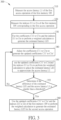
- FIG.3 illustrates a flowchart of a memory access latency estimation method 300 for the memory access latency estimation system 100 in FIG. 1 according to an embodiment.
- the memory access latency estimation method 300 may include the following steps.
- Step 310 to Step 355 the processor 130 may perform optimization to generate the updated coefficients C11' to C1n' to make the estimated access latency closer to the actual access latency.
- Step 355 may be omitted.
- the updated coefficients C11' to C1n' may be used to generate the estimated latency LE2 for the second access operation of the first memory 105 before the actual access latency is measured, and the estimated latency LE2 may be used to control the memory 105 and manage the power consumption.
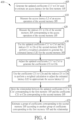
- FIG.4 illustrates a flowchart of a memory access latency estimation method 400 for the memory access latency estimation system 200 in FIG.2 according to another embodiment.
- the method 400 may include the following steps.
- Step 405 may include Step 310 to Step 355 of FIG.1 to generate and optimize the updated coefficients C1 1' to C1n' used to estimate the access latency of the first memory 105.
- Step 440 and Step 450 may be performed repeatedly to adjust the coefficients C21 to C2n until a difference of the generated estimated access latency (e.g. LE3) and the actual access latency L2 is smaller than a threshold.
- the neural network model in the processor 130 may be used to analyze and generate the relationship (e.g. the abovementioned function f()).
- the function e.g.
- the function f()) of the relationship may be generated according to a posterior probability and/or linear regression using a machine learning model and/or a neural network model of the processor 130.
- the relationship e.g. the function f()
- the relationship may be applied to find the group of coefficients corresponding to the second memory 205 for estimating the access latency for the second memory 205.
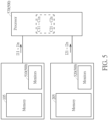
- FIG.5 illustrates a memory access latency estimation system 500 for controlling the first memory 105 and a second memory 205 according to another embodiment.
- the memory access latency estimation system 500 can include monitors 510, monitors 520 and a processor 570.
- FIG.6 is a flowchart of a memory access latency estimation method 600 for the memory access latency estimation system 500 in FIG.5 .
- the memory access latency estimation method 600 may include the following steps.
- the memory 105 can be embedded in a first chip, and the second memory 205 can be embedded in a second chip.
- the coefficients for estimating the latency of the first memory 105 in the first chip may be converted to the coefficients for estimating the latency of the second memory 205 in the second chip.
- a known formula can be used to calculate the access latency of the first memory 105.
- number and types of the indexes I11 to I1n can be fixed.
- the coefficients C11 to C1n, which are used to calculate the access latency of the first memory 105 have been optimized and are now fixed.
- This formula can be applied for a weighted calculation, for instance, the calculation like C11*I11+C12*I12+...+ C1n*I1n to generate the access latency of the first memory 105.
- the monitors 510 can measure the first memory 105 to generate the indexes I11 to I1n.
- the characteristics of the first memory 105 can be measured according to the indexes I11 to I1n.
- the monitors 520 can measure the second memory 205 to generate the indexes I21 to I2n.
- the characteristics of the second memory 205 can be measured according to the indexes I21 to I2n.
- the relationship can correspond to a mapping between the characteristics of the first memory 105 and the second memory 205.
- a neural network model in the processor 570 may be used to analyze and generate the relationship between the indexes I11 to I1n (of the first memory 105) and the indexes I21 to I2n (of the second memory 205).
- the relationship may be a function generated according to a posterior probability and/or linear regression using a machine learning model and/or a neural network model of the processor 570.
- the relationship in Step 630 can be expressed as a function and a formula.
- the number and the types of the indexes I11 to I1n can be the same as the number and types of the indexes I21 to I2n.
- Step 640 the coefficients C21 to C2n for the second memory 205 can be generated according to the known coefficients C11 to C1n of the first memory 105 and the relationship obtained in Step 630.
- the coefficients C21 to C2n can be used to estimate the access latency of the second memory 205.
- the coefficients C21 to C2n and a group of measured indexes I21' to I2n' of the second memory 205 can be used to perform a weighted calculation to estimate the access latency of the second memory 205.
- the estimated access latency of the second memory 205 can be generated with a formula such as C21 *I21' + C22*I22' + ... + C2n*I2n'.
- an access latency of an access operation of a memory may be estimated.
- the coefficients for estimating the access latency for the second memory 205 may be generated according known coefficients for the first memory 105.
- the coefficients for estimating the access latency of the second memory 205 can be generated according known coefficients for the first memory 105.
- the effort for calculating the coefficients for the second memory 205 is effectively reduced.
- an improved solution for estimating memory access latency is provided based on machine learning and neural network model, and it is helpful for power management to reduce the power consumption.
Landscapes
- Engineering & Computer Science (AREA)
- Theoretical Computer Science (AREA)
- Physics & Mathematics (AREA)
- General Engineering & Computer Science (AREA)
- General Physics & Mathematics (AREA)
- Human Computer Interaction (AREA)
- Debugging And Monitoring (AREA)
- Techniques For Improving Reliability Of Storages (AREA)
Abstract
Description
- This application claims the benefit of
U.S. Provisional Application No. 63/498,029, filed on April 25th, 2023 - When accessing a memory (e.g. DRAM), if the access latency of the memory is longer, the waiting time of a processor will be longer, increasing the power consumption of the processor. If the accessing frequency of memory is increased, the access latency may be reduced, but it will increase the power consumption of the memory. Since the access latency of the memory is related to the power consumption, it is helpful for managing power consumption to estimate the access latency correctly. However, it is a challenge to estimate and control the access latency of the memory, and a solution for controlling the access latency is still in need in the field.
- Methods and a memory access latency estimation system according to the invention are defined in the independent claims. The dependent claims define preferred embodiments thereof. An embodiment provides a memory access latency estimation method. The memory access latency estimation method includes measuring a first access latency of a first access operation of a first memory; measuring a plurality of first indexes of the first memory corresponding to the first access operation, using a plurality of first coefficients and the plurality of first indexes to perform a first weighted calculation to generate a first estimated latency, adjusting the plurality of first coefficients to generate a plurality of updated first coefficients, using the plurality of updated first coefficients and the plurality of first indexes to perform the first weighted calculation to adjust the first estimated latency for the first estimated latency to approximate the first access latency, and using the plurality of updated first coefficients and a plurality of second indexes of the first memory to perform a second weighted calculation to generate a second estimated latency for a second access operation. Number and types of the plurality of first indexes are the same as number and types of the plurality of second indexes, the plurality of second indexes are corresponding to the second access operation, and the first access operation precedes the second access operation.
- Another embodiment provides a memory access latency estimation system including a first monitor, a plurality of second monitors and a processor. The first monitor is used to measure a first access latency of a first access operation of a first memory. The plurality of second monitors are used to measuring a plurality of first indexes of the first memory corresponding to the first access operation. The processor is used to use a plurality of first coefficients and the plurality of first indexes to perform a first weighted calculation to generate a first estimated latency, adjust the plurality of first coefficients to generate a plurality of updated first coefficients in order to use the plurality of updated first coefficients and the plurality of first indexes to perform the first weighted calculation to adjust the first estimated latency for the first estimated latency to approximate the first access latency, and use the plurality of updated first coefficients and a plurality of second indexes of the first memory to perform a second weighted calculation to generate a second estimated latency for a second access operation. Number and types of the plurality of first indexes are the same as number and types of the plurality of second indexes, the plurality of second indexes are corresponding to the second access operation, and the first access operation precedes the second access operation.
- Another embodiment provides a memory access latency estimation method, including measuring a plurality of first indexes of a first memory, measuring a plurality of second indexes of a second memory, obtaining a relationship between the plurality of first indexes of the first memory and the plurality of second indexes of the second memory, and generating a plurality of second coefficients for the second memory according to the relationship and a plurality of first coefficients of the first memory. The plurality of second coefficients are used to estimate an access latency of the second memory, and number and the types of the plurality of first indexes are the same as number and types of the plurality of second indexes.
- These and other objectives of the present invention will no doubt become obvious to those of ordinary skill in the art after reading the following detailed description of the preferred embodiment that is illustrated in the various figures and drawings.
-
-
FIG.1 illustrates a memory access latency estimation system for controlling a first memory according to an embodiment. -
FIG.2 illustrates a memory access latency estimation system for controlling the first memory and a second memory according to another embodiment. -
FIG.3 illustrates a flowchart of a memory access latency estimation method for the memory access latency estimation system inFIG. 1 according to an embodiment. -
FIG.4 illustrates a flowchart of a method for the memory access latency estimation system inFIG.2 according to another embodiment. -
FIG.5 illustrates a memory access latency estimation system for controlling the first memory and a second memory according to another embodiment. -
FIG.6 illustrates a flowchart of a memory access latency estimation method for the memory access latency estimation system inFIG.5 . - In the text, a bandwidth may be an amount of data transmitted per unit time. The larger the bandwidth, the more data may be transmitted per unit time. In the text, an asterisk (i.e. *) may be the multiplication sign. In the text, a neural network model or a machine learning model may include hardware and software integrated in a model and used for machine learning. For example, a neural network model may include a convolutional neural network (CNN), a recurrent neural network (RNN), a deep neural network (DNN) and/or a proper neural network model.
-
FIG.1 illustrates a memory accesslatency estimation system 100 for controlling afirst memory 105 according to an embodiment. The memory accesslatency estimation system 100 may include amonitor 110, a plurality ofmonitors 120 and aprocessor 130. - The
monitor 110 may measure an access latency L1 of an access operation of thefirst memory 105. Themonitors 120 may measure a plurality of indexes I11 to I1n of thefirst memory 105 corresponding to the access operation. Here, the access latency L1 is an actual latency obtained by measurement instead of by estimation. - The
processor 130 may use a plurality of coefficients C11 to C1n and the indexes I11 to I1n to perform a weighted calculation to generate an estimated latency LE1. The weighted calculation may be expressed as the following equation eq-1.
- The
processor 130 may adjust the coefficients C11 to C1n to generate a plurality of updated coefficients C11' to C1n' in order to use the updated coefficients C11' to C1n' and the indexes I11 to I1n to perform the weighted calculation to adjust the estimated latency LE1 to generate an updated estimated latency LE1' for the updated estimated latency LE1' to approximate the access latency L1. The weighted calculation with the updated coefficients C11' to C1n' may be expressed as the following equation eq-2.
- The updated coefficients C11' to C1n' may be further adjusted by a machine learning model (e.g. neural network model) of the
processor 130 to further adjust the updated estimated latency LE1' for the updated estimated latency LE1' to be closer to the access latency L1. The updated coefficients C1 1' to C1n' may be adjusted and improved recursively to adjust the updated estimated latency LE1' to be closer to the actual access latency L1. - After the updated coefficients C11' to C1n' are generated, the updated coefficients C11' to C1n'may be used to generate an estimated latency for the
first memory 105. - The
processor 130 may use the updated coefficients C11' to C1n' and a plurality of indexes I21 to I2n of thefirst memory 105 to perform a weighted calculation to generate an estimated latency LE2 for a later access operation. The weighted calculation may be expressed as the following equation eq-3.
- Here, the estimated latency LE2 is an estimated latency instead of an actual latency obtained through measurement. The estimated latency LE2 corresponding to the access operation may be generated before an actual latency is measured. The estimated latency LE2 may be used by the
processor 130 to manage and reduce the power consumption of the later access operation of thefirst memory 105. - After the later access operation is completed, an actual latency of the new access operation may be measured, for example, by the
monitor 110. The updated coefficients C1 1' to C1n' may be further adjusted and improved according to the estimated latency LE2 and the actual latency of the later access operation to adjust the result of the equations eq-3 to be closer to the actual latency. Hence, subsequent estimations will be more accurate with the updated coefficients. In the process, the adjustment of the coefficients and the related calculations may be performed using the neural network model in theprocessor 130. - In the process, the number and the types of the indexes I11 to I1n may be the same as the number and the types of the indexes I21 to I2n. The access operation with the latency L1 may precede the later access operation. The updated coefficients (e.g. C11' to C1n') may be used to generate the estimated latency LE2 for the later access operation to improve power management and controls related to data accessing of the
first memory 105. The types of the indexes I11 to I1n and the indexes I21 to I2n will be described below. - After the updated coefficients C1 1' to C1n' for the
first memory 105 are obtained, an access latency of asecond memory 205 may be estimated according to the result of optimizing the estimation of the access latency for thefirst memory 105. -
FIG.2 illustrates a memory accesslatency estimation system 200 for controlling thefirst memory 105 and asecond memory 205 according to another embodiment. InFIG.2 , thefirst memory 105, themonitor 110 and themonitors 120 may be similar to that inFIG. 1 . Compared to the memory accesslatency estimation system 100, the memory accesslatency estimation system 200 may further include amonitor 210 and a plurality ofmonitors 220. - The
monitor 210 may measure an access latency L2 of an access operation of thesecond memory 205. Themonitors 220 may measure a plurality ofindexes 131 to I3n of thesecond memory 205 corresponding to the access operation of thesecond memory 205. - The
processor 130 may further use the foresaid updated coefficients C11' to C1n' (corresponding to the first memory 105) and the indexes I31 to I3n (corresponding to the second memory 205) to perform an weighted calculation to generate an estimated latency LE3 for thesecond memory 205, and weighted calculation may be expressed as the following equation eq-4.
- The
processor 130 may adjust the updated coefficients C11' to C1n' to generate a plurality of coefficients C21 to C2n. Then, theprocessor 130 may use the coefficients C21 to C2n and the indexes I31 to I3n to perform the weighted calculation (e.g. eq-4) to adjust the estimated latency LE3 to approximate the access latency L2, and the calculation may be expressed as the following equation eq-5.
- In the equation eq-5, the estimated latency LE3' may be generated using the coefficients C21 to C2n, and the estimated latency LE3' may be closer to the access latency L2 (i.e. actual latency) than the estimated latency LE3.
- After generating the coefficients C21 to C2n, the
processor 130 may obtain and store a relationship between the updated coefficients C11' to C1n' and the coefficients C21 to C2n. The updated coefficients C1 1' to C1n'are corresponding to thefirst memory 105, and the coefficients C21 to C2n are corresponding to thesecond memory 205. The relationship may be expressed as a function f(), and the relationship between the updated coefficients C1 1' to C1n' and the coefficients C21 to C2n may be expressed as the following equation eq-6.
- After obtaining the relationship (i.e. the function f()) between the coefficients for the first memory 105 (e.g. C11' to C1n') and the coefficients for the second memory 205 (e.g. C21 to C2n), the
processor 130 may estimate a group of coefficients corresponding to thesecond memory 205 according to a group of coefficients corresponding to thefirst memory 105 and the relationship f(). - For example, if a first chip having the
first memory 105 is modified and upgraded to design a second chip having thesecond memory 205, the coefficients for estimating the latency of thefirst memory 105 in the first chip may be converted to the coefficients for estimating the latency of thesecond memory 205 in the second chip. Optionally, the coefficients for estimating the latency of thesecond memory 205 in the second chip may be further adjusted to be more accurate. As a result, resources used for generating the coefficients for estimating the access latency of thesecond memory 205 are reduced. - The
processor 130, themonitors processor 130, and themonitors first memory 105 and thesecond memory 205 may be dynamic random-access memories, such as DDR (double data rate) memories. Theprocessor 130 may include a central processing unit (CPU), a graphic processing unit (GPU), a tensor processing unit (TPU), a neural network processing unit (NPU), an application specific integrated circuit (ASIC), a deep learning processing unit (DPU), a vector processing unit (VPU), a microprocessor, a micro controller unit (MCU) and/or an appropriate processing unit. - Regarding the indexes I11 to I1n, the indexes I21 to I2n, and the
indexes 131 to I3n, at least one of the indexes may include a bandwidth of a corresponding memory (e.g. thefirst memory 105 or the second memory 205). - Regarding the indexes I11 to I1n, the indexes I21 to I2n, and the
indexes 131 to I3n, at least one of the indexes may include a reciprocal of an operation frequency of a corresponding memory (e.g. thefirst memory 105 or the second memory 205). - Regarding the indexes I11 to I1n, the indexes I21 to I2n, and the
indexes 131 to I3n, at least one of the indexes may include a reciprocal of an operation frequency of an interface for a corresponding memory (e.g. thefirst memory 105 or the second memory 205). For example, the interface may include an external memory interface (EMI). - Regarding the indexes I11 to I1n, the indexes I21 to I2n, and the
indexes 131 to I3n, at least one of the indexes may include a reciprocal of a parameter corresponding to a transaction priority of a corresponding memory (e.g. thefirst memory 105 or the second memory 205). A transaction priority of a memory may refer to the priority levels assigned to memory operations in a system, and it may determine the order in which different tasks or processes access memory resources, ensuring that more critical or time-sensitive operations take precedence. - Regarding the indexes I11 to I1n, the indexes I21 to I2n, and the
indexes 131 to I3n, at least one of the indexes may include a parameter corresponding to variety of access patterns of a corresponding memory (e.g. thefirst memory 105 or the second memory 205). In computer engineering, a memory access pattern may be the pattern with which a system or program reads and writes a memory. - Regarding the indexes I11 to I1n, the indexes I21 to I2n, and the
indexes 131 to I3n, at least one of the indexes may include a squared value of the bandwidth of a corresponding memory (e.g. thefirst memory 105 or the second memory 205). - Regarding the indexes I11 to I1n, the indexes I21 to I2n, and the
indexes 131 to I3n, at least one of the indexes may include a ratio of a frequency of a corresponding memory (e.g. thefirst memory 105 or the second memory 205) to a frequency of an interface. For example, the frequency of the memory may be a frequency of a DDR (double data rate) memory, and the frequency of the interface may be a frequency of an external memory interface (EMI). - Regarding the indexes I11 to I1n, the indexes I21 to I2n, and the
indexes 131 to I3n, at least one of the indexes may include the square of a ratio of the frequency of a corresponding memory to the frequency of an interface. - Regarding the indexes I11 to I1n, the indexes I21 to I2n, and the
indexes 131 to I3n, at least one of the indexes may include a ratio of a first value to a second value, the first value is a smaller one of the number of read operations and the number of write operations, and the second value is a larger one of the number of read operations and the number of write operations. In other words, when the number of write operations is close to the number of read operations, the access latency may be longer since the operation mode of the memory should be switched frequently. When one of the number of read operations and the number of write operations is much greater than the other, the access latency may be shorter since the operation mode of the memory is less switched. -
FIG.3 illustrates a flowchart of a memory accesslatency estimation method 300 for the memory accesslatency estimation system 100 inFIG. 1 according to an embodiment. The memory accesslatency estimation method 300 may include the following steps. - Step 310: measure the access latency L1 of the first access operation of the
first memory 105; - Step 320: measure the indexes I11 to I1n of the
first memory 105 corresponding to the first access operation; - Step 330: use the coefficients C11 to C1n and the indexes I11 to I1n to perform a weighted calculation to generate the estimated latency LE1;
- Step 340: adjust the coefficients C11 to C1n to generate the updated coefficients C11' to C1n';
- Step 350: use the updated coefficients C11' to C1n'and the indexes I11 to I1n to perform the weighted calculation to adjust the estimated latency LE1 to approximate the access latency L1;
- Step 355: determine if the difference of the estimated latency LE1 and the access latency L1 is smaller than a threshold? If so, enter
Step 360; otherwise, enterStep 340; and - Step 360: use the updated coefficients C1 1' to C1n' and the indexes I21 to I2n of the
first memory 105 to perform the weighted calculation to generate the estimated latency LE2 for the second access operation. - In
Step 310 to Step 355, theprocessor 130 may perform optimization to generate the updated coefficients C11' to C1n' to make the estimated access latency closer to the actual access latency. Optionally,Step 355 may be omitted. InStep 360, the updated coefficients C11' to C1n' may be used to generate the estimated latency LE2 for the second access operation of thefirst memory 105 before the actual access latency is measured, and the estimated latency LE2 may be used to control thememory 105 and manage the power consumption. -
FIG.4 illustrates a flowchart of a memory accesslatency estimation method 400 for the memory accesslatency estimation system 200 inFIG.2 according to another embodiment. Themethod 400 may include the following steps. - Step 405: generate the updated coefficients C11' to C1n' used to estimate an access latency for the
first memory 105; - Step 410: measure the access latency L2 of an access operation of the
second memory 205; - Step 420: measure the indexes I31 to I3n of the
second memory 205 corresponding to the access operation of thesecond memory 205; - Step 430: use the updated coefficients C11' to C1n' and the indexes I31 to I3n of the
second memory 205 to perform a weighted calculation to generate the estimated latency LE3 for thesecond memory 205; - Step 440: adjust the updated coefficients C11' to C1n' to generate the coefficients C21 to C2n;
- Step 450: use the coefficients C21 to C2n and the indexes I31 to I3n to perform a weighted calculation to adjust the estimated latency LE3 to approximate the access latency L2;
- Step 460: store the relationship (e.g. the abovementioned f()) between the updated coefficients C11' to C1n' corresponding to the
first memory 105 and the coefficients C21 to C2n corresponding to thesecond memory 205; and - Step 470: estimate a group of coefficients corresponding to the
second memory 205 according to another group of coefficients corresponding to thefirst memory 105 and the relationship. - Step 405 may include
Step 310 to Step 355 ofFIG.1 to generate and optimize the updated coefficients C1 1' to C1n' used to estimate the access latency of thefirst memory 105. Optionally,Step 440 andStep 450 may be performed repeatedly to adjust the coefficients C21 to C2n until a difference of the generated estimated access latency (e.g. LE3) and the actual access latency L2 is smaller than a threshold. InStep 460, the neural network model in theprocessor 130 may be used to analyze and generate the relationship (e.g. the abovementioned function f()). InStep 460, the function (e.g. the function f()) of the relationship may be generated according to a posterior probability and/or linear regression using a machine learning model and/or a neural network model of theprocessor 130. InStep 470, the relationship (e.g. the function f()) may be applied to find the group of coefficients corresponding to thesecond memory 205 for estimating the access latency for thesecond memory 205. -
FIG.5 illustrates a memory accesslatency estimation system 500 for controlling thefirst memory 105 and asecond memory 205 according to another embodiment. The memory accesslatency estimation system 500 can includemonitors 510, monitors 520 and aprocessor 570.FIG.6 is a flowchart of a memory accesslatency estimation method 600 for the memory accesslatency estimation system 500 inFIG.5 . The memory accesslatency estimation method 600 may include the following steps. - Step 610: measure a plurality of indexes I11 to I1n of a
first memory 105; - Step 620: measure a plurality of indexes I21 to I2n of a
second memory 205; - Step 630: obtain a relationship between the indexes I11 to I1n of the
first memory 105 and the indexes I21 to I2n of thesecond memory 205; and - Step 640:generate a plurality of coefficients C21 to C2n for the
second memory 205 according to the relationship and a plurality of coefficients C11 to C1n for thefirst memory 105. - In
FIG.5 andFIG.6 , thememory 105 can be embedded in a first chip, and thesecond memory 205 can be embedded in a second chip. For example, if the first chip is modified and upgraded to design the second chip, the coefficients for estimating the latency of thefirst memory 105 in the first chip may be converted to the coefficients for estimating the latency of thesecond memory 205 in the second chip. - Prior to Step 610, a known formula can be used to calculate the access latency of the
first memory 105. In this formula, number and types of the indexes I11 to I1n can be fixed. In this formula, the coefficients C11 to C1n, which are used to calculate the access latency of thefirst memory 105, have been optimized and are now fixed. This formula can be applied for a weighted calculation, for instance, the calculation like C11*I11+C12*I12+...+ C1n*I1n to generate the access latency of thefirst memory 105. - In
Step 610, themonitors 510 can measure thefirst memory 105 to generate the indexes I11 to I1n. The characteristics of thefirst memory 105 can be measured according to the indexes I11 to I1n. - In
Step 620, themonitors 520 can measure thesecond memory 205 to generate the indexes I21 to I2n. The characteristics of thesecond memory 205 can be measured according to the indexes I21 to I2n. - In
Step 630, the relationship can correspond to a mapping between the characteristics of thefirst memory 105 and thesecond memory 205. - In
Step 630, a neural network model in theprocessor 570 may be used to analyze and generate the relationship between the indexes I11 to I1n (of the first memory 105) and the indexes I21 to I2n (of the second memory 205). InStep 630, the relationship may be a function generated according to a posterior probability and/or linear regression using a machine learning model and/or a neural network model of theprocessor 570. The relationship inStep 630 can be expressed as a function and a formula. - The number and the types of the indexes I11 to I1n can be the same as the number and types of the indexes I21 to I2n.
- In
Step 640, the coefficients C21 to C2n for thesecond memory 205 can be generated according to the known coefficients C11 to C1n of thefirst memory 105 and the relationship obtained inStep 630. - After obtaining the coefficients C21 to C2n, the coefficients C21 to C2n can be used to estimate the access latency of the
second memory 205. The coefficients C21 to C2n and a group of measured indexes I21' to I2n' of thesecond memory 205 can be used to perform a weighted calculation to estimate the access latency of thesecond memory 205. For example, the estimated access latency of thesecond memory 205 can be generated with a formula such as C21 *I21' + C22*I22' + ... + C2n*I2n'. - In summary, with the memory access
latency estimation system 100 and the memory accesslatency estimation method 300, an access latency of an access operation of a memory may be estimated. With the memory accesslatency estimation system 200 and the memory accesslatency estimation method 400, the coefficients for estimating the access latency for thesecond memory 205 may be generated according known coefficients for thefirst memory 105. With the memory accesslatency estimation system 500 and the memory accesslatency estimation method 600, the coefficients for estimating the access latency of thesecond memory 205 can be generated according known coefficients for thefirst memory 105. Hence, the effort for calculating the coefficients for thesecond memory 205 is effectively reduced. Hence, an improved solution for estimating memory access latency is provided based on machine learning and neural network model, and it is helpful for power management to reduce the power consumption. - Those skilled in the art will readily observe that numerous modifications and alterations of the device and method may be made while retaining the teachings of the invention. Accordingly, the above disclosure should be construed as limited only by the metes and bounds of the appended claims.
Claims (15)
- A memory access latency estimation method, comprising:measuring a first access latency of a first access operation of a first memory (310);measuring a plurality of first indexes of the first memory corresponding to the first access operation (320);using a plurality of first coefficients and the plurality of first indexes to perform a first weighted calculation to generate a first estimated latency (330);adjusting the plurality of first coefficients to generate a plurality of updated first coefficients (340);using the plurality of updated first coefficients and the plurality of first indexes to perform the first weighted calculation to adjust the first estimated latency for the first estimated latency to approximate the first access latency (350); andusing the plurality of updated first coefficients and a plurality of second indexes of the first memory to perform a second weighted calculation to generate a second estimated latency for a second access operation (360);wherein number and types of the plurality of first indexes are the same as number and types of the plurality of second indexes, the plurality of second indexes are corresponding to the second access operation, and the first access operation precedes the second access operation.
- The method of claim 1, further comprising:determining if a difference of the first estimated latency and the first access latency is smaller than a threshold (355); andif the difference is not smaller than the threshold, adjusting the plurality of updated first coefficients to adjust the first estimated latency to be closer to the first access latency and reduce the difference (340).
- The method of claim 1 or 2, wherein at least one of the plurality of first indexes comprises a bandwidth of the first memory.
- The method of any one of claims 1 to 3, wherein at least one of the plurality of first indexes comprises a reciprocal of an operation frequency of the first memory; and/or wherein at least one of the plurality of first indexes comprises a reciprocal of an operation frequency of an interface for the first memory.
- The method of any one of claims 1 to 4, wherein at least one of the plurality of first indexes comprises a reciprocal of a parameter corresponding to a transaction priority.
- The method of any one of claims 1 to 5, wherein at least one of the plurality of first indexes comprises a parameter corresponding to variety of access patterns.
- The method of any one of claims 1 to 6, wherein at least one of the plurality of first indexes comprises a squared value of the bandwidth of the first memory.
- The method of any one of claims 1 to 7, wherein at least one of the plurality of first indexes comprises a ratio of a frequency of the first memory to a frequency of an interface.
- The method of any one of claims 1 to 8, wherein at least one of the plurality of first indexes comprises square of a ratio of a frequency of the first memory to a frequency of an interface.
- The method of any one of claims 1 to 9, wherein at least one of the plurality of first indexes comprises a ratio of a first value to a second value, the first value is a smaller one of a number of read operations and a number of write operations, and the second value is a larger one of the number of read operations and the number of write operations.
- The method of any one of claims 1 to 10, further comprising:measuring a second access latency of a third access operation of a second memory (410);measuring a plurality of third indexes of the second memory corresponding to the third access operation (420);using the plurality of updated first coefficients and the plurality of third indexes to perform a third weighted calculation to generate a third estimated latency (430);adjusting the plurality of updated first coefficients to generate a plurality of second coefficients (440);using the plurality of second coefficients and the plurality of third indexes to perform the third weighted calculation to adjust the third estimated latency for the third estimated latency to approximate the second access latency (450);storing a relationship between the plurality of updated first coefficients corresponding to the first memory and the plurality of second coefficients corresponding to the second memory (460); andestimating a group of coefficients corresponding to the second memory according to another group of coefficients corresponding to the first memory and the relationship (470);wherein the number and the types of the plurality of first indexes are the same as number and types of the plurality of third indexes.
- A memory access latency estimation system (100; 200), comprising:a first monitor (110) configured to measure a first access latency (L1) of a first access operation of a first memory (105);a plurality of second monitors (120) configured to measuring a plurality of first indexes (L11 - L1n) of the first memory (105) corresponding to the first access operation; anda processor (130) configured to use a plurality of first coefficients (C11 - C1n) and the plurality of first indexes (L11 - L1n) to perform a first weighted calculation to generate a first estimated latency (LE1), adjust the plurality of first coefficients (C11 - C1n) to generate a plurality of updated first coefficients (C1 1' - C1n') in order to use the plurality of updated first coefficients (C11' - C1n') and the plurality of first indexes (L11 - L1n) to perform the first weighted calculation to adjust the first estimated latency (LE1) for the first estimated latency (LE1) to approximate the first access latency (L1), and use the plurality of updated first coefficients (C1 1' - C1n') and a plurality of second indexes (L21 - L2n) of the first memory (105) to perform a second weighted calculation to generate a second estimated latency (LE2) for a second access operation;wherein number and types of the plurality of first indexes (L11 - L1n) are the same as number and types of the plurality of second indexes (L21 - L2n), the plurality of second indexes (L21 - L2n) are corresponding to the second access operation, and the first access operation precedes the second access operation.
- The memory access latency estimation system (200) of claim 12, further comprising:a third monitor (210) configured to measure a second access latency (L2) of a third access operation of a second memory (205); anda plurality of fourth monitors (220) configured to measure a plurality of third indexes (I31 - I3n) of the second memory (205) corresponding to the third access operation;wherein the processor (130) is further configured to use the plurality of updated first coefficients (C11' - C1n') and the plurality of third indexes (I31 - I3n) to perform a third weighted calculation to generate a third estimated latency (LE3), adjust the plurality of updated first coefficients (C11' - C1n') to generate a plurality of second coefficients (C21 - C2n), use the plurality of second coefficients (C21 - C2n) and the plurality of third indexes (I31 - I3n) to perform the third weighted calculation to adjust the third estimated latency (LE3) for the third estimated latency (LE3) to approximate the second access latency (L2), store a relationship between the plurality of updated first coefficients (C1 1' - C1n') corresponding to the first memory (105) and the plurality of second coefficients (C21 - C2n) corresponding to the second memory (205), and estimate a group of coefficients corresponding to the second memory (205) according to another group of coefficients corresponding to the first memory (105) and the relationship; andthe number and the types of the plurality of first indexes (L11 - L1n) are the same as a number and types of the plurality of third indexes (131 - I3n).
- A memory access latency estimation method, comprising:measuring a plurality of first indexes of a first memory (610);measuring a plurality of second indexes of a second memory (620);obtaining a relationship between the plurality of first indexes of the first memory and the plurality of second indexes of the second memory (630); andgenerating a plurality of second coefficients for the second memory according to the relationship and a plurality of first coefficients of the first memory (640);wherein the plurality of second coefficients are used to estimate an access latency of the second memory, and number and the types of the plurality of first indexes are the same as number and types of the plurality of second indexes.
- The method of claim 14, wherein:
the plurality of second coefficients and a group of indexes of the second memory are used to perform a weighted calculation to estimate the access latency of the second memory.
Applications Claiming Priority (2)
| Application Number | Priority Date | Filing Date | Title |
|---|---|---|---|
| US202363498029P | 2023-04-25 | 2023-04-25 | |
| US18/642,859 US20240361927A1 (en) | 2023-04-25 | 2024-04-23 | Memory access latency estimation method and memory access latency estimation system for estimating an access latency of a memory according to a plurality of coefficients and a plurality of indexes |
Publications (2)
| Publication Number | Publication Date |
|---|---|
| EP4456072A2 true EP4456072A2 (en) | 2024-10-30 |
| EP4456072A3 EP4456072A3 (en) | 2024-12-18 |
Family
ID=90880600
Family Applications (1)
| Application Number | Title | Priority Date | Filing Date |
|---|---|---|---|
| EP24172130.7A Pending EP4456072A3 (en) | 2023-04-25 | 2024-04-24 | Memory access latency estimation method and memory access latency estimation system for estimating an access latency of a memory according to a plurality of coefficients and a plurality of indexes |
Country Status (3)
| Country | Link |
|---|---|
| US (1) | US20240361927A1 (en) |
| EP (1) | EP4456072A3 (en) |
| TW (1) | TWI882781B (en) |
Family Cites Families (3)
| Publication number | Priority date | Publication date | Assignee | Title |
|---|---|---|---|---|
| TW201216163A (en) * | 2010-10-12 | 2012-04-16 | Ind Tech Res Inst | Memory modeling method and model generator |
| US11074011B2 (en) * | 2019-03-20 | 2021-07-27 | Western Digital Technologies, Inc. | Solid state drive latency estimation interface for host performance tuning |
| CN113505084B (en) * | 2021-06-24 | 2023-09-12 | 中国科学院计算技术研究所 | Memory resource dynamic control method and system based on memory access and performance modeling |
-
2024
- 2024-04-23 US US18/642,859 patent/US20240361927A1/en active Pending
- 2024-04-24 EP EP24172130.7A patent/EP4456072A3/en active Pending
- 2024-04-25 TW TW113115532A patent/TWI882781B/en active
Also Published As
| Publication number | Publication date |
|---|---|
| TW202443403A (en) | 2024-11-01 |
| TWI882781B (en) | 2025-05-01 |
| EP4456072A3 (en) | 2024-12-18 |
| US20240361927A1 (en) | 2024-10-31 |
Similar Documents
| Publication | Publication Date | Title |
|---|---|---|
| KR102891516B1 (en) | Method and device for temperature detection and thermal management based on power measurement | |
| WO2023202355A1 (en) | Soil body state data calculation method and device based on boundary surface plasticity model | |
| US7480750B2 (en) | Optimization of buffer pool sizes for data storage | |
| CN119595992A (en) | Frequency measurement method and device based on Kalman filtering, electronic equipment and storage medium | |
| CN118070040A (en) | A steel plant data collection method, device, electronic equipment and storage medium | |
| US20240361927A1 (en) | Memory access latency estimation method and memory access latency estimation system for estimating an access latency of a memory according to a plurality of coefficients and a plurality of indexes | |
| US12254418B2 (en) | Systems and methods for heuristic algorithms with variable effort parameters | |
| US20250225390A1 (en) | Data processing method, data processing apparatus, and computer-readable storage medium | |
| CN112464599A (en) | Method for determining power supply voltage data in static time sequence analysis of circuit | |
| US10644968B1 (en) | Sampling in sliding windows with tight optimality and time decayed design | |
| TW202024925A (en) | Feature map caching method of convolutional neural network and system thereof | |
| CN118838706A (en) | Memory access delay estimation method and memory access delay estimation system for estimating memory access delay according to multiple coefficients and multiple indexes | |
| CN115841136A (en) | Neural network quantization method, device, chip, board card and equipment | |
| CN113762472A (en) | A method and device for generating an instruction sequence of a neural network | |
| JP6517706B2 (en) | Numerical control system for efficient exchange of numerical control data | |
| CN120104304A (en) | A method and device for joint optimization of computation offloading and resource allocation | |
| CN117667614B (en) | Method, device, equipment and medium for adjusting response time of pressure measurement system | |
| CN114648456B (en) | Ultrasonic image noise reduction method and electronic device | |
| CN112545484B (en) | Medical imaging system calibration time determination method, device and computer equipment | |
| JP7601236B2 (en) | Information processing device and information processing method | |
| US20230068381A1 (en) | Method and electronic device for quantizing dnn model | |
| JP2002328162A (en) | Target tracking device | |
| US20250383915A1 (en) | Non-transitory computer-readable recording medium, information processing apparatus, and information processing method | |
| CN113204411A (en) | Data processing method, intermediate processing equipment and storage medium | |
| JP7563575B2 (en) | Information processing device, information processing method, and program |
Legal Events
| Date | Code | Title | Description |
|---|---|---|---|
| PUAI | Public reference made under article 153(3) epc to a published international application that has entered the european phase |
Free format text: ORIGINAL CODE: 0009012 |
|
| STAA | Information on the status of an ep patent application or granted ep patent |
Free format text: STATUS: THE APPLICATION HAS BEEN PUBLISHED |
|
| AK | Designated contracting states |
Kind code of ref document: A2 Designated state(s): AL AT BE BG CH CY CZ DE DK EE ES FI FR GB GR HR HU IE IS IT LI LT LU LV MC ME MK MT NL NO PL PT RO RS SE SI SK SM TR |
|
| PUAL | Search report despatched |
Free format text: ORIGINAL CODE: 0009013 |
|
| AK | Designated contracting states |
Kind code of ref document: A3 Designated state(s): AL AT BE BG CH CY CZ DE DK EE ES FI FR GB GR HR HU IE IS IT LI LT LU LV MC ME MK MT NL NO PL PT RO RS SE SI SK SM TR |
|
| RIC1 | Information provided on ipc code assigned before grant |
Ipc: G06F 13/16 20060101ALI20241112BHEP Ipc: G11C 29/02 20060101AFI20241112BHEP |
|
| STAA | Information on the status of an ep patent application or granted ep patent |
Free format text: STATUS: REQUEST FOR EXAMINATION WAS MADE |
|
| 17P | Request for examination filed |
Effective date: 20250220 |
|
| GRAP | Despatch of communication of intention to grant a patent |
Free format text: ORIGINAL CODE: EPIDOSNIGR1 |
|
| STAA | Information on the status of an ep patent application or granted ep patent |
Free format text: STATUS: GRANT OF PATENT IS INTENDED |