EP4456046B1 - Krikothyreotomietrainer - Google Patents
Krikothyreotomietrainer Download PDFInfo
- Publication number
- EP4456046B1 EP4456046B1 EP24171697.6A EP24171697A EP4456046B1 EP 4456046 B1 EP4456046 B1 EP 4456046B1 EP 24171697 A EP24171697 A EP 24171697A EP 4456046 B1 EP4456046 B1 EP 4456046B1
- Authority
- EP
- European Patent Office
- Prior art keywords
- analogue
- cricoid
- trainer
- thyroid
- hyoid
- Prior art date
- Legal status (The legal status is an assumption and is not a legal conclusion. Google has not performed a legal analysis and makes no representation as to the accuracy of the status listed.)
- Active
Links
Images



Classifications
-
- G—PHYSICS
- G09—EDUCATION; CRYPTOGRAPHY; DISPLAY; ADVERTISING; SEALS
- G09B—EDUCATIONAL OR DEMONSTRATION APPLIANCES; APPLIANCES FOR TEACHING, OR COMMUNICATING WITH, THE BLIND, DEAF OR MUTE; MODELS; PLANETARIA; GLOBES; MAPS; DIAGRAMS
- G09B23/00—Models for scientific, medical, or mathematical purposes, e.g. full-sized devices for demonstration purposes
- G09B23/28—Models for scientific, medical, or mathematical purposes, e.g. full-sized devices for demonstration purposes for medicine
- G09B23/30—Anatomical models
-
- A—HUMAN NECESSITIES
- A61—MEDICAL OR VETERINARY SCIENCE; HYGIENE
- A61B—DIAGNOSIS; SURGERY; IDENTIFICATION
- A61B34/00—Computer-aided surgery; Manipulators or robots specially adapted for use in surgery
- A61B34/10—Computer-aided planning, simulation or modelling of surgical operations
-
- A—HUMAN NECESSITIES
- A61—MEDICAL OR VETERINARY SCIENCE; HYGIENE
- A61M—DEVICES FOR INTRODUCING MEDIA INTO, OR ONTO, THE BODY; DEVICES FOR TRANSDUCING BODY MEDIA OR FOR TAKING MEDIA FROM THE BODY; DEVICES FOR PRODUCING OR ENDING SLEEP OR STUPOR
- A61M16/00—Devices for influencing the respiratory system of patients by gas treatment, e.g. ventilators; Tracheal tubes
- A61M16/04—Tracheal tubes
- A61M16/0465—Tracheostomy tubes; Devices for performing a tracheostomy; Accessories therefor, e.g. masks, filters
- A61M16/0472—Devices for performing a tracheostomy
-
- G—PHYSICS
- G09—EDUCATION; CRYPTOGRAPHY; DISPLAY; ADVERTISING; SEALS
- G09B—EDUCATIONAL OR DEMONSTRATION APPLIANCES; APPLIANCES FOR TEACHING, OR COMMUNICATING WITH, THE BLIND, DEAF OR MUTE; MODELS; PLANETARIA; GLOBES; MAPS; DIAGRAMS
- G09B23/00—Models for scientific, medical, or mathematical purposes, e.g. full-sized devices for demonstration purposes
- G09B23/28—Models for scientific, medical, or mathematical purposes, e.g. full-sized devices for demonstration purposes for medicine
- G09B23/30—Anatomical models
- G09B23/32—Anatomical models with moving parts
-
- G—PHYSICS
- G09—EDUCATION; CRYPTOGRAPHY; DISPLAY; ADVERTISING; SEALS
- G09B—EDUCATIONAL OR DEMONSTRATION APPLIANCES; APPLIANCES FOR TEACHING, OR COMMUNICATING WITH, THE BLIND, DEAF OR MUTE; MODELS; PLANETARIA; GLOBES; MAPS; DIAGRAMS
- G09B23/00—Models for scientific, medical, or mathematical purposes, e.g. full-sized devices for demonstration purposes
- G09B23/28—Models for scientific, medical, or mathematical purposes, e.g. full-sized devices for demonstration purposes for medicine
- G09B23/30—Anatomical models
- G09B23/34—Anatomical models with removable parts
-
- A—HUMAN NECESSITIES
- A61—MEDICAL OR VETERINARY SCIENCE; HYGIENE
- A61B—DIAGNOSIS; SURGERY; IDENTIFICATION
- A61B34/00—Computer-aided surgery; Manipulators or robots specially adapted for use in surgery
- A61B34/10—Computer-aided planning, simulation or modelling of surgical operations
- A61B2034/101—Computer-aided simulation of surgical operations
- A61B2034/105—Modelling of the patient, e.g. for ligaments or bones
Definitions
- the present disclosure relates to task trainers for critical medical procedures and, more specifically but not exclusively, to task trainers for cricothyrotomies.
- Task trainers for critical medical procedures incorporate visual and tactile anatomic realism with structural components that permit operators to practice in a manner that recreates their stepwise performance in an actual patient.
- Most task trainers are made of heavy plastic, rubber, and latex.
- Trainers designed for surgical procedures typically have a latex skin section that can be replaced in small sections after use. These trainers are utilized in simulation training centers in which operators are assigned to visit for regular training, as the skills they are practicing require frequent repetition to maintain competence. This is particularly necessary for high-acuity, low-opportunity procedures such as surgical cricothyrotomy, chest tube thoracostomy, and endotracheal intubation.
- US 2014/154656 is related to a Tactical Combat Casualty Care Trainer For Hyper-Realistic TM Emergency Medical Training ("TCCC") which includes a tactical combat training device for the purpose of providing an emergency medical services provider hands-on training.
- the TCCC includes an artificial human skeleton having specific anatomical features which provide the trainee or provider with appropriate tactile response analogous to a real human patient, thereby increasing the fidelity of training and improving the skills necessary to conduct procedures such as cricothyrotomy, intrasosseous infusion, CPR and other medical services to human patients.
- the skeleton is covered by a realistic coating that simulates human skin, which adds to the TCCC's training value.
- the TCCC also includes a removable trachea module and training pucks located at the sternum as well as the left and right proximal humeral heads to simulate the use of infusion-type devices.
- task trainers have not been designed for overall low cost and ease of shipping, made of lightweight materials, or engineered to have a very inexpensive skin analogue.
- a task trainer with these characteristics could be deployed in all settings wherever medical personnel work, whether in civilian settings or military settings, wherever a medical detachment is present. It would allow exponentially greater frequency of practice by all operators, rather than depending on traditional trainers used in teaching hospital medical simulation centers that require the operators to go to the training center.
- the present disclosure is a trainer for cricothyrotomy.
- the trainer comprises a case and a model of a patient mounted within the case.
- the model comprises a hyoid analogue; a thyroid analogue adjacent to the hyoid analogue; a cricoid analogue adjacent to the thyroid analogue; a tracheal analogue adjacent to the cricoid analogue; and a skin analogue adapted to cover the hyoid, thyroid, cricoid, and tracheal analogues.
- the accompanying figures illustrate cricothyrotomy task trainers of the present disclosure that are designed to be lightweight, self-contained in its own case which opens to expand its size, and anatomically and mechanically realistic of male/female laryngeal structures, and incorporate a very inexpensive three-layer skin analogue.
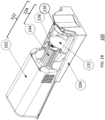
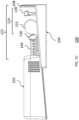
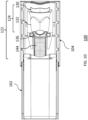
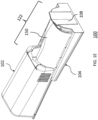
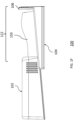
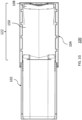
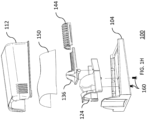
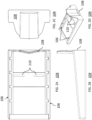
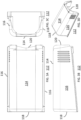
- FIGs. 1A-7E illustrate a cricothyrotomy task trainer 100 according to certain embodiments of the disclosure.
- Trainer 100 includes (i) a case 102 having a base 104 and a cover 112 and (ii) a model 122 of a patient.
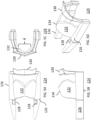
- the model 122 which is mounted within the base 104, includes a combined hyoid/thyroid analogue 124 that has an analogue 130 of the patient's hyoid bone and an analogue 132 of the patient's thyroid cartilage), a cricoid analogue 136 (i.e., an analogue of the patient's cricoid cartilage), a tracheal analogue 144 (i.e., an analogue of the patient's trachea), and a three-layer skin analogue 150 (i.e., an analogue of the patient's skin).
- the hyoid, thyroid, and cricoid analogues 130, 132, and 136 are referred to collectively as the laryngeal analogues.
- the integral protective case 102 has a base 104 and a cover 112 that slides open to expose the model 122 for use.
- the sliding cover 112 includes top 114, lateral sides 116, and distal (inferior) end 118, which constitute additional elements of the model 122.
- the proximal end 108 of the base 104 is flat, rises above the height of the hyoid/ thyroid, cricoid, and tracheal analogues 124, 136, and 144.
- the base 104 includes a sliding mechanism 106 for the cover 112.
- the proximal end 108 of the base 104 is intended to represent the position of the patient's chin above the laryngeal structures in the patient's neck.
- the proximal end 120 of the cover 112 is another element of the model 122 that functions as an analogue of the patient's sternum and provides a sternal rest for the operator.
- a critical component of proper practice is for the operator to rest their dominant hand holding the scalpel on the patient's sternum (for stabilization).
- Two opposing, lateral struts 126 run along the base of the hyoid/thyroid analogue 124 extending from the thyroid analogue 132 (i) cranially toward the hyoid analogue 130 and (ii) caudally to an articulating connection 140 of the cricoid analogue 136 at notches 128.
- the cricoid analogue 136 has a flat extension 142, which serves as an analogue of the flat posterior portion of the patient's trachea.
- Cricothyrotomy trainers of the present disclosure can have anatomically correct laryngeal cartilages in both male and female forms and have lateral mobility approximating the side-to-side mobility of the human larynx (e.g., about 1-2 inches), even when the model 122 has an attached skin analogue 150 overlaying the laryngeal and tracheal analogues 130/132/136/144. Stabilizing the larynx from side-to-side movement (by the operator using their non-dominant hand) is a critical component of performing the cricothyrotomy procedure.
- the lateral struts 126 have screws or bolts 160 that pass through horizontal, transverse slots 110 in the base 104.
- the enlarged heads of the screws or bolts 160 slide in the slots 110, allowing the side-to-side movement of the hyoid/thyroid analogue 124 (and thereby the side-to-side movement of the cricoid and tracheal analogues 136 and 144).
- Male and female forms of the trainer 100 may have different angles ⁇ ( FIG. 5C ) to the thyroid lamina 134 (e.g., approximately 90 degrees in the male form and approximately 120 degrees in the female form) and smaller overall dimensions (by approximately 15%) for the laryngeal and tracheal analogues 130/132/136/144 in the female form than in the male form.
- the adhesive, three-layer skin analogue 150 attaches to the laryngeal analogues 130/132/136.
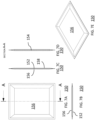
- the skin analogue 150 has an adhesive base layer 152 that represents the cricothyroid membrane, a middle layer 154 that represents subcutaneous tissue--which can be made either thin or thick using absorbent material to create a wet model, for representing bleeding, and a thin top layer 156 with a soft feel approximating human skin.
- the skin analogue 150 When attached to the laryngeal analogues 130/132/136, the skin analogue 150 does not inhibit side-to-side movement of the laryngeal and tracheal analogues 130/132/136/144.
- a relatively hard durometer plastic is used to form the hyoid/thyroid and cricoid analogues 124 and 136 as well as the base 104 and cover 112, while a softer durometer plastic is used for the tracheal analogue 144, which is externally, internally, and cross-sectionally anatomically representative of a human trachea, including having tracheal rings 146 that are palpable externally and internally.
- the flat posterior section 142 of the cricoid analogue 136 is representative of the membranous trachea.
- the tracheal rings 146 have an incomplete horseshoe shape with the rings present anteriorly, but not present on the flat posterior section 142 of the cricoid analogue 136.
- the three-layer skin analogue 150 may be made from a thin rectangular plastic pouch approximately 4" by 6" of either 2 or 3 mil thickness having a side opening that allows insertion of the absorbent material as the middle layer 154, where the two layers of the pouch function as the base and top layers 152 and 156 of the skin analogue 150.
- the middle layer 154 may comprise either white or light beige cotton or Dacron that is loosely woven, allowing it to be cut to proper length, but also to break apart with the insertion of surgical instruments or a finger, as in the actual cricothyrotomy procedure.
- the skin analogue 150 may have an opaque covering either printed in a skin tone overlying the plastic material or made of an opaque skin-tone-colored plastic, such that, when the top layer is cut, the operator can distinguish the incision of the top layer 156 from the middle layer 154, and, if fluid (artificial blood) has been placed into the pouch, then the fluid will leak out, simulating bleeding.
- a backing 158 on the three-layer skin analogue 150 may be removed to expose the adhesive base layer 152.
- the base layer 152 or the backing 158 may have a drawing of the procedural landmarks, including the hyoid, thyroid, cricoid, trachea, and sternum.
- the soft tracheal analogue 144 attaches to the harder laryngeal analogues 130/132/136 with the tracheal analogue 144 tightly abutting the more-rigid cricoid analogue 136 with a friction fit that allows the tracheal analogue 144 to be removed and replaced as needed should the tracheal analogue 144 be damaged or cut during training.
- the cricoid analogue 136 has a flat base 142 that forms a longitudinal extension of the cricoid analogue 136.
- the cricoid analogue 136 has two lateral ridges 138 that receive the two lateral rails 147 of the tracheal analogue 144 and between which the posterior section 148 of the softer durometer tracheal analogue 144 slides into place.
- the soft durometer plastic of the tracheal analogue 144 and the mechanical interaction between the cricoid and tracheal analogues 136 and 144 create enough friction so that the tracheal analogue 144 does not move out of position when performing the cricothyrotomy procedure on the model 122.
- the bottom of the trainer 100 may have rubber feet that inhibit the trainer 100 from sliding on a flat surface.
- the present disclosure is a trainer (e.g., 100) for cricothyrotomy.
- the trainer comprises a case (e.g., 102) and a model (e.g., 122) of a patient mounted within the case.
- the model comprises a hyoid analogue (e.g., 130); a thyroid analogue (e.g., 132) adjacent to the hyoid analogue; a cricoid analogue (e.g., 136) adjacent to the thyroid analogue; a tracheal analogue (e.g., 144) adjacent to the cricoid analogue; and a skin analogue (e.g., 150) adapted to cover the hyoid, thyroid, cricoid, and tracheal analogues.
- a hyoid analogue e.g., 130
- a thyroid analogue e.g., 132
- a cricoid analogue e.g., 136
- a tracheal analogue e.g., 144
- a skin analogue e.g., 150
- the case comprises a base (e.g., 104) and a cover (e.g., 112), wherein the base and the cover are slidably interconnected to enable the cover to slide relative to the base to expose the model.
- a proximal end (e.g., 108) of the base rises above the hyoid, thyroid, cricoid, and trachea analogues to represent the patient's chin.
- the cover after the cover has been slid relative to the base to expose the model, the cover represents the patient's sternum.
- the hyoid, thyroid, and cricoid analogues have lateral mobility within the base representing side-to-side mobility of the patient's larynx.
- the hyoid, thyroid, and cricoid analogues have the lateral mobility within the base with the skin analogue applied to the hyoid, thyroid, and cricoid analogues.
- the base has at least one transverse slot (e.g., 110) that engages with at least one structure (e.g., 160) of the model to enable the lateral mobility.
- the hyoid and thyroid analogues are part of a unitary hyoid/thyroid analogue structure (e.g., 124).
- the unitary hyoid/thyroid analogue structure further comprises two lateral struts (e.g., 126) that support the hyoid and thyroid analogues.
- each lateral strut has a notch (e.g., 128) that engages a different articulating connection (e.g., 140) of the cricoid analogue to connect the cricoid analogue to the unitary hyoid/thyroid analogue structure.
- the cricoid analogue comprises an extension (e.g., 142) having lateral ridges (e.g., 138) and (ii) the tracheal analogue comprises lateral rails (e.g., 147) that engage the lateral ridges to connect the tracheal analogue to the cricoid analogue.
- the extension of the cricoid analogue has a flat surface to represent the patient's tracheal posterior surface.
- the tracheal analogue has (i) a horseshoe-shaped cross section and (ii) horseshoe-shaped tracheal rings (e.g., 146) on the tracheal analogue's anterior surface.
- the skin analogue comprises a middle layer (e.g., 154) between a base layer (e.g., 152) and a top layer (e.g., 156).
- the base layer has an adhesive surface that enables the skin analogue to be removably applied to the hyoid, thyroid, and cricoid analogues.
- the skin analogue further comprises a removable backing (e.g., 158) covering the adhesive surface of the base layer, such that, after removing the backing from the skin analogue and exposing the adhesive surface, the skin analogue is removably appliable to the hyoid, thyroid, and cricoid analogues.
- a removable backing e.g., 158 covering the adhesive surface of the base layer, such that, after removing the backing from the skin analogue and exposing the adhesive surface, the skin analogue is removably appliable to the hyoid, thyroid, and cricoid analogues.
- the base layer represents the patient's cricothyroid membrane; the middle layer represents the patient's subcutaneous tissue; and the top layer represents the patient's skin.
- the base and top layers are made of plastic; and the middle layer comprises a wet, absorbent material to represent bleeding by the patient.
- the thyroid analogue's lamina (e.g., 134) forms an angle of approximately 90 degrees to represent a male patient.
- the thyroid analogue's lamina (e.g., 134) forms an angle of approximately 120 degrees to represent a female patient.
- the cricoid analogue is made of a relatively hard durometer material; and the tracheal analogue is made of a relatively soft durometer material that forms a removable, friction fit between the tracheal analogue and the cricoid analogue that enables the tracheal analogue to be replaceable.
- figure numbers and/or figure reference labels in the claims is intended to identify one or more possible embodiments of the claimed subject matter in order to facilitate the interpretation of the claims. Such use is not to be construed as necessarily limiting the scope of those claims to the embodiments shown in the corresponding figures.
- the terms “couple,” “coupling,” “coupled,” “connect,” “connecting,” or “connected” refer to any manner known in the art or later developed in which energy is allowed to be transferred between two or more elements, and the interposition of one or more additional elements is contemplated, although not required.
- the terms “directly coupled,” “directly connected,” etc. imply the absence of such additional elements.
- attachment and “directly attached,” as applied to a description of a physical structure.
- a relatively thin layer of adhesive or other suitable binder can be used to implement such "direct attachment” of the two corresponding components in such physical structure.
- each may be used to refer to one or more specified characteristics of a plurality of previously recited elements or steps.
- the open-ended term “comprising” the recitation of the term “each” does not exclude additional, unrecited elements or steps.
- an apparatus may have additional, unrecited elements and a method may have additional, unrecited steps, where the additional, unrecited elements or steps do not have the one or more specified characteristics.
- the phrases “at least one of A and B” and “at least one of A or B” are both to be interpreted to have the same meaning, encompassing the following three possibilities: 1- only A; 2- only B; 3- both A and B.
Landscapes
- Engineering & Computer Science (AREA)
- Health & Medical Sciences (AREA)
- General Physics & Mathematics (AREA)
- Physics & Mathematics (AREA)
- General Health & Medical Sciences (AREA)
- Medical Informatics (AREA)
- Life Sciences & Earth Sciences (AREA)
- Educational Administration (AREA)
- Computational Mathematics (AREA)
- Theoretical Computer Science (AREA)
- Business, Economics & Management (AREA)
- Pure & Applied Mathematics (AREA)
- Educational Technology (AREA)
- Chemical & Material Sciences (AREA)
- Mathematical Physics (AREA)
- Medicinal Chemistry (AREA)
- Mathematical Analysis (AREA)
- Algebra (AREA)
- Mathematical Optimization (AREA)
- Veterinary Medicine (AREA)
- Surgery (AREA)
- Heart & Thoracic Surgery (AREA)
- Pulmonology (AREA)
- Public Health (AREA)
- Biomedical Technology (AREA)
- Animal Behavior & Ethology (AREA)
- Anesthesiology (AREA)
- Hematology (AREA)
- Nuclear Medicine, Radiotherapy & Molecular Imaging (AREA)
- Robotics (AREA)
- Molecular Biology (AREA)
- Emergency Medicine (AREA)
- Instructional Devices (AREA)
- Prostheses (AREA)
Claims (13)
- Trainingsvorrichtung (100) für Koniotomie, wobei die Trainingsvorrichtung aufweist:ein Gehäuse (102) undein Modell (122) eines Patienten, das in dem Gehäuse angebracht ist, wobei das Modell aufweist:eine Zungenbein-Nachbildung (130),eine Schilddrüsen-Nachbildung (132), die zu der Zungenbein-Nachbildung benachbart ist,eine Ringknorpel-Nachbildung (136), die zu der Schilddrüsen-Nachbildung benachbart ist,eine Luftröhren-Nachbildung (144), die zu der Ringknorpel-Nachbildung benachbart ist, undeine Hautnachbildung (150), die angepasst ist, um die Zungenbein-, Schilddrüsen-, Ringknorpel- und Luftröhren-Nachbildungen zu bedecken, DADURCH GEKENNZEICHNET, DASSdas Gehäuse eine Basis (104) und eine Abdeckung (112) aufweist, wobei die Basis und die Abdeckung verschiebbar miteinander verbunden sind, um es der Abdeckung zu ermöglichen, relativ zur Basis verschoben zu werden, um das Modell freizulegen, unddie Zungenbein-, Schilddrüsen- und Ringknorpel-Nachbildungen eine seitliche Beweglichkeit innerhalb der Basis haben, die die seitliche Beweglichkeit des Kehlkopfs des Patienten mit oder ohne die auf die Zungenbein-, Schilddrüsen- und Ringknorpel-Nachbildungen aufgebrachte Haut-Nachbildung darstellt.
- Trainingsvorrichtung gemäß Anspruch 1, wobei ein proximales Ende (108) der Basis über die Zungenbein-, Schilddrüsen-, Ringknorpel- und Luftröhren-Nachbildungen hinausragt, um das Kinn des Patienten darzustellen.
- Trainingsvorrichtung gemäß irgendeinem der Ansprüche 1-2, wobei die Abdeckung, nachdem die Abdeckung relativ zur Basis verschoben worden ist, um das Modell freizulegen, das Brustbein des Patienten darstellt.
- Trainingsvorrichtung gemäß irgendeinem der Ansprüche 1-3, wobei die Basis mindestens einen Querschlitz (110) hat, der mit mindestens einer Struktur (160) des Modells im Eingriff steht, um die seitliche Beweglichkeit zu ermöglichen.
- Trainingsvorrichtung gemäß irgendeinem der Ansprüche 1-4, wobei die Zungenbein- und Schilddrüsen-Nachbildungen Teil einer einheitlichen Zungenbein/Schilddrüsen-Nachbildungsstruktur (124) sind.
- Trainingsvorrichtung gemäß Anspruch 5, wobei die einheitliche Zungenbein/Schilddrüsen- Nachbildungsstruktur ferner zwei seitliche Holme (126) aufweist, die die Zungenbein- und Schilddrüsen-Nachbildungen stützen.
- Trainingsvorrichtung gemäß Anspruch 6, wobei jeder seitliche Holm eine Aussparung (128) hat, die mit einer anderen Gelenkverbindung (140) der Ringknorpel-Nachbildung im Eingriff ist, um die Ringknorpel-Nachbildung mit der einheitlichen Zungenbein/Schilddrüsen-Nachbildungsstruktur zu verbinden.
- Trainingsvorrichtung gemäß irgendeinem der Ansprüche 1-7, wobei:die Ringknorpel-Nachbildung eine Verlängerung (142) mit seitlichen Rippen (138) aufweist, unddie Luftröhren-Nachbildung seitliche Schienen (147) aufweist, die mit den seitlichen Rippen im Eingriff sind, umdie Luftröhren-Nachbildung mit der Ringknorpel-Nachbildung zu verbinden.
- Trainingsvorrichtung gemäß Anspruch 8, wobei:die Verlängerung der Ringknorpel-Nachbildung eine flache Fläche aufweist, um die hintere Luftröhrenfläche des Patienten darzustellen, unddie Luftröhren-Nachbildung (i) einen hufeisenförmigen Querschnitt und (ii) hufeisenförmige Luftröhrenringe (146) auf der vorderen Fläche der Luftröhren-Nachbildung aufweist.
- Trainingsvorrichtung gemäß irgendeinem der Ansprüche 1-9, wobei:die Haut-Nachbildung eine mittlere Schicht (154) zwischen einer Basisschicht (152) und einer oberen Schicht (156) aufweist,die Basisschicht eine Klebefläche hat, die es ermöglicht, die Haut-Nachbildung abnehmbar auf die Zungenbein-, Schilddrüsen- und Ringknorpel-Nachbildungen aufzubringen, unddie Haut-Nachbildung ferner eine entfernbare Unterlage (158) aufweist, die die Klebefläche der Basisschicht bedeckt, so dass die Haut-Nachbildung nach dem Entfernen der Unterlage von der Haut-Nachbildung und dem Freilegen der Klebefläche entfernbar auf die Zungenbein-, Schilddrüsen- und Ringknorpel-Nachbildungen aufgebracht werden kann.
- Trainingsvorrichtung gemäß Anspruch 10, wobei:die Basisschicht die Kehlkopf-Membran des Patienten darstellt,die mittlere Schicht das subkutane Gewebe des Patienten darstellt unddie obere Schicht die Haut des Patienten darstellt.
- Trainingsvorrichtung gemäß Anspruch 11, wobei:die Basis- und die obere Schicht aus Kunststoff gemacht sind unddie mittlere Schicht ein feuchtes, absorbierendes Material aufweist, um Blutungen des Patienten darzustellen.
- Trainingsvorrichtung gemäß irgendeinem der Ansprüche 1-12, wobei:die Ringknorpel-Nachbildung aus einem relativ-harten-Durometer-Material gemacht ist unddie Luftröhren-Nachbildung aus einem relativ-weichen-Durometer-Material gemacht ist, das eine entfernbaren Reibungssitz zwischen der Luftröhren-Nachbildung und der Ringknorpel-Nachbildung bildet, welcher es der Luftröhren-Nachbildung ermöglicht, ausgetauscht zu werden.
Applications Claiming Priority (2)
| Application Number | Priority Date | Filing Date | Title |
|---|---|---|---|
| US202363498081P | 2023-04-25 | 2023-04-25 | |
| US18/444,220 US20240358435A1 (en) | 2023-04-25 | 2024-02-16 | Cricothyrotomy trainer |
Publications (3)
| Publication Number | Publication Date |
|---|---|
| EP4456046A1 EP4456046A1 (de) | 2024-10-30 |
| EP4456046B1 true EP4456046B1 (de) | 2025-06-18 |
| EP4456046C0 EP4456046C0 (de) | 2025-06-18 |
Family
ID=90826533
Family Applications (1)
| Application Number | Title | Priority Date | Filing Date |
|---|---|---|---|
| EP24171697.6A Active EP4456046B1 (de) | 2023-04-25 | 2024-04-22 | Krikothyreotomietrainer |
Country Status (2)
| Country | Link |
|---|---|
| US (1) | US20240358435A1 (de) |
| EP (1) | EP4456046B1 (de) |
Family Cites Families (4)
| Publication number | Priority date | Publication date | Assignee | Title |
|---|---|---|---|---|
| US11195434B2 (en) * | 2008-06-03 | 2021-12-07 | Techline Technologies, Inc. | Wound box trainer |
| CA2894673C (en) * | 2012-05-20 | 2022-03-08 | Stuart Charles Segall | Medical care training mannequin for realistic emergency medical training |
| US20220246062A1 (en) * | 2021-02-02 | 2022-08-04 | Hospital Authority | Emergency surgical airway surgery simulation device |
| US20240233579A9 (en) * | 2021-02-22 | 2024-07-11 | Halo Med Llc | Anatomical head and neck simulator apparatus |
-
2024
- 2024-02-16 US US18/444,220 patent/US20240358435A1/en active Pending
- 2024-04-22 EP EP24171697.6A patent/EP4456046B1/de active Active
Also Published As
| Publication number | Publication date |
|---|---|
| EP4456046C0 (de) | 2025-06-18 |
| US20240358435A1 (en) | 2024-10-31 |
| EP4456046A1 (de) | 2024-10-30 |
Similar Documents
| Publication | Publication Date | Title |
|---|---|---|
| US9865179B2 (en) | Tactical combat casualty care training system for hyper-realistic™ emergency medical training | |
| Kristensen et al. | Percutaneous emergency airway access; prevention, preparation, technique and training | |
| AU2014265412B2 (en) | Hernia model | |
| CA2739648A1 (en) | Training device for medical procedures | |
| Burns et al. | Simulators for laryngeal and airway surgery | |
| US20200410898A1 (en) | Simulator for practicing surgery or procedures involving the neck and airway and method of use thereof | |
| Bennett et al. | Cricothyroidotomy bottom-up training review: battlefield lessons learned | |
| EP4456046B1 (de) | Krikothyreotomietrainer | |
| Malekzadeh | Simulation in Otolaryngology, An Issue of Otolaryngologic Clinics of North: Simulation in Otolaryngology, An Issue of Otolaryngologic Clinics of North | |
| CN103943017B (zh) | 一种带有力反馈的虚拟腹腔镜手术模拟器及其制作方法 | |
| Petersen et al. | Optimization of simulation and moulage in military-related medical training | |
| Shaw et al. | High risk, low volume: evaluation of a reusable cricothyrotomy model in a paramedic difficult airway training course | |
| Hossfeld et al. | Necessity to depict difficult neck anatomy for training of cricothyroidotomy: a pilot study evaluating two surgical devices on a new hybrid training model | |
| Bowyer et al. | Far forward feasibility: testing a cricothyroidotmy simulator in Iraq. | |
| Burdick et al. | Expansion of emergency medicine's responsibilities for preclinical education of medical students | |
| Botto et al. | Manufacture of a multi-purpose low-cost animal bench-model for teaching tracheostomy | |
| Robinson et al. | Socially distanced neonatal resuscitation program (NRP): A technical report on how to teach NRP courses during the COVID-19 pandemic | |
| Martinic | Military'live tissue trauma training'using animals in the US-its purpose, importance and commentary on military medical research and the debate on use of animals in military training | |
| Lakke | SHORT COMMUNICATION Autopsy Practises for Brain Dissections and Rembrandt's Anatomy Lesson of Dr. Deyman | |
| Griffiths | Use of 3-D models in medical education | |
| Scerbo et al. | An examination of surgical skill performance under combat conditions using a mannequin-based simulator in a virtual environment | |
| Scerbo et al. | Assessing Surgical Skill Training Under Hazardous Conditions in a Virtual Environment. | |
| SPEAR | How 3D Printers Are Changing Airway Care. | |
| Ujiki et al. | Simulation training in surgery | |
| EP4469993A1 (de) | Venensimulator |
Legal Events
| Date | Code | Title | Description |
|---|---|---|---|
| PUAI | Public reference made under article 153(3) epc to a published international application that has entered the european phase |
Free format text: ORIGINAL CODE: 0009012 |
|
| STAA | Information on the status of an ep patent application or granted ep patent |
Free format text: STATUS: THE APPLICATION HAS BEEN PUBLISHED |
|
| AK | Designated contracting states |
Kind code of ref document: A1 Designated state(s): AL AT BE BG CH CY CZ DE DK EE ES FI FR GB GR HR HU IE IS IT LI LT LU LV MC ME MK MT NL NO PL PT RO RS SE SI SK SM TR |
|
| STAA | Information on the status of an ep patent application or granted ep patent |
Free format text: STATUS: REQUEST FOR EXAMINATION WAS MADE |
|
| 17P | Request for examination filed |
Effective date: 20241105 |
|
| RBV | Designated contracting states (corrected) |
Designated state(s): AL AT BE BG CH CY CZ DE DK EE ES FI FR GB GR HR HU IE IS IT LI LT LU LV MC ME MK MT NL NO PL PT RO RS SE SI SK SM TR |
|
| GRAP | Despatch of communication of intention to grant a patent |
Free format text: ORIGINAL CODE: EPIDOSNIGR1 |
|
| STAA | Information on the status of an ep patent application or granted ep patent |
Free format text: STATUS: GRANT OF PATENT IS INTENDED |
|
| RIC1 | Information provided on ipc code assigned before grant |
Ipc: G09B 23/34 20060101ALI20250107BHEP Ipc: G09B 23/32 20060101ALI20250107BHEP Ipc: G09B 23/30 20060101AFI20250107BHEP |
|
| INTG | Intention to grant announced |
Effective date: 20250121 |
|
| RIN1 | Information on inventor provided before grant (corrected) |
Inventor name: MILLER, ANDREW Inventor name: LEVITAN, RICHARD M. |
|
| GRAS | Grant fee paid |
Free format text: ORIGINAL CODE: EPIDOSNIGR3 |
|
| GRAA | (expected) grant |
Free format text: ORIGINAL CODE: 0009210 |
|
| STAA | Information on the status of an ep patent application or granted ep patent |
Free format text: STATUS: THE PATENT HAS BEEN GRANTED |
|
| AK | Designated contracting states |
Kind code of ref document: B1 Designated state(s): AL AT BE BG CH CY CZ DE DK EE ES FI FR GB GR HR HU IE IS IT LI LT LU LV MC ME MK MT NL NO PL PT RO RS SE SI SK SM TR |
|
| REG | Reference to a national code |
Ref country code: GB Ref legal event code: FG4D |
|
| REG | Reference to a national code |
Ref country code: CH Ref legal event code: EP |
|
| REG | Reference to a national code |
Ref country code: DE Ref legal event code: R096 Ref document number: 602024000211 Country of ref document: DE |
|
| REG | Reference to a national code |
Ref country code: CH Ref legal event code: EP |
|
| REG | Reference to a national code |
Ref country code: IE Ref legal event code: FG4D |
|
| U01 | Request for unitary effect filed |
Effective date: 20250702 |
|
| U07 | Unitary effect registered |
Designated state(s): AT BE BG DE DK EE FI FR IT LT LU LV MT NL PT RO SE SI Effective date: 20250710 |
|
| PG25 | Lapsed in a contracting state [announced via postgrant information from national office to epo] |
Ref country code: NO Free format text: LAPSE BECAUSE OF FAILURE TO SUBMIT A TRANSLATION OF THE DESCRIPTION OR TO PAY THE FEE WITHIN THE PRESCRIBED TIME-LIMIT Effective date: 20250918 Ref country code: GR Free format text: LAPSE BECAUSE OF FAILURE TO SUBMIT A TRANSLATION OF THE DESCRIPTION OR TO PAY THE FEE WITHIN THE PRESCRIBED TIME-LIMIT Effective date: 20250919 |
|
| PG25 | Lapsed in a contracting state [announced via postgrant information from national office to epo] |
Ref country code: HR Free format text: LAPSE BECAUSE OF FAILURE TO SUBMIT A TRANSLATION OF THE DESCRIPTION OR TO PAY THE FEE WITHIN THE PRESCRIBED TIME-LIMIT Effective date: 20250618 |
|
| PG25 | Lapsed in a contracting state [announced via postgrant information from national office to epo] |
Ref country code: RS Free format text: LAPSE BECAUSE OF FAILURE TO SUBMIT A TRANSLATION OF THE DESCRIPTION OR TO PAY THE FEE WITHIN THE PRESCRIBED TIME-LIMIT Effective date: 20250918 |
|
| PG25 | Lapsed in a contracting state [announced via postgrant information from national office to epo] |
Ref country code: IS Free format text: LAPSE BECAUSE OF FAILURE TO SUBMIT A TRANSLATION OF THE DESCRIPTION OR TO PAY THE FEE WITHIN THE PRESCRIBED TIME-LIMIT Effective date: 20251018 |
|
| PG25 | Lapsed in a contracting state [announced via postgrant information from national office to epo] |
Ref country code: SM Free format text: LAPSE BECAUSE OF FAILURE TO SUBMIT A TRANSLATION OF THE DESCRIPTION OR TO PAY THE FEE WITHIN THE PRESCRIBED TIME-LIMIT Effective date: 20250618 |
|
| PG25 | Lapsed in a contracting state [announced via postgrant information from national office to epo] |
Ref country code: CZ Free format text: LAPSE BECAUSE OF FAILURE TO SUBMIT A TRANSLATION OF THE DESCRIPTION OR TO PAY THE FEE WITHIN THE PRESCRIBED TIME-LIMIT Effective date: 20250618 |
|
| PG25 | Lapsed in a contracting state [announced via postgrant information from national office to epo] |
Ref country code: PL Free format text: LAPSE BECAUSE OF FAILURE TO SUBMIT A TRANSLATION OF THE DESCRIPTION OR TO PAY THE FEE WITHIN THE PRESCRIBED TIME-LIMIT Effective date: 20250618 |
|
| PG25 | Lapsed in a contracting state [announced via postgrant information from national office to epo] |
Ref country code: SK Free format text: LAPSE BECAUSE OF FAILURE TO SUBMIT A TRANSLATION OF THE DESCRIPTION OR TO PAY THE FEE WITHIN THE PRESCRIBED TIME-LIMIT Effective date: 20250618 |
|
| PG25 | Lapsed in a contracting state [announced via postgrant information from national office to epo] |
Ref country code: ES Free format text: LAPSE BECAUSE OF FAILURE TO SUBMIT A TRANSLATION OF THE DESCRIPTION OR TO PAY THE FEE WITHIN THE PRESCRIBED TIME-LIMIT Effective date: 20250618 |