EP4455128A1 - Main chain polymer, optical film, method for producing main chain polymer, method for producing optical film, and multilayer film - Google Patents
Main chain polymer, optical film, method for producing main chain polymer, method for producing optical film, and multilayer film Download PDFInfo
- Publication number
- EP4455128A1 EP4455128A1 EP22911340.2A EP22911340A EP4455128A1 EP 4455128 A1 EP4455128 A1 EP 4455128A1 EP 22911340 A EP22911340 A EP 22911340A EP 4455128 A1 EP4455128 A1 EP 4455128A1
- Authority
- EP
- European Patent Office
- Prior art keywords
- group
- ring system
- aromatic ring
- atom
- chemical formula
- Prior art date
- Legal status (The legal status is an assumption and is not a legal conclusion. Google has not performed a legal analysis and makes no representation as to the accuracy of the status listed.)
- Pending
Links
Classifications
-
- C—CHEMISTRY; METALLURGY
- C08—ORGANIC MACROMOLECULAR COMPOUNDS; THEIR PREPARATION OR CHEMICAL WORKING-UP; COMPOSITIONS BASED THEREON
- C08G—MACROMOLECULAR COMPOUNDS OBTAINED OTHERWISE THAN BY REACTIONS ONLY INVOLVING UNSATURATED CARBON-TO-CARBON BONDS
- C08G63/00—Macromolecular compounds obtained by reactions forming a carboxylic ester link in the main chain of the macromolecule
-
- G—PHYSICS
- G02—OPTICS
- G02B—OPTICAL ELEMENTS, SYSTEMS OR APPARATUS
- G02B5/00—Optical elements other than lenses
- G02B5/30—Polarising elements
-
- C—CHEMISTRY; METALLURGY
- C08—ORGANIC MACROMOLECULAR COMPOUNDS; THEIR PREPARATION OR CHEMICAL WORKING-UP; COMPOSITIONS BASED THEREON
- C08G—MACROMOLECULAR COMPOUNDS OBTAINED OTHERWISE THAN BY REACTIONS ONLY INVOLVING UNSATURATED CARBON-TO-CARBON BONDS
- C08G63/00—Macromolecular compounds obtained by reactions forming a carboxylic ester link in the main chain of the macromolecule
- C08G63/68—Polyesters containing atoms other than carbon, hydrogen and oxygen
- C08G63/688—Polyesters containing atoms other than carbon, hydrogen and oxygen containing sulfur
-
- C—CHEMISTRY; METALLURGY
- C07—ORGANIC CHEMISTRY
- C07D—HETEROCYCLIC COMPOUNDS
- C07D207/00—Heterocyclic compounds containing five-membered rings not condensed with other rings, with one nitrogen atom as the only ring hetero atom
- C07D207/02—Heterocyclic compounds containing five-membered rings not condensed with other rings, with one nitrogen atom as the only ring hetero atom with only hydrogen or carbon atoms directly attached to the ring nitrogen atom
- C07D207/30—Heterocyclic compounds containing five-membered rings not condensed with other rings, with one nitrogen atom as the only ring hetero atom with only hydrogen or carbon atoms directly attached to the ring nitrogen atom having two double bonds between ring members or between ring members and non-ring members
- C07D207/32—Heterocyclic compounds containing five-membered rings not condensed with other rings, with one nitrogen atom as the only ring hetero atom with only hydrogen or carbon atoms directly attached to the ring nitrogen atom having two double bonds between ring members or between ring members and non-ring members with only hydrogen atoms, hydrocarbon or substituted hydrocarbon radicals, directly attached to ring carbon atoms
- C07D207/33—Heterocyclic compounds containing five-membered rings not condensed with other rings, with one nitrogen atom as the only ring hetero atom with only hydrogen or carbon atoms directly attached to the ring nitrogen atom having two double bonds between ring members or between ring members and non-ring members with only hydrogen atoms, hydrocarbon or substituted hydrocarbon radicals, directly attached to ring carbon atoms with substituted hydrocarbon radicals, directly attached to ring carbon atoms
- C07D207/333—Radicals substituted by oxygen or sulfur atoms
-
- C—CHEMISTRY; METALLURGY
- C07—ORGANIC CHEMISTRY
- C07D—HETEROCYCLIC COMPOUNDS
- C07D263/00—Heterocyclic compounds containing 1,3-oxazole or hydrogenated 1,3-oxazole rings
- C07D263/02—Heterocyclic compounds containing 1,3-oxazole or hydrogenated 1,3-oxazole rings not condensed with other rings
- C07D263/30—Heterocyclic compounds containing 1,3-oxazole or hydrogenated 1,3-oxazole rings not condensed with other rings having two or three double bonds between ring members or between ring members and non-ring members
- C07D263/32—Heterocyclic compounds containing 1,3-oxazole or hydrogenated 1,3-oxazole rings not condensed with other rings having two or three double bonds between ring members or between ring members and non-ring members with only hydrogen atoms, hydrocarbon or substituted hydrocarbon radicals, directly attached to ring carbon atoms
-
- C—CHEMISTRY; METALLURGY
- C07—ORGANIC CHEMISTRY
- C07D—HETEROCYCLIC COMPOUNDS
- C07D277/00—Heterocyclic compounds containing 1,3-thiazole or hydrogenated 1,3-thiazole rings
- C07D277/02—Heterocyclic compounds containing 1,3-thiazole or hydrogenated 1,3-thiazole rings not condensed with other rings
- C07D277/20—Heterocyclic compounds containing 1,3-thiazole or hydrogenated 1,3-thiazole rings not condensed with other rings having two or three double bonds between ring members or between ring members and non-ring members
- C07D277/22—Heterocyclic compounds containing 1,3-thiazole or hydrogenated 1,3-thiazole rings not condensed with other rings having two or three double bonds between ring members or between ring members and non-ring members with only hydrogen atoms, hydrocarbon or substituted hydrocarbon radicals, directly attached to ring carbon atoms
- C07D277/24—Radicals substituted by oxygen atoms
-
- C—CHEMISTRY; METALLURGY
- C07—ORGANIC CHEMISTRY
- C07D—HETEROCYCLIC COMPOUNDS
- C07D307/00—Heterocyclic compounds containing five-membered rings having one oxygen atom as the only ring hetero atom
- C07D307/02—Heterocyclic compounds containing five-membered rings having one oxygen atom as the only ring hetero atom not condensed with other rings
- C07D307/34—Heterocyclic compounds containing five-membered rings having one oxygen atom as the only ring hetero atom not condensed with other rings having two or three double bonds between ring members or between ring members and non-ring members
- C07D307/38—Heterocyclic compounds containing five-membered rings having one oxygen atom as the only ring hetero atom not condensed with other rings having two or three double bonds between ring members or between ring members and non-ring members with substituted hydrocarbon radicals attached to ring carbon atoms
- C07D307/40—Radicals substituted by oxygen atoms
- C07D307/46—Doubly bound oxygen atoms, or two oxygen atoms singly bound to the same carbon atom
-
- C—CHEMISTRY; METALLURGY
- C07—ORGANIC CHEMISTRY
- C07D—HETEROCYCLIC COMPOUNDS
- C07D333/00—Heterocyclic compounds containing five-membered rings having one sulfur atom as the only ring hetero atom
- C07D333/02—Heterocyclic compounds containing five-membered rings having one sulfur atom as the only ring hetero atom not condensed with other rings
- C07D333/04—Heterocyclic compounds containing five-membered rings having one sulfur atom as the only ring hetero atom not condensed with other rings not substituted on the ring sulphur atom
- C07D333/06—Heterocyclic compounds containing five-membered rings having one sulfur atom as the only ring hetero atom not condensed with other rings not substituted on the ring sulphur atom with only hydrogen atoms, hydrocarbon or substituted hydrocarbon radicals, directly attached to the ring carbon atoms
- C07D333/14—Radicals substituted by singly bound hetero atoms other than halogen
- C07D333/16—Radicals substituted by singly bound hetero atoms other than halogen by oxygen atoms
-
- C—CHEMISTRY; METALLURGY
- C07—ORGANIC CHEMISTRY
- C07D—HETEROCYCLIC COMPOUNDS
- C07D333/00—Heterocyclic compounds containing five-membered rings having one sulfur atom as the only ring hetero atom
- C07D333/02—Heterocyclic compounds containing five-membered rings having one sulfur atom as the only ring hetero atom not condensed with other rings
- C07D333/04—Heterocyclic compounds containing five-membered rings having one sulfur atom as the only ring hetero atom not condensed with other rings not substituted on the ring sulphur atom
- C07D333/06—Heterocyclic compounds containing five-membered rings having one sulfur atom as the only ring hetero atom not condensed with other rings not substituted on the ring sulphur atom with only hydrogen atoms, hydrocarbon or substituted hydrocarbon radicals, directly attached to the ring carbon atoms
- C07D333/22—Radicals substituted by doubly bound hetero atoms, or by two hetero atoms other than halogen singly bound to the same carbon atom
-
- C—CHEMISTRY; METALLURGY
- C07—ORGANIC CHEMISTRY
- C07D—HETEROCYCLIC COMPOUNDS
- C07D333/00—Heterocyclic compounds containing five-membered rings having one sulfur atom as the only ring hetero atom
- C07D333/02—Heterocyclic compounds containing five-membered rings having one sulfur atom as the only ring hetero atom not condensed with other rings
- C07D333/04—Heterocyclic compounds containing five-membered rings having one sulfur atom as the only ring hetero atom not condensed with other rings not substituted on the ring sulphur atom
- C07D333/26—Heterocyclic compounds containing five-membered rings having one sulfur atom as the only ring hetero atom not condensed with other rings not substituted on the ring sulphur atom with hetero atoms or with carbon atoms having three bonds to hetero atoms with at the most one bond to halogen, e.g. ester or nitrile radicals, directly attached to ring carbon atoms
- C07D333/28—Halogen atoms
-
- C—CHEMISTRY; METALLURGY
- C07—ORGANIC CHEMISTRY
- C07D—HETEROCYCLIC COMPOUNDS
- C07D333/00—Heterocyclic compounds containing five-membered rings having one sulfur atom as the only ring hetero atom
- C07D333/02—Heterocyclic compounds containing five-membered rings having one sulfur atom as the only ring hetero atom not condensed with other rings
- C07D333/04—Heterocyclic compounds containing five-membered rings having one sulfur atom as the only ring hetero atom not condensed with other rings not substituted on the ring sulphur atom
- C07D333/26—Heterocyclic compounds containing five-membered rings having one sulfur atom as the only ring hetero atom not condensed with other rings not substituted on the ring sulphur atom with hetero atoms or with carbon atoms having three bonds to hetero atoms with at the most one bond to halogen, e.g. ester or nitrile radicals, directly attached to ring carbon atoms
- C07D333/30—Hetero atoms other than halogen
- C07D333/32—Oxygen atoms
-
- C—CHEMISTRY; METALLURGY
- C07—ORGANIC CHEMISTRY
- C07D—HETEROCYCLIC COMPOUNDS
- C07D333/00—Heterocyclic compounds containing five-membered rings having one sulfur atom as the only ring hetero atom
- C07D333/02—Heterocyclic compounds containing five-membered rings having one sulfur atom as the only ring hetero atom not condensed with other rings
- C07D333/04—Heterocyclic compounds containing five-membered rings having one sulfur atom as the only ring hetero atom not condensed with other rings not substituted on the ring sulphur atom
- C07D333/26—Heterocyclic compounds containing five-membered rings having one sulfur atom as the only ring hetero atom not condensed with other rings not substituted on the ring sulphur atom with hetero atoms or with carbon atoms having three bonds to hetero atoms with at the most one bond to halogen, e.g. ester or nitrile radicals, directly attached to ring carbon atoms
- C07D333/30—Hetero atoms other than halogen
- C07D333/34—Sulfur atoms
-
- C—CHEMISTRY; METALLURGY
- C07—ORGANIC CHEMISTRY
- C07D—HETEROCYCLIC COMPOUNDS
- C07D333/00—Heterocyclic compounds containing five-membered rings having one sulfur atom as the only ring hetero atom
- C07D333/02—Heterocyclic compounds containing five-membered rings having one sulfur atom as the only ring hetero atom not condensed with other rings
- C07D333/04—Heterocyclic compounds containing five-membered rings having one sulfur atom as the only ring hetero atom not condensed with other rings not substituted on the ring sulphur atom
- C07D333/26—Heterocyclic compounds containing five-membered rings having one sulfur atom as the only ring hetero atom not condensed with other rings not substituted on the ring sulphur atom with hetero atoms or with carbon atoms having three bonds to hetero atoms with at the most one bond to halogen, e.g. ester or nitrile radicals, directly attached to ring carbon atoms
- C07D333/30—Hetero atoms other than halogen
- C07D333/36—Nitrogen atoms
-
- C—CHEMISTRY; METALLURGY
- C07—ORGANIC CHEMISTRY
- C07D—HETEROCYCLIC COMPOUNDS
- C07D339/00—Heterocyclic compounds containing rings having two sulfur atoms as the only ring hetero atoms
- C07D339/02—Five-membered rings
- C07D339/06—Five-membered rings having the hetero atoms in positions 1 and 3, e.g. cyclic dithiocarbonates
-
- C—CHEMISTRY; METALLURGY
- C07—ORGANIC CHEMISTRY
- C07D—HETEROCYCLIC COMPOUNDS
- C07D409/00—Heterocyclic compounds containing two or more hetero rings, at least one ring having sulfur atoms as the only ring hetero atoms
- C07D409/02—Heterocyclic compounds containing two or more hetero rings, at least one ring having sulfur atoms as the only ring hetero atoms containing two hetero rings
- C07D409/12—Heterocyclic compounds containing two or more hetero rings, at least one ring having sulfur atoms as the only ring hetero atoms containing two hetero rings linked by a chain containing hetero atoms as chain links
-
- C—CHEMISTRY; METALLURGY
- C07—ORGANIC CHEMISTRY
- C07D—HETEROCYCLIC COMPOUNDS
- C07D409/00—Heterocyclic compounds containing two or more hetero rings, at least one ring having sulfur atoms as the only ring hetero atoms
- C07D409/14—Heterocyclic compounds containing two or more hetero rings, at least one ring having sulfur atoms as the only ring hetero atoms containing three or more hetero rings
-
- C—CHEMISTRY; METALLURGY
- C07—ORGANIC CHEMISTRY
- C07D—HETEROCYCLIC COMPOUNDS
- C07D493/00—Heterocyclic compounds containing oxygen atoms as the only ring hetero atoms in the condensed system
- C07D493/02—Heterocyclic compounds containing oxygen atoms as the only ring hetero atoms in the condensed system in which the condensed system contains two hetero rings
- C07D493/10—Spiro-condensed systems
-
- C—CHEMISTRY; METALLURGY
- C08—ORGANIC MACROMOLECULAR COMPOUNDS; THEIR PREPARATION OR CHEMICAL WORKING-UP; COMPOSITIONS BASED THEREON
- C08G—MACROMOLECULAR COMPOUNDS OBTAINED OTHERWISE THAN BY REACTIONS ONLY INVOLVING UNSATURATED CARBON-TO-CARBON BONDS
- C08G63/00—Macromolecular compounds obtained by reactions forming a carboxylic ester link in the main chain of the macromolecule
- C08G63/02—Polyesters derived from hydroxycarboxylic acids or from polycarboxylic acids and polyhydroxy compounds
- C08G63/12—Polyesters derived from hydroxycarboxylic acids or from polycarboxylic acids and polyhydroxy compounds derived from polycarboxylic acids and polyhydroxy compounds
- C08G63/123—Polyesters derived from hydroxycarboxylic acids or from polycarboxylic acids and polyhydroxy compounds derived from polycarboxylic acids and polyhydroxy compounds the acids or hydroxy compounds containing carbocyclic rings
- C08G63/137—Acids or hydroxy compounds containing cycloaliphatic rings
-
- C—CHEMISTRY; METALLURGY
- C08—ORGANIC MACROMOLECULAR COMPOUNDS; THEIR PREPARATION OR CHEMICAL WORKING-UP; COMPOSITIONS BASED THEREON
- C08G—MACROMOLECULAR COMPOUNDS OBTAINED OTHERWISE THAN BY REACTIONS ONLY INVOLVING UNSATURATED CARBON-TO-CARBON BONDS
- C08G63/00—Macromolecular compounds obtained by reactions forming a carboxylic ester link in the main chain of the macromolecule
- C08G63/02—Polyesters derived from hydroxycarboxylic acids or from polycarboxylic acids and polyhydroxy compounds
- C08G63/12—Polyesters derived from hydroxycarboxylic acids or from polycarboxylic acids and polyhydroxy compounds derived from polycarboxylic acids and polyhydroxy compounds
- C08G63/16—Dicarboxylic acids and dihydroxy compounds
- C08G63/18—Dicarboxylic acids and dihydroxy compounds the acids or hydroxy compounds containing carbocyclic rings
- C08G63/19—Hydroxy compounds containing aromatic rings
-
- C—CHEMISTRY; METALLURGY
- C08—ORGANIC MACROMOLECULAR COMPOUNDS; THEIR PREPARATION OR CHEMICAL WORKING-UP; COMPOSITIONS BASED THEREON
- C08G—MACROMOLECULAR COMPOUNDS OBTAINED OTHERWISE THAN BY REACTIONS ONLY INVOLVING UNSATURATED CARBON-TO-CARBON BONDS
- C08G63/00—Macromolecular compounds obtained by reactions forming a carboxylic ester link in the main chain of the macromolecule
- C08G63/02—Polyesters derived from hydroxycarboxylic acids or from polycarboxylic acids and polyhydroxy compounds
- C08G63/12—Polyesters derived from hydroxycarboxylic acids or from polycarboxylic acids and polyhydroxy compounds derived from polycarboxylic acids and polyhydroxy compounds
- C08G63/16—Dicarboxylic acids and dihydroxy compounds
- C08G63/18—Dicarboxylic acids and dihydroxy compounds the acids or hydroxy compounds containing carbocyclic rings
- C08G63/199—Acids or hydroxy compounds containing cycloaliphatic rings
-
- C—CHEMISTRY; METALLURGY
- C08—ORGANIC MACROMOLECULAR COMPOUNDS; THEIR PREPARATION OR CHEMICAL WORKING-UP; COMPOSITIONS BASED THEREON
- C08G—MACROMOLECULAR COMPOUNDS OBTAINED OTHERWISE THAN BY REACTIONS ONLY INVOLVING UNSATURATED CARBON-TO-CARBON BONDS
- C08G63/00—Macromolecular compounds obtained by reactions forming a carboxylic ester link in the main chain of the macromolecule
- C08G63/02—Polyesters derived from hydroxycarboxylic acids or from polycarboxylic acids and polyhydroxy compounds
- C08G63/12—Polyesters derived from hydroxycarboxylic acids or from polycarboxylic acids and polyhydroxy compounds derived from polycarboxylic acids and polyhydroxy compounds
- C08G63/52—Polycarboxylic acids or polyhydroxy compounds in which at least one of the two components contains aliphatic unsaturation
- C08G63/54—Polycarboxylic acids or polyhydroxy compounds in which at least one of the two components contains aliphatic unsaturation the acids or hydroxy compounds containing carbocyclic rings
- C08G63/547—Hydroxy compounds containing aromatic rings
-
- C—CHEMISTRY; METALLURGY
- C08—ORGANIC MACROMOLECULAR COMPOUNDS; THEIR PREPARATION OR CHEMICAL WORKING-UP; COMPOSITIONS BASED THEREON
- C08G—MACROMOLECULAR COMPOUNDS OBTAINED OTHERWISE THAN BY REACTIONS ONLY INVOLVING UNSATURATED CARBON-TO-CARBON BONDS
- C08G63/00—Macromolecular compounds obtained by reactions forming a carboxylic ester link in the main chain of the macromolecule
- C08G63/66—Polyesters containing oxygen in the form of ether groups
- C08G63/668—Polyesters containing oxygen in the form of ether groups derived from polycarboxylic acids and polyhydroxy compounds
- C08G63/676—Polyesters containing oxygen in the form of ether groups derived from polycarboxylic acids and polyhydroxy compounds in which at least one of the two components contains aliphatic unsaturation
-
- C—CHEMISTRY; METALLURGY
- C08—ORGANIC MACROMOLECULAR COMPOUNDS; THEIR PREPARATION OR CHEMICAL WORKING-UP; COMPOSITIONS BASED THEREON
- C08G—MACROMOLECULAR COMPOUNDS OBTAINED OTHERWISE THAN BY REACTIONS ONLY INVOLVING UNSATURATED CARBON-TO-CARBON BONDS
- C08G63/00—Macromolecular compounds obtained by reactions forming a carboxylic ester link in the main chain of the macromolecule
- C08G63/68—Polyesters containing atoms other than carbon, hydrogen and oxygen
- C08G63/682—Polyesters containing atoms other than carbon, hydrogen and oxygen containing halogens
-
- C—CHEMISTRY; METALLURGY
- C08—ORGANIC MACROMOLECULAR COMPOUNDS; THEIR PREPARATION OR CHEMICAL WORKING-UP; COMPOSITIONS BASED THEREON
- C08G—MACROMOLECULAR COMPOUNDS OBTAINED OTHERWISE THAN BY REACTIONS ONLY INVOLVING UNSATURATED CARBON-TO-CARBON BONDS
- C08G63/00—Macromolecular compounds obtained by reactions forming a carboxylic ester link in the main chain of the macromolecule
- C08G63/68—Polyesters containing atoms other than carbon, hydrogen and oxygen
- C08G63/682—Polyesters containing atoms other than carbon, hydrogen and oxygen containing halogens
- C08G63/6824—Polyesters containing atoms other than carbon, hydrogen and oxygen containing halogens derived from polycarboxylic acids and polyhydroxy compounds
- C08G63/6828—Polycarboxylic acids and polyhydroxy compounds in which at least one of the two components contains aliphatic unsaturation
-
- C—CHEMISTRY; METALLURGY
- C08—ORGANIC MACROMOLECULAR COMPOUNDS; THEIR PREPARATION OR CHEMICAL WORKING-UP; COMPOSITIONS BASED THEREON
- C08G—MACROMOLECULAR COMPOUNDS OBTAINED OTHERWISE THAN BY REACTIONS ONLY INVOLVING UNSATURATED CARBON-TO-CARBON BONDS
- C08G63/00—Macromolecular compounds obtained by reactions forming a carboxylic ester link in the main chain of the macromolecule
- C08G63/68—Polyesters containing atoms other than carbon, hydrogen and oxygen
- C08G63/685—Polyesters containing atoms other than carbon, hydrogen and oxygen containing nitrogen
-
- C—CHEMISTRY; METALLURGY
- C08—ORGANIC MACROMOLECULAR COMPOUNDS; THEIR PREPARATION OR CHEMICAL WORKING-UP; COMPOSITIONS BASED THEREON
- C08G—MACROMOLECULAR COMPOUNDS OBTAINED OTHERWISE THAN BY REACTIONS ONLY INVOLVING UNSATURATED CARBON-TO-CARBON BONDS
- C08G63/00—Macromolecular compounds obtained by reactions forming a carboxylic ester link in the main chain of the macromolecule
- C08G63/68—Polyesters containing atoms other than carbon, hydrogen and oxygen
- C08G63/685—Polyesters containing atoms other than carbon, hydrogen and oxygen containing nitrogen
- C08G63/6854—Polyesters containing atoms other than carbon, hydrogen and oxygen containing nitrogen derived from polycarboxylic acids and polyhydroxy compounds
- C08G63/6858—Polycarboxylic acids and polyhydroxy compounds in which at least one of the two components contains aliphatic unsaturation
-
- C—CHEMISTRY; METALLURGY
- C08—ORGANIC MACROMOLECULAR COMPOUNDS; THEIR PREPARATION OR CHEMICAL WORKING-UP; COMPOSITIONS BASED THEREON
- C08G—MACROMOLECULAR COMPOUNDS OBTAINED OTHERWISE THAN BY REACTIONS ONLY INVOLVING UNSATURATED CARBON-TO-CARBON BONDS
- C08G63/00—Macromolecular compounds obtained by reactions forming a carboxylic ester link in the main chain of the macromolecule
- C08G63/68—Polyesters containing atoms other than carbon, hydrogen and oxygen
- C08G63/688—Polyesters containing atoms other than carbon, hydrogen and oxygen containing sulfur
- C08G63/6884—Polyesters containing atoms other than carbon, hydrogen and oxygen containing sulfur derived from polycarboxylic acids and polyhydroxy compounds
- C08G63/6888—Polycarboxylic acids and polyhydroxy compounds in which at least one of the two components contains aliphatic unsaturation
-
- C—CHEMISTRY; METALLURGY
- C08—ORGANIC MACROMOLECULAR COMPOUNDS; THEIR PREPARATION OR CHEMICAL WORKING-UP; COMPOSITIONS BASED THEREON
- C08G—MACROMOLECULAR COMPOUNDS OBTAINED OTHERWISE THAN BY REACTIONS ONLY INVOLVING UNSATURATED CARBON-TO-CARBON BONDS
- C08G63/00—Macromolecular compounds obtained by reactions forming a carboxylic ester link in the main chain of the macromolecule
- C08G63/78—Preparation processes
-
- C—CHEMISTRY; METALLURGY
- C08—ORGANIC MACROMOLECULAR COMPOUNDS; THEIR PREPARATION OR CHEMICAL WORKING-UP; COMPOSITIONS BASED THEREON
- C08K—Use of inorganic or non-macromolecular organic substances as compounding ingredients
- C08K5/00—Use of organic ingredients
- C08K5/04—Oxygen-containing compounds
- C08K5/10—Esters; Ether-esters
- C08K5/12—Esters; Ether-esters of cyclic polycarboxylic acids
-
- C—CHEMISTRY; METALLURGY
- C08—ORGANIC MACROMOLECULAR COMPOUNDS; THEIR PREPARATION OR CHEMICAL WORKING-UP; COMPOSITIONS BASED THEREON
- C08L—COMPOSITIONS OF MACROMOLECULAR COMPOUNDS
- C08L67/00—Compositions of polyesters obtained by reactions forming a carboxylic ester link in the main chain; Compositions of derivatives of such polymers
- C08L67/02—Polyesters derived from dicarboxylic acids and dihydroxy compounds
-
- G—PHYSICS
- G02—OPTICS
- G02B—OPTICAL ELEMENTS, SYSTEMS OR APPARATUS
- G02B1/00—Optical elements characterised by the material of which they are made; Optical coatings for optical elements
- G02B1/04—Optical elements characterised by the material of which they are made; Optical coatings for optical elements made of organic materials, e.g. plastics
-
- G—PHYSICS
- G02—OPTICS
- G02B—OPTICAL ELEMENTS, SYSTEMS OR APPARATUS
- G02B5/00—Optical elements other than lenses
- G02B5/30—Polarising elements
- G02B5/3083—Birefringent or phase retarding elements
-
- H—ELECTRICITY
- H05—ELECTRIC TECHNIQUES NOT OTHERWISE PROVIDED FOR
- H05B—ELECTRIC HEATING; ELECTRIC LIGHT SOURCES NOT OTHERWISE PROVIDED FOR; CIRCUIT ARRANGEMENTS FOR ELECTRIC LIGHT SOURCES, IN GENERAL
- H05B33/00—Electroluminescent light sources
- H05B33/02—Details
-
- C—CHEMISTRY; METALLURGY
- C07—ORGANIC CHEMISTRY
- C07D—HETEROCYCLIC COMPOUNDS
- C07D495/00—Heterocyclic compounds containing in the condensed system at least one hetero ring having sulfur atoms as the only ring hetero atoms
- C07D495/02—Heterocyclic compounds containing in the condensed system at least one hetero ring having sulfur atoms as the only ring hetero atoms in which the condensed system contains two hetero rings
- C07D495/04—Ortho-condensed systems
-
- C—CHEMISTRY; METALLURGY
- C08—ORGANIC MACROMOLECULAR COMPOUNDS; THEIR PREPARATION OR CHEMICAL WORKING-UP; COMPOSITIONS BASED THEREON
- C08G—MACROMOLECULAR COMPOUNDS OBTAINED OTHERWISE THAN BY REACTIONS ONLY INVOLVING UNSATURATED CARBON-TO-CARBON BONDS
- C08G69/00—Macromolecular compounds obtained by reactions forming a carboxylic amide link in the main chain of the macromolecule
- C08G69/44—Polyester-amides
-
- C—CHEMISTRY; METALLURGY
- C08—ORGANIC MACROMOLECULAR COMPOUNDS; THEIR PREPARATION OR CHEMICAL WORKING-UP; COMPOSITIONS BASED THEREON
- C08L—COMPOSITIONS OF MACROMOLECULAR COMPOUNDS
- C08L77/00—Compositions of polyamides obtained by reactions forming a carboxylic amide link in the main chain; Compositions of derivatives of such polymers
- C08L77/12—Polyester-amides
-
- H—ELECTRICITY
- H10—SEMICONDUCTOR DEVICES; ELECTRIC SOLID-STATE DEVICES NOT OTHERWISE PROVIDED FOR
- H10K—ORGANIC ELECTRIC SOLID-STATE DEVICES
- H10K59/00—Integrated devices, or assemblies of multiple devices, comprising at least one organic light-emitting element covered by group H10K50/00
- H10K59/80—Constructional details
- H10K59/8791—Arrangements for improving contrast, e.g. preventing reflection of ambient light
Definitions
- the present invention relates to a main chain polymer, a composition, an optical film and production methods.
- OLED displays and liquid-crystal displays are widely used, for example in types of smart devices, computer monitors and TVs, as important display devices in the multimedia society. These displays, furthermore, are made using numerous optical films for improved display characteristics. The films play a crucial role in, for example, contrast improvement and color compensation when viewed from the front or diagonally.
- a typical example of an optical film relating to OLED displays and liquid-crystal displays is a retardation film.
- a retardation film combined with a polarizing plate can be used as an anti-reflection layer in types of displays.
- a retardation film that exhibits greater in-plane retardation in longer-wavelength ranges or a film having reverse wavelength dispersion properties (hereinafter also expressed as a reverse wavelength dispersion film).
- a reverse wavelength dispersion film when a reverse wavelength dispersion film is used in the application of a circular polarizing plate for OLEDs, it is preferred that its retardation be approximately 1/4 of the measuring wavelength ⁇ .
- the ratio between the retardation at 450 nm and the retardation at 550 nm, Re (450)/Re (550) be close to 0.80 to 0.89.
- a reverse wavelength dispersion film As for source materials for the production of reverse wavelength dispersion films, various polymerizable liquid-crystal compounds having reverse wavelength dispersion properties are under development.
- a reverse wavelength dispersion film such a polymerizable liquid-crystal compound is applied onto an alignment film created through photoalignment treatment, created through rubbing treatment or photoalignment treatment in advance (e.g., see PTL 1 to 3), and then cured, for example with light or heat, to form a film.
- a step of forming an alignment film is essential (e.g., PTL 4).
- the polymerizable liquid-crystal compound having reverse wavelength dispersion properties is produced through multistep synthesis (e.g., PTL 5).
- Linear-chain liquid-crystal polyester resins have the disadvantage that while they have excellent heat resistance, they require high processing temperatures, 200 degrees or above (e.g., PTL 8 to 10).
- a linear-chain liquid-crystal polyester resin is employed as an optical film and a retardation film, therefore, the issue has arisen that inexpensive generalpurpose resin-film support substrates, such as polyethylene terephthalate (temperature tolerance, approximately 160°C), polyethylene diaphthalate (temperature tolerance, approximately 200°C) and cycloolefin polymers (temperature tolerances, approximately 160°C), cannot be used.
- polymerizable liquid-crystal compounds having reverse wavelength dispersion properties used as source materials for the production of reverse wavelength dispersion films often require synthesis through multiple steps; they are inferior in economic efficiency.
- the inventors proceeded with research with the goal of providing a reverse wavelength dispersion film that requires no step of forming an alignment film and can be formed through the application of a polymer.
- a particular photoreactive structure develops reverse wavelength dispersion of birefringence
- a polymer comprising a photoreactive reverse wavelength dispersion unit that exhibits both of these functions of photoreactivity and reverse wavelength dispersion of birefringence hereinafter also referred to as a photoreactive reverse wavelength dispersion unit A or unit A
- a resin composition comprising a polymer having a particular photoreactive group and a particular additive enables the formation of a reverse wavelength dispersion retardation film without requiring an alignment film.
- the present invention was proposed based on such findings. Specifically, it has the following configurations.
- a main chain polymer comprising, in a polymer main chain thereof, a photoreactive reverse wavelength dispersion unit that exhibits both functions of photoreactivity and reverse wavelength dispersion of birefringence, wherein the photoreactive reverse wavelength dispersion unit has a structure represented by chemical formula (1) below.
- R°, R 1 , R 2 , R 3 and R 4 each independently represent a hydrogen atom, a halogen atom or a C1 to C8 alkyl group or a group represented by chemical formula (Z1) below.
- Ar represents a ring system selected from the group consisting of a monocyclic aromatic ring system, a polycyclic aromatic ring system and an annulated aromatic ring system whose ring-constituting atoms are atoms selected from the group consisting of a carbon atom, a nitrogen atom, an oxygen atom and a sulfur atom, with the monocyclic aromatic ring system, polycyclic aromatic ring system or annulated aromatic ring system optionally having a substituent.
- a method for producing a dihydroxy compound comprising allowing a dihydroxy compound indicated by chemical formula (3) below and a ketone indicated by chemical formula (4') below to react together to give a dihydroxy compound represented by chemical formula (1') below.
- a reverse wavelength dispersion film that requires no step of forming an alignment film and can be formed through the application of a polymer.
- a structure enclosed by brackets in a polymer structure represents a repeat unit in the polymer structure.
- a number placed at the lower right of brackets in a polymer structure represents the relative amount of the repeat unit in the polymer structure.
- the direction of binding of a divalent group or chemical structure presented by way of example is not particularly restricted as long as it is chemically acceptable.
- An aspect of the present invention is a main chain polymer comprising, in its polymer main chain, a photoreactive reverse wavelength dispersion unit A, which exhibits both functions of photoreactivity and reverse wavelength dispersion of birefringence (hereinafter also expressed as the polymer according to the present invention).
- photoreactive reverse wavelength dispersion unit A An example of a photoreactive reverse wavelength dispersion unit A is a structure indicated by chemical formula (1) below.
- R°, R 1 , R 2 , R 3 and R 4 each independently represent a hydrogen atom, a halogen atom, a C1 to C8 alkyl group or a group represented by chemical formula (Z1).
- halogen atoms include a chlorine atom, a bromine atom, an iodine atom and a fluorine atom
- C1 to C8 alkyl groups include a methyl group, an ethyl group, a propyl group, an isopropyl group, a butyl group, an isobutyl group, a sec-butyl group, a tert-butyl group, a pentyl group, a hexyl group, a heptyl group and an octyl group.
- Rz 3 and Rz 4 each independently represent a hydrogen atom, a halogen atom or a C1 to C8 alkyl group.
- halogen atoms include a chlorine atom, a bromine atom, an iodine atom and a fluorine atom
- C1 to C8 alkyl groups include a methyl group, an ethyl group, a propyl group, an isopropyl group, a butyl group, an isobutyl group, a sec-butyl group, a tert-butyl group, a pentyl group, a hexyl group, a heptyl group and an octyl group.
- a hydrogen atom, a methyl group, an ethyl group, a propyl group, an isopropyl group, a butyl group, an isobutyl group, a sec-butyl group and a tert-butyl group are preferred because they ensure that the polymer according to the present invention will exhibit good optical characteristics.
- a hydrogen atom, a methyl group and an ethyl group are particularly preferred.
- Arz represents a ring system selected from the group consisting of a monocyclic aromatic ring system, a polycyclic aromatic ring system and an annulated aromatic ring system whose ring-constituting atoms are atoms selected from the group consisting of a carbon atom, a nitrogen atom, an oxygen atom and a sulfur atom, with the monocyclic aromatic ring system, polycyclic aromatic ring system and annulated aromatic ring system optionally having a substituent.
- Examples of monocyclic aromatic ring systems at Arz whose ring-constituting atoms are atoms selected from the group consisting of a carbon atom, a nitrogen atom, an oxygen atom and a sulfur atom and that may have a substituent include benzene, pyridine, pyrazine, pyrimidine, pyridazine, furan, pyrrole, imidazole, thiophene, pyrazole, oxazole, isoxazole, thiazole and triazole.
- Examples of polycyclic aromatic ring systems at Arz whose ring-constituting atoms are atoms selected from the group consisting of a carbon atom, a nitrogen atom, an oxygen atom and a sulfur atom and that may have a substituent include biphenyl, terphenyl, bipyridine, bithiophene and bifuran.
- annulated aromatic ring systems at Arz whose ring-constituting atoms are atoms selected from the group consisting of a carbon atom, a nitrogen atom, an oxygen atom and a sulfur atom and that may have a substituent include naphthalene, anthracene, phenanthrene, quinoline, benzofuran, benzimidazole, benzothiophene, indole, indazole, benzoxazole, benzothiazole and benzotriazole.
- a monocyclic aromatic ring system whose ring-constituting atoms are atoms selected from the group consisting of a carbon atom, a nitrogen atom, an oxygen atom and a sulfur atom and that may have a substituent is preferred because of easy availability. More preferably, this aromatic ring system is a benzene ring, a furan ring, a thiophene ring, a thiazole ring or an oxazole ring because this ensures that the polymer according to the present invention will exhibit good optical characteristics. A benzene ring or thiophene ring is particularly preferred because they ensure that the polymer according to the present invention will exhibit better optical characteristics.
- a hydrogen atom, a methyl group, an ethyl group, a propyl group, an isopropyl group, a butyl group, an isobutyl group, a sec-butyl group, a tert-butyl group and the groups represented by chemical formulae (Z1-1) to (Z1-4) below are preferred because they ensure that the polymer according to the present invention will exhibit good optical characteristics.
- a hydrogen atom, a methyl group and an ethyl group are particularly preferred.
- L 1 and L 2 may be the same or different from each other, each representing a carbonyl group, an ester linkage, an amide linkage, an ether linkage or a single bond.
- L 1 and L 2 For use as L 1 and L 2 , a carbonyl group, an ester linkage or an ether linkage is preferred.
- Ar represents a ring system selected from the group consisting of a monocyclic aromatic ring system, a polycyclic aromatic ring system and an annulated aromatic ring system whose ring-constituting atoms are atoms selected from the group consisting of a carbon atom, a nitrogen atom, an oxygen atom and a sulfur atom, with the monocyclic aromatic ring system, polycyclic aromatic ring system and annulated aromatic ring system optionally having a substituent.
- examples of substituents in the monocyclic aromatic ring system, polycyclic aromatic ring system and annulated aromatic ring system include a C1 to C8 alkyl group, a halogen atom, a C1 to C4 alkoxy group and a C2 to C4 acyl group.
- C1 to C8 alkyl groups include a methyl group, an ethyl group, a propyl group, an isopropyl group, a butyl group, an isobutyl group, a sec-butyl group, a tert-butyl group, a pentyl group, a hexyl group, a heptyl group and an octyl group.
- halogen atoms include a fluorine atom, a chlorine atom, a bromine atom and an iodine atom.
- C1 to C4 alkoxy groups include a methoxy group, an ethoxy group, a propyloxy group, an isopropyloxy group, a butyloxy group, an isobutyloxy group, a sec-butyloxy group and a tert-butyloxy group.
- C2 to C4 acyl groups include an acetyl group, a propionyl group and a butyryl group.
- Examples of monocyclic aromatic ring systems at Ar whose ring-constituting atoms are atoms selected from the group consisting of a carbon atom, a nitrogen atom, an oxygen atom and a sulfur atom and that may have a substituent include benzene, pyridine, pyrazine, pyrimidine, pyridazine, furan, pyrrole, imidazole, thiophene, pyrazole, oxazole, isoxazole, thiazole and triazole.
- Examples of polycyclic aromatic ring systems at Ar whose ring-constituting atoms are atoms selected from the group consisting of a carbon atom, a nitrogen atom, an oxygen atom and a sulfur atom and that may have a substituent include biphenyl, terphenyl, bipyridine, bithiophene and bifuran.
- annulated aromatic ring systems at Ar whose ring-constituting atoms are atoms selected from the group consisting of a carbon atom, a nitrogen atom, an oxygen atom and a sulfur atom and that may have a substituent include naphthalene, anthracene, phenanthrene, quinoline, benzofuran, benzimidazole, benzothiophene, indole, indazole, benzoxazole, benzothiazole and benzotriazole.
- a monocyclic aromatic ring system whose ring-constituting atoms are atoms selected from the group consisting of a carbon atom, a nitrogen atom, an oxygen atom and a sulfur atom and that may have a substituent is preferred because of easy availability. More preferably, this aromatic ring system is a benzene ring, a furan ring, a thiophene ring, a thiazole ring or an oxazole ring because this ensures that the polymer according to the present invention will exhibit good optical characteristics. A benzene ring or thiophene ring is particularly preferred because they ensure that the polymer according to the present invention will exhibit better optical characteristics.
- Ars include the structures indicated by chemical formulae (Ar-1) to (Ar-7) below.
- X 1 , X 2 , X 3 , X 4 , X 5 , X 6 , X 7 and X 8 each independently represent a hydrogen atom, a C1 to C8 alkyl group, a C1 to C6 alkoxy group, a halogen atom, a nitro group, a cyano group, a C1 to C6 alkylthio group or a C2 to C8 dialkylamino group.
- Examples of C1 to C8 alkyl groups include a methyl group, an ethyl group, a propyl group, an isopropyl group, a butyl group, an isobutyl group, a sec-butyl group, a tert-butyl group, a pentyl group, a hexyl group, a heptyl group and an octyl group
- examples of C1 to C6 alkoxy groups include a methoxy group, an ethoxy group, a propyloxy group, an isopropyloxy group, a butyloxy group, an isobutyloxy group, a sec-butyloxy group, a tert-butyloxy group, a pentyloxy group and a hexyloxy group
- examples of halogen atoms include a fluorine atom, a chlorine atom, a bromine atom and an iodine atom
- each be a hydrogen atom, a C1 to C8 alkyl group, a C1 to C6 alkoxy group or a halogen atom because this leads to superior optical characteristics of the polymer according to the present invention. It is particularly preferred that each be a hydrogen atom, a methyl group, a methoxy group or a halogen atom because of the ease of introduction.
- R e represents a hydrogen atom or a C1 to C10 alkyl group.
- C1 to C10 alkyl groups include a methyl group, an ethyl group, a propyl group, an isopropyl group, a butyl group, an isobutyl group, a sec-butyl group, a tert-butyl group, a pentyl group, a hexyl group, a heptyl group, an octyl group, a nonyl group and a decyl group.
- R e it is preferred that it be a hydrogen atom, a methyl group or a C1 to C4 alkyl group because this leads to superior optical characteristics of the polymer according to the present invention. It is particularly preferred that R e be a hydrogen atom, a methyl group, an ethyl group, a propyl group, a butyl group, an isobutyl group, a sec-butyl group or a tert-butyl group.
- photoreactive reverse wavelength dispersion units A indicated by general formula (1) include the photoreactive reverse wavelength dispersion units A indicated by chemical formulae (1-1-1) to (1-7-4) below.
- (1-1-1) to (1-7-4) particularly preferred units are (1-1-1) to (1-2-11), (1-6-1) to (1-6-4) and (1-7-1) to (1-7-4), with especially preferred ones being (1-2-1) to (1-2-8) and (1-7-1) to (1-7-3).
- the polymer according to the present invention preferably further comprises at least one type of repeat unit selected from the group consisting of chemical formulae (2A), (2B), (2C) and (2D) below.
- ring C, ring D and ring E each independently represent a ring system selected from the group consisting of a monocyclic aromatic ring system, a polycyclic aromatic ring system, an annulated aromatic ring system and an aliphatic hydrocarbon ring system whose ring-constituting atoms are atoms selected from the group consisting of a carbon atom, a nitrogen atom, an oxygen atom and a sulfur atom, with the monocyclic aromatic ring system, polycyclic aromatic ring system, annulated aromatic ring system and aliphatic hydrocarbon ring system optionally having a substituent.
- monocyclic aromatic ring systems at ring C whose ring-constituting atoms are atoms selected from the group consisting of a carbon atom, a nitrogen atom, an oxygen atom and a sulfur atom and that may have a substituent include benzene, pyridine, pyrazine, pyrimidine, pyridazine, furan, pyrrole, imidazole, thiophene, pyrazole, oxazole, isoxazole, thiazole and triazole.
- Examples of polycyclic aromatic ring systems at ring C whose ring-constituting atoms are atoms selected from the group consisting of a carbon atom, a nitrogen atom, an oxygen atom and a sulfur atom and that may have a substituent include biphenyl, terphenyl, bipyridine, bithiophene and bifuran.
- annulated aromatic ring systems at ring C whose ring-constituting atoms are atoms selected from the group consisting of a carbon atom, a nitrogen atom, an oxygen atom and a sulfur atom and that may have a substituent include naphthalene, anthracene, phenanthrene, quinoline, benzofuran, benzimidazole, benzothiophene, indole, indazole, benzoxazole, benzothiazole and benzotriazole.
- aliphatic hydrocarbon ring systems at ring C whose ring-constituting atoms are atoms selected from the group consisting of a carbon atom, a nitrogen atom, an oxygen atom and a sulfur atom and that may have a substituent include cyclopentane, cyclohexane and tricyclo[5.2.1.0(2,6)]decane.
- ring C For use as ring C, a monocyclic aromatic ring system whose ring-constituting atoms are atoms selected from the group consisting of a carbon atom, a nitrogen atom, an oxygen atom and a sulfur atom and that may have a substituent is preferred because of easy availability of source carboxylic acids. It is particularly preferred that ring C be a benzene ring because of the ease of introduction.
- ring D and ring E each independently represent a ring system selected from the group consisting of a monocyclic aromatic ring system, a polycyclic aromatic ring system, an annulated aromatic ring system and an aliphatic hydrocarbon ring system whose ring-constituting atoms are atoms selected from the group consisting of a carbon atom, a nitrogen atom, an oxygen atom and a sulfur atom, with the monocyclic aromatic ring system, polycyclic aromatic ring system, annulated aromatic ring system and aliphatic hydrocarbon ring system optionally having a substituent.
- rings D and E are, independently for each ring, the same as for ring C.
- a monocyclic aromatic ring system whose ring-constituting atoms are atoms selected from the group consisting of a carbon atom, a nitrogen atom, an oxygen atom and a sulfur atom is preferred. It is particularly preferred that rings D and E be benzene rings because of the ease of introduction.
- examples of substituents in the monocyclic aromatic ring system, polycyclic aromatic ring system, annulated aromatic ring system and aliphatic hydrocarbon ring system include a C1 to C8 alkyl group, a halogen atom, a C1 to C4 alkoxy group and a C2 to C4 acyl group.
- Examples of C1 to C8 alkyl groups include a methyl group, an ethyl group, a propyl group, an isopropyl group, a butyl group, an isobutyl group, a sec-butyl group, a tert-butyl group, a pentyl group, a hexyl group, a heptyl group and an octyl group, examples of halogen atoms include a fluorine atom, a chlorine atom, a bromine atom and an iodine atom, examples of C1 to C4 alkoxy groups include a methoxy group, an ethoxy group, a propyloxy group, an isopropyloxy group, a butyloxy group, an isobutyloxy group, a sec-butyloxy group and a tert-butyloxy group, and examples of C2 to C4 acyl groups include an acetyl group,
- R 5 and R 6 may be the same or different from each other, each representing a group selected from the group consisting of a hydrogen atom, a substituted or unsubstituted C1 to C20 alkyl group, a substituted or unsubstituted C3 to C8 cycloalkyl group and a substituted or unsubstituted C3 to C12 aromatic group.
- C1 to C20 alkyl groups include a methyl group, an ethyl group, a propyl group, an isopropyl group, a butyl group, an isobutyl group, a sec-butyl group, a tert-butyl group, a pentyl group, a hexyl group, a heptyl group, an octyl group, a nonyl group, a decyl group and an icosyl group.
- a methyl group, an ethyl group, a propyl group, an isopropyl group, a butyl group, an isobutyl group, a sec-butyl group and a tert-butyl group are particularly preferred, with a methyl group and an ethyl group being especially preferred because of the ease of introduction.
- C3 to C8 cycloalkyl groups include a cyclopropyl group, a cyclobutyl group, a cyclopentyl group, a cyclohexyl group, a cycloheptyl group and a cyclooctyl group.
- C3 to C12 aromatic groups include a phenyl group, a naphthyl group, a biphenylyl group and a pyridyl group.
- rings G each independently represent a ring system selected from the group consisting of a monocyclic aromatic ring system, a polycyclic aromatic ring system, an annulated aromatic ring system, a spiro ring system and an aliphatic hydrocarbon ring system whose ring-constituting atoms are atoms selected from the group consisting of a carbon atom, a nitrogen atom, an oxygen atom and a sulfur atom, with the monocyclic aromatic ring system, polycyclic aromatic ring system, annulated aromatic ring system, spiro ring system and aliphatic hydrocarbon ring system optionally having a substituent.
- monocyclic aromatic ring systems at ring G whose ring-constituting atoms are atoms selected from the group consisting of a carbon atom, a nitrogen atom, an oxygen atom and a sulfur atom and that may have a substituent include benzene, pyridine, pyrazine, pyrimidine, pyridazine, furan, pyrrole, imidazole, thiophene, pyrazole, oxazole, isoxazole, thiazole and triazole.
- Examples of polycyclic aromatic ring systems at ring G whose ring-constituting atoms are atoms selected from the group consisting of a carbon atom, a nitrogen atom, an oxygen atom and a sulfur atom and that may have a substituent include biphenyl, terphenyl, bipyridine, bithiophene and bifuran.
- annulated aromatic ring systems at ring G whose ring-constituting atoms are atoms selected from the group consisting of a carbon atom, a nitrogen atom, an oxygen atom and a sulfur atom and that may have a substituent include naphthalene, anthracene, phenanthrene, quinoline, benzofuran, benzimidazole, benzothiophene, indole, indazole, benzoxazole, benzothiazole and benzotriazole.
- spiro ring system at ring G whose ring-constituting atoms are atoms selected from the group consisting of a carbon atom, a nitrogen atom, an oxygen atom and a sulfur atom and that may have a substituent is the structure indicated by chemical formula (sp1-1) below.
- Examples of aliphatic hydrocarbon ring systems at ring G whose ring-constituting atoms are atoms selected from the group consisting of a carbon atom, a nitrogen atom, an oxygen atom and a sulfur atom and that may have a substituent include cyclopropane, cyclopentane, cyclohexane and tricyclo[5.2.1.0(2,6)]decane.
- ring G a monocyclic aromatic ring system or aliphatic hydrocarbon ring system whose ring-constituting atoms are atoms selected from the group consisting of a carbon atom, a nitrogen atom, an oxygen atom and a sulfur atom is preferred because of easy availability. It is particularly preferred that ring G be a benzene ring, cyclohexane or tricyclo[5.2.1.0(2,6)]decane because this leads to good optical characteristics.
- a preferred example of a repeat unit indicated by general formula (2A) is a repeat unit indicated by chemical formula (2'A) below.
- ring C, R 5 , R 6 , L 3 , L 4 and n are synonymous with ring C, R 5 , R 6 , L 3 , L 4 and n, respectively, in formula (2A).
- repeat units indicated by general formula (2A) include the structures indicated by chemical formulae (2A-1-1) to (2A-2-20) below.
- L 3 and L 4 may be the same or different from each other, each representing a carbonyl group, an ester linkage, an amide linkage, an ether linkage or a single bond.
- (2A-1-1) to (2A-2-20) particularly preferred units are (2A-1-1) to (2A-1-10), (2A-1-36) to (2A-1-40), (2A-1-51) to (2A-1-55), (2A-1-91) to (2A-1-105) and (2A-2-1) to (2A-2-4) because they allow for easier synthesis of a source monomer for the polymer according to the present invention, with (2A-1-1) to (2A-1-10), (2A-1-36) to (2A-1-40), (2A-1-91) to (2A-1-105), (2A-1-51) to (2A-1-55) and (2A-1-104) being especially preferred because they lead to superior optical characteristics of the polymer according to the present invention.
- repeat units indicated by general formula (2B) include the structures indicated by chemical formulae (2B-1) to (2B-3) below.
- (2B-1) is particularly preferred because it leads to superior optical characteristics of the polymer according to the present invention.
- repeat units indicated by general formula (2C) include the structures indicated by chemical formulae (2C-1-1) to (2C-2-23) below.
- (2C-1-1) to (2C-2-23) are particularly preferred because they lead to superior optical characteristics of the polymer according to the present invention.
- repeat units indicated by general formula (2D) include the structures indicated by chemical formulae (2D-1-1) to (2D-14-1) below.
- (2D-1-1) to (2D-14-1), (2D-1-1), (2D-2-1), (2D-3-1), (2D-7-3), (2D-7-4), (2D-7-6), (2D-8-1) to (2D-13-1) and (2D-14-1) are particularly preferred because they lead to superior optical characteristics of the polymer according to the present invention.
- the polymer according to the present invention furthermore, preferably contains at least one type of the repeat units indicated by chemical formulae (5-1) to (5-13) below for the purpose of the adjustment of the characteristics that the polymer develops.
- the polymer according to the present invention may contain structures indicated by chemical formulae (6-1) to (6-12) for the purpose of the adjustment of the characteristics that the polymer develops.
- polymers according to the present invention include the structures indicated by chemical formulae (P1-1-1-1-1) to (P7-12-1) below.
- the amount of the photoreactive reverse wavelength dispersion unit A in the polymer is from 1 mol% to 50 mol%, preferably from 5 mol% to 45 mol%, more preferably from 20 mol% to 45 mol%.
- the amount of the repeat units represented by (2A), (2B), (2C) and (2D) in the polymer is from 1 mol% to 99 mol%, preferably from 10 mol% to 70 mol%, more preferably from 15 mol% to 60 mol%.
- the weight-average molecular weight of the polymer according to the present invention is preferably 1,000 or more and 100,000 or less, particularly preferably 1,100 or more and 50,000 or less.
- At least one of its ends be a monocarboxylic acid ester because this leads to a short-wavelength shift of the absorption band, thereby allowing for the provision of a film with a low yellowness index (YI) when the polymer is made into a film.
- YI yellowness index
- examples of C1 to C20 alkyl groups include a methyl group, an ethyl group, a propyl group, an isopropyl group, a butyl group, an isobutyl group, a sec-butyl group, a tert-butyl group, a pentyl group, a hexyl group, a heptyl group, an octyl group, a nonyl group, a decyl group and an icosyl group.
- a methyl group, an ethyl group, a propyl group, an isopropyl group, a butyl group, an isobutyl group, a sec-butyl group and a tert-butyl group are particularly preferred, with a methyl group and an ethyl group being especially preferred because of the ease of introduction.
- C3 to C8 cycloalkyl groups include a cyclopropyl group, a cyclobutyl group, a cyclopentyl group, a cyclohexyl group, a cycloheptyl group and a cyclooctyl group.
- C3 to C12 aromatic groups include a phenyl group, a naphthyl group, a biphenylyl group and a pyridyl group.
- monocarboxylic acid esters include the structures indicated by chemical formulae (2'-1) to (2'-37) below. [** represents a site of binding with another structure in the main chain polymer.]
- polymers according to the present invention at least one end of which is a monocarboxylic acid ester
- specific examples include the structures indicated by chemical formulae (PA1-1-1-1-1) to (PA7-12-1) below.
- R 10 is synonymous with R 10 in chemical formula (2') above.
- the polymer can be produced by polymerizing a source composition that contains a dihydroxy compound indicated by chemical formula (1') below.
- a source composition that contains a dihydroxy compound indicated by chemical formula (1') below.
- a method for producing the polymer according to the present invention is also an aspect of the present invention.
- R 0 , R 1 , R 2 , R 3 and R 4 each independently represent a hydrogen atom, a halogen atom, a C1 to C8 alkyl group or a group represented by chemical formula (Z1) below.
- Ar represents a ring system selected from the group consisting of a monocyclic aromatic ring system, a polycyclic aromatic ring system and an annulated aromatic ring system whose ring-constituting atoms are atoms selected from the group consisting of a carbon atom, a nitrogen atom, an oxygen atom and a sulfur atom, with the monocyclic aromatic ring system, polycyclic aromatic ring system or annulated aromatic ring system optionally having a substituent.
- R°, R 1 , R 2 , R 3 and R 4 each independently represent a hydrogen atom, a halogen atom, a C1 to C8 alkyl group or a group represented by formula (Z1).
- halogen atoms include a chlorine atom, a bromine atom, an iodine atom and a fluorine atom
- C1 to C8 alkyl groups include a methyl group, an ethyl group, a propyl group, an isopropyl group, a butyl group, an isobutyl group, a sec-butyl group, a tert-butyl group, a pentyl group, a hexyl group, a heptyl group and an octyl group.
- Rz 3 and Rz 4 each independently represent a hydrogen atom, a halogen atom or a C1 to C8 alkyl group.
- halogen atoms include a chlorine atom, a bromine atom, an iodine atom and a fluorine atom
- C1 to C8 alkyl groups include a methyl group, an ethyl group, a propyl group, an isopropyl group, a butyl group, an isobutyl group, a sec-butyl group, a tert-butyl group, a pentyl group, a hexyl group, a heptyl group and an octyl group.
- a hydrogen atom, a methyl group, an ethyl group, a propyl group, an isopropyl group, a butyl group, an isobutyl group, a sec-butyl group and a tert-butyl group are preferred because they ensure that the polymer according to the present invention will exhibit good optical characteristics.
- a hydrogen atom, a methyl group and an ethyl group are particularly preferred.
- Arz represents a ring system selected from the group consisting of a monocyclic aromatic ring system, a polycyclic aromatic ring system and an annulated aromatic ring system whose ring-constituting atoms are atoms selected from the group consisting of a carbon atom, a nitrogen atom, an oxygen atom and a sulfur atom, with the monocyclic aromatic ring system, polycyclic aromatic ring system and annulated aromatic ring system optionally having a substituent.
- Examples of monocyclic aromatic ring systems at Arz whose ring-constituting atoms are atoms selected from the group consisting of a carbon atom, a nitrogen atom, an oxygen atom and a sulfur atom and that may have a substituent include benzene, pyridine, pyrazine, pyrimidine, pyridazine, furan, pyrrole, imidazole, thiophene, pyrazole, oxazole, isoxazole, thiazole and triazole.
- Examples of polycyclic aromatic ring systems at Arz whose ring-constituting atoms are atoms selected from the group consisting of a carbon atom, a nitrogen atom, an oxygen atom and a sulfur atom and that may have a substituent include biphenyl, terphenyl, bipyridine, bithiophene and bifuran.
- annulated aromatic ring systems at Arz whose ring-constituting atoms are atoms selected from the group consisting of a carbon atom, a nitrogen atom, an oxygen atom and a sulfur atom and that may have a substituent include naphthalene, anthracene, phenanthrene, quinoline, benzofuran, benzimidazole, benzothiophene, indole, indazole, benzoxazole, benzothiazole and benzotriazole.
- a monocyclic aromatic ring system whose ring-constituting atoms are atoms selected from the group consisting of a carbon atom, a nitrogen atom, an oxygen atom and a sulfur atom and that may have a substituent is preferred because of easy availability. More preferably, this aromatic ring system is a benzene ring, a furan ring, a thiophene ring, a thiazole ring or an oxazole ring because this ensures that the polymer according to the present invention will exhibit good optical characteristics. A benzene ring or thiophene ring is particularly preferred because they ensure that the polymer according to the present invention will exhibit better optical characteristics.
- a hydrogen atom, a methyl group, an ethyl group, a propyl group, an isopropyl group, a butyl group, an isobutyl group, a sec-butyl group, a tert-butyl group and the groups represented by chemical formulae (Z1-1) to (Z1-4) below are preferred because optical characteristics after their introduction into the polymer according to the present invention will be superior.
- a hydrogen atom, a methyl group and an ethyl group are particularly preferred because of the ease of introduction.
- examples of Ars are the same Ars as in chemical formula (1).
- Preferred examples include the structures indicated by chemical formulae (Ar-1) to (Ar-7) below.
- X 1 , X 2 , X 3 , X 4 , X 5 , X 6 , X 7 and X 8 each independently represent a hydrogen atom, a C1 to C8 alkyl group, a C1 to C6 alkoxy group, a halogen atom, a nitro group, a cyano group, a C1 to C6 alkylthio group or a C2 to C8 dialkylamino group.
- Examples of C1 to C8 alkyl groups include a methyl group, an ethyl group, a propyl group, an isopropyl group, a butyl group, an isobutyl group, a sec-butyl group, a tert-butyl group, a pentyl group, a hexyl group, a heptyl group and an octyl group
- examples of C1 to C6 alkoxy groups include a methoxy group, an ethoxy group, a propyloxy group, an isopropyloxy group, a butyloxy group, an isobutyloxy group, a sec-butyloxy group, a tert-butyloxy group, a pentyloxy group and a hexyloxy group
- examples of halogen atoms include a fluorine atom, a chlorine atom, a bromine atom and an iodine atom
- each be a hydrogen atom, a C1 to C8 alkyl group, a C1 to C6 alkoxy group or a halogen atom because optical characteristics after their introduction into the polymer according to the present invention will be superior. It is particularly preferred that each be a hydrogen atom, a methyl group, a methoxy group or a halogen atom because of the ease of introduction.
- dihydroxy compounds indicated by chemical formula (1') above for use as the dihydroxy compound indicated by chemical formula (1') above, the dihydroxy compounds represented by chemical formulae (1'-1-1) to (1'-7-4) below are preferred.
- particularly preferred compounds are (1'-2-1) to (1'-2-11), (1'-6-1) to (1'-6-4) and (1'-7-1) to (1'-7-4), with especially preferred ones being (1'-2-1) to (1'-2-6), (1'-2-1) to (1'-2-11), (1'-6-2) to (1'-6-3) and (1'-7-2).
- dicarboxylic acids examples include aliphatic polycarboxylic acids (specifically, the saturated polycarboxylic acids containing 2 to 20 carbon atoms of oxalic acid, malonic acid, succinic acid, glutaric acid, adipic acid and sebacic acid, and the unsaturated polycarboxylic acids of maleic acid, fumaric acid and itaconic acid), alicyclic polycarboxylic acids (cyclobutanedicarboxylic acid, trans-1,4-cyclohexanedicarboxylic acid and cis-1,4-cyclohexanedicarboxylic acid) and aromatic polycarboxylic acids (terephthalic acid, isophthalic acid, orthophthalic acid, 4,4'-biphenyldicarboxylic acid, 4,4'-oxybis(benzoic acid) and 2,5-furandicarboxylic acid).
- aliphatic polycarboxylic acids specifically, the saturated polycarboxylic acids containing 2 to 20
- dicarboxylic acid dichlorides include the saturated carboxylic acid dichlorides containing 2 to 20 carbon atoms of oxalic acid dichloride, malonic acid dichloride, succinic acid dichloride, glutaric acid dichloride, adipic acid dichloride and sebacic acid dichloride, the unsaturated polycarboxylic acid dichlorides of fumaric acid dichloride and itaconic acid dichloride, the alicyclic carboxylic acid dichlorides of cyclobutanedicarboxylic acid dichloride, cyclopentanedicarboxylic acid dichloride, trans-1,4-cyclohexanedicarboxylic acid dichloride and cis-1,4-cyclohexanedicarboxylic acid dichloride and the aromatic polycarboxylic acid dichlorides of terephthalic acid dichloride, isophthalic acid dichloride, orthophthalic acid dichloride, 4,4'-biphenyldicarboxylic acid
- ring C, ring D and ring E each independently represent a ring system selected from the group consisting of a monocyclic aromatic ring system, a polycyclic aromatic ring system, an annulated aromatic ring system and an aliphatic hydrocarbon ring system whose ring-constituting atoms are atoms selected from the group consisting of a carbon atom, a nitrogen atom, an oxygen atom and a sulfur atom, with the monocyclic aromatic ring system, polycyclic aromatic ring system, annulated aromatic ring system and aliphatic hydrocarbon ring system optionally having a substituent.
- monocyclic aromatic ring systems at ring C whose ring-constituting atoms are atoms selected from the group consisting of a carbon atom, a nitrogen atom, an oxygen atom and a sulfur atom and that may have a substituent include benzene, pyridine, pyrazine, pyrimidine, pyridazine, furan, pyrrole, imidazole, thiophene, pyrazole, oxazole, isoxazole, thiazole and triazole.
- Examples of polycyclic aromatic ring systems at ring C whose ring-constituting atoms are atoms selected from the group consisting of a carbon atom, a nitrogen atom, an oxygen atom and a sulfur atom and that may have a substituent include biphenyl, terphenyl, bipyridine, bithiophene and bifuran.
- annulated aromatic ring systems at ring C whose ring-constituting atoms are atoms selected from the group consisting of a carbon atom, a nitrogen atom, an oxygen atom and a sulfur atom and that may have a substituent include naphthalene, anthracene, phenanthrene, quinoline, benzofuran, benzimidazole, benzothiophene, indole, indazole, benzoxazole, benzothiazole and benzotriazole.
- aliphatic hydrocarbon ring systems at ring C whose ring-constituting atoms are atoms selected from the group consisting of a carbon atom, a nitrogen atom, an oxygen atom and a sulfur atom and that may have a substituent include cyclopentane, cyclohexane and tricyclo[5.2.1.0(2,6)]decane.
- ring C For use as ring C, a monocyclic aromatic ring system whose ring-constituting atoms are atoms selected from the group consisting of a carbon atom, a nitrogen atom, an oxygen atom and a sulfur atom is preferred because of easy availability. It is particularly preferred that ring C be a benzene ring because of the ease of introduction.
- ring D and ring E each independently represent a ring system selected from the group consisting of a monocyclic aromatic ring system, a polycyclic aromatic ring system, an annulated aromatic ring system and an aliphatic hydrocarbon ring system whose ring-constituting atoms are atoms selected from the group consisting of a carbon atom, a nitrogen atom, an oxygen atom and a sulfur atom, with the monocyclic aromatic ring system, polycyclic aromatic ring system, annulated aromatic ring system and aliphatic hydrocarbon ring system optionally having a substituent.
- rings D and E are, independently for each ring, the same as for ring C because of the ease of introduction.
- a monocyclic aromatic ring system whose ring-constituting atoms are atoms selected from the group consisting of a carbon atom, a nitrogen atom, an oxygen atom and a sulfur atom is preferred. It is particularly preferred that rings D and E be benzene rings because of the ease of introduction.
- examples of substituents in the monocyclic aromatic ring system, polycyclic aromatic ring system, annulated aromatic ring system and aliphatic hydrocarbon ring system include a C1 to C8 alkyl group, a halogen atom, a C1 to C4 alkoxy group and a C2 to C4 acyl group.
- Examples of C1 to C8 alkyl groups include a methyl group, an ethyl group, a propyl group, an isopropyl group, a butyl group, an isobutyl group, a sec-butyl group, a tert-butyl group, a pentyl group, a hexyl group, a heptyl group and an octyl group, examples of halogen atoms include a fluorine atom, a chlorine atom, a bromine atom and an iodine atom, examples of C1 to C4 alkoxy groups include a methoxy group, an ethoxy group, a propyloxy group, an isopropyloxy group, a butyloxy group, an isobutyloxy group, a sec-butyloxy group and a tert-butyloxy group, and examples of C2 to C4 acyl groups include an acetyl group,
- R 5 and R 6 may be the same or different from each other, each representing a group selected from the group consisting of a hydrogen atom, a substituted or unsubstituted C1 to C20 alkyl group, a substituted or unsubstituted C3 to C8 cycloalkyl group and a substituted or unsubstituted C3 to C12 aromatic group.
- C1 to C20 alkyl groups include a methyl group, an ethyl group, a propyl group, an isopropyl group, a butyl group, an isobutyl group, a sec-butyl group, a tert-butyl group, a pentyl group, a hexyl group, a heptyl group, an octyl group, a nonyl group, a decyl group and an icosyl group.
- a methyl group, an ethyl group, a propyl group, an isopropyl group, a butyl group, an isobutyl group, a sec-butyl group and a tert-butyl group are particularly preferred because optical characteristics after their introduction into the polymer according to the present invention will be superior, with a methyl group and an ethyl group being especially preferred because of the ease of introduction.
- C3 to C8 cycloalkyl groups include a cyclopropyl group, a cyclobutyl group, a cyclopentyl group, a cyclohexyl group, a cycloheptyl group and a cyclooctyl group.
- C3 to C12 aromatic groups include a phenyl group, a naphthyl group, a biphenylyl group and a pyridyl group.
- rings G each independently represent a ring system selected from the group consisting of a monocyclic aromatic ring system, a polycyclic aromatic ring system, an annulated aromatic ring system, a spiro ring system and an aliphatic hydrocarbon ring system whose ring-constituting atoms are atoms selected from the group consisting of a carbon atom, a nitrogen atom, an oxygen atom and a sulfur atom, with the monocyclic aromatic ring system, polycyclic aromatic ring system, annulated aromatic ring system, spiro ring system and aliphatic hydrocarbon ring system optionally having a substituent.
- monocyclic aromatic ring systems at ring G whose ring-constituting atoms are atoms selected from the group consisting of a carbon atom, a nitrogen atom, an oxygen atom and a sulfur atom and that may have a substituent include benzene, pyridine, pyrazine, pyrimidine, pyridazine, furan, pyrrole, imidazole, thiophene, pyrazole, oxazole, isoxazole, thiazole and triazole.
- Examples of polycyclic aromatic ring systems at ring G whose ring-constituting atoms are atoms selected from the group consisting of a carbon atom, a nitrogen atom, an oxygen atom and a sulfur atom and that may have a substituent include biphenyl, terphenyl, bipyridine, bithiophene and bifuran.
- annulated aromatic ring systems at ring G whose ring-constituting atoms are atoms selected from the group consisting of a carbon atom, a nitrogen atom, an oxygen atom and a sulfur atom and that may have a substituent include naphthalene, anthracene, phenanthrene, quinoline, benzofuran, benzimidazole, benzothiophene, indole, indazole, benzoxazole, benzothiazole and benzotriazole.
- spiro ring system at ring G whose ring-constituting atoms are atoms selected from the group consisting of a carbon atom, a nitrogen atom, an oxygen atom and a sulfur atom and that may have a substituent is the structure indicated by chemical formula (sp1-1) below.
- Examples of aliphatic hydrocarbon ring systems at ring G whose ring-constituting atoms are atoms selected from the group consisting of a carbon atom, a nitrogen atom, an oxygen atom and a sulfur atom and that may have a substituent include cyclopentane, cyclohexane and tricyclo[5.2.1.0(2,6)]decane.
- ring G a monocyclic aromatic ring system or aliphatic hydrocarbon ring system whose ring-constituting atoms are atoms selected from the group consisting of a carbon atom, a nitrogen atom, an oxygen atom and a sulfur atom is preferred because of easy availability. It is particularly preferred that ring G be benzene, cyclohexane or tricyclo[5.2.1.0(2,6)]decane because this leads to good optical characteristics of the polymer.
- (2'A-1-1) to (2"A-2-20) particularly preferred compounds are (2"A-1-1) to (2'A-1-10), (2'A-1-36) to (2'A-1-40), (2'A-1-51) to (2'A-1-55) and (2"A-2-1) to (2"A-2-4) because they allow for easier synthesis of the polymer according to the present invention, with (2"A-1-1) to (2'A-1-10), (2'A-1-36) to (2'A-1-40) and (2'A-1-51) to (2'A-1-55) being especially preferred because they lead to superior optical characteristics of the polymer according to the present invention.
- (2"B-1) is particularly preferred because it leads to superior optical characteristics of the polymer according to the present invention.
- (2"C-1-1) to (2"C-2-23), (2"C-1-4) to (2"C-1-8) and (2"C-2-1) to (2"C-2-23) are particularly preferred because they lead to superior optical characteristics of the polymer according to the present invention.
- (2"D-1-1) to (2"D-14-1),(2"D-1-1), (2"D-2-1), (2"D-3-1), (2"D-3-1) (2"D-4-3), (2"D-7-3), (2"D-7-4), (2"D-7-4) to (2"D-13-1) and (2"D-14-1) are particularly preferred because they lead to superior optical characteristics of the polymer according to the present invention.
- a polyhydroxy compound may be used as a source material for the purpose of the adjustment of the characteristics of the polymer that forms.
- polyhydroxy compounds include the dihydroxy compounds of ethylene glycol, diethylene glycol, triethylene glycol, tetraethylene glycol, 1,3-propanediol, 1 ,2-propylene glycol, 1 ,4-butanediol, 2,2-butanediol, 2,3-butanediol, 2,4-dimethyl-2,4-pentanediol, 1,5-pentanediol, 1,6-hexanediol, 1,7-heptanediol, 2-methyl-1,3-propanediol, 3-methyl-1, 5-heptanediol, cyclopentanediol, cyclohexanediol, 1,8-octanediol, 1,9-nonanediol, 1,10-decanediol, 1,12-dodecanediol, hydroquinone, tetramethylhydro
- the polymerization method is not particularly limited. Examples include polymerization methods known in the field, such as interfacial polymerization.
- An example of a method for interfacial polymerization is the method of performing interfacial polymerization in a water-organic solvent bilayer system.
- phase transfer catalyst and a base for the purpose of accelerating the reaction.
- phase transfer catalysts include the ammonium salts of benzyltriethylammonium chloride, benzyltriethylammonium bromide, tetrabutylammonium chloride, tetrabutylammonium bromide, tetraamylammonium chloride, tetraamylammonium bromide, tetraheptylammonium chloride, tetraheptylammonium bromide, dimethyldipalmitylammonium chloride and dimethyldipalmitylammonium bromide and the phosphonium salts of tetraethylphosphonium chloride, tetraethylphosphonium bromide, tributylhexylphosphonium chloride, tributylhexylphosphonium bromide, tetra-n-octylphosphonium chloride, tetra-n-octylphosphonium
- bases include the alkali metal hydroxides of sodium hydroxide and potassium hydroxide, the alkali metal carbonates of sodium carbonate and potassium carbonate, the alkali metal hydride of sodium hydride, the alkali metal alkoxides of sodium methoxide and sodium ethoxide and tetrabutylammonium hydroxide.
- the reaction temperature for the interfacial polymerization is preferably -30°C or above and 50°C or below, particularly preferably 0°C or above and 40°C or below.
- the duration of reaction is preferably 30 minutes or more and 24 hours or less.
- any organic solvent that does not harm the reaction can be used.
- ether solvents such as dioxane, tetrahydrofuran (Hereinafter abbreviated as THF.), diethyl ether, diisopropyl ether, cyclopentyl methyl ether and dimethoxyethane
- aromatic solvents such as benzene, toluene, xylene, chlorobenzene, dichlorobenzene and pyridine
- halogenated solvents such as dichloromethane, chloroform and carbon tetrachloride
- amide solvents such as N,N-dimethylformamide, N,N-dimethylacetamide and N-methyl-2-pyrrolidone.
- One such solvent alone or two or more mixed in any proportions may be used.
- An example of a method for solution polymerization is the method of using at least one condensing agent in at least one organic solvent.
- any organic solvent that does not harm the reaction can be used.
- examples include ether solvents, such as dioxane, THF, diethyl ether, diisopropyl ether, cyclopentyl methyl ether and dimethoxyethane; aromatic solvents, such as benzene, toluene, xylene, chlorobenzene, dichlorobenzene and pyridine; halogenated solvents, such as dichloromethane, chloroform and carbon tetrachloride; amide solvents, such as N,N-dimethylformamide, N,N-dimethylacetamide and NMP; and ester solvents, such as ethyl acetate and butyl acetate.
- ether solvents such as dioxane, THF, diethyl ether, diisopropyl ether, cyclopentyl methyl ether and dimethoxyethane
- aromatic solvents such as benzene, to
- condensing agents used for solution polymerization include 1-[3-(dimethylamino)propyl]-3-ethylcarbodiimide, 1-[3-(dimethylamino)propyl]-3-ethylcarbodiimide hydrochloride, N,N'-diisopropylcarbodiimide, N,N'-dicyclohexylcarbodiimide, bis(2,6-diisopropylphenyl)carbodiimide, bis(trimethylsilyl)carbodiimide, 1-cyclohexyl-3-(2-morpholinoethyl)carbodiimide-p-toluenesulfonate, N,N'-di-tert-butylcarbodiimide and 1-[3-(dimethylamino)propyl]-3-ethylcarbodiimide methiodide.
- 1-[3-(dimethylamino)propyl]-3-ethylcarbodiimide, 1-[3-(dimethylamino)propyl]-3-ethylcarbodiimide hydrochloride, N,N'-diisopropylcarbodiimide and N,N'-dicyclohexylcarbodiimide are particularly preferred. Two or more of such ester-linkage-forming condensing agents may be used.
- the reaction temperature for solution polymerization is preferably - 30°C or above and 90°C or below, particularly preferably 0°C or above and 60°C or below.
- the duration of reaction is preferably 30 minutes or more and 24 hours or less.
- bases used include organic bases, inorganic bases, organometallic compounds, metal alkoxides, and metal amides.
- organic bases examples include triethylamine, tributylamine, diisopropylethylamine, pyridine, 4-dimethylaminopyridine, piperidine, piperazine, pyrrolidine, morpholine, N-methylmorpholine, imidazole and N-methylimidazole.
- inorganic bases include lithium hydroxide, sodium hydroxide, potassium hydroxide, calcium hydroxide, lithium carbonate, sodium carbonate, potassium carbonate, cesium carbonate, sodium hydrogencarbonate, potassium hydrogencarbonate, sodium hydride and potassium hydride.
- organometallic compounds include normal butyllithium, sec-butyllithium, tert-butyllithium and phenyllithium.
- metal alkoxides examples include sodium methoxide, sodium ethoxide, sodium tert-butoxide and potassium tert-butoxide.
- metal amides examples include lithium amide, sodium amide, lithium diisopropylamide, lithium hexamethyldisilazide, sodium hexamethyldisilazide and potassium hexamethyldisilazide.
- organic bases are particularly preferred because they allow the reaction to proceed in a favorable manner and are inexpensive.
- Triethylamine, tributylamine, diisopropylethylamine, pyridine, 4-dimethylaminopyridine, piperidine, piperazine and pyrrolidine are more preferred.
- the amount of base used is not particularly restricted. A solvating amount of base may be used.
- the base may be used in liquid form, particle form or granule form or directly as a powdery solid depending on its properties. Solutions of them can also be used, and there is no specific restriction on their concentration.
- Another aspect of the present invention relates to a dihydroxy compound represented by formula (1') below (hereinafter also referred to as the dihydroxy compound according to the present invention).
- the dihydroxy compound according to the present invention serves as a source material for the polymer according to the present invention.
- R 0 , R 1 , R 2 , R 3 and R 4 each independently represent a hydrogen atom, a halogen atom, a C1 to C8 alkyl group or a group represented by chemical formula (Z1) below.
- Ar represents a ring system selected from the group consisting of a monocyclic aromatic ring system, a polycyclic aromatic ring system and an annulated aromatic ring system whose ring-constituting atoms are atoms selected from the group consisting of a carbon atom, a nitrogen atom, an oxygen atom and a sulfur atom, with the monocyclic aromatic ring system, polycyclic aromatic ring system or annulated aromatic ring system optionally having a substituent.
- R°, R 1 , R 2 , R 3 and R 4 each independently represent a hydrogen atom, a halogen atom, a C1 to C8 alkyl group or a group represented by chemical formula (Z1).
- halogen atoms include a chlorine atom, a bromine atom, an iodine atom and a fluorine atom
- C1 to C8 alkyl groups include a methyl group, an ethyl group, a propyl group, an isopropyl group, a butyl group, an isobutyl group, a sec-butyl group, a tert-butyl group, a pentyl group, a hexyl group, a heptyl group and an octyl group.
- Rz 3 and Rz 4 each independently represent a hydrogen atom, a halogen atom or a C1 to C8 alkyl group.
- halogen atoms include a chlorine atom, a bromine atom, an iodine atom and a fluorine atom
- C1 to C8 alkyl groups include a methyl group, an ethyl group, a propyl group, an isopropyl group, a butyl group, an isobutyl group, a sec-butyl group, a tert-butyl group, a pentyl group, a hexyl group, a heptyl group and an octyl group.
- a hydrogen atom, a methyl group, an ethyl group, a propyl group, an isopropyl group, a butyl group, an isobutyl group, a sec-butyl group and a tert-butyl group are preferred because they ensure that the polymer according to the present invention will exhibit good optical characteristics.
- a hydrogen atom, a methyl group and an ethyl group are particularly preferred.
- Arz represents a ring system selected from the group consisting of a monocyclic aromatic ring system, a polycyclic aromatic ring system and an annulated aromatic ring system whose ring-constituting atoms are atoms selected from the group consisting of a carbon atom, a nitrogen atom, an oxygen atom and a sulfur atom, with the monocyclic aromatic ring system, polycyclic aromatic ring system and annulated aromatic ring system optionally having a substituent.
- Examples of monocyclic aromatic ring systems at Arz whose ring-constituting atoms are atoms selected from the group consisting of a carbon atom, a nitrogen atom, an oxygen atom and a sulfur atom and that may have a substituent include benzene, pyridine, pyrazine, pyrimidine, pyridazine, furan, pyrrole, imidazole, thiophene, pyrazole, oxazole, isoxazole, thiazole and triazole.
- Examples of polycyclic aromatic ring systems at Arz whose ring-constituting atoms are atoms selected from the group consisting of a carbon atom, a nitrogen atom, an oxygen atom and a sulfur atom and that may have a substituent include biphenyl, terphenyl, bipyridine, bithiophene and bifuran.
- annulated aromatic ring systems at Arz whose ring-constituting atoms are atoms selected from the group consisting of a carbon atom, a nitrogen atom, an oxygen atom and a sulfur atom and that may have a substituent include naphthalene, anthracene, phenanthrene, quinoline, benzofuran, benzimidazole, benzothiophene, indole, indazole, benzoxazole, benzothiazole and benzotriazole.
- a monocyclic aromatic ring system whose ring-constituting atoms are atoms selected from the group consisting of a carbon atom, a nitrogen atom, an oxygen atom and a sulfur atom and that may have a substituent is preferred because of easy availability. More preferably, this aromatic ring system is a benzene ring, a furan ring, a thiophene ring, a thiazole ring or an oxazole ring because this ensures that the polymer according to the present invention will exhibit good optical characteristics. A benzene ring or thiophene ring is particularly preferred because they ensure that the polymer according to the present invention will exhibit better optical characteristics.
- a hydrogen atom, a methyl group, an ethyl group, a propyl group, an isopropyl group, a butyl group, an isobutyl group, a sec-butyl group, a tert-butyl group and the groups represented by chemical formulae (Z1-1) to (Z1-4) below are preferred because optical characteristics after their introduction into the polymer according to the present invention will be superior.
- a hydrogen atom, a methyl group and an ethyl group are particularly preferred because of the ease of introduction.
- Ar represents a ring system selected from the group consisting of a monocyclic aromatic ring system, a polycyclic aromatic ring system and an annulated aromatic ring system whose ring-constituting atoms are atoms selected from the group consisting of a carbon atom, a nitrogen atom, an oxygen atom and a sulfur atom, with the monocyclic aromatic ring system, polycyclic aromatic ring system and annulated aromatic ring system optionally having a substituent.
- examples of substituents in the monocyclic aromatic ring system, polycyclic aromatic ring system and annulated aromatic ring system include a C1 to C8 alkyl group, a halogen atom, a C1 to C4 alkoxy group and a C2 to C4 acyl group.
- C1 to C8 alkyl groups include a methyl group, an ethyl group, a propyl group, an isopropyl group, a butyl group, an isobutyl group, a sec-butyl group, a tert-butyl group, a pentyl group, a hexyl group, a heptyl group and an octyl group.
- halogen atoms include a fluorine atom, a chlorine atom, a bromine atom and an iodine atom.
- C1 to C4 alkoxy groups include a methoxy group, an ethoxy group, a propyloxy group, an isopropyloxy group, a butyloxy group, an isobutyloxy group, a sec-butyloxy group and a tert-butyloxy group.
- C2 to C4 acyl groups include an acetyl group, a propionyl group and a butyryl group.
- Examples of monocyclic aromatic ring systems at Ar whose ring-constituting atoms are atoms selected from the group consisting of a carbon atom, a nitrogen atom, an oxygen atom and a sulfur atom and that may have a substituent include benzene, pyridine, pyrazine, pyrimidine, pyridazine, furan, pyrrole, imidazole, thiophene, pyrazole, oxazole, isoxazole, thiazole and triazole.
- Examples of polycyclic aromatic ring systems at Ar whose ring-constituting atoms are atoms selected from the group consisting of a carbon atom, a nitrogen atom, an oxygen atom and a sulfur atom and that may have a substituent include biphenyl, terphenyl, bipyridine, bithiophene and bifuran.
- annulated aromatic ring systems at Ar whose ring-constituting atoms are atoms selected from the group consisting of a carbon atom, a nitrogen atom, an oxygen atom and a sulfur atom and that may have a substituent include naphthalene, anthracene, phenanthrene, quinoline, benzofuran, benzimidazole, benzothiophene, indole, indazole, benzoxazole, benzothiazole and benzotriazole.
- a monocyclic aromatic ring system whose ring-constituting atoms are atoms selected from the group consisting of a carbon atom, a nitrogen atom, an oxygen atom and a sulfur atom and that may have a substituent is preferred because of easy availability. More preferably, this aromatic ring system is a benzene ring, a furan ring, a thiophene ring, a thiazole ring or an oxazole ring because this ensures that the polymer according to the present invention will exhibit good optical characteristics. A benzene ring or thiophene ring is particularly preferred because they ensure that the polymer according to the present invention will exhibit better optical characteristics.
- Ars include the structures indicated by chemical formulae (Ar-1) to (Ar-7) below.
- X 1 , X 2 , X 3 , X 4 , X 5 , X 6 , X 7 and X 8 each independently represent a hydrogen atom, a C1 to C8 alkyl group, a C1 to C6 alkoxy group, a halogen atom, a nitro group, a cyano group, a C1 to C6 alkylthio group or a C2 to C8 dialkylamino group.
- Examples of C1 to C8 alkyl groups include a methyl group, an ethyl group, a propyl group, an isopropyl group, a butyl group, an isobutyl group, a sec-butyl group, a tert-butyl group, a pentyl group, a hexyl group, a heptyl group and an octyl group
- examples of C1 to C6 alkoxy groups include a methoxy group, an ethoxy group, a propyloxy group, an isopropyloxy group, a butyloxy group, an isobutyloxy group, a sec-butyloxy group, a tert-butyloxy group, a pentyloxy group and a hexyloxy group
- examples of halogen atoms include a fluorine atom, a chlorine atom, a bromine atom and an iodine atom
- a preferred example of a dihydroxy compound according to the present invention is a dihydroxy compound indicated by chemical formula (1'-2) below.
- R°, R 1 , R 2 , R 3 and R 4 each independently represent a hydrogen atom or a C1 to C8 alkyl group.
- C1 to C8 alkyl groups include a methyl group, an ethyl group, a propyl group, an isopropyl group, a butyl group, an isobutyl group, a sec-butyl group, a tert-butyl group, a pentyl group, a hexyl group, a heptyl group and an octyl group.
- a hydrogen atom, a methyl group, an ethyl group, a propyl group, an isopropyl group, a butyl group, an isobutyl group, a sec-butyl group and a tert-butyl group are preferred because of the ease of introduction.
- a hydrogen atom, a methyl group and an ethyl group are particularly preferred because of the ease of introduction.
- X 6 , X 7 and X 8 each independently represent a hydrogen atom, a C1 to C8 alkyl group, a C1 to C6 alkoxy group, a halogen atom, a nitro group, a cyano group, a C1 to C6 alkylthio group or a C2 to C8 dialkylamino group.
- Examples of C1 to C8 alkyl groups include a methyl group, an ethyl group, a propyl group, an isopropyl group, a butyl group, an isobutyl group, a sec-butyl group, a tert-butyl group, a pentyl group, a hexyl group, a heptyl group and an octyl group
- examples of C1 to C6 alkoxy groups include a methoxy group, an ethoxy group, a propyloxy group, an isopropyloxy group, a butyloxy group, an isobutyloxy group, a sec-butyloxy group, a tert-butyloxy group, a pentyloxy group and a hexyloxy group
- examples of halogen atoms include a fluorine atom, a chlorine atom, a bromine atom and an iodine atom
- a hydrogen atom, a methyl group, a methoxy group, a chlorine atom, a bromine atom or a fluorine atom is particularly preferred because of the ease of introduction.
- dihydroxy compounds indicated by general formula (1') include the dihydroxy compounds indicated by chemical formulae (1'-2-1) to (1'-7-4) below.
- a method for producing the dihydroxy compound according to the present invention, represented by formula (1'), is a method comprising allowing a dihydroxy compound indicated by chemical formula (3) below and a ketone indicated by chemical formula (4') below to react together.
- R°, R 1 and R 7 each independently represent a hydrogen atom, a halogen atom or a C1 to C8 alkyl group.
- R 2f represents a hydrogen atom, a halogen atom, a C1 to C8 alkyl group or a formyl group.
- Ar represents a ring system selected from the group consisting of a monocyclic aromatic ring system, a polycyclic aromatic ring system and an annulated aromatic ring system whose ring-constituting atoms are atoms selected from the group consisting of a carbon atom, a nitrogen atom, an oxygen atom and a sulfur atom, with the monocyclic aromatic ring system, polycyclic aromatic ring system and annulated aromatic ring system optionally having a substituent.
- R 8 represents a C1 to C8 alkyl group or a C1 to C6 haloalkyl group.
- Ar represents a ring system selected from the group consisting of a monocyclic aromatic ring system, a polycyclic aromatic ring system and an annulated aromatic ring system whose ring-constituting atoms are atoms selected from the group consisting of a carbon atom, a nitrogen atom, an oxygen atom and a sulfur atom, with the monocyclic aromatic ring system, polycyclic aromatic ring system and annulated aromatic ring system optionally having a substituent.
- R°, R 1 , R 2 , R 3 and R 4 each independently represent a hydrogen atom, a halogen atom, a C1 to C8 alkyl group or a group represented by chemical formula (Z1) below.
- R°, R 1 and R 7 each independently represent a hydrogen atom or a C1 to C8 alkyl group.
- C1 to C8 alkyl groups include a methyl group, an ethyl group, a propyl group, an isopropyl group, a butyl group, an isobutyl group, a sec-butyl group, a tert-butyl group, a pentyl group, a hexyl group, a heptyl group and an octyl group.
- R 2f represents a hydrogen atom, a halogen atom, a C1 to C8 alkyl group or a formyl group.
- C1 to C8 alkyl groups include a methyl group, an ethyl group, a propyl group, an isopropyl group, a butyl group, an isobutyl group, a sec-butyl group, a tert-butyl group, a pentyl group, a hexyl group, a heptyl group and an octyl group.
- a hydrogen atom, a methyl group, an ethyl group, a propyl group, an isopropyl group, a butyl group, an isobutyl group, a sec-butyl group and a tert-butyl group are preferred because they lead to superior optical characteristics after the introduction of the dihydroxy compound according to the present invention into the polymer according to the present invention.
- a hydrogen atom, a methyl group and an ethyl group are particularly preferred because of the ease of introduction.
- dihydroxy compounds indicated by formula (3) include the structures presented in chemical formulae (3-1) to (3-11) below.
- (3-1) to (3-11) particularly preferred compounds are (3-1) to (3-4) and (3-10) to (3-11), with especially preferred ones being (3-1), (3-3) and (3-10) to (3-11).
- the dihydroxy compound indicated by formula (3) can be easily prepared according to a method known or described in literature. Alternatively, if a commercially available compound is available, it may be used.
- R 8 represents a C1 to C8 alkyl group or a C1 to C6 haloalkyl group.
- C1 to C8 alkyl groups include a methyl group, an ethyl group, a propyl group, a butyl group, a pentyl group, a hexyl group, a heptyl group and an octyl group
- examples of C1 to C6 haloalkyl groups include a chloromethyl group and a 2,2,2-trifluoroethyl group.
- a methyl group, an ethyl group, a propyl group and a butyl group are preferred because they lead to superior optical characteristics after the introduction of the dihydroxy compound according to the present invention into the polymer according to the present invention.
- a methyl group and an ethyl group are particularly preferred because of the ease of introduction.
- Ar represents a ring system selected from the group consisting of a monocyclic aromatic ring system, a polycyclic aromatic ring system and an annulated aromatic ring system whose ring-constituting atoms are atoms selected from the group consisting of a carbon atom, a nitrogen atom, an oxygen atom and a sulfur atom, with the monocyclic aromatic ring system, polycyclic aromatic ring system and annulated aromatic ring system optionally having a substituent.
- examples of substituents in the monocyclic aromatic ring system, polycyclic aromatic ring system and annulated aromatic ring system include a C1 to C8 alkyl group, a halogen atom, a C1 to C4 alkoxy group and a C2 to C4 acyl group.
- C1 to C8 alkyl groups include a methyl group, an ethyl group, a propyl group, an isopropyl group, a butyl group, an isobutyl group, a sec-butyl group, a tert-butyl group, a pentyl group, a hexyl group, a heptyl group and an octyl group.
- halogen atoms include a fluorine atom, a chlorine atom, a bromine atom and an iodine atom.
- C1 to C4 alkoxy groups include a methoxy group, an ethoxy group, a propyloxy group, an isopropyloxy group, a butyloxy group, an isobutyloxy group, a sec-butyloxy group and a tert-butyloxy group.
- C2 to C4 acyl groups include an acetyl group, a propionyl group and a butyryl group.
- Examples of monocyclic aromatic ring systems at Ar whose ring-constituting atoms are atoms selected from the group consisting of a carbon atom, a nitrogen atom, an oxygen atom and a sulfur atom and that may have a substituent include benzene, pyridine, pyrazine, pyrimidine, pyridazine, furan, pyrrole, imidazole, thiophene, pyrazole, oxazole, isoxazole, thiazole and triazole.
- Examples of polycyclic aromatic ring systems at Ar whose ring-constituting atoms are atoms selected from the group consisting of a carbon atom, a nitrogen atom, an oxygen atom and a sulfur atom and that may have a substituent include biphenyl, terphenyl, bipyridine, bithiophene and bifuran.
- annulated aromatic ring systems at Ar whose ring-constituting atoms are atoms selected from the group consisting of a carbon atom, a nitrogen atom, an oxygen atom and a sulfur atom and that may have a substituent include naphthalene, anthracene, phenanthrene, quinoline, benzofuran, benzimidazole, benzothiophene, indole, indazole, benzoxazole, benzothiazole and benzotriazole.
- a monocyclic aromatic ring system whose ring-constituting atoms are atoms selected from the group consisting of a carbon atom, a nitrogen atom, an oxygen atom and a sulfur atom whose ring-constituting atoms are atoms selected from the group consisting of a carbon atom, a nitrogen atom, an oxygen atom and a sulfur atom and that may have a substituent is preferred because of easy availability.
- a benzene ring, a furan ring, a thiophene ring, a thiazole ring or an oxazole ring is particularly preferred because they lead to superior optical characteristics after the introduction of the dihydroxy compound according to the present invention into the polymer according to the present invention.
- a benzene ring or thiophene ring is especially preferred.
- Ars include the structures indicated by chemical formulae (Ar-1) to (Ar-7) below.
- X 1 , X 2 , X 3 , X 4 , X 5 , X 6 , X 7 and X 8 each independently represent a hydrogen atom, a C1 to C8 alkyl group, a C1 to C6 alkoxy group, a halogen atom, a nitro group, a cyano group, a C1 to C6 alkylthio group or a C2 to C8 dialkylamino group.
- Examples of C1 to C8 alkyl groups include a methyl group, an ethyl group, a propyl group, an isopropyl group, a butyl group, an isobutyl group, a sec-butyl group, a tert-butyl group, a pentyl group, a hexyl group, a heptyl group and an octyl group
- examples of C1 to C6 alkoxy groups include a methoxy group, an ethoxy group, a propyloxy group, an isopropyloxy group, a butyloxy group, an isobutyloxy group, a sec-butyloxy group, a tert-butyloxy group, a pentyloxy group and a hexyloxy group
- examples of halogen atoms include a fluorine atom, a chlorine atom, a bromine atom and an iodine atom
- each be a hydrogen atom, a C1 to C8 alkyl group, a C1 to C6 alkoxy group or a halogen atom because this leads to superior optical characteristics after the introduction of the dihydroxy compound according to the present invention into the polymer according to the present invention. It is particularly preferred that each be a hydrogen atom, a methyl group, a methoxy group or a halogen atom because of the ease of introduction.
- ketones indicated by formula (4') are particularly preferred.
- R 8 represents a C1 to C8 alkyl group or a C1 to C6 haloalkyl group.
- C1 to C8 alkyl groups include a methyl group, an ethyl group, a propyl group, a butyl group, a pentyl group, a hexyl group, a heptyl group and an octyl group
- examples of C1 to C6 haloalkyl groups include a chloromethyl group and a 2,2,2-trifluoroethyl group.
- a methyl group, an ethyl group, a propyl group and a butyl group are preferred because they lead to superior optical characteristics after the introduction of the dihydroxy compound according to the present invention into the polymer according to the present invention.
- a methyl group and an ethyl group are particularly preferred because of the ease of introduction.
- X 6 , X 7 and X 8 each independently represent a hydrogen atom, a C1 to C8 alkyl group, a C1 to C6 alkoxy group, a halogen atom, a nitro group, a cyano group, a C1 to C6 alkylthio group or a C2 to C8 dialkylamino group.
- Examples of C1 to C8 alkyl groups include a methyl group, an ethyl group, a propyl group, an isopropyl group, a butyl group, an isobutyl group, a sec-butyl group, a tert-butyl group, a pentyl group, a hexyl group, a heptyl group and an octyl group
- examples of C1 to C6 alkoxy groups include a methoxy group, an ethoxy group, a propyloxy group, an isopropyloxy group, a butyloxy group, an isobutyloxy group, a sec-butyloxy group, a tert-butyloxy group, a pentyloxy group and a hexyloxy group
- examples of halogen atoms include a fluorine atom, a chlorine atom, a bromine atom and an iodine atom
- a hydrogen atom, a methyl group, a methoxy group or a halogen atom is particularly preferred because of the ease of introduction.
- ketones indicated by formula (4) include the structures presented in chemical formulae (4-1-1) to (4-2-13) below.
- ketones are (4-1-1) to (4-1-13) because they lead to superior optical characteristics after the introduction of the dihydroxy compound according to the present invention into the polymer according to the present invention, with especially preferred ones being (4-1-1) to (4-1-6) and (4-1-13).
- the ketone indicated by formula (4) can be easily prepared according to a method known or described in literature. Alternatively, if a commercially available ketone is available, it may be used.
- the dihydroxy compound according to the present invention can be synthesized by allowing a dihydroxy compound indicated by chemical formula (3) above and a ketone indicated by chemical formula (4') above to react together.
- the dihydroxy compound indicated by formula (3) the ketone indicated by formula (4') in the method for producing the dihydroxy compound indicated by formula (1')
- the dihydroxy compound indicated by formula (3):the ketone indicated by formula (4') 1:0.8 to 1:2.2 as a molar ratio.
- bases used include organic bases, inorganic bases, organometallic compounds, metal alkoxides, and metal amides.
- organic bases examples include triethylamine, tributylamine, diisopropylethylamine, pyridine, 4-dimethylaminopyridine, piperidine, piperazine, pyrrolidine, morpholine, N-methylmorpholine, imidazole and N-methylimidazole.
- inorganic bases include lithium hydroxide, sodium hydroxide, potassium hydroxide, calcium hydroxide, lithium carbonate, sodium carbonate, potassium carbonate, cesium carbonate, sodium hydrogencarbonate, potassium hydrogencarbonate, sodium hydride and potassium hydride.
- organometallic compounds include normal butyllithium, sec-butyllithium, tert-butyllithium and phenyllithium.
- metal alkoxides examples include sodium methoxide, sodium ethoxide, sodium tert-butoxide and potassium tert-butoxide.
- metal amides examples include lithium amide, sodium amide, lithium diisopropylamide, lithium hexamethyldisilazide, sodium hexamethyldisilazide and potassium hexamethyldisilazide.
- inorganic bases are particularly preferred because they allow the reaction to proceed in a favorable manner and are inexpensive.
- Sodium hydroxide and potassium hydroxide are more preferred.
- the amount of base used it is preferred to use 3 to 10 molar equivalents per molar equivalent of formula (3). More preferably, 5 to 7 molar equivalents of base is used.
- the base may be used in particle form or granule form or directly as a powdery solid depending on its properties. Solutions of them can also be used, and there is no specific restriction on their concentration.
- the process can be conducted without a solvent or in at least one solvent.
- the solvent is not particularly limited as long as it does not harm the reaction. Examples include the halogenated solvents of dichloromethane and chloroform, the ether solvents of dioxane, tetrahydrofuran (Hereinafter abbreviated as THF.), diisopropyl ether and cyclopentyl methyl ether, the aromatic solvents of benzene, toluene, xylene, chlorobenzene and dichlorobenzene, the amide solvents of N,N-dimethylformamide (Hereinafter abbreviated as DMF), N,N-dimethylacetamide and N-methyl-2-pyrrolidone (Hereinafter abbreviated as NMP.), alcohol solvents, such as methanol, ethanol, propyl alcohol, isopropyl alcohol and tert-butyl alcohol, and water.
- THF tetrahydrofuran
- the reaction temperature in the method for producing the dihydroxy compound indicated by formula (1') is preferably a reaction temperature selected as appropriate from the range of -20°C to 100°C, particularly preferably a reaction temperature selected as appropriate from the range of 0°C to 70°C.
- the duration of reaction is determined as appropriate according to the progress of the reaction, and a duration of reaction selected as appropriate from the range of 1 hour to 24 hours is preferred.
- acids used include hydrochloric acid, sulfuric acid, acetic acid, chloroacetic acid and citric acid. Of these, acetic acid is particularly preferred.
- the dihydroxy compound obtained by the production method in formula (1') may be purified until suitable purity is achieved.
- purification methods include the methods of washing, column chromatography, reprecipitation, trituration, adsorption treatment and recrystallization. Purification by washing, reprecipitation, recrystallization or trituration is preferred because of the small amount of organic solvent used, and purification by trituration is more preferred because of the simplicity of operations.
- At least one organic solvent can be used.
- organic solvent used in trituration there is no specific limitation as long as by-products can be removed therewith.
- examples include the alcohol solvents of methanol, ethanol and isopropyl alcohol, the nitrile solvent of acetonitrile, the ester solvents of methyl acetate, ethyl acetate and butyl acetate, the hydrocarbon solvents of pentane, hexane, heptane and octane and the ketone solvents of acetone, methyl ethyl ketone and methyl isobutyl ketone.
- Methanol, ethanol, ethyl acetate or acetonitrile is preferred because they are inexpensive and allow for efficient removal of by-products, and a mixture of two or more such solvents may be used.
- An example of a method for producing a polymer, in the context of the polymer according to the present invention, at least one end of which is a monocarboxylic acid ester is a production method comprising, when polymerizing a source composition containing a dihydroxy compound indicated by chemical formula (1') above, adding a monocarboxylic acid derivative compound represented by any of chemical formula (2-1) or (2-2) below.
- examples of C1 to C20 alkyl groups at R 5a , R 6a and R 7 include a methyl group, an ethyl group, a propyl group, an isopropyl group, a butyl group, an isobutyl group, a sec-butyl group, a tert-butyl group, a pentyl group, a hexyl group, a heptyl group, an octyl group, a nonyl group, a decyl group and an icosyl group.
- a methyl group, an ethyl group, a propyl group, an isopropyl group, a butyl group, an isobutyl group, a sec-butyl group and a tert-butyl group are particularly preferred, with a methyl group and an ethyl group being especially preferred because of the ease of introduction.
- C3 to C8 cycloalkyl groups include a cyclopropyl group, a cyclobutyl group, a cyclopentyl group, a cyclohexyl group, a cycloheptyl group and a cyclooctyl group.
- C3 to C12 aromatic groups include a phenyl group, a naphthyl group, a biphenylyl group and a pyridyl group.
- an example of a leaving group represented by X° is a halogen atom.
- a halogen atom examples include a fluorine atom, a chlorine atom, a bromine atom and an iodine atom.
- the monocarboxylic acid derivative compound is represented by, for example, chemical formula (2-1) or (2-2).
- Examples of specific chemical formulae (2-1) include acetic anhydride, propionic anhydride, butyric anhydride, isobutyric anhydride, difluoroacetic anhydride, valeric anhydride, isovaleric anhydride, pivalic anhydride, trifluoroacetic anhydride, hexanoic anhydride, benzoic anhydride, 3-pyridinecarboxylic anhydride, cyclohexanecarboxylic anhydride, heptanoic anhydride, chloroacetic anhydride, chlorodifluoroacetic anhydride, 2-methylbenzoic anhydride, n-octanoic anhydride, 4-methoxybenzoic anhydride, nonanoic anhydride, dichloroacetic anhydride, trichloroacetic anhydride, pentafluoropropionic an
- Preferred compounds are acetic anhydride, propionic anhydride, butyric anhydride, isobutyric anhydride, valeric anhydride, isovaleric anhydride, pivalic anhydride, trifluoroacetic anhydride, hexanoic anhydride, benzoic anhydride, cyclohexanecarboxylic anhydride, heptanoic anhydride, chloroacetic anhydride and 2-methylbenzoic anhydride, with particularly preferred ones being acetic anhydride, propionic anhydride, butyric anhydride, isobutyric anhydride, valeric anhydride, isovaleric anhydride, pivalic anhydride, hexanoic anhydride, benzoic anhydride, cyclohexanecarboxylic anhydride, heptanoic anhydride and 2-methylbenzoic anhydride.
- Examples of specific chemical formulae (2-2) include benzoyl fluoride, undecafluorohexanoyl fluoride, acetyl chloride, propyl chloride, cyclopropanecarbonyl chloride, butyryl chloride, isobutyryl chloride, chloroacetyl chloride, valeryl chloride, isovaleryl chloride, pivaloyl chloride, 2-chloropropionyl chloride, 3-chloropropionyl chloride, 2-furoyl chloride, cyclopentanecarbonyl chloride, hexanoyl chloride, 2,2-dimethylbutyryl chloride, 4-methylvaleryl chloride, 3,3-dimethylbutyryl chloride, benzoyl chloride, 4-chlorobutyryl chloride, 2-thenoyl chloride, cyclohexanecarbonyl chloride, dichloroacetyl chloride, tetrahydro-2H-pyran-4-carbonyl chloride,
- Preferred compounds are acetyl chloride, propyl chloride, cyclopropanecarbonyl chloride, butyryl chloride, isobutyryl chloride, chloroacetyl chloride, valeryl chloride, isovaleryl chloride, pivaloyl chloride, 2-chloropropionyl chloride, 3-chloropropionyl chloride, 2-furoyl chloride, cyclopentanecarbonyl chloride, hexanoyl chloride, 2,2-dimethylbutyryl chloride, 4-methylvaleryl chloride, 3,3-dimethylbutyryl chloride, benzoyl chloride, 4-chlorobutyryl chloride, cyclohexanecarbonyl chloride, dichloroacetyl chloride, heptanoyl chloride, p-toluoyl chloride, o-toluoyl chloride, m-toluoyl chloride, 3-chloropivaloyl chloride,
- the polymer according to the present invention can also be made into a resin composition containing 70% to 99.99% by weight of the polymer according to the present invention and 0.01% to 30% by weight of a thermal reorientation accelerator (hereinafter also expressed as the resin composition according to the present invention).
- This resin composition is also an aspect of the present invention.
- the resin composition according to the present invention contains a thermal reorientation accelerator.
- An optical film obtained using the resin composition according to the present invention allows for thermal reorientation treatment for a polymer, even on a general-purpose resin support substrate having a low temperature tolerance, by virtue of molecular mobility improved by the thermal reorientation accelerator.
- the thermal reorientation accelerator contained in the resin composition according to the present invention it is preferred, for reduced separation and exudation of the thermal reorientation accelerator while in a high-temperature environment or reduced evaporation of the thermal reorientation accelerator while in a high-temperature environment, that its molecular weight be from 100 to 20000. It is particularly preferred that the molecular weight be from 300 to 20000.
- the blending percentages of the polymer according to the present invention and the thermal reorientation accelerator in the resin composition according to the present invention are from 70% to 99.99% by weight for the polymer according to the present invention and from 0.01% to 30% by weight for the thermal reorientation accelerator.
- the percentages be from 85% to 99.9% by weight for the polymer according to the present invention and from 0.1% to 15% by weight for the thermal reorientation accelerator.
- the percentages be from 85% to 99.0% by weight for the polymer according to the present invention and from 1.0% to 15% by weight for the thermal reorientation accelerator.
- the percentage of the thermal reorientation accelerator is less than 0.01% by weight, the acceleration of thermal reorientability becomes difficult, and when the percentage of the thermal reorientation accelerator is greater than 30% by weight, the separation and exudation of the thermal reorientation accelerator are likely to occur.
- thermal reorientation accelerators contained in the resin composition according to the present invention include plasticizers, antioxidants and photostabilizers.
- plasticizers examples include carboxylates, phosphates and polymeric plasticizers.
- carboxylates include phthalates, trimellitates, pyromellitates, citrates, oleates, ricinoleates, sebacates, stearates, adipates and epoxidized esters. Of these, phthalates and adipates are particularly preferred because of their easy availability.
- phthalates examples include ones including a structure indicated by formula (7) below and having a molecular weight of 100 to 20000.
- phthalates examples include dimethyl phthalate, diethyl phthalate, dipropyl phthalate, diisopropyl phthalate, dibutyl phthalate, diisobutyl phthalate, diamyl phthalate, dihexyl phthalate, diheptyl phthalate, di-n-octyl phthalate, dinonyl phthalate, diisononyl phthalate, di-n-decyl phthalate, diisodecyl phthalate, diundecyl phthalate, ditridecyl phthalate, dicyclohexyl phthalate, diphenyl phthalate, di-2-ethylhexyl phthalate, benzyl butyl phthalate and di-2-ethylhexyl isophthalate.
- trimellitates include ones including a structure indicated by formula (8) below and having a molecular weight of 100 to 20000.
- trimellitates include trimethyl trimellitate, triethyl trimellitate, tributyl trimellitate, tris(2-ethylhexyl) trimellitate, tri-n-octyl trimellitate, triisooctyl trimellitate, trinonyl trimellitate, triisononyl trimellitate, tri-n-decyl trimellitate, triisodecyl trimellitate, triundecyl trimellitate, tridodecyl trimellitate, tri(tridecyl) trimellitate and tritetradecyl trimellitate.
- Examples of pyromellitates include ones including a structure indicated by formula (9) below and having a molecular weight of 100 to 20000.
- pyromellitates include tetramethyl pyromellitate, tetraethyl pyromellitate, tetrapropyl pyromellitate, tetrabutyl pyromellitate, pyromellitic acid 2-ethylhexyl esters, tetra(2-ethylhexyl) pyromellitate, tetra-n-octyl pyromellitate, tetraisooctyl pyromellitate, tetranonyl pyromellitate, tetraisononyl pyromellitate, tetra-n-decyl pyromellitate, tetraisodecyl pyromellitate, tetraundecyl pyromellitate, tetradodecyl pyromellitate, tetratridecyl pyromellitate and tetra(tetradecyl)
- citrates include ones including a structure indicated by formula (10) below and having a molecular weight of 100 to 20000.
- citrates include trimethyl citrate, triethyl citrate, tripropyl citrate, tributyl citrate, tripentyl citrate, trihexyl citrate, trimethyl acetylcitrate, triethyl acetylcitrate, tripropyl acetylcitrate, tributyl acetylcitrate, tripentyl acetylcitrate, trihexyl acetylcitrate and trihexyl butyryl citrate (trihexyl o-butyrylcitrate).
- oleates include ones including a structure indicated by formula (11) below and having a molecular weight of 100 to 20000.
- oleates include methyl oleate, ethyl oleate, propyl oleate, butyl oleate, hexyl oleate, heptyl oleate, n-octyl-oleate, nonyl oleate and n-decyl-oleate.
- ricinoleates examples include ones including a structure indicated by formula (12) below and having a molecular weight of 100 to 20000.
- ricinoleates include methyl ricinoleate, ethyl ricinoleate, propyl ricinoleate, butyl ricinoleate, pentyl ricinoleate, hexyl ricinoleate, methyl acetylricinoleate, ethyl acetylricinoleate and propyl acetylricinoleate.
- Example of sebacates include ones including a structure indicated by formula (13) below and having a molecular weight of 100 to 20000.
- sebacates include dimethyl sebacate, diethyl sebacate, dipropyl sebacate, dibutyl sebacate, di(2-ethylhexyl) sebacate, di-n-octyl sebacate, diisooctyl sebacate, dinonyl sebacate, diisononyl sebacate, di-n-decyl sebacate, diisodecyl sebacate, diundecyl sebacate, didodecyl sebacate, ditridecyl sebacate and ditetradecyl sebacate.
- stearates include methyl stearate, ethyl stearate, propyl stearate, butyl stearate, pentyl stearate, hexyl stearate, heptyl stearate, n-octyl-stearate, nonyl stearate, decyl stearate, dodecyl stearate, phenyl stearate, glycidyl stearate, methyl dichlorostearate, monostearin and tristearin.
- adipates include ones including a structure indicated by formula (15) below and having a molecular weight of 100 to 20000.
- adipates include dimethyl adipate, diethyl adipate, dipropyl adipate, dibutyl adipate, diisobutyl adipate, bis[2-(2-butoxyethoxy)ethyl] adipate, di(2-ethylhexyl) adipate, di-n-octyl adipate, diisooctyl adipate, dinonyl adipate, diisononyl adipate, di-n-decyl adipate, diisodecyl adipate, diundecyl adipate, didodecyl adipate, ditridecyl adipate and ditetradecyl adipate.
- esters there is no specific restriction as long as they have a molecular weight of 100 or more and one or more epoxy groups and one or more ester linkages.
- examples include di 2-ethylhexyl 4,5-epoxycyclohexane-1,2-dicarboxylate, di(9,10-epoxystearyl) 4,5-epoxycyclohexane-1,2-dicarboxylate, epoxidized soybean oil, epoxidized linseed oil, epoxidized fatty acid isobutyl esters and epoxidized fatty acid 2-ethylhexyl esters.
- the carboxylates only need to have a molecular weight of 100 to 20000 and are not limited to those indicated by formulae (7) to (15).
- Examples also include dimethyl isophthalate, diethyl isophthalate, dipropyl isophthalate, dibutyl isophthalate, bis(2-ethylhexyl) isophthalate, di-n-decyl isophthalate, diisodecyl isophthalate, diundecyl isophthalate, didodecyl isophthalate, ditridecyl isophthalate, ditetradecyl isophthalate, dimethyl terephthalate, diethyl terephthalate, dipropyl terephthalate, dibutyl terephthalate, bis(2-ethylhexyl) terephthalate, di-n-decyl terephthalate, diisodecyl terephthalate, diundecyl terephthalate
- phosphates include trimethyl phosphate, triethyl phosphate, tripropyl phosphate, tributyl phosphate, triamyl phosphate, trihexyl phosphate, triheptyl phosphate, tri-n-octyl phosphate, trinonyl phosphate, tri-n-decyl phosphate, tris(2-ethylhexyl) phosphate, tris(2-butoxyethyl) phosphate, tris(2-chloroethyl) phosphate, tris(1,3-dichloro-2-propyl) phosphate, 2-ethylhexyl diphenyl phosphate, triphenyl phosphate, trixylenyl phosphate, cresyl diphenyl phosphate, tris(2-ethylhexyl) phosphate and tricresyl phosphate.
- polymeric plasticizers include polyester plasticizers and ether plasticizers.
- Polyester plasticizers are polymers including a constituent unit indicated by formula (17) below, with examples including ones having a molecular weight of 100 to 20000.
- polyester plasticizers include ADK CIZER PN-160, PN-9302, PN-150, PN-170, PN-7230, PN-1010, PN-1020, P-200, PN-650, PN-7650, PN-1030, PN-1430, HPN-3130, PN-400, P-5040, PN-7250, PN-250, PN-7220, PN-7550, PN-446, PN-310, P-300, PN-280 and PN-5090 (all are trade names; manufactured by ADEKA Corporation), D620, D623, D643, D645, D633, D620N, D623N, D643D, D640A and D671N (all are trade names; manufactured by Mitsubishi Chemical Corporation) and POLYCIZER W-230-H, W-1430-EL, W-2050 and W-2310 (all are trade names; manufactured by DIC Corporation).
- ether plasticizers include ones including a constituent unit indicated by formula (18) below and having a molecular weight of 100 to 20000.
- ether plasticizers include ADK CIZER RS-107, RS-700, RS-735, RS-966 and RS-1000, (all are trade names; manufactured by ADEKA Corporation), MONOCIZER W-260 and W-262 (both are trade names; manufactured by DIC Corporation), diethylene glycol, triethylene glycol, tetraethylene glycol, pentaethylene glycol, hexaethylene glycol, heptaethylene glycol, octaethylene glycol, nonaethylene glycol, decaethylene glycol, dodecaethylene glycol, polyethylene glycol 200, polyethylene glycol 400, polyethylene glycol 300, polyethylene glycol 600, polyethylene glycol 1000, polyethylene glycol 2000, polyethylene glycol 4000, polyethylene glycol 6000, polyethylene glycol 11000 and polyethylene glycol 20000.
- antioxidants examples include phenolic antioxidants, amine antioxidants, phosphorus antioxidants, sulfur antioxidants, lactone antioxidants, hydroxylamine antioxidants and vitamin-E antioxidants.
- phenolic antioxidants include ones including a structure indicated by formula (19) below and having a molecular weight of 100 to 20000.
- phenolic antioxidants include Irganox 245 (bis[3-(3-tert-butyl-4-hydroxy-5-methylphenyl)propionic acid][ethylenebis(oxyethylene)]), Irganox 1010 (pentaerythritol tetrakis[3-(3,5-di-tert-butyl-4-hydroxyphenyl)propionate]), Irganox 1035 (2,2'-thiodiethyl bis[3-(3,5-di-tert-butyl-4-hydroxyphenyl)propionate]), Irganox 1076 (octadecyl 3-(3,5-di-tert-butyl-4-hydroxyphenyl)propionate), Irganox 1098 (N,N'-(hexane-1,6-diyl)bis[3-(3,5-di-tert-butyl-4-hydroxyphenyl)propanamide]), Irganox 11
- the phenolic antioxidants only need to have a molecular weight of 100 to 20000 and are not limited to those indicated by formula (15). Examples also include galvinoxyl free radical, 3,3',5,5'-tetra-tert-butyl-4,4'-stilbenequinone and 4-(hexyloxy)-2,3,6-trimethylphenol.
- amine antioxidants include ones including a structure indicated by formula (20) below and having a molecular weight of 100 to 20000.
- R 40 represents a ring system selected from the group consisting of an aromatic ring, a polycyclic aromatic ring system or an annulated aromatic ring system whose ring-constituting atoms are atoms selected from the group consisting of a carbon atom, a nitrogen atom, an oxygen atom and a sulfur atom, with the aromatic ring, polycyclic aromatic ring system and annulated aromatic ring system optionally having a substituent.
- amine antioxidants indicated by formula (20) include 6-ethoxy-2,2,4-trimethyl-1,2-dihydroquinoline, N-phenyl-1-naphthylamine, N,N'-di-sec-butyl-1,4-phenylenediamine, 4-isopropylaminodiphenylamine, N,N'-diphenyl-1,4-phenylenediamine, N-(1,3-dimethylbutyl)-N'-phenyl N,N'-phenylenediamine, N,N'-di-2-naphthyl-1,4-phenylenediamine and 4,4'-bis( ⁇ , ⁇ -dimethylbenzyl)diphenylamine.
- the amine antioxidants only need to have a molecular weight of 100 to 20000 and are not limited to those indicated by formula (20). Examples also include 6-ethoxy-2,2,4-trimethyl-1,2-dihydroquinoline and poly(2,2,4-trimethyl-1,2-dihydroquinoline).
- Examples of phosphorus antioxidants include ones including a structure indicated by formula (21) below and having a molecular weight of 100 to 20000.
- phosphorus antioxidants include trimethyl phosphite, triethyl phosphite, tripropyl phosphite, tributyl phosphite, triphenyl phosphite, trihexyl phosphite, tri-o-cresyl phosphite, tri-m-cresyl phosphite, tri-p-cresyl phosphite, tris(2-ethylhexyl) phosphite, trioctyl phosphite, triisodecyl phosphite, tris(1,1,1,3,3,3-hexafluoro-2-propyl) phosphite, 3,9-bis(2,4-di-tert-butylphenoxy)-2,4,8,10-tetraoxa-3,9-diphosphaspiro[5.5]undecane, tris(2,4-di-di
- sulfur antioxidants include ones including a structure indicated by formula (22) below and having a molecular weight of 100 to 20000.
- sulfur antioxidants include didodecyl 3,3'-thiodipropionate, dioctadecyl 3,3'-thiodipropionate and pentaerythritol tetrakis[3-(dodecylthio)propionate].
- photostabilizers examples include hindered-amine photostabilizers.
- hindered-amine photostabilizers include ones having a constituent unit indicated by formula (23) below and having a molecular weight of 100 to 20000.
- R 47 represents one type in the group consisting of a hydrogen atom or a substituted or unsubstituted C1 to C5 alkyl group.
- a methyl group is particularly preferred because of easy availability.
- hindered-amine photostabilizers include 2,2,6,6-tetramethyl-4-piperidyl methacrylate, 1,2,2,6,6-pentamethyl-4-piperidyl methacrylate, N,N'-bis(2,2,6,6-tetramethylpiperidin-4-yl)hexane-1,6-diamine, N,N'-bis(2,2,6,6-tetramethyl-4-piperidinyl)isophthalamide, bis(2,2,6,6-tetramethyl-4-piperidyl) sebacate, bis(2,2,6,6-tetramethyl-4-piperidyl-1-oxyl) sebacate, bis(1,2,2,6,6-pentamethyl-4-piperidyl) sebacate and bis(1,2,2,6,6-pentamethyl-4-piperidyl) butyl(3,5-di-tert-butyl-4-hydroxybenzyl)malonate.
- plasticizers are particularly preferred because of their easy availability, good compatibility with the polymer and superb thermal reorientation acceleration capability even after incorporation into the polymer.
- the resin composition according to the present invention may contain at least one or more types of surfactants for reduced unevenness in the thickness of thin films obtained therewith.
- surfactants that can be contained include alkyl carboxylates, alkyl phosphates, alkyl sulfonates, fluoroalkyl carboxylates, fluoroalkyl phosphates, fluoroalkyl sulfonates, polyoxyethylene derivatives, fluoroalkyl ethylene oxide derivatives, polyethylene glycol derivatives, alkyl ammonium salts and fluoroalkyl ammonium salts, with fluorine-containing surfactants being particularly preferred.
- the resin composition according to the present invention may contain, for example, other polymers, polymer electrolytes, conductive complexes, pigments, dyes, antistatic agents, anti-blocking agents and lubricants within the gist of the invention.
- the resin composition according to the present invention can be obtained by blending a polymer having a photoreactive reverse wavelength dispersion unit that exhibits both functions of photoreactivity and reverse wavelength dispersion of birefringence and a thermal reorientation accelerator (hereinafter referred to as the polymer, etc.).
- melt blending is a method in which the resin composition is produced by melting the polymer, etc., by heating them and kneading the molten materials.
- Solution blending is a method in which the polymer, etc., are blended through dissolution in a solvent.
- solvents such as halogenated solvents, e.g., 1,1,1,3,3,3-hexafluoroisopropanol, methylene chloride and chloroform; aromatic solvents, e.g., toluene and xylene; ketone solvents, e.g., cyclopentanone, acetone, methyl ethyl ketone and methyl isobutyl ketone; alcohol solvents, e.g., methanol, ethanol and propanol; ether solvents, e.g., dioxane and tetrahydrofuran; and dimethylformamide and N-methylpyrrolidone can be used.
- halogenated solvents e.g., 1,1,1,3,3,3-hexafluoroisopropanol, methylene chloride and chloroform
- aromatic solvents e.g., toluene and xylene
- ketone solvents e.g.,
- the polymer according to the present invention and the resin composition according to the present invention can be used as optical films.
- An optical film comprising the polymer according to the present invention or the resin composition according to the present invention (hereinafter also indicated as “the optical film according to the present invention") is also an aspect of the present invention.
- the optical film according to the present invention can meet formula (I) below.
- Re 450 ⁇ Re 550 (In formula (I), Re (450) represents an in-plane retardation value measured at a wavelength of 450 nm, and Re (550) represents an in-plane retardation value measured at a wavelength of 550 nm.)
- the optical film according to the present invention can be used with a thickness that suits its purpose.
- the thickness is from 1 to 20 ⁇ m, more preferably 10 ⁇ m or less.
- the yellowness index (YI) at a film thickness of 5 ⁇ m is preferably 5% or less, more preferably 3% or less.
- the yellowness index (YI) refers to the degree to which the hue deviates from the clear or white of a polymer in the direction toward yellow and is expressed as a positive value. Given the application as an optical film, lower yellowness indices (YI) are preferred.
- the retardation Re indicated by mathematical expression (X) below as measured using a 589-nm light source increases at high temperatures through light irradiation treatment and heating and firing treatment at 190°C.
- the retardation Re is preferably from 5 to 400, more preferably from 5 to 300, particularly preferably from 5 to 150.
- nx indicates the refractive index in the direction along the in-plane fast axis (the direction with the smallest refractive index)
- ny indicates the refractive index in the direction along the in-plane slow axis (the direction with the largest refractive index)
- d indicates the thickness of the film (nm).
- the retardation Re indicated by mathematical expression (X) below as measured using a 589-nm light source increases at high temperatures through light irradiation treatment and heating and firing treatment at 150°C.
- the retardation Re is preferably from 35 to 400, more preferably from 35 to 300, particularly preferably from 35 to 150.
- Re ny ⁇ nx ⁇ d (In mathematical expression (X), nx indicates the refractive index in the direction along the in-plane fast axis (the direction with the smallest refractive index), ny indicates the refractive index in the direction along the in-plane slow axis (the direction with the largest refractive index), and d indicates the thickness of the film (nm).)
- the increase in retardation Re at high temperatures means that the retardation Re improves to 1.3 times or greater compared with that prior to the inclusion of the thermal reorientation accelerating material.
- the inventors believe that this is because the molecular mobility of the polymer is improved by the thermal reorientation accelerator.
- melt film formation processes include melt extrusion using a T-die, calendering, heat-pressing, coextrusion, comelting, multilayer extrusion and film inflation.
- the process is not particularly limited.
- Solution casting is a method in which a solution in which a polymer has been dissolved in a solvent (Hereinafter referred to as "the casting dope.") is cast onto a support substrate, followed by solvent removal by heating to give a film.
- Methods used during this process to cast the casting dope onto the support substrate are spin coating, T-die casting, doctor blading, bar coater casting, roller coater casting and lip coater casting.
- T-die casting in which the casting dope is continuously extruded from a die onto a belt-shaped or drum-shaped support substrate, is the most common.
- support substrates used include the glass substrate of a quartz glass substrate, the metal substrates of a stainless-steel substrate and a ferrotype substrate and a film of polyethylene terephthalate.
- the optical film according to the present invention may contain at least one or more types of surfactants for reduced unevenness in its thickness.
- surfactants include alkyl carboxylates, alkyl phosphates, alkyl sulfonates, fluoroalkyl carboxylates, fluoroalkyl phosphates, fluoroalkyl sulfonates, polyoxyethylene derivatives, fluoroalkyl ethylene oxide derivatives, polyethylene glycol derivatives, alkyl ammonium salts and fluoroalkyl ammonium salts, with the fluorine-containing surfactants of fluoroalkyl carboxylates, fluoroalkyl phosphates, fluoroalkyl sulfonates, fluoroalkyl ethylene oxide derivatives and fluoroalkyl ammonium salts being particularly preferred.
- the film is suitable for use as a reverse wavelength dispersion film in particular, because it exhibits retardations with reverse wavelength dispersion properties.
- the optical film according to the present invention is preferably irradiated with any one type of ultraviolet radiation out of polarized ultraviolet radiation and obliquely incident ultraviolet radiation irradiation in order for it to exhibit retardations with reverse wavelength dispersion properties.
- the wavelength of the ultraviolet radiation is selected as appropriate from the range of 200 nm to 400 nm.
- the amount of irradiation energy is preferably from 10 mJ/cm 2 or more and 10000 mJ/cm 2 or less, particularly preferably 10 mJ/cm 2 or more and 1000 mJ/cm 2 or less.
- the optical film according to the present invention is preferably subjected to heating treatment after the above ultraviolet irradiation in order for it to exhibit retardations with reverse wavelength dispersion more.
- An example of a temperature for the heating treatment is 50°C or above and 400°C or below.
- optical film according to the present invention Subjecting the optical film according to the present invention to irradiation with polarized ultraviolet radiation or obliquely incident ultraviolet radiation and then to heating treatment makes the optical film exhibit three-dimensional anisotropy in refractive index, allowing it to be used as a retardation film.
- the optical film according to the present invention When used as a retardation film, it may be used as a single film or may be used as a multilayer film in which other films have also been stacked. A multilayer film including this optical film is also an aspect of the present invention.
- films stacked include a linear polarizing film, a PET film, a PEN film, a PVA film, a cellulose ester film, such as a TAC film, and a film made from a cycloolefin polymer.
- the multilayer film can be used as a retardation film, a polarizing plate, a circular polarizing film or a liquid-crystal alignment film.
- the measurement of the thickness of films in the Examples was performed using a spectroscopic ellipsometer (manufactured by the J.A. Woollam Company; trade name: RC2-U).
- the yellowness indices (YI) in the Examples were determined by attaching a 7-mm diameter beam attachment to a spectral haze meter (manufactured by Nippon Denshoku Industries Co., Ltd.; trade name: SH7000; light source, D65) and conducting measurements according to ASTM E313-05.
- the appearance of the films in the Examples was visually inspected. The film appearance was evaluated, with films that exhibited no visible color and were acceptable graded as "A,” films that exhibited a visible but only faint color and were acceptable graded as “B” and films that exhibited an intense visible color and were unacceptable graded as "C.”
- the polarized ultraviolet irradiation in the Examples was performed using a high-power mercury light source (manufactured by Asahi Spectra Co., Ltd.; trade name: REX-250) equipped with a band-pass filter (248 nm, 313 nm or 365 nm). Only P-polarized light was extracted using a polarizing beam splitter for the corresponding wavelength, and irradiation was conducted.
- a high-power mercury light source manufactured by Asahi Spectra Co., Ltd.; trade name: REX-250
- the heating treatment for films in the Examples was performed using an anaerobic temperature chamber (manufactured by ESPEC CORP.; trade name: IPHH-202).
- nx indicates the refractive index in the direction along the in-film-plane fast axis (the direction with the smallest refractive index)
- ny indicates the refractive index in the direction along the in-film-plane slow axis (the direction with the largest refractive index)
- d indicates the thickness of the film (nm).
- the wavelength dispersion characteristics (Re (450)/Re (550)) in the Examples were calculated as a ratio of the in-plane retardation with light having a wavelength of 450 nm, Re (450), and the in-plane retardation with light having a wavelength of 550 nm, Re (550), as measured using a tilted-sample automatic birefringence tester (manufactured by AXOMETRICS, Inc.; trade name: AxoScan).
- the solid that formed was collected by filtration and washed with water (50 mL) and toluene (270 mL). The resulting solid was suspended in an acetonitrile (235 mL)-methanol (59 mL) solvent mixture, then the system was warmed in an oil bath at 70°C, and stirring was continued for one and a half hours thereafter. The system was cooled again in an ice bath, and the solid that formed in the system was collected by filtration using a Büchner funnel.
- methyl hydrazine (1.05 mL, 19.8 mmol) and triethylamine (8.40 mL, 60.3 mmol) were dissolved in tetrahydrofuran (40 mL). With cooling on ice, the tetrahydrofuran solution of 4-acetoxybenzoyl chloride prepared in advance was slowly added. The resulting mixture was allowed to warm to room temperature and stirred overnight. The solvent was distilled away under reduced pressure, 1 M hydrochloric acid (100 mL) was added, and extraction with ethyl acetate (2 ⁇ 100 mL) was performed.
- the combined organic layer was washed sequentially with a saturated aqueous solution of sodium hydrogencarbonate (100 mL) and saturated saline solution (100 mL) and dried with anhydrous sodium sulfate, followed by concentration under reduced pressure.
- the residue was suspended in methanol (75 mL), and the resulting suspension was stirred at room temperature for 1 hour with an added aqueous (25 mL) solution of sodium hydroxide (4.13 g, 103 mmol).
- the solvent was distilled away under reduced pressure, 2 M hydrochloric acid (75 mL) was added, and extraction with ethyl acetate (2 ⁇ 100 mL) was performed.
- the combined organic layer was washed sequentially with water (100 mL), a saturated aqueous solution of sodium hydrogencarbonate (2 ⁇ 100 mL) and saturated saline solution (100 mL), followed by drying with anhydrous sodium sulfate.
- the precipitated solid was collected by filtration and washed with ethyl acetate and water, giving a white solid of compound (2"C-2-2).
- the organic layer in the filtrate was isolated and concentrated under reduced pressure, the residue was purified by silica gel column chromatography, and the resulting solid was washed in diethyl ether (50 mL) for the removal of slurry, giving a white solid of compound (2"C-2-2).
- the combined organic layer was washed with a saturated aqueous solution of sodium hydrogencarbonate (80 mL), 2 M hydrochloric acid (80 mL) and saturated saline solution (80 mL) and dried with anhydrous sodium sulfate, followed by concentration under reduced pressure.
- the residue was dissolved in methanol (50 mL), and the resulting solution was stirred at room temperature for 1 hour with an added aqueous (10 mL) solution of sodium hydroxide (1.21 g, 30.3 mmol) and then concentrated under reduced pressure. Water (35 mL) was added to the residue, the pH was adjusted to 1 with concentrated hydrochloric acid, and extraction with ethyl acetate (3 ⁇ 50 mL) was performed.
- a thin film was obtained by the same method as in Example 1-1, except that polymer 2 was used instead of polymer 1.
- the resulting thin film (thickness, 1 ⁇ m) was irradiated with 100 mJ/cm 2 of polarized ultraviolet light at 248 nm, followed by heating at 150°C. Retardations and wavelength dispersion properties are presented in Table 1.
- a thin film was obtained by the same method as in Example 1-1, except that polymer 2 was used instead of polymer 1.
- the resulting thin film (thickness, 1 ⁇ m) was irradiated with 500 mJ/cm 2 of polarized ultraviolet light at 248 nm, followed by heating at 150°C. Retardations and wavelength dispersion properties are presented in Table 1.
- a thin film was obtained by the same method as in Example 1-1, except that polymer 2 was used instead of polymer 1.
- the resulting thin film (thickness, 1 ⁇ m) was irradiated with 100 mJ/cm 2 of polarized ultraviolet light at 248 nm, followed by heating at 250°C. Retardations and wavelength dispersion properties are presented in Table 1.
- a thin film was obtained by the same method as in Example 1-1, except that polymer 2 was used instead of polymer 1.
- the resulting thin film (thickness, 1 ⁇ m) was irradiated with 500 mJ/cm 2 of polarized ultraviolet light at 248 nm, followed by heating at 250°C. Retardations and wavelength dispersion properties are presented in Table 1.
- a thin film was obtained by the same method as in Example 1-1, except that polymer 3 was used instead of polymer 1.
- the resulting thin film (thickness, 1 ⁇ m) was irradiated with 500 mJ/cm 2 of polarized ultraviolet light at 248 nm, followed by heating at 150°C. Retardations and wavelength dispersion properties are presented in Table 1.
- a thin film was obtained by the same method as in Example 1-1, except that polymer 3 was used instead of polymer 1.
- the resulting thin film (thickness, 1 ⁇ m) was irradiated with 500 mJ/cm 2 of polarized ultraviolet light at 248 nm, followed by heating at 250°C. Retardations and wavelength dispersion properties are presented in Table 1.
- a thin film was obtained by the same method as in Example 1-1, except that polymer 4 was used instead of polymer 1.
- the resulting thin film (thickness, 1 ⁇ m) was irradiated with 500 mJ/cm 2 of polarized ultraviolet light at 248 nm, followed by heating at 150°C. Retardations and wavelength dispersion properties are presented in Table 1.
- a thin film was obtained by the same method as in Example 1-1, except that polymer 4 was used instead of polymer 1.
- the resulting thin film (thickness, 1 ⁇ m) was irradiated with 1000 mJ/cm 2 of polarized ultraviolet light at 248 nm, followed by heating at 150°C. Retardations and wavelength dispersion properties are presented in Table 1.
- a thin film was obtained by the same method as in Example 1-1, except that polymer 4 was used instead of polymer 1.
- the resulting thin film (thickness, 1 ⁇ m) was irradiated with 500 mJ/cm 2 of polarized ultraviolet light at 248 nm, followed by heating at 250°C. Retardations and wavelength dispersion properties are presented in Table 1.
- a thin film was obtained by the same method as in Example 1-1, except that polymer 4 was used instead of polymer 1.
- the resulting thin film (thickness, 1 ⁇ m) was irradiated with 1000 mJ/cm 2 of polarized ultraviolet light at 248 nm, followed by heating at 250°C. Retardations and wavelength dispersion properties are presented in Table 1.
- a thin film was obtained by the same method as in Example 1-1, except that polymer 5 was used instead of polymer 1.
- the resulting thin film (thickness, 1 ⁇ m) was irradiated with 500 mJ/cm 2 of polarized ultraviolet light at 248 nm, followed by heating at 150°C. Retardations and wavelength dispersion properties are presented in Table 1.
- a thin film was obtained by the same method as in Example 1-1, except that polymer 5 was used instead of polymer 1.
- the resulting thin film (thickness, 1 ⁇ m) was irradiated with 1000 mJ/cm 2 of polarized ultraviolet light at 248 nm, followed by heating at 150°C. Retardations and wavelength dispersion properties are presented in Table 1.
- a thin film was obtained by the same method as in Example 1-1, except that polymer 5 was used instead of polymer 1.
- the resulting thin film (thickness, 1 ⁇ m) was irradiated with 500 mJ/cm 2 of polarized ultraviolet light at 248 nm, followed by heating at 250°C. Retardations and wavelength dispersion properties are presented in Table 1.
- a thin film was obtained by the same method as in Example 1-1, except that polymer 5 was used instead of polymer 1.
- the resulting thin film (thickness, 1 ⁇ m) was irradiated with 1000 mJ/cm 2 of polarized ultraviolet light at 248 nm, followed by heating at 250°C. Retardations and wavelength dispersion properties are presented in Table 1.
- a thin film was obtained by the same method as in Example 1-1, except that polymer 6 was used instead of polymer 1.
- the resulting thin film (thickness, 1 ⁇ m) was irradiated with 500 mJ/cm 2 of polarized ultraviolet light at 248 nm, followed by heating at 150°C. Retardations and wavelength dispersion properties are presented in Table 1.
- a thin film was obtained by the same method as in Example 1-1, except that polymer 6 was used instead of polymer 1.
- the resulting thin film (thickness, 1 ⁇ m) was irradiated with 1000 mJ/cm 2 of polarized ultraviolet light at 248 nm, followed by heating at 150°C. Retardations and wavelength dispersion properties are presented in Table 1.
- a thin film was obtained by the same method as in Example 1-1, except that polymer 6 was used instead of polymer 1.
- the resulting thin film (thickness, 1 ⁇ m) was irradiated with 500 mJ/cm 2 of polarized ultraviolet light at 248 nm, followed by heating at 250°C. Retardations and wavelength dispersion properties are presented in Table 1.
- a thin film was obtained by the same method as in Example 1-1, except that polymer 6 was used instead of polymer 1.
- the resulting thin film (thickness, 1 ⁇ m) was irradiated with 1000 mJ/cm 2 of polarized ultraviolet light at 248 nm, followed by heating at 250°C. Retardations and wavelength dispersion properties are presented in Table 1.
- a thin film was obtained by the same method as in Example 1-1, except that polymer 7 was used instead of polymer 1.
- the resulting thin film (thickness, 1 ⁇ m) was irradiated with 500 mJ/cm 2 of polarized ultraviolet light at 248 nm, followed by heating at 150°C. Retardations and wavelength dispersion properties are presented in Table 1.
- a thin film was obtained by the same method as in Example 1-1, except that polymer 7 was used instead of polymer 1.
- the resulting thin film (thickness, 1 ⁇ m) was irradiated with 1000 mJ/cm 2 of polarized ultraviolet light at 248 nm, followed by heating at 150°C. Retardations and wavelength dispersion properties are presented in Table 1.
- a thin film was obtained by the same method as in Example 1-1, except that polymer 7 was used instead of polymer 1.
- the resulting thin film (thickness, 1 ⁇ m) was irradiated with 500 mJ/cm 2 of polarized ultraviolet light at 248 nm, followed by heating at 250°C. Retardations and wavelength dispersion properties are presented in Table 1.
- a thin film was obtained by the same method as in Example 1-1, except that polymer 7 was used instead of polymer 1.
- the resulting thin film (thickness, 1 ⁇ m) was irradiated with 1000 mJ/cm 2 of polarized ultraviolet light at 248 nm, followed by heating at 250°C. Retardations and wavelength dispersion properties are presented in Table 1.
- a thin film was obtained by the same method as in Example 1-1, except that polymer 8 was used instead of polymer 1.
- the resulting thin film (thickness, 1 ⁇ m) was irradiated with 500 mJ/cm 2 of polarized ultraviolet light at 248 nm, followed by heating at 150°C. Retardations and wavelength dispersion properties are presented in Table 1.
- a thin film was obtained by the same method as in Example 1-1, except that polymer 8 was used instead of polymer 1.
- the resulting thin film (thickness, 1 ⁇ m) was irradiated with 1000 mJ/cm 2 of polarized ultraviolet light at 248 nm, followed by heating at 150°C. Retardations and wavelength dispersion properties are presented in Table 1.
- a thin film was obtained by the same method as in Example 1-1, except that polymer 8 was used instead of polymer 1.
- the resulting thin film (thickness, 1 ⁇ m) was irradiated with 500 mJ/cm 2 of polarized ultraviolet light at 248 nm, followed by heating at 250°C. Retardations and wavelength dispersion properties are presented in Table 1.
- a thin film was obtained by the same method as in Example 1-1, except that polymer 8 was used instead of polymer 1.
- the resulting thin film (thickness, 1 ⁇ m) was irradiated with 1000 mJ/cm 2 of polarized ultraviolet light at 248 nm, followed by heating at 250°C. Retardations and wavelength dispersion properties are presented in Table 1.
- a thin film was obtained by the same method as in Example 1-1, except that polymer 9 was used instead of polymer 1.
- the resulting thin film (thickness, 1 ⁇ m) was irradiated with 500 mJ/cm 2 of polarized ultraviolet light at 248 nm, followed by heating at 150°C. Retardations and wavelength dispersion properties are presented in Table 1.
- a thin film was obtained by the same method as in Example 1-1, except that polymer 9 was used instead of polymer 1.
- the resulting thin film (thickness, 1 ⁇ m) was irradiated with 1000 mJ/cm 2 of polarized ultraviolet light at 248 nm, followed by heating at 150°C. Retardations and wavelength dispersion properties are presented in Table 1.
- a thin film was obtained by the same method as in Example 1-1, except that polymer 9 was used instead of polymer 1.
- the resulting thin film (thickness, 1 ⁇ m) was irradiated with 500 mJ/cm 2 of polarized ultraviolet light at 248 nm, followed by heating at 250°C. Retardations and wavelength dispersion properties are presented in Table 1.
- a thin film was obtained by the same method as in Example 1-1, except that polymer 9 was used instead of polymer 1.
- the resulting thin film (thickness, 1 ⁇ m) was irradiated with 1000 mJ/cm 2 of polarized ultraviolet light at 248 nm, followed by heating at 250°C. Retardations and wavelength dispersion properties are presented in Table 1.
- a thin film was obtained by the same method as in Example 1-1, except that polymer 10 was used instead of polymer 1.
- the resulting thin film (thickness, 1 ⁇ m) was irradiated with 1000 mJ/cm 2 of polarized ultraviolet light at 248 nm, followed by heating at 150°C. Retardations and wavelength dispersion properties are presented in Table 1.
- a thin film was obtained by the same method as in Example 1-1, except that polymer 10 was used instead of polymer 1.
- the resulting thin film (thickness, 1 ⁇ m) was irradiated with 500 mJ/cm 2 of polarized ultraviolet light at 248 nm, followed by heating at 250°C. Retardations and wavelength dispersion properties are presented in Table 1.
- a thin film was obtained by the same method as in Example 1-1, except that polymer 10 was used instead of polymer 1.
- the resulting thin film (thickness, 1 ⁇ m) was irradiated with 1000 mJ/cm 2 of polarized ultraviolet light at 248 nm, followed by heating at 250°C. Retardations and wavelength dispersion properties are presented in Table 1.
- a thin film was obtained by the same method as in Example 1-1, except that polymer 11 was used instead of polymer 1.
- the resulting thin film (thickness, 1 ⁇ m) was irradiated with 100 mJ/cm 2 of polarized ultraviolet light at 248 nm, followed by heating at 250°C. Retardations and wavelength dispersion properties are presented in Table 1.
- a thin film was obtained by the same method as in Example 1-1, except that polymer 11 was used instead of polymer 1.
- the resulting thin film (thickness, 1 ⁇ m) was irradiated with 500 mJ/cm 2 of polarized ultraviolet light at 248 nm, followed by heating at 250°C. Retardations and wavelength dispersion properties are presented in Table 1.
- a thin film was obtained by the same method as in Example 1-1, except that polymer 12 was used instead of polymer 1.
- the resulting thin film (thickness, 1 ⁇ m) was irradiated with 500 mJ/cm 2 of polarized ultraviolet light at 248 nm, followed by heating at 250°C. Retardations and wavelength dispersion properties are presented in Table 1.
- a thin film was obtained by the same method as in Example 1-1, except that polymer 12 was used instead of polymer 1.
- the resulting thin film (thickness, 1 ⁇ m) was irradiated with 1000 mJ/cm 2 of polarized ultraviolet light at 248 nm, followed by heating at 250°C. Retardations and wavelength dispersion properties are presented in Table 1.
- a thin film was obtained by the same method as in Example 1-1, except that polymer 12 was used instead of polymer 1.
- the resulting thin film (thickness, 1 ⁇ m) was irradiated with 170 mJ/cm 2 of polarized ultraviolet light at 313 nm, followed by heating at 150°C. Retardations and wavelength dispersion properties are presented in Table 1.
- a thin film was obtained by the same method as in Example 1-1, except that polymer 12 was used instead of polymer 1.
- the resulting thin film (thickness, 1 ⁇ m) was irradiated with 170 mJ/cm 2 of polarized ultraviolet light at 313 nm, followed by heating at 250°C. Retardations and wavelength dispersion properties are presented in Table 1.
- a thin film was obtained by the same method as in Example 1-1, except that polymer 12 was used instead of polymer 1.
- the resulting thin film (thickness, 1 ⁇ m) was irradiated with 340 mJ/cm 2 of polarized ultraviolet light at 313 nm, followed by heating at 250°C. Retardations and wavelength dispersion properties are presented in Table 1.
- a thin film was obtained by the same method as in Example 1-1, except that polymer 12 was used instead of polymer 1.
- the resulting thin film (thickness, 1 ⁇ m) was irradiated with 700 mJ/cm 2 of polarized ultraviolet light at 365 nm, followed by heating at 250°C. Retardations and wavelength dispersion properties are presented in Table 1.
- a thin film was obtained by the same method as in Example 1-1, except that polymer 12 was used instead of polymer 1.
- the resulting thin film (thickness, 1 ⁇ m) was irradiated with 1400 mJ/cm 2 of polarized ultraviolet light at 365 nm, followed by heating at 250°C. Retardations and wavelength dispersion properties are presented in Table 1.
- a thin film was obtained by the same method as in Example 1-1, except that polymer 13 was used instead of polymer 1.
- the resulting thin film (thickness, 1 ⁇ m) was irradiated with 50 mJ/cm 2 of polarized ultraviolet light at 248 nm, followed by heating at 150°C. Retardations and wavelength dispersion properties are presented in Table 1.
- a thin film was obtained by the same method as in Example 1-1, except that polymer 13 was used instead of polymer 1.
- the resulting thin film (thickness, 1 ⁇ m) was irradiated with 50 mJ/cm 2 of polarized ultraviolet light at 248 nm, followed by heating at 250°C. Retardations and wavelength dispersion properties are presented in Table 1.
- a thin film was obtained by the same method as in Example 1-1, except that polymer 13 was used instead of polymer 1.
- the resulting thin film (thickness, 1 ⁇ m) was irradiated with 500 mJ/cm 2 of polarized ultraviolet light at 248 nm, followed by heating at 150°C. Retardations and wavelength dispersion properties are presented in Table 1.
- a thin film was obtained by the same method as in Example 1-1, except that polymer 13 was used instead of polymer 1.
- the resulting thin film (thickness, 1 ⁇ m) was irradiated with 1000 mJ/cm 2 of polarized ultraviolet light at 248 nm, followed by heating at 150°C. Retardations and wavelength dispersion properties are presented in Table 1.
- a thin film was obtained by the same method as in Example 1-1, except that polymer 13 was used instead of polymer 1.
- the resulting thin film (thickness, 1 ⁇ m) was irradiated with 500 mJ/cm 2 of polarized ultraviolet light at 248 nm, followed by heating at 250°C. Retardations and wavelength dispersion properties are presented in Table 1.
- a thin film was obtained by the same method as in Example 1-1, except that polymer 13 was used instead of polymer 1.
- the resulting thin film (thickness, 1 ⁇ m) was irradiated with 1000 mJ/cm 2 of polarized ultraviolet light at 248 nm, followed by heating at 250°C. Retardations and wavelength dispersion properties are presented in Table 1.
- a thin film was obtained by the same method as in Example 1-1, except that polymer 13 was used instead of polymer 1.
- the resulting thin film (thickness, 1 ⁇ m) was irradiated with 100 mJ/cm 2 of polarized ultraviolet light at 365 nm, followed by heating at 150°C. Retardations and wavelength dispersion properties are presented in Table 1.
- a thin film was obtained by the same method as in Example 1-1, except that polymer 13 was used instead of polymer 1.
- the resulting thin film (thickness, 1 ⁇ m) was irradiated with 500 mJ/cm 2 of polarized ultraviolet light at 365 nm, followed by heating at 150°C. Retardations and wavelength dispersion properties are presented in Table 1.
- a thin film was obtained by the same method as in Example 1-1, except that polymer 13 was used instead of polymer 1.
- the resulting thin film (thickness, 1 ⁇ m) was irradiated with 100 mJ/cm 2 of polarized ultraviolet light at 365 nm, followed by heating at 250°C. Retardations and wavelength dispersion properties are presented in Table 1.
- a thin film was obtained by the same method as in Example 1-1, except that polymer 13 was used instead of polymer 1.
- the resulting thin film (thickness, 1 ⁇ m) was irradiated with 500 mJ/cm 2 of polarized ultraviolet light at 365 nm, followed by heating at 250°C. Retardations and wavelength dispersion properties are presented in Table 1.
- a thin film was obtained by the same method as in Example 1-1, except that polymer 14 was used instead of polymer 1.
- the resulting thin film (thickness, 1 ⁇ m) was irradiated with 500 mJ/cm 2 of polarized ultraviolet light at 248 nm, followed by heating at 150°C. Retardations and wavelength dispersion properties are presented in Table 2.
- a thin film was obtained by the same method as in Example 1-1, except that polymer 14 was used instead of polymer 1.
- the resulting thin film (thickness, 1 ⁇ m) was irradiated with 1000 mJ/cm 2 of polarized ultraviolet light at 248 nm, followed by heating at 150°C. Retardations and wavelength dispersion properties are presented in Table 2.
- a thin film was obtained by the same method as in Example 1-1, except that polymer 14 was used instead of polymer 1.
- the resulting thin film (thickness, 1 ⁇ m) was irradiated with 500 mJ/cm 2 of polarized ultraviolet light at 248 nm, followed by heating at 250°C. Retardations and wavelength dispersion properties are presented in Table 2.
- a thin film was obtained by the same method as in Example 1-1, except that polymer 14 was used instead of polymer 1.
- the resulting thin film (thickness, 1 ⁇ m) was irradiated with 1000 mJ/cm 2 of polarized ultraviolet light at 248 nm, followed by heating at 250°C. Retardations and wavelength dispersion properties are presented in Table 2.
- a thin film was obtained by the same method as in Example 1-1, except that polymer 15 was used instead of polymer 1.
- the resulting thin film (thickness, 1 ⁇ m) was irradiated with 100 mJ/cm 2 of polarized ultraviolet light at 365 nm, followed by heating at 150°C. Retardations and wavelength dispersion properties are presented in Table 2.
- a thin film was obtained by the same method as in Example 1-1, except that polymer 15 was used instead of polymer 1.
- the resulting thin film (thickness, 1 ⁇ m) was irradiated with 500 mJ/cm 2 of polarized ultraviolet light at 365 nm, followed by heating at 150°C. Retardations and wavelength dispersion properties are presented in Table 2.
- a thin film was obtained by the same method as in Example 1-1, except that polymer 15 was used instead of polymer 1.
- the resulting thin film (thickness, 1 ⁇ m) was irradiated with 100 mJ/cm 2 of polarized ultraviolet light at 365 nm, followed by heating at 250°C. Retardations and wavelength dispersion properties are presented in Table 2.
- a thin film was obtained by the same method as in Example 1-1, except that polymer 15 was used instead of polymer 1.
- the resulting thin film (thickness, 1 ⁇ m) was irradiated with 500 mJ/cm 2 of polarized ultraviolet light at 365 nm, followed by heating at 250°C. Retardations and wavelength dispersion properties are presented in Table 2.
- a thin film was obtained by the same method as in Example 1-1, except that polymer 16 was used instead of polymer 1.
- the resulting thin film (thickness, 1 ⁇ m) was irradiated with 100 mJ/cm 2 of polarized ultraviolet light at 365 nm, followed by heating at 150°C. Retardations and wavelength dispersion properties are presented in Table 2.
- a thin film was obtained by the same method as in Example 1-1, except that polymer 16 was used instead of polymer 1.
- the resulting thin film (thickness, 1 ⁇ m) was irradiated with 500 mJ/cm 2 of polarized ultraviolet light at 365 nm, followed by heating at 150°C. Retardations and wavelength dispersion properties are presented in Table 2.
- a thin film was obtained by the same method as in Example 1-1, except that polymer 16 was used instead of polymer 1.
- the resulting thin film (thickness, 1 ⁇ m) was irradiated with 100 mJ/cm 2 of polarized ultraviolet light at 365 nm, followed by heating at 250°C. Retardations and wavelength dispersion properties are presented in Table 2.
- a thin film was obtained by the same method as in Example 1-1, except that polymer 16 was used instead of polymer 1.
- the resulting thin film (thickness, 1 ⁇ m) was irradiated with 500 mJ/cm 2 of polarized ultraviolet light at 365 nm, followed by heating at 250°C. Retardations and wavelength dispersion properties are presented in Table 2.
- polymer 17 511 mg (percent yield: 43%) of polymer 17 was obtained by the same method as in Example 16, except that compound (2"A-1-2-DH) (299 mg, 1.16 mmol), obtained in Synthesis Example 4, and compound (1'-2-2) (489 mg, 1.74 mmol), obtained in Dihydroxy Compound Example 2, were used as diol monomers and that trans-1,4-cyclohexanedicarboxylic acid (500 mg, 2.90 mmol) was used as a dicarboxylic acid monomer.
- a thin film was obtained by the same method as in Example 1-1, except that polymer 17 was used instead of polymer 1.
- the resulting thin film (thickness, 1 ⁇ m) was irradiated with 100 mJ/cm 2 of polarized ultraviolet light at 365 nm, followed by heating at 150°C. Retardations and wavelength dispersion properties are presented in Table 2.
- a thin film was obtained by the same method as in Example 1-1, except that polymer 17 was used instead of polymer 1.
- the resulting thin film (thickness, 1 ⁇ m) was irradiated with 500 mJ/cm 2 of polarized ultraviolet light at 365 nm, followed by heating at 150°C. Retardations and wavelength dispersion properties are presented in Table 2.
- a thin film was obtained by the same method as in Example 1-1, except that polymer 17 was used instead of polymer 1.
- the resulting thin film (thickness, 1 ⁇ m) was irradiated with 100 mJ/cm 2 of polarized ultraviolet light at 365 nm, followed by heating at 250°C. Retardations and wavelength dispersion properties are presented in Table 2.
- a thin film was obtained by the same method as in Example 1-1, except that polymer 17 was used instead of polymer 1.
- the resulting thin film (thickness, 1 ⁇ m) was irradiated with 500 mJ/cm 2 of polarized ultraviolet light at 365 nm, followed by heating at 250°C. Retardations and wavelength dispersion properties are presented in Table 2.
- a thin film was obtained by the same method as in Example 1-1, except that polymer 18 was used instead of polymer 1.
- the resulting thin film (thickness, 1 ⁇ m) was irradiated with 100 mJ/cm 2 of polarized ultraviolet light at 365 nm, followed by heating at 250°C. Retardations and wavelength dispersion properties are presented in Table 2.
- a thin film was obtained by the same method as in Example 1-1, except that polymer 18 was used instead of polymer 1.
- the resulting thin film (thickness, 1 ⁇ m) was irradiated with 500 mJ/cm 2 of polarized ultraviolet light at 365 nm, followed by heating at 250°C. Retardations and wavelength dispersion properties are presented in Table 2.
- a thin film was obtained by the same method as in Example 1-1, except that polymer 19 was used instead of polymer 1.
- the resulting thin film (thickness, 1 ⁇ m) was irradiated with 50 mJ/cm2 of polarized ultraviolet light at 365 nm, followed by heating at 150°C. Retardations and wavelength dispersion properties are presented in Table 2.
- a thin film was obtained by the same method as in Example 1-1, except that polymer 19 was used instead of polymer 1.
- the resulting thin film (thickness, 1 ⁇ m) was irradiated with 100 mJ/cm 2 of polarized ultraviolet light at 365 nm, followed by heating at 150°C. Retardations and wavelength dispersion properties are presented in Table 2.
- a thin film was obtained by the same method as in Example 1-1, except that polymer 19 was used instead of polymer 1.
- the resulting thin film (thickness, 1 ⁇ m) was irradiated with 50 mJ/cm 2 of polarized ultraviolet light at 365 nm, followed by heating at 250°C. Retardations and wavelength dispersion properties are presented in Table 2.
- a thin film was obtained by the same method as in Example 1-1, except that polymer 19 was used instead of polymer 1.
- the resulting thin film (thickness, 1 ⁇ m) was irradiated with 100 mJ/cm 2 of polarized ultraviolet light at 365 nm, followed by heating at 250°C. Retardations and wavelength dispersion properties are presented in Table 2.
- a thin film was obtained by the same method as in Example 1-1, except that polymer 20 was used instead of polymer 1.
- the resulting thin film (thickness, 1 ⁇ m) was irradiated with 500 mJ/cm 2 of polarized ultraviolet light at 248 nm, followed by heating at 250°C. Retardations and wavelength dispersion properties are presented in Table 2.
- a thin film was obtained by the same method as in Example 1-1, except that polymer 20 was used instead of polymer 1.
- the resulting thin film (thickness, 1 ⁇ m) was irradiated with 1000 mJ/cm 2 of polarized ultraviolet light at 248 nm, followed by heating at 250°C. Retardations and wavelength dispersion properties are presented in Table 2.
- a thin film was obtained by the same method as in Example 1-1, except that polymer 21 was used instead of polymer 1.
- the resulting thin film (thickness, 1 ⁇ m) was irradiated with 500 mJ/cm 2 of polarized ultraviolet light at 248 nm, followed by heating at 250°C. Retardations and wavelength dispersion properties are presented in Table 2.
- a thin film was obtained by the same method as in Example 1-1, except that polymer 22 was used instead of polymer 1.
- the resulting thin film (thickness, 1 ⁇ m) was irradiated with 500 mJ/cm 2 of polarized ultraviolet light at 248 nm, followed by heating at 150°C. Retardations and wavelength dispersion properties are presented in Table 2.
- a thin film was obtained by the same method as in Example 1-1, except that polymer 22 was used instead of polymer 1.
- the resulting thin film (thickness, 1 ⁇ m) was irradiated with 500 mJ/cm 2 of polarized ultraviolet light at 248 nm, followed by heating at 250°C. Retardations and wavelength dispersion properties are presented in Table 2.
- a thin film was obtained by the same method as in Example 1-1, except that polymer 22 was used instead of polymer 1.
- the resulting thin film (thickness, 1 ⁇ m) was irradiated with 100 mJ/cm 2 of polarized ultraviolet light at 365 nm, followed by heating at 150°C. Retardations and wavelength dispersion properties are presented in Table 2.
- a thin film was obtained by the same method as in Example 1-1, except that polymer 22 was used instead of polymer 1.
- the resulting thin film (thickness, 1 ⁇ m) was irradiated with 500 mJ/cm 2 of polarized ultraviolet light at 365 nm, followed by heating at 150°C. Retardations and wavelength dispersion properties are presented in Table 2.
- a thin film was obtained by the same method as in Example 1-1, except that polymer 22 was used instead of polymer 1.
- the resulting thin film (thickness, 1 ⁇ m) was irradiated with 100 mJ/cm 2 of polarized ultraviolet light at 365 nm, followed by heating at 250°C. Retardations and wavelength dispersion properties are presented in Table 2.
- a thin film was obtained by the same method as in Example 1-1, except that polymer 22 was used instead of polymer 1.
- the resulting thin film (thickness, 1 ⁇ m) was irradiated with 500 mJ/cm 2 of polarized ultraviolet light at 365 nm, followed by heating at 250°C. Retardations and wavelength dispersion properties are presented in Table 2.
- a thin film was obtained by the same method as in Example 1-1, except that polymer 23 was used instead of polymer 1.
- the resulting thin film (thickness, 1 ⁇ m) was irradiated with 500 mJ/cm 2 of polarized ultraviolet light at 248 nm, followed by heating at 150°C. Retardations and wavelength dispersion properties are presented in Table 2.
- a thin film was obtained by the same method as in Example 1-1, except that polymer 23 was used instead of polymer 1.
- the resulting thin film (thickness, 1 ⁇ m) was irradiated with 1000 mJ/cm 2 of polarized ultraviolet light at 248 nm, followed by heating at 150°C. Retardations and wavelength dispersion properties are presented in Table 2.
- a thin film was obtained by the same method as in Example 1-1, except that polymer 23 was used instead of polymer 1.
- the resulting thin film (thickness, 1 ⁇ m) was irradiated with 500 mJ/cm 2 of polarized ultraviolet light at 248 nm, followed by heating at 250°C. Retardations and wavelength dispersion properties are presented in Table 2.
- a thin film was obtained by the same method as in Example 1-1, except that polymer 23 was used instead of polymer 1.
- the resulting thin film (thickness, 1 ⁇ m) was irradiated with 1000 mJ/cm 2 of polarized ultraviolet light at 248 nm, followed by heating at 250°C. Retardations and wavelength dispersion properties are presented in Table 2.
- a thin film was obtained by the same method as in Example 1-1, except that polymer 24 was used instead of polymer 1.
- the resulting thin film (thickness, 1 ⁇ m) was irradiated with 500 mJ/cm 2 of polarized ultraviolet light at 248 nm, followed by heating at 150°C. Retardations and wavelength dispersion properties are presented in Table 2.
- a thin film was obtained by the same method as in Example 1-1, except that polymer 24 was used instead of polymer 1.
- the resulting thin film (thickness, 1 ⁇ m) was irradiated with 1000 mJ/cm 2 of polarized ultraviolet light at 248 nm, followed by heating at 150°C. Retardations and wavelength dispersion properties are presented in Table 2.
- a thin film was obtained by the same method as in Example 1-1, except that polymer 24 was used instead of polymer 1.
- the resulting thin film (thickness, 1 ⁇ m) was irradiated with 500 mJ/cm 2 of polarized ultraviolet light at 248 nm, followed by heating at 250°C. Retardations and wavelength dispersion properties are presented in Table 2.
- a thin film was obtained by the same method as in Example 1-1, except that polymer 24 was used instead of polymer 1.
- the resulting thin film (thickness, 1 ⁇ m) was irradiated with 1000 mJ/cm 2 of polarized ultraviolet light at 248 nm, followed by heating at 250°C. Retardations and wavelength dispersion properties are presented in Table 2.
- a thin film was obtained by the same method as in Example 1-1, except that polymer 25 was used instead of polymer 1.
- the resulting thin film (thickness, 1 ⁇ m) was irradiated with 500 mJ/cm 2 of polarized ultraviolet light at 248 nm, followed by heating at 150°C. Retardations and wavelength dispersion properties are presented in Table 2.
- a thin film was obtained by the same method as in Example 1-1, except that polymer 25 was used instead of polymer 1.
- the resulting thin film (thickness, 1 ⁇ m) was irradiated with 1000 mJ/cm 2 of polarized ultraviolet light at 248 nm, followed by heating at 150°C. Retardations and wavelength dispersion properties are presented in Table 2.
- a thin film was obtained by the same method as in Example 1-1, except that polymer 25 was used instead of polymer 1.
- the resulting thin film (thickness, 1 ⁇ m) was irradiated with 500 mJ/cm 2 of polarized ultraviolet light at 248 nm, followed by heating at 250°C. Retardations and wavelength dispersion properties are presented in Table 2.
- a thin film was obtained by the same method as in Example 1-1, except that polymer 25 was used instead of polymer 1.
- the resulting thin film (thickness, 1 ⁇ m) was irradiated with 1000 mJ/cm 2 of polarized ultraviolet light at 248 nm, followed by heating at 250°C. Retardations and wavelength dispersion properties are presented in Table 2.
- a thin film was obtained by the same method as in Example 1-1, except that polymer 26 was used instead of polymer 1.
- the resulting thin film (thickness, 1 ⁇ m) was irradiated with 500 mJ/cm 2 of polarized ultraviolet light at 248 nm, followed by heating at 250°C. Retardations and wavelength dispersion properties are presented in Table 2.
- a thin film was obtained by the same method as in Example 1-1, except that polymer 26 was used instead of polymer 1.
- the resulting thin film (thickness, 1 ⁇ m) was irradiated with 1000 mJ/cm 2 of polarized ultraviolet light at 248 nm, followed by heating at 250°C. Retardations and wavelength dispersion properties are presented in Table 2.
- a thin film was obtained by the same method as in Example 1-1, except that polymer 27 was used instead of polymer 1.
- the resulting thin film (thickness, 1 ⁇ m) was irradiated with 500 mJ/cm 2 of polarized ultraviolet light at 248 nm, followed by heating at 150°C. Retardations and wavelength dispersion properties are presented in Table 2.
- a thin film was obtained by the same method as in Example 1-1, except that polymer 27 was used instead of polymer 1.
- the resulting thin film (thickness, 1 ⁇ m) was irradiated with 1000 mJ/cm 2 of polarized ultraviolet light at 248 nm, followed by heating at 150°C. Retardations and wavelength dispersion properties are presented in Table 2.
- a thin film was obtained by the same method as in Example 1-1, except that polymer 28 was used instead of polymer 1.
- the resulting thin film (thickness, 1 ⁇ m) was irradiated with 100 mJ/cm 2 of polarized ultraviolet light at 365 nm, followed by heating at 150°C. Retardations and wavelength dispersion properties are presented in Table 3.
- a thin film was obtained by the same method as in Example 1-1, except that polymer 28 was used instead of polymer 1.
- the resulting thin film (thickness, 1 ⁇ m) was irradiated with 100 mJ/cm 2 of polarized ultraviolet light at 365 nm, followed by heating at 190°C. Retardations and wavelength dispersion properties are presented in Table 3.
- polymer 29 606 mg (percent yield: 54%) of polymer 29 was obtained by the same method as in Example 28, except that compound (2"B-1) (230 mg, 1.16 mmol) and compound (1'-2-2) (489 mg, 1.74 mmol), obtained in Dihydroxy Compound Example 2, were used as diol monomers, that trans-1,4-cyclohexanedicarboxylic acid (500 mg, 2.90 mmol) was used as a dicarboxylic acid monomer, that diisopropylcarbodiimide (806 mg, 6.39 mmol) was used as a condensing agent and that pyridine (4.2 mL) was used as a solvent.
- a thin film was obtained by the same method as in Example 1-1, except that polymer 29 was used instead of polymer 1.
- the resulting thin film (thickness, 1 ⁇ m) was irradiated with 100 mJ/cm 2 of polarized ultraviolet light at 365 nm, followed by heating at 150°C. Retardations and wavelength dispersion properties are presented in Table 3.
- a thin film was obtained by the same method as in Example 1-1, except that polymer 29 was used instead of polymer 1.
- the resulting thin film (thickness, 1 ⁇ m) was irradiated with 100 mJ/cm 2 of polarized ultraviolet light at 365 nm, followed by heating at 190°C. Retardations and wavelength dispersion properties are presented in Table 3.
- a thin film was obtained by the same method as in Example 1-1, except that polymer 30 was used instead of polymer 1.
- the resulting thin film (thickness, 1 ⁇ m) was irradiated with 100 mJ/cm 2 of polarized ultraviolet light at 365 nm, followed by heating at 150°C. Retardations and wavelength dispersion properties are presented in Table 3.
- a thin film was obtained by the same method as in Example 1-1, except that polymer 30 was used instead of polymer 1.
- the resulting thin film (thickness, 1 ⁇ m) was irradiated with 100 mJ/cm 2 of polarized ultraviolet light at 365 nm, followed by heating at 190°C. Retardations and wavelength dispersion properties are presented in Table 3.
- a thin film was obtained by the same method as in Example 1-1, except that polymer 31 was used instead of polymer 1.
- the resulting thin film (thickness, 1 ⁇ m) was irradiated with 100 mJ/cm 2 of polarized ultraviolet light at 365 nm, followed by heating at 150°C. Retardations and wavelength dispersion properties are presented in Table 3.
- a thin film was obtained by the same method as in Example 1-1, except that polymer 31 was used instead of polymer 1.
- the resulting thin film (thickness, 1 ⁇ m) was irradiated with 100 mJ/cm 2 of polarized ultraviolet light at 365 nm, followed by heating at 190°C. Retardations and wavelength dispersion properties are presented in Table 3.
- a thin film was obtained by the same method as in Example 1-1, except that polymer 32 was used instead of polymer 1.
- the resulting thin film (thickness, 1 ⁇ m) was irradiated with 100 mJ/cm 2 of polarized ultraviolet light at 365 nm, followed by heating at 150°C. Retardations and wavelength dispersion properties are presented in Table 3.
- a thin film was obtained by the same method as in Example 1-1, except that polymer 32 was used instead of polymer 1.
- the resulting thin film (thickness, 1 ⁇ m) was irradiated with 100 mJ/cm 2 of polarized ultraviolet light at 365 nm, followed by heating at 190°C. Retardations and wavelength dispersion properties are presented in Table 3.
- a thin film was obtained by the same method as in Example 1-1, except that polymer 33 was used instead of polymer 1.
- the resulting thin film (thickness, 1 ⁇ m) was irradiated with 100 mJ/cm 2 of polarized ultraviolet light at 365 nm, followed by heating at 190°C. Retardations and wavelength dispersion properties are presented in Table 3.
- a thin film was obtained by the same method as in Example 1-1, except that polymer 34 was used instead of polymer 1.
- the resulting thin film (thickness, 1 ⁇ m) was irradiated with 100 mJ/cm 2 of polarized ultraviolet light at 365 nm, followed by heating at 150°C. Retardations and wavelength dispersion properties are presented in Table 3.
- a thin film was obtained by the same method as in Example 1-1, except that polymer 35 was used instead of polymer 1.
- the resulting thin film (thickness, 1 ⁇ m) was irradiated with 100 mJ/cm 2 of polarized ultraviolet light at 365 nm, followed by heating at 190°C. Retardations and wavelength dispersion properties are presented in Table 4.
- a thin film was obtained by the same method as in Example 1-1, except that polymer 36 was used instead of polymer 1.
- the resulting thin film (thickness, 1 ⁇ m) was irradiated with 100 mJ/cm 2 of polarized ultraviolet light at 365 nm, followed by heating at 190°C. Retardations and wavelength dispersion properties are presented in Table 4.
- a thin film was obtained by the same method as in Example 1-1, except that polymer 37 was used instead of polymer 1.
- the resulting thin film (thickness, 1 ⁇ m) was irradiated with 100 mJ/cm 2 of polarized ultraviolet light at 365 nm, followed by heating at 190°C. Retardations and wavelength dispersion properties are presented in Table 4.
- a thin film was obtained by the same method as in Example 1-1, except that polymer 38 was used instead of polymer 1.
- the resulting thin film (thickness, 1 ⁇ m) was irradiated with 100 mJ/cm 2 of polarized ultraviolet light at 365 nm, followed by heating at 190°C. Retardations and wavelength dispersion properties are presented in Table 4.
- a thin film was obtained by the same method as in Example 1-1, except that polymer 39 was used instead of polymer 1.
- the resulting thin film (thickness, 1 ⁇ m) was irradiated with 100 mJ/cm 2 of polarized ultraviolet light at 365 nm, followed by heating at 190°C. Retardations and wavelength dispersion properties are presented in Table 4.
- a thin film was obtained by the same method as in Example 1-1, except that polymer 40 was used instead of polymer 1.
- the resulting thin film (thickness, 1 ⁇ m) was irradiated with 100 mJ/cm 2 of polarized ultraviolet light at 365 nm, followed by heating at 150°C. Retardations and wavelength dispersion properties are presented in Table 4.
- a thin film was obtained by the same method as in Example 1-1, except that polymer 41 was used instead of polymer 1.
- the resulting thin film (thickness, 1 ⁇ m) was irradiated with 100 mJ/cm 2 of polarized ultraviolet light at 365 nm, followed by heating at 150°C. Retardations and wavelength dispersion properties are presented in Table 4.
- a thin film was obtained by the same method as in Example 1-1, except that polymer 42 was used instead of polymer 1.
- the resulting thin film (thickness, 1 ⁇ m) was irradiated with 100 mJ/cm 2 of polarized ultraviolet light at 365 nm, followed by heating at 150°C. Retardations and wavelength dispersion properties are presented in Table 4.
- a thin film was obtained by the same method as in Example 1-1, except that polymer 43 was used instead of polymer 1.
- the resulting thin film (thickness, 1 ⁇ m) was irradiated with 100 mJ/cm 2 of polarized ultraviolet light at 365 nm, followed by heating at 190°C. Retardations and wavelength dispersion properties are presented in Table 4.
- a thin film was obtained by the same method as in Example 1-1, except that polymer 44 was used instead of polymer 1.
- the resulting thin film (thickness, 1 ⁇ m) was irradiated with 100 mJ/cm 2 of polarized ultraviolet light at 365 nm, followed by heating at 190°C. Retardations and wavelength dispersion properties are presented in Table 4.
- a thin film was obtained by the same method as in Example 1-1, except that polymer 45 was used instead of polymer 1.
- the resulting thin film (thickness, 1 ⁇ m) was irradiated with 100 mJ/cm 2 of polarized ultraviolet light at 365 nm, followed by heating at 190°C. Retardations and wavelength dispersion properties are presented in Table 4.
- a thin film was obtained by the same method as in Example 1-1, except that polymer 46 was used instead of polymer 1.
- the resulting thin film (thickness, 1 ⁇ m) was irradiated with 100 mJ/cm 2 of polarized ultraviolet light at 365 nm, followed by heating at 190°C. Retardations and wavelength dispersion properties are presented in Table 4.
- a thin film was obtained by the same method as in Example 1-1, except that polymer 46 was used instead of polymer 1.
- the resulting thin film (thickness, 1 ⁇ m) was irradiated with 100 mJ/cm 2 of polarized ultraviolet light at 365 nm, followed by heating at 250°C. Retardations and wavelength dispersion properties are presented in Table 4.
- a thin film was obtained by the same method as in Example 1-1, except that polymer 47 was used instead of polymer 1.
- the resulting thin film (thickness, 1 ⁇ m) was irradiated with 100 mJ/cm 2 of polarized ultraviolet light at 365 nm, followed by heating at 190°C. Retardations and wavelength dispersion properties are presented in Table 4.
- a thin film was obtained by the same method as in Example 1-1, except that polymer 48 was used instead of polymer 1.
- the resulting thin film (thickness, 1 ⁇ m) was irradiated with 100 mJ/cm 2 of polarized ultraviolet light at 365 nm, followed by heating at 190°C. Retardations and wavelength dispersion properties are presented in Table 4.
- a thin film was obtained by the same method as in Example 1-1, except that polymer 48 was used instead of polymer 1.
- the resulting thin film (thickness, 1 ⁇ m) was irradiated with 100 mJ/cm 2 of polarized ultraviolet light at 365 nm, followed by heating at 250°C. Retardations and wavelength dispersion properties are presented in Table 4.
- a thin film was obtained by the same method as in Example 1-1, except that polymer 49 was used instead of polymer 1.
- the resulting thin film (thickness, 1 ⁇ m) was irradiated with 100 mJ/cm 2 of polarized ultraviolet light at 365 nm, followed by heating at 190°C. Retardations and wavelength dispersion properties are presented in Table 4.
- a thin film was obtained by the same method as in Example 1-1, except that polymer 49 was used instead of polymer 1.
- the resulting thin film (thickness, 1 ⁇ m) was irradiated with 100 mJ/cm 2 of polarized ultraviolet light at 365 nm, followed by heating at 250°C. Retardations and wavelength dispersion properties are presented in Table 4.
- a thin film was obtained by the same method as in Example 1-1, except that polymer 50 was used instead of polymer 1.
- the resulting thin film (thickness, 1 ⁇ m) was irradiated with 100 mJ/cm 2 of polarized ultraviolet light at 365 nm, followed by heating at 190°C. Retardations and wavelength dispersion properties are presented in Table 4.
- a thin film was obtained by the same method as in Example 1-1, except that polymer 51 was used instead of polymer 1.
- the resulting thin film (thickness, 1 ⁇ m) was irradiated with 100 mJ/cm 2 of polarized ultraviolet light at 365 nm, followed by heating at 150°C. Retardations and wavelength dispersion properties are presented in Table 4.
- a thin film was obtained by the same method as in Example 1-1, except that polymer 52 was used instead of polymer 1.
- the resulting thin film (thickness, 1 ⁇ m) was irradiated with 100 mJ/cm 2 of polarized ultraviolet light at 365 nm, followed by heating at 190°C. Retardations and wavelength dispersion properties are presented in Table 4.
- a thin film was obtained by the same method as in Example 1-1, except that polymer 53 was used instead of polymer 1.
- the resulting thin film (thickness, 1 ⁇ m) was irradiated with 100 mJ/cm 2 of polarized ultraviolet light at 365 nm, followed by heating at 190°C. Retardations and wavelength dispersion properties are presented in Table 4.
- R (450)/R (550) represents the ratio between the in-plane retardation at 450 nm and the in-plane retardation at 550 nm.
- Re [10 ⁇ m] indicates a retardation value equivalent to a film thickness of 10 ⁇ m.
- the polymers in Examples 1 to 53 develop reverse wavelength dispersion retardations through irradiation with ultraviolet light and heating treatment.
- 1,2-dimethylhydrazine dihydrochloride (2.66 g, 20.0 mmol) and N,N-diisopropylethylamine (17.0 mL, 100 mmol) were suspended in tetrahydrofuran (40 mL). With cooling on ice, the tetrahydrofuran solution of 4-acetoxybenzoyl chloride prepared in advance was slowly added. The resulting mixture was allowed to warm to room temperature and stirred overnight. The solvent was distilled away under reduced pressure, 1 M hydrochloric acid (100 mL) was added, and extraction with ethyl acetate (2 ⁇ 100 mL) was performed.
- the combined organic layer was washed sequentially with a saturated aqueous solution of sodium hydrogencarbonate (100 mL) and saturated saline solution (100 mL) and dried with anhydrous sodium sulfate, followed by concentration under reduced pressure.
- the residue was suspended in methanol (75 mL), and the resulting suspension was stirred at room temperature for 1 hour with an added aqueous (25 mL) solution of sodium hydroxide (4.16 g, 104 mmol).
- the solvent was distilled away under reduced pressure, 2 M hydrochloric acid (75 mL) was added, and extraction with ethyl acetate (2 ⁇ 100 mL) was performed.
- the reaction system was stirred at 40°C for 1 hour for dissolution, and then N,N'-diisopropylcarbodiimide (6.1 g, 48.2 mmol) as an ester-linkage-forming condensing agent was added dropwise to initiate polymerization.
- the reaction system was stirred at 40°C for 3 hours, followed by the addition of acetic anhydride (2.2 g, 21.9 mmol) as a monocarboxylic acid derivative compound.
- the mixture in the system was added to methanol (300 mL). The solid that formed was collected by filtration, washed with methanol (500 mL) and then vacuum-dried to give polymer 57 (actual yield: 6.4 g; percent yield: 72%).
- the reaction system was stirred at 40°C for 1 hour for dissolution, and then N,N'-diisopropylcarbodiimide (6.1 g, 48.2 mmol) as an ester-linkage-forming condensing agent was added dropwise to initiate polymerization.
- the reaction system was stirred at 40°C for 3 hours, followed by the addition of cyclohexanecarbonyl chloride (3.2 g, 21.9 mmol) as a monocarboxylic acid derivative compound.
- the mixture in the system was added to methanol (300 mL). The solid that formed was collected by filtration, washed with methanol (500 mL) and then vacuum-dried to give polymer 58 (actual yield: 6.6 g; percent yield: 75%).
- the reaction system was stirred at 40°C for 1 hour for dissolution, and then N,N'-diisopropylcarbodiimide (6.1 g, 48.2 mmol) as an ester-linkage-forming condensing agent was added dropwise to initiate polymerization.
- the reaction system was stirred at 40°C for 3 hours, followed by the addition of a solution in which chloroacetic anhydride (3.7 g, 21.9 mmol) as a monocarboxylic acid derivative compound had been dissolved in N-methyl-2-pyrrolidone (3.0 mL). After the reaction system was stirred at 40°C for 30 minutes, the mixture in the system was added to methanol (300 mL). The solid that formed was collected by filtration, washed with methanol (500 mL) and then vacuum-dried to give polymer 59 (actual yield: 6.5 g; percent yield: 73%).
Landscapes
- Chemical & Material Sciences (AREA)
- Organic Chemistry (AREA)
- Health & Medical Sciences (AREA)
- Chemical Kinetics & Catalysis (AREA)
- Medicinal Chemistry (AREA)
- Polymers & Plastics (AREA)
- Physics & Mathematics (AREA)
- General Physics & Mathematics (AREA)
- Optics & Photonics (AREA)
- Addition Polymer Or Copolymer, Post-Treatments, Or Chemical Modifications (AREA)
- Heterocyclic Carbon Compounds Containing A Hetero Ring Having Nitrogen And Oxygen As The Only Ring Hetero Atoms (AREA)
- Polyesters Or Polycarbonates (AREA)
Abstract

Description
- The present invention relates to a main chain polymer, a composition, an optical film and production methods.
- OLED displays and liquid-crystal displays are widely used, for example in types of smart devices, computer monitors and TVs, as important display devices in the multimedia society. These displays, furthermore, are made using numerous optical films for improved display characteristics. The films play a crucial role in, for example, contrast improvement and color compensation when viewed from the front or diagonally.
- A typical example of an optical film relating to OLED displays and liquid-crystal displays is a retardation film. A retardation film combined with a polarizing plate can be used as an anti-reflection layer in types of displays. In this application, there is a particular need for a retardation film that exhibits greater in-plane retardation in longer-wavelength ranges, or a film having reverse wavelength dispersion properties (hereinafter also expressed as a reverse wavelength dispersion film). For example, when a reverse wavelength dispersion film is used in the application of a circular polarizing plate for OLEDs, it is preferred that its retardation be approximately 1/4 of the measuring wavelength λ. To be more specific, it is preferred that the ratio between the retardation at 450 nm and the retardation at 550 nm, Re (450)/Re (550), be close to 0.80 to 0.89.
- As for source materials for the production of reverse wavelength dispersion films, various polymerizable liquid-crystal compounds having reverse wavelength dispersion properties are under development. In the production of a reverse wavelength dispersion film, such a polymerizable liquid-crystal compound is applied onto an alignment film created through photoalignment treatment, created through rubbing treatment or photoalignment treatment in advance (e.g., see PTL 1 to 3), and then cured, for example with light or heat, to form a film. In other words, a step of forming an alignment film is essential (e.g., PTL 4). The polymerizable liquid-crystal compound having reverse wavelength dispersion properties, furthermore, is produced through multistep synthesis (e.g., PTL 5). In addition, there is a proposal to form a retardation film using a side chain acrylate resin, without requiring an alignment film (e.g., see PTL 6 and 7). Side chain liquid-crystal acrylate resins containing a photoreactive group, however, have drawbacks such as high cost due to the need for multiple steps in monomer synthesis and low temperature tolerances. Linear-chain liquid-crystal polyester resins containing a photoreactive group, with which optical films and retardation films can be formed through polarized ultraviolet irradiation and heating treatment without requiring an alignment film, are expected to enable the production of optical films and retardation films superior in heat resistance from inexpensive monomers. Linear-chain liquid-crystal polyester resins, however, have the disadvantage that while they have excellent heat resistance, they require high processing temperatures, 200 degrees or above (e.g., PTL 8 to 10). When a linear-chain liquid-crystal polyester resin is employed as an optical film and a retardation film, therefore, the issue has arisen that inexpensive generalpurpose resin-film support substrates, such as polyethylene terephthalate (temperature tolerance, approximately 160°C), polyethylene terenaphthalate (temperature tolerance, approximately 200°C) and cycloolefin polymers (temperature tolerances, approximately 160°C), cannot be used.
-
- PTL 1:
Japanese Unexamined Patent Application Publication No. 8-160430 - PTL 2:
Japanese Unexamined Patent Application Publication (Translation of PCT Application) No. 2003-505561 - PTL 3: International Publication No.
2010-150748 - PTL 4:
Japanese Patent No. 6172556 - PTL 5:
Japanese Patent No. 6754845 - PTL 6:
Japanese Unexamined Patent Application Publication No. 2002-226858 - PTL 7: International Publication Pamphlet No.
2014/017497 - PTL 8:
Japanese Unexamined Patent Application Publication No. 2018-188529 - PTL 9:
Japanese Unexamined Patent Application Publication No. 2021-028375 - PTL 10:
Japanese Unexamined Patent Application Publication No. 2021-028384 - As mentioned in the Background Art above, when a polymerizable liquid-crystal compound having reverse wavelength dispersion properties is used as a source material for the production of a reverse wavelength dispersion film, a step of forming a liquid-crystal alignment film is essential. This can hardly be considered advantageous in the process of manufacturing a reverse wavelength dispersion film.
- In addition, polymerizable liquid-crystal compounds having reverse wavelength dispersion properties used as source materials for the production of reverse wavelength dispersion films often require synthesis through multiple steps; they are inferior in economic efficiency.
- In the present invention, therefore, the inventors proceeded with research with the goal of providing a reverse wavelength dispersion film that requires no step of forming an alignment film and can be formed through the application of a polymer.
- After extensive research to solve the above problem, the inventors found that a particular photoreactive structure develops reverse wavelength dispersion of birefringence, and that the use of a polymer comprising a photoreactive reverse wavelength dispersion unit that exhibits both of these functions of photoreactivity and reverse wavelength dispersion of birefringence (hereinafter also referred to as a photoreactive reverse wavelength dispersion unit A or unit A) or a resin composition comprising a polymer having a particular photoreactive group and a particular additive enables the formation of a reverse wavelength dispersion retardation film without requiring an alignment film. Based on these findings, the inventors completed the present invention.
- The present invention was proposed based on such findings. Specifically, it has the following configurations.
- A main chain polymer comprising, in a polymer main chain thereof, a photoreactive reverse wavelength dispersion unit that exhibits both functions of photoreactivity and reverse wavelength dispersion of birefringence, wherein the photoreactive reverse wavelength dispersion unit has a structure represented by chemical formula (1) below.


- [In chemical formula (1) above, L1 and L2 may be the same or different from each other, each representing a carbonyl group, an ester linkage, an amide linkage, an ether linkage or a single bond.
- * represents a site of binding with another structure in the main chain polymer.
- Ar represents a ring system selected from the group consisting of a monocyclic aromatic ring system, a polycyclic aromatic ring system and an annulated aromatic ring system whose ring-constituting atoms are atoms selected from the group consisting of a carbon atom, a nitrogen atom, an oxygen atom and a sulfur atom, with the monocyclic aromatic ring system, polycyclic aromatic ring system or annulated aromatic ring system optionally having a substituent.
- R0, R1, R2, R3 and R4 each independently represent a hydrogen atom, a halogen atom, a C1 to C8 alkyl group or a group represented by chemical formula (Z1) below.]

- [In chemical formula (Z1) above, Rz3 and Rz4 each independently represent a hydrogen atom, a halogen atom or a C1 to C8 alkyl group.
- Arz represents a ring system selected from the group consisting of a monocyclic aromatic ring system, a polycyclic aromatic ring system and an annulated aromatic ring system whose ring-constituting atoms are atoms selected from the group consisting of a carbon atom, a nitrogen atom, an oxygen atom and a sulfur atom, with the monocyclic aromatic ring system, polycyclic aromatic ring system or annulated aromatic ring system optionally having a substituent.
- A wavy-lined portion represents a site of binding with a portion in formula (1) excluding R°, R1, R2, R3 or R4.]
- A dihydroxy compound represented by chemical formula (1') below.


- [In chemical formula (Z1) above, Rz3 and Rz4 each independently represent a hydrogen atom, a halogen atom or a C1 to C8 alkyl group.
- Arz represents a ring system selected from the group consisting of a monocyclic aromatic ring system, a polycyclic aromatic ring system and an annulated aromatic ring system whose ring-constituting atoms are atoms selected from the group consisting of a carbon atom, a nitrogen atom, an oxygen atom and a sulfur atom, with the monocyclic aromatic ring system, polycyclic aromatic ring system or annulated aromatic ring system optionally having a substituent.
- A wavy-lined portion represents a site of binding with a portion in formula (1) excluding R°, R1, R2, R3 or R4.]
- A method for producing a dihydroxy compound, the method comprising allowing a dihydroxy compound indicated by chemical formula (3) below and a ketone indicated by chemical formula (4') below to react together to give a dihydroxy compound represented by chemical formula (1') below.

- [In chemical formula (3) above, R°, R1 and R7 each independently represent a hydrogen atom, a halogen atom or a C1 to C8 alkyl group.
- R2f represents a hydrogen atom, a halogen atom, a C1 to C8 alkyl group or a formyl group.]
- [In chemical formula (4') above, R8 represents a C1 to C8 alkyl group or a C1 to C6 haloalkyl group.
- Ar represents a ring system selected from the group consisting of a monocyclic aromatic ring system, a polycyclic aromatic ring system and an annulated aromatic ring system whose ring-constituting atoms are atoms selected from the group consisting of a carbon atom, a nitrogen atom, an oxygen atom and a sulfur atom, with the monocyclic aromatic ring system, polycyclic aromatic ring system and annulated aromatic ring system optionally having a substituent.]

- [In chemical formula (1') above, R0, R1, R2, R3 and R4 each independently represent a hydrogen atom, a halogen atom or a C1 to C8 alkyl group or a group represented by chemical formula (Z1) below. Ar represents a ring system selected from the group consisting of a monocyclic aromatic ring system, a polycyclic aromatic ring system and an annulated aromatic ring system whose ring-constituting atoms are atoms selected from the group consisting of a carbon atom, a nitrogen atom, an oxygen atom and a sulfur atom, with the monocyclic aromatic ring system, polycyclic aromatic ring system or annulated aromatic ring system optionally having a substituent.]
- [In chemical formula (Z1) above, Rz3 and Rz4 each independently represent a hydrogen atom, a halogen atom or a C1 to C8 alkyl group.
- Arz represents a ring system selected from the group consisting of a monocyclic aromatic ring system, a polycyclic aromatic ring system and an annulated aromatic ring system whose ring-constituting atoms are atoms selected from the group consisting of a carbon atom, a nitrogen atom, an oxygen atom and a sulfur atom, with the monocyclic aromatic ring system, polycyclic aromatic ring system or annulated aromatic ring system optionally having a substituent. A wavy-lined portion represents a site of binding with a portion in formula (1) excluding R°, R1, R2, R3 or R4.]
- According to the present invention, there can be provided a reverse wavelength dispersion film that requires no step of forming an alignment film and can be formed through the application of a polymer.
- In the following, the present invention will be described in detail. Although the description of requirements provided below may be based on a typical embodiment or specific example, the present invention is not limited to such an embodiment. It should be noted that a numerical range expressed using ("from" and) "to" herein indicates a range that includes the values before and after "to" as the lower and upper limits.
- In the present description, a structure enclosed by brackets in a polymer structure represents a repeat unit in the polymer structure.
- In the present description, a number placed at the lower right of brackets in a polymer structure represents the relative amount of the repeat unit in the polymer structure.
- In the present description, the direction of binding of a divalent group or chemical structure presented by way of example (e.g., an ester linkage or a repeat unit in a polymer structure) is not particularly restricted as long as it is chemically acceptable.
- An aspect of the present invention is a main chain polymer comprising, in its polymer main chain, a photoreactive reverse wavelength dispersion unit A, which exhibits both functions of photoreactivity and reverse wavelength dispersion of birefringence (hereinafter also expressed as the polymer according to the present invention).
- An example of a photoreactive reverse wavelength dispersion unit A is a structure indicated by chemical formula (1) below.
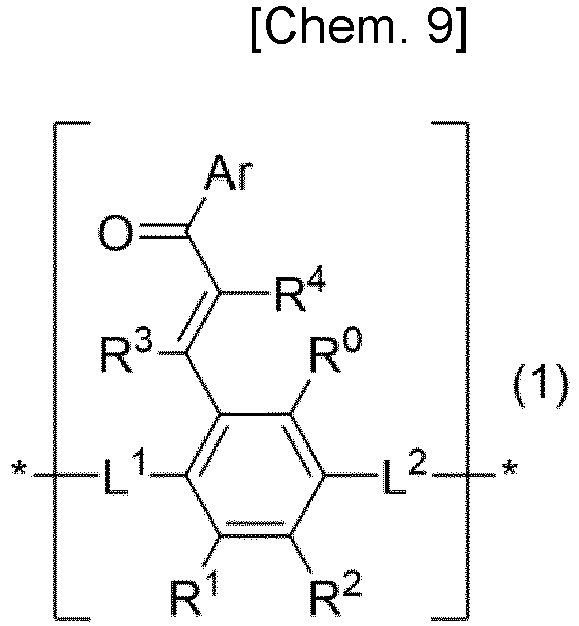
- [In formula (1), L1 and L2 may be the same or different from each other, each representing a carbonyl group, an ester linkage, an amide linkage, an ether linkage or a single bond.
- * represents a site of binding with another structure in the main chain polymer.
- Ar represents a ring system selected from the group consisting of a monocyclic aromatic ring system, a polycyclic aromatic ring system and an annulated aromatic ring system whose ring-constituting atoms are atoms selected from the group consisting of a carbon atom, a nitrogen atom, an oxygen atom and a sulfur atom, with the monocyclic aromatic ring system, polycyclic aromatic ring system and annulated aromatic ring system optionally having a substituent.
- R°, R1, R2, R3 and R4 each independently represent a hydrogen atom, a halogen atom, a C1 to C8 alkyl group or a group represented by chemical formula (Z1) below.]
- [In chemical formula (Z1) above, Rz3 and Rz4 each independently represent a hydrogen atom, a halogen atom or a C1 to C8 alkyl group.
- Arz represents a ring system selected from the group consisting of a monocyclic aromatic ring system, a polycyclic aromatic ring system and an annulated aromatic ring system whose ring-constituting atoms are atoms selected from the group consisting of a carbon atom, a nitrogen atom, an oxygen atom and a sulfur atom, with the monocyclic aromatic ring system, polycyclic aromatic ring system or annulated aromatic ring system optionally having a substituent. The wavy-lined portion represents a site of binding with the portion in formula (1) excluding R°, R1, R2, R3 or R4.]
- In formula (1), R°, R1, R2, R3 and R4 each independently represent a hydrogen atom, a halogen atom, a C1 to C8 alkyl group or a group represented by chemical formula (Z1). Examples of halogen atoms include a chlorine atom, a bromine atom, an iodine atom and a fluorine atom, and examples of C1 to C8 alkyl groups include a methyl group, an ethyl group, a propyl group, an isopropyl group, a butyl group, an isobutyl group, a sec-butyl group, a tert-butyl group, a pentyl group, a hexyl group, a heptyl group and an octyl group.
- In formula (Z1), Rz3 and Rz4 each independently represent a hydrogen atom, a halogen atom or a C1 to C8 alkyl group. Examples of halogen atoms include a chlorine atom, a bromine atom, an iodine atom and a fluorine atom, and examples of C1 to C8 alkyl groups include a methyl group, an ethyl group, a propyl group, an isopropyl group, a butyl group, an isobutyl group, a sec-butyl group, a tert-butyl group, a pentyl group, a hexyl group, a heptyl group and an octyl group.
- In formula (Z1), for use as Rz3 and Rz4, a hydrogen atom, a methyl group, an ethyl group, a propyl group, an isopropyl group, a butyl group, an isobutyl group, a sec-butyl group and a tert-butyl group are preferred because they ensure that the polymer according to the present invention will exhibit good optical characteristics. A hydrogen atom, a methyl group and an ethyl group are particularly preferred.
- Arz represents a ring system selected from the group consisting of a monocyclic aromatic ring system, a polycyclic aromatic ring system and an annulated aromatic ring system whose ring-constituting atoms are atoms selected from the group consisting of a carbon atom, a nitrogen atom, an oxygen atom and a sulfur atom, with the monocyclic aromatic ring system, polycyclic aromatic ring system and annulated aromatic ring system optionally having a substituent.
- Examples of monocyclic aromatic ring systems at Arz whose ring-constituting atoms are atoms selected from the group consisting of a carbon atom, a nitrogen atom, an oxygen atom and a sulfur atom and that may have a substituent include benzene, pyridine, pyrazine, pyrimidine, pyridazine, furan, pyrrole, imidazole, thiophene, pyrazole, oxazole, isoxazole, thiazole and triazole.
- Examples of polycyclic aromatic ring systems at Arz whose ring-constituting atoms are atoms selected from the group consisting of a carbon atom, a nitrogen atom, an oxygen atom and a sulfur atom and that may have a substituent include biphenyl, terphenyl, bipyridine, bithiophene and bifuran.
- Examples of annulated aromatic ring systems at Arz whose ring-constituting atoms are atoms selected from the group consisting of a carbon atom, a nitrogen atom, an oxygen atom and a sulfur atom and that may have a substituent include naphthalene, anthracene, phenanthrene, quinoline, benzofuran, benzimidazole, benzothiophene, indole, indazole, benzoxazole, benzothiazole and benzotriazole.
- For use as Arz, a monocyclic aromatic ring system whose ring-constituting atoms are atoms selected from the group consisting of a carbon atom, a nitrogen atom, an oxygen atom and a sulfur atom and that may have a substituent is preferred because of easy availability. More preferably, this aromatic ring system is a benzene ring, a furan ring, a thiophene ring, a thiazole ring or an oxazole ring because this ensures that the polymer according to the present invention will exhibit good optical characteristics. A benzene ring or thiophene ring is particularly preferred because they ensure that the polymer according to the present invention will exhibit better optical characteristics.
- For use as R°, R1, R2, R3 and R4, a hydrogen atom, a methyl group, an ethyl group, a propyl group, an isopropyl group, a butyl group, an isobutyl group, a sec-butyl group, a tert-butyl group and the groups represented by chemical formulae (Z1-1) to (Z1-4) below are preferred because they ensure that the polymer according to the present invention will exhibit good optical characteristics. A hydrogen atom, a methyl group and an ethyl group are particularly preferred.

- In formula (1), L1 and L2 may be the same or different from each other, each representing a carbonyl group, an ester linkage, an amide linkage, an ether linkage or a single bond.
- For use as L1 and L2, a carbonyl group, an ester linkage or an ether linkage is preferred.
- In formula (1), Ar represents a ring system selected from the group consisting of a monocyclic aromatic ring system, a polycyclic aromatic ring system and an annulated aromatic ring system whose ring-constituting atoms are atoms selected from the group consisting of a carbon atom, a nitrogen atom, an oxygen atom and a sulfur atom, with the monocyclic aromatic ring system, polycyclic aromatic ring system and annulated aromatic ring system optionally having a substituent.
- In this context, examples of substituents in the monocyclic aromatic ring system, polycyclic aromatic ring system and annulated aromatic ring system include a C1 to C8 alkyl group, a halogen atom, a C1 to C4 alkoxy group and a C2 to C4 acyl group.
- Examples of C1 to C8 alkyl groups include a methyl group, an ethyl group, a propyl group, an isopropyl group, a butyl group, an isobutyl group, a sec-butyl group, a tert-butyl group, a pentyl group, a hexyl group, a heptyl group and an octyl group.
- Examples of halogen atoms include a fluorine atom, a chlorine atom, a bromine atom and an iodine atom.
- Examples of C1 to C4 alkoxy groups include a methoxy group, an ethoxy group, a propyloxy group, an isopropyloxy group, a butyloxy group, an isobutyloxy group, a sec-butyloxy group and a tert-butyloxy group.
- Examples of C2 to C4 acyl groups include an acetyl group, a propionyl group and a butyryl group.
- Examples of monocyclic aromatic ring systems at Ar whose ring-constituting atoms are atoms selected from the group consisting of a carbon atom, a nitrogen atom, an oxygen atom and a sulfur atom and that may have a substituent include benzene, pyridine, pyrazine, pyrimidine, pyridazine, furan, pyrrole, imidazole, thiophene, pyrazole, oxazole, isoxazole, thiazole and triazole.
- Examples of polycyclic aromatic ring systems at Ar whose ring-constituting atoms are atoms selected from the group consisting of a carbon atom, a nitrogen atom, an oxygen atom and a sulfur atom and that may have a substituent include biphenyl, terphenyl, bipyridine, bithiophene and bifuran.
- Examples of annulated aromatic ring systems at Ar whose ring-constituting atoms are atoms selected from the group consisting of a carbon atom, a nitrogen atom, an oxygen atom and a sulfur atom and that may have a substituent include naphthalene, anthracene, phenanthrene, quinoline, benzofuran, benzimidazole, benzothiophene, indole, indazole, benzoxazole, benzothiazole and benzotriazole.
- For use as Ar, a monocyclic aromatic ring system whose ring-constituting atoms are atoms selected from the group consisting of a carbon atom, a nitrogen atom, an oxygen atom and a sulfur atom and that may have a substituent is preferred because of easy availability. More preferably, this aromatic ring system is a benzene ring, a furan ring, a thiophene ring, a thiazole ring or an oxazole ring because this ensures that the polymer according to the present invention will exhibit good optical characteristics. A benzene ring or thiophene ring is particularly preferred because they ensure that the polymer according to the present invention will exhibit better optical characteristics.
- Preferred examples of Ars include the structures indicated by chemical formulae (Ar-1) to (Ar-7) below.

- [In chemical formulae (Ar-1) to (Ar-7) above, X1, X2, X3, X4, X5, X6, X7 and X8 each independently represent a hydrogen atom a C1 to C8 alkyl group, a C1 to C6 alkoxy group, a halogen atom, a nitro group, a cyano group, a C1 to C6 alkylthio group or a C2 to C8 dialkylamino group.
- Re represents a hydrogen atom or a C1 to C10 alkyl group.
- ** represents a site of binding with the other portion in chemical formula (1) above, excluding Ar.]
- In formulae (Ar-1) to (Ar-7), X1, X2, X3, X4, X5, X6, X7 and X8 each independently represent a hydrogen atom, a C1 to C8 alkyl group, a C1 to C6 alkoxy group, a halogen atom, a nitro group, a cyano group, a C1 to C6 alkylthio group or a C2 to C8 dialkylamino group. Examples of C1 to C8 alkyl groups include a methyl group, an ethyl group, a propyl group, an isopropyl group, a butyl group, an isobutyl group, a sec-butyl group, a tert-butyl group, a pentyl group, a hexyl group, a heptyl group and an octyl group, examples of C1 to C6 alkoxy groups include a methoxy group, an ethoxy group, a propyloxy group, an isopropyloxy group, a butyloxy group, an isobutyloxy group, a sec-butyloxy group, a tert-butyloxy group, a pentyloxy group and a hexyloxy group, examples of halogen atoms include a fluorine atom, a chlorine atom, a bromine atom and an iodine atom, examples of C1 to C6 alkylthio groups include a methylthio group, an ethylthio group, a propylthio group, an isopropylthio group, a butylthio group, an isobutylthio group, a sec-butylthio group, a tert-butylthio group, a pentylthio group and a hexylthio group, and examples of C2 to C8 dialkylamino groups include a dimethylamino group, a diethylamino group, a dipropylamino group and a dibutylamino group.
- For X1, X2, X3, X4, X5, X6, X7 and X8, it is preferred that each be a hydrogen atom, a C1 to C8 alkyl group, a C1 to C6 alkoxy group or a halogen atom because this leads to superior optical characteristics of the polymer according to the present invention. It is particularly preferred that each be a hydrogen atom, a methyl group, a methoxy group or a halogen atom because of the ease of introduction.
- In (Ar-1) to (Ar-7), Re represents a hydrogen atom or a C1 to C10 alkyl group. Examples of C1 to C10 alkyl groups include a methyl group, an ethyl group, a propyl group, an isopropyl group, a butyl group, an isobutyl group, a sec-butyl group, a tert-butyl group, a pentyl group, a hexyl group, a heptyl group, an octyl group, a nonyl group and a decyl group.
- For Re, it is preferred that it be a hydrogen atom, a methyl group or a C1 to C4 alkyl group because this leads to superior optical characteristics of the polymer according to the present invention. It is particularly preferred that Re be a hydrogen atom, a methyl group, an ethyl group, a propyl group, a butyl group, an isobutyl group, a sec-butyl group or a tert-butyl group.
- Specific examples of photoreactive reverse wavelength dispersion units A indicated by general formula (1) include the photoreactive reverse wavelength dispersion units A indicated by chemical formulae (1-1-1) to (1-7-4) below.


- [In formulae (1-1-1) to (1-7-4), L1 and L2 may be the same or different from each other, each representing a carbonyl group, an ester linkage, an amide linkage, an ether linkage or a single bond.
- * represents a site of binding with another structure in the main chain polymer.]
- Of these (1-1-1) to (1-7-4), particularly preferred units are (1-1-1) to (1-2-11), (1-6-1) to (1-6-4) and (1-7-1) to (1-7-4), with especially preferred ones being (1-2-1) to (1-2-8) and (1-7-1) to (1-7-3).
- The polymer according to the present invention preferably further comprises at least one type of repeat unit selected from the group consisting of chemical formulae (2A), (2B), (2C) and (2D) below.

- [In chemical formula (2A) above, ring C, ring D and ring E each independently represent a ring system selected from the group consisting of a monocyclic aromatic ring system, a polycyclic aromatic ring system, an annulated aromatic ring system and an aliphatic hydrocarbon ring system whose ring-constituting atoms are atoms selected from the group consisting of a carbon atom, a nitrogen atom, an oxygen atom and a sulfur atom, with the monocyclic aromatic ring system, polycyclic aromatic ring system, annulated aromatic ring system and aliphatic hydrocarbon ring system optionally having a substituent.
- R5 and R6 may be the same or different from each other, each representing a group selected from the group consisting of a hydrogen atom, a substituted or unsubstituted C1 to C20 alkyl group, a substituted or unsubstituted C3 to C8 cycloalkyl group and a substituted or unsubstituted C3 to C12 aromatic group.
- n is 0 or 1.
- L3 and L4 may be the same or different from each other, each representing a carbonyl group, an ester linkage, an amide linkage, an ether linkage or a single bond.
- *** represents a site of binding with another structure in the main chain polymer.]
- In formula (2A), ring C, ring D and ring E each independently represent a ring system selected from the group consisting of a monocyclic aromatic ring system, a polycyclic aromatic ring system, an annulated aromatic ring system and an aliphatic hydrocarbon ring system whose ring-constituting atoms are atoms selected from the group consisting of a carbon atom, a nitrogen atom, an oxygen atom and a sulfur atom, with the monocyclic aromatic ring system, polycyclic aromatic ring system, annulated aromatic ring system and aliphatic hydrocarbon ring system optionally having a substituent.
- Specific examples of monocyclic aromatic ring systems at ring C whose ring-constituting atoms are atoms selected from the group consisting of a carbon atom, a nitrogen atom, an oxygen atom and a sulfur atom and that may have a substituent include benzene, pyridine, pyrazine, pyrimidine, pyridazine, furan, pyrrole, imidazole, thiophene, pyrazole, oxazole, isoxazole, thiazole and triazole.
- Examples of polycyclic aromatic ring systems at ring C whose ring-constituting atoms are atoms selected from the group consisting of a carbon atom, a nitrogen atom, an oxygen atom and a sulfur atom and that may have a substituent include biphenyl, terphenyl, bipyridine, bithiophene and bifuran.
- Examples of annulated aromatic ring systems at ring C whose ring-constituting atoms are atoms selected from the group consisting of a carbon atom, a nitrogen atom, an oxygen atom and a sulfur atom and that may have a substituent include naphthalene, anthracene, phenanthrene, quinoline, benzofuran, benzimidazole, benzothiophene, indole, indazole, benzoxazole, benzothiazole and benzotriazole.
- Specific examples of aliphatic hydrocarbon ring systems at ring C whose ring-constituting atoms are atoms selected from the group consisting of a carbon atom, a nitrogen atom, an oxygen atom and a sulfur atom and that may have a substituent include cyclopentane, cyclohexane and tricyclo[5.2.1.0(2,6)]decane.
- For use as ring C, a monocyclic aromatic ring system whose ring-constituting atoms are atoms selected from the group consisting of a carbon atom, a nitrogen atom, an oxygen atom and a sulfur atom and that may have a substituent is preferred because of easy availability of source carboxylic acids. It is particularly preferred that ring C be a benzene ring because of the ease of introduction.
- In formula (2A), ring D and ring E each independently represent a ring system selected from the group consisting of a monocyclic aromatic ring system, a polycyclic aromatic ring system, an annulated aromatic ring system and an aliphatic hydrocarbon ring system whose ring-constituting atoms are atoms selected from the group consisting of a carbon atom, a nitrogen atom, an oxygen atom and a sulfur atom, with the monocyclic aromatic ring system, polycyclic aromatic ring system, annulated aromatic ring system and aliphatic hydrocarbon ring system optionally having a substituent.
- Examples of specific rings D and E are, independently for each ring, the same as for ring C. A monocyclic aromatic ring system whose ring-constituting atoms are atoms selected from the group consisting of a carbon atom, a nitrogen atom, an oxygen atom and a sulfur atom is preferred. It is particularly preferred that rings D and E be benzene rings because of the ease of introduction.
- In this context, examples of substituents in the monocyclic aromatic ring system, polycyclic aromatic ring system, annulated aromatic ring system and aliphatic hydrocarbon ring system include a C1 to C8 alkyl group, a halogen atom, a C1 to C4 alkoxy group and a C2 to C4 acyl group. Examples of C1 to C8 alkyl groups include a methyl group, an ethyl group, a propyl group, an isopropyl group, a butyl group, an isobutyl group, a sec-butyl group, a tert-butyl group, a pentyl group, a hexyl group, a heptyl group and an octyl group, examples of halogen atoms include a fluorine atom, a chlorine atom, a bromine atom and an iodine atom, examples of C1 to C4 alkoxy groups include a methoxy group, an ethoxy group, a propyloxy group, an isopropyloxy group, a butyloxy group, an isobutyloxy group, a sec-butyloxy group and a tert-butyloxy group, and examples of C2 to C4 acyl groups include an acetyl group, a propionyl group and a butyryl group.
- In formula (2A), R5 and R6 may be the same or different from each other, each representing a group selected from the group consisting of a hydrogen atom, a substituted or unsubstituted C1 to C20 alkyl group, a substituted or unsubstituted C3 to C8 cycloalkyl group and a substituted or unsubstituted C3 to C12 aromatic group.
- Examples of C1 to C20 alkyl groups include a methyl group, an ethyl group, a propyl group, an isopropyl group, a butyl group, an isobutyl group, a sec-butyl group, a tert-butyl group, a pentyl group, a hexyl group, a heptyl group, an octyl group, a nonyl group, a decyl group and an icosyl group. Of these, a methyl group, an ethyl group, a propyl group, an isopropyl group, a butyl group, an isobutyl group, a sec-butyl group and a tert-butyl group are particularly preferred, with a methyl group and an ethyl group being especially preferred because of the ease of introduction.
- Examples of C3 to C8 cycloalkyl groups include a cyclopropyl group, a cyclobutyl group, a cyclopentyl group, a cyclohexyl group, a cycloheptyl group and a cyclooctyl group.
- Examples of C3 to C12 aromatic groups include a phenyl group, a naphthyl group, a biphenylyl group and a pyridyl group.

- [In chemical formula (2B) above, L9 and L10 may be the same or different from each other, each representing a carbonyl group, an ester linkage, an amide linkage, an ether linkage or a single bond.
- *** represents a site of binding with another structure in the main chain polymer.]
- [In chemical formula (2C) above, X9 represents a C1 to C10 alkylene chain or a single bond.
- X10 represents -O- or -N(Rc)-.
- X11 represents -O- or -N(Rd)-.
- Rc and Rd may be the same or different from each other, each representing a hydrogen atom or a C1 to C10 alkyl group.
- L11 and L12 may be the same or different from each other, each representing a carbonyl group, an ester linkage, an amide linkage, an ether linkage or a single bond.
- *** represents a site of binding with another structure in the main chain polymer.]
- [In chemical formula (2D) above, ring G represents a ring system selected from the group consisting of a monocyclic aromatic ring system, a polycyclic aromatic ring system, an annulated aromatic ring system, a spiro ring system and an aliphatic hydrocarbon ring system whose ring-constituting atoms are atoms selected from the group consisting of a carbon atom, a nitrogen atom, an oxygen atom and a sulfur atom, with the monocyclic aromatic ring system, polycyclic aromatic ring system, annulated aromatic ring system, spiro ring system and aliphatic hydrocarbon ring system optionally having a substituent.
- L13 and L14 may be the same or different from each other, each representing a single bond or a C1 to C6 alkylene chain.
- L15 and L16 may be the same or different from each other, each representing a carbonyl group, an ester linkage, an amide linkage, an ether linkage or a single bond.
- *** represents a site of binding with another structure in the main chain polymer.]
- In formula (2D), rings G each independently represent a ring system selected from the group consisting of a monocyclic aromatic ring system, a polycyclic aromatic ring system, an annulated aromatic ring system, a spiro ring system and an aliphatic hydrocarbon ring system whose ring-constituting atoms are atoms selected from the group consisting of a carbon atom, a nitrogen atom, an oxygen atom and a sulfur atom, with the monocyclic aromatic ring system, polycyclic aromatic ring system, annulated aromatic ring system, spiro ring system and aliphatic hydrocarbon ring system optionally having a substituent.
- Specific examples of monocyclic aromatic ring systems at ring G whose ring-constituting atoms are atoms selected from the group consisting of a carbon atom, a nitrogen atom, an oxygen atom and a sulfur atom and that may have a substituent include benzene, pyridine, pyrazine, pyrimidine, pyridazine, furan, pyrrole, imidazole, thiophene, pyrazole, oxazole, isoxazole, thiazole and triazole.
- Examples of polycyclic aromatic ring systems at ring G whose ring-constituting atoms are atoms selected from the group consisting of a carbon atom, a nitrogen atom, an oxygen atom and a sulfur atom and that may have a substituent include biphenyl, terphenyl, bipyridine, bithiophene and bifuran.
- Examples of annulated aromatic ring systems at ring G whose ring-constituting atoms are atoms selected from the group consisting of a carbon atom, a nitrogen atom, an oxygen atom and a sulfur atom and that may have a substituent include naphthalene, anthracene, phenanthrene, quinoline, benzofuran, benzimidazole, benzothiophene, indole, indazole, benzoxazole, benzothiazole and benzotriazole.
- An example of a spiro ring system at ring G whose ring-constituting atoms are atoms selected from the group consisting of a carbon atom, a nitrogen atom, an oxygen atom and a sulfur atom and that may have a substituent is the structure indicated by chemical formula (sp1-1) below.


- Examples of aliphatic hydrocarbon ring systems at ring G whose ring-constituting atoms are atoms selected from the group consisting of a carbon atom, a nitrogen atom, an oxygen atom and a sulfur atom and that may have a substituent include cyclopropane, cyclopentane, cyclohexane and tricyclo[5.2.1.0(2,6)]decane.
- For use as ring G, a monocyclic aromatic ring system or aliphatic hydrocarbon ring system whose ring-constituting atoms are atoms selected from the group consisting of a carbon atom, a nitrogen atom, an oxygen atom and a sulfur atom is preferred because of easy availability. It is particularly preferred that ring G be a benzene ring, cyclohexane or tricyclo[5.2.1.0(2,6)]decane because this leads to good optical characteristics.
- A preferred example of a repeat unit indicated by general formula (2A) is a repeat unit indicated by chemical formula (2'A) below.

- In formula (2'A), ring C, R5, R6, L3, L4 and n are synonymous with ring C, R5, R6, L3, L4 and n, respectively, in formula (2A).
- Specific examples of repeat units indicated by general formula (2A) include the structures indicated by chemical formulae (2A-1-1) to (2A-2-20) below.


- [In formulae (2A-1-1) to (2A-2-20), L3 and L4 may be the same or different from each other, each representing a carbonyl group, an ester linkage, an amide linkage, an ether linkage or a single bond.]
- Of these (2A-1-1) to (2A-2-20), particularly preferred units are (2A-1-1) to (2A-1-10), (2A-1-36) to (2A-1-40), (2A-1-51) to (2A-1-55), (2A-1-91) to (2A-1-105) and (2A-2-1) to (2A-2-4) because they allow for easier synthesis of a source monomer for the polymer according to the present invention, with (2A-1-1) to (2A-1-10), (2A-1-36) to (2A-1-40), (2A-1-91) to (2A-1-105), (2A-1-51) to (2A-1-55) and (2A-1-104) being especially preferred because they lead to superior optical characteristics of the polymer according to the present invention.
- Specific examples of repeat units indicated by general formula (2B) include the structures indicated by chemical formulae (2B-1) to (2B-3) below.

- Of these (2B-1) to (2B-3), (2B-1) is particularly preferred because it leads to superior optical characteristics of the polymer according to the present invention.
- Specific examples of repeat units indicated by general formula (2C) include the structures indicated by chemical formulae (2C-1-1) to (2C-2-23) below.



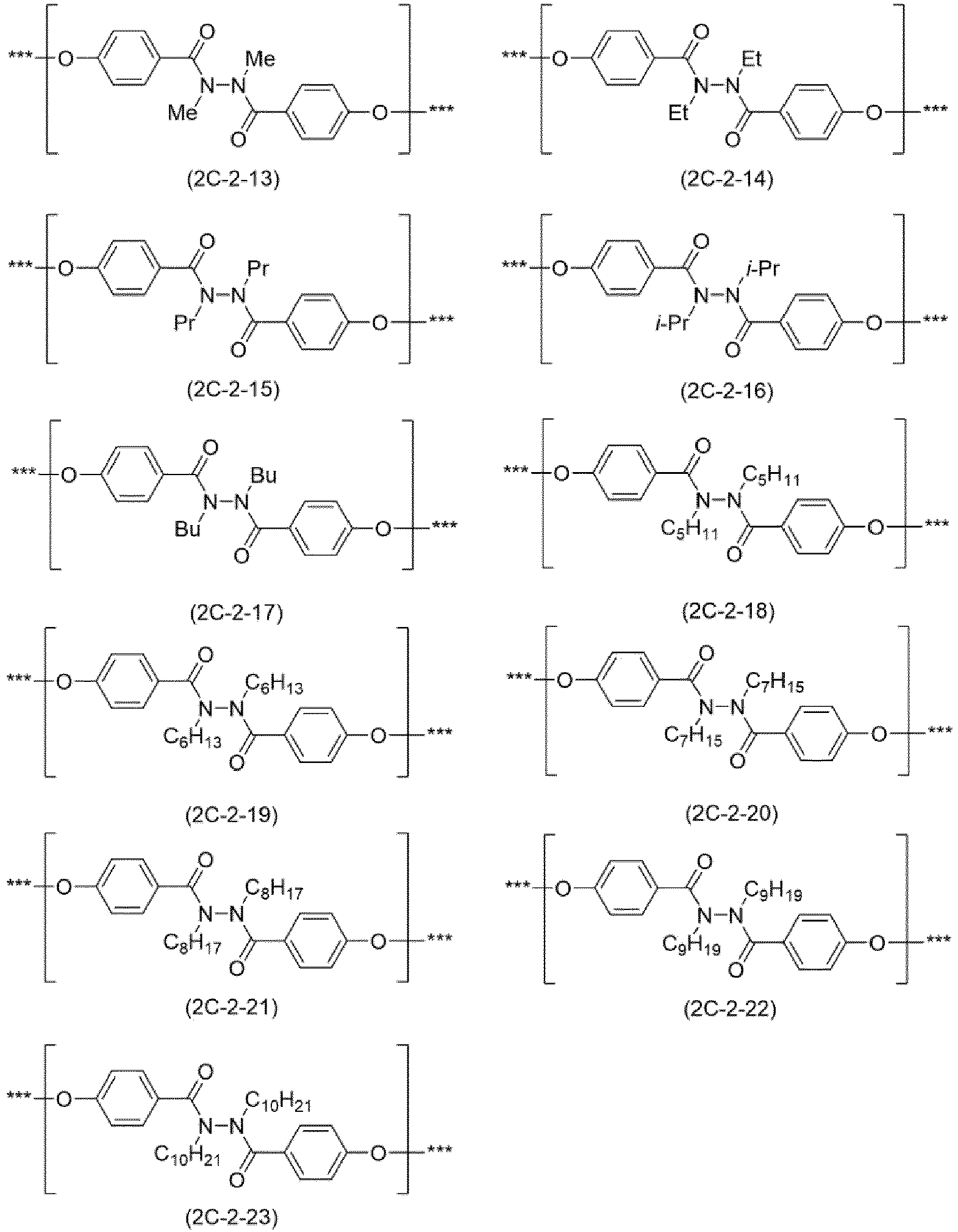
- Of these (2C-1-1) to (2C-2-23), (2C-1-1) to (2C-1-8), (2C-2-2) to (2C-2-6) and (2C-2-13) to (2C-2-19) are particularly preferred because they lead to superior optical characteristics of the polymer according to the present invention.
- Specific examples of repeat units indicated by general formula (2D) include the structures indicated by chemical formulae (2D-1-1) to (2D-14-1) below.


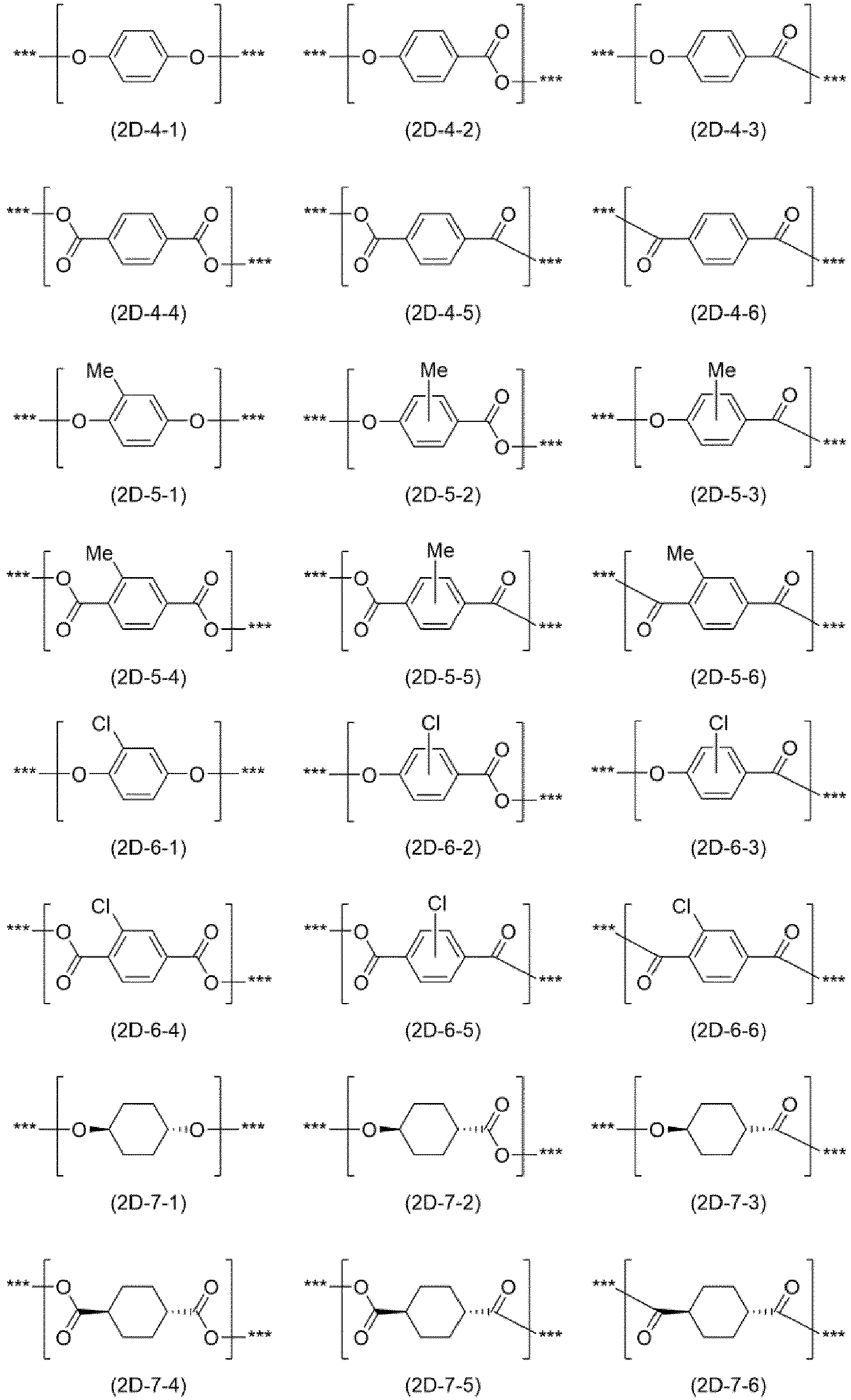


- Of these (2D-1-1) to (2D-14-1), (2D-1-1), (2D-2-1), (2D-3-1), (2D-7-3), (2D-7-4), (2D-7-6), (2D-8-1) to (2D-13-1) and (2D-14-1) are particularly preferred because they lead to superior optical characteristics of the polymer according to the present invention.
- The polymer according to the present invention, furthermore, preferably contains at least one type of the repeat units indicated by chemical formulae (5-1) to (5-13) below for the purpose of the adjustment of the characteristics that the polymer develops.

- [In formulae (5-1) to (5-13), L5 and L6 may be the same or different from each other, each representing a carbonyl group, an ester linkage, an amide linkage, an ether linkage or a single bond.
- n represents an integer of 4 to 500.
- *** represents a site of binding with another structure in the main chain polymer.]
- The polymer according to the present invention may contain structures indicated by chemical formulae (6-1) to (6-12) for the purpose of the adjustment of the characteristics that the polymer develops.

- [In formulae (6-1) to (6-12), L7 and L8 may be the same or different from each other, each representing a carbonyl group, an ester linkage, an amide linkage, an ether linkage or a single bond.
- *** represents a site of binding with another structure in the main chain polymer.]
- Specific examples of polymers according to the present invention include the structures indicated by chemical formulae (P1-1-1-1-1) to (P7-12-1) below.


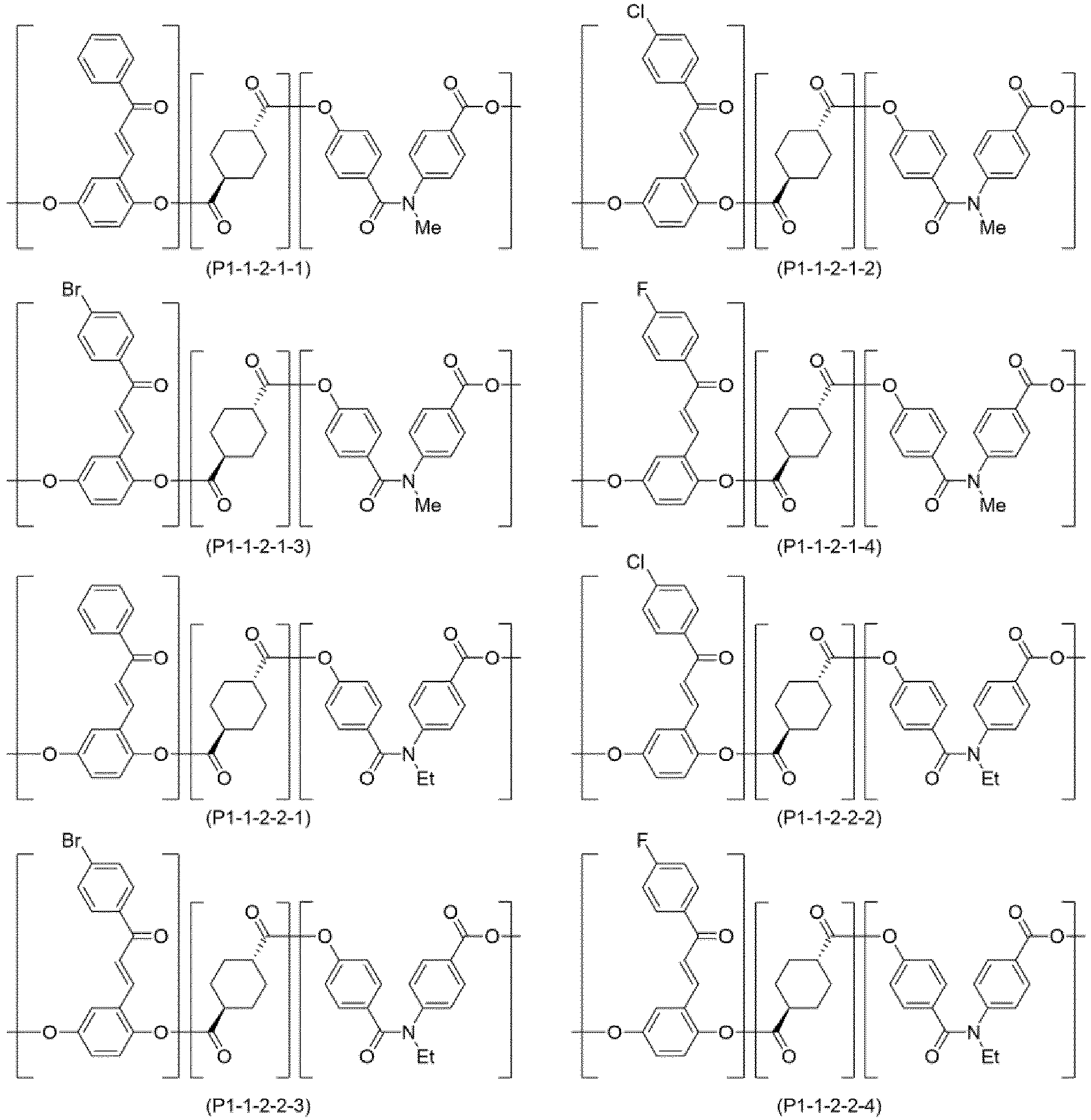


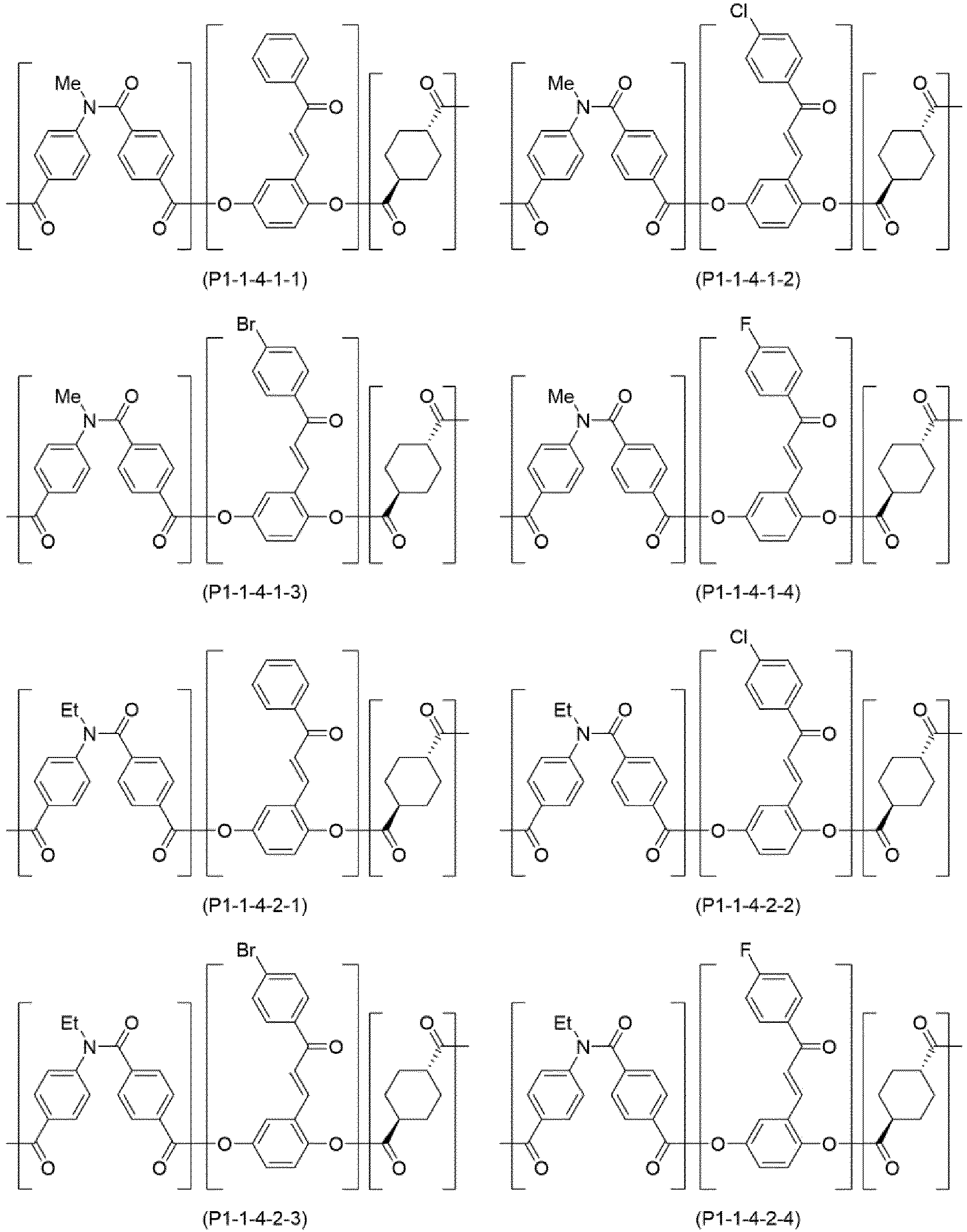


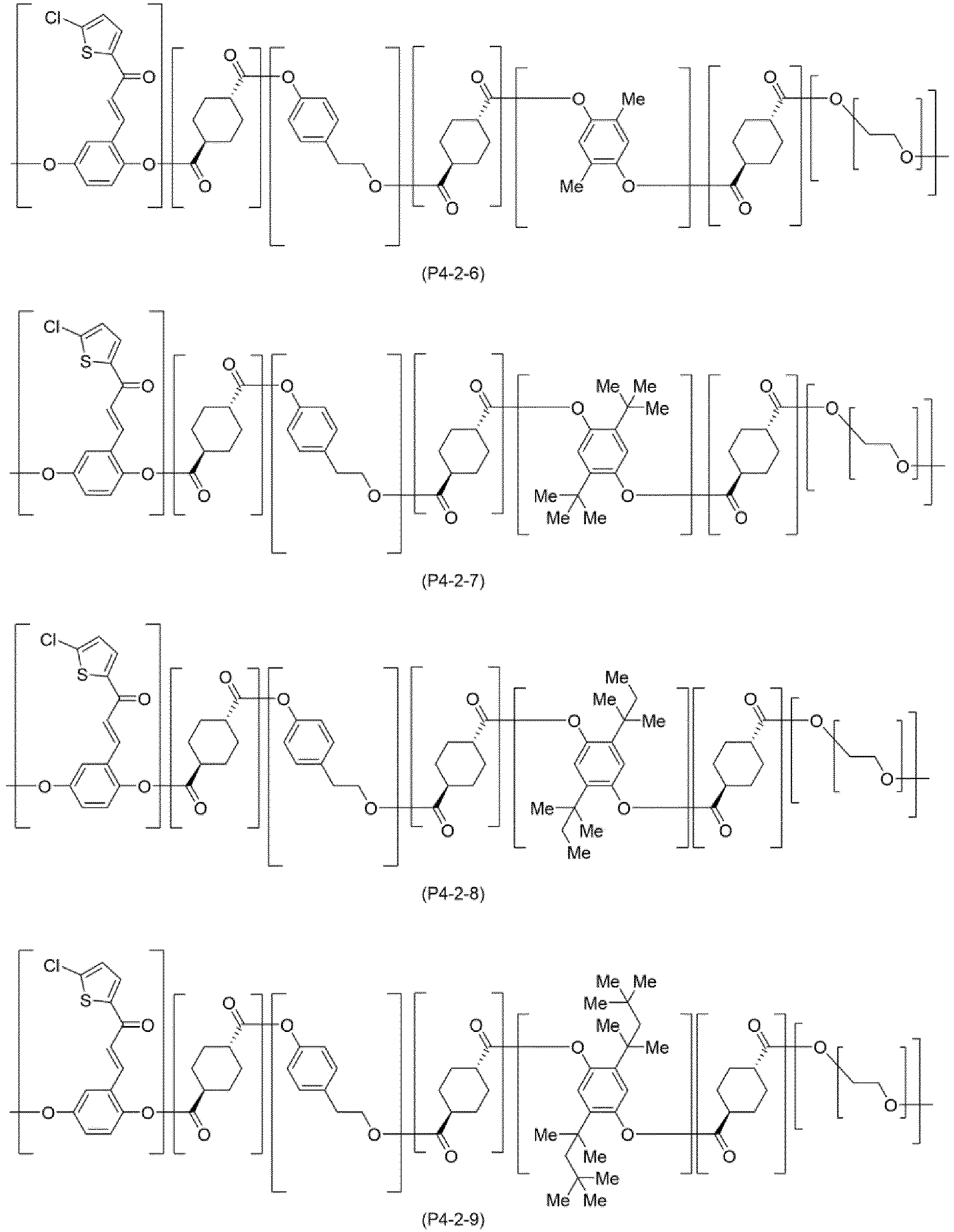




- Of these (P1-1-1-1-1) to (P7-12-1), particularly preferred structures are (P1-2-1-1-1) to (P1-2-5-1-4), (P2-2-1) to (P2-2-3), (P3-2-1) to (P3-2-2), (P4-1-1) to (P4-2-9) and (P5-1-1) to (P5-1-19) because they lead to good optical characteristics of the polymer according to the present invention.
- For the polymer according to the present invention, the amount of the photoreactive reverse wavelength dispersion unit A in the polymer is from 1 mol% to 50 mol%, preferably from 5 mol% to 45 mol%, more preferably from 20 mol% to 45 mol%.
- When the polymer according to the present invention contains repeat units represented by (2A), (2B), (2C) and (2D), the amount of the repeat units represented by (2A), (2B), (2C) and (2D) in the polymer is from 1 mol% to 99 mol%, preferably from 10 mol% to 70 mol%, more preferably from 15 mol% to 60 mol%.
- The weight-average molecular weight of the polymer according to the present invention is preferably 1,000 or more and 100,000 or less, particularly preferably 1,100 or more and 50,000 or less.
- For the polymer according to the present invention, it is preferred that at least one of its ends be a monocarboxylic acid ester because this leads to a short-wavelength shift of the absorption band, thereby allowing for the provision of a film with a low yellowness index (YI) when the polymer is made into a film.
- An example of a monocarboxylic acid ester is a structure indicated by chemical formula (2') below.

- [Here, in chemical formula (2') above, R10 represents a group selected from the group consisting of a substituted or unsubstituted C1 to C20 alkyl group, a substituted or unsubstituted C3 to C8 cycloalkyl group and a substituted or unsubstituted C3 to C12 aromatic group.
- ** represents a site of binding with another structure in the main chain polymer.]
- In formula (2'), at R10, examples of C1 to C20 alkyl groups include a methyl group, an ethyl group, a propyl group, an isopropyl group, a butyl group, an isobutyl group, a sec-butyl group, a tert-butyl group, a pentyl group, a hexyl group, a heptyl group, an octyl group, a nonyl group, a decyl group and an icosyl group. Of these, a methyl group, an ethyl group, a propyl group, an isopropyl group, a butyl group, an isobutyl group, a sec-butyl group and a tert-butyl group are particularly preferred, with a methyl group and an ethyl group being especially preferred because of the ease of introduction.
- Examples of C3 to C8 cycloalkyl groups include a cyclopropyl group, a cyclobutyl group, a cyclopentyl group, a cyclohexyl group, a cycloheptyl group and a cyclooctyl group.
- Examples of C3 to C12 aromatic groups include a phenyl group, a naphthyl group, a biphenylyl group and a pyridyl group.
- Examples of monocarboxylic acid esters include the structures indicated by chemical formulae (2'-1) to (2'-37) below.


- Of these (2'-1) to (2'-37), particularly preferred structures are (2'-1) to (2'-13) and (2'-20) to (2'-37) because of the ease of introduction, with especially preferred ones being, for example, (2'-1) to (2'-6), (2'-13), (2'-20) to (2'-23), (2'-29) and (2'-31) to (2'-36).
- For polymers according to the present invention at least one end of which is a monocarboxylic acid ester, specific examples include the structures indicated by chemical formulae (PA1-1-1-1-1) to (PA7-12-1) below.


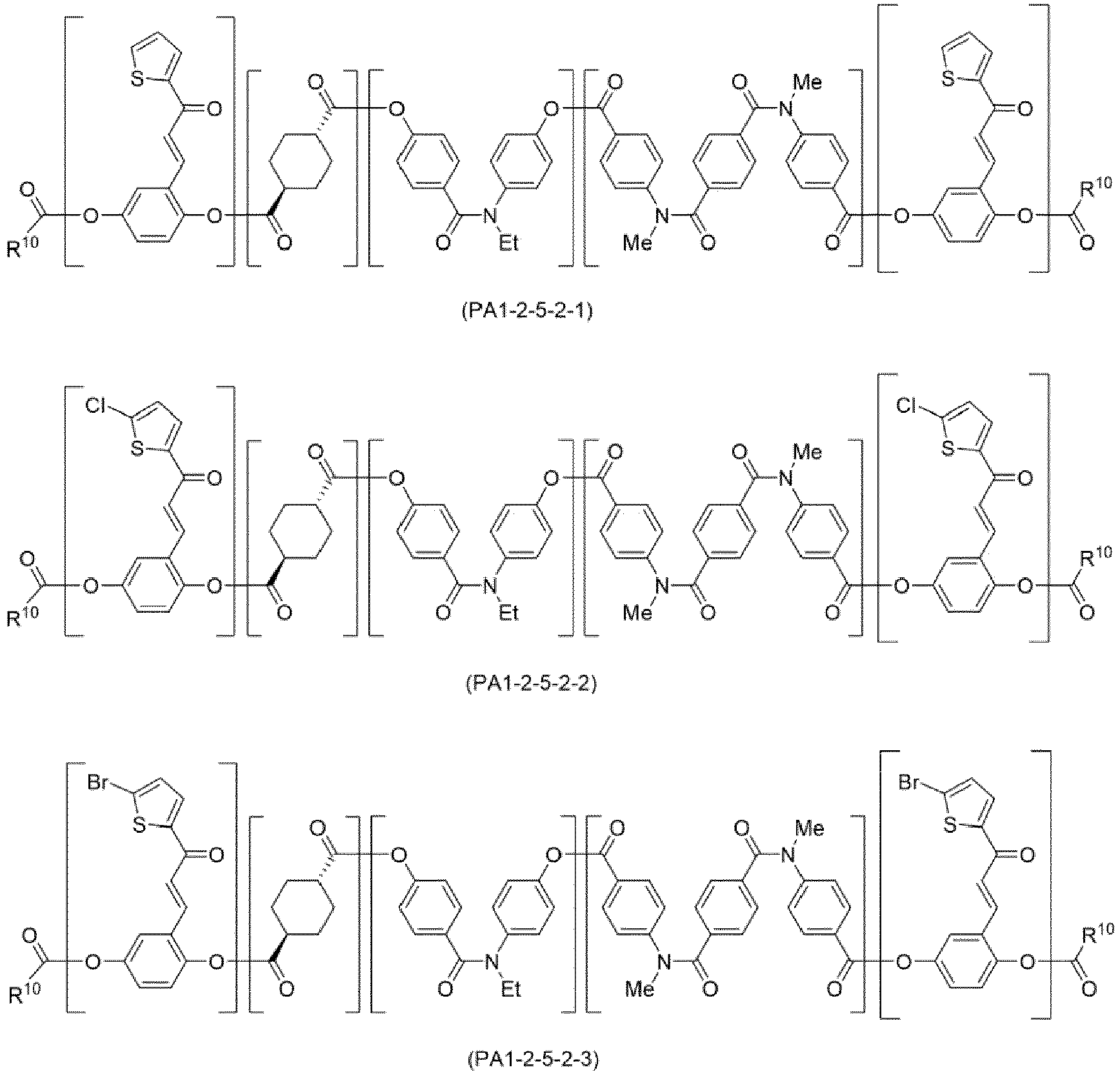

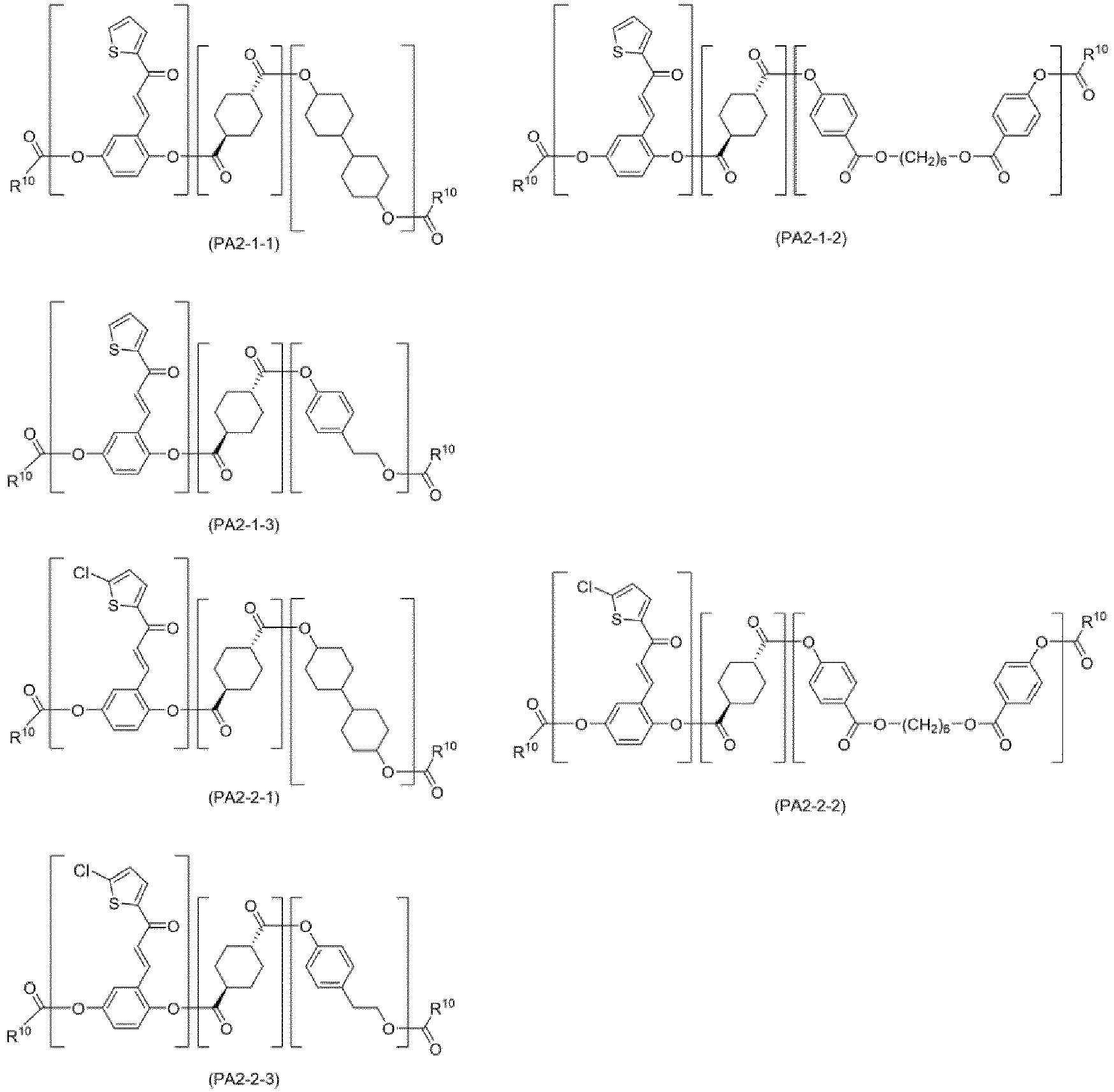


- (In chemical formulae (PA1-1-1-1-1) to (PA7-12-1) above, R10 is synonymous with R10 in chemical formula (2') above.)
- Of these chemical formulae (PA1-1-1-1-1) to (PA7-12-1), particularly preferred ones are chemical formulae (PA1-2-1-1-1) to (PA1-2-5-1-4), (PA2-2-1) to (PA2-2-3), (PA3-2-1) to (PA3-2-2), (PA4-1-1) to (PA5-1-19) and (PA7-1-1) to (PA7-12-1) because their optical characteristics are good.
- As for the method for producing the polymer according to the present invention, the polymer can be produced by polymerizing a source composition that contains a dihydroxy compound indicated by chemical formula (1') below. In particular, it is especially preferred to incorporate one or more species selected from the group consisting of dicarboxylic acid dichlorides and dicarboxylic acids in the source composition and polymerize the composition. A method for producing the polymer according to the present invention is also an aspect of the present invention.
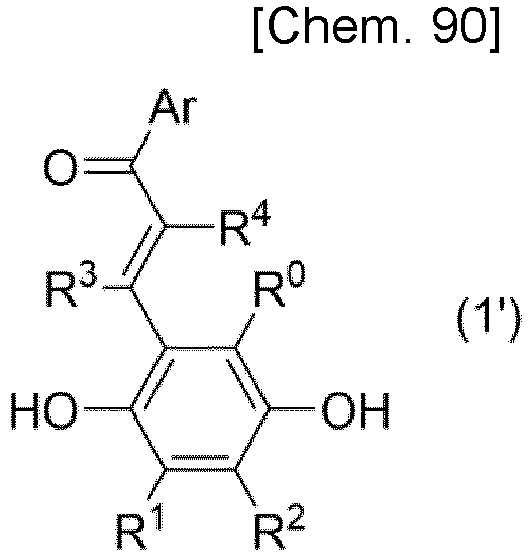
- [In chemical formula (1') above, R0, R1, R2, R3 and R4 each independently represent a hydrogen atom, a halogen atom, a C1 to C8 alkyl group or a group represented by chemical formula (Z1) below. Ar represents a ring system selected from the group consisting of a monocyclic aromatic ring system, a polycyclic aromatic ring system and an annulated aromatic ring system whose ring-constituting atoms are atoms selected from the group consisting of a carbon atom, a nitrogen atom, an oxygen atom and a sulfur atom, with the monocyclic aromatic ring system, polycyclic aromatic ring system or annulated aromatic ring system optionally having a substituent.]

- [In chemical formula (Z1) above, Rz3 and Rz4 each independently represent a hydrogen atom, a halogen atom or a C1 to C8 alkyl group.
- Arz represents a ring system selected from the group consisting of a monocyclic aromatic ring system, a polycyclic aromatic ring system and an annulated aromatic ring system whose ring-constituting atoms are atoms selected from the group consisting of a carbon atom, a nitrogen atom, an oxygen atom and a sulfur atom, with the monocyclic aromatic ring system, polycyclic aromatic ring system or annulated aromatic ring system optionally having a substituent. The wavy-lined portion represents a site of binding with the portion in formula (1) excluding R°, R1, R2, R3 or R4.]
- In formula (1'), R°, R1, R2, R3 and R4 each independently represent a hydrogen atom, a halogen atom, a C1 to C8 alkyl group or a group represented by formula (Z1). Examples of halogen atoms include a chlorine atom, a bromine atom, an iodine atom and a fluorine atom, and examples of C1 to C8 alkyl groups include a methyl group, an ethyl group, a propyl group, an isopropyl group, a butyl group, an isobutyl group, a sec-butyl group, a tert-butyl group, a pentyl group, a hexyl group, a heptyl group and an octyl group.
- In formula (Z1), Rz3 and Rz4 each independently represent a hydrogen atom, a halogen atom or a C1 to C8 alkyl group. Examples of halogen atoms include a chlorine atom, a bromine atom, an iodine atom and a fluorine atom, and examples of C1 to C8 alkyl groups include a methyl group, an ethyl group, a propyl group, an isopropyl group, a butyl group, an isobutyl group, a sec-butyl group, a tert-butyl group, a pentyl group, a hexyl group, a heptyl group and an octyl group.
- In formula (Z1), for use as Rz3 and Rz4, a hydrogen atom, a methyl group, an ethyl group, a propyl group, an isopropyl group, a butyl group, an isobutyl group, a sec-butyl group and a tert-butyl group are preferred because they ensure that the polymer according to the present invention will exhibit good optical characteristics. A hydrogen atom, a methyl group and an ethyl group are particularly preferred.
- Arz represents a ring system selected from the group consisting of a monocyclic aromatic ring system, a polycyclic aromatic ring system and an annulated aromatic ring system whose ring-constituting atoms are atoms selected from the group consisting of a carbon atom, a nitrogen atom, an oxygen atom and a sulfur atom, with the monocyclic aromatic ring system, polycyclic aromatic ring system and annulated aromatic ring system optionally having a substituent.
- Examples of monocyclic aromatic ring systems at Arz whose ring-constituting atoms are atoms selected from the group consisting of a carbon atom, a nitrogen atom, an oxygen atom and a sulfur atom and that may have a substituent include benzene, pyridine, pyrazine, pyrimidine, pyridazine, furan, pyrrole, imidazole, thiophene, pyrazole, oxazole, isoxazole, thiazole and triazole.
- Examples of polycyclic aromatic ring systems at Arz whose ring-constituting atoms are atoms selected from the group consisting of a carbon atom, a nitrogen atom, an oxygen atom and a sulfur atom and that may have a substituent include biphenyl, terphenyl, bipyridine, bithiophene and bifuran.
- Examples of annulated aromatic ring systems at Arz whose ring-constituting atoms are atoms selected from the group consisting of a carbon atom, a nitrogen atom, an oxygen atom and a sulfur atom and that may have a substituent include naphthalene, anthracene, phenanthrene, quinoline, benzofuran, benzimidazole, benzothiophene, indole, indazole, benzoxazole, benzothiazole and benzotriazole.
- For use as Arz, a monocyclic aromatic ring system whose ring-constituting atoms are atoms selected from the group consisting of a carbon atom, a nitrogen atom, an oxygen atom and a sulfur atom and that may have a substituent is preferred because of easy availability. More preferably, this aromatic ring system is a benzene ring, a furan ring, a thiophene ring, a thiazole ring or an oxazole ring because this ensures that the polymer according to the present invention will exhibit good optical characteristics. A benzene ring or thiophene ring is particularly preferred because they ensure that the polymer according to the present invention will exhibit better optical characteristics.
- For use as R°, R1, R2, R3 and R4, a hydrogen atom, a methyl group, an ethyl group, a propyl group, an isopropyl group, a butyl group, an isobutyl group, a sec-butyl group, a tert-butyl group and the groups represented by chemical formulae (Z1-1) to (Z1-4) below are preferred because optical characteristics after their introduction into the polymer according to the present invention will be superior. A hydrogen atom, a methyl group and an ethyl group are particularly preferred because of the ease of introduction.

- In chemical formula (1'), examples of Ars are the same Ars as in chemical formula (1). Preferred examples include the structures indicated by chemical formulae (Ar-1) to (Ar-7) below.
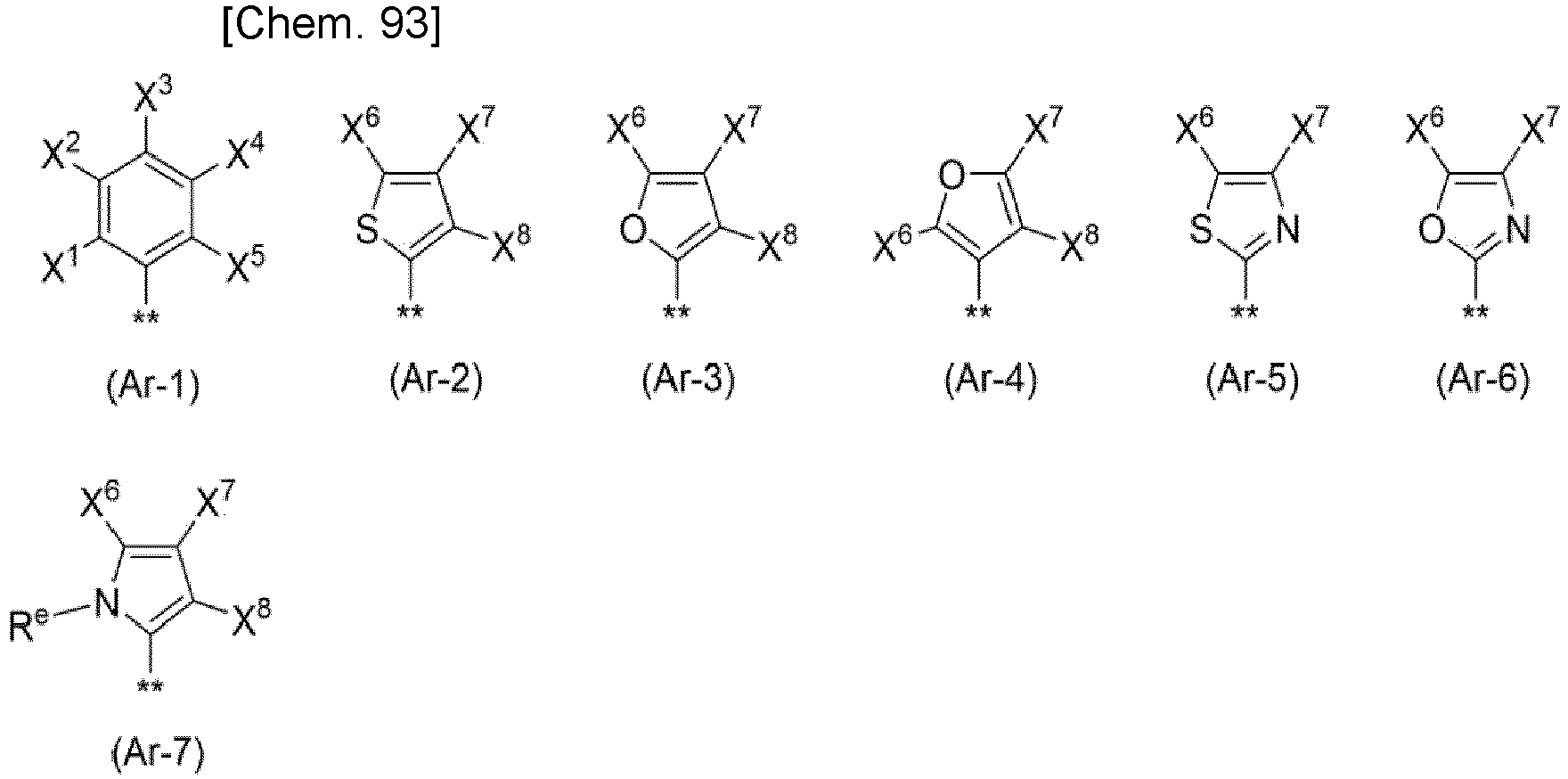
- [In chemical formulae (Ar-1) to (Ar-7) above, X1, X2, X3, X4, X5, X6, X7 and X8 each independently represent a hydrogen atom or a C1 to C8 alkyl group, a C1 to C6 alkoxy group, a halogen atom, a nitro group, a cyano group, a C1 to C6 alkylthio group or a C2 to C8 dialkylamino group.
- Re represents a hydrogen atom or a C1 to C10 alkyl group.
- ** represents a site of binding with the other portion in chemical formula (1) above, excluding Ar.]
- In (Ar-1) to (Ar-7), X1, X2, X3, X4, X5, X6, X7 and X8 each independently represent a hydrogen atom, a C1 to C8 alkyl group, a C1 to C6 alkoxy group, a halogen atom, a nitro group, a cyano group, a C1 to C6 alkylthio group or a C2 to C8 dialkylamino group. Examples of C1 to C8 alkyl groups include a methyl group, an ethyl group, a propyl group, an isopropyl group, a butyl group, an isobutyl group, a sec-butyl group, a tert-butyl group, a pentyl group, a hexyl group, a heptyl group and an octyl group, examples of C1 to C6 alkoxy groups include a methoxy group, an ethoxy group, a propyloxy group, an isopropyloxy group, a butyloxy group, an isobutyloxy group, a sec-butyloxy group, a tert-butyloxy group, a pentyloxy group and a hexyloxy group, examples of halogen atoms include a fluorine atom, a chlorine atom, a bromine atom and an iodine atom, examples of C1 to C6 alkylthio groups include a methylthio group, an ethylthio group, a propylthio group, an isopropylthio group, a butylthio group, an isobutylthio group, a sec-butylthio group, a tert-butylthio group, a pentylthio group and a hexylthio group, and examples of C2 to C8 dialkylamino groups include a dimethylamino group, a diethylamino group, a dipropylamino group and a dibutylamino group.
- For X1, X2, X3, X4, X5, X6, X7 and X8, it is preferred that each be a hydrogen atom, a C1 to C8 alkyl group, a C1 to C6 alkoxy group or a halogen atom because optical characteristics after their introduction into the polymer according to the present invention will be superior. It is particularly preferred that each be a hydrogen atom, a methyl group, a methoxy group or a halogen atom because of the ease of introduction.
- For use as the dihydroxy compound indicated by chemical formula (1') above, the dihydroxy compounds represented by chemical formulae (1'-1-1) to (1'-7-4) below are preferred.


- Of these (1'-1-1) to (1'-7-4), particularly preferred compounds are (1'-2-1) to (1'-2-11), (1'-6-1) to (1'-6-4) and (1'-7-1) to (1'-7-4), with especially preferred ones being (1'-2-1) to (1'-2-6), (1'-2-1) to (1'-2-11), (1'-6-2) to (1'-6-3) and (1'-7-2).
- Examples of dicarboxylic acids include aliphatic polycarboxylic acids (specifically, the saturated polycarboxylic acids containing 2 to 20 carbon atoms of oxalic acid, malonic acid, succinic acid, glutaric acid, adipic acid and sebacic acid, and the unsaturated polycarboxylic acids of maleic acid, fumaric acid and itaconic acid), alicyclic polycarboxylic acids (cyclobutanedicarboxylic acid, trans-1,4-cyclohexanedicarboxylic acid and cis-1,4-cyclohexanedicarboxylic acid) and aromatic polycarboxylic acids (terephthalic acid, isophthalic acid, orthophthalic acid, 4,4'-biphenyldicarboxylic acid, 4,4'-oxybis(benzoic acid) and 2,5-furandicarboxylic acid).
- Examples of dicarboxylic acid dichlorides include the saturated carboxylic acid dichlorides containing 2 to 20 carbon atoms of oxalic acid dichloride, malonic acid dichloride, succinic acid dichloride, glutaric acid dichloride, adipic acid dichloride and sebacic acid dichloride, the unsaturated polycarboxylic acid dichlorides of fumaric acid dichloride and itaconic acid dichloride, the alicyclic carboxylic acid dichlorides of cyclobutanedicarboxylic acid dichloride, cyclopentanedicarboxylic acid dichloride, trans-1,4-cyclohexanedicarboxylic acid dichloride and cis-1,4-cyclohexanedicarboxylic acid dichloride and the aromatic polycarboxylic acid dichlorides of terephthalic acid dichloride, isophthalic acid dichloride, orthophthalic acid dichloride, 4,4'-biphenyldicarboxylic acid dichloride, 4,4'-oxybis(benzoyl acid chloride) and 2,5-furandicarboxylic acid dichloride.
- In the method for producing the polymer according to the present invention, it is preferred to further incorporate compounds represented by chemical formulae (2"A), (2"B), (2"C) and (2"D) below in the source composition and polymerizing the composition.

- [In chemical formula (2"A) above, ring C, ring D and ring E each independently represent a ring system selected from the group consisting of a monocyclic aromatic ring system, a polycyclic aromatic ring system, an annulated aromatic ring system and an aliphatic hydrocarbon ring system whose ring-constituting atoms are atoms selected from the group consisting of a carbon atom, a nitrogen atom, an oxygen atom and a sulfur atom, with the monocyclic aromatic ring system, polycyclic aromatic ring system, annulated aromatic ring system and aliphatic hydrocarbon ring system optionally having a substituent.
- R5 and R6 may be the same or different from each other, each representing a group selected from the group consisting of a hydrogen atom, a substituted or unsubstituted C1 to C20 alkyl group, a substituted or unsubstituted C3 to C8 cycloalkyl group and a substituted or unsubstituted C3 to C12 aromatic group.
- Qn1 and Qn2 may be the same or different from each other, each representing a hydroxy group, an amino group, a carboxy group or -C(=O)CI.
- n is 0 or 1.]
- In formula (2"A), ring C, ring D and ring E each independently represent a ring system selected from the group consisting of a monocyclic aromatic ring system, a polycyclic aromatic ring system, an annulated aromatic ring system and an aliphatic hydrocarbon ring system whose ring-constituting atoms are atoms selected from the group consisting of a carbon atom, a nitrogen atom, an oxygen atom and a sulfur atom, with the monocyclic aromatic ring system, polycyclic aromatic ring system, annulated aromatic ring system and aliphatic hydrocarbon ring system optionally having a substituent.
- Specific examples of monocyclic aromatic ring systems at ring C whose ring-constituting atoms are atoms selected from the group consisting of a carbon atom, a nitrogen atom, an oxygen atom and a sulfur atom and that may have a substituent include benzene, pyridine, pyrazine, pyrimidine, pyridazine, furan, pyrrole, imidazole, thiophene, pyrazole, oxazole, isoxazole, thiazole and triazole.
- Examples of polycyclic aromatic ring systems at ring C whose ring-constituting atoms are atoms selected from the group consisting of a carbon atom, a nitrogen atom, an oxygen atom and a sulfur atom and that may have a substituent include biphenyl, terphenyl, bipyridine, bithiophene and bifuran.
- Examples of annulated aromatic ring systems at ring C whose ring-constituting atoms are atoms selected from the group consisting of a carbon atom, a nitrogen atom, an oxygen atom and a sulfur atom and that may have a substituent include naphthalene, anthracene, phenanthrene, quinoline, benzofuran, benzimidazole, benzothiophene, indole, indazole, benzoxazole, benzothiazole and benzotriazole.
- Specific examples of aliphatic hydrocarbon ring systems at ring C whose ring-constituting atoms are atoms selected from the group consisting of a carbon atom, a nitrogen atom, an oxygen atom and a sulfur atom and that may have a substituent include cyclopentane, cyclohexane and tricyclo[5.2.1.0(2,6)]decane.
- For use as ring C, a monocyclic aromatic ring system whose ring-constituting atoms are atoms selected from the group consisting of a carbon atom, a nitrogen atom, an oxygen atom and a sulfur atom is preferred because of easy availability. It is particularly preferred that ring C be a benzene ring because of the ease of introduction.
- In formula (2"A), ring D and ring E each independently represent a ring system selected from the group consisting of a monocyclic aromatic ring system, a polycyclic aromatic ring system, an annulated aromatic ring system and an aliphatic hydrocarbon ring system whose ring-constituting atoms are atoms selected from the group consisting of a carbon atom, a nitrogen atom, an oxygen atom and a sulfur atom, with the monocyclic aromatic ring system, polycyclic aromatic ring system, annulated aromatic ring system and aliphatic hydrocarbon ring system optionally having a substituent.
- Examples of specific rings D and E are, independently for each ring, the same as for ring C because of the ease of introduction. A monocyclic aromatic ring system whose ring-constituting atoms are atoms selected from the group consisting of a carbon atom, a nitrogen atom, an oxygen atom and a sulfur atom is preferred. It is particularly preferred that rings D and E be benzene rings because of the ease of introduction.
- In this context, examples of substituents in the monocyclic aromatic ring system, polycyclic aromatic ring system, annulated aromatic ring system and aliphatic hydrocarbon ring system include a C1 to C8 alkyl group, a halogen atom, a C1 to C4 alkoxy group and a C2 to C4 acyl group. Examples of C1 to C8 alkyl groups include a methyl group, an ethyl group, a propyl group, an isopropyl group, a butyl group, an isobutyl group, a sec-butyl group, a tert-butyl group, a pentyl group, a hexyl group, a heptyl group and an octyl group, examples of halogen atoms include a fluorine atom, a chlorine atom, a bromine atom and an iodine atom, examples of C1 to C4 alkoxy groups include a methoxy group, an ethoxy group, a propyloxy group, an isopropyloxy group, a butyloxy group, an isobutyloxy group, a sec-butyloxy group and a tert-butyloxy group, and examples of C2 to C4 acyl groups include an acetyl group, a propionyl group and a butyryl group.
- In formula (2"A), R5 and R6 may be the same or different from each other, each representing a group selected from the group consisting of a hydrogen atom, a substituted or unsubstituted C1 to C20 alkyl group, a substituted or unsubstituted C3 to C8 cycloalkyl group and a substituted or unsubstituted C3 to C12 aromatic group.
- Examples of C1 to C20 alkyl groups include a methyl group, an ethyl group, a propyl group, an isopropyl group, a butyl group, an isobutyl group, a sec-butyl group, a tert-butyl group, a pentyl group, a hexyl group, a heptyl group, an octyl group, a nonyl group, a decyl group and an icosyl group. Of these, a methyl group, an ethyl group, a propyl group, an isopropyl group, a butyl group, an isobutyl group, a sec-butyl group and a tert-butyl group are particularly preferred because optical characteristics after their introduction into the polymer according to the present invention will be superior, with a methyl group and an ethyl group being especially preferred because of the ease of introduction.
- Examples of C3 to C8 cycloalkyl groups include a cyclopropyl group, a cyclobutyl group, a cyclopentyl group, a cyclohexyl group, a cycloheptyl group and a cyclooctyl group.
- Examples of C3 to C12 aromatic groups include a phenyl group, a naphthyl group, a biphenylyl group and a pyridyl group.
- In formula (2"A), Qn1 and Qn2 may be the same or different from each other, each representing a hydroxy group, an amino group, a carboxy group or - C(=O)CI.

- [In chemical formula (2"B) above, Qn3 and Qn4 may be the same or different from each other, each representing a hydroxy group, an amino group, a carboxy group or -C(=O)CI.]

- [In chemical formula (2"C) above, X9 represents a C1 to C10 alkylene chain or a single bond.
- X10 represents -O- or -N(Rc)-.
- X11 represents -O- or -N(Rd)-.
- Rc and Rd may be the same or different from each other, each representing a hydrogen atom or a C1 to C10 alkyl group.
- Qn5 and Qn6 may be the same or different from each other, each representing a hydroxy group, an amino group, a carboxy group or -C(=O)CI.]
- [In chemical formula (2"D) above, ring G represents a ring system selected from the group consisting of a monocyclic aromatic ring system, a polycyclic aromatic ring system, an annulated aromatic ring system, a spiro ring system and an aliphatic hydrocarbon ring system whose ring-constituting atoms are atoms selected from the group consisting of a carbon atom, a nitrogen atom, an oxygen atom and a sulfur atom, with the monocyclic aromatic ring system, polycyclic aromatic ring system, annulated aromatic ring system, spiro ring system and aliphatic hydrocarbon ring system optionally having a substituent.
- L13 and L14 may be the same or different from each other, each representing a single bond or a C1 to C6 alkylene chain.
- Qn7 and Qn8 may be the same or different from each other, each representing a hydroxy group, an amino group, a carboxy group or -C(=O)CI.]
- In formula (2"D), rings G each independently represent a ring system selected from the group consisting of a monocyclic aromatic ring system, a polycyclic aromatic ring system, an annulated aromatic ring system, a spiro ring system and an aliphatic hydrocarbon ring system whose ring-constituting atoms are atoms selected from the group consisting of a carbon atom, a nitrogen atom, an oxygen atom and a sulfur atom, with the monocyclic aromatic ring system, polycyclic aromatic ring system, annulated aromatic ring system, spiro ring system and aliphatic hydrocarbon ring system optionally having a substituent.
- Specific examples of monocyclic aromatic ring systems at ring G whose ring-constituting atoms are atoms selected from the group consisting of a carbon atom, a nitrogen atom, an oxygen atom and a sulfur atom and that may have a substituent include benzene, pyridine, pyrazine, pyrimidine, pyridazine, furan, pyrrole, imidazole, thiophene, pyrazole, oxazole, isoxazole, thiazole and triazole.
- Examples of polycyclic aromatic ring systems at ring G whose ring-constituting atoms are atoms selected from the group consisting of a carbon atom, a nitrogen atom, an oxygen atom and a sulfur atom and that may have a substituent include biphenyl, terphenyl, bipyridine, bithiophene and bifuran.
- Examples of annulated aromatic ring systems at ring G whose ring-constituting atoms are atoms selected from the group consisting of a carbon atom, a nitrogen atom, an oxygen atom and a sulfur atom and that may have a substituent include naphthalene, anthracene, phenanthrene, quinoline, benzofuran, benzimidazole, benzothiophene, indole, indazole, benzoxazole, benzothiazole and benzotriazole.
- An example of a spiro ring system at ring G whose ring-constituting atoms are atoms selected from the group consisting of a carbon atom, a nitrogen atom, an oxygen atom and a sulfur atom and that may have a substituent is the structure indicated by chemical formula (sp1-1) below.

- Examples of aliphatic hydrocarbon ring systems at ring G whose ring-constituting atoms are atoms selected from the group consisting of a carbon atom, a nitrogen atom, an oxygen atom and a sulfur atom and that may have a substituent include cyclopentane, cyclohexane and tricyclo[5.2.1.0(2,6)]decane.
- For use as ring G, a monocyclic aromatic ring system or aliphatic hydrocarbon ring system whose ring-constituting atoms are atoms selected from the group consisting of a carbon atom, a nitrogen atom, an oxygen atom and a sulfur atom is preferred because of easy availability. It is particularly preferred that ring G be benzene, cyclohexane or tricyclo[5.2.1.0(2,6)]decane because this leads to good optical characteristics of the polymer.
- Specific examples of compounds indicated by formula (2"A) include the structures indicated by chemical formulae (2"A-1-1) to (2"A-2-20) below.


- Of these (2'A-1-1) to (2"A-2-20), particularly preferred compounds are (2"A-1-1) to (2'A-1-10), (2'A-1-36) to (2'A-1-40), (2'A-1-51) to (2'A-1-55) and (2"A-2-1) to (2"A-2-4) because they allow for easier synthesis of the polymer according to the present invention, with (2"A-1-1) to (2'A-1-10), (2'A-1-36) to (2'A-1-40) and (2'A-1-51) to (2'A-1-55) being especially preferred because they lead to superior optical characteristics of the polymer according to the present invention.
- Specific examples of compounds indicated by formula (2"B) include the structures indicated by chemical formulae (2"B-1) to (2"B-2) below.

- Of these (2"B-1) to (2"B-2), (2"B-1) is particularly preferred because it leads to superior optical characteristics of the polymer according to the present invention.
- Specific examples of compounds indicated by formula (2"C) include the structures indicated by chemical formulae (2"C-1-1) to (2"C-2-23) below.


- Of these (2"C-1-1) to (2"C-2-23), (2"C-1-4) to (2"C-1-8) and (2"C-2-1) to (2"C-2-23) are particularly preferred because they lead to superior optical characteristics of the polymer according to the present invention.
- Specific examples of compounds indicated by formula (2"D) include the structures indicated by chemical formulae (2"D-1-1) to (2"D-14-1) below.


- Of these (2"D-1-1) to (2"D-14-1),(2"D-1-1), (2"D-2-1), (2"D-3-1), (2"D-3-1) (2"D-4-3), (2"D-7-3), (2"D-7-4), (2"D-7-4) to (2"D-13-1) and (2"D-14-1) are particularly preferred because they lead to superior optical characteristics of the polymer according to the present invention.
- In the method for producing the polymer according to the present invention, a polyhydroxy compound may be used as a source material for the purpose of the adjustment of the characteristics of the polymer that forms.
- Examples of polyhydroxy compounds include the dihydroxy compounds of ethylene glycol, diethylene glycol, triethylene glycol, tetraethylene glycol, 1,3-propanediol, 1 ,2-propylene glycol, 1 ,4-butanediol, 2,2-butanediol, 2,3-butanediol, 2,4-dimethyl-2,4-pentanediol, 1,5-pentanediol, 1,6-hexanediol, 1,7-heptanediol, 2-methyl-1,3-propanediol, 3-methyl-1, 5-heptanediol, cyclopentanediol, cyclohexanediol, 1,8-octanediol, 1,9-nonanediol, 1,10-decanediol, 1,12-dodecanediol, hydroquinone, tetramethylhydroquinone, 4,4'-dihydroxybiphenyl, vanillyl alcohol, furan dimethanol, 2,2-bis(4-hydroxyphenyl)propane, 4,4'-(1,3-dimethylbutylidene)diphenol, 6,6'-dihydroxy-4,4,4',4',7,7'-hexamethyl-2,2'-spirobicromane, tricyclodecanedimethanol, 2,2'-dihydroxydiphenyl ether, 4,4'-methylenebis(2,6-dimethylphenol), 3,3',5,5'-tetramethylbiphenyl-4,4'-diol, 1,1-bis(4-hydroxyphenyl)cyclohexane, 2-butene-1,4-diol, 2,2-diisobutyl-1,3-propanediol, bis[4-(2-hydroxyethoxy)phenyl] sulfone, 2,2,4,4-tetramethyl-1,3-cyclobutanediol, 1,4-bis(3-hydroxyphenoxy)benzene, 4,4'-bicyclohexanol, bis(4-hydroxy-3-methylphenyl) sulfide, 2,2-diisoamyl-1,3-propanediol, 4,4'-dihydroxydiphenylmethane, dihydroxynaphthalene, 2,2-bis(3-cyclohexyl-4-hydroxyphenyl)propane, bis(4-hydroxyphenyl) sulfone, 1,4-benzenedimethanol, 3,9-bis(1,1-dimethyl-2-hydroxyethyl)-2,4,8,10-tetraoxaspiro[5.5]undecane, 4,4'-biphenyldimethanol, 1,3-bis(hexafluoro-α-hydroxyisopropyl)benzene, 3,6-dihydroxybenzonorbornane, 2-benzyloxy-1,3-propanediol, 4,4'-dihydroxybenzophenone, 4,4'-dihydroxydiphenyl ether, 9,9-bis(4-hydroxyphenyl)fluorene, 1,8-bis(hydroxymethyl)anthracene, 1,4-bis[2-(4-hydroxyphenyl)-2-propyl]benzene, α,α'-bis(4-hydroxy-3,5-dimethylphenyl)-1,4-diisopropylbenzene, 2,2-bis(4-hydroxy-3,5-dimethylphenyl)propane, 2,2'-methylenebis(4-methylphenol), 1,3-bis(4-hydroxyphenoxy)benzene, 2,2-bis(4-hydroxyphenyl)butane, 1,1-bis(4-hydroxy-3-methylphenyl)cyclohexane, 2,2-bis(4-hydroxy-3-methylphenyl)propane, 2,2'-dihydroxybenzophenone, 2,2'-bis(hydroxymethyl)diphenyl ether, 7,7'-dihydroxy-4,4,4',4'-tetramethyl-2,2'-spirobicromane, 1,4-bis(hydroxymethyl)-2,3,5,6-tetramethylbenzene, 4,4'-ethylidenebisphenol, cyclohexanedimethanol, polyethylene glycol, 1,3-adamantanediol, 1-hydroxy-3-(hydroxymethyl)adamantane, 2,7-dihydroxy-9H-fluoren-9-one and polyethylene glycols with various molecular weights, the trihydroxy compounds of glycerol, trimethylolpropane, triethanolamine, 2,3,4,4'-tetrahydroxybenzophenone, 1,2,3-butanetriol and 2,6-bis(hydroxymethyl)-4-methylphenol and the tetrahydroxy compound of pentaerythritol, and examples of other polyhydroxy compounds include various saccharides.
- The polymerization method is not particularly limited. Examples include polymerization methods known in the field, such as interfacial polymerization.
- An example of a method for interfacial polymerization is the method of performing interfacial polymerization in a water-organic solvent bilayer system.
- When interfacial polymerization is performed in a water-organic solvent bilayer system, it is preferred to use a phase transfer catalyst and a base for the purpose of accelerating the reaction.
- Examples of phase transfer catalysts include the ammonium salts of benzyltriethylammonium chloride, benzyltriethylammonium bromide, tetrabutylammonium chloride, tetrabutylammonium bromide, tetraamylammonium chloride, tetraamylammonium bromide, tetraheptylammonium chloride, tetraheptylammonium bromide, dimethyldipalmitylammonium chloride and dimethyldipalmitylammonium bromide and the phosphonium salts of tetraethylphosphonium chloride, tetraethylphosphonium bromide, tributylhexylphosphonium chloride, tributylhexylphosphonium bromide, tetra-n-octylphosphonium chloride, tetra-n-octylphosphonium bromide, tributyl-n-octylphosphonium chloride, tributyl-n-octylphosphonium bromide, tetrabutylphosphonium chloride, tetrabutylphosphonium bromide, tetraphenylphosphonium bromide and tetraphenylphosphonium chloride.
- Examples of bases include the alkali metal hydroxides of sodium hydroxide and potassium hydroxide, the alkali metal carbonates of sodium carbonate and potassium carbonate, the alkali metal hydride of sodium hydride, the alkali metal alkoxides of sodium methoxide and sodium ethoxide and tetrabutylammonium hydroxide.
- The reaction temperature for the interfacial polymerization is preferably -30°C or above and 50°C or below, particularly preferably 0°C or above and 40°C or below. The duration of reaction is preferably 30 minutes or more and 24 hours or less.
- As the organic solvent used for the interfacial polymerization, any organic solvent that does not harm the reaction can be used. Examples include ether solvents, such as dioxane, tetrahydrofuran (Hereinafter abbreviated as THF.), diethyl ether, diisopropyl ether, cyclopentyl methyl ether and dimethoxyethane; aromatic solvents, such as benzene, toluene, xylene, chlorobenzene, dichlorobenzene and pyridine; halogenated solvents, such as dichloromethane, chloroform and carbon tetrachloride; and amide solvents, such as N,N-dimethylformamide, N,N-dimethylacetamide and N-methyl-2-pyrrolidone. One such solvent alone or two or more mixed in any proportions may be used.
- An example of a method for solution polymerization is the method of using at least one condensing agent in at least one organic solvent.
- As the organic solvent used for solution polymerization, any organic solvent that does not harm the reaction can be used. Examples include ether solvents, such as dioxane, THF, diethyl ether, diisopropyl ether, cyclopentyl methyl ether and dimethoxyethane; aromatic solvents, such as benzene, toluene, xylene, chlorobenzene, dichlorobenzene and pyridine; halogenated solvents, such as dichloromethane, chloroform and carbon tetrachloride; amide solvents, such as N,N-dimethylformamide, N,N-dimethylacetamide and NMP; and ester solvents, such as ethyl acetate and butyl acetate. One such solvent alone or two or more mixed in any proportions may be used.
- Examples of condensing agents used for solution polymerization include 1-[3-(dimethylamino)propyl]-3-ethylcarbodiimide, 1-[3-(dimethylamino)propyl]-3-ethylcarbodiimide hydrochloride, N,N'-diisopropylcarbodiimide, N,N'-dicyclohexylcarbodiimide, bis(2,6-diisopropylphenyl)carbodiimide, bis(trimethylsilyl)carbodiimide, 1-cyclohexyl-3-(2-morpholinoethyl)carbodiimide-p-toluenesulfonate, N,N'-di-tert-butylcarbodiimide and 1-[3-(dimethylamino)propyl]-3-ethylcarbodiimide methiodide. Of these, 1-[3-(dimethylamino)propyl]-3-ethylcarbodiimide, 1-[3-(dimethylamino)propyl]-3-ethylcarbodiimide hydrochloride, N,N'-diisopropylcarbodiimide and N,N'-dicyclohexylcarbodiimide are particularly preferred. Two or more of such ester-linkage-forming condensing agents may be used.
- The reaction temperature for solution polymerization is preferably - 30°C or above and 90°C or below, particularly preferably 0°C or above and 60°C or below. The duration of reaction is preferably 30 minutes or more and 24 hours or less.
- In solution polymerization, it is preferred to conduct the process with an added base to ensure that the reaction will proceed smoothly.
- Examples of bases used include organic bases, inorganic bases, organometallic compounds, metal alkoxides, and metal amides.
- Examples of organic bases include triethylamine, tributylamine, diisopropylethylamine, pyridine, 4-dimethylaminopyridine, piperidine, piperazine, pyrrolidine, morpholine, N-methylmorpholine, imidazole and N-methylimidazole.
- Examples of inorganic bases include lithium hydroxide, sodium hydroxide, potassium hydroxide, calcium hydroxide, lithium carbonate, sodium carbonate, potassium carbonate, cesium carbonate, sodium hydrogencarbonate, potassium hydrogencarbonate, sodium hydride and potassium hydride.
- Examples of organometallic compounds include normal butyllithium, sec-butyllithium, tert-butyllithium and phenyllithium.
- Examples of metal alkoxides include sodium methoxide, sodium ethoxide, sodium tert-butoxide and potassium tert-butoxide.
- Examples of metal amides include lithium amide, sodium amide, lithium diisopropylamide, lithium hexamethyldisilazide, sodium hexamethyldisilazide and potassium hexamethyldisilazide.
- Among bases, organic bases are particularly preferred because they allow the reaction to proceed in a favorable manner and are inexpensive. Triethylamine, tributylamine, diisopropylethylamine, pyridine, 4-dimethylaminopyridine, piperidine, piperazine and pyrrolidine are more preferred.
- The amount of base used is not particularly restricted. A solvating amount of base may be used.
- The base may be used in liquid form, particle form or granule form or directly as a powdery solid depending on its properties. Solutions of them can also be used, and there is no specific restriction on their concentration.
- Another aspect of the present invention relates to a dihydroxy compound represented by formula (1') below (hereinafter also referred to as the dihydroxy compound according to the present invention). The dihydroxy compound according to the present invention serves as a source material for the polymer according to the present invention.

- [In chemical formula (1') above, R0, R1, R2, R3 and R4 each independently represent a hydrogen atom, a halogen atom, a C1 to C8 alkyl group or a group represented by chemical formula (Z1) below. Ar represents a ring system selected from the group consisting of a monocyclic aromatic ring system, a polycyclic aromatic ring system and an annulated aromatic ring system whose ring-constituting atoms are atoms selected from the group consisting of a carbon atom, a nitrogen atom, an oxygen atom and a sulfur atom, with the monocyclic aromatic ring system, polycyclic aromatic ring system or annulated aromatic ring system optionally having a substituent.]

- [In formula (Z1), Rz3 and Rz4 each independently represent a hydrogen atom, a halogen atom or a C1 to C8 alkyl group.
- Arz represents a ring system selected from the group consisting of a monocyclic aromatic ring system, a polycyclic aromatic ring system and an annulated aromatic ring system whose ring-constituting atoms are atoms selected from the group consisting of a carbon atom, a nitrogen atom, an oxygen atom and a sulfur atom, with the monocyclic aromatic ring system, polycyclic aromatic ring system or annulated aromatic ring system optionally having a substituent. The wavy-lined portion represents a site of binding with the portion in formula (1) excluding R0, R1, R2, R3 or R4.]
- In formula (1'), R°, R1, R2, R3 and R4 each independently represent a hydrogen atom, a halogen atom, a C1 to C8 alkyl group or a group represented by chemical formula (Z1). Examples of halogen atoms include a chlorine atom, a bromine atom, an iodine atom and a fluorine atom, and examples of C1 to C8 alkyl groups include a methyl group, an ethyl group, a propyl group, an isopropyl group, a butyl group, an isobutyl group, a sec-butyl group, a tert-butyl group, a pentyl group, a hexyl group, a heptyl group and an octyl group.
- In formula (Z1), Rz3 and Rz4 each independently represent a hydrogen atom, a halogen atom or a C1 to C8 alkyl group. Examples of halogen atoms include a chlorine atom, a bromine atom, an iodine atom and a fluorine atom, and examples of C1 to C8 alkyl groups include a methyl group, an ethyl group, a propyl group, an isopropyl group, a butyl group, an isobutyl group, a sec-butyl group, a tert-butyl group, a pentyl group, a hexyl group, a heptyl group and an octyl group.
- In formula (Z1), for use as Rz3 and Rz4, a hydrogen atom, a methyl group, an ethyl group, a propyl group, an isopropyl group, a butyl group, an isobutyl group, a sec-butyl group and a tert-butyl group are preferred because they ensure that the polymer according to the present invention will exhibit good optical characteristics. A hydrogen atom, a methyl group and an ethyl group are particularly preferred.
- Arz represents a ring system selected from the group consisting of a monocyclic aromatic ring system, a polycyclic aromatic ring system and an annulated aromatic ring system whose ring-constituting atoms are atoms selected from the group consisting of a carbon atom, a nitrogen atom, an oxygen atom and a sulfur atom, with the monocyclic aromatic ring system, polycyclic aromatic ring system and annulated aromatic ring system optionally having a substituent.
- Examples of monocyclic aromatic ring systems at Arz whose ring-constituting atoms are atoms selected from the group consisting of a carbon atom, a nitrogen atom, an oxygen atom and a sulfur atom and that may have a substituent include benzene, pyridine, pyrazine, pyrimidine, pyridazine, furan, pyrrole, imidazole, thiophene, pyrazole, oxazole, isoxazole, thiazole and triazole.
- Examples of polycyclic aromatic ring systems at Arz whose ring-constituting atoms are atoms selected from the group consisting of a carbon atom, a nitrogen atom, an oxygen atom and a sulfur atom and that may have a substituent include biphenyl, terphenyl, bipyridine, bithiophene and bifuran.
- Examples of annulated aromatic ring systems at Arz whose ring-constituting atoms are atoms selected from the group consisting of a carbon atom, a nitrogen atom, an oxygen atom and a sulfur atom and that may have a substituent include naphthalene, anthracene, phenanthrene, quinoline, benzofuran, benzimidazole, benzothiophene, indole, indazole, benzoxazole, benzothiazole and benzotriazole.
- For use as Arz, a monocyclic aromatic ring system whose ring-constituting atoms are atoms selected from the group consisting of a carbon atom, a nitrogen atom, an oxygen atom and a sulfur atom and that may have a substituent is preferred because of easy availability. More preferably, this aromatic ring system is a benzene ring, a furan ring, a thiophene ring, a thiazole ring or an oxazole ring because this ensures that the polymer according to the present invention will exhibit good optical characteristics. A benzene ring or thiophene ring is particularly preferred because they ensure that the polymer according to the present invention will exhibit better optical characteristics.
- For use as R°, R1, R2, R3 and R4, a hydrogen atom, a methyl group, an ethyl group, a propyl group, an isopropyl group, a butyl group, an isobutyl group, a sec-butyl group, a tert-butyl group and the groups represented by chemical formulae (Z1-1) to (Z1-4) below are preferred because optical characteristics after their introduction into the polymer according to the present invention will be superior. A hydrogen atom, a methyl group and an ethyl group are particularly preferred because of the ease of introduction.

- In formula (1'), Ar represents a ring system selected from the group consisting of a monocyclic aromatic ring system, a polycyclic aromatic ring system and an annulated aromatic ring system whose ring-constituting atoms are atoms selected from the group consisting of a carbon atom, a nitrogen atom, an oxygen atom and a sulfur atom, with the monocyclic aromatic ring system, polycyclic aromatic ring system and annulated aromatic ring system optionally having a substituent.
- In this context, examples of substituents in the monocyclic aromatic ring system, polycyclic aromatic ring system and annulated aromatic ring system include a C1 to C8 alkyl group, a halogen atom, a C1 to C4 alkoxy group and a C2 to C4 acyl group.
- Examples of C1 to C8 alkyl groups include a methyl group, an ethyl group, a propyl group, an isopropyl group, a butyl group, an isobutyl group, a sec-butyl group, a tert-butyl group, a pentyl group, a hexyl group, a heptyl group and an octyl group.
- Examples of halogen atoms include a fluorine atom, a chlorine atom, a bromine atom and an iodine atom.
- Examples of C1 to C4 alkoxy groups include a methoxy group, an ethoxy group, a propyloxy group, an isopropyloxy group, a butyloxy group, an isobutyloxy group, a sec-butyloxy group and a tert-butyloxy group.
- Examples of C2 to C4 acyl groups include an acetyl group, a propionyl group and a butyryl group.
- Examples of monocyclic aromatic ring systems at Ar whose ring-constituting atoms are atoms selected from the group consisting of a carbon atom, a nitrogen atom, an oxygen atom and a sulfur atom and that may have a substituent include benzene, pyridine, pyrazine, pyrimidine, pyridazine, furan, pyrrole, imidazole, thiophene, pyrazole, oxazole, isoxazole, thiazole and triazole.
- Examples of polycyclic aromatic ring systems at Ar whose ring-constituting atoms are atoms selected from the group consisting of a carbon atom, a nitrogen atom, an oxygen atom and a sulfur atom and that may have a substituent include biphenyl, terphenyl, bipyridine, bithiophene and bifuran.
- Examples of annulated aromatic ring systems at Ar whose ring-constituting atoms are atoms selected from the group consisting of a carbon atom, a nitrogen atom, an oxygen atom and a sulfur atom and that may have a substituent include naphthalene, anthracene, phenanthrene, quinoline, benzofuran, benzimidazole, benzothiophene, indole, indazole, benzoxazole, benzothiazole and benzotriazole.
- For use as Ar, a monocyclic aromatic ring system whose ring-constituting atoms are atoms selected from the group consisting of a carbon atom, a nitrogen atom, an oxygen atom and a sulfur atom and that may have a substituent is preferred because of easy availability. More preferably, this aromatic ring system is a benzene ring, a furan ring, a thiophene ring, a thiazole ring or an oxazole ring because this ensures that the polymer according to the present invention will exhibit good optical characteristics. A benzene ring or thiophene ring is particularly preferred because they ensure that the polymer according to the present invention will exhibit better optical characteristics.
- Preferred examples of Ars include the structures indicated by chemical formulae (Ar-1) to (Ar-7) below.

- [In chemical formulae (Ar-1) to (Ar-7) above, X1, X2, X3, X4, X5, X6, X7 and X8 each independently represent a hydrogen atom, a C1 to C8 alkyl group, a C1 to C6 alkoxy group, a halogen atom, a nitro group, a cyano group, a C1 to C6 alkylthio group or a C2 to C8 dialkylamino group.
- Re represents a hydrogen atom or a C1 to C10 alkyl group.
- ** represents a site of binding with the other portion in chemical formula (1') above, excluding Ar.]
- In formulae (Ar-1) to (Ar-7), X1, X2, X3, X4, X5, X6, X7 and X8 each independently represent a hydrogen atom, a C1 to C8 alkyl group, a C1 to C6 alkoxy group, a halogen atom, a nitro group, a cyano group, a C1 to C6 alkylthio group or a C2 to C8 dialkylamino group. Examples of C1 to C8 alkyl groups include a methyl group, an ethyl group, a propyl group, an isopropyl group, a butyl group, an isobutyl group, a sec-butyl group, a tert-butyl group, a pentyl group, a hexyl group, a heptyl group and an octyl group, examples of C1 to C6 alkoxy groups include a methoxy group, an ethoxy group, a propyloxy group, an isopropyloxy group, a butyloxy group, an isobutyloxy group, a sec-butyloxy group, a tert-butyloxy group, a pentyloxy group and a hexyloxy group, examples of halogen atoms include a fluorine atom, a chlorine atom, a bromine atom and an iodine atom, examples of C1 to C6 alkylthio groups include a methylthio group, an ethylthio group, a propylthio group, an isopropylthio group, a butylthio group, an isobutylthio group, a sec-butylthio group, a tert-butylthio group, a pentylthio group and a hexylthio group, and examples of C2 to C8 dialkylamino groups include a dimethylamino group, a diethylamino group, a dipropylamino group and a dibutylamino group.
- For X1, X2, X3, X4, X5, X6, X7 and X8, it is preferred that each independently be a hydrogen atom, a C1 to C8 alkyl group, a C1 to C6 alkoxy group or a halogen atom, particularly preferably a hydrogen atom, a methyl group, a methoxy group or a halogen atom.
- A preferred example of a dihydroxy compound according to the present invention is a dihydroxy compound indicated by chemical formula (1'-2) below.


- [In chemical formula (1'-2) above, R0, R1, R2, R3 and R4 each independently represent a hydrogen atom or a C1 to C8 alkyl group.
- X6, X7 and X8 each independently represent a hydrogen atom, a C1 to C8 alkyl group, a C1 to C6 alkoxy group, a halogen atom, a nitro group, a cyano group, a C1 to C6 alkylthio group or a C2 to C8 dialkylamino group.]
- In formula (1'-2), R°, R1, R2, R3 and R4 each independently represent a hydrogen atom or a C1 to C8 alkyl group. Examples of C1 to C8 alkyl groups include a methyl group, an ethyl group, a propyl group, an isopropyl group, a butyl group, an isobutyl group, a sec-butyl group, a tert-butyl group, a pentyl group, a hexyl group, a heptyl group and an octyl group.
- For use as R°, R1, R2, R3 and R4, a hydrogen atom, a methyl group, an ethyl group, a propyl group, an isopropyl group, a butyl group, an isobutyl group, a sec-butyl group and a tert-butyl group are preferred because of the ease of introduction. A hydrogen atom, a methyl group and an ethyl group are particularly preferred because of the ease of introduction.
- In formula (1'-2), X6, X7 and X8 each independently represent a hydrogen atom, a C1 to C8 alkyl group, a C1 to C6 alkoxy group, a halogen atom, a nitro group, a cyano group, a C1 to C6 alkylthio group or a C2 to C8 dialkylamino group. Examples of C1 to C8 alkyl groups include a methyl group, an ethyl group, a propyl group, an isopropyl group, a butyl group, an isobutyl group, a sec-butyl group, a tert-butyl group, a pentyl group, a hexyl group, a heptyl group and an octyl group, examples of C1 to C6 alkoxy groups include a methoxy group, an ethoxy group, a propyloxy group, an isopropyloxy group, a butyloxy group, an isobutyloxy group, a sec-butyloxy group, a tert-butyloxy group, a pentyloxy group and a hexyloxy group, examples of halogen atoms include a fluorine atom, a chlorine atom, a bromine atom and an iodine atom, examples of C1 to C6 alkylthio groups include a methylthio group, an ethylthio group, a propylthio group, an isopropylthio group, a butylthio group, an isobutylthio group, a sec-butylthio group, a tert-butylthio group, a pentylthio group and a hexylthio group, and examples of C2 to C8 dialkylamino groups include a dimethylamino group, a diethylamino group, a dipropylamino group and a dibutylamino group.
- For X6, X7 and X8, it is preferred that each be a hydrogen atom, a C1 to C8 alkyl group, a C1 to C6 alkoxy group or a halogen atom because this leads to superior optical characteristics after the introduction of the dihydroxy compound according to the present invention into the polymer according to the present invention. A hydrogen atom, a methyl group, a methoxy group, a chlorine atom, a bromine atom or a fluorine atom is particularly preferred because of the ease of introduction.
- More preferred examples of dihydroxy compounds indicated by general formula (1') include the dihydroxy compounds indicated by chemical formulae (1'-2-1) to (1'-7-4) below.


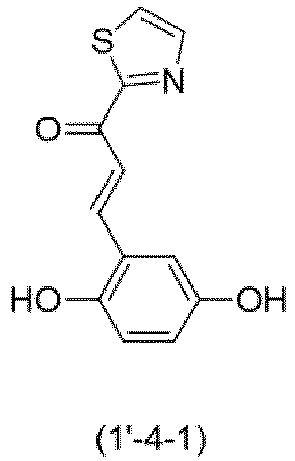


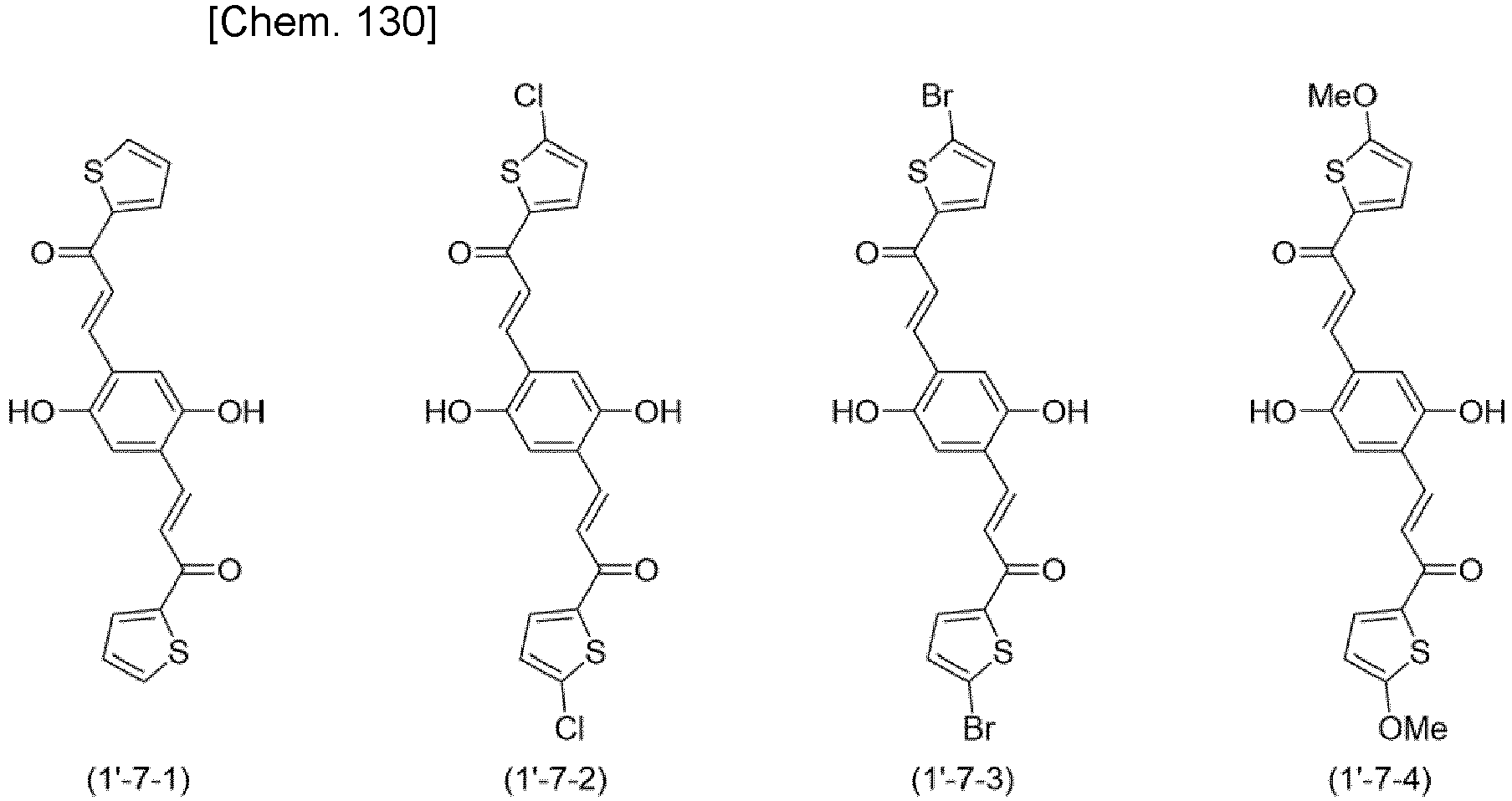
- Of these (1 '-2-1) to (1 '-7-4), particularly preferred compounds are (1'-2-2) to (1'-2-11), (1'-6-1) to (1'-6-4) and (1'-7-1) to (1'-7-4), with especially preferred ones being (1'-2-1) to (1'-2-6), (1'-2-1) to (1'-2-11), (1'-6-2) to (1'-6-3) and (1'-7-1).
- A method for producing the dihydroxy compound according to the present invention, represented by formula (1'), is a method comprising allowing a dihydroxy compound indicated by chemical formula (3) below and a ketone indicated by chemical formula (4') below to react together.

- In chemical formula (3) above, R°, R1 and R7 each independently represent a hydrogen atom, a halogen atom or a C1 to C8 alkyl group.
- R2f represents a hydrogen atom, a halogen atom, a C1 to C8 alkyl group or a formyl group.
- In chemical formula (4') above, Ar represents a ring system selected from the group consisting of a monocyclic aromatic ring system, a polycyclic aromatic ring system and an annulated aromatic ring system whose ring-constituting atoms are atoms selected from the group consisting of a carbon atom, a nitrogen atom, an oxygen atom and a sulfur atom, with the monocyclic aromatic ring system, polycyclic aromatic ring system and annulated aromatic ring system optionally having a substituent. R8 represents a C1 to C8 alkyl group or a C1 to C6 haloalkyl group.
- In chemical formula (1') above, Ar represents a ring system selected from the group consisting of a monocyclic aromatic ring system, a polycyclic aromatic ring system and an annulated aromatic ring system whose ring-constituting atoms are atoms selected from the group consisting of a carbon atom, a nitrogen atom, an oxygen atom and a sulfur atom, with the monocyclic aromatic ring system, polycyclic aromatic ring system and annulated aromatic ring system optionally having a substituent. R°, R1, R2, R3 and R4 each independently represent a hydrogen atom, a halogen atom, a C1 to C8 alkyl group or a group represented by chemical formula (Z1) below.
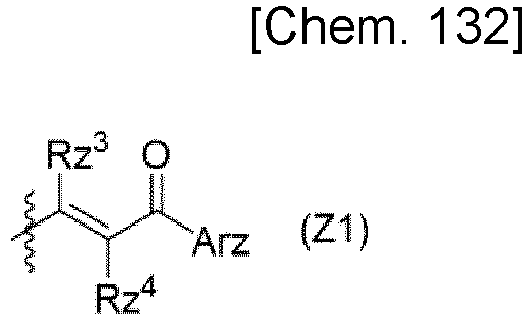
- [In formula (Z1) above, Rz3 and Rz4 each independently represent a hydrogen atom, a halogen atom or a C1 to C8 alkyl group.
- Arz represents a ring system selected from the group consisting of a monocyclic aromatic ring system, a polycyclic aromatic ring system and an annulated aromatic ring system whose ring-constituting atoms are atoms selected from the group consisting of a carbon atom, a nitrogen atom, an oxygen atom and a sulfur atom, with the monocyclic aromatic ring system, polycyclic aromatic ring system or annulated aromatic ring system optionally having a substituent. The wavy-lined portion represents a site of binding with the portion in formula (1) excluding R0, R1, R2, R3 or R4.]
- In formula (3), R°, R1 and R7 each independently represent a hydrogen atom or a C1 to C8 alkyl group. Examples of C1 to C8 alkyl groups include a methyl group, an ethyl group, a propyl group, an isopropyl group, a butyl group, an isobutyl group, a sec-butyl group, a tert-butyl group, a pentyl group, a hexyl group, a heptyl group and an octyl group.
- R2f represents a hydrogen atom, a halogen atom, a C1 to C8 alkyl group or a formyl group. Examples of C1 to C8 alkyl groups include a methyl group, an ethyl group, a propyl group, an isopropyl group, a butyl group, an isobutyl group, a sec-butyl group, a tert-butyl group, a pentyl group, a hexyl group, a heptyl group and an octyl group.
- For use as R°, R1, R2f and R7, a hydrogen atom, a methyl group, an ethyl group, a propyl group, an isopropyl group, a butyl group, an isobutyl group, a sec-butyl group and a tert-butyl group are preferred because they lead to superior optical characteristics after the introduction of the dihydroxy compound according to the present invention into the polymer according to the present invention. A hydrogen atom, a methyl group and an ethyl group are particularly preferred because of the ease of introduction.
- Specific examples of dihydroxy compounds indicated by formula (3) include the structures presented in chemical formulae (3-1) to (3-11) below.


- Of these (3-1) to (3-11), particularly preferred compounds are (3-1) to (3-4) and (3-10) to (3-11), with especially preferred ones being (3-1), (3-3) and (3-10) to (3-11).
- The dihydroxy compound indicated by formula (3) can be easily prepared according to a method known or described in literature. Alternatively, if a commercially available compound is available, it may be used.
- In formula (4'), R8 represents a C1 to C8 alkyl group or a C1 to C6 haloalkyl group. Examples of C1 to C8 alkyl groups include a methyl group, an ethyl group, a propyl group, a butyl group, a pentyl group, a hexyl group, a heptyl group and an octyl group, and examples of C1 to C6 haloalkyl groups include a chloromethyl group and a 2,2,2-trifluoroethyl group.
- For use as R8, a methyl group, an ethyl group, a propyl group and a butyl group are preferred because they lead to superior optical characteristics after the introduction of the dihydroxy compound according to the present invention into the polymer according to the present invention. A methyl group and an ethyl group are particularly preferred because of the ease of introduction.
- In formula (4'), Ar represents a ring system selected from the group consisting of a monocyclic aromatic ring system, a polycyclic aromatic ring system and an annulated aromatic ring system whose ring-constituting atoms are atoms selected from the group consisting of a carbon atom, a nitrogen atom, an oxygen atom and a sulfur atom, with the monocyclic aromatic ring system, polycyclic aromatic ring system and annulated aromatic ring system optionally having a substituent.
- In this context, examples of substituents in the monocyclic aromatic ring system, polycyclic aromatic ring system and annulated aromatic ring system include a C1 to C8 alkyl group, a halogen atom, a C1 to C4 alkoxy group and a C2 to C4 acyl group.
- Examples of C1 to C8 alkyl groups include a methyl group, an ethyl group, a propyl group, an isopropyl group, a butyl group, an isobutyl group, a sec-butyl group, a tert-butyl group, a pentyl group, a hexyl group, a heptyl group and an octyl group.
- Examples of halogen atoms include a fluorine atom, a chlorine atom, a bromine atom and an iodine atom.
- Examples of C1 to C4 alkoxy groups include a methoxy group, an ethoxy group, a propyloxy group, an isopropyloxy group, a butyloxy group, an isobutyloxy group, a sec-butyloxy group and a tert-butyloxy group.
- Examples of C2 to C4 acyl groups include an acetyl group, a propionyl group and a butyryl group.
- Examples of monocyclic aromatic ring systems at Ar whose ring-constituting atoms are atoms selected from the group consisting of a carbon atom, a nitrogen atom, an oxygen atom and a sulfur atom and that may have a substituent include benzene, pyridine, pyrazine, pyrimidine, pyridazine, furan, pyrrole, imidazole, thiophene, pyrazole, oxazole, isoxazole, thiazole and triazole.
- Examples of polycyclic aromatic ring systems at Ar whose ring-constituting atoms are atoms selected from the group consisting of a carbon atom, a nitrogen atom, an oxygen atom and a sulfur atom and that may have a substituent include biphenyl, terphenyl, bipyridine, bithiophene and bifuran.
- Examples of annulated aromatic ring systems at Ar whose ring-constituting atoms are atoms selected from the group consisting of a carbon atom, a nitrogen atom, an oxygen atom and a sulfur atom and that may have a substituent include naphthalene, anthracene, phenanthrene, quinoline, benzofuran, benzimidazole, benzothiophene, indole, indazole, benzoxazole, benzothiazole and benzotriazole.
- For use as Ar, a monocyclic aromatic ring system whose ring-constituting atoms are atoms selected from the group consisting of a carbon atom, a nitrogen atom, an oxygen atom and a sulfur atom whose ring-constituting atoms are atoms selected from the group consisting of a carbon atom, a nitrogen atom, an oxygen atom and a sulfur atom and that may have a substituent is preferred because of easy availability. A benzene ring, a furan ring, a thiophene ring, a thiazole ring or an oxazole ring is particularly preferred because they lead to superior optical characteristics after the introduction of the dihydroxy compound according to the present invention into the polymer according to the present invention. A benzene ring or thiophene ring is especially preferred.
- Preferred examples of Ars include the structures indicated by chemical formulae (Ar-1) to (Ar-7) below.

- [In chemical formula (Ar-1) to (Ar-7) above, X1, X2, X3, X4, X5, X6, X7 and X8 each independently represent a hydrogen atom, a C1 to C8 alkyl group, a C1 to C6 alkoxy group, a halogen atom, a nitro group, a cyano group, a C1 to C6 alkylthio group or a C2 to C8 dialkylamino group.
- Re represents a hydrogen atom or a C1 to C10 alkyl group.
- ** represents a site of binding with the other portion in chemical formula (1) above, excluding Ar.]
- In formulae (Ar-1) to (Ar-7), X1, X2, X3, X4, X5, X6, X7 and X8 each independently represent a hydrogen atom, a C1 to C8 alkyl group, a C1 to C6 alkoxy group, a halogen atom, a nitro group, a cyano group, a C1 to C6 alkylthio group or a C2 to C8 dialkylamino group. Examples of C1 to C8 alkyl groups include a methyl group, an ethyl group, a propyl group, an isopropyl group, a butyl group, an isobutyl group, a sec-butyl group, a tert-butyl group, a pentyl group, a hexyl group, a heptyl group and an octyl group, examples of C1 to C6 alkoxy groups include a methoxy group, an ethoxy group, a propyloxy group, an isopropyloxy group, a butyloxy group, an isobutyloxy group, a sec-butyloxy group, a tert-butyloxy group, a pentyloxy group and a hexyloxy group, examples of halogen atoms include a fluorine atom, a chlorine atom, a bromine atom and an iodine atom, examples of C1 to C6 alkylthio groups include a methylthio group, an ethylthio group, a propylthio group, an isopropylthio group, a butylthio group, an isobutylthio group, a sec-butylthio group, a tert-butylthio group, a pentylthio group and a hexylthio group, and examples of C2 to C8 dialkylamino groups include a dimethylamino group, a diethylamino group, a dipropylamino group and a dibutylamino group.
- For X1, X2, X3, X4, X5, X6, X7 and X8, it is preferred that each be a hydrogen atom, a C1 to C8 alkyl group, a C1 to C6 alkoxy group or a halogen atom because this leads to superior optical characteristics after the introduction of the dihydroxy compound according to the present invention into the polymer according to the present invention. It is particularly preferred that each be a hydrogen atom, a methyl group, a methoxy group or a halogen atom because of the ease of introduction.
- Of the ketones indicated by formula (4'), the ketones indicated by formula (4) below are particularly preferred.

- [In chemical formula (4) above, R8 represents a C1 to C8 alkyl group or a C1 to C6 haloalkyl group.
- X6, X7 and X8 each independently represent a hydrogen atom, a C1 to C8 alkyl group, a C1 to C6 alkoxy group, a halogen atom, a nitro group, a cyano group, a C1 to C6 alkylthio group or a C2 to C8 dialkylamino group.]
- In formula (4), R8 represents a C1 to C8 alkyl group or a C1 to C6 haloalkyl group. Examples of C1 to C8 alkyl groups include a methyl group, an ethyl group, a propyl group, a butyl group, a pentyl group, a hexyl group, a heptyl group and an octyl group, and examples of C1 to C6 haloalkyl groups include a chloromethyl group and a 2,2,2-trifluoroethyl group.
- For use as R8, a methyl group, an ethyl group, a propyl group and a butyl group are preferred because they lead to superior optical characteristics after the introduction of the dihydroxy compound according to the present invention into the polymer according to the present invention. A methyl group and an ethyl group are particularly preferred because of the ease of introduction.
- In formula (4), X6, X7 and X8 each independently represent a hydrogen atom, a C1 to C8 alkyl group, a C1 to C6 alkoxy group, a halogen atom, a nitro group, a cyano group, a C1 to C6 alkylthio group or a C2 to C8 dialkylamino group. Examples of C1 to C8 alkyl groups include a methyl group, an ethyl group, a propyl group, an isopropyl group, a butyl group, an isobutyl group, a sec-butyl group, a tert-butyl group, a pentyl group, a hexyl group, a heptyl group and an octyl group, examples of C1 to C6 alkoxy groups include a methoxy group, an ethoxy group, a propyloxy group, an isopropyloxy group, a butyloxy group, an isobutyloxy group, a sec-butyloxy group, a tert-butyloxy group, a pentyloxy group and a hexyloxy group, examples of halogen atoms include a fluorine atom, a chlorine atom, a bromine atom and an iodine atom, examples of C1 to C6 alkylthio groups include a methylthio group, an ethylthio group, a propylthio group, an isopropylthio group, a butylthio group, an isobutylthio group, a sec-butylthio group, a tert-butylthio group, a pentylthio group and a hexylthio group, and examples of C2 to C8 dialkylamino groups include a dimethylamino group, a diethylamino group, a dipropylamino group and a dibutylamino group.
- For X6, X7 and X8, it is preferred that each be a hydrogen atom, a C1 to C8 alkyl group, a C1 to C6 alkoxy group or a halogen atom because this leads to superior optical characteristics after the introduction of the dihydroxy compound according to the present invention into the polymer according to the present invention. A hydrogen atom, a methyl group, a methoxy group or a halogen atom is particularly preferred because of the ease of introduction.
- Specific examples of ketones indicated by formula (4) include the structures presented in chemical formulae (4-1-1) to (4-2-13) below.


- Of these (4-1-1) to (4-2-13), particularly preferred ketones are (4-1-1) to (4-1-13) because they lead to superior optical characteristics after the introduction of the dihydroxy compound according to the present invention into the polymer according to the present invention, with especially preferred ones being (4-1-1) to (4-1-6) and (4-1-13).
- The ketone indicated by formula (4) can be easily prepared according to a method known or described in literature. Alternatively, if a commercially available ketone is available, it may be used.
- The dihydroxy compound according to the present invention, indicated by formula (1'), can be synthesized by allowing a dihydroxy compound indicated by chemical formula (3) above and a ketone indicated by chemical formula (4') above to react together.

- For the proportion between the dihydroxy compound indicated by formula (3) and the ketone indicated by formula (4') in the method for producing the dihydroxy compound indicated by formula (1'), it is preferred that the dihydroxy compound indicated by formula (3):the ketone indicated by formula (4') = 1:0.8 to 1:2.2 as a molar ratio.
- In the method for producing the dihydroxy compound indicated by formula (1'), it is preferred to conduct the process with an added base to ensure that the reaction will proceed smoothly.
- Examples of bases used include organic bases, inorganic bases, organometallic compounds, metal alkoxides, and metal amides.
- Examples of organic bases include triethylamine, tributylamine, diisopropylethylamine, pyridine, 4-dimethylaminopyridine, piperidine, piperazine, pyrrolidine, morpholine, N-methylmorpholine, imidazole and N-methylimidazole.
- Examples of inorganic bases include lithium hydroxide, sodium hydroxide, potassium hydroxide, calcium hydroxide, lithium carbonate, sodium carbonate, potassium carbonate, cesium carbonate, sodium hydrogencarbonate, potassium hydrogencarbonate, sodium hydride and potassium hydride.
- Examples of organometallic compounds include normal butyllithium, sec-butyllithium, tert-butyllithium and phenyllithium.
- Examples of metal alkoxides include sodium methoxide, sodium ethoxide, sodium tert-butoxide and potassium tert-butoxide.
- Examples of metal amides include lithium amide, sodium amide, lithium diisopropylamide, lithium hexamethyldisilazide, sodium hexamethyldisilazide and potassium hexamethyldisilazide.
- Among bases, inorganic bases are particularly preferred because they allow the reaction to proceed in a favorable manner and are inexpensive. Sodium hydroxide and potassium hydroxide are more preferred.
- As for the amount of base used, it is preferred to use 3 to 10 molar equivalents per molar equivalent of formula (3). More preferably, 5 to 7 molar equivalents of base is used.
- The base may be used in particle form or granule form or directly as a powdery solid depending on its properties. Solutions of them can also be used, and there is no specific restriction on their concentration.
- In the method for producing the dihydroxy compound indicated by formula (1'), the process can be conducted without a solvent or in at least one solvent. The solvent is not particularly limited as long as it does not harm the reaction. Examples include the halogenated solvents of dichloromethane and chloroform, the ether solvents of dioxane, tetrahydrofuran (Hereinafter abbreviated as THF.), diisopropyl ether and cyclopentyl methyl ether, the aromatic solvents of benzene, toluene, xylene, chlorobenzene and dichlorobenzene, the amide solvents of N,N-dimethylformamide (Hereinafter abbreviated as DMF), N,N-dimethylacetamide and N-methyl-2-pyrrolidone (Hereinafter abbreviated as NMP.), alcohol solvents, such as methanol, ethanol, propyl alcohol, isopropyl alcohol and tert-butyl alcohol, and water. One such solvent may be used alone, or a mixture of two or more may be used. Of these, alcohol solvents are particularly preferred because they allow the reaction to proceed with a good yield, and ethanol and methanol are more preferred.
- The reaction temperature in the method for producing the dihydroxy compound indicated by formula (1') is preferably a reaction temperature selected as appropriate from the range of -20°C to 100°C, particularly preferably a reaction temperature selected as appropriate from the range of 0°C to 70°C. The duration of reaction is determined as appropriate according to the progress of the reaction, and a duration of reaction selected as appropriate from the range of 1 hour to 24 hours is preferred.
- In the method for producing the dihydroxy compound indicated by formula (1'), it is preferred to neutralize the reaction system using an acid after the completion of the reaction.
- Examples of acids used include hydrochloric acid, sulfuric acid, acetic acid, chloroacetic acid and citric acid. Of these, acetic acid is particularly preferred.
- For the amount of acid used, there is no specific restriction as long as it can neutralize the base used.
- The dihydroxy compound obtained by the production method in formula (1') may be purified until suitable purity is achieved. Examples of purification methods include the methods of washing, column chromatography, reprecipitation, trituration, adsorption treatment and recrystallization. Purification by washing, reprecipitation, recrystallization or trituration is preferred because of the small amount of organic solvent used, and purification by trituration is more preferred because of the simplicity of operations.
- In trituration, at least one organic solvent can be used.
- For the organic solvent used in trituration, there is no specific limitation as long as by-products can be removed therewith. Examples include the alcohol solvents of methanol, ethanol and isopropyl alcohol, the nitrile solvent of acetonitrile, the ester solvents of methyl acetate, ethyl acetate and butyl acetate, the hydrocarbon solvents of pentane, hexane, heptane and octane and the ketone solvents of acetone, methyl ethyl ketone and methyl isobutyl ketone. Methanol, ethanol, ethyl acetate or acetonitrile is preferred because they are inexpensive and allow for efficient removal of by-products, and a mixture of two or more such solvents may be used.
- An example of a method for producing a polymer, in the context of the polymer according to the present invention, at least one end of which is a monocarboxylic acid ester is a production method comprising, when polymerizing a source composition containing a dihydroxy compound indicated by chemical formula (1') above, adding a monocarboxylic acid derivative compound represented by any of chemical formula (2-1) or (2-2) below.

- [In chemical formula (2-1) or (2-2) above, R5a, R6a and R7 each independently represent a group selected from the group consisting of a substituted or unsubstituted C1 to C20 alkyl group, a substituted or unsubstituted C3 to C8 cycloalkyl group and a substituted or unsubstituted C3 to C12 aromatic group.
- X° represents a leaving group.]
- In chemical formula (2-1) or (2-2), examples of C1 to C20 alkyl groups at R5a, R6a and R7 include a methyl group, an ethyl group, a propyl group, an isopropyl group, a butyl group, an isobutyl group, a sec-butyl group, a tert-butyl group, a pentyl group, a hexyl group, a heptyl group, an octyl group, a nonyl group, a decyl group and an icosyl group. Of these, a methyl group, an ethyl group, a propyl group, an isopropyl group, a butyl group, an isobutyl group, a sec-butyl group and a tert-butyl group are particularly preferred, with a methyl group and an ethyl group being especially preferred because of the ease of introduction.
- Examples of C3 to C8 cycloalkyl groups include a cyclopropyl group, a cyclobutyl group, a cyclopentyl group, a cyclohexyl group, a cycloheptyl group and a cyclooctyl group.
- Examples of C3 to C12 aromatic groups include a phenyl group, a naphthyl group, a biphenylyl group and a pyridyl group.
- In chemical formula (2-2), an example of a leaving group represented by X° is a halogen atom. For this halogen atom, examples include a fluorine atom, a chlorine atom, a bromine atom and an iodine atom.
- The monocarboxylic acid derivative compound is represented by, for example, chemical formula (2-1) or (2-2). Examples of specific chemical formulae (2-1) include acetic anhydride, propionic anhydride, butyric anhydride, isobutyric anhydride, difluoroacetic anhydride, valeric anhydride, isovaleric anhydride, pivalic anhydride, trifluoroacetic anhydride, hexanoic anhydride, benzoic anhydride, 3-pyridinecarboxylic anhydride, cyclohexanecarboxylic anhydride, heptanoic anhydride, chloroacetic anhydride, chlorodifluoroacetic anhydride, 2-methylbenzoic anhydride, n-octanoic anhydride, 4-methoxybenzoic anhydride, nonanoic anhydride, dichloroacetic anhydride, trichloroacetic anhydride, pentafluoropropionic anhydride, decanoic anhydride, 2-methyl-6-nitrobenzoic anhydride, lauric anhydride, 3,4,5-trimethoxybenzoic anhydride and heptafluorobutyric anhydride. Preferred compounds are acetic anhydride, propionic anhydride, butyric anhydride, isobutyric anhydride, valeric anhydride, isovaleric anhydride, pivalic anhydride, trifluoroacetic anhydride, hexanoic anhydride, benzoic anhydride, cyclohexanecarboxylic anhydride, heptanoic anhydride, chloroacetic anhydride and 2-methylbenzoic anhydride, with particularly preferred ones being acetic anhydride, propionic anhydride, butyric anhydride, isobutyric anhydride, valeric anhydride, isovaleric anhydride, pivalic anhydride, hexanoic anhydride, benzoic anhydride, cyclohexanecarboxylic anhydride, heptanoic anhydride and 2-methylbenzoic anhydride. Examples of specific chemical formulae (2-2) include benzoyl fluoride, undecafluorohexanoyl fluoride, acetyl chloride, propyl chloride, cyclopropanecarbonyl chloride, butyryl chloride, isobutyryl chloride, chloroacetyl chloride, valeryl chloride, isovaleryl chloride, pivaloyl chloride, 2-chloropropionyl chloride, 3-chloropropionyl chloride, 2-furoyl chloride, cyclopentanecarbonyl chloride, hexanoyl chloride, 2,2-dimethylbutyryl chloride, 4-methylvaleryl chloride, 3,3-dimethylbutyryl chloride, benzoyl chloride, 4-chlorobutyryl chloride, 2-thenoyl chloride, cyclohexanecarbonyl chloride, dichloroacetyl chloride, tetrahydro-2H-pyran-4-carbonyl chloride, heptanoyl chloride, p-toluoyl chloride, o-toluoyl chloride, m-toluoyl chloride, 3-chloropivaloyl chloride, 5-chlorovaleryl chloride, bromoacetyl chloride, 3-fluorobenzoyl chloride, 2-fluorobenzoyl chloride, 4-fluorobenzoyl chloride, 3-methyl-2-thenoyl chloride, n-octanoyl chloride, 2-propylvaleryl chloride, 2-ethylhexanoyl chloride, 4-cyanobenzoyl chloride, 3,5-dimethylbenzoyl chloride, 4-methoxybenzoyl chloride, 3-methoxybenzoyl chloride, 2-methoxybenzoyl chloride, 2-bromopropionyl chloride, 3-bromopropionyl chloride, 6-chloronicotinoyl chloride, 5-chlorothiophene-2-carbonyl chloride, trichloroacetyl chloride, dodecanoyl chloride, 4-(trifluoromethyl)benzoyl chloride, acetyl bromide, propionyl bromide, isobutyryl bromide, valeryl bromide, benzoyl bromide, bromoacetyl bromide, 2-bromopropionyl bromide, 2-bromoisobutyryl bromide, 2-bromobutyryl bromide and acetyl iodide. Preferred compounds are acetyl chloride, propyl chloride, cyclopropanecarbonyl chloride, butyryl chloride, isobutyryl chloride, chloroacetyl chloride, valeryl chloride, isovaleryl chloride, pivaloyl chloride, 2-chloropropionyl chloride, 3-chloropropionyl chloride, 2-furoyl chloride, cyclopentanecarbonyl chloride, hexanoyl chloride, 2,2-dimethylbutyryl chloride, 4-methylvaleryl chloride, 3,3-dimethylbutyryl chloride, benzoyl chloride, 4-chlorobutyryl chloride, cyclohexanecarbonyl chloride, dichloroacetyl chloride, heptanoyl chloride, p-toluoyl chloride, o-toluoyl chloride, m-toluoyl chloride, 3-chloropivaloyl chloride, 5-chlorovaleryl chloride, bromoacetyl chloride, 3-fluorobenzoyl chloride, 2-fluorobenzoyl chloride, 4-fluorobenzoyl chloride, n-octanoyl chloride, 2-propylvaleryl chloride, 2-ethylhexanoyl chloride, 4-cyanobenzoyl chloride, 3,5-dimethylbenzoyl chloride, 4-methoxybenzoyl chloride, 3-methoxybenzoyl chloride, 2-methoxybenzoyl chloride, 2-bromopropionyl chloride, 3-bromopropionyl chloride, trichloroacetyl chloride, dodecanoyl chloride and 4-(trifluoromethyl)benzoyl chloride, with particularly preferred ones being acetyl chloride, propyl chloride, cyclopropanecarbonyl chloride, butyryl chloride, isobutyryl chloride, valeryl chloride, isovaleryl chloride, pivaloyl chloride, cyclopentanecarbonyl chloride, hexanoyl chloride, 2,2-dimethylbutyryl chloride, 4-methylvaleryl chloride, 3,3-dimethylbutyryl chloride, benzoyl chloride, cyclohexanecarbonyl chloride, heptanoyl chloride, p-toluoyl chloride, o-toluoyl chloride, m-toluoyl chloride, n-octanoyl chloride, 2-propylvaleryl chloride, 2-ethylhexanoyl chloride, 3,5-dimethylbenzoyl chloride and dodecanoyl chloride.
- The polymer according to the present invention can also be made into a resin composition containing 70% to 99.99% by weight of the polymer according to the present invention and 0.01% to 30% by weight of a thermal reorientation accelerator (hereinafter also expressed as the resin composition according to the present invention). This resin composition is also an aspect of the present invention.
- The resin composition according to the present invention contains a thermal reorientation accelerator. An optical film obtained using the resin composition according to the present invention allows for thermal reorientation treatment for a polymer, even on a general-purpose resin support substrate having a low temperature tolerance, by virtue of molecular mobility improved by the thermal reorientation accelerator.
- For the thermal reorientation accelerator contained in the resin composition according to the present invention, it is preferred, for reduced separation and exudation of the thermal reorientation accelerator while in a high-temperature environment or reduced evaporation of the thermal reorientation accelerator while in a high-temperature environment, that its molecular weight be from 100 to 20000. It is particularly preferred that the molecular weight be from 300 to 20000.
- The blending percentages of the polymer according to the present invention and the thermal reorientation accelerator in the resin composition according to the present invention are from 70% to 99.99% by weight for the polymer according to the present invention and from 0.01% to 30% by weight for the thermal reorientation accelerator. For reduced separation and exudation of the thermal reorientation accelerator while in a high-temperature environment, it is more preferred that the percentages be from 85% to 99.9% by weight for the polymer according to the present invention and from 0.1% to 15% by weight for the thermal reorientation accelerator. From the viewpoint of efficiency in the acceleration of thermal reorientation, it is particularly preferred that the percentages be from 85% to 99.0% by weight for the polymer according to the present invention and from 1.0% to 15% by weight for the thermal reorientation accelerator. In the present invention, when the percentage of the thermal reorientation accelerator is less than 0.01% by weight, the acceleration of thermal reorientability becomes difficult, and when the percentage of the thermal reorientation accelerator is greater than 30% by weight, the separation and exudation of the thermal reorientation accelerator are likely to occur.
- Examples of thermal reorientation accelerators contained in the resin composition according to the present invention include plasticizers, antioxidants and photostabilizers.
- For the plasticizers, examples include carboxylates, phosphates and polymeric plasticizers.
- Specific examples of carboxylates include phthalates, trimellitates, pyromellitates, citrates, oleates, ricinoleates, sebacates, stearates, adipates and epoxidized esters. Of these, phthalates and adipates are particularly preferred because of their easy availability.
- Examples of phthalates include ones including a structure indicated by formula (7) below and having a molecular weight of 100 to 20000.

- (In formula (7), Ra and Rb each independently represent one type selected from the group consisting of a substituted or unsubstituted C1 to C20 alkyl group, aromatic group, heterocyclic group, polycyclic aromatic group and annulated aromatic group, with these optionally having a linkage such as an -O-group, a -(C=O)O- group, an -O(C=O)- group, an -O(C=O)-O- group, a -C(=O)-NH- group, an -NH-(C=O)- group, a -CH=CH- group or a -C=C- group. It is preferred that each of Ra and Rb independently be a C2 to C20 alkyl group because in that case separation and exudation are rare, and improving effects on the molecular orientation of the polymer are expected.)
- Examples of specific phthalates include dimethyl phthalate, diethyl phthalate, dipropyl phthalate, diisopropyl phthalate, dibutyl phthalate, diisobutyl phthalate, diamyl phthalate, dihexyl phthalate, diheptyl phthalate, di-n-octyl phthalate, dinonyl phthalate, diisononyl phthalate, di-n-decyl phthalate, diisodecyl phthalate, diundecyl phthalate, ditridecyl phthalate, dicyclohexyl phthalate, diphenyl phthalate, di-2-ethylhexyl phthalate, benzyl butyl phthalate and di-2-ethylhexyl isophthalate.
- Examples of trimellitates include ones including a structure indicated by formula (8) below and having a molecular weight of 100 to 20000.

- (In formula (8), R11, R12 and R13 each independently represent one type selected from the group consisting of a substituted or unsubstituted C1 to C20 alkyl group, aromatic group, heterocyclic group, polycyclic aromatic group and annulated aromatic group, with these optionally having a linkage such as an -O- group, -a (C=O)O- group, an -O(C=O)- group, an -O(C=O)-O- group, a - C(=O)-NH- group, an -NH-(C=O)- group, a -CH=CH- group or a -C=C- group.)
- Specific examples of trimellitates include trimethyl trimellitate, triethyl trimellitate, tributyl trimellitate, tris(2-ethylhexyl) trimellitate, tri-n-octyl trimellitate, triisooctyl trimellitate, trinonyl trimellitate, triisononyl trimellitate, tri-n-decyl trimellitate, triisodecyl trimellitate, triundecyl trimellitate, tridodecyl trimellitate, tri(tridecyl) trimellitate and tritetradecyl trimellitate.
- Examples of pyromellitates include ones including a structure indicated by formula (9) below and having a molecular weight of 100 to 20000.


- Specific examples of pyromellitates include tetramethyl pyromellitate, tetraethyl pyromellitate, tetrapropyl pyromellitate, tetrabutyl pyromellitate, pyromellitic acid 2-ethylhexyl esters, tetra(2-ethylhexyl) pyromellitate, tetra-n-octyl pyromellitate, tetraisooctyl pyromellitate, tetranonyl pyromellitate, tetraisononyl pyromellitate, tetra-n-decyl pyromellitate, tetraisodecyl pyromellitate, tetraundecyl pyromellitate, tetradodecyl pyromellitate, tetratridecyl pyromellitate and tetra(tetradecyl) pyromellitate.
- Examples of citrates include ones including a structure indicated by formula (10) below and having a molecular weight of 100 to 20000.

- Specific examples of citrates include trimethyl citrate, triethyl citrate, tripropyl citrate, tributyl citrate, tripentyl citrate, trihexyl citrate, trimethyl acetylcitrate, triethyl acetylcitrate, tripropyl acetylcitrate, tributyl acetylcitrate, tripentyl acetylcitrate, trihexyl acetylcitrate and trihexyl butyryl citrate (trihexyl o-butyrylcitrate).
- Examples of oleates include ones including a structure indicated by formula (11) below and having a molecular weight of 100 to 20000.

- Specific examples of oleates include methyl oleate, ethyl oleate, propyl oleate, butyl oleate, hexyl oleate, heptyl oleate, n-octyl-oleate, nonyl oleate and n-decyl-oleate.
- Examples of ricinoleates include ones including a structure indicated by formula (12) below and having a molecular weight of 100 to 20000.

- Specific examples of ricinoleates include methyl ricinoleate, ethyl ricinoleate, propyl ricinoleate, butyl ricinoleate, pentyl ricinoleate, hexyl ricinoleate, methyl acetylricinoleate, ethyl acetylricinoleate and propyl acetylricinoleate.
- Example of sebacates include ones including a structure indicated by formula (13) below and having a molecular weight of 100 to 20000.

- Specific examples of sebacates include dimethyl sebacate, diethyl sebacate, dipropyl sebacate, dibutyl sebacate, di(2-ethylhexyl) sebacate, di-n-octyl sebacate, diisooctyl sebacate, dinonyl sebacate, diisononyl sebacate, di-n-decyl sebacate, diisodecyl sebacate, diundecyl sebacate, didodecyl sebacate, ditridecyl sebacate and ditetradecyl sebacate.
- Examples of stearates include ones including a structure indicated by formula (14) below and having a molecular weight of 100 to 20000.

- Specific examples of stearates include methyl stearate, ethyl stearate, propyl stearate, butyl stearate, pentyl stearate, hexyl stearate, heptyl stearate, n-octyl-stearate, nonyl stearate, decyl stearate, dodecyl stearate, phenyl stearate, glycidyl stearate, methyl dichlorostearate, monostearin and tristearin.
- Examples of adipates include ones including a structure indicated by formula (15) below and having a molecular weight of 100 to 20000.

- Specific examples of adipates include dimethyl adipate, diethyl adipate, dipropyl adipate, dibutyl adipate, diisobutyl adipate, bis[2-(2-butoxyethoxy)ethyl] adipate, di(2-ethylhexyl) adipate, di-n-octyl adipate, diisooctyl adipate, dinonyl adipate, diisononyl adipate, di-n-decyl adipate, diisodecyl adipate, diundecyl adipate, didodecyl adipate, ditridecyl adipate and ditetradecyl adipate.
- For epoxidized esters, there is no specific restriction as long as they have a molecular weight of 100 or more and one or more epoxy groups and one or more ester linkages. Examples include di 2-ethylhexyl 4,5-epoxycyclohexane-1,2-dicarboxylate, di(9,10-epoxystearyl) 4,5-epoxycyclohexane-1,2-dicarboxylate, epoxidized soybean oil, epoxidized linseed oil, epoxidized fatty acid isobutyl esters and epoxidized fatty acid 2-ethylhexyl esters.
- The carboxylates only need to have a molecular weight of 100 to 20000 and are not limited to those indicated by formulae (7) to (15). Examples also include dimethyl isophthalate, diethyl isophthalate, dipropyl isophthalate, dibutyl isophthalate, bis(2-ethylhexyl) isophthalate, di-n-decyl isophthalate, diisodecyl isophthalate, diundecyl isophthalate, didodecyl isophthalate, ditridecyl isophthalate, ditetradecyl isophthalate, dimethyl terephthalate, diethyl terephthalate, dipropyl terephthalate, dibutyl terephthalate, bis(2-ethylhexyl) terephthalate, di-n-decyl terephthalate, diisodecyl terephthalate, diundecyl terephthalate, didodecyl terephthalate, ditridecyl terephthalate, ditetradecyl terephthalate, diisodecyl 4-cyclohexene-1,2-dicarboxylate, bis(2-ethylhexyl) 4-cyclohexene-1,2-dicarboxylate, dimethyl succinate, diethyl succinate, dipropyl succinate, dibutyl succinate, bis(2-ethylhexyl) succinate, di-n-decyl succinate, diisodecyl succinate, diundecyl succinate, didodecyl succinate, ditridecyl succinate, ditetradecyl succinate, dimethyl maleate, diethyl maleate, dipropyl maleate, dibutyl maleate, bis(2-ethylhexyl) maleate, di-n-decyl maleate, diisodecyl maleate, diundecyl maleate, didodecyl maleate, ditridecyl maleate, ditetradecyl maleate, dimethyl fumarate, diethyl fumarate, dipropyl fumarate, dibutyl fumarate, bis(2-ethylhexyl) fumarate, di-n-decyl fumarate, diisodecyl fumarate, diundecyl fumarate, didodecyl fumarate, ditridecyl fumarate, ditetradecyl fumarate, dimethyl suberate, diethyl suberate, dipropyl suberate, dibutyl suberate, bis(2-ethylhexyl) suberate, di-n-decyl suberate, diisodecyl suberate, diundecyl suberate, didodecyl suberate, ditridecyl suberate, ditetradecyl suberate, dimethyl azelate, diethyl azelate, dipropyl azelate, dibutyl azelate, bis(2-ethylhexyl) azelate, di-n-decyl azelate, diisodecyl azelate, diundecyl azelate, didodecyl azelate, ditridecyl azelate, ditetradecyl azelate, dimethyl dodecanoate, diethyl dodecanoate, dipropyl dodecanoate, dibutyl dodecanoate, bis(2-ethylhexyl) dodecanoate, di-n-decyl dodecanoate, diisodecyl dodecanoate, diundecyl dodecanoate, didodecyl dodecanoate, ditridecyl dodecanoate, ditetradecyl dodecanoate, dimethyl tetradecanoate, diethyl tetradecanoate, dipropyl tetradecanoate, dibutyl tetradecanoate, bis(2-ethylhexyl) tetradecanoate, di-n-decyl tetradecanoate, diisodecyl tetradecanoate, diundecyl tetradecanoate, didodecyl tetradecanoate, ditridecyl tetradecanoate, ditetradecyl tetradecanoate, dimethyl hexadecanoate, diethyl hexadecanoate, dipropyl hexadecanoate, dibutyl hexadecanoate, bis(2-ethylhexyl) hexadecanoate, di-n-decyl hexadecanoate, diisodecyl hexadecanoate, diundecyl hexadecanoate, didodecyl hexadecanoate, ditridecyl hexadecanoate, ditetradecyl hexadecanoate, dimethyl octadecanoate, diethyl octadecanoate, dipropyl octadecanoate, dibutyl octadecanoate, bis(2-ethylhexyl) octadecanoate, di-n-decyl octadecanoate, diisodecyl octadecanoate, diundecyl octadecanoate, didodecyl octadecanoate, ditridecyl octadecanoate, ditetradecyl octadecanoate, dimethyl icosadecanoate, diethyl icosadecanoate, dipropyl icosadecanoate, dibutyl icosadecanoate, bis(2-ethylhexyl) icosadecanoate, di-n-decyl icosadecanoate, diisodecyl icosadecanoate, diundecyl icosadecanoate, didodecyl icosadecanoate, ditridecyl icosadecanoate and ditetradecyl icosadecanoate.
- Examples of phosphates include the compounds indicated by formula (16) below.

- Specific examples of phosphates include trimethyl phosphate, triethyl phosphate, tripropyl phosphate, tributyl phosphate, triamyl phosphate, trihexyl phosphate, triheptyl phosphate, tri-n-octyl phosphate, trinonyl phosphate, tri-n-decyl phosphate, tris(2-ethylhexyl) phosphate, tris(2-butoxyethyl) phosphate, tris(2-chloroethyl) phosphate, tris(1,3-dichloro-2-propyl) phosphate, 2-ethylhexyl diphenyl phosphate, triphenyl phosphate, trixylenyl phosphate, cresyl diphenyl phosphate, tris(2-ethylhexyl) phosphate and tricresyl phosphate.
- Specific examples of polymeric plasticizers include polyester plasticizers and ether plasticizers.
- Polyester plasticizers are polymers including a constituent unit indicated by formula (17) below, with examples including ones having a molecular weight of 100 to 20000.

- Specific examples of polyester plasticizers include ADK CIZER PN-160, PN-9302, PN-150, PN-170, PN-7230, PN-1010, PN-1020, P-200, PN-650, PN-7650, PN-1030, PN-1430, HPN-3130, PN-400, P-5040, PN-7250, PN-250, PN-7220, PN-7550, PN-446, PN-310, P-300, PN-280 and PN-5090 (all are trade names; manufactured by ADEKA Corporation), D620, D623, D643, D645, D633, D620N, D623N, D643D, D640A and D671N (all are trade names; manufactured by Mitsubishi Chemical Corporation) and POLYCIZER W-230-H, W-1430-EL, W-2050 and W-2310 (all are trade names; manufactured by DIC Corporation).
- Examples of ether plasticizers include ones including a constituent unit indicated by formula (18) below and having a molecular weight of 100 to 20000.

- Specific examples of ether plasticizers include ADK CIZER RS-107, RS-700, RS-735, RS-966 and RS-1000, (all are trade names; manufactured by ADEKA Corporation), MONOCIZER W-260 and W-262 (both are trade names; manufactured by DIC Corporation), diethylene glycol, triethylene glycol, tetraethylene glycol, pentaethylene glycol, hexaethylene glycol, heptaethylene glycol, octaethylene glycol, nonaethylene glycol, decaethylene glycol, dodecaethylene glycol, polyethylene glycol 200, polyethylene glycol 400, polyethylene glycol 300, polyethylene glycol 600, polyethylene glycol 1000, polyethylene glycol 2000, polyethylene glycol 4000, polyethylene glycol 6000, polyethylene glycol 11000 and polyethylene glycol 20000.
- Examples of antioxidants include phenolic antioxidants, amine antioxidants, phosphorus antioxidants, sulfur antioxidants, lactone antioxidants, hydroxylamine antioxidants and vitamin-E antioxidants.
- Examples of phenolic antioxidants include ones including a structure indicated by formula (19) below and having a molecular weight of 100 to 20000.

- Specific examples of phenolic antioxidants include Irganox 245 (bis[3-(3-tert-butyl-4-hydroxy-5-methylphenyl)propionic acid][ethylenebis(oxyethylene)]), Irganox 1010 (pentaerythritol tetrakis[3-(3,5-di-tert-butyl-4-hydroxyphenyl)propionate]), Irganox 1035 (2,2'-thiodiethyl bis[3-(3,5-di-tert-butyl-4-hydroxyphenyl)propionate]), Irganox 1076 (octadecyl 3-(3,5-di-tert-butyl-4-hydroxyphenyl)propionate), Irganox 1098 (N,N'-(hexane-1,6-diyl)bis[3-(3,5-di-tert-butyl-4-hydroxyphenyl)propanamide]), Irganox 1135 (octyl-3,5-di-tert-butyl-4-hydroxy-hydrocinnamate), Irganox 1330 (2,4,6-tris(3',5'-di-tert-butyl-4'-hydroxybenzyl)mesitylene), Irganox 1520 (2,4-bis(octylthiomethyl)-6-methylphenol), Irganox 259 (1,6-hexanediol bis[3-(3,5-di-tert-butyl-4-hydroxyphenyl)propionate]), Irganox 3114 (1,3,5-tris(3,5-di-tert-butyl-4-hydroxybenzyl)-1,3,5-triazine-2,4,6(1H,3H,5H)-trione) and Irganox 565 (4-[[4,6-bis(octylthio)-1,3,5-triazin-2-yl]amino]-2,6-di-tert-butylphenol) (all are trade names; manufactured by BASF Japan Ltd.), tetrakis[3-(3',5'-di-tert-butyl-4'-hydroxyphenyl)propionic acid] and 2,4,8,10-tetraoxaspiro[5,5]undecane-3,9-diylbis(2-methylpropane-2,1 -diyl) bis[3-[3-(tert-butyl)-4-hydroxy-5-methylphenyl]propanoate].
- The phenolic antioxidants only need to have a molecular weight of 100 to 20000 and are not limited to those indicated by formula (15). Examples also include galvinoxyl free radical, 3,3',5,5'-tetra-tert-butyl-4,4'-stilbenequinone and 4-(hexyloxy)-2,3,6-trimethylphenol.
- Examples of amine antioxidants include ones including a structure indicated by formula (20) below and having a molecular weight of 100 to 20000.

- Specific examples of amine antioxidants indicated by formula (20) include 6-ethoxy-2,2,4-trimethyl-1,2-dihydroquinoline, N-phenyl-1-naphthylamine, N,N'-di-sec-butyl-1,4-phenylenediamine, 4-isopropylaminodiphenylamine, N,N'-diphenyl-1,4-phenylenediamine, N-(1,3-dimethylbutyl)-N'-phenyl N,N'-phenylenediamine, N,N'-di-2-naphthyl-1,4-phenylenediamine and 4,4'-bis(α,α-dimethylbenzyl)diphenylamine.
- The amine antioxidants only need to have a molecular weight of 100 to 20000 and are not limited to those indicated by formula (20). Examples also include 6-ethoxy-2,2,4-trimethyl-1,2-dihydroquinoline and poly(2,2,4-trimethyl-1,2-dihydroquinoline).
- Examples of phosphorus antioxidants include ones including a structure indicated by formula (21) below and having a molecular weight of 100 to 20000.


- Specific examples of phosphorus antioxidants include trimethyl phosphite, triethyl phosphite, tripropyl phosphite, tributyl phosphite, triphenyl phosphite, trihexyl phosphite, tri-o-cresyl phosphite, tri-m-cresyl phosphite, tri-p-cresyl phosphite, tris(2-ethylhexyl) phosphite, trioctyl phosphite, triisodecyl phosphite, tris(1,1,1,3,3,3-hexafluoro-2-propyl) phosphite, 3,9-bis(2,4-di-tert-butylphenoxy)-2,4,8,10-tetraoxa-3,9-diphosphaspiro[5.5]undecane, tris(2,4-di-tert-butylphenyl) phosphite and trioleyl phosphite.
- Examples of sulfur antioxidants include ones including a structure indicated by formula (22) below and having a molecular weight of 100 to 20000.

- Specific examples of sulfur antioxidants include didodecyl 3,3'-thiodipropionate, dioctadecyl 3,3'-thiodipropionate and pentaerythritol tetrakis[3-(dodecylthio)propionate].
- Examples of photostabilizers include hindered-amine photostabilizers.
- Examples of hindered-amine photostabilizers include ones having a constituent unit indicated by formula (23) below and having a molecular weight of 100 to 20000.

- Specific examples of hindered-amine photostabilizers include 2,2,6,6-tetramethyl-4-piperidyl methacrylate, 1,2,2,6,6-pentamethyl-4-piperidyl methacrylate, N,N'-bis(2,2,6,6-tetramethylpiperidin-4-yl)hexane-1,6-diamine, N,N'-bis(2,2,6,6-tetramethyl-4-piperidinyl)isophthalamide, bis(2,2,6,6-tetramethyl-4-piperidyl) sebacate, bis(2,2,6,6-tetramethyl-4-piperidyl-1-oxyl) sebacate, bis(1,2,2,6,6-pentamethyl-4-piperidyl) sebacate and bis(1,2,2,6,6-pentamethyl-4-piperidyl) butyl(3,5-di-tert-butyl-4-hydroxybenzyl)malonate.
- Of these thermal reorientation accelerators, plasticizers are particularly preferred because of their easy availability, good compatibility with the polymer and superb thermal reorientation acceleration capability even after incorporation into the polymer.
- The resin composition according to the present invention may contain at least one or more types of surfactants for reduced unevenness in the thickness of thin films obtained therewith. Examples of surfactants that can be contained include alkyl carboxylates, alkyl phosphates, alkyl sulfonates, fluoroalkyl carboxylates, fluoroalkyl phosphates, fluoroalkyl sulfonates, polyoxyethylene derivatives, fluoroalkyl ethylene oxide derivatives, polyethylene glycol derivatives, alkyl ammonium salts and fluoroalkyl ammonium salts, with fluorine-containing surfactants being particularly preferred.
- The resin composition according to the present invention may contain, for example, other polymers, polymer electrolytes, conductive complexes, pigments, dyes, antistatic agents, anti-blocking agents and lubricants within the gist of the invention.
- The resin composition according to the present invention can be obtained by blending a polymer having a photoreactive reverse wavelength dispersion unit that exhibits both functions of photoreactivity and reverse wavelength dispersion of birefringence and a thermal reorientation accelerator (hereinafter referred to as the polymer, etc.).
- As for the method for blending, methods such as melt blending and solution blending can be used. Melt blending is a method in which the resin composition is produced by melting the polymer, etc., by heating them and kneading the molten materials. Solution blending is a method in which the polymer, etc., are blended through dissolution in a solvent. As the solvent used in solution blending, solvents such as halogenated solvents, e.g., 1,1,1,3,3,3-hexafluoroisopropanol, methylene chloride and chloroform; aromatic solvents, e.g., toluene and xylene; ketone solvents, e.g., cyclopentanone, acetone, methyl ethyl ketone and methyl isobutyl ketone; alcohol solvents, e.g., methanol, ethanol and propanol; ether solvents, e.g., dioxane and tetrahydrofuran; and dimethylformamide and N-methylpyrrolidone can be used. It is possible to dissolve the polymer, etc., in solvents and then blending the resulting solutions, and it is also possible to knead powders or pellets, for example, of the polymers and then dissolving the resulting mixture in a solvent. It is possible to put the resulting blended polymer solution into a poor solvent to cause the resin composition to separate out, and it is also possible to use the blended polymer solution directly to produce an optical film.
- The polymer according to the present invention and the resin composition according to the present invention can be used as optical films. An optical film comprising the polymer according to the present invention or the resin composition according to the present invention (hereinafter also indicated as "the optical film according to the present invention") is also an aspect of the present invention.
- The optical film according to the present invention can meet formula (I) below.

(In formula (I), Re (450) represents an in-plane retardation value measured at a wavelength of 450 nm, and Re (550) represents an in-plane retardation value measured at a wavelength of 550 nm.) - Meeting formula (I) above is synonymous with meeting formula (II) below in other words.

(In formula (II), Re (450) represents an in-plane retardation value measured at a wavelength of 450 nm, and Re (550) represents an in-plane retardation value measured at a wavelength of 550 nm.) - The optical film according to the present invention can be used with a thickness that suits its purpose. Preferably, the thickness is from 1 to 20 µm, more preferably 10 µm or less.
- For an optical film, in the context of the optical film according to the present invention, made from a polymer according to the present invention at least one end of which has a monocarboxylic acid ester, the yellowness index (YI) at a film thickness of 5 µm is preferably 5% or less, more preferably 3% or less.
- The yellowness index (YI) refers to the degree to which the hue deviates from the clear or white of a polymer in the direction toward yellow and is expressed as a positive value. Given the application as an optical film, lower yellowness indices (YI) are preferred.
- When the resin composition according to the present invention is used as an optical film, the retardation Re indicated by mathematical expression (X) below as measured using a 589-nm light source increases at high temperatures through light irradiation treatment and heating and firing treatment at 190°C. The retardation Re is preferably from 5 to 400, more preferably from 5 to 300, particularly preferably from 5 to 150.

(In mathematical expression (X), nx indicates the refractive index in the direction along the in-plane fast axis (the direction with the smallest refractive index), ny indicates the refractive index in the direction along the in-plane slow axis (the direction with the largest refractive index), and d indicates the thickness of the film (nm).) - When the resin composition according to the present invention is used as an optical film, the retardation Re indicated by mathematical expression (X) below as measured using a 589-nm light source increases at high temperatures through light irradiation treatment and heating and firing treatment at 150°C. The retardation Re is preferably from 35 to 400, more preferably from 35 to 300, particularly preferably from 35 to 150.

(In mathematical expression (X), nx indicates the refractive index in the direction along the in-plane fast axis (the direction with the smallest refractive index), ny indicates the refractive index in the direction along the in-plane slow axis (the direction with the largest refractive index), and d indicates the thickness of the film (nm).) - The increase in retardation Re at high temperatures, more specifically, means that the retardation Re improves to 1.3 times or greater compared with that prior to the inclusion of the thermal reorientation accelerating material. The inventors believe that this is because the molecular mobility of the polymer is improved by the thermal reorientation accelerator.
- For the method for producing the optical film according to the present invention, there is no specific restriction. Examples include methods such as melt film formation and solution casting.
- Specific melt film formation processes include melt extrusion using a T-die, calendering, heat-pressing, coextrusion, comelting, multilayer extrusion and film inflation. The process is not particularly limited.
- Solution casting is a method in which a solution in which a polymer has been dissolved in a solvent (Hereinafter referred to as "the casting dope.") is cast onto a support substrate, followed by solvent removal by heating to give a film. Methods used during this process to cast the casting dope onto the support substrate are spin coating, T-die casting, doctor blading, bar coater casting, roller coater casting and lip coater casting. In particular, industrially, T-die casting, in which the casting dope is continuously extruded from a die onto a belt-shaped or drum-shaped support substrate, is the most common. Examples of support substrates used include the glass substrate of a quartz glass substrate, the metal substrates of a stainless-steel substrate and a ferrotype substrate and a film of polyethylene terephthalate.
- The optical film according to the present invention may contain at least one or more types of surfactants for reduced unevenness in its thickness. Examples of surfactants include alkyl carboxylates, alkyl phosphates, alkyl sulfonates, fluoroalkyl carboxylates, fluoroalkyl phosphates, fluoroalkyl sulfonates, polyoxyethylene derivatives, fluoroalkyl ethylene oxide derivatives, polyethylene glycol derivatives, alkyl ammonium salts and fluoroalkyl ammonium salts, with the fluorine-containing surfactants of fluoroalkyl carboxylates, fluoroalkyl phosphates, fluoroalkyl sulfonates, fluoroalkyl ethylene oxide derivatives and fluoroalkyl ammonium salts being particularly preferred.
- Among optical films according to the present invention, the film is suitable for use as a reverse wavelength dispersion film in particular, because it exhibits retardations with reverse wavelength dispersion properties.
- After being made as a film by the method of melt film formation or solution casting, the optical film according to the present invention is preferably irradiated with any one type of ultraviolet radiation out of polarized ultraviolet radiation and obliquely incident ultraviolet radiation irradiation in order for it to exhibit retardations with reverse wavelength dispersion properties.
- When ultraviolet radiation is used, the wavelength of the ultraviolet radiation is selected as appropriate from the range of 200 nm to 400 nm. The amount of irradiation energy is preferably from 10 mJ/cm2 or more and 10000 mJ/cm2 or less, particularly preferably 10 mJ/cm2 or more and 1000 mJ/cm2 or less.
- The optical film according to the present invention is preferably subjected to heating treatment after the above ultraviolet irradiation in order for it to exhibit retardations with reverse wavelength dispersion more. An example of a temperature for the heating treatment is 50°C or above and 400°C or below.
- Subjecting the optical film according to the present invention to irradiation with polarized ultraviolet radiation or obliquely incident ultraviolet radiation and then to heating treatment makes the optical film exhibit three-dimensional anisotropy in refractive index, allowing it to be used as a retardation film.
- When the optical film according to the present invention is used as a retardation film, it may be used as a single film or may be used as a multilayer film in which other films have also been stacked. A multilayer film including this optical film is also an aspect of the present invention.
- Examples of films stacked include a linear polarizing film, a PET film, a PEN film, a PVA film, a cellulose ester film, such as a TAC film, and a film made from a cycloolefin polymer.
- The multilayer film can be used as a retardation film, a polarizing plate, a circular polarizing film or a liquid-crystal alignment film.
-
- [1] A main chain polymer comprising, in a polymer main chain thereof, a photoreactive reverse wavelength dispersion unit that exhibits both functions of photoreactivity and reverse wavelength dispersion of birefringence, wherein the photoreactive reverse wavelength dispersion unit has a structure represented by chemical formula (1) below.

- [In chemical formula (1) above, L1 and L2 may be the same or different from each other, each representing a carbonyl group, an ester linkage, an amide linkage, an ether linkage or a single bond.
- * represents a site of binding with another structure in the main chain polymer.
- Ar represents a ring system selected from the group consisting of a monocyclic aromatic ring system, a polycyclic aromatic ring system and an annulated aromatic ring system whose ring-constituting atoms are atoms selected from the group consisting of a carbon atom, a nitrogen atom, an oxygen atom and a sulfur atom, with the monocyclic aromatic ring system, polycyclic aromatic ring system or annulated aromatic ring system optionally having a substituent.
- R0, R1, R2, R3 and R4 each independently represent a hydrogen atom, a halogen atom, a C1 to C8 alkyl group or a group represented by chemical formula (Z1) below.]

- [In chemical formula (Z1) above, Rz3 and Rz4 each independently represent a hydrogen atom, a halogen atom or a C1 to C8 alkyl group.
- Arz represents a ring system selected from the group consisting of a monocyclic aromatic ring system, a polycyclic aromatic ring system and an annulated aromatic ring system whose ring-constituting atoms are atoms selected from the group consisting of a carbon atom, a nitrogen atom, an oxygen atom and a sulfur atom, with the monocyclic aromatic ring system, polycyclic aromatic ring system or annulated aromatic ring system optionally having a substituent.
- A wavy-lined portion represents a site of binding with a portion in formula (1) excluding R0, R1, R2, R3 or R4.]
- [2] The main chain polymer according to [1] above, wherein in chemical formula (1), Ar is any of chemical formulae (Ar-1) to (Ar-7) below.


- [In chemical formulae (Ar-1) to (Ar-7) above, X1, X2, X3, X4, X5, X6, X7 and X8 each independently represent a hydrogen atom or a C1 to C8 alkyl group, a C1 to C6 alkoxy group, a halogen atom, a nitro group, a cyano group, a C1 to C6 alkylthio group or a C2 to C8 dialkylamino group.
- Re represents a hydrogen atom or a C1 to C10 alkyl group.
- ** represents a site of binding with the other portion in chemical formula (1), excluding Ar.]
- [3] The main chain polymer according to [1] above, further comprising at least one type of structure selected from the group consisting of chemical formulae (2A), (2B), (2C) and (2D) below.

- [In chemical formula (2A) above, ring C, ring D and ring E each independently represent a ring system selected from the group consisting of a monocyclic aromatic ring system, a polycyclic aromatic ring system, an annulated aromatic ring system and an aliphatic hydrocarbon ring system whose ring-constituting atoms are atoms selected from the group consisting of a carbon atom, a nitrogen atom, an oxygen atom and a sulfur atom, with the monocyclic aromatic ring system, polycyclic aromatic ring system, annulated aromatic ring system and aliphatic hydrocarbon ring system optionally having a substituent.
- R5 and R6 may be the same or different from each other, each representing a group selected from the group consisting of a hydrogen atom, a substituted or unsubstituted C1 to C20 alkyl group, a substituted or unsubstituted C3 to C8 cycloalkyl group and a substituted or unsubstituted C3 to C12 aromatic group.
- n is 0 or 1.
- L3 and L4 may be the same or different from each other, each representing a carbonyl group, an ester linkage, an amide linkage, an ether linkage or a single bond.
- *** represents a site of binding with another structure in the main chain polymer.]

- [In chemical formula (2B) above, L9 and L10 may be the same or different from each other, each representing a carbonyl group, an ester linkage, an amide linkage, an ether linkage or a single bond.
- *** represents a site of binding with another structure in the main chain polymer.]

- [In chemical formula (2C) above, X9 represents a C1 to C10 alkylene chain or a single bond.
- X10 represents -O- or -N(Rc)-.
- X11 represents -O- or -N(Rd)-.
- Rc and Rd may be the same or different from each other, each representing a hydrogen atom or a C1 to C10 alkyl group.
- L11 and L12 may be the same or different from each other, each representing a carbonyl group, an ester linkage, an amide linkage, an ether linkage or a single bond.
- *** represents a site of binding with another structure in the main chain polymer.]

- [In chemical formula (2D) above, ring G represents a ring system selected from the group consisting of a monocyclic aromatic ring system, a polycyclic aromatic ring system, an annulated aromatic ring system, a spiro ring system and an aliphatic hydrocarbon ring system whose ring-constituting atoms are atoms selected from the group consisting of a carbon atom, a nitrogen atom, an oxygen atom and a sulfur atom, with the monocyclic aromatic ring system, polycyclic aromatic ring system, annulated aromatic ring system, spiro ring system and aliphatic hydrocarbon ring system optionally having a substituent.
- L13 and L14 may be the same or different from each other, each representing a single bond or a C1 to C6 alkylene chain.
- L15 and L16 may be the same or different from each other, each representing a carbonyl group, an ester linkage, an amide linkage, an ether linkage or a single bond.
- *** represents a site of binding with another structure in the main chain polymer.]
- [4] The main chain polymer according to any one of [1] to [3] above, wherein at least one end of the main chain polymer is a monocarboxylic acid ester represented by chemical formula (2') below.

- [In chemical formula (2') above, R10 represents a group selected from the group consisting of a substituted or unsubstituted C1 to C20 alkyl group, a substituted or unsubstituted C3 to C8 cycloalkyl group and a substituted or unsubstituted C3 to C12 aromatic group.
- ** represents a site of binding with another structure in the main chain polymer.]
- [5] A resin composition comprising 70% to 99.99% by weight of the main chain polymer according to any one of [1] to [3] above and 0.01% to 30% by weight of a thermal reorientation accelerator.
- [6] A resin composition comprising 70% to 99.99% by weight of the main chain polymer according to [4] above and 0.01% to 30% by weight of a thermal reorientation accelerator.
- [7] A method for producing the main chain polymer according to any first of [1] to [3] above, the method comprising polymerizing a source composition containing a dihydroxy compound represented by chemical formula (1') below.

- [In chemical formula (1') above, R0, R1, R2, R3 and R4 each independently represent a hydrogen atom, a halogen atom, a C1 to C8 alkyl group or a group represented by chemical formula (Z1) below. Ar represents a ring system selected from the group consisting of a monocyclic aromatic ring system, a polycyclic aromatic ring system and an annulated aromatic ring system whose ring-constituting atoms are atoms selected from the group consisting of a carbon atom, a nitrogen atom, an oxygen atom and a sulfur atom, with the monocyclic aromatic ring system, polycyclic aromatic ring system or annulated aromatic ring system optionally having a substituent.]

- [In chemical formula (Z1) above, Rz3 and Rz4 each independently represent a hydrogen atom, a halogen atom or a C1 to C8 alkyl group.
- Arz represents a ring system selected from the group consisting of a monocyclic aromatic ring system, a polycyclic aromatic ring system and an annulated aromatic ring system whose ring-constituting atoms are atoms selected from the group consisting of a carbon atom, a nitrogen atom, an oxygen atom and a sulfur atom, with the monocyclic aromatic ring system, polycyclic aromatic ring system or annulated aromatic ring system optionally having a substituent.
- A wavy-lined portion represents a site of binding with a portion in formula (1) excluding R0, R1, R2, R3 or R4.]
- [In chemical formula (1') above, R0, R1, R2, R3 and R4 each independently represent a hydrogen atom, a halogen atom, a C1 to C8 alkyl group or a group represented by chemical formula (Z1) below. Ar represents a ring system selected from the group consisting of a monocyclic aromatic ring system, a polycyclic aromatic ring system and an annulated aromatic ring system whose ring-constituting atoms are atoms selected from the group consisting of a carbon atom, a nitrogen atom, an oxygen atom and a sulfur atom, with the monocyclic aromatic ring system, polycyclic aromatic ring system or annulated aromatic ring system optionally having a substituent.]
- [8] A method for producing the main chain polymer according to [4] above, the method comprising, when polymerizing a source composition containing a dihydroxy compound represented by chemical formula (1'), further adding a monocarboxylic acid derivative compound represented by any of chemical formula (2-1) or (2-2) below.


- [9] An optical film comprising the main chain polymer according to any one of [1] to [3] above or the resin composition according to [5] above.
- [10] An optical film comprising the main chain polymer according to [4] above or the resin composition according to [6] above.
- [11] The optical film according to [9] or [10] above, wherein retardations (Re) meet formula (I) below.
Re (450) ≤ Re (550) ... (I)
(In formula (I), Re (450) represents an in-plane retardation value measured at a wavelength of 450 nm, and Re (550) represents an in-plane retardation value measured at a wavelength of 550 nm.) - [12] The optical film according to [10] above, wherein a yellowness index (YI) at a film thickness of 5 µm is 5% or less
- [13] A method for producing the optical film according to any one of [9] to [12] above, the method comprising irradiation with any one type of ultraviolet radiation out of polarized ultraviolet radiation and obliquely incident ultraviolet radiation irradiation.
- [14] The production method according to [13] above, further comprising a heat treatment step.
- [15] A multilayer film comprising the optical film according to any one of [9] to [12] above.
- [16] A dihydroxy compound represented by chemical formula (1') below.

- [In chemical formula (1') above, R0, R1, R2, R3 and R4 each independently represent a hydrogen atom, a halogen atom or a C1 to C8 alkyl group or a group represented by chemical formula (Z1) below. Ar represents a ring system selected from the group consisting of a monocyclic aromatic ring system, a polycyclic aromatic ring system and an annulated aromatic ring system whose ring-constituting atoms are atoms selected from the group consisting of a carbon atom, a nitrogen atom, an oxygen atom and a sulfur atom, with the monocyclic aromatic ring system, polycyclic aromatic ring system or annulated aromatic ring system optionally having a substituent.]

- [In chemical formula (Z1) above, Rz3 and Rz4 each independently represent a hydrogen atom, a halogen atom or a C1 to C8 alkyl group.
- Arz represents a ring system selected from the group consisting of a monocyclic aromatic ring system, a polycyclic aromatic ring system and an annulated aromatic ring system whose ring-constituting atoms are atoms selected from the group consisting of a carbon atom, a nitrogen atom, an oxygen atom and a sulfur atom, with the monocyclic aromatic ring system, polycyclic aromatic ring system or annulated aromatic ring system optionally having a substituent.
- A wavy-lined portion represents a site of binding with a portion in formula (1) excluding R0, R1, R2, R3 or R4.]
- [In chemical formula (1') above, R0, R1, R2, R3 and R4 each independently represent a hydrogen atom, a halogen atom or a C1 to C8 alkyl group or a group represented by chemical formula (Z1) below. Ar represents a ring system selected from the group consisting of a monocyclic aromatic ring system, a polycyclic aromatic ring system and an annulated aromatic ring system whose ring-constituting atoms are atoms selected from the group consisting of a carbon atom, a nitrogen atom, an oxygen atom and a sulfur atom, with the monocyclic aromatic ring system, polycyclic aromatic ring system or annulated aromatic ring system optionally having a substituent.]
- [17] A method for producing a dihydroxy compound, the method comprising allowing a dihydroxy compound indicated by chemical formula (3) below and a ketone indicated by chemical formula (4') below to react together to give a dihydroxy compound represented by chemical formula (1') below.

- [In chemical formula (3) above, R0, R1 and R7 each independently represent a hydrogen atom, a halogen atom or a C1 to C8 alkyl group.
- R2f represents a hydrogen atom, a halogen atom, a C1 to C8 alkyl group or a formyl group.]
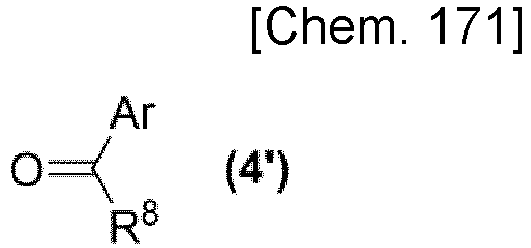
- [In chemical formula (4') above, R8 represents a C1 to C8 alkyl group or a C1 to C6 haloalkyl group.
- Ar represents a ring system selected from the group consisting of a monocyclic aromatic ring system, a polycyclic aromatic ring system and an annulated aromatic ring system whose ring-constituting atoms are atoms selected from the group consisting of a carbon atom, a nitrogen atom, an oxygen atom and a sulfur atom, with the monocyclic aromatic ring system, polycyclic aromatic ring system and annulated aromatic ring system optionally having a substituent.]


- [In formula (Z1) above, Rz3 and Rz4 each independently represent a hydrogen atom, a halogen atom or a C1 to C8 alkyl group.
- Arz represents a ring system selected from the group consisting of a monocyclic aromatic ring system, a polycyclic aromatic ring system and an annulated aromatic ring system whose ring-constituting atoms are atoms selected from the group consisting of a carbon atom, a nitrogen atom, an oxygen atom and a sulfur atom, with the monocyclic aromatic ring system, polycyclic aromatic ring system or annulated aromatic ring system optionally having a substituent. A wavy-lined portion represents a site of binding with a portion in formula (1) excluding R0, R1, R2, R3 or R4.]
- The present invention will now be described in further detail with examples, but the present invention is not to be construed as being limited to these.
- Compound (2"-2-1-DC) in the Examples was synthesized according to the method described in Macromolecules, 2018, vol. 51 (23), pp. 9430-9441.
- Compound (6'-1-DH) in the Examples was synthesized according to the method described in
Japanese Patent No. 5325733 - Using a nuclear magnetic resonance spectrometer (manufactured by JEOL Ltd.; trade name: ECZ 400S), the 1H-NMR spectrum was measured.
- The measurement of the thickness of films in the Examples was performed using a spectroscopic ellipsometer (manufactured by the J.A. Woollam Company; trade name: RC2-U).
- The yellowness indices (YI) in the Examples were determined by attaching a 7-mm diameter beam attachment to a spectral haze meter (manufactured by Nippon Denshoku Industries Co., Ltd.; trade name: SH7000; light source, D65) and conducting measurements according to ASTM E313-05.
- The appearance of the films in the Examples was visually inspected. The film appearance was evaluated, with films that exhibited no visible color and were acceptable graded as "A," films that exhibited a visible but only faint color and were acceptable graded as "B" and films that exhibited an intense visible color and were unacceptable graded as "C."
- The polarized ultraviolet irradiation in the Examples was performed using a high-power mercury light source (manufactured by Asahi Spectra Co., Ltd.; trade name: REX-250) equipped with a band-pass filter (248 nm, 313 nm or 365 nm). Only P-polarized light was extracted using a polarizing beam splitter for the corresponding wavelength, and irradiation was conducted.
- The heating treatment for films in the Examples was performed using an anaerobic temperature chamber (manufactured by ESPEC CORP.; trade name: IPHH-202).
- For the measurement of retardation characteristics (Re) in the Examples, measurement was performed using light with a wavelength of 589 nm, employing a tilted-sample automatic birefringence tester (manufactured by AXOMETRICS, Inc.; trade name: AxoScan).
Re = (ny - nx) × d ... (III)
(In formula (III), nx indicates the refractive index in the direction along the in-film-plane fast axis (the direction with the smallest refractive index), ny indicates the refractive index in the direction along the in-film-plane slow axis (the direction with the largest refractive index), and d indicates the thickness of the film (nm).) - The wavelength dispersion characteristics (Re (450)/Re (550)) in the Examples were calculated as a ratio of the in-plane retardation with light having a wavelength of 450 nm, Re (450), and the in-plane retardation with light having a wavelength of 550 nm, Re (550), as measured using a tilted-sample automatic birefringence tester (manufactured by AXOMETRICS, Inc.; trade name: AxoScan).
-

- 2,5-dihydroxybenzaldehyde (5.00 g, 36.2 mmol) and 2-acetylthiophene (4.57 g, 36.2 mmol) were dissolved in ethanol (36 mL), and then an aqueous solution (7.4 mL) of potassium hydroxide (11.0 g, 195 mmol) was added dropwise with cooling on ice. After the reaction system was stirred at room temperature for 3 hours, acetic acid (13.0 mL, 228 mmol) was added with cooling on ice. The resulting reaction mixture was added to water (100 mL), followed by vigorous stirring with added dichloromethane (30 mL). The solid that formed was collected by filtration and washed with dichloromethane (50 mL) and distilled water (50 mL). The resulting solid was vacuum-dried at 60°C for 5 hours, giving 5.01 g (percent yield: 56%) of compound (1'-2-1) as a yellow solid. 1H-NMR (400 MHz, DMSO-d6) δ 10.0-8.42 (br, 2H), 8.17 (m, 1H), 7.99 (m, 1H), 7.94 (d, J = 15.6 Hz, 1H), 7.62 (d, J = 15.6 Hz, 1H), 7.25 (m, 1H), 7.17 (s, 1H), 6.63-6.76 (m, 2H).
-

- 2,5-dihydroxybenzaldehyde (58.1 g, 421 mmol) and 2-acetyl-5-chlorothiophene (67.5 g, 421 mmol) were dissolved in methanol (216 mL), and then a 48% aqueous solution of sodium hydroxide (126 mL, 2.25 mol) was added dropwise with cooling on ice. After the reaction system was stirred at 50°C for 3 hours, acetic acid (168 mL, 2.93 mol) was added with cooling on ice. Water (270 mL), toluene (95 mL) and isopropyl alcohol (13.5 mL) were added to the resulting reaction mixture, and then water (54 mL) was further added. The solid that formed was collected by filtration and washed with water (50 mL) and toluene (270 mL). The resulting solid was suspended in an acetonitrile (235 mL)-methanol (59 mL) solvent mixture, then the system was warmed in an oil bath at 70°C, and stirring was continued for one and a half hours thereafter. The system was cooled again in an ice bath, and the solid that formed in the system was collected by filtration using a Büchner funnel. Subsequently, the solid was washed by passing acetonitrile (270 mL) from the upper portion of the Büchner funnel and then vacuum-dried, giving 81.4 g (percent yield: 69%) of compound (1'-2-2) as yellow microcrystals. 1H-NMR (400 MHz, DMSO-d6) δ 9.88-8.62 (br, 2H), 8.12 (d, J = 4.1 Hz, 1H), 7.95 (d, J = 15.8 Hz, 1H), 7.60 (d, J = 15.8 Hz, 1H), 7.31 (d, J = 4.1 Hz, 1H), 7.19 (s, 1H), 6.75-6.68 (m, 2H).
-

- 2,5-dihydroxybenzaldehyde (10.0 g, 72.4 mmol) and 2-acetyl-5-bromothiophene (14.8 g, 72.4 mmol) were dissolved in ethanol (72 mL), and then an aqueous (14.8 mL) solution of potassium hydroxide (21.9 g, 391 mmol) was added dropwise with cooling on ice. After the reaction system was stirred at room temperature for 3 hours, acetic acid (26.1 mL, 456 mmol) was added with cooling on ice. The resulting reaction mixture was added to water (200 mL), followed by vigorous stirring with added dichloromethane (60 mL). The solid that formed was collected by filtration and washed with dichloromethane (100 mL) and distilled water (100 mL). The resulting solid was vacuum-dried at 60°C for 5 hours, giving 6.08 g (percent yield: 26%) of compound (1'-2-3) as a yellow solid. 1H-NMR (400 MHz, DMSO-d6) δ 9.45 (br, 1H), 8.83 (br, 1H), 7.99 (d, J = 4.6 Hz, 1H), 7.85 (d, J = 15.8 Hz, 1H), 7.55 (d, J = 15.8 Hz, 1H), 7.15 (m, 1H), 6.69 (m, 2H), 6.49 (d, J = 4.6 Hz, 1H).
-

- 2,5-dihydroxybenzaldehyde (2.00 g, 14.5 mmol) and 2-acetyl-5-methoxythiophene (2.26 g, 14.5 mmol) were dissolved in ethanol (14.4 mL), and then an aqueous (2.8 mL) solution of potassium hydroxide (4.39 g, 78.2 mmol) was added dropwise with cooling on ice. After the reaction system was stirred at room temperature for 3 hours, acetic acid (5.22 mL, 91.2 mmol) was added with cooling on ice. The resulting reaction mixture was added to water (50 mL), followed by vigorous stirring. The solid that formed was collected by filtration and washed with dichloromethane (50 mL) and distilled water (100 mL). The resulting solid was vacuum-dried at 60°C for 5 hours, giving 1.05 g (percent yield: 26%) of compound (1'-2-5) as a yellow solid. 1H-NMR (400 MHz, DMSO-d6) δ 9.46 (br, 1H), 8.85 (br, 1H), 7.99 (d, J = 4.6 Hz, 1H), 7.85 (d, J = 15.8 Hz, 1H), 7.55 (d, J = 15.8 Hz, 1H), 7.15 (m, 1H), 6.70-6.68 (m, 2H), 6.49 (d, J = 4.6 Hz, 1H), 3.94 (s, 3H).
-

- 2,5-dihydroxybenzaldehyde (2.00 g, 14.5 mmol) and 2-acetyl-5-methylthiophene (2.03 g, 14.5 mmol) were dissolved in ethanol (14.4 mL), and then an aqueous (2.8 mL) solution of potassium hydroxide (4.39 g, 78.2 mmol) was added dropwise with cooling on ice. After the reaction system was stirred at room temperature for 3 hours, acetic acid (5.22 mL, 91.2 mmol) was added with cooling on ice. The resulting reaction mixture was added to water (50 mL), followed by vigorous stirring. The solid that formed was collected by filtration and washed with dichloromethane (50 mL) and distilled water (100 mL). The resulting solid was vacuum-dried at 60°C for 5 hours, giving 1.66 g (percent yield: 44%) of compound (1'-2-6) as a yellow solid. 1H-NMR (400 MHz, DMSO-d6) δ 9.92-8.58 (br, 2H), 7.99 (d, J = 3.9 Hz, 1H), 7.89 (d, J = 15.8 Hz, 1H), 7.56 (d, J = 15.8 Hz, 1H), 7.14 (m, 1H), 6.96 (d, J = 3.9 Hz, 1H), 6.73-6.67 (m, 2H), 2.49 (s, 3H).
-

- 2,5-dihydroxybenzaldehyde (1.00 g, 7.24 mmol) and 2-acetyl-5-methylfuran (899 mg, 7.24 mmol) were dissolved in ethanol (7.2 mL), and then an aqueous (1.4 mL) solution of potassium hydroxide (2.19 g, 39.1 mmol) was added dropwise with cooling on ice. After the reaction system was stirred at room temperature for 3 hours, acetic acid (2.61 mL, 45.6 mmol) was added with cooling on ice. The resulting reaction mixture was added to water (50 mL), followed by vigorous stirring. The solid that formed was collected by filtration and washed with dichloromethane (50 mL) and distilled water (100 mL). The resulting solid was vacuum-dried at 60°C for 5 hours, giving 1.07 g (percent yield: 61%) of compound (1'-2-6-Furan) as a yellow solid. 1H-NMR (400 MHz, DMSO-d6) δ 9.53 (br, 1H), 8.87 (br, 1H), 7.89 (d, J = 16.0 Hz, 1H), 7.57 (d, J = 3.5 Hz, 1H), 7.42 (d, J = 16.0 Hz, 1H), 7.10 (m, 1H), 6.72-6.66 (m, 2H), 6.37 (d, J = 3.5 Hz, 1H), 2.36 (s, 3H).
-

- 2,5-dihydroxybenzaldehyde (4.49 g, 32.3 mmol) and 2-acetyl-4-methyl-5-chlorothiophene (5.65 g, 32.3 mmol) were dissolved in methanol (16 mL), and then a 48% aqueous solution of sodium hydroxide (10 mL, 180 mmol) was added dropwise with cooling on ice. After the reaction system was stirred at room temperature for 4 hours, acetic acid (17 mL, 297 mmol) was added with cooling on ice. Water (30 mL) was added to the resulting reaction mixture, followed by vigorous stirring. The solid that formed was collected by filtration and washed with hexane (100 mL) and distilled water (100 mL). The resulting solid was vacuum-dried at 50°C for 5 hours, giving 7.51 g (percent yield: 79%) of compound (1'-2-7) as an orange solid. 1H-NMR (400 MHz, DMSO-de) δ 9.60 (br, 1H), 9.02 (br, 1H), 8.16 (s, 1H), 7.98 (d, J = 15.6 Hz, 1H), 7.62 (d, J = 15.6 Hz, 1H), 7.23 (m, 1H), 6.79-6.74 (m, 2H), 2.23 (s, 3H).
-

- 2,5-dihydroxy-4-methylbenzaldehyde (1.84 g, 12.1 mmol) and 2-acetyl-5-chlorothiophene (2.50 g, 15.5 mmol) were dissolved in methanol (16 mL), and then a 48% aqueous solution of sodium hydroxide (3.7 mL, 66.1 mmol) was added dropwise with cooling on ice. After the reaction system was stirred at room temperature for 6.5 hours, acetic acid (4.8 mL, 83.7 mmol) was added with cooling on ice. Dichloromethane (10 mL) and water (34 mL) were added to the resulting reaction mixture, followed by vigorous stirring. The solid that formed was collected by filtration and washed with distilled water (50 mL) and a solution mixture of dichloromethane:methanol (10 mL; ratio by volume: dichloromethane/methanol = 5/1). The resulting solid was vacuum-dried at 50°C for 3 hours, giving 1.67 g (percent yield: 47%) of compound (1'-2-10) as a yellow solid. 1H-NMR (400 MHz, DMSO-d6) δ 9.62 (br, 1H), 8.78 (br, 1H), 8.05 (d, J = 4.2 Hz, 1H), 7.96 (d, J = 15.6 Hz, 1H), 7.51 (d, J = 15.6 Hz, 1H), 7.34 (d, J = 4.2 Hz, 1H), 7.12 (s, 1H), 6.66 (s, 1H), 2.10 (s, 3H).
-

- 4-chloro-2,5-dihydroxybenzaldehyde (2.59 g, 15.0 mmol) and 2-acetyl-5-chlorothiophene (2.14 g, 15.0 mmol) were dissolved in methanol (15 mL), and then a 48% aqueous solution of sodium hydroxide (4.5 mL, 80.4 mmol) was added dropwise with cooling on ice. After the reaction system was stirred at room temperature for 4 hours, acetic acid (6.0 mL, 105 mmol) was added with cooling on ice. Water (15 mL) and toluene (3.4 mL) were added to the resulting reaction mixture, followed by vigorous stirring. The solid that formed was collected by filtration and washed with distilled water (50 mL) and a solution mixture of dichloromethane:methanol (10 mL, ratio by volume: dichloromethane/methanol = 50/1). The resulting solid was vacuum-dried at 50°C for 3 hours, giving 1.85 g (percent yield: 39%) of compound (1'-2-11) as a yellow solid. 1H-NMR (400 MHz, DMSO-d6) δ 9.95 (br, 1H), 9.61 (br, 1H), 8.11 (d, J = 4.2 Hz, 1H), 7.91 (d, J = 15.7 Hz, 1H), 7.63 (d, J = 15.7 Hz, 1H), 7.37 (s, 1H), 7.36 (d, J = 4.2 Hz, 1H), 6.90 (s, 1H).
-


- 2,5-dihydroxyterephthalaldehyde (1.29 g, 7.74 mmol) and 2-acetyl-5-chlorothiophene (2.49 g, 15.5 mmol) were dissolved in methanol (12 mL), and then a 48% aqueous solution of sodium hydroxide (1.8 mL, 32.1 mmol) was added dropwise with cooling on ice. After the reaction system was stirred at room temperature for 2.5 hours, acetic acid (3.1 mL, 54.1 mmol) was added with cooling on ice. Dichloromethane (6.5 mL) and water (22 mL) were added to the resulting reaction mixture, followed by vigorous stirring. The solid that formed was collected by filtration and washed with distilled water (50 mL) and methanol (6.0 mL). The resulting solid was vacuum-dried at 50°C for 3 hours, giving 2.0 g (percent yield: 57%) of compound (1'-7-2) as a red solid. 1H-NMR (400 MHz, DMSO-d6) δ 9.87 (br, 2H), 8.11 (d, J = 4.2 Hz, 2H), 7.96 (d, J = 15.6 Hz, 2H), 7.66 (d, J = 15.6 Hz, 2H), 7.37 (d, J = 4.2 Hz, 2H), 7.30 (s, 2H).
-


- 2,5-bis(methoxymethoxy)benzaldehyde (4.53 g, 20.0 mmol) and 2-acetyl-1-methylpyrrole (2.35 mL, 20.0 mmol) were dissolved in methanol (10 mL), and then a 48% aqueous solution of sodium hydroxide (6.1 mL, 110 mmol) was added dropwise with cooling on ice. After the reaction system was stirred at room temperature for 2 hours, the temperature was increased to 50°C, and 2 hours of stirring was performed. After the end of the reaction, methanol (90 mL) and a 10% aqueous solution of hydrochloric acid (50 mL) were added with cooling on ice, and the resulting mixture was stirred at 50°C for 1 hour. The reaction solution was concentrated under reduced pressure, and extraction with ethyl acetate (100 mL × 3) was performed, followed by the washing of the combined organic layer with saturated saline solution (50 mL × 3) and drying with anhydrous sodium sulfate. The solvent was distilled away under reduced pressure, and the resulting crude product was washed with ethyl acetate (2.0 mL) and cold methanol (1.0 mL). The resulting solid was vacuum-dried at 50°C for 3 hours, giving compound (1'-6-2) as a yellow solid (actual yield: 2.11 g; percent yield: 43%). 1H-NMR (400 MHz, DMSO-d6) δ 9.43 (brs, 1H), 8.86 (brs, 1H), 7.85 (d, J = 15.8 Hz, 1H), 7.50 (d, J = 15.8 Hz, 1H), 7.31 (dd, J = 4.1, 1.8 Hz, 1H), 7.18 (t, J = 1.8 Hz, 1H), 7.13 (d, J = 2.7 Hz, 1H), 6.73 (d, J = 8.7 Hz, 1H), 6.69 (dd, J = 8.7, 2.7 Hz, 1H), 6.18 (dd, J = 4.1, 2.5 Hz, 1H), 3.94 (s, 3H).
-

- 2,5-bis(methoxymethoxy)benzaldehyde (4.53 g, 20.0 mmol) and 2-acetyl-1-ethylpyrrole (2.72 mL, 20.0 mmol) were dissolved in methanol (10 mL), and then a 48% aqueous solution of sodium hydroxide (6.1 mL, 110 mmol) was added dropwise with cooling on ice. After the reaction system was stirred at room temperature for 2 hours, the temperature was increased to 50°C, and 2 hours of stirring was performed. After the end of the reaction, methanol (90 mL) and a 10% aqueous solution of hydrochloric acid (50 mL) were added with cooling on ice, and the resulting mixture was stirred at 50°C for 1 hour. The reaction solution was concentrated under reduced pressure, and extraction with ethyl acetate (100 mL × 3) was performed, followed by the washing of the combined organic layer with saturated saline solution (50 mL × 2) and drying with anhydrous sodium sulfate. The solvent was distilled away under reduced pressure, and the resulting crude product was washed with a solution mixture of hexane:ethyl acetate (2.0 mL; ratio by volume: hexane/ethyl acetate = 1/1) and cold methanol (1.0 mL). The resulting solid was vacuum-dried at 50°C for 3 hours, giving compound (1'-6-3) as a yellow solid (actual yield: 2.02 g; percent yield: 39%). 1H-NMR (400 MHz, DMSO-d6) δ 9.43 (brs, 1H), 8.86 (brs, 1H), 7.85 (d, J = 15.7 Hz, 1H), 7.51 (d, J = 15.7 Hz, 1H), 7.33 (dd, J = 4.1, 1.7 Hz, 1H), 7.25 (dd, J = 2.4, 1.7 Hz, 1H), 7.13 (d, J = 2.8 Hz, 1H), 6.73 (d, J = 8.6 Hz, 1H), 6.69 (dd, J = 8.6, 2.8 Hz, 1H), 6.19 (dd, J = 4.1, 2.4 Hz, 1H), 4.40 (q, J = 7.1 Hz, 2H), 1.29 (t, J = 7.1 Hz, 3H).
-

- In an argon atmosphere, thionyl chloride (15.5 mL) and DMF (250 µL) were added to a toluene (25 mL) solution of 2-chloro-4-methoxybenzoic acid (5.00 g, 26.8 mmol). After 1 hour of stirring at 100°C, an excess of thionyl chloride was distilled away under reduced pressure, and THF (45 mL) was added to the resulting residue. This solution was used entirely in the next reaction.
- A THF (45 mL)-water (45 mL) solution of 4-(methylamino)phenol sulfate (4.61 g, 13.4 mmol) was cooled to 0°C, sodium hydrogencarbonate (5.63 g, 67.0 mmol) was added with stirring, and then the THF solution of an acid chloride prepared in advance was added dropwise over 5 minutes. This mixture was allowed to warm to room temperature and vigorously stirred for one and a half hours, followed by the addition of concentrated hydrochloric acid (10 mL) and concentration under reduced pressure. The solid that formed in the system was collected by filtration and then washed with water (200 mL) to give a crude solid. This solid was further purified through reprecipitation (hexane: 50 mL; ethyl acetate: 5 mL; ethanol : 3 mL), giving a white solid of 2-chloro-4'-hydroxy-4-methoxy-N-methylbenzanilide (actual yield: 6.42 g; percent yield: 82%). 1H-NMR (400 MHz, DMSO-d6): δ 9.50 (brs, 1H), 7.16 (d, J = 8.6 Hz, 1H), 6.99 (d, J = 8.7 Hz, 2H), 6.85 (d, J = 2.4 Hz, 1H), 6.73 (dd, J = 8.6, 2.4 Hz, 1H), 6.56 (d, J = 8.7 Hz, 2H), 3.69 (s, 3H), 3.28 (s, 3H).
- In an argon atmosphere, a dichloromethane (170 mL) suspension of 2-chloro-4'-hydroxy-4-methoxy-N-methylbenzanilide (5.00 g, 17.1 mmol) was cooled to 0°C, and then a 1 M dichloromethane solution of boron tribromide (68.4 mL, 68.4 mmol) was added dropwise over 15 minutes. After the reaction system was allowed to warm to room temperature, 13 hours of stirring was performed, and the system was cooled to 0°C again. Ice (400 g) was added, followed by stirring at room temperature until the ice melted. Dichloromethane was distilled away through the concentration of the mixture under reduced pressure, and then extraction with ethyl acetate (200 mL × 3) was performed. The resulting organic layer was dried with anhydrous sodium sulfate and then concentrated under reduced pressure. The resulting residue was purified by silica gel chromatography (hexane:ethyl acetate = 5:95) and then dried under reduced pressure (120°C, a vacuum pump), giving a white solid of compound (2"A-1-36-DH) (actual yield: 3.67 g; percent yield: 77%). 1H-NMR (400 MHz, DMSO-d6): δ 10.4-9.15 (br, 2H), 7.02 (m, 1H), 6.95 (d, J = 8.5 Hz, 2H), 6.61 (m, 1H), 6.56 (d, J = 8.5 Hz, 2H), 6.53 (m, 1H), 3.27 (s, 3H).
-

- A mixture of 4-hydroxybenzoic acid (40.1 g, 290 mmol), thionyl chloride (276 g, 2.32 mol) and N,N-dimethylformamide (21.2 mg, 290 µmol) was stirred for 1 hour with heating under reflux, and then an excess of thionyl chloride was distilled away to give 4-hydroxybenzoyl chloride. The resulting 4-hydroxybenzoyl chloride was used entirely in the next reaction after being made into a THF (350 mL) solution.
- In a nitrogen atmosphere, a mixture of p-methylaminophenol sulfate (50.0 g, 290 mmol), water (350 mL) and THF (350 mL) was stirred with cooling on ice, and sodium hydrogencarbonate (122 g, 1.45 mol) was added over 5 minutes at the same time. Subsequently, the THF solution of 4-hydroxybenzoyl chloride prepared in the foregoing was added dropwise over 5 minutes. After the dropwise addition, the resulting mixture was stirred for 15 hours while being allowed to gradually warm to room temperature, and then THF was distilled away under reduced pressure. The solid that formed was collected by filtration and washed with water (1 L) and then washed with 2 M hydrochloric acid (600 mL) and acetonitrile (200 mL), giving compound (2"A-1-1-DH) as a white solid (actual yield: 44.3 g; percent yield: 62.7%). 1H-NMR (400 MHz, DMSO-d6): δ 9.97-9.22 (br, 2H), 7.03 (d, J = 8.7 Hz, 2H), 6.86 (d, J = 8.7 Hz, 2H), 6.58 (d, J = 8.7 Hz, 2H), 6.50 (d, J = 8.7 Hz, 2H), 3.20 (s, 3H).
-

- A mixture of vanillic acid (5.0 g, 29.7 mmol), thionyl chloride (28.3 g, 238 mol) and N,N-dimethylformamide (2.17 mg, 29.7 µmol) was stirred for 1 hour with heating under reflux, and then thionyl chloride was distilled away to give vanillyl chloride. The resulting vanillyl chloride was used entirely in the next reaction after being made into a THF (35 mL) solution.
- In a nitrogen atmosphere, a mixture of p-methylaminophenol sulfate (5.12 g, 29.7 mmol), water (35 mL) and THF (35 mL) was stirred with cooling on ice, and sodium hydrogencarbonate (12.5 g, 149 mol) was added over 5 minutes at the same time. Subsequently, the THF solution of vanillyl chloride prepared in the foregoing was added dropwise over 5 minutes. After the dropwise addition, the resulting mixture was stirred for 15 hours while being allowed to gradually warm to room temperature, and then THF was distilled away under reduced pressure. The resulting mixture was subjected to extraction with ethyl acetate (50 mL × 3), and the organic layer was washed with 2 M hydrochloric acid (200 mL) and water (200 mL), followed by drying with anhydrous sodium sulfate. The resulting organic layer was concentrated under reduced pressure, giving compound (2"A-1-6-DH) as a white solid (actual yield: 4.90 g; percent yield: 60%). 1H-NMR (400 MHz, DMSO-d6): δ 9.60-9.09 (br, 2H), 6.90-6.84 (m, 2H), 6.70-6.62 (m, 2H), 6.60-6.54 (m, 2H), 6.52 (m, 1H), 3.51 (s, 3H), 3.22 (s, 3H).
-

- In a nitrogen atmosphere, 4'-hydroxyacetanilide (3.85 g, 25.5 mmol) was cooled on ice, and then a 1 mol/L THF solution of borane-THF complex (100 mL, 100 mmol) was slowly added. The reaction system was allowed to warm to room temperature and then heated and stirred at 60°C for 24 hours. After the end of the reaction, the system was cooled in an ice bath, and methanol (21 mL) was added over 5 minutes. Water (100 mL) was added to the resulting reaction mixture, then THF was distilled away using an evaporator, and extraction with dichloromethane (100 mL × 3) was performed. The resulting organic layer was dried with sodium sulfate and then concentrated under reduced pressure. The resulting composition was purified by silica gel column chromatography (ethyl acetate/hexane = 61/39 Vol%), giving 4-ethylaminophenol as a brown solid (actual yield: 2.07 g; percent yield: 59%). 1H-NMR (400 MHz, CDCl3): δ 6.69 (d, J = 8.9 Hz, 2H), 6.53 (d, J = 8.9 Hz, 2H), 4.60-3.20 (br, 2H), 3.09 (q, J = 7.2 Hz, 2H), 1.22 (t, J = 7.2 Hz, 3H).
- A mixture of 4-hydroxybenzoic acid (2.01 g, 29.7 mmol), thionyl chloride (13.9 g, 117 mmol) and N,N-dimethylformamide (1.07 mg, 14.6 µmol) was stirred for 1 hour with heating under reflux, and then thionyl chloride was distilled away to give 4-hydroxybenzoyl chloride. The resulting 4-hydroxybenzoyl chloride was used entirely in the next reaction after being made into a THF (13 mL) solution.
- In a nitrogen atmosphere, a mixture of 4-ethylaminophenol (2.00 g, 14.6 mmol), water (13 mL) and THF (13 mL) was stirred with cooling on ice, and sodium hydrogencarbonate (6.12 g, 72.9 mmol) was added over 5 minutes at the same time. Subsequently, the THF solution of 4-hydroxybenzoyl chloride prepared in the foregoing was added dropwise over 5 minutes. After the dropwise addition, the resulting mixture was stirred for 15 hours while being allowed to gradually warm to room temperature, and then THF was distilled away under reduced pressure. The resulting mixture was subjected to extraction with ethyl acetate (50 mL × 3), and the organic layer was washed with 2 N hydrochloric acid (100 mL × 2) and water (100 mL), followed by drying with anhydrous sodium sulfate. The resulting organic layer was concentrated under reduced pressure, giving compound (2"A-1-2-DH) as a white solid (actual yield: 1.99 g; percent yield: 53%). 1H-NMR (400 MHz, DMSO-d6): δ 8.85-10.12(2H), 7.02 (d, J = 8.7 Hz, 2H), 6.83 (d, J = 8.7 Hz, 2H), 6.59 (d, J = 8.7 Hz, 2H), 6.49 (d, J = 8.7 Hz, 2H), 3.70 (q, J = 7.2 Hz, 2H), 1.01 (t, J = 7.2 Hz, 3H).
-


- With stirring, an NMP (32.4 mL)-acetic acid (40.5 mL) solution of 1,4-benzoquinone (16.2 g, 150 mmol) was gradually added to an NMP (40.5 mL) solution of piperidinium pentamethylenedithiocarbamate (18.5 g, 75 mmol) at 15°C. The reaction system was warmed to 50°C and stirred for 2 hours. After it was confirmed that a solid formed in the reaction system, the system was cooled to room temperature, acetone (100 mL) was added. The solid in the system was collected by filtration, washed with an acetone (50 mL)-acetic acid (50 mL) solvent mixture and then dried under reduced pressure, giving 10.2 g (percent yield: 20.7%) of compound (6C) as a yellow solid. 1H-NMR (400 MHz, CDsOD): δ 6.83 (s, 2H), 3.99-3.97 (m, 4H), 1.98-1.92 (m, 7H), 1.84-1.82 (m, 2H).
-

- In a nitrogen atmosphere, dimethyl malonate (1.5 g, 11.3 mol) was added, at room temperature, to a DMF (15 mL) solution of compound (6C) (3.7 g, 11.3 mmol), obtained in Synthesis Example 5. The reaction system was heated to 100°C with stirring, and stirring was continued for 6 hours in that state. Subsequently, the reaction system was cooled to room temperature, and then water (100 mL) was added. The mixture was subjected to extraction with ethyl acetate (100 mL × 2 times), and the combined organic layer was washed with 1 N hydrochloric acid (100 mL) and saturated saline solution (50 mL). The organic layer was dried with sodium sulfate and then dried under reduced pressure to give a partially purified product. This partially purified product was purified by silica gel column chromatography (methanol:dichloromethane = 3:97 to 4:96), giving 950 mg (percent yield: 4%) of compound (6'-2-DH) as a light brown solid. 1H-NMR (400 MHz, DMSO-d6): δ 10.09 (s, 2H), 6.70 (s, 2H), 3.77 (s, 6H).
-

- In a nitrogen atmosphere, diethyl malonate (1.2 g, 7.40 mmol) was added, at room temperature, to a DMF (24 mL) solution of compound (6C) (2.4 g, 7.40 mmol), obtained in Synthesis Example 5. The reaction system was heated to 100°C with stirring, and stirring was continued for 6 hours in that state. Subsequently, the reaction system was cooled to room temperature, and then water (100 mL) was added. The mixture was subjected to extraction with ethyl acetate (100 mL × 2 times), and the combined organic layer was washed with 1 N hydrochloric acid (100 mL) and saturated saline solution (50 mL). The organic layer was dried with sodium sulfate and then dried under reduced pressure to give a partially purified product. This partially purified product was purified by silica gel column chromatography (methanol:dichloromethane = 3:97 to 4:96), giving 470 mg (percent yield: 18%) of compound (6'-3-DH) as a light brown solid. 1H-NMR (400 MHz, CDCl3). δ 10.08 (s, 2H), 6.69 (s, 2H), 4.22 (q, J = 7.2 Hz, 4H), 1.27 (t, J = 7.2 Hz, 6H).
-

- In a nitrogen atmosphere, ethyl cyanoacetate (1.5 g, 13.2 mmol) was added, at room temperature, to a DMF (30 mL) solution of compound (6C) (4.33 g, 13.2 mmol), obtained in Synthesis Example 5. The reaction system was heated to 100°C with stirring, and stirring was continued for 6 hours in that state. Subsequently, the reaction system was cooled to room temperature, and then water (100 mL) was added. The mixture was subjected to extraction with ethyl acetate (100 mL × 2 times), and the combined organic layer was washed with 1 N hydrochloric acid (100 mL) and saturated saline solution (50 mL). The organic layer was dried with sodium sulfate and then dried under reduced pressure to give a partially purified product. This partially purified product was purified by silica gel column chromatography (methanol:dichloromethane = 3:97 to 4:96), giving 950 mg (percent yield: 24%) of compound (6'-5-DH) as a light brown solid. 1H-NMR (400 MHz, DMSO-d6): δ 10.39 (s, 1H), 10.34 (s, 1H), 6.78 (s, 2H), 4.25 (q, J = 7.2 Hz, 2H), 1.28 (t, J = 7.2 Hz, 3H).
-

- In a nitrogen atmosphere, methyl acetoacetate (1.5 g, 12.9 mmol) was added, at room temperature, to a DMF (15 mL) solution of compound (6C) (4.22 g, 12.9 mmol), obtained in Synthesis Example 5. The reaction system was heated to 100°C with stirring, and stirring was continued for 6 hours in that state. Subsequently, the reaction system was cooled to room temperature, and then water (100 mL) was added. The mixture was subjected to extraction with ethyl acetate (100 mL × 2 times), and the combined organic layer was washed with 1 N hydrochloric acid (100 mL) and saturated saline solution (50 mL). The organic layer was dried with sodium sulfate and then dried under reduced pressure to give a partially purified product. This partially purified product was purified by silica gel column chromatography (methanol:dichloromethane = 3:97 to 4:96), giving 940 mg (percent yield: 25%) of compound (6'-7-DH) as a light brown solid. 1H-NMR (400 MHz, DMSO-d6): δ 10.14 (s, 1H), 10.12 (s, 1H), 6.74 (s, 2H), 3.85 (s, 3H), 2.50 (s, 3H).
-
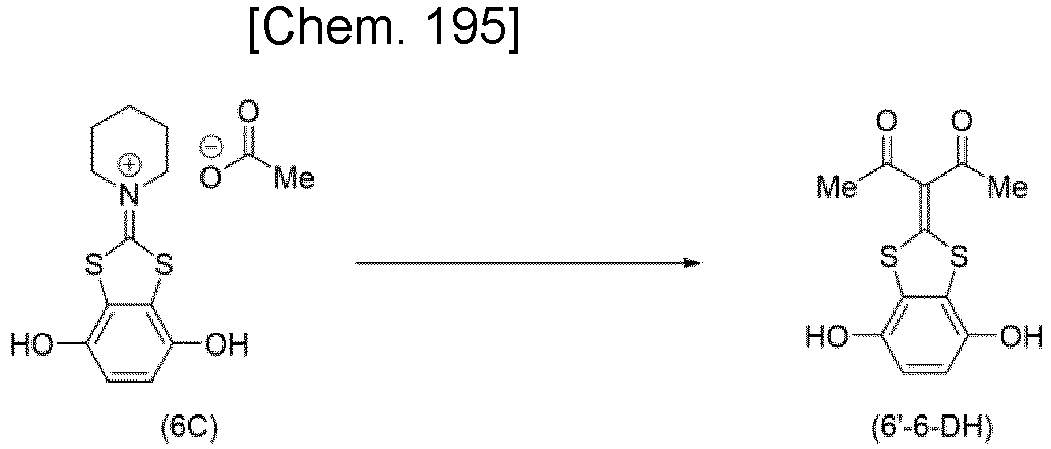
- In a nitrogen atmosphere, acetylacetone (1.5 g, 14.9 mmol) was added, at room temperature, to a DMF (30 mL) solution of compound (6C) (4.89 g, 14.9 mmol), obtained in Synthesis Example 5. The reaction system was heated to 100°C with stirring, and stirring was continued for 8 hours in that state. Subsequently, the reaction system was cooled to room temperature, and then water (100 mL) was added. The mixture was subjected to extraction with ethyl acetate (100 mL × 2 times), and the combined organic layer was washed with 1 N hydrochloric acid (100 mL) and saturated saline solution (50 mL). The organic layer was dried with sodium sulfate and then dried under reduced pressure to give a partially purified product. This partially purified product was purified by silica gel column chromatography (methanol:dichloromethane = 3:97 to 4:96), giving 940 mg (percent yield: 22%) of compound (6'-6-DH) as a light brown solid. 1H-NMR (400 MHz, DMSO-d6): δ 10.11 (s, 2H), 6.74 (s, 2H), 2.61 (s, 6H).
-

- In an argon atmosphere, a mixture of 4-acetoxybenzoic acid (7.56 g, 42.0 mmol), thionyl chloride (24.0 mL, 331 mmol) and N,N-dimethylformamide (catalytic amount) was boiled under reflux for 3 hours. Volatile components were distilled away, and the residue was azeotropically distilled with toluene (3 × 20 mL) to give 4-acetoxybenzoyl chloride. The resulting 4-acetoxybenzoyl chloride was used entirely in the next reaction after being made into a tetrahydrofuran (50 mL) solution.
- In an argon atmosphere, methyl hydrazine (1.05 mL, 19.8 mmol) and triethylamine (8.40 mL, 60.3 mmol) were dissolved in tetrahydrofuran (40 mL). With cooling on ice, the tetrahydrofuran solution of 4-acetoxybenzoyl chloride prepared in advance was slowly added. The resulting mixture was allowed to warm to room temperature and stirred overnight. The solvent was distilled away under reduced pressure, 1 M hydrochloric acid (100 mL) was added, and extraction with ethyl acetate (2 × 100 mL) was performed. The combined organic layer was washed sequentially with a saturated aqueous solution of sodium hydrogencarbonate (100 mL) and saturated saline solution (100 mL) and dried with anhydrous sodium sulfate, followed by concentration under reduced pressure. The residue was suspended in methanol (75 mL), and the resulting suspension was stirred at room temperature for 1 hour with an added aqueous (25 mL) solution of sodium hydroxide (4.13 g, 103 mmol). The solvent was distilled away under reduced pressure, 2 M hydrochloric acid (75 mL) was added, and extraction with ethyl acetate (2 × 100 mL) was performed. The combined organic layer was washed sequentially with water (100 mL), a saturated aqueous solution of sodium hydrogencarbonate (2 × 100 mL) and saturated saline solution (100 mL), followed by drying with anhydrous sodium sulfate. The precipitated solid was collected by filtration and washed with ethyl acetate and water, giving a white solid of compound (2"C-2-2). The organic layer in the filtrate was isolated and concentrated under reduced pressure, the residue was purified by silica gel column chromatography, and the resulting solid was washed in diethyl ether (50 mL) for the removal of slurry, giving a white solid of compound (2"C-2-2). The combined actual yield was 3.02 g, and the percent yield was 53%. 1H-NMR (400 MHz, DMSO-d6): δ 10.76 (brs, 1H), 10.12 (brs, 1H), 9.81 (brs, 1H), 7.66-7.46 (brm, 2H), 7.46-7.36 (m, 2H), 6.82-6.73 (m, 2H), 6.73-6.60 (brm, 2H), 3.15 (s, 3H).
-

- In an argon atmosphere, a mixture of 4-hydroxybenzoic acid (2.49 g, 18.0 mmol), toluene (18 mL), thionyl chloride (10.5 mL, 145 mmol) and N,N-dimethylformamide (catalytic amount) was boiled under reflux for 1 hour. Volatile components were distilled away, and the residue was azeotropically distilled with toluene (3 × 15 mL) to give 4-hydroxybenzoyl chloride. The resulting 4-hydroxybenzoyl chloride was used entirely in the next reaction after being made into a tetrahydrofuran (18 mL) solution.
- In an argon atmosphere, 4-(dodecylamino)phenol (4.16 g, 15.0 mmol) and sodium hydrogencarbonate (2.52 g, 30.0 mmol) were suspended in a solvent mixture of tetrahydrofuran (17 mL)/water (17 mL). With cooling on ice, the tetrahydrofuran solution of 4-hydroxybenzoyl chloride prepared in advance was slowly added. The resulting mixture was allowed to warm to room temperature and stirred for 4 hours. The solvent was distilled away under reduced pressure, water (50 mL) was added, and extraction with ethyl acetate (3 × 50 mL) was performed. The combined organic layer was washed with a saturated aqueous solution of sodium hydrogencarbonate (80 mL), 2 M hydrochloric acid (80 mL) and saturated saline solution (80 mL) and dried with anhydrous sodium sulfate, followed by concentration under reduced pressure. The residue was dissolved in methanol (50 mL), and the resulting solution was stirred at room temperature for 1 hour with an added aqueous (10 mL) solution of sodium hydroxide (1.21 g, 30.3 mmol) and then concentrated under reduced pressure. Water (35 mL) was added to the residue, the pH was adjusted to 1 with concentrated hydrochloric acid, and extraction with ethyl acetate (3 × 50 mL) was performed. The combined organic layer was washed with a saturated aqueous solution of sodium hydrogencarbonate (100 mL) and saturated saline solution (100 mL) and dried with anhydrous sodium sulfate, followed by concentration under reduced pressure. The residue was purified by silica gel column chromatography, and then the resulting solid was washed in a solvent mixture of toluene (15 mL)/hexane (15 mL) for the removal of slurry, giving a grayish white solid (actual yield: 4.74 g; percent yield: 80%) of compound (1-1-104-DH). 1H-NMR (400 MHz, DMSO-d6): δ 9.69 (brs, 1H), 9.47 (brs, 1H), 7.10-7.00 (m, 2H), 6.92-6.80 (m, 2H), 6.68-6.58 (m, 2H), 6.58-6.48 (m, 2H), 3.69 (t, J = 7.5 Hz, 2H), 1.53-1.36 (m, 2H), 1.34-1.12 (m, 18H), 0.85 (t, J = 6.8 Hz, 3H).
-

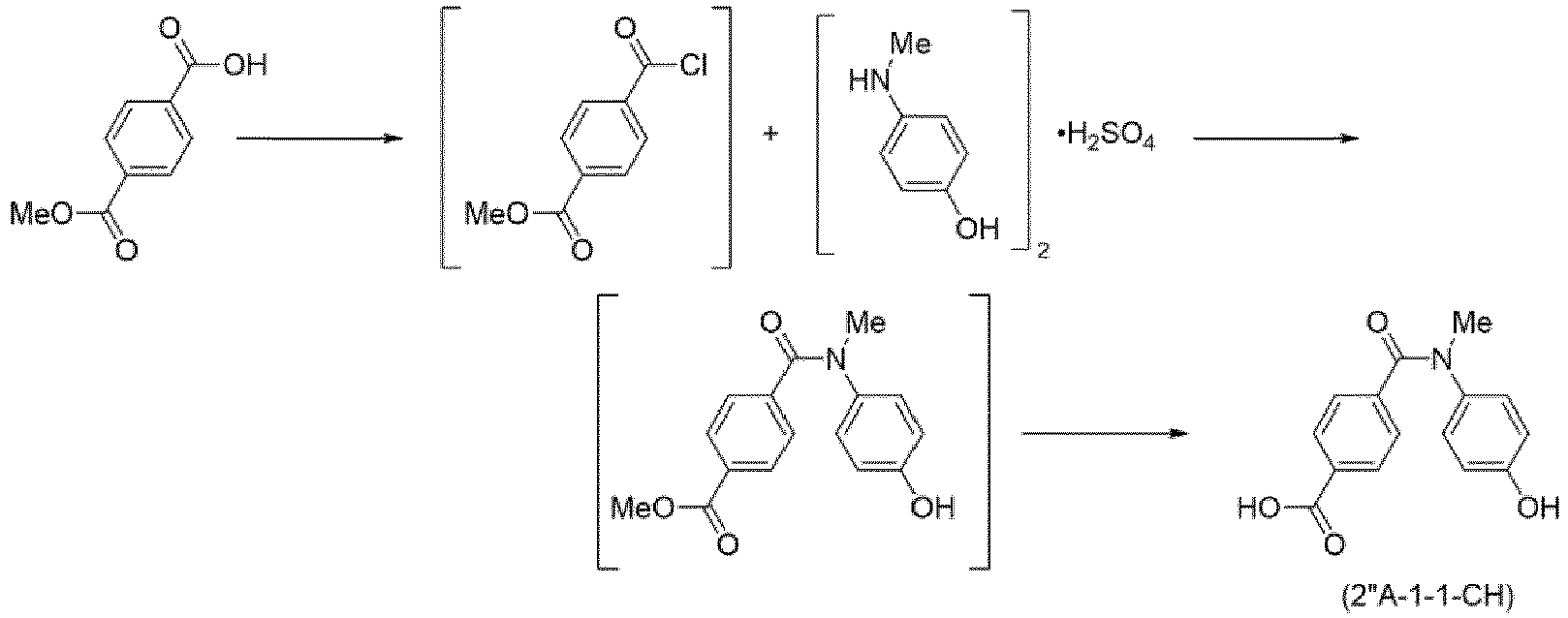
- A mixture of monomethyl terephthalate (9.19 g, 50.0 mmol), thionyl chloride (59.53 g, 0.50 mol) and toluene (50 mL) was stirred for 1 hour with heating under reflux, and then thionyl chloride was distilled away to give methyl 4-(chloroformyl)benzoate. The resulting methyl 4-(chloroformyl)benzoate was used entirely in the next reaction after being made into a THF (50 mL) solution.
- A solution mixture of p-methylaminophenol sulfate (8.44 g, 24.5 mmol), sodium hydrogencarbonate (12.60 g, 0.15 mol), THF (50 mL) and water (50 mL) was cooled to 0°C, and the THF (50 mL) solution of methyl 4-(chloroformyl)benzoate prepared in advance was added dropwise over 15 minutes. Then the resulting mixture was allowed to warm to room temperature and vigorously stirred for 12 hours. After the end of the reaction, the solvent was concentrated under reduced pressure, and the solid that formed in the system was collected by filtration and then washed with a saturated aqueous solution of sodium carbonate (50 mL) and water (50 mL), giving a white crude solid (actual crude yield: 13.53 g; percent crude yield: 97%).
- Methanol (50 mL) was added to the resulting crude solid, and the resulting mixture was stirred at room temperature for 4 hours with an added 48% aqueous solution of sodium hydroxide (6.0 mL, 0.11 mol). After the end of the reaction, water (50 mL) was added, and undissolved residue was isolated by filtration. Concentrated hydrochloric acid was added to the filtrate to make pH = 2, then the solid that formed was collected by filtration, and reprecipitation from ethyl acetate/hexane was performed, giving a white solid of compound (2"A-1-1-CH) (actual yield: 11.67 g; total percent yield: 83%). 1H-NMR (400 MHz, (DMSO-d6: δ 13.01 (brs, 1H), 9.53 (s, 1H), 7.74 (d, J = 7.3 Hz, 2H), 7.32 (d, J = 7.3 Hz, 2H), 6.96 (d, J = 7.8 Hz, 2H), 6.60 (d, J = 7.8 Hz, 2H), 3.31 (s, 3H).
-

- A solution mixture of 4-(ethylamino)phenol (4.84 g, 25.0 mmol), sodium hydrogencarbonate (4.21 g, 50.1 mmol), THF (30 mL) and water (60 mL) was cooled to 0°C, and a THF (30 mL) solution of methyl 4-(chloroformyl)benzoate (5.24 g, 25.1 mmol) was added dropwise over 15 minutes. Then the resulting mixture was allowed to warm to room temperature and vigorously stirred for 12 hours. After the end of the reaction, the solvent was concentrated under reduced pressure, and the solid that formed in the system was collected by filtration and then washed with a saturated aqueous solution of sodium carbonate (50 mL) and water (50 mL), giving a brown crude solid (actual crude yield, 7.93 g; actual percent yield, 89%).
- The resulting crude solid was cooled to 0°C with added methanol (80 mL) and water (80 mL), and then a 48% aqueous solution of sodium hydroxide (4.0 mL, 72.3 mmol) was added. Thereafter, the reaction system was allowed to warm to room temperature and heated under reflux for 4 hours. After the end of the reaction, the system was allowed to cool to room temperature and then concentrated under reduced pressure. Concentrated hydrochloric acid was added to the residue to make pH = 2, and then the solid that formed was collected by filtration and dried under reduced pressure, giving a brown solid (actual yield: 6.93 g; total percent yield, 97%) of compound (2"A-1-2-CH). 1 H-NMR (400 MHz, DMSO-d6): δ 12.99 (brs, 1H), 9.52 (s, 1H), 7.73 (d, J = 7.8 Hz, 2H), 7.31 (d, J = 7.8 Hz, 2H), 6.92 (d, J = 8.2 Hz, 2H), 6.60 (d, J = 8.2 Hz, 2H), 3.80 (q, J = 7.0 Hz, 2H), 1.09 (t, J = 7.0 Hz, 3H).
-

- A solution mixture of 3-methyl-4-(methylamino)phenol (2.06 g, 15.0 mmol), sodium hydrogencarbonate (2.52 g, 30.0 mol), THF (30 mL) and water (15 mL) was cooled to 0°C, and a THF (15 mL) solution of methyl 4-(chloroformyl)benzoate was added dropwise over 15 minutes. Then the resulting mixture was allowed to warm to room temperature and vigorously stirred for 12 hours. After the end of the reaction, the solvent was concentrated under reduced pressure, and extraction with ethyl acetate (50 mL × 3) was performed. The combined organic phase was washed with a saturated aqueous solution of sodium carbonate (50 mL) and saturated saline solution (50 mL), then dehydrated with magnesium sulfate and concentrated under reduced pressure, giving a white crude solid (actual crude yield: 3.76 g; percent crude yield: 84%).
- Methanol (40 mL) and water (40 mL) were added to the resulting crude solid. A 48% aqueous solution of sodium hydroxide (3.2 mL, 57.9 mmol) was added, and the resulting mixture was stirred at room temperature for 12 hours and with heating under reflux for 1 hour. After the end of the reaction, the mixture was concentrated under reduced pressure. Concentrated hydrochloric acid was added to the residue to make pH = 2, then the solid that formed was collected by filtration, and reprecipitation from ethyl acetate/hexane was performed, giving a white solid (actual yield: 3.49 g; total percent yield: 82%) of compound (2"A-1-46-CH). 1H-NMR (400 MHz, DMSO-d6): δ 13.05 (brs, 1H), 9.45 (s, 1H), 7.73 (d, J = 8.5 Hz, 2H), 7.31 (d, J = 8.5 Hz, 2H), 6.99 (d, J = 8.4 Hz, 1H), 6.49 (d, J = 2.8 Hz, 1H), 6.46 (dd, J = 8.4, 2.8 Hz, 1H), 3.21 (s, 3H), 2.05 (s, 3H).
-

- A solution mixture of 4-(ethylamino)-3-methylphenol (3.02 g, 20.0 mmol), sodium hydrogencarbonate (3.36 g, 40.0 mol), THF (40 mL) and water (20 mL) was cooled to 0°C, and a THF (20 mL) solution of methyl 4-(chloroformyl)benzoate was added dropwise over 15 minutes. Then the resulting mixture was allowed to warm to room temperature and vigorously stirred for 12 hours. After the end of the reaction, the solvent was concentrated under reduced pressure, and extraction with ethyl acetate (50 mL × 3) was performed. The combined organic phase was washed with a saturated aqueous solution of sodium carbonate (50 mL) and saturated saline solution (50 mL), then dehydrated with magnesium sulfate and concentrated under reduced pressure, giving a brown crude solid (actual crude yield: 23.5 g).
- Methanol (50 mL) was added to the resulting crude solid, and the resulting mixture was stirred at room temperature for 12 hours with an added 48% aqueous solution of sodium hydroxide (2.5 mL, 45.2 mmol). After the end of the reaction, water (50 mL) was added, and the resulting mixture was concentrated under reduced pressure. Concentrated hydrochloric acid was added to the filtrate to make pH = 2, and then the solid that formed was collected by filtration, giving a white solid (actual yield: 3.65 g; total percent yield: 61%) of compound (2"A-1-47-CH). 1H-NMR (400 MHz, DMSO-d6): δ 13.04 (brs, 1H), 9.45 (s, 1H), 7.72 (d, J = 8.5 Hz, 2H), 7.30 (d, J = 8.5 Hz, 2H), 6.95 (d, J = 8.4 Hz, 1H), 6.49 (d, J = 7.8 Hz, 1H), 6.48 (dd, J = 7.8, 2.7 Hz, 1H), 3.99 (dq, J = 14.0, 7.0 Hz, 1H), 3.42 (dq, J = 14.0, 7.0 Hz, 1H), 2.03 (s, 3H).
-

- A mixture of 4-hydroxybenzoic acid (3.63 g, 26.3 mmol), thionyl chloride (24.60 g, 0.207 mol) and N,N-dimethylformamide (3.0 mg) was stirred for 1 hour with heating under reflux, and then thionyl chloride was distilled away to give 4-hydroxybenzoyl chloride. The resulting 4-hydroxybenzoyl chloride was used entirely in the next reaction after being made into a THF (50 mL) solution.
- In a nitrogen atmosphere, a mixture of ethyl 4-(methylamino)benzoate (4.13 g, 25.0 mmol), water (50 mL) and THF (50 mL) was stirred with cooling on ice, and sodium hydrogencarbonate (4.20 g, 50.0 mmol) at the same time. Subsequently, the THF solution of 4-hydroxybenzoyl chloride prepared in advance was added dropwise over 5 minutes. After the dropwise addition, the resulting mixture was stirred for 12 hours while being allowed to gradually warm to room temperature, and then THF was distilled away under reduced pressure. The solid that formed was collected by filtration, washed with a saturated aqueous solution of sodium hydrogencarbonate (50 mL) and water (50 mL) and then dried under reduced pressure, giving a white crude solid (actual crude yield: 7.12 g).
- Methanol (85 mL) was added to the resulting crude solid, and the resulting mixture was stirred at room temperature for 12 hours with an added 48% aqueous solution of sodium hydroxide (2.8 mL, 50.0 mmol). After the end of the reaction, water (50 mL) was added, and undissolved residue was isolated by filtration. Concentrated hydrochloric acid was added to the resulting filtrate to make pH = 2, and then the solid that formed was collected by filtration, giving a white solid (actual yield: 5.40 g; total percent yield: 80%) of compound (2"A-1-1-HC). 1H-NMR (400 MHz, DMSO-d6): δ 12.94 (brs, 1H), 9.86 (s, 1H), 7.81 (d, J = 8.6 Hz, 2H), 7.21 (d, J = 8.6 Hz, 2H), 7.11 (d, J = 8.7 Hz, 2H), 6.58 (d, J = 8.7 Hz, 2H), 3.38 (s, 3H).
-

- A solution mixture of ethyl 4-(ethylamino)benzoate (13.6 g, 70.4 mmol), sodium hydrogencarbonate (11.8 g, 0.14 mol), THF (85 mL) and water (170 mL) was cooled to 0°C, and a THF (85 mL) solution of 4-methoxybenzoyl chloride (12.0 g, 70.3 mmol) was added dropwise over 30 minutes. Then the resulting mixture was allowed to warm to room temperature and vigorously stirred for 12 hours. After the end of the reaction, the solvent was concentrated under reduced pressure, and extraction with ethyl acetate (50 mL × 3) was performed. The combined organic phase was washed with a saturated aqueous solution of sodium carbonate (50 mL) and saturated saline solution (50 mL), then dehydrated with magnesium sulfate and concentrated under reduced pressure, giving a brown crude solid (actual crude yield: 23.5 g).
- A dichloromethane (30 mL) solution of the resulting crude solid was cooled to 0°C, and then a dichloromethane (40 mL) solution of boron tribromide (19.6 mL, 0.21 mmol) was added dropwise over 30 minutes. After the reaction system was allowed to warm to room temperature, 12 hours of stirring was performed, and the system was cooled to 0°C again. 2 M hydrochloric acid (100 mL) was gradually added, and then the solvent was distilled away through concentration under reduced pressure. Thereafter, the solid that formed was collected by filtration and washed with acetonitrile (50 mL). The resulting solid was dried under reduced pressure. Separately, extraction from the filtrate with ethyl acetate (100 mL × 3) was performed. The combined organic layer was dried with anhydrous magnesium sulfate, followed by concentration under reduced pressure.
- The resulting residue was washed with cold acetonitrile (50 mL) and then dried under reduced pressure, giving a white solid (actual yield: 9.86 g; percent yield, 49%) of compound (2"A-1-2-HC). 1H-NMR (400 MHz, DMSO-d6): δ 12.96 (brs, 1H), 9.84 (s, 1H), 7.81 (d, J = 8.7 Hz, 2H), 7.18 (d, J = 8.7 Hz, 2H), 7.10 (d, J = 8.7 Hz, 2H), 6.56 (d, J = 8.7 Hz, 2H), 3.89 (q, J = 7.0 Hz, 2H), 1.09 (t, J = 7.0 Hz, 3H).
-

- A solution mixture of methyl 3-methyl-4-(methylamino)benzoate (2.15 g, 12.0 mmol), triethylamine (3.03 mL, 23.9 mmol) and dichloromethane (40 mL) was cooled to 0°C, and a dichloromethane (15 mL) solution of 4-methoxybenzoyl chloride (2.17 g, 12.6 mmol) was added dropwise over 15 minutes. Then the resulting mixture was allowed to warm to room temperature and stirred for 8 hours. After the end of the reaction, water (20 mL) was added, and extraction with chloroform (50 mL × 3) was performed. The combined organic layer was dehydrated with magnesium sulfate and concentrated under reduced pressure, giving a white crude solid (actual crude yield: 3.02 g).
- A dichloromethane (30 mL) solution of the resulting crude solid was cooled to 0°C, and then a dichloromethane (3.50 mL, 6.4 mmol) solution of boron tribromide was added dropwise over 15 minutes. After the reaction system was allowed to warm to room temperature, 12 hours of stirring was performed, and the system was cooled to 0°C again. 2 M hydrochloric acid (10 mL) was gradually added, and then the solvent was distilled away through concentration under reduced pressure. Thereafter, the solid that formed was collected by filtration and washed with acetonitrile (50 mL). The resulting solid was dried under reduced pressure, giving a white solid (actual yield: 2.34 g; total percent yield: 69%) of compound (2"A-1-46-HC). 1H-NMR (400 MHz, DMSO-d6): δ 12.98 (brs, 1H), 9.81 (s, 1H), 7.77 (s, 1H), 7.69 (d, J = 7.1 Hz, 1H), 7.26 (d, J = 7.1 Hz, 1H), 7.67 (d, J = 7.3 Hz, 2H), 6.54 (d, J = 7.3 Hz, 2H), 3.22 (s, 3H), 2.17 (s, 3H).
-

- In a nitrogen stream, compound (2"A-1-36-DH) (333 mg, 1.20 mmol), obtained in Synthesis Example 1, and compound (1 '-2-1) (197 mg, 0.800 mmol), obtained in Dihydroxy Compound Example 1, as diol monomers were added to a reaction vessel. Then an aqueous (19.2 mL) solution of sodium hydroxide (160 mg, 4.00 mmol) and a 2 wt% aqueous solution of tetrabutylammonium bromide (0.8 mL) were added, and stirring was initiated. Trans-1,4-cyclohexanedicarboxylic acid dichloride (418 mg, 2.00 mmol) as a dicarboxylic acid dichloride monomer, furthermore, was dissolved in chloroform (20 mL), followed by the addition of this solution to the reaction system. After the reaction system was stirred for 3 hours, the mixture in the system was added to methanol (300 mL). The solid that formed was collected by filtration, washed with methanol (100 mL) and water (100 mL) and then vacuum-dried, giving 583 mg (percent yield: 73%) of polymer 1.
- 6.0% by mass of polymer 1 was dissolved in 94.0% by mass of 1,1,1,3,3,3-hexafluoroisopropyl alcohol. After this solution was cast onto a quartz glass substrate, spin coating was performed, and the resulting coating was dried in an oven at 60°C for 30 minutes to give a thin film. The resulting thin film (thickness, 1 µm) was irradiated with 500 mJ/cm2 of polarized ultraviolet light at 248 nm, followed by heating at 150°C. Retardations and wavelength dispersion properties are presented in Table 1.
-


- 407 mg (percent yield: 52%) of polymer 2 was obtained by the same method as in Example 1, except that compound (2"A-1-36-DH) (222 mg, 0.800 mmol), obtained in Synthesis Example 1, and compound (1 '-2-1) (296 mg, 1.20 mmol), obtained in Dihydroxy Compound Example 1, were used as diol monomers.
- A thin film was obtained by the same method as in Example 1-1, except that polymer 2 was used instead of polymer 1. The resulting thin film (thickness, 1 µm) was irradiated with 100 mJ/cm2 of polarized ultraviolet light at 248 nm, followed by heating at 150°C. Retardations and wavelength dispersion properties are presented in Table 1.
- A thin film was obtained by the same method as in Example 1-1, except that polymer 2 was used instead of polymer 1. The resulting thin film (thickness, 1 µm) was irradiated with 500 mJ/cm2 of polarized ultraviolet light at 248 nm, followed by heating at 150°C. Retardations and wavelength dispersion properties are presented in Table 1.
- A thin film was obtained by the same method as in Example 1-1, except that polymer 2 was used instead of polymer 1. The resulting thin film (thickness, 1 µm) was irradiated with 100 mJ/cm2 of polarized ultraviolet light at 248 nm, followed by heating at 250°C. Retardations and wavelength dispersion properties are presented in Table 1.
- A thin film was obtained by the same method as in Example 1-1, except that polymer 2 was used instead of polymer 1. The resulting thin film (thickness, 1 µm) was irradiated with 500 mJ/cm2 of polarized ultraviolet light at 248 nm, followed by heating at 250°C. Retardations and wavelength dispersion properties are presented in Table 1.
-

- 527 mg (percent yield: 68%) of polymer 3 was obtained by the same method as in Example 1, except that compound (2"A-1-36-DH) (111 mg, 0.400 mmol), obtained in Synthesis Example 1, and compound (1'-2-1) (394 mg, 1.60 mmol), obtained in Dihydroxy Compound Example 1, were used as diol monomers.
- A thin film was obtained by the same method as in Example 1-1, except that polymer 3 was used instead of polymer 1. The resulting thin film (thickness, 1 µm) was irradiated with 500 mJ/cm2 of polarized ultraviolet light at 248 nm, followed by heating at 150°C. Retardations and wavelength dispersion properties are presented in Table 1.
- A thin film was obtained by the same method as in Example 1-1, except that polymer 3 was used instead of polymer 1. The resulting thin film (thickness, 1 µm) was irradiated with 500 mJ/cm2 of polarized ultraviolet light at 248 nm, followed by heating at 250°C. Retardations and wavelength dispersion properties are presented in Table 1.
-

- 191 mg (percent yield: 24%) of polymer 4 was obtained by the same method as in Example 1, except that compound (2"A-1-36-DH) (333 mg, 1.20 mmol), obtained in Synthesis Example 1, compound (1'-2-1) (98.4 mg, 0.400 mmol), obtained in Dihydroxy Compound Example 1, and compound (6'-1-DH) (99.2 mg, 0.400 mmol) were used as diol monomers.
- A thin film was obtained by the same method as in Example 1-1, except that polymer 4 was used instead of polymer 1. The resulting thin film (thickness, 1 µm) was irradiated with 500 mJ/cm2 of polarized ultraviolet light at 248 nm, followed by heating at 150°C. Retardations and wavelength dispersion properties are presented in Table 1.
- A thin film was obtained by the same method as in Example 1-1, except that polymer 4 was used instead of polymer 1. The resulting thin film (thickness, 1 µm) was irradiated with 1000 mJ/cm2 of polarized ultraviolet light at 248 nm, followed by heating at 150°C. Retardations and wavelength dispersion properties are presented in Table 1.
- A thin film was obtained by the same method as in Example 1-1, except that polymer 4 was used instead of polymer 1. The resulting thin film (thickness, 1 µm) was irradiated with 500 mJ/cm2 of polarized ultraviolet light at 248 nm, followed by heating at 250°C. Retardations and wavelength dispersion properties are presented in Table 1.
- A thin film was obtained by the same method as in Example 1-1, except that polymer 4 was used instead of polymer 1. The resulting thin film (thickness, 1 µm) was irradiated with 1000 mJ/cm2 of polarized ultraviolet light at 248 nm, followed by heating at 250°C. Retardations and wavelength dispersion properties are presented in Table 1.
-


- 191 mg (percent yield: 42%) of polymer 5 was obtained by the same method as in Example 1, except that compound (2"A-1-1-DH) (292 mg, 1.20 mmol), obtained in Synthesis Example 2, compound (1'-2-1) (98.4 mg, 0.400 mmol), obtained in Dihydroxy Compound Example 1, and compound (6'-1-DH) (99.2 mg, 0.400 mmol) were used as diol monomers.
- A thin film was obtained by the same method as in Example 1-1, except that polymer 5 was used instead of polymer 1. The resulting thin film (thickness, 1 µm) was irradiated with 500 mJ/cm2 of polarized ultraviolet light at 248 nm, followed by heating at 150°C. Retardations and wavelength dispersion properties are presented in Table 1.
- A thin film was obtained by the same method as in Example 1-1, except that polymer 5 was used instead of polymer 1. The resulting thin film (thickness, 1 µm) was irradiated with 1000 mJ/cm2 of polarized ultraviolet light at 248 nm, followed by heating at 150°C. Retardations and wavelength dispersion properties are presented in Table 1.
- A thin film was obtained by the same method as in Example 1-1, except that polymer 5 was used instead of polymer 1. The resulting thin film (thickness, 1 µm) was irradiated with 500 mJ/cm2 of polarized ultraviolet light at 248 nm, followed by heating at 250°C. Retardations and wavelength dispersion properties are presented in Table 1.
- A thin film was obtained by the same method as in Example 1-1, except that polymer 5 was used instead of polymer 1. The resulting thin film (thickness, 1 µm) was irradiated with 1000 mJ/cm2 of polarized ultraviolet light at 248 nm, followed by heating at 250°C. Retardations and wavelength dispersion properties are presented in Table 1.
-

- 562 mg (percent yield: 71%) of polymer 6 was obtained by the same method as in Example 1, except that compound (2"A-1-1-DH) (292 mg, 1.20 mmol), obtained in Synthesis Example 2, compound (1'-2-1) (98.4 mg, 0.400 mmol), obtained in Dihydroxy Compound Example 1, and compound (6'-2-DH) (126 mg, 0.400 mmol), obtained in Synthesis Example 6, were used as diol monomers.
- A thin film was obtained by the same method as in Example 1-1, except that polymer 6 was used instead of polymer 1. The resulting thin film (thickness, 1 µm) was irradiated with 500 mJ/cm2 of polarized ultraviolet light at 248 nm, followed by heating at 150°C. Retardations and wavelength dispersion properties are presented in Table 1.
- A thin film was obtained by the same method as in Example 1-1, except that polymer 6 was used instead of polymer 1. The resulting thin film (thickness, 1 µm) was irradiated with 1000 mJ/cm2 of polarized ultraviolet light at 248 nm, followed by heating at 150°C. Retardations and wavelength dispersion properties are presented in Table 1.
- A thin film was obtained by the same method as in Example 1-1, except that polymer 6 was used instead of polymer 1. The resulting thin film (thickness, 1 µm) was irradiated with 500 mJ/cm2 of polarized ultraviolet light at 248 nm, followed by heating at 250°C. Retardations and wavelength dispersion properties are presented in Table 1.
- A thin film was obtained by the same method as in Example 1-1, except that polymer 6 was used instead of polymer 1. The resulting thin film (thickness, 1 µm) was irradiated with 1000 mJ/cm2 of polarized ultraviolet light at 248 nm, followed by heating at 250°C. Retardations and wavelength dispersion properties are presented in Table 1.
-


- 457 mg (percent yield: 57%) of polymer 7 was obtained by the same method as in Example 1, except that compound (2"A-1-1-DH) (292 mg, 1.20 mmol), obtained in Synthesis Example 2, compound (1'-2-1) (98.4 mg, 0.400 mmol), obtained in Dihydroxy Compound Example 1, and compound (6'-3-DH) (137 mg, 0.400 mmol), obtained in Synthesis Example 7, were used as diol monomers.
- A thin film was obtained by the same method as in Example 1-1, except that polymer 7 was used instead of polymer 1. The resulting thin film (thickness, 1 µm) was irradiated with 500 mJ/cm2 of polarized ultraviolet light at 248 nm, followed by heating at 150°C. Retardations and wavelength dispersion properties are presented in Table 1.
- A thin film was obtained by the same method as in Example 1-1, except that polymer 7 was used instead of polymer 1. The resulting thin film (thickness, 1 µm) was irradiated with 1000 mJ/cm2 of polarized ultraviolet light at 248 nm, followed by heating at 150°C. Retardations and wavelength dispersion properties are presented in Table 1.
- A thin film was obtained by the same method as in Example 1-1, except that polymer 7 was used instead of polymer 1. The resulting thin film (thickness, 1 µm) was irradiated with 500 mJ/cm2 of polarized ultraviolet light at 248 nm, followed by heating at 250°C. Retardations and wavelength dispersion properties are presented in Table 1.
- A thin film was obtained by the same method as in Example 1-1, except that polymer 7 was used instead of polymer 1. The resulting thin film (thickness, 1 µm) was irradiated with 1000 mJ/cm2 of polarized ultraviolet light at 248 nm, followed by heating at 250°C. Retardations and wavelength dispersion properties are presented in Table 1.
-

- 340 mg (percent yield: 44%) of polymer 8 was obtained by the same method as in Example 1, except that compound (2"A-1-1-DH) (292 mg, 1.20 mmol), obtained in Synthesis Example 2, compound (1'-2-1) (98.4 mg, 0.400 mmol), obtained in Dihydroxy Compound Example 1, and compound (6'-5-DH) (118 mg, 0.400 mmol), obtained in Synthesis Example 8, were used as diol monomers.
- A thin film was obtained by the same method as in Example 1-1, except that polymer 8 was used instead of polymer 1. The resulting thin film (thickness, 1 µm) was irradiated with 500 mJ/cm2 of polarized ultraviolet light at 248 nm, followed by heating at 150°C. Retardations and wavelength dispersion properties are presented in Table 1.
- A thin film was obtained by the same method as in Example 1-1, except that polymer 8 was used instead of polymer 1. The resulting thin film (thickness, 1 µm) was irradiated with 1000 mJ/cm2 of polarized ultraviolet light at 248 nm, followed by heating at 150°C. Retardations and wavelength dispersion properties are presented in Table 1.
- A thin film was obtained by the same method as in Example 1-1, except that polymer 8 was used instead of polymer 1. The resulting thin film (thickness, 1 µm) was irradiated with 500 mJ/cm2 of polarized ultraviolet light at 248 nm, followed by heating at 250°C. Retardations and wavelength dispersion properties are presented in Table 1.
- A thin film was obtained by the same method as in Example 1-1, except that polymer 8 was used instead of polymer 1. The resulting thin film (thickness, 1 µm) was irradiated with 1000 mJ/cm2 of polarized ultraviolet light at 248 nm, followed by heating at 250°C. Retardations and wavelength dispersion properties are presented in Table 1.
-


- 531 mg (percent yield: 68%) of polymer 9 was obtained by the same method as in Example 1, except that compound (2"A-1-1-DH) (292 mg, 1.20 mmol), obtained in Synthesis Example 2, (1'-2-1) (98.4 mg, 0.400 mmol), obtained in Dihydroxy Compound Example 1, and compound (6'-7-DH) (119 mg, 0.400 mmol), obtained in Synthesis Example 9, were used as diol monomers.
- A thin film was obtained by the same method as in Example 1-1, except that polymer 9 was used instead of polymer 1. The resulting thin film (thickness, 1 µm) was irradiated with 500 mJ/cm2 of polarized ultraviolet light at 248 nm, followed by heating at 150°C. Retardations and wavelength dispersion properties are presented in Table 1.
- A thin film was obtained by the same method as in Example 1-1, except that polymer 9 was used instead of polymer 1. The resulting thin film (thickness, 1 µm) was irradiated with 1000 mJ/cm2 of polarized ultraviolet light at 248 nm, followed by heating at 150°C. Retardations and wavelength dispersion properties are presented in Table 1.
- A thin film was obtained by the same method as in Example 1-1, except that polymer 9 was used instead of polymer 1. The resulting thin film (thickness, 1 µm) was irradiated with 500 mJ/cm2 of polarized ultraviolet light at 248 nm, followed by heating at 250°C. Retardations and wavelength dispersion properties are presented in Table 1.
- A thin film was obtained by the same method as in Example 1-1, except that polymer 9 was used instead of polymer 1. The resulting thin film (thickness, 1 µm) was irradiated with 1000 mJ/cm2 of polarized ultraviolet light at 248 nm, followed by heating at 250°C. Retardations and wavelength dispersion properties are presented in Table 1.
-

- 658 mg (percent yield: 85%) of polymer 10 was obtained by the same method as in Example 1, except that compound (2"A-1-1-DH) (292 mg, 1.20 mmol), obtained in Synthesis Example 2, compound (1'-2-1) (98.4 mg, 0.400 mmol), obtained in Dihydroxy Compound Example 1, and compound (6'-6-DH) (113 mg, 0.400 mmol), obtained in Synthesis Example 10, were used as diol monomers.
- A thin film was obtained by the same method as in Example 1-1, except that polymer 10 was used instead of polymer 1. The resulting thin film (thickness, 1 µm) was irradiated with 1000 mJ/cm2 of polarized ultraviolet light at 248 nm, followed by heating at 150°C. Retardations and wavelength dispersion properties are presented in Table 1.
- A thin film was obtained by the same method as in Example 1-1, except that polymer 10 was used instead of polymer 1. The resulting thin film (thickness, 1 µm) was irradiated with 500 mJ/cm2 of polarized ultraviolet light at 248 nm, followed by heating at 250°C. Retardations and wavelength dispersion properties are presented in Table 1.
- A thin film was obtained by the same method as in Example 1-1, except that polymer 10 was used instead of polymer 1. The resulting thin film (thickness, 1 µm) was irradiated with 1000 mJ/cm2 of polarized ultraviolet light at 248 nm, followed by heating at 250°C. Retardations and wavelength dispersion properties are presented in Table 1.
-


- 354 mg (percent yield: 43%) of polymer 11 was obtained by the same method as in Example 1, except that compound (2"A-1-36-DH) (444 mg, 1.60 mmol), obtained in Synthesis Example 1, and compound (1 '-2-2) (112 mg, 0.400 mmol), obtained in Dihydroxy Compound Example 2, were used as diol monomers.
- A thin film was obtained by the same method as in Example 1-1, except that polymer 11 was used instead of polymer 1. The resulting thin film (thickness, 1 µm) was irradiated with 100 mJ/cm2 of polarized ultraviolet light at 248 nm, followed by heating at 250°C. Retardations and wavelength dispersion properties are presented in Table 1.
- A thin film was obtained by the same method as in Example 1-1, except that polymer 11 was used instead of polymer 1. The resulting thin film (thickness, 1 µm) was irradiated with 500 mJ/cm2 of polarized ultraviolet light at 248 nm, followed by heating at 250°C. Retardations and wavelength dispersion properties are presented in Table 1.
-


- 565 mg (percent yield: 68%) of polymer 12 was obtained by the same method as in Example 1, except that compound (2"A-1-36-DH) (333 mg, 1.60 mmol), obtained in Synthesis Example 1, and compound (1 '-2-2) (224 mg, 0.800 mmol), obtained in Dihydroxy Compound Example 2, were used as diol monomers.
- A thin film was obtained by the same method as in Example 1-1, except that polymer 12 was used instead of polymer 1. The resulting thin film (thickness, 1 µm) was irradiated with 500 mJ/cm2 of polarized ultraviolet light at 248 nm, followed by heating at 250°C. Retardations and wavelength dispersion properties are presented in Table 1.
- A thin film was obtained by the same method as in Example 1-1, except that polymer 12 was used instead of polymer 1. The resulting thin film (thickness, 1 µm) was irradiated with 1000 mJ/cm2 of polarized ultraviolet light at 248 nm, followed by heating at 250°C. Retardations and wavelength dispersion properties are presented in Table 1.
- A thin film was obtained by the same method as in Example 1-1, except that polymer 12 was used instead of polymer 1. The resulting thin film (thickness, 1 µm) was irradiated with 170 mJ/cm2 of polarized ultraviolet light at 313 nm, followed by heating at 150°C. Retardations and wavelength dispersion properties are presented in Table 1.
- A thin film was obtained by the same method as in Example 1-1, except that polymer 12 was used instead of polymer 1. The resulting thin film (thickness, 1 µm) was irradiated with 170 mJ/cm2 of polarized ultraviolet light at 313 nm, followed by heating at 250°C. Retardations and wavelength dispersion properties are presented in Table 1.
- A thin film was obtained by the same method as in Example 1-1, except that polymer 12 was used instead of polymer 1. The resulting thin film (thickness, 1 µm) was irradiated with 340 mJ/cm2 of polarized ultraviolet light at 313 nm, followed by heating at 250°C. Retardations and wavelength dispersion properties are presented in Table 1.
- A thin film was obtained by the same method as in Example 1-1, except that polymer 12 was used instead of polymer 1. The resulting thin film (thickness, 1 µm) was irradiated with 700 mJ/cm2 of polarized ultraviolet light at 365 nm, followed by heating at 250°C. Retardations and wavelength dispersion properties are presented in Table 1.
- A thin film was obtained by the same method as in Example 1-1, except that polymer 12 was used instead of polymer 1. The resulting thin film (thickness, 1 µm) was irradiated with 1400 mJ/cm2 of polarized ultraviolet light at 365 nm, followed by heating at 250°C. Retardations and wavelength dispersion properties are presented in Table 1.
-

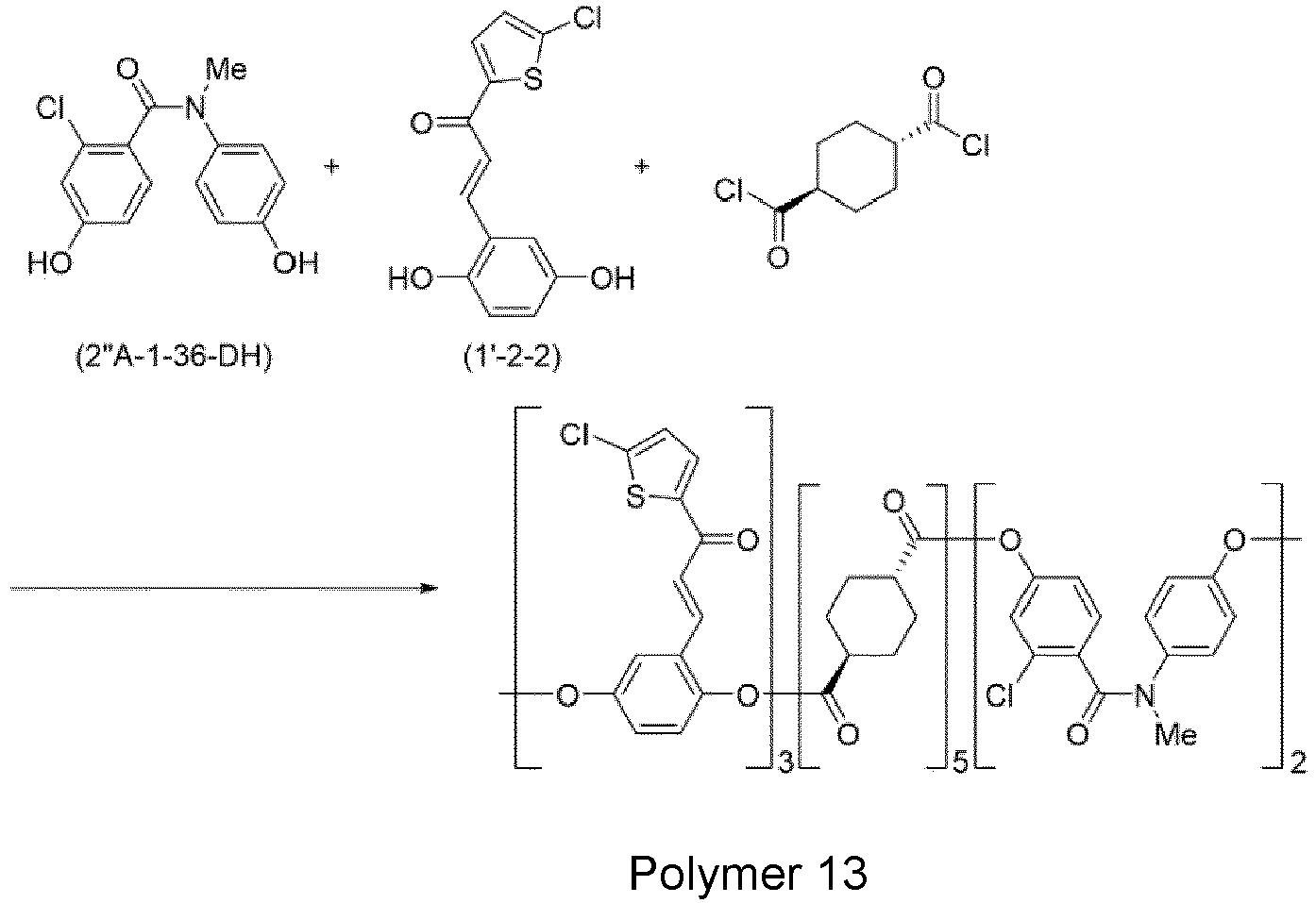
- 463 mg (percent yield: 56%) of polymer 13 was obtained by the same method as in Example 1, except that compound (2"A-1-36-DH) (222 mg, 0.800 mmol), obtained in Synthesis Example 1, and compound (1 '-2-2) (337 mg, 1.20 mmol), obtained in Dihydroxy Compound Example 2, were used as diol monomers.
- A thin film was obtained by the same method as in Example 1-1, except that polymer 13 was used instead of polymer 1. The resulting thin film (thickness, 1 µm) was irradiated with 50 mJ/cm2 of polarized ultraviolet light at 248 nm, followed by heating at 150°C. Retardations and wavelength dispersion properties are presented in Table 1.
- A thin film was obtained by the same method as in Example 1-1, except that polymer 13 was used instead of polymer 1. The resulting thin film (thickness, 1 µm) was irradiated with 50 mJ/cm2 of polarized ultraviolet light at 248 nm, followed by heating at 250°C. Retardations and wavelength dispersion properties are presented in Table 1.
- A thin film was obtained by the same method as in Example 1-1, except that polymer 13 was used instead of polymer 1. The resulting thin film (thickness, 1 µm) was irradiated with 500 mJ/cm2 of polarized ultraviolet light at 248 nm, followed by heating at 150°C. Retardations and wavelength dispersion properties are presented in Table 1.
- A thin film was obtained by the same method as in Example 1-1, except that polymer 13 was used instead of polymer 1. The resulting thin film (thickness, 1 µm) was irradiated with 1000 mJ/cm2 of polarized ultraviolet light at 248 nm, followed by heating at 150°C. Retardations and wavelength dispersion properties are presented in Table 1.
- A thin film was obtained by the same method as in Example 1-1, except that polymer 13 was used instead of polymer 1. The resulting thin film (thickness, 1 µm) was irradiated with 500 mJ/cm2 of polarized ultraviolet light at 248 nm, followed by heating at 250°C. Retardations and wavelength dispersion properties are presented in Table 1.
- A thin film was obtained by the same method as in Example 1-1, except that polymer 13 was used instead of polymer 1. The resulting thin film (thickness, 1 µm) was irradiated with 1000 mJ/cm2 of polarized ultraviolet light at 248 nm, followed by heating at 250°C. Retardations and wavelength dispersion properties are presented in Table 1.
- A thin film was obtained by the same method as in Example 1-1, except that polymer 13 was used instead of polymer 1. The resulting thin film (thickness, 1 µm) was irradiated with 100 mJ/cm2 of polarized ultraviolet light at 365 nm, followed by heating at 150°C. Retardations and wavelength dispersion properties are presented in Table 1.
- A thin film was obtained by the same method as in Example 1-1, except that polymer 13 was used instead of polymer 1. The resulting thin film (thickness, 1 µm) was irradiated with 500 mJ/cm2 of polarized ultraviolet light at 365 nm, followed by heating at 150°C. Retardations and wavelength dispersion properties are presented in Table 1.
- A thin film was obtained by the same method as in Example 1-1, except that polymer 13 was used instead of polymer 1. The resulting thin film (thickness, 1 µm) was irradiated with 100 mJ/cm2 of polarized ultraviolet light at 365 nm, followed by heating at 250°C. Retardations and wavelength dispersion properties are presented in Table 1.
- A thin film was obtained by the same method as in Example 1-1, except that polymer 13 was used instead of polymer 1. The resulting thin film (thickness, 1 µm) was irradiated with 500 mJ/cm2 of polarized ultraviolet light at 365 nm, followed by heating at 250°C. Retardations and wavelength dispersion properties are presented in Table 1.
-


- 595 mg (percent yield: 72%) of polymer 14 was obtained by the same method as in Example 1, except that compound (2"A-1-36-DH) (111 mg, 0.400 mmol), obtained in Synthesis Example 1, and compound (1 '-2-2) (449 mg, 1.60 mmol), obtained in Dihydroxy Compound Example 2, were used as diol monomers.
- A thin film was obtained by the same method as in Example 1-1, except that polymer 14 was used instead of polymer 1. The resulting thin film (thickness, 1 µm) was irradiated with 500 mJ/cm2 of polarized ultraviolet light at 248 nm, followed by heating at 150°C. Retardations and wavelength dispersion properties are presented in Table 2.
- A thin film was obtained by the same method as in Example 1-1, except that polymer 14 was used instead of polymer 1. The resulting thin film (thickness, 1 µm) was irradiated with 1000 mJ/cm2 of polarized ultraviolet light at 248 nm, followed by heating at 150°C. Retardations and wavelength dispersion properties are presented in Table 2.
- A thin film was obtained by the same method as in Example 1-1, except that polymer 14 was used instead of polymer 1. The resulting thin film (thickness, 1 µm) was irradiated with 500 mJ/cm2 of polarized ultraviolet light at 248 nm, followed by heating at 250°C. Retardations and wavelength dispersion properties are presented in Table 2.
- A thin film was obtained by the same method as in Example 1-1, except that polymer 14 was used instead of polymer 1. The resulting thin film (thickness, 1 µm) was irradiated with 1000 mJ/cm2 of polarized ultraviolet light at 248 nm, followed by heating at 250°C. Retardations and wavelength dispersion properties are presented in Table 2.
-

- 343 mg (percent yield: 41 %) of polymer 15 was obtained by the same method as in Example 1, except that compound (2"A-1-6-DH) (219 mg, 0.800 mmol), obtained in Synthesis Example 3, and compound (1'-2-2) (337 mg, 1.20 mmol), obtained in Dihydroxy Compound Example 2, were used as diol monomers.
- A thin film was obtained by the same method as in Example 1-1, except that polymer 15 was used instead of polymer 1. The resulting thin film (thickness, 1 µm) was irradiated with 100 mJ/cm2 of polarized ultraviolet light at 365 nm, followed by heating at 150°C. Retardations and wavelength dispersion properties are presented in Table 2.
- A thin film was obtained by the same method as in Example 1-1, except that polymer 15 was used instead of polymer 1. The resulting thin film (thickness, 1 µm) was irradiated with 500 mJ/cm2 of polarized ultraviolet light at 365 nm, followed by heating at 150°C. Retardations and wavelength dispersion properties are presented in Table 2.
- A thin film was obtained by the same method as in Example 1-1, except that polymer 15 was used instead of polymer 1. The resulting thin film (thickness, 1 µm) was irradiated with 100 mJ/cm2 of polarized ultraviolet light at 365 nm, followed by heating at 250°C. Retardations and wavelength dispersion properties are presented in Table 2.
- A thin film was obtained by the same method as in Example 1-1, except that polymer 15 was used instead of polymer 1. The resulting thin film (thickness, 1 µm) was irradiated with 500 mJ/cm2 of polarized ultraviolet light at 365 nm, followed by heating at 250°C. Retardations and wavelength dispersion properties are presented in Table 2.
-


- In a nitrogen stream, compound (2"A-1-1-DH) (212 mg, 0.871 mmol), obtained in Synthesis Example 2, and compound (1 '-2-2) (571 mg, 2.03 mmol), obtained in Dihydroxy Compound Example 2, as diol monomers and trans-1,4-cyclohexanedicarboxylic acid (400 mg, 2.32 mmol) and compound (2"-2-1-DC) (251 mg, 0.581 mmol) as dicarboxylic acid monomers were added to a reaction vessel. Then 1-ethyl-3-(3-dimethylaminopropyl)carbodiimide hydrochloride (1.23 g, 6.39 mmol) as a condensing agent, NMP (11.2 mL) as a solvent and 4-dimethylaminopyridine (78.1 mg, 0.639 mmol) as a catalyst were added, and stirring was initiated. After the reaction system was stirred for 3 hours, the mixture in the system was added to methanol (300 mL). The solid that formed was collected by filtration, washed with methanol (100 mL) and water (100 mL) and then vacuum-dried, giving 455 mg (percent yield: 34%) of polymer 16.
- A thin film was obtained by the same method as in Example 1-1, except that polymer 16 was used instead of polymer 1. The resulting thin film (thickness, 1 µm) was irradiated with 100 mJ/cm2 of polarized ultraviolet light at 365 nm, followed by heating at 150°C. Retardations and wavelength dispersion properties are presented in Table 2.
- A thin film was obtained by the same method as in Example 1-1, except that polymer 16 was used instead of polymer 1. The resulting thin film (thickness, 1 µm) was irradiated with 500 mJ/cm2 of polarized ultraviolet light at 365 nm, followed by heating at 150°C. Retardations and wavelength dispersion properties are presented in Table 2.
- A thin film was obtained by the same method as in Example 1-1, except that polymer 16 was used instead of polymer 1. The resulting thin film (thickness, 1 µm) was irradiated with 100 mJ/cm2 of polarized ultraviolet light at 365 nm, followed by heating at 250°C. Retardations and wavelength dispersion properties are presented in Table 2.
- A thin film was obtained by the same method as in Example 1-1, except that polymer 16 was used instead of polymer 1. The resulting thin film (thickness, 1 µm) was irradiated with 500 mJ/cm2 of polarized ultraviolet light at 365 nm, followed by heating at 250°C. Retardations and wavelength dispersion properties are presented in Table 2.
-


- 511 mg (percent yield: 43%) of polymer 17 was obtained by the same method as in Example 16, except that compound (2"A-1-2-DH) (299 mg, 1.16 mmol), obtained in Synthesis Example 4, and compound (1'-2-2) (489 mg, 1.74 mmol), obtained in Dihydroxy Compound Example 2, were used as diol monomers and that trans-1,4-cyclohexanedicarboxylic acid (500 mg, 2.90 mmol) was used as a dicarboxylic acid monomer.
- A thin film was obtained by the same method as in Example 1-1, except that polymer 17 was used instead of polymer 1. The resulting thin film (thickness, 1 µm) was irradiated with 100 mJ/cm2 of polarized ultraviolet light at 365 nm, followed by heating at 150°C. Retardations and wavelength dispersion properties are presented in Table 2.
- A thin film was obtained by the same method as in Example 1-1, except that polymer 17 was used instead of polymer 1. The resulting thin film (thickness, 1 µm) was irradiated with 500 mJ/cm2 of polarized ultraviolet light at 365 nm, followed by heating at 150°C. Retardations and wavelength dispersion properties are presented in Table 2.
- A thin film was obtained by the same method as in Example 1-1, except that polymer 17 was used instead of polymer 1. The resulting thin film (thickness, 1 µm) was irradiated with 100 mJ/cm2 of polarized ultraviolet light at 365 nm, followed by heating at 250°C. Retardations and wavelength dispersion properties are presented in Table 2.
- A thin film was obtained by the same method as in Example 1-1, except that polymer 17 was used instead of polymer 1. The resulting thin film (thickness, 1 µm) was irradiated with 500 mJ/cm2 of polarized ultraviolet light at 365 nm, followed by heating at 250°C. Retardations and wavelength dispersion properties are presented in Table 2.
-

- 987 mg (percent yield: 83%) of polymer 18 was obtained by the same method as in Example 16, except that compound (2"A-1-2-DH) (149 mg, 0.581 mmol), obtained in Synthesis Example 4, and compound (1'-2-2) (652 mg, 2.32 mmol), obtained in Dihydroxy Compound Example 2, were used as diol monomers, that trans-1 ,4-cyclohexanedicarboxylic acid (500 mg, 2.90 mmol) was used as a dicarboxylic acid monomer and that NMP (5.2 mL) was used as a solvent.
- A thin film was obtained by the same method as in Example 1-1, except that polymer 18 was used instead of polymer 1. The resulting thin film (thickness, 1 µm) was irradiated with 100 mJ/cm2 of polarized ultraviolet light at 365 nm, followed by heating at 250°C. Retardations and wavelength dispersion properties are presented in Table 2.
- A thin film was obtained by the same method as in Example 1-1, except that polymer 18 was used instead of polymer 1. The resulting thin film (thickness, 1 µm) was irradiated with 500 mJ/cm2 of polarized ultraviolet light at 365 nm, followed by heating at 250°C. Retardations and wavelength dispersion properties are presented in Table 2.
-

- 414 mg (percent yield: 35%) of polymer 19 was obtained by the same method as in Example 16, except that compound (2"A-1-1-DH) (141 mg, 581 mmol), obtained in Synthesis Example 2, and compound (1'-2-2) (652 mg, 2.32 mmol), obtained in Dihydroxy Compound Example 2, were used as diol monomers, that trans-1 ,4-cyclohexanedicarboxylic acid (500 mg, 2.90 mmol) was used as a dicarboxylic acid monomer and that NMP (29 mL) was used as a solvent.
- A thin film was obtained by the same method as in Example 1-1, except that polymer 19 was used instead of polymer 1. The resulting thin film (thickness, 1 µm) was irradiated with 50 mJ/cm2 of polarized ultraviolet light at 365 nm, followed by heating at 150°C. Retardations and wavelength dispersion properties are presented in Table 2.
- A thin film was obtained by the same method as in Example 1-1, except that polymer 19 was used instead of polymer 1. The resulting thin film (thickness, 1 µm) was irradiated with 100 mJ/cm2 of polarized ultraviolet light at 365 nm, followed by heating at 150°C. Retardations and wavelength dispersion properties are presented in Table 2.
- A thin film was obtained by the same method as in Example 1-1, except that polymer 19 was used instead of polymer 1. The resulting thin film (thickness, 1 µm) was irradiated with 50 mJ/cm2 of polarized ultraviolet light at 365 nm, followed by heating at 250°C. Retardations and wavelength dispersion properties are presented in Table 2.
- A thin film was obtained by the same method as in Example 1-1, except that polymer 19 was used instead of polymer 1. The resulting thin film (thickness, 1 µm) was irradiated with 100 mJ/cm2 of polarized ultraviolet light at 365 nm, followed by heating at 250°C. Retardations and wavelength dispersion properties are presented in Table 2.
-


- 510 mg (percent yield: 65%) of polymer 20 was obtained by the same method as in Example 1, except that compound (2"A-1-1-DH) (195 mg, 0.800 mmol), obtained in Synthesis Example 2, compound (1'-2-1) (197 mg, 0.800 mmol), obtained in Dihydroxy Compound Example 1, and compound (6'-5-DH) (118 mg, 0.400 mmol), obtained in Synthesis Example 8, were used as diol monomers.
- A thin film was obtained by the same method as in Example 1-1, except that polymer 20 was used instead of polymer 1. The resulting thin film (thickness, 1 µm) was irradiated with 500 mJ/cm2 of polarized ultraviolet light at 248 nm, followed by heating at 250°C. Retardations and wavelength dispersion properties are presented in Table 2.
- A thin film was obtained by the same method as in Example 1-1, except that polymer 20 was used instead of polymer 1. The resulting thin film (thickness, 1 µm) was irradiated with 1000 mJ/cm2 of polarized ultraviolet light at 248 nm, followed by heating at 250°C. Retardations and wavelength dispersion properties are presented in Table 2.
-

- 588 mg (percent yield: 68%) of polymer 21 was obtained by the same method as in Example 1, except that compound (2"A-1-36-DH) (333 mg, 1.20 mmol), obtained in Synthesis Example 1, and compound (1 '-2-3) (260 mg, 0.800 mmol), obtained in Dihydroxy Compound Example 3, were used as diol monomers.
- A thin film was obtained by the same method as in Example 1-1, except that polymer 21 was used instead of polymer 1. The resulting thin film (thickness, 1 µm) was irradiated with 500 mJ/cm2 of polarized ultraviolet light at 248 nm, followed by heating at 250°C. Retardations and wavelength dispersion properties are presented in Table 2.
-


- 621 mg (percent yield: 70%) of polymer 22 was obtained by the same method as in Example 1, except that compound (2"A-1-36-DH) (222 mg, 0.800 mmol), obtained in Synthesis Example 1, and compound (1 '-2-3) (390 mg, 1.20 mmol), obtained in Dihydroxy Compound Example 3, were used as diol monomers.
- A thin film was obtained by the same method as in Example 1-1, except that polymer 22 was used instead of polymer 1. The resulting thin film (thickness, 1 µm) was irradiated with 500 mJ/cm2 of polarized ultraviolet light at 248 nm, followed by heating at 150°C. Retardations and wavelength dispersion properties are presented in Table 2.
- A thin film was obtained by the same method as in Example 1-1, except that polymer 22 was used instead of polymer 1. The resulting thin film (thickness, 1 µm) was irradiated with 500 mJ/cm2 of polarized ultraviolet light at 248 nm, followed by heating at 250°C. Retardations and wavelength dispersion properties are presented in Table 2.
- A thin film was obtained by the same method as in Example 1-1, except that polymer 22 was used instead of polymer 1. The resulting thin film (thickness, 1 µm) was irradiated with 100 mJ/cm2 of polarized ultraviolet light at 365 nm, followed by heating at 150°C. Retardations and wavelength dispersion properties are presented in Table 2.
- A thin film was obtained by the same method as in Example 1-1, except that polymer 22 was used instead of polymer 1. The resulting thin film (thickness, 1 µm) was irradiated with 500 mJ/cm2 of polarized ultraviolet light at 365 nm, followed by heating at 150°C. Retardations and wavelength dispersion properties are presented in Table 2.
- A thin film was obtained by the same method as in Example 1-1, except that polymer 22 was used instead of polymer 1. The resulting thin film (thickness, 1 µm) was irradiated with 100 mJ/cm2 of polarized ultraviolet light at 365 nm, followed by heating at 250°C. Retardations and wavelength dispersion properties are presented in Table 2.
- A thin film was obtained by the same method as in Example 1-1, except that polymer 22 was used instead of polymer 1. The resulting thin film (thickness, 1 µm) was irradiated with 500 mJ/cm2 of polarized ultraviolet light at 365 nm, followed by heating at 250°C. Retardations and wavelength dispersion properties are presented in Table 2.
-


- 523 mg (percent yield: 63%) of polymer 23 was obtained by the same method as in Example 1, except that compound (2"A-1-36-DH) (222 mg, 0.800 mmol), obtained in Synthesis Example 1, and compound (1 '-2-5) (331 mg, 1.20 mmol), obtained in Dihydroxy Compound Example 4, were used as diol monomers.
- A thin film was obtained by the same method as in Example 1-1, except that polymer 23 was used instead of polymer 1. The resulting thin film (thickness, 1 µm) was irradiated with 500 mJ/cm2 of polarized ultraviolet light at 248 nm, followed by heating at 150°C. Retardations and wavelength dispersion properties are presented in Table 2.
- A thin film was obtained by the same method as in Example 1-1, except that polymer 23 was used instead of polymer 1. The resulting thin film (thickness, 1 µm) was irradiated with 1000 mJ/cm2 of polarized ultraviolet light at 248 nm, followed by heating at 150°C. Retardations and wavelength dispersion properties are presented in Table 2.
- A thin film was obtained by the same method as in Example 1-1, except that polymer 23 was used instead of polymer 1. The resulting thin film (thickness, 1 µm) was irradiated with 500 mJ/cm2 of polarized ultraviolet light at 248 nm, followed by heating at 250°C. Retardations and wavelength dispersion properties are presented in Table 2.
- A thin film was obtained by the same method as in Example 1-1, except that polymer 23 was used instead of polymer 1. The resulting thin film (thickness, 1 µm) was irradiated with 1000 mJ/cm2 of polarized ultraviolet light at 248 nm, followed by heating at 250°C. Retardations and wavelength dispersion properties are presented in Table 2.
-

- 690 mg (percent yield: 84%) of polymer 24 was obtained by the same method as in Example 1, except that compound (2"A-1-36-DH) (333 mg, 1.20 mmol), obtained in Synthesis Example 1, and compound (1'-2-5) (221 mg, 0.800 mmol), obtained in Dihydroxy Compound Example 4, were used as diol monomers.
- A thin film was obtained by the same method as in Example 1-1, except that polymer 24 was used instead of polymer 1. The resulting thin film (thickness, 1 µm) was irradiated with 500 mJ/cm2 of polarized ultraviolet light at 248 nm, followed by heating at 150°C. Retardations and wavelength dispersion properties are presented in Table 2.
- A thin film was obtained by the same method as in Example 1-1, except that polymer 24 was used instead of polymer 1. The resulting thin film (thickness, 1 µm) was irradiated with 1000 mJ/cm2 of polarized ultraviolet light at 248 nm, followed by heating at 150°C. Retardations and wavelength dispersion properties are presented in Table 2.
- A thin film was obtained by the same method as in Example 1-1, except that polymer 24 was used instead of polymer 1. The resulting thin film (thickness, 1 µm) was irradiated with 500 mJ/cm2 of polarized ultraviolet light at 248 nm, followed by heating at 250°C. Retardations and wavelength dispersion properties are presented in Table 2.
- A thin film was obtained by the same method as in Example 1-1, except that polymer 24 was used instead of polymer 1. The resulting thin film (thickness, 1 µm) was irradiated with 1000 mJ/cm2 of polarized ultraviolet light at 248 nm, followed by heating at 250°C. Retardations and wavelength dispersion properties are presented in Table 2.
-


- 512 mg (percent yield: 65%) of polymer 25 was obtained by the same method as in Example 1, except that compound (2"A-1-1-DH) (292 mg, 1.20 mmol), obtained in Synthesis Example 2, and compound (1 '-2-5) (221 mg, 0.800 mmol), obtained in Dihydroxy Compound Example 4, were used as diol monomers.
- A thin film was obtained by the same method as in Example 1-1, except that polymer 25 was used instead of polymer 1. The resulting thin film (thickness, 1 µm) was irradiated with 500 mJ/cm2 of polarized ultraviolet light at 248 nm, followed by heating at 150°C. Retardations and wavelength dispersion properties are presented in Table 2.
- A thin film was obtained by the same method as in Example 1-1, except that polymer 25 was used instead of polymer 1. The resulting thin film (thickness, 1 µm) was irradiated with 1000 mJ/cm2 of polarized ultraviolet light at 248 nm, followed by heating at 150°C. Retardations and wavelength dispersion properties are presented in Table 2.
- A thin film was obtained by the same method as in Example 1-1, except that polymer 25 was used instead of polymer 1. The resulting thin film (thickness, 1 µm) was irradiated with 500 mJ/cm2 of polarized ultraviolet light at 248 nm, followed by heating at 250°C. Retardations and wavelength dispersion properties are presented in Table 2.
- A thin film was obtained by the same method as in Example 1-1, except that polymer 25 was used instead of polymer 1. The resulting thin film (thickness, 1 µm) was irradiated with 1000 mJ/cm2 of polarized ultraviolet light at 248 nm, followed by heating at 250°C. Retardations and wavelength dispersion properties are presented in Table 2.
-

- 523 mg (percent yield: 65%) of polymer 26 was obtained by the same method as in Example 1, except that compound (2"A-1-36-DH) (222 mg, 0.800 mmol), obtained in Synthesis Example 1, and compound (1'-2-6) (312 mg, 1.20 mmol), obtained in Dihydroxy Compound Example 5, were used as diol monomers.
- A thin film was obtained by the same method as in Example 1-1, except that polymer 26 was used instead of polymer 1. The resulting thin film (thickness, 1 µm) was irradiated with 500 mJ/cm2 of polarized ultraviolet light at 248 nm, followed by heating at 250°C. Retardations and wavelength dispersion properties are presented in Table 2.
- A thin film was obtained by the same method as in Example 1-1, except that polymer 26 was used instead of polymer 1. The resulting thin film (thickness, 1 µm) was irradiated with 1000 mJ/cm2 of polarized ultraviolet light at 248 nm, followed by heating at 250°C. Retardations and wavelength dispersion properties are presented in Table 2.
-

- 445 mg (percent yield: 56%) of polymer 27 was obtained by the same method as in Example 1, except that compound (2"A-1-36-DH) (333 mg, 1.20 mmol), obtained in Synthesis Example 1, and compound (1'-2-6-Furan) (195 mg, 0.800 mmol), obtained in Dihydroxy Compound Example 6, were used as diol monomers.
- A thin film was obtained by the same method as in Example 1-1, except that polymer 27 was used instead of polymer 1. The resulting thin film (thickness, 1 µm) was irradiated with 500 mJ/cm2 of polarized ultraviolet light at 248 nm, followed by heating at 150°C. Retardations and wavelength dispersion properties are presented in Table 2.
- A thin film was obtained by the same method as in Example 1-1, except that polymer 27 was used instead of polymer 1. The resulting thin film (thickness, 1 µm) was irradiated with 1000 mJ/cm2 of polarized ultraviolet light at 248 nm, followed by heating at 150°C. Retardations and wavelength dispersion properties are presented in Table 2.
-

- In a nitrogen stream, compound (2"D-1-1) (281 mg, 2.03 mmol) and compound (1'-2-2) (1.06 g, 3.78 mmol), obtained in Dihydroxy Compound Example 2, as diol monomers and trans-1,4-cyclohexanedicarboxylic acid (400 mg, 2.32 mmol) as a dicarboxylic acid monomer were added to a reaction vessel. Then pyridine (7.9 mL) as a solvent was added, and stirring was initiated with 30°C warming. As a condensing agent, furthermore, diisopropylcarbodiimide (1.61 g, 12.8 mmol) was added. After the reaction system was stirred for 3 hours, the mixture in the system was added to methanol (300 mL). The solid that formed was collected by filtration, washed with methanol (500 mL) and water (300 mL) and then vacuum-dried, giving 1.56 g (percent yield: 73%) of polymer 28.
- A thin film was obtained by the same method as in Example 1-1, except that polymer 28 was used instead of polymer 1. The resulting thin film (thickness, 1 µm) was irradiated with 100 mJ/cm2 of polarized ultraviolet light at 365 nm, followed by heating at 150°C. Retardations and wavelength dispersion properties are presented in Table 3.
- A thin film was obtained by the same method as in Example 1-1, except that polymer 28 was used instead of polymer 1. The resulting thin film (thickness, 1 µm) was irradiated with 100 mJ/cm2 of polarized ultraviolet light at 365 nm, followed by heating at 190°C. Retardations and wavelength dispersion properties are presented in Table 3.
-


- 606 mg (percent yield: 54%) of polymer 29 was obtained by the same method as in Example 28, except that compound (2"B-1) (230 mg, 1.16 mmol) and compound (1'-2-2) (489 mg, 1.74 mmol), obtained in Dihydroxy Compound Example 2, were used as diol monomers, that trans-1,4-cyclohexanedicarboxylic acid (500 mg, 2.90 mmol) was used as a dicarboxylic acid monomer, that diisopropylcarbodiimide (806 mg, 6.39 mmol) was used as a condensing agent and that pyridine (4.2 mL) was used as a solvent.
- A thin film was obtained by the same method as in Example 1-1, except that polymer 29 was used instead of polymer 1. The resulting thin film (thickness, 1 µm) was irradiated with 100 mJ/cm2 of polarized ultraviolet light at 365 nm, followed by heating at 150°C. Retardations and wavelength dispersion properties are presented in Table 3.
- A thin film was obtained by the same method as in Example 1-1, except that polymer 29 was used instead of polymer 1. The resulting thin film (thickness, 1 µm) was irradiated with 100 mJ/cm2 of polarized ultraviolet light at 365 nm, followed by heating at 190°C. Retardations and wavelength dispersion properties are presented in Table 3.
-

- 837 mg (percent yield: 73%) of polymer 30 was obtained by the same method as in Example 28, except that compound (2"B-1) (57.6 mg, 0.290 mmol), compound (1'-2-2) (489 mg, 1.74 mmol), obtained in Dihydroxy Compound Example 2, and compound (2"A-1-1-DH) (212 mg, 0.871 mmol), obtained in Synthesis Example 2, were used as diol monomers, that trans-1,4-cyclohexanedicarboxylic acid (500 mg, 2.90 mmol) was used as a dicarboxylic acid monomer, that diisopropylcarbodiimide (806 mg, 6.39 mmol) was used as a condensing agent and that pyridine (4.3 mL) was used as a solvent.
- A thin film was obtained by the same method as in Example 1-1, except that polymer 30 was used instead of polymer 1. The resulting thin film (thickness, 1 µm) was irradiated with 100 mJ/cm2 of polarized ultraviolet light at 365 nm, followed by heating at 150°C. Retardations and wavelength dispersion properties are presented in Table 3.
- A thin film was obtained by the same method as in Example 1-1, except that polymer 30 was used instead of polymer 1. The resulting thin film (thickness, 1 µm) was irradiated with 100 mJ/cm2 of polarized ultraviolet light at 365 nm, followed by heating at 190°C. Retardations and wavelength dispersion properties are presented in Table 3.
-

- 4.53 g (percent yield: 58%) of polymer 31 was obtained by the same method as in Example 28, except that compound (2"-1-1-DH) (1.44 g, 5.92 mmol), obtained in Synthesis Example 2, compound (1'-2-2) (3.22 g, 11.5 mmol), obtained in Dihydroxy Compound Example 2, and PEG 20000 (801 mg) were used as diol monomers, that trans-1,4-cyclohexanedicarboxylic acid (3.00g, 17.4 mmol) was used as a dicarboxylic acid monomer, that diisopropylcarbodiimide (4.84 g, 38.3 mmol) was used as a condensing agent and that pyridine (29.6 mL) was used as a solvent.
- A thin film was obtained by the same method as in Example 1-1, except that polymer 31 was used instead of polymer 1. The resulting thin film (thickness, 1 µm) was irradiated with 100 mJ/cm2 of polarized ultraviolet light at 365 nm, followed by heating at 150°C. Retardations and wavelength dispersion properties are presented in Table 3.
- A thin film was obtained by the same method as in Example 1-1, except that polymer 31 was used instead of polymer 1. The resulting thin film (thickness, 1 µm) was irradiated with 100 mJ/cm2 of polarized ultraviolet light at 365 nm, followed by heating at 190°C. Retardations and wavelength dispersion properties are presented in Table 3.
-

- 1.36 g (percent yield: 65%) of polymer 32 was obtained by the same method as in Example 28, except that compound (2"B-1) (230 mg, 1.16 mmol), compound (2"D-1-1) (225 mg, 1.63 mmol) and compound (1'-2-2) (848 mg, 3.02 mmol), obtained in Dihydroxy Compound Example 2, were used as diol monomers, that trans-1,4-cyclohexanedicarboxylic acid (1.00 g, 5.81 mmol) was used as a dicarboxylic acid monomer, that diisopropylcarbodiimide (1.61 g, 12.8 mmol) was used as a condensing agent and that pyridine (16.2 mL) was used as a solvent.
- A thin film was obtained by the same method as in Example 1-1, except that polymer 32 was used instead of polymer 1. The resulting thin film (thickness, 1 µm) was irradiated with 100 mJ/cm2 of polarized ultraviolet light at 365 nm, followed by heating at 150°C. Retardations and wavelength dispersion properties are presented in Table 3.
- A thin film was obtained by the same method as in Example 1-1, except that polymer 32 was used instead of polymer 1. The resulting thin film (thickness, 1 µm) was irradiated with 100 mJ/cm2 of polarized ultraviolet light at 365 nm, followed by heating at 190°C. Retardations and wavelength dispersion properties are presented in Table 3.
-

- 2.02g (percent yield: 78%) of polymer 33 was obtained by the same method as in Example 28, except that compound (2"C-1-6) (833 mg, 2.32 mmol) and compound (1'-2-2) (978 mg, 3.49 mmol), obtained in Dihydroxy Compound Example 2, were used as diol monomers, that trans-1,4-cyclohexanedicarboxylic acid (1.00 mg, 5.81 mmol) was used as a dicarboxylic acid monomer, that diisopropylcarbodiimide (1.61 g, 12.8 mmol) was used as a condensing agent and that pyridine (9.8 mL) was used as a solvent.
- A thin film was obtained by the same method as in Example 1-1, except that polymer 33 was used instead of polymer 1. The resulting thin film (thickness, 1 µm) was irradiated with 100 mJ/cm2 of polarized ultraviolet light at 365 nm, followed by heating at 190°C. Retardations and wavelength dispersion properties are presented in Table 3.
-

- 1.77 g (percent yield: 85%) of polymer 34 was obtained by the same method as in Example 28, except that compound (1'-2-2) (1.40 g, 5.00 mmol), obtained in Dihydroxy Compound Example 2, was used as a diol monomer, that trans-1,4-cyclohexanedicarboxylic acid (861 mg, 5.00 mmol) was used as a dicarboxylic acid monomer, that diisopropylcarbodiimide (1.39 g, 11.0 mmol) was used as a condensing agent and that pyridine (2.0 mL) and NMP (1.9 mL) were used as solvents.
- A thin film was obtained by the same method as in Example 1-1, except that polymer 34 was used instead of polymer 1. The resulting thin film (thickness, 1 µm) was irradiated with 100 mJ/cm2 of polarized ultraviolet light at 365 nm, followed by heating at 150°C. Retardations and wavelength dispersion properties are presented in Table 3.
-

- 884 mg (percent yield: 76%) of polymer 35 was obtained by the same method as in Example 28, except that compound (2"A-1-1-DH) (212 mg, 0.871 mmol), obtained in Synthesis Example 2, compound (1'-2-2) (489 mg, 1.74 mmol), obtained in Dihydroxy Compound Example 2, and methylhydroquinone (2"D-5-1) (36.0 mg, 0.290 mmol) were used as diol monomers, that trans-1,4-cyclohexanedicarboxylic acid (2"D-7-3) (500 mg, 2.90 mmol) was used as a dicarboxylic acid monomer, that diisopropylcarbodiimide (806 mg, 6.39 mmol) was used as a condensing agent and that pyridine (4.2 mL) was used as a solvent.
- A thin film was obtained by the same method as in Example 1-1, except that polymer 35 was used instead of polymer 1. The resulting thin film (thickness, 1 µm) was irradiated with 100 mJ/cm2 of polarized ultraviolet light at 365 nm, followed by heating at 190°C. Retardations and wavelength dispersion properties are presented in Table 4.
-

- 889 mg (percent yield: 78%) of polymer 36 was obtained by the same method as in Example 28, except that compound (2"A-1-1-DH) (212 mg, 0.871 mmol), obtained in Synthesis Example 2, compound (1'-2-2) (489 mg, 1.74 mmol), obtained in Dihydroxy Compound Example 2, and chlorohydroquinone (2"D-6-1) (42.0 mg, 0.290 mmol) were used as diol monomers, that trans-1,4-cyclohexanedicarboxylic acid (2"D-7-3) (500 mg, 2.90 mmol) was used as a dicarboxylic acid monomer, that diisopropylcarbodiimide (806 mg, 6.39 mmol) was used as a condensing agent and that pyridine (4.2 mL) was used as a solvent.
- A thin film was obtained by the same method as in Example 1-1, except that polymer 36 was used instead of polymer 1. The resulting thin film (thickness, 1 µm) was irradiated with 100 mJ/cm2 of polarized ultraviolet light at 365 nm, followed by heating at 190°C. Retardations and wavelength dispersion properties are presented in Table 4.
-

- 872 mg (percent yield: 76%) of polymer 37 was obtained by the same method as in Example 28, except that compound (2"A-1-1-DH) (212 mg, 0.871 mmol), obtained in Synthesis Example 2, compound (1'-2-2) (489 mg, 1.74 mmol), obtained in Dihydroxy Compound Example 2, and tert-butylhydroquinone (2"D-8-1) (48.3 mg, 0.290 mmol) were used as diol monomers, that trans-1,4-cyclohexanedicarboxylic acid (2"D-7-3) (500 mg, 2.90 mmol) was used as a dicarboxylic acid monomer, that diisopropylcarbodiimide (806 mg, 6.39 mmol) was used as a condensing agent and that pyridine (4.3 mL) was used as a solvent.
- A thin film was obtained by the same method as in Example 1-1, except that polymer 37 was used instead of polymer 1. The resulting thin film (thickness, 1 µm) was irradiated with 100 mJ/cm2 of polarized ultraviolet light at 365 nm, followed by heating at 190°C. Retardations and wavelength dispersion properties are presented in Table 4.
-


- 876 mg (percent yield: 76%) of polymer 38 was obtained by the same method as in Example 28, except that compound (2"A-1-1-DH) (212 mg, 0.871 mmol), obtained in Synthesis Example 2, compound (1'-2-2) (489 mg, 1.74 mmol), obtained in Dihydroxy Compound Example 2, and 2,5-di tert-butylhydroquinone (2"D-11-1) (64.6 mg, 0.290 mmol) were used as diol monomers, that trans-1,4-cyclohexanedicarboxylic acid (2"D-7-3) (500 mg, 2.90 mmol) was used as a dicarboxylic acid monomer, that diisopropylcarbodiimide (806 mg, 6.39 mmol) was used as a condensing agent and that pyridine (4.3 mL) was used as a solvent.
- A thin film was obtained by the same method as in Example 1-1, except that polymer 38 was used instead of polymer 1. The resulting thin film (thickness, 1 µm) was irradiated with 100 mJ/cm2 of polarized ultraviolet light at 365 nm, followed by heating at 190°C. Retardations and wavelength dispersion properties are presented in Table 4.
-


- 841 mg (percent yield: 64%) of polymer 39 was obtained by the same method as in Example 28, except that compound (2"A-1-1-DH) (212 mg, 0.871 mmol), obtained in Synthesis Example 2, compound (1'-2-2) (489 mg, 1.74 mmol), obtained in Dihydroxy Compound Example 2, and 6,6'-dihydroxy-4,4,4',4',7,7'-hexamethyl-2,2'-spirobicromane (2"D-14-1) (107 mg, 0.290 mmol) were used as diol monomers, that trans-1,4-cyclohexanedicarboxylic acid (2"D-7-3) (500 mg, 2.90 mmol) was used as a dicarboxylic acid monomer, that diisopropylcarbodiimide (806 mg, 6.39 mmol) was used as a condensing agent and that pyridine (4.5 mL) was used as a solvent.
- A thin film was obtained by the same method as in Example 1-1, except that polymer 39 was used instead of polymer 1. The resulting thin film (thickness, 1 µm) was irradiated with 100 mJ/cm2 of polarized ultraviolet light at 365 nm, followed by heating at 190°C. Retardations and wavelength dispersion properties are presented in Table 4.
-


- 1.33 g (percent yield: 59%) of polymer 40 was obtained by the same method as in Example 28, except that compound (1 '-2-2) (847 mg, 3.02 mmol), obtained in Dihydroxy Compound Example 2, compound (2"D-1-1) (192 mg, 1.39 mmol), 2-(1,1,3,3-tetramethylbutyl)hydroquinone (2"D-10-1) (310 mg, 1.39 mmol) and PEG 20000 (116 mg, 5.81 µmol) were used as diol monomers, that trans-1,4-cyclohexanedicarboxylic acid (2"D-7-3) (1.00 g, 5.81 mmol) was used as a dicarboxylic acid monomer, that diisopropylcarbodiimide (1.61 g, 12.8 mmol) was used as a condensing agent and that pyridine (8.4 mL) was used as a solvent.
- A thin film was obtained by the same method as in Example 1-1, except that polymer 40 was used instead of polymer 1. The resulting thin film (thickness, 1 µm) was irradiated with 100 mJ/cm2 of polarized ultraviolet light at 365 nm, followed by heating at 150°C. Retardations and wavelength dispersion properties are presented in Table 4.
-


- 1.71 g (percent yield: 78%) of polymer 41 was obtained by the same method as in Example 28, except that compound (1 '-2-2) (1.04 g, 3.72 mmol), obtained in Dihydroxy Compound Example 2, compound (2"D-1-1) (225 mg, 1.63 mmol) and compound (2"C-2-2) (133 mg, 465 µmol), obtained in Synthesis Example 11, were used as diol monomers, that trans-1,4-cyclohexanedicarboxylic acid (2"D-7-3) (1.00 g, 5.81 mmol) was used as a dicarboxylic acid monomer, that diisopropylcarbodiimide (1.61 g, 12.8 mmol) was used as a condensing agent and that pyridine (8.1 mL) was used as a solvent.
- A thin film was obtained by the same method as in Example 1-1, except that polymer 41 was used instead of polymer 1. The resulting thin film (thickness, 1 µm) was irradiated with 100 mJ/cm2 of polarized ultraviolet light at 365 nm, followed by heating at 150°C. Retardations and wavelength dispersion properties are presented in Table 4.
-


- 1.80 g (percent yield: 63%) of polymer 42 was obtained by the same method as in Example 28, except that compound (1 '-2-2) (1.24 g, 4.43 mmol), obtained in Dihydroxy Compound Example 2, compound (2"A-1-104-DH) (541 mg, 1.36 mmol), obtained in Synthesis Example 12, and PEG 20000 (263 mg, 13.1 µmol) were used as diol monomers, that trans-1,4-cyclohexanedicarboxylic acid (2"D-7-3) (1.00 g, 5.81 mmol) was used as a dicarboxylic acid monomer, that diisopropylcarbodiimide (1.61 g, 12.8 mmol) was used as a condensing agent and that pyridine (10.8 mL) was used as a solvent.
- A thin film was obtained by the same method as in Example 1-1, except that polymer 42 was used instead of polymer 1. The resulting thin film (thickness, 1 µm) was irradiated with 100 mJ/cm2 of polarized ultraviolet light at 365 nm, followed by heating at 150°C. Retardations and wavelength dispersion properties are presented in Table 4.
-


- 1.47 g (percent yield: 61%) of polymer 43 was obtained by the same method as in Example 28, except that compound (1 '-2-2) (1.06 g, 3.78 mmol), obtained in Dihydroxy Compound Example 2, was used as a diol monomer, that compound (2"A-1-1-CH) (879 mg, 3.24 mmol), obtained in Synthesis Example 13, was used as a hydroxycarboxylic acid monomer, that trans-1,4-cyclohexanedicarboxylic acid (2"D-7-3) (651 mg, 3.78 mmol) was used as a dicarboxylic acid monomer, that diisopropylcarbodiimide (1.50 g, 11.9 mmol) was used as a condensing agent and that pyridine (9.1 mL) was used as a solvent.
- A thin film was obtained by the same method as in Example 1-1, except that polymer 43 was used instead of polymer 1. The resulting thin film (thickness, 1 µm) was irradiated with 100 mJ/cm2 of polarized ultraviolet light at 365 nm, followed by heating at 190°C. Retardations and wavelength dispersion properties are presented in Table 4.
-

- 1.42 g (percent yield: 58%) of polymer 44 was obtained by the same method as in Example 28, except that compound (1'-2-2) (1.06 mg, 3.78 mmol), obtained in Dihydroxy Compound Example 2, was used as a diol monomer, that compound (2"A-1-2-CH) (925 mg, 3.24 mmol), obtained in Synthesis Example 14, was used as a hydroxycarboxylic acid monomer, that trans-1,4-cyclohexanedicarboxylic acid (2"D-7-3) (651 mg, 3.78 mmol) was used as a dicarboxylic acid monomer, that diisopropylcarbodiimide (1.50 g, 11.9 mmol) was used as a condensing agent and that pyridine (9.2 mL) was used as a solvent.
- A thin film was obtained by the same method as in Example 1-1, except that polymer 44 was used instead of polymer 1. The resulting thin film (thickness, 1 µm) was irradiated with 100 mJ/cm2 of polarized ultraviolet light at 365 nm, followed by heating at 190°C. Retardations and wavelength dispersion properties are presented in Table 4.
-


- 1.02 g (percent yield: 62%) of polymer 45 was obtained by the same method as in Example 28, except that compound (1 '-2-2) (708 mg, 2.52 mmol), obtained in Dihydroxy Compound Example 2, was used as a diol monomer, that compound (2"A-1-46-CH) (617 mg, 2.16 mmol), obtained in Synthesis Example 15, was used as a hydroxycarboxylic acid monomer, that trans-1,4-cyclohexanedicarboxylic acid (2"D-7-3) (434 mg, 2.52 mmol) was used as a dicarboxylic acid monomer, that diisopropylcarbodiimide (1.00 g, 7.92 mmol) was used as a condensing agent and that pyridine (6.1 mL) was used as a solvent.
- A thin film was obtained by the same method as in Example 1-1, except that polymer 45 was used instead of polymer 1. The resulting thin film (thickness, 1 µm) was irradiated with 100 mJ/cm2 of polarized ultraviolet light at 365 nm, followed by heating at 190°C. Retardations and wavelength dispersion properties are presented in Table 4.
-


- 1.28 g (percent yield: 77%) of polymer 46 was obtained by the same method as in Example 28, except that compound (1 '-2-2) (708 mg, 2.52 mmol), obtained in Dihydroxy Compound Example 2, was used as a diol monomer, that compound (2"A-1-47-CH) (647 mg, 2.16 mmol), obtained in Synthesis Example 16, was used as a hydroxycarboxylic acid monomer, that trans-1,4-cyclohexanedicarboxylic acid (2"D-7-3) (434 mg, 2.52 mmol) was used as a dicarboxylic acid monomer, that diisopropylcarbodiimide (1.00 g, 7.92 mmol) was used as a condensing agent and that pyridine (6.3 mL) was used as a solvent.
- A thin film was obtained by the same method as in Example 1-1, except that polymer 46 was used instead of polymer 1. The resulting thin film (thickness, 1 µm) was irradiated with 100 mJ/cm2 of polarized ultraviolet light at 365 nm, followed by heating at 190°C. Retardations and wavelength dispersion properties are presented in Table 4.
- A thin film was obtained by the same method as in Example 1-1, except that polymer 46 was used instead of polymer 1. The resulting thin film (thickness, 1 µm) was irradiated with 100 mJ/cm2 of polarized ultraviolet light at 365 nm, followed by heating at 250°C. Retardations and wavelength dispersion properties are presented in Table 4.
-

- 979 mg (percent yield: 61%) of polymer 47 was obtained by the same method as in Example 28, except that compound (1'-2-2) (708 mg, 2.52 mmol), obtained in Dihydroxy Compound Example 2, was used as a diol monomer, that compound (2"A-1-1-HC) (586 mg, 2.16 mmol), obtained in Synthesis Example 17, was used as a hydroxycarboxylic acid monomer, that trans-1,4-cyclohexanedicarboxylic acid (2"D-7-3) (434 mg, 2.52 mmol) was used as a dicarboxylic acid monomer, that diisopropylcarbodiimide (1.00 g, 7.92 mmol) was used as a condensing agent and that pyridine (6.0 mL) was used as a solvent.
- A thin film was obtained by the same method as in Example 1-1, except that polymer 47 was used instead of polymer 1. The resulting thin film (thickness, 1 µm) was irradiated with 100 mJ/cm2 of polarized ultraviolet light at 365 nm, followed by heating at 190°C. Retardations and wavelength dispersion properties are presented in Table 4.
-

- 1.03 g (percent yield: 63%) of polymer 48 was obtained by the same method as in Example 28, except that compound (1 '-2-2) (708 mg, 2.52 mmol), obtained in Dihydroxy Compound Example 2, was used as a diol monomer, that compound (2"A-1-2-HC) (616 mg, 2.16 mmol), obtained in Synthesis Example 18, was used as a hydroxycarboxylic acid monomer, that trans-1,4-cyclohexanedicarboxylic acid (2"D-7-3) (434 mg, 2.52 mmol) was used as a dicarboxylic acid monomer, that diisopropylcarbodiimide (1.00 g, 7.92 mmol) was used as a condensing agent and that pyridine (6.2 mL) was used as a solvent.
- A thin film was obtained by the same method as in Example 1-1, except that polymer 48 was used instead of polymer 1. The resulting thin film (thickness, 1 µm) was irradiated with 100 mJ/cm2 of polarized ultraviolet light at 365 nm, followed by heating at 190°C. Retardations and wavelength dispersion properties are presented in Table 4.
- A thin film was obtained by the same method as in Example 1-1, except that polymer 48 was used instead of polymer 1. The resulting thin film (thickness, 1 µm) was irradiated with 100 mJ/cm2 of polarized ultraviolet light at 365 nm, followed by heating at 250°C. Retardations and wavelength dispersion properties are presented in Table 4.
-
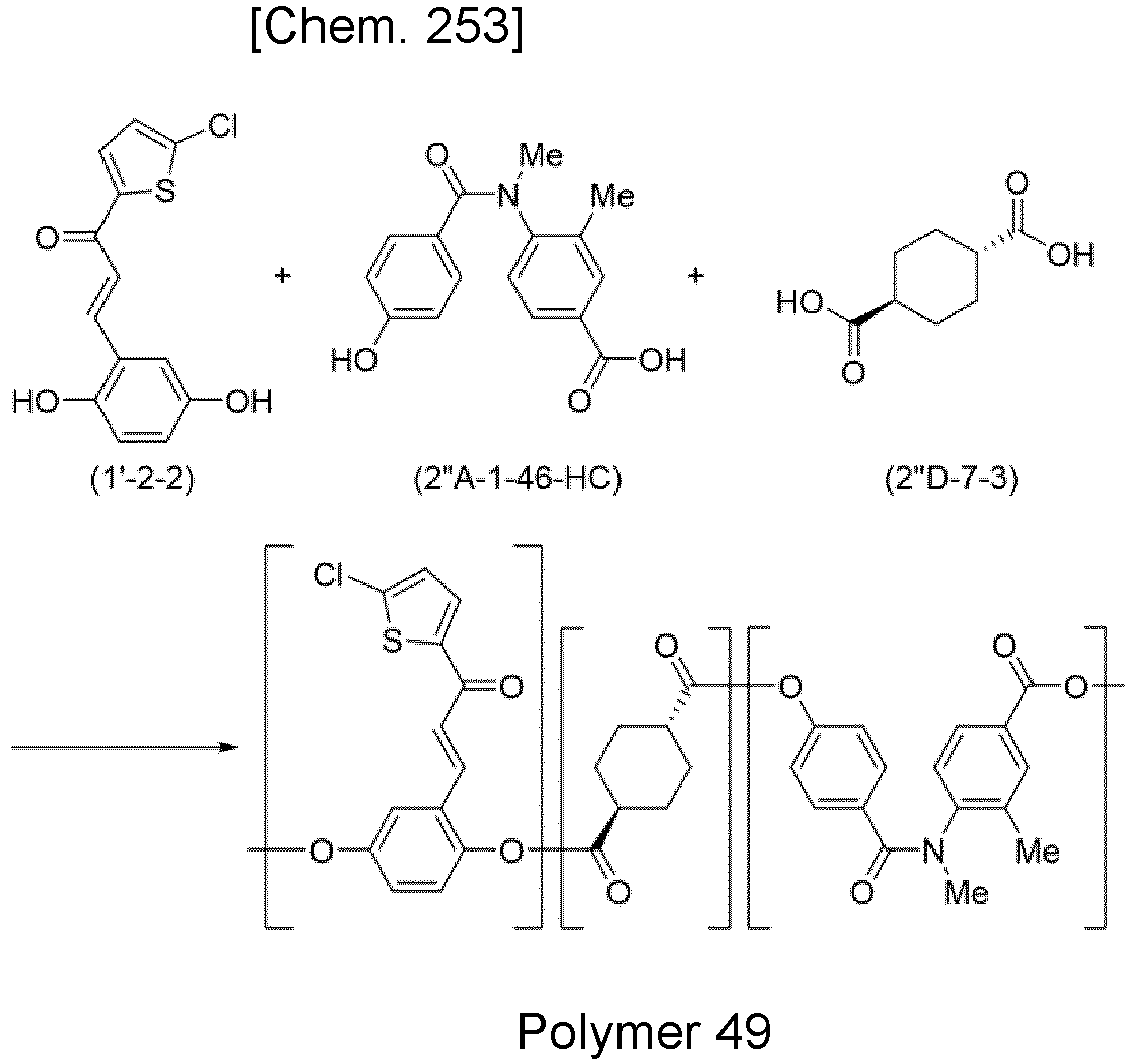
- 1.07 g (percent yield: 66%) of polymer 49 was obtained by the same method as in Example 28, except that compound (1'-2-2) (708 mg, 2.52 mmol), obtained in Dihydroxy Compound Example 2, was used as a diol monomer, that compound (2"A-1-46-HC) (617 mg, 2.16 mmol), obtained in Synthesis Example 19, was used as a hydroxycarboxylic acid monomer, that trans-1,4-cyclohexanedicarboxylic acid (2"D-7-3) (434 mg, 2.52 mmol) was used as a dicarboxylic acid monomer, that diisopropylcarbodiimide (1.00 g, 7.92 mmol) was used as a condensing agent and that pyridine (6.1 mL) was used as a solvent.
- A thin film was obtained by the same method as in Example 1-1, except that polymer 49 was used instead of polymer 1. The resulting thin film (thickness, 1 µm) was irradiated with 100 mJ/cm2 of polarized ultraviolet light at 365 nm, followed by heating at 190°C. Retardations and wavelength dispersion properties are presented in Table 4.
- A thin film was obtained by the same method as in Example 1-1, except that polymer 49 was used instead of polymer 1. The resulting thin film (thickness, 1 µm) was irradiated with 100 mJ/cm2 of polarized ultraviolet light at 365 nm, followed by heating at 250°C. Retardations and wavelength dispersion properties are presented in Table 4.
-

- 738 mg (percent yield: 67%) of polymer 50 was obtained by the same method as in Example 28, except that compound (1'-6-2) (424 mg, 1.74 mmol), obtained in Dihydroxy Compound Example 11, and compound (2"A-1-1-DH) (283 mg, 1.16 mmol), obtained in Synthesis Example 2, were used as diol monomers, that trans-1,4-cyclohexanedicarboxylic acid (2"D-7-3) (500 mg, 2.90 mmol) was used as a dicarboxylic acid monomer, that diisopropylcarbodiimide (806 mg, 6.39 mmol) was used as a condensing agent and that pyridine (4.1 mL) was used as a solvent.
- A thin film was obtained by the same method as in Example 1-1, except that polymer 50 was used instead of polymer 1. The resulting thin film (thickness, 1 µm) was irradiated with 100 mJ/cm2 of polarized ultraviolet light at 365 nm, followed by heating at 190°C. Retardations and wavelength dispersion properties are presented in Table 4.
-

- 657 mg (percent yield: 58%) of polymer 51 was obtained by the same method as in Example 28, except that compound (1 '-6-3) (448 mg, 1.74 mmol), obtained in Dihydroxy Compound Example 12, and compound (2"A-1-1-DH) (283 mg, 1.16 mmol), obtained in Synthesis Example 2, were used as diol monomers, that trans-1,4-cyclohexanedicarboxylic acid (2"D-7-3) (500 mg, 2.90 mmol) was used as a dicarboxylic acid monomer, that diisopropylcarbodiimide (806 mg, 6.39 mmol) was used as a condensing agent and that pyridine (4.1 mL) was used as a solvent.
- A thin film was obtained by the same method as in Example 1-1, except that polymer 51 was used instead of polymer 1. The resulting thin film (thickness, 1 µm) was irradiated with 100 mJ/cm2 of polarized ultraviolet light at 365 nm, followed by heating at 150°C. Retardations and wavelength dispersion properties are presented in Table 4.
-

- 966 mg (percent yield: 81%) of polymer 52 was obtained by the same method as in Example 28, except that compound (1'-2-10) (514 mg, 1.74 mmol), obtained in Dihydroxy Compound Example 8, and compound (2"A-1-1-DH) (283 mg, 1.16 mmol), obtained in Synthesis Example 2, were used as diol monomers, that trans-1,4-cyclohexanedicarboxylic acid (2"D-7-3) (500 mg, 2.90 mmol) was used as a dicarboxylic acid monomer, that diisopropylcarbodiimide (806 mg, 6.39 mmol) was used as a condensing agent and that pyridine (4.5 mL) was used as a solvent.
- A thin film was obtained by the same method as in Example 1-1, except that polymer 52 was used instead of polymer 1. The resulting thin film (thickness, 1 µm) was irradiated with 100 mJ/cm2 of polarized ultraviolet light at 365 nm, followed by heating at 190°C. Retardations and wavelength dispersion properties are presented in Table 4.
-

- 884 mg (percent yield: 74%) of polymer 53 was obtained by the same method as in Example 28, except that compound (1 '-2-9) (514 mg, 1.74 mmol), obtained in Dihydroxy Compound Example 7, and compound (2"A-1-1-DH) (283 mg, 1.16 mmol), obtained in Synthesis Example 2, were used as diol monomers, that trans-1,4-cyclohexanedicarboxylic acid (2"D-7-3) (500 mg, 2.90 mmol) was used as a dicarboxylic acid monomer, that diisopropylcarbodiimide (806 mg, 6.39 mmol) was used as a condensing agent and that pyridine (4.5 mL) was used as a solvent.
- A thin film was obtained by the same method as in Example 1-1, except that polymer 53 was used instead of polymer 1. The resulting thin film (thickness, 1 µm) was irradiated with 100 mJ/cm2 of polarized ultraviolet light at 365 nm, followed by heating at 190°C. Retardations and wavelength dispersion properties are presented in Table 4.
-

- 483 mg (percent yield: 55%) of polymer 54 was obtained by the same method as in Example 28, except that compound (1'-2-11) (157 mg, 499 µmol), obtained in Dihydroxy Compound Example 9, compound (2"A-1-1-DH) (243 mg, 999 µmol), obtained in Synthesis Example 2, and compound (2"D-1-1) (138 mg, 999 µmol) were used as diol monomers, that trans-1,4-cyclohexanedicarboxylic acid (2"D-7-3) (430 mg, 2.50 mmol) was used as a dicarboxylic acid monomer, that diisopropylcarbodiimide (693 mg, 5.49 mmol) was used as a condensing agent and that pyridine (3.2 mL) was used as a solvent.
-


- 699 mg (percent yield: 74%) of polymer 55 was obtained by the same method as in Example 28, except that compound (1'-7-2) (225 mg, 499 µmol), obtained in Dihydroxy Compound Example 10, compound (2"A-1-1-DH) (243 mg, 999 µmol), obtained in Synthesis Example 2, and compound (2"D-1-1) (138 mg, 999 µmol) were used as diol monomers, that trans-1,4-cyclohexanedicarboxylic acid (2"D-7-3) (430 mg, 2.50 mmol) was used as a dicarboxylic acid monomer, that diisopropylcarbodiimide (693 mg, 5.49 mmol) was used as a condensing agent and that pyridine (3.5 mL) was used as a solvent.
-


- 1.21 g (percent yield: 54%) of polymer 56 was obtained by the same method as in Example 28, except that compound (1 '-2-2) (946 mg, 3.37 mmol), obtained in Dihydroxy Compound Example 2, compound (2"D-1-1) (233 mg, 1.68 mmol), 2-(1,1,3,3-tetramethylbutyl)hydroquinone (2"D-10-1) (214 mg, 963 mmol) and PEG 20000 (60.3 mg, 3.01 µmol) were used as diol monomers, that terephthalic acid (1.00 g, 1.68 mmol) was used as a dicarboxylic acid monomer, that diisopropylcarbodiimide (693 mg, 5.49 mmol) was used as a condensing agent and that pyridine (3.5 mL) was used as a solvent.
-

- Deionized water (20 mL) was taken into a 200-mL three-neck flask equipped with a dropping funnel, and compound (2"-1-36-DH) (1.11 g, 4.00 mmol), obtained in Synthesis Example 1, and sodium hydroxide (320 mg, 8.00 mmol) were added. After the substrate was dissolved through vigorous stirring (350 rpm), a 2% aqueous solution of tetrabutylammonium bromide (1.6 mL) as a catalyst was added, and the inside of the instrument was sufficiently purged with argon. A dichloromethane (20 mL) solution of trans-1,4-cyclohexanedicarboxylic acid dichloride was taken into the dropping funnel and added dropwise into the system quickly. After the end of dropwise addition, interfacial polymerization was performed through 3 hours of vigorous stirring at ordinary temperature. After the reaction, the solution was added dropwise to methanol (200 mL), and the precipitate was isolated by filtration, washed with water (100 mL) and methanol (100 mL) and then vacuum-dried, giving a white solid of polymer 1' weighing 1.04 g (percent yield: 63%).
- 6.0% by mass of polymer 1' was dissolved in 94.0% by mass of 1,1,1,3,3,3-hexafluoro-2-propanol. After this solution was cast onto a quartz glass substrate, spin coating was performed, and the resulting coating was dried in an oven at 60°C for 30 minutes to give a thin film (thickness, 1 µm). The resulting thin film was irradiated with 500 mJ/cm2 of polarized ultraviolet light at 248 nm, followed by heating at 250°C. Retardations and wavelength dispersion properties are presented in Table 5.
[Table 1] Example Polymer Irradiation wavelength (nm) Heat treatment temperature (°C) Amount of light irradiation (mJ) R(450)/R(550) Re [10µm] (nm) 1-1 Polymer 1 248 150 500 0.99 313 2-1 Polymer 2 248 150 100 0.86 34 2-2 248 150 500 0.86 76 2-3 248 250 100 0.95 86 2-4 248 250 500 0.94 510 3-1 Polymer 3 248 150 500 0.80 46 3-2 248 250 500 0.89 211 4-1 Polymer 4 248 150 500 0.86 85 4-2 248 150 1000 0.86 180 4-3 248 250 500 0.89 588 4-4 248 250 1000 0.89 674 5-1 Polymer 5 248 150 500 0.80 80 5-2 248 150 1000 0.80 164 5-3 248 250 500 0.84 370 5-4 248 250 1000 0.84 579 6-1 Polymer 6 248 150 500 0.98 128 6-2 248 150 1000 0.98 178 6-3 248 250 500 0.99 569 6-4 248 250 1000 0.99 608 7-1 Polymer 7 248 150 500 0.95 345 7-2 248 150 1000 0.95 412 7-3 248 250 500 0.96 723 7-4 248 250 1000 0.96 690 8-1 Polymer 8 248 150 500 0.89 336 8-2 248 150 1000 0.89 521 8-3 248 250 500 0.93 441 8-4 248 250 1000 0.91 410 9-1 Polymer 9 248 150 500 0.91 192 9-2 248 150 1000 0.91 278 9-3 248 250 500 0.93 898 9-4 248 250 1000 0.92 945 10-1 Polymer 10 248 150 1000 0.93 95 10-2 248 250 500 0.94 390 10-3 248 250 1000 0.94 420 11-1 Polymer 11 248 250 100 1.00 723 11-2 248 250 500 1.00 798 12-1 Polymer 12 248 250 500 0.96 863 12-2 248 250 1000 0.96 824 12-3 313 150 170 1.00 145 12-4 313 250 170 0.94 913 12-5 313 250 340 0.94 1013 12-6 365 250 700 0.95 668 12-7 365 250 1400 0.96 457 13-1 Polymer 13 248 150 50 0.87 392 13-2 248 250 50 0.81 791 13-3 248 150 500 0.87 199 13-4 248 150 1000 0.89 205 13-5 248 250 500 0.87 510 13-6 248 250 1000 0.86 346 13-7 365 150 100 0.87 330 13-8 365 150 500 0.90 254 13-9 365 250 100 0.86 702 13-10 365 250 500 0.86 490 [Table 2] Example Polymer Irradiation wavelength (nm) Heat treatment temperature (°C) Amount of light irradiation (mJ) R(450)/R(550) Re [10µm] (nm) 14-1 Polymer 14 248 150 500 0.84 34 14-2 248 150 1000 0.83 149 14-3 248 250 500 0.86 37 14-4 248 250 1000 0.84 114 15-1 Polymer 15 365 150 100 0.97 384 15-2 365 150 500 0.95 398 15-3 365 250 100 0.90 147 15-4 365 250 500 0.91 99 16-1 Polymer 16 365 150 100 0.91 175 16-2 365 150 500 0.92 195 16-3 365 250 100 0.92 317 16-4 365 250 500 0.84 331 17-1 Polymer 17 365 150 100 0.92 168 17-2 365 150 500 0.93 170 17-3 365 250 100 0.88 142 17-4 365 250 500 0.88 203 18-1 Polymer 18 365 250 100 0.87 155 18-2 365 250 500 0.86 149 19-1 Polymer 19 365 150 50 0.90 339 19-2 365 150 100 0.91 369 19-3 365 250 50 0.86 364 19-4 365 250 100 0.85 289 20-1 Polymer 20 248 250 500 0.90 155 20-2 248 250 1000 0.91 295 21-1 Polymer 21 248 250 500 0.98 820 22-1 Polymer 22 248 150 500 0.94 45 22-2 248 250 500 0.93 333 22-3 365 150 100 0.94 127 22-4 365 150 500 0.94 95 22-5 365 250 100 0.93 603 22-6 365 250 500 0.94 308 23-1 Polymer 23 248 150 500 0.77 88 23-2 248 150 1000 0.78 89 23-3 248 250 500 0.79 335 23-4 248 250 1000 0.79 246 24-1 Polymer 24 248 150 500 0.97 92 24-2 248 150 1000 0.96 176 24-3 248 250 500 0.95 811 24-4 248 250 1000 0.92 1197 25-1 Polymer 25 248 150 500 0.98 143 25-2 248 150 1000 0.98 257 25-3 248 250 500 0.92 978 25-4 248 250 1000 0.92 1085 26-1 Polymer 26 248 250 500 1.00 511 26-2 248 250 1000 1.00 564 27-1 Polymer 27 248 150 500 1.00 165 27-2 248 150 1000 1.00 244 [Table 3] Example Polymer Irradiation wavelength (nm) Heat treatment temperature (°C) Amount of light irradiation (mJ) R(450)/ R(550) Re [10µm ] (nm) 28-1 Polymer 28 365 150 100 0.88 146 28-2 365 190 100 0.86 25 29-1 Polymer 29 365 150 100 0.88 165 29-2 365 190 100 0.87 90 30-1 Polymer 30 365 150 100 0.93 71 30-2 365 190 100 0.93 305 31-1 Polymer 31 365 150 100 0.95 310 31-2 365 190 100 0.92 802 32-1 Polymer 32 365 150 100 0.91 480 32-2 365 190 100 0.91 164 33-1 Polymer 33 365 190 100 0.95 200 34-1 Polymer 34 365 150 100 0.82 26 [Table 4] Example Polymer Irradiation wavelength (nm) Heat treatment temperature (°C) Amount of light irradiation (mJ) R(450)/ R(550) Re [10µm ] (nm) 35-1 Polymer 35 365 190 100 0.94 177 36-1 Polymer 36 365 190 100 0.95 411 37-1 Polymer 37 365 190 100 0.95 296 38-1 Polymer 38 365 190 100 0.94 183 39-1 Polymer 39 365 190 100 0.94 205 40-1 Polymer 40 365 150 100 0.88 570 41-1 Polymer 41 365 150 100 0.92 236 42-1 Polymer 42 365 150 100 0.86 308 43-1 Polymer 43 365 190 100 0.96 316 44-1 Polymer 44 365 190 100 0.93 188 45-1 Polymer 45 365 190 100 0.95 274 46-1 Polymer 46 365 190 100 1.00 443 46-2 365 250 100 0.87 367 47-1 Polymer 47 365 190 100 0.94 170 48-1 Polymer 48 365 190 100 0.98 287 48-2 365 250 100 0.92 206 49-1 Polymer 49 365 190 100 0.95 260 49-2 365 250 100 0.85 258 50-1 Polymer 50 365 190 100 0.92 238 51-1 Polymer 51 365 150 100 0.90 74 52-1 Polymer 52 365 190 100 0.98 76 53-1 Polymer 53 365 190 100 0.94 296 [Table 5] Comparativ e Example Polymer Irradiation wavelength (nm) Heat treatment temperature (°C) Amount of light irradiation (mJ) R(450)/ R(550) Re [10µm ] (nm) 1 Polymer 1' 248 250 500 1.06 61 - [In Table 1, Table 2, Table 3, Table 4 and Table 5, R (450)/R (550) represents the ratio between the in-plane retardation at 450 nm and the in-plane retardation at 550 nm.
- Re [10 µm] indicates a retardation value equivalent to a film thickness of 10 µm.]
- As shown in Table 1, Table 2, Table 3 and Table 4, the polymers in Examples 1 to 53 develop reverse wavelength dispersion retardations through irradiation with ultraviolet light and heating treatment.
- The development of reverse wavelength dispersion retardations by the polymers according to the present invention, which had a photoreactive reverse wavelength dispersion unit A, becomes more conspicuous through comparison with Comparative Example 1, presented in Table 5.
- 2,5-dihydroxybenzaldehyde (57.5 g, 416 mmol) and acetophenone (50.0 g, 416 mmol) were dissolved in methanol (200 mL), and then a 50% aqueous solution of sodium hydroxide (120 mL, 2.25 mol) was added dropwise with cooling on ice. After the reaction system was stirred at room temperature for 12 hours, acetic acid (167 mL, 2.91 mmol) was added with cooling on ice. The resulting reaction mixture was added to water (300 mL), followed by vigorous stirring with added toluene (30 mL), isopropyl alcohol (2 mL) and dichloromethane (100 mL). The solid that formed was collected by filtration and washed with dichloromethane (50 mL) and distilled water (50 mL). The resulting solid was vacuum-dried, giving 14.8 g (percent yield: 15%) of compound (1'-1-1) as a yellow solid. 1H-NMR (400 MHz, DMSO-d6) δ 9.90-8.39 (br, 2H), 8.04 (d, J = 8.2 Hz, 2H), 7.94 (d, J = 15.4 Hz, 1H), 7.67 (d, J = 15.4 Hz, 1H), 7.61 (t, J = 7.4 Hz, 1H), 7.52 (t, J = 7.4 Hz, 2H), 7.15 (s, 1H), 6.76-6.67 (m, 2H).

- In an argon atmosphere, a mixture of 4-acetoxybenzoic acid (7.56 g, 42.0 mmol), thionyl chloride (24.0 mL, 331 mmol) and N,N-dimethylformamide (catalytic amount) was boiled under reflux for 3 hours. Volatile components were distilled away, and the residue was azeotropically distilled with toluene (3 × 20 mL) to give 4-acetoxybenzoyl chloride. The resulting 4-acetoxybenzoyl chloride was used entirely in the next reaction after being made into a tetrahydrofuran (50 mL) solution.
- In an argon atmosphere, 1,2-dimethylhydrazine dihydrochloride (2.66 g, 20.0 mmol) and N,N-diisopropylethylamine (17.0 mL, 100 mmol) were suspended in tetrahydrofuran (40 mL). With cooling on ice, the tetrahydrofuran solution of 4-acetoxybenzoyl chloride prepared in advance was slowly added. The resulting mixture was allowed to warm to room temperature and stirred overnight. The solvent was distilled away under reduced pressure, 1 M hydrochloric acid (100 mL) was added, and extraction with ethyl acetate (2 × 100 mL) was performed. The combined organic layer was washed sequentially with a saturated aqueous solution of sodium hydrogencarbonate (100 mL) and saturated saline solution (100 mL) and dried with anhydrous sodium sulfate, followed by concentration under reduced pressure. The residue was suspended in methanol (75 mL), and the resulting suspension was stirred at room temperature for 1 hour with an added aqueous (25 mL) solution of sodium hydroxide (4.16 g, 104 mmol). The solvent was distilled away under reduced pressure, 2 M hydrochloric acid (75 mL) was added, and extraction with ethyl acetate (2 × 100 mL) was performed. The combined organic layer was washed sequentially with a saturated aqueous solution of sodium hydrogencarbonate (2 × 100 mL) and saturated saline solution (100 mL), followed by drying with anhydrous sodium sulfate. The solvent was concentrated under reduced pressure, the residue was purified by silica gel column chromatography, and then the resulting solid was recrystallized from a solvent mixture of ethanol/hexane, giving a white solid (actual yield: 3.02g; percent yield: 50%) of compound (2"C-2-13). 1H-NMR (400 MHz, (CD3)2SO): δ 9.95 (brs, 2H), 7.58-6.87 (brm, 4H), 6.87-6.61 (brm, 4H), 3.13 (brs, 6H).

- In a nitrogen atmosphere, compound (1'-2-2) (4.0 g, 14.3 mmol), obtained in Dihydroxy Compound Example 2, compound (2"A-1-1-DH) (1.9 g, 7.7 mmol), obtained in Synthesis Example 2, trans-1,4-cyclohexanedicarboxylic acid (3.8 g, 21.9 mmol), pyridine (8.2 mL) and N-methyl-2-pyrrolidone (8.2 mL) were added to a reaction vessel. The reaction system was stirred at 40°C for 1 hour for dissolution, and then N,N'-diisopropylcarbodiimide (6.1 g, 48.2 mmol) as an ester-linkage-forming condensing agent was added dropwise to initiate polymerization. The reaction system was stirred at 40°C for 3 hours, followed by the addition of acetic anhydride (2.2 g, 21.9 mmol) as a monocarboxylic acid derivative compound. After the reaction system was stirred at 40°C for 30 minutes, the mixture in the system was added to methanol (300 mL). The solid that formed was collected by filtration, washed with methanol (500 mL) and then vacuum-dried to give polymer 57 (actual yield: 6.4 g; percent yield: 72%).
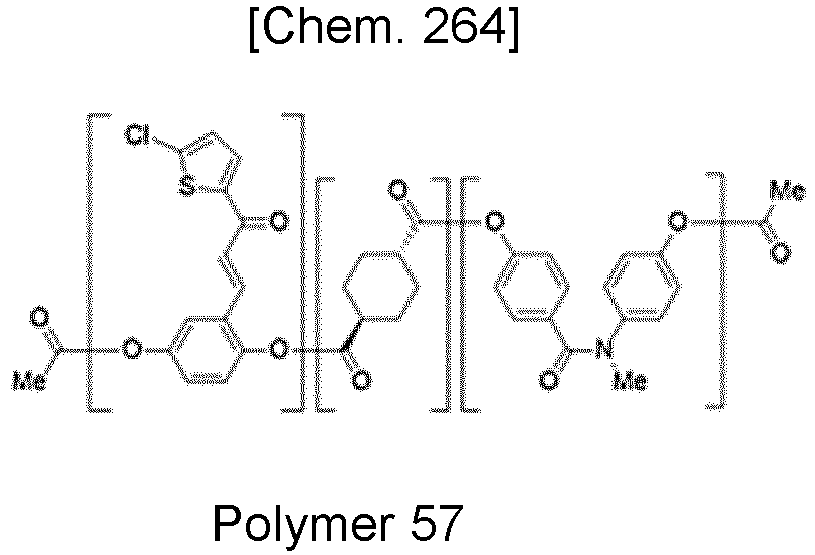
- 13.0% by mass of polymer 57 was dissolved in 87.0% by mass of hexafluoro-2-propanol. This solution was cast onto a quartz substrate, spin coating was performed at 2000 rpm for 60 seconds, and the resulting coating was dried in an oven at 60°C for 30 minutes to give a film (thickness, 5 µm). The measurement of the yellowness index (YI) of the resulting film and visual evaluation of film appearance were conducted. The resulting film was irradiated with 100 mJ/cm2 of polarized ultraviolet radiation light at 365 nm, then heating treatment was performed at 150°C for 10 minutes, and retardation characteristics and wavelength dispersion characteristics were evaluated. The results are presented in Table 6.
- In a nitrogen atmosphere, compound (1'-2-2) (4.0 g, 14.3 mmol), obtained in Dihydroxy Compound Example 2, compound (2"A-1-1-DH) (1.9 g, 7.7 mmol), obtained in Synthesis Example 2, trans-1,4-cyclohexanedicarboxylic acid (3.8 g, 21.9 mmol), pyridine (8.2 mL) and N-methyl-2-pyrrolidone (8.2 mL) were added to a reaction vessel. The reaction system was stirred at 40°C for 1 hour for dissolution, and then N,N'-diisopropylcarbodiimide (6.1 g, 48.2 mmol) as an ester-linkage-forming condensing agent was added dropwise to initiate polymerization. The reaction system was stirred at 40°C for 3 hours, followed by the addition of cyclohexanecarbonyl chloride (3.2 g, 21.9 mmol) as a monocarboxylic acid derivative compound. After the reaction system was stirred at 40°C for 30 minutes, the mixture in the system was added to methanol (300 mL). The solid that formed was collected by filtration, washed with methanol (500 mL) and then vacuum-dried to give polymer 58 (actual yield: 6.6 g; percent yield: 75%).

- 13.0% by mass of polymer 58 was dissolved in 87.0% by mass of hexafluoro-2-propanol. This solution was cast onto a quartz substrate, spin coating was performed at 1600 rpm for 60 seconds, and the resulting coating was dried in an oven at 60°C for 30 minutes to give a film (thickness, 5 µm). The measurement of the yellowness index (YI) of the resulting film and visual evaluation of film appearance were conducted. The resulting film was irradiated with 100 mJ/cm2 of polarized ultraviolet radiation light at 365 nm, then heating treatment was performed at 150°C for 10 minutes, and retardation characteristics and wavelength dispersion characteristics were evaluated. The results are presented in Table 5.
- In a nitrogen atmosphere, compound (1'-2-2) (4.0 g, 14.3 mmol), obtained in Dihydroxy Compound Example 2, compound (2"A-1-1-DH) (1.9 g, 7.7 mmol), obtained in Synthesis Example 2, trans-1,4-cyclohexanedicarboxylic acid (3.8 g, 21.9 mmol), pyridine (8.2 mL) and N-methyl-2-pyrrolidone (8.2 mL) were added to a reaction vessel. The reaction system was stirred at 40°C for 1 hour for dissolution, and then N,N'-diisopropylcarbodiimide (6.1 g, 48.2 mmol) as an ester-linkage-forming condensing agent was added dropwise to initiate polymerization. The reaction system was stirred at 40°C for 3 hours, followed by the addition of a solution in which chloroacetic anhydride (3.7 g, 21.9 mmol) as a monocarboxylic acid derivative compound had been dissolved in N-methyl-2-pyrrolidone (3.0 mL). After the reaction system was stirred at 40°C for 30 minutes, the mixture in the system was added to methanol (300 mL). The solid that formed was collected by filtration, washed with methanol (500 mL) and then vacuum-dried to give polymer 59 (actual yield: 6.5 g; percent yield: 73%).

- 13.0% by mass of polymer 59 was dissolved in 87.0% by mass of hexafluoro-2-propanol. This solution was cast onto a quartz substrate, spin coating was performed at 1800 rpm for 60 seconds, and the resulting coating was dried in an oven at 60°C for 30 minutes to give a film (thickness, 5 µm). The measurement of the yellowness index (YI) of the resulting film and visual evaluation of film appearance were conducted. The resulting film was irradiated with 100 mJ/cm2 of polarized ultraviolet radiation light at 365 nm, then heating treatment was performed at 150°C for 10 minutes, and retardation characteristics and wavelength dispersion characteristics were evaluated. The results are presented in Table 6.
- In a nitrogen atmosphere, compound (1'-2-2) (4.0 g, 14.3 mmol), obtained in Dihydroxy Compound Example 2, compound (2"A-1-1-DH) (1.9 g, 7.7 mmol), obtained in Synthesis Example 2, trans-1,4-cyclohexanedicarboxylic acid (3.8 g, 21.9 mmol), pyridine (8.2 mL) and N-methyl-2-pyrrolidone (8.2 mL) were added to a reaction vessel. The reaction system was stirred at 40°C for 1 hour for dissolution, and then N,N'-diisopropylcarbodiimide (6.1 g, 48.2 mmol) as an ester-linkage-forming condensing agent was added dropwise to initiate polymerization. The reaction system was stirred at 40°C for 3 hours, followed by the addition of p-toluoyl chloride (3.4 g, 21.9 mmol) as a monocarboxylic acid derivative compound. After the reaction system was stirred at 40°C for 30 minutes, the mixture in the system was added to methanol (300 mL). The solid that formed was collected by filtration, washed with methanol (500 mL) and then vacuum-dried to give polymer 60 (actual yield: 7.7 g; percent yield: 87%).

- 13.0% by mass of polymer 60 was dissolved in 87.0% by mass of hexafluoro-2-propanol. This solution was cast onto a quartz substrate, spin coating was performed at 1800 rpm for 60 seconds, and the resulting coating was dried in an oven at 60°C for 30 minutes to give a film (thickness, 5 µm). The measurement of the yellowness index (YI) of the resulting film and visual evaluation of film appearance were conducted. The resulting film was irradiated with 100 mJ/cm2 of polarized ultraviolet radiation light at 365 nm, then heating treatment was performed at 250°C for 10 minutes, and retardation characteristics and wavelength dispersion characteristics were evaluated. The results are presented in Table 6.
- In a nitrogen atmosphere, compound (1'-1-1) (1.0 g, 4.2 mmol), obtained in Dihydroxy Compound Example 14, compound (2"A-1-1-DH) (0.55 g, 2.2 mmol), obtained in Synthesis Example 2, trans-1,4-cyclohexanedicarboxylic acid (1.1 g, 6.4 mmol), pyridine (2.2 mL) and N-methyl-2-pyrrolidone (2.2 mL) were added to a reaction vessel. The reaction system was stirred at 40°C for 1 hour for dissolution, and then N,N'-diisopropylcarbodiimide (1.8 g, 14.1 mmol) as an ester-linkage-forming condensing agent was added dropwise to initiate polymerization. The reaction system was stirred at 40°C for 3 hours, followed by the addition of acetic anhydride (0.65 g, 6.4 mmol) as a monocarboxylic acid derivative compound. After the reaction system was stirred at 40°C for 30 minutes, the mixture in the system was added to methanol (100 mL). The solid that formed was collected by filtration, washed with methanol (500 mL) and then vacuum-dried to give polymer 61 (actual yield: 1.3 g; percent yield: 54%).

- 13.0% by mass of polymer 61 was dissolved in 87.0% by mass of hexafluoro-2-propanol. This solution was cast onto a quartz substrate, spin coating was performed at 1800 rpm for 60 seconds, and the resulting coating was dried in an oven at 60°C for 30 minutes to give a film (thickness, 5 µm). The measurement of the yellowness index (YI) of the resulting film and visual evaluation of film appearance were conducted. The resulting film was irradiated with 100 mJ/cm2 of polarized ultraviolet radiation light at 365 nm, then heating treatment was performed at 250°C for 10 minutes, and retardation characteristics and wavelength dispersion characteristics were evaluated. The results are presented in Table 6.
- In a nitrogen atmosphere, compound (1'-2-2) (2.5 g, 9.1 mmol), obtained in Dihydroxy Compound Example 2, 4,4'-bicyclohexanol (0.69 g, 3.5 mmol), 4-(2-hydroxyethyl)phenol (0.67 g, 4.9 mmol), trans-1,4-cyclohexanedicarboxylic acid (3.0 g, 17.4 mmol) and pyridine (16.2 mL) were added to a reaction vessel. The reaction system was stirred at 30°C for 1 hour for dissolution, and then N,N'-diisopropylcarbodiimide (4.8 g, 38.3 mmol) as an ester-linkage-forming condensing agent was added dropwise to initiate polymerization. The reaction system was stirred at 30°C for 3 hours, followed by the addition of acetic anhydride (1.8 g, 17.4 mmol) as a monocarboxylic acid derivative compound. After the reaction system was stirred at 30°C for 30 minutes, the mixture in the system was added to methanol (300 mL). The solid that formed was collected by filtration, washed with methanol (500 mL) and then vacuum-dried to give polymer 62 (actual yield: 4.3 g; percent yield: 69%).

- 13.0% by mass of polymer 62 was dissolved in 87.0% by mass of hexafluoro-2-propanol. This solution was cast onto a quartz substrate, spin coating was performed at 1800 rpm for 60 seconds, and the resulting coating was dried in an oven at 60°C for 30 minutes to give a film (thickness, 5 µm). The measurement of the yellowness index (YI) of the resulting film and visual evaluation of film appearance were conducted. The resulting film was irradiated with 100 mJ/cm2 of polarized ultraviolet radiation light at 365 nm, then heating treatment was performed at 150°C for 10 minutes, and retardation characteristics and wavelength dispersion characteristics were evaluated. The results are presented in Table 6.
- In a nitrogen atmosphere, compound (1'-2-2) (1.1 g, 4.1 mmol), obtained in Dihydroxy Compound Example 2, compound (2"A-1-1-DH) (7.1 g, 0.3 mmol), obtained in Synthesis Example 2, 4-(2-hydroxyethyl)phenol (0.20 g, 1.5 mmol), trans-1,4-cyclohexanedicarboxylic acid (1.0 g, 5.8 mmol) and pyridine (8.2 mL) were added to a reaction vessel. The reaction system was stirred at 30°C for 1 hour for dissolution, and then N,N'-diisopropylcarbodiimide (1.6 g, 12.8 mmol) as an ester-linkage-forming condensing agent was added dropwise to initiate polymerization. The reaction system was stirred at 30°C for 3 hours, followed by the addition of acetic anhydride (0.59 g, 5.8 mmol) as a monocarboxylic acid derivative compound. After the reaction system was stirred at 30°C for 30 minutes, the mixture in the system was added to methanol (300 mL). The solid that formed was collected by filtration, washed with methanol (500 mL) and then vacuum-dried to give polymer 63 (actual yield: 1.7 g; percent yield: 80%).

- 10.0% by mass of polymer 63 was dissolved in 90.0% by mass of hexafluoro-2-propanol. This solution was cast onto a quartz substrate, spin coating was performed at 1000 rpm for 60 seconds, and the resulting coating was dried in an oven at 60°C for 30 minutes to give a film (thickness, 5 µm). The measurement of the yellowness index (YI) of the resulting film and visual evaluation of film appearance were conducted. The resulting film was irradiated with 100 mJ/cm2 of polarized ultraviolet radiation light at 365 nm, then heating treatment was performed at 150°C for 10 minutes, and retardation characteristics and wavelength dispersion characteristics were evaluated. The results are presented in Table 6.
- In a nitrogen atmosphere, compound (1'-2-2) (1.1 g, 4.1 mmol), obtained in Dihydroxy Compound Example 2, compound (2"A-1-1-DH) (0.07 g, 0.3 mmol), obtained in Synthesis Example 2, 4-(2-hydroxyethyl)phenol (0.20 g, 1.5 mmol), polyethylene glycol 20000 (manufactured by Tokyo Chemical Industry Co., Ltd., 0.11 g), trans-1,4-cyclohexanedicarboxylic acid (1.0 g, 5.8 mmol) and pyridine (8.7 mL) were added to a reaction vessel. The reaction system was stirred at 30°C for 1 hour for dissolution, and then N,N'-diisopropylcarbodiimide (1.6 g, 12.8 mmol) as an ester-linkage-forming condensing agent was added dropwise to initiate polymerization. The reaction system was stirred at 30°C for 3 hours, followed by the addition of acetic anhydride (0.59 g, 5.8 mmol) as a monocarboxylic acid derivative compound. After the reaction system was stirred at 30°C for 30 minutes, the mixture in the system was added to methanol (300 mL). The solid that formed was collected by filtration, washed with methanol (500 mL) and then vacuum-dried to give polymer 64 (actual yield: 1.6 g; percent yield: 68%).


- 10.0% by mass of polymer 64 was dissolved in 90.0% by mass of hexafluoro-2-propanol. This solution was cast onto a quartz substrate, spin coating was performed at 1000 rpm for 60 seconds, and the resulting coating was dried in an oven at 60°C for 30 minutes to give a film (thickness, 5 µm). The measurement of the yellowness index (YI) of the resulting film and visual evaluation of film appearance were conducted. The resulting film was irradiated with 100 mJ/cm2 of polarized ultraviolet radiation light at 365 nm, then heating treatment was performed at 150°C for 10 minutes, and retardation characteristics and wavelength dispersion characteristics were evaluated. The results are presented in Table 6.
- In a nitrogen atmosphere, compound (1'-2-2) (1.3 g, 4.7 mmol), obtained in Dihydroxy Compound Example 2, hexamethylenebis(4-hydroxybenzoate) (0.10 g, 0.3 mmol), 4-(2-hydroxyethyl)phenol (0.12 g, 0.9 mmol), trans-1,4-cyclohexanedicarboxylic acid (1.0 g, 5.8 mmol) and pyridine (8.7 mL) were added to a reaction vessel. The reaction system was stirred at 30°C for 1 hour for dissolution, and then N,N'-diisopropylcarbodiimide (1.6 g, 12.8 mmol) as an ester-linkage-forming condensing agent was added dropwise to initiate polymerization. The reaction system was stirred at 30°C for 3 hours, followed by the addition of acetic anhydride (0.59 g, 5.8 mmol) as a monocarboxylic acid derivative compound. After the reaction system was stirred at 30°C for 30 minutes, the mixture in the system was added to methanol (300 mL). The solid that formed was collected by filtration, washed with methanol (500 mL) and then vacuum-dried to give polymer 65 (actual yield: 1.9 g; percent yield: 81%).

- 10.0% by mass of polymer 65 was dissolved in 90.0% by mass of hexafluoro-2-propanol. This solution was cast onto a quartz substrate, spin coating was performed at 1000 rpm for 60 seconds, and the resulting coating was dried in an oven at 60°C for 30 minutes to give a film (thickness, 5 µm). The measurement of the yellowness index (YI) of the resulting film and visual evaluation of film appearance were conducted. The resulting film was irradiated with 100 mJ/cm2 of polarized ultraviolet radiation light at 365 nm, then heating treatment was performed at 150°C for 10 minutes, and retardation characteristics and wavelength dispersion characteristics were evaluated. The results are presented in Table 6.
- In a nitrogen atmosphere, compound (1'-2-2) (0.91 g, 3.3 mmol), obtained in Dihydroxy Compound Example 2, 4,4'-bicyclohexanol (0.18 g, 0.9 mmol), 4-(2-hydroxyethyl)phenol (0.23 g, 1.6 mmol), trans-1,4-cyclohexanedicarboxylic acid (1.0 g, 5.8 mmol) and pyridine (7.8 mL) were added to a reaction vessel. The reaction system was stirred at 30°C for 1 hour for dissolution, and then N,N'-diisopropylcarbodiimide (1.6 g, 12.8 mmol) as an ester-linkage-forming condensing agent was added dropwise to initiate polymerization. The reaction system was stirred at 30°C for 3 hours, followed by the addition of isobutyric anhydride (0.92 g, 5.8 mmol) as a monocarboxylic acid derivative compound. After the reaction system was stirred at 30°C for 30 minutes, the mixture in the system was added to methanol (300 mL). The solid that formed was collected by filtration, washed with methanol (500 mL) and then vacuum-dried to give polymer 66 (actual yield: 1.4 g; percent yield: 66%).

- 13.0% by mass of polymer 66 was dissolved in 87.0% by mass of hexafluoro-2-propanol. This solution was cast onto a quartz substrate, spin coating was performed at 1800 rpm for 60 seconds, and the resulting coating was dried in an oven at 60°C for 30 minutes to give a film (thickness, 5 µm). The measurement of the yellowness index (YI) of the resulting film and visual evaluation of film appearance were conducted. The resulting film was irradiated with 100 mJ/cm2 of polarized ultraviolet radiation light at 365 nm, then heating treatment was performed at 150°C for 10 minutes, and retardation characteristics and wavelength dispersion characteristics were evaluated. The results are presented in Table 6.
- In a nitrogen atmosphere, compound (1'-2-2) (0.91 g, 3.3 mmol), obtained in Dihydroxy Compound Example 2, 4,4'-bicyclohexanol (0.18 g, 0.9 mmol), 4-(2-hydroxyethyl)phenol (0.23 g, 1.6 mmol), trans-1,4-cyclohexanedicarboxylic acid (1.0 g, 5.8 mmol) and pyridine (7.8 mL) were added to a reaction vessel. The reaction system was stirred at 30°C for 1 hour for dissolution, and then N,N'-diisopropylcarbodiimide (1.6 g, 12.8 mmol) as an ester-linkage-forming condensing agent was added dropwise to initiate polymerization. The reaction system was stirred at 30°C for 3 hours, followed by the addition of hexanoic anhydride (1.3 g, 5.8 mmol) as a monocarboxylic acid derivative compound. After the reaction system was stirred at 30°C for 30 minutes, the mixture in the system was added to methanol (300 mL). The solid that formed was collected by filtration, washed with methanol (500 mL) and then vacuum-dried to give polymer 67 (actual yield: 1.4 g; percent yield: 65%).

- 13.0% by mass of polymer 67 was dissolved in 87.0% by mass of hexafluoro-2-propanol. This solution was cast onto a quartz substrate, spin coating was performed at 1800 rpm for 60 seconds, and the resulting coating was dried in an oven at 60°C for 30 minutes to give a film (thickness, 5 µm). The measurement of the yellowness index (YI) of the resulting film and visual evaluation of film appearance were conducted. The resulting film was irradiated with 100 mJ/cm2 of polarized ultraviolet radiation light at 365 nm, then heating treatment was performed at 150°C for 10 minutes, and retardation characteristics and wavelength dispersion characteristics were evaluated. The results are presented in Table 6.
- In a nitrogen atmosphere, compound (1'-2-2) (0.91 g, 3.3 mmol), obtained in Dihydroxy Compound Example 2, 4,4'-bicyclohexanol (0.18 g, 0.9 mmol), 4-(2-hydroxyethyl)phenol (0.23 g, 1.6 mmol), trans-1,4-cyclohexanedicarboxylic acid (1.0 g, 5.8 mmol) and pyridine (7.8 mL) were added to a reaction vessel. The reaction system was stirred at 30°C for 1 hour for dissolution, and then N,N'-diisopropylcarbodiimide (1.6 g, 12.8 mmol) as an ester-linkage-forming condensing agent was added dropwise to initiate polymerization. The reaction system was stirred at 30°C for 3 hours, followed by the addition of decanoic anhydride (1.9 g, 5.8 mmol) as a monocarboxylic acid derivative compound. After the reaction system was stirred at 30°C for 30 minutes, the mixture in the system was added to methanol (300 mL). The solid that formed was collected by filtration, washed with methanol (500 mL) and then vacuum-dried to give polymer 68 (actual yield: 1.4 g; percent yield: 67%).

- 13.0% by mass of polymer 68 was dissolved in 87.0% by mass of hexafluoro-2-propanol. This solution was cast onto a quartz substrate, spin coating was performed at 1800 rpm for 60 seconds, and the resulting coating was dried in an oven at 60°C for 30 minutes to give a film (thickness, 5 µm). The measurement of the yellowness index (YI) of the resulting film and visual evaluation of film appearance were conducted. The resulting film was irradiated with 100 mJ/cm2 of polarized ultraviolet radiation light at 365 nm, then heating treatment was performed at 150°C for 10 minutes, and retardation characteristics and wavelength dispersion characteristics were evaluated. The results are presented in Table 6.
- In a nitrogen atmosphere, compound (1'-2-2) (0.91 g, 3.3 mmol), obtained in Dihydroxy Compound Example 2, 4,4'-bicyclohexanol (0.18 g, 0.9 mmol), 4-(2-hydroxyethyl)phenol (0.23 g, 1.6 mmol), trans-1,4-cyclohexanedicarboxylic acid (1.0 g, 5.8 mmol) and pyridine (7.8 mL) were added to a reaction vessel. The reaction system was stirred at 30°C for 1 hour for dissolution, and then N,N'-diisopropylcarbodiimide (1.6 g, 12.8 mmol) as an ester-linkage-forming condensing agent was added dropwise to initiate polymerization. The reaction system was stirred at 30°C for 3 hours, followed by the addition of cyclohexanecarboxylic anhydride (1.4 g, 5.8 mmol) as a monocarboxylic acid derivative compound. After the reaction system was stirred at 30°C for 30 minutes, the mixture in the system was added to methanol (300 mL). The solid that formed was collected by filtration, washed with methanol (500 mL) and then vacuum-dried to give polymer 69 (actual yield: 1.4 g; percent yield: 66%).

- 13.0% by mass of polymer 69 was dissolved in 87.0% by mass of hexafluoro-2-propanol. This solution was cast onto a quartz substrate, spin coating was performed at 1800 rpm for 60 seconds, and the resulting coating was dried in an oven at 60°C for 30 minutes to give a film (thickness, 5 µm). The measurement of the yellowness index (YI) of the resulting film and visual evaluation of film appearance were conducted. The resulting film was irradiated with 100 mJ/cm2 of polarized ultraviolet radiation light at 365 nm, then heating treatment was performed at 150°C for 10 minutes, and retardation characteristics and wavelength dispersion characteristics were evaluated. The results are presented in Table 6.
- In a nitrogen atmosphere, compound (1'-2-2) (37.3 g, 133.0 mmol), obtained in Dihydroxy Compound Example 2, compound (2"A-1-1-DH) (9.9 g, 40.8 mmol), obtained in Synthesis Example 2, polyethylene glycol 20000 (manufactured by Tokyo Chemical Industry Co., Ltd., 7.9 g), trans-1,4-cyclohexanedicarboxylic acid (30.0 g, 174.2 mmol), pyridine (74.7 mL) and N-methyl-2-pyrrolidone (74.7 mL) were added to a reaction vessel. The reaction system was stirred at 40°C for 1 hour for dissolution, and then N,N'-diisopropylcarbodiimide (48.4 g, 383.3 mmol) as an ester-linkage-forming condensing agent was added dropwise to initiate polymerization. The reaction system was stirred at 40°C for 3 hours, followed by the addition of acetic anhydride (17.8 g, 174.2 mmol) as a monocarboxylic acid derivative compound. After the reaction system was stirred at 30°C for 30 minutes, the mixture in the system was added to methanol (1320 mL). The solid that formed was collected by filtration, washed with methanol (3000 mL) and then vacuum-dried to give polymer 70 (actual yield: 39.2 g; percent yield: 50%).

- 13.0% by mass of polymer 70 was dissolved in 87.0% by mass of hexafluoro-2-propanol. This solution was cast onto a quartz substrate, spin coating was performed at 1800 rpm for 60 seconds, and the resulting coating was dried in an oven at 60°C for 30 minutes to give a film (thickness, 5 µm). The measurement of the yellowness index (YI) of the resulting film and visual evaluation of film appearance were conducted. The resulting film was irradiated with 100 mJ/cm2 of polarized ultraviolet radiation light at 365 nm, then heating treatment was performed at 150°C for 10 minutes, and retardation characteristics and wavelength dispersion characteristics were evaluated. The results are presented in Table 6.
- In a nitrogen atmosphere, compound (1'-2-2) (0.91 g, 3.3 mmol), obtained in Dihydroxy Compound Example 2, 4-(2-hydroxyethyl)phenol (0.29 g, 2.1 mmol), hydroquinone (0.05 g, 0.5 mmol), trans-1,4-cyclohexanedicarboxylic acid (1.0 g, 5.8 mmol) and pyridine (7.5 mL) were added to a reaction vessel. The reaction system was stirred at 30°C for 1 hour for dissolution, and then N,N'-diisopropylcarbodiimide (1.6 g, 12.8 mmol) as an ester-linkage-forming condensing agent was added dropwise to initiate polymerization. The reaction system was stirred at 30°C for 3 hours, followed by the addition of acetic anhydride (0.59 g, 5.8 mmol) as a monocarboxylic acid derivative compound. After the reaction system was stirred at 30°C for 30 minutes, the mixture in the system was added to methanol (300 mL). The solid that formed was collected by filtration, washed with methanol (500 mL) and then vacuum-dried to give polymer 71 (actual yield: 1.6 g; percent yield: 76%).


- 13.0% by mass of polymer 71 was dissolved in 87.0% by mass of hexafluoro-2-propanol. This solution was cast onto a quartz substrate, spin coating was performed at 1800 rpm for 60 seconds, and the resulting coating was dried in an oven at 60°C for 30 minutes to give a film (thickness, 5 µm). The measurement of the yellowness index (YI) of the resulting film and visual evaluation of film appearance were conducted. The resulting film was irradiated with 100 mJ/cm2 of polarized ultraviolet radiation light at 365 nm, then heating treatment was performed at 150°C for 10 minutes, and retardation characteristics and wavelength dispersion characteristics were evaluated. The results are presented in Table 6.
- In a nitrogen atmosphere, compound (1'-2-2) (0.91 g, 3.3 mmol), obtained in Dihydroxy Compound Example 2, 4-(2-hydroxyethyl)phenol (0.29 g, 2.1 mmol), methylhydroquinone (0.06 g, 0.5 mmol), trans-1,4-cyclohexanedicarboxylic acid (1.0 g, 5.8 mmol) and pyridine (7.6 mL) were added to a reaction vessel. The reaction system was stirred at 30°C for 1 hour for dissolution, and then N,N'-diisopropylcarbodiimide (1.6 g, 12.8 mmol) as an ester-linkage-forming condensing agent was added dropwise to initiate polymerization. The reaction system was stirred at 30°C for 3 hours, followed by the addition of acetic anhydride (0.59 g, 5.8 mmol) as a monocarboxylic acid derivative compound. After the reaction system was stirred at 30°C for 30 minutes, the mixture in the system was added to methanol (300 mL). The solid that formed was collected by filtration, washed with methanol (500 mL) and then vacuum-dried to give polymer 72 (actual yield: 1.5 g; percent yield: 71 %).


- 13.0% by mass of polymer 72 was dissolved in 87.0% by mass of hexafluoro-2-propanol. This solution was cast onto a quartz substrate, spin coating was performed at 1800 rpm for 60 seconds, and the resulting coating was dried in an oven at 60°C for 30 minutes to give a film (thickness, 5 µm). The measurement of the yellowness index (YI) of the resulting film and visual evaluation of film appearance were conducted. The resulting film was irradiated with 100 mJ/cm2 of polarized ultraviolet radiation light at 365 nm, then heating treatment was performed at 150°C for 10 minutes, and retardation characteristics and wavelength dispersion characteristics were evaluated. The results are presented in Table 6.
- In a nitrogen atmosphere, compound (1'-2-2) (0.91 g, 3.3 mmol), obtained in Dihydroxy Compound Example 2, 4-(2-hydroxyethyl)phenol (0.29 g, 2.1 mmol), 2-tert-butylhydroquinone (0.08 g, 0.5 mmol), trans-1,4-cyclohexanedicarboxylic acid (1.0 g, 5.8 mmol) and pyridine (7.6 mL) were added to a reaction vessel. The reaction system was stirred at 30°C for 1 hour for dissolution, and then N,N'-diisopropylcarbodiimide (1.6 g, 12.8 mmol) as an ester-linkage-forming condensing agent was added dropwise to initiate polymerization. The reaction system was stirred at 30°C for 3 hours, followed by the addition of acetic anhydride (0.59 g, 5.8 mmol) as a monocarboxylic acid derivative compound. After the reaction system was stirred at 30°C for 30 minutes, the mixture in the system was added to methanol (300 mL). The solid that formed was collected by filtration, washed with methanol (500 mL) and then vacuum-dried to give polymer 73 (actual yield: 1.5 g; percent yield: 70%).

- 13.0% by mass of polymer 73 was dissolved in 87.0% by mass of hexafluoro-2-propanol. This solution was cast onto a quartz substrate, spin coating was performed at 1800 rpm for 60 seconds, and the resulting coating was dried in an oven at 60°C for 30 minutes to give a film (thickness, 5 µm). The measurement of the yellowness index (YI) of the resulting film and visual evaluation of film appearance were conducted. The resulting film was irradiated with 100 mJ/cm2 of polarized ultraviolet radiation light at 365 nm, then heating treatment was performed at 150°C for 10 minutes, and retardation characteristics and wavelength dispersion characteristics were evaluated. The results are presented in Table 6.
- In a nitrogen atmosphere, compound (1'-2-2) (0.91 g, 3.3 mmol), obtained in Dihydroxy Compound Example 2, 4-(2-hydroxyethyl)phenol (0.22 g, 1.6 mmol), 2-(1,1,3,3-tetramethylbutyl)hydroquinone (0.21 g, 0.9 mmol), polyethylene glycol 20000 (manufactured by Tokyo Chemical Industry Co., Ltd., 0.1 g), trans-1,4-cyclohexanedicarboxylic acid (1.0 g, 5.8 mmol) and pyridine (8.4 mL) were added to a reaction vessel. The reaction system was stirred at 30°C for 1 hour for dissolution, and then N,N'-diisopropylcarbodiimide (1.6 g, 12.8 mmol) as an ester-linkage-forming condensing agent was added dropwise to initiate polymerization. The reaction system was stirred at 30°C for 3 hours, followed by the addition of acetic anhydride (0.59 g, 5.8 mmol) as a monocarboxylic acid derivative compound. After the reaction system was stirred at 30°C for 30 minutes, the mixture in the system was added to methanol (300 mL). The solid that formed was collected by filtration, washed with methanol (500 mL) and then vacuum-dried to give polymer 74 (actual yield: 1.3 g; percent yield: 59%).

- 13.0% by mass of polymer 74 was dissolved in 87.0% by mass of hexafluoro-2-propanol. This solution was cast onto a quartz substrate, spin coating was performed at 1800 rpm for 60 seconds, and the resulting coating was dried in an oven at 60°C for 30 minutes to give a film (thickness, 5 µm). The measurement of the yellowness index (YI) of the resulting film and visual evaluation of film appearance were conducted. The resulting film was irradiated with 100 mJ/cm2 of polarized ultraviolet radiation light at 365 nm, then heating treatment was performed at 150°C for 10 minutes, and retardation characteristics and wavelength dispersion characteristics were evaluated. The results are presented in Table 6.
- In a nitrogen atmosphere, compound (1'-2-2) (0.91 g, 3.3 mmol), obtained in Dihydroxy Compound Example 2, 4-(2-hydroxyethyl)phenol (0.22 g, 1.6 mmol), 2,5-di-tert-butylhydroquinone (0.21 g, 0.9 mmol), trans-1,4-cyclohexanedicarboxylic acid (1.0 g, 5.8 mmol) and pyridine (7.9 mL) were added to a reaction vessel. The reaction system was stirred at 30°C for 1 hour for dissolution, and then N,N'-diisopropylcarbodiimide (1.6 g, 12.8 mmol) as an ester-linkage-forming condensing agent was added dropwise to initiate polymerization. The reaction system was stirred at 30°C for 3 hours, followed by the addition of acetic anhydride (0.59 g, 5.8 mmol) as a monocarboxylic acid derivative compound. After the reaction system was stirred at 30°C for 30 minutes, the mixture in the system was added to methanol (300 mL). The solid that formed was collected by filtration, washed with methanol (500 mL) and then vacuum-dried to give polymer 75 (actual yield: 1.5 g; percent yield: 68%).

- 13.0% by mass of polymer 75 was dissolved in 87.0% by mass of hexafluoro-2-propanol. This solution was cast onto a quartz substrate, spin coating was performed at 1800 rpm for 60 seconds, and the resulting coating was dried in an oven at 60°C for 30 minutes to give a film (thickness, 5 µm). The measurement of the yellowness index (YI) of the resulting film and visual evaluation of film appearance were conducted. The resulting film was irradiated with 100 mJ/cm2 of polarized ultraviolet radiation light at 365 nm, then heating treatment was performed at 150°C for 10 minutes, and retardation characteristics and wavelength dispersion characteristics were evaluated. The results are presented in Table 6.
- In a nitrogen atmosphere, compound (1'-2-2) (0.91 g, 3.3 mmol), obtained in Dihydroxy Compound Example 2, 4-(2-hydroxyethyl)phenol (0.22 g, 1.6 mmol), 2,5-di-tert-pentylhydroquinone (0.23 g, 0.9 mmol), trans-1,4-cyclohexanedicarboxylic acid (1.0 g, 5.8 mmol) and pyridine (8.0 mL) were added to a reaction vessel. The reaction system was stirred at 30°C for 1 hour for dissolution, and then N,N'-diisopropylcarbodiimide (1.6 g, 12.8 mmol) as an ester-linkage-forming condensing agent was added dropwise to initiate polymerization. The reaction system was stirred at 30°C for 3 hours, followed by the addition of acetic anhydride (0.59 g, 5.8 mmol) as a monocarboxylic acid derivative compound. After the reaction system was stirred at 30°C for 30 minutes, the mixture in the system was added to methanol (300 mL). The solid that formed was collected by filtration, washed with methanol (500 mL) and then vacuum-dried to give polymer 76 (actual yield: 1.4 g; percent yield: 66%).

- 13.0% by mass of polymer 76 was dissolved in 87.0% by mass of hexafluoro-2-propanol. This solution was cast onto a quartz substrate, spin coating was performed at 1800 rpm for 60 seconds, and the resulting coating was dried in an oven at 60°C for 30 minutes to give a film (thickness, 5 µm). The measurement of the yellowness index (YI) of the resulting film and visual evaluation of film appearance were conducted. The resulting film was irradiated with 100 mJ/cm2 of polarized ultraviolet radiation light at 365 nm, then heating treatment was performed at 150°C for 10 minutes, and retardation characteristics and wavelength dispersion characteristics were evaluated. The results are presented in Table 6.
- In a nitrogen atmosphere, compound (1'-2-2) (0.91 g, 3.3 mmol), obtained in Dihydroxy Compound Example 2, 4-(2-hydroxyethyl)phenol (0.22 g, 1.6 mmol), 2,5-bis(1,1,3,3-tetramethylbutyl)hydroquinone (0.31 g, 0.9 mmol), trans-1,4-cyclohexanedicarboxylic acid (1.0 g, 5.8 mmol) and pyridine (8.3 mL) were added to a reaction vessel. The reaction system was stirred at 30°C for 1 hour for dissolution, and then N,N'-diisopropylcarbodiimide (1.6 g, 12.8 mmol) as an ester-linkage-forming condensing agent was added dropwise to initiate polymerization. The reaction system was stirred at 30°C for 3 hours, followed by the addition of acetic anhydride (0.59 g, 5.8 mmol) as a monocarboxylic acid derivative compound. After the reaction system was stirred at 30°C for 30 minutes, the mixture in the system was added to methanol (300 mL). The solid that formed was collected by filtration, washed with methanol (500 mL) and then vacuum-dried to give polymer 77 (actual yield: 1.4 g; percent yield: 63%).

- 13.0% by mass of polymer 77 was dissolved in 87.0% by mass of hexafluoro-2-propanol. This solution was cast onto a quartz substrate, spin coating was performed at 1800 rpm for 60 seconds, and the resulting coating was dried in an oven at 60°C for 30 minutes to give a film (thickness, 5 µm). The measurement of the yellowness index (YI) of the resulting film and visual evaluation of film appearance were conducted. The resulting film was irradiated with 100 mJ/cm2 of polarized ultraviolet radiation light at 365 nm, then heating treatment was performed at 150°C for 10 minutes, and retardation characteristics and wavelength dispersion characteristics were evaluated. The results are presented in Table 6.
- In a nitrogen atmosphere, compound (1'-2-2) (0.85 g, 3.0 mmol), obtained in Dihydroxy Compound Example 2, 4-(2-hydroxyethyl)phenol (0.19 g, 1.4 mmol), 2-(1,1,3,3-tetramethylbutyl)hydroquinone (0.31 g, 1.4 mmol), polyethylene glycol 20000 (manufactured by Tokyo Chemical Industry Co., Ltd., 0.1 g), trans-1,4-cyclohexanedicarboxylic acid (1.0 g, 5.8 mmol) and pyridine (8.4 mL) were added to a reaction vessel. The reaction system was stirred at 30°C for 1 hour for dissolution, and then N,N'-diisopropylcarbodiimide (1.6 g, 12.8 mmol) as an ester-linkage-forming condensing agent was added dropwise to initiate polymerization. The reaction system was stirred at 30°C for 3 hours, followed by the addition of decanoic anhydride (1.9 g, 5.8 mmol) as a monocarboxylic acid derivative compound. After the reaction system was stirred at 30°C for 30 minutes, the mixture in the system was added to methanol (300 mL). The solid that formed was collected by filtration, washed with methanol (500 mL) and then vacuum-dried to give polymer 78 (actual yield: 1.2 g; percent yield: 53%).

- 13.0% by mass of polymer 78 was dissolved in 87.0% by mass of hexafluoro-2-propanol. This solution was cast onto a quartz substrate, spin coating was performed at 1800 rpm for 60 seconds, and the resulting coating was dried in an oven at 60°C for 30 minutes to give a film (thickness, 5 µm). The measurement of the yellowness index (YI) of the resulting film and visual evaluation of film appearance were conducted. The resulting film was irradiated with 100 mJ/cm2 of polarized ultraviolet radiation light at 365 nm, then heating treatment was performed at 150°C for 10 minutes, and retardation characteristics and wavelength dispersion characteristics were evaluated. The results are presented in Table 6.
- In a nitrogen atmosphere, compound (1'-2-2) (0.85 g, 3.0 mmol), obtained in Dihydroxy Compound Example 2, 4-(2-hydroxyethyl)phenol (0.06 g, 0.5 mmol), 2-tert-butylhydroquinone (0.39 g, 2.3 mmol), polyethylene glycol 20000 (manufactured by Tokyo Chemical Industry Co., Ltd., 0.1 g), trans-1,4-cyclohexanedicarboxylic acid (1.0 g, 5.8 mmol) and pyridine (5.7 mL) were added to a reaction vessel. The reaction system was stirred at 30°C for 1 hour for dissolution, and then N,N'-diisopropylcarbodiimide (1.6 g, 12.8 mmol) as an ester-linkage-forming condensing agent was added dropwise to initiate polymerization. The reaction system was stirred at 30°C for 3 hours, followed by the addition of decanoic anhydride (1.9 g, 5.8 mmol) as a monocarboxylic acid derivative compound. After the reaction system was stirred at 30°C for 30 minutes, the mixture in the system was added to methanol (300 mL). The solid that formed was collected by filtration, washed with methanol (500 mL) and then vacuum-dried to give polymer 79 (actual yield: 1.2 g; percent yield: 56%).


- 13.0% by mass of polymer 79 was dissolved in 87.0% by mass of hexafluoro-2-propanol. This solution was cast onto a quartz substrate, spin coating was performed at 1800 rpm for 60 seconds, and the resulting coating was dried in an oven at 60°C for 30 minutes to give a film (thickness, 5 µm). The measurement of the yellowness index (YI) of the resulting film and visual evaluation of film appearance were conducted. The resulting film was irradiated with 100 mJ/cm2 of polarized ultraviolet radiation light at 365 nm, then heating treatment was performed at 150°C for 10 minutes, and retardation characteristics and wavelength dispersion characteristics were evaluated. The results are presented in Table 6.
- In a nitrogen atmosphere, compound (1'-2-2) (1.0 g, 3.7 mmol), obtained in Dihydroxy Compound Example 2, 4-(2-hydroxyethyl)phenol (0.22 g, 1.6 mmol), methylhydroquinone (0.06 g, 0.5 mmol), trans-1,4-cyclohexanedicarboxylic acid (1.0 g, 5.8 mmol) and pyridine (7.8 mL) were added to a reaction vessel. The reaction system was stirred at 30°C for 1 hour for dissolution, and then N,N'-diisopropylcarbodiimide (1.6 g, 12.8 mmol) as an ester-linkage-forming condensing agent was added dropwise to initiate polymerization. The reaction system was stirred at 30°C for 3 hours, followed by the addition of hexanoic anhydride (1.2 g, 5.8 mmol) as a monocarboxylic acid derivative compound. After the reaction system was stirred at 30°C for 30 minutes, the mixture in the system was added to methanol (300 mL). The solid that formed was collected by filtration, washed with methanol (500 mL) and then vacuum-dried to give polymer 80 (actual yield: 1.7 g; percent yield: 78%).

- 13.0% by mass of polymer 80 was dissolved in 87.0% by mass of hexafluoro-2-propanol. This solution was cast onto a quartz substrate, spin coating was performed at 1800 rpm for 60 seconds, and the resulting coating was dried in an oven at 60°C for 30 minutes to give a film (thickness, 5 µm). The measurement of the yellowness index (YI) of the resulting film and visual evaluation of film appearance were conducted. The resulting film was irradiated with 100 mJ/cm2 of polarized ultraviolet radiation light at 365 nm, then heating treatment was performed at 150°C for 10 minutes, and retardation characteristics and wavelength dispersion characteristics were evaluated. The results are presented in Table 6.
- In a nitrogen atmosphere, compound (1'-2-2) (1.0 g, 3.7 mmol), obtained in Dihydroxy Compound Example 2, compound (2"C-2-2) (0.1 g, 0.5 mmol), obtained in Synthesis Example 11, 4-(2-hydroxyethyl)phenol (0.22 g, 1.6 mmol), trans-1,4-cyclohexanedicarboxylic acid (1.0 g, 5.8 mmol) and pyridine (8.1 mL) were added to a reaction vessel. The reaction system was stirred at 30°C for 1 hour for dissolution, and then N,N'-diisopropylcarbodiimide (1.6 g, 12.8 mmol) as an ester-linkage-forming condensing agent was added dropwise to initiate polymerization. The reaction system was stirred at 30°C for 3 hours, followed by the addition of acetic anhydride (0.6 g, 5.8 mmol) as a monocarboxylic acid derivative compound. After the reaction system was stirred at 30°C for 30 minutes, the mixture in the system was added to methanol (300 mL). The solid that formed was collected by filtration, washed with methanol (500 mL) and then vacuum-dried to give polymer 81 (actual yield: 1.7 g; percent yield: 79%).

- 13.0% by mass of polymer 81 was dissolved in 87.0% by mass of hexafluoro-2-propanol. This solution was cast onto a quartz substrate, spin coating was performed at 1800 rpm for 60 seconds, and the resulting coating was dried in an oven at 60°C for 30 minutes to give a film (thickness, 5 µm). The measurement of the yellowness index (YI) of the resulting film and visual evaluation of film appearance were conducted. The resulting film was irradiated with 100 mJ/cm2 of polarized ultraviolet radiation light at 365 nm, then heating treatment was performed at 150°C for 10 minutes, and retardation characteristics and wavelength dispersion characteristics were evaluated. The results are presented in Table 6.
- In a nitrogen atmosphere, compound (1'-2-2) (1.0 g, 3.7 mmol), obtained in Dihydroxy Compound Example 2, compound (2"C-2-13) (0.1 g, 0.5 mmol), obtained in Synthesis Example 20-1, 4-(2-hydroxyethyl)phenol (0.22 g, 1.6 mmol), trans-1,4-cyclohexanedicarboxylic acid (1.0 g, 5.8 mmol) and pyridine (8.2 mL) were added to a reaction vessel. The reaction system was stirred at 30°C for 1 hour for dissolution, and then N,N'-diisopropylcarbodiimide (1.6 g, 12.8 mmol) as an ester-linkage-forming condensing agent was added dropwise to initiate polymerization. The reaction system was stirred at 30°C for 3 hours, followed by the addition of acetic anhydride (0.6 g, 5.8 mmol) as a monocarboxylic acid derivative compound. After the reaction system was stirred at 30°C for 30 minutes, the mixture in the system was added to methanol (300 mL). The solid that formed was collected by filtration, washed with methanol (500 mL) and then vacuum-dried to give polymer 82 (actual yield: 1.7 g; percent yield: 78%).

- 13.0% by mass of polymer 82 was dissolved in 87.0% by mass of hexafluoro-2-propanol. This solution was cast onto a quartz substrate, spin coating was performed at 1800 rpm for 60 seconds, and the resulting coating was dried in an oven at 60°C for 30 minutes to give a film (thickness, 5 µm). The measurement of the yellowness index (YI) of the resulting film and visual evaluation of film appearance were conducted. The resulting film was irradiated with 100 mJ/cm2 of polarized ultraviolet radiation light at 365 nm, then heating treatment was performed at 150°C for 10 minutes, and retardation characteristics and wavelength dispersion characteristics were evaluated. The results are presented in Table 6.
- In a nitrogen atmosphere, compound (1'-2-2) (0.91 g, 3.3 mmol), obtained in Dihydroxy Compound Example 2, 4-(2-hydroxyethyl)phenol (0.22 g, 1.6 mmol), 2-(1,1,3,3-tetramethylbutyl)hydroquinone (0.21 g, 0.9 mmol), trans-1,4-cyclohexanedicarboxylic acid (1.0 g, 5.8 mmol) and pyridine (7.9 mL) were added to a reaction vessel. The reaction system was stirred at 30°C for 1 hour for dissolution, and then N,N'-diisopropylcarbodiimide (1.6 g, 12.8 mmol) as an ester-linkage-forming condensing agent was added dropwise to initiate polymerization. The reaction system was stirred at 30°C for 3 hours, followed by the addition of acetic anhydride (0.6 g, 5.8 mmol) as a monocarboxylic acid derivative compound. After the reaction system was stirred at 30°C for 30 minutes, the mixture in the system was added to methanol (300 mL). The solid that formed was collected by filtration, washed with methanol (500 mL) and then vacuum-dried to give polymer 83 (actual yield: 1.4 g; percent yield: 63%).

- In a nitrogen atmosphere, compound (1'-2-2) (0.91 g, 3.3 mmol), obtained in Dihydroxy Compound Example 2, 1,4-cyclohexanedimethanol (0.13 g, 0.87 mmol), 4-(2-hydroxyethyl)phenol (0.23 g, 1.7 mmol), trans-1,4-cyclohexanedicarboxylic acid (1.0 g, 5.8 mmol) and pyridine (7.6 mL) were added to a reaction vessel. The reaction system was stirred at 30°C for 1 hour for dissolution, and then N,N'-diisopropylcarbodiimide (1.6 g, 12.8 mmol) as an ester-linkage-forming condensing agent was added dropwise to initiate polymerization. The reaction system was stirred at 30°C for 3 hours, followed by the addition of acetic anhydride (0.6 g, 5.8 mmol) as a monocarboxylic acid derivative compound. After the reaction system was stirred at 30°C for 30 minutes, the mixture in the system was added to methanol (300 mL). The solid that formed was collected by filtration, washed with methanol (500 mL) and then vacuum-dried to give polymer 84 (actual yield: 1.6 g; percent yield: 77%).

- 6.0% by mass of polymer 84 was dissolved in 94.0% by mass of 1,1,1,3,3,3-hexafluoroisopropyl alcohol. This solution was cast onto a quartz glass substrate, then spin coating was performed, and the resulting coating was dried in an oven at 60°C for 30 minutes to give a thin film. The resulting thin film (thickness, 1 µm) was irradiated with 500 mJ/cm2 of polarized ultraviolet light at 365 nm and then heated at 150°C, with the result that the film exhibited retardation Re = 46.8 nm and wavelength dispersion Re (450)/Re (550) = 0.89.
- In a nitrogen atmosphere, compound (1'-2-2) (0.93 g, 3.3 mmol), obtained in Dihydroxy Compound Example 2, tricyclodecanedimethanol (0.13 g, 0.64 mmol), 4-(2-hydroxyethyl)phenol (0.26 g, 1.7 mmol), trans-1,4-cyclohexanedicarboxylic acid (1.0 g, 5.8 mmol) and pyridine (7.8 mL) were added to a reaction vessel. The reaction system was stirred at 30°C for 1 hour for dissolution, and then N,N'-diisopropylcarbodiimide (1.6 g, 12.8 mmol) as an ester-linkage-forming condensing agent was added dropwise to initiate polymerization. The reaction system was stirred at 30°C for 3 hours, followed by the addition of acetic anhydride (0.6 g, 5.8 mmol) as a monocarboxylic acid derivative compound. After the reaction system was stirred at 30°C for 30 minutes, the mixture in the system was added to methanol (300 mL). The solid that formed was collected by filtration, washed with methanol (500 mL) and then vacuum-dried to give polymer 85 (actual yield: 1.5 g; percent yield: 70%).

- 6.0% by mass of polymer 85 was dissolved in 94.0% by mass of 1,1,1,3,3,3-hexafluoroisopropyl alcohol. This solution was cast onto a quartz glass substrate, then spin coating was performed, and the resulting coating was dried in an oven at 60°C for 30 minutes to give a thin film. The resulting thin film (thickness, 1 µm) was irradiated with 500 mJ/cm2 of polarized ultraviolet light at 365 nm and then heated at 150°C, with the result that the film exhibited retardation Re = 39.9 nm and wavelength dispersion Re (450)/Re (550) = 0.88.
Table 6 Polymer YI (%) Film appearance Re (nm) R(450)/R(550) Example 57 Polymer 57 2.7 A 36 0.96 Example 58 Polymer 58 2.5 A 48 0.96 Example 59 Polymer 59 4.9 B 36 0.94 Example 60 Polymer 60 2.8 A 52 0.88 Example 61 Polymer 61 3.6 B 270 0.88 Example 62 Polymer 62 1.8 A 16 0.92 Example 63 Polymer 63 1.7 A 9 0.86 Example 64 Polymer 64 3.8 B 19 0.82 Example 65 Polymer 65 1.4 A 16 0.84 Example 66 Polymer 66 2.8 A 7 0.87 Example 67 Polymer 67 2.4 A 12 0.87 Example 68 Polymer 68 2.3 A 7 0.88 Example 69 Polymer 69 2.7 A 6 0.87 Example 70 Polymer 70 3.2 B 10 0.87 Example 71 Polymer 71 2.7 A 7 0.96 Example 72 Polymer 72 2.4 A 9 0.88 Example 73 Polymer 73 2.5 A 7 0.87 Example 74 Polymer 74 3.0 B 3 0.83 Example 75 Polymer 75 3.0 B 5 0.89 Example 76 Polymer 76 3.5 B 11 0.88 Example 77 Polymer 77 2.7 A 10 0.91 Example 78 Polymer 78 2.7 A 6 0.86 Example 79 Polymer 79 3.3 B 11 0.83 Example 80 Polymer 80 3.2 B 10 0.84 Example 81 Polymer 81 3.0 B 5 0.84 Example 82 Polymer 82 3.2 B 7 0.88 - As shown in Table 6, films produced using the polymers in Examples 57 to 82 exhibit a low yellowness index (YI) and develop reverse wavelength dispersion retardations through irradiation with ultraviolet radiation light and heating treatment.
- Polymers 57 to 82 exhibit a low yellowness index (YI).
-


- In a nitrogen stream, compound (2"A-1-1-DH) (1.16 g, 4.78 mmol), obtained in Synthesis Example 2, and compound (1'-2-1) (1.77 g, 7.16 mmol), obtained in Dihydroxy Compound Example 1, as diol monomers were added to a reaction vessel. Then an aqueous (114 mL) solution of sodium hydroxide (960 mg, 23.9 mmol) and a 2 wt% aqueous solution of tetrabutylammonium bromide (4.75 mL) were added, and stirring was initiated. Trans-1,4-cyclohexanedicarboxylic acid dichloride (2.50 g, 12.0 mmol) as a dicarboxylic acid dichloride monomer, furthermore, was dissolved in chloroform (119 mL), followed by the addition of this solution to the reaction system. After the reaction system was stirred for 3 hours, the mixture in the system was added to methanol (500 mL). The solid that formed was collected by filtration, washed with methanol (200 mL) and water (200 mL) and then vacuum-dried, giving 4.13 g (percent yield: 91%) of polymer 86.
-


- In a nitrogen atmosphere, compound (2"A-1-1-DH) (1.44 g, 5.92 mmol), obtained in Synthesis Example 2, compound (1'-2-2) (3.22 g, 11.5 mmol), obtained in Dihydroxy Compound Example 2, trans-1,4-cyclohexanedicarboxylic acid (3.00 g, 17.4 mmol), PEG 20000 (0.801 mg) and pyridine (29.6 mL) were added to a reaction vessel. The reaction system was stirred at 30°C for 1 hour for dissolution, and then N,N'-diisopropylcarbodiimide (4.84 g, 38.3 mmol) was added dropwise. After the reaction system was stirred at 30°C for 3 hours, the mixture in the system was added to methanol (300 mL). The solid that formed was collected by filtration, washed with methanol (500 mL) and then vacuum-dried to give polymer 87 (actual yield: 4.53 g; percent yield: 58%).
-


- In a nitrogen atmosphere, compound (1'-2-2) (21 g, 74 mmol), obtained in Dihydroxy Compound Example 2, 4,4-bicyclohexanol (1.8 g, 9.3 mmol), 4-(2-hydroxyethyl)phenol (4.5 g, 33 mmol), trans-1,4-cyclohexanedicarboxylic acid (20 g, 120 mmol) and pyridine (119 mL) were added to a reaction vessel. The reaction system was stirred at 30°C for 30 minutes for dissolution, and then N,N'-diisopropylcarbodiimide (32 g, 260 mmol) as an ester-linkage-forming condensing agent was added dropwise to initiate polymerization. The reaction system was stirred at 30°C for 3 hours, followed by the addition of acetic anhydride (12 g, 120 mmol) as a monocarboxylic acid derivative compound. After the reaction system was stirred at 30°C for 30 minutes, the mixture in the system was added to methanol (1400 mL). The solid that formed was collected by filtration, washed with methanol (2000 mL) and then vacuum-dried to give polymer 88 (actual yield: 31.6 g; percent yield: 73%).
-


- In a nitrogen atmosphere, compound (1'-2-2) (0.98 g, 3.49 mmol), obtained in Dihydroxy Compound Example 2, 2-(tert-butyl)benzene-1,4-diol (0.15 g, 0.93 mmol), 4-(2-hydroxyethyl)phenol (0.19 g, 1.39 mmol), trans-1,4-cyclohexanedicarboxylic acid (1.00 g, 5.81 mmol) and pyridine (7.8 mL) were added to a reaction vessel. The reaction system was stirred at 30°C for 30 minutes for dissolution, and then N,N'-diisopropylcarbodiimide (1.61 g, 12.78 mmol) as an ester-linkage-forming condensing agent was added dropwise to initiate polymerization. The reaction system was stirred at 30°C for 3 hours, followed by the addition of acetic anhydride (0.6 g, 5.81 mmol) as a monocarboxylic acid derivative compound. After the reaction system was stirred at 30°C for 30 minutes, the mixture in the system was added to methanol (300 mL). The solid that formed was collected by filtration, washed with methanol (500 mL) and then vacuum-dried to give polymer 89 (actual yield: 1.49 g; percent yield: 70%).
-


- In a nitrogen atmosphere, compound (1'-2-2) (0.98 g, 3.49 mmol), obtained in Dihydroxy Compound Example 2, 2-(tert-butyl)benzene-1,4-diol (0.19 g, 1.16 mmol), 4-(2-hydroxyethyl)phenol (0.16 g, 1.16 mmol), trans-1,4-cyclohexanedicarboxylic acid (1.00 g, 5.81 mmol) and pyridine (7.8 mL) were added to a reaction vessel. The reaction system was stirred at 30°C for 30 minutes for dissolution, and then N,N'-diisopropylcarbodiimide (1.61 g, 12.78 mmol) as an ester-linkage-forming condensing agent was added dropwise to initiate polymerization. The reaction system was stirred at 30°C for 3 hours, followed by the addition of acetic anhydride (0.6 g, 5.81 mmol) as a monocarboxylic acid derivative compound. After the reaction system was stirred at 30°C for 30 minutes, the mixture in the system was added to methanol (300 mL). The solid that formed was collected by filtration, washed with methanol (500 mL) and then vacuum-dried to give polymer 90 (actual yield: 1.47 g; percent yield: 69%).
-


- In a nitrogen atmosphere, compound (1'-2-2) (0.91 g, 3.25 mmol), obtained in Dihydroxy Compound Example 2, 2-(2,4,4-trimethylpentan-2-yl)benzene-1,4-diol (0.27 g, 0.93 mmol), 4-(2-hydroxyethyl)phenol (0.22 g, 1.63 mmol), trans-1,4-cyclohexanedicarboxylic acid (1.00 g, 5.81 mmol) and pyridine (7.9 mL) were added to a reaction vessel. The reaction system was stirred at 30°C for 30 minutes for dissolution, and then N,N'-diisopropylcarbodiimide (1.61 g, 12.78 mmol) as an ester-linkage-forming condensing agent was added dropwise to initiate polymerization. The reaction system was stirred at 30°C for 3 hours, followed by the addition of acetic anhydride (0.6 g, 5.81 mmol) as a monocarboxylic acid derivative compound. After the reaction system was stirred at 30°C for 30 minutes, the mixture in the system was added to methanol (300 mL). The solid that formed was collected by filtration, washed with methanol (500 mL) and then vacuum-dried to give polymer 91 (actual yield: 1.35 g; percent yield: 63%).
- 5.4% by weight of polymer 86 and 0.6% by weight of dimethyl phthalate (molecular weight: 194) as a thermal reorientation accelerator were dissolved in 94% by weight of 1,1,1,3,3,3-hexafluoro-2-propanol. This solution was cast onto a quartz glass substrate, spin coating was performed at 4000 rpm for 60 seconds, and the resulting coating was dried in an oven at 60°C for 30 minutes to give a thin film (thickness, 1.004 µm). The resulting thin film was irradiated with 100 mJ/cm2 of linearly polarized ultraviolet light at 365 nm and then heated at 190°C, giving a thin film exhibiting a large amount of retardation with a good appearance. The amount of retardation is presented in Table 7.
- 5.4% by weight of polymer 86 and 0.6% by weight of diisodecyl phthalate (molecular weight: 447) as a thermal reorientation accelerator were dissolved in 94% by weight of 1,1,1,3,3,3-hexafluoro-2-propanol. This solution was cast onto a quartz glass substrate, spin coating was performed at 5000 rpm for 60 seconds, and the resulting coating was dried in an oven at 60°C for 30 minutes to give a thin film (thickness, 0.948 µm). The resulting thin film was irradiated with 100 mJ/cm2 of linearly polarized ultraviolet light at 365 nm and then heated at 190°C, giving a thin film exhibiting a large amount of retardation with a good appearance. The amount of retardation is presented in Table 7.
- A thin film (thickness, 1.121 µm) was obtained in the same manner as in Example 86, except that ditridecyl phthalate (molecular weight: 531) was used as a thermal reorientation accelerator. The resulting thin film was irradiated with 100 mJ/cm2 of linearly polarized ultraviolet light at 365 nm and then heated at 190°C, giving a thin film exhibiting a large amount of retardation with a good appearance. The amount of retardation is presented in Table 7.
- A thin film (thickness, 1.098 µm) was obtained in the same manner as in Example 86, except that tributyl trimellitate (molecular weight: 378) was used as a thermal reorientation accelerator. The resulting thin film was irradiated with 100 mJ/cm2 of linearly polarized ultraviolet light at 365 nm and then heated at 190°C, giving a thin film exhibiting a large amount of retardation with a good appearance. The amount of retardation is presented in Table 7.
- A thin film (thickness, 1.155 µm) was obtained in the same manner as in Example 86, except that trihexyl O-butyrylcitrate (molecular weight: 515) was used as a thermal reorientation accelerator. The resulting thin film was irradiated with 100 mJ/cm2 of linearly polarized ultraviolet light at 365 nm and then heated at 190°C, giving a thin film exhibiting a large amount of retardation with a good appearance. The amount of retardation is presented in Table 7.
- 5.7% by weight of polymer 86 and 0.3% by weight of diisodecyl adipate (molecular weight: 427) as a thermal reorientation accelerator were dissolved in 94% by weight of 1,1,1,3,3,3-hexafluoro-2-propanol. This solution was cast onto a quartz glass substrate, spin coating was performed at 5000 rpm for 60 seconds, and the resulting coating was dried in an oven at 60°C for 30 minutes to give a thin film (thickness, 1.021 µm). The resulting thin film was irradiated with 100 mJ/cm2 of linearly polarized ultraviolet light at 365 nm and then heated at 190°C, giving a thin film exhibiting a large amount of retardation with a good appearance. The amount of retardation is presented in Table 7.
- A thin film (thickness, 0.943 µm) was obtained in the same manner as in Example 87, except that diisodecyl adipate (molecular weight: 427) was used as a thermal reorientation accelerator. The resulting thin film was irradiated with 100 mJ/cm2 of linearly polarized ultraviolet light at 365 nm and then heated at 190°C, giving a thin film exhibiting a large amount of retardation with a good appearance. The amount of retardation is presented in Table 7.
- 5.1 % by weight of polymer 86 and 0.9% by weight of diisodecyl adipate (molecular weight: 427) as a thermal reorientation accelerator were dissolved in 94% by weight of 1,1,1,3,3,3-hexafluoro-2-propanol. This solution was cast onto a quartz glass substrate, spin coating was performed at 2500 rpm for 60 seconds, and the resulting coating was dried in an oven at 60°C for 30 minutes to give a thin film (thickness, 0.981 µm). The resulting thin film was irradiated with 100 mJ/cm2 of linearly polarized ultraviolet light at 365 nm and then heated at 190°C, giving a thin film exhibiting a large amount of retardation with a good appearance. The amount of retardation is presented in Table 7.
- 4.5% by weight of polymer 86 and 1.5% by weight of diisodecyl adipate (molecular weight: 427) as a thermal reorientation accelerator were dissolved in 94% by weight of 1,1,1,3,3,3-hexafluoro-2-propanol. This solution was cast onto a quartz glass substrate, spin coating was performed at 5000 rpm for 60 seconds, and the resulting coating was dried in an oven at 60°C for 30 minutes to give a thin film (thickness, 0.896 µm). The resulting thin film was irradiated with 100 mJ/cm2 of linearly polarized ultraviolet light at 365 nm and then heated at 190°C, giving a thin film exhibiting a large amount of retardation with a good appearance. The amount of retardation is presented in Table 7.
- A thin film (thickness, 1.019 µm) was obtained in the same manner as in Example 86, except that trimethyl phosphate (molecular weight: 140) was used as a thermal reorientation accelerator. The resulting thin film was irradiated with 100 mJ/cm2 of linearly polarized ultraviolet light at 365 nm and then heated at 190°C, giving a thin film exhibiting a large amount of retardation with a good appearance. The amount of retardation is presented in Table 7.
- A thin film (thickness, 1.025 µm) was obtained in the same manner as in Example 87, except that a polyester plasticizer (ADK CIZER P-300 (molecular weight: 3000)) was used as a thermal reorientation accelerator. The resulting thin film was irradiated with 100 mJ/cm2 of linearly polarized ultraviolet light at 365 nm and then heated at 190°C, giving a thin film exhibiting a large amount of retardation with a good appearance. The amount of retardation is presented in Table 7.
- A thin film (thickness, 1.052 µm) was obtained in the same manner as in Example 87, except that polyethylene glycol 4000 (molecular weight: 4000) was used as a thermal reorientation accelerator. The resulting thin film was irradiated with 100 mJ/cm2 of linearly polarized ultraviolet light at 365 nm and then heated at 190°C, giving a thin film exhibiting a large amount of retardation with a good appearance. The amount of retardation is presented in Table 7.
- A thin film (thickness, 1.077 µm) was obtained in the same manner as in Example 87, except that polyethylene glycol 11000 (molecular weight: 11000) was used as a thermal reorientation accelerator. The resulting thin film was irradiated with 100 mJ/cm2 of linearly polarized ultraviolet light at 365 nm and then heated at 190°C, giving a thin film exhibiting a large amount of retardation with a good appearance. The amount of retardation is presented in Table 7.
- A thin film (thickness, 1.141 µm) was obtained in the same manner as in Example 87, except that polyethylene glycol 20000 (molecular weight: 20000) was used as a thermal reorientation accelerator. The resulting thin film was irradiated with 100 mJ/cm2 of linearly polarized ultraviolet light at 365 nm and then heated at 190°C, giving a thin film exhibiting a large amount of retardation with a good appearance. The amount of retardation is presented in Table 7.
- A thin film (thickness, 0.975 µm) was obtained in the same manner as in Example 87, except that bis[3-(3-tert-butyl-4-hydroxy-5-methylphenyl)propionic acid][ethylenebis(oxyethylene)] (molecular weight: 587) was used as a thermal reorientation accelerator. The resulting thin film was irradiated with 100 mJ/cm2 of linearly polarized ultraviolet light at 365 nm and then heated at 190°C, giving a thin film exhibiting a large amount of retardation with a good appearance. The amount of retardation is presented in Table 8.
- 4.5% by weight of polymer 86 and 0.5% by weight of tetrakis[3-(3',5'-di-tert-butyl-4'-hydroxyphenyl)propionic acid] (molecular weight: 1178) as a thermal reorientation accelerator were dissolved in 95% by weight of 1,1,1,3,3,3-hexafluoro-2-propanol. This solution was cast onto a quartz glass substrate, spin coating was performed at 3000 rpm for 60 seconds, and the resulting coating was dried in an oven at 60°C for 30 minutes to give a thin film (thickness, 0.986 µm). The resulting thin film was irradiated with 100 mJ/cm2 of linearly polarized ultraviolet light at 365 nm and then heated at 190°C, giving a thin film exhibiting a large amount of retardation with a good appearance. The amount of retardation is presented in Table 8.
- A thin film (thickness, 1.067 µm) was obtained in the same manner as in Example 87, except that 2,4,8,10-tetraoxaspiro[5,5]undecane-3,9-diylbis(2-methylpropane-2,1-diyl) bis[3-[3-(tert-butyl)-4-hydroxy-5-methylphenyl]propanoate] (molecular weight: 741) was used as a thermal reorientation accelerator. The resulting thin film was irradiated with 100 mJ/cm2 of linearly polarized ultraviolet light at 365 nm and then heated at 190°C, giving a thin film exhibiting a large amount of retardation with a good appearance. The amount of retardation is presented in Table 8.
- A thin film (thickness, 0.969 µm) was obtained in the same manner as in Example 87, except that triisodecyl phosphite (molecular weight: 503) was used as a thermal reorientation accelerator. The resulting thin film was irradiated with 100 mJ/cm2 of linearly polarized ultraviolet light at 365 nm and then heated at 190°C, giving a thin film exhibiting a large amount of retardation with a good appearance. The amount of retardation is presented in Table 8.
- A thin film (thickness, 0.970 µm) was obtained in the same manner as in Example 87, except that didodecyl 3,3'-thiodipropionate (molecular weight: 515) was used as a thermal reorientation accelerator. The resulting thin film was irradiated with 100 mJ/cm2 of linearly polarized ultraviolet light at 365 nm and then heated at 190°C, giving a thin film exhibiting a large amount of retardation with a good appearance. The amount of retardation is presented in Table 8.
- A thin film (thickness, 1.033 µm) was obtained in the same manner as in Example 87, except that bis(1,2,2,6,6-pentamethyl-4-piperidyl) sebacate (molecular weight: 509) was used as a thermal reorientation accelerator. The resulting thin film was irradiated with 100 mJ/cm2 of linearly polarized ultraviolet light at 365 nm and then heated at 190°C, giving a thin film exhibiting a large amount of retardation with a good appearance. The amount of retardation is presented in Table 8.
- 5.4% by weight of polymer 87 and 0.6% by weight of dihexyl phthalate (molecular weight: 224) as a thermal reorientation accelerator were dissolved in 94% by weight of 1,1,1,3,3,3-hexafluoro-2-propanol. This solution was cast onto a quartz glass substrate, spin coating was performed at 2200 rpm for 60 seconds, and the resulting coating was dried in an oven at 60°C for 30 minutes to give a thin film (thickness, 1.033 µm). The resulting thin film was irradiated with 100 mJ/cm2 of linearly polarized ultraviolet light at 365 nm and then heated at 150°C, giving a thin film exhibiting a large amount of retardation with a good appearance. The amount of retardation is presented in Table 9.
- A thin film (thickness, 1.084 µm) was obtained in the same manner as in Example 106, except that diphenyl phthalate (molecular weight: 318) was used as a thermal reorientation accelerator. The resulting thin film was irradiated with 100 mJ/cm2 of linearly polarized ultraviolet light at 365 nm and then heated at 150°C, giving a thin film exhibiting a large amount of retardation with a good appearance. The amount of retardation is presented in Table 9.
- A thin film (thickness, 1.042 µm) was obtained in the same manner as in Example 106, except that diisodecyl phthalate (molecular weight: 447) was used as a thermal reorientation accelerator. The resulting thin film was irradiated with 100 mJ/cm2 of linearly polarized ultraviolet light at 365 nm and then heated at 150°C, giving a thin film exhibiting a large amount of retardation with a good appearance. The amount of retardation is presented in Table 9.
- A thin film (thickness, 1.079 µm) was obtained in the same manner as in Example 106, except that ditridecyl phthalate (molecular weight: 531) was used as a thermal reorientation accelerator. The resulting thin film was irradiated with 100 mJ/cm2 of linearly polarized ultraviolet light at 365 nm and then heated at 150°C, giving a thin film exhibiting a large amount of retardation with a good appearance. The amount of retardation is presented in Table 9.
- A thin film (thickness, 1.018 µm) was obtained in the same manner as in Example 106, except that diisodecyl adipate (molecular weight: 427) was used as a thermal reorientation accelerator. The resulting thin film was irradiated with 100 mJ/cm2 of linearly polarized ultraviolet light at 365 nm and then heated at 150°C, giving a thin film exhibiting a large amount of retardation with a good appearance. The amount of retardation is presented in Table 9.
- A thin film (thickness, 1.036 µm) was obtained in the same manner as in Example 106, except that trihexyl phosphate (molecular weight: 350) was used as a thermal reorientation accelerator. The resulting thin film was irradiated with 100 mJ/cm2 of linearly polarized ultraviolet light at 365 nm and then heated at 150°C, giving a thin film exhibiting a large amount of retardation with a good appearance. The amount of retardation is presented in Table 9.
- A thin film (thickness, 1.057 µm) was obtained in the same manner as in Example 106, except that triphenyl phosphate (molecular weight: 326) was used as a thermal reorientation accelerator. The resulting thin film was irradiated with 100 mJ/cm2 of linearly polarized ultraviolet light at 365 nm and then heated at 150°C, giving a thin film exhibiting a large amount of retardation with a good appearance. The amount of retardation is presented in Table 9.
- 5.7% by weight of polymer 88 and 0.3% by weight of diisodecyl phthalate (molecular weight: 447) as a thermal reorientation accelerator were dissolved in 94% by weight of 1,1,1,3,3,3-hexafluoro-2-propanol. This solution was cast onto a quartz glass substrate, spin coating was performed at 2600 rpm for 60 seconds, and the resulting coating was dried in an oven at 60°C for 30 minutes to give a thin film (thickness, 0.996 µm). The resulting thin film was irradiated with 100 mJ/cm2 of linearly polarized ultraviolet light at 365 nm and then heated at 150°C, giving a thin film exhibiting a large amount of retardation with a good appearance. The amount of retardation is presented in Table 10.
- 5.4% by weight of polymer 88 and 0.6% by weight of diisodecyl phthalate (molecular weight: 447) as a thermal reorientation accelerator were dissolved in 94% by weight of 1,1,1,3,3,3-hexafluoro-2-propanol. This solution was cast onto a quartz glass substrate, spin coating was performed at 2400 rpm for 60 seconds, and the resulting coating was dried in an oven at 60°C for 30 minutes to give a thin film (thickness, 1.015 µm). The resulting thin film was irradiated with 100 mJ/cm2 of linearly polarized ultraviolet light at 365 nm and then heated at 150°C, giving a thin film exhibiting a large amount of retardation with a good appearance. The amount of retardation is presented in Table 10.
- 5.1% by weight of polymer 88 and 0.9% by weight of diisodecyl phthalate (molecular weight: 447) as a thermal reorientation accelerator were dissolved in 94% by weight of 1,1,1,3,3,3-hexafluoro-2-propanol. This solution was cast onto a quartz glass substrate, spin coating was performed at 2300 rpm for 60 seconds, and the resulting coating was dried in an oven at 60°C for 30 minutes to give a thin film (thickness, 1.006 µm). The resulting thin film was irradiated with 100 mJ/cm2 of linearly polarized ultraviolet light at 365 nm and then heated at 150°C, giving a thin film exhibiting a large amount of retardation with a good appearance. The amount of retardation is presented in Table 10.
- 4.8% by weight of polymer 88 and 1.2% by weight of diisodecyl phthalate (molecular weight: 447) as a thermal reorientation accelerator were dissolved in 94% by weight of 1,1,1,3,3,3-hexafluoro-2-propanol. This solution was cast onto a quartz glass substrate, spin coating was performed at 2000 rpm for 60 seconds, and the resulting coating was dried in an oven at 60°C for 30 minutes to give a thin film (thickness, 1.125 µm). The resulting thin film was irradiated with 100 mJ/cm2 of linearly polarized ultraviolet light at 365 nm and then heated at 150°C, giving a thin film exhibiting a large amount of retardation with a good appearance. The amount of retardation is presented in Table 10.
- A thin film (thickness, 1.015 µm) was obtained in the same manner as in Example 114, except that ditridecyl phthalate (molecular weight: 531) was used as a thermal reorientation accelerator. The resulting thin film was irradiated with 100 mJ/cm2 of linearly polarized ultraviolet light at 365 nm and then heated at 150°C, giving a thin film exhibiting a large amount of retardation with a good appearance. The amount of retardation is presented in Table 10.
- A thin film (thickness, 0.995 µm) was obtained in the same manner as in Example 114, except that bis(2-ethylhexyl) phthalate (molecular weight: 391) was used as a thermal reorientation accelerator. The resulting thin film was irradiated with 100 mJ/cm2 of linearly polarized ultraviolet light at 365 nm and then heated at 150°C, giving a thin film exhibiting a large amount of retardation with a good appearance. The amount of retardation is presented in Table 10.
- A thin film (thickness, 1.021 µm) was obtained in the same manner as in Example 114, except that tris(2-ethylhexyl) trimellitate (molecular weight: 547) was used as a thermal reorientation accelerator. The resulting thin film was irradiated with 100 mJ/cm2 of linearly polarized ultraviolet light at 365 nm and then heated at 150°C, giving a thin film exhibiting a large amount of retardation with a good appearance. The amount of retardation is presented in Table 10.
- A thin film (thickness, 0.997 µm) was obtained in the same manner as in Example 114, except that diisodecyl adipate (molecular weight: 427) was used as a thermal reorientation accelerator. The resulting thin film was irradiated with 100 mJ/cm2 of linearly polarized ultraviolet light at 365 nm and then heated at 150°C, giving a thin film exhibiting a large amount of retardation with a good appearance. The amount of retardation is presented in Table 10.
- A thin film (thickness, 1.019 µm) was obtained in the same manner as in Example 114, except that tris(2-ethylhexyl) phosphate (molecular weight: 435) was used as a thermal reorientation accelerator. The resulting thin film was irradiated with 100 mJ/cm2 of linearly polarized ultraviolet light at 365 nm and then heated at 150°C, giving a thin film exhibiting a large amount of retardation with a good appearance. The amount of retardation is presented in Table 10.
- A thin film (thickness, 1.027 µm) was obtained in the same manner as in Example 114, except that bis(2-ethylhexyl) terephthalate (molecular weight: 391) was used as a thermal reorientation accelerator. The resulting thin film was irradiated with 100 mJ/cm2 of linearly polarized ultraviolet light at 365 nm and then heated at 150°C, giving a thin film exhibiting a large amount of retardation with a good appearance. The amount of retardation is presented in Table 10.
- A thin film (thickness, 1.005 µm) was obtained in the same manner as in Example 114, except that di 2-ethylhexyl 4,5-epoxycyclohexane-1,2-dicarboxylate (molecular weight: 394) was used as a thermal reorientation accelerator. The resulting thin film was irradiated with 100 mJ/cm2 of linearly polarized ultraviolet light at 365 nm and then heated at 150°C, giving a thin film exhibiting a large amount of retardation with a good appearance. The amount of retardation is presented in Table 10.
- A thin film (thickness, 1.005 µm) was obtained in the same manner as in Example 114, except that bis(2-ethylhexyl) 4-cyclohexene-1,2-dicarboxylate (molecular weight: 395) was used as a thermal reorientation accelerator. The resulting thin film was irradiated with 100 mJ/cm2 of linearly polarized ultraviolet light at 365 nm and then heated at 150°C, giving a thin film exhibiting a large amount of retardation with a good appearance. The amount of retardation is presented in Table 10.
- 5.94% by weight of polymer 89 and 0.06% by weight of diisodecyl phthalate (molecular weight: 447) as a thermal reorientation accelerator were dissolved in 94% by weight of 1,1,1,3,3,3-hexafluoro-2-propanol. This solution was cast onto a quartz glass substrate, spin coating was performed at 2700 rpm for 60 seconds, and the resulting coating was dried in an oven at 60°C for 30 minutes to give a thin film (thickness, 0.991 µm). The resulting thin film was irradiated with 100 mJ/cm2 of linearly polarized ultraviolet light at 365 nm and then heated at 150°C, giving a thin film exhibiting a large amount of retardation with a good appearance. The amount of retardation is presented in Table 11.
- 5.7% by weight of polymer 89 and 0.3% by weight of diisodecyl phthalate (molecular weight: 447) as a thermal reorientation accelerator were dissolved in 94% by weight of 1,1,1,3,3,3-hexafluoro-2-propanol. This solution was cast onto a quartz glass substrate, spin coating was performed at 2600 rpm for 60 seconds, and the resulting coating was dried in an oven at 60°C for 30 minutes to give a thin film (thickness, 0.972 µm). The resulting thin film was irradiated with 100 mJ/cm2 of linearly polarized ultraviolet light at 365 nm and then heated at 150°C, giving a thin film exhibiting a large amount of retardation with a good appearance. The amount of retardation is presented in Table 11.
- 5.4% by weight of polymer 89 and 0.6% by weight of diisodecyl phthalate (molecular weight: 447) as a thermal reorientation accelerator were dissolved in 94% by weight of 1,1,1,3,3,3-hexafluoro-2-propanol. This solution was cast onto a quartz glass substrate, spin coating was performed at 2500 rpm for 60 seconds, and the resulting coating was dried in an oven at 60°C for 30 minutes to give a thin film (thickness, 1.009 µm). The resulting thin film was irradiated with 100 mJ/cm2 of linearly polarized ultraviolet light at 365 nm and then heated at 150°C, giving a thin film exhibiting a large amount of retardation with a good appearance. The amount of retardation is presented in Table 11.
- 5.1% by weight of polymer 89 and 0.9% by weight of diisodecyl phthalate (molecular weight: 447) as a thermal reorientation accelerator were dissolved in 94% by weight of 1,1,1,3,3,3-hexafluoro-2-propanol. This solution was cast onto a quartz glass substrate, spin coating was performed at 2300 rpm for 60 seconds, and the resulting coating was dried in an oven at 60°C for 30 minutes to give a thin film (thickness, 1.033 µm). The resulting thin film was irradiated with 100 mJ/cm2 of linearly polarized ultraviolet light at 365 nm and then heated at 150°C, giving a thin film exhibiting a large amount of retardation with a good appearance. The amount of retardation is presented in Table 11.
- 4.8% by weight of polymer 89 and 1.2% by weight of diisodecyl phthalate (molecular weight: 447) as a thermal reorientation accelerator were dissolved in 94% by weight of 1,1,1,3,3,3-hexafluoro-2-propanol. This solution was cast onto a quartz glass substrate, spin coating was performed at 2000 rpm for 60 seconds, and the resulting coating was dried in an oven at 60°C for 30 minutes to give a thin film (thickness, 1.096 µm). The resulting thin film was irradiated with 100 mJ/cm2 of linearly polarized ultraviolet light at 365 nm and then heated at 150°C, giving a thin film exhibiting a large amount of retardation with a good appearance. The amount of retardation is presented in Table 11.
- A thin film (thickness, 0.969 µm) was obtained in the same manner as in Example 103, except that bis(2-ethylhexyl) phthalate (molecular weight: 391) was used as a thermal reorientation accelerator. The resulting thin film was irradiated with 100 mJ/cm2 of linearly polarized ultraviolet light at 365 nm and then heated at 150°C, giving a thin film exhibiting a large amount of retardation with a good appearance. The amount of retardation is presented in Table 11.
- A thin film (thickness, 0.991 µm) was obtained in the same manner as in Example 127, except that diundecyl phthalate (molecular weight: 475) was used as a thermal reorientation accelerator. The resulting thin film was irradiated with 100 mJ/cm2 of linearly polarized ultraviolet light at 365 nm and then heated at 150°C, giving a thin film exhibiting a large amount of retardation with a good appearance. The amount of retardation is presented in Table 11.
- A thin film (thickness, 1.034 µm) was obtained in the same manner as in Example 127, except that ditridecyl phthalate (molecular weight: 531) was used as a thermal reorientation accelerator. The resulting thin film was irradiated with 100 mJ/cm2 of linearly polarized ultraviolet light at 365 nm and then heated at 150°C, giving a thin film exhibiting a large amount of retardation with a good appearance. The amount of retardation is presented in Table 11.
- A thin film (thickness, 0.992 µm) was obtained in the same manner as in Example 127, except that tris(2-ethylhexyl) trimellitate (molecular weight: 547) was used as a thermal reorientation accelerator. The resulting thin film was irradiated with 100 mJ/cm2 of linearly polarized ultraviolet light at 365 nm and then heated at 150°C, giving a thin film exhibiting a large amount of retardation with a good appearance. The amount of retardation is presented in Table 11.
- A thin film (thickness, 0.958 µm) was obtained in the same manner as in Example 127, except that diisodecyl adipate (molecular weight: 427) was used as a thermal reorientation accelerator. The resulting thin film was irradiated with 100 mJ/cm2 of linearly polarized ultraviolet light at 365 nm and then heated at 150°C, giving a thin film exhibiting a large amount of retardation with a good appearance. The amount of retardation is presented in Table 11.
- A thin film (thickness, 1.025 µm) was obtained in the same manner as in Example 127, except that tris(2-ethylhexyl) phosphate (molecular weight: 435) was used as a thermal reorientation accelerator. The resulting thin film was irradiated with 100 mJ/cm2 of linearly polarized ultraviolet light at 365 nm and then heated at 150°C, giving a thin film exhibiting a large amount of retardation with a good appearance. The amount of retardation is presented in Table 11.
- A thin film (thickness, 0.950 µm) was obtained in the same manner as in Example 127, except that bis(2-ethylhexyl) terephthalate (molecular weight: 391) was used as a thermal reorientation accelerator. The resulting thin film was irradiated with 100 mJ/cm2 of linearly polarized ultraviolet light at 365 nm and then heated at 150°C, giving a thin film exhibiting a large amount of retardation with a good appearance. The amount of retardation is presented in Table 11.
- A thin film (thickness, 0.980 µm) was obtained in the same manner as in Example 127, except that di 2-ethylhexyl 4,5-epoxycyclohexane-1,2-dicarboxylate (molecular weight: 394) was used as a thermal reorientation accelerator. The resulting thin film was irradiated with 100 mJ/cm2 of linearly polarized ultraviolet light at 365 nm and then heated at 150°C, giving a thin film exhibiting a large amount of retardation with a good appearance. The amount of retardation is presented in Table 11.
- A thin film (thickness, 0.990 µm) was obtained in the same manner as in Example 127, except that bis(2-ethylhexyl) 4-cyclohexene-1,2-dicarboxylate (molecular weight: 395) was used as a thermal reorientation accelerator. The resulting thin film was irradiated with 100 mJ/cm2 of linearly polarized ultraviolet light at 365 nm and then heated at 150°C, giving a thin film exhibiting a large amount of retardation with a good appearance. The amount of retardation is presented in Table 11.
- 5.4% by weight of polymer 90 and 0.6% by weight of diisodecyl phthalate (molecular weight: 447) as a thermal reorientation accelerator were dissolved in 94% by weight of 1,1,1,3,3,3-hexafluoro-2-propanol. This solution was cast onto a quartz glass substrate, spin coating was performed at 2500 rpm for 60 seconds, and the resulting coating was dried in an oven at 60°C for 30 minutes to give a thin film (thickness, 1.010 µm). The resulting thin film was irradiated with 100 mJ/cm2 of linearly polarized ultraviolet light at 365 nm and then heated at 150°C, giving a thin film exhibiting a large amount of retardation with a good appearance. The amount of retardation is presented in Table 12.
- 5.7% by weight of polymer 90 and 0.3% by weight of diisodecyl adipate (molecular weight: 427) as a thermal reorientation accelerator were dissolved in 94% by weight of 1,1,1,3,3,3-hexafluoro-2-propanol. This solution was cast onto a quartz glass substrate, spin coating was performed at 2600 rpm for 60 seconds, and the resulting coating was dried in an oven at 60°C for 30 minutes to give a thin film (thickness, 0.978 µm). The resulting thin film was irradiated with 100 mJ/cm2 of linearly polarized ultraviolet light at 365 nm and then heated at 150°C, giving a thin film exhibiting a large amount of retardation with a good appearance. The amount of retardation is presented in Table 12.
- 5.1 % by weight of polymer 90 and 0.9% by weight of diisodecyl adipate (molecular weight: 427) as a thermal reorientation accelerator were dissolved in 94% by weight of 1,1,1,3,3,3-hexafluoro-2-propanol. This solution was cast onto a quartz glass substrate, spin coating was performed at 2300 rpm for 60 seconds, and the resulting coating was dried in an oven at 60°C for 30 minutes to give a thin film (thickness, 1.002 µm). The resulting thin film was irradiated with 100 mJ/cm2 of linearly polarized ultraviolet light at 365 nm and then heated at 150°C, giving a thin film exhibiting a large amount of retardation with a good appearance. The amount of retardation is presented in Table 12.
- 5.1% by weight of polymer 90 and 0.9% by weight of bis(2-ethylhexyl) terephthalate (molecular weight: 391) as a thermal reorientation accelerator were dissolved in 94% by weight of 1,1,1,3,3,3-hexafluoro-2-propanol. This solution was cast onto a quartz glass substrate, spin coating was performed at 2300 rpm for 60 seconds, and the resulting coating was dried in an oven at 60°C for 30 minutes to give a thin film (thickness, 0.962 µm). The resulting thin film was irradiated with 100 mJ/cm2 of linearly polarized ultraviolet light at 365 nm and then heated at 150°C, giving a thin film exhibiting a large amount of retardation with a good appearance. The amount of retardation is presented in Table 12.
- 5.7% by weight of polymer 90 and 0.3% by weight of bis(2-ethylhexyl) 4-cyclohexene-1,2-dicarboxylate (molecular weight: 395) as a thermal reorientation accelerator were dissolved in 94% by weight of 1,1,1,3,3,3-hexafluoro-2-propanol. This solution was cast onto a quartz glass substrate, spin coating was performed at 2600 rpm for 60 seconds, and the resulting coating was dried in an oven at 60°C for 30 minutes to give a thin film (thickness, 0.953 µm). The resulting thin film was irradiated with 100 mJ/cm2 of linearly polarized ultraviolet light at 365 nm and then heated at 150°C, giving a thin film exhibiting a large amount of retardation with a good appearance. The amount of retardation is presented in Table 12.
- 5.1% by weight of polymer 90 and 0.9% by weight of bis(2-ethylhexyl) 4-cyclohexene-1,2-dicarboxylate (molecular weight: 395) as a thermal reorientation accelerator were dissolved in 94% by weight of 1,1,1,3,3,3-hexafluoro-2-propanol. This solution was cast onto a quartz glass substrate, spin coating was performed at 2300 rpm for 60 seconds, and the resulting coating was dried in an oven at 60°C for 30 minutes to give a thin film (thickness, 0.967 µm). The resulting thin film was irradiated with 100 mJ/cm2 of linearly polarized ultraviolet light at 365 nm and then heated at 150°C, giving a thin film exhibiting a large amount of retardation with a good appearance. The amount of retardation is presented in Table 12.
- 5.94% by weight of polymer 91 and 0.06% by weight of diisodecyl phthalate (molecular weight: 447) as a thermal reorientation accelerator were dissolved in 94% by weight of 1,1,1,3,3,3-hexafluoro-2-propanol. This solution was cast onto a quartz glass substrate, spin coating was performed at 2700 rpm for 60 seconds, and the resulting coating was dried in an oven at 60°C for 30 minutes to give a thin film (thickness, 1.035 µm). The resulting thin film was irradiated with 100 mJ/cm2 of linearly polarized ultraviolet light at 365 nm and then heated at 150°C, giving a thin film exhibiting a large amount of retardation with a good appearance. The amount of retardation is presented in Table 13.
- 5.7% by weight of polymer 91 and 0.3% by weight of diisodecyl phthalate (molecular weight: 447) as a thermal reorientation accelerator were dissolved in 94% by weight of 1,1,1,3,3,3-hexafluoro-2-propanol. This solution was cast onto a quartz glass substrate, spin coating was performed at 2600 rpm for 60 seconds, and the resulting coating was dried in an oven at 60°C for 30 minutes to give a thin film (thickness, 0.931 µm). The resulting thin film was irradiated with 100 mJ/cm2 of linearly polarized ultraviolet light at 365 nm and then heated at 150°C, giving a thin film exhibiting a large amount of retardation with a good appearance. The amount of retardation is presented in Table 13.
- 5.4% by weight of polymer 91 and 0.6% by weight of diisodecyl phthalate (molecular weight: 447) as a thermal reorientation accelerator were dissolved in 94% by weight of 1,1,1,3,3,3-hexafluoro-2-propanol. This solution was cast onto a quartz glass substrate, spin coating was performed at 2500 rpm for 60 seconds, and the resulting coating was dried in an oven at 60°C for 30 minutes to give a thin film (thickness, 0.994 µm). The resulting thin film was irradiated with 100 mJ/cm2 of linearly polarized ultraviolet light at 365 nm and then heated at 150°C, giving a thin film exhibiting a large amount of retardation with a good appearance. The amount of retardation is presented in Table 13.
- 5.1% by weight of polymer 91 and 0.9% by weight of diisodecyl phthalate (molecular weight: 447) as a thermal reorientation accelerator were dissolved in 94% by weight of 1,1,1,3,3,3-hexafluoro-2-propanol. This solution was cast onto a quartz glass substrate, spin coating was performed at 2300 rpm for 60 seconds, and the resulting coating was dried in an oven at 60°C for 30 minutes to give a thin film (thickness, 1.049 µm). The resulting thin film was irradiated with 100 mJ/cm2 of linearly polarized ultraviolet light at 365 nm and then heated at 150°C, giving a thin film exhibiting a large amount of retardation with a good appearance. The amount of retardation is presented in Table 13.
- A thin film (thickness, 0.952 µm) was obtained in the same manner as in Example 147, except that bis(2-ethylhexyl) phthalate (molecular weight: 391) was used as a thermal reorientation accelerator. The resulting thin film was irradiated with 100 mJ/cm2 of linearly polarized ultraviolet light at 365 nm and then heated at 150°C, giving a thin film exhibiting a large amount of retardation with a good appearance. The amount of retardation is presented in Table 13.
- A thin film (thickness, 0.970 µm) was obtained in the same manner as in Example 147, except that ditridecyl phthalate (molecular weight: 531) was used as a thermal reorientation accelerator. The resulting thin film was irradiated with 100 mJ/cm2 of linearly polarized ultraviolet light at 365 nm and then heated at 150°C, giving a thin film exhibiting a large amount of retardation with a good appearance. The amount of retardation is presented in Table 13.
- A thin film (thickness, 0.954 µm) was obtained in the same manner as in Example 147, except that tris(2-ethylhexyl) trimellitate (molecular weight: 547) was used as a thermal reorientation accelerator. The resulting thin film was irradiated with 100 mJ/cm2 of linearly polarized ultraviolet light at 365 nm and then heated at 150°C, giving a thin film exhibiting a large amount of retardation with a good appearance. The amount of retardation is presented in Table 13.
- A thin film (thickness, 0.973 µm) was obtained in the same manner as in Example 145, except that diisodecyl adipate (molecular weight: 427) was used as a thermal reorientation accelerator. The resulting thin film was irradiated with 100 mJ/cm2 of linearly polarized ultraviolet light at 365 nm and then heated at 150°C, giving a thin film exhibiting a large amount of retardation with a good appearance. The amount of retardation is presented in Table 13.
- A thin film (thickness, 0.999 µm) was obtained in the same manner as in Example 146, except that diisodecyl adipate (molecular weight: 427) was used as a thermal reorientation accelerator. The resulting thin film was irradiated with 100 mJ/cm2 of linearly polarized ultraviolet light at 365 nm and then heated at 150°C, giving a thin film exhibiting a large amount of retardation with a good appearance. The amount of retardation is presented in Table 13.
- A thin film (thickness, 0.953 µm) was obtained in the same manner as in Example 147, except that diisodecyl adipate (molecular weight: 427) was used as a thermal reorientation accelerator. The resulting thin film was irradiated with 100 mJ/cm2 of linearly polarized ultraviolet light at 365 nm and then heated at 150°C, giving a thin film exhibiting a large amount of retardation with a good appearance. The amount of retardation is presented in Table 13.
- A thin film (thickness, 1.020 µm) was obtained in the same manner as in Example 148, except that diisodecyl adipate (molecular weight: 427) was used as a thermal reorientation accelerator. The resulting thin film was irradiated with 100 mJ/cm2 of linearly polarized ultraviolet light at 365 nm and then heated at 150°C, giving a thin film exhibiting a large amount of retardation with a good appearance. The amount of retardation is presented in Table 13.
- A thin film (thickness, 0.980 µm) was obtained in the same manner as in Example 147, except that tris(2-ethylhexyl) phosphate (molecular weight: 435) was used as a thermal reorientation accelerator. The resulting thin film was irradiated with 100 mJ/cm2 of linearly polarized ultraviolet light at 365 nm and then heated at 150°C, giving a thin film exhibiting a large amount of retardation with a good appearance. The amount of retardation is presented in Table 13.
- A thin film (thickness, 0.989 µm) was obtained in the same manner as in Example 145, except that bis(2-ethylhexyl) terephthalate (molecular weight: 391) was used as a thermal reorientation accelerator. The resulting thin film was irradiated with 100 mJ/cm2 of linearly polarized ultraviolet light at 365 nm and then heated at 150°C, giving a thin film exhibiting a large amount of retardation with a good appearance. The amount of retardation is presented in Table 13.
- A thin film (thickness, 0.966 µm) was obtained in the same manner as in Example 146, except that bis(2-ethylhexyl) terephthalate (molecular weight: 391) was used as a thermal reorientation accelerator. The resulting thin film was irradiated with 100 mJ/cm2 of linearly polarized ultraviolet light at 365 nm and then heated at 150°C, giving a thin film exhibiting a large amount of retardation with a good appearance. The amount of retardation is presented in Table 13.
- A thin film (thickness, 1.037 µm) was obtained in the same manner as in Example 147, except that bis(2-ethylhexyl) terephthalate (molecular weight: 391) was used as a thermal reorientation accelerator. The resulting thin film was irradiated with 100 mJ/cm2 of linearly polarized ultraviolet light at 365 nm and then heated at 150°C, giving a thin film exhibiting a large amount of retardation with a good appearance. The amount of retardation is presented in Table 13.
- A thin film (thickness, 1.025 µm) was obtained in the same manner as in Example 148, except that bis(2-ethylhexyl) terephthalate (molecular weight: 391) was used as a thermal reorientation accelerator. The resulting thin film was irradiated with 100 mJ/cm2 of linearly polarized ultraviolet light at 365 nm and then heated at 150°C, giving a thin film exhibiting a large amount of retardation with a good appearance. The amount of retardation is presented in Table 13.
- A thin film (thickness, 0.966 µm) was obtained in the same manner as in Example 145, except that bis(2-ethylhexyl) 4-cyclohexene-1,2-dicarboxylate (molecular weight: 395) was used as a thermal reorientation accelerator. The resulting thin film was irradiated with 100 mJ/cm2 of linearly polarized ultraviolet light at 365 nm and then heated at 150°C, giving a thin film exhibiting a large amount of retardation with a good appearance. The amount of retardation is presented in Table 13.
- A thin film (thickness, 0.943 µm) was obtained in the same manner as in Example 146, except that bis(2-ethylhexyl) 4-cyclohexene-1,2-dicarboxylate (molecular weight: 395) was used as a thermal reorientation accelerator. The resulting thin film was irradiated with 100 mJ/cm2 of linearly polarized ultraviolet light at 365 nm and then heated at 150°C, giving a thin film exhibiting a large amount of retardation with a good appearance. The amount of retardation is presented in Table 13.
- A thin film (thickness, 1.000 µm) was obtained in the same manner as in Example 147, except that bis(2-ethylhexyl) 4-cyclohexene-1,2-dicarboxylate (molecular weight: 395) was used as a thermal reorientation accelerator. The resulting thin film was irradiated with 100 mJ/cm2 of linearly polarized ultraviolet light at 365 nm and then heated at 150°C, giving a thin film exhibiting a large amount of retardation with a good appearance. The amount of retardation is presented in Table 13.
- A thin film (thickness, 1.011 µm) was obtained in the same manner as in Example 148, except that bis(2-ethylhexyl) 4-cyclohexene-1,2-dicarboxylate (molecular weight: 395) was used as a thermal reorientation accelerator. The resulting thin film was irradiated with 100 mJ/cm2 of linearly polarized ultraviolet light at 365 nm and then heated at 150°C, giving a thin film exhibiting a large amount of retardation with a good appearance. The amount of retardation is presented in Table 13.
- 6.0% by weight of polymer 86 was dissolved in 94% by weight of 1,1,1,3,3,3-hexafluoro-2-propanol. This solution was cast onto a quartz glass substrate, spin coating was performed at 5700 rpm for 60 seconds, and the resulting coating was dried in an oven at 60°C for 30 minutes to give a thin film (thickness, 0.974 µm). The resulting thin film was irradiated with 100 mJ/cm2 of linearly polarized ultraviolet light at 365 nm and then heated at 190°C, without giving a thin film that was good in terms of appearance but exhibited a large amount of retardation. The amount of retardation is presented in Table 14.
- 3.9% by weight of polymer 86 and 2.1% by weight of diisodecyl adipate (molecular weight: 427) as a thermal reorientation accelerator were dissolved in 94% by weight of 1,1,1,3,3,3-hexafluoro-2-propanol. This solution was cast onto a quartz glass substrate, spin coating was performed at 2500 rpm for 60 seconds, and the resulting coating was dried in an oven at 60°C for 30 minutes to give a thin film (thickness, 1.167 µm). The resulting thin film was irradiated with 100 mJ/cm2 of linearly polarized ultraviolet light at 365 nm and then heated at 190°C, giving a thin film that exhibited a large amount of retardation but was inferior in terms of appearance. The amount of retardation is presented in Table 14.
- 6.0% by weight of polymer 87 was dissolved in 94% by weight of 1,1,1,3,3,3-hexafluoro-2-propanol. This solution was cast onto a quartz glass substrate, spin coating was performed at 3000 rpm for 60 seconds, and the resulting coating was dried in an oven at 60°C for 30 minutes to give a thin film (thickness, 0.945 µm). The resulting thin film was irradiated with 100 mJ/cm2 of linearly polarized ultraviolet light at 365 nm and then heated at 150°C, without giving a thin film that was good in terms of appearance but exhibited a large amount of retardation. The amount of retardation is presented in Table 14.
- 6.0% by weight of polymer 88 was dissolved in 94% by weight of 1,1,1,3,3,3-hexafluoro-2-propanol. This solution was cast onto a quartz glass substrate, spin coating was performed at 2700 rpm for 60 seconds, and the resulting coating was dried in an oven at 60°C for 30 minutes to give a thin film (thickness, 1.017 µm). The resulting thin film was irradiated with 100 mJ/cm2 of linearly polarized ultraviolet light at 365 nm and then heated at 150°C, without giving a thin film that was good in terms of appearance but exhibited a large amount of retardation. The amount of retardation is presented in Table 14.
- 6.0% by weight of polymer 89 was dissolved in 94% by weight of 1,1,1,3,3,3-hexafluoro-2-propanol. This solution was cast onto a quartz glass substrate, spin coating was performed at 2700 rpm for 60 seconds, and the resulting coating was dried in an oven at 60°C for 30 minutes to give a thin film (thickness, 1.031 µm). The resulting thin film was irradiated with 100 mJ/cm2 of linearly polarized ultraviolet light at 365 nm and then heated at 150°C, without giving a thin film that was good in terms of appearance but exhibited a large amount of retardation. The amount of retardation is presented in Table 14.
- 6.0% by weight of polymer 90 was dissolved in 94% by weight of 1,1,1,3,3,3-hexafluoro-2-propanol. This solution was cast onto a quartz glass substrate, spin coating was performed at 2700 rpm for 60 seconds, and the resulting coating was dried in an oven at 60°C for 30 minutes to give a thin film (thickness, 1.000 µm). The resulting thin film was irradiated with 100 mJ/cm2 of linearly polarized ultraviolet light at 365 nm and then heated at 150°C, without giving a thin film that was good in terms of appearance but exhibited a large amount of retardation. The amount of retardation is presented in Table 14.
- 6.0% by weight of polymer 91 was dissolved in 94% by weight of 1,1,1,3,3,3-hexafluoro-2-propanol. This solution was cast onto a quartz glass substrate, spin coating was performed at 2700 rpm for 60 seconds, and the resulting coating was dried in an oven at 60°C for 30 minutes to give a thin film (thickness, 1.006 µm). The resulting thin film was irradiated with 100 mJ/cm2 of linearly polarized ultraviolet light at 365 nm and then heated at 150°C, without giving a thin film that was good in terms of appearance but exhibited a large amount of retardation. The amount of retardation is presented in Table 14.
[Table 7] Photoreactive reverse wavelength dispersion polymer Thermal reorientation accelerator Heating temperature (°C) Retardation after heating Re (nm) Re(450)/ Re(550) Appearance of the thin film Type % by weight Type of accelerator Structural classification Name % by weight Molecular weight Example 86 Polymer 86 90 Plasticizer Phthalates Dimethyl phthalate 10 194 190 14.5 0.959 Good Example 87 90 Diisodecyl phthalate 10 447 16.4 0.954 Good Example 88 90 Ditridecyl phthalate 10 531 23.4 0.962 Good Example 89 90 Trimellitates Tributyl trimellitate 10 378 13.7 0.961 Good Example 90 90 Citrates Trihexyl O-butyrylcitrate 10 515 22.8 0.964 Good Example 91 95 Adipates Diisodecyl adipate 5 427 12.2 0.959 Good Example 92 90 10 22.2 0.954 Good Example 93 85 15 19.6 0.955 Good Example 94 75 25 15.8 0.952 Good Example 95 90 Phosphates Trimethyl phosphate 10 140 13.5 0.959 Good Example 96 90 Polyesters ADK CIZER P-300 10 3000 17.8 0.967 Good Example 97 90 Ethers Polyethylene glycol 4000 10 4000 12.0 0.964 Good Example 98 90 Polyethylene glycol 11000 10 11000 12.8 0.963 Good Example 99 90 Polyethylene glycol 20000 10 20000 18.5 0.967 Good [Table 8] Photoreactive reverse wavelength dispersion polymer Thermal reorientation accelerator Heating temperatur e (°C) Retardatio n after heating Re (nm) Re(450) / Re(550) Appearanc e of the thin film Type % by weigh t Type of accelerator Structural classificatio n Name % by weigh t Molecula r weight Exampl e 100 Polyme r 86 90 Antioxidant Hindered-phenol Bis[3-(3-tert-butyl-4-hydroxy-5-methylphenyl)propionic acid][ethylenebis(oxyethylene) ] 10 587 190 8.6 0.954 Good Exampl e 101 90 Tetrakis[3-(3',5'-di-tert-butyl-4'-hydroxyphenyl)propionic acid] 10 1178 6.0 0.946 Good Exampl e 102 90 2,4,8,10-tetraoxaspiro[5,5]undecane-3,9-diylbis(2-methylpropane-2,1-diyl) bis[3-[3-(tert-butyl)-4-hydroxy-5-methylphenyl]propanoate] 10 741 7.3 0.956 Good Exampl e 103 90 Phosphorus Triisodecyl phosphite 10 503 11.5 0.964 Good Exampl e 104 90 Sulfur Didodecyl 3,3'-thiodipropionate 10 515 17.3 0.957 Good Exampl e 105 90 Photostabilize r Hinderedamine Bis(1,2,2,6,6-pentamethyl-4-piperidyl) sebacate 10 509 18.6 0.983 Good [Table 9] Photoreactive reverse wavelength dispersion polymer Thermal reorientation accelerator Heating temperature (°C) Retardation after heating Re (nm) Re(450)/ Re(550) Appearance of the thin film Type % by weight Type of accelerator Structural classification Name % by weight Molecular weight Example 106 Polymer 87 90 Plasticizer Phthalates Dihexyl phthalate 10 334 150 55.3 0.924 Good Example 107 90 Diphenyl phthalate 10 318 46.5 0.926 Good Example 108 90 Diisodecyl phthalate 10 447 62.4 0.922 Good Example 109 90 Ditridecyl phthalate 10 531 50.3 0.924 Good Example 110 90 Adipates Diisodecyl adipate 10 427 53.6 0.926 Good Example 111 90 Phosphates Trihexyl phosphate 10 350 51.1 0.926 Good Example 112 90 Triphenyl phosphate 10 326 49.2 0.926 Good [Table 10] Photoreactive reverse wavelength dispersion polymer Thermal reorientation accelerator Heating temperature (°C) Retardation after heating Re (nm) Re(450)/ Re(550) Appearance of the thin film Type % by weight Type of accelerator Structural classification Name % by weight Molecular weight Example 113 Polymer 88 95 Plasticizer Phthalates Diisodecyl phthalate 5 447 150 37.8 0.860 Good Example 114 90 10 44.1 0.851 Good Example 115 85 15 42.5 0.856 Good Example 116 80 20 43.1 0.856 Good Example 117 90 Bis(2-ethylhexyl) phthalate 10 391 42.9 0.861 Good Example 118 90 Ditridecyl phthalate 10 531 41.9 0.858 Good Example 119 90 Trimellitates Tris(2-ethylhexyl) trimellitate 10 547 42.7 0.850 Good Example 120 90 Adipates Diisodecyl adipate 10 427 40.7 0.866 Good Example 121 90 Phosphates Tris(2-ethylhexyl) phosphate 10 435 37.3 0.871 Good Example 122 90 Other carboxylates Bis(2-ethylhexyl) terephthalate 10 391 44.4 0.859 Good Example 123 90 Epoxidized esters Di 2-ethylhexyl 4,5-epoxycyclohexane-1,2-dicarboxylate 10 394 45.9 0.855 Good Example 124 90 Other carboxylates Bis(2-ethylhexyl) 4-cyclohexene-1,2-dicarboxylate 10 395 35.3 0.863 Good [Table 11] Photoreactive reverse wavelength dispersion polymer Thermal reorientation accelerator Heating temperature (°C) Retardation after heating Re (nm) Re(450)/ Re(550) Appearance of the thin film Type % by weight Type of accelerator Structural classification Name % by weight Molecular weight Example 125 Polymer 89 99 Plasticizer Phthalates Diisodecyl phthalate 1 447 150 35.7 0.863 Good Example 126 95 5 41.3 0.871 Good Example 127 90 10 48.9 0.870 Good Example 128 85 15 46.7 0.870 Good Example 129 80 20 44.6 0.866 Good Example 130 90 Bis(2-ethylhexyl) phthalate 10 391 45.4 0.870 Good Example 131 90 Diundecyl phthalate 10 475 44.3 0.867 Good Example 132 90 Ditridecyl phthalate 10 531 46.9 0.859 Good Example 133 90 Trimellitates Tris(2-ethylhexyl) trimellitate 10 547 41.1 0.861 Good Example 134 90 Adipates Diisodecyl adipate 10 427 43.1 0.868 Good Example 135 90 Phosphates Tris(2-ethylhexyl) phosphate 10 435 46.0 0.868 Good Example 136 90 Other carboxylates Bis(2-ethylhexyl) terephthalate 10 391 42.5 0.863 Good Example 137 90 Epoxidized esters Di 2-ethylhexyl 4,5-epoxycyclohexane-1,2-dicarboxylate 10 394 42.6 0.870 Good Example 138 90 Other carboxylates Bis(2-ethylhexyl) 4-cyclohexene-1,2-dicarboxylate 10 395 45.6 0.872 Good [Table 12] Photoreactive reverse wavelength dispersion polymer Thermal reorientation accelerator Heating temperature (°C) Retardation after heating Re (nm) Re(450)/ Re(550) Appearance of the thin film Type % by weight Type of accelerator Structural classification Name % by weight Molecular weight Example 139 Polymer 90 90 Plasticizer Phthalates Diisodecyl phthalate 10 447 150 47.1 0.866 Good Example 140 95 Adipates Diisodecyl adipate 5 427 38.6 0.867 Good Example 141 85 15 42.8 0.862 Good Example 142 85 Other carboxylates Bis(2-ethylhexyl) terephthalate 15 391 41.8 0.861 Good Example 143 95 Bis(2-ethylhexyl) 4-cyclohexene-1,2-dicarboxylate 5 395 36.4 0.870 Good Example 144 85 15 44.0 0.862 Good [Table 13] Photoreactive reverse wavelength dispersion polymer Thermal reorientation accelerator Heating temperature (°C) Retardation after heating Re (nm) Re(450)/ Re(550) Appearance of the thin film Type % by weight Type of accelerator Structural classification Name % by weight Molecular weight Example 145 Polymer 91 99 Plasticizer Phthalates Diisodecyl phthalate 1 447 150 37.6 0.865 Good Example 146 95 5 40.2 0.874 Good Example 147 90 10 47.0 0.871 Good Example 148 85 15 44.6 0.872 Good Example 149 90 Bis(2-ethylhexyl) phthalate 10 391 43.9 0.869 Good Example 150 90 Ditridecyl phthalate 10 531 35.5 0.862 Good Example 151 90 Trimellitates Tris(2-ethylhexyl) trimellitate 10 547 36.0 0.863 Good Example 152 99 Adipates Diisodecyl adipate 1 427 37.7 0.869 Good Example 153 95 5 45.4 0.865 Good Example 154 90 10 43.6 0.868 Good Example 155 85 15 44.7 0.870 Good Example 156 90 Phosphates Tris(2-ethylhexyl) phosphate 10 435 42.5 0.869 Good Example 157 99 Other carboxylates Bis(2-ethylhexyl) terephthalate 1 391 40.1 0.871 Good Example 158 95 5 42.3 0.876 Good Example 159 90 10 41.5 0.862 Good Example 160 85 15 42.5 0.874 Good Example 161 99 Bis(2-ethylhexyl) 4-cyclohexene-1,2-dicarboxylate 1 395 40.1 0.873 Good Example 162 95 5 40.2 0.876 Good Example 163 90 10 43.8 0.870 Good Example 164 85 15 43.7 0.871 Good [Table 14] Photoreactive reverse wavelength dispersion polymer Thermal reorientation accelerator Heating temperature (°C) Retardation after heating Re (nm) Re(450)/ Re(550) Appearance of the thin film Type % by weight Type of accelerator Structural classification Name % by weight Molecular weight Comparative Example 3 Polymer 86 100 - - - - - 190 4.3 0.959 Good Comparative Example 4 65 Plasticizer Adipates Diisodecyl adipate 35 427 190 7.3 0.953 Inferior Comparative Example 5 Polymer 87 100 - - - - - 150 31.0 0.926 Good Comparative Example 6 Polymer 88 100 - - - - - 150 29.6 0.851 Good Comparative Example 7 Polymer 89 100 - - - - - 150 30.3 0.865 Good Comparative Example 8 Polymer 90 100 - - - - - 150 27.9 0.861 Good Comparative Example 9 Polymer 91 100 - - - - - 150 32.4 0.863 Good - [In Tables 7 to 14, Re (450)/Re (550) represents the ratio between the in-plane retardation at 450 nm and the in-plane retardation at 550 nm.]
- By using the polymer according to the present invention, a reverse wavelength dispersion retardation film can be formed without requiring an alignment film. The present invention, therefore, is highly industrially applicable.


Claims (17)
- A main chain polymer comprising, in a polymer main chain thereof, a photoreactive reverse wavelength dispersion unit that exhibits both functions of photoreactivity and reverse wavelength dispersion of birefringence, wherein:the photoreactive reverse wavelength dispersion unit has a structure represented by chemical formula (1) below.
 [In chemical formula (1) above, L1 and L2 may be the same or different from each other, each representing a carbonyl group, an ester linkage, an amide linkage, an ether linkage or a single bond.* represents a site of binding with another structure in the main chain polymer.Ar represents a ring system selected from the group consisting of a monocyclic aromatic ring system, a polycyclic aromatic ring system and an annulated aromatic ring system whose ring-constituting atoms are atoms selected from the group consisting of a carbon atom, a nitrogen atom, an oxygen atom and a sulfur atom, with the monocyclic aromatic ring system, polycyclic aromatic ring system or annulated aromatic ring system optionally having a substituent.R0, R1, R2, R3 and R4 each independently represent a hydrogen atom, a halogen atom, a C1 to C8 alkyl group or a group represented by chemical formula (Z1) below.]
 [In chemical formula (Z1) above, Rz3 and Rz4 each independently represent a hydrogen atom, a halogen atom or a C1 to C8 alkyl group.Arz represents a ring system selected from the group consisting of a monocyclic aromatic ring system, a polycyclic aromatic ring system and an annulated aromatic ring system whose ring-constituting atoms are atoms selected from the group consisting of a carbon atom, a nitrogen atom, an oxygen atom and a sulfur atom, with the monocyclic aromatic ring system, polycyclic aromatic ring system or annulated aromatic ring system optionally having a substituent. A wavy-lined portion represents a site of binding with a portion in formula (1) excluding R°, R1, R2, R3 or R4.]
 - The main chain polymer according to Claim 1, wherein in chemical formula (1), Ar is any of chemical formulae (Ar-1) to (Ar-7) below.
 [In chemical formulae (Ar-1) to (Ar-7) above, X1, X2, X3, X4, X5, X6, X7 and X8 each independently represent a hydrogen atom or a C1 to C8 alkyl group, a C1 to C6 alkoxy group, a halogen atom, a nitro group, a cyano group, a C1 to C6 alkylthio group or a C2 to C8 dialkylamino group.Re represents a hydrogen atom or a C1 to C10 alkyl group.** represents a site of binding with the other portion in chemical formula (1), excluding Ar.]
 - The main chain polymer according to Claim 1, further comprising at least one type of structure selected from the group consisting of chemical formulae (2A), (2B), (2C) and (2D) below.
 [In chemical formula (2A) above, ring C, ring D and ring E each independently represent a ring system selected from the group consisting of a monocyclic aromatic ring system, a polycyclic aromatic ring system, an annulated aromatic ring system and an aliphatic hydrocarbon ring system whose ring-constituting atoms are atoms selected from the group consisting of a carbon atom, a nitrogen atom, an oxygen atom and a sulfur atom, with the monocyclic aromatic ring system, polycyclic aromatic ring system, annulated aromatic ring system and aliphatic hydrocarbon ring system optionally having a substituent.R5 and R6 may be the same or different from each other, each representing a group selected from the group consisting of a hydrogen atom, a substituted or unsubstituted C1 to C20 alkyl group, a substituted or unsubstituted C3 to C8 cycloalkyl group and a substituted or unsubstituted C3 to C12 aromatic group.n is 0 or 1.L3 and L4 may be the same or different from each other, each representing a carbonyl group, an ester linkage, an amide linkage, an ether linkage or a single bond.*** represents a site of binding with another structure in the main chain polymer.]
 [In chemical formula (2B) above, L9 and L10 may be the same or different from each other, each representing a carbonyl group, an ester linkage, an amide linkage, an ether linkage or a single bond.*** represents a site of binding with another structure in the main chain polymer.]
 [In chemical formula (2C) above, X9 represents a C1 to C10 alkylene chain or a single bond.X10 represents -O- or -N(Rc)-.X11 represents -O- or -N(Rd)-.Rc and Rd may be the same or different from each other, each representing a hydrogen atom or a C1 to C10 alkyl group.L11 and L12 may be the same or different from each other, each representing a carbonyl group, an ester linkage, an amide linkage, an ether linkage or a single bond.*** represents a site of binding with another structure in the main chain polymer.]
 [In chemical formula (2D) above, ring G represents a ring system selected from the group consisting of a monocyclic aromatic ring system, a polycyclic aromatic ring system, an annulated aromatic ring system, a spiro ring system and an aliphatic hydrocarbon ring system whose ring-constituting atoms are atoms selected from the group consisting of a carbon atom, a nitrogen atom, an oxygen atom and a sulfur atom, with the monocyclic aromatic ring system, polycyclic aromatic ring system, annulated aromatic ring system, spiro ring system and aliphatic hydrocarbon ring system optionally having a substituent.L13 and L14 may be the same or different from each other, each representing a single bond or a C1 to C6 alkylene chain.L15 and L16 may be the same or different from each other, each representing a carbonyl group, an ester linkage, an amide linkage, an ether linkage or a single bond.*** represents a site of binding with another structure in the main chain polymer.]
 - The main chain polymer according to any one of Claims 1 to 3, wherein at least one end of the main chain polymer is a monocarboxylic acid ester represented by chemical formula (2') below.
 [In chemical formula (2') above, R10 represents a group selected from the group consisting of a substituted or unsubstituted C1 to C20 alkyl group, a substituted or unsubstituted C3 to C8 cycloalkyl group and a substituted or unsubstituted C3 to C12 aromatic group.** represents a site of binding with another structure in the main chain polymer.]
 - A resin composition comprising 70% to 99.99% by weight of the main chain polymer according to any one of Claims 1 to 3 and 0.01% to 30% by weight of a thermal reorientation accelerator.
- A resin composition comprising 70% to 99.99% by weight of the main chain polymer according to Claim 4 and 0.01% to 30% by weight of a thermal reorientation accelerator.
- A method for producing the main chain polymer according to any first of Claims 1 to 3, the method comprising polymerizing a source composition containing a dihydroxy compound represented by chemical formula (1') below.
 [In chemical formula (1') above, R0, R1, R2, R3 and R4 each independently represent a hydrogen atom, a halogen atom, a C1 to C8 alkyl group or a group represented by chemical formula (Z1) below. Ar represents a ring system selected from the group consisting of a monocyclic aromatic ring system, a polycyclic aromatic ring system and an annulated aromatic ring system whose ring-constituting atoms are atoms selected from the group consisting of a carbon atom, a nitrogen atom, an oxygen atom and a sulfur atom, with the monocyclic aromatic ring system, polycyclic aromatic ring system or annulated aromatic ring system optionally having a substituent.]
 [In chemical formula (Z1) above, Rz3 and Rz4 each independently represent a hydrogen atom, a halogen atom or a C1 to C8 alkyl group.Arz represents a ring system selected from the group consisting of a monocyclic aromatic ring system, a polycyclic aromatic ring system and an annulated aromatic ring system whose ring-constituting atoms are atoms selected from the group consisting of a carbon atom, a nitrogen atom, an oxygen atom and a sulfur atom, with the monocyclic aromatic ring system, polycyclic aromatic ring system or annulated aromatic ring system optionally having a substituent. A wavy-lined portion represents a site of binding with a portion in formula (1) excluding R°, R1, R2, R3 or R4.]
 - A method for producing the main chain polymer according to Claim 4, the method comprising, when polymerizing a source composition containing a dihydroxy compound represented by chemical formula (1'), further adding a monocarboxylic acid derivative compound represented by any of chemical formula (2-1) or (2-2) below.

- An optical film comprising the main chain polymer according to any one of Claims 1 to 3 or the resin composition according to Claim 5.
- An optical film comprising the main chain polymer according to Claim 4 or the resin composition according to Claim 6.
- The optical film according to Claim 9 or 10, wherein retardations (Re) meet formula (I) below.
Re (450) ≤ Re (550) ... (I)
(In formula (I), Re (450) represents an in-plane retardation value measured at a wavelength of 450 nm, and Re (550) represents an in-plane retardation value measured at a wavelength of 550 nm.) - The optical film according to Claim 10, wherein a yellowness index (YI) at a film thickness of 5 µm is 5% or less.
- A method for producing the optical film according to any one of Claims 9 to 12, the method comprising irradiation with any one type of ultraviolet radiation out of polarized ultraviolet radiation and obliquely incident ultraviolet radiation irradiation.
- The production method according to Claim 13, further comprising a heat treatment step.
- A multilayer film comprising the optical film according to any one of Claims 9 to 12.
- A dihydroxy compound represented by chemical formula (1') below.
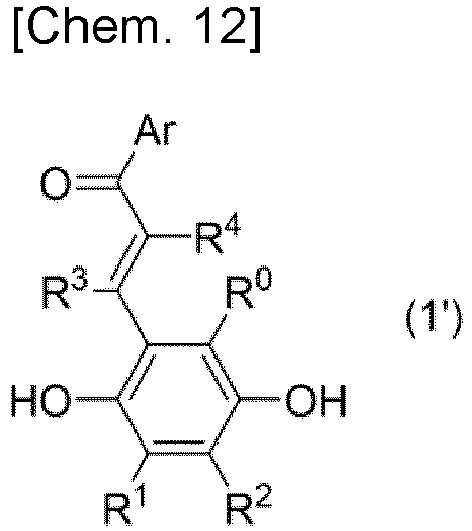 [In chemical formula (1') above, R0, R1, R2, R3 and R4 each independently represent a hydrogen atom, a halogen atom or a C1 to C8 alkyl group or a group represented by chemical formula (Z1) below. Ar represents a ring system selected from the group consisting of a monocyclic aromatic ring system, a polycyclic aromatic ring system and an annulated aromatic ring system whose ring-constituting atoms are atoms selected from the group consisting of a carbon atom, a nitrogen atom, an oxygen atom and a sulfur atom, with the monocyclic aromatic ring system, polycyclic aromatic ring system or annulated aromatic ring system optionally having a substituent..]
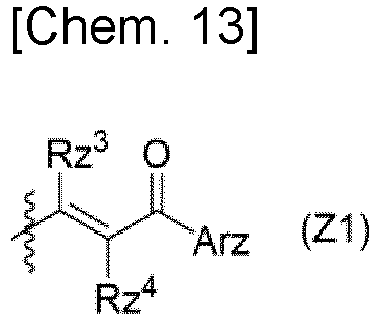 [In chemical formula (Z1) above, Rz3 and Rz4 each independently represent a hydrogen atom, a halogen atom or a C1 to C8 alkyl group.Arz represents a ring system selected from the group consisting of a monocyclic aromatic ring system, a polycyclic aromatic ring system and an annulated aromatic ring system whose ring-constituting atoms are atoms selected from the group consisting of a carbon atom, a nitrogen atom, an oxygen atom and a sulfur atom, with the monocyclic aromatic ring system, polycyclic aromatic ring system or annulated aromatic ring system optionally having a substituent. A wavy-lined portion represents a site of binding with a portion in formula (1) excluding R°, R1, R2, R3 or R4.]
 - A method for producing a dihydroxy compound, the method comprising allowing a dihydroxy compound indicated by chemical formula (3) below and a ketone indicated by chemical formula (4') below to react together to give a dihydroxy compound represented by chemical formula (1') below.
 [In chemical formula (3) above, R°, R1 and R7 each independently represent a hydrogen atom, a halogen atom or a C1 to C8 alkyl group.R2f represents a hydrogen atom, a halogen atom, a C1 to C8 alkyl group or a formyl group.]
 [In chemical formula (4') above, R8 represents a C1 to C8 alkyl group or a C1 to C6 haloalkyl group.Ar represents a ring system selected from the group consisting of a monocyclic aromatic ring system, a polycyclic aromatic ring system and an annulated aromatic ring system whose ring-constituting atoms are atoms selected from the group consisting of a carbon atom, a nitrogen atom, an oxygen atom and a sulfur atom, with the monocyclic aromatic ring system, polycyclic aromatic ring system and annulated aromatic ring system optionally having a substituent.]
 [In chemical formula (1') above, Ar represents a ring system selected from the group consisting of a monocyclic aromatic ring system, a polycyclic aromatic ring system and an annulated aromatic ring system whose ring-constituting atoms are atoms selected from the group consisting of a carbon atom, a nitrogen atom, an oxygen atom and a sulfur atom, with the monocyclic aromatic ring system, polycyclic aromatic ring system and annulated aromatic ring system optionally having a substituent.R°, R1, R2, R3 and R4 each independently represent a hydrogen atom, a halogen atom or a C1 to C8 alkyl group or a group represented by chemical formula (Z1) below.]
 [In formula (Z1) above, Rz3 and Rz4 each independently represent a hydrogen atom, a halogen atom or a C1 to C8 alkyl group.Arz represents a ring system selected from the group consisting of a monocyclic aromatic ring system, a polycyclic aromatic ring system and an annulated aromatic ring system whose ring-constituting atoms are atoms selected from the group consisting of a carbon atom, a nitrogen atom, an oxygen atom and a sulfur atom, with the monocyclic aromatic ring system, polycyclic aromatic ring system or annulated aromatic ring system optionally having a substituent. A wavy-lined portion represents a site of binding with a portion in formula (1) excluding R°, R1, R2, R3 or R4.]
Applications Claiming Priority (10)
| Application Number | Priority Date | Filing Date | Title |
|---|---|---|---|
| JP2021207755 | 2021-12-22 | ||
| JP2022050388 | 2022-03-25 | ||
| JP2022062204 | 2022-04-04 | ||
| JP2022117673 | 2022-07-25 | ||
| JP2022150482 | 2022-09-21 | ||
| JP2022170362 | 2022-10-25 | ||
| JP2022190544A JP2023143673A (en) | 2022-03-25 | 2022-11-29 | Main chain polymers, optical films, their production methods, and multilayer films |
| JP2022200615A JP2023093371A (en) | 2021-12-22 | 2022-12-15 | Photoreactive inverse wavelength dispersion polymers, monomers and optical films |
| JP2022202410A JP2023152652A (en) | 2022-04-04 | 2022-12-19 | Resin composition and optical film containing photoreactive polymer |
| PCT/JP2022/047334 WO2023120638A1 (en) | 2021-12-22 | 2022-12-22 | Main chain polymer, optical film, method for producing main chain polymer, method for producing optical film, and multilayer film |
Publications (2)
| Publication Number | Publication Date |
|---|---|
| EP4455128A1 true EP4455128A1 (en) | 2024-10-30 |
| EP4455128A4 EP4455128A4 (en) | 2025-12-24 |
Family
ID=86902735
Family Applications (1)
| Application Number | Title | Priority Date | Filing Date |
|---|---|---|---|
| EP22911340.2A Pending EP4455128A4 (en) | 2021-12-22 | 2022-12-22 | Main chain polymer, optical film, method for producing a main chain polymer, method for producing an optical film and multi-layer film |
Country Status (5)
| Country | Link |
|---|---|
| US (1) | US20250179243A1 (en) |
| EP (1) | EP4455128A4 (en) |
| KR (1) | KR20240117129A (en) |
| TW (1) | TW202344553A (en) |
| WO (1) | WO2023120638A1 (en) |
Family Cites Families (15)
| Publication number | Priority date | Publication date | Assignee | Title |
|---|---|---|---|---|
| JPS6172556U (en) | 1984-10-15 | 1986-05-17 | ||
| JPH08160430A (en) | 1994-12-02 | 1996-06-21 | Fuji Photo Film Co Ltd | Rubbing method and production of optical compensation sheet by using the same |
| EP1070731A1 (en) | 1999-07-23 | 2001-01-24 | Rolic AG | Compound |
| JP4907007B2 (en) | 2001-02-01 | 2012-03-28 | 林テレンプ株式会社 | Photoreactive polymer liquid crystal for birefringent film and birefringent film using the same |
| KR100934706B1 (en) * | 2006-12-07 | 2009-12-31 | 재단법인서울대학교산학협력재단 | Method for Screening Anti-cancer Compounds Inhibiting Functions of TM4SF5 and Anti-cancer Composition Containing Chalcone Compounds |
| JP5325733B2 (en) | 2009-03-31 | 2013-10-23 | 富士フイルム株式会社 | Optical film, retardation plate, polarizing plate, and liquid crystal display device comprising cellulose composition |
| US9733519B2 (en) | 2009-06-23 | 2017-08-15 | Nissan Chemical Industries, Ltd. | Composition for forming thermoset film having photo alignment properties |
| KR20120022504A (en) * | 2010-07-30 | 2012-03-12 | 서울대학교산학협력단 | Composition for diagnosing, treating and preventing hepatic disease |
| JP6268089B2 (en) | 2012-07-24 | 2018-01-24 | 日産化学工業株式会社 | Method for producing liquid crystal alignment film |
| US20180016502A1 (en) | 2015-01-16 | 2018-01-18 | Dic Corporation | Polymerizable composition and optically anisotropic body using same |
| KR102210179B1 (en) | 2016-11-29 | 2021-01-29 | 후지필름 가부시키가이샤 | Polymerizable liquid crystal composition, optically anisotropic film, optical film, polarizing plate, image display device, and organic electroluminescence display device |
| JP2018188529A (en) | 2017-04-28 | 2018-11-29 | 住友化学株式会社 | Liquid crystal polyester composition |
| CN110691999A (en) * | 2017-06-21 | 2020-01-14 | 富士胶片株式会社 | Phase difference plate for organic EL display device, and method for manufacturing phase difference plate |
| JP6773930B1 (en) | 2019-08-09 | 2020-10-21 | 住友化学株式会社 | Manufacturing method of liquid crystal polyester resin molded product, liquid crystal polyester resin pellet, and liquid crystal polyester resin pellet |
| JP6741835B1 (en) | 2019-08-09 | 2020-08-19 | 住友化学株式会社 | Liquid crystal polyester resin pellets and liquid crystal polyester resin moldings |
-
2022
- 2022-12-22 KR KR1020247022620A patent/KR20240117129A/en active Pending
- 2022-12-22 TW TW111149407A patent/TW202344553A/en unknown
- 2022-12-22 US US18/721,466 patent/US20250179243A1/en active Pending
- 2022-12-22 WO PCT/JP2022/047334 patent/WO2023120638A1/en not_active Ceased
- 2022-12-22 EP EP22911340.2A patent/EP4455128A4/en active Pending
Also Published As
| Publication number | Publication date |
|---|---|
| WO2023120638A1 (en) | 2023-06-29 |
| US20250179243A1 (en) | 2025-06-05 |
| EP4455128A4 (en) | 2025-12-24 |
| TW202344553A (en) | 2023-11-16 |
| KR20240117129A (en) | 2024-07-31 |
Similar Documents
| Publication | Publication Date | Title |
|---|---|---|
| JP7227345B2 (en) | optical lens | |
| KR102828066B1 (en) | polycyclic compound | |
| JP7405133B2 (en) | Thermoplastic resin, its manufacturing method, and optical lens | |
| EP1184401B1 (en) | Liquid crystalline polyester and method for producing the same | |
| TWI689528B (en) | Polycarbonate resin, molded products and optical films | |
| US20060004151A1 (en) | Copolymers containing indan moieties and blends thereof | |
| JP5437106B2 (en) | Polyester resin having a fluorene skeleton | |
| EP3749631B1 (en) | Triarylmethane compounds | |
| JP2013508498A (en) | Totally aromatic liquid crystal polyester resin compound, method for producing the resin compound, component for optical pickup, and method for producing the component | |
| WO2020079225A1 (en) | Polycyclic compounds | |
| EP4506392A1 (en) | Thermoplastic resin and optical lens including same | |
| EP2907835B1 (en) | Copolymer, optically anisotropic substance, and oriented polymer film | |
| US20250179243A1 (en) | Main chain polymer, optical film, method for producing main chain polymer, method for producing optical film, and multilayer film | |
| JP6155999B2 (en) | Resin molded body, film / lens, transparent conductive film, resin composition, polymer | |
| JP2023152652A (en) | Resin composition and optical film containing photoreactive polymer | |
| JP2025533627A (en) | Oligomeric binaphthyl compounds and thermoplastic resins | |
| CN118434793A (en) | Main chain polymer, optical film, method for producing the same, and multilayer film | |
| JP2022187901A (en) | Composition of polymer including photoreactive group, optical thin film | |
| JP7663200B2 (en) | Dibenzo[g,p]chrysene-based diol compound, polyester resin, and method for producing the same | |
| JP5567366B2 (en) | Resin composition and film | |
| JP2025112671A (en) | Terminally modified polymer and optical element | |
| WO2024237154A1 (en) | Thermoplastic resin and optical lens including same | |
| JP2023093371A (en) | Photoreactive inverse wavelength dispersion polymers, monomers and optical films | |
| EP1954764A2 (en) | Benzopyran colorants, method of manufacture, and method of use | |
| JP2025173829A (en) | Polyester resin and its manufacturing method |
Legal Events
| Date | Code | Title | Description |
|---|---|---|---|
| STAA | Information on the status of an ep patent application or granted ep patent |
Free format text: STATUS: THE INTERNATIONAL PUBLICATION HAS BEEN MADE |
|
| PUAI | Public reference made under article 153(3) epc to a published international application that has entered the european phase |
Free format text: ORIGINAL CODE: 0009012 |
|
| STAA | Information on the status of an ep patent application or granted ep patent |
Free format text: STATUS: REQUEST FOR EXAMINATION WAS MADE |
|
| 17P | Request for examination filed |
Effective date: 20240704 |
|
| AK | Designated contracting states |
Kind code of ref document: A1 Designated state(s): AL AT BE BG CH CY CZ DE DK EE ES FI FR GB GR HR HU IE IS IT LI LT LU LV MC ME MK MT NL NO PL PT RO RS SE SI SK SM TR |
|
| DAV | Request for validation of the european patent (deleted) | ||
| DAX | Request for extension of the european patent (deleted) | ||
| A4 | Supplementary search report drawn up and despatched |
Effective date: 20251120 |
|
| RIC1 | Information provided on ipc code assigned before grant |
Ipc: C07D 307/46 20060101AFI20251114BHEP Ipc: C07D 333/16 20060101ALI20251114BHEP Ipc: G02B 1/04 20060101ALI20251114BHEP Ipc: G02B 5/30 20060101ALI20251114BHEP Ipc: H05B 33/02 20060101ALI20251114BHEP Ipc: H10K 50/00 20230101ALI20251114BHEP |