EP4455116A1 - Process for the preparation of halodifluorobenzene - Google Patents
Process for the preparation of halodifluorobenzene Download PDFInfo
- Publication number
- EP4455116A1 EP4455116A1 EP23170073.3A EP23170073A EP4455116A1 EP 4455116 A1 EP4455116 A1 EP 4455116A1 EP 23170073 A EP23170073 A EP 23170073A EP 4455116 A1 EP4455116 A1 EP 4455116A1
- Authority
- EP
- European Patent Office
- Prior art keywords
- process according
- nano
- formula
- hbr
- bromo
- Prior art date
- Legal status (The legal status is an assumption and is not a legal conclusion. Google has not performed a legal analysis and makes no representation as to the accuracy of the status listed.)
- Pending
Links
Classifications
-
- C—CHEMISTRY; METALLURGY
- C07—ORGANIC CHEMISTRY
- C07C—ACYCLIC OR CARBOCYCLIC COMPOUNDS
- C07C17/00—Preparation of halogenated hydrocarbons
- C07C17/35—Preparation of halogenated hydrocarbons by reactions not affecting the number of carbon or of halogen atoms in the reaction
-
- C—CHEMISTRY; METALLURGY
- C07—ORGANIC CHEMISTRY
- C07C—ACYCLIC OR CARBOCYCLIC COMPOUNDS
- C07C209/00—Preparation of compounds containing amino groups bound to a carbon skeleton
- C07C209/68—Preparation of compounds containing amino groups bound to a carbon skeleton from amines, by reactions not involving amino groups, e.g. reduction of unsaturated amines, aromatisation, or substitution of the carbon skeleton
- C07C209/74—Preparation of compounds containing amino groups bound to a carbon skeleton from amines, by reactions not involving amino groups, e.g. reduction of unsaturated amines, aromatisation, or substitution of the carbon skeleton by halogenation, hydrohalogenation, dehalogenation, or dehydrohalogenation
-
- C—CHEMISTRY; METALLURGY
- C07—ORGANIC CHEMISTRY
- C07C—ACYCLIC OR CARBOCYCLIC COMPOUNDS
- C07C211/00—Compounds containing amino groups bound to a carbon skeleton
- C07C211/43—Compounds containing amino groups bound to a carbon skeleton having amino groups bound to carbon atoms of six-membered aromatic rings of the carbon skeleton
- C07C211/44—Compounds containing amino groups bound to a carbon skeleton having amino groups bound to carbon atoms of six-membered aromatic rings of the carbon skeleton having amino groups bound to only one six-membered aromatic ring
- C07C211/52—Compounds containing amino groups bound to a carbon skeleton having amino groups bound to carbon atoms of six-membered aromatic rings of the carbon skeleton having amino groups bound to only one six-membered aromatic ring the carbon skeleton being further substituted by halogen atoms or by nitro or nitroso groups
-
- C—CHEMISTRY; METALLURGY
- C07—ORGANIC CHEMISTRY
- C07C—ACYCLIC OR CARBOCYCLIC COMPOUNDS
- C07C25/00—Compounds containing at least one halogen atom bound to a six-membered aromatic ring
- C07C25/02—Monocyclic aromatic halogenated hydrocarbons
- C07C25/13—Monocyclic aromatic halogenated hydrocarbons containing fluorine
Definitions
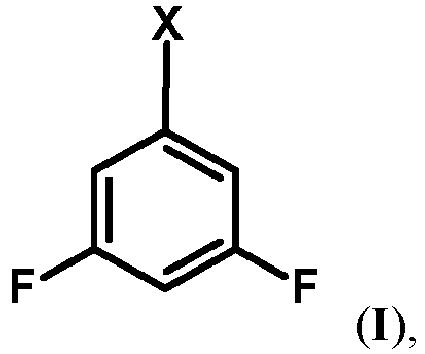
- the present invention relates to a novel process for preparing 1-halo-3,5-difluorobenzene of the formula (I) .
- 1-Halo-3,5-difluorobenzene of the formula (I) is an important precursor for the preparation of agrochemical compounds, e.g., for the chemical class of isooxazoline carboxamides which are very potent herbicides (e.g.: WO2018/228985 , WO2018/228986 ).
- An object of the present invention is providing a cost-effective process for preparing 1-halo-3,5-difluorobenzene that can be used on industrial scale without the above-mentioned disadvantages.
- the object is achieved by a process for preparing 1-halo-3,5-difluorobenzene of the formula (I) characterized in that compounds of the general formula (II) react in a first step in the presence of bromine or chlorine or a combination of a bromine or chlorine source and an oxidizing agent to compounds of the general formula (III) wherein
- reaction according to the invention is performed with X is bromo.
- reaction according to the invention is performed with Br 2 as halogenating agent in step 1.
- reaction according to the invention is performed with Br 2 / H 2 O 2 , Br 2 /Oxone or Br 2 / NaOCl as halogenating agent in step 1.
- reaction according to the invention is performed with NaBr or KBr/ H 2 O 2 , NaBr or KBr/ Oxone, NaBr or KBr/ NaOCl as halogenating agent in step 1.
- reaction according to the invention is performed with HBr/H 2 O 2 , HBr /Oxone or HBr/ NaOCl as halogenating agent in step 1.
- reaction according to the invention is performed with HCl, Cu 2 O or CuO, NaNO 2 and 2-PrOH as reagent in step 2.
- reaction according to the invention is performed with CuCl or CuCl 2 , NaNO 2 and 2-PrOH as reagent in step 2.
- reaction according to the invention is performed with CuSO 4 , NaNO 2 and 2-PrOH as reagent in step 2.
- the present invention has the advantage, that the halogenation is conducted with high atom efficiency and minimum waste production. It also leads to increased yield for the deamination step and in addition higher catalyst flexibility and process robustness.
- the reaction scheme shows the two-step synthesis according to the invention.
- Process for preparing 1-halo-3,5-difluorobenzene of the formula (I) characterized in that compounds of the general formula ( II ) react in a first step in the presence a bromine or chlorine source and an oxidizing agent to compounds of the general formula (III) and is in a second step is further converted to compounds of the formula (I) in the presence of a nitrite source, a copper catalyst and a secondary alcohol that can be oxidized.
- stochiometric amounts of acid for example H 2 SO 4 , HCl, HBr, H 3 PO 4 or boric acid are added.
- the halogenation is usually performed in a temperature range from -10°C to 60°C, preferably -5°C to 50°C, particularly preferably 0 to 40°C.
- the halogenation is furthermore performed in the presence of a solvent or diluent, preferred solvents being, water, toluene, chlorobenzene, ethyl acetate, isopropyl acetate, methyl-tert-butyl ether, cylopentylmethylether, methyl-tetrahydrofuran, tert-amylmethylether, Dichloromethane, Dichloroethane or mixtures of the above mentioned solvents.
- a solvent or diluent preferred solvents being, water, toluene, chlorobenzene, ethyl acetate, isopropyl acetate, methyl-tert-butyl ether, cylopentylmethylether, methyl-tetrahydrofuran, tert-amylmethylether, Dichloromethane, Dichloroethane or mixtures of the above mentioned solvents.
- sodium nitrite (NaNO 2 ) or potassium nitrite (KNO 2 ) is used as nitrite source, preferably sodium nitrite is used.
- the reductive deamination is usually performed in a temperature range from -10°C to 40°C, preferably - 0°C to 50°C, particularly preferably 0 to 30°C.
- the reductive deamination is furthermore performed in the presence of a solvent or dilutent, preferred solvents are water, aqueous solutions of HBr or HCl or mixtures of those.
- the products were characterized by 1 H spectroscopy and/or HPLC and/or GC-MS (Liquid Chromatography Mass Spectrometry) and / or GC
- the NMR spectra were determined using a ECZL 400S NMR (JEOL 40 MHz NMR).
- the GC chromatograms were measured on Shimadzu instrument, connected to a mass detector.
- the aqueous phase is extracted with MTBE.
- the combined organic layers are evaporated to yield the 320 g of 5-Bromo-2,4-difluoroaniline which is dissolved in 231 g isopropyl alcohol and directly used for the next step without further purification.
- a flask is charged with 936 g 30% HCl, followed by 7.6 g of CuCl, 222 g of water and then 320 g of 5-Bromo-2,4-difluoroaniline which is dissolved in 231 g isopropyl alcohol (step 1). Stirring for 1 hour at 25°C and then cooling to 0°C. Then 318 g of a 40% NaNO 2 solution (127.2 g NaNO 2 and 190.8 g water) at 0 to 2°C is added over 4 hours. Further stirring for 30 minutes at 0°C to 2 °C. Then raise temperature slowly to 25°C and stir for 3 to 4 hours. Then 1000 g water is added. Stirring for 15 minutes at 25°C.
Landscapes
- Chemical & Material Sciences (AREA)
- Organic Chemistry (AREA)
- Chemical Kinetics & Catalysis (AREA)
- Organic Low-Molecular-Weight Compounds And Preparation Thereof (AREA)
- Low-Molecular Organic Synthesis Reactions Using Catalysts (AREA)
Abstract
The present invention relates to a novel process for preparing 1-halo-3,5-difluorobenzene of the formula (I).
Description
- The present invention relates to a novel process for preparing 1-halo-3,5-difluorobenzene of the formula (I).
- The synthesis of 1-bromo-3,5-difluorobenzene of the formula (I) has already been described in
US patent 5,977,412 starting from 2-bromo-4,6-difluoroaniline. A recent publication for the synthesis of 1-bromo-3,5-difluorobenzene starting from 2,4-difluoroaniline isCN105949067 . - 1-Halo-3,5-difluorobenzene of the formula (I) is an important precursor for the preparation of agrochemical compounds, e.g., for the chemical class of isooxazoline carboxamides which are very potent herbicides (e.g.:
WO2018/228985 ,WO2018/228986 ). - In order to prepare 1-bromo-3,5-difluorobenzene according to the procedure disclosed in
US patent 5,977,412 2 CN105949067 the reaction is performed in aqueous medium, too. The disadvantage is that more than stoichiometric amounts of the reagents are need and a pollution of the water is the consequence. - An object of the present invention is providing a cost-effective process for preparing 1-halo-3,5-difluorobenzene that can be used on industrial scale without the above-mentioned disadvantages.
- The object is achieved by a process for preparing 1-halo-3,5-difluorobenzene of the formula (I)

to compounds of the general formula (III)
- X is bromo or chloro,
- and in a second step, is further converted to compounds of the formula (I) in the presence of a nitrite source, a copper catalyst and a secondary alcohol that can be oxidized.
- In a preferred embodiment the reaction according to the invention is performed with
X is bromo. - In another preferred embodiment the reaction according to the invention is performed with
Br2 as halogenating agent in step 1. - In another preferred embodiment the reaction according to the invention is performed with
Br2 / H2O2, Br2 /Oxone or Br2 / NaOCl as halogenating agent in step 1. - In another preferred embodiment the reaction according to the invention is performed with NaBr or KBr/ H2O2, NaBr or KBr/ Oxone, NaBr or KBr/ NaOCl as halogenating agent in step 1.
- In another preferred embodiment the reaction according to the invention is performed with HBr/H2O2, HBr /Oxone or HBr/ NaOCl as halogenating agent in step 1.
- In another preferred embodiment the reaction according to the invention is performed with HCl, Cu2O or CuO, NaNO2 and 2-PrOH as reagent in step 2.
- In another preferred embodiment the reaction according to the invention is performed with CuCl or CuCl2, NaNO2 and 2-PrOH as reagent in step 2.
- In another preferred embodiment the reaction according to the invention is performed with CuSO4, NaNO2 and 2-PrOH as reagent in step 2.
- The present invention has the advantage, that the halogenation is conducted with high atom efficiency and minimum waste production. It also leads to increased yield for the deamination step and in addition higher catalyst flexibility and process robustness.
- The reaction scheme shows the two-step synthesis according to the invention.

- Process for preparing 1-halo-3,5-difluorobenzene of the formula (I), characterized in that compounds of the general formula (II) react in a first step in the presence a bromine or chlorine source and an oxidizing agent to compounds of the general formula (III) and is in a second step is further converted to compounds of the formula (I) in the presence of a nitrite source, a copper catalyst and a secondary alcohol that can be oxidized.
- In the process according to the invention 0.45 to 1.5, preferably 0.55 to 1.2 equivalents bromine or chlorine source is used.
- In the process according to the invention 0.9 to 1.5, preferably 0.99 to 1.2 equivalents H2O2 is used.
- In the process according to the invention 0.9 to 1.5, preferably 0.99 to 1.2 equivalents HBr is used.
- In the process according to the invention 0.9 to 1.5, preferably 0.99 to 1.2 equivalents H2O2 is used.
- In the process according to the invention 0.9 to 1.5, preferably 0.99 to 1.2 equivalents NaBr or KBr is used.
- In a preferred embodiment, stochiometric amounts of acid, for example H2SO4, HCl, HBr, H3PO4 or boric acid are added.
- These stoichiometric quantities can be applied analogously for the other oxidizing agents as mentioned above.For reactions with Br2
- In the process according to the invention 0.90 to 1.5, preferably 0.99 to 1.2 equivalents Br2 is used.
- In the process according to the invention 0.40 to 0.6 , preferably 0.45 to 0.55 equivalents Br2 is used.
- In the process according to the invention 0.45 to 0.65, preferably 0.50 to 0.60 equivalents H2O2 is used.
- The halogenation is usually performed in a temperature range from -10°C to 60°C, preferably -5°C to 50°C, particularly preferably 0 to 40°C.
- The halogenation is furthermore performed in the presence of a solvent or diluent, preferred solvents being, water, toluene, chlorobenzene, ethyl acetate, isopropyl acetate, methyl-tert-butyl ether, cylopentylmethylether, methyl-tetrahydrofuran, tert-amylmethylether, Dichloromethane, Dichloroethane or mixtures of the above mentioned solvents.
- In the process according to the invention 0.01 to 0.5 equivalents. , preferably 0.05 to 0.1 equivalents copper reagent is used.
- In the process according to the invention 0.95 to 1.2 equivalents , preferably 0.99 to 1.1 equivalents of the nitrite source are used.
- In the process according to the invention sodium nitrite (NaNO2) or potassium nitrite (KNO2) is used as nitrite source, preferably sodium nitrite is used.
- In the process according to the invention as oxidizable alcohol 2-propanol or 2-butanol is used, preferably 2-propanol is used.
- The reductive deamination is usually performed in a temperature range from -10°C to 40°C, preferably - 0°C to 50°C, particularly preferably 0 to 30°C.
- The reductive deamination is furthermore performed in the presence of a solvent or dilutent, preferred solvents are water, aqueous solutions of HBr or HCl or mixtures of those.
- The present invention is elucidated in more detail by the examples that follow, without restriction of the invention thereto.
- The products were characterized by 1H spectroscopy and/or HPLC and/or GC-MS (Liquid Chromatography Mass Spectrometry) and / or GC
- The NMR spectra were determined using a ECZL 400S NMR (JEOL 40 MHz NMR).
- The GC chromatograms were measured on Shimadzu instrument, connected to a mass detector.
- To 200 g 2,4-difluoroaniline in a two-liter reactor is added 300 g of a 47% HBr solution over a time period of 15 minutes at a temperature of 28 to 30°C. Furthermore 188 g of MTBE (Methyl-tert-butylether) and 240 g of water is added at that temperature. Stirring is continued for further 15 minutes. Then 125 g of a 48 % H2O2 solution is added at 30 to 32 °C over 2 hours. It is stirred for 4 hours. Then the reaction mixture is cooled to 15°C, 296 g of MTBE is added. It is stirred for 30 minutes. Then stirring is stopped and the separation of phases is awaited for 30 minutes. The aqueous phase is extracted with MTBE. The combined organic layers are evaporated to yield the 320 g of 5-Bromo-2,4-difluoroaniline which is dissolved in 231 g isopropyl alcohol and directly used for the next step without further purification.
- In accordance with example 1.1 (Step 1), the following examples have been prepared:
Example Bromine Source Oxidant Additive Solvent Yield 1.2a) NaBr H2O2 H2SO4 /H2O 90% 1.3 NaBr H2O2 Boric acid + H2SO4 H2O 97% 1.4a) NaBr H2O2 H2SO4 MTBE/H2O 89% 1.5b) NaBr H2O2 H2SO4 MTBE/H2O 94% 1.6 HBr H2O2 - H2O 92% 1.7 HBr H2O2 - MTBE/H2O 99% a) H2SO4 added after H2O2 addition. b) Addition of H2SO4 followed by H2O2. - A flask is charged with 936 g 30% HCl, followed by 7.6 g of CuCl, 222 g of water and then 320 g of 5-Bromo-2,4-difluoroaniline which is dissolved in 231 g isopropyl alcohol (step 1). Stirring for 1 hour at 25°C and then cooling to 0°C. Then 318 g of a 40% NaNO2 solution (127.2 g NaNO2 and 190.8 g water) at 0 to 2°C is added over 4 hours. Further stirring for 30 minutes at 0°C to 2 °C. Then raise temperature slowly to 25°C and stir for 3 to 4 hours. Then 1000 g water is added. Stirring for 15 minutes at 25°C. Then 888 g MTBE is added and stirring for 30 minutes at 25°C. Wait for settling for 30 minutes. Then separation of phases. Aqueous phase is extracted with MTBE. Organic phases are combined. The solvent is distilled off. The product is distilled out of the crude to yield a colourless liquid. (256 g , GC purity > 98% 86% over two steps).
- GC-MS: 113.05 (192/194, M+)
- 1H-NMR (CDCl3): 7.10 - 7.05 (m, 2H), 6.78 (tt, 1H) ppm.
- In accordance with example 1.2 (Step 2), the following examples have been prepared:
Example Nitrite Source Catalyst (eq) Alcohol Solvent Yield over 2 Steps Preparation of 1-Bromo-3,5-difluorobenzene according to US patent - 5,977,412 14% Preparation of 1-Bromo-3,5-difluorobenzene according to CN105949067 .19-20% 2.2 NaNO2 CuCl2 (0.05) iPrOH HCl 86% 2.3 NaNO2 Cu2O (0.05) iPrOH HCl 83% 2.4 NaNO2 CuSO4 (0.05) iPrOH HCl 86% 2.5 NaNO2 CuCl (0.025) iPrOH HCl 87% 2.6a) NaNO2 CuCl (0.05) iPrOH HCl 68% 2.7b) NaNO2 CuCl (0.05) iPrOH HCl 72% 2.8c) NaNO2 CuCl (0.05) iPrOH HCl 87% a) Direct use of reaction mixture from example 1.5 without intermediate work-up. b) Extraction of product from step 1 with HCl required for step 2.
Claims (9)
- Process for preparing 1-halo-3,5-difluorobenzene of the formula (I)


to compounds of the formula (III) X is bromo or chloro,and is, in a second step, further converted to compounds of the formula (I) in the presence of a nitrite source, a copper catalyst and a secondary alcohol that can be oxidized.
 - Process according to Claim 1,
wherein X is bromo. - Process according to Claim 1, wherein the reaction according to the invention is performed with Br2 as halogenating agent in step 1.
- Process according to Claim 1, wherein the reaction according to the invention is performed with Br2 / H2O2, Br2 /Oxone or Br2 / NaOCl as halogenating agent in step 1.
- Process according to Claim 1, wherein the reaction according to the invention is performed with NaBr or KBr/ H2O2,NaBr or KBr/ Oxone, NaBr or KBr/ NaOCl as halogenating agent in step 1.
- Process according to Claim 1, wherein the reaction according to the invention is performed with HBr/H2O2, HBr /Oxone or HBr/ NaOCl as halogenating agent in step 1.
- Process according to Claim 1, wherein the reaction according to the invention is performed with HCl, Cu2O or CuO, NaNO2 and 2-PrOH as reagent in step 2.
- Process according to Claim 1, wherein the reaction according to the invention is performed with CuCl or CuCl2, NaNO2 and 2-PrOH as reagent in step 2.
- Process according to Claim 1, wherein the reaction according to the invention is performed with CuSO4, NaNO2 and 2-PrOH as reagent in step 2.
Priority Applications (8)
| Application Number | Priority Date | Filing Date | Title |
|---|---|---|---|
| EP23170073.3A EP4455116A1 (en) | 2023-04-26 | 2023-04-26 | Process for the preparation of halodifluorobenzene |
| JP2025562541A JP2026513416A (en) | 2023-04-26 | 2024-04-22 | Method for preparing halodifluorobenzene |
| EP24722130.2A EP4702001A1 (en) | 2023-04-26 | 2024-04-22 | Process for the preparation of halodifluorobenzene |
| CN202480028015.0A CN121001983A (en) | 2023-04-26 | 2024-04-22 | Methods for preparing halodifluorobenzenes |
| PCT/EP2024/060879 WO2024223459A1 (en) | 2023-04-26 | 2024-04-22 | Process for the preparation of halodifluorobenzene |
| KR1020257038978A KR20260003040A (en) | 2023-04-26 | 2024-04-22 | Method for producing halodifluorobenzene |
| TW113115196A TW202506612A (en) | 2023-04-26 | 2024-04-24 | Process for the preparation of halodifluorobenzene |
| IL324149A IL324149A (en) | 2023-04-26 | 2025-10-22 | Process for preparing halodifluorobenzene |
Applications Claiming Priority (1)
| Application Number | Priority Date | Filing Date | Title |
|---|---|---|---|
| EP23170073.3A EP4455116A1 (en) | 2023-04-26 | 2023-04-26 | Process for the preparation of halodifluorobenzene |
Publications (1)
| Publication Number | Publication Date |
|---|---|
| EP4455116A1 true EP4455116A1 (en) | 2024-10-30 |
Family
ID=86226991
Family Applications (2)
| Application Number | Title | Priority Date | Filing Date |
|---|---|---|---|
| EP23170073.3A Pending EP4455116A1 (en) | 2023-04-26 | 2023-04-26 | Process for the preparation of halodifluorobenzene |
| EP24722130.2A Pending EP4702001A1 (en) | 2023-04-26 | 2024-04-22 | Process for the preparation of halodifluorobenzene |
Family Applications After (1)
| Application Number | Title | Priority Date | Filing Date |
|---|---|---|---|
| EP24722130.2A Pending EP4702001A1 (en) | 2023-04-26 | 2024-04-22 | Process for the preparation of halodifluorobenzene |
Country Status (7)
| Country | Link |
|---|---|
| EP (2) | EP4455116A1 (en) |
| JP (1) | JP2026513416A (en) |
| KR (1) | KR20260003040A (en) |
| CN (1) | CN121001983A (en) |
| IL (1) | IL324149A (en) |
| TW (1) | TW202506612A (en) |
| WO (1) | WO2024223459A1 (en) |
Citations (6)
| Publication number | Priority date | Publication date | Assignee | Title |
|---|---|---|---|---|
| US5977412A (en) | 1998-08-14 | 1999-11-02 | Basf Corporation | Process for preparing 3,5-difluoroaniline |
| WO2001014311A1 (en) * | 1999-08-24 | 2001-03-01 | Rhodia Chimie | Method for monohalogenating aminoaromatic derivatives |
| CN105949067A (en) | 2016-05-06 | 2016-09-21 | 蚌埠中实化学技术有限公司 | Preparation method of 3,5-difluoroaniline |
| WO2018228985A1 (en) | 2017-06-13 | 2018-12-20 | Bayer Aktiengesellschaft | Herbicidally active 3-phenylisoxazoline-5-carboxamides of tetrahydro and dihydrofuran carboxylic acids and esters |
| WO2018228986A1 (en) | 2017-06-13 | 2018-12-20 | Bayer Aktiengesellschaft | Herbicidally active 3-phenylisoxazoline-5-carboxamides of tetrahydro and dihydrofuran carboxamides |
| IN201911003809A (en) * | 2019-01-31 | 2020-08-28 | Srf Ltd |
-
2023
- 2023-04-26 EP EP23170073.3A patent/EP4455116A1/en active Pending
-
2024
- 2024-04-22 EP EP24722130.2A patent/EP4702001A1/en active Pending
- 2024-04-22 JP JP2025562541A patent/JP2026513416A/en active Pending
- 2024-04-22 KR KR1020257038978A patent/KR20260003040A/en active Pending
- 2024-04-22 WO PCT/EP2024/060879 patent/WO2024223459A1/en not_active Ceased
- 2024-04-22 CN CN202480028015.0A patent/CN121001983A/en active Pending
- 2024-04-24 TW TW113115196A patent/TW202506612A/en unknown
-
2025
- 2025-10-22 IL IL324149A patent/IL324149A/en unknown
Patent Citations (6)
| Publication number | Priority date | Publication date | Assignee | Title |
|---|---|---|---|---|
| US5977412A (en) | 1998-08-14 | 1999-11-02 | Basf Corporation | Process for preparing 3,5-difluoroaniline |
| WO2001014311A1 (en) * | 1999-08-24 | 2001-03-01 | Rhodia Chimie | Method for monohalogenating aminoaromatic derivatives |
| CN105949067A (en) | 2016-05-06 | 2016-09-21 | 蚌埠中实化学技术有限公司 | Preparation method of 3,5-difluoroaniline |
| WO2018228985A1 (en) | 2017-06-13 | 2018-12-20 | Bayer Aktiengesellschaft | Herbicidally active 3-phenylisoxazoline-5-carboxamides of tetrahydro and dihydrofuran carboxylic acids and esters |
| WO2018228986A1 (en) | 2017-06-13 | 2018-12-20 | Bayer Aktiengesellschaft | Herbicidally active 3-phenylisoxazoline-5-carboxamides of tetrahydro and dihydrofuran carboxamides |
| IN201911003809A (en) * | 2019-01-31 | 2020-08-28 | Srf Ltd |
Also Published As
| Publication number | Publication date |
|---|---|
| IL324149A (en) | 2025-12-01 |
| CN121001983A (en) | 2025-11-21 |
| JP2026513416A (en) | 2026-04-24 |
| WO2024223459A1 (en) | 2024-10-31 |
| KR20260003040A (en) | 2026-01-06 |
| EP4702001A1 (en) | 2026-03-04 |
| TW202506612A (en) | 2025-02-16 |
Similar Documents
| Publication | Publication Date | Title |
|---|---|---|
| KR100220645B1 (en) | Method for producing benzene derivative | |
| WO2024223459A1 (en) | Process for the preparation of halodifluorobenzene | |
| Yang et al. | New preparation of difluoroiodomethylsulfanylbenzenes and their radical addition to unsaturated compounds initiated by sodium dithionite | |
| EP0851852B1 (en) | Process for nitrating diphenyl ether compounds | |
| KR100418355B1 (en) | Process for preparing aryl bromide derivatives | |
| WO2017014214A1 (en) | Method for producing 4-(trifluoromethylsulfonyl)phenol compound | |
| CN111072476B (en) | Method for highly selective monofluoromethylation of β-ketoester compounds on oxygen | |
| US20040242942A1 (en) | Process for producing 2,5-bis(trifluoromethyl)nitrobenzene | |
| US7282610B2 (en) | Method of producing aromatic amine compound having alkylthio group | |
| EP1013651B1 (en) | O-(perfluoroalkyl)dibenzofuranium salt derivatives, intermediates for the preparation of the same, process for the preparation of the intermediates, perfluoroalkylating agents, and process for perfluoroalkylation | |
| CN115613058B (en) | A method for electrocatalytic synthesis of 1-iodine acetylenic compounds | |
| JP3268459B2 (en) | Method for producing acetophenones | |
| JP3641836B2 (en) | (Perfluoroalkoxy) biphenyldiazonium compound, production intermediate thereof, and perfluoroalkylation method | |
| US4306102A (en) | P-Tert.butylbenzotribromide and p-tert.butylbenzoyl bromide and process for their manufacture | |
| JP4022929B2 (en) | Method for producing 3,5-bis (trifluoromethyl) nitrobenzene | |
| CN100509737C (en) | Process for producing 2,6-chlorophenesic compound | |
| JP6156696B2 (en) | 1-Bromo-1-fluorobis (phenylsulfonyl) methane, method for producing the same, and method for producing 1-fluorobis (phenylsulfonyl) methane using the same | |
| CN115490597B (en) | Synthetic method of fluorotoluene derivative | |
| CN110683949B (en) | Method for preparing 9, 10-phenanthrene dicarboxylic ester compound | |
| JPS60178829A (en) | Production of fluorine-containing aromatic compound derivative | |
| Ubysz | Transition Metal-Free Hydroxylation of (Hetero) aromatic Halides | |
| JP2006188501A (en) | Method for producing brominated dialkyl ketone compound | |
| KR880000200B1 (en) | Process for the preparation of p-chlorobenzene | |
| CN120518480A (en) | Preparation method of m-nitroacetylene | |
| DE10309645A1 (en) | Process for the preparation of a- (3-arylthio) acetophenones |
Legal Events
| Date | Code | Title | Description |
|---|---|---|---|
| PUAI | Public reference made under article 153(3) epc to a published international application that has entered the european phase |
Free format text: ORIGINAL CODE: 0009012 |
|
| STAA | Information on the status of an ep patent application or granted ep patent |
Free format text: STATUS: THE APPLICATION HAS BEEN PUBLISHED |
|
| AK | Designated contracting states |
Kind code of ref document: A1 Designated state(s): AL AT BE BG CH CY CZ DE DK EE ES FI FR GB GR HR HU IE IS IT LI LT LU LV MC ME MK MT NL NO PL PT RO RS SE SI SK SM TR |