EP4454740A1 - Naturinspirierte stalactitnanostrukturen wie nanoporen zur biosensing und energiegewinnung - Google Patents
Naturinspirierte stalactitnanostrukturen wie nanoporen zur biosensing und energiegewinnung Download PDFInfo
- Publication number
- EP4454740A1 EP4454740A1 EP23170779.5A EP23170779A EP4454740A1 EP 4454740 A1 EP4454740 A1 EP 4454740A1 EP 23170779 A EP23170779 A EP 23170779A EP 4454740 A1 EP4454740 A1 EP 4454740A1
- Authority
- EP
- European Patent Office
- Prior art keywords
- template
- pore
- compartment
- electrolyte
- aperture
- Prior art date
- Legal status (The legal status is an assumption and is not a legal conclusion. Google has not performed a legal analysis and makes no representation as to the accuracy of the status listed.)
- Withdrawn
Links
Images













Classifications
-
- B—PERFORMING OPERATIONS; TRANSPORTING
- B01—PHYSICAL OR CHEMICAL PROCESSES OR APPARATUS IN GENERAL
- B01D—SEPARATION
- B01D67/00—Processes specially adapted for manufacturing semi-permeable membranes for separation processes or apparatus
- B01D67/0039—Inorganic membrane manufacture
- B01D67/0072—Inorganic membrane manufacture by deposition from the gaseous phase, e.g. sputtering, CVD, PVD
-
- B—PERFORMING OPERATIONS; TRANSPORTING
- B01—PHYSICAL OR CHEMICAL PROCESSES OR APPARATUS IN GENERAL
- B01D—SEPARATION
- B01D69/00—Semi-permeable membranes for separation processes or apparatus characterised by their form, structure or properties; Manufacturing processes specially adapted therefor
- B01D69/02—Semi-permeable membranes for separation processes or apparatus characterised by their form, structure or properties; Manufacturing processes specially adapted therefor characterised by their properties
-
- B—PERFORMING OPERATIONS; TRANSPORTING
- B01—PHYSICAL OR CHEMICAL PROCESSES OR APPARATUS IN GENERAL
- B01D—SEPARATION
- B01D69/00—Semi-permeable membranes for separation processes or apparatus characterised by their form, structure or properties; Manufacturing processes specially adapted therefor
- B01D69/10—Supported membranes; Membrane supports
- B01D69/105—Support pretreatment
-
- B—PERFORMING OPERATIONS; TRANSPORTING
- B01—PHYSICAL OR CHEMICAL PROCESSES OR APPARATUS IN GENERAL
- B01D—SEPARATION
- B01D71/00—Semi-permeable membranes for separation processes or apparatus characterised by the material; Manufacturing processes specially adapted therefor
- B01D71/02—Inorganic material
- B01D71/024—Oxides
-
- F—MECHANICAL ENGINEERING; LIGHTING; HEATING; WEAPONS; BLASTING
- F03—MACHINES OR ENGINES FOR LIQUIDS; WIND, SPRING, OR WEIGHT MOTORS; PRODUCING MECHANICAL POWER OR A REACTIVE PROPULSIVE THRUST, NOT OTHERWISE PROVIDED FOR
- F03G—SPRING, WEIGHT, INERTIA OR LIKE MOTORS; MECHANICAL-POWER PRODUCING DEVICES OR MECHANISMS, NOT OTHERWISE PROVIDED FOR OR USING ENERGY SOURCES NOT OTHERWISE PROVIDED FOR
- F03G7/00—Mechanical-power-producing mechanisms, not otherwise provided for or using energy sources not otherwise provided for
- F03G7/008—Mechanical-power-producing mechanisms, not otherwise provided for or using energy sources not otherwise provided for characterised by the actuating element
- F03G7/015—Actuators using the difference in osmotic pressure between fluids
-
- G—PHYSICS
- G01—MEASURING; TESTING
- G01N—INVESTIGATING OR ANALYSING MATERIALS BY DETERMINING THEIR CHEMICAL OR PHYSICAL PROPERTIES
- G01N33/00—Investigating or analysing materials by specific methods not covered by groups G01N1/00 - G01N31/00
- G01N33/48—Biological material, e.g. blood, urine; Haemocytometers
- G01N33/483—Physical analysis of biological material
- G01N33/487—Physical analysis of biological material of liquid biological material
- G01N33/48707—Physical analysis of biological material of liquid biological material by electrical means
- G01N33/48721—Investigating individual macromolecules, e.g. by translocation through nanopores
-
- B—PERFORMING OPERATIONS; TRANSPORTING
- B01—PHYSICAL OR CHEMICAL PROCESSES OR APPARATUS IN GENERAL
- B01D—SEPARATION
- B01D2325/00—Details relating to properties of membranes
- B01D2325/02—Details relating to pores or porosity of the membranes
- B01D2325/021—Pore shapes
- B01D2325/0214—Tapered pores
-
- B—PERFORMING OPERATIONS; TRANSPORTING
- B01—PHYSICAL OR CHEMICAL PROCESSES OR APPARATUS IN GENERAL
- B01D—SEPARATION
- B01D2325/00—Details relating to properties of membranes
- B01D2325/08—Patterned membranes
-
- H—ELECTRICITY
- H01—ELECTRIC ELEMENTS
- H01M—PROCESSES OR MEANS, e.g. BATTERIES, FOR THE DIRECT CONVERSION OF CHEMICAL ENERGY INTO ELECTRICAL ENERGY
- H01M8/00—Fuel cells; Manufacture thereof
- H01M8/22—Fuel cells in which the fuel is based on materials comprising carbon or oxygen or hydrogen and other elements; Fuel cells in which the fuel is based on materials comprising only elements other than carbon, oxygen or hydrogen
- H01M8/227—Dialytic cells or batteries; Reverse electrodialysis cells or batteries
Definitions
- the present invention relates to a method of forming a structure, preferably a pore, according to claim 1, an assembly comprising a template and a structure, in particular a pore, formed in the said method according to claim 11, an osmotic power generator comprising said assembly according to claim 12, a method of generating osmotic power using said osmotic power generator according to claim 13, a sensing device for sensing an analyte comprising said assembly according to claim 14, and a method of sensing an analyte using said sensing device according to claim 15.
- Nanopores hold great potential in a wide range of applications, such as biomolecules' sequencing', energy harvesting and generation 2,3 , bio-inspired iontronics 4,5 , biosensing 6 , chemical separation 7,8 , and nanofluidics 9 .
- biomolecules' sequencing', energy harvesting and generation 2,3 bio-inspired iontronics 4,5
- biosensing 6 chemical separation 7,8
- nanofluidics 9 nanofluidics 9 .
- the various applications require the pores to be adjustable, ion-selective, scalable, stable, and affordable 6 .
- a method of forming a structure preferably a pore.
- the method comprises the steps of i) providing a template comprising at least one template aperture, and ii) growing at least one material at an orifice of the template aperture by depositing the material, whereby the structure is formed.
- the present invention is based on the insight that structures such as pores can be grown and thus formed by depositing at least one material the structure such as the pore shall comprise or consist of at an orifice of a template aperture of a template.
- a preferred structure according to the invention is a pore.
- the pore preferably comprises a pore opening and thus preferably is a hollow structure.
- the structure does not comprise any such opening or is not hollow, respectively. That is, the structure can be a solid structure.
- the deposition of the material resulting in the growth and thus formation of the structure such as the pore preferably occurs in a tailored Atomic Layer Deposition process and particularly preferably in conditions of anisotropic growth.
- the structure such as the pore is formed by depositing the material via said tailored Atomic Layer Deposition (ALD) process, wherein the structure such as the pore is grown in a stepwise manner i.e. in multiple growth cycles.
- said tailored Atomic Layer Deposition process is referred to as a non-ALD process.
- the resulting structure such as the pore is asymmetric, wherein its aspect ratio is determined by the number of growth cycles, with a final structure such as a final pore size being preferably smaller than the initial size of the orifice of the template aperture.
- structures such as pores of a size in the nanometer range can be formed, i.e. the method of the invention enables the formation of nanostructures such as nanopores.
- structures such as pores of another size such as in the micrometer range can likewise be formed, i.e. the method of the invention enables the formation of microstructures such as micropores.
- the method of the invention allows the formation of structures such as pores of a desired size, wherein the size can be determined by the number of growth cycles and/or the initial size of the orifice of the template aperture.
- the material is preferably also deposited and grown on regions of the template other than the region comprising the orifice of the template aperture, see further below.
- Said deposition preferably occurs in an ALD process as it is well known in the art, herein called standard ALD process.
- standard ALD a linear deposition and thus isotropic growth of the material occurs.
- Said linear deposition or isotropic growth preferably results in the formation of a layer.
- the non-ALD process of the present invention wherein an anisotropic growth of the material occurs thus allowing the formation of the structure such as the pore.
- the growth rate of the material associated with the non-ALD process preferably differs from the growth rate of the material associated with the standard ALD process.
- the growth rate of the material at the orifice of the template aperture being grown in the non-ALD process is larger, preferably by at least one and more preferably by at least two orders of magnitude, than the growth rate of the material in template aperture-free regions of the template being grown in the standard ALD.
- a structure such as a pore is grown and thus formed at the orifice of the template aperture.
- the material is preferably grown by supplying at least two precursors in two or more supply cycles. These precursors are preferably supplied into a reaction chamber.
- the template is preferably arranged in the said reaction chamber as well.
- the precursors preferably react with the orifice of the template aperture, whereby the material is deposited at the orifice of the template aperture.
- the precursors preferably react with the material being deposited in a previous supply cycle, whereby the deposited material grows in growth cycles and preferably in the form of rings.
- the template comprising the template aperture is preferably placed into a reaction chamber.
- Said reaction chamber preferably corresponds to a reaction chamber as it is commonly used in standard ALD.
- at least two precursors are preferably alternatingly supplied into the reaction chamber, preferably as pulses.
- Said precursors are preferably well-known precursors in the field of standard ALD.
- a first precursor comprising at least one metal compound and/or non-metal compound and a second precursor comprising at least one compound reacting with the first precursor could be used.
- a conceivable first precursor comprising at least one metal compound is a first precursor comprising at least one organometal compound such as tetrakis(ethylmethylamido)hafnium.
- a first precursor comprising at least one inert metal such as platinum.
- Another example is an inorganic compound such as titanium tetrachloride (TiCl 4 ).
- a conceivable first precursor comprising at least one non-metal compound is a first precursor comprising at least one silicon compound.
- Conceivable second precursors comprise at least one oxidant such as water vapor, oxygen (O 2 ), ozone (Os), nitrogen (N 2 ), ammonia, and a plasma such as an oxygen plasma or formation-assistant chemical.
- oxidant such as water vapor, oxygen (O 2 ), ozone (Os), nitrogen (N 2 ), ammonia
- a plasma such as an oxygen plasma or formation-assistant chemical.
- Formation-assistant chemicals are well-known in the art and are preferably used for inert metal deposition such as platinum deposition.
- the deposited material and as such the structure such as the pore preferably comprises or consists of at least one non-metal compound and/or metal compound and/or a metal.
- the deposited material preferably comprises or consists of at least one metal compound such as a metal oxide, for instance, hafnium oxide (HfO 2 ), or a metal nitride, for instance, titanium nitride (TiN).
- the deposited material could likewise comprise or consist of a metal such as an inert metal, for instance, platinum (Pt), or a non-metal compound such as silicon dioxide (SiO 2 ). It is noted that this list is not exhaustive. Instead, the deposited material and as such the structure such as the pore can consist of a variety of other compounds, depending on which first and second precursors are used.
- the precursors are preferably provided as alternating precursor pulses, wherein in each of these precursor pulses the precursors react with the orifice of the template aperture or with the material being already deposited in a self-limiting way.
- the precursor pulses are preferably non-overlapping with respect to time.
- the pulse duration of the precursor pulse supplying the first precursor and the pulse duration of the precursor pulse supplying the second precursor are preferably different from one another.
- pulse durations are preferably chosen in accordance with the type of precursors, i.e. their compounds.
- first precursor being an organometal compound such as tetrakis(ethylmethylamido)hafnium
- second precursor being water vapor
- pulse durations are in the range of 1 second to 3 seconds such as about 2 seconds.
- temporal pauses can be present between two successive pulses. For instance, a temporal pause of 10 seconds or less, preferably of 8 seconds or less such as 5 seconds or less or 2 seconds or less, could be present between the first precursor supplying the organometal compound such as tetrakis(ethylmethylamido)hafnium, and the second precursor supplying the water vapor.
- organometal compound such as tetrakis(ethylmethylamido)hafnium
- the deposition of the material via this tailored Atomic Layer Deposition (ALD) process results in a structure such as a pore being grown in different supply cycles, i.e. in multiple growth cycles and in a stepwise manner.
- ALD Atomic Layer Deposition
- the shape of the orifice of the aperture preferably determines the shape of the deposited material.
- the deposited material preferably has, when seen in cross-section, a circular shape as well.
- the material being deposited per supply cycle or that grows per growth cycle can thus be said to have the form of a ring.
- the deposited material such as the rings of deposited material grows along a structure axis such as a pore axis extending from a base, e.g. the pore base, towards a tip, e.g. the pore tip, wherein previously deposited material such as a preceding ring of deposited material is a template for the further material such as the next ring of material to be deposited.
- the structure such as the pore preferably comprises the region of the orifice of the template aperture a structure base such as a pore base.
- the structure such as the pore preferably extends from the orifice of the template aperture along the structure axis such as the pore axis and terminates in a structure tip such as a pore tip.
- the structure such as the pore grows along the structure axis such as the pore axis with a gradually reducing diameter.
- the method according to the invention allows the formation of structures such as pores whose size varies, and wherein the diameter of the structure such as the pore preferably decreases with respect to the structure axis such as the pore axis.
- the size of the structure base such as the pore base is preferably determined by the size of the orifice of the template aperture, in particular of the initial orifice prior to any deposition of the material.
- the size of the structure tip such as the pore tip is preferably smaller than the size of the orifice of the template aperture
- the method according to the invention allows the formation of structures such as pores that are hollow, wherein the deposited material such as the said rings of deposited material delimits a hollow space.
- the structure preferably has an opening such as the pore having a pore opening.
- the material is deposited until a non-hollow structure that does not comprise any opening or the like is grown.
- the length of the structure is preferably determined by the number of supply cycles. Additionally or alternatively, the structure preferably extends from the orifice of the template aperture along a structure axis and terminates in a structure tip, the size of the structure tip being determined by the number of supply cycles.
- the size of the structure tip such as the pore tip depends on the number of supply cycles and can be as low as 3 nanometers.
- the method according to the invention provides several ways of determining the size of the structure such as the pore. Namely, the size of the structure such as the pore can be determined by the number of growth cycles or supply cycles. Furthermore, the size of the structure such as the pore can be determined by the size of the orifice of the template aperture, wherein a decrease in the orifice of the template aperture results in smaller structures such as pores for the same number of growth cycles.
- the structure preferably is of an asymmetric shape and/or a conical shape.
- the structure such as the pore preferably has an asymmetric shape such as a conical shape, i.e. the size of the structure tip such as the pore tip is different from the size of the structure base such as the pore base, in particular, a wide structure base such as a pore base and a narrow structure tip such as pore tip.
- a symmetric structure such as a pore that is drilled, for instance in the shape of a cylinder (RIE drilled) or that has an hourglass shape (TEM drilled).
- the template preferably is a suspended membrane arranged on a substrate comprising at least one opening.
- the suspended membrane preferably spans the opening of the substrate.
- the material to be deposited is preferably supplied to the suspended membrane and enters the opening of the substrate via the suspended membrane.
- the material is preferably growing inside the opening of the substrate.
- the template or membrane preferably comprises or consists of silicon nitride (SiNx) such as SiN.
- SiNx silicon nitride
- many other compounds are conceivable that is suited for forming a thin membrane and that be free-standing (low stress) and allow the formation of the template apertures.
- the thickness of the template or membrane, respectively, preferably is in the nanometer range, for instance between 5 nanometers to 50 nanometers such as about 20 nanometers.
- the substrate preferably comprises or consists of at least one of SiNx, SiO2, or Si.
- the membrane and/or the substrate are preferably commercially available and/or well-known in the art.
- the substrate can be manufactured from a template wafer, for instance, a silicon template wafer, wherein one or more layers such as silicon dioxide (SiO2) layers are formed on the template wafer through conventional microfabrication techniques.
- SiO 2 could be omitted.
- a template wafer such as a silicon wafer Si in which the opening is formed and a template such as SiNx used as a free-standing membrane that closes the opening would suffice.
- SiO 2 can be added to improve electrical characteristics.
- the template in particular the membrane, is formed on the template wafer or, if applicable, on one of the layers such as the silicon dioxide layer being formed on the template wafer through conventional microfabrication techniques as well.
- the opening in the substrate for instance by drilling such as TEM drilling or RIE drilling, focused ion beam, or other means as it is well known in the art as well.
- the template aperture of the template is preferably arranged congruently with the opening of the substrate. That is, the template aperture preferably leads or opens into the opening of the substrate.
- the material is preferably deposited via a non-ALD process.
- the substrate in the reaction chamber such, that the material to be deposited or the precursors, respectively, are supplied to the suspended membrane that spans the opening of the substrate.
- the material or the precursors then enter the opening of the substrate via the suspended membrane, in particular via the at least one template aperture.
- the material or precursors get trapped inside the opening of the substrate.
- the first precursor is already trapped inside the opening of the substrate when the second precursor is entering the opening of the substrate.
- the template in the form of a suspended membrane is preferably arranged on the first side or top side of the substrate.
- the opening of the substrate preferably extends at least partially or entirely through the substrate towards an opposed second side or bottom side of the substrate.
- the substrate comprising the template in the form of the suspended membrane being formed thereon can be seen as a chip, wherein the opening of the substrate provides an opening of the chip.
- the chip is preferably arranged in the reaction chamber such, that the material to be deposited or the precursors, respectively, are supplied to the template, and wherein the material to be deposited or the precursors, respectively, that arrive at the template can flow or drop through the template opening of the template into the opening of the chip, where it precipitates and forms the structure such as the pore. Since the structure such as the pore is formed by flowing or dropping material, the structure such as the pore can also be referred to as a stalactite structure, in particular a stalactite pore.
- the opening of the chip being spanned by the template preferably delimits the opening of the chip towards an outside. Consequently, the opening of the chip preferably forms a compartment delimited by the template and by walls of the chip delimiting the opening of the chip.
- the template aperture(s) can be seen as tiny “windows” in the template- once the precursors get inside the compartment of the chip- they are trapped and cannot leave like they could do on a regular surface, for instance.
- the precursors are trapped within the compartment of the chip and thus prevented from diffusing away.
- the material is preferably furthermore deposited on the template in aperture-free regions of the template, wherein the deposited material preferably forms a layer on the template.
- the material also in aperture-free regions of the template. Said deposition is preferably performed in standard ALD.
- the method according to the invention enables a standard ALD growth in aperture-free regions and a selective, anisotropic growth at the orifice of the template aperture.
- the template aperture is preferably pre-patterned by lithography, in particular by electron-beam lithography, photolithography, deep UV lithography (DUV), or extreme UV lithography (EUV). Additionally or alternatively, the template aperture is preferably formed by etching, in particular dry etching.
- the template aperture is particularly preferably formed by pre-patterning with lithography followed by dry etching.
- Said template aperture is preferably formed in the template after the template has been arranged on the substrate.
- the template aperture is preferably formed in the chip mentioned earlier.
- the template can comprise a single template aperture.
- the template can comprise a plurality of template apertures.
- the plurality of template apertures is preferably arranged in an array.
- the size of the orifices of the template apertures can be the same or different from one another.
- the orifices of the template apertures can comprise gradient sizes.
- the size of the orifice preferably is in the nanometer range. Additionally or alternatively, the size of the orifice preferably is between 1 nanometer to several micrometers.
- a distance between successive template apertures can be in the nanometer range, such as between 10 nanometers to 500 nanometers, for example between 250 nanometers and 300 nanometers. However, other distances are likewise conceivable. In fact, the distance between the template apertures has been shown not to affect the growth of the deposited material. As such, any distance between template apertures can be used as long as the template apertures are separated from one another.
- the surface property of the structure such as the pore is preferably modified by depositing at least one surface modifier on the surface of the structure such as the surface of the pore.
- the surface modifier can be a chemical surface modifier, i.e. the surface property of the structure such as the pore can be modified chemically, for instance via silanization. Said modification allows, for instance, the formation of positively or negatively charged surfaces.
- a surface modifier in the form of a thin film technologycompatible material could be deposited on the surface of the structure such as on the surface of the pore.
- the surface property of the structure such as the pore could likewise be modified structurally, in particular shrank, for instance by depositing a surface modifier, and wherein said surface modifier preferably corresponds to one or more precursors known in the field of standard ALD.
- the structure such as the pore could be grown and formed according to the method so as to have the size of the structure tip such as the pore tip to be around 10 nm.
- the surface property of the structure such as the pore could be modified structurally by depositing a material like SiO 2 in order to slowly shrink the initial structure such as the initial pore to a desired size of the structure tip such as the pore tip, for example, 1 nanometer or even in the sub-nanometer range.
- a least one pore formed in the method as produced in the method described above is preferably used for osmotic power generation, sensing, or filtration.
- an assembly comprising or consisting of a template and at least one structure, in particular at least one pore, formed in the method described above is provided.
- any statements made herein regarding the method of forming the structure such as the pore preferably likewise apply to the assembly comprising the structure such as the pore and vice versa.
- the assembly can comprise exactly one structure such as exactly one pore or two or more structures such as two or more pores, for instance, a plurality of structures such as a plurality of pores.
- the template preferably corresponds to the template described above. That is, the template preferably comprises at least one template aperture, and wherein the structure such as the pore is grown at an orifice of the template aperture.
- the template preferably is a membrane, in particular a free-standing membrane.
- the template or membrane preferably comprises or consists of silicon nitride (SiNx) such as SiN.
- the thickness of the template or membrane, respectively preferably is in the nanometer range, for instance between 5 nanometers to 50 nanometers such as about 20 nanometers. Etc.
- the assembly is preferably configured for osmotic power generation or sensing, see further below.
- the structure such as the pore according to the invention can be used for other applications as well, for instance for filtration.
- the structure such as the pore allows one to discriminate species by their size.
- species larger than the structure opening such as the pore opening are filtered out.
- the assembly according to the invention can be configured for filtration.
- a filtration device for filtering species comprising or consists of at least one assembly as described above, and wherein the structure such as a pore is configured to filter out species being larger than the size of the pore tip but smaller than the size of the pore base.
- the structure according to the invention must not in any case be hollow or comprise an opening, respectively.
- further applications of the structure according to the invention are conceivable.
- a plurality of such non-hollow structures could be used as x-ray antennas in the nanometer range, for instance.
- an osmotic power generator comprises at least one active membrane, at least a first compartment being disposed on the first side of the active membrane and being configured to receive a first electrolyte and a second compartment being disposed on a second side of the active membrane and being configured to receive a second electrolyte.
- the first electrolyte has greater ionic strength than the second electrolyte.
- the active membrane comprises or consists of the assembly as described above.
- the structure is a pore, and wherein the pore is configured to allow ions of the first electrolyte to pass from the first compartment to the second compartment by diffusion, whereby osmotic power can be generated.
- the assembly comprising or consisting of a template comprising at least one structure being at least one pore according to the invention can be used as an active membrane in an osmotic power generator.
- the pore according to the invention has shown to outperform existing osmotic power generators being based on pore platforms, wherein the pore according to the invention is orders of magnitude more stable and is furthermore capable of generating the same power at a more normal pH-value, in particular at a pH-value of 9 instead of 11, for instance.
- the first compartment of the osmotic power generator comprises a first electrolyte such as high salinity water
- the second compartment of the osmotic power generator comprises a second electrolyte such as low salinity water.
- These compartments are separated by the active membrane.
- first and second compartments in order to keep an osmotic gradient constant.
- flush the first and second compartments with the first and second electrolytes, respectively, in order to keep the same concentrations in the high- and low-salt compartments as it was initially the case.
- the pore allows the passing of specific species such as ionic species of a given sign only.
- selectivity of the active membrane is provided that can limit the diffusion so that only ionic species of the particular sign, for instance, cations, can pass.
- the osmotic power being produced can be harvested, for example by providing at least a first electrode in electrical connection with the first compartment and at least a second electrode in electrical connection with the second compartment, and wherein the electrodes are configured to harvest the electricity being produced by the diffusion.
- a method of generating osmotic power comprises the steps of i) providing at least one osmotic power generator as described above and ii) supplying the first electrolyte into the first compartment and supplying the second electrolyte into the second compartment.
- the first electrolyte has greater ionic strength than the second electrolyte, wherein ions of the first electrolyte pass through the pore from the first compartment to the second compartment by diffusion, whereby osmotic power is generated.
- the assembly according to the invention is preferably arranged such, that an osmotic gradient between the first and second electrolytes establishes along a tip-to-base flow direction.
- the osmotic gradient corresponds to a ratio between an ion concentration of the first electrolyte with respect to an ion concentration of the second electrolyte.
- the tip-to-base flow direction is understood as the ions passing through the pore from the tip of the pore toward the base of the pore.
- a sensing device for sensing an analyte.
- the sensing device comprises at least one active membrane, at least a first compartment being disposed on the first side of the active membrane and being configured to receive a first electrolyte comprising the analyte, at least a second compartment being disposed on a second side of the active membrane and being configured to receive a second electrolyte, and at least a first electrode being in electrical connection with the first compartment and a second electrode being in electrical connection with the second compartment.
- the active membrane comprises or consists of the assembly as described above.
- the structure is a pore, and wherein the pore is configured to allow ions of the first and second electrolyte to pass between the first compartment and the second compartment upon the application of a potential difference between the first electrode and the second electrode, whereby an ionic current is changeable by a translocation of the analyte through the pore.
- the active membrane preferably comprises a single pore only, i.e. the assembly according to the invention preferably comprises the template and a single pore formed in the method according to the invention.
- the ionic strength of the first electrolyte and the second electrolyte can be the same or different from one another.
- the analyte preferably is a molecular analyte. Furthermore, the analyte is preferably charged. For instance, the analyte could be DNA.
- the assembly according to the invention can be used for molecular sensing, in particular biosensing.
- an ionic current is generated by the ions of the first and second electrolytes passing through the pore between the first compartment and the second compartment.
- an ionic current is generated by the ions of the first and second electrolytes passing through the pore between the first compartment and the second compartment.
- the analyte translocates or passes through the pore it changes the ionic current.
- the analyte in the event that the analyte is passing through the pore, it preferably causes a drop in the current level of the ionic current as the resistance increases. By reading out the changes in the ionic current the analyte can be sensed.
- a method of sensing an analyte comprises the steps of i) providing at least one sensing device as described above, ii) supplying the first electrolyte comprising or consisting of the analyte into the first compartment, iii) supplying the second electrolyte into the second compartment, and iv) applying a potential difference between the first electrode and the second electrode, wherein ions of the first and second electrolyte pass through the pore between the first compartment and the second compartment, whereby an ionic current is changed by a translocation of the analyte through the pore.
- the fast, nature-inspired method according to the invention for growing structures such as stalactite nanopores using heterogeneous atomic deposition of hafnium dioxide at the orifice of templated silicon nitride apertures is illustrated.
- These stalactite-like structures combine the benefits of reduced sensing region typically for 2D material nanopores with the asymmetric geometry of capillaries, resulting in ionic selectivity, stability, and scalability.
- the proposed growing method provides an adaptable nanopore platform for basic and applied nanofluidic research, including biosensing, energy science, and filtration technologies.
- stalactite-pores asymmetric conical nanopores
- the fabrication method of stalactite-nanopores is directly inspired by nature. Myriads of examples exist when periodic thermodynamic conditions permit peculiar structures such as corals, stalactites, brinicles, and icicles 18 . These naturally assembled objects' structures are formed due to cyclical supplies of precursors and changes in the thermodynamic parameters at the point of growth. This strategy inspired us to use a similar approach applied to nanopores. Unlike natural objects, we used state-of-the-art cleanroom techniques to facilitate the process and dramatically improve its pace.
- a templated silicon nitride aperture herein also referred to as a silicon nitride template aperture
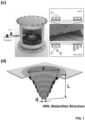
- a silicon nitride template aperture we demonstrate the anisotropic growth of periodic hafnium-oxide rings, resulting in shallow conical ladder-shaped stalactite nanostructures ( Fig. 1 ).
- This fabrication method allows one to create highly-asymmetric nanopores with on-demand pore sizes from single-digit to hundreds of nanometers, providing a new platform for nanofluidic research with good potential for scalability.
- Typical stalactites and stalagmites are structures determined by the precipitation of calcium carbonate from the liquid flowing or dropping on their surfaces ( Fig. 1a ).
- the combination of material precipitation, fluid dynamics, evaporation, and periodic thermodynamic conditions determines the growth and shape of natural stalactites and stalagmites 19 .
- SiN silicon-nitride
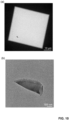
- Figures 7 and 8 were pre-patterned with electronic-beam lithography and dry etching to form periodic templated apertures ( Fig. 1b , inset).
- the templated SiN apertures were placed into a reaction chamber, typically used for atomic-layer deposition (ALD) ( Fig. 1c ), yet the growth regimes are different.
- ALD atomic-layer deposition
- the precursors in the present examples water vapor and tetrakis(ethylmethylamido)hafnium, were used for HfO 2 growth, varying the pulse duration.
- Templated silicon nitride aperture on a single chip substrate served as a nanoreactor for the material precipitation ( Fig. 1c ). Due to the heterogeneity of the substrate caused by the presence of aperture(s) and presumably due to the local concentration gradients of precursors, precipitation was mainly at the orifice of the aperture(s). The growth rate at the aperture orifice was two orders of magnitude higher than the aperture-free region. As a result, HfO 2 stalactite nanopores were forming at each aperture ( Fig.
- the typical stalactite HfO 2 nanopore is shown in the transmission electron microscopy (TEM) micrograph in Figure 1b .
- the pore array is shown on top, and the single pore is enlarged on the bottom.
- the gray-and-black contrast demonstrates the periodic structure of the pore.
- Each ring corresponds to one growth cycle.
- Each pore has a 3D structure.
- the 3D sketch of a single pore is shown in Figure 1d .
- the pore has a conical shape of the length L, defined by the number of rings.
- the pore base diameter a is defined by the initial aperture diameter.
- the pore tip diameter d depends on the number of cycles and can be as low as 3 nm ( Fig. 1b , bottom).
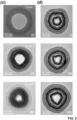
- TEM images including energy-dispersive X-ray (EDX) mapping, are shown in Fig. 2 .
- the high-resolution TEM micrograph ( FIG. 2a(I) ) shows that a single HfO 2 stalactite has a periodic step-like structure similar to that observed in natural stalactites ( Fig. 1a ).
- the pore shown on the picture has eight rings. The rings grow in the direction from the pore perimeter to the center so that a preceding ring is a template for the next ring with a gradually reducing diameter.
- the energy-dispersive X-ray spectroscopy analysis of the side-view projection prepared with a focused ion beam shows the elemental composition of the stalactite ( Fig.
- the first is choosing the number of growth cycles ( Fig. 2c ). For example, one, three, and five cycles result in zero, two, and four rings in the HfO 2 stalactite nanostructure, respectively. Therefore, each growth cycle except the first one adds a ring to the stalactite until it clogs. In other words, n cycles of precursor supply result in n-1 rings.
- the second way to control the stalactite dimensions is by varying the diameter of the templated silicon-nitride apertures ( Fig. 2d ). The decrease of the aperture diameter results in smaller nanopores for the same number of growth cycles.
- a distinctive feature of the stalactite nanopore is its asymmetry.
- the latter was demonstrated to influence the charge and mass transport through the pore with and without an electric field, with and without a concentration gradient 20-22 .
- the tapering geometry creates nonuniformity of the electric field distribution, helping separate charges and, for example, produce electricity from the concentration gradients 16 or affecting the translocation rate of the biomolecules through the pore 23,24 .
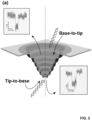
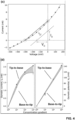
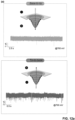
- Figure 3a shows a layout for the DNA translocation experiment.
- the insets demonstrate an electric current through the pore during a single DNA translocation event for two cases: tip-to-base (left) and base-to-tip (right) directions of translocation.
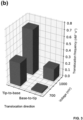
- the object of interest is the difference in the translocation frequency between two directions with charged DNA driven by an electric field.
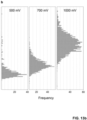
- the current-voltage characteristics are given in Figure 11 , and details of translocation comparison are shown in Figures 12 and 13 .
- the concentration-normalized DNA translocation rate for the tip-to-base direction is almost an order of magnitude higher than for the base-to-tip direction.
- FIG 4a shows the schematics of the reverse electrodialysis experiment, which has been designed to demonstrate the osmotic energy conversion 27 .
- the setup consisted of a single stalactite nanopore in the membrane separating two volumes with aqueous KCI solutions. The concentration gradient between the opposite sides of the membrane was changing within three orders of magnitude.
- Two Ag/AgCI electrodes were recording the ionic current.
- the efficiency of ions rectification was compared for two cases of the tip-to-base and the base-to-tip flow directions ( Fig. 4b ).
- the experiments were repeated several times using stalactite nanopores with a tip diameter of 15 ⁇ 5 nm ( Figure 14 ).
- the measured I-V characteristics are shown in Figure 4c (see Methods for details).
- the osmotic current I o and the osmotic potential V o were obtained using a standard procedure 28 .
- the tip-to-base flow direction showed higher V o and I o than the base-to-tip flow ( Fig. 4d ).
- This effect originates from the difference in the spatial charge distribution ( Fig. 4e ) for the two cases.
- Different ion rectification of the stalactite nanopore occurs due to the differential diffusion of cations and anions across the membrane in the presence of the concentration gradient.
- the difference between the values of osmotic current (left) and osmotic potential (right) for the tip-to-base and base-to-tip directions of the concentration gradients comes from the asymmetric geometry.
- the lower concentration at the base side leads to a broader electrical double layer (EDL) at the inner pore wall ( Fig.
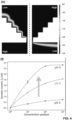
- Figure 4f shows the dependence of I o on concentration gradients.
- Three curves are measured at different pH and showed high sensitivity of the osmotic current on the surface charge, which is known to be pH dependent.
- the HfO 2 nanopore shows relatively good osmotic power at neutral pH. This fact positively distinguishes our assembly as it can be used for natural applications, such as, e.g. energy harvesting at the see-river contact in which water has neutral pH.
- stalactite nanopores are very stable due to the inert chemical nature of HfO 2 .
- Our nanopores showed remarkable stability in 1 M KCI solution for 42 days.
- the variation of pore conductance was within 10% ( Figure 15 ). Modifying the surface of our HfO 2 nanopore by deposition of superhydrophobic materials can also increase osmotic power generation.
- Figure 5b shows the experimental setup layout. It consists of the osmotic battery with the nanopore membrane, the ammeter, and the imitation of the working load.
- a tip-to-base concentration gradient direction that showed a higher osmotic current on a single pore ( Fig. 4 ).
- the device showed a high output current stability for more than one hour under a 1-to-0.1 M KCI concentration gradient ( Figure 16 ).
- the growth rate for this recipe and a standard flat surface was 1.01 ⁇ 0.05 ⁇ /cycle.
- To heat the SiN template we used the Inox-316L substrate. Each sample was pre-heated for 15 minutes before the growth cycle.
- For the biomolecules translocation experiment we used 2-kbp double-stranded DNA in 1 M aqueous solution of KCI.
- the samples were imaged using Osiris TM , Talos TM , and Titan TM transmission electron microscopy (TEM) instruments by FEI Company at 200 kV.
- HRTEM High-Resolution TEM
- STEM Scanning TEM
- EDX Energy-dispersive X-ray spectroscopy
- EDX mappings of the single nanopore were obtained using the data from Figure 2d by re-normalizing the signal to the thickness of the sample, measured by atomic force microscopy (AFM).
- AFM atomic force microscopy
- FIB Focused Ion Beam
- the SiN membrane with the icicle pores was cut perpendicularly to the wafer surface by Ga ions using the Zeiss Crossbeam FIB system.
- the cross-section was imaged using Scanning Electron Microscopy (SEM) technique. SEM images of the icicle-pore arrays ( Fig. 1b ) were obtained by the same machine at 1.5 kV.
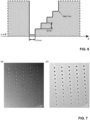
- Each stair is 20 nm wide and 20 nm deep with a 2 nm fillet on all corners to achieve better mesh distribution.
- the dashed line represents the ideal infinite boundary of the structure, and the solid line represents the nanopore boundaries that were applied with surface charge during the simulation 34,35 .
Landscapes
- Chemical & Material Sciences (AREA)
- Engineering & Computer Science (AREA)
- Health & Medical Sciences (AREA)
- Chemical Kinetics & Catalysis (AREA)
- Life Sciences & Earth Sciences (AREA)
- Physics & Mathematics (AREA)
- Biomedical Technology (AREA)
- Analytical Chemistry (AREA)
- Combustion & Propulsion (AREA)
- Inorganic Chemistry (AREA)
- Hematology (AREA)
- Biochemistry (AREA)
- Nanotechnology (AREA)
- Biophysics (AREA)
- General Engineering & Computer Science (AREA)
- Molecular Biology (AREA)
- Urology & Nephrology (AREA)
- Food Science & Technology (AREA)
- Medicinal Chemistry (AREA)
- Spectroscopy & Molecular Physics (AREA)
- General Health & Medical Sciences (AREA)
- General Physics & Mathematics (AREA)
- Immunology (AREA)
- Pathology (AREA)
- Mechanical Engineering (AREA)
- Manufacturing & Machinery (AREA)
- Investigating Or Analyzing Materials By The Use Of Electric Means (AREA)
- Separation Using Semi-Permeable Membranes (AREA)
Priority Applications (3)
| Application Number | Priority Date | Filing Date | Title |
|---|---|---|---|
| EP23170779.5A EP4454740A1 (de) | 2023-04-28 | 2023-04-28 | Naturinspirierte stalactitnanostrukturen wie nanoporen zur biosensing und energiegewinnung |
| PCT/EP2024/060971 WO2024223502A1 (en) | 2023-04-28 | 2024-04-22 | Nature-inspired stalactite nanostructures such as nanopores for biosensing and energy harvesting |
| EP24720223.7A EP4701773A1 (de) | 2023-04-28 | 2024-04-22 | Naturinspirierte stalactitnanostrukturen wie nanoporen zur biosensing und energiegewinnung |
Applications Claiming Priority (1)
| Application Number | Priority Date | Filing Date | Title |
|---|---|---|---|
| EP23170779.5A EP4454740A1 (de) | 2023-04-28 | 2023-04-28 | Naturinspirierte stalactitnanostrukturen wie nanoporen zur biosensing und energiegewinnung |
Publications (1)
| Publication Number | Publication Date |
|---|---|
| EP4454740A1 true EP4454740A1 (de) | 2024-10-30 |
Family
ID=86282578
Family Applications (2)
| Application Number | Title | Priority Date | Filing Date |
|---|---|---|---|
| EP23170779.5A Withdrawn EP4454740A1 (de) | 2023-04-28 | 2023-04-28 | Naturinspirierte stalactitnanostrukturen wie nanoporen zur biosensing und energiegewinnung |
| EP24720223.7A Pending EP4701773A1 (de) | 2023-04-28 | 2024-04-22 | Naturinspirierte stalactitnanostrukturen wie nanoporen zur biosensing und energiegewinnung |
Family Applications After (1)
| Application Number | Title | Priority Date | Filing Date |
|---|---|---|---|
| EP24720223.7A Pending EP4701773A1 (de) | 2023-04-28 | 2024-04-22 | Naturinspirierte stalactitnanostrukturen wie nanoporen zur biosensing und energiegewinnung |
Country Status (2)
| Country | Link |
|---|---|
| EP (2) | EP4454740A1 (de) |
| WO (1) | WO2024223502A1 (de) |
Citations (1)
| Publication number | Priority date | Publication date | Assignee | Title |
|---|---|---|---|---|
| US20100089866A1 (en) * | 2008-10-10 | 2010-04-15 | Prinz Friedrich B | Method for producing tapered metallic nanowire tips on atomic force microscope cantilevers |
-
2023
- 2023-04-28 EP EP23170779.5A patent/EP4454740A1/de not_active Withdrawn
-
2024
- 2024-04-22 EP EP24720223.7A patent/EP4701773A1/de active Pending
- 2024-04-22 WO PCT/EP2024/060971 patent/WO2024223502A1/en not_active Ceased
Patent Citations (1)
| Publication number | Priority date | Publication date | Assignee | Title |
|---|---|---|---|---|
| US20100089866A1 (en) * | 2008-10-10 | 2010-04-15 | Prinz Friedrich B | Method for producing tapered metallic nanowire tips on atomic force microscope cantilevers |
Non-Patent Citations (41)
| Title |
|---|
| ACAR, E. T.BUCHSBAUM, S. F.COMBS, C.FORNASIERO, F.SIWY, Z. S.: "Biomimetic potassium-selective nanopores", SCI. ADV., vol. 5, 2019, pages eaav2568 |
| BELL, N. A. W.MUTHUKUMAR, M.KEYSER, U. F.: "Translocation frequency of double-stranded DNA through a solid-state nanopore", PHYS. REV. E, vol. 93, 2016, pages 022401 |
| BLACK, D. M.: "Cave Pearls in Carlsbad Caverns", SCI. MON., vol. 74, 1952, pages 206 - 210 |
| BOCQUET, L.: "Nanofluidics coming of age", NAT. MATER., vol. 19, 2020, pages 254 - 256, XP037050070, DOI: 10.1038/s41563-020-0625-8 |
| CHERNEV ANDREY ET AL: "Nature-Inspired Stalactite Nanopores for Biosensing and Energy Harvesting", ADVANCED MATERIALS, vol. 35, no. 33, 6 July 2023 (2023-07-06), DE, XP093086238, ISSN: 0935-9648, DOI: 10.1002/adma.202302827 * |
| CHOU, Y.-C.MASIH DAS, P.MONOS, D. S.DRNDIC, M.: "Lifetime and Stability of Silicon Nitride Nanopores and Nanopore Arrays for Ionic Measurements", ACS NANO, vol. 14, 2020, pages 6715 - 6728 |
| CRESSIOT, B.GREIVE, S. J.MOJTABAVI, M.ANTSON, A. A.WANUNU, M.: "Thermostable virus portal proteins as reprogrammable adapters for solid-state nanopore sensors", NAT., vol. 9, 2018, pages 4652 |
| DAVIS, S. J. ET AL.: "Pressure-Induced Enlargement and Ionic Current Rectification in Symmetric Nanopores", NANO LETT., vol. 20, 2020, pages 8089 - 8095 |
| DEKKER, C: "Solid-state nanopores", NAT. NANOTECHNOL., vol. 2, 2007, pages 209 - 215 |
| FANG, A.KROENLEIN, K.RICCARDI, D.SMOLYANITSKY, A.: "Highly mechanosensitive ion channels from graphene-embedded crown ethers", NAT. MATER., vol. 18, 2019, pages 76 - 81, XP036657283, DOI: 10.1038/s41563-018-0220-4 |
| FENG, J ET AL.: "Single-layer MoS2 nanopores as nanopower generators", NATURE, vol. 536, 2016, pages 197 - 200, XP055536414, DOI: 10.1038/nature18593 |
| FREEDMAN, K. J. ET AL.: "Nanopore sensing at ultra-low concentrations using single-molecule dielectrophoretic trapping", NAT. COMMUN., vol. 7, 2016, pages 10217, XP055747452, DOI: 10.1038/ncomms10217 |
| GADALETA, A ET AL.: "Sub-additive ionic transport across arrays of solid-state nanopores", PHYS. FLUIDS, vol. 26, 2014, pages 012005 |
| GRAF, M ET AL.: "Fabrication and practical applications of molybdenum disulfide nanopores", NAT. PROTOC., vol. 14, 2019, pages 1130 - 1168, XP036742124, DOI: 10.1038/s41596-019-0131-0 |
| HALL, A. R. ET AL.: "Hybrid pore formation by directed insertion of a-haemolysin into solid-state nanopores", NAT. NANOTECHNOL., vol. 5, 2010, pages 874 - 877, XP002690758, DOI: 10.1038/nnano.2010.237 |
| HAUSMANN, D. M.KIM, E.BECKER, J.GORDON, R. G.: "Atomic Layer Deposition of Hafnium and Zirconium Oxides Using Metal Amide Precursors", CHEM. MATER., vol. 14, 2002, pages 4350 - 4358, XP002351132, DOI: 10.1021/cm020357x |
| HE, Y.TSUTSUI, M.ZHOU, Y.MIAO, X.-S.: "Solid-state nanopore systems: from materials to applications", NPG ASIA MATER, vol. 13, 2021, pages 1 - 26 |
| HSU, J.-P. ET AL.: "Unraveling the Anomalous Surface-Charge-Dependent Osmotic Power Using a Single Funnel-Shaped Nanochannel", ACS NANO, vol. 13, 2019, pages 13374 - 13381 |
| KASIANOWICZ, J. J.BRANDIN, E.BRANTON, D.DEAMER, D. W.: "Characterization of individual polynucleotide molecules using a membrane channel", PROC. NATL. ACAD. SCI., vol. 93, 1996, pages 13770 - 13773, XP002937962, DOI: 10.1073/pnas.93.24.13770 |
| KATIYAR, N. K.GOEL, G.HAWI, S.GOEL, S.: "Nature-inspired materials: Emerging trends and prospects", NPG ASIA MATER, vol. 13, 2021, pages 1 - 16 |
| LAUCIRICA GREGORIO ET AL: "Shape matters: Enhanced osmotic energy harvesting in bullet-shaped nanochannels", NANO ENERGY, vol. 71, 1 May 2020 (2020-05-01), NL, pages 104612, XP093086237, ISSN: 2211-2855, DOI: 10.1016/j.nanoen.2020.104612 * |
| LIU, H., ZHOU, Q., WANG, W., FANG, F., ZHANG, J.: "Solid-State Nanopore Array: Manufacturing and Applications", SMALL, vol. 19, 2023, pages 2205680 |
| LIU, X., SKANATA, M. M., STEIN, D.: "Entropic cages for trapping DNA near a nanopore", NAT. COMMUN., vol. 6, 2015, pages 6222 |
| LUO, L.HOLDEN, D. A.WHITE, H. S.: "Negative Differential Electrolyte Resistance in a Solid-State Nanopore Resulting from Electroosmotic Flow Bistability", ACS NANO, vol. 8, 2014, pages 3023 - 3030 |
| MA, L ET AL.: "Modulation of Ionic Current Rectification in Ultrashort Conical Nanopores", ANAL. CHEM., vol. 92, 2020, pages 16188 - 16196 |
| MACHA, M.MARION, S.NANDIGANA, V. V. R.RADENOVIC, A.: "2D materials as an emerging platform for nanopore-based power generation", NAT. REV. MATER., vol. 4, 2019, pages 588 - 605, XP036878977, DOI: 10.1038/s41578-019-0126-z |
| RAILLON, C., GRANJON, P., GRAF, M., STEINBOCK, L. J., RADENOVIC, A.: "Fast and automatic processing of multi-level events in nanopore translocation experiments", NANOSCALE, vol. 4, 2012, pages 4916 - 4924 |
| ROBIN, P ET AL.: "Long-term memory and synapse-like dynamics in two-dimensional nanofluidic channels", SCIENCE, vol. 379, 2023, pages 161 - 167 |
| SHAW, R. S.PACKARD, N.SCHRDTER, M.SWINNEY, H. L.: "Geometry-induced asymmetric diffusion", PROC. NATL. ACAD. SCI., vol. 104, 2007, pages 9580 - 9584 |
| SIRIA, A ET AL.: "Giant osmotic energy conversion measured in a single transmembrane boron nitride nanotube", NATURE, vol. 494, 2013, pages 455 - 458, XP055254216, DOI: 10.1038/nature11876 |
| STEIN, D.KRUITHOF, M.DEKKER, C.: "Surface-Charge-Governed Ion Transport in Nanofluidic Channels", PHYS. REV. LETT., vol. 93, 2004, pages 035901 |
| TENG, Y ET AL.: "Bioinspired nervous signal transmission system based on two-dimensional laminar nanofluidics: From electronics to ionics", PROC. NATL. ACAD. SCI., vol. 117, 2020, pages 16743 - 16748 |
| THAKUR, M ET AL.: "Wafer-Scale Fabrication of Nanopore Devices for Single-Molecule DNA Biosensing using MoS2", SMALL METHODS, vol. 4, 2020, pages 2000072 |
| THANGARAJ VIDHYADEVI ET AL: "Detection of short ssDNA and dsDNA by current-voltage measurements using conical nanopores coated with Al2O3by atomic layer deposition", MICROCHIMICA ACTA, SPRINGER VIENNA, VIENNA, vol. 183, no. 3, 21 December 2015 (2015-12-21), pages 1011 - 1017, XP035641228, ISSN: 0026-3672, [retrieved on 20151221], DOI: 10.1007/S00604-015-1706-2 * |
| TRAVERSI, F ET AL.: "Detecting the translocation of DNA through a nanopore using graphene nanoribbons", NAT. NANOTECHNOL., vol. 8, 2013, pages 939 - 945, XP055134764, DOI: 10.1038/nnano.2013.240 |
| TSUTSUI, M.YOKOTA, K.LEONG, I. W.HE, Y.KAWAI, T.: "Sparse multi-nanopore osmotic power generators", CELL REP. PHYS. SCI., vol. 3, 2022, pages 101065 |
| ULRICH NILS ET AL: "Conical Nanotubes Synthesized by Atomic Layer Deposition of Al2O3, TiO2, and SiO2 in Etched Ion-Track Nanochannels", NANOMATERIALS, vol. 11, no. 8, 21 July 2021 (2021-07-21), pages 1874, XP093085500, DOI: 10.3390/nano11081874 * |
| XUE, L ET AL.: "Solid-state nanopore sensors", NAT. REV. MATER., vol. 5, 2020, pages 931 - 951, XP037310149, DOI: 10.1038/s41578-020-0229-6 |
| YAZDA, K: "High Osmotic Power Generation via Nanopore Arrays in Hybrid Hexagonal Boron Nitride/Silicon Nitride Membranes", NANO LETT, vol. 21, 2021, pages 4152 - 4159 |
| ZHANG, Z ET AL.: "Ultrathin and Ion-Selective Janus Membranes for High-Performance Osmotic Energy Conversion", J. AM. CHEM. SOC., vol. 139, 2017, pages 8905 - 8914 |
| ZHANG, Z.WEN, L.JIANG, L.: "Nanofluidics for osmotic energy conversion", NAT. REV., vol. 6, 2021, pages 622 - 639, XP037501811, DOI: 10.1038/s41578-021-00300-4 |
Also Published As
| Publication number | Publication date |
|---|---|
| WO2024223502A1 (en) | 2024-10-31 |
| EP4701773A1 (de) | 2026-03-04 |
Similar Documents
| Publication | Publication Date | Title |
|---|---|---|
| US11753738B2 (en) | Nanopore forming method and uses thereof | |
| Macha et al. | 2D materials as an emerging platform for nanopore-based power generation | |
| CN113274888B (zh) | 利用电介质击穿法在固态膜中形成孔隙的方法和设备 | |
| KR102351743B1 (ko) | 시퀀싱을 위한 디바이스 | |
| Cervera et al. | A Poisson/Nernst-Planck model for ionic transport through synthetic conical nanopores | |
| Deng et al. | Development of solid-state nanopore fabrication technologies | |
| Venkatesan et al. | DNA sensing using nanocrystalline surface‐enhanced Al2O3 nanopore sensors | |
| JP2011521222A (ja) | 少なくとも1つのナノポアまたはマイクロポアを有するダイヤモンドフィルムを含む伝導度センサーデバイス | |
| US20080121534A1 (en) | Nanopore electrode, nanopore membrane, methods of preparation and surface modification, and use thereof | |
| EP3263896A1 (de) | Osmotische stromerzeugung | |
| US20150249255A1 (en) | Method and device for producing energy | |
| CA2522222A1 (en) | Fluidic nanotubes and devices | |
| Deng et al. | Effect of concentration gradient on ionic current rectification in polyethyleneimine modified glass nano-pipettes | |
| DE112011103053T5 (de) | Steuerung der Abmessungen in Nanopren- und Nanofluidischen Einheiten mit Rückkopplung | |
| Chernev et al. | Nature‐Inspired Stalactite Nanopores for Biosensing and Energy Harvesting | |
| Wang et al. | Surface engineering of synthetic nanopores by atomic layer deposition and their applications | |
| Pullini et al. | Insights into pulsed electrodeposition of GMR multilayered nanowires | |
| Liu et al. | Ion current rectification in combination with ion current saturation | |
| WO2024223502A1 (en) | Nature-inspired stalactite nanostructures such as nanopores for biosensing and energy harvesting | |
| Zhang et al. | Nanoconfined ion and water transport through nanoporous atomically thin membranes: Fabrication and mechanism | |
| Chung et al. | Optimized electrochemical breakdown etching using temporal voltage variation for formation of nanopores in a silicon membrane | |
| Zhu et al. | Properties and stability of atomic layer deposition modified track-etched single conical nanopore | |
| Chang et al. | Vertically aligned antimony nanowires as solid-state pH sensors | |
| Kuan | Ultra-Thin Solid-State Nanopores: Fabrication and Applications | |
| Waters | The fabrication of Pt nanoparticle arrays via a Surface Limited Redox Replacement of a Cu UPD monolayer on lipid-templated Au |
Legal Events
| Date | Code | Title | Description |
|---|---|---|---|
| PUAI | Public reference made under article 153(3) epc to a published international application that has entered the european phase |
Free format text: ORIGINAL CODE: 0009012 |
|
| STAA | Information on the status of an ep patent application or granted ep patent |
Free format text: STATUS: THE APPLICATION HAS BEEN PUBLISHED |
|
| AK | Designated contracting states |
Kind code of ref document: A1 Designated state(s): AL AT BE BG CH CY CZ DE DK EE ES FI FR GB GR HR HU IE IS IT LI LT LU LV MC ME MK MT NL NO PL PT RO RS SE SI SK SM TR |
|
| STAA | Information on the status of an ep patent application or granted ep patent |
Free format text: STATUS: THE APPLICATION IS DEEMED TO BE WITHDRAWN |
|
| 18D | Application deemed to be withdrawn |
Effective date: 20250501 |