EP4454633A1 - Feste farbmittelemulsion zur herstellung von haarfärbemitteln - Google Patents
Feste farbmittelemulsion zur herstellung von haarfärbemitteln Download PDFInfo
- Publication number
- EP4454633A1 EP4454633A1 EP23382383.0A EP23382383A EP4454633A1 EP 4454633 A1 EP4454633 A1 EP 4454633A1 EP 23382383 A EP23382383 A EP 23382383A EP 4454633 A1 EP4454633 A1 EP 4454633A1
- Authority
- EP
- European Patent Office
- Prior art keywords
- agent
- solid
- solid cosmetic
- weight
- colouring agent
- Prior art date
- Legal status (The legal status is an assumption and is not a legal conclusion. Google has not performed a legal analysis and makes no representation as to the accuracy of the status listed.)
- Withdrawn
Links
Images

Classifications
-
- A—HUMAN NECESSITIES
- A61—MEDICAL OR VETERINARY SCIENCE; HYGIENE
- A61Q—SPECIFIC USE OF COSMETICS OR SIMILAR TOILETRY PREPARATIONS
- A61Q5/00—Preparations for care of the hair
- A61Q5/10—Preparations for permanently dyeing the hair
-
- A—HUMAN NECESSITIES
- A61—MEDICAL OR VETERINARY SCIENCE; HYGIENE
- A61K—PREPARATIONS FOR MEDICAL, DENTAL OR TOILETRY PURPOSES
- A61K8/00—Cosmetics or similar toiletry preparations
- A61K8/02—Cosmetics or similar toiletry preparations characterised by special physical form
- A61K8/0216—Solid or semisolid forms
-
- A—HUMAN NECESSITIES
- A61—MEDICAL OR VETERINARY SCIENCE; HYGIENE
- A61K—PREPARATIONS FOR MEDICAL, DENTAL OR TOILETRY PURPOSES
- A61K8/00—Cosmetics or similar toiletry preparations
- A61K8/02—Cosmetics or similar toiletry preparations characterised by special physical form
- A61K8/04—Dispersions; Emulsions
- A61K8/06—Emulsions
- A61K8/062—Oil-in-water emulsions
-
- A—HUMAN NECESSITIES
- A61—MEDICAL OR VETERINARY SCIENCE; HYGIENE
- A61K—PREPARATIONS FOR MEDICAL, DENTAL OR TOILETRY PURPOSES
- A61K8/00—Cosmetics or similar toiletry preparations
- A61K8/18—Cosmetics or similar toiletry preparations characterised by the composition
- A61K8/30—Cosmetics or similar toiletry preparations characterised by the composition containing organic compounds
- A61K8/33—Cosmetics or similar toiletry preparations characterised by the composition containing organic compounds containing oxygen
- A61K8/34—Alcohols
- A61K8/342—Alcohols having more than seven atoms in an unbroken chain
-
- A—HUMAN NECESSITIES
- A61—MEDICAL OR VETERINARY SCIENCE; HYGIENE
- A61K—PREPARATIONS FOR MEDICAL, DENTAL OR TOILETRY PURPOSES
- A61K8/00—Cosmetics or similar toiletry preparations
- A61K8/18—Cosmetics or similar toiletry preparations characterised by the composition
- A61K8/92—Oils, fats or waxes; Derivatives thereof, e.g. hydrogenation products thereof
- A61K8/922—Oils, fats or waxes; Derivatives thereof, e.g. hydrogenation products thereof of vegetable origin
Definitions
- This invention refers to the field of dying keratin fibres and more specifically to the field of dying hair.
- This invention refers to a solid colouring agent composition for producing colouring cream for hair dye. More specifically, the invention relates to solid cosmetic compositions comprising a cosmetically acceptable vehicle, at least one colour precursor, at least one antioxidant agent, at least one preservative, at least one chelating agent, at least one treating agent and at least one antioxidant agent.
- Hair dyes are decorative cosmetics whose purpose is to change the colour or bleach the hair temporarily, semi-permanently or permanently, depending on their components (oxidative or not) and their penetration at different levels of the stem cortex. They are used by men and women to change the natural colour of the hair, delay the appearance of grey hair or re-pigment the hair when the grey is already established.
- Hair dyes are classified based on their origin as: vegetable dyes, mineral or metallic dyes and synthetic dyes. The latter are classified according to the resistance of the colour to successively washing the hair and the time the colour remains on the hair.
- Temporary dyes The colour lasts a few days. High molecular weight molecules are used that remain on the surface of the cuticle.
- Semi-permanent dyes They can be non-oxidative and oxidative, the colour lasts for weeks. Low molecular weight molecules are used and are introduced superficially into the cortex and (iii) Permanent dyes. The colour lasts indefinitely. Very low molecular weight molecules are used that go deep into the cortex. ( Cosmetic Dermatology: Products and Procedures Edited by Zoe Diana Draelos ⁇ 2010 Blackwell Publishing Ltd. ISBN: 978-1-405-18635-3 ).
- Tone-on-tone oxidation colouring The hair is dyed in its natural colour or only modified by one tone (does not contain ammonia). Permanent oxidation colouring: It can eliminate melanin pigments (eumelanin pheomelanin). The hair is bleached and then dyed in lighter tones, in the same tone or darker. Depending on the oxidant concentration, a permanent oxidation colour can lighten from 1 to 4 tones (5-6 tones with ammonia load) while it can darken 7-8 tones in a controlled manner with a light oxidant load.
- the active components of oxidation dyes are the colouring cream and the oxidant. Due to its chemical specifications, the colouring cream is sensitive to oxidation and therefore it is generally marketed in 30 to 100 ml aluminium tubes and the oxidising cream in plastic containers.
- a second aspect of vital importance that makes colouring cream production difficult is related to the state in which these 28 raw materials are marketed and their percentage in the final formula.
- the components in which the proportion of ingredients in the final colouring cream formula is lower include the colour precursors and the so-called treating agents.
- the colour precursors which are the fundamental part of the final product, are in a solid state and in different formats (crystal or powder) and therefore to achieve a homogeneous formulation in which the percentage of the product's ingredients responds to the desired formula, it must be worked in batches by weighing the precursors depending on the colour to be manufactured.
- colour precursors are oxidation bases such as p-phenylenediamine, p-toluenediamine, o-chloro-p-phenylenediamine, o-aminophenol and p-aminophenol and couplers such as m-phenylenediamine, 2,6-diaminotoluene, resorcinol and m-aminophenol.
- Colour precursors are generally compounds whose handling presents various hazards to human health. Therefore, in the process of weighing the ingredients, workers must comply with all workplace health and safety regulatory requirements in terms of hours of exposure to these products and the PPE to be used.
- the batch manufacturing process for colouring creams for hair dyes is generally carried out in a multi-step process. First, all the ingredients are weighed according to the formula, then demineralised water is added, its temperature is raised and the waxes added, which melt on direct contact with hot demineralised water. Next, the rest of the hot demineralised water is added to the main mixing tank and the remaining previously-weighed raw materials are added manually. The batch is mixed until the ingredients are completely melted and then cooled, then alkalising agents and finally the perfume are added before packaging. This process can take between 1 and 6 hours depending on the batch volume.
- the wax premix tank solid waxes are added manually and melted inside the tank. The tank is continuously stirred until the waxes are completely melted, dispersed and dissolved.
- the dye premix tank the solid dyes are dissolved with hot water. The tank is continuously stirred until the dyes are fully dispersed and dissolved.
- the batch preparation sequence the content of the tanks, waxes and dyes is transferred to the main mixing tank by vacuum. The batch temperature is raised to 80-85°C and the batch is recirculated through the homogeniser at the bottom. Subsequently, minor ingredients are added depending on the formula, followed by batch cooling. The ammonium hydroxide and perfume are then added slowly and the batch is finalised.
- the colour precursor batch weighing process implies that the time spent working on it and therefore the minutes of exposure of the people who do so are strictly proportional to the number of kilograms manufactured per batch.
- the capacity of the manufacturing tank determines the batch volume. Therefore, if it is 100 kg, the batches will be 100 kg.
- the average weighing time for precursors, regardless of the volume to be produced and without taking the ingredient preparation time into account, is 10 minutes.
- 500 kg of a single colour in batches of 100 kg five weighings are required. In other words, 50 minutes in total.
- Table 2 summarises this problem.
- 13,000 g of five colour precursors prec. 1 to prec. 5 need to be added that are distributed as detailed in the table in % and in grams.
- identical percentages are needed so that when weighing 500 kg, 28.08 g of precursor 1 must be added to the batch and 0.56 g to the 10 kg batch so that both productions contain 0.22% of this ingredient.
- +/- 0.25 g differentials can be admitted in adding one precursor or another without altering the colour of the resulting cream, since no alteration is observed to two decimal places in the formula percentage. It is observed that in producing 10 kg of dye (which is equivalent to about 200 50 ml tubes) the same absolute error of +/- 0.25 g per ingredient entails a significant change in the formula, since all the percentages vary and in the most extreme case, precursor 1, which should be present at 0.22% in the theoretical formula, becomes 0.31% in the product actually manufactured. Table 2. Simulation of the impact of a weighing error on the final product of +/- 0.25 g in the precursors depending on production volume.
- the system should enable hair dye to be manufactured simply and with minimal handling by operators and also enable weighing errors to be corrected during this process so that product batches with incorrectly weighed precursor amounts are not discarded or undesirable results reach the market.
- treating agents whose functions fundamentally act as hair conditioners (ease of combing, flexibility, softness and shine, volume and lightness) and at the same time act as an emollient with substances that soften the skin and create a protective lipid layer that prevents water loss through evaporation.
- the batch manufacturing process for colouring creams for hair dyes is generally carried out in a multi-step process.
- the system should preferably enable hair dye to be manufactured simply and with minimum handling by the operators and at the same time enable weighing errors to be corrected.
- This invention provides a solution to these problems in the hair dye industry.
- the invention refers to a solid colouring agent composition for preparing colouring cream for hair dyes that comprises a cosmetically acceptable vehicle, at least one colour precursor, at least one antioxidant agent, at least one preservative, at least one chelating agent and at least one treating agent.
- the invention refers to a process for preparing a solid colouring agent composition for preparing a colouring cream for hair dye according to any of the preceding claims, comprising the following steps:
- the invention refers to the use of the solid colouring agent composition of the first aspect of the invention or prepared using the process according to the second aspect of the invention for preparing colouring cream for hair dye or for dying hair.
- the invention refers to a solid colouring agent composition for preparing colouring cream for hair dye that comprises a cosmetically acceptable vehicle, at least one colour precursor, at least one antioxidant agent, at least one preservative, at least one chelating agent, at least one treating agent and at least one antioxidant agent.
- the solid colouring agent composition is a solid emulsion.
- the solid colouring agent emulsion is in the form of granules, flakes, powder or noodles, preferably in the form of granules. The granule format allows the best dosing precision and very fast dissolution and integration, which reduces production time and energy consumption.
- cosmetically acceptable vehicle refers to a compound or a mixture of compounds in which the different compounds that comprise the concentrated cosmetic gel can dissolve and/or mix.
- the cosmetically acceptable vehicle can include solvents, surfactants, emulsifiers, anti-foaming agents and/or viscosity controllers.
- antioxidant agent refers to a compound that inhibits reactions caused by oxygen, thus preventing oxidation and rancidity.
- preservative refers to a compound that primarily inhibits microorganism growth in cosmetics.
- chelating agent refers to a compound that reacts and forms complexes with metal ions that could affect the stability and/or appearance of cosmetics.
- colour precursor refers to a compound that colours the cosmetic product and/or gives colour to the skin and/or its appendages, i.e. hair.
- treating agent refers to a compound that nourishes the hair and protects it against the chemical action of the dye components. These act as hair conditioners (easy to comb, flexible, soft and shiny and/or give volume, lightness and shine) and at the same time act as an emollient with substances that soften the skin and create a protective lipid layer that prevents water loss due to evaporation.
- chemical dyes refers to non-natural-origin compounds that colour the cosmetic product and/or give colour to the skin and/or its appendages.
- Natural dyes refers to compounds or extracts of natural origin that colour the cosmetic product and/or give colour to the skin and/or its appendages. Natural dyes can be vegetable origin or mineral origin.
- hair dye refers to a compound or composition that colours hair.
- composition of the first aspect makes it possible to manufacture hair dye from 3 ingredients or raw materials instead the more than 20 that are currently used, which represents a significant change compared to the current state of the art.
- the cosmetically acceptable vehicle comprises at least one of the compounds selected from water, isopropyl alcohol, propylene glycol, sodium lauryl sulphate, polyacrylic acid, sodium sulphate, coconut betaine, glycol stearate, polyethylene glycol monostearate (100), C12-C20 saturated-fatty-acid alcohols, ECOROL ® 68/50 or mixtures thereof.
- the cosmetically acceptable vehicle consists of isopropyl alcohol, propylene glycol, sodium lauryl sulphate, polyacrylic acid, sodium sulphate, coconut betaine, glycol stearate and polyethylene glycol monostearate (100) and C12-C20 saturated-fatty-acid alcohols.
- At least one colour precursor comprises at least one colour precursor selected from the group of chemical dyes, natural dyes or mixtures thereof.
- At least one colour precursor comprises organic vegetable-origin natural dyes such as red henna, neutral henna, black henna, chamomile flower, sandalwood, black tea, Rhamnus frangula bark, sage, logwood, Rubia tinctorum root, acacia extract (catechu), cedar root or alkanna root.
- organic vegetable-origin natural dyes such as red henna, neutral henna, black henna, chamomile flower, sandalwood, black tea, Rhamnus frangula bark, sage, logwood, Rubia tinctorum root, acacia extract (catechu), cedar root or alkanna root.
- At least one colour precursor comprises mineral-origin inorganic natural dyes, such as iron trioxide, titanium dioxide or mica.
- At least one colour precursor is selected from the following group: 2,4-Diaminophenoxyethanol hydrochloride, 1,3-bis-(2,4-diaminophenoxy)-propane tetrahydrochloride, 2,6-diaminopyridine, 2-amino-3-hydroxypyridine, 3-methyl-4-aminophenol, 2-amino-4-hydroxyethylaminoanisole sulphate, 6-amino-m-cresol, 5-amino-6-chloro-o-cresol, 2-amino-6-chloro-4-nitrophenol, toluene-2,5-diamine sulphate, 4-chlororesorcinol, p-phenylenediamine, 1-Naphthol, N-phenyl-p-phenylenediamine, N-phenyl-p sulphate - phenylamine, 3-nitro-p-hydroxyethylaminophenol, 4-(2-hydroxyethyl)
- the colour precursor comprises at least chemical dyes, such as 2,5-diaminotoluene sulphate, resorcinol, 4-aminophenol and its isomers, 4-amino-2-hydroxytoluene, 1-phenyl-3-methyl -5-pyrazolone, 2,4-diaminophenoxyethanol, 1-naphthol, 2,7-naphthalenediol, 2-amino-4-hydroxyethylamino anisole sulphate, 2-methylresorcinol, 4-amino-m-resorcinol, 4-chlororesorcinol, sulphate N,N-bis(2-hydroxyethyl)-p-phenylenediamine, p-phenyldiamine or 2,5-diaminotoluene sulphate.
- chemical dyes such as 2,5-diaminotoluene sulphate, resorcinol, 4-aminophenol and its isomers, 4-amin
- the colour precursor is selected at least from 2,5-diaminotoluene sulphate, resorcinol, 4-aminophenol and its isomers, 4-amino-2-hydroxytoluene, 1-phenyl-3-methyl-5-pyrazolone, 2,4-diaminophenoxyethanol, 1-naphthol, 2,7-naphthalenediol, 2-amino-4-hydroxyethylamino anisole sulphate, 2-methylresorcinol, 4-amino-m-resorcinol, 4-chlororesorcinol, N,N- sulphate bis(2-hydroxyethyl)-p-phenylenediamine, p-phenyldiamine, 2,5-diaminotoluene sulphate, iron trioxide, titanium dioxide, red henna, neutral henna, black henna, chamomile flower, sandalwood, black tea, Rhamnus frangul
- At least one treating agent is selected from the group of Polyquaternium-6, Polyquaternium-22, dimethicone or aminopropyl phenyl trimethicone, hydrolysed keratin, high-erucate oil, Argania spinosa seed oil, Camellia oleifera seed oil, European olive fruit oil, Prunus amygdalus dulcis oil, Zea mays oil, Persea gratissima oil, Vitis vinifera seed oil, hydrolysed jojoba esters, Rosmarinus officinalis extract, honey extract or mixtures thereof.
- At least one antioxidant agent is selected from ascorbic acid, sodium dithionate, sodium sulphanilate, thiolactic acid, erythorbic acid or mixtures thereof.
- the antioxidant agent consists of ascorbic acid salts, sodium dithionate, sodium sulphanilate, thiolactic acid, erythorbic acid or mixtures thereof.
- At least one chelating agent is selected from ethylenediaminetetraacetic acid (EDTA) or its salts, citric acid or its salts, tartaric acid or its salts, ethanolamine, sodium sulphate, etidronic acid, pentasodium pentetate, sodium silicate, sodium metasilicate, linoleamidopropyl PG-dimethicone phosphate dimonium chloride or mixtures thereof.
- the chelating agent is ethylenediaminetetraacetic acid (EDTA) or its salts, preferably the sodium salt of EDTA.
- At least one preservative agent is selected from 2-phenoxyethanol, hydroxyethylcellulose, tocopherol, sodium metabisulphite, steartrimonium chloride, behentrimonium chloride or mixtures thereof.
- the preservative agent consists of 2-phenoxyethanol, hydroxyethylcellulose, tocopherol, sodium metabisulphite, steartrimonium chloride, behentrimonium chloride or mixtures thereof.
- the solid colouring agent cosmetic composition for preparing colouring cream for hair dye of the first aspect comprises:
- the solid colouring agent cosmetic composition for preparing colouring cream for hair dye of the first aspect comprises:
- the solid colouring agent cosmetic composition for preparing colouring cream for hair dye in the first aspect comprises:
- the solid colouring agent emulsion for preparing colouring cream for hair dye of the first aspect comprises:
- the solid colouring agent emulsion for preparing colouring cream for hair dye of the first aspect comprises:
- the solid colouring agent emulsion for preparing colouring cream for hair dye of the first aspect comprises:
- the solid colouring agent cosmetic emulsion comprises less than 3% water with respect to the solid colouring agent cosmetic emulsion, preferably less than 2% by weight of water with respect to the solid colouring agent cosmetic emulsion.
- the invention refers to a process for preparing a solid colouring agent emulsion for preparing a colouring cream for hair dye according to any of the preceding claims, comprising the following steps:
- steps a), b), c) and d) are carried out at less than 50°C.
- the process for preparing a solid colouring agent emulsion for preparing colouring cream for hair dye comprises the following steps:
- the third aspect of the invention refers to the use of the solid colouring agent composition according to the first aspect of the invention or prepared using the process according to the second aspect of the invention in preparing colouring cream for hair dye or in preparing the hair dye.
- Example 1 Formulation of a solid colouring agent cosmetic composition according to the invention.
- the solid cosmetic composition comprises various treating agents such as Argania spinosa seed oil or Persea gratissima oil. Final amounts may vary depending on the type and number of treating agents in the final formula. Table 2. Formulation example of the solid cosmetic composition of the invention.
- Component CAS number % by weight Cosmetically acceptable vehicle - 85.06% Water 7732-18-5 1.08% Behentrimonium chloride 17301-53-0 0.56% Ceteth-24 9004-95-9 7.86% Cetearyl alcohol 67762-27-0 54.63% Isopropyl alcohol 67-63-0 3.60% Isopropyl myristate 110-80-1 0.37% Oleic acid 112-80-1 0.56% Oleyl alcohol 143-28-2 0.56% Propylene glycol 57-55-6 14.41% Sodium laureth sulphate 3088-31-1 1.44% Treating agent - 0.93% Argania spinosa seed oil 299184-75-1 0.19% Oleyl erucate / (Z)-octadec-9-enyl (Z)-docos-13-enoate 17673-56-2 0.19% Persea gratissima oil 8024-32-6 0.19% Prunus amygdalus dulcis oil 8007-
- the solid colouring agent cosmetic composition of Example 1 was prepared following these steps:
- the solid colouring agent cosmetic composition is stable for at least 36 months and once the container of the solid cosmetic composition is opened it is stable for 8 weeks.
- Example 3 Preparing hair dyes by means of the solid colouring agent cosmetic composition of the invention.
- the solid colouring agent cosmetic composition of Example 1 was used to prepare the following hair dye with ammonia and without ammonia.
- the compounds and amounts of colour precursor are adjusted depending on the desired tone.
- the solid colouring agent cosmetic composition in Table 3 would correspond to a Number 6 tone, which is a tone that exists in all the colour charts of practically all hair dye manufacturers in the world and which means the results can be compared with a dye manufactured from the solid colouring agent cosmetic composition.
- Table 3 Example of hair dye prepared with the concentrated cosmetic composition from Example 1 without ammonia.
- the production process of the base cream for hair dye consists of the following steps:
- the base cream preparation process enables weights to be corrected by adding only two elements in its preparation, reducing the need for specialist operators, the preparation time, handling errors and the risks to operators.
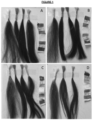
- the colouring obtained with a hair dye made from the solid colouring agent emulsion of the invention is comparable to the colouring of any dye prepared by conventional state-of-the-art processes as seen in the images in figure 1 and figure 2 .
Landscapes
- Health & Medical Sciences (AREA)
- Life Sciences & Earth Sciences (AREA)
- Veterinary Medicine (AREA)
- Animal Behavior & Ethology (AREA)
- General Health & Medical Sciences (AREA)
- Public Health (AREA)
- Birds (AREA)
- Epidemiology (AREA)
- Chemical & Material Sciences (AREA)
- Oil, Petroleum & Natural Gas (AREA)
- Dispersion Chemistry (AREA)
- Emergency Medicine (AREA)
- Cosmetics (AREA)
Priority Applications (2)
| Application Number | Priority Date | Filing Date | Title |
|---|---|---|---|
| EP23382383.0A EP4454633A1 (de) | 2023-04-24 | 2023-04-24 | Feste farbmittelemulsion zur herstellung von haarfärbemitteln |
| PCT/ES2024/070232 WO2024223966A1 (es) | 2023-04-24 | 2024-04-17 | Emulsion colorante solida para la fabricación de tinte capilar |
Applications Claiming Priority (1)
| Application Number | Priority Date | Filing Date | Title |
|---|---|---|---|
| EP23382383.0A EP4454633A1 (de) | 2023-04-24 | 2023-04-24 | Feste farbmittelemulsion zur herstellung von haarfärbemitteln |
Publications (1)
| Publication Number | Publication Date |
|---|---|
| EP4454633A1 true EP4454633A1 (de) | 2024-10-30 |
Family
ID=86776412
Family Applications (1)
| Application Number | Title | Priority Date | Filing Date |
|---|---|---|---|
| EP23382383.0A Withdrawn EP4454633A1 (de) | 2023-04-24 | 2023-04-24 | Feste farbmittelemulsion zur herstellung von haarfärbemitteln |
Country Status (2)
| Country | Link |
|---|---|
| EP (1) | EP4454633A1 (de) |
| WO (1) | WO2024223966A1 (de) |
Citations (6)
| Publication number | Priority date | Publication date | Assignee | Title |
|---|---|---|---|---|
| KR20150061234A (ko) * | 2013-11-27 | 2015-06-04 | (주)케이피티 | 고형 에멀젼 비드를 포함하는 제제 및 이의 화장학적 또는 피부학적 용도 |
| WO2018078344A1 (en) * | 2016-10-24 | 2018-05-03 | Cosmetic Warriors Limited | Solid hair colouring composition |
| FR3089794A1 (fr) * | 2018-12-18 | 2020-06-19 | L'oreal | Composition solide pour la coloration ou l’éclaircissement des fibres kératiniques comprenant un phospholipide |
| WO2021099974A1 (en) * | 2019-11-20 | 2021-05-27 | Giuliani S.P.A. | Colouring composition based on dye plants and use thereof for hair dyeing |
| US20210283024A1 (en) * | 2020-03-13 | 2021-09-16 | Combe Incorporated | Compositions for coloring hair including ultra-efficient high aqueous, multi-lamellar emulsion systems, and methods of making the same |
| WO2023017035A1 (en) * | 2021-08-09 | 2023-02-16 | Wella Germany Gmbh | Hair coloring compositions comprising hydroxyalkyl amines as alkalising agents |
-
2023
- 2023-04-24 EP EP23382383.0A patent/EP4454633A1/de not_active Withdrawn
-
2024
- 2024-04-17 WO PCT/ES2024/070232 patent/WO2024223966A1/es not_active Ceased
Patent Citations (6)
| Publication number | Priority date | Publication date | Assignee | Title |
|---|---|---|---|---|
| KR20150061234A (ko) * | 2013-11-27 | 2015-06-04 | (주)케이피티 | 고형 에멀젼 비드를 포함하는 제제 및 이의 화장학적 또는 피부학적 용도 |
| WO2018078344A1 (en) * | 2016-10-24 | 2018-05-03 | Cosmetic Warriors Limited | Solid hair colouring composition |
| FR3089794A1 (fr) * | 2018-12-18 | 2020-06-19 | L'oreal | Composition solide pour la coloration ou l’éclaircissement des fibres kératiniques comprenant un phospholipide |
| WO2021099974A1 (en) * | 2019-11-20 | 2021-05-27 | Giuliani S.P.A. | Colouring composition based on dye plants and use thereof for hair dyeing |
| US20210283024A1 (en) * | 2020-03-13 | 2021-09-16 | Combe Incorporated | Compositions for coloring hair including ultra-efficient high aqueous, multi-lamellar emulsion systems, and methods of making the same |
| WO2023017035A1 (en) * | 2021-08-09 | 2023-02-16 | Wella Germany Gmbh | Hair coloring compositions comprising hydroxyalkyl amines as alkalising agents |
Non-Patent Citations (2)
| Title |
|---|
| "Cosmetic Dermatology: Products and Procedures", 2010, BLACKWELL PUBLISHING LTD |
| DATABASE WPI Week 201556, Derwent World Patents Index; AN 2015-338787, XP002810288 * |
Also Published As
| Publication number | Publication date |
|---|---|
| WO2024223966A1 (es) | 2024-10-31 |
Similar Documents
| Publication | Publication Date | Title |
|---|---|---|
| EP1865914B1 (de) | Verbesserte oxidative haarfärbemittel | |
| US5421833A (en) | Hair dye compositions based on oxidation dyestuff precursors | |
| US8034126B2 (en) | Henna and vegetable dye based compositions for coloring of human hair | |
| US5494489A (en) | Aqueous colorants for keratin fibers | |
| US20030192133A1 (en) | Hair bleach or hair dye | |
| US4883656A (en) | Composition and method for the oxidative dyeing of hair | |
| US5064441A (en) | Hair treatment composition, bleaching composition and hair color tone modifier composition | |
| EP3777822A1 (de) | Kosmetische zusammensetzung | |
| JPH04244011A (ja) | 毛髪染色組成物 | |
| EP1479371B1 (de) | Haarfärbeverfahren und haarfärbesatz | |
| DE19544655A1 (de) | Oxidations-Haarfärbemittel | |
| ZA200400475B (en) | Hair colouring compositions | |
| EP1366754B1 (de) | Zusammensetzung zum Färben von menschlichen Haaren | |
| JPH04117322A (ja) | 酸化毛染剤及び毛染法 | |
| EP3795135A1 (de) | Haarfarbzusammensetzung und farbkit | |
| CN118902919A (zh) | 一种减缓染发伤发和护理头皮的组合物及制备方法和应用 | |
| JP2002241248A (ja) | 染毛方法、酸化染毛剤組成物、及び染毛用品 | |
| US5089026A (en) | Dyeing composition for keratin fiber | |
| EP0920855B1 (de) | Haarfarbemittel mit 3-Alkyl-4-aminophenol und 2-substituiertes-1-Naphtol | |
| KR102353526B1 (ko) | 1제형 염모제 샴푸 조성물 | |
| JP7856277B2 (ja) | 染毛剤組成物 | |
| WO2024223966A1 (es) | Emulsion colorante solida para la fabricación de tinte capilar | |
| JP2950746B2 (ja) | 粉末染毛剤組成物 | |
| JP2024533586A (ja) | 酸化および直接染料を含む組成物 | |
| EP2698143A1 (de) | Wässrige Oxidationszusammensetzung |
Legal Events
| Date | Code | Title | Description |
|---|---|---|---|
| PUAI | Public reference made under article 153(3) epc to a published international application that has entered the european phase |
Free format text: ORIGINAL CODE: 0009012 |
|
| STAA | Information on the status of an ep patent application or granted ep patent |
Free format text: STATUS: THE APPLICATION HAS BEEN PUBLISHED |
|
| AK | Designated contracting states |
Kind code of ref document: A1 Designated state(s): AL AT BE BG CH CY CZ DE DK EE ES FI FR GB GR HR HU IE IS IT LI LT LU LV MC ME MK MT NL NO PL PT RO RS SE SI SK SM TR |
|
| STAA | Information on the status of an ep patent application or granted ep patent |
Free format text: STATUS: THE APPLICATION IS DEEMED TO BE WITHDRAWN |
|
| 18D | Application deemed to be withdrawn |
Effective date: 20250501 |