EP4454589A1 - Robotergestütztes automatisches trokarandockverfahren und vorrichtung - Google Patents
Robotergestütztes automatisches trokarandockverfahren und vorrichtung Download PDFInfo
- Publication number
- EP4454589A1 EP4454589A1 EP22909648.2A EP22909648A EP4454589A1 EP 4454589 A1 EP4454589 A1 EP 4454589A1 EP 22909648 A EP22909648 A EP 22909648A EP 4454589 A1 EP4454589 A1 EP 4454589A1
- Authority
- EP
- European Patent Office
- Prior art keywords
- trocar
- rotation matrix
- position information
- robot
- pred
- Prior art date
- Legal status (The legal status is an assumption and is not a legal conclusion. Google has not performed a legal analysis and makes no representation as to the accuracy of the status listed.)
- Pending
Links
Images

Classifications
-
- A—HUMAN NECESSITIES
- A61—MEDICAL OR VETERINARY SCIENCE; HYGIENE
- A61B—DIAGNOSIS; SURGERY; IDENTIFICATION
- A61B34/00—Computer-aided surgery; Manipulators or robots specially adapted for use in surgery
- A61B34/30—Surgical robots
- A61B34/32—Surgical robots operating autonomously
-
- G—PHYSICS
- G06—COMPUTING OR CALCULATING; COUNTING
- G06T—IMAGE DATA PROCESSING OR GENERATION, IN GENERAL
- G06T7/00—Image analysis
- G06T7/70—Determining position or orientation of objects or cameras
- G06T7/77—Determining position or orientation of objects or cameras using statistical methods
-
- A—HUMAN NECESSITIES
- A61—MEDICAL OR VETERINARY SCIENCE; HYGIENE
- A61B—DIAGNOSIS; SURGERY; IDENTIFICATION
- A61B17/00—Surgical instruments, devices or methods
- A61B17/34—Trocars; Puncturing needles
- A61B17/3403—Needle locating or guiding means
-
- A—HUMAN NECESSITIES
- A61—MEDICAL OR VETERINARY SCIENCE; HYGIENE
- A61B—DIAGNOSIS; SURGERY; IDENTIFICATION
- A61B34/00—Computer-aided surgery; Manipulators or robots specially adapted for use in surgery
- A61B34/10—Computer-aided planning, simulation or modelling of surgical operations
-
- A—HUMAN NECESSITIES
- A61—MEDICAL OR VETERINARY SCIENCE; HYGIENE
- A61B—DIAGNOSIS; SURGERY; IDENTIFICATION
- A61B34/00—Computer-aided surgery; Manipulators or robots specially adapted for use in surgery
- A61B34/20—Surgical navigation systems; Devices for tracking or guiding surgical instruments, e.g. for frameless stereotaxis
-
- A—HUMAN NECESSITIES
- A61—MEDICAL OR VETERINARY SCIENCE; HYGIENE
- A61B—DIAGNOSIS; SURGERY; IDENTIFICATION
- A61B34/00—Computer-aided surgery; Manipulators or robots specially adapted for use in surgery
- A61B34/30—Surgical robots
-
- G—PHYSICS
- G06—COMPUTING OR CALCULATING; COUNTING
- G06N—COMPUTING ARRANGEMENTS BASED ON SPECIFIC COMPUTATIONAL MODELS
- G06N3/00—Computing arrangements based on biological models
- G06N3/02—Neural networks
- G06N3/04—Architecture, e.g. interconnection topology
- G06N3/045—Combinations of networks
-
- G—PHYSICS
- G06—COMPUTING OR CALCULATING; COUNTING
- G06N—COMPUTING ARRANGEMENTS BASED ON SPECIFIC COMPUTATIONAL MODELS
- G06N3/00—Computing arrangements based on biological models
- G06N3/02—Neural networks
- G06N3/04—Architecture, e.g. interconnection topology
- G06N3/048—Activation functions
-
- G—PHYSICS
- G06—COMPUTING OR CALCULATING; COUNTING
- G06T—IMAGE DATA PROCESSING OR GENERATION, IN GENERAL
- G06T7/00—Image analysis
- G06T7/70—Determining position or orientation of objects or cameras
-
- G—PHYSICS
- G06—COMPUTING OR CALCULATING; COUNTING
- G06T—IMAGE DATA PROCESSING OR GENERATION, IN GENERAL
- G06T7/00—Image analysis
- G06T7/70—Determining position or orientation of objects or cameras
- G06T7/73—Determining position or orientation of objects or cameras using feature-based methods
-
- G—PHYSICS
- G16—INFORMATION AND COMMUNICATION TECHNOLOGY [ICT] SPECIALLY ADAPTED FOR SPECIFIC APPLICATION FIELDS
- G16H—HEALTHCARE INFORMATICS, i.e. INFORMATION AND COMMUNICATION TECHNOLOGY [ICT] SPECIALLY ADAPTED FOR THE HANDLING OR PROCESSING OF MEDICAL OR HEALTHCARE DATA
- G16H40/00—ICT specially adapted for the management or administration of healthcare resources or facilities; ICT specially adapted for the management or operation of medical equipment or devices
- G16H40/60—ICT specially adapted for the management or administration of healthcare resources or facilities; ICT specially adapted for the management or operation of medical equipment or devices for the operation of medical equipment or devices
- G16H40/63—ICT specially adapted for the management or administration of healthcare resources or facilities; ICT specially adapted for the management or operation of medical equipment or devices for the operation of medical equipment or devices for local operation
-
- A—HUMAN NECESSITIES
- A61—MEDICAL OR VETERINARY SCIENCE; HYGIENE
- A61B—DIAGNOSIS; SURGERY; IDENTIFICATION
- A61B17/00—Surgical instruments, devices or methods
- A61B17/34—Trocars; Puncturing needles
-
- A—HUMAN NECESSITIES
- A61—MEDICAL OR VETERINARY SCIENCE; HYGIENE
- A61B—DIAGNOSIS; SURGERY; IDENTIFICATION
- A61B34/00—Computer-aided surgery; Manipulators or robots specially adapted for use in surgery
- A61B34/10—Computer-aided planning, simulation or modelling of surgical operations
- A61B2034/101—Computer-aided simulation of surgical operations
-
- A—HUMAN NECESSITIES
- A61—MEDICAL OR VETERINARY SCIENCE; HYGIENE
- A61B—DIAGNOSIS; SURGERY; IDENTIFICATION
- A61B34/00—Computer-aided surgery; Manipulators or robots specially adapted for use in surgery
- A61B34/20—Surgical navigation systems; Devices for tracking or guiding surgical instruments, e.g. for frameless stereotaxis
- A61B2034/2046—Tracking techniques
- A61B2034/2055—Optical tracking systems
-
- A—HUMAN NECESSITIES
- A61—MEDICAL OR VETERINARY SCIENCE; HYGIENE
- A61B—DIAGNOSIS; SURGERY; IDENTIFICATION
- A61B34/00—Computer-aided surgery; Manipulators or robots specially adapted for use in surgery
- A61B34/20—Surgical navigation systems; Devices for tracking or guiding surgical instruments, e.g. for frameless stereotaxis
- A61B2034/2046—Tracking techniques
- A61B2034/2065—Tracking using image or pattern recognition
-
- A—HUMAN NECESSITIES
- A61—MEDICAL OR VETERINARY SCIENCE; HYGIENE
- A61B—DIAGNOSIS; SURGERY; IDENTIFICATION
- A61B34/00—Computer-aided surgery; Manipulators or robots specially adapted for use in surgery
- A61B34/30—Surgical robots
- A61B2034/301—Surgical robots for introducing or steering flexible instruments inserted into the body, e.g. catheters or endoscopes
-
- A—HUMAN NECESSITIES
- A61—MEDICAL OR VETERINARY SCIENCE; HYGIENE
- A61B—DIAGNOSIS; SURGERY; IDENTIFICATION
- A61B90/00—Instruments, implements or accessories specially adapted for surgery or diagnosis and not covered by any of the groups A61B1/00 - A61B50/00, e.g. for luxation treatment or for protecting wound edges
- A61B90/36—Image-producing devices or illumination devices not otherwise provided for
- A61B90/361—Image-producing devices, e.g. surgical cameras
-
- G—PHYSICS
- G06—COMPUTING OR CALCULATING; COUNTING
- G06N—COMPUTING ARRANGEMENTS BASED ON SPECIFIC COMPUTATIONAL MODELS
- G06N3/00—Computing arrangements based on biological models
- G06N3/02—Neural networks
- G06N3/08—Learning methods
-
- G—PHYSICS
- G06—COMPUTING OR CALCULATING; COUNTING
- G06T—IMAGE DATA PROCESSING OR GENERATION, IN GENERAL
- G06T2207/00—Indexing scheme for image analysis or image enhancement
- G06T2207/10—Image acquisition modality
- G06T2207/10024—Color image
-
- G—PHYSICS
- G06—COMPUTING OR CALCULATING; COUNTING
- G06T—IMAGE DATA PROCESSING OR GENERATION, IN GENERAL
- G06T2207/00—Indexing scheme for image analysis or image enhancement
- G06T2207/20—Special algorithmic details
- G06T2207/20081—Training; Learning
-
- G—PHYSICS
- G06—COMPUTING OR CALCULATING; COUNTING
- G06T—IMAGE DATA PROCESSING OR GENERATION, IN GENERAL
- G06T2207/00—Indexing scheme for image analysis or image enhancement
- G06T2207/20—Special algorithmic details
- G06T2207/20084—Artificial neural networks [ANN]
-
- G—PHYSICS
- G06—COMPUTING OR CALCULATING; COUNTING
- G06T—IMAGE DATA PROCESSING OR GENERATION, IN GENERAL
- G06T2207/00—Indexing scheme for image analysis or image enhancement
- G06T2207/30—Subject of image; Context of image processing
- G06T2207/30004—Biomedical image processing
-
- G—PHYSICS
- G06—COMPUTING OR CALCULATING; COUNTING
- G06T—IMAGE DATA PROCESSING OR GENERATION, IN GENERAL
- G06T2207/00—Indexing scheme for image analysis or image enhancement
- G06T2207/30—Subject of image; Context of image processing
- G06T2207/30004—Biomedical image processing
- G06T2207/30021—Catheter; Guide wire
Definitions
- the present disclosure relates to the field of robot control, and in particular to a robot-assisted automatic introduction method and device for a trocar.
- the present disclosure provides a robot-assisted automatic introduction method and device for a trocar.
- the present disclosure solves the technical problem of how to automatically determine the orientation of a trocar.
- an embodiment of the present disclosure provides a robot-assisted automatic introduction method for a trocar, including:
- the outputting position information of the trocar that meets a preset condition specifically includes:
- the robot-assisted automatic introduction method before parameterizing a rotation angle of the trocar, further includes: processing the position information of the trocar that meets the preset condition, specifically:
- an orientation of the trocar specifically includes:
- the present disclosure further provides a robot-assisted automatic introduction device for a trocar, including a training module, a detection module, a rotation matrix module, and an introduction module, where
- the detection module is configured to output position information of the trocar that meets a preset condition; and specifically:
- the robot-assisted automatic introduction device further includes a screening module configured to process the position information of the trocar that meets the preset condition before the rotation matrix module parameterizes the rotation angle of the trocar; and specifically: the screening module is configured to calculate a median value of the position information in every seven consecutive image frames, calculate a Euclidean distance between the median value and the position information in each of the seven consecutive image frames, and average position information with the Euclidean distance less than or equal to a quarter of a standard deviation to acquire final position information of the trocar.
- the rotation matrix module is configured to acquire a rotation matrix of the trocar; and specifically:
- the introduction module is configured to acquire, according to the rotation matrix of the trocar, an orientation of the trocar; and specifically:
- the embodiments of the present disclosure provide a robot-assisted automatic introduction method and device for a trocar.
- the robot-assisted automatic introduction method includes: acquiring a dataset of the trocar, and training through a preset U-Net to acquire a first model; detecting, by the first model, a position of the trocar in a target image, and outputting position information of the trocar that meets a preset condition; parameterizing, according to the position information of the trocar that meets the preset condition, a rotation angle of the trocar, and acquiring a rotation matrix of the trocar; and acquiring, according to the rotation matrix of the trocar, an orientation of the trocar, and controlling, according to the orientation of the trocar, an instrument at an end of the robot to introduce the trocar.
- the present disclosure detects the position of the trocar and acquires the orientation of the trocar through the U-Net.
- the present disclosure can accurately control the instrument at the end of the robot to introduce the trocar, and automatically determine the orientation of the trocar, adapting to in-vivo operations with poor visibility.
- FIG. 1 is a flowchart of a robot-assisted automatic introduction method for a trocar provided by an embodiment of the present disclosure.
- the method includes steps S1 to S4.
- This embodiment adopts a five-degree-of-freedom series/parallel ophthalmic surgical robot and a multifunctional welding magnifier camera.
- the series/parallel ophthalmic surgical robot includes a first joint and a second joint for two-axis translation and rotation and a sliding rail joint for z-axis motion of an end effector.
- the first joint is provided with a first linear motor and a second linear motor, while the second joint is provided with a third linear motor and a fourth linear motor.
- the sliding rail joint is provided with a fifth linear motor.
- the multifunctional welding magnifier camera is rigidly provided on a syringe at an end of a robot in a preset direction through a three-dimensional (3D) printing bracket.
- a dataset of the trocar is acquired, and training is performed through a preset U-Net to acquire a first model.
- the multifunctional welding magnifier camera provided on the robot is configured to capture image frames, acquire red, green, and blue (RGB) images of the trocar, and generate a dataset of the trocar.
- the dataset includes no less than 2,000 images, which include real ground information of the trocar in an image coordinate system and a three-dimensional position of the trocar relative to the camera in a virtual scene.
- the U-Net with Resnet34 as a core feature extractor is selected for training to form an optimal model.
- the U-Net first pre-trains with the dataset of the trocar, and then fine-tunes with a dataset of the trocar after marking to acquire the first model.
- a last network layer of the U-Net uses a sigmoid activation function and a binary cross entropy loss function.
- a position of the trocar in a target image is detected by the first model, and position information of the trocar that meets a preset condition is output.
- final image coordinates of the position of the trocar after each frame processing are acquired through the first model.
- all pixel positions (x,y) that meet the condition in the output of the U-Net are taken as candidate positions of the trocar, that is, the position information of the trocar that meets the preset condition.
- the position information of the trocar that meets the preset condition is further processed. Specifically: A median value of the position information in every seven consecutive image frames is calculated, a Euclidean distance between the median value and the position information in each of the seven consecutive image frames is calculated, position information with the Euclidean distance less than or equal to a quarter of a standard deviation is averaged, and final position information of the trocar is acquired. In this way, the processing results are robust.
- a rotation angle of the trocar is parameterized according to the position information of the trocar that meets the preset condition, and a rotation matrix of the trocar is acquired. Specifically, in this embodiment, the rotation matrix of the trocar is acquired in the following manner.
- the rotation angle of the trocar is parameterized.
- a coordinate system is established for the trocar by taking a center of a cross-section of the trocar as an origin, the cross-section of the trocar as an XY plane of the coordinate system, and a normal vector of the cross-section as the z-axis.
- the rotation matrix R z of the trocar in the z-direction and the rotation matrix R y of the trocar in the y-direction are acquired, and the six-dimensional rotation matrix R of the trocar is calculated, R being a unit and orthogonal rotation matrix.
- an orientation of the trocar is acquired, and according to the orientation of the trocar, an instrument at an end of the robot is controlled to introduce the trocar.
- a normal vector of the cross-section closest to the trocar on the current image plane is estimated to determine the appropriate position of the target trocar.
- ROI region of interest
- L rotation MSE R Z gt R Z pred ;
- a two-stage step-by-step alignment method is used to align the direction of the instrument at the end of the robot with the direction of the trocar.
- the XY of an end of the instrument at the end of the robot is aligned with the trocar so as to compensate for minor intraoperative movement of the trocar.
- the end of the instrument is always maintained on a connecting line of the trocar and approaches the trocar at an adaptive speed to complete introduction.
- the trocar is provided with an infrared reflector
- the miniature camera is provided with an infrared detector to assist in detecting the position of the trocar and helping to determine the position range of the trocar.
- the robot-assisted automatic introduction method for a trocar described in this embodiment only demonstrates its application in ophthalmic surgery, but this is only an example.
- the robot-assisted automatic introduction method can also be applied to other types of minimally invasive robotic surgeries.
- the present disclosure further provides a robot-assisted automatic introduction device for a trocar.
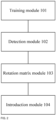
- the robot-assisted automatic introduction device includes training module 101, detection module 102, rotation matrix module 103, and introduction module 104.
- the training module 101 is configured to acquire a dataset of the trocar, and train through a preset U-Net to acquire a first model.
- the detection module 102 is configured to detect, by the first model, a position of the trocar in a target image, and output position information of the trocar that meets a preset condition.
- the rotation matrix module 103 is configured to parameterize, according to the position information of the trocar that meets the preset condition, a rotation angle of the trocar, and acquire a rotation matrix of the trocar.
- the introduction module 104 is configured to acquire, according to the rotation matrix of the trocar, an orientation of the trocar, and control, according to the orientation of the trocar, an instrument at an end of the robot to introduce the trocar.
- the detection module 102 is configured to output position information of the trocar that meets a preset condition. Specifically: The detection module 102 is configured to output position information of the trocar that meets the following condition: pred x ,y ⁇ 0.8 * max pred ; where, (x,y) denotes a pixel position of the trocar; pred(x,y) denotes a confidence of the pixel position (x,y) being classified as trocar; and max(pred) denotes an overall maximum value of an image output by the U-Net.
- the robot-assisted automatic introduction device further includes a screening module configured to process the position information of the trocar that meets the preset condition before the rotation matrix module 103 parameterizes the rotation angle of the trocar.
- the screening module is configured to calculate a median value of the position information in every seven consecutive image frames, calculate a Euclidean distance between the median value and the position information in each of the seven consecutive image frames, and average position information with the Euclidean distance less than or equal to a quarter of a standard deviation to acquire final position information of the trocar.
- the rotation matrix module 103 is configured to acquire a rotation matrix of the trocar. Specifically: The rotation matrix module 103 is configured to acquire rotation matrix R z of the trocar in a z-direction and rotation matrix R y of the trocar in a y-direction, and calculate six-dimensional rotation matrix R of the trocar.
- the embodiments of the present disclosure provide a robot-assisted automatic introduction method and device for a trocar.
- the robot-assisted automatic introduction method includes:
Landscapes
- Engineering & Computer Science (AREA)
- Health & Medical Sciences (AREA)
- Life Sciences & Earth Sciences (AREA)
- Surgery (AREA)
- Biomedical Technology (AREA)
- General Health & Medical Sciences (AREA)
- Molecular Biology (AREA)
- Physics & Mathematics (AREA)
- Theoretical Computer Science (AREA)
- Medical Informatics (AREA)
- Public Health (AREA)
- Animal Behavior & Ethology (AREA)
- Heart & Thoracic Surgery (AREA)
- Veterinary Medicine (AREA)
- Nuclear Medicine, Radiotherapy & Molecular Imaging (AREA)
- General Physics & Mathematics (AREA)
- Robotics (AREA)
- Computer Vision & Pattern Recognition (AREA)
- Computing Systems (AREA)
- Software Systems (AREA)
- Data Mining & Analysis (AREA)
- General Engineering & Computer Science (AREA)
- Mathematical Physics (AREA)
- Artificial Intelligence (AREA)
- Biophysics (AREA)
- Computational Linguistics (AREA)
- Evolutionary Computation (AREA)
- Pathology (AREA)
- Epidemiology (AREA)
- Business, Economics & Management (AREA)
- Primary Health Care (AREA)
- General Business, Economics & Management (AREA)
- Bioinformatics & Cheminformatics (AREA)
- Bioinformatics & Computational Biology (AREA)
- Evolutionary Biology (AREA)
- Probability & Statistics with Applications (AREA)
- Manipulator (AREA)
- Surgical Instruments (AREA)
Applications Claiming Priority (2)
| Application Number | Priority Date | Filing Date | Title |
|---|---|---|---|
| CN202111577523.9A CN114159166B (zh) | 2021-12-21 | 2021-12-21 | 一种机器人辅助的套管针自动对接方法和装置 |
| PCT/CN2022/134016 WO2023116333A1 (zh) | 2021-12-21 | 2022-11-24 | 一种机器人辅助的套管针自动对接方法和装置 |
Publications (2)
| Publication Number | Publication Date |
|---|---|
| EP4454589A1 true EP4454589A1 (de) | 2024-10-30 |
| EP4454589A4 EP4454589A4 (de) | 2025-04-16 |
Family
ID=80487687
Family Applications (1)
| Application Number | Title | Priority Date | Filing Date |
|---|---|---|---|
| EP22909648.2A Pending EP4454589A4 (de) | 2021-12-21 | 2022-11-24 | Robotergestütztes automatisches trokarandockverfahren und vorrichtung |
Country Status (5)
| Country | Link |
|---|---|
| US (1) | US12702505B2 (de) |
| EP (1) | EP4454589A4 (de) |
| CN (1) | CN114159166B (de) |
| LU (1) | LU504661B1 (de) |
| WO (1) | WO2023116333A1 (de) |
Families Citing this family (2)
| Publication number | Priority date | Publication date | Assignee | Title |
|---|---|---|---|---|
| CN114159166B (zh) * | 2021-12-21 | 2024-02-27 | 广州市微眸医疗器械有限公司 | 一种机器人辅助的套管针自动对接方法和装置 |
| CN116269754B (zh) * | 2022-12-20 | 2025-08-22 | 广州市微眸医疗器械有限公司 | 一种手术机器人与隧道针的对接方法 |
Family Cites Families (16)
| Publication number | Priority date | Publication date | Assignee | Title |
|---|---|---|---|---|
| DE102010029275A1 (de) | 2010-05-25 | 2011-12-01 | Siemens Aktiengesellschaft | Verfahren zum Bewegen eines Instrumentenarms eines Laparoskopierobotors in einer vorgebbare Relativlage zu einem Trokar |
| DE102010040987A1 (de) * | 2010-09-17 | 2012-03-22 | Siemens Aktiengesellschaft | Verfahren zum Platzieren eines Laparoskopieroboters in einer vorgebbaren Relativlage zu einem Trokar |
| US9414776B2 (en) * | 2013-03-06 | 2016-08-16 | Navigated Technologies, LLC | Patient permission-based mobile health-linked information collection and exchange systems and methods |
| US12478444B2 (en) * | 2019-03-21 | 2025-11-25 | The Board Of Trustees Of The Leland Stanford Junior University | Systems and methods for localization based on machine learning |
| US11170526B2 (en) * | 2019-03-26 | 2021-11-09 | Samsung Electronics Co., Ltd. | Method and apparatus for estimating tool trajectories |
| US11547495B2 (en) * | 2019-04-26 | 2023-01-10 | Globus Medical, Inc. | System and method for reducing interference in positional sensors for robotic surgery |
| CN110559075B (zh) * | 2019-08-05 | 2021-09-24 | 常州锦瑟医疗信息科技有限公司 | 术中增强现实配准方法和装置 |
| WO2021030536A1 (en) * | 2019-08-13 | 2021-02-18 | Duluth Medical Technologies Inc. | Robotic surgical methods and apparatuses |
| DE102019123742B4 (de) * | 2019-09-04 | 2021-12-30 | Carl Zeiss Meditec Ag | Augenchirurgie-Operationssystem und computerimplementiertes Verfahren zum Bereitstellen der Lage wenigstens eines Trokarpunkts |
| US11529734B2 (en) | 2019-10-31 | 2022-12-20 | Verb Surgical Inc. | Systems and methods for visual sensing of and docking with a trocar |
| US11819288B2 (en) * | 2020-03-19 | 2023-11-21 | Verb Surgical Inc. | Trocar pose estimation using machine learning for docking surgical robotic arm to trocar |
| EP4138715A4 (de) * | 2020-04-19 | 2023-10-11 | Xact Robotics Ltd. | Algorithmusbasierte verfahren zur vorhersage und/oder erkennung eines klinischen zustands im zusammenhang mit der einführung eines medizinischen instruments in ein internes ziel |
| WO2021247744A1 (en) * | 2020-06-03 | 2021-12-09 | Noah Medical Corporation | Systems and methods for hybrid imaging and navigation |
| CN112370161B (zh) * | 2020-10-12 | 2022-07-26 | 珠海横乐医学科技有限公司 | 基于超声图像特征平面检测的手术导航方法及介质 |
| CN113538522B (zh) * | 2021-08-12 | 2022-08-12 | 广东工业大学 | 一种用于腹腔镜微创手术的器械视觉跟踪方法 |
| CN114159166B (zh) * | 2021-12-21 | 2024-02-27 | 广州市微眸医疗器械有限公司 | 一种机器人辅助的套管针自动对接方法和装置 |
-
2021
- 2021-12-21 CN CN202111577523.9A patent/CN114159166B/zh active Active
-
2022
- 2022-11-24 LU LU504661A patent/LU504661B1/en active IP Right Grant
- 2022-11-24 EP EP22909648.2A patent/EP4454589A4/de active Pending
- 2022-11-24 WO PCT/CN2022/134016 patent/WO2023116333A1/zh not_active Ceased
- 2022-11-24 US US18/721,882 patent/US12702505B2/en active Active
Also Published As
| Publication number | Publication date |
|---|---|
| EP4454589A4 (de) | 2025-04-16 |
| LU504661B1 (en) | 2023-11-07 |
| CN114159166A (zh) | 2022-03-11 |
| US20250064537A1 (en) | 2025-02-27 |
| CN114159166B (zh) | 2024-02-27 |
| US12702505B2 (en) | 2026-08-11 |
| WO2023116333A1 (zh) | 2023-06-29 |
Similar Documents
| Publication | Publication Date | Title |
|---|---|---|
| CN104933718B (zh) | 一种基于双目视觉的物理坐标定位方法 | |
| Doignon et al. | Segmentation and guidance of multiple rigid objects for intra-operative endoscopic vision | |
| Probst et al. | Automatic tool landmark detection for stereo vision in robot-assisted retinal surgery | |
| US8073528B2 (en) | Tool tracking systems, methods and computer products for image guided surgery | |
| US8108072B2 (en) | Methods and systems for robotic instrument tool tracking with adaptive fusion of kinematics information and image information | |
| EP4209313A1 (de) | Fehlererkennungsverfahren und robotersystem auf der basis mehrerer haltungsidentifizierungen | |
| EP4396779B1 (de) | Verfahren und systeme zur erzeugung von kameramodellen zur kamerakalibrierung | |
| US20250064537A1 (en) | Robot-assisted Automatic Introduction Method and Device for Trocar | |
| US12548159B2 (en) | Scene perception systems and methods | |
| CN102567989A (zh) | 基于双目立体视觉的空间定位方法 | |
| CN112215871B (zh) | 一种基于机器人视觉的移动目标追踪方法及装置 | |
| CN105082161A (zh) | 双目立体摄像机机器人视觉伺服控制装置及其使用方法 | |
| US12318937B2 (en) | Error detection method and robot system based on association identification | |
| CN118492790B (zh) | 一种焊接机器人位姿计算方法、系统、装置及介质 | |
| Beyl et al. | Time-of-flight-assisted Kinect camera-based people detection for intuitive human robot cooperation in the surgical operating room | |
| CN117621103A (zh) | 基于位姿自适应逆透视变换的护理机器人测距及避障方法 | |
| CN121650026A (zh) | 一种利用双微距镜头约束对机械臂进行控制的方法及装置 | |
| Gans et al. | Visual servoing to an arbitrary pose with respect to an object given a single known length | |
| CN119992634A (zh) | 人机交互视线追踪方法 | |
| Wang et al. | Image-based pose estimation and tracking of surgical instruments in minimally invasive surgery | |
| US10832422B2 (en) | Alignment system for liver surgery | |
| Gaschler et al. | Epipolar-based stereo tracking without explicit 3d reconstruction | |
| Alkhalil et al. | Stereo visual servoing with decoupling control | |
| Safin et al. | Experiments on mobile robot stereo vision system calibration under hardware imperfection | |
| Mileti et al. | Accuracy of position and orientation for consumer-grade tracking sensors with Hand-Eye Calibration |
Legal Events
| Date | Code | Title | Description |
|---|---|---|---|
| STAA | Information on the status of an ep patent application or granted ep patent |
Free format text: STATUS: THE INTERNATIONAL PUBLICATION HAS BEEN MADE |
|
| PUAI | Public reference made under article 153(3) epc to a published international application that has entered the european phase |
Free format text: ORIGINAL CODE: 0009012 |
|
| STAA | Information on the status of an ep patent application or granted ep patent |
Free format text: STATUS: REQUEST FOR EXAMINATION WAS MADE |
|
| 17P | Request for examination filed |
Effective date: 20240704 |
|
| AK | Designated contracting states |
Kind code of ref document: A1 Designated state(s): AL AT BE BG CH CY CZ DE DK EE ES FI FR GB GR HR HU IE IS IT LI LT LU LV MC ME MK MT NL NO PL PT RO RS SE SI SK SM TR |
|
| DAV | Request for validation of the european patent (deleted) | ||
| DAX | Request for extension of the european patent (deleted) | ||
| A4 | Supplementary search report drawn up and despatched |
Effective date: 20250314 |
|
| RIC1 | Information provided on ipc code assigned before grant |
Ipc: G06N 3/08 20230101ALN20250310BHEP Ipc: G06T 7/77 20170101ALI20250310BHEP Ipc: G06N 3/04 20230101ALI20250310BHEP Ipc: A61B 17/34 20060101ALI20250310BHEP Ipc: A61B 34/10 20160101ALI20250310BHEP Ipc: A61B 34/20 20160101ALI20250310BHEP Ipc: A61B 34/30 20160101AFI20250310BHEP |