EP4454474A1 - Confection and method for making confections - Google Patents
Confection and method for making confections Download PDFInfo
- Publication number
- EP4454474A1 EP4454474A1 EP24167652.7A EP24167652A EP4454474A1 EP 4454474 A1 EP4454474 A1 EP 4454474A1 EP 24167652 A EP24167652 A EP 24167652A EP 4454474 A1 EP4454474 A1 EP 4454474A1
- Authority
- EP
- European Patent Office
- Prior art keywords
- outer shell
- main body
- shell portion
- mold
- confection
- Prior art date
- Legal status (The legal status is an assumption and is not a legal conclusion. Google has not performed a legal analysis and makes no representation as to the accuracy of the status listed.)
- Granted
Links
Images


Classifications
-
- A—HUMAN NECESSITIES
- A23—FOODS OR FOODSTUFFS; TREATMENT THEREOF, NOT COVERED BY OTHER CLASSES
- A23G—COCOA; COCOA PRODUCTS, e.g. CHOCOLATE; SUBSTITUTES FOR COCOA OR COCOA PRODUCTS; CONFECTIONERY; CHEWING GUM; ICE-CREAM; PREPARATION THEREOF
- A23G1/00—Cocoa; Cocoa products, e.g. chocolate; Substitutes therefor
- A23G1/30—Cocoa products, e.g. chocolate; Substitutes therefor
- A23G1/50—Cocoa products, e.g. chocolate; Substitutes therefor characterised by shape, structure or physical form, e.g. products with an inedible support
- A23G1/54—Composite products, e.g. layered, laminated, coated or filled
- A23G1/545—Hollow products, e.g. with inedible or edible filling, fixed or movable within the cavity
-
- A—HUMAN NECESSITIES
- A23—FOODS OR FOODSTUFFS; TREATMENT THEREOF, NOT COVERED BY OTHER CLASSES
- A23G—COCOA; COCOA PRODUCTS, e.g. CHOCOLATE; SUBSTITUTES FOR COCOA OR COCOA PRODUCTS; CONFECTIONERY; CHEWING GUM; ICE-CREAM; PREPARATION THEREOF
- A23G3/00—Sweetmeats; Confectionery; Marzipan; Coated or filled products
- A23G3/34—Sweetmeats, confectionery or marzipan; Processes for the preparation thereof
- A23G3/50—Sweetmeats, confectionery or marzipan; Processes for the preparation thereof characterised by shape, structure or physical form, e.g. products with supported structure
- A23G3/54—Composite products, e.g. layered, coated, filled
-
- A—HUMAN NECESSITIES
- A23—FOODS OR FOODSTUFFS; TREATMENT THEREOF, NOT COVERED BY OTHER CLASSES
- A23G—COCOA; COCOA PRODUCTS, e.g. CHOCOLATE; SUBSTITUTES FOR COCOA OR COCOA PRODUCTS; CONFECTIONERY; CHEWING GUM; ICE-CREAM; PREPARATION THEREOF
- A23G1/00—Cocoa; Cocoa products, e.g. chocolate; Substitutes therefor
- A23G1/0003—Processes of manufacture not relating to composition or compounding ingredients
- A23G1/005—Moulding, shaping, cutting or dispensing chocolate
- A23G1/0053—Processes of shaping not covered elsewhere
- A23G1/0063—Processes in which the material is shaped at least partially in a mould, in the hollows of a surface, a drum or an endless band, or by drop-by-drop casting or dispensing of the material on a surface, e.g. injection moulding or transfer moulding
-
- A—HUMAN NECESSITIES
- A23—FOODS OR FOODSTUFFS; TREATMENT THEREOF, NOT COVERED BY OTHER CLASSES
- A23G—COCOA; COCOA PRODUCTS, e.g. CHOCOLATE; SUBSTITUTES FOR COCOA OR COCOA PRODUCTS; CONFECTIONERY; CHEWING GUM; ICE-CREAM; PREPARATION THEREOF
- A23G1/00—Cocoa; Cocoa products, e.g. chocolate; Substitutes therefor
- A23G1/0003—Processes of manufacture not relating to composition or compounding ingredients
- A23G1/0076—Processes for moulding hollow products, open shells or other articles having cavities, e.g. open cavities
-
- A—HUMAN NECESSITIES
- A23—FOODS OR FOODSTUFFS; TREATMENT THEREOF, NOT COVERED BY OTHER CLASSES
- A23G—COCOA; COCOA PRODUCTS, e.g. CHOCOLATE; SUBSTITUTES FOR COCOA OR COCOA PRODUCTS; CONFECTIONERY; CHEWING GUM; ICE-CREAM; PREPARATION THEREOF
- A23G1/00—Cocoa; Cocoa products, e.g. chocolate; Substitutes therefor
- A23G1/04—Apparatus specially adapted for manufacture or treatment of cocoa or cocoa products
- A23G1/20—Apparatus for moulding, cutting or dispensing chocolate
- A23G1/21—Apparatus for moulding hollow products, open shells or other articles having cavities, e.g. open cavities
-
- A—HUMAN NECESSITIES
- A23—FOODS OR FOODSTUFFS; TREATMENT THEREOF, NOT COVERED BY OTHER CLASSES
- A23G—COCOA; COCOA PRODUCTS, e.g. CHOCOLATE; SUBSTITUTES FOR COCOA OR COCOA PRODUCTS; CONFECTIONERY; CHEWING GUM; ICE-CREAM; PREPARATION THEREOF
- A23G1/00—Cocoa; Cocoa products, e.g. chocolate; Substitutes therefor
- A23G1/30—Cocoa products, e.g. chocolate; Substitutes therefor
- A23G1/50—Cocoa products, e.g. chocolate; Substitutes therefor characterised by shape, structure or physical form, e.g. products with an inedible support
- A23G1/54—Composite products, e.g. layered, laminated, coated or filled
-
- A—HUMAN NECESSITIES
- A23—FOODS OR FOODSTUFFS; TREATMENT THEREOF, NOT COVERED BY OTHER CLASSES
- A23G—COCOA; COCOA PRODUCTS, e.g. CHOCOLATE; SUBSTITUTES FOR COCOA OR COCOA PRODUCTS; CONFECTIONERY; CHEWING GUM; ICE-CREAM; PREPARATION THEREOF
- A23G3/00—Sweetmeats; Confectionery; Marzipan; Coated or filled products
- A23G3/0002—Processes of manufacture not relating to composition and compounding ingredients
- A23G3/0004—Processes specially adapted for manufacture or treatment of sweetmeats or confectionery
- A23G3/0019—Shaping of liquid, paste, powder; Manufacture of moulded articles, e.g. modelling, moulding, calendering
- A23G3/0025—Processes in which the material is shaped at least partially in a mould in the hollows of a surface, a drum, an endless band, or by a drop-by-drop casting or dispensing of the material on a surface, e.g. injection moulding, transfer moulding
- A23G3/0029—Moulding processes for hollow products, e.g. opened shell
-
- A—HUMAN NECESSITIES
- A23—FOODS OR FOODSTUFFS; TREATMENT THEREOF, NOT COVERED BY OTHER CLASSES
- A23G—COCOA; COCOA PRODUCTS, e.g. CHOCOLATE; SUBSTITUTES FOR COCOA OR COCOA PRODUCTS; CONFECTIONERY; CHEWING GUM; ICE-CREAM; PREPARATION THEREOF
- A23G3/00—Sweetmeats; Confectionery; Marzipan; Coated or filled products
- A23G3/0002—Processes of manufacture not relating to composition and compounding ingredients
- A23G3/0053—Processes for moulding candy in the plastic state
-
- A—HUMAN NECESSITIES
- A23—FOODS OR FOODSTUFFS; TREATMENT THEREOF, NOT COVERED BY OTHER CLASSES
- A23G—COCOA; COCOA PRODUCTS, e.g. CHOCOLATE; SUBSTITUTES FOR COCOA OR COCOA PRODUCTS; CONFECTIONERY; CHEWING GUM; ICE-CREAM; PREPARATION THEREOF
- A23G3/00—Sweetmeats; Confectionery; Marzipan; Coated or filled products
- A23G3/34—Sweetmeats, confectionery or marzipan; Processes for the preparation thereof
- A23G3/50—Sweetmeats, confectionery or marzipan; Processes for the preparation thereof characterised by shape, structure or physical form, e.g. products with supported structure
-
- A—HUMAN NECESSITIES
- A23—FOODS OR FOODSTUFFS; TREATMENT THEREOF, NOT COVERED BY OTHER CLASSES
- A23G—COCOA; COCOA PRODUCTS, e.g. CHOCOLATE; SUBSTITUTES FOR COCOA OR COCOA PRODUCTS; CONFECTIONERY; CHEWING GUM; ICE-CREAM; PREPARATION THEREOF
- A23G3/00—Sweetmeats; Confectionery; Marzipan; Coated or filled products
- A23G3/34—Sweetmeats, confectionery or marzipan; Processes for the preparation thereof
- A23G3/50—Sweetmeats, confectionery or marzipan; Processes for the preparation thereof characterised by shape, structure or physical form, e.g. products with supported structure
- A23G3/54—Composite products, e.g. layered, coated, filled
- A23G3/545—Composite products, e.g. layered, coated, filled hollow products, e.g. with inedible or edible filling, fixed or movable within the cavity
-
- A—HUMAN NECESSITIES
- A63—SPORTS; GAMES; AMUSEMENTS
- A63H—TOYS, e.g. TOPS, DOLLS, HOOPS OR BUILDING BLOCKS
- A63H3/00—Dolls
- A63H3/003—Dolls specially adapted for a particular function not connected with dolls
- A63H3/005—Dolls specially adapted for a particular function not connected with dolls for use as container
-
- A—HUMAN NECESSITIES
- A63—SPORTS; GAMES; AMUSEMENTS
- A63H—TOYS, e.g. TOPS, DOLLS, HOOPS OR BUILDING BLOCKS
- A63H33/00—Other toys
- A63H33/42—Toy models or toy scenery not otherwise covered
-
- B—PERFORMING OPERATIONS; TRANSPORTING
- B65—CONVEYING; PACKING; STORING; HANDLING THIN OR FILAMENTARY MATERIAL
- B65D—CONTAINERS FOR STORAGE OR TRANSPORT OF ARTICLES OR MATERIALS, e.g. BAGS, BARRELS, BOTTLES, BOXES, CANS, CARTONS, CRATES, DRUMS, JARS, TANKS, HOPPERS, FORWARDING CONTAINERS; ACCESSORIES, CLOSURES, OR FITTINGS THEREFOR; PACKAGING ELEMENTS; PACKAGES
- B65D81/00—Containers, packaging elements, or packages, for contents presenting particular transport or storage problems, or adapted to be used for non-packaging purposes after removal of contents
- B65D81/36—Containers, packaging elements, or packages, for contents presenting particular transport or storage problems, or adapted to be used for non-packaging purposes after removal of contents adapted to be used for non-packaging purposes after removal of contents
- B65D81/365—Containers, or parts thereof, simulating or being incorporated into other items, e.g. puppet, animal, vehicle, building, dumb bells
-
- A—HUMAN NECESSITIES
- A23—FOODS OR FOODSTUFFS; TREATMENT THEREOF, NOT COVERED BY OTHER CLASSES
- A23G—COCOA; COCOA PRODUCTS, e.g. CHOCOLATE; SUBSTITUTES FOR COCOA OR COCOA PRODUCTS; CONFECTIONERY; CHEWING GUM; ICE-CREAM; PREPARATION THEREOF
- A23G2220/00—Products with special structure
- A23G2220/22—Hollow products, e.g. with inedible or edible filling, fixed or movable within the cavity
-
- A—HUMAN NECESSITIES
- A63—SPORTS; GAMES; AMUSEMENTS
- A63H—TOYS, e.g. TOPS, DOLLS, HOOPS OR BUILDING BLOCKS
- A63H3/00—Dolls
Definitions
- the present invention relates to confectionery and a method for making confections.
- Utility Patent Application Publication No. S53-110977 discloses a capsule having a structure in which the article such as a figure (toy) is accommodated, and the exterior thereof is covered by a confection.
- the spherical capsule-shaped confection is formed by combining two hemispherical capsules.
- the capsules When removing the capsules, it is possible to break the confection to extract them, but this confection was merely unsatisfactory in terms of interest value when consumed alone.
- the "confection” is defined as and includes and any one of sweets such as candies, chocolates, cakes, cookies pancakes, and confectionery, and any food in which sugar is not contained such as snack food and the like.
- the confection comprises a main body which is spherical and hollow.
- the main body is made up of a first outer shell portion in a first color and a second outer shell portion in a second color, which is different from the first color, and a connecting portion provided between the first outer shell portion and the second outer shell portion has an outer peripheral surface without any step.
- Another aspect of the present invention is a method for manufacturing a confection.
- the method comprises a filling step of filling a first raw material in a first color into a first mold and filling a second raw material in a second color into a second mold, a molding step of forming a first outer shell portion having a hemispherical shape with an internal space from the first raw material filled in the first mold, and forming a second outer shell portion having a hemispherical shape with an internal space from the second raw material filled in the second mold, a container insertion step of inserting a container into the internal space of the formed first outer shell portion or the formed second outer shell portion; and a connecting step of connecting the formed first outer shell portion and the formed second outer shell portion to form a spherical-shaped main body.
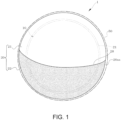
- FIG. 1 is a perspective view of a confection according to an embodiment of the present invention.
- FIG. 2 is a cross sectional view of a main part of the confection shown in FIG. 1 .
- the confection 1 has a spherical external shape and comprises a body portion 20, which is hollow and accommodates a spherical container 10.
- This body portion 20 is, for example, a chocolate confection made up of a white first outer shell part 21 and a black second outer shell part 22, wherein the color of the first outer shell part 21 is different from that of the first shell part 21.
- the first outer shell part 21 and the second outer shell part 22 are made of material with different flavors, and for instance, the white first outer shell part 21 is made of white chocolate, and the second outer shell part 22 shown in black is made of milk chocolate, wherein the amount of the white chocolate is equal to that of the milk chocolate.
- the container 10 is made of a hard material such as synthetic resin.
- the body portion 20 has a connecting portion 28 between the first outer shell part 21 and the second outer shell part 22 which are connected to each other without any step, through a manufacturing method described later. Therefore, the connecting portion 28, which is the boundary of the two-color separation, forms part of an outer peripheral surface 20us in a clean spherical shape without any step, and the internal space SP1 (refer to FIG. 3 ) has also a spherical space without any step.
- the body portion 20 is opaque and made of a chocolate confection.
- the container 10 accommodated inside the body portion 20 is made invisible in a state where the first outer shell part 21 and the second outer shell part 22 are connected to each other. Additionally, the entire outer peripheral surface 20us of the body portion 20 is covered with a covering member 50.
- This covering member 50 is composed of opaque wrapping paper or a wrapping film with colored patterns, so that the body portion 20 is not visible from the outside.”
- the covering member 50 is provided so as to be attached firmly to the outer peripheral surface 20us of the body portion 20. Therefore, since the body portion 20 is wrapped with the covering member 50, the confection 1 can be rolled and played with before consumption.
- the body portion 20 is configured such that only part (a lower end P in the figure) of the outer peripheral surface 10us of the container 10 is brought in contact with the inner peripheral surface 20is of the body portion 20 in a first state before disassembly or destruction thereof. That is, the size of the internal space SP1 of the body portion 20 is set so that a gap is formed by taking the outer diameter size of the container 10 into consideration.
- the body portion 20 can directly accommodate the container 10 within the internal space SP1 and the container 10 can be swung within the internal space SP1. For instance, by shaking the body portion 20, the inner peripheral surface 20is of the body portion 20 is brough in contact with the outer peripheral surface 10us of the container 10, thereby generating sound.
- the maximum length D1 of the body portion 20 is set in a range, for example, of 4 cm to 6 cm
- the maximum diameter d2 of the container 10 accommodated inside the body portion 20 is set in a range of 3 cm to 5 cm.
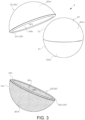
- FIG. 3 is an exploded perspective view showing an initial state of a disassembled confection 1
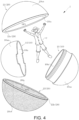
- FIG. 4 is an exploded perspective view showing a final state of the disassembled confection 1.
- the body portion 20 is divided so as to be turned into a second state, as shown in FIG. 3 , thereby allowing separation of the container 10 from the body portion 20 for consumption and removal of the container 10.
- the connecting portion 28 is configured so as to be separated more easily than other parts.
- the container 10 accommodated in the body portion 20 is disassembled.
- the container 10 is made up, for example, of two parts, the first main part 11 and the second main part 12.
- an article C which is a specific character figure, and is contained in the container 10 can be taken therefrom.
- the body portion 20 can be consumed, and the article C inside the container 10 can be played with.
- Various figures are prepared for such an article C, and one of them is enclosed in the container 10. Thus, one can enjoy both consuming the confection 1 and collecting the figures.
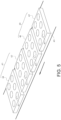
- FIG. 5 is a schematic perspective view of shaping molds placed on a conveyance path 45, and an example of a state of arrangement thereof at time when confections are manufactured.
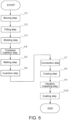
- FIG. 6 is a flowchart of an example of the method for manufacturing confections.
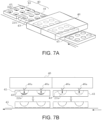
- FIGS. 7A and 7B respectively show a perspective view and a side view, illustrating an example of a moving step at time when raw material is filled during the confection manufacturing.
- FIG. 8 is a schematic side view showing a molding step of hemispherical outer shell parts.
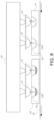
- FIG. 9 is a schematic side view of a state where a container is provided into the mold.
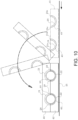
- FIG. 10 is a schematic view of an example of an inversion step at time of the confection manufacture.
- a shaping mold 40 which forms the shape of the confections 1, comprises a first mold 41 and a second mold 42. All steps of the manufacturing method described below are performed while the first mold 41 and the second mold 42 are moved in a state where they are in series aligned on a continuously formed conveyance path 45. As shown in FIG. 5 , each of the shaping molds 40 is made up of the first mold 41 and the second mold 42, which are aligned in a conveying direction (in a direction shown by an arrow) of the conveyance path 45 and are configured to form a pair. In addition, the first mold 41 and the second mold 42 are alternatively arranged in the conveying direction. In addition, both the first and second molds 41 and 42 respectively include one or a plurality of hemispherical concave portions 43, each of which forms the outer shape of a confection 1 (in this embodiment, the number of the concave portions is six).
- a manufacturing process including, for example, steps S1 to S10 is carried out on the shaping molds 40 which are transported by the conveying path 45 in order produce confections 1.
- a moving step is carried out on the shaping molds 40 which have been transported onto the conveying path 45.
- this moving step is carried out in an area where a filling device 46, which fills melted chocolate raw material, and which is provided on the upper side of the conveying path 45, is provided.
- the shaping molds 40 which have come directly below the filling device 46 are moved upward by a moving device (not shown) as shown in FIG. 7B from the conveying surface (in an upper direction from a conveying face of the conveying path 45).
- a moving device not shown
- the first mold(s) 41 and the second mold(s) 42 of the concave portions 43 approach towards filling openings 46a of the filling device 46 (Refer to FIG. 7B ).
- step S2 the filling step of chocolate raw materials is carried out. Specifically, in a state where the shaping mold 40 is close to the filling openings 46a, first material (white) 21b is filled into the concave portions 43 of the first mold 41, and second material (black) 22b is filled into the concave portions 43 of the second mold 42. Subsequently, the shaping mold(s) 40 filled with these raw materials is lowered and returned onto the conveying path 45, and then transferred to the next process.
- this molding step involves a step of lowering hemispherical convex molds 47 provided in a molding machine 48, for example, located above the conveying path 45, towards the first mold 41 and the second mold 42 on the conveyance path 45.
- a molding machine 48 for example, located above the conveying path 45
- the raw material accumulated at the bottom of each of the concave portions 43 in the previous step is pushed and spread into the molding space between the concave portion 43 and the convex mold 47.
- the convex mold 47 rises back to its standby position. Consequently, the hemispherical-shaped first outer shell part 21 and the hemispherical-shaped second outer shell part 22, each of which has an internal space, are molded.
- a container insertion step is carried out. Specifically, as shown in FIG. 9 , a container 10 containing an article C is inserted from above into the hemispherical internal space of, for example, each of the second outer shell parts 22. It should be noted that the mold where the container 10 is inserted is shown as the second mold 42, which will be a lower side in a subsequent inversion step, however, if the first mold 41 becomes the lower side during inversion, the mold the containers 10 are inserted will be a first mold 41.
- a melting step is conducted.
- This melting step involves a step of reheating an opening end 21e of each of the first outer shell parts 21, and an opening end 22e of each of the second outer shell part 22 where the container 10 is inserted, after a natural cooling step, or forced cooling process. (Refer to FIG. 9 .)
- an inversion step is conducted.
- this inversion step involves, a step of inverting the first mold 41 on the conveyance path 45 so as to cover the second mold 42 by an inverting device (not shown).
- an inverting device not shown.
- the first mold 41 and the second mold 42 are vertically overlapped with each other. Consequently, the opening end 21e of the first outer shell part 21 and the opening end 22e of the second outer shell part 22 come into contact with each other.
- a connection step is conducted following the inversion step without performing any step between the inversion step and this connection step.
- the contact state between the opening end 21e of the first outer shell part 21 and the opening end 22e of the second outer shell part 22 is maintained, thereby forming a main body 20, which has a connecting portion 28 by which the first outer shell part 21 and the second outer shell part 22 are connected to each other.
- the strength of the connecting portion 28 can be set based on the degree of re-melting of the opening ends 21e, 22e. For example, only the opening ends 21e, 22e are reheated when both of the outer shell parts 21, 22 are in a cooled and solidified state. While the strength of the connection can be set higher when the melting temperature at the reheating is high, a separation of the opening end 21e from the opening end 22e at the connecting portion 28 can be made easier when the melting temperature is low. Thus, by reheating only the surfaces of the opening ends 21e, 22e, it is possible to create a condition where the opening ends 21e, 22e can be separated from each other at the connecting portion, more easily than at other parts which are entirely solidified from the melted state.
- a forced cooling step is conducted.
- the main body 20 is rapidly cooled, thereby expediting subsequent steps.
- the cooling step may be provided before the step S5, as mentioned above. In such case, it is possible to reheat them fast.
- a vibration imparting step is conducted.
- vibration is imparted to the stacked first and second molds 41 and 42 (the shaping mold 40) to facilitate removal of the main body 20 from the shaping molds 40.
- a coating step for coating the main body 20 is conducted.
- the first mold 41 which covers the second mold42, is returned to its original position to open the shaping mold 40, by rotating and moving the first mold 41.
- the main bodies 20 are removed from the second mold 42 by using, for example, a suction means, and are coated with the coating member 50 on its outer peripheral surface 20us.
- the coated main body 20 is then transferred to another transfer path from the conveyance path 45 and packaged into cosmetic boxes or the like.
- the confection 1 comprises differently colored chocolates connected without steps, the confection 1 can be easily held and rolled even by infants and children. Moreover, since the two-colored chocolates can be neatly separated at the connecting portion, the infants and children can eat it, and enjoy the visual color combination. Furthermore, since the two colors of the outer shells are composed of different flavors, they can choose to enjoy multiple flavors separately or simultaneously. Since a character article C is enclosed in the container 10, it can be enjoyed as a character toy.
- first outer shell portion 21 and the second outer shell portion 22 both have the same semi-spherical shape, two-colored confection 1 can have different flavors in equal amounts. Moreover, due to the configuration where they are easily separable at the connecting portion 28 located near the equator of the main body 20, the container 10 included thereinside can be reliably removed without destroying multiple parts of the main body 20. Furthermore, since the confection 1 enclosed thereinside cannot be seen from the outside of the main body 20, it can create a sense of anticipation about what is inside.
- the main body 20 can directly accommodate the container 10 without providing a packaging member around the container 10. Therefore, it is possible not only to prevent from accidentally eating such a packaging member but also to eliminate the need for removing the packaging member from the container 10.
- the container 10 since the container 10 is configured to be swingable within the main body 20, the outer peripheral surface of the container 10 can be brought in contact with the inner peripheral surface of the main body 20 thereby generating a sound.
- this configuration can prevent damage to the main body 20, caused by unexpected expansion of the container 10.
- the container 10 contains one character article selected from multiple types of articles C, it is possible to offer an enjoyment of collecting multiple characters.”
- the main body 20 is configured so as not to be visible from the outside in a state where the entire outer peripheral surface 20us of the main body 20 is covered by the covering member 50, the two colors of the content enclosed thereinside can be enjoyed by a viewer when it is opened.
- connection step includes the melting step for melting the opening end portion of each of the first outer shell portions 21 and that of each of the second outer shell portions 22 in a state where the first mold 41 and the second mold 42 are alternatively arranged one by one in a conveying direction thereof, connections between the opening end portions 21e in the first mold 41 and the opening end portions 22e in the second mold 42 can be easily achieved by simply flipping, upside down, one of the molds adjacent to each other. Additionally, this connection can be performed on the conveyance path 45 transporting both molds.
- the moving step for moving the first mold 41 and the second mold 42 in a direction crossing the conveying direction (in an upward direction) so as to approach the filling ports 46a for filling the concave portions with the first raw material 21b and the second raw material 22b since there is the moving step for moving the first mold 41 and the second mold 42 in a direction crossing the conveying direction (in an upward direction) so as to approach the filling ports 46a for filling the concave portions with the first raw material 21b and the second raw material 22b, the filling of materials can be reliably performed even while conveying.
- a vibration application step for applying vibration to the first mold 41 and the second mold 42 is included, which facilitates separation between the surface of the shaping mold 40 and the molded product, thereby enabling easy release.
- a covering step for covering the main body 20 by taking the main portions 20 from the first mold 41 or the second mold 42, and covering its outer peripheral surface 20us with the covering member 50, thereby ensuring food hygiene of the confection 1.
- a cooling process(es) for cooling the first outer shell portion 21 and the second outer shell portion 22 is included before, after, or before and after the connecting process.
- a cooling process for cooling the first outer shell portion 21 and the second outer shell portion 22 is included before, after, or before and after the connecting process.
- the solidification before the melting process can be advanced, thus enlarging a range in which the connection strength (melting adjustment of the opening end portions) of the connecting portion 28 is adjusted.
- the connection, fixing and overall cooling of the first outer shell portion 21 and the second outer shell portion 22 and cooling can be accelerated, thereby enhancing productivity thereof.
- all the steps are executed while the first mold 41 and the second mold 42 on a continuous conveyance path 45 while moving, thereby improving productivity thereof.
- the colors of the confection are black and white, but these colors are not limited thereto and may be any suitable combination of colors, for example, purple, red, yellow, water blue, green, brown, and black.
- the first mold 41 and the second mold 42 are arranged in a single row along the conveying direction, but the arrangement thereof is not limited thereto, and they may be arranged in two rows along the conveying direction.
Landscapes
- Engineering & Computer Science (AREA)
- Life Sciences & Earth Sciences (AREA)
- Chemical & Material Sciences (AREA)
- Food Science & Technology (AREA)
- Polymers & Plastics (AREA)
- Manufacturing & Machinery (AREA)
- Mechanical Engineering (AREA)
- Confectionery (AREA)
Abstract
Description
- The disclosure of
Japanese Patent Application No. 2023-071073 filed April 24, 2023 - The present invention relates to confectionery and a method for making confections.
- Conventionally, there have been capsule-shaped confections, each of which contains an article(s) inside the capsule. For example, Utility Patent Application Publication No.
S53-110977 - In Utility Patent Application Publication No.
S53-110977 - It is an object of the present invention to provide a confection(s) with high interest value and a method for making the confections.
- One of the aspects of the present invention is a confection. In the present specification, the "confection" is defined as and includes and any one of sweets such as candies, chocolates, cakes, cookies pancakes, and confectionery, and any food in which sugar is not contained such as snack food and the like. The confection comprises a main body which is spherical and hollow. The main body is made up of a first outer shell portion in a first color and a second outer shell portion in a second color, which is different from the first color, and a connecting portion provided between the first outer shell portion and the second outer shell portion has an outer peripheral surface without any step.
- Another aspect of the present invention is a method for manufacturing a confection. The method comprises a filling step of filling a first raw material in a first color into a first mold and filling a second raw material in a second color into a second mold, a molding step of forming a first outer shell portion having a hemispherical shape with an internal space from the first raw material filled in the first mold, and forming a second outer shell portion having a hemispherical shape with an internal space from the second raw material filled in the second mold, a container insertion step of inserting a container into the internal space of the formed first outer shell portion or the formed second outer shell portion; and a connecting step of connecting the formed first outer shell portion and the formed second outer shell portion to form a spherical-shaped main body.
- According to the present invention, it is possible to provide a confection, which is excellent in handleability.
-
-
FIG. 1 is a perspective view of a confection according to an embodiment of the present invention; -
FIG. 2 is a cross sectional view of a main part of the confection shown inFIG. 1 ; -
FIG. 3 is an exploded perspective view thereof, showing an initial state where the confection shown inFIG. 1 is exploded; -
FIG. 4 is an exploded perspective view thereof, showing a final disassembled state of the confection shown inFIG. 1 ; -
FIG. 5 is a schematic perspective view of shaping molds arranged at time when confections are manufactured, as an example; -
FIG. 6 is a flowchart of an example of a method of manufacturing confections; -
FIGS. 7A is a schematic perspective view illustrating an example of a moving step at time of filling of raw material during confection manufacturing; -
FIGS. 7B is a side view illustrating an example of a moving step at time when the raw material is filled during confection manufacturing; -
FIG. 8 is a schematic side view showing a molding step of a first outer shell part and a second outer shell part; -
FIG. 9 is a schematic side view showing a state where a container is provided into each of the molds; and -
FIG. 10 is a schematic view showing an example of a reversal step at time of confection manufacture. - An embodiment will be explained below, referring to attached drawings.
FIG. 1 is a perspective view of a confection according to an embodiment of the present invention.FIG. 2 is a cross sectional view of a main part of the confection shown inFIG. 1 . - As shown in
FIGS. 1 and2 , theconfection 1 has a spherical external shape and comprises abody portion 20, which is hollow and accommodates aspherical container 10. Thisbody portion 20 is, for example, a chocolate confection made up of a white firstouter shell part 21 and a black secondouter shell part 22, wherein the color of the firstouter shell part 21 is different from that of thefirst shell part 21. The firstouter shell part 21 and the secondouter shell part 22 are made of material with different flavors, and for instance, the white firstouter shell part 21 is made of white chocolate, and the secondouter shell part 22 shown in black is made of milk chocolate, wherein the amount of the white chocolate is equal to that of the milk chocolate. Thecontainer 10 is made of a hard material such as synthetic resin. - Here, the
body portion 20 has a connectingportion 28 between the firstouter shell part 21 and the secondouter shell part 22 which are connected to each other without any step, through a manufacturing method described later. Therefore, the connectingportion 28, which is the boundary of the two-color separation, forms part of an outer peripheral surface 20us in a clean spherical shape without any step, and the internal space SP1 (refer toFIG. 3 ) has also a spherical space without any step. - The
body portion 20 is opaque and made of a chocolate confection. Thecontainer 10 accommodated inside thebody portion 20 is made invisible in a state where the firstouter shell part 21 and the secondouter shell part 22 are connected to each other. Additionally, the entire outer peripheral surface 20us of thebody portion 20 is covered with a coveringmember 50. This coveringmember 50 is composed of opaque wrapping paper or a wrapping film with colored patterns, so that thebody portion 20 is not visible from the outside." - Additionally, the covering
member 50 is provided so as to be attached firmly to the outer peripheral surface 20us of thebody portion 20. Therefore, since thebody portion 20 is wrapped with the coveringmember 50, theconfection 1 can be rolled and played with before consumption. - As shown in
FIG. 2 , thebody portion 20 is configured such that only part (a lower end P in the figure) of the outer peripheral surface 10us of thecontainer 10 is brought in contact with the inner peripheral surface 20is of thebody portion 20 in a first state before disassembly or destruction thereof. That is, the size of the internal space SP1 of thebody portion 20 is set so that a gap is formed by taking the outer diameter size of thecontainer 10 into consideration. - Thus, in the first state, the
body portion 20 can directly accommodate thecontainer 10 within the internal space SP1 and thecontainer 10 can be swung within the internal space SP1. For instance, by shaking thebody portion 20, the inner peripheral surface 20is of thebody portion 20 is brough in contact with the outer peripheral surface 10us of thecontainer 10, thereby generating sound. - When the maximum length D1 of the
body portion 20 is set in a range, for example, of 4 cm to 6 cm, the maximum diameter d2 of thecontainer 10 accommodated inside thebody portion 20 is set in a range of 3 cm to 5 cm. -
FIG. 3 is an exploded perspective view showing an initial state of a disassembledconfection 1, andFIG. 4 is an exploded perspective view showing a final state of the disassembledconfection 1. To disassemble theconfection 1, after removing the coveringmember 50, thebody portion 20 is divided so as to be turned into a second state, as shown inFIG. 3 , thereby allowing separation of thecontainer 10 from thebody portion 20 for consumption and removal of thecontainer 10. - First, when the
body portion 20 is disassembled, as shown inFIG. 3 , the hemispherical firstouter shell part 21 and hemispherical secondouter shell part 22 which are identical in shape can be cleanly separated from each other by, for example, applying a force near the connectingportion 28. In the manufacturing method described later, the connectingportion 28 is configured so as to be separated more easily than other parts. - Next, as shown in
FIG. 4 , thecontainer 10 accommodated in thebody portion 20 is disassembled. Thecontainer 10 is made up, for example, of two parts, the firstmain part 11 and the secondmain part 12. By disassembling these parts, an article C, which is a specific character figure, and is contained in thecontainer 10 can be taken therefrom. In this non-rolling second state after the disassembly, thebody portion 20 can be consumed, and the article C inside thecontainer 10 can be played with. Various figures are prepared for such an article C, and one of them is enclosed in thecontainer 10. Thus, one can enjoy both consuming theconfection 1 and collecting the figures. - A manufacturing method of such a
confection 1 will be explained referring toFIGS. 5-10 .FIG. 5 is a schematic perspective view of shaping molds placed on aconveyance path 45, and an example of a state of arrangement thereof at time when confections are manufactured.FIG. 6 is a flowchart of an example of the method for manufacturing confections.FIGS. 7A and 7B respectively show a perspective view and a side view, illustrating an example of a moving step at time when raw material is filled during the confection manufacturing.FIG. 8 is a schematic side view showing a molding step of hemispherical outer shell parts.FIG. 9 is a schematic side view of a state where a container is provided into the mold.FIG. 10 is a schematic view of an example of an inversion step at time of the confection manufacture. - A shaping
mold 40, which forms the shape of theconfections 1, comprises afirst mold 41 and asecond mold 42. All steps of the manufacturing method described below are performed while thefirst mold 41 and thesecond mold 42 are moved in a state where they are in series aligned on a continuously formedconveyance path 45. As shown inFIG. 5 , each of the shapingmolds 40 is made up of thefirst mold 41 and thesecond mold 42, which are aligned in a conveying direction (in a direction shown by an arrow) of theconveyance path 45 and are configured to form a pair. In addition, thefirst mold 41 and thesecond mold 42 are alternatively arranged in the conveying direction. In addition, both the first andsecond molds concave portions 43, each of which forms the outer shape of a confection 1 (in this embodiment, the number of the concave portions is six). - As shown in
FIG. 6 , a manufacturing process including, for example, steps S1 to S10 is carried out on the shapingmolds 40 which are transported by the conveyingpath 45 in order produceconfections 1. - First, in the step S1, a moving step is carried out on the shaping
molds 40 which have been transported onto the conveyingpath 45. As shown inFIG. 7A , this moving step is carried out in an area where a fillingdevice 46, which fills melted chocolate raw material, and which is provided on the upper side of the conveyingpath 45, is provided. For example, the shapingmolds 40 which have come directly below the fillingdevice 46 are moved upward by a moving device (not shown) as shown inFIG. 7B from the conveying surface (in an upper direction from a conveying face of the conveying path 45). By this movement, the first mold(s) 41 and the second mold(s) 42 of theconcave portions 43 approach towards fillingopenings 46a of the filling device 46 (Refer toFIG. 7B ). - In the step S2, the filling step of chocolate raw materials is carried out. Specifically, in a state where the shaping
mold 40 is close to the fillingopenings 46a, first material (white) 21b is filled into theconcave portions 43 of thefirst mold 41, and second material (black) 22b is filled into theconcave portions 43 of thesecond mold 42. Subsequently, the shaping mold(s) 40 filled with these raw materials is lowered and returned onto the conveyingpath 45, and then transferred to the next process. - In the step S3, the molding step of the hemispherical-shaped first
outer shell part 21 and the hemispherical-shaped secondouter shell part 22 is conducted. As shown inFIG. 8 , this molding step involves a step of lowering hemisphericalconvex molds 47 provided in amolding machine 48, for example, located above the conveyingpath 45, towards thefirst mold 41 and thesecond mold 42 on theconveyance path 45. As a result, the raw material accumulated at the bottom of each of theconcave portions 43 in the previous step is pushed and spread into the molding space between theconcave portion 43 and theconvex mold 47. Subsequently, theconvex mold 47 rises back to its standby position. Consequently, the hemispherical-shaped firstouter shell part 21 and the hemispherical-shaped secondouter shell part 22, each of which has an internal space, are molded. - In the step S4, a container insertion step is carried out. Specifically, as shown in
FIG. 9 , acontainer 10 containing an article C is inserted from above into the hemispherical internal space of, for example, each of the secondouter shell parts 22. It should be noted that the mold where thecontainer 10 is inserted is shown as thesecond mold 42, which will be a lower side in a subsequent inversion step, however, if thefirst mold 41 becomes the lower side during inversion, the mold thecontainers 10 are inserted will be afirst mold 41. - In a step S5, a melting step is conducted. This melting step involves a step of reheating an opening
end 21e of each of the firstouter shell parts 21, and anopening end 22e of each of the secondouter shell part 22 where thecontainer 10 is inserted, after a natural cooling step, or forced cooling process. (Refer toFIG. 9 .) - In a step S6, an inversion step is conducted. As shown in
FIG. 10 , this inversion step involves, a step of inverting thefirst mold 41 on theconveyance path 45 so as to cover thesecond mold 42 by an inverting device (not shown). As a result, thefirst mold 41 and thesecond mold 42 are vertically overlapped with each other. Consequently, the openingend 21e of the firstouter shell part 21 and the openingend 22e of the secondouter shell part 22 come into contact with each other. - In a step S7, a connection step is conducted following the inversion step without performing any step between the inversion step and this connection step. The contact state between the opening
end 21e of the firstouter shell part 21 and the openingend 22e of the secondouter shell part 22 is maintained, thereby forming amain body 20, which has a connectingportion 28 by which the firstouter shell part 21 and the secondouter shell part 22 are connected to each other. - Here, the strength of the connecting
portion 28 can be set based on the degree of re-melting of the opening ends 21e, 22e. For example, only the opening ends 21e, 22e are reheated when both of theouter shell parts end 21e from the openingend 22e at the connectingportion 28 can be made easier when the melting temperature is low. Thus, by reheating only the surfaces of the opening ends 21e, 22e, it is possible to create a condition where the opening ends 21e, 22e can be separated from each other at the connecting portion, more easily than at other parts which are entirely solidified from the melted state. - In the step S8, a forced cooling step is conducted. In this cooling step, the
main body 20 is rapidly cooled, thereby expediting subsequent steps. Additionally, the cooling step may be provided before the step S5, as mentioned above. In such case, it is possible to reheat them fast. - In a step S9, a vibration imparting step is conducted. In this step, vibration is imparted to the stacked first and
second molds 41 and 42 (the shaping mold 40) to facilitate removal of themain body 20 from the shapingmolds 40. - In a step S10, a coating step for coating the
main body 20 is conducted. Prior to this coating step, thefirst mold 41, which covers the second mold42, is returned to its original position to open the shapingmold 40, by rotating and moving thefirst mold 41. In this state, themain bodies 20 are removed from thesecond mold 42 by using, for example, a suction means, and are coated with the coatingmember 50 on its outer peripheral surface 20us. The coatedmain body 20 is then transferred to another transfer path from theconveyance path 45 and packaged into cosmetic boxes or the like. - As described above, since the
confection 1 according to this embodiment, comprises differently colored chocolates connected without steps, theconfection 1 can be easily held and rolled even by infants and children. Moreover, since the two-colored chocolates can be neatly separated at the connecting portion, the infants and children can eat it, and enjoy the visual color combination. Furthermore, since the two colors of the outer shells are composed of different flavors, they can choose to enjoy multiple flavors separately or simultaneously. Since a character article C is enclosed in thecontainer 10, it can be enjoyed as a character toy. - In addition, in the present embodiment, since the first
outer shell portion 21 and the secondouter shell portion 22 both have the same semi-spherical shape, two-colored confection 1 can have different flavors in equal amounts. Moreover, due to the configuration where they are easily separable at the connectingportion 28 located near the equator of themain body 20, thecontainer 10 included thereinside can be reliably removed without destroying multiple parts of themain body 20. Furthermore, since theconfection 1 enclosed thereinside cannot be seen from the outside of themain body 20, it can create a sense of anticipation about what is inside. - In this embodiment, since the
container 10, including its constituents, is designed with hygiene in mind, themain body 20 can directly accommodate thecontainer 10 without providing a packaging member around thecontainer 10. Therefore, it is possible not only to prevent from accidentally eating such a packaging member but also to eliminate the need for removing the packaging member from thecontainer 10. - In this embodiment, since the
container 10 is configured to be swingable within themain body 20, the outer peripheral surface of thecontainer 10 can be brought in contact with the inner peripheral surface of themain body 20 thereby generating a sound. Thus, it is possible to offer aconfection 1 capable of generating a sound. Moreover, this configuration can prevent damage to themain body 20, caused by unexpected expansion of thecontainer 10. - In this embodiment, since the
container 10 contains one character article selected from multiple types of articles C, it is possible to offer an enjoyment of collecting multiple characters." - In the present embodiment, since the
main body 20 is configured so as not to be visible from the outside in a state where the entire outer peripheral surface 20us of themain body 20 is covered by the coveringmember 50, the two colors of the content enclosed thereinside can be enjoyed by a viewer when it is opened. - In the present embodiment, since hemispherical molded confections made of different raw materials are combined with and connected to each other to form a spherical shape, by using two molds in the same shape in the manufacturing process, and the connecting
portion 28 therebetween is configured so as to be easily separated from each other, it is possible to provide aconfection 1 having two different color flavors, which can be enjoyed separately. - In the present embodiment, since the connection step includes the melting step for melting the opening end portion of each of the first
outer shell portions 21 and that of each of the secondouter shell portions 22 in a state where thefirst mold 41 and thesecond mold 42 are alternatively arranged one by one in a conveying direction thereof, connections between the openingend portions 21e in thefirst mold 41 and the openingend portions 22e in thesecond mold 42 can be easily achieved by simply flipping, upside down, one of the molds adjacent to each other. Additionally, this connection can be performed on theconveyance path 45 transporting both molds. - In the present embodiment, since there is the moving step for moving the
first mold 41 and thesecond mold 42 in a direction crossing the conveying direction (in an upward direction) so as to approach the fillingports 46a for filling the concave portions with the firstraw material 21b and the secondraw material 22b, the filling of materials can be reliably performed even while conveying. - In the present embodiment, as a post process after the connecting step, a vibration application step for applying vibration to the
first mold 41 and thesecond mold 42 is included, which facilitates separation between the surface of the shapingmold 40 and the molded product, thereby enabling easy release. - In the present embodiment, as a post process after the connecting process, there is a covering step for covering the
main body 20 by taking themain portions 20 from thefirst mold 41 or thesecond mold 42, and covering its outer peripheral surface 20us with the coveringmember 50, thereby ensuring food hygiene of theconfection 1. - In the present embodiment, a cooling process(es) for cooling the first
outer shell portion 21 and the secondouter shell portion 22 is included before, after, or before and after the connecting process. For example, when such a cooling process is provided before the connecting process, the solidification before the melting process can be advanced, thus enlarging a range in which the connection strength (melting adjustment of the opening end portions) of the connectingportion 28 is adjusted. Conversely, when such a cooling process is provided after the connecting process, the connection, fixing and overall cooling of the firstouter shell portion 21 and the secondouter shell portion 22 and cooling can be accelerated, thereby enhancing productivity thereof. - In the present embodiment, all the steps are executed while the
first mold 41 and thesecond mold 42 on acontinuous conveyance path 45 while moving, thereby improving productivity thereof. - Although the embodiments of the present invention are described above, the present invention can be appropriately modified within the scope of its technical concept. For example, in the above embodiments, the colors of the confection are black and white, but these colors are not limited thereto and may be any suitable combination of colors, for example, purple, red, yellow, water blue, green, brown, and black.
- Furthermore, in the manufacturing process in the above embodiment, the
first mold 41 and thesecond mold 42 are arranged in a single row along the conveying direction, but the arrangement thereof is not limited thereto, and they may be arranged in two rows along the conveying direction. - As described above, the following matters are described in this specification:
- (1) A confection comprising: a main body having a spherical shape and being hollow, wherein the main body includes a first outer shell portion in a first color and a second outer shell portion in a second color, which is different from the first color, and a connecting portion between the first outer shell portion and the second outer shell portion has an outer peripheral surface without any step.
- (2) In the confection as described in (1), the first outer shell portion and the second outer shell portion are both formed in a hemispheroidal and identical shape.
- (3) In the confection as described in (1) or (2), a space capable of accommodating a container is formed inside the main body in a state where the first outer shell portion and the second outer shell portion are connected to each other.
- (4) In the confection as described in (3), the main body is configured so that the container accommodated inside the main body is invisible in the state where the first outer shell portion and the second outer shell portion are connected to each other.
- (5) In the confection as described in (3) or (4), the first outer shell portion and the second outer shell portion are made of chocolate confections having different flavors.
- (6) In the confection as described in (3) to (5), the main body can take a first state capable of being rolled and a second state incapable of being rolled, wherein the first state is a state before the main body is broken, and the second state is a state after the main body is broken.
- (7) In the confection as described in (6), the main body is configured to be separable at the connecting portion.
- (8) In the confection as described in (7), the main body is configured to be separable more easily at the connecting part than other parts.
- (9) In the confection as described in any one of (6) to (8), the main body accommodates the container so as to be swingable in the first state.
- (10) In the confection as described in any one of (6) to (9), the main body is configured such that only part of the outer peripheral surface of the container is in contact with an inner peripheral surface of the main body in the first state.
- (11) In the confection as described in (9) or (10), the main body is formed within a range of 4 cm to 6 cm in a maximum diameter thereof, wherein the container, which is formed in a range of 3 cm to 5 cm in a maximum diameter thereof, is accommodated in the main body.
- (12) In the confection as described in any one of (3) to (11), the container accommodated in the main body contains one article selected from among a plurality of articles.
- (13) In the confection as described in (12), the article is a figure associated with a specific character.
- (14) In the confection as described in any one of (3) to (13), the main body directly accommodates the container.
- (15) In the confection as described in any one of (1) to (14), the main body is configured so as to be invisible from the outside when the entire outer peripheral surface is covered with a covering member.
- (16) A method for manufacturing confection comprises a filling step of filling a first raw material in a first color into a first mold, and filling a second raw material in a second color into a second mold, a molding step of forming a first outer shell portion having a hemispherical shape with an internal space from the first raw material filled in the first mold, and forming a second outer shell portion having a hemispherical shape with an internal space from the second raw material filled in the second mold, a container insertion step of inserting a container into the internal space of the formed first outer shell portion or the second outer shell portion, and a connecting step of connecting the formed first outer shell portion and the formed second outer shell portion to form a spherical-shaped main body.
- (17) In the method for manufacturing confection as described in (16), the connecting step includes a melting step of melting an opening end portion of the first outer shell portion and that of the second outer shell portion.
- (18) In the method for manufacturing confection as described in (17), the connecting step includes an inversion step of reversing the first mold or the second mold to bring the opening end portions of the first outer shell portion and that of the second outer shell portion into contact with each other.
- (19) In the method for manufacturing confection as described in any one of (16) to (18), the first mold and the second mold are arranged alternately every other in a conveying direction thereof.
- (20) In the method for manufacturing confectionery as described in (19), the filling step includes a moving step of moving the first mold and the second mold in a direction intersecting with the conveying direction toward filling ports of the first raw material and that of the second raw material.
- (21) In the method for manufacturing confection as described in any one of (16) to (20), further comprising a vibration applying step of applying vibration to the first mold and the second mold after the connecting step.
- (22) In the method for manufacturing confection as described in any one of (16) to (21), further comprising a covering step of taking out the main body from the first mold or the second mold after the connecting step and covering the outer peripheral surface of the main body with a covering member.
- (23) In the method for manufacturing confection as described in any one of (16) to (22), further comprising a cooling step of cooling the first outer shell portion and the second outer shell portion before, after, or before and after the connecting step.
- (24) In the method for manufacturing confection as described in any one of (16) to (23), all the steps are performed on a continuous conveyance path while the first mold and the second mold are moved thereby.
Claims (21)
- A confection comprising:a main body, which is in a spherical shape and hollow;wherein the main body includes a first outer shell portion in a first color and a second outer shell portion in a second color, which is different from the first color, and a connecting portion between the first outer shell portion and the second outer shell portion has an outer peripheral surface without any step.
- The confection according to claim 1, wherein the first outer shell portion and the second outer shell portion are respectively formed in a hemispheroidal and identical shape.
- The confection according to claim 2, wherein a space capable of accommodating a container is formed inside the main body in a state where the first outer shell portion and the second outer shell portion are connected to each other.
- The confection according to claim 3, wherein the main body is configured so that the container accommodated inside the main body is invisible in the state where the first outer shell portion and the second outer shell portion are connected to each other.
- The confection according to claim 4, wherein the first outer shell portion and the second outer shell portion are made of chocolate confections having different flavors.
- The confection according to claim 3, wherein the main body can take a first state in which the main body can be rolled or a second state in which the main body cannot be rolled, and the first state is a state before the main body is broken, and the second state is a state after the main body is broken.
- The confection according to claim 6, wherein the main body is configured to be separable at the connecting portion.
- The confection according to claim 6, wherein the main body accommodates the container so as to be swingable in the first state.
- The confection according to claim 6, wherein the main body is configured such that only part of an outer peripheral surface of the container is in contact with an inner peripheral surface of the main body in the first state.
- The confection according to claim 1, wherein the container accommodated in the main body contains one article selected from among a plurality of articles.
- The confection according to claim 10, wherein the main body directly accommodates the container.
- The confection according to any one of claims 3-7, wherein the main body is configured so as to be invisible from the outside when an outer peripheral surface of the main body is entirely covered by a covering member.
- A method for manufacturing a confection, comprising the following steps of:a filling step of filling a first raw material in a first color into a first mold, and filling a second raw material in a second color into a second mold;a molding step of forming a first outer shell portion having a hemispherical shape with an internal space from the first raw material filled in the first mold, and forming a second outer shell portion having a hemispherical shape with an internal space from the second raw material filled in the second mold;a container insertion step of inserting a container into the internal space of the formed first outer shell portion or the formed second outer shell portion; anda connecting step of connecting the formed first outer shell portion and the formed second outer shell portion to form a spherical-shaped main body.
- The method for manufacturing a confection according to claim 13, wherein the connecting step includes a melting step of melting an opening end portion of the first outer shell portion and that of the second outer shell portion.
- The method for manufacturing a confection according to claim 14, wherein the connecting step includes a reversal step of reversing the first mold or the second mold to bring the opening end portion of the first outer shell portion and that of the second outer shell portion into contact with each other.
- The method for manufacturing confection according to claim 13, wherein the first mold and the second mold are arranged alternately in a conveying direction thereof.
- The method for manufacturing a confection according to claim 13, wherein the filling step includes a moving step of moving the first mold and the second mold in a direction intersecting with the conveying direction toward a filling port of the first raw material and that of the second raw material.
- The method for manufacturing confection according to claim 17, further comprising a vibration applying step of applying vibration to the first mold and the second mold after the connecting step.
- The method for manufacturing a confection according to claim 18, further comprising a covering step of taking out the main body from the first mold or the second mold after the connecting step and covering an outer peripheral surface of the main body with a covering member.
- The method for manufacturing a confection according to claim 19, further comprising a cooling step of cooling the first outer shell portion and the second outer shell portion before, after, or before and after the connecting step.
- The method for manufacturing a confection according to claim 13, wherein all the steps are performed on a continuous conveyance path while the first mold and the second mold are moved thereby.
Applications Claiming Priority (1)
| Application Number | Priority Date | Filing Date | Title |
|---|---|---|---|
| JP2023071073A JP7583098B2 (en) | 2023-04-24 | 2023-04-24 | Confectionery and method for producing same |
Publications (3)
| Publication Number | Publication Date |
|---|---|
| EP4454474A1 true EP4454474A1 (en) | 2024-10-30 |
| EP4454474C0 EP4454474C0 (en) | 2026-05-13 |
| EP4454474B1 EP4454474B1 (en) | 2026-05-13 |
Family
ID=90571718
Family Applications (1)
| Application Number | Title | Priority Date | Filing Date |
|---|---|---|---|
| EP24167652.7A Active EP4454474B1 (en) | 2023-04-24 | 2024-03-28 | Method for making confections |
Country Status (7)
| Country | Link |
|---|---|
| US (1) | US20240349750A1 (en) |
| EP (1) | EP4454474B1 (en) |
| JP (3) | JP7583098B2 (en) |
| KR (1) | KR20240156948A (en) |
| CN (1) | CN117958343A (en) |
| TW (2) | TWI897265B (en) |
| WO (1) | WO2024224866A1 (en) |
Citations (4)
| Publication number | Priority date | Publication date | Assignee | Title |
|---|---|---|---|---|
| JPS53110977A (en) | 1977-03-10 | 1978-09-28 | Matsushita Electric Ind Co Ltd | Ultrafiltration membrane |
| US5792496A (en) * | 1997-01-10 | 1998-08-11 | Fekete; Ferenc | Edible shell/thermoplastic container system |
| US6099872A (en) * | 1998-04-22 | 2000-08-08 | Whetstone, Jr.; Henry M. | Edible and non-edible product |
| WO2015124642A1 (en) * | 2014-02-21 | 2015-08-27 | Perfetti Van Melle S.P.A. | Edible multicoloured, fat-based, solid oral compositions and the manufacturing process thereof |
Family Cites Families (10)
| Publication number | Priority date | Publication date | Assignee | Title |
|---|---|---|---|---|
| JPS52106490U (en) * | 1976-01-23 | 1977-08-13 | ||
| EP1110459A1 (en) * | 1999-12-22 | 2001-06-27 | Soremartec S.A. | A method of manufacturing a food product |
| US20120321750A1 (en) * | 2011-06-14 | 2012-12-20 | James Klene | Complex Confectionery Products |
| CN203355294U (en) * | 2013-04-03 | 2013-12-25 | 广州市卡力思食品有限公司 | Candy toy |
| BE1022280B1 (en) | 2014-12-22 | 2016-03-10 | C&B Logistics Bvba | Method for printing on multilayer chocolate hollow figures |
| MX2017017001A (en) | 2015-06-30 | 2018-04-10 | Magic Production Group M P G S A | Food product package. |
| US20200037631A1 (en) * | 2017-06-15 | 2020-02-06 | C&B Logistics Bvba | Printing on Multi-Layered, Hollow, Chocolate Figures |
| US20200008443A1 (en) | 2018-07-09 | 2020-01-09 | Henry M. Whetstone, Jr. | Confectionery product |
| WO2021029826A1 (en) * | 2019-08-09 | 2021-02-18 | Zuru (Singapore) Pte. Ltd. | Gummy confectionery-coated non-edible container |
| CN215775305U (en) * | 2021-04-19 | 2022-02-11 | 江油市丹阳机电设备有限责任公司 | Chocolate product with content |
-
2023
- 2023-04-24 JP JP2023071073A patent/JP7583098B2/en active Active
-
2024
- 2024-02-09 JP JP2024018282A patent/JP7543582B1/en active Active
- 2024-02-29 TW TW113107194A patent/TWI897265B/en active
- 2024-02-29 TW TW113151506A patent/TW202517161A/en unknown
- 2024-03-07 KR KR1020240032384A patent/KR20240156948A/en active Pending
- 2024-03-11 CN CN202410271568.0A patent/CN117958343A/en active Pending
- 2024-03-14 WO PCT/JP2024/010067 patent/WO2024224866A1/en not_active Ceased
- 2024-03-24 US US18/614,678 patent/US20240349750A1/en active Pending
- 2024-03-28 EP EP24167652.7A patent/EP4454474B1/en active Active
- 2024-10-31 JP JP2024192500A patent/JP2025014052A/en active Pending
Patent Citations (4)
| Publication number | Priority date | Publication date | Assignee | Title |
|---|---|---|---|---|
| JPS53110977A (en) | 1977-03-10 | 1978-09-28 | Matsushita Electric Ind Co Ltd | Ultrafiltration membrane |
| US5792496A (en) * | 1997-01-10 | 1998-08-11 | Fekete; Ferenc | Edible shell/thermoplastic container system |
| US6099872A (en) * | 1998-04-22 | 2000-08-08 | Whetstone, Jr.; Henry M. | Edible and non-edible product |
| WO2015124642A1 (en) * | 2014-02-21 | 2015-08-27 | Perfetti Van Melle S.P.A. | Edible multicoloured, fat-based, solid oral compositions and the manufacturing process thereof |
Non-Patent Citations (2)
| Title |
|---|
| ANONYMOUS: "Schoko Spass - das �berraschungsei von Lidl - Bauchladenblog", 26 July 2017 (2017-07-26), pages 1 - 16, XP093205907, Retrieved from the Internet <URL:https://bauchladenblog.de/das-ueberraschungsei-von-lidl/> [retrieved on 20230917] * |
| DATABASE GNPD [online] MINTEL; 25 September 2018 (2018-09-25), ANONYMOUS: "Chocolate Fun Eggs with Surprise", XP093205916, retrieved from https://www.gnpd.com/sinatra/recordpage/5999141/ Database accession no. 5999141 * |
Also Published As
| Publication number | Publication date |
|---|---|
| JP7583098B2 (en) | 2024-11-13 |
| EP4454474C0 (en) | 2026-05-13 |
| CN117958343A (en) | 2024-05-03 |
| JP2024156532A (en) | 2024-11-06 |
| KR20240156948A (en) | 2024-10-31 |
| EP4454474B1 (en) | 2026-05-13 |
| JP2025014052A (en) | 2025-01-28 |
| WO2024224866A1 (en) | 2024-10-31 |
| TW202442130A (en) | 2024-11-01 |
| JP7543582B1 (en) | 2024-09-02 |
| TW202517161A (en) | 2025-05-01 |
| US20240349750A1 (en) | 2024-10-24 |
| JP2024156603A (en) | 2024-11-06 |
| TWI897265B (en) | 2025-09-11 |
Similar Documents
| Publication | Publication Date | Title |
|---|---|---|
| EP0951835B1 (en) | Edible products comprising non-edible containers | |
| EP3348317B1 (en) | Toy having multiple serial surprise reveals | |
| US20250280851A1 (en) | Gummy confectionery-coated non-edible container | |
| JP2004506433A (en) | Frozen confectionery products and their production | |
| CA2918818A1 (en) | Packaged food item and method | |
| US20040180120A1 (en) | Packaged decorated frozen confection and method of manufacture | |
| WO2011027621A1 (en) | Chocolate product and production method therefor | |
| EP4454474B1 (en) | Method for making confections | |
| HK40106328A (en) | Sweets and manufacturing method for the same | |
| US11510422B1 (en) | Method for manufacturing of frozen confection product | |
| PT2730172T (en) | Casting method for fruit gums | |
| US20240306660A1 (en) | Specialty food products and methods for manufacturing the same | |
| RU2655853C1 (en) | Candy in original packaging | |
| JP7133249B1 (en) | Method for producing chocolate and method for producing chocolate package | |
| CN212164791U (en) | Building block vitamin fruit soft sweets capable of being spliced into toy | |
| JP2002065169A (en) | Food with integral hollow shell | |
| KR200292369Y1 (en) | Confectionary packing case | |
| KR0180996B1 (en) | Chocolate Toy Capsules | |
| JP3080401U (en) | Kako | |
| RU12939U1 (en) | DEVICE FOR PRODUCING HOLLOW CANDY | |
| JP2002272379A (en) | Baked confectionery and packaging method of baked confectionery | |
| JPH02177867A (en) | Jelly cake having two or more combined colors and preparation thereof |
Legal Events
| Date | Code | Title | Description |
|---|---|---|---|
| PUAI | Public reference made under article 153(3) epc to a published international application that has entered the european phase |
Free format text: ORIGINAL CODE: 0009012 |
|
| STAA | Information on the status of an ep patent application or granted ep patent |
Free format text: STATUS: REQUEST FOR EXAMINATION WAS MADE |
|
| 17P | Request for examination filed |
Effective date: 20240328 |
|
| AK | Designated contracting states |
Kind code of ref document: A1 Designated state(s): AL AT BE BG CH CY CZ DE DK EE ES FI FR GB GR HR HU IE IS IT LI LT LU LV MC ME MK MT NL NO PL PT RO RS SE SI SK SM TR |
|
| STAA | Information on the status of an ep patent application or granted ep patent |
Free format text: STATUS: EXAMINATION IS IN PROGRESS |
|
| 17Q | First examination report despatched |
Effective date: 20250716 |
|
| GRAP | Despatch of communication of intention to grant a patent |
Free format text: ORIGINAL CODE: EPIDOSNIGR1 |
|
| STAA | Information on the status of an ep patent application or granted ep patent |
Free format text: STATUS: GRANT OF PATENT IS INTENDED |
|
| INTG | Intention to grant announced |
Effective date: 20251211 |
|
| GRAS | Grant fee paid |
Free format text: ORIGINAL CODE: EPIDOSNIGR3 |
|
| GRAA | (expected) grant |
Free format text: ORIGINAL CODE: 0009210 |
|
| STAA | Information on the status of an ep patent application or granted ep patent |
Free format text: STATUS: THE PATENT HAS BEEN GRANTED |
|
| AK | Designated contracting states |
Kind code of ref document: B1 Designated state(s): AL AT BE BG CH CY CZ DE DK EE ES FI FR GB GR HR HU IE IS IT LI LT LU LV MC ME MK MT NL NO PL PT RO RS SE SI SK SM TR |
|
| REG | Reference to a national code |
Ref country code: CH Ref legal event code: F10 Free format text: ST27 STATUS EVENT CODE: U-0-0-F10-F00 (AS PROVIDED BY THE NATIONAL OFFICE) Effective date: 20260513 Ref country code: GB Ref legal event code: FG4D |
|
| REG | Reference to a national code |
Ref country code: DE Ref legal event code: R096 Ref document number: 602024004598 Country of ref document: DE |
|
| REG | Reference to a national code |
Ref country code: IE Ref legal event code: FG4D |
|
| U01 | Request for unitary effect filed |
Effective date: 20260609 |
|
| U07 | Unitary effect registered |
Designated state(s): AT BE BG DE DK EE FI FR IT LT LU LV MT NL PT RO SE SI Effective date: 20260617 |