EP4451650A2 - Absichtsbasierte anwendungsmatrix - Google Patents
Absichtsbasierte anwendungsmatrix Download PDFInfo
- Publication number
- EP4451650A2 EP4451650A2 EP24197980.6A EP24197980A EP4451650A2 EP 4451650 A2 EP4451650 A2 EP 4451650A2 EP 24197980 A EP24197980 A EP 24197980A EP 4451650 A2 EP4451650 A2 EP 4451650A2
- Authority
- EP
- European Patent Office
- Prior art keywords
- application
- fabric
- devices
- edge routers
- wan
- Prior art date
- Legal status (The legal status is an assumption and is not a legal conclusion. Google has not performed a legal analysis and makes no representation as to the accuracy of the status listed.)
- Granted
Links
Images


Classifications
-
- H—ELECTRICITY
- H04—ELECTRIC COMMUNICATION TECHNIQUE
- H04L—TRANSMISSION OF DIGITAL INFORMATION, e.g. TELEGRAPHIC COMMUNICATION
- H04L49/00—Packet switching elements
- H04L49/35—Switches specially adapted for specific applications
- H04L49/355—Application aware switches, e.g. for HTTP
-
- H—ELECTRICITY
- H04—ELECTRIC COMMUNICATION TECHNIQUE
- H04L—TRANSMISSION OF DIGITAL INFORMATION, e.g. TELEGRAPHIC COMMUNICATION
- H04L45/00—Routing or path finding of packets in data switching networks
- H04L45/42—Centralised routing
-
- H—ELECTRICITY
- H04—ELECTRIC COMMUNICATION TECHNIQUE
- H04L—TRANSMISSION OF DIGITAL INFORMATION, e.g. TELEGRAPHIC COMMUNICATION
- H04L41/00—Arrangements for maintenance, administration or management of data switching networks, e.g. of packet switching networks
- H04L41/08—Configuration management of networks or network elements
- H04L41/0894—Policy-based network configuration management
-
- H—ELECTRICITY
- H04—ELECTRIC COMMUNICATION TECHNIQUE
- H04L—TRANSMISSION OF DIGITAL INFORMATION, e.g. TELEGRAPHIC COMMUNICATION
- H04L41/00—Arrangements for maintenance, administration or management of data switching networks, e.g. of packet switching networks
- H04L41/50—Network service management, e.g. ensuring proper service fulfilment according to agreements
- H04L41/5003—Managing SLA; Interaction between SLA and QoS
- H04L41/5009—Determining service level performance parameters or violations of service level contracts, e.g. violations of agreed response time or mean time between failures [MTBF]
-
- H—ELECTRICITY
- H04—ELECTRIC COMMUNICATION TECHNIQUE
- H04L—TRANSMISSION OF DIGITAL INFORMATION, e.g. TELEGRAPHIC COMMUNICATION
- H04L41/00—Arrangements for maintenance, administration or management of data switching networks, e.g. of packet switching networks
- H04L41/50—Network service management, e.g. ensuring proper service fulfilment according to agreements
- H04L41/5003—Managing SLA; Interaction between SLA and QoS
- H04L41/5019—Ensuring fulfilment of SLA
- H04L41/5022—Ensuring fulfilment of SLA by giving priorities, e.g. assigning classes of service
-
- H—ELECTRICITY
- H04—ELECTRIC COMMUNICATION TECHNIQUE
- H04L—TRANSMISSION OF DIGITAL INFORMATION, e.g. TELEGRAPHIC COMMUNICATION
- H04L41/00—Arrangements for maintenance, administration or management of data switching networks, e.g. of packet switching networks
- H04L41/50—Network service management, e.g. ensuring proper service fulfilment according to agreements
- H04L41/5041—Network service management, e.g. ensuring proper service fulfilment according to agreements characterised by the time relationship between creation and deployment of a service
- H04L41/5051—Service on demand, e.g. definition and deployment of services in real time
-
- H—ELECTRICITY
- H04—ELECTRIC COMMUNICATION TECHNIQUE
- H04L—TRANSMISSION OF DIGITAL INFORMATION, e.g. TELEGRAPHIC COMMUNICATION
- H04L43/00—Arrangements for monitoring or testing data switching networks
- H04L43/08—Monitoring or testing based on specific metrics, e.g. QoS, energy consumption or environmental parameters
- H04L43/0823—Errors, e.g. transmission errors
- H04L43/0829—Packet loss
-
- H—ELECTRICITY
- H04—ELECTRIC COMMUNICATION TECHNIQUE
- H04L—TRANSMISSION OF DIGITAL INFORMATION, e.g. TELEGRAPHIC COMMUNICATION
- H04L43/00—Arrangements for monitoring or testing data switching networks
- H04L43/08—Monitoring or testing based on specific metrics, e.g. QoS, energy consumption or environmental parameters
- H04L43/0852—Delays
-
- H—ELECTRICITY
- H04—ELECTRIC COMMUNICATION TECHNIQUE
- H04L—TRANSMISSION OF DIGITAL INFORMATION, e.g. TELEGRAPHIC COMMUNICATION
- H04L43/00—Arrangements for monitoring or testing data switching networks
- H04L43/08—Monitoring or testing based on specific metrics, e.g. QoS, energy consumption or environmental parameters
- H04L43/0876—Network utilisation, e.g. volume of load or congestion level
- H04L43/0882—Utilisation of link capacity
-
- H—ELECTRICITY
- H04—ELECTRIC COMMUNICATION TECHNIQUE
- H04L—TRANSMISSION OF DIGITAL INFORMATION, e.g. TELEGRAPHIC COMMUNICATION
- H04L43/00—Arrangements for monitoring or testing data switching networks
- H04L43/08—Monitoring or testing based on specific metrics, e.g. QoS, energy consumption or environmental parameters
- H04L43/091—Measuring contribution of individual network components to actual service level
-
- H—ELECTRICITY
- H04—ELECTRIC COMMUNICATION TECHNIQUE
- H04L—TRANSMISSION OF DIGITAL INFORMATION, e.g. TELEGRAPHIC COMMUNICATION
- H04L43/00—Arrangements for monitoring or testing data switching networks
- H04L43/50—Testing arrangements
- H04L43/55—Testing of service level quality, e.g. simulating service usage
-
- H—ELECTRICITY
- H04—ELECTRIC COMMUNICATION TECHNIQUE
- H04L—TRANSMISSION OF DIGITAL INFORMATION, e.g. TELEGRAPHIC COMMUNICATION
- H04L45/00—Routing or path finding of packets in data switching networks
- H04L45/30—Routing of multiclass traffic
-
- H—ELECTRICITY
- H04—ELECTRIC COMMUNICATION TECHNIQUE
- H04L—TRANSMISSION OF DIGITAL INFORMATION, e.g. TELEGRAPHIC COMMUNICATION
- H04L45/00—Routing or path finding of packets in data switching networks
- H04L45/70—Routing based on monitoring results
-
- H—ELECTRICITY
- H04—ELECTRIC COMMUNICATION TECHNIQUE
- H04L—TRANSMISSION OF DIGITAL INFORMATION, e.g. TELEGRAPHIC COMMUNICATION
- H04L49/00—Packet switching elements
- H04L49/60—Software-defined switches
-
- H—ELECTRICITY
- H04—ELECTRIC COMMUNICATION TECHNIQUE
- H04L—TRANSMISSION OF DIGITAL INFORMATION, e.g. TELEGRAPHIC COMMUNICATION
- H04L67/00—Network arrangements or protocols for supporting network services or applications
- H04L67/2866—Architectures; Arrangements
- H04L67/30—Profiles
-
- H—ELECTRICITY
- H04—ELECTRIC COMMUNICATION TECHNIQUE
- H04L—TRANSMISSION OF DIGITAL INFORMATION, e.g. TELEGRAPHIC COMMUNICATION
- H04L67/00—Network arrangements or protocols for supporting network services or applications
- H04L67/50—Network services
- H04L67/60—Scheduling or organising the servicing of application requests, e.g. requests for application data transmissions using the analysis and optimisation of the required network resources
- H04L67/63—Routing a service request depending on the request content or context
-
- H—ELECTRICITY
- H04—ELECTRIC COMMUNICATION TECHNIQUE
- H04L—TRANSMISSION OF DIGITAL INFORMATION, e.g. TELEGRAPHIC COMMUNICATION
- H04L41/00—Arrangements for maintenance, administration or management of data switching networks, e.g. of packet switching networks
- H04L41/08—Configuration management of networks or network elements
- H04L41/0893—Assignment of logical groups to network elements
-
- H—ELECTRICITY
- H04—ELECTRIC COMMUNICATION TECHNIQUE
- H04L—TRANSMISSION OF DIGITAL INFORMATION, e.g. TELEGRAPHIC COMMUNICATION
- H04L41/00—Arrangements for maintenance, administration or management of data switching networks, e.g. of packet switching networks
- H04L41/08—Configuration management of networks or network elements
- H04L41/0895—Configuration of virtualised networks or elements, e.g. virtualised network function or OpenFlow elements
-
- H—ELECTRICITY
- H04—ELECTRIC COMMUNICATION TECHNIQUE
- H04L—TRANSMISSION OF DIGITAL INFORMATION, e.g. TELEGRAPHIC COMMUNICATION
- H04L41/00—Arrangements for maintenance, administration or management of data switching networks, e.g. of packet switching networks
- H04L41/40—Arrangements for maintenance, administration or management of data switching networks, e.g. of packet switching networks using virtualisation of network functions or resources, e.g. SDN or NFV entities
-
- H—ELECTRICITY
- H04—ELECTRIC COMMUNICATION TECHNIQUE
- H04L—TRANSMISSION OF DIGITAL INFORMATION, e.g. TELEGRAPHIC COMMUNICATION
- H04L43/00—Arrangements for monitoring or testing data switching networks
- H04L43/06—Generation of reports
-
- H—ELECTRICITY
- H04—ELECTRIC COMMUNICATION TECHNIQUE
- H04L—TRANSMISSION OF DIGITAL INFORMATION, e.g. TELEGRAPHIC COMMUNICATION
- H04L43/00—Arrangements for monitoring or testing data switching networks
- H04L43/08—Monitoring or testing based on specific metrics, e.g. QoS, energy consumption or environmental parameters
- H04L43/0876—Network utilisation, e.g. volume of load or congestion level
-
- H—ELECTRICITY
- H04—ELECTRIC COMMUNICATION TECHNIQUE
- H04L—TRANSMISSION OF DIGITAL INFORMATION, e.g. TELEGRAPHIC COMMUNICATION
- H04L43/00—Arrangements for monitoring or testing data switching networks
- H04L43/20—Arrangements for monitoring or testing data switching networks the monitoring system or the monitored elements being virtualised, abstracted or software-defined entities, e.g. SDN or NFV
-
- H—ELECTRICITY
- H04—ELECTRIC COMMUNICATION TECHNIQUE
- H04L—TRANSMISSION OF DIGITAL INFORMATION, e.g. TELEGRAPHIC COMMUNICATION
- H04L45/00—Routing or path finding of packets in data switching networks
- H04L45/64—Routing or path finding of packets in data switching networks using an overlay routing layer
Definitions
- the present disclosure relates generally to a software-defined wide area network (SD-WAN), and more particularly to generating an application fabric over the SD-WAN.
- SD-WAN software-defined wide area network
- a computer network can include a system of hardware, software, protocols, and transmission components that collectively allow separate devices to communicate, share data, and access resources, such as software applications. More specifically, a computer network is a geographically distributed collection of nodes interconnected by communication links and segments for transporting data between endpoints, such as personal computers and workstations. Many types of networks are available, ranging from local area networks (LANs) and wide area networks (WANs) to overlay and software-defined networks, such as software-defined local area networks (SD-LANs) and software-defined wide area networks (SD-WANs), and virtual networks, such as virtual LANs (VLANs) and virtual private networks (VPNs).
- LANs local area networks
- WANs wide area networks
- SD-LANs software-defined local area networks
- SD-WANs software-defined wide area networks
- VLANs virtual LANs
- VPNs virtual private networks
- Particular embodiments described herein provide an intent based application fabric which is created to control and manage one or more specific applications of interest using a portion of a software-defined wide area network (SD-WAN) in a communication network. This is accomplished by (1) discovering which devices (or routers) are running an application of interest among edge routers of the SD-WAN, and by (2) building (or generating), when one or more edge routers running the application of interest are discovered, an application fabric for the application of interest based on a policy (e.g., network policy), quality of service (QoS), latency, loss, or bandwidth availability for the application of interest.
- a policy e.g., network policy
- QoS quality of service
- an application fabric may refer to this application fabric as an "intent based application fabric.”
- the application fabric is to be built using a portion of the SD-WAN, because the application fabric is configured with all or part of the edge routers, each of which runs the application of interest, selected from among the edge routers of the SD-WAN.
- a controller of the SD-WAN is configured to generate a first profile for a first application and provide the first profile to a plurality of edge routers of the SD-WAN.
- the plurality of edge routers may be operable to interface a plurality of devices to the SD-WAN, and the first profile may enable the plurality of edge routers to discover which devices of the plurality of devices support the first application.
- the controller is further configured to receive, from one or more of the edge routers, information indicating which devices of the plurality of devices support the first application.
- the controller is furthermore configured to build a first application fabric for the first application based on the information indicating which devices of the plurality of devices support the first application.
- intent-based networking infrastructure is provided to capture the business intent, in business language, and translate this intent into IT policies that can be applied and constantly monitored across the network.
- an intent of a user or an operator e.g., the "what” is translated into specific executions (the "how") for performing the intent.
- An intent-based network provides three principal functional building blocks: capabilities to capture intent; functions to automate the deployment of the expressed intent throughout the network infrastructure; and the ability to assure that the desired intent is being realized.
- intent-based networking may offer a significant paradigm shift in how networks are planned, designed, and operated.
- tools were not available to declare intent and translate it into the device-level configurations required to realize a desired outcome.
- the network designer or operator had to manually derive individual network-element configurations to support the desired intent, such as, "I want these servers to be reachable from these branches; therefore, I need to configure specific virtual local area network (VLAN), subnet, and security rules on each device in my network.”
- VLAN virtual local area network
- Intent-based networking solutions enable conventional practices that require the alignment of manually derived individual network-element configurations to be replaced by controller-led and policy-based abstractions that easily enable operators to express intent (desired outcome) and subsequently validate that the network is doing what they asked of it.
- intent-based networking In some embodiments of intent-based networking, scale, agility and security demands associated with digital transformation require that element-by-element network configuration be replaced by automated systemwide programming of network elements with consistent intent-based policies. Furthermore, the contextual analysis of data before, during, and after deployment enables continuous verification to help assure that the network is delivering the desired outcome and protection at any point in time. Continuous gathering of telemetry and other forms of data from a multitude of diverse sources provides a rich context of information to optimize a system and ensure it is secure. Intent-based policy extends beyond the access control of clients or applications. It broadens to expressions of the desired user experience, application prioritization, service-chaining network functions that need to be applied to an application flow, or even operational service-level agreement (SLA) rules, such as, "I want to deploy only golden images on my network devices.”
- SLA operational service-level agreement
- embodiments include various elements and limitations, with no one element or limitation contemplated as being a critical element or limitation.
- Each of the claims individually recites an aspect of the embodiment in its entirety.
- some embodiments described may include, but are not limited to, inter alia , systems, networks, integrated circuit chips, embedded processors, ASICs, methods, and computer-readable non-transitory media containing instructions.
- One or multiple systems, devices, components, etc. may comprise one or more embodiments, which may include some elements or limitations of a claim being performed by the same or different systems, devices, components, etc.
- a processing element may be a general processor, a task-specific processor, a core of one or more processors, or other co-located, resource-sharing implementation for performing the corresponding processing.
- the embodiments described hereinafter embody various aspects and configurations, with the figures illustrating example and non-limiting configurations.
- the term "system” or "apparatus” is used consistently herein with its common definition of an appliance or device.
- any block and flow diagrams and message sequence charts may typically be performed in the same or in a different serial or parallel ordering and/or by different components and/or processes, threads, etc., and/or over different connections and be combined with other functions in other embodiments, unless this disables the embodiment or a sequence is explicitly or implicitly required (e.g., for a sequence of read the value, process said read value--the value must be obtained prior to processing it, although some of the associated processing may be performed prior to, concurrently with, and/or after the read operation). Also, nothing described or referenced in this document is admitted as prior art to this application unless explicitly so stated.
- first,” “second,” etc., as well as “particular” and “specific” are typically used herein to denote different units (e.g., a first widget or operation, a second widget or operation, a particular widget or operation, a specific widget or operation).
- a and B means “A and B, jointly or severally,” unless expressly indicated otherwise or indicated otherwise by context.
- transitional term “comprising,” which depending on the context may generally be synonymous with “including,” “containing,” or “characterized by,” is inclusive or open-ended and does not exclude additional, unrecited elements or method steps.
- particular machine when recited in a method claim for performing steps, refers to a particular machine within the 35 USC ⁇ 101 machine statutory class.
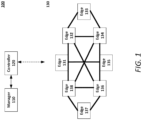
- FIG. 1 illustrates an example of an SD-WAN overlay 100.
- SD-WAN overlay 100 comprises a management controller (manager 110), a network controller (controller 120), and a plurality of edge routers 130 (e.g., edge routers 131 to 138).
- Edge routers 130 connect with one another via, for example, dynamic tunnels.
- the example in FIG. 1 illustrates a fully-meshed network in which each edge router 130 is part of the SD-WAN overlay.
- Edge routers 130 may interface a plurality of devices to the SD-WAN. Examples of devices may include washing machines, credit card machines, security cameras, conference room cameras, printers, remote surgery machines, etc. The devices may be deployed at different sites.
- devices at one site may communicate with edge router 131, and devices at a different site may communicate with edge router 132.
- Examples of different sites may include a headquarters, one or more branch offices, an R&D campus, a cloud-based site, a data center, etc.
- the devices may communicate messages via the SD-WAN according to various applications (e.g., washing machine application, video conferencing, credit card application, security camera application, printer application, remote surgery application, etc.).
- Manager 110 and controller 120 are both examples of controllers.
- manager 110 e.g., a management controller
- Controller 120 is configured to communicate with manager 110 and to control a plurality of edge routers 130 in SD-WAN overlay 100.
- controller 120 may be embodied independently from manager 110.
- controller 120 may embodied together with manager 110 (e.g., a controller in a single computer system or device may perform functionality of both manager 110 and controller 120).
- a controller may comprise manager 110, controller 120, or both (whether embodied in the same system/device, or embodied in different systems/devices communicatively coupled via a network or other connection).
- manager 110 and controller 120 may cooperate to determine an application-specific fabric overlay for edge routers deployed in the SD-WAN overlay.
- the application-specific fabric comprises a portion of the SD-WAN operable to communicate messages associated with a specific application (as one example, a washing machine application).
- the application-specific fabric includes a subset of edge routers 130 that interface devices that support the specific application (in the example, the washing machine application) with the SD-WAN.
- manager 110 and controller 120 may build the application-specific fabric overlay in response to a request from a user (such as a system administrator, network operator, or end user). The request may indicate the application (or features of the application) for which the user would like to build an application-specific fabric.
- manager 110 is operable to determine an application of interest (an application for which an application fabric overlay is to be built) and to provide controller 120 with a profile to be distributed to edge routers 131-138.
- the profile enables edge routers 131-138 to discover which devices support the application of interest.
- One or more of edge routers 131-138 may each provide information to controller 120 indicating whether that edge router has discovered any devices supporting the application of interest.
- Controller 120 provides the information to manager 110, and manager 110 uses the information to build the application fabric overlay for the application of interest.
- Manager 110 may then develop application-specific policies and provide the policies to controller 120 for distribution to the subset of edge devices that are associated with the application fabric overlay for the application of interest.
- the subset of edge devices may then enforce the application-specific policies when communicating traffic associated with the application of interest.
- Controller 120 may receive application monitoring data (or application meta data) from the end devices.
- an example method and system may support the capabilities of SD-WAN and may provide an intent based application fabric (e.g., a platform using a set of middleware technologies) for business critical applications in the SD-WAN.
- an intent based application fabric e.g., a platform using a set of middleware technologies
- one or more controllers of the SD-WAN infrastructure may be operable to: see or monitor an application fabric (e.g., a customer's application fabric); monitor traffic states in sites (e.g., places where edge routers 130 are placed in FIG.
- Particular embodiments of this disclosure provide a solution and a system for performing an intent based application fabric in the SD-WAN that performs a set of technical functions or abilities: (i) to identify applications hosted in a site; (ii) to host the applications and collect meta data on an Enterprise Network Compute System (ENCS)-type branch platform and to advertise application availability to the rest of the enterprise networks; (iii) to visualize and monitor flows/conversations belonging to an application across the enterprise; (iv) to query a management controller (e.g., vManage Controller such as manager 110 in FIG. 1 ) for network bandwidth availability for using SD-WAN overlay and allocate dynamic tunnels between sites for facilitating an application.
- a management controller e.g., vManage Controller such as manager 110 in FIG. 1
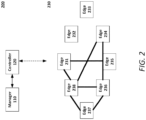
- FIG. 2 illustrates a first example of an application overlay for a first application fabric in SD-WAN.
- FIG. 2 includes manager 110 and controller 120 (described above with respect to FIG. 1 ).
- FIG. 2 also includes a plurality of edge routers 230 (similar to edge routers 130 described above with respect to FIG. 1 ).
- FIG. 2 illustrates eight edge routers 231-238.
- the application overlay connects a subset of the edge routers (231 and 234-238). This subset represents the edge routers associated with a specific application.
- edge routers 232 and 233 are not associated with the specific application (e.g., the devices that edge routers 232 and 233 interface to the SD-WAN do not support the specific application) and therefore edge routers 232 and 233 are not included in the application overlay.
- application overlay shown in FIG. 2 does not include tunnels connecting to edge routers 232 and 233.
- FIG. 2 may represent an application overlay for an application related to a health care.
- an application overlay may encompass applications associated with a field (e.g., health care) and/or an enterprise (e.g., a hospital or health care provider).
- an intent based application fabric may be applied to a health care vertical (e.g., McKesson, Cigna, Palo Alto Medical Foundation and others) use case in which hospitals are located at various sites and these various sites are connected using SD-WAN overlay.
- Certain health care-related embodiments may facilitate providing patients with high quality care and access to all of the latest technologies available to the doctors and staffs.
- Particular embodiments may provide availability of various pre-determined application overlays based on business vertical like, e.g., the heath care.
- a computing system may deploy, for example, device classification services (DCS) which classify the devices in addition to application recognition engines (e.g., NBAR2) which use application signatures.
- DCS device classification services
- NBAR2 application recognition engines
- Particular embodiments enable or authorize the health care provider to perform a set of instructions in the network.
- the instructions may indicate the user's intent and may be based on information obtained from the user.
- a user-friendly interface may be provided to obtain the user's intent through familiar, natural language ordinarily used in the applicable business, such as the health care business, instead of requiring the user to learn technical jargon to convey the user's intent.
- the instructions may allow the health care provider to know (i.e., monitor, detect, or check) all the sites where the remote surgery application can be performed.
- the health care provider may be associated with a subset of the sites (e.g., hospitals) at network end points.
- the particular embodiments may enable or authorize the health care provider to show, between these sites, a view of how the "remote surgery" telepresence applications are performing, where each remote surgery application is hosted (e.g., which of the edge routers are hosting, scheduled to host, and/or capable of hosting the remote surgery application), and the performance reliability and/or performance guarantee associated with each remote surgery application (or each edge router).
- the health care provider may use information obtained based on the application overlay to reserve bandwidth resources. For example, the health care provider may reserve bandwidth for a particular time (when the surgery is scheduled) with a particular quality of service (QoS) guarantee (QoS approved for the remote surgery application).
- QoS quality of service
- the health care provider can schedule the resources to ensure that the reserved resources have high availability (e.g., a remote surgery application may require high availability to ensure patient safety and may be given higher priority/QoS guarantee compared to other types of applications, such as back office applications). Information obtained via the application overlay may also aide the health care provider in quickly troubleshooting any problems in the network or with a particular application.
- a remote surgery application may require high availability to ensure patient safety and may be given higher priority/QoS guarantee compared to other types of applications, such as back office applications.
- Information obtained via the application overlay may also aide the health care provider in quickly troubleshooting any problems in the network or with a particular application.
- certain embodiments may provide video and voice services in an enterprise network such that the SD-WAN controller (e.g., 110 and 120 in FIGs. 1 and 2 ) is to perform various query processes and the bandwidth between sites is reserved to participate in the video and/or voice teleconference meetings.
- Manager 110 may determine a policy (or policies) that is specific to the application of interest. Manager 110 may provide the determined policy to the edge routers via the controller 120. Different types of policies may include, for example, routing policies, bandwidth reservation policies, QoS policies, service level agreement (SLA) policies, security policies, etc.
- the policy may be determined based on information obtained from the user (such as a system administrator, network operator, or end user). The policy may also be determined based on information obtained from the network (e.g., based on network performance).
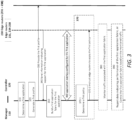
- FIG. 3 illustrate an example signal flow of a method and system for building a first application fabric.
- a method and system for building an "intent based application fabric" e.g., application fabric overlay shown in FIG. 2
- a business critical application e.g., "remote surgery” application
- An embodiment in FIG. 3 presents signal flows associated with the processes of the application discovery (e.g., steps 310-350), application fabric building (e.g., step 360), application monitoring (e.g., step 380), and application control and experience (e.g., step 390).
- the example in FIG. 3 shows certain functionality of one or more controllers. This functionality may be performed by manager 110, controller 120, both, or any other controller or combination of controllers operable to perform the described functionality, depending on the embodiment.
- manager 110 may determine a first application.
- the first application may be an application for which a first application fabric is to be built.
- the first application may be an application of interest to a user.
- the first application may be determined based on information received from a user (such as a system administrator, network operator, or end user).
- the user may select the first application from a list of predetermined applications.
- the list might include a video application, a telepresence application, a printer application, a credit card reader application, etc.
- the user can define a custom application.
- a washing machine vendor may provide characteristics for discovering washing machines that support a proprietary washing machine application.
- characteristics may include an application identifier, an application signature, or other application-related information (e.g., a parameter, a port number, a protocol number, a protocol format, a message signature, etc.).
- the application signature (or custom signature) is configured to determine a certain application which is specific to a certain business or a specified customer. Certain embodiments may provide the user with the option of selecting from a list of predetermined applications (e.g., listing default applications or previously defined custom applications) or customizing a new definition for an application.
- Information may be obtained from a user in any suitable manner, such as via an I/O interface of manager 110 (or controller 120), or via a network (e.g., the Internet) that connects manager 110 to a computer system of the user.
- manager 110 may generate a first profile for enabling edge routers 231-238 to discover devices that support the first application (i.e., the application determined in step 310).
- the profile may indicate one or more characteristics associated with the first application, such as an application identifier, an application signature, or other application-related information (e.g., a parameter, a port number, a protocol number, a protocol format, a message signature, etc.).
- Manager 110 may provide the first profile to controller 120 for distribution to edge routers 230 of the SD-WAN, and at step 330 controller 120 may provide the first profile generated in step 320 to the plurality of edge routers 230 of the SD-WAN.
- the first profile enables edge routers 231-238 to discover devices that support the first application.
- edge routers 231-238 are operable to interface a plurality of devices (such as washing machines, credit card machines, security cameras, conference room cameras, printers, etc.) to the SD-WAN.
- the first profile indicates characteristics of a video conferencing application, such as a message signature of messages that a video conferencing device communicates to other video conferencing devices via an edge router and SD-WAN.
- the first profile enables the plurality of edge routers 231-238 to discover which devices of the plurality of devices support the first application.
- the message signature can be compared to messages that end devices send to the SD-WAN, and messages from video conferencing devices running the first application would match the message signature associated with the first application. Messages from other types of devices (such as washing machines) would not match the message signature associated with the first application.
- the first application of interest is a video conferencing application
- traffic signals received from a printer would contain the device signature of a printer and would fail validation for the video conferencing application.
- the printer would not be authorized to run the video conferencing application.
- rogue devices such as devices that are spoofing an application, from being associated with the first application fabric.
- Validation may be performed by any suitable node (e.g., manager 110, controller 120, or an edge router).
- manager 110 and/or controller 120 may build the first application fabric based on the information indicating which devices of the plurality of devices support the first application.
- the first application fabric may correspond to a portion of the SD-WAN operable to communicate messages associated with the first application.
- FIG. 1 shows a full-meshed SD-WAN overlay operable communicate between edge routers 131-138
- FIG. 2 shows the first application fabric (i.e., an application overlay configured for the first application) to be built with a portion (e.g., edge routers 231 and 234-238) determined among all edge routers 231-238 of the SD-WAN overlay.
- edge routers 231 and 234-238 may be operable to communicate messages associated with the first application therebetween (at step 360).
- manager 350 excludes edge routers 232 and 233 from the first application fabric based on the absence of any message from edge routers 232 and 233 in step 340 (or based on the presence of a message from edge routers 232 and 233 indicating that they have not discovered any devices that support the first application).
- manager 110 and/or controller 120 may continue to receive information from edge routers 230 over time indicating discovery of additional devices that support the first application (e.g., as additional devices are added to the SD-WAN over time).
- Manager 110 and/or controller 120 may continue to build/update the first application fabric accordingly. Similarly, manager 110 and/or controller 120 may build/update the first application fabric to remove an edge router from the first application fabric (e.g., if all of the devices that the edge router had discovered for the first application are later removed from the site hosted by that edge router). Thus, building of an application fabric may be dynamic to reflect when devices are added to or removed from the SD-WAN.
- manager 110 and controller 120 instruct each of edge routers 231 and 234-238 to apply the first policy to traffic of the first application (at step 370-2).
- the first policy may include one or more different types of policies such as, for example, routing policies, bandwidth reservation policies, QoS policies, SLA policies, security policies, etc.
- the first policy may be determined based on information obtained from the user (such as a system administrator, network operator, or end user).
- the policy may be also determined based on information obtained from the network (e.g., based on network performance).
- controller 120 may abstain from providing the first policy to edge routers that are not associated with the first application fabric. Thus, the first policy need only be applied by the edge routers (e.g., 231 and 234-238 in FIG.
- step 370 may be performed before building the first application fabric (in which case the policy may be sent to each edge router in the SD-WAN).
- Manager 110 may generate data (e.g., the data can be statistics, a status report, etc.) indicating performance of the first application fabric and report the generated data to a user (such as a system administrator, network operator, or end user) or to components of the network that use the data to automatically update policies (e.g., a routing policy could be updated if the data shows that the first application was experiencing too much latency) (at step 390).
- manager 110 and controller 120 may further control the first application fabric based on the monitored traffic, by instructing one or more nodes (e.g., edge routers 231, 234-238 in FIG. 2 and/or internal nodes within the SD-WAN (not shown)) of the first application fabric to perform one or more actions such as, for example, reserving a bandwidth resource, implementing a routing decision, and updating a policy.
- nodes e.g., edge routers 231, 234-238 in FIG. 2 and/or internal nodes within the SD-WAN (not shown)
- the method described in FIG. 3 may be repeated to build additional application fabrics for additional applications.
- Different application fabrics may include different (overlapping or non-overlapping) portions of the SD-WAN depending on where the devices supporting the various applications are located. Examples are described with respect to FIGs. 4-5 .
- FIG. 4 illustrates a second example of an application overlay for a second application fabric in SD-WAN.
- a topology illustrated in FIG. 4 may be an application overlay for a specific application of interest (e.g., "washing machine” application).
- the second application fabric for the second application of interest is built to configure application overlay 400 in the SD-WAN.
- the second application fabric 400 is configured with edge routers (e.g., edge routers 231-234 in FIG. 4 ) operable to run the specific application (i.e., "washing machine” application).
- the second application fabric 400 of FIG. 4 corresponds to a portion of the SD-WAN, as described above in FIG. 3 . Referring to FIGs. 2 and 4 , FIG.
- FIG. 2 shows the application overlay of the first application fabric which is built for the first application and operable to communicate between edge routers 231 and 234-238.
- FIG. 4 shows the application overlay of the second application fabric which is built for the second application and operable to communicate between edge routers 231-234.
- Step 510 determines a second application.
- the second application may be determined in a manner analogous to step 310 of FIG. 3 .
- the method may build a first application fabric for a first application (e.g., a video conferencing application) following the steps of FIG. 3 and may also determine a second application (e.g., a printer application) for which a second application fabric is to be built.
- a first application e.g., a video conferencing application
- a second application e.g., a printer application
- Step 540 of FIG. 5 is generally analogous to step 340 of FIG. 3 .
- manager 110 and/or controller 120 may receive, from one or more of the edge routers (e.g., 231-234) among edge routers 230, information indicating which devices of the plurality of devices support the second application.
- the subset of edge routers that support the second application differs from the subset of routers that support the first application (edge routers 231, 234-238), however, the different subsets partially overlap (edge routers 231 and 234 belong to both subsets).
- Step 560 configures the second application fabric for the second application.
- Step 560 in FIG. 5 is generally analogous to step 360 in FIG. 3 .
- manager 110 and/or controller 120 may use the second application fabric to apply application-specific policies, as shown in step 570.
- manager 110 may determine a second policy that is specific to the second application and may provide the second policy to controller 120.
- controller 120 may push the second policy to edge routers of the second application fabric (e.g., edge routers 231-234). The edge routers of the second application fabric may then apply the second policy to traffic associated with the second application.
- policies may include routing policies, bandwidth reservation policies, QoS policies, SLA policies, security policies, etc.
- policies may allow for prioritizing certain applications. For example, suppose that the first application fabric corresponds to a critical application (such as a remote surgery telepresence application) and the second application fabric corresponds to a non-critical application (such as a printer application in the back office). The policies may be configured to ensure that the first application fabric has higher priority for bandwidth reservation, with stricter QoS and SLA policies, etc.
- Step 580 of FIG. 5 monitors traffic associated with the first application fabric and traffic associated with the second application fabric (similar to step 380 of FIG. 3 ).
- Step 590 of FIG. 5 may report data indicating performance of the first application fabric and data indicating performance of the second application fabric (similar to step 390 of FIG. 3 ).
- statistics or reports based on the monitoring the first application traffic may be separated from statistics or reports based on monitoring the second application fabric.
- the statistics or reports may be combined and application fabric identifiers may be included with the data to allow for filtering information associated with either the first application fabric or the second application fabric.
- step 590 comprises controlling the first application fabric and the second application fabric based on the monitored traffic (similar to step 390 of FIG. 3 ).
- the first application fabric and the second application fabric may be controlled separately based on their respective traffic.
- a routing policy for the first application fabric could be updated if the data shows that the first application was experiencing too much latency, but a routing policy for the second application fabric would not necessarily need to be updated if the data shows that the second application was experiencing acceptable latency.
- Steps 580 and 590 may be performed by manager 110 and/or controller 120.
- FIG. 6 illustrates an example of a flow chart of building an application fabric for an application of interest in SD-WAN.
- the method may be performed by a controller (e.g., the controller may be either or both of manager 110 and controller 120 in FIGs. 2-5 ) of the SD-WAN, where the controller is included in a computing system and configured to perform processes for building the application fabric for a specific application of interest.
- the controller is configured to provide a first profile to a plurality of edge routers of the SD-WAN (at step 610).
- the edge routers are operable to interface a plurality of devices to the SD-WAN, and the first profile may enable the plurality of edge routers to discover which devices of the plurality of devices support a first application.
- the controller is configured to receive, from one or more of the edge routers, information indicating which devices of the plurality of devices support the first application.
- the controller is configured to build a first application fabric based on the information indicating which devices of the plurality of devices support the first application, where the first application fabric corresponds to a portion of the SD-WAN operable to communicate messages associated with the first application.
- descriptions and requirements related to building an intent based application fabric are presented hereinafter in view of the following processes (or steps): (1) application discovery; (2) application fabric building; (3) application monitoring; (4) application control and experience.
- the Application discovery is to perform technical instruction(s) to identify the sites (e.g., endpoints or edge routers in FIGs. 1 and 2 ) where business critical applications are hosted and track the user conversations/sessions between the sites and build an application fabric (e.g., intent based application fabric) based on this information with real time monitoring view.
- the certain embodiments enable one or more applications that need the application fabric to execute technical functions, instructions or capabilities, as follows:
- Edge devices will make use of existing Application identification module (NBAR2, Cosmos) to observe the traffic and match against the applications selected in Fabric list. If there is a match, application metadata is collected at the site and is advertised in the smart controller (e.g., Controllers/vSmart) which include ⁇ Site, flow information - src, dst, tunnel, time, volume, performance ⁇ .
- Application signatures may be deployed on many edge devices, where some edge devices may not be part of an application fabric yet because of no application traffic seen on that edge device or administrator may not have excluded through some policy.
- ENCS Branch case When the customer installs an Application at different sites, on the virtual platform with Application Fabric option selected in vManage, Fabric policy is pushed and using NBAR2/SD-AVC applications metadata is advertised from the sites where the app is hosted.
- Application metadata will be advertised via OMP (Overlay Management Protocol) protocol as a protocol extension, there by Controllers like vSmart can build Application overlay across sites for the said application.
- OMP Overlay Management Protocol
- Controllers like vSmart can build Application overlay across sites for the said application.
- Each Application which is hosted at sites will have separate overlay fabric and needs its own bandwidth and QoS.
- App requirements are pre-configured on vManage so all sites hosting this application will be aware of Application fabric needs.
- Applications belonging to certain Category may be grouped like "Corporate Communication Applications” which may include say WebEx, Skype, Zoom etc. and Fabric will also have individual App Fabric view also i.e., show me only WebEx Fabric. If needed Application can build Dynamic Tunnels between the sites for the said Applications. Once the Application Fabric is built by the Controllers, Application fabric specific Policies like “Reserve BW for this applications across sites say 1,2,3 from time say 10:00am to 12:00pm tomorrow" can be pushed with ease.
- Constant vAnalytics i.e., a leading analytics application for video collaboration
- monitoring would indicate if Applications topology on the overlay has the minimum requirement met in the Fabric Overlay. If the requirement is not met, the performance of application across the sites will be sub-optimal and necessary recovery actions like Application priority and BW reservations should be provided. Once a case where application packet drops are witnessed takes place, in such a case more bandwidth on the IPSEC tunnels between sites along the path for that Application(s) is allowed to be reserved or assigned.
- Monitoring of Application is done depending on whether to satisfy App fabric SLA. Newer Application that needs to be hosted across sites, will first consult the SD-WAN controller and determine if there is enough bandwidth available on SD-WAN overlay to satisfy the application requirements. Monitoring of Application that a customer is interested in may happen at non-application fabric edge devices for purpose of visibility.
- the exemplary method and system are to perform the technical functions or instruction related to Application Experience , as follows:
- Application experience is performed by the exemplary method and system, and can be achieved at a granular level in certain cases.
- a video conferencing is used by many user groups but based on the Application Fabric monitoring, if a specific group of users need to be prioritized then "SGT" based Policies can be authored for the Application Fabric. For example: "Video conferencing sessions for the Doctors/Surgery rooms" is of higher priority than others video conferences for staff meetings.
- the exemplary method and system are to also perform the technical functions or instruction related to Application Control , as follows:
- a computing system comprises one or more end devices (or branch devices, or edge routers) configured to define one or more applications based on a user preference, provide a pre-defined list including the one or more application, select a specific application from the pre-defined list, and enable the specific application to select one or more fabric options.
- the computing system further comprises a first controller configured to propagate information for selecting the specific application to one or more specific sites.
- the computing system further comprises a second controller configured to build an application overlay for the specific application across the specific sites and advertise a metadata of the specific application to the one or more branch devices.
- the computing system further comprises one or more edge devices configured to observe a traffic, the traffic against the application selected in a fabric list, and collect metadata of the specific application.
- the computing system executes one or more processes including a first process for performing an application discovery to identify one or more endpoints and track sessions established between the endpoints, a second process for performing an application fabric building based on information on the identified endpoints and the tracked sessions, a third process for performing an application monitoring based on predetermined requirements for a fabric overlay in a soft defined network system, and a fourth process for performing application control and experience by determining a degree for quality of service (QoS) and reserving a demand bandwidth based on type of application traffic.
- QoS quality of service
- FIG. 7 illustrates an example of components of computing system 700, in accordance with certain embodiments.
- computing system 700 may be implemented as manager 110, a controller 120, an edge router (e.g., 131-138 or 231-238), an end device, or other suitable computing system for performing functionality disclosed herein.
- one or more computer systems 700 perform one or more steps of one or more methods described or illustrated herein.
- one or more computer systems 700 provide functionality described or illustrated herein.
- software running on one or more computer systems 700 performs one or more steps of one or more methods described or illustrated herein or provides functionality described or illustrated herein.
- Particular embodiments include one or more portions of one or more computer systems 700.
- reference to a computer system may encompass a computing device, and vice versa, where appropriate.
- reference to a computer system may encompass one or more computer systems, where appropriate.
- computer system 700 may be an embedded computer system, a system-on-chip (SOC), a single-board computer system (SBC) (such as, for example, a computer-on-module (COM) or system-on-module (SOM)), a desktop computer system, a laptop or notebook computer system, an interactive kiosk, a mainframe, a mesh of computer systems, a mobile telephone, a personal digital assistant (PDA), a server, a tablet computer system, an augmented/virtual reality device, or a combination of two or more of these.
- SOC system-on-chip
- SBC single-board computer system
- COM computer-on-module
- SOM system-on-module
- computer system 700 may include one or more computer systems 700; be unitary or distributed; span multiple locations; span multiple machines; span multiple data centers; or reside in a cloud, which may include one or more cloud components in one or more networks.
- one or more computer systems 700 may perform without substantial spatial or temporal limitation one or more steps of one or more methods described or illustrated herein.
- one or more computer systems 700 may perform in real time or in batch mode one or more steps of one or more methods described or illustrated herein.
- One or more computer systems 700 may perform at different times or at different locations one or more steps of one or more methods described or illustrated herein, where appropriate.
- computer system 700 includes one or more processor(s) 702, memory 704, storage 706, input/output (I/O) interface(s) 708, communication interface(s) 710, and/or bus (or busses) 712.
- processor(s) 702 memory 704, storage 706, input/output (I/O) interface(s) 708, communication interface(s) 710, and/or bus (or busses) 712.
- processor 702 includes hardware for executing instructions, such as those making up a computer program.
- processor 702 may retrieve (or fetch) the instructions from an internal register, an internal cache, memory 704, or storage 706; decode and execute them; and then write one or more results to an internal register, an internal cache, memory 704, or storage 706.
- processor 702 may include one or more internal caches for data, instructions, or addresses. This disclosure contemplates processor 702 including any suitable number of any suitable internal caches, where appropriate.
- processor 702 may include one or more instruction caches, one or more data caches, and one or more translation lookaside buffers (TLBs).
- TLBs translation lookaside buffers
- Instructions in the instruction caches may be copies of instructions in memory 704 or storage 706, and the instruction caches may speed up retrieval of those instructions by processor 702.
- Data in the data caches may be copies of data in memory 704 or storage 706 for instructions executing at processor 702 to operate on; the results of previous instructions executed at processor 702 for access by subsequent instructions executing at processor 702 or for writing to memory 704 or storage 706; or other suitable data.
- the data caches may speed up read or write operations by processor 702.
- the TLBs may speed up virtual-address translation for processor 702.
- processor 702 may include one or more internal registers for data, instructions, or addresses. This disclosure contemplates processor 702 including any suitable number of any suitable internal registers, where appropriate. Where appropriate, processor 702 may include one or more arithmetic logic units (ALUs); be a multi-core processor; or include one or more processors 702. Although this disclosure describes and illustrates a particular processor, this disclosure contemplates any suitable processor.
- ALUs
- memory 704 includes main memory for storing instructions for processor 702 to execute or data for processor 702 to operate on.
- computer system 700 may load instructions from storage 706 or another source (such as, for example, another computer system 700) to memory 704.
- Processor 702 may then load the instructions from memory 704 to an internal register or internal cache.
- processor 702 may retrieve the instructions from the internal register or internal cache and decode them.
- processor 702 may write one or more results (which may be intermediate or final results) to the internal register or internal cache.
- Processor 702 may then write one or more of those results to memory 704.
- processor 702 executes only instructions in one or more internal registers or internal caches or in memory 704 (as opposed to storage 706 or elsewhere) and operates only on data in one or more internal registers or internal caches or in memory 704 (as opposed to storage 706 or elsewhere).
- One or more memory buses (which may each include an address bus and a data bus) may couple processor 702 to memory 704.
- Bus 712 may include one or more memory buses, as described below.
- one or more memory management units reside between processor 702 and memory 704 and facilitate accesses to memory 704 requested by processor 702.
- memory 704 includes random access memory (RAM). This RAM may be volatile memory, where appropriate.
- this RAM may be dynamic RAM (DRAM) or static RAM (SRAM). Moreover, where appropriate, this RAM may be single-ported or multi-ported RAM. This disclosure contemplates any suitable RAM.
- Memory 704 may include one or more memories 704, where appropriate. Although this disclosure describes and illustrates particular memory, this disclosure contemplates any suitable memory.
- storage 706 includes mass storage for data or instructions.
- storage 706 may include a hard disk drive (HDD), a floppy disk drive, flash memory, an optical disc, a magneto-optical disc, magnetic tape, or a Universal Serial Bus (USB) drive or a combination of two or more of these.
- Storage 706 may include removable or non-removable (or fixed) media, where appropriate.
- Storage 706 may be internal or external to computer system 700, where appropriate.
- storage 706 is non-volatile, solid-state memory.
- storage 706 includes read-only memory (ROM).
- this ROM may be mask-programmed ROM, programmable ROM (PROM), erasable PROM (EPROM), electrically erasable PROM (EEPROM), electrically alterable ROM (EAROM), or flash memory or a combination of two or more of these.
- This disclosure contemplates mass storage 706 taking any suitable physical form.
- Storage 706 may include one or more storage control units facilitating communication between processor 702 and storage 706, where appropriate. Where appropriate, storage 706 may include one or more storages 706. Although this disclosure describes and illustrates particular storage, this disclosure contemplates any suitable storage.
- I/O interface 708 includes hardware, software, or both, providing one or more interfaces for communication between computer system 700 and one or more I/O devices.
- Computer system 700 may include one or more of these I/O devices, where appropriate.
- One or more of these I/O devices may enable communication between a person and computer system 700.
- an I/O device may include a keyboard, keypad, microphone, monitor, mouse, printer, scanner, speaker, still camera, stylus, tablet, touch screen, trackball, video camera, another suitable I/O device or a combination of two or more of these.
- An I/O device may include one or more sensors. This disclosure contemplates any suitable I/O devices and any suitable I/O interfaces 708 for them.
- I/O interface 708 may include one or more device or software drivers enabling processor 702 to drive one or more of these I/O devices.
- I/O interface 708 may include one or more I/O interfaces 708, where appropriate.
- communication interface 710 includes hardware, software, or both providing one or more interfaces for communication (such as, for example, packet-based communication) between computer system 700 and one or more other computer systems 700 or one or more networks.
- communication interface 710 may facilitate communication between computer system 700 and manager 110, controller 120, edge router (e.g., 131-138 or 231-238), or an end device.
- communication interface 710 may include a network interface controller (NIC) or network adapter for communicating with an Ethernet or other wire-based network or a wireless NIC (WNIC) or wireless adapter for communicating with a wireless network, such as a WI-FI network.
- NIC network interface controller
- WNIC wireless NIC
- This disclosure contemplates any suitable network and any suitable communication interface 710 for it.
- computer system 700 may communicate with an ad hoc network, a personal area network (PAN), a local area network (LAN), a wide area network (WAN), a metropolitan area network (MAN), or one or more portions of the Internet or a combination of two or more of these.
- PAN personal area network
- LAN local area network
- WAN wide area network
- MAN metropolitan area network
- One or more portions of one or more of these networks may be wired or wireless.
- computer system 700 may communicate with a wireless PAN (WPAN) (such as, for example, a BLUETOOTH WPAN), a WI-FI network, a WI-MAX network, a cellular telephone network (such as, for example, a Global System for Mobile Communications (GSM) network, a Long-Term Evolution (LTE) network, or a 5G network), or other suitable wireless network or a combination of two or more of these.
- WPAN wireless PAN
- WI-FI such as, for example, a BLUETOOTH WPAN
- WI-MAX such as, for example, a Global System for Mobile Communications (GSM) network, a Long-Term Evolution (LTE) network, or a 5G network
- GSM Global System for Mobile Communications
- LTE Long-Term Evolution
- 5G 5G network
- Computer system 700 may include any suitable communication interface 710 for any of these networks, where appropriate.
- Communication interface 710 may include one or more communication interfaces 710, where appropriate.
- bus 712 includes hardware, software, or both coupling components of computer system 700 to each other.
- bus 712 may include an Accelerated Graphics Port (AGP) or other graphics bus, an Enhanced Industry Standard Architecture (EISA) bus, a front-side bus (FSB), a HYPER TRANSPORT (HT) interconnect, an Industry Standard Architecture (ISA) bus, an INFINIBAND interconnect, a low-pin-count (LPC) bus, a memory bus, a Micro Channel Architecture (MCA) bus, a Peripheral Component Interconnect (PCI) bus, a PCI-Express (PCIe) bus, a serial advanced technology attachment (SATA) bus, a Video Electronics Standards Association local (VLB) bus, or another suitable bus or a combination of two or more of these.
- Bus 712 may include one or more buses 712, where appropriate.
- a computer-readable non-transitory storage medium or media may include one or more semiconductor-based or other integrated circuits (ICs) (such, as for example, field-programmable gate arrays (FPGAs) or application-specific ICs (ASICs)), hard disk drives (HDDs), hybrid hard drives (HHDs), optical discs, optical disc drives (ODDs), magneto-optical discs, magneto-optical drives, floppy diskettes, floppy disk drives (FDDs), magnetic tapes, solid-state drives (SSDs), RAM-drives, SECURE DIGITAL cards or drives, any other suitable computer-readable non-transitory storage media, or any suitable combination of two or more of these, where appropriate.
- ICs such, as for example, field-programmable gate arrays (FPGAs) or application-specific ICs (ASICs)
- HDDs hard disk drives
- HHDs hybrid hard drives
- ODDs optical disc drives
- magneto-optical discs magneto-optical drives
- a method includes providing a first profile to a plurality of edge routers of the SD-WAN, the plurality of edge routers operable to interface a plurality of devices to the SD-WAN.
- the first profile enables the plurality of edge routers to discover which devices of the plurality of devices support a first application.
- the method includes receiving, from one or more of the edge routers, information indicating which devices of the plurality of devices support the first application and building a first application fabric based on the information indicating which devices of the plurality of devices support the first application.
- a technical advantage of certain embodiments allows for building different application fabric overlays for different applications depending on which portions of the SD-WAN support a particular application. For example, a first application fabric overlay (such as that shown in FIG. 1 ) may be used for a first application, a second application fabric overlay (such as that shown in FIG. 2 ) may be used for a second application, a third application fabric overlay (such as that shown in FIG. 4 ) may be used for a third application, and so on for any suitable number of applications.
- Each application fabric overlay is topology independent, and an overlay need not touch all sites.
- the first application may correspond to a surveillance application such that video cameras connected for surveillance of a campus become part of the first application fabric overlay
- the second application may correspond to a healthcare application such that HIPAA-Compliant devices become part of the second application fabric overlay
- the third application may correspond to a real-time collaboration application such that real-time collaboration software becomes its own (third) application fabric overlay.
- Other embodiments may build application fabric overlays for additional applications or different applications. Certain embodiments may include all, some, or none of these advantages. Other technical advantages will be appreciated by those of ordinary skill in the art.
- references in the appended claims to an apparatus or system or a component of an apparatus or system being adapted to, arranged to, capable of, configured to, enabled to, operable to, or operative to perform a particular function encompasses that apparatus, system, component, whether or not it or that particular function is activated, turned on, or unlocked, as long as that apparatus, system, or component is so adapted, arranged, capable, configured, enabled, operable, or operative. Additionally, although this disclosure describes or illustrates particular embodiments as providing particular advantages, particular embodiments may provide none, some, or all of these advantages.
Landscapes
- Engineering & Computer Science (AREA)
- Computer Networks & Wireless Communication (AREA)
- Signal Processing (AREA)
- Environmental & Geological Engineering (AREA)
- Quality & Reliability (AREA)
- Data Exchanges In Wide-Area Networks (AREA)
- Information Transfer Between Computers (AREA)
Applications Claiming Priority (4)
| Application Number | Priority Date | Filing Date | Title |
|---|---|---|---|
| US201962860577P | 2019-06-12 | 2019-06-12 | |
| US16/702,272 US10911330B2 (en) | 2019-06-12 | 2019-12-03 | Intent based application fabric |
| EP20751701.2A EP3984179B1 (de) | 2019-06-12 | 2020-06-11 | Absichtsbasierte anwendungsmatrix |
| PCT/US2020/037124 WO2020252096A1 (en) | 2019-06-12 | 2020-06-11 | Intent based application fabric |
Related Parent Applications (2)
| Application Number | Title | Priority Date | Filing Date |
|---|---|---|---|
| EP20751701.2A Division EP3984179B1 (de) | 2019-06-12 | 2020-06-11 | Absichtsbasierte anwendungsmatrix |
| EP20751701.2A Division-Into EP3984179B1 (de) | 2019-06-12 | 2020-06-11 | Absichtsbasierte anwendungsmatrix |
Publications (3)
| Publication Number | Publication Date |
|---|---|
| EP4451650A2 true EP4451650A2 (de) | 2024-10-23 |
| EP4451650A3 EP4451650A3 (de) | 2024-11-13 |
| EP4451650B1 EP4451650B1 (de) | 2026-01-14 |
Family
ID=73745284
Family Applications (2)
| Application Number | Title | Priority Date | Filing Date |
|---|---|---|---|
| EP20751701.2A Active EP3984179B1 (de) | 2019-06-12 | 2020-06-11 | Absichtsbasierte anwendungsmatrix |
| EP24197980.6A Active EP4451650B1 (de) | 2019-06-12 | 2020-06-11 | Absichtsbasiertes anwendungsgewebe |
Family Applications Before (1)
| Application Number | Title | Priority Date | Filing Date |
|---|---|---|---|
| EP20751701.2A Active EP3984179B1 (de) | 2019-06-12 | 2020-06-11 | Absichtsbasierte anwendungsmatrix |
Country Status (7)
| Country | Link |
|---|---|
| US (2) | US10911330B2 (de) |
| EP (2) | EP3984179B1 (de) |
| JP (1) | JP7304439B2 (de) |
| CN (1) | CN113966595B (de) |
| AU (1) | AU2020290944B2 (de) |
| CA (1) | CA3143170A1 (de) |
| WO (1) | WO2020252096A1 (de) |
Families Citing this family (10)
| Publication number | Priority date | Publication date | Assignee | Title |
|---|---|---|---|---|
| US12068965B2 (en) * | 2020-02-21 | 2024-08-20 | Cisco Technology, Inc. | Passing application network metadata to network controllers using service registries |
| CN114338541A (zh) * | 2020-09-30 | 2022-04-12 | 华为技术有限公司 | 一种流量控制方法、设备及介质 |
| US20230412423A1 (en) * | 2020-10-09 | 2023-12-21 | Schlumberger Technology Corporation | Devices and systems that connect iiot edge devices and applications to a corporate data network |
| EP4302466A1 (de) * | 2021-03-02 | 2024-01-10 | Cisco Technology, Inc. | Übertragung von anwendungsnetzwerkmetadaten an netzwerksteuergeräte unter verwendung von diensteinträgen |
| CN116746130A (zh) * | 2021-03-02 | 2023-09-12 | 思科技术公司 | 使用服务注册中心将应用网络元数据传递给网络控制器 |
| US12425395B2 (en) * | 2022-01-15 | 2025-09-23 | VMware LLC | Method and system of securely adding an edge device operating in a public network to an SD-WAN |
| US20240235966A9 (en) * | 2022-10-21 | 2024-07-11 | Cisco Technology, Inc. | Inferring application experience from dns traffic patterns |
| US12417312B2 (en) * | 2023-02-07 | 2025-09-16 | Cisco Technology, Inc. | Constraint-based training data generation |
| US20240303336A1 (en) * | 2023-03-08 | 2024-09-12 | Cisco Technology, Inc. | Dynamic security for fabric networks |
| US20250350555A1 (en) * | 2024-05-08 | 2025-11-13 | Cisco Technology, Inc. | Intent-based orchestration of routing controls across a network overlay |
Family Cites Families (27)
| Publication number | Priority date | Publication date | Assignee | Title |
|---|---|---|---|---|
| EP2713573A1 (de) * | 2012-09-27 | 2014-04-02 | British Telecommunications public limited company | Anwendungsschicht-Sitzungs-Routing |
| US20140226681A1 (en) * | 2013-02-12 | 2014-08-14 | Qualcomm Incorporated | Centralized task management using a router |
| US9461967B2 (en) * | 2013-07-18 | 2016-10-04 | Palo Alto Networks, Inc. | Packet classification for network routing |
| US9635486B2 (en) * | 2014-06-10 | 2017-04-25 | Microsoft Technology Licensing, Llc | Network selection for a given application or context |
| US10425382B2 (en) | 2015-04-13 | 2019-09-24 | Nicira, Inc. | Method and system of a cloud-based multipath routing protocol |
| US10135789B2 (en) | 2015-04-13 | 2018-11-20 | Nicira, Inc. | Method and system of establishing a virtual private network in a cloud service for branch networking |
| EP3304831B1 (de) * | 2015-06-03 | 2021-11-10 | VID SCALE, Inc. | Leistungssteigerung einer mehrwegkommunikation |
| US20180167319A1 (en) | 2015-06-12 | 2018-06-14 | Hewlett Packard Enterprise Development Lp | Application identification cache |
| US10797992B2 (en) | 2015-07-07 | 2020-10-06 | Cisco Technology, Inc. | Intelligent wide area network (IWAN) |
| US10069722B2 (en) * | 2015-09-03 | 2018-09-04 | International Business Machines Corporation | Application information based network route modification |
| US10069844B2 (en) * | 2016-07-21 | 2018-09-04 | Sprint Communications Company L.P. | Virtual network function (VNF) hardware trust in a network function virtualization (NFV) software defined network (SDN) |
| WO2018042459A1 (en) * | 2016-09-02 | 2018-03-08 | Muthukumarasamy Murugavel | Adaptive and seamless traffic steering among multiple paths based on application qoe needs |
| US10148561B2 (en) * | 2016-12-06 | 2018-12-04 | At&T Intellectual Property I, L.P. | Enhanced quality of service in software-defined networking-based connectionless mobility architecture |
| CN108574728B (zh) * | 2017-03-08 | 2021-05-04 | 中兴通讯股份有限公司 | 用于移动边缘计算的流量路径改变检测的方法和装置 |
| US10491503B2 (en) * | 2017-04-03 | 2019-11-26 | Dell Products L.P. | Application-policy-based virtual SDN controller system |
| CN110809875B (zh) * | 2017-06-13 | 2022-12-16 | 环球互连及数据中心公司 | 服务对等交换 |
| US10263900B2 (en) * | 2017-06-23 | 2019-04-16 | Level 3 Communications, Llc | Programmable packet processor (PPP)-based adaptive network function chaining |
| US10819577B2 (en) * | 2017-07-31 | 2020-10-27 | Cisco Technology, Inc. | Node update in a software-defined network |
| US20190036779A1 (en) * | 2017-07-31 | 2019-01-31 | Cisco Technology, Inc. | Virtualized software-defined network |
| US10700982B2 (en) * | 2017-07-31 | 2020-06-30 | Cisco Technology, Inc. | Path selection for an application based on a performance score in a software-defined network |
| US10263863B2 (en) * | 2017-08-11 | 2019-04-16 | Extrahop Networks, Inc. | Real-time configuration discovery and management |
| US11516049B2 (en) | 2017-10-02 | 2022-11-29 | Vmware, Inc. | Overlay network encapsulation to forward data message flows through multiple public cloud datacenters |
| CN107566196A (zh) * | 2017-10-20 | 2018-01-09 | 北京星河星云信息技术有限公司 | 组网方法和组网装置、用户边缘设备及可读存储介质 |
| US10728288B2 (en) * | 2017-11-21 | 2020-07-28 | Juniper Networks, Inc. | Policy-driven workload launching based on software defined networking encryption policies |
| US10616106B2 (en) * | 2017-12-06 | 2020-04-07 | Futurewei Technologies, Inc. | Establishing virtual network routes in a computer network |
| CN108390774A (zh) * | 2018-02-01 | 2018-08-10 | 葛晗 | 一种基于软件定义的广域网组网方法和系统 |
| US10541877B2 (en) * | 2018-05-29 | 2020-01-21 | Ciena Corporation | Dynamic reservation protocol for 5G network slicing |
-
2019
- 2019-12-03 US US16/702,272 patent/US10911330B2/en active Active
-
2020
- 2020-06-11 AU AU2020290944A patent/AU2020290944B2/en active Active
- 2020-06-11 JP JP2021572654A patent/JP7304439B2/ja active Active
- 2020-06-11 CA CA3143170A patent/CA3143170A1/en active Pending
- 2020-06-11 EP EP20751701.2A patent/EP3984179B1/de active Active
- 2020-06-11 EP EP24197980.6A patent/EP4451650B1/de active Active
- 2020-06-11 CN CN202080042866.2A patent/CN113966595B/zh active Active
- 2020-06-11 WO PCT/US2020/037124 patent/WO2020252096A1/en not_active Ceased
-
2021
- 2021-01-04 US US17/140,273 patent/US11381478B2/en active Active
Also Published As
| Publication number | Publication date |
|---|---|
| JP7304439B2 (ja) | 2023-07-06 |
| US11381478B2 (en) | 2022-07-05 |
| EP4451650A3 (de) | 2024-11-13 |
| AU2020290944A1 (en) | 2022-02-03 |
| US20210152442A1 (en) | 2021-05-20 |
| EP3984179B1 (de) | 2024-12-04 |
| US10911330B2 (en) | 2021-02-02 |
| AU2020290944B2 (en) | 2024-12-19 |
| EP3984179A1 (de) | 2022-04-20 |
| JP2022537669A (ja) | 2022-08-29 |
| WO2020252096A1 (en) | 2020-12-17 |
| CA3143170A1 (en) | 2020-12-17 |
| US20200396141A1 (en) | 2020-12-17 |
| CN113966595A (zh) | 2022-01-21 |
| CN113966595B (zh) | 2024-05-31 |
| EP4451650B1 (de) | 2026-01-14 |
| KR20220018041A (ko) | 2022-02-14 |
Similar Documents
| Publication | Publication Date | Title |
|---|---|---|
| US11381478B2 (en) | Intent based application fabric | |
| US10862758B2 (en) | Generation of network configuration and configuration commands for impacted nodes of a software defined wide area network | |
| US11882202B2 (en) | Intent based network data path tracing and instant diagnostics | |
| EP3881495B1 (de) | Algorithmische problemidentifizierung und -auflösung in gewebenetzwerken durch softwaredefinierte operationen, administration und wartung | |
| US10999189B2 (en) | Route optimization using real time traffic feedback | |
| US11165658B2 (en) | Systems and methods for contextual network assurance based on change audits | |
| US10797956B2 (en) | Extending center cluster membership to additional compute resources | |
| US11399283B2 (en) | Tenant service set identifiers (SSIDs) | |
| US11509532B2 (en) | Switch triggered traffic tracking | |
| US20200162315A1 (en) | System and methods to validate issue detection and classification in a network assurance system | |
| US11121923B2 (en) | Automatic provisioning of network components | |
| US20200162325A1 (en) | Context aware based adjustment in visual rendering of network sites | |
| US20220360494A1 (en) | Assisted and context-driven network changes | |
| US12153933B2 (en) | Techniques for bootstrapping across secure air gaps with edge device cluster | |
| CN120548699A (zh) | 用于提供多用途控制及联网平台的计算机实施的系统及方法 | |
| KR102916277B1 (ko) | 의도 기반 애플리케이션 패브릭 | |
| EP4498242A1 (de) | Fernausführung einer datenanalyse unter verwendung eines virtuellen desktops | |
| EP4498243A1 (de) | Konfiguration eines virtuellen desktops in einer fahrzeugvorrichtung zur datenanalyse | |
| US12425348B2 (en) | Quality-of-service enabled network communication for virtual private network clients | |
| US20250343616A1 (en) | Optical switching network and portal | |
| US12101244B1 (en) | Layer 7 network security for container workloads |
Legal Events
| Date | Code | Title | Description |
|---|---|---|---|
| PUAI | Public reference made under article 153(3) epc to a published international application that has entered the european phase |
Free format text: ORIGINAL CODE: 0009012 |
|
| STAA | Information on the status of an ep patent application or granted ep patent |
Free format text: STATUS: THE APPLICATION HAS BEEN PUBLISHED |
|
| REG | Reference to a national code |
Ref country code: DE Ref legal event code: R079 Free format text: PREVIOUS MAIN CLASS: H04L0067630000 Ipc: H04L0041089400 Ref document number: 602020065547 Country of ref document: DE |
|
| PUAL | Search report despatched |
Free format text: ORIGINAL CODE: 0009013 |
|
| AC | Divisional application: reference to earlier application |
Ref document number: 3984179 Country of ref document: EP Kind code of ref document: P |
|
| AK | Designated contracting states |
Kind code of ref document: A2 Designated state(s): AL AT BE BG CH CY CZ DE DK EE ES FI FR GB GR HR HU IE IS IT LI LT LU LV MC MK MT NL NO PL PT RO RS SE SI SK SM TR |
|
| AK | Designated contracting states |
Kind code of ref document: A3 Designated state(s): AL AT BE BG CH CY CZ DE DK EE ES FI FR GB GR HR HU IE IS IT LI LT LU LV MC MK MT NL NO PL PT RO RS SE SI SK SM TR |
|
| RIC1 | Information provided on ipc code assigned before grant |
Ipc: H04L 67/63 20220101ALI20241009BHEP Ipc: H04L 45/00 20220101ALI20241009BHEP Ipc: H04L 45/64 20220101ALI20241009BHEP Ipc: H04L 45/42 20220101ALI20241009BHEP Ipc: H04L 45/30 20220101ALI20241009BHEP Ipc: H04L 43/091 20220101ALI20241009BHEP Ipc: H04L 41/5051 20220101ALI20241009BHEP Ipc: H04L 41/0894 20220101AFI20241009BHEP |
|
| STAA | Information on the status of an ep patent application or granted ep patent |
Free format text: STATUS: REQUEST FOR EXAMINATION WAS MADE |
|
| 17P | Request for examination filed |
Effective date: 20250501 |
|
| GRAP | Despatch of communication of intention to grant a patent |
Free format text: ORIGINAL CODE: EPIDOSNIGR1 |
|
| STAA | Information on the status of an ep patent application or granted ep patent |
Free format text: STATUS: GRANT OF PATENT IS INTENDED |
|
| RIC1 | Information provided on ipc code assigned before grant |
Ipc: H04L 41/0894 20220101AFI20250929BHEP Ipc: H04L 41/5051 20220101ALI20250929BHEP Ipc: H04L 43/091 20220101ALI20250929BHEP Ipc: H04L 45/30 20220101ALI20250929BHEP Ipc: H04L 45/42 20220101ALI20250929BHEP Ipc: H04L 45/64 20220101ALI20250929BHEP Ipc: H04L 45/00 20220101ALI20250929BHEP Ipc: H04L 67/63 20220101ALI20250929BHEP |
|
| INTG | Intention to grant announced |
Effective date: 20251013 |
|
| P01 | Opt-out of the competence of the unified patent court (upc) registered |
Free format text: CASE NUMBER: UPC_APP_0011320_4451650/2025 Effective date: 20251028 |
|
| GRAS | Grant fee paid |
Free format text: ORIGINAL CODE: EPIDOSNIGR3 |
|
| GRAA | (expected) grant |
Free format text: ORIGINAL CODE: 0009210 |
|
| STAA | Information on the status of an ep patent application or granted ep patent |
Free format text: STATUS: THE PATENT HAS BEEN GRANTED |
|
| AC | Divisional application: reference to earlier application |
Ref document number: 3984179 Country of ref document: EP Kind code of ref document: P |
|
| AK | Designated contracting states |
Kind code of ref document: B1 Designated state(s): AL AT BE BG CH CY CZ DE DK EE ES FI FR GB GR HR HU IE IS IT LI LT LU LV MC MK MT NL NO PL PT RO RS SE SI SK SM TR |
|
| REG | Reference to a national code |
Ref country code: CH Ref legal event code: F10 Free format text: ST27 STATUS EVENT CODE: U-0-0-F10-F00 (AS PROVIDED BY THE NATIONAL OFFICE) Effective date: 20260114 Ref country code: GB Ref legal event code: FG4D |
|
| REG | Reference to a national code |
Ref country code: DE Ref legal event code: R096 Ref document number: 602020065547 Country of ref document: DE |