EP4451148A1 - Biometric recognition across distributed assets - Google Patents
Biometric recognition across distributed assets Download PDFInfo
- Publication number
- EP4451148A1 EP4451148A1 EP24169232.6A EP24169232A EP4451148A1 EP 4451148 A1 EP4451148 A1 EP 4451148A1 EP 24169232 A EP24169232 A EP 24169232A EP 4451148 A1 EP4451148 A1 EP 4451148A1
- Authority
- EP
- European Patent Office
- Prior art keywords
- vehicle
- person
- profile
- test data
- information
- Prior art date
- Legal status (The legal status is an assumption and is not a legal conclusion. Google has not performed a legal analysis and makes no representation as to the accuracy of the status listed.)
- Pending
Links
Images


Classifications
-
- G—PHYSICS
- G06—COMPUTING OR CALCULATING; COUNTING
- G06F—ELECTRIC DIGITAL DATA PROCESSING
- G06F21/00—Security arrangements for protecting computers, components thereof, programs or data against unauthorised activity
- G06F21/30—Authentication, i.e. establishing the identity or authorisation of security principals
- G06F21/31—User authentication
- G06F21/32—User authentication using biometric data, e.g. fingerprints, iris scans or voiceprints
-
- B—PERFORMING OPERATIONS; TRANSPORTING
- B60—VEHICLES IN GENERAL
- B60R—VEHICLES, VEHICLE FITTINGS, OR VEHICLE PARTS, NOT OTHERWISE PROVIDED FOR
- B60R25/00—Fittings or systems for preventing or indicating unauthorised use or theft of vehicles
- B60R25/20—Means to switch the anti-theft system on or off
- B60R25/25—Means to switch the anti-theft system on or off using biometry
-
- B—PERFORMING OPERATIONS; TRANSPORTING
- B60—VEHICLES IN GENERAL
- B60N—SEATS SPECIALLY ADAPTED FOR VEHICLES; VEHICLE PASSENGER ACCOMMODATION NOT OTHERWISE PROVIDED FOR
- B60N2/00—Seats specially adapted for vehicles; Arrangement or mounting of seats in vehicles
- B60N2/002—Seats provided with an occupancy detection means mounted therein or thereon
-
- B—PERFORMING OPERATIONS; TRANSPORTING
- B60—VEHICLES IN GENERAL
- B60R—VEHICLES, VEHICLE FITTINGS, OR VEHICLE PARTS, NOT OTHERWISE PROVIDED FOR
- B60R16/00—Electric or fluid circuits specially adapted for vehicles and not otherwise provided for; Arrangement of elements of electric or fluid circuits specially adapted for vehicles and not otherwise provided for
- B60R16/02—Electric or fluid circuits specially adapted for vehicles and not otherwise provided for; Arrangement of elements of electric or fluid circuits specially adapted for vehicles and not otherwise provided for electric constitutive elements
- B60R16/037—Electric or fluid circuits specially adapted for vehicles and not otherwise provided for; Arrangement of elements of electric or fluid circuits specially adapted for vehicles and not otherwise provided for electric constitutive elements for occupant comfort, e.g. for automatic adjustment of appliances according to personal settings, e.g. seats, mirrors, steering wheel
-
- B—PERFORMING OPERATIONS; TRANSPORTING
- B60—VEHICLES IN GENERAL
- B60R—VEHICLES, VEHICLE FITTINGS, OR VEHICLE PARTS, NOT OTHERWISE PROVIDED FOR
- B60R25/00—Fittings or systems for preventing or indicating unauthorised use or theft of vehicles
- B60R25/30—Detection related to theft or to other events relevant to anti-theft systems
- B60R25/305—Detection related to theft or to other events relevant to anti-theft systems using a camera
-
- G—PHYSICS
- G06—COMPUTING OR CALCULATING; COUNTING
- G06F—ELECTRIC DIGITAL DATA PROCESSING
- G06F21/00—Security arrangements for protecting computers, components thereof, programs or data against unauthorised activity
- G06F21/30—Authentication, i.e. establishing the identity or authorisation of security principals
- G06F21/31—User authentication
-
- G—PHYSICS
- G06—COMPUTING OR CALCULATING; COUNTING
- G06Q—INFORMATION AND COMMUNICATION TECHNOLOGY [ICT] SPECIALLY ADAPTED FOR ADMINISTRATIVE, COMMERCIAL, FINANCIAL, MANAGERIAL OR SUPERVISORY PURPOSES; SYSTEMS OR METHODS SPECIALLY ADAPTED FOR ADMINISTRATIVE, COMMERCIAL, FINANCIAL, MANAGERIAL OR SUPERVISORY PURPOSES, NOT OTHERWISE PROVIDED FOR
- G06Q30/00—Commerce
- G06Q30/06—Buying, selling or leasing transactions
- G06Q30/0601—Electronic shopping [e-shopping]
- G06Q30/0609—Qualifying participants for shopping transactions
-
- G—PHYSICS
- G06—COMPUTING OR CALCULATING; COUNTING
- G06Q—INFORMATION AND COMMUNICATION TECHNOLOGY [ICT] SPECIALLY ADAPTED FOR ADMINISTRATIVE, COMMERCIAL, FINANCIAL, MANAGERIAL OR SUPERVISORY PURPOSES; SYSTEMS OR METHODS SPECIALLY ADAPTED FOR ADMINISTRATIVE, COMMERCIAL, FINANCIAL, MANAGERIAL OR SUPERVISORY PURPOSES, NOT OTHERWISE PROVIDED FOR
- G06Q30/00—Commerce
- G06Q30/06—Buying, selling or leasing transactions
- G06Q30/0645—Rental transactions; Leasing transactions
-
- G—PHYSICS
- G06—COMPUTING OR CALCULATING; COUNTING
- G06Q—INFORMATION AND COMMUNICATION TECHNOLOGY [ICT] SPECIALLY ADAPTED FOR ADMINISTRATIVE, COMMERCIAL, FINANCIAL, MANAGERIAL OR SUPERVISORY PURPOSES; SYSTEMS OR METHODS SPECIALLY ADAPTED FOR ADMINISTRATIVE, COMMERCIAL, FINANCIAL, MANAGERIAL OR SUPERVISORY PURPOSES, NOT OTHERWISE PROVIDED FOR
- G06Q50/00—Information and communication technology [ICT] specially adapted for implementation of business processes of specific business sectors, e.g. utilities or tourism
- G06Q50/40—Business processes related to the transportation industry
- G06Q50/43—Business processes related to the sharing of vehicles, e.g. car sharing
-
- G—PHYSICS
- G06—COMPUTING OR CALCULATING; COUNTING
- G06V—IMAGE OR VIDEO RECOGNITION OR UNDERSTANDING
- G06V20/00—Scenes; Scene-specific elements
- G06V20/50—Context or environment of the image
- G06V20/56—Context or environment of the image exterior to a vehicle by using sensors mounted on the vehicle
- G06V20/58—Recognition of moving objects or obstacles, e.g. vehicles or pedestrians; Recognition of traffic objects, e.g. traffic signs, traffic lights or roads
-
- G—PHYSICS
- G06—COMPUTING OR CALCULATING; COUNTING
- G06V—IMAGE OR VIDEO RECOGNITION OR UNDERSTANDING
- G06V40/00—Recognition of biometric, human-related or animal-related patterns in image or video data
- G06V40/10—Human or animal bodies, e.g. vehicle occupants or pedestrians; Body parts, e.g. hands
- G06V40/16—Human faces, e.g. facial parts, sketches or expressions
-
- G—PHYSICS
- G06—COMPUTING OR CALCULATING; COUNTING
- G06V—IMAGE OR VIDEO RECOGNITION OR UNDERSTANDING
- G06V40/00—Recognition of biometric, human-related or animal-related patterns in image or video data
- G06V40/10—Human or animal bodies, e.g. vehicle occupants or pedestrians; Body parts, e.g. hands
- G06V40/16—Human faces, e.g. facial parts, sketches or expressions
- G06V40/168—Feature extraction; Face representation
-
- G—PHYSICS
- G06—COMPUTING OR CALCULATING; COUNTING
- G06V—IMAGE OR VIDEO RECOGNITION OR UNDERSTANDING
- G06V40/00—Recognition of biometric, human-related or animal-related patterns in image or video data
- G06V40/10—Human or animal bodies, e.g. vehicle occupants or pedestrians; Body parts, e.g. hands
- G06V40/16—Human faces, e.g. facial parts, sketches or expressions
- G06V40/172—Classification, e.g. identification
-
- G—PHYSICS
- G07—CHECKING-DEVICES
- G07C—TIME OR ATTENDANCE REGISTERS; REGISTERING OR INDICATING THE WORKING OF MACHINES; GENERATING RANDOM NUMBERS; VOTING OR LOTTERY APPARATUS; ARRANGEMENTS, SYSTEMS OR APPARATUS FOR CHECKING NOT PROVIDED FOR ELSEWHERE
- G07C9/00—Individual registration on entry or exit
- G07C9/20—Individual registration on entry or exit involving the use of a pass
- G07C9/22—Individual registration on entry or exit involving the use of a pass in combination with an identity check of the pass holder
- G07C9/25—Individual registration on entry or exit involving the use of a pass in combination with an identity check of the pass holder using biometric data, e.g. fingerprints, iris scans or voice recognition
- G07C9/257—Individual registration on entry or exit involving the use of a pass in combination with an identity check of the pass holder using biometric data, e.g. fingerprints, iris scans or voice recognition electronically
-
- G—PHYSICS
- G07—CHECKING-DEVICES
- G07C—TIME OR ATTENDANCE REGISTERS; REGISTERING OR INDICATING THE WORKING OF MACHINES; GENERATING RANDOM NUMBERS; VOTING OR LOTTERY APPARATUS; ARRANGEMENTS, SYSTEMS OR APPARATUS FOR CHECKING NOT PROVIDED FOR ELSEWHERE
- G07C9/00—Individual registration on entry or exit
- G07C9/20—Individual registration on entry or exit involving the use of a pass
- G07C9/27—Individual registration on entry or exit involving the use of a pass with central registration
-
- B—PERFORMING OPERATIONS; TRANSPORTING
- B60—VEHICLES IN GENERAL
- B60K—ARRANGEMENT OR MOUNTING OF PROPULSION UNITS OR OF TRANSMISSIONS IN VEHICLES; ARRANGEMENT OR MOUNTING OF PLURAL DIVERSE PRIME-MOVERS IN VEHICLES; AUXILIARY DRIVES FOR VEHICLES; INSTRUMENTATION OR DASHBOARDS FOR VEHICLES; ARRANGEMENTS IN CONNECTION WITH COOLING, AIR INTAKE, GAS EXHAUST OR FUEL SUPPLY OF PROPULSION UNITS IN VEHICLES
- B60K35/00—Instruments specially adapted for vehicles; Arrangement of instruments in or on vehicles
- B60K35/20—Output arrangements, i.e. from vehicle to user, associated with vehicle functions or specially adapted therefor
- B60K35/28—Output arrangements, i.e. from vehicle to user, associated with vehicle functions or specially adapted therefor characterised by the type of the output information, e.g. video entertainment or vehicle dynamics information; characterised by the purpose of the output information, e.g. for attracting the attention of the driver
-
- G—PHYSICS
- G07—CHECKING-DEVICES
- G07C—TIME OR ATTENDANCE REGISTERS; REGISTERING OR INDICATING THE WORKING OF MACHINES; GENERATING RANDOM NUMBERS; VOTING OR LOTTERY APPARATUS; ARRANGEMENTS, SYSTEMS OR APPARATUS FOR CHECKING NOT PROVIDED FOR ELSEWHERE
- G07C9/00—Individual registration on entry or exit
- G07C9/00174—Electronically operated locks; Circuits therefor; Nonmechanical keys therefor, e.g. passive or active electrical keys or other data carriers without mechanical keys
- G07C9/00563—Electronically operated locks; Circuits therefor; Nonmechanical keys therefor, e.g. passive or active electrical keys or other data carriers without mechanical keys using personal physical data of the operator, e.g. finger prints, retinal images, voicepatterns
-
- H—ELECTRICITY
- H04—ELECTRIC COMMUNICATION TECHNIQUE
- H04L—TRANSMISSION OF DIGITAL INFORMATION, e.g. TELEGRAPHIC COMMUNICATION
- H04L67/00—Network arrangements or protocols for supporting network services or applications
- H04L67/2866—Architectures; Arrangements
- H04L67/30—Profiles
- H04L67/306—User profiles
Definitions
- An example of such a case is a rental car business or car-sharing service in which one has assets (i.e., cars) that are disposed at various locations.
- assets i.e., cars
- An inherent aspect of such a business is that of providing access to one but not all of those assets.
- a customer has an access card that establishes wireless communication with a vehicle.
- the vehicle communicates with a central server to confirm that access is authorized and unlocks itself if it is appropriate to do so. This eliminates the need for a central repository of cars and permits distribution of cars over a wide area.
- the invention provides a way to remotely grant access to one of a plurality of assets in a way that provides some assurance that the person receiving access is the same person to whom access was granted.
- the invention features a method that includes customizing a person's interaction with a vehicle from a fleet of vehicles.
- customizing the interaction comprises receiving, from an access controller in the vehicle, biometric data, the biometric data having been acquired from the person; using the biometric data, retrieving a profile for the person; and providing the profile to the vehicle. This enables the vehicle to transition into, or be reconfigured into, a state that enables the person to interact with the vehicle in a manner based on the profile.
- identifying the person comprises obtaining reference data for comparison with the test data.
- This reference data comprises information indicative of facial features of the person.
- these practices are those in which the reference data is data that was provided by the person during an enrollment process.
- the reference data is data that has been obtained by the cloud service from publicly available images of the person.
- receiving the test data comprises receiving test data that is based on an image of the person that was obtained by an internal camera of the vehicle while the person was inside the vehicle
- receiving the test data comprises receiving test data that is based on an image of the person that was obtained by an external camera of the vehicle while the person was outside the vehicle
- receiving test data that is based on an image of the person that was obtained by an external camera of the vehicle while the person was approaching the vehicle.
- Still other practices include those in which receiving the test data is not carried out by the vehicle.
- receiving the test data comprises receiving test data that is based on an image of the person that was obtained by a camera of a smartphone.
- the image is typically one that was acquired as a result of a photograph taken of the person by using the smartphone, for example by using the smartphone to take a selfie.
- Further practices include those in which, after the person has been identified, the seating within the vehicle is adjusted based on the profile. These include one or more of adjusting the seat's height, its position along the vehicle's longitudinal axis, and the seat back's angle.
- Still other practices include those in which a person uses the same profile in two different vehicles from a fleet.
- the vehicle is a first vehicle of a fleet that comprises a second vehicle.
- Such practices include receiving, from an access controller in the second vehicle, test data, the test data being representative of an image of the person's face, using the test data, identifying the person, after having identified the person, retrieving a profile for the person and providing the profile to the second vehicle. This enables the second vehicle to be configured based on the profile. As a result, both the second vehicle and the first vehicle are able to be configured based on the same profile.
- Still other practices include customizing interaction of the vehicle with a companion of the person.
- the practices are those that include receiving, from the access controller, biometric data acquired from a companion of the person.
- the profile is a composite profile that includes a profile of the person and a profile of the companion. Providing the profile to the vehicle enables the companion to interact with the vehicle in a manner based on the profile of the companion.
- Still other practices include, based on information in the profile, customizing a spoken greeting and causing the vehicle to deliver the customized spoken greeting.
- the invention features a cloud service that is in communication with each vehicle in a fleet of vehicles.
- Each of the vehicles has an access controller that receives biometric information.
- the cloud service comprises a database of profiles and a profile manager.
- Each of the profiles comprises a profile of a person and includes information for customizing interaction between the person and any vehicle in the fleet of vehicles.
- the profile manager receives, from an access controller of a vehicle in the fleet, information indicating presence of the person at the vehicle, the presence having been determined based on inspection of biometric data obtained from the person.
- the profile manager retrieves a profile of the person and provides the profile to the vehicle. This enables the vehicle to transition into a state that enables the person to interact with the vehicle in a manner based on the profile.
- FIG. 1 shows a person 10 who seeks access to a vehicle 12 that is one of several vehicles in a vehicle fleet 14.
- Each vehicle 12 includes a biometric sensor 16.
- the vehicles are all in communication with a cloud service 18 that provides an access signal 20 to a vehicle 10 based in part on biometric data 22 received by the biometric sensor 16 at that vehicle 10.
- the cloud service 18 comprises one or more cloud servers.
- the biometric sensor 16 is configured to receive biometric data 22 from the person 10 while the person 10 stands outside the vehicle 12. This is useful for embodiments in which the vehicle 10 is kept locked. In other embodiments, the biometric sensor 16 is instead disposed to receive biometric data 22 from a person 10 who is already seated within the vehicle 12. This allows the person 10 to be sheltered from the elements during the authentication process.
- a typical vehicle 10 includes a head unit 24 that executes certain applications.
- these applications is an access controller 26 that receives biometric data 22 from the biometric sensor 16 and that also communicates with the cloud service 18 via a wireless interface 28.
- the access controller 26 also sends signals to access controls 30 to permit the vehicle 10 to be unlocked and/or started.
- the biometric sensor 16 is a smartphone carried by the person 10. This allows controlling access to the vehicle 12 based on biometric data 22 for those cases in which the vehicle 12 lacks any sort of biometric sensor 16 but nevertheless is able to provide its location to the cloud service 18 using the wireless interface 24.
- the person's smartphone also has a location sensor and biometric sensor 16 (such as a camera or microphone).
- biometric sensor 16 such as a camera or microphone.
- the person 10 provides biometric data 22 by taking a selfie and providing that selfie, along with the smartphone's location information, to the cloud service 18.
- FIG. 3 shows details of the cloud service 18, the access controller 26, and the access controls 30, all of which are shown in FIG. 2 .
- the embodiment shown in FIG. 3 has, as its biometric sensor 16, an external camera 34 and an internal camera 36.
- the internal camera 36 is useful for access control when the car is unlocked. In such cases, a person 10 to be identified sits in the vehicle within the internal camera's field of view. The internal camera 36 then collects the relevant biometric data 22.
- the access controller 26 features an image processor 38 in communication with a local database 40.
- the image processor 38 receives biometric data 22 and extracts relevant features for comparison against feature sets in the local database 40.
- the image processor 38 identifies a candidate feature set from the local database 40 and, based on the biometric data 22, calculates the probability that the person 10 to be identified matches the corresponding data in the candidate feature set. If this probability exceeds a pre-defined value, the access controller 26 transmits two signals: a grant signal 42, which goes to the access controls 30, and a profile request 44, which goes to the cloud service 18. By choosing the pre-defined value, it is possible to control the probability of incorrectly granting access as well as the probability of incorrectly denying access.
- the access controls 30 Upon receiving the grant signal 42 from the access controller 26, the access controls 30 carry out the relevant instruction. Examples of such instructions include unlocking the vehicle's passenger compartment, unlocking the vehicle's trunk, and enabling the engine to be started. The choice of which instruction to carry out depends on details of the grant signal 42. These details are provided by the access controller 26.
- a profile manager 46 receives the profile request 44 from the access controller 26 retrieves a profile 48 corresponding to the person 10 from a preference database 50, and relays the profile 48 back to the access controller 26.
- the profile 48 comprises the person's preferences, which can then be used to configure the vehicle 12.
- a variety of user preferences are contemplated within the profile 48. Among these are pre-sets of radio stations, pre-sets of seats and mirrors, stored music or other entertainment media, contacts, and appointments.
- the act of identifying a person 10 through facial recognition takes place outside the vehicle, using an external camera 34, either while the person 10 stands near the vehicle 12 or as the person approaches the vehicle 12.
- the vehicle 12 carries out any one or more of various actions, such as unlocking its doors, unlocking its trunk, turning on an interior light, downloading a profile 48 corresponding to that person 10, or playing a suitable welcoming prompt via a speech interface.
- the act of identifying the person 10 through facial recognition takes place inside the vehicle using the internal camera 36.
- Such embodiments include those in which the access controller 26, upon recognizing the person 10, unlocks or even starts the engine and those in which the access controller 26, upon failing to recognize the person 10, immobilizes the vehicle 10 and, optionally, sends a message to the vehicle registered owner or driver.
- the act of recognizing the person 10 requires information that correlates an observed biometric feature, such as a face, with an identity.
- the access controller 26 has at least two options for acquiring such information: using information provided by prior enrollment by the person 10 and using publicly available information.
- a person 10 who wishes to access vehicles 12 in the fleet 14 enrolls with the fleet's proprietor to gain such access. As part of the enrollment process, that person 10 provides biometric data 22 as part of a registration process.
- the enrollment process is one that can be carried out remotely. This procedure, which is sometimes referred to as "digital onboarding," relies on execution of an enrollment application 52 on an enrollment machine 54.
- the enrollment application 52 collects relevant information and transmits it to the cloud service 18. Since the relevant information includes biometric data 22, it is particularly useful for the enrollment machine 54 to have a biometric input, such as a camera 56, for recording the person's face for facial recognition, or a microphone, for recording a sample of the person's voice for use as a voiceprint.
- a biometric input such as a camera 56, for recording the person's face for facial recognition, or a microphone, for recording a sample of the person's voice for use as a voiceprint.
- the enrollment machine 54 is a device that is separate from the vehicle 12.
- An enrollment machine 54 of this type communicates directly with the cloud service 18. As a result, it is possible to carry out the enrollment process without having to access the vehicle 12. Examples of such an enrollment machine 54 includes a personal computer, a smartphone, and a tablet.
- the biometric data obtained during enrollment will be at the cloud service 18. This biometric data would have to find its way to the local database 40 of the relevant vehicle 12. In the context of a vehicle fleet 14, one would expect a particular vehicle 12 in the fleet 14 to be assigned to the user 10. In such cases, the act of assigning a vehicle 12 to a user 10 would include having the cloud service 18 transfer appropriate biometric data to that vehicle's local database 40. As a result, when the user 10 approaches that vehicle 10, the biometric data will be available to the access controller 26.
- the head unit 24 itself executes the enrollment application 52.
- enrollment requires the user 10 to access the vehicle 12.
- the enrollment process includes cooperation between the head unit 24 and a device that is separate from the vehicle 12.
- a device that is separate from the vehicle 12. Examples of such devices include a personal computer, a smartphone, and a tablet.
- the access controller 26 instead relies on publicly available information.
- Many publicly available sites have images of people's faces. Examples of such sites include "LINKEDIN(R)” and “FACEBOOK(R).”
- the internal camera 36 acquires an image and the access controller 26 sends a signal to the cloud service 18 requesting a match.
- the cloud service 18 further includes a proactive engine 58 that includes a dialog orchestrator 60 in communication with a natural language generator 62.
- the dialog orchestrator 60 receives information from the profile manager 46 concerning the relevant profile 48 and details of the profile request 44. Based on this information, the dialog orchestrator 60 causes the natural language generator 62 to deliver an appropriate message to a text-to-speech module 64 within the head unit 24 for delivery within the vehicle 12.
- the enrollment process includes enrolling a set of people.
- the resulting "enrollment set” includes the user 10 as well as one or more other persons who are authorized to use the vehicle 12 or who are expected to occasionally ride in the vehicle 12. Examples of such persons include members of the user's family, including children of the user 10.
- the resulting profile 48 in such cases includes preferences for each person in the enrollment set. Such a profile 48 is therefore a "composite" profile 48.
- Information available in the profile request 46 includes information concerning the presence of any person who is in the enrollment set. Since the profile 48 includes preferences for each person in the enrollment set, it becomes possible to customize the vehicle 12 to accommodate the preferences of all persons who are identified in the profile request 46 as being members of the enrollment set. This makes it possible to also set preferences not only for the user 10 but for anyone else in the enrollment set who happens to be accompanying the user 10. Such preferences include all of the preferences as described above in connection with the user 10. In addition, such information makes it possible for the proactive engine 58 to customize a welcome message so that it recognizes the existence of the user's companion with a suitable greeting.
Landscapes
- Engineering & Computer Science (AREA)
- Theoretical Computer Science (AREA)
- Physics & Mathematics (AREA)
- General Physics & Mathematics (AREA)
- Business, Economics & Management (AREA)
- Health & Medical Sciences (AREA)
- Oral & Maxillofacial Surgery (AREA)
- Computer Security & Cryptography (AREA)
- Human Computer Interaction (AREA)
- Multimedia (AREA)
- General Health & Medical Sciences (AREA)
- Accounting & Taxation (AREA)
- Mechanical Engineering (AREA)
- Finance (AREA)
- General Engineering & Computer Science (AREA)
- Software Systems (AREA)
- Computer Hardware Design (AREA)
- Strategic Management (AREA)
- General Business, Economics & Management (AREA)
- Marketing (AREA)
- Economics (AREA)
- Computer Vision & Pattern Recognition (AREA)
- Development Economics (AREA)
- Tourism & Hospitality (AREA)
- Primary Health Care (AREA)
- Human Resources & Organizations (AREA)
- Aviation & Aerospace Engineering (AREA)
- Transportation (AREA)
- Management, Administration, Business Operations System, And Electronic Commerce (AREA)
- Lock And Its Accessories (AREA)
Abstract
Description
- There exist cases in which one has multiple assets distributed across space. An example of such a case is a rental car business or car-sharing service in which one has assets (i.e., cars) that are disposed at various locations. An inherent aspect of such a business is that of providing access to one but not all of those assets.
- In a conventional method, the customer comes to a central office, fills out paperwork, and receives a key. At the central office, one can inspect a driver's license and confirm the driver's identity. Although this method is simple and secure, it does have a disadvantage, namely the inconvenience of having to maintain a central repository of vehicles.
- In another conventional method, which is widespread in the car sharing industry, a customer has an access card that establishes wireless communication with a vehicle. In such cases, the vehicle communicates with a central server to confirm that access is authorized and unlocks itself if it is appropriate to do so. This eliminates the need for a central repository of cars and permits distribution of cars over a wide area.
- On the other hand, anybody can hold the access card. Thus, there is no way to tell if the person driving the car is the same person who was granted permission to drive the car.
- The invention provides a way to remotely grant access to one of a plurality of assets in a way that provides some assurance that the person receiving access is the same person to whom access was granted.
- In one aspect, the invention features a method that includes customizing a person's interaction with a vehicle from a fleet of vehicles. In such a method, customizing the interaction comprises receiving, from an access controller in the vehicle, biometric data, the biometric data having been acquired from the person; using the biometric data, retrieving a profile for the person; and providing the profile to the vehicle. This enables the vehicle to transition into, or be reconfigured into, a state that enables the person to interact with the vehicle in a manner based on the profile.
- In some practices, identifying the person comprises obtaining reference data for comparison with the test data. This reference data comprises information indicative of facial features of the person. Among these practices are those in which the reference data is data that was provided by the person during an enrollment process. Also among these practices of the method are those in which the reference data is data that has been obtained by the cloud service from publicly available images of the person.
- Further practices include those in which receiving the test data comprises receiving test data that is based on an image of the person that was obtained by an internal camera of the vehicle while the person was inside the vehicle, those in which receiving the test data comprises receiving test data that is based on an image of the person that was obtained by an external camera of the vehicle while the person was outside the vehicle, and those in which receiving test data that is based on an image of the person that was obtained by an external camera of the vehicle while the person was approaching the vehicle.
- Still other practices include those in which receiving the test data is not carried out by the vehicle. Among these are practices in which receiving the test data comprises receiving test data that is based on an image of the person that was obtained by a camera of a smartphone. In such cases, the image is typically one that was acquired as a result of a photograph taken of the person by using the smartphone, for example by using the smartphone to take a selfie.
- Further practices include those in which, after the person has been identified, the seating within the vehicle is adjusted based on the profile. These include one or more of adjusting the seat's height, its position along the vehicle's longitudinal axis, and the seat back's angle.
- Also among the practices are those in which, after the person has been identified, various settings in an infotainment system of the vehicle are based on the profile. These include such adjustments as resetting stored radio stations or including preferred audio settings for such parameters as treble or bass.
- Still other practices include those in which a person uses the same profile in two different vehicles from a fleet. In such practices, the vehicle is a first vehicle of a fleet that comprises a second vehicle. Such practices include receiving, from an access controller in the second vehicle, test data, the test data being representative of an image of the person's face, using the test data, identifying the person, after having identified the person, retrieving a profile for the person and providing the profile to the second vehicle. This enables the second vehicle to be configured based on the profile. As a result, both the second vehicle and the first vehicle are able to be configured based on the same profile.
- Still other practices include customizing interaction of the vehicle with a companion of the person.
- Also among the practices are those that include receiving, from the access controller, biometric data acquired from a companion of the person. In such cases, the profile is a composite profile that includes a profile of the person and a profile of the companion. Providing the profile to the vehicle enables the companion to interact with the vehicle in a manner based on the profile of the companion.
- Still other practices include, based on information in the profile, customizing a spoken greeting and causing the vehicle to deliver the customized spoken greeting.
- In another aspect, the invention features a cloud service that is in communication with each vehicle in a fleet of vehicles. Each of the vehicles has an access controller that receives biometric information. The cloud service comprises a database of profiles and a profile manager. Each of the profiles comprises a profile of a person and includes information for customizing interaction between the person and any vehicle in the fleet of vehicles. The profile manager receives, from an access controller of a vehicle in the fleet, information indicating presence of the person at the vehicle, the presence having been determined based on inspection of biometric data obtained from the person. The profile manager then retrieves a profile of the person and provides the profile to the vehicle. This enables the vehicle to transition into a state that enables the person to interact with the vehicle in a manner based on the profile.
- In some embodiments, the cloud service further comprises a proactive engine that receives information from the profile manager and uses that information to customize spoken interaction with the person in the vehicle.
- In other embodiments, the profiles include a composite profile that includes information that enables customizing interaction of a companion to said person with said vehicle from said fleet of vehicles.
- Within the claims, the terms "method" and "apparatus" shall be construed to mean a "non-abstract method" and a "non-abstract apparatus," respectively. The claims are not intended to cover any "abstract" method and "abstract" apparatus. Any person who construes the claims as covering abstract subject matter would therefore be demonstrating the ability to construe the claims contrary to the specification.
- As used herein, the term "non-abstract" shall be construed to mean the complement of "abstract" as that term has been defined by the U.S. Supreme Court and the Federal Circuit as of the filing date of this application.
- These and other features of the invention will be apparent from the following detailed description and the accompanying figures, in which:
-
-
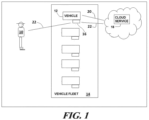
FIG. 1 shows a fleet of vehicles, each equipped to receive biometric data and to communicate with a cloud service. -
FIG. 2 shows details of a vehicle from the fleet shown inFIG. 1 . -
FIG. 3 shows details of the cloud service and the head unit shown inFIG. 2 . -
FIG. 1 shows aperson 10 who seeks access to avehicle 12 that is one of several vehicles in avehicle fleet 14. Eachvehicle 12 includes abiometric sensor 16. The vehicles are all in communication with acloud service 18 that provides anaccess signal 20 to avehicle 10 based in part onbiometric data 22 received by thebiometric sensor 16 at thatvehicle 10. Thecloud service 18 comprises one or more cloud servers. - In the illustrated embodiment, the
biometric sensor 16 is configured to receivebiometric data 22 from theperson 10 while theperson 10 stands outside thevehicle 12. This is useful for embodiments in which thevehicle 10 is kept locked. In other embodiments, thebiometric sensor 16 is instead disposed to receivebiometric data 22 from aperson 10 who is already seated within thevehicle 12. This allows theperson 10 to be sheltered from the elements during the authentication process. - As shown in
FIG. 2 , atypical vehicle 10 includes ahead unit 24 that executes certain applications. Among these applications is anaccess controller 26 that receivesbiometric data 22 from thebiometric sensor 16 and that also communicates with thecloud service 18 via awireless interface 28. When deemed appropriate, theaccess controller 26 also sends signals to accesscontrols 30 to permit thevehicle 10 to be unlocked and/or started. - The
biometric sensor 16 shown inFIG. 2 features the combination of amicrophone 32 and acamera 34. However, embodiments include those in which thebiometric sensor 16 consists of any combination of one or more of acamera 34, amicrophone 32, a touch sensor for sensing of fingerprints, and an iris sensor that inspects a human iris. Embodiments of acamera 34 include infrared cameras and RGB cameras. - In some embodiments, the
biometric sensor 16 is a smartphone carried by theperson 10. This allows controlling access to thevehicle 12 based onbiometric data 22 for those cases in which thevehicle 12 lacks any sort ofbiometric sensor 16 but nevertheless is able to provide its location to thecloud service 18 using thewireless interface 24. - In a typical case, the person's smartphone also has a location sensor and biometric sensor 16 (such as a camera or microphone). For the case in which face recognition is used, the
person 10 providesbiometric data 22 by taking a selfie and providing that selfie, along with the smartphone's location information, to thecloud service 18. - The
cloud service 18 obtains the vehicle's location information and correlates it with the location information of the smartphone. From this, thecloud service 18 infers whichvehicle 12 in thefleet 14 theperson 10 seeks to access. Thecloud service 18 then inspects thebiometric data 22 in the selfie and renders an appropriate judgment to provide to theaccess controller 26. -
FIG. 3 shows details of thecloud service 18, theaccess controller 26, and the access controls 30, all of which are shown inFIG. 2 . In addition, the embodiment shown inFIG. 3 has, as itsbiometric sensor 16, anexternal camera 34 and aninternal camera 36. Theinternal camera 36 is useful for access control when the car is unlocked. In such cases, aperson 10 to be identified sits in the vehicle within the internal camera's field of view. Theinternal camera 36 then collects the relevantbiometric data 22. - The
access controller 26 features animage processor 38 in communication with alocal database 40. Theimage processor 38 receivesbiometric data 22 and extracts relevant features for comparison against feature sets in thelocal database 40. - The
image processor 38 identifies a candidate feature set from thelocal database 40 and, based on thebiometric data 22, calculates the probability that theperson 10 to be identified matches the corresponding data in the candidate feature set. If this probability exceeds a pre-defined value, theaccess controller 26 transmits two signals: agrant signal 42, which goes to the access controls 30, and aprofile request 44, which goes to thecloud service 18. By choosing the pre-defined value, it is possible to control the probability of incorrectly granting access as well as the probability of incorrectly denying access. - Upon receiving the
grant signal 42 from theaccess controller 26, the access controls 30 carry out the relevant instruction. Examples of such instructions include unlocking the vehicle's passenger compartment, unlocking the vehicle's trunk, and enabling the engine to be started. The choice of which instruction to carry out depends on details of thegrant signal 42. These details are provided by theaccess controller 26. - At the
cloud service 18, aprofile manager 46 receives theprofile request 44 from theaccess controller 26 retrieves aprofile 48 corresponding to theperson 10 from apreference database 50, and relays theprofile 48 back to theaccess controller 26. Theprofile 48 comprises the person's preferences, which can then be used to configure thevehicle 12. A variety of user preferences are contemplated within theprofile 48. Among these are pre-sets of radio stations, pre-sets of seats and mirrors, stored music or other entertainment media, contacts, and appointments. - The foregoing interaction occurs between the
cloud service 18 and anyvehicle 12 in thefleet 14. As a result, the person's preferences become portable. Anyvehicle 12 that theperson 10 uses will import that person's 10profile 48, thereby allowing thatvehicle 12 to be customized for thatperson 10. Such a system is applicable not only to car sharing services or rental car companies but also for families that own more than one vehicle. - In some embodiments, the act of identifying a
person 10 through facial recognition takes place outside the vehicle, using anexternal camera 34, either while theperson 10 stands near thevehicle 12 or as the person approaches thevehicle 12. Upon successful facial recognition, thevehicle 12 carries out any one or more of various actions, such as unlocking its doors, unlocking its trunk, turning on an interior light, downloading aprofile 48 corresponding to thatperson 10, or playing a suitable welcoming prompt via a speech interface. - In other embodiments, the act of identifying the
person 10 through facial recognition takes place inside the vehicle using theinternal camera 36. Such embodiments include those in which theaccess controller 26, upon recognizing theperson 10, unlocks or even starts the engine and those in which theaccess controller 26, upon failing to recognize theperson 10, immobilizes thevehicle 10 and, optionally, sends a message to the vehicle registered owner or driver. - The act of recognizing the
person 10 requires information that correlates an observed biometric feature, such as a face, with an identity. Theaccess controller 26 has at least two options for acquiring such information: using information provided by prior enrollment by theperson 10 and using publicly available information. - In a first option, a
person 10 who wishes to accessvehicles 12 in thefleet 14 enrolls with the fleet's proprietor to gain such access. As part of the enrollment process, thatperson 10 providesbiometric data 22 as part of a registration process. - The enrollment process is one that can be carried out remotely. This procedure, which is sometimes referred to as "digital onboarding," relies on execution of an
enrollment application 52 on anenrollment machine 54. - The
enrollment application 52 collects relevant information and transmits it to thecloud service 18. Since the relevant information includesbiometric data 22, it is particularly useful for theenrollment machine 54 to have a biometric input, such as acamera 56, for recording the person's face for facial recognition, or a microphone, for recording a sample of the person's voice for use as a voiceprint. - In the illustrated embodiment, the
enrollment machine 54 is a device that is separate from thevehicle 12. Anenrollment machine 54 of this type communicates directly with thecloud service 18. As a result, it is possible to carry out the enrollment process without having to access thevehicle 12. Examples of such anenrollment machine 54 includes a personal computer, a smartphone, and a tablet. - In those cases in which enrollment is carried out remotely from any
vehicle 12, the biometric data obtained during enrollment will be at thecloud service 18. This biometric data would have to find its way to thelocal database 40 of therelevant vehicle 12. In the context of avehicle fleet 14, one would expect aparticular vehicle 12 in thefleet 14 to be assigned to theuser 10. In such cases, the act of assigning avehicle 12 to auser 10 would include having thecloud service 18 transfer appropriate biometric data to that vehicle'slocal database 40. As a result, when theuser 10 approaches thatvehicle 10, the biometric data will be available to theaccess controller 26. - In other embodiments, the
head unit 24 itself executes theenrollment application 52. In such embodiments, enrollment requires theuser 10 to access thevehicle 12. - In still other embodiments, the enrollment process includes cooperation between the
head unit 24 and a device that is separate from thevehicle 12. Examples of such devices include a personal computer, a smartphone, and a tablet. - In a second option, the
access controller 26 instead relies on publicly available information. Many publicly available sites have images of people's faces. Examples of such sites include "LINKEDIN(R)" and "FACEBOOK(R)." In such cases, theinternal camera 36 acquires an image and theaccess controller 26 sends a signal to thecloud service 18 requesting a match. - The
cloud service 18 further includes aproactive engine 58 that includes adialog orchestrator 60 in communication with anatural language generator 62. Thedialog orchestrator 60 receives information from theprofile manager 46 concerning therelevant profile 48 and details of theprofile request 44. Based on this information, thedialog orchestrator 60 causes thenatural language generator 62 to deliver an appropriate message to a text-to-speech module 64 within thehead unit 24 for delivery within thevehicle 12. - In some cases, the enrollment process includes enrolling a set of people. The resulting "enrollment set" includes the
user 10 as well as one or more other persons who are authorized to use thevehicle 12 or who are expected to occasionally ride in thevehicle 12. Examples of such persons include members of the user's family, including children of theuser 10. The resultingprofile 48 in such cases includes preferences for each person in the enrollment set. Such aprofile 48 is therefore a "composite"profile 48. - Information available in the
profile request 46 includes information concerning the presence of any person who is in the enrollment set. Since theprofile 48 includes preferences for each person in the enrollment set, it becomes possible to customize thevehicle 12 to accommodate the preferences of all persons who are identified in theprofile request 46 as being members of the enrollment set. This makes it possible to also set preferences not only for theuser 10 but for anyone else in the enrollment set who happens to be accompanying theuser 10. Such preferences include all of the preferences as described above in connection with theuser 10. In addition, such information makes it possible for theproactive engine 58 to customize a welcome message so that it recognizes the existence of the user's companion with a suitable greeting. - In the case of seat adjustment, it is useful to know, for each person in the enrollment set, where that person will be sitting. In a
vehicle 12 equipped withexternal cameras 34, it is possible to observe the trajectories of the individual persons as they approach thevehicle 12 and make their way to individual doors of thevehicle 12. This provides some basis for proactively determining which seats to adjust and how to adjust them. - Having described the invention and a preferred embodiment thereof, what is claimed as new and secured by letters patent is:
Claims (16)
- A method comprising customizing interaction of a person with a vehicle from a fleet of vehicles, wherein customizing said interaction comprisesreceiving, from an access controller in said vehicle, biometric data, said biometric data having been acquired from said person,using said biometric data, retrieving a profile for said person, andproviding said profile to said vehicle, thereby enabling said vehicle to transition into a state that enables said person to interact with said vehicle in a manner based on said profile.
- The method of claim 1, wherein identifying said person comprises obtaining reference data for comparison with said test data, wherein said reference data comprises information indicative of facial features of said person,
said reference data having been provided by said person during an enrollment process. - The method of claim 1, wherein identifying said person comprises obtaining reference data for comparison with said test data, wherein said reference data comprises information indicative of facial features of said person,
said reference data having been obtained by said cloud service from publicly available images of said person. - The method of claim 1, wherein receiving said test data comprises receiving test data that is based on an image of said person that was obtained by an internal camera of said vehicle while said person was inside said vehicle.
- The method of claim 1, wherein receiving said test data comprises receiving test data that is based on an image of said person that was obtained by an external camera of said vehicle while said person was outside said vehicle.
- The method of claim 1, wherein receiving said test data comprises receiving test data that is based on an image of said person that was obtained by an external camera of said vehicle while said person was approaching said vehicle.
- The method of claim 1, wherein receiving said test data comprises receiving test data that is based on an image of said person that was obtained by a camera of a smartphone.
- The method of claim 1, further comprising, after said person has been identified, adjusting seating in said vehicle based on said profile.
- The method of claim 1, further comprising, after said person has been identified, adjusting settings in an infotainment system of said vehicle based on said profile.
- The method of claim 1, wherein said vehicle is a first vehicle of a fleet that comprises a second vehicle, wherein said method further comprises receiving, from an access controller in said second vehicle, test data, said test data being representative of an image of said person's face, using said test data, identifying said person, after having identified said person, retrieving a profile for said person and providing said profile to said second vehicle, thereby enabling said second vehicle to be configured based on said profile, wherein said second vehicle and said first vehicle are configured based on said profile.
- The method of claim 1, further comprising customizing interaction of said vehicle with a companion of said person.
- The method of claim 1, further comprising receiving, from said access controller, biometric data acquired from a companion of said person, wherein said profile is a composite profile that includes a profile of said person and a profile of said companion, and wherein providing said profile to said vehicle enables said companion to interact with said vehicle in a manner based on said profile of said companion.
- The method of claim 1, further comprising, based on information in said profile, customizing a spoken greeting and causing said vehicle to deliver said spoken greeting.
- An apparatus comprising a cloud service that is in communication with each vehicle in a fleet of vehicles, each of which comprises an access controller that receives biometric information, wherein said cloud service comprises a database of profiles and a profile manager, wherein each of said profiles comprises a profile of a person, wherein each of said profiles includes information for customizing interaction between said person and any vehicle in said fleet of vehicles, wherein said profile manager receives, from an access controller of a vehicle in said fleet, information indicating presence of said person at said vehicle, said presence having been determined based on inspection of biometric data obtained from said person, wherein said profile manager retrieves said profile of said person and provides said profile to said vehicle, thereby enabling said vehicle to transition into a state that enables said person to interact with said vehicle in a manner based on said profile.
- The apparatus of claim 14, wherein said cloud service further comprises a proactive engine that receives information from said profile manager and uses said information to customize spoken interaction with said person in said vehicle.
- The apparatus of claim 14, wherein said profiles comprise a composite profile that includes information that enables customizing interaction of a companion to said person with said vehicle from said fleet of vehicles.
Applications Claiming Priority (1)
| Application Number | Priority Date | Filing Date | Title |
|---|---|---|---|
| US202363460646P | 2023-04-20 | 2023-04-20 |
Publications (1)
| Publication Number | Publication Date |
|---|---|
| EP4451148A1 true EP4451148A1 (en) | 2024-10-23 |
Family
ID=90720248
Family Applications (1)
| Application Number | Title | Priority Date | Filing Date |
|---|---|---|---|
| EP24169232.6A Pending EP4451148A1 (en) | 2023-04-20 | 2024-04-09 | Biometric recognition across distributed assets |
Country Status (3)
| Country | Link |
|---|---|
| US (1) | US20240354387A1 (en) |
| EP (1) | EP4451148A1 (en) |
| CN (1) | CN118822664A (en) |
Citations (4)
| Publication number | Priority date | Publication date | Assignee | Title |
|---|---|---|---|---|
| US20140309862A1 (en) * | 2013-04-15 | 2014-10-16 | Flextronics Ap, Llc | User profile exchange via vehicle supported communications protocol |
| US9783162B2 (en) * | 2014-06-11 | 2017-10-10 | Veridium Ip Limited | System and method for facilitating user access to vehicles based on biometric information |
| US20210094492A1 (en) * | 2019-09-30 | 2021-04-01 | Cerence Operating Company | Multi-modal keyless multi-seat in-car personalization |
| US20220101333A1 (en) * | 2017-07-28 | 2022-03-31 | Alclear, Llc | Biometric pre-identification |
-
2024
- 2024-04-08 US US18/629,178 patent/US20240354387A1/en active Pending
- 2024-04-09 EP EP24169232.6A patent/EP4451148A1/en active Pending
- 2024-04-22 CN CN202410485022.5A patent/CN118822664A/en active Pending
Patent Citations (4)
| Publication number | Priority date | Publication date | Assignee | Title |
|---|---|---|---|---|
| US20140309862A1 (en) * | 2013-04-15 | 2014-10-16 | Flextronics Ap, Llc | User profile exchange via vehicle supported communications protocol |
| US9783162B2 (en) * | 2014-06-11 | 2017-10-10 | Veridium Ip Limited | System and method for facilitating user access to vehicles based on biometric information |
| US20220101333A1 (en) * | 2017-07-28 | 2022-03-31 | Alclear, Llc | Biometric pre-identification |
| US20210094492A1 (en) * | 2019-09-30 | 2021-04-01 | Cerence Operating Company | Multi-modal keyless multi-seat in-car personalization |
Also Published As
| Publication number | Publication date |
|---|---|
| US20240354387A1 (en) | 2024-10-24 |
| CN118822664A (en) | 2024-10-22 |
Similar Documents
| Publication | Publication Date | Title |
|---|---|---|
| CN104024078B (en) | System, method and apparatus for the identity that learns delivery vehicle occupant | |
| CN111788090B (en) | Method, personalization device and motor vehicle for a motor vehicle system for operating a motor vehicle depending on the driving situation | |
| CN111231893B (en) | Method for operating a shared vehicle and shared vehicle | |
| CN104010914B (en) | System, method and apparatus for recognizing automotive occupant | |
| US20210094492A1 (en) | Multi-modal keyless multi-seat in-car personalization | |
| US9862352B2 (en) | User identification and personalized vehicle settings management system | |
| US20190031145A1 (en) | Biometric identification system connected vehicle | |
| WO2018133365A1 (en) | Method and system for adjusting user scene | |
| US9694771B1 (en) | Biometric based personalized settings for a driving apparatus | |
| CN107483528A (en) | The end-to-end regulation function of entirely autonomous shared or tax services vehicle passenger | |
| CN111717083B (en) | Vehicle interaction method and vehicle | |
| US12623620B2 (en) | Occupant-dependent setting system for vehicle, and vehicle | |
| JP2019008702A (en) | Authentication apparatus | |
| JP2018027731A (en) | On-vehicle device, control method of on-vehicle device, and content providing system | |
| CN112116740A (en) | Vehicle unlocking method, device and equipment and vehicle | |
| US10471965B2 (en) | Securing guest access to vehicle | |
| US20240354387A1 (en) | Biometric Recognition Across Distributed Assets | |
| CN114715165A (en) | System for determining when a driver accesses a communication device | |
| US20230037991A1 (en) | Occupant-dependent setting system for vehicle, and vehicle | |
| JP7783704B2 (en) | Vehicle configuration system tailored to the occupants | |
| US12375480B2 (en) | Occupant-dependent setting system for vehicle, and vehicle | |
| JP6888160B1 (en) | Authentication system, authentication method, authentication program and terminal device | |
| JP2020121668A (en) | User support system and user support device | |
| HK1240380A1 (en) | Biometric based personalized settings for a driving apparatus |
Legal Events
| Date | Code | Title | Description |
|---|---|---|---|
| PUAI | Public reference made under article 153(3) epc to a published international application that has entered the european phase |
Free format text: ORIGINAL CODE: 0009012 |
|
| STAA | Information on the status of an ep patent application or granted ep patent |
Free format text: STATUS: THE APPLICATION HAS BEEN PUBLISHED |
|
| AK | Designated contracting states |
Kind code of ref document: A1 Designated state(s): AL AT BE BG CH CY CZ DE DK EE ES FI FR GB GR HR HU IE IS IT LI LT LU LV MC ME MK MT NL NO PL PT RO RS SE SI SK SM TR |
|
| STAA | Information on the status of an ep patent application or granted ep patent |
Free format text: STATUS: REQUEST FOR EXAMINATION WAS MADE |
|
| 17P | Request for examination filed |
Effective date: 20250423 |
|
| STAA | Information on the status of an ep patent application or granted ep patent |
Free format text: STATUS: EXAMINATION IS IN PROGRESS |
|
| 17Q | First examination report despatched |
Effective date: 20260226 |
|
| RAP3 | Party data changed (applicant data changed or rights of an application transferred) |
Owner name: CERENCE OPERATING COMPANY |