EP4450833A1 - Hydraulischer aktuator - Google Patents
Hydraulischer aktuator Download PDFInfo
- Publication number
- EP4450833A1 EP4450833A1 EP22906994.3A EP22906994A EP4450833A1 EP 4450833 A1 EP4450833 A1 EP 4450833A1 EP 22906994 A EP22906994 A EP 22906994A EP 4450833 A1 EP4450833 A1 EP 4450833A1
- Authority
- EP
- European Patent Office
- Prior art keywords
- body portion
- tube
- actuator
- sealing member
- actuator body
- Prior art date
- Legal status (The legal status is an assumption and is not a legal conclusion. Google has not performed a legal analysis and makes no representation as to the accuracy of the status listed.)
- Pending
Links
- 238000007789 sealing Methods 0.000 claims abstract description 78
- 239000012530 fluid Substances 0.000 claims abstract description 43
- 230000007246 mechanism Effects 0.000 claims abstract description 35
- 230000002093 peripheral effect Effects 0.000 claims abstract description 14
- 230000007423 decrease Effects 0.000 claims description 8
- 229910052751 metal Inorganic materials 0.000 description 7
- 239000002184 metal Substances 0.000 description 7
- 230000008602 contraction Effects 0.000 description 6
- 239000000835 fiber Substances 0.000 description 6
- 229920000459 Nitrile rubber Polymers 0.000 description 4
- 238000007373 indentation Methods 0.000 description 4
- 241000219122 Cucurbita Species 0.000 description 3
- 235000009852 Cucurbita pepo Nutrition 0.000 description 3
- 239000007788 liquid Substances 0.000 description 3
- 239000000463 material Substances 0.000 description 3
- -1 polyethylene terephthalate Polymers 0.000 description 3
- XEEYBQQBJWHFJM-UHFFFAOYSA-N Iron Chemical compound [Fe] XEEYBQQBJWHFJM-UHFFFAOYSA-N 0.000 description 2
- 230000000694 effects Effects 0.000 description 2
- 229920001971 elastomer Polymers 0.000 description 2
- 230000006872 improvement Effects 0.000 description 2
- 210000003205 muscle Anatomy 0.000 description 2
- 239000004033 plastic Substances 0.000 description 2
- 229920003023 plastic Polymers 0.000 description 2
- 229920000139 polyethylene terephthalate Polymers 0.000 description 2
- 239000005020 polyethylene terephthalate Substances 0.000 description 2
- 230000002265 prevention Effects 0.000 description 2
- QNRATNLHPGXHMA-XZHTYLCXSA-N (r)-(6-ethoxyquinolin-4-yl)-[(2s,4s,5r)-5-ethyl-1-azabicyclo[2.2.2]octan-2-yl]methanol;hydrochloride Chemical compound Cl.C([C@H]([C@H](C1)CC)C2)CN1[C@@H]2[C@H](O)C1=CC=NC2=CC=C(OCC)C=C21 QNRATNLHPGXHMA-XZHTYLCXSA-N 0.000 description 1
- 229910000838 Al alloy Inorganic materials 0.000 description 1
- 229910001369 Brass Inorganic materials 0.000 description 1
- 239000004952 Polyamide Substances 0.000 description 1
- 239000004760 aramid Substances 0.000 description 1
- 229920006231 aramid fiber Polymers 0.000 description 1
- 229920003235 aromatic polyamide Polymers 0.000 description 1
- 239000010951 brass Substances 0.000 description 1
- 229920005549 butyl rubber Polymers 0.000 description 1
- 230000008859 change Effects 0.000 description 1
- 238000010586 diagram Methods 0.000 description 1
- 239000013013 elastic material Substances 0.000 description 1
- 229920005558 epichlorohydrin rubber Polymers 0.000 description 1
- 210000003414 extremity Anatomy 0.000 description 1
- 230000005021 gait Effects 0.000 description 1
- 229910052742 iron Inorganic materials 0.000 description 1
- 210000003141 lower extremity Anatomy 0.000 description 1
- 150000002739 metals Chemical class 0.000 description 1
- 239000002480 mineral oil Substances 0.000 description 1
- 235000010446 mineral oil Nutrition 0.000 description 1
- 230000004048 modification Effects 0.000 description 1
- 238000012986 modification Methods 0.000 description 1
- 239000003921 oil Substances 0.000 description 1
- 229920001084 poly(chloroprene) Polymers 0.000 description 1
- 229920002647 polyamide Polymers 0.000 description 1
- 230000003014 reinforcing effect Effects 0.000 description 1
- 230000004044 response Effects 0.000 description 1
- 239000010935 stainless steel Substances 0.000 description 1
- 229910001220 stainless steel Inorganic materials 0.000 description 1
- 210000001364 upper extremity Anatomy 0.000 description 1
- XLYOFNOQVPJJNP-UHFFFAOYSA-N water Substances O XLYOFNOQVPJJNP-UHFFFAOYSA-N 0.000 description 1
Images


Classifications
-
- F—MECHANICAL ENGINEERING; LIGHTING; HEATING; WEAPONS; BLASTING
- F15—FLUID-PRESSURE ACTUATORS; HYDRAULICS OR PNEUMATICS IN GENERAL
- F15B—SYSTEMS ACTING BY MEANS OF FLUIDS IN GENERAL; FLUID-PRESSURE ACTUATORS, e.g. SERVOMOTORS; DETAILS OF FLUID-PRESSURE SYSTEMS, NOT OTHERWISE PROVIDED FOR
- F15B15/00—Fluid-actuated devices for displacing a member from one position to another; Gearing associated therewith
- F15B15/08—Characterised by the construction of the motor unit
- F15B15/10—Characterised by the construction of the motor unit the motor being of diaphragm type
- F15B15/103—Characterised by the construction of the motor unit the motor being of diaphragm type using inflatable bodies that contract when fluid pressure is applied, e.g. pneumatic artificial muscles or McKibben-type actuators
-
- F—MECHANICAL ENGINEERING; LIGHTING; HEATING; WEAPONS; BLASTING
- F16—ENGINEERING ELEMENTS AND UNITS; GENERAL MEASURES FOR PRODUCING AND MAINTAINING EFFECTIVE FUNCTIONING OF MACHINES OR INSTALLATIONS; THERMAL INSULATION IN GENERAL
- F16L—PIPES; JOINTS OR FITTINGS FOR PIPES; SUPPORTS FOR PIPES, CABLES OR PROTECTIVE TUBING; MEANS FOR THERMAL INSULATION IN GENERAL
- F16L33/00—Arrangements for connecting hoses to rigid members; Rigid hose-connectors, i.e. single members engaging both hoses
- F16L33/20—Undivided rings, sleeves, or like members contracted on the hose or expanded inside the hose by means of tools; Arrangements using such members
- F16L33/207—Undivided rings, sleeves, or like members contracted on the hose or expanded inside the hose by means of tools; Arrangements using such members only a sleeve being contracted on the hose
- F16L33/2071—Undivided rings, sleeves, or like members contracted on the hose or expanded inside the hose by means of tools; Arrangements using such members only a sleeve being contracted on the hose the sleeve being a separate connecting member
-
- F—MECHANICAL ENGINEERING; LIGHTING; HEATING; WEAPONS; BLASTING
- F15—FLUID-PRESSURE ACTUATORS; HYDRAULICS OR PNEUMATICS IN GENERAL
- F15B—SYSTEMS ACTING BY MEANS OF FLUIDS IN GENERAL; FLUID-PRESSURE ACTUATORS, e.g. SERVOMOTORS; DETAILS OF FLUID-PRESSURE SYSTEMS, NOT OTHERWISE PROVIDED FOR
- F15B15/00—Fluid-actuated devices for displacing a member from one position to another; Gearing associated therewith
- F15B15/08—Characterised by the construction of the motor unit
- F15B15/14—Characterised by the construction of the motor unit of the straight-cylinder type
- F15B15/1423—Component parts; Constructional details
- F15B15/1438—Cylinder to end cap assemblies
-
- F—MECHANICAL ENGINEERING; LIGHTING; HEATING; WEAPONS; BLASTING
- F16—ENGINEERING ELEMENTS AND UNITS; GENERAL MEASURES FOR PRODUCING AND MAINTAINING EFFECTIVE FUNCTIONING OF MACHINES OR INSTALLATIONS; THERMAL INSULATION IN GENERAL
- F16L—PIPES; JOINTS OR FITTINGS FOR PIPES; SUPPORTS FOR PIPES, CABLES OR PROTECTIVE TUBING; MEANS FOR THERMAL INSULATION IN GENERAL
- F16L33/00—Arrangements for connecting hoses to rigid members; Rigid hose-connectors, i.e. single members engaging both hoses
- F16L33/22—Arrangements for connecting hoses to rigid members; Rigid hose-connectors, i.e. single members engaging both hoses with means not mentioned in the preceding groups for gripping the hose between inner and outer parts
- F16L33/225—Arrangements for connecting hoses to rigid members; Rigid hose-connectors, i.e. single members engaging both hoses with means not mentioned in the preceding groups for gripping the hose between inner and outer parts a sleeve being movable axially
Definitions
- the present invention relates to a fluid pressure actuator that expands and contracts a tube using a gas or liquid, and more particularly to a so-called McKibben type fluid pressure actuator.
- McKibben type having a rubber tube (tubular body) that expands and contracts by air pressure and a sleeve (mesh reinforcing structure) that covers the outer peripheral surface of the tube is widely used as a fluid pressure actuator that expands and contracts the tube as described above.
- Both ends of the actuator body portion constituted by the tube and the sleeve are sealed using a sealing member formed of metal.
- the sleeve is a cylindrical structure in which a high-tension fiber such as a polyamide fiber or a metal cord is woven, and the expansion motion of the tube is restricted to a predetermined range.
- Patent Literature 1 Japanese Patent Laid-Open No. 2018-035930
- a McKibben type fluid pressure actuator as described above may be used in an environment where expansion and contraction are repeated very many times (For example, about 10,000 ⁇ 100,000 times) in succession.
- both ends of the tube in the axial direction near the restricting member expand more easily, and if the expansion and contraction operations are repeated many times, the end of the tube becomes bulged like a gourd and its durability decreases.
- the following disclosure is made in view of such a situation, and it is an object of the present invention to provide a fluid pressure actuator which can prevent the mesh of the sleeve near the restricting member from expanding and further improve its durability.
- An aspect of the present disclosure is a fluid pressure actuator including an actuator body portion comprising a tube having a cylindrical shape and that expands and contracts under pressure of a fluid, and a sleeve that is a structure in which cords oriented in a predetermined direction are woven and covers an outer peripheral surface of the tube.
- a sealing mechanism that seals an end of the actuator body portion in an axial direction of the actuator body portion.
- the sealing mechanism includes a sealing member into which the actuator body portion is inserted, a restricting member provided on an outer peripheral surface of the actuator body portion inserted into the sealing member and that restricts the actuator body portion, and a locking member that locks the sleeve to the sealing member.
- the sealing member includes a body portion into which the tube is inserted, and the outer diameter of the body portion is larger than the inner diameter of the tube in a portion not inserted into the body portion.
- FIG. 1 is a side view of the fluid pressure actuator 10 according to the present embodiment.
- the fluid pressure actuator 10 includes an actuator body portion 100, a sealing mechanism 200, and a sealing mechanism 300.
- the sealing mechanism 200 and the sealing mechanism 300 seal both ends of the actuator body portion 100 in the axial direction D AX .
- the sealing mechanism 200 includes a sealing member 210 and a caulking ring 230.
- the sealing member 210 seals the end of the axial direction D AX of the actuator body portion 100.
- the caulking ring 230 caulks the actuator body portion 100 together with the sealing member 210.
- the difference between the sealing mechanism 200 and the sealing mechanism 300 is whether or not a connection port 211a for the fluid is provided.
- the actuator body portion 100 is constituted by a tube 110 and a sleeve 120. Fluid flows into the actuator body portion 100 through the connection port 211a.
- the actuator body portion 100 contracts in the axial direction D AX of the actuator body portion 100 and expands in the radial direction D R due to fluid flow into the tube 110.
- the actuator body portion 100 expands in the axial direction D AX of the actuator body portion 100 and contracts in the radial direction D R due to the outflow of fluid from the tube 110. Due to the shape change of the actuator body portion 100, the fluid pressure actuator 10 functions as an actuator.
- the fluid used for driving the fluid pressure actuator 10 may be either a gas such as air or a liquid such as water or mineral oil, but in particular, the fluid pressure actuator 10 has high durability that can withstand hydraulic driving under high pressure applied to the actuator body portion 100.
- the fluid pressure actuator 10 is a so-called McKibben type, and can be used not only for artificial muscles, but also suitably for a robot limb (such as an upper limb or a lower limb) for which higher performance (contraction force) is required.
- the fluid pressure actuator 10 can also be used as a body-worn power assist device, a gait assist device, and a training device such as muscle strength.
- FIG. 2 is a partially enlarged perspective view of the fluid pressure actuator 10. As shown in FIG. 2 , the fluid pressure actuator 10 includes an actuator body portion 100 and a sealing mechanism 200.
- the actuator body portion 100 comprises a tube 110 and a sleeve 120.
- the tube 110 is a cylindrical cylindrical body that expands and contracts under fluid pressure.
- the tube 110 is made of an elastic material such as butyl rubber to repeatedly contract and expand under fluid pressure.
- the inner diameter ⁇ 10 (see FIG. 4 ) of the tube 110 is not particularly limited, but in this embodiment, it is about 9 mm.
- the material of the tube 110 may be NBR (nitrile rubber) having high oil resistance or at least one kind selected from the group consisting of NBR, hydrogenated NBR, chloroprene rubber, and epichlorohydrin rubber.
- the sleeve 120 is cylindrical and covers the outer peripheral surface of the tube 110.
- the sleeve 120 is a structure in which cords oriented in a predetermined direction are woven, and a rhombic shape is repeated by crossing the oriented cords. By having such a shape, the sleeve 120 deforms pantographically and follows the tube 110 while restricting its contraction and expansion.
- a fiber cord of an aromatic polyamide (aramid fiber) or polyethylene terephthalate (PET) is preferably used.
- aromatic polyamide aromatic polyamide
- PET polyethylene terephthalate
- a metal cord composed of a high-strength fiber such as a PBO fiber (polyparaphenylene benzobisoxazole) or an extra-fine filament may be used.
- the sealing mechanism 200 seals the end of the actuator body portion 100 in the axial direction D AX .
- the sealing mechanism 200 is constituted by a sealing member 210, a locking ring 220 and a caulking ring 230.
- the actuator body portion 100 is inserted into the sealing member 210.
- Metal such as stainless steel may be suitably used as the sealing member 210, but it is not limited to such metal, and a hard plastic material may be used.
- the locking ring 220 locks the sleeve 120 to the sealing member 210.
- the locking ring 220 constitutes a locking member. Specifically, the sleeve 120 is folded back to the radial direction D R outside via the locking ring 220 (Not shown in FIG. 2 , see FIG. 3 ).
- the locking ring 220 has a notched portion 221 partially notched so as to engage the sealing member 210.
- a metal or a hard plastic material similar to the sealing member 210 can be used as the locking ring 220.
- the caulking ring 230 is provided on the outer peripheral surface of the actuator body portion 100 inserted into the sealing member 210 to restrict the actuator body portion 100.
- the locking ring 230 constitutes a restricting member.
- the caulking ring 230 caulks the actuator body portion 100 together with the sealing member 210.
- Metals such as aluminum alloy, brass and iron can be used as the caulking ring 230.
- the caulking jig is not particularly limited, but by caulking a plurality of dies (For example, a die divided into seven parts on the circumference) in contact with the outer circumferential surface of the caulking ring 230 in the radial inside, the actuator body portion 100 is restricted to form the linear indentation 231 along the axial direction D AX .
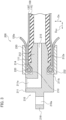
- FIG. 3 is a partial cross-sectional view of the sealing mechanism 200 along the axial direction D AX .
- the sealing member 210 includes a head portion 211, a body portion 212, and a neck portion 213.
- the head portion 211 is provided in outside more than the body portion 212 in the axial direction D AX .
- a connection port 211a is formed in the head portion 211.
- connection port 211a is connected to a hose (pipeline) connected to a driving pressure source of the fluid pressure actuator 10, specifically, a gas or liquid compressor.
- the body portion 212 is a portion into which the tube 110 (see FIGS. 1 and 2 ) is inserted. Specifically, the body portion 212 is in contact with the inner peripheral surface of the tube 110 inserted into the sealing member 210.
- At least a part of the body portion 212 is tapered such that the outer diameter decreases toward a center in the axial direction D AX .
- the inside end portion of the axial direction D AX of the body portion 212 is tapered in such a way that the outer diameter decreases toward inside from the axial direction D AX outside.
- a stepped part 212a is formed on the outer peripheral surface of the body portion 212 to make it difficult for the tube 110 to be removed from the sealing member 210.
- the stepped part 212a is protruded toward the radial direction D R outside so as to be resistant to the pulling direction of the tube 110 from the body portion 212.
- the neck portion 213 is provided between a flange portion 214 and the head portion 211.
- the diameter ⁇ of the neck portion 213 is smaller than the diameter of the other portion of the sealing member 210. In this embodiment, the diameter of the neck portion 213 is about 13 mm.
- the size of the neck portion 213 in the radial direction D R is smaller than that of the body portion 212 and the head portion 211.
- the flange portion 214 is provided between the body portion 212 and the head portion 211, specifically adjacent to the body portion 212 and the neck portion 213.
- the flange portion 214 is more convex in the radial direction D R outside than the body portion 212. More specifically, the flange portion 214 is an annular shape projecting from the outer peripheral surface of the neck portion 213 to the radial direction D R outside.
- the diameter of the flange portion 214 is about 16 mm. As described above, since the diameter of the neck portion 213 is 13 mm, the level difference between the flange portion 214 and the neck portion 213 is about 1.5 mm.
- the flange portion 214 abuts against an end surface 111 (Not shown in FIG. 3 , see FIG. 2 ) of the tube 110 in the axial direction D AX .
- a through hole 215 is formed inside the sealing member 210 along the axial direction D AX .
- the through hole 215 communicates with the connection port 211a, and fluid flows into the actuator body portion 100 through the through hole 215.
- the diameter ⁇ of the through hole 215 is about 5 mm.
- the sealing member 210 is provided with a connecting portion 216.
- the connecting portion 216 is provided in the axial direction D AX outside of the head portion 211.
- An engagement hole 216a is formed in the connecting portion 216 for engaging a member constituting a device using the fluid pressure actuator 10.
- the tube 110 is inserted into the body portion 212. As described above, the flange portion 214 abuts against the end surface 111 of the tube 110. The diameter of the tube 110 is enlarged by being inserted into the body portion 212.
- the stepped part 212a is further prevented from cutting into the inner peripheral surface of the tube 110 and dislodging the tube 110 from the body portion 212 by clamping the actuator body portion 100 together with the sealing member 210 by the caulking ring 230.
- the locking ring 220 is provided on the outer peripheral surface of the sleeve 120 and the sleeve 120 is folded back to center side of the axial direction D AX through the locking ring 220.
- the sleeve 120 has a folded back part 120a folded back through the locking ring 220.
- the folded back part 120a is folded back to the radial direction D R outside through the locking ring 220 and abuts against the inner circumferential surface of the caulking ring 230.
- the caulking ring 230 locks the sleeve 120 folded back via the tube 110 and the locking ring 220 together with the sealing member 210 to secure the actuator body portion 100 to the sealing member 210.
- An end surface 232 of the axial direction D AX outside of the caulking ring 230 may be located near the boundary between the head portion 211 and the neck portion 213. Specifically, the end surface 232 may be located in contact with an inside surface 211b of the head portion 211 in the axial direction D AX .
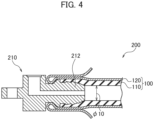
- FIG. 4 is a partial cross-sectional view of the sealing mechanism 200 before assembly along the axial direction D AX .
- FIG. 4 only the actuator body portion 100 and the sealing member 210 are shown, and illustrations such as the locking ring 220, the caulking ring 230, and the folded back part 120a of the sleeve 120 are omitted for convenience of explanation.
- the tube 110 is enlarged in diameter by being inserted into the body portion 212. Therefore, the inner diameter ⁇ 10 of the tube 110 before being enlarged, in other words, the inner diameter ⁇ 10 of the tube 110 in the portion not inserted into the body portion 212, is smaller than the diameter (outer diameter) of the body portion 212.
- the outer diameter of the body portion 212 may be larger than the inner diameter ⁇ 10 of the tube 110 in the portion not inserted into the body portion 212.
- the outer diameter (In this embodiment, about 14 mm) of inside end of the body portion 212 in the axial direction D AX is larger than the inner diameter ⁇ 10 of the tube 110.
- the outer diameter of inside end of the body portion 212 is preferably 30-70% larger than the inner diameter ⁇ 10, and more preferably 40-50% larger.
- the tube 110 is easily dislodged before the actuator body portion 100 is caulked during the assembly of the fluid pressure actuator 10, and productivity decreases. In addition, the rubber (tube 110) in the caulked portion becomes too thin, and it is easy to cause a failure core. On the other hand, if the outer diameter of inside end of the body portion 212 is too thin than the inner diameter ⁇ 10, a sufficient effect to prevent the mesh of the sleeve near the caulking ring 230 from widening cannot be obtained.
- the diameter of the tube 110 is enlarged by being inserted into the body portion 212 having such a diameter difference, but the diameter enlargement ratio of the tube 110 is preferably 1.3 times or more and 1.7 times or less in consideration of the pullout prevention and durability of the tube 110.
- the diameter expansion ratio of the tube 110 may be the ratio of the diameter of the groove bottom of the stepped part 212a in the maximum outer diameter portion of the body portion 212 to the inner diameter ⁇ 10 of the tube 110.
- the diameter of the body portion 212 When the diameter of the body portion 212 is increased, the diameter of the groove bottom of the stepped part 212a also increases, thereby increasing the outer diameter of the portion to be caulked by the caulking ring 230 and increasing the strength of the portion to be caulked. As a result, the diameter ⁇ of the through hole 215 can also be increased, thereby reducing the fluid flow resistance and contributing to the improvement of the response when the fluid pressure actuator 10 is actuated.
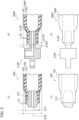
- FIGS. 5 (a) to 5 (d) are partially sectional and contour views of the sealing mechanism 200 and the sealing mechanism 200P along the axial direction D AX .
- FIGS. 5 (a) to 5 (d) as in FIG. 4 , illustrations of the locking ring 220, the caulking ring 230, and the like are omitted.
- FIG. 5 (a) schematically shows the shape of the sealing mechanism 200 when the actuator body portion 100 is expanded.
- FIG. 5 (b) schematically shows the shape of the sealing mechanism 200P according to the conventional example when the actuator body portion 100P is expanded.
- FIGS. 5 (c) and 5 (d) show contour diagrams of the sealing mechanism 200 and the sealing mechanism 200P, respectively.
- the outer diameter of the body portion 212P of the sealing member 210P is the same or smaller than the inner diameter of the tube 110P, as in the case of the sealing mechanism 200P, when the actuator body portion 100 is expanded in the circumferential direction by pressurizing the actuator body portion 100, the outer diameter of the portion of the actuator body portion 100P that is not caulked by the caulking ring 230 becomes larger compared with the actuator body portion 100P caulked by the caulking ring 230 (see, for example, FIG. 3 ). When such expansion and contraction operations are repeated, the mesh of the sleeve 120 shifts.
- the cords constituting the sleeve 120 move toward the side of the caulking ring 230 that does not expand, and the cord spacing becomes narrow and dense.
- the tube 110P expands more than other parts, and finally deforms into a distorted shape like a gourd. Since unevenly large load is applied to the cord and the tube 110P constituting the sleeve 120, durability decreases.
- the sealing mechanism 200 can prevent such deformation of the actuator body portion. Specifically, as shown in FIGS. 5 (a) to 5 (d) , when the actuator body portion 100 is expanded, the diameter difference D 1 between the diameter ⁇ 31 of the actuator body portion 100 inserted into the body portion 212 and the diameter ⁇ 32 of the actuator body portion 100 not inserted into the body portion 212 is smaller than the diameter difference D2 between the diameter ⁇ 31P of the actuator body portion 100P inserted into the body portion 212P and the diameter ⁇ 32P of the actuator body portion 100P not inserted into the body portion 212 when the actuator body portion 100P is expanded.
- the outer diameter (about 14 mm) of the axial direction D AX inside end of the body portion 212 is made larger than the inner diameter ⁇ 10 (see FIG. 4 ) of the tube 110, and by inserting the tube 110 into the body portion 212 of the sealing member 210 while extending the tube in the radial direction D R , the diameter size of the tube 110 in the portion caulked by the caulking ring 230 when the actuator body portion 100 is not pressurized can be made larger in advance than the diameter size of the tube 110 of the actuator body portion 100 not caulked by the caulking ring 230.
- the diameter difference D1 can be reduced (In other words, it is possible to assume that the diameter difference D1 ⁇ the diameter difference D2.).
- the deviation of the cord (thread) constituting the sleeve 120 can be reduced, and finally the gourding of the shape of the actuator body portion 100 can be suppressed.
- the mesh of the sleeve 120 in the vicinity of the caulking ring 230 can be prevented from widening, and the durability can be further improved.
- the tube 110 is widened by being inserted into the body portion 212 of the sealing member 210. Therefore, the contraction force of the tube 110 makes the tube more firmly engaged with the stepped part 212a of the body portion 212, thereby preventing the tube 110 from being pulled out more securely.
- the diameter expansion ratio of the tube 110 is preferably 1.3 times or more and 1.7 times or less. By adopting such a range, the pullout prevention and durability of the tube 110 can be achieved while suppressing the shape of the actuator body portion 100 from becoming gourd.
- the axial direction D AX inside end portion of the body portion 212 has a tapered shape whose outer diameter decreases toward the center of the axial direction D AX . Therefore, it is easy to insert the tube 110 into the body portion 212 while enlarging the diameter.
- the body portion 212 of the sealing member 210 may not necessarily have a tapered shape whose outer diameter decreases toward the center of the axial direction D AX . That is, the outer diameter of the body portion 212 may be constant as long as it is larger than the inner diameter ⁇ 10 of the tube 110, and portions of the axial direction D AX outside may be equal to or smaller than the inner diameter ⁇ 10.
- the connecting portion 216 of the sealing member 210 may not be provided. That is, the connecting portion 216 may or may not be provided depending on the application of the fluid pressure actuator 10. Further, a screw portion may be formed in the connecting portion 216 and may be detachable from the head portion 211.
- the sleeve 120 is folded back via the locking ring 220, but the sleeve 120 may not necessarily be folded back toward the center of the axial direction D AX .
Landscapes
- Engineering & Computer Science (AREA)
- General Engineering & Computer Science (AREA)
- Mechanical Engineering (AREA)
- Physics & Mathematics (AREA)
- Fluid Mechanics (AREA)
- Chemical & Material Sciences (AREA)
- Analytical Chemistry (AREA)
- Actuator (AREA)
Applications Claiming Priority (2)
| Application Number | Priority Date | Filing Date | Title |
|---|---|---|---|
| JP2021201735A JP7717597B2 (ja) | 2021-12-13 | 2021-12-13 | 流体圧アクチュエータ |
| PCT/JP2022/038447 WO2023112459A1 (ja) | 2021-12-13 | 2022-10-14 | 流体圧アクチュエータ |
Publications (2)
| Publication Number | Publication Date |
|---|---|
| EP4450833A1 true EP4450833A1 (de) | 2024-10-23 |
| EP4450833A4 EP4450833A4 (de) | 2025-03-19 |
Family
ID=86774406
Family Applications (1)
| Application Number | Title | Priority Date | Filing Date |
|---|---|---|---|
| EP22906994.3A Pending EP4450833A4 (de) | 2021-12-13 | 2022-10-14 | Hydraulischer aktuator |
Country Status (5)
| Country | Link |
|---|---|
| US (1) | US20250035135A1 (de) |
| EP (1) | EP4450833A4 (de) |
| JP (1) | JP7717597B2 (de) |
| CN (1) | CN118369513A (de) |
| WO (1) | WO2023112459A1 (de) |
Families Citing this family (1)
| Publication number | Priority date | Publication date | Assignee | Title |
|---|---|---|---|---|
| JP2025129919A (ja) * | 2024-02-26 | 2025-09-05 | 株式会社ブリヂストン | 流体圧アクチュエータ |
Family Cites Families (5)
| Publication number | Priority date | Publication date | Assignee | Title |
|---|---|---|---|---|
| JP2010276072A (ja) * | 2009-05-27 | 2010-12-09 | Toyoda Gosei Co Ltd | コネクタ |
| JP2016080130A (ja) * | 2014-10-22 | 2016-05-16 | 日信工業株式会社 | リザーバタンク |
| JP6889992B2 (ja) * | 2016-09-02 | 2021-06-18 | 株式会社ブリヂストン | 流体圧アクチュエータ |
| DE102018205891B3 (de) * | 2018-04-18 | 2019-02-21 | Festo Ag & Co. Kg | Durch Fluidbeaufschlagung aktivierbare Betätigungseinrichtung mit Rastmechanismus |
| CN112912632B (zh) * | 2018-10-19 | 2023-05-05 | 株式会社普利司通 | 致动器 |
-
2021
- 2021-12-13 JP JP2021201735A patent/JP7717597B2/ja active Active
-
2022
- 2022-10-14 US US18/717,646 patent/US20250035135A1/en active Pending
- 2022-10-14 EP EP22906994.3A patent/EP4450833A4/de active Pending
- 2022-10-14 CN CN202280081358.4A patent/CN118369513A/zh active Pending
- 2022-10-14 WO PCT/JP2022/038447 patent/WO2023112459A1/ja not_active Ceased
Also Published As
| Publication number | Publication date |
|---|---|
| WO2023112459A1 (ja) | 2023-06-22 |
| CN118369513A (zh) | 2024-07-19 |
| JP7717597B2 (ja) | 2025-08-04 |
| US20250035135A1 (en) | 2025-01-30 |
| JP2023087386A (ja) | 2023-06-23 |
| EP4450833A4 (de) | 2025-03-19 |
Similar Documents
| Publication | Publication Date | Title |
|---|---|---|
| EP3508736B1 (de) | Hydraulikaktuator | |
| US4844517A (en) | Tube coupling | |
| EP4446596A1 (de) | Hydraulischer aktuator | |
| EP2093470A1 (de) | Schlauchverbindung | |
| EP4450833A1 (de) | Hydraulischer aktuator | |
| US6162031A (en) | Seal seat for high pressure pumps and vessels | |
| US20070056725A1 (en) | Seal assembly | |
| US5853203A (en) | Barbed tubular connectors | |
| EP1818592B1 (de) | Verbindungsstruktur für einen kunststoffschlauch | |
| US20060032369A1 (en) | Piston-piston rod retaining assembly for a hydraulic piston and cylinder unit | |
| EP4491884A1 (de) | Hydraulischer aktuator | |
| US20200292105A1 (en) | Reinforced hose end connector having a smooth surface inboard end length | |
| US10393301B1 (en) | Fluid connectors with bellows | |
| JP2023084864A (ja) | 流体圧アクチュエータ | |
| WO2020129743A1 (ja) | 流体圧アクチュエータ | |
| US5344196A (en) | Metallic hose joint | |
| EP4600502A1 (de) | Hydraulischer aktuator | |
| EP4450828A1 (de) | Hydraulischer aktuator | |
| EP4491885A1 (de) | Fluiddruckstellglied mit abdeckung | |
| EP4450829A1 (de) | Hydraulischer aktuator | |
| JP2000110978A (ja) | ホース継手 | |
| TW202348922A (zh) | 管接頭 | |
| TW202403214A (zh) | 管接頭及用於管接頭之套筒 |
Legal Events
| Date | Code | Title | Description |
|---|---|---|---|
| STAA | Information on the status of an ep patent application or granted ep patent |
Free format text: STATUS: THE INTERNATIONAL PUBLICATION HAS BEEN MADE |
|
| PUAI | Public reference made under article 153(3) epc to a published international application that has entered the european phase |
Free format text: ORIGINAL CODE: 0009012 |
|
| STAA | Information on the status of an ep patent application or granted ep patent |
Free format text: STATUS: REQUEST FOR EXAMINATION WAS MADE |
|
| 17P | Request for examination filed |
Effective date: 20240605 |
|
| AK | Designated contracting states |
Kind code of ref document: A1 Designated state(s): AL AT BE BG CH CY CZ DE DK EE ES FI FR GB GR HR HU IE IS IT LI LT LU LV MC ME MK MT NL NO PL PT RO RS SE SI SK SM TR |
|
| A4 | Supplementary search report drawn up and despatched |
Effective date: 20250213 |
|
| DAV | Request for validation of the european patent (deleted) | ||
| DAX | Request for extension of the european patent (deleted) | ||
| RIC1 | Information provided on ipc code assigned before grant |
Ipc: F15B 15/14 20060101ALN20250207BHEP Ipc: F16L 33/24 20060101ALI20250207BHEP Ipc: F15B 15/10 20060101AFI20250207BHEP |