EP4450773A2 - Antriebsschaufelbildgebungsanordnung für ein flugzeugantriebssystem - Google Patents
Antriebsschaufelbildgebungsanordnung für ein flugzeugantriebssystem Download PDFInfo
- Publication number
- EP4450773A2 EP4450773A2 EP24171134.0A EP24171134A EP4450773A2 EP 4450773 A2 EP4450773 A2 EP 4450773A2 EP 24171134 A EP24171134 A EP 24171134A EP 4450773 A2 EP4450773 A2 EP 4450773A2
- Authority
- EP
- European Patent Office
- Prior art keywords
- propulsor
- camera
- cover
- assembly
- cavity
- Prior art date
- Legal status (The legal status is an assumption and is not a legal conclusion. Google has not performed a legal analysis and makes no representation as to the accuracy of the status listed.)
- Pending
Links
Images




Classifications
-
- F—MECHANICAL ENGINEERING; LIGHTING; HEATING; WEAPONS; BLASTING
- F01—MACHINES OR ENGINES IN GENERAL; ENGINE PLANTS IN GENERAL; STEAM ENGINES
- F01D—NON-POSITIVE DISPLACEMENT MACHINES OR ENGINES, e.g. STEAM TURBINES
- F01D21/00—Shutting-down of machines or engines, e.g. in emergency; Regulating, controlling, or safety means not otherwise provided for
- F01D21/003—Arrangements for testing or measuring
-
- G—PHYSICS
- G03—PHOTOGRAPHY; CINEMATOGRAPHY; ANALOGOUS TECHNIQUES USING WAVES OTHER THAN OPTICAL WAVES; ELECTROGRAPHY; HOLOGRAPHY
- G03B—APPARATUS OR ARRANGEMENTS FOR TAKING PHOTOGRAPHS OR FOR PROJECTING OR VIEWING THEM; APPARATUS OR ARRANGEMENTS EMPLOYING ANALOGOUS TECHNIQUES USING WAVES OTHER THAN OPTICAL WAVES; ACCESSORIES THEREFOR
- G03B11/00—Filters or other obturators specially adapted for photographic purposes
- G03B11/04—Hoods or caps for eliminating unwanted light from lenses, viewfinders or focusing aids
-
- F—MECHANICAL ENGINEERING; LIGHTING; HEATING; WEAPONS; BLASTING
- F01—MACHINES OR ENGINES IN GENERAL; ENGINE PLANTS IN GENERAL; STEAM ENGINES
- F01D—NON-POSITIVE DISPLACEMENT MACHINES OR ENGINES, e.g. STEAM TURBINES
- F01D21/00—Shutting-down of machines or engines, e.g. in emergency; Regulating, controlling, or safety means not otherwise provided for
- F01D21/04—Shutting-down of machines or engines, e.g. in emergency; Regulating, controlling, or safety means not otherwise provided for responsive to undesired position of rotor relative to stator or to breaking-off of a part of the rotor, e.g. indicating such position
-
- F—MECHANICAL ENGINEERING; LIGHTING; HEATING; WEAPONS; BLASTING
- F01—MACHINES OR ENGINES IN GENERAL; ENGINE PLANTS IN GENERAL; STEAM ENGINES
- F01D—NON-POSITIVE DISPLACEMENT MACHINES OR ENGINES, e.g. STEAM TURBINES
- F01D21/00—Shutting-down of machines or engines, e.g. in emergency; Regulating, controlling, or safety means not otherwise provided for
- F01D21/04—Shutting-down of machines or engines, e.g. in emergency; Regulating, controlling, or safety means not otherwise provided for responsive to undesired position of rotor relative to stator or to breaking-off of a part of the rotor, e.g. indicating such position
- F01D21/06—Shutting-down
-
- F—MECHANICAL ENGINEERING; LIGHTING; HEATING; WEAPONS; BLASTING
- F02—COMBUSTION ENGINES; HOT-GAS OR COMBUSTION-PRODUCT ENGINE PLANTS
- F02C—GAS-TURBINE PLANTS; AIR INTAKES FOR JET-PROPULSION PLANTS; CONTROLLING FUEL SUPPLY IN AIR-BREATHING JET-PROPULSION PLANTS
- F02C7/00—Features, components parts, details or accessories, not provided for in, or of interest apart form groups F02C1/00 - F02C6/00; Air intakes for jet-propulsion plants
- F02C7/04—Air intakes for gas-turbine plants or jet-propulsion plants
-
- G—PHYSICS
- G01—MEASURING; TESTING
- G01N—INVESTIGATING OR ANALYSING MATERIALS BY DETERMINING THEIR CHEMICAL OR PHYSICAL PROPERTIES
- G01N21/00—Investigating or analysing materials by the use of optical means, i.e. using sub-millimetre waves, infrared, visible or ultraviolet light
- G01N21/84—Systems specially adapted for particular applications
- G01N21/88—Investigating the presence of flaws or contamination
- G01N21/95—Investigating the presence of flaws or contamination characterised by the material or shape of the object to be examined
-
- B—PERFORMING OPERATIONS; TRANSPORTING
- B64—AIRCRAFT; AVIATION; COSMONAUTICS
- B64D—EQUIPMENT FOR FITTING IN OR TO AIRCRAFT; FLIGHT SUITS; PARACHUTES; ARRANGEMENT OR MOUNTING OF POWER PLANTS OR PROPULSION TRANSMISSIONS IN AIRCRAFT
- B64D45/00—Aircraft indicators or protectors not otherwise provided for
- B64D2045/0085—Devices for aircraft health monitoring, e.g. monitoring flutter or vibration
-
- F—MECHANICAL ENGINEERING; LIGHTING; HEATING; WEAPONS; BLASTING
- F05—INDEXING SCHEMES RELATING TO ENGINES OR PUMPS IN VARIOUS SUBCLASSES OF CLASSES F01-F04
- F05D—INDEXING SCHEME FOR ASPECTS RELATING TO NON-POSITIVE-DISPLACEMENT MACHINES OR ENGINES, GAS-TURBINES OR JET-PROPULSION PLANTS
- F05D2220/00—Application
- F05D2220/30—Application in turbines
- F05D2220/36—Application in turbines specially adapted for the fan of turbofan engines
-
- F—MECHANICAL ENGINEERING; LIGHTING; HEATING; WEAPONS; BLASTING
- F05—INDEXING SCHEMES RELATING TO ENGINES OR PUMPS IN VARIOUS SUBCLASSES OF CLASSES F01-F04
- F05D—INDEXING SCHEME FOR ASPECTS RELATING TO NON-POSITIVE-DISPLACEMENT MACHINES OR ENGINES, GAS-TURBINES OR JET-PROPULSION PLANTS
- F05D2260/00—Function
- F05D2260/80—Diagnostics
-
- F—MECHANICAL ENGINEERING; LIGHTING; HEATING; WEAPONS; BLASTING
- F05—INDEXING SCHEMES RELATING TO ENGINES OR PUMPS IN VARIOUS SUBCLASSES OF CLASSES F01-F04
- F05D—INDEXING SCHEME FOR ASPECTS RELATING TO NON-POSITIVE-DISPLACEMENT MACHINES OR ENGINES, GAS-TURBINES OR JET-PROPULSION PLANTS
- F05D2270/00—Control
- F05D2270/80—Devices generating input signals, e.g. transducers, sensors, cameras or strain gauges
- F05D2270/804—Optical devices
- F05D2270/8041—Cameras
Definitions
- the present disclosure relates to aircraft propulsion systems and, more particularly, to imaging assemblies for in situ inspection of propulsor blades for aircraft propulsion systems.
- Propulsion systems for aircraft may include rotational equipment, such as propulsors, fans, or other rotational equipment components, which may be susceptible to foreign object damage (FOD).
- rotational equipment such as propulsors, fans, or other rotational equipment components
- FOD foreign object damage
- Various systems and methods for inspecting rotational equipment components for FOD are known in the art. While these known systems and methods have various advantages, there is still room in the art for improvement. There is a need in the art, therefore, for improved systems and methods for identifying damage to propulsors, fans, and other rotational equipment for aircraft propulsion systems.
- an assembly for an aircraft propulsion system includes a propulsor section for the aircraft propulsion system and an imaging device.
- the propulsor section includes a propulsor and a structural body.
- the propulsor includes a plurality of propulsor blades configuration for rotation about a rotational axis of the aircraft propulsion system.
- the structural body forms an outer air flow surface.
- the outer air flow surface forms a portion of an air flow path through the propulsor section.
- the imaging device includes a housing and a camera.
- the housing includes a housing body and a cover. The housing body is mounted in the structural body.
- the housing body forms a cavity and an opening of the cavity.
- the opening of the cavity is disposed at the outer air flow surface.
- the cover is pivotably mounted to the housing body.
- the cover is pivotable between a stowed position and a deployed position.
- the cover is positioned in the opening in the stowed position.
- the camera is disposed in the cavity with the cover positioned in the stowed position.
- the camera is configured to capture image data of each propulsor blade of the plurality of propulsor blades as the propulsor blades rotate about the rotational axis with the cover positioned in the deployed position.
- the propulsor may further include a nose cone and the nose cone may form the structural body.
- the nose cone may be rotationally fixed relative to the rotational axis.
- the propulsor section may further include a propulsor case extending circumferentially about the rotational axis and circumscribing the plurality of propulsor blades.
- the propulsor case may form the structural body.
- the cover in the deployed position may be disposed upstream of the camera with respect to the air flow path.
- the camera may be mounted to the cover.
- the camera may be pivotable with the cover between the stowed position and the deployed position.
- the housing body may extend about an axial centerline of the housing.
- the camera may be configured for axial translation between a first axial position and a second axial position relative to the axial centerline.
- the camera may be disposed in the cavity in the first axial position.
- the camera may be disposed outside the cavity in the second axial position.
- the cover may include an outer side and an inner side.
- the outer side may form a portion of the outer air flow surface with the cover in the stowed position.
- the cover may include a mirror disposed at the inner side.
- the camera may be positionally fixed relative to the housing body.
- the camera may be configured to capture the image data for a portion of a radial span of each propulsor blade of the plurality of propulsor blades.
- the portion of the radial span may be at a root end of each propulsor blade of the plurality of propulsor blades.
- the imaging assembly may further include a controller connected in signal communication with the imaging device.
- the controller may include a processor in communication with a non-transitory memory storing instructions, which instructions when executed by the processor, may cause the processor to: initiate the capture of the image data by controlling the camera to capture the image data based on a measured rotation speed of the propulsor about the rotational axis.
- the instructions when executed by the processor, may further cause the processor to control the imaging device to position the cover in the deployed position prior to initiating the capture of the image data.
- the instructions when executed by the processor, may further cause the processor to identify a presence or an absence of damage for each propulsor blade of the plurality of propulsor blades using the image data.
- the instructions when executed by the processor, may further cause the processor to transmit to an offboard system an indication of identification of the presence of damage to at least one propulsor blade of the plurality of propulsor blades.
- an assembly for an aircraft propulsion system includes a propulsor, an imaging device, and a controller.
- the propulsor includes a plurality of propulsor blades configured for rotation about a rotational axis of the aircraft propulsion system.
- the imaging device includes a housing and a camera.
- the housing includes a housing body and a cover.
- the housing body forms a cavity and an opening of the cavity.
- the cover is pivotable between a stowed position and a deployed position.
- the cover is positioned in the opening in the stowed position.
- the camera is disposed in the cavity with the cover positioned in the stowed position.
- the camera is configured to capture image data of each propulsor blade of the plurality of propulsor blades as the propulsor blades rotate about the rotational axis with the cover positioned in the deployed position.
- the controller is connected in signal communication with the imaging device.
- the controller includes a processor in communication with a non-transitory memory storing instructions, which instructions when executed by the processor, cause the processor to: control the imaging device to position the cover from the stowed position to the deployed position and initiate the capture of the image data, with the cover in the deployed position, by controlling the camera to capture the image data.
- the camera may be mounted to the cover.
- the camera may be pivotable with the cover between the stowed position and the deployed position.
- the housing body may extend about an axial centerline of the housing.
- the camera may be configured for axial translation between a first axial position and a second axial position relative to the axial centerline.
- the camera may be disposed in the cavity in the first axial position.
- the camera may be disposed outside the cavity in the second axial position.
- the cover may include an outer side, an inner side, and a mirror.
- the inner side may form a portion of the cavity with the cover in the stowed position.
- the mirror may be disposed at the inner side.
- the camera may be positionally fixed relative to the housing body.
- FIG. 1 schematically illustrates a side, cutaway view of a propulsion system 20 configured for an aircraft.
- the aircraft propulsion system 20 of FIG. 1 includes a gas turbine engine 22, a nacelle 24, and an imaging assembly 26.
- the gas turbine engine 22 of FIG. 1 is configured as a multi-spool turbofan gas turbine engine.
- the gas turbine engine 22 of FIG. 1 includes a propulsor section 28, a compressor section 30, a combustor section 32, a turbine section 34, and an engine static structure 36.
- the present disclosure is not limited to the particular gas turbine engine 22 configuration of FIG. 1 .
- aspects of the present disclosure may also be applicable to propulsion system gas turbine engines having single-spool and three-spool configurations.
- the gas turbine engine 22 sections 28, 30, 32, and 34, of FIG. 1 are arranged sequentially along an axial centerline 38 (e.g., a rotational axis) of the gas turbine engine 22.
- the engine static structure 36 may include, for example, one or more engine cases for the gas turbine engine 22.
- the engine static structure 36 may additionally include cowlings, bearing assemblies, or other structural components of the gas turbine engine 22.
- the engine static structure 36 and its components house, structurally support, and/or rotationally support components of the engine sections 28, 30, 32, and 34.
- the propulsor section 28 includes a propulsor 40 (e.g., a fan, an open rotor propulsor, etc.)
- the propulsor section 28 may additionally include a propulsor case 42 (e.g., a fan case).
- the propulsor 40 includes a propulsor disk 44, a plurality of propulsor blades 46, and a nose cone 48.
- the propulsor disk 44 is configured as an annular body.
- the propulsor disk 44 extends circumferentially about (e.g., completely around) the axial centerline 38.
- Each of the plurality of propulsor blades 46 includes a root end 50 and a tip end 52. The root end 50 is mounted to the propulsor disk 44.
- Each of the plurality of propulsor blades 46 extends radially outward from the root end 50 to the tip end 52.
- the plurality of propulsor blades 46 are circumferentially distributed about the propulsor disk 44.
- the nose cone 48 forms an aerodynamic structure of the propulsor 40 axially adjacent the propulsor disk 44.
- the nose cone 48 may be disposed upstream of (e.g., axially forward of) the propulsor disk 44.
- the nose cone 48 extends (e.g., axially extends) between and to a leading end 54 of the nose cone 48 and a trailing end 56 of the nose cone 48.
- the leading end 54 is disposed upstream of (e.g., axially forward of) the trailing end 56.
- the trailing end 56 is disposed at (e.g., on, adjacent, or proximate) the propulsor disk 44.
- the nose cone 48 forms an exterior surface 58 extending between and to the leading end 54 and the trailing end 56.
- the exterior surface 58 is configured with a conical shape which radially diverges in a direction from the leading end 54 to the trailing end 56.
- the nose cone 48 of FIG. 1 is rotationally fixed relative to the propulsor disk 44. In other words, the propulsor disk 44 and the plurality of propulsor blades 46 may rotate about the axial centerline 38 while the nose cone 48 remains rotationally fixed relative to the axial centerline 38.
- the propulsor 40 may include one or more struts 59, vanes, or other structural components for supporting the nose cone 48 (e.g., for mounting the nose cone 48 to the propulsor case 42); however, the present disclosure is not limited to any particular mounting configuration for the nose cone 48.
- the propulsor case 42 extends circumferentially about (e.g., completely around) the axial centerline 38.
- the propulsor case 42 radially circumscribes the plurality of propulsor blades 46.
- the propulsor case 42 may be formed by or otherwise disposed at the nacelle 24.
- the compressor section 30 may include a low-pressure compressor (LPC) 60 and a high-pressure compressor (HPC) 62.
- the combustor section 32 includes a combustor 64 (e.g., an annular combustor) forming a combustion chamber.
- the turbine section 34 may include a high-pressure turbine (HPT) 66 a low-pressure turbine (LPT) 68.
- the gas turbine engine 22 sections 28, 30, 32, 34 form a first rotational assembly 70 (e.g., a high-pressure spool) and a second rotational assembly 72 (e.g., a low-pressure spool) of the gas turbine engine 22.
- the first rotational assembly 70 and the second rotational assembly 72 of FIG. 1 are mounted for rotation about the axial centerline 38 relative to the engine static structure 36.
- the first rotational assembly 70 and the second rotational assembly 72 may each be mounted for rotation about different respective rotational axes.
- the first rotational assembly 70 includes a first shaft 74, a bladed first compressor rotor 76 for the high-pressure compressor 62, and a bladed first turbine rotor 78 for the high-pressure turbine 66.
- the first shaft 74 interconnects the bladed first compressor rotor 76 and the bladed first turbine rotor 78.
- the first rotational assembly 70 may further include one or more engine accessories connected in rotational communication with the first shaft 74.
- the first rotational assembly 70 of FIG. 1 includes a generator 80 connected in rotational communication with the first shaft 74.
- the generator 80 may be directly mechanically coupled to the first shaft 74.
- the generator 80 may be indirectly mechanically coupled to the first shaft 74, for example, by an accessory gear assembly (not shown) configured to rotationally drive the generator 80 at a reduced rotational speed relative to the first shaft 74.
- Rotation of the first shaft 74 drives rotation of the generator 80 causing the generator 80 to generate electrical power for electrical loads (e.g., electronic control systems, electric motors, lighting systems, etc.) of the propulsion system 20 and/or an aircraft on which the propulsion system 20 is installed.
- the generator 80 may direct electrical power 82 to all or a portion of the imaging assembly 26.
- engine accessories such as the generator 80
- the engine accessories may alternatively be components of the second rotational assembly 72 and may be mechanically coupled to and driven by the second rotational assembly 72 in a similar manner.
- the second rotational assembly 72 includes a second shaft 84, a bladed second compressor rotor 86 for the low-pressure compressor 60, and a bladed second turbine rotor 88 for the low-pressure turbine 68.
- the second shaft 84 interconnects the bladed second compressor rotor 86 and the bladed second turbine rotor 88.
- the second shaft 84 may be directly or indirectly connected to the propulsor 40 (e.g., the propulsor disk 44) to drive rotation of the propulsor 40.
- the second shaft 84 may be connected to the propulsor 40 by one or more speed-reducing gear assemblies (not shown) to drive the propulsor 40 at a reduced rotational speed relative to the second shaft 84.
- the nacelle 24 forms an exterior aerodynamic housing for the propulsion system 20.
- the nacelle 24 of FIG. 1 extends circumferentially about (e.g., completely around) the axial centerline 38 and surrounds the gas turbine engine 22.
- the nacelle 24 surrounds and forms an annular bypass duct 90 between (e.g., radially between) the nacelle 24 and the engine static structure 36 (e.g., a core cowling).
- ambient air enters the gas turbine engine 22 through the propulsor section 28 and is directed into a core flow path 92 and a bypass flow path 94 by rotation of the propulsor 40.
- the core flow path 92 extends generally axially along the axial centerline 38 in the gas turbine engine 22.
- the core flow path 92 extends axially through the gas turbine engine 22 sections 30, 32, and 34 of FIG. 1 .
- the air in the core flow path 92 may be referred to as "core air.”
- the core air is compressed by the bladed second compressor rotor 86 and the bladed first compressor rotor 76 and directed into the combustion chamber of the combustor 64.
- Fuel is injected into the combustion chamber and mixed with the compressed core air to form a fuel-air mixture.
- This fuel-air mixture is ignited and combustion products thereof, which may be referred to as "core combustion gas,” flow through and sequentially cause the bladed first turbine rotor 78 and the bladed second turbine rotor 88 to rotate.
- the rotation of the bladed first turbine rotor 78 and the bladed second turbine rotor 88 respectively drive rotation of the first rotational assembly 70 and the second rotational assembly 72.
- Rotation of the second rotational assembly 72 further drives rotation of the propulsor 40, as discussed above.
- the air in the bypass flow path 94 is directed through the bypass duct 90.
- the air in the bypass flow path 94 may be referred to as "bypass air.”
- the imaging assembly 26 of FIG. 1 includes a controller 96 and one or more imaging devices 98.
- the imaging assembly 26 may additionally include a shaft speed sensor 100.
- the controller 96 is connected in signal communication with the imaging device(s) 98 to perform the functions described herein.
- the controller 96 includes a processor 102 and memory 104.
- the memory 104 is connected in signal communication with the processor 102.
- the processor 102 may include any type of computing device, computational circuit, processor(s), CPU, computer, or the like capable of executing a series of instructions that are stored in the memory 104. Instructions can be directly executable or can be used to develop executable instructions. For example, instructions can be realized as executable or non-executable machine code or as instructions in a high-level language that can be compiled to produce executable or non-executable machine code. Further, instructions also can be realized as or can include data.
- Computer-executable instructions also can be organized in any format, including routines, subroutines, programs, data structures, objects, modules, applications, applets, functions, etc.
- the instructions may include an operating system, and/or executable software modules such as program files, system data, buffers, drivers, utilities, and the like.
- the executable instructions may apply to any functionality described herein to enable the imaging assembly 26 to accomplish the same algorithmically and/or by coordination of imaging assembly 26 components.
- the memory 104 may include a single memory device or a plurality of memory devices, for example, a computer-readable storage device that can be read, written, or otherwise accessed by a general purpose or special purpose computing device, including any processing electronics, and/or processing circuitry capable of executing instructions.
- the present disclosure is not limited to any particular type of configuration for the memory 104, which may be non-transitory, and may include read-only memory, random access memory, volatile memory, non-volatile memory, static memory, dynamic memory, flash memory, cache memory, volatile or non-volatile semiconductor memory, optical disk storage, magnetic disk storage, magnetic tape, other magnetic storage devices, or any other medium capable of storing one or more instructions, and/or any device that stores digital information.
- the memory 104 may be directly or indirectly electronically integrated with the controller 96.
- the controller 96 may include, or may be in communication with, an input device that enables a user to enter data and/or instructions, and may include, or be in communication with, an output device configured, for example to display information (e.g., a visual display or a printer), or to transfer data, etc. Communications between the controller 96 and other components, such as other components of the imaging assembly 26, may be via a hardwire connection or via a wireless connection.
- portions of the controller 96 may assume various forms (e.g., digital signal processor, analog device, etc.) capable of performing the functions described herein.
- the controller 96 may form or otherwise be part of an electronic engine controller (EEC) for the gas turbine engine 22.
- EEC electronic engine controller
- the EEC may control operating parameters of the gas turbine engine 22 including, but not limited to, fuel flow to the combustor 64, stator vane position (e.g., variable compressor inlet guide vane (IGV) position), compressor air bleed valve position, etc. so as to control an engine power and/or thrust of the gas turbine engine 22.
- the EEC may be part of a full authority digital engine control (FADEC) system for the gas turbine engine 22.
- FADEC full authority digital engine control
- the shaft speed sensor 100 may be connected in signal communication with the controller 96, as shown in FIG. 1 .
- the shaft speed sensor 100 of FIG. 1 is positioned at (e.g., on, adjacent, or proximate) the second shaft 84.
- the shaft speed sensor 100 is configured to measure a rotation speed of the second rotational assembly 72 (e.g., the second shaft 84) and generate an output signal proportional to the measured rotation speed.
- the controller 96 may be configured for wireless communication with one or more offboard systems 106 (e.g., an electronic system which is external to both the propulsion system 20 and an aircraft on which the propulsion system 20 is installed). As will be discussed in further detail, the controller 96 may transmit image data and/or other operational data collected from the propulsion system 20 (e.g., from the imaging device 98) to the offboard system(s) 106 for remote monitoring and/or analysis of propulsion system 20 health. For example, the offboard system(s) 106 may allow maintenance personnel to remotely monitor and/or analyze the health of the propulsion system 20 (e.g., the plurality of propulsor blades 46).
- the offboard system(s) 106 may allow maintenance personnel to remotely monitor and/or analyze the health of the propulsion system 20 (e.g., the plurality of propulsor blades 46).
- the offboard system(s) 106 may include, for example, a ground station, a near-wing maintenance computer, and/or any other device with which the controller 96 may establish one-way or two-way wireless communication.
- Wireless communication may be implemented by a variety of technologies such as, but not limited to, Wi-Fi (e.g., radio wireless local area networking based on IEEE 802.11 or other applicable standards), cellular networks, satellite communication, and/or other wireless communication technologies known in the art.
- Wireless communication between the controller 96 and the offboard system(s) 106 may be direct or indirect.
- the controller 96 may directly wirelessly communicate with the offboard system(s) 106.
- the controller 96 may indirectly wirelessly communicate with the offboard system(s) 106 using one or more intermediate systems or components (e.g., communication systems) of the propulsion system 20 and/or an aircraft on which the propulsion system 20 is installed.
- intermediate systems or components e.g., communication systems
- wired communication systems may be used in addition to or as an alternative to wireless communication systems.
- the imaging device 98 of FIG. 1 may be disposed at one or more positions in the propulsor section 28.
- the imaging device 98 may be disposed at (e.g., on, adjacent, or proximate) the propulsor case 42.
- the imaging device 98 may be disposed on the propulsor case 42 upstream of (e.g., axially forward of) the plurality of propulsor blades 46 and/or downstream of (e.g., axially aft of) the plurality of propulsor blades 46.
- the imaging device 98 may additionally or alternatively be disposed at (e.g., on, adjacent, or proximate) the nose cone 48.
- the imaging device 98 may additionally or alternatively be disposed at (e.g., on, adjacent, or proximate) the engine static structure 36.
- the present disclosure is not limited to any particular location of the imaging device 98 in the propulsor section 28.
- FIG. 2 illustrates a block diagram including the imaging device 98, the controller 96, and the propulsor 40.
- the imaging device 98 includes at least one camera 108, as shown in FIG. 2 .
- the imaging device 98 may further include a light source 110.
- the camera 108 is configured to capture image data of the plurality of propulsor blades 46 as the plurality of propulsor blades 46 rotate with the propulsor disk 44 about the axial centerline 38, and subsequently transmit the capture image data to the controller 96.
- the camera 108 is configured to capture image data for at least a portion of each of the plurality of propulsor blades 46.
- the camera 108 is configured to capture image data of a radial portion of the plurality of propulsor blades 46 as the plurality of propulsor blades 46 pass through a focused field-of-view (schematically illustrated in FIG. 2 as field-of-view 112 having a field-of-view angle ⁇ ) of the camera 108.
- the camera 108 configured to capture image data associated with a radial portion of the illustrated propulsor blade 46 at (e.g., on, adjacent, or proximate) the root end 50.
- the camera 108 may alternatively be configured to capture an entire radial span of the passing plurality of propulsor blades 46 from the root end 50 to the tip end 52.
- the camera 108 has a shutter speed, which shutter speed is representative of a length of time in which a digital image sensor of the camera 108 is exposed to light (e.g., while capturing the image data).
- the particular shutter speed for the camera 108 may correspond to a rotation speed range of the propulsor 40 at which the camera 108 may be used to capture image data of the plurality of propulsor blades 46.
- a faster shutter speed of the camera 108 may facilitate the capture of suitable image data of the plurality of propulsor blades 46 for greater rotation speeds of the propulsor 40.
- the present disclosure is not limited to any particular shutter speed for the camera 108.
- the imaging device 98 may include a plurality of cameras 108. Each of the plurality of cameras may be positioned with a focused field-of-view of a different portion (e.g., a different radial portion) of the plurality of propulsor blades 46. Accordingly, the plurality of cameras 108 may cooperatively capture image data associated with all or at least a substantial portion of a radial span of the passing plurality of propulsor blades 46.
- the light source 110 is configured to direct light (schematically illustrated in FIG. 2 as light vector 114) toward the plurality of propulsor blades 46 to facilitate the capture of image data of the plurality of propulsor blades 46 by the camera 108.
- the light source 110 may have any suitable lighting configuration conventionally known in the art.
- the light source 110 may be positioned at (e.g., on, adjacent, or proximate) the camera 108. Alternatively, the light source 110 may be positioned in a discrete location of the propulsor section 28 separated from the camera 108 (e.g., on the propulsor case 42).
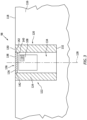
- FIG. 3 schematically illustrates a side, cutaway view of the imaging device 98 and a structural body 116 of the propulsor section 28 (see FIG. 1 ).
- the imaging device 98 is disposed in or otherwise mounted to the structural body 116.
- the structural body 116 may be include or otherwise be formed by a fixed structure of the propulsor section 28 such as, but not limited to, the propulsor case 42, the nose cone 48, the engine static structure 36, or one of the struts 59 (see FIG. 1 ).
- the structural body 116 forms an outer air flow surface 118, which outer air flow surface 118 forms a portion of an air flow path through the propulsor section 28 and into the core flow path 92 and/or the bypass flow path 94 (see FIG. 1 ).
- the structural body 116 forms a recess 120 at and through the air flow surface 118.
- the imaging device 98 of FIG. 3 is disposed in the recess 120.
- the imaging device 98 of FIG. 3 includes the camera 108 and a housing 122.
- the imaging device 98 of FIG. 3 further includes the light source 110 positioned at (e.g., on, adjacent, or proximate) the camera 108.
- the housing 122 of FIG. 3 includes a housing body 124 and a cover 126.
- the housing body 124 extends about (e.g., completely around) an axial centerline 128 of the housing 122.
- the housing body 124 may be configured as an annular or cylindrical body extending circumferentially about the axial centerline 128, however, the present disclosure is not limited to any particular shape of the housing body 124.
- the housing body 124 extends (e.g., axially extends) between and to a first axial end 130 of the housing body 124 and a second axial end 132 of the housing body 124.
- the housing body 124 surrounds and forms a cavity 134 of the housing 122.
- the cavity 134 extends along the axial centerline 128 and is disposed between the first axial end 130 and the second axial end 132.
- the camera 108 and the light source 110 are positioned in the cavity.
- the housing body 124 forms an opening 136 of the cavity 134 at the first axial end 130.
- the opening 136 is disposed coincident with the axial centerline 128 at (e.g., on, adjacent, or proximate) the outer air flow surface 118.
- the first axial end 130 may form a portion of the outer air flow surface 118 (e.g., the first axial end 130 may be disposed coincident with the outer air flow surface 118 formed by the structural body 116).
- the cover 126 is disposed at (e.g., on, adjacent, or proximate) the first axial end 130.
- the cover 126 includes an outer side 138, an inner side 140, and a perimeter side 142.
- the outer side 138 is disposed opposite the inner side 140.
- the perimeter side 142 extends about (e.g., completely around) the cover 126.
- the perimeter side 142 extends between and to the outer side 138 and the inner side 140.
- the cover 126 is selectively positionable between a stowed position and a deployed position.
- the cover 126 is illustrated in the stowed position. In the stowed position, the cover 126 is disposed in the opening 136.
- the cover 126 obstructs the opening 136 to separate the cavity 134 from the air flow path through the propulsor section 28 (see FIG. 1 ).
- the outer side 138 may form a portion of the outer air flow surface 118 (e.g., the outer side 138 may be disposed coincident with the outer air flow surface 118 formed by the structural body 116).
- the inner side 140 may form a portion of the cavity 134 and may face the camera 108.
- the perimeter side 142 may be disposed at (e.g., on, adjacent, or proximate) the housing body 124.
- the cover 126 may be pivotably mounted to the housing body 124 such that the cover 126 may pivot between the stowed position and the deployed position.
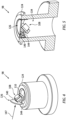
- FIGS. 4 and 5 an embodiment of the imaging device 98 is illustrated.
- FIG. 4 illustrates the imaging device 98 with the cover 126 in the deployed position.
- FIG. 5 illustrates the imaging device 98 with the cover 126 in the stowed position.
- the cover 126 of FIGS. 4 and 5 includes a hinge 144 pivotably mounting the cover 126 to the housing body 124.
- the imaging device 98 further includes an actuator 146 coupled to the hinge 144.
- the actuator 146 is configured to effect pivoting of the hinge 144 relative to the housing body 124 to pivot the cover 126 between and to the stowed position and the deployed position.
- the actuator 146 may be configured to pivot the hinge 144 about a pivot axis, which pivot axis may be perpendicular to or substantially perpendicular to the axial centerline 128.
- the actuator 146 may be configured as an electric motor, a pneumatic actuator, an electro-mechanical actuator, or any other suitable actuator for effecting pivoting of the cover 126.
- the camera 108 of FIGS. 4 and 5 is fixedly mounted to the cover 126 (e.g., the inner side 140).
- the camera 108 may additionally or alternatively be fixedly mounted to the hinge 144. Accordingly, the camera 108 may pivot with the cover 126 between and to the stowed position and the deployed position. In the stowed position, the camera 108 is disposed in the cavity 134. In the deployed position, at least a portion of the camera 108 is disposed outside of the cavity 134.
- the camera 108 is positionally fixed relative to the cover 126 such that, with the cover 126 in the deployed position, the camera 108 is positioned with the field-of-view 112 (see FIG.
- the light source 110 is disposed at (e.g., on, adjacent, or proximate) the camera 108 and configured to pivot with the camera 108 between the stowed position and the deployed position.
- the hinge 144 may be connected to the cover 126 at a circumferential position of the cover 126 such that, in the deployed position, the cover 126 is disposed upstream of the camera 108 relative to air flow (schematically illustrated as air flow vector 147 in FIG. 4 ) through the propulsor section 28 (see FIG. 1 ).
- the cover 126 in the deployed position may, therefore, protect the camera 108 from high-velocity air, and potentially debris, passing through the propulsor section 28.
- the cover 126 in the deployed position may facilitate a reduction in vibration and/or other disturbance of the camera 108 which may be caused by passing air flow through the propulsor section 28.
- the cover 126 in the deployed position may facilitate improvements in image data quality and/or clarity for the plurality of propulsor blades 46. It should be noted, however, that the above-described configuration of the cover 126 to facilitate protection and stabilization of the camera 108 is not limited to the specific embodiment of the imaging device 98 of FIGS. 4 and 5 .
- FIGS. 6 and 7 another embodiment of the imaging device 98 is illustrated.
- FIG. 6 illustrates the imaging device 98 with the cover 126 in the deployed position.
- FIG. 7 illustrates the imaging device 98 with the cover 126 in the stowed position.
- the cover 126 of FIGS. 6 and 7 includes the hinge 144 pivotably mounting the cover 126 to the housing body 124.
- the imaging device 98 of FIGS. 6 and 7 further includes a camera post 148 and at least one camera actuator 150.
- the camera post 148 includes a distal end 152.
- the distal end 152 may be an axial end of the camera post 148.
- the camera post 148 is configured for axial translation (e.g., relative to the axial centerline 128; see FIG.
- the camera post 148 is configured to abut or to otherwise be attached to the cover 126 (e.g., the inner side 140) at (e.g., on, adjacent, or proximate) the distal end 152 to control a position of the cover 126 between and to the stowed position and the deployed position by axial translation of the camera post 148.
- the distal end 152 is positioned axially outside of the cavity 134.
- Axial translation of the camera post 148 to position the distal end 152 outside of the cavity 134 pushes the cover 126 (e.g., the inner side 140) causing the cover 126 to pivot to the deployed position.
- the distal end 152 is positioned axially in the cavity 134.
- Axial translation of the camera post 148 to position the distal end 152 in the cavity 134 allows the cover 126 to pivot to the stowed position (e.g., as a result of air flow against the cover 126 and/or a pivotable connection between the cover 126 and the camera post 148).
- the imaging device 98 of FIGS. 6 and 7 further includes an actuator (not shown) coupled to the camera post 148.
- the actuator is configured to effect axial translation of the camera post 148.
- the actuator may be configured as an electric motor, a pneumatic actuator, an electro-mechanical actuator, or any other suitable actuator for effecting axial translation of the camera post 148.
- the camera 108 is mounted to the camera post 148.
- the camera may be mounted to the camera post 148 at (e.g., on, adjacent, or proximate) the distal end 152.
- the camera 108 may axially translate with the camera post 148.
- FIG. 6 with the cover 126 in the deployed position, at least a portion of the camera 108 may be positioned outside of the cavity 134.
- FIG. 7 with the cover 126 in the stowed position, the camera 108 may be positioned in the cavity 134.
- the camera 108 may be pivotably mounted to the camera post 148.
- the at least one camera actuator 150 may be configured to pivot the camera 108 to control a direction and/or orientation of the field-of-view 112 (see FIG. 2 ) for the camera 108.
- the at least one camera actuator 150 of FIGS. 6 and 7 includes a first camera actuator 150A and a second camera actuator 150B.
- the first camera actuator 150A is configured to pivot the camera 108 about a first pivot axis 154A.
- the second camera actuator 150B is configured to pivot the camera 108 about a second pivot axis 154B.
- the first pivot axis 154A may be perpendicular to or substantially perpendicular to the second pivot axis 154B.
- the at least one camera actuator 150 may be configured as an electric motor, a pneumatic actuator, an electro-mechanical actuator, or any other suitable actuator for effecting pivoting of the camera 108.
- the light source 110 is disposed at (e.g., on, adjacent, or proximate) the camera 108 and configured to translate (e.g., between the stowed position and the deployed position) and/or pivot with the camera 108.
- FIGS. 8 and 9 another embodiment of the imaging device 98 is illustrated.
- FIG. 8 illustrates the imaging device 98 with the cover 126 in the deployed position.
- FIG. 9 illustrates the imaging device 98 with the cover 126 in the stowed position.
- the cover 126 of FIGS. 4 and 5 includes the hinge 144 pivotably mounting the cover 126 to the housing body 124.
- the imaging device 98 further includes the actuator 146 (not shown in FIGS. 8 and 9 ; see FIG. 5 ) coupled to the hinge 144.
- the actuator 146 is configured to effect pivoting of the hinge 144 relative to the housing body 124 to pivot the cover 126 between and to the stowed position and the deployed position.
- the cover 126 of FIGS. 8 and 9 further includes a mirror 156 disposed on the inner side 140.
- the mirror 156 includes a reflective surface 158.
- the camera 108 of FIGS. 8 and 9 is fixedly mounted in the cavity 134.
- the camera 108 may be fixedly mounted to the housing body 124, such that the camera 108 (e.g., all of the camera 108) is positioned in the cavity 134.
- the camera 108 of FIGS. 8 and 9 is oriented in the cavity 134 with the camera 108 (e.g., the field-of-view 112) facing an axial or substantially axial direction relative to the axial centerline 128 (see FIG. 3 ).
- the present disclosure is not limited to the particular camera 108 orientation illustrated in FIGS. 8 and 9 . With the cover 126 in the deployed position, the field-of-view 112 is directed toward the reflective surface 158.
- the reflective surface 158 is positioned to reflect an image (e.g., light 160) of the plurality of propulsor blades 46 (e.g., at least a portion of each propulsor blade of the plurality of propulsor blades 46) toward the camera 108 and its field-of-view 112.
- the plurality of propulsor blades 46 may be exposed to foreign objects (e.g., birds, direct, rocks, loose mechanical fasteners, etc.) which may enter the propulsor section 28 and collide with one or more of the plurality of propulsor blades 46.
- foreign objects e.g., birds, direct, rocks, loose mechanical fasteners, etc.
- one or more of the plurality of propulsor blades 46 may be damaged (e.g., foreign object damage or "FOD").
- FOD foreign object damage
- one or more of the plurality of propulsor blades 46 may include nicks, dents, scratches, tears, and the like caused by a foreign object.
- Propulsor blades such as the plurality of propulsor blades 46, which experience foreign object damage may exhibit an increased likelihood of material failure.
- Inner radial portions of propulsor blades e.g., at the root end 50
- these inner radial portions may, therefore, be more susceptible to material failure resulting from foreign object damage.
- the propulsor blades may be periodically inspected.
- This inspection process may conventionally be performed manually by an inspector directly visually observing the propulsor blades and feeling the propulsor blades to identify foreign object damage. While this may be a reliable method for identifying foreign object damage, it can require a considerable amount of time, during which time the propulsion system 20 and its gas turbine engine 22 may not be operated. Moreover, this manual inspection process may present an increased likelihood of inspection tools and/or maintenance materials being left inside the gas turbine engine, where they may subsequently be ingested by the gas turbine engine contributing to the risk of foreign object damage.
- the imaging device 98 (e.g., the camera(s) 108) captures image data of the plurality of propulsor blades 46 and transmits the image data to the controller 96.
- the memory 104 includes instructions which, when executed by the controller 96 and/or its processor 102, cause the controller 96 and/or its processor 102 to identify the presence or absence of damage (e.g., foreign object damage) for the plurality of propulsor blades 46.
- the controller 96 may identify a probability that the plurality of propulsor blades 46 or one or more of the plurality of propulsor blades 46 includes damage.
- the controller 96 may identify damage to the plurality of propulsor blades 46 or one or more of the plurality of propulsor blades 46 if the determined probability exceeds a damage probability threshold.
- the damage probability threshold may be a predetermined value (e.g., a user input).
- the instructions may include, for example, a machine learning algorithm to identify the presence of damage or otherwise determine a probability of damage using the image data from the cameras 108.
- the machine learning algorithm may be trained using historical image data of propulsor blades, which historical image data may include flagged (e.g., manually identified) propulsor blade damage.
- the instructions may cause the controller 96 to compare the image data from the cameras 108 to reference image data which is representative of the plurality of propulsor blades 46.
- the controller 96 may compare the image data from the cameras 108 to the reference image data to identify differences which may be indicative of the presence of damage for the plurality of propulsor blades 46.
- the present disclosure is not limited to any particular algorithm or process for identifying damage using the image data from the cameras 108.
- the controller 96 may control the imaging device 98 (e.g., the camera(s) 108 and/or the light source 110) to capture the image data for the plurality of propulsor blades 46.
- the memory 104 may include instructions which, when executed by the controller 96 and/or its processor 102, cause the controller 96 to control the imaging device 98 (e.g., the camera(s) 108 and/or the light source 110) to capture the image data for the plurality of propulsor blades 46.
- the controller 96 may be connected in signal communication with the imaging device 98 actuators (e.g., the actuator 146, the at least one camera actuator 150, etc.) to control a position and/or an orientation of the cover 126 and/or the camera 108 to capture the image data for the plurality of propulsor blades 46.
- the controller 96 may control the cover 126 and/or the camera 108 to be positioned in the deployed position to capture the image data and may control the cover 126 and/or the camera 108 to be positioned in the stowed position while capture of the image data is not necessary or not otherwise being performed.
- the controller 96 may control the imaging device 98 based on a measured or otherwise determined rotation speed of the propulsor 40.
- the controller 96 may control the imaging device 98 based on the output signal of the shaft speed sensor 100, which output signal may be representative of the rotation speed of the propulsor 40.
- the rotation speed of the propulsor 40 may be determined by the controller 96 based on a known speed-reduction ratio of the speed-reducing gear assembly.
- the controller 96 may control the imaging device 98 to capture the image data for the plurality of propulsor blades 46 when the rotation speed of the propulsor 40 is less than or equal to a rotation speed threshold value (e.g., a predetermined rotation speed value).
- the rotation speed threshold value may be representative of a rotation speed of the propulsor 40 at or below which the camera(s) 108 may capture image data of the plurality of propulsor blades 46 which is suitable for the controller 96 to identify the presence or absence of damage (e.g., foreign object damage) for the plurality of propulsor blades 46, for example, based on the shutter speed for each camera 108.
- the controller 96 may control the imaging device 98 to capture the image data for the plurality of propulsor blades 46 subsequent to shutdown of the propulsion system 20 and/or its gas turbine engine 22 (e.g., when fuel is no longer being supplied to the combustor 64 to drive rotation of the rotational assemblies 70, 72).
- the propulsion system 20 may be understood to be in a shutdown condition when the propulsion system 20 is no longer expending energy (e.g., fuel, stored battery energy, etc.) to drive rotation of the propulsor 40 (e.g., using the rotational assemblies 70, 72).
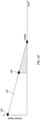
- FIG. 10 illustrates a graph of propulsor 40 rotation speed vs. time following shutdown of the gas turbine engine 22.
- a shutdown 162 of the gas turbine engine 22 may occur at Time 0, as shown in FIG. 10 .
- a rotation speed 164 of the propulsor 40 (e.g., based on measurement of the second shaft 84 rotation speed) will gradually decrease toward zero (0) revolutions per minute (RPM) subsequent to the shutdown 162.
- RPM revolutions per minute
- the slope of the rotation speed 164 in FIG. 10 is illustrated as being substantially linear, however, the present disclosure should not be understood to be limited in this regard.
- the controller 96 may control the imaging device 98 to capture the image data for the plurality of propulsor blades 46 when the rotation speed 164 of the propulsor 40 is less than or equal to a rotation speed threshold value 166. As shown in FIG.
- the rotation speed threshold value 166 is a rotation speed value greater than zero (0) RPM.
- the rotation speed threshold value 166 may be less than an initial rotation speed 164 of the propulsor 40 at the shutdown 162.
- the rotation speed threshold value 166 may be selected such that the captured image data of the plurality of propulsor blades 46 is suitable for analysis by the controller 96, as described above, but provides sufficient time for the capture of the image data of each of the plurality of propulsor blades 46 prior to the propulsor 40 reaching a rotationally stationary condition (e.g., the rotation speed 164 at or approximately at zero (0) RPM).
- the imaging assembly 26 or components (e.g., the imaging device 98) of the imaging assembly 26 may receive electrical power from the generator 80 (see FIG. 1 ). Following the shutdown 162, rotation of the first rotational assembly 70 and the second rotational assembly 72 may gradually decrease to a point at which the generator 80 may no longer be capable of suitably generating electrical power for the imaging assembly 26 or components (e.g., the imaging device 98) of the imaging assembly 26. Accordingly, the rotation speed threshold value 166 may be selected to provide sufficient time for the capture of the image data of each of the plurality of propulsor blades 46 prior to a loss of electrical power by the imaging assembly 26 or components (e.g., the imaging device 98) of the imaging assembly 26.
- the process for capturing the image data for the plurality of propulsor blades 46 following the shutdown 162, as described above, may generally be performed with the propulsion system 20 in a grounded condition (e.g., with the aircraft on which the propulsion system 20 is installed being on the ground).
- the controller 96 may initiate the capture of the image data following an aircraft landing procedure, where the gas turbine engine 22 is shutdown during or following aircraft transit on the ground (e.g., taxiing).
- the controller 96 may transmit the image data and/or an indication of the identified presence or absence of damage for the plurality of propulsor blades 46 to the offboard system(s) 106.
- the controller 96 may transmit data to the offboard system(s) 106 indicating that one or more of the plurality of propulsor blades 46 has been identified as being damaged. Receipt of the damage-indicative data by the offboard system(s) 106 may facilitate the scheduling and/or performing of inspections and/or repair for the plurality of propulsor blades 46 (e.g., the damaged one or more propulsor blades of the plurality of propulsor blades 46).
- aspects of the present disclosure may facilitate a reduction or elimination of periodic manual inspections of the plurality of propulsor blades 46, and inspections and repairs may instead be performed based on in situ identification of damage to the plurality of propulsor blades 46 as identified by the imaging assembly 26.
- any one of these structures may describe the operations as a sequential process, many of the operations can be performed in parallel or concurrently.
- the order of the operations may be rearranged.
- a process may correspond to a method, a function, a procedure, a subroutine, a subprogram, etc.
Landscapes
- Engineering & Computer Science (AREA)
- Chemical & Material Sciences (AREA)
- General Engineering & Computer Science (AREA)
- Mechanical Engineering (AREA)
- General Physics & Mathematics (AREA)
- Combustion & Propulsion (AREA)
- Physics & Mathematics (AREA)
- General Health & Medical Sciences (AREA)
- Immunology (AREA)
- Pathology (AREA)
- Biochemistry (AREA)
- Analytical Chemistry (AREA)
- Life Sciences & Earth Sciences (AREA)
- Health & Medical Sciences (AREA)
- Accessories Of Cameras (AREA)
Applications Claiming Priority (1)
| Application Number | Priority Date | Filing Date | Title |
|---|---|---|---|
| US18/136,109 US12379645B2 (en) | 2023-04-18 | 2023-04-18 | Propulsor blade imaging assembly for an aircraft propulsion system |
Publications (2)
| Publication Number | Publication Date |
|---|---|
| EP4450773A2 true EP4450773A2 (de) | 2024-10-23 |
| EP4450773A3 EP4450773A3 (de) | 2024-11-20 |
Family
ID=90789304
Family Applications (1)
| Application Number | Title | Priority Date | Filing Date |
|---|---|---|---|
| EP24171134.0A Pending EP4450773A3 (de) | 2023-04-18 | 2024-04-18 | Antriebsschaufelbildgebungsanordnung für ein flugzeugantriebssystem |
Country Status (2)
| Country | Link |
|---|---|
| US (1) | US12379645B2 (de) |
| EP (1) | EP4450773A3 (de) |
Families Citing this family (2)
| Publication number | Priority date | Publication date | Assignee | Title |
|---|---|---|---|---|
| WO2022162663A1 (en) | 2021-01-28 | 2022-08-04 | Scoutcam Ltd. | Systems and methods for monitoring potential failure in a machine or a component thereof |
| US20240352869A1 (en) * | 2023-04-21 | 2024-10-24 | Raytheon Technologies Corporation | Propulsor blade imaging assembly for an aircraft propulsion system |
Family Cites Families (13)
| Publication number | Priority date | Publication date | Assignee | Title |
|---|---|---|---|---|
| US6796709B2 (en) | 2002-11-21 | 2004-09-28 | General Electric Company | Turbine blade (bucket) health monitoring and prognosis using infrared camera |
| GB0514149D0 (en) | 2005-07-09 | 2005-08-17 | Rolls Royce Plc | In-situ component monitoring |
| WO2008045072A1 (en) * | 2006-10-12 | 2008-04-17 | United Technologies Corporation | Dual function cascade integrated variable area fan nozzle and thrust reverser |
| US9909505B2 (en) * | 2011-07-05 | 2018-03-06 | United Technologies Corporation | Efficient, low pressure ratio propulsor for gas turbine engines |
| GB201204913D0 (en) | 2012-03-21 | 2012-05-02 | Rolls Royce Plc | An inspection device for an internal combustion engine |
| US20150300199A1 (en) | 2012-11-28 | 2015-10-22 | United Technologies Corporation | Turbofan with optical diagnostic capabilities |
| US9969489B2 (en) * | 2013-02-08 | 2018-05-15 | General Electric Company | Hybrid spinner support |
| WO2015042514A2 (en) * | 2013-09-22 | 2015-03-26 | Unison Industries, Llc | Dual seated by-pass valve for surface coolers |
| JP6554282B2 (ja) * | 2014-12-24 | 2019-07-31 | 川崎重工業株式会社 | 航空機用エンジン装置 |
| US10914191B2 (en) | 2018-05-04 | 2021-02-09 | Raytheon Technologies Corporation | System and method for in situ airfoil inspection |
| GB201813432D0 (en) | 2018-08-17 | 2018-10-03 | Rolls Royce Plc | Method of detecting rotor blade damage |
| US11781506B2 (en) * | 2020-06-03 | 2023-10-10 | Rtx Corporation | Splitter and guide vane arrangement for gas turbine engines |
| US11753999B2 (en) | 2021-06-17 | 2023-09-12 | General Electric Company | Gas turbine sensor assembly and associated shutter mechanism |
-
2023
- 2023-04-18 US US18/136,109 patent/US12379645B2/en active Active
-
2024
- 2024-04-18 EP EP24171134.0A patent/EP4450773A3/de active Pending
Also Published As
| Publication number | Publication date |
|---|---|
| EP4450773A3 (de) | 2024-11-20 |
| US12379645B2 (en) | 2025-08-05 |
| US20240353737A1 (en) | 2024-10-24 |
Similar Documents
| Publication | Publication Date | Title |
|---|---|---|
| US12410727B2 (en) | Propulsor blade imaging assembly method for an aircraft propulsion system | |
| EP4450773A2 (de) | Antriebsschaufelbildgebungsanordnung für ein flugzeugantriebssystem | |
| EP4450774A2 (de) | Antriebsschaufelbildgebungsanordnung für ein flugzeugantriebssystem | |
| EP4450775A1 (de) | Antriebsschaufelbildgebungsanordnung für ein flugzeugantriebssystem | |
| EP2925972B1 (de) | Turbolüfter mit optischer diagnosefunktion | |
| CN110462169A (zh) | 燃气涡轮发动机维护工具 | |
| CN110249212A (zh) | 燃气涡轮发动机维护方法 | |
| US20230314281A1 (en) | Methods and systems of monitoring a condition of a component of a gas turbine engine | |
| US12055055B1 (en) | Rotor blade inspection system | |
| EP3702599B1 (de) | System und verfahren zur diagnose des gesundheitszustands eines leistungskompressors eines hilfsaggregats | |
| US12055053B1 (en) | Rotor blade inspection system | |
| EP4450957A1 (de) | Rotorblattprüfsystem | |
| GB2587612A (en) | Ice detection system and method | |
| KR20170061132A (ko) | 헬리콥터 터빈 엔진 신속한 재가동 시스템의 무결성을 검사하는 장치 및 방법 | |
| EP4397845A1 (de) | Enteisungssystem und verfahren für ein flugzeugantriebssystem | |
| EP4361404A2 (de) | Systeme und verfahren zur identifizierung eines zustands von gasturbinenmotordichtungen | |
| EP4506242A1 (de) | System zur erkennung des lastverlustwegs für eine flugzeugantriebssystemgondel und verfahren zur verwendung davon | |
| US20250383307A1 (en) | X-ray diffraction inspection system and method for operating same | |
| US12535016B2 (en) | Systems and methods for identifying insufficient starter acceleration for an aircraft engine | |
| US12055095B1 (en) | System and method for identifying blockage of an air intake for an aircraft propulsion system | |
| US12378893B2 (en) | Buffer air assembly for an aircraft engine | |
| EP4563788A1 (de) | Verfahren und system zur inspektion von gebläseturbinenschaufeln | |
| US20240060426A1 (en) | Systems and methods for determining gas turbine engine operating margins | |
| CN120007448A (zh) | 具有集成数据采集系统的飞行器发动机起动器 |
Legal Events
| Date | Code | Title | Description |
|---|---|---|---|
| PUAI | Public reference made under article 153(3) epc to a published international application that has entered the european phase |
Free format text: ORIGINAL CODE: 0009012 |
|
| STAA | Information on the status of an ep patent application or granted ep patent |
Free format text: STATUS: THE APPLICATION HAS BEEN PUBLISHED |
|
| PUAL | Search report despatched |
Free format text: ORIGINAL CODE: 0009013 |
|
| AK | Designated contracting states |
Kind code of ref document: A2 Designated state(s): AL AT BE BG CH CY CZ DE DK EE ES FI FR GB GR HR HU IE IS IT LI LT LU LV MC ME MK MT NL NO PL PT RO RS SE SI SK SM TR |
|
| AK | Designated contracting states |
Kind code of ref document: A3 Designated state(s): AL AT BE BG CH CY CZ DE DK EE ES FI FR GB GR HR HU IE IS IT LI LT LU LV MC ME MK MT NL NO PL PT RO RS SE SI SK SM TR |
|
| RIC1 | Information provided on ipc code assigned before grant |
Ipc: F02C 7/04 20060101ALI20241015BHEP Ipc: F01D 21/06 20060101ALI20241015BHEP Ipc: F01D 21/04 20060101ALI20241015BHEP Ipc: F01D 21/00 20060101AFI20241015BHEP |
|
| STAA | Information on the status of an ep patent application or granted ep patent |
Free format text: STATUS: REQUEST FOR EXAMINATION WAS MADE |
|
| 17P | Request for examination filed |
Effective date: 20250520 |