EP4450722A1 - Toilet hygiene apparatus - Google Patents
Toilet hygiene apparatus Download PDFInfo
- Publication number
- EP4450722A1 EP4450722A1 EP23196311.7A EP23196311A EP4450722A1 EP 4450722 A1 EP4450722 A1 EP 4450722A1 EP 23196311 A EP23196311 A EP 23196311A EP 4450722 A1 EP4450722 A1 EP 4450722A1
- Authority
- EP
- European Patent Office
- Prior art keywords
- hygiene
- support member
- engagement member
- substance
- hygiene substance
- Prior art date
- Legal status (The legal status is an assumption and is not a legal conclusion. Google has not performed a legal analysis and makes no representation as to the accuracy of the status listed.)
- Granted
Links
Images



Classifications
-
- E—FIXED CONSTRUCTIONS
- E03—WATER SUPPLY; SEWERAGE
- E03D—WATER-CLOSETS OR URINALS WITH FLUSHING DEVICES; FLUSHING VALVES THEREFOR
- E03D9/00—Sanitary or other accessories for lavatories ; Devices for cleaning or disinfecting the toilet room or the toilet bowl; Devices for eliminating smells
- E03D9/02—Devices adding a disinfecting, deodorising, or cleaning agent to the water while flushing
- E03D9/022—Devices adding a disinfecting, deodorising, or cleaning agent to the water while flushing consisting of solid substances introduced in the bowl or the supply line
-
- E—FIXED CONSTRUCTIONS
- E03—WATER SUPPLY; SEWERAGE
- E03D—WATER-CLOSETS OR URINALS WITH FLUSHING DEVICES; FLUSHING VALVES THEREFOR
- E03D9/00—Sanitary or other accessories for lavatories ; Devices for cleaning or disinfecting the toilet room or the toilet bowl; Devices for eliminating smells
- E03D9/02—Devices adding a disinfecting, deodorising, or cleaning agent to the water while flushing
- E03D9/03—Devices adding a disinfecting, deodorising, or cleaning agent to the water while flushing consisting of a separate container with an outlet through which the agent is introduced into the flushing water, e.g. by suction ; Devices for agents in direct contact with flushing water
- E03D9/032—Devices connected to or dispensing into the bowl
-
- E—FIXED CONSTRUCTIONS
- E03—WATER SUPPLY; SEWERAGE
- E03D—WATER-CLOSETS OR URINALS WITH FLUSHING DEVICES; FLUSHING VALVES THEREFOR
- E03D9/00—Sanitary or other accessories for lavatories ; Devices for cleaning or disinfecting the toilet room or the toilet bowl; Devices for eliminating smells
- E03D9/02—Devices adding a disinfecting, deodorising, or cleaning agent to the water while flushing
- E03D2009/024—Devices adding a disinfecting, deodorising, or cleaning agent to the water while flushing using a solid substance
Definitions
- the present invention concerns hygiene devices for toilets, (or as they may be alternatively called “water closets” or “flush toilets”) and more particularly to hygiene devices for toilet bowls, for example apparatus for dispensing a hygiene substance such as a germicidal and/or cleaning and/or fragrant material into the bowl with each flush.
- hygiene devices for toilet bowls for example apparatus for dispensing a hygiene substance such as a germicidal and/or cleaning and/or fragrant material into the bowl with each flush.
- Such apparatus may include toilet cages or "baskets” for holding solid hygiene substances.
- Other versions may include containers containing liquid or gel wherein the apparatus dispenses the liquid or gel hygiene substance into the bowl with each toilet flush.
- Conventional rimmed toilets typically include a bowl with a lower drain outlet and a rim around an upper end of the bowl which overhangs the remainder of the bowl.
- Flush water is directed from a cistern into the overhanging rim and the flush water progresses around the inside of the rim and falls downward into the bowl.
- rimless toilets have developed as an alternative to conventional rimmed toilets.
- One reason for this is that it is believed that the interaction of the flush water with the overhanging rim of a conventional rimmed toilet tends to cause the flush water to lose energy so that more water must be used than might otherwise be the case for flushing and cleaning.
- Another reason is that it is impractical to clean under the rim of a rimmed toilet.
- toilet hygiene apparatus that includes a basket or cage containing a hygiene substance and a clip which extends from the basket and attaches to the top of the bowl. Upon flushing the toilet water flows out through the rim and down the sides of the bowl and in so doing passes through the hygiene apparatus and contacts the hygiene substance within so that a cleaning and/or disinfecting solution is released from the hygiene apparatus and flows down the sides of the bowl.
- Bowl attachment hygiene apparatus such as those previously mentioned, are sold in high volumes in many countries. Accordingly, a consideration that their use raises is that of the amount of plastic waste that they produce once exhausted.
- Various approaches have been taken to reducing the amount of waste associated with bowl attachment hygiene apparatus. For example, extending the number of flushes over which the apparatus can be used reduces the ratio of amount of waste to number of flushes, which is desirable.
- One way of extending the number of flushes is to provide an apparatus that can be replenished with a block of the hygiene substance. For example, it may be possible to open the basket and insert a replacement block as needed. However, users may not wish to perform such regular replacement for hygiene and labour reasons.
- Another way of extending the number of flushes is to make a block of hygiene substance that has a reduced water solubility so that it diminishes more slowly over each flush. However, reducing water solubility may cause less fragrance and hygiene agents to be dispensed so that the product may then become less effective.
- the bowl attachment apparatus may be made with less plastic, as described in international patent publication WO 2020/236003 by Oskar Anthoni de Waal .
- the apparatus described in that patent application uses an adhesive tape, rather than a clip, to attach the holder of the hygiene substance to the top of the bowl.
- the holder is ring shaped and is said to comprise one or more chambers that may be at least defined by a bottom and one or more sidewalls.
- a toilet bowl hygiene apparatus comprising:
- edge of the upwardly extending blade has an angle of 40 to 50 degrees.
- the at least one engagement member includes a downwardly extending blade.
- edge of the downwardly extending blade has an angle of 20 to 80 degrees.
- edge of the downwardly extending blade has an angle of 40 to 50 degrees.
- the at least one engagement member includes an elongate convex portion wherein the upwardly extending blade extends upwardly from the elongate convex portion and wherein the downwardly extending blade extends downwardly from the elongate convex portion.
- the toilet bowl hygiene apparatus includes a second engagement member coupled to or integrally formed with the support member and extending into and/or through the body of hygiene substance, wherein the second engagement member is spaced from the first engagement member for preventing rotation and associated wearing of the body of hygiene substance about either the first engagement member or the second engagement member.
- an adhesive tape extends from the support member for attachment to a toilet bowl at a point above the body of hygiene substance.
- the toilet bowl hygiene apparatus includes a water diversion portion coupled to or integrally formed with the support member and locatable between a source of flush water and body of hygiene substance, for preventing flush water impacting directly upon a portion of the body of hygiene substance.
- the body of hygiene substance includes a rear side and a front side wherein the support member includes a rear side portion that extends down the rear side.
- the rear side portion includes a trapezoidal portion with sides that diverge downwardly.
- a base of the trapezoidal portion is continuous with a semicircular portion.
- a longitudinal reinforcement rib extends down a rear side of the support member.
- a transverse reinforcement rib extends across a lower end of the trapezoidal portion.
- the at least one engagement member extends from a front side of the support member.
- the at least one engagement member extends through the body of hygiene substance.
- a fastener is attached to a remote end of the at least one engagement member for retaining the body of hygiene substance thereon.
- the first engagement member extends from a front side of the support member adjacent an intersection of the longitudinal reinforcement rib and the transverse reinforcement rib.
- the second engagement member extends from the front side of the rear side portion of the support member, adjacent a point on the longitudinal reinforcement rib.
- the support member includes a forwardly extending portion that extends from the rear side portion over a top side portion of the body of hygiene substance.
- the support member includes an upwardly extending portion that extends upwardly from the forwardly extending portion.
- the adhesive tape is coupled to an upper end of the upwardly extending portion.
- the forwardly extending portion is serpentine in side profile.
- the upwardly extending portion extends upwardly and forwardly from the forwardly extending portion.
- opposed sides of the upwardly extending portion diverge upwardly and outwardly to tape engagement formations.
- the toilet bowl hygiene apparatus 100 is comprised of number of parts or portions, being a body of hygiene substance 2, a support member 4, at least one engagement member 6, and an adhesive tape 8 extending from the support member 4 for attachment to a toilet bowl at a point above the body of hygiene substance.
- the at least one engagement member 6 is coupled to, or integrally formed with, the support member 4 and extends from the support member 4 into and/or through the body of hygiene substance 2.
- the at least one engagement member 6 includes an upwardly extending blade portion 6a and a downwardly extending blade portion 6b.
- the at least one engagement member 6 also includes an elongate convex portion 6c wherein the upwardly extending blade 6a extends upwardly from the elongate convex portion and the downwardly extending blade 6b extends downwardly therefrom.
- the preferred shape of the at least one engagement member 6 has been found to assist in keeping the body of hygiene substance located about the at least one engagement member 6 in the face of a large number of flush cycles.
- the edge of the upwardly extending blade 6a preferably describes an angle ⁇ of 20 to 80 degrees, or even more preferably of 40 to 50 degrees. In Figure 3A ⁇ is 45 degrees.
- the at least one elongate member 6 has upwardly extending and downwardly extending blade portions 6a, 6b, in other embodiments the elongate member may not have such blade portions and may be cylindrical ( Fig 3B ) or an extruded oval ( Fig 3C ) or an extruded ellipse ( Fig 3D ) or other elongate shape.
- the adhesive tape 8 is typically provided with its adhesive side against a release liner 10 (shown only in Figure 1 ), from which a user can easily detach the adhesive tape 8 prior to use.
- the adhesive tape 8 terminates in an enlarged handle portion 11 (shown only in Figure 1 ) which does not have an adhesive side for ease of handling.
- the toilet bowl hygiene apparatus includes a second engagement member 12, best seen in Figure 3 coupled to or integrally formed with the support member 4 and extending into and/or through the body of hygiene substance 2, wherein the second engagement member 12 is spaced from the first engagement member by a distance " d " for preventing rotation of the body of hygiene substance about either the first engagement member 6 or the second engagement member 12 and associated wearing of the body of hygiene substance about either member.
- a fastener 14 is attached to a remote end of the at least one engagement member 6 for retaining the body of hygiene substance 2 thereon.
- the fastener 14 is disk-shaped in the presently described embodiment, though other shapes might also be used.
- the toilet bowl hygiene apparatus 100 may include a water diversion portion 16 ( Figure 1 ), which is coupled to or integrally formed with the support member 4 and locatable between a source of flush water, for example a rim of a toilet bowl, and the body of hygiene substance 2. Whilst not essential, the water diversion portion 16 may assist to reduce flush water impacting directly upon an upper portion 18 of the body of hygiene substance 2 and thus dissolving portions of the body of hygiene substance above the first and second elongate members 6 and 12, so that the body of hygiene substance might fall from the first and second elongate members.
- a source of flush water for example a rim of a toilet bowl
- the water diversion portion 16 may assist to reduce flush water impacting directly upon an upper portion 18 of the body of hygiene substance 2 and thus dissolving portions of the body of hygiene substance above the first and second elongate members 6 and 12, so that the body of hygiene substance might fall from the first and second elongate members.
- the body of hygiene substance 2 includes a rear side 20 ( Figure 2 ) and a front side 22 ( Figure 1 ) wherein the support member 4 includes a rear-side portion 24 that extends down the rear side 20 of the body of hygiene substance 2.
- the rear-side portion 24 includes a trapezoidal portion 26 (identified in Figure 4 ) with sides 26a, 26b, that diverge downwardly.
- a base 26c of the trapezoidal portion 26 is continuous with a semicircular portion 28.
- Reinforcement ribs are integrally formed with the support member so that it includes a longitudinal reinforcement rib 30, which extends down a rear surface 31 (indicated in Figure 2 and Figure 3 ) of the rear-side portion 24 of the support member 4 and a transverse reinforcement rib 32, that extends across a lower end of the trapezoidal portion 26.
- the shape of the rear side portion 24 may be otherwise, for example it may simply be a rectangle rather than a trapezoid with a semicircle at its base.
- the shape that has been described in the example that is discussed is preferable because it has been arrived at with the objective of minimal use of plastic whilst retaining sufficient strength to support the body of hygiene substance 2.
- the at least one engagement member 6 extends from a front side 32 ( Figure 3 ) of the rear-side portion 24 of support member 4 and extends all the way through the body of hygiene substance 2 so that its remote end 36 can be captured by fastener 14 to thereby retain the body of hygiene substance 2 to the engagement member 6 and thus to the support member 4.
- the fastener 14 includes a central opening 37, generally shaped as a slit 38 with an enlarged central portion 40 which complements the upper and lower blade portions 6a, 6b and central elongate convex portion 6c of the first engagement member 6.
- the non-circular complementary shapes of the cross section of the first support member 6 and the central opening 37 ensure that the fastener 14 does not rotate about the first support member 6, further assisting in preventing rotation of the body of hygiene substance 2 about the first support member 6.
- the fastener 14 is attached to the tip 36 of the first support member 6 by a snap fit.
- a lower end of the adhesive tape 8 is coupled to an upper end 44 of the upwardly extending portion 42.
- the upwardly extending portion 42 extends upwardly and forwardly from the forwardly extending portion so that the body of hygiene substance 2 tends to swing rearwardly in use to make contact with flush water.
- Opposed sides 42a, 42b ( Figure 4 ) of the upwardly extending portion 44 diverge upwardly and outwardly to tape engagement formations 46.
- the at least one elongate member 6 is, for example a square shape or round shape in cross section, then as the body of hygiene substance 2 becomes smaller due to it being dissolved, then the member 6 is exposed to flushing water.
- the flush water 19 passes along the elongate member 6 between the elongate member and the body of hygiene substance 2, then it is believed that the flush water flows with turbulence around the elongate member 6, and after the water flush there is a small amount of water left on the elongate member 6, thus causing the body of hygiene substance 2 around the elongate member 6 to dissolve further.
- the toilet bowl hygiene apparatus 100 is able to support the body of hygiene substance 2 whilst being composed of only a small amount of plastic compared to prior basket type apparatus.
Landscapes
- Health & Medical Sciences (AREA)
- Public Health (AREA)
- Epidemiology (AREA)
- Life Sciences & Earth Sciences (AREA)
- Engineering & Computer Science (AREA)
- Hydrology & Water Resources (AREA)
- Water Supply & Treatment (AREA)
- Bidet-Like Cleaning Device And Other Flush Toilet Accessories (AREA)
Abstract
Description
- The present invention concerns hygiene devices for toilets, (or as they may be alternatively called "water closets" or "flush toilets") and more particularly to hygiene devices for toilet bowls, for example apparatus for dispensing a hygiene substance such as a germicidal and/or cleaning and/or fragrant material into the bowl with each flush. Such apparatus may include toilet cages or "baskets" for holding solid hygiene substances. Other versions may include containers containing liquid or gel wherein the apparatus dispenses the liquid or gel hygiene substance into the bowl with each toilet flush.
- Any references to methods, apparatus or documents of the prior art are not to be taken as constituting any evidence or admission that they formed, or form part of the common general knowledge.
- Conventional rimmed toilets typically include a bowl with a lower drain outlet and a rim around an upper end of the bowl which overhangs the remainder of the bowl. Flush water is directed from a cistern into the overhanging rim and the flush water progresses around the inside of the rim and falls downward into the bowl.
- In recent years rimless toilets have developed as an alternative to conventional rimmed toilets. One reason for this is that it is believed that the interaction of the flush water with the overhanging rim of a conventional rimmed toilet tends to cause the flush water to lose energy so that more water must be used than might otherwise be the case for flushing and cleaning. Another reason is that it is impractical to clean under the rim of a rimmed toilet.
- It is known to provide toilet hygiene apparatus that includes a basket or cage containing a hygiene substance and a clip which extends from the basket and attaches to the top of the bowl. Upon flushing the toilet water flows out through the rim and down the sides of the bowl and in so doing passes through the hygiene apparatus and contacts the hygiene substance within so that a cleaning and/or disinfecting solution is released from the hygiene apparatus and flows down the sides of the bowl.
- Bowl attachment hygiene apparatus, such as those previously mentioned, are sold in high volumes in many countries. Accordingly, a consideration that their use raises is that of the amount of plastic waste that they produce once exhausted.
- Various approaches have been taken to reducing the amount of waste associated with bowl attachment hygiene apparatus. For example, extending the number of flushes over which the apparatus can be used reduces the ratio of amount of waste to number of flushes, which is desirable. One way of extending the number of flushes is to provide an apparatus that can be replenished with a block of the hygiene substance. For example, it may be possible to open the basket and insert a replacement block as needed. However, users may not wish to perform such regular replacement for hygiene and labour reasons. Another way of extending the number of flushes is to make a block of hygiene substance that has a reduced water solubility so that it diminishes more slowly over each flush. However, reducing water solubility may cause less fragrance and hygiene agents to be dispensed so that the product may then become less effective.
- Another approach to reducing the amount of waste is to devise a holder that uses less plastic. For example, the bowl attachment apparatus may be made with less plastic, as described in international patent publication
WO 2020/236003 by Oskar Anthoni de Waal . The apparatus described in that patent application uses an adhesive tape, rather than a clip, to attach the holder of the hygiene substance to the top of the bowl. The holder is ring shaped and is said to comprise one or more chambers that may be at least defined by a bottom and one or more sidewalls. - Other prior art that is of general relevance to toilet hygiene products includes:
-
EP 2540918 A1 (BOLTON MANITOBA SPA) 2 January 2013 ; -
US 2013/0104304 A1 (WILSON BRIAN et al.) 2 May 2013 ; -
EP 2270286 A1 (RE LE VI SPA) 5 January 2011 ; -
FR 2977264 A1 (EURVEST) 4 January 2013 -
DE 8906140 U1 (POLYFILM AG, RORSCHACH, CH) 9 November 1989 . - Whilst the apparatus that are described in prior art documents, such as
WO 2020/236003 , may address the problem of undue plastic waste, nevertheless it would be desirable if a further improved solution could be provided that is able to withstand numerous flushes and which can be fabricated with a relatively small volume of plastic. - According to a first aspect of the present invention there is provided a toilet bowl hygiene apparatus comprising:
- a body of hygiene substance;
- a support member; and
- at least one engagement member coupled to or integrally formed with the support member and extending from the support member into and/or through the body of hygiene substance;
- wherein the at least one engagement member includes an upwardly extending blade having an angle of 20 to 80 degrees.
- In an embodiment the edge of the upwardly extending blade has an angle of 40 to 50 degrees.
- In an embodiment the at least one engagement member includes a downwardly extending blade.
- In an embodiment the edge of the downwardly extending blade has an angle of 20 to 80 degrees.
- In an embodiment the edge of the downwardly extending blade has an angle of 40 to 50 degrees.
- In an embodiment the at least one engagement member includes an elongate convex portion wherein the upwardly extending blade extends upwardly from the elongate convex portion and wherein the downwardly extending blade extends downwardly from the elongate convex portion.
- In an embodiment the toilet bowl hygiene apparatus includes a second engagement member coupled to or integrally formed with the support member and extending into and/or through the body of hygiene substance, wherein the second engagement member is spaced from the first engagement member for preventing rotation and associated wearing of the body of hygiene substance about either the first engagement member or the second engagement member.
- In an embodiment an adhesive tape extends from the support member for attachment to a toilet bowl at a point above the body of hygiene substance.
- In an embodiment the toilet bowl hygiene apparatus includes a water diversion portion coupled to or integrally formed with the support member and locatable between a source of flush water and body of hygiene substance, for preventing flush water impacting directly upon a portion of the body of hygiene substance.
- In an embodiment the body of hygiene substance includes a rear side and a front side wherein the support member includes a rear side portion that extends down the rear side.
- In an embodiment the rear side portion includes a trapezoidal portion with sides that diverge downwardly.
- In an embodiment a base of the trapezoidal portion is continuous with a semicircular portion.
- In an embodiment a longitudinal reinforcement rib extends down a rear side of the support member.
- In an embodiment a transverse reinforcement rib extends across a lower end of the trapezoidal portion.
- In an embodiment the at least one engagement member extends from a front side of the support member.
- In an embodiment the at least one engagement member extends through the body of hygiene substance.
- In an embodiment a fastener is attached to a remote end of the at least one engagement member for retaining the body of hygiene substance thereon.
- In an embodiment the first engagement member extends from a front side of the support member adjacent an intersection of the longitudinal reinforcement rib and the transverse reinforcement rib.
- In an embodiment the second engagement member extends from the front side of the rear side portion of the support member, adjacent a point on the longitudinal reinforcement rib.
- In an embodiment the support member includes a forwardly extending portion that extends from the rear side portion over a top side portion of the body of hygiene substance.
- In an embodiment the support member includes an upwardly extending portion that extends upwardly from the forwardly extending portion.
- In an embodiment the adhesive tape is coupled to an upper end of the upwardly extending portion.
- In an embodiment the forwardly extending portion is serpentine in side profile.
- In an embodiment the upwardly extending portion extends upwardly and forwardly from the forwardly extending portion.
- In an embodiment, opposed sides of the upwardly extending portion diverge upwardly and outwardly to tape engagement formations.
- Preferred features, embodiments and variations may be discerned from the following Detailed Description which provides sufficient information for those skilled in the art. The Detailed Description is not to be regarded as limiting the scope of the preceding Summary in any way. The Detailed Description will make reference to a number of drawings as follows:
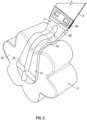
- Figure 1
- illustrates a front side of a toilet bowl hygiene apparatus.
- Figure 2
- is a view of the rear of the toilet bowl hygiene apparatus.
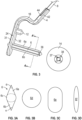
- Figure 3
- shows a support member and fastener of the toilet bowl hygiene apparatus.
- Figure 3A
- is a cross sectional view of a
engagement member 6 ofFigure 3 along the line A-A' - Figures 3B-3C
- are cross sectional views of support arms corresponding to
engagement member 6 ofFigure 3 but with respectively circular, oval and elliptical cross sections. - Figure 4
- is a further view of the rear of the toilet bowl hygiene apparatus.
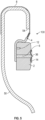
- Figure 5
- is a cross sectional view of the toilet bowl hygiene apparatus shown in use.
- Figure 6
- is a diagram showing how flush water is believed to flow along the
engagement member 6. - Referring now to the Figures, a toilet
bowl hygiene apparatus 100, according to a preferred embodiment is illustrated. In overview, the toiletbowl hygiene apparatus 100 is comprised of number of parts or portions, being a body ofhygiene substance 2, asupport member 4, at least oneengagement member 6, and anadhesive tape 8 extending from thesupport member 4 for attachment to a toilet bowl at a point above the body of hygiene substance. - The at least one
engagement member 6 is coupled to, or integrally formed with, thesupport member 4 and extends from thesupport member 4 into and/or through the body ofhygiene substance 2. - In the presently described exemplary embodiment the at least one
engagement member 6 includes an upwardly extendingblade portion 6a and a downwardly extendingblade portion 6b. - The at least one
engagement member 6 also includes an elongateconvex portion 6c wherein the upwardly extendingblade 6a extends upwardly from the elongate convex portion and the downwardly extendingblade 6b extends downwardly therefrom. As will be explained, the preferred shape of the at least oneengagement member 6 has been found to assist in keeping the body of hygiene substance located about the at least oneengagement member 6 in the face of a large number of flush cycles. - With reference to
Figure 3A , which is a cross sectional view along the line A-A' ofFigure 3 , the edge of the upwardly extendingblade 6a preferably describes an angle θ of 20 to 80 degrees, or even more preferably of 40 to 50 degrees. InFigure 3A θ is 45 degrees. - The edge of the downwardly extending
blade 6b preferably describes an angle α of 20 to 80 degrees or even more preferably of 40 to 50 degrees. InFigure 3A α is 45 degrees. It will be realized that θ and α, whilst being the same in the embodiment ofFigure 3A , may be non-equal in other embodiments. - Furthermore, whilst it is preferred that the at least one
elongate member 6 has upwardly extending and downwardly extendingblade portions Fig 3B ) or an extruded oval (Fig 3C ) or an extruded ellipse (Fig 3D ) or other elongate shape. - The
adhesive tape 8 is typically provided with its adhesive side against a release liner 10 (shown only inFigure 1 ), from which a user can easily detach theadhesive tape 8 prior to use. Theadhesive tape 8 terminates in an enlarged handle portion 11 (shown only inFigure 1 ) which does not have an adhesive side for ease of handling. - In an embodiment the toilet bowl hygiene apparatus includes a
second engagement member 12, best seen inFigure 3 coupled to or integrally formed with thesupport member 4 and extending into and/or through the body ofhygiene substance 2, wherein thesecond engagement member 12 is spaced from the first engagement member by a distance " d" for preventing rotation of the body of hygiene substance about either thefirst engagement member 6 or thesecond engagement member 12 and associated wearing of the body of hygiene substance about either member. - In an embodiment a
fastener 14 is attached to a remote end of the at least oneengagement member 6 for retaining the body ofhygiene substance 2 thereon. Thefastener 14 is disk-shaped in the presently described embodiment, though other shapes might also be used. - The toilet
bowl hygiene apparatus 100 may include a water diversion portion 16 (Figure 1 ), which is coupled to or integrally formed with thesupport member 4 and locatable between a source of flush water, for example a rim of a toilet bowl, and the body ofhygiene substance 2. Whilst not essential, thewater diversion portion 16 may assist to reduce flush water impacting directly upon anupper portion 18 of the body ofhygiene substance 2 and thus dissolving portions of the body of hygiene substance above the first and secondelongate members - In an embodiment the body of
hygiene substance 2 includes a rear side 20 (Figure 2 ) and a front side 22 (Figure 1 ) wherein thesupport member 4 includes a rear-side portion 24 that extends down therear side 20 of the body ofhygiene substance 2. - In an embodiment the rear-
side portion 24 includes a trapezoidal portion 26 (identified inFigure 4 ) withsides - A base 26c of the
trapezoidal portion 26 is continuous with a semicircular portion 28. - Reinforcement ribs are integrally formed with the support member so that it includes a
longitudinal reinforcement rib 30, which extends down a rear surface 31 (indicated inFigure 2 andFigure 3 ) of the rear-side portion 24 of thesupport member 4 and atransverse reinforcement rib 32, that extends across a lower end of thetrapezoidal portion 26. - It will be realized that in other embodiments the shape of the
rear side portion 24 may be otherwise, for example it may simply be a rectangle rather than a trapezoid with a semicircle at its base. However, the shape that has been described in the example that is discussed is preferable because it has been arrived at with the objective of minimal use of plastic whilst retaining sufficient strength to support the body ofhygiene substance 2. - In the presently described exemplary embodiment the at least one
engagement member 6 extends from a front side 32 (Figure 3 ) of the rear-side portion 24 ofsupport member 4 and extends all the way through the body ofhygiene substance 2 so that itsremote end 36 can be captured byfastener 14 to thereby retain the body ofhygiene substance 2 to theengagement member 6 and thus to thesupport member 4. - The
fastener 14 includes acentral opening 37, generally shaped as aslit 38 with an enlarged central portion 40 which complements the upper andlower blade portions convex portion 6c of thefirst engagement member 6. The non-circular complementary shapes of the cross section of thefirst support member 6 and thecentral opening 37 ensure that thefastener 14 does not rotate about thefirst support member 6, further assisting in preventing rotation of the body ofhygiene substance 2 about thefirst support member 6. Thefastener 14 is attached to thetip 36 of thefirst support member 6 by a snap fit. - In an embodiment the water diversion portion is provided in the form of a forwardly extending
portion 16 that is serpentine in side profile as can best be seen inFigure 3 . - The
support member 4 includes an upwardly extendingportion 42 that extends upwardly from the forwardly extendingportion 16. - A lower end of the
adhesive tape 8 is coupled to anupper end 44 of the upwardly extendingportion 42. The upwardly extendingportion 42 extends upwardly and forwardly from the forwardly extending portion so that the body ofhygiene substance 2 tends to swing rearwardly in use to make contact with flush water.Opposed sides Figure 4 ) of the upwardly extendingportion 44 diverge upwardly and outwardly totape engagement formations 46. -
Figure 5 shows the toiletbowl hygiene apparatus 100 installed in atoilet bowl 50. Theadhesive tape 8 has been attached over the upper side 52 ofbowl 50 so that the body of hygiene substance locates beneath therim 54, which is the source of flush water. - When the toilet is flushed, water flows down from the rim over the body of
hygiene substance 2. The body ofhygiene substance 2 is securely held on the support member by the firstelongate member 6 andfastener 14. Furthermore, the body of hygiene substance does not rotate about the first elongate member due to the presence of the secondelongate member 12. - Over many flushes the body of hygiene substance reduces in volume due to it being partially dissolved. However, the
water diversion portion 16 somewhat protects theupper portion 18 of the body of hygiene substance to prevent premature dissolving of that portion and associated early detachment of the body of hygiene substance. - It has been found that if the at least one
elongate member 6 is, for example a square shape or round shape in cross section, then as the body ofhygiene substance 2 becomes smaller due to it being dissolved, then themember 6 is exposed to flushing water. With reference toFigure 6 , when theflush water 19 passes along theelongate member 6 between the elongate member and the body ofhygiene substance 2, then it is believed that the flush water flows with turbulence around theelongate member 6, and after the water flush there is a small amount of water left on theelongate member 6, thus causing the body ofhygiene substance 2 around theelongate member 6 to dissolve further. However, it was found through experiment that if theelongate member 6 is formed with the upper, and preferably also lower,edge portions Figure 3A for example, then water passes quickly along theelongate member 6, it is believed without water turbulence and without substantial water being left on theelongate member 6. Consequently, it is preferable that the at least oneelongate member 6 includes at least theupper blade portion 6a and also preferable that it includes thelower blade portion 6b. If the upper and/or lower blade portions are not present then the wear rate of the body ofhygiene substance 2 is believed to be greater in that case. - It will be realized that the toilet
bowl hygiene apparatus 100 is able to support the body ofhygiene substance 2 whilst being composed of only a small amount of plastic compared to prior basket type apparatus. - Throughout the discussion, like components and features may be identified from embodiment to embodiment with the same identifier numerals in the figures. Corresponding left hand and right hand side features may be specifically referred to with item numbers that have an "a" or a "b" suffix. In some cases the right hand and corresponding left hand components will be referred to generally without the use of the "a" or "b" suffix depending on context.
- In compliance with the statute, the invention has been described in language more or less specific to structural or methodical features. The term "comprises" and its variations, such as "comprising" and "comprised of" is used throughout in an inclusive sense and not to the exclusion of any additional features. It is to be understood that the invention is not limited to specific features shown or described since the means herein described comprises preferred forms of putting the invention into effect. The invention is, therefore, claimed in any of its forms or modifications within the proper scope of the appended claims appropriately interpreted by those skilled in the art.
- Any embodiment of the invention is meant to be illustrative only and is not meant to be limiting to the invention. Therefore, it should be appreciated that various other changes and modifications can be made to any embodiment described without departing from the spirit and scope of the invention.
- Throughout the description and claims of this specification, the singular encompasses the plural unless the context otherwise requires. In particular, where the indefinite article is used, the specification is to be understood as contemplating plurality as well as singularity, unless the context requires otherwise.
- Features, integers, characteristics, compounds, chemical moieties or groups described in conjunction with a particular aspect, embodiment or example of the invention are to be understood to be applicable to any other aspect, embodiment or example described herein unless incompatible therewith.
Claims (15)
- A toilet bowl hygiene apparatus comprising:a body of hygiene substance;a support member; andat least one engagement member coupled to or integrally formed with the support member and extending from the support member into and/or through the body of hygiene substance;wherein the at least one engagement member includes an upwardly extending blade having an angle of 20 to 80 degrees.
- The apparatus of claim 1, wherein the edge of the upwardly extending blade has an angle of 40 to 50 degrees.
- The apparatus claim 1 or claim 2, wherein the at least one engagement member includes a downwardly extending blade.
- The apparatus of claim 3, wherein the edge of the downwardly extending blade has an angle of 20 to 80 degrees.
- The apparatus of claim 4, wherein the edge of the downwardly extending blade has an angle of 40 to 50 degrees.
- The apparatus of any one of claims 3 to 5, wherein the at least one engagement member includes an elongate convex portion wherein the upwardly extending blade extends upwardly from the elongate convex portion and wherein the downwardly extending blade extends downwardly from the elongate convex portion.
- The apparatus of any one of claims 1 to 6, including an adhesive tape extending from the support member for attachment to a toilet bowl at a point above the body of hygiene substance.
- The apparatus of any one of claims 1 to 7, including a second engagement member coupled to or integrally formed with the support member and extending into and/or through the body of hygiene substance, wherein the second engagement member is spaced from the first engagement member for preventing rotation and associated wearing of the body of hygiene substance.
- The apparatus of any one of claims 1 to 8, including a water diversion portion coupled to or integrally formed with the support member and locatable between a source of flush water and body of hygiene substance, for preventing flush water impacting directly upon a portion of the body of hygiene substance.
- The apparatus of claim 9, wherein the body of hygiene substance includes a rear side and a front side wherein the support member includes a rear side portion that extends down the rear side.
- The apparatus of any one of claims 1 to 10, wherein the at least one engagement member extends through the body of hygiene substance.
- The apparatus of claim 11, wherein a fastener is attached to a remote end of the at least one engagement member for retaining the body of hygiene substance thereon.
- The apparatus of any one of claims 1 to 12, wherein the first engagement member extends from a front side of the support member adjacent an intersection of a longitudinal reinforcement rib thereof and a transverse reinforcement rib thereof.
- The apparatus of any one of claims 1 to 13, wherein the support member includes a forwardly extending portion that extends from a rear side portion of the support member over a top side portion of the body of hygiene substance.
- The apparatus of claim 14, wherein the support member includes an upwardly extending portion that extends upwardly from the forwardly extending portion;
wherein the forwardly extending portion is serpentine in side profile.
Applications Claiming Priority (1)
| Application Number | Priority Date | Filing Date | Title |
|---|---|---|---|
| AU2023901160A AU2023901160A0 (en) | 2023-04-19 | Toilet Hygiene Apparatus |
Publications (3)
| Publication Number | Publication Date |
|---|---|
| EP4450722A1 true EP4450722A1 (en) | 2024-10-23 |
| EP4450722B1 EP4450722B1 (en) | 2025-09-03 |
| EP4450722C0 EP4450722C0 (en) | 2025-09-03 |
Family
ID=88018027
Family Applications (1)
| Application Number | Title | Priority Date | Filing Date |
|---|---|---|---|
| EP23196311.7A Active EP4450722B1 (en) | 2023-04-19 | 2023-09-08 | Toilet hygiene apparatus |
Country Status (2)
| Country | Link |
|---|---|
| EP (1) | EP4450722B1 (en) |
| AU (1) | AU2024201924A1 (en) |
Citations (9)
| Publication number | Priority date | Publication date | Assignee | Title |
|---|---|---|---|---|
| US3947901A (en) * | 1972-08-25 | 1976-04-06 | Irwin-Willert Company | Hanger for toilet bowl deodorant |
| US4096593A (en) * | 1976-07-15 | 1978-06-27 | Eftichios Van Vlahakis | Toilet bowl dispenser |
| DE8906140U1 (en) | 1988-07-01 | 1989-11-09 | Polyfilm AG, Rorschach | Toilet odor improver and cleaner for attaching to the rim of toilet bowls |
| EP2270286A1 (en) | 2009-06-30 | 2011-01-05 | RE.LE.VI. S.p.a. | Dispenser of active substances for WC bowls |
| WO2011141720A1 (en) * | 2010-05-14 | 2011-11-17 | Jeyes Group Limited | Dispensing device and method of manufacture |
| EP2540918A1 (en) | 2011-07-01 | 2013-01-02 | Bolton Manitoba SpA | Hygiene device with improved consumption for sanitary appliances |
| FR2977264A1 (en) | 2011-07-01 | 2013-01-04 | Eurvest | Cageless support for supporting cleaning product e.g. detergent, maintenance unit in toilet bowl, has body including studs projecting from plate, where studs hold maintenance unit in flushing water path when body is hooked on toilet bowl |
| WO2013072088A1 (en) * | 2011-11-16 | 2013-05-23 | Buck-Chemie Gmbh | Device for fastening cleaning agents to sanitary fittings |
| WO2020236003A1 (en) | 2019-05-23 | 2020-11-26 | Toilet Tapes B.V. | Substance dispenser, use thereof, and method for manufacturing |
-
2023
- 2023-09-08 EP EP23196311.7A patent/EP4450722B1/en active Active
-
2024
- 2024-03-26 AU AU2024201924A patent/AU2024201924A1/en active Pending
Patent Citations (11)
| Publication number | Priority date | Publication date | Assignee | Title |
|---|---|---|---|---|
| US3947901A (en) * | 1972-08-25 | 1976-04-06 | Irwin-Willert Company | Hanger for toilet bowl deodorant |
| US4096593A (en) * | 1976-07-15 | 1978-06-27 | Eftichios Van Vlahakis | Toilet bowl dispenser |
| DE8906140U1 (en) | 1988-07-01 | 1989-11-09 | Polyfilm AG, Rorschach | Toilet odor improver and cleaner for attaching to the rim of toilet bowls |
| CH675140A5 (en) * | 1988-07-01 | 1990-08-31 | Polyfilm Ag | Deodorising and cleaning of WC bowls - using chemical compound which is actuated by water used for flushing |
| EP2270286A1 (en) | 2009-06-30 | 2011-01-05 | RE.LE.VI. S.p.a. | Dispenser of active substances for WC bowls |
| WO2011141720A1 (en) * | 2010-05-14 | 2011-11-17 | Jeyes Group Limited | Dispensing device and method of manufacture |
| US20130104304A1 (en) | 2010-05-14 | 2013-05-02 | Brian Wilson | Dispensing device and method of manufacture |
| EP2540918A1 (en) | 2011-07-01 | 2013-01-02 | Bolton Manitoba SpA | Hygiene device with improved consumption for sanitary appliances |
| FR2977264A1 (en) | 2011-07-01 | 2013-01-04 | Eurvest | Cageless support for supporting cleaning product e.g. detergent, maintenance unit in toilet bowl, has body including studs projecting from plate, where studs hold maintenance unit in flushing water path when body is hooked on toilet bowl |
| WO2013072088A1 (en) * | 2011-11-16 | 2013-05-23 | Buck-Chemie Gmbh | Device for fastening cleaning agents to sanitary fittings |
| WO2020236003A1 (en) | 2019-05-23 | 2020-11-26 | Toilet Tapes B.V. | Substance dispenser, use thereof, and method for manufacturing |
Also Published As
| Publication number | Publication date |
|---|---|
| EP4450722B1 (en) | 2025-09-03 |
| AU2024201924A1 (en) | 2024-11-07 |
| EP4450722C0 (en) | 2025-09-03 |
Similar Documents
| Publication | Publication Date | Title |
|---|---|---|
| EP2141221B1 (en) | Adhesive toilet product, containment and applicator device thereto | |
| US6295688B1 (en) | Toilet bowl cleaner | |
| US6546566B1 (en) | Water conserving urination system | |
| CN104919117A (en) | Urinal screen | |
| US20230191463A1 (en) | Drain Cleaning Device Used With A Chemical Cleaning Fluid | |
| JP2001522390A (en) | Toilet flush hygiene compositions and systems, and methods of using the same | |
| US20250333944A1 (en) | Toilet hygiene apparatus | |
| EP4450722B1 (en) | Toilet hygiene apparatus | |
| AU2004220724A1 (en) | A dispenser for releasing a substance into a toilet bowl | |
| EP0626026A1 (en) | A toilet cage dispenser | |
| US20140123377A1 (en) | Pipe and tubular declogging device and method of use | |
| KR20110052110A (en) | Blockage structure of toilet drain trap | |
| EP2765248A1 (en) | Rim block holder | |
| PL351989A1 (en) | Device for metering liquid for cleaning lavatory bowls | |
| EP1072728A3 (en) | Dispenser for toilet hygiene liquids | |
| JP4185759B2 (en) | Cleaning device and solid medicine holding member | |
| EP1426505A2 (en) | Universal dispenser of sanitizing liquid for containers of water or the like, particularly flushing cisterns for toilets | |
| JPH0612017B2 (en) | Chemical addition device in flush toilet | |
| EP1130178A3 (en) | Dispenser for the dosage of sanitizing and/or deodorant liquids, particularly for cisterns toilet bowls | |
| JP2008284044A (en) | Excrement sink for ostomates | |
| US20170298607A1 (en) | Disposable unclogging apparatus | |
| ES2847404T3 (en) | Portable chemical toilet | |
| WO1994029536A1 (en) | Holding device for urinal and toilet bowl treatment bodies | |
| EP4036335A1 (en) | Toilet hygiene apparatus | |
| JP2005290867A (en) | Chemical feed device for water closet |
Legal Events
| Date | Code | Title | Description |
|---|---|---|---|
| STAA | Information on the status of an ep patent application or granted ep patent |
Free format text: STATUS: EXAMINATION IS IN PROGRESS |
|
| PUAI | Public reference made under article 153(3) epc to a published international application that has entered the european phase |
Free format text: ORIGINAL CODE: 0009012 |
|
| 17P | Request for examination filed |
Effective date: 20230908 |
|
| AK | Designated contracting states |
Kind code of ref document: A1 Designated state(s): AL AT BE BG CH CY CZ DE DK EE ES FI FR GB GR HR HU IE IS IT LI LT LU LV MC ME MK MT NL NO PL PT RO RS SE SI SK SM TR |
|
| GRAP | Despatch of communication of intention to grant a patent |
Free format text: ORIGINAL CODE: EPIDOSNIGR1 |
|
| STAA | Information on the status of an ep patent application or granted ep patent |
Free format text: STATUS: GRANT OF PATENT IS INTENDED |
|
| RIC1 | Information provided on ipc code assigned before grant |
Ipc: E03D 9/02 20060101ALN20250321BHEP Ipc: E03D 9/03 20060101AFI20250321BHEP |
|
| INTG | Intention to grant announced |
Effective date: 20250408 |
|
| GRAS | Grant fee paid |
Free format text: ORIGINAL CODE: EPIDOSNIGR3 |
|
| GRAA | (expected) grant |
Free format text: ORIGINAL CODE: 0009210 |
|
| STAA | Information on the status of an ep patent application or granted ep patent |
Free format text: STATUS: THE PATENT HAS BEEN GRANTED |
|
| AK | Designated contracting states |
Kind code of ref document: B1 Designated state(s): AL AT BE BG CH CY CZ DE DK EE ES FI FR GB GR HR HU IE IS IT LI LT LU LV MC ME MK MT NL NO PL PT RO RS SE SI SK SM TR |
|
| REG | Reference to a national code |
Ref country code: CH Ref legal event code: EP |
|
| REG | Reference to a national code |
Ref country code: DE Ref legal event code: R096 Ref document number: 602023006320 Country of ref document: DE |
|
| REG | Reference to a national code |
Ref country code: IE Ref legal event code: FG4D |
|
| PGFP | Annual fee paid to national office [announced via postgrant information from national office to epo] |
Ref country code: AT Payment date: 20251020 Year of fee payment: 3 |
|
| U01 | Request for unitary effect filed |
Effective date: 20250917 |
|
| U07 | Unitary effect registered |
Designated state(s): AT BE BG DE DK EE FI FR IT LT LU LV MT NL PT RO SE SI Effective date: 20250924 |
|
| U20 | Renewal fee for the european patent with unitary effect paid |
Year of fee payment: 3 Effective date: 20250922 |
|
| PG25 | Lapsed in a contracting state [announced via postgrant information from national office to epo] |
Ref country code: NO Free format text: LAPSE BECAUSE OF FAILURE TO SUBMIT A TRANSLATION OF THE DESCRIPTION OR TO PAY THE FEE WITHIN THE PRESCRIBED TIME-LIMIT Effective date: 20251203 |
|
| PG25 | Lapsed in a contracting state [announced via postgrant information from national office to epo] |
Ref country code: HR Free format text: LAPSE BECAUSE OF FAILURE TO SUBMIT A TRANSLATION OF THE DESCRIPTION OR TO PAY THE FEE WITHIN THE PRESCRIBED TIME-LIMIT Effective date: 20250903 |
|
| PG25 | Lapsed in a contracting state [announced via postgrant information from national office to epo] |
Ref country code: GR Free format text: LAPSE BECAUSE OF FAILURE TO SUBMIT A TRANSLATION OF THE DESCRIPTION OR TO PAY THE FEE WITHIN THE PRESCRIBED TIME-LIMIT Effective date: 20251204 |
|
| PG25 | Lapsed in a contracting state [announced via postgrant information from national office to epo] |
Ref country code: PL Free format text: LAPSE BECAUSE OF FAILURE TO SUBMIT A TRANSLATION OF THE DESCRIPTION OR TO PAY THE FEE WITHIN THE PRESCRIBED TIME-LIMIT Effective date: 20250903 |
|
| PG25 | Lapsed in a contracting state [announced via postgrant information from national office to epo] |
Ref country code: RS Free format text: LAPSE BECAUSE OF FAILURE TO SUBMIT A TRANSLATION OF THE DESCRIPTION OR TO PAY THE FEE WITHIN THE PRESCRIBED TIME-LIMIT Effective date: 20251203 |
|
| PG25 | Lapsed in a contracting state [announced via postgrant information from national office to epo] |
Ref country code: ES Free format text: LAPSE BECAUSE OF FAILURE TO SUBMIT A TRANSLATION OF THE DESCRIPTION OR TO PAY THE FEE WITHIN THE PRESCRIBED TIME-LIMIT Effective date: 20250903 |
|
| PG25 | Lapsed in a contracting state [announced via postgrant information from national office to epo] |
Ref country code: SM Free format text: LAPSE BECAUSE OF FAILURE TO SUBMIT A TRANSLATION OF THE DESCRIPTION OR TO PAY THE FEE WITHIN THE PRESCRIBED TIME-LIMIT Effective date: 20250903 |
|
| PG25 | Lapsed in a contracting state [announced via postgrant information from national office to epo] |
Ref country code: IS Free format text: LAPSE BECAUSE OF FAILURE TO SUBMIT A TRANSLATION OF THE DESCRIPTION OR TO PAY THE FEE WITHIN THE PRESCRIBED TIME-LIMIT Effective date: 20260103 |
|
| PG25 | Lapsed in a contracting state [announced via postgrant information from national office to epo] |
Ref country code: CZ Free format text: LAPSE BECAUSE OF FAILURE TO SUBMIT A TRANSLATION OF THE DESCRIPTION OR TO PAY THE FEE WITHIN THE PRESCRIBED TIME-LIMIT Effective date: 20250903 |
|
| PG25 | Lapsed in a contracting state [announced via postgrant information from national office to epo] |
Ref country code: SK Free format text: LAPSE BECAUSE OF FAILURE TO SUBMIT A TRANSLATION OF THE DESCRIPTION OR TO PAY THE FEE WITHIN THE PRESCRIBED TIME-LIMIT Effective date: 20250903 |
|
| PG25 | Lapsed in a contracting state [announced via postgrant information from national office to epo] |
Ref country code: MC Free format text: LAPSE BECAUSE OF FAILURE TO SUBMIT A TRANSLATION OF THE DESCRIPTION OR TO PAY THE FEE WITHIN THE PRESCRIBED TIME-LIMIT Effective date: 20250903 |
|
| PLBE | No opposition filed within time limit |
Free format text: ORIGINAL CODE: 0009261 |
|
| STAA | Information on the status of an ep patent application or granted ep patent |
Free format text: STATUS: NO OPPOSITION FILED WITHIN TIME LIMIT |
|
| REG | Reference to a national code |
Ref country code: CH Ref legal event code: L10 Free format text: ST27 STATUS EVENT CODE: U-0-0-L10-L00 (AS PROVIDED BY THE NATIONAL OFFICE) Effective date: 20260715 |
|
| PG25 | Lapsed in a contracting state [announced via postgrant information from national office to epo] |
Ref country code: IE Free format text: LAPSE BECAUSE OF NON-PAYMENT OF DUE FEES Effective date: 20250908 |
|
| 26N | No opposition filed |
Effective date: 20260604 |