EP4450666A1 - Cold rolled steel sheet for enamel, having excellent anti-fishscale properties and method for manufacturing same - Google Patents
Cold rolled steel sheet for enamel, having excellent anti-fishscale properties and method for manufacturing same Download PDFInfo
- Publication number
- EP4450666A1 EP4450666A1 EP22908000.7A EP22908000A EP4450666A1 EP 4450666 A1 EP4450666 A1 EP 4450666A1 EP 22908000 A EP22908000 A EP 22908000A EP 4450666 A1 EP4450666 A1 EP 4450666A1
- Authority
- EP
- European Patent Office
- Prior art keywords
- steel sheet
- rolled steel
- cold rolled
- equation
- enamel
- Prior art date
- Legal status (The legal status is an assumption and is not a legal conclusion. Google has not performed a legal analysis and makes no representation as to the accuracy of the status listed.)
- Pending
Links
Images
Classifications
-
- C—CHEMISTRY; METALLURGY
- C21—METALLURGY OF IRON
- C21D—MODIFYING THE PHYSICAL STRUCTURE OF FERROUS METALS; GENERAL DEVICES FOR HEAT TREATMENT OF FERROUS OR NON-FERROUS METALS OR ALLOYS; MAKING METAL MALLEABLE, e.g. BY DECARBURISATION OR TEMPERING
- C21D9/00—Heat treatment, e.g. annealing, hardening, quenching or tempering, adapted for particular articles; Furnaces therefor
- C21D9/46—Heat treatment, e.g. annealing, hardening, quenching or tempering, adapted for particular articles; Furnaces therefor for sheet metals
-
- C—CHEMISTRY; METALLURGY
- C21—METALLURGY OF IRON
- C21D—MODIFYING THE PHYSICAL STRUCTURE OF FERROUS METALS; GENERAL DEVICES FOR HEAT TREATMENT OF FERROUS OR NON-FERROUS METALS OR ALLOYS; MAKING METAL MALLEABLE, e.g. BY DECARBURISATION OR TEMPERING
- C21D6/00—Heat treatment of ferrous alloys
- C21D6/005—Heat treatment of ferrous alloys containing Mn
-
- C—CHEMISTRY; METALLURGY
- C21—METALLURGY OF IRON
- C21D—MODIFYING THE PHYSICAL STRUCTURE OF FERROUS METALS; GENERAL DEVICES FOR HEAT TREATMENT OF FERROUS OR NON-FERROUS METALS OR ALLOYS; MAKING METAL MALLEABLE, e.g. BY DECARBURISATION OR TEMPERING
- C21D8/00—Modifying the physical properties of ferrous metals or ferrous alloys by deformation combined with, or followed by, heat treatment
- C21D8/02—Modifying the physical properties of ferrous metals or ferrous alloys by deformation combined with, or followed by, heat treatment during manufacturing of plates or strips
-
- C—CHEMISTRY; METALLURGY
- C21—METALLURGY OF IRON
- C21D—MODIFYING THE PHYSICAL STRUCTURE OF FERROUS METALS; GENERAL DEVICES FOR HEAT TREATMENT OF FERROUS OR NON-FERROUS METALS OR ALLOYS; MAKING METAL MALLEABLE, e.g. BY DECARBURISATION OR TEMPERING
- C21D8/00—Modifying the physical properties of ferrous metals or ferrous alloys by deformation combined with, or followed by, heat treatment
- C21D8/02—Modifying the physical properties of ferrous metals or ferrous alloys by deformation combined with, or followed by, heat treatment during manufacturing of plates or strips
- C21D8/0221—Modifying the physical properties of ferrous metals or ferrous alloys by deformation combined with, or followed by, heat treatment during manufacturing of plates or strips characterised by the working steps
- C21D8/0226—Hot rolling
-
- C—CHEMISTRY; METALLURGY
- C21—METALLURGY OF IRON
- C21D—MODIFYING THE PHYSICAL STRUCTURE OF FERROUS METALS; GENERAL DEVICES FOR HEAT TREATMENT OF FERROUS OR NON-FERROUS METALS OR ALLOYS; MAKING METAL MALLEABLE, e.g. BY DECARBURISATION OR TEMPERING
- C21D8/00—Modifying the physical properties of ferrous metals or ferrous alloys by deformation combined with, or followed by, heat treatment
- C21D8/02—Modifying the physical properties of ferrous metals or ferrous alloys by deformation combined with, or followed by, heat treatment during manufacturing of plates or strips
- C21D8/0221—Modifying the physical properties of ferrous metals or ferrous alloys by deformation combined with, or followed by, heat treatment during manufacturing of plates or strips characterised by the working steps
- C21D8/0236—Cold rolling
-
- C—CHEMISTRY; METALLURGY
- C21—METALLURGY OF IRON
- C21D—MODIFYING THE PHYSICAL STRUCTURE OF FERROUS METALS; GENERAL DEVICES FOR HEAT TREATMENT OF FERROUS OR NON-FERROUS METALS OR ALLOYS; MAKING METAL MALLEABLE, e.g. BY DECARBURISATION OR TEMPERING
- C21D8/00—Modifying the physical properties of ferrous metals or ferrous alloys by deformation combined with, or followed by, heat treatment
- C21D8/02—Modifying the physical properties of ferrous metals or ferrous alloys by deformation combined with, or followed by, heat treatment during manufacturing of plates or strips
- C21D8/0247—Modifying the physical properties of ferrous metals or ferrous alloys by deformation combined with, or followed by, heat treatment during manufacturing of plates or strips characterised by the heat treatment
- C21D8/0263—Modifying the physical properties of ferrous metals or ferrous alloys by deformation combined with, or followed by, heat treatment during manufacturing of plates or strips characterised by the heat treatment following hot rolling
-
- C—CHEMISTRY; METALLURGY
- C21—METALLURGY OF IRON
- C21D—MODIFYING THE PHYSICAL STRUCTURE OF FERROUS METALS; GENERAL DEVICES FOR HEAT TREATMENT OF FERROUS OR NON-FERROUS METALS OR ALLOYS; MAKING METAL MALLEABLE, e.g. BY DECARBURISATION OR TEMPERING
- C21D8/00—Modifying the physical properties of ferrous metals or ferrous alloys by deformation combined with, or followed by, heat treatment
- C21D8/02—Modifying the physical properties of ferrous metals or ferrous alloys by deformation combined with, or followed by, heat treatment during manufacturing of plates or strips
- C21D8/0247—Modifying the physical properties of ferrous metals or ferrous alloys by deformation combined with, or followed by, heat treatment during manufacturing of plates or strips characterised by the heat treatment
- C21D8/0273—Final recrystallisation annealing
-
- C—CHEMISTRY; METALLURGY
- C21—METALLURGY OF IRON
- C21D—MODIFYING THE PHYSICAL STRUCTURE OF FERROUS METALS; GENERAL DEVICES FOR HEAT TREATMENT OF FERROUS OR NON-FERROUS METALS OR ALLOYS; MAKING METAL MALLEABLE, e.g. BY DECARBURISATION OR TEMPERING
- C21D8/00—Modifying the physical properties of ferrous metals or ferrous alloys by deformation combined with, or followed by, heat treatment
- C21D8/02—Modifying the physical properties of ferrous metals or ferrous alloys by deformation combined with, or followed by, heat treatment during manufacturing of plates or strips
- C21D8/0278—Modifying the physical properties of ferrous metals or ferrous alloys by deformation combined with, or followed by, heat treatment during manufacturing of plates or strips involving a particular surface treatment
-
- C—CHEMISTRY; METALLURGY
- C22—METALLURGY; FERROUS OR NON-FERROUS ALLOYS; TREATMENT OF ALLOYS OR NON-FERROUS METALS
- C22C—ALLOYS
- C22C38/00—Ferrous alloys, e.g. steel alloys
- C22C38/001—Ferrous alloys, e.g. steel alloys containing N
-
- C—CHEMISTRY; METALLURGY
- C22—METALLURGY; FERROUS OR NON-FERROUS ALLOYS; TREATMENT OF ALLOYS OR NON-FERROUS METALS
- C22C—ALLOYS
- C22C38/00—Ferrous alloys, e.g. steel alloys
- C22C38/002—Ferrous alloys, e.g. steel alloys containing In, Mg, or other elements not provided for in one single group C22C38/001 - C22C38/60
-
- C—CHEMISTRY; METALLURGY
- C22—METALLURGY; FERROUS OR NON-FERROUS ALLOYS; TREATMENT OF ALLOYS OR NON-FERROUS METALS
- C22C—ALLOYS
- C22C38/00—Ferrous alloys, e.g. steel alloys
- C22C38/004—Very low carbon steels, i.e. having a carbon content of less than 0,01%
-
- C—CHEMISTRY; METALLURGY
- C22—METALLURGY; FERROUS OR NON-FERROUS ALLOYS; TREATMENT OF ALLOYS OR NON-FERROUS METALS
- C22C—ALLOYS
- C22C38/00—Ferrous alloys, e.g. steel alloys
- C22C38/02—Ferrous alloys, e.g. steel alloys containing silicon
-
- C—CHEMISTRY; METALLURGY
- C22—METALLURGY; FERROUS OR NON-FERROUS ALLOYS; TREATMENT OF ALLOYS OR NON-FERROUS METALS
- C22C—ALLOYS
- C22C38/00—Ferrous alloys, e.g. steel alloys
- C22C38/04—Ferrous alloys, e.g. steel alloys containing manganese
-
- C—CHEMISTRY; METALLURGY
- C22—METALLURGY; FERROUS OR NON-FERROUS ALLOYS; TREATMENT OF ALLOYS OR NON-FERROUS METALS
- C22C—ALLOYS
- C22C38/00—Ferrous alloys, e.g. steel alloys
- C22C38/06—Ferrous alloys, e.g. steel alloys containing aluminium
-
- C—CHEMISTRY; METALLURGY
- C22—METALLURGY; FERROUS OR NON-FERROUS ALLOYS; TREATMENT OF ALLOYS OR NON-FERROUS METALS
- C22C—ALLOYS
- C22C38/00—Ferrous alloys, e.g. steel alloys
- C22C38/12—Ferrous alloys, e.g. steel alloys containing tungsten, tantalum, molybdenum, vanadium, or niobium
-
- C—CHEMISTRY; METALLURGY
- C22—METALLURGY; FERROUS OR NON-FERROUS ALLOYS; TREATMENT OF ALLOYS OR NON-FERROUS METALS
- C22C—ALLOYS
- C22C38/00—Ferrous alloys, e.g. steel alloys
- C22C38/16—Ferrous alloys, e.g. steel alloys containing copper
Definitions
- the present invention relates to a steel sheet, and more particularly, to a cold rolled steel sheet for enamel having excellent anti-fishscale properties and a method for manufacturing the same.
- An enamel steel sheet is a surface-treated product having improved corrosion resistance, weather resistance, heat resistance, and chemical resistance by applying a vitreous glaze to a base steel sheet such as a hot rolled steel sheet or cold rolled steel sheet and then sintering the steel sheet at a high temperature.
- the enamel steel sheet has been used as a material for building exteriors, home appliances, tableware, and various industries.
- rimmed steel was mainly used as the enamel steel sheet, but recently, as continuous casting has been used to improve productivity, most materials are being continuously cast by the continuous casting method.
- Fishscale defects one of the problems of the enamel steel sheet, are defects occurring when hydrogen dissolved in the steel during the manufacturing process of enamel products becomes supersaturated in the steel during cooling after sintering, and then released to the surface of the steel over time to cause an enamel layer to fall off in a fishscale shape.
- Enamel steel manufactured by a continuous annealing method using the continuous annealing process is generally based on ultra-low carbon steel and uses precipitates such as titanium (Ti) or inclusions secured by a non-deoxidation method as a hydrogen storage source.
- Ti titanium
- inclusions secured by a non-deoxidation method as a hydrogen storage source.
- the elements act as a factor in increasing the cost and decreasing the passability, and the problem of surface defects caused by the formed precipitates, or the non-deoxidized inclusions is a fundamental problem to be solved.
- titanium nitride titanium nitride
- the titanium nitride mixed into the molten steel not only causes blister defects, which are representative bubble defects, when present on the upper part of the steel sheet, but also the titanium added in a large amount forms a titanium-based oxide layer to cause a problem of inhibiting the adhesion between the steel sheet and a glaze layer.
- the present disclosure attempts to provide a high-strength cold rolled steel sheet for enamel having yield strength of 220 MPa or more after enameling, no bubble defects, and excellent enamel adhesion and anti-fishscale properties.
- the present disclosure also attempts to provide a method for manufacturing a cold rolled steel sheet having the advantages.
- a cold rolled steel sheet includes, in wt%, 0.0003 to 0.003% of C, 0.25 to 0.55% of Mn, 0.001 to 0.03% of Si, 0.0005 to 0.0015% of Al, 0.01 to 0.03% of P, 0.001 to 0.010% of S, 0.03 to 0.08% of Cu, 0.008 to 0.015% of N, 0.1 to 0.3% of Mo, 0.025 to 0.055% of O, and a balance of Fe and inevitable impurities, and an oxide layer, wherein the thickness of the oxide layer, which is formed from the surface of the cold rolled steel sheet toward the inside thereof, may be 0.006 to 0.030 ⁇ m.
- the cold rolled steel sheet may satisfy Equation 1 below: 0.014 ⁇ Cu ⁇ [ Si / P ⁇ 0.080
- the cold rolled steel sheet may satisfy Equation 2 below: 0 .0065 ⁇ Al ⁇ Mo / C + N ⁇ 0 .0310
- the cold rolled steel sheet may satisfy Equation 3 below: 0 .50 ⁇ R max ⁇ 20 S e / P c ⁇ 1.05
- P c refers to the number of surface protrusions and depressions per unit centimeter (cm)
- R max refers to the maximum roughness value ( ⁇ m)
- S e refers to a temper reduction ratio (%).
- the cold rolled steel sheet may have a yield strength of 220 MPa or more after enamel sintering heat treatment. In an exemplary embodiment, the cold rolled steel sheet may have an enamel adhesion of over 95%. In an exemplary embodiment, the cold rolled steel sheet may a hydrogen permeability rate of 600 sec/mm 2 or more.
- a method for manufacturing a cold rolled steel sheet includes reheating a steel slab including , in wt%, 0.0003 to 0.003% of C, 0.25 to 0.55% of Mn, 0.001 to 0.03% of Si, 0.0005 to 0.0015% of Al, 0.01 to 0.03% of P, 0.001 to 0.010% of S, 0.03 to 0.08% of Cu, 0.008 to 0.015% of N, 0.1 to 0.3% of Mo, 0.025 to 0.055% of O, and a balance of Fe and inevitable impurities in a temperature range of 1,150 to 1,280°C; hot rolling the heated slab in a finish hot rolling temperature of 890 to 950°C; winding the hot-rolled hot rolled steel sheet in a temperature range of 580 to 720°C; cold rolling the wound hot rolled steel sheet at a cold reduction ratio of 60 to 90%; annealing the cold-rolled cold rolled steel sheet at an annealing temperature of 720 to 850°
- the cold rolled steel sheet may satisfy Equation 1 below: 0.014 ⁇ Cu ⁇ [ Si / P ⁇ 0.080
- the cold rolled steel sheet may satisfy Equation 2 below: 0 .0065 ⁇ Al ⁇ Mo / C + N ⁇ 0 .0310
- the cold rolled steel sheet may satisfy Equation 3 below: 0 .50 ⁇ R max ⁇ 20 S e / P c ⁇ 1.05
- P c refers to the number of surface protrusions and depressions per unit centimeter (cm)
- R max refers to the maximum roughness value ( ⁇ m)
- S e refers to a temper reduction ratio (%).
- a cold rolled steel sheet with excellent enamel adhesion and anti-fishscale properties by controlling a steel composition, which can be used in various members such as home appliances, chemical appliances, kitchen appliances, sanitary appliances, and building interior and exterior materials.
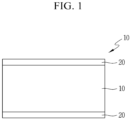
- FIG. 1 is a schematic cross-sectional view of a cold rolled steel sheet according to an exemplary embodiment.
- first, second and third are used to describe various parts, components, regions, layers and/or sections, but are not limited thereto. These terms are only used to distinguish one part, component, region, layer or section from another part, component, region, layer, or section. Accordingly, a first part, component, region, layer, or section to be described below may be referred to as a second part, component, region, layer, or section without departing from the scope of the present invention.
- % means weight%, and 1 ppm is 0.0001 weight%.
- the meaning of further including an additional element means replacing and including iron (Fe), which is the remainder by an additional amount of an additional element.
- FIG. 1 is a schematic cross-sectional view of a cold rolled steel sheet 100 according to an exemplary embodiment.
- the cold rolled steel sheet 100 includes a steel sheet base material 10 and an oxide layer 20.
- the cold rolled steel sheet 100 includes the steel sheet base material 10 and the oxide layer 20 that is formed from both surfaces of the cold rolled steel sheet 100 toward the inside thereof and distinguished from the steel sheet base material 10.
- the cold rolled steel sheet 100 includes, in wt%, 0.0003 to 0.003% of C, 0.25 to 0.55% of Mn, 0.001 to 0.03% of Si, 0.0005 to 0.0015% of Al, 0.01 to 0.03% of P, 0.001 to 0.010% of S, 0.03 to 0.08% of Cu, 0.008 to 0.015% of N, 0.1 to 0.3% of Mo, 0.025 to 0.055% of O, and a balance of Fe and inevitable impurities, and an oxide layer.
- wt% may be represented by %.
- Carbon (C) is an element that affects steel sheet properties such as solid solution strengthening, aging, and bubble defects.
- the carbon content may be 0.0003 to 0.0030%. Specifically, the carbon content may be in the range of 0.0005 to 0.0028%.
- the carbon content is out of the upper limit of the range, the strength increases, but there is a problem that the development of a texture is hindered during annealing, which reduces formability and causes bubble defects due to bubbling of an enamel layer in an enamel sintering process. If the carbon content is out of the lower limit of the range, there is a problem that the amount of precipitates that act as sites for absorbing hydrogen in the steel decreases, and grain growth occurs due to purification of grain boundaries in the sintering step, thereby deteriorating processability and enamel characteristics.
- Manganese (Mn) is a representative solid solution strengthening element and an element that prevents hot shortness by precipitating sulfur dissolved in steel in the form of manganese sulfide (MnS) and promotes the precipitation of carbides.
- the manganese content may be 0.25 to 0.55%. Specifically, the manganese content may be in the range of 0.27 to 0.53%.
- the manganese content is out of the upper limit of the range, there is a problem that formability due to the generation of central segregation is deteriorated and a formed product is deformed by lowering an Ar3 transformation temperature of the steel to cause transformation during enamel sintering. If the manganese content is out of the lower limit of the range, there is a problem in that the effects of preventing hot shortness and promoting precipitation of carbides are not exhibited.
- Silicon (Si) is an element that increases the strength and promotes the formation of precipitates that act as a hydrogen storage source.
- the silicon content may be 0.001 to 0.030%. Specifically, the silicon content may be in the range of 0.002 to 0.028%.
- the silicon content is out of the upper limit of the range, there is a problem in that an oxidation film is formed on the surface of the steel sheet, thereby reducing enamel adhesion. If the silicon content is out of the lower limit of the range, there is a problem in that the effect of increasing the strength and forming the precipitate acting as a hydrogen storage source is not exhibited.
- Aluminum (Al) is used as a strong deoxidizer to remove oxygen from molten steel in a steelmaking stage and is a representative element that fixes solid solution nitrogen.
- the aluminum content may be 0.0005 to 0.0015%. Specifically, the aluminum content may be in the range of 0.0006 to 0.0014%.
- the aluminum content is out of the upper limit of the range, there is a problem that not only the fraction of inclusions that act as a hydrogen storage source decreases to significantly increase the occurrence of fishscale, but also the amount of solid solution nitrogen is lowered, making it impossible to secure a target material after sintering. If the aluminum content is out of the lower limit of the range, there is a problem in that the effect of being used as the deoxidizer and fixing solid solution nitrogen is not exhibited.
- Phosphorus (P) is a solid solution strengthening element and an element that controls surface pickling properties.
- the phosphorus content may be 0.01 to 0.03%. Specifically, the phosphorus content may be in the range of 0.011 to 0.028%.
- the phosphorus content is out of the upper limit of the range, there is a problem that a segregation layer is formed inside the steel sheet, which not only reduces formability, but also promotes sulfuric acid reactivity in an enamel pretreatment process, thereby reducing adhesion. If the phosphorus content is out of the lower limit of the range, there is a problem that it is difficult to secure the target material and surface properties.
- S is an element that is bound with manganese (Mn) to cause hot shortness.
- the sulfur content may be 0.001 to 0.010%. Specifically, the sulfur content may be in the range of 0.002 to 0.009%.
- Copper (Cu) is an element added to strengthen solid solution and improve adhesion.
- the copper content may be 0.03 to 0.08%. Specifically, the copper content may be in the range of 0.032 to 0.078%.
- the copper content is out of the upper limit of the range, there is a problem that appropriate roughness properties cannot be obtained for the steel sheet by lowering a pickling rate in an acid treatment step, which is the enamel pretreatment process to reduce the adhesion. If the copper content is out of the lower limit of the range, there is a problem that the effect such as the solid solution strengthening, and the adhesion improvement is not exhibited.
- Nitrogen (N) is a representative interstitial solid solution strengthening element together with carbon (C) and is an element used to secure a target strength level after the sintering process.
- the nitrogen content may be 0.008 to 0.015%. Specifically, the nitrogen content may be 0.0083 to 0.0145%.
- Molybdenum (Mo) is an element that secures stable strength and provides a hydrogen storage source by forming various precipitates and oxides.
- the molybdenum content may be 0.1 to 0.3%. Specifically, the molybdenum content may be in the range of 0.11 to 0.29%.
- the molybdenum content is out of the upper limit of the range, there is a problem that not only the annealing passability is reduced, but also the occurrence of surface defects increases. If the molybdenum content is out of the lower limit of the range, there is a problem in that effects such as securing the strength and providing a hydrogen storage source are not exhibited.
- Oxygen (O) is an essential element in forming inclusions that act as a hydrogen storage source in enamel steel.
- the oxygen content may be 0.025 to 0.055%. Specifically, the oxygen content may be in the range of 0.0255 to 0.0540%.
- the oxygen content is out of the upper limit of the range, there is a problem in that severe meltdown of a refractory material occurs during the steelmaking step and the occurrence of surface defects in the steel sheet increases. If the oxygen content is out of the lower limit of the range, there is a problem in that the effect of forming the inclusions is not exhibited.
- the balance includes iron (Fe).
- the balance may include inevitable impurities.
- the inevitable impurities refer to impurities that are inevitably mixed during the manufacturing process of steelmaking and the grain-oriented electrical steel sheet. Since the inevitable impurities are widely known, detailed descriptions are omitted.
- the addition of elements other than the above-described alloy components is not excluded, and various elements may be included within a range that does not impair the technical spirit of the present invention. When additional elements are further included, the additional elements are included by replacing the remainder Fe.
- the cold rolled steel sheet 100 may include titanium (Ti), niobium (Nb), chromium (Cr), and vanadium (V).
- the cold rolled steel sheet for enamel with excellent anti-fishscale properties may optionally further include one or more of Ti: 0.005% or less, Nb: 0.005% or less, Cr: 0.05% or less, and V: 0.003% or less.
- the cold rolled steel sheet 100 of the present invention is not only not randomly added with elements such as titanium (Ti), which are highly oxidizing compared to iron (Fe), but also controls a surface oxide layer, thereby improving characteristics such as enamel adhesion between the steel sheet and the glaze.
- elements such as titanium (Ti), which are highly oxidizing compared to iron (Fe), but also controls a surface oxide layer, thereby improving characteristics such as enamel adhesion between the steel sheet and the glaze.
- the oxide layer 20 is formed from both surfaces of the cold rolled steel sheet 100, which is the base material 10, toward the inside thereof and may be distinguished based on a point containing 5% of oxygen. Specifically, the thickness of the oxide layer was determined based on the point containing 5% oxygen by analyzing the oxygen concentration from the surface toward the inside of the cross section of the steel sheet. More specifically, the thickness of the oxide layer was measured using Glow Discharge Spectroscopy (GDS) based on the point containing 5% oxygen.
- GDS Glow Discharge Spectroscopy
- the thickness of the oxide layer 20 may be in the range of 0.006 to 0.030 ⁇ m.
- the thickness of the oxide layer 20 may be specifically 0.007 to 0.028 ⁇ m. If the thickness of the oxide layer 20 is out of the upper limit of the range, there is a problem that the surface properties of the steel sheet are deteriorated. If the thickness of the oxide layer 20 is out of the lower limit of the range, there is a problem that the bonding force between the glaze layer and the steel plate decreases, making it difficult to secure the enamel adhesion, and the anti-fishscale properties also decrease.
- enamel products are products in which an organic glaze is attached to the steel plate, and it is very important to ensure adhesion between the steel plate and the glaze.
- the main component of the glaze specifically consists of silicon-oxide (SiO 2 ), and there is a problem of applying an expensive glaze such as NiO among the glaze components to prevent deterioration of the adhesion to the steel sheet.
- the high-strength cold rolled steel sheet for enamel with excellent enamel adhesion and anti-fishscale properties may improve enamel adhesion by controlling the thickness of the oxide layer on the surface of the steel sheet.
- the thickness of the oxide layer consisting of 90 wt% or more of iron oxide (FeO-based) is managed in a certain range to promote the covalent bonding with silicon (Si) atoms of the glaze layer, thereby improving enamel adhesion.
- the cold rolled steel sheet 100 may satisfy Equation 1 below. 0.014 ⁇ Cu ⁇ [ Si / P ⁇ 0.080
- Equation 1 is a correlation of copper (Cu) and silicon (Si) to phosphorus (P). Equation 1 may be in the range of 0.014 to 0.080. Specifically, Equation 1 may be in the range of 0.0142 to 0.0798. By satisfying the range, the enamel adhesion and surface bubble defects of the cold rolled steel sheet 100 may be suppressed.
- Equation 1 If the value of Equation 1 is out of the upper limit of the range, the inflow of gas into the surface of the steel sheet increases to cause surface defects such as bubble defects, thereby reducing the reliability of the product. If the value of Equation 1 is out of the lower limit of the range, there is a problem that enamel properties such as enamel adhesion are deteriorated as surface modification is not achieved during a sulfuric acid pretreatment process.
- the cold rolled steel sheet 100 may satisfy Equation 2 below. 0 .0065 ⁇ Al ⁇ Mo / C + N ⁇ 0 .0310
- Equation 2 above is a correlation of aluminum (Al) and molybdenum (Mo) to carbon (C) and nitrogen (N).
- Al aluminum
- Mo molybdenum
- carbon (C) and nitrogen (N) react with aluminum (Al) and molybdenum (Mo) to form carbonitrides, and excess solid solution elements inhibit texture growth even when applied with heat treatment at a high temperature such as the enamel sintering process, so that not only the shape fixability is excellently controlled, but also these precipitates serve as a hydrogen storage source.
- Equation 2 above may be 0.0065 to 0.0310. Specifically, Equation 2 above may be in the range of 0.0067 to 0.0305.
- Equation 2 If the value of Equation 2 is out of the upper limit of the range, the processability is good, but rolling and annealing passability is reduced and the manufacturing cost increases due to an increase in the used amount of expensive alloy elements. If the value of Equation 2 is out of the lower limit of the range, there is a problem that not only anti-fishscale properties are deteriorated as precipitation is not promoted, but also processability is deteriorated as the amount of interstitial solid solution elements increases.
- the cold rolled steel sheet 100 may satisfy Equation 3 below. 0 .50 ⁇ R max ⁇ 20 S e / P c ⁇ 1.05
- P c refers to the number of surface protrusions and depressions per unit centimeter (cm)
- R max refers to the maximum roughness value ( ⁇ m)
- S e refers to a temper reduction ratio (%).
- the cold rolled steel sheet 100 may have a yield strength of 220 MPa or more after enamel sintering heat treatment.
- the yield strength of the material used in the structural member is a physical property that determines dent resistance and shape fixability of the material.
- the yield strength after the enamel sintering heat treatment is 220 MPa or more, there is an advantage of having excellent stability of the product in the heat treatment step for drying after the glaze treatment.
- the cold rolled steel sheet 100 may have enamel adhesion of 95% or more. Specifically, the enamel adhesion may be 96% or more. Within the range, the cold rolled steel sheet 100 may be used as an enamel material even if an inexpensive glaze is used. When the enamel adhesion is lower than the range, there is a problem that the fishscale occurrence due to hydrogen in the steel increases.
- the cold rolled steel sheet 100 may have a hydrogen permeability rate of 600 sec/mm 2 or more.
- the hydrogen permeability rate may be 600 sec/mm 2 or more.
- the upper limit of the hydrogen permeability rate is not particularly limited, but may be, for example, 1,700 sec/mm 2 .
- the hydrogen permeability rate is a representative index for evaluating anti-fishscale properties, which represent resistance to fishscale defects, which are fatal defects when applying enamel steel, and means the ability to fix hydrogen in the cold rolled steel sheet.
- the hydrogen permeability rate is a value expressed by measuring a time taken to generate hydrogen in one direction of the steel sheet and permeate hydrogen in the other direction opposite to one direction of the steel sheet and dividing the time by the square of the material thickness. If the hydrogen permeability rate is excessively low, when the resistance to fishscale defects is evaluated by accelerated heat treatment at 200°C for 24 hours after enameling, the defect rate occurs at over 50%, and thus there is a problem in being used as a stable enamel product.
- a method for manufacturing a cold rolled steel sheet 100 includes reheating a steel slab including , in wt%, 0.0003 to 0.003% of C, 0.25 to 0.55% of Mn, 0.001 to 0.03% of Si, 0.0005 to 0.0015% of Al, 0.01 to 0.03% of P, 0.001 to 0.010% of S, 0.03 to 0.08% of Cu, 0.008 to 0.015% of N, 0.1 to 0.3% of Mo, 0.025 to 0.055% of O, and a balance of Fe and inevitable impurities; hot rolling the heated slab; winding the hot-rolled hot rolled steel sheet; cold rolling the wound hot rolled steel sheet; annealing the cold-rolled cold rolled steel sheet and temper rolling the annealed cold rolled steel sheet to manufacture an annealed sheet; and enamel sintering and heat-treating the annealed sheet.
- the detailed description of the steel slab is the same as that of the above-described cold-rolled steel sheet without
- the reheating of the steel slab is a step for smoothly performing a subsequent hot rolling process and homogenizing the steel slab.
- the heating may mean reheating.
- the reheating of the steel slab may be a step of hot rolling the steel slab in the range of 1,150 to 1,280°C.
- the reheating temperature range may be 1,150 to 1,280°C. If the temperature exceeds the upper limit of the temperature range, not only the amount of surface scale increases at the slab heating temperature, so that a material loss is increased, but also there is a problem of increased energy costs due to an increase in the heat source. If the temperature exceeds the lower limit of the temperature range, there is problem that the rolling load rapidly increases in the hot rolling process, thereby deteriorating hot rolling workability.
- the reheating of the steel slab may be performed at a finish hot rolling temperature in the temperature range of 890 to 950°C.
- the finish hot rolling may be performed in a temperature range of 900 to 945°C.
- finish hot rolling temperature is out of the upper limit of the range, there is a problem that the peeling property of surface scales decreases, so that the surface defect occurrence is increased, and impact toughness is deteriorated as uniform hot rolling is not secured. If the finish hot rolling temperature is out of the lower limit of the range, as hot rolling is finished in a low-temperature region, there is a problem in that grain agglomeration is rapidly progressed to cause a decrease in the rolling properties and workability.
- the winding of the hot-rolled hot rolled steel sheet may be performed in a temperature range of 580 to 720°C. Specifically, the temperature range may be 590 to 700°C.
- the hot rolled steel sheet may be cooled on a run-out table (ROT) before winding.
- ROT run-out table
- the temperature exceeds the upper limit of the temperature range, there is a problem that corrosion resistance is lowered during winding, grain boundary segregation of phosphorus (P) is promoted, cold rolling properties are lowered, and the processability of the final product is adversely affected.
- the temperature exceeds the lower limit of the temperature range, there is a problem that as the temperature ununiformity in the width direction increases during the cooling and cracking process, a mechanical property deviation due to a difference in precipitation behavior increases and an enamel property deteriorates.
- the method may further include pickling the hot rolled steel sheet.
- pickling step scales generated during hot rolling may be removed.
- the cold rolling of the wound hot rolled steel sheet may be performed at a cold reduction ratio of 60 to 90%.
- the cold reduction ratio may be in the range of 63 to 88%.
- the cold reduction ratio is out of the upper limit of the range, there is a problem that not only the material is hardened so that processability deteriorates, but also the load on a cold roller increases so that workability to deteriorate. If the cold reduction ratio is out of the lower limit of the range, there is a problem that the driving force for recrystallization in the subsequent heat treatment process is not secured, and thus unrecrystallized grains remain locally, so that the processability deteriorates.
- the annealing and temper rolling of the cold-rolled cold rolled steel sheet to manufacture the annealed sheet may be performed in an annealing temperature range of 720 to 850°C and may be performed for 10 to 70 seconds in the annealing temperature range.
- the temperature is out of the upper limit of the annealing temperature range, there is a problem that the annealing passability decreases by softening due to a decrease in high-temperature strength. If the temperature is out of the lower limit of the annealing temperature range, there is a problem that the strain formed by cold rolling is not sufficiently removed, so that processability is significantly reduced and enamel properties cannot be secured.
- the annealing and temper rolling of the cold-rolled cold rolled steel sheet to manufacture the annealed sheet may be performed at a reduction ratio of 2.5% or less during the temper rolling.
- the shape of the material may be controlled, and a desired surface roughness may be obtained.
- the temper rolling may be performed at a reduction ratio of 0.3 to 2.2%.
- the range of the reduction ratio exceeds the upper limit, there is a problem that the material is hardened due to work hardening and the processability deteriorates.
- the temper reduction ratio is high during the sintering heat treatment in the enamel process, there is a problem that strain-induced abnormal grain growth occurs, so that the yield strength of the enamel product is significantly reduced, thereby reducing dent resistance.
- the enamel sintering heat-treating of the annealed sheet may be a step of enamel sintering heat-treating the annealed sheet in a temperature range of 780 to 850°C.
- the enamel sintering heat treatment may be a step for drying the enameled glaze.
- the temperature range may be 790 to 840°C.
- the temperature range exceeds the upper limit, there is a problem that the occurrence of surface defects increases due to an increase in the thickness of the oxide layer, and the amount of energy used increases, which acts as a factor in increasing manufacturing costs. If the temperature range exceeds the lower limit, there is a problem that the wettability of the glaze deteriorates, making it impossible to secure enamel adhesion properties.
- a method for manufacturing a cold rolled steel sheet includes heating a steel slab including 0.11 to 0.13% of C, 0.05% or less of Si, 0.1 to 0.6% of Mn, 0.02 to 0.06 % of Al, 0.015% or less of P, 0.015% or less of S, 0.006% or less of N, and a balance of Fe and inevitable impurities; hot-rolling the heated slab; winding the hot-rolled hot rolled steel sheet; cooling the hot-rolled hot rolled steel sheet; winding the cooled hot rolled steel sheet; cold-rolling the wound hot rolled steel sheet; annealing the cold-rolled cold rolled steel sheet; and secondary rolling the annealed cold rolled steel sheet.
- the detailed description of the steel slab is the same as that of the above-described cold-rolled steel sheet without contradiction, and thus overlapping descriptions will be omitted.
- the steel slab is heated.
- the heating of the steel slab may be performed at 1,150°C or higher.
- the heating of the steel slab requires a temperature of 1,150°C or higher because the precipitates generated in the steel needs to be re-dissolved.
- a hot-rolled steel sheet may be obtained by hot-rolling the heated slab.
- the finish hot rolling of the steel slab may be performed at a temperature of Ar3 of higher.
- the temperature of Ar3 of higher may be 890°C of higher.
- the finish hot rolling is performed at the temperature of Ar3 of higher, the rolling may be performed in an austenite single phase region. When the rolling is performed out of the temperature range, there is a problem of reducing rolling stability due to non-uniform mechanical properties.
- the cooling is performed to be maintained for a time range of 150 to 1,200 seconds.
- the time exceeds the lower limit of the time range, there is a problem in that a large amount of pearlite phase is formed and large-sized carbides are generated in the final material.
- the size of the carbide is large, there is a problem that the carbide becomes the starting point of cracks to reduce a hole expansion rate.
- the hot rolled steel sheet may be cooled to 710°C to be maintained between 710°C and 860°C for 150 to 1,200 seconds.
- the cooled hot rolled steel sheet may be wound at 560 to 700°C.
- the winding of the cooled hot rolled steel sheet may be controlled within the winding temperature range.
- the winding temperature is excessively low, there is a problem in that the grains become excessively fine, and when the winding temperature is excessively high, there is a problem in that the grains become excessively coarse.
- the hot rolled steel sheet may be cold-rolled at a reduction ratio of 80 to 95% to manufacture a cold rolled steel sheet.
- the typical thickness of the hot rolled steel sheet is 2 to 4 mm, and a reduction ratio of 80% or more is required to reduce the thickness to 0.4 mm.
- the reduction ratio exceeds the upper limit, there is a problem that the deformation resistance due to rolling increases excessively, making rolling difficult. If the reduction ratio exceeds the lower limit, there is a problem in that the target thickness of the cold rolled steel sheet is not reached.
- the method may further include a pickling step, before the cold rolling of the wound hot rolled steel sheet.
- a pickling step scales generated during hot rolling may be removed.
- the annealed steel sheet is manufactured by annealing at a temperature of 620 to 760°C.
- a temperature of 620 to 760°C Through the annealing of the cold rolled steel sheet, internal stress formed during cold rolling may be removed and processability may be secured.
- an annealing process is required at a sufficiently high temperature so that recrystallization occurs.
- the final steel sheet may be manufactured by secondary rolling the annealed cold rolled steel sheet at a reduction ratio of 6 to 18%. If the reduction ratio exceeds the upper limit, there is a problem in that a desired level of processability is not secured due to a decrease in elongation. If the reduction ratio exceeds the lower limit, there is a problem that it is not sufficient to obtain the target strength.
- Equation 1 represents ([Cu] ⁇ [Si])/[P]
- Equation 2 represents ([Al] ⁇ [Mo])/([C] + [N]).
- [Cu], [Si], [P], [Al], [Mo], [C], and [N] in Equations 1 and 2 mean wt%, respectively.
- Table 2 below shows that the slab was manufactured into a cold rolled steel sheet according to the manufacturing conditions disclosed in Table 2 below. Specifically, the slab was maintained in a furnace for 2 hours and then hot rolled, and at this time, the thickness of the hot rolled steel sheet was adjusted to 4.0 mm. The hot-rolled hot rolled steel sheet was pickled, and then cold-rolled at each reduction ratio after the oxide film on the surface was removed.
- Examples 1 to 9 were used with the slabs of Invention Steels 1 to 5 included in the composition range of the present invention, and performed in the ranges of the reheating temperature, finish hot rolling temperature, winding temperature, cold reduction ratio, annealing temperature, holding time, temper reduction ratio, and enamel sintering temperature of the slab of the present invention.
- Comparative Examples 1 to 4 were used with the slabs of Invention Steels 1 to 4 included in the composition range of the present invention and controlled so that at least one of the manufacturing conditions of Table 2 above did not correspond to the conditions of the present invention.
- Comparative Examples 5 to 9 were used with Comparative Steels 1 to 5 in Table 1 and controlled so that the manufacturing conditions in Table 2 fall within the scope of the present invention.
- Table 3 below shows the thickness of oxide layer, passability, yield strength, presence of bubble defects, presence of fishscale, enamel adhesion, and hydrogen permeability rate of Examples 1 to 9 and Comparative Examples 1 to 9 of Invention Steels and Comparative Steel of Table 1 manufactured under the manufacturing conditions of Table 2 above.
- the thickness of the oxide layer was represented as an average value by analyzing the oxygen concentration from the surface of the steel sheet toward the inside thereof using Glow Discharge Spectroscopy (GDS), dividing the oxide layer and the base material based on a point containing 5% oxygen, and measuring a thickness up to the point containing 5% oxygen, and measuring the thickness three times.
- GDS Glow Discharge Spectroscopy
- the yield strength was measured by fabricating tensile test specimens (standard ASTM 13B) on specimens that were sintered and heat-treated for 15 minutes at each temperature in a furnace, and performing a tensile test at a crosshead speed of 10 mm/min.
- the enameled specimens were cut to an appropriate size for each purpose to meet the test purpose.
- the heat-treated enameled specimens were completely degreased and then applied with a standard glaze (Check Frit), which was relatively vulnerable to fishscale defects, and kept at 300°C for 10 minutes to remove moisture.
- Check Frit a standard glaze
- the dried specimens were sintered at each sintering temperature for 15 minutes and then cooled to room temperature. At this time, the atmosphere condition of the furnace was selected as a harsh condition where fishscale defects were likely to occur with a dew point temperature of 20°C.
- the enameled specimens were subjected to a fishscale acceleration experiment which was kept in an oven at 200°C for 24 hours. After the fishscale acceleration process, the occurrence of fishscale defects was visually observed. If no fishscale defects occurred, it was indicated as good (indicated by " ⁇ "), and if the fishscale defects occurred, it was indicated as poor (indicated by " ⁇ ").
- the enamel adhesion which evaluated the adhesion between the steel sheet and the glaze, as defined in the American Society for Testing and Materials standard, ASTM C313-78, was represented by applying a certain load to the enamel layer with a steel ball and then evaluating the degree of current conduction in this site to index the peeling degree of the enamel glaze layer.
- the enamel adhesion evaluation results were set as a target of securing adhesion of 95% or more in terms of securing application stability in relatively inexpensive glazes.
- the bubble defects were determined as excellent (indicated by "o") and poor (indicated by " ⁇ ”) by visually observing the enamel surface of a specimen kept in an oven at 200°C for 24 hours after enameling treatment, respectively.
- the hydrogen permeability rate was one of indices of evaluating the resistance to fishscale, a fatal defect of enamel, and represented by a value expressed as a square of a material thickness (t, unit: mm), ts/t2 (unit: sec/mm 2 ), by generating hydrogen in one direction of the steel sheet according to an experimental method indicated in the European standard (EN10209-2013) and measuring a time (ts, unit: sec) taken when the hydrogen permeated to the other side.
- Inventive Examples 1 to 9 which satisfied all of various properties of the present invention such as component compositions, manufacturing conditions, surface properties, and the thickness of the oxide layer, not only had good passability, but also related indices such as the thickness of the oxide layer satisfied the scope of the present invention.
- Inventive Examples 1 to 9 not only had no enamel defects such as fishscales and bubble defects, but also satisfied a hydrogen permeability rate of 600 sec/mm 2 or more, an enamel adhesion index of 95% or more, and a yield strength after enamel sintering heat treatment of 220 MPa to secure the characteristics targeted by the present invention.
- Comparative Examples 5 to 9 that did not satisfy the composition of the present invention, most of Comparative Examples 5 to 9 did not satisfy the thickness of the surface oxide layer, the hydrogen permeability rate, and the enamel adhesion represented in the present invention, and in most cases, even in visible observation after enamel treatment, fishscales and bubble defects occurred, and thus there was a problem in applicability to the intended use.
- the cold rolled steel sheet for enamel with excellent enamel adhesion and anti-fishscale properties satisfies the alloy composition and alloy range, so that it is possible to control the thickness of the oxide layer formed toward the inside thereof to an appropriate level, thereby providing a high-strength cold rolled steel sheet for enamel with excellent anti-fishscale properties.
- enamel properties are significantly improved through high-speed continuous annealing, the strength level after enamel sintering heat treatment may be maintained at a high level, adhesion may be improved by optimizing surface roughness characteristics during the heat treatment and temper rolling steps in a continuous annealing furnace, and grain growth during enamel sintering, such as residual nitrogen in the surface layer of the steel sheet is suppressed, thereby securing stable mechanical properties even after high-temperature sintering.
Landscapes
- Chemical & Material Sciences (AREA)
- Engineering & Computer Science (AREA)
- Mechanical Engineering (AREA)
- Materials Engineering (AREA)
- Metallurgy (AREA)
- Organic Chemistry (AREA)
- Physics & Mathematics (AREA)
- Thermal Sciences (AREA)
- Crystallography & Structural Chemistry (AREA)
- Heat Treatment Of Sheet Steel (AREA)
Abstract
Description
- The present invention relates to a steel sheet, and more particularly, to a cold rolled steel sheet for enamel having excellent anti-fishscale properties and a method for manufacturing the same.
- An enamel steel sheet is a surface-treated product having improved corrosion resistance, weather resistance, heat resistance, and chemical resistance by applying a vitreous glaze to a base steel sheet such as a hot rolled steel sheet or cold rolled steel sheet and then sintering the steel sheet at a high temperature. The enamel steel sheet has been used as a material for building exteriors, home appliances, tableware, and various industries.
- Initially, rimmed steel was mainly used as the enamel steel sheet, but recently, as continuous casting has been used to improve productivity, most materials are being continuously cast by the continuous casting method. Fishscale defects, one of the problems of the enamel steel sheet, are defects occurring when hydrogen dissolved in the steel during the manufacturing process of enamel products becomes supersaturated in the steel during cooling after sintering, and then released to the surface of the steel over time to cause an enamel layer to fall off in a fishscale shape.
- When the fishscale defects occur, rust occurs intensively in the defective area, so that there is a problem of significantly reducing the value of the enamel product. Accordingly, in the manufacture of the enamel steel sheet, in order to prevent fishscale defects, various methods related to forming a large number of sites inside the steel that may hold hydrogen dissolved in the steel are used.
- Specifically, there has been proposed a method of securing processability and anti-fishscale properties by applying an open coil annealing (OCA) method, a type of batch annealing method. However, in this method, since the heat treatment process takes a relatively long time, there is a problem in that productivity is lowered, manufacturing costs are increased, and a large quality deviation occurs within the coil. In addition, since it is not easy to control the decarburization reaction in the heat treatment process, there is a problem that decarburization progresses excessively and the grain boundaries of the steel sheet are softened after the enamel sintering heat treatment, resulting in a decrease in shape fixability.
- As such, in order to overcome problems such as low productivity and increased manufacturing costs caused by long-time annealing, recently developed enamel steel sheets utilize a continuous annealing process. Enamel steel manufactured by a continuous annealing method using the continuous annealing process is generally based on ultra-low carbon steel and uses precipitates such as titanium (Ti) or inclusions secured by a non-deoxidation method as a hydrogen storage source. However, even in this case, as a large amount of carbonitride forming elements are required, the elements act as a factor in increasing the cost and decreasing the passability, and the problem of surface defects caused by the formed precipitates, or the non-deoxidized inclusions is a fundamental problem to be solved.
- In enamel steel sheets using titanium-based precipitates, as a large amount of titanium is added to suppress the hydrogen reaction that causes the fishscale, an exposure clogging phenomenon occurs due to titanium nitride (TiN) and inclusions during a continuous casting stage of a steelmaking process to cause a decrease in workability and cause a direct problem with a production load. In addition, the titanium nitride mixed into the molten steel not only causes blister defects, which are representative bubble defects, when present on the upper part of the steel sheet, but also the titanium added in a large amount forms a titanium-based oxide layer to cause a problem of inhibiting the adhesion between the steel sheet and a glaze layer.
- In addition, in the case of enamel steel applied to the enamel steel sheet, as materials of most structural members are used, the strengths of the materials are increased to seek strengthened competitiveness by reducing the weights of the members used. To this end, there is a demand for mechanical properties after sintering and heat treatment in a high temperature area performed for drying of the glaze in the enameling process. In order to meet the demand, it is required to secure the yield strength of 220 MPa or more after sintering the enamel steel.
- The present disclosure attempts to provide a high-strength cold rolled steel sheet for enamel having yield strength of 220 MPa or more after enameling, no bubble defects, and excellent enamel adhesion and anti-fishscale properties.
- The present disclosure also attempts to provide a method for manufacturing a cold rolled steel sheet having the advantages.
- According to an exemplary embodiment of the present invention, a cold rolled steel sheet includes, in wt%, 0.0003 to 0.003% of C, 0.25 to 0.55% of Mn, 0.001 to 0.03% of Si, 0.0005 to 0.0015% of Al, 0.01 to 0.03% of P, 0.001 to 0.010% of S, 0.03 to 0.08% of Cu, 0.008 to 0.015% of N, 0.1 to 0.3% of Mo, 0.025 to 0.055% of O, and a balance of Fe and inevitable impurities, and an oxide layer, wherein the thickness of the oxide layer, which is formed from the surface of the cold rolled steel sheet toward the inside thereof, may be 0.006 to 0.030 µm.
- In an exemplary embodiment, the cold rolled steel sheet may satisfy Equation 1 below:
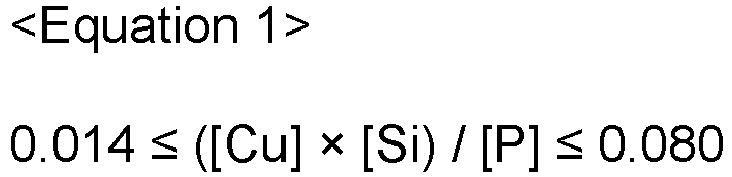
- (In Equation 1, [Cu], [Si], and [P] refer to the wt% contents of Cu, Si, and P, respectively.)
- In an exemplary embodiment, the cold rolled steel sheet may satisfy Equation 2 below:

- (In Equation 2, [Al], [Mo], [C], and [N] refer to the wt% contents of Al, Mo, C, and N, respectively.)
- In an exemplary embodiment, the cold rolled steel sheet may satisfy Equation 3 below:

- (In Equation 3 above, Pc refers to the number of surface protrusions and depressions per unit centimeter (cm), Rmax refers to the maximum roughness value (µm), and Se refers to a temper reduction ratio (%).)
- In an exemplary embodiment, the cold rolled steel sheet may have a yield strength of 220 MPa or more after enamel sintering heat treatment. In an exemplary embodiment, the cold rolled steel sheet may have an enamel adhesion of over 95%. In an exemplary embodiment, the cold rolled steel sheet may a hydrogen permeability rate of 600 sec/mm2 or more.
- According to another exemplary embodiment of the present invention, a method for manufacturing a cold rolled steel sheet includes reheating a steel slab including , in wt%, 0.0003 to 0.003% of C, 0.25 to 0.55% of Mn, 0.001 to 0.03% of Si, 0.0005 to 0.0015% of Al, 0.01 to 0.03% of P, 0.001 to 0.010% of S, 0.03 to 0.08% of Cu, 0.008 to 0.015% of N, 0.1 to 0.3% of Mo, 0.025 to 0.055% of O, and a balance of Fe and inevitable impurities in a temperature range of 1,150 to 1,280°C; hot rolling the heated slab in a finish hot rolling temperature of 890 to 950°C; winding the hot-rolled hot rolled steel sheet in a temperature range of 580 to 720°C; cold rolling the wound hot rolled steel sheet at a cold reduction ratio of 60 to 90%; annealing the cold-rolled cold rolled steel sheet at an annealing temperature of 720 to 850°C for 10 to 70 seconds and temper rolling the annealed cold rolled steel sheet at a reduction ratio of 2.5% or less to manufacture an annealed sheet; and enamel sintering and heat-treating the annealed sheet in a temperature range of 780 to 850°C.
- In an exemplary embodiment, the cold rolled steel sheet may satisfy Equation 1 below:

- (In Equation 1, [Cu], [Si], and [P] refer to the wt% contents of Cu, Si, and P, respectively.)
- In an exemplary embodiment, the cold rolled steel sheet may satisfy Equation 2 below:

- (In Equation 2, [Al], [Mo], [C], and [N] refer to the wt% contents of Al, Mo, C, and N, respectively.)
- In an exemplary embodiment, the cold rolled steel sheet may satisfy Equation 3 below:

- (In Equation 3 above, Pc refers to the number of surface protrusions and depressions per unit centimeter (cm), Rmax refers to the maximum roughness value (µm), and Se refers to a temper reduction ratio (%).)
- According to an exemplary embodiment of the present invention, it is possible to provide a cold rolled steel sheet with excellent enamel adhesion and anti-fishscale properties by controlling a steel composition, which can be used in various members such as home appliances, chemical appliances, kitchen appliances, sanitary appliances, and building interior and exterior materials.
- According to another exemplary embodiment of the present invention, it is possible to provide a method for manufacturing a cold rolled steel sheet having the advantages.
-
FIG. 1 is a schematic cross-sectional view of a cold rolled steel sheet according to an exemplary embodiment. - Terms such as first, second and third are used to describe various parts, components, regions, layers and/or sections, but are not limited thereto. These terms are only used to distinguish one part, component, region, layer or section from another part, component, region, layer, or section. Accordingly, a first part, component, region, layer, or section to be described below may be referred to as a second part, component, region, layer, or section without departing from the scope of the present invention.
- The terms used herein is for the purpose of describing specific exemplary embodiments only and are not intended to be limiting of the present invention. The singular forms used herein include plural forms as well, if the phrases do not clearly have the opposite meaning. The "comprising" used in the specification means that a specific feature, region, integer, step, operation, element and/or component is embodied and other specific features, regions, integers, steps, operations, elements, components, and/or groups are not excluded.
- When a part is referred to as being "above" or "on" the other part, the part may be directly above or on the other part or may be followed by another part therebetween. In contrast, when a part is referred to as being "directly on" the other part, there is no intervening part therebetween.
- Unless defined otherwise, all terms including technical and scientific terms used herein have the same meaning as commonly understood by those skilled in the art to which the present invention belongs. Commonly used predefined terms are further interpreted as having a meaning consistent with the relevant technical literature and the present invention and are not to be construed as ideal or very formal meanings unless defined otherwise.
- In addition, unless otherwise specified, % means weight%, and 1 ppm is 0.0001 weight%.
- In an exemplary embodiment of the present invention, the meaning of further including an additional element means replacing and including iron (Fe), which is the remainder by an additional amount of an additional element.
- The present invention will be described more fully hereinafter with reference to the accompanying drawings, in which exemplary embodiments of the invention are shown. As those skilled in the art would realize, the described embodiments may be modified in various different ways, all without departing from the spirit or scope of the present invention.
-
FIG. 1 is a schematic cross-sectional view of a cold rolled steel sheet 100 according to an exemplary embodiment. - Referring to
FIG. 1 , the cold rolled steel sheet 100 includes a steelsheet base material 10 and anoxide layer 20. The cold rolled steel sheet 100 includes the steelsheet base material 10 and theoxide layer 20 that is formed from both surfaces of the cold rolled steel sheet 100 toward the inside thereof and distinguished from the steelsheet base material 10. Specifically, the cold rolled steel sheet 100 according to an exemplary embodiment of the present invention includes, in wt%, 0.0003 to 0.003% of C, 0.25 to 0.55% of Mn, 0.001 to 0.03% of Si, 0.0005 to 0.0015% of Al, 0.01 to 0.03% of P, 0.001 to 0.010% of S, 0.03 to 0.08% of Cu, 0.008 to 0.015% of N, 0.1 to 0.3% of Mo, 0.025 to 0.055% of O, and a balance of Fe and inevitable impurities, and an oxide layer. - The reason for limiting alloy components will be described below. Hereinafter, wt% may be represented by %.
- Carbon (C) is an element that affects steel sheet properties such as solid solution strengthening, aging, and bubble defects. The carbon content may be 0.0003 to 0.0030%. Specifically, the carbon content may be in the range of 0.0005 to 0.0028%.
- If the carbon content is out of the upper limit of the range, the strength increases, but there is a problem that the development of a texture is hindered during annealing, which reduces formability and causes bubble defects due to bubbling of an enamel layer in an enamel sintering process. If the carbon content is out of the lower limit of the range, there is a problem that the amount of precipitates that act as sites for absorbing hydrogen in the steel decreases, and grain growth occurs due to purification of grain boundaries in the sintering step, thereby deteriorating processability and enamel characteristics.
- Manganese (Mn) is a representative solid solution strengthening element and an element that prevents hot shortness by precipitating sulfur dissolved in steel in the form of manganese sulfide (MnS) and promotes the precipitation of carbides. The manganese content may be 0.25 to 0.55%. Specifically, the manganese content may be in the range of 0.27 to 0.53%.
- If the manganese content is out of the upper limit of the range, there is a problem that formability due to the generation of central segregation is deteriorated and a formed product is deformed by lowering an Ar3 transformation temperature of the steel to cause transformation during enamel sintering. If the manganese content is out of the lower limit of the range, there is a problem in that the effects of preventing hot shortness and promoting precipitation of carbides are not exhibited.
- Silicon (Si) is an element that increases the strength and promotes the formation of precipitates that act as a hydrogen storage source. The silicon content may be 0.001 to 0.030%. Specifically, the silicon content may be in the range of 0.002 to 0.028%.
- If the silicon content is out of the upper limit of the range, there is a problem in that an oxidation film is formed on the surface of the steel sheet, thereby reducing enamel adhesion. If the silicon content is out of the lower limit of the range, there is a problem in that the effect of increasing the strength and forming the precipitate acting as a hydrogen storage source is not exhibited.
- Aluminum (Al) is used as a strong deoxidizer to remove oxygen from molten steel in a steelmaking stage and is a representative element that fixes solid solution nitrogen. The aluminum content may be 0.0005 to 0.0015%. Specifically, the aluminum content may be in the range of 0.0006 to 0.0014%.
- If the aluminum content is out of the upper limit of the range, there is a problem that not only the fraction of inclusions that act as a hydrogen storage source decreases to significantly increase the occurrence of fishscale, but also the amount of solid solution nitrogen is lowered, making it impossible to secure a target material after sintering. If the aluminum content is out of the lower limit of the range, there is a problem in that the effect of being used as the deoxidizer and fixing solid solution nitrogen is not exhibited.
- Phosphorus (P) is a solid solution strengthening element and an element that controls surface pickling properties. The phosphorus content may be 0.01 to 0.03%. Specifically, the phosphorus content may be in the range of 0.011 to 0.028%.
- If the phosphorus content is out of the upper limit of the range, there is a problem that a segregation layer is formed inside the steel sheet, which not only reduces formability, but also promotes sulfuric acid reactivity in an enamel pretreatment process, thereby reducing adhesion. If the phosphorus content is out of the lower limit of the range, there is a problem that it is difficult to secure the target material and surface properties.
- Sulfur (S) is an element that is bound with manganese (Mn) to cause hot shortness. The sulfur content may be 0.001 to 0.010%. Specifically, the sulfur content may be in the range of 0.002 to 0.009%.
- If the sulfur content is out of the upper limit of the range, there is a problem that not only ductility is greatly reduced to deteriorate processability, but also manganese sulfide is excessively precipitated to adversely affect the fishscale properties of the product. If the sulfur content is out of the lower limit of the range, there is a problem of deteriorating weldability.
- Copper (Cu) is an element added to strengthen solid solution and improve adhesion. The copper content may be 0.03 to 0.08%. Specifically, the copper content may be in the range of 0.032 to 0.078%.
- If the copper content is out of the upper limit of the range, there is a problem that appropriate roughness properties cannot be obtained for the steel sheet by lowering a pickling rate in an acid treatment step, which is the enamel pretreatment process to reduce the adhesion. If the copper content is out of the lower limit of the range, there is a problem that the effect such as the solid solution strengthening, and the adhesion improvement is not exhibited.
- Nitrogen (N) is a representative interstitial solid solution strengthening element together with carbon (C) and is an element used to secure a target strength level after the sintering process. The nitrogen content may be 0.008 to 0.015%. Specifically, the nitrogen content may be 0.0083 to 0.0145%.
- Molybdenum (Mo) is an element that secures stable strength and provides a hydrogen storage source by forming various precipitates and oxides. The molybdenum content may be 0.1 to 0.3%. Specifically, the molybdenum content may be in the range of 0.11 to 0.29%.
- If the molybdenum content is out of the upper limit of the range, there is a problem that not only the annealing passability is reduced, but also the occurrence of surface defects increases. If the molybdenum content is out of the lower limit of the range, there is a problem in that effects such as securing the strength and providing a hydrogen storage source are not exhibited.
- Oxygen (O) is an essential element in forming inclusions that act as a hydrogen storage source in enamel steel. The oxygen content may be 0.025 to 0.055%. Specifically, the oxygen content may be in the range of 0.0255 to 0.0540%.
- If the oxygen content is out of the upper limit of the range, there is a problem in that severe meltdown of a refractory material occurs during the steelmaking step and the occurrence of surface defects in the steel sheet increases. If the oxygen content is out of the lower limit of the range, there is a problem in that the effect of forming the inclusions is not exhibited.
- The balance includes iron (Fe). In addition, the balance may include inevitable impurities. The inevitable impurities refer to impurities that are inevitably mixed during the manufacturing process of steelmaking and the grain-oriented electrical steel sheet. Since the inevitable impurities are widely known, detailed descriptions are omitted. In an exemplary embodiment of the present invention, the addition of elements other than the above-described alloy components is not excluded, and various elements may be included within a range that does not impair the technical spirit of the present invention. When additional elements are further included, the additional elements are included by replacing the remainder Fe.
- In an exemplary embodiment, the cold rolled steel sheet 100 may include titanium (Ti), niobium (Nb), chromium (Cr), and vanadium (V). The cold rolled steel sheet for enamel with excellent anti-fishscale properties may optionally further include one or more of Ti: 0.005% or less, Nb: 0.005% or less, Cr: 0.05% or less, and V: 0.003% or less.
- As such, the cold rolled steel sheet 100 of the present invention is not only not randomly added with elements such as titanium (Ti), which are highly oxidizing compared to iron (Fe), but also controls a surface oxide layer, thereby improving characteristics such as enamel adhesion between the steel sheet and the glaze.
- The
oxide layer 20 is formed from both surfaces of the cold rolled steel sheet 100, which is thebase material 10, toward the inside thereof and may be distinguished based on a point containing 5% of oxygen. Specifically, the thickness of the oxide layer was determined based on the point containing 5% oxygen by analyzing the oxygen concentration from the surface toward the inside of the cross section of the steel sheet. More specifically, the thickness of the oxide layer was measured using Glow Discharge Spectroscopy (GDS) based on the point containing 5% oxygen. - In an exemplary embodiment, the thickness of the
oxide layer 20 may be in the range of 0.006 to 0.030 µm. The thickness of theoxide layer 20 may be specifically 0.007 to 0.028 µm. If the thickness of theoxide layer 20 is out of the upper limit of the range, there is a problem that the surface properties of the steel sheet are deteriorated. If the thickness of theoxide layer 20 is out of the lower limit of the range, there is a problem that the bonding force between the glaze layer and the steel plate decreases, making it difficult to secure the enamel adhesion, and the anti-fishscale properties also decrease. - As such, enamel products are products in which an organic glaze is attached to the steel plate, and it is very important to ensure adhesion between the steel plate and the glaze. The main component of the glaze specifically consists of silicon-oxide (SiO2), and there is a problem of applying an expensive glaze such as NiO among the glaze components to prevent deterioration of the adhesion to the steel sheet. The high-strength cold rolled steel sheet for enamel with excellent enamel adhesion and anti-fishscale properties according to an exemplary embodiment of the present invention may improve enamel adhesion by controlling the thickness of the oxide layer on the surface of the steel sheet. The thickness of the oxide layer consisting of 90 wt% or more of iron oxide (FeO-based) is managed in a certain range to promote the covalent bonding with silicon (Si) atoms of the glaze layer, thereby improving enamel adhesion.
- In an exemplary embodiment, the cold rolled steel sheet 100 may satisfy Equation 1 below.

- (In Equation 1, [Cu], [Si], and [P] refer to the wt% contents of Cu, Si, and P, respectively.)
- Equation 1 is a correlation of copper (Cu) and silicon (Si) to phosphorus (P). Equation 1 may be in the range of 0.014 to 0.080. Specifically, Equation 1 may be in the range of 0.0142 to 0.0798. By satisfying the range, the enamel adhesion and surface bubble defects of the cold rolled steel sheet 100 may be suppressed.
- If the value of Equation 1 is out of the upper limit of the range, the inflow of gas into the surface of the steel sheet increases to cause surface defects such as bubble defects, thereby reducing the reliability of the product. If the value of Equation 1 is out of the lower limit of the range, there is a problem that enamel properties such as enamel adhesion are deteriorated as surface modification is not achieved during a sulfuric acid pretreatment process.
- In an exemplary embodiment, the cold rolled steel sheet 100 may satisfy Equation 2 below.

- (In Equation 2, [Al], [Mo], [C], and [N] refer to the wt% contents of Al, Mo, C, and N, respectively)
- Equation 2 above is a correlation of aluminum (Al) and molybdenum (Mo) to carbon (C) and nitrogen (N). In the case of carbon (C) and nitrogen (N) in the steel, carbon (C) and nitrogen (N) react with aluminum (Al) and molybdenum (Mo) to form carbonitrides, and excess solid solution elements inhibit texture growth even when applied with heat treatment at a high temperature such as the enamel sintering process, so that not only the shape fixability is excellently controlled, but also these precipitates serve as a hydrogen storage source.
- Accordingly, it is necessary to consider the reactivity of not only each alloy element but also complex solid solution elements. Equation 2 above may be 0.0065 to 0.0310. Specifically, Equation 2 above may be in the range of 0.0067 to 0.0305.
- If the value of Equation 2 is out of the upper limit of the range, the processability is good, but rolling and annealing passability is reduced and the manufacturing cost increases due to an increase in the used amount of expensive alloy elements. If the value of Equation 2 is out of the lower limit of the range, there is a problem that not only anti-fishscale properties are deteriorated as precipitation is not promoted, but also processability is deteriorated as the amount of interstitial solid solution elements increases.
- In an exemplary embodiment, the cold rolled steel sheet 100 may satisfy Equation 3 below.

- (In Equation 3 above, Pc refers to the number of surface protrusions and depressions per unit centimeter (cm), Rmax refers to the maximum roughness value (µm), and Se refers to a temper reduction ratio (%).)
- Equation 3 above may be 0.50 to 1.05. Specifically, Equation 3 above may be in the range of 0.505 to 1.00. If the value of Equation 3 is out of the upper limit of the range, grains of the steel sheet grow after the enamel sintering treatment, and thus there is a problem in securing the target mechanical properties and enamel characteristics. If the value of Equation 3 is out of the lower limit of the range, there is a problem in that a wedge effect on the surface of the steel sheet is reduced and the adhesion with the glaze is reduced.
- In an exemplary embodiment, the cold rolled steel sheet 100 may have a yield strength of 220 MPa or more after enamel sintering heat treatment. The yield strength of the material used in the structural member is a physical property that determines dent resistance and shape fixability of the material. In the case of enamel products, not only the yield strength at the processing entrance, but also the yield strength after enamel glaze treatment and then heat treatment at a high temperature for a long time for drying are major factors in examining the stability of the products. When the yield strength after the enamel sintering heat treatment is 220 MPa or more, there is an advantage of having excellent stability of the product in the heat treatment step for drying after the glaze treatment.
- In an exemplary embodiment, the cold rolled steel sheet 100 may have enamel adhesion of 95% or more. Specifically, the enamel adhesion may be 96% or more. Within the range, the cold rolled steel sheet 100 may be used as an enamel material even if an inexpensive glaze is used. When the enamel adhesion is lower than the range, there is a problem that the fishscale occurrence due to hydrogen in the steel increases.
- In an exemplary embodiment, the cold rolled steel sheet 100 may have a hydrogen permeability rate of 600 sec/mm2 or more. Specifically, the hydrogen permeability rate may be 600 sec/mm2 or more. The upper limit of the hydrogen permeability rate is not particularly limited, but may be, for example, 1,700 sec/mm2. The hydrogen permeability rate is a representative index for evaluating anti-fishscale properties, which represent resistance to fishscale defects, which are fatal defects when applying enamel steel, and means the ability to fix hydrogen in the cold rolled steel sheet.
- Specifically, the hydrogen permeability rate is a value expressed by measuring a time taken to generate hydrogen in one direction of the steel sheet and permeate hydrogen in the other direction opposite to one direction of the steel sheet and dividing the time by the square of the material thickness. If the hydrogen permeability rate is excessively low, when the resistance to fishscale defects is evaluated by accelerated heat treatment at 200°C for 24 hours after enameling, the defect rate occurs at over 50%, and thus there is a problem in being used as a stable enamel product.
- According to another exemplary embodiment of the present invention, a method for manufacturing a cold rolled steel sheet 100 includes reheating a steel slab including , in wt%, 0.0003 to 0.003% of C, 0.25 to 0.55% of Mn, 0.001 to 0.03% of Si, 0.0005 to 0.0015% of Al, 0.01 to 0.03% of P, 0.001 to 0.010% of S, 0.03 to 0.08% of Cu, 0.008 to 0.015% of N, 0.1 to 0.3% of Mo, 0.025 to 0.055% of O, and a balance of Fe and inevitable impurities; hot rolling the heated slab; winding the hot-rolled hot rolled steel sheet; cold rolling the wound hot rolled steel sheet; annealing the cold-rolled cold rolled steel sheet and temper rolling the annealed cold rolled steel sheet to manufacture an annealed sheet; and enamel sintering and heat-treating the annealed sheet. The detailed description of the steel slab is the same as that of the above-described cold-rolled steel sheet without contradiction, and thus overlapping descriptions will be omitted.
- The reheating of the steel slab is a step for smoothly performing a subsequent hot rolling process and homogenizing the steel slab. The heating may mean reheating.
- In an exemplary embodiment, the reheating of the steel slab may be a step of hot rolling the steel slab in the range of 1,150 to 1,280°C. Specifically, the reheating temperature range may be 1,150 to 1,280°C. If the temperature exceeds the upper limit of the temperature range, not only the amount of surface scale increases at the slab heating temperature, so that a material loss is increased, but also there is a problem of increased energy costs due to an increase in the heat source. If the temperature exceeds the lower limit of the temperature range, there is problem that the rolling load rapidly increases in the hot rolling process, thereby deteriorating hot rolling workability.
- In an exemplary embodiment, the reheating of the steel slab may be performed at a finish hot rolling temperature in the temperature range of 890 to 950°C. Specifically, the finish hot rolling may be performed in a temperature range of 900 to 945°C.
- If the finish hot rolling temperature is out of the upper limit of the range, there is a problem that the peeling property of surface scales decreases, so that the surface defect occurrence is increased, and impact toughness is deteriorated as uniform hot rolling is not secured. If the finish hot rolling temperature is out of the lower limit of the range, as hot rolling is finished in a low-temperature region, there is a problem in that grain agglomeration is rapidly progressed to cause a decrease in the rolling properties and workability.
- In an exemplary embodiment, the winding of the hot-rolled hot rolled steel sheet may be performed in a temperature range of 580 to 720°C. Specifically, the temperature range may be 590 to 700°C. The hot rolled steel sheet may be cooled on a run-out table (ROT) before winding.
- If the temperature exceeds the upper limit of the temperature range, there is a problem that corrosion resistance is lowered during winding, grain boundary segregation of phosphorus (P) is promoted, cold rolling properties are lowered, and the processability of the final product is adversely affected. If the temperature exceeds the lower limit of the temperature range, there is a problem that as the temperature ununiformity in the width direction increases during the cooling and cracking process, a mechanical property deviation due to a difference in precipitation behavior increases and an enamel property deteriorates.
- In an exemplary embodiment, after the winding of the hot-rolled hot rolled steel sheet, the method may further include pickling the hot rolled steel sheet. In the pickling step, scales generated during hot rolling may be removed.
- In an exemplary embodiment, the cold rolling of the wound hot rolled steel sheet may be performed at a cold reduction ratio of 60 to 90%. Specifically, the cold reduction ratio may be in the range of 63 to 88%.
- If the cold reduction ratio is out of the upper limit of the range, there is a problem that not only the material is hardened so that processability deteriorates, but also the load on a cold roller increases so that workability to deteriorate. If the cold reduction ratio is out of the lower limit of the range, there is a problem that the driving force for recrystallization in the subsequent heat treatment process is not secured, and thus unrecrystallized grains remain locally, so that the processability deteriorates.
- The annealing and temper rolling of the cold-rolled cold rolled steel sheet to manufacture the annealed sheet may be performed in an annealing temperature range of 720 to 850°C and may be performed for 10 to 70 seconds in the annealing temperature range.
- If the temperature is out of the upper limit of the annealing temperature range, there is a problem that the annealing passability decreases by softening due to a decrease in high-temperature strength. If the temperature is out of the lower limit of the annealing temperature range, there is a problem that the strain formed by cold rolling is not sufficiently removed, so that processability is significantly reduced and enamel properties cannot be secured.
- When the annealing holding time is out of the upper limit of the range, the processability is good, but there is a problem of deteriorating the enamel properties due to increased grain ununiformity. When the annealing holding time is out of the lower limit of the range, there is a problem that formability is deteriorated as recrystallization is not completed and thus unrecrystallized grains remain.
- In an exemplary embodiment, the annealing and temper rolling of the cold-rolled cold rolled steel sheet to manufacture the annealed sheet may be performed at a reduction ratio of 2.5% or less during the temper rolling. Through the temper rolling, the shape of the material may be controlled, and a desired surface roughness may be obtained. Specifically, the temper rolling may be performed at a reduction ratio of 0.3 to 2.2%.
- If the range of the reduction ratio exceeds the upper limit, there is a problem that the material is hardened due to work hardening and the processability deteriorates. In addition, when the temper reduction ratio is high during the sintering heat treatment in the enamel process, there is a problem that strain-induced abnormal grain growth occurs, so that the yield strength of the enamel product is significantly reduced, thereby reducing dent resistance.
- In an exemplary embodiment, the enamel sintering heat-treating of the annealed sheet may be a step of enamel sintering heat-treating the annealed sheet in a temperature range of 780 to 850°C. The enamel sintering heat treatment may be a step for drying the enameled glaze. Specifically, the temperature range may be 790 to 840°C.
- If the temperature range exceeds the upper limit, there is a problem that the occurrence of surface defects increases due to an increase in the thickness of the oxide layer, and the amount of energy used increases, which acts as a factor in increasing manufacturing costs. If the temperature range exceeds the lower limit, there is a problem that the wettability of the glaze deteriorates, making it impossible to secure enamel adhesion properties.
- Hereinafter, a high-strength cold rolled steel sheet for enamel with excellent anti-fishscale properties according to the present invention and a method for manufacturing the same will be described in detail through Examples and Comparative Examples. The following Examples are for reference to explain the present invention in detail, but the present invention is not limited thereto and may be implemented in various forms.
- According to another exemplary embodiment of the present invention, a method for manufacturing a cold rolled steel sheet includes heating a steel slab including 0.11 to 0.13% of C, 0.05% or less of Si, 0.1 to 0.6% of Mn, 0.02 to 0.06 % of Al, 0.015% or less of P, 0.015% or less of S, 0.006% or less of N, and a balance of Fe and inevitable impurities; hot-rolling the heated slab; winding the hot-rolled hot rolled steel sheet; cooling the hot-rolled hot rolled steel sheet; winding the cooled hot rolled steel sheet; cold-rolling the wound hot rolled steel sheet; annealing the cold-rolled cold rolled steel sheet; and secondary rolling the annealed cold rolled steel sheet. The detailed description of the steel slab is the same as that of the above-described cold-rolled steel sheet without contradiction, and thus overlapping descriptions will be omitted.
- First, the steel slab is heated. The heating of the steel slab may be performed at 1,150°C or higher. The heating of the steel slab requires a temperature of 1,150°C or higher because the precipitates generated in the steel needs to be re-dissolved.
- Next, in the hot-rolling of the heated slab, a hot-rolled steel sheet may be obtained by hot-rolling the heated slab. In an exemplary embodiment, the finish hot rolling of the steel slab may be performed at a temperature of Ar3 of higher. The temperature of Ar3 of higher may be 890°C of higher. As the finish hot rolling is performed at the temperature of Ar3 of higher, the rolling may be performed in an austenite single phase region. When the rolling is performed out of the temperature range, there is a problem of reducing rolling stability due to non-uniform mechanical properties.
- In the cooling of the hot-rolled hot rolled steel sheet, the cooling is performed to be maintained for a time range of 150 to 1,200 seconds. When the time exceeds the lower limit of the time range, there is a problem in that a large amount of pearlite phase is formed and large-sized carbides are generated in the final material. When the size of the carbide is large, there is a problem that the carbide becomes the starting point of cracks to reduce a hole expansion rate.
- If the time exceeds the upper limit of the time range, the generation of the pearlite phase is suppressed, but there is a problem in that a thick surface oxide layer is formed due to oxidation on the surface of the hot rolled steel sheet. If the surface oxide layer is formed thickly, there is a problem that not only the pickling time before cold rolling become longer, but also the possibility of causing surface defects greatly increases. Specifically, in the cooling of the hot-rolled hot rolled steel sheet, the hot rolled steel sheet may be cooled to 710°C to be maintained between 710°C and 860°C for 150 to 1,200 seconds.
- In the winding of the cooled hot rolled steel sheet, the cooled hot rolled steel sheet may be wound at 560 to 700°C. In order to secure a grain size suitable for strength and processability, the winding of the cooled hot rolled steel sheet may be controlled within the winding temperature range. When the winding temperature is excessively low, there is a problem in that the grains become excessively fine, and when the winding temperature is excessively high, there is a problem in that the grains become excessively coarse.
- In the cold rolling of the wound hot rolled steel sheet, the hot rolled steel sheet may be cold-rolled at a reduction ratio of 80 to 95% to manufacture a cold rolled steel sheet. The typical thickness of the hot rolled steel sheet is 2 to 4 mm, and a reduction ratio of 80% or more is required to reduce the thickness to 0.4 mm.
- If the reduction ratio exceeds the upper limit, there is a problem that the deformation resistance due to rolling increases excessively, making rolling difficult. If the reduction ratio exceeds the lower limit, there is a problem in that the target thickness of the cold rolled steel sheet is not reached.
- In an exemplary embodiment, the method may further include a pickling step, before the cold rolling of the wound hot rolled steel sheet. In the pickling step, scales generated during hot rolling may be removed.
- In the annealing of the cold-rolled cold rolled steel sheet, the annealed steel sheet is manufactured by annealing at a temperature of 620 to 760°C. Through the annealing of the cold rolled steel sheet, internal stress formed during cold rolling may be removed and processability may be secured. In order to remove the internal stress and secure the processability, an annealing process is required at a sufficiently high temperature so that recrystallization occurs.
- If the temperature exceeds the upper limit, sheet fracture defects may be caused by a decrease in high-temperature strength. If the temperature exceeds the lower limit, there is a problem in that recrystallization of the cold rolled steel sheet having the composition system of the present invention does not occur.
- In the secondary rolling of the annealed cold rolled steel sheet, the final steel sheet may be manufactured by secondary rolling the annealed cold rolled steel sheet at a reduction ratio of 6 to 18%. If the reduction ratio exceeds the upper limit, there is a problem in that a desired level of processability is not secured due to a decrease in elongation. If the reduction ratio exceeds the lower limit, there is a problem that it is not sufficient to obtain the target strength.
- Hereinafter, a high-strength cold rolled steel sheet for enamel with excellent anti-fishscale properties according to the present invention and a method for manufacturing the same will be described in detail through Examples and Comparative Examples. The following Examples are for reference to explain the present invention in detail, but the present invention is not limited thereto and may be implemented in various forms.
- Table 1 below shows compositions of main components for Invention Steels 1 to 5 and Comparative Steels 1 to 5. Slabs were manufactured using alloy components according to the compositions shown in Table 1 below through steel converting, secondary refining, and continuous casting processes. In addition, depending on the composition of the main components, the values of Equations 1 and 2 are shown. Equation 1 represents ([Cu] × [Si])/[P], and Equation 2 represents ([Al] × [Mo])/([C] + [N]). [Cu], [Si], [P], [Al], [Mo], [C], and [N] in Equations 1 and 2 mean wt%, respectively.
(Table 1) Classif ication C Mn Si Al P S N Cu O Mo (Cu*Si)/ P weight ratio (Al*Mο)/ (C+N) weight ratio Inventive Steel 1 0.00 15 0.4 8 0.00 8 0.001 2 0.01 9 0.00 8 0.009 1 0.03 8 0.02 8 0.2 6 0.0160 0.0294 Inventi ve Steel 2 0.00 26 0.3 9 0.01 4 0.000 9 0.02 4 0.00 5 0.013 4 0.05 2 0.03 1 0.1 4 0.0303 0.0079 Inventi ve Steel 3 0.00 10 0.5 1 0.01 1 0.001 3 0.01 7 0.00 7 0.010 5 0.07 1 0.04 8 0.1 8 0.0459 0.0203 Inventi ve Steel 4 0.00 22 0.2 8 0.02 4 0.001 0 0.01 5 0.00 3 0.012 2 0.04 6 0.04 5 0.2 7 0.0736 0.0188 Inventi ve Steel 5 0.00 09 0.3 5 0.00 6 0.000 7 0.02 6 0.00 4 0.014 1 0.06 5 0.03 7 0.2 0 0.0150 0.0093 Comp arative Steel 1 0.00 52 0.3 4 0.01 2 0.000 9 0.00 3 0.00 5 0.012 4 0.02 5 0.00 2 0.1 2 0.1000 0.0061 Comp arative Steel 2 0.00 18 0.1 2 0.01 0 0.032 5 0.02 6 0.00 3 0.003 5 0.40 9 0.02 7 0.2 2 0.1573 1.3491 Comp arative Steel 3 0.00 21 0.6 8 0.00 7 0.000 3 0.03 8 0.00 7 0.010 4 0.04 3 0.07 5 0.0 1 0.0079 0.0002 Comp arative Steel 4 0.00 27 0.4 2 0.21 5 0.000 9 0.02 5 0.00 4 0.017 2 0.05 1 0.03 0 0.9 2 0.4386 0.0416 Comp arative Steel 5 0.06 72 0.2 9 0.00 8 0.001 2 0.04 8 0.03 9 0.009 7 0.05 3 0.04 5 0.2 8 0.0088 0.0044 - As shown in Table 1, it can be confirmed that Comparative Steels are not included in the steel composition range of the present invention compared to Invention Steels, and accordingly, it can be seen that Comparative Steels are not included in the values of Equations 1 and 2.
- Table 2 below shows that the slab was manufactured into a cold rolled steel sheet according to the manufacturing conditions disclosed in Table 2 below. Specifically, the slab was maintained in a furnace for 2 hours and then hot rolled, and at this time, the thickness of the hot rolled steel sheet was adjusted to 4.0 mm. The hot-rolled hot rolled steel sheet was pickled, and then cold-rolled at each reduction ratio after the oxide film on the surface was removed.
(Table 2) Classific ation Steel type Slab reheating temperature (°C) Finish hot rolling temper ature (°C) Wind ing temperatu re (°C) Cold reduc tion ratio (%) Anne aling temperatu re (°C) Holdi ng time(sec) Temp er reduction ratio (%) (Rmax*2 0Se)/Pc value Enamel sintering temperature (°C) Exampl e 1 Inventi ve Steel 1 1220 910 680 70 750 60 0.8 0.5291 820 Exampl e2 Inventi ve Steel 1 1220 910 680 75 780 40 1.3 0.7257 820 Exampl e3 Inventi ve Steel 1 1220 910 680 80 830 15 1.9 0.9927 820 Exampl e 4 Inventi ve Steel 2 1240 940 640 65 780 50 0.5 0.6032 800 Exampl e5 Inventi ve Steel 2 1240 940 640 85 820 20 1.5 0.8850 800 Exampl e6 Inventi ve Steel 3 1260 920 660 75 750 35 0.8 0.5821 830 Example 7 Inventi ve Steel 4 1240 920 620 75 820 20 1.2 0.6903 830 Exampl e 8 Inventi ve Steel 5 1250 920 620 80 800 40 1.9 0.9656 830 Exampl e 9 Inventi ve Steel 5 1250 920 620 70 830 40 2.0 0.9770 830 Com par ative Exampl e 1 Inventi ve Steel 1 1080 750 680 80 880 90 0.8 0.4231 820 Com par ative Exampl e 2 Inventi ve Steel 2 1220 940 780 50 820 30 2.9 1.2022 750 Com par ative Exampl e 3 Inventi ve Steel 3 1250 920 480 75 680 5 0.8 0.3572 890 Com par ative Exampl e 4 Inventi ve Steel 4 1250 970 620 95 820 20 0.1 0.1504 820 Compar ative Exampl e 5 Compa rative Steel 1 1240 910 640 75 820 40 0.5 0.2015 820 Compar ative Exampl e 6 Compa rative Steel 2 1240 910 640 75 820 30 1.2 0.4153 820 Compar ative Exampl e 7 Compa rative Steel 3 1240 910 640 80 800 60 1.6 1.3246 820 Compar ative Exampl e 8 Compa rative Steel 4 1240 910 640 80 800 20 0.8 0.3913 820 Compar ative Exampl e 9 Compa rative Steel 5 1240 910 640 80 800 40 1.2 0.4234 820 - As shown in Table 2, Examples 1 to 9 were used with the slabs of Invention Steels 1 to 5 included in the composition range of the present invention, and performed in the ranges of the reheating temperature, finish hot rolling temperature, winding temperature, cold reduction ratio, annealing temperature, holding time, temper reduction ratio, and enamel sintering temperature of the slab of the present invention. On the other hand, Comparative Examples 1 to 4 were used with the slabs of Invention Steels 1 to 4 included in the composition range of the present invention and controlled so that at least one of the manufacturing conditions of Table 2 above did not correspond to the conditions of the present invention. In addition, Comparative Examples 5 to 9 were used with Comparative Steels 1 to 5 in Table 1 and controlled so that the manufacturing conditions in Table 2 fall within the scope of the present invention.
- Table 3 below shows the thickness of oxide layer, passability, yield strength, presence of bubble defects, presence of fishscale, enamel adhesion, and hydrogen permeability rate of Examples 1 to 9 and Comparative Examples 1 to 9 of Invention Steels and Comparative Steel of Table 1 manufactured under the manufacturing conditions of Table 2 above.
- The thickness of the oxide layer was represented as an average value by analyzing the oxygen concentration from the surface of the steel sheet toward the inside thereof using Glow Discharge Spectroscopy (GDS), dividing the oxide layer and the base material based on a point containing 5% oxygen, and measuring a thickness up to the point containing 5% oxygen, and measuring the thickness three times. In the case of the passability, if the workability was 90% or more compared to the productivity of a normal material in continuous casting, hot rolling, and cold rolling processes, it was indicated as good (indicated by "∘"), and if the productivity was less than 90% or the defect occurrence was 10% or more, it was indicated as poor (indicated by "×").
- In order to simulate the enamel glaze drying process for the steel sheet, the yield strength was measured by fabricating tensile test specimens (standard ASTM 13B) on specimens that were sintered and heat-treated for 15 minutes at each temperature in a furnace, and performing a tensile test at a crosshead speed of 10 mm/min.
- The enameled specimens were cut to an appropriate size for each purpose to meet the test purpose. The heat-treated enameled specimens were completely degreased and then applied with a standard glaze (Check Frit), which was relatively vulnerable to fishscale defects, and kept at 300°C for 10 minutes to remove moisture. In order to highlight the differences in enamel characteristics such as adhesion, the dried specimens were sintered at each sintering temperature for 15 minutes and then cooled to room temperature. At this time, the atmosphere condition of the furnace was selected as a harsh condition where fishscale defects were likely to occur with a dew point temperature of 20°C.
- The enameled specimens were subjected to a fishscale acceleration experiment which was kept in an oven at 200°C for 24 hours. After the fishscale acceleration process, the occurrence of fishscale defects was visually observed. If no fishscale defects occurred, it was indicated as good (indicated by "∘"), and if the fishscale defects occurred, it was indicated as poor (indicated by " ×").
- The enamel adhesion, which evaluated the adhesion between the steel sheet and the glaze, as defined in the American Society for Testing and Materials standard, ASTM C313-78, was represented by applying a certain load to the enamel layer with a steel ball and then evaluating the degree of current conduction in this site to index the peeling degree of the enamel glaze layer. In the present invention, the enamel adhesion evaluation results were set as a target of securing adhesion of 95% or more in terms of securing application stability in relatively inexpensive glazes.
- The bubble defects were determined as excellent (indicated by "o") and poor (indicated by "×") by visually observing the enamel surface of a specimen kept in an oven at 200°C for 24 hours after enameling treatment, respectively. The hydrogen permeability rate was one of indices of evaluating the resistance to fishscale, a fatal defect of enamel, and represented by a value expressed as a square of a material thickness (t, unit: mm), ts/t2 (unit: sec/mm2), by generating hydrogen in one direction of the steel sheet according to an experimental method indicated in the European standard (EN10209-2013) and measuring a time (ts, unit: sec) taken when the hydrogen permeated to the other side.
(Table 3) Classific ation Oxide layer thickness (µm) Passabil ity Yield strength (MPa) Presence of bubble defects Presence of fishscale Enamel adhesion (%) Hydrogen permeabilit y rate (sec/mm2) Inventiv e Exampl e 1 0.024 O 247 O O 98.9 1008 Inventiv e Exampl e 2 0.019 O 254 O O 100.0 1126 Inventiv e Exampl e 3 0.012 O 263 O O 99.2 989 Inventiv e Exampl e 4 0.010 O 256 O O 99.5 883 Inventiv e Exampl e 5 0.017 O 277 O O 99.4 1014 Inventiv e Exampl e 6 0.026 O 309 O O 99.3 942 Inventiv e Exampl e 7 0.022 O 284 O O 100.0 1203 Inventiv e Exampl e 8 0.015 O 251 O O 98.8 869 Inventiv e Exampl e 9 0.009 O 271 O O 99.4 972 Compar ative Exampl e 1 0.036 X 202 O X 75.5 548 Compar ative Example2 0.003 X 104 X X 80.9 508 Compar ative Exampl e3 0.002 X 148 X X 82.4 498 Compar ative Exampl e 4 0.004 X 211 X X 80.1 412 Compar ative Exampl e5 0.003 O 158 X X 87.4 525 Compar ative Exampl e6 0.004 X 166 O X 70.3 392 Compar ative Exampl e7 0.001 O 169 X X 82.4 438 Compar ative Exampl e 8 0.002 X 194 X X 84.7 306 Compar ative Exampl e 9 0.003 O 241 X X 58.4 284 - Referring to Table 3, Inventive Examples 1 to 9, which satisfied all of various properties of the present invention such as component compositions, manufacturing conditions, surface properties, and the thickness of the oxide layer, not only had good passability, but also related indices such as the thickness of the oxide layer satisfied the scope of the present invention. In addition, Inventive Examples 1 to 9 not only had no enamel defects such as fishscales and bubble defects, but also satisfied a hydrogen permeability rate of 600 sec/mm2 or more, an enamel adhesion index of 95% or more, and a yield strength after enamel sintering heat treatment of 220 MPa to secure the characteristics targeted by the present invention. On the other hand, in the case of Comparative Examples 5 to 9 that did not satisfy the composition of the present invention, most of Comparative Examples 5 to 9 did not satisfy the thickness of the surface oxide layer, the hydrogen permeability rate, and the enamel adhesion represented in the present invention, and in most cases, even in visible observation after enamel treatment, fishscales and bubble defects occurred, and thus there was a problem in applicability to the intended use. In addition, in Comparative Examples 1 to 4 in which the composition of the present invention was satisfied, but the manufacturing conditions in various annealing processes during hot rolling did not satisfy the management range of the present invention, it was confirmed that the thickness of the surface oxide layer was out of the range proposed in the present invention, the enamel adhesion was less than 95%, or enamel defects such as bubble defects or fishscales occurred after enameling, and the passability was not good, and the yield strength after enamel sintering heat treatment was less than 220 MPa, and as a result, the overall target properties could not be secured.
- As such, according to an exemplary embodiment of the present invention, the cold rolled steel sheet for enamel with excellent enamel adhesion and anti-fishscale properties satisfies the alloy composition and alloy range, so that it is possible to control the thickness of the oxide layer formed toward the inside thereof to an appropriate level, thereby providing a high-strength cold rolled steel sheet for enamel with excellent anti-fishscale properties.
- In addition, in the cold rolled steel sheet, enamel properties are significantly improved through high-speed continuous annealing, the strength level after enamel sintering heat treatment may be maintained at a high level, adhesion may be improved by optimizing surface roughness characteristics during the heat treatment and temper rolling steps in a continuous annealing furnace, and grain growth during enamel sintering, such as residual nitrogen in the surface layer of the steel sheet is suppressed, thereby securing stable mechanical properties even after high-temperature sintering.
- The present invention can be manufactured in various different forms, not limited to the above embodiments, and it will be appreciated to those skilled in the present invention that the present invention may be implemented in other specific forms without changing the technical idea or essential features of the present invention. Therefore, it should be appreciated that the aforementioned exemplary embodiments are illustrative in all aspects and are not restricted.
Claims (11)
- A cold rolled steel sheet comprising:0.0003 to 0.003% of C, 0.25 to 0.55% of Mn, 0.001 to 0.03% of Si, 0.0005 to 0.0015% of Al, 0.01 to 0.03% of P, 0.001 to 0.010% of S, 0.03 to 0.08% of Cu, 0.008 to 0.015% of N, 0.1 to 0.3% of Mo, 0.025 to 0.055% of O, and a balance of Fe and inevitable impurities, andan oxide layer,wherein the thickness of the oxide layer, which is formed from the surface of the cold rolled steel sheet toward the inside thereof, is 0.006 to 0.030 µm.
- The cold rolled steel sheet of claim 1, wherein:Equation 1 below is satisfied.
 (in Equation 1, [Cu], [Si], and [P] refer to the wt% contents of Cu, Si, and P, respectively)
 - The cold rolled steel sheet of claim 1, wherein:Equation 2 below is satisfied.
 (in Equation 2, [Al], [Mo], [C], and [N] refer to the wt% contents of Al, Mo, C, and N, respectively)
 - The cold rolled steel sheet of claim 1, wherein:Equation 3 below is satisfied.
 (in Equation 3, Pc refers to the number of surface protrusions and depressions per unit centimeter (cm), Rmax refers to the maximum roughness value (µm), and Se refers to a temper reduction ratio (%))
 - The cold rolled steel sheet of claim 1, wherein:
a yield strength after enamel sintering heat treatment is 220 MPa or more. - The cold rolled steel sheet of claim 1, wherein:
an enamel adhesion is 95 % or more. - The cold rolled steel sheet of claim 1, wherein:
a hydrogen permeability rate is 600 sec/mm2 or more. - A method for manufacturing a cold rolled steel sheet comprising:reheating a steel slab including, in wt%, 0.0003 to 0.003% of C, 0.25 to 0.55% of Mn, 0.001 to 0.03% of Si, 0.0005 to 0.0015% of Al, 0.01 to 0.03% of P, 0.001 to 0.010% of S, 0.03 to 0.08% of Cu, 0.008 to 0.015% of N, 0.1 to 0.3% of Mo, 0.025 to 0.055% of O, and a balance of Fe and inevitable impurities in a temperature range of 1,150 to 1,280°C;hot rolling the heated slab in a finish hot rolling temperature of 890 to 950°C;winding the hot-rolled hot rolled steel sheet in a temperature range of 580 to 720°C;cold rolling the wound hot rolled steel sheet at a cold reduction ratio of 60 to 90%;annealing the cold-rolled cold rolled steel sheet at an annealing temperature of 720 to 850°C for 10 to 70 seconds and temper rolling the annealed cold rolled steel sheet at a reduction ratio of 2.5% or less to manufacture an annealed sheet; andenamel sintering and heat-treating the annealed sheet in a temperature range of 780 to 850°C.
- The method for manufacturing the cold rolled steel sheet of claim 8, wherein:Equation 1 below is satisfied.
 (in Equation 1, [Cu], [Si], and [P] refer to the wt% contents of Cu, Si, and P, respectively)
 - The method for manufacturing the cold rolled steel sheet of claim 8, wherein:Equation 2 below is satisfied.
 (in Equation 2, [Al], [Mo], [C], and [N] refer to the wt% contents of Al, Mo, C, and N, respectively)
 - The method for manufacturing the cold rolled steel sheet of claim 8, wherein:Equation 3 below is satisfied.
 (in Equation 3, Pc refers to the number of surface protrusions and depressions per unit centimeter (cm), Rmax refers to the maximum roughness value (µm), and Se refers to a temper reduction ratio (%))
Applications Claiming Priority (2)
| Application Number | Priority Date | Filing Date | Title |
|---|---|---|---|
| KR1020210182136A KR20230092603A (en) | 2021-12-17 | 2021-12-17 | Cold rolled steel sheet for enamel having excellent anti-fishscale and method of manufacturing thereof |
| PCT/KR2022/020584 WO2023113535A1 (en) | 2021-12-17 | 2022-12-16 | Cold rolled steel sheet for enamel, having excellent anti-fishscale properties and method for manufacturing same |
Publications (2)
| Publication Number | Publication Date |
|---|---|
| EP4450666A1 true EP4450666A1 (en) | 2024-10-23 |
| EP4450666A4 EP4450666A4 (en) | 2025-04-02 |
Family
ID=86773128
Family Applications (1)
| Application Number | Title | Priority Date | Filing Date |
|---|---|---|---|
| EP22908000.7A Pending EP4450666A4 (en) | 2021-12-17 | 2022-12-16 | Cold-rolled steel sheet for enamel with excellent anti-fish scale properties and method for producing the same |
Country Status (6)
| Country | Link |
|---|---|
| EP (1) | EP4450666A4 (en) |
| JP (1) | JP2024545259A (en) |
| KR (1) | KR20230092603A (en) |
| CN (1) | CN118414444A (en) |
| MX (1) | MX2024007521A (en) |
| WO (1) | WO2023113535A1 (en) |
Families Citing this family (1)
| Publication number | Priority date | Publication date | Assignee | Title |
|---|---|---|---|---|
| WO2026095473A1 (en) * | 2024-11-01 | 2026-05-07 | 주식회사 포스코 | Hot press formed member and method for manufacturing same |
Family Cites Families (11)
| Publication number | Priority date | Publication date | Assignee | Title |
|---|---|---|---|---|
| JPH0762211B2 (en) * | 1989-11-24 | 1995-07-05 | 新日本製鐵株式会社 | Steel for enameling with excellent deep drawability |
| JPH08120406A (en) * | 1994-10-20 | 1996-05-14 | Sumitomo Metal Ind Ltd | Steel plate for enameling having excellent weldability and method for producing the same |
| JP3797063B2 (en) * | 2000-05-02 | 2006-07-12 | 住友金属工業株式会社 | Steel plate for enamel with excellent nail skipping resistance, adhesion and workability, and its manufacturing method |
| KR100480201B1 (en) * | 2000-06-23 | 2005-04-06 | 니폰 스틸 코포레이션 | Steel sheet for porcelain enamel excellent in forming property, aging property and enameling characteristics and method for producing the same |
| JP3774644B2 (en) * | 2000-06-23 | 2006-05-17 | 新日本製鐵株式会社 | Steel plate for enamel excellent in workability, aging property and enamel characteristics and method for producing the same |
| KR100468447B1 (en) * | 2000-12-20 | 2005-01-29 | 주식회사 포스코 | A method for manufacturing porcelain enamel steel sheet for non-hairline crack |
| JP4332086B2 (en) * | 2004-07-30 | 2009-09-16 | 新日本製鐵株式会社 | Steel plate for enamel with good enamel adhesion, method for producing the same, and enamel product |
| US8236111B2 (en) * | 2006-09-19 | 2012-08-07 | Nippon Steel Corporation | Product for enameling and enameled product |
| CN104775069B (en) * | 2015-04-21 | 2017-03-08 | 宝山钢铁股份有限公司 | A kind of enamel sheet for direct glazing and its manufacture method |
| KR102305878B1 (en) * | 2019-12-20 | 2021-09-27 | 주식회사 포스코 | Steel sheet for enamel and method of manufacturing the same |
| JP7115653B2 (en) * | 2020-03-27 | 2022-08-09 | 日本製鉄株式会社 | Steel plate and enamel products |
-
2021
- 2021-12-17 KR KR1020210182136A patent/KR20230092603A/en active Pending
-
2022
- 2022-12-16 EP EP22908000.7A patent/EP4450666A4/en active Pending
- 2022-12-16 MX MX2024007521A patent/MX2024007521A/en unknown
- 2022-12-16 JP JP2024536146A patent/JP2024545259A/en active Pending
- 2022-12-16 WO PCT/KR2022/020584 patent/WO2023113535A1/en not_active Ceased
- 2022-12-16 CN CN202280082571.7A patent/CN118414444A/en active Pending
Also Published As
| Publication number | Publication date |
|---|---|
| KR20230092603A (en) | 2023-06-26 |
| JP2024545259A (en) | 2024-12-05 |
| EP4450666A4 (en) | 2025-04-02 |
| WO2023113535A1 (en) | 2023-06-22 |
| CN118414444A (en) | 2024-07-30 |
| MX2024007521A (en) | 2024-07-04 |
Similar Documents
| Publication | Publication Date | Title |
|---|---|---|
| KR101232972B1 (en) | Method of producing high-strength steel plates with excellent ductility and plates thus produced | |
| KR101561358B1 (en) | High-strength cold rolled steel sheet having excellent deep drawability and bake hardenability and method for manufacturing the same | |
| JP7588148B2 (en) | Steel plate for enamel and its manufacturing method | |
| KR102678569B1 (en) | Ultra-high strength galvanized steel sheet with excellent weldability and method for manufacturing the same | |
| EP2623622A1 (en) | High-strength hot-dip galvanized steel sheet with excellent deep drawability and stretch flangeability, and process for producing same | |
| KR20140068183A (en) | High-strength cold-rolled steel plate having excellent deep drawability and in-coil material uniformity, and method for manufacturing same | |
| JP2025528267A (en) | Hot-formed plated steel sheet with excellent impact resistance, hot-formed member, and manufacturing method thereof | |
| JPH06145894A (en) | High-strength hot-rolled steel sheet excellent in ductility and delayed fracture resistance and method for producing the same | |
| JP2025122113A (en) | Hot-forming plated steel sheet with excellent hydrogen embrittlement resistance and collision resistance, hot-forming member, and manufacturing method thereof | |
| KR102312511B1 (en) | Cold rolled steel sheet having excellent bake hardenability and anti-aging properties at room temperature and method for manufacturing the same | |
| JP2024545259A (en) | Cold-rolled steel sheet for enamel having excellent fish scale resistance and manufacturing method thereof | |
| US12545971B2 (en) | High-strength cold-rolled enamel steel sheet with excellent adhesion, and method of manufacturing same | |
| KR101467056B1 (en) | Cold-rolled steel sheet for enamel and method of manufacturing the same | |
| CN116368253B (en) | High-strength steel sheet with excellent thermal stability and method for manufacturing the same | |
| KR102405223B1 (en) | Steel sheet for enamel and method of manufacturing the same | |
| CN118489015A (en) | Steel sheet for enameling and method for producing same | |
| JP2025517791A (en) | Ultra-high strength cold rolled steel sheet and its manufacturing method | |
| JPH0756050B2 (en) | Manufacturing method of high strength cold rolled steel sheet for non-aging, high bake hardening and press working by continuous annealing | |
| KR20230094273A (en) | Cold rolled steel and metal plated steel sheet having excellent low temperature bake hardenability and aging property at room temperature, and manufacturing method thereof | |
| JP2003041342A (en) | Cold rolled steel sheet with excellent punchability | |
| KR102501947B1 (en) | Steel sheet for enamel and method of manufacturing the same | |
| JP3068677B2 (en) | Enamelled steel sheet having good deep drawability and aging resistance and method for producing the same | |
| KR20200065988A (en) | Cold-rolled steel sheet for enamel and method of manufacturing the same | |
| KR20250148787A (en) | Steel sheet for enamel and method of manufacturing the same | |
| EP4108796A1 (en) | Steel sheet for can, and method for producing same |
Legal Events
| Date | Code | Title | Description |
|---|---|---|---|
| STAA | Information on the status of an ep patent application or granted ep patent |
Free format text: STATUS: THE INTERNATIONAL PUBLICATION HAS BEEN MADE |
|
| PUAI | Public reference made under article 153(3) epc to a published international application that has entered the european phase |
Free format text: ORIGINAL CODE: 0009012 |
|
| STAA | Information on the status of an ep patent application or granted ep patent |
Free format text: STATUS: REQUEST FOR EXAMINATION WAS MADE |
|
| 17P | Request for examination filed |
Effective date: 20240708 |
|
| AK | Designated contracting states |
Kind code of ref document: A1 Designated state(s): AL AT BE BG CH CY CZ DE DK EE ES FI FR GB GR HR HU IE IS IT LI LT LU LV MC ME MK MT NL NO PL PT RO RS SE SI SK SM TR |
|
| DAV | Request for validation of the european patent (deleted) | ||
| DAX | Request for extension of the european patent (deleted) | ||
| A4 | Supplementary search report drawn up and despatched |
Effective date: 20250228 |
|
| RIC1 | Information provided on ipc code assigned before grant |
Ipc: C21D 6/00 20060101ALI20250224BHEP Ipc: C22C 38/00 20060101ALI20250224BHEP Ipc: C21D 9/46 20060101ALI20250224BHEP Ipc: C21D 8/02 20060101ALI20250224BHEP Ipc: C22C 38/16 20060101ALI20250224BHEP Ipc: C22C 38/06 20060101ALI20250224BHEP Ipc: C22C 38/12 20060101ALI20250224BHEP Ipc: C22C 38/02 20060101ALI20250224BHEP Ipc: C22C 38/04 20060101AFI20250224BHEP |