EP4450579A1 - Substrate-and-adhesive layer integrated sheet for flexible device, and production method of flexible device - Google Patents
Substrate-and-adhesive layer integrated sheet for flexible device, and production method of flexible device Download PDFInfo
- Publication number
- EP4450579A1 EP4450579A1 EP22893975.7A EP22893975A EP4450579A1 EP 4450579 A1 EP4450579 A1 EP 4450579A1 EP 22893975 A EP22893975 A EP 22893975A EP 4450579 A1 EP4450579 A1 EP 4450579A1
- Authority
- EP
- European Patent Office
- Prior art keywords
- adhesive layer
- flexible device
- flexible
- integrated sheet
- base material
- Prior art date
- Legal status (The legal status is an assumption and is not a legal conclusion. Google has not performed a legal analysis and makes no representation as to the accuracy of the status listed.)
- Pending
Links
Images
Classifications
-
- C—CHEMISTRY; METALLURGY
- C09—DYES; PAINTS; POLISHES; NATURAL RESINS; ADHESIVES; COMPOSITIONS NOT OTHERWISE PROVIDED FOR; APPLICATIONS OF MATERIALS NOT OTHERWISE PROVIDED FOR
- C09J—ADHESIVES; NON-MECHANICAL ASPECTS OF ADHESIVE PROCESSES IN GENERAL; ADHESIVE PROCESSES NOT PROVIDED FOR ELSEWHERE; USE OF MATERIALS AS ADHESIVES
- C09J7/00—Adhesives in the form of films or foils
- C09J7/20—Adhesives in the form of films or foils characterised by their carriers
- C09J7/29—Laminated material
-
- C—CHEMISTRY; METALLURGY
- C09—DYES; PAINTS; POLISHES; NATURAL RESINS; ADHESIVES; COMPOSITIONS NOT OTHERWISE PROVIDED FOR; APPLICATIONS OF MATERIALS NOT OTHERWISE PROVIDED FOR
- C09J—ADHESIVES; NON-MECHANICAL ASPECTS OF ADHESIVE PROCESSES IN GENERAL; ADHESIVE PROCESSES NOT PROVIDED FOR ELSEWHERE; USE OF MATERIALS AS ADHESIVES
- C09J7/00—Adhesives in the form of films or foils
- C09J7/30—Adhesives in the form of films or foils characterised by the adhesive composition
-
- B—PERFORMING OPERATIONS; TRANSPORTING
- B32—LAYERED PRODUCTS
- B32B—LAYERED PRODUCTS, i.e. PRODUCTS BUILT-UP OF STRATA OF FLAT OR NON-FLAT, e.g. CELLULAR OR HONEYCOMB, FORM
- B32B27/00—Layered products comprising a layer of synthetic resin
- B32B27/06—Layered products comprising a layer of synthetic resin as the main or only constituent of a layer, which is next to another layer of the same or of a different material
-
- B—PERFORMING OPERATIONS; TRANSPORTING
- B32—LAYERED PRODUCTS
- B32B—LAYERED PRODUCTS, i.e. PRODUCTS BUILT-UP OF STRATA OF FLAT OR NON-FLAT, e.g. CELLULAR OR HONEYCOMB, FORM
- B32B27/00—Layered products comprising a layer of synthetic resin
- B32B27/06—Layered products comprising a layer of synthetic resin as the main or only constituent of a layer, which is next to another layer of the same or of a different material
- B32B27/08—Layered products comprising a layer of synthetic resin as the main or only constituent of a layer, which is next to another layer of the same or of a different material of synthetic resin
-
- B—PERFORMING OPERATIONS; TRANSPORTING
- B32—LAYERED PRODUCTS
- B32B—LAYERED PRODUCTS, i.e. PRODUCTS BUILT-UP OF STRATA OF FLAT OR NON-FLAT, e.g. CELLULAR OR HONEYCOMB, FORM
- B32B27/00—Layered products comprising a layer of synthetic resin
- B32B27/30—Layered products comprising a layer of synthetic resin comprising vinyl (co)polymers; comprising acrylic (co)polymers
- B32B27/308—Layered products comprising a layer of synthetic resin comprising vinyl (co)polymers; comprising acrylic (co)polymers comprising acrylic (co)polymers
-
- B—PERFORMING OPERATIONS; TRANSPORTING
- B32—LAYERED PRODUCTS
- B32B—LAYERED PRODUCTS, i.e. PRODUCTS BUILT-UP OF STRATA OF FLAT OR NON-FLAT, e.g. CELLULAR OR HONEYCOMB, FORM
- B32B7/00—Layered products characterised by the relation between layers; Layered products characterised by the relative orientation of features between layers, or by the relative values of a measurable parameter between layers, i.e. products comprising layers having different physical, chemical or physicochemical properties; Layered products characterised by the interconnection of layers
- B32B7/04—Interconnection of layers
-
- C—CHEMISTRY; METALLURGY
- C09—DYES; PAINTS; POLISHES; NATURAL RESINS; ADHESIVES; COMPOSITIONS NOT OTHERWISE PROVIDED FOR; APPLICATIONS OF MATERIALS NOT OTHERWISE PROVIDED FOR
- C09J—ADHESIVES; NON-MECHANICAL ASPECTS OF ADHESIVE PROCESSES IN GENERAL; ADHESIVE PROCESSES NOT PROVIDED FOR ELSEWHERE; USE OF MATERIALS AS ADHESIVES
- C09J11/00—Features of adhesives not provided for in group C09J9/00, e.g. additives
- C09J11/02—Non-macromolecular additives
- C09J11/06—Non-macromolecular additives organic
-
- C—CHEMISTRY; METALLURGY
- C09—DYES; PAINTS; POLISHES; NATURAL RESINS; ADHESIVES; COMPOSITIONS NOT OTHERWISE PROVIDED FOR; APPLICATIONS OF MATERIALS NOT OTHERWISE PROVIDED FOR
- C09J—ADHESIVES; NON-MECHANICAL ASPECTS OF ADHESIVE PROCESSES IN GENERAL; ADHESIVE PROCESSES NOT PROVIDED FOR ELSEWHERE; USE OF MATERIALS AS ADHESIVES
- C09J201/00—Adhesives based on unspecified macromolecular compounds
-
- C—CHEMISTRY; METALLURGY
- C09—DYES; PAINTS; POLISHES; NATURAL RESINS; ADHESIVES; COMPOSITIONS NOT OTHERWISE PROVIDED FOR; APPLICATIONS OF MATERIALS NOT OTHERWISE PROVIDED FOR
- C09J—ADHESIVES; NON-MECHANICAL ASPECTS OF ADHESIVE PROCESSES IN GENERAL; ADHESIVE PROCESSES NOT PROVIDED FOR ELSEWHERE; USE OF MATERIALS AS ADHESIVES
- C09J201/00—Adhesives based on unspecified macromolecular compounds
- C09J201/02—Adhesives based on unspecified macromolecular compounds characterised by the presence of specified groups, e.g. terminal or pendant functional groups
- C09J201/06—Adhesives based on unspecified macromolecular compounds characterised by the presence of specified groups, e.g. terminal or pendant functional groups containing oxygen atoms
-
- C—CHEMISTRY; METALLURGY
- C09—DYES; PAINTS; POLISHES; NATURAL RESINS; ADHESIVES; COMPOSITIONS NOT OTHERWISE PROVIDED FOR; APPLICATIONS OF MATERIALS NOT OTHERWISE PROVIDED FOR
- C09J—ADHESIVES; NON-MECHANICAL ASPECTS OF ADHESIVE PROCESSES IN GENERAL; ADHESIVE PROCESSES NOT PROVIDED FOR ELSEWHERE; USE OF MATERIALS AS ADHESIVES
- C09J7/00—Adhesives in the form of films or foils
- C09J7/20—Adhesives in the form of films or foils characterised by their carriers
-
- C—CHEMISTRY; METALLURGY
- C09—DYES; PAINTS; POLISHES; NATURAL RESINS; ADHESIVES; COMPOSITIONS NOT OTHERWISE PROVIDED FOR; APPLICATIONS OF MATERIALS NOT OTHERWISE PROVIDED FOR
- C09J—ADHESIVES; NON-MECHANICAL ASPECTS OF ADHESIVE PROCESSES IN GENERAL; ADHESIVE PROCESSES NOT PROVIDED FOR ELSEWHERE; USE OF MATERIALS AS ADHESIVES
- C09J7/00—Adhesives in the form of films or foils
- C09J7/20—Adhesives in the form of films or foils characterised by their carriers
- C09J7/22—Plastics; Metallised plastics
-
- C—CHEMISTRY; METALLURGY
- C09—DYES; PAINTS; POLISHES; NATURAL RESINS; ADHESIVES; COMPOSITIONS NOT OTHERWISE PROVIDED FOR; APPLICATIONS OF MATERIALS NOT OTHERWISE PROVIDED FOR
- C09J—ADHESIVES; NON-MECHANICAL ASPECTS OF ADHESIVE PROCESSES IN GENERAL; ADHESIVE PROCESSES NOT PROVIDED FOR ELSEWHERE; USE OF MATERIALS AS ADHESIVES
- C09J7/00—Adhesives in the form of films or foils
- C09J7/20—Adhesives in the form of films or foils characterised by their carriers
- C09J7/22—Plastics; Metallised plastics
- C09J7/25—Plastics; Metallised plastics based on macromolecular compounds obtained otherwise than by reactions involving only carbon-to-carbon unsaturated bonds
-
- C—CHEMISTRY; METALLURGY
- C09—DYES; PAINTS; POLISHES; NATURAL RESINS; ADHESIVES; COMPOSITIONS NOT OTHERWISE PROVIDED FOR; APPLICATIONS OF MATERIALS NOT OTHERWISE PROVIDED FOR
- C09J—ADHESIVES; NON-MECHANICAL ASPECTS OF ADHESIVE PROCESSES IN GENERAL; ADHESIVE PROCESSES NOT PROVIDED FOR ELSEWHERE; USE OF MATERIALS AS ADHESIVES
- C09J7/00—Adhesives in the form of films or foils
- C09J7/30—Adhesives in the form of films or foils characterised by the adhesive composition
- C09J7/35—Heat-activated
-
- C—CHEMISTRY; METALLURGY
- C09—DYES; PAINTS; POLISHES; NATURAL RESINS; ADHESIVES; COMPOSITIONS NOT OTHERWISE PROVIDED FOR; APPLICATIONS OF MATERIALS NOT OTHERWISE PROVIDED FOR
- C09J—ADHESIVES; NON-MECHANICAL ASPECTS OF ADHESIVE PROCESSES IN GENERAL; ADHESIVE PROCESSES NOT PROVIDED FOR ELSEWHERE; USE OF MATERIALS AS ADHESIVES
- C09J7/00—Adhesives in the form of films or foils
- C09J7/30—Adhesives in the form of films or foils characterised by the adhesive composition
- C09J7/38—Pressure-sensitive adhesives [PSA]
-
- C—CHEMISTRY; METALLURGY
- C09—DYES; PAINTS; POLISHES; NATURAL RESINS; ADHESIVES; COMPOSITIONS NOT OTHERWISE PROVIDED FOR; APPLICATIONS OF MATERIALS NOT OTHERWISE PROVIDED FOR
- C09J—ADHESIVES; NON-MECHANICAL ASPECTS OF ADHESIVE PROCESSES IN GENERAL; ADHESIVE PROCESSES NOT PROVIDED FOR ELSEWHERE; USE OF MATERIALS AS ADHESIVES
- C09J7/00—Adhesives in the form of films or foils
- C09J7/30—Adhesives in the form of films or foils characterised by the adhesive composition
- C09J7/38—Pressure-sensitive adhesives [PSA]
- C09J7/381—Pressure-sensitive adhesives [PSA] based on macromolecular compounds obtained by reactions involving only carbon-to-carbon unsaturated bonds
- C09J7/385—Acrylic polymers
-
- G—PHYSICS
- G09—EDUCATION; CRYPTOGRAPHY; DISPLAY; ADVERTISING; SEALS
- G09F—DISPLAYING; ADVERTISING; SIGNS; LABELS OR NAME-PLATES; SEALS
- G09F9/00—Indicating arrangements for variable information in which the information is built-up on a support by selection or combination of individual elements
-
- G—PHYSICS
- G09—EDUCATION; CRYPTOGRAPHY; DISPLAY; ADVERTISING; SEALS
- G09F—DISPLAYING; ADVERTISING; SIGNS; LABELS OR NAME-PLATES; SEALS
- G09F9/00—Indicating arrangements for variable information in which the information is built-up on a support by selection or combination of individual elements
- G09F9/30—Indicating arrangements for variable information in which the information is built-up on a support by selection or combination of individual elements in which the desired character or characters are formed by combining individual elements
-
- G—PHYSICS
- G09—EDUCATION; CRYPTOGRAPHY; DISPLAY; ADVERTISING; SEALS
- G09F—DISPLAYING; ADVERTISING; SIGNS; LABELS OR NAME-PLATES; SEALS
- G09F9/00—Indicating arrangements for variable information in which the information is built-up on a support by selection or combination of individual elements
- G09F9/30—Indicating arrangements for variable information in which the information is built-up on a support by selection or combination of individual elements in which the desired character or characters are formed by combining individual elements
- G09F9/301—Indicating arrangements for variable information in which the information is built-up on a support by selection or combination of individual elements in which the desired character or characters are formed by combining individual elements flexible foldable or roll-able electronic displays, e.g. thin LCD, OLED
-
- C—CHEMISTRY; METALLURGY
- C09—DYES; PAINTS; POLISHES; NATURAL RESINS; ADHESIVES; COMPOSITIONS NOT OTHERWISE PROVIDED FOR; APPLICATIONS OF MATERIALS NOT OTHERWISE PROVIDED FOR
- C09J—ADHESIVES; NON-MECHANICAL ASPECTS OF ADHESIVE PROCESSES IN GENERAL; ADHESIVE PROCESSES NOT PROVIDED FOR ELSEWHERE; USE OF MATERIALS AS ADHESIVES
- C09J2203/00—Applications of adhesives in processes or use of adhesives in the form of films or foils
- C09J2203/318—Applications of adhesives in processes or use of adhesives in the form of films or foils for the production of liquid crystal displays
-
- C—CHEMISTRY; METALLURGY
- C09—DYES; PAINTS; POLISHES; NATURAL RESINS; ADHESIVES; COMPOSITIONS NOT OTHERWISE PROVIDED FOR; APPLICATIONS OF MATERIALS NOT OTHERWISE PROVIDED FOR
- C09J—ADHESIVES; NON-MECHANICAL ASPECTS OF ADHESIVE PROCESSES IN GENERAL; ADHESIVE PROCESSES NOT PROVIDED FOR ELSEWHERE; USE OF MATERIALS AS ADHESIVES
- C09J2301/00—Additional features of adhesives in the form of films or foils
- C09J2301/30—Additional features of adhesives in the form of films or foils characterized by the chemical, physicochemical or physical properties of the adhesive or the carrier
- C09J2301/312—Additional features of adhesives in the form of films or foils characterized by the chemical, physicochemical or physical properties of the adhesive or the carrier parameters being the characterizing feature
-
- C—CHEMISTRY; METALLURGY
- C09—DYES; PAINTS; POLISHES; NATURAL RESINS; ADHESIVES; COMPOSITIONS NOT OTHERWISE PROVIDED FOR; APPLICATIONS OF MATERIALS NOT OTHERWISE PROVIDED FOR
- C09J—ADHESIVES; NON-MECHANICAL ASPECTS OF ADHESIVE PROCESSES IN GENERAL; ADHESIVE PROCESSES NOT PROVIDED FOR ELSEWHERE; USE OF MATERIALS AS ADHESIVES
- C09J2463/00—Presence of epoxy resin
Definitions
- the present invention relates to a base material/adhesive layer integrated sheet for a flexible device and a method of producing a flexible device.
- a flexible device such as a flexible display is produced by forming semiconductor elements such as an organic electroluminescence (organic EL) element, a liquid crystal panel, a micro light emitting diode (micro LED), and a transistor (these are collectively referred to as a functional element) on a flexible support base material (flexible film).
- semiconductor elements such as an organic electroluminescence (organic EL) element, a liquid crystal panel, a micro light emitting diode (micro LED), and a transistor (these are collectively referred to as a functional element) on a flexible support base material (flexible film).
- such a flexible device includes a flexible film (back plate) as a support base material that supports the entire device in order to increase the strength of a device main body and impart reliability. That is, the functional element is fixed onto the flexible film, and the flexible device is produced. On both surfaces of the functional element, various functional layers (for example, a protective layer, a gas barrier layer (sealing layer), a polarizing plate, and a hard coat layer) are usually laminated, and the entire laminate including the functional element is integrally disposed on the flexible film and fixed via a paste-like or film-like adhesive.
- a polyethylene terephthalate film, a polyimide film, or the like is used as the flexible film.
- Patent Literature 1 describes an adhesive sheet for sealing a device, including a first release film, a second release film, and an adhesive layer sandwiched therebetween.
- This adhesive layer contains a compound having a cyclic ether group, and a storage modulus thereof at 23°C is adjusted to 9.5 ⁇ 10 5 Pa or more and 3.0 ⁇ 10 7 Pa or less.
- peelability of the release film from the adhesive layer is excellent even when the adhesive sheet is cut, and this adhesive layer is also excellent in adhesiveness to an adherend.
- Patent Literature 1 WO 2020/251030 A
- an adhesive sheet used for adhesion between layers of a flexible device is used as an adhesive film having adhesiveness on both surfaces thereof by forming release films on both surfaces of an adhesive layer and peeling the release films on the both surfaces at the time of use.
- a functional element is formed on a flexible film as the support base material
- a two-step process is performed in which the release films are peeled off from the adhesive sheet, the flexible film is bonded to one surface of the adhesive layer, and the laminate including the functional element is bonded to the other surface.
- peeling easily occurs between the flexible film and the adhesive layer at the time of bending. If peeling occurs between the flexible film and the adhesive layer, reliability of the device is largely reduced.
- the present invention provides a base material/adhesive layer integrated sheet for a flexible device, formed by laminating a flexible film and an adhesive layer, having excellent adhesiveness (adhesiveness due to a curing reaction) between the flexible film and the adhesive layer, and capable of being directly bonded to a laminate including a functional element as a support base material for a flexible device.
- the present invention provides a method of producing a flexible device, capable of simplifying a flexible device producing process and further improving quality of a flexible device to be obtained.
- the flexible film side is used as “lower” and the adhesive layer side is used as “upper” for convenience.
- a base material/adhesive layer integrated sheet for a flexible device of the present invention has a laminated structure of a flexible film applicable as a support base material of a flexible device and an adhesive layer, and as a support base material of a flexible device, can be directly bonded to a laminate including a functional element via the adhesive layer, and is also excellent in adhesiveness (adhesiveness due to curing reaction) between the flexible film and the adhesive layer. That is, the base material/adhesive layer integrated sheet for a flexible device of the present invention contributes to simplification of a flexible device producing process and also contributes to improvement of quality of a flexible device to be obtained.
- the flexible device producing process can be simplified, and the quality of a flexible device to be obtained can be further improved.
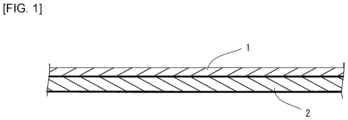
- FIG. 1 is a cross-sectional view schematically illustrating a laminated structure of a base material/adhesive layer integrated sheet for a flexible device of the present invention.
- a base material/adhesive layer integrated sheet for a flexible device of the present invention (hereinafter, also simply referred to as "integrated sheet of the present invention") has a structure formed by laminating a flexible film and an adhesive layer.
- an absolute value of a difference between surface free energy of the flexible film and surface free energy of a cured layer obtained by curing the adhesive layer is 30 dyn/cm or less. This can effectively enhance adhesion of a contact surface between the flexible film and the cured layer of the adhesive layer.
- the cured layer has a storage modulus of 5 GPa or less.
- the material, thickness, and the like of the flexible film constituting the integrated sheet of the present invention are not particularly limited as long as the flexible film has flexibility and can be used as a support base material of a flexible device. That is, a flexible film used for a flexible device can be widely applied.
- the storage modulus of the flexible film is preferably 10 GPa or less, more preferably 7 GPa or less, and still more preferably 5 GPa or less.
- the storage modulus is usually 0.01 GPa or more, also preferably 0.05 GPa or more, and also preferably 0.1 GPa or more.
- the storage modulus of the flexible film is a storage modulus at 23°C when the flexible film is cut into a width of 5 mm, and the temperature thereof is raised from -20°C to 150°C under a tensile condition of a distance between chucks of 20 mm and a frequency of 10 Hz and a temperature raising rate of 5°C/min using a dynamic viscoelasticity measurement apparatus RSAIII (manufactured by TA Instruments).
- the term "storage modulus” refers to a storage modulus at normal temperature (23°C).
- a material of the flexible film include a polyester resin, a polyimide resin, an acrylic resin (a polymethyl methacrylate (PMMA) resin and the like), a polycarbonate resin, an acrylonitrile/butadiene/styrene copolymer (ABS) resin, a polyolefin resin (a polypropylene resin, a polyethylene resin, and the like), a polyamide resin, a polyurethane resin, a polyvinyl alcohol (PVA) resin, a polystyrene resin, a polyphenylene sulfide (PPS) resin, and a polyether ether ketone (PEEK) resin.
- a polyester resin or a polyimide resin is preferable.
- the polyester resin include a polyethylene terephthalate resin and a polyethylene naphthalate resin.
- the thickness of the flexible film is usually 1 to 1,000 ⁇ m, preferably 5 to 800 ⁇ m, also preferably 5 to 400 ⁇ m, also preferably 5 to 200 ⁇ m, and also preferably 10 to 100 ⁇ m.
- the thickness can be measured by a contact type linear gauge method (desk-top contact type thickness measurement apparatus).
- the surface free energy is preferably 10 to 200 dyn/cm, more preferably 20 to 100 dyn/cm, also preferably 30 to 80 dyn/cm, also preferably 35 to 75 dyn/cm, also preferably 40 to 70 dyn/cm, also preferably 45 to 65 dyn/cm, and also preferably 48 to 62 dyn/cm.
- surface free energy is a value obtained by using the Owens and Wendt method, and is determined by measuring contact angles of a surface to be measured with respect to pure water and diiodomethane (droplet volume: 2 ⁇ L of pure water and 3 ⁇ L of diiodomethane, reading time: 30 seconds after dropping, measurement atmosphere: temperature 23°C and relative humidity 50%) and solving simultaneous expressions of the following Expression 1.
- solid surface in the following refers to a surface to be measured (a surface of a flexible film and a surface of a cured layer obtained by curing an adhesive layer).
- Expression (1) is Fowkes-Owens Expression that divides components of surface free energy and indicates that the surface free energy ⁇ s is a sum of a polar component ⁇ s p (only London force) of the surface free energy and a dispersion component ⁇ s d (including Debye force and hydrogen bonding force) of the surface free energy.
- the above Expressions (2a) and (2b) are relational expressions obtained by combining Young's Expression with a relational expression of an extended Fowkes model for interfacial tension ⁇ sl of an interface such as a solid s and a liquid I. Out of these expressions, Expression (2a) is a relational expression for pure water, and Expression (2b) is a relational expression for diiodomethane.
- a surface tension ⁇ I , a surface tension polar component ⁇ I p , and a surface tension dispersion component ⁇ I d of pure water are 72.8 mN/m, 51.0 mN/m, and 21.8 mN/m, respectively, and a surface tension ⁇ I , a surface tension polar component ⁇ I p , and a surface tension dispersion component ⁇ I d of diiodomethane are 50.8 mN/m, 2.3 mN/m, and 48.5 mN/m, respectively. Therefore, these values are incorporated into the above Expressions (2a) and (2b). Note that "dyn/cm" has the same meaning as "mN/m”.
- the surface free energy of the surface of the flexible film measured above can be regarded as surface free energy of the flexible film at a contact surface between the flexible film and the adhesive layer in the integrated sheet of the present invention.
- the surface free energy of the surface of the cured layer obtained by curing the adhesive layer, measured above can be regarded as surface free energy of the cured layer at a contact surface between the flexible film and the cured layer of the adhesive layer in the integrated sheet of the present invention.
- the polar component and the dispersion component of pure water are different from the polar component and the dispersion component of diiodomethane, respectively, and therefore surface tensions thereof are different from each other as described above.
- pure water and diiodomethane are different from each other in presence or absence of a hydrogen bond and a difference in electronegativity, and therefore the polarities thereof are largely different from each other.
- a hydrogen bond of -OH, -O-, or the like is strong, and the proportion of the polar component is large.
- the coefficient of linear expansion of the flexible film is preferably 10 to 200 ppm/K, more preferably 20 to 150 ppm/K, still more preferably 30 to 100 ppm/K, also preferably 40 to 80 ppm/K, also preferably 50 to 80 ppm/K, also preferably 55 to 75 ppm/K, and also preferably 58 to 72 ppm/K from a viewpoint of thermal stability.
- the coefficient of linear expansion is synonymous with a coefficient of linear thermal expansion.
- the coefficient of linear expansion is calculated from an elongation at 10 to 40°C when the temperature of a measurement sample obtained by cutting out the flexible film is raised from -20°C to 220°C at 5°C/min using a thermomechanical analyzer TMA/SS6100 (manufactured by Seiko Instruments Inc.).
- TMA/SS6100 thermomechanical analyzer
- the term "coefficient of linear expansion” means a coefficient of linear expansion in every direction.
- the adhesive layer constituting the integrated sheet of the present invention is cured by a curing reaction to exhibit adhesive strength to an adherend. That is, the adhesive layer is a layer made of a curable composition.
- the storage modulus of the cured layer after a curing reaction is 5.0 GPa or less.
- the storage modulus of the cured layer is preferably 4.5 GPa or less, more preferably 4.0 GPa or less, still more preferably 3.5 GPa or less, further still more preferably 3.0 GPa or less, further still more preferably 2.5 GPa or less, and further still more preferably 2.2 GPa or less.
- the storage modulus of the cured layer is usually 0.5 GPa or more, also preferably 0.7 GPa or more, also preferably 0.8 GPa or more, and also preferably 0.9 GPa or more.
- the storage modulus of the cured layer is preferably 0.5 to 5.0 GPa, more preferably 0.7 to 5.0 GPa or less, still more preferably 0.8 to 4.5 GPa, further still more preferably 0.8 to 4.0 GPa, further still more preferably 0.8 to 3.5 GPa, further still more preferably 0.8 to 3.0 GPa, further still more preferably 0.8 to 2.5 GPa, and further still more preferably 0.9 to 2.2 GPa.
- the storage modulus of the cured layer is determined as follows.
- the adhesive layer is peeled off from the integrated sheet, and only this adhesive layer is laminated at 70°C up to a thickness of 1 mm using a laminator, and cured under a condition (i) or (ii) described later.
- the obtained cured sample is cut into a width of 5 mm and used as a measurement sample.
- the temperature of the measurement sample is raised from -20°C to 150°C under a tensile condition of a distance between chucks of 20 mm and a frequency of 10 Hz and a temperature raising rate of 5°C/min using a dynamic viscoelasticity measurement apparatus RSAIII (manufactured by TA Instruments), and the storage modulus at 23°C is determined.
- RSAIII dynamic viscoelasticity measurement apparatus
- the storage modulus of the cured layer can be controlled by the chemical structure, type of functional group, functional group equivalent, content, and the like of a curable compound to be a constituent component of the adhesive layer (for example, the chemical structure and content of a compound having a cyclic ether group, the type of cyclic ether group, and a cyclic ether group equivalent), the chemical structure, molecular weight, glass transition temperature, content, and the like of a polymer component, and the type, content, and the like of a filler, a curing agent, or another additive in the adhesive layer.
- a curable compound to be a constituent component of the adhesive layer for example, the chemical structure and content of a compound having a cyclic ether group, the type of cyclic ether group, and a cyclic ether group equivalent
- the chemical structure, molecular weight, glass transition temperature, content, and the like of a polymer component and the type, content, and the like of a filler, a curing agent, or another additive
- cured layer means a cured layer obtained by causing the adhesive layer to undergo a curing reaction.
- this cured layer is a cured layer obtained by causing the adhesive layer to undergo a curing reaction under the following condition (i) or (ii) depending on the type of curing agent.
- each of the adhesive layer and the cured layer obtained by curing the adhesive layer is usually 1 to 100 ⁇ m, preferably 2 to 80 ⁇ m, also preferably 5 to 50 ⁇ m, also preferably 8 to 40 ⁇ m, and also preferably 10 to 30 ⁇ m.
- the surface free energy is preferably10 to 200 dyn/cm, more preferably 15 to 120 dyn/cm, also preferably 20 to 90 dyn/cm, also preferably 20 to 80 dyn/cm, also preferably 25 to 75 dyn/cm, and also preferably 28 to 70 dyn/cm.
- the storage modulus of the cured layer can be controlled by the chemical structure, type of functional group, functional group equivalent, content, and the like of a curable compound to be a constituent component of the adhesive layer (for example, the chemical structure and content of a compound having a cyclic ether group, the type of cyclic ether group, and a cyclic ether group equivalent), the chemical structure, molecular weight, glass transition temperature, content, and the like of a polymer component, and the type, content, and the like of a filler, a curing agent, or another additive in the adhesive layer.
- a curable compound to be a constituent component of the adhesive layer for example, the chemical structure and content of a compound having a cyclic ether group, the type of cyclic ether group, and a cyclic ether group equivalent
- the chemical structure, molecular weight, glass transition temperature, content, and the like of a polymer component and the type, content, and the like of a filler, a curing agent, or another additive
- an absolute value of a difference between surface free energy of the flexible film and surface free energy of a cured layer obtained by curing the adhesive layer (hereinafter, also simply referred to as "difference in surface free energy between layers”) is 30 dyn/cm or less.
- difference in surface free energy between layers is 30 dyn/cm or less.
- the difference in surface free energy between layers is usually 1 dyn/cm or more, also preferably 2 dyn/cm or more, also preferably 4 dyn/cm or more, and also preferably 6 dyn/cm or more.
- the difference in surface free energy between layers is preferably 1 to 30 dyn/cm, also preferably 2 to 28 dyn/cm, also preferably 4 to 28 dyn/cm, also preferably 6 to 28 dyn/cm, and also preferably 7 to 27 dyn/cm.
- the coefficient of linear expansion of the cured layer obtained by curing the adhesive layer is preferably 10 to 200 ppm/K, more preferably 20 to 150 ppm/K, still more preferably 25 to 100 ppm/K, also preferably 30 to 80 ppm/K, also preferably 40 to 80 ppm/K, also preferably 45 to 75 ppm/K, also preferably 46 to 70 ppm/K, and also preferably 47 to 65 ppm/K from a viewpoint of thermal stability.
- the coefficient of linear expansion of the cured layer is determined as follows.
- the adhesive layer is peeled off from the integrated sheet, and only this adhesive layer is laminated at 70°C up to a thickness of 1 mm using a laminator, and subsequently cured under the above condition (i) or (ii).
- a prismatic test piece having a length of 5 mm ⁇ a width of 5 mm ⁇ a thickness of 1 mm is cut out from the obtained cured sample and used as a measurement sample.
- the coefficient of linear expansion is calculated from an elongation at 10 to 40°C when the temperature of the measurement sample is raised from -20°C to 220°C at 5°C/min using a thermomechanical analyzer TMA/SS6100 (manufactured by Seiko Instruments Inc.).
- An absolute value of a difference between a coefficient of linear expansion of the flexible film and a coefficient of linear expansion of the cured layer obtained by curing the adhesive layer is preferably 30 ppm/K or less, more preferably 25 ppm/K or less, and still more preferably 20 ppm/K or less from a viewpoint of thermal stability.
- the difference in coefficient of linear expansion between layers is preferably as small as possible (the difference in coefficient of linear expansion between layers is particularly preferably 0 ppm/K), but is usually 1 ppm/K or more.
- the difference in coefficient of linear expansion between layers is preferably 1 to 30 ppm/K, preferably 1 to 25 ppm/K, also preferably 2 to 20 ppm/K, and also preferably 2 to 18 ppm/K.
- a component composition of the adhesive layer is not particularly limited as long as it satisfies the requirements specified in the present invention.
- a form of the adhesive layer include a form containing a compound having a cyclic ether group and a curing agent of the compound.
- the adhesive layer usually contains a polymer component (film component) separately from the compound having a cyclic ether group.
- the adhesive layer can contain other components as necessary for adjustment of surface free energy, elastic modulus, a coefficient of linear expansion, and the like. Constituent components of the adhesive layer will be described.
- the compound having a cyclic ether group is a compound having at least one (preferably 2 to 20, more preferably 2 to 10) cyclic ether group in a molecule thereof. Note that, in the present invention, even when the compound having a cyclic ether group is a polymer, the compound having a cyclic ether group is not classified as the polymer component but classified as the compound having a cyclic ether group. Therefore, a general epoxy resin is classified as the compound having a cyclic ether group. Note that a phenoxy resin described later is not included in the compound having a cyclic ether group. That is, the phenoxy resin described later is a polymer component.
- the compound having a cyclic ether group has a molecular weight of preferably 100 to 3,000, more preferably 200 to 1,500.
- the compound having a cyclic ether group has a cyclic ether equivalent of preferably 100 to 3,000 g/eq, also preferably 200 to 1,500 g/eq.
- Cyclic ether equivalent refers to the number of grams (g/eq) of a compound containing one gram equivalent of cyclic ether groups.
- the number of ring-constituting atoms of the cyclic ether group is preferably 3 or 4.
- the cyclic ether group include an oxirane group (epoxy group), an oxetane group (oxetanyl group), a tetrahydrofuryl group, and a tetrahydropyranyl group.
- an oxirane group or an oxetane group is preferable, and an oxirane group is more preferable. That is, the compound having a cyclic ether group is particularly preferably an epoxy resin.
- Examples of the skeleton of the epoxy resin include a phenol novolac type, an orthocresol novolac type, a cresol novolac type, a dicyclopentadiene type, a biphenyl type, a fluorene bisphenol type, a triazine type, a naphthol type, a naphthalene diol type, a triphenylmethane type, a tetraphenyl type, a bisphenol A type, a bisphenol F type, a bisphenol AD type, a bisphenol S type, and a trimethylolmethane type.
- a triphenylmethane type, a bisphenol A type, a cresol novolac type, and an orthocresol novolac type are preferable from a viewpoint of being capable of obtaining a film-like adhesive having low resin crystallinity and good appearance.
- the content of the compound having a cyclic ether group in a solid content (components other than a solvent) of the adhesive layer is preferably 10 to 70% by mass, preferably 15 to 65% by mass, more preferably 20 to 60% by mass, and still more preferably 22 to 55% by mass.
- a curing agent generally used as a curing agent of a compound having a cyclic ether group such as amines, acid anhydrides, polyhydric phenols, and a cationic polymerization initiator (preferably a photocationic polymerization initiator), can be widely used.
- an organic EL device is assumed as the flexible device, since an adherend to be bonded to the integrated sheet of the present invention is weak against heat, it may be unsuitable to use a thermal cationic polymerization initiator as the curing agent.
- the thermal cationic polymerization initiator tends to excessively increase the elastic modulus of a cured layer to be obtained, and it is not suitable to use the thermal cationic polymerization initiator as the curing agent also from this viewpoint. Therefore, the curing agent is preferably a photocationic polymerization initiation or a latent curing agent.
- latent curing agent examples include a dicyandiamide compound, an imidazole compound, a curing catalyst-complex polyhydric phenol compound, a hydrazide compound, a boron trifluoride-amine complex, an aminimide compound, a polyamine salt, and modified products or microcapsules thereof. These may be used singly, or in combination of two or more types thereof.
- Use of an imidazole compound is more preferable from a viewpoint of providing even better latency (properties of excellent stability at room temperature and exhibiting curability by heating) and providing a more rapid curing rate.
- the content of the curing agent in the adhesive layer only needs to be appropriately set according to the type and reaction form of the curing agent.
- the content can be 0.5 to 30 parts by mass, may be 1 to 20 parts by mass or 1 to 15 parts by mass, and is also preferably 2 to 10 parts by mass or also preferably 3 to 8 parts by mass with respect to 100 parts by mass of the compound having a cyclic ether group.
- the polymer component only needs to be a component that suppresses a film tack property at normal temperature (25°C) (property that the film state is likely to change by even a little temperature change) and imparts sufficient adhesiveness and film formability (film forming property).
- Examples thereof include a natural rubber, a butyl rubber, an isoprene rubber, a chloroprene rubber, an ethylene-vinyl acetate copolymer, an ethylene-(meth)acrylic acid copolymer, an ethylene-(meth)acrylic acid ester copolymer, a polybutadiene resin, a polycarbonate resin, a thermoplastic polyimide resin, polyamide resins such as 6-nylon and 6,6-nylon, a phenoxy resin, a (meth)acrylic resin, polyester resins such as polyethylene terephthalate and polybutylene terephthalate, a polyamideimide resin, a polyurethane resin, and a fluororesin. These polymer components may be used singly, or in combination of two or more types thereof.
- the phenoxy resin has a structure similar to that of a compound having a cyclic ether group, and thus is preferable as a polymer component from a viewpoint of good compatibility.
- the phenoxy resin can be obtained by a usual method.
- the phenoxy resin can be obtained by a reaction of a bisphenol or a biphenol compound with an epihalohydrin such as epichlorohydrin, or a reaction of a liquid epoxy resin with a bisphenol or a biphenol compound.
- a (meth)acrylic resin as the polymer component.
- the (meth)acrylic resin include a copolymer containing a (meth)acrylic acid or (meth)acrylic acid ester component as a constituent component of the polymer.
- Examples of a constituent component of the (meth)acrylic resin include components derived from 2-hydroxyethyl acrylate, 2-hydroxyethyl methacrylate, 2-hydroxypropyl acrylate, 2-hydroxypropyl methacrylate, acrylic acid, methacrylic acid, itaconic acid, glycidylmethacrylate, and glycidylacrylate.
- the (meth)acrylic resin may contain a (meth)acrylic acid ester (for example, a (meth)acrylic acid cycloalkyl ester, a (meth)acrylic acid benzyl ester, isobornyl (meth)acrylate, dicyclopentanyl (meth)acrylate, dicyclopentenyl (meth)acrylate, or dicyclopentenyloxyethyl (meth)acrylate) component having a cyclic skeleton as a constituent component.
- a (meth)acrylic acid ester for example, a (meth)acrylic acid cycloalkyl ester, a (meth)acrylic acid benzyl ester, isobornyl (meth)acrylate, dicyclopentanyl (meth)acrylate, dicyclopentenyl (meth)acrylate, or dicyclopentenyloxyethyl (meth)acrylate
- the (meth)acrylic resin can contain an imide (meth)acrylate component or a C 1-18 (meth)acrylic acid alkyl ester (for example, methyl (meth)acrylate, ethyl (meth)acrylate, propyl (meth)acrylate, or butyl (meth)acrylate) component.
- the (meth)acrylic resin may contain a copolymer with vinyl acetate, (meth)acrylonitrile, styrene, or the like.
- the (meth)acrylic resin preferably has a hydroxy group from a viewpoint of compatibility with a compound having a cyclic ether group.
- the polymer component usually has a mass average molecular weight of 10,000 or more.
- the upper limit is not particularly limited, but is practically 5,000,000 or less.
- the mass average molecular weight of the polymer component is a value determined by GPC (Gel Permeation Chromatography) in terms of polystyrene.
- the polymer component has glass transition temperature (Tg) of preferably 100°C or lower, more preferably 90°C or lower.
- Tg of the polymer component is preferably -30°C or higher, also preferably -10°C or higher, also preferably 0°C or higher, also preferably 10°C or higher, and also preferably 20°C or higher, and may be 30°C or higher, 40°C or higher, 50°C or higher, or 60°C or higher.
- Tg of the polymer component is preferably -30 to 100°C, also preferably -10 to 100°C, also preferably 0 to 100°C, also preferably 10 to 90°C, also preferably 20 to 90°C, also preferably 30 to 90°C, also preferably 40 to 90°C, also preferably 50 to 90°C, and also preferably 60 to 90°C.
- Tg of the polymer component is a peak top temperature of tan ⁇ in dynamic viscoelasticity measurement. Specifically, Tg can be determined as follows.
- a solution obtained by dissolving the polymer component therein is applied onto a release film, and heated and dried to form a film (polymer film) made of the polymer component on the release film.
- the release film is peeled off and removed from this polymer film.
- This polymer film is measured by using a dynamic viscoelasticity measurement apparatus (trade name: Rheogel-E4000F, manufactured by UBM) under a condition of a measurement temperature range of 20 to 300°C, a temperature raising rate of 5°C/min, and a frequency of 1 Hz.
- the obtained tan ⁇ peak top temperature (temperature at which tan ⁇ indicates maximum) is defined as Tg.
- the content of the polymer component in the adhesive layer can be 10 to 300 parts by mass, may be 20 to 200 parts by mass or 40 to 180 parts by mass, and is also preferably 60 to 160 parts by mass, also preferably 70 to 140 parts by mass, or also preferably 80 to 130 parts by mass with respect to 100 parts by mass of the compound having a cyclic ether group.
- the adhesive layer may contain an inorganic filler.
- the inorganic filler include various inorganic powders made of ceramics such as silica, clay, gypsum, calcium carbonate, barium sulfate, alumina (aluminum oxide), beryllium oxide, magnesium oxide, silicon carbide, silicon nitride, aluminum nitride, and boron nitride; a metal or alloys, such as aluminum, copper, silver, gold, nickel, chromium, lead, tin, zinc, palladium, and solder; and carbons such as carbon nanotube and graphene.
- the inorganic filler may be subjected to surface treatment or surface modification.
- surface treatment or surface modification include a silane coupling agent, phosphoric acid, a phosphoric acid compound, and a surfactant.
- Examples of the shape of the inorganic filler include a flake shape, a needle shape, a filament shape, a spherical shape, and a scale shape, but a spherical particle is preferable from a viewpoint of achieving higher filling and fluidity.
- the content of the inorganic filler in the adhesive layer is preferably 70% by mass or less, more preferably 60% by mass or less, also preferably 50% by mass or less, and also preferably 40% by mass or less.
- the content of the inorganic filler in the adhesive layer can be 1% by mass or more, may be 2% by mass or more, and is also preferably 4% by mass or more.
- the content of the inorganic filler in the adhesive layer can be 1 to 70% by mass, 2 to 60% by mass, or 4 to 50% by mass, and is also preferably 4 to 40% by mass.
- the adhesive layer may contain a silane coupling agent separately from the inorganic filler.
- the silane coupling agent is a compound in which at least one hydrolyzable group such as an alkoxy group or an aryloxy group is bonded to a silicon atom.
- an alkyl group, an alkenyl group, or an aryl group may be bonded to the silicon atom.
- the alkyl group is preferably an alkyl group substituted with an amino group, an alkoxy group, an epoxy group, or a (meth)acryloyloxy group, and more preferably an alkyl group substituted with an amino group (preferably, a phenylamino group), an alkoxy group (preferably, a glycidyloxy group), or a (meth)acryloyloxy group.
- silane coupling agent examples include 2-(3,4-epoxycyclohexyl) ethyltrimethoxysilane, 3-glycidyloxypropyltrimethoxysilane, 3-glycidyloxypropyltriethoxysilane, 3-glycidyloxypropylmethyldimethoxysilane, 3-glycidyloxypropylmethyldiethoxysilane, dimethyldimethoxysilane, dimethyldiethoxysilane, methyltrimethoxysilane, methyltriethoxysilane, phenyltrimethoxysilane, phenyltriethoxysilane, N-phenyl-3-aminopropyltrimethoxysilane, 3-methacryloyloxypropylmethyldimethoxysilane, 3-methacryloyloxypropyltrimethoxysilane, 3-methacryloyloxypropylmethyldiethoxysilane, and 3-me
- the adhesive layer may further contain an organic solvent, an ion trapping agent (ion capturing agent), a curing catalyst, a viscosity adjusting agent, an antioxidant, a flame retardant, a coloring agent, and the like.
- the adhesive layer can contain, for example, other additives described in WO 2017/158994 A .
- the total proportion of the contents of the compound having a cyclic ether group, the curing agent thereof, and the polymer component in the adhesive layer can be, for example, 30% by mass or more, and is preferably 40% by mass or more and more preferably 50% by mass or more.
- the proportion may be 60% by mass or more, 70% by mass or more, 80% by mass or more, or 90% by mass or more.
- the integrated sheet of the present invention can be formed by preparing a composition (varnish) obtained by mixing the constituent components of the adhesive layer, applying the composition onto a flexible film, and drying the composition as necessary.
- the composition (varnish) obtained by mixing the constituent components of the adhesive layer usually contains an organic solvent.
- a publicly known method can be appropriately employed as an application method, and examples thereof include methods using a roll knife coater, a gravure coater, a die coater, a reverse coater, and the like.
- Drying only needs to be able to form the adhesive layer by removing the organic solvent without substantially causing a curing reaction, and can be performed, for example, by holding the composition at a temperature of 80 to 150°C for 1 to 20 minutes.
- the integrated sheet of the present invention may have a configuration including a flexible film and an adhesive layer, or may be in a form in which the above-described release-treated base material film is bonded to a surface of the adhesive layer on a side opposite to the flexible film side.
- a protective film or the like may be formed on a surface of the flexible film on a side opposite to the adhesive layer side.
- the integrated sheet of the present invention may be in a form obtained by cutting the sheet into an appropriate size or a form obtained by winding the sheet into a roll form.
- the integrated sheet of the present invention is preferably stored under a temperature condition of 10°C or lower before use (before curing reaction) from a viewpoint of suppressing a curing reaction of the adhesive layer (curing reaction of the compound having a cyclic ether group).
- the flexible film constituting the integrated sheet can be used as a support base material (back plate) that supports the entire flexible device, and the adhesive layer of the integrated sheet can function as a layer for bonding the support base material to a laminate including a functional element thereon (a laminate of a functional element and various functional layers disposed on one surface or both surfaces of the functional element). Therefore, the method of producing a flexible device of the present invention includes a step of forming a support base material of a flexible device with the integrated sheet of the present invention, that is, a step of bonding the adhesive layer side of the integrated sheet of the present invention to a laminate including a functional element and causing the adhesive layer to undergo a curing reaction.
- Conditions for this curing reaction can be appropriately set in consideration of the type of curing agent, heat resistance of the functional element, and the like.
- the adhesive layer can be sufficiently cured by irradiating the adhesive layer with ultraviolet rays of 100 to 3,000 mJ/cm 2 using a mercury lamp or the like.
- the adhesive layer can be sufficiently cured by heating the adhesive layer at a temperature of 150°C or higher for one hour or more.
- the present invention will be described in more detail based on Examples and Comparative Examples. However, the present invention is not limited to forms of the following Examples.
- the room temperature means 25°C
- MEK means methyl ethyl ketone
- PET means polyethylene terephthalate
- UV means ultraviolet rays.
- % and "part” are on a mass basis unless otherwise specified.
- this resin varnish was transferred to a 800 mL planetary mixer, 2 parts by mass of WPI-113 (UV cationic polymerization initiator, manufactured by FUJIFILM Wako Pure Chemical Corporation) was added thereto as a curing agent, and the mixture was stirred and mixed at room temperature for one hour and then vacuum-defoamed to obtain a mixed varnish. Subsequently, the obtained mixed varnish was applied onto a PET film (flexible film, storage modulus at 23°C: 5 GPa) having a thickness of 20 ⁇ m, and heated and dried at 130°C for 10 minutes to obtain an integrated sheet having a length of 300 mm, a width of 200 mm, and a thickness of an adhesive layer of 20 ⁇ m.
- WPI-113 UV cationic polymerization initiator, manufactured by FUJIFILM Wako Pure Chemical Corporation
- Example 1 An integrated sheet was obtained in a similar manner to Example 1 except that the curing agent was replaced with 2 parts by mass of 2E4MZ (imidazole-based thermosetting agent, manufactured by Shikoku Chemicals Corporation) in Example 1.
- 2E4MZ imidazole-based thermosetting agent, manufactured by Shikoku Chemicals Corporation
- Example 2 An integrated sheet was obtained in a similar manner to Example 1 except that 1 part by mass of KBM-402 (silane coupling agent, manufactured by Shin-Etsu Chemical Co., Ltd.) was added to the mixed varnish in Example 1.
- KBM-402 silane coupling agent, manufactured by Shin-Etsu Chemical Co., Ltd.
- Example 2 An integrated sheet was obtained in a similar manner to Example 2 except that 1 part by mass of KBM-402 (silane coupling agent, manufactured by Shin-Etsu Chemical Co., Ltd.) was added to the mixed varnish in Example 2.
- KBM-402 silane coupling agent, manufactured by Shin-Etsu Chemical Co., Ltd.
- Example 2 An integrated sheet was obtained in a similar manner to Example 1 except that 10 parts by mass of SIRMEK50WT%-M01 (silica slurry filler, manufactured by CIK Nanotech Co., Ltd.) was added to the mixed varnish in Example 1.
- SIRMEK50WT%-M01 sica slurry filler, manufactured by CIK Nanotech Co., Ltd.
- An integrated sheet was obtained in a similar manner to Example 2 except that 80 parts by mass of SIRMEK50WT%-M01 (silica slurry filler, manufactured by CIK Nanotech Co., Ltd.) and 1 part by mass of KBM-402 (silane coupling agent, manufactured by Shin-Etsu Chemical Co., Ltd.) were added to the mixed varnish in Example 2.
- SIRMEK50WT%-M01 sica slurry filler, manufactured by CIK Nanotech Co., Ltd.
- KBM-402 silane coupling agent, manufactured by Shin-Etsu Chemical Co., Ltd.
- Example 2 An integrated sheet was obtained in a similar manner to Example 1 except that the compound having a cyclic ether group was replaced with 50 parts by mass of EPPN-501H (triphenylmethane type epoxy resin, manufactured by Nippon Kayaku Co., Ltd.) in Example 1.
- EPPN-501H triphenylmethane type epoxy resin, manufactured by Nippon Kayaku Co., Ltd.
- Example 2 An integrated sheet was obtained in a similar manner to Example 2 except that the compound having a cyclic ether group was replaced with a mixture of 25 parts by mass of 828 (bisphenol A type liquid epoxy resin, manufactured by Mitsubishi Chemical Corporation) and 25 parts by mass of EPPN-501H (triphenylmethane type epoxy resin, manufactured by Nippon Kayaku Co., Ltd.) in Example 2.
- 828 bisphenol A type liquid epoxy resin, manufactured by Mitsubishi Chemical Corporation
- EPPN-501H triphenylmethane type epoxy resin, manufactured by Nippon Kayaku Co., Ltd.
- Example 2 An integrated sheet was obtained in a similar manner to Example 1 except that 300 parts by mass of SIRMEK50WT%-M01 (silica slurry filler, manufactured by CIK Nanotech Co., Ltd.) was added to the mixed varnish in Example 1.
- SIRMEK50WT%-M01 sica slurry filler, manufactured by CIK Nanotech Co., Ltd.
- An integrated sheet was obtained in a similar manner to Example 4 except that 450 parts by mass of SIRMEK50WT%-M01 (silica slurry filler, manufactured by CIK Nanotech Co., Ltd.) was added to the mixed varnish in Example 4.
- An integrated sheet was obtained in a similar manner to Example 1 except that 1 part by mass of KY-1271 (fluorine compound, manufactured by Shin-Etsu Chemical Co., Ltd.) was added to the mixed varnish in Example 1.
- KY-1271 fluorine compound, manufactured by Shin-Etsu Chemical Co., Ltd.
- Example 7 An integrated sheet was obtained in a similar manner to Example 7 except that the polymer component was replaced with 50 parts by mass of YX7200B35 (phenoxy resin, Tg 150°C, manufactured by Mitsubishi Chemical Corporation) in Example 7.
- YX7200B35 phenoxy resin, Tg 150°C, manufactured by Mitsubishi Chemical Corporation
- Example 7 An integrated sheet was obtained in a similar manner to Example 7 except that the curing agent was replaced with 2 parts by mass of SI-B3 (thermal cationic polymerization initiator, manufactured by Sanshin Chemical Industry Co., Ltd.) in Example 7.
- SI-B3 thermal cationic polymerization initiator, manufactured by Sanshin Chemical Industry Co., Ltd.
- the integrated sheet was cut into a width of 25 mm and a length of 10 cm, and the adhesive layer was caused to undergo a curing reaction under the curing condition (i) or (ii) described above to obtain a test piece.
- the adhesive layer was set on a side opposite to the mandrel based on an intermediate point in the longitudinal direction, and an operation of bending the test piece by 180° was repeated 1,000 times.
- the diameter (mm) of the mandrel in which breakage of the adhesive layer, a fold mark of the adhesive layer, or peeling between the adhesive layer and the flexible film occurred was applied to the following evaluation criteria, and flex resistance was evaluated. The results are shown in Table 1.
Landscapes
- Chemical & Material Sciences (AREA)
- Organic Chemistry (AREA)
- Physics & Mathematics (AREA)
- General Physics & Mathematics (AREA)
- Engineering & Computer Science (AREA)
- Theoretical Computer Science (AREA)
- Chemical Kinetics & Catalysis (AREA)
- Adhesives Or Adhesive Processes (AREA)
- Devices For Indicating Variable Information By Combining Individual Elements (AREA)
- Adhesive Tapes (AREA)
- Laminated Bodies (AREA)
Abstract
a method of producing a flexible device with the same.
Description
- The present invention relates to a base material/adhesive layer integrated sheet for a flexible device and a method of producing a flexible device.
- A flexible device such as a flexible display is produced by forming semiconductor elements such as an organic electroluminescence (organic EL) element, a liquid crystal panel, a micro light emitting diode (micro LED), and a transistor (these are collectively referred to as a functional element) on a flexible support base material (flexible film). Recently, in application to a display of a mobile terminal such as a smartphone, a phablet, or a tablet, a foldable flexible device that can be folded or rolled is required.
- As described above, such a flexible device includes a flexible film (back plate) as a support base material that supports the entire device in order to increase the strength of a device main body and impart reliability. That is, the functional element is fixed onto the flexible film, and the flexible device is produced. On both surfaces of the functional element, various functional layers (for example, a protective layer, a gas barrier layer (sealing layer), a polarizing plate, and a hard coat layer) are usually laminated, and the entire laminate including the functional element is integrally disposed on the flexible film and fixed via a paste-like or film-like adhesive. As the flexible film, a polyethylene terephthalate film, a polyimide film, or the like is used.
- In production of a flexible device, an adhesive sheet used for adhesion between layers of a laminated structure has been proposed. For example, Patent Literature 1 describes an adhesive sheet for sealing a device, including a first release film, a second release film, and an adhesive layer sandwiched therebetween. This adhesive layer contains a compound having a cyclic ether group, and a storage modulus thereof at 23°C is adjusted to 9.5 × 10⁵ Pa or more and 3.0 × 10⁷ Pa or less. According to the technique described in Patent Literature 1, peelability of the release film from the adhesive layer is excellent even when the adhesive sheet is cut, and this adhesive layer is also excellent in adhesiveness to an adherend.
- Patent Literature 1:
WO 2020/251030 A - As described in Patent Literature 1, an adhesive sheet used for adhesion between layers of a flexible device is used as an adhesive film having adhesiveness on both surfaces thereof by forming release films on both surfaces of an adhesive layer and peeling the release films on the both surfaces at the time of use. For example, in a case where a functional element is formed on a flexible film as the support base material, a two-step process is performed in which the release films are peeled off from the adhesive sheet, the flexible film is bonded to one surface of the adhesive layer, and the laminate including the functional element is bonded to the other surface. In this case, depending on a combination of the flexible film and the adhesive layer, when the adhesive layer is cured, peeling easily occurs between the flexible film and the adhesive layer at the time of bending. If peeling occurs between the flexible film and the adhesive layer, reliability of the device is largely reduced.
- The present invention provides a base material/adhesive layer integrated sheet for a flexible device, formed by laminating a flexible film and an adhesive layer, having excellent adhesiveness (adhesiveness due to a curing reaction) between the flexible film and the adhesive layer, and capable of being directly bonded to a laminate including a functional element as a support base material for a flexible device. In addition, the present invention provides a method of producing a flexible device, capable of simplifying a flexible device producing process and further improving quality of a flexible device to be obtained.
- The above problems of the present invention have been solved by the following means.
- [1] A base material/adhesive layer integrated sheet for a flexible device, containing:
- a flexible film; and
- an adhesive layer;
- wherein the flexible film and the adhesive layer are laminated;
- wherein an absolute value of a difference between surface free energy of the flexible film and surface free energy of a cured layer obtained by curing the adhesive layer is 30 dyn/cm or less, and
- wherein the cured layer has a storage modulus of 5.0 GPa or less.
- [2] The base material/adhesive layer integrated sheet for a flexible device described in [1], wherein an absolute value of a difference between a coefficient of linear expansion of the flexible film and a coefficient of linear expansion of the cured layer is 25 ppm/K or less.
- [3] The base material/adhesive layer integrated sheet for a flexible device described in [1] or [2], wherein the adhesive layer contains at least a compound having a cyclic ether group, a curing agent of the compound, and a polymer component.
- [4] The base material/adhesive layer integrated sheet for a flexible device described in any one of [1] to [3], wherein the adhesive layer or the cured layer has a thickness of 1 to 100 µm.
- [5] The base material/adhesive layer integrated sheet for a flexible device described in any one of [1] to [4], wherein the flexible device is a flexible display.
- [6] A method of producing a flexible device, including forming a support base material of the flexible device with the base material/adhesive layer integrated sheet for a flexible device described in any one of [1] to [5].
- [7] The method of producing a flexible device described in [6], wherein the flexible device is a flexible display.
- In the present invention, the numerical ranges expressed with the term "to" refer to ranges including, as the lower limit and the upper limit, the numerical values before and after the term "to".
- In the present invention, for the terms "upper" and "lower" of the laminated structure, the flexible film side is used as "lower" and the adhesive layer side is used as "upper" for convenience.
- A base material/adhesive layer integrated sheet for a flexible device of the present invention has a laminated structure of a flexible film applicable as a support base material of a flexible device and an adhesive layer, and as a support base material of a flexible device, can be directly bonded to a laminate including a functional element via the adhesive layer, and is also excellent in adhesiveness (adhesiveness due to curing reaction) between the flexible film and the adhesive layer. That is, the base material/adhesive layer integrated sheet for a flexible device of the present invention contributes to simplification of a flexible device producing process and also contributes to improvement of quality of a flexible device to be obtained.
- In addition, according to a method of producing a flexible device of the present invention, the flexible device producing process can be simplified, and the quality of a flexible device to be obtained can be further improved.
- {
FIG. 1 }
FIG. 1 is a cross-sectional view schematically illustrating a laminated structure of a base material/adhesive layer integrated sheet for a flexible device of the present invention. - A base material/adhesive layer integrated sheet for a flexible device of the present invention (hereinafter, also simply referred to as "integrated sheet of the present invention") has a structure formed by laminating a flexible film and an adhesive layer. In the integrated sheet of the present invention, an absolute value of a difference between surface free energy of the flexible film and surface free energy of a cured layer obtained by curing the adhesive layer is 30 dyn/cm or less. This can effectively enhance adhesion of a contact surface between the flexible film and the cured layer of the adhesive layer. The cured layer has a storage modulus of 5 GPa or less.
- With such a configuration, even when the integrated sheet is repeatedly bent after the adhesive layer of the integrated sheet is caused to undergo a curing reaction, it is possible to effectively suppress breakage of the cured layer, a fold mark of the cured layer, peeling between the cured layer and the flexible film, and the like. Therefore, by using the integrated sheet of the present invention as a support base material of a flexible device, reliability (structural stability and the like) of the flexible device can be further enhanced.
- The flexible film and the adhesive layer constituting the integrated sheet of the present invention will be described in order.
- The material, thickness, and the like of the flexible film constituting the integrated sheet of the present invention are not particularly limited as long as the flexible film has flexibility and can be used as a support base material of a flexible device. That is, a flexible film used for a flexible device can be widely applied.
- The storage modulus of the flexible film is preferably 10 GPa or less, more preferably 7 GPa or less, and still more preferably 5 GPa or less. The storage modulus is usually 0.01 GPa or more, also preferably 0.05 GPa or more, and also preferably 0.1 GPa or more. The storage modulus of the flexible film is a storage modulus at 23°C when the flexible film is cut into a width of 5 mm, and the temperature thereof is raised from -20°C to 150°C under a tensile condition of a distance between chucks of 20 mm and a frequency of 10 Hz and a temperature raising rate of 5°C/min using a dynamic viscoelasticity measurement apparatus RSAIII (manufactured by TA Instruments).
- In the present invention, the term "storage modulus" refers to a storage modulus at normal temperature (23°C).
- Preferable examples of a material of the flexible film include a polyester resin, a polyimide resin, an acrylic resin (a polymethyl methacrylate (PMMA) resin and the like), a polycarbonate resin, an acrylonitrile/butadiene/styrene copolymer (ABS) resin, a polyolefin resin (a polypropylene resin, a polyethylene resin, and the like), a polyamide resin, a polyurethane resin, a polyvinyl alcohol (PVA) resin, a polystyrene resin, a polyphenylene sulfide (PPS) resin, and a polyether ether ketone (PEEK) resin. Among these materials, a polyester resin or a polyimide resin is preferable. Preferable examples of the polyester resin include a polyethylene terephthalate resin and a polyethylene naphthalate resin.
- The thickness of the flexible film is usually 1 to 1,000 µm, preferably 5 to 800 µm, also preferably 5 to 400 µm, also preferably 5 to 200 µm, and also preferably 10 to 100 µm. The thickness can be measured by a contact type linear gauge method (desk-top contact type thickness measurement apparatus).
- In a contact surface of the flexible film with the adhesive layer thereon, the surface free energy is preferably 10 to 200 dyn/cm, more preferably 20 to 100 dyn/cm, also preferably 30 to 80 dyn/cm, also preferably 35 to 75 dyn/cm, also preferably 40 to 70 dyn/cm, also preferably 45 to 65 dyn/cm, and also preferably 48 to 62 dyn/cm.
- In the present invention, "surface free energy " is a value obtained by using the Owens and Wendt method, and is determined by measuring contact angles of a surface to be measured with respect to pure water and diiodomethane (droplet volume: 2 µL of pure water and 3 µL of diiodomethane, reading time: 30 seconds after dropping, measurement atmosphere: temperature 23°C and relative humidity 50%) and solving simultaneous expressions of the following Expression 1. Note that "solid surface" in the following refers to a surface to be measured (a surface of a flexible film and a surface of a cured layer obtained by curing an adhesive layer).
-

- γs = Surface free energy
- γs p = Polar component of surface free energy
- γs d = Dispersion component of surface free energy
- θI H = Contact angle of pure water with respect to solid surface
- θI I = Contact angle of diiodomethane (CH2I2) with respect to the solid surface
- Here, Expression (1) is Fowkes-Owens Expression that divides components of surface free energy and indicates that the surface free energy γs is a sum of a polar component γs p (only London force) of the surface free energy and a dispersion component γs d (including Debye force and hydrogen bonding force) of the surface free energy. The above Expressions (2a) and (2b) are relational expressions obtained by combining Young's Expression with a relational expression of an extended Fowkes model for interfacial tension γsl of an interface such as a solid s and a liquid I. Out of these expressions, Expression (2a) is a relational expression for pure water, and Expression (2b) is a relational expression for diiodomethane.
- A surface tension λI, a surface tension polar component γI p, and a surface tension dispersion component γI d of pure water are 72.8 mN/m, 51.0 mN/m, and 21.8 mN/m, respectively, and a surface tension γI, a surface tension polar component γI p, and a surface tension dispersion component γI d of diiodomethane are 50.8 mN/m, 2.3 mN/m, and 48.5 mN/m, respectively. Therefore, these values are incorporated into the above Expressions (2a) and (2b). Note that "dyn/cm" has the same meaning as "mN/m".
- Here, the surface free energy of the surface of the flexible film measured above can be regarded as surface free energy of the flexible film at a contact surface between the flexible film and the adhesive layer in the integrated sheet of the present invention. Similarly, the surface free energy of the surface of the cured layer obtained by curing the adhesive layer, measured above can be regarded as surface free energy of the cured layer at a contact surface between the flexible film and the cured layer of the adhesive layer in the integrated sheet of the present invention.
- Note that the polar component and the dispersion component of pure water are different from the polar component and the dispersion component of diiodomethane, respectively, and therefore surface tensions thereof are different from each other as described above. This is because pure water and diiodomethane are different from each other in presence or absence of a hydrogen bond and a difference in electronegativity, and therefore the polarities thereof are largely different from each other. In particular, in a case of water, a hydrogen bond of -OH, -O-, or the like is strong, and the proportion of the polar component is large.
- The coefficient of linear expansion of the flexible film is preferably 10 to 200 ppm/K, more preferably 20 to 150 ppm/K, still more preferably 30 to 100 ppm/K, also preferably 40 to 80 ppm/K, also preferably 50 to 80 ppm/K, also preferably 55 to 75 ppm/K, and also preferably 58 to 72 ppm/K from a viewpoint of thermal stability.
- In the present invention, the coefficient of linear expansion is synonymous with a coefficient of linear thermal expansion. The coefficient of linear expansion is calculated from an elongation at 10 to 40°C when the temperature of a measurement sample obtained by cutting out the flexible film is raised from -20°C to 220°C at 5°C/min using a thermomechanical analyzer TMA/SS6100 (manufactured by Seiko Instruments Inc.). Note that, in the present invention, the term "coefficient of linear expansion" means a coefficient of linear expansion in every direction.
- The adhesive layer constituting the integrated sheet of the present invention is cured by a curing reaction to exhibit adhesive strength to an adherend. That is, the adhesive layer is a layer made of a curable composition.
- In the adhesive layer, the storage modulus of the cured layer after a curing reaction is 5.0 GPa or less. By setting the storage modulus to 5.0 GPa or less, it is possible to make peeling less likely to occur due to bending of the flexible device. The storage modulus of the cured layer is preferably 4.5 GPa or less, more preferably 4.0 GPa or less, still more preferably 3.5 GPa or less, further still more preferably 3.0 GPa or less, further still more preferably 2.5 GPa or less, and further still more preferably 2.2 GPa or less. In addition, the storage modulus of the cured layer is usually 0.5 GPa or more, also preferably 0.7 GPa or more, also preferably 0.8 GPa or more, and also preferably 0.9 GPa or more. The storage modulus of the cured layer is preferably 0.5 to 5.0 GPa, more preferably 0.7 to 5.0 GPa or less, still more preferably 0.8 to 4.5 GPa, further still more preferably 0.8 to 4.0 GPa, further still more preferably 0.8 to 3.5 GPa, further still more preferably 0.8 to 3.0 GPa, further still more preferably 0.8 to 2.5 GPa, and further still more preferably 0.9 to 2.2 GPa.
- The storage modulus of the cured layer is determined as follows. The adhesive layer is peeled off from the integrated sheet, and only this adhesive layer is laminated at 70°C up to a thickness of 1 mm using a laminator, and cured under a condition (i) or (ii) described later. The obtained cured sample is cut into a width of 5 mm and used as a measurement sample. As described above, the temperature of the measurement sample is raised from -20°C to 150°C under a tensile condition of a distance between chucks of 20 mm and a frequency of 10 Hz and a temperature raising rate of 5°C/min using a dynamic viscoelasticity measurement apparatus RSAIII (manufactured by TA Instruments), and the storage modulus at 23°C is determined.
- The storage modulus of the cured layer can be controlled by the chemical structure, type of functional group, functional group equivalent, content, and the like of a curable compound to be a constituent component of the adhesive layer (for example, the chemical structure and content of a compound having a cyclic ether group, the type of cyclic ether group, and a cyclic ether group equivalent), the chemical structure, molecular weight, glass transition temperature, content, and the like of a polymer component, and the type, content, and the like of a filler, a curing agent, or another additive in the adhesive layer.
- In the present invention, "cured layer" means a cured layer obtained by causing the adhesive layer to undergo a curing reaction. When characteristics of the cured layer are specified or described in the present invention, this cured layer is a cured layer obtained by causing the adhesive layer to undergo a curing reaction under the following condition (i) or (ii) depending on the type of curing agent.
- (i) When the curing agent is a photocationic polymerization initiator:
a cured layer obtained by irradiation with ultraviolet rays at 25°C under an irradiation condition of 1,000 mJ/cm2 using a mercury lamp. - (ii) When the curing agent is a latent curing agent or a thermal cationic polymerization initiator:
a cured layer obtained by heat treatment at 150°C for one hour. - The thickness of each of the adhesive layer and the cured layer obtained by curing the adhesive layer is usually 1 to 100 µm, preferably 2 to 80 µm, also preferably 5 to 50 µm, also preferably 8 to 40 µm, and also preferably 10 to 30 µm.
- In a contact surface of the cured layer obtained by curing the adhesive layer with the flexible film thereunder, the surface free energy is preferably10 to 200 dyn/cm, more preferably 15 to 120 dyn/cm, also preferably 20 to 90 dyn/cm, also preferably 20 to 80 dyn/cm, also preferably 25 to 75 dyn/cm, and also preferably 28 to 70 dyn/cm.
- The storage modulus of the cured layer can be controlled by the chemical structure, type of functional group, functional group equivalent, content, and the like of a curable compound to be a constituent component of the adhesive layer (for example, the chemical structure and content of a compound having a cyclic ether group, the type of cyclic ether group, and a cyclic ether group equivalent), the chemical structure, molecular weight, glass transition temperature, content, and the like of a polymer component, and the type, content, and the like of a filler, a curing agent, or another additive in the adhesive layer.
- In the integrated sheet of the present invention, an absolute value of a difference between surface free energy of the flexible film and surface free energy of a cured layer obtained by curing the adhesive layer (hereinafter, also simply referred to as "difference in surface free energy between layers") is 30 dyn/cm or less. By setting the difference in surface free energy between layers to 30 dyn/cm or less, adhesiveness between the flexible film and the adhesive layer can be further enhanced. The difference in surface free energy between layers is more preferably 28 dyn/cm or less. In addition, the difference in surface free energy between layers is usually 1 dyn/cm or more, also preferably 2 dyn/cm or more, also preferably 4 dyn/cm or more, and also preferably 6 dyn/cm or more. The difference in surface free energy between layers is preferably 1 to 30 dyn/cm, also preferably 2 to 28 dyn/cm, also preferably 4 to 28 dyn/cm, also preferably 6 to 28 dyn/cm, and also preferably 7 to 27 dyn/cm.
- The coefficient of linear expansion of the cured layer obtained by curing the adhesive layer is preferably 10 to 200 ppm/K, more preferably 20 to 150 ppm/K, still more preferably 25 to 100 ppm/K, also preferably 30 to 80 ppm/K, also preferably 40 to 80 ppm/K, also preferably 45 to 75 ppm/K, also preferably 46 to 70 ppm/K, and also preferably 47 to 65 ppm/K from a viewpoint of thermal stability.
- The coefficient of linear expansion of the cured layer is determined as follows. The adhesive layer is peeled off from the integrated sheet, and only this adhesive layer is laminated at 70°C up to a thickness of 1 mm using a laminator, and subsequently cured under the above condition (i) or (ii). A prismatic test piece having a length of 5 mm × a width of 5 mm × a thickness of 1 mm is cut out from the obtained cured sample and used as a measurement sample. As described above, the coefficient of linear expansion is calculated from an elongation at 10 to 40°C when the temperature of the measurement sample is raised from -20°C to 220°C at 5°C/min using a thermomechanical analyzer TMA/SS6100 (manufactured by Seiko Instruments Inc.).
- An absolute value of a difference between a coefficient of linear expansion of the flexible film and a coefficient of linear expansion of the cured layer obtained by curing the adhesive layer (hereinafter, also simply referred to as "difference in coefficient of linear expansion between layers") is preferably 30 ppm/K or less, more preferably 25 ppm/K or less, and still more preferably 20 ppm/K or less from a viewpoint of thermal stability. The difference in coefficient of linear expansion between layers is preferably as small as possible (the difference in coefficient of linear expansion between layers is particularly preferably 0 ppm/K), but is usually 1 ppm/K or more. The difference in coefficient of linear expansion between layers is preferably 1 to 30 ppm/K, preferably 1 to 25 ppm/K, also preferably 2 to 20 ppm/K, and also preferably 2 to 18 ppm/K.
- A component composition of the adhesive layer is not particularly limited as long as it satisfies the requirements specified in the present invention. Preferable examples of a form of the adhesive layer include a form containing a compound having a cyclic ether group and a curing agent of the compound. In this case, the adhesive layer usually contains a polymer component (film component) separately from the compound having a cyclic ether group. In addition, the adhesive layer can contain other components as necessary for adjustment of surface free energy, elastic modulus, a coefficient of linear expansion, and the like. Constituent components of the adhesive layer will be described.
- The compound having a cyclic ether group is a compound having at least one (preferably 2 to 20, more preferably 2 to 10) cyclic ether group in a molecule thereof. Note that, in the present invention, even when the compound having a cyclic ether group is a polymer, the compound having a cyclic ether group is not classified as the polymer component but classified as the compound having a cyclic ether group. Therefore, a general epoxy resin is classified as the compound having a cyclic ether group. Note that a phenoxy resin described later is not included in the compound having a cyclic ether group. That is, the phenoxy resin described later is a polymer component.
- The compound having a cyclic ether group has a molecular weight of preferably 100 to 3,000, more preferably 200 to 1,500. The compound having a cyclic ether group has a cyclic ether equivalent of preferably 100 to 3,000 g/eq, also preferably 200 to 1,500 g/eq. "Cyclic ether equivalent" refers to the number of grams (g/eq) of a compound containing one gram equivalent of cyclic ether groups.
- The number of ring-constituting atoms of the cyclic ether group is preferably 3 or 4. Examples of the cyclic ether group include an oxirane group (epoxy group), an oxetane group (oxetanyl group), a tetrahydrofuryl group, and a tetrahydropyranyl group. Among these groups, an oxirane group or an oxetane group is preferable, and an oxirane group is more preferable. That is, the compound having a cyclic ether group is particularly preferably an epoxy resin.
- Examples of the skeleton of the epoxy resin include a phenol novolac type, an orthocresol novolac type, a cresol novolac type, a dicyclopentadiene type, a biphenyl type, a fluorene bisphenol type, a triazine type, a naphthol type, a naphthalene diol type, a triphenylmethane type, a tetraphenyl type, a bisphenol A type, a bisphenol F type, a bisphenol AD type, a bisphenol S type, and a trimethylolmethane type. Among these skeletons, a triphenylmethane type, a bisphenol A type, a cresol novolac type, and an orthocresol novolac type are preferable from a viewpoint of being capable of obtaining a film-like adhesive having low resin crystallinity and good appearance.
- The content of the compound having a cyclic ether group in a solid content (components other than a solvent) of the adhesive layer is preferably 10 to 70% by mass, preferably 15 to 65% by mass, more preferably 20 to 60% by mass, and still more preferably 22 to 55% by mass.
- As the curing agent of the compound having a cyclic ether group, a curing agent generally used as a curing agent of a compound having a cyclic ether group (an epoxy resin or the like), such as amines, acid anhydrides, polyhydric phenols, and a cationic polymerization initiator (preferably a photocationic polymerization initiator), can be widely used. When an organic EL device is assumed as the flexible device, since an adherend to be bonded to the integrated sheet of the present invention is weak against heat, it may be unsuitable to use a thermal cationic polymerization initiator as the curing agent. In addition, the thermal cationic polymerization initiator tends to excessively increase the elastic modulus of a cured layer to be obtained, and it is not suitable to use the thermal cationic polymerization initiator as the curing agent also from this viewpoint. Therefore, the curing agent is preferably a photocationic polymerization initiation or a latent curing agent.
- Examples of the latent curing agent include a dicyandiamide compound, an imidazole compound, a curing catalyst-complex polyhydric phenol compound, a hydrazide compound, a boron trifluoride-amine complex, an aminimide compound, a polyamine salt, and modified products or microcapsules thereof. These may be used singly, or in combination of two or more types thereof. Use of an imidazole compound is more preferable from a viewpoint of providing even better latency (properties of excellent stability at room temperature and exhibiting curability by heating) and providing a more rapid curing rate.
- The content of the curing agent in the adhesive layer only needs to be appropriately set according to the type and reaction form of the curing agent. For example, the content can be 0.5 to 30 parts by mass, may be 1 to 20 parts by mass or 1 to 15 parts by mass, and is also preferably 2 to 10 parts by mass or also preferably 3 to 8 parts by mass with respect to 100 parts by mass of the compound having a cyclic ether group.
- The polymer component only needs to be a component that suppresses a film tack property at normal temperature (25°C) (property that the film state is likely to change by even a little temperature change) and imparts sufficient adhesiveness and film formability (film forming property). Examples thereof include a natural rubber, a butyl rubber, an isoprene rubber, a chloroprene rubber, an ethylene-vinyl acetate copolymer, an ethylene-(meth)acrylic acid copolymer, an ethylene-(meth)acrylic acid ester copolymer, a polybutadiene resin, a polycarbonate resin, a thermoplastic polyimide resin, polyamide resins such as 6-nylon and 6,6-nylon, a phenoxy resin, a (meth)acrylic resin, polyester resins such as polyethylene terephthalate and polybutylene terephthalate, a polyamideimide resin, a polyurethane resin, and a fluororesin. These polymer components may be used singly, or in combination of two or more types thereof.
- The phenoxy resin has a structure similar to that of a compound having a cyclic ether group, and thus is preferable as a polymer component from a viewpoint of good compatibility. The phenoxy resin can be obtained by a usual method. For example, the phenoxy resin can be obtained by a reaction of a bisphenol or a biphenol compound with an epihalohydrin such as epichlorohydrin, or a reaction of a liquid epoxy resin with a bisphenol or a biphenol compound.
- It is also preferable to use a (meth)acrylic resin as the polymer component. Examples of the (meth)acrylic resin include a copolymer containing a (meth)acrylic acid or (meth)acrylic acid ester component as a constituent component of the polymer.
- Examples of a constituent component of the (meth)acrylic resin include components derived from 2-hydroxyethyl acrylate, 2-hydroxyethyl methacrylate, 2-hydroxypropyl acrylate, 2-hydroxypropyl methacrylate, acrylic acid, methacrylic acid, itaconic acid, glycidylmethacrylate, and glycidylacrylate. In addition, the (meth)acrylic resin may contain a (meth)acrylic acid ester (for example, a (meth)acrylic acid cycloalkyl ester, a (meth)acrylic acid benzyl ester, isobornyl (meth)acrylate, dicyclopentanyl (meth)acrylate, dicyclopentenyl (meth)acrylate, or dicyclopentenyloxyethyl (meth)acrylate) component having a cyclic skeleton as a constituent component. In addition, the (meth)acrylic resin can contain an imide (meth)acrylate component or a C1-18 (meth)acrylic acid alkyl ester (for example, methyl (meth)acrylate, ethyl (meth)acrylate, propyl (meth)acrylate, or butyl (meth)acrylate) component. In addition, the (meth)acrylic resin may contain a copolymer with vinyl acetate, (meth)acrylonitrile, styrene, or the like. The (meth)acrylic resin preferably has a hydroxy group from a viewpoint of compatibility with a compound having a cyclic ether group.
- The polymer component usually has a mass average molecular weight of 10,000 or more. The upper limit is not particularly limited, but is practically 5,000,000 or less.
- The mass average molecular weight of the polymer component is a value determined by GPC (Gel Permeation Chromatography) in terms of polystyrene.
- The polymer component has glass transition temperature (Tg) of preferably 100°C or lower, more preferably 90°C or lower. Tg of the polymer component is preferably -30°C or higher, also preferably -10°C or higher, also preferably 0°C or higher, also preferably 10°C or higher, and also preferably 20°C or higher, and may be 30°C or higher, 40°C or higher, 50°C or higher, or 60°C or higher. Tg of the polymer component is preferably -30 to 100°C, also preferably -10 to 100°C, also preferably 0 to 100°C, also preferably 10 to 90°C, also preferably 20 to 90°C, also preferably 30 to 90°C, also preferably 40 to 90°C, also preferably 50 to 90°C, and also preferably 60 to 90°C.
- Tg of the polymer component is a peak top temperature of tan δ in dynamic viscoelasticity measurement. Specifically, Tg can be determined as follows.
- A solution obtained by dissolving the polymer component therein is applied onto a release film, and heated and dried to form a film (polymer film) made of the polymer component on the release film. The release film is peeled off and removed from this polymer film. This polymer film is measured by using a dynamic viscoelasticity measurement apparatus (trade name: Rheogel-E4000F, manufactured by UBM) under a condition of a measurement temperature range of 20 to 300°C, a temperature raising rate of 5°C/min, and a frequency of 1 Hz. The obtained tan δ peak top temperature (temperature at which tan δ indicates maximum) is defined as Tg.
- For example, the content of the polymer component in the adhesive layer can be 10 to 300 parts by mass, may be 20 to 200 parts by mass or 40 to 180 parts by mass, and is also preferably 60 to 160 parts by mass, also preferably 70 to 140 parts by mass, or also preferably 80 to 130 parts by mass with respect to 100 parts by mass of the compound having a cyclic ether group.
- The adhesive layer may contain an inorganic filler. Examples of the inorganic filler include various inorganic powders made of ceramics such as silica, clay, gypsum, calcium carbonate, barium sulfate, alumina (aluminum oxide), beryllium oxide, magnesium oxide, silicon carbide, silicon nitride, aluminum nitride, and boron nitride; a metal or alloys, such as aluminum, copper, silver, gold, nickel, chromium, lead, tin, zinc, palladium, and solder; and carbons such as carbon nanotube and graphene.
- The inorganic filler may be subjected to surface treatment or surface modification. Examples of such surface treatment or surface modification include a silane coupling agent, phosphoric acid, a phosphoric acid compound, and a surfactant.
- Examples of the shape of the inorganic filler include a flake shape, a needle shape, a filament shape, a spherical shape, and a scale shape, but a spherical particle is preferable from a viewpoint of achieving higher filling and fluidity.
- When the adhesive layer contains an inorganic filler, the content of the inorganic filler in the adhesive layer is preferably 70% by mass or less, more preferably 60% by mass or less, also preferably 50% by mass or less, and also preferably 40% by mass or less. When the adhesive layer contains an inorganic filler, the content of the inorganic filler in the adhesive layer can be 1% by mass or more, may be 2% by mass or more, and is also preferably 4% by mass or more. When the adhesive layer contains an inorganic filler, the content of the inorganic filler in the adhesive layer can be 1 to 70% by mass, 2 to 60% by mass, or 4 to 50% by mass, and is also preferably 4 to 40% by mass.
- The adhesive layer may contain a silane coupling agent separately from the inorganic filler. The silane coupling agent is a compound in which at least one hydrolyzable group such as an alkoxy group or an aryloxy group is bonded to a silicon atom. In addition to these groups, an alkyl group, an alkenyl group, or an aryl group may be bonded to the silicon atom. The alkyl group is preferably an alkyl group substituted with an amino group, an alkoxy group, an epoxy group, or a (meth)acryloyloxy group, and more preferably an alkyl group substituted with an amino group (preferably, a phenylamino group), an alkoxy group (preferably, a glycidyloxy group), or a (meth)acryloyloxy group.
- Examples of the silane coupling agent include 2-(3,4-epoxycyclohexyl) ethyltrimethoxysilane, 3-glycidyloxypropyltrimethoxysilane, 3-glycidyloxypropyltriethoxysilane, 3-glycidyloxypropylmethyldimethoxysilane, 3-glycidyloxypropylmethyldiethoxysilane, dimethyldimethoxysilane, dimethyldiethoxysilane, methyltrimethoxysilane, methyltriethoxysilane, phenyltrimethoxysilane, phenyltriethoxysilane, N-phenyl-3-aminopropyltrimethoxysilane, 3-methacryloyloxypropylmethyldimethoxysilane, 3-methacryloyloxypropyltrimethoxysilane, 3-methacryloyloxypropylmethyldiethoxysilane, and 3-methacryloyloxypropyltriethoxysilane.
- The adhesive layer may further contain an organic solvent, an ion trapping agent (ion capturing agent), a curing catalyst, a viscosity adjusting agent, an antioxidant, a flame retardant, a coloring agent, and the like. The adhesive layer can contain, for example, other additives described in
WO 2017/158994 A . - The total proportion of the contents of the compound having a cyclic ether group, the curing agent thereof, and the polymer component in the adhesive layer can be, for example, 30% by mass or more, and is preferably 40% by mass or more and more preferably 50% by mass or more. The proportion may be 60% by mass or more, 70% by mass or more, 80% by mass or more, or 90% by mass or more.
- The integrated sheet of the present invention can be formed by preparing a composition (varnish) obtained by mixing the constituent components of the adhesive layer, applying the composition onto a flexible film, and drying the composition as necessary. The composition (varnish) obtained by mixing the constituent components of the adhesive layer usually contains an organic solvent.
- A publicly known method can be appropriately employed as an application method, and examples thereof include methods using a roll knife coater, a gravure coater, a die coater, a reverse coater, and the like.
- Drying only needs to be able to form the adhesive layer by removing the organic solvent without substantially causing a curing reaction, and can be performed, for example, by holding the composition at a temperature of 80 to 150°C for 1 to 20 minutes.
- The integrated sheet of the present invention may have a configuration including a flexible film and an adhesive layer, or may be in a form in which the above-described release-treated base material film is bonded to a surface of the adhesive layer on a side opposite to the flexible film side. In addition, a protective film or the like may be formed on a surface of the flexible film on a side opposite to the adhesive layer side. In addition, the integrated sheet of the present invention may be in a form obtained by cutting the sheet into an appropriate size or a form obtained by winding the sheet into a roll form.
- The integrated sheet of the present invention is preferably stored under a temperature condition of 10°C or lower before use (before curing reaction) from a viewpoint of suppressing a curing reaction of the adhesive layer (curing reaction of the compound having a cyclic ether group).
- In the integrated sheet of the present invention, the flexible film constituting the integrated sheet can be used as a support base material (back plate) that supports the entire flexible device, and the adhesive layer of the integrated sheet can function as a layer for bonding the support base material to a laminate including a functional element thereon (a laminate of a functional element and various functional layers disposed on one surface or both surfaces of the functional element). Therefore, the method of producing a flexible device of the present invention includes a step of forming a support base material of a flexible device with the integrated sheet of the present invention, that is, a step of bonding the adhesive layer side of the integrated sheet of the present invention to a laminate including a functional element and causing the adhesive layer to undergo a curing reaction.
- Conditions for this curing reaction can be appropriately set in consideration of the type of curing agent, heat resistance of the functional element, and the like. For example, when a photocationic polymerization initiator is used as the curing agent, the adhesive layer can be sufficiently cured by irradiating the adhesive layer with ultraviolet rays of 100 to 3,000 mJ/cm2 using a mercury lamp or the like. In addition, when a latent curing agent or a thermal cationic polymerization initiator is used, for example, the adhesive layer can be sufficiently cured by heating the adhesive layer at a temperature of 150°C or higher for one hour or more.
- The present invention will be described in more detail based on Examples and Comparative Examples. However, the present invention is not limited to forms of the following Examples. In addition, the room temperature means 25°C, MEK means methyl ethyl ketone, PET means polyethylene terephthalate, and UV means ultraviolet rays. "%" and "part" are on a mass basis unless otherwise specified.
- In a 1,000 mL separable flask, 50 parts by mass of 828 (bisphenol A type liquid epoxy resin, manufactured by Mitsubishi Chemical Corporation) as a compound having a cyclic ether group, 50 parts by mass of YP-50 (phenoxy resin, Tg 84°C, manufactured by NIPPON STEEL CHEMICAL & MATERIALS CO., LTD.) as a polymer component, and 30 parts by mass of MEK were heated and stirred at a temperature of 110°C for two hours to obtain a resin varnish. Furthermore, this resin varnish was transferred to a 800 mL planetary mixer, 2 parts by mass of WPI-113 (UV cationic polymerization initiator, manufactured by FUJIFILM Wako Pure Chemical Corporation) was added thereto as a curing agent, and the mixture was stirred and mixed at room temperature for one hour and then vacuum-defoamed to obtain a mixed varnish. Subsequently, the obtained mixed varnish was applied onto a PET film (flexible film, storage modulus at 23°C: 5 GPa) having a thickness of 20 µm, and heated and dried at 130°C for 10 minutes to obtain an integrated sheet having a length of 300 mm, a width of 200 mm, and a thickness of an adhesive layer of 20 µm.
- An integrated sheet was obtained in a similar manner to Example 1 except that the curing agent was replaced with 2 parts by mass of 2E4MZ (imidazole-based thermosetting agent, manufactured by Shikoku Chemicals Corporation) in Example 1.
- An integrated sheet was obtained in a similar manner to Example 1 except that 1 part by mass of KBM-402 (silane coupling agent, manufactured by Shin-Etsu Chemical Co., Ltd.) was added to the mixed varnish in Example 1.
- An integrated sheet was obtained in a similar manner to Example 2 except that 1 part by mass of KBM-402 (silane coupling agent, manufactured by Shin-Etsu Chemical Co., Ltd.) was added to the mixed varnish in Example 2.
- An integrated sheet was obtained in a similar manner to Example 1 except that 10 parts by mass of SIRMEK50WT%-M01 (silica slurry filler, manufactured by CIK Nanotech Co., Ltd.) was added to the mixed varnish in Example 1.
- An integrated sheet was obtained in a similar manner to Example 2 except that 80 parts by mass of SIRMEK50WT%-M01 (silica slurry filler, manufactured by CIK Nanotech Co., Ltd.) and 1 part by mass of KBM-402 (silane coupling agent, manufactured by Shin-Etsu Chemical Co., Ltd.) were added to the mixed varnish in Example 2.
- An integrated sheet was obtained in a similar manner to Example 1 except that the compound having a cyclic ether group was replaced with 50 parts by mass of EPPN-501H (triphenylmethane type epoxy resin, manufactured by Nippon Kayaku Co., Ltd.) in Example 1.
- An integrated sheet was obtained in a similar manner to Example 2 except that the compound having a cyclic ether group was replaced with a mixture of 25 parts by mass of 828 (bisphenol A type liquid epoxy resin, manufactured by Mitsubishi Chemical Corporation) and 25 parts by mass of EPPN-501H (triphenylmethane type epoxy resin, manufactured by Nippon Kayaku Co., Ltd.) in Example 2.
- An integrated sheet was obtained in a similar manner to Example 1 except that 300 parts by mass of SIRMEK50WT%-M01 (silica slurry filler, manufactured by CIK Nanotech Co., Ltd.) was added to the mixed varnish in Example 1.
- An integrated sheet was obtained in a similar manner to Example 4 except that 450 parts by mass of SIRMEK50WT%-M01 (silica slurry filler, manufactured by CIK Nanotech Co., Ltd.) was added to the mixed varnish in Example 4.
- An integrated sheet was obtained in a similar manner to Example 1 except that 1 part by mass of KY-1271 (fluorine compound, manufactured by Shin-Etsu Chemical Co., Ltd.) was added to the mixed varnish in Example 1.
- An integrated sheet was obtained in a similar manner to Example 7 except that the polymer component was replaced with 50 parts by mass of YX7200B35 (phenoxy resin, Tg 150°C, manufactured by Mitsubishi Chemical Corporation) in Example 7.
- An integrated sheet was obtained in a similar manner to Example 7 except that the curing agent was replaced with 2 parts by mass of SI-B3 (thermal cationic polymerization initiator, manufactured by Sanshin Chemical Industry Co., Ltd.) in Example 7.
- An integrated sheet was obtained in a similar manner to Example 1 except that the polymer component was replaced with 50 parts by mass of YX7200B35 (phenoxy resin, Tg 150°C, manufactured by Mitsubishi Chemical Corporation) and the curing agent was replaced with 2 parts by mass of SI-B3 (thermal cationic polymerization initiator, manufactured by Sanshin Chemical Industry Co., Ltd.) in Example 1.
- Using the integrated sheet obtained in each of Examples and each Comparative Examples, a flex resistance test using a mandrel was performed as follows. The results are shown in the following Table. Note that, as a curing condition in physical property values and the mandrel test, (i) or (ii) described above was employed depending on the type of curing agent. The employed curing conditions are also shown in Table below.
- The integrated sheet was cut into a width of 25 mm and a length of 10 cm, and the adhesive layer was caused to undergo a curing reaction under the curing condition (i) or (ii) described above to obtain a test piece. The adhesive layer was set on a side opposite to the mandrel based on an intermediate point in the longitudinal direction, and an operation of bending the test piece by 180° was repeated 1,000 times. The diameter (mm) of the mandrel in which breakage of the adhesive layer, a fold mark of the adhesive layer, or peeling between the adhesive layer and the flexible film occurred was applied to the following evaluation criteria, and flex resistance was evaluated. The results are shown in Table 1.
-
- A: 4 mm or less
- B: 5 mm or more and 15 mm or less
- C: 16 mm or more
- In Table above, the blending amount of each component of the adhesive is indicated by parts by mass.
- As shown in Table above, when the storage modulus of the cured layer obtained by curing the adhesive layer was higher than that specified in the present invention, breakage of the adhesive layer, a folding mark of the adhesive layer, or peeling between the adhesive layer and the flexible film easily occurred against repeated bending, and the flex resistance was poor (Comparative Examples 1, 2, and 4 to 6). In addition, when the difference in surface free energy between layers was larger than that specified in the present invention, the flex resistance was poor (Comparative Example 3).
- Meanwhile, all of the integrated sheets of Examples 1 to 8 satisfying the requirements of the present invention exhibited excellent flex resistance. It can be found that application of the integrated sheet of the present invention as a support base material of a flexible device contributes to reduction of man-hours and improvement of reliability of the flexible device.
- The present application claims priority of
Japanese Patent Application No. 2021-204360 -
- 1
- Adhesive layer (film-like adhesive)
- 2
- Flexible film (support base material)
| Ex. 1 | Ex. 2 | Ex. 3 | Ex. 4 | Ex. 5 | Ex. 6 | Ex. 7 | Ex. 8 | |||
| Compound having cyclic ether group | 828 (Bisphenol A type liquid epoxy resin) | 50 | 50 | 50 | 50 | 50 | 50 | 25 | ||
| EPPN-501H (Triphenylmethane type epoxy resin) | 50 | 25 | ||||||||
| Polymer component | YP-50 (Phenoxy resin, Tg 84°C) | 50 | 50 | 50 | 50 | 50 | 50 | 50 | 50 | |
| YX7200B35 (Phenoxy resin, Tg 150°C) | ||||||||||
| Adhesive | Inorganic filler | SIRMEK50WT%-M01 (Silica slurry) | 10 | 80 | ||||||
| Additive | KBM-402 (Silane coupling agent) | 1 | 1 | 1 | ||||||
| KY-1271 (Fluorine compound) | ||||||||||
| Curing agent | WPI-113 (UV cationic polymerization initiator) | 2 | 2 | 2 | 2 | |||||
| SI-B3 (Thermal cationic polymerization initiator) | ||||||||||
| 2E4MZ (Imidazole-based thermosetting agent) | 2 | 2 | 2 | 2 | ||||||
| Curing conditions of adhesive layer | (i) | (ii) | (i) | (ii) | (i) | (ii) | (i) | (ii) | ||
| Surface free energy [dyn/cm] of cured layer obtained by curing adhesive layer | 29 | 64 | 36 | 67 | 30 | 65 | 35 | 65 | ||
| Surface free energy of flexible film [dyn/cm] | 56 | |||||||||
| Difference in surface free energy between layers [dyn/cm] | 27 | 8 | 20 | 11 | 26 | 9 | 21 | 9 | ||
| Normal temperature (23°C) storage modulus [GPa] of cured layer obtained by curing adhesive layer | 1.2 | 1.5 | 1.0 | 1.1 | 2.0 | 4.8 | 4.9 | 5.0 | ||
| Coefficient of linear expansion [ppm/K] of cured layer obtained by curing adhesive layer | 60 | 50 | 62 | 55 | 48 | 41 | 52 | 39 | ||
| Coefficient of linear expansion of flexible film [ppm/K] | 65 | |||||||||
| Difference in coefficient of linear expansion between layers [ppm/K] | 5 | 15 | 3 | 10 | 17 | 24 | 13 | 26 | ||
| Flex resistance evaluation | A | A | A | A | A | B | B | B | ||
| Remarks: 'Ex.' means Example according to this invention. |
| CEx. 1 | CEx. 2 | CEx. 3 | CEx. 4 | CEx. 5 | CEx. 6 | |||
| Compound having cyclic ether group | 828 (Bisphenol A type liquid epoxy resin) | 50 | 50 | 50 | 50 | |||
| EPPN-501H (Triphenylmethane type epoxy resin) | 50 | 50 | ||||||
| Polymer component | YP-50 (Phenoxy resin, Tg 84°C) | 50 | 50 | 50 | 50 | |||
| YX7200B35 (Phenoxy resin, Tg 150°C) | 50 | 50 | ||||||
| Adhesive | Inorganic filler | SIRMEK50WT%-M01 (Silica slurry) | 300 | 450 | ||||
| Additive | KBM-402 (Silane coupling agent) | 1 | ||||||
| KY-1271 (Fluorine compound) | 1 | |||||||
| Curing agent | WPI-113 (UV cationic polymerization initiator) | 2 | 2 | 2 | ||||
| SI-B3 (Thermal cationic polymerization initiator) | 2 | 2 | ||||||
| 2E4MZ (Imidazole-based thermosetting agent) | 2 | |||||||
| Curing conditions of adhesive layer | (i) | (ii) | (i) | (i) | (ii) | (ii) | ||
| Surface free energy [dyn/cm] of cured layer obtained by curing adhesive layer | 73 | 65 | 2 | 40 | 38 | 35 | ||
| Surface free energy of flexible film [dyn/cm] | 56 | |||||||
| Difference in surface free energy between layers [dyn/cm] | 17 | 9 | 54 | 16 | 18 | 25 | ||
| Normal temperature (23°C) storage modulus [GPa] of cured layer obtained by curing adhesive layer | 14 | 19 | 1.0 | 7.0 | 5.5 | 5.2 | ||
| Coefficient of linear expansion [ppm/K] of cured layer obtained by curing adhesive layer | 27 | 20 | 63 | 49 | 45 | 50 | ||
| Coefficient of linear expansion of flexible film [ppm/K] | 65 | |||||||
| Difference in coefficient of linear expansion between layers [ppm/K] | 38 | 45 | 2 | 16 | 20 | 15 | ||
| Flex resistance evaluation | C | C | C | C | C | C | ||
| Remarks: "CEx.' means Comparative Example. |
Claims (7)
- A base material/adhesive layer integrated sheet for a flexible device, comprising:a flexible film; andan adhesive layer;wherein the flexible film and the adhesive layer are laminated,wherein an absolute value of a difference between surface free energy of the flexible film and surface free energy of a cured layer obtained by curing the adhesive layer is 30 dyn/cm or less, andwherein the cured layer has a storage modulus of 5.0 GPa or less.
- The base material/adhesive layer integrated sheet for a flexible device according to claim 1, wherein an absolute value of a difference between a coefficient of linear expansion of the flexible film and a coefficient of linear expansion of the cured layer is 25 ppm/K or less.
- The base material/adhesive layer integrated sheet for a flexible device according to claim 1 or 2, wherein the adhesive layer comprises at least a compound having a cyclic ether group, a curing agent of the compound, and a polymer component.
- The base material/adhesive layer integrated sheet for a flexible device according to any one of claims 1 to 3, wherein the adhesive layer or the cured layer has a thickness of 1 to 100 µm.
- The base material/adhesive layer integrated sheet for a flexible device according to any one of claims 1 to 4, wherein the flexible device is a flexible display.
- A method of producing a flexible device, comprising forming a support base material of the flexible device with the base material/adhesive layer integrated sheet for a flexible device according to any one of claims 1 to 5.
- The method of producing a flexible device according to claim 6, wherein the flexible device is a flexible display.
Applications Claiming Priority (2)
| Application Number | Priority Date | Filing Date | Title |
|---|---|---|---|
| JP2021204360 | 2021-12-16 | ||
| PCT/JP2022/044271 WO2023112685A1 (en) | 2021-12-16 | 2022-11-30 | Substrate-and-adhesive layer integrated sheet for flexible device, and production method of flexible device |
Publications (2)
| Publication Number | Publication Date |
|---|---|
| EP4450579A1 true EP4450579A1 (en) | 2024-10-23 |
| EP4450579A4 EP4450579A4 (en) | 2025-10-01 |
Family
ID=86774219
Family Applications (1)
| Application Number | Title | Priority Date | Filing Date |
|---|---|---|---|
| EP22893975.7A Pending EP4450579A4 (en) | 2021-12-16 | 2022-11-30 | Substrate and adhesive layer integrated film for a flexible device and manufacturing method for a flexible device |
Country Status (7)
| Country | Link |
|---|---|
| US (1) | US20230295470A1 (en) |
| EP (1) | EP4450579A4 (en) |
| JP (1) | JP7470863B2 (en) |
| KR (1) | KR102943975B1 (en) |
| CN (1) | CN116829668A (en) |
| TW (1) | TWI867381B (en) |
| WO (1) | WO2023112685A1 (en) |
Family Cites Families (28)
| Publication number | Priority date | Publication date | Assignee | Title |
|---|---|---|---|---|
| JP2003216060A (en) | 2002-01-28 | 2003-07-30 | Sumitomo Bakelite Co Ltd | Plastic substrate for indicating element |
| JP2004281085A (en) | 2003-03-12 | 2004-10-07 | Nippon Hoso Kyokai <Nhk> | Flexible organic EL device and flexible organic EL display |
| WO2011027815A1 (en) * | 2009-09-04 | 2011-03-10 | 株式会社スリーボンド | Organic el element sealing member |
| WO2011125099A1 (en) | 2010-04-02 | 2011-10-13 | 株式会社 東芝 | Master for producing stamper |
| JP2012097195A (en) * | 2010-11-02 | 2012-05-24 | Shin-Etsu Chemical Co Ltd | Flame-retardant adhesive composition and adhesive sheet and coverlay film using the same |
| CN102208541B (en) * | 2011-04-18 | 2013-07-10 | 电子科技大学 | Flexible substrate used in opto electronic device and preparation method thereof |
| JP2012241147A (en) * | 2011-05-23 | 2012-12-10 | Shin-Etsu Chemical Co Ltd | Flame retardant adhesive composition, adhesive sheet and cover lay film using the same |
| JP4865926B1 (en) * | 2011-06-24 | 2012-02-01 | 古河電気工業株式会社 | Wafer processing tape |
| US9403947B2 (en) * | 2012-06-19 | 2016-08-02 | Nippon Steel & Sumikin Chemical Co., Ltd. | Display device, method for manufacturing same, polyimide film for display device supporting bases, and method for producing polyimide film for display device supporting bases |
| JP2014097595A (en) * | 2012-11-14 | 2014-05-29 | Toray Ind Inc | Laminate film and heat shielding member using the same |
| CN106062928B (en) * | 2014-03-03 | 2018-08-14 | 琳得科株式会社 | The manufacturing method of the chip of semiconductor associated components processing sheet material and the utilization sheet material |
| JP2016126130A (en) * | 2014-12-26 | 2016-07-11 | 日東電工株式会社 | Laminate for organic EL display device and organic EL display device |
| CN108463528B (en) * | 2016-03-03 | 2019-03-15 | 东丽薄膜先端加工股份有限公司 | Laminated film |
| CN107406742B (en) | 2016-03-15 | 2020-12-29 | 古河电气工业株式会社 | Composition for film adhesive, film adhesive, and production method, semiconductor package using film adhesive, and production method |
| JP6893500B2 (en) * | 2016-03-24 | 2021-06-23 | リンテック株式会社 | Composite sheet for forming a protective film |
| JP2018028974A (en) | 2016-08-15 | 2018-02-22 | 日東電工株式会社 | Adhesive composition for organic el display device, adhesive layer for organic el display device, polarizing film with adhesive layer for organic el display device, and organic el display device |
| JP6615150B2 (en) * | 2017-05-01 | 2019-12-04 | 古河電気工業株式会社 | Adhesive film, semiconductor wafer processing tape, semiconductor package, and manufacturing method thereof |
| WO2019003860A1 (en) | 2017-06-30 | 2019-01-03 | 富士フイルム株式会社 | Composition, optical film, polarizing plate, display device, and method for producing composition |
| CN109628026B (en) * | 2017-10-06 | 2022-09-23 | 日东电工株式会社 | Acrylic pressure-sensitive adhesive composition and pressure-sensitive adhesive sheet |
| JP2020105061A (en) | 2018-05-07 | 2020-07-09 | 日本電気硝子株式会社 | Manufacturing method for porous glass member |
| CN112789340B (en) * | 2018-10-04 | 2022-07-22 | Agc株式会社 | Adhesive composition, adhesive layer, laminate, and image display device |
| CN109637368B (en) * | 2019-01-07 | 2023-12-26 | 京东方科技集团股份有限公司 | Display panel, preparation method and display device thereof |
| JPWO2020153259A1 (en) * | 2019-01-25 | 2021-12-02 | 株式会社ダイセル | Cover member |
| CN111499893B (en) | 2019-01-31 | 2023-12-22 | 住友化学株式会社 | Optical film, flexible display device and resin composition |
| WO2020251030A1 (en) | 2019-06-14 | 2020-12-17 | リンテック株式会社 | Device sealing adhesive sheet |
| KR102349088B1 (en) * | 2020-01-29 | 2022-01-12 | 주식회사 오플렉스 | Backplate film and flexible display device using the same |
| KR102910124B1 (en) * | 2020-03-30 | 2026-01-08 | 린텍 가부시키가이샤 | Optical sheet adhesive |
| CN112625623B (en) | 2020-09-27 | 2022-08-19 | 新纶电子材料(常州)有限公司 | Adhesive for flexible display and flexible display assembly layer |
-
2022
- 2022-11-30 EP EP22893975.7A patent/EP4450579A4/en active Pending
- 2022-11-30 WO PCT/JP2022/044271 patent/WO2023112685A1/en not_active Ceased
- 2022-11-30 JP JP2023515661A patent/JP7470863B2/en active Active
- 2022-11-30 KR KR1020237012425A patent/KR102943975B1/en active Active
- 2022-11-30 CN CN202280007924.7A patent/CN116829668A/en active Pending
- 2022-12-05 TW TW111146494A patent/TWI867381B/en active
-
2023
- 2023-05-30 US US18/203,389 patent/US20230295470A1/en active Pending
Also Published As
| Publication number | Publication date |
|---|---|
| JPWO2023112685A1 (en) | 2023-06-22 |
| CN116829668A (en) | 2023-09-29 |
| TW202330695A (en) | 2023-08-01 |
| KR20230098567A (en) | 2023-07-04 |
| TWI867381B (en) | 2024-12-21 |
| WO2023112685A1 (en) | 2023-06-22 |
| JP7470863B2 (en) | 2024-04-18 |
| EP4450579A4 (en) | 2025-10-01 |
| KR102943975B1 (en) | 2026-03-26 |
| US20230295470A1 (en) | 2023-09-21 |
Similar Documents
| Publication | Publication Date | Title |
|---|---|---|
| US10717896B2 (en) | Curable heat radiation composition | |
| US20240279517A1 (en) | Adhesive composition and film adhesive, and semiconductor package using film adhesive and producing method thereof | |
| CN114729252B (en) | Adhesive composition, adhesive film, and connection structure | |
| US20230295470A1 (en) | Base material/adhesive layer integrated sheet for flexible device and method of producing flexible device | |
| JP7445086B2 (en) | Film adhesive for flexible devices, adhesive sheet for flexible devices, and method for manufacturing flexible devices | |
| JP2022032572A (en) | Manufacturing method of protective film forming sheet roll | |
| EP4464732A1 (en) | Resin composition for flexible device, film-like adhesive for flexible device, adhesive sheet for flexible device, and method for manufacturing flexible device | |
| JP2020143237A (en) | Adhesive composition | |
| CN111108162A (en) | Method for producing laminate containing curable bonding material | |
| EP4183848A1 (en) | Dicing die bonding film | |
| CN115702478B (en) | Manufacturing methods for die-bonding integrated films, die-bonding films and semiconductor devices | |
| JP2023184447A (en) | adhesive sheet | |
| JP2023184448A (en) | adhesive sheet | |
| CN107446512B (en) | Sheet-like adhesive and adhesion method using same | |
| TWI382072B (en) | Composition and application of an adhesive | |
| CN119032146A (en) | Energy ray curing film-like transparent adhesive, device including the film-like transparent adhesive, and method for producing the device | |
| TW202106503A (en) | Magnetic film | |
| JP2018127565A (en) | Resin composition and cured product | |
| WO2019130539A1 (en) | Adhesive sheet and method for producing semiconductor device |
Legal Events
| Date | Code | Title | Description |
|---|---|---|---|
| STAA | Information on the status of an ep patent application or granted ep patent |
Free format text: STATUS: UNKNOWN |
|
| STAA | Information on the status of an ep patent application or granted ep patent |
Free format text: STATUS: THE INTERNATIONAL PUBLICATION HAS BEEN MADE |
|
| PUAI | Public reference made under article 153(3) epc to a published international application that has entered the european phase |
Free format text: ORIGINAL CODE: 0009012 |
|
| STAA | Information on the status of an ep patent application or granted ep patent |
Free format text: STATUS: REQUEST FOR EXAMINATION WAS MADE |
|
| 17P | Request for examination filed |
Effective date: 20230525 |
|
| AK | Designated contracting states |
Kind code of ref document: A1 Designated state(s): AL AT BE BG CH CY CZ DE DK EE ES FI FR GB GR HR HU IE IS IT LI LT LU LV MC ME MK MT NL NO PL PT RO RS SE SI SK SM TR |
|
| DAV | Request for validation of the european patent (deleted) | ||
| DAX | Request for extension of the european patent (deleted) | ||
| A4 | Supplementary search report drawn up and despatched |
Effective date: 20250903 |
|
| RIC1 | Information provided on ipc code assigned before grant |
Ipc: C09J 11/06 20060101AFI20250828BHEP Ipc: C09J 201/00 20060101ALI20250828BHEP Ipc: C09J 201/06 20060101ALI20250828BHEP Ipc: G09F 9/00 20060101ALI20250828BHEP Ipc: G09F 9/30 20060101ALI20250828BHEP Ipc: C09J 7/30 20180101ALI20250828BHEP Ipc: B32B 7/04 20190101ALI20250828BHEP |