EP4450485A1 - Method for purifying composition - Google Patents
Method for purifying composition Download PDFInfo
- Publication number
- EP4450485A1 EP4450485A1 EP22907463.8A EP22907463A EP4450485A1 EP 4450485 A1 EP4450485 A1 EP 4450485A1 EP 22907463 A EP22907463 A EP 22907463A EP 4450485 A1 EP4450485 A1 EP 4450485A1
- Authority
- EP
- European Patent Office
- Prior art keywords
- compound
- composition
- group
- liquid
- formula
- Prior art date
- Legal status (The legal status is an assumption and is not a legal conclusion. Google has not performed a legal analysis and makes no representation as to the accuracy of the status listed.)
- Pending
Links
Images


Classifications
-
- A—HUMAN NECESSITIES
- A61—MEDICAL OR VETERINARY SCIENCE; HYGIENE
- A61P—SPECIFIC THERAPEUTIC ACTIVITY OF CHEMICAL COMPOUNDS OR MEDICINAL PREPARATIONS
- A61P35/00—Antineoplastic agents
-
- C—CHEMISTRY; METALLURGY
- C07—ORGANIC CHEMISTRY
- C07C—ACYCLIC OR CARBOCYCLIC COMPOUNDS
- C07C219/00—Compounds containing amino and esterified hydroxy groups bound to the same carbon skeleton
- C07C219/02—Compounds containing amino and esterified hydroxy groups bound to the same carbon skeleton having esterified hydroxy groups and amino groups bound to acyclic carbon atoms of the same carbon skeleton
- C07C219/20—Compounds containing amino and esterified hydroxy groups bound to the same carbon skeleton having esterified hydroxy groups and amino groups bound to acyclic carbon atoms of the same carbon skeleton the carbon skeleton being unsaturated
-
- A—HUMAN NECESSITIES
- A61—MEDICAL OR VETERINARY SCIENCE; HYGIENE
- A61K—PREPARATIONS FOR MEDICAL, DENTAL OR TOILETRY PURPOSES
- A61K31/00—Medicinal preparations containing organic active ingredients
- A61K31/70—Carbohydrates; Sugars; Derivatives thereof
- A61K31/7088—Compounds having three or more nucleosides or nucleotides
- A61K31/713—Double-stranded nucleic acids or oligonucleotides
-
- A—HUMAN NECESSITIES
- A61—MEDICAL OR VETERINARY SCIENCE; HYGIENE
- A61K—PREPARATIONS FOR MEDICAL, DENTAL OR TOILETRY PURPOSES
- A61K47/00—Medicinal preparations characterised by the non-active ingredients used, e.g. carriers or inert additives; Targeting or modifying agents chemically bound to the active ingredient
- A61K47/06—Organic compounds, e.g. natural or synthetic hydrocarbons, polyolefins, mineral oil, petrolatum or ozokerite
- A61K47/16—Organic compounds, e.g. natural or synthetic hydrocarbons, polyolefins, mineral oil, petrolatum or ozokerite containing nitrogen, e.g. nitro-, nitroso-, azo-compounds, nitriles, cyanates
- A61K47/18—Amines; Amides; Ureas; Quaternary ammonium compounds; Amino acids; Oligopeptides having up to five amino acids
-
- A—HUMAN NECESSITIES
- A61—MEDICAL OR VETERINARY SCIENCE; HYGIENE
- A61K—PREPARATIONS FOR MEDICAL, DENTAL OR TOILETRY PURPOSES
- A61K47/00—Medicinal preparations characterised by the non-active ingredients used, e.g. carriers or inert additives; Targeting or modifying agents chemically bound to the active ingredient
- A61K47/06—Organic compounds, e.g. natural or synthetic hydrocarbons, polyolefins, mineral oil, petrolatum or ozokerite
- A61K47/16—Organic compounds, e.g. natural or synthetic hydrocarbons, polyolefins, mineral oil, petrolatum or ozokerite containing nitrogen, e.g. nitro-, nitroso-, azo-compounds, nitriles, cyanates
- A61K47/18—Amines; Amides; Ureas; Quaternary ammonium compounds; Amino acids; Oligopeptides having up to five amino acids
- A61K47/183—Amino acids, e.g. glycine, EDTA or aspartame
-
- A—HUMAN NECESSITIES
- A61—MEDICAL OR VETERINARY SCIENCE; HYGIENE
- A61K—PREPARATIONS FOR MEDICAL, DENTAL OR TOILETRY PURPOSES
- A61K9/00—Medicinal preparations characterised by special physical form
- A61K9/48—Preparations in capsules, e.g. of gelatin, of chocolate
- A61K9/50—Microcapsules having a gas, liquid or semi-solid filling; Solid microparticles or pellets surrounded by a distinct coating layer, e.g. coated microspheres, coated drug crystals
- A61K9/51—Nanocapsules; Nanoparticles
- A61K9/5107—Excipients; Inactive ingredients
- A61K9/5123—Organic compounds, e.g. fats, sugars
-
- B—PERFORMING OPERATIONS; TRANSPORTING
- B01—PHYSICAL OR CHEMICAL PROCESSES OR APPARATUS IN GENERAL
- B01D—SEPARATION
- B01D11/00—Solvent extraction
- B01D11/04—Solvent extraction of solutions which are liquid
- B01D11/0492—Applications, solvents used
-
- C—CHEMISTRY; METALLURGY
- C07—ORGANIC CHEMISTRY
- C07C—ACYCLIC OR CARBOCYCLIC COMPOUNDS
- C07C213/00—Preparation of compounds containing amino and hydroxy, amino and etherified hydroxy or amino and esterified hydroxy groups bound to the same carbon skeleton
- C07C213/10—Separation; Purification; Stabilisation; Use of additives
-
- C—CHEMISTRY; METALLURGY
- C07—ORGANIC CHEMISTRY
- C07C—ACYCLIC OR CARBOCYCLIC COMPOUNDS
- C07C219/00—Compounds containing amino and esterified hydroxy groups bound to the same carbon skeleton
- C07C219/02—Compounds containing amino and esterified hydroxy groups bound to the same carbon skeleton having esterified hydroxy groups and amino groups bound to acyclic carbon atoms of the same carbon skeleton
- C07C219/04—Compounds containing amino and esterified hydroxy groups bound to the same carbon skeleton having esterified hydroxy groups and amino groups bound to acyclic carbon atoms of the same carbon skeleton the carbon skeleton being acyclic and saturated
- C07C219/06—Compounds containing amino and esterified hydroxy groups bound to the same carbon skeleton having esterified hydroxy groups and amino groups bound to acyclic carbon atoms of the same carbon skeleton the carbon skeleton being acyclic and saturated having the hydroxy groups esterified by carboxylic acids having the esterifying carboxyl groups bound to hydrogen atoms or to acyclic carbon atoms of an acyclic saturated carbon skeleton
-
- C—CHEMISTRY; METALLURGY
- C07—ORGANIC CHEMISTRY
- C07C—ACYCLIC OR CARBOCYCLIC COMPOUNDS
- C07C219/00—Compounds containing amino and esterified hydroxy groups bound to the same carbon skeleton
- C07C219/02—Compounds containing amino and esterified hydroxy groups bound to the same carbon skeleton having esterified hydroxy groups and amino groups bound to acyclic carbon atoms of the same carbon skeleton
- C07C219/04—Compounds containing amino and esterified hydroxy groups bound to the same carbon skeleton having esterified hydroxy groups and amino groups bound to acyclic carbon atoms of the same carbon skeleton the carbon skeleton being acyclic and saturated
- C07C219/08—Compounds containing amino and esterified hydroxy groups bound to the same carbon skeleton having esterified hydroxy groups and amino groups bound to acyclic carbon atoms of the same carbon skeleton the carbon skeleton being acyclic and saturated having at least one of the hydroxy groups esterified by a carboxylic acid having the esterifying carboxyl group bound to an acyclic carbon atom of an acyclic unsaturated carbon skeleton
-
- C—CHEMISTRY; METALLURGY
- C07—ORGANIC CHEMISTRY
- C07C—ACYCLIC OR CARBOCYCLIC COMPOUNDS
- C07C227/00—Preparation of compounds containing amino and carboxyl groups bound to the same carbon skeleton
- C07C227/38—Separation; Purification; Stabilisation; Use of additives
- C07C227/40—Separation; Purification
-
- C—CHEMISTRY; METALLURGY
- C07—ORGANIC CHEMISTRY
- C07C—ACYCLIC OR CARBOCYCLIC COMPOUNDS
- C07C229/00—Compounds containing amino and carboxyl groups bound to the same carbon skeleton
- C07C229/02—Compounds containing amino and carboxyl groups bound to the same carbon skeleton having amino and carboxyl groups bound to acyclic carbon atoms of the same carbon skeleton
- C07C229/04—Compounds containing amino and carboxyl groups bound to the same carbon skeleton having amino and carboxyl groups bound to acyclic carbon atoms of the same carbon skeleton the carbon skeleton being acyclic and saturated
- C07C229/06—Compounds containing amino and carboxyl groups bound to the same carbon skeleton having amino and carboxyl groups bound to acyclic carbon atoms of the same carbon skeleton the carbon skeleton being acyclic and saturated having only one amino and one carboxyl group bound to the carbon skeleton
- C07C229/10—Compounds containing amino and carboxyl groups bound to the same carbon skeleton having amino and carboxyl groups bound to acyclic carbon atoms of the same carbon skeleton the carbon skeleton being acyclic and saturated having only one amino and one carboxyl group bound to the carbon skeleton the nitrogen atom of the amino group being further bound to acyclic carbon atoms or to carbon atoms of rings other than six-membered aromatic rings
- C07C229/12—Compounds containing amino and carboxyl groups bound to the same carbon skeleton having amino and carboxyl groups bound to acyclic carbon atoms of the same carbon skeleton the carbon skeleton being acyclic and saturated having only one amino and one carboxyl group bound to the carbon skeleton the nitrogen atom of the amino group being further bound to acyclic carbon atoms or to carbon atoms of rings other than six-membered aromatic rings to carbon atoms of acyclic carbon skeletons
-
- C—CHEMISTRY; METALLURGY
- C07—ORGANIC CHEMISTRY
- C07C—ACYCLIC OR CARBOCYCLIC COMPOUNDS
- C07C229/00—Compounds containing amino and carboxyl groups bound to the same carbon skeleton
- C07C229/02—Compounds containing amino and carboxyl groups bound to the same carbon skeleton having amino and carboxyl groups bound to acyclic carbon atoms of the same carbon skeleton
- C07C229/30—Compounds containing amino and carboxyl groups bound to the same carbon skeleton having amino and carboxyl groups bound to acyclic carbon atoms of the same carbon skeleton the carbon skeleton being acyclic and unsaturated
-
- C—CHEMISTRY; METALLURGY
- C12—BIOCHEMISTRY; BEER; SPIRITS; WINE; VINEGAR; MICROBIOLOGY; ENZYMOLOGY; MUTATION OR GENETIC ENGINEERING
- C12N—MICROORGANISMS OR ENZYMES; COMPOSITIONS THEREOF; PROPAGATING, PRESERVING, OR MAINTAINING MICROORGANISMS; MUTATION OR GENETIC ENGINEERING; CULTURE MEDIA
- C12N15/00—Mutation or genetic engineering; DNA or RNA concerning genetic engineering, vectors, e.g. plasmids, or their isolation, preparation or purification; Use of hosts therefor
- C12N15/09—Recombinant DNA-technology
- C12N15/11—DNA or RNA fragments; Modified forms thereof; Non-coding nucleic acids having a biological activity
- C12N15/113—Non-coding nucleic acids modulating the expression of genes, e.g. antisense oligonucleotides; Antisense DNA or RNA; Triplex- forming oligonucleotides; Catalytic nucleic acids, e.g. ribozymes; Nucleic acids used in co-suppression or gene silencing
-
- C—CHEMISTRY; METALLURGY
- C12—BIOCHEMISTRY; BEER; SPIRITS; WINE; VINEGAR; MICROBIOLOGY; ENZYMOLOGY; MUTATION OR GENETIC ENGINEERING
- C12N—MICROORGANISMS OR ENZYMES; COMPOSITIONS THEREOF; PROPAGATING, PRESERVING, OR MAINTAINING MICROORGANISMS; MUTATION OR GENETIC ENGINEERING; CULTURE MEDIA
- C12N2310/00—Structure or type of the nucleic acid
- C12N2310/10—Type of nucleic acid
- C12N2310/14—Type of nucleic acid interfering nucleic acids [NA]
Definitions
- the present invention relates to a method for purifying a composition. More particularly, the present invention relates to a method for purifying a composition, a composition, a compound, and a lipid nanoparticle.
- Priority is claimed on Japanese Patent Application No. 2021-204594, filed December 16, 2021 , the content of which is incorporated herein by reference.
- a drug administered to a living body is metabolized in the liver and excreted through the kidney before reaching a target site (on-target) such as a receptor or a gene.
- a target site such as a receptor or a gene.
- the drug may act on a non-target site (off-target) and cause side effects.
- a drug delivery system is a drug development technology for controlling in vivo kinetics of a drug in order to maximize the effect of the drug.
- a drug can be delivered to a target site (on-target) at an appropriate concentration and for an appropriate time period by the DDS.
- lipid nanoparticles encapsulating a drug As the DDS, lipid nanoparticles encapsulating a drug, and the like are known.
- Patent Document 1 and Non-Patent Document 1 describe lipid nanoparticles encapsulating siRNAs.
- the lipid nanoparticles encapsulating siRNAs are useful for cancer immunotherapy based on knockdown using an siRNA targeting an immunosuppressive factor of a dendritic cell as a target site.
- an object of the present invention is to provide a technology for removing impurities included in a composition including a lipid.
- the present invention includes the following embodiments.
- a technology can be provided for removing impurities included in a composition including a lipid.
- the present invention provides a method for purifying a composition, the method including a step of dissolving a composition including a compound represented by Formula (1) in an aqueous layer to perform liquid-liquid extraction, and refining the compound represented by the following Formula (1), in which an oil layer used for the liquid-liquid extraction includes one or more kinds of liquids selected from the group consisting of a ketone-based liquid, an ester-based liquid, and an ether-based liquid, all of which have a solubility parameter (SP value) of 14.8 to 20.5 (MPa 1/2 ).
- SP value solubility parameter
- R 1 represents -N(R 2 )-R 2 (here, each R 2 independently represents a C1 to C4 alkyl group), R 3 represents a C3 to C8 alkanediyl group, R 4 represents a C3 to C8 alkanediyl group, R 5 represents a hydroxyl group, R 6 represents -R 7 -OH (here, R 7 represents a C4 to C12 alkanediyl group) or a hydrogen atom, and n represents an integer of 0 or 1.
- the present inventors have found that impurities are included in the lipid constituting the lipid nanoparticles described in Patent Document 1 and Non-Patent Document 1, and these impurities have adverse effects on the in vivo kinetics of lipid nanoparticles encapsulating an siRNA to a target site and reduce the knockdown efficiency of a target gene. It is difficult to identify the chemical structures of these impurities, and the chemical structures are still unknown.
- the above-described compound represented by Formula (1) can be refined to remove impurities, and a composition (lipid) that will be described later can be produced.
- lipid nanoparticles encapsulating an siRNA are produced using this lipid
- the in vivo kinetics of the lipid nanoparticles to a target site can be improved, and a decrease in the knockdown efficiency of a target gene can be suppressed, as compared with a case where the purification method of the present embodiment is not performed.
- improving the in vivo kinetics means that a proportion of the lipid nanoparticles to be delivered to a target site among the administered lipid nanoparticles is increased.
- a composition including the above-described compound represented by Formula (1) can be obtained by, for example, a reaction of Scheme (1) shown in FIG. 1 .
- R 2 and R 7 are the same as those in the above-described Formula (1), each R 2 independently represents a C1 to C4 alkyl group, each R 7 independently represents a C4 to C12 alkanediyl group, and R 8 represents a protective group.
- R 2 and R 7 are the same as those in the above-described Formula (1), each R 2 independently represents a C1 to C4 alkyl group, each R 7 independently represents a C4 to C12 alkanediyl group, and R 8 represents a protective group.
- the protective group for R 8 a group which is conventionally used as a protective group for a hydroxyl group can be appropriately used. Specific examples thereof include a tert-butyldimethylsilyl group, a trimethylsilyl group, a triethylsilyl group, a benzyl group, a tert-butyl group, a methoxymethyl group, a 2-tetrahydropyranyl group, an acetyl group, and a benzoyl group.
- Liquid-liquid extraction is a separation and thickening method utilizing the partitioning of a solute between two liquids that are immiscible with each other.
- a composition including the above-described compound represented by Formula (1) is dissolved in an aqueous layer, and extraction between this aqueous layer and an oil layer that is immiscible with the aqueous layer is performed.
- the oil layer to be used for the liquid-liquid extraction one or more kinds of liquids selected from the group consisting of a ketone-based liquid, an ester-based liquid, and an ether-based liquid, all of which have a solubility parameter (SP value) of 14.8 to 20.5 (MPa 1/2 ), are used.
- SP value solubility parameter
- the liquid-liquid extraction can be performed under ordinary conditions. Specifically, for example, the above-described aqueous layer and oil layer are mixed at room temperature, subsequently the mixture is left to stand to separate the aqueous layer and the oil layer, and the aqueous layer is collected. As a result, the above-described compound represented by Formula (1), from which impurities have been removed, can be obtained in the collected aqueous layer.
- examples of the ketone-based liquid include cyclohexanone, methyl isobutyl ketone, and diisopropyl ketone.
- Examples of the ester-based liquid include ethyl acetate and butyl acetate.
- Examples of the ether-based liquid include diethyl ether, dipropyl ether, cyclopentyl methyl ether, and propylene glycol monomethyl ether acetate.
- a liquid having both of a -C(O)- group and an ether bond, such as propylene glycol monomethyl ether acetate is classified into an ether-based liquid, as described above. These liquids may be used singly or may be used as mixtures of two or more kinds thereof.
- the present invention provides a composition including: one or more kinds of compounds selected from the group consisting of a compound (2-1) in which, in a compound represented by Formula (2), n is 0, both R 9 's are -R 7 -O-C(O)-R 10 , and R 5 is a hydroxyl group, a compound (2-2) in which, in a compound represented by Formula (2), n is 0, one R 9 is -R 7 -O-C(O)-R 10 , the other R 9 is - O-C(O)-R 10 , and R 5 is a hydrogen atom, and a compound (2-3) in which, in a compound represented by Formula (2), n is 1, both R 9 's are -R 7 -O-C(O)-R 10 , and R 5 is a hydroxyl group, in which a total content proportion of the compound (2-1), the compound (2-2), and the compound (2-3) included in the composition is 90% by mass or more.
- R 1 represents -N(R 2 )-R 2 (here, each R 2 independently represents a C1 to C4 alkyl group);
- R 3 represents a C3 to C8 alkanediyl group;
- R 4 represents a C3 to C8 alkanediyl group;
- R 5 represents a hydroxyl group or a hydrogen atom;
- each R 9 independently represents -R 7 -O-C(O)-R 10 or -O-C(O)-R 10 (here, R 7 represents a C4 to C12 alkanediyl group, and R 10 represents a C4 to C25 alkenyl group), where at least one R 9 is -R 7 -O-C(O)-R 10 ; and
- n represents an integer of 0 or 1.
- R 1 represents -N(R 2 )-R 2 (here, each R 2 independently represents a Cl to C4 alkyl group); R 3 represents a C3 to C8 alkanediyl group; each R 7 independently represents a C4 to C12 alkanediyl group; and each R 10 independently represents a C4 to C25 alkenyl group.
- R 1 represents -N(R 2 )-R 2 (here, each R 2 independently represents a C1 to C4 alkyl group); R 3 represents a C3 to C8 alkanediyl group; R 7 represents a C4 to C12 alkanediyl group; and each R 10 independently represents a C4 to C25 alkenyl group.
- R 1 represents -N(R 2 )-R 2 (here, each R 2 independently represents a C1 to C4 alkyl group); R 3 represents a C3 to C8 alkanediyl group; R 4 represents a C3 to C8 alkanediyl group; each R 7 independently represents a C4 to C12 alkanediyl group; and each R 10 independently represents a C4 to C25 alkenyl group.
- the composition of the present embodiment is a lipid, and lipid nanoparticles encapsulating a drug can be produced therefrom.
- the composition of the present embodiment can be obtained by converting R 6 in the composition including the above-described compound represented by Formula (1), which has been purified by the above-mentioned purification method, into R 9 (here, R 9 represents -R 7 -O-C(O)-R 10 or -O-C(O)-R 10 ).
- R 9 represents -R 7 -O-C(O)-R 10 or -O-C(O)-R 10 .
- the composition of the present embodiment can be obtained by, for example, a reaction of Scheme (II) shown in FIG. 2 .
- the Scheme (II) is a reaction subsequent to the Scheme (1) shown in FIG. 1 .
- R 2 and R 7 are the same as those in the above-described Formula (1), each R 2 independently represents a C1 to C4 alkyl group, and each R 7 independently represents a C4 to C12 alkanediyl group.
- Each R 10 independently represents a C4 to C25 alkenyl group.
- compound 6 is an example of the above-described compound (2-1)
- compound 6' is an example of the above-described compound (2-2)
- compound 6" is an example of the above-described compound (2-3).
- the compounds 6' and 6" are unintended products; however, the present inventors have verified that even though these compounds are present, when lipid nanoparticles encapsulating an siRNA are produced, there are no adverse effects on the in vivo kinetics of the lipid nanoparticles to a target site and on the knockdown efficiency of a target gene.
- R 6 is converted to R 9 (here, R 9 represents -R 7 -O-C(O)-R 10 or -O-C(O)-R 10 ) by reacting the composition including the compounds 5, 5', and 5" with X-C(O)-R 10 (here, X is a halogen atom).
- the composition of the present embodiment includes one or more kinds of compounds selected from the group consisting of the above-described compounds (2-1), (2-2), and (2-3), and the total content proportion of the compound (2-1), the compound (2-2), and the compound (2-3) included in the composition is 90% by mass or more, preferably 95% by mass or more, more preferably 98% by mass or more, and even more preferably 99% by mass or more, while the balance includes impurities.
- the composition of the present embodiment can be obtained by carrying out the above-described method for purifying a composition and removing impurities.
- the content proportion of the above-described compound (2-1) included in the composition is preferably 85% to 99% by mass.
- the total content proportion of the above-described compound (2-2) and the above-described compound (2-3) included in the composition is preferably 0.1% to 15% by mass.
- the present invention provides a compound (2-2) in which, in the above-described Formula (2), n is 0, one R 9 is -R 7 -O-C(O)-R 10 , the other R 9 is -O-C(O)-R 10 , and R 5 is a hydrogen atom.
- the general formula of the compound (2-2) is as described above.
- the present invention provides a compound (2-3) in which, in the above-described Formula (2), n is 1, both R 9 's are -R 7 -O-C(O)-R 10 , and R 5 is a hydroxyl group.
- the general formula of the compound (2-3) is as described above.
- the present invention provides a lipid nanoparticle that is formed from a composition including one or more kinds of compounds selected from the group consisting of the above-described compounds (2-1), (2-2), and (2-3), in which the total content proportion of the compound (2-1), the compound (2-2), and the compound (2-3) included in the composition is 90% by mass or more, preferably 95% by mass or more, more preferably 98% by mass or more, and even more preferably 99% by mass or more, and encapsulates a drug.
- the lipid nanoparticle according to the present specification refers to a particle containing a lipid as a main component and having a particle diameter of 10 nm to 1,000 nm.
- the lipid nanoparticle is also referred to as "Lipid Nanoparticle” (LNP).
- the lipid nanoparticle of the present embodiment since the incorporation of impurities with adverse effects is reduced, the in vivo kinetics to a target site is favorable. In addition, in a case where the drug is an siRNA, the knockdown efficiency of a target gene is high.
- the lipid nanoparticle of the present embodiment can be formed from a composition from which impurities have been removed by carrying out the above-described method for purifying a composition.
- lipid component of the lipid nanoparticle only one or more kinds of compounds selected from the group consisting of the above-described compounds (2-1), (2-2), and (2-3) may be used; however, generally, for example, one or more kinds of lipids selected from the group consisting of a phospholipid, a glycolipid, a sterol, a saturated or unsaturated fatty acid, and a saturated or unsaturated fatty acid ester are combined to form the lipid nanoparticle.
- a combination of a plurality of lipids and blending proportions thereof can be appropriately adjusted according to the purpose.
- Examples of the phospholipid and phospholipid derivatives include phosphatidylethanolamine, phosphatidylcholine, phosphatidylserine, phosphatidylinositol, phosphatidylglycerol, cardiolipin, sphingomyelin, ceramide phosphorylethanolamine, ceramide phosphorylglycerol, ceramide phosphorylglycerol phosphate, 1,2-dimyristoyl-1,2-deoxyphosphatidylcholine, distearoylphosphatidylcholine, plasmalogen, and phosphatidic acid, and these can be used singly or in combination of two or more kinds thereof.
- the fatty acid residue in these phospholipids is not particularly limited; however, examples thereof include a saturated or unsaturated fatty acid residue having 12 to 20 carbon atoms, and specific examples include acyl groups derived from fatty acids such as lauric acid, myristic acid, palmitic acid, stearic acid, oleic acid, and linoleic acid.
- acyl groups derived from fatty acids such as lauric acid, myristic acid, palmitic acid, stearic acid, oleic acid, and linoleic acid.
- phospholipids derived from natural substances such as egg yolk lecithin and soy lecithin, can also be used.
- glycolipid examples include glyceroglycolipids (for example, sulfoxyribosyl glyceride, diglycosyl diglyceride, digalactosyl diglyceride, galactosyl diglyceride, and glycosyl diglyceride) and sphingoglycolipids (for example, galactosyl cerebroside, lactosyl cerebroside, and ganglioside).
- glyceroglycolipids for example, sulfoxyribosyl glyceride, diglycosyl diglyceride, digalactosyl diglyceride, galactosyl diglyceride, and glycosyl diglyceride
- sphingoglycolipids for example, galactosyl cerebroside, lactosyl cerebroside, and ganglioside.
- sterol examples include animal-derived sterols (for example, cholesterol, cholesterol succinic acid, lanosterol, dihydrolanosterol, desmosterol, and dihydrocholesterol), plant-derived sterols (phytosterols) (for example, stigmasterol, sitosterol, campesterol, and brassicasterol), and microbial-derived sterols (for example, zymosterol and ergosterol).
- animal-derived sterols for example, cholesterol, cholesterol succinic acid, lanosterol, dihydrolanosterol, desmosterol, and dihydrocholesterol
- plant-derived sterols for example, stigmasterol, sitosterol, campesterol, and brassicasterol
- microbial-derived sterols for example, zymosterol and ergosterol.
- saturated or unsaturated fatty acid examples include saturated or unsaturated fatty acids having 12 to 20 carbon atoms, such as palmitic acid, oleic acid, stearic acid, arachidonic acid, and myristic acid.
- saturated or unsaturated fatty acid ester examples include glycerin fatty acid esters in which one or two hydroxyl groups of a glycerol are ester-bonded to a fatty acid.
- fatty acid residue in the glycerin fatty acid ester include acyl groups derived from saturated or unsaturated fatty acids having 12 to 20 carbon atoms, such as palmitic acid, oleic acid, stearic acid, arachidonic acid, and myristic acid. Specific examples thereof include dimyristoyl glycerol (DMG) and distearoyl glycerol (DSG).
- a method for producing lipid nanoparticles is not particularly limited.
- lipid nanoparticles can be produced by dissolving all lipid components in an organic solvent such as chloroform, subsequently performing vacuum drying with an evaporator or spray drying with a spray dryer to form a lipid membrane, subsequently adding a water-based solvent to the above-described dried mixture, and further performing emulsification using an emulsifier such as a homogenizer, an ultrasonic emulsifier, a high-pressure jet emulsifier, or the like.
- the lipid nanoparticles can also be produced by, for example, a reverse-phase evaporation method.
- extrusion extrusion filtration
- the size of the lipid nanoparticles in a dispersed state can be appropriately selected according to the purpose, and for example, the size can be an average particle size of about 60 to 140 nm, for example, an average particle size of about 80 to 120 nm, or for example, an average particle size of about 20 to 50 nm.
- the particle diameter can be measured by, for example, a dynamic light scattering (DLS) method.
- the average particle size of the lipid nanoparticles means a number-average particle size measured by DLS.
- the measurement by DLS can be performed by a routine method using a commercially available DLS apparatus or the like.
- the polydispersity index (PDI) is about 0.05 to 0.1, preferably about 0.06 to 0.08, and more preferably about 0.07.
- composition of the water-based solvent is not particularly limited, and examples thereof include buffer solutions such as a phosphate buffer solution, a citrate buffer solution, and a phosphate-buffered saline; physiological saline; and media for cell culture.
- buffer solutions such as a phosphate buffer solution, a citrate buffer solution, and a phosphate-buffered saline; physiological saline; and media for cell culture.
- sugars aqueous solutions
- monosaccharides such as glucose, galactose, mannose, fructose, inositol, ribose, and xylose
- disaccharides such as lactose, sucrose, cellobiose, trehalose, and maltose
- trisaccharides such as raffinose and melezitose
- polysaccharides such as cyclodextrin
- sugar alcohols such as erythritol, xylitol, sorbitol, mannitol, and maltitol
- polyhydric alcohols such as glycerin, diglycerin, polyglycerin, propylene glycol, polypropylene glycol, ethylene glycol, diethylene glycol, triethylene glycol, polyethylene glycol, ethylene glycol mono
- the lipid nanoparticles dispersed in a water-based solvent In order to stably store the lipid nanoparticles dispersed in a water-based solvent for a long period of time, from the viewpoint of physical stability such as suppression of aggregation, it is preferable to exclude an electrolyte in the water-based solvent as much as possible.
- aqueous solutions including monosaccharides such as glucose, galactose, mannose, fructose, inositol, ribose, and xylose; disaccharides such as lactose, sucrose, cellobiose, trehalose, and maltose; trisaccharides such as raffinose and melezitose, polysaccharides such as cyclodextrin; and sugar alcohols such as erythritol, xylitol, sorbitol, mannitol, and maltitol.
- sugars aqueous solutions
- monosaccharides such as glucose, galactose, mannose, fructose, inositol, ribose, and xylose
- disaccharides such as lactose, sucrose, cellobiose, trehalose, and maltose
- trisaccharides such as raffinose and
- aqueous dispersion in a case where the above-described aqueous dispersion is frozen, it may be possible to improve stability, for example, when the sugars or polyhydric alcohols (aqueous solutions) such as glycerin, diglycerin, polyglycerin, propylene glycol, polypropylene glycol, ethylene glycol, diethylene glycol, triethylene glycol, polyethylene glycol, ethylene glycol monoalkyl ether, diethylene glycol monoalkyl ether, and 1,3-butylene glycol are used.
- sugars or polyhydric alcohols aqueous solutions
- the drug encapsulated therein is not particularly limited.
- nucleic acids such as siRNA, microRNA, mRNA, and a plasmid
- optional pharmaceutically active ingredients such as an antitumor agent, an anti-inflammatory agent, an antibacterial agent, and an antiviral agent, and optional substances such as a sugar, a peptide, a low-molecular-weight compound, and a metal compound
- an antitumor agent such as an antitumor agent, an anti-inflammatory agent, an antibacterial agent, and an antiviral agent
- optional substances such as a sugar, a peptide, a low-molecular-weight compound, and a metal compound.
- These may be encapsulated singly, or a mixture of two or more kinds thereof may be encapsulated.
- a small interfering RNA is a low-molecular-weight double-stranded RNA having 21 to 23 base pairs, and the siRNA is involved in RNA interference (RNAi) and suppresses the expression of a gene in a sequence-specific manner by destroying mRNA. Since a gene can be knocked down by RNA interference using siRNA, the siRNA is expected to be applied to the utilization as a medicine and to the field of treatment of cancer and the like.
- siRNA capable of causing RNA interference
- any siRNA capable of causing RNA interference may be used; however, generally, a double-stranded RNA having 21 to 23 base pairs and having a structure in which the 3' portion of the RNA chain adopts a structure of protruding by 2 bases, and each chain has a phosphate group at the 5'-end and a hydroxyl group at the 3'-end, can be used as the siRNA.
- siRNA in which the hydroxyl group at the 2'-position of the ribose skeleton has been substituted with a methoxy group, a fluoro group, or a methoxyethyl group, and some phosphodiester bonds have been substituted with phosphorothioate bonds, are also included.
- the form of the lipid nanoparticles of the present embodiment is not particularly limited, and examples thereof include a form of being dispersed in a water-based solvent (for example, water, physiological saline, or phosphate-buffered saline), and a form of being freeze-dried from an aqueous dispersion.
- a water-based solvent for example, water, physiological saline, or phosphate-buffered saline
- composition (1-1) including compound (4-1-1), compound (4-2-1), and compound (4-3-1) was prepared according to the Scheme (III) shown in FIG. 3 .
- the solution was left to stand at room temperature until the entire solution turned brown, subsequently the solution was heated to 40°C using an oil bath while being stirred, decolorization was checked, and then the above-described (6-bromohexyloxy)-tert-butyldimethylsilane solution was added dropwise to the flask.
- the reaction was carried out at 40°C for 2 hours, and then the reaction solution was cooled in ice. Subsequently, 3.67 mL (39.6 mmol) of ⁇ -valerolactone dissolved in 3.67 mL of dry diethyl ether was added dropwise to the flask, and the mixture was allowed to react overnight at room temperature.
- composition of Experimental Example 1-1) including compound (2-1-1), compound (2-2-1), and compound (2-3-1).
- composition (1-2) including compound (3-1-1), compound (3-2-1), and compound (3-3-1)
- composition of Experimental Example 1-2 including compound (3-1-1), compound (3-2-1), and compound (3-3-1).
- composition (1-3) including compound (4-1-1), compound (4-2-1), and compound (4-3-1)
- composition (1-1) including compound (5-1-1), compound (5-2-1), and compound (5-3-1) was obtained.
- composition (1-2) preparation of composition before purification
- composition (1-3) preparation of composition before purification
- compositions including the compound (5-1-1), the compound (5-2-1), and the compound (5-3-1) composition (1-1), composition (1-2), and composition (1-3)) (each 9.5 g) was dissolved in a 0.5 N aqueous solution of hydrochloric acid (150 mL), a solvent (100 mL) as described in Table 1 was added to each of the compositions, and the mixture was stirred for 10 minutes. Subsequently, liquid separation was performed using a liquid separatory funnel, and the aqueous layer was collected. In this case, the liquid separation and washing was repeated until the impurities included in the organic layer disappeared or there was no change in a TLC analysis.
- compositions including compound (6-1-1), compound (6-2-1), and compound (6-3-1) were produced according to the Scheme (111) shown in FIG. 3 .
- compositions (composition (2-1) to composition (2-11)) purified in Experimental Example 4 were dissolved in 5 mL of dichloromethane in a flask. Subsequently, 900 mg (3.0 mmol) of oleyl chloride was added thereto, and the mixture was cooled to 4°C. 697 ⁇ L (5.0 mmol) of triethylamine (TEA) was added dropwise to the flask, and the mixture was reacted at room temperature for 3 hours. The solvent was distilled off using a rotary evaporator, subsequently the residue was suspended in ethyl acetate, and insolubles were removed by filtration.
- TAA triethylamine
- the filtrate was separated and washed using a 0.5 N aqueous solution of sodium hydroxide and saturated brine. Anhydrous sodium sulfate was added to the organic layer to dewater the organic layer. This mixture was filtered, the solvent was distilled off using a rotary evaporator, and a crude product was obtained. The crude product was refined by silica gel chromatography (elution solvent was a continuous gradient of dichloroethane and ethanol), and a composition including compound (6-1-1), compound (6-2-1), and compound (6-3-1) (each of composition (3-1) to composition (3-11)) was obtained.
- compositions including the compound (6-1-1), the compound (6-2-1), and the compound (6-3-1) were separated and analyzed by UHPLC (CAD) using a column (C18 column, 1.7 ⁇ m, inner diameter: 2.1 mm ⁇ 150 mm) and an eluent (continuous gradient of a 20 mM aqueous solution of ammonium acetate and a 20 mM ethanol solution of ammonium acetate.
- CAD UHPLC
- siRNA lipid nanoparticles encapsulating the siRNA were produced.
- PBS phosphate-buffered saline
- LNP1 lipid nanoparticles encapsulating the siRNA
- a product obtained by hybridizing a nucleic acid having a base sequence set forth in SEQ ID NO:1 and a nucleic acid having a base sequence set forth in SEQ ID NO:2 was used. This siRNA was to target the mRNA of mouse blood coagulation factor VII.
- Lipid nanoparticles (LNP2 to LNP11) encapsulating the siRNA were produced by a similar method, except that the compositions (3-2) to (3-11) were used instead of the composition (3-1).
- mice (LNP1 to LNP11) produced in Experimental Example 6 were each administered to mice (C57BL/6NCrSlc, 6 weeks old, female, Sankyo Labo Service Corporation) through the tail vein such that the amount of the siRNA was 0.03 mg/kg of body weight. Subsequently, the mice were euthanized 24 hours later, and the liver and the spleen were extracted and frozen using liquid nitrogen.
- each of the extracted organs was diluted with 0.25% Triton X-100-containing PBS and homogenized with a bead-type shredder. Subsequently, the resultant was treated at 95°C for 10 minutes to thermally denature proteins. Subsequently, each sample was left to stand on ice for 5 minutes and then centrifuged at 20,000 ⁇ g at 4°C for 20 minutes. Subsequently, the supernatant of each sample was treated at 95°C for 10 minutes, and a reverse transcription reaction of RNA was performed. A commercially available kit (product name "TaqMan MicroRNA Reverse Transcription Kit", Thermo Fisher Scientific, Inc.) was used for the reverse transcription reaction. The reaction conditions were 16°C for 30 minutes, subsequently 42°C for 30 minutes, and subsequently 85°C for 5 minutes.
- PCR reagent product name "TaqMan Universal Master Mix II, no UNG", Thermo Fisher Scientific, Inc.
- mice (LNP1 to LNP11) produced in Experimental Example 6 were each administered to mice (C57BL/6NCrSlc, 6 weeks old, female, Sankyo Labo Service Corporation) through the tail vein such that the amount of the siRNA was 0.03 mg/kg of body weight. Subsequently, the mice were euthanized 24 hours later, and blood was collected through the inferior vena cava. Subsequently, the blood sample was centrifuged at 800 ⁇ g and 4°C for 5 minutes, and a blood plasma sample was obtained.
- Knockdown rate (%) (1 - (amount of blood coagualation factor FVII in sample/amount of blood coagulation factor FVII in lipid nanoparticle-unadministered group)) ⁇ 100
- a technology for removing impurities included in a composition including a lipid.
Landscapes
- Chemical & Material Sciences (AREA)
- Organic Chemistry (AREA)
- Health & Medical Sciences (AREA)
- Life Sciences & Earth Sciences (AREA)
- Engineering & Computer Science (AREA)
- General Health & Medical Sciences (AREA)
- Public Health (AREA)
- Veterinary Medicine (AREA)
- Medicinal Chemistry (AREA)
- Pharmacology & Pharmacy (AREA)
- Animal Behavior & Ethology (AREA)
- Epidemiology (AREA)
- Bioinformatics & Cheminformatics (AREA)
- Biomedical Technology (AREA)
- Chemical Kinetics & Catalysis (AREA)
- Molecular Biology (AREA)
- Genetics & Genomics (AREA)
- General Chemical & Material Sciences (AREA)
- Biochemistry (AREA)
- Physics & Mathematics (AREA)
- Nanotechnology (AREA)
- Proteomics, Peptides & Aminoacids (AREA)
- Biotechnology (AREA)
- General Engineering & Computer Science (AREA)
- Oil, Petroleum & Natural Gas (AREA)
- Optics & Photonics (AREA)
- Wood Science & Technology (AREA)
- Zoology (AREA)
- Nuclear Medicine, Radiotherapy & Molecular Imaging (AREA)
- Microbiology (AREA)
- Biophysics (AREA)
- Plant Pathology (AREA)
- Organic Low-Molecular-Weight Compounds And Preparation Thereof (AREA)
- Medicinal Preparation (AREA)
- Extraction Or Liquid Replacement (AREA)
Abstract
Description
- The present invention relates to a method for purifying a composition. More particularly, the present invention relates to a method for purifying a composition, a composition, a compound, and a lipid nanoparticle. Priority is claimed on
Japanese Patent Application No. 2021-204594, filed December 16, 2021 - Most of a drug administered to a living body is metabolized in the liver and excreted through the kidney before reaching a target site (on-target) such as a receptor or a gene. In addition, the drug may act on a non-target site (off-target) and cause side effects.
- A drug delivery system (DDS) is a drug development technology for controlling in vivo kinetics of a drug in order to maximize the effect of the drug. A drug can be delivered to a target site (on-target) at an appropriate concentration and for an appropriate time period by the DDS.
- As the DDS, lipid nanoparticles encapsulating a drug, and the like are known. For example, Patent Document 1 and Non-Patent Document 1 describe lipid nanoparticles encapsulating siRNAs. In addition, it is described in Patent Document 1 and Non-Patent Document 1 that the lipid nanoparticles encapsulating siRNAs are useful for cancer immunotherapy based on knockdown using an siRNA targeting an immunosuppressive factor of a dendritic cell as a target site.
-
United States Patent Application, Publication No. 2017/00273905 - Warashina S., et al., A lipid nanoparticle for the efficient delivery of siRNA to dendritic cells, Journal of Controlled Release, 225, 183-191, 2016.
- However, the inventors of the present invention have found that the lipids constituting the lipid nanoparticles described in Patent Document 1 and Non-Patent Document 1 include impurities, and these impurities have adverse effects on the in vivo kinetics of the lipid nanoparticles encapsulating an siRNA to a target site and reduce the knockdown efficiency of a target gene. Thus, an object of the present invention is to provide a technology for removing impurities included in a composition including a lipid.
- The present invention includes the following embodiments.
- [1] A method for purifying a composition, the method including:
- a step of dissolving a composition including a compound represented by the following Formula (1) in an aqueous layer to perform liquid-liquid extraction and refining the compound represented by the following Formula (1),
- in which an oil layer used for the liquid-liquid extraction includes one or more kinds of liquids selected from the group consisting of a ketone-based liquid, an ester-based liquid, and an ether-based liquid, all of which have a solubility parameter (SP value) of 14.8 to 20.5 (MPa1/2),

- [2] The method for purifying according to [1], in which the ketone-based liquid is cyclohexanone, methyl isobutyl ketone, or diisopropyl ketone, the ester-based liquid is ethyl acetate or butyl acetate, and the ether-based liquid is diethyl ether, dipropyl ether, cyclopentyl methyl ether, or propylene glycol monomethyl ether acetate.
- [3] A composition including:
- one or more kinds of compounds selected from the group consisting of a compound (2-1) in which, in a compound represented by the following Formula (2), n is 0, both R9's are -R7-O-C(O)-R10, and R5 is a hydroxyl group,
- a compound (2-2) in which, in a compound represented by the following Formula (2), n is 0, one R9 is -R7-O-C(O)-R10, the other R9 is -O-C(O)-R10, and R5 is a hydrogen atom, and
- a compound (2-3) in which, in a compound represented by the following Formula (2), n is 1, both R9's are -R7-O-C(O)-R10, and R5 is a hydroxyl group,
- in which a total content proportion of the compound (2-1), the compound (2-2), and the compound (2-3) included in the composition is 90% by mass or more,

- [4] The composition according to [3], in which a content proportion of the compound (2-1) included in the composition is 85% to 99% by mass.
- [5] The composition according to [3] or [4], in which a total content proportion of the compound (2-2) and the compound (2-3) included in the composition is 0.1% to 15% by mass.
- [6] A compound in which, in the Formula (2) according to [3], n is 0, one R9 is - R7-O-C(O)-R10, the other R9 is -O-C(O)-R10, and R5 is a hydrogen atom.
- [7] A compound in which, in Formula (2) according to [3], n is 1, both R9's are - R7-O-C(O)-R10, and R5 is a hydroxyl group.
- [8] A lipid nanoparticle formed from a compound included in the composition according to any one of [3] to [5] and encapsulating a drug.
- [9] The lipid nanoparticle according to [8], in which the drug is an siRNA.
- According to the present invention, a technology can be provided for removing impurities included in a composition including a lipid.
-
-
FIG. 1 is a diagram showing a reaction of Scheme (1). -
FIG. 2 is a diagram showing a reaction of Scheme (II). -
FIG. 3 is a diagram showing a reaction of Scheme (III). - Hereinafter, the present invention will be described in more detail by way of embodiments; however, the present invention is not intended to be limited to the following embodiments.
- According to an embodiment, the present invention provides a method for purifying a composition, the method including a step of dissolving a composition including a compound represented by Formula (1) in an aqueous layer to perform liquid-liquid extraction, and refining the compound represented by the following Formula (1), in which an oil layer used for the liquid-liquid extraction includes one or more kinds of liquids selected from the group consisting of a ketone-based liquid, an ester-based liquid, and an ether-based liquid, all of which have a solubility parameter (SP value) of 14.8 to 20.5 (MPa1/2).

- In Formula (1), R1 represents -N(R2)-R2 (here, each R2 independently represents a C1 to C4 alkyl group), R3 represents a C3 to C8 alkanediyl group, R4 represents a C3 to C8 alkanediyl group, R5 represents a hydroxyl group, R6 represents -R7-OH (here, R7 represents a C4 to C12 alkanediyl group) or a hydrogen atom, and n represents an integer of 0 or 1.
- As described above, the present inventors have found that impurities are included in the lipid constituting the lipid nanoparticles described in Patent Document 1 and Non-Patent Document 1, and these impurities have adverse effects on the in vivo kinetics of lipid nanoparticles encapsulating an siRNA to a target site and reduce the knockdown efficiency of a target gene. It is difficult to identify the chemical structures of these impurities, and the chemical structures are still unknown.
- However, according to the purification method of the present embodiment, the above-described compound represented by Formula (1) can be refined to remove impurities, and a composition (lipid) that will be described later can be produced. In a case where lipid nanoparticles encapsulating an siRNA are produced using this lipid, the in vivo kinetics of the lipid nanoparticles to a target site can be improved, and a decrease in the knockdown efficiency of a target gene can be suppressed, as compared with a case where the purification method of the present embodiment is not performed. In the present specification, improving the in vivo kinetics means that a proportion of the lipid nanoparticles to be delivered to a target site among the administered lipid nanoparticles is increased.
- A composition including the above-described compound represented by Formula (1) can be obtained by, for example, a reaction of Scheme (1) shown in
FIG. 1 . InFIG. 1 , R2 and R7 are the same as those in the above-described Formula (1), each R2 independently represents a C1 to C4 alkyl group, each R7 independently represents a C4 to C12 alkanediyl group, and R8 represents a protective group. InFIG. 1 ,compounds 2', 2", 3', 3", 4', 4", 5', and 5" are unintended products; however, the present inventors have verified that even though these compounds are present, when the composition (lipid) that will be described below is produced and then lipid nanoparticles encapsulating an siRNA are produced, there are no adverse effects on the in vivo kinetics of the lipid nanoparticles to a target site and on the knockdown efficiency of a target gene. - As the protective group for R8, a group which is conventionally used as a protective group for a hydroxyl group can be appropriately used. Specific examples thereof include a tert-butyldimethylsilyl group, a trimethylsilyl group, a triethylsilyl group, a benzyl group, a tert-butyl group, a methoxymethyl group, a 2-tetrahydropyranyl group, an acetyl group, and a benzoyl group.
- Liquid-liquid extraction is a separation and thickening method utilizing the partitioning of a solute between two liquids that are immiscible with each other. In the purification method of the present embodiment, a composition including the above-described compound represented by Formula (1) is dissolved in an aqueous layer, and extraction between this aqueous layer and an oil layer that is immiscible with the aqueous layer is performed. As the oil layer to be used for the liquid-liquid extraction, one or more kinds of liquids selected from the group consisting of a ketone-based liquid, an ester-based liquid, and an ether-based liquid, all of which have a solubility parameter (SP value) of 14.8 to 20.5 (MPa1/2), are used. The liquid-liquid extraction can be performed under ordinary conditions. Specifically, for example, the above-described aqueous layer and oil layer are mixed at room temperature, subsequently the mixture is left to stand to separate the aqueous layer and the oil layer, and the aqueous layer is collected. As a result, the above-described compound represented by Formula (1), from which impurities have been removed, can be obtained in the collected aqueous layer.
- Here, examples of the ketone-based liquid include cyclohexanone, methyl isobutyl ketone, and diisopropyl ketone. Examples of the ester-based liquid include ethyl acetate and butyl acetate. Examples of the ether-based liquid include diethyl ether, dipropyl ether, cyclopentyl methyl ether, and propylene glycol monomethyl ether acetate. In the present specification, a liquid having both of a -C(O)- group and an ether bond, such as propylene glycol monomethyl ether acetate, is classified into an ether-based liquid, as described above. These liquids may be used singly or may be used as mixtures of two or more kinds thereof.
- According to an embodiment, the present invention provides a composition including: one or more kinds of compounds selected from the group consisting of a compound (2-1) in which, in a compound represented by Formula (2), n is 0, both R9's are -R7-O-C(O)-R10, and R5 is a hydroxyl group, a compound (2-2) in which, in a compound represented by Formula (2), n is 0, one R9 is -R7-O-C(O)-R10, the other R9 is - O-C(O)-R10, and R5 is a hydrogen atom, and a compound (2-3) in which, in a compound represented by Formula (2), n is 1, both R9's are -R7-O-C(O)-R10, and R5 is a hydroxyl group, in which a total content proportion of the compound (2-1), the compound (2-2), and the compound (2-3) included in the composition is 90% by mass or more.
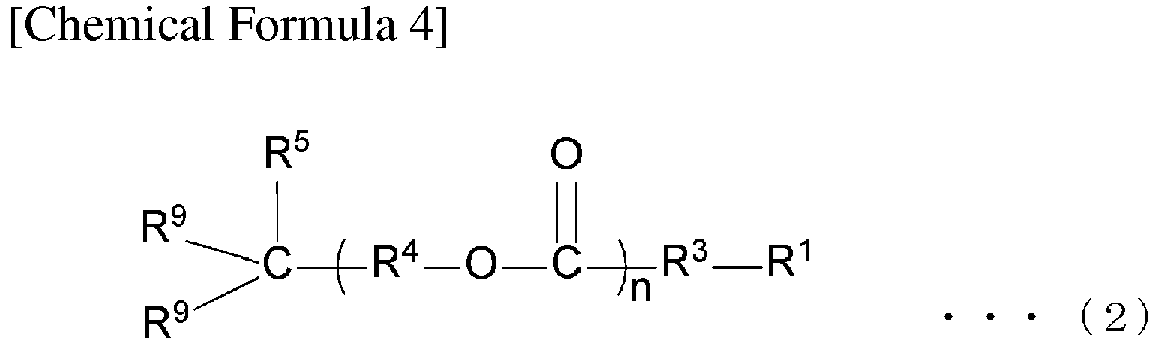
- In Formula (2), R1 represents -N(R2)-R2 (here, each R2 independently represents a C1 to C4 alkyl group); R3 represents a C3 to C8 alkanediyl group; R4 represents a C3 to C8 alkanediyl group; R5 represents a hydroxyl group or a hydrogen atom; each R9 independently represents -R7-O-C(O)-R10 or -O-C(O)-R10 (here, R7 represents a C4 to C12 alkanediyl group, and R10 represents a C4 to C25 alkenyl group), where at least one R9 is -R7-O-C(O)-R10; and n represents an integer of 0 or 1.
- General formulas of the compound (2-1), compound (2-2), and compound (2-3) are shown below.


- The composition of the present embodiment is a lipid, and lipid nanoparticles encapsulating a drug can be produced therefrom. The composition of the present embodiment can be obtained by converting R6 in the composition including the above-described compound represented by Formula (1), which has been purified by the above-mentioned purification method, into R9 (here, R9 represents -R7-O-C(O)-R10 or -O-C(O)-R10). Here, R9 represents -R7-O-C(O)-R10 or -O-C(O)-R10.
- The composition of the present embodiment can be obtained by, for example, a reaction of Scheme (II) shown in
FIG. 2 . The Scheme (II) is a reaction subsequent to the Scheme (1) shown inFIG. 1 . InFIG. 2 , R2 and R7 are the same as those in the above-described Formula (1), each R2 independently represents a C1 to C4 alkyl group, and each R7 independently represents a C4 to C12 alkanediyl group. Each R10 independently represents a C4 to C25 alkenyl group. - In
FIG. 2 ,compound 6 is an example of the above-described compound (2-1), compound 6' is an example of the above-described compound (2-2), andcompound 6" is an example of the above-described compound (2-3). Here, thecompounds 6' and 6" are unintended products; however, the present inventors have verified that even though these compounds are present, when lipid nanoparticles encapsulating an siRNA are produced, there are no adverse effects on the in vivo kinetics of the lipid nanoparticles to a target site and on the knockdown efficiency of a target gene. - In
FIG. 2 , R6 is converted to R9 (here, R9 represents -R7-O-C(O)-R10 or -O-C(O)-R10) by reacting the composition including thecompounds - The composition of the present embodiment includes one or more kinds of compounds selected from the group consisting of the above-described compounds (2-1), (2-2), and (2-3), and the total content proportion of the compound (2-1), the compound (2-2), and the compound (2-3) included in the composition is 90% by mass or more, preferably 95% by mass or more, more preferably 98% by mass or more, and even more preferably 99% by mass or more, while the balance includes impurities. The composition of the present embodiment can be obtained by carrying out the above-described method for purifying a composition and removing impurities.
- In the composition of the present embodiment, the content proportion of the above-described compound (2-1) included in the composition is preferably 85% to 99% by mass. In addition, the total content proportion of the above-described compound (2-2) and the above-described compound (2-3) included in the composition is preferably 0.1% to 15% by mass.
- According to embodiment, the present invention provides a compound (2-2) in which, in the above-described Formula (2), n is 0, one R9 is -R7-O-C(O)-R10, the other R9 is -O-C(O)-R10, and R5 is a hydrogen atom. The general formula of the compound (2-2) is as described above.
- According to another embodiment, the present invention provides a compound (2-3) in which, in the above-described Formula (2), n is 1, both R9's are -R7-O-C(O)-R10, and R5 is a hydroxyl group. The general formula of the compound (2-3) is as described above.
- According to an embodiment, the present invention provides a lipid nanoparticle that is formed from a composition including one or more kinds of compounds selected from the group consisting of the above-described compounds (2-1), (2-2), and (2-3), in which the total content proportion of the compound (2-1), the compound (2-2), and the compound (2-3) included in the composition is 90% by mass or more, preferably 95% by mass or more, more preferably 98% by mass or more, and even more preferably 99% by mass or more, and encapsulates a drug.
- The lipid nanoparticle according to the present specification refers to a particle containing a lipid as a main component and having a particle diameter of 10 nm to 1,000 nm. The lipid nanoparticle is also referred to as "Lipid Nanoparticle" (LNP).
- In the lipid nanoparticle of the present embodiment, since the incorporation of impurities with adverse effects is reduced, the in vivo kinetics to a target site is favorable. In addition, in a case where the drug is an siRNA, the knockdown efficiency of a target gene is high. The lipid nanoparticle of the present embodiment can be formed from a composition from which impurities have been removed by carrying out the above-described method for purifying a composition.
- As the lipid component of the lipid nanoparticle, only one or more kinds of compounds selected from the group consisting of the above-described compounds (2-1), (2-2), and (2-3) may be used; however, generally, for example, one or more kinds of lipids selected from the group consisting of a phospholipid, a glycolipid, a sterol, a saturated or unsaturated fatty acid, and a saturated or unsaturated fatty acid ester are combined to form the lipid nanoparticle. A combination of a plurality of lipids and blending proportions thereof can be appropriately adjusted according to the purpose.
- Examples of the phospholipid and phospholipid derivatives include phosphatidylethanolamine, phosphatidylcholine, phosphatidylserine, phosphatidylinositol, phosphatidylglycerol, cardiolipin, sphingomyelin, ceramide phosphorylethanolamine, ceramide phosphorylglycerol, ceramide phosphorylglycerol phosphate, 1,2-dimyristoyl-1,2-deoxyphosphatidylcholine, distearoylphosphatidylcholine, plasmalogen, and phosphatidic acid, and these can be used singly or in combination of two or more kinds thereof. The fatty acid residue in these phospholipids is not particularly limited; however, examples thereof include a saturated or unsaturated fatty acid residue having 12 to 20 carbon atoms, and specific examples include acyl groups derived from fatty acids such as lauric acid, myristic acid, palmitic acid, stearic acid, oleic acid, and linoleic acid. In addition, phospholipids derived from natural substances, such as egg yolk lecithin and soy lecithin, can also be used.
- Examples of the glycolipid include glyceroglycolipids (for example, sulfoxyribosyl glyceride, diglycosyl diglyceride, digalactosyl diglyceride, galactosyl diglyceride, and glycosyl diglyceride) and sphingoglycolipids (for example, galactosyl cerebroside, lactosyl cerebroside, and ganglioside).
- Examples of the sterol include animal-derived sterols (for example, cholesterol, cholesterol succinic acid, lanosterol, dihydrolanosterol, desmosterol, and dihydrocholesterol), plant-derived sterols (phytosterols) (for example, stigmasterol, sitosterol, campesterol, and brassicasterol), and microbial-derived sterols (for example, zymosterol and ergosterol).
- Examples of the saturated or unsaturated fatty acid include saturated or unsaturated fatty acids having 12 to 20 carbon atoms, such as palmitic acid, oleic acid, stearic acid, arachidonic acid, and myristic acid.
- Examples of the saturated or unsaturated fatty acid ester include glycerin fatty acid esters in which one or two hydroxyl groups of a glycerol are ester-bonded to a fatty acid. Examples of the fatty acid residue in the glycerin fatty acid ester include acyl groups derived from saturated or unsaturated fatty acids having 12 to 20 carbon atoms, such as palmitic acid, oleic acid, stearic acid, arachidonic acid, and myristic acid. Specific examples thereof include dimyristoyl glycerol (DMG) and distearoyl glycerol (DSG).
- A method for producing lipid nanoparticles is not particularly limited. For example, lipid nanoparticles can be produced by dissolving all lipid components in an organic solvent such as chloroform, subsequently performing vacuum drying with an evaporator or spray drying with a spray dryer to form a lipid membrane, subsequently adding a water-based solvent to the above-described dried mixture, and further performing emulsification using an emulsifier such as a homogenizer, an ultrasonic emulsifier, a high-pressure jet emulsifier, or the like. In addition, the lipid nanoparticles can also be produced by, for example, a reverse-phase evaporation method. In a case where it is desirable to control the size of the lipid nanoparticles, extrusion (extrusion filtration) may be performed under high pressure using a membrane filter having a uniform pore diameter, or the like.
- The size of the lipid nanoparticles in a dispersed state can be appropriately selected according to the purpose, and for example, the size can be an average particle size of about 60 to 140 nm, for example, an average particle size of about 80 to 120 nm, or for example, an average particle size of about 20 to 50 nm. The particle diameter can be measured by, for example, a dynamic light scattering (DLS) method. In the present specification, the average particle size of the lipid nanoparticles means a number-average particle size measured by DLS. The measurement by DLS can be performed by a routine method using a commercially available DLS apparatus or the like. The polydispersity index (PDI) is about 0.05 to 0.1, preferably about 0.06 to 0.08, and more preferably about 0.07.
- The composition of the water-based solvent (dispersion medium) is not particularly limited, and examples thereof include buffer solutions such as a phosphate buffer solution, a citrate buffer solution, and a phosphate-buffered saline; physiological saline; and media for cell culture. These water-based solvents (dispersion media) can stably disperse the lipid nanoparticles; however, sugars (aqueous solutions), including monosaccharides such as glucose, galactose, mannose, fructose, inositol, ribose, and xylose; disaccharides such as lactose, sucrose, cellobiose, trehalose, and maltose; trisaccharides such as raffinose and melezitose; polysaccharides such as cyclodextrin; and sugar alcohols such as erythritol, xylitol, sorbitol, mannitol, and maltitol, and polyhydric alcohols (aqueous solutions) such as glycerin, diglycerin, polyglycerin, propylene glycol, polypropylene glycol, ethylene glycol, diethylene glycol, triethylene glycol, polyethylene glycol, ethylene glycol monoalkyl ether, diethylene glycol monoalkyl ether, and 1 ,3-butylene glycol, may be further added. In order to stably store the lipid nanoparticles dispersed in a water-based solvent for a long period of time, from the viewpoint of physical stability such as suppression of aggregation, it is preferable to exclude an electrolyte in the water-based solvent as much as possible. In addition, from the viewpoint of chemical stability of the lipid, it is preferable to set the pH of the water-based solvent to weak acidity to near neutrality (approximately pH 3.0 to 8.0), and it is preferable to remove dissolved oxygen by nitrogen bubbling or the like.
- In a case where the obtained aqueous dispersion of lipid nanoparticles is freeze-dried or spray-dried, it may be possible to improve stability by using sugars (aqueous solutions), including monosaccharides such as glucose, galactose, mannose, fructose, inositol, ribose, and xylose; disaccharides such as lactose, sucrose, cellobiose, trehalose, and maltose; trisaccharides such as raffinose and melezitose, polysaccharides such as cyclodextrin; and sugar alcohols such as erythritol, xylitol, sorbitol, mannitol, and maltitol. In addition, in a case where the above-described aqueous dispersion is frozen, it may be possible to improve stability, for example, when the sugars or polyhydric alcohols (aqueous solutions) such as glycerin, diglycerin, polyglycerin, propylene glycol, polypropylene glycol, ethylene glycol, diethylene glycol, triethylene glycol, polyethylene glycol, ethylene glycol monoalkyl ether, diethylene glycol monoalkyl ether, and 1,3-butylene glycol are used.
- With regard to the lipid nanoparticles of the present embodiment, the drug encapsulated therein is not particularly limited. For example, nucleic acids such as siRNA, microRNA, mRNA, and a plasmid, as well as optional pharmaceutically active ingredients such as an antitumor agent, an anti-inflammatory agent, an antibacterial agent, and an antiviral agent, and optional substances such as a sugar, a peptide, a low-molecular-weight compound, and a metal compound, can be encapsulated in the lipid nanoparticles. These may be encapsulated singly, or a mixture of two or more kinds thereof may be encapsulated.
- A small interfering RNA (siRNA) is a low-molecular-weight double-stranded RNA having 21 to 23 base pairs, and the siRNA is involved in RNA interference (RNAi) and suppresses the expression of a gene in a sequence-specific manner by destroying mRNA. Since a gene can be knocked down by RNA interference using siRNA, the siRNA is expected to be applied to the utilization as a medicine and to the field of treatment of cancer and the like. The type of siRNA that can be used is not particularly limited, and any siRNA capable of causing RNA interference may be used; however, generally, a double-stranded RNA having 21 to 23 base pairs and having a structure in which the 3' portion of the RNA chain adopts a structure of protruding by 2 bases, and each chain has a phosphate group at the 5'-end and a hydroxyl group at the 3'-end, can be used as the siRNA. In addition, an siRNA in which the hydroxyl group at the 2'-position of the ribose skeleton has been substituted with a methoxy group, a fluoro group, or a methoxyethyl group, and some phosphodiester bonds have been substituted with phosphorothioate bonds, are also included.
- The form of the lipid nanoparticles of the present embodiment is not particularly limited, and examples thereof include a form of being dispersed in a water-based solvent (for example, water, physiological saline, or phosphate-buffered saline), and a form of being freeze-dried from an aqueous dispersion.
- Next, the present invention will be described in more detail by way of Examples; however, the present invention is not intended to be limited to the following Examples. All animal experiments were performed in accordance with a protocol reviewed by the Institutional Animal Care and Use Committee of Hokkaido University and approved by the President of Hokkaido University. In addition, the structures of the compounds included in the composition were identified by 1H NMR (manufactured by Bruker Corporation, AVANCE III 600).
- A composition before purification (composition (1-1)) including compound (4-1-1), compound (4-2-1), and compound (4-3-1) was prepared according to the Scheme (III) shown in
FIG. 3 . - 26.0 g (88.0 mmol) of (6-bromohexyloxy)-tert-butyldimethylsilane was dissolved in 26 mL of dry diethyl ether to prepare a solution. 1 mL of the above-described solution, 4 mL of dry diethyl ether, and 2.35 g (96.8 mmol) of magnesium shavings were added to a flask in an argon atmosphere, and subsequently a piece of iodine was added thereto. The solution was left to stand at room temperature until the entire solution turned brown, subsequently the solution was heated to 40°C using an oil bath while being stirred, decolorization was checked, and then the above-described (6-bromohexyloxy)-tert-butyldimethylsilane solution was added dropwise to the flask. The reaction was carried out at 40°C for 2 hours, and then the reaction solution was cooled in ice. Subsequently, 3.67 mL (39.6 mmol) of δ-valerolactone dissolved in 3.67 mL of dry diethyl ether was added dropwise to the flask, and the mixture was allowed to react overnight at room temperature. The reaction solution was cooled in ice, diethyl ether was added thereto to dilute the reaction solution, and remaining magnesium was dissolved by adding a saturated aqueous solution of citric acid dropwise to the flask. The organic layer was separated and washed using water and saturated brine. Subsequently, the organic layer was dewatered by adding anhydrous sodium sulfate. This organic layer was filtered, and then the solvent was distilled off using a rotary evaporator to obtain a composition (composition of Experimental Example 1-1) including compound (2-1-1), compound (2-2-1), and compound (2-3-1). The content proportions of the compound (2-1-1), the compound (2-2-1), and the compound (2-3-1) included in the composition (1-1) were such that compound (2-1-1):compound (2-2-1):compound (2-3-1) = 99.0:0.2:0.8.
- 14.0 g of the composition of Experimental Example 1-1 was dissolved in 50 mL of dichloromethane in a flask, 321 mg (2.63 mmol) of N,N-dimethyl-4-aminopyridine (DMAP) and 5.50 mL (39.5 mmol) of diisopropylethylamine were added thereto, and the mixture was cooled in ice. 6.02 g (31.6 mmol) of p-toluenesulfonyl chloride was gradually added to the flask, and then the mixture was allowed to react overnight at room temperature. The solvent was distilled off using a rotary evaporator, subsequently the residue was suspended in ethyl acetate, and the suspension was separated and washed using water and saturated brine. Anhydrous sodium sulfate was added to the organic layer to dewater the organic layer, this mixture was filtered, subsequently the solvent was distilled off using a rotary evaporator, and a composition (composition of Experimental Example 1-2) including compound (3-1-1), compound (3-2-1), and compound (3-3-1).
- 30 mL of tetrahydrofuran was added to 12.4 g of the composition of Experimental Example 1-2 in a flask, and the mixture was cooled to 4°C. Subsequently, 7.38 mL (54.0 mmol) of dipropylamine was added to the flask, and then the mixture was allowed to react at room temperature for 11 days. The solvent was distilled off using a rotary evaporator, subsequently the residue was suspended in ethyl acetate, and the suspension was separated and washed using a 0.5 N aqueous solution of sodium hydroxide and saturated brine. Anhydrous sodium sulfate was added to the organic layer to dewater the organic layer. This organic layer was filtered, subsequently the solvent was distilled off using a rotary evaporator, and a composition (composition of Experimental Example 1-3) including compound (4-1-1), compound (4-2-1), and compound (4-3-1) was obtained.
- 2.23 mL (39 mmol) of acetic acid and 26 mL of a 1.0 M tetrahydrofuran solution of tetrabutylammonium fluoride (TBAF) were added to 7.27 g of the composition of Experimental Example 1-3 in a flask, and the mixture was allowed to react overnight at room temperature. The solvent was distilled off using a rotary evaporator, and a composition (composition (1-1)) including compound (5-1-1), compound (5-2-1), and compound (5-3-1) was obtained.
- A composition including the compound (2-1-1), the compound (2-2-1), and the compound (2-3-1) at content proportions of compound (2-1-1):compound (2-2-1):compound (2-3-1) = 92.5:7.0:0.5 was obtained by an operation similar to that of Experimental Example 1-1, except that 3.34 mL (36.0 mmol) of δ-valerolactone was used. Subsequently, a composition (1-2) was obtained by operations similar to those of Experimental Example 1-2, Experimental Example 1-3, and Experimental Example 1-4.
- A composition including the compound (2-1-1), the compound (2-2-1), and the compound (2-3-1) at content proportions of compound (2-1-1):compound (2-2-1):compound (2-3-1) = 85.0:0.0:15.0 was obtained by an operation similar to that of Experimental Example 1-1, except that 4.04 mL (43.6 mmol) of δ-valerolactone was used. Subsequently, a composition (1-3) was obtained by operations similar to those of Experimental Example 1-2, Experimental Example 1-3, and Experimental Example 1-4.
- Each of the compositions including the compound (5-1-1), the compound (5-2-1), and the compound (5-3-1) (composition (1-1), composition (1-2), and composition (1-3)) (each 9.5 g) was dissolved in a 0.5 N aqueous solution of hydrochloric acid (150 mL), a solvent (100 mL) as described in Table 1 was added to each of the compositions, and the mixture was stirred for 10 minutes. Subsequently, liquid separation was performed using a liquid separatory funnel, and the aqueous layer was collected. In this case, the liquid separation and washing was repeated until the impurities included in the organic layer disappeared or there was no change in a TLC analysis. Thereafter, a 5M aqueous solution of sodium hydroxide (30 mL) was introduced into the collected aqueous layer, and the mixture was stirred for 10 minutes. Ethyl acetate (100 mL) was further added thereinto, and the mixture was stirred for 10 minutes. Thereafter, the solution was separated using a liquid separatory funnel, and the organic layer was collected. The collected organic layer was separated and washed once using saturated brine. Anhydrous sodium sulfate was added to the organic layer to dewater the organic layer. This mixture was filtered, subsequently the solvent was distilled off using a rotary evaporator, and a purified composition was obtained.
[Table 1] Solvent Solubility parameter (MPa1/2) Name of composition before purification Name of composition after purification Cyclohexanone 20.5 Composition (1-1) Composition (2-1) Methyl isobutyl ketone 169 Composition (1-2) Composition (2-2) Diisopropyl ketone 16.6 Composition (1-3) Composition (2-3) Ethyl acetate 17.9 Composition (1-1) Composition (2-4) Butyl acetate 17.8 Composition (1-3) Composition (2-5) Diethyl ether 14.8 Composition (1-2) Composition (2-6) Dipropyl ether 15.5 Composition (1-2) Composition (2-7) Cyclopentyl methyl ether 17.6 Composition (1-1) Composition (2-8) Propylene glycol monomethyl ether acetate 19.5 Composition (1-3) Composition (2-9) Hexane 14.2 Composition (1-2) Composition (2-10) 2-Butanol 22.1 Composition (1-3) Composition (2-11) - Compositions (composition (3-1) to composition (3-11)) including compound (6-1-1), compound (6-2-1), and compound (6-3-1) were produced according to the Scheme (111) shown in
FIG. 3 . - Each of the compositions (composition (2-1) to composition (2-11)) purified in Experimental Example 4 was dissolved in 5 mL of dichloromethane in a flask. Subsequently, 900 mg (3.0 mmol) of oleyl chloride was added thereto, and the mixture was cooled to 4°C. 697 µL (5.0 mmol) of triethylamine (TEA) was added dropwise to the flask, and the mixture was reacted at room temperature for 3 hours. The solvent was distilled off using a rotary evaporator, subsequently the residue was suspended in ethyl acetate, and insolubles were removed by filtration. The filtrate was separated and washed using a 0.5 N aqueous solution of sodium hydroxide and saturated brine. Anhydrous sodium sulfate was added to the organic layer to dewater the organic layer. This mixture was filtered, the solvent was distilled off using a rotary evaporator, and a crude product was obtained. The crude product was refined by silica gel chromatography (elution solvent was a continuous gradient of dichloroethane and ethanol), and a composition including compound (6-1-1), compound (6-2-1), and compound (6-3-1) (each of composition (3-1) to composition (3-11)) was obtained.
- The compositions including the compound (6-1-1), the compound (6-2-1), and the compound (6-3-1) (composition (3-1) to composition (3-11)) were separated and analyzed by UHPLC (CAD) using a column (C18 column, 1.7 µm, inner diameter: 2.1 mm × 150 mm) and an eluent (continuous gradient of a 20 mM aqueous solution of ammonium acetate and a 20 mM ethanol solution of ammonium acetate. The evaluation results are illustrated in the following Table 2.
[Table 2] Solvent used for purification Name of composition UHPLC (CAD) area ratio (%) Compound (6-1-1) Compound (6-2-1) Compound (6-3-1) Impurities Cyclohexanone (3-1) 97.8 0.0 1.0 1.2 Methyl isobutyl ketone (3-2) 95.2 0.2 2.2 2.4 Diisopropyl ketone (3-3) 90.9 0.2 1.0 7.9 Ethyl acetate (3-4) 91.7 0.3 0.0 8.0 Butyl acetate (3-5) 93.0 0.0 5.1 1.9 Diethyl ether (3-6) 96.5 0.1 0.5 2.9 Dipropyl ether (3-7) 93.8 0.2 0.4 5.6 Cyclopentyl methyl ether (3-8) 98.4 0.0 0.1 1.5 Propylene glycol monomethyl ether acetate (3-9) 78.9 0.2 13.4 7.5 Hexane (3-10) 85.7 0.2 0.8 13.3 2-Butanol (3-11) 57.4 0.0 0.0 42.6 - A lipid solution obtained by dissolving 1.83 mg of the composition (3-1), 0.158 mg of a phospholipid (DSPC, Catalog No. "COATSOME MC-8080", Yuka Sangyo Co., Ltd.), 0.696 mg of cholesterol (Catalog No. "C8667", Sigma-Aldrich Corporation), and 0.0502 mg of a PEG lipid (PEG-DMG, product name "SUNBRIGHT GM-020", Yuka Sangyo Co., Ltd.) in 0.5 mL of ethanol was mixed with 1.5 mL of an siRNA solution obtained by dissolving 0.0594 mg of an siRNA in an acetate buffer solution (pH 4) using a flow reactor. The solution after mixing was dialyzed with phosphate-buffered saline (PBS), and lipid nanoparticles (LNP1) encapsulating the siRNA were produced. As the siRNA, a product obtained by hybridizing a nucleic acid having a base sequence set forth in SEQ ID NO:1 and a nucleic acid having a base sequence set forth in SEQ ID NO:2 was used. This siRNA was to target the mRNA of mouse blood coagulation factor VII.
- Lipid nanoparticles (LNP2 to LNP11) encapsulating the siRNA were produced by a similar method, except that the compositions (3-2) to (3-11) were used instead of the composition (3-1).
- The in vivo kinetics of the lipid nanoparticles encapsulating an siRNA was evaluated. Specifically, (LNP1 to LNP11) produced in Experimental Example 6 were each administered to mice (C57BL/6NCrSlc, 6 weeks old, female, Sankyo Labo Service Corporation) through the tail vein such that the amount of the siRNA was 0.03 mg/kg of body weight. Subsequently, the mice were euthanized 24 hours later, and the liver and the spleen were extracted and frozen using liquid nitrogen.
- Subsequently, each of the extracted organs was diluted with 0.25% Triton X-100-containing PBS and homogenized with a bead-type shredder. Subsequently, the resultant was treated at 95°C for 10 minutes to thermally denature proteins. Subsequently, each sample was left to stand on ice for 5 minutes and then centrifuged at 20,000 × g at 4°C for 20 minutes. Subsequently, the supernatant of each sample was treated at 95°C for 10 minutes, and a reverse transcription reaction of RNA was performed. A commercially available kit (product name "TaqMan MicroRNA Reverse Transcription Kit", Thermo Fisher Scientific, Inc.) was used for the reverse transcription reaction. The reaction conditions were 16°C for 30 minutes, subsequently 42°C for 30 minutes, and subsequently 85°C for 5 minutes.
- Subsequently, a PCR reagent (product name "TaqMan Universal Master Mix II, no UNG", Thermo Fisher Scientific, Inc.) was added to each sample after the reverse transcription reaction, and the amount of siRNA in the liver and the spleen was quantified by real-time PCR.
- Subsequently, the in vivo kinetics of each lipid nanoparticle was evaluated in vivo according to the following evaluation criteria. The results are shown in the following Table 3. The in vivo kinetics was evaluated by making a comparison with LNP9, which had the lowest delivery amount of siRNA into the liver and the spleen among LNP1 to LNP9.
-
- ++: The total amount of siRNA in the liver and the spleen was 65% or more of that of LNP9.
- -: The total amount of siRNA in the liver and the spleen was less than 65% of that of LNP9.
- The in vivo knockdown activity of the lipid nanoparticles encapsulating an siRNA was evaluated. Specifically, (LNP1 to LNP11) produced in Experimental Example 6 were each administered to mice (C57BL/6NCrSlc, 6 weeks old, female, Sankyo Labo Service Corporation) through the tail vein such that the amount of the siRNA was 0.03 mg/kg of body weight. Subsequently, the mice were euthanized 24 hours later, and blood was collected through the inferior vena cava. Subsequently, the blood sample was centrifuged at 800 × g and 4°C for 5 minutes, and a blood plasma sample was obtained. Subsequently, using a BIOPHEN FVII Kit (Hyphen Biomed SAS), the amount of blood coagulation factor FV11 in each sample and the amount of blood coagulation factor FVII in the lipid nanoparticle-unadministered group were measured, and the knockdown rate was calculated on the basis of the following Expression (1).
Knockdown rate (%) = (1 - (amount of blood coagualation factor FVII in sample/amount of blood coagulation factor FVII in lipid nanoparticle-unadministered group)) × 100 - Subsequently, the knockdown activity of each lipid nanoparticle was evaluated according to the following evaluation criteria. The results are shown in the following Table 3.
-
- ++: Knockdown rate was 70% or more.
- +: Knockdown rate was 30% or more and less than 70%.
- -: Knockdown rate was less than 30%.
- According to the present invention, a technology is provided for removing impurities included in a composition including a lipid.
| Solvent used for purification | Name of composition | Name of lipid nanoparticle | In vivo kinetics | Knockdown activity |
| Cyclohexanone | (3-1) | LNP 1 | ++ | ++ |
| Methyl isobutyl ketone | (3-2) | |
++ | ++ |
| Diisopropyl ketone | (3-3) | |
++ | ++ |
| Ethyl acetate | (3-4) | |
++ | ++ |
| Butyl acetate | (3-5) | |
++ | ++ |
| Diethyl ether | (3-6) | |
++ | ++ |
| Dipropyl ether | (3-7) | LNP 7 | ++ | ++ |
| Cyclopentyl methyl ether | (3-8) | LNP 8 | ++ | ++ |
| Propylene glycol monomethyl ether acetate | (3-9) | LNP 9 | ++ | ++ |
| Hexane | (3-10) | LNP 10 | - | ++ |
| 2-Butanol | (3-11) | LNP 11 | - | - |
Claims (11)
- A method for purifying a composition, the method comprising:a step of dissolving a composition including a compound represented by the following Formula (1) in an aqueous layer to perform liquid-liquid extraction and refining the compound represented by the following Formula (1),wherein an oil layer used for the liquid-liquid extraction includes one or more kinds of liquids selected from the group consisting of a ketone-based liquid, an ester-based liquid, and an ether-based liquid, all of which have a solubility parameter (SP value) of 14.8 to 20.5 (MPa1/2),

- The method for purifying according to Claim 1,
wherein the ketone-based liquid is cyclohexanone, methyl isobutyl ketone, or diisopropyl ketone, the ester-based liquid is ethyl acetate or butyl acetate, and the ether-based liquid is diethyl ether, dipropyl ether, cyclopentyl methyl ether, or propylene glycol monomethyl ether acetate. - A composition comprising:one or more kinds of compounds selected from the group consisting ofa compound (2-1) in which, in a compound represented by the following Formula (2), n is 0, both R9's are -R7-O-C(O)-R10, and R5 is a hydroxyl group,a compound (2-2) in which, in a compound represented by the following Formula (2), n is 0, one R9 is -R7-O-C(O)-R10, the other R9 is -O-C(O)-R10, and R5 is a hydrogen atom, anda compound (2-3) in which, in a compound represented by the following Formula (2), n is 1, both R9's are -R7-O-C(O)-R10, and R5 is a hydroxyl group,wherein a total content proportion of the compound (2-1), the compound (2-2), and the compound (2-3) included in the composition is 90% by mass or more,
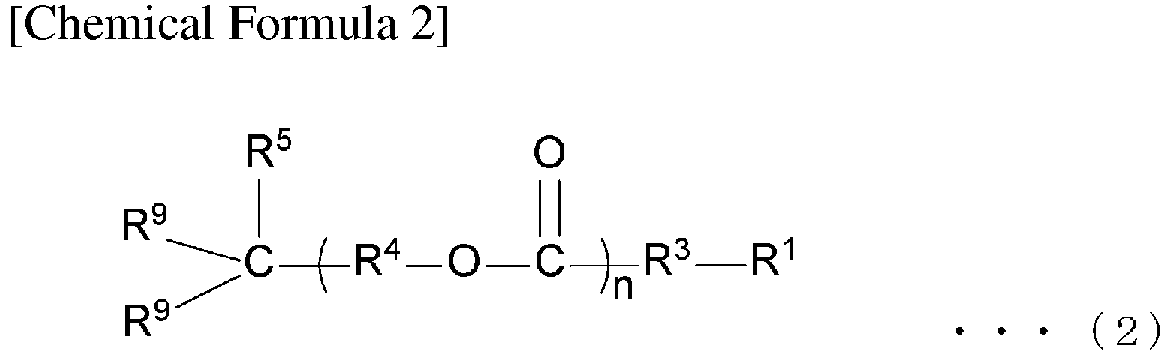
- The composition according to Claim 3,
wherein a content proportion of the compound (2-1) included in the composition is 85% to 99% by mass. - The composition according to Claim 3 or 4, wherein a total content proportion of the compound (2-2) and the compound (2-3) included in the composition is 0.1% to 15% by mass.
- A compound in which, in the Formula (2) according to Claim 3, n is 0, one R9 is -R7-O-C(O)-R10, the other R9 is -O-C(O)-R10, and R5 is a hydrogen atom.
- A compound in which, in the Formula (2) according to Claim 3, n is 1, both R9's are -R7-O-C(O)-R10, and R5 is a hydroxyl group.
- A lipid nanoparticle formed from a compound included in the composition according to Claim 3 or 4 and encapsulating a drug.
- A lipid nanoparticle formed from a compound included in the composition according to Claim 5 and encapsulating a drug.
- The lipid nanoparticle according to Claim 8,
wherein the drug is an siRNA. - The lipid nanoparticle according to Claim 9,
wherein the drug is an siRNA.
Applications Claiming Priority (2)
| Application Number | Priority Date | Filing Date | Title |
|---|---|---|---|
| JP2021204594 | 2021-12-16 | ||
| PCT/JP2022/045954 WO2023112939A1 (en) | 2021-12-16 | 2022-12-14 | Method for purifying composition |
Publications (2)
| Publication Number | Publication Date |
|---|---|
| EP4450485A1 true EP4450485A1 (en) | 2024-10-23 |
| EP4450485A4 EP4450485A4 (en) | 2026-06-03 |
Family
ID=86774752
Family Applications (1)
| Application Number | Title | Priority Date | Filing Date |
|---|---|---|---|
| EP22907463.8A Pending EP4450485A4 (en) | 2021-12-16 | 2022-12-14 | METHOD FOR CLEANING A COMPOSITION |
Country Status (8)
| Country | Link |
|---|---|
| US (1) | US20250346554A1 (en) |
| EP (1) | EP4450485A4 (en) |
| JP (1) | JP7698851B2 (en) |
| KR (1) | KR20240110610A (en) |
| CN (1) | CN118401495A (en) |
| CA (1) | CA3242621A1 (en) |
| TW (1) | TW202328053A (en) |
| WO (1) | WO2023112939A1 (en) |
Family Cites Families (10)
| Publication number | Priority date | Publication date | Assignee | Title |
|---|---|---|---|---|
| JPH03204594A (en) | 1990-01-08 | 1991-09-06 | Tadao Totsuka | Heat exchanger |
| GB0620005D0 (en) * | 2006-10-10 | 2006-11-22 | Glaxo Group Ltd | Compounds |
| JP6570188B2 (en) | 2014-05-20 | 2019-09-04 | 国立大学法人北海道大学 | Lipid membrane structures for siRNA intracellular delivery |
| WO2016153012A1 (en) * | 2015-03-24 | 2016-09-29 | 協和発酵キリン株式会社 | Nucleic acid-containing lipid nanoparticles |
| CN107281103A (en) * | 2016-04-11 | 2017-10-24 | 百奥迈科生物技术有限公司 | Liposomal formulation and its application with high content positive lipid compound |
| KR102676927B1 (en) * | 2017-06-15 | 2024-06-24 | 국립대학법인 홋가이도 다이가쿠 | Lipid membrane construct for siRNA intracellular delivery |
| CA3071968A1 (en) * | 2017-08-04 | 2019-02-07 | Kyowa Kirin Co., Ltd. | Nucleic acid-containing lipid nanoparticle |
| JP2019151589A (en) * | 2018-03-02 | 2019-09-12 | 国立大学法人北海道大学 | Lipid nanoparticle |
| JP7699128B2 (en) * | 2019-12-06 | 2025-06-26 | ガイド セラピューティクス,エルエルシー | Nanomaterials |
| WO2023067561A1 (en) * | 2021-10-22 | 2023-04-27 | Seqirus Inc. | Ionizable cationic lipid for messenger rna delivery |
-
2022
- 2022-12-14 WO PCT/JP2022/045954 patent/WO2023112939A1/en not_active Ceased
- 2022-12-14 CA CA3242621A patent/CA3242621A1/en active Pending
- 2022-12-14 US US18/719,492 patent/US20250346554A1/en active Pending
- 2022-12-14 EP EP22907463.8A patent/EP4450485A4/en active Pending
- 2022-12-14 TW TW111147982A patent/TW202328053A/en unknown
- 2022-12-14 KR KR1020247019412A patent/KR20240110610A/en active Pending
- 2022-12-14 CN CN202280082023.4A patent/CN118401495A/en active Pending
- 2022-12-14 JP JP2023567800A patent/JP7698851B2/en active Active
Also Published As
| Publication number | Publication date |
|---|---|
| CN118401495A (en) | 2024-07-26 |
| US20250346554A1 (en) | 2025-11-13 |
| WO2023112939A1 (en) | 2023-06-22 |
| CA3242621A1 (en) | 2023-06-22 |
| JPWO2023112939A1 (en) | 2023-06-22 |
| JP7698851B2 (en) | 2025-06-26 |
| TW202328053A (en) | 2023-07-16 |
| KR20240110610A (en) | 2024-07-15 |
| EP4450485A4 (en) | 2026-06-03 |
Similar Documents
| Publication | Publication Date | Title |
|---|---|---|
| CA1143656A (en) | Liposome including active substance | |
| EP3239132B1 (en) | Cationic lipid | |
| US20220249694A1 (en) | Nanomaterials comprising a biodegradable feature | |
| EP0094692A1 (en) | Coated ubidecarenone-containing liposome | |
| WO2018230710A1 (en) | Lipid membrane structure for delivery into sirna cell | |
| Pathak et al. | Cholesterol anchored arabinogalactan for asialoglycoprotein receptor targeting: Synthesis, characterization, and proof of concept of hepatospecific delivery | |
| DE60208454T2 (en) | Polyalkylene oxide-modified phospholipids and process for their preparation | |
| EP4347554A1 (en) | Mc3-type lipids and use thereof in the preparation of lipid nanoparticles | |
| EP4281050A1 (en) | Nanomaterials | |
| JP2019151589A (en) | Lipid nanoparticle | |
| EP3611178B1 (en) | Lipid derivative for nucleic acid introduction | |
| CN118290339A (en) | Ionizable lipid compounds and their applications | |
| US20250346554A1 (en) | Method for purifying composition | |
| EP4495130A1 (en) | Compound and lipid composition | |
| JP3570561B2 (en) | Carrier that recognizes vascular endothelial injury site | |
| CN114405298A (en) | Method for purifying polyethylene glycol conjugated lipids | |
| EP3888637B1 (en) | Lyophilized preparation for prostaglandin e1 methyl ester injection, preparation thereof and application thereof | |
| CN117534585B (en) | An ionizable cationic lipid compound, its preparation method and application | |
| EP4628494A1 (en) | Phosphatidylamine compound comprising multiple tertiary amino group structures, and composition and use thereof | |
| CN117982460A (en) | Preparation and application of ball-and-stick shaped lipid nanoparticles | |
| CN106580945A (en) | Combretastatin A4 derivative and preparation thereof | |
| CN119874553B (en) | Lipid compounds and lipid nanoparticles for delivery | |
| CN119874554A (en) | Lipid compounds and lipid nanoparticles for delivery | |
| JP2026514094A (en) | Nanoparticles of mycophenolate prodrugs and their therapeutic applications | |
| CN117580820A (en) | MC3 type lipids and their use in the preparation of lipid nanoparticles |
Legal Events
| Date | Code | Title | Description |
|---|---|---|---|
| STAA | Information on the status of an ep patent application or granted ep patent |
Free format text: STATUS: THE INTERNATIONAL PUBLICATION HAS BEEN MADE |
|
| PUAI | Public reference made under article 153(3) epc to a published international application that has entered the european phase |
Free format text: ORIGINAL CODE: 0009012 |
|
| STAA | Information on the status of an ep patent application or granted ep patent |
Free format text: STATUS: REQUEST FOR EXAMINATION WAS MADE |
|
| 17P | Request for examination filed |
Effective date: 20240614 |
|
| AK | Designated contracting states |
Kind code of ref document: A1 Designated state(s): AL AT BE BG CH CY CZ DE DK EE ES FI FR GB GR HR HU IE IS IT LI LT LU LV MC ME MK MT NL NO PL PT RO RS SE SI SK SM TR |
|
| DAV | Request for validation of the european patent (deleted) | ||
| DAX | Request for extension of the european patent (deleted) | ||
| RAP1 | Party data changed (applicant data changed or rights of an application transferred) |
Owner name: NATIONAL UNIVERSITY CORPORATIONHOKKAIDO UNIVERSITY Owner name: JICC-02 CO., LTD. |
|
| RAP3 | Party data changed (applicant data changed or rights of an application transferred) |
Owner name: NATIONAL UNIVERSITY CORPORATIONHOKKAIDO UNIVERSITY Owner name: JSR CORPORATION |
|
| RIC1 | Information provided on ipc code assigned before grant |
Ipc: C07C 213/10 20060101AFI20260204BHEP Ipc: A61K 9/16 20060101ALI20260204BHEP Ipc: A61K 31/713 20060101ALI20260204BHEP Ipc: A61K 47/18 20170101ALI20260204BHEP Ipc: A61K 47/24 20060101ALI20260204BHEP Ipc: A61K 47/28 20060101ALI20260204BHEP Ipc: A61K 47/34 20170101ALI20260204BHEP Ipc: A61P 35/00 20060101ALI20260204BHEP Ipc: C07C 219/06 20060101ALI20260204BHEP Ipc: C07C 219/08 20060101ALI20260204BHEP Ipc: C07C 227/40 20060101ALI20260204BHEP Ipc: C07C 229/12 20060101ALI20260204BHEP Ipc: C12N 15/113 20100101ALI20260204BHEP |
|
| RAP1 | Party data changed (applicant data changed or rights of an application transferred) |
Owner name: NOF CORPORATION Owner name: NATIONAL UNIVERSITY CORPORATIONHOKKAIDO UNIVERSITY |
|
| A4 | Supplementary search report drawn up and despatched |
Effective date: 20260504 |
|
| RIC1 | Information provided on ipc code assigned before grant |
Ipc: C07C 213/10 20060101AFI20260427BHEP Ipc: A61K 9/16 20060101ALI20260427BHEP Ipc: A61K 31/713 20060101ALI20260427BHEP Ipc: A61K 47/18 20170101ALI20260427BHEP Ipc: A61K 47/24 20060101ALI20260427BHEP Ipc: A61K 47/28 20060101ALI20260427BHEP Ipc: A61K 47/34 20170101ALI20260427BHEP Ipc: A61P 35/00 20060101ALI20260427BHEP Ipc: C07C 219/06 20060101ALI20260427BHEP Ipc: C07C 219/08 20060101ALI20260427BHEP Ipc: C07C 227/40 20060101ALI20260427BHEP Ipc: C07C 229/12 20060101ALI20260427BHEP Ipc: C12N 15/113 20100101ALI20260427BHEP |