EP4450155A1 - Sodium ion adsorbent, preparation method thereof, and method of removing sodium ion - Google Patents
Sodium ion adsorbent, preparation method thereof, and method of removing sodium ion Download PDFInfo
- Publication number
- EP4450155A1 EP4450155A1 EP22907949.6A EP22907949A EP4450155A1 EP 4450155 A1 EP4450155 A1 EP 4450155A1 EP 22907949 A EP22907949 A EP 22907949A EP 4450155 A1 EP4450155 A1 EP 4450155A1
- Authority
- EP
- European Patent Office
- Prior art keywords
- adsorbent
- solid
- sodium ion
- solution
- sodium
- Prior art date
- Legal status (The legal status is an assumption and is not a legal conclusion. Google has not performed a legal analysis and makes no representation as to the accuracy of the status listed.)
- Pending
Links
Images

Classifications
-
- B—PERFORMING OPERATIONS; TRANSPORTING
- B01—PHYSICAL OR CHEMICAL PROCESSES OR APPARATUS IN GENERAL
- B01J—CHEMICAL OR PHYSICAL PROCESSES, e.g. CATALYSIS OR COLLOID CHEMISTRY; THEIR RELEVANT APPARATUS
- B01J20/00—Solid sorbent compositions or filter aid compositions; Sorbents for chromatography; Processes for preparing, regenerating or reactivating thereof
- B01J20/02—Solid sorbent compositions or filter aid compositions; Sorbents for chromatography; Processes for preparing, regenerating or reactivating thereof comprising inorganic material
- B01J20/10—Solid sorbent compositions or filter aid compositions; Sorbents for chromatography; Processes for preparing, regenerating or reactivating thereof comprising inorganic material comprising silica or silicate
- B01J20/16—Alumino-silicates
-
- C—CHEMISTRY; METALLURGY
- C02—TREATMENT OF WATER, WASTE WATER, SEWAGE, OR SLUDGE
- C02F—TREATMENT OF WATER, WASTE WATER, SEWAGE, OR SLUDGE
- C02F1/00—Treatment of water, waste water, or sewage
- C02F1/28—Treatment of water, waste water, or sewage by sorption
-
- B—PERFORMING OPERATIONS; TRANSPORTING
- B01—PHYSICAL OR CHEMICAL PROCESSES OR APPARATUS IN GENERAL
- B01J—CHEMICAL OR PHYSICAL PROCESSES, e.g. CATALYSIS OR COLLOID CHEMISTRY; THEIR RELEVANT APPARATUS
- B01J20/00—Solid sorbent compositions or filter aid compositions; Sorbents for chromatography; Processes for preparing, regenerating or reactivating thereof
- B01J20/02—Solid sorbent compositions or filter aid compositions; Sorbents for chromatography; Processes for preparing, regenerating or reactivating thereof comprising inorganic material
-
- B—PERFORMING OPERATIONS; TRANSPORTING
- B01—PHYSICAL OR CHEMICAL PROCESSES OR APPARATUS IN GENERAL
- B01J—CHEMICAL OR PHYSICAL PROCESSES, e.g. CATALYSIS OR COLLOID CHEMISTRY; THEIR RELEVANT APPARATUS
- B01J20/00—Solid sorbent compositions or filter aid compositions; Sorbents for chromatography; Processes for preparing, regenerating or reactivating thereof
- B01J20/02—Solid sorbent compositions or filter aid compositions; Sorbents for chromatography; Processes for preparing, regenerating or reactivating thereof comprising inorganic material
- B01J20/04—Solid sorbent compositions or filter aid compositions; Sorbents for chromatography; Processes for preparing, regenerating or reactivating thereof comprising inorganic material comprising compounds of alkali metals, alkaline earth metals or magnesium
-
- B—PERFORMING OPERATIONS; TRANSPORTING
- B01—PHYSICAL OR CHEMICAL PROCESSES OR APPARATUS IN GENERAL
- B01J—CHEMICAL OR PHYSICAL PROCESSES, e.g. CATALYSIS OR COLLOID CHEMISTRY; THEIR RELEVANT APPARATUS
- B01J20/00—Solid sorbent compositions or filter aid compositions; Sorbents for chromatography; Processes for preparing, regenerating or reactivating thereof
- B01J20/02—Solid sorbent compositions or filter aid compositions; Sorbents for chromatography; Processes for preparing, regenerating or reactivating thereof comprising inorganic material
- B01J20/06—Solid sorbent compositions or filter aid compositions; Sorbents for chromatography; Processes for preparing, regenerating or reactivating thereof comprising inorganic material comprising oxides or hydroxides of metals not provided for in group B01J20/04
- B01J20/08—Solid sorbent compositions or filter aid compositions; Sorbents for chromatography; Processes for preparing, regenerating or reactivating thereof comprising inorganic material comprising oxides or hydroxides of metals not provided for in group B01J20/04 comprising aluminium oxide or hydroxide; comprising bauxite
-
- B—PERFORMING OPERATIONS; TRANSPORTING
- B01—PHYSICAL OR CHEMICAL PROCESSES OR APPARATUS IN GENERAL
- B01J—CHEMICAL OR PHYSICAL PROCESSES, e.g. CATALYSIS OR COLLOID CHEMISTRY; THEIR RELEVANT APPARATUS
- B01J20/00—Solid sorbent compositions or filter aid compositions; Sorbents for chromatography; Processes for preparing, regenerating or reactivating thereof
- B01J20/02—Solid sorbent compositions or filter aid compositions; Sorbents for chromatography; Processes for preparing, regenerating or reactivating thereof comprising inorganic material
- B01J20/10—Solid sorbent compositions or filter aid compositions; Sorbents for chromatography; Processes for preparing, regenerating or reactivating thereof comprising inorganic material comprising silica or silicate
-
- B—PERFORMING OPERATIONS; TRANSPORTING
- B01—PHYSICAL OR CHEMICAL PROCESSES OR APPARATUS IN GENERAL
- B01J—CHEMICAL OR PHYSICAL PROCESSES, e.g. CATALYSIS OR COLLOID CHEMISTRY; THEIR RELEVANT APPARATUS
- B01J20/00—Solid sorbent compositions or filter aid compositions; Sorbents for chromatography; Processes for preparing, regenerating or reactivating thereof
- B01J20/28—Solid sorbent compositions or filter aid compositions; Sorbents for chromatography; Processes for preparing, regenerating or reactivating thereof characterised by their form or physical properties
-
- B—PERFORMING OPERATIONS; TRANSPORTING
- B01—PHYSICAL OR CHEMICAL PROCESSES OR APPARATUS IN GENERAL
- B01J—CHEMICAL OR PHYSICAL PROCESSES, e.g. CATALYSIS OR COLLOID CHEMISTRY; THEIR RELEVANT APPARATUS
- B01J20/00—Solid sorbent compositions or filter aid compositions; Sorbents for chromatography; Processes for preparing, regenerating or reactivating thereof
- B01J20/28—Solid sorbent compositions or filter aid compositions; Sorbents for chromatography; Processes for preparing, regenerating or reactivating thereof characterised by their form or physical properties
- B01J20/28002—Solid sorbent compositions or filter aid compositions; Sorbents for chromatography; Processes for preparing, regenerating or reactivating thereof characterised by their form or physical properties characterised by their physical properties
- B01J20/28004—Sorbent size or size distribution, e.g. particle size
-
- B—PERFORMING OPERATIONS; TRANSPORTING
- B01—PHYSICAL OR CHEMICAL PROCESSES OR APPARATUS IN GENERAL
- B01J—CHEMICAL OR PHYSICAL PROCESSES, e.g. CATALYSIS OR COLLOID CHEMISTRY; THEIR RELEVANT APPARATUS
- B01J20/00—Solid sorbent compositions or filter aid compositions; Sorbents for chromatography; Processes for preparing, regenerating or reactivating thereof
- B01J20/30—Processes for preparing, regenerating, or reactivating
-
- B—PERFORMING OPERATIONS; TRANSPORTING
- B01—PHYSICAL OR CHEMICAL PROCESSES OR APPARATUS IN GENERAL
- B01J—CHEMICAL OR PHYSICAL PROCESSES, e.g. CATALYSIS OR COLLOID CHEMISTRY; THEIR RELEVANT APPARATUS
- B01J20/00—Solid sorbent compositions or filter aid compositions; Sorbents for chromatography; Processes for preparing, regenerating or reactivating thereof
- B01J20/30—Processes for preparing, regenerating, or reactivating
- B01J20/3071—Washing or leaching
-
- B—PERFORMING OPERATIONS; TRANSPORTING
- B01—PHYSICAL OR CHEMICAL PROCESSES OR APPARATUS IN GENERAL
- B01J—CHEMICAL OR PHYSICAL PROCESSES, e.g. CATALYSIS OR COLLOID CHEMISTRY; THEIR RELEVANT APPARATUS
- B01J20/00—Solid sorbent compositions or filter aid compositions; Sorbents for chromatography; Processes for preparing, regenerating or reactivating thereof
- B01J20/30—Processes for preparing, regenerating, or reactivating
- B01J20/3078—Thermal treatment, e.g. calcining or pyrolizing
-
- B—PERFORMING OPERATIONS; TRANSPORTING
- B01—PHYSICAL OR CHEMICAL PROCESSES OR APPARATUS IN GENERAL
- B01J—CHEMICAL OR PHYSICAL PROCESSES, e.g. CATALYSIS OR COLLOID CHEMISTRY; THEIR RELEVANT APPARATUS
- B01J20/00—Solid sorbent compositions or filter aid compositions; Sorbents for chromatography; Processes for preparing, regenerating or reactivating thereof
- B01J20/30—Processes for preparing, regenerating, or reactivating
- B01J20/3085—Chemical treatments not covered by groups B01J20/3007 - B01J20/3078
-
- C—CHEMISTRY; METALLURGY
- C02—TREATMENT OF WATER, WASTE WATER, SEWAGE, OR SLUDGE
- C02F—TREATMENT OF WATER, WASTE WATER, SEWAGE, OR SLUDGE
- C02F1/00—Treatment of water, waste water, or sewage
- C02F1/28—Treatment of water, waste water, or sewage by sorption
- C02F1/281—Treatment of water, waste water, or sewage by sorption using inorganic sorbents
-
- C—CHEMISTRY; METALLURGY
- C02—TREATMENT OF WATER, WASTE WATER, SEWAGE, OR SLUDGE
- C02F—TREATMENT OF WATER, WASTE WATER, SEWAGE, OR SLUDGE
- C02F2103/00—Nature of the water, waste water, sewage or sludge to be treated
- C02F2103/08—Seawater, e.g. for desalination
Definitions
- the present exemplary embodiments relate to a sodium ion adsorbent that selectively removes sodium ions from a solution containing sodium ions and heterogeneous ions, a method for manufacturing the same, and a method for removing sodium ions.
- sodium ions act as impurities.
- Na and K are dissolved, when recovering economically valuable K, Na should be removed because Na acts as an impurity to make a recovered K compound worthless.
- examples of a method for removing ions in a solution include a precipitation method, an adsorption method, an ion exchange resin method, and a membrane method.
- the precipitation method is rarely used because the solubility of salts containing sodium is generally very high.
- the present exemplary embodiment attempts to provide a sodium ion adsorbent that can selectively remove sodium ions from a solution containing sodium ions and heterogeneous ions, and a method for manufacturing the same.
- the present exemplary embodiment attempts to provide a method for selectively removing sodium ions from a solution containing sodium ions and heterogeneous ions using an adsorbent that can selectively remove sodium ions.
- a sodium ion adsorbent according to an exemplary embodiment may include a compound represented by Chemical Formula 1 below. [Chemical Formula 1] H x M 1-x AlSi 2 O 6
- M is one or more elements selected from Na, K, Cs, and Rb, and 0 ⁇ x ⁇ 1.
- the adsorbent can selectively adsorb sodium ions in a solution, and an average particle diameter (D50) of the adsorbent may be within a range of 10 ⁇ m to 300 ⁇ m.
- an exemplary embodiment of the present invention may provide a method for manufacturing a sodium ion adsorbent including a compound represented by Chemical Formula 1, the method including obtaining an adsorbent by subjecting a mineral to a multistage treatment; and separating the obtained adsorbent.
- the obtaining an adsorbent by subjecting a mineral to a multistage treatment may include obtaining a first solid by heat-treating the mineral at a high temperature; obtaining a second solid by treating the obtained first solid with an acid; and subjecting the obtained second solid to a cleaning treatment.
- the obtaining a first solid by heat-treating the mineral at a high temperature may be performed at a temperature ranging from 1000°C to 1200°C.
- the obtaining a second solid by treating the obtained first solid with an acid may include mixing the first solid with an acid and may be performed at a temperature ranging from 150°C to 300°C.
- the obtaining a second solid by treating the obtained first solid with an acid may include mixing the first solid with an acid, and the acid may be mixed within a range of 10 wt% to 40 wt% based on a weight of the first solid.
- the subjecting the obtained second solid to a cleaning treatment may include a water cleaning treatment and a base cleaning treatment.
- an exemplary embodiment of the present invention may provide a method for removing sodium ions, including adding an adsorbent including a compound represented by Chemical Formula 1 to a sodium ion-containing solution; adsorbing sodium ions to the adsorbent while stirring the solution with the adsorbent added thereto; and separating the sodium ion adsorbent with the sodium ions adsorbed thereto from the solution.
- the adsorbing sodium ions to the sodium ion adsorbent while stirring the solution with the adsorbent added thereto may be performed at a temperature ranging from 30°C to 95°C.
- pH of the solution with the adsorbent added thereto may be 7 or higher.
- a sodium ion adsorbent that can selectively remove sodium ions is manufactured using a mineral, which is advantageous from an economic perspective.
- Sodium ions are selectively removed from a solution containing sodium ions and heterogeneous ions, and thus, for a solution containing lithium, the loss of lithium can be reduced and a high concentration of lithium can be provided to a subsequent lithium using process.
- first, second and third are used for describing, but are not limited to, various parts, components, regions, layers, and/or sections. These terms are used only to discriminate one part, component, region, layer or section from another part, component, region, layer or section. Therefore, a first part, component, region, layer or section described below may be referred to as a second part, component, region, layer or section without departing from the scope of the present invention.
- An exemplary embodiment of the present invention may provide a sodium ion adsorbent that selectively removes sodium ions from a solution containing sodium ions.
- the adsorbent refers to a sodium ion adsorbent.
- the sodium ion adsorbent according to an exemplary embodiment includes a compound including an alkali element, aluminum, and silicon, and represented by Chemical Formula 1. [Chemical Formula 1] H x M 1-x AlSi 2 O 6
- the compound represented by Chemical Formula 1 exhibits excellent adsorption selectivity for sodium ions.
- the compound represented by Chemical Formula 1 may be used as a sodium ion adsorbent that can effectively recover sodium ions contained in an aqueous source such as seawater and brine.
- the compound represented by Chemical Formula 1 may be obtained through recycling of a residual mineral produced after extracting lithium from a raw mineral containing lithium, such as spodumene.
- an average particle diameter (D50) of the sodium ion adsorbent may be within a range of 1 ⁇ m to 400 ⁇ m, and specifically 10 ⁇ m to 300 ⁇ m. If the average particle diameter (D50) is below the above range, there is a problem in that solid-liquid separation is difficult in a process of separating the adsorbent with sodium ions adsorbed thereto. In addition, if the particle diameter is above the above range, there is a problem in that a specific surface area of the adsorbent decreases and a sodium ion adsorption performance deteriorates.
- Another exemplary embodiment of the present invention may provide a method for manufacturing a sodium ion adsorbent.
- FIG. 1 shows a method for manufacturing a sodium ion adsorbent according to an exemplary embodiment. Specifically, a method for manufacturing the compound represented by Chemical Formula 1 is shown.
- the method for manufacturing a sodium ion adsorbent may include a first step (S1) of obtaining a sodium ion adsorbent by subjecting a mineral to a multistage treatment; and a second step (S2) of separating the obtained sodium ion adsorbent.
- the mineral may be a residual mineral produced after extracting lithium from a raw mineral containing lithium, such as spodumene.
- a sodium ion adsorbent including a compound represented by Chemical Formula 1 may be manufactured.
- Chemical Formula 1 H x M 1-x AlSi 2 O 6
- the first step (S1) of obtaining a sodium ion adsorbent by subjecting a mineral to a multistage treatment may include a step of obtaining a first solid by heat-treating the mineral at a high temperature; a step of obtaining a second solid by treating the obtained first solid with an acid; and a step of subjecting the obtained second solid to a cleaning treatment.
- the mineral prepared to have a predetermined particle size may be heated at a temperature ranging from 1000°C to 1200°C.
- the present invention is not limited to the above temperature range. If the high-temperature heat treatment temperature is below the above temperature range, impurities in the mineral may not be sufficiently removed, which may affect the performance of the manufactured adsorbent. In addition, if the high-temperature heat treatment temperature is above the above temperature range, there is a problem in that chemical components in the mineral undergo a chemical reaction at high temperature to deteriorate the adsorption performance of the manufactured adsorbent.
- the high-temperature heat treatment may be performed for 30 minutes or longer, and specifically within a range of 30 minutes to 3 hours.
- the present invention is not limited to the above time range. If the high-temperature heat treatment time is too short, impurities in the mineral are not sufficiently removed, and if the high-temperature heat treatment time is too long, chemical components in the mineral may undergo a chemical reaction at high temperatures, leading to deterioration in the adsorption performance of the manufactured adsorbent.
- the mineral used as a raw material may be prepared to have a predetermined particle size.
- An average particle diameter (D50) of the mineral may be 1 ⁇ m to 10 mm, and specifically 1 ⁇ m to 1000 ⁇ m.
- the present invention is not limited thereto.
- the obtained first solid may be mixed with an acid.
- the obtained first solid is cooled and then mixed with an acid.
- the acid may be mixed within a range of 10 wt% to 40 wt%, and specifically 20 wt% to 30 wt%, based on a weight of the first solid.
- the present invention is not limited to the above range.
- the acid may be sulfuric acid (H 2 SO 4 ), and may react for 30 minutes or longer.
- the mixture of the first solid and the acid may be subjected to an acid treatment at a temperature ranging from 150°C to 350°C, and specifically from 200°C to 300°C. If the acid treatment temperature is below the above temperature range, ion exchange between lithium in the first solid, that is, the mineral from which impurities have been removed, and hydrogen in sulfuric acid may not occur properly, which may affect the performance of the manufactured adsorbent. In addition, if the acid treatment temperature is above the above temperature range, there is a problem in that the chemical components in the mineral undergo a chemical reaction with sulfuric acid, leading to deterioration in the adsorption performance of the manufactured adsorbent.
- a stirring member may be provided to stir the mixture of the first solid and the acid.
- a step of subjecting the second solid to a cleaning treatment may be performed.
- the second solid may be mixed with water and subjected to a cleaning treatment.
- the water may be mixed at 100 wt% to 1000 wt% based on a weight of the second solid, and stirring may be performed using a stirring member.
- lithium contained in the second solid may be dissolved in the water.
- Ca(OH) 2 may be added to adjust pH of the aqueous solution in which the second solid and water are mixed.
- the Ca(OH) 2 added can reduce Al and Si ions dissolved together with lithium contained in the aqueous solution.
- the pH can be adjusted to a range of 4 to 10. If the pH is below the above pH range, there is a problem in that the adsorbent may dissolve. In addition, if the pH is above the pH range, the consumption of alkaline solution increases, which reduces economic efficiency.
- a sodium ion adsorbent is manufactured through the above cleaning treatment.
- a second step (S2) of separating and drying the obtained sodium ion adsorbent may be performed.
- the sodium ion adsorbent may be separated from the solution through centrifugation or filtration.
- the separated sodium ion adsorbent may be further subjected to a water cleaning treatment.
- the cleaning may be performed while mixing water three times or more than a weight of the sodium ion adsorbent.
- the sodium ion adsorbent subjected to the water cleaning treatment may be dried under temperature conditions, and the drying temperature may be within a range of 30°C to 100°C.
- the dried sodium ion adsorbent may be subjected to a further pulverization operation, whereby a sodium ion adsorbent having a predetermined particle size range may be manufactured.
- Another exemplary embodiment of the present invention may provide a method for removing sodium ions from a solution containing sodium ions using a sodium ion adsorbent. Specifically, a method for selectively removing sodium ions from a solution containing sodium ions may be provided.
- sodium ions may be selectively removed from a sodium ion-containing solution using a sodium ion adsorbent represented by Chemical Formula 1 below.
- Chemical Formula 1 H x M 1-x AlSi 2 O 6
- the method for removing sodium ions may include a step of adding a sodium ion adsorbent to a sodium ion-containing solution; a step of adsorbing sodium ions to the sodium ion adsorbent while stirring the solution with the sodium ion adsorbent added thereto; and a step of separating the sodium ion adsorbent with the sodium ions adsorbed thereto from the solution.
- a sodium ion concentration in the solution may be 0.01 g/L to 130 g/L, and specifically 0.1 g/L to 10 g/L.
- the sodium ion-containing solution may additionally contain one or more ions selected from calcium ions, magnesium ions, iron ions, and manganese ions.
- the ions may be present in the solution at a concentration ranging from 0.1 g/L to 10 g/L.
- the sodium ions may be adsorbed to the sodium ion adsorbent while stirring.
- a stirring rate may be within a range of 200 rpm to 500 rpm, and specifically 250 rpm to 350 rpm. When the stirring rate is within the above range, the sodium ion removal efficiency of the adsorbent is excellent.
- the sodium ions can be adsorbed to the adsorbent while stirring under heating conditions.
- the heating temperature may be within a range of 30°C to 90°C, and specifically 70°C to 90°C. When the heating temperature is within the above range, the selective adsorption efficiency of the adsorbent for sodium ions in the sodium-containing solution is excellent.
- pH of a solution in which the sodium ion-containing solution and the adsorbent are mixed may be 7 or more, and specifically may be within a range of more than 7 and 14 or less. This is because the adsorption mechanism is ion exchange of H+ of the adsorbent and Na+ in the solution and when the solution maintains alkalinity, it is advantageous for the sodium ion adsorption reaction.
- the solid separated after the heat treatment and distilled water were mixed at a weight ratio of 1:2 and stirred. After 10 minutes of stirring, solid powder of Ca(OH) 2 of 10% of the weight of the solid was added and stirred for 20 minutes, and then solid and liquid were separated. The separated solid was cleaned using distilled water three times or more than the weight of the solid. Next, the solid was separated and dried at 45°C to a constant weight to prepare a sodium ion adsorbent.
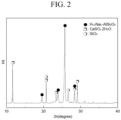
- FIG. 2 An XRD analysis result of the prepared adsorbent is shown in FIG. 2 .
- a stock solution with a sodium ion concentration of 192 mg/L was prepared using sodium hydroxide.
- Table 1 (unit: mg/L) Classification Temperature (°C) 30 50 70 90 3 hrs 192 191 175 96 5 hrs 192 186 163 79 7 hrs 192 185 151 77
- the sodium ion concentration changes little at 30°C and 50°C.
- the sodium ion concentration decreased as the stirring time increased, and when stirring was performed for 7 hours, the sodium ion concentration decreased to 165 mg/L, confirming that about 12% of the sodium ions in the stock solution were removed.
- the potassium ion concentration changed little, confirming that sodium ions in the stock solution were selectively removed.
- the sodium ion concentration decreased to 114 mg/L after 3 hours, and the decrease in sodium ion concentration increased as the stirring time increased.
- the stirring time was 7 hours, the sodium ion concentration in the solution was 63 mg/L, confirming that about 66% of the sodium ions in the stock solution were removed.
- the potassium ion concentration changed little, confirming that sodium ions could be effectively selected and removed.
Landscapes
- Chemical & Material Sciences (AREA)
- Organic Chemistry (AREA)
- Chemical Kinetics & Catalysis (AREA)
- Analytical Chemistry (AREA)
- Inorganic Chemistry (AREA)
- Water Supply & Treatment (AREA)
- Environmental & Geological Engineering (AREA)
- Engineering & Computer Science (AREA)
- Hydrology & Water Resources (AREA)
- Life Sciences & Earth Sciences (AREA)
- Physics & Mathematics (AREA)
- Thermal Sciences (AREA)
- Solid-Sorbent Or Filter-Aiding Compositions (AREA)
Abstract
Description
- The present exemplary embodiments relate to a sodium ion adsorbent that selectively removes sodium ions from a solution containing sodium ions and heterogeneous ions, a method for manufacturing the same, and a method for removing sodium ions.
- In recovering valuable elements in a solution, sodium ions act as impurities. For example, in a case where Na and K are dissolved, when recovering economically valuable K, Na should be removed because Na acts as an impurity to make a recovered K compound worthless.
- Generally, examples of a method for removing ions in a solution include a precipitation method, an adsorption method, an ion exchange resin method, and a membrane method.
- For sodium ions, the precipitation method is rarely used because the solubility of salts containing sodium is generally very high.
- Some research is being conducted on the adsorption, ion exchange resin, and membrane methods, but their use is limited due to their low selectivity for sodium ions and high manufacturing and operating costs.
- Therefore, there is a need for an economical method that can selectively remove sodium ions in a solution.
- As discussed above, the present exemplary embodiment attempts to provide a sodium ion adsorbent that can selectively remove sodium ions from a solution containing sodium ions and heterogeneous ions, and a method for manufacturing the same.
- In addition, the present exemplary embodiment attempts to provide a method for selectively removing sodium ions from a solution containing sodium ions and heterogeneous ions using an adsorbent that can selectively remove sodium ions.
- A sodium ion adsorbent according to an exemplary embodiment may include a compound represented by Chemical Formula 1 below.
[Chemical Formula 1] HxM1-xAlSi2O6
- In
Chemical Formula 1, M is one or more elements selected from Na, K, Cs, and Rb, and 0<x≤1. - The adsorbent can selectively adsorb sodium ions in a solution, and an average particle diameter (D50) of the adsorbent may be within a range of 10 µm to 300 µm.
- In addition, an exemplary embodiment of the present invention may provide a method for manufacturing a sodium ion adsorbent including a compound represented by Chemical Formula 1, the method including obtaining an adsorbent by subjecting a mineral to a multistage treatment; and separating the obtained adsorbent.
- The obtaining an adsorbent by subjecting a mineral to a multistage treatment may include obtaining a first solid by heat-treating the mineral at a high temperature; obtaining a second solid by treating the obtained first solid with an acid; and subjecting the obtained second solid to a cleaning treatment.
- The obtaining a first solid by heat-treating the mineral at a high temperature may be performed at a temperature ranging from 1000°C to 1200°C.
- In addition, the obtaining a second solid by treating the obtained first solid with an acid may include mixing the first solid with an acid and may be performed at a temperature ranging from 150°C to 300°C.
- In addition, the obtaining a second solid by treating the obtained first solid with an acid may include mixing the first solid with an acid, and the acid may be mixed within a range of 10 wt% to 40 wt% based on a weight of the first solid.
- The subjecting the obtained second solid to a cleaning treatment may include a water cleaning treatment and a base cleaning treatment.
- In addition, an exemplary embodiment of the present invention may provide a method for removing sodium ions, including adding an adsorbent including a compound represented by Chemical Formula 1 to a sodium ion-containing solution; adsorbing sodium ions to the adsorbent while stirring the solution with the adsorbent added thereto; and separating the sodium ion adsorbent with the sodium ions adsorbed thereto from the solution.
- The adsorbing sodium ions to the sodium ion adsorbent while stirring the solution with the adsorbent added thereto may be performed at a temperature ranging from 30°C to 95°C.
- In addition, in the adsorbing sodium ions to the sodium ion adsorbent while stirring the solution with the adsorbent added thereto, pH of the solution with the adsorbent added thereto may be 7 or higher.
- According to the present exemplary embodiment, a sodium ion adsorbent that can selectively remove sodium ions is manufactured using a mineral, which is advantageous from an economic perspective.
- Sodium ions are selectively removed from a solution containing sodium ions and heterogeneous ions, and thus, for a solution containing lithium, the loss of lithium can be reduced and a high concentration of lithium can be provided to a subsequent lithium using process.
-
-
FIG. 1 shows a method for manufacturing a sodium ion adsorbent according to an exemplary embodiment. -
FIG. 2 shows a result of an XRD analysis of a sodium ion adsorbent prepared according to an exemplary embodiment. - The terms such as first, second and third are used for describing, but are not limited to, various parts, components, regions, layers, and/or sections. These terms are used only to discriminate one part, component, region, layer or section from another part, component, region, layer or section. Therefore, a first part, component, region, layer or section described below may be referred to as a second part, component, region, layer or section without departing from the scope of the present invention.
- The technical terms used herein are set forth only to mention specific exemplary embodiments and are not intended to limit the present invention. Singular forms used herein are intended to include the plural forms as long as phrases do not clearly indicate an opposite meaning. In the present specification, the term "including" is intended to embody specific characteristics, regions, integers, steps, operations, elements and/or components, but is not intended to exclude presence or addition of other characteristics, regions, integers, steps, operations, elements, and/or components.
- When a part is referred to as being "above" or "on" another part, it may be directly above or on the other part or an intervening part may also be present. In contrast, when a part is referred to as being "directly above" another part, there is no intervening part present.
- Unless otherwise defined, all terms including technical and scientific terms used herein have the same meanings as the meanings generally understood by one skilled in the art to which the present invention pertains. Terms, such as those defined in commonly used dictionaries, are to be interpreted as having meanings consistent with the relevant technical literature and the present disclosure, and are not to be interpreted as having idealized or overly formal meanings unless expressly so defined herein.
- Hereinafter, an exemplary embodiment of the present invention will be described in detail. However, the exemplary embodiment is only provided by way of example, and the present invention is not limited thereto, but is defined by the scope of the claims described later.
- An exemplary embodiment of the present invention may provide a sodium ion adsorbent that selectively removes sodium ions from a solution containing sodium ions.
- Unless otherwise described throughout the specification of the present invention, the adsorbent refers to a sodium ion adsorbent.
- The sodium ion adsorbent according to an exemplary embodiment includes a compound including an alkali element, aluminum, and silicon, and represented by Chemical Formula 1.
[Chemical Formula 1] HxM1-xAlSi2O6
- in Chemical Formula 1,
- M is one or more elements selected from Na, K, Cs, and Rb, and
- 0<x≤1.
- The compound represented by Chemical Formula 1 exhibits excellent adsorption selectivity for sodium ions. The compound represented by Chemical Formula 1 may be used as a sodium ion adsorbent that can effectively recover sodium ions contained in an aqueous source such as seawater and brine.
- The compound represented by Chemical Formula 1 may be obtained through recycling of a residual mineral produced after extracting lithium from a raw mineral containing lithium, such as spodumene.
- Note that an average particle diameter (D50) of the sodium ion adsorbent may be within a range of 1 µm to 400 µm, and specifically 10 µm to 300 µm. If the average particle diameter (D50) is below the above range, there is a problem in that solid-liquid separation is difficult in a process of separating the adsorbent with sodium ions adsorbed thereto. In addition, if the particle diameter is above the above range, there is a problem in that a specific surface area of the adsorbent decreases and a sodium ion adsorption performance deteriorates.
- Another exemplary embodiment of the present invention may provide a method for manufacturing a sodium ion adsorbent.
-
FIG. 1 shows a method for manufacturing a sodium ion adsorbent according to an exemplary embodiment. Specifically, a method for manufacturing the compound represented by Chemical Formula 1 is shown. - Referring to
FIG. 1 , the method for manufacturing a sodium ion adsorbent according to an exemplary embodiment may include a first step (S1) of obtaining a sodium ion adsorbent by subjecting a mineral to a multistage treatment; and a second step (S2) of separating the obtained sodium ion adsorbent. - Here, the mineral may be a residual mineral produced after extracting lithium from a raw mineral containing lithium, such as spodumene.
- According to an exemplary embodiment of the present invention, a sodium ion adsorbent including a compound represented by Chemical Formula 1 may be manufactured.
[Chemical Formula 1] HxM1-xAlSi2O6
- in
Chemical Formula 1, - M is one or more elements selected from Na, K, Cs, and Rb, and
- 0<x≤1.
- In addition, the first step (S1) of obtaining a sodium ion adsorbent by subjecting a mineral to a multistage treatment may include a step of obtaining a first solid by heat-treating the mineral at a high temperature; a step of obtaining a second solid by treating the obtained first solid with an acid; and a step of subjecting the obtained second solid to a cleaning treatment.
- First, in the step of obtaining a first solid by heat-treating the mineral at a high temperature, the mineral prepared to have a predetermined particle size may be heated at a temperature ranging from 1000°C to 1200°C. However, the present invention is not limited to the above temperature range. If the high-temperature heat treatment temperature is below the above temperature range, impurities in the mineral may not be sufficiently removed, which may affect the performance of the manufactured adsorbent. In addition, if the high-temperature heat treatment temperature is above the above temperature range, there is a problem in that chemical components in the mineral undergo a chemical reaction at high temperature to deteriorate the adsorption performance of the manufactured adsorbent.
- Additionally, the high-temperature heat treatment may be performed for 30 minutes or longer, and specifically within a range of 30 minutes to 3 hours. However, the present invention is not limited to the above time range. If the high-temperature heat treatment time is too short, impurities in the mineral are not sufficiently removed, and if the high-temperature heat treatment time is too long, chemical components in the mineral may undergo a chemical reaction at high temperatures, leading to deterioration in the adsorption performance of the manufactured adsorbent.
- Note that in the step of obtaining a first solid by heat-treating the mineral at a high temperature, the mineral used as a raw material may be prepared to have a predetermined particle size. An average particle diameter (D50) of the mineral may be 1 µm to 10 mm, and specifically 1 µm to 1000 µm. However, the present invention is not limited thereto.
- Then, in the step of obtaining a second solid by treating the obtained first solid with an acid, the obtained first solid may be mixed with an acid.
- In the step of obtaining a first solid by heat-treating the mineral at a high temperature, the obtained first solid is cooled and then mixed with an acid. The acid may be mixed within a range of 10 wt% to 40 wt%, and specifically 20 wt% to 30 wt%, based on a weight of the first solid. However, the present invention is not limited to the above range.
- In addition, the acid may be sulfuric acid (H2SO4), and may react for 30 minutes or longer.
- The mixture of the first solid and the acid may be subjected to an acid treatment at a temperature ranging from 150°C to 350°C, and specifically from 200°C to 300°C. If the acid treatment temperature is below the above temperature range, ion exchange between lithium in the first solid, that is, the mineral from which impurities have been removed, and hydrogen in sulfuric acid may not occur properly, which may affect the performance of the manufactured adsorbent. In addition, if the acid treatment temperature is above the above temperature range, there is a problem in that the chemical components in the mineral undergo a chemical reaction with sulfuric acid, leading to deterioration in the adsorption performance of the manufactured adsorbent.
- Additionally, a stirring member may be provided to stir the mixture of the first solid and the acid.
- Then, a step of subjecting the second solid to a cleaning treatment may be performed.
- The second solid may be mixed with water and subjected to a cleaning treatment.
- In this case, the water may be mixed at 100 wt% to 1000 wt% based on a weight of the second solid, and stirring may be performed using a stirring member. Here, lithium contained in the second solid may be dissolved in the water.
- Additionally, Ca(OH)2 may be added to adjust pH of the aqueous solution in which the second solid and water are mixed. The Ca(OH)2 added can reduce Al and Si ions dissolved together with lithium contained in the aqueous solution.
- The pH can be adjusted to a range of 4 to 10. If the pH is below the above pH range, there is a problem in that the adsorbent may dissolve. In addition, if the pH is above the pH range, the consumption of alkaline solution increases, which reduces economic efficiency.
- A sodium ion adsorbent is manufactured through the above cleaning treatment.
- Next, a second step (S2) of separating and drying the obtained sodium ion adsorbent may be performed.
- The sodium ion adsorbent may be separated from the solution through centrifugation or filtration.
- The separated sodium ion adsorbent may be further subjected to a water cleaning treatment. In this case, the cleaning may be performed while mixing water three times or more than a weight of the sodium ion adsorbent.
- The sodium ion adsorbent subjected to the water cleaning treatment may be dried under temperature conditions, and the drying temperature may be within a range of 30°C to 100°C.
- The dried sodium ion adsorbent may be subjected to a further pulverization operation, whereby a sodium ion adsorbent having a predetermined particle size range may be manufactured.
- Another exemplary embodiment of the present invention may provide a method for removing sodium ions from a solution containing sodium ions using a sodium ion adsorbent. Specifically, a method for selectively removing sodium ions from a solution containing sodium ions may be provided.
- According to an exemplary embodiment, sodium ions may be selectively removed from a sodium ion-containing solution using a sodium ion adsorbent represented by
Chemical Formula 1 below.
[Chemical Formula 1] HxM1-xAlSi2O6
- in
Chemical Formula 1, - M is one or more elements selected from Na, K, Cs, and Rb, and
- 0<x≤1.
- The method for removing sodium ions according to an exemplary embodiment may include a step of adding a sodium ion adsorbent to a sodium ion-containing solution; a step of adsorbing sodium ions to the sodium ion adsorbent while stirring the solution with the sodium ion adsorbent added thereto; and a step of separating the sodium ion adsorbent with the sodium ions adsorbed thereto from the solution.
- In the step of adding a sodium ion adsorbent to the sodium ion-containing solution, a sodium ion concentration in the solution may be 0.01 g/L to 130 g/L, and specifically 0.1 g/L to 10 g/L.
- Additionally, the sodium ion-containing solution may additionally contain one or more ions selected from calcium ions, magnesium ions, iron ions, and manganese ions. The ions may be present in the solution at a concentration ranging from 0.1 g/L to 10 g/L.
- After the adsorbent is added to the sodium ion-containing solution, the sodium ions may be adsorbed to the sodium ion adsorbent while stirring. In this case, a stirring rate may be within a range of 200 rpm to 500 rpm, and specifically 250 rpm to 350 rpm. When the stirring rate is within the above range, the sodium ion removal efficiency of the adsorbent is excellent.
- Note that, after adding a sodium ion adsorbent to the sodium ion-containing solution, the sodium ions can be adsorbed to the adsorbent while stirring under heating conditions. In this case, the heating temperature may be within a range of 30°C to 90°C, and specifically 70°C to 90°C. When the heating temperature is within the above range, the selective adsorption efficiency of the adsorbent for sodium ions in the sodium-containing solution is excellent.
- In addition, pH of a solution in which the sodium ion-containing solution and the adsorbent are mixed may be 7 or more, and specifically may be within a range of more than 7 and 14 or less. This is because the adsorption mechanism is ion exchange of H+ of the adsorbent and Na+ in the solution and when the solution maintains alkalinity, it is advantageous for the sodium ion adsorption reaction.
- Hereinafter, Examples of the present invention will be described in detail. However, the Examples are only provided by way of example, and the present invention is not limited thereto, but is defined by the scope of the claims described later.
- 100 g of a mineral containing spodumene was placed in a crucible, heat-treated at 1,100°C for 1 hour, and then air cooled. The heat treatment product and sulfuric acid (98%) were mixed at a weight ratio of 100:23, and subjected to heat treatment at 250°C for 1 hour, and a solid was separated.
- The solid separated after the heat treatment and distilled water were mixed at a weight ratio of 1:2 and stirred. After 10 minutes of stirring, solid powder of Ca(OH)2 of 10% of the weight of the solid was added and stirred for 20 minutes, and then solid and liquid were separated. The separated solid was cleaned using distilled water three times or more than the weight of the solid. Next, the solid was separated and dried at 45°C to a constant weight to prepare a sodium ion adsorbent.
- An XRD analysis result of the prepared adsorbent is shown in
FIG. 2 . - Referring to
FIG. 2 , it can be confirmed that H0.9Na0.1AlSi2O6 was prepared. - A stock solution with a sodium ion concentration of 192 mg/L was prepared using sodium hydroxide.
- 4 g of the sodium ion adsorbent prepared in Preparation Example 1 was added to 400 mL of the stock solution, which was then stirred at 300 rpm.
- After stirring for a certain period of time under predetermined temperature conditions, a sample was collected, solid and liquid were separated, and a sodium ion concentration in the solution was measured.
- When the temperature was 30°C, 50°C, 70°C, and 90°C and the stirring time was 3 hours, 5 hours, and 7 hours, the sodium ion concentrations in the collected solution are shown in Table 1.
(Table 1) (unit: mg/L) Classification Temperature (°C) 30 50 70 90 3 hrs 192 191 175 96 5 hrs 192 186 163 79 7 hrs 192 185 151 77 - Referring to Table 1, it can be seen that the sodium ion concentration changes little at 30°C and 50°C. Additionally, at 70°C, the sodium ion concentration tended to decrease as the stirring time increased. When stirred for 7 hours, the sodium ion concentration decreased to 151 mg/L, confirming that about 21% of the sodium ions in the stock solution were removed. In addition, at 90°C, after stirring was performed for 3 hours, the sodium ion concentration in the solution decreased to 96 mg/L, and when stirring was performed for 7 hours, the sodium ion concentration became 77 mg/L, confirming that about 60% of the sodium ions in the stock solution were removed.
- Therefore, it can be confirmed that sodium ions in the solution can be effectively removed using the adsorbent prepared in Preparation Example 1.
- A stock solution with sodium and potassium ion concentrations of 189 mg/L and 198 mg/L, respectively, was prepared.
- 4 g of the adsorbent prepared in Preparation Example 1 was added to 400 mL of the stock solution, which was then stirred at 300 rpm.
- After stirring for a certain period of time under predetermined temperature conditions, a sample was collected, solid and liquid were separated, and a sodium ion concentration in the solution was measured.
- When the temperature was 30°C, 50°C, 70°C, and 90°C and the stirring time was 3 hours, 5 hours, and 7 hours, the sodium ion concentrations in the collected solution are shown in Table 2.
(Table 2) Ion concentration in solution (mg/L) Na K 30°C 3 hrs 189 198 5 hrs 190 197 7 hrs 189 198 50°C 3 hrs 185 197 5 hrs 184 198 7 hrs 183 198 70°C 3 hrs 181 197 5 hrs 174 195 7 hrs 165 197 90°C 3 hrs 114 191 5 hrs 81 195 7 hrs 63 194 - Referring to Table 2, it can be seen that the sodium ion concentration changes little at 30°C and 50°C. However, at 70°C, the sodium ion concentration decreased as the stirring time increased, and when stirring was performed for 7 hours, the sodium ion concentration decreased to 165 mg/L, confirming that about 12% of the sodium ions in the stock solution were removed. At this time, the potassium ion concentration changed little, confirming that sodium ions in the stock solution were selectively removed.
- In addition, at 90°C, the sodium ion concentration decreased to 114 mg/L after 3 hours, and the decrease in sodium ion concentration increased as the stirring time increased. When the stirring time was 7 hours, the sodium ion concentration in the solution was 63 mg/L, confirming that about 66% of the sodium ions in the stock solution were removed. On the other hand, the potassium ion concentration changed little, confirming that sodium ions could be effectively selected and removed.
- It will be understood by one skilled in the art to which the present invention belongs that the present invention is not limited to the above exemplary embodiments, but can be manufactured in a variety of different forms, and can be implemented in other specific forms without changing the technical spirit or essential features of the present invention. Therefore, the exemplary embodiments described above should be understood as illustrative in all respects and not for purposes of limitation.
Claims (12)
- A sodium ion adsorbent for removing sodium ions, including a compound represented by Chemical Formula 1.
[Chemical Formula 1] HxM1-xAlSi2O6
in Chemical Formula 1,M is one or more elements selected from Na, K, Cs, and Rb, and 0<x≤1. - The sodium ion adsorbent of claim 1, wherein:
the adsorbent selectively adsorbs sodium ions in a solution. - The sodium ion adsorbent of claim 1, wherein:
an average particle diameter (D50) of the adsorbent is within a range of 10 µm to 300 µm. - A method for manufacturing a sodium ion adsorbent including a compound represented by Chemical Formula 1, the method comprising:obtaining an adsorbent by subjecting a mineral to a multistage treatment; andseparating the obtained adsorbent.
[Chemical Formula 1] HxM1-xAlSi2O6
in Chemical Formula 1,M is one or more elements selected from Na, K, Cs, and Rb, and 0<x≤1. - The method of claim 4, wherein:
the obtaining an adsorbent by subjecting a mineral to a multistage treatment comprises:obtaining a first solid by heat-treating the mineral at a high temperature;obtaining a second solid by treating the obtained first solid with an acid; andsubjecting the obtained second solid to a cleaning treatment. - The method of claim 5, wherein:the obtaining a first solid by heat-treating the mineral at a high temperature isperformed at a temperature ranging from 1000°C to 1200°C.
- The method of claim 5, wherein:the obtaining a second solid by treating the obtained first solid with an acid comprisesmixing the first solid with an acid, andis performed at a temperature ranging from 150°C to 300°C.
- The method of claim 5, wherein:the obtaining a second solid by treating the obtained first solid with an acid comprisesmixing the first solid with an acid, andthe acid is mixed within a range of 10 wt% to 40 wt% based on a weight of the first solid.
- The method of claim 5, wherein:
the subjecting the obtained second solid to a cleaning treatment comprises:a water cleaning treatment; anda base cleaning treatment and - A method for removing sodium ions, the method comprising:adding an adsorbent including a compound represented by Chemical Formula 1 to a sodium ion-containing solution;adsorbing sodium ions to the adsorbent while stirring the solution with the adsorbent added thereto; andseparating the sodium ion adsorbent with the sodium ions adsorbed thereto from the solution.
[Chemical Formula 1] HxM1-xAlSi2O6
in Chemical Formula 1,M is one or more elements selected from Na, K, Cs, and Rb, and0<x≤1. - The method of claim 10, wherein:the adsorbing sodium ions to the sodium ion adsorbent while stirring the solution with the adsorbent added thereto is performedat a temperature ranging from 30°C to 95°C.
- The method of claim 10, wherein:in the adsorbing sodium ions to the sodium ion adsorbent while stirring the solution with the adsorbent added thereto,pH of the solution with the adsorbent added thereto is 7 or higher.
Applications Claiming Priority (2)
| Application Number | Priority Date | Filing Date | Title |
|---|---|---|---|
| KR1020210181815A KR102793303B1 (en) | 2021-12-17 | 2021-12-17 | Adsorbent for removing sodium ion, its preparation method and method of removing sodium ion |
| PCT/KR2022/020403 WO2023113482A1 (en) | 2021-12-17 | 2022-12-15 | Sodium ion adsorbent, preparation method thereof, and method of removing sodium ion |
Publications (2)
| Publication Number | Publication Date |
|---|---|
| EP4450155A1 true EP4450155A1 (en) | 2024-10-23 |
| EP4450155A4 EP4450155A4 (en) | 2025-11-12 |
Family
ID=86773092
Family Applications (1)
| Application Number | Title | Priority Date | Filing Date |
|---|---|---|---|
| EP22907949.6A Pending EP4450155A4 (en) | 2021-12-17 | 2022-12-15 | SODIUM ION ADSORPTION AGENT, MANUFACTURING METHOD FOR THEM AND METHOD FOR THE REMOVAL OF SODIUM IONS |
Country Status (6)
| Country | Link |
|---|---|
| US (1) | US20250050307A1 (en) |
| EP (1) | EP4450155A4 (en) |
| KR (1) | KR102793303B1 (en) |
| CN (1) | CN118369155A (en) |
| AU (1) | AU2022415784A1 (en) |
| WO (1) | WO2023113482A1 (en) |
Family Cites Families (9)
| Publication number | Priority date | Publication date | Assignee | Title |
|---|---|---|---|---|
| JP3395039B2 (en) * | 2000-01-27 | 2003-04-07 | 独立行政法人産業技術総合研究所 | Silver ion or sodium ion adsorbent and adsorption treatment method |
| JP4553187B2 (en) | 2003-11-06 | 2010-09-29 | 独立行政法人産業技術総合研究所 | Method for selective removal of sodium ions |
| CN103747868B (en) | 2011-08-23 | 2018-06-15 | 株式会社东芝 | Cationic adsorbent and method of treating solution using same |
| CN103706325B (en) * | 2013-12-17 | 2015-12-30 | 南京工业大学 | Preparation method of lithium slag adsorbent for liquid-state lithium extraction |
| CN105771879A (en) * | 2016-03-09 | 2016-07-20 | 江苏容汇通用锂业股份有限公司 | Lithium adsorbent and preparation method and application thereof |
| KR102521570B1 (en) * | 2018-08-27 | 2023-04-12 | 주식회사 엘지화학 | Lithium ion adsorbent and a method for recovering lithium ion using the same |
| CN112573546A (en) * | 2019-09-30 | 2021-03-30 | 戴艾霖 | New method for directly producing lithium carbonate from lithium sulfate and sodium (potassium) carbonate to reduce sulfate radical content |
| KR102316889B1 (en) * | 2019-12-12 | 2021-10-22 | 주식회사 포스코 | Manufaturing method of zeolite using lithium residue |
| CN111250036B (en) | 2020-02-13 | 2022-11-01 | 中国科学院青海盐湖研究所 | Sodium ion adsorbent, preparation method and application thereof |
-
2021
- 2021-12-17 KR KR1020210181815A patent/KR102793303B1/en active Active
-
2022
- 2022-12-15 US US18/720,316 patent/US20250050307A1/en active Pending
- 2022-12-15 WO PCT/KR2022/020403 patent/WO2023113482A1/en not_active Ceased
- 2022-12-15 AU AU2022415784A patent/AU2022415784A1/en active Pending
- 2022-12-15 CN CN202280080948.5A patent/CN118369155A/en active Pending
- 2022-12-15 EP EP22907949.6A patent/EP4450155A4/en active Pending
Also Published As
| Publication number | Publication date |
|---|---|
| WO2023113482A1 (en) | 2023-06-22 |
| CN118369155A (en) | 2024-07-19 |
| EP4450155A4 (en) | 2025-11-12 |
| US20250050307A1 (en) | 2025-02-13 |
| KR20230092433A (en) | 2023-06-26 |
| KR102793303B1 (en) | 2025-04-07 |
| AU2022415784A1 (en) | 2024-07-04 |
Similar Documents
| Publication | Publication Date | Title |
|---|---|---|
| KR101604954B1 (en) | Manufacturing Method of High Purity Lithium Phosphate from The Waste Liquid of The Exhausted Litium-Ion Battery | |
| US12473201B2 (en) | Method for producing lithium compound | |
| EP4140952A1 (en) | Method for producing lithium hydroxide | |
| EP1251117B1 (en) | Method of treating fluorine compound and treated substance | |
| KR102033607B1 (en) | Method for concentrating of lithium by addition of aluminum compound and sulfation reaction from lithium solution and recycling method of by-product made thereby | |
| KR102521570B1 (en) | Lithium ion adsorbent and a method for recovering lithium ion using the same | |
| KR20210074781A (en) | Manufaturing method of zeolite using lithium residue | |
| JP2025535524A (en) | Lithium Recovery | |
| EP4450657A1 (en) | Recovery method of lithium ion | |
| WO2022056230A1 (en) | Weak acid lixiviants for selective recovery of alkaline earth metals | |
| US20250050307A1 (en) | Sodium ion adsorbent, preparation method thereof, and method of removing sodium ion | |
| CN110407236B (en) | Preparation method of electric automobile-grade lithium carbonate | |
| KR102670694B1 (en) | High-efficiency manufacturing method of lithium hydroxide from lithium carbonate through process improvement | |
| JPS61286220A (en) | Recovery of gallium component using adsorbent | |
| WO2024126601A1 (en) | Lithium extraction | |
| JP2994405B2 (en) | Purification method of alkali hydroxide | |
| KR102271298B1 (en) | Manufaturing method of zeolite using lithium residue | |
| KR102325755B1 (en) | Method of manufacturing lithium compound | |
| KR20220075904A (en) | Manufacturing method of zeolite using lithium residue | |
| KR102744027B1 (en) | High-efficiency lithium recovery method from low-grade lithium minerals through process improvement and lithium carbonate manufactured thereby | |
| EP4635621A1 (en) | Aluminum-based lithium adsorbent and manufacturing method thereof | |
| CN121894695A (en) | A method for treating fluoride-containing wastewater | |
| CN119143165A (en) | Method for preparing aluminum fluoride and lithium hydroxide by using lithium-containing aluminum electrolyte | |
| JP2025127527A (en) | How to manufacture lithium hydroxide | |
| WO2025120256A1 (en) | A novel leaching process of lithium concentrates |
Legal Events
| Date | Code | Title | Description |
|---|---|---|---|
| STAA | Information on the status of an ep patent application or granted ep patent |
Free format text: STATUS: THE INTERNATIONAL PUBLICATION HAS BEEN MADE |
|
| PUAI | Public reference made under article 153(3) epc to a published international application that has entered the european phase |
Free format text: ORIGINAL CODE: 0009012 |
|
| STAA | Information on the status of an ep patent application or granted ep patent |
Free format text: STATUS: REQUEST FOR EXAMINATION WAS MADE |
|
| 17P | Request for examination filed |
Effective date: 20240619 |
|
| AK | Designated contracting states |
Kind code of ref document: A1 Designated state(s): AL AT BE BG CH CY CZ DE DK EE ES FI FR GB GR HR HU IE IS IT LI LT LU LV MC ME MK MT NL NO PL PT RO RS SE SI SK SM TR |
|
| DAV | Request for validation of the european patent (deleted) | ||
| DAX | Request for extension of the european patent (deleted) | ||
| A4 | Supplementary search report drawn up and despatched |
Effective date: 20251013 |
|
| RIC1 | Information provided on ipc code assigned before grant |
Ipc: B01J 20/02 20060101AFI20251007BHEP Ipc: B01J 20/04 20060101ALI20251007BHEP Ipc: B01J 20/08 20060101ALI20251007BHEP Ipc: B01J 20/10 20060101ALI20251007BHEP Ipc: C02F 1/28 20230101ALI20251007BHEP Ipc: B01J 20/28 20060101ALI20251007BHEP Ipc: B01J 20/30 20060101ALI20251007BHEP |