EP4447616A1 - Lighting device with voice control - Google Patents
Lighting device with voice control Download PDFInfo
- Publication number
- EP4447616A1 EP4447616A1 EP23167702.2A EP23167702A EP4447616A1 EP 4447616 A1 EP4447616 A1 EP 4447616A1 EP 23167702 A EP23167702 A EP 23167702A EP 4447616 A1 EP4447616 A1 EP 4447616A1
- Authority
- EP
- European Patent Office
- Prior art keywords
- lighting device
- voice
- command
- predetermined
- control circuit
- Prior art date
- Legal status (The legal status is an assumption and is not a legal conclusion. Google has not performed a legal analysis and makes no representation as to the accuracy of the status listed.)
- Pending
Links
Images



Classifications
-
- H—ELECTRICITY
- H05—ELECTRIC TECHNIQUES NOT OTHERWISE PROVIDED FOR
- H05B—ELECTRIC HEATING; ELECTRIC LIGHT SOURCES NOT OTHERWISE PROVIDED FOR; CIRCUIT ARRANGEMENTS FOR ELECTRIC LIGHT SOURCES, IN GENERAL
- H05B47/00—Circuit arrangements for operating light sources in general, i.e. where the type of light source is not relevant
- H05B47/10—Controlling the light source
- H05B47/105—Controlling the light source in response to determined parameters
- H05B47/115—Controlling the light source in response to determined parameters by determining the presence or movement of objects or living beings
- H05B47/12—Controlling the light source in response to determined parameters by determining the presence or movement of objects or living beings by detecting audible sound
-
- H—ELECTRICITY
- H05—ELECTRIC TECHNIQUES NOT OTHERWISE PROVIDED FOR
- H05B—ELECTRIC HEATING; ELECTRIC LIGHT SOURCES NOT OTHERWISE PROVIDED FOR; CIRCUIT ARRANGEMENTS FOR ELECTRIC LIGHT SOURCES, IN GENERAL
- H05B47/00—Circuit arrangements for operating light sources in general, i.e. where the type of light source is not relevant
- H05B47/10—Controlling the light source
- H05B47/105—Controlling the light source in response to determined parameters
- H05B47/115—Controlling the light source in response to determined parameters by determining the presence or movement of objects or living beings
Definitions
- the invention is in the field of lighting equipment.
- the invention relates to a lighting device and a method for controlling the lighting device.
- luminaires In lighting systems, a person usually controls luminaires by operating a switch. Alternatively, or for activating special functions that cannot be easily set with a single switch, luminaires can be controlled by voice commands.
- This connection may be local for controlling lighting devices connected in the same network, but in most cases the component for voice command recognition is also connected to the internet.
- an object of the present invention is to provide an apparatus and a method, which reduce the above problems.
- an object of the present invention is to provide a lighting device and a method, with which voice control can be provided with low effort and cost.
- the lighting device comprising a receiver for receiving a voice input, a voice recognition circuit configured to recognize at least one predetermined voice command in the voice input and to output a command code assigned to the predetermined voice command in response to the recognized predetermined voice command and a control circuit configured to control the lighting device based on the command code.
- the voice recognition circuit and the receiver for receiving the voice input are part of the lighting device, eliminating the need for an external voice input device or Internet connection. Since voice input is processed within the lighting device, no special data protection measures or measures to prevent unauthorized access from outside are necessary. Further, such integration has the advantage that spoken voice command does not need to reach a central component to execute command recognition and a spatial limitation can be achieved. In a scenario where a plurality of devices are in a close spatial relation, this avoids misinterpretation of voice command.
- An example is an office with a plurality of voice controlled luminaires, for which the invention enables control from a limited area around the position of the luminaire.
- the voice recognition circuitry and the control circuitry can be separate modules, interconnected via a Universal Serial Bus (USB) or universal asynchronous receiver-transmitter (UART) interface.
- USB Universal Serial Bus
- UART universal asynchronous receiver-transmitter
- the control circuit acts as USB host and the voice recognition circuit acts as USB device preferably as USB Human Interface Device.
- the voice recognition circuitry can be powered via the USB interface.
- control circuit is DALI-2 application controller
- the lighting device comprises at least one converter circuit configured to provide a supply voltage and/or current to a light source of the lighting device and a DALI-2 bus configured to interconnect the at least one converter device and the control circuit.
- the voice command and thus the command code can contain a command for configuration (setting parameters, such as dimming speed, color temperature) and/or for control (switching on/off, dimming) of the lighting device.
- a single voice command such as "light” could be used/stored to control the lighting device, with the voice command turning the lighting device on or off depending on the current operating state of the lighting device.
- the voice recognition circuitry can be configured to recognize the command even if it is spoken in different languages.
- the voice command can include one or more words.
- the voice recognition circuit can be configured to recognize each of a plurality of predetermined voice commands, wherein a part of the plurality of predetermined voice commands is assigned to a predetermined state of the lighting device and the control circuit is configured to detect the predetermined state and to control the voice recognition circuit to restrict the recognition of the voice commands to the part when the predetermined state is detected.
- the state can be an operating state of the lighting device (e.g., light on or off, configuration mode, emergency mode) or a user/device-activated menu (e.g., language selection menu, menu for selecting color temperature and/or intensity) in which only certain settings can be made by predetermined voice commands.
- an operating state of the lighting device e.g., light on or off, configuration mode, emergency mode
- a user/device-activated menu e.g., language selection menu, menu for selecting color temperature and/or intensity
- Language can be set in the language selection menu activated by a voice command and/or can be set automatically by the lighting device by analyzing/determining the language of the voice commands received by the receiver (microphone).
- an error signal can be issued to the user if a voice command is received that cannot be executed in the current/detected state or if the voice input cannot be recognized (unknown command, wrong language).
- the control circuit is configured to output an error signal if the predetermined state is detected and the voice recognition circuit recognizes a voice command that does not belong to the part of the plurality of predetermined voice commands or if the voice recognition circuit does not recognize a voice command in the voice input.
- the error signal can be output by an indicator light of the lighting device and/or a loudspeaker of the lighting device.
- the voice commands expected/accepted in the current state can be output by the loudspeaker to inform the user, wherein the control circuit is configured to control the loudspeaker to output the voice commands of the part of the plurality of predetermined voice commands one by one, when the predetermined state is detected and/or instead of the error signal.
- the control circuit can be configured to classify a plurality of states of the lighting device, such as different operating states (on, off, x% ⁇ dim level>y%) but also different menu stages, and to determine the expected/accepted commands assigned to each class (stage).
- the control circuit can be configured to detect at least a first and second state of the lighting device, wherein the first state corresponds to a main menu and the second state corresponds to a sub menu of the main menu and a first part of the plurality of voice commands is assigned to the main menu and a second part of the plurality of voice commands is assigned to the sub menu.
- the voice recognition circuit can be controlled to restrict/focus recognition on the voice commands expected/accepted for the respective menu.
- the lighting device can comprise a detecting means configured to detected a person in an area, wherein the control circuit is configured to control the lighting device based on the command code only when the person is detected.
- the detecting means can comprise a directional microphone, a camera and/or a motion detector directed to the area and/or a microphone array configured to locate the person in the area.
- the receiver can comprise the directional microphone or the microphone array to receive the person's voice input when the person is in the area.
- the lighting device can be a pendant luminaire, a wall luminaire or ceiling luminaire.
- the lighting device is a free-standing luminaire having a head, wherein the head comprises an optical element configured to direct, by refraction and/or reflection, light of a light source to at least a part of the area and the detecting means is located in or on the luminaire head.
- the person can address the desired lighting device to prevent control of another lighting device.
- the voice recognition circuit is configured to recognize the at least one predetermined voice command including a name assigned to the lighting device and the control circuit is configured to control the lighting device based on the command code only when the name is included in the at least one predetermined voice command.
- the voice command can name a parameter and specify how to change/set the parameter, wherein the voice recognition circuit is configured to recognize a voice command including the name of a parameter to be set and an indication of how to set/change the parameter and the control circuit is configured to set/change the parameter.
- the lighting device can comprise a housing, in which at least one of the receiver, the voice recognition circuit, the control circuit and the detecting means is arranged.
- a method for controlling a lighting device comprises the steps of:
- FIG. 1 shows a lighting device 1 according to an embodiment of the present invention in a side view.
- the lighting device 1 is a free-standing luminaire (floor lamp) formed by a head 2, a base 3 and a stand 4 which is mounted on the base 3 and to which head 2 is attached.
- the head 2 comprises an optical element 5 configured to direct light from a light source (not shown) to an area below the head 2 and a microphone 6 to receive voice commands.
- a switch 7 to turn the light on and off and a loudspeaker 8 is attached to the stand 4. It is to be noted that the switch is optional and the lighting device may be controlled by voice control only.
- the height of the lighting device 1 is about two meters.
- the lighting device 1 comprises a light source 9, a converter circuit 10 configured to provide a supply voltage and/or current to the light source 9, a control circuit 11 configured to control the converter circuit 10 based on a signal received from the switch 7 and based on a voice command received by the microphone 6, a DALI bus 12, to which the converter circuit 10, the switch 7 and the control circuit 11 are connected, a voice recognition circuit 13 connected to the microphone 6 and the control circuit 11, a power supply 14 for the voice recognition circuit 13 and a power supply 15 for the control circuit 11.
- the control circuit 11 is a DALI application controller that transmits and receives signals to/from the converter circuit 10 and the switch 7 via the DALI bus 12 and transmits and receives signals to/from the voice recognition circuit 13 via a USB interface/connection 16.
- the voice recognition circuit 13 is powered by the power supply 14.
- the voice recognition circuit 13 can be powered by the USB interface (5V, 500mA).
- the voice recognition circuit 13 acts as USB 2.0 device and the control circuit 11 acts as USB host.
- Table 1 in FIG. 3 shows parameters to be set for the Human Interface Device (HID) communication.
- HID Human Interface Device
- the voice recognition circuit 13 is programmed by the manufacturer of the lighting device 1 or the voice recognition circuit 13 to generally recognize a specific set of voice commands in specific languages.
- the commands (command codes) transmitted from the voice recognition circuit 13 to the control circuit 11 via the USB interface 16 can be classified in different instruction groups, wherein the respective instruction group is indicated by the first byte of the possible 64 bytes in the HID report data packet.
- Table 2 in FIG. 4 shows the first byte assigned to different instruction groups.
- the control circuit 11 controls the converter circuit 10 based on the command received from the voice recognition circuit 13.
- the command can be an instruction to set the light intensity or the color temperature.
- the command can be an instruction to activate/deactivate a settings menu or to select a menu item.
- numbers can be assigned to the menu items, wherein the control circuit 11 controls the loudspeaker 8 to list the menu items with the corresponding number so that the user knows which number to call to select the desired menu item.
- the control circuit 11 can be configured to provide feedback to the user regarding the result of the voice recognition and/or to list all commands/instructions if the lighting device 1 is powered with for the first time, a certain switch is operated, or a corresponding voice command is received.
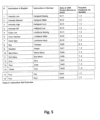
- Table 3 in FIG. 5 shows a set of 16 instructions that can be recognized by the voice recognition circuit 13 in English and German, wherein the instructions of columns 12 to 16 are numbers for selecting menu items in a menu activated by the instruction "Start Menu” and "Starte Menu” of column 12.
- the instructions of columns 11 to 16 can be executed only when the menu is activated and the instructions of columns 1 to 10 can be executed only when the menu is deactivated.
- the control circuit 10 can control the voice recognition circuit 13 to focus/restrict the voice recognition to the instructions of columns 1 to 10 when the menu is deactivated and to focus/restrict the voice recognition to the instructions of columns 11 to 16 when the menu is activated.
- the control circuit 10 requests information about the weather from an external server (not shown), for example, via Internet, and controls the loudspeaker 8 to output the information using Text-to-Speech software/module.
- Table 4 in FIG. 6 shows results of the voice recognition and the respective feedback output by the loudspeaker 8.
- the language of the feedback can be adapted to the language of the instruction.
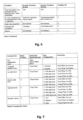
- FIG. 7 shows in table 5 the selection options with the corresponding instruction for the menu and submenus (different menu stages), and FIG. 8 shows a flowchart of the menu selection operation.
- the control circuit 11 controls the loudspeaker 8 to list the menu items “Language speaker output", “Low light level”,..., “Speaker volume” with the corresponding number "One"/”Eins", “Two”/”Zwei", ..., “Five”/"Fünf” and list the sub menu items “Deutsch” and “English” with the corresponding number "Eins” and “Two” when the menu item "Language speaker output” is activated by the instruction "One” or "Eins”.
Landscapes
- Circuit Arrangement For Electric Light Sources In General (AREA)
Abstract
Description
- The invention is in the field of lighting equipment. In particular, the invention relates to a lighting device and a method for controlling the lighting device.
- In lighting systems, a person usually controls luminaires by operating a switch. Alternatively, or for activating special functions that cannot be easily set with a single switch, luminaires can be controlled by voice commands.
- However, this often requires additional devices, such as a smartphone, for voice input and an Internet connection or central components that are connected to a network. This connection may be local for controlling lighting devices connected in the same network, but in most cases the component for voice command recognition is also connected to the internet.
- It is an object of the present invention to provide an apparatus and a method, which reduce the above problems. In particular, an object of the present invention is to provide a lighting device and a method, with which voice control can be provided with low effort and cost.
- This object is achieved by a lighting device and a method for controlling a lighting device according to the enclosed independent claims. Advantageous features of the present invention are defined in the corresponding dependent claims.
- According to the present invention, the lighting device comprising a receiver for receiving a voice input, a voice recognition circuit configured to recognize at least one predetermined voice command in the voice input and to output a command code assigned to the predetermined voice command in response to the recognized predetermined voice command and a control circuit configured to control the lighting device based on the command code.
- The voice recognition circuit and the receiver for receiving the voice input are part of the lighting device, eliminating the need for an external voice input device or Internet connection. Since voice input is processed within the lighting device, no special data protection measures or measures to prevent unauthorized access from outside are necessary. Further, such integration has the advantage that spoken voice command does not need to reach a central component to execute command recognition and a spatial limitation can be achieved. In a scenario where a plurality of devices are in a close spatial relation, this avoids misinterpretation of voice command. An example is an office with a plurality of voice controlled luminaires, for which the invention enables control from a limited area around the position of the luminaire.
- The voice recognition circuitry and the control circuitry can be separate modules, interconnected via a Universal Serial Bus (USB) or universal asynchronous receiver-transmitter (UART) interface. Preferably, the control circuit acts as USB host and the voice recognition circuit acts as USB device preferably as USB Human Interface Device. In addition, the voice recognition circuitry can be powered via the USB interface.
- According to a preferred embodiment, the control circuit is DALI-2 application controller, wherein the lighting device comprises at least one converter circuit configured to provide a supply voltage and/or current to a light source of the lighting device and a DALI-2 bus configured to interconnect the at least one converter device and the control circuit.
- The voice command and thus the command code can contain a command for configuration (setting parameters, such as dimming speed, color temperature) and/or for control (switching on/off, dimming) of the lighting device. Only a single voice command, such as "light", could be used/stored to control the lighting device, with the voice command turning the lighting device on or off depending on the current operating state of the lighting device. In addition, the voice recognition circuitry can be configured to recognize the command even if it is spoken in different languages.
- The voice command can include one or more words. To increase the accuracy of voice recognition, the number of words/commands to be recognized can be reduced by language selection and/or adaptation to the current state of the lighting device in which only certain commands can be processed/executed. For this, the voice recognition circuit can be configured to recognize each of a plurality of predetermined voice commands, wherein a part of the plurality of predetermined voice commands is assigned to a predetermined state of the lighting device and the control circuit is configured to detect the predetermined state and to control the voice recognition circuit to restrict the recognition of the voice commands to the part when the predetermined state is detected. The state can be an operating state of the lighting device (e.g., light on or off, configuration mode, emergency mode) or a user/device-activated menu (e.g., language selection menu, menu for selecting color temperature and/or intensity) in which only certain settings can be made by predetermined voice commands.
- Language can be set in the language selection menu activated by a voice command and/or can be set automatically by the lighting device by analyzing/determining the language of the voice commands received by the receiver (microphone).
- In addition or alternatively, an error signal can be issued to the user if a voice command is received that cannot be executed in the current/detected state or if the voice input cannot be recognized (unknown command, wrong language). For this, the control circuit is configured to output an error signal if the predetermined state is detected and the voice recognition circuit recognizes a voice command that does not belong to the part of the plurality of predetermined voice commands or if the voice recognition circuit does not recognize a voice command in the voice input.
- The error signal can be output by an indicator light of the lighting device and/or a loudspeaker of the lighting device. In addition or alternatively, the voice commands expected/accepted in the current state can be output by the loudspeaker to inform the user, wherein the control circuit is configured to control the loudspeaker to output the voice commands of the part of the plurality of predetermined voice commands one by one, when the predetermined state is detected and/or instead of the error signal.
- The control circuit can be configured to classify a plurality of states of the lighting device, such as different operating states (on, off, x%<dim level>y%) but also different menu stages, and to determine the expected/accepted commands assigned to each class (stage). In particular, the control circuit can be configured to detect at least a first and second state of the lighting device, wherein the first state corresponds to a main menu and the second state corresponds to a sub menu of the main menu and a first part of the plurality of voice commands is assigned to the main menu and a second part of the plurality of voice commands is assigned to the sub menu. In this way, the voice recognition circuit can be controlled to restrict/focus recognition on the voice commands expected/accepted for the respective menu.
- If there are several persons and/or lighting devices in the same room, lighting device may be controlled unintentionally. To prevent such malfunction, the lighting device can comprise a detecting means configured to detected a person in an area, wherein the control circuit is configured to control the lighting device based on the command code only when the person is detected. The detecting means can comprise a directional microphone, a camera and/or a motion detector directed to the area and/or a microphone array configured to locate the person in the area.
- The receiver can comprise the directional microphone or the microphone array to receive the person's voice input when the person is in the area.
- The lighting device can be a pendant luminaire, a wall luminaire or ceiling luminaire. According to a preferred embodiment, the lighting device is a free-standing luminaire having a head, wherein the head comprises an optical element configured to direct, by refraction and/or reflection, light of a light source to at least a part of the area and the detecting means is located in or on the luminaire head.
- Alternatively or in addition, the person can address the desired lighting device to prevent control of another lighting device. For this, the voice recognition circuit is configured to recognize the at least one predetermined voice command including a name assigned to the lighting device and the control circuit is configured to control the lighting device based on the command code only when the name is included in the at least one predetermined voice command.
- If several parameters of the lighting device are controllable, the voice command can name a parameter and specify how to change/set the parameter, wherein the voice recognition circuit is configured to recognize a voice command including the name of a parameter to be set and an indication of how to set/change the parameter and the control circuit is configured to set/change the parameter.
- The lighting device can comprise a housing, in which at least one of the receiver, the voice recognition circuit, the control circuit and the detecting means is arranged.
- According to the present invention, a method for controlling a lighting device comprises the steps of:
- receiving a voice input;
- recognizing at least one predetermined voice command in the voice input to output a command code assigned to the predetermined voice command in response to the recognized predetermined voice command; and
- controlling the lighting device based on the command code.
- Embodiments of the invention are discussed in detail with reference to the enclosed figures, in which
-
FIG. 1 shows a lighting device according to an embodiment of the present invention in side view, -
FIG. 2 shows a simplified block diagram of parts of the lighting device shown inFIG. 1 , -
FIG. 3 shows a table of parameters to be set for the USB Human Interface Device communication, -
FIG. 4 shows a table of instruction groups and the corresponding first byte of the HID report data packet, -
FIG. 5 shows a table of instructions to be recognized, -
FIG. 6 shows a table of voice recognition results and the respective feedback to the user, -
FIG. 7 shows a table of menu options and the corresponding command, and -
FIG. 8 shows a flowchart of a menu selection operation. - In the figures, same reference numbers denote same or equivalent structures. The explanation of structures with same reference numbers in different figures is avoided where deemed possible for sake of conciseness.
-
FIG. 1 shows alighting device 1 according to an embodiment of the present invention in a side view. Thelighting device 1 is a free-standing luminaire (floor lamp) formed by ahead 2, abase 3 and astand 4 which is mounted on thebase 3 and to whichhead 2 is attached. Thehead 2 comprises anoptical element 5 configured to direct light from a light source (not shown) to an area below thehead 2 and amicrophone 6 to receive voice commands. Aswitch 7 to turn the light on and off and aloudspeaker 8 is attached to thestand 4. It is to be noted that the switch is optional and the lighting device may be controlled by voice control only. The height of thelighting device 1 is about two meters. - As shown in
FIG. 2 thelighting device 1 comprises alight source 9, aconverter circuit 10 configured to provide a supply voltage and/or current to thelight source 9, acontrol circuit 11 configured to control theconverter circuit 10 based on a signal received from theswitch 7 and based on a voice command received by themicrophone 6, aDALI bus 12, to which theconverter circuit 10, theswitch 7 and thecontrol circuit 11 are connected, avoice recognition circuit 13 connected to themicrophone 6 and thecontrol circuit 11, apower supply 14 for thevoice recognition circuit 13 and apower supply 15 for thecontrol circuit 11. - The
control circuit 11 is a DALI application controller that transmits and receives signals to/from theconverter circuit 10 and theswitch 7 via theDALI bus 12 and transmits and receives signals to/from thevoice recognition circuit 13 via a USB interface/connection 16. InFIG. 2 , thevoice recognition circuit 13 is powered by thepower supply 14. Alternatively, thevoice recognition circuit 13 can be powered by the USB interface (5V, 500mA). - The
voice recognition circuit 13 acts as USB 2.0 device and thecontrol circuit 11 acts as USB host. Table 1 inFIG. 3 shows parameters to be set for the Human Interface Device (HID) communication. - The
voice recognition circuit 13 is programmed by the manufacturer of thelighting device 1 or thevoice recognition circuit 13 to generally recognize a specific set of voice commands in specific languages. The commands (command codes) transmitted from thevoice recognition circuit 13 to thecontrol circuit 11 via theUSB interface 16 can be classified in different instruction groups, wherein the respective instruction group is indicated by the first byte of the possible 64 bytes in the HID report data packet. Table 2 inFIG. 4 shows the first byte assigned to different instruction groups. - The
control circuit 11 controls theconverter circuit 10 based on the command received from thevoice recognition circuit 13. The command can be an instruction to set the light intensity or the color temperature. In addition, the command can be an instruction to activate/deactivate a settings menu or to select a menu item. To simplify speech recognition, numbers can be assigned to the menu items, wherein thecontrol circuit 11 controls theloudspeaker 8 to list the menu items with the corresponding number so that the user knows which number to call to select the desired menu item. In addition, thecontrol circuit 11 can be configured to provide feedback to the user regarding the result of the voice recognition and/or to list all commands/instructions if thelighting device 1 is powered with for the first time, a certain switch is operated, or a corresponding voice command is received. - Table 3 in
FIG. 5 shows a set of 16 instructions that can be recognized by thevoice recognition circuit 13 in English and German, wherein the instructions ofcolumns 12 to 16 are numbers for selecting menu items in a menu activated by the instruction "Start Menu" and "Starte Menu" ofcolumn 12. In this way, the instructions ofcolumns 11 to 16 can be executed only when the menu is activated and the instructions ofcolumns 1 to 10 can be executed only when the menu is deactivated. To increase the accuracy of voice recognition, thecontrol circuit 10 can control thevoice recognition circuit 13 to focus/restrict the voice recognition to the instructions ofcolumns 1 to 10 when the menu is deactivated and to focus/restrict the voice recognition to the instructions ofcolumns 11 to 16 when the menu is activated. When the instruction ofcolumn 9 is received, thecontrol circuit 10 requests information about the weather from an external server (not shown), for example, via Internet, and controls theloudspeaker 8 to output the information using Text-to-Speech software/module. - Table 4 in
FIG. 6 shows results of the voice recognition and the respective feedback output by theloudspeaker 8. The language of the feedback can be adapted to the language of the instruction. -
FIG. 7 shows in table 5 the selection options with the corresponding instruction for the menu and submenus (different menu stages), andFIG. 8 shows a flowchart of the menu selection operation. As shown inFIG. 7 and8 , when the menu is activated by the command "Start Menu" or "Starte Menü", thecontrol circuit 11 controls theloudspeaker 8 to list the menu items "Language speaker output", "Low light level",..., "Speaker volume" with the corresponding number "One"/"Eins", "Two"/"Zwei", ..., "Five"/"Fünf" and list the sub menu items "Deutsch" and "English" with the corresponding number "Eins" and "Two" when the menu item "Language speaker output" is activated by the instruction "One" or "Eins".
Claims (15)
- Lighting device comprisinga receiver (6) for receiving a voice input;a voice recognition circuit (13) configured to recognize at least one predetermined voice command in the voice input and to output a command code assigned to the predetermined voice command in response to the recognized predetermined voice command; anda control circuit (11) configured to control the lighting device based on the command code.
- The lighting device according to claim 1, further comprising
a serial interface, preferably USB or UART interface (16), configured to connect the voice recognition circuit (13) to the control circuit (11). - The lighting device according to claim 2, wherein
the control circuit (11) acts as USB host and the voice recognition circuit (13) acts as USB device or as USB Human Interface Device. - The lighting device according to any one of the preceding claims, further comprisingat least one converter circuit (10) configured to provide a supply voltage and/or current to a light source (9); anda DALI-2 bus (12) configured to connect the at least one converter device (109) to the control circuit (11), whereinthe control circuit (11) is an application controller.
- The lighting device according to any one of the preceding claims, whereinthe voice recognition circuit (13) is configured to recognize each of a plurality of predetermined voice commands; anda part of the plurality of predetermined voice commands is assigned to a predetermined state of the lighting device; andthe control circuit (11) is configured to detect the predetermined state and is configured to control the voice recognition circuit (13) to restrict the recognition of the voice commands to the part when the predetermined state is detected and/or is configured to output an error signal when the predetermined state is detected and a voice command that does not belong to the part is recognized by the voice recognition circuit (13).
- The lighting device according to claim 5, further comprisinga loudspeaker (8); whereinthe control circuit (11) is configured to control the loudspeaker to output the error signal and/or is configured to control the loudspeaker to output the voice commands of the part one by one when the predetermined state is detected.
- The lighting device according to claim 5 or 6, whereinthe control circuit (11) is configured to detect a first state of the lighting device and a second state of the lighting device;the first state corresponds to a main menu and the second state corresponds to a sub menu of the main menu; anda first part of the plurality of voice commands is assigned to the main menu and a second part of the plurality of voice commands is assigned to the sub menu.
- The lighting device according to any one of the preceding claims, further comprisinga detecting means configured to detected a person in an area; whereinthe control circuit (11) is configured to control the lighting device based on the command code only when the person is detect.
- The lighting device according to claim 8, wherein
the detecting means is a directional microphone, a microphone array, a camera or a motion detector. - The lighting device according to claim 9, wherein
the receiver (6) comprises the directional microphone or the microphone array. - The lighting device according to any one of claims 8 to 10, whereinthe lighting device is a free-standing luminaire comprising a head (2);the head (2) comprises an optical element (5) configured to direct, by refraction and/or reflection, light of a light source (9) to at least a part of the area; andthe detecting means is located in or on the luminaire head (2).
- The lighting device according to any one of the preceding claims, whereinthe voice recognition circuit (13) is configured to recognize the at least one predetermined voice command including a name assigned to the lighting device; andthe control circuit (11) is configured to control the lighting device based on the command code only when the name is included in the at least one predetermined voice command.
- The lighting device according to any one of the preceding claims, wherein
the voice recognition circuit (13) is configured to recognize the at least one predetermined voice command including a name of a parameter to be set and an indication of how to set the parameter. - The lighting device according to any one of the preceding claims, further comprising
a housing, in which at least one of the receiver (6), the voice recognition circuit (13) and the control circuit (11) is arranged. - A method for controlling a lighting device (1) comprising the steps of:receiving a voice input;recognizing at least one predetermined voice command in the voice input to output a command code assigned to the predetermined voice command in response to the recognized predetermined voice command; andcontrolling the lighting device (1) based on the command code.
Priority Applications (2)
| Application Number | Priority Date | Filing Date | Title |
|---|---|---|---|
| EP23167702.2A EP4447616A1 (en) | 2023-04-13 | 2023-04-13 | Lighting device with voice control |
| PCT/EP2024/059133 WO2024213457A1 (en) | 2023-04-13 | 2024-04-04 | Lighting device with voice control |
Applications Claiming Priority (1)
| Application Number | Priority Date | Filing Date | Title |
|---|---|---|---|
| EP23167702.2A EP4447616A1 (en) | 2023-04-13 | 2023-04-13 | Lighting device with voice control |
Publications (1)
| Publication Number | Publication Date |
|---|---|
| EP4447616A1 true EP4447616A1 (en) | 2024-10-16 |
Family
ID=86007376
Family Applications (1)
| Application Number | Title | Priority Date | Filing Date |
|---|---|---|---|
| EP23167702.2A Pending EP4447616A1 (en) | 2023-04-13 | 2023-04-13 | Lighting device with voice control |
Country Status (2)
| Country | Link |
|---|---|
| EP (1) | EP4447616A1 (en) |
| WO (1) | WO2024213457A1 (en) |
Citations (6)
| Publication number | Priority date | Publication date | Assignee | Title |
|---|---|---|---|---|
| US20140100854A1 (en) * | 2012-10-09 | 2014-04-10 | Hon Hai Precision Industry Co., Ltd. | Smart switch with voice operated function and smart control system using the same |
| WO2016022612A1 (en) * | 2014-08-04 | 2016-02-11 | Innosys, Inc. | Lighting systems |
| US20180158460A1 (en) * | 2016-12-01 | 2018-06-07 | Samsung Electronics Co., Ltd. | Lamp device for inputting or outputting voice signal and method of driving the same |
| WO2018206359A1 (en) * | 2017-05-08 | 2018-11-15 | Philips Lighting Holding B.V. | Voice control |
| GB2569300A (en) * | 2017-12-12 | 2019-06-19 | Xmos Ltd | Device comprising a microphone unit |
| US20200205269A1 (en) * | 2017-09-07 | 2020-06-25 | Panasonic Intellectual Property Management Co., Ltd. | Lighting control system, lighting control method, and program |
-
2023
- 2023-04-13 EP EP23167702.2A patent/EP4447616A1/en active Pending
-
2024
- 2024-04-04 WO PCT/EP2024/059133 patent/WO2024213457A1/en not_active Ceased
Patent Citations (6)
| Publication number | Priority date | Publication date | Assignee | Title |
|---|---|---|---|---|
| US20140100854A1 (en) * | 2012-10-09 | 2014-04-10 | Hon Hai Precision Industry Co., Ltd. | Smart switch with voice operated function and smart control system using the same |
| WO2016022612A1 (en) * | 2014-08-04 | 2016-02-11 | Innosys, Inc. | Lighting systems |
| US20180158460A1 (en) * | 2016-12-01 | 2018-06-07 | Samsung Electronics Co., Ltd. | Lamp device for inputting or outputting voice signal and method of driving the same |
| WO2018206359A1 (en) * | 2017-05-08 | 2018-11-15 | Philips Lighting Holding B.V. | Voice control |
| US20200205269A1 (en) * | 2017-09-07 | 2020-06-25 | Panasonic Intellectual Property Management Co., Ltd. | Lighting control system, lighting control method, and program |
| GB2569300A (en) * | 2017-12-12 | 2019-06-19 | Xmos Ltd | Device comprising a microphone unit |
Also Published As
| Publication number | Publication date |
|---|---|
| WO2024213457A1 (en) | 2024-10-17 |
Similar Documents
| Publication | Publication Date | Title |
|---|---|---|
| US8183784B2 (en) | Integrated lighting control module and power switch | |
| US11119725B2 (en) | Customizable embedded vocal command sets for a lighting and/or other environmental controller | |
| US10811904B2 (en) | Modular lighting control system | |
| EP2325670B1 (en) | Lighting system with user interface with position awareness | |
| JP7496560B2 (en) | Control System | |
| US10834803B2 (en) | Smart trims for recessed light fixtures | |
| WO2003027942A1 (en) | Gesture activated home appliance | |
| JP6839103B2 (en) | How to set up the equipment in the lighting system | |
| JP4642439B2 (en) | Lighting control system | |
| EP3843507A1 (en) | Transceiver for emulating an input device of a lighting system | |
| WO2024213457A1 (en) | Lighting device with voice control | |
| CN107637020B (en) | Method and system for context-dependent commissioning of lighting devices | |
| CN113273141B (en) | Lighting control system configurable by control device | |
| CN105960832A (en) | Lighting system and method for operating a lighting system having an integrated safety concept | |
| KR102189465B1 (en) | Smart lamp for wireless communication and system for controlling smart lamp | |
| EP3621413B1 (en) | Apparatus for controlling brightness of led lamp | |
| KR102194146B1 (en) | Plug and play general internet of things node based smart monitoring system and method for recognizing type of sensor in the same | |
| JP6798570B2 (en) | Light source unit | |
| KR20210143068A (en) | Lighting apparatus for recognizing emergency situation | |
| KR20180044690A (en) | Doorbell apparatus | |
| CN214507414U (en) | LED illumination control driving system | |
| EP4033865A1 (en) | Intelligent emergency lighting system and luminaire | |
| KR20250078105A (en) | Voice recognition switching system | |
| JPH0654375A (en) | Automatic flush monitoring terminal equipment |
Legal Events
| Date | Code | Title | Description |
|---|---|---|---|
| PUAI | Public reference made under article 153(3) epc to a published international application that has entered the european phase |
Free format text: ORIGINAL CODE: 0009012 |
|
| STAA | Information on the status of an ep patent application or granted ep patent |
Free format text: STATUS: THE APPLICATION HAS BEEN PUBLISHED |
|
| AK | Designated contracting states |
Kind code of ref document: A1 Designated state(s): AL AT BE BG CH CY CZ DE DK EE ES FI FR GB GR HR HU IE IS IT LI LT LU LV MC ME MK MT NL NO PL PT RO RS SE SI SK SM TR |
|
| STAA | Information on the status of an ep patent application or granted ep patent |
Free format text: STATUS: REQUEST FOR EXAMINATION WAS MADE |
|
| 17P | Request for examination filed |
Effective date: 20250124 |
|
| STAA | Information on the status of an ep patent application or granted ep patent |
Free format text: STATUS: EXAMINATION IS IN PROGRESS |
|
| 17Q | First examination report despatched |
Effective date: 20250414 |