EP4447486A2 - System und verfahren zur erzeugung einer sitzbasierten niederfrequenten audiowiedergabe - Google Patents
System und verfahren zur erzeugung einer sitzbasierten niederfrequenten audiowiedergabe Download PDFInfo
- Publication number
- EP4447486A2 EP4447486A2 EP24164168.7A EP24164168A EP4447486A2 EP 4447486 A2 EP4447486 A2 EP 4447486A2 EP 24164168 A EP24164168 A EP 24164168A EP 4447486 A2 EP4447486 A2 EP 4447486A2
- Authority
- EP
- European Patent Office
- Prior art keywords
- iss
- audio signal
- interest
- listening
- systems
- Prior art date
- Legal status (The legal status is an assumption and is not a legal conclusion. Google has not performed a legal analysis and makes no representation as to the accuracy of the status listed.)
- Pending
Links
Images




Classifications
-
- H—ELECTRICITY
- H04—ELECTRIC COMMUNICATION TECHNIQUE
- H04S—STEREOPHONIC SYSTEMS
- H04S7/00—Indicating arrangements; Control arrangements, e.g. balance control
- H04S7/30—Control circuits for electronic adaptation of the sound field
- H04S7/305—Electronic adaptation of stereophonic audio signals to reverberation of the listening space
-
- H—ELECTRICITY
- H04—ELECTRIC COMMUNICATION TECHNIQUE
- H04R—LOUDSPEAKERS, MICROPHONES, GRAMOPHONE PICK-UPS OR LIKE ACOUSTIC ELECTROMECHANICAL TRANSDUCERS; ELECTRIC HEARING AIDS; PUBLIC ADDRESS SYSTEMS
- H04R1/00—Details of transducers, loudspeakers or microphones
- H04R1/20—Arrangements for obtaining desired frequency or directional characteristics
- H04R1/22—Arrangements for obtaining desired frequency or directional characteristics for obtaining desired frequency characteristic only
- H04R1/28—Transducer mountings or enclosures modified by provision of mechanical or acoustic impedances, e.g. resonator, damping means
-
- G—PHYSICS
- G06—COMPUTING OR CALCULATING; COUNTING
- G06F—ELECTRIC DIGITAL DATA PROCESSING
- G06F3/00—Input arrangements for transferring data to be processed into a form capable of being handled by the computer; Output arrangements for transferring data from processing unit to output unit, e.g. interface arrangements
- G06F3/16—Sound input; Sound output
- G06F3/165—Management of the audio stream, e.g. setting of volume, audio stream path
-
- G—PHYSICS
- G10—MUSICAL INSTRUMENTS; ACOUSTICS
- G10K—SOUND-PRODUCING DEVICES; METHODS OR DEVICES FOR PROTECTING AGAINST, OR FOR DAMPING, NOISE OR OTHER ACOUSTIC WAVES IN GENERAL; ACOUSTICS NOT OTHERWISE PROVIDED FOR
- G10K11/00—Methods or devices for transmitting, conducting or directing sound in general; Methods or devices for protecting against, or for damping, noise or other acoustic waves in general
- G10K11/16—Methods or devices for protecting against, or for damping, noise or other acoustic waves in general
- G10K11/175—Methods or devices for protecting against, or for damping, noise or other acoustic waves in general using interference effects; Masking sound
- G10K11/178—Methods or devices for protecting against, or for damping, noise or other acoustic waves in general using interference effects; Masking sound by electro-acoustically regenerating the original acoustic waves in anti-phase
- G10K11/1781—Methods or devices for protecting against, or for damping, noise or other acoustic waves in general using interference effects; Masking sound by electro-acoustically regenerating the original acoustic waves in anti-phase characterised by the analysis of input or output signals, e.g. frequency range, modes, transfer functions
- G10K11/17813—Methods or devices for protecting against, or for damping, noise or other acoustic waves in general using interference effects; Masking sound by electro-acoustically regenerating the original acoustic waves in anti-phase characterised by the analysis of input or output signals, e.g. frequency range, modes, transfer functions characterised by the analysis of the acoustic paths, e.g. estimating, calibrating or testing of transfer functions or cross-terms
- G10K11/17817—Methods or devices for protecting against, or for damping, noise or other acoustic waves in general using interference effects; Masking sound by electro-acoustically regenerating the original acoustic waves in anti-phase characterised by the analysis of input or output signals, e.g. frequency range, modes, transfer functions characterised by the analysis of the acoustic paths, e.g. estimating, calibrating or testing of transfer functions or cross-terms between the output signals and the error signals, i.e. secondary path
-
- G—PHYSICS
- G10—MUSICAL INSTRUMENTS; ACOUSTICS
- G10K—SOUND-PRODUCING DEVICES; METHODS OR DEVICES FOR PROTECTING AGAINST, OR FOR DAMPING, NOISE OR OTHER ACOUSTIC WAVES IN GENERAL; ACOUSTICS NOT OTHERWISE PROVIDED FOR
- G10K11/00—Methods or devices for transmitting, conducting or directing sound in general; Methods or devices for protecting against, or for damping, noise or other acoustic waves in general
- G10K11/16—Methods or devices for protecting against, or for damping, noise or other acoustic waves in general
- G10K11/175—Methods or devices for protecting against, or for damping, noise or other acoustic waves in general using interference effects; Masking sound
- G10K11/178—Methods or devices for protecting against, or for damping, noise or other acoustic waves in general using interference effects; Masking sound by electro-acoustically regenerating the original acoustic waves in anti-phase
- G10K11/1783—Methods or devices for protecting against, or for damping, noise or other acoustic waves in general using interference effects; Masking sound by electro-acoustically regenerating the original acoustic waves in anti-phase handling or detecting of non-standard events or conditions, e.g. changing operating modes under specific operating conditions
-
- G—PHYSICS
- G10—MUSICAL INSTRUMENTS; ACOUSTICS
- G10K—SOUND-PRODUCING DEVICES; METHODS OR DEVICES FOR PROTECTING AGAINST, OR FOR DAMPING, NOISE OR OTHER ACOUSTIC WAVES IN GENERAL; ACOUSTICS NOT OTHERWISE PROVIDED FOR
- G10K11/00—Methods or devices for transmitting, conducting or directing sound in general; Methods or devices for protecting against, or for damping, noise or other acoustic waves in general
- G10K11/16—Methods or devices for protecting against, or for damping, noise or other acoustic waves in general
- G10K11/175—Methods or devices for protecting against, or for damping, noise or other acoustic waves in general using interference effects; Masking sound
- G10K11/178—Methods or devices for protecting against, or for damping, noise or other acoustic waves in general using interference effects; Masking sound by electro-acoustically regenerating the original acoustic waves in anti-phase
- G10K11/1787—General system configurations
- G10K11/17875—General system configurations using an error signal without a reference signal, e.g. pure feedback
-
- H—ELECTRICITY
- H04—ELECTRIC COMMUNICATION TECHNIQUE
- H04R—LOUDSPEAKERS, MICROPHONES, GRAMOPHONE PICK-UPS OR LIKE ACOUSTIC ELECTROMECHANICAL TRANSDUCERS; ELECTRIC HEARING AIDS; PUBLIC ADDRESS SYSTEMS
- H04R1/00—Details of transducers, loudspeakers or microphones
- H04R1/02—Casings; Cabinets ; Supports therefor; Mountings therein
- H04R1/025—Arrangements for fixing loudspeaker transducers, e.g. in a box, furniture
-
- H—ELECTRICITY
- H04—ELECTRIC COMMUNICATION TECHNIQUE
- H04R—LOUDSPEAKERS, MICROPHONES, GRAMOPHONE PICK-UPS OR LIKE ACOUSTIC ELECTROMECHANICAL TRANSDUCERS; ELECTRIC HEARING AIDS; PUBLIC ADDRESS SYSTEMS
- H04R3/00—Circuits for transducers
- H04R3/12—Circuits for transducers for distributing signals to two or more loudspeakers
-
- H—ELECTRICITY
- H04—ELECTRIC COMMUNICATION TECHNIQUE
- H04R—LOUDSPEAKERS, MICROPHONES, GRAMOPHONE PICK-UPS OR LIKE ACOUSTIC ELECTROMECHANICAL TRANSDUCERS; ELECTRIC HEARING AIDS; PUBLIC ADDRESS SYSTEMS
- H04R5/00—Stereophonic arrangements
- H04R5/02—Spatial or constructional arrangements of loudspeakers
- H04R5/023—Spatial or constructional arrangements of loudspeakers in a chair, pillow
-
- H—ELECTRICITY
- H04—ELECTRIC COMMUNICATION TECHNIQUE
- H04S—STEREOPHONIC SYSTEMS
- H04S1/00—Two-channel systems
- H04S1/007—Two-channel systems in which the audio signals are in digital form
-
- G—PHYSICS
- G10—MUSICAL INSTRUMENTS; ACOUSTICS
- G10K—SOUND-PRODUCING DEVICES; METHODS OR DEVICES FOR PROTECTING AGAINST, OR FOR DAMPING, NOISE OR OTHER ACOUSTIC WAVES IN GENERAL; ACOUSTICS NOT OTHERWISE PROVIDED FOR
- G10K2210/00—Details of active noise control [ANC] covered by G10K11/178 but not provided for in any of its subgroups
- G10K2210/10—Applications
- G10K2210/128—Vehicles
- G10K2210/1282—Automobiles
-
- G—PHYSICS
- G10—MUSICAL INSTRUMENTS; ACOUSTICS
- G10K—SOUND-PRODUCING DEVICES; METHODS OR DEVICES FOR PROTECTING AGAINST, OR FOR DAMPING, NOISE OR OTHER ACOUSTIC WAVES IN GENERAL; ACOUSTICS NOT OTHERWISE PROVIDED FOR
- G10K2210/00—Details of active noise control [ANC] covered by G10K11/178 but not provided for in any of its subgroups
- G10K2210/30—Means
- G10K2210/301—Computational
- G10K2210/3019—Cross-terms between multiple in's and out's
-
- G—PHYSICS
- G10—MUSICAL INSTRUMENTS; ACOUSTICS
- G10K—SOUND-PRODUCING DEVICES; METHODS OR DEVICES FOR PROTECTING AGAINST, OR FOR DAMPING, NOISE OR OTHER ACOUSTIC WAVES IN GENERAL; ACOUSTICS NOT OTHERWISE PROVIDED FOR
- G10K2210/00—Details of active noise control [ANC] covered by G10K11/178 but not provided for in any of its subgroups
- G10K2210/30—Means
- G10K2210/301—Computational
- G10K2210/3046—Multiple acoustic inputs, multiple acoustic outputs
-
- G—PHYSICS
- G10—MUSICAL INSTRUMENTS; ACOUSTICS
- G10K—SOUND-PRODUCING DEVICES; METHODS OR DEVICES FOR PROTECTING AGAINST, OR FOR DAMPING, NOISE OR OTHER ACOUSTIC WAVES IN GENERAL; ACOUSTICS NOT OTHERWISE PROVIDED FOR
- G10K2210/00—Details of active noise control [ANC] covered by G10K11/178 but not provided for in any of its subgroups
- G10K2210/30—Means
- G10K2210/321—Physical
- G10K2210/3219—Geometry of the configuration
-
- G—PHYSICS
- G10—MUSICAL INSTRUMENTS; ACOUSTICS
- G10K—SOUND-PRODUCING DEVICES; METHODS OR DEVICES FOR PROTECTING AGAINST, OR FOR DAMPING, NOISE OR OTHER ACOUSTIC WAVES IN GENERAL; ACOUSTICS NOT OTHERWISE PROVIDED FOR
- G10K2210/00—Details of active noise control [ANC] covered by G10K11/178 but not provided for in any of its subgroups
- G10K2210/30—Means
- G10K2210/321—Physical
- G10K2210/3221—Headrests, seats or the like, for personal ANC systems
-
- G—PHYSICS
- G10—MUSICAL INSTRUMENTS; ACOUSTICS
- G10K—SOUND-PRODUCING DEVICES; METHODS OR DEVICES FOR PROTECTING AGAINST, OR FOR DAMPING, NOISE OR OTHER ACOUSTIC WAVES IN GENERAL; ACOUSTICS NOT OTHERWISE PROVIDED FOR
- G10K2210/00—Details of active noise control [ANC] covered by G10K11/178 but not provided for in any of its subgroups
- G10K2210/50—Miscellaneous
- G10K2210/504—Calibration
-
- G—PHYSICS
- G10—MUSICAL INSTRUMENTS; ACOUSTICS
- G10K—SOUND-PRODUCING DEVICES; METHODS OR DEVICES FOR PROTECTING AGAINST, OR FOR DAMPING, NOISE OR OTHER ACOUSTIC WAVES IN GENERAL; ACOUSTICS NOT OTHERWISE PROVIDED FOR
- G10K2210/00—Details of active noise control [ANC] covered by G10K11/178 but not provided for in any of its subgroups
- G10K2210/50—Miscellaneous
- G10K2210/505—Echo cancellation, e.g. multipath-, ghost- or reverberation-cancellation
-
- H—ELECTRICITY
- H04—ELECTRIC COMMUNICATION TECHNIQUE
- H04R—LOUDSPEAKERS, MICROPHONES, GRAMOPHONE PICK-UPS OR LIKE ACOUSTIC ELECTROMECHANICAL TRANSDUCERS; ELECTRIC HEARING AIDS; PUBLIC ADDRESS SYSTEMS
- H04R2499/00—Aspects covered by H04R or H04S not otherwise provided for in their subgroups
- H04R2499/10—General applications
- H04R2499/13—Acoustic transducers and sound field adaptation in vehicles
Definitions
- the present disclosure relates to audio playback in an individual seat-based sound (ISS) system and more particularly, to low-frequency audio playback at an ISS system.
- ISS seat-based sound
- Audio systems and particularly vehicle audio systems, are increasingly based on a seat-based concept, which provides individual, user-preferred listening modes in each seat.
- the listening modes rely on an arrangement of speakers, and in some instances, headphones may be needed.
- transducers may be positioned in a headrest to take advantage of its proximity to a head of a listener.
- low frequencies are played through large woofers mounted in the vehicle's doors.
- arranging loudspeakers in the vehicle's doors makes them susceptible to debris, vibrations, and rattling noises.
- low frequencies include several wavelengths below 200Hz that are proportional to the dimensions of the vehicle cabin. This results in strong modal behavior that may be difficult to control using known systems and methods.
- situational awareness may be critical to safety for the driver and the passengers. Headphones require user interaction and may inhibit situational awareness and communication with others around the user, making them less than ideal for the driver.
- a listening mode in the plurality of listening modes is selectable at each ISS system in the plurality of ISS systems and each ISS system in the plurality of ISS systems has a single transducer arranged at a head of a listener to playback an audio signal from one or more audio sources.
- a listening mode from the plurality of listening modes is selected at an ISS system of interest. And a set of playback preferences for playing back the audio signal at the ISS of interest is selected.
- a crosstalk cancellation algorithm for the selected listening mode in the plurality of listening modes for the ISS system of interest is generated.
- the crosstalk cancellation algorithm is generated using impulse response measurements of the audio signal, taken only in an acoustical domain, of a transfer function between the audio signal directly after the single transducer in the ISS system of interest and the audio signal at the head of the listener in the ISS system of interest.
- the crosstalk cancellation algorithm for the selected listening mode is applied to the audio signal to be played back at the ISS system of interest, and the audio signal is played back at the single transducer of the ISS system of interest with the set of playback preferences.
- the single transducer of the ISS system of interest further comprises arranging the single transducer within 6 inches of the head of the listener in the ISS system of interest.
- the coherent listening environment is a vehicle cabin, and each ISS system corresponds to a seat in the vehicle cabin.
- the single transducer is for playback of the audio signal having a frequency less than 200 Hz.
- a listener selects a dark mode from the plurality of listening modes.
- dark mode the crosstalk cancellation algorithm that cancels out, at the ISS system of interest, any audio signal being played back at any other ISS system in the plurality of ISS systems.
- a listener selects a personal mode from the plurality of listening modes.
- the crosstalk cancellation algorithm plays back a first audio signal at the ISS system of interest and cancels out, at the ISS system of interest, any other audio signal being played back at all the other ISS systems.
- a listener selects an out-loud mode from the plurality of listening modes.
- the crosstalk cancellation algorithm plays back an audio signal at one or more ISS systems, including the ISS system of interest.
- FIGS. 1-11C While various aspects of the present disclosure are described with reference to FIGS. 1-11C , the present disclosure is not limited to such embodiments, and additional modifications, applications, and embodiments may be implemented without departing from the present disclosure.
- like reference numbers will be used to illustrate the same components. Those skilled in the art will recognize that the various components set forth herein may be altered without varying from the scope of the present disclosure.
- FIG. 1 is an example arrangement 100 for a vehicle 102 having a coherent listening environment 104 with a plurality of individual seat-based sound (ISS) systems 112, 114, 116, and 118.
- the listening environment 104 is a cabin of the vehicle 102 having an audio system 120 and the ISS systems 112, 114, 116, and 118 correspond to one or more zones, or listening positions, within the listening environment 104.
- the zones may correspond with locations of seats in the vehicle cabin.
- front seats, including a driver seat 106 and a front passenger seat 108 may each be associated with a dedicated ISS 112, 114 of the audio system 120 respectively thereby creating two zones in the front of the listening environment, the front of the vehicle cabin.
- a rear seat 110 may be associated with two ISS systems 116, 118 of the audio system 120. It should be noted that four ISS systems 112, 114, 116, 118 are shown in the example arrangement 100 of FIG. 1 , but there may be fewer or more ISS systems in the listening environment 104. For example, instead of two ISS systems 116, 118 in the rear seat 110, the rear seat 110 may correspond to a single ISS system. Alternatively, the vehicle may not have rear seating, the vehicle may have three zones in the rear seat 110, or the vehicle may have multiple rows of rear seats.
- Each ISS system 112, 114, 116, and 118 has at least one transducer 122, also referred to hereinafter as a driver, positioned in a small, open housing 124 at each listening position.
- the transducer 122 is a dipole loudspeaker.
- the small, open housing 124 may be a headrest at each ISS system 112, 114, 116, 118 in the listening environment 104.
- the at least one transducer 122 is strategically positioned in the open housing 124 and it is placed within a predetermined distance (i.e., inches) to a head of a listener in the listening position, or zone.
- the transducer 122 is within inches of a head of the listener.
- the open housing 124 coincides with the headrest.
- a headrest 226 is shown in perspective view in FIG. 2A , a side view in FIG. 2B , and a rear view in FIG. 2C .
- the headrest 226 houses a transducer 222 and has an opening 202 on a backside 204 of the headrest 226 to a rear of the listening environment 104.
- the opening 202 on the backside 204 of the headrest 226 eliminates back pressure of the transducer 222, which creates a dipole condition of the transducer 222.
- the opening 204 is on the backside 206 of the headrest 226 to provide a maximum path length from the front to the back of the headrest 226, which in turn, ensures the highest possible output from the dipole condition.
- the shape of the headrest 226 is shown generically in FIGS. 2A, 2B, and 2C .
- the actual size and shape of the headrest 226 may be one of many configurations which include the opening 204 on the backside 206 of the headrest 226.
- the transducer 222 is sized according to the dimensions of the headrest 226 and a volumetric output of the transducer 222.
- the overall volumetric displacement of the transducer 222 should not exceed the dimensions of the headrest 226.
- voltages that excite the transducer 222 may be controlled according to the inventive subject matter so that maximum sound pressure level (SPL) in a non-linear operating range may be accurately predicted.
- SPL maximum sound pressure level
- the audio system 120 would typically have loudspeakers spread throughout the entire cabin.
- This known arrangement provides poor sound isolation at low frequencies where the sound level is similar for all listening positions, and particularly when loudspeakers are all playing the same content, thereby making the typical loudspeaker arrangement less than ideal for ISS systems.
- a near-field driver such as the dipole loudspeaker 222 in the headrest 226, has a higher natural separation due to its proximity to a listener in the ISS system relative to the other listening positions.
- the inventive subject matter may control the loudspeaker 222 using dampeners and may tune the audio system for haptic feedback thereby enhancing low frequency perception at each listening position independently of the other listening positions.
- the haptic feedback which may be the result of a transfer of vibrational energy into the seat, advantageously increases perceived bass levels.
- a listener in an ISS system of interest is a near-listener, meaning the listener is in close proximity to the loudspeaker 222.
- the ISS system within which the listener is seated in the vehicle is the ISS system of interest for that particular near-listener.
- the near-listener will only receive a signal reproduced by the loudspeaker 222 at the headrest 226 of the ISS system of interest.
- the signal reproduced by the loudspeaker 222 at the ISS of interest undergoes signal processing for that particular ISS system. This will be described in detail later herein.
- the signal is processed to generate a crosstalk cancellation algorithm so that it is out of phase with the signals being reproduced at any of the other ISS systems in other listening positions, thereby canceling any cross talk from adjacent listening positions.
- FIG. 3 is a comparison table 300 showing modelling of an output level Max SPL 302, natural isolation 304, and total isolation 306, in dB, of the sound field inside the vehicle cabin.
- the table compares measured test results of isolation numbers for several different loudspeaker arrangements: a typical in-vehicle loudspeaker arrangement having four door woofers 308, a typical arrangement of four door woofers with a subwoofer 310, a dipole loudspeaker in a headrest 312 of the inventive subject matter, a dipole loudspeaker headrest with a subwoofer 314 in a predetermined position (for example, a back of the vehicle interior), a monopole speaker in a headrest 316 (a closed-back of the speaker housing), and a monopole loudspeaker in a headrest with a subwoofer 318 in a predetermined position, i.e., near the rear of the vehicle.
- the isolation numbers are averaged across four listening positions 112, 114, 116, and 118 in the vehicle cabin 104. Signals for total isolation 306 have also undergone crosstalk cancellation processing.
- Each column in table 300 is a comparison of measurements taken at 40Hz with the ISS system at a driver's (front left) listening position 112 turned on and the other listening positions 114, 116, and 118 set to a silent mode.
- the graph shows a much clearer separation for the dipole headrest 312, than the loudspeaker arrangement having four door woofers 308.
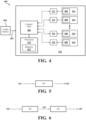
- FIG. 4 is a block diagram 400 of the audio system 120 having a plurality of ISS systems.
- the audio system 120 receives one or more audio signals 402 from an audio source 404 and drives the transducer at each ISS system (112, 114, 116, 118) independently.
- the audio source 404 itself may be one or more of a music source, a video source, a navigation source, a phone source, a warning sound, a smart device etc. to name a few examples, which may be wired in the vehicle, connected by wire in the vehicle, or connected wirelessly in the vehicle.
- Each ISS system is in communication with a control unit 406.
- the audio signal 402 provided by the audio source 404 may be selected, by a listener, at each ISS system 112, 114, 116, and 118. Therefore, the audio signal 402 may be played out loud at one ISS system or it may be played out loud at multiple ISS systems.
- Each ISS system may individually select an audio signal from the one or more audio signals so that a different audio signal is being played at each ISS system simultaneously. This will be discussed in detail later herein.
- Each ISS system communicates, through user input interface 414, with the control unit 406 to select the audio source 404 that supplies the audio signal 404 to be played back at the ISS system.
- the user input interface 414 is also used by a listener to select a listening mode at each ISS system, and to select playback preferences for the audio signal being played back at each ISS system. Playback preferences may include, but are not limited to, volume, equalization, bass, treble, etc.
- the control unit 406 has a processor 410 with computer-readable instructions stored in non-transitory memory 412. When executed, the instructions perform one or more functions to control and/or limit operation of the at least one transducer 222 at the ISS system.
- the user input interface 414 may be a keypad, touch pad, or a graphical user interface from a display or device wired to the control unit 406 or connected wirelessly to the control unit 406 in the vehicle.
- the audio system 120 is designed for near-field playback at each ISS system, nominally ⁇ 0.25 meters.
- the audio system 120 may be tuned, using signal processing, to maximize low frequency output with high isolation performance.
- a plurality of modes of operation 408 may be preset and selectable by the listener in each listening position.
- the listener may select a mode from the plurality of modes by way of a user interface 414, such as but not limited to a knob, dial, display, or wirelessly by way of a device interface.
- the modes may include, but are not limited to, all listening positions playing the same audio content out loud, different listening positions playing different audio content, different listening positions playing different audio content, different listening positions having different equalization and/or balance setting for the same audio content, some listening positions playing audio content, some listening positions optimized for silence, and any combination.
- the user input interface 414 may be a portable device, such as a mobile phone or tablet. Alternatively, or additionally, the user input interface 414 may be a display, console, or other such device for communicating, wired or wirelessly, the user input to the control unit 406.
- the transducer in each ISS system is a dipole configuration that has a controlled radiation pattern to minimize sound to the left and right of the headrest while concentrating sound to the front and back of the headrest. Typical roll off at low frequencies is not experienced at each ISS system because the listener is seated in the near-field. Additionally, the signal processing using equalization filter and a cross talk cancelation algorithm for each ISS system tunes the audio system 120 for each mode selected at each listening position.
- FIG. 5 is a block diagram 500 showing a simple version of the audio system 120 having one input signal 102 and one receiver position in a sound field.
- a new input 101*H1 -1 is generated that is equal to the output signal 102.
- the inverse of H1, H1 -1 would be applied to the input signal 101, thereby making 101 and102 equal.
- FIG. 6 is a block diagram 600 showing separation between the speaker system and the acoustic sound field.
- H2 represents the ISS system 112 in the electrical domain.
- H3 represents an external sound field in the acoustical domain.
- the inventive subject matter measures impulse response of the transfer functions only in the acoustical domain.
- a signal in the transmission path 103 right after the transducer and a signal in the transmission path 104 at the ISS system are measured only in the acoustical domain to generate the crosstalk cancellation algorithm, or create the C-Matrix. Only measuring in the acoustical domain bypasses any losses or distortions in the electrical domain. The result is a more lossless transfer function, H3.
- CTC filters are then processed in the frequency domain and a Hilbert Transform is applied to convert to the time domain.
- the result is a preservation of magnitude and phase of the signal in a low frequency domain.
- An added advantage is that the matrix inversion process is more robust eliminating any need for regularization.
- the inventive subject matter is more computationally efficient than traditional methods. This will be described in detail later herein. First, the complexities of the transfer function signal path are shown in FIGS. 7-9 .
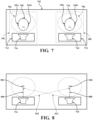
- FIG. 7 is a block diagram 700 showing a listening environment 702 with two zones 704, 706 and two distinct input signals at a driver seat 106 and a front passenger seat 108.
- Each of a first listener 708 and a second listener 710 has their own personal listening zone 704, 706.
- Each zone has a loudspeaker system, 712, 714.
- Loudspeaker system 712 has a transducer 716 and loudspeaker system 714 has a transducer 718.
- the loudspeaker systems 712, 714 are an ISS system dedicated to a respective personal listening zone 704, 706.
- Each listener 708, 710 chooses, from their respective zone, a listening mode from the plurality of listening modes.
- each listener 708, 710 may listen to the same audio content.
- Each listener 708, 710 may choose personal mode. In the personal mode the listeners may listen to different audio content with personalized audio settings. In dark mode, one or more, listeners 708, 710 may choose to have their zone dark, or quiet. Audio content being played back from anywhere else in the listening environment is blocked at the zone that is in dark mode.
- FIG. 8 is a block diagram 800 showing a transfer function signal path for the two-ISS system of FIG. 7 .
- microphones 802, 804 are shown for demonstrative purposes only. The microphones are only used during a testing phase and a tuning process to measure the transfer function at the position of the listener 708, 710 in each zone 704, 706.
- a signal path 806 from the transducer 716 to the first microphone 802 at a location of the first listener 708 is measured.
- a signal path 808 from the transducer 718 to the second microphone 804 at a location of the second listener 710 is measured.
- An ipsilateral signal path 810 from the transducer 716 to the second microphone 804 is measured.
- An ipsilateral signal path 812 from the transducer 718 to the first microphone 802 is measured.
- the ipsilateral paths are the paths that cancel a signal from the opposite transducer, thereby creating the personal zone.
- FIG. 8 shows a direct signal and a signal to an opposite transducer.
- the transfer function signal path occurs in a reverberant acoustic field.
- the reverberant acoustic field has a direct path, a rear-reflected path, and a reverberant field path.
- FIG. 9 demonstrates the transfer function signal path in the reverberant acoustic field for an acoustic field boundary 900.
- the transfer function signal path is shown for a single speaker.
- the direct path 902 is shown between the transducer 716 to the first microphone 802.
- the rear reflected path 904 is a path from the rear of the loudspeaker that is reflected off a rear hard surface behind the transducer 716.
- a single audio input signal will follow each of these paths, causing them to arrive at the microphone 802 (listener 708) at different times.
- FIG. 10 is a block diagram 1000 of the two-ISS system with the matrices applied.
- a first audio signal 1002 to be played at the first ISS system 112 and a second audio signal 1004 to be played at the second ISS system 114 are each processed with a CTC filter matrix 1006.
- the first processed signal 1008 is input to a loudspeaker 1010 for the first ISS system and the second processed signal 1012 is input to a loudspeaker 1016 for the second ISS system.
- An output 1018, 1020 of each loudspeaker 1010, 1016 is subj ected to the reflected acoustic field transfer function matrix 1018.
- a fully processed audio signal 1020 is played back for a listener 708 in the first ISS system 112 and a fully processed audio signal 1022 is played back for the listener 710 in the second ISS system 114.
- a significant amount of interference is removed. This is beneficial for small and complex reflective listening environments, such as a vehicle cabin.
- first listener 708 may listen to the same audio content at the same volume as second listener 710 by selecting out-loud mode for the listening mode.
- first listener 708 and second listener 710 may choose to listen to the same audio content, each at different volumes, or first listener 708 and second listener 710 may choose to listen to different content. This is accomplished by selecting personal mode. Alternatively, or additionally, first and/or second listeners 708, 710 may choose to have a dark, or quiet, listening mode. Audio content from anywhere else in the listening environment is blocked at the ISS by selecting dark mode.
- each ISS system having a dipole configuration with a controlled radiation pattern that minimizes sound to the left and right of the near listener at the headrest while concentrating sound to the front and back of the headrest.
- Typical roll off at low frequencies is not experienced at each ISS system because the listener is seated in the near-field.
- the signal processing using equalization filter and a cross talk cancelation algorithm for each ISS system tunes the audio system 120 for each listening mode selection at each listening position, or zone.
- FIG. 11A shows a listening environment 1100 with two ISS systems 1112, 1114.
- FIG. 11A depicts an out-loud listening mode.
- the out-loud mode is a listening mode wherein a first audio signal 1102 is being played at each ISS.
- a first listener 1108, the near listener in the first ISS system 1112, and a second listener 1110, the near listener in the second ISS system have each selected the same audio signal 1102 for playback. Therefore, same audio signal, for example a music signal, is being played in each ISS system 1112, 1114.
- the first and second listeners 1108, 1110 may still choose to customize playback in their respective ISS system, for example, the first and second listeners may listen to the audio signal at different audio settings, like volume, for example, as chosen or selected by them, or for them, via the user interface (not shown in FIG. 11A ).
- the audio signal is processed as described earlier herein (see FIG. 10 in particular) so that the first listener 1108 hears the first audio signal 1102 played back at a volume selected by the first listener 1108 and the second listener 1110 hears the first audio signal 1102, played back at a volume selected by the second listener 1110.
- FIG. 11B shows a listening environment 1100 with two ISS systems 1112, 1114.
- FIG. 11B depicts a dark mode wherein the first listener 1108 has selected playback of the first audio signal 1102 in the first ISS system 1112 and the second listener 1110 has selected dark mode in the second ISS system 1114.
- the ISS system 1114 processes the first audio signal 1102 to generate a canceling signal 1106, so that the second listener 1110 does not hear the first audio signal 1102 being played back at the first ISS system 1112.
- FIG. 11C shows a personal listening mode wherein the first listener 1108 has selected playback of the first audio signal 1102 in the first ISS system 1112 and the second listener 1110 has selected playback of the second audio signal 1104 in the second ISS system 1114.
- the first and second audio signals 1102, 1104 are different from each other. For example, from two different audio input sources, or two different radio stations from a radio audio input source, etc.
- the audio signal 1102 is being played back at the first ISS system 1112 with a set of playback preferences, which are settings selected by the first listener 1108.
- the second audio signal 1104 is being played back at the second ISS system 1114 with a set of playback preferences, which are settings selected by the second listener 1110.
- the first and second audio signals 1102, 1104 are processed at each ISS system 1112, 1114 so that the first audio signal 1102 is cancelled at the second ISS system 1114 and the second audio signal 1104 is cancelled at the first ISS system 1112.
- the settings input by each listener 1108, 1110 for playback of the audio signal may also be different in each ISS system.
- the acoustic environment of the vehicle cabin is small and reverberant, so CTC can be particularly challenging for known systems and methods.
- Yet another issue of an acoustic environment in a vehicle cabin is that a listener will move their head from side to side and rotate their head clockwise or counter-clockwise which requires a wide and stable sound field.
- CTC cross talk cancellation
- Known systems rely on multiple speakers in the headrest, use multiple speakers in an array at the front of the vehicle, or numerous speakers arranged throughout the vehicle cabin.
- a further advantage of the inventive subject matter is that a single transducer is used in each ISS system. And due to the proximity of the transducer to the listener, there is no need for a line array to direct audio toward specific locations, eliminating any need for beamforming. This reduces complexity in both hardware and software, which, in turn, reduces processing power that is needed for signal processing as compared to known systems and methods.
- the inventive subject matter uses only one woofer and focuses on frequencies below 200Hz. This is advantageous in that the ISS system may be configured for multiple seats in the vehicle cabin without the need for large space in which to house multiple loudspeakers, high power demand, or complicated processing that is needed for beamforming and/or individual speaker delay compensation for an array of loudspeakers.
- any method or process claims may be executed in any order, may be executed repeatedly, and are not limited to the specific order presented in the claims.
Landscapes
- Engineering & Computer Science (AREA)
- Physics & Mathematics (AREA)
- Acoustics & Sound (AREA)
- Signal Processing (AREA)
- Multimedia (AREA)
- Health & Medical Sciences (AREA)
- General Health & Medical Sciences (AREA)
- Theoretical Computer Science (AREA)
- Otolaryngology (AREA)
- Audiology, Speech & Language Pathology (AREA)
- Human Computer Interaction (AREA)
- General Engineering & Computer Science (AREA)
- General Physics & Mathematics (AREA)
- Fittings On The Vehicle Exterior For Carrying Loads, And Devices For Holding Or Mounting Articles (AREA)
- Stereophonic System (AREA)
Applications Claiming Priority (1)
| Application Number | Priority Date | Filing Date | Title |
|---|---|---|---|
| US18/299,963 US12363498B2 (en) | 2023-04-13 | 2023-04-13 | System and method for creating seat-based low frequency audio playback |
Publications (2)
| Publication Number | Publication Date |
|---|---|
| EP4447486A2 true EP4447486A2 (de) | 2024-10-16 |
| EP4447486A3 EP4447486A3 (de) | 2024-10-23 |
Family
ID=90365993
Family Applications (1)
| Application Number | Title | Priority Date | Filing Date |
|---|---|---|---|
| EP24164168.7A Pending EP4447486A3 (de) | 2023-04-13 | 2024-03-18 | System und verfahren zur erzeugung einer sitzbasierten niederfrequenten audiowiedergabe |
Country Status (3)
| Country | Link |
|---|---|
| US (1) | US12363498B2 (de) |
| EP (1) | EP4447486A3 (de) |
| CN (1) | CN118803507A (de) |
Family Cites Families (9)
| Publication number | Priority date | Publication date | Assignee | Title |
|---|---|---|---|---|
| US8126159B2 (en) * | 2005-05-17 | 2012-02-28 | Continental Automotive Gmbh | System and method for creating personalized sound zones |
| EP2806663B1 (de) | 2013-05-24 | 2020-04-15 | Harman Becker Automotive Systems GmbH | Erzeugung von Individuellen Schallzonen innerhalb eines Hörraumes |
| EP3024252B1 (de) * | 2014-11-19 | 2018-01-31 | Harman Becker Automotive Systems GmbH | Tonsystem zur Erzeugung einer Klangzone |
| US9860643B1 (en) * | 2016-11-23 | 2018-01-02 | Bose Corporation | Audio systems and method for acoustic isolation |
| GB201721127D0 (en) * | 2017-12-18 | 2018-01-31 | Pss Belgium Nv | Dipole loudspeaker for producing sound at bass frequencies |
| WO2019139103A1 (ja) * | 2018-01-12 | 2019-07-18 | ソニー株式会社 | 音響装置 |
| FR3113760B1 (fr) * | 2020-08-28 | 2022-10-21 | Faurecia Clarion Electronics Europe | Dispositif électronique et procédé de réduction de diaphonie, système audio pour appuis-têtes de sièges et programme d’ordinateur associés |
| WO2022147346A1 (en) | 2020-12-31 | 2022-07-07 | Harman International Industries, Incorporated | Modular audio assembly for use with vehicle headrest |
| US12447884B2 (en) | 2020-12-31 | 2025-10-21 | Harman International Industries, Incorporated | Vehicle headrest assembly with configurable speaker modules and control for multiple audio modes |
-
2023
- 2023-04-13 US US18/299,963 patent/US12363498B2/en active Active
-
2024
- 2024-03-18 EP EP24164168.7A patent/EP4447486A3/de active Pending
- 2024-04-08 CN CN202410412016.7A patent/CN118803507A/zh active Pending
Also Published As
| Publication number | Publication date |
|---|---|
| US12363498B2 (en) | 2025-07-15 |
| CN118803507A (zh) | 2024-10-18 |
| EP4447486A3 (de) | 2024-10-23 |
| US20240349006A1 (en) | 2024-10-17 |
Similar Documents
| Publication | Publication Date | Title |
|---|---|---|
| CN101682814B (zh) | 用于定向辐射声音的系统和方法 | |
| CN101682806B (zh) | 用于定向辐射声音的系统 | |
| EP1210846B1 (de) | Kraftfahrzeugaudiosystem mit dachhimmel als schwingende membrane | |
| US7853025B2 (en) | Vehicular audio system including a headliner speaker, electromagnetic transducer assembly for use therein and computer system programmed with a graphic software control for changing the audio system's signal level and delay | |
| CN106664480B (zh) | 用于声波场生成的系统和方法 | |
| US8081776B2 (en) | Indoor communication system for a vehicular cabin | |
| EP2168397B1 (de) | System und verfahren für direktional abgestrahlten klang | |
| CN111492666B (zh) | 用于产生低音频率的声音的偶极扬声器 | |
| CN1778141B (zh) | 车辆的扬声器阵列 | |
| CN102696244B (zh) | 具有音频通道补偿的多通道音频系统 | |
| US10623857B2 (en) | Individual delay compensation for personal sound zones | |
| EP4122215B1 (de) | Lautsprecher | |
| JP2019511888A (ja) | 個々のサウンド領域を提供するための装置および方法 | |
| EP4114043A1 (de) | System und verfahren zum steuern des ausgegebenen schalls in einer hörumgebung | |
| CN109466467A (zh) | 基于可调节座椅定位的声音调谐 | |
| CN116438809A (zh) | 用于提供增强音频的系统和方法 | |
| GB2595318A (en) | Loudspeaker arrangement | |
| US12363498B2 (en) | System and method for creating seat-based low frequency audio playback | |
| US10536795B2 (en) | Vehicle audio system with reverberant content presentation | |
| JP7714660B2 (ja) | 低周波自動校正音響システム | |
| US20240267691A1 (en) | Systems and methods for an audio system | |
| JP2020109963A (ja) | いくつかのトランスデューサを有する、ユーザによって知覚可能な振動を生成するシステムに関する位相フィルタを決定する方法 |
Legal Events
| Date | Code | Title | Description |
|---|---|---|---|
| PUAI | Public reference made under article 153(3) epc to a published international application that has entered the european phase |
Free format text: ORIGINAL CODE: 0009012 |
|
| STAA | Information on the status of an ep patent application or granted ep patent |
Free format text: STATUS: THE APPLICATION HAS BEEN PUBLISHED |
|
| PUAL | Search report despatched |
Free format text: ORIGINAL CODE: 0009013 |
|
| AK | Designated contracting states |
Kind code of ref document: A2 Designated state(s): AL AT BE BG CH CY CZ DE DK EE ES FI FR GB GR HR HU IE IS IT LI LT LU LV MC ME MK MT NL NO PL PT RO RS SE SI SK SM TR |
|
| AK | Designated contracting states |
Kind code of ref document: A3 Designated state(s): AL AT BE BG CH CY CZ DE DK EE ES FI FR GB GR HR HU IE IS IT LI LT LU LV MC ME MK MT NL NO PL PT RO RS SE SI SK SM TR |
|
| RIC1 | Information provided on ipc code assigned before grant |
Ipc: G10K 11/178 20060101ALI20240916BHEP Ipc: H04R 5/02 20060101AFI20240916BHEP |
|
| STAA | Information on the status of an ep patent application or granted ep patent |
Free format text: STATUS: REQUEST FOR EXAMINATION WAS MADE |
|
| 17P | Request for examination filed |
Effective date: 20250423 |