EP4447137A1 - Electrode plate, electrode body, and battery - Google Patents
Electrode plate, electrode body, and battery Download PDFInfo
- Publication number
- EP4447137A1 EP4447137A1 EP22903991.2A EP22903991A EP4447137A1 EP 4447137 A1 EP4447137 A1 EP 4447137A1 EP 22903991 A EP22903991 A EP 22903991A EP 4447137 A1 EP4447137 A1 EP 4447137A1
- Authority
- EP
- European Patent Office
- Prior art keywords
- positive electrode
- core
- electrode plate
- identification mark
- exposed part
- Prior art date
- Legal status (The legal status is an assumption and is not a legal conclusion. Google has not performed a legal analysis and makes no representation as to the accuracy of the status listed.)
- Pending
Links
Images



Classifications
-
- H—ELECTRICITY
- H01—ELECTRIC ELEMENTS
- H01M—PROCESSES OR MEANS, e.g. BATTERIES, FOR THE DIRECT CONVERSION OF CHEMICAL ENERGY INTO ELECTRICAL ENERGY
- H01M4/00—Electrodes
- H01M4/02—Electrodes composed of, or comprising, active material
- H01M4/13—Electrodes for accumulators with non-aqueous electrolyte, e.g. for lithium-accumulators; Processes of manufacture thereof
-
- H—ELECTRICITY
- H01—ELECTRIC ELEMENTS
- H01M—PROCESSES OR MEANS, e.g. BATTERIES, FOR THE DIRECT CONVERSION OF CHEMICAL ENERGY INTO ELECTRICAL ENERGY
- H01M10/00—Secondary cells; Manufacture thereof
- H01M10/42—Methods or arrangements for servicing or maintenance of secondary cells or secondary half-cells
- H01M10/48—Accumulators combined with arrangements for measuring, testing or indicating the condition of cells, e.g. the level or density of the electrolyte
-
- H—ELECTRICITY
- H01—ELECTRIC ELEMENTS
- H01M—PROCESSES OR MEANS, e.g. BATTERIES, FOR THE DIRECT CONVERSION OF CHEMICAL ENERGY INTO ELECTRICAL ENERGY
- H01M10/00—Secondary cells; Manufacture thereof
- H01M10/05—Accumulators with non-aqueous electrolyte
- H01M10/058—Construction or manufacture
- H01M10/0587—Construction or manufacture of accumulators having only wound construction elements, i.e. wound positive electrodes, wound negative electrodes and wound separators
-
- H—ELECTRICITY
- H01—ELECTRIC ELEMENTS
- H01M—PROCESSES OR MEANS, e.g. BATTERIES, FOR THE DIRECT CONVERSION OF CHEMICAL ENERGY INTO ELECTRICAL ENERGY
- H01M4/00—Electrodes
- H01M4/02—Electrodes composed of, or comprising, active material
- H01M4/13—Electrodes for accumulators with non-aqueous electrolyte, e.g. for lithium-accumulators; Processes of manufacture thereof
- H01M4/139—Processes of manufacture
-
- H—ELECTRICITY
- H01—ELECTRIC ELEMENTS
- H01M—PROCESSES OR MEANS, e.g. BATTERIES, FOR THE DIRECT CONVERSION OF CHEMICAL ENERGY INTO ELECTRICAL ENERGY
- H01M50/00—Constructional details or processes of manufacture of the non-active parts of electrochemical cells other than fuel cells, e.g. hybrid cells
- H01M50/10—Primary casings; Jackets or wrappings
- H01M50/102—Primary casings; Jackets or wrappings characterised by their shape or physical structure
- H01M50/107—Primary casings; Jackets or wrappings characterised by their shape or physical structure having curved cross-section, e.g. round or elliptic
-
- H—ELECTRICITY
- H01—ELECTRIC ELEMENTS
- H01M—PROCESSES OR MEANS, e.g. BATTERIES, FOR THE DIRECT CONVERSION OF CHEMICAL ENERGY INTO ELECTRICAL ENERGY
- H01M50/00—Constructional details or processes of manufacture of the non-active parts of electrochemical cells other than fuel cells, e.g. hybrid cells
- H01M50/50—Current conducting connections for cells or batteries
- H01M50/531—Electrode connections inside a battery casing
- H01M50/533—Electrode connections inside a battery casing characterised by the shape of the leads or tabs
-
- H—ELECTRICITY
- H01—ELECTRIC ELEMENTS
- H01M—PROCESSES OR MEANS, e.g. BATTERIES, FOR THE DIRECT CONVERSION OF CHEMICAL ENERGY INTO ELECTRICAL ENERGY
- H01M10/00—Secondary cells; Manufacture thereof
- H01M10/05—Accumulators with non-aqueous electrolyte
- H01M10/052—Li-accumulators
-
- Y—GENERAL TAGGING OF NEW TECHNOLOGICAL DEVELOPMENTS; GENERAL TAGGING OF CROSS-SECTIONAL TECHNOLOGIES SPANNING OVER SEVERAL SECTIONS OF THE IPC; TECHNICAL SUBJECTS COVERED BY FORMER USPC CROSS-REFERENCE ART COLLECTIONS [XRACs] AND DIGESTS
- Y02—TECHNOLOGIES OR APPLICATIONS FOR MITIGATION OR ADAPTATION AGAINST CLIMATE CHANGE
- Y02E—REDUCTION OF GREENHOUSE GAS [GHG] EMISSIONS, RELATED TO ENERGY GENERATION, TRANSMISSION OR DISTRIBUTION
- Y02E60/00—Enabling technologies; Technologies with a potential or indirect contribution to GHG emissions mitigation
- Y02E60/10—Energy storage using batteries
Definitions
- the present disclosure generally relates to an electrode plate, an electrode assembly, and a battery.
- PATENT LITERATURE 1 discloses a technique in which in an electrode assembly, an identification mark is provided on an exposed part in which a core of an electrode plate is exposed and/or a lead connected to the electrode plate.
- the identification mark is a mark that enables confirmation of manufacturing process history records. If a failure occurs in the battery, most of components of the battery are severely deformed by high heat; however, the core and the lead, which are each formed of a metal material, are hardly deformed.
- PATENT LITERATURE 1 discloses that at the time of occurrence of a problem in the battery, the manufacturing process history records can easily be confirmed using the identification mark, enabling easy analysis of a cause of the problem.
- PATENT LITERATURE 2 discloses a technique in which in an electrode plate, an identification mark is provided on an exposed part and a mixture layer is disposed at a position on an opposite side in a thickness direction of the core from the identification mark. PATENT LITERATURE 2 discloses that the identification mark can be formed with high accuracy.
- the lead In the configuration described in PATENT LITERATURE 1, the lead is small in width, and thus, it is difficult to form an identification mark part on the lead. Also, in the configuration described in PATENT LITERATURE 1, an identification mark may fail to be formed with high accuracy because of a decrease in rigidity of a part, on which the identification mark is formed, of the core of each of the positive electrode plate and the negative electrode plate. In the configuration described in PATENT LITERATURE 2, when an identification mark is formed on a core, a mixture layer provided on a surface on an opposite side of the core from the identification mark bulges, and thus, spaces among layers of an electrode assembly in which electrode plates are wound may be non-uniform. The techniques described in PATENT LITERATURES 1 and 2 still leave room for improvement in the above-described points.
- An electrode assembly according to the present disclosure is an electrode assembly in which a first electrode plate and a second electrode plate having different polarities from each other are wound with a separator interposed between the first electrode plate and the second electrode plate, wherein the first electrode plate is the above-described electrode plate.
- a battery according to the present disclosure comprises the above-described electrode assembly, an electrolyte, and an exterior housing can that houses the electrode assembly and the electrolyte.
- the identification mark can be formed with high accuracy regardless of the rigidity of the core of the electrode plate. This makes it possible to easily confirm the identification mark at the time of occurrence of a failure, thereby quickly performing analysis of a cause of the failure on the basis of the identification mark.
- the battery is not limited to this example.
- the battery may be another secondary battery or a primary battery, for example.
- the exterior housing body is not limited to having a cylindrical shape, and may have, for example, a rectangular shape, a coin shape, or another shape, or may be of a pouch type made of a laminate sheet including a metal layer and a resin layer.
- the electrode plate (first electrode plate) is at least one of a positive electrode and a negative electrode plate.
- FIG. 1 is an axial sectional view of a cylindrical secondary battery 10 of an example of an embodiment.
- an electrode assembly 14 and a non-aqueous electrolyte (not illustrated) are housed in an exterior housing body 15.
- the electrode assembly 14 has a wound-type structure in which a positive electrode plate 11 and a negative electrode plate 12 are wound with a separator 13 interposed therebetween.
- a non-aqueous solvent of the non-aqueous electrolyte organic solvent
- carbonates, lactones, ethers, ketones, esters, and the like may be used, and two or more of these solvents may be mixed to be used.
- a mixed solvent including a cyclic carbonate and a chain carbonate is preferably used.
- ethylene carbonate (EC), propylene carbonate (PC), butylene carbonate (BC), and the like may be used as the cyclic carbonate
- dimethyl carbonate (DMC), ethyl methyl carbonate (EMC), diethyl carbonate (DEC), and the like may be used as the chain carbonate.
- electrolyte salt in the non-aqueous electrolyte LiPF 6 , LiBF 4 , LiCF 3 SO 3 , and the like, and a mixture thereof may be used.
- An amount of the electrolyte salt dissolved in the non-aqueous solvent may be, for example, greater than or equal to 0.5 mol/L and less than or equal to 2.0 mol/L.
- a sealing assembly 16 side will be described as “the upper side”
- a bottom side of the exterior housing body 15 will be described as “the lower side”.
- An opening of the exterior housing body 15 is capped with the sealing assembly 16 to seal inside the secondary battery 10.
- Insulating plates 17 and 18 are provided on the upper and lower sides of the electrode assembly 14, respectively.
- a positive electrode lead 19 extends upward through a through hole of the insulating plate 17, and is welded with the lower face of a filter 22, which is a bottom plate of the sealing assembly 16.
- a negative electrode lead 20 extends through a through hole of the insulating plate 18 toward the bottom side of the exterior housing body 15, and is welded with a bottom inner face of the exterior housing body 15.
- the exterior housing body 15 becomes a negative electrode terminal. Note that when the negative electrode lead 20 is provided on an outer wound end, the negative electrode lead 20 extends through an outer side of the insulating plate 18 toward the bottom side of the exterior housing body 15, and is welded with the bottom inner face of the exterior housing body 15.
- the exterior housing body 15 is, for example, a bottomed cylindrical metallic exterior housing can.
- a gasket 27 is provided between the exterior housing body 15 and the sealing assembly 16 to achieve sealability inside the secondary battery 10.
- the exterior housing body 15 has a grooved portion 21 formed by, for example, pressing a side wall thereof from the outside to support the sealing assembly 16.
- the grooved portion 21 is preferably formed circularly along the circumferential direction of the exterior housing body 15, and supports the sealing assembly 16 with an upper face of the grooved portion 21.
- the sealing assembly 16 has a stacked structure of a filter 22, a lower vent member 23, an insulating member 24, an upper vent member 25, and a cap 26 in this order from the electrode assembly 14 side.
- Each member constituting the sealing assembly 16 has, for example, a disk shape or a ring shape, and each member except for the insulating member 24 is electrically connected to each other.
- the lower vent member 23 and the upper vent member 25 are connected to each other at each of central parts thereof, and the insulating member 24 is interposed between the circumferential portions of the vent members 23 and 25.
- the lower vent member 23 ruptures and the upper vent member 25 expands toward the cap 26 side to be separated from the lower vent member 23, resulting in cutting off an electrical connection between the both members. If the internal pressure further increases, the upper vent member 25 ruptures, and gas is discharged through an opening 26a of the cap 26.
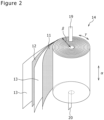
- FIG. 2 is a perspective view of the electrode assembly 14.
- the electrode assembly 14 has a wound structure in which the positive electrode plate 11 and the negative electrode plate 12 are spirally wound with the separator 13 interposed therebetween. All of the positive electrode plate 11, the negative electrode plate 12, and the separator 13 are formed into a band shaped, and are spirally wound around a winding axis to be alternately stacked in a radial direction ⁇ of the electrode assembly 14.
- the winding axial side is referred to as the inner circumferential side
- the opposite side is referred to as the outer circumferential side.
- the longitudinal direction of the positive electrode plate 11 and negative electrode plate 12 corresponds to a winding direction ⁇
- the short direction of the positive electrode plate 11 and negative electrode plate 12 corresponds to an axial direction ⁇
- the positive electrode lead 19 extends, on an upper end of the electrode assembly 14 toward the axial direction ⁇ , from a substantial center between the center and the outermost circumference in the radial direction.
- the negative electrode lead 20 extends, on a lower end of the electrode assembly 14, toward the axial direction ⁇ from near the winding axis.
- the negative electrode plate 12 has a band-shaped negative electrode core, a negative electrode mixture layer formed on each surface of the negative electrode core, and a negative electrode exposed part in which the negative electrode core is exposed.
- a thickness of the negative electrode core is, for example, greater than or equal to 5 ⁇ m and less than or equal to 30 ⁇ m.
- a thickness of the negative electrode mixture layer is, for example, greater than or equal to 10 ⁇ m and less than or equal to 150 ⁇ m on each side of the negative electrode core.
- a foil of a metal that is stable in a potential range of the negative electrode plate 12, such as copper, a film in which such a metal is provided on a surface layer, or the like can be used.
- the negative electrode mixture layer includes, for example, a negative electrode active material, a binder, and the like.
- the negative electrode plate 12 is produced by, for example, applying a negative electrode mixture slurry including the negative electrode active material, the binder, and a solvent such as water on a surface of the negative electrode core, drying the resulting coating film, and then compressing it to form a negative electrode mixture layer on each surface of the negative electrode core.
- the negative electrode lead 20 is joined to a surface on an inner circumferential side of the negative electrode core with, for example, ultrasonic welding.
- One end of the negative electrode lead 20 is disposed on a negative electrode exposed part, and the other end thereof extends downward from a lower end of the negative electrode exposed part.
- the position of the negative electrode lead 20 to be disposed is not limited to an inner winding end as illustrated in FIG. 2 , and may be any position in the longitudinal direction ⁇ from the inner winding end to the outer winding end.
- the negative electrode exposed part is provided by, for example, intermittent application in which the negative electrode mixture slurry is not applied on a part of the negative electrode core.
- Examples of the negative electrode active material contained in the negative electrode mixture layer include a carbon-based active material that reversibly occludes and releases lithium ions.
- a preferable carbon-based active material is graphite including natural graphite such as flake graphite, massive graphite, and earthy graphite, and artificial graphite such as massive artificial graphite (MAG) and graphitized mesophase carbon microbeads (MCMB).
- a Si-based active material that is consisted of at least one of Si and a Si-containing compound may be used, and a carbon-based active material and a Si-based active material may be used in combination.
- a fluororesin, PAN, a polyimide, an acrylic resin, a polyolefin, or the like may be used in the same manner as in the case of the positive electrode plate 11, and a styrene-butadiene rubber (SBR) is preferably used.
- the negative electrode mixture layer preferably further includes CMC or a salt thereof, polyacrylic acid (PAA) or a salt thereof, polyvinyl alcohol (PVA), or the like.
- PVA polyvinyl alcohol
- SBR is preferably used in combination with CMC or a salt thereof, or PAA or a salt thereof.
- a conductive agent may be included in the negative electrode mixture layer.
- a porous sheet having an ion permeation property and an insulation property is used.
- the porous sheet include a fine porous thin film, a woven fabric, and a non-woven fabric.
- an olefin resin such as polyethylene and polypropylene is preferable.
- a thickness of the separator 13 is, for example, greater than or equal to 10 ⁇ m and less than or equal to 50 ⁇ m.
- the separator 13 tends to be thinned due to higher capacity and higher output of the battery.
- the separator 13 has a melting point of, for example, approximately greater than or equal to 130°C and less than or equal to 180°C.
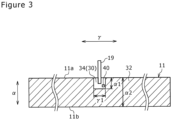
- the positive electrode plate 11 has a band-shaped positive electrode core 30, a positive electrode mixture layer 32 formed on each surface of the positive electrode core 30, and a positive electrode exposed part 34 in which the positive electrode core 30 is exposed.
- a thickness of the positive electrode core 30 is, for example, greater than or equal to 10 ⁇ m and less than or equal to 30 ⁇ m.
- a thickness of the positive electrode mixture layer 32 is, for example, greater than or equal to 50 ⁇ m and less than or equal to 200 ⁇ m on each side of the positive electrode core 30.
- a foil of a metal that is stable in a potential range of the positive electrode plate 11, such as aluminum, a film in which such a metal is provided on a surface layer, or the like can be used.
- Examples of the above-described conductive agent include carbon materials such as carbon black (CB), acetylene black (AB), Ketjenblack, and graphite.
- Examples of the above-described binder include fluororesins such as polytetrafluoroethylene (PTFE) and polyvinylidene fluoride (PVdF), polyacrylonitrile (PAN), a polyimide (PI), an acrylic resin, and a polyolefin resin. With these resins, carboxymethyl cellulose (CMC) or a salt thereof, polyethylene oxide (PEO), and the like may be used in combination. These materials may be used singly, or may be used in combination of two or more thereof.
- the positive electrode exposed part 34 is provided by, for example, intermittent application in which the positive electrode mixture slurry is not applied on a part of the positive electrode core 30. Note that a plurality of positive electrode exposed parts 34 may be provided in the longitudinal direction ⁇ of the positive electrode plate 11.
- the positive electrode exposed part 34 is provided so as to be in contact with one end 11a in the short direction ⁇ of the positive electrode plate 11.
- the positive electrode exposed part 34 is adjacent to the positive electrode mixture layer 32 in the short direction ⁇ and the longitudinal direction ⁇ of the positive electrode core 30.
- the positive electrode exposed part 34 is surrounded from three directions by the positive electrode mixture layer 32 in the short direction ⁇ and the longitudinal direction ⁇ of the positive electrode plate 11, and does not reach the other end 11b of the positive electrode plate 11. This increases the rigidity of the positive electrode core 30 in the positive electrode exposed part 34, so that an identification mark part 40, which will be described later, can be formed with high accuracy.
- the positive electrode exposed part 34 has, for example, a substantially rectangular shape.
- a depth ⁇ 1 of the positive electrode exposed part 34 (a length in the short direction ⁇ ) is, for example, greater than or equal to 0.05 times and less than or equal to 0.7 times a depth ⁇ 2 (a length in the short direction ⁇ ) of the positive electrode plate 11.
- a width ⁇ 1 of the positive electrode exposed part 34 (a length in the longitudinal direction ⁇ ) is, for example, greater than or equal to 1.0 times and less than or equal to 10 times a depth ⁇ 1 of the positive electrode exposed part 34.
- the positive electrode exposed part 34 is provided at a position where both surfaces of the positive electrode core 30 face each other. That is, the positive electrode exposed part 34 has substantially the same shape and is provided at substantially the same position, at each surface of the positive electrode core 30.
- the identification mark part 40 is formed on the positive electrode exposed part 34 in any one surface of the positive electrode core 30.
- the identification mark part 40 may be formed on a surface of the positive electrode exposed part 34 to which the positive electrode lead 19 is connected, or may be formed on a surface of the positive electrode exposed part 34 to which the positive electrode lead 19 is not connected.
- the identification mark part 40 is formed on the surface of the positive electrode exposed part 34 to which the positive electrode lead 19 is connected.
- the identification mark part 40 is formed on the other end 11b side of the positive electrode plate 11 rather than the positive electrode lead 19 in the short direction ⁇ of the positive electrode plate 11. Note that a position where the identification mark part 40 is provided is not limited to an example in FIG. 3 .
- the identification mark part 40 may be formed to be adjacent to the positive electrode lead 19 in the longitudinal direction ⁇ of the positive electrode plate 11. That is, the identification mark part 40 may be formed at any position where the positive electrode lead 19 is not provided in the positive electrode exposed part 34.
- the identification mark part may be formed of numbers, characters, or a combination of numbers and characters. Also, the identification mark part may be formed of protrusions, holes, or a combination of protrusions and holes. Also, the identification mark part may be a one-dimensional code such as a bar code, and is not limited thereto.
- the identification mark part 40 is formed via laser marking.
- Laser marking is contactless marking using laser beam, generates no static electricity, enables high-speed marking work, and has high productivity.
- laser beam is applied to the positive electrode exposed part 34 while the positive electrode plate 11 is transported in one direction via a plurality of rollers, to form the identification mark part 40.
- the identification mark part 40 is not limited to those formed via laser marking, but may be formed by, for example, inkjet printing. Alternatively, without having to be limited to this, the positive electrode plate 11 may be stopped, so that the identification mark part 40 can be formed on the positive electrode exposed part 34.
- the identification mark part 40 is covered by the second tape 44.
- the second tape 44 preferably has transparency.
- the transparency means that a reading device can recognize the identification mark part 40 and can read the contents of the two-dimensional code. This enables the reading device to read the identification mark part 40 without removing the second tape 44.
- the second tape 44 may be semi-transparent or opaque, or may be colorless or colored.
- a portion of the positive electrode lead 19, the portion extending from the positive electrode exposed part 34 and a portion of the positive electrode lead 19, the portion being connected to the positive electrode exposed part 34 are covered by the first tape 42 and the second tape 44.
- the first tape 42 is attached to the positive electrode lead 19 in such a manner that the first tape 42 is wound around the portion of the positive electrode lead 19, the portion extending from the positive electrode exposed part 34, and the portion of the positive electrode lead 19, the portion overlapping with the positive electrode exposed part 34.
- Each of the first tape 42 and the second tape 44 is formed of an insulating material.
- Each of the first tape 42 and the second tape 44 is made of, for example, a resin such as polypropylene (PP).
- PP polypropylene
- the positive electrode plate 11, the electrode assembly 14, and the secondary battery 10 described above regardless of rigidity of the positive electrode core 30, surrounding the positive electrode exposed part 34 from the three directions by the positive electrode mixture layer 32 enables an increase in rigidity of the portion in which the identification mark part 40 is formed. This enables the identification mark to be formed with high accuracy. Therefore, at the time of occurrence of a failure in a manufacturing process of the secondary battery 10 or after shipment of the secondary battery 10, the identification mark can be easily confirmed. For example, when the identification mark part 40 is a two-dimensional code or a one-dimensional code, the manufacturing history records can be quickly confirmed by reading the code using a reading device. This makes it possible to quickly perform analysis of a cause of the failure on the basis of the identification mark.
Landscapes
- Chemical & Material Sciences (AREA)
- Chemical Kinetics & Catalysis (AREA)
- Electrochemistry (AREA)
- General Chemical & Material Sciences (AREA)
- Engineering & Computer Science (AREA)
- Manufacturing & Machinery (AREA)
- Materials Engineering (AREA)
- Secondary Cells (AREA)
Abstract
Description
- The present disclosure generally relates to an electrode plate, an electrode assembly, and a battery.
- In recent years, the energy density of a battery has increased more and more, and the reliability of the battery is required to be further improved. However, in a process of manufacturing a battery or after shipment of a battery, if a failure occurs for some reason to cause heat generation in the battery, and most of components of the battery are damaged, it may be difficult to analyze a cause of the failure.
- PATENT LITERATURE 1 discloses a technique in which in an electrode assembly, an identification mark is provided on an exposed part in which a core of an electrode plate is exposed and/or a lead connected to the electrode plate. The identification mark is a mark that enables confirmation of manufacturing process history records. If a failure occurs in the battery, most of components of the battery are severely deformed by high heat; however, the core and the lead, which are each formed of a metal material, are hardly deformed. PATENT LITERATURE 1 discloses that at the time of occurrence of a problem in the battery, the manufacturing process history records can easily be confirmed using the identification mark, enabling easy analysis of a cause of the problem.
- PATENT LITERATURE 2 discloses a technique in which in an electrode plate, an identification mark is provided on an exposed part and a mixture layer is disposed at a position on an opposite side in a thickness direction of the core from the identification mark. PATENT LITERATURE 2 discloses that the identification mark can be formed with high accuracy.
-
- PATENT LITERATURE 1:
Japanese Unexamined Patent Application Publication No. 2006-40875 - PATENT LITERATURE 2: International Publication No.
WO 2019/193869 - In the configuration described in PATENT LITERATURE 1, the lead is small in width, and thus, it is difficult to form an identification mark part on the lead. Also, in the configuration described in PATENT LITERATURE 1, an identification mark may fail to be formed with high accuracy because of a decrease in rigidity of a part, on which the identification mark is formed, of the core of each of the positive electrode plate and the negative electrode plate. In the configuration described in PATENT LITERATURE 2, when an identification mark is formed on a core, a mixture layer provided on a surface on an opposite side of the core from the identification mark bulges, and thus, spaces among layers of an electrode assembly in which electrode plates are wound may be non-uniform. The techniques described in PATENT LITERATURES 1 and 2 still leave room for improvement in the above-described points.
- It is an advantage of the present disclosure to, in an electrode plate, an electrode assembly, and a battery, enable upon occurrence of a failure, quick analysis of a cause of the failure and stabilize quality of the electrode assembly.
- An electrode plate according to the present disclosure is an electrode plate comprising a band-like core, a mixture layer that is formed on each surface of the core, and an exposed part that is provided so as to be in contact with one end in a short direction of the core and in which the core is exposed, wherein the exposed part is provided at a position where both surfaces of the core face each other, and is adjacent to the mixture layer in the short direction and a longitudinal direction of the core, in any one surface of the core, a lead is connected to the exposed part to extend from the one end, and on any one surface of the core, an identification mark part capable of specifying a manufacturing process history records is formed on the exposed part.
- An electrode assembly according to the present disclosure is an electrode assembly in which a first electrode plate and a second electrode plate having different polarities from each other are wound with a separator interposed between the first electrode plate and the second electrode plate, wherein the first electrode plate is the above-described electrode plate.
- A battery according to the present disclosure comprises the above-described electrode assembly, an electrolyte, and an exterior housing can that houses the electrode assembly and the electrolyte.
- According to the electrode plate, the electrode assembly, and the battery according to the present disclosure, the identification mark can be formed with high accuracy regardless of the rigidity of the core of the electrode plate. This makes it possible to easily confirm the identification mark at the time of occurrence of a failure, thereby quickly performing analysis of a cause of the failure on the basis of the identification mark.
-
-
FIG. 1 is a longitudinal sectional view of a cylindrical secondary battery of an example of an embodiment. -
FIG. 2 is a perspective view of a wound-type electrode assembly of an example of an embodiment. -
FIG. 3 is a diagram illustrating a positive electrode plate of an example of an embodiment, in a developed state. -
FIG. 4 is an enlarged view of the periphery of a positive electrode exposed part in the positive electrode plate inFIG. 3 . -
FIG. 5 is a sectional view taken along line A-A inFIG. 4 . - Hereinafter, an embodiment of the present disclosure will be described in detail with reference to the accompanying drawings. In the following description, specific shapes, materials, numeric values, directions, and the like are examples given for facilitating understanding of the present disclosure and, without being limited thereto, can be appropriately changed according to specifications of the electrode plate, the electrode assembly, or the battery. Also, in the following, the term "substantially" is used for meaning including, for example, a case that can be regarded as substantially the same in addition to a case that is completely the same. Furthermore, where a plurality of embodiments and modified examples are included in the following description, it is assumed from the beginning that feature parts of the embodiments and modified examples are appropriately used in combination.
- In the following, a cylindrical non-aqueous electrolyte secondary battery in which a wound-type electrode assembly is housed in a cylindrical exterior housing body will be described; however, the battery is not limited to this example. The battery may be another secondary battery or a primary battery, for example. The exterior housing body is not limited to having a cylindrical shape, and may have, for example, a rectangular shape, a coin shape, or another shape, or may be of a pouch type made of a laminate sheet including a metal layer and a resin layer. The electrode plate (first electrode plate) is at least one of a positive electrode and a negative electrode plate.
-
FIG. 1 is an axial sectional view of a cylindricalsecondary battery 10 of an example of an embodiment. In thesecondary battery 10 illustrated inFIG. 1 , anelectrode assembly 14 and a non-aqueous electrolyte (not illustrated) are housed in anexterior housing body 15. Theelectrode assembly 14 has a wound-type structure in which apositive electrode plate 11 and anegative electrode plate 12 are wound with aseparator 13 interposed therebetween. For a non-aqueous solvent of the non-aqueous electrolyte (organic solvent), carbonates, lactones, ethers, ketones, esters, and the like may be used, and two or more of these solvents may be mixed to be used. When two or more of the solvents are mixed to be used, a mixed solvent including a cyclic carbonate and a chain carbonate is preferably used. For example, ethylene carbonate (EC), propylene carbonate (PC), butylene carbonate (BC), and the like may be used as the cyclic carbonate, and dimethyl carbonate (DMC), ethyl methyl carbonate (EMC), diethyl carbonate (DEC), and the like may be used as the chain carbonate. For an electrolyte salt in the non-aqueous electrolyte, LiPF6, LiBF4, LiCF3SO3, and the like, and a mixture thereof may be used. An amount of the electrolyte salt dissolved in the non-aqueous solvent may be, for example, greater than or equal to 0.5 mol/L and less than or equal to 2.0 mol/L. Hereinafter, for convenience of description, asealing assembly 16 side will be described as "the upper side", and a bottom side of theexterior housing body 15 will be described as "the lower side". - An opening of the
exterior housing body 15 is capped with thesealing assembly 16 to seal inside thesecondary battery 10.Insulating plates electrode assembly 14, respectively. Apositive electrode lead 19 extends upward through a through hole of theinsulating plate 17, and is welded with the lower face of afilter 22, which is a bottom plate of thesealing assembly 16. In thesecondary battery 10, acap 26, which is a top plate of thesealing assembly 16 electrically connected to thefilter 22, becomes a positive electrode terminal. Meanwhile, anegative electrode lead 20 extends through a through hole of theinsulating plate 18 toward the bottom side of theexterior housing body 15, and is welded with a bottom inner face of theexterior housing body 15. In thesecondary battery 10, theexterior housing body 15 becomes a negative electrode terminal. Note that when thenegative electrode lead 20 is provided on an outer wound end, thenegative electrode lead 20 extends through an outer side of theinsulating plate 18 toward the bottom side of theexterior housing body 15, and is welded with the bottom inner face of theexterior housing body 15. - The
exterior housing body 15 is, for example, a bottomed cylindrical metallic exterior housing can. Agasket 27 is provided between theexterior housing body 15 and thesealing assembly 16 to achieve sealability inside thesecondary battery 10. Theexterior housing body 15 has a groovedportion 21 formed by, for example, pressing a side wall thereof from the outside to support thesealing assembly 16. Thegrooved portion 21 is preferably formed circularly along the circumferential direction of theexterior housing body 15, and supports thesealing assembly 16 with an upper face of thegrooved portion 21. - The
sealing assembly 16 has a stacked structure of afilter 22, alower vent member 23, aninsulating member 24, anupper vent member 25, and acap 26 in this order from theelectrode assembly 14 side. Each member constituting thesealing assembly 16 has, for example, a disk shape or a ring shape, and each member except for the insulatingmember 24 is electrically connected to each other. Thelower vent member 23 and theupper vent member 25 are connected to each other at each of central parts thereof, and theinsulating member 24 is interposed between the circumferential portions of thevent members lower vent member 23 ruptures and theupper vent member 25 expands toward thecap 26 side to be separated from thelower vent member 23, resulting in cutting off an electrical connection between the both members. If the internal pressure further increases, theupper vent member 25 ruptures, and gas is discharged through an opening 26a of thecap 26. - Next, the
electrode assembly 14 will be described with reference toFIG. 2. FIG. 2 is a perspective view of theelectrode assembly 14. As described above, theelectrode assembly 14 has a wound structure in which thepositive electrode plate 11 and thenegative electrode plate 12 are spirally wound with theseparator 13 interposed therebetween. All of thepositive electrode plate 11, thenegative electrode plate 12, and theseparator 13 are formed into a band shaped, and are spirally wound around a winding axis to be alternately stacked in a radial direction β of theelectrode assembly 14. In the radial direction β, the winding axial side is referred to as the inner circumferential side, and the opposite side is referred to as the outer circumferential side. In theelectrode assembly 14, the longitudinal direction of thepositive electrode plate 11 andnegative electrode plate 12 corresponds to a winding direction γ, and the short direction of thepositive electrode plate 11 andnegative electrode plate 12 corresponds to an axial direction α. Thepositive electrode lead 19 extends, on an upper end of theelectrode assembly 14 toward the axial direction α, from a substantial center between the center and the outermost circumference in the radial direction. Thenegative electrode lead 20 extends, on a lower end of theelectrode assembly 14, toward the axial direction α from near the winding axis. - The
negative electrode plate 12 has a band-shaped negative electrode core, a negative electrode mixture layer formed on each surface of the negative electrode core, and a negative electrode exposed part in which the negative electrode core is exposed. A thickness of the negative electrode core is, for example, greater than or equal to 5 µm and less than or equal to 30 µm. A thickness of the negative electrode mixture layer is, for example, greater than or equal to 10 µm and less than or equal to 150 µm on each side of the negative electrode core. For the negative electrode core, a foil of a metal that is stable in a potential range of thenegative electrode plate 12, such as copper, a film in which such a metal is provided on a surface layer, or the like can be used. The negative electrode mixture layer includes, for example, a negative electrode active material, a binder, and the like. Thenegative electrode plate 12 is produced by, for example, applying a negative electrode mixture slurry including the negative electrode active material, the binder, and a solvent such as water on a surface of the negative electrode core, drying the resulting coating film, and then compressing it to form a negative electrode mixture layer on each surface of the negative electrode core. - In the present embodiment, the
negative electrode lead 20 is joined to a surface on an inner circumferential side of the negative electrode core with, for example, ultrasonic welding. One end of thenegative electrode lead 20 is disposed on a negative electrode exposed part, and the other end thereof extends downward from a lower end of the negative electrode exposed part. The position of thenegative electrode lead 20 to be disposed is not limited to an inner winding end as illustrated inFIG. 2 , and may be any position in the longitudinal direction γ from the inner winding end to the outer winding end. The negative electrode exposed part is provided by, for example, intermittent application in which the negative electrode mixture slurry is not applied on a part of the negative electrode core. - Examples of the negative electrode active material contained in the negative electrode mixture layer include a carbon-based active material that reversibly occludes and releases lithium ions. A preferable carbon-based active material is graphite including natural graphite such as flake graphite, massive graphite, and earthy graphite, and artificial graphite such as massive artificial graphite (MAG) and graphitized mesophase carbon microbeads (MCMB). For the negative electrode active material, a Si-based active material that is consisted of at least one of Si and a Si-containing compound may be used, and a carbon-based active material and a Si-based active material may be used in combination.
- As the binder contained in the negative electrode mixture layer, a fluororesin, PAN, a polyimide, an acrylic resin, a polyolefin, or the like may be used in the same manner as in the case of the
positive electrode plate 11, and a styrene-butadiene rubber (SBR) is preferably used. The negative electrode mixture layer preferably further includes CMC or a salt thereof, polyacrylic acid (PAA) or a salt thereof, polyvinyl alcohol (PVA), or the like. In particular, SBR is preferably used in combination with CMC or a salt thereof, or PAA or a salt thereof. Note that a conductive agent may be included in the negative electrode mixture layer. - For the
separator 13, a porous sheet having an ion permeation property and an insulation property is used. Specific examples of the porous sheet include a fine porous thin film, a woven fabric, and a non-woven fabric. As a material of theseparator 13, an olefin resin such as polyethylene and polypropylene is preferable. A thickness of theseparator 13 is, for example, greater than or equal to 10 µm and less than or equal to 50 µ m. Theseparator 13 tends to be thinned due to higher capacity and higher output of the battery. Theseparator 13 has a melting point of, for example, approximately greater than or equal to 130°C and less than or equal to 180°C. - Next, the
positive electrode plate 11 will be described with reference toFIGS. 3 to 5 .FIG. 3 is a diagram illustrating thepositive electrode plate 11 of an example of an embodiment, in a developed state. Note that, inFIG. 3 , afirst tape 42 and asecond tape 44, which will be described later, are not illustrated. Although, in the present embodiment, the case where thepositive electrode plate 11 is a first electrode plate is described, thenegative electrode plate 12 may be the first electrode plate. - The
positive electrode plate 11 has a band-shapedpositive electrode core 30, a positiveelectrode mixture layer 32 formed on each surface of thepositive electrode core 30, and a positive electrode exposedpart 34 in which thepositive electrode core 30 is exposed. A thickness of thepositive electrode core 30 is, for example, greater than or equal to 10 µm and less than or equal to 30 µm. A thickness of the positiveelectrode mixture layer 32 is, for example, greater than or equal to 50 µm and less than or equal to 200 µm on each side of thepositive electrode core 30. For thepositive electrode core 30, a foil of a metal that is stable in a potential range of thepositive electrode plate 11, such as aluminum, a film in which such a metal is provided on a surface layer, or the like can be used. The positiveelectrode mixture layer 32 includes, for example, a positive electrode active material, a conductive agent, a binder, and the like. Thepositive electrode plate 11 is produced by, for example, applying a positive electrode mixture slurry including the positive electrode active material, the conductive agent, the binder, and a solvent such as N-methyl-2-pyrrolidone (NMP) on a surface of thepositive electrode core 30, drying the resulting coating film, and then compressing it to form a positiveelectrode mixture layer 32 on each surface of thepositive electrode core 30. - Examples of the positive electrode active material may include a lithium-containing transition metal oxide containing a transition metal element such as Co, Mn, and Ni. The lithium-containing transition metal oxide is not limited to a particular oxide, and preferably a composite oxide represented by the general formula Li1+xMO2 (in the formula, -0.2 < x ≤ 0.2 and M includes at least one of the group consisting of Ni, Co, Mn, and Al).
- Examples of the above-described conductive agent include carbon materials such as carbon black (CB), acetylene black (AB), Ketjenblack, and graphite. Examples of the above-described binder include fluororesins such as polytetrafluoroethylene (PTFE) and polyvinylidene fluoride (PVdF), polyacrylonitrile (PAN), a polyimide (PI), an acrylic resin, and a polyolefin resin. With these resins, carboxymethyl cellulose (CMC) or a salt thereof, polyethylene oxide (PEO), and the like may be used in combination. These materials may be used singly, or may be used in combination of two or more thereof.
- In the example illustrated in
FIG. 3 , the positive electrode exposedpart 34 is provided on a central part in the longitudinal direction γ of thepositive electrode plate 11. The positive electrode exposedpart 34 may be formed near an end in the longitudinal direction γ of thepositive electrode plate 11, but is preferably provided at a position of substantially same distance from both ends in the longitudinal direction γ from a viewpoint of current collectability. When thepositive electrode lead 19 is connected to the positive electrode exposedpart 34 provided at the above-described position, thepositive electrode lead 19 is disposed to protrude upward from an end surface in the axial direction at a substantially medial position in the radial direction β of theelectrode assembly 14 when being wound as theelectrode assembly 14. The positive electrode exposedpart 34 is provided by, for example, intermittent application in which the positive electrode mixture slurry is not applied on a part of thepositive electrode core 30. Note that a plurality of positive electrode exposedparts 34 may be provided in the longitudinal direction γ of thepositive electrode plate 11. - The positive electrode exposed
part 34 is provided so as to be in contact with oneend 11a in the short direction α of thepositive electrode plate 11. The positive electrode exposedpart 34 is adjacent to the positiveelectrode mixture layer 32 in the short direction α and the longitudinal direction γ of thepositive electrode core 30. In other words, the positive electrode exposedpart 34 is surrounded from three directions by the positiveelectrode mixture layer 32 in the short direction α and the longitudinal direction γ of thepositive electrode plate 11, and does not reach theother end 11b of thepositive electrode plate 11. This increases the rigidity of thepositive electrode core 30 in the positive electrode exposedpart 34, so that anidentification mark part 40, which will be described later, can be formed with high accuracy. - The positive electrode exposed
part 34 has, for example, a substantially rectangular shape. A depth α1 of the positive electrode exposed part 34 (a length in the short direction α) is, for example, greater than or equal to 0.05 times and less than or equal to 0.7 times a depth α2 (a length in the short direction α) of thepositive electrode plate 11. A width γ1 of the positive electrode exposed part 34 (a length in the longitudinal direction γ) is, for example, greater than or equal to 1.0 times and less than or equal to 10 times a depth α1 of the positive electrode exposedpart 34. - The positive electrode exposed
part 34 is provided at a position where both surfaces of thepositive electrode core 30 face each other. That is, the positive electrode exposedpart 34 has substantially the same shape and is provided at substantially the same position, at each surface of thepositive electrode core 30. - The
positive electrode lead 19 is connected to the positive electrode exposedpart 34 in at least one surface of thepositive electrode core 30, and extends from the oneend 11a of thepositive electrode plate 11. Thepositive electrode lead 19 is joined to the positive electrode exposedpart 34 with, for example, laser welding, ultrasonic welding, or the like. A width of the positive electrode lead 19 (a length in the longitudinal direction γ) is, for example, greater than or equal to 0.05 times and less than or equal to 0.7 times the width γ1 of the positive electrode exposedpart 34. - The
identification mark part 40 is formed on the positive electrode exposedpart 34 in any one surface of thepositive electrode core 30. In other words, theidentification mark part 40 may be formed on a surface of the positive electrode exposedpart 34 to which thepositive electrode lead 19 is connected, or may be formed on a surface of the positive electrode exposedpart 34 to which thepositive electrode lead 19 is not connected. In the present embodiment, theidentification mark part 40 is formed on the surface of the positive electrode exposedpart 34 to which thepositive electrode lead 19 is connected. - In the present embodiment, the
identification mark part 40 is formed on theother end 11b side of thepositive electrode plate 11 rather than thepositive electrode lead 19 in the short direction α of thepositive electrode plate 11. Note that a position where theidentification mark part 40 is provided is not limited to an example inFIG. 3 . Theidentification mark part 40 may be formed to be adjacent to thepositive electrode lead 19 in the longitudinal direction γ of thepositive electrode plate 11. That is, theidentification mark part 40 may be formed at any position where thepositive electrode lead 19 is not provided in the positive electrode exposedpart 34. - The
identification mark part 40 is, for example, a QR code (registered trademark), which is a two-dimensional code. Theidentification mark part 40 includes at least one piece of information of, for example, a production facility, a production line, an operator, and a production date as manufacturing process history records. Even if most of components of thesecondary battery 10 are deformed by the effect of high heat due to an abnormality of thesecondary battery 10, for example, the electrode plates inside, such as thepositive electrode core 30, that are each formed of a metal material are less likely to be deformed. Therefore, enabling confirmation of the manufacturing process history records at the time of occurrence of a failure in thesecondary battery 10 makes it easy to quickly analyze a cause of the failure. Other than a two-dimensional code, the identification mark part may be formed of numbers, characters, or a combination of numbers and characters. Also, the identification mark part may be formed of protrusions, holes, or a combination of protrusions and holes. Also, the identification mark part may be a one-dimensional code such as a bar code, and is not limited thereto. - In the present embodiment, the
identification mark part 40 is formed via laser marking. Laser marking is contactless marking using laser beam, generates no static electricity, enables high-speed marking work, and has high productivity. In forming theidentification mark part 40, laser beam is applied to the positive electrode exposedpart 34 while thepositive electrode plate 11 is transported in one direction via a plurality of rollers, to form theidentification mark part 40. Note that theidentification mark part 40 is not limited to those formed via laser marking, but may be formed by, for example, inkjet printing. Alternatively, without having to be limited to this, thepositive electrode plate 11 may be stopped, so that theidentification mark part 40 can be formed on the positive electrode exposedpart 34. - Next, a configuration of the periphery of the positive electrode exposed
part 34 will be described with reference toFIGS. 4 and5 .FIG. 4 is an enlarged view of the periphery of the positive electrode exposedpart 34 in thepositive electrode plate 11 inFIG. 3 .FIG. 5 is a sectional view taken along line A-A inFIG. 4 . - As illustrated in
FIG. 4 , theidentification mark part 40 is covered by thesecond tape 44. This can suppress damage of theidentification mark part 40. Thesecond tape 44 preferably has transparency. Here, the transparency means that a reading device can recognize theidentification mark part 40 and can read the contents of the two-dimensional code. This enables the reading device to read theidentification mark part 40 without removing thesecond tape 44. Note that thesecond tape 44 may be semi-transparent or opaque, or may be colorless or colored. - A portion of the
positive electrode lead 19, the portion extending from the positive electrode exposedpart 34 and a portion of thepositive electrode lead 19, the portion being connected to the positive electrode exposedpart 34 are covered by thefirst tape 42 and thesecond tape 44. Thefirst tape 42 is attached to thepositive electrode lead 19 in such a manner that thefirst tape 42 is wound around the portion of thepositive electrode lead 19, the portion extending from the positive electrode exposedpart 34, and the portion of thepositive electrode lead 19, the portion overlapping with the positive electrode exposedpart 34. - As illustrated in
Fig. 5 , thesecond tape 44 consists of two pieces. One of the two pieces of thesecond tape 44 covers thepositive electrode lead 19, the positive electrode exposedpart 34, and a part of the positiveelectrode mixture layer 32. The other of the two pieces of thesecond tape 44 covers the positive electrode exposedpart 34, and a part of the positiveelectrode mixture layer 32. Then, as illustrated inFIG. 4 , the two pieces of thesecond tape 44 are bonded to each other at respective portions protruding from the oneend 11a in the short direction α of thepositive electrode plate 11. - Each of the
first tape 42 and thesecond tape 44 is formed of an insulating material. Each of thefirst tape 42 and thesecond tape 44 is made of, for example, a resin such as polypropylene (PP). Thefirst tape 42 and thesecond tape 44 can prevent an internal short circuit in a case where theseparator 13 between thepositive electrode plate 11 and thenegative electrode plate 12 is ruptured. - According to the
positive electrode plate 11, theelectrode assembly 14, and thesecondary battery 10 described above, regardless of rigidity of thepositive electrode core 30, surrounding the positive electrode exposedpart 34 from the three directions by the positiveelectrode mixture layer 32 enables an increase in rigidity of the portion in which theidentification mark part 40 is formed. This enables the identification mark to be formed with high accuracy. Therefore, at the time of occurrence of a failure in a manufacturing process of thesecondary battery 10 or after shipment of thesecondary battery 10, the identification mark can be easily confirmed. For example, when theidentification mark part 40 is a two-dimensional code or a one-dimensional code, the manufacturing history records can be quickly confirmed by reading the code using a reading device. This makes it possible to quickly perform analysis of a cause of the failure on the basis of the identification mark. - Also, subject products each having a cause of a failure can be quickly selected. In reality, for example, a plurality of
positive electrode plates 11 are obtained by cutting a positive electrode plate hoop and position information pieces indicating positions in the positive electrode plate hoop from which the respectivepositive electrode plates 11 were cut out can be tracked on the electrode plate-by-electrode plate basis from respective identification mark parts 40 (the same applies to the negative electrode plate 12). Also, information is shared by association between at least one of thepositive electrode plate 11, theelectrode assembly 14, and thesecondary battery 10 of the embodiment, and a manufacturing execution system (MES) that performs product quality management, manufacturing management, and the like, in a production system of the product, enabling streamlining of the production system. Note that for the identification mark parts, a same one can be used for a group that is a predetermined lot ofpositive electrode plates 11. For example, the identification display part may be a lot ID set on a lot-by-lot basis. - 10 Secondary battery, 11 Positive electrode plate, 11a One end, 11b The other end, 12 Negative electrode plate, 13 Separator, 14 Electrode assembly, 15 Exterior housing body, 16 Sealing assembly, 17, 18 Insulating plate, 19 Positive electrode lead, 20 Negative electrode lead, 21 Grooved portion, 22 Filter, 23 Lower vent member, 24 Insulating member, 25 Upper vent member, 26 Cap, 26a Opening, 27 Gasket, 30 Positive electrode core, 32 Positive electrode mixture layer, 34 Positive electrode exposed part, 40 Identification mark part, 42 First tape, 44 Second tape
Claims (6)
- An electrode plate, comprising:a band-like core;a mixture layer that is formed on each surface of the core; andan exposed part that is provided so as to be in contact with one end in a short direction of the core and in which the core is exposed, whereinthe exposed part is provided at a position where both surfaces of the core face each other, and is adjacent to the mixture layer in the short direction and a longitudinal direction of the core,in any one surface of the core, a lead is connected to the exposed part to extend from the one end, andon any one surface of the core, an identification mark part capable of specifying a manufacturing process history records is formed on the exposed part.
- The electrode plate according to claim 1, wherein
the identification mark part is covered by a tape. - The electrode plate according to claim 2, wherein
the tape is transparent. - The electrode plate according to any one of claims 1 to 3, wherein
the identification mark part is formed via laser marking. - An electrode assembly in which a first electrode plate and a second electrode plate having different polarities from each other are wound with a separator interposed between the first electrode plate and the second electrode plate, wherein
the first electrode plate is the electrode plate according to any one of claims 1 to 4. - A battery, comprising:the electrode assembly according to claim 5;an electrolyte; andan exterior housing can that houses the electrode assembly and the electrolyte.
Applications Claiming Priority (2)
| Application Number | Priority Date | Filing Date | Title |
|---|---|---|---|
| JP2021199162 | 2021-12-08 | ||
| PCT/JP2022/042657 WO2023106060A1 (en) | 2021-12-08 | 2022-11-17 | Electrode plate, electrode body, and battery |
Publications (2)
| Publication Number | Publication Date |
|---|---|
| EP4447137A1 true EP4447137A1 (en) | 2024-10-16 |
| EP4447137A4 EP4447137A4 (en) | 2025-08-06 |
Family
ID=86730250
Family Applications (1)
| Application Number | Title | Priority Date | Filing Date |
|---|---|---|---|
| EP22903991.2A Pending EP4447137A4 (en) | 2021-12-08 | 2022-11-17 | ELECTRODE PLATE, ELECTRODE BODY AND BATTERY |
Country Status (5)
| Country | Link |
|---|---|
| US (1) | US20250030069A1 (en) |
| EP (1) | EP4447137A4 (en) |
| JP (1) | JPWO2023106060A1 (en) |
| CN (1) | CN118318316A (en) |
| WO (1) | WO2023106060A1 (en) |
Families Citing this family (1)
| Publication number | Priority date | Publication date | Assignee | Title |
|---|---|---|---|---|
| JPWO2024257542A1 (en) * | 2023-06-16 | 2024-12-19 |
Family Cites Families (4)
| Publication number | Priority date | Publication date | Assignee | Title |
|---|---|---|---|---|
| KR100601562B1 (en) | 2004-07-29 | 2006-07-19 | 삼성에스디아이 주식회사 | Electrode Assembly and Lithium Secondary Battery Using the Same |
| JP2013030376A (en) * | 2011-07-29 | 2013-02-07 | Hitachi Ltd | Electrode sheet lamination type lithium ion battery or method for manufacturing the same |
| CN109891640B (en) * | 2016-10-26 | 2022-12-06 | 三洋电机株式会社 | Electrode for nonaqueous electrolyte secondary battery and nonaqueous electrolyte secondary battery |
| WO2019193869A1 (en) | 2018-04-06 | 2019-10-10 | パナソニックIpマネジメント株式会社 | Electrode plate, electrode body, and battery |
-
2022
- 2022-11-17 WO PCT/JP2022/042657 patent/WO2023106060A1/en not_active Ceased
- 2022-11-17 CN CN202280078553.1A patent/CN118318316A/en active Pending
- 2022-11-17 US US18/714,868 patent/US20250030069A1/en active Pending
- 2022-11-17 EP EP22903991.2A patent/EP4447137A4/en active Pending
- 2022-11-17 JP JP2023566197A patent/JPWO2023106060A1/ja active Pending
Also Published As
| Publication number | Publication date |
|---|---|
| US20250030069A1 (en) | 2025-01-23 |
| WO2023106060A1 (en) | 2023-06-15 |
| JPWO2023106060A1 (en) | 2023-06-15 |
| EP4447137A4 (en) | 2025-08-06 |
| CN118318316A (en) | 2024-07-09 |
Similar Documents
| Publication | Publication Date | Title |
|---|---|---|
| US12191532B2 (en) | Electrode plate, electrode body, and battery | |
| JP6505859B2 (en) | Nonaqueous electrolyte secondary battery | |
| US10461369B2 (en) | Battery and battery pack | |
| JP6504158B2 (en) | Stacked battery and method of manufacturing the same | |
| JP6250921B2 (en) | battery | |
| JP6593344B2 (en) | Cylindrical battery | |
| EP3316349B1 (en) | Method for manufacturing electrochemical device | |
| KR101224528B1 (en) | Lithium-ion secondary battery | |
| KR20070083415A (en) | Square battery | |
| EP4203091A1 (en) | Non-aqueous electrolyte secondary battery | |
| WO2011111556A1 (en) | Lithium-ion secondary battery | |
| WO2017010046A1 (en) | Wound type battery | |
| US20250015361A1 (en) | Nonaqueous electrolyte secondary battery | |
| EP4447137A1 (en) | Electrode plate, electrode body, and battery | |
| JP6241529B2 (en) | Method for producing non-aqueous electrolyte secondary battery | |
| CN119487683A (en) | Cylindrical battery | |
| KR20190014484A (en) | Lead member and capacitor device | |
| EP4641824A1 (en) | Cylindrical battery | |
| EP4641744A1 (en) | Nonaqueous electrolyte secondary battery | |
| EP4672445A1 (en) | SEALED BATTERY | |
| EP4672436A1 (en) | BATTERY AND METHOD FOR MAKING THE BATTERY | |
| KR20250102764A (en) | Electrode assembly and rechargeable battery comprising the same | |
| WO2021033264A1 (en) | Battery and battery pack |
Legal Events
| Date | Code | Title | Description |
|---|---|---|---|
| STAA | Information on the status of an ep patent application or granted ep patent |
Free format text: STATUS: THE INTERNATIONAL PUBLICATION HAS BEEN MADE |
|
| PUAI | Public reference made under article 153(3) epc to a published international application that has entered the european phase |
Free format text: ORIGINAL CODE: 0009012 |
|
| STAA | Information on the status of an ep patent application or granted ep patent |
Free format text: STATUS: REQUEST FOR EXAMINATION WAS MADE |
|
| 17P | Request for examination filed |
Effective date: 20240523 |
|
| AK | Designated contracting states |
Kind code of ref document: A1 Designated state(s): AL AT BE BG CH CY CZ DE DK EE ES FI FR GB GR HR HU IE IS IT LI LT LU LV MC ME MK MT NL NO PL PT RO RS SE SI SK SM TR |
|
| DAV | Request for validation of the european patent (deleted) | ||
| DAX | Request for extension of the european patent (deleted) | ||
| REG | Reference to a national code |
Ref country code: DE Ref legal event code: R079 Free format text: PREVIOUS MAIN CLASS: H01M0004020000 Ipc: H01M0010040000 |
|
| A4 | Supplementary search report drawn up and despatched |
Effective date: 20250707 |
|
| RIC1 | Information provided on ipc code assigned before grant |
Ipc: H01M 10/04 20060101AFI20250701BHEP Ipc: H01M 50/531 20210101ALI20250701BHEP Ipc: H01M 4/13 20100101ALI20250701BHEP Ipc: H01M 4/139 20100101ALI20250701BHEP Ipc: H01M 10/0587 20100101ALI20250701BHEP Ipc: H01M 50/533 20210101ALI20250701BHEP |