EP4447048A2 - Verfahren zur verarbeitung eines audiosignals, computer-lesbares medium und audio-decoder - Google Patents
Verfahren zur verarbeitung eines audiosignals, computer-lesbares medium und audio-decoder Download PDFInfo
- Publication number
- EP4447048A2 EP4447048A2 EP24198100.0A EP24198100A EP4447048A2 EP 4447048 A2 EP4447048 A2 EP 4447048A2 EP 24198100 A EP24198100 A EP 24198100A EP 4447048 A2 EP4447048 A2 EP 4447048A2
- Authority
- EP
- European Patent Office
- Prior art keywords
- filtered
- current frame
- filter
- audio signal
- filtering
- Prior art date
- Legal status (The legal status is an assumption and is not a legal conclusion. Google has not performed a legal analysis and makes no representation as to the accuracy of the status listed.)
- Granted
Links
Images




Classifications
-
- G—PHYSICS
- G10—MUSICAL INSTRUMENTS; ACOUSTICS
- G10L—SPEECH ANALYSIS TECHNIQUES OR SPEECH SYNTHESIS; SPEECH RECOGNITION; SPEECH OR VOICE PROCESSING TECHNIQUES; SPEECH OR AUDIO CODING OR DECODING
- G10L19/00—Speech or audio signals analysis-synthesis techniques for redundancy reduction, e.g. in vocoders; Coding or decoding of speech or audio signals, using source filter models or psychoacoustic analysis
- G10L19/04—Speech or audio signals analysis-synthesis techniques for redundancy reduction, e.g. in vocoders; Coding or decoding of speech or audio signals, using source filter models or psychoacoustic analysis using predictive techniques
- G10L19/06—Determination or coding of the spectral characteristics, e.g. of the short-term prediction coefficients
-
- G—PHYSICS
- G10—MUSICAL INSTRUMENTS; ACOUSTICS
- G10L—SPEECH ANALYSIS TECHNIQUES OR SPEECH SYNTHESIS; SPEECH RECOGNITION; SPEECH OR VOICE PROCESSING TECHNIQUES; SPEECH OR AUDIO CODING OR DECODING
- G10L19/00—Speech or audio signals analysis-synthesis techniques for redundancy reduction, e.g. in vocoders; Coding or decoding of speech or audio signals, using source filter models or psychoacoustic analysis
- G10L19/005—Correction of errors induced by the transmission channel, if related to the coding algorithm
-
- G—PHYSICS
- G10—MUSICAL INSTRUMENTS; ACOUSTICS
- G10L—SPEECH ANALYSIS TECHNIQUES OR SPEECH SYNTHESIS; SPEECH RECOGNITION; SPEECH OR VOICE PROCESSING TECHNIQUES; SPEECH OR AUDIO CODING OR DECODING
- G10L19/00—Speech or audio signals analysis-synthesis techniques for redundancy reduction, e.g. in vocoders; Coding or decoding of speech or audio signals, using source filter models or psychoacoustic analysis
- G10L19/02—Speech or audio signals analysis-synthesis techniques for redundancy reduction, e.g. in vocoders; Coding or decoding of speech or audio signals, using source filter models or psychoacoustic analysis using spectral analysis, e.g. transform vocoders or subband vocoders
- G10L19/022—Blocking, i.e. grouping of samples in time; Choice of analysis windows; Overlap factoring
-
- G—PHYSICS
- G10—MUSICAL INSTRUMENTS; ACOUSTICS
- G10L—SPEECH ANALYSIS TECHNIQUES OR SPEECH SYNTHESIS; SPEECH RECOGNITION; SPEECH OR VOICE PROCESSING TECHNIQUES; SPEECH OR AUDIO CODING OR DECODING
- G10L19/00—Speech or audio signals analysis-synthesis techniques for redundancy reduction, e.g. in vocoders; Coding or decoding of speech or audio signals, using source filter models or psychoacoustic analysis
- G10L19/02—Speech or audio signals analysis-synthesis techniques for redundancy reduction, e.g. in vocoders; Coding or decoding of speech or audio signals, using source filter models or psychoacoustic analysis using spectral analysis, e.g. transform vocoders or subband vocoders
- G10L19/03—Spectral prediction for preventing pre-echo; Temporary noise shaping [TNS], e.g. in MPEG2 or MPEG4
-
- G—PHYSICS
- G10—MUSICAL INSTRUMENTS; ACOUSTICS
- G10L—SPEECH ANALYSIS TECHNIQUES OR SPEECH SYNTHESIS; SPEECH RECOGNITION; SPEECH OR VOICE PROCESSING TECHNIQUES; SPEECH OR AUDIO CODING OR DECODING
- G10L19/00—Speech or audio signals analysis-synthesis techniques for redundancy reduction, e.g. in vocoders; Coding or decoding of speech or audio signals, using source filter models or psychoacoustic analysis
- G10L19/04—Speech or audio signals analysis-synthesis techniques for redundancy reduction, e.g. in vocoders; Coding or decoding of speech or audio signals, using source filter models or psychoacoustic analysis using predictive techniques
- G10L19/08—Determination or coding of the excitation function; Determination or coding of the long-term prediction parameters
- G10L19/09—Long term prediction, i.e. removing periodical redundancies, e.g. by using adaptive codebook or pitch predictor
-
- G—PHYSICS
- G10—MUSICAL INSTRUMENTS; ACOUSTICS
- G10L—SPEECH ANALYSIS TECHNIQUES OR SPEECH SYNTHESIS; SPEECH RECOGNITION; SPEECH OR VOICE PROCESSING TECHNIQUES; SPEECH OR AUDIO CODING OR DECODING
- G10L19/00—Speech or audio signals analysis-synthesis techniques for redundancy reduction, e.g. in vocoders; Coding or decoding of speech or audio signals, using source filter models or psychoacoustic analysis
- G10L19/04—Speech or audio signals analysis-synthesis techniques for redundancy reduction, e.g. in vocoders; Coding or decoding of speech or audio signals, using source filter models or psychoacoustic analysis using predictive techniques
- G10L19/08—Determination or coding of the excitation function; Determination or coding of the long-term prediction parameters
- G10L19/12—Determination or coding of the excitation function; Determination or coding of the long-term prediction parameters the excitation function being a code excitation, e.g. in code excited linear prediction [CELP] vocoders
-
- G—PHYSICS
- G10—MUSICAL INSTRUMENTS; ACOUSTICS
- G10L—SPEECH ANALYSIS TECHNIQUES OR SPEECH SYNTHESIS; SPEECH RECOGNITION; SPEECH OR VOICE PROCESSING TECHNIQUES; SPEECH OR AUDIO CODING OR DECODING
- G10L19/00—Speech or audio signals analysis-synthesis techniques for redundancy reduction, e.g. in vocoders; Coding or decoding of speech or audio signals, using source filter models or psychoacoustic analysis
- G10L19/04—Speech or audio signals analysis-synthesis techniques for redundancy reduction, e.g. in vocoders; Coding or decoding of speech or audio signals, using source filter models or psychoacoustic analysis using predictive techniques
- G10L19/16—Vocoder architecture
- G10L19/18—Vocoders using multiple modes
- G10L19/20—Vocoders using multiple modes using sound class specific coding, hybrid encoders or object based coding
-
- G—PHYSICS
- G10—MUSICAL INSTRUMENTS; ACOUSTICS
- G10L—SPEECH ANALYSIS TECHNIQUES OR SPEECH SYNTHESIS; SPEECH RECOGNITION; SPEECH OR VOICE PROCESSING TECHNIQUES; SPEECH OR AUDIO CODING OR DECODING
- G10L19/00—Speech or audio signals analysis-synthesis techniques for redundancy reduction, e.g. in vocoders; Coding or decoding of speech or audio signals, using source filter models or psychoacoustic analysis
- G10L19/04—Speech or audio signals analysis-synthesis techniques for redundancy reduction, e.g. in vocoders; Coding or decoding of speech or audio signals, using source filter models or psychoacoustic analysis using predictive techniques
- G10L19/26—Pre-filtering or post-filtering
-
- G—PHYSICS
- G10—MUSICAL INSTRUMENTS; ACOUSTICS
- G10L—SPEECH ANALYSIS TECHNIQUES OR SPEECH SYNTHESIS; SPEECH RECOGNITION; SPEECH OR VOICE PROCESSING TECHNIQUES; SPEECH OR AUDIO CODING OR DECODING
- G10L21/00—Speech or voice signal processing techniques to produce another audible or non-audible signal, e.g. visual or tactile, in order to modify its quality or its intelligibility
- G10L21/02—Speech enhancement, e.g. noise reduction or echo cancellation
- G10L21/0208—Noise filtering
- G10L21/0264—Noise filtering characterised by the type of parameter measurement, e.g. correlation techniques, zero crossing techniques or predictive techniques
-
- H—ELECTRICITY
- H03—ELECTRONIC CIRCUITRY
- H03M—CODING; DECODING; CODE CONVERSION IN GENERAL
- H03M7/00—Conversion of a code where information is represented by a given sequence or number of digits to a code where the same, similar or subset of information is represented by a different sequence or number of digits
- H03M7/30—Compression; Expansion; Suppression of unnecessary data, e.g. redundancy reduction
-
- G—PHYSICS
- G10—MUSICAL INSTRUMENTS; ACOUSTICS
- G10L—SPEECH ANALYSIS TECHNIQUES OR SPEECH SYNTHESIS; SPEECH RECOGNITION; SPEECH OR VOICE PROCESSING TECHNIQUES; SPEECH OR AUDIO CODING OR DECODING
- G10L19/00—Speech or audio signals analysis-synthesis techniques for redundancy reduction, e.g. in vocoders; Coding or decoding of speech or audio signals, using source filter models or psychoacoustic analysis
- G10L2019/0001—Codebooks
- G10L2019/0011—Long term prediction filters, i.e. pitch estimation
-
- G—PHYSICS
- G10—MUSICAL INSTRUMENTS; ACOUSTICS
- G10L—SPEECH ANALYSIS TECHNIQUES OR SPEECH SYNTHESIS; SPEECH RECOGNITION; SPEECH OR VOICE PROCESSING TECHNIQUES; SPEECH OR AUDIO CODING OR DECODING
- G10L21/00—Speech or voice signal processing techniques to produce another audible or non-audible signal, e.g. visual or tactile, in order to modify its quality or its intelligibility
- G10L21/02—Speech enhancement, e.g. noise reduction or echo cancellation
- G10L21/0316—Speech enhancement, e.g. noise reduction or echo cancellation by changing the amplitude
- G10L21/0364—Speech enhancement, e.g. noise reduction or echo cancellation by changing the amplitude for improving intelligibility
-
- G—PHYSICS
- G11—INFORMATION STORAGE
- G11B—INFORMATION STORAGE BASED ON RELATIVE MOVEMENT BETWEEN RECORD CARRIER AND TRANSDUCER
- G11B27/00—Editing; Indexing; Addressing; Timing or synchronising; Monitoring; Measuring tape travel
- G11B27/02—Editing, e.g. varying the order of information signals recorded on, or reproduced from, record carriers
- G11B27/031—Electronic editing of digitised analogue information signals, e.g. audio or video signals
- G11B27/038—Cross-faders therefor
-
- H—ELECTRICITY
- H04—ELECTRIC COMMUNICATION TECHNIQUE
- H04B—TRANSMISSION
- H04B1/00—Details of transmission systems, not covered by a single one of groups H04B3/00 - H04B13/00; Details of transmission systems not characterised by the medium used for transmission
- H04B1/06—Receivers
- H04B1/10—Means associated with receiver for limiting or suppressing noise or interference
- H04B1/1027—Means associated with receiver for limiting or suppressing noise or interference assessing signal quality or detecting noise/interference for the received signal
Definitions
- the present invention relates to the field of audio signals, more specifically to an approach for processing an audio signal including a plurality of audio frames, wherein discontinuities between consecutive filtered audio frames are reduced or omitted.
- an audio signal may be filtered for various reasons, e.g., a long-term prediction filter may be used in an audio signal encoder, to attenuate or even suppress completely a set of harmonics in the audio signal.
- a long-term prediction filter may be used in an audio signal encoder, to attenuate or even suppress completely a set of harmonics in the audio signal.
- the audio signal includes a plurality of audio frames, and the frames are filtered using the long-term prediction filter.
- a linear filter H(z) having a set of parameters c is used for filtering the audio signal. More specifically, the past frame is filtered with the filter H(z) using a first set of parameters c 0 which will produce a so-called filtered past frame.
- the current frame is filtered with the filter H(z) using a set of parameters c 1 which will produce a filtered current frame.
- Fig. 1 shows a block diagram for processing consecutive frames of an audio signal in accordance with a known approach.
- An audio signal 100 including a plurality of audio frames is provided.
- the audio signal 100 is supplied to a filter block 102 and a current frame n of the audio signal 100 is filtered.
- the filter block besides the audio signal 100, receives a set of filter parameters c n for the current frame of the audio signal.
- the filter block 102 filters the current frame n of the audio signal and outputs a filtered audio signal 104 including consecutive filtered frames.
- Fig. 1 the filtered current frame n, the filtered past frame n-1 and the filtered second last frame n-2 are schematically depicted.
- the filtered frames are schematically represented in Fig. 1 with respective gaps therebetween for schematically indicating a discontinuity 106a, 106b that may be introduced by the filtering process between the filtered frames.
- the filter block 102 causes filtering of the frames of the audio signal using respective filter parameters c 0 and c 1 for a past frame n-1 and a current frame n.
- a long-term prediction filter may be used to attenuate or even suppress completely a set of harmonics in an audio signal.
- a discontinuity 106a, 106b (see Fig. 1 ) between the filtered past frame n-1 and the filtered current frame n when using such a long-term prediction filter and when the past frame filter parameters c 0 are different from the current frame filter parameters c 1 .
- This discontinuity may produce an artifact in the filtered audio signal 104, for example a "click".
- the current frame is filtered with the filter parameters c 1 of the current frame for producing a filtered current frame.
- a beginning portion of the current frame is filtered with the filter parameters of the past frame c 0 for producing a filtered frame portion, and then an overlap-add or cross-fade operation is performed over the beginning portion of the filtered current frame and the filtered frame portion.
- Fig. 2 shows a block diagram of such a conventional approach for processing consecutive audio frames for removing a discontinuity.
- the filter block 102 includes a further processing block 108 for performing the overlap-add or cross-fade operation.
- the filtered audio signal 104 there will be no or a reduced discontinuity between the consecutive filtered frames, as is schematically indicated in Fig. 2 showing the consecutive filtered frames n, n-1 and n-2 without the gaps of Fig. 1 .
- the filter H(z) may be a filter having a recursive part, for example an IIR filter.
- the approach as described above with regard to Fig. 2 is applied on a sample-by-sample basis.
- the processing starts with the first sample of the beginning portion of the current frame n being filtered with the filter parameters c 0 of the past frame n-1 yielding a first filtered sample.
- the sample is also filtered with the filter parameters c 1 of the current frame n producing a second filtered sample.
- the overlap-add or cross-fade operation is performed based on the first and second filtered samples which yields the corresponding sample of the filtered current frame n.
- the next sample is processed and the above steps are repeated until the last sample of the beginning portion of the current frame n has been processed.
- the remaining samples of the current frame n are filtered with the filter parameters c 1 of the current frame n.
- the length of the frame portion has to be sufficiently long, for example in the case of a frame length of 20 ms, the frame portion or beginning portion length could be as long as 5 ms. In certain cases, this can be too long, especially in situations where the past frame filter parameters c 0 will not apply well to the current frame and this may result in additional artifacts.
- One example is a harmonic audio signal with fast changing pitch, and a long-term prediction filter that is designed to reduce the amplitude of the harmonics. In that case, the pitch-lag is different from one frame to the next.
- the long-term prediction filter with the pitch estimated in the current frame would effectively reduce the amplitude of the harmonics in the current frame, but it would not reduce the amplitude of the harmonics if used in another frame (e.g. beginning portion of the next frame) where the pitch of the audio signal would be different. It could even make things worse, by reducing the amplitude of non-harmonic-related components in the signal, introducing a distortion in the signal
- the present invention provides a method for processing an audio signal, the method comprising removing a discontinuity between a filtered past frame and a filtered current frame of the audio signal using linear predictive filtering.
- This kind of filter is also known as Linear Predictive Coding (LPC).
- the method comprises filtering the current frame of the audio signal and removing the discontinuity by modifying a beginning portion of the filtered current frame by a signal obtained by linear predictive filtering a predefined signal with initial states of the linear predictive filter defined on the basis of a last part of the past frame.
- the initial states of the linear predictive filter are defined on the basis of a last part of the unfiltered past frame filtered using the set of filter parameters for filtering the current frame.
- the method comprises estimating the linear predictive filter on the filtered or non-filtered audio signal.
- estimating the linear predictive filter comprises estimating the filter based on the past or current frame of the audio signal or based on the past filtered frame of the audio signal using the Levinson-Durbin algorithm.
- the linear predictive filter comprises a linear predictive filter of an audio codec.
- removing the discontinuity comprises processing the beginning portion of the filtered current frame, wherein the beginning portion of the current frame has a predefined number of samples being less or equal than the total number of samples in the current frame, and wherein processing the beginning portion of the current frame comprises subtracting a beginning portion of a zero-input-response (ZIR) from the beginning portion of the filtered current frame.
- ZIR zero-input-response
- the method comprises filtering the current frame of the audio signal using a non-recursive filter, like a FIR filter, for producing the filtered current frame.
- a non-recursive filter like a FIR filter
- the method comprises processing the unfiltered current frame of the audio signal on a sample-by-sample basis using a recursive filter, like an IIR filter, and wherein processing a sample of the beginning portion of the current frame comprises:
- filtering and subtracting are repeated until the last sample in the beginning portion of the current frame is processed, and wherein the method further comprises filtering the remaining samples in the current frame with the recursive filter using the filter parameters of the current frame.
- the method comprises generating the ZIR, wherein generating the ZIR comprises:
- the method comprises windowing the ZIR such that its amplitude decreases faster to zero.
- the present invention is based on the inventor's findings that the problems that have been recognized in conventional approaches for removing signal discontinuities which result in the additional unwanted distortion mentioned above, are mainly due to the processing of the current frame or at least a portion thereof on the basis of the filter parameters for the past frame. In accordance with the inventive approach this is avoided, i.e. the inventive approach does not filter a portion of the current frame with the filter parameters of the past frame and thus avoids the problems mentioned above.
- an LPC filter linear predictive filter
- the LPC filter may be estimated on the audio signal and therefore it is a good model of the spectral shape of the audio signal so that, when using the LPC filter, the spectral shape of the audio signal will mask the discontinuity.
- the LPC filter may be estimated on the basis of the non-filtered audio signal or on the basis of an audio signal that has been filtered by a linear filter H(z) mentioned above.
- the LPC filter may be estimated by using the audio signal, for example the current frame and/or the past frame, and the Levinson-Durbin algorithm. It may also be computed only on the basis of the past filtered frame signal using the Levinson-Durbin algorithm.
- an audio codec for processing the audio signal may use a linear filter H(z) and may also use an LPC filter, either quantized or not, for example to shape the quantization noise in a transform-based audio codec.
- this existing LPC filter can be directly used for smoothing the discontinuity without the additional complexity needed to estimate a new LPC filter.
- Fig. 3 shows a simplified block diagram of a system for transmitting audio signals implementing the inventive approach at the encoder side and/or at the decoder side.
- the system of Fig. 3 comprises an encoder 200 receiving at an input 202 an audio signal 204.
- the encoder includes an encoding processor 206 receiving the audio signal 204 and generating an encoded audio signal that is provided at an output 208 of the encoder.
- the encoding processor may be programmed or built to implement the inventive approach for processing consecutive audio frames of the audio signal received to avoid discontinuities.
- the encoder does not need to be part of a transmission system, however, it can be a standalone device generating encoded audio signals or it may be part of an audio signal transmitter.
- the encoder 200 may comprise an antenna 210 to allow for a wireless transmission of the audio signal, as is indicated at 212.
- the encoder 200 may output the encoded audio signal provided at the output 208 using a wired connection line, as it is for example indicated at reference sign 214.
- the system of Fig. 3 further comprises a decoder 250 having an input 252 receiving an encoded audio signal to be processed by the encoder 250, e.g. via the wired line 214 or via an antenna 254.
- the encoder 250 comprises a decoding processor 256 operating on the encoded signal and providing a decoded audio signal 258 at an output 260.
- the decoding processor 256 may be implemented to operate in accordance with the inventive approach on consecutive frames that are filtered in such a way that discontinuities are avoided.
- the decoder does not need to be part of a transmission system, rather, it may be a standalone device for decoding encoded audio signals or it may be part of an audio signal receiver.
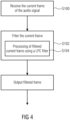
- Fig. 4 shows a flow diagram for processing a current frame of the audio signal in accordance with an embodiment of the inventive approach.
- the processing of the current frame will be described, and the past frame is assumed to be already processed with the same technique described below.
- step S100 a current frame of the audio signal is received.
- the current frame is filtered in step S102, for example in a way as described above with regard to Figs. 1 and 2 (see filter block 102).
- a discontinuity between the filtered past frame n-1 and the filtered current frame n see Fig.
- This kind of filter is also known as Linear Predictive Coding (LPC).
- LPC Linear Predictive Coding
- the filtered current frame is processed by applying linear predictive filtering to at least a part of the filtered current frame.
- the discontinuity may be removed by modifying a beginning portion of the filtered current frame by a signal obtained by linear predictive filtering a predefined signal with initial states of the linear predictive coding filter defined on the basis of a last part of the past frame.
- the initial states of the linear predictive coding filter may be defined on the basis of a last part of the past frame filtered using the set of filter parameters for the current frame.
- the inventive approach is advantageous as it does not require filtering the current frame of an audio signal with a filter coefficient that is used for the past frame and thereby avoids problems that arise due to the mismatch of the filter parameters for the current frame and for the past frame as they are experienced in the prior art approaches described above with reference to Fig. 2 .
- Fig. 5 shows a schematic block diagram for processing a current audio frame of the audio signal in accordance with embodiments of the present invention avoiding undesired distortion in the output signal despite the removal of the discontinuities.
- a current frame n of the audio signal 100 is received, each frame of the audio signal 100 having a plurality of samples.
- the current frame n of the audio signal 100 is processed by the filter block 102.
- the filtered current frame is further processed on the basis of ZIR samples as is schematically shown by block 110.
- the ZIR samples are produced as is schematically shown by block 112.
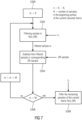
- Fig. 6 shows a flow diagram representing the functionality of the processing block 112 for generating the ZIR samples.
- the frames of an audio signal 100 are filtered with a linear filter H(z) using filter parameters c selected or determined for the respective frame.
- the filter H(z) may be a recursive filer, e.g., an IIR filter, or it may be a non-recursive filter, e.g., a FIR filter.
- a LPC filter is used which may or may not be quantized.
- the LPC filter is of the order M and may be either estimated on the filtered or non-filtered audio signal or may be the LPC filter that is also used in an audio codec.
- Step S200 thereby produces a first portion of filtered signal.
- step S202 the M last samples of the filtered past frame n-1 (the M last samples of the past frame filtered using the filter parameters or coefficients c 0 of the past frame n-1) are subtracted from the first portion of filtered signal provided by step S200, thereby producing a second portion of filtered signal.
- step S204 the LPC filter having the order M is applied, more specifically a zero input response (ZIR) of the LPC filter is generated in step S204 by filtering a frame of zero samples, wherein the initial states of the filter are equal to the second portion of filtered signals, thereby generating the ZIR.
- the ZIR can be windowed such that its amplitude decreases faster to 0.
- filtering the current frame n comprises processing (filtering) the current frame n on a sample-by-sample basis, wherein the samples of the beginning portion are treated in accordance with the inventive approach.
- M samples of a beginning portion of the current frame n are processed, and at a first step S300 the variables m is set to 0.
- the sample m of the current frame n is filtered using the filter H(z) and the filter coefficients or parameters c 1 for the current frame n.
- Step S302 yields a filtered sample m
- step S304 the ZIR sample corresponding to sample m is subtracted from the filtered sample m yielding the corresponding sample of the filtered current frame n.
- step S306 it is determined whether the last sample M of the beginning portion of the current frame n is processed. In case not all M samples of the beginning portions have been processed, the variable m is incremented and the method steps S302 to S306 are repeated for the next sample of the current frame n.
- step S308 the remaining samples of the current frame n are filtered using the filter parameters of the current frame c 1 , thereby providing the filtered current frame n processed in accordance with the inventive approach avoiding undesired distortion upon removal of the discontinuities between consecutive frames.
- the linear filer H(z) is a non-recursive filter, like a FIR filter, and the ZIR, as described above with regard to Fig. 5 , is applied in the processing block 110.
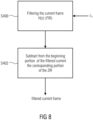
- the functionality of this embodiment is described with reference to the flow diagram of Fig. 8 .
- the current frame n at step S400, is filtered with the filter H(z) using the filter coefficients or parameters c 1 for the current frame.
- the current frame in accordance with the inventive approach, is not filtered using coefficients from the past frame, but only coefficients from the current frame, which as a consequence avoids the undesired distortion which exist in conventional approaches despite the fact that discontinuities are removed.
- step S402 a beginning portion of the ZIR is subtracted from a corresponding beginning portion of the filtered current frame, thereby providing the filtered current frame n having the beginning portion filtered/processed in accordance with the inventive approach and the remaining part only filtered using filter coefficients or parameters c 1 for the current frame, thereby avoiding undesired distortion upon removal of the discontinuities between consecutive frames.
- the inventive approach may be applied in situations as described above when the audio signal is filtered.
- the inventive approach may also be applied at the decoder side, for example, when using an audio codec postfilter for reducing the level of coding noise between signal harmonics.
- the filter may also introduce a discontinuity between the two filtered frames, for example when the past filter frame parameters c 0 are different from the current frame filter parameters c 1 , and such a discontinuity may produce an artifact in the filtered audio signal 104, for example a "click".
- This discontinuity is removed by processing the filtered current frame as described above in detail.
- aspects of the described concept have been described in the context of an apparatus, it is clear that these aspects also represent a description of the corresponding method, where a block or device corresponds to a method step or a feature of a method step. Analogously, aspects described in the context of a method step also represent a description of a corresponding block or item or feature of a corresponding apparatus.
- embodiments of the invention can be implemented in hardware or in software.
- the implementation can be performed using a digital storage medium, for example a floppy disk, a DVD, a Blue-Ray, a CD, a ROM, a PROM, an EPROM, an EEPROM or a FLASH memory, having electronically readable control signals stored thereon, which cooperate (or are capable of cooperating) with a programmable computer system such that the respective method is performed. Therefore, the digital storage medium may be computer readable.
- Some embodiments according to the invention comprise a data carrier having electronically readable control signals, which are capable of cooperating with a programmable computer system, such that one of the methods described herein is performed.
- embodiments of the present invention can be implemented as a computer program product with a program code, the program code being operative for performing one of the methods when the computer program product runs on a computer.
- the program code may for example be stored on a machine readable carrier.
- inventions comprise the computer program for performing one of the methods described herein, stored on a machine readable carrier.
- an embodiment of the inventive method is, therefore, a computer program having a program code for performing one of the methods described herein, when the computer program runs on a computer.
- a further embodiment of the inventive methods is, therefore, a data carrier (or a digital storage medium, or a computer-readable medium) comprising, recorded thereon, the computer program for performing one of the methods described herein.
- a further embodiment of the inventive method is, therefore, a data stream or a sequence of signals representing the computer program for performing one of the methods described herein.
- the data stream or the sequence of signals may for example be configured to be transferred via a data communication connection, for example via the Internet.
- a further embodiment comprises a processing means, for example a computer, or a programmable logic device, configured to or adapted to perform one of the methods described herein.
- a processing means for example a computer, or a programmable logic device, configured to or adapted to perform one of the methods described herein.
- a further embodiment comprises a computer having installed thereon the computer program for performing one of the methods described herein.
- a programmable logic device for example a field programmable gate array
- a field programmable gate array may cooperate with a microprocessor in order to perform one of the methods described herein.
- the methods are preferably performed by any hardware apparatus.
Landscapes
- Engineering & Computer Science (AREA)
- Physics & Mathematics (AREA)
- Multimedia (AREA)
- Health & Medical Sciences (AREA)
- Audiology, Speech & Language Pathology (AREA)
- Human Computer Interaction (AREA)
- Signal Processing (AREA)
- Acoustics & Sound (AREA)
- Computational Linguistics (AREA)
- Spectroscopy & Molecular Physics (AREA)
- Quality & Reliability (AREA)
- Theoretical Computer Science (AREA)
- Compression, Expansion, Code Conversion, And Decoders (AREA)
- Signal Processing For Digital Recording And Reproducing (AREA)
- Transmission Systems Not Characterized By The Medium Used For Transmission (AREA)
- Soundproofing, Sound Blocking, And Sound Damping (AREA)
- Stereophonic System (AREA)
- Circuit For Audible Band Transducer (AREA)
Applications Claiming Priority (7)
| Application Number | Priority Date | Filing Date | Title |
|---|---|---|---|
| EP14178821.6A EP2980796A1 (de) | 2014-07-28 | 2014-07-28 | Verfahren und Vorrichtung zur Verarbeitung eines Audiosignals, Audiodecodierer und Audiocodierer |
| EP23179786.1A EP4235667B1 (de) | 2014-07-28 | 2015-07-03 | Verfahren zur verarbeitung eines audiosignals, computer-lesbares medium und audio-decoder |
| EP18182785.8A EP3407351B1 (de) | 2014-07-28 | 2015-07-03 | Verfahren zur codierung und decodierung eines audiosignals, audiocodierer und audiodecodierer |
| EP15732290.0A EP3175452B1 (de) | 2014-07-28 | 2015-07-03 | Verfahren und vorrichtung zur verarbeitung eines audiosignals, audiodecodierer und audiocodierer |
| EP19209351.6A EP3654333B1 (de) | 2014-07-28 | 2015-07-03 | Verfahren zur verarbeitung eines audiosignals und audiodecoder |
| PCT/EP2015/065219 WO2016015950A1 (en) | 2014-07-28 | 2015-07-03 | Method and apparatus for precessing an audio signal, audio decoder, and audio encoder |
| EP22160064.6A EP4030426B1 (de) | 2014-07-28 | 2015-07-03 | Verfahren und vorrichtung zur verarbeitung eines audiosignals, audio-decoder und audio-encoder |
Related Parent Applications (5)
| Application Number | Title | Priority Date | Filing Date |
|---|---|---|---|
| EP22160064.6A Division EP4030426B1 (de) | 2014-07-28 | 2015-07-03 | Verfahren und vorrichtung zur verarbeitung eines audiosignals, audio-decoder und audio-encoder |
| EP23179786.1A Division EP4235667B1 (de) | 2014-07-28 | 2015-07-03 | Verfahren zur verarbeitung eines audiosignals, computer-lesbares medium und audio-decoder |
| EP15732290.0A Division EP3175452B1 (de) | 2014-07-28 | 2015-07-03 | Verfahren und vorrichtung zur verarbeitung eines audiosignals, audiodecodierer und audiocodierer |
| EP19209351.6A Division EP3654333B1 (de) | 2014-07-28 | 2015-07-03 | Verfahren zur verarbeitung eines audiosignals und audiodecoder |
| EP18182785.8A Division EP3407351B1 (de) | 2014-07-28 | 2015-07-03 | Verfahren zur codierung und decodierung eines audiosignals, audiocodierer und audiodecodierer |
Publications (4)
| Publication Number | Publication Date |
|---|---|
| EP4447048A2 true EP4447048A2 (de) | 2024-10-16 |
| EP4447048A3 EP4447048A3 (de) | 2024-10-23 |
| EP4447048B1 EP4447048B1 (de) | 2025-10-01 |
| EP4447048C0 EP4447048C0 (de) | 2025-10-01 |
Family
ID=51224879
Family Applications (7)
| Application Number | Title | Priority Date | Filing Date |
|---|---|---|---|
| EP14178821.6A Withdrawn EP2980796A1 (de) | 2014-07-28 | 2014-07-28 | Verfahren und Vorrichtung zur Verarbeitung eines Audiosignals, Audiodecodierer und Audiocodierer |
| EP23179786.1A Active EP4235667B1 (de) | 2014-07-28 | 2015-07-03 | Verfahren zur verarbeitung eines audiosignals, computer-lesbares medium und audio-decoder |
| EP22160064.6A Active EP4030426B1 (de) | 2014-07-28 | 2015-07-03 | Verfahren und vorrichtung zur verarbeitung eines audiosignals, audio-decoder und audio-encoder |
| EP18182785.8A Active EP3407351B1 (de) | 2014-07-28 | 2015-07-03 | Verfahren zur codierung und decodierung eines audiosignals, audiocodierer und audiodecodierer |
| EP24198100.0A Active EP4447048B1 (de) | 2014-07-28 | 2015-07-03 | Verfahren und vorrichtung zur verarbeitung eines audiosignals, computerlesbares medium, audiodecoder und audioencoder |
| EP15732290.0A Active EP3175452B1 (de) | 2014-07-28 | 2015-07-03 | Verfahren und vorrichtung zur verarbeitung eines audiosignals, audiodecodierer und audiocodierer |
| EP19209351.6A Active EP3654333B1 (de) | 2014-07-28 | 2015-07-03 | Verfahren zur verarbeitung eines audiosignals und audiodecoder |
Family Applications Before (4)
| Application Number | Title | Priority Date | Filing Date |
|---|---|---|---|
| EP14178821.6A Withdrawn EP2980796A1 (de) | 2014-07-28 | 2014-07-28 | Verfahren und Vorrichtung zur Verarbeitung eines Audiosignals, Audiodecodierer und Audiocodierer |
| EP23179786.1A Active EP4235667B1 (de) | 2014-07-28 | 2015-07-03 | Verfahren zur verarbeitung eines audiosignals, computer-lesbares medium und audio-decoder |
| EP22160064.6A Active EP4030426B1 (de) | 2014-07-28 | 2015-07-03 | Verfahren und vorrichtung zur verarbeitung eines audiosignals, audio-decoder und audio-encoder |
| EP18182785.8A Active EP3407351B1 (de) | 2014-07-28 | 2015-07-03 | Verfahren zur codierung und decodierung eines audiosignals, audiocodierer und audiodecodierer |
Family Applications After (2)
| Application Number | Title | Priority Date | Filing Date |
|---|---|---|---|
| EP15732290.0A Active EP3175452B1 (de) | 2014-07-28 | 2015-07-03 | Verfahren und vorrichtung zur verarbeitung eines audiosignals, audiodecodierer und audiocodierer |
| EP19209351.6A Active EP3654333B1 (de) | 2014-07-28 | 2015-07-03 | Verfahren zur verarbeitung eines audiosignals und audiodecoder |
Country Status (17)
| Country | Link |
|---|---|
| US (6) | US20170133028A1 (de) |
| EP (7) | EP2980796A1 (de) |
| JP (5) | JP6503051B2 (de) |
| KR (6) | KR102748357B1 (de) |
| CN (2) | CN106575507B (de) |
| AR (1) | AR101287A1 (de) |
| AU (1) | AU2015295709B2 (de) |
| CA (6) | CA3193302A1 (de) |
| ES (5) | ES2960422T3 (de) |
| MX (1) | MX362737B (de) |
| MY (1) | MY179016A (de) |
| PL (5) | PL4235667T3 (de) |
| PT (3) | PT3407351T (de) |
| RU (1) | RU2665282C1 (de) |
| SG (1) | SG11201700684YA (de) |
| TW (1) | TWI595480B (de) |
| WO (1) | WO2016015950A1 (de) |
Families Citing this family (12)
| Publication number | Priority date | Publication date | Assignee | Title |
|---|---|---|---|---|
| EP2980796A1 (de) * | 2014-07-28 | 2016-02-03 | Fraunhofer-Gesellschaft zur Förderung der angewandten Forschung e.V. | Verfahren und Vorrichtung zur Verarbeitung eines Audiosignals, Audiodecodierer und Audiocodierer |
| EP3483879A1 (de) | 2017-11-10 | 2019-05-15 | Fraunhofer-Gesellschaft zur Förderung der angewandten Forschung e.V. | Analyse-/synthese-fensterfunktion für modulierte geläppte transformation |
| EP3483880A1 (de) | 2017-11-10 | 2019-05-15 | Fraunhofer-Gesellschaft zur Förderung der angewandten Forschung e.V. | Zeitliche rauschformung |
| WO2019091573A1 (en) | 2017-11-10 | 2019-05-16 | Fraunhofer-Gesellschaft zur Förderung der angewandten Forschung e.V. | Apparatus and method for encoding and decoding an audio signal using downsampling or interpolation of scale parameters |
| EP3483886A1 (de) | 2017-11-10 | 2019-05-15 | Fraunhofer-Gesellschaft zur Förderung der angewandten Forschung e.V. | Auswahl einer grundfrequenz |
| EP3483882A1 (de) | 2017-11-10 | 2019-05-15 | Fraunhofer-Gesellschaft zur Förderung der angewandten Forschung e.V. | Steuerung der bandbreite in codierern und/oder decodierern |
| EP3483878A1 (de) | 2017-11-10 | 2019-05-15 | Fraunhofer-Gesellschaft zur Förderung der angewandten Forschung e.V. | Audiodecoder mit auswahlfunktion für unterschiedliche verlustmaskierungswerkzeuge |
| EP3483883A1 (de) | 2017-11-10 | 2019-05-15 | Fraunhofer-Gesellschaft zur Förderung der angewandten Forschung e.V. | Audiokodierung und -dekodierung mit selektiver nachfilterung |
| WO2019091576A1 (en) | 2017-11-10 | 2019-05-16 | Fraunhofer-Gesellschaft zur Förderung der angewandten Forschung e.V. | Audio encoders, audio decoders, methods and computer programs adapting an encoding and decoding of least significant bits |
| EP3483884A1 (de) | 2017-11-10 | 2019-05-15 | Fraunhofer-Gesellschaft zur Förderung der angewandten Forschung e.V. | Signalfiltrierung |
| ES2995244T3 (en) * | 2020-04-24 | 2025-02-07 | Ericsson Telefon Ab L M | Low cost adaptation of bass post-filter |
| CN117040487B (zh) * | 2023-10-08 | 2024-01-02 | 武汉海微科技有限公司 | 音频信号处理的滤波方法、装置、设备及存储介质 |
Citations (4)
| Publication number | Priority date | Publication date | Assignee | Title |
|---|---|---|---|---|
| US5012517A (en) | 1989-04-18 | 1991-04-30 | Pacific Communication Science, Inc. | Adaptive transform coder having long term predictor |
| EP0732687A2 (de) | 1995-03-13 | 1996-09-18 | Matsushita Electric Industrial Co., Ltd. | Vorrichtung zur Erweiterung der Sprachbandbreite |
| US5999899A (en) | 1997-06-19 | 1999-12-07 | Softsound Limited | Low bit rate audio coder and decoder operating in a transform domain using vector quantization |
| US7353168B2 (en) | 2001-10-03 | 2008-04-01 | Broadcom Corporation | Method and apparatus to eliminate discontinuities in adaptively filtered signals |
Family Cites Families (45)
| Publication number | Priority date | Publication date | Assignee | Title |
|---|---|---|---|---|
| US4969192A (en) * | 1987-04-06 | 1990-11-06 | Voicecraft, Inc. | Vector adaptive predictive coder for speech and audio |
| ATE294441T1 (de) * | 1991-06-11 | 2005-05-15 | Qualcomm Inc | Vocoder mit veränderlicher bitrate |
| US5784532A (en) * | 1994-02-16 | 1998-07-21 | Qualcomm Incorporated | Application specific integrated circuit (ASIC) for performing rapid speech compression in a mobile telephone system |
| JP3653826B2 (ja) * | 1995-10-26 | 2005-06-02 | ソニー株式会社 | 音声復号化方法及び装置 |
| US5960389A (en) * | 1996-11-15 | 1999-09-28 | Nokia Mobile Phones Limited | Methods for generating comfort noise during discontinuous transmission |
| SE9700772D0 (sv) | 1997-03-03 | 1997-03-03 | Ericsson Telefon Ab L M | A high resolution post processing method for a speech decoder |
| FR2762464B1 (fr) * | 1997-04-16 | 1999-06-25 | France Telecom | Procede et dispositif de codage d'un signal audiofrequence par analyse lpc "avant" et "arriere" |
| US7072832B1 (en) | 1998-08-24 | 2006-07-04 | Mindspeed Technologies, Inc. | System for speech encoding having an adaptive encoding arrangement |
| GB2356538A (en) * | 1999-11-22 | 2001-05-23 | Mitel Corp | Comfort noise generation for open discontinuous transmission systems |
| US6584438B1 (en) * | 2000-04-24 | 2003-06-24 | Qualcomm Incorporated | Frame erasure compensation method in a variable rate speech coder |
| US20040098255A1 (en) * | 2002-11-14 | 2004-05-20 | France Telecom | Generalized analysis-by-synthesis speech coding method, and coder implementing such method |
| EP1580895B1 (de) | 2002-11-21 | 2009-03-04 | Nippon Telegraph and Telephone Corporation | Verfahren zur digitalen signalverarbeitung, prozessor dafür, programm dafür und das programm enthaltendesaufzeichnungsmedium |
| US7613606B2 (en) * | 2003-10-02 | 2009-11-03 | Nokia Corporation | Speech codecs |
| CA2457988A1 (en) * | 2004-02-18 | 2005-08-18 | Voiceage Corporation | Methods and devices for audio compression based on acelp/tcx coding and multi-rate lattice vector quantization |
| US7930184B2 (en) * | 2004-08-04 | 2011-04-19 | Dts, Inc. | Multi-channel audio coding/decoding of random access points and transients |
| JP4606264B2 (ja) * | 2005-07-19 | 2011-01-05 | 三洋電機株式会社 | ノイズキャンセラ |
| JP2009539132A (ja) * | 2006-05-30 | 2009-11-12 | コーニンクレッカ フィリップス エレクトロニクス エヌ ヴィ | オーディオ信号の線形予測符号化 |
| CN101197134A (zh) * | 2006-12-05 | 2008-06-11 | 华为技术有限公司 | 消除编码模式切换影响的方法和装置以及解码方法和装置 |
| US8000969B2 (en) * | 2006-12-19 | 2011-08-16 | Nuance Communications, Inc. | Inferring switching conditions for switching between modalities in a speech application environment extended for interactive text exchanges |
| CN101231850B (zh) * | 2007-01-23 | 2012-02-29 | 华为技术有限公司 | 编解码方法及装置 |
| US8069051B2 (en) * | 2007-09-25 | 2011-11-29 | Apple Inc. | Zero-gap playback using predictive mixing |
| CN101527138B (zh) * | 2008-03-05 | 2011-12-28 | 华为技术有限公司 | 超宽带扩展编码、解码方法、编解码器及超宽带扩展系统 |
| ES2895268T3 (es) * | 2008-03-20 | 2022-02-18 | Fraunhofer Ges Forschung | Aparato y método para modificar una representación parametrizada |
| CA2871252C (en) * | 2008-07-11 | 2015-11-03 | Nikolaus Rettelbach | Audio encoder, audio decoder, methods for encoding and decoding an audio signal, audio stream and computer program |
| RU2498419C2 (ru) * | 2008-07-11 | 2013-11-10 | Фраунхофер-Гезелльшафт цур Фёердерунг дер ангевандтен | Устройство аудио кодирования и декодирования для кодирования фреймов, представленных в виде выборок звуковых сигналов |
| ES2683077T3 (es) * | 2008-07-11 | 2018-09-24 | Fraunhofer-Gesellschaft zur Förderung der angewandten Forschung e.V. | Codificador y decodificador de audio para codificar y decodificar tramas de una señal de audio muestreada |
| JP5551693B2 (ja) * | 2008-07-11 | 2014-07-16 | フラウンホッファー−ゲゼルシャフト ツァ フェルダールング デァ アンゲヴァンテン フォアシュンク エー.ファオ | エイリアシングスイッチスキームを用いてオーディオ信号を符号化/復号化するための装置および方法 |
| KR20100007738A (ko) * | 2008-07-14 | 2010-01-22 | 한국전자통신연구원 | 음성/오디오 통합 신호의 부호화/복호화 장치 |
| CN101355692B (zh) * | 2008-07-30 | 2013-03-20 | 浙江大学 | 一种实时跟踪运动目标区域的智能监控装置 |
| WO2010036061A2 (en) * | 2008-09-25 | 2010-04-01 | Lg Electronics Inc. | An apparatus for processing an audio signal and method thereof |
| EP3352168B1 (de) * | 2009-06-23 | 2020-09-16 | VoiceAge Corporation | Forward time domain aliasing mit anwendung in gewichteter oder originaler signaldomäne |
| KR101734948B1 (ko) | 2009-10-09 | 2017-05-12 | 삼성전자주식회사 | 파워 헤드룸 보고, 자원 할당 및 전력 제어 방법 |
| EP4571739A1 (de) * | 2009-10-20 | 2025-06-18 | Fraunhofer-Gesellschaft zur Förderung der angewandten Forschung e.V. | Audiosignalcodierer, audiosignaldecodierer, verfahren zur codierung oder decodierung eines audiosignals unter verwendung einer aliasing-unterdrückung |
| US9093066B2 (en) | 2010-01-13 | 2015-07-28 | Voiceage Corporation | Forward time-domain aliasing cancellation using linear-predictive filtering to cancel time reversed and zero input responses of adjacent frames |
| US8423355B2 (en) * | 2010-03-05 | 2013-04-16 | Motorola Mobility Llc | Encoder for audio signal including generic audio and speech frames |
| CA2804548C (en) * | 2010-07-08 | 2016-06-21 | Fraunhofer-Gesellschaft Zur Foerderung Der Angewandten Forschung E.V. | Coder using forward aliasing cancellation |
| CN101976566B (zh) * | 2010-07-09 | 2012-05-02 | 瑞声声学科技(深圳)有限公司 | 语音增强方法及应用该方法的装置 |
| US8738385B2 (en) * | 2010-10-20 | 2014-05-27 | Broadcom Corporation | Pitch-based pre-filtering and post-filtering for compression of audio signals |
| FR2969805A1 (fr) * | 2010-12-23 | 2012-06-29 | France Telecom | Codage bas retard alternant codage predictif et codage par transformee |
| US9037456B2 (en) * | 2011-07-26 | 2015-05-19 | Google Technology Holdings LLC | Method and apparatus for audio coding and decoding |
| CN102368385B (zh) * | 2011-09-07 | 2013-08-14 | 中科开元信息技术(北京)有限公司 | 后向块自适应Golomb-Rice编解码方法及装置 |
| US9043201B2 (en) * | 2012-01-03 | 2015-05-26 | Google Technology Holdings LLC | Method and apparatus for processing audio frames to transition between different codecs |
| US9489962B2 (en) * | 2012-05-11 | 2016-11-08 | Panasonic Corporation | Sound signal hybrid encoder, sound signal hybrid decoder, sound signal encoding method, and sound signal decoding method |
| EP2980797A1 (de) * | 2014-07-28 | 2016-02-03 | Fraunhofer-Gesellschaft zur Förderung der angewandten Forschung e.V. | Audiodecodierer, Verfahren und Computerprogramm mit Zero-Input-Response zur Erzeugung eines sanften Übergangs |
| EP2980796A1 (de) | 2014-07-28 | 2016-02-03 | Fraunhofer-Gesellschaft zur Förderung der angewandten Forschung e.V. | Verfahren und Vorrichtung zur Verarbeitung eines Audiosignals, Audiodecodierer und Audiocodierer |
-
2014
- 2014-07-28 EP EP14178821.6A patent/EP2980796A1/de not_active Withdrawn
-
2015
- 2015-07-03 EP EP23179786.1A patent/EP4235667B1/de active Active
- 2015-07-03 ES ES22160064T patent/ES2960422T3/es active Active
- 2015-07-03 KR KR1020237043141A patent/KR102748357B1/ko active Active
- 2015-07-03 MY MYPI2017000131A patent/MY179016A/en unknown
- 2015-07-03 ES ES15732290.0T patent/ES2685984T3/es active Active
- 2015-07-03 EP EP22160064.6A patent/EP4030426B1/de active Active
- 2015-07-03 WO PCT/EP2015/065219 patent/WO2016015950A1/en not_active Ceased
- 2015-07-03 SG SG11201700684YA patent/SG11201700684YA/en unknown
- 2015-07-03 CA CA3193302A patent/CA3193302A1/en active Pending
- 2015-07-03 KR KR1020227036973A patent/KR102615475B1/ko active Active
- 2015-07-03 RU RU2017105447A patent/RU2665282C1/ru active
- 2015-07-03 EP EP18182785.8A patent/EP3407351B1/de active Active
- 2015-07-03 AU AU2015295709A patent/AU2015295709B2/en active Active
- 2015-07-03 CA CA3193309A patent/CA3193309A1/en active Pending
- 2015-07-03 EP EP24198100.0A patent/EP4447048B1/de active Active
- 2015-07-03 PL PL23179786.1T patent/PL4235667T3/pl unknown
- 2015-07-03 JP JP2017504689A patent/JP6503051B2/ja active Active
- 2015-07-03 CA CA3193306A patent/CA3193306A1/en active Pending
- 2015-07-03 ES ES19209351T patent/ES2914632T3/es active Active
- 2015-07-03 CN CN201580040572.5A patent/CN106575507B/zh active Active
- 2015-07-03 CA CA3193316A patent/CA3193316A1/en active Pending
- 2015-07-03 ES ES18182785T patent/ES2773690T3/es active Active
- 2015-07-03 KR KR1020177005450A patent/KR101997006B1/ko active Active
- 2015-07-03 EP EP15732290.0A patent/EP3175452B1/de active Active
- 2015-07-03 CA CA3193319A patent/CA3193319A1/en active Pending
- 2015-07-03 MX MX2017001245A patent/MX362737B/es active IP Right Grant
- 2015-07-03 KR KR1020197018895A patent/KR102304326B1/ko active Active
- 2015-07-03 PT PT181827858T patent/PT3407351T/pt unknown
- 2015-07-03 CA CA2955674A patent/CA2955674C/en active Active
- 2015-07-03 CN CN202110100360.9A patent/CN113012704B/zh active Active
- 2015-07-03 PL PL18182785T patent/PL3407351T3/pl unknown
- 2015-07-03 EP EP19209351.6A patent/EP3654333B1/de active Active
- 2015-07-03 ES ES23179786T patent/ES2994941T3/es active Active
- 2015-07-03 PT PT192093516T patent/PT3654333T/pt unknown
- 2015-07-03 PL PL15732290T patent/PL3175452T3/pl unknown
- 2015-07-03 PL PL19209351T patent/PL3654333T3/pl unknown
- 2015-07-03 KR KR1020217029645A patent/KR102459857B1/ko active Active
- 2015-07-03 KR KR1020247042711A patent/KR20250008957A/ko active Pending
- 2015-07-03 PL PL22160064.6T patent/PL4030426T3/pl unknown
- 2015-07-03 PT PT15732290T patent/PT3175452T/pt unknown
- 2015-07-13 TW TW104122578A patent/TWI595480B/zh active
- 2015-07-23 AR ARP150102337A patent/AR101287A1/es active IP Right Grant
-
2017
- 2017-01-23 US US15/412,920 patent/US20170133028A1/en active Granted
-
2019
- 2019-03-22 JP JP2019054137A patent/JP6864382B2/ja active Active
-
2021
- 2021-03-26 JP JP2021052578A patent/JP7202545B2/ja active Active
-
2022
- 2022-01-20 US US17/580,578 patent/US12014746B2/en active Active
- 2022-02-03 US US17/592,423 patent/US11869525B2/en active Active
- 2022-12-08 JP JP2022196100A patent/JP7509859B2/ja active Active
-
2023
- 2023-06-22 US US18/339,915 patent/US12033648B2/en active Active
- 2023-12-12 US US18/537,655 patent/US12165665B2/en active Active
-
2024
- 2024-06-20 JP JP2024099693A patent/JP7736866B2/ja active Active
- 2024-11-06 US US18/939,370 patent/US20250078850A1/en active Pending
Patent Citations (4)
| Publication number | Priority date | Publication date | Assignee | Title |
|---|---|---|---|---|
| US5012517A (en) | 1989-04-18 | 1991-04-30 | Pacific Communication Science, Inc. | Adaptive transform coder having long term predictor |
| EP0732687A2 (de) | 1995-03-13 | 1996-09-18 | Matsushita Electric Industrial Co., Ltd. | Vorrichtung zur Erweiterung der Sprachbandbreite |
| US5999899A (en) | 1997-06-19 | 1999-12-07 | Softsound Limited | Low bit rate audio coder and decoder operating in a transform domain using vector quantization |
| US7353168B2 (en) | 2001-10-03 | 2008-04-01 | Broadcom Corporation | Method and apparatus to eliminate discontinuities in adaptively filtered signals |
Also Published As
Similar Documents
| Publication | Publication Date | Title |
|---|---|---|
| US12033648B2 (en) | Method and apparatus for processing an audio signal, audio decoder, and audio encoder for removing a discontinuity between frames by subtracting a portion of a zero-input-reponse | |
| HK40115863A (en) | Method and apparatus for processing an audio signal, computer readable medium and audio decoder | |
| HK40076902A (en) | Method and apparatus for processing an audio signal, audio decoder and audio encoder | |
| HK40098015B (en) | Method and apparatus for processing an audio signal, computer readable medium and audio decoder | |
| HK40098015A (en) | Method and apparatus for processing an audio signal, computer readable medium and audio decoder | |
| HK40076902B (en) | Method and apparatus for processing an audio signal, audio decoder and audio encoder | |
| HK1259289B (en) | Methods for encoding and decoding an audio signal, audio decoder and audio encoder | |
| HK1236275B (en) | Method and apparatus for processing an audio signal, audio decoder, and audio encoder | |
| HK1236275A1 (en) | Method and apparatus for processing an audio signal, audio decoder, and audio encoder |
Legal Events
| Date | Code | Title | Description |
|---|---|---|---|
| PUAI | Public reference made under article 153(3) epc to a published international application that has entered the european phase |
Free format text: ORIGINAL CODE: 0009012 |
|
| STAA | Information on the status of an ep patent application or granted ep patent |
Free format text: STATUS: THE APPLICATION HAS BEEN PUBLISHED |
|
| REG | Reference to a national code |
Free format text: PREVIOUS MAIN CLASS: G11B0027038000 Ipc: G10L0019260000 Ref country code: DE Ref legal event code: R079 Ref document number: 602015092484 Country of ref document: DE Free format text: PREVIOUS MAIN CLASS: G11B0027038000 Ipc: G10L0019260000 |
|
| PUAL | Search report despatched |
Free format text: ORIGINAL CODE: 0009013 |
|
| AC | Divisional application: reference to earlier application |
Ref document number: 3175452 Country of ref document: EP Kind code of ref document: P Ref document number: 3407351 Country of ref document: EP Kind code of ref document: P Ref document number: 3654333 Country of ref document: EP Kind code of ref document: P Ref document number: 4030426 Country of ref document: EP Kind code of ref document: P Ref document number: 4235667 Country of ref document: EP Kind code of ref document: P |
|
| AK | Designated contracting states |
Kind code of ref document: A2 Designated state(s): AL AT BE BG CH CY CZ DE DK EE ES FI FR GB GR HR HU IE IS IT LI LT LU LV MC MK MT NL NO PL PT RO RS SE SI SK SM TR |
|
| AK | Designated contracting states |
Kind code of ref document: A3 Designated state(s): AL AT BE BG CH CY CZ DE DK EE ES FI FR GB GR HR HU IE IS IT LI LT LU LV MC MK MT NL NO PL PT RO RS SE SI SK SM TR |
|
| RIC1 | Information provided on ipc code assigned before grant |
Ipc: G10L 21/0364 20130101ALN20240916BHEP Ipc: G11B 27/038 20060101ALI20240916BHEP Ipc: G10L 19/06 20130101ALI20240916BHEP Ipc: G10L 19/26 20130101AFI20240916BHEP |
|
| REG | Reference to a national code |
Ref country code: HK Ref legal event code: DE Ref document number: 40115863 Country of ref document: HK |
|
| STAA | Information on the status of an ep patent application or granted ep patent |
Free format text: STATUS: REQUEST FOR EXAMINATION WAS MADE |
|
| GRAP | Despatch of communication of intention to grant a patent |
Free format text: ORIGINAL CODE: EPIDOSNIGR1 |
|
| STAA | Information on the status of an ep patent application or granted ep patent |
Free format text: STATUS: GRANT OF PATENT IS INTENDED |
|
| 17P | Request for examination filed |
Effective date: 20250416 |
|
| RIC1 | Information provided on ipc code assigned before grant |
Ipc: G10L 21/0364 20130101ALN20250430BHEP Ipc: G11B 27/038 20060101ALI20250430BHEP Ipc: G10L 19/06 20130101ALI20250430BHEP Ipc: G10L 19/26 20130101AFI20250430BHEP |
|
| INTG | Intention to grant announced |
Effective date: 20250512 |
|
| GRAS | Grant fee paid |
Free format text: ORIGINAL CODE: EPIDOSNIGR3 |
|
| GRAA | (expected) grant |
Free format text: ORIGINAL CODE: 0009210 |
|
| STAA | Information on the status of an ep patent application or granted ep patent |
Free format text: STATUS: THE PATENT HAS BEEN GRANTED |
|
| AC | Divisional application: reference to earlier application |
Ref document number: 4235667 Country of ref document: EP Kind code of ref document: P Ref document number: 4030426 Country of ref document: EP Kind code of ref document: P Ref document number: 3654333 Country of ref document: EP Kind code of ref document: P Ref document number: 3407351 Country of ref document: EP Kind code of ref document: P Ref document number: 3175452 Country of ref document: EP Kind code of ref document: P |
|
| AK | Designated contracting states |
Kind code of ref document: B1 Designated state(s): AL AT BE BG CH CY CZ DE DK EE ES FI FR GB GR HR HU IE IS IT LI LT LU LV MC MK MT NL NO PL PT RO RS SE SI SK SM TR |
|
| REG | Reference to a national code |
Ref country code: GB Ref legal event code: FG4D Ref country code: CH Ref legal event code: F10 Free format text: ST27 STATUS EVENT CODE: U-0-0-F10-F00 (AS PROVIDED BY THE NATIONAL OFFICE) Effective date: 20251001 |
|
| REG | Reference to a national code |
Ref country code: DE Ref legal event code: R096 Ref document number: 602015092484 Country of ref document: DE |
|
| U01 | Request for unitary effect filed |
Effective date: 20251024 |
|
| U07 | Unitary effect registered |
Designated state(s): AT BE BG DE DK EE FI FR IT LT LU LV MT NL PT RO SE SI Effective date: 20251030 |