EP4446316A1 - Compound and organic light-emitting device comprising same - Google Patents
Compound and organic light-emitting device comprising same Download PDFInfo
- Publication number
- EP4446316A1 EP4446316A1 EP23831792.9A EP23831792A EP4446316A1 EP 4446316 A1 EP4446316 A1 EP 4446316A1 EP 23831792 A EP23831792 A EP 23831792A EP 4446316 A1 EP4446316 A1 EP 4446316A1
- Authority
- EP
- European Patent Office
- Prior art keywords
- group
- substituted
- unsubstituted
- deuterium
- present specification
- Prior art date
- Legal status (The legal status is an assumption and is not a legal conclusion. Google has not performed a legal analysis and makes no representation as to the accuracy of the status listed.)
- Pending
Links
Images
Classifications
-
- C—CHEMISTRY; METALLURGY
- C07—ORGANIC CHEMISTRY
- C07D—HETEROCYCLIC COMPOUNDS
- C07D307/00—Heterocyclic compounds containing five-membered rings having one oxygen atom as the only ring hetero atom
- C07D307/77—Heterocyclic compounds containing five-membered rings having one oxygen atom as the only ring hetero atom ortho- or peri-condensed with carbocyclic rings or ring systems
- C07D307/92—Naphthofurans; Hydrogenated naphthofurans
-
- C—CHEMISTRY; METALLURGY
- C07—ORGANIC CHEMISTRY
- C07B—GENERAL METHODS OF ORGANIC CHEMISTRY; APPARATUS THEREFOR
- C07B59/00—Introduction of isotopes of elements into organic compounds ; Labelled organic compounds per se
- C07B59/002—Heterocyclic compounds
-
- C—CHEMISTRY; METALLURGY
- C07—ORGANIC CHEMISTRY
- C07D—HETEROCYCLIC COMPOUNDS
- C07D407/00—Heterocyclic compounds containing two or more hetero rings, at least one ring having oxygen atoms as the only ring hetero atoms, not provided for by group C07D405/00
- C07D407/02—Heterocyclic compounds containing two or more hetero rings, at least one ring having oxygen atoms as the only ring hetero atoms, not provided for by group C07D405/00 containing two hetero rings
- C07D407/04—Heterocyclic compounds containing two or more hetero rings, at least one ring having oxygen atoms as the only ring hetero atoms, not provided for by group C07D405/00 containing two hetero rings directly linked by a ring-member-to-ring-member bond
-
- C—CHEMISTRY; METALLURGY
- C07—ORGANIC CHEMISTRY
- C07D—HETEROCYCLIC COMPOUNDS
- C07D407/00—Heterocyclic compounds containing two or more hetero rings, at least one ring having oxygen atoms as the only ring hetero atoms, not provided for by group C07D405/00
- C07D407/02—Heterocyclic compounds containing two or more hetero rings, at least one ring having oxygen atoms as the only ring hetero atoms, not provided for by group C07D405/00 containing two hetero rings
- C07D407/10—Heterocyclic compounds containing two or more hetero rings, at least one ring having oxygen atoms as the only ring hetero atoms, not provided for by group C07D405/00 containing two hetero rings linked by a carbon chain containing aromatic rings
-
- C—CHEMISTRY; METALLURGY
- C09—DYES; PAINTS; POLISHES; NATURAL RESINS; ADHESIVES; COMPOSITIONS NOT OTHERWISE PROVIDED FOR; APPLICATIONS OF MATERIALS NOT OTHERWISE PROVIDED FOR
- C09K—MATERIALS FOR MISCELLANEOUS APPLICATIONS, NOT PROVIDED FOR ELSEWHERE
- C09K11/00—Luminescent materials, e.g. electroluminescent or chemiluminescent
- C09K11/06—Luminescent materials, e.g. electroluminescent or chemiluminescent containing organic luminescent materials
-
- H—ELECTRICITY
- H10—SEMICONDUCTOR DEVICES; ELECTRIC SOLID-STATE DEVICES NOT OTHERWISE PROVIDED FOR
- H10K—ORGANIC ELECTRIC SOLID-STATE DEVICES
- H10K50/00—Organic light-emitting devices
- H10K50/10—OLEDs or polymer light-emitting diodes [PLED]
- H10K50/11—OLEDs or polymer light-emitting diodes [PLED] characterised by the electroluminescent [EL] layers
- H10K50/12—OLEDs or polymer light-emitting diodes [PLED] characterised by the electroluminescent [EL] layers comprising dopants
-
- H—ELECTRICITY
- H10—SEMICONDUCTOR DEVICES; ELECTRIC SOLID-STATE DEVICES NOT OTHERWISE PROVIDED FOR
- H10K—ORGANIC ELECTRIC SOLID-STATE DEVICES
- H10K85/00—Organic materials used in the body or electrodes of devices covered by this subclass
- H10K85/60—Organic compounds having low molecular weight
- H10K85/615—Polycyclic condensed aromatic hydrocarbons, e.g. anthracene
-
- H—ELECTRICITY
- H10—SEMICONDUCTOR DEVICES; ELECTRIC SOLID-STATE DEVICES NOT OTHERWISE PROVIDED FOR
- H10K—ORGANIC ELECTRIC SOLID-STATE DEVICES
- H10K85/00—Organic materials used in the body or electrodes of devices covered by this subclass
- H10K85/60—Organic compounds having low molecular weight
- H10K85/615—Polycyclic condensed aromatic hydrocarbons, e.g. anthracene
- H10K85/622—Polycyclic condensed aromatic hydrocarbons, e.g. anthracene containing four rings, e.g. pyrene
-
- H—ELECTRICITY
- H10—SEMICONDUCTOR DEVICES; ELECTRIC SOLID-STATE DEVICES NOT OTHERWISE PROVIDED FOR
- H10K—ORGANIC ELECTRIC SOLID-STATE DEVICES
- H10K85/00—Organic materials used in the body or electrodes of devices covered by this subclass
- H10K85/60—Organic compounds having low molecular weight
- H10K85/615—Polycyclic condensed aromatic hydrocarbons, e.g. anthracene
- H10K85/626—Polycyclic condensed aromatic hydrocarbons, e.g. anthracene containing more than one polycyclic condensed aromatic rings, e.g. bis-anthracene
-
- H—ELECTRICITY
- H10—SEMICONDUCTOR DEVICES; ELECTRIC SOLID-STATE DEVICES NOT OTHERWISE PROVIDED FOR
- H10K—ORGANIC ELECTRIC SOLID-STATE DEVICES
- H10K85/00—Organic materials used in the body or electrodes of devices covered by this subclass
- H10K85/60—Organic compounds having low molecular weight
- H10K85/631—Amine compounds having at least two aryl rest on at least one amine-nitrogen atom, e.g. triphenylamine
- H10K85/633—Amine compounds having at least two aryl rest on at least one amine-nitrogen atom, e.g. triphenylamine comprising polycyclic condensed aromatic hydrocarbons as substituents on the nitrogen atom
-
- H—ELECTRICITY
- H10—SEMICONDUCTOR DEVICES; ELECTRIC SOLID-STATE DEVICES NOT OTHERWISE PROVIDED FOR
- H10K—ORGANIC ELECTRIC SOLID-STATE DEVICES
- H10K85/00—Organic materials used in the body or electrodes of devices covered by this subclass
- H10K85/60—Organic compounds having low molecular weight
- H10K85/631—Amine compounds having at least two aryl rest on at least one amine-nitrogen atom, e.g. triphenylamine
- H10K85/636—Amine compounds having at least two aryl rest on at least one amine-nitrogen atom, e.g. triphenylamine comprising heteroaromatic hydrocarbons as substituents on the nitrogen atom
-
- H—ELECTRICITY
- H10—SEMICONDUCTOR DEVICES; ELECTRIC SOLID-STATE DEVICES NOT OTHERWISE PROVIDED FOR
- H10K—ORGANIC ELECTRIC SOLID-STATE DEVICES
- H10K85/00—Organic materials used in the body or electrodes of devices covered by this subclass
- H10K85/60—Organic compounds having low molecular weight
- H10K85/649—Aromatic compounds comprising a hetero atom
- H10K85/654—Aromatic compounds comprising a hetero atom comprising only nitrogen as heteroatom
-
- H—ELECTRICITY
- H10—SEMICONDUCTOR DEVICES; ELECTRIC SOLID-STATE DEVICES NOT OTHERWISE PROVIDED FOR
- H10K—ORGANIC ELECTRIC SOLID-STATE DEVICES
- H10K85/00—Organic materials used in the body or electrodes of devices covered by this subclass
- H10K85/60—Organic compounds having low molecular weight
- H10K85/649—Aromatic compounds comprising a hetero atom
- H10K85/657—Polycyclic condensed heteroaromatic hydrocarbons
- H10K85/6572—Polycyclic condensed heteroaromatic hydrocarbons comprising only nitrogen in the heteroaromatic polycondensed ring system, e.g. phenanthroline or carbazole
-
- H—ELECTRICITY
- H10—SEMICONDUCTOR DEVICES; ELECTRIC SOLID-STATE DEVICES NOT OTHERWISE PROVIDED FOR
- H10K—ORGANIC ELECTRIC SOLID-STATE DEVICES
- H10K85/00—Organic materials used in the body or electrodes of devices covered by this subclass
- H10K85/60—Organic compounds having low molecular weight
- H10K85/649—Aromatic compounds comprising a hetero atom
- H10K85/657—Polycyclic condensed heteroaromatic hydrocarbons
- H10K85/6574—Polycyclic condensed heteroaromatic hydrocarbons comprising only oxygen in the heteroaromatic polycondensed ring system, e.g. cumarine dyes
-
- H—ELECTRICITY
- H10—SEMICONDUCTOR DEVICES; ELECTRIC SOLID-STATE DEVICES NOT OTHERWISE PROVIDED FOR
- H10K—ORGANIC ELECTRIC SOLID-STATE DEVICES
- H10K85/00—Organic materials used in the body or electrodes of devices covered by this subclass
- H10K85/60—Organic compounds having low molecular weight
- H10K85/658—Organoboranes
-
- C—CHEMISTRY; METALLURGY
- C09—DYES; PAINTS; POLISHES; NATURAL RESINS; ADHESIVES; COMPOSITIONS NOT OTHERWISE PROVIDED FOR; APPLICATIONS OF MATERIALS NOT OTHERWISE PROVIDED FOR
- C09K—MATERIALS FOR MISCELLANEOUS APPLICATIONS, NOT PROVIDED FOR ELSEWHERE
- C09K2211/00—Chemical nature of organic luminescent or tenebrescent compounds
- C09K2211/10—Non-macromolecular compounds
- C09K2211/1003—Carbocyclic compounds
- C09K2211/1007—Non-condensed systems
-
- C—CHEMISTRY; METALLURGY
- C09—DYES; PAINTS; POLISHES; NATURAL RESINS; ADHESIVES; COMPOSITIONS NOT OTHERWISE PROVIDED FOR; APPLICATIONS OF MATERIALS NOT OTHERWISE PROVIDED FOR
- C09K—MATERIALS FOR MISCELLANEOUS APPLICATIONS, NOT PROVIDED FOR ELSEWHERE
- C09K2211/00—Chemical nature of organic luminescent or tenebrescent compounds
- C09K2211/10—Non-macromolecular compounds
- C09K2211/1003—Carbocyclic compounds
- C09K2211/1011—Condensed systems
-
- C—CHEMISTRY; METALLURGY
- C09—DYES; PAINTS; POLISHES; NATURAL RESINS; ADHESIVES; COMPOSITIONS NOT OTHERWISE PROVIDED FOR; APPLICATIONS OF MATERIALS NOT OTHERWISE PROVIDED FOR
- C09K—MATERIALS FOR MISCELLANEOUS APPLICATIONS, NOT PROVIDED FOR ELSEWHERE
- C09K2211/00—Chemical nature of organic luminescent or tenebrescent compounds
- C09K2211/10—Non-macromolecular compounds
- C09K2211/1018—Heterocyclic compounds
- C09K2211/1025—Heterocyclic compounds characterised by ligands
- C09K2211/1044—Heterocyclic compounds characterised by ligands containing two nitrogen atoms as heteroatoms
- C09K2211/1055—Heterocyclic compounds characterised by ligands containing two nitrogen atoms as heteroatoms with other heteroatoms
-
- H—ELECTRICITY
- H10—SEMICONDUCTOR DEVICES; ELECTRIC SOLID-STATE DEVICES NOT OTHERWISE PROVIDED FOR
- H10K—ORGANIC ELECTRIC SOLID-STATE DEVICES
- H10K2101/00—Properties of the organic materials covered by group H10K85/00
- H10K2101/90—Multiple hosts in the emissive layer
-
- H—ELECTRICITY
- H10—SEMICONDUCTOR DEVICES; ELECTRIC SOLID-STATE DEVICES NOT OTHERWISE PROVIDED FOR
- H10K—ORGANIC ELECTRIC SOLID-STATE DEVICES
- H10K50/00—Organic light-emitting devices
- H10K50/10—OLEDs or polymer light-emitting diodes [PLED]
- H10K50/11—OLEDs or polymer light-emitting diodes [PLED] characterised by the electroluminescent [EL] layers
Definitions
- the present specification relates to a compound and an organic light emitting device including the same.
- An organic light emission phenomenon generally refers to a phenomenon converting electrical energy to light energy using an organic material.
- An organic light emitting device using an organic light emission phenomenon normally has a structure including a positive electrode, a negative electrode, and an organic material layer therebetween.
- the organic material layer has in many cases a multi-layered structure composed of different materials in order to improve the efficiency and stability of the organic light emitting device, and for example, may be composed of a hole injection layer, a hole transport layer, a light emitting layer, an electron transport layer, an electron injection layer, and the like.
- the present specification provides a compound and an organic light emitting device including the same.
- an exemplary embodiment of the present specification provides an organic light emitting device including: a first electrode; a second electrode; and an organic material layer having one or more layers provided between the first electrode and the second electrode, in which one or more layers of the organic material layer include the above-described compound.
- the compound according to an exemplary embodiment of the present specification can be used for an organic material layer of an organic light emitting device to lower the driving voltage of the organic light emitting device and improve the light efficiency. Further, the service life characteristics of the device can be improved by the thermal stability of the compound.
- FIGS. 1 and 2 illustrate an example of an organic light emitting device according to an exemplary embodiment of the present specification.
- An exemplary embodiment of the present specification provides the compound of Chemical Formula 1.
- Chemical Formula 1 according to an exemplary embodiment of the present specification has structural characteristics in which the mobility of electrons and holes is enhanced and molecular stability is improved because a substituted or unsubstituted aryl group is bonded to Position 9 of anthracene, naphthofuran is bonded to Position 10 through L, and Chemical Formula 1 includes at least one deuterium. Therefore, an organic light emitting device including the same is excellent in terms of driving voltage, efficiency and service life.
- the present specification provides a compound in which at least one hydrogen of Chemical Formula 1 is substituted with deuterium, and an organic light emitting device including the same. Since a C-D bond of the compound of the present invention is stronger than a C-H bond, the stability of the compound may be improved. When the chemical decomposition of a light emitting compound is accompanied by the destruction of the C(sp3)-H bond, which is relatively weak, there is an effect that the stability of the compound can be further improved using the C-D bond which is stronger than the C-H bond.
- the term "combination thereof" included in the Markush type expression means a mixture or combination of one or more selected from the group consisting of constituent elements described in the Markush type expression, and means including one or more selected from the group consisting of the above-described constituent elements.
- substitution means that a hydrogen atom bonded to a carbon atom of a compound is changed into another substituent, and a position to be substituted is not limited as long as the position is a position at which the hydrogen atom is substituted, that is, a position at which the substituent may be substituted, and when two or more are substituted, the two or more substituents may be the same as or different from each other.
- substituted or unsubstituted means being substituted with one or more substituents selected from the group consisting of deuterium; a halogen group; a cyano group; an alkyl group; a cycloalkyl group; an alkoxy group; an aryloxy group; an alkylthioxy group; an arylthioxy group; an alkenyl group; a haloalkyl group; a haloalkoxy group; an arylalkyl group; a silyl group; a boron group; an amine group; an aryl group; and a heterocyclic group, being substituted with a substituent to which two or more substituents among the exemplified substituents are linked, or having no substituent.
- the fact that two or more substituents are linked indicates that hydrogen of any one substituent is linked to another substituent.
- a phenyl group and a naphthyl group may be linked to each other to become a substituent of or
- the case where three substituents are linked to one another includes not only a case where (Substituent 1)-(Substituent 2)-(Substituent 3) are consecutively linked to one another, but also a case where (Substituent 2) and (Substituent 3) are linked to (Substituent 1).
- a phenyl group, a naphthyl group, and an isopropyl group may be linked to one another to become a substituent of
- the above-described definition also applies equally to the case where four or more substituents are linked to one another.
- examples of a halogen group include fluorine, chlorine, bromine or iodine.
- the alkyl group may be straight-chained or branched, and the number of carbon atoms thereof is not particularly limited, but is preferably 1 to 30.
- Specific examples thereof include methyl, ethyl, propyl, n-propyl, isopropyl, butyl, n-butyl, isobutyl, tert-butyl, sec-butyl, 1-methyl-butyl, 1-ethylbutyl, pentyl, n-pentyl, isopentyl, neopentyl, tert-pentyl, hexyl, n-hexyl, 1-methylpentyl, 2-methylpentyl, 4-methyl-2-pentyl, 3,3-dimethylbutyl, 2-ethylbutyl, heptyl, n-heptyl, 1-methylhexyl, cyclopentylmethyl, cyclohexylmethyl, oct
- a cycloalkyl group is not particularly limited, but has preferably 3 to 30 carbon atoms, and specific examples thereof include cyclopropyl, cyclobutyl, cyclopentyl, 3-methylcyclopentyl, 2,3-dimethylcyclopentyl, cyclohexyl, 3-methylcyclohexyl, 4-methylcyclohexyl, 2,3-dimethylcyclohexyl, 3,4,5-trimethylcyclohexyl, 4-tert-butylcyclohexyl, cycloheptyl, cyclooctyl, an adamantyl group, a bicyclo[2.2.1]heptyl group, a bicyclo[2.2.1]octyl group, a norbornyl group, and the like, but are not limited thereto.
- the alkoxy group may be straight-chained, branched, or cyclic.
- the number of carbon atoms of the alkoxy group is not particularly limited, but is preferably 1 to 30. Specific examples thereof include methoxy, ethoxy, n-propoxy, isopropoxy, n-butoxy, isobutoxy, tert-butoxy, sec-butoxy, n-pentyloxy, neopentyloxy, isopentyloxy, n-hexyloxy, 3,3-dimethylbutyloxy, 2-ethylbutyloxy, n-octyloxy, n-nonyloxy, n-decyloxy, benzyloxy, p-methylbenzyloxy, and the like, but are not limited thereto.
- the alkenyl group may be straight-chained or branched, and the number of carbon atoms thereof is not particularly limited, but is preferably 2 to 30.
- Specific examples thereof include vinyl, 1-propenyl, isopropenyl, 1-butenyl, 2-butenyl, 3-butenyl, 1-pentenyl, 2-pentenyl, 3-pentenyl, 3-methyl-1-butenyl, 1,3-butadienyl, allyl, 1-phenylvinyl-1-yl, 2-phenylvinyl-1-yl, 2,2-diphenylvinyl-1-yl, 2-phenyl-2-(naphthyl-1-yl)vinyl-1-yl, 2,2-bis(diphenyl-1-yl)vinyl-1-yl, a stilbenyl group, a styrenyl group, and the like, but are not limited thereto.
- haloalkyl group means that at least one halogen group is substituted instead of hydrogen in an alkyl group in the definition of the alkyl group.
- the haloalkoxy group means that at least one halogen group is substituted instead of hydrogen in an alkoxy group in the definition of the alkoxy group.
- an aryl group is not particularly limited, but has preferably 6 to 30 carbon atoms, and the aryl group may be monocyclic or polycyclic.
- the aryl group is a monocyclic aryl group
- the number of carbon atoms thereof is not particularly limited, but is preferably 6 to 30.
- Specific examples of the monocyclic aryl group include a phenyl group, a biphenyl group, a terphenyl group, and the like, but are not limited thereto.
- the aryl group is a polycyclic aryl group
- the number of carbon atoms thereof is not particularly limited, but is preferably 10 to 30.
- Specific examples of the polycyclic aryl group include a naphthyl group, an anthracene group, a phenanthrene group, a triphenylene group, a pyrene group, a phenalene group, a perylene group, a chrysene group, a fluorene group, and the like, but are not limited thereto.
- the fluorene group may be substituted, and adjacent groups may be bonded to each other to form a ring.
- fluorene group examples include and the like, but are not limited thereto.
- an "adjacent" group may mean a substituent substituting an atom directly linked to an atom substituted by the corresponding substituent, a substituent sterically most closely positioned to the corresponding substituent, or another substituent substituting an atom substituted by the corresponding substituent.
- two substituents substituting ortho positions in a benzene ring, and two substituents substituting the same carbon in an aliphatic ring may be interpreted as groups "adjacent" to each other.
- an arylalkyl group means that the alkyl group is substituted with an aryl group, and examples of the aryl group and the alkyl group described above may be applied to the aryl group and the alkyl group of the arylalkyl group.
- an aryloxy group means that in the definition of the alkoxy group, the alkoxy group is substituted with an aryl group instead of an alkyl group, and examples of the aryloxy group include a phenoxy group, a p-tolyloxy group, an m-tolyloxy group, a 3,5-dimethyl-phenoxy group, a 2,4,6-trimethylphenoxy group, a p-tert-butylphenoxy group, a 3-biphenyloxy group, a 4-biphenyloxy group, a 1-naphthyloxy group, a 2-naphthyloxy group, a 4-methyl-1-naphthyloxy group, a 5-methyl-2-naphthyloxy group, a 1-anthryloxy group, a 2-anthryloxy group, a 9-anthryloxy group, a 1-phenanthryloxy group, a 3-phenanthryloxy group, a 9-phen
- the alkyl group in the alkylthioxy group is the same as the above-described examples of the alkyl group.
- Specific examples of the alkylthioxy group include a methylthioxy group, an ethylthioxy group, a tert-butylthioxy group, a hexylthioxy group, an octylthioxy group, and the like, but are not limited thereto.
- the aryl group in the arylthioxy group is the same as the above-described examples of the aryl group.
- Specific examples of the arylthioxy group include a phenylthioxy group, a 2-methylphenylthioxy group, a 4-tert- butylphenylthioxy group, and the like, but are not limited thereto.
- a heterocyclic group includes one or more atoms other than carbon, that is, one or more heteroatoms, and specifically, the heteroatom may include one or more atoms selected from the group consisting of O, N, Se, S, and the like, and includes an aromatic heterocyclic group, or an aliphatic heterocyclic group.
- the aromatic heterocyclic group may be represented by a heteroaryl group.
- the number of carbon atoms of the heterocyclic group is not particularly limited, but is preferably 2 to 30, and the heterocyclic group may be monocyclic or polycyclic.
- heterocyclic group examples include a thiophene group, a furan group, a pyrrole group, an imidazole group, a thiazole group, an oxazole group, an oxadiazole group, a pyridine group, a bipyridine group, a pyrimidine group, a triazine group, a triazole group, an acridine group, a pyridazine group, a pyrazine group, a quinoline group, a quinazoline group, a quinoxaline group, a phthalazine group, a pyridopyrimidine group, a pyridopyrazine group, a pyrazinopyrazine group, an isoquinoline group, an indole group, a carbazole group, a benzoxazole group, a benzimidazole group, a benzothiazole group, a benzocarbazole
- the silyl group may be an alkylsilyl group, an arylsilyl group, an alkylarylsilyl group, a heteroarylsilyl group, and the like.
- the above-described examples of the alkyl group may be applied to the alkyl group in the alkylsilyl group
- the above-described examples of the aryl group may be applied to the aryl group in the arylsilyl group
- the examples of the alkyl group and the aryl group may be applied to the alkyl group and the aryl group in the alkylarylsilyl group
- the examples of the heterocyclic group may be applied to the heteroaryl group in the heteroarylsilyl group.
- a boron group may be - BY 100 Y 101 , and Y 100 and Y 101 are the same as or different from each other, and may be each independently selected from the group consisting of hydrogen; deuterium; halogen; a nitrile group; a substituted or unsubstituted monocyclic or polycyclic cycloalkyl group having 3 to 30 carbon atoms; a substituted or unsubstituted straight-chained or branched alkyl group having 1 to 30 carbon atoms; a substituted or unsubstituted monocyclic or polycyclic aryl group having 6 to 30 carbon atoms; and a substituted or unsubstituted monocyclic or polycyclic heterocyclic group having 2 to 30 carbon atoms.
- the boron group include a dimethylboron group, a diethylboron group, a t-butylmethylboron group, a diphenylboron group, and the like,
- an amine group may be selected from the group consisting of -NH 2 , an alkylamine group, an N-alkylarylamine group, an arylamine group, an N-arylheteroarylamine group, an N-alkylheteroarylamine group, and a heteroarylamine group, and the number of carbon atoms thereof is not particularly limited, but is preferably 1 to 30.
- the amine group include a methylamine group, a dimethylamine group, an ethylamine group, a diethylamine group, a phenylamine group, a naphthylamine group, a biphenylamine group, an anthracenylamine group, a 9-methyl-anthracenylamine group, a diphenylamine group, a ditolylamine group, an N-phenyltolylamine group, an N-phenylbiphenylamine group, an N-phenylnaphthylamine group, an N-biphenylnaphthylamine group, an N-naphthylfluorenylamine group, an N-phenylphenanthrenylamine group, an N-biphenylphenanthrenylamine group, an N-phenylfluorenylamine group, an N-phenyl terphenylamine group, an N-phenanthrenylamine group
- an N-alkylarylamine group means an amine group in which an alkyl group and an aryl group are substituted with N of the amine group.
- the alkyl group and the aryl group in the N-alkylarylamine group are the same as the above-described examples of the alkyl group and the aryl group.
- an N-arylheteroarylamine group means an amine group in which an aryl group and a heteroaryl group are substituted with N of the amine group.
- the aryl group and heteroaryl group in the N-arylheteroarylamine group are the same as the above-described examples of the aryl group and the heterocyclic group.
- an N-alkylheteroarylamine group means an amine group in which an alkyl group and a heteroaryl group are substituted with N of the amine group.
- the alkyl group and the heteroaryl group in the N-alkylheteroarylamine group are the same as the above-described examples of the alkyl group and the heterocyclic group.
- examples of an alkylamine group include a substituted or unsubstituted monoalkylamine group or a substituted or unsubstituted dialkylamine group.
- the alkyl group in the alkylamine group may be a straight-chained or branched alkyl group.
- the alkylamine group including two or more alkyl groups may include a straight-chained alkyl group, a branched alkyl group, or both a straight-chained alkyl group and a branched alkyl group.
- the alkyl group in the alkylamine group may be selected from the above-described examples of the alkyl group.
- examples of a heteroarylamine group include a substituted or unsubstituted monoheteroarylamine group or a substituted or unsubstituted diheteroarylamine group.
- the heteroarylamine group including two or more heteroaryl groups may include a monocyclic heteroaryl group, a polycyclic heteroaryl group, or both a monocyclic heteroaryl group and a polycyclic heteroaryl group.
- the heteroaryl group in the heteroarylamine group may be selected from the above-described examples of the heterocyclic group.
- the alkyl group in the N-alkylarylamine group, the alkylthioxy group, and the N-alkylheteroarylamine group is the same as the above-described examples of the alkyl group.
- Specific examples of the alkylthioxy group include a methylthioxy group, an ethylthioxy group, a tert-butylthioxy group, a hexylthioxy group, an octylthioxy group, and the like, but are not limited thereto.
- the aryl group in the aryloxy group, the arylthioxy group, the N-arylalkylamine group, and the N-arylheteroarylamine group is the same as the above-described examples of the aryl group.
- examples of the aryloxy group include a phenoxy group, a p-tolyloxy group, an m-tolyloxy group, a 3,5-dimethyl-phenoxy group, a 2,4,6-trimethylphenoxy group, a p-tert-butylphenoxy group, a 3-biphenyloxy group, a 4-biphenyloxy group, a 1-naphthyloxy group, a 2-naphthyloxy group, a 4-methyl-1-naphthyloxy group, a 5-methyl-2-naphthyloxy group, a 1-anthryloxy group, a 2-anthryloxy group, a 9-anthryloxy group, a 1-phenanthryloxy group, a 3-phenanthryloxy group, a 9-phenanthryloxy group, and the like
- examples of the arylthioxy group include a phenylthioxy group, a 2-methylphenylthioxy group,
- a hydrocarbon ring group may be an aromatic hydrocarbon ring group, an aliphatic hydrocarbon ring group, or a fused group of an aromatic hydrocarbon ring and an aliphatic hydrocarbon ring and may be selected among examples of the cycloalkyl group, the aryl group, and a combination thereof, and examples of the hydrocarbon ring group include a phenyl group, a cyclohexyl group, an adamantyl group, a bicylo[2.2.1]heptyl group, a bicyclo[2.2.1]octyl group, a tetrahydronaphthalene group, a tetrahydroanthracene group, a 1,2,3,4-tetrahydro-1,4-methanonaphthalene group, a 1,2,3,4-tetrahydro-1,4-ethanonaphthalene group, a spirocyclopentanefluorene group, a spi
- the meaning of "adjacent” in “bonded to an adjacent group to form a ring” is as described above, and the “ring” means a substituted or unsubstituted hydrocarbon ring; or a substituted or unsubstituted hetero ring.
- the hydrocarbon ring may be an aromatic hydrocarbon ring, an aliphatic hydrocarbon ring, or a fused ring of the aromatic hydrocarbon ring and the aliphatic hydrocarbon ring and may be selected among examples of the cycloalkyl group, the aryl group, and a combination thereof except for those which are not monovalent, and examples of the hydrocarbon ring include benzene, cyclohexane, adamantane, bicyclo[2.2.1]heptane, bicyclo[2.2.1]octane, tetrahydronaphthalene, tetrahydroanthracene, 1,2,3,4-tetrahydro-1,4-methanonaphthalene, 1,2,3,4-tetrahydro-1,4-ethanonaphthalene, spiro cyclopentane fluorene, spiro adamantane fluorene, spiro cyclohexane fluorene
- a hetero ring includes one or more atoms other than carbon, that is, one or more heteroatoms, and specifically, the heteroatom may include one or more atoms selected from the group consisting of O, N, Se, S, and the like.
- the hetero ring may be monocyclic or polycyclic and may be an aromatic ring, an aliphatic ring, or a fused ring of the aromatic ring and the aliphatic ring, and the aromatic hetero ring may be selected from the examples of the heteroaryl group in the heterocyclic group, except for the aromatic hetero ring which is not monovalent.
- an aliphatic hetero ring means an aliphatic ring including one or more of hetero atoms. Further, the aliphatic hetero ring means any hetero ring excluding an aromatic hetero ring, and a hetero ring, which includes a double bond, but is not aromatic, is an aliphatic hetero ring.
- Examples of the aliphatic hetero ring include oxirane, tetrahydrofuran, 1,4-dioxane, pyrrolidine, piperidine, morpholine, oxepane, azocane, thiocane, tetrahydronaphthothiophene, tetrahydronaphthofuran, tetrahydrobenzothiophene, tetrahydrobenzofuran, and the like, but are not limited thereto.
- the aliphatic hetero ring (group) means an aliphatic ring (group) including one or more heteroatoms. Furthermore, the aliphatic hetero ring (group) means any hetero ring (group) excluding an aromatic hetero ring (group), and a hetero ring (group), which includes a double bond, but is not aromatic, is an aliphatic hetero ring (group).
- examples of an aliphatic ring, or a fused hetero ring of the aromatic ring and the aliphatic ring include tetrahydrobenzonaphthothiophene, tetrahydrobenzonaphthofuran, and the like, but are not limited thereto.
- an arylene group means a group having two bonding positions in an aryl group, that is, a divalent group.
- the above-described description on the aryl group may be applied to the arylene group, except for a divalent group.
- a heteroarylene group means a group having two bonding positions in a heteroaryl group, that is, a divalent group.
- the above-described description on the heteroaryl group in the heterocyclic group may be applied to the heteroarylene group, except for a divalent heteroarylene group.
- Chemical Formula A is any one of the following Chemical Formulae A-1 to A-3.
- Y1 is a moiety bonded to L.
- Y2 is a moiety bonded to L.
- Y3 is a moiety bonded to L.
- Y4 is a moiety bonded to L.
- Y7 is a moiety bonded to L.
- Y8 is a moiety bonded to L.
- Y9 is a moiety bonded to L.
- Y10 is a moiety bonded to L.
- Y1 is a moiety bonded to L.
- Y2 is a moiety bonded to L.
- Y3 is a moiety bonded to L.
- Y5 is a moiety bonded to L.
- Y7 is a moiety bonded to L.
- Y8 is a moiety bonded to L.
- Y9 is a moiety bonded to L.
- Y10 is a moiety bonded to L.
- Y1 is a moiety bonded to L.
- Y2 is a moiety bonded to L.
- Y5 is a moiety bonded to L.
- Y6 is a moiety bonded to L.
- Y7 is a moiety bonded to L.
- Y8 is a moiety bonded to L.
- Y9 is a moiety bonded to L.
- Y10 is a moiety bonded to L.
- Chemical Formula 1 is the following Chemical Formula 1-1.
- Chemical Formula 1 is any one of the following Chemical Formulae 1-2 to 1-4.
- R1 is a substituted or unsubstituted monocyclic or polycyclic aryl group having 6 to 30 carbon atoms.
- R1 is a substituted or unsubstituted monocyclic or polycyclic aryl group having 6 to 20 carbon atoms.
- R1 is a monocyclic or polycyclic aryl group having 6 to 30 carbon atoms, which is unsubstituted or substituted with one or more of deuterium, a straight-chained or branched alkyl group having 1 to 30 carbon atoms, a monocyclic or polycyclic aryl group having 6 to 30 carbon atoms, which is unsubstituted or substituted with deuterium, and combinations thereof.
- R1 is a monocyclic or polycyclic aryl group having 6 to 20 carbon atoms, which is unsubstituted or substituted with one or more of deuterium, a straight-chained or branched alkyl group having 1 to 20 carbon atoms, a monocyclic or polycyclic aryl group having 6 to 20 carbon atoms, which is unsubstituted or substituted with deuterium, and combinations thereof.
- R1 is a phenyl group which is unsubstituted or substituted with one or more of deuterium, a monocyclic or polycyclic aryl group having 6 to 30 carbon atoms, which is unsubstituted or substituted with deuterium, and combinations thereof; a naphthyl group which is unsubstituted or substituted with one or more of deuterium, a monocyclic or polycyclic aryl group having 6 to 30 carbon atoms, which is unsubstituted or substituted with deuterium, and combinations thereof; a biphenyl group which is unsubstituted or substituted with a monocyclic or polycyclic aryl group having 6 to 30 carbon atoms; a phenanthrene group which is unsubstituted or substituted with deuterium; a triphenylene group which is unsubstituted or substituted with deuterium; or a fluorene group which is unsubstit
- R1 is a phenyl group which is unsubstituted or substituted with one or more of deuterium, a monocyclic or polycyclic aryl group having 6 to 20 carbon atoms, which is unsubstituted or substituted with deuterium, and combinations thereof; a naphthyl group which is unsubstituted or substituted with one or more of deuterium, a monocyclic or polycyclic aryl group having 6 to 20 carbon atoms, which is unsubstituted or substituted with deuterium, and combinations thereof; a biphenyl group which is unsubstituted or substituted with a monocyclic or polycyclic aryl group having 6 to 20 carbon atoms; a phenanthrene group which is unsubstituted or substituted with deuterium; a triphenylene group which is unsubstituted or substituted with deuterium; or a fluorene group which is unsubstit
- R1 is a phenyl group which is unsubstituted or substituted with one or more of deuterium, a naphthyl group which is unsubstituted or substituted with deuterium, and combinations thereof; a naphthyl group which is unsubstituted or substituted with one or more of deuterium, a phenyl group which is unsubstituted or substituted with deuterium, a naphthyl group which is unsubstituted or substituted with deuterium, and combinations thereof; a biphenyl group which is unsubstituted or substituted with a phenyl group; a phenanthrene group which is unsubstituted or substituted with deuterium; a triphenylene group which is unsubstituted or substituted with deuterium; or a fluorene group which is unsubstituted or substituted with a methyl group or a phenyl group
- R3 to R10 are the same as or different from each other, and are each independently hydrogen; deuterium; a substituted or unsubstituted monocyclic or polycyclic aryl group having 6 to 30 carbon atoms; or a substituted or unsubstituted monocyclic or polycyclic heteroaryl group having 2 to 30 carbon atoms.
- R3 to R10 are the same as or different from each other, and are each independently hydrogen; deuterium; a substituted or unsubstituted monocyclic or polycyclic aryl group having 6 to 20 carbon atoms; or a substituted or unsubstituted monocyclic or polycyclic heteroaryl group having 2 to 20 carbon atoms.
- R3 to R10 are the same as or different from each other, and are each independently hydrogen; deuterium; a monocyclic or polycyclic aryl group having 6 to 30 carbon atoms, which is unsubstituted or substituted with deuterium; or a monocyclic or polycyclic heteroaryl group having 2 to 30 carbon atoms, which is unsubstituted or substituted with deuterium.
- R3 to R10 are the same as or different from each other, and are each independently hydrogen; deuterium; a monocyclic or polycyclic aryl group having 6 to 20 carbon atoms, which is unsubstituted or substituted with deuterium; or a monocyclic or polycyclic heteroaryl group having 2 to 20 carbon atoms, which is unsubstituted or substituted with deuterium.
- R3 to R10 are the same as or different from each other, and are each independently hydrogen; deuterium; a phenyl group which is unsubstituted or substituted with deuterium; a naphthyl group which is unsubstituted or substituted with deuterium; or a dibenzofuran group which is unsubstituted or substituted with deuterium.
- R3 to R10 are the same as or different from each other, and are each independently hydrogen; deuterium; a phenyl group; a naphthyl group which is unsubstituted or substituted with deuterium; or a dibenzofuran group.
- L is a direct bond; a substituted or unsubstituted monocyclic or polycyclic arylene group having 6 to 30 carbon atoms; or a substituted or unsubstituted monocyclic or polycyclic heteroarylene group having 2 to 30 carbon atoms.
- L is a direct bond; a substituted or unsubstituted monocyclic or polycyclic arylene group having 6 to 20 carbon atoms; or a substituted or unsubstituted monocyclic or polycyclic heteroarylene group having 2 to 20 carbon atoms.
- L is a direct bond; a monocyclic or polycyclic arylene group having 6 to 30 carbon atoms, which is unsubstituted or substituted with deuterium; or a monocyclic or polycyclic heteroarylene group having 2 to 30 carbon atoms, which is unsubstituted or substituted with deuterium.
- L is a direct bond; a monocyclic or polycyclic arylene group having 6 to 20 carbon atoms, which is unsubstituted or substituted with deuterium; or a monocyclic or polycyclic heteroarylene group having 2 to 20 carbon atoms, which is unsubstituted or substituted with deuterium.
- L is a direct bond; a phenylene group which is unsubstituted or substituted with deuterium; a biphenylylene group which is unsubstituted or substituted with deuterium; a divalent naphthyl group which is unsubstituted or substituted with deuterium; or a divalent dibenzofuran group which is unsubstituted or substituted with deuterium.
- L is a direct bond; a phenylene group; a biphenylylene group; a divalent naphthyl group; or a divalent dibenzofuran group.
- any one of Y1, Y2 and Y7 to Y11 is a moiety bonded to L, and the others of Y1, Y2 and Y7 to Y11, which are not bonded to L, are the same as or different from each other, and are each independently hydrogen; deuterium; a substituted or unsubstituted straight-chained or branched alkyl group having 1 to 30 carbon atoms; a substituted or unsubstituted monocyclic or polycyclic cycloalkyl group having 2 to 30 carbon atoms; or a substituted or unsubstituted monocyclic or polycyclic aryl group having 6 to 30 carbon atoms, or any one or more adjacent pairs are bonded to each other to form a substituted or unsubstituted hydrocarbon ring having 3 to 30 carbon atoms.
- any one of Y1, Y2 and Y7 to Y11 is a moiety bonded to L, and the others of Y1, Y2 and Y7 to Y11, which are not bonded to L, are the same as or different from each other, and are each independently hydrogen; deuterium; a substituted or unsubstituted straight-chained or branched alkyl group having 1 to 20 carbon atoms; a substituted or unsubstituted monocyclic or polycyclic cycloalkyl group having 2 to 20 carbon atoms; or a substituted or unsubstituted monocyclic or polycyclic aryl group having 6 to 20 carbon atoms, or any one or more adjacent pairs are bonded to each other to form a substituted or unsubstituted hydrocarbon ring having 3 to 20 carbon atoms.
- any one of Y1, Y2 and Y7 to Y11 is a moiety bonded to L, and the others of Y1, Y2 and Y7 to Y11, which are not bonded to L, are the same as or different from each other, and are each independently hydrogen; deuterium; a straight-chained or branched alkyl group having 1 to 30 carbon atoms, which is unsubstituted or substituted with deuterium; a monocyclic or polycyclic cycloalkyl group having 2 to 30 carbon atoms, which is unsubstituted or substituted with deuterium; or a monocyclic or polycyclic aryl group having 6 to 30 carbon atoms, which is unsubstituted or substituted with deuterium, or any one or more adjacent pairs are bonded to each other to form a hydrocarbon ring having 3 to 30 carbon atoms, which is unsubstituted or substituted with a straight-chained or
- any one of Y1, Y2 and Y7 to Y11 is a moiety bonded to L, and the others of Y1, Y2 and Y7 to Y11, which are not bonded to L, are the same as or different from each other, and are each independently hydrogen; deuterium; a straight-chained or branched alkyl group having 1 to 20 carbon atoms, which is unsubstituted or substituted with deuterium; a monocyclic or polycyclic cycloalkyl group having 2 to 20 carbon atoms, which is unsubstituted or substituted with deuterium; or a monocyclic or polycyclic aryl group having 6 to 20 carbon atoms, which is unsubstituted or substituted with deuterium, or any one or more adjacent pairs are bonded to each other to form a hydrocarbon ring having 3 to 20 carbon atoms, which is unsubstituted or substituted with a straight-chained or
- any one of Y1, Y2 and Y7 to Y11 is a moiety bonded to L, and the others of Y1, Y2 and Y7 to Y11, which are not bonded to L, are the same as or different from each other, and are each independently hydrogen; deuterium; a methyl group which is unsubstituted or substituted with deuterium; an isopropyl group which is unsubstituted or substituted with deuterium; a tert-butyl group which is unsubstituted or substituted with deuterium; a cyclopentyl group which is unsubstituted or substituted with deuterium; a phenyl group which is unsubstituted or substituted with deuterium; a naphthyl group which is unsubstituted or substituted with deuterium; or a biphenyl group which is unsubstituted or substituted with deuterium, or any one or
- any one of Y1, Y2 and Y7 to Y11 is a moiety bonded to L, and the others of Y1, Y2 and Y7 to Y11, which are not bonded to L, are the same as or different from each other, and are each independently hydrogen; deuterium; a methyl group which is unsubstituted or substituted with deuterium; an isopropyl group which is unsubstituted or substituted with deuterium; a tert-butyl group which is unsubstituted or substituted with deuterium; a cyclopentyl group which is unsubstituted or substituted with deuterium; a phenyl group which is unsubstituted or substituted with deuterium; a naphthyl group which is unsubstituted or substituted with deuterium; or a biphenyl group which is unsubstituted or substituted with deuterium, or any one or
- any one of Y1, Y2 and Y7 to Y11 is a moiety bonded to L, the others of Y1, Y2 and Y7 to Y11, which are not bonded to L, are the same as or different from each other, and are each independently hydrogen; deuterium; a methyl group; an isopropyl group; a tert-butyl group; a cyclopentyl group; a phenyl group which is unsubstituted or substituted with deuterium; a naphthyl group; or a biphenyl group, or any one or more adjacent pairs are bonded to each other to form a cyclohexane which is unsubstituted or substituted with a methyl group which is unsubstituted or substituted with deuterium.
- Chemical Formula 1 is any one selected from the following compounds.
- the present specification provides an organic light emitting device including the above-described compound.
- the ⁇ layer' has a meaning compatible with a ⁇ film' usually used in the art, and means a coating covering a target region.
- the size of the ⁇ layer' is not limited, and the sizes of the respective 'layers' may be the same as or different from one another. According to an exemplary embodiment, the size of the ⁇ layer' may be the same as that of the entire device, may correspond to the size of a specific functional region, and may also be as small as a single sub-pixel.
- the present specification provides an organic light emitting device including: a first electrode; a second electrode provided to face the first electrode; and an organic material layer having one or more layers provided between the first electrode and the second electrode, in which one or more layers of the organic material layer include the compound represented by Chemical Formula 1.
- the organic material layer of the organic light emitting device of the present specification may have a single-layered structure, but may also have a multi-layered structure in which two or more organic material layers are stacked.
- the organic material layer may have a structure including a hole injection layer, a hole transport layer, a light emitting layer, an electron transport layer, an electron injection layer, an electron blocking layer, a hole blocking layer, and the like.
- the structure of the organic light emitting device is not limited thereto, and may include a fewer number of organic layers.
- the organic material layer includes a light emitting layer, and the light emitting layer includes the compound.
- the organic material layer includes a light emitting layer, and the light emitting layer includes the compound as a host of the light emitting layer.
- the light emitting layer includes a dopant
- the dopant includes a fluorescent dopant
- the fluorescent dopant is a pyrene-based compound or a non-pyrene-based compound.
- the non-pyrene-based compound includes a boron-based compound.
- the light emitting layer further includes one or more hosts different from the compound of Chemical Formula 1.
- Any anthracene-based host used in the art can be used without limitation as long as the host different from the compound of Chemical Formula 1 is different from Chemical Formula 1, and the host is not limited thereto.
- the light emitting layer includes a host and a dopant.
- the light emitting layer includes a host and a dopant, and the host includes the compound represented by Chemical Formula 1.
- the dopant is a blue dopant.
- the organic light emitting device is a blue organic light emitting device.
- the light emitting layer includes two or more mixed hosts, and one or more of the two or more mixed hosts include the compound represented by Chemical Formula 1.
- the light emitting layer includes two or more mixed hosts, at least one of the two or more mixed hosts includes the compound represented by Chemical Formula 1, and the others include an anthracene-based compound different from Chemical Formula 1.
- At least one of the two or more mixed hosts includes the compound represented by Chemical Formula 1, and an anthracene-based host used in the art can be used without limitation as long as the others are different from Chemical Formula 1, and the mixed hosts are not limited thereto.
- An organic light emitting device using two or more mixed hosts is intended to improve the performance of the device by combining the advantages of each host, and for example, when two types of hosts are mixed, one type of host with high efficiency and low voltage effects and one type of host with long service life effects may be mixed to manufacture an organic light emitting device having the effects of high efficiency, low voltage and long service life.
- the organic light emitting device has a maximum emission wavelength ( ⁇ max ) of 400 nm to 470 nm in an emission spectrum.
- the light emitting layer includes a host and a dopant, and the dopant is a fluorescent dopant.
- the light emitting layer includes a host and a dopant, and the dopant includes one or more selected from a pyrene-based compound and a non-pyrene-based compound.
- the pyrene-based compound and the non-pyrene-based compounds can be used without limitation as long as they are compounds used in the art, and are not limited thereto.
- the non-pyrene-based compound includes a boron-based compound.
- the light emitting layer includes a host and a dopant
- the host includes the compound represented by Chemical Formula 1
- the dopant includes one or more selected from a pyrene-based compound and a non-pyrene-based compound.
- the light emitting layer includes the host and the dopant at a weight ratio of 0.1:99.9 to 20:80.
- the light emitting layer further includes a capping layer provided on a surface of at least one of the first electrode and the second electrode opposite to the surface facing the organic material layer.
- the capping layer is formed to prevent a considerable amount of light from being lost through total reflection of light in the organic light emitting device, and the capping layer has the performance capable of sufficiently protecting the underlying negative electrode and light emitting layer from external moisture penetration or contamination, and has a high refractive index, and thus may prevent light loss caused by total reflection.
- the capping layer may be provided on each of a surface of the first electrode opposite to the surface facing the organic layer and a surface of the second electrode opposite to the surface facing the organic layer.
- the capping layer may be provided on a surface of the first electrode opposite to the surface facing the organic layer.
- the capping layer may be provided on a surface of the second electrode opposite to the surface facing the organic layer.
- the organic light emitting device further includes one or two or more layers selected from the group consisting of a hole injection layer, a hole transport layer, a light emitting layer, an electron transport layer, an electron injection layer, a hole blocking layer, and an electron blocking layer.
- the organic light emitting device includes: a first electrode; a second electrode provided to face the first electrode; a light emitting layer provided between the first electrode and the second electrode; and an organic material layer having two or more layers provided between the light emitting layer and the first electrode, or between the light emitting layer and the second electrode.
- two or more may be selected from the group consisting of a light emitting layer, a hole transport layer, a hole injection layer, a hole injection and transport layer, an electron blocking layer, a hole blocking layer, an electron injection layer, an electron transport layer, and an electron injection and transport layer.
- a hole transport layer having two or more layers is included between the light emitting layer and the first electrode.
- the hole transport layer having two or more layers may include materials which are the same as or different from each other.
- the first electrode is an anode or a cathode.
- the second electrode is a cathode or an anode.
- the organic light emitting device may be a normal type organic light emitting device in which an anode, an organic material layer having one or more layers, and a cathode are sequentially stacked on a substrate.
- the organic light emitting device may be an inverted type organic light emitting device in which a cathode, an organic material layer having one or more layers, and an anode are sequentially stacked on a substrate.
- FIGS. 1 and 2 exemplify an organic light emitting device, and the organic light emitting device is not limited thereto.
- FIG. 1 exemplifies a structure of an organic light emitting device in which a first electrode 2, an organic material layer 4, and a second electrode 3 are sequentially stacked on a substrate 1.
- the compound is included in the organic material layer.
- FIG. 2 exemplifies the structure of an organic light emitting device in which a first electrode 2, a hole injection layer 5, a hole transport layer 6, a hole adjusting layer 7, a light emitting layer 4, an electron adjusting layer 8, an electron transport layer 9, an electron injection layer 10, a second electrode 3, and a capping layer 11 are sequentially stacked on a substrate 1.
- the compound is included in the light emitting layer.
- the organic light emitting device of the present specification may be manufactured by the materials and methods known in the art, except that the light emitting layer includes the compound, that is, the compound represented by Chemical Formula 1.
- the organic material layers may be formed of the same material or different materials.
- the organic light emitting device of the present specification may be manufactured by sequentially stacking a first electrode, an organic material layer, and a second electrode on a substrate.
- the organic light emitting device may be manufactured by depositing a metal or a metal oxide having conductivity, or an alloy thereof on a substrate to form an anode, forming an organic material layer including a hole injection layer, a hole transport layer, a light emitting layer, and an electron transport layer thereon, and then depositing a material, which may be used as a cathode, thereon, by using a physical vapor deposition (PVD) method such as sputtering or e-beam evaporation.
- PVD physical vapor deposition
- an organic light emitting device may be manufactured by sequentially depositing a second electrode material, an organic material layer, and a first electrode material on a substrate.
- the compound represented by Chemical Formula 1 may be formed as an organic material layer by not only a vacuum deposition method, but also a solution application method when an organic light emitting device is manufactured.
- the solution application method means spin coating, dip coating, doctor blading, inkjet printing, screen printing, a spray method, roll coating, and the like, but is not limited thereto.
- an organic light emitting device may be made by sequentially depositing a second electrode material, an organic material layer, and a first electrode material on a substrate.
- the manufacturing method is not limited thereto.
- the first electrode material materials having a high work function are usually preferred so as to facilitate the injection of holes into an organic material layer.
- materials having a high work function include: a metal, such as vanadium, chromium, copper, zinc, and gold, or an alloy thereof; a metal oxide, such as zinc oxide, indium oxide, indium tin oxide (ITO), and indium zinc oxide (IZO); a combination of a metal and an oxide, such as ZnO:Al or SnO 2 :Sb; a conductive polymer, such as poly(3-methylthiophene), poly[3,4-(ethylene-1,2-dioxy)thiophene] (PEDOT), polypyrrole, and polyaniline; and the like, but are not limited thereto.
- a metal such as vanadium, chromium, copper, zinc, and gold, or an alloy thereof
- a metal oxide such as zinc oxide, indium oxide, indium tin oxide (ITO), and indium zinc oxide (IZO)
- the second electrode material materials having a low work function are usually preferred so as to facilitate the injection of electrons into an organic material layer.
- materials having a low work function include: a metal, such as magnesium, calcium, sodium, potassium, titanium, indium, yttrium, lithium, gadolinium, aluminum, silver, tin, and lead, or an alloy thereof; a multi-layer structured material, such as LiF/Al or LiO 2 /Al; and the like, but are not limited thereto.
- the light emitting layer may include a host material and a dopant material.
- a host material include a fused and/or non-fused aromatic ring derivative, a hetero ring-containing compound, or the like.
- fused aromatic ring derivative examples include anthracene derivatives, pyrene derivatives, naphthalene derivatives, pentacene derivatives, phenanthrene compounds, fluoranthene compounds, and the like
- hetero ring-containing compound examples include dibenzofuran derivatives, ladder-type furan compounds, pyrimidine derivatives, and the like, but the examples are not limited thereto.
- the host includes a compound represented by the following Chemical Formula H-1, but is not limited thereto.
- L20 and L21 are the same as or different from each other, and are each independently a direct bond; a monocyclic or polycyclic arylene group having 6 to 30 carbon atoms; or a monocyclic or polycyclic divalent heterocyclic group having 2 to 30 carbon atoms.
- L20 and L21 are the same as or different from each other, and are each independently a direct bond; a phenylene group which is unsubstituted or substituted with deuterium; a biphenylylene group which is unsubstituted or substituted with deuterium; a naphthylene group which is unsubstituted or substituted with deuterium; a divalent dibenzofuran group; or a divalent dibenzothiophene group.
- Ar20 and Ar21 are the same as or different from each other, and are each independently a substituted or unsubstituted monocyclic or polycyclic aryl group having 6 to 30 carbon atoms; or a substituted or unsubstituted monocyclic or polycyclic heterocyclic group having 2 to 30 carbon atoms.
- Ar20 and Ar21 are the same as or different from each other, and are each independently a substituted or unsubstituted monocyclic to tetracyclic aryl group having 6 to 20 carbon atoms; or a substituted or unsubstituted monocyclic to tetracyclic heterocyclic group having 6 to 20 carbon atoms.
- Ar20 and Ar21 are the same as or different from each other, and are each independently a phenyl group which is unsubstituted or substituted with deuterium or a monocyclic or polycyclic aryl group having 6 to 20 carbon atoms; a biphenyl group which is unsubstituted or substituted with deuterium or a monocyclic or polycyclic aryl group having 6 to 20 carbon atoms; a naphthyl group which is unsubstituted or substituted with a monocyclic or polycyclic aryl group having 6 to 20 carbon atoms; a thiophene group which is unsubstituted or substituted with a monocyclic or polycyclic aryl group having 6 to 30 carbon atoms; a dibenzofuran group which is unsubstituted or substituted with a monocyclic or polycyclic aryl group having 6 to 20 carbon atoms; a naphthobenzofuran
- Ar20 and Ar21 are the same as or different from each other, and are each independently a phenyl group which is unsubstituted or substituted with deuterium; a biphenyl group which is unsubstituted or substituted with deuterium; a terphenyl group; a naphthyl group which is unsubstituted or substituted with deuterium; a thiophene group which is unsubstituted or substituted with a phenyl group; a phenanthrene group; a dibenzofuran group; a naphthobenzofuran group; a dibenzothiophene group; or a naphthobenzothiophene group.
- Ar20 and Ar21 are the same as or different from each other, and each independently a substituted or unsubstituted aryl group.
- Ar20 and Ar21 are the same as or different from each other, and are each independently a phenyl group which is unsubstituted or substituted with deuterium; a biphenyl group which is unsubstituted or substituted with deuterium; a terphenyl group; or a naphthyl group which is unsubstituted or substituted with deuterium.
- R201 is hydrogen
- Chemical Formula H-1 is represented by the following compound.
- the dopant material examples include an aromatic amine derivative, a styrylamine compound, a boron complex, a fluoranthene compound, a metal complex, and the like.
- the aromatic amine derivative is a fused aromatic ring derivative having a substituted or unsubstituted arylamine group, and examples thereof include pyrene, anthracene, chrysene, periflanthene, and the like having an arylamine group.
- the styrylamine compound is a compound in which a substituted or unsubstituted arylamine is substituted with at least one arylvinyl group, and one or two or more substituents selected from the group consisting of an aryl group, a silyl group, an alkyl group, a cycloalkyl group, and an arylamine group are substituted or unsubstituted.
- substituents selected from the group consisting of an aryl group, a silyl group, an alkyl group, a cycloalkyl group, and an arylamine group are substituted or unsubstituted.
- Specific examples thereof include styrylamine, styryldiamine, styryltriamine, styryltetramine, and the like, but are not limited thereto.
- examples of the metal complex include an iridium complex, a platinum complex, and the like, but are not limited thereto.
- the dopant material includes a compound of the following Chemical Formula D-1 or D-2, but is not limited thereto.
- L101 and L102 are a direct bond.
- Ar101 to Ar104 are the same as or different from each other, and are each independently a substituted or unsubstituted monocyclic or polycyclic aryl group having 6 to 30 carbon atoms; or a substituted or unsubstituted monocyclic or polycyclic heteroaryl group having 2 to 30 carbon atoms.
- Ar101 to Ar104 are the same as or different from each other, and are each independently a monocyclic or polycyclic aryl group having 6 to 30 carbon atoms, which is unsubstituted or substituted with a straight-chained or branched alkyl group having 1 to 30 carbon atoms; or a monocyclic or polycyclic heteroaryl group having 2 to 30 carbon atoms.
- Ar101 to Ar104 are the same as or different from each other, and are each independently a phenyl group substituted with a methyl group; or a dibenzofuran group.
- Chemical Formula D-1 is represented by the following compound.
- T1 to T5 are the same as or different from each other, and are each independently hydrogen; a substituted or unsubstituted straight-chained or branched alkyl group having 1 to 30 carbon atoms; a substituted or unsubstituted monocyclic or polycyclic arylamine group having 6 to 30 carbon atoms; or a substituted or unsubstituted monocyclic or polycyclic aryl group having 6 to 30 carbon atoms.
- T1 to T5 are the same as or different from each other, and are each independently hydrogen; a straight-chained or branched alkyl group having 1 to 30 carbon atoms; a monocyclic or polycyclic arylamine group having 6 to 30 carbon atoms; or a monocyclic or polycyclic aryl group having 6 to 30 carbon atoms, which is unsubstituted or substituted with a straight-chained or branched alkyl group having 1 to 30 carbon atoms.
- T1 to T5 are the same as or different from each other, and are each independently hydrogen; a methyl group; a tert-butyl group; a diphenylamine group; or a phenyl group which is unsubstituted or substituted with a methyl group or tert-butyl group.
- Chemical Formula D-2 is represented by the following compound.
- the hole injection layer is a layer which accepts holes from an electrode. It is preferred that hole injection material has an ability to transport holes, and has an effect of accepting holes from an anode and an excellent hole injection effect for a light emitting layer or a light emitting material. Further, the hole injection material is preferably a material which is excellent in ability to prevent excitons produced from a light emitting layer from moving to an electron injection layer or an electron injection material. In addition, the hole injection material is preferably a material which is excellent in ability to form a thin film. In addition, the highest occupied molecular orbital (HOMO) of the hole injection material is preferably a value between the work function of the anode material and the HOMO of the neighboring organic material layer.
- HOMO highest occupied molecular orbital
- the hole injection material include: metal porphyrin, oligothiophene, and arylamine-based organic materials; hexanitrile hexaazatriphenylene-based organic materials; quinacridone-based organic materials; perylene-based organic materials; polythiophene-based conductive polymers such as anthraquinone and polyaniline; and the like, but are not limited thereto.
- the hole injection layer includes a compound of the following Chemical Formula HI-1, but is not limited thereto.
- X'1 to X'6 are N.
- R309 to R314 are a cyano group.
- Chemical Formula HI-1 is represented by the following compound.
- the hole transport layer is a layer which accepts holes from a hole injection layer and transports the holes to a light emitting layer.
- a hole transport material is preferably a material having high hole mobility which may accept holes from an anode or a hole injection layer and transfer the holes to a light emitting layer. Specific examples thereof include arylamine-based organic materials, conductive polymers, block copolymers having both conjugated portions and non-conjugated portions, and the like, but are not limited thereto.
- the hole transport layer or hole adjusting layer includes a compound of following Chemical Formula HT-1, but is not limited thereto.
- R317 is any one selected from the group consisting of a substituted or unsubstituted aryl group; a substituted or unsubstituted heteroaryl group; and a combination thereof.
- R317 is any one selected from the group consisting of a carbazole group; a phenyl group; a biphenyl group; and a combination thereof.
- R315 and R316 are the same as or different from each other, and are each independently a substituted or unsubstituted aryl group, or are bonded to an adjacent group to form an aromatic hydrocarbon ring substituted with an alkyl group.
- R315 and R316 are the same as or different from each other, and are each independently a phenyl group or a phenanthrene group, or are bonded to an adjacent group to form indene substituted with a methyl group.
- Chemical Formula HT-1 is represented by any one of the following compounds.
- the electron adjusting layer is a layer that adjusts electrons transferred from the electron transport layer to be smoothly injected into the light emitting layer, and known materials can be used without limitation.
- the electron adjusting layer includes a compound of the following Chemical Formula EG-1, but is not limited thereto.
- L51 is O.
- L51 is S.
- G1 and G18 are linked through -L51- to form a substituted or unsubstituted hetero ring.
- G1 and G18 are linked through -L51- to form a substituted or unsubstituted xanthene ring; or a substituted or unsubstituted thioxanthene ring.
- G1 and G18 are linked through -O- to form a substituted or unsubstituted xanthene ring.
- G1 and G18 are linked through -S- to form a substituted or unsubstituted thioxanthene ring.
- G1 and G18 are linked through -O- to form a xanthene ring.
- G1 and G18 are linked through -S- to form a thioxanthene ring.
- L5 is a direct bond; or a substituted or unsubstituted monocyclic or polycyclic arylene group having 6 to 30 carbon atoms.
- L5 is a direct bond; or a substituted or unsubstituted monocyclic or polycyclic arylene group having 6 to 20 carbon atoms.
- L5 is a direct bond; or a monocyclic or polycyclic arylene group having 6 to 30 carbon atoms.
- L5 is a direct bond; or a monocyclic or polycyclic arylene group having 6 to 20 carbon atoms.
- L5 is a direct bond; or a phenylene group.
- Ar5 is a substituted or unsubstituted triazine group.
- Ar5 is a triazine group which is unsubstituted or substituted with a monocyclic or polycyclic aryl group having 6 to 30 carbon atoms.
- Ar5 is a triazine group substituted with a phenyl group.
- EG-1 is represented by the following compound.
- the electron transport layer is a layer which accepts electrons from an electron injection layer and transports the electrons to a light emitting layer.
- An electron transport material is preferably a material having high electron mobility which may proficiently accept electrons from a cathode and transfer the electrons to a light emitting layer. Specific examples thereof include: Al complexes of 8-hydroxyquinoline; complexes including Alq 3 ; organic radical compounds; hydroxyflavone-metal complexes; and the like, but are not limited thereto.
- the electron transport layer may be used with any desired cathode material, as used according to the related art.
- an appropriate cathode material is a typical material which has a low work function, followed by an aluminum layer or a silver layer. Specific examples thereof include cesium, barium, calcium, ytterbium, and samarium, in each case followed by an aluminum layer or a silver layer.
- the electron transport layer includes a compound of the following Chemical Formula ET-1, but is not limited thereto.
- L601 is a substituted or unsubstituted monocyclic or polycyclic arylene group having 6 to 30 carbon atoms.
- L601 is a phenylene group; a biphenylylene group; or a naphthylene group.
- Ar601 and Ar602 are the same as or different from each other, and are each independently a substituted or unsubstituted monocyclic or polycyclic aryl group having 6 to 30 carbon atoms.
- Ar601 and Ar602 are a phenyl group.
- Chemical Formula ET-1 is represented by the following compound.
- the electron injection layer is a layer which accepts electrons from an electrode. It is preferred that an electron injection material is excellent in ability to transport electrons and has an effect of accepting electrons from the second electrode and an excellent electron injection effect for a light emitting layer or a light emitting material. Further, the electron injection material is preferably a material which prevents excitons produced from a light emitting layer from moving to a hole injection layer and is excellent in ability to form a thin film.
- fluorenone anthraquinodimethane, diphenoquinone, thiopyran dioxide, oxazole, oxadiazole, triazole, imidazole, perylenetetracarboxylic acid, fluorenylidene methane, anthrone, and the like, and derivatives thereof, metal complex compounds, nitrogen-containing 5-membered ring derivatives, and the like, but are not limited thereto.
- Examples of the metal complex compounds include 8-hydroxyquinolinato lithium, bis(8-hydroxyquinolinato) zinc, bis(8-hydroxyquinolinato) copper, bis(8-hydroxyquinolinato) manganese, tris(8-hydroxyquinolinato) aluminum, tris(2-methyl-8-hydroxyquinolinato) aluminum, tris(8-hydroxyquinolinato) gallium, bis(10-hydroxybenzo[h]quinolinato) beryllium, bis(10-hydroxybenzo[h]quinolinato) zinc, bis(2-methyl-8-quinolinato) chlorogallium, bis(2-methyl-8-quinolinato)(o-cresolato) gallium, bis(2-methyl-8-quinolinato)(1-naphtholato) aluminum, bis(2-methyl-8-quinolinato)(2-naphtholato) gallium, and the like, but are not limited thereto.
- the electron injection and transport layer is a layer that transports electrons to the light emitting layer.
- materials exemplified for the electron transport layer and the electron injection layer may be used, but the materials are not limited thereto.
- the electron injection and transport layer may further include a metal complex compound.
- the metal complex compound is as described above.
- the electron blocking layer is a layer which may improve the service life and efficiency of a device by preventing electrons injected from an electron injection layer from passing through a light emitting layer and entering a hole injection layer.
- the electron blocking layer the publicly-known material can be used without limitation, and the electron blocking layer may be formed between a light emitting layer and a hole injection layer, between a light emitting layer and a hole transport layer, or between a light emitting layer and a layer which simultaneously injects and transports holes.
- the examples of Chemical Formula HI-1 can be applied, but the material is not limited thereto.
- the hole blocking layer is a layer which blocks holes from reaching a cathode, and may be generally formed under the same conditions as those of the electron injection layer. Specific examples thereof include oxadiazole derivatives or triazole derivatives, phenanthroline derivatives, aluminum complexes, and the like, but are not limited thereto.
- the capping layer is formed to prevent a considerable amount of light from being lost through total reflection of light in the organic light emitting device, and the capping layer has the performance capable of sufficiently protecting the underlying negative electrode and light emitting layer from external moisture penetration or contamination, and has a high refractive index, and thus may prevent light loss caused by total reflection, and materials in the related art can be used without limitation.
- the capping layer includes a compound represented by the following Chemical Formula CP-1, but is not limited thereto.
- L501 and L502 are the same as or different from each other, and are each independently a substituted or unsubstituted monocyclic or polycyclic arylene group having 6 to 30 carbon atoms.
- L501 and L502 are a phenylene group.
- R501 and Ar501 to Ar504 are the same as or different from each other, and are each independently a substituted or unsubstituted monocyclic or polycyclic aryl group having 6 to 30 carbon atoms, or are bonded to an adjacent group to form a substituted or unsubstituted monocyclic or polycyclic hetero ring having 2 to 30 carbon atoms.
- R501 and Ar501 to Ar504 are a phenyl group, or are bonded to an adjacent group to form a carbazole group which is unsubstituted or substituted with a phenyl group.
- Ar501 and L501 are bonded to form a carbazole substituted with a phenyl group.
- Ar503 is bonded to L503 to form a carbazole substituted with a phenyl group.
- Chemical Formula CP-1 is represented by the following compound.
- the organic light emitting device may be a top-emission type, a bottom-emission type or a dual-emission type depending on the materials used.
- the organic light emitting device may be included and used in various electronic devices.
- the electronic device may be a display panel, a touch panel, a solar module, a lighting device, and the like, and is not limited thereto.
- X is a halogen group
- n is an integer from 1 to 7
- R is the same as the above-described definitions of Y7 to Y11.
- Chemical Formulae A1-1 to A1-6 and B1-1 to B1-7 of the following Table 1 were synthesized in the same manner in the synthesis method of Chemical Formulae A1 and B1, except that SM1 and SM2 were changed to SM1 and SM2 of the following Table 1, respectively.
- X is a halogen group
- n is an integer from 1 to 6.
- Chemical Formulae A2-1 to A2-6 and B2-1 to B2-7 of the following Table 2 were synthesized in the same manner in the synthesis method of Chemical Formulae A2 and B2, except that SM1 and SM2 were changed to SM1 and SM2 of the following Table 2, respectively.
- X is a halogen group
- n is an integer from 1 to 6.
- Chemical Formulae C2-1 to C2-8 of the following Table 2 were synthesized in the same manner in the synthesis method of Chemical Formula C2, except that SM1 and SM2 were changed to SM1 and SM2 of the following Table 2, respectively.
- X is a halogen group
- n is an integer from 1 to 6.
- X is a halogen group
- n is an integer from 1 to 6.
- X is a halogen group
- n is an integer from 1 to 6.
- X is a halogen group
- n is an integer from 1 to 6.
- X is a halogen group
- n is an integer from 1 to 5
- R is the same as the above-described definitions of Y7 to Y11.
- SM1 (1 eq, Chemical Formula A4, B4 or C4) and SM2 (1.3 eq) were put into 1,4-dioxane (12-fold mass ratio compared to SM1), potassium acetate (3 eq) was added thereto, and the resulting mixture was stirred and refluxed. After palladium acetate (0.02 eq) and tricyclohexylphosphine (0.04 eq) are stirred in 1,4-dioxane for 5 minutes, the resulting mixture was added thereto, and 10 hours later, the mixture was cooled to room temperature after confirming that the reaction was terminated. After ethanol and water were added thereto, the resulting mixture was filtered and purified by recrystallization with ethyl acetate and ethanol to prepare Chemical Formulae A5, B5 and C5, respectively.
- R is the same as the above-described definitions of Y7 to Y11, and m is an integer from 1 to 7.
- R is the same as the above-described definitions of Y7 to Y11, and m is an integer from 1 to 7.
- R is the same as the above-described definitions of Y7 to Y11, and m is an integer from 1 to 7.
- R is the same as the above-described definitions of Y7 to Y11, and m is an integer from 1 to 7.
- the Suzuki reaction is the same method as in the synthesis of Chemical Formulae A4, B4, and C4, and the bromination is the same method as in the synthesis of Chemical Formulae A3-1 to A3-3, B3-1 to B3-3 and C3-1 to C3-3, except that SM1 and SM2 were changed.
- a substrate on which ITO/Ag/ITO were deposited to have a thickness of 70/1,000/70 ⁇ was cut into a size of 50 mm x 50 mm x 0.5 mm, put into distilled water in which a dispersant was dissolved, and washed with ultrasonic waves.
- a product manufactured by Fischer Co. was used as a detergent, and distilled water twice filtered using a filter manufactured by Millipore Co., was used as the distilled water.
- ultrasonic washing was repeated twice with distilled water for 10 minutes. After the washing using distilled water was completed, ultrasonic washing was conducted using isopropyl alcohol, acetone, and methanol solvents in this order, and drying was then conducted.
- HI-1 was thermally vacuum-deposited to have a thickness of 50 ⁇ on the positive electrode thus prepared, thereby forming a hole injection layer, and HT1 as a material which transports holes was vacuum-deposited to have a thickness of 1,150 ⁇ thereon, thereby forming a hole transport layer, Next, a hole adjusting layer was formed using EB1 (150 ⁇ ), and then Compound 1 (host) and dopant BD1 (2 wt%) were vacuum-deposited to have a thickness of 360 ⁇ , thereby forming a light emitting layer.
- ET1 was deposited to have a thickness of 50 ⁇ , thereby forming an electron adjusting layer, and Compounds ET2 and Liq were mixed at a weight ratio of 7:3, thereby forming an electron transport layer having a thickness of 250 ⁇ .
- Compounds ET2 and Liq were mixed at a weight ratio of 7:3, thereby forming an electron transport layer having a thickness of 250 ⁇ .
- magnesium and lithium fluoride (LiF) were deposited to have a thickness of 50 ⁇ to form a film as an electron injection layer (EIL)
- magnesium and silver (1:4, weight ratio) were used to form a negative electrode having a thickness of 200 ⁇
- CP1 was deposited to have a thickness of 600 ⁇ as a capping layer, thereby completing a device.
- the deposition rate of the organic material was maintained at 1 ⁇ /sec.
- T95 means the time taken for the initial luminance to drop to 95% at a current density of 20 mA/cm 2 .
- Chemical Formula 1 according to an exemplary embodiment of the present specification is intended to improve the blue light emitting device by improving the characteristics of an anthracene blue fluorescent host into which a naphthofuran unit including oxygen and deuterium were introduced.
- the organic electroluminescent device combined with the compound derivative of Chemical Formula 1 according to an exemplary embodiment of the present specification may adjust the role of smoothly injecting holes into the light emitting layer by using the compounds of Preparation Examples 8 and 9 as the host of the blue organic electroluminescent device, and the device according to the present specification exhibits excellent characteristics in terms of efficiency, driving voltage and stability through the balance between holes and electrons of the organic light emitting device according to the chemical structure.
Landscapes
- Chemical & Material Sciences (AREA)
- Organic Chemistry (AREA)
- Physics & Mathematics (AREA)
- Engineering & Computer Science (AREA)
- Materials Engineering (AREA)
- Spectroscopy & Molecular Physics (AREA)
- Optics & Photonics (AREA)
- Electroluminescent Light Sources (AREA)
- Organic Low-Molecular-Weight Compounds And Preparation Thereof (AREA)
Abstract
Description
- This application claims priority to and the benefit of
Korean Patent Application No. 10-2022-0079962 filed in the Korean Intellectual Property Office on June 29, 2022 - The present specification relates to a compound and an organic light emitting device including the same.
- An organic light emission phenomenon generally refers to a phenomenon converting electrical energy to light energy using an organic material. An organic light emitting device using an organic light emission phenomenon normally has a structure including a positive electrode, a negative electrode, and an organic material layer therebetween. Here, the organic material layer has in many cases a multi-layered structure composed of different materials in order to improve the efficiency and stability of the organic light emitting device, and for example, may be composed of a hole injection layer, a hole transport layer, a light emitting layer, an electron transport layer, an electron injection layer, and the like. In such a structure of the organic light emitting device, if a voltage is applied between the two electrodes, holes are injected from the positive electrode into the organic material layer and electrons are injected from the negative electrode into the organic material layer, and when the injected holes and electrons meet each other, an exciton is formed, and light is emitted when the exciton falls down again to a ground state.
- There is a continuous need for developing a new material for the aforementioned organic light emitting device.
- The present specification provides a compound and an organic light emitting device including the same.
- The present specification provides a compound of the following Chemical Formula 1.
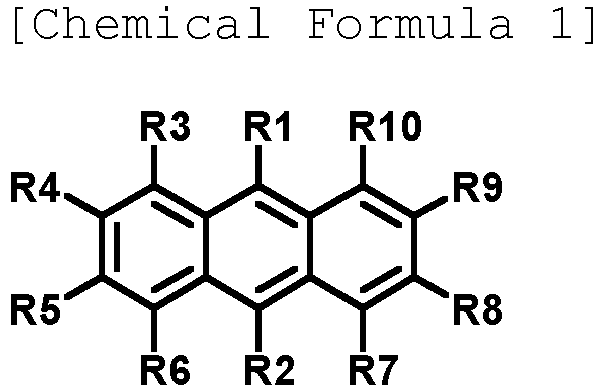
- In Chemical Formula 1,
- R1 is a substituted or unsubstituted aryl group,
- R2 is -L-Ar1,
- R3 to R10 are the same as or different from each other, and are each independently hydrogen; deuterium; a substituted or unsubstituted aryl group; or a substituted or unsubstituted heteroaryl group,
- L is a direct bond; a substituted or unsubstituted arylene group; or a substituted or unsubstituted heteroarylene group, and
- Ar1 is the following Chemical Formula A,

- in Chemical Formula A,
- any one of Y1, Y2 and Y7 to Y11 is a moiety bonded to L, and the others of Y1, Y2 and Y7 to Y11 which are not bonded to L are the same as or different from each other, and are each independently hydrogen; deuterium; a halogen group; a substituted or unsubstituted alkyl group; a substituted or unsubstituted cycloalkyl group; a substituted or unsubstituted alkenyl group; a substituted or unsubstituted alkoxy group; a substituted or unsubstituted aryloxy group; a substituted or unsubstituted alkylthioxy group; a substituted or unsubstituted arylthioxy group; a substituted or unsubstituted silyl group; a substituted or unsubstituted amine group; a substituted or unsubstituted aryl group; or a substituted or unsubstituted heteroaryl group, or any one or more adjacent pairs are bonded to each other to form a substituted or unsubstituted ring, and
- y11 is 1 or 2, and when y11 is 2, two Y11's are the same as or different from each other, and
- Chemical Formula 1 includes at least one deuterium.
- Further, an exemplary embodiment of the present specification provides an organic light emitting device including: a first electrode; a second electrode; and an organic material layer having one or more layers provided between the first electrode and the second electrode, in which one or more layers of the organic material layer include the above-described compound.
- The compound according to an exemplary embodiment of the present specification can be used for an organic material layer of an organic light emitting device to lower the driving voltage of the organic light emitting device and improve the light efficiency. Further, the service life characteristics of the device can be improved by the thermal stability of the compound.
-
FIGS. 1 and 2 illustrate an example of an organic light emitting device according to an exemplary embodiment of the present specification. -
- 1: Substrate
- 2: First electrode
- 3: Second electrode
- 4: Light emitting layer
- 5: Hole injection layer
- 6: Hole transport layer
- 7: Hole adjusting layer
- 8: Electron adjusting layer
- 9: Electron transport layer
- 10: Electron injection layer
- 11: Capping layer
- Hereinafter, the present specification will be described in more detail.
- An exemplary embodiment of the present specification provides the compound of Chemical Formula 1.
- Chemical Formula 1 according to an exemplary embodiment of the present specification has structural characteristics in which the mobility of electrons and holes is enhanced and molecular stability is improved because a substituted or unsubstituted aryl group is bonded to
Position 9 of anthracene, naphthofuran is bonded toPosition 10 through L, and Chemical Formula 1 includes at least one deuterium. Therefore, an organic light emitting device including the same is excellent in terms of driving voltage, efficiency and service life. - Further, the present specification provides a compound in which at least one hydrogen of Chemical Formula 1 is substituted with deuterium, and an organic light emitting device including the same. Since a C-D bond of the compound of the present invention is stronger than a C-H bond, the stability of the compound may be improved. When the chemical decomposition of a light emitting compound is accompanied by the destruction of the C(sp3)-H bond, which is relatively weak, there is an effect that the stability of the compound can be further improved using the C-D bond which is stronger than the C-H bond.
- In this case, when an alkyl group is used as a substituent capable of donating electrons, the light emitting characteristics can be effectively adjusted, but the C-H bond of the alkyl group introduced in a high energy state is destructed, and the decomposition of the compound is promoted, so that a problem occurs to the overall service life characteristics of a device. Therefore, when an alkyl group substituted with deuterium is used, it is possible to effectively adjust the light emitting characteristics while securing the stability of a blue device. Additionally, when a smaller wan der Waals radius of deuterium is used, the steric hindrance is smaller than that of the existing alkyl group, so that the conjugation can be improved.
- Throughout the specification of the present application, the term "combination thereof" included in the Markush type expression means a mixture or combination of one or more selected from the group consisting of constituent elements described in the Markush type expression, and means including one or more selected from the group consisting of the above-described constituent elements.
- Examples of the substituents in the present specification will be described below, but are not limited thereto.
- In the present specification,

- The term "substitution" means that a hydrogen atom bonded to a carbon atom of a compound is changed into another substituent, and a position to be substituted is not limited as long as the position is a position at which the hydrogen atom is substituted, that is, a position at which the substituent may be substituted, and when two or more are substituted, the two or more substituents may be the same as or different from each other.
- In the present specification, the term "substituted or unsubstituted" means being substituted with one or more substituents selected from the group consisting of deuterium; a halogen group; a cyano group; an alkyl group; a cycloalkyl group; an alkoxy group; an aryloxy group; an alkylthioxy group; an arylthioxy group; an alkenyl group; a haloalkyl group; a haloalkoxy group; an arylalkyl group; a silyl group; a boron group; an amine group; an aryl group; and a heterocyclic group, being substituted with a substituent to which two or more substituents among the exemplified substituents are linked, or having no substituent.
- In the present specification, the fact that two or more substituents are linked indicates that hydrogen of any one substituent is linked to another substituent. For example, when two substituents are linked to each other, a phenyl group and a naphthyl group may be linked to each other to become a substituent of


- In the present specification, examples of a halogen group include fluorine, chlorine, bromine or iodine.
- In the present specification, the alkyl group may be straight-chained or branched, and the number of carbon atoms thereof is not particularly limited, but is preferably 1 to 30. Specific examples thereof include methyl, ethyl, propyl, n-propyl, isopropyl, butyl, n-butyl, isobutyl, tert-butyl, sec-butyl, 1-methyl-butyl, 1-ethylbutyl, pentyl, n-pentyl, isopentyl, neopentyl, tert-pentyl, hexyl, n-hexyl, 1-methylpentyl, 2-methylpentyl, 4-methyl-2-pentyl, 3,3-dimethylbutyl, 2-ethylbutyl, heptyl, n-heptyl, 1-methylhexyl, cyclopentylmethyl, cyclohexylmethyl, octyl, n-octyl, tert-octyl, 1-methylheptyl, 2-ethylhexyl, 2-propylpentyl, n-nonyl, 2,2-dimethylheptyl, 1-ethyl-propyl, 1,1-dimethyl-propyl, isohexyl, 2-methylpentyl, 4-methylhexyl, 5-methylhexyl, and the like, but are not limited thereto.
- In the present specification, a cycloalkyl group is not particularly limited, but has preferably 3 to 30 carbon atoms, and specific examples thereof include cyclopropyl, cyclobutyl, cyclopentyl, 3-methylcyclopentyl, 2,3-dimethylcyclopentyl, cyclohexyl, 3-methylcyclohexyl, 4-methylcyclohexyl, 2,3-dimethylcyclohexyl, 3,4,5-trimethylcyclohexyl, 4-tert-butylcyclohexyl, cycloheptyl, cyclooctyl, an adamantyl group, a bicyclo[2.2.1]heptyl group, a bicyclo[2.2.1]octyl group, a norbornyl group, and the like, but are not limited thereto.
- In the present specification, the alkoxy group may be straight-chained, branched, or cyclic. The number of carbon atoms of the alkoxy group is not particularly limited, but is preferably 1 to 30. Specific examples thereof include methoxy, ethoxy, n-propoxy, isopropoxy, n-butoxy, isobutoxy, tert-butoxy, sec-butoxy, n-pentyloxy, neopentyloxy, isopentyloxy, n-hexyloxy, 3,3-dimethylbutyloxy, 2-ethylbutyloxy, n-octyloxy, n-nonyloxy, n-decyloxy, benzyloxy, p-methylbenzyloxy, and the like, but are not limited thereto.
- In the present specification, the alkenyl group may be straight-chained or branched, and the number of carbon atoms thereof is not particularly limited, but is preferably 2 to 30. Specific examples thereof include vinyl, 1-propenyl, isopropenyl, 1-butenyl, 2-butenyl, 3-butenyl, 1-pentenyl, 2-pentenyl, 3-pentenyl, 3-methyl-1-butenyl, 1,3-butadienyl, allyl, 1-phenylvinyl-1-yl, 2-phenylvinyl-1-yl, 2,2-diphenylvinyl-1-yl, 2-phenyl-2-(naphthyl-1-yl)vinyl-1-yl, 2,2-bis(diphenyl-1-yl)vinyl-1-yl, a stilbenyl group, a styrenyl group, and the like, but are not limited thereto.
- In the present specification, the haloalkyl group means that at least one halogen group is substituted instead of hydrogen in an alkyl group in the definition of the alkyl group.
- In the present specification, the haloalkoxy group means that at least one halogen group is substituted instead of hydrogen in an alkoxy group in the definition of the alkoxy group.
- In the present specification, an aryl group is not particularly limited, but has preferably 6 to 30 carbon atoms, and the aryl group may be monocyclic or polycyclic.
- When the aryl group is a monocyclic aryl group, the number of carbon atoms thereof is not particularly limited, but is preferably 6 to 30. Specific examples of the monocyclic aryl group include a phenyl group, a biphenyl group, a terphenyl group, and the like, but are not limited thereto.
- When the aryl group is a polycyclic aryl group, the number of carbon atoms thereof is not particularly limited, but is preferably 10 to 30. Specific examples of the polycyclic aryl group include a naphthyl group, an anthracene group, a phenanthrene group, a triphenylene group, a pyrene group, a phenalene group, a perylene group, a chrysene group, a fluorene group, and the like, but are not limited thereto.
- In the present specification, the fluorene group may be substituted, and adjacent groups may be bonded to each other to form a ring.
- Examples of the fluorene group include


- In the present specification, an "adjacent" group may mean a substituent substituting an atom directly linked to an atom substituted by the corresponding substituent, a substituent sterically most closely positioned to the corresponding substituent, or another substituent substituting an atom substituted by the corresponding substituent. For example, two substituents substituting ortho positions in a benzene ring, and two substituents substituting the same carbon in an aliphatic ring may be interpreted as groups "adjacent" to each other.
- In the present specification, an arylalkyl group means that the alkyl group is substituted with an aryl group, and examples of the aryl group and the alkyl group described above may be applied to the aryl group and the alkyl group of the arylalkyl group.
- In the present specification, an aryloxy group means that in the definition of the alkoxy group, the alkoxy group is substituted with an aryl group instead of an alkyl group, and examples of the aryloxy group include a phenoxy group, a p-tolyloxy group, an m-tolyloxy group, a 3,5-dimethyl-phenoxy group, a 2,4,6-trimethylphenoxy group, a p-tert-butylphenoxy group, a 3-biphenyloxy group, a 4-biphenyloxy group, a 1-naphthyloxy group, a 2-naphthyloxy group, a 4-methyl-1-naphthyloxy group, a 5-methyl-2-naphthyloxy group, a 1-anthryloxy group, a 2-anthryloxy group, a 9-anthryloxy group, a 1-phenanthryloxy group, a 3-phenanthryloxy group, a 9-phenanthryloxy group, and the like, but are not limited thereto.
- In the present specification, the alkyl group in the alkylthioxy group is the same as the above-described examples of the alkyl group. Specific examples of the alkylthioxy group include a methylthioxy group, an ethylthioxy group, a tert-butylthioxy group, a hexylthioxy group, an octylthioxy group, and the like, but are not limited thereto.
- In the present specification, the aryl group in the arylthioxy group is the same as the above-described examples of the aryl group. Specific examples of the arylthioxy group include a phenylthioxy group, a 2-methylphenylthioxy group, a 4-tert- butylphenylthioxy group, and the like, but are not limited thereto.
- In the present specification, a heterocyclic group includes one or more atoms other than carbon, that is, one or more heteroatoms, and specifically, the heteroatom may include one or more atoms selected from the group consisting of O, N, Se, S, and the like, and includes an aromatic heterocyclic group, or an aliphatic heterocyclic group. The aromatic heterocyclic group may be represented by a heteroaryl group. The number of carbon atoms of the heterocyclic group is not particularly limited, but is preferably 2 to 30, and the heterocyclic group may be monocyclic or polycyclic. Examples of the heterocyclic group include a thiophene group, a furan group, a pyrrole group, an imidazole group, a thiazole group, an oxazole group, an oxadiazole group, a pyridine group, a bipyridine group, a pyrimidine group, a triazine group, a triazole group, an acridine group, a pyridazine group, a pyrazine group, a quinoline group, a quinazoline group, a quinoxaline group, a phthalazine group, a pyridopyrimidine group, a pyridopyrazine group, a pyrazinopyrazine group, an isoquinoline group, an indole group, a carbazole group, a benzoxazole group, a benzimidazole group, a benzothiazole group, a benzocarbazole group, a benzothiophene group, a dibenzothiophene group, a benzofuran group, a phenanthridine group, a phenanthroline group, an isoxazole group, a thiadiazole group, a dibenzofuran group, a dibenzosilole group, a phenoxathiin group, a phenoxazine group, a phenothiazine group, a decahydrobenzocarbazole group, a hexahydrocarbazole group, a dihydrobenzoazasiline group, a dihydroindenocarbazole group, a spirofluorenexanthene group, a spirofluorenethioxanthene group, a tetrahydronaphthothiophene group, a tetrahydronaphthofuran group, a tetrahydrobenzothiophene group, a tetrahydrobenzofuran group, and the like, but are not limited thereto.
- In the present specification, the silyl group may be an alkylsilyl group, an arylsilyl group, an alkylarylsilyl group, a heteroarylsilyl group, and the like. The above-described examples of the alkyl group may be applied to the alkyl group in the alkylsilyl group, the above-described examples of the aryl group may be applied to the aryl group in the arylsilyl group, the examples of the alkyl group and the aryl group may be applied to the alkyl group and the aryl group in the alkylarylsilyl group, and the examples of the heterocyclic group may be applied to the heteroaryl group in the heteroarylsilyl group.
- In the present specification, a boron group may be - BY100Y101, and Y100 and Y101 are the same as or different from each other, and may be each independently selected from the group consisting of hydrogen; deuterium; halogen; a nitrile group; a substituted or unsubstituted monocyclic or polycyclic cycloalkyl group having 3 to 30 carbon atoms; a substituted or unsubstituted straight-chained or branched alkyl group having 1 to 30 carbon atoms; a substituted or unsubstituted monocyclic or polycyclic aryl group having 6 to 30 carbon atoms; and a substituted or unsubstituted monocyclic or polycyclic heterocyclic group having 2 to 30 carbon atoms. Specific examples of the boron group include a dimethylboron group, a diethylboron group, a t-butylmethylboron group, a diphenylboron group, and the like, but are not limited thereto.
- In the present specification, an amine group may be selected from the group consisting of -NH2, an alkylamine group, an N-alkylarylamine group, an arylamine group, an N-arylheteroarylamine group, an N-alkylheteroarylamine group, and a heteroarylamine group, and the number of carbon atoms thereof is not particularly limited, but is preferably 1 to 30. Specific examples of the amine group include a methylamine group, a dimethylamine group, an ethylamine group, a diethylamine group, a phenylamine group, a naphthylamine group, a biphenylamine group, an anthracenylamine group, a 9-methyl-anthracenylamine group, a diphenylamine group, a ditolylamine group, an N-phenyltolylamine group, an N-phenylbiphenylamine group, an N-phenylnaphthylamine group, an N-biphenylnaphthylamine group, an N-naphthylfluorenylamine group, an N-phenylphenanthrenylamine group, an N-biphenylphenanthrenylamine group, an N-phenylfluorenylamine group, an N-phenyl terphenylamine group, an N-phenanthrenylfluorenylamine group, an N-biphenylfluorenylamine group, and the like, but are not limited thereto.
- In the present specification, an N-alkylarylamine group means an amine group in which an alkyl group and an aryl group are substituted with N of the amine group. The alkyl group and the aryl group in the N-alkylarylamine group are the same as the above-described examples of the alkyl group and the aryl group.
- In the present specification, an N-arylheteroarylamine group means an amine group in which an aryl group and a heteroaryl group are substituted with N of the amine group. The aryl group and heteroaryl group in the N-arylheteroarylamine group are the same as the above-described examples of the aryl group and the heterocyclic group.
- In the present specification, an N-alkylheteroarylamine group means an amine group in which an alkyl group and a heteroaryl group are substituted with N of the amine group. The alkyl group and the heteroaryl group in the N-alkylheteroarylamine group are the same as the above-described examples of the alkyl group and the heterocyclic group.
- In the present specification, examples of an alkylamine group include a substituted or unsubstituted monoalkylamine group or a substituted or unsubstituted dialkylamine group. The alkyl group in the alkylamine group may be a straight-chained or branched alkyl group. The alkylamine group including two or more alkyl groups may include a straight-chained alkyl group, a branched alkyl group, or both a straight-chained alkyl group and a branched alkyl group. For example, the alkyl group in the alkylamine group may be selected from the above-described examples of the alkyl group.
- In the present specification, examples of a heteroarylamine group include a substituted or unsubstituted monoheteroarylamine group or a substituted or unsubstituted diheteroarylamine group. The heteroarylamine group including two or more heteroaryl groups may include a monocyclic heteroaryl group, a polycyclic heteroaryl group, or both a monocyclic heteroaryl group and a polycyclic heteroaryl group. For example, the heteroaryl group in the heteroarylamine group may be selected from the above-described examples of the heterocyclic group.
- In the present specification, the alkyl group in the N-alkylarylamine group, the alkylthioxy group, and the N-alkylheteroarylamine group is the same as the above-described examples of the alkyl group. Specific examples of the alkylthioxy group include a methylthioxy group, an ethylthioxy group, a tert-butylthioxy group, a hexylthioxy group, an octylthioxy group, and the like, but are not limited thereto.
- In the present specification, the aryl group in the aryloxy group, the arylthioxy group, the N-arylalkylamine group, and the N-arylheteroarylamine group is the same as the above-described examples of the aryl group. Specifically, examples of the aryloxy group include a phenoxy group, a p-tolyloxy group, an m-tolyloxy group, a 3,5-dimethyl-phenoxy group, a 2,4,6-trimethylphenoxy group, a p-tert-butylphenoxy group, a 3-biphenyloxy group, a 4-biphenyloxy group, a 1-naphthyloxy group, a 2-naphthyloxy group, a 4-methyl-1-naphthyloxy group, a 5-methyl-2-naphthyloxy group, a 1-anthryloxy group, a 2-anthryloxy group, a 9-anthryloxy group, a 1-phenanthryloxy group, a 3-phenanthryloxy group, a 9-phenanthryloxy group, and the like, and examples of the arylthioxy group include a phenylthioxy group, a 2-methylphenylthioxy group, a 4-tert-butylphenylthioxy group, and the like, but the examples are not limited thereto.
- In the present specification, a hydrocarbon ring group may be an aromatic hydrocarbon ring group, an aliphatic hydrocarbon ring group, or a fused group of an aromatic hydrocarbon ring and an aliphatic hydrocarbon ring and may be selected among examples of the cycloalkyl group, the aryl group, and a combination thereof, and examples of the hydrocarbon ring group include a phenyl group, a cyclohexyl group, an adamantyl group, a bicylo[2.2.1]heptyl group, a bicyclo[2.2.1]octyl group, a tetrahydronaphthalene group, a tetrahydroanthracene group, a 1,2,3,4-tetrahydro-1,4-methanonaphthalene group, a 1,2,3,4-tetrahydro-1,4-ethanonaphthalene group, a spirocyclopentanefluorene group, a spiroadamantanefluorene group, a spirocyclohexanefluorene group, and the like, but are not limited thereto.
- In the present specification, the meaning of "adjacent" in "bonded to an adjacent group to form a ring" is as described above, and the "ring" means a substituted or unsubstituted hydrocarbon ring; or a substituted or unsubstituted hetero ring.
- In the present specification, the hydrocarbon ring may be an aromatic hydrocarbon ring, an aliphatic hydrocarbon ring, or a fused ring of the aromatic hydrocarbon ring and the aliphatic hydrocarbon ring and may be selected among examples of the cycloalkyl group, the aryl group, and a combination thereof except for those which are not monovalent, and examples of the hydrocarbon ring include benzene, cyclohexane, adamantane, bicyclo[2.2.1]heptane, bicyclo[2.2.1]octane, tetrahydronaphthalene, tetrahydroanthracene, 1,2,3,4-tetrahydro-1,4-methanonaphthalene, 1,2,3,4-tetrahydro-1,4-ethanonaphthalene, spiro cyclopentane fluorene, spiro adamantane fluorene, spiro cyclohexane fluorene, and the like, but are not limited thereto.
- In the present specification, a hetero ring includes one or more atoms other than carbon, that is, one or more heteroatoms, and specifically, the heteroatom may include one or more atoms selected from the group consisting of O, N, Se, S, and the like. The hetero ring may be monocyclic or polycyclic and may be an aromatic ring, an aliphatic ring, or a fused ring of the aromatic ring and the aliphatic ring, and the aromatic hetero ring may be selected from the examples of the heteroaryl group in the heterocyclic group, except for the aromatic hetero ring which is not monovalent.
- In the present specification, an aliphatic hetero ring means an aliphatic ring including one or more of hetero atoms. Further, the aliphatic hetero ring means any hetero ring excluding an aromatic hetero ring, and a hetero ring, which includes a double bond, but is not aromatic, is an aliphatic hetero ring. Examples of the aliphatic hetero ring include oxirane, tetrahydrofuran, 1,4-dioxane, pyrrolidine, piperidine, morpholine, oxepane, azocane, thiocane, tetrahydronaphthothiophene, tetrahydronaphthofuran, tetrahydrobenzothiophene, tetrahydrobenzofuran, and the like, but are not limited thereto.
- In the present specification, the aliphatic hetero ring (group) means an aliphatic ring (group) including one or more heteroatoms. Furthermore, the aliphatic hetero ring (group) means any hetero ring (group) excluding an aromatic hetero ring (group), and a hetero ring (group), which includes a double bond, but is not aromatic, is an aliphatic hetero ring (group).
- In the present specification, examples of an aliphatic ring, or a fused hetero ring of the aromatic ring and the aliphatic ring include tetrahydrobenzonaphthothiophene, tetrahydrobenzonaphthofuran, and the like, but are not limited thereto.
- In the present specification, an arylene group means a group having two bonding positions in an aryl group, that is, a divalent group. The above-described description on the aryl group may be applied to the arylene group, except for a divalent group.
- In the present specification, a heteroarylene group means a group having two bonding positions in a heteroaryl group, that is, a divalent group. The above-described description on the heteroaryl group in the heterocyclic group may be applied to the heteroarylene group, except for a divalent heteroarylene group.
- Unless otherwise defined in the present specification, all technical and scientific terms used in the present specification have the same meaning as commonly understood by one with ordinary skill in the art to which the present invention pertains. Although methods and materials similar to or equivalent to those described in the present specification may be used in the practice or in the test of exemplary embodiments of the present invention, suitable methods and materials will be described below. All publications, patent applications, patents, and other references mentioned in the present specification are hereby incorporated by reference in their entireties, and in the case of conflict, the present specification, including definitions, will control unless a particular passage is mentioned. In addition, the materials, methods, and examples are illustrative only and are not intended to be limiting.
- Hereinafter, the compound of
Chemical Formula 1 will be described in detail. - According to an exemplary embodiment of the present specification, Chemical Formula A is any one of the following Chemical Formulae A-1 to A-3.


- In Chemical Formula A-1,
- any one of Y1 to Y4 and Y7 to Y10 is a moiety bonded to L, and the others of Y1 to Y4 and Y7 to Y10 which are not bonded to L are the same as or different from each other, and are each independently hydrogen; deuterium; a halogen group; a substituted or unsubstituted alkyl group; a substituted or unsubstituted cycloalkyl group; a substituted or unsubstituted alkenyl group; a substituted or unsubstituted alkoxy group; a substituted or unsubstituted aryloxy group; a substituted or unsubstituted alkylthioxy group; a substituted or unsubstituted arylthioxy group; a substituted or unsubstituted silyl group; a substituted or unsubstituted amine group; a substituted or unsubstituted aryl group; or a substituted or unsubstituted heteroaryl group, or any one or more adjacent pairs are bonded to each other to form a substituted or unsubstituted ring,
- in Chemical Formula A-2,
- any one of Y1 to Y3, Y5 and Y7 to Y10 is a moiety bonded to L, and the others of Y1 to Y3, Y5 and Y7 to Y10 which are not bonded to L are the same as or different from each other, and are each independently hydrogen; deuterium; a halogen group; a substituted or unsubstituted alkyl group; a substituted or unsubstituted cycloalkyl group; a substituted or unsubstituted alkenyl group; a substituted or unsubstituted alkoxy group; a substituted or unsubstituted aryloxy group; a substituted or unsubstituted alkylthioxy group; a substituted or unsubstituted arylthioxy group; a substituted or unsubstituted silyl group; a substituted or unsubstituted amine group; a substituted or unsubstituted aryl group; or a substituted or unsubstituted heteroaryl group, or any one or more adjacent pairs are bonded to each other to form a substituted or unsubstituted ring,
- in Chemical Formula A-3,
any one of Y1, Y2 and Y5 to Y10 is a moiety bonded to L, and the others of Y1, Y2 and Y5 to Y10 which are not bonded to L are the same as or different from each other, and are each independently hydrogen; deuterium; a halogen group; a substituted or unsubstituted alkyl group; a substituted or unsubstituted cycloalkyl group; a substituted or unsubstituted alkenyl group; a substituted or unsubstituted alkoxy group; a substituted or unsubstituted aryloxy group; a substituted or unsubstituted alkylthioxy group; a substituted or unsubstituted arylthioxy group; a substituted or unsubstituted silyl group; a substituted or unsubstituted amine group; a substituted or unsubstituted aryl group; or a substituted or unsubstituted heteroaryl group, or any one or more adjacent pairs are bonded to each other to form a substituted or unsubstituted ring.
- According to an exemplary embodiment of the present specification, in Chemical Formula A-1, Y1 is a moiety bonded to L.
- According to an exemplary embodiment of the present specification, in Chemical Formula A-1, Y2 is a moiety bonded to L.
- According to an exemplary embodiment of the present specification, in Chemical Formula A-1, Y3 is a moiety bonded to L.
- According to an exemplary embodiment of the present specification, in Chemical Formula A-1, Y4 is a moiety bonded to L.
- According to an exemplary embodiment of the present specification, in Chemical Formula A-1, Y7 is a moiety bonded to L.
- According to an exemplary embodiment of the present specification, in Chemical Formula A-1, Y8 is a moiety bonded to L.
- According to an exemplary embodiment of the present specification, in Chemical Formula A-1, Y9 is a moiety bonded to L.
- According to an exemplary embodiment of the present specification, in Chemical Formula A-1, Y10 is a moiety bonded to L.
- According to an exemplary embodiment of the present specification, in Chemical Formula A-2, Y1 is a moiety bonded to L.
- According to an exemplary embodiment of the present specification, in Chemical Formula A-2, Y2 is a moiety bonded to L.
- According to an exemplary embodiment of the present specification, in Chemical Formula A-2, Y3 is a moiety bonded to L.
- According to an exemplary embodiment of the present specification, in Chemical Formula A-2, Y5 is a moiety bonded to L.
- According to an exemplary embodiment of the present specification, in Chemical Formula A-2, Y7 is a moiety bonded to L.
- According to an exemplary embodiment of the present specification, in Chemical Formula A-2, Y8 is a moiety bonded to L.
- According to an exemplary embodiment of the present specification, in Chemical Formula A-2, Y9 is a moiety bonded to L.
- According to an exemplary embodiment of the present specification, in Chemical Formula A-2, Y10 is a moiety bonded to L.
- According to an exemplary embodiment of the present specification, in Chemical Formula A-3, Y1 is a moiety bonded to L.
- According to an exemplary embodiment of the present specification, in Chemical Formula A-3, Y2 is a moiety bonded to L.
- According to an exemplary embodiment of the present specification, in Chemical Formula A-3, Y5 is a moiety bonded to L.
- According to an exemplary embodiment of the present specification, in Chemical Formula A-3, Y6 is a moiety bonded to L.
- According to an exemplary embodiment of the present specification, in Chemical Formula A-3, Y7 is a moiety bonded to L.
- According to an exemplary embodiment of the present specification, in Chemical Formula A-3, Y8 is a moiety bonded to L.
- According to an exemplary embodiment of the present specification, in Chemical Formula A-3, Y9 is a moiety bonded to L.
- According to an exemplary embodiment of the present specification, in Chemical Formula A-3, Y10 is a moiety bonded to L.
- According to an exemplary embodiment of the present specification,
Chemical Formula 1 is the following Chemical Formula 1-1.
- In Chemical Formula 1-1,
- the definitions of R1, R3 to R10 and L are the same as those defined in
Chemical Formula 1, - any one of Y11 to Y13 is a moiety bonded to L, and the others of Y11 to Y13 which are not bonded to L are the same as or different from each other, and are each independently hydrogen; deuterium; a halogen group; a substituted or unsubstituted alkyl group; a substituted or unsubstituted cycloalkyl group; a substituted or unsubstituted alkenyl group; a substituted or unsubstituted alkoxy group; a substituted or unsubstituted aryloxy group; a substituted or unsubstituted alkylthioxy group; a substituted or unsubstituted arylthioxy group; a substituted or unsubstituted silyl group; a substituted or unsubstituted amine group; a substituted or unsubstituted aryl group; or a substituted or unsubstituted heteroaryl group, or any one or more adjacent pairs are bonded to each other to form a substituted or unsubstituted ring,
- y11 and y13 are each 1 or 2,
- y12 is an integer from 1 to 4,
- y11 + y12 + y13 ≤7,
- when y11 is 2, two Y11's are the same as or different from each other,
- when y13 is 2, two Y13's are the same as or different from each other, and
- when y12 is 2 or higher, two or more Y12's are the same as or different from each other.
- According to an exemplary embodiment of the present specification,
Chemical Formula 1 is any one of the following Chemical Formulae 1-2 to 1-4.


- In Chemical Formulae 1-2 to 1-4,
- the definitions of R1, R3 to R10 and L are the same as those defined in
Chemical Formula 1, - any one of Y11 to Y13 is a moiety bonded to L, and the others of Y11 to Y13 which are not bonded to L are the same as or different from each other, and are each independently hydrogen; deuterium; a halogen group; a substituted or unsubstituted alkyl group; a substituted or unsubstituted cycloalkyl group; a substituted or unsubstituted alkenyl group; a substituted or unsubstituted alkoxy group; a substituted or unsubstituted aryloxy group; a substituted or unsubstituted alkylthioxy group; a substituted or unsubstituted arylthioxy group; a substituted or unsubstituted silyl group; a substituted or unsubstituted amine group; a substituted or unsubstituted aryl group; or a substituted or unsubstituted heteroaryl group, or any one or more adjacent pairs are bonded to each other to form a substituted or unsubstituted ring,
- y11 and y13 are each 1 or 2,
- y12 is an integer from 1 to 4,

- when y11 is 2, two Y11's are the same as or different from each other,
- when y13 is 2, two Y13's are the same as or different from each other, and
- when y12 is 2 or higher, two or more Y12's are the same as or different from each other.
- According to an exemplary embodiment of the present specification, R1 is a substituted or unsubstituted monocyclic or polycyclic aryl group having 6 to 30 carbon atoms.
- According to an exemplary embodiment of the present specification, R1 is a substituted or unsubstituted monocyclic or polycyclic aryl group having 6 to 20 carbon atoms.
- According to an exemplary embodiment of the present specification, R1 is a monocyclic or polycyclic aryl group having 6 to 30 carbon atoms, which is unsubstituted or substituted with one or more of deuterium, a straight-chained or branched alkyl group having 1 to 30 carbon atoms, a monocyclic or polycyclic aryl group having 6 to 30 carbon atoms, which is unsubstituted or substituted with deuterium, and combinations thereof.
- According to an exemplary embodiment of the present specification, R1 is a monocyclic or polycyclic aryl group having 6 to 20 carbon atoms, which is unsubstituted or substituted with one or more of deuterium, a straight-chained or branched alkyl group having 1 to 20 carbon atoms, a monocyclic or polycyclic aryl group having 6 to 20 carbon atoms, which is unsubstituted or substituted with deuterium, and combinations thereof.
- According to an exemplary embodiment of the present specification, R1 is a phenyl group which is unsubstituted or substituted with one or more of deuterium, a monocyclic or polycyclic aryl group having 6 to 30 carbon atoms, which is unsubstituted or substituted with deuterium, and combinations thereof; a naphthyl group which is unsubstituted or substituted with one or more of deuterium, a monocyclic or polycyclic aryl group having 6 to 30 carbon atoms, which is unsubstituted or substituted with deuterium, and combinations thereof; a biphenyl group which is unsubstituted or substituted with a monocyclic or polycyclic aryl group having 6 to 30 carbon atoms; a phenanthrene group which is unsubstituted or substituted with deuterium; a triphenylene group which is unsubstituted or substituted with deuterium; or a fluorene group which is unsubstituted or substituted with a straight-chained or branched alkyl group having 1 to 20 carbon atoms, or a monocyclic or polycyclic aryl group having 6 to 30 carbon atoms.
- According to an exemplary embodiment of the present specification, R1 is a phenyl group which is unsubstituted or substituted with one or more of deuterium, a monocyclic or polycyclic aryl group having 6 to 20 carbon atoms, which is unsubstituted or substituted with deuterium, and combinations thereof; a naphthyl group which is unsubstituted or substituted with one or more of deuterium, a monocyclic or polycyclic aryl group having 6 to 20 carbon atoms, which is unsubstituted or substituted with deuterium, and combinations thereof; a biphenyl group which is unsubstituted or substituted with a monocyclic or polycyclic aryl group having 6 to 20 carbon atoms; a phenanthrene group which is unsubstituted or substituted with deuterium; a triphenylene group which is unsubstituted or substituted with deuterium; or a fluorene group which is unsubstituted or substituted with a straight-chained or branched alkyl group having 1 to 20 carbon atoms, or a monocyclic or polycyclic aryl group having 6 to 20 carbon atoms.
- According to an exemplary embodiment of the present specification, R1 is a phenyl group which is unsubstituted or substituted with one or more of deuterium, a naphthyl group which is unsubstituted or substituted with deuterium, and combinations thereof; a naphthyl group which is unsubstituted or substituted with one or more of deuterium, a phenyl group which is unsubstituted or substituted with deuterium, a naphthyl group which is unsubstituted or substituted with deuterium, and combinations thereof; a biphenyl group which is unsubstituted or substituted with a phenyl group; a phenanthrene group which is unsubstituted or substituted with deuterium; a triphenylene group which is unsubstituted or substituted with deuterium; or a fluorene group which is unsubstituted or substituted with a methyl group or a phenyl group.
- According to an exemplary embodiment of the present specification, R3 to R10 are the same as or different from each other, and are each independently hydrogen; deuterium; a substituted or unsubstituted monocyclic or polycyclic aryl group having 6 to 30 carbon atoms; or a substituted or unsubstituted monocyclic or polycyclic heteroaryl group having 2 to 30 carbon atoms.
- According to an exemplary embodiment of the present specification, R3 to R10 are the same as or different from each other, and are each independently hydrogen; deuterium; a substituted or unsubstituted monocyclic or polycyclic aryl group having 6 to 20 carbon atoms; or a substituted or unsubstituted monocyclic or polycyclic heteroaryl group having 2 to 20 carbon atoms.
- According to an exemplary embodiment of the present specification, R3 to R10 are the same as or different from each other, and are each independently hydrogen; deuterium; a monocyclic or polycyclic aryl group having 6 to 30 carbon atoms, which is unsubstituted or substituted with deuterium; or a monocyclic or polycyclic heteroaryl group having 2 to 30 carbon atoms, which is unsubstituted or substituted with deuterium.
- According to an exemplary embodiment of the present specification, R3 to R10 are the same as or different from each other, and are each independently hydrogen; deuterium; a monocyclic or polycyclic aryl group having 6 to 20 carbon atoms, which is unsubstituted or substituted with deuterium; or a monocyclic or polycyclic heteroaryl group having 2 to 20 carbon atoms, which is unsubstituted or substituted with deuterium.
- According to an exemplary embodiment of the present specification, R3 to R10 are the same as or different from each other, and are each independently hydrogen; deuterium; a phenyl group which is unsubstituted or substituted with deuterium; a naphthyl group which is unsubstituted or substituted with deuterium; or a dibenzofuran group which is unsubstituted or substituted with deuterium.
- According to an exemplary embodiment of the present specification, R3 to R10 are the same as or different from each other, and are each independently hydrogen; deuterium; a phenyl group; a naphthyl group which is unsubstituted or substituted with deuterium; or a dibenzofuran group.
- According to an exemplary embodiment of the present specification, L is a direct bond; a substituted or unsubstituted monocyclic or polycyclic arylene group having 6 to 30 carbon atoms; or a substituted or unsubstituted monocyclic or polycyclic heteroarylene group having 2 to 30 carbon atoms.
- According to an exemplary embodiment of the present specification, L is a direct bond; a substituted or unsubstituted monocyclic or polycyclic arylene group having 6 to 20 carbon atoms; or a substituted or unsubstituted monocyclic or polycyclic heteroarylene group having 2 to 20 carbon atoms.
- According to an exemplary embodiment of the present specification, L is a direct bond; a monocyclic or polycyclic arylene group having 6 to 30 carbon atoms, which is unsubstituted or substituted with deuterium; or a monocyclic or polycyclic heteroarylene group having 2 to 30 carbon atoms, which is unsubstituted or substituted with deuterium.
- According to an exemplary embodiment of the present specification, L is a direct bond; a monocyclic or polycyclic arylene group having 6 to 20 carbon atoms, which is unsubstituted or substituted with deuterium; or a monocyclic or polycyclic heteroarylene group having 2 to 20 carbon atoms, which is unsubstituted or substituted with deuterium.
- According to an exemplary embodiment of the present specification, L is a direct bond; a phenylene group which is unsubstituted or substituted with deuterium; a biphenylylene group which is unsubstituted or substituted with deuterium; a divalent naphthyl group which is unsubstituted or substituted with deuterium; or a divalent dibenzofuran group which is unsubstituted or substituted with deuterium.
- According to an exemplary embodiment of the present specification, L is a direct bond; a phenylene group; a biphenylylene group; a divalent naphthyl group; or a divalent dibenzofuran group.
- According to an exemplary embodiment of the present specification, any one of Y1, Y2 and Y7 to Y11 is a moiety bonded to L, and the others of Y1, Y2 and Y7 to Y11, which are not bonded to L, are the same as or different from each other, and are each independently hydrogen; deuterium; a substituted or unsubstituted straight-chained or branched alkyl group having 1 to 30 carbon atoms; a substituted or unsubstituted monocyclic or polycyclic cycloalkyl group having 2 to 30 carbon atoms; or a substituted or unsubstituted monocyclic or polycyclic aryl group having 6 to 30 carbon atoms, or any one or more adjacent pairs are bonded to each other to form a substituted or unsubstituted hydrocarbon ring having 3 to 30 carbon atoms.
- According to an exemplary embodiment of the present specification, any one of Y1, Y2 and Y7 to Y11 is a moiety bonded to L, and the others of Y1, Y2 and Y7 to Y11, which are not bonded to L, are the same as or different from each other, and are each independently hydrogen; deuterium; a substituted or unsubstituted straight-chained or branched alkyl group having 1 to 20 carbon atoms; a substituted or unsubstituted monocyclic or polycyclic cycloalkyl group having 2 to 20 carbon atoms; or a substituted or unsubstituted monocyclic or polycyclic aryl group having 6 to 20 carbon atoms, or any one or more adjacent pairs are bonded to each other to form a substituted or unsubstituted hydrocarbon ring having 3 to 20 carbon atoms.
- According to an exemplary embodiment of the present specification, any one of Y1, Y2 and Y7 to Y11 is a moiety bonded to L, and the others of Y1, Y2 and Y7 to Y11, which are not bonded to L, are the same as or different from each other, and are each independently hydrogen; deuterium; a straight-chained or branched alkyl group having 1 to 30 carbon atoms, which is unsubstituted or substituted with deuterium; a monocyclic or polycyclic cycloalkyl group having 2 to 30 carbon atoms, which is unsubstituted or substituted with deuterium; or a monocyclic or polycyclic aryl group having 6 to 30 carbon atoms, which is unsubstituted or substituted with deuterium, or any one or more adjacent pairs are bonded to each other to form a hydrocarbon ring having 3 to 30 carbon atoms, which is unsubstituted or substituted with a straight-chained or branched alkyl group having 1 to 30 carbon atoms, which is unsubstituted or substituted with deuterium.
- According to an exemplary embodiment of the present specification, any one of Y1, Y2 and Y7 to Y11 is a moiety bonded to L, and the others of Y1, Y2 and Y7 to Y11, which are not bonded to L, are the same as or different from each other, and are each independently hydrogen; deuterium; a straight-chained or branched alkyl group having 1 to 20 carbon atoms, which is unsubstituted or substituted with deuterium; a monocyclic or polycyclic cycloalkyl group having 2 to 20 carbon atoms, which is unsubstituted or substituted with deuterium; or a monocyclic or polycyclic aryl group having 6 to 20 carbon atoms, which is unsubstituted or substituted with deuterium, or any one or more adjacent pairs are bonded to each other to form a hydrocarbon ring having 3 to 20 carbon atoms, which is unsubstituted or substituted with a straight-chained or branched alkyl group having 1 to 20 carbon atoms, which is unsubstituted or substituted with deuterium.
- According to an exemplary embodiment of the present specification, any one of Y1, Y2 and Y7 to Y11 is a moiety bonded to L, and the others of Y1, Y2 and Y7 to Y11, which are not bonded to L, are the same as or different from each other, and are each independently hydrogen; deuterium; a methyl group which is unsubstituted or substituted with deuterium; an isopropyl group which is unsubstituted or substituted with deuterium; a tert-butyl group which is unsubstituted or substituted with deuterium; a cyclopentyl group which is unsubstituted or substituted with deuterium; a phenyl group which is unsubstituted or substituted with deuterium; a naphthyl group which is unsubstituted or substituted with deuterium; or a biphenyl group which is unsubstituted or substituted with deuterium, or any one or more adjacent pairs are bonded to each other to form a cyclohexane which is unsubstituted or substituted with a straight-chained or branched alkyl group having 1 to 30 carbon atoms, which is unsubstituted or substituted with deuterium.
- According to an exemplary embodiment of the present specification, any one of Y1, Y2 and Y7 to Y11 is a moiety bonded to L, and the others of Y1, Y2 and Y7 to Y11, which are not bonded to L, are the same as or different from each other, and are each independently hydrogen; deuterium; a methyl group which is unsubstituted or substituted with deuterium; an isopropyl group which is unsubstituted or substituted with deuterium; a tert-butyl group which is unsubstituted or substituted with deuterium; a cyclopentyl group which is unsubstituted or substituted with deuterium; a phenyl group which is unsubstituted or substituted with deuterium; a naphthyl group which is unsubstituted or substituted with deuterium; or a biphenyl group which is unsubstituted or substituted with deuterium, or any one or more adjacent pairs are bonded to each other to form a cyclohexane which is unsubstituted or substituted with a straight-chained or branched alkyl group having 1 to 20 carbon atoms, which is unsubstituted or substituted with deuterium.
- According to an exemplary embodiment of the present specification, any one of Y1, Y2 and Y7 to Y11 is a moiety bonded to L, the others of Y1, Y2 and Y7 to Y11, which are not bonded to L, are the same as or different from each other, and are each independently hydrogen; deuterium; a methyl group; an isopropyl group; a tert-butyl group; a cyclopentyl group; a phenyl group which is unsubstituted or substituted with deuterium; a naphthyl group; or a biphenyl group, or any one or more adjacent pairs are bonded to each other to form a cyclohexane which is unsubstituted or substituted with a methyl group which is unsubstituted or substituted with deuterium.
- According to an exemplary embodiment of the present specification,
Chemical Formula 1 is any one selected from the following compounds.


- The present specification provides an organic light emitting device including the above-described compound.
- When one member is disposed "on" another member in the present specification, this includes not only a case where the one member is brought into contact with another member, but also a case where still another member is present between the two members.
- When one part "includes" one constituent element in the present specification, unless otherwise specifically described, this does not mean that another constituent element is excluded, but means that another constituent element may be further included.
- In the present specification, the `layer' has a meaning compatible with a `film' usually used in the art, and means a coating covering a target region. The size of the `layer' is not limited, and the sizes of the respective 'layers' may be the same as or different from one another. According to an exemplary embodiment, the size of the `layer' may be the same as that of the entire device, may correspond to the size of a specific functional region, and may also be as small as a single sub-pixel.
- In the present specification, when a specific A material is included in a B layer, this means both i) the fact that one or more A materials are included in one B layer and ii) the fact that the B layer is composed of one or more layers, and the A material is included in one or more layers of the multi-layered B layer.
- In the present specification, when a specific A material is included in a C layer or a D layer, this means all of i) the fact that the A material is included in one or more layers of the C layer having one or more layers, ii) the fact that the A material is included in one or more layers of the D layer having one or more layers, and iii) the fact that the A material is included in each of the C layer having one or more layers and the D layer having one or more layers.
- The present specification provides an organic light emitting device including: a first electrode; a second electrode provided to face the first electrode; and an organic material layer having one or more layers provided between the first electrode and the second electrode, in which one or more layers of the organic material layer include the compound represented by
Chemical Formula 1. - The organic material layer of the organic light emitting device of the present specification may have a single-layered structure, but may also have a multi-layered structure in which two or more organic material layers are stacked. For example, the organic material layer may have a structure including a hole injection layer, a hole transport layer, a light emitting layer, an electron transport layer, an electron injection layer, an electron blocking layer, a hole blocking layer, and the like. However, the structure of the organic light emitting device is not limited thereto, and may include a fewer number of organic layers.
- According to an exemplary embodiment of the present specification, the organic material layer includes a light emitting layer, and the light emitting layer includes the compound.
- According to an exemplary embodiment of the present specification, the organic material layer includes a light emitting layer, and the light emitting layer includes the compound as a host of the light emitting layer.
- According to an exemplary embodiment of the present specification, the light emitting layer includes a dopant, and the dopant includes a fluorescent dopant.
- According to an exemplary embodiment of the present specification, the fluorescent dopant is a pyrene-based compound or a non-pyrene-based compound.
- According to an exemplary embodiment of the present specification, the non-pyrene-based compound includes a boron-based compound.
- According to an exemplary embodiment of the present specification, the light emitting layer further includes one or more hosts different from the compound of
Chemical Formula 1. - Any anthracene-based host used in the art can be used without limitation as long as the host different from the compound of
Chemical Formula 1 is different fromChemical Formula 1, and the host is not limited thereto. - According to an exemplary embodiment of the present specification, the light emitting layer includes a host and a dopant.
- According to an exemplary embodiment of the present specification, the light emitting layer includes a host and a dopant, and the host includes the compound represented by
Chemical Formula 1. - According to an exemplary embodiment of the present specification, the dopant is a blue dopant.
- According to an exemplary embodiment of the present specification, the organic light emitting device is a blue organic light emitting device.
- According to an exemplary embodiment of the present specification, the light emitting layer includes two or more mixed hosts, and one or more of the two or more mixed hosts include the compound represented by
Chemical Formula 1. - According to an exemplary embodiment of the present specification, the light emitting layer includes two or more mixed hosts, at least one of the two or more mixed hosts includes the compound represented by
Chemical Formula 1, and the others include an anthracene-based compound different fromChemical Formula 1. - At least one of the two or more mixed hosts includes the compound represented by
Chemical Formula 1, and an anthracene-based host used in the art can be used without limitation as long as the others are different fromChemical Formula 1, and the mixed hosts are not limited thereto. - An organic light emitting device using two or more mixed hosts according to an exemplary embodiment of the present specification is intended to improve the performance of the device by combining the advantages of each host, and for example, when two types of hosts are mixed, one type of host with high efficiency and low voltage effects and one type of host with long service life effects may be mixed to manufacture an organic light emitting device having the effects of high efficiency, low voltage and long service life.
- According to an exemplary embodiment of the present specification, the organic light emitting device has a maximum emission wavelength (λmax) of 400 nm to 470 nm in an emission spectrum.
- According to an exemplary embodiment of the present specification, the light emitting layer includes a host and a dopant, and the dopant is a fluorescent dopant.
- According to an exemplary embodiment of the present specification, the light emitting layer includes a host and a dopant, and the dopant includes one or more selected from a pyrene-based compound and a non-pyrene-based compound.
- The pyrene-based compound and the non-pyrene-based compounds can be used without limitation as long as they are compounds used in the art, and are not limited thereto.
- According to an exemplary embodiment of the present specification, the non-pyrene-based compound includes a boron-based compound.
- According to an exemplary embodiment of the present specification, the light emitting layer includes a host and a dopant, the host includes the compound represented by
Chemical Formula 1, and the dopant includes one or more selected from a pyrene-based compound and a non-pyrene-based compound. - According to an exemplary embodiment of the present specification, the light emitting layer includes the host and the dopant at a weight ratio of 0.1:99.9 to 20:80.
- According to another exemplary embodiment of the present specification, the light emitting layer further includes a capping layer provided on a surface of at least one of the first electrode and the second electrode opposite to the surface facing the organic material layer.
- The capping layer is formed to prevent a considerable amount of light from being lost through total reflection of light in the organic light emitting device, and the capping layer has the performance capable of sufficiently protecting the underlying negative electrode and light emitting layer from external moisture penetration or contamination, and has a high refractive index, and thus may prevent light loss caused by total reflection.
- According to still another exemplary embodiment of the present specification, the capping layer may be provided on each of a surface of the first electrode opposite to the surface facing the organic layer and a surface of the second electrode opposite to the surface facing the organic layer.
- According to yet another exemplary embodiment of the present specification, the capping layer may be provided on a surface of the first electrode opposite to the surface facing the organic layer.
- According to still yet another exemplary embodiment of the present specification, the capping layer may be provided on a surface of the second electrode opposite to the surface facing the organic layer.
- According to an exemplary embodiment of the present specification, the organic light emitting device further includes one or two or more layers selected from the group consisting of a hole injection layer, a hole transport layer, a light emitting layer, an electron transport layer, an electron injection layer, a hole blocking layer, and an electron blocking layer.
- According to an exemplary embodiment of the present specification, the organic light emitting device includes: a first electrode; a second electrode provided to face the first electrode; a light emitting layer provided between the first electrode and the second electrode; and an organic material layer having two or more layers provided between the light emitting layer and the first electrode, or between the light emitting layer and the second electrode.
- According to an exemplary embodiment of the present specification, as the organic material layer having two or more layers between the light emitting layer and the first electrode, or between the light emitting layer and the second electrode, two or more may be selected from the group consisting of a light emitting layer, a hole transport layer, a hole injection layer, a hole injection and transport layer, an electron blocking layer, a hole blocking layer, an electron injection layer, an electron transport layer, and an electron injection and transport layer.
- According to an exemplary embodiment of the present specification, a hole transport layer having two or more layers is included between the light emitting layer and the first electrode. The hole transport layer having two or more layers may include materials which are the same as or different from each other.
- According to an exemplary embodiment of the present specification, the first electrode is an anode or a cathode.
- According to an exemplary embodiment of the present specification, the second electrode is a cathode or an anode.
- According to an exemplary embodiment of the present specification, the organic light emitting device may be a normal type organic light emitting device in which an anode, an organic material layer having one or more layers, and a cathode are sequentially stacked on a substrate.
- According to an exemplary embodiment of the present specification, the organic light emitting device may be an inverted type organic light emitting device in which a cathode, an organic material layer having one or more layers, and an anode are sequentially stacked on a substrate.
- For example, the structure of the organic light emitting device according to an exemplary embodiment of the present specification is exemplified in
FIGS. 1 and 2. FIGS. 1 and 2 exemplify an organic light emitting device, and the organic light emitting device is not limited thereto. -
FIG. 1 exemplifies a structure of an organic light emitting device in which afirst electrode 2, anorganic material layer 4, and asecond electrode 3 are sequentially stacked on asubstrate 1. The compound is included in the organic material layer. -
FIG. 2 exemplifies the structure of an organic light emitting device in which afirst electrode 2, ahole injection layer 5, ahole transport layer 6, ahole adjusting layer 7, alight emitting layer 4, anelectron adjusting layer 8, anelectron transport layer 9, anelectron injection layer 10, asecond electrode 3, and acapping layer 11 are sequentially stacked on asubstrate 1. The compound is included in the light emitting layer. - The organic light emitting device of the present specification may be manufactured by the materials and methods known in the art, except that the light emitting layer includes the compound, that is, the compound represented by
Chemical Formula 1. - When the organic light emitting device includes a plurality of organic material layers, the organic material layers may be formed of the same material or different materials.
- For example, the organic light emitting device of the present specification may be manufactured by sequentially stacking a first electrode, an organic material layer, and a second electrode on a substrate. In this case, the organic light emitting device may be manufactured by depositing a metal or a metal oxide having conductivity, or an alloy thereof on a substrate to form an anode, forming an organic material layer including a hole injection layer, a hole transport layer, a light emitting layer, and an electron transport layer thereon, and then depositing a material, which may be used as a cathode, thereon, by using a physical vapor deposition (PVD) method such as sputtering or e-beam evaporation. In addition to the method described above, an organic light emitting device may be manufactured by sequentially depositing a second electrode material, an organic material layer, and a first electrode material on a substrate.
- Further, the compound represented by
Chemical Formula 1 may be formed as an organic material layer by not only a vacuum deposition method, but also a solution application method when an organic light emitting device is manufactured. Here, the solution application method means spin coating, dip coating, doctor blading, inkjet printing, screen printing, a spray method, roll coating, and the like, but is not limited thereto. - In addition to the method described above, an organic light emitting device may be made by sequentially depositing a second electrode material, an organic material layer, and a first electrode material on a substrate. However, the manufacturing method is not limited thereto.
- As the first electrode material, materials having a high work function are usually preferred so as to facilitate the injection of holes into an organic material layer. Examples thereof include: a metal, such as vanadium, chromium, copper, zinc, and gold, or an alloy thereof; a metal oxide, such as zinc oxide, indium oxide, indium tin oxide (ITO), and indium zinc oxide (IZO); a combination of a metal and an oxide, such as ZnO:Al or SnO2:Sb; a conductive polymer, such as poly(3-methylthiophene), poly[3,4-(ethylene-1,2-dioxy)thiophene] (PEDOT), polypyrrole, and polyaniline; and the like, but are not limited thereto.
- As the second electrode material, materials having a low work function are usually preferred so as to facilitate the injection of electrons into an organic material layer. Examples thereof include: a metal, such as magnesium, calcium, sodium, potassium, titanium, indium, yttrium, lithium, gadolinium, aluminum, silver, tin, and lead, or an alloy thereof; a multi-layer structured material, such as LiF/Al or LiO2/Al; and the like, but are not limited thereto.
- The light emitting layer may include a host material and a dopant material. When an additional light emitting layer is included in addition to a light emitting layer including the compound of
Chemical Formula 1 according to an exemplary embodiment of the present specification, examples of a host material include a fused and/or non-fused aromatic ring derivative, a hetero ring-containing compound, or the like. Specific examples of the fused aromatic ring derivative include anthracene derivatives, pyrene derivatives, naphthalene derivatives, pentacene derivatives, phenanthrene compounds, fluoranthene compounds, and the like, and specific examples of the hetero ring-containing compound include dibenzofuran derivatives, ladder-type furan compounds, pyrimidine derivatives, and the like, but the examples are not limited thereto. - According to an exemplary embodiment of the present specification, the host includes a compound represented by the following Chemical Formula H-1, but is not limited thereto.
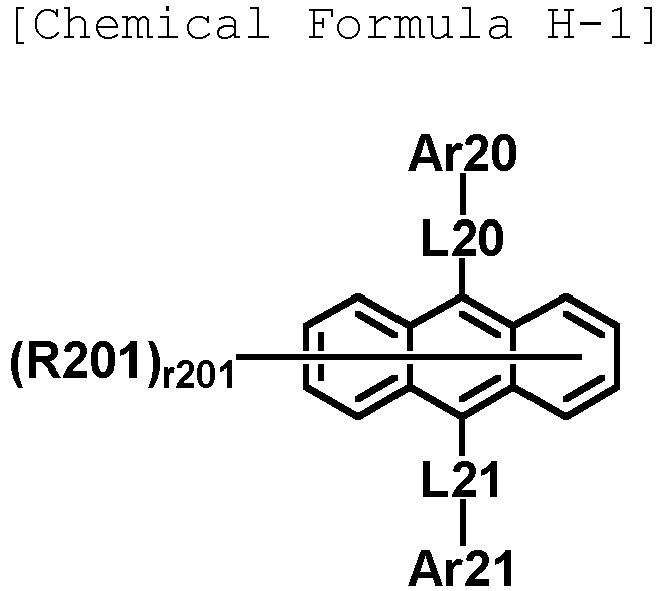
- In Chemical Formula H-1,
- L20 and L21 are the same as or different from each other, and each independently a direct bond; a substituted or unsubstituted arylene group; or a substituted or unsubstituted divalent heterocyclic group,
- Ar20 and Ar21 are the same as or different from each other, and are each independently hydrogen; deuterium; a substituted or unsubstituted aryl group; or a substituted or unsubstituted heterocyclic group,
- R201 is hydrogen; deuterium; a halogen group; a substituted or unsubstituted alkyl group; a substituted or unsubstituted cycloalkyl group; a substituted or unsubstituted aryl group; or a substituted or unsubstituted heterocyclic group, and
- r201 is an integer from 1 to 8, and when r201 is 2 or higher, two or more R201's are the same as or different from each other.
- In an exemplary embodiment of the present specification, L20 and L21 are the same as or different from each other, and are each independently a direct bond; a monocyclic or polycyclic arylene group having 6 to 30 carbon atoms; or a monocyclic or polycyclic divalent heterocyclic group having 2 to 30 carbon atoms.
- In an exemplary embodiment of the present specification, L20 and L21 are the same as or different from each other, and are each independently a direct bond; a phenylene group which is unsubstituted or substituted with deuterium; a biphenylylene group which is unsubstituted or substituted with deuterium; a naphthylene group which is unsubstituted or substituted with deuterium; a divalent dibenzofuran group; or a divalent dibenzothiophene group.
- In an exemplary embodiment of the present specification, Ar20 and Ar21 are the same as or different from each other, and are each independently a substituted or unsubstituted monocyclic or polycyclic aryl group having 6 to 30 carbon atoms; or a substituted or unsubstituted monocyclic or polycyclic heterocyclic group having 2 to 30 carbon atoms.
- In an exemplary embodiment of the present specification, Ar20 and Ar21 are the same as or different from each other, and are each independently a substituted or unsubstituted monocyclic to tetracyclic aryl group having 6 to 20 carbon atoms; or a substituted or unsubstituted monocyclic to tetracyclic heterocyclic group having 6 to 20 carbon atoms.
- In an exemplary embodiment of the present specification, Ar20 and Ar21 are the same as or different from each other, and are each independently a phenyl group which is unsubstituted or substituted with deuterium or a monocyclic or polycyclic aryl group having 6 to 20 carbon atoms; a biphenyl group which is unsubstituted or substituted with deuterium or a monocyclic or polycyclic aryl group having 6 to 20 carbon atoms; a naphthyl group which is unsubstituted or substituted with a monocyclic or polycyclic aryl group having 6 to 20 carbon atoms; a thiophene group which is unsubstituted or substituted with a monocyclic or polycyclic aryl group having 6 to 30 carbon atoms; a dibenzofuran group which is unsubstituted or substituted with a monocyclic or polycyclic aryl group having 6 to 20 carbon atoms; a naphthobenzofuran group which is unsubstituted or substituted with a monocyclic or polycyclic aryl group having 6 to 20 carbon atoms; a dibenzothiophene group which is unsubstituted or substituted with a monocyclic or polycyclic aryl group having 6 to 20 carbon atoms; or a naphthobenzothiophene group which is unsubstituted or substituted with a monocyclic or polycyclic aryl group having 6 to 20 carbon atoms.
- In an exemplary embodiment of the present specification, Ar20 and Ar21 are the same as or different from each other, and are each independently a phenyl group which is unsubstituted or substituted with deuterium; a biphenyl group which is unsubstituted or substituted with deuterium; a terphenyl group; a naphthyl group which is unsubstituted or substituted with deuterium; a thiophene group which is unsubstituted or substituted with a phenyl group; a phenanthrene group; a dibenzofuran group; a naphthobenzofuran group; a dibenzothiophene group; or a naphthobenzothiophene group.
- In an exemplary embodiment of the present specification, Ar20 and Ar21 are the same as or different from each other, and each independently a substituted or unsubstituted aryl group.
- In an exemplary embodiment of the present specification, Ar20 and Ar21 are the same as or different from each other, and are each independently a phenyl group which is unsubstituted or substituted with deuterium; a biphenyl group which is unsubstituted or substituted with deuterium; a terphenyl group; or a naphthyl group which is unsubstituted or substituted with deuterium.
- According to an exemplary embodiment of the present specification, R201 is hydrogen.
- According to an exemplary embodiment of the present specification, Chemical Formula H-1 is represented by the following compound.

- Examples of the dopant material include an aromatic amine derivative, a styrylamine compound, a boron complex, a fluoranthene compound, a metal complex, and the like. Specifically, the aromatic amine derivative is a fused aromatic ring derivative having a substituted or unsubstituted arylamine group, and examples thereof include pyrene, anthracene, chrysene, periflanthene, and the like having an arylamine group. Further, the styrylamine compound is a compound in which a substituted or unsubstituted arylamine is substituted with at least one arylvinyl group, and one or two or more substituents selected from the group consisting of an aryl group, a silyl group, an alkyl group, a cycloalkyl group, and an arylamine group are substituted or unsubstituted. Specific examples thereof include styrylamine, styryldiamine, styryltriamine, styryltetramine, and the like, but are not limited thereto. Further, examples of the metal complex include an iridium complex, a platinum complex, and the like, but are not limited thereto.
- According to an exemplary embodiment of the present specification, the dopant material includes a compound of the following Chemical Formula D-1 or D-2, but is not limited thereto.


- In Chemical Formula D-1,
- L101 and L102 are the same as or different from each other, and are each independently a direct bond; or a substituted or unsubstituted arylene group, and
- Ar101 to Ar104 are the same as or different from each other, and are each independently a substituted or unsubstituted aryl group; or a substituted or unsubstituted heteroaryl group,

- In Chemical Formula D-2,
- T1 to T5 are the same as or different from each other, and are each independently hydrogen; a substituted or unsubstituted alkyl group; a substituted or unsubstituted amine group; or a substituted or unsubstituted aryl group,
- t3 and t4 are each an integer from 1 to 4,
- t5 is an integer from 1 to 3,
- when t3 is 2 or higher, two or more T3's are the same as or different from each other,
- when t4 is 2 or higher, two or more T4's are the same as or different from each other, and
- when t5 is 2 or higher, two or more T5's are the same as or different from each other.
- According to an exemplary embodiment of the present specification, L101 and L102 are a direct bond.
- According to an exemplary embodiment of the present specification, Ar101 to Ar104 are the same as or different from each other, and are each independently a substituted or unsubstituted monocyclic or polycyclic aryl group having 6 to 30 carbon atoms; or a substituted or unsubstituted monocyclic or polycyclic heteroaryl group having 2 to 30 carbon atoms.
- According to an exemplary embodiment of the present specification, Ar101 to Ar104 are the same as or different from each other, and are each independently a monocyclic or polycyclic aryl group having 6 to 30 carbon atoms, which is unsubstituted or substituted with a straight-chained or branched alkyl group having 1 to 30 carbon atoms; or a monocyclic or polycyclic heteroaryl group having 2 to 30 carbon atoms.
- According to an exemplary embodiment of the present specification, Ar101 to Ar104 are the same as or different from each other, and are each independently a phenyl group substituted with a methyl group; or a dibenzofuran group.
- According to an exemplary embodiment of the present specification, Chemical Formula D-1 is represented by the following compound.

- According to an exemplary embodiment of the present specification, T1 to T5 are the same as or different from each other, and are each independently hydrogen; a substituted or unsubstituted straight-chained or branched alkyl group having 1 to 30 carbon atoms; a substituted or unsubstituted monocyclic or polycyclic arylamine group having 6 to 30 carbon atoms; or a substituted or unsubstituted monocyclic or polycyclic aryl group having 6 to 30 carbon atoms.
- According to an exemplary embodiment of the present specification, T1 to T5 are the same as or different from each other, and are each independently hydrogen; a straight-chained or branched alkyl group having 1 to 30 carbon atoms; a monocyclic or polycyclic arylamine group having 6 to 30 carbon atoms; or a monocyclic or polycyclic aryl group having 6 to 30 carbon atoms, which is unsubstituted or substituted with a straight-chained or branched alkyl group having 1 to 30 carbon atoms.
- According to an exemplary embodiment of the present specification, T1 to T5 are the same as or different from each other, and are each independently hydrogen; a methyl group; a tert-butyl group; a diphenylamine group; or a phenyl group which is unsubstituted or substituted with a methyl group or tert-butyl group.
- According to an exemplary embodiment of the present specification, Chemical Formula D-2 is represented by the following compound.

- The hole injection layer is a layer which accepts holes from an electrode. It is preferred that hole injection material has an ability to transport holes, and has an effect of accepting holes from an anode and an excellent hole injection effect for a light emitting layer or a light emitting material. Further, the hole injection material is preferably a material which is excellent in ability to prevent excitons produced from a light emitting layer from moving to an electron injection layer or an electron injection material. In addition, the hole injection material is preferably a material which is excellent in ability to form a thin film. In addition, the highest occupied molecular orbital (HOMO) of the hole injection material is preferably a value between the work function of the anode material and the HOMO of the neighboring organic material layer. Specific examples of the hole injection material include: metal porphyrin, oligothiophene, and arylamine-based organic materials; hexanitrile hexaazatriphenylene-based organic materials; quinacridone-based organic materials; perylene-based organic materials; polythiophene-based conductive polymers such as anthraquinone and polyaniline; and the like, but are not limited thereto.
- According to an exemplary embodiment of the present specification, the hole injection layer includes a compound of the following Chemical Formula HI-1, but is not limited thereto.

- In Chemical Formula HI-1,
- at least one of X'1 to X'6 is N, and the others are CH, and
- R309 to R314 are the same as or different from each other, and are each independently hydrogen; deuterium; a cyano group; a substituted or unsubstituted alkyl group; a substituted or unsubstituted amine group; a substituted or unsubstituted aryl group; or a substituted or unsubstituted heteroaryl group, or are bonded to an adjacent group to form a substituted or unsubstituted ring.
- According to an exemplary embodiment of the present specification, X'1 to X'6 are N.
- According to an exemplary embodiment of the present specification, R309 to R314 are a cyano group.
- According to an exemplary embodiment of the present specification, Chemical Formula HI-1 is represented by the following compound.

- The hole transport layer is a layer which accepts holes from a hole injection layer and transports the holes to a light emitting layer. A hole transport material is preferably a material having high hole mobility which may accept holes from an anode or a hole injection layer and transfer the holes to a light emitting layer. Specific examples thereof include arylamine-based organic materials, conductive polymers, block copolymers having both conjugated portions and non-conjugated portions, and the like, but are not limited thereto.
- According to an exemplary embodiment of the present specification, the hole transport layer or hole adjusting layer includes a compound of following Chemical Formula HT-1, but is not limited thereto.

- In Chemical Formula HT-1,
- R315 to R317 are the same as or different from each other, and are each independently any one selected from the group consisting of hydrogen; deuterium; a substituted or unsubstituted alkyl group; a substituted or unsubstituted aryl group; a substituted or unsubstituted heteroaryl group; and a combination thereof, or are bonded to an adjacent group to form a substituted or unsubstituted ring,
- r315 is an integer from 1 to 5, and when r315 is 2 or higher, two or more R315's are the same as or different from each other, and
- r316 is an integer from 1 to 5, and when r316 is 2 or higher, two or more R316's are the same as or different from each other.
- According to an exemplary embodiment of the present specification, R317 is any one selected from the group consisting of a substituted or unsubstituted aryl group; a substituted or unsubstituted heteroaryl group; and a combination thereof.
- According to an exemplary embodiment of the present specification, R317 is any one selected from the group consisting of a carbazole group; a phenyl group; a biphenyl group; and a combination thereof.
- According to an exemplary embodiment of the present specification, R315 and R316 are the same as or different from each other, and are each independently a substituted or unsubstituted aryl group, or are bonded to an adjacent group to form an aromatic hydrocarbon ring substituted with an alkyl group.
- According to an exemplary embodiment of the present specification, R315 and R316 are the same as or different from each other, and are each independently a phenyl group or a phenanthrene group, or are bonded to an adjacent group to form indene substituted with a methyl group.
- According to an exemplary embodiment of the present specification, Chemical Formula HT-1 is represented by any one of the following compounds.

- The electron adjusting layer is a layer that adjusts electrons transferred from the electron transport layer to be smoothly injected into the light emitting layer, and known materials can be used without limitation.
- According to an exemplary embodiment of the present specification, the electron adjusting layer includes a compound of the following Chemical Formula EG-1, but is not limited thereto.

- In Chemical Formula EG-1,
- at least one of G1 to G18 is -L5-Ar5, the others are hydrogen, or G1 and G18 are linked through -L51- to form a substituted or unsubstituted ring,
- L5 is a direct bond; or a substituted or unsubstituted arylene group,
- Ar5 is a substituted or unsubstituted aryl group; or a substituted or unsubstituted heteroaryl group, and
- L51 is O; or S.
- According to an exemplary embodiment of the present specification, L51 is O.
- According to an exemplary embodiment of the present specification, L51 is S.
- According to an exemplary embodiment of the present specification, G1 and G18 are linked through -L51- to form a substituted or unsubstituted hetero ring.
- According to an exemplary embodiment of the present specification, G1 and G18 are linked through -L51- to form a substituted or unsubstituted xanthene ring; or a substituted or unsubstituted thioxanthene ring.
- According to an exemplary embodiment of the present specification, G1 and G18 are linked through -O- to form a substituted or unsubstituted xanthene ring.
- According to an exemplary embodiment of the present specification, G1 and G18 are linked through -S- to form a substituted or unsubstituted thioxanthene ring.
- According to an exemplary embodiment of the present specification, G1 and G18 are linked through -O- to form a xanthene ring.
- According to an exemplary embodiment of the present specification, G1 and G18 are linked through -S- to form a thioxanthene ring.
- According to an exemplary embodiment of the present specification, L5 is a direct bond; or a substituted or unsubstituted monocyclic or polycyclic arylene group having 6 to 30 carbon atoms.
- According to an exemplary embodiment of the present specification, L5 is a direct bond; or a substituted or unsubstituted monocyclic or polycyclic arylene group having 6 to 20 carbon atoms.
- According to an exemplary embodiment of the present specification, L5 is a direct bond; or a monocyclic or polycyclic arylene group having 6 to 30 carbon atoms.
- According to an exemplary embodiment of the present specification, L5 is a direct bond; or a monocyclic or polycyclic arylene group having 6 to 20 carbon atoms.
- According to an exemplary embodiment of the present specification, L5 is a direct bond; or a phenylene group.
- According to an exemplary embodiment of the present specification, Ar5 is a substituted or unsubstituted triazine group.
- According to an exemplary embodiment of the present specification, Ar5 is a triazine group which is unsubstituted or substituted with a monocyclic or polycyclic aryl group having 6 to 30 carbon atoms.
- According to an exemplary embodiment of the present specification, Ar5 is a triazine group substituted with a phenyl group.
- According to an exemplary embodiment of the present specification, EG-1 is represented by the following compound.

- The electron transport layer is a layer which accepts electrons from an electron injection layer and transports the electrons to a light emitting layer. An electron transport material is preferably a material having high electron mobility which may proficiently accept electrons from a cathode and transfer the electrons to a light emitting layer. Specific examples thereof include: Al complexes of 8-hydroxyquinoline; complexes including Alq3; organic radical compounds; hydroxyflavone-metal complexes; and the like, but are not limited thereto. The electron transport layer may be used with any desired cathode material, as used according to the related art. In particular, an appropriate cathode material is a typical material which has a low work function, followed by an aluminum layer or a silver layer. Specific examples thereof include cesium, barium, calcium, ytterbium, and samarium, in each case followed by an aluminum layer or a silver layer.
- According to an exemplary embodiment of the present specification, the electron transport layer includes a compound of the following Chemical Formula ET-1, but is not limited thereto.

- In Chemical Formula ET-1,
- at least one of Z11 to Z13 is N, and the others are CH,
- L601 is a direct bond; a substituted or unsubstituted arylene group; or a substituted or unsubstituted heteroarylene group,
- Ar601 and Ar602 are the same as or different from each other, and are each independently a substituted or unsubstituted aryl group; or a substituted or unsubstituted heteroaryl group, and
- 1601 is an integer from 1 to 5, and when 1601 is 2 or higher, two or more L601's are the same as or different from each other.
- According to an exemplary embodiment of the present specification, L601 is a substituted or unsubstituted monocyclic or polycyclic arylene group having 6 to 30 carbon atoms.
- According to an exemplary embodiment of the present specification, L601 is a phenylene group; a biphenylylene group; or a naphthylene group.
- According to an exemplary embodiment of the present specification, Ar601 and Ar602 are the same as or different from each other, and are each independently a substituted or unsubstituted monocyclic or polycyclic aryl group having 6 to 30 carbon atoms.
- According to an exemplary embodiment of the present specification, Ar601 and Ar602 are a phenyl group.
- According to an exemplary embodiment of the present specification, Chemical Formula ET-1 is represented by the following compound.

- The electron injection layer is a layer which accepts electrons from an electrode. It is preferred that an electron injection material is excellent in ability to transport electrons and has an effect of accepting electrons from the second electrode and an excellent electron injection effect for a light emitting layer or a light emitting material. Further, the electron injection material is preferably a material which prevents excitons produced from a light emitting layer from moving to a hole injection layer and is excellent in ability to form a thin film. Specific examples thereof include fluorenone, anthraquinodimethane, diphenoquinone, thiopyran dioxide, oxazole, oxadiazole, triazole, imidazole, perylenetetracarboxylic acid, fluorenylidene methane, anthrone, and the like, and derivatives thereof, metal complex compounds, nitrogen-containing 5-membered ring derivatives, and the like, but are not limited thereto.
- Examples of the metal complex compounds include 8-hydroxyquinolinato lithium, bis(8-hydroxyquinolinato) zinc, bis(8-hydroxyquinolinato) copper, bis(8-hydroxyquinolinato) manganese, tris(8-hydroxyquinolinato) aluminum, tris(2-methyl-8-hydroxyquinolinato) aluminum, tris(8-hydroxyquinolinato) gallium, bis(10-hydroxybenzo[h]quinolinato) beryllium, bis(10-hydroxybenzo[h]quinolinato) zinc, bis(2-methyl-8-quinolinato) chlorogallium, bis(2-methyl-8-quinolinato)(o-cresolato) gallium, bis(2-methyl-8-quinolinato)(1-naphtholato) aluminum, bis(2-methyl-8-quinolinato)(2-naphtholato) gallium, and the like, but are not limited thereto.
- According to an exemplary embodiment of the present specification, the electron injection and transport layer is a layer that transports electrons to the light emitting layer. For the electron injection and transport layer, materials exemplified for the electron transport layer and the electron injection layer may be used, but the materials are not limited thereto.
- According to an exemplary embodiment of the present specification, the electron injection and transport layer may further include a metal complex compound. The metal complex compound is as described above.
- The electron blocking layer is a layer which may improve the service life and efficiency of a device by preventing electrons injected from an electron injection layer from passing through a light emitting layer and entering a hole injection layer. As the electron blocking layer, the publicly-known material can be used without limitation, and the electron blocking layer may be formed between a light emitting layer and a hole injection layer, between a light emitting layer and a hole transport layer, or between a light emitting layer and a layer which simultaneously injects and transports holes.
- As a material for the electron blocking layer, the examples of Chemical Formula HI-1 can be applied, but the material is not limited thereto.
- The hole blocking layer is a layer which blocks holes from reaching a cathode, and may be generally formed under the same conditions as those of the electron injection layer. Specific examples thereof include oxadiazole derivatives or triazole derivatives, phenanthroline derivatives, aluminum complexes, and the like, but are not limited thereto.
- The capping layer is formed to prevent a considerable amount of light from being lost through total reflection of light in the organic light emitting device, and the capping layer has the performance capable of sufficiently protecting the underlying negative electrode and light emitting layer from external moisture penetration or contamination, and has a high refractive index, and thus may prevent light loss caused by total reflection, and materials in the related art can be used without limitation.
- According to an exemplary embodiment of the present specification, the capping layer includes a compound represented by the following Chemical Formula CP-1, but is not limited thereto.

- In Chemical Formula CP-1,
- L501 and L502 are the same as or different from each other, and are each independently a direct bond; a substituted or unsubstituted arylene group; or a substituted or unsubstituted heteroarylene group, and
- R501 and Ar501 to Ar504 are the same as or different from each other, and are each independently a substituted or unsubstituted aryl group; or a substituted or unsubstituted heteroaryl group, or adjacent groups are bonded to each other to form a substituted or unsubstituted ring.
- According to an exemplary embodiment of the present specification, L501 and L502 are the same as or different from each other, and are each independently a substituted or unsubstituted monocyclic or polycyclic arylene group having 6 to 30 carbon atoms.
- According to an exemplary embodiment of the present specification, L501 and L502 are a phenylene group.
- According to an exemplary embodiment of the present specification, R501 and Ar501 to Ar504 are the same as or different from each other, and are each independently a substituted or unsubstituted monocyclic or polycyclic aryl group having 6 to 30 carbon atoms, or are bonded to an adjacent group to form a substituted or unsubstituted monocyclic or polycyclic hetero ring having 2 to 30 carbon atoms.
- According to an exemplary embodiment of the present specification, R501 and Ar501 to Ar504 are a phenyl group, or are bonded to an adjacent group to form a carbazole group which is unsubstituted or substituted with a phenyl group.
- According to an exemplary embodiment of the present specification, Ar501 and L501 are bonded to form a carbazole substituted with a phenyl group.
- According to an exemplary embodiment of the present specification, Ar503 is bonded to L503 to form a carbazole substituted with a phenyl group.
- According to an exemplary embodiment of the present specification, Chemical Formula CP-1 is represented by the following compound.

- The organic light emitting device according to the present specification may be a top-emission type, a bottom-emission type or a dual-emission type depending on the materials used.
- The organic light emitting device according to the present specification may be included and used in various electronic devices. For example, the electronic device may be a display panel, a touch panel, a solar module, a lighting device, and the like, and is not limited thereto.
- Hereinafter, the present specification will be described in detail with reference to Examples, Comparative Examples, and the like for specifically describing the present specification. However, the Examples and the Comparative Examples according to the present specification may be modified in various forms, and it is not interpreted that the scope of the present specification is limited to the Examples and the Comparative Examples described below in detail. The Examples and the Comparative Examples of the present specification are provided to more completely explain the present specification to a person with ordinary skill in the art.
-


- After SM1 (1 eq) and SM2 (1.1 eq) were added to acetone (excess), potassium carbonate (2 eq) was added thereto, and the resulting mixture was stirred under reflux for 24 hours. After the temperature was lowered to room temperature and the reaction was terminated, water and ethanol were added thereto, and the resulting mixture was filtered to prepare Chemical Formulae A1 and B1 (Chemical Formulae A1-1 to A1-6 and B1-1 to B1-7), respectively.
- In the reaction scheme, X is a halogen group, n is an integer from 1 to 7, and the definition of R is the same as the above-described definitions of Y7 to Y11.
- Chemical Formulae A1-1 to A1-6 and B1-1 to B1-7 of the following Table 1 were synthesized in the same manner in the synthesis method of Chemical Formulae A1 and B1, except that SM1 and SM2 were changed to SM1 and SM2 of the following Table 1, respectively.
[Table 1] Chemical Formula SM1 SM2 Product Yield MS [M+H] + A1-1 


70% 221.65 A1-2 

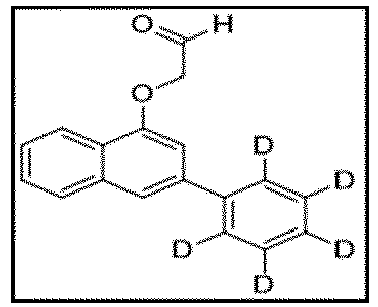
71% 268.34 A1-3 


73% 187.21 A1-4 
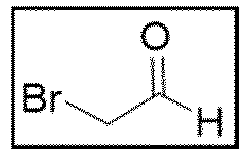

70% 221.65 A1-5 


72% 221.65 A1-6 


69% 221.65 B1-1 


68% 221.65 B1-2 


71% 187.21 B1-3 


73% 263.73 B1-4 


74% 221.65 B1-5 


70% 221.65 B1-6 
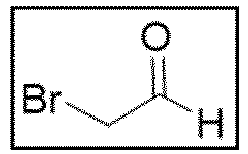

72% 221.65 B1-7 


68% 221.65 -

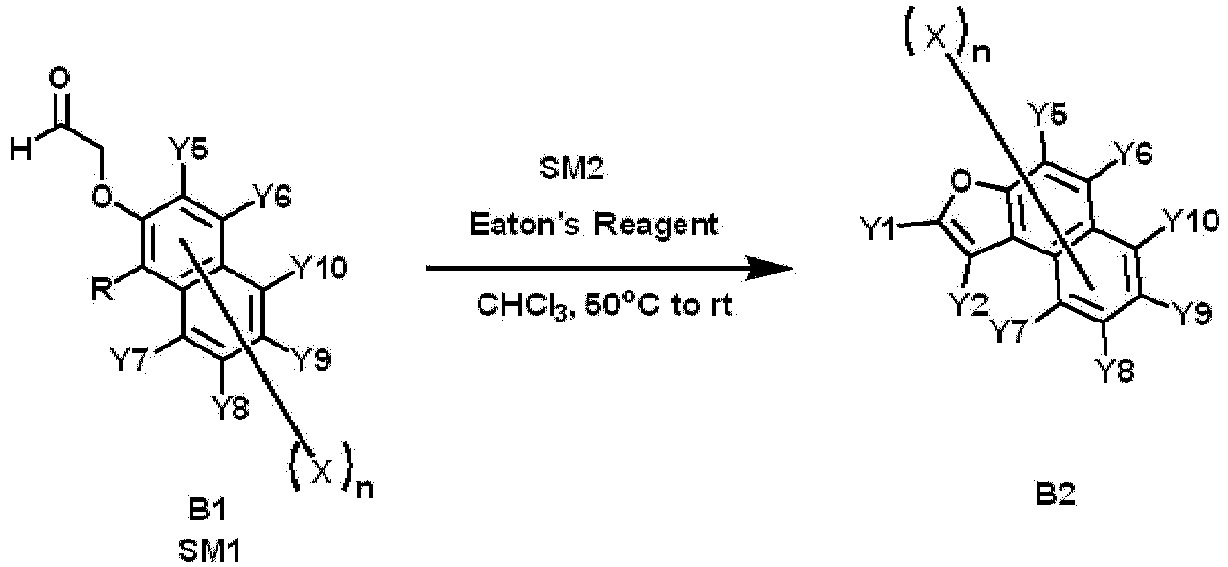
- After SM1 (1 eq, Chemical Formula A1 or B1) was put into chloroform (excess), the resulting mixture was refluxed under heating and dissolved, and then Eaton's reagent (1 eq, phosphorus pentoxide, 7.7 wt% in methanesulfonic acid, Sigma-Aldrich) was added thereto, and the resulting mixture was stirred for 1 hour. The temperature was lowered to room temperature, water was added thereto, the resulting mixture was stirred for 30 minutes, and then layers were separated, and the organic layer was extracted until the pH became neutral with a saturated aqueous solution of sodium hydrogen carbonate (NaHCO3). Thereafter, the organic layer was columned with hexane and ethyl acetate to prepare Chemical Formulae A2 and B2 (Chemical Formulae A2-1 to A2-6 and B2-1 to B2-7), respectively.
- In the reaction scheme, X is a halogen group, and n is an integer from 1 to 6.
- Chemical Formulae A2-1 to A2-6 and B2-1 to B2-7 of the following Table 2 were synthesized in the same manner in the synthesis method of Chemical Formulae A2 and B2, except that SM1 and SM2 were changed to SM1 and SM2 of the following Table 2, respectively.
-

- SM1 (1 eq) was put into benzene (excess), polyphosphoric acid (PPA, excess) was added thereto under stirring, and the resulting mixture was stirred for 4 hours. The temperature was lowered to room temperature, water was added thereto, the resulting mixture was stirred for 30 minutes, and then layers were separated, and the organic layer was extracted until the pH became neutral with a saturated aqueous solution of sodium hydrogen carbonate (NaHCO3). Thereafter, the organic layer was columned with hexane and ethyl acetate to prepare Chemical Formula C2 (Chemical Formulae C2-1 to C2-8), respectively.
- In the reaction formula, X is a halogen group, and n is an integer from 1 to 6.
- Chemical Formulae C2-1 to C2-8 of the following Table 2 were synthesized in the same manner in the synthesis method of Chemical Formula C2, except that SM1 and SM2 were changed to SM1 and SM2 of the following Table 2, respectively.
[Table 2] Chemical Formula SM1 SM2 Product Yield MS [M+H] + A2-1 A1-1 Eaton's reagent (P2O5 in MSA 7.5 w/w%) 
55% 203.64 A2-2 A1-2 Eaton's reagent (P2O5 in MSA 7.5 w/w%) 
56% 284.77 A2-3 A1-3 Eaton's reagent (P2O5 in MSA 7.5 w/w%) 
60% 169.20 A2-4 A1-4 Eaton's reagent (P2O5 in MSA 7.5 w/w%) 
61% 203.64 A2-5 A1-5 Eaton's reagent (P2O5 in MSA 7.5 w/w%) 
62% 203.64 A2-6 A1-6 Eaton's reagent (P2O5 in MSA 7.5 w/w%) 
63% 203.64 B2-1 B1-1 Eaton's reagent (P2O5 in MSA 7.5 w/w%) 
58$ 203.64 B2-2 B1-2 Eaton's reagent (P2O5 in MSA 7.5 w/w%) 
55% 169.20 B2-3 B1-3 Eaton's reagent (P2O5 in MSA 7.5 w/w%) 
54% 245.72 B2-4 B1-4 Eaton's reagent (P2O5 in MSA 7.5 w/w%) 
53% 203.64 B2-5 B1-5 Eaton's reagent (P2O5 in MSA 7.5 w/w%) 
50% 203.64 B2-6 B1-6 Eaton's reagent (P2O5 in MSA 7.5 w/w%) 
53% 203.64 B2-7 B1-7 Eaton's reagent (P2O5 in MSA 7.5 w/w%) 
60% 203.64 C2-1 
PPA, benzene 
66$ 295.35 C2-2 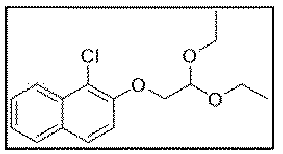
PPA, benzene 
68$ 203.64 C2-3 
PPA, benzene 
63% 259.75 C2-4 
PPA, benzene 
60% 282.53 C2-5 
PPA, benzene 
64% 203.64 C2-6 
PPA, benzene 
63% 279.74 C2-7 
PPA, benzene 
58$ 245.29 C2-8 
PPA, benzene 
59% 203.64 -


- SM1 (1 eq) and trifluoromethanesulfonic acid (cat.) were put into C6D6 (10- to 50-fold mass ratio compared to the reactant), and the resulting mixture was stirred at 70°C for 10 minutes to 100 minutes. After the reaction was completed, D2O (excess) was added thereto, the resulting solution was stirred for 30 minutes, and then trimethylamine (excess) was added dropwise thereto. The reaction solution was transferred to a separatory funnel, and an extraction with water and chloroform was performed. The extract was dried over MgSO4 and then columned with ethyl acetate and hexane to obtain Chemical Formulae A2" and B2", respectively.
- In the reaction scheme, X is a halogen group, and n is an integer from 1 to 6.
- The chemical formulae of the following Table 3 were synthesized in the same manner in the synthesis method of Chemical Formulae A2" and B2", except that SM1 and SM2 were changed to SM1 and SM2 of the following Table 3, respectively.
[Table 3] Chemical Formula SM1 SM2 Product Yield MS [M+H] + A2"-3 A2-3 Benzene_D6 
82% 176.24 B2"-2 B2-2 Benzene_D6 
80% 176.24 -


- After SM1 (1 eq, Chemical Formula A2, B2 or C2) was dissolved in THF (excess), the temperature was lowered to - 78°C, then 2.5 M n-BuLi (1 eq) was added dropwise thereto, the resulting mixture was stirred for 1 hour, and then N-bromosuccinimide (1 eq) was added thereto. Thereafter, the reactant was warmed to room temperature and stirred for 4 hours, and 1 N HCl (excess) was added thereto to terminate the reaction. After the reaction was completed, the solvent was removed by separating layers, and then the residue was subjected to silica column chromatography (ethyl acetate/hexane 1:15) to prepare Chemical Formulae A3-1, B3-1 and C3-1, respectively.
- In the reaction formula, X is a halogen group, and n is an integer from 1 to 6.
- The chemical formulae of the following Table 4 were synthesized in the same manner in the synthesis method of Chemical Formulae A3-1, B3-1 and C3-1, except that SM1 and SM2 were changed to SM1 and SM2 of the following Table 4, respectively.
- After SM1 (1 eq, Chemical Formula A2, B2 or C2) was dissolved in chloroform (excess), N-bromosuccinimide (1 eq) was added thereto, the temperature was increased to 40°C, and the resulting mixture was heated and stirred for 3 hours. After the resulting product was cooled to room temperature, 1N HCl (excess) was added thereto to terminate the reaction. After the reaction was completed, the solvent was removed by separating layers, and then the residue was subjected to silica column chromatography (ethyl acetate/hexane 1:15) to prepare Chemical Formulae A3-2, B3-2 and C3-2, respectively.
- In the reaction scheme, X is a halogen group, and n is an integer from 1 to 6.
- The chemical formulae of the following Table 4 were synthesized in the same manner in the synthesis method of Chemical Formulae A3-2, B3-2 and C3-2, except that SM1 and SM2 were changed to SM1 and SM2 of the following Table 4, respectively.
- After SM1 (1 eq, Chemical Formula A2, B2 or C2) was dissolved in THF (excess), the temperature was lowered to - 78°C, then 2.5 M n-BuLi (1 eq) was added dropwise thereto, the resulting mixture was stirred for 1 hour, and then N-bromosuccinimide (1 eq) was added thereto. Thereafter, the reactant was warmed to room temperature and stirred for 4 hours, and 1 N HCl (excess) was added thereto to terminate the reaction. After the reaction was completed, the solvent was removed by separating layers, then the residue was dissolved in chloroform (excess), then N-bromosuccinimide (1 eq) was added thereto, the temperature was increased to 40°C, and the resulting mixture was heated and stirred for 3 hours. After the resulting product was cooled to room temperature, 1N HCl (excess) was added thereto to terminate the reaction. After the reaction was completed, the solvent was removed by separating layers, and then the residue was subjected to silica column chromatography (ethyl acetate/hexane 1:15) to prepare Chemical Formulae A3-3, B3-3 and C3-3, respectively.
- In the reaction scheme, X is a halogen group, and n is an integer from 1 to 6.
- The chemical formulae of the following Table 4 were synthesized in the same manner in the synthesis method of Chemical Formulae A3-3, B3-3 and C3-3, except that SM1 and SM2 were changed to SM1 and SM2 of the following Table 4, respectively.
[Table 4] Chemical Formula SM1 SM2 Product Yield MS [M+H] + A3-3-1 A2-1 1) n-BuLi 2.5M in hex 
69% 361.43 2) NBS 3) NBS, chlroform, 40°C A3-2-1 A2"-3 NBS, CHCl3 
68$ 255.13 A3-1-1 A2-4 1) n-BuLi 2.5M in hex 
70% 282.53 2) NBS A3-2-2 A2-5 NBS, CHCl3 
72% 282.53 A3-1-2 A2-6 1) n-BuLi 2.5M in hex 
73% 248.09 2) NBS A3-2-3 A2-2 NBS, CHCl3 
70% 282.53 A3-2-4 A2-3 NBS, CHCl3 
73% 248.09 B3-3-1 B2-1 1) n-BuLi 2.5M in hex 
68% 361.43 2) NBS 3) NBS, chlroform, 40°C B3-2-1 B2-2 NBS, CHCl3 
69% 248.09 B3-1-1 B2-4 1) n-BuLi 2.5M in hex 
70% 282.53 2) NBS B3-1-2 B2"-2 1) n-BuLi 2.5M in hex 
71% 255.13 2) NBS B3-1-2 B2-5 1) n-BuLi 2.5M in hex 
73% 282.53 2) NBS B3-3-2 B2-6 1) n-BuLi 2.5M in hex 
72% 361.43 2) NBS 3) NBS, chlroform, 40°C B3-3-3 B2-7 1) n-BuLi 2.5M in hex 
70% 361.43 2) NBS 3) NBS, chlroform, 40°C C3-2-1 C2-1 NBS, CHCl3 
68% 374.25 C3-2-2 C2-3 NBS, CHCl3 
69% 282.53 C3-1-1 C2-4 1) n-BuLi 2.5M in hex 
66% 361.43 2) NBS C3-2-3 C2-6 NBS, CHCl3 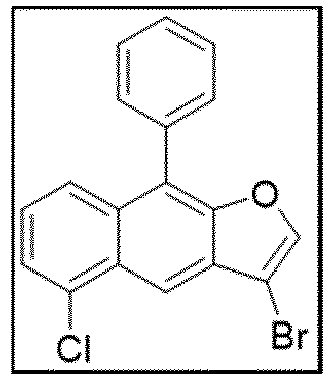
70% 358.63 C3-1-2 C2-7 1) n-BuLi 2.5M in hex 
71% 324.19 2) NBS -


- After SM1 (1 eq, Chemical Formulae A3-1 to A3-3, B3-1 to B3-3, C3-1, C3-2 or C3-3) and SM2 (1.02 eq) were added to tetrahydrofuran (excess), a 2 M aqueous potassium carbonate solution (30-fold volume ratio compared to THF) was added thereto, and tetrakis triphenyl-phosphine palladium (2 mol%) was added thereto, and then the resulting mixture was heated and stirred for 10 hours. After the temperature was lowered to room temperature and the reaction was terminated, the aqueous potassium carbonate solution was removed to separate the layers. After the solvent was removed, the residue was distilled under vacuum and recrystallized with ethyl acetate and hexane to prepare Chemical Formulae A4, B4 and C4, respectively.
- In the reaction scheme, X is a halogen group, n is an integer from 1 to 5, and the definition of R" is the same as the above-described definitions of Y7 to Y11.
- The chemical formulae of the following Table 5 were synthesized in the same manner in the synthesis method of Chemical Formulae A4, B4 and C4, except that SM1 and SM2 were changed to SM1 and SM2 of the following Table 5, respectively.
[Table 5] Chemica l Formula SM1 SM2 Product Yiel d MS [M+H] + A4-1 A3-3-1 

75% 355.83 A4-2 A3-1-1 

73% 259.75 A4-3 A3-2-2 

70% 271.76 A4-4 A3-2-3 

72% 279.74 B4-1 B3-3-1 
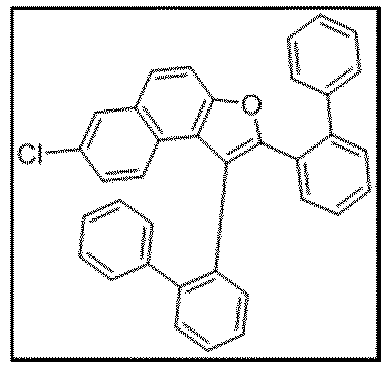
73% 508.03 B4-2 B3-1-1 

70% 259.75 B4-3 B3-1-3 

73% 336.84 B4-4 B3-3-2 
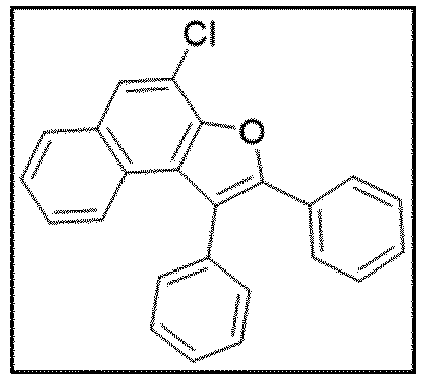
72% 355.83 B4-5 B3-3-3 

68% 231.69 C4-1 C3-2-2 

69% 245.72 C4-2 C3-1-1 

75% 385.89 C4-3 C3-2-3 

71% 355.83 -


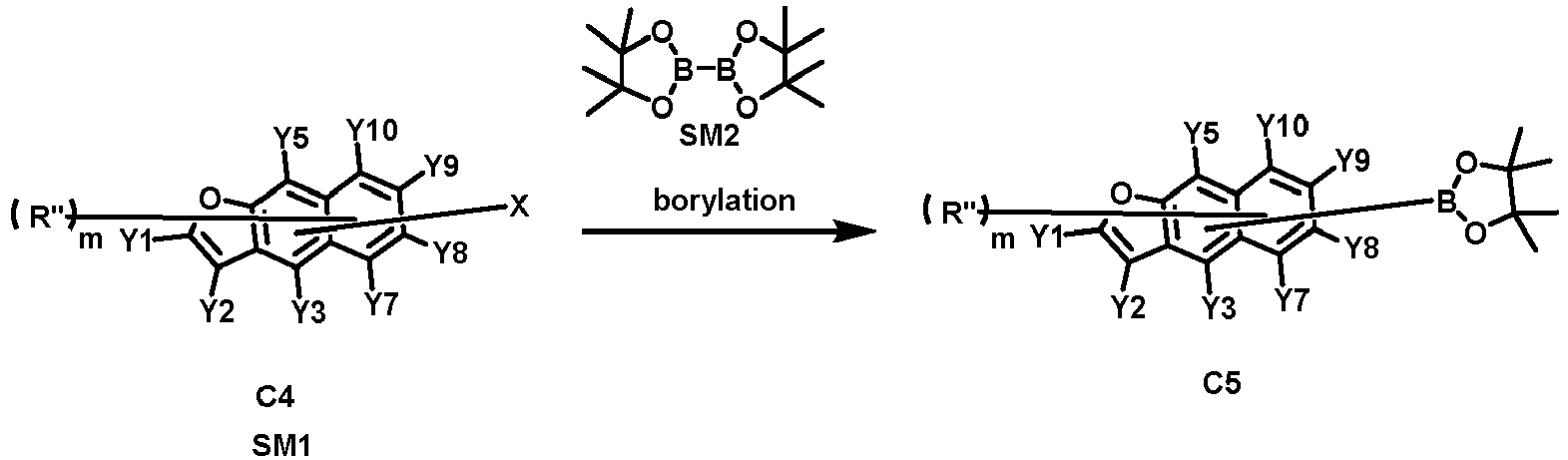
- SM1 (1 eq, Chemical Formula A4, B4 or C4) and SM2 (1.3 eq) were put into 1,4-dioxane (12-fold mass ratio compared to SM1), potassium acetate (3 eq) was added thereto, and the resulting mixture was stirred and refluxed. After palladium acetate (0.02 eq) and tricyclohexylphosphine (0.04 eq) are stirred in 1,4-dioxane for 5 minutes, the resulting mixture was added thereto, and 10 hours later, the mixture was cooled to room temperature after confirming that the reaction was terminated. After ethanol and water were added thereto, the resulting mixture was filtered and purified by recrystallization with ethyl acetate and ethanol to prepare Chemical Formulae A5, B5 and C5, respectively.
- In the reaction scheme, the definition of R" is the same as the above-described definitions of Y7 to Y11, and m is an integer from 1 to 7.
- The chemical formulae of the following Table 6 were synthesized in the same manner in the synthesis method of Chemical Formulae A5, B5 and C5, except that SM1 and SM2 were changed to SM1 and SM2 of the following Table 6, respectively.
[Table 6] Chemi cal Formu la SM1 SM2 Product Yield MS [M+H] + A5-1 A4-1 

78% 447.35 A5-2 A2-2 

77% 376.29 A5-3 A3-2-1 

74% 302.20 A5-4 A4-2 

80% 351.27 A5-5 A4-3 

74% 363.28 A5-6 A3-1-2 

79% 295.18 A5-7 A4-7 

80% 371.26 A5-8 A2-7 

71% 295.18 A5-9 A3-2-4 

74% 295.18 B5-1 B4-1 

77% 599.55 B5-2 B3-2-1 

75% 295.16 B5-3 B2-3 

76% 323.21 B5-4 B4-2 

77% 351.27 B5-5 B3-1-2 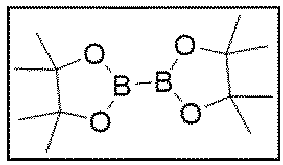

76% 302.20 B5-6 B4-3 

70% 428.36 B5-7 B4-4 

79% 447.35 B5-8 B4-5 

73% 323.21 C5-1 C3-2-1 

71% 547.47 C5-2 C4-1 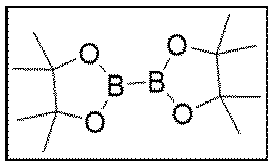

70% 337.24 C5-3 C2-3 

77% 351.27 C5-4 C4-2 

73% 457.41 C5-5 C2-5 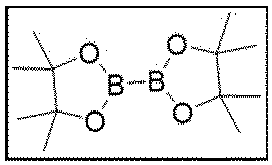

72% 295.16 C5-6 C4-3 

70% 447.35 C5-7 C3-1-2 

77% 371.26 C5-8 C2-8 

73% 295.16 -


- In the reaction scheme, the definition of R" is the same as the above-described definitions of Y7 to Y11, and m is an integer from 1 to 7.
- The chemical formulae of the following Table 7 were synthesized in the same manner in the synthesis method of Chemical Formulae A4, B4 and C4, except that SM1 and SM2 were changed to SM1 and SM2 of the following Table 7, respectively.
[Table 7] Chemical Formula SM1 SM2 Product Yield MS [M+H] + A6-1 A5-6 

75% 279.74 A6-2 A5-7 

73% 355.83 A6-3 A5-8 

71% 355.83 A6-4 A5-9 

70% 369.82 B6-1 B5-7 

73% 481.99 B6-2 B5-8 

80% 357.85 C6-1 C5-8 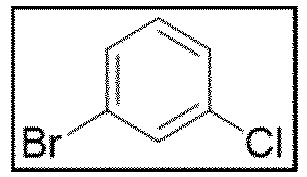

73% 279.74 -

- In the reaction scheme, the definition of R" is the same as the above-described definitions of Y7 to Y11, and m is an integer from 1 to 7.
- The chemical formulae of the following Table 8 were synthesized in the same manner in the synthesis method of Chemical Formulae A5, B5 and C5, except that SM1 and SM2 were changed to SM1 and SM2 of the following Table 8, respectively.
[Table 8] Chemica l Formula SM1 SM2 Product Yiel d MS [M+H] + A7-1 A6-1 

80% 371.2 6 A7-2 A6-2 

71% 447.3 5 A7-3 A6-3 

75% 447.3 5 A7-4 A6-4 

78% 461.3 4 B7-1 B6-1 

80% 573.5 1 B7-2 B6-2 
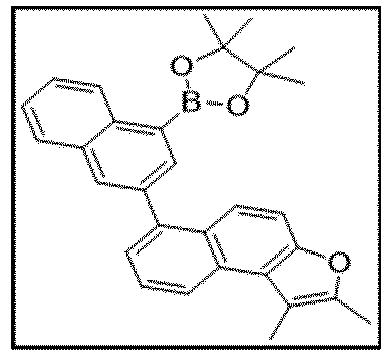
83% 449.3 7 C7-1 C6-1 

79% 371.2 6 -


- After SM1 (1.05 eq, Chemical Formula A5, B5, C5, A7, B7 or C7) and SM2 (1 eq) were added to tetrahydrofuran (excess), a 2 M aqueous potassium carbonate solution (30-fold volume ratio compared to THF) was added thereto, and tetrakis triphenyl-phosphine palladium (2 mol%) was added thereto, and then the resulting mixture was heated and stirred for 10 hours. After the temperature was lowered to room temperature and the reaction was terminated, the aqueous potassium carbonate solution was removed to separate the layers. After it was confirmed that the reaction was terminated, the temperature was lowered to room temperature to remove the solvent, and the residue was purified by recrystallization using toluene to prepare the following
Compounds 1 to 25. - In the reaction scheme, the definition of R" is the same as the above-described definitions of Y7 to Y11, and m is an integer from 1 to 7.
-
Compounds 1 to 25 of the following Table 9 were synthesized in the same manner as described above, except that SM1 and SM2 were changed to SM1 and SM2 of the following Table 9, respectively.
SM2 of the following Table 9 was prepared in the following scheme.


- SM2 of
Compounds 1 to 25 were prepared as the synthesis examples as described above. - In addition, the Suzuki reaction is the same method as in the synthesis of Chemical Formulae A4, B4, and C4, and the bromination is the same method as in the synthesis of Chemical Formulae A3-1 to A3-3, B3-1 to B3-3 and C3-1 to C3-3, except that SM1 and SM2 were changed.
[Table 9] Compound SM1 SM2 Product Yield MS [M+H] + 1 A5-1 
71% 638.86 2 A5-2 
72% 583.77 3 A5-3 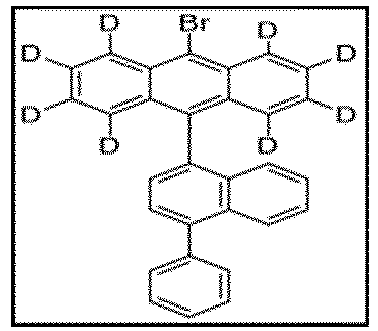
69% 575.78 4 A5-4 
68% 611.83 5 A5-5 
70% 699.93 6 A7-1 
75% 657.85 7 A7-2 
75% 681.88 8 A7-3 
71% 638.86 9 A7-4 
65% 645.80 10 B5-1 
79% 733.95 11 B5-2 
74% 579.74 12 B5-3 
77% 647.86 13 B5-4 
72% 661.89 14 B5-5 
70% 554.71 15 B5-6 
71% 680.87 16 B7-1 
73% 712.94 17 B7-2 
70% 640.87 18 C5-1 
76% 611.81 19 C5-2 
68% 597.80 20 C5-3 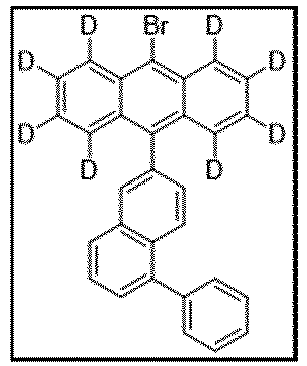
67% 611.83 21 C5-4 
68% 691.94 22 C5-5 
73% 554.71 23 C5-6 
75% 697.92 24 C5-7 
70% 744.96 25 C7-1 
73% 561.75 -


- The reactant (1 eq) and trifluoromethanesulfonic acid (cat.) were put into C6D6 (10- to 50-fold mass ratio compared to the reactant), and the resulting mixture was stirred at 70°C for 10 minutes to 100 minutes. After the reaction was completed, D2O (excess) was added thereto, the resulting solution was stirred for 30 minutes, and then trimethylamine (excess) was added dropwise thereto. The reaction solution was transferred to a separatory funnel, and an extraction with water and chloroform was performed. The extract was dried over MgSO4, and then recrystallized by heating with toluene to obtain Compounds 26 to 28 of the following Table 10, respectively.
- In the reaction scheme, the substituents are defined as described above, and Dx means the number of deuterium atoms substituted in the compound.
- Compound 26 to Compound 28 of the following Table 10 were synthesized in the same manner as described above, except that SM1 and SM2 were changed to the reactant in the following Table 10 and C6D6.
- The reactants of the following Table 10 were prepared by changing SM1 and SM2 in the same manner as in the method of Preparation Example 8. (non-deuterated compound)
- The prior literature of
KR1538534 [Table 10] Compo und Reactant Product React ant m/z Product theory max m/z Reaction time (min) 26 Deuterium - unsubstit uted compound of Compound 1
622 652 50 27 Deuterium - unsubstit uted compound of Compound 14 
546 572 50 28 Deuterium - unsubstit uted compound of Compound 21 
672 704 50 Compo und Product actual max m/z number of total hydrogens Numbe r of D subst ituti ons D substit ution ratio (%) Yield 26 648 30 26 87% 68% 27 569 26 23 88% 73% 28 700 32 28 88% 69% - As a positive electrode, a substrate on which ITO/Ag/ITO were deposited to have a thickness of 70/1,000/70 Å was cut into a size of 50 mm x 50 mm x 0.5 mm, put into distilled water in which a dispersant was dissolved, and washed with ultrasonic waves. A product manufactured by Fischer Co., was used as a detergent, and distilled water twice filtered using a filter manufactured by Millipore Co., was used as the distilled water. After the ITO was washed for 30 minutes, ultrasonic washing was repeated twice with distilled water for 10 minutes. After the washing using distilled water was completed, ultrasonic washing was conducted using isopropyl alcohol, acetone, and methanol solvents in this order, and drying was then conducted.
- HI-1 was thermally vacuum-deposited to have a thickness of 50 Å on the positive electrode thus prepared, thereby forming a hole injection layer, and HT1 as a material which transports holes was vacuum-deposited to have a thickness of 1,150 Å thereon, thereby forming a hole transport layer, Next, a hole adjusting layer was formed using EB1 (150 Å), and then Compound 1 (host) and dopant BD1 (2 wt%) were vacuum-deposited to have a thickness of 360 Å, thereby forming a light emitting layer. Thereafter, ET1 was deposited to have a thickness of 50 Å, thereby forming an electron adjusting layer, and Compounds ET2 and Liq were mixed at a weight ratio of 7:3, thereby forming an electron transport layer having a thickness of 250 Å. Sequentially, after magnesium and lithium fluoride (LiF) were deposited to have a thickness of 50 Å to form a film as an electron injection layer (EIL), magnesium and silver (1:4, weight ratio) were used to form a negative electrode having a thickness of 200 Å, and then CP1 was deposited to have a thickness of 600 Å as a capping layer, thereby completing a device. In the aforementioned procedure, the deposition rate of the organic material was maintained at 1 Å/sec.


- Organic light emitting devices of Examples 2 to 33 and Comparative Examples 1 to 4 were manufactured in the same manner as in Example 1, except that compounds described in the following Table 11 were used, respectively, instead of
Compound 1 and BD1 in Example 1.
- A current of 20 mA/cm2 was applied to the organic light emitting devices manufactured in Examples 1 to 33 and Comparative Examples 1 to 4 to measure the voltage, efficiency, color coordinates, and service life (T95), and the results are shown in the following Table 11. In this case, T95 means the time taken for the initial luminance to drop to 95% at a current density of 20 mA/cm2.
[Table 11] Experimental Example 20 mA/cm2 Host Dopant Voltage (V) (@20 mA/cm2) Cd/A (@20 mA/cm2) Color coordin ate (x,y) Service life (T95, h) (@20 mA/cm2) Example 1 Compound 1 BD1 3.45 6.80 (0.129, 0.128) 75.1 Example 2 Compound 2 BD1 3.36 6.78 (0.131, 0.141) 63.1 Example 3 Compound 3 BD1 3.43 6.77 (0.129, 0.129) 66.4 Example 4 Compound 4 BD1 3.48 6.68 (0.130, 0.129) 65.2 Example 5 Compound 5 BD1 3.41 6.60 (0.130, 0.128) 67.5 Example 6 Compound 6 BD1 3.39 6.72 (0.130, 0.134) 66.1 Example 7 Compound 7 BD1 3.40 6.69 (0.131, 0.134) 68.2 Example 8 Compound 8 BD1 3.38 6.73 (0.131, 0.135) 74.9 Example 9 Compound 9 BD1 3.34 6.81 (0.132, 0.141) 65.1 Example 10 Compound 10 BD1 3.38 6.73 (0.131, 0.134) 66.8 Example 11 Compound 11 BD1 3.44 6.70 (0.129, 0.129) 64.1 Example 12 Compound 12 BD1 3.35 6.71 (0.132, 0.142) 67.6 Example 13 Compound 13 BD1 3.34 6.69 (0.131, 0.141) 66.1 Example 14 Compound 14 BD1 3.39 6.70 (0.131, 0.134) 62.3 Example 15 Compound 15 BD1 3.40 6.73 (0.131, 0.135) 63.4 Example 16 Compound 16 BD1 3.32 6.78 (0.131, 0.141) 73.9 Example 17 Compound 17 BD1 3.33 6.77 (0.131, 0.141) 76.1 Example 18 Compound 18 BD1 3.43 6.70 (0.130, 0.129) 75.8 Example 19 Compound 19 BD1 3.44 6.72 (0.130, 0.129) 68.1 Example 20 Compound 20 BD1 3.45 6.69 (0.130, 0.128) 67.4 Example 21 Compound 21 BD1 3.40 6.80 (0.130, 0.129) 67.7 Example 22 Compound 22 BD1 3.34 6.63 (0.132, 0.142) 63.9 Example 23 Compound 23 BD1 3.43 6.72 (0.130, 0.128) 66.1 Example 24 Compound 24 BD1 3.44 6.73 (0.130, 0.129) 65.3 Example 25 Compound 25 BD1 3.38 6.74 (0.131, 0.135) 66.9 Example 26 Compound 26 BD1 3.45 7.03 (0.129, 0.128) 83.5 Example 27 Compound 27 BD1 3.39 6.70 (0.131, 0.134) 73.5 Example 28 Compound 28 BD1 3.40 6.80 (0.130, 0.129) 76.1 Example 29 Compound 1 BD2 3.51 6.93 (0.123, 0.124) 64.8 Example 30 Compound 8 BD2 3.46 6.84 (0.124, 0.123) 65.2 Example 31 Compound 15 BD2 3.49 6.81 (0.122, 0.123) 57.5 Example 32 Compound 21 BD2 3.48 6.93 (0.122, 0.124) 59.2 Example 33 Compound 25 BD2 3.45 6.90 (0.122, 0.123) 58.4 Comparative Example 1 BH1 BD1 3.90 5.88 (0.134, 0.139) 40.8 Comparative Example 2 BH2 BD1 3.72 5.12 (0.134, 0.151) 12.3 Comparative Example 3 BH5 BD1 3.81 5.51 (0.134, 0.138) 23.0 Comparative Example 4 BH6 BD1 3.78 5.53 (0.134, 0.137) 20.8 -
Chemical Formula 1 according to an exemplary embodiment of the present specification is intended to improve the blue light emitting device by improving the characteristics of an anthracene blue fluorescent host into which a naphthofuran unit including oxygen and deuterium were introduced. By showing various derivatives known in the related art in Comparative Examples 1 to 4, it is possible to observe a clear improvement in the device performance of the blue device compared to those in the related art. - The organic electroluminescent device combined with the compound derivative of
Chemical Formula 1 according to an exemplary embodiment of the present specification may adjust the role of smoothly injecting holes into the light emitting layer by using the compounds of Preparation Examples 8 and 9 as the host of the blue organic electroluminescent device, and the device according to the present specification exhibits excellent characteristics in terms of efficiency, driving voltage and stability through the balance between holes and electrons of the organic light emitting device according to the chemical structure.
Claims (15)
- A compound of the following Chemical Formula 1:
 R1 is a substituted or unsubstituted aryl group,R2 is -L-Ar1,R3 to R10 are the same as or different from each other, and are each independently hydrogen; deuterium; a substituted or unsubstituted aryl group; or a substituted or unsubstituted heteroaryl group,L is a direct bond; a substituted or unsubstituted arylene group; or a substituted or unsubstituted heteroarylene group, andAr1 is the following Chemical Formula A,
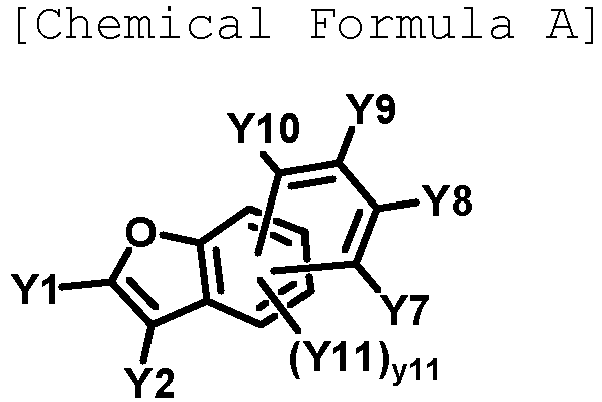 in Chemical Formula A,any one of Y1, Y2 and Y7 to Y11 is a moiety bonded to L, and the others of Y1, Y2 and Y7 to Y11 which are not bonded to L are the same as or different from each other, and are each independently hydrogen; deuterium; a halogen group; a substituted or unsubstituted alkyl group; a substituted or unsubstituted cycloalkyl group; a substituted or unsubstituted alkenyl group; a substituted or unsubstituted alkoxy group; a substituted or unsubstituted aryloxy group; a substituted or unsubstituted alkylthioxy group; a substituted or unsubstituted arylthioxy group; a substituted or unsubstituted silyl group; a substituted or unsubstituted amine group; a substituted or unsubstituted aryl group; or a substituted or unsubstituted heteroaryl group, or any one or more adjacent pairs are bonded to each other to form a substituted or unsubstituted ring, y11 is 1 or 2, and when y11 is 2, two Y11's are the same as or different from each other, andChemical Formula 1 includes at least one deuterium.
 - The compound of claim 1, wherein Chemical Formula A is any one of the following Chemical Formulae A-1 to A-3:
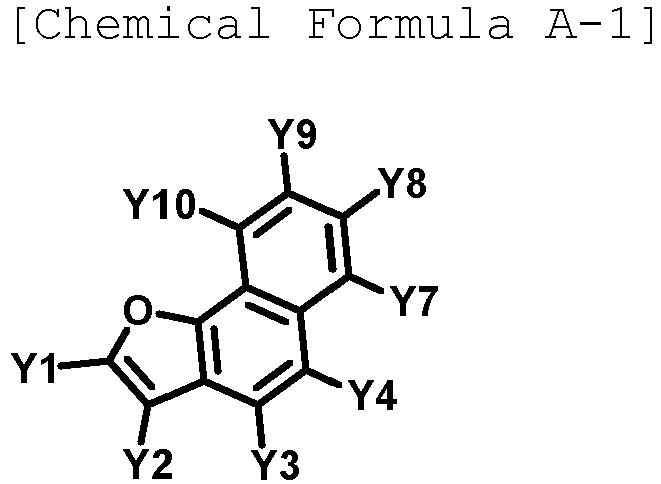

 any one of Y1 to Y4 and Y7 to Y10 is a moiety bonded to L, and the others of Y1 to Y4 and Y7 to Y10 which are not bonded to L are the same as or different from each other, and are each independently hydrogen; deuterium; a halogen group; a substituted or unsubstituted alkyl group; a substituted or unsubstituted cycloalkyl group; a substituted or unsubstituted alkenyl group; a substituted or unsubstituted alkoxy group; a substituted or unsubstituted aryloxy group; a substituted or unsubstituted alkylthioxy group; a substituted or unsubstituted arylthioxy group; a substituted or unsubstituted silyl group; a substituted or unsubstituted amine group; a substituted or unsubstituted aryl group; or a substituted or unsubstituted heteroaryl group, or any one or more adjacent pairs are bonded to each other to form a substituted or unsubstituted ring,in Chemical Formula A-2,any one of Y1 to Y3, Y5 and Y7 to Y10 is a moiety bonded to L, and the others of Y1 to Y3, Y5 and Y7 to Y10 which are not bonded to L are the same as or different from each other, and are each independently hydrogen; deuterium; a halogen group; a substituted or unsubstituted alkyl group; a substituted or unsubstituted cycloalkyl group; a substituted or unsubstituted alkenyl group; a substituted or unsubstituted alkoxy group; a substituted or unsubstituted aryloxy group; a substituted or unsubstituted alkylthioxy group; a substituted or unsubstituted arylthioxy group; a substituted or unsubstituted silyl group; a substituted or unsubstituted amine group; a substituted or unsubstituted aryl group; or a substituted or unsubstituted heteroaryl group, or any one or more adjacent pairs are bonded to each other to form a substituted or unsubstituted ring,in Chemical Formula A-3,
any one of Y1, Y2 and Y5 to Y10 is a moiety bonded to L, and the others of Y1, Y2 and Y5 to Y10 which are not bonded to L are the same as or different from each other, and are each independently hydrogen; deuterium; a halogen group; a substituted or unsubstituted alkyl group; a substituted or unsubstituted cycloalkyl group; a substituted or unsubstituted alkenyl group; a substituted or unsubstituted alkoxy group; a substituted or unsubstituted aryloxy group; a substituted or unsubstituted alkylthioxy group; a substituted or unsubstituted arylthioxy group; a substituted or unsubstituted silyl group; a substituted or unsubstituted amine group; a substituted or unsubstituted aryl group; or a substituted or unsubstituted heteroaryl group, or any one or more adjacent pairs are bonded to each other to form a substituted or unsubstituted ring. - The compound of claim 1, wherein Chemical Formula 1 is the following Chemical Formula 1-1:
 the definitions of R1, R3 to R10 and L are the same as those defined in Chemical Formula 1,any one of Y11 to Y13 is a moiety bonded to L, and the others of Y11 to Y13 which are not bonded to L are the same as or different from each other, and are each independently hydrogen; deuterium; a halogen group; a substituted or unsubstituted alkyl group; a substituted or unsubstituted cycloalkyl group; a substituted or unsubstituted alkenyl group; a substituted or unsubstituted alkoxy group; a substituted or unsubstituted aryloxy group; a substituted or unsubstituted alkylthioxy group; a substituted or unsubstituted arylthioxy group; a substituted or unsubstituted silyl group; a substituted or unsubstituted amine group; a substituted or unsubstituted aryl group; or a substituted or unsubstituted heteroaryl group, or any one or more adjacent pairs are bonded to each other to form a substituted or unsubstituted ring,y11 and y13 are each 1 or 2,y12 is an integer from 1 to 4,
 when y11 is 2, two Y11's are the same as or different from each other,when y13 is 2, two Y13's are the same as or different from each other, andwhen y12 is 2 or higher, two or more Y12's are the same as or different from each other.
 - The compound of claim 1, wherein Chemical Formula 1 is any one of the following Chemical Formulae 1-2 to 1-4:


 the definitions of R1, R3 to R10 and L are the same as those defined in Chemical Formula 1,any one of Y11 to Y13 is a moiety bonded to L, and the others of Y11 to Y13 which are not bonded to L are the same as or different from each other, and are each independently hydrogen; deuterium; a halogen group; a substituted or unsubstituted alkyl group; a substituted or unsubstituted cycloalkyl group; a substituted or unsubstituted alkenyl group; a substituted or unsubstituted alkoxy group; a substituted or unsubstituted aryloxy group; a substituted or unsubstituted alkylthioxy group; a substituted or unsubstituted arylthioxy group; a substituted or unsubstituted silyl group; a substituted or unsubstituted amine group; a substituted or unsubstituted aryl group; or a substituted or unsubstituted heteroaryl group, or any one or more adjacent pairs are bonded to each other to form a substituted or unsubstituted ring,y11 and y13 are each 1 or 2,y12 is an integer from 1 to 4,
 when y11 is 2, two Y11's are the same as or different from each other,when y13 is 2, two Y13's are the same as or different from each other, andwhen y12 is 2 or higher, two or more Y12's are the same as or different from each other.
 - The compound of claim 1, wherein R1 is a monocyclic or polycyclic aryl group having 6 to 30 carbon atoms, which is unsubstituted or substituted with one or more of deuterium, a straight-chained or branched alkyl group having 1 to 30 carbon atoms, a monocyclic or polycyclic aryl group having 6 to 30 carbon atoms, which is unsubstituted or substituted with deuterium, and combinations thereof.
- The compound of claim 1, wherein R3 to R10 are the same as or different from each other, and are each independently hydrogen; deuterium; a monocyclic or polycyclic aryl group having 6 to 30 carbon atoms, which is unsubstituted or substituted with deuterium; or a monocyclic or polycyclic heteroaryl group having 2 to 30 carbon atoms, which is unsubstituted or substituted with deuterium.
- The compound of claim 1, wherein L is a direct bond, a monocyclic or polycyclic arylene group having 6 to 30 carbon atoms, which is unsubstituted or substituted with deuterium, or a monocyclic or polycyclic heteroarylene group having 2 to 30 carbon atoms, which is unsubstituted or substituted with deuterium.
- The compound of claim 1, wherein any one of Y1, Y2 and Y7 to Y11 is a moiety bonded to L, and the others of Y1, Y2 and Y7 to Y11, which are not bonded to L, are the same as or different from each other, and are each independently hydrogen; deuterium; a straight-chained or branched alkyl group having 1 to 30 carbon atoms, which is unsubstituted or substituted with deuterium; a monocyclic or polycyclic cycloalkyl group having 2 to 30 carbon atoms, which is unsubstituted or substituted with deuterium; or a monocyclic or polycyclic aryl group having 6 to 30 carbon atoms, which is unsubstituted or substituted with deuterium, or any one or more adjacent pairs are bonded to each other to form a hydrocarbon ring having 3 to 30 carbon atoms, which is unsubstituted or substituted with a straight-chained or branched alkyl group having 1 to 30 carbon atoms, which is unsubstituted or substituted with deuterium.
- The compound of claim 1, wherein Chemical Formula 1 is any one selected from the following compounds:


- An organic light emitting device comprising: a first electrode; a second electrode; and an organic material layer having one or more layers provided between the first electrode and the second electrode, wherein one or more layers of the organic material layer comprise the compound of any one of claims 1 to 9.
- The organic light emitting device of claim 10,
wherein the organic material layer comprises a light emitting layer, and the light emitting layer comprises the compound as a host of the light emitting layer. - The organic light emitting device of claim 11,
wherein the light emitting layer comprises a dopant, and the dopant comprises a fluorescent dopant. - The organic light emitting device of claim 12,
wherein the fluorescent dopant comprises one or more selected from among a pyrene-based compound and a non-pyrene-based compound. - The organic light emitting device of claim 13,
wherein the non-pyrene-based compound comprises a boron-based compound. - The organic light emitting device of claim 11,
wherein the light emitting layer further comprises one or more hosts different from the compound.
Applications Claiming Priority (2)
| Application Number | Priority Date | Filing Date | Title |
|---|---|---|---|
| KR1020220079962A KR20240002594A (en) | 2022-06-29 | 2022-06-29 | Compound and organic light emitting device comprising same |
| PCT/KR2023/008515 WO2024005432A1 (en) | 2022-06-29 | 2023-06-20 | Compound and organic light-emitting device comprising same |
Publications (2)
| Publication Number | Publication Date |
|---|---|
| EP4446316A1 true EP4446316A1 (en) | 2024-10-16 |
| EP4446316A4 EP4446316A4 (en) | 2025-05-21 |
Family
ID=89380785
Family Applications (1)
| Application Number | Title | Priority Date | Filing Date |
|---|---|---|---|
| EP23831792.9A Pending EP4446316A4 (en) | 2022-06-29 | 2023-06-20 | COMPOUND AND ORGANIC ELECTROLUMINESCENT DEVICE COMPRISING SAME |
Country Status (6)
| Country | Link |
|---|---|
| US (1) | US20250241115A1 (en) |
| EP (1) | EP4446316A4 (en) |
| JP (1) | JP2025503532A (en) |
| KR (2) | KR20240002594A (en) |
| CN (1) | CN118434724A (en) |
| WO (1) | WO2024005432A1 (en) |
Family Cites Families (17)
| Publication number | Priority date | Publication date | Assignee | Title |
|---|---|---|---|---|
| KR100430549B1 (en) | 1999-01-27 | 2004-05-10 | 주식회사 엘지화학 | New organomattalic complex molecule for the fabrication of organic light emitting diodes |
| JP4392206B2 (en) * | 2003-07-30 | 2009-12-24 | 三井化学株式会社 | Anthracene compound and organic electroluminescent device containing the anthracene compound |
| CN102224148B (en) * | 2008-09-23 | 2015-07-15 | 株式会社Lg化学 | Compound, method for preparing same, and organic electronic component using same |
| EP2493835A4 (en) | 2009-10-26 | 2015-07-15 | Du Pont | Method for preparing deuterated aromatic compounds |
| KR102291489B1 (en) * | 2014-11-10 | 2021-08-20 | 삼성디스플레이 주식회사 | Compound and Organic light emitting device comprising same |
| US12384796B2 (en) * | 2016-06-03 | 2025-08-12 | Lg Chem, Ltd. | Electroactive compounds |
| KR102800490B1 (en) * | 2016-10-05 | 2025-04-29 | 에스에프씨 주식회사 | Organic light-emitting diode with long lifetime, low voltage and high efficiency |
| KR102136806B1 (en) * | 2018-03-28 | 2020-07-23 | 엘지디스플레이 주식회사 | Novel organic compounds and an organic electroluminescent device comprising the same |
| CN110317186B (en) * | 2018-03-28 | 2023-07-07 | 乐金显示有限公司 | Novel organic compound and organic electroluminescent device comprising the same |
| WO2019235873A1 (en) * | 2018-06-08 | 2019-12-12 | 주식회사 엘지화학 | Organic light-emitting device |
| KR102091507B1 (en) * | 2018-07-24 | 2020-03-20 | 머티어리얼사이언스 주식회사 | Organic electroluminescent device |
| US12114562B2 (en) * | 2019-01-21 | 2024-10-08 | Sfc Co., Ltd. | Compound for organic light-emitting diode and long lifespan organic light-emitting diode comprising same |
| CN114514225A (en) * | 2019-07-31 | 2022-05-17 | 杜邦电子公司 | Electroactive compounds |
| CN110798744A (en) | 2019-11-08 | 2020-02-14 | 北京字节跳动网络技术有限公司 | Multimedia information processing method, device, electronic equipment and medium |
| CN113950754B (en) * | 2020-01-20 | 2024-04-30 | 株式会社Lg化学 | Organic light-emitting devices |
| EP4369902A4 (en) * | 2021-07-07 | 2024-12-04 | LG Chem, Ltd. | COMPOUND AND ORGANIC LIGHT-EMITTING DEVICE THEREOF |
| CN116199656B (en) * | 2023-03-09 | 2025-01-28 | 阜阳欣奕华新材料科技股份有限公司 | A compound containing naphthofuran and anthracene and an organic light-emitting device using the compound |
-
2022
- 2022-06-29 KR KR1020220079962A patent/KR20240002594A/en not_active Ceased
-
2023
- 2023-06-20 WO PCT/KR2023/008515 patent/WO2024005432A1/en not_active Ceased
- 2023-06-20 EP EP23831792.9A patent/EP4446316A4/en active Pending
- 2023-06-20 JP JP2024539280A patent/JP2025503532A/en active Pending
- 2023-06-20 CN CN202380015462.8A patent/CN118434724A/en active Pending
- 2023-06-20 US US18/730,729 patent/US20250241115A1/en active Pending
-
2025
- 2025-07-14 KR KR1020250094596A patent/KR20250114250A/en active Pending
Also Published As
| Publication number | Publication date |
|---|---|
| US20250241115A1 (en) | 2025-07-24 |
| WO2024005432A1 (en) | 2024-01-04 |
| CN118434724A (en) | 2024-08-02 |
| EP4446316A4 (en) | 2025-05-21 |
| KR20250114250A (en) | 2025-07-29 |
| KR20240002594A (en) | 2024-01-05 |
| JP2025503532A (en) | 2025-02-04 |
Similar Documents
| Publication | Publication Date | Title |
|---|---|---|
| EP3439062B1 (en) | Organic light emitting element | |
| EP3428163B1 (en) | Polycyclic compound and organic light emitting element comprising same | |
| EP3360868B1 (en) | Spiro-type compound and organic light emitting diode comprising same | |
| CN115996915B (en) | Heterocyclic compound and organic light-emitting device using the same | |
| EP3305771A2 (en) | Heterocyclic compound and organic light emitting device including same | |
| EP4431507A1 (en) | Compound and organic light-emitting device comprising same | |
| EP3763720B1 (en) | Compound and organic light emitting device comprising same | |
| EP3263555B1 (en) | Hetero ring compound and organic luminescent element comprising same | |
| EP4446315A1 (en) | Compound and organic light-emitting device comprising same | |
| KR20240146582A (en) | Compound and organic light emitting device comprising same | |
| KR102374517B1 (en) | Heterocyclic compound and organic light emitting device comprising the same | |
| EP4431506A1 (en) | Compound and organic light-emitting device comprising same | |
| EP4212535B1 (en) | Compound and organic light-emitting element comprising same | |
| KR20240146581A (en) | Compound and organic light emitting device comprising same | |
| KR101907797B1 (en) | Heterocyclic compound and organic light emitting device comprising the same | |
| EP4446321A1 (en) | Compound and organic light-emitting device comprising same | |
| US20250241115A1 (en) | Compound and organic light-emitting device comprising same | |
| EP4431500A1 (en) | Compound and organic light-emitting device comprising same | |
| KR102885092B1 (en) | Compound and organic light emitting device comprising same | |
| KR102943871B1 (en) | Compound and organic light emitting device comprising same | |
| KR20240146583A (en) | Compound and organic light emitting device comprising same | |
| KR20240146580A (en) | Compound and organic light emitting device comprising same | |
| KR20240009858A (en) | Compound and organic light emitting device comprising same |
Legal Events
| Date | Code | Title | Description |
|---|---|---|---|
| STAA | Information on the status of an ep patent application or granted ep patent |
Free format text: STATUS: THE INTERNATIONAL PUBLICATION HAS BEEN MADE |
|
| PUAI | Public reference made under article 153(3) epc to a published international application that has entered the european phase |
Free format text: ORIGINAL CODE: 0009012 |
|
| STAA | Information on the status of an ep patent application or granted ep patent |
Free format text: STATUS: REQUEST FOR EXAMINATION WAS MADE |
|
| 17P | Request for examination filed |
Effective date: 20240711 |
|
| AK | Designated contracting states |
Kind code of ref document: A1 Designated state(s): AL AT BE BG CH CY CZ DE DK EE ES FI FR GB GR HR HU IE IS IT LI LT LU LV MC ME MK MT NL NO PL PT RO RS SE SI SK SM TR |
|
| A4 | Supplementary search report drawn up and despatched |
Effective date: 20250423 |
|
| RIC1 | Information provided on ipc code assigned before grant |
Ipc: C09K 11/06 20060101ALI20250415BHEP Ipc: C07D 407/04 20060101ALI20250415BHEP Ipc: C07B 59/00 20060101ALI20250415BHEP Ipc: H10K 50/11 20230101ALI20250415BHEP Ipc: H10K 85/60 20230101ALI20250415BHEP Ipc: C07D 307/92 20060101AFI20250415BHEP |
|
| DAV | Request for validation of the european patent (deleted) | ||
| DAX | Request for extension of the european patent (deleted) | ||
| STAA | Information on the status of an ep patent application or granted ep patent |
Free format text: STATUS: EXAMINATION IS IN PROGRESS |
|
| 17Q | First examination report despatched |
Effective date: 20251119 |