EP4445976A1 - Information processing device, information processing method, and program - Google Patents
Information processing device, information processing method, and program Download PDFInfo
- Publication number
- EP4445976A1 EP4445976A1 EP22903989.6A EP22903989A EP4445976A1 EP 4445976 A1 EP4445976 A1 EP 4445976A1 EP 22903989 A EP22903989 A EP 22903989A EP 4445976 A1 EP4445976 A1 EP 4445976A1
- Authority
- EP
- European Patent Office
- Prior art keywords
- user
- play
- information processing
- learning
- unit
- Prior art date
- Legal status (The legal status is an assumption and is not a legal conclusion. Google has not performed a legal analysis and makes no representation as to the accuracy of the status listed.)
- Granted
Links
Images






Classifications
-
- A—HUMAN NECESSITIES
- A63—SPORTS; GAMES; AMUSEMENTS
- A63F—CARD, BOARD, OR ROULETTE GAMES; INDOOR GAMES USING SMALL MOVING PLAYING BODIES; VIDEO GAMES; GAMES NOT OTHERWISE PROVIDED FOR
- A63F13/00—Video games, i.e. games using an electronically generated display having two or more dimensions
- A63F13/60—Generating or modifying game content before or while executing the game program, e.g. authoring tools specially adapted for game development or game-integrated level editor
- A63F13/67—Generating or modifying game content before or while executing the game program, e.g. authoring tools specially adapted for game development or game-integrated level editor adaptively or by learning from player actions, e.g. skill level adjustment or by storing successful combat sequences for re-use
-
- A—HUMAN NECESSITIES
- A63—SPORTS; GAMES; AMUSEMENTS
- A63F—CARD, BOARD, OR ROULETTE GAMES; INDOOR GAMES USING SMALL MOVING PLAYING BODIES; VIDEO GAMES; GAMES NOT OTHERWISE PROVIDED FOR
- A63F13/00—Video games, i.e. games using an electronically generated display having two or more dimensions
- A63F13/40—Processing input control signals of video game devices, e.g. signals generated by the player or derived from the environment
- A63F13/42—Processing input control signals of video game devices, e.g. signals generated by the player or derived from the environment by mapping the input signals into game commands, e.g. mapping the displacement of a stylus on a touch screen to the steering angle of a virtual vehicle
- A63F13/422—Processing input control signals of video game devices, e.g. signals generated by the player or derived from the environment by mapping the input signals into game commands, e.g. mapping the displacement of a stylus on a touch screen to the steering angle of a virtual vehicle automatically for the purpose of assisting the player, e.g. automatic braking in a driving game
-
- A—HUMAN NECESSITIES
- A63—SPORTS; GAMES; AMUSEMENTS
- A63F—CARD, BOARD, OR ROULETTE GAMES; INDOOR GAMES USING SMALL MOVING PLAYING BODIES; VIDEO GAMES; GAMES NOT OTHERWISE PROVIDED FOR
- A63F13/00—Video games, i.e. games using an electronically generated display having two or more dimensions
- A63F13/40—Processing input control signals of video game devices, e.g. signals generated by the player or derived from the environment
- A63F13/42—Processing input control signals of video game devices, e.g. signals generated by the player or derived from the environment by mapping the input signals into game commands, e.g. mapping the displacement of a stylus on a touch screen to the steering angle of a virtual vehicle
- A63F13/424—Processing input control signals of video game devices, e.g. signals generated by the player or derived from the environment by mapping the input signals into game commands, e.g. mapping the displacement of a stylus on a touch screen to the steering angle of a virtual vehicle involving acoustic input signals, e.g. by using the results of pitch or rhythm extraction or voice recognition
-
- A—HUMAN NECESSITIES
- A63—SPORTS; GAMES; AMUSEMENTS
- A63F—CARD, BOARD, OR ROULETTE GAMES; INDOOR GAMES USING SMALL MOVING PLAYING BODIES; VIDEO GAMES; GAMES NOT OTHERWISE PROVIDED FOR
- A63F13/00—Video games, i.e. games using an electronically generated display having two or more dimensions
- A63F13/45—Controlling the progress of the video game
- A63F13/49—Saving the game status; Pausing or ending the game
- A63F13/497—Partially or entirely replaying previous game actions
Definitions
- the present disclosure relates to an information processing device, an information processing method, and a program.
- game application software
- TPS third-person shooter
- MMORPG massively multiplayer online role-playing game
- some game applications have, for example, an auto-play function of automatically executing predetermined game contents set in advance.
- Low-skill users, busy users, and the like can be assisted in their own gameplay by using such an auto-play function.
- a technology of assisting team organization and strategy in a team environment such as the MMORPG has also been proposed (see, for example, Patent Literature 1).
- Patent Literature 1 Japanese Patent Application Laid-open No. 2021-041225
- the present disclosure proposes an information processing device, an information processing method, and a program capable of improving convenience in application operation by the user regardless of the application.
- one aspect of an information processing device includes: a learning unit that learns a situation at a time of operation by a user on an application by machine learning; and an assistance unit that executes, across one or more of the applications, operation assistance processing of automatically operating the application by using a learning result of the learning unit.
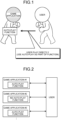
- FIG. 1 is a schematic explanatory diagram (part 1) of an information processing method according to an existing technology.
- FIG. 2 is a schematic explanatory diagram (part 2) of the information processing method according to the existing technology.
- FIG. 3 is a schematic explanatory diagram (part 1) of an information processing method according to an embodiment of the present disclosure.
- FIG. 4 is a schematic explanatory diagram (part 2) of the information processing method according to the embodiment of the present disclosure.
- the existing technology is based on a relationship in which the user directly plays one game application on a one-to-one basis. Furthermore, at this time, even when the game application has the auto-play function, the user can only use the auto-play as a part of the function of the game application. Contents of the auto-play usually varies depending on game applications.
- the user in a case where the user uses a plurality of game applications by using one information processing device, the user needs to perform different operations for game sessions of the game applications respectively with respect to the use of the auto-play in the existing technology.
- the user can use the auto-play for the game applications having the auto-play function, that is, game applications #1 and #3 in the example of FIG. 2
- contents of the auto-play that can be set vary depending on the game applications. For example, there are some game applications in which the above-described level grinding can be performed and those in which the level grinding cannot be performed.
- a situation at the time of play by the user on the game application is learned by machine learning, and operation assistance processing of performing the auto-play of the game application by using a learning result of the machine learning is executed across one or more of the game applications.
- the information processing device has a gameplay assistance function.
- a "gameplay assistance application” that executes such a function is interposed between the game application and the user, and provides an auto-play function of automatically playing a game on behalf of the user.
- the gameplay assistance application provides the auto-play function in a form of integrating a plurality of game applications, in other words, across a plurality of game applications.
- the gameplay assistance application can also provide the auto-play function for the game application #2 that does not originally have the auto-play function.
- the gameplay assistance application can integrally perform setting of the auto-play of the game applications #1 and #3 originally having individual auto-play functions in addition to the game application #2.
- the gameplay assistance application sets the auto-play on the basis of an artificial intelligence (AI) model 15a that learns a "situation at the time of play” including "mental and physical state” of the user based on vital data, a "surrounding situation” such as a global positioning system (GPS) position and temperature, and the like as needed.
- AI artificial intelligence
- the AI model 15a is, for example, a deep neural network (DNN) or the like.
- information that is related to the situation at the time of play by the user and that is indicated by not only the game application but also what is other than the game application is acquired, and contents of the auto-play is set according to a feature at the time of play of the user which feature is learned by utilization of the information.
- the gameplay assistance application replays a video of a play scene played by the user in the past, and proposes contents of the auto-play according to each scene and corresponding to the feature of the user at the time of play to the user. Then, contents of the auto-play are set in a form of being interactive with the user for the proposal. Then, the gameplay assistance application executes the auto-play according to contents of the set auto-play.
- the gameplay assistance application can notify the other information processing device 10 that the auto-play function is used with respect to a game application that exchanges information with the other information processing device 10 via a network N, such as the game application #3.
- a network N such as the game application #3.
- the situation at the time of play by the user on the game application is learned by machine learning, and the operation assistance processing of performing the auto-play of the game application by using the learning result of the machine learning is executed across one or more of the game applications.
- the monotonous level grinding work that needs to be performed steadily by the user in the existing technology includes two meanings.
- the first is work of repeatedly laying down a monster or the like and accumulating an experience point in an RPG-type game.
- the work is to repeatedly perform practice and a match and accumulate an experience point.
- the second is work of improving an attribute of a character by using the accumulated experience point.
- the experience points necessary to be a next level are accumulated, "raising the level" automatically occurs due to processing on a game side, and there are many cases where it is not necessary for the user himself/herself to perform the operation for raising the level.
- the auto-play function is included in the sport-related game, the experience points are accumulated but are not consumed in many cases while the practice or the match is repeatedly performed in the auto-play function.
- the user needs to stop the auto-play once and perform operation to improve ability of the character by manual operation. That is, in this case, the user needs to manually perform operation of selecting a specific attribute to be improved from among attributes such as offensive ability, defensive ability, running ability, and dribbling of the character by using the accumulated experience points.
- the information processing method according to an embodiment of the present disclosure realizes automatic execution of the monotonous level grinding work on behalf of the user.
- a configuration example of the information processing device 10 to which the information processing method according to the embodiment of the present disclosure is applied will be described more specifically.
- FIG. 5 is a block diagram illustrating the configuration example of the information processing device 10 according to the embodiment of the present disclosure. Note that only components necessary for describing features of the embodiment of the present disclosure are illustrated in FIG. 5 , and description of general components is omitted.
- each of the components illustrated in FIG. 5 is functionally conceptual, and is not necessarily configured physically in an illustrated manner.
- a specific form of distribution/integration of each block is not limited to what is illustrated in the drawings, and a whole or part thereof can be functionally or physically distributed/integrated in an arbitrary unit according to various loads and usage conditions.
- the information processing device 10 is a computer used by the user to use a game application and various other applications, and is, for example, a smartphone or a tablet terminal. Note that the information processing device 10 may be a personal computer (PC), a wearable device, or a game dedicated machine or the like as when being limited to a game application.
- PC personal computer
- wearable device or a game dedicated machine or the like as when being limited to a game application.
- the information processing device 10 includes a sensor unit 11, an input unit 12, an output unit 13, a communication unit 14, a storage unit 15, and a control unit 16.
- the sensor unit 11 is a group of various sensors, and includes, for example, a camera 11a, a vital sensor 11b, a GPS sensor 11c, and a microphone 11d.
- the camera 11a is, for example, a front camera of a smartphone or the like, and is provided in such a manner as to be able to capture image data from which an expression, a line of sight, a pupillary reaction, and the like of the user playing a game can be detected.
- the vital sensor 11b is a sensor that detects a mental and physical state of the user, is worn by the user, and measures vital data indicating the mental and physical state of the user playing the game, such as a heartbeat, brain waves, a blood oxygen level, and perspiration of the user.
- the GPS sensor 11c measures a GPS position of the user playing the game.
- the microphone 11d collects utterance of the user playing the game.
- the sensor unit 11 may appropriately include various sensors other than those described above, such as an inertial sensor.
- the input unit 12 is an input component to which the user inputs various kinds of operation. Note that the input unit 12 may be integrated with the output unit 13 (described later) by a touch panel or the like. Thus, the input unit 12 may be a software component, and may be a graphical user interface (GUI) for operating a game application, for example.
- GUI graphical user interface
- the output unit 13 is, for example, a display device that displays visual information, and displays visual information such as a moving image and text related to an entire system or the game application under the control of the control unit 16.
- Examples of the above display device include a liquid crystal display (LCD), an organic light emitting diode (OLED), and the like.
- the output unit 13 is, for example, a sounding device that emits voice information, and emits voice information such as a voice related to the entire system or the game application under the control of the control unit 16.
- the sounding device include a speaker and the like.
- the communication unit 14 is realized, for example, by a network interface card (NIC) or the like.
- the communication unit 14 is connected in a wireless or wired manner to the network N such as the Internet or a mobile phone network, and transmits and receives information to and from the other information processing device 10 or a game server (not illustrated) via the network N.
- the network N such as the Internet or a mobile phone network
- the storage unit 15 is realized by, for example, a semiconductor memory element such as a random access memory (RAM), a read only memory (ROM), or a flash memory. In the example illustrated in FIG. 5 , the storage unit 15 stores the AI model 15a and application information 15b.
- the AI model 15a already illustrated in FIG. 4 is a learning model learned by a learning unit 16b (described later). As described above, the AI model 15a is a DNN or the like, and learns correlation of elements in a multidimensional feature amount space having elements indicating the contents of the game and the situation at the time of play as dimensions as needed.
- Examples of the elements include a game title, an input by the user with respect to the contents of the game being played and an output corresponding thereto, a mental and physical state of the user with respect to the input or the output, a surrounding situation such as a GPS position and a temperature during the play, change operation at the time of erroneous input, and the like.
- the application information 15b is information including various applications executed by the information processing device 10, such as programs of the game applications, various parameters used during execution of the game applications, and the like.
- the control unit 16 is a controller, and is realized, for example, when various programs stored in the storage unit 15 are executed by a central processing unit (CPU), a micro processing unit (MPU), or the like with a RAM as a work area. Also, the control unit 16 can be realized by, for example, an integrated circuit such as an application specific integrated circuit (ASIC) or a field programmable gate array (FPGA).
- ASIC application specific integrated circuit
- FPGA field programmable gate array
- the control unit 16 includes an acquisition unit 16a, the learning unit 16b, a gameplay assistance unit 16c, an application execution unit 16d, and a transmission/reception unit 16e, and realizes or executes a function and an action of information processing described below.
- the acquisition unit 16a acquires the above-described situation at the time of the play, which situation includes the mental and physical state of the user and the surrounding situation, via the sensor unit 11. Furthermore, the acquisition unit 16a outputs the acquired situation at the time of the play to the learning unit 16b as needed. Note that the acquisition unit 16a can acquire the situation (such as a temperature, weather, traffic condition, and the like) at the time of the play via the network N not only from the sensor unit 11 but also from, for example, the transmission/reception unit 16e (described later) .
- the situation such as a temperature, weather, traffic condition, and the like
- the learning unit 16b learns the AI model 15a on the basis of the situation at the time of the play, which situation is acquired by the acquisition unit 16a, and contents of a game which contents are input from the gameplay assistance unit 16c (described later).
- An example of learning algorithm executed by the learning unit 16b will be described later with reference to FIG. 13 and FIG. 14 . Note that in a case where the AI model 15a is the DNN, the learning unit 16b learns the AI model 15a by using deep learning.
- the gameplay assistance unit 16c executes gameplay assistance processing for realizing the function of the gameplay assistance application described with reference to FIG. 3 and FIG. 4 . That is, the gameplay assistance unit 16c provides the auto-play function in a form in which a plurality of game applications is integrated.
- the gameplay assistance unit 16c proposes contents of the auto-play corresponding to the feature at the time of the play by the user, which contents are output from the AI model 15a, to the user with respect to the input situation at the time of the play and contents of the game. Then, the gameplay assistance unit 16c sets the contents of the auto-play in a form of being interactive with the user who uses the input unit 12 and the output unit 13 in response to the proposal. Then, with respect to the application execution unit 16d (described later) that executes the game application, the gameplay assistance unit 16c executes the auto-play in place of the user according to the set contents of the auto-play.
- the gameplay assistance unit 16c provides the semi-auto-play function of reflecting the operation of the user only when the user intervenes via the input unit 12 interruptively with respect to the auto-play that substitutes for the user.
- the gameplay assistance unit 16c notifies the other information processing device 10, with which the application execution unit 16d exchanges information related to the currently-executed game application via the network N, that the auto-play function is used.
- the gameplay assistance unit 16c executes the gameplay assistance processing while residing in the control unit 16 as, for example, middleware.
- the application execution unit 16d executes the game application started by the user.
- the application execution unit 16d receives an input by the user via the input unit 12 or an input by the auto-play in place of the user.
- the application execution unit 16d causes the output unit 13 to output the contents of the game, which progresses according to the received input, as an output result via the gameplay assistance unit 16c.
- the transmission/reception unit 16e transmits and receives the information to and from the other information processing device 10 via the communication unit 14. Furthermore, the transmission/reception unit 16e receives the situation at the time of the play which situation can be acquired via the network N, and causes the acquisition unit 16a to perform the acquisition.
- FIG. 6 is a view illustrating an example of an on/off setting screen of the auto-play.
- the information processing device 10 displays the on/off setting screen of the auto-play in a manner illustrated in FIG. 6 , for example.
- a setting screen is displayed by the gameplay assistance unit 16c, for example, in a case where the user selects an item corresponding to the auto-play from a system setting screen or the like of the information processing device 10.
- any game session may be selected instead of the "all game sessions”.
- the user can arbitrarily select each item indicating contents of each auto-play, such as "level grinding in a field” or “searching for an item in a field” for the "auto-play contents”.
- the gameplay assistance unit 16c can present the items as options on the basis of each of determined scenes as a result of the past AI learning.
- FIG. 6 an example of the "auto-play contents" that can be set for the MMORPG and the like is illustrated in FIG. 6 .
- the user uses another game application such as a shooting game, a sport game, or the like by using the information processing device 10, in other words, in a case where such another game application is installed, an item corresponding to the other game application is displayed together in the "auto-play contents".
- the situation at the time of the play of the game application the point of acquiring the vital data of the user, the surrounding situation including the GPS position, the temperature, and the like has already been described.
- the information processing according to the embodiment of the present disclosure it is possible to learn the correlation between the game application and the situation at the time of the play by AI learning using these pieces of data, calculate a matching rate of the auto-play, and set the auto-play based on the matching rate, for example.
- FIG. 7 is an explanatory diagram (part 1) of a setting example of the auto-play corresponding to the situation at the time of the play.
- FIG. 8 is an explanatory diagram (part 2) of the setting example of the auto-play corresponding to the situation at the time of the play.
- the vital data of the user, a GPS position, an ambient temperature, a time period, an environmental sound, and the like are acquired as the situation at the time of the play.
- each of these pieces of data indicates, for example, a situation in which it is difficult for the user to concentrate on play in playing of the game application by himself/herself, such as during commuting, going to school, working, or taking a class, or a situation that is originally not suitable for playing.
- the AI model 15a may be learned by utilization of these pieces of data, and in a case where, for example, a real-time situation at the time of the play is input, the AI model 15a may output an auto-play matching rate indicating a degree whether the situation is suitable for the auto-play.
- the gameplay assistance processing it is possible to replay a video of a play scene played by the user in the past, and propose contents of the auto-play according to each scene and corresponding to the feature of the user at the time of play to the user. Then, it is possible to interactively set the contents of the auto-play by a form of being interactive with the user for the proposal.
- FIG. 9 is an explanatory diagram (part 1) of an example of interactively setting the auto-play by using a replay of a scene.
- FIG. 10 is an explanatory diagram (part 2) of the example of interactively setting the auto-play by using the replay of a scene.
- the gameplay assistance unit 16c displays a dialog asking the user "Do you approve this operation?" about the operation from “aiming at the opponent” to "attacking the opponent” illustrated at a time point T2 to a time point T3 with a scene of "finding an opponent” at a time point T1 as a trigger, for example.
- the operation from the time point T2 to the time point T3 is set as the auto-play contents in the series of scenes triggered by the time point T1, and the auto-play of reproducing the play scene played by the user in the past is executed as illustrated in FIG. 10 .
- the gameplay assistance unit 16c proposes other operation.
- the other operation is, for example, operation of attacking the opponent with another weapon or operation of not attacking the opponent.
- the gameplay assistance unit 16c replays a scene corresponding to the other trigger, presents operation corresponding to the scene, and interactively sets contents of the auto-play.
- FIG. 11 is an explanatory diagram of the setting example of the semi-auto-play.
- the gameplay assistance unit 16c can set the semi-auto-play triggered by, for example, utterance of a predetermined wake word by the user. As illustrated in FIG. 11 , such a wake word evokes temporarily stopping the auto-play that substitutes for the user, such as "Wait” or "Oh”.
- the wake word that restarts the auto-play evokes the restart of the auto-play, such as "Good” or "Return”.
- the gameplay assistance unit 16c can perform setting of the semi-auto-play.
- the trigger of the start/cancellation of the semi-auto-play may be based on vital data of the user. Examples the above include a change in a line of sight, a gesture, a change in brain waves, and the like.
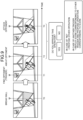
- FIG. 12 is an explanatory diagram of the example of the notification to the other information processing device 10. Note that FIG. 12 is a view illustrating a game screen displayed on the other information processing device 10.
- the gameplay assistance unit 16c notifies the other information processing device 10 that the user is in the auto-play.
- the other information processing device 10 that receives the notification displays a symbol ("A" indicating "Auto Play” in the example of FIG. 12 ), an icon, or the like indicating that the auto-play is being performed together with a user name of the user.
- A indicating "Auto Play” in the example of FIG. 12
- an icon, or the like indicating that the auto-play is being performed together with a user name of the user.
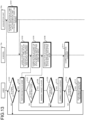
- FIG. 13 is a processing sequence (part 1) of the learning algorithm in the information processing device 10.
- FIG. 14 is a processing sequence (part 2) of the learning algorithm in the information processing device 10.
- FIG. 13 is a view illustrating a processing sequence of a case where the game application is a sport game
- FIG. 14 is a view illustrating a processing sequence of a case where the game application is an RPG game.
- the acquisition unit 16a acquires the situation at the time of the play, which situation includes the mental and physical state of the user, as needed (Step S101). Then, by the learning unit 16b, the AI model 15a learns the correlation of the situation at the time of the play, the contents of the game, the input, and the output as needed (Step S102).
- Step S103 the user checks whether there is an action point while playing the sport game. In a case where there is the action point (Step S103, Yes), a match in the game is performed (Step S104).
- the AI model 15a learns an input start action in Step S104 and a difference in a state before and after the start of the input (Step S105).
- the difference in the state before and after the start of the input indicates a difference in the action point before the match and at the start of the match.
- the AI model 15a learns an action of stopping the match at the end of Step S104 and the difference in the state before and after the stop (Step S106).
- the difference in the state before and after the stop indicates a difference in a level of a player in the game before and after the match.
- Step S103 is repeated until the action points are accumulated.
- Step S107 the user checks whether there is a player whose level is MAX. In a case where there is a player whose level is MAX (Step S107, Yes), the target player is awakened (Step S108).
- Step S109 the user checks whether there is an input mistake with respect to the awakening of the player. In a case where there is the input mistake (Step S109, Yes), the input contents are corrected (Step S110) .
- the AI model 15a learns the correction contents in Step S110 (Step S111).
- the learning unit 16b can learn the AI model 15a related to the input mistake by using, for example, the utterance of "Oh” by the user, a change in brain waves, or the like as a trigger.
- Step S112 the user checks whether there is no action point. In a case where there is the action point (Step S112, No), the user repeats the action from Step S104.
- Step S113 the user performs an action point recovery measure (Step S113).
- the action point recovery measure is, for example, paying money, waiting for time recovery, or the like. Then, the user repeats the action from Step S103.
- the acquisition unit 16a acquires the situation at the time of the play, which situation includes the mental and physical state of the user, as needed (Step S201). Then, by the learning unit 16b, the AI model 15a learns the correlation of the situation at the time of the play, the contents of the game, the input, and the output as needed (Step S202) .
- Step S203 the user checks whether there are a health point (HP)/magic point (MP)/recovery item. In a case where there are these points and items (Step S203, Yes), movement to a place where an enemy that can be hunted at the current level is present and an important item in the current experience point or the current state is present is performed, and the enemy is hunted (Step S204).
- HP health point
- MP magic point
- the AI model 15a learns an input start action in Step S204 and a difference in a state before and after the start of the input (Step S205).
- the state before and after the start of the input indicates the HP/MP/recovery item, level, enemy in the hunting place, item, and the like.
- the AI model 15a learns the action of stopping the hunting at the end of Step S204 and the difference in the state before and after the stop (Step S206).
- the state before and after the stop indicates, for example, the remaining number of recovery items.
- Step S203 is repeated until these are accumulated by time recovery or the like.
- Step S207 the user checks whether there is no recovery item. In a case where there is no recovery item (Step S207, Yes), the item is acquired (Step S208). In a case where there is the recovery item (Step S207, No), transition to Step S209 is performed.
- Step S209 the user checks whether there is an input error with respect to hunting of the enemy. In a case where there is the input mistake (Step S209, Yes), the input contents is corrected (Step S210).
- the AI model 15a learns the correction contents in Step S210 (Step S211).
- the learning unit 16b can perform learning of the AI model 15a related to the input mistake by using, for example, the utterance of "Oh” by the user, the change in brain waves, or the like as the trigger as described above.
- Step S212 the user checks whether a stage has been cleared.
- the stage indicates, for example, a current hunting place.
- the user repeats the action from Step S204.
- Step S212 Yes
- Step S213 the user moves to a next stage (Step S213), and repeats the action from Step S203.
- the configuration of the AI model 15a learned by machine learning is not limited.
- the AI model 15a may be a variational auto encoder (VAE), a generative adversarial network (GAN), or the like.
- algorithm other than deep learning may be used as algorithm of machine learning.
- machine learning may be executed by a regression analysis method such as support vector regression using a pattern identifier such as a support vector machine (SVM) and the AI model 15a may be learned.
- the pattern identifier is not limited to the SVM, and may be, for example, AdaBoost.
- AdaBoost AdaBoost
- random forest, deep forest, or the like may be used.
- a whole or part of the processing described to be automatically performed can be manually performed, or a whole or part of the processing described to be manually performed can be automatically performed by a known method.
- the processing procedures, specific names, and information including various kinds of data or parameters in the above document or in the drawings can be arbitrarily changed unless otherwise specified.
- various kinds of information illustrated in each of the drawings are not limited to the illustrated information.
- each component of each of the illustrated devices is a functional concept, and does not need to be physically configured in the illustrated manner. That is, a specific form of distribution/integration of each device is not limited to what is illustrated in the drawings, and a whole or part thereof can be functionally or physically distributed/integrated in an arbitrary unit according to various loads and usage conditions.
- FIG. 15 is a hardware configuration diagram illustrating an example of the computer 1000 that realizes functions of the information processing device 10.
- the computer 1000 includes a CPU 1100, a RAM 1200, a ROM 1300, a hard disk drive (HDD) 1400, a communication interface 1500, and an input/output interface 1600.
- Each unit of the computer 1000 is connected by a bus 1050.
- the CPU 1100 operates on the basis of programs stored in the ROM 1300 or the HDD 1400, and controls each unit. For example, the CPU 1100 expands the programs, which are stored in the ROM 1300 or the HDD 1400, in the RAM 1200 and executes processing corresponding to the various programs.
- the ROM 1300 stores a boot program such as a basic input output system (BIOS) executed by the CPU 1100 during activation of the computer 1000, a program that depends on hardware of the computer 1000, and the like.
- BIOS basic input output system
- the HDD 1400 is a computer-readable recording medium that non-temporarily records the programs executed by the CPU 1100, data used by the programs, and the like.
- the HDD 1400 is a recording medium that records a program according to the embodiment of the present disclosure which program is an example of program data 1450.
- the communication interface 1500 is an interface with which the computer 1000 is connected to an external network 1550 (such as the Internet).
- the CPU 1100 receives data from another equipment or transmits data generated by the CPU 1100 to another equipment via the communication interface 1500.
- the input/output interface 1600 is an interface to connect an input/output device 1650 and the computer 1000.
- the CPU 1100 receives data from an input device such as a keyboard or mouse via the input/output interface 1600.
- the CPU 1100 transmits data to an output device such as a display, speaker, or printer via the input/output interface 1600.
- the input/output interface 1600 may function as a medium interface that reads a program or the like recorded on a predetermined recording medium (medium).
- the medium is, for example, an optical recording medium such as a digital versatile disc (DVD) or phase change rewritable disk (PD), a magneto-optical recording medium such as a magneto-optical disk (MO), a tape medium, a magnetic recording medium, a semiconductor memory, or the like.
- an optical recording medium such as a digital versatile disc (DVD) or phase change rewritable disk (PD)
- a magneto-optical recording medium such as a magneto-optical disk (MO)
- a tape medium such as a magneto-optical disk (MO)
- magnetic recording medium such as a magnetic tape, a magnetic recording medium, a semiconductor memory, or the like.
- the CPU 1100 of the computer 1000 realizes a function of the control unit 16 by executing the program loaded on the RAM 1200.
- the HDD 1400 stores a program according to the present disclosure, and data in the storage unit 15. Note that the CPU 1100 reads the program data 1450 from the HDD 1400 and performs execution thereof. However, these programs may be acquired from another device via the external network 1550 in another example.
- the information processing device 10 includes the learning unit 16b that learns a situation at the time of operation by the user on a game application (corresponding to an example of an "application”) by machine learning, and the gameplay assistance unit 16c (corresponding to an example of an "assistance unit") that executes, across one or more of the game applications, operation assistance processing of performing auto-play (corresponding to an example of "automatic operation") of the game application by using a learning result of the learning unit 16b.
- the learning unit 16b that learns a situation at the time of operation by the user on a game application (corresponding to an example of an "application") by machine learning
- the gameplay assistance unit 16c (corresponding to an example of an "assistance unit") that executes, across one or more of the game applications, operation assistance processing of performing auto-play (corresponding to an example of "automatic operation") of the game application by using a learning result of the learning unit 16b.
Landscapes
- Engineering & Computer Science (AREA)
- Multimedia (AREA)
- Human Computer Interaction (AREA)
- Physics & Mathematics (AREA)
- Acoustics & Sound (AREA)
- Electrically Operated Instructional Devices (AREA)
- User Interface Of Digital Computer (AREA)
Abstract
Description
- The present disclosure relates to an information processing device, an information processing method, and a program.
- In recent years, the spread of portable information processing devices such as smartphones and tablet terminals is remarkable. In addition, in these information processing devices, performance of image processing and communication processing is also rapidly improved, and a user can easily enjoy various kinds of game application software (hereinafter, referred to as "game application") such as, for example, a third-person shooter (TPS) and a massively multiplayer online role-playing game (MMORPG) by using these information processing devices.
- Furthermore, in such a situation, in order to further improve convenience of the user, some game applications have, for example, an auto-play function of automatically executing predetermined game contents set in advance. Low-skill users, busy users, and the like can be assisted in their own gameplay by using such an auto-play function. Similarly, a technology of assisting team organization and strategy in a team environment such as the MMORPG has also been proposed (see, for example, Patent Literature 1).
- Patent Literature 1:
Japanese Patent Application Laid-open No. 2021-041225 - However, the above-described conventional technology has room for further improvement in improving convenience in gameplay of the user regardless of the game application.
- For example, in a case where the above-described conventional technology is used, only a user who uses a specific game application having an auto-play function can be assisted in gameplay.
- Note that such a problem is also a common problem in a case where a user operates an application that is other than a game application and that has or does not have an automatic operation function corresponding to the auto-play function.
- Thus, the present disclosure proposes an information processing device, an information processing method, and a program capable of improving convenience in application operation by the user regardless of the application.
- In order to solve the above problems, one aspect of an information processing device according to the present disclosure includes: a learning unit that learns a situation at a time of operation by a user on an application by machine learning; and an assistance unit that executes, across one or more of the applications, operation assistance processing of automatically operating the application by using a learning result of the learning unit.
-
-
FIG. 1 is a schematic explanatory diagram (part 1) of an information processing method according to an existing technology. -
FIG. 2 is a schematic explanatory diagram (part 2) of the information processing method according to the existing technology. -
FIG. 3 is a schematic explanatory diagram (part 1) of an information processing method according to an embodiment of the present disclosure. -
FIG. 4 is a schematic explanatory diagram (part 2) of the information processing method according to the embodiment of the present disclosure. -
FIG. 5 is a block diagram illustrating a configuration example of an information processing device according to the embodiment of the present disclosure. -
FIG. 6 is a view illustrating an example of an on/off setting screen of auto-play. -
FIG. 7 is an explanatory diagram (part 1) of a setting example of auto-play corresponding to a situation at the time of play. -
FIG. 8 is an explanatory diagram (part 2) of the setting example of the auto-play corresponding to the situation at the time of the play. -
FIG. 9 is an explanatory diagram (part 1) of an example of interactively setting the auto-play by using a replay of a scene. -
FIG. 10 is an explanatory diagram (part 2) of the example of interactively setting the auto-play by using the replay of a scene. -
FIG. 11 is an explanatory diagram of a setting example of semi-auto-play. -
FIG. 12 is an explanatory diagram of an example of notification to another information processing device. -
FIG. 13 is a processing sequence (part 1) of learning algorithm in the information processing device. -
FIG. 14 is a processing sequence (part 2) of the learning algorithm in the information processing device. -
FIG. 15 is a hardware configuration diagram illustrating an example of a computer that realizes functions of the information processing device. Description of Embodiments - In the following, embodiments of the present disclosure will be described in detail on the basis of the drawings. Note that in each of the following embodiments, overlapped description is omitted by assignment of the same reference sign to the same parts.
- Furthermore, in the following, a case where an application operated by a user is a game application will be described as a main example.
- Furthermore, the present disclosure will be described in the following order of items.
- 1. Outline
- 2. Configuration of an information processing device
- 3. Setting example of auto-play
- 3-1. Auto-play
- 3-2. Semi-auto-play
- 4. Example of notification to another information processing device
- 5. Processing sequence of learning algorithm
- 6. Modification example
- 7. Hardware configuration
- 8. Conclusion
-
FIG. 1 is a schematic explanatory diagram (part 1) of an information processing method according to an existing technology.FIG. 2 is a schematic explanatory diagram (part 2) of the information processing method according to the existing technology.FIG. 3 is a schematic explanatory diagram (part 1) of an information processing method according to an embodiment of the present disclosure.FIG. 4 is a schematic explanatory diagram (part 2) of the information processing method according to the embodiment of the present disclosure. - In recent years, a user can easily enjoy various game applications such as a TPS and an MMORPG by using a portable information processing device such as a smartphone or a tablet terminal, and some game applications have an auto-play function as a part of the function.
- Low-skill users, busy users, and the like can be assisted in their own gameplay by using such an auto-play function. On the other hand, as a matter of course, a user who uses a game application not having the auto-play function cannot be assisted in the gameplay by the auto-play function.
- Specifically, as illustrated in
FIG. 1 , the existing technology is based on a relationship in which the user directly plays one game application on a one-to-one basis. Furthermore, at this time, even when the game application has the auto-play function, the user can only use the auto-play as a part of the function of the game application. Contents of the auto-play usually varies depending on game applications. - Thus, as illustrated in
FIG. 2 , in a case where the user uses a plurality of game applications by using one information processing device, the user needs to perform different operations for game sessions of the game applications respectively with respect to the use of the auto-play in the existing technology. - That is, in the existing technology, obviously, the user cannot use the auto-play for the game application that does not have the auto-play function. Thus, in the example of
FIG. 2 , the user cannot use the auto-play for agame application # 2, and for example, a monotonous level grinding work that is so-called "leveling" also needs to be repeated steadily by his/her own. - On the other hand, although the user can use the auto-play for the game applications having the auto-play function, that is,
game applications # 1 and #3 in the example ofFIG. 2 , contents of the auto-play that can be set vary depending on the game applications. For example, there are some game applications in which the above-described level grinding can be performed and those in which the level grinding cannot be performed. - Thus, in the existing technology, even in a case where the user can use the auto-play, there are many cases where it is inconvenient that the user needs to perform different kinds of setting of the auto-play respectively for game sessions or the contents of the auto-play is limited.
- Thus, in the information processing method according to the embodiment of the present disclosure, a situation at the time of play by the user on the game application is learned by machine learning, and operation assistance processing of performing the auto-play of the game application by using a learning result of the machine learning is executed across one or more of the game applications.
- Specifically, the information processing device according to the embodiment of the present disclosure has a gameplay assistance function. As illustrated in
FIG. 3 , a "gameplay assistance application" that executes such a function is interposed between the game application and the user, and provides an auto-play function of automatically playing a game on behalf of the user. - Furthermore, as illustrated in
FIG. 4 , the gameplay assistance application provides the auto-play function in a form of integrating a plurality of game applications, in other words, across a plurality of game applications. Thus, the gameplay assistance application can also provide the auto-play function for thegame application # 2 that does not originally have the auto-play function. In addition, the gameplay assistance application can integrally perform setting of the auto-play of thegame applications # 1 and #3 originally having individual auto-play functions in addition to thegame application # 2. - For example, as illustrated in
FIG. 4 , the gameplay assistance application sets the auto-play on the basis of an artificial intelligence (AI)model 15a that learns a "situation at the time of play" including "mental and physical state" of the user based on vital data, a "surrounding situation" such as a global positioning system (GPS) position and temperature, and the like as needed. TheAI model 15a is, for example, a deep neural network (DNN) or the like. - That is, in the information processing method according to the embodiment of the present disclosure, information that is related to the situation at the time of play by the user and that is indicated by not only the game application but also what is other than the game application is acquired, and contents of the auto-play is set according to a feature at the time of play of the user which feature is learned by utilization of the information.
- For example, the gameplay assistance application replays a video of a play scene played by the user in the past, and proposes contents of the auto-play according to each scene and corresponding to the feature of the user at the time of play to the user. Then, contents of the auto-play are set in a form of being interactive with the user for the proposal. Then, the gameplay assistance application executes the auto-play according to contents of the set auto-play.
- A specific example related to setting and execution of the auto-play in the information processing method according to the embodiment of the present disclosure will be described later in description with reference to
FIG. 6 to FIG. 10 . - Furthermore, in the information processing method according to the embodiment of the present disclosure, as illustrated in
FIG. 3 , it is possible to provide a semi-auto-play function that allows interrupt intervention only when the user intervenes in the gameplay assistance application that plays on behalf of the user. A specific example of the semi-auto-play function will be described later in description with reference toFIG. 11 . - Furthermore, as illustrated in
FIG. 4 , in the information processing method according to the embodiment of the present disclosure, the gameplay assistance application can notify the otherinformation processing device 10 that the auto-play function is used with respect to a game application that exchanges information with the otherinformation processing device 10 via a network N, such as thegame application # 3. Such a specific example will be described later in description with reference toFIG. 12 . - In such a manner, in the information processing method according to the embodiment of the present disclosure, the situation at the time of play by the user on the game application is learned by machine learning, and the operation assistance processing of performing the auto-play of the game application by using the learning result of the machine learning is executed across one or more of the game applications.
- Thus, according to the information processing method according to the embodiment of the present disclosure, it is possible to improve convenience in gameplay by the user regardless of the game application. Specifically, according to the information processing method according to the embodiment of the present disclosure, regardless of the game application, monotonous work such as level grinding can be automatically performed on behalf of the user, and a burden on the user can be reduced.
- Note that as a supplement for the "level grinding", the monotonous level grinding work that needs to be performed steadily by the user in the existing technology includes two meanings. The first is work of repeatedly laying down a monster or the like and accumulating an experience point in an RPG-type game. In a case of a sport-related game, the work is to repeatedly perform practice and a match and accumulate an experience point.
- The second is work of improving an attribute of a character by using the accumulated experience point. In the second case, in a case of the RPG-type game, when the experience points necessary to be a next level are accumulated, "raising the level" automatically occurs due to processing on a game side, and there are many cases where it is not necessary for the user himself/herself to perform the operation for raising the level. On the other hand, although the auto-play function is included in the sport-related game, the experience points are accumulated but are not consumed in many cases while the practice or the match is repeatedly performed in the auto-play function.
- Thus, in this case, the user needs to stop the auto-play once and perform operation to improve ability of the character by manual operation. That is, in this case, the user needs to manually perform operation of selecting a specific attribute to be improved from among attributes such as offensive ability, defensive ability, running ability, and dribbling of the character by using the accumulated experience points.
- The information processing method according to an embodiment of the present disclosure realizes automatic execution of the monotonous level grinding work on behalf of the user. Hereinafter, a configuration example of the
information processing device 10 to which the information processing method according to the embodiment of the present disclosure is applied will be described more specifically. -
FIG. 5 is a block diagram illustrating the configuration example of theinformation processing device 10 according to the embodiment of the present disclosure. Note that only components necessary for describing features of the embodiment of the present disclosure are illustrated inFIG. 5 , and description of general components is omitted. - In other words, each of the components illustrated in
FIG. 5 is functionally conceptual, and is not necessarily configured physically in an illustrated manner. For example, a specific form of distribution/integration of each block is not limited to what is illustrated in the drawings, and a whole or part thereof can be functionally or physically distributed/integrated in an arbitrary unit according to various loads and usage conditions. - Furthermore, in the description with reference to
FIG. 5 , description of the already-described components may be simplified or omitted. - The
information processing device 10 is a computer used by the user to use a game application and various other applications, and is, for example, a smartphone or a tablet terminal. Note that theinformation processing device 10 may be a personal computer (PC), a wearable device, or a game dedicated machine or the like as when being limited to a game application. - As illustrated in
FIG. 5 , theinformation processing device 10 includes asensor unit 11, aninput unit 12, anoutput unit 13, acommunication unit 14, astorage unit 15, and acontrol unit 16. - The
sensor unit 11 is a group of various sensors, and includes, for example, acamera 11a, avital sensor 11b, aGPS sensor 11c, and amicrophone 11d. - The
camera 11a is, for example, a front camera of a smartphone or the like, and is provided in such a manner as to be able to capture image data from which an expression, a line of sight, a pupillary reaction, and the like of the user playing a game can be detected. Thevital sensor 11b is a sensor that detects a mental and physical state of the user, is worn by the user, and measures vital data indicating the mental and physical state of the user playing the game, such as a heartbeat, brain waves, a blood oxygen level, and perspiration of the user. - The
GPS sensor 11c measures a GPS position of the user playing the game. Themicrophone 11d collects utterance of the user playing the game. Note that, needless to say, thesensor unit 11 may appropriately include various sensors other than those described above, such as an inertial sensor. - The
input unit 12 is an input component to which the user inputs various kinds of operation. Note that theinput unit 12 may be integrated with the output unit 13 (described later) by a touch panel or the like. Thus, theinput unit 12 may be a software component, and may be a graphical user interface (GUI) for operating a game application, for example. - The
output unit 13 is, for example, a display device that displays visual information, and displays visual information such as a moving image and text related to an entire system or the game application under the control of thecontrol unit 16. Examples of the above display device include a liquid crystal display (LCD), an organic light emitting diode (OLED), and the like. - Furthermore, the
output unit 13 is, for example, a sounding device that emits voice information, and emits voice information such as a voice related to the entire system or the game application under the control of thecontrol unit 16. Examples of the sounding device include a speaker and the like. - The
communication unit 14 is realized, for example, by a network interface card (NIC) or the like. Thecommunication unit 14 is connected in a wireless or wired manner to the network N such as the Internet or a mobile phone network, and transmits and receives information to and from the otherinformation processing device 10 or a game server (not illustrated) via the network N. - The
storage unit 15 is realized by, for example, a semiconductor memory element such as a random access memory (RAM), a read only memory (ROM), or a flash memory. In the example illustrated inFIG. 5 , thestorage unit 15 stores theAI model 15a andapplication information 15b. - The
AI model 15a already illustrated inFIG. 4 is a learning model learned by alearning unit 16b (described later). As described above, theAI model 15a is a DNN or the like, and learns correlation of elements in a multidimensional feature amount space having elements indicating the contents of the game and the situation at the time of play as dimensions as needed. - Examples of the elements include a game title, an input by the user with respect to the contents of the game being played and an output corresponding thereto, a mental and physical state of the user with respect to the input or the output, a surrounding situation such as a GPS position and a temperature during the play, change operation at the time of erroneous input, and the like.
- The
application information 15b is information including various applications executed by theinformation processing device 10, such as programs of the game applications, various parameters used during execution of the game applications, and the like. - The
control unit 16 is a controller, and is realized, for example, when various programs stored in thestorage unit 15 are executed by a central processing unit (CPU), a micro processing unit (MPU), or the like with a RAM as a work area. Also, thecontrol unit 16 can be realized by, for example, an integrated circuit such as an application specific integrated circuit (ASIC) or a field programmable gate array (FPGA). - The
control unit 16 includes anacquisition unit 16a, thelearning unit 16b, agameplay assistance unit 16c, anapplication execution unit 16d, and a transmission/reception unit 16e, and realizes or executes a function and an action of information processing described below. - The
acquisition unit 16a acquires the above-described situation at the time of the play, which situation includes the mental and physical state of the user and the surrounding situation, via thesensor unit 11. Furthermore, theacquisition unit 16a outputs the acquired situation at the time of the play to thelearning unit 16b as needed. Note that theacquisition unit 16a can acquire the situation (such as a temperature, weather, traffic condition, and the like) at the time of the play via the network N not only from thesensor unit 11 but also from, for example, the transmission/reception unit 16e (described later) . - The
learning unit 16b learns theAI model 15a on the basis of the situation at the time of the play, which situation is acquired by theacquisition unit 16a, and contents of a game which contents are input from thegameplay assistance unit 16c (described later). An example of learning algorithm executed by thelearning unit 16b will be described later with reference toFIG. 13 andFIG. 14 . Note that in a case where theAI model 15a is the DNN, thelearning unit 16b learns theAI model 15a by using deep learning. - The
gameplay assistance unit 16c executes gameplay assistance processing for realizing the function of the gameplay assistance application described with reference toFIG. 3 and FIG. 4 . That is, thegameplay assistance unit 16c provides the auto-play function in a form in which a plurality of game applications is integrated. - Specifically, the
gameplay assistance unit 16c proposes contents of the auto-play corresponding to the feature at the time of the play by the user, which contents are output from theAI model 15a, to the user with respect to the input situation at the time of the play and contents of the game. Then, thegameplay assistance unit 16c sets the contents of the auto-play in a form of being interactive with the user who uses theinput unit 12 and theoutput unit 13 in response to the proposal. Then, with respect to theapplication execution unit 16d (described later) that executes the game application, thegameplay assistance unit 16c executes the auto-play in place of the user according to the set contents of the auto-play. - Furthermore, the
gameplay assistance unit 16c provides the semi-auto-play function of reflecting the operation of the user only when the user intervenes via theinput unit 12 interruptively with respect to the auto-play that substitutes for the user. - Furthermore, the
gameplay assistance unit 16c notifies the otherinformation processing device 10, with which theapplication execution unit 16d exchanges information related to the currently-executed game application via the network N, that the auto-play function is used. - Note that the
gameplay assistance unit 16c executes the gameplay assistance processing while residing in thecontrol unit 16 as, for example, middleware. - On the basis of the
application information 15b, theapplication execution unit 16d executes the game application started by the user. In addition, from thegameplay assistance unit 16c, theapplication execution unit 16d receives an input by the user via theinput unit 12 or an input by the auto-play in place of the user. In addition, theapplication execution unit 16d causes theoutput unit 13 to output the contents of the game, which progresses according to the received input, as an output result via thegameplay assistance unit 16c. - In a case where it is necessary to exchange the information related to the game application, which is currently executed by the
application execution unit 16d, with the otherinformation processing device 10, the transmission/reception unit 16e transmits and receives the information to and from the otherinformation processing device 10 via thecommunication unit 14. Furthermore, the transmission/reception unit 16e receives the situation at the time of the play which situation can be acquired via the network N, and causes theacquisition unit 16a to perform the acquisition. - Next, a setting example of the auto-play in the information processing according to the embodiment of the present disclosure will be described with reference to
FIG. 6 to FIG. 10 . First,FIG. 6 is a view illustrating an example of an on/off setting screen of the auto-play. - In a case where the user sets on/off of the auto-play, the
information processing device 10 displays the on/off setting screen of the auto-play in a manner illustrated inFIG. 6 , for example. Such a setting screen is displayed by thegameplay assistance unit 16c, for example, in a case where the user selects an item corresponding to the auto-play from a system setting screen or the like of theinformation processing device 10. - Then, when the user sets the auto-play to be turned ON on the setting screen, an input to items below "auto-play setting" illustrated in
FIG. 6 is enabled. - Then, the user can select "all game sessions" as an "auto-play target range" among the enabled items. In a case where the "all game sessions" are selected, it becomes possible to "perform AI learning of all gameplay and propose the auto-play in all play scenes" as illustrated in
FIG. 6 . - Note that although not illustrated, any game session may be selected instead of the "all game sessions".
- Furthermore, as illustrated in
FIG. 6 , the user can arbitrarily select each item indicating contents of each auto-play, such as "level grinding in a field" or "searching for an item in a field" for the "auto-play contents". Thegameplay assistance unit 16c can present the items as options on the basis of each of determined scenes as a result of the past AI learning. - Note that an example of the "auto-play contents" that can be set for the MMORPG and the like is illustrated in
FIG. 6 . For example, in a case where the user uses another game application such as a shooting game, a sport game, or the like by using theinformation processing device 10, in other words, in a case where such another game application is installed, an item corresponding to the other game application is displayed together in the "auto-play contents". - Incidentally, as the situation at the time of the play of the game application, the point of acquiring the vital data of the user, the surrounding situation including the GPS position, the temperature, and the like has already been described. In the information processing according to the embodiment of the present disclosure, it is possible to learn the correlation between the game application and the situation at the time of the play by AI learning using these pieces of data, calculate a matching rate of the auto-play, and set the auto-play based on the matching rate, for example.
- An example of such a case will be described with reference to
FIG. 7 and FIG. 8. FIG. 7 is an explanatory diagram (part 1) of a setting example of the auto-play corresponding to the situation at the time of the play. Furthermore,FIG. 8 is an explanatory diagram (part 2) of the setting example of the auto-play corresponding to the situation at the time of the play. - As illustrated in
FIG. 7 , the vital data of the user, a GPS position, an ambient temperature, a time period, an environmental sound, and the like are acquired as the situation at the time of the play. There is a case where each of these pieces of data indicates, for example, a situation in which it is difficult for the user to concentrate on play in playing of the game application by himself/herself, such as during commuting, going to school, working, or taking a class, or a situation that is originally not suitable for playing. - Thus, as illustrated in
FIG. 7 , theAI model 15a may be learned by utilization of these pieces of data, and in a case where, for example, a real-time situation at the time of the play is input, theAI model 15a may output an auto-play matching rate indicating a degree whether the situation is suitable for the auto-play. - Then, as illustrated in
FIG. 8 , in a case where the auto-play matching rate is high, that is, in a situation in which it is difficult for the user to concentrate on the play, in a case of the sport game, for example, a dialogue such as "Do you want to skip the match?" may be displayed, and auto-play setting corresponding to a response to the dialogue may be enabled. As a result, it becomes possible to dynamically set the auto-play according to the real-time situation in which the user is in. - Furthermore, as described above, in the gameplay assistance processing, it is possible to replay a video of a play scene played by the user in the past, and propose contents of the auto-play according to each scene and corresponding to the feature of the user at the time of play to the user. Then, it is possible to interactively set the contents of the auto-play by a form of being interactive with the user for the proposal.
- An example of such a case will be described with reference to
FIG. 9 andFIG. 10 .FIG. 9 is an explanatory diagram (part 1) of an example of interactively setting the auto-play by using a replay of a scene.FIG. 10 is an explanatory diagram (part 2) of the example of interactively setting the auto-play by using the replay of a scene. - As illustrated in
FIG. 9 , in a case where the game application is the TPS, it is assumed that there is a series of flows of scenes of "breaking a wall", "finding an opponent", "aiming at the opponent", and "attacking the opponent" in the play scenes played by the user in the past. - Then, while replaying a video of the series of play scenes, the
gameplay assistance unit 16c displays a dialog asking the user "Do you approve this operation?" about the operation from "aiming at the opponent" to "attacking the opponent" illustrated at a time point T2 to a time point T3 with a scene of "finding an opponent" at a time point T1 as a trigger, for example. - Here, when the user selects "Yes", the operation from the time point T2 to the time point T3 is set as the auto-play contents in the series of scenes triggered by the time point T1, and the auto-play of reproducing the play scene played by the user in the past is executed as illustrated in
FIG. 10 . - On the other hand, as illustrated in
FIG. 9 , when the user selects "No" in the dialog asking "Do you approve this operation?", thegameplay assistance unit 16c proposes other operation. In the example ofFIG. 9 , the other operation is, for example, operation of attacking the opponent with another weapon or operation of not attacking the opponent. - Furthermore, in a case of another trigger other than "finding an opponent", the
gameplay assistance unit 16c replays a scene corresponding to the other trigger, presents operation corresponding to the scene, and interactively sets contents of the auto-play. - By repeating such setting and confirmation, for example, in a case of "finding an opponent", it is possible to set the auto-play contents with high reproducibility corresponding to a feature at the time of the play by the user, such as immediately attacking in a case of a weak opponent, attacking with a different weapon in a case of a strong opponent, escaping in a case of a further strong opponent, and not attacking in a case where the opponent is an ally or the own level is MAX.
- Next, a setting example of the above-described semi-auto-play function will be described with reference to
FIG. 11. FIG. 11 is an explanatory diagram of the setting example of the semi-auto-play. - The
gameplay assistance unit 16c can set the semi-auto-play triggered by, for example, utterance of a predetermined wake word by the user. As illustrated inFIG. 11 , such a wake word evokes temporarily stopping the auto-play that substitutes for the user, such as "Wait" or "Oh". - Conversely, as illustrated in
FIG. 11 , the wake word that restarts the auto-play evokes the restart of the auto-play, such as "Good" or "Return". - For example, when a setting item of the semi-auto-play is provided on the setting screen of the auto-play illustrated in
FIG. 6 and the wake word for starting/canceling the semi-auto-play is registered in the setting item of the semi-auto-play through themicrophone 11d, thegameplay assistance unit 16c can perform setting of the semi-auto-play. - When setting of the semi-auto-play is performed in such a manner, as illustrated in
FIG. 11 , for example, utterance of the user which utterance indicates a start of the semi-auto-play at the time point T1 enables the user to perform intervening operation such as "not aiming at the opponent" or "not attacking the opponent" on the contents of the auto-play illustrated inFIG. 10 . In addition, it becomes possible to resume the auto-play by utterance by the user which utterance indicates cancellation of the semi-auto-play at the time point T3. - Note that although an example in which the utterance of the predetermined wake word by the user is used as a trigger for starting/canceling the semi-auto-play has been described in the description with reference to
FIG. 10 andFIG. 11 , this is not a limitation. For example, the trigger of the start/cancellation of the semi-auto-play may be based on vital data of the user. Examples the above include a change in a line of sight, a gesture, a change in brain waves, and the like. - Next, an example of notification to another
information processing device 10 will be described with reference toFIG. 12. FIG. 12 is an explanatory diagram of the example of the notification to the otherinformation processing device 10. Note thatFIG. 12 is a view illustrating a game screen displayed on the otherinformation processing device 10. - As illustrated in
FIG. 12 , in a case where another user confirms the user, who is in the auto-play, from a third party viewpoint by using the otherinformation processing device 10 via the network N, thegameplay assistance unit 16c notifies the otherinformation processing device 10 that the user is in the auto-play. - As illustrated in
FIG. 12 , the otherinformation processing device 10 that receives the notification displays a symbol ("A" indicating "Auto Play" in the example ofFIG. 12 ), an icon, or the like indicating that the auto-play is being performed together with a user name of the user. As a result, in an online game such as the TPS or the MMORPG, it becomes possible for another participant to easily distinguish whether the user is in the auto-play, or to prevent unnecessary talking in chat or the like. - Next, a processing sequence of the learning algorithm in the
information processing device 10 will be described with reference toFIG. 13 andFIG. 14 .FIG. 13 is a processing sequence (part 1) of the learning algorithm in theinformation processing device 10.FIG. 14 is a processing sequence (part 2) of the learning algorithm in theinformation processing device 10. - Note that
FIG. 13 is a view illustrating a processing sequence of a case where the game application is a sport game, andFIG. 14 is a view illustrating a processing sequence of a case where the game application is an RPG game. - As illustrated in
FIG. 13 , first, theacquisition unit 16a acquires the situation at the time of the play, which situation includes the mental and physical state of the user, as needed (Step S101). Then, by thelearning unit 16b, theAI model 15a learns the correlation of the situation at the time of the play, the contents of the game, the input, and the output as needed (Step S102). - On the other hand, the user checks whether there is an action point while playing the sport game (Step S103). In a case where there is the action point (Step S103, Yes), a match in the game is performed (Step S104).
- Then, by the
learning unit 16b, theAI model 15a learns an input start action in Step S104 and a difference in a state before and after the start of the input (Step S105). Here, the difference in the state before and after the start of the input indicates a difference in the action point before the match and at the start of the match. - Furthermore, by the
learning unit 16b, theAI model 15a learns an action of stopping the match at the end of Step S104 and the difference in the state before and after the stop (Step S106). The difference in the state before and after the stop indicates a difference in a level of a player in the game before and after the match. - Note that in a case where there is no action point (Step S103, No), Step S103 is repeated until the action points are accumulated.
- Then, after playing the match, the user checks whether there is a player whose level is MAX (Step S107). In a case where there is a player whose level is MAX (Step S107, Yes), the target player is awakened (Step S108).
- Furthermore, the user checks whether there is an input mistake with respect to the awakening of the player (Step S109). In a case where there is the input mistake (Step S109, Yes), the input contents are corrected (Step S110) .
- Then, by the
learning unit 16b, theAI model 15a learns the correction contents in Step S110 (Step S111). Note that thelearning unit 16b can learn theAI model 15a related to the input mistake by using, for example, the utterance of "Oh" by the user, a change in brain waves, or the like as a trigger. - Then, the user checks whether there is no action point (Step S112). In a case where there is the action point (Step S112, No), the user repeats the action from Step S104.
- In a case where there is no action point (Step S112, Yes), the user performs an action point recovery measure (Step S113). The action point recovery measure is, for example, paying money, waiting for time recovery, or the like. Then, the user repeats the action from Step S103.
- Furthermore, also in a case where the game application is the RPG game, as illustrated in
FIG. 14 , theacquisition unit 16a acquires the situation at the time of the play, which situation includes the mental and physical state of the user, as needed (Step S201). Then, by thelearning unit 16b, theAI model 15a learns the correlation of the situation at the time of the play, the contents of the game, the input, and the output as needed (Step S202) . - On the other hand, while playing the RPG game, the user checks whether there are a health point (HP)/magic point (MP)/recovery item (Step S203). In a case where there are these points and items (Step S203, Yes), movement to a place where an enemy that can be hunted at the current level is present and an important item in the current experience point or the current state is present is performed, and the enemy is hunted (Step S204).
- Then, by the
learning unit 16b, theAI model 15a learns an input start action in Step S204 and a difference in a state before and after the start of the input (Step S205). Here, the state before and after the start of the input indicates the HP/MP/recovery item, level, enemy in the hunting place, item, and the like. - Furthermore, by the
learning unit 16b, theAI model 15a learns the action of stopping the hunting at the end of Step S204 and the difference in the state before and after the stop (Step S206). Here, the state before and after the stop indicates, for example, the remaining number of recovery items. - Note that in a case where there is no HP/MP/recovery item (Step S203, No), Step S203 is repeated until these are accumulated by time recovery or the like.
- Then, after hunting the enemy, the user checks whether there is no recovery item (Step S207). In a case where there is no recovery item (Step S207, Yes), the item is acquired (Step S208). In a case where there is the recovery item (Step S207, No), transition to Step S209 is performed.
- Furthermore, the user checks whether there is an input error with respect to hunting of the enemy (Step S209). In a case where there is the input mistake (Step S209, Yes), the input contents is corrected (Step S210).
- Then, by the
learning unit 16b, theAI model 15a learns the correction contents in Step S210 (Step S211). Note that thelearning unit 16b can perform learning of theAI model 15a related to the input mistake by using, for example, the utterance of "Oh" by the user, the change in brain waves, or the like as the trigger as described above. - Then, the user checks whether a stage has been cleared (Step S212). The stage indicates, for example, a current hunting place. In a case where the stage is not cleared (Step S212, No), the user repeats the action from Step S204.
- In a case where the stage is cleared (Step S212, Yes), the user moves to a next stage (Step S213), and repeats the action from Step S203.
- Incidentally, there are some modification examples for the above-described embodiment of the present disclosure.
- For example, although it is assumed that the
AI model 15a is the DNN in the embodiment of the present disclosure, the configuration of theAI model 15a learned by machine learning is not limited. For example, theAI model 15a may be a variational auto encoder (VAE), a generative adversarial network (GAN), or the like. In addition, algorithm other than deep learning may be used as algorithm of machine learning. For example, machine learning may be executed by a regression analysis method such as support vector regression using a pattern identifier such as a support vector machine (SVM) and theAI model 15a may be learned. Furthermore, here, the pattern identifier is not limited to the SVM, and may be, for example, AdaBoost. In addition, random forest, deep forest, or the like may be used. - Furthermore, among the pieces of processing described in the above-described embodiment of the present disclosure, a whole or part of the processing described to be automatically performed can be manually performed, or a whole or part of the processing described to be manually performed can be automatically performed by a known method. In addition, the processing procedures, specific names, and information including various kinds of data or parameters in the above document or in the drawings can be arbitrarily changed unless otherwise specified. For example, various kinds of information illustrated in each of the drawings are not limited to the illustrated information.
- In addition, each component of each of the illustrated devices is a functional concept, and does not need to be physically configured in the illustrated manner. That is, a specific form of distribution/integration of each device is not limited to what is illustrated in the drawings, and a whole or part thereof can be functionally or physically distributed/integrated in an arbitrary unit according to various loads and usage conditions.
- In addition, the above-described embodiments of the present disclosure can be arbitrarily combined in a region in which the processing contents do not contradict each other. Furthermore, the order of steps illustrated in the sequence diagram or the flowchart of the present embodiment can be changed as appropriate.
- Furthermore, the
information processing device 10 according to the above-described embodiment of the present disclosure is realized by, for example, acomputer 1000 having a configuration in a manner illustrated inFIG. 15. FIG. 15 is a hardware configuration diagram illustrating an example of thecomputer 1000 that realizes functions of theinformation processing device 10. Thecomputer 1000 includes aCPU 1100, aRAM 1200, aROM 1300, a hard disk drive (HDD) 1400, acommunication interface 1500, and an input/output interface 1600. Each unit of thecomputer 1000 is connected by abus 1050. - The
CPU 1100 operates on the basis of programs stored in theROM 1300 or theHDD 1400, and controls each unit. For example, theCPU 1100 expands the programs, which are stored in theROM 1300 or theHDD 1400, in theRAM 1200 and executes processing corresponding to the various programs. - The
ROM 1300 stores a boot program such as a basic input output system (BIOS) executed by theCPU 1100 during activation of thecomputer 1000, a program that depends on hardware of thecomputer 1000, and the like. - The
HDD 1400 is a computer-readable recording medium that non-temporarily records the programs executed by theCPU 1100, data used by the programs, and the like. Specifically, theHDD 1400 is a recording medium that records a program according to the embodiment of the present disclosure which program is an example of program data 1450. - The
communication interface 1500 is an interface with which thecomputer 1000 is connected to an external network 1550 (such as the Internet). For example, theCPU 1100 receives data from another equipment or transmits data generated by theCPU 1100 to another equipment via thecommunication interface 1500. - The input/
output interface 1600 is an interface to connect an input/output device 1650 and thecomputer 1000. For example, theCPU 1100 receives data from an input device such as a keyboard or mouse via the input/output interface 1600. Furthermore, theCPU 1100 transmits data to an output device such as a display, speaker, or printer via the input/output interface 1600. Also, the input/output interface 1600 may function as a medium interface that reads a program or the like recorded on a predetermined recording medium (medium). The medium is, for example, an optical recording medium such as a digital versatile disc (DVD) or phase change rewritable disk (PD), a magneto-optical recording medium such as a magneto-optical disk (MO), a tape medium, a magnetic recording medium, a semiconductor memory, or the like. - For example, in a case where the
computer 1000 functions as theinformation processing device 10 according to the embodiment of the present disclosure, theCPU 1100 of thecomputer 1000 realizes a function of thecontrol unit 16 by executing the program loaded on theRAM 1200. Also, theHDD 1400 stores a program according to the present disclosure, and data in thestorage unit 15. Note that theCPU 1100 reads the program data 1450 from theHDD 1400 and performs execution thereof. However, these programs may be acquired from another device via theexternal network 1550 in another example. - As described above, according to an embodiment of the present disclosure, the
information processing device 10 includes thelearning unit 16b that learns a situation at the time of operation by the user on a game application (corresponding to an example of an "application") by machine learning, and thegameplay assistance unit 16c (corresponding to an example of an "assistance unit") that executes, across one or more of the game applications, operation assistance processing of performing auto-play (corresponding to an example of "automatic operation") of the game application by using a learning result of thelearning unit 16b. As a result, it is possible to improve convenience in the gameplay (corresponding to an example of "application operation") by the user regardless of the game application. - Although embodiments of the present disclosure have been described above, a technical scope of the present disclosure is not limited to the above-described embodiments as they are, and various modifications can be made within the spirit and scope of the present disclosure. In addition, components of different embodiments and modification examples may be arbitrarily combined.
- Also, an effect in each of the embodiments described in the present description is merely an example and is not a limitation, and there may be a different effect.
- Note that the present technology can also have the following configurations.
- (1) An information processing device comprising:
- a learning unit that learns a situation at a time of operation by a user on an application by machine learning; and
- an assistance unit that executes, across one or more of the applications, operation assistance processing of automatically operating the application by using a learning result of the learning unit.
- (2) The information processing device according to (1), wherein
- the application is a game application, and
- the situation at the time of operation includes information related to the situation at the time of the play by the user which situation is indicated by what is other than the game application,
- the learning unit
- learns correlation of each of elements of the information related to the situation at the time of play and information related to the game application, and
- the assistance unit
- performs the automatic operation on behalf of the user by using a learning result of the correlation.
- (3) The information processing device according to (2), wherein
- the elements include
- a game title of the game application, an input by the user during the play, an output in response to the input, a mental and physical state of the user with respect to the input or the output, position information of the user, a temperature around the user, and change operation at a time of an erroneous input.
- (4) The information processing device according to (2) or (3), wherein
- the assistance unit
- sets contents of the automatic operation according to a feature of the user at the time of the play which feature is indicated by a learning result of the correlation.
- (5) The information processing device according to (4), wherein
- the assistance unit
- replays a play scene of the user, proposes contents of the automatic operation to the user according to the replayed scene and according to a feature at the time of the play, and sets the contents of the automatic operation in a form of being interactive with the user.
- (6) The information processing device according to (4) or (5), wherein
- the assistance unit
- is provided in such a manner that the operation of the user can intervene interruptively during the execution of the automatic operation corresponding to the set contents.
- (7) The information processing device according to (6), wherein
- the assistance unit
- is provided in such a manner that intervention by or cancellation of the operation of the user can be performed with utterance of a predetermined wake word by the user as a trigger.
- (8) The information processing device according to any one of (2) to (7), wherein
- the assistance unit
- notifies another user other than the user, via a network, that the user is assisted by the operation assistance processing.
- (9) An information processing method comprising:
- learning a situation at a time of operation by a user on an application by machine learning; and
- executing, across one or more of the applications, operation assistance processing of automatically operating the application by using a learning result of the learning.
- (10) A program causing a computer to realize
- learning a situation at a time of operation by a user on an application by machine learning, and
- executing, across one or more of the applications, operation assistance processing of automatically operating the application by using a learning result of the learning. Reference Signs List
-
- 10
- INFORMATION PROCESSING DEVICE
- 11
- SENSOR UNIT
- 11a
- CAMERA
- 11b
- VITAL SENSOR
- 11c
- GPS SENSOR
- 11d
- MICROPHONE
- 12
- INPUT UNIT
- 13
- OUTPUT UNIT
- 14
- COMMUNICATION UNIT
- 15
- STORAGE UNIT
- 15a
- AI MODEL
- 15b
- APPLICATION INFORMATION
- 16
- CONTROL UNIT
- 16a
- ACQUISITION UNIT
- 16b
- LEARNING UNIT
- 16c
- GAMEPLAY ASSISTANCE UNIT
- 16d
- APPLICATION EXECUTION UNIT
- 16e
- TRANSMISSION/RECEPTION UNIT
- N
- NETWORK
Claims (10)
- An information processing device comprising:a learning unit that learns a situation at a time of operation by a user on an application by machine learning; andan assistance unit that executes, across one or more of the applications, operation assistance processing of automatically operating the application by using a learning result of the learning unit.
- The information processing device according to claim 1, whereinthe application is a game application, andthe situation at the time of operation includes information related to the situation at the time of the play by the user which situation is indicated by what is other than the game application,the learning unitlearns correlation of each of elements of the information related to the situation at the time of play and information related to the game application, andthe assistance unitperforms the automatic operation on behalf of the user by using a learning result of the correlation.
- The information processing device according to claim 2, whereinthe elements includea game title of the game application, an input by the user during the play, an output in response to the input, a mental and physical state of the user with respect to the input or the output, position information of the user, a temperature around the user, and change operation at a time of an erroneous input.
- The information processing device according to claim 2, whereinthe assistance unitsets contents of the automatic operation according to a feature of the user at the time of the play which feature is indicated by a learning result of the correlation.
- The information processing device according to claim 4, whereinthe assistance unitreplays a play scene of the user, proposes contents of the automatic operation to the user according to the replayed scene and according to a feature at the time of the play, and sets the contents of the automatic operation in a form of being interactive with the user.
- The information processing device according to claim 4, whereinthe assistance unitis provided in such a manner that the operation of the user can intervene interruptively during the execution of the automatic operation corresponding to the set contents.
- The information processing device according to claim 6, whereinthe assistance unitis provided in such a manner that intervention by or cancellation of the operation of the user can be performed with utterance of a predetermined wake word by the user as a trigger.
- The information processing device according to claim 2, whereinthe assistance unitnotifies another user other than the user, via a network, that the user is assisted by the operation assistance processing.
- An information processing method comprising:learning a situation at a time of operation by a user on an application by machine learning; andexecuting, across one or more of the applications, operation assistance processing of automatically operating the application by using a learning result of the learning.
- A program causing a computer to realizelearning a situation at a time of operation by a user on an application by machine learning, andexecuting, across one or more of the applications, operation assistance processing of automatically operating the application by using a learning result of the learning.
Applications Claiming Priority (2)
| Application Number | Priority Date | Filing Date | Title |
|---|---|---|---|
| JP2021200110 | 2021-12-09 | ||
| PCT/JP2022/042647 WO2023106058A1 (en) | 2021-12-09 | 2022-11-17 | Information processing device, information processing method, and program |
Publications (3)
| Publication Number | Publication Date |
|---|---|
| EP4445976A1 true EP4445976A1 (en) | 2024-10-16 |
| EP4445976A4 EP4445976A4 (en) | 2025-04-09 |
| EP4445976B1 EP4445976B1 (en) | 2026-03-04 |
Family
ID=86730372
Family Applications (1)
| Application Number | Title | Priority Date | Filing Date |
|---|---|---|---|
| EP22903989.6A Active EP4445976B1 (en) | 2021-12-09 | 2022-11-17 | Information processing device, information processing method, and program |
Country Status (4)
| Country | Link |
|---|---|
| US (1) | US20250025788A1 (en) |
| EP (1) | EP4445976B1 (en) |
| JP (1) | JPWO2023106058A1 (en) |
| WO (1) | WO2023106058A1 (en) |
Family Cites Families (10)
| Publication number | Priority date | Publication date | Assignee | Title |
|---|---|---|---|---|
| US11420114B2 (en) * | 2015-09-30 | 2022-08-23 | Sony Interactive Entertainment LLC | Systems and methods for enabling time-shifted coaching for cloud gaming systems |
| US10286322B1 (en) * | 2016-01-25 | 2019-05-14 | Electronic Arts Inc. | System and method for determining and executing actions in an online game |
| US10888788B2 (en) * | 2016-06-30 | 2021-01-12 | Sony Interactive Entertainment Inc. | Automated artificial intelligence (AI) control mode for playing specific tasks during gaming applications |
| US10195531B2 (en) | 2016-06-30 | 2019-02-05 | Sony Interactive Entertainment Inc. | Automated artificial intelligence (AI) personal assistant |
| US10576380B1 (en) * | 2018-11-05 | 2020-03-03 | Sony Interactive Entertainment LLC | Artificial intelligence (AI) model training using cloud gaming network |
| US20200324206A1 (en) * | 2019-04-09 | 2020-10-15 | FalconAI Technologies, Inc. | Method and system for assisting game-play of a user using artificial intelligence (ai) |
| JP2022536931A (en) * | 2019-06-14 | 2022-08-22 | ファイター・ベース・パブリッシング,インコーポレイテッド | Method and system for artificial intelligence powered user interface |
| US11213746B2 (en) * | 2019-10-22 | 2022-01-04 | Microsoft Technology Licensing, Llc | Providing automated user input to an application during a disruption |
| JP7037834B2 (en) * | 2020-07-16 | 2022-03-17 | 株式会社コナミデジタルエンタテインメント | Game management equipment, game systems and programs |
| JP6843410B1 (en) * | 2020-07-31 | 2021-03-17 | 株式会社GamingD | Programs, information processing equipment, methods |
-
2022
- 2022-11-17 WO PCT/JP2022/042647 patent/WO2023106058A1/en not_active Ceased
- 2022-11-17 JP JP2023566196A patent/JPWO2023106058A1/ja active Pending
- 2022-11-17 EP EP22903989.6A patent/EP4445976B1/en active Active
- 2022-11-27 US US18/716,096 patent/US20250025788A1/en active Pending
Also Published As
| Publication number | Publication date |
|---|---|
| WO2023106058A1 (en) | 2023-06-15 |
| EP4445976A4 (en) | 2025-04-09 |
| EP4445976B1 (en) | 2026-03-04 |
| US20250025788A1 (en) | 2025-01-23 |
| JPWO2023106058A1 (en) | 2023-06-15 |
Similar Documents
| Publication | Publication Date | Title |
|---|---|---|
| CN114339368B (en) | Display method, device, equipment and storage medium for live event broadcast | |
| CN113272032B (en) | Remote networking services for providing contextual game guidance | |
| CN113260433B (en) | Dynamic interface for launching direct gameplay | |
| US8425325B2 (en) | Automatically generating a book describing a user's videogame performance | |
| JP6182147B2 (en) | Asynchronous game play with rival display | |
| WO2015188027A1 (en) | Display of system-level achievements with real-time updating | |
| CN113633968B (en) | A method, device, electronic device and storage medium for displaying information in a game | |
| EP4445974A1 (en) | Information processing device, information processing method, and program | |
| CN118384498A (en) | Game control method, game control device, computer equipment and storage medium | |
| US9943764B2 (en) | Non-transitory computer-readable storage medium, information processing apparatus, information processing system, and information processing method | |
| CN118807210A (en) | Virtual scene interaction method, device, computer equipment and storage medium | |
| JP2021040700A (en) | Program, information processing device, and game system | |
| CN115645912B (en) | Methods, devices, computer equipment, and storage media for displaying game elements | |
| CN114288659B (en) | Interaction method, device, equipment, medium and program product based on virtual object | |
| EP4445976B1 (en) | Information processing device, information processing method, and program | |
| CN111265867B (en) | Display method, device, terminal, and storage medium for game screen | |
| JP6843410B1 (en) | Programs, information processing equipment, methods | |
| JP6826217B1 (en) | Programs, terminals, game execution devices and methods | |
| CN112138373B (en) | Interaction result determination method and device, computer equipment and storage medium | |
| CN113893523A (en) | Mark display method and device, storage medium and electronic equipment | |
| WO2021187309A1 (en) | Game system, program, terminal, and game management device | |
| JP6999723B2 (en) | Programs, terminals, and game systems | |
| JP2021142142A (en) | Program and terminal | |
| CN121422478A (en) | Information processing methods, devices, electronic devices, and readable storage media in games | |
| CN121466598A (en) | Information processing methods, devices, equipment and storage media |
Legal Events
| Date | Code | Title | Description |
|---|---|---|---|
| STAA | Information on the status of an ep patent application or granted ep patent |
Free format text: STATUS: THE INTERNATIONAL PUBLICATION HAS BEEN MADE |
|
| PUAI | Public reference made under article 153(3) epc to a published international application that has entered the european phase |
Free format text: ORIGINAL CODE: 0009012 |
|
| STAA | Information on the status of an ep patent application or granted ep patent |
Free format text: STATUS: REQUEST FOR EXAMINATION WAS MADE |
|
| 17P | Request for examination filed |
Effective date: 20240618 |
|
| AK | Designated contracting states |
Kind code of ref document: A1 Designated state(s): AL AT BE BG CH CY CZ DE DK EE ES FI FR GB GR HR HU IE IS IT LI LT LU LV MC ME MK MT NL NO PL PT RO RS SE SI SK SM TR |
|
| DAV | Request for validation of the european patent (deleted) | ||
| DAX | Request for extension of the european patent (deleted) | ||
| A4 | Supplementary search report drawn up and despatched |
Effective date: 20250306 |
|
| RIC1 | Information provided on ipc code assigned before grant |
Ipc: A63F 13/424 20140101ALI20250228BHEP Ipc: A63F 13/65 20140101ALI20250228BHEP Ipc: A63F 13/497 20140101ALI20250228BHEP Ipc: A63F 13/45 20140101ALI20250228BHEP Ipc: A63F 13/422 20140101ALI20250228BHEP Ipc: A63F 13/67 20140101AFI20250228BHEP |
|
| RAP3 | Party data changed (applicant data changed or rights of an application transferred) |
Owner name: SONY GROUP CORPORATION |
|
| GRAP | Despatch of communication of intention to grant a patent |
Free format text: ORIGINAL CODE: EPIDOSNIGR1 |
|
| STAA | Information on the status of an ep patent application or granted ep patent |
Free format text: STATUS: GRANT OF PATENT IS INTENDED |
|
| INTG | Intention to grant announced |
Effective date: 20251006 |
|
| GRAS | Grant fee paid |
Free format text: ORIGINAL CODE: EPIDOSNIGR3 |
|
| GRAA | (expected) grant |
Free format text: ORIGINAL CODE: 0009210 |
|
| STAA | Information on the status of an ep patent application or granted ep patent |
Free format text: STATUS: THE PATENT HAS BEEN GRANTED |
|
| P01 | Opt-out of the competence of the unified patent court (upc) registered |
Free format text: CASE NUMBER: UPC_APP_0001461_4445976/2026 Effective date: 20260116 |
|
| AK | Designated contracting states |
Kind code of ref document: B1 Designated state(s): AL AT BE BG CH CY CZ DE DK EE ES FI FR GB GR HR HU IE IS IT LI LT LU LV MC ME MK MT NL NO PL PT RO RS SE SI SK SM TR |
|
| REG | Reference to a national code |
Ref country code: CH Ref legal event code: F10 Free format text: ST27 STATUS EVENT CODE: U-0-0-F10-F00 (AS PROVIDED BY THE NATIONAL OFFICE) Effective date: 20260304 Ref country code: GB Ref legal event code: FG4D |
|
| REG | Reference to a national code |
Ref country code: IE Ref legal event code: FG4D |
|
| REG | Reference to a national code |
Ref country code: DE Ref legal event code: R096 Ref document number: 602022031894 Country of ref document: DE |