EP4444007A1 - Konfiguration mehrerer übertragungsgelegenheiten - Google Patents
Konfiguration mehrerer übertragungsgelegenheiten Download PDFInfo
- Publication number
- EP4444007A1 EP4444007A1 EP23167043.1A EP23167043A EP4444007A1 EP 4444007 A1 EP4444007 A1 EP 4444007A1 EP 23167043 A EP23167043 A EP 23167043A EP 4444007 A1 EP4444007 A1 EP 4444007A1
- Authority
- EP
- European Patent Office
- Prior art keywords
- time
- transmission
- time intervals
- resource
- communication apparatus
- Prior art date
- Legal status (The legal status is an assumption and is not a legal conclusion. Google has not performed a legal analysis and makes no representation as to the accuracy of the status listed.)
- Withdrawn
Links
Images




Classifications
-
- H—ELECTRICITY
- H04—ELECTRIC COMMUNICATION TECHNIQUE
- H04W—WIRELESS COMMUNICATION NETWORKS
- H04W72/00—Local resource management
- H04W72/04—Wireless resource allocation
- H04W72/044—Wireless resource allocation based on the type of the allocated resource
- H04W72/0446—Resources in time domain, e.g. slots or frames
-
- H—ELECTRICITY
- H04—ELECTRIC COMMUNICATION TECHNIQUE
- H04L—TRANSMISSION OF DIGITAL INFORMATION, e.g. TELEGRAPHIC COMMUNICATION
- H04L1/00—Arrangements for detecting or preventing errors in the information received
- H04L1/08—Arrangements for detecting or preventing errors in the information received by repeating transmission, e.g. Verdan system
-
- H—ELECTRICITY
- H04—ELECTRIC COMMUNICATION TECHNIQUE
- H04W—WIRELESS COMMUNICATION NETWORKS
- H04W72/00—Local resource management
- H04W72/20—Control channels or signalling for resource management
- H04W72/23—Control channels or signalling for resource management in the downlink direction of a wireless link, i.e. towards a terminal
Definitions
- the present disclosure relates to transmission and reception of signals in communication systems, such as 3GPP communication systems.
- the present disclosure relates to methods and apparatuses for such transmission and reception.
- the 3rd Generation Partnership Project (3GPP) works at technical specifications for the next generation cellular technology, which is also called fifth generation (5G) including "New Radio" (NR) radio access technology (RAT), which operates in frequency ranges up to 100 GHz.
- 5G Fifth Generation
- NR radio access technology
- the NR is a follower of the technology represented by Long Term Evolution (LTE) and LTE Advanced (LTE-A).
- One non-limiting and exemplary embodiment facilitates efficient handling of configured grant uplink transmissions.
- the techniques disclosed here feature a communication apparatus comprising a transceiver, which, in operation, receives one or more signals conveying a configuration indicating, for each of one or more time intervals, one or both of a duration and a timing of the time interval, and circuitry, which, in operation, selects, for a transmission, a time resource configured with a direction matching a direction of the transmission within the one or more time intervals.
- the transceiver in operation, transmits or receives the transmission on the selected time resource.
- 5G 5th generation cellular technology
- NR radio access technology
- the overall system architecture assumes an NG-RAN (Next Generation - Radio Access Network) that comprises gNBs, providing the NG-radio access user plane (SDAP/PDCP/RLC/MAC/PHY) and control plane (RRC) protocol terminations towards the UE.
- the gNBs are interconnected with each other by means of the Xn interface.
- the gNBs are also connected by means of the Next Generation (NG) interface to the NGC (Next Generation Core), more specifically to the AMF (Access and Mobility Management Function) (e.g. a particular core entity performing the AMF) by means of the NG-C interface and to the UPF (User Plane Function) (e.g. a particular core entity performing the UPF) by means of the NG-U interface.
- the NG-RAN architecture is illustrated in Fig. 1 (see e.g. 3GPP TS 38.300 v15.6.0, section 4).
- the user plane protocol stack for NR (see e.g. 3GPP TS 38.300, section 4.4.1) comprises the PDCP (Packet Data Convergence Protocol, see section 6.4 of TS 38.300), RLC (Radio Link Control, see section 6.3 of TS 38.300) and MAC (Medium Access Control, see section 6.2 of TS 38.300) sublayers, which are terminated in the gNB on the network side. Additionally, a new access stratum (AS) sublayer (SOAP, Service Data Adaptation Protocol) is introduced above PDCP (see e.g. sub-clause 6.5 of 3GPP TS 38.300).
- a control plane protocol stack is also defined for NR (see for instance TS 38.300, section 4.4.2).
- the Medium-Access-Control layer handles logical-channel multiplexing, and scheduling and scheduling-related functions, including handling of different numerologies.
- the physical layer is for example responsible for coding, PHY HARQ processing, modulation, multi-antenna processing, and mapping of the signal to the appropriate physical time-frequency resources. It also handles mapping of transport channels to physical channels.
- the physical layer provides services to the MAC layer in the form of transport channels.
- a physical channel corresponds to the set of time-frequency resources used for transmission of a particular transport channel, and each transport channel is mapped to a corresponding physical channel.
- the physical channels are PRACH (Physical Random Access Channel), PUSCH (Physical Uplink Shared Channel) and PUCCH (Physical Uplink Control Channel) for uplink and PDSCH (Physical Downlink Shared Channel), PDCCH (Physical Downlink Control Channel) and PBCH (Physical Broadcast Channel) for downlink.
- PRACH Physical Random Access Channel
- PUSCH Physical Uplink Shared Channel
- PUCCH Physical Uplink Control Channel
- PDSCH Physical Downlink Shared Channel
- PDCCH Physical Downlink Control Channel
- PBCH Physical Broadcast Channel
- Use cases / deployment scenarios for NR could include enhanced mobile broadband (eMBB), ultra-reliable low-latency communications (URLLC), and massive machine type communication (mMTC), which have diverse requirements in terms of data rates, latency, and coverage.
- eMBB is expected to support peak data rates (20Gbps for downlink and 10Gbps for uplink) and user-experienced data rates in the order of three times what is offered by IMT-Advanced.
- URLLC the tighter requirements are put on ultra-low latency (0.5ms for UL and DL each for user plane latency) and high reliability (1-10 -5 within 1ms).
- mMTC may preferably require high connection density (1,000,000 devices/km 2 in an urban environment), large coverage in harsh environments, and extremely long-life battery for low cost devices (15 years).
- the OFDM numerology e.g. subcarrier spacing, OFDM symbol duration, cyclic prefix (CP) duration, number of symbols per scheduling interval
- the OFDM numerology e.g. subcarrier spacing, OFDM symbol duration, cyclic prefix (CP) duration, number of symbols per scheduling interval
- low-latency services may preferably require a shorter symbol duration (and thus larger subcarrier spacing) and/or fewer symbols per scheduling interval (aka, TTI) than an mMTC service.
- deployment scenarios with large channel delay spreads may preferably require a longer CP duration than scenarios with short delay spreads.
- the subcarrier spacing should be optimized accordingly to retain the similar CP overhead.
- NR may support more than one value of subcarrier spacing.
- subcarrier spacing of 15kHz, 30kHz, 60 kHz... are being considered at the moment.
- the term "resource element" can be used to denote a minimum resource unit being composed of one subcarrier for the length of one OFDM/SC-FDMA symbol.
- a resource grid of subcarriers and OFDM symbols is defined respectively for uplink and downlink.
- Each element in the resource grid is called a resource element and is identified based on the frequency index in the frequency domain and the symbol position in the time domain (see 3GPP TS 38.211 v15.6.0 or e.g. v16.2.0, section 4).
- downlink and uplink transmissions are organized into frames with 10ms duration, each frame consisting of ten subframes of respectively 1ms duration.
- the number of consecutive OFDM symbols per subframe depends on the subcarrier-spacing configuration.
- a subframe For example, for a 15-kHz subcarrier spacing, a subframe has 14 OFDM symbols (similar to an LTE-conformant implementation, assuming a normal cyclic prefix). On the other hand, for a 30-kHz subcarrier spacing, a subframe has two slots, each slot comprising 14 OFDM symbols.
- the types NR numerology are summarized in 3GPP TS 38.211, v 15.7.0.
- 5G NR functional split between NG-RAN and 5GC
- Fig. 2 illustrates functional split between NG-RAN and NGC or 5GC.
- NG-RAN logical node is a gNB or ng-eNB.
- the 5GC has logical nodes AMF, UPF and SMF.
- the gNB and ng-eNB host the following main functions:
- the Access and Mobility Management Function hosts the following main functions:
- UPF User Plane Function
- Session Management function hosts the following main functions:
- Fig. 3 illustrates some interactions between a UE, gNB, and AMF (a 5GC entity) in the context of a transition of the UE from RRC_IDLE to RRC_CONNECTED for the NAS part (see e.g. TS 38.300 v15.6.0).
- AMF a 5GC entity
- RRC is a higher layer signaling (protocol) used for UE and gNB configuration.
- this transition involves that the AMF prepares the UE context data (including e.g. PDU session context, the Security Key, UE Radio Capability and UE Security Capabilities, etc.) and sends it to the gNB with the INITIAL CONTEXT SETUP REQUEST. Then, the gNB activates the AS security with the UE, which is performed by the gNB transmitting to the UE a SecurityModeCommand message and by the UE responding to the gNB with the SecurityModeComplete message.
- the AMF prepares the UE context data (including e.g. PDU session context, the Security Key, UE Radio Capability and UE Security Capabilities, etc.) and sends it to the gNB with the INITIAL CONTEXT SETUP REQUEST. Then, the gNB activates the AS security with the UE, which is performed by the gNB transmitting to the
- the gNB performs the reconfiguration to setup the Signaling Radio Bearer 2, SRB2, and Data Radio Bearer(s), DRB(s) by means of transmitting to the UE the RRCReconfiguration message and, in response, receiving by the gNB the RRCReconfigurationComplete from the UE.
- the steps relating to the RRCReconfiguration are skipped since SRB2 and DRBs are not setup.
- the gNB informs the AMF that the setup procedure is completed with the INITIAL CONTEXT SETUP RESPONSE.
- an entity for exampleAMF, SMF, etc.
- a 5th Generation Core 5GC
- comprises control circuitry which, in operation, establishes a Next Generation (NG) connection with a gNodeB, and a transmitter which, in operation, transmits an initial context setup message, via the NG connection, to the gNodeB to cause a signaling radio bearer setup between the gNodeB and a user equipment (UE).
- the gNodeB transmits a Radio Resource Control, RRC, signaling containing a resource allocation configuration information element to the UE via the signaling radio bearer.
- RRC Radio Resource Control
- the UE then performs an uplink transmission or a downlink reception based on the resource allocation configuration.
- Fig. 4 illustrates some of the use cases for 5G NR.
- 3GPP NR 3rd generation partnership project new radio
- three use cases are being considered that have been envisaged to support a wide variety of services and applications by IMT-2020.
- the specification for the phase 1 of enhanced mobile-broadband (eMBB) has been concluded.
- eMBB enhanced mobile-broadband
- URLLC ultra-reliable and low-latency communications
- Fig. 4 illustrates some examples of envisioned usage scenarios for IMT for 2020 and beyond (see e.g. ITU-R M.2083 Fig. 2 ).
- the URLLC use case has stringent requirements for capabilities such as throughput, latency and availability and has been envisioned as one of the enablers for future vertical applications such as wireless control of industrial manufacturing or production processes, remote medical surgery, distribution automation in a smart grid, transportation safety, etc.
- Ultra-reliability for URLLC is to be supported by identifying the techniques to meet the requirements set by TR 38.913.
- key requirements include a target user plane latency of 0.5 ms for UL (uplink) and 0.5 ms for DL (downlink).
- the general URLLC requirement for one transmission of a packet is a BLER (block error rate) of 1E-5 for a packet size of 32 bytes with a user plane latency of 1ms.
- NR URLLC NR URLLC key requirements.
- Augmented Reality/Virtual Reality (AR/VR) Augmented Reality/Virtual Reality
- e-health e-safety
- mission-critical applications e-critical applications
- technology enhancements targeted by NR URLLC aim at latency improvement and reliability improvement.
- Technology enhancements for latency improvement include configurable numerology, non slot-based scheduling with flexible mapping, grant free (configured grant) uplink, slot-level repetition for data channels, and downlink pre-emption.
- Pre-emption means that a transmission for which resources have already been allocated is stopped, and the already allocated resources are used for another transmission that has been requested later, but has lower latency / higher priority requirements. Accordingly, the already granted transmission is pre-empted by a later transmission.
- Pre-emption is applicable independent of the particular service type. For example, a transmission for a service-type A (URLLC) may be pre-empted by a transmission for a service type B (such as eMBB).
- Technology enhancements with respect to reliability improvement include dedicated CQI/MCS tables for the target BLER of 1E-5.
- mMTC massive machine type communication
- PDCCH Physical Downlink Control Channel
- UCI Uplink Control Information
- HARQ Hybrid Automatic Repeat Request
- CSI feedback enhancements PUSCH enhancements related to mini-slot level hopping and retransmission/repetition enhancements.
- mini-slot refers to a Transmission Time Interval (TTI) including a smaller number of symbols than a slot (a slot comprising fourteen symbols).
- the 5G QoS (Quality of Service) model is based on QoS flows and supports both QoS flows that require guaranteed flow bit rate (GBR QoS flows) and QoS flows that do not require guaranteed flow bit rate (non-GBR QoS Flows).
- GRR QoS flows QoS flows that require guaranteed flow bit rate
- non-GBR QoS Flows QoS flows that do not require guaranteed flow bit rate
- the QoS flow is thus the finest granularity of QoS differentiation in a PDU session.
- a QoS flow is identified within a PDU session by a QoS flow ID (QFI) carried in an encapsulation header over NG-U interface.
- QFI QoS flow ID
- 5GC For each UE, 5GC establishes one or more PDU Sessions. For each UE, the NG-RAN establishes at least one Data Radio Bearers (DRB) together with the PDU Session, and additional DRB(s) for QoS flow(s) of that PDU session can be subsequently configured (it is up to NG-RAN when to do so), e.g. as shown above with reference to Fig. 3 .
- the NG-RAN maps packets belonging to different PDU sessions to different DRBs.
- NAS level packet filters in the UE and in the 5GC associate UL and DL packets with QoS Flows, whereas AS-level mapping rules in the UE and in the NG-RAN associate UL and DL QoS Flows with DRBs.
- Fig. 5 illustrates a 5G NR non-roaming reference architecture (see TS 23.501 v16.1.0, section 4.23).
- An Application Function e.g. an external application server hosting 5G services, exemplarily described in Fig. 4 , interacts with the 3GPP Core Network in order to provide services, for example to support application influence on traffic routing, accessing Network Exposure Function (NEF) or interacting with the Policy framework for policy control (see Policy Control Function, PCF), e.g. QoS control.
- PCF Policy Control Function
- Application Functions considered to be trusted by the operator can be allowed to interact directly with relevant Network Functions.
- Application Functions not allowed by the operator to access directly the Network Functions use the external exposure framework via the NEF to interact with relevant Network Functions.
- Fig. 5 shows further functional units of the 5G architecture, namely Network Slice Selection Function (NSSF), Network Repository Function (NRF), Unified Data Management (UDM), Authentication Server Function (AUSF), Access and Mobility Management Function (AMF), Session Management Function (SMF), and Data Network (DN), e.g. operator services, Internet access or 3rd party services. All of or a part of the core network functions and the application services may be deployed and running on cloud computing environments.
- NSSF Network Slice Selection Function
- NRF Network Repository Function
- UDM Unified Data Management
- AUSF Authentication Server Function
- AMF Access and Mobility Management Function
- SMSF Session Management Function
- DN Data Network
- All of or a part of the core network functions and the application services may be deployed and running on cloud computing environments.
- an application server for example, AF of the 5G architecture
- a transmitter which, in operation, transmits a request containing a QoS requirement for at least one of URLLC, eMMB and mMTC services to at least one of functions (for example NEF, AMF, SMF, PCF,UPF, etc) of the 5GC to establish a PDU session including a radio bearer between a gNodeB and a UE in accordance with the QoS requirement and control circuitry, which, in operation, performs the services using the established PDU session.
- functions for example NEF, AMF, SMF, PCF,UPF, etc
- the downlink control signal (information) related to the present disclosure may be a signal (information) transmitted through PDCCH of the physical layer or may be a signal (information) transmitted through a MAC Control Element (CE) of the higher layer or the RRC.
- the downlink control signal may be a pre-defined signal (information).
- the uplink control signal (information) related to the present disclosure may be a signal (information) transmitted through PUCCH of the physical layer or may be a signal (information) transmitted through a MAC CE of the higher layer or the RRC. Further, the uplink control signal may be a pre-defined signal (information).
- the uplink control signal may be replaced with uplink control information (UCI), the 1st stage sidelink control information (SCI) or the 2nd stage SCI.
- the present disclosure may be applied to any of uplink, downlink and sidelink.
- uplink channels such as PUSCH, PUCCH, and PRACH
- downlink channels such as PDSCH, PDCCH, and PBCH
- side link channels such as Physical Sidelink Shared Channel (PSSCH), Physical Sidelink Control Channel (PSCCH), and Physical Sidelink Broadcast Channel (PSBCH).
- PSSCH Physical Sidelink Shared Channel
- PSCCH Physical Sidelink Control Channel
- PSBCH Physical Sidelink Broadcast Channel
- PDCCH, PDSCH, PUSCH, and PUCCH are examples of a downlink control channel, a downlink data channel, an uplink data channel, and an uplink control channel, respectively.
- PSCCH and PSSCH are examples of a sidelink control channel and a sidelink data channel, respectively.
- PBCH and PSBCH are examples of broadcast channels, respectively, and PRACH is an example of a random access channel.
- the present disclosure may be applied to any of data channels and control channels.
- the channels in the present disclosure may be replaced with data channels including PDSCH, PUSCH and PSSCH and/or control channels including PDCCH, PUCCH, PBCH, PSCCH, and PSBCH.
- the reference signals are signals known to both a base station and a mobile station and each reference signal may be referred to as a Reference Signal (RS) or sometimes a pilot signal.
- the reference signal may be any of a Demodulation Reference Signal (DMRS), a Channel State Information - Reference Signal (CSI-RS), a Tracking Reference Signal (TRS), a Phase Tracking Reference Signal (PTRS), a Cell-specific Reference Signal (CRS), and a Sounding Reference Signal (SRS).
- Reference signals may be used at a receiving apparatus for estimating channel characteristics and/or for synchronization.
- One or more parameters of a reference signal may also be used to transmit data (control or payload) while another one or more parameters of the same reference signal may be used as the reference.
- a reference signal may be used to compare the received power with the reference power.
- the reference signals may also be used to compare phase and/or frequency or the like.
- time resource units are not limited to one or a combination of slots and symbols, and may be time resource units, such as frames, superframes, subframes, slots, time slot subslots, mini-slots, or time resource units, such as symbols, Orthogonal Frequency Division Multiplexing (OFDM) symbols, Single Carrier-Frequency Division Multiplexing Access (SC-FDMA) symbols, or other time resource units.
- OFDM Orthogonal Frequency Division Multiplexing
- SC-FDMA Single Carrier-Frequency Division Multiplexing Access
- the number of symbols included in one slot is not limited to any number of symbols exemplified in the described embodiment(s), and may be other numbers of symbols.
- the present disclosure may be applied to any of a licensed band and an unlicensed band. It is applicable for any frequency bands, but may be particularly advantageous for higher frequency bands due to the increasing benefits of beamforming.
- frequency bands for 5G NR are separated into two different frequency ranges.
- FR1 Frequency Range 1
- FR2 Frequency Range 2
- the present disclosure may be applied to any of communication between a base station and a terminal (Uu-link communication), communication between a terminal and a terminal (Sidelink communication), and Vehicle to Everything (V2X) communication.
- the channels in the present disclosure may be replaced with PSCCH, PSSCH, Physical Sidelink Feedback Channel (PSFCH), PSBCH, PDCCH, PUCCH, PDSCH, PUSCH, and PBCH.
- the present disclosure may be applied to any of a terrestrial network or a network other than a terrestrial network (NTN: Non-Terrestrial Network) using a satellite or a High Altitude Pseudo Satellite (HAPS).
- NTN Non-Terrestrial Network
- HAPS High Altitude Pseudo Satellite
- the present disclosure may be applied to a network having a large cell size, and a terrestrial network with a large delay compared with a symbol length or a slot length, such as an ultra-wideband transmission network.
- An antenna port refers to a logical antenna (antenna group) formed of one or more physical antenna(s). That is, the antenna port does not necessarily refer to one physical antenna and sometimes refers to an array antenna formed of multiple antennas or the like. For example, it is not defined how many physical antennas form the antenna port, and instead, the antenna port is defined as the minimum unit through which a terminal is allowed to transmit a reference signal. The antenna port may also be defined as the minimum unit for multiplication of a precoding vector weighting.
- a downlink control channel e.g. the PDCCH, see 3GPP TS 38.300 v15.6.0, section 5.2.3
- receive e.g. particular control information or data destined to the UE e.g. particular control information or data destined to the UE.
- the PDCCH monitoring is done by the UE so as to identify and receive information intended for the UE, such as the control information as well as the user traffic (e.g. the DCI on the PDCCH, and the user data on the PDSCH indicated by the PDCCH).
- the control information e.g. the DCI on the PDCCH, and the user data on the PDSCH indicated by the PDCCH.
- Control information in the downlink (can be termed downlink control information, DCI) has the same purpose in 5G NR as the DCI in LTE, namely being a special set of control information that e.g. schedules a downlink data channel (e.g. the PDSCH) or an uplink data channel (e.g. PUSCH).
- DCI downlink control information
- 5G NR there are a number of different DCI Formats defined already (see TS 38.212 v15.6.0 section 7.3.1).
- Said DCI formats represent predetermined formats in which respective information is formed and transmitted.
- DCI formats 0_1 and 1_1 are used for scheduling PUSCH and PDSCH, respectively, in one cell.
- the PDCCH monitoring of each of these functions serves a particular purpose and is thus started to said end.
- the PDCCH monitoring is typically controlled at least based on a timer, operated by the UE.
- the timer has the purpose of controlling the PDCCH monitoring, e.g. limiting the maximum amount of time that the UE is to monitor the PDCCH. For instance, the UE may not need to indefinitely monitor the PDCCH, but may stop the monitoring after some time so as to be able to save power.
- DCI on the PDCCH is the dynamic scheduling of resources in downlink or uplink or even sidelink.
- some formats of DCI are provided to carry indication of resources (resource allocation, RA) allocated to a data channel for a particular user.
- the resource allocation may include specification of resources in frequency domain and/or time domain.
- PRB physical resource block
- a PRB has a predetermined number (e.g. 12) of consecutive subcarriers in frequency domain and a predetermined number of symbols in time domain (e.g. 14 OFDM symbols in LTE).
- a terminal or user terminal or user device or mobile station or mobile node is referred to in the LTE and NR as a user equipment (UE).
- UE user equipment
- This may be a mobile device or communication apparatus/device such as a wireless phone, smartphone, tablet computer, or an USB (universal serial bus) stick with the functionality of a user equipment.
- the term mobile device is not limited thereto, in general, a relay may also have functionality of such mobile device, and a mobile device may also work as a relay.
- a terminal is a physical entity (physical node) within a communication network.
- the communication device may be any machine-type communication device, such as IoT device or the like.
- One node may have several functional entities.
- a functional entity refers to a software or hardware module that implements and/or offers a predetermined set of functions to other functional entities of the same or another node or the network.
- Nodes may have one or more interfaces that attach the node to a communication facility or medium over which nodes can communicate.
- a network entity may have a logical interface attaching the functional entity to a communication facility or medium over which it may communicate with other functional entities or correspondent nodes.
- the base station may be a Transmission Reception Point (TRP), a clusterhead, an access point, a Remote Radio Head (RRH), an eNodeB (eNB), a gNodeB (gNB), a Base Station (BS), a Base Transceiver Station (BTS), a base unit or a gateway, for example.
- TRP Transmission Reception Point
- RRH Remote Radio Head
- eNB eNodeB
- gNB gNodeB
- BS Base Station
- BTS Base Transceiver Station
- a terminal may be adopted instead of a base station.
- the base station may be a relay apparatus that relays communication between a higher node and a terminal.
- the base station may be a roadside unit as well.
- a base station may be a scheduling node or network node, e.g. forming a part of the network for providing services to terminals.
- a base station may provide wireless access to terminals.
- Communication between the communication device (e.g. UE or terminal) and the scheduling device (e.g. base station) is typically standardized and may be defined by different layers, such as PHY, MAC, RRC etc. (see also the above discussion).
- the wireless interface protocol stack includes physical layer, medium access layer (MAC) and higher layers.
- MAC medium access layer
- control plane higher-layer protocol Radio Resource Control protocol is provided.
- RRC Radio Resource Control protocol
- the base station can control configuration of the terminals and terminals may communicate with the base station to perform control tasks such as connection and bearer establishment, modification, or the like, measurements, and other functions.
- LTE Long Term Evolution
- gNB Non-Terrestrial Network
- extended reality (XR) applications are considered, including augmented reality (AR), virtual reality (VR), mixed reality (MR), and cloud gaming use cases.
- AR augmented reality
- VR virtual reality
- MR mixed reality
- cloud gaming use cases To support XR applications while reducing the power consumption and increasing the system capacity, a 3GPPP work item for XR enhancements was approved (cf. 3GPP TSG RAN Meeting #98-e, RP-223502, "XR Enhancements for NR ").
- Objectives of the work item include specifying enhancements related to power saving, including DRX (discontinuous reception) support of XR frame rates corresponding to non-integer periodicities (through at least semi-static mechanisms e.g. RRC signalling).
- Objectives of the work item further include the following enhancements related to capacity.
- XR applications require high data rate in downlink (DL) and uplink (UL) with relatively strict packet delay budget (PDB).
- PDB packet delay budget
- some of XR applications run on devices with a limited source of energy, such as wearable glasses or handheld devices. In this regard, energy efficiency is an important concern.
- XR applications impose a variety of data types, including video streams and pose control traffic.
- a video stream may contain video frames with quite large and varying sizes.
- packet sizes for a high quality video stream, the frame size may be around 1M bits after compression for an 8K video. This can lead to having large size packets.
- frame sizes may vary, e.g. due to the structure of the video content or due to some frames being less compressible than other frames. For instance, I-frames (intra-coded pictures), which do not require other frames to decode, may be less compressible than or P-frame/B-frame (predicted or bidirectionally predicted pictures), which require information from the preceding frame (P-frame) or from the preceding and the following frame (B-frames).
- video stream traffic may typically be characterized as "quasi-periodic", where frames arrive over a time window related to jitter. For instance, the frame packets from a UE/gNB may arrive at the gNB/UE over a time window of [-4, 4] ms or even a larger time window.
- an exemplary video stream generates 60, 90, or 120 fps (frames per second), which correspond to a periodicity of 16.667 ms, 11.111 ms, and 8.333 ms, respectively. Accordingly, the periodicity of the time window may be non-integer.
- the delay budget for delivering the XR packets could be tight, for instance, 10 ms for AR/VR or 15 ms for cloud gaming.
- a UE may be configured for uplink transmission on the PUSCH without having to receive individual resource allocations on the PDCCH for periodic transmission on a specific set of resource blocks. This is referred to as “configured grant” (CG) resource allocation or “grant free” resource allocation.
- CG configured grant
- 3GPP NR the following two types of CG have been specified within Release 15.
- Type 1 configured grants are fully configured by RRC using RRC signaling and do not require PDCCH (layer 1) signaling.
- a Type 1 CG remains valid until further RRC signaling reconfigures the CG.
- Type 2 configured grants are configured using a combination of RRC signaling and PDCCH signaling.
- a subset of the resource allocation is provided by the RRC signaling, whereas the PDCCH may provide the remaining resource allocation information and also acts as an activation trigger, deactivation trigger, or reactivation trigger for the PUSCH transmissions.
- time domain resource allocation may be based on a repetition framework.
- a first option is to follow the time domain mapping of Type A repetition.
- a number N of consecutive slots with PUSCH is configured by higher layers (e.g. RRC) or indicated by an activation DCI.
- a single SLIV (a so-called “start and length indicator value” used to deduce both the resource allocation starting symbol and the number of consecutive symbols belonging to the resource allocation) is determined from time domain resource allocation.
- the same SLIV is applied in N PUSCH in consecutive slot per CG period.
- the time domain resource allocation for PUSCHs in non-consecutive slots in the first option of the first alternative is an issue for possible study.
- a second option within the first alternative is to follow the time domain resource allocation of Type B repetition.
- a single SLIV is determined from time domain resource allocation.
- the SLIV is used for the first PUSCH per CG period.
- N There are N consecutive nominal PUSCHs per CG period, with N configured by higher layers or indicated by an activation DCI. It is noted that N is not necessarily the repetition factor.
- the time domain resource allocation may be based on the framework from NR unlicensed spectrum (NR-U).
- NR-U NR unlicensed spectrum
- a single SLIV is determined from time domain resource allocation.
- the SLIV is used for the first PUSCH per CG period.
- M consecutive PUSCH TOs are configured with the same duration in slot.
- the M PUSCH TOs are used in N consecutive slots per CG period.
- N and M are configured by higher layers and independently from cg-nrofSlots-r16 and cg-nrofPUSCH-InSlot-r16, respectively.
- M and N configurations are independent from cgRetransmissionTimer configuration.
- "cg-RetransmissionTimer” refers to a timer also used in NR-U communication that is re-set when the UE has successfully transmitted a CG PUSCH transmission.
- time domain resource allocation is based on a single DCI scheduling multiple PUSCHs.
- a first option within the third alternative is to follow the Release 16 single DCI scheduling multiple PUSCHs.
- the time domain resource allocation is configured by pusch-TimeDomainAllocationListForMultPUSCH-r16 with extendedK2-r16.
- a row of time domain resource allocation with N entries determines the time domain resources allocation of N PUSCH TOs per period.
- N PUSCH TOs should be consecutive PUSCH TOs in consecutive slots.
- a second option within the third alternative is to follow the Release 17 single DCI scheduling multiple PUSCHs.
- the time domain resource allocation is configured by pusch-TimeDomainAllocationListForMultPUSCH-r16 with extendedK2-r17.
- a row of time domain resource allocation with N entries determines the time domain resources allocation of N PUSCH TOs per period.
- N PUSCH TOs can be non-consecutive PUSCHs and/or in non-consecutive slots.
- a multi-PUSCHs CG with 8 transmission occasions (TOs) per period is configured to deliver XR video traffic with 60 fps corresponding to a period of 16. 667 ms.
- uneven time delays between consecutive TOs are considered, e.g. a time interval or difference between TO#5 and TO#4 being smaller than a time difference between TO#2 and TO#1.
- an 8 ms jitter window is shown within which a frame arrives. It is noted that the TOs are configured such that when a frame arrives, the next TO is used for the transmission. If a frame arrives at the end of the frame, TO#8, which is outside jitter window, can be used.
- the above-mentioned repetition schemes, Type A and Type B support PUSCH transmissions over consecutive slots or mini-slots.
- PUSCH repetition Type A as shown in Fig. 7 in the top part, only a single transmission can be performed in each slot.
- the PUSCH repetition Type B shown in Fig. 7 in the bottom part allows having more than one transmission in a slot.
- a transmission can be segmented, e.g., due to the slot boundary. As a result, the number of actual transmissions may be more than the configured number of repetitions.
- Fig. 7 the first of four subsequent TOs collides with a flexible slot, in which the symbols may be used for both the downlink and the uplink.
- flexible slots are illustrated by a combination of the patters used for downlink and uplink in a single slot.
- a UE is generating XR video traffic at a rate of 60 fps (frames per second).
- the UE is configured with a multi-PUSCHs CG with 4 TOs.
- a 3-slot time offset between two consecutive TOs is considered.
- a TO requires 14 UL symbols, i.e., a TO is performed only over an UL slot.
- the UE is indicated with the start of the period.
- the UE first determines all TOs based on the 3-slot delay. For each of the scheduled TOs, the UE determines if the TO collides with DL or Flexible slots. In case of collision, as shown, an approach is to postpone the actual TO until the next available UL slot. However, with such an approach, the relative time offsets between the actual TOs with actual transmissions may vary a lot (there is 2-slot time delay between TO#1 and TO#2, while there is 5-slot time delay between TO#3 and TO#4).
- the UE determines the actual TO individually considering the defined delay offset (3 slots in this example) from the last actual transmission. If there is a collision between the intended TO and an UL or Flexible slot, the transmission is postponed to the earliest UL slot. However, when taking such an approach, the TOs may shift a lot, resulting in having several transmission occasions with short delays and/or not be aligned with the frame jitter arrival.
- the inventors have identified a possibility of configuring the UE with time intervals (TIs) for multi-transmissions (for the same or different transport block, TB) in UUDL.
- TIs time intervals
- TB transport block
- Each transmission occasion is determined according to each TI.
- the multi-transmissions can be utilized for DG or CG UL (dynamic grant / configured grant) and DG/SPS DL.
- the present disclosure in particular provides scheduling devices or scheduling apparatuses (such as scheduling nodes), corresponding methods for scheduling devices, communication devices or communication apparatuses (e.g. adapted/configured to perform the function of a communication terminal in a communication system), corresponding methods and (computer) programs (e.g. stored on a memory) for communication devices, communications systems comprising such scheduling devices and communication devices, as well as integrated circuits which, in operation, control a processes of scheduling devices/communication devices to perform the respective methods.
- scheduling devices or scheduling apparatuses such as scheduling nodes
- corresponding methods for scheduling devices e.g. adapted/configured to perform the function of a communication terminal in a communication system
- corresponding methods and (computer) programs e.g. stored on a memory
- communications systems comprising such scheduling devices and communication devices, as well as integrated circuits which, in operation, control a processes of scheduling devices/communication devices to perform the respective methods.
- the communication system 900 may be a wireless communication system in accordance with the technical specifications of 5G, in particular a NR communication system.
- 5G a wireless communication system
- a NR communication system a wireless communication system in accordance with the technical specifications of 5G
- the present disclosure is not limited to 3GPP NR terrestrial networks (TN) and may also be applied to NTNs or other wireless or cellular systems.
- TN 3GPP NR terrestrial networks
- Fig. 9 illustrates a general, simplified and exemplary block diagram of a communication apparatus 910 (here assumed to be a user equipment (UE) or communication terminal) and a scheduling device 960 or scheduling node (here exemplarily assumed to be located in a base station, e.g. in a LTE eNB (alternatively termed ng-eNB) or the gNB in 5G NR).
- a scheduling device may also be a terminal in case of a sidelink connection between two terminals.
- the communication device 810 may also be a sensor device, a wearable device, or a connected vehicle, or a controller of an automated machine in an industrial factory.
- the communication device 910 and the scheduling device 960 may communicate with each other over a (wireless) physical channel 950 respectively using their transceivers 920 (communication terminal side) and 970 (base station side). Together, the scheduling device 960 and the communication apparatus 910 form the communication system 900.
- the communication system 900 may further include other entities such as those shown in Fig. 1 and, e.g. a plurality of UEs connected to the scheduling node or a relay node relaying signals to/from the base station from/to one or more UEs.
- the communication device may comprise a transceiver and circuitry (or processing circuitry), and the scheduling device may comprise a transceiver and a (processing) circuitry.
- transceiver refers to a front end including on or more antenna (more than one antenna in case beamforming is used).
- a transceiver here can further include an amplifier, some modulators for modulation of the baseband signal onto the system carrier, possibly also the D/A converter and possibly further signal improvement circuitry.
- a transceiver may comprise and/or function as a receiver and/or a transmitter.
- transceiver is used for hardware and software components that allow a communication device to transmit and/or receive radio signals over a wireless channel. Accordingly, a transceiver corresponds to a receiver, a transmitter, or a combination of receiver and transmitter.
- a base station and a communication device are assumed to be capable of transmitting as well as receiving radio signals.
- a device such as a sensor, only receives signals.
- a transmitter may be responsible for performing the process of transmitting and other processes related thereto.
- a receiver may be responsible for performing the process of receiving and other processes related thereto, such as monitoring a channel.
- a transceiver may be controlled by a circuitry to perform said transmitting and/or receiving.
- circuitry herein refers to any hardware and/or software.
- the circuitry may include one or more processors (or processing units or any LSIs), microcontrollers, programmable hardware such as FPGA(s) (field programmable gate array) and/or dedicated hardware such as ASIC(s) (application-specific integrated circuit) or the like, possibly further including further digital or analog circuits.
- the processing circuitry may implement control tasks such as controlling the transceiver to transmit user data and control data provided by the processing circuitry and/or receive user data and control data, which is further processed by the processing circuitry.
- the processing circuitry may also be responsible for performing other processes such as determining, deciding, calculating, measuring, etc.
- a communication apparatus 910 as e.g. illustrated in Fig. 9 (left-hand side) is provided.
- the communication apparatus comprises a transceiver 920 and circuitry 930.
- the transceiver in operation, receives one or more signals conveying a configuration indicating, for each of one or more time intervals, one or both of a duration and a timing of the time interval.
- the circuitry 930 in operation, selects, for a transmission, a time resource configured with a direction matching a direction of the transmission within the one or more time intervals.
- the transceiver 920 in operation, transmits or receives the transmission on the selected time resource.
- the circuitry 930 (also denoted “UE circuitry” for short) is exemplarily considered to include time resource determination circuitry 935, which selects a time resource for transmission.
- Fig. 10 shows an exemplary structure of time resource determination circuitry 935.
- the time resource determination circuitry 935 may include time resource direction checking circuitry 1010, which may be responsible for determining which time resources within a configured time interval match the direction of the transmission, and time resource selection circuitry 1020, which may be responsible for selecting a time resource with a matching direction.
- circuitries 930, 935, 1010, and 1020 may implement more functionality than the above-mentioned HP ID processing and assignment, and the functionalities mentioned above are in general implemented by circuitry 930 without being limited to the respective circuitries 935, 1010 and 1020 described above.
- the communication apparatus comprises a step S1110 of receiving one or more signals conveying a configuration indicating, for each of one or more time intervals, one or both of a duration and a timing of the time interval, a step S1120 of selecting, for a transmission, a time resource configured with a direction matching a direction of the transmission within the one or more time intervals, and a step S1130 of transmitting or receiving the transmission on the selected time resource.
- the scheduling node 960 comprises a transceiver 970 and circuitry 980.
- the circuitry 980 determines a configuration indicating, for one or more time intervals, one or both of a duration and a timing of the time interval.
- the transceiver 970 in operation, transmits one or more signals conveying the configuration and receives or transmits a transmission on a time resource configured with a direction matching a direction of the transmission within the one or more time intervals.
- exemplary circuitry 980 of a scheduling node (also denoted “gNB circuitry” for short) comprises time resource determination circuitry 985, which may be responsible for determining a configuration indicating a duration and / or a timing of the one or more time intervals.
- the gNB circuitry my include time resource direction checking circuitry 1210 and time resource selection circuitry for determining the time resource on which the transmission is to be transmitted or received in accordance with the selection made by UE 910.
- circuitries 980, 985, 1210 and 1220 may implement more functionality than the above-mentioned processing, and the functionalities mentioned above are in general implemented by circuitry 980 without being limited to the respective circuitries 985, 1010 or 1020.
- a communication method to be performed by a scheduling node includes a steps 1310 of determining, a configuration indicating, for one or more time intervals, one or both of a duration and a timing of the time interval, a step S1320 of transmitting one or more signals conveying the configuration, and a step S1330 of receiving or transmitting a transmission on a time resource configured with a direction matching a direction of the transmission within the one or more time intervals.
- one or more signals refers to control signaling including dynamic signaling on a physical channel (e.g. a DCI / PSCCH) and /or semi-static signaling on a higher layer such as RRC signaling.
- the one or more signals may include a Type 1 or Type 2 CG configuration or a dynamic grant.
- a time resource may be selected for a single transmission, a plurality of transmissions e.g. of a CG time pattern (or SPS (semi-persistent scheduling) pattern) or a plurality of transmission occasions available for one or more transmissions.
- “Receiving the transmission” (or the transmissions) may correspond to receiving a transmission on each of time resources selected as TOs or monitoring the selected time resource or resources for a transmission. For instance, one time resource per configured time interval is selected.
- the duration (or length) of the configured time interval as well as the timing may be indicated in terms of slots, where the timing may be provided relative to other time intervals, e.g. as a delay, time/slot difference or number of slots between time intervals.
- the first TI in time order may be assumed to begin at a start of a period of the CG, or an offset with respect to the start of the period may be configured.
- a time resource for a transmission or for a transmission occasion may be selected.
- a time resource may correspond to one or more slots or a required number of symbols within one or more slots.
- the direction of a transmission may be uplink or downlink. Accordingly, the UE may check for each time interval identified from the received configuration whether the resource includes a time resource matching a direction of the transmission, e.g. a slot configured for uplink a sufficient number of symbols in one or more uplink and/or flexible slots if the transmission direction is uplink (and in an analogous manner, a slot or symbols configured downlink if the transmission direction is downlink).
- a direction of the transmission e.g. a slot configured for uplink a sufficient number of symbols in one or more uplink and/or flexible slots if the transmission direction is uplink (and in an analogous manner, a slot or symbols configured downlink if the transmission direction is downlink).
- the communication apparatus 910 may determine, using circuitry 930, for each of the one or more intervals, if there is a resource available matching the required transmission direction is available. If yes, the transmission is received or transmitted on a selected one of the resources in the time interval. If not, the communication apparatus, e.g. using circuitry 820, may discard /drop the transmission or postpone the transmission.
- selection of a time resource or time resources for transmission(s) may be performed by both the communication apparatus 810 and the scheduling node 860 in the same manner using the same rules for selection, to achieve agreement on the time resource(s) in the one or more transmission intervals where the transmission is actually made.
- the UE is configured with the durations of TIs and time delays (e.g. time differences) between TIs. Within each TI, the first available slot/mini-slot is selected for the TO.
- the multi-transmissions are configured with the durations of the TIs and time delays between the beginnings of TIs.
- a predetermined available time resource e.g. the earliest or latest available slot/mini-slot in time order), meeting the TO's transmission requirements and direction, is used for the TO.
- the configuration received by the communication apparatus 910 from the scheduling node 960 may indicate, for each of the one or more time intervals, the duration of the time interval and, a time difference (or delay) between the beginnings of consecutive time intervals.
- the beginnings of consecutive time intervals are an exemplary indication of the above-mentioned timing.
- the UE determines the earliest or latest available slot/mini-slot for an UL or DL TO, depending on the direction of the transmission, within each TI.
- the TO is dropped (e.g. canceled) and possibly delayed to another time interval or period of the CG.
- the TI may be further extended, for instance, for a configured duration (set by RRC), until the beginning of the next TI, or for the unlimited amount of time.
- time differences between endings may be indicated as timings, or a time difference (e.g. number of slots between) the ending of the preceding TI and the beginning of the next subsequent TI.
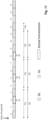
- a UE is configured with a multi-PUSCHs CG with 4 TIs.
- the durations of the TIs are 3, 2, 3, 3 slots.
- the UE is configured to select the earliest available slot for PUSCH TO within each Tl.
- the transmission direction is the uplink, and available slots are those configured as uplink slots.
- the first and second slots collide with DL and Flexible slots, respectively. Slot 3 is selected for the TO#1.
- the first slot (slot 4) collides with a Flexible slot, and the PUSCH TO is postponed to the next available UL slot (slot 5) as the slot selected for the transmission.
- the first slot (slot 8) is available, and the slot is selected as a TO#3.
- the first slot (slot 11) in the TI is selected for TO#4.
- the lengths / durations and/or delays / differences may be indicated by RRC in the CG configuration.
- the lengths of TIs may also be indicated dynamically, e.g. by a DCI (re)activation.
- indicating a duration does not necessarily imply indications of respective values for the durations of different time intervals.
- a single value could be set for all the lengths of TIs:
- the configuration indicates single duration applicable to all of the one or more time intervals.
- the TIs may also be configured to overlap with one another. For the overlapping TIs, the slot/mini-slot selected for a TO of a TI becomes unavailable for other TIs.
- Priorities may be defined for the TIs, and a TI with the higher priority may selects a TO before a TI with a lower priority.
- the one or more time intervals are a plurality of time intervals including a first time interval and a second time interval, and as mentioned the configuration indicates priorities for the plurality of time intervals.
- the first time interval having a higher priority and overlapping with the second time interval
- the UE circuitry 830 in operation, selects the time resource for the transmission among all available resources within the first time interval before selecting another time resource for another transmission among resources within the second time interval remaining after selection of said time resource within the first time interval (it is noted that the gNB circuitry may select or determine the time resource in the manner to identify the time resource selected by the UE 810).
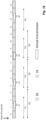
- TI1 slot 2 is selected for TO#1.
- the slot 2 therefore becomes unavailable for the later TIs, in particular TI2 overlapping with TI1.
- slot 5 is selected for TO#2.
- slot 8 is selected for TO#3.
- the earliest available slot is 11 that is selected for the TO#4 (after slot 8 has already been selected for another TI).
- Priorities need not necessarily be signaled. Priorities may e.g. be implicitly indicated and/or derived according to rules, e.g. based on a time order of the TIs (as shown in Fig. 15 ) or based on a type of data, e.g. sensitive data or control data.
- the present disclosure allows for the gNB to configure TIs in a manner to facilitate obtaining PUSCH TOs over non-consecutive slots/mini-slots.
- the actual PUSCH TO is determined within a TI.
- later TOs e.g. in different TIs are not affected.
- the configuration indicates, in addition to the above-described duration(s) and possibly timing(s), a subset of time resources among all time resources within the one or more time intervals, and the circuitry (UE circuitry 830 and accordingly, the gNB circuitry 880), in operation, selects the time resource for the transmission from the subset.
- a TO may be selected from a subset of resources, e.g. slots or mini-slots, within a time interval, or a subset of available (mini-)slots / resources in the time interval.
- the TO within a TI is derived from a subset of available slots/min-slots, e.g. considering the defined priorities.
- subsets may be configured according to defined priorities or orders. For instance, a CG PUSCH having a higher priority may be configured to select the TO from all slots in the time interval (or from a larger subset comprising a greater number of slots), and a CG PUSCH (or DG PUSCH etc.) having a lower priority may be configured a smaller subset than the subset available for the higher priority transmission.
- the different priorities may be defined for different physical channels. For instance, a higher priority is set for a CG PUSCH and a lower priority is set for DG PUSCH.
- UE initially may, for instance, initially try to carry the data using CG PUSCH (or more generally a first physical channel) within a TI, if there is no time resource available for TO, the data may be carried by a DG PUSCH.
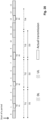
- Fig. 16 An example is shown in Fig. 16 , where the lengths of TIs are 3 slots. However, the UE can only select the first or third slots as a subset within a TI for a PUSCH TO. For TI1, TI3, and TI4, there are available UL slots for PUSCH TOs. For the TI2, there is no UL slot among the first or third slots. So, the PUSCH TO for TI3 is dropped.
- elements of a subset can be assigned with the priorities, e.g. the first slot having a higher priority than the third slot.
- the configuration may indicate, for each two consecutive time intervals of the one or more time intervals, a time difference between the beginnings of the time intervals as an indication of the duration (or length) of the preceding time interval.
- a TI can be considered to end at the beginning of the next (or subsequent or (directly) consecutive) TI.
- the UE is configured with a multi-PUSCHs with 4 TIs.
- the end of the TI is aligned with the beginning of the next TI.
- the length of a TI is 1 slot. There is no available UL slot within the fourth TI, so the fourth PUSCH TO is dropped.
- the UE may determine one or more than one TO, meeting the required resource allocations, within a TI.
- the UE circuitry 830 (as well as gNB circuitry 880) may select the time resource for the transmission to comprise one or more symbols in a first slot and one or more symbols in a second slot within a time interval of the one or more time intervals.
- the time resource for the transmission may comprise a first TO including symbols in one slot and a second TO including symbols in another slot, and the total number of symbols satisfies the required number of symbols or Res for the transmission.
- a PUSCH TO requires 14 symbols.
- the UE can perform the UL transmissions with the slot boundary crossing.
- Over slot 1 and slot 13 which are flexible slots comprising both uplink and downlink configured symbols, less than 14 symbols are available for UL. Therefore, the UE extends the TO transmission over the next consecutive slots.
- a PUSCH TO requires 14 symbols.
- the UE can perform the UL transmissions with discontinuous transmissions.
- Over slot 1 and slot 13 which are flexible slots comprising both uplink and downlink configured symbols, less than 14 symbols are available for UL. Therefore, the UE extends the TO transmission over the next consecutive slots.
- first slot and the second slot may be arbitrary slots within the time interval (or within a subset of the TI if such a subset is configured as described above) having available symbols matching the direction of transmission and are not limited to directly consecutive slots.
- the configuration indicates, for the transmission, a minimum number of resource elements (or an allowed range between a minimum and a maximum number of resource elements) or symbols available for allocation of the transmission, and the UE circuitry 830, in operation, selects a time resource satisfying the at least one of the minimum number or maximum number of REs or symbols within the one or more time intervals.
- a UE may be configured to transmit/receive a TO with a reduced number of resource elements (REs).
- REs resource elements
- some conditions may be defined for the UE to perform the TO with a reduced number of REs, e.g. a minimum number of REs/symbols.
- the TO with a reduced number of REs may have a different communication characteristics, such as, using a higher MCS or lower TB size.
- the UE circuitry may adapt or adjust a modulation and coding scheme or a transport block size to the selected time resource satisfying the indicated minimum number (and/or, if also configured, the maximum number) of resource elements or symbols.
- a PUSCH TO is configured with 14 UL symbols.
- the UE is capable of transmitting a PUSCH TO with a reduced number of REs, when less than 14 UL symbols are available in a slot, e.g. by adapting the MCS, TB size etc.
- transmissions on TO#1, TO#2, and TO#4 are transmitted with a reduced number of REs (less than 14 symbols) over flexible slots.
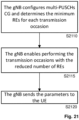
- Figures 21 and 22 show flowcharts for the gNB ( Fig. 21 ) and for the UE ( Fig. 22 ) for setting the TI and associated transmission requirements, and a UE performing the TO with a reduced number of REs.
- Fig. 21 shows a step S2110 of configuring multi-PUSCHs CG and determining the minimum number of REs for each transmission occasion of the multi-PUSCHs CG, and a step of enabling performing the transmission on the transmission occasions with the reduced number of REs.
- Steps S2110 and S2120 define the gNB determining a configuration including a minimum number of REs required and possibly determining allowed MCSs and TB sizes for the transmission.
- the gNB sends the parameters to the UE (e.g. as part of the configuration conveyed in the above-mentioned "one or more signals" which are sent in step S1320 of Fig. 13 ).
- the UE determines the number of available REs in a slot, and determine in step S2220 whether the number of required REs for the transmission is less than the number of available slots in the TO. If yes, the UE performs the transmission on the TI in step S2230. If no, the UE further determines whether the transmission can be performed on the TO with a reduced number of REs. If yes, the UE in step S2250 performs the transmission with a reduced number of UEs. If no, the UE drops / discards the transmission and/or postpones the transmission to another transmission, e.g. in a next slot, a next available slot, a slot in a subsequent time interval or period, etc.
- step S1120 of selecting a time resource for the transmission may be performed to select the time resource from all slots within the time interval having a sufficient number of symbols satisfying the minimum number of required REs.
- a direction of the transmission is an uplink direction or a downlink direction.
- the configuration conveyed by one or more signals may include, for example a dynamic grant (DG), a configured grant (CG), or semi-persistent scheduling (SPS).
- DG dynamic grant
- CG configured grant
- SPS semi-persistent scheduling
- a TI configured in accordance with the present disclosure can be used to derive the timing of a PDSCH, instead of a PUSCH TO.
- Possible scenarios further include, the transmission on the selected TI being an initial transmission or a repetition on a shared channel, a reference signal or a control signal.
- the TIs can be used to determine the timing of PUSCH/PDSCH repetitions (e.g., indicated by a dynamic grant).
- the TI can be utilized to determine the timing of a TB by a dynamic grant (through a DCI).
- a TI can be utilized to determine the timing of SRS or PUCCH transmission occasions (e.g., carrying CQI or SR).
- the present disclosure can be realized by software, hardware, or software in cooperation with hardware.
- Each functional block used in the description of each embodiment described above can be partly or entirely realized by an LSI such as an integrated circuit, and each process described in the each embodiment may be controlled partly or entirely by the same LSI or a combination of LSIs.
- the LSI may be individually formed as chips, or one chip may be formed so as to include a part or all of the functional blocks.
- the LSI may include a data input and output coupled thereto.
- the LSI here may be referred to as an IC, a system LSI, a super LSI, or an ultra LSI depending on a difference in the degree of integration.
- the technique of implementing an integrated circuit is not limited to the LSI and may be realized by using a dedicated circuit, a general-purpose processor, or a special-purpose processor.
- a FPGA Field Programmable Gate Array
- a reconfigurable processor in which the connections and the settings of circuit cells disposed inside the LSI can be reconfigured may be used.
- the present disclosure can be realized as digital processing or analogue processing. If future integrated circuit technology replaces LSIs as a result of the advancement of semiconductor technology or other derivative technology, the functional blocks could be integrated using the future integrated circuit technology. Biotechnology can also be applied.
- the present disclosure can be realized by any kind of apparatus, device or system having a function of communication, which is referred to as a communication apparatus.
- a communication apparatus For example, a relay node, a network node, and a scheduling device may be considered (each) as a communication apparatus.
- the communication apparatus may comprise a transceiver and processing/control circuitry.
- the transceiver may comprise and/or function as a receiver and a transmitter.
- the transceiver, as the transmitter and receiver, may include an RF (radio frequency) module including amplifiers, RF modulators/demodulators and the like, and one or more antennas.
- RF radio frequency
- Such a communication apparatus include a phone (e.g., cellular (cell) phone, smart phone), a tablet, a personal computer (PC) (e.g., laptop, desktop, netbook), a camera (e.g., digital still/video camera), a digital player (digital audio/video player), a wearable device (e.g., wearable camera, smart watch, tracking device), a game console, a digital book reader, a telehealth/telemedicine (remote health and medicine) device, and a vehicle providing communication functionality (e.g., automotive, airplane, ship), and various combinations thereof.
- a phone e.g., cellular (cell) phone, smart phone
- a tablet e.g., a personal computer (PC) (e.g., laptop, desktop, netbook)
- a camera e.g., digital still/video camera
- a digital player digital audio/video player
- a wearable device e.g., wearable camera, smart watch, tracking device
- the communication apparatus is not limited to be portable or movable, and may also include any kind of apparatus, device or system being non-portable or stationary, such as a smart home device (e.g., an appliance, lighting, smart meter, control panel), a vending machine, and any other "things" in a network of an "Internet of Things (IoT)".
- a smart home device e.g., an appliance, lighting, smart meter, control panel
- vending machine e.g., a vending machine, and any other "things” in a network of an "Internet of Things (IoT)".
- IoT Internet of Things
- the communication may include exchanging data through, for example, a cellular system, a wireless LAN system, a satellite system, etc., and various combinations thereof.
- the communication apparatus may comprise a device such as a controller or a sensor which is coupled to a communication device performing a function of communication described in the present disclosure.
- the communication apparatus may comprise a controller or a sensor that generates control signals or data signals which are used by a communication device performing a communication function of the communication apparatus.
- the communication apparatus also may include an infrastructure facility, such as a base station, an access point, and any other apparatus, device or system that communicates with or controls apparatuses such as those in the above non-limiting examples.
- an infrastructure facility such as a base station, an access point, and any other apparatus, device or system that communicates with or controls apparatuses such as those in the above non-limiting examples.
- the various embodiments may also be implemented by means of software modules, which are executed by a processor or directly in hardware. Also, a combination of software modules and a hardware implementation may be possible.
- the software modules may be stored on any kind of computer-readable storage media.
- a non-transitory computer-readable recording medium is provided. The recording medium stores a program which, when executed by one or more processors, causes the one or more processors to carry out the steps of a method according to the present disclosure.
- such computer-readable storage media can comprise RAM, ROM, EEPROM, CD-ROM or other optical disk storage, magnetic disk storage, or other magnetic storage devices, flash memory, or any other medium that can be used to store desired program code in the form of instructions or data structures and that can be accessed by a computer.
- any connection is properly termed a computer-readable medium.
- a computer-readable medium For example, if instructions are transmitted from a website, server, or other remote source using a coaxial cable, fiber optic cable, twisted pair, digital subscriber line (DSL), or wireless technologies such as infrared, radio, and microwave, then the coaxial cable, fiber optic cable, twisted pair, DSL, or wireless technologies such as infrared, radio, and microwave are included in the definition of medium.
- DSL digital subscriber line
- Disk and disc includes compact disc (CD), laser disc, optical disc, digital versatile disc (DVD), floppy disk and Blu-ray disc, where disks usually reproduce data magnetically, while discs reproduce data optically with lasers. Combinations of the above should also be included within the scope of computer-readable media.
- a communication apparatus comprising: a transceiver which, in operation, receives one or more signals conveying a configuration indicating, for each of one or more time intervals, one or both of a duration and a timing of the time interval; and circuitry which, in operation, selects, for a transmission, a time resource configured with a direction matching a direction of the transmission within the one or more time intervals, wherein the transceiver, in operation, transmits or receives the transmission on the selected time resource.
- the configuration indicates, for each of the one or more time intervals, the duration of the time interval and, a time difference between the beginnings of consecutive time intervals as an indication of the timing.
- the configuration indicates single duration applicable to all of the one or more time intervals.
- the one or more time intervals are a plurality of time intervals including a first time interval and a second time interval
- the configuration indicates priorities for the plurality of time intervals, the first time interval having a higher priority and overlapping with the second time interval
- the circuitry in operation, selects the time resource for the transmission among all available resources within the first time interval before selecting another time resource for another transmission among resources within the second time interval remaining after selection of said time resource within the first time interval.
- the configuration indicates a subset of time resources among all time resources within the one or more time intervals, and the circuitry, in operation, selects the time resource for the transmission from the subset.
- the configuration indicates, for each two consecutive time intervals of the one or more time intervals, a time difference between the beginnings of the time intervals as an indication of the duration of the preceding time interval.
- the circuitry in operation, selects the time resource for the transmission to comprise one or more symbols in a first slot and one or more symbols in a second slot within a time interval of the one or more time intervals.
- the configuration indicates, for the transmission, at least one of a minimum number or a maximum number of resource elements or symbols available for allocation of the transmission, and the circuitry, in operation, selects a time resource satisfying the at least one of the minimum number or maximum number within the one or more time intervals.
- the circuitry in operation, adapts a modulation and coding scheme or a transport block size to the selected time resource satisfying the indicated minimum number or maximum number of resource elements or symbols.
- a direction of the transmission is an uplink direction or a downlink direction.
- the configuration includes a dynamic grant, a configured grant, or semi-persistent scheduling.
- the transmission is an initial transmission or a repetition on a shared channel, a reference signal or a control signal.
- a scheduling node comprising circuitry which, in operation, determines, a configuration indicating, for one or more time intervals, one or both of a duration and a timing of the time interval; and a transceiver which, in operation, transmits one or more signals conveying the configuration and receives or transmits a transmission on a time resource configured with a direction matching a direction of the transmission within the one or more time intervals.
- a communication method to be performed by a communication apparatus comprising the steps of: receiving one or more signals conveying a configuration indicating, for each of one or more time intervals, one or both of a duration and a timing of the time interval; selecting, for a transmission, a time resource configured with a direction matching a direction of the transmission within the one or more time intervals; and transmitting or receiving the transmission on the selected time resource.
- a communication method to be performed by a scheduling node comprising the steps of: determining, a configuration indicating, for one or more time intervals, one or both of a duration and a timing of the time interval; transmitting one or more signals conveying the configuration; and receiving or transmitting a transmission on a time resource configured with a direction matching a direction of the transmission within the one or more time intervals.
- an integrated circuit which, in operation, causes a communication apparatus to carry out the steps of the communication method according to the fourteenth aspect.
- an integrated circuit which, in operation, causes a scheduling node to carry out the steps of the communication method according to the fifteenth aspect.
- a program stored on a (non-transitory) storage medium and including code instructions, which, when executed on one or more processors of a communication apparatus, cause the one or more processors to execute the steps the fourteenth aspect.
- a program stored on a (non-transitory) storage medium and including code instructions, which, when executed on one or more processors of a scheduling, cause the one or more processors to execute the steps the fifteenth aspect.
Landscapes
- Engineering & Computer Science (AREA)
- Computer Networks & Wireless Communication (AREA)
- Signal Processing (AREA)
- Mobile Radio Communication Systems (AREA)
Priority Applications (2)
| Application Number | Priority Date | Filing Date | Title |
|---|---|---|---|
| EP23167043.1A EP4444007A1 (de) | 2023-04-06 | 2023-04-06 | Konfiguration mehrerer übertragungsgelegenheiten |
| PCT/EP2024/058454 WO2024208720A1 (en) | 2023-04-06 | 2024-03-28 | Configuration of multiple transmission occasions |
Applications Claiming Priority (1)
| Application Number | Priority Date | Filing Date | Title |
|---|---|---|---|
| EP23167043.1A EP4444007A1 (de) | 2023-04-06 | 2023-04-06 | Konfiguration mehrerer übertragungsgelegenheiten |
Publications (1)
| Publication Number | Publication Date |
|---|---|
| EP4444007A1 true EP4444007A1 (de) | 2024-10-09 |
Family
ID=85980601
Family Applications (1)
| Application Number | Title | Priority Date | Filing Date |
|---|---|---|---|
| EP23167043.1A Withdrawn EP4444007A1 (de) | 2023-04-06 | 2023-04-06 | Konfiguration mehrerer übertragungsgelegenheiten |
Country Status (2)
| Country | Link |
|---|---|
| EP (1) | EP4444007A1 (de) |
| WO (1) | WO2024208720A1 (de) |
Citations (4)
| Publication number | Priority date | Publication date | Assignee | Title |
|---|---|---|---|---|
| US20210014874A1 (en) * | 2019-07-10 | 2021-01-14 | Qualcomm Incorporated | Data scheduling in uplink burst |
| US20210091890A1 (en) * | 2018-08-10 | 2021-03-25 | Zte Corporation | Repetition transmission method and apparatus, network device, and computer readable storage medium |
| US20210144737A1 (en) * | 2018-01-23 | 2021-05-13 | Huawei Technologies Co., Ltd. | System and Method for Time Domain Grant-Free PUSCH Resource Allocation |
| US20210320760A1 (en) * | 2020-04-09 | 2021-10-14 | Nazanin Rastegardoost | HARQ Feedback Collision in Unlicensed Bands |
-
2023
- 2023-04-06 EP EP23167043.1A patent/EP4444007A1/de not_active Withdrawn
-
2024
- 2024-03-28 WO PCT/EP2024/058454 patent/WO2024208720A1/en not_active Ceased
Patent Citations (4)
| Publication number | Priority date | Publication date | Assignee | Title |
|---|---|---|---|---|
| US20210144737A1 (en) * | 2018-01-23 | 2021-05-13 | Huawei Technologies Co., Ltd. | System and Method for Time Domain Grant-Free PUSCH Resource Allocation |
| US20210091890A1 (en) * | 2018-08-10 | 2021-03-25 | Zte Corporation | Repetition transmission method and apparatus, network device, and computer readable storage medium |
| US20210014874A1 (en) * | 2019-07-10 | 2021-01-14 | Qualcomm Incorporated | Data scheduling in uplink burst |
| US20210320760A1 (en) * | 2020-04-09 | 2021-10-14 | Nazanin Rastegardoost | HARQ Feedback Collision in Unlicensed Bands |
Non-Patent Citations (6)
| Title |
|---|
| "Moderator Summary#4 (Final) - XR Specific Capacity Improvements", R1-2301903 |
| "XR Enhancements for NR", RP-223502 |
| 3GPP TS 38.211 |
| 3GPP TS 38.300 |
| YU DING ET AL: "Discussion on XR-specific capacity enhancements", vol. 3GPP RAN 1, no. Athens, GR; 20230227 - 20230303, 17 February 2023 (2023-02-17), XP052247383, Retrieved from the Internet <URL:https://www.3gpp.org/ftp/TSG_RAN/WG1_RL1/TSGR1_112/Docs/R1-2300235.zip> [retrieved on 20230217] * |
| ZHIHUA SHI ET AL: "Discussion on XR specific capacity enhancements techniques", vol. 3GPP RAN 1, no. Toulouse, FR; 20221114 - 20221118, 7 November 2022 (2022-11-07), XP052222055, Retrieved from the Internet <URL:https://www.3gpp.org/ftp/TSG_RAN/WG1_RL1/TSGR1_111/Docs/R1-2211491.zip> [retrieved on 20221107] * |
Also Published As
| Publication number | Publication date |
|---|---|
| WO2024208720A1 (en) | 2024-10-10 |
Similar Documents
| Publication | Publication Date | Title |
|---|---|---|
| US20250247831A1 (en) | Base station, terminal, and communication method | |
| WO2023117356A1 (en) | User equipment and base station involved in an adaptation procedure | |
| US20260088958A1 (en) | Base station, terminal, and communication method | |
| EP4378252A1 (de) | Benutzergerät und basisstation mit beteiligung an der überwachung eines steuerkanals | |
| EP4160966A1 (de) | Benutzergerät, planungsknoten, verfahren für benutzergerät und verfahren zur planung von knoten | |
| EP4099598A1 (de) | Benutzergerät, planungsknoten, verfahren für benutzergerät und verfahren zur planung von knoten | |
| EP4465688A1 (de) | Benutzergerät und basisstation mit beteiligung an kanalmessungsberichten | |
| US20260051976A1 (en) | User equipment and scheduling device | |
| US20250056511A1 (en) | Base station, terminal and communication method | |
| US20250280408A1 (en) | User equipment, scheduling node, method for user equipment, and method for scheduling node | |
| US20250071783A1 (en) | Advance indication of resource selection | |
| EP4346115A1 (de) | System und verfahren zur tci-anzeige für mehrfache trp-übertragung | |
| EP4444007A1 (de) | Konfiguration mehrerer übertragungsgelegenheiten | |
| EP4465728A1 (de) | Unbenutzte anzeige von übertragungsgelegenheiten | |
| EP4443791A1 (de) | Harq-prozesshandhabung für multi-puschs cg | |
| EP4507433A1 (de) | Anzeige unbenutzter übertragungsgelegenheiten für pusch-wiederholung | |
| EP4465687A1 (de) | Benutzergerät und basisstation mit beteiligung an kanalmessungsberichten | |
| EP4346117A1 (de) | Steuerungskonfigurationspriorität für netzwerkgesteuerte zwischenverstärker | |
| EP4572477A1 (de) | Basisstation, endgerät und kommunikationsverfahren | |
| EP4344087A1 (de) | Übertragungskonfigurationsmechanismen für einen netzwerkgesteuerten repeater | |
| US20250301353A1 (en) | User equipment and base station involved in spatial/frequency domain measurement | |
| US20240380548A1 (en) | User equipment, scheduling node, method for user equipment, and method for scheduling node |
Legal Events
| Date | Code | Title | Description |
|---|---|---|---|
| PUAI | Public reference made under article 153(3) epc to a published international application that has entered the european phase |
Free format text: ORIGINAL CODE: 0009012 |
|
| STAA | Information on the status of an ep patent application or granted ep patent |
Free format text: STATUS: THE APPLICATION HAS BEEN PUBLISHED |
|
| AK | Designated contracting states |
Kind code of ref document: A1 Designated state(s): AL AT BE BG CH CY CZ DE DK EE ES FI FR GB GR HR HU IE IS IT LI LT LU LV MC ME MK MT NL NO PL PT RO RS SE SI SK SM TR |
|
| STAA | Information on the status of an ep patent application or granted ep patent |
Free format text: STATUS: THE APPLICATION IS DEEMED TO BE WITHDRAWN |
|
| 18D | Application deemed to be withdrawn |
Effective date: 20250410 |