EP4443717A1 - Electric motor and air conditioner - Google Patents
Electric motor and air conditioner Download PDFInfo
- Publication number
- EP4443717A1 EP4443717A1 EP21965686.5A EP21965686A EP4443717A1 EP 4443717 A1 EP4443717 A1 EP 4443717A1 EP 21965686 A EP21965686 A EP 21965686A EP 4443717 A1 EP4443717 A1 EP 4443717A1
- Authority
- EP
- European Patent Office
- Prior art keywords
- stator
- molded resin
- board
- electric motor
- side molded
- Prior art date
- Legal status (The legal status is an assumption and is not a legal conclusion. Google has not performed a legal analysis and makes no representation as to the accuracy of the status listed.)
- Withdrawn
Links
Images





Classifications
-
- H—ELECTRICITY
- H02—GENERATION; CONVERSION OR DISTRIBUTION OF ELECTRIC POWER
- H02K—DYNAMO-ELECTRIC MACHINES
- H02K5/00—Casings; Enclosures; Supports
- H02K5/04—Casings or enclosures characterised by the shape, form or construction thereof
- H02K5/16—Means for supporting bearings, e.g. insulating supports or means for fitting bearings in the bearing-shields
-
- H—ELECTRICITY
- H02—GENERATION; CONVERSION OR DISTRIBUTION OF ELECTRIC POWER
- H02K—DYNAMO-ELECTRIC MACHINES
- H02K1/00—Details of the magnetic circuit
- H02K1/06—Details of the magnetic circuit characterised by the shape, form or construction
- H02K1/12—Stationary parts of the magnetic circuit
- H02K1/18—Means for mounting or fastening magnetic stationary parts on to, or to, the stator structures
- H02K1/185—Means for mounting or fastening magnetic stationary parts on to, or to, the stator structures to outer stators
-
- H—ELECTRICITY
- H02—GENERATION; CONVERSION OR DISTRIBUTION OF ELECTRIC POWER
- H02K—DYNAMO-ELECTRIC MACHINES
- H02K11/00—Structural association of dynamo-electric machines with electric components or with devices for shielding, monitoring or protection
- H02K11/30—Structural association with control circuits or drive circuits
-
- H—ELECTRICITY
- H02—GENERATION; CONVERSION OR DISTRIBUTION OF ELECTRIC POWER
- H02K—DYNAMO-ELECTRIC MACHINES
- H02K3/00—Details of windings
- H02K3/04—Windings characterised by the conductor shape, form or construction, e.g. with bar conductors
- H02K3/28—Layout of windings or of connections between windings
-
- H—ELECTRICITY
- H02—GENERATION; CONVERSION OR DISTRIBUTION OF ELECTRIC POWER
- H02K—DYNAMO-ELECTRIC MACHINES
- H02K5/00—Casings; Enclosures; Supports
- H02K5/04—Casings or enclosures characterised by the shape, form or construction thereof
- H02K5/08—Insulating casings
-
- H—ELECTRICITY
- H02—GENERATION; CONVERSION OR DISTRIBUTION OF ELECTRIC POWER
- H02K—DYNAMO-ELECTRIC MACHINES
- H02K5/00—Casings; Enclosures; Supports
- H02K5/04—Casings or enclosures characterised by the shape, form or construction thereof
- H02K5/16—Means for supporting bearings, e.g. insulating supports or means for fitting bearings in the bearing-shields
- H02K5/161—Means for supporting bearings, e.g. insulating supports or means for fitting bearings in the bearing-shields radially supporting the rotary shaft at both ends of the rotor
-
- H—ELECTRICITY
- H02—GENERATION; CONVERSION OR DISTRIBUTION OF ELECTRIC POWER
- H02K—DYNAMO-ELECTRIC MACHINES
- H02K5/00—Casings; Enclosures; Supports
- H02K5/04—Casings or enclosures characterised by the shape, form or construction thereof
- H02K5/16—Means for supporting bearings, e.g. insulating supports or means for fitting bearings in the bearing-shields
- H02K5/173—Means for supporting bearings, e.g. insulating supports or means for fitting bearings in the bearing-shields using bearings with rolling contact, e.g. ball bearings
- H02K5/1732—Means for supporting bearings, e.g. insulating supports or means for fitting bearings in the bearing-shields using bearings with rolling contact, e.g. ball bearings radially supporting the rotary shaft at both ends of the rotor
-
- H—ELECTRICITY
- H02—GENERATION; CONVERSION OR DISTRIBUTION OF ELECTRIC POWER
- H02K—DYNAMO-ELECTRIC MACHINES
- H02K5/00—Casings; Enclosures; Supports
- H02K5/04—Casings or enclosures characterised by the shape, form or construction thereof
- H02K5/22—Auxiliary parts of casings not covered by groups H02K5/06-H02K5/20, e.g. shaped to form connection boxes or terminal boxes
-
- H—ELECTRICITY
- H02—GENERATION; CONVERSION OR DISTRIBUTION OF ELECTRIC POWER
- H02K—DYNAMO-ELECTRIC MACHINES
- H02K2203/00—Specific aspects not provided for in the other groups of this subclass relating to the windings
- H02K2203/03—Machines characterised by the wiring boards, i.e. printed circuit boards or similar structures for connecting the winding terminations
-
- H—ELECTRICITY
- H02—GENERATION; CONVERSION OR DISTRIBUTION OF ELECTRIC POWER
- H02K—DYNAMO-ELECTRIC MACHINES
- H02K2203/00—Specific aspects not provided for in the other groups of this subclass relating to the windings
- H02K2203/06—Machines characterised by the wiring leads, i.e. conducting wires for connecting the winding terminations
Definitions
- the present disclosure relates to an electric motor and an air conditioner.
- Patent Reference 1 Japanese Unexamined Patent Application Publication No. 2015-126583
- An electric motor according to the present disclosure includes:
- An air conditioner according to the present disclosure includes:
- noise in the electric motor due to electrolytic corrosion in the bearings or the bearing housings can be reduced.
- a z-axis direction represents a direction parallel to the axis A1 of the electric motor 1
- an x-axis direction represents a direction orthogonal to the z-axis direction
- a y-axis direction represents a direction orthogonal to both the z-axis direction and the x-axis direction.
- the axis A1 refers to the rotation center of a rotor 2, that is, the rotation axis of the rotor 2.
- the direction parallel to the axis A1 is also referred to as the "axis direction of the rotor 2" or simply the “axis direction.”
- a radial direction refers to a direction along a radius of the rotor 2, a stator 3, or a stator core 31, and refers to a direction orthogonal to the axis A1.
- An xy plane refers to a plane orthogonal to the axial direction.
- a circumferential direction of the rotor 2, the stator 3, or the stator core 31 is also simply referred to as the "circumferential direction.”
- FIG. 1 is a cross-sectional view schematically showing an electric motor 1 according to a first embodiment.
- the electric motor 1 includes the rotor 2, the stator 3, a circuit board 4, a board-side molded resin 5, and a stator-side molded resin 6.
- the electric motor 1 is, for example, a permanent magnet synchronous motor, but not limited to the permanent magnet synchronous motor.
- the rotor 2 is rotatably disposed inside the stator 3. An air gap exists between the rotor 2 and the stator 3.
- the rotor 2 includes a rotor core 21 (also referred to as a "rotor yoke"), a shaft 22, a first bearing 23 (also referred to as a "board-side bearing”), a second bearing 24 (also referred to as a "stator-side bearing”), and a preloading member 25.
- the rotor 2 is rotatable about the rotation axis (i.e., axis A1).
- the rotor 2 may further include a permanent magnet to form the magnetic poles of the rotor 2.
- the rotor core 21 is provided between the first bearing 23 and the second bearing 24.
- the shaft 22 is located inside the rotor core 21.
- the shaft 22 is rotatably supported by the first bearing 23 and the second bearing 24.
- the first bearing 23 and the second bearing 24 rotatably support the shaft 22 of the rotor 2.
- the first bearing 23 is located on the anti-load side of the electric motor 1 from the rotor core 21.
- the first bearing 23 rotatably supports the anti-load side of the shaft 22.
- the second bearing 24 is located on the load side of the electric motor 1 from the rotor core 21.
- the second bearing 24 rotatably supports the load side of the shaft 22.
- the first bearing 23 and the second bearing 24 are, for example, rolling bearings.
- vibration of the rotor 2 due to magnetic attractive force between the rotor 2 and the stator 3 can be prevented compared to plain bearings.
- the preloading member 25 provides preload to the second bearing 24.
- the preloading member 25 is, for example, a compression spring.
- the stator 3 includes a stator core 31, at least one winding 32 (also referred to as a stator winding), and at least one insulator 33.
- the stator core 31 is a cylindrical core.
- the stator core 31 is formed of a plurality of electrical steel sheets laminated in the axial direction.
- each of the plurality of electrical steel sheets is formed into a predetermined shape with blanking. These electrical steel sheets are fixed to each other by caulking, welding, gluing, or the like.
- the winding 32 is, for example, a magnet wire.
- the winding 32 is wound on the insulator 33.
- the winding 32 is wound on the insulator 33, thereby forming a coil.
- the winding 32 is electrically connected to the terminals of the circuit board 4.
- the insulator 33 is a thermoplastic resin, such as polybutylene terephthalate (PBT), for example.
- PBT polybutylene terephthalate
- the insulator 33 electrically insulates the stator core 31.
- the insulator 33 is unitedly molded with the stator core 31.
- the insulator 33 may be molded in advance, and then the molded insulator 33 may be combined with the stator core 31.
- the circuit board 4 includes driving circuitry such as a power transistor.
- the circuit board 4 faces the first bearing 23.
- the circuit board 4 is electrically connected to the winding 32.
- the board-side molded resin 5 includes a first bearing housing 51 (also referred to as a "board-side bearing housing").
- the first bearing housing 51 holds the first bearing 23.
- the board-side molded resin 5 covers at least part of the circuit board 4.
- the board-side molded resin 5 is, for example, a non-conductive resin. As shown in FIG. 1 , the board-side molded resin 5 may cover the whole circuit board 4.
- the board-side molded resin 5 is, for example, a thermosetting resin such as a bulk molding compound (BMC).
- FIG. 2 is a cross-sectional view schematically showing the structure of the first bearing housing 51.
- the first bearing housing 51 includes a bottom surface 51A and an opening 51B.
- the bottom surface 51A faces the first bearing 23.
- the bottom surface 51A supports the first bearing 23 in the axial direction.
- the opening 51B is formed on the opposite side from the circuit board 4 with the bottom surface 51A in between in the axial direction.
- the board-side molded resin 5 be an insulating material.
- the board-side molded resin 5 is an insulating resin.
- the stator-side molded resin 6 is a different component from the board-side molded resin 5.
- the stator-side molded resin 6 includes a second bearing housing 61 (also referred to as a "stator-side bearing housing").
- the second bearing housing 61 holds the second bearing 24.
- the stator-side molded resin 6 covers at least part of the stator 3.
- the stator-side molded resin 6 is, for example, a non-conductive resin. As shown in FIG. 1 , the stator-side molded resin 6 may cover all of the stator 3.
- the stator-side molded resin 6 is, for example, a thermosetting resin such as a bulk molding compound (BMC).
- stator-side molded resin 6 be an insulating material.
- stator-side molded resin 6 is an insulating resin.
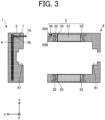
- FIG. 3 is an exploded view showing another example of the electric motor 1 in cross section.
- the rotor 2 is omitted in the example shown in FIG. 3 , but the rotor 2 shown in FIG. 1 can be applied to the electric motor 1 shown in FIG. 3 .
- the electric motor 1 shown in FIG. 3 further includes a board-side terminal 7 electrically connected to the circuit board 4.
- the stator 3 shown in FIG. 3 includes a winding 32 and a stator-side terminal 34 electrically connected to the winding 32.
- One end 7A of the board-side terminal 7 is directly connected to the stator-side terminal 34, while the other end 7B of the board-side terminal 7 is electrically connected to the circuit board 4 (e.g., driving circuitry) .
- the end 7A of the board-side terminal 7 may be electrically connected to the stator-side terminal 34 through a lead wire. As shown in FIG. 3 , the end 7A of the board-side terminal 7 is exposed outside the board-side molded resin 5.
- stator-side terminal 34 One end 34A of the stator-side terminal 34 is directly connected to the board-side terminal 7, while the other end 34B of the stator-side terminal 34 is electrically connected to the winding 32.
- the end 34A of the stator-side terminal 34 may be electrically connected to the board-side terminal 7 through a lead wire.
- the end 34A of the stator-side terminal 34 is exposed outside the stator-side molded resin 6.
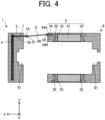
- FIG. 4 is a cross-sectional view showing still another example of the electric motor 1.
- the rotor 2 is omitted in the example shown in FIG. 4 , but the rotor 2 shown in FIG. 1 can be applied to the electric motor 1 shown in FIG. 4 .
- the electric motor 1 shown in FIG. 4 includes a lead wire 8 that electrically connects the end 7A of the board-side terminal 7 and the end 34A of the stator-side terminal 34.
- the lead wire 8 includes a conductor 80 and lead wire terminals 81 and 82 connected to both ends of the conductor 80 respectively.
- the lead wire terminal 81 is also referred to as a first lead wire terminal 81
- the lead wire terminal 82 is also referred to as a second lead wire terminal 82.
- the first lead wire terminal 81 is connected to the end 7A of the board-side terminal 7, and the second lead wire terminal 82 is connected to the end 34A of the stator-side terminal 34.
- FIG. 5 is a cross-sectional view showing still another example of the electric motor 1.
- the electric motor 1 shown in FIG. 5 further includes a resin 26 provided between the rotor core 21 and the shaft 22.
- the resin 26 is also referred to as a "fixing resin”.
- the shaft 22 is spaced apart from the rotor core 21. It is preferable that the resin 26 be an insulating resin.
- FIG. 6 is a cross-sectional view showing still another example of the electric motor 1.
- the board-side molded resin 5 and the stator-side molded resin 6 are assembled with each other by press fit.
- the board-side molded resin 5 includes at least one first press-fit portion 52 (also referred to as a "board-side press-fit portion") that is combined with the stator-side molded resin 6.
- the first press-fit portion 52 includes a first press-fit portion 52 that is combined with the stator-side molded resin 6.
- the first press-fit portion 52 is, for example, a protruding portion or a concave portion.
- the stator-side molded resin 6 includes at least one second press-fit portion 62 (also referred to as a "stator-side press-fit portion") that is combined with the board-side molded resin 5.
- the second press-fit portion 62 is, for example, a protruding portion or a concave portion.
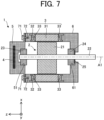
- FIG. 7 is a cross-sectional view showing still another example of the electric motor 1.
- the electric motor 1 includes of a fixing part 71 (also referred to as a "first fixing part” or a “board-side fixing part”) provided in the board-side molded resin 5 and a fixing part 72 (also referred to as a "second fixing part” or a “stator-side fixing part”) provided in the stator-side molded resin 6.
- the stator-side molded resin 6 includes the first fixing part 71 and the stator-side molded resin 6.
- the first fixing part 71 is fixed to the second fixing part 72, and thus the board-side molded resin 5 and the stator-side molded resin 6 are fixed to each other.
- the board-side molded resin 5 and the stator-side molded resin 6 are combined with each other, for example, by a screw.
- the first fixing part 71 is, for example, a male screw for combining the board-side molded resin 5 with the stator-side molded resin 6, and the second fixing part 72 is, for example, a female screw embedded in the stator-side molded resin 6.
- the male screw as the first fixing part 71 is fixed to the female screw as the second fixing part 72.
- the second fixing part 72 may be a hole formed in the stator-side molded resin 6.
- the male screw as the first fixing part 71 is fixed to the hole as the second fixing part 72.
- the second fixing part 72 as a component (e.g., a component made of thermoplastic resin) other than a screw may be embedded in the stator-side molded resin 6.
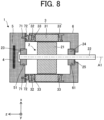
- FIG. 8 is a cross-sectional view showing still another example of the electric motor 1.
- the second fixing part 72 may be a male screw for combining the stator-side molded resin 6 with the board-side molded resin 5, and the first fixing part 71 may be a female screw embedded in the board-side molded resin 5.
- the male screw as the second fixing part 72 is fixed to the female screw as the first fixing part 71.
- the first fixing part 71 may be a hole formed in the board-side molded resin 5.
- the male screw as the second fixing part 72 is fixed to the hole as the first fixing part 71.
- the first fixing part 71 as a component (e.g., a component made of thermoplastic resin) other than a screw may be embedded in the board-side molded resin 5.
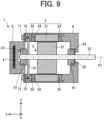
- FIG. 9 is a cross-sectional view showing still another example of the electric motor 1.
- the electric motor 1 includes an insulating member 73 provided in the stator 3.
- the insulating member 73 is fixed to the stator-side molded resin 6, for example.
- the second fixing part 72 e.g., a female screw
- the second fixing part 72 is united with the insulating member 73 by the stator-side molded resin 6.
- the board-side molded resin 5 (e.g., the first bearing housing 51) holds the first bearing 23, and the stator-side molded resin 6 (e.g., the second bearing housing 61) holds the second bearing 24, thereby reducing noise in the electric motor 1 due to electrolytic corrosion in the first bearing 23, the second bearing 24, the first bearing housing 51, or the second bearing housing 61 compared to bearing housings made of metal materials.
- the board-side molded resin 5 covers at least part of the circuit board 4, a foreign object can be prevented from entering the circuit board 4.
- the board-side molded resin 5 covers the whole circuit board 4, it is possible to effectively prevent a foreign object from entering into the circuit board 4.
- the rigidity of the entire stator 3 can be enhanced. As a result, noise in the electric motor 1 during the rotation of the rotor 2 can be reduced.
- the rigidity of the entire stator 3 can be enhanced and the noise in the electric motor 1 during the rotation of the rotor 2 can be further reduced.
- the noise in the electric motor 1 due to electrolytic corrosion in the first bearing 23, the second bearing 24, the first bearing housing 51, or the second bearing housing 61 can be effectively reduced compared to bearing housings made of metal materials.
- the first bearing housing 51 includes the bottom surface 51A and the opening 51B.
- the bottom surface 51A faces the first bearing 23.
- the bottom surface 51A supports the first bearing 23 in the axial direction.
- the opening 51B is formed on the opposite side from the circuit board 4 with the bottom surface 51A in between in the axial direction.
- the first bearing 23 is supported on the opposite side from the circuit board 4 with the bottom surface 51A in between in the axial direction. Therefore, the area of the circuit board 4 can be increased, and the insulation performance for the circuit board 4 and the heat dissipation performance of the circuit board 4 can be improved.
- the board-side molded resin 5 is a thermosetting resin
- the stator-side molded resin 6 is a thermosetting resin
- the first bearing housing 51 and the second bearing housing 61 can be molded with high precision. As a result, noise such as friction noise in the first bearing housing 51 and the second bearing housing 61 can be reduced during the rotation of the rotor 2.
- the end 7A of the board-side terminal 7 is exposed outside the board-side molded resin 5, and the end 34A of the stator-side terminal 34 is exposed outside the stator-side molded resin 6. In this case, the end 7A of the board-side terminal 7 and the end 34A of the stator-side terminal 34 can be easily connected.
- the electric motor 1 includes the lead wire 8 that electrically connects the end 7A of the board-side terminal 7 and the end 34A of the stator-side terminal 34.
- the end 7A of the board-side terminal 7 and the end 34A of the stator-side terminal 34 can be easily connected electrically, regardless of the position of the board-side terminal 7 and the stator-side terminal 34.
- the electric motor 1 further includes the resin 26 provided between the rotor core 21 and the shaft 22, and the shaft 22 is spaced apart from the rotor core 21.
- the shaft 22 can be effectively insulated from the rotor core 21.
- the noise in the electric motor 1 due to electrolytic corrosion in the first bearing 23 or the second bearing 24 can be further reduced.
- the board-side molded resin 5 and the stator-side molded resin 6 are assembled with each other by press fit.
- the board-side molded resin 5 and the stator-side molded resin 6 can be fixed without using fixing parts such as screws.
- the board-side molded resin 5 and the stator-side molded resin 6 may be assembled to each other with a screw. In this case, the required level of dimensions of the board-side molded resin 5 and the stator-side molded resin 6 can be reduced compared to press fit. As a result, the manufacturing cost of the electric motor 1 can be reduced.
- a male screw as the first fixing part 71 may be fixed in a hole as the second fixing part 72 embedded in the stator-side molded resin 6.
- the second fixing part 72 is, for example, a component made of thermoplastic resin. This configuration allows the first fixing part 71 to be firmly fixed to the second fixing part 72.
- a male screw as the second fixing part 72 may be fixed in a hole as the first fixing part 71 embedded in the board-side molded resin 5.
- the first fixing part 71 is, for example, a component made of thermoplastic resin. This configuration allows the second fixing part 72 to be firmly fixed to the first fixing part 71.
- the second fixing part 72 (e.g., a female screw) is united with the insulating member 73 by the stator-side molded resin 6.
- the second fixing part 72 can be easily positioned, and the second fixing part 72, the insulating member 73, and the stator core 31 can be easily united by the stator-side molded resin 6.
- An air conditioner 10 (also referred to as a refrigerating and air conditioning apparatus or a refrigeration cycle apparatus) according to a second embodiment will be described.
- FIG. 10 is a diagram schematically showing the configuration of the air conditioner 10 according to the second embodiment.
- the air conditioner 10 includes an indoor unit 11 as a blower (also referred to as a first blower) and an outdoor unit 13 as a blower (also referred to as a second blower) to be connected to the indoor unit 11.
- a blower also referred to as a first blower
- an outdoor unit 13 as a blower (also referred to as a second blower) to be connected to the indoor unit 11.
- the air conditioner 10 includes the indoor unit 11, a refrigerant piping 12, and the outdoor unit 13.
- the outdoor unit 13 is connected to the indoor unit 11 through the refrigerant piping 12.
- the indoor unit 11 includes an electric motor 11a (e.g., the electric motor 1 according to the first embodiment), a blowing unit 11b that blows air by being driven by the electric motor 11a, and a housing 11c that covers the electric motor 11a and the blowing unit 11b.
- the blowing unit 11b includes, for example, a blade 11d to be driven by the electric motor 11a.
- the blade 11d is fixed to the shaft of the electric motor 11a and generates airflow.
- the outdoor unit 13 includes an electric motor 13a (e.g., the electric motor 1 according to the first embodiment), a blowing unit 13b, a compressor 14, a heat exchanger (not shown), and a housing 13c that covers the blowing unit 13b, the compressor 14, and the heat exchanger.
- the blowing unit 13b is driven by the electric motor 13a and sends air.
- the blowing unit 13b includes, for example, a blade 13d to be driven by the electric motor 13a.
- the blade 13d is fixed to the shaft of the electric motor 13a and generates airflow.
- the compressor 14 includes an electric motor 14a (e.g., the electric motor 1 according to the first embodiment), a compression mechanism 14b (e.g., a refrigerant circuit) to be driven by the electric motor 14a, and a housing 14c that covers the electric motor 14a and the compression mechanism 14b.
- an electric motor 14a e.g., the electric motor 1 according to the first embodiment
- a compression mechanism 14b e.g., a refrigerant circuit
- At least one of the indoor unit 11 or the outdoor unit 13 includes the electric motor 1 described in the first embodiment. That is, the indoor unit 11, the outdoor unit 13, or each of the indoor unit 11 and the outdoor unit 13 includes the electric motor 1 described in the first embodiment. Specifically, the electric motor 1 described in the first embodiment is applied to at least one of the electric motors 11a or 13a as a driving source of the air blowing unit. In other words, the electric motor 1 described in the first embodiment is applied to the indoor unit 11, the outdoor unit 13, or each of the indoor unit 11 and the outdoor unit 13. The electric motor 1 described in the first embodiment may be applied to the electric motor 14a of the compressor 14.
- the air conditioner 10 can perform air conditioning, for example, cooling operation in which cold air is blown from the indoor unit 11 or heating operation in which warm air is blown from the indoor unit 11.
- the electric motor 11a is a driving source for driving the blowing unit 11b.
- the blowing unit 11b can blow conditioned air.
- the electric motor 11a is fixed to the housing 11c of the indoor unit 11, for example, by a screw.
- the electric motor 13a is fixed to the housing 13c of the outdoor unit 13, for example, by a screw.
- the electric motor 1 described in the first embodiment is applied to at least one of the electric motors 11a or 13a, the same advantages as those described in the first embodiment can be obtained. As a result, noise in the air conditioner 10 can be reduced.
- the electric motor 1 according to the first embodiment when used as the driving source of a blower (e.g., indoor unit 11), the same advantages described in the first embodiment can be obtained. As a result, noise in the blower can be reduced.
- the blower including the electric motor 1 according to the first embodiment and the blade (e.g., blade 11d or 13d) to be driven by the electric motor 1 can be used alone as a device to send air.
- the blower can also be applied to devices other than the air conditioner 10.
- the electric motor 1 described in the first embodiment can be mounted on equipment that includes a driving source, such as ventilators, home appliances, or machine tools.
Landscapes
- Engineering & Computer Science (AREA)
- Power Engineering (AREA)
- Motor Or Generator Frames (AREA)
Applications Claiming Priority (1)
| Application Number | Priority Date | Filing Date | Title |
|---|---|---|---|
| PCT/JP2021/043547 WO2023095316A1 (ja) | 2021-11-29 | 2021-11-29 | 電動機及び空気調和機 |
Publications (1)
| Publication Number | Publication Date |
|---|---|
| EP4443717A1 true EP4443717A1 (en) | 2024-10-09 |
Family
ID=86539271
Family Applications (1)
| Application Number | Title | Priority Date | Filing Date |
|---|---|---|---|
| EP21965686.5A Withdrawn EP4443717A1 (en) | 2021-11-29 | 2021-11-29 | Electric motor and air conditioner |
Country Status (5)
| Country | Link |
|---|---|
| US (1) | US20240413677A1 (https=) |
| EP (1) | EP4443717A1 (https=) |
| JP (1) | JPWO2023095316A1 (https=) |
| CN (1) | CN118302938A (https=) |
| WO (1) | WO2023095316A1 (https=) |
Families Citing this family (1)
| Publication number | Priority date | Publication date | Assignee | Title |
|---|---|---|---|---|
| CN220210077U (zh) * | 2023-01-31 | 2023-12-19 | 日本电产株式会社 | 马达和电气产品 |
Family Cites Families (8)
| Publication number | Priority date | Publication date | Assignee | Title |
|---|---|---|---|---|
| JPH09154260A (ja) * | 1995-11-29 | 1997-06-10 | Matsushita Electric Ind Co Ltd | 電動機 |
| JPH11166500A (ja) * | 1997-12-03 | 1999-06-22 | Toshiba Ave Co Ltd | ポンプ |
| US8384257B2 (en) * | 2007-05-25 | 2013-02-26 | Mitsubishi Electric Corporation | Brushless motor |
| WO2012017646A1 (ja) * | 2010-08-03 | 2012-02-09 | パナソニック株式会社 | モールド構造体及びそれを有するモータ |
| JP5927765B2 (ja) * | 2011-03-03 | 2016-06-01 | 株式会社富士通ゼネラル | アキシャルギャップ型電動機 |
| JP6321374B2 (ja) | 2013-12-26 | 2018-05-09 | 日本電産テクノモータ株式会社 | インナーロータ型モータ |
| JP6639132B2 (ja) * | 2014-07-17 | 2020-02-05 | ジェジアン サンホア クライメット アンド アプライアンス コントロールズ グループ カンパニー リミテッド | 電動機固定子、電動機、循環ポンプ、ポンプ輸送装置及び電動機固定子の形成方法 |
| CN112366852B (zh) * | 2020-11-30 | 2026-04-14 | 广东美的制冷设备有限公司 | 一种电机总成、空调室内机及空调器 |
-
2021
- 2021-11-29 WO PCT/JP2021/043547 patent/WO2023095316A1/ja not_active Ceased
- 2021-11-29 JP JP2023563466A patent/JPWO2023095316A1/ja not_active Withdrawn
- 2021-11-29 EP EP21965686.5A patent/EP4443717A1/en not_active Withdrawn
- 2021-11-29 CN CN202180104375.0A patent/CN118302938A/zh active Pending
- 2021-11-29 US US18/702,460 patent/US20240413677A1/en active Pending
Also Published As
| Publication number | Publication date |
|---|---|
| JPWO2023095316A1 (https=) | 2023-06-01 |
| US20240413677A1 (en) | 2024-12-12 |
| WO2023095316A1 (ja) | 2023-06-01 |
| CN118302938A (zh) | 2024-07-05 |
Similar Documents
| Publication | Publication Date | Title |
|---|---|---|
| US11394260B2 (en) | Rotor, motor, fan, and air conditioning apparatus | |
| KR20190025959A (ko) | 전동기, 송풍기, 공기 조화기 및 전동기의 제조 방법 | |
| US11309772B2 (en) | Electric motor, air conditioner, vacuum cleaner, and method for producing electric motor | |
| US10090726B2 (en) | Motor and air-conditioning apparatus | |
| EP4443717A1 (en) | Electric motor and air conditioner | |
| JP6895996B2 (ja) | 電動機及び空気調和機、並びに電動機の製造方法 | |
| US12401237B2 (en) | Motor, blower, and refrigerator | |
| US11462956B2 (en) | Electric motor, compressor, air conditioner, and manufacturing method of electric motor | |
| US20250219480A1 (en) | Electric motor and air conditioner | |
| US20240405630A1 (en) | Motor, fan, and ventilation fan | |
| WO2022249307A1 (ja) | 電動機及び空気調和機 | |
| US11381137B2 (en) | Electric motor, compressor, air conditioner, and method for manufacturing electric motor | |
| EP2980965B1 (en) | Molded motor and outdoor air conditioning unit | |
| US20230358243A1 (en) | Motor, fan, and air conditioner | |
| WO2022259394A1 (ja) | モータ、ファン、換気扇、及び空気調和機 | |
| US12081097B2 (en) | Motor, fan, and air conditioner | |
| EP4007130A1 (en) | Electric motor, fan, air conditioning device, and method for manufacturing electric motor | |
| WO2023127084A1 (ja) | ロータ、モータ、ファン、換気扇、及び空気調和機 | |
| WO2024121879A1 (ja) | 電動機及び空気調和機 | |
| JP7550999B2 (ja) | ロータ、モータ、送風機、換気扇、電気機器及び空気調和装置 | |
| WO2024154238A1 (ja) | モータ、ファン、換気扇、及び空気調和機 | |
| WO2023233609A1 (ja) | 電動機及び空気調和機 | |
| JP7566627B2 (ja) | ロータ、モータ、ファン、空気調和装置、及びロータの製造方法 | |
| KR20080103865A (ko) | 직류 모터용 회전자 조립체 | |
| WO2024157406A1 (ja) | 電動機、ファン、及び空気調和機 |
Legal Events
| Date | Code | Title | Description |
|---|---|---|---|
| STAA | Information on the status of an ep patent application or granted ep patent |
Free format text: STATUS: THE INTERNATIONAL PUBLICATION HAS BEEN MADE |
|
| PUAI | Public reference made under article 153(3) epc to a published international application that has entered the european phase |
Free format text: ORIGINAL CODE: 0009012 |
|
| STAA | Information on the status of an ep patent application or granted ep patent |
Free format text: STATUS: REQUEST FOR EXAMINATION WAS MADE |
|
| STAA | Information on the status of an ep patent application or granted ep patent |
Free format text: STATUS: THE APPLICATION HAS BEEN WITHDRAWN |
|
| 17P | Request for examination filed |
Effective date: 20240509 |
|
| AK | Designated contracting states |
Kind code of ref document: A1 Designated state(s): AL AT BE BG CH CY CZ DE DK EE ES FI FR GB GR HR HU IE IS IT LI LT LU LV MC MK MT NL NO PL PT RO RS SE SI SK SM TR |
|
| 18W | Application withdrawn |
Effective date: 20240906 |