EP4440171A1 - Control device, control method, and program - Google Patents
Control device, control method, and program Download PDFInfo
- Publication number
- EP4440171A1 EP4440171A1 EP21964843.3A EP21964843A EP4440171A1 EP 4440171 A1 EP4440171 A1 EP 4440171A1 EP 21964843 A EP21964843 A EP 21964843A EP 4440171 A1 EP4440171 A1 EP 4440171A1
- Authority
- EP
- European Patent Office
- Prior art keywords
- station
- suspension
- control
- base station
- determination unit
- Prior art date
- Legal status (The legal status is an assumption and is not a legal conclusion. Google has not performed a legal analysis and makes no representation as to the accuracy of the status listed.)
- Pending
Links
Images




Classifications
-
- H—ELECTRICITY
- H04—ELECTRIC COMMUNICATION TECHNIQUE
- H04W—WIRELESS COMMUNICATION NETWORKS
- H04W16/00—Network planning, e.g. coverage or traffic planning tools; Network deployment, e.g. resource partitioning or cells structures
- H04W16/02—Resource partitioning among network components, e.g. reuse partitioning
- H04W16/06—Hybrid resource partitioning, e.g. channel borrowing
- H04W16/08—Load shedding arrangements
-
- H—ELECTRICITY
- H04—ELECTRIC COMMUNICATION TECHNIQUE
- H04W—WIRELESS COMMUNICATION NETWORKS
- H04W16/00—Network planning, e.g. coverage or traffic planning tools; Network deployment, e.g. resource partitioning or cells structures
- H04W16/02—Resource partitioning among network components, e.g. reuse partitioning
- H04W16/04—Traffic adaptive resource partitioning
-
- H—ELECTRICITY
- H04—ELECTRIC COMMUNICATION TECHNIQUE
- H04W—WIRELESS COMMUNICATION NETWORKS
- H04W24/00—Supervisory, monitoring or testing arrangements
- H04W24/02—Arrangements for optimising operational condition
-
- H—ELECTRICITY
- H04—ELECTRIC COMMUNICATION TECHNIQUE
- H04W—WIRELESS COMMUNICATION NETWORKS
- H04W24/00—Supervisory, monitoring or testing arrangements
- H04W24/04—Arrangements for maintaining operational condition
-
- H—ELECTRICITY
- H04—ELECTRIC COMMUNICATION TECHNIQUE
- H04W—WIRELESS COMMUNICATION NETWORKS
- H04W28/00—Network traffic management; Network resource management
- H04W28/02—Traffic management, e.g. flow control or congestion control
- H04W28/0289—Congestion control
-
- H—ELECTRICITY
- H04—ELECTRIC COMMUNICATION TECHNIQUE
- H04W—WIRELESS COMMUNICATION NETWORKS
- H04W52/00—Power management, e.g. Transmission Power Control [TPC] or power classes
- H04W52/02—Power saving arrangements
- H04W52/0203—Power saving arrangements in the radio access network or backbone network of wireless communication networks
-
- H—ELECTRICITY
- H04—ELECTRIC COMMUNICATION TECHNIQUE
- H04W—WIRELESS COMMUNICATION NETWORKS
- H04W52/00—Power management, e.g. Transmission Power Control [TPC] or power classes
- H04W52/02—Power saving arrangements
- H04W52/0203—Power saving arrangements in the radio access network or backbone network of wireless communication networks
- H04W52/0206—Power saving arrangements in the radio access network or backbone network of wireless communication networks in access points, e.g. base stations
-
- H—ELECTRICITY
- H04—ELECTRIC COMMUNICATION TECHNIQUE
- H04W—WIRELESS COMMUNICATION NETWORKS
- H04W52/00—Power management, e.g. Transmission Power Control [TPC] or power classes
- H04W52/02—Power saving arrangements
- H04W52/0209—Power saving arrangements in terminal devices
- H04W52/0225—Power saving arrangements in terminal devices using monitoring of external events, e.g. the presence of a signal
- H04W52/0245—Power saving arrangements in terminal devices using monitoring of external events, e.g. the presence of a signal according to signal strength
-
- H—ELECTRICITY
- H04—ELECTRIC COMMUNICATION TECHNIQUE
- H04W—WIRELESS COMMUNICATION NETWORKS
- H04W88/00—Devices specially adapted for wireless communication networks, e.g. terminals, base stations or access point devices
- H04W88/08—Access point devices
Definitions
- the present invention relates to a technique for controlling a wireless base station (hereinafter, referred to as a base station) that provides a wireless communication service to a terminal in a mobile communication system.
- a wireless base station hereinafter, referred to as a base station
- the base station Since traffic demand to the base station greatly fluctuates depending on a time zone/place, the base station generally secures a capacity (calculation resource or the like) for traffic processing in accordance with a peak of the traffic demand.
- the base station generally covers an area with multiple frequency bands, and can perform suspension for each frequency band.
- the communication terminal connected to the suspended base station needs to switch the connection destination to another base station, which may deteriorate the communication quality.
- base station control such as suspension of a base station and changing of parameters (tilt angle, transmission power, etc.) of peripheral base stations while suppressing deterioration in the communication quality of terminals.
- Non Patent Literature 1 Y. Gao, Y. Li, H. Yu, X. Wang and S. Gao, "Energy efficient joint optimization of electric antenna tilt and transmit power in 3GPP LTE-Advanced: A system level result," 2013 IEEE 9th International Colloquium on Signal Processing and its Applications, 2013, pp. 135-139, doi:10.1109/CSPA.2013.6530029 .
- a base station to be suspended is determined by some method, parameters for suppressing the communication quality of a terminal are calculated. Since the communication quality of the terminal greatly depends on the base station to be suspended, however, it may be impossible to secure the communication quality depending on the method of selecting the base station to be suspended.
- the present invention has been made in view of the above points, and an object of the present invention is to provide a technique capable of achieving both the suppression of deterioration in communication quality and reduction in the power consumption of a base station.
- control apparatus that controls a base station in a mobile communication system including multiple base stations, the control apparatus including:
- a control system that controls base stations obtains parameters (tilt angle, transmission power, etc.) of a base station to be suspended and a base station to be operated to reduce power consumption under the constraint that the communication quality of a terminal is secured according to the traffic demand of each base station, and performs control.
- control using a current traffic demand can be performed, or control using a future traffic demand (for example, for each time zone) can be performed.
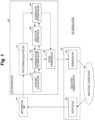
- Fig. 1 illustrates an example configuration of a control system 100 according to this embodiment.
- base station information position information (latitude/longitude), current parameters (tilt angle (°), transmission power (W), etc.), and a traffic demand (traffic amount (bps) for each area/time zone, the number of active users (persons) for each area/time zone) are input, and instruction information as to the suspension/operation of a base station, changed parameters (tilt angle, transmission power, etc.) of a base station, etc., are output.
- the control system 100 includes an input reception unit 10, a data processing unit 20, and a base station communication unit 30.
- the data processing unit 20 includes a traffic demand calculation unit 21, a suspension station determination unit 22, a cover area calculation unit 23, a suspension end determination unit 24, a control transmission unit 25, and a base station information DB 26.
- the base station communication unit 30 includes a transmission unit 31 and a reception unit 32.
- Each base station constitutes a communication area and performs wireless communication with a terminal in the area.
- cover area calculation unit 23 may be included in the suspension station determination unit 22.
- the "suspension station determination unit 22 + cover area calculation unit 23" may be referred to as a "suspension station determination unit”.
- the control transmission unit 25 may include the function of the base station communication unit 30.
- control system 100 may include one apparatus (computer or the like) or may include multiple apparatuses.
- the control system 100 including one apparatus (computer or the like) may be referred to as a control apparatus.
- the data processing unit 20 may be referred to as a control apparatus.
- the method of the mobile communication system according to this embodiment is not limited to a specific method.
- the method may be any of 3G, 4G, 5G, 6G, and wireless LAN, and may be other methods.
- the input reception unit 10 periodically observes the traffic demand of each base station.
- the observation cycle is set to, for example, about several minutes to several hours according to estimation/prediction accuracy required for the traffic demand calculation unit 21.
- the input reception unit 10 notifies the traffic demand calculation unit 21 of the observation result.
- the traffic demand calculation unit 21 calculates the current traffic demand and the future traffic demand of each base station based on the information from the input reception unit 10.
- the suspension station determination unit 22 determines a base station to be suspended (referred to as a suspension station) and a base station to change parameters (referred to as a repair station) based on the observation/prediction result by the traffic demand calculation unit 21 and the calculation result by the cover area calculation unit 23.
- the cover area calculation unit 23 calculates whether a coverage hole occurs because of the suspension of a base station, and when it occurs, whether the coverage hole can be covered by a peripheral base station.
- the suspension end determination unit 24 determines whether to restart the operation of the suspension station based on the calculation result by the traffic demand calculation unit 21.
- the control transmission unit 25 receives control contents from the suspension station determination unit 22 or the suspension end determination unit 24, and transmits the control contents to the base station communication unit 30. Based on the control contents, a target base station is controlled by the base station communication unit 30.
- the base station information DB 26 stores and manages the position information of each base station, parameters of each base station, suspension station information, and repair station information. These pieces of information are updated upon reception of the control contents determined by the suspension station determination unit 22 or the suspension end determination unit 24. In addition, the past information is also held in the base station information DB 26 according to the information used for calculation by the suspension station determination unit 22 and the suspension end determination unit 24.
- the traffic demand calculation unit 21 calculates a current estimated value of the traffic demand of each base station and a future prediction value of each base station based on the information regarding the traffic demand periodically obtained from the input reception unit 10.
- the method of calculating the estimated value is not limited to a specific method, and, for example, an exponential smoothed moving average, a state space model, or the like can be used.
- the calculation method of the future prediction value of the traffic demand is not limited to a specific method, and, for example, a prediction method using SARIMA [5], a prediction method using LSTM [6], or the like can be used.
- the suspension station determination unit 22 determines a base station to be suspended based on the calculation result by the traffic demand calculation unit 21 and the determination by the cover area calculation unit 23. The operation of the suspension station determination unit 22 will be described in detail, following the procedure of the flowchart of Fig. 2 .
- the suspension station determination unit 22 lists base stations having a demand that falls below a threshold value. If there is no base station with a low demand, the subsequent calculation is not performed, and information from the input reception unit 10 is awaited.
- the suspension station determination unit 22 determines whether the base stations listed in S1 are to be subjected to a determination as to whether to perform suspension one by one in order from the base station with a lower demand.
- a base station that is a target for determining whether to perform suspension is referred to as a suspension candidate station.
- a base station that has already been suspended and a base station (repair station or the like) that cannot be suspended are excluded from targets for determining whether to perform suspension, and other base stations are set as suspension candidate stations.
- Information on a base station that has already been suspended and a base station (repair station or the like) that cannot be suspended can be acquired from the base station information DB 26.
- the base station information DB 26 is updated according to the control contents determined by the suspension station determination unit 22.
- the suspension station determination unit 22 lists, for a suspension candidate station, base stations (referred to as peripheral stations) that exist around the suspension candidate station and having a traffic demand that falls below a threshold value.
- the suspension station determination unit 22 transmits information on the suspension candidate station and the peripheral stations to the cover area calculation unit 23, and receives a determination result as to whether suspension can be performed.
- the determination result includes a parameter indicating a frequency band to be suspended by the suspension candidate station and a parameter of the repair station.
- the suspension station determination unit 22 determines whether to suspend the suspension candidate station based on the determination result received at S4.
- the processing of S3 to S5 is performed on each of the suspension candidate stations, and a base station to be suspended in any frequency band is determined.
- the suspension station determination unit 22 notifies the control transmission unit 25 of parameters of a base station to be suspended (frequency band to be suspended, etc.) and parameters of a repair station at that time.
- the cover area calculation unit 23 calculates whether a coverage hole occurs because of the suspension of a suspension candidate station, and whether the coverage hole can be covered by a peripheral station (when it occurs). The operation of the cover area calculation unit 23 will be described in detail, following the procedure of the flowchart of Fig. 3 . When there are multiple sets of "suspension candidate station and one or more peripheral stations corresponding to the suspension candidate station", the following processing is executed for each set.
- the cover area calculation unit 23 estimates a current cover range with respect to the suspension candidate station and the peripheral station that have been sent from the suspension station determination unit 22. There are multiple methods for estimating the cover range, and any method may be used.
- the geometric cover range estimation method of the literature [3] the highly accurate estimation in consideration of the propagation loss and the radio wave interference of the literature [4], or the like can be used. These can be changed according to the requirements of calculation time and estimation accuracy, and when a sufficient calculation time can be secured, the cover range is estimated based on the technique of the literature [4], and otherwise, the cover range is estimated based on the technique of the literature [3].
- the cover range of the base station is, for example, a range in which a terminal present is enabled to perform communications with the base station with a predetermined communication quality.
- the cover range may not only be defined in view of communication quality but also be defined as "a range that can cover communication in view of traffic accommodation.”
- the cover area calculation unit 23 uses the cover range obtained in S11 to determine whether a coverage hole is generated by suspending one or more or all frequency bands of the suspension candidate station.
- the coverage hole is a range that is covered by neither the coverage range of the suspension candidate station nor the coverage range of the peripheral station.
- the cover area calculation unit 23 causes the frequency bands of the suspension candidate station to be suspended one by one, and determines whether a coverage hole occurs in each situation.
- the order of suspending the frequency bands for example, there is a method of performing suspension in order from a higher frequency band.
- the process proceeds to S13,where it is determined that all the frequency bands of this suspension candidate station can be suspended and the suspension station determination unit 22 is notified of a frequency band to be suspended of this suspension candidate station.
- the suspension station determined here is a suspension station that does not require a change in parameters of the peripheral station.
- the process proceeds to S14, and whether the coverage hole can be covered by a change in parameters of the peripheral station is calculated for each situation of the suspension of the frequency band.
- the cover area calculation unit 23 calculates the coverage ratio of the coverage hole by the coverage range of the peripheral station, using, for example, the technique of the literature [3]. Specifically, when the calculated coverage ratio with respect to the coverage hole is equal to or greater than a threshold value, it is determined that the coverage hole can be covered.
- the peripheral station that changes a parameter for the cover is referred to as a repair station. Parameters to be changed may be, but are not limited to, the tilt angle and transmission power of an antenna, etc. In addition, there may be one repair station or multiple repair stations for a certain suspension station.
- the cover area calculation unit 23 adopts, as the control contents, a situation in which the number of frequency bands that can be suspended is the largest among situations with respect to which it is determined that covering is possible with the repair station. If it is determined that covering is possible in none of the situations, no suspension is performed.
- the cover area calculation unit 23 notifies the suspension station determination unit 22 whether it is possible to suspend a base station, of a frequency band to be suspended of a suspension candidate station (if the suspension can be performed), and of the parameter of the repair station.
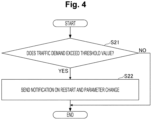
- the suspension end determination unit 24 determines whether to restart the operation of the suspension station that is suspended in at least one frequency band based on the calculation result by the traffic demand calculation unit 21. The operation of the suspension end determination unit 24is described, following the procedure of the flowchart of Fig. 4 .
- the suspension end determination unit 24 determines whether the traffic demand of the suspension station or the repair station exceeds a threshold value.
- the information on the traffic demand of the current suspension station and its repair station can be acquired from the base station information DB 26.
- the process proceeds to S22, and the suspension end determination unit 24 notifies the control transmission unit 25 of the restart of the suspension station (the restart of the suspended frequency band) and the change of the parameters of the repair station.
- the suspension end determination unit 24 updates the base station information DB 26 according to the control result determined as described above.
- the base station managed in the base station information DB 26 as a suspension station is managed as a normal base station that is not a suspension station.
- the situation is the same as the situation when the suspension control is performed, and thus, nothing is performed and the suspension is continued.
- the control transmission unit 25 receives the control contents determined by the suspension station determination unit 22 and the suspension end determination unit 24, and transmits the control contents to the base station communication unit 30. More specifically, the control transmission unit 25 starts transmission immediately after receiving a notification from the suspension station determination unit 22 or the suspension end determination unit 24. Note that if notifications are simultaneously received from the suspension station determination unit 22 and the suspension end determination unit 24, these pieces of information are transmitted together.
- control transmission unit 25 receives the control contents for each time zone, the control transmission unit 25 receives the control contents until the current time reaches the time zone, and transmits the corresponding control contents when the current time reaches the time zone.
- Examples 1 to 3 are described as examples of the base station control.
- Example 1 the suspension contents of the base station and the parameter change of the repair station are calculated according to the traffic demand periodically observed, and the corresponding base station is controlled based on the calculation result.
- the processing of Example 1 is described with reference to the flowchart of Fig. 5 .
- the control cycle is set to, for example, about several minutes to one hour, and online control is periodically performed. That is, the processing of the flowchart of Fig. 5 is periodically executed.
- the input reception unit 10 periodically acquires information from the base station communication unit 30.
- the traffic demand calculation unit 21 estimates a current traffic demand from the information acquired at S101.
- the suspension station determination unit 22 determines whether there is a base station having a traffic demand that is equal to or less than a threshold value based on the estimation result at S102, and if there is one, the process proceeds to S104. If there is no base station having a traffic demand that is equal to or less than the threshold value, subsequent operations are not performed, and the process returns to S101 to wait for information from the input reception unit 10.
- the suspension station determination unit 22 calculates parameters of the base station that can be suspended and a repair station in that case based on the estimation result at S102.
- the suspension station determination unit 22 notifies the control transmission unit 25 of the calculation result.
- the suspension end determination unit 24 determines whether there is a suspension station or a repair station having a traffic demand that is equal to or greater than the threshold value, that is, whether to restart the base station that has already been suspended. In the case of restarting, the process proceeds to S107. If there is no suspension station or repair station having a traffic demand that is equal to or greater than the threshold value, the subsequent operation is not performed, and the process returns to the beginning.
- the suspension end determination unit 24 determines the restart of the operation of the corresponding suspension station and calculates the parameter after the change of the repair station, and at S108, notifies the control transmission unit 25 of the control contents (calculation result).
- control transmission unit 25 transmits control information indicating the suspension/restart/parameter change of the base station to the base station communication unit 30.
- Example 2 in the data processing unit 20, the control pattern of the suspension and the tilt angle change of the base station is prepared for each time zone in advance using a future prediction value of traffic demand. Then, the base station communication unit 30 is instructed to perform control in each time zone.
- the control cycle is, for example, about several hours, and offline control is performed every cycle.
- Example 2 unlike Example 1, the calculation time of the base station parameters in the cover area calculation unit 23 can be sufficiently secured, and highly accurate control in consideration of radio wave interference or the like can be performed.
- the flow of processing executed by the data processing unit 20 in Example 2 is as follows.
- the traffic demand calculation unit 21 calculates a prediction value of traffic demand for each time zone of each base station based on information regarding traffic demand that is periodically observed.
- the prediction value is stored in the base station information DB 26.
- the suspension station determination unit 22 and the suspension end determination unit 24 calculate the suspension/restart/parameter change of the base station for each time zone from the prediction value of the demand in each time zone stored in the base station information DB 26, and collectively notify the control transmission unit 25 of the control contents.
- the control transmission unit 25 holds the sent control contents.
- the control transmission unit 25 transmits the control contents received in advance to the base station communication unit 30 according to a time zone, and gives an instruction for control.
- Example 3 offline control based on traffic demand prediction is performed similarly to the Example 2, and if sudden traffic demand fluctuation or base station failure occurs, online control similar to that of Example 1 is performed. As a result, it is possible to achieve both highly accurate control in consideration of radio wave interference or the like in normal times and coping with sudden demand fluctuations.
- the flow of processing executed by the data processing unit 20 in Example 3 is as follows.
- the input reception unit 10 acquires the observation information in a cycle shorter than about several hours, for example, a cycle of several minutes, which is the control cycle of Example 2.
- the traffic demand calculation unit 21 estimates the current traffic demand of each base station based on the observation information.
- control contents for each time zone are determined based on a future traffic demand by the same processing as in Example 2, the control contents are transmitted to the base station communication unit 30 for each time zone, and an instruction for control is given.
- the control system 100 or the control apparatus can be implemented by, for example, causing a computer to execute a program.
- This computer may be a physical computer, or may be a virtual machine on a cloud.
- the control system 100 and the control apparatus are collectively referred to as "apparatus".
- the apparatus can be implemented by executing a program corresponding to the processing to be performed in the apparatus, using hardware resources such as a CPU and a memory built into the computer.
- the above program can be stored and distributed by being recorded in a computer-readable recording medium (portable memory or the like).
- the above program can also be provided through a network such as the Internet or an electronic mail.
- Fig. 6 is a diagram illustrating an example hardware configuration of the computer.
- the computer in Fig. 6 includes a drive device 1000, an auxiliary storage device 1002, a memory device 1003, a CPU 1004, an interface device 1005, a display device 1006, an input device 1007, and an output device 1008, which are connected to one another by a bus BS.
- a program for implementing processing in the computer is provided through a recording medium 1001 such as a CD-ROM or a memory card, for example.
- a recording medium 1001 such as a CD-ROM or a memory card
- the program is installed on the auxiliary storage device 1002 from the recording medium 1001 via the drive device 1000.
- the program is not necessarily installed from the recording medium 1001, and may be downloaded from another computer via a network.
- the auxiliary storage device 1002 stores the installed program, and also stores necessary files, data, and the like.
- the memory device 1003 reads the program from the auxiliary storage device 1002 and stores the program.
- the CPU 1004 implements a function related to the device in accordance with a program stored in the memory device 1003.
- the interface device 1005 is used as an interface for connection to a network or the like.
- the display device 1006 displays a graphical user interface (GUI) or the like by the program.
- the input device 1007 is constituted by a keyboard and a mouse, buttons, a touchscreen, or the like, and is used to input various operation instructions.
- the output device 1008 outputs a calculation result.
- Effect 1 In the control, the number of terminals in which the communication quality deteriorates because of the suspension of the base station can be reduced as compared with the prior art by placing the securing of the communication quality of the terminal as a constraint.
- Effect 2 By simultaneously optimizing parameter settings of a base station to be suspended and a base station to be operated, more base stations can be suspended and power consumption can be further reduced as compared with the prior art.
- Effect 3 By optimizing the base station to be suspended simultaneously with parameter setting of other base stations, even in an area where the cells of base stations do not overlap or an area where the density of base stations is low, to which the prior art cannot be applied, some base stations can be suspended, and power consumption can be reduced.
- a control apparatus that controls a base station in a mobile communication system including multiple base stations, the control apparatus including:
- the control apparatus in which the suspension station determination unit determines a parameter of the at least one repair station corresponding to a situation in which a number of frequency bands suspendable by the suspension station is the largest among situations in which the at least one repair station is able to cover a coverage hole.
- the control apparatus in which the suspension station determination unit determines a base station in which no coverage hole is generated even when all frequency bands are suspended as a suspension station that does not require a parameter change of a peripheral station.
- the control apparatus according to any one of items 1 to 3, further including: a suspension end determination unit configured to determine whether to restart a suspended frequency band in a suspension station based on traffic demand.
- the control apparatus in which the suspension station determination unit determines control information for each future time zone based on a prediction value of a future traffic demand, and the control transmission unit transmits the control information when a time of the time zone arrives.
Landscapes
- Engineering & Computer Science (AREA)
- Computer Networks & Wireless Communication (AREA)
- Signal Processing (AREA)
- Mobile Radio Communication Systems (AREA)
Abstract
Description
- The present invention relates to a technique for controlling a wireless base station (hereinafter, referred to as a base station) that provides a wireless communication service to a terminal in a mobile communication system.
- Since traffic demand to the base station greatly fluctuates depending on a time zone/place, the base station generally secures a capacity (calculation resource or the like) for traffic processing in accordance with a peak of the traffic demand.
- Therefore, in a time zone/place where the traffic demand is small, capacity is excessively secured with respect to the traffic demand. Since power is consumed according to this capacity, power use efficiency with respect to traffic processing deteriorates.
- In order to improve the power use efficiency, it has been studied to reduce the power consumption by suspending one or more base stations in a time zone/place where traffic demand is small and covering the area of a suspended base station with a peripheral base station [1 and 2]. Note that the literature names of the reference literatures indicated by numbers in this specification are listed at the end of the specification.
- The base station generally covers an area with multiple frequency bands, and can perform suspension for each frequency band. The communication terminal connected to the suspended base station, however, needs to switch the connection destination to another base station, which may deteriorate the communication quality.
- Therefore, it is required to perform base station control such as suspension of a base station and changing of parameters (tilt angle, transmission power, etc.) of peripheral base stations while suppressing deterioration in the communication quality of terminals.
- Non Patent Literature 1: Y. Gao, Y. Li, H. Yu, X. Wang and S. Gao, "Energy efficient joint optimization of electric antenna tilt and transmit power in 3GPP LTE-Advanced: A system level result," 2013 IEEE 9th International Colloquium on Signal Processing and its Applications, 2013, pp. 135-139, doi:10.1109/CSPA.2013.6530029.
- As an existing method for improving power use efficiency, there is a (handover) method of suspending a base station with a small traffic demand and switching a terminal connected to the base station to a nearby base station [1]. This method assumes the presence of a base station that can be handed over to the terminal.
- In an area in which the cells of base stations do not overlap or an area in which the density of base stations is low, however, the suspension of a base station is likely to cause a location where no radio waves reach (coverage hole) or the insufficiency of the bandwidth of a base station to make it impossible to perform handover. Therefore, this method cannot be applied to the area as described above.
- In addition, as another existing method, there is a method of suppressing the deterioration of the communication quality of terminals near one or more base stations while suspending the base stations, by changing parameters such as the elevation angle (tilt angle) and transmission power of the antenna of a base station ([2], Non Patent Literature 1).
- According to this method, after a base station to be suspended is determined by some method, parameters for suppressing the communication quality of a terminal are calculated. Since the communication quality of the terminal greatly depends on the base station to be suspended, however, it may be impossible to secure the communication quality depending on the method of selecting the base station to be suspended.
- The present invention has been made in view of the above points, and an object of the present invention is to provide a technique capable of achieving both the suppression of deterioration in communication quality and reduction in the power consumption of a base station.
- According to the disclosed technology, there is provided a control apparatus that controls a base station in a mobile communication system including multiple base stations, the control apparatus including:
- a suspension station determination unit configured to determine, based on a traffic demand of each of the base stations, a suspension station that suspends at least one frequency band and a parameter of at least one repair station that covers a coverage hole generated by the suspension of the suspension station; and
- a control transmission unit configured to transmit control information, the control information including information on the suspension station determined by the suspension station determination unit and the parameter.
- According to the disclosed technique, it is possible to achieve both the suppression of deterioration in communication quality and reduction in the power consumption of a base station.
-
-
Fig. 1 is a configuration diagram of a control system according to an embodiment of the present invention. -
Fig. 2 is a flowchart for explaining an operation of a suspension station determination unit. -
Fig. 3 is a flowchart for explaining an operation of a cover area calculation unit. -
Fig. 4 is a flowchart for explaining an operation of a suspension end determination unit. -
Fig. 5 is a flowchart for explaining an operation of an example. -
Fig. 6 is a diagram illustrating a hardware configuration example of an apparatus. - An embodiment of the present invention (this embodiment) will be described below with reference to the drawings. The embodiment described below is merely an example, and embodiments to which the present invention is applied are not limited to the following embodiment.
- According to this embodiment, a control system that controls base stations obtains parameters (tilt angle, transmission power, etc.) of a base station to be suspended and a base station to be operated to reduce power consumption under the constraint that the communication quality of a terminal is secured according to the traffic demand of each base station, and performs control.
- As described in an example to be described below, control using a current traffic demand can be performed, or control using a future traffic demand (for example, for each time zone) can be performed.
-
Fig. 1 illustrates an example configuration of acontrol system 100 according to this embodiment. According to thecontrol system 100 of this embodiment, base station information (position information (latitude/longitude), current parameters (tilt angle (°), transmission power (W), etc.), and a traffic demand (traffic amount (bps) for each area/time zone, the number of active users (persons) for each area/time zone) are input, and instruction information as to the suspension/operation of a base station, changed parameters (tilt angle, transmission power, etc.) of a base station, etc., are output. - As illustrated in
Fig. 1 , thecontrol system 100 includes aninput reception unit 10, adata processing unit 20, and a basestation communication unit 30. Thedata processing unit 20 includes a trafficdemand calculation unit 21, a suspensionstation determination unit 22, a coverarea calculation unit 23, a suspensionend determination unit 24, acontrol transmission unit 25, and a basestation information DB 26. The basestation communication unit 30 includes atransmission unit 31 and areception unit 32. - Multiple base stations to be controlled and a control apparatus for controlling the base stations are connected to the base
station communication unit 30. Each base station constitutes a communication area and performs wireless communication with a terminal in the area. - Note that the cover
area calculation unit 23 may be included in the suspensionstation determination unit 22. Alternatively, the "suspensionstation determination unit 22 + coverarea calculation unit 23" may be referred to as a "suspension station determination unit". In addition, thecontrol transmission unit 25 may include the function of the basestation communication unit 30. - In addition, the
control system 100 may include one apparatus (computer or the like) or may include multiple apparatuses. Thecontrol system 100 including one apparatus (computer or the like) may be referred to as a control apparatus. In addition, thedata processing unit 20 may be referred to as a control apparatus. - In addition, the method of the mobile communication system according to this embodiment is not limited to a specific method. For example, the method may be any of 3G, 4G, 5G, 6G, and wireless LAN, and may be other methods.
- An operation overview of each unit is as follows.
- The
input reception unit 10 periodically observes the traffic demand of each base station. The observation cycle is set to, for example, about several minutes to several hours according to estimation/prediction accuracy required for the trafficdemand calculation unit 21. Theinput reception unit 10 notifies the trafficdemand calculation unit 21 of the observation result. - The traffic
demand calculation unit 21 calculates the current traffic demand and the future traffic demand of each base station based on the information from theinput reception unit 10. - The suspension
station determination unit 22 determines a base station to be suspended (referred to as a suspension station) and a base station to change parameters (referred to as a repair station) based on the observation/prediction result by the trafficdemand calculation unit 21 and the calculation result by the coverarea calculation unit 23. - The cover
area calculation unit 23 calculates whether a coverage hole occurs because of the suspension of a base station, and when it occurs, whether the coverage hole can be covered by a peripheral base station. - The suspension
end determination unit 24 determines whether to restart the operation of the suspension station based on the calculation result by the trafficdemand calculation unit 21. - The
control transmission unit 25 receives control contents from the suspensionstation determination unit 22 or the suspensionend determination unit 24, and transmits the control contents to the basestation communication unit 30. Based on the control contents, a target base station is controlled by the basestation communication unit 30. - The base
station information DB 26 stores and manages the position information of each base station, parameters of each base station, suspension station information, and repair station information. These pieces of information are updated upon reception of the control contents determined by the suspensionstation determination unit 22 or the suspensionend determination unit 24. In addition, the past information is also held in the basestation information DB 26 according to the information used for calculation by the suspensionstation determination unit 22 and the suspensionend determination unit 24. - Next, the operation of each unit in the
data processing unit 20 will be described in more detail. - The traffic
demand calculation unit 21 calculates a current estimated value of the traffic demand of each base station and a future prediction value of each base station based on the information regarding the traffic demand periodically obtained from theinput reception unit 10. The method of calculating the estimated value is not limited to a specific method, and, for example, an exponential smoothed moving average, a state space model, or the like can be used. The calculation method of the future prediction value of the traffic demand is not limited to a specific method, and, for example, a prediction method using SARIMA [5], a prediction method using LSTM [6], or the like can be used. - The suspension
station determination unit 22 determines a base station to be suspended based on the calculation result by the trafficdemand calculation unit 21 and the determination by the coverarea calculation unit 23. The operation of the suspensionstation determination unit 22 will be described in detail, following the procedure of the flowchart ofFig. 2 . - At S1, based on the traffic demand of each base station calculated by the traffic
demand calculation unit 21, the suspensionstation determination unit 22 lists base stations having a demand that falls below a threshold value. If there is no base station with a low demand, the subsequent calculation is not performed, and information from theinput reception unit 10 is awaited. - At S2, the suspension
station determination unit 22 determines whether the base stations listed in S1 are to be subjected to a determination as to whether to perform suspension one by one in order from the base station with a lower demand. A base station that is a target for determining whether to perform suspension is referred to as a suspension candidate station. - Here, among the base stations with a low demand, a base station that has already been suspended and a base station (repair station or the like) that cannot be suspended are excluded from targets for determining whether to perform suspension, and other base stations are set as suspension candidate stations. Information on a base station that has already been suspended and a base station (repair station or the like) that cannot be suspended can be acquired from the base
station information DB 26. In addition, the basestation information DB 26 is updated according to the control contents determined by the suspensionstation determination unit 22. - At S3, the suspension
station determination unit 22 lists, for a suspension candidate station, base stations (referred to as peripheral stations) that exist around the suspension candidate station and having a traffic demand that falls below a threshold value. - At S4, the suspension
station determination unit 22 transmits information on the suspension candidate station and the peripheral stations to the coverarea calculation unit 23, and receives a determination result as to whether suspension can be performed. The determination result includes a parameter indicating a frequency band to be suspended by the suspension candidate station and a parameter of the repair station. - At S5, the suspension
station determination unit 22 determines whether to suspend the suspension candidate station based on the determination result received at S4. The processing of S3 to S5 is performed on each of the suspension candidate stations, and a base station to be suspended in any frequency band is determined. - At S6, the suspension
station determination unit 22 notifies thecontrol transmission unit 25 of parameters of a base station to be suspended (frequency band to be suspended, etc.) and parameters of a repair station at that time. - The cover
area calculation unit 23 calculates whether a coverage hole occurs because of the suspension of a suspension candidate station, and whether the coverage hole can be covered by a peripheral station (when it occurs). The operation of the coverarea calculation unit 23 will be described in detail, following the procedure of the flowchart ofFig. 3 . When there are multiple sets of "suspension candidate station and one or more peripheral stations corresponding to the suspension candidate station", the following processing is executed for each set. - At S11, the cover
area calculation unit 23 estimates a current cover range with respect to the suspension candidate station and the peripheral station that have been sent from the suspensionstation determination unit 22. There are multiple methods for estimating the cover range, and any method may be used. - For example, as a method of estimating the cover range, the geometric cover range estimation method of the literature [3], the highly accurate estimation in consideration of the propagation loss and the radio wave interference of the literature [4], or the like can be used. These can be changed according to the requirements of calculation time and estimation accuracy, and when a sufficient calculation time can be secured, the cover range is estimated based on the technique of the literature [4], and otherwise, the cover range is estimated based on the technique of the literature [3].
- The cover range of the base station is, for example, a range in which a terminal present is enabled to perform communications with the base station with a predetermined communication quality.
- The cover range may not only be defined in view of communication quality but also be defined as "a range that can cover communication in view of traffic accommodation."
- At S12, the cover
area calculation unit 23 uses the cover range obtained in S11 to determine whether a coverage hole is generated by suspending one or more or all frequency bands of the suspension candidate station. The coverage hole is a range that is covered by neither the coverage range of the suspension candidate station nor the coverage range of the peripheral station. - Specifically, the cover
area calculation unit 23 causes the frequency bands of the suspension candidate station to be suspended one by one, and determines whether a coverage hole occurs in each situation. As the order of suspending the frequency bands, for example, there is a method of performing suspension in order from a higher frequency band. - If it is determined at S12 that no coverage hole is to be generated even when all the frequency bands are suspended, the process proceeds to S13,where it is determined that all the frequency bands of this suspension candidate station can be suspended and the suspension
station determination unit 22 is notified of a frequency band to be suspended of this suspension candidate station. The suspension station determined here is a suspension station that does not require a change in parameters of the peripheral station. - If it is determined at S12 that a coverage hole is to be generated by suspending any frequency band, the process proceeds to S14, and whether the coverage hole can be covered by a change in parameters of the peripheral station is calculated for each situation of the suspension of the frequency band.
- The cover
area calculation unit 23 calculates the coverage ratio of the coverage hole by the coverage range of the peripheral station, using, for example, the technique of the literature [3]. Specifically, when the calculated coverage ratio with respect to the coverage hole is equal to or greater than a threshold value, it is determined that the coverage hole can be covered. The peripheral station that changes a parameter for the cover is referred to as a repair station. Parameters to be changed may be, but are not limited to, the tilt angle and transmission power of an antenna, etc. In addition, there may be one repair station or multiple repair stations for a certain suspension station. - At S15, the cover
area calculation unit 23 adopts, as the control contents, a situation in which the number of frequency bands that can be suspended is the largest among situations with respect to which it is determined that covering is possible with the repair station. If it is determined that covering is possible in none of the situations, no suspension is performed. - At S16, the cover
area calculation unit 23 notifies the suspensionstation determination unit 22 whether it is possible to suspend a base station, of a frequency band to be suspended of a suspension candidate station (if the suspension can be performed), and of the parameter of the repair station. - The suspension
end determination unit 24 determines whether to restart the operation of the suspension station that is suspended in at least one frequency band based on the calculation result by the trafficdemand calculation unit 21. The operation of the suspension end determination unit 24is described, following the procedure of the flowchart ofFig. 4 . - At S21, the suspension
end determination unit 24 determines whether the traffic demand of the suspension station or the repair station exceeds a threshold value. The information on the traffic demand of the current suspension station and its repair station can be acquired from the basestation information DB 26. - If it is determined that the traffic demand of the suspension station or the repair station exceeds the threshold value, the process proceeds to S22, and the suspension
end determination unit 24 notifies thecontrol transmission unit 25 of the restart of the suspension station (the restart of the suspended frequency band) and the change of the parameters of the repair station. - For the parameter change, for example, processing such as returning the parameter to the parameter before covering the coverage hole. In addition, the suspension
end determination unit 24 updates the basestation information DB 26 according to the control result determined as described above. By this update, for example, the base station managed in the basestation information DB 26 as a suspension station is managed as a normal base station that is not a suspension station. - If it is determined that the traffic demand of the suspension station or the repair station does not exceed the threshold value at S21, the situation is the same as the situation when the suspension control is performed, and thus, nothing is performed and the suspension is continued.
- The
control transmission unit 25 receives the control contents determined by the suspensionstation determination unit 22 and the suspensionend determination unit 24, and transmits the control contents to the basestation communication unit 30. More specifically, thecontrol transmission unit 25 starts transmission immediately after receiving a notification from the suspensionstation determination unit 22 or the suspensionend determination unit 24. Note that if notifications are simultaneously received from the suspensionstation determination unit 22 and the suspensionend determination unit 24, these pieces of information are transmitted together. - Note that, as in Example 2 to be described below, if the
control transmission unit 25 receives the control contents for each time zone, thecontrol transmission unit 25 receives the control contents until the current time reaches the time zone, and transmits the corresponding control contents when the current time reaches the time zone. - Hereinafter, Examples 1 to 3 are described as examples of the base station control.
- In Example 1, the suspension contents of the base station and the parameter change of the repair station are calculated according to the traffic demand periodically observed, and the corresponding base station is controlled based on the calculation result. The processing of Example 1 is described with reference to the flowchart of
Fig. 5 . In this example, the control cycle is set to, for example, about several minutes to one hour, and online control is periodically performed. That is, the processing of the flowchart ofFig. 5 is periodically executed. - At S101, the
input reception unit 10 periodically acquires information from the basestation communication unit 30. At S102, the trafficdemand calculation unit 21 estimates a current traffic demand from the information acquired at S101. - At S103, the suspension
station determination unit 22 determines whether there is a base station having a traffic demand that is equal to or less than a threshold value based on the estimation result at S102, and if there is one, the process proceeds to S104. If there is no base station having a traffic demand that is equal to or less than the threshold value, subsequent operations are not performed, and the process returns to S101 to wait for information from theinput reception unit 10. - At S104, the suspension
station determination unit 22 calculates parameters of the base station that can be suspended and a repair station in that case based on the estimation result at S102. At S105, the suspensionstation determination unit 22 notifies thecontrol transmission unit 25 of the calculation result. - At S106, based on the estimation result at S102, the suspension
end determination unit 24 determines whether there is a suspension station or a repair station having a traffic demand that is equal to or greater than the threshold value, that is, whether to restart the base station that has already been suspended. In the case of restarting, the process proceeds to S107. If there is no suspension station or repair station having a traffic demand that is equal to or greater than the threshold value, the subsequent operation is not performed, and the process returns to the beginning. - At S107, the suspension
end determination unit 24 determines the restart of the operation of the corresponding suspension station and calculates the parameter after the change of the repair station, and at S108, notifies thecontrol transmission unit 25 of the control contents (calculation result). - At S109, the
control transmission unit 25 transmits control information indicating the suspension/restart/parameter change of the base station to the basestation communication unit 30. - At S110, it is determined whether to end the operation of the base station control. In the case of ending the operation, the operation of this system ends. In the case of not ending the operation, the processing described above is repeated.
- In Example 2, in the
data processing unit 20, the control pattern of the suspension and the tilt angle change of the base station is prepared for each time zone in advance using a future prediction value of traffic demand. Then, the basestation communication unit 30 is instructed to perform control in each time zone. In Example 2, the control cycle is, for example, about several hours, and offline control is performed every cycle. - In Example 2, unlike Example 1, the calculation time of the base station parameters in the cover
area calculation unit 23 can be sufficiently secured, and highly accurate control in consideration of radio wave interference or the like can be performed. The flow of processing executed by thedata processing unit 20 in Example 2 is as follows. - First, the traffic
demand calculation unit 21 calculates a prediction value of traffic demand for each time zone of each base station based on information regarding traffic demand that is periodically observed. The prediction value is stored in the basestation information DB 26. - Next, the suspension
station determination unit 22 and the suspensionend determination unit 24 calculate the suspension/restart/parameter change of the base station for each time zone from the prediction value of the demand in each time zone stored in the basestation information DB 26, and collectively notify thecontrol transmission unit 25 of the control contents. Thecontrol transmission unit 25 holds the sent control contents. - The
control transmission unit 25 transmits the control contents received in advance to the basestation communication unit 30 according to a time zone, and gives an instruction for control. - In Example 3, offline control based on traffic demand prediction is performed similarly to the Example 2, and if sudden traffic demand fluctuation or base station failure occurs, online control similar to that of Example 1 is performed. As a result, it is possible to achieve both highly accurate control in consideration of radio wave interference or the like in normal times and coping with sudden demand fluctuations. The flow of processing executed by the
data processing unit 20 in Example 3 is as follows. - The
input reception unit 10 acquires the observation information in a cycle shorter than about several hours, for example, a cycle of several minutes, which is the control cycle of Example 2. The trafficdemand calculation unit 21 estimates the current traffic demand of each base station based on the observation information. - If there is a base station having a current traffic demand that exceeds a threshold value, new control contents are calculated by the same processing as in Example 1 and are sent to the
control transmission unit 25, and thecontrol transmission unit 25 transmits the control contents to the basestation communication unit 30. - If there is no base station having a current traffic demand that exceeds the threshold value, the control contents for each time zone are determined based on a future traffic demand by the same processing as in Example 2, the control contents are transmitted to the base
station communication unit 30 for each time zone, and an instruction for control is given. - The
control system 100 or the control apparatus can be implemented by, for example, causing a computer to execute a program. This computer may be a physical computer, or may be a virtual machine on a cloud. Hereinafter, thecontrol system 100 and the control apparatus are collectively referred to as "apparatus". - Specifically, the apparatus can be implemented by executing a program corresponding to the processing to be performed in the apparatus, using hardware resources such as a CPU and a memory built into the computer. The above program can be stored and distributed by being recorded in a computer-readable recording medium (portable memory or the like). The above program can also be provided through a network such as the Internet or an electronic mail.
-
Fig. 6 is a diagram illustrating an example hardware configuration of the computer. The computer inFig. 6 includes adrive device 1000, anauxiliary storage device 1002, amemory device 1003, aCPU 1004, aninterface device 1005, adisplay device 1006, aninput device 1007, and anoutput device 1008, which are connected to one another by a bus BS. - A program for implementing processing in the computer is provided through a
recording medium 1001 such as a CD-ROM or a memory card, for example. When therecording medium 1001 storing the program is set in thedrive device 1000, the program is installed on theauxiliary storage device 1002 from therecording medium 1001 via thedrive device 1000. Here, the program is not necessarily installed from therecording medium 1001, and may be downloaded from another computer via a network. Theauxiliary storage device 1002 stores the installed program, and also stores necessary files, data, and the like. - When an instruction to start the program is made, the
memory device 1003 reads the program from theauxiliary storage device 1002 and stores the program. TheCPU 1004 implements a function related to the device in accordance with a program stored in thememory device 1003. Theinterface device 1005 is used as an interface for connection to a network or the like. Thedisplay device 1006 displays a graphical user interface (GUI) or the like by the program. Theinput device 1007 is constituted by a keyboard and a mouse, buttons, a touchscreen, or the like, and is used to input various operation instructions. Theoutput device 1008 outputs a calculation result. - With the technique according to this embodiment, it is possible to achieve both the suppression of deterioration in communication quality and reduction in the power consumption of a base station in a mobile communication system. As secondary effects, there are following effects 1 to 3.
- Effect 1: In the control, the number of terminals in which the communication quality deteriorates because of the suspension of the base station can be reduced as compared with the prior art by placing the securing of the communication quality of the terminal as a constraint.
- Effect 2: By simultaneously optimizing parameter settings of a base station to be suspended and a base station to be operated, more base stations can be suspended and power consumption can be further reduced as compared with the prior art.
- Effect 3: By optimizing the base station to be suspended simultaneously with parameter setting of other base stations, even in an area where the cells of base stations do not overlap or an area where the density of base stations is low, to which the prior art cannot be applied, some base stations can be suspended, and power consumption can be reduced.
- In the present specification, at least a control apparatus, a control method, and a program in the following items are disclosed.
- A control apparatus that controls a base station in a mobile communication system including multiple base stations, the control apparatus including:
- a suspension station determination unit configured to determine, based on a traffic demand of each of the base stations, a suspension station that suspends at least one frequency band and a parameter of at least one repair station that covers a coverage hole generated by the suspension of the suspension station; and
- a control transmission unit configured to transmit control information, the control information including information on the suspension station determined by the suspension station determination unit and the parameter.
- The control apparatus according to item 1, in which
the suspension station determination unit determines a parameter of the at least one repair station corresponding to a situation in which a number of frequency bands suspendable by the suspension station is the largest among situations in which the at least one repair station is able to cover a coverage hole. - The control apparatus according to item 1 or 2, in which
the suspension station determination unit determines a base station in which no coverage hole is generated even when all frequency bands are suspended as a suspension station that does not require a parameter change of a peripheral station. - The control apparatus according to any one of items 1 to 3, further including:
a suspension end determination unit configured to determine whether to restart a suspended frequency band in a suspension station based on traffic demand. - The control apparatus according to any one of items 1 to 4, in which
the suspension station determination unit determines control information for each future time zone based on a prediction value of a future traffic demand, and the control transmission unit transmits the control information when a time of the time zone arrives. - A control method executed by a control apparatus that controls a base station in a mobile communication system including multiple base stations, the control method including:
- a suspension station determination step that determines, based on a traffic demand of each of the base stations, a suspension station that suspends at least one frequency band and a parameter of at least one repair station that covers a coverage hole generated by the suspension of the suspension station; and
- a control transmission step that transmits control information, the control information including information on the suspension station determined by the suspension station determination step and the parameter.
- A program for causing a computer to function as each unit in the control apparatus according to any one of items 1 to 5.
- Although the embodiment is described above, the present invention is not limited to the specific embodiment, and various modifications and changes can be made within the scope of the gist of the present invention described in the claims.
-
- [1] E. Oh and B. Krishnamachari, "Energy Savings through Dynamic Base Station Switching in Cellular Wireless Access Networks," 2010 IEEE Global Telecommunications Conference GLOBECOM 2010, 2010, pp. 1-5, doi: 10.1109/GLOCOM.2010.5683654.
- [2] Y. Gao, Y. Li, H. Yu, X. Wang and S. Gao, "Energy efficient joint optimization of electric antenna tilt and transmit power in 3GPP LTE-Advanced: A system level result," 2013 IEEE 9th International Colloquium on Signal Processing and its Applications, 2013, pp. 135-139, doi:10.1109/CSPA.2013.6530029.
- [3] Masayoshi Iwamoto, Akito Suzuki, Shigeaki Harada, "Antenna tilting angle control method for early recovery of communication interruption area," The IEICE Society Conference, B-7-6, September 2020.
- [4] N. Dandanov, H. Al-Shatri, A. Klein, and V. Poulkov, "Dynamic Self-Optimization of the Antenna Tilt for Best Trade-off Between Coverage and Capacity in Mobile Networks," Wirel. Pers. Commun., vol. 92, no. 1, pp. 251-278, 2017.
- [5] Luo, X., Niu, L. & Zhang, S. An Algorithm for Traffic Flow Prediction Based on Improved SARIMA and GA. KSCE .
- [6] H. D. Trinh, L. Giupponi and P. Dini, "Mobile Traffic Prediction from Raw Data Using LSTM Networks," 2018 IEEE 29th Annual International Symposium on Personal, Indoor and Mobile Radio Communications (PIMRC), 2018, pp. 1827-1832, doi:10.1109/PIMRC.2018.8581000.
-
- 100
- Control system
- 10
- Input reception unit
- 20
- Data processing unit
- 21
- Traffic demand calculation unit
- 22
- Suspension station determination unit
- 23
- Cover area calculation unit
- 24
- Suspension end determination unit
- 25
- Control transmission unit
- 26
- Base station information DB
- 30
- Base station communication unit
- 31
- Transmission unit
- 32
- Reception unit
- 1000
- Drive device
- 1001
- Recording medium
- 1002
- Auxiliary storage device
- 1003
- Memory device
- 1004
- CPU
- 1005
- Interface device
- 1006
- Display device
- 1007
- Input device
- 1008
- Output device
Claims (7)
- A control apparatus that controls a base station in a mobile communication system including a plurality of base stations, the control apparatus comprising:a suspension station determination unit configured to determine, based on a traffic demand of each of the base stations, a suspension station that suspends at least one frequency band and a parameter of at least one repair station that covers a coverage hole generated by the suspension of the suspension station; anda control transmission unit configured to transmit control information, the control information including information on the suspension station determined by the suspension station determination unit and the parameter.
- The control apparatus according to claim 1, wherein
the suspension station determination unit determines a parameter of the at least one repair station corresponding to a situation in which a number of frequency bands suspendable by the suspension station is the largest among situations in which the at least one repair station is able to cover a coverage hole. - The control apparatus according to claim 1 or 2, wherein
the suspension station determination unit determines a base station in which no coverage hole is generated even when all frequency bands are suspended as a suspension station that does not require a parameter change of a peripheral station. - The control apparatus according to any one of claims 1 to 3, further comprising:
a suspension end determination unit configured to determine whether to restart a suspended frequency band in a suspension station based on traffic demand. - The control apparatus according to any one of claims 1 to 4, wherein
the suspension station determination unit determines control information for each future time zone based on a prediction value of a future traffic demand, and the control transmission unit transmits the control information when a time of the time zone arrives. - A control method executed by a control apparatus that controls a base station in a mobile communication system including a plurality of base stations, the control method comprising:a suspension station determination step that determines, based on a traffic demand of each of the base stations, a suspension station that suspends at least one frequency band and a parameter of at least one repair station that covers a coverage hole generated by the suspension of the suspension station; anda control transmission step that transmits control information, the control information including information on the suspension station determined by the suspension station determination step and the parameter.
- A program for causing a computer to function as each unit in the control apparatus according to any one of claims 1 to 5.
Applications Claiming Priority (1)
| Application Number | Priority Date | Filing Date | Title |
|---|---|---|---|
| PCT/JP2021/042803 WO2023089830A1 (en) | 2021-11-22 | 2021-11-22 | Control device, control method, and program |
Publications (2)
| Publication Number | Publication Date |
|---|---|
| EP4440171A1 true EP4440171A1 (en) | 2024-10-02 |
| EP4440171A4 EP4440171A4 (en) | 2025-09-17 |
Family
ID=86396552
Family Applications (1)
| Application Number | Title | Priority Date | Filing Date |
|---|---|---|---|
| EP21964843.3A Pending EP4440171A4 (en) | 2021-11-22 | 2021-11-22 | CONTROL DEVICE, CONTROL METHOD AND PROGRAM |
Country Status (4)
| Country | Link |
|---|---|
| US (1) | US20240406739A1 (en) |
| EP (1) | EP4440171A4 (en) |
| JP (1) | JP7758054B2 (en) |
| WO (1) | WO2023089830A1 (en) |
Families Citing this family (1)
| Publication number | Priority date | Publication date | Assignee | Title |
|---|---|---|---|---|
| JP7766216B1 (en) * | 2025-03-07 | 2025-11-07 | ソフトバンク株式会社 | Power control device, power control method, and program |
Family Cites Families (13)
| Publication number | Priority date | Publication date | Assignee | Title |
|---|---|---|---|---|
| JP3618097B2 (en) * | 2002-05-17 | 2005-02-09 | 株式会社エヌ・ティ・ティ・ドコモ | Radio channel control method, radio channel control system, and radio channel control station |
| US9622169B2 (en) * | 2010-01-04 | 2017-04-11 | Nec Corporation | Power-save operation supporting apparatus, power-save operation supporting method, storage medium and base station |
| JP5650059B2 (en) * | 2011-06-03 | 2015-01-07 | 日本電信電話株式会社 | Base station equipment |
| US9204315B2 (en) * | 2011-06-20 | 2015-12-01 | Alcatel Lucent | Method of coordinating fault detection responses by access nodes of a network |
| CN103974389B (en) * | 2013-02-01 | 2018-04-06 | 株式会社日立制作所 | The dormancy control method of base station and base station in cellular network |
| CN103476105B (en) * | 2013-08-21 | 2016-04-06 | 北京邮电大学 | Space connector synchronization method |
| US9723493B2 (en) * | 2013-09-20 | 2017-08-01 | Avaya Inc. | Plan-assisted wireless access point configuration |
| JP6427935B2 (en) * | 2013-12-04 | 2018-11-28 | ソニー株式会社 | Communication control device and communication control method |
| US9408095B2 (en) * | 2014-02-05 | 2016-08-02 | Telefonaktiebolaget L M Ericsson (Publ) | Autonomous determination of overlapping coverage in heterogeneous networks |
| US10142849B2 (en) * | 2014-03-20 | 2018-11-27 | Kyocera Corporation | Communication control method and radio base station using handover count information |
| CN105050170B (en) * | 2015-06-30 | 2019-02-05 | 东南大学 | A Base Station Sleep Method Based on Traffic Prediction in Heterogeneous Networks |
| US10433189B2 (en) * | 2016-05-09 | 2019-10-01 | Cisco Technology, Inc. | Flexible radio assignment |
| CN113411869A (en) * | 2020-03-17 | 2021-09-17 | 北京亿阳信通科技有限公司 | Method for determining LTE power-saving cell, scheduling method and scheduling device |
-
2021
- 2021-11-22 US US18/698,546 patent/US20240406739A1/en active Pending
- 2021-11-22 EP EP21964843.3A patent/EP4440171A4/en active Pending
- 2021-11-22 WO PCT/JP2021/042803 patent/WO2023089830A1/en not_active Ceased
- 2021-11-22 JP JP2023562097A patent/JP7758054B2/en active Active
Also Published As
| Publication number | Publication date |
|---|---|
| WO2023089830A1 (en) | 2023-05-25 |
| US20240406739A1 (en) | 2024-12-05 |
| EP4440171A4 (en) | 2025-09-17 |
| JPWO2023089830A1 (en) | 2023-05-25 |
| JP7758054B2 (en) | 2025-10-22 |
Similar Documents
| Publication | Publication Date | Title |
|---|---|---|
| EP2744256B1 (en) | Communication control device, communication control method, communication system, and terminal device | |
| US10159111B2 (en) | Radio resource management in a telecommunication system | |
| US9622169B2 (en) | Power-save operation supporting apparatus, power-save operation supporting method, storage medium and base station | |
| US10154522B2 (en) | Communication control device providing communication services via a plurality of communication paths | |
| JP5465162B2 (en) | Mobile communication network and radio base station | |
| WO2013025777A2 (en) | Method and apparatus for providing increased small cell resource utilization | |
| Shen et al. | Downlink cell association optimization for heterogeneous networks via dual coordinate descent | |
| US9408118B2 (en) | Traffic management for heterogenous networks | |
| US20120269127A1 (en) | Radio access device, a radio access system, a network selection method and a recording medium | |
| JPWO2011148487A1 (en) | Wireless communication system, base station, terminal, and wireless communication method | |
| CN120075920A (en) | Rapid switching method and system for indoor Wi-Fi communication | |
| EP2790449A1 (en) | Wireless base station and method for controlling transition between wireless systems | |
| US20240406739A1 (en) | Control apparatus, control method, and program | |
| US9693295B2 (en) | Terminal selection method and system based on self-organizing network, and network entity | |
| CN115039451B (en) | Network nodes in a communication network and the methods executed therein | |
| EP4586665A1 (en) | Control apparatus, control method, and program | |
| Ozyurt et al. | Impact of self-configuration on handover performance in green cellular networks | |
| KR20110048779A (en) | Handover Devices and Methods | |
| WO2022231485A1 (en) | Network node and method performed therein | |
| US9717052B2 (en) | Method for receiving radio packet through short-range wireless communication, portable terminal, and short-range wireless communication system | |
| EP4344303A1 (en) | Communication method and apparatus | |
| JP4337005B1 (en) | Wireless communication system, base station, wireless communication method, program | |
| WO2023000273A1 (en) | Network access method and apparatus, parameter configuration method and apparatus, and device and storage medium | |
| US20260006529A1 (en) | Wireless communication system, control apparatus, relay station apparatus, and data transmission method determination method | |
| KR101555020B1 (en) | System and method for providing mobile communications service |
Legal Events
| Date | Code | Title | Description |
|---|---|---|---|
| STAA | Information on the status of an ep patent application or granted ep patent |
Free format text: STATUS: THE INTERNATIONAL PUBLICATION HAS BEEN MADE |
|
| PUAI | Public reference made under article 153(3) epc to a published international application that has entered the european phase |
Free format text: ORIGINAL CODE: 0009012 |
|
| STAA | Information on the status of an ep patent application or granted ep patent |
Free format text: STATUS: REQUEST FOR EXAMINATION WAS MADE |
|
| 17P | Request for examination filed |
Effective date: 20240405 |
|
| AK | Designated contracting states |
Kind code of ref document: A1 Designated state(s): AL AT BE BG CH CY CZ DE DK EE ES FI FR GB GR HR HU IE IS IT LI LT LU LV MC MK MT NL NO PL PT RO RS SE SI SK SM TR |
|
| DAV | Request for validation of the european patent (deleted) | ||
| DAX | Request for extension of the european patent (deleted) | ||
| A4 | Supplementary search report drawn up and despatched |
Effective date: 20250819 |
|
| RIC1 | Information provided on ipc code assigned before grant |
Ipc: H04W 16/08 20090101AFI20250812BHEP Ipc: H04W 52/02 20090101ALI20250812BHEP |
|
| RAP3 | Party data changed (applicant data changed or rights of an application transferred) |
Owner name: NTT, INC. |