EP4439779A2 - Tragbares batteriepack mit verbesserter wärmeableitungsstruktur - Google Patents
Tragbares batteriepack mit verbesserter wärmeableitungsstruktur Download PDFInfo
- Publication number
- EP4439779A2 EP4439779A2 EP24165706.3A EP24165706A EP4439779A2 EP 4439779 A2 EP4439779 A2 EP 4439779A2 EP 24165706 A EP24165706 A EP 24165706A EP 4439779 A2 EP4439779 A2 EP 4439779A2
- Authority
- EP
- European Patent Office
- Prior art keywords
- protective pad
- battery pack
- portable battery
- uneven structures
- protection circuit
- Prior art date
- Legal status (The legal status is an assumption and is not a legal conclusion. Google has not performed a legal analysis and makes no representation as to the accuracy of the status listed.)
- Pending
Links
Images


Classifications
-
- H—ELECTRICITY
- H01—ELECTRIC ELEMENTS
- H01M—PROCESSES OR MEANS, e.g. BATTERIES, FOR THE DIRECT CONVERSION OF CHEMICAL ENERGY INTO ELECTRICAL ENERGY
- H01M10/00—Secondary cells; Manufacture thereof
- H01M10/42—Methods or arrangements for servicing or maintenance of secondary cells or secondary half-cells
- H01M10/425—Structural combination with electronic components, e.g. electronic circuits integrated to the outside of the casing
-
- H—ELECTRICITY
- H01—ELECTRIC ELEMENTS
- H01M—PROCESSES OR MEANS, e.g. BATTERIES, FOR THE DIRECT CONVERSION OF CHEMICAL ENERGY INTO ELECTRICAL ENERGY
- H01M10/00—Secondary cells; Manufacture thereof
- H01M10/60—Heating or cooling; Temperature control
- H01M10/64—Heating or cooling; Temperature control characterised by the shape of the cells
- H01M10/647—Prismatic or flat cells, e.g. pouch cells
-
- H—ELECTRICITY
- H01—ELECTRIC ELEMENTS
- H01M—PROCESSES OR MEANS, e.g. BATTERIES, FOR THE DIRECT CONVERSION OF CHEMICAL ENERGY INTO ELECTRICAL ENERGY
- H01M10/00—Secondary cells; Manufacture thereof
- H01M10/60—Heating or cooling; Temperature control
- H01M10/65—Means for temperature control structurally associated with the cells
- H01M10/653—Means for temperature control structurally associated with the cells characterised by electrically insulating or thermally conductive materials
-
- H—ELECTRICITY
- H01—ELECTRIC ELEMENTS
- H01M—PROCESSES OR MEANS, e.g. BATTERIES, FOR THE DIRECT CONVERSION OF CHEMICAL ENERGY INTO ELECTRICAL ENERGY
- H01M10/00—Secondary cells; Manufacture thereof
- H01M10/60—Heating or cooling; Temperature control
- H01M10/65—Means for temperature control structurally associated with the cells
- H01M10/655—Solid structures for heat exchange or heat conduction
- H01M10/6551—Surfaces specially adapted for heat dissipation or radiation, e.g. fins or coatings
-
- H—ELECTRICITY
- H01—ELECTRIC ELEMENTS
- H01M—PROCESSES OR MEANS, e.g. BATTERIES, FOR THE DIRECT CONVERSION OF CHEMICAL ENERGY INTO ELECTRICAL ENERGY
- H01M50/00—Constructional details or processes of manufacture of the non-active parts of electrochemical cells other than fuel cells, e.g. hybrid cells
- H01M50/50—Current conducting connections for cells or batteries
- H01M50/572—Means for preventing undesired use or discharge
- H01M50/584—Means for preventing undesired use or discharge for preventing incorrect connections inside or outside the batteries
- H01M50/59—Means for preventing undesired use or discharge for preventing incorrect connections inside or outside the batteries characterised by the protection means
- H01M50/593—Spacers; Insulating plates
-
- H—ELECTRICITY
- H01—ELECTRIC ELEMENTS
- H01M—PROCESSES OR MEANS, e.g. BATTERIES, FOR THE DIRECT CONVERSION OF CHEMICAL ENERGY INTO ELECTRICAL ENERGY
- H01M50/00—Constructional details or processes of manufacture of the non-active parts of electrochemical cells other than fuel cells, e.g. hybrid cells
- H01M50/50—Current conducting connections for cells or batteries
- H01M50/572—Means for preventing undesired use or discharge
- H01M50/584—Means for preventing undesired use or discharge for preventing incorrect connections inside or outside the batteries
- H01M50/59—Means for preventing undesired use or discharge for preventing incorrect connections inside or outside the batteries characterised by the protection means
- H01M50/595—Tapes
-
- H—ELECTRICITY
- H01—ELECTRIC ELEMENTS
- H01M—PROCESSES OR MEANS, e.g. BATTERIES, FOR THE DIRECT CONVERSION OF CHEMICAL ENERGY INTO ELECTRICAL ENERGY
- H01M10/00—Secondary cells; Manufacture thereof
- H01M10/42—Methods or arrangements for servicing or maintenance of secondary cells or secondary half-cells
- H01M10/425—Structural combination with electronic components, e.g. electronic circuits integrated to the outside of the casing
- H01M2010/4271—Battery management systems including electronic circuits, e.g. control of current or voltage to keep battery in healthy state, cell balancing
-
- H—ELECTRICITY
- H01—ELECTRIC ELEMENTS
- H01M—PROCESSES OR MEANS, e.g. BATTERIES, FOR THE DIRECT CONVERSION OF CHEMICAL ENERGY INTO ELECTRICAL ENERGY
- H01M2220/00—Batteries for particular applications
- H01M2220/30—Batteries in portable systems, e.g. mobile phone, laptop
-
- Y—GENERAL TAGGING OF NEW TECHNOLOGICAL DEVELOPMENTS; GENERAL TAGGING OF CROSS-SECTIONAL TECHNOLOGIES SPANNING OVER SEVERAL SECTIONS OF THE IPC; TECHNICAL SUBJECTS COVERED BY FORMER USPC CROSS-REFERENCE ART COLLECTIONS [XRACs] AND DIGESTS
- Y02—TECHNOLOGIES OR APPLICATIONS FOR MITIGATION OR ADAPTATION AGAINST CLIMATE CHANGE
- Y02E—REDUCTION OF GREENHOUSE GAS [GHG] EMISSIONS, RELATED TO ENERGY GENERATION, TRANSMISSION OR DISTRIBUTION
- Y02E60/00—Enabling technologies; Technologies with a potential or indirect contribution to GHG emissions mitigation
- Y02E60/10—Energy storage using batteries
Definitions
- aspects of embodiments of the present disclosure relate to a portable battery pack having an improved heat dissipation structure.
- Secondary batteries are designed to be repeatedly charged and discharged. Secondary batteries have been widely used to power portable electronic devices. For example, secondary batteries may be widely used to power portable electronic devices, such as smart phones, laptop computers, camcorders, etc. Secondary batteries for powering portable electronic devices generally have lower capacities than large-capacity batteries used to power electric vehicles, etc.
- HHP battery pack includes a pouch-type housing in which a battery cell, including a cathode material, an anode material, a separator, and an electrolyte, is arranged, and a protection circuit module (PCM) is installed at a terminal of the housing.
- the PCM is a controller that is configured to control charging/discharging of the battery cell.
- the PCM may be manufactured in the form of a printed circuit board.
- a large amount of heat is typically generated in the PCM. If the heat generated in the PCM is not properly dissipated, fire may occur in the battery and/or the battery cell may be damaged.
- a protective pad is attached on a top surface of the PCM along with a synthetic resin foam, such as polyurethane, or a rubber material for electric insulation of the PCM and protection from physical shock. The surface of the protective pad is sealed with a top tape.
- the protective pad has superior electric insulation but has relatively low thermal conductivity, thereby making it difficult to provide effective heat dissipation from the PCM.
- Embodiments of the present disclosure provide a battery pack that can effectively dissipate heat generated in a protection circuit module (PCM) by using an improved structure including a protective pad for insulation and protection of the PCM of a hand-held product (HHP) battery pack.
- PCM protection circuit module
- HP hand-held product
- a hand-held product (HHP) (i.e. portable) battery pack includes: a battery cell; a protection circuit module electrically connected to the battery cell; a protective pad attached to a surface of the protection circuit module and including an electrically insulating material; and a top tape attached to a top surface of the protective pad.
- a plurality of uneven structures are formed on the top surface of the protective pad.
- the uneven structures may be in a stripe form.
- the uneven structures may include a protrusion portion, and an upper end of the protrusion portion may be the top surface of the protective pad.
- the uneven structures may include concave portions, and depths of the concave portions may be the same as each other.
- the uneven structures may include concave portions, and a depth of a first one of the concave portions may be different from a depth of a second one of the concave portions.
- the plurality of uneven structures may be arranged in a checker board pattern.
- the uneven structures may include a protrusion portion, and a cross-section of the protrusion portion may be rectangular.
- the uneven structures may include a protrusion portion, and a cross-section of the protrusion portion may be circular.
- the protective pad may include a polyurethane material.
- the protective pad may include a rubber material.
- the expression "at least one of a, b, or c" indicates only a, only b, only c, both a and b, both a and c, both b and c, all of a, b, and c, or variations thereof.
- the terms “use,” “using,” and “used” may be considered synonymous with the terms “utilize,” “utilizing,” and “utilized,” respectively.
- the terms “substantially,” “about,” and similar terms are used as terms of approximation and not as terms of degree, and are intended to account for the inherent variations in measured or calculated values that would be recognized by those of ordinary skill in the art.
- first, second, third, etc. may be used herein to describe various elements, components, regions, layers, and/or sections, these elements, components, regions, layers, and/or sections should not be limited by these terms. These terms are used to distinguish one element, component, region, layer, or section from another element, component, region, layer, or section. Thus, a first element, component, region, layer, or section discussed below could be termed a second element, component, region, layer, or section without departing from the teachings of example embodiments.
- spatially relative terms such as “beneath,” “below,” “lower,” “above,” “upper,” and the like, may be used herein for ease of description to describe one element or feature's relationship to another element(s) or feature(s) as illustrated in the figures. It will be understood that the spatially relative terms are intended to encompass different orientations of the device in use or operation in addition to the orientation depicted in the figures. For example, if the device in the figures is turned over, elements described as “below” or “beneath” other elements or features would then be oriented “above” or “over” the other elements or features. Thus, the term “below” may encompass both an orientation of above and below. The device may be otherwise oriented (rotated 90 degrees or at other orientations), and the spatially relative descriptors used herein should be interpreted accordingly.
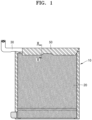
- FIG. 1 shows an overall structure of a hand-held product (HHP) battery pack according to embodiments of the present disclosure.
- FIG. 2 is a schematic cross-sectional view taken along the line II-II in FIG. 1 .
- FIG. 3 shows a protection circuit module of the battery pack shown in FIG. 1 .
- FIG. 4 is a perspective view of a protective pad according to embodiments of the present disclosure.
- FIG. 5 is a cross-sectional view of the protective pad taken along the line V-V in FIG. 4 .
- FIG. 6 is a cross-sectional view of a protective pad according to other embodiments of the present disclosure.
- FIG. 7 is a top view of a protective pad according to embodiments of the present disclosure.
- FIG. 8 is a top view of a protective pad according to other embodiments of the present disclosure.
- a hand-held product (HHP) battery pack 10 (hereinafter, referred to as a "battery pack") having an improved heat dissipation structure according to embodiments of the present disclosure includes a battery cell 20, a protection circuit module 30, a protective pad 40, and a top tape 50.
- the battery cell 20 may be installed in a pouch-type housing.
- the battery cell 20 may include a cathode material, an anode material, a separator, and an electrolyte.
- the battery cell 20 may employ a known structure.
- the protection circuit module 30 is a circuit device electrically connected to the battery cell 20.
- the protection circuit module 30 may be electrically connected to the battery cell 20 via an electric terminal 25 included in the battery cell 20.
- the protection circuit module 30 may include a plurality of electronic elements mounted on a printed circuit board (PCB).
- the protection circuit module 30 may be a battery controller configured to control charging and discharging of the battery cell 20.
- the protection circuit module 30 may generate heat during charging and discharging of the battery cell 20.
- the protective pad 40 is a structure attached to a surface of the protection circuit module 30.
- the protective pad 40 may be manufactured with (e.g., may include or may be formed of) a material having superior electric insulation.
- the protective pad 40 may include a material having good impact-absorbing property to protect the protection circuit module 30 from physical shock that may be applied to the protection circuit module 30.
- the protective pad 40 may include a polyurethane resin foam or rubber.
- As the material of the protective pad 40 PORON° foam (an open cell urethane foam) may be used. PORON ® is a registered trademark of Rogers Corporation. A polyurethane-based foaming resin may also be used.
- the top tape 50 may be an adhesive tape attached to the surface of the protective pad 40.
- the top tape 50 may enclose and seal the protection circuit module 30 and the protective pad 40.
- the top tape 50 may be relatively thin so as to not significantly disturb (or impede) dissipation of heat generated in the protection circuit module 30.
- a plurality of uneven structures 42 are formed on (or in) the top surface of the protective pad 40.
- the uneven structures 42 may be provided to improve dissipation of heat generated in the protection circuit module 30 into the air.
- the uneven structures 42 may be an empty space (e.g., an opening, hole, or groove) between the top tape 50 and the protective pad 40.
- the empty space formed by the uneven structures 42 may improve heat exchange with air (e.g., may increase surface area to improve heat exchange with the air).
- the uneven structures 42 may act as heat exchange fins.
- a concave portion 46 of the uneven structure 42 may increase (e.g., may double) a heat dissipation effect by shortening a heat transfer path from the protection circuit module 30 to the air.
- the uneven structures 42 may be arranged in the form of a stripe.
- Each uneven structure 42 may include a protrusion portion 44 and a concave portion 46.
- the protrusion portion 44 may protrude upwardly from the concave portion 46.
- the concave portion 46 may be recessed concavely from the top surface of the protective pad 40.
- An upper end of the protrusion portion 44 may form the top surface of the protective pad 40.
- a depth of the concave portion 46 of the uneven structure 42 may be maintained constant as shown in the cross-sectional view of FIG. 5 , which is taken along the line V-V in FIG. 4 .
- a lower end (e.g., a bottom) of each of the concave portions 46 may be formed at the same height.
- a depth of the concave portions 46 of the uneven structure 42 may be different from each other.
- a height of the lower end of the concave portion 46 may be different.
- the uneven structures 42 may be arranged in the form of a checker board (e.g., may be formed in a two-dimensional matrix).
- the protrusion portions 44 may be arranged in the form of a checker board on (e.g., to extend from) the concave portion 46.
- a cross-section of the protrusion portion 44 of the uneven structure 42 may be rectangular. According to other embodiments, however, as shown in FIG. 8 , for example, the cross-section of the protrusion portion 44 of the uneven structure 42 may be circular.
- the protrusion portion 44 may be arranged in the form of a checker board on the concave portion 46.
- the protective pad 40 may have a relatively low thermal conductivity (e.g., may have heat conduction that is much lower than that of metal).
- the plurality of uneven structures 42 formed on the top surface of the protective pad 40 may form an empty space between the protective pad 40 and the top tape 50 attached to the top surface of the protective pad 40.
- the empty space formed in the concave portion 46 of the uneven structure 42 may form an air layer. The heat of the protective pad 40 may be easily transferred to the air layer formed in the concave portion 46.
- heat exchange may occur with external air under the top tape 50.
- An interfacial surface between the protrusion portion 44 and the concave portion 46 may promote heat exchange by increasing a contact area with the air layer formed in the concave portion 46.
- the heat may be easily dissipated to the external air at the concave portion 46.
- heat may be easily transferred to outside of the battery pack 10 through the empty space formed by the uneven structure 42 of the protective pad 40, thereby effectively preventing overheating of the protection circuit module 30.
- the battery pack according to embodiments of the present disclosure may quickly dissipate heat generated in the protection circuit module into the air because the heat is exchanged with the air layer formed between the top tape and the protective pad through the plurality of uneven structures formed on the top surface of the protective pad to be attached to the protection circuit module.
- the battery pack may quickly dissipate heat generated in the protection circuit module into the air because the heat is exchanged with the air layer formed between the top tape and the protective pad through the plurality of uneven structures formed in the top surface of the protective pad to be attached to the protection circuit module.
Landscapes
- Engineering & Computer Science (AREA)
- Chemical & Material Sciences (AREA)
- Chemical Kinetics & Catalysis (AREA)
- Electrochemistry (AREA)
- General Chemical & Material Sciences (AREA)
- Manufacturing & Machinery (AREA)
- Microelectronics & Electronic Packaging (AREA)
- Battery Mounting, Suspending (AREA)
- Secondary Cells (AREA)
Applications Claiming Priority (2)
| Application Number | Priority Date | Filing Date | Title |
|---|---|---|---|
| KR20230039347 | 2023-03-26 | ||
| KR1020230095481A KR20240144834A (ko) | 2023-03-26 | 2023-07-21 | 방열 구조가 개선된 휴대형 배터리 팩 |
Publications (2)
| Publication Number | Publication Date |
|---|---|
| EP4439779A2 true EP4439779A2 (de) | 2024-10-02 |
| EP4439779A3 EP4439779A3 (de) | 2025-01-01 |
Family
ID=90468798
Family Applications (1)
| Application Number | Title | Priority Date | Filing Date |
|---|---|---|---|
| EP24165706.3A Pending EP4439779A3 (de) | 2023-03-26 | 2024-03-22 | Tragbares batteriepack mit verbesserter wärmeableitungsstruktur |
Country Status (2)
| Country | Link |
|---|---|
| US (1) | US20240322289A1 (de) |
| EP (1) | EP4439779A3 (de) |
Family Cites Families (2)
| Publication number | Priority date | Publication date | Assignee | Title |
|---|---|---|---|---|
| US9196894B2 (en) * | 2012-06-08 | 2015-11-24 | Samsung Sdi Co., Ltd. | Rechargeable battery pack |
| KR102362074B1 (ko) * | 2017-03-10 | 2022-02-11 | 삼성전자주식회사 | 방열 플레이트를 포함하는 배터리 및 이를 포함하는 전자 장치 |
-
2023
- 2023-10-27 US US18/496,715 patent/US20240322289A1/en active Pending
-
2024
- 2024-03-22 EP EP24165706.3A patent/EP4439779A3/de active Pending
Also Published As
| Publication number | Publication date |
|---|---|
| EP4439779A3 (de) | 2025-01-01 |
| US20240322289A1 (en) | 2024-09-26 |
Similar Documents
| Publication | Publication Date | Title |
|---|---|---|
| KR102814054B1 (ko) | 배터리 모듈 | |
| EP3731304B1 (de) | Batteriemodul | |
| KR102507878B1 (ko) | 홀더를 갖는 전지 모듈 | |
| EP3343672B1 (de) | Sammelschiene zum kühlen einer batteriezelle und batteriemodul damit | |
| US11355797B2 (en) | Battery module and manufacturing method thereof | |
| US12266775B2 (en) | Battery module | |
| KR102052588B1 (ko) | 이차전지 팩 | |
| CN113678302B (zh) | 电池模块 | |
| US9231235B2 (en) | Battery pack | |
| KR102018693B1 (ko) | 이차 전지 팩 | |
| EP4318736A1 (de) | Batteriemodul und batteriepack damit | |
| CN114976377B (zh) | 电池模块及包括其的电池组 | |
| KR102881802B1 (ko) | 필름 히터와 이를 이용한 배터리 평가 장치 및 방법 | |
| KR20230018072A (ko) | 배터리 팩 | |
| KR102825222B1 (ko) | 이차전지 및 이를 포함하는 배터리 모듈 | |
| KR20220018124A (ko) | 상변화 물질에 의해 온도가 관리되는 배터리 | |
| EP4439779A2 (de) | Tragbares batteriepack mit verbesserter wärmeableitungsstruktur | |
| KR102080902B1 (ko) | 배터리 모듈 및 이를 포함하는 배터리 팩 | |
| US20240413455A1 (en) | Systems and Methods for Lithium-Ion Battery Durability | |
| CN118712587A (zh) | 具有改善的散热结构的便携式电池组 | |
| KR20240144834A (ko) | 방열 구조가 개선된 휴대형 배터리 팩 | |
| US20260054116A1 (en) | Battery structure | |
| EP4395039A2 (de) | Batteriemodul | |
| US20250192269A1 (en) | Secondary battery | |
| US20240006683A1 (en) | Battery module and battery pack including the same |
Legal Events
| Date | Code | Title | Description |
|---|---|---|---|
| PUAI | Public reference made under article 153(3) epc to a published international application that has entered the european phase |
Free format text: ORIGINAL CODE: 0009012 |
|
| STAA | Information on the status of an ep patent application or granted ep patent |
Free format text: STATUS: REQUEST FOR EXAMINATION WAS MADE |
|
| 17P | Request for examination filed |
Effective date: 20240325 |
|
| AK | Designated contracting states |
Kind code of ref document: A2 Designated state(s): AL AT BE BG CH CY CZ DE DK EE ES FI FR GB GR HR HU IE IS IT LI LT LU LV MC ME MK MT NL NO PL PT RO RS SE SI SK SM TR |
|
| PUAL | Search report despatched |
Free format text: ORIGINAL CODE: 0009013 |
|
| AK | Designated contracting states |
Kind code of ref document: A3 Designated state(s): AL AT BE BG CH CY CZ DE DK EE ES FI FR GB GR HR HU IE IS IT LI LT LU LV MC ME MK MT NL NO PL PT RO RS SE SI SK SM TR |
|
| RIC1 | Information provided on ipc code assigned before grant |
Ipc: H01M 50/595 20210101ALI20241128BHEP Ipc: H01M 50/593 20210101ALI20241128BHEP Ipc: H01M 10/42 20060101AFI20241128BHEP |