EP4439501A1 - Money handling system and money handling method - Google Patents
Money handling system and money handling method Download PDFInfo
- Publication number
- EP4439501A1 EP4439501A1 EP24166294.9A EP24166294A EP4439501A1 EP 4439501 A1 EP4439501 A1 EP 4439501A1 EP 24166294 A EP24166294 A EP 24166294A EP 4439501 A1 EP4439501 A1 EP 4439501A1
- Authority
- EP
- European Patent Office
- Prior art keywords
- information
- money
- money handling
- document
- handling system
- Prior art date
- Legal status (The legal status is an assumption and is not a legal conclusion. Google has not performed a legal analysis and makes no representation as to the accuracy of the status listed.)
- Pending
Links
- 238000000034 method Methods 0.000 title claims description 49
- 238000003860 storage Methods 0.000 claims description 53
- 230000008569 process Effects 0.000 claims description 30
- 238000000151 deposition Methods 0.000 claims description 20
- 238000012790 confirmation Methods 0.000 claims description 7
- 238000004891 communication Methods 0.000 description 21
- 230000032258 transport Effects 0.000 description 14
- 238000010586 diagram Methods 0.000 description 5
- 230000008859 change Effects 0.000 description 3
- 230000007246 mechanism Effects 0.000 description 3
- 238000009826 distribution Methods 0.000 description 2
- 230000006870 function Effects 0.000 description 2
- 230000015572 biosynthetic process Effects 0.000 description 1
- 238000001514 detection method Methods 0.000 description 1
- 238000011835 investigation Methods 0.000 description 1
- 239000004973 liquid crystal related substance Substances 0.000 description 1
- 230000003287 optical effect Effects 0.000 description 1
- 238000002360 preparation method Methods 0.000 description 1
- 230000004044 response Effects 0.000 description 1
Images




Classifications
-
- G—PHYSICS
- G07—CHECKING-DEVICES
- G07D—HANDLING OF COINS OR VALUABLE PAPERS, e.g. TESTING, SORTING BY DENOMINATIONS, COUNTING, DISPENSING, CHANGING OR DEPOSITING
- G07D7/00—Testing specially adapted to determine the identity or genuineness of valuable papers or for segregating those which are unacceptable, e.g. banknotes that are alien to a currency
- G07D7/04—Testing magnetic properties of the materials thereof, e.g. by detection of magnetic imprint
-
- G—PHYSICS
- G07—CHECKING-DEVICES
- G07D—HANDLING OF COINS OR VALUABLE PAPERS, e.g. TESTING, SORTING BY DENOMINATIONS, COUNTING, DISPENSING, CHANGING OR DEPOSITING
- G07D11/00—Devices accepting coins; Devices accepting, dispensing, sorting or counting valuable papers
- G07D11/20—Controlling or monitoring the operation of devices; Data handling
- G07D11/30—Tracking or tracing valuable papers or cassettes
-
- G—PHYSICS
- G07—CHECKING-DEVICES
- G07D—HANDLING OF COINS OR VALUABLE PAPERS, e.g. TESTING, SORTING BY DENOMINATIONS, COUNTING, DISPENSING, CHANGING OR DEPOSITING
- G07D11/00—Devices accepting coins; Devices accepting, dispensing, sorting or counting valuable papers
- G07D11/20—Controlling or monitoring the operation of devices; Data handling
- G07D11/32—Record keeping
- G07D11/36—Auditing of activities
-
- G—PHYSICS
- G07—CHECKING-DEVICES
- G07D—HANDLING OF COINS OR VALUABLE PAPERS, e.g. TESTING, SORTING BY DENOMINATIONS, COUNTING, DISPENSING, CHANGING OR DEPOSITING
- G07D11/00—Devices accepting coins; Devices accepting, dispensing, sorting or counting valuable papers
- G07D11/60—User-interface arrangements
-
- G—PHYSICS
- G07—CHECKING-DEVICES
- G07D—HANDLING OF COINS OR VALUABLE PAPERS, e.g. TESTING, SORTING BY DENOMINATIONS, COUNTING, DISPENSING, CHANGING OR DEPOSITING
- G07D7/00—Testing specially adapted to determine the identity or genuineness of valuable papers or for segregating those which are unacceptable, e.g. banknotes that are alien to a currency
- G07D7/06—Testing specially adapted to determine the identity or genuineness of valuable papers or for segregating those which are unacceptable, e.g. banknotes that are alien to a currency using wave or particle radiation
- G07D7/12—Visible light, infrared or ultraviolet radiation
Definitions
- the present disclosure relates to a money handling system and a money handling method for supporting work related to a request for authentication of money to an authentication institute.
- a money handling system in which money to be deposited by a customer into his/her account is recognized and counted by a money handling apparatus to perform account handling for the customer based on a result of the recognition and counting, has been used. If counterfeit money or money suspected of being counterfeit is found while handling the money by the money handling apparatus, this money is sometimes sent to a predetermined authentication institute to judge the authenticity of the money.
- Japanese Laid-Open Patent Publication No. 2018-128887 discloses a system capable of handling, in various methods, a counterfeit coin or a coin suspected of being counterfeit that is found during a transaction with a customer.
- counterfeit money or money suspected of being counterfeit that is found in a store is required to be sent to an institute that issues the money.
- the store sends the counterfeit money and the money suspected of being counterfeit to the issuing institute and requests the issuing institute to judge the authenticity of the money.
- the issuing institute to perform such authentication is the central bank of each country; however, there are countries where a plurality of institutes including the central bank issue money and perform the authentication.
- the institute requests the store to submit a document including information on the money.
- the format of the document varies among the institutes. In a country where there are a plurality of institutes, a clerk who performs work for requesting the authentication needs to prepare different documents for different institutes, and such preparation work is a burden to the clerk.
- the present disclosure is made in view of the above problem, as well as other problems, of the conventional art, and the present disclosure addresses these issues, as discussed here, with a money handling system and a money handling method capable of supporting a clerk who makes a request for authentication of money.
- a money handling system includes: an inlet configured to receive money; a recognition unit configured to recognize authenticity of the money; and a memory storing therein, correspondence information for each of authentication institutes.
- the correspondence information includes correspondence between a kind of money to be authenticated by the authentication institute, and information on a document required to be submitted to the authentication institute for requesting the authentication of the money.
- information on a document corresponding to the money recognized by the recognition unit can be selected.
- the information on the document includes at least one of format information of the document required to be submitted to the authentication institute, and entry information on contents whose entry in the document is required by the authentication institute.
- the authentication institutes may be issuing banks of money.
- the above correspondence information indicates, for each of the issuing banks, the correspondence between money issued by the issuing bank and information on the document whose submission is requested by the issuing bank for authenticating money.
- the recognition unit recognizes which issuing bank issued the money.
- the money handling system selects the document to be submitted for the authentication of the money based on the recognition result.
- FIG. 1 is a schematic diagram illustrating an outline of handling performed by a money handling system 1 according to an embodiment of the present disclosure.
- the money handling system 1 includes a money handling apparatus 100 installed in a store.
- a bank support server 11 for supporting a bank server 12 is used in the money handling system 1.
- the bank support server 11 may be included in the money handling system 1.
- the money handling apparatus 100 serves as an automatic teller machine (ATM) of a bank.
- the type of the store is not particularly limited.
- the store may be a distribution store that sells commodities to customers, or a branch of a financial institute.
- the customer can perform a deposit transaction to deposit an amount of money into his/her bank account by depositing the money to the money handling apparatus 100 (S1). Also, the customer can perform a withdrawal transaction to withdraw an amount of money from his/her bank account and receive the money dispensed from the money handling apparatus 100 (S1).
- the bank support server 11 specifies the bank account of the customer, and the money handling apparatus 100 with which the customer deposits /withdraws money, by using a communication terminal 200 such as a smartphone possessed by the customer.
- the bank support server 11 imparts identification information including a user ID and a password to a user who has registered account information including an account number, an account holder's name, etc., of the bank account.
- the bank support server 11 performs an identification process based on the identification information inputted to the communication terminal 200 by the customer, thereby specifying the account information of the customer.
- the money handling apparatus 100 displays, on an operation/display unit 80, a graphic code including an apparatus number (identification information) that allows the bank support server 11 to specify the money handling apparatus 100.
- the customer captures the graphic code with a camera included in the communication terminal 200.
- the bank support server 11 acquires the apparatus number from the graphic code received from the communication terminal 200.
- the bank support server 11 specifies the money handling apparatus 100, which is being used by the customer for transaction, based on the apparatus number.
- the money handling apparatus 100 recognizes and counts money deposited by the customer, and transmits the deposit amount to the bank support server 11.
- the bank support server 11 transmits the deposit amount and the account information of the customer to the bank server 12.
- the bank server 12 updates the balance on the bank account of the customer, based on the deposit amount.
- account handling in the deposit transaction is performed (S2) .
- the customer designates a withdrawal amount with the communication terminal 200 or the operation/display unit 80 of the money handling apparatus 100.
- the bank support server 11 based on the account information of the customer, inquires of the bank server 12 as to whether the withdrawal amount can be withdrawn from the bank account of the customer. Upon confirming that the withdrawal is possible, the money handling apparatus 100 dispenses money corresponding to the withdrawal amount and notifies the bank support server 11 that the withdrawal is completed.
- the bank support server 11 transmits the withdrawal amount and the account information of the customer to the bank server 12.
- the bank server 12 updates the balance on the bank account of the customer, based on the withdrawal amount.
- account handling in the withdrawal transaction is performed (S2).
- the money handling apparatus 100 detects counterfeit money or money suspected of being counterfeit during the deposit transaction, a clerk of the store needs to handle he detected money.
- the money handling system 1 supports the clerk performing work for the detected money.
- the money detected by the money handling apparatus 100 may be a banknote or a coin.
- a case of an example in which the detected money is a banknote will be described. Since a counterfeit banknote (counterfeit note) and a banknote suspected of being counterfeit (suspect note) are similarly handled, hereinafter, a suspect note will be described as an example.
- the money handling apparatus 100 stores the suspect note in a predetermined storage unit to keep the same inside the apparatus (S3).
- the money handling apparatus 100 performs a notification process of notifying the clerk that the suspect note is detected (S4).
- the money handling apparatus 100 displays, on the operation/display unit 80, information for notifying the customer that a suspect note is detected in the money deposited by the customer.
- the money handling apparatus 100 also displays information indicating that the deposit transaction will be performed with the amount of the suspect note being excluded from the deposit amount.
- the money handling apparatus 100 displays the information to notify the customer of these facts on the detected suspect note.
- the money handling apparatus 100 has, stored therein, correspondence information indicating the correspondence between: a plurality of authentication institutes that judge authenticities of banknotes; the kinds of banknotes that the respective authentication institutes authenticate; and information on documents whose submission is required by the respective authentication institutes at the time of authentication.
- the information on the documents includes at least one of format information of the documents whose submission is requested by the authentication institutes, and entry information on contents whose entry in the documents is requested by the authentication institutes.
- the format information is information for preparing a document.
- the format information includes, for example, the size of the document, information on characters, figures, patterns, etc., to be printed on the document, and positions where the pieces of information are to be printed.
- the entry information includes at least one of: the serial number of the suspect note; the date and time of the transaction in which the suspect note was handled; information for specifying the store (i.e., place) where the suspect note was handled; information for specifying the money handling apparatus 100 which handled the suspect note; and information for specifying the clerk who handled the suspect note.
- the information on the document is determined as appropriate according to a request of each authentication institute and therefore, the content thereof is not particularly limited.
- the description will be continued for the case where the information on the document including both the format information and the entry information.
- the information on the document may be referred to simply as "format”.
- the money handling apparatus 100 manages, for each currency, a report format to be used for reporting detection of a suspect note. If a plurality of issuing banks issue the same currency, the money handling apparatus 100 manages the report format for each issuing bank.
- the report format is prescribed by each authentication institute, such as an issuing bank, that judges the authenticity of the currency.
- the money handling apparatus 100 selects a report format corresponding to the detected suspect note, and generates report data of the report in which information that the apparatus 100 can input has been inputted in a position corresponding to the information (S5). That is, based on the kind of the suspect note, the money handling apparatus 100 selects an authentication institute for authenticating the suspect note, and a document whose submission is requested by the authentication institute, and generates document data of the document in which information that the apparatus 100 can enter, among pieces of information to be entered in the selected document, has already been entered.
- the money handling apparatus 100 generates the report data including, at predetermined positions of the report, the transaction date/time, the denomination of the suspect note, the account information of the customer, the name and address of the store, the apparatus number of the money handling apparatus 100, and the like.
- the authentication institute varies among countries or currencies.
- Examples of the authentication institute include central banks, issuing banks, and printing bureaus, which issue banknotes.
- banknotes of the United Kingdom as an example, where banknotes of the same denominations are issued by the central bank and a plurality of issuing banks different from the central bank.
- these banks may be referred to simply as "issuing bank”.
- the clerk who is notified of the detected suspect note performs a predetermined operation with the operation/display unit 80 of the money handling apparatus 100 or his/her communication terminal 300, whereby the money handling apparatus 100 outputs a report obtained by printing the report data on a sheet by a printer 90 (S6).
- the money handling apparatus 100 discharges the suspect note, which has been stored and kept inside of the apparatus 100, to the outside of the apparatus 100 (S7) .
- the clerk works to prepare the report to be sent to the issuing bank, in cooperation with the customer who deposited the suspect note into the money handling apparatus 100 (S8).
- the report outputted from the printer 90 has been created in the format specified by the issuing bank of the suspect note.
- information available from the money handling system 1 such as the transaction date/time and the denomination of the suspect note, has already been printed. Therefore, the clerk only needs to enter information unavailable from the money handling system 1. For example, the clerk enters information that cannot be obtained without asking questions of the customer.
- the clerk Upon completing the report, the clerk performs post-handling of the report. For example, the clerk copies the report, hands one copy to the customer, and keeps one copy in the store. Additionally, the clerk posts the suspect note and the report to the issuing bank by a predetermined mailing method (S9). It can be set that the printer 90 prints the address, etc., of the issuing bank on an envelope and outputs the envelope with the report when outputting the report from the printer 90. In this case, the clerk may put the suspect note and the report in the envelope on which the name and address of the issuing bank have been already printed, and post the envelope.
- S9 predetermined mailing method
- the money handling system 1 can support the work of the clerk who prepares the report of the predetermined format for requesting the authentication of the suspect note and sends the report with the suspect note to the issuing bank.
- the money handling system 1 selects the issuing bank corresponding to the detected suspect note, and generates the report data in the format specified by the issuing bank.
- the money handling system 1 generates the report data in which information possessed by the money handling system, among pieces of information to be entered in the report, has already been entered.
- the clerk Since the report printed out by the money handling system 1 is in the state where the available information has already been entered, the clerk only needs to enter the remaining information that could not be entered by the money handling system 1. It reduces the work burden on the clerk, and prevents human errors regarding the report format and the entry contents.
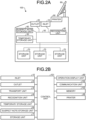
- FIGS. 2A and 2B illustrate an example of the configuration of the money handling apparatus 100.
- FIG. 2A is a schematic cross-sectional view showing the internal configuration of the money handling apparatus 100.
- FIG. 2B is a block diagram showing the functional configuration of the money handling apparatus 100.
- the money handling apparatus 100 includes an inlet 10, an outlet 20, a transport unit 30, a recognition unit 40, a temporary storage unit 50, a suspect note storage unit 60, storage units 70, an operation/display unit 80, and a printer 90.
- the transport unit 30 transports banknotes along a transport path connecting the inlet 10, the outlet 20, the recognition unit 40, the temporary storage unit 50, the suspect note storage unit 60, and the storage units 70.
- the money handling apparatus 100 can perform a plurality of kinds of money handling including a depositing process and a dispensing process.
- the inlet 10 receives banknotes and feeds out the banknotes one by one to the transport path in the apparatus 100.
- the outlet 20 discharges the banknotes fed out from the storage units 70, to the outside of the apparatus 100.
- the recognition unit 40 recognizes denomination and authenticity of each banknote being transported by the transport unit 30.
- the recognition unit 40 includes a plurality of types of sensors.
- the sensors may include an image sensor and a magnetic sensor.
- the recognition unit 40 may acquire characteristic information of the banknote such as optical characteristics and magnetic characteristics by using the respective sensors, and recognizes denomination and authenticity of the banknote based on the characteristic information.
- the recognition unit 40 acquires a banknote image obtained by capturing each banknote at the time of recognition.
- the recognition unit 40 reads the serial number of each banknote.
- the serial number may be read by using a method known as the OCR for reading characters from a captured image.
- characteristic information of genuine banknotes is prepared for each currency and for each denomination as a template in advance.
- the recognition unit 40 compares each template with the characteristic information acquired from the banknote to be recognized, thereby recognizing the banknote. If different issuing banks issue banknotes of the same currency, the template is prepared for each issuing bank. This allows the recognition unit 40 to recognize, for each banknote, information on the currency, the denomination, and the issuing bank.
- the information on the issuing bank may include characters, a character string, a pattern, etc., imparted to the banknote.
- the recognition unit 40 recognizes the characters, the character string, the pattern, etc., included in the banknote, thereby specifying the issuing bank of the banknote.
- the temporary storage unit 50 temporarily stores banknotes.
- the suspect note storage unit 60 stores a banknote recognized as a suspect note by the recognition unit 40.
- Each storage unit 70 stores banknotes and feeds out the stored banknotes.
- the temporary storage unit 50 and the storage unit 70 are used to store genuine banknotes.
- the number of the storage units 70 is not particularly limited. For example, banknotes are stored for each denomination in a plurality of storage units 70. A portion lower than a broken line shown in FIG. 2A may be a safe to house the storage units 70 for storing a large quantity of banknotes.
- the operation/display unit 80 is configured to include a touch panel type liquid crystal display device, for example.
- the operation/display unit 80 serves as an operation unit that receives input of various kinds of information.
- the operation/display unit 80 also serves as a display unit that displays various kinds of information.
- the printer 90 prints report data on a predetermined sheet, thereby outputting a report.
- the operation/display unit 80 and the printer 90 may be disposed separately from the money handling apparatus 100, and communicably connected to the money handling apparatus 100 wirelessly or via wires.
- the money handling apparatus 100 includes a control unit 101, a communication unit 102, and a memory 103 in addition to the components shown in FIG. 2A .
- the communication unit 102 is used for communicating with external devices.
- the external devices include the bank support server 11, the communication terminal 200 possessed by the customer, and the communication terminal 300 possessed by the clerk of the store.
- the memory 103 is a non-volatile storage device storing therein, various kinds of information used for operations of the money handling apparatus 100.
- the memory 103 stores therein, information including the issuing banks of the respective currencies, the report formats specified by the issuing banks, and the correspondence between the issuing banks and the report formats.
- the memory 103 also store therein, other various kinds of information required for generating report data and outputting the report.
- Information on the suspect note being currently stored in the suspect note storage unit 60 may be stored in the memory 103.
- Inventory amount information including the denominations and the number for each denomination of the banknotes being currently stored in the respective storage units 70 may be also stored in the memory 103.
- the control unit 101 controls the respective components of the money handling apparatus 100.
- a program corresponding to the control unit 101 is stored in advance in the memory 103 or a dedicated memory, and this program being executed by hardware such as a CPU realizes the functions and operations of the control unit 101.
- the control unit 101 controls the respective components, based on information inputted/outputted via the operation/display unit 80, information transmitted/received via the communication unit 102, and information stored in the memory 103, whereby the functions and operations of the money handling apparatus 100 according to the present embodiment are realized.
- the money handling apparatus 100 When the withdrawal transaction in which the customer withdraws cash from the bank account is performed, the money handling apparatus 100 performs the dispensing process.
- the dispensing process banknotes to be dispensed are fed out from the storage unit 70, transported by the transport unit 30, and discharged from the outlet 20. Each banknote may be recognized by the recognition unit 40 before it is discharged.
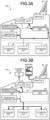
- FIGS. 3A and 3B illustrate an example of the depositing process performed by the money handling apparatus 100.
- banknotes received from the customer are fed out one by one from the inlet 10 to the transport path in the apparatus 100, and transported by the transport unit 30.
- the recognition unit 40 recognizes each banknote being transported by the transport unit 30. Based on the recognition result, the banknote that can be deposited is stored in the temporary storage unit 50. Meanwhile, the banknote recognized as a suspect note is stored in the suspect note storage unit 60 as indicated by a broken-line arrow shown in FIG. 3A .
- the money handling apparatus 100 displays the deposit amount on the screen of the operation/display unit 80, with the banknotes, which can be deposited, being stored in the temporary storage unit 50.
- the customer performs a predetermined operation for accepting the displayed deposit amount by operating the operation/display unit 80.
- the money handling apparatus 100 feeds out all the banknotes in the temporary storage unit 50 one by one to the transport path, transports each banknote by the transport unit 30 to store in the storage unit 70 corresponding to the denominations of each banknote, as shown in FIG. 3B .
- the banknotes in the temporary storage unit 50 may be recognized by the recognition unit 40 again and then stored in the storage units 70, respectively. When no suspect note is detected during the depositing process, the banknotes in the temporary storage unit 50 are stored in the storage units 70 and the depositing process is completed.
- the clerk is notified of the detected suspect note as described in FIG. 1 .
- the clerk performs a predetermined operation with the operation/display unit 80 or the communication terminal 300, the suspect note is fed out from the suspect note storage unit 60.
- the suspect note is transported by the transport unit 30, and discharged from the outlet 20, as shown in FIG. 3B .
- the money handling apparatus 100 automatically generates report data according to the issuing bank of the suspect note.
- a report in which some information has already been entered, is outputted from the printer 90.
- the money handling apparatus 100 stops the depositing process, and discharges the banknotes stored in the temporary storage unit 50 from the outlet 20 to return to the customer.
- the banknotes deposited by the customer from the inlet 10 can be returned as they are.
- the suspect note is stored in the suspect note storage unit 60 dedicated for suspect notes, during the depositing process. The suspect note is not returned to the customer even when the customer cancels the deposit transaction.
- the suspect note in the suspect note storage unit 60 is discharged from the outlet 20 according to an instruction operation of the clerk. If the suspect note is detected, the suspect note is handled under surveillance of the clerk even when the customer cancels the deposit transaction to stop the dispensing process. After the customer cancels the deposit transaction, the clerk can output the report from the printer 90 to handle the suspect note with the report, as described in FIG. 1 .
- FIGS. 3A and 3B The configuration shown in FIGS. 3A and 3B is an example, and does not limit the configuration of the money handling apparatus 100.
- the configuration of the money handling apparatus 100 is not particularly limited as long as the operation of the money handling apparatus 100 described in the present embodiment can be realized.
- the method for performing the depositing process is not limited to the method described above.
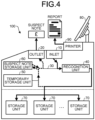
- FIG. 4 illustrates another example of the depositing process performed by the money handling apparatus 100.
- banknotes deposited from the inlet 10 may not necessarily be stored in the temporary storage unit 50, and may be directly stored in the storage units 70 after recognition by the recognition unit 40.
- the money handling apparatus 100 may not necessarily Ide the temporary storage unit 50.
- the suspect note can be stored and kept in the suspect note storage unit 60, and discharged from the outlet 20 to the outside of the apparatus 100 according to the instruction of the clerk, as indicated by broken-line arrows in FIG. 4 .
- FIG. 5 is a schematic diagram illustrating handling of a suspect note performed in the money handling system 1.
- the money handling apparatus 100 performs the depositing process as described above (S11).
- the money handling apparatus 100 Upon detecting a suspect note with the recognition unit 40 during the depositing process (S12), the money handling apparatus 100 performs a notification process of notifying the clerk of this fact (S13).
- the money handling apparatus 100 stores, in the memory 103, information acquired from the suspect note by the recognition unit 40 as handling information (S14).
- the handling information may include the handling date/time, currency, denomination, quantity, and serial number of the suspect note.
- the handling information may include a face-side banknote image obtained by capturing the entire face side of the banknote, and a back-side banknote image obtained by capturing the entire back side of the banknote.
- the handling information may include a serial number image obtained by capturing a partial area of the banknote, on which the serial number is printed.
- the money handling apparatus 100 selects a report format corresponding to the kind of the suspect note (S15). Specifically, an issuing bank that issued the suspect note is recognized in the depositing process and then, a report format specified by this issuing bank is selected.
- FIGS. 6A and 6B illustrate an example of data for explaining a method in which the money handling apparatus 100 selects a report format.
- information indicating the correspondence between the currency, the issuing bank, the identification code, and the report format is stored in the memory 103 of the money handling apparatus 100.
- report data and related information are stored, for each report format, in the memory 103.
- the regions, where the currency (British pound) of the United Kingdom is used include three regions as shown in FIG. 6A .
- banknotes issued by three banks in Scotland and banknotes issued by five banks in Northern Ireland are used in addition to banknotes issued by the Bank of England that is the central bank.
- the money handling apparatus 100 can specify the issuing bank of each banknote by recognizing the banknote by using the recognition unit 40.
- the money handling apparatus 100 can recognize which of the nine issuing banks shown in FIG. 6A issued this five-pound note.
- the money handling apparatus 100 adds an identification code of the issuing bank in the recognition result. For example, recognition result of a five-pound note issued by the Bank of England, whose identification code is "GBP”, is given as “5-GBP”, while recognition result of a five-pound note issued by the Bank of Scotland, whose identification code is "BOS”, is given as "5-BOS".
- the issuing bank of each banknote can be distinguished by adding the identification code to the recognition result of each banknote.
- the money handling apparatus 100 generates report data in a report format according to the identification code of the suspect note, based on the correspondence between the identification code and the report format shown in FIG. 6A . For example, the money handling apparatus 100 generates report data in the report format "A" when the identification code in the recognition result of the suspect note is "GBP”, generates report data in the report format "B” when the identification code is "BOS”, and generates report data in the report format "C” when the identification code is "BOI”.
- the money handling apparatus 100 reads out the report data corresponding to the report format of the suspect note from among a plurality of pieces of report data stored in the memory 103 as shown in FIG. 6B .
- the money handling apparatus 100 prepares the report data including information that the apparatus 100 can input.
- the fixed information is stored in the memory 103 of the money handling apparatus 100, in addition to the handling information acquired during the depositing process.
- the fixed information may include information on the store where the money handling apparatus 100 is installed, and information on the money handling apparatus 100.
- the information on the store includes, for example, a store number (identification information) for specifying the store, the address of the store, and the telephone number of the store.
- the information on the apparatus includes, for example, the model number of the apparatus, and an apparatus number (identification information) such as the serial number for specifying the apparatus.
- the fixed information may include clerk information such as the name of the clerk who is in charge of handling the suspect note, and/or a clerk number (identification information) for specifying the clerk.
- the money handling apparatus 100 can acquire account information of the customer who deposited the suspect note, by using the communication unit 102.
- the account information may be acquired from the bank support server 11.
- the account information includes, for example, the bank name and branch name having the bank account of the customer, the account number of the bank account of the customer, and the account holder's name. Instead of or in addition to the name of the bank and branch, a bank number and a branch number may be included in the account information.
- the report data includes information indicating the kind of information to be entered in the report, and the position on the report where the information is entered.
- the money handling apparatus 100 selects, from the handling information, the fixed information, and the account information, information that can be inputted in the report data, i.e., information that can be entered in the report (S16).
- the money handling apparatus 100 generates the report data in which the selected information is inputted to the position where the information is to be entered (S17).
- the money handling apparatus 100 confirms whether information to be entered in the report is included in the handling information, the fixed information, and the account information.
- the money handling apparatus 100 generates the report data in which the information is entered in the corresponding position of the report.
- the kind of the report data is not particularly limited as long as the report data can be printed by the printer 90 with the predetermined information being entered in the predetermined position.
- the report data may be image data, document data formed by document formation software, or document data represented in markup language such as XML or HTML.
- the report data may be generated such that the information selected from the handling information, the fixed information, and the account information is composited to the corresponding position in the image of the report.
- the report data may be generated such that the information selected from the handling information, the fixed information, and the account information is inputted to the corresponding position in the document data.
- the money handling system automatically selects the report format corresponding to the suspect note, and automatically generates the report data, in which the information that the money handling system 1 can specify, among the pieces of information to be entered in the report, has automatically been inputted.
- the money handling apparatus 100 can display information related to the suspect note on the screen of the communication terminal 300 possessed by the clerk as shown in FIG. 5 (S18) .
- the image of the suspect note and/or the image of the serial number captured by the recognition unit 40 of the money handling apparatus 100, the suspect note recognition result, the suspect note handling date/time, etc. are displayed on the screen.
- a suspect note discharge button, a report printout button, and an end button are displayed. When the clerk presses the end button, the information on the screen disappears to return to the initial screen.
- the money handling apparatus 100 feeds out the suspect note from the suspect note storage unit 60 and discharges the suspect note from the outlet 20 (S19).
- the money handling apparatus 100 prints out the report data generated for the suspect note by using the printer 90 (S20). The clerk can check the actual suspect note fed out from the outlet 20 (S21). If information to be entered in the report still remains, the clerk enters the information to complete the report (S22).
- related information is stored for each report format in the memory 103 of the money handling apparatus 100.
- the related information includes matters to be informed to the clerk who handles the suspect note.
- the related information includes information indicating that there is an item to be entered by the clerk on the report.
- the related information may include information indicating that there is an item which needs to be asked to the customer and entered on the report by the clerk or the customer.
- the related information includes a matter to which the clerk should pay attention when preparing the report, and a matter that the clerk should inform to the customer.
- the money handling apparatus 100 displays the matters to be informed to the clerk, on the screen of the communication terminal 300 as shown in FIG. 5 .
- information instructing entry to the item is displayed on the screen.
- the matter to which the clerk should pay attention, and the matter that the clerk should inform to the customer may be displayed on the screen.
- This allows the clerk to prepare the report and serve the customer according to the screen display. For example, the clerk confirms whether the customer is the same person as the account holder. If not, the clerk enters the name of the customer in the report. For another example, the clerk asks the customer if he/she has any idea about mixing of the suspect note in the deposited banknotes, and enters the answer of the customer in the report.
- the money handling apparatus 100 prints out the report on which the information that the apparatus 100 can input has already been inputted. However, if the accuracy of the inputted information is equal to or lower than a predetermined threshold value, the money handling apparatus 100 displays information instructing the clerk to perform confirmation, on the screen of the communication terminal 300. For example, when there is an unreadable digit in the serial number, or when a numerical value indicating accuracy of the read serial number is equal to or smaller than a predetermined threshold value, information instructing the clerk to confirm whether the serial number printed on the report matches the serial number of the suspect note is displayed on the screen. The clerk confirms whether the serial number printed on the report matches the serial number of the actual suspect note, and corrects the report according to need.
- the information that supports the work of the clerk such as the work procedure and the matters that require attention, is displayed on the screen of the communication terminal 300 used by the clerk, whereby the clerk can easily proceed with the work.
- the components of the money handling system 1 described above are conceptually functional components, and thus may not necessarily be physically limited thereto.
- Distributed or integrated forms of each device are not limited to the forms described above, and all or some of the forms may be distributed or integrated functionally or physically in any unit depending on various loads, use statuses, or the like.
- the money handling apparatus 100 selects an issuing bank corresponding to a suspect note, and generates report data in a format specified by the issuing bank.
- selection of an issuing bank and generation of report data may be performed by an external device such as a server.
- Information required for selection of an issuing bank and generation of report data may be stored in a memory of an external device, and this external device or still another external device communicable with the external device may perform selection of an issuing bank and generation of report data.
- the money handling apparatus 100 can perform the above-described processes by receiving the report data generated by the external device.
- the banknote recognized as a suspect note by the recognition unit 40 is stored in the suspect note storage unit 60 and thereafter is discharged from the outlet 20.
- the banknote recognized as a suspect note by the recognition unit 40 may be discharged from the outlet 20 without being stored inside the apparatus 100. Even when the money handling apparatus 100 does not include the suspect note storage unit 60, the suspect note can be handled as described above.
- the outlet 20 may be provided with a shutter so that only a clerk having a predetermined authority can take out the suspect note discharged to the outlet 20, in other words, so that the customer cannot take out the suspect note from the outlet 20.
- the outlet 20 may be provided with a shutter that is lockable by a locking mechanism such as an electromagnetic lock.
- the shutter is usually unlocked, and the money handling apparatus 100 may control the locking mechanism to lock the shutter when a suspect note is detected by the recognition unit 40.
- the money handling apparatus 100 may control the locking mechanism to unlock the shutter so that the clerk can take out the suspect note from the outlet 20.
- the money handling apparatus 100 selects, according to the issuing bank of the suspect note, the format including: the format information of the document whose submission is requested by the issuing bank being the authentication institute for the suspect note; and the entry information on contents that the issuing bank requests to enter in the document.
- the selection target is not limited thereto, and only the format information or the entry information may be selected.
- the suspect note is sent to the central bank or the issuing bank, which issued the suspect note, but the suspect note may be sent to another institute.
- the suspect note may be sent to a private authentication institute, or an investigation authority such as a police.
- data of a document, whose submission is requested by the institute being the destination of the suspect note may be associated with the kind of the banknote such as the currency, the identification code, etc., whereby the document according to the destination of the suspect note can be prepared.
- the suspect note has been described as an example.
- the money handling system 1 handles a counterfeit note in the same manner as that for the suspect note
- the above-described handling for the suspect note can be interpreted as handling for the counterfeit note.
- a database in which characteristic information on counterfeit banknotes is registered may be prepared in advance, and the recognition unit 40 may recognize a banknote having characteristic information registered in this database, as a counterfeit note.
- a serial number is a number for uniquely specifying each banknote, there is a case where a plurality of banknotes have the same serial number. In this case, these banknotes are evidently counterfeit notes.
- a report regarding the counterfeit note is created and sent to an issuing bank in the same manner as that for the suspect note described above.
- the kind of the suspect note described in the present embodiment is not particularly limited. For example, a suspect note made to resemble a genuine banknote to deceive people, a suspect note made to include characteristic information possessed by a genuine banknote to deceive mechanical recognition, and the like are handled in the above-described method.
- the clerk enters the item after the report has been printed out by the printer 90.
- the report may be printed after the clerk inputs the data.
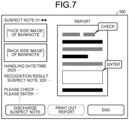
- FIG. 7 illustrates an example for explaining a method in which the clerk inputs data to complete a report.
- the money handling apparatus 100 may display report data on the screen of the communication terminal 300 as shown in FIG. 7 , and the clerk may input information on the report data by operating the communication terminal 300 to complete the report data.
- the clerk may work on the report with the images of the face side and/or the back side of the suspect note being displayed on the screen while the suspect note is being stored in the suspect note storage unit 60 of the money handling apparatus 100.
- an item to be checked by the clerk or an item to be inputted by the clerk may be displayed with a predetermined mark such as a speech balloon.
- a predetermined mark such as a speech balloon.
- On the screen an item or the like to which the clerk should pay attention may be displayed.
- the money handling apparatus 100 may gray out the report printout button on the screen to make the button not pressable, and when the clerk has inputted all the necessary data, the apparatus 100 may update the report data to make the report printout button pressable. The clerk inputs all the necessary information on the screen shown in FIG. 7 to complete the report data, and then presses the report printout button to cause the printer 90 to print the report.
- the money handling apparatus 100 imparts the identification codes shown in FIG. 6A , to the recognition information to distinguish the banknotes of different issuing banks from each other.
- the identification codes that the money handling apparatus 100 outputs to the external devices may be different from those shown in FIG. 6A .
- FIGS. 8A, 8B and 8C illustrate an example of a process in which the money handling apparatus 100 changes the identification code, according to the external device as the destination of the recognition information.
- the identification code desired by the external device is sometimes different from the identification code shown in FIG. 6A .
- the memory 103 of the money handling apparatus 100 as shown in FIG. 8A , information indicating the correspondence between the identification code ("apparatus code" in FIG. 8A ) used in the money handling apparatus 100 and the output code to be outputted to the external device, is stored.
- the apparatus code is the code obtained by the money handling apparatus 100.
- the output code includes a plurality of kinds of codes such as a first code and a second code.
- the money handling apparatus 100 outputs the recognition information to which the first code is imparted instead of the apparatus code shown in FIG. 8A .
- the money handling apparatus 100 outputs the recognition information to which the second code or the third code is imparted instead of the apparatus code.
- the second code is imparted when the external device performs handling with the identification code of British banknotes being "GBP”
- the third code is imparted when the external device performs handling with the identification code of British banknotes being "UKP”.
- the memory 103 of the money handling apparatus 100 as shown in FIG. 8B , information indicating the correspondence between the external device and the output code is stored, and the money handling apparatus 100 can change the identification code to be imparted to the recognition information according to the external device, based on the correspondence information shown in FIG. 8B .
- the money handling apparatus 100 When changing the identification code to be imparted to the recognition information, the money handling apparatus 100 generates the recognition information to be outputted to the external device such that the correspondence between the recognition information managed in the money handling apparatus 100 and the recognition information outputted to the external device can be clarified. For example, it is assumed that the money handling apparatus 100, by using the recognition unit 40, acquires recognition information of three banknotes, i.e., banknotes No. 1 to No. 3, shown in FIG. 8C . In this example, the recognition information includes the identification code that the money handling apparatus 100 uses, the denomination, and the series indicating the issuance year of the banknote.
- the money handling apparatus 100 changes the number at the tens place of the 2-digit number representing the series to a different number for each issuing bank, and outputs the identification information to the first device. This enables confirmation that the banknote No. 2 and the banknote No. 3 to be handled with the same identification code in the first device are banknotes issued in different issuing banks. The number at the tens place is set to different numbers among the nine issuing banks in the United Kingdom.
- the correspondence between the identification code of each issuing bank and the number at the tens place is determined such that the number is "0" for the identification code "GBP", “1” for the identification code "BOS”, “2” for the identification code "RBS”, and so on, whereby the identification code of the identification information received from the first device to the money handling apparatus 100 can be restored to the original identification code.
- the money handling apparatus 100 adds additional information to the data of each banknote and outputs the data to the second device. This enables confirmation that the three banknotes to be handled with the same identification code in the second device are banknotes issued in different issuing banks.
- the additional information is set to different values among the nine issuing banks in the United Kingdom.
- the correspondence between the identification code of each issuing bank and the additional information is determined such that "00" is added to the identification code "GBP", “01” to the identification code “BOS”, “02” to the identification code "RBS”, and so on, whereby the identification code of the identification information received from the first device to the money handling apparatus 100 can be restored to the original identification code.
- the money handling apparatus 100 may perform change of the identification code, change of the data representing the series, addition of the additional information, and the like as described with reference to FIGS. 8A to 8C , according to a standard such as XFS that is established in the field of financial distribution.
- a money handling system includes: an inlet configured to receive money; a recognition unit configured to recognize authenticity of the money; and a memory storing therein, correspondence information for each of authentication institutes.
- the correspondence information indicates correspondence between a kind of money to be authenticated by the authentication institute, and information on a document required to be submitted to the authentication institute for requesting the authentication of the money.
- information on a document corresponding to the money recognized by the recognition unit is selected.
- the information on the document includes at least one of format information of the document required to be submitted to the authentication institute, and entry information on contents whose entry in the document is required by the authentication institute.
- the authentication institutes may be issuing banks of money.
- the above correspondence information indicates, for each of the issuing banks, the correspondence between money issued by the issuing bank and information on the document whose submission is requested by the issuing bank for authenticating money.
- the recognition unit recognizes which issuing bank issued the money, and the money handling system selects the document to be submitted for the authentication of the money, based on the recognition result.
- the money handling system may further include a first storage unit configured to store money that is recognized as genuine money by the recognition unit.
- the money handling system may further include a second storage unit configured to store money that is recognized, by the recognition unit, as counterfeit money or money suspected of being counterfeit.
- the system may further include an outlet for dispensing the money fed out from the first storage unit.
- the money that is recognized by the recognition unit as counterfeit money or money suspected of being counterfeit may be transported to the outlet.
- the outlet may be provided with a shutter so that only a person having a predetermined authority can take out the counterfeit money or the suspected money from the outlet.
- the money handling system may: select an authentication institute and a document corresponding to the money stored in the second storage unit; generate document data of the document in which information that can be entered based on the information obtained by the recognition unit, among pieces of information to be entered in the document, has already been entered; and output the document data to an external device.
- the money handling system may further include a server configured to manage information on an account of a customer, and perform a process related to account handling for depositing, into the account of the customer, an amount of money received from the customer and stored in the first storage unit.
- the document data is generated such that information that can be entered based on information possessed by the server, among the pieces of information to be entered in the document, has already been entered in the document.
- the external device may be a printer configured to print the document data on a sheet and outputs the sheet. That is, the printer outputs the document represented by the document data.
- the money handling system may further include a terminal device configured to display information on the document.
- the terminal device may display the information on a screen thereof to notify that there is information to be manually entered in the sheet outputted by the printer.
- information instructing the confirmation may be displayed on the screen of the terminal device.
- the external device may be a terminal device configured to display the document data on a screen thereof.
- the terminal device may display, on the screen, that there is information to be inputted by a predetermined person.
- the document data is updated such that the information inputted by the predetermined person has already been entered in the document of the document data.
- a money handling method is performed by a money handling system, and the method includes: receiving money in an inlet; recognizing authenticity of the money by using a recognition unit; and selecting information on a document corresponding to the money recognized by the recognition unit, based on correspondence information indicating, for each of authentication institutes, correspondence between the kind of money to be authenticated by the authentication institute, and information on a document whose submission is requested by the authentication institute at the time of authentication.
- the money handling system can specify the authentication institute corresponding to the kind of the money to be authenticated, and the document whose submission is requested by the authentication institute.
- the money handling system can generate the document data of the document in which information that can be entered based on the information obtained during the money handling, among pieces of information to be entered in the specified document, has already been entered, and output the document data to the external device.
- the document is printed out such that the information that can be entered by the money handling system, among matters to be entered in the document, has already been entered. Therefore, the work burden on the clerk to complete the document can be significantly reduced.
Landscapes
- Physics & Mathematics (AREA)
- General Physics & Mathematics (AREA)
- Health & Medical Sciences (AREA)
- General Health & Medical Sciences (AREA)
- Toxicology (AREA)
- Business, Economics & Management (AREA)
- Accounting & Taxation (AREA)
- Financial Or Insurance-Related Operations Such As Payment And Settlement (AREA)
Abstract
A money handling system includes: an inlet configured to receive money; a recognition unit configured to recognize authenticity of the money; and a memory storing therein, correspondence information, for each of authentication institutes, indicating correspondence between a kind of money to be authenticated by the authentication institute, and information on a document required to be submitted to the authentication institute for authenticating the money, wherein information on the document corresponding to the money recognized by the recognition unit is selected based on the correspondence information.
Description
- The present disclosure relates to a money handling system and a money handling method for supporting work related to a request for authentication of money to an authentication institute.
- Conventionally, a money handling system, in which money to be deposited by a customer into his/her account is recognized and counted by a money handling apparatus to perform account handling for the customer based on a result of the recognition and counting, has been used. If counterfeit money or money suspected of being counterfeit is found while handling the money by the money handling apparatus, this money is sometimes sent to a predetermined authentication institute to judge the authenticity of the money. For example,
Japanese Laid-Open Patent Publication No. 2018-128887 - In some countries, counterfeit money or money suspected of being counterfeit that is found in a store is required to be sent to an institute that issues the money. For example, the store sends the counterfeit money and the money suspected of being counterfeit to the issuing institute and requests the issuing institute to judge the authenticity of the money. In many countries, the issuing institute to perform such authentication is the central bank of each country; however, there are countries where a plurality of institutes including the central bank issue money and perform the authentication. When the store asks the institute for the authentication of the money, the institute requests the store to submit a document including information on the money. The format of the document varies among the institutes. In a country where there are a plurality of institutes, a clerk who performs work for requesting the authentication needs to prepare different documents for different institutes, and such preparation work is a burden to the clerk.
- The present disclosure is made in view of the above problem, as well as other problems, of the conventional art, and the present disclosure addresses these issues, as discussed here, with a money handling system and a money handling method capable of supporting a clerk who makes a request for authentication of money.
- A money handling system according to one aspect of the present disclosure includes: an inlet configured to receive money; a recognition unit configured to recognize authenticity of the money; and a memory storing therein, correspondence information for each of authentication institutes. The correspondence information includes correspondence between a kind of money to be authenticated by the authentication institute, and information on a document required to be submitted to the authentication institute for requesting the authentication of the money. Based on the correspondence information, information on a document corresponding to the money recognized by the recognition unit can be selected. The information on the document includes at least one of format information of the document required to be submitted to the authentication institute, and entry information on contents whose entry in the document is required by the authentication institute. The authentication institutes may be issuing banks of money. In this case, the above correspondence information indicates, for each of the issuing banks, the correspondence between money issued by the issuing bank and information on the document whose submission is requested by the issuing bank for authenticating money. The recognition unit recognizes which issuing bank issued the money. The money handling system selects the document to be submitted for the authentication of the money based on the recognition result.
- The objects, features, advantages, and technical and industrial significance of this disclosure will be better understood by the following description and the accompanying drawings of the disclosure.
-
-
FIG. 1 is a schematic diagram illustrating an outline of handling performed by a money handling system according to an embodiment of the present disclosure; -
FIGS. 2A and 2B illustrate an example of a configuration of a money handling apparatus; -
FIGS. 3A and 3B illustrate an example of a depositing process performed by the money handling apparatus; -
FIG. 4 illustrates another example of the depositing process performed by the money handling apparatus; -
FIG. 5 is a schematic diagram illustrating handling of a suspect note performed in the money handling system; -
FIGS. 6A and 6B illustrate an example of data for explaining a method in which the money handling apparatus selects a report format; -
FIG. 7 illustrates an example of a screen for explaining a method in which a clerk inputs data to complete a report; and -
FIGS. 8A, 8B and 8C illustrate an example of handling in which the money handling apparatus changes an identification code according to an external device being an output destination of a recognition information. - Hereinafter, a money handling system and a money handling method according to the present disclosure will be described with reference to the accompanying drawings.
FIG. 1 is a schematic diagram illustrating an outline of handling performed by amoney handling system 1 according to an embodiment of the present disclosure. Themoney handling system 1 includes amoney handling apparatus 100 installed in a store. Abank support server 11 for supporting abank server 12 is used in themoney handling system 1. Thebank support server 11 may be included in themoney handling system 1. - The money handling
apparatus 100 serves as an automatic teller machine (ATM) of a bank. The type of the store is not particularly limited. The store may be a distribution store that sells commodities to customers, or a branch of a financial institute. The customer can perform a deposit transaction to deposit an amount of money into his/her bank account by depositing the money to the money handling apparatus 100 (S1). Also, the customer can perform a withdrawal transaction to withdraw an amount of money from his/her bank account and receive the money dispensed from the money handling apparatus 100 (S1). Thebank support server 11 specifies the bank account of the customer, and themoney handling apparatus 100 with which the customer deposits /withdraws money, by using acommunication terminal 200 such as a smartphone possessed by the customer. - For example, the
bank support server 11 imparts identification information including a user ID and a password to a user who has registered account information including an account number, an account holder's name, etc., of the bank account. Thebank support server 11 performs an identification process based on the identification information inputted to thecommunication terminal 200 by the customer, thereby specifying the account information of the customer. Themoney handling apparatus 100 displays, on an operation/display unit 80, a graphic code including an apparatus number (identification information) that allows thebank support server 11 to specify themoney handling apparatus 100. The customer captures the graphic code with a camera included in thecommunication terminal 200. Thebank support server 11 acquires the apparatus number from the graphic code received from thecommunication terminal 200. Thebank support server 11 specifies themoney handling apparatus 100, which is being used by the customer for transaction, based on the apparatus number. - In the case of the deposit transaction, the
money handling apparatus 100 recognizes and counts money deposited by the customer, and transmits the deposit amount to thebank support server 11. Thebank support server 11 transmits the deposit amount and the account information of the customer to thebank server 12. Thebank server 12 updates the balance on the bank account of the customer, based on the deposit amount. Thus, account handling in the deposit transaction is performed (S2) . - In the case of the withdrawal transaction, the customer designates a withdrawal amount with the
communication terminal 200 or the operation/display unit 80 of themoney handling apparatus 100. Thebank support server 11, based on the account information of the customer, inquires of thebank server 12 as to whether the withdrawal amount can be withdrawn from the bank account of the customer. Upon confirming that the withdrawal is possible, themoney handling apparatus 100 dispenses money corresponding to the withdrawal amount and notifies thebank support server 11 that the withdrawal is completed. Thebank support server 11 transmits the withdrawal amount and the account information of the customer to thebank server 12. Thebank server 12 updates the balance on the bank account of the customer, based on the withdrawal amount. Thus, account handling in the withdrawal transaction is performed (S2). - If the
money handling apparatus 100 detects counterfeit money or money suspected of being counterfeit during the deposit transaction, a clerk of the store needs to handle he detected money. Themoney handling system 1 supports the clerk performing work for the detected money. The money detected by themoney handling apparatus 100 may be a banknote or a coin. Hereinafter, a case of an example in which the detected money is a banknote will be described. Since a counterfeit banknote (counterfeit note) and a banknote suspected of being counterfeit (suspect note) are similarly handled, hereinafter, a suspect note will be described as an example. - As shown in
FIG. 1 , when a suspect note is detected during recognition of banknotes deposited by the customer at the time of deposit transaction, themoney handling apparatus 100 stores the suspect note in a predetermined storage unit to keep the same inside the apparatus (S3). Themoney handling apparatus 100 performs a notification process of notifying the clerk that the suspect note is detected (S4). Themoney handling apparatus 100 displays, on the operation/display unit 80, information for notifying the customer that a suspect note is detected in the money deposited by the customer. Themoney handling apparatus 100 also displays information indicating that the deposit transaction will be performed with the amount of the suspect note being excluded from the deposit amount. Themoney handling apparatus 100 displays the information to notify the customer of these facts on the detected suspect note. - The
money handling apparatus 100 has, stored therein, correspondence information indicating the correspondence between: a plurality of authentication institutes that judge authenticities of banknotes; the kinds of banknotes that the respective authentication institutes authenticate; and information on documents whose submission is required by the respective authentication institutes at the time of authentication. - The information on the documents includes at least one of format information of the documents whose submission is requested by the authentication institutes, and entry information on contents whose entry in the documents is requested by the authentication institutes. The format information is information for preparing a document. The format information includes, for example, the size of the document, information on characters, figures, patterns, etc., to be printed on the document, and positions where the pieces of information are to be printed. The entry information includes at least one of: the serial number of the suspect note; the date and time of the transaction in which the suspect note was handled; information for specifying the store (i.e., place) where the suspect note was handled; information for specifying the
money handling apparatus 100 which handled the suspect note; and information for specifying the clerk who handled the suspect note. The information on the document is determined as appropriate according to a request of each authentication institute and therefore, the content thereof is not particularly limited. Hereinafter, the description will be continued for the case where the information on the document including both the format information and the entry information. In the following description, the information on the document may be referred to simply as "format". - For example, the
money handling apparatus 100 manages, for each currency, a report format to be used for reporting detection of a suspect note. If a plurality of issuing banks issue the same currency, themoney handling apparatus 100 manages the report format for each issuing bank. The report format is prescribed by each authentication institute, such as an issuing bank, that judges the authenticity of the currency. - The
money handling apparatus 100 selects a report format corresponding to the detected suspect note, and generates report data of the report in which information that theapparatus 100 can input has been inputted in a position corresponding to the information (S5). That is, based on the kind of the suspect note, themoney handling apparatus 100 selects an authentication institute for authenticating the suspect note, and a document whose submission is requested by the authentication institute, and generates document data of the document in which information that theapparatus 100 can enter, among pieces of information to be entered in the selected document, has already been entered. For example, themoney handling apparatus 100 generates the report data including, at predetermined positions of the report, the transaction date/time, the denomination of the suspect note, the account information of the customer, the name and address of the store, the apparatus number of themoney handling apparatus 100, and the like. - The authentication institute varies among countries or currencies. Examples of the authentication institute include central banks, issuing banks, and printing bureaus, which issue banknotes. Hereinafter, the description will be continued for banknotes of the United Kingdom, as an example, where banknotes of the same denominations are issued by the central bank and a plurality of issuing banks different from the central bank. In the following description, when both the central bank and the issuing bank(s) are described, these banks may be referred to simply as "issuing bank".
- The clerk who is notified of the detected suspect note performs a predetermined operation with the operation/
display unit 80 of themoney handling apparatus 100 or his/hercommunication terminal 300, whereby themoney handling apparatus 100 outputs a report obtained by printing the report data on a sheet by a printer 90 (S6). In addition, when the clerk performs a predetermined operation, themoney handling apparatus 100 discharges the suspect note, which has been stored and kept inside of theapparatus 100, to the outside of the apparatus 100 (S7) . - The clerk works to prepare the report to be sent to the issuing bank, in cooperation with the customer who deposited the suspect note into the money handling apparatus 100 (S8). The report outputted from the
printer 90 has been created in the format specified by the issuing bank of the suspect note. On the report, information available from themoney handling system 1, such as the transaction date/time and the denomination of the suspect note, has already been printed. Therefore, the clerk only needs to enter information unavailable from themoney handling system 1. For example, the clerk enters information that cannot be obtained without asking questions of the customer. - Upon completing the report, the clerk performs post-handling of the report. For example, the clerk copies the report, hands one copy to the customer, and keeps one copy in the store. Additionally, the clerk posts the suspect note and the report to the issuing bank by a predetermined mailing method (S9). It can be set that the
printer 90 prints the address, etc., of the issuing bank on an envelope and outputs the envelope with the report when outputting the report from theprinter 90. In this case, the clerk may put the suspect note and the report in the envelope on which the name and address of the issuing bank have been already printed, and post the envelope. - As described above, when a suspect note is detected in the banknotes deposited by the customer in the
money handling apparatus 100 during the deposit transaction to the bank account, themoney handling system 1 can support the work of the clerk who prepares the report of the predetermined format for requesting the authentication of the suspect note and sends the report with the suspect note to the issuing bank. Themoney handling system 1 selects the issuing bank corresponding to the detected suspect note, and generates the report data in the format specified by the issuing bank. Themoney handling system 1 generates the report data in which information possessed by the money handling system, among pieces of information to be entered in the report, has already been entered. Since the report printed out by themoney handling system 1 is in the state where the available information has already been entered, the clerk only needs to enter the remaining information that could not be entered by themoney handling system 1. It reduces the work burden on the clerk, and prevents human errors regarding the report format and the entry contents. -
FIGS. 2A and 2B illustrate an example of the configuration of themoney handling apparatus 100.FIG. 2A is a schematic cross-sectional view showing the internal configuration of themoney handling apparatus 100.FIG. 2B is a block diagram showing the functional configuration of themoney handling apparatus 100. Themoney handling apparatus 100 includes aninlet 10, anoutlet 20, atransport unit 30, arecognition unit 40, atemporary storage unit 50, a suspectnote storage unit 60,storage units 70, an operation/display unit 80, and aprinter 90. Thetransport unit 30 transports banknotes along a transport path connecting theinlet 10, theoutlet 20, therecognition unit 40, thetemporary storage unit 50, the suspectnote storage unit 60, and thestorage units 70. - The
money handling apparatus 100 can perform a plurality of kinds of money handling including a depositing process and a dispensing process. In the depositing process, theinlet 10 receives banknotes and feeds out the banknotes one by one to the transport path in theapparatus 100. In the dispensing process, theoutlet 20 discharges the banknotes fed out from thestorage units 70, to the outside of theapparatus 100. - The
recognition unit 40 recognizes denomination and authenticity of each banknote being transported by thetransport unit 30. For example, therecognition unit 40 includes a plurality of types of sensors. The sensors may include an image sensor and a magnetic sensor. Therecognition unit 40 may acquire characteristic information of the banknote such as optical characteristics and magnetic characteristics by using the respective sensors, and recognizes denomination and authenticity of the banknote based on the characteristic information. Therecognition unit 40 acquires a banknote image obtained by capturing each banknote at the time of recognition. Therecognition unit 40 reads the serial number of each banknote. The serial number may be read by using a method known as the OCR for reading characters from a captured image. - For example, characteristic information of genuine banknotes is prepared for each currency and for each denomination as a template in advance. The
recognition unit 40 compares each template with the characteristic information acquired from the banknote to be recognized, thereby recognizing the banknote. If different issuing banks issue banknotes of the same currency, the template is prepared for each issuing bank. This allows therecognition unit 40 to recognize, for each banknote, information on the currency, the denomination, and the issuing bank. - The information on the issuing bank may include characters, a character string, a pattern, etc., imparted to the banknote. The
recognition unit 40 recognizes the characters, the character string, the pattern, etc., included in the banknote, thereby specifying the issuing bank of the banknote. - In the
banknote handling apparatus 100, thetemporary storage unit 50 temporarily stores banknotes. The suspectnote storage unit 60 stores a banknote recognized as a suspect note by therecognition unit 40. Eachstorage unit 70 stores banknotes and feeds out the stored banknotes. Thetemporary storage unit 50 and thestorage unit 70 are used to store genuine banknotes. The number of thestorage units 70 is not particularly limited. For example, banknotes are stored for each denomination in a plurality ofstorage units 70. A portion lower than a broken line shown inFIG. 2A may be a safe to house thestorage units 70 for storing a large quantity of banknotes. - The operation/
display unit 80 is configured to include a touch panel type liquid crystal display device, for example. The operation/display unit 80 serves as an operation unit that receives input of various kinds of information. The operation/display unit 80 also serves as a display unit that displays various kinds of information. Theprinter 90 prints report data on a predetermined sheet, thereby outputting a report. The operation/display unit 80 and theprinter 90 may be disposed separately from themoney handling apparatus 100, and communicably connected to themoney handling apparatus 100 wirelessly or via wires. - As shown in
FIG. 2B , themoney handling apparatus 100 includes acontrol unit 101, acommunication unit 102, and amemory 103 in addition to the components shown inFIG. 2A . Thecommunication unit 102 is used for communicating with external devices. The external devices include thebank support server 11, thecommunication terminal 200 possessed by the customer, and thecommunication terminal 300 possessed by the clerk of the store. - The
memory 103 is a non-volatile storage device storing therein, various kinds of information used for operations of themoney handling apparatus 100. Thememory 103 stores therein, information including the issuing banks of the respective currencies, the report formats specified by the issuing banks, and the correspondence between the issuing banks and the report formats. Thememory 103 also store therein, other various kinds of information required for generating report data and outputting the report. Information on the suspect note being currently stored in the suspectnote storage unit 60 may be stored in thememory 103. Inventory amount information including the denominations and the number for each denomination of the banknotes being currently stored in therespective storage units 70 may be also stored in thememory 103. - The
control unit 101 controls the respective components of themoney handling apparatus 100. For example, a program corresponding to thecontrol unit 101 is stored in advance in thememory 103 or a dedicated memory, and this program being executed by hardware such as a CPU realizes the functions and operations of thecontrol unit 101. Thecontrol unit 101 controls the respective components, based on information inputted/outputted via the operation/display unit 80, information transmitted/received via thecommunication unit 102, and information stored in thememory 103, whereby the functions and operations of themoney handling apparatus 100 according to the present embodiment are realized. - When the withdrawal transaction in which the customer withdraws cash from the bank account is performed, the
money handling apparatus 100 performs the dispensing process. In the dispensing process, banknotes to be dispensed are fed out from thestorage unit 70, transported by thetransport unit 30, and discharged from theoutlet 20. Each banknote may be recognized by therecognition unit 40 before it is discharged. - When the deposit transaction in which the customer deposits cash into the bank account is performed, the
money handling apparatus 100 performs the depositing process.FIGS. 3A and 3B illustrate an example of the depositing process performed by themoney handling apparatus 100. As indicated by solid-line arrows inFIG. 3A , banknotes received from the customer are fed out one by one from theinlet 10 to the transport path in theapparatus 100, and transported by thetransport unit 30. Therecognition unit 40 recognizes each banknote being transported by thetransport unit 30. Based on the recognition result, the banknote that can be deposited is stored in thetemporary storage unit 50. Meanwhile, the banknote recognized as a suspect note is stored in the suspectnote storage unit 60 as indicated by a broken-line arrow shown inFIG. 3A . - The
money handling apparatus 100 displays the deposit amount on the screen of the operation/display unit 80, with the banknotes, which can be deposited, being stored in thetemporary storage unit 50. The customer performs a predetermined operation for accepting the displayed deposit amount by operating the operation/display unit 80. After the customer accepts the deposit amount, themoney handling apparatus 100 feeds out all the banknotes in thetemporary storage unit 50 one by one to the transport path, transports each banknote by thetransport unit 30 to store in thestorage unit 70 corresponding to the denominations of each banknote, as shown inFIG. 3B . The banknotes in thetemporary storage unit 50 may be recognized by therecognition unit 40 again and then stored in thestorage units 70, respectively. When no suspect note is detected during the depositing process, the banknotes in thetemporary storage unit 50 are stored in thestorage units 70 and the depositing process is completed. - If a suspect note is detected and stored in the suspect
note storage unit 60 during the depositing process, the clerk is notified of the detected suspect note as described inFIG. 1 . When the clerk performs a predetermined operation with the operation/display unit 80 or thecommunication terminal 300, the suspect note is fed out from the suspectnote storage unit 60. The suspect note is transported by thetransport unit 30, and discharged from theoutlet 20, as shown inFIG. 3B . Additionally, themoney handling apparatus 100 automatically generates report data according to the issuing bank of the suspect note. When the clerk performs a predetermined operation with the operation/display unit 80 or thecommunication terminal 300, a report, in which some information has already been entered, is outputted from theprinter 90. - If the customer cancels the deposit transaction by operating the operation/
display unit 80 on which the deposit amount is displayed, themoney handling apparatus 100 stops the depositing process, and discharges the banknotes stored in thetemporary storage unit 50 from theoutlet 20 to return to the customer. Using thetemporary storage unit 50, the banknotes deposited by the customer from theinlet 10 can be returned as they are. The suspect note is stored in the suspectnote storage unit 60 dedicated for suspect notes, during the depositing process. The suspect note is not returned to the customer even when the customer cancels the deposit transaction. The suspect note in the suspectnote storage unit 60 is discharged from theoutlet 20 according to an instruction operation of the clerk. If the suspect note is detected, the suspect note is handled under surveillance of the clerk even when the customer cancels the deposit transaction to stop the dispensing process. After the customer cancels the deposit transaction, the clerk can output the report from theprinter 90 to handle the suspect note with the report, as described inFIG. 1 . - The configuration shown in
FIGS. 3A and 3B is an example, and does not limit the configuration of themoney handling apparatus 100. The configuration of themoney handling apparatus 100 is not particularly limited as long as the operation of themoney handling apparatus 100 described in the present embodiment can be realized. Also, the method for performing the depositing process is not limited to the method described above.FIG. 4 illustrates another example of the depositing process performed by themoney handling apparatus 100. As indicated by solid-line arrows inFIG. 4 , banknotes deposited from theinlet 10 may not necessarily be stored in thetemporary storage unit 50, and may be directly stored in thestorage units 70 after recognition by therecognition unit 40. Themoney handling apparatus 100 may not necessarily Ide thetemporary storage unit 50. Even when temporary storage of the banknotes is not performed in theapparatus 100, the suspect note can be stored and kept in the suspectnote storage unit 60, and discharged from theoutlet 20 to the outside of theapparatus 100 according to the instruction of the clerk, as indicated by broken-line arrows inFIG. 4 . -
FIG. 5 is a schematic diagram illustrating handling of a suspect note performed in themoney handling system 1. Themoney handling apparatus 100 performs the depositing process as described above (S11). Upon detecting a suspect note with therecognition unit 40 during the depositing process (S12), themoney handling apparatus 100 performs a notification process of notifying the clerk of this fact (S13). - The
money handling apparatus 100 stores, in thememory 103, information acquired from the suspect note by therecognition unit 40 as handling information (S14). The handling information may include the handling date/time, currency, denomination, quantity, and serial number of the suspect note. The handling information may include a face-side banknote image obtained by capturing the entire face side of the banknote, and a back-side banknote image obtained by capturing the entire back side of the banknote. The handling information may include a serial number image obtained by capturing a partial area of the banknote, on which the serial number is printed. - The
money handling apparatus 100 selects a report format corresponding to the kind of the suspect note (S15). Specifically, an issuing bank that issued the suspect note is recognized in the depositing process and then, a report format specified by this issuing bank is selected. -
FIGS. 6A and 6B illustrate an example of data for explaining a method in which themoney handling apparatus 100 selects a report format. As shown inFIG. 6A , information indicating the correspondence between the currency, the issuing bank, the identification code, and the report format is stored in thememory 103 of themoney handling apparatus 100. As shown inFIG. 6B , report data and related information are stored, for each report format, in thememory 103. - The regions, where the currency (British pound) of the United Kingdom is used, include three regions as shown in
FIG. 6A . Specifically, in the United Kingdom, banknotes issued by three banks in Scotland and banknotes issued by five banks in Northern Ireland are used in addition to banknotes issued by the Bank of England that is the central bank. Even when a plurality of issuing banks issue banknotes of the same denomination of the same currency, themoney handling apparatus 100 can specify the issuing bank of each banknote by recognizing the banknote by using therecognition unit 40. - For example, when recognizing a five-pound note, the
money handling apparatus 100 can recognize which of the nine issuing banks shown inFIG. 6A issued this five-pound note. Themoney handling apparatus 100 adds an identification code of the issuing bank in the recognition result. For example, recognition result of a five-pound note issued by the Bank of England, whose identification code is "GBP", is given as "5-GBP", while recognition result of a five-pound note issued by the Bank of Scotland, whose identification code is "BOS", is given as "5-BOS". The issuing bank of each banknote can be distinguished by adding the identification code to the recognition result of each banknote. - The
money handling apparatus 100 generates report data in a report format according to the identification code of the suspect note, based on the correspondence between the identification code and the report format shown inFIG. 6A . For example, themoney handling apparatus 100 generates report data in the report format "A" when the identification code in the recognition result of the suspect note is "GBP", generates report data in the report format "B" when the identification code is "BOS", and generates report data in the report format "C" when the identification code is "BOI". - The
money handling apparatus 100 reads out the report data corresponding to the report format of the suspect note from among a plurality of pieces of report data stored in thememory 103 as shown inFIG. 6B . Themoney handling apparatus 100 prepares the report data including information that theapparatus 100 can input. - As shown in
FIG. 5 , fixed information is stored in thememory 103 of themoney handling apparatus 100, in addition to the handling information acquired during the depositing process. The fixed information may include information on the store where themoney handling apparatus 100 is installed, and information on themoney handling apparatus 100. The information on the store includes, for example, a store number (identification information) for specifying the store, the address of the store, and the telephone number of the store. The information on the apparatus includes, for example, the model number of the apparatus, and an apparatus number (identification information) such as the serial number for specifying the apparatus. The fixed information may include clerk information such as the name of the clerk who is in charge of handling the suspect note, and/or a clerk number (identification information) for specifying the clerk. - The
money handling apparatus 100 can acquire account information of the customer who deposited the suspect note, by using thecommunication unit 102. The account information may be acquired from thebank support server 11. The account information includes, for example, the bank name and branch name having the bank account of the customer, the account number of the bank account of the customer, and the account holder's name. Instead of or in addition to the name of the bank and branch, a bank number and a branch number may be included in the account information. - The report data includes information indicating the kind of information to be entered in the report, and the position on the report where the information is entered. As shown in
FIG. 5 , themoney handling apparatus 100 selects, from the handling information, the fixed information, and the account information, information that can be inputted in the report data, i.e., information that can be entered in the report (S16). Themoney handling apparatus 100 generates the report data in which the selected information is inputted to the position where the information is to be entered (S17). - Specifically, the
money handling apparatus 100 confirms whether information to be entered in the report is included in the handling information, the fixed information, and the account information. When the information is included, themoney handling apparatus 100 generates the report data in which the information is entered in the corresponding position of the report. The kind of the report data is not particularly limited as long as the report data can be printed by theprinter 90 with the predetermined information being entered in the predetermined position. For example, the report data may be image data, document data formed by document formation software, or document data represented in markup language such as XML or HTML. When using the image data, the report data may be generated such that the information selected from the handling information, the fixed information, and the account information is composited to the corresponding position in the image of the report. When using the document data, the report data may be generated such that the information selected from the handling information, the fixed information, and the account information is inputted to the corresponding position in the document data. - As described above, the money handling system automatically selects the report format corresponding to the suspect note, and automatically generates the report data, in which the information that the
money handling system 1 can specify, among the pieces of information to be entered in the report, has automatically been inputted. - When notifying the clerk of the detected suspect note, the
money handling apparatus 100 can display information related to the suspect note on the screen of thecommunication terminal 300 possessed by the clerk as shown inFIG. 5 (S18) . For example, the image of the suspect note and/or the image of the serial number captured by therecognition unit 40 of themoney handling apparatus 100, the suspect note recognition result, the suspect note handling date/time, etc., are displayed on the screen. On the screen, a suspect note discharge button, a report printout button, and an end button are displayed. When the clerk presses the end button, the information on the screen disappears to return to the initial screen. When the clerk presses the suspect note discharge button, themoney handling apparatus 100 feeds out the suspect note from the suspectnote storage unit 60 and discharges the suspect note from the outlet 20 (S19). When the clerk presses the report printout button, themoney handling apparatus 100 prints out the report data generated for the suspect note by using the printer 90 (S20). The clerk can check the actual suspect note fed out from the outlet 20 (S21). If information to be entered in the report still remains, the clerk enters the information to complete the report (S22). - As shown in
FIG. 6B , related information is stored for each report format in thememory 103 of themoney handling apparatus 100. The related information includes matters to be informed to the clerk who handles the suspect note. For example, the related information includes information indicating that there is an item to be entered by the clerk on the report. The related information may include information indicating that there is an item which needs to be asked to the customer and entered on the report by the clerk or the customer. For another example, the related information includes a matter to which the clerk should pay attention when preparing the report, and a matter that the clerk should inform to the customer. - Based on the related information shown in
FIG. 6B , themoney handling apparatus 100 displays the matters to be informed to the clerk, on the screen of thecommunication terminal 300 as shown inFIG. 5 . When there is an item to be entered by the clerk on the report outputted from theprinter 90, information instructing entry to the item is displayed on the screen. Also, the matter to which the clerk should pay attention, and the matter that the clerk should inform to the customer may be displayed on the screen. This allows the clerk to prepare the report and serve the customer according to the screen display. For example, the clerk confirms whether the customer is the same person as the account holder. If not, the clerk enters the name of the customer in the report. For another example, the clerk asks the customer if he/she has any idea about mixing of the suspect note in the deposited banknotes, and enters the answer of the customer in the report. - The
money handling apparatus 100 prints out the report on which the information that theapparatus 100 can input has already been inputted. However, if the accuracy of the inputted information is equal to or lower than a predetermined threshold value, themoney handling apparatus 100 displays information instructing the clerk to perform confirmation, on the screen of thecommunication terminal 300. For example, when there is an unreadable digit in the serial number, or when a numerical value indicating accuracy of the read serial number is equal to or smaller than a predetermined threshold value, information instructing the clerk to confirm whether the serial number printed on the report matches the serial number of the suspect note is displayed on the screen. The clerk confirms whether the serial number printed on the report matches the serial number of the actual suspect note, and corrects the report according to need. The information that supports the work of the clerk, such as the work procedure and the matters that require attention, is displayed on the screen of thecommunication terminal 300 used by the clerk, whereby the clerk can easily proceed with the work. - The components of the
money handling system 1 described above are conceptually functional components, and thus may not necessarily be physically limited thereto. Distributed or integrated forms of each device are not limited to the forms described above, and all or some of the forms may be distributed or integrated functionally or physically in any unit depending on various loads, use statuses, or the like. - For example, in the present embodiment, the
money handling apparatus 100, i.e., thecontrol unit 101 of themoney handling apparatus 100, selects an issuing bank corresponding to a suspect note, and generates report data in a format specified by the issuing bank. However, selection of an issuing bank and generation of report data may be performed by an external device such as a server. Information required for selection of an issuing bank and generation of report data may be stored in a memory of an external device, and this external device or still another external device communicable with the external device may perform selection of an issuing bank and generation of report data. Even in this case, themoney handling apparatus 100 can perform the above-described processes by receiving the report data generated by the external device. - In the present embodiment, the banknote recognized as a suspect note by the
recognition unit 40 is stored in the suspectnote storage unit 60 and thereafter is discharged from theoutlet 20. However, the banknote recognized as a suspect note by therecognition unit 40 may be discharged from theoutlet 20 without being stored inside theapparatus 100. Even when themoney handling apparatus 100 does not include the suspectnote storage unit 60, the suspect note can be handled as described above. - The
outlet 20 may be provided with a shutter so that only a clerk having a predetermined authority can take out the suspect note discharged to theoutlet 20, in other words, so that the customer cannot take out the suspect note from theoutlet 20. For example, theoutlet 20 may be provided with a shutter that is lockable by a locking mechanism such as an electromagnetic lock. The shutter is usually unlocked, and themoney handling apparatus 100 may control the locking mechanism to lock the shutter when a suspect note is detected by therecognition unit 40. In response to a predetermined operation performed by the clerk with the operation/display unit 80 or thecommunication terminal 300, themoney handling apparatus 100 may control the locking mechanism to unlock the shutter so that the clerk can take out the suspect note from theoutlet 20. - In the present embodiment, the
money handling apparatus 100 selects, according to the issuing bank of the suspect note, the format including: the format information of the document whose submission is requested by the issuing bank being the authentication institute for the suspect note; and the entry information on contents that the issuing bank requests to enter in the document. However, the selection target is not limited thereto, and only the format information or the entry information may be selected. - In the present embodiment, the suspect note is sent to the central bank or the issuing bank, which issued the suspect note, but the suspect note may be sent to another institute. For example, the suspect note may be sent to a private authentication institute, or an investigation authority such as a police. In this case, data of a document, whose submission is requested by the institute being the destination of the suspect note, may be associated with the kind of the banknote such as the currency, the identification code, etc., whereby the document according to the destination of the suspect note can be prepared.
- In the present embodiment, the suspect note has been described as an example. However, since the
money handling system 1 handles a counterfeit note in the same manner as that for the suspect note, the above-described handling for the suspect note can be interpreted as handling for the counterfeit note. For example, a database in which characteristic information on counterfeit banknotes is registered may be prepared in advance, and therecognition unit 40 may recognize a banknote having characteristic information registered in this database, as a counterfeit note. For example, although a serial number is a number for uniquely specifying each banknote, there is a case where a plurality of banknotes have the same serial number. In this case, these banknotes are evidently counterfeit notes. When a banknote is evidently a counterfeit note, a report regarding the counterfeit note is created and sent to an issuing bank in the same manner as that for the suspect note described above. The kind of the suspect note described in the present embodiment is not particularly limited. For example, a suspect note made to resemble a genuine banknote to deceive people, a suspect note made to include characteristic information possessed by a genuine banknote to deceive mechanical recognition, and the like are handled in the above-described method. - In the present embodiment, as for an item that the
money handling apparatus 100 cannot input to the report data, the clerk enters the item after the report has been printed out by theprinter 90. However, the report may be printed after the clerk inputs the data. -
FIG. 7 illustrates an example for explaining a method in which the clerk inputs data to complete a report. For example, themoney handling apparatus 100 may display report data on the screen of thecommunication terminal 300 as shown inFIG. 7 , and the clerk may input information on the report data by operating thecommunication terminal 300 to complete the report data. The clerk may work on the report with the images of the face side and/or the back side of the suspect note being displayed on the screen while the suspect note is being stored in the suspectnote storage unit 60 of themoney handling apparatus 100. In the report data, an item to be checked by the clerk or an item to be inputted by the clerk may be displayed with a predetermined mark such as a speech balloon. On the screen, an item or the like to which the clerk should pay attention may be displayed. Themoney handling apparatus 100 may gray out the report printout button on the screen to make the button not pressable, and when the clerk has inputted all the necessary data, theapparatus 100 may update the report data to make the report printout button pressable. The clerk inputs all the necessary information on the screen shown inFIG. 7 to complete the report data, and then presses the report printout button to cause theprinter 90 to print the report. - In the present embodiment, the
money handling apparatus 100 imparts the identification codes shown inFIG. 6A , to the recognition information to distinguish the banknotes of different issuing banks from each other. However, the identification codes that themoney handling apparatus 100 outputs to the external devices may be different from those shown inFIG. 6A . -
FIGS. 8A, 8B and 8C illustrate an example of a process in which themoney handling apparatus 100 changes the identification code, according to the external device as the destination of the recognition information. When themoney handling apparatus 100 outputs the recognition information of the banknote to the external device, the identification code desired by the external device is sometimes different from the identification code shown inFIG. 6A . In thememory 103 of themoney handling apparatus 100, as shown inFIG. 8A , information indicating the correspondence between the identification code ("apparatus code" inFIG. 8A ) used in themoney handling apparatus 100 and the output code to be outputted to the external device, is stored. The apparatus code is the code obtained by themoney handling apparatus 100. The output code includes a plurality of kinds of codes such as a first code and a second code. For example, when the external device only needs to distinguish among banknotes issued by the Bank of England, banknotes issues by the three banks in Scotland, and banknotes issued by the five banks in Northern Ireland shown inFIG. 6A , themoney handling apparatus 100 outputs the recognition information to which the first code is imparted instead of the apparatus code shown inFIG. 8A . Likewise, when the external device only needs to distinguish British banknotes from the currencies of the other countries, themoney handling apparatus 100 outputs the recognition information to which the second code or the third code is imparted instead of the apparatus code. The second code is imparted when the external device performs handling with the identification code of British banknotes being "GBP", while the third code is imparted when the external device performs handling with the identification code of British banknotes being "UKP". In thememory 103 of themoney handling apparatus 100, as shown inFIG. 8B , information indicating the correspondence between the external device and the output code is stored, and themoney handling apparatus 100 can change the identification code to be imparted to the recognition information according to the external device, based on the correspondence information shown inFIG. 8B . - When changing the identification code to be imparted to the recognition information, the
money handling apparatus 100 generates the recognition information to be outputted to the external device such that the correspondence between the recognition information managed in themoney handling apparatus 100 and the recognition information outputted to the external device can be clarified. For example, it is assumed that themoney handling apparatus 100, by using therecognition unit 40, acquires recognition information of three banknotes, i.e., banknotes No. 1 to No. 3, shown inFIG. 8C . In this example, the recognition information includes the identification code that themoney handling apparatus 100 uses, the denomination, and the series indicating the issuance year of the banknote. - If these pieces of recognition information are outputted to a first device using the first code, as shown in
FIG. 8C , the banknote No. 2 and the banknote No. 3 will have the same identification code when being handled in the first device, which makes it unclear that the issuing banks of these banknotes are different from each other. Therefore, themoney handling apparatus 100 changes the number at the tens place of the 2-digit number representing the series to a different number for each issuing bank, and outputs the identification information to the first device. This enables confirmation that the banknote No. 2 and the banknote No. 3 to be handled with the same identification code in the first device are banknotes issued in different issuing banks. The number at the tens place is set to different numbers among the nine issuing banks in the United Kingdom. For example, the correspondence between the identification code of each issuing bank and the number at the tens place is determined such that the number is "0" for the identification code "GBP", "1" for the identification code "BOS", "2" for the identification code "RBS", and so on, whereby the identification code of the identification information received from the first device to themoney handling apparatus 100 can be restored to the original identification code. - Likewise, if the pieces of recognition information of the banknotes No. 1 to No. 3 obtained in the
money handling apparatus 100 are outputted to a second device using the second code, as shown inFIG. 8C , all the banknotes will have the same identification code when being handled in the second device, which makes it unclear that the issuing banks of these banknotes are different from each other. Therefore, themoney handling apparatus 100 adds additional information to the data of each banknote and outputs the data to the second device. This enables confirmation that the three banknotes to be handled with the same identification code in the second device are banknotes issued in different issuing banks. The additional information is set to different values among the nine issuing banks in the United Kingdom. For example, the correspondence between the identification code of each issuing bank and the additional information is determined such that "00" is added to the identification code "GBP", "01" to the identification code "BOS", "02" to the identification code "RBS", and so on, whereby the identification code of the identification information received from the first device to themoney handling apparatus 100 can be restored to the original identification code. - For example, in the process of outputting the recognition information to the external device, the
money handling apparatus 100 may perform change of the identification code, change of the data representing the series, addition of the additional information, and the like as described with reference toFIGS. 8A to 8C , according to a standard such as XFS that is established in the field of financial distribution. - A money handling system according to the present disclosure includes: an inlet configured to receive money; a recognition unit configured to recognize authenticity of the money; and a memory storing therein, correspondence information for each of authentication institutes. The correspondence information indicates correspondence between a kind of money to be authenticated by the authentication institute, and information on a document required to be submitted to the authentication institute for requesting the authentication of the money. Based on the correspondence information, information on a document corresponding to the money recognized by the recognition unit is selected. The information on the document includes at least one of format information of the document required to be submitted to the authentication institute, and entry information on contents whose entry in the document is required by the authentication institute. The authentication institutes may be issuing banks of money. In this case, the above correspondence information indicates, for each of the issuing banks, the correspondence between money issued by the issuing bank and information on the document whose submission is requested by the issuing bank for authenticating money. The recognition unit recognizes which issuing bank issued the money, and the money handling system selects the document to be submitted for the authentication of the money, based on the recognition result.
- In the above configuration, the money handling system may further include a first storage unit configured to store money that is recognized as genuine money by the recognition unit.
- In the above configuration, the money handling system may further include a second storage unit configured to store money that is recognized, by the recognition unit, as counterfeit money or money suspected of being counterfeit. The system may further include an outlet for dispensing the money fed out from the first storage unit. The money that is recognized by the recognition unit as counterfeit money or money suspected of being counterfeit, may be transported to the outlet. The outlet may be provided with a shutter so that only a person having a predetermined authority can take out the counterfeit money or the suspected money from the outlet.
- In the above configuration, based on the correspondence information, the money handling system may: select an authentication institute and a document corresponding to the money stored in the second storage unit; generate document data of the document in which information that can be entered based on the information obtained by the recognition unit, among pieces of information to be entered in the document, has already been entered; and output the document data to an external device.
- In the above configuration, the money handling system may further include a server configured to manage information on an account of a customer, and perform a process related to account handling for depositing, into the account of the customer, an amount of money received from the customer and stored in the first storage unit. The document data is generated such that information that can be entered based on information possessed by the server, among the pieces of information to be entered in the document, has already been entered in the document.
- In the above configuration, the external device may be a printer configured to print the document data on a sheet and outputs the sheet. That is, the printer outputs the document represented by the document data.
- In the above configuration, the money handling system may further include a terminal device configured to display information on the document. The terminal device may display the information on a screen thereof to notify that there is information to be manually entered in the sheet outputted by the printer.
- In the above configuration, when information, which requires confirmation by a predetermined person, is included among pieces of the information that have been entered in the document of the document data, information instructing the confirmation may be displayed on the screen of the terminal device.
- In the above configuration, the external device may be a terminal device configured to display the document data on a screen thereof. The terminal device may display, on the screen, that there is information to be inputted by a predetermined person. When the predetermined person has inputted the information, the document data is updated such that the information inputted by the predetermined person has already been entered in the document of the document data.
- A money handling method according to the present disclosure is performed by a money handling system, and the method includes: receiving money in an inlet; recognizing authenticity of the money by using a recognition unit; and selecting information on a document corresponding to the money recognized by the recognition unit, based on correspondence information indicating, for each of authentication institutes, correspondence between the kind of money to be authenticated by the authentication institute, and information on a document whose submission is requested by the authentication institute at the time of authentication.
- As described above, in the money handling system according to the present embodiment, it is possible to manage correspondence information indicating the correspondence between an authentication institute that judges authenticity of money, the kind of money to be authenticated by the authentication institute, and information on the document whose submission is requested by the authentication institute at the time of authentication. Thus, when it is necessary to request authentication of money, the money handling system can specify the authentication institute corresponding to the kind of the money to be authenticated, and the document whose submission is requested by the authentication institute. The money handling system can generate the document data of the document in which information that can be entered based on the information obtained during the money handling, among pieces of information to be entered in the specified document, has already been entered, and output the document data to the external device. For example, the document is printed out such that the information that can be entered by the money handling system, among matters to be entered in the document, has already been entered. Therefore, the work burden on the clerk to complete the document can be significantly reduced.
Claims (10)
- A money handling system (1) comprising:an inlet (10) configured to receive money;a recognition unit (40) configured to recognize authenticity of the money; anda memory (103) storing therein, correspondence information indicating, for each of authentication institutes, correspondence between a kind of money to be authenticated by the authentication institute, and information on a document required to be submitted to the authentication institute for authenticating the money, whereininformation on the document corresponding to the money recognized by the recognition unit (40) is selected based on the correspondence information.
- The money handling system (1) according to claim 1, further comprising
a first storage unit (70) configured to store money recognized as genuine money by the recognition unit (40). - The money handling system (1) according to claim 2, further comprising
a second storage unit (60) configured to store money recognized as counterfeit money or money suspected of being counterfeit, by the recognition unit (40). - The money handling system (1) according to claim 3, configured to:select, based on the correspondence information, the authentication institute and the document corresponding to the money stored in the second storage unit (60),generate document data of the document in which information that can be entered based on the information obtained by the recognition unit (40), among pieces of information to be entered in the document, has already been entered; andoutput the document data to an external device (80, 90, 300) .
- The money handling system (1) according to claim 4, further comprisinga server (11) configured to manage information on an account of a customer, and perform a process related to account handling for depositing, into the account of the customer, an amount of money received from the customer and stored in the first storage unit, whereinthe document data is generated such that information that can be entered based on information possessed by the server (11), among the pieces of information to be entered in the document, has already been entered in the document.
- The money handling system (1) according to claim 5, wherein
the external device (80, 90, 300) is a printer (90) configured to print the document data on a sheet and outputs the sheet. - The money handling system (1) according to claim 6, further comprisinga terminal device (80, 300) configured to display information on the document, whereinthe terminal device (80, 300) displays the information on a screen thereof to notify that there is information to be manually entered in the sheet outputted by the printer.
- The money handling system (1) according to claim 7, wherein
in a case where information, which requires confirmation by a predetermined person, is included among pieces of the information that have been entered in the document of the document data, information instructing the confirmation is displayed on the screen of the terminal device (80, 300). - The money handling system (1) according to claim 5, whereinthe external device (80, 90, 300) is a terminal device (80, 300) configured to display the document data on a screen thereof, andthe terminal device(80, 300) displays, on the screen, that there is information to be inputted by a predetermined person, andin a case where the predetermined person has inputted the information, the document data is updated such that the information inputted by the predetermined person has already been entered in the document of the documents data.
- A money handling method performed by a money handling system (1), the method comprising:receiving money in an inlet (10);recognizing authenticity of the money by using a recognition unit (40); andselecting information on a document corresponding to the money recognized by the recognition unit (40), based on correspondence information indicating, for each of authentication institutes, correspondence between a kind of money to be authenticated by the authentication institute, and information on the document required to be submitted to the authentication institute for authenticating the money.
Applications Claiming Priority (1)
| Application Number | Priority Date | Filing Date | Title |
|---|---|---|---|
| JP2023055556A JP2024143071A (en) | 2023-03-30 | 2023-03-30 | Money handling system and money handling method |
Publications (1)
| Publication Number | Publication Date |
|---|---|
| EP4439501A1 true EP4439501A1 (en) | 2024-10-02 |
Family
ID=90482057
Family Applications (1)
| Application Number | Title | Priority Date | Filing Date |
|---|---|---|---|
| EP24166294.9A Pending EP4439501A1 (en) | 2023-03-30 | 2024-03-26 | Money handling system and money handling method |
Country Status (2)
| Country | Link |
|---|---|
| EP (1) | EP4439501A1 (en) |
| JP (1) | JP2024143071A (en) |
Citations (3)
| Publication number | Priority date | Publication date | Assignee | Title |
|---|---|---|---|---|
| US20150146963A1 (en) * | 2009-04-15 | 2015-05-28 | Cummins-Allison Corp. | System and method for processing banknote and check deposits |
| US20160343191A1 (en) * | 2014-03-03 | 2016-11-24 | Oki Electric Industry Co., Ltd. | Cash transaction machine |
| JP2018128887A (en) | 2017-02-09 | 2018-08-16 | グローリー株式会社 | Currency processing system and currency processor |
-
2023
- 2023-03-30 JP JP2023055556A patent/JP2024143071A/en active Pending
-
2024
- 2024-03-26 EP EP24166294.9A patent/EP4439501A1/en active Pending
Patent Citations (3)
| Publication number | Priority date | Publication date | Assignee | Title |
|---|---|---|---|---|
| US20150146963A1 (en) * | 2009-04-15 | 2015-05-28 | Cummins-Allison Corp. | System and method for processing banknote and check deposits |
| US20160343191A1 (en) * | 2014-03-03 | 2016-11-24 | Oki Electric Industry Co., Ltd. | Cash transaction machine |
| JP2018128887A (en) | 2017-02-09 | 2018-08-16 | グローリー株式会社 | Currency processing system and currency processor |
Also Published As
| Publication number | Publication date |
|---|---|
| JP2024143071A (en) | 2024-10-11 |
Similar Documents
| Publication | Publication Date | Title |
|---|---|---|
| US3990558A (en) | Method and apparatus for preparing and assessing payment documents | |
| US7903863B2 (en) | Currency bill tracking system | |
| JP5539112B2 (en) | Valuable medium processing apparatus and valuable medium processing system | |
| US7331515B1 (en) | Check accepting and cash dispensing automated banking machine system and method | |
| US20110206265A1 (en) | Paper sheet management device, paper sheet management method, and paper sheet management program | |
| KR860000431B1 (en) | Transaction processing system | |
| RU2602379C2 (en) | Machine for money handling, system for money handling and method of money handling | |
| JP5325900B2 (en) | Valuable medium processing apparatus and valuable medium processing method | |
| KR20100081915A (en) | Bill handling machine, recodring medium and bill handling method | |
| JP4677776B2 (en) | Cash management device and cash management system | |
| JP2017037376A (en) | Automatic machine system and money processing method | |
| JP5245415B2 (en) | Automatic transaction equipment | |
| KR100334664B1 (en) | Automatic trade system, trade apparatus and trade method | |
| JP2024143071A (en) | Money handling system and money handling method | |
| JPS5853785B2 (en) | money payment device | |
| JP2020024501A (en) | Transaction device | |
| JP3124746B2 (en) | Money depositing and dispensing machine management device | |
| JPH0488555A (en) | Lost card notification system | |
| WO2016185989A1 (en) | Money management system and money management method | |
| US12602963B2 (en) | Cash handling apparatus | |
| JP7533008B2 (en) | Cash handling equipment | |
| JP7541794B2 (en) | Money handling device, method for eliminating abnormalities in money handling device, and computer program | |
| JP5478431B2 (en) | Securities processing apparatus, securities processing system, and securities processing method | |
| JPH05181892A (en) | Automatic transaction device | |
| JP6753751B2 (en) | Paper leaf processing system and paper leaf processing method |
Legal Events
| Date | Code | Title | Description |
|---|---|---|---|
| PUAI | Public reference made under article 153(3) epc to a published international application that has entered the european phase |
Free format text: ORIGINAL CODE: 0009012 |
|
| STAA | Information on the status of an ep patent application or granted ep patent |
Free format text: STATUS: REQUEST FOR EXAMINATION WAS MADE |
|
| 17P | Request for examination filed |
Effective date: 20240326 |
|
| AK | Designated contracting states |
Kind code of ref document: A1 Designated state(s): AL AT BE BG CH CY CZ DE DK EE ES FI FR GB GR HR HU IE IS IT LI LT LU LV MC ME MK MT NL NO PL PT RO RS SE SI SK SM TR |
|
| P01 | Opt-out of the competence of the unified patent court (upc) registered |
Free format text: CASE NUMBER: APP_61172/2024 Effective date: 20241114 |