EP4439379A1 - Card reader foreign object detection - Google Patents
Card reader foreign object detection Download PDFInfo
- Publication number
- EP4439379A1 EP4439379A1 EP23219052.0A EP23219052A EP4439379A1 EP 4439379 A1 EP4439379 A1 EP 4439379A1 EP 23219052 A EP23219052 A EP 23219052A EP 4439379 A1 EP4439379 A1 EP 4439379A1
- Authority
- EP
- European Patent Office
- Prior art keywords
- card
- card reader
- interior surface
- reader
- sensor
- Prior art date
- Legal status (The legal status is an assumption and is not a legal conclusion. Google has not performed a legal analysis and makes no representation as to the accuracy of the status listed.)
- Granted
Links
Images

Classifications
-
- G—PHYSICS
- G06—COMPUTING OR CALCULATING; COUNTING
- G06K—GRAPHICAL DATA READING; PRESENTATION OF DATA; RECORD CARRIERS; HANDLING RECORD CARRIERS
- G06K7/00—Methods or arrangements for sensing record carriers, e.g. for reading patterns
- G06K7/0013—Methods or arrangements for sensing record carriers, e.g. for reading patterns by galvanic contacts, e.g. card connectors for ISO-7816 compliant smart cards or memory cards, e.g. SD card readers
- G06K7/0086—Methods or arrangements for sensing record carriers, e.g. for reading patterns by galvanic contacts, e.g. card connectors for ISO-7816 compliant smart cards or memory cards, e.g. SD card readers the connector comprising a circuit for steering the operations of the card connector
- G06K7/0091—Methods or arrangements for sensing record carriers, e.g. for reading patterns by galvanic contacts, e.g. card connectors for ISO-7816 compliant smart cards or memory cards, e.g. SD card readers the connector comprising a circuit for steering the operations of the card connector the circuit comprising an arrangement for avoiding intrusions and unwanted access to data inside of the connector
-
- G—PHYSICS
- G06—COMPUTING OR CALCULATING; COUNTING
- G06K—GRAPHICAL DATA READING; PRESENTATION OF DATA; RECORD CARRIERS; HANDLING RECORD CARRIERS
- G06K7/00—Methods or arrangements for sensing record carriers, e.g. for reading patterns
- G06K7/0013—Methods or arrangements for sensing record carriers, e.g. for reading patterns by galvanic contacts, e.g. card connectors for ISO-7816 compliant smart cards or memory cards, e.g. SD card readers
- G06K7/0056—Methods or arrangements for sensing record carriers, e.g. for reading patterns by galvanic contacts, e.g. card connectors for ISO-7816 compliant smart cards or memory cards, e.g. SD card readers housing of the card connector
- G06K7/0069—Methods or arrangements for sensing record carriers, e.g. for reading patterns by galvanic contacts, e.g. card connectors for ISO-7816 compliant smart cards or memory cards, e.g. SD card readers housing of the card connector including means for detecting correct insertion of the card, e.g. end detection switches notifying that the card has been inserted completely and correctly
-
- G—PHYSICS
- G06—COMPUTING OR CALCULATING; COUNTING
- G06K—GRAPHICAL DATA READING; PRESENTATION OF DATA; RECORD CARRIERS; HANDLING RECORD CARRIERS
- G06K13/00—Conveying record carriers from one station to another, e.g. from stack to punching mechanism
- G06K13/02—Conveying record carriers from one station to another, e.g. from stack to punching mechanism the record carrier having longitudinal dimension comparable with transverse dimension, e.g. punched card
- G06K13/08—Feeding or discharging cards
- G06K13/0868—Feeding or discharging cards using an arrangement for keeping the feeding or insertion slot of the card station clean of dirt, or to avoid feeding of foreign or unwanted objects into the slot
-
- G—PHYSICS
- G06—COMPUTING OR CALCULATING; COUNTING
- G06K—GRAPHICAL DATA READING; PRESENTATION OF DATA; RECORD CARRIERS; HANDLING RECORD CARRIERS
- G06K7/00—Methods or arrangements for sensing record carriers, e.g. for reading patterns
- G06K7/08—Methods or arrangements for sensing record carriers, e.g. for reading patterns by means detecting the change of an electrostatic or magnetic field, e.g. by detecting change of capacitance between electrodes
- G06K7/082—Methods or arrangements for sensing record carriers, e.g. for reading patterns by means detecting the change of an electrostatic or magnetic field, e.g. by detecting change of capacitance between electrodes using inductive or magnetic sensors
- G06K7/087—Methods or arrangements for sensing record carriers, e.g. for reading patterns by means detecting the change of an electrostatic or magnetic field, e.g. by detecting change of capacitance between electrodes using inductive or magnetic sensors flux-sensitive, e.g. magnetic, detectors
Definitions
- a card reader for detecting foreign objects in the card reader.
- a card reader is provided with a spring-loaded or motorized upper surface.
- a lower transport surface that opposes the upper surface includes at least one sensor. The more sensors on this surface, the more sensitive and efficient the new security feature will be.
- the card reader is reported as closed, the upper surface moves down and makes contact with the lower transport surface. If any object is on the lower surface so as to prevent the upper surface from making contact with the lower surface, the sensor reports this condition and the card reader is disabled, as there is a foreign object located within the card reader, which potentially could be a skimmer or a shimming device.
- a card reader comprising: a sensor attached to a first interior surface of the card reader; a moveable platform associated with at least a portion of a second interior surface of the card reader, wherein the first interior surface and the second interior surface oppose one another on an interior of the card reader; a processor; a non-transitory computer-readable storage medium comprising executable instructions as firmware; the firmware when executed by the processor from the non-transitory computer-readable storage medium causes the processor to perform operations comprising: disabling the card reader when the card reader is in an idle state and the sensor is reporting an event indicating that the moveable platform is not in contact or not covering the sensor indicating that a foreign object is on the interior of the card reader between the first interior surface and the moveable platform.
- a card transport area of the card reader is defined by a distance between the first interior surface and a lower surface of the moveable platform.
- the card reader further comprises a card sensor or slot sensor located proximate to a card slot or card shutter to report when a card is present at the card slot or to report when the card shutter opens.
- the card reader further comprises a card transport attached to the first interior surface to transport the card within the card reader; a magnetic card reader attached to the first interior surface to read card data off a magnetic strip of the card; and a chip reader attached to the first interior surface to read chip encoded card data off an embedded chip of the card.
- the moveable platform further includes a spring attached to a backside of the moveable platform, the spring adapted to retract the moveable platform away from the first interior surface and permit a card inserted into the card reader to be transported within the card reader and card data read by a magnetic reader or a chip reader located on the first interior surface.
- the moveable platform further includes a motor or solenoid to move the moveable platform down towards and on the first interior surface and to move the moveable platform away from and off of the first interior surface.
- the firmware when executed by the processor from the non-transitory computer-readable storage medium further causes the processor to perform additional operations comprising: controlling the motor to move the moveable platform down towards and on the first interior surface and to move the moveable platform away from and off of the first interior surface.
- the additional operations associated with the controlling further include: causing the moveable platform to move away from and off of the first interior surface when the card reader is in a card is present or card slot is open state; and causing the moveable platform to move down towards and on the first interior surface when the card reader is in the idle state.
- the operations associated with the disabling further include reporting a foreign object detected event to a transaction terminal associated with the card reader, wherein the card reader is a peripheral device of the transaction terminal.
- a system comprising: a terminal; and a card reader comprising: a card transport area defined by a distance between a lower fixed interior surface of the card reader and a dynamic moving upper interior surface of the card reader; wherein the card transport area is sufficient to permit a card inserted into the card reader to have card data read from the card through a magnetic card reader or a chip card reader located on the lower fixed interior surface; wherein the card transport area reduces by urging the dynamic moving upper interior surface down towards and on top of the lower fixed interior surface when the card reader is in an idle state; wherein when the card reader is in an idle state and the dynamic moving upper interior surface is not touching or covering the lower fixed interior surface, the card reader disables for card transactions on the terminal.
- the terminal is an automated teller machine, a self-service terminal, or a point-of-sale terminal.
- the card reader further includes at least one sensor located on lower fixed interior surface to report an event associated with whether the lower fixed interior surface and the dynamic moving upper interior surface are touching during the idle state.
- the at least one sensor is a microswitch sensor, a time-of-flight sensor, or an optical sensor.
- the at least one sensor comprises two or more sensors distributed and attached along the lower fixed interior surface.
- the dynamic moving upper interior surface is spring loaded to cause a spring attached to the backside of the dynamic moving upper interior surface to compress and move the dynamic moving upper interior surface upward off of the lower fixed interior surface creating the card transport area when the card is inserted in the card reader, and wherein the spring expands or de-coils pushing the dynamic moving upper interior surface onto the lower fixed interior surface when the card is removed from the card reader.
- the dynamic moving upper interior surface is adapted to be driven upward and downward by a solenoid or a motor based on a given state of the card reader.
- the card reader is configured to report a foreign object detected event to the terminal before the card reader is disabled.
- a method comprising: disabling, by a processor of a card reader, the card reader when one or more sensors of the card reader report an event during an idle state of the card reader indicating that a foreign object inside the card reader is preventing a moveable upper surface platform of the card reader from making contact or covering the one or more sensors, wherein the one or more sensors are attached to a lower surface of the card reader.
- the method further comprises sending, by the processor, a foreign object detected event to a processor of a transaction terminal associated with the card reader, wherein the card reader is a peripheral device of the transaction terminal.
- disabling further includes locking a shutter of the card reader in a closed position and disabling a card is present sensor for a card slot of the card reader.
- skimmers and shimming devices are a big problem in the industry.
- a variety of card manufacturers have attempted to narrow the card transport area to no avail since some criminals now employ devices as small as less than 1 mm thick, which is almost equal to the half the thickness of bank and credit cards.
- These card manufacturing techniques have not been working well in the industry and skimmers/shimmers remain a significant problem in the industry.
- the teachings that follow provide a new card reader that utilizes one or more sensors situated on a lower surface of the transport area and a movable upper surface situated above the lower surface.
- the shutter of the card reader is closed when the card reader is in an idle state.
- a shutter sensor reports when the shutter closes or opens.
- the movable upper surface moves down towards the lower surface to make contact with the lower surface.
- the one or more sensors on the lower surface report if the upper surface made contact with the lower surface of did not make contact with the lower surface.
- the card reader is disabled when the one or more sensors are reporting that the upper surface is not in contact with the lower surface. This is an indication that a skimmer/shimmer is potentially present within the transport area of the card reader.
- the card reader detects the foreign objects regardless of the width of the foreign objects, such that even a fraction of a mm in thickness skimmer/shimmer is detected and the card reader is disabled.
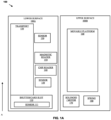
- FIG. 1A is a diagram of card reader 100 that includes a lower surface 100A and an upper surface 100B.
- the lower surface 100A includes a card shutter/slot 110 with sensor 111, a card transport 120, one or more sensors 130, a chip reader or read head 140, and a magnetic reader or read head 150.
- the upper surface 100B includes a movable surface platform 160, optionally a solenoid/motor 170, and optionally a spring 180.
- FIG. 1B illustrates additional components of card reader 100 and discussed below with FIG. 1B .
- FIG. 1A the various components identified in the FIG. 1A are illustrated and the arrangement of the components is presented for purposes of illustration only. It is to be noted that other arrangements with more or fewer components are possible without departing from the teachings of disabling a card reader 100 when a foreign object is detected along the card transport 120 of the lower surface 100A as presented herein and below.
- Shutter/card slot 110 is activated at a transaction terminal during a transaction when a card is expected for the transaction or upon detection by sensor 111 that a card is being presented for entry into card reader 100. Sensor 111 reports when shutter 110 is opened or closed and/or reports when a card is being presented to the card slot 110 in cases where card reader 100 lacks a shutter.
- transport 120 activates to urge the card along the transport path or transport 120 for purposes of reading the card through a magnetic reader 150 when the card lacks a chip or for purposes of reading the card through chip reader 130 when the card includes an embedded chip.
- Reader 150 or 140 reads card data from the card and provides the card data back to the transaction terminal. With the card data obtained, transport 120 moves the card back out through card slot 110 and the card returns to the consumer who is performing a transaction on the transaction terminal.
- a shimmer/skimmer may be present along the transport 120 or lower surface 100A, such that when the card is read, the card data is intercepted and saved in memory/storage of the shimmer/skimmer and/or transmitted wirelessly to a nearby device of a thief.
- card reader 100 already determined that there was not a shimmer/skimmer device or any other foreign object along the transport path 120.
- moveable platform 160 lowers onto and is in contact with lower surface 100A. Movable platform 160 locks into place until sensor 111 reports that shutter 110 is opened for a card transaction or sensor 111 reports that a card is being presented for a card transaction to card slot 110. When sensor 111 reports such an event or condition, movable platform 160 raises off of lower surface and returns to a card reading position to receive the card within the card reader 100.
- Sensor 130 or sensors 130 report when the card reader 100 is in an idle state an event indicating whether movable 160 is in contact with lower surface 100A or not.
- sensor 130 or sensors 130 report an event indication that moveable platform 160 is not in contact with lower surface 100A during an idle state for card reader 100, card reader 100 is disabled for card transactions because a foreign object is wedged in between lower surface 100A and moveable platform 160.
- the foreign object could potentially be a skimmer/shimmer device placed into the card reader 100 by a thief/criminal.
- any foreign object along lower surface 100A is an indication that something is amiss and card reader 100 should be disabled for card transactions.
- moveable platform 160 is spring loaded behind a back surface of moveable platform 160.
- the force of a card being inserted into card slot 110 forces the spring 180 of the upper surface 100B to contract and allow entry into the card reader 100.
- the spring releases and pushes moveable platform 160 onto lower surface 100A.
- moveable platform 160 is spring loaded with a spring, a latch, and a spring contraction apparatus.
- the latch and spring contraction apparatus controlled by a solenoid or a small motor 170 to contract the spring 180, attached to a back surface of moveable platform 160, into a card entry state for purposes of permitting a card inserted into card slot 110 during a transaction.
- the latch is released when the an idle state is reported by sensor 111 indicating no card is expected in card reader 100; this causes the spring to uncoil and push mobile platform 160 onto lower surface 100A.
- a rail mechanism with a solenoid or small motor raises and lowers movable platform 160 off of and on to lower surface 100A. At least one side, any combination of more than one side, or all of the sides for moveable platform 160 aligned in the rail mechanism.
- sensor 130 is a single sensor 130 attached onto the lower surface in an area not previously occupied by other components of the lower surface 100A for an existing card reader being enhanced as card reader 100. In an embodiment, sensor 130 is two or more sensors 130 that are attached in areas not previously occupied by other components of lower surface 100A for an existing card reader being enhanced as card reader 100.
- sensor 130 or sensors 130 is/are a microswitch sensor, a time-of-flight sensor, or an optical sensor.
- the optical sensor embodiment reports light detected between lower surface 100A and upper surface 100B such that when moveable platform 160 lowers onto lower surface 100A the optical sensor is covered and reports no presence of light.
- card reader 100 When the card reader 100 is expected to be in an idle state and a sensor 130 reports an event indicating that mobile platform 160 is in contact with lower surface 100A, card reader 100 disables the card reader for card transactions and reports a potential foreign object detected event to the transaction terminal. In response, the transaction terminal initiates additional security operations and procedures.
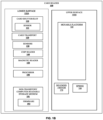
- FIG. 1B is another diagram of the card reader 100 of FIG. 1A , according to an example embodiment.
- FIG. 1B illustrates that card reader 100 further includes a processor 190 and a non-transitory computer-readable storage medium (hereinafter "medium") 191 for executable instructions or firmware 192.
- the instructions/firmware 192 when executed by processor 190 from medium 191 cause processor 190 to perform operations discussed herein and below.
- the processor 190 monitors events reported from sensors 111 and 130. When sensor 111 reports that the card reader 100 is in an idle state, processor 190 expects an all-clear event from sensor 130 or sensors 130 indicating that moveable platform 160 is in contact with lower surface 100A. When an all-clear event is not received from sensor 130 or sensors 130, processor 190 disables card reader 100 and sends a foreign object event to the transaction terminal associated with card reader 100.
- the card reader 100 can be disabled by locking shutter 110, disabling power to card reader 100, and/or permanently setting the state of the card reader 100 to offline or idle and not permitting the state to be changed. It is noted that processor 190 can perform other operations to effectively disable card reader 100, such as disabling magnetic reader 150 and chip reader 140.
- processor 190 activates a motor or solenoid 170 to cause movable platform 160 to lower onto or raise off of lower surface 100A. In an embodiment, processor 190, delays checking for an all-clear event by a configurable amount of micro seconds to permit mobile platform 160 to properly be lowered onto lower surface 100A following a completion of a card transaction on card reader 100.
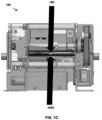
- FIG. 1C is a schematic diagram of rear-view of the card reader 100 of FIGS. 1A and 1B where the mobile platform 160 of the card reader 100 is moving down towards the lower surface 100A after the card shutter 110 is closed, according to an example embodiment.
- FIG. 1C illustrates that mobile platform 160 is in contact with lower surface 100A is moving from a card transaction position following a completed card transaction down to contact the lower surface 100A at which point sensor 130 or sensors 130 report an all-clear event to processor 190.
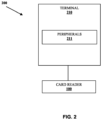
- FIG. 2 is a diagram 200 of a system for card reader 100 that detects foreign objects in the card reader, according to an example embodiment.
- the system includes a transaction terminal 210, other terminal peripheral devices 211 of terminal 210, and card reader 100 as a card reader peripheral device of terminal 210.
- the other peripherals 211 include a touch display, a receipt printer, a media depository, a media dispenser, a scanner, a weigh scale, a combined scanner and weigh scale, a bag scale, a keypad, a Personal Identification Number (PIN) pad, an encrypted PIN pad, etc.
- the terminal 210 is an ATM, a self-service terminal (SST), a point-of-sale (POS) terminal, a fuel pump kiosk, a travel kiosk, a reservation kiosk, an entertainment kiosk, or an informational kiosk.
- a customer inserts a card (for example, a credit card, a debit card, a bank card, a loyalty card, a gift card, etc.) into card slot 111 of card reader 100.
- firmware 192 executed by processor 190 cause processor to perform operations discussed above with FIGS. 1B and 1C .
- processor 190 detects a card is present event for a card transaction at terminal 210 via card reader 100, sensor 111 reports the card is present event to processor 190.
- a spring-loaded moveable platform 160 is forced upward and away from contact with lower surface 100A by the force of a card being inserted into card reader 100, which contracts/coils a spring 180 of card reader 100.
- processor 190 activates a solenoid/motor 170 of card reader 100 to urge movable platform 160 off of and out of contact with lower surface 100A based on the card is present event.
- processor 190 detects a shutter opened event reported by sensor 111.
- a spring-loaded moveable platform 160 is forced upward and away from contact with lower surface 100A by the force of a card being inserted into card reader 100, which contracts/coils a spring 180 of card reader 100.
- processor 190 activates a solenoid/motor 170 of card reader 100 to urge movable platform 160 off of and out of contact with lower surface 100A based on the card is present event.
- a spring-loaded moveable platform 160 when the card is withdrawn from the card reader 100, de-coils or expands by the force of gravity and/or preconfigured tension of the spring 180.
- the spring 180 in a relaxed state without the card wedged between lower surface 100A and mobile platform 160 expands forcing mobile platform 160 onto and into contact with lower surface 100A.
- Movable platform 160 covers or touches sensor 130 and/or sensors 130 and report an expected event for an idle state of card reader 100 to processor 190. When the expected event is not received from sensor 130 or sensors 130, processor 190 initiates operations to disable the card reader 100 and report a foreign object detected event to a processor of terminal 210.
- processor 190 when the card is withdrawn from the card reader 100, processor 190 activates a solenoid/motor 170 to urge/move mobile platform 160 down from an initial position, which was associated with the card is present event, and onto lower surface 100A touching or covering sensor 130 or sensors 130. Sensor 130 or sensors 130 remote an expected event for an idle state of card reader 100 to processor 190. When the expected event is not received from sensor 130 or sensors 130, processor 190 initiates operations to disable the card reader 100 and report a foreign object detected event to a processor of terminal 210.
- card reader 100 Any presence of a foreign object including a skimmer/shimmer device of a single mm or less, is detected by card reader 100 when the card reader 100 is supposed to be in an idle state. This causes the card reader 100 to be disabled and a foreign object detected event sent to a processor of terminal 210. Moreover, card jams associated with narrowing the card transport area are avoided because the card transport area is adjusted to have a sufficient clearance for any card inserted into card reader 100 whenever the card reader 100 is reporting a card is present or shutter is opened event. Thus, card reader 100 is flexible in design to catch and to detect any skimmer/shimmer manufactured by criminals.
- FIG. 3 is a diagram of a method 300 for disabling a card reader 100 when a foreign object is detected within the card reader 100, according to an example embodiment.
- the method 300 is implemented as executable instructions referred to herein as "firmware.”
- the firmware is executed by a processor 190 of a card reader 100, which cause the processor 190 to perform operations discussed with method 300.
- the firmware resides in non-transitory computer-readable storage media 191 or memory of the card reader 100.
- the firmware is firmware 192 discussed above with FIGS. 1B , 1C , and 2 .
- the firmware disables a card reader 100 when one or more sensors 130 of the card reader 100 report an event during an idle state of the card reader 100.
- the event is an indication that a foreign object is inside the card reader's card transport area prevent a moveable upper surface platform 100B from making contact or covering the one or more sensors 130, which are attached to a lower surface 100A of the card reader 100.
- the firmware locks a shutter 110 of the card reader 100 in a closed position and disables a card is present sensor 111 for a card slot 110 of the card reader 100.
- the card reader is disable in any of the above-discussed manners.
- the firmware sends a foreign object detected event to a processor of a transaction terminal 210.
- the terminal 210 is associated with card reader 100 and the card reader is a peripheral device of the terminal 210.
- security software or security systems executed by the processor of the terminal 210 or executed by a cloud processor of a cloud connect to terminal 210 can disable the terminal 210 in response to receiving the foreign object detected event and cause service personnel/staff to be dispatched to visually inspect the card transport area of card reader 100 for the presence of a skimmer/shimmer device.
- modules are illustrated as separate modules, but may be implemented as homogenous code, as individual components, some, but not all of these modules may be combined, or the functions may be implemented in software/firmware structured in any other convenient manner.
Landscapes
- Engineering & Computer Science (AREA)
- Physics & Mathematics (AREA)
- General Physics & Mathematics (AREA)
- Theoretical Computer Science (AREA)
- Artificial Intelligence (AREA)
- Computer Vision & Pattern Recognition (AREA)
- Conveying Record Carriers (AREA)
Abstract
Description
- Skimmers and shimming devices are getting thinner and thinner as manufacturing by criminals improves. Recent skimmers and shimming devices have proven to defeat current security measures in motorized card readers, such as by narrowing the card transport areas of the card readers. The transport areas can only be narrowed so much in order to still allow a card transaction to take place without card jams. There have been cases in the field of successful skimmers of less than millimeter (mm) thick fitting into tamper-resistant card readers.
- Again, there is only a limited amount that the card transportation area can be narrowed for a card transaction to take place without a high number of card jams. This presents a technical problem in the industry, which to date has been unable to be solved by the industry.
- In various embodiments, a card reader, a method of operating a card reader, and a system for a card reader are presented for detecting foreign objects in the card reader. A card reader is provided with a spring-loaded or motorized upper surface. A lower transport surface that opposes the upper surface includes at least one sensor. The more sensors on this surface, the more sensitive and efficient the new security feature will be. When there is no card transaction in progress the card reader is reported as closed, the upper surface moves down and makes contact with the lower transport surface. If any object is on the lower surface so as to prevent the upper surface from making contact with the lower surface, the sensor reports this condition and the card reader is disabled, as there is a foreign object located within the card reader, which potentially could be a skimmer or a shimming device.
- According to a first aspect of the present invention there is provided a card reader, comprising: a sensor attached to a first interior surface of the card reader; a moveable platform associated with at least a portion of a second interior surface of the card reader, wherein the first interior surface and the second interior surface oppose one another on an interior of the card reader; a processor; a non-transitory computer-readable storage medium comprising executable instructions as firmware; the firmware when executed by the processor from the non-transitory computer-readable storage medium causes the processor to perform operations comprising: disabling the card reader when the card reader is in an idle state and the sensor is reporting an event indicating that the moveable platform is not in contact or not covering the sensor indicating that a foreign object is on the interior of the card reader between the first interior surface and the moveable platform.
- Aptly, a card transport area of the card reader is defined by a distance between the first interior surface and a lower surface of the moveable platform.
- Aptly, the card reader further comprises a card sensor or slot sensor located proximate to a card slot or card shutter to report when a card is present at the card slot or to report when the card shutter opens.
- Aptly, the card reader further comprises a card transport attached to the first interior surface to transport the card within the card reader; a magnetic card reader attached to the first interior surface to read card data off a magnetic strip of the card; and a chip reader attached to the first interior surface to read chip encoded card data off an embedded chip of the card.
- Aptly, the moveable platform further includes a spring attached to a backside of the moveable platform, the spring adapted to retract the moveable platform away from the first interior surface and permit a card inserted into the card reader to be transported within the card reader and card data read by a magnetic reader or a chip reader located on the first interior surface.
- Aptly, the moveable platform further includes a motor or solenoid to move the moveable platform down towards and on the first interior surface and to move the moveable platform away from and off of the first interior surface.
- Aptly, the firmware when executed by the processor from the non-transitory computer-readable storage medium further causes the processor to perform additional operations comprising: controlling the motor to move the moveable platform down towards and on the first interior surface and to move the moveable platform away from and off of the first interior surface.
- Aptly, the additional operations associated with the controlling further include: causing the moveable platform to move away from and off of the first interior surface when the card reader is in a card is present or card slot is open state; and causing the moveable platform to move down towards and on the first interior surface when the card reader is in the idle state.
- Aptly, the operations associated with the disabling further include reporting a foreign object detected event to a transaction terminal associated with the card reader, wherein the card reader is a peripheral device of the transaction terminal.
- According to a second aspect of the present invention there is provided a system, comprising: a terminal; and a card reader comprising: a card transport area defined by a distance between a lower fixed interior surface of the card reader and a dynamic moving upper interior surface of the card reader; wherein the card transport area is sufficient to permit a card inserted into the card reader to have card data read from the card through a magnetic card reader or a chip card reader located on the lower fixed interior surface; wherein the card transport area reduces by urging the dynamic moving upper interior surface down towards and on top of the lower fixed interior surface when the card reader is in an idle state; wherein when the card reader is in an idle state and the dynamic moving upper interior surface is not touching or covering the lower fixed interior surface, the card reader disables for card transactions on the terminal.
- Aptly, the terminal is an automated teller machine, a self-service terminal, or a point-of-sale terminal.
- Aptly, the card reader further includes at least one sensor located on lower fixed interior surface to report an event associated with whether the lower fixed interior surface and the dynamic moving upper interior surface are touching during the idle state.
- Aptly, the at least one sensor is a microswitch sensor, a time-of-flight sensor, or an optical sensor.
- Aptly, the at least one sensor comprises two or more sensors distributed and attached along the lower fixed interior surface.
- Aptly, the dynamic moving upper interior surface is spring loaded to cause a spring attached to the backside of the dynamic moving upper interior surface to compress and move the dynamic moving upper interior surface upward off of the lower fixed interior surface creating the card transport area when the card is inserted in the card reader, and wherein the spring expands or de-coils pushing the dynamic moving upper interior surface onto the lower fixed interior surface when the card is removed from the card reader.
- Aptly, the dynamic moving upper interior surface is adapted to be driven upward and downward by a solenoid or a motor based on a given state of the card reader.
- Aptly, the card reader is configured to report a foreign object detected event to the terminal before the card reader is disabled.
- According to a third aspect of the present invention there is provided a method, comprising: disabling, by a processor of a card reader, the card reader when one or more sensors of the card reader report an event during an idle state of the card reader indicating that a foreign object inside the card reader is preventing a moveable upper surface platform of the card reader from making contact or covering the one or more sensors, wherein the one or more sensors are attached to a lower surface of the card reader.
- Aptly, the method further comprises sending, by the processor, a foreign object detected event to a processor of a transaction terminal associated with the card reader, wherein the card reader is a peripheral device of the transaction terminal.
- Aptly, disabling further includes locking a shutter of the card reader in a closed position and disabling a card is present sensor for a card slot of the card reader.
-
FIG. 1A is a diagram of card reader that detects a foreign object in the card reader, according to an example embodiment. -
FIG. 1B is another diagram of the card reader ofFIG. 1A , according to an example embodiment. -
Fig. 1C is a schematic diagram of rear-view of the card reader ofFIGS. 1A and1B where the upper surface of the card reader is moving down towards the lower surface after the card shutter is closed, according to an example embodiment. -
FIG. 2 is a diagram of a system for a card reader that detects foreign objects in the card reader, according to an example embodiment. -
FIG. 3 is a diagram of a method for disabling a card reader when a foreign object is detected within the card reader, according to an example embodiment. - As stated above, skimmers and shimming devices are a big problem in the industry. A variety of card manufacturers have attempted to narrow the card transport area to no avail since some criminals now employ devices as small as less than 1 mm thick, which is almost equal to the half the thickness of bank and credit cards. These card manufacturing techniques have not been working well in the industry and skimmers/shimmers remain a significant problem in the industry.
- The teachings that follow provide a new card reader that utilizes one or more sensors situated on a lower surface of the transport area and a movable upper surface situated above the lower surface. The shutter of the card reader is closed when the card reader is in an idle state.
- A shutter sensor reports when the shutter closes or opens. When the shutter is closed, the movable upper surface moves down towards the lower surface to make contact with the lower surface. The one or more sensors on the lower surface report if the upper surface made contact with the lower surface of did not make contact with the lower surface. The card reader is disabled when the one or more sensors are reporting that the upper surface is not in contact with the lower surface. This is an indication that a skimmer/shimmer is potentially present within the transport area of the card reader. The card reader detects the foreign objects regardless of the width of the foreign objects, such that even a fraction of a mm in thickness skimmer/shimmer is detected and the card reader is disabled.
-
FIG. 1A is a diagram ofcard reader 100 that includes alower surface 100A and anupper surface 100B. Thelower surface 100A includes a card shutter/slot 110 withsensor 111, acard transport 120, one ormore sensors 130, a chip reader or readhead 140, and a magnetic reader or readhead 150. Theupper surface 100B includes amovable surface platform 160, optionally a solenoid/motor 170, and optionally aspring 180.FIG. 1B illustrates additional components ofcard reader 100 and discussed below withFIG. 1B . - Furthermore, the various components identified in the
FIG. 1A ) are illustrated and the arrangement of the components is presented for purposes of illustration only. It is to be noted that other arrangements with more or fewer components are possible without departing from the teachings of disabling acard reader 100 when a foreign object is detected along thecard transport 120 of thelower surface 100A as presented herein and below. - Shutter/
card slot 110 is activated at a transaction terminal during a transaction when a card is expected for the transaction or upon detection bysensor 111 that a card is being presented for entry intocard reader 100.Sensor 111 reports whenshutter 110 is opened or closed and/or reports when a card is being presented to thecard slot 110 in cases wherecard reader 100 lacks a shutter. - When the shutter or card slot opens based on the event reported by
sensor 111,transport 120 activates to urge the card along the transport path ortransport 120 for purposes of reading the card through amagnetic reader 150 when the card lacks a chip or for purposes of reading the card throughchip reader 130 when the card includes an embedded chip.Reader transport 120 moves the card back out throughcard slot 110 and the card returns to the consumer who is performing a transaction on the transaction terminal. - As stated above, a shimmer/skimmer may be present along the
transport 120 orlower surface 100A, such that when the card is read, the card data is intercepted and saved in memory/storage of the shimmer/skimmer and/or transmitted wirelessly to a nearby device of a thief. However, unlike convention detection mechanisms before the shutter orcard slot 110 was activated for the consumer transaction and before the card was urged along the transport 120 (in the direction indicated by the arrow and label "A" withinFIG. 1A ),card reader 100 already determined that there was not a shimmer/skimmer device or any other foreign object along thetransport path 120. - This is achieved via
sensor 130 orsensors 130 located adjacent to the transport path and viamoveable platform 160. When thecard reader 100 is idle and not being used for a card transaction,moveable platform 160 lowers onto and is in contact withlower surface 100A.Movable platform 160 locks into place untilsensor 111 reports that shutter 110 is opened for a card transaction orsensor 111 reports that a card is being presented for a card transaction tocard slot 110. Whensensor 111 reports such an event or condition,movable platform 160 raises off of lower surface and returns to a card reading position to receive the card within thecard reader 100. -
Sensor 130 orsensors 130 report when thecard reader 100 is in an idle state an event indicating whether movable 160 is in contact withlower surface 100A or not. Whensensor 130 orsensors 130 report an event indication thatmoveable platform 160 is not in contact withlower surface 100A during an idle state forcard reader 100,card reader 100 is disabled for card transactions because a foreign object is wedged in betweenlower surface 100A andmoveable platform 160. The foreign object could potentially be a skimmer/shimmer device placed into thecard reader 100 by a thief/criminal. In fact, any foreign object alonglower surface 100A is an indication that something is amiss andcard reader 100 should be disabled for card transactions. - In an embodiment,
moveable platform 160 is spring loaded behind a back surface ofmoveable platform 160. The force of a card being inserted intocard slot 110 forces thespring 180 of theupper surface 100B to contract and allow entry into thecard reader 100. When a card is removed from thecard reader 100, the spring releases and pushesmoveable platform 160 ontolower surface 100A. - In an embodiment,
moveable platform 160 is spring loaded with a spring, a latch, and a spring contraction apparatus. The latch and spring contraction apparatus controlled by a solenoid or asmall motor 170 to contract thespring 180, attached to a back surface ofmoveable platform 160, into a card entry state for purposes of permitting a card inserted intocard slot 110 during a transaction. The latch is released when the an idle state is reported bysensor 111 indicating no card is expected incard reader 100; this causes the spring to uncoil and pushmobile platform 160 ontolower surface 100A. - In an embodiment, a rail mechanism with a solenoid or small motor raises and lowers
movable platform 160 off of and on tolower surface 100A. At least one side, any combination of more than one side, or all of the sides formoveable platform 160 aligned in the rail mechanism. - In an embodiment,
sensor 130 is asingle sensor 130 attached onto the lower surface in an area not previously occupied by other components of thelower surface 100A for an existing card reader being enhanced ascard reader 100. In an embodiment,sensor 130 is two ormore sensors 130 that are attached in areas not previously occupied by other components oflower surface 100A for an existing card reader being enhanced ascard reader 100. - In an embodiment,
sensor 130 orsensors 130 is/are a microswitch sensor, a time-of-flight sensor, or an optical sensor. The optical sensor embodiment reports light detected betweenlower surface 100A andupper surface 100B such that whenmoveable platform 160 lowers ontolower surface 100A the optical sensor is covered and reports no presence of light. When thecard reader 100 is expected to be in an idle state and asensor 130 reports an event indicating thatmobile platform 160 is in contact withlower surface 100A,card reader 100 disables the card reader for card transactions and reports a potential foreign object detected event to the transaction terminal. In response, the transaction terminal initiates additional security operations and procedures. -
FIG. 1B is another diagram of thecard reader 100 ofFIG. 1A , according to an example embodiment.FIG. 1B illustrates thatcard reader 100 further includes aprocessor 190 and a non-transitory computer-readable storage medium (hereinafter "medium") 191 for executable instructions orfirmware 192. The instructions/firmware 192 when executed byprocessor 190 from medium 191cause processor 190 to perform operations discussed herein and below. - For example, the
processor 190 monitors events reported fromsensors sensor 111 reports that thecard reader 100 is in an idle state,processor 190 expects an all-clear event fromsensor 130 orsensors 130 indicating thatmoveable platform 160 is in contact withlower surface 100A. When an all-clear event is not received fromsensor 130 orsensors 130,processor 190 disablescard reader 100 and sends a foreign object event to the transaction terminal associated withcard reader 100. Thecard reader 100 can be disabled by lockingshutter 110, disabling power tocard reader 100, and/or permanently setting the state of thecard reader 100 to offline or idle and not permitting the state to be changed. It is noted thatprocessor 190 can perform other operations to effectively disablecard reader 100, such as disablingmagnetic reader 150 andchip reader 140. - In an embodiment,
processor 190 activates a motor orsolenoid 170 to causemovable platform 160 to lower onto or raise off oflower surface 100A. In an embodiment,processor 190, delays checking for an all-clear event by a configurable amount of micro seconds to permitmobile platform 160 to properly be lowered ontolower surface 100A following a completion of a card transaction oncard reader 100. -
Fig. 1C is a schematic diagram of rear-view of thecard reader 100 ofFIGS. 1A and1B where themobile platform 160 of thecard reader 100 is moving down towards thelower surface 100A after thecard shutter 110 is closed, according to an example embodiment.FIG. 1C illustrates thatmobile platform 160 is in contact withlower surface 100A is moving from a card transaction position following a completed card transaction down to contact thelower surface 100A at whichpoint sensor 130 orsensors 130 report an all-clear event toprocessor 190. -
FIG. 2 is a diagram 200 of a system forcard reader 100 that detects foreign objects in the card reader, according to an example embodiment. The system includes atransaction terminal 210, other terminalperipheral devices 211 ofterminal 210, andcard reader 100 as a card reader peripheral device ofterminal 210. - In an embodiment, the
other peripherals 211 include a touch display, a receipt printer, a media depository, a media dispenser, a scanner, a weigh scale, a combined scanner and weigh scale, a bag scale, a keypad, a Personal Identification Number (PIN) pad, an encrypted PIN pad, etc. In an embodiment, the terminal 210 is an ATM, a self-service terminal (SST), a point-of-sale (POS) terminal, a fuel pump kiosk, a travel kiosk, a reservation kiosk, an entertainment kiosk, or an informational kiosk. - During operation of the terminal 210, a customer inserts a card (for example, a credit card, a debit card, a bank card, a loyalty card, a gift card, etc.) into
card slot 111 ofcard reader 100. In an embodiment,firmware 192 executed byprocessor 190 cause processor to perform operations discussed above withFIGS. 1B and1C . For example,processor 190 detects a card is present event for a card transaction atterminal 210 viacard reader 100,sensor 111 reports the card is present event toprocessor 190. In an embodiment, a spring-loadedmoveable platform 160 is forced upward and away from contact withlower surface 100A by the force of a card being inserted intocard reader 100, which contracts/coils aspring 180 ofcard reader 100. In an embodiment,processor 190 activates a solenoid/motor 170 ofcard reader 100 to urgemovable platform 160 off of and out of contact withlower surface 100A based on the card is present event. - In an embodiment,
processor 190 detects a shutter opened event reported bysensor 111. A spring-loadedmoveable platform 160 is forced upward and away from contact withlower surface 100A by the force of a card being inserted intocard reader 100, which contracts/coils aspring 180 ofcard reader 100. In an embodiment,processor 190 activates a solenoid/motor 170 ofcard reader 100 to urgemovable platform 160 off of and out of contact withlower surface 100A based on the card is present event. - In an embodiment, when the card is withdrawn from the
card reader 100, a spring-loadedmoveable platform 160 de-coils or expands by the force of gravity and/or preconfigured tension of thespring 180. Thespring 180 in a relaxed state without the card wedged betweenlower surface 100A andmobile platform 160 expands forcingmobile platform 160 onto and into contact withlower surface 100A.Movable platform 160 covers or touchessensor 130 and/orsensors 130 and report an expected event for an idle state ofcard reader 100 toprocessor 190. When the expected event is not received fromsensor 130 orsensors 130,processor 190 initiates operations to disable thecard reader 100 and report a foreign object detected event to a processor ofterminal 210. - In an embodiment, when the card is withdrawn from the
card reader 100,processor 190 activates a solenoid/motor 170 to urge/movemobile platform 160 down from an initial position, which was associated with the card is present event, and ontolower surface 100A touching or coveringsensor 130 orsensors 130.Sensor 130 orsensors 130 remote an expected event for an idle state ofcard reader 100 toprocessor 190. When the expected event is not received fromsensor 130 orsensors 130,processor 190 initiates operations to disable thecard reader 100 and report a foreign object detected event to a processor ofterminal 210. - Any presence of a foreign object including a skimmer/shimmer device of a single mm or less, is detected by
card reader 100 when thecard reader 100 is supposed to be in an idle state. This causes thecard reader 100 to be disabled and a foreign object detected event sent to a processor ofterminal 210. Moreover, card jams associated with narrowing the card transport area are avoided because the card transport area is adjusted to have a sufficient clearance for any card inserted intocard reader 100 whenever thecard reader 100 is reporting a card is present or shutter is opened event. Thus,card reader 100 is flexible in design to catch and to detect any skimmer/shimmer manufactured by criminals. -
FIG. 3 is a diagram of amethod 300 for disabling acard reader 100 when a foreign object is detected within thecard reader 100, according to an example embodiment. Themethod 300 is implemented as executable instructions referred to herein as "firmware." The firmware is executed by aprocessor 190 of acard reader 100, which cause theprocessor 190 to perform operations discussed withmethod 300. The firmware resides in non-transitory computer-readable storage media 191 or memory of thecard reader 100. In an embodiment, the firmware isfirmware 192 discussed above withFIGS. 1B ,1C , and2 . - At 310, the firmware disables a
card reader 100 when one ormore sensors 130 of thecard reader 100 report an event during an idle state of thecard reader 100. The event is an indication that a foreign object is inside the card reader's card transport area prevent a moveableupper surface platform 100B from making contact or covering the one ormore sensors 130, which are attached to alower surface 100A of thecard reader 100. - In an embodiment, at 311, the firmware locks a
shutter 110 of thecard reader 100 in a closed position and disables a card ispresent sensor 111 for acard slot 110 of thecard reader 100. In embodiment, the card reader is disable in any of the above-discussed manners. - In an embodiment, at 320, the firmware sends a foreign object detected event to a processor of a
transaction terminal 210. The terminal 210 is associated withcard reader 100 and the card reader is a peripheral device of the terminal 210. In an embodiment, security software or security systems executed by the processor of the terminal 210 or executed by a cloud processor of a cloud connect toterminal 210 can disable the terminal 210 in response to receiving the foreign object detected event and cause service personnel/staff to be dispatched to visually inspect the card transport area ofcard reader 100 for the presence of a skimmer/shimmer device. - It should be appreciated that where software/firmware is described in a particular form (such as a component or module) this is merely to aid understanding and is not intended to limit how software/firmware that implements those functions may be architected or structured. For example, modules are illustrated as separate modules, but may be implemented as homogenous code, as individual components, some, but not all of these modules may be combined, or the functions may be implemented in software/firmware structured in any other convenient manner.
- Furthermore, although the software/firmware modules are illustrated as executing on one piece of hardware, the software/firmware may be distributed over multiple processors or in any other convenient manner. The above description is illustrative, and not restrictive. Many other embodiments will be apparent to those of ordinary skill in the art upon reviewing the above description. The scope of embodiments should therefore be determined with reference to the appended claims, along with the full scope of equivalents to which such claims are entitled.
- In the foregoing description of the embodiments, various features are grouped together in a single embodiment for the purpose of streamlining the disclosure. This method of disclosure is not to be interpreted as reflecting that the claimed embodiments have more features than are expressly recited in each claim. Rather, as the following claims reflect, inventive subject matter lies in less than all features of a single disclosed embodiment. Thus, the following claims are hereby incorporated into the Description of the Embodiments, with each claim standing on its own as a separate exemplary embodiment.
- Throughout the description and claims of this specification, the words "comprise" and "contain" and variations of them mean "including but not limited to" and they are not intended to (and do not) exclude other moieties, additives, components, integers or steps. Throughout the description and claims of this specification, the singular encompasses the plural unless the context otherwise requires. In particular, where the indefinite article is used, the specification is to be understood as contemplating plurality as well as singularity, unless the context requires otherwise.
- Features, integers, characteristics or groups described in conjunction with a particular aspect, embodiment or example of the invention are to be understood to be applicable to any other aspect, embodiment or example described herein unless incompatible therewith. All of the features disclosed in this specification (including any accompanying claims, abstract and drawings), and/or all of the steps of any method or process so disclosed, may be combined in any combination, except combinations where at least some of the features and/or steps are mutually exclusive. The invention is not restricted to any details of any foregoing embodiments. The invention extends to any novel one, or novel combination, of the features disclosed in this specification (including any accompanying claims, abstract and drawings), or to any novel one, or any novel combination, of the steps of any method or process so disclosed.
- The reader's attention is directed to all papers and documents which are filed concurrently with or previous to this specification in connection with this application and which are open to public inspection with this specification, and the contents of all such papers and documents are incorporated herein by reference.
Claims (15)
- A card reader, comprising:a sensor attached to a first interior surface of the card reader;a moveable platform associated with at least a portion of a second interior surface of the card reader, wherein the first interior surface and the second interior surface oppose one another on an interior of the card reader;a processor;a non-transitory computer-readable storage medium comprising executable instructions as firmware;the firmware when executed by the processor from the non-transitory computer-readable storage medium causes the processor to perform operations comprising:
disabling the card reader when the card reader is in an idle state and the sensor is reporting an event indicating that the moveable platform is not in contact or not covering the sensor indicating that a foreign object is on the interior of the card reader between the first interior surface and the moveable platform. - The card reader of claim 1, wherein a card transport area of the card reader is defined by a distance between the first interior surface and a lower surface of the moveable platform.
- The card reader of claim 1 further comprising:
a card sensor or slot sensor located proximate to a card slot or card shutter to report when a card is present at the card slot or to report when the card shutter opens. - The card reader of claim 2 further comprising;a card transport attached to the first interior surface to transport the card within the card reader;a magnetic card reader attached to the first interior surface to read card data off a magnetic strip of the card; anda chip reader attached to the first interior surface to read chip encoded card data off an embedded chip of the card.
- The card reader of claim 1, wherein the moveable platform further includes a spring attached to a backside of the moveable platform, the spring adapted to retract the moveable platform away from the first interior surface and permit a card inserted into the card reader to be transported within the card reader and card data read by a magnetic reader or a chip reader located on the first interior surface.
- The card reader of claim 1, wherein the moveable platform further includes a motor or solenoid to move the moveable platform down towards and on the first interior surface and to move the moveable platform away from and off of the first interior surface.
- The card reader of claim 6, wherein the firmware when executed by the processor from the non-transitory computer-readable storage medium further causes the processor to perform additional operations comprising:
controlling the motor to move the moveable platform down towards and on the first interior surface and to move the moveable platform away from and off of the first interior surface. - The card reader of claim 7, wherein the additional operations associated with the controlling further include:
causing the moveable platform to move away from and off of the first interior surface when the card reader is in a card is present or card slot is open state; and
causing the moveable platform to move down towards and on the first interior surface when the card reader is in the idle state. - A system, comprising:a terminal; anda card reader comprising:a card transport area defined by a distance between a lower fixed interior surface of the card reader and a dynamic moving upper interior surface of the card reader;wherein the card transport area is sufficient to permit a card inserted into the card reader to have card data read from the card through a magnetic card reader or a chip card reader located on the lower fixed interior surface;wherein the card transport area reduces by urging the dynamic moving upper interior surface down towards and on top of the lower fixed interior surface when the card reader is in an idle state;wherein when the card reader is in an idle state and the dynamic moving upper interior surface is not touching or covering the lower fixed interior surface, the card reader disables for card transactions on the terminal.
- The system of claim 9, wherein the terminal is an automated teller machine, a self-service terminal, or a point-of-sale terminal.
- The system of claim 9, wherein the card reader further includes at least one sensor located on lower fixed interior surface to report an event associated with whether the lower fixed interior surface and the dynamic moving upper interior surface are touching during the idle state.
- The system of claim 11, wherein the at least one sensor is a microswitch sensor, a time-of-flight sensor, or an optical sensor and optionally the at least one sensor comprises two or more sensors distributed and attached along the lower fixed interior surface.
- The system of claim 9, wherein the dynamic moving upper interior surface is spring loaded to cause a spring attached to the backside of the dynamic moving upper interior surface to compress and move the dynamic moving upper interior surface upward off of the lower fixed interior surface creating the card transport area when the card is inserted in the card reader, and wherein the spring expands or de-coils pushing the dynamic moving upper interior surface onto the lower fixed interior surface when the card is removed from the card reader.
- A method, comprising:
disabling, by a processor of a card reader, the card reader when one or more sensors of the card reader report an event during an idle state of the card reader indicating that a foreign object inside the card reader is preventing a moveable upper surface platform of the card reader from making contact or covering the one or more sensors, wherein the one or more sensors are attached to a lower surface of the card reader. - The method of claim 14 further comprising:
sending, by the processor, a foreign object detected event to a processor of a transaction terminal associated with the card reader, wherein the card reader is a peripheral device of the transaction terminal.
Applications Claiming Priority (1)
| Application Number | Priority Date | Filing Date | Title |
|---|---|---|---|
| US18/194,107 US12254373B2 (en) | 2023-03-31 | 2023-03-31 | Card reader foreign object detection |
Publications (2)
| Publication Number | Publication Date |
|---|---|
| EP4439379A1 true EP4439379A1 (en) | 2024-10-02 |
| EP4439379B1 EP4439379B1 (en) | 2025-11-12 |
Family
ID=89430592
Family Applications (1)
| Application Number | Title | Priority Date | Filing Date |
|---|---|---|---|
| EP23219052.0A Active EP4439379B1 (en) | 2023-03-31 | 2023-12-21 | Card reader foreign object detection |
Country Status (2)
| Country | Link |
|---|---|
| US (2) | US12254373B2 (en) |
| EP (1) | EP4439379B1 (en) |
Citations (3)
| Publication number | Priority date | Publication date | Assignee | Title |
|---|---|---|---|---|
| US6981647B2 (en) * | 2000-11-17 | 2006-01-03 | Kabushiki Kaisha Sankyo Seiki Seisakusho | Foreign matter detecting mechanism, carriage moving mechanism and method for operating carriage moving mechanism |
| US20200126368A1 (en) * | 2017-01-17 | 2020-04-23 | Nidec Sankyo Corporation | Card reader and control method of card reader |
| US20220391604A1 (en) * | 2021-06-04 | 2022-12-08 | Hitachi Channel Solutions, Corp. | Card reader and foreign object detection method for card reader |
Family Cites Families (8)
| Publication number | Priority date | Publication date | Assignee | Title |
|---|---|---|---|---|
| JP3884348B2 (en) * | 2002-08-02 | 2007-02-21 | 日立オムロンターミナルソリューションズ株式会社 | Card reader |
| US7458516B2 (en) * | 2005-11-14 | 2008-12-02 | Ncr Corporation | Card reader |
| US9483668B2 (en) * | 2007-05-08 | 2016-11-01 | Cirque Corporation | Method of securing volumes of space in card readers |
| US8251282B2 (en) * | 2007-12-20 | 2012-08-28 | Ncr Corporation | Card reader device with sensor for sensing card trapping device |
| US8708235B2 (en) * | 2010-01-27 | 2014-04-29 | Nidec Sankyo Corporation | Card reader |
| CN109791596A (en) * | 2016-09-29 | 2019-05-21 | 日本电产三协株式会社 | The control method of card reader |
| US10262326B1 (en) * | 2017-07-31 | 2019-04-16 | Wells Fargo Bank, N.A. | Anti-skimming card reader computing device |
| JP2022103544A (en) * | 2020-12-28 | 2022-07-08 | 日本電産サンキョー株式会社 | Card reader and transaction apparatus |
-
2023
- 2023-03-31 US US18/194,107 patent/US12254373B2/en active Active
- 2023-12-21 EP EP23219052.0A patent/EP4439379B1/en active Active
-
2025
- 2025-01-10 US US19/016,840 patent/US20250148225A1/en active Pending
Patent Citations (3)
| Publication number | Priority date | Publication date | Assignee | Title |
|---|---|---|---|---|
| US6981647B2 (en) * | 2000-11-17 | 2006-01-03 | Kabushiki Kaisha Sankyo Seiki Seisakusho | Foreign matter detecting mechanism, carriage moving mechanism and method for operating carriage moving mechanism |
| US20200126368A1 (en) * | 2017-01-17 | 2020-04-23 | Nidec Sankyo Corporation | Card reader and control method of card reader |
| US20220391604A1 (en) * | 2021-06-04 | 2022-12-08 | Hitachi Channel Solutions, Corp. | Card reader and foreign object detection method for card reader |
Also Published As
| Publication number | Publication date |
|---|---|
| US20240330611A1 (en) | 2024-10-03 |
| US12254373B2 (en) | 2025-03-18 |
| EP4439379B1 (en) | 2025-11-12 |
| US20250148225A1 (en) | 2025-05-08 |
Similar Documents
| Publication | Publication Date | Title |
|---|---|---|
| US8978973B2 (en) | Banking apparatus controlled responsive to data bearing records | |
| US9361767B2 (en) | Banking apparatus controlled responsive to data bearing records | |
| CN101789084B (en) | Automatic card issuing machine and its automatic card issuing method | |
| US9697699B2 (en) | Banking apparatus with deposit accepting device | |
| US8695879B1 (en) | Fraud prevention | |
| EP4312149A1 (en) | Card reader skimmer disrupter | |
| US20130153654A1 (en) | Banking Apparatus Controlled Responsive to Data Bearing Records | |
| JP7096914B2 (en) | Automatic payment machine and automatic payment machine control method | |
| EP4439379B1 (en) | Card reader foreign object detection | |
| US20250239124A1 (en) | Media handling device module alignment | |
| KR100953296B1 (en) | Automatic trading device | |
| CN103310551B (en) | Automatic transaction device and method for preventing card data capture by automatic transaction device | |
| EP3296971B1 (en) | Card dispenser | |
| EP4531013B1 (en) | Media shutter attack sensing | |
| US11055971B1 (en) | Bendable anti-skimming plate for a card reader | |
| JP5142740B2 (en) | Automatic transaction equipment | |
| US20230416031A1 (en) | Edge sensing apparatus in automated transaction machine | |
| JP2001126120A (en) | Automatic transaction machine | |
| EP4332828A1 (en) | Skimming and magnetic read prevention | |
| KR101831809B1 (en) | Anti-skimming apparatus | |
| KR101056668B1 (en) | Check character recognition method of check and withdrawal device | |
| JPH11265474A (en) | Acceptability detector of data recording card, self-service system and its operating method |
Legal Events
| Date | Code | Title | Description |
|---|---|---|---|
| PUAI | Public reference made under article 153(3) epc to a published international application that has entered the european phase |
Free format text: ORIGINAL CODE: 0009012 |
|
| STAA | Information on the status of an ep patent application or granted ep patent |
Free format text: STATUS: REQUEST FOR EXAMINATION WAS MADE |
|
| 17P | Request for examination filed |
Effective date: 20231221 |
|
| AK | Designated contracting states |
Kind code of ref document: A1 Designated state(s): AL AT BE BG CH CY CZ DE DK EE ES FI FR GB GR HR HU IE IS IT LI LT LU LV MC ME MK MT NL NO PL PT RO RS SE SI SK SM TR |
|
| GRAP | Despatch of communication of intention to grant a patent |
Free format text: ORIGINAL CODE: EPIDOSNIGR1 |
|
| STAA | Information on the status of an ep patent application or granted ep patent |
Free format text: STATUS: GRANT OF PATENT IS INTENDED |
|
| INTG | Intention to grant announced |
Effective date: 20250725 |
|
| GRAS | Grant fee paid |
Free format text: ORIGINAL CODE: EPIDOSNIGR3 |
|
| GRAA | (expected) grant |
Free format text: ORIGINAL CODE: 0009210 |
|
| STAA | Information on the status of an ep patent application or granted ep patent |
Free format text: STATUS: THE PATENT HAS BEEN GRANTED |
|
| AK | Designated contracting states |
Kind code of ref document: B1 Designated state(s): AL AT BE BG CH CY CZ DE DK EE ES FI FR GB GR HR HU IE IS IT LI LT LU LV MC ME MK MT NL NO PL PT RO RS SE SI SK SM TR |
|
| REG | Reference to a national code |
Ref country code: CH Ref legal event code: F10 Free format text: ST27 STATUS EVENT CODE: U-0-0-F10-F00 (AS PROVIDED BY THE NATIONAL OFFICE) Effective date: 20251112 Ref country code: GB Ref legal event code: FG4D |
|
| REG | Reference to a national code |
Ref country code: DE Ref legal event code: R084 Ref document number: 602023008539 Country of ref document: DE |
|
| REG | Reference to a national code |
Ref country code: IE Ref legal event code: FG4D |
|
| REG | Reference to a national code |
Ref country code: DE Ref legal event code: R096 Ref document number: 602023008539 Country of ref document: DE |
|
| REG | Reference to a national code |
Ref country code: GB Ref legal event code: 746 Effective date: 20251212 |
|
| PGFP | Annual fee paid to national office [announced via postgrant information from national office to epo] |
Ref country code: AT Payment date: 20260113 Year of fee payment: 3 |
|
| PGFP | Annual fee paid to national office [announced via postgrant information from national office to epo] |
Ref country code: FR Payment date: 20251226 Year of fee payment: 3 |
|
| REG | Reference to a national code |
Ref country code: NL Ref legal event code: MP Effective date: 20251112 |
|
| PG25 | Lapsed in a contracting state [announced via postgrant information from national office to epo] |
Ref country code: ES Free format text: LAPSE BECAUSE OF FAILURE TO SUBMIT A TRANSLATION OF THE DESCRIPTION OR TO PAY THE FEE WITHIN THE PRESCRIBED TIME-LIMIT Effective date: 20251112 |
|
| REG | Reference to a national code |
Ref country code: LT Ref legal event code: MG9D |
|
| PG25 | Lapsed in a contracting state [announced via postgrant information from national office to epo] |
Ref country code: NO Free format text: LAPSE BECAUSE OF FAILURE TO SUBMIT A TRANSLATION OF THE DESCRIPTION OR TO PAY THE FEE WITHIN THE PRESCRIBED TIME-LIMIT Effective date: 20260212 |
|
| PGFP | Annual fee paid to national office [announced via postgrant information from national office to epo] |
Ref country code: DE Payment date: 20251229 Year of fee payment: 3 |
|
| PG25 | Lapsed in a contracting state [announced via postgrant information from national office to epo] |
Ref country code: AT Free format text: LAPSE BECAUSE OF FAILURE TO SUBMIT A TRANSLATION OF THE DESCRIPTION OR TO PAY THE FEE WITHIN THE PRESCRIBED TIME-LIMIT Effective date: 20251112 Ref country code: HR Free format text: LAPSE BECAUSE OF FAILURE TO SUBMIT A TRANSLATION OF THE DESCRIPTION OR TO PAY THE FEE WITHIN THE PRESCRIBED TIME-LIMIT Effective date: 20251112 Ref country code: FI Free format text: LAPSE BECAUSE OF FAILURE TO SUBMIT A TRANSLATION OF THE DESCRIPTION OR TO PAY THE FEE WITHIN THE PRESCRIBED TIME-LIMIT Effective date: 20251112 |
|
| REG | Reference to a national code |
Ref country code: AT Ref legal event code: MK05 Ref document number: 1857371 Country of ref document: AT Kind code of ref document: T Effective date: 20251112 |
|
| PG25 | Lapsed in a contracting state [announced via postgrant information from national office to epo] |
Ref country code: NL Free format text: LAPSE BECAUSE OF FAILURE TO SUBMIT A TRANSLATION OF THE DESCRIPTION OR TO PAY THE FEE WITHIN THE PRESCRIBED TIME-LIMIT Effective date: 20251112 |
|
| PG25 | Lapsed in a contracting state [announced via postgrant information from national office to epo] |
Ref country code: RS Free format text: LAPSE BECAUSE OF FAILURE TO SUBMIT A TRANSLATION OF THE DESCRIPTION OR TO PAY THE FEE WITHIN THE PRESCRIBED TIME-LIMIT Effective date: 20260212 |
|
| PG25 | Lapsed in a contracting state [announced via postgrant information from national office to epo] |
Ref country code: IS Free format text: LAPSE BECAUSE OF FAILURE TO SUBMIT A TRANSLATION OF THE DESCRIPTION OR TO PAY THE FEE WITHIN THE PRESCRIBED TIME-LIMIT Effective date: 20260312 |
|
| PG25 | Lapsed in a contracting state [announced via postgrant information from national office to epo] |
Ref country code: PT Free format text: LAPSE BECAUSE OF FAILURE TO SUBMIT A TRANSLATION OF THE DESCRIPTION OR TO PAY THE FEE WITHIN THE PRESCRIBED TIME-LIMIT Effective date: 20260312 |
|
| PG25 | Lapsed in a contracting state [announced via postgrant information from national office to epo] |
Ref country code: PL Free format text: LAPSE BECAUSE OF FAILURE TO SUBMIT A TRANSLATION OF THE DESCRIPTION OR TO PAY THE FEE WITHIN THE PRESCRIBED TIME-LIMIT Effective date: 20251112 |
|
| PG25 | Lapsed in a contracting state [announced via postgrant information from national office to epo] |
Ref country code: LV Free format text: LAPSE BECAUSE OF FAILURE TO SUBMIT A TRANSLATION OF THE DESCRIPTION OR TO PAY THE FEE WITHIN THE PRESCRIBED TIME-LIMIT Effective date: 20251112 |
|
| PG25 | Lapsed in a contracting state [announced via postgrant information from national office to epo] |
Ref country code: BG Free format text: LAPSE BECAUSE OF FAILURE TO SUBMIT A TRANSLATION OF THE DESCRIPTION OR TO PAY THE FEE WITHIN THE PRESCRIBED TIME-LIMIT Effective date: 20251112 |