EP4438837A1 - Lock with tamper-evident security - Google Patents
Lock with tamper-evident security Download PDFInfo
- Publication number
- EP4438837A1 EP4438837A1 EP23218832.6A EP23218832A EP4438837A1 EP 4438837 A1 EP4438837 A1 EP 4438837A1 EP 23218832 A EP23218832 A EP 23218832A EP 4438837 A1 EP4438837 A1 EP 4438837A1
- Authority
- EP
- European Patent Office
- Prior art keywords
- lock
- safe
- backplate
- sensor
- media
- Prior art date
- Legal status (The legal status is an assumption and is not a legal conclusion. Google has not performed a legal analysis and makes no representation as to the accuracy of the status listed.)
- Pending
Links
- 238000013475 authorization Methods 0.000 claims description 17
- 238000000034 method Methods 0.000 claims description 17
- 230000002093 peripheral effect Effects 0.000 claims description 5
- 239000003795 chemical substances by application Substances 0.000 description 28
- 238000010586 diagram Methods 0.000 description 8
- 230000009471 action Effects 0.000 description 5
- 230000008569 process Effects 0.000 description 4
- 230000004044 response Effects 0.000 description 4
- 238000001514 detection method Methods 0.000 description 2
- 230000000694 effects Effects 0.000 description 2
- 238000005516 engineering process Methods 0.000 description 2
- 239000000654 additive Substances 0.000 description 1
- 238000012550 audit Methods 0.000 description 1
- 230000008901 benefit Effects 0.000 description 1
- 238000007689 inspection Methods 0.000 description 1
- 230000007246 mechanism Effects 0.000 description 1
Images


Classifications
-
- E—FIXED CONSTRUCTIONS
- E05—LOCKS; KEYS; WINDOW OR DOOR FITTINGS; SAFES
- E05B—LOCKS; ACCESSORIES THEREFOR; HANDCUFFS
- E05B39/00—Locks giving indication of authorised or unauthorised unlocking
- E05B39/04—Locks giving indication of authorised or unauthorised unlocking with counting or registering devices
-
- E—FIXED CONSTRUCTIONS
- E05—LOCKS; KEYS; WINDOW OR DOOR FITTINGS; SAFES
- E05B—LOCKS; ACCESSORIES THEREFOR; HANDCUFFS
- E05B45/00—Alarm locks
- E05B45/06—Electric alarm locks
-
- E—FIXED CONSTRUCTIONS
- E05—LOCKS; KEYS; WINDOW OR DOOR FITTINGS; SAFES
- E05B—LOCKS; ACCESSORIES THEREFOR; HANDCUFFS
- E05B65/00—Locks or fastenings for special use
- E05B65/0075—Locks or fastenings for special use for safes, strongrooms, vaults, fire-resisting cabinets or the like
-
- E—FIXED CONSTRUCTIONS
- E05—LOCKS; KEYS; WINDOW OR DOOR FITTINGS; SAFES
- E05G—SAFES OR STRONG-ROOMS FOR VALUABLES; BANK PROTECTION DEVICES; SAFETY TRANSACTION PARTITIONS
- E05G1/00—Safes or strong-rooms for valuables
- E05G1/02—Details
- E05G1/04—Closure fasteners
-
- E—FIXED CONSTRUCTIONS
- E05—LOCKS; KEYS; WINDOW OR DOOR FITTINGS; SAFES
- E05G—SAFES OR STRONG-ROOMS FOR VALUABLES; BANK PROTECTION DEVICES; SAFETY TRANSACTION PARTITIONS
- E05G1/00—Safes or strong-rooms for valuables
- E05G1/10—Safes or strong-rooms for valuables with alarm, signal or indicator
-
- E—FIXED CONSTRUCTIONS
- E05—LOCKS; KEYS; WINDOW OR DOOR FITTINGS; SAFES
- E05B—LOCKS; ACCESSORIES THEREFOR; HANDCUFFS
- E05B17/00—Accessories in connection with locks
- E05B17/20—Means independent of the locking mechanism for preventing unauthorised opening, e.g. for securing the bolt in the fastening position
- E05B17/2084—Means to prevent forced opening by attack, tampering or jimmying
- E05B2017/2096—Preventing tampering by removal of lock parts which are vital for the function
-
- E—FIXED CONSTRUCTIONS
- E05—LOCKS; KEYS; WINDOW OR DOOR FITTINGS; SAFES
- E05B—LOCKS; ACCESSORIES THEREFOR; HANDCUFFS
- E05B45/00—Alarm locks
- E05B45/06—Electric alarm locks
- E05B2045/064—Electric alarm locks by movement of the lock housing or part thereof
Definitions
- Locks have a variety of uses, one of which is in connection with media terminals because the terminals accept and dispense currency notes to consumers.
- the safes include cassettes which store the notes.
- a lock apparatus in various embodiments, a lock apparatus, a safe with the lock apparatus, and a method for detecting lock tampering are presented.
- the lock apparatus includes a lock body, a lock backplate, a lock, and a sensor.
- the sensor is a contact sensor anchored on a surface of the lock body and extending to and touching a surface of the lock backplate such that when the lock backplate is removed from the lock body to gain access to the lock, the sensor sends a signal indicating the backplate was separated from the lock body. Should a host device that supplies power to a safe associated with the lock apparatus lose power, a security agent of the safe will report an unauthorized access when power is restored.
- a lock apparatus comprising: a lock body removably attached to a lock backplate; a sensor adapted to report an event when the lock body is removed from the lock backplate, and a lock.
- the senor is a contact sensor attached on a surface of the lock body and in contact with a surface of the lock backplate when the lock body is attached to the lock backplate.
- the contact sensor is adapted to report the event when contact is broken with the surface of the lock backplate indicating the lock backplate was removed from the lock body.
- the contact sensor is adapted to report the event to a security agent of a safe.
- the lock body is securely affixed to a safe door of the safe.
- the safe comprises media cassettes with currency notes.
- a media recycler or depository of a media terminal comprises the media cassettes.
- the media terminal is an automated teller machine, a self-service terminal, or a point-of-sale terminal.
- the lock body is adapted to interlock to the lock backplate.
- the lock body comprises the lock and the body is adapted to securely affix to an inside surface of an access door.
- a safe comprising: a housing comprising media cassettes that store currency notes; an access door on the housing to provide authorized access to the media cassettes; a display or keypad affixed to an external surface of the access door; a lock apparatus comprising a lock backplate, a lock body, a sensor, and a lock integrated into the access door and the lock body, wherein a portion of the lock body is securely attached to an inside surface of the access door; a processor; a non-transitory computer-readable storage medium comprising executable instructions; the executable instructions when executed by the processor cause the processor to perform operations comprising: detecting a lock tampering event raised by the sensor when a surface of the lock backplate is no longer in contact with the sensor indicating that the lock backplate was removed from the lock body; and reporting the lock tampering event when the safe is restored power after having lost power.
- the executable instructions when executed by the processor further cause the processor to perform additional operations comprising: resetting the lock tampering event based on an authorization code received from a terminal or server after the power is restored and the lock tampering event was reported to one or more of the terminal and the server.
- the safe is integrated into a media recycler or dispenser.
- the media recycler or dispenser is a peripheral device of a media terminal.
- the media terminal is an automated teller machine, a self-service terminal, or a point-of-sale terminal.
- the senor is a contact sensor that makes contact with a surface of the lock body and a surface of the lock backplate when the lock body is interlocked with the lock backplate on the inside surface of the safe door.
- the safe further comprises: an external network connection to a server; and an internal network connection to a media recycler or dispenser; wherein the safe is a peripheral device of the media recycler or dispenser, and wherein the media recycler or dispenser is a peripheral device of a media terminal.
- the executable instructions when executed by the processor further cause the processor to perform additional operations comprising: receiving an access authorization code via the display or the keypad; authenticating the access authorization code with the server over the external network connection and receiving access details for the access authorization code from one or more of the server and the media terminal; controlling the lock apparatus to unlock the lock and open the safe door when the server authenticates the access authorization code; and logging or reporting the access details.
- a method comprising: detecting that a sensor of a lock apparatus is reporting that a lock backplate was separated from a lock body of the lock apparatus; and reporting a lock tampering event associated with the lock apparatus based on the detecting.
- the method further comprises: detecting power being restored to a safe associated with the lock apparatus after power was lost at the safe; and reporting the lock tampering event based on the detecting of power being restored.
- a lock apparatus is provided with a sensor.
- the sensor does not report any event when the backplate of the lock apparatus remains in contact with the lock body. Whenever the sensor loses contact with a surface of the backplate or a surface of the body, the sensor reports a lock tampering event.
- Firmware or software on a safe associated with the lock apparatus also reports a lock tampering event anytime the safe loses power as soon as power is restored. This ensures that power cannot be cut to the safe, the backplate removed, the backplate reattached to the lock body, and power restored to the safe without a lock tampering event being reported.
- the firmware or software of the safe reports the lock tampering events to a security agent of the media terminal and the security agent can activate security actions and procedures in response thereto.
- the security agent of the media terminal reports the lock tampering events to a security system of a cloud or a server.
- the security system can activate security actions and procedures in response thereto.
- FIG. 1A is a diagram of a system 100A for detecting tampering with a lock apparatus, according to an embodiment. It is to be noted that the components are shown schematically in greatly simplified form, with only those components relevant to understanding of the embodiments being illustrated.
- System 100A includes one or more media terminals (hereinafter “terminals”) 110 and optionally a cloud 140 or a server 140 (hereinafter just “cloud 140').
- Each terminal 110 includes a processor 111, a non-transitory computer-readable storage medium (hereinafter just “medium”) 112, which includes executable instructions for a transaction manager 113 and a security manager 114. The instructions when executed by processor 111 from memory 112 cause the processor 111 to perform the operations discussed herein and below for 113-114.
- Each terminal 110 also includes a media dispenser/recycler 120.
- Media dispenser/recycler 120 includes a safe 121.
- the safe 121 includes media cassettes 122, a display/keypad 123, a processor, a lock apparatus 125, and a non-transitory computer-readable storage medium 127, which includes executable instruction for a security agent 128.
- processor 124 executes the instructions from medium 127, this causes the processor to perform operations discussed herein and below with respect to 128.
- Lock apparatus 126 includes a lock/sensor 126.
- FIG. 1B is a more detailed diagram of lock apparatus 126, according to an example embodiment.
- Lock apparatus 126 includes a lock body 125A, a lock backplate 125B, a sensor 126, and a lock 125C.
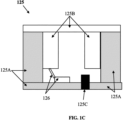
- FIG. 1C is a diagram illustrating the relationship and position of the lock components 125A, 125B, 126, and 125C relative to one another, according to an example embodiment.
- the lock backplate 125B interlocks with lock body 125A with lock 125C extending into an interior space of the lock apparatus 125 when the lock 125C is in an unlocked or unlock state.
- lock 125C extends out from lock body 125A into an aperture in a side wall of the safe 121. Because lock body 125A and lock backplate 125B are interlocked with one another the two 125A and 125B cannot be separated without detection by sensor 126. Thus, there is no mechanism by which lock 125C can be tampered with without being detected.
- Sensor 126 is anchored on an inside surface of lock body 125A proximate to lock 125C. Furthermore, sensor 126 includes a first end anchored to lock body extending to a second end that makes surface contact with of lock backplate 125B. Sensor 126 is surface contact sensor that reports when touch contact is broken between either of the two surfaces (e.g., a surface of the lock backplate 125B or a surface of lock body 125A). This ensures that whenever the backplate 125B is removed and separated from lock body 125A and event is raised by sensor 126.
- Agent 128 reports the events to security manager 114 and/or security system 143 when safe 121 has its own independent network connection to cloud 140.
- safe 121 lacks an independent network connection to cloud 140, the events reported to security manager 114 are reported over the terminal's network connection to security system 143.
- Agent 128, manager 114, and/or system 143 maintain an audit log each time the safe 120 is accessed since notes in cassettes 122 are exposed to potential theft. Agent 128, manager 114, and/or system 143 also process security workflows in response to lock tampering events. The workflows can be similar or different from one another.
- Agent 128 also raises a lock tampering event when power is cut to the safe 121 and/or terminal 110 and then subsequently restored. That, agent 128 undergoes a reboot and loading into memory each time power is restored, thus agent 128 knows when it is being loaded and starting up. On start up, agent 128 sends a lock tampering event to security manager 114 and/or security system 143.
- agent 128 is configured to be provided a code from manager 114 and/or 143 that overrides reporting of the lock tampering event.
- the code can be provided before the reboot or power loss, such that agent 128 configures itself to clear the lock tampering event during its reboot and load based on a flag set in storage which is read by agent 128 on startup.
- the code can also be provided after startup or reboot by manager 114 and/or system 143 after agent 128 starts up and initially reports the lock tampering event.
- backplate 125B cannot be separated from lock body 125A during a loss of power because on reboot when power is restored, agent 128 will raise a lock tampering event to manager 114 and/or system 143 unless a prior authorization code was provided before the loss of power to safe 121. Agent 128 can continue to report the lock tampering event once detected until an authorization code is received from manager 114 and/or system 143. Unexpected and unplanned reboots or power losses that explainable can quickly stop agent 128 from reporting the lock tampering event through an authorization code provided as an override by manager 114 and/or system 143. Unexpected and unplanned reboots or power losses that are explainable can quickly stop agent 128 from reporting the lock tampering event through an authorization code provided as an override by manager 114 and/or system 143.
- the backplate 125B When power is not lost, the backplate 125B cannot be separated from lock body 125A without agent 128 reporting a lock tampering event to manager 114 and/or system 143.
- the lock 125C cannot be accessed internally from lock apparatus 125 without removing the backplate 125B from lock body 125A.
- any authorized individual on a service visit to safe 121 cannot tamper with lock 125 without being detected and without security actions and protocols being instituted.
- security logs are maintained by agent 128, manager 114, and/or 143 which record details with dates, times of day, personnel identifiers, and service action identifiers for service activities of each authorized service activity.
- the lock tampering event is raised by agent 128 either during the service visit or shortly after the service visit when power was cut during the service visit and restored after the service event. The last personnel to access the safe 121 before the lock tampering event was raised will be known.
- lock 125 is an e-lock, which has an independent network connection to security system 143 from terminal 110.
- Authorized individuals are authenticated via their mobile devices and provided an authorization code to access the safe 121 by system 143.
- Additional cryptographic algorithms are executed by processor 121 to independently generate the code and compare the code entered on display 123 or keypad 123 by the authorized individual against the independently generated code.
- terminal 110 is an automated teller machine, a self-service terminal, or a point-of-sale terminal.
- agent 128 is subsumed and processed by security manager 114.
- lock apparatus 125 is associated with a different device or a different server from 110 and 140.
- lock apparatus 125 is any smart lock affixed to any structure or interfaced to a processing device.
- lock apparatus 125 includes a processor and a medium with instructions 128 that are executed by the lock apparatus processor.
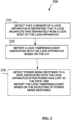
- FIGS. is a flow diagram of a method 200 for detecting tampering with the lock apparatus, according to an example embodiment.
- the software module(s) that implements the method 200 is referred to as a "safe lock tamper manager.”
- the safe lock tamper manager is implemented as executable instructions programmed and residing within memory and/or a non-transitory computer-readable (processor-readable) storage medium and executed by one or more processors of one or more devices.
- the processor(s) of the device(s) that executes the safe lock tamper manager are specifically configured and programmed to process safe lock tamper manager.
- the safe lock tamper manager may have access to one or more network connections during its processing. Any connections can be wired, wireless, or a combination thereof.
- the device that executes the safe lock tamper manager is safe 121.
- the safe lock tamper manager is agent 128.
- the safe lock tamper manager detects that a sensor 126 of a lock apparatus 125 is reporting that a lock backplate 125B was separated from a lock body 125A of the lock apparatus 125. This is an indication that the lock 125C of the lock apparatus 125 has potentially been tampered with during an authorized opening of a safe 121 of a media terminal 110.
- the safe lock tamper manager reports a lock tampering event associated with the lock apparatus 125 based on 210.
- the safe lock tamper manager reports the lock tampering event to one or more of security manager 114 and security system 143.
- the safe lock tamper manager detects power being restored to the safe 121 associated with lock apparatus 125 after power had been lost at the safe 121. In response to detecting a restoration of power, the safe lock tamper manager reports the lock tampering event to one or more of security manager 114 and security system 143.
Landscapes
- Lock And Its Accessories (AREA)
Abstract
A safe with lock tampering capabilities is provided. A lock apparatus includes a lock body, a lock backplate, a lock, and a sensor. The sensor raises an event when a first end and/or a send end of the sensor loses contact with a surface of the lock body and/or a surface of the lock backplate. The event is reported by the safe as a lock tampering event. Whenever the safe loses power and is subsequently restored power, the safe reports a lock tampering event.
Description
- Locks have a variety of uses, one of which is in connection with media terminals because the terminals accept and dispense currency notes to consumers. A plethora of technology exists in the industry to detect, lock, unlock, and report access to safes associated with media terminals. The safes include cassettes which store the notes.
- Media terminals frequently need replenishing with notes when denomination of the notes are low or when a denomination in a cassette is at its note capacity. Authorized personnel are dispatched with the proper authorization to access the safes and a variety of additional security precautions are enforced.
- However, not all personnel are trustworthy, and some have taken advantage of their authorized access to tamper with the safe lock making it easy for them or someone they know to return to the terminal during an unauthorized visit, open the safe and cassettes, and remove the notes. The manner in which these individuals tamper with the lock prevents security detection by existing technology available in the industry.
- In various embodiments, a lock apparatus, a safe with the lock apparatus, and a method for detecting lock tampering are presented. The lock apparatus includes a lock body, a lock backplate, a lock, and a sensor. The sensor is a contact sensor anchored on a surface of the lock body and extending to and touching a surface of the lock backplate such that when the lock backplate is removed from the lock body to gain access to the lock, the sensor sends a signal indicating the backplate was separated from the lock body. Should a host device that supplies power to a safe associated with the lock apparatus lose power, a security agent of the safe will report an unauthorized access when power is restored.
- In a first aspect of the present invention there is provided a lock apparatus, comprising: a lock body removably attached to a lock backplate; a sensor adapted to report an event when the lock body is removed from the lock backplate, and a lock.
- Aptly, the sensor is a contact sensor attached on a surface of the lock body and in contact with a surface of the lock backplate when the lock body is attached to the lock backplate.
- Aptly, the contact sensor is adapted to report the event when contact is broken with the surface of the lock backplate indicating the lock backplate was removed from the lock body.
- Aptly, the contact sensor is adapted to report the event to a security agent of a safe.
- Aptly, the lock body is securely affixed to a safe door of the safe.
- Aptly, the safe comprises media cassettes with currency notes.
- Aptly, a media recycler or depository of a media terminal comprises the media cassettes.
- Aptly, the media terminal is an automated teller machine, a self-service terminal, or a point-of-sale terminal.
- Aptly, the lock body is adapted to interlock to the lock backplate.
- Aptly, the lock body comprises the lock and the body is adapted to securely affix to an inside surface of an access door.
- According to a second aspect of the present invention there is provided a safe, comprising: a housing comprising media cassettes that store currency notes; an access door on the housing to provide authorized access to the media cassettes; a display or keypad affixed to an external surface of the access door; a lock apparatus comprising a lock backplate, a lock body, a sensor, and a lock integrated into the access door and the lock body, wherein a portion of the lock body is securely attached to an inside surface of the access door; a processor; a non-transitory computer-readable storage medium comprising executable instructions; the executable instructions when executed by the processor cause the processor to perform operations comprising: detecting a lock tampering event raised by the sensor when a surface of the lock backplate is no longer in contact with the sensor indicating that the lock backplate was removed from the lock body; and reporting the lock tampering event when the safe is restored power after having lost power.
- Aptly, the executable instructions when executed by the processor further cause the processor to perform additional operations comprising: resetting the lock tampering event based on an authorization code received from a terminal or server after the power is restored and the lock tampering event was reported to one or more of the terminal and the server.
- Aptly, the safe is integrated into a media recycler or dispenser.
- Aptly, the media recycler or dispenser is a peripheral device of a media terminal.
- Aptly, the media terminal is an automated teller machine, a self-service terminal, or a point-of-sale terminal.
- Aptly, the sensor is a contact sensor that makes contact with a surface of the lock body and a surface of the lock backplate when the lock body is interlocked with the lock backplate on the inside surface of the safe door.
- Aptly, the safe further comprises: an external network connection to a server; and an internal network connection to a media recycler or dispenser; wherein the safe is a peripheral device of the media recycler or dispenser, and wherein the media recycler or dispenser is a peripheral device of a media terminal.
- Aptly, the executable instructions when executed by the processor further cause the processor to perform additional operations comprising: receiving an access authorization code via the display or the keypad; authenticating the access authorization code with the server over the external network connection and receiving access details for the access authorization code from one or more of the server and the media terminal; controlling the lock apparatus to unlock the lock and open the safe door when the server authenticates the access authorization code; and logging or reporting the access details.
- According to a third aspect of the present invention there is provided a method, comprising: detecting that a sensor of a lock apparatus is reporting that a lock backplate was separated from a lock body of the lock apparatus; and reporting a lock tampering event associated with the lock apparatus based on the detecting.
- Aptly, the method further comprises: detecting power being restored to a safe associated with the lock apparatus after power was lost at the safe; and reporting the lock tampering event based on the detecting of power being restored.
-
FIG. 1A is a diagram of a system for detecting tampering with a lock apparatus, according to an example embodiment. -
FIG. 1B is a diagram of a lock apparatus, according to an example embodiment. -
FIG. 1C is another diagram of the lock apparatus, according to an example embodiment. -
FIG. 2 is a flow diagram of a method for detecting tampering with the lock apparatus, according to an example embodiment. - Unfortunately, technicians and media service personnel/staff who are authorized to access a media terminal's safe are not always trustworthy. A few of these individuals have been known to tamper with the safe's lock in a manner that permits the safe to be unlocked upon a return and unauthorized visit to the terminal. Notably, the tampering requires an individual to remove the lock's backplate in order to access the lock. Typically, the backplate is removed during the visit or removed after cutting power off during the visit. In either case, removal of the backplate goes undetected and there is chance that the safe's lock was tampered with so that someone can return later to the terminal and unlock the safe without proper authorization.
- The above-described security hole is remedied by the teachings provided herein. A lock apparatus is provided with a sensor. The sensor does not report any event when the backplate of the lock apparatus remains in contact with the lock body. Whenever the sensor loses contact with a surface of the backplate or a surface of the body, the sensor reports a lock tampering event. Firmware or software on a safe associated with the lock apparatus also reports a lock tampering event anytime the safe loses power as soon as power is restored. This ensures that power cannot be cut to the safe, the backplate removed, the backplate reattached to the lock body, and power restored to the safe without a lock tampering event being reported. The firmware or software of the safe reports the lock tampering events to a security agent of the media terminal and the security agent can activate security actions and procedures in response thereto. Alternatively or additionally, the security agent of the media terminal reports the lock tampering events to a security system of a cloud or a server. The security system can activate security actions and procedures in response thereto.
-
FIG. 1A is a diagram of asystem 100A for detecting tampering with a lock apparatus, according to an embodiment. It is to be noted that the components are shown schematically in greatly simplified form, with only those components relevant to understanding of the embodiments being illustrated. - Furthermore, the various components (that are identified in
FIG. 1A ) are illustrated and the arrangement of the components is presented for purposes of illustration only. It is noted that other arrangements with more or less components are possible without departing from the teachings of detecting tampering with a lock apparatus presented herein and below. -
System 100A includes one or more media terminals (hereinafter "terminals") 110 and optionally acloud 140 or a server 140 (hereinafter just "cloud 140'). Eachterminal 110 includes aprocessor 111, a non-transitory computer-readable storage medium (hereinafter just "medium") 112, which includes executable instructions for atransaction manager 113 and asecurity manager 114. The instructions when executed byprocessor 111 frommemory 112 cause theprocessor 111 to perform the operations discussed herein and below for 113-114. Eachterminal 110 also includes a media dispenser/recycler 120. - Media dispenser/recycler 120 includes a safe 121. The safe 121 includes
media cassettes 122, a display/keypad 123, a processor, alock apparatus 125, and a non-transitory computer-readable storage medium 127, which includes executable instruction for asecurity agent 128. Whenprocessor 124 executes the instructions frommedium 127, this causes the processor to perform operations discussed herein and below with respect to 128. -
Lock apparatus 126 includes a lock/sensor 126.FIG. 1B is a more detailed diagram oflock apparatus 126, according to an example embodiment.Lock apparatus 126 includes alock body 125A, alock backplate 125B, asensor 126, and alock 125C. -
FIG. 1C is a diagram illustrating the relationship and position of thelock components lock backplate 125B interlocks withlock body 125A withlock 125C extending into an interior space of thelock apparatus 125 when thelock 125C is in an unlocked or unlock state. When thelock 125C is in a locked or lock state,lock 125C extends out fromlock body 125A into an aperture in a side wall of the safe 121. Becauselock body 125A and lockbackplate 125B are interlocked with one another the two 125A and 125B cannot be separated without detection bysensor 126. Thus, there is no mechanism by which lock 125C can be tampered with without being detected. -
Sensor 126 is anchored on an inside surface oflock body 125A proximate to lock 125C. Furthermore,sensor 126 includes a first end anchored to lock body extending to a second end that makes surface contact with oflock backplate 125B.Sensor 126 is surface contact sensor that reports when touch contact is broken between either of the two surfaces (e.g., a surface of thelock backplate 125B or a surface oflock body 125A). This ensures that whenever thebackplate 125B is removed and separated fromlock body 125A and event is raised bysensor 126. - Events raised by
sensor 126 are recorded, logged, and reported byagent 128 of safe 121. In an embodiment,agent 128 reports the events tosecurity manager 114 and/orsecurity system 143 when safe 121 has its own independent network connection to cloud 140. When safe 121 lacks an independent network connection to cloud 140, the events reported tosecurity manager 114 are reported over the terminal's network connection tosecurity system 143. -
Agent 128,manager 114, and/orsystem 143 maintain an audit log each time the safe 120 is accessed since notes incassettes 122 are exposed to potential theft.Agent 128,manager 114, and/orsystem 143 also process security workflows in response to lock tampering events. The workflows can be similar or different from one another. -
Agent 128 also raises a lock tampering event when power is cut to the safe 121 and/orterminal 110 and then subsequently restored. That,agent 128 undergoes a reboot and loading into memory each time power is restored, thusagent 128 knows when it is being loaded and starting up. On start up,agent 128 sends a lock tampering event tosecurity manager 114 and/orsecurity system 143. - It may be that the power loss was known and expected such that the security event can be cleared by the appropriate personnel and security actions are unnecessary. It may also be that a known reboot, a patch, an update, or an upgrade was performed on
agent 128 or some other software component of safe 121; in such cases the lock tampering event can also be cleared by the personnel. In an embodiment,agent 128 is configured to be provided a code frommanager 114 and/or 143 that overrides reporting of the lock tampering event. The code can be provided before the reboot or power loss, such thatagent 128 configures itself to clear the lock tampering event during its reboot and load based on a flag set in storage which is read byagent 128 on startup. The code can also be provided after startup or reboot bymanager 114 and/orsystem 143 afteragent 128 starts up and initially reports the lock tampering event. - Thus,
backplate 125B cannot be separated fromlock body 125A during a loss of power because on reboot when power is restored,agent 128 will raise a lock tampering event tomanager 114 and/orsystem 143 unless a prior authorization code was provided before the loss of power to safe 121.Agent 128 can continue to report the lock tampering event once detected until an authorization code is received frommanager 114 and/orsystem 143. Unexpected and unplanned reboots or power losses that explainable can quickly stopagent 128 from reporting the lock tampering event through an authorization code provided as an override bymanager 114 and/orsystem 143. Unexpected and unplanned reboots or power losses that are explainable can quickly stopagent 128 from reporting the lock tampering event through an authorization code provided as an override bymanager 114 and/orsystem 143. - When power is not lost, the
backplate 125B cannot be separated fromlock body 125A withoutagent 128 reporting a lock tampering event tomanager 114 and/orsystem 143. Thelock 125C cannot be accessed internally fromlock apparatus 125 without removing thebackplate 125B fromlock body 125A. Thus, any authorized individual on a service visit to safe 121 cannot tamper withlock 125 without being detected and without security actions and protocols being instituted. - This plugs a security hole present in the industry and prevents authorized personnel with access to safe 121 from tampering with
lock 125 without being detected. This is because security logs are maintained byagent 128,manager 114, and/or 143 which record details with dates, times of day, personnel identifiers, and service action identifiers for service activities of each authorized service activity. Thus, the lock tampering event is raised byagent 128 either during the service visit or shortly after the service visit when power was cut during the service visit and restored after the service event. The last personnel to access the safe 121 before the lock tampering event was raised will be known. - In an embodiment,
lock 125 is an e-lock, which has an independent network connection tosecurity system 143 fromterminal 110. Authorized individuals are authenticated via their mobile devices and provided an authorization code to access the safe 121 bysystem 143. Additional cryptographic algorithms are executed byprocessor 121 to independently generate the code and compare the code entered ondisplay 123 orkeypad 123 by the authorized individual against the independently generated code. - In an embodiment, terminal 110 is an automated teller machine, a self-service terminal, or a point-of-sale terminal. In an embodiment,
agent 128 is subsumed and processed bysecurity manager 114. In an embodiment,lock apparatus 125 is associated with a different device or a different server from 110 and 140. In an embodiment,lock apparatus 125 is any smart lock affixed to any structure or interfaced to a processing device. In this latter embodiment,lock apparatus 125 includes a processor and a medium withinstructions 128 that are executed by the lock apparatus processor. - The above-referenced embodiments and other embodiments will now be discussed with reference to
FIG. 2 . FIGS. is a flow diagram of amethod 200 for detecting tampering with the lock apparatus, according to an example embodiment. The software module(s) that implements themethod 200 is referred to as a "safe lock tamper manager." The safe lock tamper manager is implemented as executable instructions programmed and residing within memory and/or a non-transitory computer-readable (processor-readable) storage medium and executed by one or more processors of one or more devices. The processor(s) of the device(s) that executes the safe lock tamper manager are specifically configured and programmed to process safe lock tamper manager. The safe lock tamper manager may have access to one or more network connections during its processing. Any connections can be wired, wireless, or a combination thereof. - In an embodiment, the device that executes the safe lock tamper manager is safe 121. In an embodiment, the safe lock tamper manager is
agent 128. - At 210, the safe lock tamper manager detects that a
sensor 126 of alock apparatus 125 is reporting that alock backplate 125B was separated from alock body 125A of thelock apparatus 125. This is an indication that thelock 125C of thelock apparatus 125 has potentially been tampered with during an authorized opening of a safe 121 of amedia terminal 110. - At 220, the safe lock tamper manager reports a lock tampering event associated with the
lock apparatus 125 based on 210. The safe lock tamper manager reports the lock tampering event to one or more ofsecurity manager 114 andsecurity system 143. - In an embodiment, at 230, the safe lock tamper manager detects power being restored to the safe 121 associated with
lock apparatus 125 after power had been lost at the safe 121. In response to detecting a restoration of power, the safe lock tamper manager reports the lock tampering event to one or more ofsecurity manager 114 andsecurity system 143. - The above description is illustrative, and not restrictive. Many other embodiments will be apparent to those of skill in the art upon reviewing the above description. The scope of embodiments should therefore be determined with reference to the appended claims, along with the full scope of equivalents to which such claims are entitled.
- In the foregoing description of the embodiments, various features are grouped together in a single embodiment for the purpose of streamlining the disclosure. This method of disclosure is not to be interpreted as reflecting that the claimed embodiments have more features than are expressly recited in each claim. Rather, as the following claims reflect, inventive subject matter lies in less than all features of a single disclosed embodiment. Thus, the following claims are hereby incorporated into the Description of the Embodiments, with each claim standing on its own as a separate exemplary embodiment.
- Throughout the description and claims of this specification, the words "comprise" and "contain" and variations of them mean "including but not limited to" and they are not intended to (and do not) exclude other moieties, additives, components, integers or steps. Throughout the description and claims of this specification, the singular encompasses the plural unless the context otherwise requires. In particular, where the indefinite article is used, the specification is to be understood as contemplating plurality as well as singularity, unless the context requires otherwise.
- Features, integers, characteristics or groups described in conjunction with a particular aspect, embodiment or example of the invention are to be understood to be applicable to any other aspect, embodiment or example described herein unless incompatible therewith. All of the features disclosed in this specification (including any accompanying claims, abstract and drawings), and/or all of the steps of any method or process so disclosed, may be combined in any combination, except combinations where at least some of the features and/or steps are mutually exclusive. The invention is not restricted to any details of any foregoing embodiments. The invention extends to any novel one, or novel combination, of the features disclosed in this specification (including any accompanying claims, abstract and drawings), or to any novel one, or any novel combination, of the steps of any method or process so disclosed.
- The reader's attention is directed to all papers and documents which are filed concurrently with or previous to this specification in connection with this application and which are open to public inspection with this specification, and the contents of all such papers and documents are incorporated herein by reference.
Claims (15)
- A lock apparatus, comprising:a lock body removably attached to a lock backplate;a sensor adapted to report an event when the lock body is removed from the lock backplate, anda lock.
- The lock apparatus of claim 1, wherein the sensor is a contact sensor attached on a surface of the lock body and in contact with a surface of the lock backplate when the lock body is attached to the lock backplate.
- The lock apparatus of claim 2, wherein the contact sensor is adapted to report the event when contact is broken with the surface of the lock backplate indicating the lock backplate was removed from the lock body.
- The lock apparatus of claim 3, wherein the contact sensor is adapted to report the event to a security agent of a safe.
- The lock apparatus of claim 4, wherein the lock body is securely affixed to a safe door of the safe.
- The lock apparatus of claim 4, wherein the safe comprises media cassettes with currency notes.
- The lock apparatus of claim 6, wherein a media recycler or depository of a media terminal comprises the media cassettes.
- The lock apparatus of claim 7, wherein the media terminal is an automated teller machine, a self-service terminal, or a point-of-sale terminal.
- A safe, comprising:a housing comprising media cassettes that store currency notes;an access door on the housing to provide authorized access to the media cassettes;a display or keypad affixed to an external surface of the access door;a lock apparatus comprising a lock backplate, a lock body, a sensor, and a lock integrated into the access door and the lock body, wherein a portion of the lock body is securely attached to an inside surface of the access door;a processor;a non-transitory computer-readable storage medium comprising executable instructions;the executable instructions when executed by the processor cause the processor to perform operations comprising:detecting a lock tampering event raised by the sensor when a surface of the lock backplate is no longer in contact with the sensor indicating that the lock backplate was removed from the lock body; andreporting the lock tampering event when the safe is restored power after having lost power.
- The safe of claim 9, wherein the executable instructions when executed by the processor further cause the processor to perform additional operations comprising:
resetting the lock tampering event based on an authorization code received from a terminal or server after the power is restored and the lock tampering event was reported to one or more of the terminal and the server. - The safe of claim 9, wherein the sensor is a contact sensor that makes contact with a surface of the lock body and a surface of the lock backplate when the lock body is interlocked with the lock backplate on the inside surface of the safe door.
- The safe of claim 9 further comprising:an external network connection to a server; andan internal network connection to a media recycler or dispenser;wherein the safe is a peripheral device of the media recycler or dispenser, and wherein the media recycler or dispenser is a peripheral device of a media terminal;
- The safe of claim 12, wherein the executable instructions when executed by the processor further cause the processor to perform additional operations comprising:receiving an access authorization code via the display or the keypad;authenticating the access authorization code with the server over the external network connection and receiving access details for the access authorization code from one or more of the server and the media terminal;controlling the lock apparatus to unlock the lock and open the safe door when the server authenticates the access authorization code; andlogging or reporting the access details.
- A method, comprising:detecting that a sensor of a lock apparatus is reporting that a lock backplate was separated from a lock body of the lock apparatus; andreporting a lock tampering event associated with the lock apparatus based on the detecting.
- The method of claim 14 further comprising:detecting power being restored to a safe associated with the lock apparatus after power was lost at the safe; andreporting the lock tampering event based on the detecting of power being restored.
Applications Claiming Priority (1)
| Application Number | Priority Date | Filing Date | Title |
|---|---|---|---|
| US18/129,462 US12305422B2 (en) | 2023-03-31 | 2023-03-31 | Lock with tamper-evident security |
Publications (1)
| Publication Number | Publication Date |
|---|---|
| EP4438837A1 true EP4438837A1 (en) | 2024-10-02 |
Family
ID=89429975
Family Applications (1)
| Application Number | Title | Priority Date | Filing Date |
|---|---|---|---|
| EP23218832.6A Pending EP4438837A1 (en) | 2023-03-31 | 2023-12-20 | Lock with tamper-evident security |
Country Status (2)
| Country | Link |
|---|---|
| US (2) | US12305422B2 (en) |
| EP (1) | EP4438837A1 (en) |
Citations (5)
| Publication number | Priority date | Publication date | Assignee | Title |
|---|---|---|---|---|
| WO2012050936A1 (en) * | 2010-09-28 | 2012-04-19 | Scott Meeker | Centrally controlled safe management system |
| US20170044800A9 (en) * | 2010-02-25 | 2017-02-16 | Sargent Manufacturing Company | Locking device with configurable electrical connector key and internal circuit board for electronic door locks |
| ITUB20159755A1 (en) * | 2015-12-30 | 2017-06-30 | Christian Olivo | LOCKING DEVICE FOR WINDOWS |
| CN110939327A (en) * | 2019-12-21 | 2020-03-31 | 广州保仕盾智能科技有限公司 | Anti-prying device applied to intelligent door lock |
| US20210025205A1 (en) * | 2019-07-23 | 2021-01-28 | Joseph Curtis Taylor | Door Security Apparatus |
Family Cites Families (3)
| Publication number | Priority date | Publication date | Assignee | Title |
|---|---|---|---|---|
| US10109124B2 (en) * | 2011-11-03 | 2018-10-23 | 3-East, Llc | Method, system and device for securing and managing access to a lock and providing surveillance |
| US20150240531A1 (en) * | 2014-02-27 | 2015-08-27 | LifeStyleLock, LLC | Wireless locking system and method |
| US11915540B1 (en) * | 2021-03-19 | 2024-02-27 | Wells Fargo Bank, N.A. | Systems and methods for two-way cash recycler |
-
2023
- 2023-03-31 US US18/129,462 patent/US12305422B2/en active Active
- 2023-12-20 EP EP23218832.6A patent/EP4438837A1/en active Pending
-
2025
- 2025-03-20 US US19/085,195 patent/US20250215727A1/en active Pending
Patent Citations (5)
| Publication number | Priority date | Publication date | Assignee | Title |
|---|---|---|---|---|
| US20170044800A9 (en) * | 2010-02-25 | 2017-02-16 | Sargent Manufacturing Company | Locking device with configurable electrical connector key and internal circuit board for electronic door locks |
| WO2012050936A1 (en) * | 2010-09-28 | 2012-04-19 | Scott Meeker | Centrally controlled safe management system |
| ITUB20159755A1 (en) * | 2015-12-30 | 2017-06-30 | Christian Olivo | LOCKING DEVICE FOR WINDOWS |
| US20210025205A1 (en) * | 2019-07-23 | 2021-01-28 | Joseph Curtis Taylor | Door Security Apparatus |
| CN110939327A (en) * | 2019-12-21 | 2020-03-31 | 广州保仕盾智能科技有限公司 | Anti-prying device applied to intelligent door lock |
Also Published As
| Publication number | Publication date |
|---|---|
| US20240328198A1 (en) | 2024-10-03 |
| US12305422B2 (en) | 2025-05-20 |
| US20250215727A1 (en) | 2025-07-03 |
Similar Documents
| Publication | Publication Date | Title |
|---|---|---|
| US12393950B2 (en) | Fraud detection in self-service terminal | |
| KR102278251B1 (en) | A user terminal system and method | |
| US9390594B2 (en) | Note validator security | |
| WO2012050936A1 (en) | Centrally controlled safe management system | |
| CN101406350A (en) | Fingerprint file cabinet system and control method thereof | |
| JP6851889B2 (en) | ATM | |
| EP3136356A1 (en) | Automatic transaction device and automatic transaction system | |
| JP5722316B2 (en) | Cash management system and cash management method | |
| WO2017109994A1 (en) | Automated transaction system | |
| US7946482B2 (en) | Electronic money paying-in system | |
| JP6718732B2 (en) | Deposit/withdrawal machine and deposit/withdrawal machine management method | |
| US12305422B2 (en) | Lock with tamper-evident security | |
| JP2001043429A (en) | Automatic transaction device monitoring system and monitoring method | |
| CN112184988A (en) | Cash box control method and device, electronic equipment and storage medium | |
| JP7298084B2 (en) | Piggy Bank, Savings System, Financial Institution Apparatus, Method and Program Therefor | |
| JP2006065751A (en) | Ic card deposit increasing machine and electronic money system | |
| JP2005150925A (en) | Security system | |
| US20250308314A1 (en) | Valuable medium processing apparatus, valuablemedium processing system, and processing method | |
| CN116057592B (en) | System and method for transferring locking containers between safes | |
| JP2006099200A (en) | Ic card system | |
| CN108346214B (en) | Cash box system | |
| JPWO2019098061A1 (en) | Fraud detection methods in money processing systems, money processing devices, center devices, and money processing devices | |
| WO2019056221A1 (en) | Banknote box, financial self-service equipment, and banknote box management system | |
| HK40088071A (en) | Systems and methods for transferring a locked container between vaults | |
| JP2017138877A (en) | Transaction device and transaction system |
Legal Events
| Date | Code | Title | Description |
|---|---|---|---|
| PUAI | Public reference made under article 153(3) epc to a published international application that has entered the european phase |
Free format text: ORIGINAL CODE: 0009012 |
|
| STAA | Information on the status of an ep patent application or granted ep patent |
Free format text: STATUS: REQUEST FOR EXAMINATION WAS MADE |
|
| 17P | Request for examination filed |
Effective date: 20231220 |
|
| AK | Designated contracting states |
Kind code of ref document: A1 Designated state(s): AL AT BE BG CH CY CZ DE DK EE ES FI FR GB GR HR HU IE IS IT LI LT LU LV MC ME MK MT NL NO PL PT RO RS SE SI SK SM TR |