EP4438784A1 - Method for producing dry nonwoven fabric - Google Patents
Method for producing dry nonwoven fabric Download PDFInfo
- Publication number
- EP4438784A1 EP4438784A1 EP21928359.5A EP21928359A EP4438784A1 EP 4438784 A1 EP4438784 A1 EP 4438784A1 EP 21928359 A EP21928359 A EP 21928359A EP 4438784 A1 EP4438784 A1 EP 4438784A1
- Authority
- EP
- European Patent Office
- Prior art keywords
- fibers
- nonwoven fabric
- resin particles
- fiber
- production method
- Prior art date
- Legal status (The legal status is an assumption and is not a legal conclusion. Google has not performed a legal analysis and makes no representation as to the accuracy of the status listed.)
- Pending
Links
Images


Classifications
-
- D—TEXTILES; PAPER
- D04—BRAIDING; LACE-MAKING; KNITTING; TRIMMINGS; NON-WOVEN FABRICS
- D04H—MAKING TEXTILE FABRICS, e.g. FROM FIBRES OR FILAMENTARY MATERIAL; FABRICS MADE BY SUCH PROCESSES OR APPARATUS, e.g. FELTS, NON-WOVEN FABRICS; COTTON-WOOL; WADDING ; NON-WOVEN FABRICS FROM STAPLE FIBRES, FILAMENTS OR YARNS, BONDED WITH AT LEAST ONE WEB-LIKE MATERIAL DURING THEIR CONSOLIDATION
- D04H1/00—Non-woven fabrics formed wholly or mainly of staple fibres or like relatively short fibres
- D04H1/40—Non-woven fabrics formed wholly or mainly of staple fibres or like relatively short fibres from fleeces or layers composed of fibres without existing or potential cohesive properties
- D04H1/42—Non-woven fabrics formed wholly or mainly of staple fibres or like relatively short fibres from fleeces or layers composed of fibres without existing or potential cohesive properties characterised by the use of certain kinds of fibres insofar as this use has no preponderant influence on the consolidation of the fleece
- D04H1/425—Cellulose series
-
- D—TEXTILES; PAPER
- D04—BRAIDING; LACE-MAKING; KNITTING; TRIMMINGS; NON-WOVEN FABRICS
- D04H—MAKING TEXTILE FABRICS, e.g. FROM FIBRES OR FILAMENTARY MATERIAL; FABRICS MADE BY SUCH PROCESSES OR APPARATUS, e.g. FELTS, NON-WOVEN FABRICS; COTTON-WOOL; WADDING ; NON-WOVEN FABRICS FROM STAPLE FIBRES, FILAMENTS OR YARNS, BONDED WITH AT LEAST ONE WEB-LIKE MATERIAL DURING THEIR CONSOLIDATION
- D04H1/00—Non-woven fabrics formed wholly or mainly of staple fibres or like relatively short fibres
- D04H1/70—Non-woven fabrics formed wholly or mainly of staple fibres or like relatively short fibres characterised by the method of forming fleeces or layers, e.g. reorientation of fibres
- D04H1/72—Non-woven fabrics formed wholly or mainly of staple fibres or like relatively short fibres characterised by the method of forming fleeces or layers, e.g. reorientation of fibres the fibres being randomly arranged
-
- B—PERFORMING OPERATIONS; TRANSPORTING
- B01—PHYSICAL OR CHEMICAL PROCESSES OR APPARATUS IN GENERAL
- B01D—SEPARATION
- B01D39/00—Filtering material for liquid or gaseous fluids
- B01D39/14—Other self-supporting filtering material ; Other filtering material
- B01D39/16—Other self-supporting filtering material ; Other filtering material of organic material, e.g. synthetic fibres
- B01D39/1607—Other self-supporting filtering material ; Other filtering material of organic material, e.g. synthetic fibres the material being fibrous
- B01D39/1623—Other self-supporting filtering material ; Other filtering material of organic material, e.g. synthetic fibres the material being fibrous of synthetic origin
-
- B—PERFORMING OPERATIONS; TRANSPORTING
- B32—LAYERED PRODUCTS
- B32B—LAYERED PRODUCTS, i.e. PRODUCTS BUILT-UP OF STRATA OF FLAT OR NON-FLAT, e.g. CELLULAR OR HONEYCOMB, FORM
- B32B5/00—Layered products characterised by the non- homogeneity or physical structure, i.e. comprising a fibrous, filamentary, particulate or foam layer; Layered products characterised by having a layer differing constitutionally or physically in different parts
- B32B5/02—Layered products characterised by the non- homogeneity or physical structure, i.e. comprising a fibrous, filamentary, particulate or foam layer; Layered products characterised by having a layer differing constitutionally or physically in different parts characterised by structural features of a fibrous or filamentary layer
- B32B5/022—Non-woven fabric
-
- B—PERFORMING OPERATIONS; TRANSPORTING
- B32—LAYERED PRODUCTS
- B32B—LAYERED PRODUCTS, i.e. PRODUCTS BUILT-UP OF STRATA OF FLAT OR NON-FLAT, e.g. CELLULAR OR HONEYCOMB, FORM
- B32B5/00—Layered products characterised by the non- homogeneity or physical structure, i.e. comprising a fibrous, filamentary, particulate or foam layer; Layered products characterised by having a layer differing constitutionally or physically in different parts
- B32B5/16—Layered products characterised by the non- homogeneity or physical structure, i.e. comprising a fibrous, filamentary, particulate or foam layer; Layered products characterised by having a layer differing constitutionally or physically in different parts characterised by features of a layer formed of particles, e.g. chips, powder or granules
-
- B—PERFORMING OPERATIONS; TRANSPORTING
- B32—LAYERED PRODUCTS
- B32B—LAYERED PRODUCTS, i.e. PRODUCTS BUILT-UP OF STRATA OF FLAT OR NON-FLAT, e.g. CELLULAR OR HONEYCOMB, FORM
- B32B5/00—Layered products characterised by the non- homogeneity or physical structure, i.e. comprising a fibrous, filamentary, particulate or foam layer; Layered products characterised by having a layer differing constitutionally or physically in different parts
- B32B5/22—Layered products characterised by the non- homogeneity or physical structure, i.e. comprising a fibrous, filamentary, particulate or foam layer; Layered products characterised by having a layer differing constitutionally or physically in different parts characterised by the presence of two or more layers which are next to each other and are fibrous, filamentary, formed of particles or foamed
- B32B5/24—Layered products characterised by the non- homogeneity or physical structure, i.e. comprising a fibrous, filamentary, particulate or foam layer; Layered products characterised by having a layer differing constitutionally or physically in different parts characterised by the presence of two or more layers which are next to each other and are fibrous, filamentary, formed of particles or foamed one layer being a fibrous or filamentary layer
-
- B—PERFORMING OPERATIONS; TRANSPORTING
- B32—LAYERED PRODUCTS
- B32B—LAYERED PRODUCTS, i.e. PRODUCTS BUILT-UP OF STRATA OF FLAT OR NON-FLAT, e.g. CELLULAR OR HONEYCOMB, FORM
- B32B5/00—Layered products characterised by the non- homogeneity or physical structure, i.e. comprising a fibrous, filamentary, particulate or foam layer; Layered products characterised by having a layer differing constitutionally or physically in different parts
- B32B5/22—Layered products characterised by the non- homogeneity or physical structure, i.e. comprising a fibrous, filamentary, particulate or foam layer; Layered products characterised by having a layer differing constitutionally or physically in different parts characterised by the presence of two or more layers which are next to each other and are fibrous, filamentary, formed of particles or foamed
- B32B5/30—Layered products characterised by the non- homogeneity or physical structure, i.e. comprising a fibrous, filamentary, particulate or foam layer; Layered products characterised by having a layer differing constitutionally or physically in different parts characterised by the presence of two or more layers which are next to each other and are fibrous, filamentary, formed of particles or foamed one layer being formed of particles, e.g. chips, granules, powder
-
- D—TEXTILES; PAPER
- D04—BRAIDING; LACE-MAKING; KNITTING; TRIMMINGS; NON-WOVEN FABRICS
- D04H—MAKING TEXTILE FABRICS, e.g. FROM FIBRES OR FILAMENTARY MATERIAL; FABRICS MADE BY SUCH PROCESSES OR APPARATUS, e.g. FELTS, NON-WOVEN FABRICS; COTTON-WOOL; WADDING ; NON-WOVEN FABRICS FROM STAPLE FIBRES, FILAMENTS OR YARNS, BONDED WITH AT LEAST ONE WEB-LIKE MATERIAL DURING THEIR CONSOLIDATION
- D04H1/00—Non-woven fabrics formed wholly or mainly of staple fibres or like relatively short fibres
- D04H1/40—Non-woven fabrics formed wholly or mainly of staple fibres or like relatively short fibres from fleeces or layers composed of fibres without existing or potential cohesive properties
- D04H1/42—Non-woven fabrics formed wholly or mainly of staple fibres or like relatively short fibres from fleeces or layers composed of fibres without existing or potential cohesive properties characterised by the use of certain kinds of fibres insofar as this use has no preponderant influence on the consolidation of the fleece
- D04H1/4382—Stretched reticular film fibres; Composite fibres; Mixed fibres; Ultrafine fibres; Fibres for artificial leather
- D04H1/43825—Composite fibres
-
- D—TEXTILES; PAPER
- D04—BRAIDING; LACE-MAKING; KNITTING; TRIMMINGS; NON-WOVEN FABRICS
- D04H—MAKING TEXTILE FABRICS, e.g. FROM FIBRES OR FILAMENTARY MATERIAL; FABRICS MADE BY SUCH PROCESSES OR APPARATUS, e.g. FELTS, NON-WOVEN FABRICS; COTTON-WOOL; WADDING ; NON-WOVEN FABRICS FROM STAPLE FIBRES, FILAMENTS OR YARNS, BONDED WITH AT LEAST ONE WEB-LIKE MATERIAL DURING THEIR CONSOLIDATION
- D04H1/00—Non-woven fabrics formed wholly or mainly of staple fibres or like relatively short fibres
- D04H1/40—Non-woven fabrics formed wholly or mainly of staple fibres or like relatively short fibres from fleeces or layers composed of fibres without existing or potential cohesive properties
- D04H1/42—Non-woven fabrics formed wholly or mainly of staple fibres or like relatively short fibres from fleeces or layers composed of fibres without existing or potential cohesive properties characterised by the use of certain kinds of fibres insofar as this use has no preponderant influence on the consolidation of the fleece
- D04H1/4391—Non-woven fabrics formed wholly or mainly of staple fibres or like relatively short fibres from fleeces or layers composed of fibres without existing or potential cohesive properties characterised by the use of certain kinds of fibres insofar as this use has no preponderant influence on the consolidation of the fleece characterised by the shape of the fibres
- D04H1/43918—Non-woven fabrics formed wholly or mainly of staple fibres or like relatively short fibres from fleeces or layers composed of fibres without existing or potential cohesive properties characterised by the use of certain kinds of fibres insofar as this use has no preponderant influence on the consolidation of the fleece characterised by the shape of the fibres nonlinear fibres, e.g. crimped or coiled fibres
-
- D—TEXTILES; PAPER
- D04—BRAIDING; LACE-MAKING; KNITTING; TRIMMINGS; NON-WOVEN FABRICS
- D04H—MAKING TEXTILE FABRICS, e.g. FROM FIBRES OR FILAMENTARY MATERIAL; FABRICS MADE BY SUCH PROCESSES OR APPARATUS, e.g. FELTS, NON-WOVEN FABRICS; COTTON-WOOL; WADDING ; NON-WOVEN FABRICS FROM STAPLE FIBRES, FILAMENTS OR YARNS, BONDED WITH AT LEAST ONE WEB-LIKE MATERIAL DURING THEIR CONSOLIDATION
- D04H1/00—Non-woven fabrics formed wholly or mainly of staple fibres or like relatively short fibres
- D04H1/40—Non-woven fabrics formed wholly or mainly of staple fibres or like relatively short fibres from fleeces or layers composed of fibres without existing or potential cohesive properties
- D04H1/58—Non-woven fabrics formed wholly or mainly of staple fibres or like relatively short fibres from fleeces or layers composed of fibres without existing or potential cohesive properties by applying, incorporating or activating chemical or thermoplastic bonding agents, e.g. adhesives
- D04H1/593—Non-woven fabrics formed wholly or mainly of staple fibres or like relatively short fibres from fleeces or layers composed of fibres without existing or potential cohesive properties by applying, incorporating or activating chemical or thermoplastic bonding agents, e.g. adhesives to layered webs
-
- D—TEXTILES; PAPER
- D04—BRAIDING; LACE-MAKING; KNITTING; TRIMMINGS; NON-WOVEN FABRICS
- D04H—MAKING TEXTILE FABRICS, e.g. FROM FIBRES OR FILAMENTARY MATERIAL; FABRICS MADE BY SUCH PROCESSES OR APPARATUS, e.g. FELTS, NON-WOVEN FABRICS; COTTON-WOOL; WADDING ; NON-WOVEN FABRICS FROM STAPLE FIBRES, FILAMENTS OR YARNS, BONDED WITH AT LEAST ONE WEB-LIKE MATERIAL DURING THEIR CONSOLIDATION
- D04H1/00—Non-woven fabrics formed wholly or mainly of staple fibres or like relatively short fibres
- D04H1/40—Non-woven fabrics formed wholly or mainly of staple fibres or like relatively short fibres from fleeces or layers composed of fibres without existing or potential cohesive properties
- D04H1/58—Non-woven fabrics formed wholly or mainly of staple fibres or like relatively short fibres from fleeces or layers composed of fibres without existing or potential cohesive properties by applying, incorporating or activating chemical or thermoplastic bonding agents, e.g. adhesives
- D04H1/64—Non-woven fabrics formed wholly or mainly of staple fibres or like relatively short fibres from fleeces or layers composed of fibres without existing or potential cohesive properties by applying, incorporating or activating chemical or thermoplastic bonding agents, e.g. adhesives the bonding agent being applied in wet state, e.g. chemical agents in dispersions or solutions
-
- D—TEXTILES; PAPER
- D04—BRAIDING; LACE-MAKING; KNITTING; TRIMMINGS; NON-WOVEN FABRICS
- D04H—MAKING TEXTILE FABRICS, e.g. FROM FIBRES OR FILAMENTARY MATERIAL; FABRICS MADE BY SUCH PROCESSES OR APPARATUS, e.g. FELTS, NON-WOVEN FABRICS; COTTON-WOOL; WADDING ; NON-WOVEN FABRICS FROM STAPLE FIBRES, FILAMENTS OR YARNS, BONDED WITH AT LEAST ONE WEB-LIKE MATERIAL DURING THEIR CONSOLIDATION
- D04H1/00—Non-woven fabrics formed wholly or mainly of staple fibres or like relatively short fibres
- D04H1/40—Non-woven fabrics formed wholly or mainly of staple fibres or like relatively short fibres from fleeces or layers composed of fibres without existing or potential cohesive properties
- D04H1/58—Non-woven fabrics formed wholly or mainly of staple fibres or like relatively short fibres from fleeces or layers composed of fibres without existing or potential cohesive properties by applying, incorporating or activating chemical or thermoplastic bonding agents, e.g. adhesives
- D04H1/64—Non-woven fabrics formed wholly or mainly of staple fibres or like relatively short fibres from fleeces or layers composed of fibres without existing or potential cohesive properties by applying, incorporating or activating chemical or thermoplastic bonding agents, e.g. adhesives the bonding agent being applied in wet state, e.g. chemical agents in dispersions or solutions
- D04H1/655—Non-woven fabrics formed wholly or mainly of staple fibres or like relatively short fibres from fleeces or layers composed of fibres without existing or potential cohesive properties by applying, incorporating or activating chemical or thermoplastic bonding agents, e.g. adhesives the bonding agent being applied in wet state, e.g. chemical agents in dispersions or solutions characterised by the apparatus for applying bonding agents
-
- D—TEXTILES; PAPER
- D04—BRAIDING; LACE-MAKING; KNITTING; TRIMMINGS; NON-WOVEN FABRICS
- D04H—MAKING TEXTILE FABRICS, e.g. FROM FIBRES OR FILAMENTARY MATERIAL; FABRICS MADE BY SUCH PROCESSES OR APPARATUS, e.g. FELTS, NON-WOVEN FABRICS; COTTON-WOOL; WADDING ; NON-WOVEN FABRICS FROM STAPLE FIBRES, FILAMENTS OR YARNS, BONDED WITH AT LEAST ONE WEB-LIKE MATERIAL DURING THEIR CONSOLIDATION
- D04H1/00—Non-woven fabrics formed wholly or mainly of staple fibres or like relatively short fibres
- D04H1/70—Non-woven fabrics formed wholly or mainly of staple fibres or like relatively short fibres characterised by the method of forming fleeces or layers, e.g. reorientation of fibres
- D04H1/74—Non-woven fabrics formed wholly or mainly of staple fibres or like relatively short fibres characterised by the method of forming fleeces or layers, e.g. reorientation of fibres the fibres being orientated, e.g. in parallel (anisotropic fleeces)
-
- D—TEXTILES; PAPER
- D04—BRAIDING; LACE-MAKING; KNITTING; TRIMMINGS; NON-WOVEN FABRICS
- D04H—MAKING TEXTILE FABRICS, e.g. FROM FIBRES OR FILAMENTARY MATERIAL; FABRICS MADE BY SUCH PROCESSES OR APPARATUS, e.g. FELTS, NON-WOVEN FABRICS; COTTON-WOOL; WADDING ; NON-WOVEN FABRICS FROM STAPLE FIBRES, FILAMENTS OR YARNS, BONDED WITH AT LEAST ONE WEB-LIKE MATERIAL DURING THEIR CONSOLIDATION
- D04H5/00—Non woven fabrics formed of mixtures of relatively short fibres and yarns or like filamentary material of substantial length
- D04H5/04—Non woven fabrics formed of mixtures of relatively short fibres and yarns or like filamentary material of substantial length strengthened or consolidated by applying or incorporating chemical or thermo-activatable bonding agents in solid or liquid form
-
- D—TEXTILES; PAPER
- D04—BRAIDING; LACE-MAKING; KNITTING; TRIMMINGS; NON-WOVEN FABRICS
- D04H—MAKING TEXTILE FABRICS, e.g. FROM FIBRES OR FILAMENTARY MATERIAL; FABRICS MADE BY SUCH PROCESSES OR APPARATUS, e.g. FELTS, NON-WOVEN FABRICS; COTTON-WOOL; WADDING ; NON-WOVEN FABRICS FROM STAPLE FIBRES, FILAMENTS OR YARNS, BONDED WITH AT LEAST ONE WEB-LIKE MATERIAL DURING THEIR CONSOLIDATION
- D04H5/00—Non woven fabrics formed of mixtures of relatively short fibres and yarns or like filamentary material of substantial length
- D04H5/08—Non woven fabrics formed of mixtures of relatively short fibres and yarns or like filamentary material of substantial length characterised by the method of forming fleeces or layers, e.g. reorientation of fibres or yarns
-
- B—PERFORMING OPERATIONS; TRANSPORTING
- B01—PHYSICAL OR CHEMICAL PROCESSES OR APPARATUS IN GENERAL
- B01D—SEPARATION
- B01D2239/00—Aspects relating to filtering material for liquid or gaseous fluids
- B01D2239/02—Types of fibres, filaments or particles, self-supporting or supported materials
- B01D2239/025—Types of fibres, filaments or particles, self-supporting or supported materials comprising nanofibres
-
- B—PERFORMING OPERATIONS; TRANSPORTING
- B01—PHYSICAL OR CHEMICAL PROCESSES OR APPARATUS IN GENERAL
- B01D—SEPARATION
- B01D2239/00—Aspects relating to filtering material for liquid or gaseous fluids
- B01D2239/04—Additives and treatments of the filtering material
- B01D2239/0435—Electret
-
- B—PERFORMING OPERATIONS; TRANSPORTING
- B01—PHYSICAL OR CHEMICAL PROCESSES OR APPARATUS IN GENERAL
- B01D—SEPARATION
- B01D2239/00—Aspects relating to filtering material for liquid or gaseous fluids
- B01D2239/06—Filter cloth, e.g. knitted, woven non-woven; self-supported material
- B01D2239/0604—Arrangement of the fibres in the filtering material
- B01D2239/0636—Two or more types of fibres present in the filter material
-
- B—PERFORMING OPERATIONS; TRANSPORTING
- B01—PHYSICAL OR CHEMICAL PROCESSES OR APPARATUS IN GENERAL
- B01D—SEPARATION
- B01D2239/00—Aspects relating to filtering material for liquid or gaseous fluids
- B01D2239/10—Filtering material manufacturing
-
- B—PERFORMING OPERATIONS; TRANSPORTING
- B01—PHYSICAL OR CHEMICAL PROCESSES OR APPARATUS IN GENERAL
- B01D—SEPARATION
- B01D2239/00—Aspects relating to filtering material for liquid or gaseous fluids
- B01D2239/12—Special parameters characterising the filtering material
- B01D2239/1225—Fibre length
-
- B—PERFORMING OPERATIONS; TRANSPORTING
- B01—PHYSICAL OR CHEMICAL PROCESSES OR APPARATUS IN GENERAL
- B01D—SEPARATION
- B01D2239/00—Aspects relating to filtering material for liquid or gaseous fluids
- B01D2239/12—Special parameters characterising the filtering material
- B01D2239/1233—Fibre diameter
Definitions
- the present disclosure relates to a dry-laid nonwoven fabric production method that produces a nonwoven fabric including a plurality of types of fibers.
- Patent Document 1 discloses a production method in which particles are added to long fibers that are spun and transferred from a cabinet, and these particles form different fibers having outer diameters different from those of the long fibers to produce a fiber composite including a plurality of types of fibers having different outer diameters.
- Patent Document 1 WO 2021/039979 A1
- an intermediate product including long fibers to which particles are added needs to be transported to a location including a nonwoven fabric production facility. This incurs time and effort to transport and transportation costs.
- impurities may adhere to the intermediate product during transportation, or the particles may fall off from the intermediate product during transportation. As a result, the quality of the nonwoven fabric decreases.
- An object of the present disclosure is to, when producing a nonwoven fabric including a plurality of types of fibers having different outer diameters, be able to efficiently produce a high-quality nonwoven fabric.
- a dry-laid nonwoven fabric production method includes: affixing resin particles including high molecules that can be fiberized to a plurality of first fibers crimped and cut into short fibers; applying an external force to the plurality of first fibers to which the plurality of resin particles are affixed, thereby reducing gaps between fibers; relieving the applied external force to form in gas, from the plurality of resin particles, second fibers each having an outer diameter smaller than that of the first fiber and set to a value in a range from 30 nm to 1.0 ⁇ m; and forming a nonwoven fabric that is a fiber composite including the first fibers and the second fibers.
- the nonwoven fabric that is a fiber composite including the fine second fibers each having an outer diameter set to a value in the range from 30 nm to 1.0 ⁇ m, and the first fibers each having an outer diameter larger than that of the second fiber can be produced.
- each of the steps described above can be sequentially performed in a single nonwoven fabric production apparatus. Therefore, in order to produce the nonwoven fabric including the first fibers and the second fibers, for example, it is not necessary to transport an intermediate product including a plurality of long fibers to which the plurality of resin particles are affixed, to a location including a nonwoven fabric production facility.
- the nonwoven fabric including the first fibers and the second fibers can be produced in gas. Accordingly, for example, drying of the fibers can be simplified compared to a wet-laid nonwoven fabric production method. Furthermore, the fibers can be suppressed from being excessively damaged by drying. Therefore, a high-quality nonwoven fabric can be efficiently produced.
- the external force may be applied to the plurality of the first fibers to which the plurality of resin particles are affixed while heating the plurality of first fibers and the plurality of resin particles.
- a heating temperature at the time of heating the plurality of first fibers and the plurality of resin particles may be set to a value in a range from 70°C to 200°C. Therefore, the second fibers can be more easily formed from the plurality of resin particles. Furthermore, by applying heat to the first fibers to plasticize the first fibers, the plurality of first fibers are densely disposed, and thus the nonwoven fabric including fine gaps between fibers can be easily formed.
- a carding process is performed on the plurality of first fibers to form the plurality of fibers into a sheet shape, and the plurality of resin particles may be affixed to the plurality of first fibers subjected to the carding process.
- the plurality of resin particles can be affixed to the plurality of first fibers that are processed into a sheet shape by the carding process, thereby aligning the first fibers in the fiber flow direction. Therefore, the plurality of resin particles can be uniformly affixed to each of the first fibers. Additionally, the resin particles can be prevented from adhering to a carding machine. As a result, the carding process can be stably performed on the plurality of first fibers.
- the plurality of first fibers formed into the sheet shape by the carding process may be overlapped to form a fiber laminate, and the plurality of resin particles may be affixed to the plurality of first fibers of the fiber laminate.
- the resin particles can be affixed to the fiber laminate.
- a bulky nonwoven fabric including the first fibers and the second fibers can be produced.
- the thickness of the fiber laminate can be adjusted by the degree of overlap of the plurality of first fibers, and thus the degree of freedom in design of the thickness of the nonwoven fabric can be improved.
- the nonwoven fabric having the characteristics of both the first fibers and the second fibers and having bulkiness can be efficiently produced.
- a length dimension of the short fibers may be a value in a range from 10 mm to 100 mm.
- a high-quality nonwoven fabric when producing a nonwoven fabric including a plurality of fibers having different outer diameters, a high-quality nonwoven fabric can be efficiently produced.
- a dry-laid nonwoven fabric production method first, a plurality of resin particles 91 containing high molecules that can be fiberized are affixed to a plurality of first fibers 82 crimped and cut into short fibers. Next, an external force is applied to the plurality of first fibers 82 to which the plurality of resin particles 91 are affixed, which reduces the gaps between fibers.
- second fibers 91a each having an outer diameter smaller than those of the plurality of first fibers 82 and set to a value in a range from 30 nm to 1.0 ⁇ m are formed from the plurality of resin particles 91, and a nonwoven fabric 84 that is a fiber composite including the first fibers and the second fibers is formed.
- a pair of thermal compression rolls 7 is used in the present embodiment as an example.
- FIG. 1 is an overall view of a nonwoven fabric production apparatus 1 according to the first embodiment.
- the nonwoven fabric production apparatus 1 illustrated in FIG. 1 produces the nonwoven fabric 84 based on the dry-laid nonwoven fabric production method that produces a nonwoven fabric in gas (for example, in air).
- the nonwoven fabric 84 includes the first fibers 82 and the second fibers 91a.
- the nonwoven fabric referred to herein is a short fiber nonwoven fabric in compliance with Number 102 of JIS L 0222:2001.
- a bale-like band 80 that is folded and packaged in a packaging sleeve B is fed out.
- the first fibers 82 that are short fibers and constitute the material of the nonwoven fabric 84 are formed from the band 80.
- An outer diameter of the first fiber 82 can be adjusted as appropriate.
- the outer diameter of the first fiber 82 is a value in a range from 5 ⁇ m to 50 ⁇ m as an example, but is not limited thereto.
- the band 80 includes a plurality of long fibers 81 that are crimped.
- the long fibers 81 include at least one of rayon, polypropylene, polyethylene terephthalate, polyethylene, or cellulose acetate.
- the long fibers 81 of the present embodiment include cellulose acetate.
- the material of the long fibers 81 can be selected as appropriate.
- the nonwoven fabric production apparatus 1 includes a guide member G that guides the band 80, a plurality of guide rolls R1 to R4, R7 that guide the tow band 80 in predetermined transfer directions P1, P2, and a short fiber forming unit 2.
- the short fiber forming unit 2 includes a cutter 20 that cuts the long fibers 81 to a predetermined length dimension to form the first fibers 82 that are short fibers, a blower (cotton blower) BL that transfers, in the transfer direction P1, the first fibers 82 discharged from the cutter 20, and a carding machine 21 that performs a carding process on the plurality of first fibers 82.
- the length dimension of the first fibers 82 formed by the cutter 20 in the present embodiment can be set as appropriate.
- the length dimension of the first fibers 82 is a value in a range from 10 mm to 100 mm, as an example. Also, in another example, the length dimension of the first fibers 82 is a value in a range from 30 mm to 100 mm. By setting the length dimension of the first fibers 82 to a value of 100 mm or less, for example, unnecessary entanglement of the first fibers 82 with respect to the carding machine 21 can be prevented. Additionally, by setting the length dimension of the first fibers 82 to a value of 10 mm or greater, the plurality of crimped first fibers 82 can be entangled with one another, and thus a bulky nonwoven fabric 84 with plenty of gaps between fibers can be easily produced.
- the nonwoven fabric production apparatus 1 further includes a dispersion application apparatus 3 that applies a dispersion 90 including the plurality of resin particles 91 to the plurality of first fibers 82, and a cross layer (fiber laminate forming apparatus) 4 that layers the plurality of first fibers 82 to form a fiber laminate 83.
- the dispersion application apparatus 3 includes one or more nozzles 30 that spray the dispersion 90 supplied from outside toward the first fibers 82, and a housing 31 that houses the nozzles 30. In order to allow the dispersion 90 to penetrate into the fiber laminate 83, it is preferable that droplets of the dispersion 90 sprayed from the nozzles 30 are smaller, as an example.
- the dispersion application apparatus 3 may include a reservoir that stores the dispersion 90, and an application roll that is pivotally supported in a state where the dispersion 90 in the reservoir is applied to the roll surface to be applied to the first fibers 82.
- the dispersion 90 of the present embodiment is an aqueous dispersion.
- the dispersion 90 may include a liquid other than water. By using an aqueous dispersion, the dispersion 90 can be produced relatively inexpensively. In addition, the dispersion 90 can be easily handled.
- the resin particles 91 contain lamellar structures.
- the lamellar structure herein referred to corresponds to a structure in which polymer chains constituting a resin of the resin particles 91 are linked and folded.
- the lamellar structures contained in the resin particles 91 are formed of fine fibers, specifically, in which the polymer chains are linked in millions and formed into a ribbon shape. The fine fibers are folded and stored in the resin particles 91.
- the resin particles 91 are primary particles.
- the plurality of resin particles 91 are bonded to one another to form secondary particles.
- the dispersion 90 of the present embodiment contains the primary particles including the plurality of resin particles 91 in a dispersed manner in a solvent.
- the dispersion 90 is applied to the first fibers 82, and thus the plurality of resin particles 91 are dispersed and affixed to the surface of the first fibers 82.
- the secondary particles of the plurality of resin particles 91 are affixed to the surface of the first fibers 82.
- the external force is applied to the plurality of first fibers 82 to which the plurality of resin particles 91 are affixed, and the gaps between fibers are reduced. Therefore, the plurality of resin particles 91 affixed to the surfaces of different first fibers 82 are bonded together. In addition, the external force applied to the plurality of first fibers 82 is relieved, and the bonded resin particles 91 are separated. As a result, the second fibers 91a are formed (see FIGS. 2 and 3 ).
- the resin particles 91 may be formed, for example, by a polymerization reaction and may contain lamellar structures.
- the resin particles 91 contain, for example, at least one of PTFE (polytetrafluoroethylene), polypropylene, polyethylene, or polyamide.
- the resin particles 91 of the present embodiment include PTFE.
- the resin particles 91 are set to have a mean particle size of a value in a range from 100 nm to 100 ⁇ m, for example.
- the value of the mean particle size is further preferably in a range from 200 nm to 700 nm, and is still further preferably in a range from 250 nm to 400 nm.
- the mean particle size herein refers to the median diameter (cumulative 50% diameter (D50)) calculated from measurement results of dynamic light scattering.
- the resin particles 91 are formed, for example, by paste extrusion.
- the cross layer 4 layers in an overlapped manner (here, for example, layers in a folded manner) the plurality of first fibers 82 in a sheet shape to which the resin particles 91 are affixed to form the fiber laminate 83.
- the cross layer 4 includes the plurality of rolls R2 to R6 that guide the plurality of first fibers 82 in a sheet shape, and a housing 40 that houses the rolls R3 to R6.
- the plurality of first fibers 82 in a sheet shape are guided to the upper side of the interior of the housing 40 by the rolls R3, R4, and then are guided downward by the pair of rolls R5, R6.
- the plurality of first fibers 82 are guided back and forth in one direction orthogonal to the vertical direction, and are folded and layered. As a result, the fiber laminate 83 is formed.
- the one direction and the transfer direction P2 of the fiber laminate 83 discharged from the cross layer 4 intersect with the transfer direction P1 of the plurality of first fibers 82 when introduced into the cross layer 4.
- the plurality of first fibers 82 in a sheet shape are not long fibers but short fibers. Therefore, the plurality of first fibers 82 in a sheet shape have, for example, a relatively small restoring force at the overlapped portion compared to a plurality of long fibers formed in a sheet shape. As a result, the plurality of first fibers 82 in a sheet shape can be easily overlapped, and the fiber laminate 83 can be efficiently formed.
- the nonwoven fabric production apparatus 1 includes a slitter 5 that cuts an unnecessary portion (for example, both ends in a width direction of the fiber laminate 83) of the fiber laminate 83 discharged from the cross layer 4, and a pair of pressure rolls 6 that allow the fiber laminate 83 passed through the slitter 5 to be compressed in the thickness direction and that adjust the thickness of the fiber laminate 83.
- the slitter 5 includes a transfer roll 51 that transfers the fiber laminate 83 and a cutting roll 50 that cuts a portion of the fiber laminate 83.
- a cut portion 83a of the fiber laminate 83 is, for example, introduced into the carding machine 21 and reused.
- the pair of pressure rolls 6 include a pair of pressure rolls R7, R8.
- the nonwoven fabric production apparatus 1 includes a pair of thermal compression rolls 7 that allow the fiber laminate 83 passed through the pair of pressure rolls 6 to be thermally compressed in the thickness direction to heat the plurality of first fibers 82 and the plurality of resin particles 91 and apply the external force, an electret apparatus 8 that causes the fiber laminate 83 to be electrically polarized, and a winding roll R12 that winds up the nonwoven fabric 84.
- the pair of thermal compression rolls 7 include a pair of thermal compression rolls R10, R11, the roll surfaces of which are to be heated.
- the pair of pressure rolls 6 of the present embodiment apply the external force to the fiber laminate 83 while heating the fiber laminate 83.
- the heating temperature of the plurality of first fibers 82 and the plurality of resin particles 91 by the pair of thermal compression rolls 7 can be adjusted as appropriate.
- the heating temperature can be set to a temperature in a range of, for example, from 25°C to 200°C.
- the heating temperature is preferably a temperature, for example, in a range from 50°C to 200°C, more preferably a temperature in a range from 70°C to 200°C, and still more preferably a temperature in a range from 90°C to 200°C.
- the heating temperature is preferably a temperature in a range from 110°C to 200°C, and more preferably a temperature in a range from 150°C to 200°C.
- the heating temperature may be, for example, below the melting point of each material of the first fibers 82 and the resin particles 91, or may be below the decomposition temperature of each of the materials.
- the electret apparatus 8 causes the fiber laminate 83 to be polarized, and thus filtration performance as performance when the nonwoven fabric 84 is used as a filtration member, for example, is improved. Note that, when the application of the nonwoven fabric 84 is an application other than filtration, the electret apparatus 8 may be omitted.
- the bale-like band 80 (the plurality of crimped long fibers 81) housed in the packaging sleeve B is fed out, and the band 80 is guided by the guide member G and the guide roll R1 to be introduced into the short fiber forming unit 2.
- the band 80 is introduced into the cutter 20 and cut.
- the plurality of crimped first fibers 82 are formed.
- the plurality of first fibers 82 are introduced into the carding machine 21 to be carded.
- impurities are removed from the plurality of first fibers 82, and the thickness dimension and the fiber flow direction are adjusted.
- the plurality of carded first fibers 82 are formed into a sheet shape with plenty of gaps between fibers while being entangled with one another.
- the dispersion 90 is applied by the dispersion application apparatus 3 to the plurality of first fibers 82 in a sheet shape.
- the plurality of resin particles 91 containing high molecules that can be fiberized are affixed to the plurality of first fibers 82 crimped and cut into short fibers.
- the plurality of first fibers 82 discharged from the dispersion application apparatus 3 are introduced into the cross layer 4. Consequently, the fiber laminate 83 is formed.
- the fiber laminate 83 discharged from the cross layer 4 is guided in the transfer direction P2 and introduced into the slitter 5. As a result, both sides in the width direction of the fiber laminate 83 are cut.
- the fiber laminate 83 passed through the slitter 5 passes through a nip point of the pair of pressure rolls 6 and is formed into a sheet shape having a thickness that is adjusted.
- the fiber laminate 83 passed through the nip point of the pair of pressure rolls 6 is guided by the guide roll R9 and passes through a nip point of the pair of thermal compression rolls 7, therefore being thermally compressed.
- the external force is applied to the plurality of first fibers 82 and the plurality of resin particles 91 in the fiber laminate 83 in a state where the first fibers 82 and the resin particles 91 are heated.
- the external force is applied to the plurality of first fibers 82 to which the plurality of resin particles 91 are affixed, the gaps between fibers are reduced.
- the first fibers 82 are heated and plasticized to some extent.
- the external force is relieved.
- the plurality of second fibers 91a are formed from the plurality of resin particles 91.
- the plurality of first fibers 82 and the plurality of second fibers 91a are electrically polarized by the electret apparatus 8. As a result, the nonwoven fabric 84 is formed.
- the nonwoven fabric 84 is wound by the winding roll R12.
- the nonwoven fabric 84 is cut, for example, into predetermined dimensions to be used.
- FIG. 2 is a schematic cross-sectional view of the fiber laminate 83 of FIG. 1 .
- nip pressure is applied as the external force to the plurality of first fibers 82 to which the plurality of resin particles 91 are affixed, while heating the plurality of first fibers 82 and the plurality of resin particles 91, and the gaps between fibers are reduced.
- the gaps between fibers are reduced.
- the plurality of resin particles 91 affixed to the first fibers 82 are bonded together, which forms high-order particles of the resin particles 91.
- the external force is relieved.
- an external force set to a value of 0.05 MPa or greater is applied to the plurality of first fibers 82 to which the plurality of resin particles 91 are affixed. Accordingly, the external force is adequately applied to the plurality of resin particles 91, and the second fibers 91a can be easily formed.
- the upper limit value of the external force may be, for example, several tens of MPa.
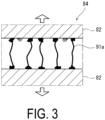
- FIG. 3 is a schematic cross-sectional view of the nonwoven fabric 84 in FIG. 1 .
- the external force is relieved, tensile force is applied to the resin particles 91 to separate the resin particles 91 bonded to one another between the different first fibers 82. Therefore, the fine fibers folded into the resin particles 91 are stretched, and the second fibers 91a are formed as a bridge between the plurality of different first fibers 82.
- the nonwoven fabric 84 that is a fiber composite including the first fibers 82 and the second fibers 91a is formed.
- the second fiber 91a is set to have an outer diameter smaller than that of the first fiber 82 and to have a value in the range from 30 nm to 1.0 ⁇ m. Further, the second fibers 91a are supported by the first fibers 82 while being entangled with the first fibers 82 within the nonwoven fabric 84. Accordingly, even when the second fiber 91a is significantly thinner than the first fiber 82, the second fiber 91a can be supported by the first fiber 82 while being prevented from being cut. Therefore, the function of the second fibers 91a can be maintained for a long period of time.
- the second fibers 91a are dispersedly disposed throughout the inside of the nonwoven fabric 84.
- the resin particles 91 in the fiber laminate 83 may decrease or disappear due to the formation of the second fibers 91a.
- a weight ratio W1/W2 of a total weight W1 of the first fibers 82 of the nonwoven fabric 84 to a total weight W2 of the second fibers 91a and the residual resin particles 91 can be set as appropriate.
- the nonwoven fabric 84 having the weight ratio W1/W2 set to a value in a range from, for example, 3.00 to 200.00 is formed.
- the function of the second fibers 91a can be easily exerted while the second fibers 91a are stably supported by the first fibers 82.
- a variety of components of a known nonwoven fabric production apparatus may be disposed between the pair of pressure rolls 6 and the pair of thermal compression rolls 7.
- a drying machine that dries the fiber laminate 83 to which the dispersion 90 is applied may be disposed between the dispersion application apparatus 3 and the pair of thermal compression rolls 7.
- at least one of a measuring tank for measuring the plurality of first fibers 82, a mixing and blowing machine, a blower, or a measuring feeder may be disposed between the cutter 20 and the carding machine 21.
- the nonwoven fabric 84 that is a fiber composite including the fine second fibers 91a having an outer diameter set to a value in the range from 30 nm to 1.0 ⁇ m, and the first fibers 82 having an outer diameter larger than those of the second fibers 91a can be produced.
- each of the steps described above can be sequentially performed in a single nonwoven fabric production apparatus 1.
- the nonwoven fabric 84 including the first fibers 82 and the second fibers 91a for example, it is not necessary to transport an intermediate product including the plurality of long fibers 81, to which the plurality of resin particles 91 are affixed, to a location including a nonwoven fabric production facility. As a result, time and effort to transport and transportation costs can be reduced. Additionally, deterioration of the quality of the nonwoven fabric, which is caused by transportation of the intermediate product, can be prevented. Further, according to the production method described above, the nonwoven fabric 84 including the first fibers 82 and the second fibers 91a can be produced in gas.
- drying of the fibers 82, 91a can be simplified compared to a wet-laid nonwoven fabric production method. Furthermore, the fibers 82, 91a can be suppressed from being excessively damaged by drying. Therefore, the nonwoven fabric 84 having high quality can be efficiently produced.
- the nonwoven fabric 84 including the plurality of second fibers 91a supported by the plurality of first fibers 82 is produced.
- the plurality of first fibers 82 are short fibers that are crimped and entangled with one another extending in a plurality of different directions within the nonwoven fabric 84.
- the nonwoven fabric 84 as a fiber article having bulkiness and plenty of gaps between fibers can be produced.
- the nonwoven fabric 84 can have a basis weight (g/m 2 ) that is largely reduced to nearly half compared to that of a fiber article including the plurality of long fibers 81 and the plurality of second fibers 91a.
- the high-quality nonwoven fabric 84 that can exert the function of the second fibers 91a for a long period of time in gaps between fibers can be produced. Further, for example, by spraying the dispersion 90 including the resin particles 91 onto the plurality of first fibers 82, the dispersion 90 can be easily incorporated deeply into the gaps between fibers. Accordingly, the second fibers 91a can be disposed uniformly in the nonwoven fabric 84. Therefore, the nonwoven fabric 84 having high quality can be stably produced.
- the nonwoven fabric 84 can provide increased entanglement between the fibers and can suppress crudeness and unevenness of the fibers.
- the nonwoven fabric 84 can be efficiently and serially produced, for example, by using the nonwoven fabric production apparatus 1 consolidated in one location.
- the number of production processes are reduced, and production costs of the nonwoven fabric 84 can be reduced.
- the nonwoven fabric 84 having both a good bulkiness and a good void ratio can be efficiently produced.
- the external force is applied to the plurality of first fibers 82 to which the plurality of resin particles 91 are affixed, while heating the plurality of first fibers 82 and the plurality of resin particles 91.
- the heating temperature at the time of heating the plurality of first fibers 82 and the plurality of resin particles 91 is set to a value in the range from 70°C to 200°C.
- heat is applied to the plurality of resin particles 91, and thus the second fibers 91a can be more easily formed from the resin particles 91.
- the plurality of first fibers 82 are densely disposed, and the nonwoven fabric 84 including fine gaps between fibers can be easily formed.
- the plurality of first fibers 82 are formed into a sheet shape by a carding process, and the plurality of resin particles 91 are affixed to the plurality of first fibers 82 subject to the carding process.
- the plurality of resin particles 91 can be affixed to the plurality of first fibers 82 that are processed into a sheet shape by the carding process, thereby aligning the first fibers 82 in the fiber flow direction. Therefore, the plurality of resin particles 91 can be uniformly affixed to each of the first fibers 82. Additionally, the resin particles 91 can be prevented from adhering to the carding machine. Therefore, the carding process can be stably performed on the plurality of first fibers 82.
- the nonwoven fabric 84 having the weight ratio W1/W2 set to a value in the range from 3.00 to 200.00 is formed.
- the second fibers 91a are stably supported by the first fibers 82, and the function of the second fibers 91a can be easily exerted.
- the first fibers 82 having the outer diameter set to a value in the range from 5 ⁇ m to 50 ⁇ m are used. As a result, the difference between the outer diameters of the first fiber 82 and the second fiber 91a is increased, and the degree of freedom in design of the nonwoven fabric 84 can be improved.
- the length dimension of the short fibers is a value in the range from 10 mm to 100 mm.
- the nonwoven fabric 84 can be easily produced while the plurality of crimped first fibers 82 are made to entangle with one another, the nonwoven fabric 84 including plenty of gaps between fibers with the first fibers 82 and the second fibers 91a and having bulkiness. Additionally, when carding the plurality of first fibers 82, the plurality of first fibers 82 can be efficiently carded while being prevented from being entangled with the carding machine 21. Another embodiment will be described below focusing on differences from the first embodiment.
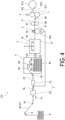
- FIG. 4 is a schematic view of a nonwoven fabric production apparatus 101 according to a second embodiment of the present invention.
- the nonwoven fabric production apparatus 101 differs from the nonwoven fabric production apparatus 1 in that the cross layer 4 is disposed closer to the carding machine 21 side than the dispersion application apparatus 3 in the transfer direction P1.
- the dispersion 90 is applied to the plurality of first fibers 82 that have been carded.
- the plurality of first fibers 82 to which the plurality of resin particles 91 are affixed are introduced into the cross layer 4, thereby forming a fiber laminate 183 to which the plurality of resin particles 91 are affixed.
- the nonwoven fabric 184 is formed from the fiber laminate 183.
- the plurality of first fibers 82 formed into a sheet shape by a carding process are folded and layered to form the fiber laminate 183, and the plurality of resin particles 91 are affixed to the plurality of first fibers 82 of the fiber laminate 183.
- the resin particles 91 can be affixed to the fiber laminate 183.
- the bulky nonwoven fabric 184 including the first fibers 82 and the second fibers 91a can be produced.
- the thickness of the fiber laminate 183 can be adjusted by the degree of overlap of the plurality of first fibers 82, and thus the degree of freedom in design of the thickness of the nonwoven fabric 184 can be improved. Therefore, the nonwoven fabric 184 having the characteristics of both the first fibers 82 and the second fibers 91a and having bulkiness can be efficiently produced.
- the plurality of first fibers 82 were formed by using the long fibers 81 each having an outer diameter set to a value in the range from 5 ⁇ m to 50 ⁇ m and corresponding to crimped cellulose acetate (CA) fibers. Further, the plurality of resin particles 91 each having a mean particle size set to a value in the range from 100 nm to 100 ⁇ m and including PTFE were prepared.
- the nonwoven fabric 84 including the first fibers 82 and the second fibers 91a was produced.
- the nonwoven fabric 184 including the first fibers 82 and the second fibers 91a was produced.
- the heating temperature (compression temperature) for heating the first fibers 82 and the resin particles 91 at the time of compressing the fiber laminates 83, 183 by the pair of thermal compression rolls 7 was set to a temperature of any of room temperature (25°C), 70°C, 90°C, 110°C, 150°C, and 200°C.
- the heating temperatures for heating the plurality of first fibers 82 and the plurality of resin particles 91 at the time of applying the external force to the plurality of first fibers 82 to which the plurality of resin particles 91 are affixed are different from each other.
- the nonwoven fabrics 84, 184 differing from each other were produced as samples of Examples 1 to 10.
- the samples of Examples 1 to 5 were produced by the production method of the first embodiment based on a dry-laid nonwoven fabric production method.
- the samples of Examples 6 to 10 were produced by the production method of the second embodiment based on a dry-laid nonwoven fabric production method.
- a plurality of CA fibers being the long fibers 81 each having the outer diameter set to a value in the range from 5 ⁇ m to 50 ⁇ m were spun.
- the resin particles 91 each having the mean particle size set to a value in the range from 100 nm to 100 ⁇ m and including PTFE were affixed to the CA fibers.
- the plurality of CA fibers were crimped, and a bale-shaped band was produced.
- the band was compressed and packaged into the packaging sleeve B.
- the band was fed out from the packaging sleeve B, and the filaments of the band were opened with gas in the width direction.
- the filaments of the band were further opened by applying, with two pairs of opening rolls disposed separated in a predetermined transfer direction, tensile force in the transfer direction.
- the second fibers 91a were formed by nip pressure from a pair of nip rolls at the time of crimping and external force applied at the time of opening the filaments.
- a fiber article including the long fibers 81 and the second fibers 91a was produced as a sample of Comparative Example 1.
- Example 1 Sample production method Collection efficiency (%) Compression temperature (°C)
- Example 1 Production method of first embodiment 76 110
- Example 2 Production method of first embodiment 65 90
- Example 3 Production method of first embodiment 38 70
- Example 4 Production method of first embodiment 92 150
- Example 5 Production method of first embodiment 90 200
- Example 6 Production method of second embodiment 76 90
- Example 7 Production method of second embodiment 76 110
- Example 8 Production method of second embodiment 92 150
- Example 9 Production method of second embodiment 86 200
- Example 10 Production method of second embodiment 26 25
- Comparative Example 1 Fiber article production method using long fibers (method described in Patent Document 1) 19 25
- the plurality of first fibers 82 are short fibers and are crimped and entangled with one another extending in a plurality of different directions within the nonwoven fabric 84, 184, resulting in bulky samples formed with plenty of gaps between fibers, thereby improving filtration performance.
- Examples 1 to 10 it was confirmed that a higher compression temperature from an ordinary temperature (25°C) increases the collection efficiency. The following can be given as the reason for this.
- a higher compression temperature resulted in the plurality of first fibers 82 being plasticized more easily.
- the gaps between fibers formed by the plurality of first fibers 82 and the plurality of second fibers 91a in the samples are made thinner and the filtration performance is further improved.
- the heating temperature of the plurality of first fibers 82 and the plurality of resin particles 91 is, for example, preferably a value in a range from 25°C to 200°C, and is more preferably a value in a range from 70°C to 200°C.
- the collection efficiency of the nonwoven fabric is a value in a range from 26% to 92%, is a value in a range from 38% to 92% in another example, and is a value in a range from 65% to 92% in yet another example.
- the nonwoven fabric produced by the production method of the present disclosure is not limited to a filtration member that filters impurities from fluid, and may be used in other applications such as an absorbent member used in hygiene items. Further, when the external force is applied to the plurality of first fibers 82 and the plurality of resin particles 91, the first fibers 82 and the resin particles 91 need not necessarily be heated. Furthermore, instead of using the dispersion application apparatus 3, a powder application apparatus that applies powdered resin particles 91 to the first fibers 82 may be used.
Landscapes
- Engineering & Computer Science (AREA)
- Textile Engineering (AREA)
- Chemical & Material Sciences (AREA)
- Chemical Kinetics & Catalysis (AREA)
- General Chemical & Material Sciences (AREA)
- Dispersion Chemistry (AREA)
- Life Sciences & Earth Sciences (AREA)
- Wood Science & Technology (AREA)
- Nonwoven Fabrics (AREA)
Abstract
Description
- The present disclosure relates to a dry-laid nonwoven fabric production method that produces a nonwoven fabric including a plurality of types of fibers.
- Patent Document 1 discloses a production method in which particles are added to long fibers that are spun and transferred from a cabinet, and these particles form different fibers having outer diameters different from those of the long fibers to produce a fiber composite including a plurality of types of fibers having different outer diameters.
- Patent Document 1:
WO 2021/039979 A1 - When producing a nonwoven fabric by using a fiber composite including a plurality of types of fibers, for example, an intermediate product including long fibers to which particles are added needs to be transported to a location including a nonwoven fabric production facility. This incurs time and effort to transport and transportation costs. In addition, impurities may adhere to the intermediate product during transportation, or the particles may fall off from the intermediate product during transportation. As a result, the quality of the nonwoven fabric decreases.
- An object of the present disclosure is to, when producing a nonwoven fabric including a plurality of types of fibers having different outer diameters, be able to efficiently produce a high-quality nonwoven fabric.
- In order to solve the problem described above, a dry-laid nonwoven fabric production method includes: affixing resin particles including high molecules that can be fiberized to a plurality of first fibers crimped and cut into short fibers; applying an external force to the plurality of first fibers to which the plurality of resin particles are affixed, thereby reducing gaps between fibers; relieving the applied external force to form in gas, from the plurality of resin particles, second fibers each having an outer diameter smaller than that of the first fiber and set to a value in a range from 30 nm to 1.0 µm; and forming a nonwoven fabric that is a fiber composite including the first fibers and the second fibers.
- According to the production method described above, by using the plurality of first fibers cut into short fibers, the nonwoven fabric that is a fiber composite including the fine second fibers each having an outer diameter set to a value in the range from 30 nm to 1.0 µm, and the first fibers each having an outer diameter larger than that of the second fiber can be produced. Thus, for example, each of the steps described above can be sequentially performed in a single nonwoven fabric production apparatus. Therefore, in order to produce the nonwoven fabric including the first fibers and the second fibers, for example, it is not necessary to transport an intermediate product including a plurality of long fibers to which the plurality of resin particles are affixed, to a location including a nonwoven fabric production facility. As a result, time and effort to transport and transportation costs can be reduced. Additionally, deterioration of the quality of the nonwoven fabric, which is caused by transportation of the intermediate product, can be prevented. Further, according to the production method described above, the nonwoven fabric including the first fibers and the second fibers can be produced in gas. Accordingly, for example, drying of the fibers can be simplified compared to a wet-laid nonwoven fabric production method. Furthermore, the fibers can be suppressed from being excessively damaged by drying. Therefore, a high-quality nonwoven fabric can be efficiently produced.
- The external force may be applied to the plurality of the first fibers to which the plurality of resin particles are affixed while heating the plurality of first fibers and the plurality of resin particles. Further, a heating temperature at the time of heating the plurality of first fibers and the plurality of resin particles may be set to a value in a range from 70°C to 200°C. Therefore, the second fibers can be more easily formed from the plurality of resin particles. Furthermore, by applying heat to the first fibers to plasticize the first fibers, the plurality of first fibers are densely disposed, and thus the nonwoven fabric including fine gaps between fibers can be easily formed.
- A carding process is performed on the plurality of first fibers to form the plurality of fibers into a sheet shape, and the plurality of resin particles may be affixed to the plurality of first fibers subjected to the carding process. Thus, the plurality of resin particles can be affixed to the plurality of first fibers that are processed into a sheet shape by the carding process, thereby aligning the first fibers in the fiber flow direction. Therefore, the plurality of resin particles can be uniformly affixed to each of the first fibers. Additionally, the resin particles can be prevented from adhering to a carding machine. As a result, the carding process can be stably performed on the plurality of first fibers.
- The plurality of first fibers formed into the sheet shape by the carding process may be overlapped to form a fiber laminate, and the plurality of resin particles may be affixed to the plurality of first fibers of the fiber laminate. Thus, the resin particles can be affixed to the fiber laminate. As a result, a bulky nonwoven fabric including the first fibers and the second fibers can be produced. Additionally, at the time of forming the fiber laminate, the thickness of the fiber laminate can be adjusted by the degree of overlap of the plurality of first fibers, and thus the degree of freedom in design of the thickness of the nonwoven fabric can be improved. As a result, the nonwoven fabric having the characteristics of both the first fibers and the second fibers and having bulkiness can be efficiently produced.
- A length dimension of the short fibers may be a value in a range from 10 mm to 100 mm. As a result, while the plurality of crimped first fibers are entangled with one another, the nonwoven fabric can be easily produced that includes plenty of gaps between fibers with the first fibers and the second fibers and has bulkiness. Additionally, when carding the plurality of first fibers, the plurality of first fibers can be efficiently carded while being prevented from being entangled with the carding machine.
- According to aspects of the present disclosure, when producing a nonwoven fabric including a plurality of fibers having different outer diameters, a high-quality nonwoven fabric can be efficiently produced.
-
-
FIG. 1 is a schematic diagram of a nonwoven fabric production apparatus according to a first embodiment. -
FIG. 2 is a schematic cross-sectional view of a fiber laminate inFIG. 1 . -
FIG. 3 is a schematic cross-sectional view of the nonwoven fabric inFIG. 1 . -
FIG. 4 is a schematic view of a nonwoven fabric production apparatus according to a second embodiment of the present invention. - Embodiments of the present invention will be described below with reference to the drawings.
- In a dry-laid nonwoven fabric production method according to a first embodiment, first, a plurality of
resin particles 91 containing high molecules that can be fiberized are affixed to a plurality offirst fibers 82 crimped and cut into short fibers. Next, an external force is applied to the plurality offirst fibers 82 to which the plurality ofresin particles 91 are affixed, which reduces the gaps between fibers. Thereafter, the external force is relieved and, in gas,second fibers 91a each having an outer diameter smaller than those of the plurality offirst fibers 82 and set to a value in a range from 30 nm to 1.0 µm are formed from the plurality ofresin particles 91, and anonwoven fabric 84 that is a fiber composite including the first fibers and the second fibers is formed. For applying the external force and relieving the external force, a pair ofthermal compression rolls 7 is used in the present embodiment as an example. -
FIG. 1 is an overall view of a nonwoven fabric production apparatus 1 according to the first embodiment. The nonwoven fabric production apparatus 1 illustrated inFIG. 1 produces thenonwoven fabric 84 based on the dry-laid nonwoven fabric production method that produces a nonwoven fabric in gas (for example, in air). Thenonwoven fabric 84 includes thefirst fibers 82 and thesecond fibers 91a. The nonwoven fabric referred to herein is a short fiber nonwoven fabric in compliance with Number 102 of JIS L 0222:2001. - In the present embodiment, when producing the
nonwoven fabric 84, a bale-like band 80 that is folded and packaged in a packaging sleeve B is fed out. Thefirst fibers 82 that are short fibers and constitute the material of thenonwoven fabric 84 are formed from theband 80. An outer diameter of thefirst fiber 82 can be adjusted as appropriate. The outer diameter of thefirst fiber 82 is a value in a range from 5 µm to 50 µm as an example, but is not limited thereto. Theband 80 includes a plurality oflong fibers 81 that are crimped. For example, thelong fibers 81 include at least one of rayon, polypropylene, polyethylene terephthalate, polyethylene, or cellulose acetate. Thelong fibers 81 of the present embodiment include cellulose acetate. The material of thelong fibers 81 can be selected as appropriate. - As illustrated in
FIG. 1 , the nonwoven fabric production apparatus 1 includes a guide member G that guides theband 80, a plurality of guide rolls R1 to R4, R7 that guide thetow band 80 in predetermined transfer directions P1, P2, and a shortfiber forming unit 2. The shortfiber forming unit 2 includes acutter 20 that cuts thelong fibers 81 to a predetermined length dimension to form thefirst fibers 82 that are short fibers, a blower (cotton blower) BL that transfers, in the transfer direction P1, thefirst fibers 82 discharged from thecutter 20, and a cardingmachine 21 that performs a carding process on the plurality offirst fibers 82. The length dimension of thefirst fibers 82 formed by thecutter 20 in the present embodiment can be set as appropriate. The length dimension of thefirst fibers 82 is a value in a range from 10 mm to 100 mm, as an example. Also, in another example, the length dimension of thefirst fibers 82 is a value in a range from 30 mm to 100 mm. By setting the length dimension of thefirst fibers 82 to a value of 100 mm or less, for example, unnecessary entanglement of thefirst fibers 82 with respect to the cardingmachine 21 can be prevented. Additionally, by setting the length dimension of thefirst fibers 82 to a value of 10 mm or greater, the plurality of crimpedfirst fibers 82 can be entangled with one another, and thus a bulkynonwoven fabric 84 with plenty of gaps between fibers can be easily produced. - The nonwoven fabric production apparatus 1 further includes a
dispersion application apparatus 3 that applies adispersion 90 including the plurality ofresin particles 91 to the plurality offirst fibers 82, and a cross layer (fiber laminate forming apparatus) 4 that layers the plurality offirst fibers 82 to form afiber laminate 83. As an example, thedispersion application apparatus 3 includes one ormore nozzles 30 that spray thedispersion 90 supplied from outside toward thefirst fibers 82, and ahousing 31 that houses thenozzles 30. In order to allow thedispersion 90 to penetrate into thefiber laminate 83, it is preferable that droplets of thedispersion 90 sprayed from thenozzles 30 are smaller, as an example. The configuration of thedispersion application apparatus 3 is not limited to that described above. For example, thedispersion application apparatus 3 may include a reservoir that stores thedispersion 90, and an application roll that is pivotally supported in a state where thedispersion 90 in the reservoir is applied to the roll surface to be applied to thefirst fibers 82. Thedispersion 90 of the present embodiment is an aqueous dispersion. Thedispersion 90 may include a liquid other than water. By using an aqueous dispersion, thedispersion 90 can be produced relatively inexpensively. In addition, thedispersion 90 can be easily handled. - The
resin particles 91 contain lamellar structures. The lamellar structure herein referred to corresponds to a structure in which polymer chains constituting a resin of theresin particles 91 are linked and folded. The lamellar structures contained in theresin particles 91 are formed of fine fibers, specifically, in which the polymer chains are linked in millions and formed into a ribbon shape. The fine fibers are folded and stored in theresin particles 91. - The
resin particles 91 are primary particles. The plurality ofresin particles 91 are bonded to one another to form secondary particles. When an external force is applied to the secondary particles (in other words, two or more bonded resin particles 91) and theresin particles 91 are separated, the fine fibers are drawn out of theresin particles 91, and thesecond fibers 91a are formed from theresin particles 91. Thedispersion 90 of the present embodiment contains the primary particles including the plurality ofresin particles 91 in a dispersed manner in a solvent. Thedispersion 90 is applied to thefirst fibers 82, and thus the plurality ofresin particles 91 are dispersed and affixed to the surface of thefirst fibers 82. As an example, the secondary particles of the plurality ofresin particles 91 are affixed to the surface of thefirst fibers 82. - As described below, the external force is applied to the plurality of
first fibers 82 to which the plurality ofresin particles 91 are affixed, and the gaps between fibers are reduced. Therefore, the plurality ofresin particles 91 affixed to the surfaces of differentfirst fibers 82 are bonded together. In addition, the external force applied to the plurality offirst fibers 82 is relieved, and the bondedresin particles 91 are separated. As a result, thesecond fibers 91a are formed (seeFIGS. 2 and3 ). - The
resin particles 91 may be formed, for example, by a polymerization reaction and may contain lamellar structures. Theresin particles 91 contain, for example, at least one of PTFE (polytetrafluoroethylene), polypropylene, polyethylene, or polyamide. Theresin particles 91 of the present embodiment include PTFE. - Here, the
resin particles 91 are set to have a mean particle size of a value in a range from 100 nm to 100 µm, for example. As an example, the value of the mean particle size is further preferably in a range from 200 nm to 700 nm, and is still further preferably in a range from 250 nm to 400 nm. Note that the mean particle size herein refers to the median diameter (cumulative 50% diameter (D50)) calculated from measurement results of dynamic light scattering. Theresin particles 91 are formed, for example, by paste extrusion. - The
cross layer 4 layers in an overlapped manner (here, for example, layers in a folded manner) the plurality offirst fibers 82 in a sheet shape to which theresin particles 91 are affixed to form thefiber laminate 83. As an example, thecross layer 4 includes the plurality of rolls R2 to R6 that guide the plurality offirst fibers 82 in a sheet shape, and ahousing 40 that houses the rolls R3 to R6. In thecross layer 4 of the present embodiment, the plurality offirst fibers 82 in a sheet shape are guided to the upper side of the interior of thehousing 40 by the rolls R3, R4, and then are guided downward by the pair of rolls R5, R6. At this time, the plurality offirst fibers 82 are guided back and forth in one direction orthogonal to the vertical direction, and are folded and layered. As a result, thefiber laminate 83 is formed. As an example, the one direction and the transfer direction P2 of thefiber laminate 83 discharged from thecross layer 4 intersect with the transfer direction P1 of the plurality offirst fibers 82 when introduced into thecross layer 4. Note that the plurality offirst fibers 82 in a sheet shape are not long fibers but short fibers. Therefore, the plurality offirst fibers 82 in a sheet shape have, for example, a relatively small restoring force at the overlapped portion compared to a plurality of long fibers formed in a sheet shape. As a result, the plurality offirst fibers 82 in a sheet shape can be easily overlapped, and thefiber laminate 83 can be efficiently formed. - Further, the nonwoven fabric production apparatus 1 includes a
slitter 5 that cuts an unnecessary portion (for example, both ends in a width direction of the fiber laminate 83) of thefiber laminate 83 discharged from thecross layer 4, and a pair of pressure rolls 6 that allow thefiber laminate 83 passed through theslitter 5 to be compressed in the thickness direction and that adjust the thickness of thefiber laminate 83. Theslitter 5 includes atransfer roll 51 that transfers thefiber laminate 83 and a cuttingroll 50 that cuts a portion of thefiber laminate 83. Acut portion 83a of thefiber laminate 83 is, for example, introduced into the cardingmachine 21 and reused. The pair of pressure rolls 6 include a pair of pressure rolls R7, R8. - Furthermore, the nonwoven fabric production apparatus 1 includes a pair of thermal compression rolls 7 that allow the
fiber laminate 83 passed through the pair of pressure rolls 6 to be thermally compressed in the thickness direction to heat the plurality offirst fibers 82 and the plurality ofresin particles 91 and apply the external force, anelectret apparatus 8 that causes thefiber laminate 83 to be electrically polarized, and a winding roll R12 that winds up thenonwoven fabric 84. The pair of thermal compression rolls 7 include a pair of thermal compression rolls R10, R11, the roll surfaces of which are to be heated. The pair of pressure rolls 6 of the present embodiment apply the external force to thefiber laminate 83 while heating thefiber laminate 83. The heating temperature of the plurality offirst fibers 82 and the plurality ofresin particles 91 by the pair of thermal compression rolls 7 can be adjusted as appropriate. The heating temperature can be set to a temperature in a range of, for example, from 25°C to 200°C. The heating temperature is preferably a temperature, for example, in a range from 50°C to 200°C, more preferably a temperature in a range from 70°C to 200°C, and still more preferably a temperature in a range from 90°C to 200°C. In yet another example, the heating temperature is preferably a temperature in a range from 110°C to 200°C, and more preferably a temperature in a range from 150°C to 200°C. The heating temperature may be, for example, below the melting point of each material of thefirst fibers 82 and theresin particles 91, or may be below the decomposition temperature of each of the materials. Theelectret apparatus 8 causes thefiber laminate 83 to be polarized, and thus filtration performance as performance when thenonwoven fabric 84 is used as a filtration member, for example, is improved. Note that, when the application of thenonwoven fabric 84 is an application other than filtration, theelectret apparatus 8 may be omitted. - When the nonwoven fabric production apparatus 1 is driven, the bale-like band 80 (the plurality of crimped long fibers 81) housed in the packaging sleeve B is fed out, and the
band 80 is guided by the guide member G and the guide roll R1 to be introduced into the shortfiber forming unit 2. In the shortfiber forming unit 2, theband 80 is introduced into thecutter 20 and cut. Thus, the plurality of crimpedfirst fibers 82 are formed. The plurality offirst fibers 82 are introduced into the cardingmachine 21 to be carded. Thus, impurities are removed from the plurality offirst fibers 82, and the thickness dimension and the fiber flow direction are adjusted. The plurality of cardedfirst fibers 82 are formed into a sheet shape with plenty of gaps between fibers while being entangled with one another. Thedispersion 90 is applied by thedispersion application apparatus 3 to the plurality offirst fibers 82 in a sheet shape. Thus, the plurality ofresin particles 91 containing high molecules that can be fiberized are affixed to the plurality offirst fibers 82 crimped and cut into short fibers. - The plurality of
first fibers 82 discharged from thedispersion application apparatus 3 are introduced into thecross layer 4. Consequently, thefiber laminate 83 is formed. Thefiber laminate 83 discharged from thecross layer 4 is guided in the transfer direction P2 and introduced into theslitter 5. As a result, both sides in the width direction of thefiber laminate 83 are cut. Thefiber laminate 83 passed through theslitter 5 passes through a nip point of the pair of pressure rolls 6 and is formed into a sheet shape having a thickness that is adjusted. Thefiber laminate 83 passed through the nip point of the pair of pressure rolls 6 is guided by the guide roll R9 and passes through a nip point of the pair of thermal compression rolls 7, therefore being thermally compressed. Thus, the external force is applied to the plurality offirst fibers 82 and the plurality ofresin particles 91 in thefiber laminate 83 in a state where thefirst fibers 82 and theresin particles 91 are heated. As a result, because the external force is applied to the plurality offirst fibers 82 to which the plurality ofresin particles 91 are affixed, the gaps between fibers are reduced. In addition, thefirst fibers 82 are heated and plasticized to some extent. After thefiber laminate 83 passes through the nip point of the pair of thermal compression rolls 7, the external force is relieved. Along with such processing, the plurality ofsecond fibers 91a are formed from the plurality ofresin particles 91. The plurality offirst fibers 82 and the plurality ofsecond fibers 91a are electrically polarized by theelectret apparatus 8. As a result, thenonwoven fabric 84 is formed. Thenonwoven fabric 84 is wound by the winding roll R12. Thenonwoven fabric 84 is cut, for example, into predetermined dimensions to be used. -
FIG. 2 is a schematic cross-sectional view of thefiber laminate 83 ofFIG. 1 . As illustrated inFIG. 2 , when thefiber laminate 83 passes through the nip point of the pair of thermal compression rolls 7, nip pressure is applied as the external force to the plurality offirst fibers 82 to which the plurality ofresin particles 91 are affixed, while heating the plurality offirst fibers 82 and the plurality ofresin particles 91, and the gaps between fibers are reduced. In the plurality offirst fibers 82, the gaps between fibers are reduced. In addition, the plurality ofresin particles 91 affixed to thefirst fibers 82 are bonded together, which forms high-order particles of theresin particles 91. When thefirst fibers 82 separate from the nip point of the pair of thermal compression rolls 7, the external force is relieved. As an example, an external force set to a value of 0.05 MPa or greater is applied to the plurality offirst fibers 82 to which the plurality ofresin particles 91 are affixed. Accordingly, the external force is adequately applied to the plurality ofresin particles 91, and thesecond fibers 91a can be easily formed. Note that the upper limit value of the external force may be, for example, several tens of MPa. -
FIG. 3 is a schematic cross-sectional view of thenonwoven fabric 84 inFIG. 1 . As illustrated inFIG. 3 , when the external force is relieved, tensile force is applied to theresin particles 91 to separate theresin particles 91 bonded to one another between the differentfirst fibers 82. Therefore, the fine fibers folded into theresin particles 91 are stretched, and thesecond fibers 91a are formed as a bridge between the plurality of differentfirst fibers 82. As a result, thenonwoven fabric 84 that is a fiber composite including thefirst fibers 82 and thesecond fibers 91a is formed. - The
second fiber 91a is set to have an outer diameter smaller than that of thefirst fiber 82 and to have a value in the range from 30 nm to 1.0 µm. Further, thesecond fibers 91a are supported by thefirst fibers 82 while being entangled with thefirst fibers 82 within thenonwoven fabric 84. Accordingly, even when thesecond fiber 91a is significantly thinner than thefirst fiber 82, thesecond fiber 91a can be supported by thefirst fiber 82 while being prevented from being cut. Therefore, the function of thesecond fibers 91a can be maintained for a long period of time. Thesecond fibers 91a are dispersedly disposed throughout the inside of thenonwoven fabric 84. Theresin particles 91 in thefiber laminate 83 may decrease or disappear due to the formation of thesecond fibers 91a. - A weight ratio W1/W2 of a total weight W1 of the
first fibers 82 of thenonwoven fabric 84 to a total weight W2 of thesecond fibers 91a and theresidual resin particles 91 can be set as appropriate. In the present embodiment, thenonwoven fabric 84 having the weight ratio W1/W2 set to a value in a range from, for example, 3.00 to 200.00 is formed. As a result, in thenonwoven fabric 84, the function of thesecond fibers 91a can be easily exerted while thesecond fibers 91a are stably supported by thefirst fibers 82. - Note that a variety of components of a known nonwoven fabric production apparatus (for example, at least one of a metal detector, an iron removing machine, an adding device for adding various additives, a feeding roll for feeding sheet to be affixed to the
fiber laminate 83, or a paste application device for applying a paste used in attaching a sheet to at least a portion of the fiber laminate 83) may be disposed between the pair of pressure rolls 6 and the pair of thermal compression rolls 7. Further, a drying machine that dries thefiber laminate 83 to which thedispersion 90 is applied may be disposed between thedispersion application apparatus 3 and the pair of thermal compression rolls 7. Furthermore, at least one of a measuring tank for measuring the plurality offirst fibers 82, a mixing and blowing machine, a blower, or a measuring feeder may be disposed between thecutter 20 and the cardingmachine 21. - As described above, according to the production method of the present embodiment, by using the plurality of
first fibers 82 cut into short fibers, thenonwoven fabric 84 that is a fiber composite including the finesecond fibers 91a having an outer diameter set to a value in the range from 30 nm to 1.0 µm, and thefirst fibers 82 having an outer diameter larger than those of thesecond fibers 91a can be produced. Thus, for example, each of the steps described above can be sequentially performed in a single nonwoven fabric production apparatus 1. Therefore, in order to produce thenonwoven fabric 84 including thefirst fibers 82 and thesecond fibers 91a, for example, it is not necessary to transport an intermediate product including the plurality oflong fibers 81, to which the plurality ofresin particles 91 are affixed, to a location including a nonwoven fabric production facility. As a result, time and effort to transport and transportation costs can be reduced. Additionally, deterioration of the quality of the nonwoven fabric, which is caused by transportation of the intermediate product, can be prevented. Further, according to the production method described above, thenonwoven fabric 84 including thefirst fibers 82 and thesecond fibers 91a can be produced in gas. Accordingly, for example, drying of thefibers fibers nonwoven fabric 84 having high quality can be efficiently produced. - In addition, according to the production method described above, by combining the fine
second fibers 91a with thefirst fibers 82, thenonwoven fabric 84 including the plurality ofsecond fibers 91a supported by the plurality offirst fibers 82 is produced. Here, the plurality offirst fibers 82 are short fibers that are crimped and entangled with one another extending in a plurality of different directions within thenonwoven fabric 84. Thus, for example, as compared to a fiber article including the plurality oflong fibers 81 and the plurality ofsecond fibers 91a, thenonwoven fabric 84 as a fiber article having bulkiness and plenty of gaps between fibers can be produced. Here, according to study conducted by the inventors of the present application, thenonwoven fabric 84 can have a basis weight (g/m2) that is largely reduced to nearly half compared to that of a fiber article including the plurality oflong fibers 81 and the plurality ofsecond fibers 91a. - In addition, the high-
quality nonwoven fabric 84 that can exert the function of thesecond fibers 91a for a long period of time in gaps between fibers can be produced. Further, for example, by spraying thedispersion 90 including theresin particles 91 onto the plurality offirst fibers 82, thedispersion 90 can be easily incorporated deeply into the gaps between fibers. Accordingly, thesecond fibers 91a can be disposed uniformly in thenonwoven fabric 84. Therefore, thenonwoven fabric 84 having high quality can be stably produced. Furthermore, for example, as compared to a fiber article including the plurality oflong fibers 81 and the plurality ofsecond fibers 91a, thenonwoven fabric 84 can provide increased entanglement between the fibers and can suppress crudeness and unevenness of the fibers. - In addition, according to the production method described above, the
nonwoven fabric 84 can be efficiently and serially produced, for example, by using the nonwoven fabric production apparatus 1 consolidated in one location. Thus, the number of production processes are reduced, and production costs of thenonwoven fabric 84 can be reduced. Moreover, according to the present embodiment, thenonwoven fabric 84 having both a good bulkiness and a good void ratio can be efficiently produced. - Further, in the present embodiment, the external force is applied to the plurality of
first fibers 82 to which the plurality ofresin particles 91 are affixed, while heating the plurality offirst fibers 82 and the plurality ofresin particles 91. Furthermore, as an example, the heating temperature at the time of heating the plurality offirst fibers 82 and the plurality ofresin particles 91 is set to a value in the range from 70°C to 200°C. As a result, heat is applied to the plurality ofresin particles 91, and thus thesecond fibers 91a can be more easily formed from theresin particles 91. Additionally, by applying heat to thefirst fibers 82 to plasticize thefirst fibers 82, the plurality offirst fibers 82 are densely disposed, and thenonwoven fabric 84 including fine gaps between fibers can be easily formed. - Further, according to the production method of the present embodiment, the plurality of
first fibers 82 are formed into a sheet shape by a carding process, and the plurality ofresin particles 91 are affixed to the plurality offirst fibers 82 subject to the carding process. Thus, the plurality ofresin particles 91 can be affixed to the plurality offirst fibers 82 that are processed into a sheet shape by the carding process, thereby aligning thefirst fibers 82 in the fiber flow direction. Therefore, the plurality ofresin particles 91 can be uniformly affixed to each of thefirst fibers 82. Additionally, theresin particles 91 can be prevented from adhering to the carding machine. Therefore, the carding process can be stably performed on the plurality offirst fibers 82. - Furthermore, in the present embodiment, the
nonwoven fabric 84 having the weight ratio W1/W2 set to a value in the range from 3.00 to 200.00 is formed. As a result, thesecond fibers 91a are stably supported by thefirst fibers 82, and the function of thesecond fibers 91a can be easily exerted. Additionally, in the present embodiment, as an example, thefirst fibers 82 having the outer diameter set to a value in the range from 5 µm to 50 µm are used. As a result, the difference between the outer diameters of thefirst fiber 82 and thesecond fiber 91a is increased, and the degree of freedom in design of thenonwoven fabric 84 can be improved. - Moreover, in the present embodiment, the length dimension of the short fibers (first fibers 82) is a value in the range from 10 mm to 100 mm. Thus, the
nonwoven fabric 84 can be easily produced while the plurality of crimpedfirst fibers 82 are made to entangle with one another, thenonwoven fabric 84 including plenty of gaps between fibers with thefirst fibers 82 and thesecond fibers 91a and having bulkiness. Additionally, when carding the plurality offirst fibers 82, the plurality offirst fibers 82 can be efficiently carded while being prevented from being entangled with the cardingmachine 21. Another embodiment will be described below focusing on differences from the first embodiment. -
FIG. 4 is a schematic view of a nonwovenfabric production apparatus 101 according to a second embodiment of the present invention. The nonwovenfabric production apparatus 101 differs from the nonwoven fabric production apparatus 1 in that thecross layer 4 is disposed closer to the cardingmachine 21 side than thedispersion application apparatus 3 in the transfer direction P1. When producing anonwoven fabric 184, thedispersion 90 is applied to the plurality offirst fibers 82 that have been carded. As a result, the plurality offirst fibers 82 to which the plurality ofresin particles 91 are affixed are introduced into thecross layer 4, thereby forming afiber laminate 183 to which the plurality ofresin particles 91 are affixed. Thenonwoven fabric 184 is formed from thefiber laminate 183. - As just described, in the nonwoven fabric production method of the second embodiment, the plurality of
first fibers 82 formed into a sheet shape by a carding process are folded and layered to form thefiber laminate 183, and the plurality ofresin particles 91 are affixed to the plurality offirst fibers 82 of thefiber laminate 183. - According to this production method, the
resin particles 91 can be affixed to thefiber laminate 183. Thus, the bulkynonwoven fabric 184 including thefirst fibers 82 and thesecond fibers 91a can be produced. Additionally, at the time of forming thefiber laminate 183, the thickness of thefiber laminate 183 can be adjusted by the degree of overlap of the plurality offirst fibers 82, and thus the degree of freedom in design of the thickness of thenonwoven fabric 184 can be improved. Therefore, thenonwoven fabric 184 having the characteristics of both thefirst fibers 82 and thesecond fibers 91a and having bulkiness can be efficiently produced. - Next, confirmation tests to confirm the performance of the present disclosure will be described. The present disclosure is not limited to the Examples described below.
- The plurality of
first fibers 82 were formed by using thelong fibers 81 each having an outer diameter set to a value in the range from 5 µm to 50 µm and corresponding to crimped cellulose acetate (CA) fibers. Further, the plurality ofresin particles 91 each having a mean particle size set to a value in the range from 100 nm to 100 µm and including PTFE were prepared. By using thefirst fibers 82 and theresin particles 91 and using the nonwoven fabric production apparatus 1 of the first embodiment, thenonwoven fabric 84 including thefirst fibers 82 and thesecond fibers 91a was produced. Furthermore, by using thefirst fibers 82 and theresin particles 91 and using the nonwovenfabric production apparatus 101 of the second embodiment, thenonwoven fabric 184 including thefirst fibers 82 and thesecond fibers 91a was produced. - When producing the
nonwoven fabrics first fibers 82 and theresin particles 91 at the time of compressing the fiber laminates 83, 183 by the pair of thermal compression rolls 7 was set to a temperature of any of room temperature (25°C), 70°C, 90°C, 110°C, 150°C, and 200°C. As a result, the heating temperatures for heating the plurality offirst fibers 82 and the plurality ofresin particles 91 at the time of applying the external force to the plurality offirst fibers 82 to which the plurality ofresin particles 91 are affixed are different from each other. As described above, thenonwoven fabrics - Moreover, in accordance with the description of the first embodiment in Patent Document 1, a plurality of CA fibers being the
long fibers 81 each having the outer diameter set to a value in the range from 5 µm to 50 µm were spun. Theresin particles 91 each having the mean particle size set to a value in the range from 100 nm to 100 µm and including PTFE were affixed to the CA fibers. Thereafter, the plurality of CA fibers were crimped, and a bale-shaped band was produced. The band was compressed and packaged into the packaging sleeve B. The band was fed out from the packaging sleeve B, and the filaments of the band were opened with gas in the width direction. Subsequently, the filaments of the band were further opened by applying, with two pairs of opening rolls disposed separated in a predetermined transfer direction, tensile force in the transfer direction. Thesecond fibers 91a were formed by nip pressure from a pair of nip rolls at the time of crimping and external force applied at the time of opening the filaments. Thus, a fiber article including thelong fibers 81 and thesecond fibers 91a was produced as a sample of Comparative Example 1. - For each of the samples of Examples 1 to 10 and Comparative Example 1, the collection efficiency of particles when air containing NaCl particles having a particle size of 0.3 µm was passed through the fiber article at a flow rate of 5.3 cm/sec was measured. As can be evaluated, for example, the performance of the sample as a filtration member increases as the collection efficiency value increases. The measurement results of the collection efficiency are indicated in Table 1.
[Table 1] Sample production method Collection efficiency (%) Compression temperature (°C) Example 1 Production method of first embodiment 76 110 Example 2 Production method of first embodiment 65 90 Example 3 Production method of first embodiment 38 70 Example 4 Production method of first embodiment 92 150 Example 5 Production method of first embodiment 90 200 Example 6 Production method of second embodiment 76 90 Example 7 Production method of second embodiment 76 110 Example 8 Production method of second embodiment 92 150 Example 9 Production method of second embodiment 86 200 Example 10 Production method of second embodiment 26 25 Comparative Example 1 Fiber article production method using long fibers (method described in Patent Document 1) 19 25 - As indicated in Table 1, it was confirmed that the collection efficiency of Examples 1 to 10 was higher than that of Comparative Example 1. The following can be given as the reason for this. In Examples 1 to 10, the plurality of
first fibers 82 are short fibers and are crimped and entangled with one another extending in a plurality of different directions within thenonwoven fabric - Additionally, in Examples 1 to 10, it was confirmed that a higher compression temperature from an ordinary temperature (25°C) increases the collection efficiency. The following can be given as the reason for this. In Examples 1 to 10, a higher compression temperature resulted in the plurality of
first fibers 82 being plasticized more easily. Thus, the gaps between fibers formed by the plurality offirst fibers 82 and the plurality ofsecond fibers 91a in the samples are made thinner and the filtration performance is further improved. - According to the present test results, the heating temperature of the plurality of
first fibers 82 and the plurality ofresin particles 91 is, for example, preferably a value in a range from 25°C to 200°C, and is more preferably a value in a range from 70°C to 200°C. In addition, the collection efficiency of the nonwoven fabric is a value in a range from 26% to 92%, is a value in a range from 38% to 92% in another example, and is a value in a range from 65% to 92% in yet another example. - Note that each of the configurations, combinations thereof, or the like in each of the embodiments are examples, and additions, omissions, replacements, and other changes to the configurations may be made as appropriate without departing from the spirit of the present disclosure. The present disclosure is not limited by the embodiments and is limited only by the scope of the claims. Also, aspects disclosed in the present specification can be combined with any other feature disclosed herein.
- The nonwoven fabric produced by the production method of the present disclosure is not limited to a filtration member that filters impurities from fluid, and may be used in other applications such as an absorbent member used in hygiene items. Further, when the external force is applied to the plurality of
first fibers 82 and the plurality ofresin particles 91, thefirst fibers 82 and theresin particles 91 need not necessarily be heated. Furthermore, instead of using thedispersion application apparatus 3, a powder application apparatus that appliespowdered resin particles 91 to thefirst fibers 82 may be used. -
- 82 First fiber
- 83, 183 Fiber laminate
- 84, 184 Nonwoven fabric
- 91 Resin particle
- 91a Second fiber
Claims (6)
- A dry-laid nonwoven fabric production method, comprising:affixing resin particles including high molecules that can be fiberized to a plurality of first fibers crimped and cut into short fibers;applying an external force to the plurality of first fibers to which the plurality of resin particles are affixed, thereby reducing gaps between fibers;relieving the applied external force to form in gas, from the plurality of resin particles, second fibers each having an outer diameter smaller than that of the first fiber and set to a value in a range from 30 nm to 1.0 µm; andforming a nonwoven fabric that is a fiber composite including the first fibers and the second fibers.
- The nonwoven fabric production method according to claim 1, wherein the external force is applied to the plurality of the first fibers to which the plurality of resin particles are affixed while heating the plurality of first fibers and the plurality of resin particles.
- The nonwoven fabric production method according to claim 2, wherein a heating temperature at the time of heating the plurality of first fibers and the plurality of resin particles is set to a value in a range from 70°C to 200°C.
- The nonwoven fabric production method according to any one of claims 1 to 3, wherein a carding process is performed on the plurality of first fibers to form the plurality of fibers into a sheet shape, and
the plurality of resin particles are affixed to the plurality of first fibers subjected to the carding process. - The nonwoven fabric production method according to claim 4, wherein the plurality of first fibers formed into the sheet shape by the carding process are overlapped to form a fiber laminate, and
the plurality of resin particles are affixed to the plurality of first fibers of the fiber laminate. - The nonwoven fabric production method according to any one of claims 1 to 5, wherein a length dimension of the short fibers is a value in a range from 10 mm to 100 mm.
Applications Claiming Priority (1)
| Application Number | Priority Date | Filing Date | Title |
|---|---|---|---|
| PCT/JP2021/043444 WO2023095301A1 (en) | 2021-11-26 | 2021-11-26 | Method for producing dry nonwoven fabric |
Publications (2)
| Publication Number | Publication Date |
|---|---|
| EP4438784A1 true EP4438784A1 (en) | 2024-10-02 |
| EP4438784A4 EP4438784A4 (en) | 2025-09-10 |
Family
ID=86539256
Family Applications (1)
| Application Number | Title | Priority Date | Filing Date |
|---|---|---|---|
| EP21928359.5A Pending EP4438784A4 (en) | 2021-11-26 | 2021-11-26 | DRY-LAID NONWOVEN FABRIC MANUFACTURING PROCESS |
Country Status (5)
| Country | Link |
|---|---|
| US (1) | US12152325B2 (en) |
| EP (1) | EP4438784A4 (en) |
| JP (1) | JP7793508B2 (en) |
| CN (1) | CN116507770A (en) |
| WO (1) | WO2023095301A1 (en) |
Family Cites Families (5)
| Publication number | Priority date | Publication date | Assignee | Title |
|---|---|---|---|---|
| EP0825286A3 (en) * | 1992-11-18 | 2000-11-02 | AQF Technologies LLC | Fibrous structure containing immobilized particulate matter and process therefor |
| JP2012188774A (en) * | 2011-03-09 | 2012-10-04 | Mitsubishi Paper Mills Ltd | Nonwoven fabric and method for manufacturing nonwoven fabric |
| US20150031257A1 (en) * | 2011-12-22 | 2015-01-29 | Teijin Limited | Random Mat and Fiber-Reinforced Composite Material |
| JP6083239B2 (en) * | 2012-05-23 | 2017-02-22 | 東レ株式会社 | Fiber-reinforced plastic and method for producing the same |
| US12180627B2 (en) * | 2019-08-30 | 2024-12-31 | Daicel Corporation | Method for producing fiber articles |
-
2021
- 2021-11-26 US US17/778,859 patent/US12152325B2/en active Active
- 2021-11-26 WO PCT/JP2021/043444 patent/WO2023095301A1/en not_active Ceased
- 2021-11-26 EP EP21928359.5A patent/EP4438784A4/en active Pending
- 2021-11-26 JP JP2022513572A patent/JP7793508B2/en active Active
- 2021-11-26 CN CN202180005936.1A patent/CN116507770A/en active Pending
Also Published As
| Publication number | Publication date |
|---|---|
| JPWO2023095301A1 (en) | 2023-06-01 |
| JP7793508B2 (en) | 2026-01-05 |
| US20240328048A1 (en) | 2024-10-03 |
| EP4438784A4 (en) | 2025-09-10 |
| WO2023095301A1 (en) | 2023-06-01 |
| CN116507770A (en) | 2023-07-28 |
| US12152325B2 (en) | 2024-11-26 |
Similar Documents
| Publication | Publication Date | Title |
|---|---|---|
| EP4023804B1 (en) | Method for producing fiber articles | |
| CN106133236A (en) | The cellulose acetate tow band of hydrophiling and use its absorber | |
| CN103930607A (en) | Nonwoven materials from continuous tow bands and apparatuses and methods thereof | |
| WO2013074584A1 (en) | Nonwoven materials from polymer melt filaments and apparatuses and methods thereof | |
| EP3417018A2 (en) | Blended chitosan-latex binder for high performance nonwoven fabrics | |
| EP2842732A1 (en) | Nonwoven fabric composite and method for making the same | |
| US12478904B2 (en) | Air filter medium and air filter product | |
| CN112342706B (en) | Mask material capable of inactivating viruses, production line and application thereof | |
| US12152325B2 (en) | Dry-laid nonwoven fabric production method | |
| JPWO2020084732A1 (en) | A tow band for an electronic cigarette chip, a chip for an electronic cigarette, a method for manufacturing a tow band for an electronic cigarette chip, and a method for manufacturing an electronic cigarette chip. | |
| TWI820405B (en) | Methods of manufacturing fiber articles | |
| JP2007312967A (en) | Face mask and manufacturing method thereof | |
| WO2026042769A1 (en) | Laminate | |
| JP5410687B2 (en) | Short fiber manufacturing method | |
| JPWO2016084115A1 (en) | Tow band manufacturing method and tow band manufacturing apparatus | |
| WO2026042768A1 (en) | Fiber layered body | |
| WO2022190797A1 (en) | Polyphenylene sulfide fiber nonwoven fabric, and diaphragm comprising same | |
| EP4707446A1 (en) | Fiber article manufacturing method | |
| DE102014211021A1 (en) | Impregnated filter materials and filter elements made therefrom | |
| CN114430783B (en) | Liquid coating cloth, liquid coating kit, liquid coating sheet, and liquid coating tool | |
| KR20250045703A (en) | Cooling system for sheet manufacturing equipment for ptfe fiber production | |
| WO2022219743A1 (en) | Method for manufacturing short fibers, method for manufacturing nonwoven fabric, short fiber manufacturing device, and nonwoven fabric manufacturing device |
Legal Events
| Date | Code | Title | Description |
|---|---|---|---|
| STAA | Information on the status of an ep patent application or granted ep patent |
Free format text: STATUS: UNKNOWN |
|
| STAA | Information on the status of an ep patent application or granted ep patent |
Free format text: STATUS: THE INTERNATIONAL PUBLICATION HAS BEEN MADE |
|
| PUAI | Public reference made under article 153(3) epc to a published international application that has entered the european phase |
Free format text: ORIGINAL CODE: 0009012 |
|
| STAA | Information on the status of an ep patent application or granted ep patent |
Free format text: STATUS: REQUEST FOR EXAMINATION WAS MADE |
|
| 17P | Request for examination filed |
Effective date: 20220908 |
|
| AK | Designated contracting states |
Kind code of ref document: A1 Designated state(s): AL AT BE BG CH CY CZ DE DK EE ES FI FR GB GR HR HU IE IS IT LI LT LU LV MC MK MT NL NO PL PT RO RS SE SI SK SM TR |
|
| DAV | Request for validation of the european patent (deleted) | ||
| DAX | Request for extension of the european patent (deleted) | ||
| REG | Reference to a national code |
Ref country code: DE Ref legal event code: R079 Free format text: PREVIOUS MAIN CLASS: D04H0001720000 Ipc: D04H0001593000 |
|
| A4 | Supplementary search report drawn up and despatched |
Effective date: 20250808 |
|
| RIC1 | Information provided on ipc code assigned before grant |
Ipc: D04H 1/593 20120101AFI20250804BHEP Ipc: D04H 1/4391 20120101ALI20250804BHEP Ipc: D04H 1/64 20120101ALI20250804BHEP Ipc: D04H 1/655 20120101ALI20250804BHEP Ipc: D04H 1/74 20060101ALI20250804BHEP Ipc: D04H 5/04 20060101ALI20250804BHEP Ipc: D04H 5/08 20120101ALI20250804BHEP Ipc: B32B 5/26 20060101ALI20250804BHEP Ipc: B01D 39/16 20060101ALN20250804BHEP |
|
| GRAP | Despatch of communication of intention to grant a patent |
Free format text: ORIGINAL CODE: EPIDOSNIGR1 |
|
| STAA | Information on the status of an ep patent application or granted ep patent |
Free format text: STATUS: GRANT OF PATENT IS INTENDED |
|
| RIC1 | Information provided on ipc code assigned before grant |
Ipc: D04H 1/593 20120101AFI20260211BHEP Ipc: D04H 1/4391 20120101ALI20260211BHEP Ipc: D04H 1/64 20120101ALI20260211BHEP Ipc: D04H 1/655 20120101ALI20260211BHEP Ipc: D04H 1/74 20060101ALI20260211BHEP Ipc: D04H 5/04 20060101ALI20260211BHEP Ipc: D04H 5/08 20120101ALI20260211BHEP Ipc: B01D 39/16 20060101ALI20260211BHEP Ipc: B32B 5/02 20060101ALI20260211BHEP Ipc: B32B 5/16 20060101ALI20260211BHEP Ipc: B32B 5/24 20060101ALI20260211BHEP Ipc: B32B 5/26 20060101ALI20260211BHEP Ipc: B32B 5/30 20060101ALI20260211BHEP |
|
| INTG | Intention to grant announced |
Effective date: 20260226 |
|
| GRAS | Grant fee paid |
Free format text: ORIGINAL CODE: EPIDOSNIGR3 |
|
| GRAA | (expected) grant |
Free format text: ORIGINAL CODE: 0009210 |
|
| STAA | Information on the status of an ep patent application or granted ep patent |
Free format text: STATUS: THE PATENT HAS BEEN GRANTED |