EP4438583A2 - Recycling system and process of a methanol-to-propylene and steam cracker plant - Google Patents
Recycling system and process of a methanol-to-propylene and steam cracker plant Download PDFInfo
- Publication number
- EP4438583A2 EP4438583A2 EP24195483.3A EP24195483A EP4438583A2 EP 4438583 A2 EP4438583 A2 EP 4438583A2 EP 24195483 A EP24195483 A EP 24195483A EP 4438583 A2 EP4438583 A2 EP 4438583A2
- Authority
- EP
- European Patent Office
- Prior art keywords
- stream
- mtp
- plant
- propylene
- intermediate process
- Prior art date
- Legal status (The legal status is an assumption and is not a legal conclusion. Google has not performed a legal analysis and makes no representation as to the accuracy of the status listed.)
- Pending
Links
Images

Classifications
-
- C—CHEMISTRY; METALLURGY
- C07—ORGANIC CHEMISTRY
- C07C—ACYCLIC OR CARBOCYCLIC COMPOUNDS
- C07C1/00—Preparation of hydrocarbons from one or more compounds, none of them being a hydrocarbon
- C07C1/20—Preparation of hydrocarbons from one or more compounds, none of them being a hydrocarbon starting from organic compounds containing only oxygen atoms as heteroatoms
-
- C—CHEMISTRY; METALLURGY
- C07—ORGANIC CHEMISTRY
- C07C—ACYCLIC OR CARBOCYCLIC COMPOUNDS
- C07C11/00—Aliphatic unsaturated hydrocarbons
- C07C11/02—Alkenes
- C07C11/06—Propene
-
- C—CHEMISTRY; METALLURGY
- C07—ORGANIC CHEMISTRY
- C07C—ACYCLIC OR CARBOCYCLIC COMPOUNDS
- C07C4/00—Preparation of hydrocarbons from hydrocarbons containing a larger number of carbon atoms
- C07C4/02—Preparation of hydrocarbons from hydrocarbons containing a larger number of carbon atoms by cracking a single hydrocarbon or a mixture of individually defined hydrocarbons or a normally gaseous hydrocarbon fraction
- C07C4/04—Thermal processes
-
- C—CHEMISTRY; METALLURGY
- C10—PETROLEUM, GAS OR COKE INDUSTRIES; TECHNICAL GASES CONTAINING CARBON MONOXIDE; FUELS; LUBRICANTS; PEAT
- C10G—CRACKING HYDROCARBON OILS; PRODUCTION OF LIQUID HYDROCARBON MIXTURES, e.g. BY DESTRUCTIVE HYDROGENATION, OLIGOMERISATION, POLYMERISATION; RECOVERY OF HYDROCARBON OILS FROM OIL-SHALE, OIL-SAND, OR GASES; REFINING MIXTURES MAINLY CONSISTING OF HYDROCARBONS; REFORMING OF NAPHTHA; MINERAL WAXES
- C10G9/00—Thermal non-catalytic cracking, in the absence of hydrogen, of hydrocarbon oils
- C10G9/34—Thermal non-catalytic cracking, in the absence of hydrogen, of hydrocarbon oils by direct contact with inert preheated fluids, e.g. with molten metals or salts
- C10G9/36—Thermal non-catalytic cracking, in the absence of hydrogen, of hydrocarbon oils by direct contact with inert preheated fluids, e.g. with molten metals or salts with heated gases or vapours
-
- C—CHEMISTRY; METALLURGY
- C10—PETROLEUM, GAS OR COKE INDUSTRIES; TECHNICAL GASES CONTAINING CARBON MONOXIDE; FUELS; LUBRICANTS; PEAT
- C10G—CRACKING HYDROCARBON OILS; PRODUCTION OF LIQUID HYDROCARBON MIXTURES, e.g. BY DESTRUCTIVE HYDROGENATION, OLIGOMERISATION, POLYMERISATION; RECOVERY OF HYDROCARBON OILS FROM OIL-SHALE, OIL-SAND, OR GASES; REFINING MIXTURES MAINLY CONSISTING OF HYDROCARBONS; REFORMING OF NAPHTHA; MINERAL WAXES
- C10G2300/00—Aspects relating to hydrocarbon processing covered by groups C10G1/00 - C10G99/00
- C10G2300/10—Feedstock materials
- C10G2300/1037—Hydrocarbon fractions
- C10G2300/104—Light gasoline having a boiling range of about 20 - 100 °C
-
- C—CHEMISTRY; METALLURGY
- C10—PETROLEUM, GAS OR COKE INDUSTRIES; TECHNICAL GASES CONTAINING CARBON MONOXIDE; FUELS; LUBRICANTS; PEAT
- C10G—CRACKING HYDROCARBON OILS; PRODUCTION OF LIQUID HYDROCARBON MIXTURES, e.g. BY DESTRUCTIVE HYDROGENATION, OLIGOMERISATION, POLYMERISATION; RECOVERY OF HYDROCARBON OILS FROM OIL-SHALE, OIL-SAND, OR GASES; REFINING MIXTURES MAINLY CONSISTING OF HYDROCARBONS; REFORMING OF NAPHTHA; MINERAL WAXES
- C10G2400/00—Products obtained by processes covered by groups C10G9/00 - C10G69/14
- C10G2400/20—C2-C4 olefins
-
- C—CHEMISTRY; METALLURGY
- C10—PETROLEUM, GAS OR COKE INDUSTRIES; TECHNICAL GASES CONTAINING CARBON MONOXIDE; FUELS; LUBRICANTS; PEAT
- C10G—CRACKING HYDROCARBON OILS; PRODUCTION OF LIQUID HYDROCARBON MIXTURES, e.g. BY DESTRUCTIVE HYDROGENATION, OLIGOMERISATION, POLYMERISATION; RECOVERY OF HYDROCARBON OILS FROM OIL-SHALE, OIL-SAND, OR GASES; REFINING MIXTURES MAINLY CONSISTING OF HYDROCARBONS; REFORMING OF NAPHTHA; MINERAL WAXES
- C10G2400/00—Products obtained by processes covered by groups C10G9/00 - C10G69/14
- C10G2400/26—Fuel gas
-
- Y—GENERAL TAGGING OF NEW TECHNOLOGICAL DEVELOPMENTS; GENERAL TAGGING OF CROSS-SECTIONAL TECHNOLOGIES SPANNING OVER SEVERAL SECTIONS OF THE IPC; TECHNICAL SUBJECTS COVERED BY FORMER USPC CROSS-REFERENCE ART COLLECTIONS [XRACs] AND DIGESTS
- Y02—TECHNOLOGIES OR APPLICATIONS FOR MITIGATION OR ADAPTATION AGAINST CLIMATE CHANGE
- Y02P—CLIMATE CHANGE MITIGATION TECHNOLOGIES IN THE PRODUCTION OR PROCESSING OF GOODS
- Y02P30/00—Technologies relating to oil refining and petrochemical industry
- Y02P30/20—Technologies relating to oil refining and petrochemical industry using bio-feedstock
-
- Y—GENERAL TAGGING OF NEW TECHNOLOGICAL DEVELOPMENTS; GENERAL TAGGING OF CROSS-SECTIONAL TECHNOLOGIES SPANNING OVER SEVERAL SECTIONS OF THE IPC; TECHNICAL SUBJECTS COVERED BY FORMER USPC CROSS-REFERENCE ART COLLECTIONS [XRACs] AND DIGESTS
- Y02—TECHNOLOGIES OR APPLICATIONS FOR MITIGATION OR ADAPTATION AGAINST CLIMATE CHANGE
- Y02P—CLIMATE CHANGE MITIGATION TECHNOLOGIES IN THE PRODUCTION OR PROCESSING OF GOODS
- Y02P30/00—Technologies relating to oil refining and petrochemical industry
- Y02P30/40—Ethylene production
Definitions
- the disclosure generally relates to the production of olefins and recycling specific product streams for greater production and efficiency. More specifically, the disclosure relates to the increased production of ethylene and propylene from a combination of a methanol to propylene (MTP) plant and a steam cracker plant and selective streams for recycling.
- MTP methanol to propylene
- Olefins including ethylene and propylene
- ethylene and propylene are the raw material for the production of long-chain synthetic polymers that can be created when ethylene and/or propylene gases are polymerized under specific conditions.
- feedstock such as ethane, propane, butane, naphtha and others.
- lighter feedstock especially ethane, for steam cracking. This trend will result in a shift of the ethylene to propylene ratio towards ethylene and therefore, a driver for on-purpose production of propylene.
- US Publication No. 2010/0206771 teaches a combination of an MTP process and a steam cracking process.
- This publication teaches: "For the production of hydrocarbons, in particular C2-C4 olefins, using a combined plant with a steam cracker and at least one reactor for converting an educt mixture which includes steam and at least one oxygenate the respective intermediate product streams of the steam cracker and of the reactor are at least partly combined.
- a shape-selective zeolite material is used as catalyst in the reactor for oxygenate conversion and at least a part of the product streams obtained downstream of the combined plant is recirculated to the steam cracker and/or the reactor.”
- US Publication No. 2015/0158783 also teaches a combination.
- This publication teaches: "The present invention provides an integrated process for the preparation of olefins, which process comprises the steps of: (a) reacting an oxygenate and/or olefinic feed in a reactor to form an effluent which comprises olefins; (b) fractionating at least part of the effluent into two olefinic product fractions; (c) subjecting a hydrocarbon feedstock in a reactor to a steam cracking process to form an effluent which comprises olefins including butadiene; (d) combining at least part of the first olefinic product fraction as obtained in step (b) and at least part of the second effluent which comprises olefins as obtained in step (c) to form a combined olefinic product stream comprising at least ethylene, propylene and butadiene; and (e) separating at least part of the combined olefinic product stream
- the present disclosure provides a system and a method for recycling one or more intermediate product streams of at least gasoline from the MTP plant to the steam cracker plant for processing with the feedstock of the steam cracker plant to generate a higher selectivity of ethylene and propylene.
- the steam cracker feedstock can be ethane.
- an MTP plant rejects by-products rich in paraffins and in particular ethane, propane, and butanes as well as an aliphatic-rich C5/C6/C7+ intermediate process stream.
- MTP by-products are converted in a steam cracker plant. This conversion by pyrolysis not only produces additional light olefins, such as ethylene and propylene, but it also increases an olefin-rich C4 cut by-product that is recycled back to the MTP plant. This process is a synergistic process as the olefin-rich recycled stream allows a higher propylene yield in the MTP plant than in the steam cracker plant.
- the paraffin/aliphatic-rich streams from the MTP plant provide a high light olefins yield in the steam cracker plant.
- the ethylene produced by the MTP reactor can be recovered directly in the steam cracker plant as a main olefin product.
- the MTP reactor and design can be optimized to maximize the combined light olefin production (ethylene and propylene) instead of only maximizing the propylene production.
- such an integration results not only in reduced specific investment and utilities, but also in more light olefins than the stand-alone MTP plant or steam cracker plant together.
- the by-products from the MTP plant contain some olefins; however, they also contain an important amount of aliphatic components. This composition makes the by-products better suitable for reaction in the steam cracker plant, where aliphatic components can be thermally cracked to light olefins.
- the by-product streams from the MTP plant can be fed to the stream cracker plant to increase light olefin production by pyrolysis.
- the MTP plant can flow a C3 intermediate process stream containing light olefin/paraffin products with a carbon number of 3 or less and by-product streams such as a C4 intermediate product stream and a C5/C6/C7+ intermediate process stream to the steam cracker plant for further purification and/or reaction.
- the streams sent to the steam cracker are advantageously low in oxygenates.
- the steam cracker plant has a C4 product stream that contains predominately di-olefins and is not suitable to be fed back into the MTP plant without further processing. With selected hydrogenation of the di-olefins, the C4 product becomes a feedstock rich in C4 olefins that can be converted into C2 and C3 olefins in the MTP reactor.
- an MTP plant can be added to an existing steam cracker plant that has undergone a change of feedstock from LPG or naphtha to ethane.
- a steam cracker can be added to an existing MTP plant. In the same way, the intentional joint installation of a steam cracker and an MTP plant is possible.
- the disclosure provides a process of producing hydrocarbons from a combined plant made of an oxygenates-to-propylene, preferably a methanol to propylene ("MTP"), plant having at least a catalytic reactor and a steam cracker plant, comprising: flowing a stream having a least a portion of oxygenate into the catalytic reactor; purifying an intermediate process stream from the reactor to reduce oxygenates in a separation section, including gasoline of at least C5 or heavier; flowing at least a portion of the hydrocarbons, including the gasoline, to a cracking furnace; purifying an intermediate process stream from the cracking furnace into at least one process stream having ethylene, and an intermediate process stream of at least C4, C5, or a combination thereof as a cut stream from the separation section; and recycling the cut stream to the catalytic reactor.
- MTP methanol to propylene
- the disclosure also provides a process of producing hydrocarbons from a combined plant of an oxygenate-to-propylene, preferably methanol to propylene ("MTP"), plant having at least a catalytic reactor and a steam cracker plant having at least a cracking furnace, comprising: keeping at least the section of effluent intermediate process streams that are purified from the MTP reactor to reduce oxygenates, independent from intermediate process streams that are purified from the cracking furnace; flowing at least one intermediate process stream of at least a portion of MTP plant by-products to the steam cracker plant; converting the MTP plant by-products in the steam cracker plant using thermal pyrolysis to produce ethylene, propylene, or a combination thereof, and a C4 cut by-product containing di-olefins and olefins; selectively hydrogenating the C4 cut by-product containing di-olefins in the steam cracker plant to convert the di-olefins into olefins and increase the C4 o
- the disclosure further provides a system for producing hydrocarbons from a combined plant, comprising: an oxygenate-to-propylene, preferably a methanol to propylene ("MTP"), plant having at least a catalytic reactor and an MTP separation section, the MTP separation section configured to remove oxygenates from at least gasoline; a steam cracker plant having at least a cracking furnace and a cracker separation section; a conduit fluidicly configured to flow the gasoline from the MTP separation section to the cracking furnace, and converting the gasoline in the steam cracker plant using thermal pyrolysis to produce ethylene, propylene, or a combination thereof.
- MTP methanol to propylene
- references to at least one item may include one or more items. Also, various aspects of the embodiments could be used in conjunction with each other to accomplish the understood goals of the disclosure. Unless the context requires otherwise, the term “comprise” or variations such as “comprises” or “comprising,” should be understood to imply the inclusion of at least the stated element or step or group of elements or steps or equivalents thereof, and not the exclusion of a greater numerical quantity or any other element or step or group of elements or steps or equivalents thereof.
- the device or system may be used in a number of directions and orientations. The order of steps can occur in a variety of sequences unless otherwise specifically limited. The various steps described herein can be combined with other steps, interlineated with the stated steps, and/or split into multiple steps.
- product stream means the fluid stream that leaves the MTP plant or the steam cracker plant as a product, such as ethylene, propylene, fuel gas or fuel oil.
- intermediate product stream means a fluid stream between components of the system, including those that are recycled between the MTP plant and the steam cracker plant. In some instances, all or a portion of fluid stream can be used as a product or one for recycling.
- the present disclosure provides a system and method for recycling an intermediate product stream of at least gasoline from the MTP plant to the steam cracker plant for processing with the feedstock of the steam cracker plant to generate a higher percentage of ethylene and propylene.
- the steam cracker feedstock can be ethane.
- the process and associated system can be summarized as follows: combining an MTP plant with a steam cracker plant; keeping at least the section of the separation section of the MTP reactor effluent streams that removes oxygenates independent from the steam cracker separation section, converting all or part of the MTP plant by-products (including paraffins, unreacted C4/C5/C6/C7+ olefins, other C4/C5/C6/C7+ aliphatic components, ethane and propane) in the steam cracker plant using thermal pyrolysis to produce light olefins (ethylene and propylene) and C4 and C5 cuts by-products; selectively hydrogenating the C4 cut by-product (and optionally the C5 cut by-product) in the steam cracker plant to convert di-olefins into olefins and produce an olefin-rich C4 product (and optionally an olefin-rich C5 product); and recycling the steam cracker o
- the operation and design of the MTP plant can be focused on a maximum light olefins production (ethylene and propylene).
- This focus can include not recycling any stream containing significant amounts of ethylene to the MTP reactor.
- the ethylene and propylene productions can be increased by: cracking the MTP byproducts in the steam cracker plant and feeding the MTP reactor with the steam cracker C4 (and optionally C5) olefin by-product.
- the invention will work with: stand-alone MTP plants based on a methanol feed, integrated gas-to-propylene plants (reforming and methanol plant and MTP plants integrated), integrated coal-to-propylene plants (coal gasification, synthesis gas cleaning, methanol synthesis and MTP synthesis integrated), and any other oxygenate to olefin process. Not all products need to be recycled in the described way. Depending on market conditions, the system and process can be modified to selectively produce various percentages (including zero percent) of the exemplary product streams.
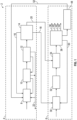
- FIG 1 is an exemplary flowchart for a system and process of a combined methanol- to-propylene (MTP) plant and a steam cracker plant with selective recycled fluids.
- MTP methanol-to-propylene
- the system 2 and associated process includes a portion that functionally can be described as a methanol-to-propylene ("MTP") plant 2 and a portion that functionally can be described as a steam cracker plant 6.
- MTP methanol-to-propylene
- the MTP plant is shown as a separate unit from the steam cracker plant. While physical separation is possible, it is envisioned that in at least one embodiment of the combined plant will be integrally connected in operation with each other and thus the demarcation is along functional lines.
- the feedstock such as methanol
- the feedstock can be provided to a catalytic MTP reactor 8.
- the intermediate process stream from the MTP reactor 8 can flow through a quencher 10 with internal water cycle to cool the stream and condense reaction water and then to a compressor 12. Some of the water from the quencher can be recycled to the MTP reactors. Excess reaction water from the methanol dehydration in the catalytic reactor can be discharged from the quencher 10 into a water stream conduit 22.
- the quencher removes already some of the oxygenates from the reactor effluent. These are normally recovered from the water for example in a column before it is discharged.
- the compressor 12 can be a multi-stage compressor that usually has intermediate cooling and partial condensation. Some of the water separated from the condensate in the compressor 12 can be recycled to the quencher 10 and excess water can be discharged into the water stream conduit 22.
- the intermediate product streams (hydrocarbon vapour and hydrocarbon liquid) from the compressor 12 can be provided to an MTP separation section 14 for a process of fractionation and additional oxygenates removal.
- the MTP separation section 14 generally includes the fractionation columns and other separation equipment and associated equipment used in the MTP plant to separate the different components in the catalytic reactor effluent into product streams and intermediate product streams. In the MTP separation section, oxygenates can be removed from at least the heavy organic phase (gasoline).
- the separation section 14 can also produce a hydrocarbon stream of various hydrocarbons, preferably C4, C5, and/or C6 that can be recycled back through a conduit 16 into the MTP reactor 8.
- the separation section 14 can separate oxygenates so that the streams sent to the steam cracker plant 6 through conduits 18 and 20 have only trace components of oxygenates that will not harm the steam cracker operation. The oxygenates are recycled back to the MTP reactor.
- the conduit 18 can flow intermediate process streams C5 and heavier components as gasoline and/or C4 components.
- the conduit 20 can flow lighter products, C2, or C3, light ends, or a combination thereof as a light end intermediate process stream.
- the gasoline (and LPG) as an intermediate process stream can be routed to a cracking furnace 30 in the steam cracker plant 6 and added to the primary feedstock ethane that is fed to the cracking furnace 30.
- a cracking furnace 30 in the steam cracker plant 6
- one or more furnaces other than a cracking furnace for the ethane feedstock may be required to convert the intermediate process streams C5 and heavier.
- the light end stream of the light ends, C2, C3, or a combination thereof can be directed into a compressor 34 in the steam cracker plant 6 as described above.
- Methods for reducing the olefin content in the intermediate process in the MTP plant can vary as would be known to those with ordinary skill in the art and can comprise distillation and extraction steps. Examples of such steps are described in US Pat. No. 8,058,498 and US Application No. 2013/0060073 A1 .
- the feedstock ethane and the combination of the LPG and gasoline through conduit 18 is at least partially cracked in the cracking furnace 30 and sent to a quencher 32.
- the intermediate process stream from the separation section 14 of the MTP plant having the light ends and C2s and C3s flows through conduit 20 into the compressor 34.
- the intermediate process stream in the conduit 20 can be combined with an intermediate process stream from the quencher 32 that flows into the compressor 34.
- the intermediate product stream from the compressor 34 is sent to a cracker separation section 36.
- the cracker separation section 36 can include a caustic wash, dryer, C2 hydrogenator, and/or the fractionation columns and other separation equipment and associated equipment used in the steam cracker plant to separate the different components in the cracking furnace effluent into product streams and intermediate product streams.
- the product streams from the separation section 36 include a conduit 38 that can flow fuel gas, a conduit 40 that flow ethylene, a conduit 42 that can flow propylene, and a conduit 44 that can flow pyrolysis gasoline (“pygas”) and/or fuel oil.
- the C4 components can be cut in a fractionation step and optionally sent to a hydrogenator 48 as an intermediate process stream forming a cut stream of one or more by-products.
- the hydrogenator 48 can selectively hydrogenate di- olefins in the C4 intermediate process stream to convert the di-olefins into olefins and increase the C4 olefins content of this stream, thus forming an olefin-rich stream.
- Such an intermediate process stream can flow via a conduit 52 back to the MTP reactor 8 of the MTP plant 4 to assist in optimizing the selectivity of the streams toward light olefins, in particular propylene.
- an intermediate process stream of ethane and propane components from the separation section 36 can be recycled through a conduit 50 back to the cracking furnace 30 to mix with the incoming feedstock ethane and the intermediate process stream of gasoline (and LPG), as described above.
- Figure 2 is another exemplary flowchart for a system and process of a combined methanol-to-propylene (MTP) plant and a steam cracker plant with selective recycled fluids. While Figure 1 shows an exemplary embodiment as a retrofit assembly to existing plants, Figure 2 shows an exemplary embodiment of a combined system and process that has been designed with the combination in mind.
- the steam cracker unit 6 includes a liquid cracking furnace separate from a gas cracking furnace for more optimization of the recycled intermediate process streams. The system overall is similar to that described for Figure 1 .
- the methanol feedstock is delivered to the MTP reactor 8 to produce an intermediate process stream that is quenched in the quencher 10, compressed in the compressor 12, and then purified and depleted from oxygenates in the MTP separation section 14.
- the separation produces a hydrocarbon stream of C4, C5 and/or C6 that is recycled back through the conduit 16 into the MTP reactor.
- the separation section 14 produces a process stream through conduit 24 of propylene.
- the separation section 14 also produces gasoline (and LPG of C3 and/or C4) as an intermediate process stream in the conduit 18 that can be sent to a liquid cracking furnace 30A of the stream cracker plant 6.
- the LPG in this process can include propane as a lighter fluid than the process in Figure 1 .
- light ends and C2s from the separation section 14 can flow through the conduit 20 into the compressor 34.
- the intermediate process stream from the liquid cracking furnace 30A can flow into the quencher 32.
- the ethane feedstock is directed into a gas cracking furnace 30B.
- the intermediate process stream exiting the gas cracking furnace is directed also into the quencher 32 and intermixes with the intermediate process stream from the liquid cracking furnace 30A.
- the combined quenched streams are sent into the compressor 34 where the combined intermediate process stream is further combined with the intermediate process stream in conduit 20 of light ends and C2s.
- the combined stream after compression is sent to the cracker separation section 36 that can include a caustic wash, dryer, C2 hydrogenator, and/or a fractionation columns. Different functions can be in one or more units that combine for the separation section 36.
- the product streams from the separation section 36 include a conduit 38 that can flow fuel gas, a conduit 40 that flow ethylene, and a conduit 44 that can flow pyrolysis gasoline ("pygas") and/or fuel oil.
- Other products can be used as intermediate process streams for further processing.
- an intermediate process stream of C3s, such as propane and propylene, from the cracker separation section 36 can be recycled through a conduit 42 back to the MTP separation section 14 in the MTP plant 4.
- an intermediate process stream of C4 components can be cut from the separation section 36 and selectively hydrogenated in the hydrogenator 48 to convert di- olefins into olefins and thus increasing the olefin content of this stream and forming a comparatively olefin-rich C4 product.
- This stream can then be recycled back through the conduit 52 into the MTP reactor 8.
- the hydrogenated C4 can be converted in the MTP process into C2 and C3 olefins.
- Another intermediate process stream generally containing ethane from the separation section 36 can be recycled through the conduit 50 into the gas cracking furnace 30B to combine with the feedstock ethane flowing therein.
- the intermediate process stream of C4 components generally is the C4 cut typically generated in the separation section of a steam cracker that contains C4 olefins and di-olefins in various concentrations. These concentrations depend significantly on cracker set-up, feedstock, and a potential integration with an olefin to propylene plant. Typical mass concentrations range from 50 % of di-olefins for a naphtha liquid cracker to 70% for an ethane gas cracker. The di-olefins can in some cases be extracted as butadiene and form a by-product.
- various examples have been calculated using simulation software for the MTP plant 4, and steam cracker plant 6 to compare the stand-alone plants and three steps of integration.
- the integration step 1 the light ends and C2's are sent as an intermediate process stream via conduit 20 and the C3 and C4 MTP by-products intermediate process streams are sent through conduit 18 and converted to light olefins by pyrolysis in the steam cracker plant 6.
- an MTP by-product, gasoline is sent as an intermediate process stream through conduit 18 and converted to light olefins by pyrolysis in the steam cracker plant 6.
- the steam cracker C4 cut by-product in the C4 hydrogenator 48 is converted to light olefins in the MTP reactor.
- the MTP C2s and light ends are recovered and fractionated in the steam cracker plant.
- the MTP ethane and the MTP LPG (C3/C4) are used as a supplemental feed to the cracking furnaces.
- Step 2 In a second integration step further to the integration described in step 1, the MTP gasoline is sent to the steam cracker plant to feed a liquid cracking furnace, using Technip GK6 ® coil technology in this study case. Since the MTP gasoline contains very low amounts of di-olefins, no partial or full hydrogenation of the stream is required prior to feeding it to the cracking furnace. Once-through steam cracking yields evaluated with Technip's SPYRO ® software show that approximately 30% of the MTP gasoline can be directly converted to light olefins. In a stand-alone MTP plant, the gasoline product is normally used as low sulfur blend stock for gasoline pools.
- a further improvement of the gasoline conversion to light olefins could be achieved through hydrogenation of the MTP gasoline before feeding it to the steam cracker plant.
- This hydrogenation step to convert olefins into paraffins could be done to further increase the cracking yields to ethylene and propylene.
- Integration Step 3 In a third integration step, the olefin-rich streams from the steam cracker plant are sent to the MTP reactor for conversion to propylene, using preferably the C4 cut from the steam cracker plant. In general, conversion of the C4 cut is in competition with other potential uses of the stream, such as extraction of butadiene or recycle of the C4 stream to the cracking furnaces. For the third integration step, the recycle of the full C4 cut after partial hydrogenation of the di-olefins is shown.
- One or more other olefin-rich streams from the steam cracker plant can also be used as feed to the MTP reactor as well, provided the stream does not contain significant amounts of di-olefins or aromatics.
- the first integration step leads to a slightly lower propylene production. While this result may seem surprising, it is actually in line with a preference of increasing the light olefins production. It is a deliberate result from design simplifications made in the integrated MTP unit.
- the integration step 3 can 5 boost the light olefins production (ethylene + propylene) by almost 10% while reducing the quantity of by-products by nearly 30%.
Landscapes
- Chemical & Material Sciences (AREA)
- Organic Chemistry (AREA)
- Oil, Petroleum & Natural Gas (AREA)
- Physics & Mathematics (AREA)
- Thermal Sciences (AREA)
- Engineering & Computer Science (AREA)
- Chemical Kinetics & Catalysis (AREA)
- General Chemical & Material Sciences (AREA)
- Organic Low-Molecular-Weight Compounds And Preparation Thereof (AREA)
- Production Of Liquid Hydrocarbon Mixture For Refining Petroleum (AREA)
- Separation By Low-Temperature Treatments (AREA)
Abstract
Description
- The disclosure generally relates to the production of olefins and recycling specific product streams for greater production and efficiency. More specifically, the disclosure relates to the increased production of ethylene and propylene from a combination of a methanol to propylene (MTP) plant and a steam cracker plant and selective streams for recycling.
- Since the early production of olefins based synthetic polymers in the 1950's, the demand has steadily increased. Olefins, including ethylene and propylene, are the raw material for the production of long-chain synthetic polymers that can be created when ethylene and/or propylene gases are polymerized under specific conditions. Historically, steam cracking has been used to break bonds in longer chain molecules using feedstock such as ethane, propane, butane, naphtha and others. In recent years there is a trend to use lighter feedstock, especially ethane, for steam cracking. This trend will result in a shift of the ethylene to propylene ratio towards ethylene and therefore, a driver for on-purpose production of propylene. The art has progressed to using catalytic reactors to produce more propylene than the steam cracking process. For example
US Pubi. No. 2010/0234655A describes a process known as methanol-to-propylene (MTP) that is able to produce selectively a high amount of propylene by converting oxygenates into hydrocarbons. This technology is a catalytic process to produce on-purpose propylene using natural gas, coal or biomass as feedstocks. These alternative feedstocks are first converted to synthesis gas which is cleaned and then converted to methanol. Methanol in turn is converted to DME (dimethyl ether) which is used to produce a propylene-rich mixture containing various hydrocarbons. These various hydrocarbons are conditioned and fractionated into propylene and other components including ethylene if desired, LPG, and gasoline. From the outset, the MTP process had been based on a tailor made ZSM-5 zeolite catalyst. Efforts then began to combine the two processes. -
US Publication No. 2010/0206771 teaches a combination of an MTP process and a steam cracking process. This publication teaches: "For the production of hydrocarbons, in particular C2-C4 olefins, using a combined plant with a steam cracker and at least one reactor for converting an educt mixture which includes steam and at least one oxygenate the respective intermediate product streams of the steam cracker and of the reactor are at least partly combined. To increase the yield of valuable products, a shape-selective zeolite material is used as catalyst in the reactor for oxygenate conversion and at least a part of the product streams obtained downstream of the combined plant is recirculated to the steam cracker and/or the reactor." -
US Publication No. 2015/0158783 also teaches a combination. This publication teaches: "The present invention provides an integrated process for the preparation of olefins, which process comprises the steps of: (a) reacting an oxygenate and/or olefinic feed in a reactor to form an effluent which comprises olefins; (b) fractionating at least part of the effluent into two olefinic product fractions; (c) subjecting a hydrocarbon feedstock in a reactor to a steam cracking process to form an effluent which comprises olefins including butadiene; (d) combining at least part of the first olefinic product fraction as obtained in step (b) and at least part of the second effluent which comprises olefins as obtained in step (c) to form a combined olefinic product stream comprising at least ethylene, propylene and butadiene; and (e) separating at least part of the combined olefinic product stream as obtained in step (d) to form a fraction comprising ethylene and/or propylene and a fraction that comprises butadiene." - However, these combinations do not maximize ethylene and propylene regarding the management of the recycling of the different streams produced during the reaction. Therefore, there remains a need to further improve the production of ethylene and propylene from selective recycling of streams in a combined system and process.
- The present disclosure provides a system and a method for recycling one or more intermediate product streams of at least gasoline from the MTP plant to the steam cracker plant for processing with the feedstock of the steam cracker plant to generate a higher selectivity of ethylene and propylene. The steam cracker feedstock can be ethane.
- In general, an MTP plant rejects by-products rich in paraffins and in particular ethane, propane, and butanes as well as an aliphatic-rich C5/C6/C7+ intermediate process stream. These MTP by-products are converted in a steam cracker plant. This conversion by pyrolysis not only produces additional light olefins, such as ethylene and propylene, but it also increases an olefin-rich C4 cut by-product that is recycled back to the MTP plant. This process is a synergistic process as the olefin-rich recycled stream allows a higher propylene yield in the MTP plant than in the steam cracker plant. The paraffin/aliphatic-rich streams from the MTP plant provide a high light olefins yield in the steam cracker plant. In addition, the ethylene produced by the MTP reactor can be recovered directly in the steam cracker plant as a main olefin product. The MTP reactor and design can be optimized to maximize the combined light olefin production (ethylene and propylene) instead of only maximizing the propylene production. Surprisingly, such an integration results not only in reduced specific investment and utilities, but also in more light olefins than the stand-alone MTP plant or steam cracker plant together.
- The by-products from the MTP plant contain some olefins; however, they also contain an important amount of aliphatic components. This composition makes the by-products better suitable for reaction in the steam cracker plant, where aliphatic components can be thermally cracked to light olefins. The by-product streams from the MTP plant can be fed to the stream cracker plant to increase light olefin production by pyrolysis. The MTP plant can flow a C3 intermediate process stream containing light olefin/paraffin products with a carbon number of 3 or less and by-product streams such as a C4 intermediate product stream and a C5/C6/C7+ intermediate process stream to the steam cracker plant for further purification and/or reaction. The streams sent to the steam cracker are advantageously low in oxygenates. The steam cracker plant has a C4 product stream that contains predominately di-olefins and is not suitable to be fed back into the MTP plant without further processing. With selected hydrogenation of the di-olefins, the C4 product becomes a feedstock rich in C4 olefins that can be converted into C2 and C3 olefins in the MTP reactor.
- The integration of an MTP plant can be added to an existing steam cracker plant that has undergone a change of feedstock from LPG or naphtha to ethane. Conversely, a steam cracker can be added to an existing MTP plant. In the same way, the intentional joint installation of a steam cracker and an MTP plant is possible.
- The disclosure provides a process of producing hydrocarbons from a combined plant made of an oxygenates-to-propylene, preferably a methanol to propylene ("MTP"), plant having at least a catalytic reactor and a steam cracker plant, comprising: flowing a stream having a least a portion of oxygenate into the catalytic reactor; purifying an intermediate process stream from the reactor to reduce oxygenates in a separation section, including gasoline of at least C5 or heavier; flowing at least a portion of the hydrocarbons, including the gasoline, to a cracking furnace; purifying an intermediate process stream from the cracking furnace into at least one process stream having ethylene, and an intermediate process stream of at least C4, C5, or a combination thereof as a cut stream from the separation section; and recycling the cut stream to the catalytic reactor.
- The disclosure also provides a process of producing hydrocarbons from a combined plant of an oxygenate-to-propylene, preferably methanol to propylene ("MTP"), plant having at least a catalytic reactor and a steam cracker plant having at least a cracking furnace, comprising: keeping at least the section of effluent intermediate process streams that are purified from the MTP reactor to reduce oxygenates, independent from intermediate process streams that are purified from the cracking furnace; flowing at least one intermediate process stream of at least a portion of MTP plant by-products to the steam cracker plant; converting the MTP plant by-products in the steam cracker plant using thermal pyrolysis to produce ethylene, propylene, or a combination thereof, and a C4 cut by-product containing di-olefins and olefins; selectively hydrogenating the C4 cut by-product containing di-olefins in the steam cracker plant to convert the di-olefins into olefins and increase the C4 olefins content of this stream; and recycling the steam cracker olefin-rich C4 product to the MTP reactor for conversion of the olefins in the C4 product to ethylene, propylene, or a combination thereof, and other MTP reaction by-products, such as propane and pentane, hexane, pentene, and hexene.
- The disclosure further provides a system for producing hydrocarbons from a combined plant, comprising: an oxygenate-to-propylene, preferably a methanol to propylene ("MTP"), plant having at least a catalytic reactor and an MTP separation section, the MTP separation section configured to remove oxygenates from at least gasoline; a steam cracker plant having at least a cracking furnace and a cracker separation section; a conduit fluidicly configured to flow the gasoline from the MTP separation section to the cracking furnace, and converting the gasoline in the steam cracker plant using thermal pyrolysis to produce ethylene, propylene, or a combination thereof.
-
-
Figure 1 is an exemplary flowchart for a system and process of a combined methanol- to-propylene (MTP) plant and a steam cracker plant with selective recycled fluids. -
Figure 2 is another exemplary flowchart for a system and process of a combined methanol-to-propylene (MTP) plant and a steam cracker plant with selective recycled fluids. - The Figures described above and the written description of specific structures and functions below are not presented to limit the scope of what Applicant has invented or the scope of the appended claims. Rather, the Figures and written description are provided to teach any person skilled in the art to make and use the inventions for which patent protection is sought. Those skilled in the art will appreciate that not all features of a commercial embodiment of the inventions are described or shown for the sake of clarity and understanding. Persons of skill in this art will also appreciate that the development of an actual commercial embodiment incorporating aspects of the present disclosure will require numerous implementation-specific decisions to achieve the developer's ultimate goal for the commercial embodiment. Such implementation-specific decisions may include, and likely are not limited to, compliance with system-related, business-related, government-related and other constraints, which may vary by specific implementation, location and from time to time. While a developer's efforts might be complex and time-consuming in an absolute sense, such efforts would be, nevertheless, a routine undertaking for those of ordinary skill in this art having benefit of this disclosure. It must be understood that the inventions disclosed and taught herein are susceptible to numerous and various modifications and alternative forms. The use of a singular term, such as, but not limited to, "a," is not intended as limiting of the number of items. Further, the various methods and embodiments of the system can be included in combination with each other to produce variations of the disclosed methods and embodiments. Discussion of singular elements can include plural elements and vice-versa. References to at least one item may include one or more items. Also, various aspects of the embodiments could be used in conjunction with each other to accomplish the understood goals of the disclosure. Unless the context requires otherwise, the term "comprise" or variations such as "comprises" or "comprising," should be understood to imply the inclusion of at least the stated element or step or group of elements or steps or equivalents thereof, and not the exclusion of a greater numerical quantity or any other element or step or group of elements or steps or equivalents thereof. The device or system may be used in a number of directions and orientations. The order of steps can occur in a variety of sequences unless otherwise specifically limited. The various steps described herein can be combined with other steps, interlineated with the stated steps, and/or split into multiple steps. Similarly, elements have been described functionally and can be embodied as separate components or can be combined into components having multiple functions. The term "product stream" means the fluid stream that leaves the MTP plant or the steam cracker plant as a product, such as ethylene, propylene, fuel gas or fuel oil. The term "intermediate product stream" means a fluid stream between components of the system, including those that are recycled between the MTP plant and the steam cracker plant. In some instances, all or a portion of fluid stream can be used as a product or one for recycling. Some elements are nominated by a device name for simplicity and would be understood to include a system or a section, such as a "quencher" would encompass a quenching system or quenching section, and so forth.
- The present disclosure provides a system and method for recycling an intermediate product stream of at least gasoline from the MTP plant to the steam cracker plant for processing with the feedstock of the steam cracker plant to generate a higher percentage of ethylene and propylene. The steam cracker feedstock can be ethane.
- In at least one embodiment, the process and associated system can be summarized as follows: combining an MTP plant with a steam cracker plant; keeping at least the section of the separation section of the MTP reactor effluent streams that removes oxygenates independent from the steam cracker separation section, converting all or part of the MTP plant by-products (including paraffins, unreacted C4/C5/C6/C7+ olefins, other C4/C5/C6/C7+ aliphatic components, ethane and propane) in the steam cracker plant using thermal pyrolysis to produce light olefins (ethylene and propylene) and C4 and C5 cuts by-products; selectively hydrogenating the C4 cut by-product (and optionally the C5 cut by-product) in the steam cracker plant to convert di-olefins into olefins and produce an olefin-rich C4 product (and optionally an olefin-rich C5 product); and recycling the steam cracker olefin-rich C4 product (and optionally the olefin-rich C5 product) to the MTP reactor for conversion of the C4 (and optionally C5) olefins to light olefins (ethylene and propylene).
- Advantageously, the operation and design of the MTP plant can be focused on a maximum light olefins production (ethylene and propylene). This focus can include not recycling any stream containing significant amounts of ethylene to the MTP reactor. In other words, the ethylene and propylene productions can be increased by: cracking the MTP byproducts in the steam cracker plant and feeding the MTP reactor with the steam cracker C4 (and optionally C5) olefin by-product. The invention will work with: stand-alone MTP plants based on a methanol feed, integrated gas-to-propylene plants (reforming and methanol plant and MTP plants integrated), integrated coal-to-propylene plants (coal gasification, synthesis gas cleaning, methanol synthesis and MTP synthesis integrated), and any other oxygenate to olefin process. Not all products need to be recycled in the described way. Depending on market conditions, the system and process can be modified to selectively produce various percentages (including zero percent) of the exemplary product streams.
-
Figure 1 is an exemplary flowchart for a system and process of a combined methanol- to-propylene (MTP) plant and a steam cracker plant with selective recycled fluids. The arrangement could exemplify integrating an olefin-to-propylene plant with a cracker for a retrofit solution. Referring toFigure 1 , thesystem 2 and associated process includes a portion that functionally can be described as a methanol-to-propylene ("MTP")plant 2 and a portion that functionally can be described as a steam cracker plant 6. The MTP plant is shown as a separate unit from the steam cracker plant. While physical separation is possible, it is envisioned that in at least one embodiment of the combined plant will be integrally connected in operation with each other and thus the demarcation is along functional lines. - Starting with the MTP plant 4, the feedstock, such as methanol, can be provided to a catalytic MTP reactor 8. (To improve operation conditions in the MTP reactor, it may be useful to at least partially convert methanol to DME in a catalytic reactor upstream the MTP reactor, using processes known to those with ordinary skill in the art.) The intermediate process stream from the MTP reactor 8 can flow through a
quencher 10 with internal water cycle to cool the stream and condense reaction water and then to acompressor 12. Some of the water from the quencher can be recycled to the MTP reactors. Excess reaction water from the methanol dehydration in the catalytic reactor can be discharged from thequencher 10 into awater stream conduit 22. The quencher removes already some of the oxygenates from the reactor effluent. These are normally recovered from the water for example in a column before it is discharged. Thecompressor 12 can be a multi-stage compressor that usually has intermediate cooling and partial condensation. Some of the water separated from the condensate in thecompressor 12 can be recycled to thequencher 10 and excess water can be discharged into thewater stream conduit 22. The intermediate product streams (hydrocarbon vapour and hydrocarbon liquid) from thecompressor 12 can be provided to anMTP separation section 14 for a process of fractionation and additional oxygenates removal. TheMTP separation section 14 generally includes the fractionation columns and other separation equipment and associated equipment used in the MTP plant to separate the different components in the catalytic reactor effluent into product streams and intermediate product streams. In the MTP separation section, oxygenates can be removed from at least the heavy organic phase (gasoline). - The
separation section 14 can also produce a hydrocarbon stream of various hydrocarbons, preferably C4, C5, and/or C6 that can be recycled back through aconduit 16 into the MTP reactor 8. Theseparation section 14 can separate oxygenates so that the streams sent to the steam cracker plant 6 throughconduits conduit 18 can flow intermediate process streams C5 and heavier components as gasoline and/or C4 components. Theconduit 20 can flow lighter products, C2, or C3, light ends, or a combination thereof as a light end intermediate process stream. In at least one embodiment, the gasoline (and LPG) as an intermediate process stream can be routed to a crackingfurnace 30 in the steam cracker plant 6 and added to the primary feedstock ethane that is fed to the crackingfurnace 30. Depending on the composition of the intermediate process streams from the MTP plant 4, one or more furnaces other than a cracking furnace for the ethane feedstock may be required to convert the intermediate process streams C5 and heavier. Further, the light end stream of the light ends, C2, C3, or a combination thereof can be directed into acompressor 34 in the steam cracker plant 6 as described above. - Methods for reducing the olefin content in the intermediate process in the MTP plant can vary as would be known to those with ordinary skill in the art and can comprise distillation and extraction steps. Examples of such steps are described in
US Pat. No. 8,058,498 andUS Application No. 2013/0060073 A1 . - The feedstock ethane and the combination of the LPG and gasoline through
conduit 18 is at least partially cracked in the crackingfurnace 30 and sent to aquencher 32. The intermediate process stream from theseparation section 14 of the MTP plant having the light ends and C2s and C3s flows throughconduit 20 into thecompressor 34. The intermediate process stream in theconduit 20 can be combined with an intermediate process stream from thequencher 32 that flows into thecompressor 34. The intermediate product stream from thecompressor 34 is sent to acracker separation section 36. Thecracker separation section 36 can include a caustic wash, dryer, C2 hydrogenator, and/or the fractionation columns and other separation equipment and associated equipment used in the steam cracker plant to separate the different components in the cracking furnace effluent into product streams and intermediate product streams. Different functions can be in one or more units that combine for theseparation section 36. The product streams from theseparation section 36 include aconduit 38 that can flow fuel gas, aconduit 40 that flow ethylene, aconduit 42 that can flow propylene, and aconduit 44 that can flow pyrolysis gasoline ("pygas") and/or fuel oil. - Also, in the
separation section 36, the C4 components can be cut in a fractionation step and optionally sent to ahydrogenator 48 as an intermediate process stream forming a cut stream of one or more by-products. Thehydrogenator 48 can selectively hydrogenate di- olefins in the C4 intermediate process stream to convert the di-olefins into olefins and increase the C4 olefins content of this stream, thus forming an olefin-rich stream. Such an intermediate process stream can flow via aconduit 52 back to the MTP reactor 8 of the MTP plant 4 to assist in optimizing the selectivity of the streams toward light olefins, in particular propylene. Also, an intermediate process stream of ethane and propane components from theseparation section 36 can be recycled through aconduit 50 back to the crackingfurnace 30 to mix with the incoming feedstock ethane and the intermediate process stream of gasoline (and LPG), as described above. -
Figure 2 is another exemplary flowchart for a system and process of a combined methanol-to-propylene (MTP) plant and a steam cracker plant with selective recycled fluids. WhileFigure 1 shows an exemplary embodiment as a retrofit assembly to existing plants,Figure 2 shows an exemplary embodiment of a combined system and process that has been designed with the combination in mind. In at least one aspect, the steam cracker unit 6 includes a liquid cracking furnace separate from a gas cracking furnace for more optimization of the recycled intermediate process streams. The system overall is similar to that described forFigure 1 . - In the MTP plant 4, the methanol feedstock, potentially after a first reaction step in a DME prereactor, is delivered to the MTP reactor 8 to produce an intermediate process stream that is quenched in the
quencher 10, compressed in thecompressor 12, and then purified and depleted from oxygenates in theMTP separation section 14. These steps have been described in paragraph [0026] in a more detail that can be applicable here as well. The separation produces a hydrocarbon stream of C4, C5 and/or C6 that is recycled back through theconduit 16 into the MTP reactor. Theseparation section 14 produces a process stream throughconduit 24 of propylene. Theseparation section 14 also produces gasoline (and LPG of C3 and/or C4) as an intermediate process stream in theconduit 18 that can be sent to aliquid cracking furnace 30A of the stream cracker plant 6. The LPG in this process can include propane as a lighter fluid than the process inFigure 1 . Also, light ends and C2s from theseparation section 14 can flow through theconduit 20 into thecompressor 34. The intermediate process stream from theliquid cracking furnace 30A can flow into thequencher 32. - The ethane feedstock is directed into a
gas cracking furnace 30B. The intermediate process stream exiting the gas cracking furnace is directed also into thequencher 32 and intermixes with the intermediate process stream from theliquid cracking furnace 30A. The combined quenched streams are sent into thecompressor 34 where the combined intermediate process stream is further combined with the intermediate process stream inconduit 20 of light ends and C2s. The combined stream after compression is sent to thecracker separation section 36 that can include a caustic wash, dryer, C2 hydrogenator, and/or a fractionation columns. Different functions can be in one or more units that combine for theseparation section 36. The product streams from theseparation section 36 include aconduit 38 that can flow fuel gas, aconduit 40 that flow ethylene, and aconduit 44 that can flow pyrolysis gasoline ("pygas") and/or fuel oil. Other products can be used as intermediate process streams for further processing. For example, an intermediate process stream of C3s, such as propane and propylene, from thecracker separation section 36 can be recycled through aconduit 42 back to theMTP separation section 14 in the MTP plant 4. Also, an intermediate process stream of C4 components, including di-olefins, can be cut from theseparation section 36 and selectively hydrogenated in thehydrogenator 48 to convert di- olefins into olefins and thus increasing the olefin content of this stream and forming a comparatively olefin-rich C4 product. This stream can then be recycled back through theconduit 52 into the MTP reactor 8. The hydrogenated C4 can be converted in the MTP process into C2 and C3 olefins. Another intermediate process stream generally containing ethane from theseparation section 36 can be recycled through theconduit 50 into thegas cracking furnace 30B to combine with the feedstock ethane flowing therein. - The intermediate process stream of C4 components, including di-olefins, generally is the C4 cut typically generated in the separation section of a steam cracker that contains C4 olefins and di-olefins in various concentrations. These concentrations depend significantly on cracker set-up, feedstock, and a potential integration with an olefin to propylene plant. Typical mass concentrations range from 50 % of di-olefins for a naphtha liquid cracker to 70% for an ethane gas cracker. The di-olefins can in some cases be extracted as butadiene and form a by-product. For the integration with a MTP plant, it is advantageous to selectively hydrogenate the di-olefins to olefins that react well in the catalytic reactor of the MTP plant and increase light olefin yield. If a butadiene extraction is performed for site-specific reasons, it is possible to send the butadiene-depleted C4 stream, or fractions of it, to the MTP plant.
- To describe some of the benefits of the invention, various examples have been calculated using simulation software for the MTP plant 4, and steam cracker plant 6 to compare the stand-alone plants and three steps of integration. For the
integration step 1 , the light ends and C2's are sent as an intermediate process stream viaconduit 20 and the C3 and C4 MTP by-products intermediate process streams are sent throughconduit 18 and converted to light olefins by pyrolysis in the steam cracker plant 6. Forintegration step 2, additionally an MTP by-product, gasoline, is sent as an intermediate process stream throughconduit 18 and converted to light olefins by pyrolysis in the steam cracker plant 6. For the integration step 3, in addition to the integration described asstep C4 hydrogenator 48 is converted to light olefins in the MTP reactor. - The different measures described in the three steps can be combined differently. Not all activities of one step have to be done together and the steps do not have to be staged as described above or in the examples. The optimum solution for each integration heavily depends on the actual design and feedstock of the steam cracker plant and other local conditions.
- An MTP - steam cracker integration for a grassroot plant has been studied. As reference, two stand-alone units are considered with middle of run catalysts' conditions and an on-stream factor is 8,400 hours per year.
- Three sequential degrees of integration will be applied to a grassroot study case which combines two separate and independent grassroot units:
- Lurgi MTP™ unit with a name plate capacity of 1,410 TPD propylene based on 5,000 TPD methanol feed.
- Gas Steam Cracker unit, producing 1,000 kTA ethylene, ethane feed, Technip SMK™ cracking furnaces, ethane and propane recycled to extinction.
- Reference: The Overall Material Balance for the two stand-alone units is shown in Table 1, considering middle of run catalysts' conditions and an on-stream factor is 8,400 hr / year.
Table 1 Stand-alone Steam Cracker + Stand-alone MTP Overall Material Balance Hydrocarbons Products Cracker kTA MTP kTA Total kTA wt% Ethylene 1,000 26.4 1,026 50.0% Propylene 22.5 500 523 25.4% Fuel Gas 197 13.2 210 10.2% Raw C4 Cut / LPG 35.8 37.2 73.0 3.6% Pygas / Gasoline 30.1 188 218 10.6% Fuel Oil 3.9 - 3.9 0.2% Total Hydrocarbons 1,289 765 2,054 100% - In this step,:
- the MTP C2s and lighter are sent to the steam cracker plant upstream of the caustic wash,
- the cracker C3 cut is sent to the
separation section 14 in the MTP unit, - The propane from the
separation section 14, which now combines the propane generated in the MTP reactor and the propane generated in the steam cracker furnaces, is mixed with the MTP C4s. This C3/C4 mixture, which has also been subjected to enhanced oxygenate recovery, is sent to the cracking furnaces in the steam cracker plant. - With this configuration, the MTP C2s and light ends are recovered and fractionated in the steam cracker plant. In the end, the MTP ethane and the MTP LPG (C3/C4) are used as a supplemental feed to the cracking furnaces.
- Integration Step 2: In a second integration step further to the integration described in
step 1, the MTP gasoline is sent to the steam cracker plant to feed a liquid cracking furnace, using Technip GK6® coil technology in this study case. Since the MTP gasoline contains very low amounts of di-olefins, no partial or full hydrogenation of the stream is required prior to feeding it to the cracking furnace. Once-through steam cracking yields evaluated with Technip's SPYRO® software show that approximately 30% of the MTP gasoline can be directly converted to light olefins. In a stand-alone MTP plant, the gasoline product is normally used as low sulfur blend stock for gasoline pools. A further improvement of the gasoline conversion to light olefins could be achieved through hydrogenation of the MTP gasoline before feeding it to the steam cracker plant. This hydrogenation step to convert olefins into paraffins could be done to further increase the cracking yields to ethylene and propylene. - Integration Step 3: In a third integration step, the olefin-rich streams from the steam cracker plant are sent to the MTP reactor for conversion to propylene, using preferably the C4 cut from the steam cracker plant. In general, conversion of the C4 cut is in competition with other potential uses of the stream, such as extraction of butadiene or recycle of the C4 stream to the cracking furnaces. For the third integration step, the recycle of the full C4 cut after partial hydrogenation of the di-olefins is shown. One or more other olefin-rich streams from the steam cracker plant can also be used as feed to the MTP reactor as well, provided the stream does not contain significant amounts of di-olefins or aromatics.
- Integration Steps results: Compared to two stand-alone units, the first integration step leads to a slightly lower propylene production. While this result may seem surprising, it is actually in line with a preference of increasing the light olefins production. It is a deliberate result from design simplifications made in the integrated MTP unit. The integration step 3 can 5 boost the light olefins production (ethylene + propylene) by almost 10% while reducing the quantity of by-products by nearly 30%.
Table 2 MTP - Steam Cracker Integration Grassroot Study Case Integration Steps Summary Products kTA Stand-alone 1 + 1 Step 1Step 2Step 3 Ethylene 1,026 1,086 1,120 1,132 Propylene 523 507 533 556 Total Light Olefins 1,549 1,593 1,653 1,688 + 3% + 7% + 9% Fuel Gas 210 218 237 245 Raw C4 Cut / LPG including Butadiene 73 36 54 0 24.8 25.5 33.3 0 Pygas / Gasoline 218 203 80 88 Fuel Oil 4 4 30 33 Total By-Products 505 461 401 366 -9% -21% - 28% Total Hydrocarbons 2,054 2,054 2,054 2,054 - Other and further embodiments utilizing one or more aspects of the invention described above can be devised without departing from the spirit of Applicant's invention. For example, the processes and system can be varied to produce various percentages of some products io over other products, along with other variations can occur in keeping within the scope of the claims.
- The invention has been described in the context of preferred and other embodiments and not every embodiment of the invention has been described. Obvious modifications and alterations to the described embodiments are available to those of ordinary skill in the art. The disclosed and undisclosed embodiments are not intended to limit or restrict the scope or applicability of the invention conceived of by the Applicant, but rather, in conformity with the patent laws, Applicant intends to protect fully all such modifications and improvements that come within the scope or range of equivalents of the following claims.
Claims (9)
- A process of producing hydrocarbons from a combined plant of a methanol-to-propylene ("MTP") plant having at least an MTP catalytic reactor and a steam cracker plant having at least a steam cracking furnace, the process comprising the steps of:keeping at least a portion of effluent intermediate process streams that are purified from the MTP catalytic reactor to reduce oxygenates independent from intermediate process streams that are purified from the steam cracking furnace;obtaining an MTP plant by-products having at least oxygenate-reduced C5 hydrocarbons or heavier components from the portion of effluent intermediate process streams that are purified from the MTP catalytic reactor in a separation section;flowing at least a portion of the MTP plant by-products having at least oxygenate-reduced C5 hydrocarbons or heavier components from the separation section to the steam cracker plant, without passing through a catalytic reactor, that converts gasoline to ethylene; andconverting the at least a portion of the MTP plant by-products in the steam cracker plant (SCP) under conditions effective for thermal non-catalytic pyrolysis to produce an SCP intermediate process stream comprising ethylene and C4 di-olefins;purifying the SCP intermediate process stream to produce an ethylene stream and a C4 di-olefin stream;hydrogenating the C4 di-olefin stream to produce a C4 olefin stream; andrecycling the C4 olefin stream to the MTP catalytic reactor wherein C4 olefins within the C4 olefin stream are converted to propylene within the MTP catalytic reactor.
- The process of claim 1, wherein the purifying the second intermediate process stream further comprises separating at least one intermediate process stream of at least C4 hydrocarbons, C5 hydrocarbons, or a combination thereof as a second cut stream from the cracker separation section; and
the process further comprises recycling the second cut stream to the catalytic reactor. - The process of claim 2, further comprising hydrogenating at least a portion of the second cut stream.
- The process of claim 1, further comprising an absence of a step of hydrogenating the gasoline stream prior to the step of flowing at least a portion of the gasoline stream to the steam cracking furnace.
- The process of claim 1, further comprising a step of hydrogenating the gasoline stream prior to the step of flowing at least a portion of the gasoline stream to the steam cracking furnace.
- The process of claim 1, wherein the second intermediate process stream has a volumetric flow rate greater than that of the at least a portion of the gasoline stream flowed to the steam cracking furnace.
- The process of claim 1, wherein the second intermediate process stream is derived from the gasoline stream flowed to the steam cracking furnace and a separate ethane stream introduced to the steam cracking furnace.
- The process of claim 7, wherein during the step of purifying the second intermediate process stream, a first cut stream comprising the C4 di-olefin fraction is formed, wherein the process further comprises steps of hydrogenating the first cut stream to produce a C4 olefin stream; and recycling the C4 olefin stream to the catalytic reactor of the MTP plant, wherein C4 olefins are converted to propylene within the catalytic reactor, thereby increasing propylene content of the first intermediate process stream.
- A process for producing hydrocarbons from a combined plant of methanol-to-propylene ("MTP") plant having at least an MTP catalytic reactor and a steam cracker plant, the process comprising the steps of:introducing a feed stream comprising methanol and dimethyl ether ("DME") to the MTP catalytic reactor under conditions effective for producing a first intermediate process stream containing propylene, C4+ oxygenates, a light ends fraction, and gasoline, wherein the light end fraction comprises C2 hydrocarbons, C3 hydrocarbons, or a combination thereof;separating the first intermediate process stream using a fractionator into a propylene stream, an oxygenate recycle stream containing the C4+ oxygenates, a light end stream, and a gasoline stream;recycling the C4+ oxygenate stream to the MTP catalytic reactor;introducing the gasoline stream along with an ethane feedstock to a steam cracker furnace under conditions effective for producing a second intermediate process stream containing ethylene and a C4 di-olefin fraction, wherein the gasoline stream is introduced from the fractionator to the steam cracker furnace without passing through a catalytic reactor;compressing the light end stream and the second intermediate process stream and then introducing the light end stream and the second intermediate process stream into a cracker separation unit;withdrawing a fuel gas stream, an ethylene stream, a propylene stream, a pygas stream, a C2 hydrocarbon and C3 hydrocarbon stream, and a C4 di-olefin stream from the cracker separation unit;hydrogenating the C4 di-olefin stream in a hydrogenator under conditions effective for producing a C4 olefins stream; andrecycling the C4 olefins stream to the MTP catalytic reactor, wherein C4 olefins are converted to propylene within the MTP catalytic reactor, thereby increasing propylene content of the first intermediate process stream.
Applications Claiming Priority (3)
| Application Number | Priority Date | Filing Date | Title |
|---|---|---|---|
| US15/060,773 US10427990B2 (en) | 2016-03-04 | 2016-03-04 | Recycling system and process of a methanol-to-propylene and steam cracker plant |
| PCT/US2017/020653 WO2017152046A1 (en) | 2016-03-04 | 2017-03-03 | Recycling system and process of a methanol-to-propylene and steam cracker plant |
| EP17711497.2A EP3423546B1 (en) | 2016-03-04 | 2017-03-03 | Recycling process of a methanol-to-propylene and steam cracker plant |
Related Parent Applications (1)
| Application Number | Title | Priority Date | Filing Date |
|---|---|---|---|
| EP17711497.2A Division EP3423546B1 (en) | 2016-03-04 | 2017-03-03 | Recycling process of a methanol-to-propylene and steam cracker plant |
Publications (2)
| Publication Number | Publication Date |
|---|---|
| EP4438583A2 true EP4438583A2 (en) | 2024-10-02 |
| EP4438583A3 EP4438583A3 (en) | 2025-01-01 |
Family
ID=58347986
Family Applications (2)
| Application Number | Title | Priority Date | Filing Date |
|---|---|---|---|
| EP24195483.3A Pending EP4438583A3 (en) | 2016-03-04 | 2017-03-03 | Recycling system and process of a methanol-to-propylene and steam cracker plant |
| EP17711497.2A Active EP3423546B1 (en) | 2016-03-04 | 2017-03-03 | Recycling process of a methanol-to-propylene and steam cracker plant |
Family Applications After (1)
| Application Number | Title | Priority Date | Filing Date |
|---|---|---|---|
| EP17711497.2A Active EP3423546B1 (en) | 2016-03-04 | 2017-03-03 | Recycling process of a methanol-to-propylene and steam cracker plant |
Country Status (9)
| Country | Link |
|---|---|
| US (1) | US10427990B2 (en) |
| EP (2) | EP4438583A3 (en) |
| CN (1) | CN109477005B (en) |
| EA (1) | EA201891986A1 (en) |
| ES (1) | ES3000441T3 (en) |
| FI (1) | FI3423546T3 (en) |
| HU (1) | HUE069515T2 (en) |
| PT (1) | PT3423546T (en) |
| WO (1) | WO2017152046A1 (en) |
Families Citing this family (17)
| Publication number | Priority date | Publication date | Assignee | Title |
|---|---|---|---|---|
| WO2018004992A1 (en) | 2016-07-01 | 2018-01-04 | Res Usa, Llc | Conversion of methane to dimethyl ether |
| WO2018004993A1 (en) | 2016-07-01 | 2018-01-04 | Res Usa, Llc | Reduction of greenhouse gas emission |
| US9938217B2 (en) | 2016-07-01 | 2018-04-10 | Res Usa, Llc | Fluidized bed membrane reactor |
| CN111116290B (en) * | 2018-10-30 | 2023-04-07 | 中国石油化工股份有限公司 | Energy expanding method for olefin cracking device |
| CN109651043A (en) * | 2018-12-10 | 2019-04-19 | 中石化上海工程有限公司 | The method that naphtha and ethane cracking predepropanization are coupled with MTO |
| CN110157480B (en) * | 2019-05-10 | 2021-04-20 | 国家能源投资集团有限责任公司 | Value-added utilization method of high-carbon byproduct in process of preparing propylene from coal-based methanol and application of value-added utilization method |
| EP3976735A4 (en) | 2019-05-24 | 2023-03-15 | Eastman Chemical Company | CO-CRACKING OF PYROLYSIS OIL WITH ETHANE |
| US12018220B2 (en) | 2019-05-24 | 2024-06-25 | Eastman Chemical Company | Thermal pyoil to a gas fed cracker furnace |
| US11365357B2 (en) | 2019-05-24 | 2022-06-21 | Eastman Chemical Company | Cracking C8+ fraction of pyoil |
| EP4003948A4 (en) * | 2019-07-29 | 2023-09-06 | Eastman Chemical Company | CHANNEL WITH RECYCLED CONTENT (C4) |
| CN110527555B (en) * | 2019-09-27 | 2021-09-14 | 中石化上海工程有限公司 | System for ethylene is prepared to thermal cracking of wide fraction crude oil |
| CN114867826A (en) * | 2019-10-31 | 2022-08-05 | 伊士曼化工公司 | Methods and systems for forming a recovered component hydrocarbon composition |
| US12173237B2 (en) | 2019-10-31 | 2024-12-24 | Eastman Chemical Company | Processes and systems for formation of recycle-content hydrocarbon compositions |
| EP4051763A4 (en) | 2019-10-31 | 2024-03-20 | Eastman Chemical Company | METHODS AND SYSTEMS FOR THE FORMATION OF HYDROCARBON COMPOSITIONS WITH RECYCLED CONTENT |
| WO2021092293A1 (en) | 2019-11-07 | 2021-05-14 | Eastman Chemical Company | Recycle content oxo glycols |
| CN114644540A (en) * | 2020-12-18 | 2022-06-21 | 中国石油化工股份有限公司 | Device and method for preparing low-carbon olefin from alcohol |
| US20240425768A1 (en) * | 2021-10-07 | 2024-12-26 | Exxonmobil Chemical Patents Inc. | Pyrolysis Processes for Upgrading a Hydrocarbon Feed |
Citations (4)
| Publication number | Priority date | Publication date | Assignee | Title |
|---|---|---|---|---|
| US20100206771A1 (en) | 2007-09-21 | 2010-08-19 | Lurgi Gmbh | Process and plant for producing hydrocarbons |
| US8058498B2 (en) | 2004-10-29 | 2011-11-15 | Sandra Jensen | Device for removing oxygen-containing organic compounds from mixtures of various hydrocarbon compounds |
| US20130060073A1 (en) | 2010-05-20 | 2013-03-07 | Lurgi Gmbh | Method and system for producing low-oxygenate olefin flows |
| US20150158783A1 (en) | 2012-07-05 | 2015-06-11 | Shell Oil Company | Integrated process for the preparation of olefins |
Family Cites Families (12)
| Publication number | Priority date | Publication date | Assignee | Title |
|---|---|---|---|---|
| US4478709A (en) * | 1981-08-28 | 1984-10-23 | Mobil Oil Corporation | Process for stabilizing dewaxed distillate oils |
| KR100544880B1 (en) * | 2002-08-19 | 2006-01-24 | 주식회사 엘지화학 | Hydrocarbon Steam Pyrolysis Catalyst for Olefin Production, Method for Preparing the Olefin and Olefin Production Method Using the Same |
| WO2006063201A1 (en) * | 2004-12-10 | 2006-06-15 | Bhirud Vasant L | Steam cracking with naphtha dearomatization |
| DE102005015923B4 (en) | 2005-04-06 | 2014-12-04 | Air Liquide Global E&C Solutions Germany Gmbh | Process for the preparation of C2 to C4 olefins from an oxygenate and steam containing feed stream |
| CN102190545A (en) | 2010-03-03 | 2011-09-21 | 中国石油化工股份有限公司 | Method for utilizing byproducts in the process of preparing olefins from methanol |
| EP2601157B1 (en) * | 2010-08-03 | 2019-03-06 | Total Research & Technology Feluy | Combined process to make olefins from isobutanol |
| US20120041243A1 (en) * | 2010-08-10 | 2012-02-16 | Uop Llc | Integration of a methanol-to-olefin reaction system with a hydrocarbon pyrolysis system |
| US8829259B2 (en) * | 2010-08-10 | 2014-09-09 | Uop Llc | Integration of a methanol-to-olefin reaction system with a hydrocarbon pyrolysis system |
| US9708231B2 (en) * | 2011-01-19 | 2017-07-18 | Exxonmobil Chemical Patents Inc. | Method and apparatus for converting hydrocarbons into olefins using hydroprocessing and thermal pyrolysis |
| CN104125937A (en) * | 2011-12-27 | 2014-10-29 | 国际壳牌研究有限公司 | Process for the preparation of an olefin product |
| US20130172627A1 (en) | 2011-12-28 | 2013-07-04 | Shell Oil Company | Process for preparing lower olefins |
| US20140187833A1 (en) * | 2012-12-31 | 2014-07-03 | Shell Oil Company | Integrated process for the preparation of olefins |
-
2016
- 2016-03-04 US US15/060,773 patent/US10427990B2/en active Active
-
2017
- 2017-03-03 EP EP24195483.3A patent/EP4438583A3/en active Pending
- 2017-03-03 ES ES17711497T patent/ES3000441T3/en active Active
- 2017-03-03 HU HUE17711497A patent/HUE069515T2/en unknown
- 2017-03-03 CN CN201780024152.7A patent/CN109477005B/en active Active
- 2017-03-03 EA EA201891986A patent/EA201891986A1/en unknown
- 2017-03-03 FI FIEP17711497.2T patent/FI3423546T3/en active
- 2017-03-03 WO PCT/US2017/020653 patent/WO2017152046A1/en not_active Ceased
- 2017-03-03 PT PT177114972T patent/PT3423546T/en unknown
- 2017-03-03 EP EP17711497.2A patent/EP3423546B1/en active Active
Patent Citations (4)
| Publication number | Priority date | Publication date | Assignee | Title |
|---|---|---|---|---|
| US8058498B2 (en) | 2004-10-29 | 2011-11-15 | Sandra Jensen | Device for removing oxygen-containing organic compounds from mixtures of various hydrocarbon compounds |
| US20100206771A1 (en) | 2007-09-21 | 2010-08-19 | Lurgi Gmbh | Process and plant for producing hydrocarbons |
| US20130060073A1 (en) | 2010-05-20 | 2013-03-07 | Lurgi Gmbh | Method and system for producing low-oxygenate olefin flows |
| US20150158783A1 (en) | 2012-07-05 | 2015-06-11 | Shell Oil Company | Integrated process for the preparation of olefins |
Also Published As
| Publication number | Publication date |
|---|---|
| EP4438583A3 (en) | 2025-01-01 |
| EP3423546B1 (en) | 2024-08-21 |
| WO2017152046A1 (en) | 2017-09-08 |
| ES3000441T3 (en) | 2025-02-28 |
| US20170253539A1 (en) | 2017-09-07 |
| FI3423546T3 (en) | 2024-11-20 |
| EP3423546A1 (en) | 2019-01-09 |
| US10427990B2 (en) | 2019-10-01 |
| CN109477005B (en) | 2020-12-22 |
| PT3423546T (en) | 2024-11-26 |
| CN109477005A (en) | 2019-03-15 |
| HUE069515T2 (en) | 2025-03-28 |
| EA201891986A1 (en) | 2019-02-28 |
Similar Documents
| Publication | Publication Date | Title |
|---|---|---|
| EP3423546B1 (en) | Recycling process of a methanol-to-propylene and steam cracker plant | |
| US7128827B2 (en) | Integrated catalytic cracking and steam pyrolysis process for olefins | |
| CN100475755C (en) | Method for the multi-step conversion of a feed comprising olefins having four, five or more carbon atoms to propylene | |
| EP0188872B1 (en) | Process for upgrading fischer-tropsch olefins | |
| AU2007253404B2 (en) | Production of propylene and ethylene from butane and ethane | |
| EP3110923B1 (en) | Process for converting hydrocarbons into olefins and btx. | |
| US8829259B2 (en) | Integration of a methanol-to-olefin reaction system with a hydrocarbon pyrolysis system | |
| CN1643112A (en) | Process for the joint production of propylene and gasoline from heavy feedstocks | |
| RU2529855C2 (en) | Producing 1-butene in apparatus for converting oxygen-containing compounds to olefins | |
| CN103221514B (en) | Heavy feed stock is changed into the method for middle runnings | |
| US20260098215A1 (en) | Process to prepare feed by using dividing wall column and/or conventional column for catalytic cracking unit targeting olefin production | |
| EP3110924B1 (en) | Process for converting hydrocarbons into olefins and btx. | |
| US20160264492A1 (en) | Integrated process for converting light paraffins to gasoline and distillate | |
| CN102234523B (en) | The olefinic fraction that recycle is taken out from gas fallaway section upstream is to maximize the catalyst cracking method of productivity of propylene | |
| WO2026027734A1 (en) | Process for producing a jet fuel composition | |
| US20180208861A1 (en) | Two stage upgrading of light olefins | |
| US10252955B2 (en) | System for two stage upgrading of light olefins | |
| US20250128998A1 (en) | Fcc product vapour separation method for improved product recovery | |
| EA041111B1 (en) | METHOD FOR OBTAINING HYDROCARBONS USING A COMBINED METHANOL TO PROPYLENE CONVERSION UNIT | |
| US20250171699A1 (en) | Process for maximizing light olefins via aromatics saturation in fcc and steam cracker based crude to chemicals configuration |
Legal Events
| Date | Code | Title | Description |
|---|---|---|---|
| PUAI | Public reference made under article 153(3) epc to a published international application that has entered the european phase |
Free format text: ORIGINAL CODE: 0009012 |
|
| STAA | Information on the status of an ep patent application or granted ep patent |
Free format text: STATUS: REQUEST FOR EXAMINATION WAS MADE |
|
| 17P | Request for examination filed |
Effective date: 20240820 |
|
| AC | Divisional application: reference to earlier application |
Ref document number: 3423546 Country of ref document: EP Kind code of ref document: P |
|
| AK | Designated contracting states |
Kind code of ref document: A2 Designated state(s): AL AT BE BG CH CY CZ DE DK EE ES FI FR GB GR HR HU IE IS IT LI LT LU LV MC MK MT NL NO PL PT RO RS SE SI SK SM TR |
|
| RIN1 | Information on inventor provided before grant (corrected) |
Inventor name: GORNY, MARTIN Inventor name: WURZEL, THOMAS Inventor name: HAAG, STEPHANE Inventor name: LAUGIER, JEAN-PAUL Inventor name: WAGNER, ERIC STANLEY Inventor name: FOURNIER, JEAN-FRANCOIS |
|
| REG | Reference to a national code |
Ref country code: DE Ref legal event code: R079 Free format text: PREVIOUS MAIN CLASS: C07C0001200000 Ipc: C10G0009360000 |
|
| PUAL | Search report despatched |
Free format text: ORIGINAL CODE: 0009013 |
|
| RAP3 | Party data changed (applicant data changed or rights of an application transferred) |
Owner name: L'AIR LIQUIDE, SOCIETE ANONYME POUR L'ETUDEET L'EXPLOITATION DES PROCEDES GEORGES CLAUDE Owner name: TECHNIP ENERGIES FRANCE |
|
| AK | Designated contracting states |
Kind code of ref document: A3 Designated state(s): AL AT BE BG CH CY CZ DE DK EE ES FI FR GB GR HR HU IE IS IT LI LT LU LV MC MK MT NL NO PL PT RO RS SE SI SK SM TR |
|
| RIC1 | Information provided on ipc code assigned before grant |
Ipc: C07C 4/04 20060101ALI20241127BHEP Ipc: C07C 11/06 20060101ALI20241127BHEP Ipc: C07C 1/20 20060101ALI20241127BHEP Ipc: C10G 9/36 20060101AFI20241127BHEP |
|
| STAA | Information on the status of an ep patent application or granted ep patent |
Free format text: STATUS: EXAMINATION IS IN PROGRESS |
|
| 17Q | First examination report despatched |
Effective date: 20250331 |
|
| P01 | Opt-out of the competence of the unified patent court (upc) registered |
Free format text: CASE NUMBER: UPC_APP_7013_4438583/2025 Effective date: 20250912 |