EP4438479A1 - Aircraft oven with safety operation mode - Google Patents
Aircraft oven with safety operation mode Download PDFInfo
- Publication number
- EP4438479A1 EP4438479A1 EP23166048.1A EP23166048A EP4438479A1 EP 4438479 A1 EP4438479 A1 EP 4438479A1 EP 23166048 A EP23166048 A EP 23166048A EP 4438479 A1 EP4438479 A1 EP 4438479A1
- Authority
- EP
- European Patent Office
- Prior art keywords
- oven
- aircraft
- operation mode
- inner cavity
- door
- Prior art date
- Legal status (The legal status is an assumption and is not a legal conclusion. Google has not performed a legal analysis and makes no representation as to the accuracy of the status listed.)
- Granted
Links
Images



Classifications
-
- B—PERFORMING OPERATIONS; TRANSPORTING
- B64—AIRCRAFT; AVIATION; COSMONAUTICS
- B64D—EQUIPMENT FOR FITTING IN OR TO AIRCRAFT; FLIGHT SUITS; PARACHUTES; ARRANGEMENT OR MOUNTING OF POWER PLANTS OR PROPULSION TRANSMISSIONS IN AIRCRAFT
- B64D11/00—Passenger or crew accommodation; Flight-deck installations not otherwise provided for
- B64D11/04—Galleys
-
- A—HUMAN NECESSITIES
- A62—LIFE-SAVING; FIRE-FIGHTING
- A62C—FIRE-FIGHTING
- A62C3/00—Fire prevention, containment or extinguishing specially adapted for particular objects or places
- A62C3/07—Fire prevention, containment or extinguishing specially adapted for particular objects or places in vehicles, e.g. in road vehicles
- A62C3/08—Fire prevention, containment or extinguishing specially adapted for particular objects or places in vehicles, e.g. in road vehicles in aircraft
-
- A—HUMAN NECESSITIES
- A62—LIFE-SAVING; FIRE-FIGHTING
- A62C—FIRE-FIGHTING
- A62C37/00—Control of fire-fighting equipment
- A62C37/36—Control of fire-fighting equipment an actuating signal being generated by a sensor separate from an outlet device
- A62C37/38—Control of fire-fighting equipment an actuating signal being generated by a sensor separate from an outlet device by both sensor and actuator, e.g. valve, being in the danger zone
- A62C37/40—Control of fire-fighting equipment an actuating signal being generated by a sensor separate from an outlet device by both sensor and actuator, e.g. valve, being in the danger zone with electric connection between sensor and actuator
-
- A—HUMAN NECESSITIES
- A62—LIFE-SAVING; FIRE-FIGHTING
- A62C—FIRE-FIGHTING
- A62C3/00—Fire prevention, containment or extinguishing specially adapted for particular objects or places
- A62C3/16—Fire prevention, containment or extinguishing specially adapted for particular objects or places in electrical installations, e.g. cableways
-
- B—PERFORMING OPERATIONS; TRANSPORTING
- B64—AIRCRAFT; AVIATION; COSMONAUTICS
- B64D—EQUIPMENT FOR FITTING IN OR TO AIRCRAFT; FLIGHT SUITS; PARACHUTES; ARRANGEMENT OR MOUNTING OF POWER PLANTS OR PROPULSION TRANSMISSIONS IN AIRCRAFT
- B64D11/00—Passenger or crew accommodation; Flight-deck installations not otherwise provided for
- B64D11/0007—Devices specially adapted for food or beverage distribution services
-
- B—PERFORMING OPERATIONS; TRANSPORTING
- B64—AIRCRAFT; AVIATION; COSMONAUTICS
- B64D—EQUIPMENT FOR FITTING IN OR TO AIRCRAFT; FLIGHT SUITS; PARACHUTES; ARRANGEMENT OR MOUNTING OF POWER PLANTS OR PROPULSION TRANSMISSIONS IN AIRCRAFT
- B64D13/00—Arrangements or adaptations of air-treatment apparatus for aircraft crew or passengers, or freight space
- B64D13/06—Arrangements or adaptations of air-treatment apparatus for aircraft crew or passengers, or freight space the air being conditioned
- B64D2013/0603—Environmental Control Systems
- B64D2013/0629—Environmental Control Systems with subsystems for cooling food, catering or special loads
-
- B—PERFORMING OPERATIONS; TRANSPORTING
- B64—AIRCRAFT; AVIATION; COSMONAUTICS
- B64D—EQUIPMENT FOR FITTING IN OR TO AIRCRAFT; FLIGHT SUITS; PARACHUTES; ARRANGEMENT OR MOUNTING OF POWER PLANTS OR PROPULSION TRANSMISSIONS IN AIRCRAFT
- B64D45/00—Aircraft indicators or protectors not otherwise provided for
- B64D2045/009—Fire detection or protection; Erosion protection, e.g. from airborne particles
Definitions
- the present disclosure relates to an aircraft oven with a safety operation mode for use on an aircraft.
- Portable electronic devices for example, are allowed in the aircraft cabin and most of their batteries are highly flammable and extremely sensitive to impacts, damage and high temperatures. Thus, these goods pose a risk of uncontained thermal runaway leading to explosion, fire, and/or the release of fumes or smoke. Fumes, smoke and/or fire can usually be detected early by the cabin crew and the cabin crew can usually address these hazards with firefighting equipment. However, firefighting equipment does not necessarily address the problem of smoke and fumes. For example, fire blankets and portable fire extinguishers can be used to suffocate fire, but they cannot contain fumes or smoke, which can lead to reduced visibility, toxic fume inhalation, panic amongst passengers, etc.
- safety boxes are available in the field for such hazardous items, they require a refit of an aircraft to provide safety boxes around the cabin. They are cumbersome to install and require space and weight allowances in an aircraft. Therefore, there is a need for an improved and more available way of containing fumes, smoke and/or fire on aircraft.
- an aircraft oven that includes an inner cavity configured to receive at least one hazardous item and an oven door. When the oven door is closed, the aircraft oven is configured to switch from a normal operation mode to a safety operation mode, in use.
- the aircraft oven may further include a vent hose and a valve.
- the control valve when the aircraft oven is in the safety operation mode, the control valve is closed.
- the valve is permanently closed.
- the aircraft oven may further include a Human Machine Interface and/or a mechanical actuator.
- the Human Machine Interface and/or the mechanical actuator may be configured to switch the aircraft oven from the normal operation mode to the safety operation mode, in use.
- the aircraft oven may further include insulation and an airtight seal.
- the airtight seal may be located between the oven door and the insulation.
- the oven door may include an inner door surface and the inner cavity may include an inner cavity surface.
- the airtight seal may be located between the inner door surface and the inner cavity surface.
- the inner door surface and the inner cavity surface may include a refractory or metallic material.
- an aircraft that includes the aircraft oven described above.
- a method for switching an aircraft oven from a normal operation mode to a safety operation mode includes opening an oven door, depositing at least one hazardous item within an inner cavity of the aircraft oven, closing the oven door and locking the oven door, activating a user interface to switch from a normal operation mode to a safety operation mode.
- the method may further include removing at least one meal carrier from the aircraft oven between the steps of opening the door and depositing the at least one hazardous material within the inner cavity of the aircraft oven.
- the method may further include adding a fire extinguishing agent into the inner cavity between the steps of depositing the at least one hazardous material within the inner cavity of the aircraft oven.
- the fire extinguishing agent may be at least one of fire-extinguishing granules and/or an automatic fire extinguisher.
- the method may further include closing a valve when switching from the normal operation mode to the safety operation mode.
- the valve may be electrically closed and/or mechanically closed.
- the method may further include a warning signal provided when the aircraft oven is in the safety operation mode. Additionally, or alternatively, a status of the inner cavity may be displayed on the aircraft oven.
- FIGS 1A-1C and Figure 2 show representations of ovens in accordance with the detailed description below. It is clear that the elements of the ovens have been extrapolated that are relevant to the present disclosure and that the ovens would include ordinary elements that are not shown for the specifics of the present disclosure. Such elements that are not shown, but would ordinarily be included in the aircraft ovens, are: heating elements, fan, internal circuitry etc.
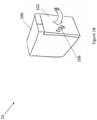
- FIG 1A-1C show an example of an aircraft oven system, shown generally as 10.
- an aircraft oven 10 includes an inner cavity 104 and a door 102.
- the inner cavity 104 is configured to receive at least one hazardous item (e.g. an overheating portable device, laptop, burning item etc.) 103.
- the aircraft oven door 102 may be closed and locked using a locking mechanism 106. Therefore, the at least one hazardous item 103 may be locked within the aircraft oven 100.
- a user interface 108 to allow the user to switch from a normal operation mode (i.e.
- the user interface 108 may be a Human Machine Interface or an actuator lever.
- FIGS 1A-1C show a general overview of the concept of using an aircraft oven for use as in a safety operation mode.
- An aircraft oven such as the aircraft oven 100 shown in these Figures may, for example, withstand extremely high temperatures and contain spillage, small bursts and/or fire that avoids quick propagation or reignition.
- aircraft ovens are not generally completely closed (i.e. airtight) due to, for instance, a venting hose or valve connecting the inner cavity of the aircraft oven to the back of the galley compartment for pressure release/compensation. Therefore, in the examples of this disclosure, the safety operation mode is to ensure that the aircraft oven, e.g. the aircraft oven 100, is completely closed such that no fumes, smoke and/or fire can escape the oven. Further, no fresh air will be able to enter the aircraft oven 100 to fuel or reignite the fire.
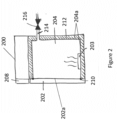
- FIG 2 shows an example of a cross-section of an aircraft oven 200 that can be used as an example in the aircraft oven system 10 of Figures 1A-1C .
- the aircraft oven 200 may include a door 202, an inner cavity 204, insulation 212, an airtight seal 210 located between the door 202 and the insulation 212 to ensure that the inner cavity 204 is airtight, a vent hose 214 and a control valve 216.
- the door 202 may include an inner door surface 202a and the inner cavity 204 may include an inner cavity surface 204a.
- the inner door surface 202a and the inner cavity surface 204a may contain a refractory or metallic material (e.g.
- the airtight seal 210 is located between the inner door surface 202a and the inner cavity surface 204a to ensure that the inner cavity 204 is airtight.
- the vent hose 214 provides fluid flow of air from the inner cavity 204. This is to ensure that the aircraft oven 200 operates as a conventional oven for cooking/warming meals and the like.
- the control valve 216 may operate to maintain the normal operation of the aircraft oven 200 by being in an open position such that there is fluid flow through the vent hose 214 during operation.
- the control valve 216 is actuated to build pressure during cooking.
- the inner cavity 204 is configured to receive at least one hazardous item (e.g. an overheating portable device, laptop, burning item etc.) 203.
- a hazardous item e.g.
- the at least one hazardous item 203 may be deposited into the inner cavity 204 of the aircraft oven 200.
- the oven door 202 may be closed and locked via a locking mechanism (not shown).
- the airtight seal 210 ensures that the inner cavity 204 is airtight.
- the airtight seal 210 may be a temperature resistant seal.
- the aircraft oven includes a Human Machine Interface (HMI) 208 that allows the user (e.g. cabin crew) to switch the aircraft oven 200 from a normal operation mode to a safety operation mode.
- HMI Human Machine Interface
- the HMI 208 when engaged by a user to switch from a normal operation mode to a safety operation mode, would send an electrical signal to the control valve 216 to close the valve.
- the control valve 216 is permanently closed.
- the safety operation mode closes the control valve 216 (either permanently or temporarily) to ensure that there is no fluid or gas flow through the vent hose 214. This allows for the aircraft oven 200 to act as a 'safe box' for suffocating the fire and containing the smoke from the at least one hazardous item 203 deposited within the inner cavity 204.
- HMI 208 is shown in Figure 2 , it is to be understood that, instead of the HMI 208, or in addition to, there may be provided a mechanical actuator (not shown) on the exterior of the aircraft oven 200 to switch the control valve 216 from an open position to a closed position, and vice versa, to move from a normal operation mode to a safety operation mode.
- a mechanical actuator not shown on the exterior of the aircraft oven 200 to switch the control valve 216 from an open position to a closed position, and vice versa, to move from a normal operation mode to a safety operation mode.
- FIG. 3 shows an example of a method 300 for operating any of the aircraft ovens described above (e.g., aircraft oven 100, 200).
- the steps shown in dotted lines in the method 300 are entirely optional.
- the cabin crew, or user can open the oven door (e.g., oven doors 102, 202).
- the cabin crew, or user can remove any meals, meal carriers, or the like from the inner cavity (e.g., inner cavity 104, 204) of the aircraft oven, if necessary.
- the cabin crew, or user deposits a good susceptible to produce heat, explode, leak, catch fire, release smoke or the like (e.g., at least one hazardous item 103, 203) inside the inner cavity of the aircraft oven.
- a fire-extinguishing agent can be deposited into the inner cavity at step 304.
- the fire-extinguishing agent may be, as an example, fire-extinguishing granules or an automatic fire extinguisher.
- the cabin crew, or user closes the oven door and locks the oven door (e.g., via latches (not shown)).
- the cabin crew, or user activates the safe box functionality, for example by switching from a normal operation mode to a safety operation mode as described above in relation to Figure2 .
- a venting valve e.g., control valve 216) is closed.
- a warning signal is displayed on the aircraft oven at step 307b to notify the user that the aircraft oven is in a safety operation mode.
- the warning signal may be, for example, a visual and/or audible signal.
- the status of the inner cavity of the aircraft oven may be displayed on the aircraft oven (e.g., on an HMI 208).
- the aircraft ovens described above make use of already existing appliances on aircraft that saves space, weight, cost and maintenance due to them already being present in aircraft galleys. Further, due to the plurality of ovens and distribution of different galleys within an aircraft, the aircraft ovens are more accessible and convenient.
- the hazardous items may be any item that is considered a hazard and the aircraft ovens described herein not only contain/suffocate fire but also contain fumes, smoke, bursts, chemical/liquid spills and/or overheating goods.
- the hazardous item may, therefore, be any product susceptible to produce heat, explode, catch fire, release fumes and/or release smoke and is certainly not limited to portable electric devices.
Landscapes
- Health & Medical Sciences (AREA)
- Public Health (AREA)
- Business, Economics & Management (AREA)
- Emergency Management (AREA)
- Engineering & Computer Science (AREA)
- Aviation & Aerospace Engineering (AREA)
- Fire-Extinguishing By Fire Departments, And Fire-Extinguishing Equipment And Control Thereof (AREA)
Abstract
Description
- The present disclosure relates to an aircraft oven with a safety operation mode for use on an aircraft.
- Passengers travelling in aircraft often carry, and use, portable electronics in flight. Additionally, aircraft include potentially hazardous items that could cause a fire within the aircraft cabin. In rare instances, batteries in the portable electronics or hazardous items may overheat and cause a fire. Fumes, smoke and/or fire accidents are the most severe incidents that can happen inside an aircraft and can lead to catastrophic loss of the aircraft in a very short period of time. Due to increasing demand of portable electronics, and other dangerous goods, the risks have also increased rapidly.
- Portable electronic devices, for example, are allowed in the aircraft cabin and most of their batteries are highly flammable and extremely sensitive to impacts, damage and high temperatures. Thus, these goods pose a risk of uncontained thermal runaway leading to explosion, fire, and/or the release of fumes or smoke. Fumes, smoke and/or fire can usually be detected early by the cabin crew and the cabin crew can usually address these hazards with firefighting equipment. However, firefighting equipment does not necessarily address the problem of smoke and fumes. For example, fire blankets and portable fire extinguishers can be used to suffocate fire, but they cannot contain fumes or smoke, which can lead to reduced visibility, toxic fume inhalation, panic amongst passengers, etc.
- Although safety boxes are available in the field for such hazardous items, they require a refit of an aircraft to provide safety boxes around the cabin. They are cumbersome to install and require space and weight allowances in an aircraft. Therefore, there is a need for an improved and more available way of containing fumes, smoke and/or fire on aircraft.
- In one aspect, there is provided an aircraft oven that includes an inner cavity configured to receive at least one hazardous item and an oven door. When the oven door is closed, the aircraft oven is configured to switch from a normal operation mode to a safety operation mode, in use.
- The aircraft oven may further include a vent hose and a valve. Optionally, when the aircraft oven is in the safety operation mode, the control valve is closed. Preferably, the valve is permanently closed.
- The aircraft oven may further include a Human Machine Interface and/or a mechanical actuator. The Human Machine Interface and/or the mechanical actuator may be configured to switch the aircraft oven from the normal operation mode to the safety operation mode, in use.
- The aircraft oven may further include insulation and an airtight seal. The airtight seal may be located between the oven door and the insulation. Preferably, the oven door may include an inner door surface and the inner cavity may include an inner cavity surface. The airtight seal may be located between the inner door surface and the inner cavity surface. The inner door surface and the inner cavity surface may include a refractory or metallic material.
- In another aspect, there is provided an aircraft that includes the aircraft oven described above.
- In another aspect, there is provided a method for switching an aircraft oven from a normal operation mode to a safety operation mode. The method includes opening an oven door, depositing at least one hazardous item within an inner cavity of the aircraft oven, closing the oven door and locking the oven door, activating a user interface to switch from a normal operation mode to a safety operation mode.
- The method may further include removing at least one meal carrier from the aircraft oven between the steps of opening the door and depositing the at least one hazardous material within the inner cavity of the aircraft oven.
- The method may further include adding a fire extinguishing agent into the inner cavity between the steps of depositing the at least one hazardous material within the inner cavity of the aircraft oven. The fire extinguishing agent may be at least one of fire-extinguishing granules and/or an automatic fire extinguisher.
- The method may further include closing a valve when switching from the normal operation mode to the safety operation mode. The valve may be electrically closed and/or mechanically closed.
- The method may further include a warning signal provided when the aircraft oven is in the safety operation mode. Additionally, or alternatively, a status of the inner cavity may be displayed on the aircraft oven.
-
-
Figures 1A-1C show an example of an aircraft oven that includes a safety operation mode. -
Figure 2 shows an example of a cross-section of an aircraft oven that includes a safety operation mode. -
Figure 3 shows an example method of using any of the ovens shown inFigures 1A-2 . -
Figures 1A-1C andFigure 2 show representations of ovens in accordance with the detailed description below. It is clear that the elements of the ovens have been extrapolated that are relevant to the present disclosure and that the ovens would include ordinary elements that are not shown for the specifics of the present disclosure. Such elements that are not shown, but would ordinarily be included in the aircraft ovens, are: heating elements, fan, internal circuitry etc. -
Figure 1A-1C show an example of an aircraft oven system, shown generally as 10. As can be seen inFigure 1A , anaircraft oven 10 includes aninner cavity 104 and adoor 102. As shown inFigure 1A , theinner cavity 104 is configured to receive at least one hazardous item (e.g. an overheating portable device, laptop, burning item etc.) 103. InFigure 1B , it is shown that theaircraft oven door 102 may be closed and locked using alocking mechanism 106. Therefore, the at least onehazardous item 103 may be locked within theaircraft oven 100. As shown inFigure 1C , once theaircraft oven door 102 is closed and locked via thelocking mechanism 106 there may be provided auser interface 108 to allow the user to switch from a normal operation mode (i.e. when theaircraft oven 100 is in its normal operation) to a "safe box" (or safety) operation mode (i.e., when theaircraft oven 100 includes at least onehazardous item 103 and cannot be used in its normal operation). Theuser interface 108 may be a Human Machine Interface or an actuator lever. -
Figures 1A-1C show a general overview of the concept of using an aircraft oven for use as in a safety operation mode. An aircraft oven, such as theaircraft oven 100 shown in these Figures may, for example, withstand extremely high temperatures and contain spillage, small bursts and/or fire that avoids quick propagation or reignition. However, aircraft ovens are not generally completely closed (i.e. airtight) due to, for instance, a venting hose or valve connecting the inner cavity of the aircraft oven to the back of the galley compartment for pressure release/compensation. Therefore, in the examples of this disclosure, the safety operation mode is to ensure that the aircraft oven, e.g. theaircraft oven 100, is completely closed such that no fumes, smoke and/or fire can escape the oven. Further, no fresh air will be able to enter theaircraft oven 100 to fuel or reignite the fire. -
Figure 2 shows an example of a cross-section of anaircraft oven 200 that can be used as an example in theaircraft oven system 10 ofFigures 1A-1C . Theaircraft oven 200 may include adoor 202, aninner cavity 204,insulation 212, anairtight seal 210 located between thedoor 202 and theinsulation 212 to ensure that theinner cavity 204 is airtight, avent hose 214 and acontrol valve 216. Thedoor 202 may include aninner door surface 202a and theinner cavity 204 may include aninner cavity surface 204a. Theinner door surface 202a and theinner cavity surface 204a may contain a refractory or metallic material (e.g. ceramic, polycrystalline, stainless steel, titanium or the like) that is resistant to decomposition by heat, pressure, or chemical attack and that retains strength and form at high temperatures. In this case, theairtight seal 210 is located between theinner door surface 202a and theinner cavity surface 204a to ensure that theinner cavity 204 is airtight. - In normal operation, the
vent hose 214 provides fluid flow of air from theinner cavity 204. This is to ensure that theaircraft oven 200 operates as a conventional oven for cooking/warming meals and the like. Thecontrol valve 216 may operate to maintain the normal operation of theaircraft oven 200 by being in an open position such that there is fluid flow through thevent hose 214 during operation. Optionally, in a pressurized normal mode, thecontrol valve 216 is actuated to build pressure during cooking. As shown inFigure 2 , theinner cavity 204 is configured to receive at least one hazardous item (e.g. an overheating portable device, laptop, burning item etc.) 203. When a hazardous item, e.g. 203, is located in the aircraft cabin (not shown) by the cabin crew, the at least onehazardous item 203 may be deposited into theinner cavity 204 of theaircraft oven 200. Theoven door 202 may be closed and locked via a locking mechanism (not shown). When theoven door 202 is closed and locked, theairtight seal 210 ensures that theinner cavity 204 is airtight. As an example, theairtight seal 210 may be a temperature resistant seal. In the example shown inFigure 2 , the aircraft oven includes a Human Machine Interface (HMI) 208 that allows the user (e.g. cabin crew) to switch theaircraft oven 200 from a normal operation mode to a safety operation mode. It is envisaged that theHMI 208, when engaged by a user to switch from a normal operation mode to a safety operation mode, would send an electrical signal to thecontrol valve 216 to close the valve. In some examples, thecontrol valve 216 is permanently closed. In other words, when the safety operation mode is activated, the safety operation mode closes the control valve 216 (either permanently or temporarily) to ensure that there is no fluid or gas flow through thevent hose 214. This allows for theaircraft oven 200 to act as a 'safe box' for suffocating the fire and containing the smoke from the at least onehazardous item 203 deposited within theinner cavity 204. Although anHMI 208 is shown inFigure 2 , it is to be understood that, instead of theHMI 208, or in addition to, there may be provided a mechanical actuator (not shown) on the exterior of theaircraft oven 200 to switch thecontrol valve 216 from an open position to a closed position, and vice versa, to move from a normal operation mode to a safety operation mode. -
Figure 3 shows an example of amethod 300 for operating any of the aircraft ovens described above (e.g.,aircraft oven 100, 200). The steps shown in dotted lines in themethod 300 are entirely optional. Atstep 301, the cabin crew, or user, can open the oven door (e.g.,oven doors 102, 202). Optionally, the cabin crew, or user, can remove any meals, meal carriers, or the like from the inner cavity (e.g.,inner cavity 104, 204) of the aircraft oven, if necessary. Instep 303, the cabin crew, or user, deposits a good susceptible to produce heat, explode, leak, catch fire, release smoke or the like (e.g., at least onehazardous item 103, 203) inside the inner cavity of the aircraft oven. Optionally, a fire-extinguishing agent can be deposited into the inner cavity atstep 304. The fire-extinguishing agent may be, as an example, fire-extinguishing granules or an automatic fire extinguisher. Atstep 305, the cabin crew, or user, closes the oven door and locks the oven door (e.g., via latches (not shown)). Atstep 306, the cabin crew, or user, activates the safe box functionality, for example by switching from a normal operation mode to a safety operation mode as described above in relation toFigure2 . Atstep 307a, on successful activation of the safe box functionality, a venting valve (e.g., control valve 216) is closed. A warning signal is displayed on the aircraft oven atstep 307b to notify the user that the aircraft oven is in a safety operation mode. The warning signal may be, for example, a visual and/or audible signal. Optionally, the status of the inner cavity of the aircraft oven may be displayed on the aircraft oven (e.g., on an HMI 208). - The aircraft ovens described above make use of already existing appliances on aircraft that saves space, weight, cost and maintenance due to them already being present in aircraft galleys. Further, due to the plurality of ovens and distribution of different galleys within an aircraft, the aircraft ovens are more accessible and convenient. The hazardous items may be any item that is considered a hazard and the aircraft ovens described herein not only contain/suffocate fire but also contain fumes, smoke, bursts, chemical/liquid spills and/or overheating goods. The hazardous item may, therefore, be any product susceptible to produce heat, explode, catch fire, release fumes and/or release smoke and is certainly not limited to portable electric devices. Due to the increased volume of inner cavities of aircraft ovens, many hazardous items may be stored inside to ensure the safety of the aircraft cabin. Generally, cabin crew are aware of the location of all aircraft ovens and have ample knowledge of how to operate ovens - therefore, little training is needed to ensure that the cabin crew understand how to operate the oven from a normal operation mode to a safety operation mode.
- Although this disclosure has been described in terms of preferred examples, it should be understood that these examples are illustrative only and that the claims are not limited to those examples. Those skilled in the art will be able to make modifications and alternatives in view of the disclosure which are contemplated as falling within the scope of the appended claims.
Claims (15)
- An aircraft oven (100, 200) comprising:an inner cavity (104, 204) configured to receive at least one hazardous item (103, 203);an oven door (102, 202);wherein, when the oven door (102, 202) is closed, the aircraft oven is configured to switch from a normal operation mode to a safety operation mode, in use.
- The aircraft oven of claim 1, wherein the aircraft oven further comprises:a vent hose (214) and a valve (216); andwherein, when the aircraft oven is in the safety operation mode, the control valve (216) is closed.
- The aircraft oven of claim 2, wherein the valve (216) is permanently closed.
- The aircraft oven of any preceding claim, further comprising:a Human Machine Interface (108, 208) and/or a mechanical actuator;wherein the Human Machine Interface and/or the mechanical actuator is configured to switch the aircraft oven from the normal operation mode to the safety operation mode, in use.
- The aircraft oven of any preceding claim, further comprising:
insulation (212), an airtight seal (210), wherein the airtight seal (210) is located between the oven door (102, 202) and the insulation (212). - The aircraft oven of claim 5, wherein the oven door (102, 202) includes an inner door surface (202a) and wherein the inner cavity (204) includes an inner cavity surface (204a) and wherein the airtight seal (210) is located between the inner door surface (202a) and the inner cavity surface (204a).
- The aircraft oven of claim 6, wherein the inner door surface (202a) and the inner cavity surface (204a) includes a refractory or metallic material.
- An aircraft comprising the aircraft oven of any preceding claim.
- A method for switching an aircraft oven from a normal operation mode to a safety operation mode, the method comprising:opening an oven door;depositing at least one hazardous item within an inner cavity of the aircraft oven;closing the oven door and locking the oven door;activating a user interface to switch from a normal operation mode to a safety operation mode.
- The method of claim 9, further comprising removing at least one meal carrier from the aircraft oven between the steps of opening the door and depositing the at least one hazardous material within the inner cavity of the aircraft oven.
- The method of claim 9 or 10, further comprising adding a fire extinguishing agent into the inner cavity between the steps of depositing the at least one hazardous material within the inner cavity of the aircraft oven; and
wherein the fire extinguishing agent is at least one of fire-extinguishing granules and/or an automatic fire extinguisher. - The method of any of claims 9-11, further comprising closing a valve when switching from the normal operation mode to the safety operation mode.
- The method of claim 12, wherein the valve is electrically closed and/or mechanically closed.
- The method of any of claims 9-13, wherein a warning signal is provided when the aircraft oven is in the safety operation mode.
- The method of any of claims 9-14, wherein a status of the inner cavity is displayed on the aircraft oven.
Priority Applications (2)
| Application Number | Priority Date | Filing Date | Title |
|---|---|---|---|
| EP23166048.1A EP4438479B1 (en) | 2023-03-31 | 2023-03-31 | Aircraft oven with safety operation mode |
| US18/402,442 US20240325803A1 (en) | 2023-03-31 | 2024-01-02 | Aircraft oven with safety operation mode |
Applications Claiming Priority (1)
| Application Number | Priority Date | Filing Date | Title |
|---|---|---|---|
| EP23166048.1A EP4438479B1 (en) | 2023-03-31 | 2023-03-31 | Aircraft oven with safety operation mode |
Publications (2)
| Publication Number | Publication Date |
|---|---|
| EP4438479A1 true EP4438479A1 (en) | 2024-10-02 |
| EP4438479B1 EP4438479B1 (en) | 2026-03-11 |
Family
ID=85800248
Family Applications (1)
| Application Number | Title | Priority Date | Filing Date |
|---|---|---|---|
| EP23166048.1A Active EP4438479B1 (en) | 2023-03-31 | 2023-03-31 | Aircraft oven with safety operation mode |
Country Status (2)
| Country | Link |
|---|---|
| US (1) | US20240325803A1 (en) |
| EP (1) | EP4438479B1 (en) |
Citations (7)
| Publication number | Priority date | Publication date | Assignee | Title |
|---|---|---|---|---|
| WO2011056763A1 (en) * | 2009-11-05 | 2011-05-12 | Mag Aerospace Industries, Inc. | Steam oven water delivery and drain valve systems and methods |
| US20140209332A1 (en) * | 2013-01-25 | 2014-07-31 | Brian Dewey Burkett | Fire and smoke containment and extinguishing apparatus |
| US20170361139A1 (en) * | 2016-06-17 | 2017-12-21 | The Boeing Company | Fire extinguishing container |
| EP3663201A1 (en) * | 2018-12-05 | 2020-06-10 | Rockwell Collins, Inc. | Thermochromic paint for temperature-related warnings |
| US20210379432A1 (en) * | 2020-06-05 | 2021-12-09 | Airbus Operations Gmbh | Apparatus And System For Handling Dangerous Objects In A Closed Vehicle Cabin |
| EP4112465A1 (en) * | 2021-06-28 | 2023-01-04 | B/E Aerospace, Inc. | Aerospace galley insert comprising oven |
| EP4112463A1 (en) * | 2021-06-28 | 2023-01-04 | B/E Aerospace, Inc. | Oven with air quality sensor |
Family Cites Families (2)
| Publication number | Priority date | Publication date | Assignee | Title |
|---|---|---|---|---|
| US9339671B1 (en) * | 2014-12-18 | 2016-05-17 | Anthony Anand Raj | Portable fire containment and extinguisher system for in flight aircraft/cabin fires caused by lithium ion battery fires of personal electronic devices in passenger aircraft |
| MX2021012067A (en) * | 2019-04-11 | 2022-01-04 | Tyco Fire Products Lp | VARIABLE FLOW EXTINGUISHING SYSTEM. |
-
2023
- 2023-03-31 EP EP23166048.1A patent/EP4438479B1/en active Active
-
2024
- 2024-01-02 US US18/402,442 patent/US20240325803A1/en active Pending
Patent Citations (7)
| Publication number | Priority date | Publication date | Assignee | Title |
|---|---|---|---|---|
| WO2011056763A1 (en) * | 2009-11-05 | 2011-05-12 | Mag Aerospace Industries, Inc. | Steam oven water delivery and drain valve systems and methods |
| US20140209332A1 (en) * | 2013-01-25 | 2014-07-31 | Brian Dewey Burkett | Fire and smoke containment and extinguishing apparatus |
| US20170361139A1 (en) * | 2016-06-17 | 2017-12-21 | The Boeing Company | Fire extinguishing container |
| EP3663201A1 (en) * | 2018-12-05 | 2020-06-10 | Rockwell Collins, Inc. | Thermochromic paint for temperature-related warnings |
| US20210379432A1 (en) * | 2020-06-05 | 2021-12-09 | Airbus Operations Gmbh | Apparatus And System For Handling Dangerous Objects In A Closed Vehicle Cabin |
| EP4112465A1 (en) * | 2021-06-28 | 2023-01-04 | B/E Aerospace, Inc. | Aerospace galley insert comprising oven |
| EP4112463A1 (en) * | 2021-06-28 | 2023-01-04 | B/E Aerospace, Inc. | Oven with air quality sensor |
Also Published As
| Publication number | Publication date |
|---|---|
| EP4438479B1 (en) | 2026-03-11 |
| US20240325803A1 (en) | 2024-10-03 |
Similar Documents
| Publication | Publication Date | Title |
|---|---|---|
| AU2020202009B2 (en) | Fire and smoke containment and extinguishing apparatus | |
| JP6175266B2 (en) | Fire extinguisher | |
| CN107519593B (en) | Fire extinguishing container | |
| US4830116A (en) | Fire extinguishing system | |
| Guibaud et al. | Fire safety in spacecraft: Past incidents and Deep Space challenges | |
| US6952169B1 (en) | Cordless/wireless automatic detection and suppression system | |
| JP2015533609A (en) | Portable battery-powered fire containment case for electronic devices | |
| US9597535B2 (en) | Fire protection trolley and fire protection device comprising a fire protection trolley of this type | |
| US8978778B2 (en) | Fire extinguishing system for an airplane and method for firefighting in an airplane | |
| EP4438479B1 (en) | Aircraft oven with safety operation mode | |
| KR102682548B1 (en) | Commercial kitchen automatic fire extinguishing system | |
| US6039124A (en) | Electrical detector actuated magazine sprinkler (EDAMS) system | |
| CN215781103U (en) | Kitchen fire-extinguishing guarantee device and kitchen fire-extinguishing guarantee system | |
| GB2129868A (en) | Fire proof letter box | |
| US12478813B1 (en) | Automated kitchen hood fire trap | |
| CN220309636U (en) | Fire extinguishing structure and dangerous waste incineration chain plate machine | |
| CN218407175U (en) | Steel fireproof door with reinforcing structure | |
| CN218501162U (en) | Marine kitchen wet chemical fire extinguishing apparatus alarm control device | |
| WO2025252320A1 (en) | Compartment for charging electronic device | |
| US20250136286A1 (en) | Safety container to hold a burning battery powered object, aircraft galley and aircraft | |
| KR20250056845A (en) | Automatic Fire Suppression System for Aircraft Overhead Bins with Heat Detection | |
| CN103721359B (en) | The GAFES of offshore platform | |
| JP2019176937A (en) | Fire prevention device of flyer | |
| CN114949667A (en) | Passenger cabin dining car with fire extinguishing function | |
| Rayburn | Fire Hazards |
Legal Events
| Date | Code | Title | Description |
|---|---|---|---|
| PUAI | Public reference made under article 153(3) epc to a published international application that has entered the european phase |
Free format text: ORIGINAL CODE: 0009012 |
|
| STAA | Information on the status of an ep patent application or granted ep patent |
Free format text: STATUS: THE APPLICATION HAS BEEN PUBLISHED |
|
| AK | Designated contracting states |
Kind code of ref document: A1 Designated state(s): AL AT BE BG CH CY CZ DE DK EE ES FI FR GB GR HR HU IE IS IT LI LT LU LV MC ME MK MT NL NO PL PT RO RS SE SI SK SM TR |
|
| STAA | Information on the status of an ep patent application or granted ep patent |
Free format text: STATUS: REQUEST FOR EXAMINATION WAS MADE |
|
| 17P | Request for examination filed |
Effective date: 20250328 |
|
| GRAP | Despatch of communication of intention to grant a patent |
Free format text: ORIGINAL CODE: EPIDOSNIGR1 |
|
| STAA | Information on the status of an ep patent application or granted ep patent |
Free format text: STATUS: GRANT OF PATENT IS INTENDED |
|
| INTG | Intention to grant announced |
Effective date: 20251201 |
|
| GRAS | Grant fee paid |
Free format text: ORIGINAL CODE: EPIDOSNIGR3 |
|
| GRAA | (expected) grant |
Free format text: ORIGINAL CODE: 0009210 |
|
| STAA | Information on the status of an ep patent application or granted ep patent |
Free format text: STATUS: THE PATENT HAS BEEN GRANTED |
|
| AK | Designated contracting states |
Kind code of ref document: B1 Designated state(s): AL AT BE BG CH CY CZ DE DK EE ES FI FR GB GR HR HU IE IS IT LI LT LU LV MC ME MK MT NL NO PL PT RO RS SE SI SK SM TR |
|
| REG | Reference to a national code |
Ref country code: CH Ref legal event code: F10 Free format text: ST27 STATUS EVENT CODE: U-0-0-F10-F00 (AS PROVIDED BY THE NATIONAL OFFICE) Effective date: 20260311 Ref country code: GB Ref legal event code: FG4D |
|
| REG | Reference to a national code |
Ref country code: DE Ref legal event code: R096 Ref document number: 602023013201 Country of ref document: DE |
|
| REG | Reference to a national code |
Ref country code: IE Ref legal event code: FG4D |
|
| PGFP | Annual fee paid to national office [announced via postgrant information from national office to epo] |
Ref country code: DE Payment date: 20260319 Year of fee payment: 4 |
|
| PG25 | Lapsed in a contracting state [announced via postgrant information from national office to epo] |
Ref country code: RS Free format text: LAPSE BECAUSE OF FAILURE TO SUBMIT A TRANSLATION OF THE DESCRIPTION OR TO PAY THE FEE WITHIN THE PRESCRIBED TIME-LIMIT Effective date: 20260611 |
|
| PG25 | Lapsed in a contracting state [announced via postgrant information from national office to epo] |
Ref country code: ES Free format text: LAPSE BECAUSE OF FAILURE TO SUBMIT A TRANSLATION OF THE DESCRIPTION OR TO PAY THE FEE WITHIN THE PRESCRIBED TIME-LIMIT Effective date: 20260311 |
|
| PG25 | Lapsed in a contracting state [announced via postgrant information from national office to epo] |
Ref country code: GR Free format text: LAPSE BECAUSE OF FAILURE TO SUBMIT A TRANSLATION OF THE DESCRIPTION OR TO PAY THE FEE WITHIN THE PRESCRIBED TIME-LIMIT Effective date: 20260612 |
|
| REG | Reference to a national code |
Ref country code: LT Ref legal event code: MG9D |
|
| PG25 | Lapsed in a contracting state [announced via postgrant information from national office to epo] |
Ref country code: LT Free format text: LAPSE BECAUSE OF FAILURE TO SUBMIT A TRANSLATION OF THE DESCRIPTION OR TO PAY THE FEE WITHIN THE PRESCRIBED TIME-LIMIT Effective date: 20260311 |
|
| PG25 | Lapsed in a contracting state [announced via postgrant information from national office to epo] |
Ref country code: NO Free format text: LAPSE BECAUSE OF FAILURE TO SUBMIT A TRANSLATION OF THE DESCRIPTION OR TO PAY THE FEE WITHIN THE PRESCRIBED TIME-LIMIT Effective date: 20260611 |
|
| PG25 | Lapsed in a contracting state [announced via postgrant information from national office to epo] |
Ref country code: SE Free format text: LAPSE BECAUSE OF FAILURE TO SUBMIT A TRANSLATION OF THE DESCRIPTION OR TO PAY THE FEE WITHIN THE PRESCRIBED TIME-LIMIT Effective date: 20260311 Ref country code: FI Free format text: LAPSE BECAUSE OF FAILURE TO SUBMIT A TRANSLATION OF THE DESCRIPTION OR TO PAY THE FEE WITHIN THE PRESCRIBED TIME-LIMIT Effective date: 20260311 |
|
| REG | Reference to a national code |
Ref country code: NL Ref legal event code: MP Effective date: 20260311 |
|
| PG25 | Lapsed in a contracting state [announced via postgrant information from national office to epo] |
Ref country code: HR Free format text: LAPSE BECAUSE OF FAILURE TO SUBMIT A TRANSLATION OF THE DESCRIPTION OR TO PAY THE FEE WITHIN THE PRESCRIBED TIME-LIMIT Effective date: 20260311 |
|
| PGFP | Annual fee paid to national office [announced via postgrant information from national office to epo] |
Ref country code: FR Payment date: 20260421 Year of fee payment: 4 |
|
| PG25 | Lapsed in a contracting state [announced via postgrant information from national office to epo] |
Ref country code: LV Free format text: LAPSE BECAUSE OF FAILURE TO SUBMIT A TRANSLATION OF THE DESCRIPTION OR TO PAY THE FEE WITHIN THE PRESCRIBED TIME-LIMIT Effective date: 20260311 |
|
| PG25 | Lapsed in a contracting state [announced via postgrant information from national office to epo] |
Ref country code: BG Free format text: LAPSE BECAUSE OF FAILURE TO SUBMIT A TRANSLATION OF THE DESCRIPTION OR TO PAY THE FEE WITHIN THE PRESCRIBED TIME-LIMIT Effective date: 20260311 |