EP4438195A1 - Method and device for cross-process use of cold/hot-rolled excess material, medium, and program product - Google Patents
Method and device for cross-process use of cold/hot-rolled excess material, medium, and program product Download PDFInfo
- Publication number
- EP4438195A1 EP4438195A1 EP22918227.4A EP22918227A EP4438195A1 EP 4438195 A1 EP4438195 A1 EP 4438195A1 EP 22918227 A EP22918227 A EP 22918227A EP 4438195 A1 EP4438195 A1 EP 4438195A1
- Authority
- EP
- European Patent Office
- Prior art keywords
- matching
- hot
- rolled
- cold
- weight
- Prior art date
- Legal status (The legal status is an assumption and is not a legal conclusion. Google has not performed a legal analysis and makes no representation as to the accuracy of the status listed.)
- Granted
Links
Images





Classifications
-
- G—PHYSICS
- G06—COMPUTING OR CALCULATING; COUNTING
- G06Q—INFORMATION AND COMMUNICATION TECHNOLOGY [ICT] SPECIALLY ADAPTED FOR ADMINISTRATIVE, COMMERCIAL, FINANCIAL, MANAGERIAL OR SUPERVISORY PURPOSES; SYSTEMS OR METHODS SPECIALLY ADAPTED FOR ADMINISTRATIVE, COMMERCIAL, FINANCIAL, MANAGERIAL OR SUPERVISORY PURPOSES, NOT OTHERWISE PROVIDED FOR
- G06Q10/00—Administration; Management
- G06Q10/08—Logistics, e.g. warehousing, loading or distribution; Inventory or stock management
- G06Q10/087—Inventory or stock management, e.g. order filling, procurement or balancing against orders
-
- B—PERFORMING OPERATIONS; TRANSPORTING
- B21—MECHANICAL METAL-WORKING WITHOUT ESSENTIALLY REMOVING MATERIAL; PUNCHING METAL
- B21B—ROLLING OF METAL
- B21B37/00—Control devices or methods specially adapted for metal-rolling mills or the work produced thereby
-
- G—PHYSICS
- G06—COMPUTING OR CALCULATING; COUNTING
- G06Q—INFORMATION AND COMMUNICATION TECHNOLOGY [ICT] SPECIALLY ADAPTED FOR ADMINISTRATIVE, COMMERCIAL, FINANCIAL, MANAGERIAL OR SUPERVISORY PURPOSES; SYSTEMS OR METHODS SPECIALLY ADAPTED FOR ADMINISTRATIVE, COMMERCIAL, FINANCIAL, MANAGERIAL OR SUPERVISORY PURPOSES, NOT OTHERWISE PROVIDED FOR
- G06Q10/00—Administration; Management
- G06Q10/06—Resources, workflows, human or project management; Enterprise or organisation planning; Enterprise or organisation modelling
-
- G—PHYSICS
- G06—COMPUTING OR CALCULATING; COUNTING
- G06Q—INFORMATION AND COMMUNICATION TECHNOLOGY [ICT] SPECIALLY ADAPTED FOR ADMINISTRATIVE, COMMERCIAL, FINANCIAL, MANAGERIAL OR SUPERVISORY PURPOSES; SYSTEMS OR METHODS SPECIALLY ADAPTED FOR ADMINISTRATIVE, COMMERCIAL, FINANCIAL, MANAGERIAL OR SUPERVISORY PURPOSES, NOT OTHERWISE PROVIDED FOR
- G06Q10/00—Administration; Management
- G06Q10/06—Resources, workflows, human or project management; Enterprise or organisation planning; Enterprise or organisation modelling
- G06Q10/063—Operations research, analysis or management
- G06Q10/0631—Resource planning, allocation, distributing or scheduling for enterprises or organisations
- G06Q10/06316—Sequencing of tasks or work
-
- G—PHYSICS
- G06—COMPUTING OR CALCULATING; COUNTING
- G06Q—INFORMATION AND COMMUNICATION TECHNOLOGY [ICT] SPECIALLY ADAPTED FOR ADMINISTRATIVE, COMMERCIAL, FINANCIAL, MANAGERIAL OR SUPERVISORY PURPOSES; SYSTEMS OR METHODS SPECIALLY ADAPTED FOR ADMINISTRATIVE, COMMERCIAL, FINANCIAL, MANAGERIAL OR SUPERVISORY PURPOSES, NOT OTHERWISE PROVIDED FOR
- G06Q10/00—Administration; Management
- G06Q10/08—Logistics, e.g. warehousing, loading or distribution; Inventory or stock management
-
- G—PHYSICS
- G06—COMPUTING OR CALCULATING; COUNTING
- G06Q—INFORMATION AND COMMUNICATION TECHNOLOGY [ICT] SPECIALLY ADAPTED FOR ADMINISTRATIVE, COMMERCIAL, FINANCIAL, MANAGERIAL OR SUPERVISORY PURPOSES; SYSTEMS OR METHODS SPECIALLY ADAPTED FOR ADMINISTRATIVE, COMMERCIAL, FINANCIAL, MANAGERIAL OR SUPERVISORY PURPOSES, NOT OTHERWISE PROVIDED FOR
- G06Q40/00—Finance; Insurance; Tax strategies; Processing of corporate or income taxes
- G06Q40/04—Trading; Exchange, e.g. stocks, commodities, derivatives or currency exchange
-
- G—PHYSICS
- G06—COMPUTING OR CALCULATING; COUNTING
- G06Q—INFORMATION AND COMMUNICATION TECHNOLOGY [ICT] SPECIALLY ADAPTED FOR ADMINISTRATIVE, COMMERCIAL, FINANCIAL, MANAGERIAL OR SUPERVISORY PURPOSES; SYSTEMS OR METHODS SPECIALLY ADAPTED FOR ADMINISTRATIVE, COMMERCIAL, FINANCIAL, MANAGERIAL OR SUPERVISORY PURPOSES, NOT OTHERWISE PROVIDED FOR
- G06Q50/00—Information and communication technology [ICT] specially adapted for implementation of business processes of specific business sectors, e.g. utilities or tourism
- G06Q50/04—Manufacturing
-
- Y—GENERAL TAGGING OF NEW TECHNOLOGICAL DEVELOPMENTS; GENERAL TAGGING OF CROSS-SECTIONAL TECHNOLOGIES SPANNING OVER SEVERAL SECTIONS OF THE IPC; TECHNICAL SUBJECTS COVERED BY FORMER USPC CROSS-REFERENCE ART COLLECTIONS [XRACs] AND DIGESTS
- Y02—TECHNOLOGIES OR APPLICATIONS FOR MITIGATION OR ADAPTATION AGAINST CLIMATE CHANGE
- Y02P—CLIMATE CHANGE MITIGATION TECHNOLOGIES IN THE PRODUCTION OR PROCESSING OF GOODS
- Y02P90/00—Enabling technologies with a potential contribution to greenhouse gas [GHG] emissions mitigation
- Y02P90/30—Computing systems specially adapted for manufacturing
Definitions
- This disclosure relates to the field of metallurgical automation technologies, and in particular, to a method and device for cross-process use of cold/hot-rolled excess material, medium and program product.
- non-commissioned materials that do not belong to any contract are generated in different processes of a steel production procedure.
- This kind of non-commissioned materials can be called contract excess materials.
- the contract excess materials are not materials with quality problems, but materials generated because of production organization. So, the contract excess materials can be reused.
- the contract excess materials can be classified into hot-rolled excess materials, cold-rolled excess materials, and slab excess materials according to different material forms. Cold-rolled excess materials can also be classified into multiple types, such as acid washing coil, hard rolling coil, and hot-dip galvanizing coil according to different cold rolling processes.
- the contract excess materials may be matched to futures contracts to reuse the contract excess materials in iron and steel enterprises. This process can be called the use of excess materials. On the one hand, by doing so, the excess materials can be reduced. On the other hand, the production cycle of the futures contracts can be shortened, improving customer's satisfaction.
- Embodiments of this disclosure provide a method and device for cross-process use of cold/hot-rolled excess material, medium, and program product, so as to resolve a problem in the prior art that it is difficult to automatically implement the cross-process use of the cold/hot-rolled excess materials.
- an embodiment of this disclosure provides a method for cross-process use of cold/hot-rolled excess material, applied to an electronic device, comprising:
- forming at least one matching pair consisting of a futures contract and a cold/hot-rolled excess material by taking the multiple futures contracts and the multiple cold/hot-rolled excess materials as nodes in a weighted binary graph comprises:
- the matching degree between futures contracts and cold/hot-rolled excess materials can be verified by the preset rule of use, which can be adjusted flexibly according to the actual situation.
- changes in matching degree can also be timely responded, so as to be able to make a use solution most in line with the current demand for matching, to avoid making invalid use solution.
- determining a matching weight of each matching pair in the at least one matching pair comprises: determining a matching weight for each matching pair in the at least one matching pair according to preset matching priority information, wherein the matching priority information is used to describe a matching quality between the multiple futures contracts and the multiple cold/hot-rolled excess materials.
- matching weights of futures contracts and the cold/hot-rolled excess materials can be determined based on preset matching priority information, which can be adjusted flexibly according to the actual situation.
- the preset matching priority information can be adjusted in time according to the personalized use requirement to improve the flexibility and application range of cold/hot-rolled excess materials.
- determining a matching weight for each matching pair in the at least one matching pair according to preset matching priority information comprises:
- the rule of use includes at least one of the following: rule of a specification type, rule of a surface type, rule of a performance and process type, rule of a management type, and rule of a component type.
- the matching priority information includes priority content and priority level, and includes at least one of the following: contract priority information, material priority information, and adaptation priority information.
- computing the matching relationship graph based on a binary graph maximum weight matching algorithm, to obtain a use solution between the multiple futures contract and the multiple cold/hot-rolled excess materials comprises: computing the matching relationship graph based on a binary graph maximum weight matching algorithm based on preset constraint conditions, to obtain a use solution between the multiple futures contract and the multiple cold/hot-rolled excess materials.
- the constraint conditions are set for computing the matching relationship graph, to make the use solution meet the user's expectation. For example, if the user wants there is no excess material generated after use of cold/hot-rolled excess materials, the contract process deficiency weight constraints can be set.
- computing the matching relationship graph based on a binary graph maximum weight matching algorithm based on preset constraint conditions comprises:
- the binary graph maximum weight matching algorithm is used to compute matching relationship graph iteratively. Because the algorithm can only produce one-to-one corresponding solution of a futures contract and a cold/hot-rolled excess material at one time, in order to obtain multiple sets of solutions for a futures contract and several cold/hot-rolled excess materials, the matched cold/hot-rolled excess materials are removed from the graph after a set of solution is obtained, and then the new graph can be computed. Thus, a complete solution can be obtained to avoid missing the possible solution.
- the method further comprises: performing weight inspection on each remaining matching pair in the matching relationship graph, retaining matching pairs that meet a weight inspection rule, and removing matching pair that don't meet the weight inspection rule.
- the constraint conditions include at least one of the following: a matching quantity constraint, a contract process deficiency weight constraint, a use rule constraint, and a decision variable value constraint.
- multiple futures contracts and multiple cold/hot-rolled excess materials with same steel grade are obtained.
- These futures contracts and cold/hot-rolled excess materials can be used as nodes in a weighted binary graph, to form at least one matching pair, constructing a matching relationship graph, where the at least one matching pair consists of a futures contract and a cold/hot-rolled excess material.
- a matching weight of each matching pair is determined.
- the weighted binary graph is computed based on a (binary graph) maximum weight matching algorithm to obtain the final use solution.
- the automation and scale of cross-process use of cold/hot-rolled excess materials can be implemented, the use efficiency of cold/hot-rolled excess materials and futures contract can be improved, and the optimal use of excess materials can be achieved.
- the method can also have better adaptability and more lasting vitality to the dynamic optimization tendency and demand in steel production, effectively reduce the enterprise inventory, shorten the delivery time of futures contracts, and reduce steelmaking applications and spot goods.
- an embodiment of this disclosure provides an apparatus for for cross-process use of cold/hot-rolled excess materials, comprising:
- the matching relationship graph determining unit comprises:
- determining a matching weight of each matching pair in the at least one matching pair comprises: determining a matching weight for each matching pair in the at least one matching pair according to preset matching priority information, wherein the matching priority information is used to describe a matching quality between the multiple futures contracts and the multiple cold/hot-rolled excess materials.
- determining a matching weight for each matching pair in the at least one matching pair according to preset matching priority information comprises:
- the rule of use includes at least one of the following: rule of a specification type, rule of a surface type, rule of a performance and process type, rule of a management type, and rule of a component type.
- the matching priority information includes priority content and priority level, and includes at least one of the following: contract priority information, material priority information, and adaptation priority information.
- computing the matching relationship graph based on a binary graph maximum weight matching algorithm based on preset constraint conditions comprises:
- the apparatus further comprises: a weight inspection unit, configured to perform weight inspection on each remaining matching pair in the matching relationship graph, retaining matching pairs that meet a weight inspection rule, and removing matching pair that don't meet the weight inspection rule.
- the constraint conditions include at least one of the following: a matching quantity constraint, a contract process deficiency weight constraint, a use rule constraint, and a decision variable value constraint.
- an embodiment of this disclosure provides a non-transitory computer-readable storage medium storing instructions, wherein when the instructions are executed on a computer, the instructions cause the computer to execute the method mentioned in the first aspect.
- an electronic device comprising:
- an embodiment of this disclosure provides a computer program product comprising computer programs/instructions, wherein the computer programs/instructions are executed by a processor to implement the method mentioned in the first aspect.
- a computer program product comprising computer programs/instructions, wherein the computer programs/instructions are executed by a processor to implement the method mentioned in the first aspect.
- Steel production is a typical long-term industry.
- Main production processes include iron-making, steel-making, hot rolling, and cold rolling.
- the cold rolling process is a finished process in steel production.
- Hot-rolled coils produced in the hot rolling process may be processed into cold-rolled coils after the cold-rolling process, such as acid washing, cold rolling mill, continuous annealing, and hot-dip galvanizing.
- the cold-rolled coils are high-value-added products, which are mainly used to produce high-end products such as automotive boards, electrical steels, and household electrical boards.
- a plurality of excess materials that don't belong to contracts may be generated, such as hot rolling process excess materials, acid washing process excess materials, hard rolling process excess materials, hot-dip galvanizing process excess materials, and annealing process excess materials.
- the excess materials may be matched to futures contracts to make use of the contract excess materials in iron and steel enterprises.
- futures contracts there are requirements for multiple excess materials. For example, requirements for slabs, hot-rolled coils, acid washing coils, cold-rolled coils, and annealing coils are included in a futures contract A. Requirements for slabs, hot-rolled coils, acid washing coils, cold-rolled coils, and hot-dip galvanizing coils are included in a futures contract B. Therefore, proper excess materials may be matched to corresponding processes in futures contracts. Because there are requirements for the same excess material in multiple futures contracts, how to match excess materials to futures contracts may be considered. For example, a requirement for acid washing coils exists in both futures contract A and futures contract B.
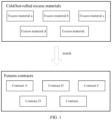
- FIG. 1 shows a schematic scenario diagram of the cross-process use of cold/hot-rolled excess materials.
- excess materials a, b, c, d, ... are cold/hot-rolled excess materials generated in hot rolling or cold rolling processes.
- Contracts A, B, C, D, ... are futures contracts. Multiple types of cold/hot-rolled excess materials may be matched to futures contracts. In the matching process, corresponding matching rules may be met, so that the match between excess materials and contracts is globally optimal.
- the artificial experience manner may be performed according to historical data of the matching between cold/hot-rolled excess materials and futures contracts, as well as subjective judgment.
- this disclosure provides a method of cross-process use of cold/hot-rolled excess materials, which is applied to an electronic device.
- the electronic device is configured to perform matching between cold/hot-rolled excess materials and futures contracts, to obtain a final use solution of cold/hot-rolled excess materials.
- multiple futures contracts and multiple cold/hot-rolled excess materials with same steel grade are obtained.
- These futures contracts and cold/hot-rolled excess materials can be used as nodes in a weighted binary graph, to form at least one matching pair, constructing a matching relationship graph, where the at least one matching pair consists of a futures contract and a cold/hot-rolled excess material.
- a matching weight of each matching pair is determined.
- the weighted binary graph is computed based on a (binary graph) maximum weight matching algorithm to obtain the final use solution.
- FIG. 2 shows a hardware structural diagram of an electronic device 400.
- the electronic device 400 may be a desktop computer device, a notebook computer device, a flat computing device, a mobile terminal, or the like.
- the electronic device 400 may include one or more processors 401 coupled to the controller hub 403.
- the controller hub 403 communicates with the processor 401 by using a multi-branch bus such as a Front Side Bus (FSB), a point-to-point interface such as a Quick Path Interconnect (QPI), or similar connections.
- the processor 401 executes an instruction for controlling a data processing operation of a general type.
- the controller hub 403 includes, but is not limited to, a Graphics & Memory Controller Hub (GMCH) (not shown) and an Input Output Hub (IOH) (which may be on separate chips) (not shown), where the GMCH includes a memory and a graphics controller, and is coupled to the IOH.
- GMCH Graphics & Memory Controller Hub
- IOH Input Output Hub
- the electronic device 400 may further include a coprocessor 402 and a memory 404 coupled to the controller hub 403.
- a coprocessor 402 and a memory 404 coupled to the controller hub 403.
- one or both of the memory and the GMCH may be integrated into a processor (as described in this disclosure).
- the memory 404 and the coprocessor 402 are directly coupled to the processor 401 and the controller hub 403, and the controller hub 403 and the IOH are in a single chip.
- the memory 404 may be, for example, a Dynamic Random Access Memory (DRAM), a Phase Change Memory (PCM), or a combination thereof.
- the memory 404 may include one or more tangible, non-temporary computer readable media for storing data and/or instructions.
- the computer readable storage medium stores an instruction. Specifically, a temporary and permanent copy of the instruction is stored.
- the instruction may include: an instruction, when the instruction is executed by at least one of the processors, the instruction may cause the electronic device 400 to implement a method of cross-process use of cold/hot-rolled excess materials according to this disclosure.
- the instruction runs on a computer, the computer performs the foregoing method of cross-process use of cold/hot-rolled excess materials according to this disclosure.
- the coprocessor 402 can be a dedicated processor, such as a high throughput Many Integrated Core (MIC) processor, a network or communication processor, a compression engine, a graphics processor, a general-purpose computing on graphics processing units (GPGPU), or an embedded processor.
- MIC Many Integrated Core
- GPGPU general-purpose computing on graphics processing units
- embedded processor The optional nature of the coprocessor 402 is represented by a dashed line in FIG. 2 .
- the electronic device 400 may further include a Network Interface Controller (NIC) 406.
- the NIC 406 may include a transceiver configured to provide a radio interface for the electronic device 400 to communicate with any other suitable device (e.g., front-end module, antenna, etc.).
- the NIC 406 may be integrated with other components of the electronic device 400.
- the NIC 406 may implement a function of the communications unit in the foregoing embodiment.
- the electronic device 400 may further include an Input/Output (I/O) device 405.
- the I/O device 405 may include a user interface, which is designed to enable the user to interact with the electronic device 400; a peripheral component interface, which is designed to enable the peripheral component to interact with the electronic device 400; and/or a sensor, which is designed to determine environmental conditions and/or location information related to the electronic device 400.
- FIG. 2 is merely an example.
- the electronic device 400 includes multiple components such as the processor 401, the controller hub 403, and the memory 404, in actual application, the device of this disclosure may include only a part of the components of the electronic device 400.
- the device of this disclosure may only include the processor 401 and a NIC 406.
- the properties of the optional component in FIG. 2 are shown by dashed lines.
- FIG. 3 shows a schematic flow diagram of a method for cross-process use of cold/hot-rolled excess materials according to some embodiments of this disclosure. With reference to FIG. 3 , the following describes this method in detail.
- the method for cross-process use of cold/hot-rolled excess materials in this disclosure includes the following steps: S310: obtaining multiple futures contracts and multiple cold/hot-rolled excess materials with same steel grade.
- futures contracts and cold/hot-rolled excess materials have corresponding steel grades.
- steel with different steel grades has different chemical composition and mechanical indexes. Therefore, futures contracts and cold/hot-rolled excess materials with different steel grades cannot be matched. Only cold/hot-rolled excess materials whose steel grade is the same with that of futures contracts can be used in futures contracts.
- futures contracts and cold/hot-rolled excess materials may be grouped according to steel grades. In each group, futures contracts and cold/hot-rolled excess materials have same steel grade. There may be multiple futures contracts and multiple cold/hot-rolled excess materials in each group, and the cold/hot-rolled excess materials in the group may be used in futures contracts in the group. After all futures contracts and cold/hot-rolled excess materials are divided into multiple groups, multiple futures contracts and multiple cold/hot-rolled excess materials in each group can be matched.
- the futures contracts may include steel requirements of multiple processes.
- futures contract A includes five processes: steelmaking, hot rolling, acid washing, cold rolling, and annealing, and each process has a corresponding steel deficiency weight.
- the cold/hot-rolled excess materials are the superfluous steel materials corresponding to one process.
- cold/hot-rolled excess material a is superfluous steel material corresponding to the acid washing process.
- the cold/hot-rolled excess materials are used as deficient steel of the corresponding process in futures contracts when a matching condition is met.
- the cold/hot-rolled excess material a may be matched to the futures contract A when the matching condition is met, and the excess material a can be used as the deficient steel of the acid washing process in the futures contract A.
- the futures contracts include contract information and process-related information, and the process-related information of the futures contracts may include but is not limited to: process number, process name, process feed rate, process deficiency weight.
- the process number is used to describe the sequence of different processes in the futures contracts.
- the process name is used to describe the name corresponding to each process, such as "01-steelmaking" and "07-acid washing”.
- the process feed rate is used to describe the input-output ratio of the process. For example, "1.036" indicates that the weight ratio of the input material to the output material is 1.036.
- the process deficiency weight is used to describe the weight of material required by the corresponding process. For example, if the deficiency weight of a process is 32.69 tons, and the corresponding process is a steelmaking process, it indicates that weight of material required by the steelmaking process is 32.69 tons.
- the information about the cold/hot-rolled excess materials may include but is not limited to: process, weight, name, and type.
- the process is the process corresponding to the cold/hot-rolled excess materials, for example, "04-hot rolling".
- the weight is the weight of the excess materials.
- the material name is the name of excess materials generated by a process, such as "hot-rolled coils” and “acid washing coils”.
- the type is the type of excess materials generated by a process, for example, "hot-rolled coils" and "cold-rolled coils”.
- S320 constructing a matching relationship graph between multiple futures contracts and multiple cold/hot-rolled excess materials.
- the matching relationship graph is used to describe matching relationships between multiple futures contracts and multiple cold/hot-rolled excess materials, which is, cold/hot-rolled excess materials may be matched to which futures contract, and the futures contracts may include which cold/hot-rolled excess material.
- cold/hot-rolled excess materials may be matched to which futures contract
- the futures contracts may include which cold/hot-rolled excess material.
- one cold/hot-rolled excess material corresponds to only one futures contract
- one futures contract may correspond to multiple cold/hot-rolled excess materials.
- a weighted binary graph in graph theory can be used to represent the matching relationship graph.
- the weighted binary graph is a special model in graph theory, and nodes in the weighted binary graph may be divided into two disjoint subsets. Two nodes associated with each edge in the weighted binary graph respectively belong to two different subsets, and edges in the weighted binary graph have different weights.
- multiple futures contracts and multiple cold/hot-rolled excess materials are respectively used as nodes in the weighted binary graph, and there is possible matching relationships between multiple futures contracts and multiple cold/hot-rolled excess materials.
- One futures contract and one cold/hot-rolled excess material in a possible matching relationship may be taken as one matching pair. Therefore, there may be at least one such matching pair between the multiple futures contracts and the multiple cold/hot-rolled excess materials. Therefore, the weighted binary graph also includes at least one such matching pair. In addition, there are good and bad matching relationships.
- a matching relationship between a futures contract and a cold/hot-rolled excess material may be described by using different values of weights.
- matching weight of a matching pair can be used to describe the matching degree of futures contract and cold/hot-rolled excess material in the matching pair.
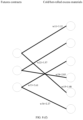
- FIG. 4 shows a schematic diagram of example of a matching relationship graph between cold/hot-rolled excess materials and futures contracts.
- three futures contracts and four cold/hot-rolled excess materials are respectively used as nodes in a binary graph, and there are eight possible matching relationships between futures contracts A, B, C and cold/hot-rolled excess materials a, b, c, d. That is to say, there are 8 matching pairs in this matching relationship graph, e.g., ⁇ A, b>, ⁇ A, c>.
- the matching pairs may be represented by lines between the futures contracts and the cold/hot-rolled excess materials in FIG. 4 .
- the matching weights of the matching pairs may be represented by weights of lines in FIG. 4 .
- the matching weight of the matching pair ⁇ A, a> is w11
- the matching weight of the matching pair ⁇ B, c> is w23
- the matching weight of the matching pair ⁇ C, d> is w34.
- the rule of use in order to determine at least one matching pair in the matching relationship graph, the rule of use may first be determined, and then a futures contract and a cold/hot-rolled excess material that meet the rule can be taken as a matching pair. Therefore, there may be at least one matching pair in the matching relationship graph.
- FIG. 5 shows a schematic flow diagram of a method for determining matching pairs in the matching relationship graph. As shown in FIG. 5 , the method may include the following steps: S510: determining the rule of use.
- the rule is used to determine whether a futures contract and a cold/hot-rolled excess material can be matched, and is a preset condition. If a futures contract and a cold/hot-rolled excess material can meet the rule, there is a possible matching relationship between the futures contract and the cold/hot-rolled excess material. That is to say, the futures contract and the cold/hot-rolled excess material can be matched. If the futures contract and the cold/hot-rolled excess material do not meet the rule, there is no matching relationship between the futures contract and the cold/hot-rolled excess material. That is to say, the futures contract and the cold/hot-rolled excess material cannot be matched.
- a Boolean value may be used to indicate a matching situation. For example, TRUE indicates that a matching may be performed, and FALSE indicates that a matching may not be performed.
- the rule may include but is not limited to the following several types: rule of a specification type, rule of a surface type, rule of a performance and process type, rule of a management type, and rule of a component type.
- the rule of a specification type determines the matching degree of a futures contract and a cold/hot-rolled excess material from the perspective of specifications.
- the determination criteria may include but is not limited to: steel grade, length, width, thickness, and weight.
- the rule of a surface type determines the matching degree of a futures contract and a cold/hot-rolled excess material from the perspective of the external surface of materials.
- the determination criteria may include but is not limited to: classification level, coating type, and oil coating.
- the rule of a performance and process type determines the matching degree of a futures contract and a cold/hot-rolled excess material from the perspective of performance and process.
- the determination criteria may include but is not limited to: yield strength, tensile strength, hardness, and extension.
- the rule of a management type determines the matching degree of a futures contract and a cold/hot-rolled excess material from the perspective of management.
- the determination criteria may include but is not limited to: material status, contract status, factory location and warehouse region, and finished product marking.
- the rule of a component type determines the matching degree of a futures contract and a cold/hot-rolled excess material from the perspective of material component.
- the determination criteria may include but is not limited to: element components such as C, AL, MN, P, and S.
- the rule can be implemented in a configurable manner. Because the cold/hot-rolled excess materials are closer to the finished product process, and lack of subsequent remediation and improvement measures, requirements for matching in terms of quality, surface, performance, and process are more stringent. In addition, the rule changes frequently. If the rule is cured into a software system in a form of hard coding, it is inconvenient to adjust the rule, and it is difficult to ensure time efficiency of change of the rule. Therefore, a configurable implementation manner is provided for the rule, so that operations such as adding, deleting, or changing the rule can be conveniently implemented without modifying software code. What's more, the operations may takes effect immediately. By doing so, the flexibility is improved, and requirements for a flexible adjustment of the rule is well met.
- S520 forming at least one matching pair consisting of a futures contract and a cold/hot-rolled excess material that meet the preset rule of use.
- a futures contract and a cold/hot-rolled excess material that meet a preset rule can be used as a matching pair.
- matching weights of each matching pair in the at least one matching pair in the matching relationship graph can be determined based on preset matching priority information.
- a larger matching weight indicates a higher matching possibility of a futures contract and a cold/hot-rolled excess material in a matching pair.
- the matching priority information is preset, and may be used to describe a matching degree between a futures contract and a cold/hot-rolled excess material.
- the matching priority information may include but is not limited to one or more of contract priority information, material priority information, and adaptation priority information.
- the contract priority information includes information related to basic attributes of a futures contract, such as a due date and an export mark.
- the contract priority information may further include information such as dynamically specifying priority processing of a type of contract.
- the material priority information includes information related to material attributes, for example, storage time, and finished product mark.
- the adaptation priority information includes information related to parameters of futures contracts and materials, such as switching loss, warehouse transfer, and contract integrity.
- the matching priority information includes priority content and priority level.
- the priority content includes combination of attributes or process parameters of the futures contracts.
- priority content of a futures contract is "color coating export contract last month”.
- the priority level is used to indicate importance of priority content. For specific implementation, a number may be used. For example, level 1 is a highest priority, and level 2 is a second priority.
- personalized requirements e.g., specific product lines or specific types of futures contracts are preferentially processed
- a production fluctuation and a special management requirement can be considered, and the flexibility and applicable range can be improved, so that dynamic setting of matching priority information is implemented, and requirements for dynamically adjusting matching priority information can be met.
- multiple pieces of priority content and priority levels may be defined according to service requirements and inclination, to form a matching priority definition table, and an operation of adding, deleting, or changing matching priority information is supported by modifying data in the matching priority definition table.
- a typical contract priority definition table is shown in Table 1 below: Table 1 Contract priority definition table Priorit y level Priority content Process parameter 1 Relationshi p Paramete r value 1 Process paramete r2 Relationshi p Paramete r value 2 1 Export contract two month ago Delivery date Equal to Contract two month ago Export mark Equal to Export contract 2 General contract two month ago Delivery date Equal to Contract two month ago Export mark Equal to Ordinary contract 3 Contrac t for the C101 unit after acid washing BACKLOG 7th bit Equal to 1 4 Color coating contract last month Delivery date Equal to Contract last month Variety category Equal to O 5 Coating code 10 Coating Code Differentiatio n Equal to 10 6 ... ... ... ... ... ... ... ... ... ...
- the matching weight may be used to describe a comprehensive level of contract priority information, material priority information, and adaptation priority information.
- a matching weight of a matching pair is determined according to the matching priority information can be that, a matching weight of a matching pair is determined according to the matching priority information of a futures contract and the weight of a cold/hot-rolled excess material in the matching pair.
- FIG. 6 shows a schematic flow diagram of a method for determining a matching weight according to matching priority information. As shown in FIG. 6 , the method may include the following steps:
- the following uses contract priority information as an example for description.
- process parameters included in the futures contract A is compared with priority content in a preset priority definition table (e.g., Table 1) to determine a corresponding priority level. If the futures contract A meets multiple priority-related definitions in the priority definition table at the same time, the highest priority level corresponding to the multiple priority-related definitions is used as the priority level of the futures contract A. If the futures contract A does not match any priority definition in the priority definition table, the priority level is set to a level which is equal to the maximum priority level in the priority definition table plus 1. The way of determining the priority level of the futures contracts according to the material priority information and the adaptation priority information is the same as that according to contract priority information.
- the matching weights are determined according to the priority levels and the material weights of the cold/hot-rolled excess materials.
- p i o indicates a priority level of the futures contract i corresponding to the contract priority information
- p j m indicates a priority level corresponding to the material priority information
- p ij f indicates a priority level corresponding to the adaptation priority information.
- the cold/hot-rolled excess material may be matched to the futures contract first.
- the final use solution can be obtained by computing the weighted binary graph based on a maximum weight matching algorithm.
- the use solution may include at least one matching pair that successfully matches. And usually, the use solution includes multiple matching pairs, with each pair including a futures contract and a cold/hot-rolled excess material.
- a cold/hot-rolled excess material is matched to at most one futures contract.
- One futures contract may match cold/hot-rolled excess materials, or may not match cold/hot-rolled excess materials. If a futures contract matches the cold/hot-rolled excess materials, the futures contract may match at least one cold/hot-rolled excess material.
- the object of maximizing the sum of the matching weights of all matching pairs is determined by the optimization objective set when the matching relationship graph is computed based on the maximum weight matching algorithm. The optimization objective is used to describe an optimization direction when the matching relationship graph is computed.
- the matching relationship graph is computed based on the maximum weight matching algorithm according to a preset constraint condition, to obtain a use solution between futures contracts and cold/hot-rolled excess materials.
- the constraint condition includes the constraint condition to be followed when computing the matching relationship graph.
- the constraint condition may include but is not limited to one or more of a matching quantity constraint, a contract process deficiency weight constraint, a use rule constraint, and a decision variable value constraint.
- the decision variable is defined as x ij , indicating whether the futures contract i matches the cold/hot-rolled excess material j.
- x ij 1 indicates that the cold/hot-rolled excess material j matches the futures contract i
- x ij 0 indicates that there is no matching relationship between the cold/hot-rolled excess material j and the futures contract i.
- the total number of processes for the futures contract i will be defined as K i .
- S ik indicates the set of cold/hot-rolled excess materials whose process is the same as the k th process in the futures contract i. That is to say, if j ⁇ S ik , it indicates that the process corresponding to the cold/hot-rolled excess material j is the same as the k th process in the futures contract i.
- D ik indicates the material deficiency weight in the k th process of the futures contract i.
- y ik indicates the cumulative feed rate of the futures contract i from the steelmaking process to the k th process, which is equal to the product of the feed rate of each process.
- the matching quantity constraint is used to indicate that one cold/hot-rolled excess material can only be matched to one futures contract, and it cannot be split and matched to different futures contracts.
- the contract process deficiency weight constraint can be used to indicate that the weight of a cold/hot-rolled excess material cannot exceed the material deficiency weight of corresponding process in the futures contract.
- the weight of a cold/hot-rolled excess material in the steelmaking process cannot exceed the material deficiency weight in the steelmaking process in the futures contract.
- the weight of an excess material converted to the steelmaking process cannot exceed the deficiency weight in the steelmaking process in a futures contract.
- the objective of setting the contract process deficiency weight constraint is that there will be no other new excess materials after the cold/hot-rolled excess materials are used in the futures contracts.
- the use rule constraint is used to indicate that the futures contracts and the cold/hot-rolled excess materials can be matched only if the use rule is satisfied. Otherwise, the match cannot be performed.
- the following formula can be used to indicate the use rule constraint: x ij ⁇ r ij
- the decision variable value constraint is used to indicate that the value of the decision variable can only be 0 or 1. That is, the cold/hot-rolled excess materials are matched to the futures contracts or are not matched to the futures contracts.
- the decision variable value constraint can be represented by the following formula: x ij ⁇ 0 , 1
- the optimization objective includes: maximizing the sum of matching weights between the futures contracts and the cold/hot-rolled excess materials.
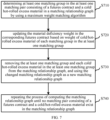
- FIG. 7 shows a schematic flow diagram of a method for computing a matching relationship graph by using a maximum weight matching algorithm. As shown in FIG. 7 , the method includes the following steps:
- a cold/hot-rolled excess material j matches a K th process of a futures contract i in the matching group
- weight of the cold/hot-rolled excess material j is Uj
- material deficiency weight of the k th process of the futures contract i is D ik
- feed rate of the k th process of the futures contract i Z ik
- S730 removing the at least one matching group and each cold/hot-rolled excess material in the at least one matching group from the matching relationship graph, and using the changed matching relationship graph as a new matching relationship graph.
- weight inspection needs to be further performed on each remaining matching pair in the matching relationship graph. Matching pairs that meet a weight inspection rule is reserved, and matching pairs that don't meet the weight inspection rule may be removed. Due to a change in material deficiency weights required for different processes in multiple futures contracts in the matching relationship graph, weight inspection may be performed on cold/hot-rolled excess materials and futures contracts in matching pairs remaining in the matching relationship graph.
- the corresponding matching pair including the cold/hot-rolled excess material and the futures contract may be removed. Otherwise, the matching pair may be reserved.
- the weight inspection rule may include a determining condition for weight of a cold/hot-rolled excess material in a matching pair and the material deficiency weights in different processes of a futures contract in the same matching pair.
- the weight inspection rule may include that weight of a cold/hot-rolled excess material in a matching pair is lower than a material deficiency weight in a process which is the same as that of the cold/hot-rolled excess material of a futures contract in the matching pair.
- weight of the cold/hot-rolled excess material converted to the steelmaking process is lower than material deficiency weight in the steelmaking process of the futures contract.
- the weight of a cold/hot-rolled excess materials j in matching pair is Uj, and corresponding process is K.
- the material deficiency in the k th process of a futures contract i in the matching pair is D ik .
- the cumulative feed rate of the futures contract i from the steelmaking process to the K th process is y iK .
- the weight inspection rule is defined as W j ⁇ D iK && W j * y iK ⁇ D i 1 .
- the matching pair can be reserved in the matching relationship graph, and the matching weight of the matching pair remains unchanged. Otherwise, the matching pair may be removed. The cold/hot-rolled excess materials j and the futures contract i in this matching pair may no longer be matched with each other.
- S740 repeating the process of computing the matching relationship graph until no matching pair consisting of a futures contract and a cold/hot-rolled excess material exist in the matching relationship graph.
- use solution between futures contracts and cold/hot-rolled excess materials in other different steel grades may be computed to obtain the corresponding use result.
- use solutions of all steel grades are determined, the final use solutions can be delivered and executed.
- the cold/hot-rolled excess materials can be used in the corresponding futures contracts to become the contract materials. And subsequent processing is performed on these contract materials according to specified processes.
- an initial matching relationship graph shown in FIG. 8 (a) may be constructed based on the futures contracts and the cold/hot-rolled excess materials. And then multiple iterative calculation is performed by using the maximum weight matching algorithm to obtain the use solution of the futures contracts and the cold/hot-rolled excess materials.
- a specific calculation process is as follows: (1) The maximum weight matching algorithm can be used to compute the current matching relationship graph, to obtain three matching results shown by thick solid lines in FIG. 8(b) , which are respectively: contract 1-excess material 1, contract 2-excess material 2, and contract 3-excess material 3. The matching results may be saved. (2) Removing the matched excess materials 1, 2, and 3, and updating the corresponding contracts 1, 2, and 3. Take contract 1 as an example.
- the process corresponding to the excess material 1 is 04-hot rolling, with a weight of 20.60 tons.
- the excess material 1 is matched to the process 2 of contract 1, with process deficiency weight being 32.21 tons.
- process deficiency weight of each process in contract 2 and contract 3 can be updated. The results are shown in Table 5 below.
- the process corresponding to the excess material 5 is 10-annealing, with a weight of 9.88 tons.
- the process deficiency weight of the same process is 30 tons.
- the condition that weight of an excess material does not exceed the deficiency weight of process which is the same as the process corresponding to the excess material is met, because 9.88 ⁇ 30.
- the weight of excess material 5 corresponding to the steelmaking process may be calculated.
- the calculation process can be called weight converting process. Therefore, the weight of the excess material 5 converted to the steelmaking process can be represented as: 9.88*1.013*1.023*1.036*1.015, which equals 10.77. 10.77 is lower than 11.78.
- the matching relationship graph can be constructed as shown in FIG. 8(c) .
- the maximum weight matching algorithm can be used to compute the current matching relationship graph, to obtain the matching results shown in the thick solid lines in FIG. 8(d) .
- the matching results include contract 1-excess material 5, contract 2-excess material 4, and contract 3-excess material 6.
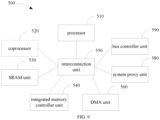
- FIG. 9 is a schematic block diagram of a System on Chip (SoC) 500 according to an embodiment of this disclosure.
- SoC 500 may be disposed on an intelligent production line, and is configured to establish a method for cross-process use of cold/hot-rolled excess materials between upstream and downstream groups of a production line and implement control.
- the SoC 500 includes an interconnection unit 550 coupled to the processor 510, a system proxy unit 580, a bus controller unit 590, an integrated memory controller unit 540, a group of or one or more coprocessors 520 which may include an integrated graphics logic, an image processor, an audio processor, and a video processor, a static random-access memory (SRAM) unit 530, a direct memory access (DMA) unit 560.
- the coprocessor 520 includes a dedicated processor such as a network or a communication processor, a compression engine, general-purpose computing on graphics processing units (GPGPU), a high throughput MIC processor, or an embedded processor.
- the SRAM unit 530 may include one or more tangible, non-temporary, computer readable media for storing data and/or instructions.
- the computer readable storage medium stores an instruction. Specifically, a temporary and permanent copy of the instruction is stored.
- the instruction may include an instruction that is executed by at least one of the processors to cause the SoC to implement the method shown in FIG. 3 , FIG. 5 , FIG. 6 , and FIG. 7 .
- the instruction runs on a computer, the computer performs the method disclosed in embodiment 1 and/or embodiment 2 above.
- a and/or B is merely an association relationship that describes associated objects, and indicates that three relationships may exist.
- a and/or B may indicate: A exists separately, A and B exist simultaneously, and B exists separately.
- a processing system includes any system with a processor such as a digital signal processor (DSP), a microcontroller, an application specific integrated circuit (ASIC), or a microprocessor.
- DSP digital signal processor
- ASIC application specific integrated circuit
- Program code may be implemented in an advanced programming language or an object-oriented programming language, to communicate with a processing system.
- Program code may also be implemented in assembly language or machine language when required.
- the mechanisms described herein are not limited to the scope of any particular programming language. In either case, the language may be a compilation language or an interpretation language.
- IP Intelligent Property
- One or more aspects of the at least one embodiment may be implemented by an representational instruction stored in a computer readable storage medium, where the instruction represents various logic in the processor, and the instruction causes, when read by a machine, the machine to make logic which is used to execute the method or technology described in this disclosure.
- Representations referred to as "Intellectual Property (IP) cores” may be stored on a tangible computer readable storage medium and provided to multiple customers or production facilities to load into a manufacturing machine that actually manufactures the logic or processor.
- the instruction converter may be configured to convert instructions from a source instruction set to a target instruction set.
- the instruction converter may convert instructions into one or more other instructions to be processed by the core by the way of converting (e.g., using static binary transforms, including dynamic binary transforms of dynamic compiling), transforming, emulating, or other ways.
- the instruction converter may be implemented by software, hardware, firmware, or a combination thereof.
- the instruction converter may be on a processor, outside a processor, or partly on a processor, and partly outside a processor.
Landscapes
- Business, Economics & Management (AREA)
- Engineering & Computer Science (AREA)
- Human Resources & Organizations (AREA)
- Economics (AREA)
- Strategic Management (AREA)
- General Business, Economics & Management (AREA)
- Marketing (AREA)
- Physics & Mathematics (AREA)
- General Physics & Mathematics (AREA)
- Theoretical Computer Science (AREA)
- Tourism & Hospitality (AREA)
- Entrepreneurship & Innovation (AREA)
- Development Economics (AREA)
- Quality & Reliability (AREA)
- Operations Research (AREA)
- Educational Administration (AREA)
- General Health & Medical Sciences (AREA)
- Manufacturing & Machinery (AREA)
- Game Theory and Decision Science (AREA)
- Health & Medical Sciences (AREA)
- Primary Health Care (AREA)
- Accounting & Taxation (AREA)
- Finance (AREA)
- Mechanical Engineering (AREA)
- Technology Law (AREA)
- Control Of Metal Rolling (AREA)
Abstract
Description
- This application claims priority to
Chinese Patent Application No. 202210017717.1, filed with the Chinese Patent Office on January 7, 2022 - This disclosure relates to the field of metallurgical automation technologies, and in particular, to a method and device for cross-process use of cold/hot-rolled excess material, medium and program product.
- At present, non-commissioned materials that do not belong to any contract are generated in different processes of a steel production procedure. This kind of non-commissioned materials can be called contract excess materials. The contract excess materials are not materials with quality problems, but materials generated because of production organization. So, the contract excess materials can be reused. The contract excess materials can be classified into hot-rolled excess materials, cold-rolled excess materials, and slab excess materials according to different material forms. Cold-rolled excess materials can also be classified into multiple types, such as acid washing coil, hard rolling coil, and hot-dip galvanizing coil according to different cold rolling processes.
- In order to reduce cost and increase efficiency, the contract excess materials may be matched to futures contracts to reuse the contract excess materials in iron and steel enterprises. This process can be called the use of excess materials. On the one hand, by doing so, the excess materials can be reduced. On the other hand, the production cycle of the futures contracts can be shortened, improving customer's satisfaction.
- During the process of the use of excess materials, a cross-process use may be involved. What's more, a coupling relationship between a front and a back process may exist. A change of rules for use is frequent, and types of materials are diversified. Therefore, implementation of the use of excess materials is difficult. At present, the use of cold/hot-rolled excess materials is implemented based on artificial experience in iron and steel enterprises. This method may cause following problems: work efficiency is low, mistakes are made easily, global optimization is difficult to achieve.
- Embodiments of this disclosure provide a method and device for cross-process use of cold/hot-rolled excess material, medium, and program product, so as to resolve a problem in the prior art that it is difficult to automatically implement the cross-process use of the cold/hot-rolled excess materials.
- In a first aspect, an embodiment of this disclosure provides a method for cross-process use of cold/hot-rolled excess material, applied to an electronic device, comprising:
- obtaining multiple futures contracts and multiple cold/hot-rolled excess materials with same steel grade, wherein the multiple cold/hot-rolled excess materials are used as deficient materials of corresponding processes in the multiple futures contracts;
- forming at least one matching pair consisting of a futures contract and a cold/hot-rolled excess material by taking the multiple futures contracts and the multiple cold/hot-rolled excess materials as nodes in a weighted binary graph, to construct a matching relationship graph between the multiple futures contracts and the multiple cold/hot-rolled excess materials, and determining a matching weight of each matching pair in the at least one matching pair;
- computing the matching relationship graph based on a binary graph maximum weight matching algorithm, to obtain a use solution between the multiple futures contract and the multiple cold/hot-rolled excess materials, wherein in the use solution, a matched cold/hot-rolled excess material is associated with a futures contract, and a maximum sum of matching weights of the at least one matching pair is obtained.
- In a possible implementation of the first aspect, forming at least one matching pair consisting of a futures contract and a cold/hot-rolled excess material by taking the multiple futures contracts and the multiple cold/hot-rolled excess materials as nodes in a weighted binary graph, comprises:
- determining a rule of use, wherein the rule of use is used to check whether the multiple futures contracts match the multiple cold/hot-rolled excess materials;
- forming at least one matching pair consisting of a futures contract and a cold/hot-rolled excess material which meet the rule of use preset, by taking the multiple futures contracts and the multiple cold/hot-rolled excess materials as nodes in a weighted binary graph.
- That is to say, in this implementation, the matching degree between futures contracts and cold/hot-rolled excess materials can be verified by the preset rule of use, which can be adjusted flexibly according to the actual situation. In addition, changes in matching degree can also be timely responded, so as to be able to make a use solution most in line with the current demand for matching, to avoid making invalid use solution.
- In a possible implementation of the first aspect, determining a matching weight of each matching pair in the at least one matching pair, comprises:
determining a matching weight for each matching pair in the at least one matching pair according to preset matching priority information, wherein the matching priority information is used to describe a matching quality between the multiple futures contracts and the multiple cold/hot-rolled excess materials. - In this implementation, matching weights of futures contracts and the cold/hot-rolled excess materials can be determined based on preset matching priority information, which can be adjusted flexibly according to the actual situation. The preset matching priority information can be adjusted in time according to the personalized use requirement to improve the flexibility and application range of cold/hot-rolled excess materials.
- In a possible implementation of the first aspect, determining a matching weight for each matching pair in the at least one matching pair according to preset matching priority information, comprises:
- determining, a priority level of a futures contract in each matching pair of the at least one matching pair, according to preset matching priority information;
- determining a matching weight of each matching pair in the at least one matching pair, according to the priority level and weight of a cold/hot-rolled excess material in each matching pair.
- In a possible implementation of the first aspect, the rule of use includes at least one of the following: rule of a specification type, rule of a surface type, rule of a performance and process type, rule of a management type, and rule of a component type.
- In a possible implementation of the first aspect, the matching priority information includes priority content and priority level, and includes at least one of the following: contract priority information, material priority information, and adaptation priority information.
- In a possible implementation of the first aspect, computing the matching relationship graph based on a binary graph maximum weight matching algorithm, to obtain a use solution between the multiple futures contract and the multiple cold/hot-rolled excess materials, comprises:
computing the matching relationship graph based on a binary graph maximum weight matching algorithm based on preset constraint conditions, to obtain a use solution between the multiple futures contract and the multiple cold/hot-rolled excess materials. - In this implementation, the constraint conditions are set for computing the matching relationship graph, to make the use solution meet the user's expectation. For example, if the user wants there is no excess material generated after use of cold/hot-rolled excess materials, the contract process deficiency weight constraints can be set.
- In a possible implementation of the first aspect, computing the matching relationship graph based on a binary graph maximum weight matching algorithm based on preset constraint conditions, comprises:
- determining at least one matching group in the at least one matching pair consisting of a futures contract and a cold/hot-rolled excess material in the matching relationship graph based on the binary graph maximum weight matching algorithm, according to preset constraint conditions;
- updating a material deficiency weight in a corresponding futures contract based on a cold/hot-rolled excess material of each matching group in the at least one matching group;
- removing the at least one matching group and each cold/hot-rolled excess material in the at least one matching group from the matching relationship graph, and using changed matching relationship graph as a new matching relationship graph;
- repeating process of computing the matching relationship graph until no matching pair consisting of a futures contract and a cold/hot-rolled excess material exist in the matching relationship graph.
- In this implementation, the binary graph maximum weight matching algorithm is used to compute matching relationship graph iteratively. Because the algorithm can only produce one-to-one corresponding solution of a futures contract and a cold/hot-rolled excess material at one time, in order to obtain multiple sets of solutions for a futures contract and several cold/hot-rolled excess materials, the matched cold/hot-rolled excess materials are removed from the graph after a set of solution is obtained, and then the new graph can be computed. Thus, a complete solution can be obtained to avoid missing the possible solution.
- In a possible implementation of the first aspect, after removing the at least one matching group and each cold/hot-rolled excess material in the at least one matching group from the matching relationship graph, the method further comprises:
performing weight inspection on each remaining matching pair in the matching relationship graph, retaining matching pairs that meet a weight inspection rule, and removing matching pair that don't meet the weight inspection rule. - In this implementation, after the matched cold/hot-rolled excess materials are removed from the graph, matching degree between remained cold/hot-rolled excess materials and futures contracts is checked again. The deletion of the matched cold/hot-rolled excess materials may make the originally matched futures contracts and cold/hot-rolled excess materials remain unmatched, so there is a need to check again, avoiding an incorrect solution because of incorrect match in the matching relationship graph.
- In a possible implementation of the first aspect, the constraint conditions include at least one of the following: a matching quantity constraint, a contract process deficiency weight constraint, a use rule constraint, and a decision variable value constraint.
- In this method, multiple futures contracts and multiple cold/hot-rolled excess materials with same steel grade are obtained. These futures contracts and cold/hot-rolled excess materials can be used as nodes in a weighted binary graph, to form at least one matching pair, constructing a matching relationship graph, where the at least one matching pair consists of a futures contract and a cold/hot-rolled excess material. In addition, a matching weight of each matching pair is determined. Then, the weighted binary graph is computed based on a (binary graph) maximum weight matching algorithm to obtain the final use solution. By doing so, the automation and scale of cross-process use of cold/hot-rolled excess materials can be implemented, the use efficiency of cold/hot-rolled excess materials and futures contract can be improved, and the optimal use of excess materials can be achieved. In addition, the method can also have better adaptability and more lasting vitality to the dynamic optimization tendency and demand in steel production, effectively reduce the enterprise inventory, shorten the delivery time of futures contracts, and reduce steelmaking applications and spot goods.
- In a second aspect, an embodiment of this disclosure provides an apparatus for for cross-process use of cold/hot-rolled excess materials, comprising:
- an obtaining unit, configured to obtain multiple futures contracts and multiple cold/hot-rolled excess materials with same steel grade, wherein the multiple cold/hot-rolled excess materials are used as deficient materials of corresponding processes in the multiple futures contracts;
- a matching relationship graph determining unit, configured to form at least one matching pair consisting of a futures contract and a cold/hot-rolled excess material by taking the multiple futures contracts and the multiple cold/hot-rolled excess materials as nodes in a weighted binary graph, to construct a matching relationship graph between the multiple futures contracts and the multiple cold/hot-rolled excess materials, and determining a matching weight of each matching pair in the at least one matching pair;
- a use solution generating unit, configured to compute the matching relationship graph based on a binary graph maximum weight matching algorithm, to obtain a use solution between the multiple futures contract and the multiple cold/hot-rolled excess materials, wherein in the use solution, a matched cold/hot-rolled excess material is associated with a futures contract, and a maximum sum of matching weights of the at least one matching pair is obtained.
- In a possible implementation of the second aspect, the matching relationship graph determining unit comprises:
- a rule of use determining sub-unit, configured to determine a rule of use, wherein the rule of use is used to check whether the multiple futures contracts match the multiple cold/hot-rolled excess materials;
- a matching pair generating sub-unit, configured to form at least one matching pair consisting of a futures contract and a cold/hot-rolled excess material which meet the rule of use preset, by taking the multiple futures contracts and the multiple cold/hot-rolled excess materials as nodes in a weighted binary graph.
- In a possible implementation of the second aspect, in the matching relationship graph determining unit, determining a matching weight of each matching pair in the at least one matching pair, comprises:
determining a matching weight for each matching pair in the at least one matching pair according to preset matching priority information, wherein the matching priority information is used to describe a matching quality between the multiple futures contracts and the multiple cold/hot-rolled excess materials. - In a possible implementation of the second aspect, in the matching relationship graph determining unit, determining a matching weight for each matching pair in the at least one matching pair according to preset matching priority information, comprises:
- determining, a priority level of a futures contract in each matching pair of the at least one matching pair, according to preset matching priority information;
- determining a matching weight of each matching pair in the at least one matching pair, according to the priority level and weight of a cold/hot-rolled excess material in each matching pair.
- In a possible implementation of the second aspect, in the matching relationship graph determining unit, the rule of use includes at least one of the following: rule of a specification type, rule of a surface type, rule of a performance and process type, rule of a management type, and rule of a component type.
- In a possible implementation of the second aspect, in the matching relationship graph determining unit, the matching priority information includes priority content and priority level, and includes at least one of the following: contract priority information, material priority information, and adaptation priority information.
- In a possible implementation of the second aspect, in the use solution generating unit, computing the matching relationship graph based on a binary graph maximum weight matching algorithm, to obtain a use solution between the multiple futures contract and the multiple cold/hot-rolled excess materials, comprises:
computing the matching relationship graph based on a binary graph maximum weight matching algorithm based on preset constraint conditions, to obtain a use solution between the multiple futures contract and the multiple cold/hot-rolled excess materials. - In a possible implementation of the second aspect, in the use solution generating unit, computing the matching relationship graph based on a binary graph maximum weight matching algorithm based on preset constraint conditions, comprises:
- determining at least one matching group in the at least one matching pair consisting of a futures contract and a cold/hot-rolled excess material in the matching relationship graph based on the binary graph maximum weight matching algorithm, according to preset constraint conditions;
- updating a material deficiency weight in a corresponding futures contract based on a cold/hot-rolled excess material of each matching group in the at least one matching group;
- removing the at least one matching group and each cold/hot-rolled excess material in the at least one matching group from the matching relationship graph, and using changed matching relationship graph as a new matching relationship graph;
- repeating process of computing the matching relationship graph until no matching pair consisting of a futures contract and a cold/hot-rolled excess material exist in the matching relationship graph.
- In a possible implementation of the second aspect, the apparatus further comprises:
a weight inspection unit, configured to perform weight inspection on each remaining matching pair in the matching relationship graph, retaining matching pairs that meet a weight inspection rule, and removing matching pair that don't meet the weight inspection rule. - In a possible implementation of the second aspect, in the use solution generating unit, the constraint conditions include at least one of the following: a matching quantity constraint, a contract process deficiency weight constraint, a use rule constraint, and a decision variable value constraint.
- In a third aspect, an embodiment of this disclosure provides a non-transitory computer-readable storage medium storing instructions, wherein when the instructions are executed on a computer, the instructions cause the computer to execute the method mentioned in the first aspect. For beneficial effects that can be achieved in the third aspect, reference may be made to beneficial effects of the method provided in any implementation of the first aspect, and details are not described herein again.
- In a fourth aspect, an embodiment of this disclosure provides an electronic device, comprising:
- a memory, configured to store instructions executed by one or more processors of the electronic device; and
- a processor, which is one of processors of the electronic device, configured to execute the method mentioned in the first aspect. For beneficial effects that can be achieved in the fourth aspect, reference may be made to the beneficial effects of the method provided in any implementation of the first aspect, and details are not described herein again.
- In a fifth aspect, an embodiment of this disclosure provides a computer program product comprising computer programs/instructions, wherein the computer programs/instructions are executed by a processor to implement the method mentioned in the first aspect. For beneficial effects that can be achieved in the fifth aspect, reference may be made to the beneficial effects of the method provided in any implementation of the first aspect, and details are not described herein again.
-
-
FIG. 1 shows a schematic scenario diagram of cross-process use of cold/hot-rolled excess materials according to some embodiments of this disclosure. -
FIG. 2 shows a hardware structural diagram of an electronic device according to some embodiments of this disclosure. -
FIG. 3 shows a schematic flow diagram of a method for cross-process use of cold/hot-rolled excess materials according to some embodiments of this disclosure. -
FIG. 4 shows a schematic diagram of example of a matching relationship graph between cold/hot-rolled excess materials and futures contracts according to some embodiments of this disclosure. -
FIG. 5 shows a schematic flow diagram of a method for determining matching pairs in a matching relationship graph according to some embodiments of this disclosure. -
FIG. 6 shows a schematic flow diagram of a method for determining matching weights of matching pairs based on matching priority information according to some embodiments of this disclosure. -
FIG. 7 shows a schematic flow diagram of a method for computing a matching relationship graph by using a binary graph maximum weight matching algorithm according to some embodiments of this disclosure. -
FIG. 8(a) to FIG. 8(f) show schematic diagrams of changes of a matching relationship graph in a process of computing the matching relationship graph according to some embodiments of this disclosure. -
FIG. 9 shows a schematic structural diagram of a System on Chip (SoC) according to some embodiments of this disclosure. - Embodiments of this disclosure will be described in detail with reference to the drawings.
- Steel production is a typical long-term industry. Main production processes include iron-making, steel-making, hot rolling, and cold rolling. The cold rolling process is a finished process in steel production. Hot-rolled coils produced in the hot rolling process may be processed into cold-rolled coils after the cold-rolling process, such as acid washing, cold rolling mill, continuous annealing, and hot-dip galvanizing. The cold-rolled coils are high-value-added products, which are mainly used to produce high-end products such as automotive boards, electrical steels, and household electrical boards.
- In hot rolling and cold rolling processes of a steel production, a plurality of excess materials that don't belong to contracts may be generated, such as hot rolling process excess materials, acid washing process excess materials, hard rolling process excess materials, hot-dip galvanizing process excess materials, and annealing process excess materials. To reduce excess materials, the excess materials may be matched to futures contracts to make use of the contract excess materials in iron and steel enterprises.
- In futures contracts, there are requirements for multiple excess materials. For example, requirements for slabs, hot-rolled coils, acid washing coils, cold-rolled coils, and annealing coils are included in a futures contract A. Requirements for slabs, hot-rolled coils, acid washing coils, cold-rolled coils, and hot-dip galvanizing coils are included in a futures contract B. Therefore, proper excess materials may be matched to corresponding processes in futures contracts. Because there are requirements for the same excess material in multiple futures contracts, how to match excess materials to futures contracts may be considered. For example, a requirement for acid washing coils exists in both futures contract A and futures contract B. Therefore, there is a need to determine matching acid washing excess materials to futures contract A or futures contract B. Because there are multiple possibilities for matching the excess materials to the futures contracts, improper matching methods may affect material requirements required in a front process of the futures contracts, cause regenerated materials, and also affect logistics balance of a back process of futures contracts.
-
FIG. 1 shows a schematic scenario diagram of the cross-process use of cold/hot-rolled excess materials. As shown inFIG. 1 , excess materials a, b, c, d, ... are cold/hot-rolled excess materials generated in hot rolling or cold rolling processes. Contracts A, B, C, D, ... are futures contracts. Multiple types of cold/hot-rolled excess materials may be matched to futures contracts. In the matching process, corresponding matching rules may be met, so that the match between excess materials and contracts is globally optimal. - In the prior art, cold/hot-rolled excess materials and futures contracts are matched in an artificial experience-based manner. So the working efficiency is low and error-prone, and global optimization is difficult to be achieved. The artificial experience manner may be performed according to historical data of the matching between cold/hot-rolled excess materials and futures contracts, as well as subjective judgment.
- Therefore, as shown in
FIG. 1 , this disclosure provides a method of cross-process use of cold/hot-rolled excess materials, which is applied to an electronic device. The electronic device is configured to perform matching between cold/hot-rolled excess materials and futures contracts, to obtain a final use solution of cold/hot-rolled excess materials. In this method, multiple futures contracts and multiple cold/hot-rolled excess materials with same steel grade are obtained. These futures contracts and cold/hot-rolled excess materials can be used as nodes in a weighted binary graph, to form at least one matching pair, constructing a matching relationship graph, where the at least one matching pair consists of a futures contract and a cold/hot-rolled excess material. In addition, a matching weight of each matching pair is determined. Then, the weighted binary graph is computed based on a (binary graph) maximum weight matching algorithm to obtain the final use solution. By doing so, the automation and scale of cross-process use of cold/hot-rolled excess materials can be implemented, the use efficiency of cold/hot-rolled excess materials and futures contract can be improved, and the optimal use of excess materials can be achieved. In addition, the method can also have better adaptability and more lasting vitality to the dynamic optimization tendency and demand in steel production, effectively reduce the enterprise inventory, shorten the delivery time of futures contracts, and reduce steelmaking applications and spot goods. - In this disclosure, the terms "first", "second", and the like are used only to distinguish descriptions, and are not understood to indicate or imply relative importance.
- Referring to
FIG. 2, FIG. 2 shows a hardware structural diagram of anelectronic device 400. As a control device in this disclosure, theelectronic device 400 may be a desktop computer device, a notebook computer device, a flat computing device, a mobile terminal, or the like. - The
electronic device 400 may include one ormore processors 401 coupled to thecontroller hub 403. For at least one embodiment, thecontroller hub 403 communicates with theprocessor 401 by using a multi-branch bus such as a Front Side Bus (FSB), a point-to-point interface such as a Quick Path Interconnect (QPI), or similar connections. Theprocessor 401 executes an instruction for controlling a data processing operation of a general type. In an embodiment, thecontroller hub 403 includes, but is not limited to, a Graphics & Memory Controller Hub (GMCH) (not shown) and an Input Output Hub (IOH) (which may be on separate chips) (not shown), where the GMCH includes a memory and a graphics controller, and is coupled to the IOH. - The
electronic device 400 may further include acoprocessor 402 and amemory 404 coupled to thecontroller hub 403. Alternatively, one or both of the memory and the GMCH may be integrated into a processor (as described in this disclosure). Thememory 404 and thecoprocessor 402 are directly coupled to theprocessor 401 and thecontroller hub 403, and thecontroller hub 403 and the IOH are in a single chip. - The
memory 404 may be, for example, a Dynamic Random Access Memory (DRAM), a Phase Change Memory (PCM), or a combination thereof. Thememory 404 may include one or more tangible, non-temporary computer readable media for storing data and/or instructions. - The computer readable storage medium stores an instruction. Specifically, a temporary and permanent copy of the instruction is stored. The instruction may include: an instruction, when the instruction is executed by at least one of the processors, the instruction may cause the
electronic device 400 to implement a method of cross-process use of cold/hot-rolled excess materials according to this disclosure. When the instruction runs on a computer, the computer performs the foregoing method of cross-process use of cold/hot-rolled excess materials according to this disclosure. - In an embodiment, the
coprocessor 402 can be a dedicated processor, such as a high throughput Many Integrated Core (MIC) processor, a network or communication processor, a compression engine, a graphics processor, a general-purpose computing on graphics processing units (GPGPU), or an embedded processor. The optional nature of thecoprocessor 402 is represented by a dashed line inFIG. 2 . - In an embodiment, the
electronic device 400 may further include a Network Interface Controller (NIC) 406. TheNIC 406 may include a transceiver configured to provide a radio interface for theelectronic device 400 to communicate with any other suitable device (e.g., front-end module, antenna, etc.). In various embodiments, theNIC 406 may be integrated with other components of theelectronic device 400. TheNIC 406 may implement a function of the communications unit in the foregoing embodiment. - The
electronic device 400 may further include an Input/Output (I/O)device 405. The I/O device 405 may include a user interface, which is designed to enable the user to interact with theelectronic device 400; a peripheral component interface, which is designed to enable the peripheral component to interact with theelectronic device 400; and/or a sensor, which is designed to determine environmental conditions and/or location information related to theelectronic device 400. - It should be noted that
FIG. 2 is merely an example. AlthoughFIG. 2 shows that theelectronic device 400 includes multiple components such as theprocessor 401, thecontroller hub 403, and thememory 404, in actual application, the device of this disclosure may include only a part of the components of theelectronic device 400. For example, the device of this disclosure may only include theprocessor 401 and aNIC 406. The properties of the optional component inFIG. 2 are shown by dashed lines. -
FIG. 3 shows a schematic flow diagram of a method for cross-process use of cold/hot-rolled excess materials according to some embodiments of this disclosure. With reference toFIG. 3 , the following describes this method in detail. - As shown in
FIG. 3 , the method for cross-process use of cold/hot-rolled excess materials in this disclosure includes the following steps:
S310: obtaining multiple futures contracts and multiple cold/hot-rolled excess materials with same steel grade. - In some embodiments, futures contracts and cold/hot-rolled excess materials have corresponding steel grades. According to the technical knowledge related to steel production, steel with different steel grades has different chemical composition and mechanical indexes. Therefore, futures contracts and cold/hot-rolled excess materials with different steel grades cannot be matched. Only cold/hot-rolled excess materials whose steel grade is the same with that of futures contracts can be used in futures contracts.
- In some embodiments of this disclosure, futures contracts and cold/hot-rolled excess materials may be grouped according to steel grades. In each group, futures contracts and cold/hot-rolled excess materials have same steel grade. There may be multiple futures contracts and multiple cold/hot-rolled excess materials in each group, and the cold/hot-rolled excess materials in the group may be used in futures contracts in the group. After all futures contracts and cold/hot-rolled excess materials are divided into multiple groups, multiple futures contracts and multiple cold/hot-rolled excess materials in each group can be matched.
- The futures contracts may include steel requirements of multiple processes. For example, futures contract A includes five processes: steelmaking, hot rolling, acid washing, cold rolling, and annealing, and each process has a corresponding steel deficiency weight. The cold/hot-rolled excess materials are the superfluous steel materials corresponding to one process. For example, cold/hot-rolled excess material a is superfluous steel material corresponding to the acid washing process. The cold/hot-rolled excess materials are used as deficient steel of the corresponding process in futures contracts when a matching condition is met. For example, the cold/hot-rolled excess material a may be matched to the futures contract A when the matching condition is met, and the excess material a can be used as the deficient steel of the acid washing process in the futures contract A.
- The futures contracts include contract information and process-related information, and the process-related information of the futures contracts may include but is not limited to: process number, process name, process feed rate, process deficiency weight. The process number is used to describe the sequence of different processes in the futures contracts. The process name is used to describe the name corresponding to each process, such as "01-steelmaking" and "07-acid washing". The process feed rate is used to describe the input-output ratio of the process. For example, "1.036" indicates that the weight ratio of the input material to the output material is 1.036. The process deficiency weight is used to describe the weight of material required by the corresponding process. For example, if the deficiency weight of a process is 32.69 tons, and the corresponding process is a steelmaking process, it indicates that weight of material required by the steelmaking process is 32.69 tons.
- The information about the cold/hot-rolled excess materials may include but is not limited to: process, weight, name, and type. The process is the process corresponding to the cold/hot-rolled excess materials, for example, "04-hot rolling". The weight is the weight of the excess materials. The material name is the name of excess materials generated by a process, such as "hot-rolled coils" and "acid washing coils". The type is the type of excess materials generated by a process, for example, "hot-rolled coils" and "cold-rolled coils".
- S320: constructing a matching relationship graph between multiple futures contracts and multiple cold/hot-rolled excess materials.
- The matching relationship graph is used to describe matching relationships between multiple futures contracts and multiple cold/hot-rolled excess materials, which is, cold/hot-rolled excess materials may be matched to which futures contract, and the futures contracts may include which cold/hot-rolled excess material. In the matching relationship between multiple futures contracts and multiple cold/hot-rolled excess materials, one cold/hot-rolled excess material corresponds to only one futures contract, while one futures contract may correspond to multiple cold/hot-rolled excess materials.
- In some embodiments of this disclosure, a weighted binary graph in graph theory can be used to represent the matching relationship graph. The weighted binary graph is a special model in graph theory, and nodes in the weighted binary graph may be divided into two disjoint subsets. Two nodes associated with each edge in the weighted binary graph respectively belong to two different subsets, and edges in the weighted binary graph have different weights.
- In this disclosure, multiple futures contracts and multiple cold/hot-rolled excess materials are respectively used as nodes in the weighted binary graph, and there is possible matching relationships between multiple futures contracts and multiple cold/hot-rolled excess materials. There is at least one possible matching relationship between multiple futures contracts and multiple cold/hot-rolled excess materials. Generally, there are multiple possible matching relationships. One futures contract and one cold/hot-rolled excess material in a possible matching relationship may be taken as one matching pair. Therefore, there may be at least one such matching pair between the multiple futures contracts and the multiple cold/hot-rolled excess materials. Therefore, the weighted binary graph also includes at least one such matching pair. In addition, there are good and bad matching relationships. A matching relationship between a futures contract and a cold/hot-rolled excess material may be described by using different values of weights. In detail, matching weight of a matching pair can be used to describe the matching degree of futures contract and cold/hot-rolled excess material in the matching pair.
-
FIG. 4 shows a schematic diagram of example of a matching relationship graph between cold/hot-rolled excess materials and futures contracts. As shown inFIG. 4 , three futures contracts and four cold/hot-rolled excess materials are respectively used as nodes in a binary graph, and there are eight possible matching relationships between futures contracts A, B, C and cold/hot-rolled excess materials a, b, c, d. That is to say, there are 8 matching pairs in this matching relationship graph, e.g., <A, b>, <A, c>. The matching pairs may be represented by lines between the futures contracts and the cold/hot-rolled excess materials inFIG. 4 . The matching weights of the matching pairs may be represented by weights of lines inFIG. 4 . For example, the matching weight of the matching pair <A, a> is w11, the matching weight of the matching pair <B, c> is w23, the matching weight of the matching pair <C, d> is w34. - In some embodiments of this disclosure, in order to determine at least one matching pair in the matching relationship graph, the rule of use may first be determined, and then a futures contract and a cold/hot-rolled excess material that meet the rule can be taken as a matching pair. Therefore, there may be at least one matching pair in the matching relationship graph.
FIG. 5 shows a schematic flow diagram of a method for determining matching pairs in the matching relationship graph. As shown inFIG. 5 , the method may include the following steps:
S510: determining the rule of use. - The rule is used to determine whether a futures contract and a cold/hot-rolled excess material can be matched, and is a preset condition. If a futures contract and a cold/hot-rolled excess material can meet the rule, there is a possible matching relationship between the futures contract and the cold/hot-rolled excess material. That is to say, the futures contract and the cold/hot-rolled excess material can be matched. If the futures contract and the cold/hot-rolled excess material do not meet the rule, there is no matching relationship between the futures contract and the cold/hot-rolled excess material. That is to say, the futures contract and the cold/hot-rolled excess material cannot be matched. Specifically, a Boolean value may be used to indicate a matching situation. For example, TRUE indicates that a matching may be performed, and FALSE indicates that a matching may not be performed.
- There may be multiple types of rules for determining whether futures contracts and cold/hot-rolled excess material can be matched from different perspectives. Specifically, the rule may include but is not limited to the following several types: rule of a specification type, rule of a surface type, rule of a performance and process type, rule of a management type, and rule of a component type. The rule of a specification type determines the matching degree of a futures contract and a cold/hot-rolled excess material from the perspective of specifications. The determination criteria may include but is not limited to: steel grade, length, width, thickness, and weight. The rule of a surface type determines the matching degree of a futures contract and a cold/hot-rolled excess material from the perspective of the external surface of materials. The determination criteria may include but is not limited to: classification level, coating type, and oil coating. The rule of a performance and process type determines the matching degree of a futures contract and a cold/hot-rolled excess material from the perspective of performance and process. The determination criteria may include but is not limited to: yield strength, tensile strength, hardness, and extension. The rule of a management type determines the matching degree of a futures contract and a cold/hot-rolled excess material from the perspective of management. The determination criteria may include but is not limited to: material status, contract status, factory location and warehouse region, and finished product marking. The rule of a component type determines the matching degree of a futures contract and a cold/hot-rolled excess material from the perspective of material component. The determination criteria may include but is not limited to: element components such as C, AL, MN, P, and S.
- For example, a simple rule may be described as follows:
     If (Contract information. Contract status >= 33 && Contract information. Contract status
 <= 49)
     return TRUE;
     ELSE
     return FALSE;
| Priorit y level | Priority content | Process parameter 1 | Relationshi p | Paramete r value 1 | Process paramete r2 | Relationshi p | Paramete r value 2 |
| 1 | Export contract two month ago | Delivery date | Equal to | Contract two month ago | Export mark | Equal to | Export contract |
| 2 | General contract two month ago | Delivery date | Equal to | Contract two month ago | Export mark | Equal to | Ordinary contract |
| 3 | Contrac t for the C101 unit after acid washing | BACKLOG 7th bit | Equal to | 1 | |||
| 4 | Color coating contract last month | Delivery date | Equal to | Contract last month | Variety category | Equal to | O |
| 5 | Coating code 10 | Coating Code Differentiatio n | Equal to | 10 | |||
| 6 | ... | ... | ... | ... | ... | ... | ... |
- S610: determining, according to preset matching priority information, a priority level of futures contract in each matching pair in the matching relationship graph.
- S620: determining matching weight of each matching pair according to the priority level and the material weight of cold/hot-rolled excess material in each matching pair.
Suppose the total number of futures contracts is M. N is the total number of cold/hot-rolled excess materials. I is index of the futures contracts, i = 1,..., M. J is the index of the cold/hot-rolled excess materials, j=1,..., N. wij indicates the matching weight of the futures contract i and the cold/hot-rolled excess material j. Wj indicates the material weight of the cold/hot-rolled excess material j.


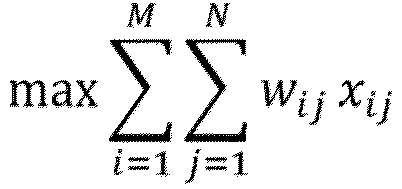
- S710: determining at least one matching group in the at least one matching pair consisting of a futures contract and a cold/hot-rolled excess material in a matching relationship graph by using a maximum weight matching algorithm.
The futures contracts and cold/hot-rolled excess materials in matching result is in a one-to-one correspondence, with the matching result obtained by computing the matching relationship graph based on the maximum weight matching algorithm. In the matching result, each futures contract matches one cold/hot-rolled excess material, and each cold/hot-rolled excess material matches one futures contract. Each pair of successfully matched futures contract and cold/hot-rolled excess material forms a matching group, which includes one futures contract and one cold/hot-rolled excess material. The matching result includes at least one matching group. The matching result can satisfy the constraint that a cold/hot-rolled excess material can only match a futures contract. However, because a futures contract can match multiple cold/hot-rolled excess materials, the matching relationship graph may be computed multiple times. - S720: updating the material deficiency weight in the corresponding futures contract based on weight of cold/hot-rolled excess material of each matching group in the at least one matching group.

In some embodiments, the weight of a cold/hot-rolled excess materials j in matching pair is Uj, and corresponding process is K. The material deficiency in the k th process of a futures contract i in the matching pair is Dik . And the cumulative feed rate of the futures contract i from the steelmaking process to the K th process is yiK. Assume that the weight inspection rule is defined as Wj ≤ DiK &&Wj * yiK ≤ D i1 . If the weight inspection rule is met, the matching pair can be reserved in the matching relationship graph, and the matching weight of the matching pair remains unchanged. Otherwise, the matching pair may be removed. The cold/hot-rolled excess materials j and the futures contract i in this matching pair may no longer be matched with each other.
| Contr act | Contract process information | |||||
| Contr act 1 | Process No. | 1 | 2 | 3 | 4 | 5 |
| Process name | 01-Steelm aking | 04-Hot Rolling | 07-Acid washing | 08-Cold Rolling | 10-Anneal ing | |
| Process feed rate | 1 | 1.015 | 1.036 | 1.023 | 1.013 | |
| Process deficiency weight/ ton | 32.69 | 32.21 | 31.09 | 30.39 | 30.00 | |
| Contr act 2 | Process No. | 1 | 2 | 3 | 4 | 5 |
| Process name | 01-Steelm aking | 04-Hot Rolling | 07-Acid washing | 08-Cold Rolling | 09-Hot-di p galvanizin g | |
| Process feed rate | 1 | 1.015 | 1.036 | 1.023 | 0.98 | |
| Process deficiency | 37.29 | 36.74 | 45.11 | 44.10 | 45.00 | |
| weight/ton | ||||||
| Contr act 3 | Process No. | 1 | 2 | 3 | 4 | 5 |
| Process name | 01-Steelm aking | 04-Hot Rolling | 07-Acid washing | 08-Cold Rolling | 10-Anneal ing | |
| Process feed rate | 1 | 1.015 | 1.036 | 1.023 | 1.013 | |
| Process deficiency weight/ton | 32.97 | 32.48 | 31.35 | 30.65 | 50.00 | |
| Excess materials | Corresponding process | Weight/ton | Material name | Excess materials type |
| 1 | 04-Hot Rolling | 20.60 | Hot rolling coil | Hot coil |
| 2 | 07-Acid washing | 10.08 | Acid washing coil | Cold coil |
| 3 | 08-Cold Rolling | 15.21 | Hard rolling coil | Cold coil |
| 4 | 09-Hot-dip galvanizing | 11.75 | Hot-dip galvanizing coil | Cold coil |
| 5 | 10-Annealing | 9.88 | Annealing coil | Cold coil |
| 6 | 10-Annealing | 10.16 | Annealing coil | Cold coil |
| Matching weight | Excess material 1 | Excess material 2 | Excess material 3 | Excess material 4 | Excess material 5 | Excess material 6 |
| Contract 1 | 3.12 | 2.36 | 1.09 | / | 1.48 | 1.63 |
| Contract 2 | / | 3.57 | / | 2.83 | / | / |
| Contract 3 | / | / | 3.61 | / | / | 2.27 |
(1) The maximum weight matching algorithm can be used to compute the current matching relationship graph, to obtain three matching results shown by thick solid lines in
(2) Removing the matched excess materials 1, 2, and 3, and updating the corresponding contracts 1, 2, and 3. Take contract 1 as an example. The process corresponding to the excess material 1 is 04-hot rolling, with a weight of 20.60 tons. The excess material 1 is matched to the process 2 of contract 1, with process deficiency weight being 32.21 tons. The process deficiency weight of each process can be updated according to the formula:


| Process deficiency weight/ton | 1 | 2 | 3 | 4 | 5 |
| Contract 1 | 11.78 | 11.61 | 31.09 | 30.39 | 30.00 |
| Contract 2 | 26.69 | 26.30 | 35.03 | 44.10 | 45.00 |
| Contract 3 | 16.61 | 16.36 | 15.79 | 15.44 | 50.00 |
(3) The remaining materials 4, 5, 6 and contracts 1, 2, 3 are used to reconstruct matching relationship graph. As shown in
(4) Because there is still connection relationship between the remaining excess materials and the remaining contracts, the maximum weight matching algorithm can be used to compute the current matching relationship graph, to obtain the matching results shown in the thick solid lines in
Claims (23)
- A method for cross-process use of cold/hot-rolled excess materials, applied in an electronic device, comprising:obtaining multiple futures contracts and multiple cold/hot-rolled excess materials with same steel grade, wherein the multiple cold/hot-rolled excess materials are used as deficient materials of corresponding processes in the multiple futures contracts;forming at least one matching pair consisting of a futures contract and a cold/hot-rolled excess material by taking the multiple futures contracts and the multiple cold/hot-rolled excess materials as nodes in a weighted binary graph, to construct a matching relationship graph between the multiple futures contracts and the multiple cold/hot-rolled excess materials, and determining a matching weight of each matching pair in the at least one matching pair;computing the matching relationship graph based on a binary graph maximum weight matching algorithm, to obtain a use solution between the multiple futures contract and the multiple cold/hot-rolled excess materials, wherein in the use solution, a matched cold/hot-rolled excess material is associated with a futures contract, and a maximum sum of matching weights of the at least one matching pair is obtained.
- The method of claim 1, wherein forming at least one matching pair consisting of a futures contract and a cold/hot-rolled excess material by taking the multiple futures contracts and the multiple cold/hot-rolled excess materials as nodes in a weighted binary graph, comprises:determining a rule of use, wherein the rule of use is used to check whether the multiple futures contracts match the multiple cold/hot-rolled excess materials;forming at least one matching pair consisting of a futures contract and a cold/hot-rolled excess material which meet the rule of use preset, by taking the multiple futures contracts and the multiple cold/hot-rolled excess materials as nodes in a weighted binary graph.
- The method of claim 1, wherein determining a matching weight of each matching pair in the at least one matching pair, comprises:
determining a matching weight for each matching pair in the at least one matching pair according to preset matching priority information, wherein the matching priority information is used to describe a matching quality between the multiple futures contracts and the multiple cold/hot-rolled excess materials. - The method of claim 3, wherein determining a matching weight for each matching pair in the at least one matching pair according to preset matching priority information, comprises:determining, a priority level of a futures contract in each matching pair of the at least one matching pair, according to preset matching priority information;determining a matching weight of each matching pair in the at least one matching pair, according to the priority level and weight of a cold/hot-rolled excess material in each matching pair.
- The method of any one of claims 2 to 4, wherein the rule of use includes at least one of the following: rule of a specification type, rule of a surface type, rule of a performance and process type, rule of a management type, and rule of a component type.
- The method of any one of claims 2 to 4, wherein the matching priority information includes priority content and priority level, and includes at least one of the following: contract priority information, material priority information, and adaptation priority information.
- The method of claim 1, wherein computing the matching relationship graph based on a binary graph maximum weight matching algorithm, to obtain a use solution between the multiple futures contract and the multiple cold/hot-rolled excess materials, comprises:
computing the matching relationship graph based on a binary graph maximum weight matching algorithm based on preset constraint conditions, to obtain a use solution between the multiple futures contract and the multiple cold/hot-rolled excess materials. - The method of claim 7, wherein computing the matching relationship graph based on a binary graph maximum weight matching algorithm based on preset constraint conditions, comprises:determining at least one matching group in the at least one matching pair consisting of a futures contract and a cold/hot-rolled excess material in the matching relationship graph based on the binary graph maximum weight matching algorithm, according to preset constraint conditions;updating a material deficiency weight in a corresponding futures contract based on a cold/hot-rolled excess material of each matching group in the at least one matching group;removing the at least one matching group and each cold/hot-rolled excess material in the at least one matching group from the matching relationship graph, and using changed matching relationship graph as a new matching relationship graph;repeating process of computing the matching relationship graph until no matching pair consisting of a futures contract and a cold/hot-rolled excess material exist in the matching relationship graph.
- The method of claim 8, wherein after removing the at least one matching group and each cold/hot-rolled excess material in the at least one matching group from the matching relationship graph, the method further comprises:
performing weight inspection on each remaining matching pair in the matching relationship graph, retaining matching pairs that meet a weight inspection rule, and removing matching pair that don't meet the weight inspection rule. - The method of any one of claims 7 to 9, wherein the constraint conditions include at least one of the following: a matching quantity constraint, a contract process deficiency weight constraint, a use rule constraint, and a decision variable value constraint.
- An apparatus for cross-process use of cold/hot-rolled excess materials, comprising:an obtaining unit, configured to obtain multiple futures contracts and multiple cold/hot-rolled excess materials with same steel grade, wherein the multiple cold/hot-rolled excess materials are used as deficient materials of corresponding processes in the multiple futures contracts;a matching relationship graph determining unit, configured to form at least one matching pair consisting of a futures contract and a cold/hot-rolled excess material by taking the multiple futures contracts and the multiple cold/hot-rolled excess materials as nodes in a weighted binary graph, to construct a matching relationship graph between the multiple futures contracts and the multiple cold/hot-rolled excess materials, and determining a matching weight of each matching pair in the at least one matching pair;a use solution generating unit, configured to compute the matching relationship graph based on a binary graph maximum weight matching algorithm, to obtain a use solution between the multiple futures contract and the multiple cold/hot-rolled excess materials, wherein in the use solution, a matched cold/hot-rolled excess material is associated with a futures contract, and a maximum sum of matching weights of the at least one matching pair is obtained.
- The apparatus of claim 11, wherein the matching relationship graph determining unit comprises:a rule of use determining sub-unit, configured to determine a rule of use, wherein the rule of use is used to check whether the multiple futures contracts match the multiple cold/hot-rolled excess materials;a matching pair generating sub-unit, configured to form at least one matching pair consisting of a futures contract and a cold/hot-rolled excess material which meet the rule of use preset, by taking the multiple futures contracts and the multiple cold/hot-rolled excess materials as nodes in a weighted binary graph.
- The apparatus of claim 11, wherein in the matching relationship graph determining unit, determining a matching weight of each matching pair in the at least one matching pair, comprises:
determining a matching weight for each matching pair in the at least one matching pair according to preset matching priority information, wherein the matching priority information is used to describe a matching quality between the multiple futures contracts and the multiple cold/hot-rolled excess materials. - The apparatus according to claim 13, wherein in the matching relationship graph determining unit, determining a matching weight for each matching pair in the at least one matching pair according to preset matching priority information, comprises:determining, a priority level of a futures contract in each matching pair of the at least one matching pair, according to preset matching priority information;determining a matching weight of each matching pair in the at least one matching pair, according to the priority level and weight of a cold/hot-rolled excess material in each matching pair.
- The apparatus of any one of claims 12 to 14, wherein in the matching relationship graph determining unit, the rule of use includes at least one of the following: rule of a specification type, rule of a surface type, rule of a performance and process type, rule of a management type, and rule of a component type.
- The apparatus of any one of claims 12 to 14, wherein in the matching relationship graph determining unit, the matching priority information includes priority content and priority level, and includes at least one of the following: contract priority information, material priority information, and adaptation priority information.
- The apparatus of claim 11, wherein in the use solution generating unit, computing the matching relationship graph based on a binary graph maximum weight matching algorithm, to obtain a use solution between the multiple futures contract and the multiple cold/hot-rolled excess materials, comprises:
computing the matching relationship graph based on a binary graph maximum weight matching algorithm based on preset constraint conditions, to obtain a use solution between the multiple futures contract and the multiple cold/hot-rolled excess materials. - The apparatus of claim 17, wherein in the use solution generating unit, computing the matching relationship graph based on a binary graph maximum weight matching algorithm based on preset constraint conditions, comprises:determining at least one matching group in the at least one matching pair consisting of a futures contract and a cold/hot-rolled excess material in the matching relationship graph based on the binary graph maximum weight matching algorithm, according to preset constraint conditions;updating a material deficiency weight in a corresponding futures contract based on a cold/hot-rolled excess material of each matching group in the at least one matching group;removing the at least one matching group and each cold/hot-rolled excess material in the at least one matching group from the matching relationship graph, and using changed matching relationship graph as a new matching relationship graph;repeating process of computing the matching relationship graph until no matching pair consisting of a futures contract and a cold/hot-rolled excess material exist in the matching relationship graph.
- The apparatus of claim 18, wherein the apparatus further comprises:
a weight inspection unit, configured to perform weight inspection on each remaining matching pair in the matching relationship graph, retaining matching pairs that meet a weight inspection rule, and removing matching pair that don't meet the weight inspection rule. - The apparatus of any one of claims 17 to 19, wherein in the use solution generating unit, the constraint conditions include at least one of the following: a matching quantity constraint, a contract process deficiency weight constraint, a use rule constraint, and a decision variable value constraint.
- A non-transitory computer-readable storage medium storing instructions, wherein when the instructions are executed on a computer, the instructions cause the computer to execute the method of any one of claims 1 to 10.
- An electronic device, comprising:a memory, configured to store instructions executed by one or more processors of the electronic device; anda processor, which is one of processors of the electronic device, configured to execute the method of any one of claims 1 to 10.
- A computer program product comprising computer programs/instructions, wherein the computer programs/instructions are executed by a processor to implement the method of any one of claims 1 to 10.
Applications Claiming Priority (2)
| Application Number | Priority Date | Filing Date | Title |
|---|---|---|---|
| CN202210017717.1A CN116441319A (en) | 2022-01-07 | 2022-01-07 | Method, apparatus, medium and program product for cold and hot coil surplus material to act across processes |
| PCT/CN2022/121615 WO2023130773A1 (en) | 2022-01-07 | 2022-09-27 | Method and device for cross-process use of cold/hot-rolled excess material, medium, and program product |
Publications (3)
| Publication Number | Publication Date |
|---|---|
| EP4438195A1 true EP4438195A1 (en) | 2024-10-02 |
| EP4438195A4 EP4438195A4 (en) | 2025-02-19 |
| EP4438195B1 EP4438195B1 (en) | 2026-04-01 |
Family
ID=87072998
Family Applications (1)
| Application Number | Title | Priority Date | Filing Date |
|---|---|---|---|
| EP22918227.4A Active EP4438195B1 (en) | 2022-01-07 | 2022-09-27 | Method and device for cross-process use of cold/hot-rolled excess material, medium, and program product |
Country Status (6)
| Country | Link |
|---|---|
| US (1) | US20250069034A1 (en) |
| EP (1) | EP4438195B1 (en) |
| JP (1) | JP2025501346A (en) |
| KR (1) | KR20240122504A (en) |
| CN (1) | CN116441319A (en) |
| WO (1) | WO2023130773A1 (en) |
Family Cites Families (16)
| Publication number | Priority date | Publication date | Assignee | Title |
|---|---|---|---|---|
| US6044361A (en) * | 1998-03-24 | 2000-03-28 | International Business Machines Corporation | Fast inventory matching algorithm for the process industry |
| JP2003330528A (en) * | 2002-05-17 | 2003-11-21 | Nippon Steel Corp | How to allocate extra slabs |
| CN1661609A (en) * | 2004-02-26 | 2005-08-31 | 何浩然 | Method of united optimized managing contracts and repertories in plane of steel production |
| US8896604B2 (en) * | 2010-01-29 | 2014-11-25 | Yahoo! Inc. | Producing optimization graphs in online advertising systems |
| CN103184302B (en) * | 2011-12-28 | 2014-12-03 | 宝山钢铁股份有限公司 | Controlling method and controlling system for charging of main raw material of converter |
| CN102637272B (en) * | 2012-03-19 | 2016-05-04 | 东北大学 | Distribution method and the device of the front storehouse of hot rolling slab residue slab |
| CN102651114B (en) * | 2012-04-05 | 2015-04-15 | 东北大学 | A matching method of slab and contract transfer to improve the slab utilization rate of iron and steel enterprises |
| CN104483915B (en) * | 2014-10-31 | 2017-03-22 | 东北大学 | Hot rolling multiple production line slab matching control method for improving steel enterprise material utilization rate |
| CN104573956A (en) * | 2014-12-30 | 2015-04-29 | 东北大学 | Accurate distribution method for slab resources of iron and steel enterprise |
| JP6508185B2 (en) * | 2015-12-24 | 2019-05-08 | Jfeスチール株式会社 | Result prediction device and result prediction method |
| CN108876050B (en) * | 2018-06-27 | 2021-08-10 | 东北大学 | Method for setting and automatically converting contract main process of iron and steel enterprise |
| US11615882B2 (en) * | 2018-11-07 | 2023-03-28 | Ge Healthcare Limited | Apparatus, non-transitory computer-readable storage medium, and computer-implemented method for distributed ledger management of nuclear medicine products |
| CN110648096A (en) * | 2019-08-19 | 2020-01-03 | 北京三快在线科技有限公司 | Distribution line generation method and device |
| CN113780693B (en) * | 2020-06-10 | 2023-11-14 | 宝山钢铁股份有限公司 | Method, equipment, system and storage medium for generating capacity allocation plan |
| CN112688848B (en) * | 2020-12-17 | 2021-12-21 | 北京邮电大学 | A kind of heterogeneous virtual network mapping method and system |
| CN113033905A (en) * | 2021-04-02 | 2021-06-25 | 北京橙心无限科技发展有限公司 | Route allocation method and device, electronic device and storage medium |
-
2022
- 2022-01-07 CN CN202210017717.1A patent/CN116441319A/en active Pending
- 2022-09-27 EP EP22918227.4A patent/EP4438195B1/en active Active
- 2022-09-27 JP JP2024540668A patent/JP2025501346A/en active Pending
- 2022-09-27 WO PCT/CN2022/121615 patent/WO2023130773A1/en not_active Ceased
- 2022-09-27 KR KR1020247022946A patent/KR20240122504A/en active Pending
- 2022-09-27 US US18/726,098 patent/US20250069034A1/en active Pending
Also Published As
| Publication number | Publication date |
|---|---|
| EP4438195A4 (en) | 2025-02-19 |
| US20250069034A1 (en) | 2025-02-27 |
| KR20240122504A (en) | 2024-08-12 |
| JP2025501346A (en) | 2025-01-17 |
| EP4438195B1 (en) | 2026-04-01 |
| WO2023130773A1 (en) | 2023-07-13 |
| CN116441319A (en) | 2023-07-18 |
Similar Documents
| Publication | Publication Date | Title |
|---|---|---|
| CN114594744B (en) | Distributed factory production distribution integrated scheduling method and system | |
| CN113780907B (en) | Consumable demand and inventory control method, device, system and storage medium | |
| CN106960373A (en) | Trade matching method and trading platform system based on staple commodities transaction platform | |
| CN115049175A (en) | Multi-product production planning method and device, computer equipment and storage medium | |
| US20080040292A1 (en) | Cost information management system, cost information management method, and cost information management program | |
| CN110223142A (en) | A kind of supply chain implementation method based on block chain technology | |
| CN113780693B (en) | Method, equipment, system and storage medium for generating capacity allocation plan | |
| CN115758761A (en) | Quality inspection task scheduling method, equipment and medium based on genetic algorithm | |
| CN117540990A (en) | Production line scheduling method based on deep reinforcement learning and multi-objective optimization | |
| EP4438195B1 (en) | Method and device for cross-process use of cold/hot-rolled excess material, medium, and program product | |
| CN113485278A (en) | Flexible job shop scheduling multi-target distribution estimation method for optimizing two production indexes | |
| CN119578845B (en) | Material distribution task generation method and device, terminal equipment and computer program product | |
| CN120450587A (en) | Recommended warehouse method, device, electronic equipment and storage medium for steel coil storage | |
| CN114918261B (en) | Setting method and device for convexity of intermediate blank and computer equipment | |
| CN117436665A (en) | Production scheduling method and device for mixed flow shop, electronic equipment and medium | |
| CN110929955A (en) | Method for acquiring stable historical data in contract rolling mode | |
| CN117764641A (en) | An optimized dispatching method, electronic device and storage medium for power trading | |
| CN117094792A (en) | A method for identifying power generator monopoly in the electricity day-ahead market based on quotation behavior | |
| CN117406677A (en) | Wear-resistant steel quality data processing method, device, equipment and medium | |
| CN116501272A (en) | A 3D printing order task scheduling method based on improved genetic algorithm | |
| CN113657956A (en) | Second-hand article transaction method and device, storage medium and electronic equipment | |
| CN119310864B (en) | Intelligent control system for optimizing iron ore blending structure | |
| Tang | The relative efficiency of ownership structures and intra-firm trade | |
| KR101442196B1 (en) | System and method for bond bidding | |
| JPH05307551A (en) | Scheduling method in iron and steel industry |
Legal Events
| Date | Code | Title | Description |
|---|---|---|---|
| STAA | Information on the status of an ep patent application or granted ep patent |
Free format text: STATUS: THE INTERNATIONAL PUBLICATION HAS BEEN MADE |
|
| PUAI | Public reference made under article 153(3) epc to a published international application that has entered the european phase |
Free format text: ORIGINAL CODE: 0009012 |
|
| STAA | Information on the status of an ep patent application or granted ep patent |
Free format text: STATUS: REQUEST FOR EXAMINATION WAS MADE |
|
| 17P | Request for examination filed |
Effective date: 20240625 |
|
| AK | Designated contracting states |
Kind code of ref document: A1 Designated state(s): AL AT BE BG CH CY CZ DE DK EE ES FI FR GB GR HR HU IE IS IT LI LT LU LV MC MK MT NL NO PL PT RO RS SE SI SK SM TR |
|
| A4 | Supplementary search report drawn up and despatched |
Effective date: 20250120 |
|
| RIC1 | Information provided on ipc code assigned before grant |
Ipc: G06Q 10/08 20240101ALI20250114BHEP Ipc: G06Q 50/04 20120101ALI20250114BHEP Ipc: B21B 37/00 20060101AFI20250114BHEP |
|
| DAV | Request for validation of the european patent (deleted) | ||
| DAX | Request for extension of the european patent (deleted) | ||
| GRAP | Despatch of communication of intention to grant a patent |
Free format text: ORIGINAL CODE: EPIDOSNIGR1 |
|
| STAA | Information on the status of an ep patent application or granted ep patent |
Free format text: STATUS: GRANT OF PATENT IS INTENDED |
|
| INTG | Intention to grant announced |
Effective date: 20251118 |
|
| GRAS | Grant fee paid |
Free format text: ORIGINAL CODE: EPIDOSNIGR3 |
|
| GRAA | (expected) grant |
Free format text: ORIGINAL CODE: 0009210 |
|
| STAA | Information on the status of an ep patent application or granted ep patent |
Free format text: STATUS: THE PATENT HAS BEEN GRANTED |
|
| P01 | Opt-out of the competence of the unified patent court (upc) registered |
Free format text: CASE NUMBER: UPC_APP_0005686_4438195/2026 Effective date: 20260216 |
|
| AK | Designated contracting states |
Kind code of ref document: B1 Designated state(s): AL AT BE BG CH CY CZ DE DK EE ES FI FR GB GR HR HU IE IS IT LI LT LU LV MC MK MT NL NO PL PT RO RS SE SI SK SM TR |
|
| REG | Reference to a national code |
Ref country code: CH Ref legal event code: F10 Free format text: ST27 STATUS EVENT CODE: U-0-0-F10-F00 (AS PROVIDED BY THE NATIONAL OFFICE) Effective date: 20260401 Ref country code: GB Ref legal event code: FG4D |
|
| REG | Reference to a national code |
Ref country code: IE Ref legal event code: FG4D |
|
| REG | Reference to a national code |
Ref country code: DE Ref legal event code: R096 Ref document number: 602022033788 Country of ref document: DE |