EP4438170A1 - Method for regenerating carbonate-type layered double hydroxide, acidic exhaust gas treatment method, and acidic exhaust gas treatment equipment - Google Patents
Method for regenerating carbonate-type layered double hydroxide, acidic exhaust gas treatment method, and acidic exhaust gas treatment equipment Download PDFInfo
- Publication number
- EP4438170A1 EP4438170A1 EP22895201.6A EP22895201A EP4438170A1 EP 4438170 A1 EP4438170 A1 EP 4438170A1 EP 22895201 A EP22895201 A EP 22895201A EP 4438170 A1 EP4438170 A1 EP 4438170A1
- Authority
- EP
- European Patent Office
- Prior art keywords
- layered double
- double hydroxide
- carbonate
- exhaust gas
- type
- Prior art date
- Legal status (The legal status is an assumption and is not a legal conclusion. Google has not performed a legal analysis and makes no representation as to the accuracy of the status listed.)
- Pending
Links
Images

Classifications
-
- B—PERFORMING OPERATIONS; TRANSPORTING
- B01—PHYSICAL OR CHEMICAL PROCESSES OR APPARATUS IN GENERAL
- B01D—SEPARATION
- B01D53/00—Separation of gases or vapours; Recovering vapours of volatile solvents from gases; Chemical or biological purification of waste gases, e.g. engine exhaust gases, smoke, fumes, flue gases, aerosols
- B01D53/34—Chemical or biological purification of waste gases
- B01D53/38—Removing components of undefined structure
- B01D53/40—Acidic components
-
- C—CHEMISTRY; METALLURGY
- C01—INORGANIC CHEMISTRY
- C01F—COMPOUNDS OF THE METALS BERYLLIUM, MAGNESIUM, ALUMINIUM, CALCIUM, STRONTIUM, BARIUM, RADIUM, THORIUM, OR OF THE RARE-EARTH METALS
- C01F7/00—Compounds of aluminium
- C01F7/78—Compounds containing aluminium, with or without oxygen or hydrogen, and containing two or more other elements
- C01F7/784—Layered double hydroxide, e.g. comprising nitrate, sulfate or carbonate ions as intercalating anions
- C01F7/785—Hydrotalcite
-
- B—PERFORMING OPERATIONS; TRANSPORTING
- B01—PHYSICAL OR CHEMICAL PROCESSES OR APPARATUS IN GENERAL
- B01D—SEPARATION
- B01D53/00—Separation of gases or vapours; Recovering vapours of volatile solvents from gases; Chemical or biological purification of waste gases, e.g. engine exhaust gases, smoke, fumes, flue gases, aerosols
- B01D53/34—Chemical or biological purification of waste gases
- B01D53/46—Removing components of defined structure
- B01D53/48—Sulfur compounds
- B01D53/50—Sulfur oxides
-
- B—PERFORMING OPERATIONS; TRANSPORTING
- B01—PHYSICAL OR CHEMICAL PROCESSES OR APPARATUS IN GENERAL
- B01D—SEPARATION
- B01D53/00—Separation of gases or vapours; Recovering vapours of volatile solvents from gases; Chemical or biological purification of waste gases, e.g. engine exhaust gases, smoke, fumes, flue gases, aerosols
- B01D53/34—Chemical or biological purification of waste gases
- B01D53/46—Removing components of defined structure
- B01D53/54—Nitrogen compounds
- B01D53/56—Nitrogen oxides
- B01D53/565—Nitrogen oxides by treating the gases with solids
-
- B—PERFORMING OPERATIONS; TRANSPORTING
- B01—PHYSICAL OR CHEMICAL PROCESSES OR APPARATUS IN GENERAL
- B01D—SEPARATION
- B01D53/00—Separation of gases or vapours; Recovering vapours of volatile solvents from gases; Chemical or biological purification of waste gases, e.g. engine exhaust gases, smoke, fumes, flue gases, aerosols
- B01D53/34—Chemical or biological purification of waste gases
- B01D53/46—Removing components of defined structure
- B01D53/68—Halogens or halogen compounds
- B01D53/685—Halogens or halogen compounds by treating the gases with solids
-
- B—PERFORMING OPERATIONS; TRANSPORTING
- B01—PHYSICAL OR CHEMICAL PROCESSES OR APPARATUS IN GENERAL
- B01D—SEPARATION
- B01D53/00—Separation of gases or vapours; Recovering vapours of volatile solvents from gases; Chemical or biological purification of waste gases, e.g. engine exhaust gases, smoke, fumes, flue gases, aerosols
- B01D53/34—Chemical or biological purification of waste gases
- B01D53/74—General processes for purification of waste gases; Apparatus or devices specially adapted therefor
- B01D53/81—Solid phase processes
- B01D53/82—Solid phase processes with stationary reactants
-
- B—PERFORMING OPERATIONS; TRANSPORTING
- B01—PHYSICAL OR CHEMICAL PROCESSES OR APPARATUS IN GENERAL
- B01D—SEPARATION
- B01D53/00—Separation of gases or vapours; Recovering vapours of volatile solvents from gases; Chemical or biological purification of waste gases, e.g. engine exhaust gases, smoke, fumes, flue gases, aerosols
- B01D53/34—Chemical or biological purification of waste gases
- B01D53/96—Regeneration, reactivation or recycling of reactants
-
- B—PERFORMING OPERATIONS; TRANSPORTING
- B01—PHYSICAL OR CHEMICAL PROCESSES OR APPARATUS IN GENERAL
- B01J—CHEMICAL OR PHYSICAL PROCESSES, e.g. CATALYSIS OR COLLOID CHEMISTRY; THEIR RELEVANT APPARATUS
- B01J20/00—Solid sorbent compositions or filter aid compositions; Sorbents for chromatography; Processes for preparing, regenerating or reactivating thereof
- B01J20/02—Solid sorbent compositions or filter aid compositions; Sorbents for chromatography; Processes for preparing, regenerating or reactivating thereof comprising inorganic material
- B01J20/04—Solid sorbent compositions or filter aid compositions; Sorbents for chromatography; Processes for preparing, regenerating or reactivating thereof comprising inorganic material comprising compounds of alkali metals, alkaline earth metals or magnesium
- B01J20/041—Oxides or hydroxides
-
- B—PERFORMING OPERATIONS; TRANSPORTING
- B01—PHYSICAL OR CHEMICAL PROCESSES OR APPARATUS IN GENERAL
- B01J—CHEMICAL OR PHYSICAL PROCESSES, e.g. CATALYSIS OR COLLOID CHEMISTRY; THEIR RELEVANT APPARATUS
- B01J20/00—Solid sorbent compositions or filter aid compositions; Sorbents for chromatography; Processes for preparing, regenerating or reactivating thereof
- B01J20/02—Solid sorbent compositions or filter aid compositions; Sorbents for chromatography; Processes for preparing, regenerating or reactivating thereof comprising inorganic material
- B01J20/04—Solid sorbent compositions or filter aid compositions; Sorbents for chromatography; Processes for preparing, regenerating or reactivating thereof comprising inorganic material comprising compounds of alkali metals, alkaline earth metals or magnesium
- B01J20/043—Carbonates or bicarbonates, e.g. limestone, dolomite, aragonite
-
- B—PERFORMING OPERATIONS; TRANSPORTING
- B01—PHYSICAL OR CHEMICAL PROCESSES OR APPARATUS IN GENERAL
- B01J—CHEMICAL OR PHYSICAL PROCESSES, e.g. CATALYSIS OR COLLOID CHEMISTRY; THEIR RELEVANT APPARATUS
- B01J20/00—Solid sorbent compositions or filter aid compositions; Sorbents for chromatography; Processes for preparing, regenerating or reactivating thereof
- B01J20/02—Solid sorbent compositions or filter aid compositions; Sorbents for chromatography; Processes for preparing, regenerating or reactivating thereof comprising inorganic material
- B01J20/06—Solid sorbent compositions or filter aid compositions; Sorbents for chromatography; Processes for preparing, regenerating or reactivating thereof comprising inorganic material comprising oxides or hydroxides of metals not provided for in group B01J20/04
- B01J20/08—Solid sorbent compositions or filter aid compositions; Sorbents for chromatography; Processes for preparing, regenerating or reactivating thereof comprising inorganic material comprising oxides or hydroxides of metals not provided for in group B01J20/04 comprising aluminium oxide or hydroxide; comprising bauxite
-
- B—PERFORMING OPERATIONS; TRANSPORTING
- B01—PHYSICAL OR CHEMICAL PROCESSES OR APPARATUS IN GENERAL
- B01J—CHEMICAL OR PHYSICAL PROCESSES, e.g. CATALYSIS OR COLLOID CHEMISTRY; THEIR RELEVANT APPARATUS
- B01J20/00—Solid sorbent compositions or filter aid compositions; Sorbents for chromatography; Processes for preparing, regenerating or reactivating thereof
- B01J20/30—Processes for preparing, regenerating, or reactivating
- B01J20/34—Regenerating or reactivating
-
- B—PERFORMING OPERATIONS; TRANSPORTING
- B01—PHYSICAL OR CHEMICAL PROCESSES OR APPARATUS IN GENERAL
- B01J—CHEMICAL OR PHYSICAL PROCESSES, e.g. CATALYSIS OR COLLOID CHEMISTRY; THEIR RELEVANT APPARATUS
- B01J20/00—Solid sorbent compositions or filter aid compositions; Sorbents for chromatography; Processes for preparing, regenerating or reactivating thereof
- B01J20/30—Processes for preparing, regenerating, or reactivating
- B01J20/34—Regenerating or reactivating
- B01J20/3433—Regenerating or reactivating of sorbents or filter aids other than those covered by B01J20/3408 - B01J20/3425
-
- B—PERFORMING OPERATIONS; TRANSPORTING
- B01—PHYSICAL OR CHEMICAL PROCESSES OR APPARATUS IN GENERAL
- B01D—SEPARATION
- B01D2251/00—Reactants
- B01D2251/40—Alkaline earth metal or magnesium compounds
- B01D2251/402—Alkaline earth metal or magnesium compounds of magnesium
-
- B—PERFORMING OPERATIONS; TRANSPORTING
- B01—PHYSICAL OR CHEMICAL PROCESSES OR APPARATUS IN GENERAL
- B01D—SEPARATION
- B01D2251/00—Reactants
- B01D2251/60—Inorganic bases or salts
- B01D2251/606—Carbonates
-
- B—PERFORMING OPERATIONS; TRANSPORTING
- B01—PHYSICAL OR CHEMICAL PROCESSES OR APPARATUS IN GENERAL
- B01D—SEPARATION
- B01D2257/00—Components to be removed
- B01D2257/20—Halogens or halogen compounds
- B01D2257/204—Inorganic halogen compounds
- B01D2257/2045—Hydrochloric acid
-
- B—PERFORMING OPERATIONS; TRANSPORTING
- B01—PHYSICAL OR CHEMICAL PROCESSES OR APPARATUS IN GENERAL
- B01D—SEPARATION
- B01D2257/00—Components to be removed
- B01D2257/30—Sulfur compounds
- B01D2257/302—Sulfur oxides
-
- B—PERFORMING OPERATIONS; TRANSPORTING
- B01—PHYSICAL OR CHEMICAL PROCESSES OR APPARATUS IN GENERAL
- B01D—SEPARATION
- B01D2257/00—Components to be removed
- B01D2257/40—Nitrogen compounds
- B01D2257/404—Nitrogen oxides other than dinitrogen oxide
-
- B—PERFORMING OPERATIONS; TRANSPORTING
- B01—PHYSICAL OR CHEMICAL PROCESSES OR APPARATUS IN GENERAL
- B01D—SEPARATION
- B01D2258/00—Sources of waste gases
- B01D2258/02—Other waste gases
- B01D2258/0283—Flue gases
Definitions
- the present invention relates to a method for regenerating carbonate-type layered double hydroxide, a method for treating acid exhaust gas using the regeneration method, and a facility for treating acid exhaust gas.
- the combustion exhaust gas generated in combustion plants such as thermal power plants and waste incineration plants contains harmful acid materials such as hydrogen chloride, sulfur oxides, and nitrogen oxides.
- Various techniques are available as treatment techniques for removing the acid materials from the acid exhaust gas containing the acid materials.
- the present inventors have proposed a method for treating an acid exhaust gas using a carbonate-type Mg-Al layered double hydroxide, a treatment agent, etc.
- the carbonate-type Mg-Al layered double hydroxide is a treatment agent that can be regenerated for repeated use. Accordingly, after the carbonate-type Mg-Al layered double hydroxide is used in treatment of an acid exhaust gas, the used layered double hydroxide is regenerated and reused.
- PTL1 describes a method of, after a carbonate-type Mg-Al layered double hydroxide is used in treatment of an acid exhaust gas, regenerating the used layered double hydroxide by mixing with a carbonate aqueous solution.
- PTL2 describes a method of, after a carbonate-type Mg-Al layered double hydroxide is used in treatment of an acid exhaust gas, regenerating the used layered double hydroxide into a carbonate-type Mg-Al layered double hydroxide by contacting with a treated gas from which acid gases other than carbon dioxide have been removed by the carbonate-type Mg-Al layered double hydroxide.
- An object of the present invention is to provide a method for regenerating carbonate-type layered double hydroxide, capable of regenerating a used layered double hydroxide obtained after a carbonate-type Mg-Al layered double hydroxide is used for treatment of an acid exhaust gas, into a carbonate-type Mg-Al layered double hydroxide effectively without requirement of a large-scale facility, a method for treating acid exhaust gas, and a facility for treating acid exhaust gas.
- a used layered double hydroxide can be effectively regenerated into a carbonate-type Mg-Al layered double hydroxide by contacting a used layered double hydroxide obtained after a carbonate-type Mg-Al layered double hydroxide is used in treatment of an acid exhaust gas, with a treated gas containing carbon dioxide treated with the carbonate-type Mg-Al layered double hydroxide in the presence of an alkali.
- the present invention is based on the finding.
- the present invention provides the following [1] to [7].
- a method for regenerating a carbonate-type layered double hydroxide capable of regenerating a used layered double hydroxide obtained after a carbonate-type Mg-Al layered double hydroxide is used for treatment of an acid exhaust gas, into a carbonate-type Mg-Al layered double hydroxide effectively without requirement of a large-scale facility, a method for treating acid exhaust gas, and a facility for treating acid exhaust gas.
- a method for regenerating a carbonate-type layered double hydroxide, a method for treating an acid exhaust gas, and a facility for treating an acid exhaust gas of the present invention are described as follows partly with reference to drawings.
- acid materials other than carbon dioxide may be simply referred to as “acid materials”. That is, in the present invention, the term “acid materials” means “acid materials other than carbon dioxide”.
- a method for regenerating a used carbonate-type Mg-Al layered double hydroxide of the present invention is a method for regenerating a used carbonate-type Mg-Al layered double hydroxide in which at least some of interlayer carbonate ions of a carbonate-type Mg-Al layered double hydroxide are exchanged with another anion, the method comprising: contacting the used carbonate-type Mg-Al layered double hydroxide with a carbon dioxide-containing gas that contains carbon dioxide in the presence of an alkali.
- the used layered double hydroxide can be efficiently regenerated into a carbonate-type Mg-Al layered double hydroxide.
- the carbonate-type Mg-Al layered double hydroxide has a structure in which a hydroxide base layer and an interlayer composed of interlayer carbonate ions and interlayer water are alternately laminated.
- the interlayer carbonate ions have been exchanged with an anion derived from acid materials.
- the used carbonate-type Mg-Al layered double hydroxide is obtained by contacting a carbonate-type Mg-Al layered double hydroxide with an acid exhaust gas containing carbon dioxide and acid materials other than carbon dioxide to remove the acid materials from the acid exhaust gas, thereby obtaining a treated gas, and the carbon dioxide-containing gas that contains carbon dioxide is the treated gas.
- the method for regenerating a used carbonate-type Mg-Al layered double hydroxide in the first aspect is a method for regenerating a used carbonate-type Mg-Al layered double hydroxide obtained by contacting a carbonate-type Mg-Al layered double hydroxide with an acid exhaust gas containing carbon dioxide and acid materials other than carbon dioxide to remove the acid materials from the acid exhaust gas, thereby obtaining a treated gas, the method comprising: contacting the used carbonate-type Mg-Al layered double hydroxide with the treated gas in the presence of an alkali.
- the carbon dioxide-containing gas that contains carbon dioxide is not particularly limited, as described above, a treated gas is preferred from the viewpoint that the separate preparation of a carbon dioxide-containing gas for regeneration is not required.
- the acid exhaust gas contains carbon dioxide and acid materials other than carbon dioxide.
- Examples of the acid materials include hydrogen chloride, SO x such as sulfur dioxide, and NO x such as nitrogen dioxide.
- Carbon dioxide is also an acid material. However, in this specification, carbon dioxide is not included in "acid materials" from the viewpoint of distinguishing carbon dioxide from acid materials other than carbon dioxide.
- the acid exhaust gas is not particularly limited as long as it contains carbon dioxide and acid materials, and examples thereof include combustion exhaust gas generated from incinerators of combustion plants such as thermal power plants and incineration plants.
- the treated gas from which the acid materials are removed by contacting the combustion exhaust gas with the carbonate-type Mg-Al layered double hydroxide also contains a large amount of carbon dioxide. Therefore, in the case of using the treated gas to regenerate the used carbonate-type Mg-Al layered double hydroxide, the regeneration can be performed efficiently.
- the content of carbon dioxide in the acid exhaust gas is preferably 1 to 20 vol%, more preferably 5 to 18 vol%, and still more preferably 10 to 15 vol%. With a content of 1 vol% or more, the reactivity of the ion exchange reaction is increased, so that in the case of regenerating a used carbonate-type Mg-Al layered double hydroxide by using the treated gas derived from the acid exhaust gas, the regeneration can be efficiently performed.
- the content of acid materials in the acid exhaust gas is preferably 10 to 5000 vol ppm, more preferably 200 to 3000 vol ppm, still more preferably 300 to 1500 vol ppm, and even more preferably 500 to 1000 vol ppm.
- the water content in the acid exhaust gas is preferably 0 to 30 vol%, more preferably 5 to 25 vol%, and still more preferably 10 to 20 vol%.
- the total content of nitrogen, oxygen, carbon dioxide, acid materials and water in the acid exhaust gas is preferably 90 vol% or more, more preferably 95 vol% or more, and still more preferably 99 vol% or more.
- a carbonate-type Mg-Al layered double hydroxide is a particle having a structure in which a hydroxide base layer ([Mg 2+ 1-x Al 3+ x (OH) 2 ]) and an intermediate layer composed of interlayer carbonate ions and interlayer water ([(CO 3 2- ) x/2 ⁇ yH 2 O]) are alternately laminated.
- the carbonate-type Mg-Al layered double hydroxide is a non-stoichiometric compound in which the hydroxide base layer has a positive charge equivalent to x, and carbonate ions are present in the intermediate layer as negatively charged negative ions (anions) to compensate the charge.
- the carbonate-type Mg-Al layered double hydroxide can incorporate acid materials, for example, such as hydrogen chloride, SO x and NO x as anions between the layers while maintaining the hydroxide base layer. Therefore, it can be suitably used for treatment of an acid exhaust gas to remove acid materials from the acid exhaust gas.
- acid materials for example, such as hydrogen chloride, SO x and NO x as anions between the layers while maintaining the hydroxide base layer. Therefore, it can be suitably used for treatment of an acid exhaust gas to remove acid materials from the acid exhaust gas.
- a layered double hydroxide other than the carbonate-type Mg-Al layered double hydroxide or, for example, a chemical agent other than the layered double hydroxide such as calcium hydroxide (slaked lime), calcium oxide, sodium bicarbonate (baking soda), sodium carbonate, dolomite hydroxide, light burnt dolomite, aluminum hydroxide, aluminum oxide, magnesium hydroxide and magnesium oxide may be used in combination.
- a chemical agent other than the layered double hydroxide such as calcium hydroxide (slaked lime), calcium oxide, sodium bicarbonate (baking soda), sodium carbonate, dolomite hydroxide, light burnt dolomite, aluminum hydroxide, aluminum oxide, magnesium hydroxide and magnesium oxide
- the carbonate-type Mg-Al layered double hydroxides include naturally produced clay minerals as hydrotalcite, synthetic powders are usually used.
- the synthesis method is not particularly limited, and a known method (for example, the method described in PTL1) may be used.
- a carbonate-type Mg-Al layered double hydroxide when used for treatment of an acid exhaust gas and taking the acid materials in between the layers, turns into an anion-type Mg-Al layered double hydroxide (used carbonate-type Mg-Al layered double hydroxide) in which the interlayer carbonate ions have been exchanged with other ions derived from acid materials such as chloride ions, sulfate ions, and nitrate ions.
- the anion-type Mg-Al layered double hydroxide produced in this manner has a reduced capability to remove an acid exhaust gas. Therefore, the anion-type Mg-Al layered double hydroxide is regenerated again by anion exchange into a carbonate-type Mg-Al layered double hydroxide for reuse.
- the treated gas is an acid waste gas containing carbon dioxide and acid materials other than carbon dioxide of which a part or all of the acid materials are exchanged with carbon dioxide derived from interlayer carbonate ions in the carbonate-type Mg-Al layered double hydroxide.
- the content of carbon dioxide in the acid exhaust gas is preferably 1 to 20 vol%, more preferably 5 to 18 vol%, and still more preferably 10 to 15 vol%. With a content of 1 vol% or more, when the used carbonate-type Mg-Al layered double hydroxide is regenerated using the treated gas derived from the acid exhaust gas, regeneration can be performed efficiently.
- the content of acid materials in the acid exhaust gas is preferably 100 vol ppm or less, more preferably 10 vol ppm, and even more preferably 1 vol ppm.
- the water content in the acid exhaust gas is preferably 0 to 30 vol%, more preferably 5 to 25 vol%, and still more preferably 10 to 20 vol%.
- the total content of nitrogen, oxygen, carbon dioxide, acid materials and water in the acid exhaust gas is preferably 90 vol% or more, more preferably 95 vol% or more, and still more preferably 99 vol% or more.
- the method for regenerating the used carbonate-type Mg-Al layered double hydroxide of the present invention is a method including contacting the used carbonate-type Mg-Al layered double hydroxide with the treated gas in the presence of an alkali.
- the carbon dioxide that has been present in the acid exhaust gas is also present in addition to the carbon dioxide derived from the interlayer carbonate ions, so that the anions derived from the acid materials present in the used carbonate-type Mg-Al layered double hydroxide can be efficiently anion-exchanged to carbonate ions.
- the anion exchange is performed in the presence of an alkali. Accordingly, the anions derived from the acid materials present in the used carbonate-type Mg-Al layered double hydroxide are more efficiently anion-exchanged to carbonate ions compared to the case of anion exchange in the absence of alkali.
- the alkali is preferably sodium hydroxide or potassium hydroxide, more preferably sodium hydroxide.
- the ratio of the alkali to 100 parts by mass of the used carbonate-type Mg-Al layered double hydroxide is preferably 1 to 20 parts by mass, more preferably 1 to 10 parts by mass, still more preferably 2 to 10 parts by mass, and even more preferably 2 to 5 parts by mass. With a ratio of 1 part by mass or more, the anions derived from the acid materials present in the used carbonate-type Mg-Al layered double hydroxide can be efficiently anion-exchanged to carbonate ions.
- an alkaline aqueous solution be added to the used carbonate-type Mg-Al layered double hydroxide, and then the used carbonate-type Mg-Al layered double hydroxide be contacted with the treated gas.
- the treated gas can be contacted with the used carbonate-type Mg-Al layered double hydroxide in a state where alkali is evenly present in the used carbonate-type Mg-Al layered double hydroxide, so that the used carbonate-type Mg-Al layered double hydroxide can be regenerated more efficiently.
- an alkaline aqueous solution to the used carbonate-type Mg-Al layered double hydroxide and the contact of the used carbonate-type Mg-Al layered double hydroxide with the treated gas may be performed at the same time.
- the alkaline aqueous solution may be added during contact with the treated gas.
- the alkali concentration of the alkaline aqueous solution is preferably 0.1 to 20 mass%, more preferably 1 to 10 mass%, still more preferably 2 to 10 mass%, and even more preferably 2 to 5 mass%. With a concentration of 0.1 mass% or more, due to the low alkali concentration, the usage amount of the alkaline aqueous solution can be reduced. With a concentration of 20 mass% or less, excellence in handleability can be achieved.
- the ratio of the alkaline aqueous solution to 100 parts by mass of the used carbonate-type Mg-Al layered double hydroxide is preferably 1 to 1000 parts by mass, more preferably 10 to 500 parts by mass, still more preferably 50 to 200 parts by mass, and even more preferably 80 to 120 parts by mass. With a ratio of 1 part by mass or more, the concentration of the alkaline aqueous solution can be lowered, so that excellence in handleability can be achieved. With a ratio of 1000 parts by mass or less, the usage amount of the alkaline aqueous solution can be reduced.
- the temperature at which the regeneration or treatment of contacting the used carbonate-type Mg-Al layered double hydroxide with the treated gas in the presence of alkali is preferably 20 to 100°C, more preferably 60 to 95°C, still more preferably 70 to 90°C, and even more preferably 75 to 85°C. Within the range, the anion-type Mg-Al layered double hydroxide can be efficiently regenerated into the carbonate-type Mg-Al layered double hydroxide.
- the time for regeneration is preferably 10 minutes to 10 hours, more preferably 30 minutes to 8 hours, and still more preferably 1 to 5 hours. With a time of 10 minutes or more, the anion-type Mg-Al layered double hydroxide can be sufficiently regenerated into the carbonate-type Mg-Al layered double hydroxide. With a time of 10 hours or less, the regeneration can be performed in a short period of time.
- the method for treating an acid exhaust gas of the present invention comprises:
- the carbonate-type Mg-Al layered double hydroxide allows acid materials to be incorporated between the layers while maintaining the hydroxide base layer. Accordingly, the acid materials can be suitably removed from the acid exhaust gas.
- the regeneration step as described in the method for regenerating the used carbonate-type Mg-Al layered double hydroxide, the used layered double hydroxide can be efficiently regenerated into a carbonate-type Mg-Al layered double hydroxide.
- a facility for treating an acid exhaust gas of the present invention comprises:
- the method for treating an acid exhaust gas can be efficiently performed.
- the alkali addition apparatus have an alkaline aqueous solution storage tank that stores an alkaline aqueous solution, and an alkaline aqueous solution inflow pipe that connects the alkaline aqueous solution storage tank and the housing container.
- the regeneration apparatus have a waste liquid discharge apparatus connected to the housing container, which discharges the alkaline aqueous solution flowing into the housing container to the outside of the housing container.
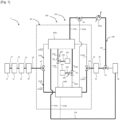
- Fig. 1 is a first schematic diagram illustrating an incineration plant having a facility for treating an acid exhaust gas in one embodiment of the present invention.
- An incineration plant 1 shown in Fig. 1 includes an incinerator 11, a boiler 12, a gas cooling apparatus 13, a dust collector 14, a layered double hydroxide housing apparatus 30, an induced draft fan 15, a stack 16, and pipe 21 to 26 sequentially connecting therebetween to form a flue.
- the incineration plant 1 further includes an alkali addition apparatus 130, a waste liquid discharge apparatus 140, and a regeneration gas supply apparatus 150, which will be described below.
- the layered double hydroxide housing apparatus 30 includes a first three-way valve V1, a second three-way valve V2, and a first pipe 111a and a second pipe 111b connecting the first three-way valve V1 and the second three-way valve V2 in parallel, a first housing container 120a provided on the way of the first pipe 111a, and a second housing container 120b provided on the way of the second pipe 111b.
- connection port to which the first pipe 111a and the second pipe 111b are not connected is connected to the pipe 24.
- the connection port to which the first pipe 111a and the second pipe 111b are not connected is connected to the pipe 25.
- the first pipe 111a includes a pipe 111a1 on the upstream of the first housing container 120a and a pipe 111a2 on the downstream of the first housing container 120a.
- the first three-way valve V1 and the first housing container 120a are connected through the pipe 111a1
- the first housing container 120a and the second three-way valve V2 are connected through the pipe 111a2.
- the second pipe 111b includes a pipe 111b1 on the upstream of the second housing container 120b and a pipe 111b2 on the downstream of the second housing container 120b.
- the first three-way valve V1 and the second housing container 120b are connected through the pipe 111b1
- the second housing container 120b and the second three-way valve V2 are connected through the pipe 111b2.
- the carbonate-type Mg-Al layered double hydroxide is housed.
- the alkali addition apparatus 130 includes an alkaline aqueous solution storage tank 131, an alkali supply three-way valve V5, a pipe 132 connecting the alkali supply three-way valve V5 and the alkaline aqueous solution storage tank 131, a pipe 133a connecting the three-way valve V5 and the first housing container 120a, and a pipe 133b connecting the three-way valve V5 and the first housing container 120b.
- the waste liquid discharge apparatus 140 includes a waste liquid containing container 141, an alkali discharge three-way valve V6, a pipe 142 connecting the three-way valve V6 and the waste liquid containing container 141, a pipe 143 connecting the three-way valve V6 and the first housing container 120a, and a pipe 143b connecting the three-way valve V6 and the second housing container 120b.
- a third three-way valve V3 is installed on the way of the pipe 26 connecting an induced draft fan 15 and a stack 16, and a return pipe 151 is connected to a remaining connection port of a third three-way valve V3.
- the return pipe 151 is branched into a return pipe 152a and a return pipe 152b through a fourth three-way valve V4.
- the return pipe 152a is connected to the first housing container 120a, and the return pipe 152b is connected to the second housing container 120b.
- a heat exchanger 151a is installed on the way of the return pipe 151.
- an exhaust gas pipe 153a To the first housing container 120a, one end of an exhaust gas pipe 153a is connected, and to the second housing container 120b, one end of an exhaust gas pipe 153b is connected. Other ends of the exhaust gas pipe 153a and 153b join together to form an exhaust gas pipe 154, and another end of the exhaust gas pipe 154 is connected to the stack 16.
- the regeneration gas supply apparatus 150 is composed of the third three-way valve V3, the heat exchanger 151a, the fourth three-way valve V4, the pipe 151, the pipe 152a, the pipe 152b, the pipe 153a, the pipe 153b, and the pipe 154.
- a regeneration apparatus 160 is composed of the alkali addition apparatus 130, the waste liquid discharge apparatus 140, and the regeneration gas supply apparatus 150.
- a facility for treating acid exhaust gas 170 is composed of the layered double hydroxide housing apparatus 30 and the regeneration apparatus 160.
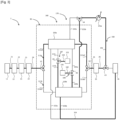
- the incineration plant 1 shown in Fig. 2 and Fig. 3 is identical to the incineration plant 1 shown in Fig. 1 .
- the three-way valve V5 is operated to switch into a state where the pipe 132 communicates with the pipe 133a and does not communicate with the pipe 133b. Further, the three-way valve V6 is operated to switch into a state where the pipe 142 communicates with the pipe 143a and does not communicate with the pipe 143b.
- the alkaline aqueous solution is supplied from the alkali addition apparatus 130 to the first housing container 120a, and permeates into the used carbonate-type Mg-Al layered double hydroxide in the first housing container 120a, so that alkali is supplied into the carbonate-type Mg-Al layered double hydroxide.
- the alkaline aqueous solution is discharged from the first housing container 120a into a waste liquid containing container 141.
- the first three-way valve V1 is operated to switch into the state where the pipe 24 communicates with the pipe 111b and does not communicate with the pipe 111a.
- the second three-way valve V2 is operated to switch into the state where the pipe 25 communicates with the pipe 111b and does not communicate with the pipe 111a.
- the three-way valve V3 is operated to switch into the state where the pipe 26 communicates with return pipe 151 and does not communicate with the stack 16.
- the three-way valve V4 is operated to switch into the state where the return pipe 151 communicates with the pipe 152a and does not to communicate with the pipe 152b.
- the acid exhaust gas discharged from the incinerator 11 passes through the boiler 12, the gas cooling apparatus 13, the dust collector 14, and the first three-way valve V1 so as to be introduced into the second housing container 120b, where the acid materials contained in the acid exhaust gas are removed by the carbonate-type Mg-Al layered double hydroxide.
- the treated gas in which acid materials have been removed from the acid exhaust gas in this manner is discharged from the second housing container 120b.
- the discharged treated gas passes through the second three-way valve V2, the induced draft fan 15, the third three-way valve V3, and the return pipe 151, and is adjusted to an appropriate temperature by the heat exchanger 151a.
- the treated gas then passes through the fourth three-way valve V4 and the return pipe 152a, and is introduced into the first housing container 120a.
- the treated gas introduced into the first housing container 120a contains carbon dioxide derived from the acid exhaust gas discharged from the incinerator and carbon dioxide supplied from the carbonate-type Mg-Al layered double hydroxide through ion exchange with acid materials contained in the acid exhaust gas.
- the carbonate-type Mg-Al layered double hydroxide is regenerated.
- the used carbonate-type Mg-Al layered double hydroxide is regenerated in the presence of alkali, so that the regeneration can be efficiently performed.
- the treated gas introduced into the first housing container 120a passes through the pipe 153a and pipe 154, and is discharged from the stack 16.
- the third three-way valve V3 is operated to switch into the state where the pipe 26 communicates with the stack 16 and does not communicate with the return pipe 151.
- the three-way valves V5 and V6 are operated to switch into a "closed” state.
- the acid exhaust gas discharged from the incinerator 11 is introduced into the second housing container 120b through the boiler 12, the gas cooling apparatus 13, the dust collector 14, and the first three-way valve V1, where the acid materials contained in the acid exhaust gas are removed by the carbonate-type Mg-Al layered double hydroxide.
- the treated gas in which the acid materials have been removed from the acid exhaust gas is discharged from the second housing container 120b, and discharged to the atmosphere from the stack 16 through the second three-way valve V2, the induced draft fan 15 and the third three-way valve V3.
- the acid exhaust gas treatment step is thus performed in the second housing container 120b.
- the three-way valve V5 is operated to switch into the state where the pipe 132 communicates with the pipe 133b and does not communicate with the pipe 133a. Further, the three-way valve V6 is operated to switch into the state where the pipe 142 communicates with the pipe 143b and does not communicate with the pipe 143a.
- the alkaline aqueous solution is supplied from the alkali addition apparatus 130 to the second housing container 120b, and permeates into the used carbonate-type Mg-Al layered double hydroxide in the second housing container 120b, so that the alkali is supplied into the carbonate-type Mg-Al layered double hydroxide.
- the alkaline aqueous solution discharged from the second housing container 120b is discharged to the waste liquid containing container 141.
- the first three-way valve V1 is operated to switch into the state where the pipe 24 communicates with the pipe 111a and does not communicate with the pipe 11 1b.
- the second three-way valve V2 is operated to switch into a state where the pipe 25 communicates with the pipe 111a and does not communicate with the pipe 111b.
- the three-way valve V3 is operated to switch into a state where the pipe 26 communicates with the return pipe 151 and does not communicate with the stack 16.
- the three-way valve V4 is operated to switch into a state where the return pipe 151 communicates with the pipe 152b and does not communicate with the pipe 152a.
- the acid exhaust gas discharged from the incinerator 11 is introduced into the first housing container 120a through the boiler 12, the gas cooling apparatus 13, the dust collector 14, and the first three-way valve V1, and the acid materials contained in the acid exhaust gas are removed by the carbonate-type Mg-Al layered double hydroxide.
- the treated gas in which acid materials have been removed from the acid exhaust gas in this manner is discharged from the first housing container 120a.
- the discharged treated gas passes through the second three-way valve V2, the induced draft fan 15, the third three-way valve V3, and the return pipe 151, and is adjusted to an appropriate temperature by the heat exchanger 151a.
- the treated gas then passes through the fourth three-way valve V4 and the return pipe 152a, and is introduced into the second housing container 120b.
- the treated gas introduced into the second housing container 120b contains carbon dioxide derived from the acid exhaust gas discharged from the incinerator and carbon dioxide supplied from the carbonate-type Mg-Al layered double hydroxide through ion exchange with acid materials contained in the acid exhaust gas.
- the carbonate-type Mg-Al layered double hydroxide is regenerated.
- the used carbonate-type Mg-Al layered double hydroxide is regenerated in the presence of alkali, so that the regeneration can be efficiently performed.
- the treated gas introduced into the second housing container 120b passes through the pipe 153b and pipe 154, and is discharged from the stack 16.
- the third three-way valve V3 is operated to switch into the state where the pipe 26 communicates with the stack 16 and does not communicate with the return pipe 151.
- the three-way valves V5 and V6 are operated to switch into a "closed” state.
- the acid exhaust gas discharged from the incinerator 11 is introduced into the first housing container 120a through the boiler 12, the gas cooling apparatus 13, the dust collector 14, and the first three-way valve V1, where the acid materials contained in the acid exhaust gas are removed by the carbonate-type Mg-Al layered double hydroxide.
- the treated gas in which the acid materials have been removed from the acid exhaust gas is discharged from the first housing container 120a, and discharged to the atmosphere from the stack 16 through the second three-way valve V2, the induced draft fan 15 and the third three-way valve V3.
- the acid exhaust gas treatment step is thus performed in the first housing container 120a.
- the first step described above is performed to regenerate the carbonate-type Mg-Al layered double hydroxide in the first housing container 120a.
- step 1 to step 4 the used carbonate-type Mg-Al layered double hydroxide can be regenerated while continuously operating the incineration plant.
- the timing for starting the supply of the alkaline aqueous solution to the first housing container 120a and the timing for starting the supply of the treated gas to the first housing container 120a may be the same.
- the supply of the alkaline aqueous solution may be performed first, or the supply of the treated gas may be started first. It is, however, preferable that the supply of the alkaline aqueous solution be started first.
- the treated gas may be supplied to the first housing container 120a and discharged from the pipe 153a.
- the three-way valve V6 may be operated such that the pipe 142 communicates with the pipe 143a and does not communicate with the pipe 143b.
- the solution may be discharged from the pipe 143a, while supplying the treated gas to the first housing container 120a to be discharged from the pipe 153a.
- the treated gas may be passed into the first housing container 120a after passing the alkaline aqueous solution into the first housing container 120a, or the passing of the liquid and the passing of the gas may be performed at the same time.
- the timing for starting the supply of the alkaline aqueous solution to the second housing container 120b and the timing for starting the supply of the treated gas to the second housing container 120b may be the same.
- the supply of the alkaline aqueous solution may be performed first, or the supply of the treated gas may be started first. It is, however, preferable that the supply of the alkaline aqueous solution be started first.
- the treated gas may be supplied to the second housing container 120b and discharged from the pipe 153b.
- the three-way valve V6 may be operated such that the pipe 142 communicates with the pipe 143b and does not communicate with the pipe 143a, and after supply of the alkaline aqueous solution to the second housing container 120b to be contacted with the used carbonate-type Mg-Al layered double hydroxide, the solution may be discharged from the pipe 143b, while supplying the treated gas to the second housing container 120b to be discharged from the pipe 153b.
- the treated gas may be passed into the second housing container 120b after passing the alkaline aqueous solution into the second housing container 120b, or the passing of the liquid and the passing of the gas may be performed at the same time.
- Example the present invention will be described in more detail based on Example, though the present invention is not limited to the following Example.
- An acrylic resin column with an inner diameter of 40 mm was filled with carbonate-type Mg-Al layered double hydroxide ("Kyoward (registered trademark) 500 PL", manufactured by Kyowa Chemical Industry Co., Ltd., synthesized hydrotalcite).
- a hydrogen chloride-containing gas prepared by introducing hydrogen chloride gas into air, adjusted to a hydrogen chloride concentration of about 1000 vol ppm at 100°C, was circulated until detection of hydrogen chloride at the column outlet, so that chlorine-type Mg-Al layered double hydroxide (used carbonate-type Mg-Al layered double hydroxide) was obtained.
- a mixed gas adjusted to 80°C having a water content of 20 vol% and a carbon dioxide concentration of 13 vol% prepared by introducing water and carbon dioxide into air through adjustment of flow rate of each gas by a mass flow controller was circulated in the column at a superficial velocity of 1.0 m/min for 3 hours so as to perform a regeneration treatment test.
- A means the chloride ion content in the mixed gas after the regeneration treatment test
- B means the chloride ion content in the mixed gas before the regeneration treatment test.
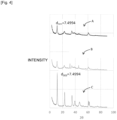
- A is the powder X-ray diffraction measurement result of the Mg-Al layered double hydroxide after the regeneration treatment test in Example 1
- B is the powder X-ray diffraction measurement result of the Mg-Al layered double hydroxide after the regeneration treatment test in Comparative Example 1 described below
- C is the powder X-ray diffraction measurement result of the Mg-Al layered double hydroxide before the regeneration treatment test in Example 1.
- the structure of the Mg-Al layered double hydroxide was checked from the peak pattern and interlayer distance (d 003 ).
- Example 2 The same operation as in Example 1 was performed except that 20 g of 4 mass% of sodium hydroxide aqueous solution was not fed from the top of the column, and the same measurements were performed.
- Table 1 Desorption rate of chloride ions (%) Powder XRD measurement result
- Example 1 100 Carbonate-type Mg-Al layered double hydroxide (No peak of chlorine-type Mg-Al layered double hydroxide) Comparative Example 1 80 Mixture of carbonate-type Mg-Al layered double hydroxide and chlorine-type Mg-Al layered double hydroxide Table 2 Test sample
- Example 1 Comparative Example 1 MgO mass% 40.1 39.6 38.7 Al 2 O 3 mass% 17.8 17.1 16.9 CO 2 mass% 11.6 11.6 9.2 Cl mass% 3.1 0.0 1.6 Total of four components described above mass% 72.6 68.3 66.4
- Example and Comparative Example From each of the test results in Example and Comparative Example, it has been found that according to the present invention, a used carbonate-type Mg-Al layered double hydroxide (chlorine-type Mg-Al layered double hydroxide) can be efficiently regenerated into a carbonate-type Mg-Al layered double hydroxide.
Landscapes
- Chemical & Material Sciences (AREA)
- Engineering & Computer Science (AREA)
- Chemical Kinetics & Catalysis (AREA)
- Analytical Chemistry (AREA)
- Organic Chemistry (AREA)
- Environmental & Geological Engineering (AREA)
- Biomedical Technology (AREA)
- General Chemical & Material Sciences (AREA)
- Oil, Petroleum & Natural Gas (AREA)
- Health & Medical Sciences (AREA)
- Inorganic Chemistry (AREA)
- Life Sciences & Earth Sciences (AREA)
- Sustainable Development (AREA)
- Geology (AREA)
- Treating Waste Gases (AREA)
- Compounds Of Alkaline-Earth Elements, Aluminum Or Rare-Earth Metals (AREA)
- Solid-Sorbent Or Filter-Aiding Compositions (AREA)
Abstract
Description
- The present invention relates to a method for regenerating carbonate-type layered double hydroxide, a method for treating acid exhaust gas using the regeneration method, and a facility for treating acid exhaust gas.
- The combustion exhaust gas generated in combustion plants such as thermal power plants and waste incineration plants contains harmful acid materials such as hydrogen chloride, sulfur oxides, and nitrogen oxides. Various techniques are available as treatment techniques for removing the acid materials from the acid exhaust gas containing the acid materials.
- As an efficient treatment technique capable of simultaneously treating and removing a plurality of types of acid materials, the present inventors have proposed a method for treating an acid exhaust gas using a carbonate-type Mg-Al layered double hydroxide, a treatment agent, etc.
- The carbonate-type Mg-Al layered double hydroxide is a treatment agent that can be regenerated for repeated use. Accordingly, after the carbonate-type Mg-Al layered double hydroxide is used in treatment of an acid exhaust gas, the used layered double hydroxide is regenerated and reused.
- PTL1 describes a method of, after a carbonate-type Mg-Al layered double hydroxide is used in treatment of an acid exhaust gas, regenerating the used layered double hydroxide by mixing with a carbonate aqueous solution.
- PTL2 describes a method of, after a carbonate-type Mg-Al layered double hydroxide is used in treatment of an acid exhaust gas, regenerating the used layered double hydroxide into a carbonate-type Mg-Al layered double hydroxide by contacting with a treated gas from which acid gases other than carbon dioxide have been removed by the carbonate-type Mg-Al layered double hydroxide.
-
- PTL1:
JP 2016-190199 A - PTL2:
JP 2021-090913 A - According to the regeneration method described in PTL1, since it is necessary to mix the used layered double hydroxide with a carbonate aqueous solution, a facility for regenerating the used layered double hydroxide is required to be provided outside a combustion plant. In this case, it is necessary to transport the used layered double hydroxide and the regenerated carbonate-type Mg-Al layered double hydroxide between a combustion plant and the regeneration facility of the layered double hydroxide, and it is also necessary to install the regeneration facility of the layered double hydroxide separately from the combustion plant, so that there is a problem that labor and cost burdens are large.
- In the case where a facility for regenerating the used layered double hydroxide is installed in a combustion plant, installation and connection of a storage tank and a mixing tank for the carbonate aqueous solution are required, so that the scale of the combustion plant is required to be enlarged.
- According to the regeneration method described in PTL2, although installation of a large-scale regeneration facility for a layered double hydroxide is not required in a combustion plant, the problem is that a sufficient regeneration effect is hardly obtained.
- An object of the present invention is to provide a method for regenerating carbonate-type layered double hydroxide, capable of regenerating a used layered double hydroxide obtained after a carbonate-type Mg-Al layered double hydroxide is used for treatment of an acid exhaust gas, into a carbonate-type Mg-Al layered double hydroxide effectively without requirement of a large-scale facility, a method for treating acid exhaust gas, and a facility for treating acid exhaust gas.
- As a result of extensive studies, the present inventors have found that a used layered double hydroxide can be effectively regenerated into a carbonate-type Mg-Al layered double hydroxide by contacting a used layered double hydroxide obtained after a carbonate-type Mg-Al layered double hydroxide is used in treatment of an acid exhaust gas, with a treated gas containing carbon dioxide treated with the carbonate-type Mg-Al layered double hydroxide in the presence of an alkali. The present invention is based on the finding.
- That is, the present invention provides the following [1] to [7].
- [1] A method for regenerating a used carbonate-type Mg-Al layered double hydroxide in which at least some of interlayer carbonate ions of a carbonate-type Mg-Al layered double hydroxide are exchanged with another anion, the method comprising:
contacting the used carbonate-type Mg-Al layered double hydroxide with a carbon dioxide-containing gas that comprises carbon dioxide in the presence of an alkali. - [2] The method for regenerating a used carbonate-type Mg-Al layered double hydroxide according to item [1],
- wherein the used carbonate-type Mg-Al layered double hydroxide is obtained by contacting a carbonate-type Mg-Al layered double hydroxide with an acid exhaust gas comprising carbon dioxide and acid materials other than carbon dioxide to remove the acid materials from the acid exhaust gas, thereby obtaining a treated gas, and
- the carbon dioxide-containing gas that comprises carbon dioxide is the treated gas.
- [3] The method for regenerating a used carbonate-type Mg-Al layered double hydroxide according to item [2],
wherein the acid exhaust gas is a combustion exhaust gas generated from an incinerator. - [4] A method for treating an acid exhaust gas, comprising:
- an acid exhaust gas treatment step of contacting an acid exhaust gas comprising carbon dioxide and acid materials other than carbon dioxide with a carbonate-type Mg-Al layered double hydroxide to remove the acid materials from the acid exhaust gas, thereby obtaining a treated gas; and
- a regeneration step of regenerating a used carbonate-type Mg-Al layered double hydroxide generated in the acid exhaust gas treatment step,
- wherein in the regeneration step, the regeneration method according to item [2] or [3] is performed.
- [5] A facility for treating an acid exhaust gas, comprising:
- a housing container that houses a carbonate-type Mg-Al layered double hydroxide;
- a supply pipe that supplies an acid exhaust gas comprising carbon dioxide and acid materials other than carbon dioxide to the housing container;
- a discharge pipe that discharges a treated gas discharged from the housing container after treatment of the acid materials therein; and
- a regeneration apparatus that regenerates the carbonate-type Mg-Al layered double hydroxide in the housing container;
- wherein the regeneration apparatus comprises an alkali addition apparatus that adds an alkali to the housing container, and a return pipe that returns the treated gas to the housing container.
- [6] The facility for treating an acid exhaust gas according to item [5], wherein the alkali addition apparatus comprises an alkaline aqueous solution storage tank that stores an alkaline aqueous solution, and an alkaline aqueous solution inflow pipe that connects the alkaline aqueous solution storage tank and the housing container.
- [7] The facility for treating an acid exhaust gas according to item [5] or [6], wherein the regeneration apparatus is connected to the housing container and comprises a waste liquid discharge apparatus to discharge the alkaline aqueous solution flowing into the housing container to the outside of the housing container.
- According to the present invention, there can be provided a method for regenerating a carbonate-type layered double hydroxide, capable of regenerating a used layered double hydroxide obtained after a carbonate-type Mg-Al layered double hydroxide is used for treatment of an acid exhaust gas, into a carbonate-type Mg-Al layered double hydroxide effectively without requirement of a large-scale facility, a method for treating acid exhaust gas, and a facility for treating acid exhaust gas.
-
- [
Fig. 1] Fig. 1 is a schematic diagram illustrating a step of regenerating a used layered double hydroxide in afirst housing container 120a using an incineration plant having a facility for treating an acid exhaust gas in one embodiment of the present invention. - [
Fig. 2] Fig. 2 is a schematic diagram illustrating an acid exhaust gas treatment step in asecond housing container 120b using an incineration plant having a facility for treating an acid exhaust gas in one embodiment of the present invention. - [
Fig. 3] Fig. 3 is a schematic diagram illustrating a step of regenerating a used layered double hydroxide in asecond housing container 120b using an incineration plant having a facility for treating an acid exhaust gas in one embodiment of the present invention. - [
Fig. 4] Fig. 4 is a graph illustrating the results of powder X-ray diffraction measurement. - A method for regenerating a carbonate-type layered double hydroxide, a method for treating an acid exhaust gas, and a facility for treating an acid exhaust gas of the present invention are described as follows partly with reference to drawings.
- In the present specification, "acid materials other than carbon dioxide" may be simply referred to as "acid materials". That is, in the present invention, the term "acid materials" means "acid materials other than carbon dioxide".
- A method for regenerating a used carbonate-type Mg-Al layered double hydroxide of the present invention is a method for regenerating a used carbonate-type Mg-Al layered double hydroxide in which at least some of interlayer carbonate ions of a carbonate-type Mg-Al layered double hydroxide are exchanged with another anion, the method comprising:
contacting the used carbonate-type Mg-Al layered double hydroxide with a carbon dioxide-containing gas that contains carbon dioxide in the presence of an alkali. - As described above, by contacting a used carbonate-type Mg-Al layered double hydroxide with a carbon dioxide-containing gas that contains carbon dioxide in the presence of an alkali, the used layered double hydroxide can be efficiently regenerated into a carbonate-type Mg-Al layered double hydroxide.
- The reason is presumed as follows, though not clear.
- That is, the carbonate-type Mg-Al layered double hydroxide has a structure in which a hydroxide base layer and an interlayer composed of interlayer carbonate ions and interlayer water are alternately laminated. In the used carbonate-type Mg-Al layered double hydroxide, some or all of the interlayer carbonate ions have been exchanged with an anion derived from acid materials. Through regeneration by contacting the used carbonate-type Mg-Al layered double hydroxide with a carbon dioxide-containing gas that contains carbon dioxide in the presence of an alkali, dissolution of the carbonate ions into the interlayer water is accelerated due to presence of the alkali, so that ion exchange between anions derived from acid materials and carbonate ions derived from carbon dioxide in a treated gas is accelerated. Accordingly, it is presumed that the regeneration efficiency is improved.
- In the method for regenerating used carbonate-type Mg-Al layered double hydroxide in a first aspect, the used carbonate-type Mg-Al layered double hydroxide is obtained by contacting a carbonate-type Mg-Al layered double hydroxide with an acid exhaust gas containing carbon dioxide and acid materials other than carbon dioxide to remove the acid materials from the acid exhaust gas, thereby obtaining a treated gas, and
the carbon dioxide-containing gas that contains carbon dioxide is the treated gas. - In other words, the method for regenerating a used carbonate-type Mg-Al layered double hydroxide in the first aspect is a method for regenerating a used carbonate-type Mg-Al layered double hydroxide obtained by contacting a carbonate-type Mg-Al layered double hydroxide with an acid exhaust gas containing carbon dioxide and acid materials other than carbon dioxide to remove the acid materials from the acid exhaust gas, thereby obtaining a treated gas, the method comprising:
contacting the used carbonate-type Mg-Al layered double hydroxide with the treated gas in the presence of an alkali. - In this case, by using the treated gas obtained by the carbonate-type Mg-Al layered double hydroxide as the carbon dioxide-containing gas for regeneration, the separate preparation of a carbon dioxide-containing gas for regeneration is not required, which is advantageous.
- Although the carbon dioxide-containing gas that contains carbon dioxide is not particularly limited, as described above, a treated gas is preferred from the viewpoint that the separate preparation of a carbon dioxide-containing gas for regeneration is not required.
- The acid exhaust gas contains carbon dioxide and acid materials other than carbon dioxide.
- Examples of the acid materials include hydrogen chloride, SOx such as sulfur dioxide, and NOx such as nitrogen dioxide.
- Carbon dioxide is also an acid material. However, in this specification, carbon dioxide is not included in "acid materials" from the viewpoint of distinguishing carbon dioxide from acid materials other than carbon dioxide.
- The acid exhaust gas is not particularly limited as long as it contains carbon dioxide and acid materials, and examples thereof include combustion exhaust gas generated from incinerators of combustion plants such as thermal power plants and incineration plants.
- Since the combustion exhaust gas contains a large amount of carbon dioxide, the treated gas from which the acid materials are removed by contacting the combustion exhaust gas with the carbonate-type Mg-Al layered double hydroxide also contains a large amount of carbon dioxide. Therefore, in the case of using the treated gas to regenerate the used carbonate-type Mg-Al layered double hydroxide, the regeneration can be performed efficiently.
- The content of carbon dioxide in the acid exhaust gas is preferably 1 to 20 vol%, more preferably 5 to 18 vol%, and still more preferably 10 to 15 vol%. With a content of 1 vol% or more, the reactivity of the ion exchange reaction is increased, so that in the case of regenerating a used carbonate-type Mg-Al layered double hydroxide by using the treated gas derived from the acid exhaust gas, the regeneration can be efficiently performed.
- The content of acid materials in the acid exhaust gas is preferably 10 to 5000 vol ppm, more preferably 200 to 3000 vol ppm, still more preferably 300 to 1500 vol ppm, and even more preferably 500 to 1000 vol ppm.
- The water content in the acid exhaust gas is preferably 0 to 30 vol%, more preferably 5 to 25 vol%, and still more preferably 10 to 20 vol%.
- The total content of nitrogen, oxygen, carbon dioxide, acid materials and water in the acid exhaust gas is preferably 90 vol% or more, more preferably 95 vol% or more, and still more preferably 99 vol% or more.
- A carbonate-type Mg-Al layered double hydroxide is a particle having a structure in which a hydroxide base layer ([Mg2+ 1-xAl3+ x(OH)2]) and an intermediate layer composed of interlayer carbonate ions and interlayer water ([(CO3 2-)x/2·yH2O]) are alternately laminated. The carbonate-type Mg-Al layered double hydroxide is a non-stoichiometric compound in which the hydroxide base layer has a positive charge equivalent to x, and carbonate ions are present in the intermediate layer as negatively charged negative ions (anions) to compensate the charge.
- The carbonate-type Mg-Al layered double hydroxide can incorporate acid materials, for example, such as hydrogen chloride, SOx and NOx as anions between the layers while maintaining the hydroxide base layer. Therefore, it can be suitably used for treatment of an acid exhaust gas to remove acid materials from the acid exhaust gas.
- When the carbonate-type Mg-Al layered double hydroxide is used in treatment of an acid exhaust gas, a layered double hydroxide other than the carbonate-type Mg-Al layered double hydroxide, or, for example, a chemical agent other than the layered double hydroxide such as calcium hydroxide (slaked lime), calcium oxide, sodium bicarbonate (baking soda), sodium carbonate, dolomite hydroxide, light burnt dolomite, aluminum hydroxide, aluminum oxide, magnesium hydroxide and magnesium oxide may be used in combination. However, from the viewpoint of efficiently regenerating and reusing the carbonate-type Mg-Al layered double hydroxide, it is preferable that other layered double hydroxides or chemical agents are not mixed in.
- Although the carbonate-type Mg-Al layered double hydroxides include naturally produced clay minerals as hydrotalcite, synthetic powders are usually used. The synthesis method is not particularly limited, and a known method (for example, the method described in PTL1) may be used.
- For example, an aqueous mixture solution of magnesium nitrate (Mg(NO3)2) and aluminum nitrate (Al(NO3)3) with a molar ratio of Mg/Al=2/1 maintained at pH 10.5 is added dropwise to a sodium carbonate (Na2CO3) aqueous solution, so that a carbonate-type Mg-Al layered double hydroxide can be obtained.
- A carbonate-type Mg-Al layered double hydroxide, when used for treatment of an acid exhaust gas and taking the acid materials in between the layers, turns into an anion-type Mg-Al layered double hydroxide (used carbonate-type Mg-Al layered double hydroxide) in which the interlayer carbonate ions have been exchanged with other ions derived from acid materials such as chloride ions, sulfate ions, and nitrate ions. The anion-type Mg-Al layered double hydroxide produced in this manner has a reduced capability to remove an acid exhaust gas. Therefore, the anion-type Mg-Al layered double hydroxide is regenerated again by anion exchange into a carbonate-type Mg-Al layered double hydroxide for reuse.
- The treated gas is an acid waste gas containing carbon dioxide and acid materials other than carbon dioxide of which a part or all of the acid materials are exchanged with carbon dioxide derived from interlayer carbonate ions in the carbonate-type Mg-Al layered double hydroxide.
- The content of carbon dioxide in the acid exhaust gas is preferably 1 to 20 vol%, more preferably 5 to 18 vol%, and still more preferably 10 to 15 vol%. With a content of 1 vol% or more, when the used carbonate-type Mg-Al layered double hydroxide is regenerated using the treated gas derived from the acid exhaust gas, regeneration can be performed efficiently.
- The content of acid materials in the acid exhaust gas is preferably 100 vol ppm or less, more preferably 10 vol ppm, and even more preferably 1 vol ppm.
- The water content in the acid exhaust gas is preferably 0 to 30 vol%, more preferably 5 to 25 vol%, and still more preferably 10 to 20 vol%.
- The total content of nitrogen, oxygen, carbon dioxide, acid materials and water in the acid exhaust gas is preferably 90 vol% or more, more preferably 95 vol% or more, and still more preferably 99 vol% or more.
- The method for regenerating the used carbonate-type Mg-Al layered double hydroxide of the present invention is a method including contacting the used carbonate-type Mg-Al layered double hydroxide with the treated gas in the presence of an alkali.
- In the treated gas, the carbon dioxide that has been present in the acid exhaust gas is also present in addition to the carbon dioxide derived from the interlayer carbonate ions, so that the anions derived from the acid materials present in the used carbonate-type Mg-Al layered double hydroxide can be efficiently anion-exchanged to carbonate ions.
- The anion exchange is performed in the presence of an alkali. Accordingly, the anions derived from the acid materials present in the used carbonate-type Mg-Al layered double hydroxide are more efficiently anion-exchanged to carbonate ions compared to the case of anion exchange in the absence of alkali.
- The alkali is preferably sodium hydroxide or potassium hydroxide, more preferably sodium hydroxide.
- The ratio of the alkali to 100 parts by mass of the used carbonate-type Mg-Al layered double hydroxide is preferably 1 to 20 parts by mass, more preferably 1 to 10 parts by mass, still more preferably 2 to 10 parts by mass, and even more preferably 2 to 5 parts by mass. With a ratio of 1 part by mass or more, the anions derived from the acid materials present in the used carbonate-type Mg-Al layered double hydroxide can be efficiently anion-exchanged to carbonate ions. With a ratio of 20 parts by mass or less, elution of the constituent elements (such as Al) of the carbonate-type Mg-Al layered double hydroxide can be prevented, so that the crystal structure of the carbonate-type Mg-Al layered double hydroxide can be maintained.
- In regeneration of a used carbonate-type Mg-Al layered double hydroxide, it is preferable that an alkaline aqueous solution be added to the used carbonate-type Mg-Al layered double hydroxide, and then the used carbonate-type Mg-Al layered double hydroxide be contacted with the treated gas. Thereby, the treated gas can be contacted with the used carbonate-type Mg-Al layered double hydroxide in a state where alkali is evenly present in the used carbonate-type Mg-Al layered double hydroxide, so that the used carbonate-type Mg-Al layered double hydroxide can be regenerated more efficiently.
- However, the addition of an alkaline aqueous solution to the used carbonate-type Mg-Al layered double hydroxide and the contact of the used carbonate-type Mg-Al layered double hydroxide with the treated gas may be performed at the same time. Alternatively, the alkaline aqueous solution may be added during contact with the treated gas.
- The alkali concentration of the alkaline aqueous solution is preferably 0.1 to 20 mass%, more preferably 1 to 10 mass%, still more preferably 2 to 10 mass%, and even more preferably 2 to 5 mass%. With a concentration of 0.1 mass% or more, due to the low alkali concentration, the usage amount of the alkaline aqueous solution can be reduced. With a concentration of 20 mass% or less, excellence in handleability can be achieved.
- The ratio of the alkaline aqueous solution to 100 parts by mass of the used carbonate-type Mg-Al layered double hydroxide is preferably 1 to 1000 parts by mass, more preferably 10 to 500 parts by mass, still more preferably 50 to 200 parts by mass, and even more preferably 80 to 120 parts by mass. With a ratio of 1 part by mass or more, the concentration of the alkaline aqueous solution can be lowered, so that excellence in handleability can be achieved. With a ratio of 1000 parts by mass or less, the usage amount of the alkaline aqueous solution can be reduced.
- The temperature at which the regeneration or treatment of contacting the used carbonate-type Mg-Al layered double hydroxide with the treated gas in the presence of alkali is preferably 20 to 100°C, more preferably 60 to 95°C, still more preferably 70 to 90°C, and even more preferably 75 to 85°C. Within the range, the anion-type Mg-Al layered double hydroxide can be efficiently regenerated into the carbonate-type Mg-Al layered double hydroxide.
- The time for regeneration is preferably 10 minutes to 10 hours, more preferably 30 minutes to 8 hours, and still more preferably 1 to 5 hours. With a time of 10 minutes or more, the anion-type Mg-Al layered double hydroxide can be sufficiently regenerated into the carbonate-type Mg-Al layered double hydroxide. With a time of 10 hours or less, the regeneration can be performed in a short period of time.
- The method for treating an acid exhaust gas of the present invention comprises:
- an acid exhaust gas treatment step of contacting an acid exhaust gas containing carbon dioxide and acid materials other than carbon dioxide with a carbonate-type Mg-Al layered double hydroxide to remove the acid materials from the acid exhaust gas, thereby obtaining a treated gas; and
- a regeneration step of regenerating a used carbonate-type Mg-Al layered double hydroxide generated in the acid exhaust gas treatment step,
- wherein in the regeneration step, the regeneration method described above is performed.
- According to the method for treating an acid exhaust gas, the carbonate-type Mg-Al layered double hydroxide allows acid materials to be incorporated between the layers while maintaining the hydroxide base layer. Accordingly, the acid materials can be suitably removed from the acid exhaust gas.
- Further, by the regeneration step, as described in the method for regenerating the used carbonate-type Mg-Al layered double hydroxide, the used layered double hydroxide can be efficiently regenerated into a carbonate-type Mg-Al layered double hydroxide.
- A facility for treating an acid exhaust gas of the present invention comprises:
- a housing container that houses a carbonate-type Mg-Al layered double hydroxide;
- a supply pipe that supplies an acid exhaust gas containing carbon dioxide and acid materials other than carbon dioxide to the housing container;
- a discharge pipe that discharges a treated gas discharged from the housing container after treatment of the acid materials therein; and
- a regeneration apparatus that regenerates the carbonate-type Mg-Al layered double hydroxide in the housing container;
- wherein the regeneration apparatus comprises an alkali addition apparatus that adds an alkali to the housing container, and a return pipe that returns the treated gas to the housing container.
- By using the facility for treating an acid exhaust gas, the method for treating an acid exhaust gas can be efficiently performed.
- It is preferable that the alkali addition apparatus have an alkaline aqueous solution storage tank that stores an alkaline aqueous solution, and an alkaline aqueous solution inflow pipe that connects the alkaline aqueous solution storage tank and the housing container. As a result, the method for treating an acid exhaust gas described above can be performed more efficiently.
- Also, it is preferable that the regeneration apparatus have a waste liquid discharge apparatus connected to the housing container, which discharges the alkaline aqueous solution flowing into the housing container to the outside of the housing container. As a result, the method for treating an acid exhaust gas described above can be performed more efficiently.
-
Fig. 1 is a first schematic diagram illustrating an incineration plant having a facility for treating an acid exhaust gas in one embodiment of the present invention. - An incineration plant 1 shown in
Fig. 1 includes anincinerator 11, aboiler 12, agas cooling apparatus 13, adust collector 14, a layered doublehydroxide housing apparatus 30, an induceddraft fan 15, astack 16, andpipe 21 to 26 sequentially connecting therebetween to form a flue. - The incineration plant 1 further includes an
alkali addition apparatus 130, a wasteliquid discharge apparatus 140, and a regenerationgas supply apparatus 150, which will be described below. - The layered double
hydroxide housing apparatus 30 includes a first three-way valve V1, a second three-way valve V2, and afirst pipe 111a and asecond pipe 111b connecting the first three-way valve V1 and the second three-way valve V2 in parallel, afirst housing container 120a provided on the way of thefirst pipe 111a, and asecond housing container 120b provided on the way of thesecond pipe 111b. - Of the three connection ports of the first three-way valve V1, the connection port to which the
first pipe 111a and thesecond pipe 111b are not connected is connected to thepipe 24. Of the three connection ports of the second three-way valve V2, the connection port to which thefirst pipe 111a and thesecond pipe 111b are not connected is connected to thepipe 25. - The
first pipe 111a includes a pipe 111a1 on the upstream of thefirst housing container 120a and a pipe 111a2 on the downstream of thefirst housing container 120a. In other words, the first three-way valve V1 and thefirst housing container 120a are connected through the pipe 111a1, and thefirst housing container 120a and the second three-way valve V2 are connected through the pipe 111a2. - The
second pipe 111b includes a pipe 111b1 on the upstream of thesecond housing container 120b and a pipe 111b2 on the downstream of thesecond housing container 120b. In other words, the first three-way valve V1 and thesecond housing container 120b are connected through the pipe 111b1, and thesecond housing container 120b and the second three-way valve V2 are connected through the pipe 111b2. - In the
first housing container 120a and thesecond housing container 120b, the carbonate-type Mg-Al layered double hydroxide is housed. - The
alkali addition apparatus 130 includes an alkaline aqueoussolution storage tank 131, an alkali supply three-way valve V5, apipe 132 connecting the alkali supply three-way valve V5 and the alkaline aqueoussolution storage tank 131, apipe 133a connecting the three-way valve V5 and thefirst housing container 120a, and apipe 133b connecting the three-way valve V5 and thefirst housing container 120b. - The waste
liquid discharge apparatus 140 includes a wasteliquid containing container 141, an alkali discharge three-way valve V6, apipe 142 connecting the three-way valve V6 and the wasteliquid containing container 141, a pipe 143 connecting the three-way valve V6 and thefirst housing container 120a, and apipe 143b connecting the three-way valve V6 and thesecond housing container 120b. - A third three-way valve V3 is installed on the way of the
pipe 26 connecting an induceddraft fan 15 and astack 16, and areturn pipe 151 is connected to a remaining connection port of a third three-way valve V3. Thereturn pipe 151 is branched into areturn pipe 152a and areturn pipe 152b through a fourth three-way valve V4. Thereturn pipe 152a is connected to thefirst housing container 120a, and thereturn pipe 152b is connected to thesecond housing container 120b. Aheat exchanger 151a is installed on the way of thereturn pipe 151. - To the
first housing container 120a, one end of anexhaust gas pipe 153a is connected, and to thesecond housing container 120b, one end of anexhaust gas pipe 153b is connected. Other ends of theexhaust gas pipe exhaust gas pipe 154, and another end of theexhaust gas pipe 154 is connected to thestack 16. - The regeneration
gas supply apparatus 150 is composed of the third three-way valve V3, theheat exchanger 151a, the fourth three-way valve V4, thepipe 151, thepipe 152a, thepipe 152b, thepipe 153a, thepipe 153b, and thepipe 154. - A
regeneration apparatus 160 is composed of thealkali addition apparatus 130, the wasteliquid discharge apparatus 140, and the regenerationgas supply apparatus 150. - A facility for treating
acid exhaust gas 170 is composed of the layered doublehydroxide housing apparatus 30 and theregeneration apparatus 160. - The incineration plant 1 shown in
Fig. 2 andFig. 3 is identical to the incineration plant 1 shown inFig. 1 . - However, in
Fig. 1 to Fig. 3 , the operating state of the incineration plant 1 is different as described below. - In
Fig. 1 to Fig. 3 , the fluid is flowing through the portions of the pipe represented by thick lines, and the fluid is not flowing through the portions represented by thin lines. - First, as shown in
Fig. 1 , the three-way valve V5 is operated to switch into a state where thepipe 132 communicates with thepipe 133a and does not communicate with thepipe 133b. Further, the three-way valve V6 is operated to switch into a state where thepipe 142 communicates with thepipe 143a and does not communicate with thepipe 143b. - As a result, the alkaline aqueous solution is supplied from the
alkali addition apparatus 130 to thefirst housing container 120a, and permeates into the used carbonate-type Mg-Al layered double hydroxide in thefirst housing container 120a, so that alkali is supplied into the carbonate-type Mg-Al layered double hydroxide. - The alkaline aqueous solution is discharged from the
first housing container 120a into a wasteliquid containing container 141. - In
Fig. 1 , the first three-way valve V1 is operated to switch into the state where thepipe 24 communicates with thepipe 111b and does not communicate with thepipe 111a. Further, the second three-way valve V2 is operated to switch into the state where thepipe 25 communicates with thepipe 111b and does not communicate with thepipe 111a. Further, the three-way valve V3 is operated to switch into the state where thepipe 26 communicates withreturn pipe 151 and does not communicate with thestack 16. Further, the three-way valve V4 is operated to switch into the state where thereturn pipe 151 communicates with thepipe 152a and does not to communicate with thepipe 152b. - As a result, the acid exhaust gas discharged from the
incinerator 11 passes through theboiler 12, thegas cooling apparatus 13, thedust collector 14, and the first three-way valve V1 so as to be introduced into thesecond housing container 120b, where the acid materials contained in the acid exhaust gas are removed by the carbonate-type Mg-Al layered double hydroxide. - The treated gas in which acid materials have been removed from the acid exhaust gas in this manner is discharged from the
second housing container 120b. The discharged treated gas passes through the second three-way valve V2, the induceddraft fan 15, the third three-way valve V3, and thereturn pipe 151, and is adjusted to an appropriate temperature by theheat exchanger 151a. The treated gas then passes through the fourth three-way valve V4 and thereturn pipe 152a, and is introduced into thefirst housing container 120a. - The treated gas introduced into the
first housing container 120a contains carbon dioxide derived from the acid exhaust gas discharged from the incinerator and carbon dioxide supplied from the carbonate-type Mg-Al layered double hydroxide through ion exchange with acid materials contained in the acid exhaust gas. In this manner, through ion exchange between the carbonate ions derived from carbon dioxide contained in the treated gas and the anions derived from the acid materials present in the used carbonate-type Mg-Al layered double hydroxide, the carbonate-type Mg-Al layered double hydroxide is regenerated. During the regeneration, since the alkaline aqueous solution is supplied to thefirst housing container 120a, the used carbonate-type Mg-Al layered double hydroxide is regenerated in the presence of alkali, so that the regeneration can be efficiently performed. - The treated gas introduced into the
first housing container 120a passes through thepipe 153a andpipe 154, and is discharged from thestack 16. - After regeneration of the used carbonate-type Mg-Al layered double hydroxide in the
first housing container 120a, the third three-way valve V3 is operated to switch into the state where thepipe 26 communicates with thestack 16 and does not communicate with thereturn pipe 151. - Also, the three-way valves V5 and V6 are operated to switch into a "closed" state.
- As a result, the acid exhaust gas discharged from the
incinerator 11 is introduced into thesecond housing container 120b through theboiler 12, thegas cooling apparatus 13, thedust collector 14, and the first three-way valve V1, where the acid materials contained in the acid exhaust gas are removed by the carbonate-type Mg-Al layered double hydroxide. In this manner, the treated gas in which the acid materials have been removed from the acid exhaust gas is discharged from thesecond housing container 120b, and discharged to the atmosphere from thestack 16 through the second three-way valve V2, the induceddraft fan 15 and the third three-way valve V3. - The acid exhaust gas treatment step is thus performed in the
second housing container 120b. - When the ion exchange capacity of the carbonate-type Mg-Al layered double hydroxide in the
second housing container 120b declines due to continuation of the second step, the carbonate-type Mg-Al layered double hydroxide in thesecond housing container 120b is regenerated in the subsequent third step. - As shown in
Fig. 3 , the three-way valve V5 is operated to switch into the state where thepipe 132 communicates with thepipe 133b and does not communicate with thepipe 133a. Further, the three-way valve V6 is operated to switch into the state where thepipe 142 communicates with thepipe 143b and does not communicate with thepipe 143a. - As a result, the alkaline aqueous solution is supplied from the
alkali addition apparatus 130 to thesecond housing container 120b, and permeates into the used carbonate-type Mg-Al layered double hydroxide in thesecond housing container 120b, so that the alkali is supplied into the carbonate-type Mg-Al layered double hydroxide. - Also, the alkaline aqueous solution discharged from the
second housing container 120b is discharged to the wasteliquid containing container 141. - Further, in
Fig. 3 , the first three-way valve V1 is operated to switch into the state where thepipe 24 communicates with thepipe 111a and does not communicate with thepipe 11 1b. Further, the second three-way valve V2 is operated to switch into a state where thepipe 25 communicates with thepipe 111a and does not communicate with thepipe 111b. Further, the three-way valve V3 is operated to switch into a state where thepipe 26 communicates with thereturn pipe 151 and does not communicate with thestack 16. Further, the three-way valve V4 is operated to switch into a state where thereturn pipe 151 communicates with thepipe 152b and does not communicate with thepipe 152a. - As a result, the acid exhaust gas discharged from the
incinerator 11 is introduced into thefirst housing container 120a through theboiler 12, thegas cooling apparatus 13, thedust collector 14, and the first three-way valve V1, and the acid materials contained in the acid exhaust gas are removed by the carbonate-type Mg-Al layered double hydroxide. - The treated gas in which acid materials have been removed from the acid exhaust gas in this manner is discharged from the
first housing container 120a. The discharged treated gas passes through the second three-way valve V2, the induceddraft fan 15, the third three-way valve V3, and thereturn pipe 151, and is adjusted to an appropriate temperature by theheat exchanger 151a. The treated gas then passes through the fourth three-way valve V4 and thereturn pipe 152a, and is introduced into thesecond housing container 120b. - The treated gas introduced into the
second housing container 120b contains carbon dioxide derived from the acid exhaust gas discharged from the incinerator and carbon dioxide supplied from the carbonate-type Mg-Al layered double hydroxide through ion exchange with acid materials contained in the acid exhaust gas. In this manner, through ion exchange between the carbonate ions derived from carbon dioxide contained in the treated gas and the anions derived from the acid materials present in the used carbonate-type Mg-Al layered double hydroxide, the carbonate-type Mg-Al layered double hydroxide is regenerated. During the regeneration, since the alkaline aqueous solution is supplied to thesecond housing container 120b, the used carbonate-type Mg-Al layered double hydroxide is regenerated in the presence of alkali, so that the regeneration can be efficiently performed. - The treated gas introduced into the
second housing container 120b passes through thepipe 153b andpipe 154, and is discharged from thestack 16. - After regeneration of the used carbonate-type Mg-Al layered double hydroxide in the
second housing container 120b, the third three-way valve V3 is operated to switch into the state where thepipe 26 communicates with thestack 16 and does not communicate with thereturn pipe 151. - Also, the three-way valves V5 and V6 are operated to switch into a "closed" state.
- As a result, the acid exhaust gas discharged from the
incinerator 11 is introduced into thefirst housing container 120a through theboiler 12, thegas cooling apparatus 13, thedust collector 14, and the first three-way valve V1, where the acid materials contained in the acid exhaust gas are removed by the carbonate-type Mg-Al layered double hydroxide. In this manner, the treated gas in which the acid materials have been removed from the acid exhaust gas is discharged from thefirst housing container 120a, and discharged to the atmosphere from thestack 16 through the second three-way valve V2, the induceddraft fan 15 and the third three-way valve V3. - The acid exhaust gas treatment step is thus performed in the
first housing container 120a. - When the ion exchange capacity of the carbonate-type Mg-Al layered double hydroxide in the
first housing container 120a declines due to continuation of the fourth step, the first step described above is performed to regenerate the carbonate-type Mg-Al layered double hydroxide in thefirst housing container 120a. - Through repetition of the step 1 to step 4, the used carbonate-type Mg-Al layered double hydroxide can be regenerated while continuously operating the incineration plant.
- In the first step, the timing for starting the supply of the alkaline aqueous solution to the
first housing container 120a and the timing for starting the supply of the treated gas to thefirst housing container 120a may be the same. Alternatively, the supply of the alkaline aqueous solution may be performed first, or the supply of the treated gas may be started first. It is, however, preferable that the supply of the alkaline aqueous solution be started first. - Further, in the first step, with the three-way valve V6 being kept in the "closed" state, in a state where the alkaline aqueous solution is stored in the
first housing container 120a, the treated gas may be supplied to thefirst housing container 120a and discharged from thepipe 153a. Alternatively, the three-way valve V6 may be operated such that thepipe 142 communicates with thepipe 143a and does not communicate with thepipe 143b. After the alkaline aqueous solution is supplied to thefirst housing container 120a to be contacted with the used carbonate-type Mg-Al layered double hydroxide, the solution may be discharged from thepipe 143a, while supplying the treated gas to thefirst housing container 120a to be discharged from thepipe 153a. In this case, the treated gas may be passed into thefirst housing container 120a after passing the alkaline aqueous solution into thefirst housing container 120a, or the passing of the liquid and the passing of the gas may be performed at the same time. - In the same manner, in the third step, the timing for starting the supply of the alkaline aqueous solution to the
second housing container 120b and the timing for starting the supply of the treated gas to thesecond housing container 120b may be the same. Alternatively, the supply of the alkaline aqueous solution may be performed first, or the supply of the treated gas may be started first. It is, however, preferable that the supply of the alkaline aqueous solution be started first. - Further, in the third step, with the three-way valve V6 being kept in the "closed" state, in a state where the alkaline aqueous solution is stored in the
second housing container 120b, the treated gas may be supplied to thesecond housing container 120b and discharged from thepipe 153b. Alternatively, the three-way valve V6 may be operated such that thepipe 142 communicates with thepipe 143b and does not communicate with thepipe 143a, and after supply of the alkaline aqueous solution to thesecond housing container 120b to be contacted with the used carbonate-type Mg-Al layered double hydroxide, the solution may be discharged from thepipe 143b, while supplying the treated gas to thesecond housing container 120b to be discharged from thepipe 153b. In this case, the treated gas may be passed into thesecond housing container 120b after passing the alkaline aqueous solution into thesecond housing container 120b, or the passing of the liquid and the passing of the gas may be performed at the same time. - Hereinafter, the present invention will be described in more detail based on Example, though the present invention is not limited to the following Example.
- An acrylic resin column with an inner diameter of 40 mm was filled with carbonate-type Mg-Al layered double hydroxide ("Kyoward (registered trademark) 500 PL", manufactured by Kyowa Chemical Industry Co., Ltd., synthesized hydrotalcite). A hydrogen chloride-containing gas prepared by introducing hydrogen chloride gas into air, adjusted to a hydrogen chloride concentration of about 1000 vol ppm at 100°C, was circulated until detection of hydrogen chloride at the column outlet, so that chlorine-type Mg-Al layered double hydroxide (used carbonate-type Mg-Al layered double hydroxide) was obtained.
- The generation of chlorine-type Mg-Al layered double hydroxide was confirmed by powder X-ray diffraction measurement (powder X-ray diffractometer: "MiniFlex 600" manufactured by Rigaku Corporation) and ion chromatography (ion chromatograph: "Dionex Integrion" manufactured by Thermo Fisher Scientific Inc.).
- An acrylic resin column with an inner diameter of 40 mm was filled with 20 g of the chlorine-type Mg-Al layered double hydroxide prepared in Preparation Example 1.
- Into the column, 20 g of 4 mass% of sodium hydroxide aqueous solution was fed from the top of the column.
- A mixed gas adjusted to 80°C having a water content of 20 vol% and a carbon dioxide concentration of 13 vol% prepared by introducing water and carbon dioxide into air through adjustment of flow rate of each gas by a mass flow controller was circulated in the column at a superficial velocity of 1.0 m/min for 3 hours so as to perform a regeneration treatment test.
- Before and after the regeneration treatment test, the chlorine content in the Mg-Al layered double hydroxide was measured by ion chromatography, and based on the measurement results, the desorption rate of chloride ions was calculated from the following formula, so that the regeneration efficiency of the carbonate-type Mg-Al layered double hydroxide was evaluated. The results are shown in Table 1. It can be said that the higher the desorption rate of chloride ions, the higher the efficiency of regeneration from the chlorine-type Mg-Al layered double hydroxide to the carbonate-type Mg-Al layered double hydroxide.

- Here, A means the chloride ion content in the mixed gas after the regeneration treatment test, and B means the chloride ion content in the mixed gas before the regeneration treatment test.
- Further, powder X-ray diffraction measurement of Mg-Al layered double hydroxide before and after the regeneration treatment test was performed. The results are shown in
Fig. 4 . The results of identifying each component based on the results of powder X-ray diffraction measurement are shown in Table 2. When chloride ions are desorbed by regeneration, the chloride ions decrease and the content of carbonate ions increases. - In
Fig. 4 , A is the powder X-ray diffraction measurement result of the Mg-Al layered double hydroxide after the regeneration treatment test in Example 1, B is the powder X-ray diffraction measurement result of the Mg-Al layered double hydroxide after the regeneration treatment test in Comparative Example 1 described below, and C is the powder X-ray diffraction measurement result of the Mg-Al layered double hydroxide before the regeneration treatment test in Example 1. The structure of the Mg-Al layered double hydroxide was checked from the peak pattern and interlayer distance (d003). - The same operation as in Example 1 was performed except that 20 g of 4 mass% of sodium hydroxide aqueous solution was not fed from the top of the column, and the same measurements were performed.
- These results are shown in Tables 1 and 2 and
Fig. 4 .Table 1 Desorption rate of chloride ions (%) Powder XRD measurement result Example 1 100 Carbonate-type Mg-Al layered double hydroxide (No peak of chlorine-type Mg-Al layered double hydroxide) Comparative Example 1 80 Mixture of carbonate-type Mg-Al layered double hydroxide and chlorine-type Mg-Al layered double hydroxide Table 2 Test sample Example 1 Comparative Example 1 MgO mass% 40.1 39.6 38.7 Al2O3 mass% 17.8 17.1 16.9 CO2 mass% 11.6 11.6 9.2 Cl mass% 3.1 0.0 1.6 Total of four components described above mass% 72.6 68.3 66.4 - From each of the test results in Example and Comparative Example, it has been found that according to the present invention, a used carbonate-type Mg-Al layered double hydroxide (chlorine-type Mg-Al layered double hydroxide) can be efficiently regenerated into a carbonate-type Mg-Al layered double hydroxide.
-
- 1: Incineration plant
- 11: Incinerator
- 12: Boiler
- 13: Gas cooling apparatus
- 14: Dust collector
- 15: Induced draft fan
- 16: Stack
- 30: Layered double hydroxide housing apparatus
- 120a: First housing container
- 120b: Second housing container
- 130: Alkali addition apparatus
- 131: Alkaline aqueous solution storage tank
- 140: Waste liquid discharge apparatus
- 141: Waste liquid containing container
- 150: Regeneration gas supply apparatus
- 151a: Heat exchanger
- 160: Regeneration apparatus
- 170: Facility for treating acid exhaust gas
- V1: First three-way valve
- V2: Second three-way valve
- V3: Third three-way valve
- V4: Fourth three-way valve
- V5: Three-way valve for supplying alkali
- V6: Three-way valve for discharging alkali
Claims (7)
- A method for regenerating a used carbonate-type Mg-Al layered double hydroxide in which at least some of interlayer carbonate ions of a carbonate-type Mg-Al layered double hydroxide are exchanged with another anion, the method comprising:
contacting the used carbonate-type Mg-Al layered double hydroxide with a carbon dioxide-containing gas that comprises carbon dioxide in the presence of an alkali. - The method for regenerating a used carbonate-type Mg-Al layered double hydroxide according to claim 1,wherein the used carbonate-type Mg-Al layered double hydroxide is obtained by contacting a carbonate-type Mg-Al layered double hydroxide with an acid exhaust gas comprising carbon dioxide and acid materials other than carbon dioxide to remove the acid materials from the acid exhaust gas, thereby obtaining a treated gas, andthe carbon dioxide-containing gas that comprises carbon dioxide is the treated gas.
- The method for regenerating a used carbonate-type Mg-Al layered double hydroxide according to claim 2,
wherein the acid exhaust gas is a combustion exhaust gas generated from an incinerator. - A method for treating an acid exhaust gas, comprising:an acid exhaust gas treatment step of contacting an acid exhaust gas comprising carbon dioxide and acid materials other than carbon dioxide with a carbonate-type Mg-Al layered double hydroxide to remove the acid materials from the acid exhaust gas, thereby obtaining a treated gas; anda regeneration step of regenerating a used carbonate-type Mg-Al layered double hydroxide generated in the acid exhaust gas treatment step,wherein in the regeneration step, the regeneration method according to claim 2 or 3 is performed.
- A facility for treating an acid exhaust gas, comprising:a housing container that houses a carbonate-type Mg-Al layered double hydroxide;a supply pipe that supplies an acid exhaust gas comprising carbon dioxide and acid materials other than carbon dioxide to the housing container;a discharge pipe that discharges a treated gas discharged from the housing container after treatment of the acid materials therein; anda regeneration apparatus that regenerates the carbonate-type Mg-Al layered double hydroxide in the housing container;wherein the regeneration apparatus comprises an alkali addition apparatus that adds an alkali to the housing container, and a return pipe that returns the treated gas to the housing container.
- The facility for treating an acid exhaust gas according to claim 5, wherein the alkali addition apparatus comprises an alkaline aqueous solution storage tank that stores an alkaline aqueous solution, and an alkaline aqueous solution inflow pipe that connects the alkaline aqueous solution storage tank and the housing container.
- The facility for treating an acid exhaust gas according to claim 5 or 6, wherein the regeneration apparatus is connected to the housing container and comprises a waste liquid discharge apparatus to discharge the alkaline aqueous solution flowing into the housing container to the outside of the housing container.
Applications Claiming Priority (2)
| Application Number | Priority Date | Filing Date | Title |
|---|---|---|---|
| JP2021189622A JP7249602B1 (en) | 2021-11-22 | 2021-11-22 | Method for regenerating carbonate-type layered double hydroxide, method for treating acidic exhaust gas, and facility for treating acidic exhaust gas |
| PCT/JP2022/033141 WO2023089913A1 (en) | 2021-11-22 | 2022-09-02 | Method for regenerating carbonate-type layered double hydroxide, acidic exhaust gas treatment method, and acidic exhaust gas treatment equipment |
Publications (2)
| Publication Number | Publication Date |
|---|---|
| EP4438170A1 true EP4438170A1 (en) | 2024-10-02 |
| EP4438170A4 EP4438170A4 (en) | 2025-12-17 |
Family
ID=85772951
Family Applications (1)
| Application Number | Title | Priority Date | Filing Date |
|---|---|---|---|
| EP22895201.6A Pending EP4438170A4 (en) | 2021-11-22 | 2022-09-02 | CARBONATE-TYPE TWO-LAYER HYDROXIDE REGENERATION PROCESS, ACID EXHAUST GAS TREATMENT PROCESS AND ACID EXHAUST GAS TREATMENT EQUIPMENT |
Country Status (5)
| Country | Link |
|---|---|
| EP (1) | EP4438170A4 (en) |
| JP (1) | JP7249602B1 (en) |
| KR (1) | KR102958262B1 (en) |
| CN (1) | CN118251272A (en) |
| WO (1) | WO2023089913A1 (en) |
Families Citing this family (2)
| Publication number | Priority date | Publication date | Assignee | Title |
|---|---|---|---|---|
| CN112955253B (en) * | 2018-11-01 | 2024-03-15 | 埃克森美孚科技工程公司 | High silicon content form of zeolite RHO |
| JP7566291B1 (en) | 2023-07-25 | 2024-10-15 | 栗田工業株式会社 | Acid gas treatment agent and acid gas treatment method |
Family Cites Families (5)
| Publication number | Priority date | Publication date | Assignee | Title |
|---|---|---|---|---|
| JP2005193167A (en) | 2004-01-08 | 2005-07-21 | Sophia Co Ltd | Wastewater purification method and purification method |
| EP2218504A4 (en) * | 2007-11-20 | 2012-11-28 | Japan Dev & Construction | METHOD FOR REPLACING HYDROTALCITE TYPE SUBSTANCE INTERLAYER IONS, REGENERATION METHOD, AND APPARATUS FOR REPLACING ICE INTERLAYER IONS |
| JP2016190199A (en) | 2015-03-31 | 2016-11-10 | 栗田工業株式会社 | Method for treating acidic exhaust gas generated from combustion facility, combustion facility and acidic exhaust gas treatment agent |
| JP6898627B2 (en) | 2019-12-10 | 2021-07-07 | 栗田工業株式会社 | Carbonated layered double hydroxide regeneration method and acidic exhaust gas treatment equipment |
| CN111659362A (en) * | 2020-05-19 | 2020-09-15 | 河北冀研能源科学技术研究院有限公司 | Activation regeneration method of roasted aluminum-magnesium hydrotalcite chloride ion adsorbent |
-
2021
- 2021-11-22 JP JP2021189622A patent/JP7249602B1/en active Active
-
2022
- 2022-09-02 KR KR1020247016394A patent/KR102958262B1/en active Active
- 2022-09-02 WO PCT/JP2022/033141 patent/WO2023089913A1/en not_active Ceased
- 2022-09-02 CN CN202280076043.0A patent/CN118251272A/en active Pending
- 2022-09-02 EP EP22895201.6A patent/EP4438170A4/en active Pending
Also Published As
| Publication number | Publication date |
|---|---|
| WO2023089913A1 (en) | 2023-05-25 |
| KR102958262B1 (en) | 2026-04-27 |
| CN118251272A (en) | 2024-06-25 |
| EP4438170A4 (en) | 2025-12-17 |
| KR20240115233A (en) | 2024-07-25 |
| JP7249602B1 (en) | 2023-03-31 |
| TW202321152A (en) | 2023-06-01 |
| JP2023076288A (en) | 2023-06-01 |
Similar Documents
| Publication | Publication Date | Title |
|---|---|---|
| EP3153224B1 (en) | Process and device for desulphurization and denitration of flue gas | |
| EP2240258B1 (en) | The complexation and removal of heavy metals from flue gas desulfurization systems | |
| EP2574393A1 (en) | Scrubber system and process | |
| JP5675364B2 (en) | Method for promoting mercury retention in wet flue gas desulfurization systems | |
| CN1962034A (en) | Method and apparatus for removing sulfur, nitrate and mercury simultaneously from boiler flue gas | |
| KR101773813B1 (en) | Selective preparing method of carbonate using carbon dioxide | |
| CA3038760A1 (en) | A noxious gas purificant and its preparation and purification method thereof | |
| US20050214199A1 (en) | Manganese compound, process for producing the same, and method of utilization of the same | |
| KR102958262B1 (en) | Regeneration method for layered carbonate condensate, acidic exhaust gas treatment method, and acidic exhaust gas treatment facility | |
| JP6898627B2 (en) | Carbonated layered double hydroxide regeneration method and acidic exhaust gas treatment equipment | |
| TWI850542B (en) | Acid waste gas treatment method, acid waste gas treatment equipment and incineration facility | |
| JP2012106215A (en) | Method for purification and treatment of flue gas | |
| TWI917693B (en) | Regeneration method for carbonate-type layered hydrogen hydride, acidic exhaust gas treatment method, and acidic exhaust gas treatment equipment | |
| KR100660234B1 (en) | Dry cleaning system and dry cleaning method of sintered exhaust | |
| JP2005028312A (en) | Fluorine adsorbent and its manufacturing method | |
| CN218924291U (en) | Industrial flue gas dust removal desulfurization denitration integrated processing apparatus | |
| KR102349120B1 (en) | Exhaust gas purifying agent and exhaust gas purifying method using the same | |
| EP4309766A1 (en) | Method for treating acidic exhaust gas, equipment for treating acidic exhaust gas, and incineration facility | |
| CN110339691B (en) | Flue gas desulfurization system and method | |
| AU2012250908A1 (en) | Method and apparatus for capturing SOx in a flue gas processing system | |
| EP1566210A1 (en) | Method for removing harmful substance in bent gas | |
| CN115634559B (en) | Wet desulfurization device, process and application | |
| JP2025152353A (en) | Carbon dioxide recovery device and recovery method | |
| CN114570189B (en) | Device and method for deacidifying flue gas of hazardous waste incineration system | |
| KR20250040856A (en) | CO2 Reduction Device For Ship |
Legal Events
| Date | Code | Title | Description |
|---|---|---|---|
| STAA | Information on the status of an ep patent application or granted ep patent |
Free format text: STATUS: THE INTERNATIONAL PUBLICATION HAS BEEN MADE |
|
| PUAI | Public reference made under article 153(3) epc to a published international application that has entered the european phase |
Free format text: ORIGINAL CODE: 0009012 |
|
| STAA | Information on the status of an ep patent application or granted ep patent |
Free format text: STATUS: REQUEST FOR EXAMINATION WAS MADE |
|
| 17P | Request for examination filed |
Effective date: 20240516 |
|
| AK | Designated contracting states |
Kind code of ref document: A1 Designated state(s): AL AT BE BG CH CY CZ DE DK EE ES FI FR GB GR HR HU IE IS IT LI LT LU LV MC MK MT NL NO PL PT RO RS SE SI SK SM TR |
|
| DAV | Request for validation of the european patent (deleted) | ||
| DAX | Request for extension of the european patent (deleted) | ||
| A4 | Supplementary search report drawn up and despatched |
Effective date: 20251113 |
|
| RIC1 | Information provided on ipc code assigned before grant |
Ipc: B01J 20/34 20060101AFI20251107BHEP Ipc: B01D 53/50 20060101ALI20251107BHEP Ipc: B01D 53/56 20060101ALI20251107BHEP Ipc: B01D 53/68 20060101ALI20251107BHEP Ipc: B01D 53/82 20060101ALI20251107BHEP Ipc: B01J 20/08 20060101ALI20251107BHEP Ipc: C01F 7/785 20220101ALI20251107BHEP |