EP4435911A2 - Secondary battery electrode film and separator supply device - Google Patents
Secondary battery electrode film and separator supply device Download PDFInfo
- Publication number
- EP4435911A2 EP4435911A2 EP23197211.8A EP23197211A EP4435911A2 EP 4435911 A2 EP4435911 A2 EP 4435911A2 EP 23197211 A EP23197211 A EP 23197211A EP 4435911 A2 EP4435911 A2 EP 4435911A2
- Authority
- EP
- European Patent Office
- Prior art keywords
- bobbin
- separator
- mount
- empty
- spool
- Prior art date
- Legal status (The legal status is an assumption and is not a legal conclusion. Google has not performed a legal analysis and makes no representation as to the accuracy of the status listed.)
- Pending
Links
- 239000002313 adhesive film Substances 0.000 claims description 49
- 239000000853 adhesive Substances 0.000 claims description 30
- 230000001070 adhesive effect Effects 0.000 claims description 30
- 238000005520 cutting process Methods 0.000 claims description 10
- 239000000463 material Substances 0.000 abstract description 58
- 238000004519 manufacturing process Methods 0.000 description 12
- 238000000034 method Methods 0.000 description 8
- HBBGRARXTFLTSG-UHFFFAOYSA-N Lithium ion Chemical compound [Li+] HBBGRARXTFLTSG-UHFFFAOYSA-N 0.000 description 7
- 229910001416 lithium ion Inorganic materials 0.000 description 7
- 230000007547 defect Effects 0.000 description 5
- 239000000284 extract Substances 0.000 description 4
- 238000004804 winding Methods 0.000 description 4
- 230000000694 effects Effects 0.000 description 3
- 238000005516 engineering process Methods 0.000 description 2
- 238000000605 extraction Methods 0.000 description 2
- 239000006183 anode active material Substances 0.000 description 1
- 239000006182 cathode active material Substances 0.000 description 1
- 230000007423 decrease Effects 0.000 description 1
- 239000003792 electrolyte Substances 0.000 description 1
- 239000011888 foil Substances 0.000 description 1
- 230000002452 interceptive effect Effects 0.000 description 1
- 229910052751 metal Inorganic materials 0.000 description 1
- 239000002184 metal Substances 0.000 description 1
- 238000007789 sealing Methods 0.000 description 1
Images






Classifications
-
- H—ELECTRICITY
- H01—ELECTRIC ELEMENTS
- H01M—PROCESSES OR MEANS, e.g. BATTERIES, FOR THE DIRECT CONVERSION OF CHEMICAL ENERGY INTO ELECTRICAL ENERGY
- H01M10/00—Secondary cells; Manufacture thereof
- H01M10/04—Construction or manufacture in general
- H01M10/0404—Machines for assembling batteries
- H01M10/0409—Machines for assembling batteries for cells with wound electrodes
-
- B—PERFORMING OPERATIONS; TRANSPORTING
- B65—CONVEYING; PACKING; STORING; HANDLING THIN OR FILAMENTARY MATERIAL
- B65H—HANDLING THIN OR FILAMENTARY MATERIAL, e.g. SHEETS, WEBS, CABLES
- B65H19/00—Changing the web roll
- B65H19/10—Changing the web roll in unwinding mechanisms or in connection with unwinding operations
- B65H19/102—Preparing the leading end of the replacement web before splicing operation; Adhesive arrangements on leading end of replacement web; Tabs and adhesive tapes for splicing
-
- B—PERFORMING OPERATIONS; TRANSPORTING
- B65—CONVEYING; PACKING; STORING; HANDLING THIN OR FILAMENTARY MATERIAL
- B65H—HANDLING THIN OR FILAMENTARY MATERIAL, e.g. SHEETS, WEBS, CABLES
- B65H19/00—Changing the web roll
- B65H19/10—Changing the web roll in unwinding mechanisms or in connection with unwinding operations
- B65H19/18—Attaching, e.g. pasting, the replacement web to the expiring web
- B65H19/1842—Attaching, e.g. pasting, the replacement web to the expiring web standing splicing, i.e. the expiring web being stationary during splicing contact
- B65H19/1852—Attaching, e.g. pasting, the replacement web to the expiring web standing splicing, i.e. the expiring web being stationary during splicing contact taking place at a distance from the replacement roll
-
- B—PERFORMING OPERATIONS; TRANSPORTING
- B65—CONVEYING; PACKING; STORING; HANDLING THIN OR FILAMENTARY MATERIAL
- B65H—HANDLING THIN OR FILAMENTARY MATERIAL, e.g. SHEETS, WEBS, CABLES
- B65H2301/00—Handling processes for sheets or webs
- B65H2301/40—Type of handling process
- B65H2301/41—Winding, unwinding
- B65H2301/413—Supporting web roll
- B65H2301/4132—Cantilever arrangement
- B65H2301/41322—Cantilever arrangement pivoting movement of roll support
- B65H2301/413226—Cantilever arrangement pivoting movement of roll support around an axis perpendicular to roll axis
-
- B—PERFORMING OPERATIONS; TRANSPORTING
- B65—CONVEYING; PACKING; STORING; HANDLING THIN OR FILAMENTARY MATERIAL
- B65H—HANDLING THIN OR FILAMENTARY MATERIAL, e.g. SHEETS, WEBS, CABLES
- B65H2301/00—Handling processes for sheets or webs
- B65H2301/40—Type of handling process
- B65H2301/41—Winding, unwinding
- B65H2301/417—Handling or changing web rolls
- B65H2301/4171—Handling web roll
- B65H2301/4173—Handling web roll by central portion, e.g. gripping central portion
-
- B—PERFORMING OPERATIONS; TRANSPORTING
- B65—CONVEYING; PACKING; STORING; HANDLING THIN OR FILAMENTARY MATERIAL
- B65H—HANDLING THIN OR FILAMENTARY MATERIAL, e.g. SHEETS, WEBS, CABLES
- B65H2301/00—Handling processes for sheets or webs
- B65H2301/40—Type of handling process
- B65H2301/41—Winding, unwinding
- B65H2301/417—Handling or changing web rolls
- B65H2301/4171—Handling web roll
- B65H2301/4173—Handling web roll by central portion, e.g. gripping central portion
- B65H2301/41734—Handling web roll by central portion, e.g. gripping central portion involving rail
-
- B—PERFORMING OPERATIONS; TRANSPORTING
- B65—CONVEYING; PACKING; STORING; HANDLING THIN OR FILAMENTARY MATERIAL
- B65H—HANDLING THIN OR FILAMENTARY MATERIAL, e.g. SHEETS, WEBS, CABLES
- B65H2301/00—Handling processes for sheets or webs
- B65H2301/40—Type of handling process
- B65H2301/41—Winding, unwinding
- B65H2301/417—Handling or changing web rolls
- B65H2301/418—Changing web roll
- B65H2301/4185—Core or mandrel discharge or removal, also organisation of core removal
- B65H2301/41856—Core or mandrel discharge or removal, also organisation of core removal by stripping core from mandrel or chuck, e.g. by spring mechanism
-
- B—PERFORMING OPERATIONS; TRANSPORTING
- B65—CONVEYING; PACKING; STORING; HANDLING THIN OR FILAMENTARY MATERIAL
- B65H—HANDLING THIN OR FILAMENTARY MATERIAL, e.g. SHEETS, WEBS, CABLES
- B65H2301/00—Handling processes for sheets or webs
- B65H2301/40—Type of handling process
- B65H2301/44—Moving, forwarding, guiding material
- B65H2301/443—Moving, forwarding, guiding material by acting on surface of handled material
- B65H2301/4435—Moving, forwarding, guiding material by acting on surface of handled material by acting only on part of the surface
- B65H2301/44352—Moving, forwarding, guiding material by acting on surface of handled material by acting only on part of the surface on opposite lateral edge regions
-
- B—PERFORMING OPERATIONS; TRANSPORTING
- B65—CONVEYING; PACKING; STORING; HANDLING THIN OR FILAMENTARY MATERIAL
- B65H—HANDLING THIN OR FILAMENTARY MATERIAL, e.g. SHEETS, WEBS, CABLES
- B65H2301/00—Handling processes for sheets or webs
- B65H2301/40—Type of handling process
- B65H2301/46—Splicing
- B65H2301/4604—Opening web rolls, remove outer layers
- B65H2301/46042—Opening web rolls, remove outer layers by tearing, bursting etc. preferably only outer (protective) layer
-
- B—PERFORMING OPERATIONS; TRANSPORTING
- B65—CONVEYING; PACKING; STORING; HANDLING THIN OR FILAMENTARY MATERIAL
- B65H—HANDLING THIN OR FILAMENTARY MATERIAL, e.g. SHEETS, WEBS, CABLES
- B65H2301/00—Handling processes for sheets or webs
- B65H2301/40—Type of handling process
- B65H2301/46—Splicing
- B65H2301/4606—Preparing leading edge for splicing
- B65H2301/46075—Preparing leading edge for splicing by adhesive tab
-
- B—PERFORMING OPERATIONS; TRANSPORTING
- B65—CONVEYING; PACKING; STORING; HANDLING THIN OR FILAMENTARY MATERIAL
- B65H—HANDLING THIN OR FILAMENTARY MATERIAL, e.g. SHEETS, WEBS, CABLES
- B65H2301/00—Handling processes for sheets or webs
- B65H2301/40—Type of handling process
- B65H2301/46—Splicing
- B65H2301/463—Splicing splicing means, i.e. means by which a web end is bound to another web end
- B65H2301/4631—Adhesive tape
-
- B—PERFORMING OPERATIONS; TRANSPORTING
- B65—CONVEYING; PACKING; STORING; HANDLING THIN OR FILAMENTARY MATERIAL
- B65H—HANDLING THIN OR FILAMENTARY MATERIAL, e.g. SHEETS, WEBS, CABLES
- B65H2406/00—Means using fluid
- B65H2406/30—Suction means
- B65H2406/34—Suction grippers
- B65H2406/343—Details of sucking member
-
- B—PERFORMING OPERATIONS; TRANSPORTING
- B65—CONVEYING; PACKING; STORING; HANDLING THIN OR FILAMENTARY MATERIAL
- B65H—HANDLING THIN OR FILAMENTARY MATERIAL, e.g. SHEETS, WEBS, CABLES
- B65H2701/00—Handled material; Storage means
- B65H2701/10—Handled articles or webs
- B65H2701/13—Parts concerned of the handled material
- B65H2701/132—Side portions
-
- B—PERFORMING OPERATIONS; TRANSPORTING
- B65—CONVEYING; PACKING; STORING; HANDLING THIN OR FILAMENTARY MATERIAL
- B65H—HANDLING THIN OR FILAMENTARY MATERIAL, e.g. SHEETS, WEBS, CABLES
- B65H2801/00—Application field
- B65H2801/72—Fuel cell manufacture
-
- H—ELECTRICITY
- H01—ELECTRIC ELEMENTS
- H01M—PROCESSES OR MEANS, e.g. BATTERIES, FOR THE DIRECT CONVERSION OF CHEMICAL ENERGY INTO ELECTRICAL ENERGY
- H01M10/00—Secondary cells; Manufacture thereof
- H01M10/05—Accumulators with non-aqueous electrolyte
- H01M10/058—Construction or manufacture
- H01M10/0587—Construction or manufacture of accumulators having only wound construction elements, i.e. wound positive electrodes, wound negative electrodes and wound separators
-
- H—ELECTRICITY
- H01—ELECTRIC ELEMENTS
- H01M—PROCESSES OR MEANS, e.g. BATTERIES, FOR THE DIRECT CONVERSION OF CHEMICAL ENERGY INTO ELECTRICAL ENERGY
- H01M2220/00—Batteries for particular applications
- H01M2220/20—Batteries in motive systems, e.g. vehicle, ship, plane
-
- H—ELECTRICITY
- H01—ELECTRIC ELEMENTS
- H01M—PROCESSES OR MEANS, e.g. BATTERIES, FOR THE DIRECT CONVERSION OF CHEMICAL ENERGY INTO ELECTRICAL ENERGY
- H01M50/00—Constructional details or processes of manufacture of the non-active parts of electrochemical cells other than fuel cells, e.g. hybrid cells
- H01M50/40—Separators; Membranes; Diaphragms; Spacing elements inside cells
- H01M50/46—Separators, membranes or diaphragms characterised by their combination with electrodes
- H01M50/461—Separators, membranes or diaphragms characterised by their combination with electrodes with adhesive layers between electrodes and separators
-
- Y—GENERAL TAGGING OF NEW TECHNOLOGICAL DEVELOPMENTS; GENERAL TAGGING OF CROSS-SECTIONAL TECHNOLOGIES SPANNING OVER SEVERAL SECTIONS OF THE IPC; TECHNICAL SUBJECTS COVERED BY FORMER USPC CROSS-REFERENCE ART COLLECTIONS [XRACs] AND DIGESTS
- Y02—TECHNOLOGIES OR APPLICATIONS FOR MITIGATION OR ADAPTATION AGAINST CLIMATE CHANGE
- Y02E—REDUCTION OF GREENHOUSE GAS [GHG] EMISSIONS, RELATED TO ENERGY GENERATION, TRANSMISSION OR DISTRIBUTION
- Y02E60/00—Enabling technologies; Technologies with a potential or indirect contribution to GHG emissions mitigation
- Y02E60/10—Energy storage using batteries
-
- Y—GENERAL TAGGING OF NEW TECHNOLOGICAL DEVELOPMENTS; GENERAL TAGGING OF CROSS-SECTIONAL TECHNOLOGIES SPANNING OVER SEVERAL SECTIONS OF THE IPC; TECHNICAL SUBJECTS COVERED BY FORMER USPC CROSS-REFERENCE ART COLLECTIONS [XRACs] AND DIGESTS
- Y02—TECHNOLOGIES OR APPLICATIONS FOR MITIGATION OR ADAPTATION AGAINST CLIMATE CHANGE
- Y02P—CLIMATE CHANGE MITIGATION TECHNOLOGIES IN THE PRODUCTION OR PROCESSING OF GOODS
- Y02P70/00—Climate change mitigation technologies in the production process for final industrial or consumer products
- Y02P70/50—Manufacturing or production processes characterised by the final manufactured product
Definitions
- the present disclosure relates to a secondary battery electrode film and separator supply device, particularly, configured to: automatically replace a bobbin when an electrode separator is used up by automatically extracting an empty bobbin from a spool, mounting the empty bobbin on a side of a bobbin mount of a bobbin changer, changing the position of a new bobbin mounted on another side by rotating the bobbin mount 180 degrees, and then moving and mounting the new bobbin on the spool; automatically extracting an end of a wound electrode separator through vacuum suction and connecting the end to another electrode separator; and feed a replacing material roll to a moving spool, cut a finishing tap at an end of a material by a predetermined length, and then automatically connect a new separator end of the replacing material roll and an in-use separator end through taping.
- a secondary battery for an electric vehicle is a battery that is not disposed of, but semi-permanently used through charging after it is used once, and a lithium ion battery of secondary batteries is the most generally used and has many advantages in comparison to other batteries, so a lithium ion battery is widely used as the battery of not only electronic devices, but electric vehicles.
- Such a lithium ion battery is manufacture by manufacturing electrodes, that is, a cathode and an anode by applying cathode and anode active materials to a metal foil, by manufacturing a Jelly Roll by putting and winding a separator between the electrodes, by inserting the Jelly Roll into a cylindrical or polygonal container, and then by filling the container with an electrolyte and sealing the container.
- a material roll formed by winding a cathode, an anode, and a separator on a bobbin in a roll type is mounted on a spool, and then the cathode, the anode, and the separator are fed and wound on a winding roll, whereby a Jelly Roll is manufactured.
- the materials wound on the material roll of the cathode, the anode, and the separator are used up, it is required to replace the material roll with another material roll.
- a separator makes it difficult to increase a roll diameter for the material characteristics thereof, so it is required to frequently replace rolls in a winding process.
- a material roll can be additionally mounted on only one spool and a worker leads and prepares material ends of a replacing material roll to a mount and prepares a connection tape at an automatic connection portion in a standby state, whereby when materials are used up, a standby material roll is automatically connected to an in-use material roll and a worker removes the bobbin of a used material roll and repeatedly prepares and uses a new material roll.
- the present disclosure has been made in an effort to solve the defects in the related art described above and an objective of the present disclosure is to provide a secondary battery electrode film and separator supply device that can automatically replace an empty bobbin for an electrode separator with a new bobbin using a unit that rotates a bobbin mount 180 degrees at one place without a worker every time manually replacing bobbins when replacing bobbins for an electrode separator.
- Another objective of the present disclosure is to provide a secondary battery electrode film and separator supply device that can automatically extract and connect an end of a wound electrode separator to another electrode separator using an up-down holder with the end of the electrode separator pulled by vacuum suction.
- Another objective of the present disclosure is to provide a secondary battery electrode film and separator supply device that feeds a replacing material roll to a moving spool, cuts a material by a predetermined length by peeling off a finishing tap at the end of the material, conveys and mount the replacing material roll ahead of a main spool, and automatically connects a separator end of the replacing material roll and an in-use separator end through taping.
- the present disclosure for achieving the objectives is characterized by being composed of a bobbin extractor and shifter and a bobbin changer, in which the bobbin extractor and shifter and the bobbin changer are configured on one table;
- the bobbin extractor and shifter includes a spool for mounting a bobbin, a bobbin shifter taking an empty bobbin, which is fitted on the spool and used up, moving within a predetermined section, receiving a new bobbin and moving, and then fitting and fixing the new bobbin on the spool, a rail installed on a bottom to move the bobbin shifter, and a support for supporting the rail;
- the bobbin changer includes a bobbin mount formed in a straight cylindrical shape to mount several new bobbin on a side and mount an empty bobbin on another side, a turn table installed under the bobbin mount to rotate the bobbin mount 180 degrees, a rail for moving the turn table, and a support for supporting the rail.
- the present disclosure is characterized in that, in order to automatically extract a separator end, a pair of vacuum suctioners is provided ahead of an electrode separator, a separator end is fixed up and down by an up-down holder with an adhesive sticker, which is bonded at a middle, torn and separated by pulling up both sides of the separator end using vacuum, and then next work is continuously performed, the adhesive sticker has a perforated line at the center, and other perforated lines are formed over and under the perforated line, respectively, so that the adhesive sticker is easily torn.
- the present disclosure is characterized by including, in order to automatically connecting a separator end through taping: a material roll feeding unit that feeds and fits a replacing material roll having a material wound on a bobbin onto a moving spool; a material roll extracting unit that extracts a material end of the replacing material roll fed to the moving spool; a material roll cutting unit that cuts the material end of the replacing material roll by a predetermined length; a material roll shifting unit that moves the moving spool having the replacing roll mounted thereon to the front of a main spool; a material changing unit that fits and mounts the replacing roll on the moving spool onto the main spool by pushing it, and aligns a separator end of the replacing material roll with an in-use separator end; and a material roll connecting unit that connects the separator end of the replacing material roll and the in-use separator end into one piece by connecting them using a tape.
- the present disclosure has an effect that it is possible to automatically perform work of automatically taking out an empty bobbin fitted on a spool and moving the empty bobbin to a bobbin changer, receiving and fitting a new bobbin onto the spool on one turn table, and it is possible to replace an empty bobbin with a new bobbin by mounting the empty bobbin on a side of one bobbin mount and a new bobbin on another side and switching them using a unit for rotating them 180 degrees.
- the present disclosure has an effect that it is possible to enable work to continue without disconnection by pulling an end of a separator through vacuum suction, fixing the separator end using an up-down holder, and connecting the end to another separator.
- the present disclosure has an effect that it is possible to automatically perform an entire process of feeding and fitting a replacing material roll onto a spool using a material roller feeding unit, of cutting off a separator end by a predetermined length using a material roll cutting unit, of moving the replacing material roll to the front of a main spool using a material roll shifting unit, of fitting the replacing material roll onto the main spool by pushing it using a material roll changing unit such that the separator end of the replacing material roll is aligned with an in-use separator end, and of connecting the separator end of the replacing material roll and the in-use separator end by bonding them using a tape.
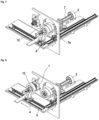
- FIG. 1 is a perspective view showing the entire configuration of the present disclosure
- FIG. 2 is a perspective view showing operation of bobbin shifter moving to take an empty bobbin of the present disclosure
- FIG. 3 is a perspective view showing operation of taking and delivering an empty bobbin of the present disclosure to a bobbin changer
- FIG. 4 is a perspective view showing operation in which an empty bobbin is mounted and moved on the bobbin changer of the present disclosure
- FIG. 5 is a perspective view showing operation of the bobbin changer moving a new bobbin forward while moving an empty bobbin rearward by rotating 180 degrees
- FIG. 6 is a perspective view showing operation of moving a new bobbin fed through 180-degree rotation in the present disclosure
- FIG. 1 is a perspective view showing the entire configuration of the present disclosure
- FIG. 2 is a perspective view showing operation of bobbin shifter moving to take an empty bobbin of the present disclosure
- FIG. 3 is a perspective view showing operation of taking and delivering an empty bobbin of the present
- FIG. 7 is a perspective view showing operation of delivering a new bobbin of the present disclosure to the bobbin shifter
- FIG. 8 is a perspective view showing operation of the bobbin shifter moving to replace a bobbin after receiving a new bobbin
- FIG. 9 is a perspective view illustrating operation of mounting a new bobbin delivered to the bobbin shifter of the present disclosure onto a spool by pushing it with a pusher, in which A bobbin shifter 20 is installed at a first side on one table and a bobbin changer 30 is installed at a second side.
- the bobbin shifter 20 is composed of a spool 1 for mounting a bobbin, an empty bobbin 2 mounted and used up on the spool 1, a pusher 3 pushing the empty bobbin 2 and then returning to the initial position, a deliverer 4 for receiving the empty bobbin 2 and then moving, a rail 5 installed on the bottom to move the deliverer 4, and a support 6 for supporting the rail 5.
- the bobbin changer 30 installed at the second side on one table is composed of a straight cylindrical bobbin mount 7 for fitting a new bobbin on a first side and an empty bobbin on a second side for delivery, a guide 8 installed at the middle of the bobbin mount 7 to separate bobbins while restricting movement of an empty bobbin and a new bobbin, a turn table 9 for rotating the bobbin mount 7 180 degrees, a rail 10 for moving the turn table 9, and a support 11 supporting the rail 10.
- the bobbin is taken or delivered by pushing the bobbin with pushers 3, 4b, and 7a that are each driven by a cylinder.
- the pusher 7a has a circular grooved end, is coupled to a circular rod of the bobbin mount 7, and is configured to push a bobbin to a side and to be able to rotate up and down.
- the pusher 7a has been rotated outward when the bobbin mount 7 is rotated 180 degrees, and is coupled back to the bobbin mount 7 ahead of a guide 8 when the bobbin mount 7 finishes rotating 180 degrees to be able to push a bobbin.
- the pusher 7a can be moved up and down and left and right by a cylinder.
- the bobbin is fitted and fixed with a circular hole at the center of the bobbin horizontally aligned with the axis of the spool 1 or the circular bobbin mount 7.
- unstated reference numeral "8" indicates a guide for separating an empty bobbin 2 and a new bobbin 12
- unstated reference numeral “15” indicates a support for supporting the spool 1 and surrounding parts, and several circular projections are rotatably installed on the bobbin mount 7, thereby enabling smooth movement of a bobbin.
- the deliverer 4 of the bobbin shifter 20 in the state in which the deliverer 4 of the bobbin shifter 20 positioned at a predetermined position at a side, as in FIG. 1 , the deliverer 4 moves left on the rail 5 in the figures and stops accurately ahead of the spool 1 of an empty bobbin 2 to replace the empty bobbin 2 mounted on the spool 1.
- the pusher 3 installed at the spool 1 pushes the empty bobbin 2 out of the spool 1 and simultaneously fits the empty bobbin 2 onto a cylindrical shaft 4a of the deliverer 4.
- the deliverer 4 receiving the empty bobbin 2 moves on the rail 5 to the right in the figures and stops at a predetermined position, as in FIG. 3 , and the empty bobbin 2 is fitted onto the bobbin mount 7 of the bobbin changer 30 with the deliverer 4 at the predetermined position.
- the pusher 4b installed at the deliverer 4 pushes the empty bobbin 2 out of the cylindrical shaft 4a and simultaneously fits and fixes the empty bobbin 2 on the bobbin mount 7.
- the bobbin mount 7 moves on the rail 10 to the end with the empty bobbin 2 thereon, and in this case, the pusher 7a rotates upward, thereby not interfering with movement of the bobbin mount 7.
- the bobbin mount 7 is rotated 180 degrees after moving to the end of the rail 10, the empty bobbin 2 and a new bobbin 12 on the bobbin mount 7 are switched.
- the pusher 7a is positioned up and moves down, thereby pushing the new bobbin 12 to a side with the cylindrical groove fitted on the front end of the guide 8.
- the pusher 7a can be moved up and down, and left and right by a cylinder.
- the deliverer 4 moves on the rail 5 to the left and then stops at a predetermined position to mount the new bobbin 12 on the spool 1, and, as in FIG. 9 , the pusher 4b pushes and fixes the new bobbin 12 on the spool 1.
- the deliverer 4 of the bobbin shifter 20 mounts the new bobbin 12 on the spool 1, the deliverer 4 moves back on the rail and then stops and stands by at a predetermined position, as in FIG. 1 .
- FIGS. 10 to 16 show a process of automatically extracting an end of an electrode separator for a secondary battery of the present disclosure.
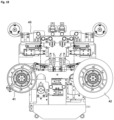
- FIG. 10 is a view showing the entire configuration of automatic extraction of an end of an electrode separator
- FIG. 11 is a perspective view showing the state in which a holder is positioned at an electrode separator end of the present disclosure
- FIG. 12 is a plan view showing the positions of a separator, a suctioner, and a holder of the present disclosure
- FIG. 13 is a view showing the state in which the suctioner of the present disclosure has suctioned an end portion of a separator
- FIG. 14 is a view showing the state in which an adhesive sticker at the center has been separated by the suctioner of the present disclosure suctioning and pulling a separator
- FIG. 10 is a view showing the entire configuration of automatic extraction of an end of an electrode separator
- FIG. 11 is a perspective view showing the state in which a holder is positioned at an electrode separator end of the present disclosure
- FIG. 12 is a plan view showing the positions of a separator, a suctioner, and a holder of the present disclosure
- FIG. 15 is a perspective view showing the state in which an end portion of a separator is held and fixed by an up-down holder of the present disclosure
- FIG. 16 is a view showing an adhesive sticker of the present disclosure.
- a separator 32 is wound on a bobbin 31 and an adhesive sticker 33 is bonded to an end
- an automatic extractor is composed of a suctioner 34 positioned ahead of both sides of the adhesive sticker 33 to perform vacuum suction by a cylinder, etc., a tow bar 35 for fixing the suctioner 34, and a holder 36 installed over and under the front end of the suctioner 34 to pull and fix an end of the separator 32 over and under the end when the end is pulled to protrude
- unstated reference numeral "37" indicates a separator end in the figures.
- the adhesive sticker 33 has a perforated line 38 at the center and other perforated lines 39 are formed over and under the perforated line 38, respectively, so when the separator 32 is pulled by vacuum suction, the perforated lines 38 and 39 of the adhesive sticker 33 are easily torn and separated.
- an electrode separator 32 is wound on the bobbin 31.
- the adhesive sticker 33 is attached to an end of the electrode separator 32 and the end is fixed.
- the separator end 37 is detached and both ends of the end are held and connected to another electrode separator to be used.
- the perforated line 38 is formed at the center of the adhesive sticker 33 not as a simple adhesive sticker by improving the structure of the adhesive sticker 33, and another perforated line 39 is formed over and under the perforated line 38 so that when the end 37 is pulled, the end is separated while the perforated lines 38 and 39 of the adhesive sticker 33 are easily torn.
- both sides of the end 37 of the separator 32 are pulled out.
- the adhesive sticker 33 attached to the center of the end 37 is easily torn by the perforated lines 38 and 39 and the entire end 37 is pulled up.
- the end 37 of the electrode separator 32 is set to be automatically positioned at the suctioner 34 by a sensor, etc.
- the holder 36 installed over and under the separator end 37 is driven by a motor or a cylinder, thereby holding and firmly fixing the end 37.
- FIGS. 17 to 31 show operation of automatically taping an end of an electrode separator for a secondary battery of the present disclosure.
- FIG. 17 is a perspective view in which a separator is prepared ahead and an adhesive film is prepared behind in the present disclosure, in which an empty bobbin 41 and a new bobbin 42 are rotatably installed at the left and right of a center, adhesive films 43 and 44 are rotatably installed at the upper ends of the empty bobbin 41 and the new bobbin 42, an adhesive film holder A 45 and an adhesive film holder B 46 are installed, and a separator suctioner 47, an adhesive film suctioner 48, a separator cutter 49 for cutting a separator, and an adhesive film cutter 50 for cutting an adhesive film are installed, in which unstated reference numeral "51" indicates a separator.
- FIGS. 17 to 31 in order to automatically bond and connect a new separator to a separator that is almost completely used using an adhesive film, two wound adhesive films 43 and 44 installed at both sides of the upper end of a body are cut and inaccurately attached to a separator 51 and the separator 51 is connected to each of exposed adhesive surfaces having adhesion, whereby one continuous separator 51 can be achieved.
- FIG. 18 is a front view excluding the separator 51 and the separator suctioner 47 in the present disclosure, and shows a process of cutting and bonding a pair of adhesive films 43 to each other.
- a pair of left and right holders B 46 of the present disclosure move up and hold ends of a pair of left and right adhesive films 43 and 44, as in FIG. 19 .
- the holder B 46 moves down and pulls the adhesive film 43 and the upper portion of the adhesive film 43 is held and fixed by the holder A 45.
- the holder B 46 moves back not to interfere with the adhesive film 43 and the cut adhesive film 43 remains attached to the separator suctioner 47 by air suction force.
- the separator suctioner 47 is slightly moved down, and the left and right suctioners 47 and 48 are moved to the center toward each other, as in FIG. 24 , whereby the two sheets of adhesive films 43 and 44 are attached to each other.
- right adhesive film suctioner 48 stops air suction and moves to the right as indicated by an arrow with the adhesive film 44 on the separator suctioner 47.
- FIG. 26 enlarges and shows a separator joint in a dotted-line circle and shows operation of connecting a new separator to an end of an almost used-up separator 51, in which the separator suctioner 47 is moved forward to be positioned between the adhesive film 43 and the separator 51.
- FIG. 27 is a front view including the separator and the separator suctioner 47 excluded in FIG. 19 , in which a new bobbin 42 is prepared and a start end 54 of a new separator coming out from the new bobbin 42 is fitted and fixed between a presser 52 and a roller 53.
- the adhesive film suctioner 48 brings a right separator 51a in contact with an adhesive surface of the adhesive film 43 by pushing it in the direction of a left arrow, and then the separator suctioner 47 stops air suction and moves back.
- the separator suctioner 47 attaches a left separator 51 to the adhesive surface of the adhesive film 43 by pushing it in the direction of a right arrow, whereby separators are bonded to both sides of the adhesive films 43 and 44 having adhesion.
- the separator 51 and the separator 51a are suctioned and bonded to both adhesive surfaces of the adhesive film 43, respectively, by the suctioner 47, whereby they are supplied as one complete separator.
Landscapes
- Engineering & Computer Science (AREA)
- Manufacturing & Machinery (AREA)
- Chemical & Material Sciences (AREA)
- Chemical Kinetics & Catalysis (AREA)
- Electrochemistry (AREA)
- General Chemical & Material Sciences (AREA)
- Secondary Cells (AREA)
- Replacement Of Web Rolls (AREA)
- Cell Separators (AREA)
Abstract
Description
- The present application claims priority to
Korean Patent Application No. 10-2023-0037001 10-2023-0037010 10-2023-0037074 filed on March 22, 2023 - The present disclosure relates to a secondary battery electrode film and separator supply device, particularly, configured to: automatically replace a bobbin when an electrode separator is used up by automatically extracting an empty bobbin from a spool, mounting the empty bobbin on a side of a bobbin mount of a bobbin changer, changing the position of a new bobbin mounted on another side by rotating the bobbin mount 180 degrees, and then moving and mounting the new bobbin on the spool; automatically extracting an end of a wound electrode separator through vacuum suction and connecting the end to another electrode separator; and feed a replacing material roll to a moving spool, cut a finishing tap at an end of a material by a predetermined length, and then automatically connect a new separator end of the replacing material roll and an in-use separator end through taping.
- In general, a secondary battery for an electric vehicle is a battery that is not disposed of, but semi-permanently used through charging after it is used once, and a lithium ion battery of secondary batteries is the most generally used and has many advantages in comparison to other batteries, so a lithium ion battery is widely used as the battery of not only electronic devices, but electric vehicles.
- Such a lithium ion battery is manufacture by manufacturing electrodes, that is, a cathode and an anode by applying cathode and anode active materials to a metal foil, by manufacturing a Jelly Roll by putting and winding a separator between the electrodes, by inserting the Jelly Roll into a cylindrical or polygonal container, and then by filling the container with an electrolyte and sealing the container.
- In order to manufacture such a Jelly Roll, a material roll formed by winding a cathode, an anode, and a separator on a bobbin in a roll type is mounted on a spool, and then the cathode, the anode, and the separator are fed and wound on a winding roll, whereby a Jelly Roll is manufactured. When the materials wound on the material roll of the cathode, the anode, and the separator are used up, it is required to replace the material roll with another material roll.
- In particular, a separator makes it difficult to increase a roll diameter for the material characteristics thereof, so it is required to frequently replace rolls in a winding process.
- Accordingly, a rest time of a manufacturing facility increases due to frequent replacement of material rolls and connection of ends of the materials of material rolls in the process of manufacturing Jelly Rolls of lithium ion secondary batteries in the related art, so the productivity of lithium ion secondary batteries decreases.
- Further, workers frequently meet with safety accidents in the process of replacing heavy rolls and the manufacturing quality is deteriorated due to manual replacement.
- That is, since automated equipment for replacing bobbins for a separator was not proposed in the related art, workers every time manually take out and separate an empty bobbin from a shaft and then move and fit a new bobbin for a separator onto the shaft to use it.
- Accordingly, since workers have to every time manually replace empty bobbins for a separator with new bobbins in the related art, there is a defect that it is difficult and also takes long time to replace bobbins.
- That is, since a rest time of a manufacturing facility increases due to frequent replacement of material rolls and connection of ends of the materials of material rolls in the process of manufacturing Jelly Rolls of lithium ion secondary batteries in the related art, there is a defect that productivity of lithium ion secondary batteries is deteriorated, workers frequently meet with safety accidents in the process of replacing heavy rolls, and the quality is deteriorated due to manual replacement.
- In particular, work cannot continue without disconnection unless ends of electrode separators are continuously connected when electrode separators are replaced, and workers have to every time manually extract and connect ends in order to extract ends of electrode separators in the related art, so there is a defect that it is troublesome and inconvenient to extract ends of electrode separators.
- Meanwhile, various technologies for solving the problems with manufacturing facilities have been disclosed in the related art. According to these technologies, a material roll can be additionally mounted on only one spool and a worker leads and prepares material ends of a replacing material roll to a mount and prepares a connection tape at an automatic connection portion in a standby state, whereby when materials are used up, a standby material roll is automatically connected to an in-use material roll and a worker removes the bobbin of a used material roll and repeatedly prepares and uses a new material roll.
- Accordingly, in the related art, it is required to prepare material rolls while alternatively using two spools and to dispose a worker for replacing materials, and in addition, it is manually made to examine and manage the consumption situation of materials and replace materials, so there is a defect that workability and productivity are deteriorated, a large amount of manufacturing cost is needed, and in addition, the manufacturing quality is deteriorated and various safety accidents are caused.
-
-
Korean Patent Appllication No. 10-2021-0094953 -
Korean Patent No. 10-1956930 -
Korean Patent Appllication No. 10-2021-0094953 - The present disclosure has been made in an effort to solve the defects in the related art described above and an objective of the present disclosure is to provide a secondary battery electrode film and separator supply device that can automatically replace an empty bobbin for an electrode separator with a new bobbin using a unit that rotates a bobbin mount 180 degrees at one place without a worker every time manually replacing bobbins when replacing bobbins for an electrode separator.
- Another objective of the present disclosure is to provide a secondary battery electrode film and separator supply device that can automatically extract and connect an end of a wound electrode separator to another electrode separator using an up-down holder with the end of the electrode separator pulled by vacuum suction.
- Another objective of the present disclosure is to provide a secondary battery electrode film and separator supply device that feeds a replacing material roll to a moving spool, cuts a material by a predetermined length by peeling off a finishing tap at the end of the material, conveys and mount the replacing material roll ahead of a main spool, and automatically connects a separator end of the replacing material roll and an in-use separator end through taping.
- The present disclosure for achieving the objectives is characterized by being composed of a bobbin extractor and shifter and a bobbin changer, in which the bobbin extractor and shifter and the bobbin changer are configured on one table; the bobbin extractor and shifter includes a spool for mounting a bobbin, a bobbin shifter taking an empty bobbin, which is fitted on the spool and used up, moving within a predetermined section, receiving a new bobbin and moving, and then fitting and fixing the new bobbin on the spool, a rail installed on a bottom to move the bobbin shifter, and a support for supporting the rail; and the bobbin changer includes a bobbin mount formed in a straight cylindrical shape to mount several new bobbin on a side and mount an empty bobbin on another side, a turn table installed under the bobbin mount to rotate the bobbin mount 180 degrees, a rail for moving the turn table, and a support for supporting the rail.
- The present disclosure is characterized in that, in order to automatically extract a separator end, a pair of vacuum suctioners is provided ahead of an electrode separator, a separator end is fixed up and down by an up-down holder with an adhesive sticker, which is bonded at a middle, torn and separated by pulling up both sides of the separator end using vacuum, and then next work is continuously performed, the adhesive sticker has a perforated line at the center, and other perforated lines are formed over and under the perforated line, respectively, so that the adhesive sticker is easily torn.
- The present disclosure is characterized by including, in order to automatically connecting a separator end through taping: a material roll feeding unit that feeds and fits a replacing material roll having a material wound on a bobbin onto a moving spool; a material roll extracting unit that extracts a material end of the replacing material roll fed to the moving spool; a material roll cutting unit that cuts the material end of the replacing material roll by a predetermined length; a material roll shifting unit that moves the moving spool having the replacing roll mounted thereon to the front of a main spool; a material changing unit that fits and mounts the replacing roll on the moving spool onto the main spool by pushing it, and aligns a separator end of the replacing material roll with an in-use separator end; and a material roll connecting unit that connects the separator end of the replacing material roll and the in-use separator end into one piece by connecting them using a tape.
- As described in detail above, the present disclosure has an effect that it is possible to automatically perform work of automatically taking out an empty bobbin fitted on a spool and moving the empty bobbin to a bobbin changer, receiving and fitting a new bobbin onto the spool on one turn table, and it is possible to replace an empty bobbin with a new bobbin by mounting the empty bobbin on a side of one bobbin mount and a new bobbin on another side and switching them using a unit for rotating them 180 degrees.
- The present disclosure has an effect that it is possible to enable work to continue without disconnection by pulling an end of a separator through vacuum suction, fixing the separator end using an up-down holder, and connecting the end to another separator.
- The present disclosure has an effect that it is possible to automatically perform an entire process of feeding and fitting a replacing material roll onto a spool using a material roller feeding unit, of cutting off a separator end by a predetermined length using a material roll cutting unit, of moving the replacing material roll to the front of a main spool using a material roll shifting unit, of fitting the replacing material roll onto the main spool by pushing it using a material roll changing unit such that the separator end of the replacing material roll is aligned with an in-use separator end, and of connecting the separator end of the replacing material roll and the in-use separator end by bonding them using a tape.
-
-
FIG. 1 is a perspective view showing the entire configuration of the present disclosure. -
FIG. 2 is a perspective view showing operation of bobbin shifter moving to take an empty bobbin of the present disclosure. -
FIG. 3 is a perspective view showing operation of taking and delivering an empty bobbin of the present disclosure to a bobbin changer. -
FIG. 4 is a perspective view showing operation in which an empty bobbin is mounted and moved on the bobbin changer of the present disclosure. -
FIG. 5 is a perspective view showing operation of the bobbin changer moving a new bobbin forward while moving an empty bobbin rearward by rotating 180 degrees. -
FIG. 6 is a perspective view showing operation of moving a new bobbin fed through 180-degree rotation in the present disclosure. -
FIG. 7 is a perspective view showing operation of delivering a new bobbin of the present disclosure to the bobbin shifter. -
FIG. 8 is a perspective view showing operation of the bobbin shifter moving to replace a bobbin after receiving a new bobbin. -
FIG. 9 is a perspective view illustrating operation of mounting a new bobbin delivered to the bobbin shifter of the present disclosure onto a spool by pushing it with a pusher. -
FIGS. 10 to 16 relate to automatic extraction of an electrode separator of the present disclosure. -
FIG. 10 is a perspective view of an automatic extractor of the present disclosure. -
FIG. 11 is a perspective view showing the state in which a holder is positioned at an electrode separator end of the present disclosure. -
FIG. 12 is a plan view showing the positions of a separator, a suctioner, and a holder of the present disclosure. -
FIG. 13 is a view showing the state in which the suctioner of the present disclosure has suctioned an end portion of a separator. -
FIG. 14 is a view showing the state in which an adhesive sticker at the center has been separated by the suctioner of the present disclosure suctioning and pulling a separator. -
FIG. 15 is a perspective view showing the state in which an end portion of a separator is held and fixed by an up-down holder of the present disclosure. -
FIG. 16 is a view showing an adhesive sticker of the present disclosure. -
FIGS. 17 to 31 relate to automatic taping connection of an electrode separator end of the present disclosure. -
FIG. 17 is a perspective view in which a separator is prepared ahead and an adhesive film is prepared behind in the present disclosure. -
FIG. 18 is a front view excluding the separator and the suctioner of the present disclosure. -
FIG. 19 is a front view showing operation of holding ends of a pair of left and right adhesive films by a pair of left and right holders B moving up in the present disclosure. -
FIG. 20 is a front view showing the state in which a holder pulls an adhesive film by moving down and a holder A fixes the upper portion of the adhesive film in the present disclosure. -
FIG. 21 is a front view showing the state in which the suctioner of the present disclosure has suctioned and held an adhesive film. -
FIG. 22 is a front view showing a cutting process with the suctioner holding an adhesive film in the present disclosure. -
FIG. 23 is a front view showing a moving-down state of the suctioner after cutting the adhesive film ofFIG. 22 . -
FIG. 24 is a front view showing operation of bonding two sheets of adhesive films by left and right suctioners moving to the center in the present disclosure. -
FIG. 25 is a front view showing the state in which the adhesive surface of a non-overlap portion is exposed when two sheets of adhesive films are inaccurately bonded in the present disclosure. -
FIG. 26 is a front view showing operation of connecting a new separator to an end of a completely used separator of the present disclosure. -
FIG. 27 is a front view of an assembly including an adhesive film and a separator suctioner of the present disclosure. -
FIGS. 28 to 31 are front views when one separator connection has been finished by inaccurately bonding both surfaces of an adhesive film to a suctioner and sequentially bonding a right separator and a left separator to an exposed adhesive surface. - Hereafter, embodiments of the present disclosure are described with reference to the accompanying drawings.
-
FIG. 1 is a perspective view showing the entire configuration of the present disclosure,FIG. 2 is a perspective view showing operation of bobbin shifter moving to take an empty bobbin of the present disclosure,FIG. 3 is a perspective view showing operation of taking and delivering an empty bobbin of the present disclosure to a bobbin changer,FIG. 4 is a perspective view showing operation in which an empty bobbin is mounted and moved on the bobbin changer of the present disclosure,FIG. 5 is a perspective view showing operation of the bobbin changer moving a new bobbin forward while moving an empty bobbin rearward by rotating 180 degrees,FIG. 6 is a perspective view showing operation of moving a new bobbin fed through 180-degree rotation in the present disclosure,FIG. 7 is a perspective view showing operation of delivering a new bobbin of the present disclosure to the bobbin shifter,FIG. 8 is a perspective view showing operation of the bobbin shifter moving to replace a bobbin after receiving a new bobbin, andFIG. 9 is a perspective view illustrating operation of mounting a new bobbin delivered to the bobbin shifter of the present disclosure onto a spool by pushing it with a pusher, in which Abobbin shifter 20 is installed at a first side on one table and abobbin changer 30 is installed at a second side. Thebobbin shifter 20 is composed of aspool 1 for mounting a bobbin, anempty bobbin 2 mounted and used up on thespool 1, apusher 3 pushing theempty bobbin 2 and then returning to the initial position, adeliverer 4 for receiving theempty bobbin 2 and then moving, arail 5 installed on the bottom to move thedeliverer 4, and asupport 6 for supporting therail 5. - The
bobbin changer 30 installed at the second side on one table is composed of a straightcylindrical bobbin mount 7 for fitting a new bobbin on a first side and an empty bobbin on a second side for delivery, aguide 8 installed at the middle of thebobbin mount 7 to separate bobbins while restricting movement of an empty bobbin and a new bobbin, a turn table 9 for rotating thebobbin mount 7 180 degrees, arail 10 for moving the turn table 9, and asupport 11 supporting therail 10. - When the
empty bobbin 2 is taken from thespool 1 or is delivered to be mounted on thebobbin mount 7, or when they are operated in the opposite way, the bobbin is taken or delivered by pushing the bobbin withpushers - The
pusher 7a has a circular grooved end, is coupled to a circular rod of thebobbin mount 7, and is configured to push a bobbin to a side and to be able to rotate up and down. Thepusher 7a has been rotated outward when thebobbin mount 7 is rotated 180 degrees, and is coupled back to thebobbin mount 7 ahead of aguide 8 when thebobbin mount 7 finishes rotating 180 degrees to be able to push a bobbin. Thepusher 7a can be moved up and down and left and right by a cylinder. - The bobbin is fitted and fixed with a circular hole at the center of the bobbin horizontally aligned with the axis of the
spool 1 or thecircular bobbin mount 7. - In the figures, unstated reference numeral "8" indicates a guide for separating an
empty bobbin 2 and anew bobbin 12 and unstated reference numeral "15" indicates a support for supporting thespool 1 and surrounding parts, and several circular projections are rotatably installed on thebobbin mount 7, thereby enabling smooth movement of a bobbin. - Operation of the present disclosure having this configuration is described.
- According to the present disclosure, in the state in which the
deliverer 4 of thebobbin shifter 20 positioned at a predetermined position at a side, as inFIG. 1 , thedeliverer 4 moves left on therail 5 in the figures and stops accurately ahead of thespool 1 of anempty bobbin 2 to replace theempty bobbin 2 mounted on thespool 1. - Accordingly, when the
deliverer 4 is positioned at theempty bobbin 2 mounted on thespool 1, thepusher 3 installed at thespool 1 pushes theempty bobbin 2 out of thespool 1 and simultaneously fits theempty bobbin 2 onto acylindrical shaft 4a of thedeliverer 4. - The
deliverer 4 receiving theempty bobbin 2 moves on therail 5 to the right in the figures and stops at a predetermined position, as inFIG. 3 , and theempty bobbin 2 is fitted onto thebobbin mount 7 of thebobbin changer 30 with thedeliverer 4 at the predetermined position. In this case, thepusher 4b installed at thedeliverer 4 pushes theempty bobbin 2 out of thecylindrical shaft 4a and simultaneously fits and fixes theempty bobbin 2 on thebobbin mount 7. - Accordingly, as in
FIG. 4 , thebobbin mount 7 moves on therail 10 to the end with theempty bobbin 2 thereon, and in this case, thepusher 7a rotates upward, thereby not interfering with movement of thebobbin mount 7. When thebobbin mount 7 is rotated 180 degrees after moving to the end of therail 10, theempty bobbin 2 and anew bobbin 12 on thebobbin mount 7 are switched. - That is, as in
FIG. 5 , theempty bobbin 2 at the front is moved to the rear and thenew bobbin 12 at the rear is moved to the front. - As in
FIG. 6 , when thebobbin mount 7 of thebobbin changer 30 moves on therail 10 back to the left in the figures with theempty bobbin 2 and thenew bobbin 12 switched by rotation of thebobbin mount 7, thepusher 7a pushes and fixes the onenew bobbin 12 on thecylindrical shaft 4a of thedeliverer 4 stopped at the predetermined position. - In this case, the
pusher 7a is positioned up and moves down, thereby pushing thenew bobbin 12 to a side with the cylindrical groove fitted on the front end of theguide 8. Thepusher 7a can be moved up and down, and left and right by a cylinder. - Accordingly, as in
FIG. 8 , thedeliverer 4 moves on therail 5 to the left and then stops at a predetermined position to mount thenew bobbin 12 on thespool 1, and, as inFIG. 9 , thepusher 4b pushes and fixes thenew bobbin 12 on thespool 1. - After the
deliverer 4 of thebobbin shifter 20 mounts thenew bobbin 12 on thespool 1, thedeliverer 4 moves back on the rail and then stops and stands by at a predetermined position, as inFIG. 1 . - Meanwhile,
FIGS. 10 to 16 show a process of automatically extracting an end of an electrode separator for a secondary battery of the present disclosure. -
FIG. 10 is a view showing the entire configuration of automatic extraction of an end of an electrode separator,FIG. 11 is a perspective view showing the state in which a holder is positioned at an electrode separator end of the present disclosure,FIG. 12 is a plan view showing the positions of a separator, a suctioner, and a holder of the present disclosure,FIG. 13 is a view showing the state in which the suctioner of the present disclosure has suctioned an end portion of a separator,FIG. 14 is a view showing the state in which an adhesive sticker at the center has been separated by the suctioner of the present disclosure suctioning and pulling a separator,FIG. 15 is a perspective view showing the state in which an end portion of a separator is held and fixed by an up-down holder of the present disclosure, andFIG. 16 is a view showing an adhesive sticker of the present disclosure. As shown in the figures, aseparator 32 is wound on abobbin 31 and anadhesive sticker 33 is bonded to an end, an automatic extractor is composed of asuctioner 34 positioned ahead of both sides of theadhesive sticker 33 to perform vacuum suction by a cylinder, etc., atow bar 35 for fixing thesuctioner 34, and aholder 36 installed over and under the front end of thesuctioner 34 to pull and fix an end of theseparator 32 over and under the end when the end is pulled to protrude, and unstated reference numeral "37" indicates a separator end in the figures. - However, the
adhesive sticker 33 has a perforatedline 38 at the center and otherperforated lines 39 are formed over and under theperforated line 38, respectively, so when theseparator 32 is pulled by vacuum suction, theperforated lines adhesive sticker 33 are easily torn and separated. - In
FIGS. 10 to 16 , anelectrode separator 32 is wound on thebobbin 31. Theadhesive sticker 33 is attached to an end of theelectrode separator 32 and the end is fixed. Theseparator end 37 is detached and both ends of the end are held and connected to another electrode separator to be used. - When an end of the
electrode separator 32 is separated and connected to another electrode separator to be used, as described above, it is usually difficult to separate the end of theelectrode separator 32. Accordingly, in the present disclosure, theperforated line 38 is formed at the center of theadhesive sticker 33 not as a simple adhesive sticker by improving the structure of theadhesive sticker 33, and anotherperforated line 39 is formed over and under theperforated line 38 so that when theend 37 is pulled, the end is separated while theperforated lines adhesive sticker 33 are easily torn. - That is, when the
suctioner 34 is positioned ahead of both sides of theend 37 of theseparator 32, as inFIG. 12 , and the end is vacuum-suctioned by thesuctioner 34, as inFIG. 13 , both sides of theend 37 of theseparator 32 are pulled out. In this case, as inFIG. 14 , theadhesive sticker 33 attached to the center of theend 37 is easily torn by theperforated lines entire end 37 is pulled up. - In this case, the
end 37 of theelectrode separator 32 is set to be automatically positioned at thesuctioner 34 by a sensor, etc. - When the
end 37 of theseparator 32 is pulled to protrude, theholder 36 installed over and under theseparator end 37 is driven by a motor or a cylinder, thereby holding and firmly fixing theend 37. - Accordingly, it is possible to make separators be continuously supplied by immediately pulling up and connecting the
end 37 of theseparator 32, which has been pulled by vacuum suction, to another electrode separator. - Meanwhile,
FIGS. 17 to 31 show operation of automatically taping an end of an electrode separator for a secondary battery of the present disclosure. -
FIG. 17 is a perspective view in which a separator is prepared ahead and an adhesive film is prepared behind in the present disclosure, in which anempty bobbin 41 and anew bobbin 42 are rotatably installed at the left and right of a center,adhesive films empty bobbin 41 and thenew bobbin 42, an adhesivefilm holder A 45 and an adhesivefilm holder B 46 are installed, and aseparator suctioner 47, anadhesive film suctioner 48, aseparator cutter 49 for cutting a separator, and anadhesive film cutter 50 for cutting an adhesive film are installed, in which unstated reference numeral "51" indicates a separator. - In
FIGS. 17 to 31 , in order to automatically bond and connect a new separator to a separator that is almost completely used using an adhesive film, two woundadhesive films separator 51 and theseparator 51 is connected to each of exposed adhesive surfaces having adhesion, whereby onecontinuous separator 51 can be achieved. -
FIG. 18 is a front view excluding theseparator 51 and theseparator suctioner 47 in the present disclosure, and shows a process of cutting and bonding a pair ofadhesive films 43 to each other. - A pair of left and
right holders B 46 of the present disclosure move up and hold ends of a pair of left and rightadhesive films FIG. 19 . - Then, as in
FIG. 20 , theholder B 46 moves down and pulls theadhesive film 43 and the upper portion of theadhesive film 43 is held and fixed by theholder A 45. - In this state, when the
suctioner 37 suctions and holds theadhesive film 43, as inFIG. 21 , and thecutter 50 cuts theadhesive film 43 and then moves back, as inFIG. 22 , theholder B 46 opens and releases theadhesive film 43. - Accordingly, though not shown in figures, the
holder B 46 moves back not to interfere with theadhesive film 43 and thecut adhesive film 43 remains attached to theseparator suctioner 47 by air suction force. - Further, with the
cut adhesive film 43 attached to theseparator suctioner 47, as inFIG. 3 , theseparator suctioner 47 is slightly moved down, and the left and right suctioners 47 and 48 are moved to the center toward each other, as inFIG. 24 , whereby the two sheets ofadhesive films - In this state, as in
FIG. 25 , since the two sheets ofadhesive films adhesive films - Further, right
adhesive film suctioner 48 stops air suction and moves to the right as indicated by an arrow with theadhesive film 44 on theseparator suctioner 47. -
FIG. 26 enlarges and shows a separator joint in a dotted-line circle and shows operation of connecting a new separator to an end of an almost used-upseparator 51, in which theseparator suctioner 47 is moved forward to be positioned between theadhesive film 43 and theseparator 51. -
FIG. 27 is a front view including the separator and theseparator suctioner 47 excluded inFIG. 19 , in which anew bobbin 42 is prepared and astart end 54 of a new separator coming out from thenew bobbin 42 is fitted and fixed between apresser 52 and aroller 53. - Then, as in
FIGS. 28 and 29 , theadhesive film suctioner 48 brings aright separator 51a in contact with an adhesive surface of theadhesive film 43 by pushing it in the direction of a left arrow, and then theseparator suctioner 47 stops air suction and moves back. - Then, as in
FIG. 30 , theseparator suctioner 47 attaches aleft separator 51 to the adhesive surface of theadhesive film 43 by pushing it in the direction of a right arrow, whereby separators are bonded to both sides of theadhesive films - Next, as in
FIG. 31 , thepresser 52 shown inFIG. 27 is released and theleft separator 51 is pulled, whereby theright separator 51a finishes being bonded to theadhesive film 43. - That is, the
separator 51 and theseparator 51a are suctioned and bonded to both adhesive surfaces of theadhesive film 43, respectively, by thesuctioner 47, whereby they are supplied as one complete separator.
Claims (7)
- A secondary battery electrode film and separator supply device comprising a bobbin extractor and shifter installed at a first side on one table and a bobbin changer installed at a second side,wherein the bobbin extractor and shifter includes a spool for mounting a bobbin, an empty bobbin mounted and used up on the spool, a pusher pushing the empty bobbin and then returning to an initial position, a deliverer for receiving the empty bobbin and then moving, a rail installed on a bottom to move the deliverer, and a support for supporting the rail, andthe bobbin changer includes a straight cylindrical bobbin mount for fitting a new bobbin on a first side and an empty bobbin on a second side for delivery, a guide installed at the middle of the bobbin mount to separate bobbins while restricting movement of an empty bobbin and a new bobbin, a turn table for rotating the bobbin mount 180 degrees, a rail for moving the turn table, and a support supporting the rail.
- The secondary battery electrode film and separator supply device of claim 1, wherein several circular projections are rotatably installed on a surface of the bobbin mount to enable smooth movement of a bobbin.
- The secondary battery electrode film and separator supply device of claim 2, wherein a pusher is configured to be able to rotate up and down and move left and right at a front end of a guide of the bobbin mount, a circular groove is formed at an end of the pusher to be fitted on the bobbin mount, the circular groove of the pusher is coupled to the bobbin mount to push a bobbin to a side, the pusher has been rotated outward not to interfere with the bobbin mount when the bobbin mount rotates 180 degrees, and when the bobbin mount finishes rotating 180 degrees, the pusher is coupled to the front end of the guide of the bobbin mount and pushes a bobbin to a side.
- A secondary battery electrode film and separator supply device, in which a separator is wound on a bobbin and an adhesive sticker for fixing an end is bonded to the center of an end of the separator, comprising a pair of suctioner positioned ahead of both sides of the adhesive sticker bonded to the end of the electrode separator to pull an end through vacuum suction, a tow bar fixing the suctioners and moved by a cylinder, and a holder installed over and under the suctioners and holing and fixing the end of the electrode when the end is pulled to protrude by the suctioners.
- The secondary battery electrode film and separator supply device of claim 4, wherein the adhesive sticker has a perforated line at a center and other perforated lines are formed over and under the perforated line, respectively, so when the suctioners pulls a separator through vacuum suction, the perforated lines of the adhesive sticker bonded to a center of an end of the separator are torn and separated.
- A secondary battery electrode film and separator supply device, wherein an empty bobbin and a new bobbin are rotatably installed at left and right of a machine center and adhesive films are rotatably installed at upper ends of the empty bobbin and the new bobbin, and
the secondary battery electrode film and separator supply device comprises:holders installed up and down to hold and move the adhesive films; anda separator suctioner, an adhesive film suctioner, a separator cutter for cutting a separator, and an adhesive film cutter for cutting an adhesive film. - The secondary battery electrode film and separator supply device of claim 6, wherein the adhesive films are inaccurately attached to each other such that both ends of adhesive surfaces of the adhesive films are exposed, and a separator is bonded to the exposed adhesive surfaces.
Priority Applications (2)
| Application Number | Priority Date | Filing Date | Title |
|---|---|---|---|
| EP24219213.6A EP4516713B1 (en) | 2023-03-22 | 2023-09-13 | Secondary battery electrode film and separator supply device |
| EP24219214.4A EP4520696A3 (en) | 2023-03-22 | 2023-09-13 | Secondary battery electrode film and separator supply device |
Applications Claiming Priority (3)
| Application Number | Priority Date | Filing Date | Title |
|---|---|---|---|
| KR1020230037074A KR102739372B1 (en) | 2023-03-22 | 2023-03-22 | Automatic taping connection device for electrode separator end |
| KR1020230037010A KR102786085B1 (en) | 2023-03-22 | 2023-03-22 | Automatic extraction apparatus for end of electrode |
| KR1020230037001A KR102739371B1 (en) | 2023-03-22 | 2023-03-22 | Automatic bobbin replacement device for electrode separator of anode |
Related Child Applications (2)
| Application Number | Title | Priority Date | Filing Date |
|---|---|---|---|
| EP24219213.6A Division EP4516713B1 (en) | 2023-03-22 | 2023-09-13 | Secondary battery electrode film and separator supply device |
| EP24219214.4A Division EP4520696A3 (en) | 2023-03-22 | 2023-09-13 | Secondary battery electrode film and separator supply device |
Publications (2)
| Publication Number | Publication Date |
|---|---|
| EP4435911A2 true EP4435911A2 (en) | 2024-09-25 |
| EP4435911A3 EP4435911A3 (en) | 2024-10-30 |
Family
ID=88020715
Family Applications (3)
| Application Number | Title | Priority Date | Filing Date |
|---|---|---|---|
| EP24219214.4A Pending EP4520696A3 (en) | 2023-03-22 | 2023-09-13 | Secondary battery electrode film and separator supply device |
| EP24219213.6A Active EP4516713B1 (en) | 2023-03-22 | 2023-09-13 | Secondary battery electrode film and separator supply device |
| EP23197211.8A Pending EP4435911A3 (en) | 2023-03-22 | 2023-09-13 | Secondary battery electrode film and separator supply device |
Family Applications Before (2)
| Application Number | Title | Priority Date | Filing Date |
|---|---|---|---|
| EP24219214.4A Pending EP4520696A3 (en) | 2023-03-22 | 2023-09-13 | Secondary battery electrode film and separator supply device |
| EP24219213.6A Active EP4516713B1 (en) | 2023-03-22 | 2023-09-13 | Secondary battery electrode film and separator supply device |
Country Status (2)
| Country | Link |
|---|---|
| US (1) | US20240322213A1 (en) |
| EP (3) | EP4520696A3 (en) |
Families Citing this family (2)
| Publication number | Priority date | Publication date | Assignee | Title |
|---|---|---|---|---|
| HUE068160T2 (en) * | 2021-07-12 | 2024-12-28 | Manz Italy Srl | System for replacing a reel of material for the production of electrical energy storage devices and related method |
| US20260088327A1 (en) * | 2024-09-25 | 2026-03-26 | Innorex Inc. | Automatic material supply device for secondary batteries |
Citations (2)
| Publication number | Priority date | Publication date | Assignee | Title |
|---|---|---|---|---|
| KR101956930B1 (en) | 2013-02-25 | 2019-03-11 | 삼성에스디아이 주식회사 | Materials automatically exchanging device of secondary battery winding equipment |
| KR20210094953A (en) | 2020-01-22 | 2021-07-30 | 엘지전자 주식회사 | Electric motor and compressor having the same |
Family Cites Families (6)
| Publication number | Priority date | Publication date | Assignee | Title |
|---|---|---|---|---|
| JPS60186271A (en) * | 1984-02-15 | 1985-09-21 | 日本たばこ産業株式会社 | Stocker in reel supply apparatus |
| JPS63127961A (en) * | 1986-11-17 | 1988-05-31 | Hamada Insatsuki Seizosho:Kk | Paper adding device |
| CN108598547B (en) * | 2018-04-27 | 2024-03-19 | 深圳市诚捷智能装备股份有限公司 | Battery making machine |
| HUE068160T2 (en) * | 2021-07-12 | 2024-12-28 | Manz Italy Srl | System for replacing a reel of material for the production of electrical energy storage devices and related method |
| KR102425021B1 (en) * | 2021-07-20 | 2022-07-27 | (주)도원위즈테크 | Automatic supply and exchange device for material rolls for secondary battery manufacturing |
| KR102433356B1 (en) * | 2022-01-24 | 2022-08-18 | (주)도원위즈테크 | Material roll cutting and installation setting device for replacement of secondary battery jelly roll manufacturing facility |
-
2023
- 2023-04-21 US US18/137,483 patent/US20240322213A1/en active Pending
- 2023-09-13 EP EP24219214.4A patent/EP4520696A3/en active Pending
- 2023-09-13 EP EP24219213.6A patent/EP4516713B1/en active Active
- 2023-09-13 EP EP23197211.8A patent/EP4435911A3/en active Pending
Patent Citations (2)
| Publication number | Priority date | Publication date | Assignee | Title |
|---|---|---|---|---|
| KR101956930B1 (en) | 2013-02-25 | 2019-03-11 | 삼성에스디아이 주식회사 | Materials automatically exchanging device of secondary battery winding equipment |
| KR20210094953A (en) | 2020-01-22 | 2021-07-30 | 엘지전자 주식회사 | Electric motor and compressor having the same |
Also Published As
| Publication number | Publication date |
|---|---|
| US20240322213A1 (en) | 2024-09-26 |
| EP4516713A3 (en) | 2025-05-14 |
| EP4516713B1 (en) | 2025-12-10 |
| EP4520696A3 (en) | 2025-10-22 |
| EP4516713C0 (en) | 2025-12-10 |
| EP4516713A2 (en) | 2025-03-05 |
| EP4435911A3 (en) | 2024-10-30 |
| EP4520696A2 (en) | 2025-03-12 |
Similar Documents
| Publication | Publication Date | Title |
|---|---|---|
| EP4435911A2 (en) | Secondary battery electrode film and separator supply device | |
| CN114314109B (en) | Roll changing equipment | |
| CN217417581U (en) | Roll changing equipment | |
| EP3813172A1 (en) | Automatic replacement device of secondary battery material | |
| CN108063276A (en) | Coiler device | |
| JP5620708B2 (en) | Winding device | |
| CN115611045A (en) | System for replacing a reel of material for producing an electrical energy storage device and related method | |
| KR102192068B1 (en) | Automatic Tape Supply for Electrode Plate Automatic Adhesion of Lithium-ion Battery | |
| EP1380526B9 (en) | Web winding method and apparatus therefor | |
| CN116081361A (en) | Roll changing equipment | |
| CN108328388B (en) | Film automatic material changing machine for producing plastic bags | |
| CN114314111B (en) | Transfer device and reel changing equipment | |
| CN218491010U (en) | Feed preparation device and roll changing equipment | |
| CN218595641U (en) | Waste collecting mechanism, pickup device and reel changing equipment | |
| CN114314113B (en) | Tape splicing device and reel changing equipment | |
| CN218507136U (en) | Unwinding device and roll changing equipment | |
| CN212907820U (en) | Automatic production line of battery | |
| CN217417583U (en) | Transfer device and reel changing equipment | |
| CN218707698U (en) | Roll changing equipment | |
| CN218595657U (en) | Handling device and roll changing equipment | |
| CN216996910U (en) | Tape splicing device and reel changing equipment | |
| CN218595661U (en) | Pick up mechanism, pickup apparatus and change of lap equipment | |
| KR102739372B1 (en) | Automatic taping connection device for electrode separator end | |
| CN119133616A (en) | Gluing device and battery production system | |
| JPH06211411A (en) | Tape sticking machine |
Legal Events
| Date | Code | Title | Description |
|---|---|---|---|
| PUAI | Public reference made under article 153(3) epc to a published international application that has entered the european phase |
Free format text: ORIGINAL CODE: 0009012 |
|
| STAA | Information on the status of an ep patent application or granted ep patent |
Free format text: STATUS: REQUEST FOR EXAMINATION WAS MADE |
|
| 17P | Request for examination filed |
Effective date: 20230913 |
|
| AK | Designated contracting states |
Kind code of ref document: A2 Designated state(s): AL AT BE BG CH CY CZ DE DK EE ES FI FR GB GR HR HU IE IS IT LI LT LU LV MC ME MK MT NL NO PL PT RO RS SE SI SK SM TR |
|
| PUAL | Search report despatched |
Free format text: ORIGINAL CODE: 0009013 |
|
| AK | Designated contracting states |
Kind code of ref document: A3 Designated state(s): AL AT BE BG CH CY CZ DE DK EE ES FI FR GB GR HR HU IE IS IT LI LT LU LV MC ME MK MT NL NO PL PT RO RS SE SI SK SM TR |
|
| RIC1 | Information provided on ipc code assigned before grant |
Ipc: B65H 35/00 20060101ALI20240924BHEP Ipc: B65H 19/10 20060101ALI20240924BHEP Ipc: B65H 19/12 20060101ALI20240924BHEP Ipc: H01M 10/04 20060101AFI20240924BHEP |
|
| RBV | Designated contracting states (corrected) |
Designated state(s): AL AT BE BG CH CY CZ DE DK EE ES FI FR GB GR HR HU IE IS IT LI LT LU LV MC ME MK MT NL NO PL PT RO RS SE SI SK SM TR |