EP4435845A1 - Gate-verbindung über gate-schnitt in halbleiterbauelementen - Google Patents
Gate-verbindung über gate-schnitt in halbleiterbauelementen Download PDFInfo
- Publication number
- EP4435845A1 EP4435845A1 EP23206291.9A EP23206291A EP4435845A1 EP 4435845 A1 EP4435845 A1 EP 4435845A1 EP 23206291 A EP23206291 A EP 23206291A EP 4435845 A1 EP4435845 A1 EP 4435845A1
- Authority
- EP
- European Patent Office
- Prior art keywords
- gate
- semiconductor
- dielectric
- integrated circuit
- region
- Prior art date
- Legal status (The legal status is an assumption and is not a legal conclusion. Google has not performed a legal analysis and makes no representation as to the accuracy of the status listed.)
- Pending
Links
Images





Classifications
-
- H—ELECTRICITY
- H10—SEMICONDUCTOR DEVICES; ELECTRIC SOLID-STATE DEVICES NOT OTHERWISE PROVIDED FOR
- H10D—INORGANIC ELECTRIC SEMICONDUCTOR DEVICES
- H10D84/00—Integrated devices formed in or on semiconductor substrates that comprise only semiconducting layers, e.g. on Si wafers or on GaAs-on-Si wafers
- H10D84/01—Manufacture or treatment
- H10D84/0123—Integrating together multiple components covered by H10D12/00 or H10D30/00, e.g. integrating multiple IGBTs
- H10D84/0126—Integrating together multiple components covered by H10D12/00 or H10D30/00, e.g. integrating multiple IGBTs the components including insulated gates, e.g. IGFETs
- H10D84/0151—Manufacturing their isolation regions
-
- H—ELECTRICITY
- H10—SEMICONDUCTOR DEVICES; ELECTRIC SOLID-STATE DEVICES NOT OTHERWISE PROVIDED FOR
- H10D—INORGANIC ELECTRIC SEMICONDUCTOR DEVICES
- H10D84/00—Integrated devices formed in or on semiconductor substrates that comprise only semiconducting layers, e.g. on Si wafers or on GaAs-on-Si wafers
- H10D84/80—Integrated devices formed in or on semiconductor substrates that comprise only semiconducting layers, e.g. on Si wafers or on GaAs-on-Si wafers characterised by the integration of at least one component covered by groups H10D12/00 or H10D30/00, e.g. integration of IGFETs
- H10D84/82—Integrated devices formed in or on semiconductor substrates that comprise only semiconducting layers, e.g. on Si wafers or on GaAs-on-Si wafers characterised by the integration of at least one component covered by groups H10D12/00 or H10D30/00, e.g. integration of IGFETs of only field-effect components
- H10D84/83—Integrated devices formed in or on semiconductor substrates that comprise only semiconducting layers, e.g. on Si wafers or on GaAs-on-Si wafers characterised by the integration of at least one component covered by groups H10D12/00 or H10D30/00, e.g. integration of IGFETs of only field-effect components of only insulated-gate FETs [IGFET]
-
- H—ELECTRICITY
- H10—SEMICONDUCTOR DEVICES; ELECTRIC SOLID-STATE DEVICES NOT OTHERWISE PROVIDED FOR
- H10D—INORGANIC ELECTRIC SEMICONDUCTOR DEVICES
- H10D30/00—Field-effect transistors [FET]
- H10D30/40—FETs having zero-dimensional [0D], one-dimensional [1D] or two-dimensional [2D] charge carrier gas channels
- H10D30/47—FETs having zero-dimensional [0D], one-dimensional [1D] or two-dimensional [2D] charge carrier gas channels having two-dimensional [2D] charge carrier gas channels, e.g. nanoribbon FETs or high electron mobility transistors [HEMT]
-
- H—ELECTRICITY
- H10—SEMICONDUCTOR DEVICES; ELECTRIC SOLID-STATE DEVICES NOT OTHERWISE PROVIDED FOR
- H10D—INORGANIC ELECTRIC SEMICONDUCTOR DEVICES
- H10D30/00—Field-effect transistors [FET]
- H10D30/60—Insulated-gate field-effect transistors [IGFET]
- H10D30/67—Thin-film transistors [TFT]
- H10D30/6729—Thin-film transistors [TFT] characterised by the electrodes
- H10D30/673—Thin-film transistors [TFT] characterised by the electrodes characterised by the shapes, relative sizes or dispositions of the gate electrodes
- H10D30/6735—Thin-film transistors [TFT] characterised by the electrodes characterised by the shapes, relative sizes or dispositions of the gate electrodes having gates fully surrounding the channels, e.g. gate-all-around
-
- H—ELECTRICITY
- H10—SEMICONDUCTOR DEVICES; ELECTRIC SOLID-STATE DEVICES NOT OTHERWISE PROVIDED FOR
- H10D—INORGANIC ELECTRIC SEMICONDUCTOR DEVICES
- H10D30/00—Field-effect transistors [FET]
- H10D30/60—Insulated-gate field-effect transistors [IGFET]
- H10D30/67—Thin-film transistors [TFT]
- H10D30/6757—Thin-film transistors [TFT] characterised by the structure of the channel, e.g. transverse or longitudinal shape or doping profile
-
- H—ELECTRICITY
- H10—SEMICONDUCTOR DEVICES; ELECTRIC SOLID-STATE DEVICES NOT OTHERWISE PROVIDED FOR
- H10D—INORGANIC ELECTRIC SEMICONDUCTOR DEVICES
- H10D62/00—Semiconductor bodies, or regions thereof, of devices having potential barriers
- H10D62/10—Shapes, relative sizes or dispositions of the regions of the semiconductor bodies; Shapes of the semiconductor bodies
- H10D62/117—Shapes of semiconductor bodies
- H10D62/118—Nanostructure semiconductor bodies
-
- H—ELECTRICITY
- H10—SEMICONDUCTOR DEVICES; ELECTRIC SOLID-STATE DEVICES NOT OTHERWISE PROVIDED FOR
- H10D—INORGANIC ELECTRIC SEMICONDUCTOR DEVICES
- H10D84/00—Integrated devices formed in or on semiconductor substrates that comprise only semiconducting layers, e.g. on Si wafers or on GaAs-on-Si wafers
- H10D84/01—Manufacture or treatment
- H10D84/0123—Integrating together multiple components covered by H10D12/00 or H10D30/00, e.g. integrating multiple IGBTs
- H10D84/0126—Integrating together multiple components covered by H10D12/00 or H10D30/00, e.g. integrating multiple IGBTs the components including insulated gates, e.g. IGFETs
- H10D84/0135—Manufacturing their gate conductors
-
- H—ELECTRICITY
- H10—SEMICONDUCTOR DEVICES; ELECTRIC SOLID-STATE DEVICES NOT OTHERWISE PROVIDED FOR
- H10D—INORGANIC ELECTRIC SEMICONDUCTOR DEVICES
- H10D84/00—Integrated devices formed in or on semiconductor substrates that comprise only semiconducting layers, e.g. on Si wafers or on GaAs-on-Si wafers
- H10D84/01—Manufacture or treatment
- H10D84/0123—Integrating together multiple components covered by H10D12/00 or H10D30/00, e.g. integrating multiple IGBTs
- H10D84/0126—Integrating together multiple components covered by H10D12/00 or H10D30/00, e.g. integrating multiple IGBTs the components including insulated gates, e.g. IGFETs
- H10D84/0149—Manufacturing their interconnections or electrodes, e.g. source or drain electrodes
-
- H—ELECTRICITY
- H10—SEMICONDUCTOR DEVICES; ELECTRIC SOLID-STATE DEVICES NOT OTHERWISE PROVIDED FOR
- H10D—INORGANIC ELECTRIC SEMICONDUCTOR DEVICES
- H10D84/00—Integrated devices formed in or on semiconductor substrates that comprise only semiconducting layers, e.g. on Si wafers or on GaAs-on-Si wafers
- H10D84/01—Manufacture or treatment
- H10D84/02—Manufacture or treatment characterised by using material-based technologies
- H10D84/03—Manufacture or treatment characterised by using material-based technologies using Group IV technology, e.g. silicon technology or silicon-carbide [SiC] technology
- H10D84/038—Manufacture or treatment characterised by using material-based technologies using Group IV technology, e.g. silicon technology or silicon-carbide [SiC] technology using silicon technology, e.g. SiGe
-
- H—ELECTRICITY
- H10—SEMICONDUCTOR DEVICES; ELECTRIC SOLID-STATE DEVICES NOT OTHERWISE PROVIDED FOR
- H10D—INORGANIC ELECTRIC SEMICONDUCTOR DEVICES
- H10D30/00—Field-effect transistors [FET]
- H10D30/40—FETs having zero-dimensional [0D], one-dimensional [1D] or two-dimensional [2D] charge carrier gas channels
- H10D30/43—FETs having zero-dimensional [0D], one-dimensional [1D] or two-dimensional [2D] charge carrier gas channels having one-dimensional [1D] charge carrier gas channels, e.g. quantum wire FETs or transistors having 1D quantum-confined channels
-
- H—ELECTRICITY
- H10—SEMICONDUCTOR DEVICES; ELECTRIC SOLID-STATE DEVICES NOT OTHERWISE PROVIDED FOR
- H10D—INORGANIC ELECTRIC SEMICONDUCTOR DEVICES
- H10D84/00—Integrated devices formed in or on semiconductor substrates that comprise only semiconducting layers, e.g. on Si wafers or on GaAs-on-Si wafers
- H10D84/01—Manufacture or treatment
- H10D84/0123—Integrating together multiple components covered by H10D12/00 or H10D30/00, e.g. integrating multiple IGBTs
- H10D84/0126—Integrating together multiple components covered by H10D12/00 or H10D30/00, e.g. integrating multiple IGBTs the components including insulated gates, e.g. IGFETs
- H10D84/0144—Manufacturing their gate insulating layers
Definitions
- the present disclosure relates to integrated circuits, and more particularly, to conductive bridges across gate cuts.
- a conductive link e.g., a bridge
- the techniques can be used in any number of integrated circuit applications and are particularly useful with respect to logic and memory cells, such as those cells that use finFETs or gate-all-around transistors (e.g., ribbonFETs and nanowire FETs).
- neighboring semiconductor devices each include a semiconductor region extending between a source region and a drain region, and a gate structure extending over the semiconductor regions of the neighboring semiconductor devices.
- a gate cut may be present between each pair of neighboring semiconductor devices thus interrupting the gate structure and isolating the gate of one semiconductor device from the gate of the other semiconductor device.
- Each of the gate cuts may be formed, for example, at the same time in a grid-like pattern across the integrated circuit, or in one or more portions of the integrated circuit.
- a conductive link extends over a recessed portion of, or otherwise through, a given gate cut to electrically connect the adjacent gate electrodes together.
- gate cuts are sometimes provided between two adjacent semiconductor devices to isolate first and second portions of a gate structure that crosses over each of the adjacent semiconductor devices. Accordingly, a gate cut can be used to isolate the gates of two devices from one another. Forming such specifically located structures can require numerous masking and etching processes that are relatively complex to implement and can compromise the integrity of the integrated circuit. Furthermore, standard gate cuts are contained within the gate trench area, which can lead to potential shorting around the gate cuts.
- forming the gate cuts between each device pair allows for a more streamlined masking and etching process to form the gate cuts through various material types (e.g., the gate cuts may be formed after the metal gates are formed).
- the gate cut between a given pair of adjacent devices may be etched back and the recess may be plugged with a conductive material to bridge the gap between the adjacent gate structures of the adjacent devices.
- the process may yield a slight indentation or protrusion of a dielectric cap layer over the recessed gate cut that can be observed in the final structure.
- the conductive bridge between adjacent gate electrodes may have a smaller width (e.g., in the direction parallel to the length of the semiconductor channel regions) compared to the gate electrodes to allow for more alignment tolerance when etching the recess through the gate cut.
- an integrated circuit includes a first semiconductor device having a first semiconductor region extending in a first direction between a first source region and a first drain region, a second semiconductor device having a second semiconductor region extending in the first direction between a second source region and a second drain region and spaced from the first semiconductor device in a second direction different from the first direction, a gate electrode around each of the first semiconductor region and the second semiconductor region, a dielectric wall between the first semiconductor device and the second semiconductor device, such that the gate electrode extends through a portion of the dielectric wall along the second direction, and a dielectric layer on a top surface of the gate electrode.
- the dielectric layer has a first thickness above the dielectric wall and a second thickness above the first semiconductor device or the second semiconductor device that is at least 2 nm different from the first thickness.
- an integrated circuit includes a first semiconductor region extending in a first direction between a first source region and a first drain region, a second semiconductor region extending in the first direction between a second source region and a second drain region and spaced from the first semiconductor region in a second direction different from the first direction, a first gate electrode around the first semiconductor region, a second gate electrode around the second semiconductor region, a dielectric wall between the first gate electrode and the second gate electrode, and a conductive bridge extending through a portion of the dielectric wall along the second direction and contacting the first gate electrode and the second gate electrode.
- the first gate electrode and the second gate electrode have a first width along the first direction and the conductive bridge has a second width along the first direction that is at least 2 nm less than the first width.
- a method of forming an integrated circuit includes: forming a first fin comprising first semiconductor material and a second fin comprising second semiconductor material, the first and second fins extending above a substrate and each extending in a first direction; forming a gate electrode extending over the first fin and the second fin in a second direction different from the first direction; forming a first source region at a first end of the first fin and a first drain region at a second end of the first fin; forming a second source region at a first end of the second fin and a second drain region at a second end of the second fin; forming a dielectric layer over the gate electrode; forming a recess through the gate electrode between the first fin and the second fin, the recess further extending in the first direction between the first source region and the second source region and between the first drain region and the second drain region; forming a dielectric material within the recess; recessing a portion of the dielectric material within the recess between the first semiconductor material and the second semiconductor
- the techniques can be used with any type of non-planar transistors, including finFETs (sometimes called double-gate transistors, or tri-gate transistors), or nanowire and nanoribbon transistors (sometimes called gate-all-around transistors), to name a few examples.
- the source and drain regions can be, for example, doped portions of a given fin or substrate, or epitaxial regions that are deposited during an etch-and-replace source/drain forming process. The dopant-type in the source and drain regions will depend on the polarity of the corresponding transistor.
- the gate structure can be implemented with a gate-first process or a gate-last process (sometimes called a replacement metal gate, or RMG, process), or any other gate formation process. Any number of semiconductor materials can be used in forming the transistors, such as group IV materials (e.g., silicon, germanium, silicon germanium) or group III-V materials (e.g., gallium arsenide, indium gallium arsenide).
- Use of the techniques and structures provided herein may be detectable using tools such as electron microscopy including scanning/transmission electron microscopy (SEM/TEM), scanning transmission electron microscopy (STEM), nano-beam electron diffraction (NBD or NBED), and reflection electron microscopy (REM); composition mapping; x-ray crystallography or diffraction (XRD); energy-dispersive x-ray spectroscopy (EDX); secondary ion mass spectrometry (SIMS); time-of-flight SIMS (ToF-SIMS); atom probe imaging or tomography; local electrode atom probe (LEAP) techniques; 3D tomography; or high resolution physical or chemical analysis, to name a few suitable example analytical tools.
- tools such as electron microscopy including scanning/transmission electron microscopy (SEM/TEM), scanning transmission electron microscopy (STEM), nano-beam electron diffraction (NBD or NBED), and reflection electron microscopy (REM); composition mapping; x-ray crystallography or
- such tools may indicate the presence of gate cuts between every adjacent pair of semiconductor devices of a given integrated circuit along with one or more gate links or conductive bridges between gate structures of one or more adjacent semiconductor devices.
- the thickness of a dielectric cap layer over a given adjacent pair of gate electrodes will show a change (either an indent or protrusion) over the recessed gate cut compared to adjacent portions of the dielectric cap layer not over the recessed gate cut.
- a layer refers to a material portion including a region with a thickness.
- a monolayer is a layer that consists of a single layer of atoms of a given material.
- a layer can extend over the entirety of an underlying or overlying structure, or may have an extent less than the extent of an underlying or overlying structure.
- a layer can be a region of a homogeneous or inhomogeneous continuous structure, with the layer having a thickness less than the thickness of the continuous structure.
- a layer can be located between any pair of horizontal planes between, or at, a top surface and a bottom surface of the continuous structure.
- a layer can extend horizontally, vertically, and/or along a tapered surface.
- a layer can be conformal to a given surface (whether flat or curvilinear) with a relatively uniform thickness across the entire layer.
- compositionally different refers to two materials that have different chemical compositions. This compositional difference may be, for instance, by virtue of an element that is in one material but not the other (e.g., SiGe is compositionally different than silicon), or by way of one material having all the same elements as a second material but at least one of those elements is intentionally provided at a different concentration in one material relative to the other material (e.g., SiGe having 70 atomic percent germanium is compositionally different than from SiGe having 25 atomic percent germanium).
- the materials may also have distinct dopants (e.g., gallium and magnesium) or the same dopants but at differing concentrations.
- compositionally distinct materials may further refer to two materials that have different crystallographic orientations. For instance, (110) silicon is compositionally distinct or different from (100) silicon. Creating a stack of different orientations could be accomplished, for instance, with blanket wafer layer transfer. If two materials are elementally different, then one of the material has an element that is not in the other material.
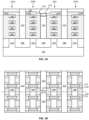
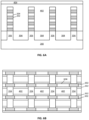
- FIG 1A is a cross sectional view taken across a plurality of semiconductor devices 102a - 102d, according to an embodiment of the present disclosure.
- semiconductor devices 102a - 102d may be non-planar metal oxide semiconductor (MOS) transistors, such as tri-gate or gate-all-around (GAA) transistors, although other transistor topologies and types could also benefit from the techniques provided herein.
- MOS metal oxide semiconductor
- GAA gate-all-around
- the examples herein illustrate semiconductor devices with a GAA structure (e.g., having nanoribbons that extend between source and drain regions).
- semiconductor devices 102a - 102d are formed over a substrate 104. Any number of semiconductor devices can be formed on or over substrate 104, but four are used here as an example.
- Substrate 104 can be, for example, a bulk substrate including group IV semiconductor material (such as silicon, germanium, or silicon germanium), group III-V semiconductor material (such as gallium arsenide, indium gallium arsenide, or indium phosphide), and/or any other suitable material upon which transistors can be formed.
- the substrate can be a semiconductor-on-insulator substrate having a desired semiconductor layer over a buried insulator layer (e.g., silicon over silicon dioxide).
- the substrate can be a multilayer substrate or superlattice suitable for forming nanowires or nanoribbons (e.g., alternating layers of silicon and SiGe, or alternating layers indium gallium arsenide and indium phosphide). Any number of substrates can be used.
- substrate 104 is removed from the backside and replaced with one or more backside interconnect layers to provide backside power and signal routing.
- Each of semiconductor devices 102a - 102d includes one or more nanoribbons 106 that extend parallel to one another along a direction between a source region and a drain region (e.g., into and out of the page in the cross-section view of Figure 1A ).
- Nanoribbons 106 are one example of semiconductor regions that extend between source and drain regions. The term nanoribbon may also encompass other similar shapes such as nanowires or nanosheets.
- the semiconductor material of nanoribbons 106 may be formed from substrate 104.
- semiconductor devices 102a - 102d may each include semiconductor regions in the shape of fins that can be, for example, native to substrate 104 (formed from the substrate itself), such as silicon fins etched from a bulk silicon substrate.
- the fins can be formed of material deposited onto an underlying substrate.
- a blanket layer of silicon germanium (SiGe) can be deposited onto a silicon substrate, and then patterned and etched to form a plurality of SiGe fins extending from that substrate.
- non-native fins can be formed in a so-called aspect ratio trapping based process, where native fins are etched away so as to leave fin-shaped trenches which can then be filled with an alternative semiconductor material (e.g., group IV or III-V material).
- the fins include alternating layers of material (e.g., alternating layers of silicon and SiGe) that facilitates forming of the illustrated nanoribbons 106 during a gate forming process where one type of the alternating layers are selectively etched away so as to liberate the other type of alternating layers within the channel region, so that a gate-all-around (GAA) process can then be carried out.
- the alternating layers can be blanket deposited and then etched into fins, or deposited into fin-shaped trenches.
- Dielectric fill 108 provides shallow trench isolation (STI) between any adjacent semiconductor devices.
- Dielectric fill 108 can be any suitable dielectric material, such as silicon dioxide, aluminum oxide, or silicon oxycarbonitride.
- semiconductor devices 102a - 102d each include a subfin region 110.
- subfin region 110 comprises the same semiconductor material as substrate 104 and is adjacent to dielectric fill 108.
- nanoribbons 106 are present above the top surface of subfin region 110 and provide an active region for each transistor (e.g., the semiconductor region beneath the gate).
- nanoribbons 106 extend between a source region and a drain region.
- the source and drain regions are not shown in the cross-section of Figure 1A .
- the source and drain regions are epitaxial regions that are provided on the ends of the fins or nanoribbons in an etch-and-replace process.
- one or both of the source and drain regions could be, for example, implantation-doped native portions of the fins or substrate.
- Any semiconductor materials suitable for source and drain regions can be used (e.g., group IV and group III-V semiconductor materials).
- the source and drain regions may include multiple layers such as liners and capping layers to improve contact resistance.
- the composition and doping of the source and drain regions may be the same or different, depending on the polarity of the transistors.
- one transistor is a p-type MOS (PMOS) transistor
- the other transistor is an n-type MOS (NMOS) transistor.
- PMOS p-type MOS
- NMOS n-type MOS
- gate structures 112a - 112d extend over nanoribbons 106 of corresponding semiconductor devices 102a - 102d. It should be noted that one or more gate dielectric layers are also a part of each of gate structure 112a - 112d around nanoribbons 106 and are not shown for clarity. Each of gate structures 112a - 112d may include any sufficiently conductive material such as a metal, metal alloy, or doped polysilicon. In some embodiments, the gate structures 112a - 112d include one or more workfunction metals around nanoribbons 106.
- semiconductor devices 102a and 102b are p-channel devices that include a workfunction metal having titanium around its nanoribbons 106 and semiconductor devices 102c and 102d are n-channel devices that include a workfunction metal having tungsten around its nanoribbons 106.
- Gate structures 112a - 112d may also include a fill metal or other conductive material around the workfunction metals to provide the whole gate electrode structure.
- each gate structure 112a - 112d is separated along the second direction by a different gate cut 114, which act like dielectric barriers between gate structures.
- the gate cuts 114 effectively isolate the gate structures 112a - 112d from one another to form electrically separate gates for each semiconductor device.
- three gate cuts 114 are formed.
- Gate cuts 114 may be formed from a sufficiently insulating material, such as a dielectric material.
- Example materials for gate cuts 114 include silicon nitride, silicon oxide, or silicon oxynitride.
- gate cuts 114 each has a width between about 10 nm and about 15 nm.
- gate cuts 114 extend in the first direction (along the length of nanoribbons 106) across the gate trench and further along the source/drain trench to isolate adjacent source or drain regions from each other. In the top-down view illustrated in Figure 1B , gate cuts 114 can be seen extending across multiple devices to separate gate structures and source or drain regions 116 from one another. Source or drain regions 116 may be formed at the ends of nanoribbons 106 along the source/drain trench between spacer structures 118. According to some embodiments, spacer structures 118 are dielectric structures along the sidewalls of the gate structures. Nanoribbons 106 extend through spacer structures 118 to contact source or drain regions 116.
- FIG. 1B The plan view of Figure 1B is taken across the dotted line shown in Figure 1A such that nanoribbons 106 can be seen extending between source or drain regions 116 while Figure 1A is a cross section taken through the dotted line shown in Figure 1B .
- Any of source or drain regions 116 may act as either a source region or a drain region, depending on the application and dopant profile.
- Any semiconductor materials suitable for source and drain regions can be used (e.g., group IV and group III-V semiconductor materials) for any of the illustrated source or drains regions 116. In any such cases, the composition and doping of source or drain regions 116 may be the same or different, depending on the polarity of the transistors.
- semiconductor device 102b may be a p-type MOS (PMOS) transistor having a high concentration of p-type dopants in the associated source or drain regions 116
- semiconductor device 102c may be an n-type MOS (NMOS) transistor having a high concentration of n-type dopants in the associated source or drain regions 116. Any number of source and drain configurations and materials can be used.
- PMOS p-type MOS
- NMOS n-type MOS
- a dielectric cap 120 is formed over gate structures 112a - 112d to protect the underlying gate structure.
- Dielectric cap 120 may be any suitable dielectric material, such as silicon nitride, silicon oxide, or silicon oxynitride.
- gate cuts 114 separate all gate structures from one another along the second direction.
- two adjacent gate structures may want to be connected.
- a gate link e.g., a conductive bridge
- Gate link 122 may be any suitable conductive material, and may include the same conductive material as the gate electrode material used in either gate structure 112b or gate structure 112c.
- gate link 122 may have a smaller width in the first direction compared to the width in the first direction of either gate structure 112b or gate structure 112c.
- dielectric cap 120 exhibits a change in thickness over gate link 112.
- dielectric cap 120 includes a protrusion 124 at least over gate link 122 that has a greater thickness compared to other regions of dielectric cap 120.
- dielectric cap 120 may have a divot or other similar feature such that the thickness of dielectric cap 120 over gate link 122 is thinner compared to other regions of dielectric cap 120.
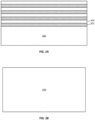
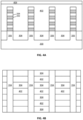
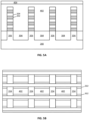
- Figures 2A - 13A and 2B - 13B are cross-sectional and plan views, respectively, that collectively illustrate an example process for forming an integrated circuit configured with one or more gate links across gate cuts, in accordance with an embodiment of the present disclosure.
- Figures 2A - 13A represent a cross-sectional view taken the dotted line shown in the plan view of Figure 1B
- figures 2B - 13B represent the corresponding plan view taken across the dotted line shown in the cross-section view of Figure 1A
- Each figure shows an example structure that results from the process flow up to that point in time, so the depicted structure evolves as the process flow continues, culminating in the structure shown in Figures 13A and 13B , which is similar to the structure shown in Figures 1A and 1B .
- Such a structure may be part of an overall integrated circuit (e.g., such as a processor or memory chip) that includes, for example, digital logic cells and/or memory cells and analog mixed signal circuitry.
- the illustrated integrated circuit structure may be part of a larger integrated circuit that includes other integrated circuitry not depicted.
- Example materials and process parameters are given, but the present disclosure is not intended to be limited to any specific such materials or parameters, as will be appreciated.
- Figures sharing the same number illustrate different views of the structure at the same point in time during the process flow.
- Figure 2A illustrates a cross-sectional view taken through a substrate 200 having a series of material layers formed over the substrate, according to an embodiment of the present disclosure.
- Alternating material layers maybe deposited over substrate 200 including sacrificial layers 202 alternating with semiconductor layers 204.
- the alternating layers are used to form GAA transistor structures. Any number of alternating semiconductor layers 204 and sacrificial layers 202 may be deposited over substrate 200.
- the description above for substrate 104 applies equally to substrate 200.
- sacrificial layers 202 have a different material composition than semiconductor layers 204.
- sacrificial layers 202 are silicon germanium (SiGe) while semiconductor layers 204 include a semiconductor material suitable for use as a nanoribbon such as silicon (Si), SiGe, germanium, or III-V materials like indium phosphide (InP) or gallium arsenide (GaAs).
- SiGe silicon germanium
- germanium silicon germanium
- the germanium concentration is different between sacrificial layers 202 and semiconductor layers 204.
- sacrificial layers 202 may include a higher germanium content compared to semiconductor layers 204.
- semiconductor layers 204 may be doped with either n-type dopants (to produce a p-channel transistor) or p-type dopants (to produce an n-channel transistor).
- each sacrificial layer 202 may be between about 5 nm and about 20 nm. In some embodiments, the thickness of each sacrificial layer 202 is substantially the same (e.g., within 1-2 nm). The thickness of each of semiconductor layers 204 may be about the same as the thickness of each sacrificial layer 202 (e.g., about 5-20 nm).
- Each of sacrificial layers 202 and semiconductor layers 204 may be deposited using any known material deposition technique, such as chemical vapor deposition (CVD), plasma-enhanced chemical vapor deposition (PECVD), physical vapor deposition (PVD), or atomic layer deposition (ALD).
- Figure 2B illustrates a plan view taken through the top-most deposited semiconductor layer 204, according to an embodiment.
- FIGS 3A and 3B depict the cross-section and plan views of the structure shown in Figures 2A and 2B , respectively, following the formation of a cap layer 302 and the subsequent formation of fins beneath cap layer 302, according to an embodiment.
- Cap layer 302 may be any suitable hard mask material such as a carbon hard mask (CHM) or silicon nitride.
- CHM carbon hard mask
- Cap layer 302 is patterned into rows to form corresponding rows of fins from the alternating layer stack of sacrificial layers 202 and semiconductor layers 204. The rows of fins extend lengthwise in a first direction.
- an anisotropic etching process through the layer stack continues into at least a portion of substrate 200.
- the etched portion of substrate 200 may be filled with a dielectric layer 304 that acts as shallow trench isolation (STI) between adjacent fins.
- Dielectric layer 304 may be any suitable dielectric material such as silicon oxide.
- Subfin regions 306 represent remaining portions of substrate 200 between dielectric layer 304, according to some embodiments.
- Figure 3B illustrates how dielectric layer 304 extends along the entire length of each of the fins in the first direction, according to some embodiments.
- Figures 4A and 4B depict the cross-section and plan views of the structure shown in Figures 3A and 3B , respectively, following the formation of a sacrificial gate 402 beneath a corresponding gate masking layer 404, according to some embodiments.
- Gate masking layers 404 may be patterned in strips that extend in a second direction (e.g., orthogonally) across each of the fins in order to form corresponding sacrificial gates 402 in strips beneath the gate masking layers 404.
- the sacrificial gate material is removed in all areas not protected by gate masking layers 404.
- Gate masking layer 404 may be any suitable hard mask material such as CHM or silicon nitride.
- Sacrificial gate 402 may be any suitable material that can be selectively removed without damaging the semiconductor material of the fins.
- sacrificial gate 402 includes polysilicon.
- Figures 5A and 5B depict the cross-section and plan views of the structure shown in Figures 4A and 4B , respectively, following the formation of spacer structures 502, according to some embodiments.
- Spacer structures 502 may be formed along the sidewalls of sacrificial gates 402 following the removal of gate masking layers 404.
- gate masking layers 404 are retained above sacrificial gates 402 and the spacer structures 502 are formed along sidewalls of both sacrificial gates 402 and gate masking layers 404.
- Spacer structures 502 may be deposited and then etched back such that spacer structures 502 remain mostly only on sidewalls of any exposed structures.
- spacer structures 502 are shown extending in the second direction along the sidewalls of each sacrificial gate 402.
- spacer structures 502 may be any suitable dielectric material, such as silicon nitride, silicon carbon nitride, or silicon oxycarbonitride.
- spacer structures 502 comprise a nitride and dielectric layer 304 comprises an oxide, so as to provide a degree of etch selectivity during final gate processing.
- Other etch selective dielectric schemes e.g., oxide/carbide, carbide/nitride
- spacer structures 502 and dielectric layer 304 are compositionally the same or otherwise similar, where etch selectivity is not employed.
- exposed portions of the fins between spacer structures 502 along the first direction are removed.
- the exposed fin portions may be removed using any anisotropic etching process, such as reactive ion etching (RIE).
- RIE reactive ion etching
- the removal of the exposed fin portions creates source or drain trenches that alternate with gate trenches (currently filled with sacrificial gates 402) along the first direction, according to some embodiments.
- Source or drain regions 602 may be formed in the areas that had been previously occupied by the exposed fins between spacer structures 502. According to some embodiments, source or drain regions 602 are epitaxially grown from the exposed semiconductor material of the fins (or nanoribbons, nanowires or nanosheets, as the case may be) along the exterior walls of spacer structures 502. In some example embodiments, source or drain regions 602 are NMOS source or drain regions (e.g., epitaxial silicon) or PMOS source or drain regions (e.g., epitaxial SiGe).
- NMOS source or drain regions e.g., epitaxial silicon
- PMOS source or drain regions e.g., epitaxial SiGe
- a dielectric fill 604 is provided between adjacent source or drain regions 602.
- Dielectric fill 604 may be any suitable dielectric material, such as silicon oxide.
- dielectric fill 604 also extends over a top surface of source or drain regions 602 (e.g., up to and planar with a top surface of spacer structures 502).
- One or more conductive contacts may be formed at a later time through dielectric fill 604 to provide electrical contact to source or drain regions 602.
- Figures 7A and 7B depict the cross-section and plan views of the structure shown in Figures 6A and 6B , respectively, following the removal of sacrificial gates 402 and sacrificial layers 202, according to some embodiments. In examples where gate masking layers 404 are still present, they would be removed at this time. Once sacrificial gates 402 are removed, the fins extending between spacer structures 502 are exposed.
- sacrificial layers 202 are selectively removed to leave behind nanoribbons 702 that extend between corresponding source or drain regions 602.
- Each vertical set of nanoribbons 702 represents the semiconductor region of a different semiconductor device. It should be understood that nanoribbons 702 may also be nanowires or nanosheets.
- Sacrificial gates 402 and sacrificial layers 202 may be removed using the same isotropic etching process or different isotropic etching processes.
- FIGs 8A and 8B depict the cross-section and plan views of the structure shown in Figures 7A and 7B , respectively, following the formation of a gate structure 802 and subsequent gate cap 804, according to some embodiments.
- Gate structure 802 includes a gate dielectric and a gate electrode on the gate dielectric.
- the gate dielectric may be first formed around nanoribbons 702 prior to the formation of the conductive gate electrode, which may include one or more conductive layers.
- the gate dielectric may include any suitable dielectric material (such as silicon dioxide, and/or a high-k dielectric material).
- high-k dielectric materials include, for instance, hafnium oxide, hafnium silicon oxide, lanthanum oxide, lanthanum aluminum oxide, zirconium oxide, zirconium silicon oxide, tantalum oxide, titanium oxide, barium strontium titanium oxide, barium titanium oxide, strontium titanium oxide, yttrium oxide, aluminum oxide, lead scandium tantalum oxide, and lead zinc niobate, to provide some examples.
- the gate dielectric includes a layer of hafnium oxide with a thickness between about 1 nm and about 5 nm.
- the gate dielectric may include one or more silicates (e.g., titanium silicate, tungsten silicate, niobium silicate, and silicates of other transition metals).
- the gate dielectric includes a first layer on nanoribbons 702, and a second layer on the first layer.
- the first layer can be, for instance, an oxide of the semiconductor material of nanoribbons 702 (e.g., silicon dioxide) and the second layer can be a high-k dielectric material (e.g., hafnium oxide).
- the one or more conductive layers that make up the gate electrode may be deposited using electroplating, electroless plating, CVD, PECVD, ALD, or PVD, to name a few examples.
- the gate electrode includes doped polysilicon, a metal, or a metal alloy.
- Example suitable metals or metal alloys include aluminum, tungsten, cobalt, molybdenum, ruthenium, titanium, tantalum, copper, and carbides and nitrides thereof.
- the gate electrode may include, for instance, a metal fill material along with one or more workfunction layers, resistance-reducing layers, and/or barrier layers.
- the workfunction layers can include, for example, p-type workfunction materials (e.g., titanium nitride) for PMOS gates, or n-type workfunction materials (e.g., titanium aluminum carbide) for NMOS gates.
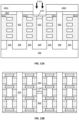
- Figures 9A and 9B depict the cross-section and plan views of the structure shown in Figures 8A and 8B , respectively, following the formation of gate cuts 902 extending in the first direction between devices, according to some embodiments.
- Gate cuts 902 extend to a depth at least through an entire thickness of gate structure 802 to isolate separate gate structures 802a - 802d. In some embodiments, gate cuts 902 extend into at least a portion of dielectric layer 304 or through an entire thickness of dielectric layer 304. In some embodiments, gate cuts 902 extend entirely through dielectric layer 304 and into a portion of substrate 200.
- gate cuts 902 may be formed by first forming corresponding gate cut recesses through gate cap 804 and gate structure 802 using any suitable metal gate etch process that iteratively etches through portions of the gate electrode while simultaneously protecting the sidewalls of the recess from lateral etching to provide a high height-to-width aspect ratio recess (e.g., aspect ratio of 5:1 or higher, or 10:1 or higher).
- the gate cut recesses extend in the first direction through multiple gate trenches and source/drain trenches to isolate adjacent gate structures and source or drain regions.
- the gate cut recesses may be filled with one or more dielectric materials to form gate cuts 902.
- gate cuts 902 may include only silicon oxide or silicon nitride or silicon carbide.
- gate cuts 902 include a first dielectric layer deposited first and a second dielectric layer or dielectric fill formed on the first dielectric layer.
- the first dielectric layer may include a high-k dielectric material (e.g., materials with a dielectric constant higher than that of silicon oxide or higher than 3.9) while the second dielectric layer may include a low-k dielectric material (e.g. materials with a dielectric constant equal to or lower than that of silicon oxide, such as porous silicon oxide, or equal to or lower than 3.9).
- a given gate structure 802a includes a gate dielectric 904a and a gate electrode 906a.
- Gate dielectric 904a is formed around nanoribbons 702 and along a bottom surface of the gate trench (e.g., over subfin 306 and dielectric layer 304). However, according to some embodiments, gate dielectric 904a is not along the sidewall of gate cut 902 as it was formed before the formation of gate cut 902. Gate electrode 906a may directly contact the sidewall of gate cut 902.
- gate dielectric 904a is on the sidewalls of gate cut 902. Rather, in this context, a material that is on a sidewall must be formed on the sidewall, and gate dielectric 904a is not formed on or along the sidewalls of gate cut 902.
- each gate structure 902a - 902d is formed over the semiconductor region of a single corresponding semiconductor device.
- Each gate structure 902a - 902d may be constrained over a single semiconductor device in the second direction by adjacent gate cuts 902.
- the entire structure may be polished such that the top surface of gate structures 902a - 902d are planar with the top surface of at least spacer structures 502.
- a gate cut 902 is present between each adjacent pair of semiconductor devices in the second direction.
- Figures 10A and 10B depict the cross-section and plan views of the structure shown in Figures 9A and 9B , respectively, following the formation of a masking layer 1002 having an opening aligned over a portion of a given gate cut 902 and the subsequent removal of gate cap 804 and a portion of the gate cut 902 within the opening, according to an embodiment.
- Masking layer 1002 may be any suitable hard mask or photoresist.
- a reactive ion etching (RIE) process may be used to punch through cap layer 804 and continue to form a recess 1004 through the exposed gate cut 902. According to some embodiments, the etching process does not recess (or recesses very little) of the exposed gate structures 802b and 802c.
- Both Figure 10A and Figure 10B illustrate how recess 1004 extends across an entirety of gate cut 902 along the second direction to expose sidewalls of the gate electrodes of both gate structures 802b and 802c.
- Figure 10B further illustrates that recess 1004 may have a smaller width compared to a width of either gate structures 802b or 802c, with such widths being measured in the first direction.
- Recess 1004 does not need to be centrally aligned along the first direction between gate structures 802b and 802c.
- recess 1004 may be shifted along the first direction so long as at least some portion of the gate electrodes of gate structures 802b and 802c are exposed within recess 1004.
- Figures 11A and 11B depict the cross-section and plan views of the structure shown in Figures 10A and 10B , respectively, following the formation of a conductive fill 1102 within recess 1004 and between gate cap 804, according to some embodiments.
- Conductive fill 1102 may be any suitable conductive material, and may include any of the conductive materials noted above for the gate electrode.
- conductive fill 1102 includes the same conductive material as the gate electrode for either or both of gate structures 802b or 802c.
- conductive fill 1102 includes molybdenum.
- conductive fill 1102 may include multiple layers, such as a first liner or barrier layer (e.g., titanium or tantalum nitride) and a second fill material (e.g., molybdenum or tungsten) on the first material.
- a first liner or barrier layer e.g., titanium or tantalum nitride
- a second fill material e.g., molybdenum or tungsten
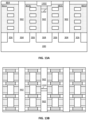
- Figures 12A and 12B depict the cross-section and plan views of the structure shown in Figures 11A and 11B , respectively, following an etching operation to recess conductive fill 1102 resulting in a conductive bridge 1202 between gate structures 802a and 802b, according to some embodiments.
- the conductive material may be recessed using any suitable metal etching process.
- the etch may exhibit a high selectivity between metal and dielectric materials such that any etching to cap layer 804 or masking layer 1002 is minimized.
- the etch may recess the conductive material lower than a top surface of gate structures 802b and 802c (identified by the dotted line in Figure 12A ).
- the etch may recess the conductive material to a final thickness that is flush with, or above, the top surface of gate structures 802b and 802c.
- conductive bridge 1202 extends along a top surface of gate cut 902 and is in contact with a sidewall of both gate structures 802a and 802b, thus providing a conductive bridge between gate structures 802a and 802b.
- FIGS 13A and 13B depict the cross-section and plan views of the structure shown in Figures 12A and 12B , respectively, following the formation of a dielectric plug 1302 within the recess formed by the conductive etching process, according to some embodiments.
- a polishing process may be performed using chemical mechanical polishing (CMP) to planarize the top of the structure such that a top surface of dielectric plug 1302 is substantially coplanar with a top surface of gate cap 804.
- CMP chemical mechanical polishing
- Dielectric plug 1302 may be any suitable material, however in some embodiments, dielectric plug 1302 is the same dielectric material as gate cap 804. Accordingly, gate cap 804 and dielectric plug 1302 may be considered a homogenous dielectric layer. Because they are deposited at different times, there may be a seam demarcating the separate deposition. Such a seam may be visible, for instance, via SEM.
- dielectric plug 1302 has a thickness over gate cut 902 and in a third direction (vertical, or bottom-to-top in Figure 13A ) that is greater than a thickness of gate cap 804 (e.g., not over gate cut 902) in the third direction, due to the recess extending below the top surface of gate structures 802b and 802c.
- the thickness difference may be at least 1 nm, at least 2 nm, or at least 3 nm, or at least 5 nm, or at least 7 nm. In some such example embodiments, the thickness difference is between 1 nm and 5 nm.
- Figure 13C illustrates an alternative cross-section view of the structure that is similar to that shown in Figure 13A , but with dielectric plug 1302 having a smaller thickness over gate cut 902 and in the third direction compared to gate cap 804, according to an embodiment.
- This situation may occur if the recessing process used to etch through conductive fill 1102 does not reach the top surface of gate structures 802b and 802c, such that a top surface of conductive bridge 1202 is above the top surface of gate structures 802b and 802c, as shown.
- the thickness difference between dielectric plug 1302 and gate cap 804, as illustrated in Figure 13C may be at least 1 nm, at least 2 nm, or at least 3 nm, or at least 5 nm, or at least 7 nm. In some such example embodiments, the thickness difference is between 1 nm and 5 nm.
- FIG. 14 illustrates an example embodiment of a chip package 1400, in accordance with an embodiment of the present disclosure.
- chip package 1400 includes one or more dies 1402.
- One or more dies 1402 may include at least one integrated circuit having semiconductor devices, such as any of the semiconductor devices disclosed herein.
- One or more dies 1402 may include any other circuitry used to interface with other devices formed on the dies, or other devices connected to chip package 1400, in some example configurations.
- chip package 1400 includes a housing 1404 that is bonded to a package substrate 1406.
- the housing 1404 may be any standard or proprietary housing, and may provide, for example, electromagnetic shielding and environmental protection for the components of chip package 1400.
- the one or more dies 1402 may be conductively coupled to a package substrate 1406 using connections 1408, which may be implemented with any number of standard or proprietary connection mechanisms, such as solder bumps, ball grid array (BGA), pins, or wire bonds, to name a few examples.
- Package substrate 1406 may be any standard or proprietary package substrate, but in some cases includes a dielectric material having conductive pathways (e.g., including conductive vias and lines) extending through the dielectric material between the faces of package substrate 1406, or between different locations on each face.
- package substrate 1406 may have a thickness less than 1 millimeter (e.g., between 0.1 millimeters and 0.5 millimeters), although any number of package geometries can be used. Additional conductive contacts 1412 may be disposed at an opposite face of package substrate 1406 for conductively contacting, for instance, a printed circuit board (PCB). One or more vias 1410 extend through a thickness of package substrate 1406 to provide conductive pathways between one or more of connections 1408 to one or more of contacts 1412.
- PCB printed circuit board
- Vias 1410 are illustrated as single straight columns through package substrate 1406 for ease of illustration, although other configurations can be used (e.g., damascene, dual damascene, through-silicon via, or an interconnect structure that meanders through the thickness of substrate 1406 to contact one or more intermediate locations therein).
- vias 1410 are fabricated by multiple smaller stacked vias, or are staggered at different locations across package substrate 1406.
- contacts 1412 are solder balls (e.g., for bump-based connections or a ball grid array arrangement), but any suitable package bonding mechanism may be used (e.g., pins in a pin grid array arrangement or lands in a land grid array arrangement).
- a solder resist is disposed between contacts 1412, to inhibit shorting.
- a mold material 1414 may be disposed around the one or more dies 1402 included within housing 1404 (e.g., between dies 1402 and package substrate 1406 as an underfill material, as well as between dies 1402 and housing 1404 as an overfill material). Although the dimensions and qualities of the mold material 1414 can vary from one embodiment to the next, in some embodiments, a thickness of mold material 1414 is less than 1 millimeter.
- Example materials that may be used for mold material 1414 include epoxy mold materials, as suitable. In some cases, the mold material 1414 is thermally conductive, in addition to being electrically insulating.
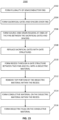
- Figure 15 is a flow chart of a method 1500 for forming at least a portion of an integrated circuit, according to an embodiment.
- Various operations of method 1500 may be illustrated in Figures 2A - 13A and 2B - 13B .
- the correlation of the various operations of method 1500 to the specific components illustrated in the aforementioned figures is not intended to imply any structural and/or use limitations. Rather, the aforementioned figures provide one example embodiment of method 1500.
- Other operations may be performed before, during, or after any of the operations of method 1500.
- method 1500 does not explicitly describe various processes that are performed to form common transistor structures. Some of the operations of method 1500 may be performed in a different order than the illustrated order.
- Method 1500 begins with operation 1502 where a plurality of parallel semiconductor fins are formed, according to some embodiments.
- the semiconductor material in the fins may be formed from a substrate such that the fins are an integral part of the substrate (e.g., etched from a bulk silicon substrate).
- the fins can be formed of material deposited onto an underlying substrate.
- a blanket layer of silicon germanium (SiGe) can be deposited onto a silicon substrate, and then patterned and etched to form a plurality of SiGe fins extending from that substrate.
- non-native fins can be formed in a so-called aspect ratio trapping based process, where native fins are etched away so as to leave fin-shaped trenches which can then be filled with an alternative semiconductor material (e.g., group IV or III-V material).
- the fins include alternating layers of material (e.g., alternating layers of silicon and SiGe) that facilitates forming of nanowires and nanoribbons during a gate forming process where one type of the alternating layers are selectively etched away so as to liberate the other type of alternating layers within the channel region, so that a gate-all-around (GAA) process can then be carried out.
- GAA gate-all-around
- the alternating layers can be blanket deposited and then etched into fins, or deposited into fin-shaped trenches.
- the fins may also include a cap structure over each fin that is used to define the locations of the fins during, for example, an RIE process.
- the cap structure may be a dielectric material, such as silicon nitride.
- Method 1500 continues with operation 1504 where sacrificial gates are formed over the fins.
- the sacrificial gates may be patterned using gate masking layers in strips that run orthogonally over the fins and parallel to one another (e.g., forming a cross-hatch pattern).
- the gate masking layers may be any suitable hard mask material, such as CHM or silicon nitride.
- the sacrificial gates themselves may be formed from any suitable material that can be selectively removed at a later time without damaging the semiconductor material of the fins.
- the sacrificial gates include polysilicon.
- Spacer structures may be formed along the sidewalls of the sacrificial gates using an etch-back process.
- the spacer structures may include any suitable dielectric material, such as silicon nitride. In some cases, spacer structures may also be formed along sidewalls of the exposed fins running orthogonally between the strips of sacrificial gates.
- Method 1500 continues with operation 1506 where source or drain regions are formed at the ends of the semiconductor regions of each of the fins. Any portions of the fins not protected by the sacrificial gate and spacer structures may be removed using, for example, an anisotropic etching process followed by the epitaxial growth of the source or drain regions from the exposed ends of the semiconductor layers in the fins.
- the source or drain regions are NMOS source or drain regions (e.g., epitaxial silicon) or PMOS source or drain regions (e.g., epitaxial SiGe).
- Another dielectric fill may be formed adjacent to the various source or drain regions for additional electrical isolation between adjacent regions. The dielectric fill may also extend over a top surface of the source or drain regions.
- topside conductive contacts may be formed through the dielectric fill to contact one or more of the source or drain regions.
- internal gate spacers may be formed during the source drain processing (e.g., after removing the exposed fins but prior to epi growth of source/drain regions, using a lateral etch process that selectively recesses sacrificial material of the channel region and then filling that recess with internal gate spacer material).
- Method 1500 continues with operation 1508 where the sacrificial gates are removed and replaced with gate structures.
- the sacrificial gates may be removed using an isotropic etching process that selectively removes all of the material from the sacrificial gates, thus exposing the various fins between the set of spacer structures.
- any sacrificial layers within the exposed fins between the spacer structures may also be removed to release nanoribbons, nanosheets, or nanowires of semiconductor material.
- the gate structures may each include both a gate dielectric and a gate electrode.
- the gate dielectric is first formed over the exposed semiconductor regions between the spacer structures followed by forming the gate electrode within the remainder of the trench between the spacer structures, according to some embodiments.
- the gate dielectric may include any number of dielectric layers deposited using a CVD process, such as ALD.
- the gate electrode can include any number of conductive material layers, such as any metals, metal alloys, or polysilicon.
- the gate electrode may be deposited using electroplating, electroless plating, CVD, ALD, PECVD, or PVD, to name a few examples.
- Method 1500 continues with operation 1510 where deep recesses are formed through at least a full thickness of the gate structure between adjacent devices and filled with one or more dielectric materials to form gate cuts.
- gate cuts are formed between all adjacent devices of a given integrated circuit.
- the deep recesses may be formed using a metal gate etch process that iteratively etches through portions of the gate electrode while simultaneously protecting the sidewalls of the recess from lateral etching to provide a high height-to-width aspect ratio final recess (e.g., aspect ratio of 5:1 or higher, or 10:1 or higher).
- the recesses may be filled with any number of dielectric materials to form gate cuts that isolate semiconductor devices from one another. Because the gate cuts are formed after the formation of the gate structures, the gate dielectric layers of the gate structures are not on the sidewalls of the gate cuts.
- Method 1500 continues with operation 1512, where a top portion of a given gate cut is removed to form a recess over the gate cut.
- a dielectric etching process may be used to remove the dielectric material of the gate cut while minimizing any removal of the surrounding gate electrode material.
- the recess may extend across an entirety of the gate cut to expose sidewalls of the gate electrodes of both adjacent gate structures.
- the recess has a smaller width compared to a width of either gate of the adjacent gate structures, which allows for some misalignment tolerance within the gate trench. The recess does not need to be centrally aligned between the adjacent gate structures.
- Method 1500 continues with operation 1514, where a conductive material is formed within the recess to form a conductive bridge between the adjacent gate structures.
- the conductive material may be any suitable conductive material, and may include any of the conductive materials noted above for the gate electrode, such as tungsten or molybdenum.
- the conductive fill includes the same conductive material as the gate electrode for either or both of the adjacent gate structures.
- the conductive material may be recessed within the recess. As described above, the height of the conductive material may be lower than the upper surface of the adjacent gate electrodes being bridged, but in other cases may be flush with, or higher than the upper gate electrode surfaces.
- Method 1500 continues with operation 1516, where a dielectric plug is formed over the conductive material.
- a polishing process may be performed using CMP to planarize the top of the structure such that a top surface of the dielectric plug is substantially coplanar with a top surface of adjacent gate cuts.
- the dielectric plug may be any suitable material, however in some embodiments, the dielectric plug is the same dielectric material as a gate cap formed over the gate structures. According to some embodiments, the dielectric plug has a thickness over the gate cut that is either greater or less than a thickness of the gate cap (e.g., not over the gate cut) due to the recess either being etched to a final position above or below the top surface of the adjacent gate structures.
- the thickness difference may be at least 1 nm, at least 2 nm, or at least 3 nm. In some embodiments, the thickness difference is between 1 nm and 5 nm.
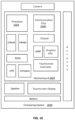
- FIG. 16 is an example computing system implemented with one or more of the integrated circuit structures as disclosed herein, in accordance with some embodiments of the present disclosure.
- the computing system 1600 houses a motherboard 1602.
- the motherboard 1602 may include a number of components, including, but not limited to, a processor 1604 and at least one communication chip 1606, each of which can be physically and electrically coupled to the motherboard 1602, or otherwise integrated therein.
- the motherboard 1602 may be, for example, any printed circuit board (PCB), whether a main board, a daughterboard mounted on a main board, or the only board of system 1600, etc.
- PCB printed circuit board
- computing system 1600 may include one or more other components that may or may not be physically and electrically coupled to the motherboard 1602. These other components may include, but are not limited to, volatile memory (e.g., DRAM), non-volatile memory (e.g., ROM), a graphics processor, a digital signal processor, a crypto processor, a chipset, an antenna, a display, a touchscreen display, a touchscreen controller, a battery, an audio codec, a video codec, a power amplifier, a global positioning system (GPS) device, a compass, an accelerometer, a gyroscope, a speaker, a camera, and a mass storage device (such as hard disk drive, compact disk (CD), digital versatile disk (DVD), and so forth).
- volatile memory e.g., DRAM
- non-volatile memory e.g., ROM
- graphics processor e.g., a digital signal processor
- crypto processor e.g., a graphics processor
- a digital signal processor
- any of the components included in computing system 1600 may include one or more integrated circuit structures or devices configured in accordance with an example embodiment (e.g., a module including an integrated circuit device on a substrate, the substrate having one or more semiconductor devices with gate cuts present between adjacent pairs of semiconductor devices and one or more gate links between adjacent pairs of gate structures, as variously described herein).
- a module including an integrated circuit device on a substrate the substrate having one or more semiconductor devices with gate cuts present between adjacent pairs of semiconductor devices and one or more gate links between adjacent pairs of gate structures, as variously described herein.
- multiple functions can be integrated into one or more chips (e.g., for instance, note that the communication chip 1606 can be part of or otherwise integrated into the processor 1604).
- the communication chip 1606 enables wireless communications for the transfer of data to and from the computing system 1600.
- wireless and its derivatives may be used to describe circuits, devices, systems, methods, techniques, communications channels, etc., that may communicate data through the use of modulated electromagnetic radiation through a non-solid medium. The term does not imply that the associated devices do not contain any wires, although in some embodiments they might not.
- the communication chip 1606 may implement any of a number of wireless standards or protocols, including, but not limited to, Wi-Fi (IEEE 802.11 family), WiMAX (IEEE 802.16 family), IEEE 802.20, long term evolution (LTE), Ev-DO, HSPA+, HSDPA+, HSUPA+, EDGE, GSM, GPRS, CDMA, TDMA, DECT, Bluetooth, derivatives thereof, as well as any other wireless protocols that are designated as 3G, 4G, 5G, and beyond.
- the computing system 1600 may include a plurality of communication chips 1606.
- a first communication chip 1606 may be dedicated to shorter range wireless communications such as Wi-Fi and Bluetooth and a second communication chip 1606 may be dedicated to longer range wireless communications such as GPS, EDGE, GPRS, CDMA, WiMAX, LTE, Ev-DO, and others.
- the processor 1604 of the computing system 1600 includes an integrated circuit die packaged within the processor 1604.
- the integrated circuit die of the processor includes onboard circuitry that is implemented with one or more semiconductor devices as variously described herein.
- the term "processor" may refer to any device or portion of a device that processes, for instance, electronic data from registers and/or memory to transform that electronic data into other electronic data that may be stored in registers and/or memory.
- the communication chip 1606 also may include an integrated circuit die packaged within the communication chip 1606.
- the integrated circuit die of the communication chip includes one or more semiconductor devices as variously described herein.
- multi-standard wireless capability may be integrated directly into the processor 1604 (e.g., where functionality of any chips 1606 is integrated into processor 1604, rather than having separate communication chips).
- processor 1604 may be a chip set having such wireless capability.
- any number of processor 1604 and/or communication chips 1606 can be used.
- any one chip or chip set can have multiple functions integrated therein.
- the computing system 1600 may be a laptop, a netbook, a notebook, a smartphone, a tablet, a personal digital assistant (PDA), an ultra-mobile PC, a mobile phone, a desktop computer, a server, a printer, a scanner, a monitor, a set-top box, an entertainment control unit, a digital camera, a portable music player, a digital video recorder, or any other electronic device that processes data or employs one or more integrated circuit structures or devices formed using the disclosed techniques, as variously described herein.
- PDA personal digital assistant
- the various components of the computing system 1600 may be combined or integrated in a system-on-a-chip (SoC) architecture.
- the components may be hardware components, firmware components, software components or any suitable combination of hardware, firmware or software.
- Example 1 is an integrated circuit that includes a first semiconductor device having a first semiconductor region extending in a first direction between a first source region and a first drain region and a second semiconductor device having a second semiconductor region extending in the first direction between a second source region and a second drain region.
- the second semiconductor device is spaced from the first semiconductor device in a second direction different from the first direction.
- the integrated circuit also includes a gate electrode around each of the first semiconductor region and the second semiconductor region, a dielectric wall between the first semiconductor device and the second semiconductor device, such that the gate electrode extends through a portion of the dielectric wall along the second direction, and a dielectric layer on a top surface of the gate electrode.
- the dielectric layer has a first thickness above the dielectric wall and a second thickness above the first semiconductor device or the second semiconductor device that is at least 1 nm different from the first thickness. The first and second thickness are measured in a third direction different from the first and second directions.
- Example 2 includes the integrated circuit of Example 1, wherein the dielectric wall comprises a dielectric layer along one or more edges of the dielectric wall and a dielectric fill in a remaining volume of the dielectric wall.
- Example 3 includes the integrated circuit of Example 2, wherein the dielectric layer comprises a low-K dielectric material.
- Example 4 includes the integrated circuit of any one of Examples 1-3, wherein the first semiconductor region comprises a plurality of first semiconductor nanoribbons and the second semiconductor region comprises a plurality of second semiconductor nanoribbons.
- Example 5 includes the integrated circuit of Example 4, wherein the plurality of first semiconductor nanoribbons and the plurality of second semiconductor nanoribbons comprise germanium, silicon, or a combination thereof.
- Example 6 includes the integrated circuit of any one of Examples 1-5, further comprising a gate dielectric layer around the first semiconductor region and the second semiconductor region, such that the gate dielectric layer is between the first semiconductor region and the gate electrode, and is between the second semiconductor region and the gate electrode.
- Example 7 includes the integrated circuit of Example 6, wherein the gate dielectric layer does not extend along any sidewall of the dielectric wall in the third direction.
- Example 8 includes the integrated circuit of any one of Examples 1-7, wherein the first thickness of the dielectric layer is greater than the second thickness of the dielectric layer.
- Example 9 includes the integrated circuit of any one of Examples 1-8, wherein the dielectric wall is a first dielectric wall and the integrated circuit further comprises a second dielectric wall between the first semiconductor device and a third semiconductor device, and a third dielectric wall between the second semiconductor device and a fourth semiconductor device.
- the second dielectric wall and the third dielectric wall extend through an entire thickness of the gate electrode.
- Example 10 includes the integrated circuit of any one of Examples 1-9, wherein the dielectric wall extends in the first direction between the first source region and the second source region and between the first drain region and the second drain region.
- Example 11 is a printed circuit board comprising the integrated circuit of any one of Examples 1-10.
- Example 12 is an electronic device that includes a chip package comprising one or more dies. At least one of the one or more dies includes a first semiconductor device having a first semiconductor region extending in a first direction between a first source region and a first drain region, a second semiconductor device having a second semiconductor region extending in the first direction between a second source region and a second drain region with the second semiconductor device spaced from the first semiconductor device in a second direction different from the first direction, a first gate electrode around the first semiconductor region and a second gate electrode around the second semiconductor region, a gate cut comprising a dielectric material and between the first semiconductor device and the second semiconductor device such that the gate cut separates the first and second gate electrodes, a conductive bridge above the gate cut and extending from a sidewall of the first gate electrode to a sidewall of the second gate electrode, and a dielectric layer on a top surface of the gate electrode and on a top surface of the conductive bridge.
- the dielectric layer has a first thickness above the conductive bridge and a second thickness
- Example 13 includes the electronic device of Example 12, wherein the gate cut comprises a dielectric layer along one or more edges of the gate cut and a dielectric fill in a remaining volume of the gate cut.
- Example 14 includes the electronic device of Example 13, wherein the dielectric layer comprises a low-K dielectric material.
- Example 15 includes the electronic device of any one of Examples 12-14, wherein the first semiconductor region comprises a plurality of first semiconductor nanoribbons and the second semiconductor region comprises a plurality of second semiconductor nanoribbons.
- Example 16 includes the electronic device of Example 15, wherein the plurality of first semiconductor nanoribbons and the plurality of second semiconductor nanoribbons comprise germanium, silicon, or a combination thereof.
- Example 17 includes the electronic device of any one of Examples 12-16, further comprising a gate dielectric layer around the first semiconductor region and the second semiconductor region, such that the gate dielectric layer is between the first semiconductor region and the gate electrode and is between the second semiconductor region and the gate electrode.
- Example 18 includes the electronic device of Example 17, wherein the gate dielectric layer does not extend along any sidewall of the gate cut in the third direction.
- Example 19 includes the electronic device of any one of Examples 12-18, wherein the first thickness of the dielectric layer is greater than the second thickness of the dielectric layer.
- Example 20 includes the electronic device of any one of Examples 12-19, wherein the gate cut is a first gate cut and the at least one of the one or more dies further comprises: a second gate cut between the first gate electrode and a third gate electrode with the second gate cut completely separating the first and third gate electrodes, and a third gate cut between the second gate electrode and a fourth gate electrode with the third gate cut completely separating the second and fourth gate electrodes.
- Example 21 includes the electronic device of any one of Examples 12-20, wherein the gate cut extends in the first direction between the first source region and the second source region and between the first drain region and the second drain region.
- Example 22 includes the electronic device of any one of Examples 12-21, further comprising a printed circuit board, wherein the chip package is coupled to the printed circuit board.
- Example 23 is a method of forming an integrated circuit.
- the method includes forming a first fin comprising first semiconductor material and a second fin comprising second semiconductor material, the first and second fins extending above a substrate and each extending in a first direction; forming a gate electrode extending over the first fin and the second fin in a second direction different from the first direction; forming a first source region at a first end of the first fin and a first drain region at a second end of the first fin; forming a second source region at a first end of the second fin and a second drain region at a second end of the second fin; forming a dielectric layer over the gate electrode; forming a recess through the gate electrode between the first fin and the second fin, the recess further extending in the first direction between the first source region and the second source region and between the first drain region and the second drain region; forming a dielectric material within the recess; recessing a portion of the dielectric material within the recess between the first semiconductor material and
- Example 24 includes the method of Example 23, further comprising forming a gate dielectric layer around the first semiconductor material and the second semiconductor material before forming the gate electrode.
- Example 25 includes the method of Example 23 or 24, wherein forming the recess comprises forming the recess through an entire thickness of the gate electrode.
- Example 26 includes the method of any one of Examples 23-25, wherein forming the recess comprises forming the recess through an entire thickness of the dielectric layer.
- Example 27 is an integrated circuit that includes a first semiconductor region extending in a first direction between a first source region and a first drain region and a second semiconductor region extending in the first direction between a second source region and a second drain region.
- the second semiconductor region is spaced from the first semiconductor region in a second direction different from the first direction.
- the integrated circuit also includes a first gate electrode around the first semiconductor region, a second gate electrode around the second semiconductor region, a dielectric wall between the first gate electrode and the second gate electrode, and a conductive bridge extending through a portion of the dielectric wall along the second direction and contacting sidewalls of the first gate electrode and the second gate electrode.
- Example 28 includes the integrated circuit of Example 27, wherein the first gate electrode and the second gate electrode have a first width along the first direction and the conductive bridge has a second width along the first direction that is at least 2 nm less than the first width.
- Example 29 includes the integrated circuit of Example 27 or 28, wherein the dielectric wall comprises a dielectric layer along one or more edges of the dielectric wall and a dielectric fill in a remaining volume of the dielectric wall.
- Example 30 includes the integrated circuit of Example 29, wherein the dielectric layer comprises a low-K dielectric material.
- Example 31 includes the integrated circuit of any one of Examples 27-30, wherein the first semiconductor region comprises a plurality of first semiconductor nanoribbons and the second semiconductor region comprises a plurality of second semiconductor nanoribbons.
- Example 32 includes the integrated circuit of Example 31, wherein the plurality of first semiconductor nanoribbons and the plurality of second semiconductor nanoribbons comprise germanium, silicon, or a combination thereof.
- Example 33 includes the integrated circuit of any one of Examples 27-32, further comprising a gate dielectric layer around the first semiconductor region and the second semiconductor region, such that the gate dielectric layer is between the first semiconductor region and the first gate electrode and is between the second semiconductor region and the second gate electrode.
- Example 34 includes the integrated circuit of Example 33, wherein the dielectric wall passes through the gate dielectric layer, such that the dielectric layer abuts the dielectric wall but does not extend up a sidewall of the dielectric wall.
- Example 35 includes the integrated circuit of any one of Examples 27-34, wherein the conductive bridge comprises a different conductive material than the first gate electrode and the second gate electrode.
- Example 36 includes the integrated circuit of any one of Examples 27-35, wherein the conductive bridge comprises molybdenum.
- Example 37 includes the integrated circuit of any one of Examples 27-36, wherein the dielectric wall is a first dielectric wall and the integrated circuit further comprises a second dielectric wall between the first semiconductor region and a third semiconductor region with the second dielectric wall extending along an entire thickness of the first gate electrode, and a third dielectric wall between the second semiconductor region and a fourth semiconductor region with the third dielectric wall extending along an entire thickness of the second gate electrode.
- the dielectric wall is a first dielectric wall and the integrated circuit further comprises a second dielectric wall between the first semiconductor region and a third semiconductor region with the second dielectric wall extending along an entire thickness of the first gate electrode, and a third dielectric wall between the second semiconductor region and a fourth semiconductor region with the third dielectric wall extending along an entire thickness of the second gate electrode.
- Example 38 is a printed circuit board comprising the integrated circuit of claim any one of Examples 27-37.
Landscapes
- Insulated Gate Type Field-Effect Transistor (AREA)
- Chemical & Material Sciences (AREA)
- Engineering & Computer Science (AREA)
- Crystallography & Structural Chemistry (AREA)
- Nanotechnology (AREA)
Applications Claiming Priority (1)
| Application Number | Priority Date | Filing Date | Title |
|---|---|---|---|
| US18/125,447 US20240321872A1 (en) | 2023-03-23 | 2023-03-23 | Gate link across gate cut in semiconductor devices |
Publications (1)
| Publication Number | Publication Date |
|---|---|
| EP4435845A1 true EP4435845A1 (de) | 2024-09-25 |
Family
ID=88598739
Family Applications (1)
| Application Number | Title | Priority Date | Filing Date |
|---|---|---|---|
| EP23206291.9A Pending EP4435845A1 (de) | 2023-03-23 | 2023-10-27 | Gate-verbindung über gate-schnitt in halbleiterbauelementen |
Country Status (3)
| Country | Link |
|---|---|
| US (1) | US20240321872A1 (de) |
| EP (1) | EP4435845A1 (de) |
| CN (1) | CN118693129A (de) |
Families Citing this family (1)
| Publication number | Priority date | Publication date | Assignee | Title |
|---|---|---|---|---|
| US20250089288A1 (en) * | 2023-09-12 | 2025-03-13 | International Business Machines Corporation | Gate contact at gate ends through backside gate cut |
Citations (4)
| Publication number | Priority date | Publication date | Assignee | Title |
|---|---|---|---|---|
| US20180138092A1 (en) * | 2016-11-14 | 2018-05-17 | Samsung Electronics Co., Ltd. | Semiconductor device and method for fabricating the same |
| US20220013410A1 (en) * | 2020-07-13 | 2022-01-13 | Taiwan Semiconductor Manufacturing Co., Ltd. | Self-aligned metal gate for multigate device and method of forming thereof |
| US20220139914A1 (en) * | 2020-10-30 | 2022-05-05 | Taiwan Semiconductor Manufacturing Company, Ltd. | Semiconductor Device with Gate Isolation Structure and Method for Forming the Same |
| US20220393013A1 (en) * | 2021-06-04 | 2022-12-08 | Intel Corporation | Fabrication of gate-all-around integrated circuit structures having pre-spacer-deposition wide cut gates |
-
2023
- 2023-03-23 US US18/125,447 patent/US20240321872A1/en active Pending
- 2023-10-27 EP EP23206291.9A patent/EP4435845A1/de active Pending
- 2023-12-29 CN CN202311862975.0A patent/CN118693129A/zh active Pending
Patent Citations (4)
| Publication number | Priority date | Publication date | Assignee | Title |
|---|---|---|---|---|
| US20180138092A1 (en) * | 2016-11-14 | 2018-05-17 | Samsung Electronics Co., Ltd. | Semiconductor device and method for fabricating the same |
| US20220013410A1 (en) * | 2020-07-13 | 2022-01-13 | Taiwan Semiconductor Manufacturing Co., Ltd. | Self-aligned metal gate for multigate device and method of forming thereof |
| US20220139914A1 (en) * | 2020-10-30 | 2022-05-05 | Taiwan Semiconductor Manufacturing Company, Ltd. | Semiconductor Device with Gate Isolation Structure and Method for Forming the Same |
| US20220393013A1 (en) * | 2021-06-04 | 2022-12-08 | Intel Corporation | Fabrication of gate-all-around integrated circuit structures having pre-spacer-deposition wide cut gates |
Also Published As
| Publication number | Publication date |
|---|---|
| US20240321872A1 (en) | 2024-09-26 |
| CN118693129A (zh) | 2024-09-24 |
Similar Documents
| Publication | Publication Date | Title |
|---|---|---|
| EP4177938A1 (de) | Gitterstapel zur herstellung eines internen abstandshalters | |
| US20260114030A1 (en) | Forming metal gate cuts using multiple passes for depth control | |
| US20240088218A1 (en) | Gate cuts in a grating pattern across an integrated circuit | |
| EP4626176A2 (de) | Dielektrische wand zur trennung eines gate-dielektrikums zwischen benachbarten vorrichtungen | |
| EP4435845A1 (de) | Gate-verbindung über gate-schnitt in halbleiterbauelementen | |
| EP4435871A1 (de) | Eingeschränkte epitaxialbildung mit dielektrischen wänden | |
| EP4435841A1 (de) | Über einen angrenzenden source- oder drainbereich erweiterter kontakt | |
| EP4345869A1 (de) | Metallgate-schnitt nach bildung der source- und drainkontakte | |
| US12490462B2 (en) | Angled gate or diffusion plugs | |
| US20240203739A1 (en) | Dielectric layer stack for wide gate cut structures | |
| EP4246564A1 (de) | Partielle gate-cut-strukturen in einer integrierten schaltung | |
| US20230275085A1 (en) | Gate cut grid across integrated circuit | |
| US20240321738A1 (en) | Bridging contact structures | |
| US20260113998A1 (en) | Fin isolation structures formed after gate metallization | |
| US20250311363A1 (en) | Backside gate cut formation | |
| US20260006859A1 (en) | Strain engineering using gate cuts | |
| EP4625483A2 (de) | Leitfähige durchkontaktierung durch eine rippenisolationsstruktur zwischen halbleiterbauelementen | |
| US20260032960A1 (en) | Backside contact structure with enhanced ohmic contact | |
| US20250311298A1 (en) | Gate-all-around transistor without cavity spacer structures | |
| EP4239666A1 (de) | Gate-schnitt-strukturen, die vor einem dummy-gate gebildet werden | |
| US20240321685A1 (en) | Semiconductor devices between gate cuts and deep backside vias | |
| US20250087530A1 (en) | Lateral etching process to remove metal gate foot structures | |
| EP4576087A1 (de) | Rückseiten-logikverbindungen | |
| US20250311404A1 (en) | Backside-patterned fin isolation structures between semiconductor devices | |
| US20250204008A1 (en) | Conductive interconnect structure within gate cut |
Legal Events
| Date | Code | Title | Description |
|---|---|---|---|
| PUAI | Public reference made under article 153(3) epc to a published international application that has entered the european phase |
Free format text: ORIGINAL CODE: 0009012 |
|
| STAA | Information on the status of an ep patent application or granted ep patent |
Free format text: STATUS: THE APPLICATION HAS BEEN PUBLISHED |
|
| AK | Designated contracting states |
Kind code of ref document: A1 Designated state(s): AL AT BE BG CH CY CZ DE DK EE ES FI FR GB GR HR HU IE IS IT LI LT LU LV MC ME MK MT NL NO PL PT RO RS SE SI SK SM TR |
|
| STAA | Information on the status of an ep patent application or granted ep patent |
Free format text: STATUS: REQUEST FOR EXAMINATION WAS MADE |
|
| 17P | Request for examination filed |
Effective date: 20250317 |