EP4435679A1 - Kommunikationsverfahren und -vorrichtung - Google Patents
Kommunikationsverfahren und -vorrichtung Download PDFInfo
- Publication number
- EP4435679A1 EP4435679A1 EP22909967.6A EP22909967A EP4435679A1 EP 4435679 A1 EP4435679 A1 EP 4435679A1 EP 22909967 A EP22909967 A EP 22909967A EP 4435679 A1 EP4435679 A1 EP 4435679A1
- Authority
- EP
- European Patent Office
- Prior art keywords
- data
- node
- information
- manner
- model
- Prior art date
- Legal status (The legal status is an assumption and is not a legal conclusion. Google has not performed a legal analysis and makes no representation as to the accuracy of the status listed.)
- Pending
Links
Images





Classifications
-
- H—ELECTRICITY
- H04—ELECTRIC COMMUNICATION TECHNIQUE
- H04B—TRANSMISSION
- H04B17/00—Monitoring; Testing
- H04B17/30—Monitoring; Testing of propagation channels
- H04B17/391—Modelling the propagation channel
-
- G—PHYSICS
- G06—COMPUTING OR CALCULATING; COUNTING
- G06N—COMPUTING ARRANGEMENTS BASED ON SPECIFIC COMPUTATIONAL MODELS
- G06N3/00—Computing arrangements based on biological models
- G06N3/02—Neural networks
- G06N3/08—Learning methods
- G06N3/094—Adversarial learning
-
- G—PHYSICS
- G06—COMPUTING OR CALCULATING; COUNTING
- G06F—ELECTRIC DIGITAL DATA PROCESSING
- G06F18/00—Pattern recognition
- G06F18/20—Analysing
- G06F18/21—Design or setup of recognition systems or techniques; Extraction of features in feature space; Blind source separation
- G06F18/214—Generating training patterns; Bootstrap methods, e.g. bagging or boosting
-
- G—PHYSICS
- G06—COMPUTING OR CALCULATING; COUNTING
- G06N—COMPUTING ARRANGEMENTS BASED ON SPECIFIC COMPUTATIONAL MODELS
- G06N20/00—Machine learning
-
- G—PHYSICS
- G06—COMPUTING OR CALCULATING; COUNTING
- G06N—COMPUTING ARRANGEMENTS BASED ON SPECIFIC COMPUTATIONAL MODELS
- G06N3/00—Computing arrangements based on biological models
- G06N3/02—Neural networks
- G06N3/04—Architecture, e.g. interconnection topology
-
- G—PHYSICS
- G06—COMPUTING OR CALCULATING; COUNTING
- G06N—COMPUTING ARRANGEMENTS BASED ON SPECIFIC COMPUTATIONAL MODELS
- G06N3/00—Computing arrangements based on biological models
- G06N3/02—Neural networks
- G06N3/04—Architecture, e.g. interconnection topology
- G06N3/044—Recurrent networks, e.g. Hopfield networks
-
- G—PHYSICS
- G06—COMPUTING OR CALCULATING; COUNTING
- G06N—COMPUTING ARRANGEMENTS BASED ON SPECIFIC COMPUTATIONAL MODELS
- G06N3/00—Computing arrangements based on biological models
- G06N3/02—Neural networks
- G06N3/04—Architecture, e.g. interconnection topology
- G06N3/0464—Convolutional networks [CNN, ConvNet]
-
- G—PHYSICS
- G06—COMPUTING OR CALCULATING; COUNTING
- G06N—COMPUTING ARRANGEMENTS BASED ON SPECIFIC COMPUTATIONAL MODELS
- G06N3/00—Computing arrangements based on biological models
- G06N3/02—Neural networks
- G06N3/04—Architecture, e.g. interconnection topology
- G06N3/0475—Generative networks
-
- G—PHYSICS
- G06—COMPUTING OR CALCULATING; COUNTING
- G06N—COMPUTING ARRANGEMENTS BASED ON SPECIFIC COMPUTATIONAL MODELS
- G06N3/00—Computing arrangements based on biological models
- G06N3/02—Neural networks
- G06N3/08—Learning methods
-
- G—PHYSICS
- G06—COMPUTING OR CALCULATING; COUNTING
- G06N—COMPUTING ARRANGEMENTS BASED ON SPECIFIC COMPUTATIONAL MODELS
- G06N3/00—Computing arrangements based on biological models
- G06N3/02—Neural networks
- G06N3/08—Learning methods
- G06N3/088—Non-supervised learning, e.g. competitive learning
-
- H—ELECTRICITY
- H04—ELECTRIC COMMUNICATION TECHNIQUE
- H04B—TRANSMISSION
- H04B17/00—Monitoring; Testing
- H04B17/30—Monitoring; Testing of propagation channels
- H04B17/391—Modelling the propagation channel
- H04B17/3913—Predictive models, e.g. based on neural network models
Definitions
- This disclosure relates to the field of communication technologies, and in particular, to a communication method and apparatus.
- a wireless communication network for example, in a mobile communication network, services supported by the network are increasingly diversified, and therefore requirements that need to be met are increasingly diversified.
- the network needs to be able to support ultra-high rates, ultra-low delays, and/or ultra-large connections.
- This feature makes network planning, network configuration, and/or resource scheduling increasingly complex.
- a network function is increasingly powerful, for example, supporting an increasingly high spectrum and supporting new technologies such as a high-order multiple-input multiple-output (multiple-input multiple-output, MIMO) technology, beamforming, and/or beam management, network energy saving becomes a hot research topic.
- MIMO multiple-input multiple-output
- This disclosure provides a communication method and apparatus, to reduce transmission overheads of training data and improve performance of an artificial intelligence model.
- this disclosure provides a communication method, including: obtaining first data from a first node, and determining a first training dataset of a model based on the first data and a data augmentation manner of the first data.
- the data augmentation manner of the first data may be indicated by the first node.
- the communication method may alternatively be understood as: obtaining first data and first information from a first node, where the first information indicates a data augmentation manner of the first data; and determining a first training dataset of a model based on the first data and the first information.
- the data augmentation manner of the first data may be agreed on in a protocol.
- the data augmentation manner of the first data may be understood as one or more data augmentation manners that match the first data, and the data augmentation manner may also be described as a data extension manner, a data processing manner, a data preprocessing manner, or another name.
- the data augmentation manner of the first data is determined based on a type of the first data and/or a model application scenario, and the model application scenario may be further described as a scenario corresponding to first training data.
- the first information includes one or more identifiers, and the identifier indicates the data augmentation manner of the first data.
- the first information includes a parameter of the data augmentation manner of the first data.
- the communication method further includes: sending second information to the first node, where the second information indicates at least one of the following: the type of the first data, a scenario corresponding to the first training dataset, a data amount of the first data, or a data augmentation manner supported by a second node, where the second node is used to train the model.
- the second information indicates a related requirement for obtaining the first data, to help obtain proper training data, in other words, improve validity of the model training data.
- the type of the first data may include channel data.
- the scenario corresponding to the first training dataset is used to determine a collection range of the first data.
- the first data may be data in the scenario corresponding to the first dataset.
- the scenario corresponding to the first training dataset may also be described as a scenario corresponding to the first data.
- the communication method further includes: obtaining second data from the first node, where the model is obtained through training based on the first training dataset, and the second data is used to perform update training on the model.
- a trigger condition of the method includes: performance of the model does not meet a performance requirement, in other words, when the performance of the model does not meet the performance requirement, the second data is obtained from the first node.
- the first node may determine that the performance of the model does not meet the performance requirement, or a node that trains the model, for example, the second node, may determine that the performance of the model does not meet the performance requirement.
- the obtaining second data from the first node may include: sending third information to the first node, where the third information indicates that the performance of the model does not meet the performance requirement, and/or the third information is used to request the second data; and receiving the second data from the first node.
- the model training is first performed by using the training data obtained in the data augmentation manner, and then more training data is obtained for the update training of the model with reference to the performance of the model. This can further ensure the performance of the model when reducing the overheads of the training data transmission.
- the communication method further includes: obtaining, from the first node, information that indicates the performance requirement.
- the method further includes: sending fourth information to the first node, where the fourth information is used to request the data augmentation manner of the first data.
- the fourth information includes indication information of a first data augmentation manner; and the first information includes acknowledgment information, and the acknowledgment information indicates that the data augmentation manner of the first data includes the first data augmentation manner; or the first information includes negative acknowledgment information and indication information of a second data augmentation manner, the negative acknowledgment information indicates that the data augmentation manner of the first data does not include the first data augmentation manner; and the data augmentation manner of the first data includes the second data augmentation manner.
- the first node determines whether a data augmentation manner that is planned to use is applicable to the first data, and then indicates the data augmentation manner. This can ensure that the data augmentation manner that matches the first data is actually used, to help improve the performance of the model.
- this disclosure provides a communication method, including: determining first data and first information, where the first information indicates a data augmentation manner of the first data; and sending the first data and the first information to a second node, where the first data and the first information are used to determine a first training dataset of a model.
- the method before the sending second data to the second node, the method further includes: receiving third information from the second node, where the third information indicates that the performance of the model does not meet the performance requirement, and/or the third information is used to request the second data.
- information that indicates the performance requirement is sent to the second node.
- the method further includes: receiving fourth information from the second node, where the fourth information is used to request the data augmentation manner of the first data.
- this disclosure provides a communication apparatus.
- the communication apparatus may be a second node, an apparatus in the second node, or an apparatus that may be used together with the second node.
- the communication apparatus may include modules that are in one-to-one correspondence with the method/operation/step/action described in the first aspect.
- the modules may be implemented by a hardware circuit, software, or a combination of the hardware circuit and software.
- the communication apparatus may include a processing module and a communication module.
- the communication module is configured to obtain first data from a first node; and the processing module is configured to determine a first training dataset of a model based on the first data and a data augmentation manner of the first data.
- the data augmentation manner of the first data may be indicated by the first node.
- the communication module is configured to obtain first data and first information from a first node, where the first information indicates a data augmentation manner of the first data; and the processing module is configured to determine a first training dataset of a model based on the first data and the first information.
- the data augmentation manner of the first data may be agreed on in a protocol.
- the communication module is further configured to send second information to the first node, where the second information indicates at least one of the following: a type of the first data, a scenario corresponding to the first training dataset, a data amount of the first data, or a data augmentation manner supported by a second node, where the second node is used to train the model.
- the communication module is further configured to obtain second data from the first node, where the model is obtained through training based on the first training dataset, and the second data is used to perform update training on the model.
- the communication module is configured to obtain the second data from the first node.
- the first node may determine that the performance of the model does not meet the performance requirement, or a node that trains the model, for example, the second node, may determine that the performance of the model does not meet the performance requirement.
- the communication module is further configured to: send third information to the first node, where the third information indicates that the performance of the model does not meet the performance requirement, and/or the third information is used to request the second data; and receive the second data from the first node.
- the communication module is further configured to obtain, from the first node, information that indicates the performance requirement.
- the communication module is further configured to: send fourth information to the first node, where the fourth information is used to request the data augmentation manner of the first data.
- the communication apparatus may be a first node, an apparatus in the first node, or an apparatus that may be used together with the first node.
- the communication apparatus may include modules that are in one-to-one correspondence with the method/operation/step/action described in the second aspect.
- the modules may be implemented by a hardware circuit, software, or a combination of the hardware circuit and software.
- the communication apparatus may include a processing module and a communication module. An example is as follows:
- the processing module is further configured to: obtain second information by using the communication module, where the second information indicates at least one of the following: a type of the first data, a scenario corresponding to the first training dataset, a data amount of the first data, or a data augmentation manner supported by the second node; and the communication module is further configured to determine the first data and the first information based on the second information.
- the communication module is further configured to send second data to the second node, where the second data is used to perform update training on the model.
- the second data may be sent to the second node.
- the first node may determine that the performance of the model does not meet the performance requirement, or a node that trains the model, for example, the second node, may determine that the performance of the model does not meet the performance requirement.
- the communication module before sending the second data to the second node, is further configured to receive third information from the second node, where the third information indicates that the performance of the model does not meet the performance requirement, and/or the third information is used to request the second data.
- the communication module is further configured to send, to the second node, information that indicates the performance requirement.
- the communication module is further configured to receive fourth information from the second node, where the fourth information is used to request the data augmentation manner of the first data.
- this disclosure provides a communication apparatus.
- the communication apparatus includes a processor, configured to implement the method according to the first aspect.
- the communication apparatus may further include a memory, configured to store instructions and data.
- the memory is coupled to the processor.
- the processor can implement the method described in the first aspect.
- the communication apparatus may further include a communication interface.
- the communication interface is used by the apparatus to communicate with another device.
- the communication interface may be a transceiver, a circuit, a bus, a module, a pin, or another type of communication interface.
- the communication apparatus includes:
- the communication apparatus includes:
- this disclosure provides a communication apparatus.
- the communication apparatus includes a processor, configured to implement the method according to the second aspect.
- the communication apparatus may further include a memory, configured to store instructions and data.
- the memory is coupled to the processor.
- the processor can implement the method described in the second aspect.
- the communication apparatus may further include a communication interface.
- the communication interface is used by the apparatus to communicate with another device.
- the communication interface may be a transceiver, a circuit, a bus, a module, a pin, or another type of communication interface.
- the communication apparatus includes:
- this disclosure provides a communication system, including the communication apparatus described in the third aspect or the fifth aspect, and the communication apparatus described in the fourth aspect or the sixth aspect.
- this disclosure further provides a computer program product, including instructions.
- the instructions When the instructions are run on a computer, the computer is enabled to perform the method provided in the first aspect or the second aspect.
- this disclosure further provides a computer-readable storage medium, where the computer-readable storage medium stores a computer program or instructions.
- the computer program or the instructions When the computer program or the instructions are run on a computer, the computer is enabled to perform the method provided in the first aspect or the second aspect.
- this disclosure further provides a chip.
- the chip is configured to read a computer program stored in a memory, to perform the method provided in the first aspect or the second aspect.
- this disclosure further provides a chip system.
- the chip system includes a processor, configured to support a computer apparatus in implementing the method provided in the first aspect or the second aspect.
- the chip system further includes a memory, and the memory is configured to store a program and data that are necessary for the computer apparatus.
- the chip system may include a chip, or may include a chip and another discrete component.
- This disclosure relates to at least one (item) indicating one or more (items).
- a plurality of (items) mean two (items) or more than two (items).
- the term "and/or” describes an association relationship for describing associated objects and represents that three relationships may exist.
- a and/or B may represent the following three cases: Only A exists, both A and B exist, and only B exists.
- the character "/" generally indicates an "or” relationship between the associated objects.
- first and second may be used in this disclosure to describe objects, these objects are not limited by these terms. These terms are merely used to distinguish the objects from each other.
- the communication system may be a 3 rd generation (3 rd generation, 3G) communication system (for example, a universal mobile telecommunications system (universal mobile telecommunications system, UMTS)), a 4 th generation (4 th generation, 4G) communication system (for example, a long term evolution (long term evolution, LTE) system), a 5 th generation (5 th generation, 5G) communication system, a worldwide interoperability for microwave access (worldwide interoperability for microwave access, WiMAX) or a wireless local area network (wireless local area network, WLAN) system, or a system integrating a plurality of systems, or a future communication system, for example, a 6G communication system.
- the 5G communication system may also be referred to as a new radio (new radio, NR) system.
- a network element in a communication system may send a signal to another network element or receive a signal from another network element.
- the signal may include information, signaling, data, or the like.
- the network element may alternatively be replaced with an entity, a network entity, a device, a communication device, a communication module, a node, a communication node, or the like.
- the network element is used as an example for description in this disclosure.
- the communication system may include at least one terminal device and at least one access network device.
- the access network device may send a downlink signal to the terminal device, and/or the terminal device may send an uplink signal to the access network device.
- the communication system includes a plurality of terminal devices, the plurality of terminal devices may send signals to each other, in other words, both a signal sending network element and a signal receiving network element may be terminal devices.
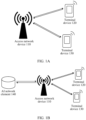
- FIG. 1A shows a communication system.
- the communication system includes an access network device 110 and two terminal devices, namely, a terminal device 120 and a terminal device 130. At least one of the terminal device 120 and the terminal device 130 may send uplink data to the access network device 110, and the access network device 110 may receive the uplink data. The access network device may send downlink data to at least one of the terminal device 120 and the terminal device 130.
- the access network device may be a base station (base station, BS).
- the access network device may also be referred to as a network device, an access node (access node, AN), or a radio access node (radio access node, RAN).
- the access network device may be connected to a core network (for example, an LTE core network or a 5G core network), and the access network device may provide a radio access service for the terminal device.
- a core network for example, an LTE core network or a 5G core network
- the access network device includes but is not limited to, for example, at least one of the following: a next generation NodeB (generation NodeB, gNB) in 5G, an access network device in an open radio access network (open radio access network, O-RAN), or a module included in an access network device, an evolved NodeB (evolved NodeB, eNB), a radio network controller (radio network controller, RNC), a NodeB (NodeB, NB), a base station controller (base station controller, BSC), a base transceiver station (base transceiver station, BTS), a home base station (for example, home evolved NodeB, or home NodeB, HNB), and a baseband unit (baseband unit, BBU), a transmission reception point (transmitting and receiving point, TRP), a transmission point (transmitting point, TP), and/or a mobile switching center.
- a next generation NodeB generation NodeB
- gNB next generation NodeB
- gNB
- the access network device may be a radio unit (radio unit, RU), a central unit (central unit, CU), a distributed unit (distributed unit, DU), a central unit control plane (CU control plane, CU-CP) node, or a central unit user plane (CU user plane, CU-UP) node.
- the access network device may be a relay station, an access point, a vehicle-mounted device, a wearable device, an access network device in a future evolved public land mobile network (public land mobile network, PLMN), or the like.
- the communication apparatus configured to implement a function of the access network device may be an access network device, or may be a network device having some functions of the access network device, or may be an apparatus that can support the access network device in implementing the function, for example, a chip system, a hardware circuit, a software module, or a hardware circuit plus a software module.
- the apparatus may be installed in the access network device or used in matching with the access network device.
- an example in which the communication apparatus configured to implement the function of the access network device is the access network device is used for description.
- the terminal device is also referred to as a terminal, user equipment (user equipment, UE), a mobile station (mobile station, MS), a mobile terminal (mobile terminal, MT), or the like.
- the terminal device may be a device that provides voice and/or data connectivity for a user.
- the terminal device may communicate with one or more core networks via an access network device.
- the terminal device includes a handheld device with a wireless connection function, another processing device connected to a wireless modem, a vehicle-mounted device, or the like.
- the terminal device may be a portable, pocket-sized, handheld, computer built-in, or vehicle-mounted mobile apparatus.
- the terminal device are: a personal communication service (personal communication service, PCS) phone, a cordless phone, a session initiation protocol (session initiation protocol, SIP) phone, a wireless local loop (wireless local loop, WLL) station, a personal digital assistant (personal digital assistant, PDA), a wireless network camera, a mobile phone (mobile phone), a tablet computer, a notebook computer, a palmtop computer, a mobile internet device (mobile internet device, MID), a wearable device such as a smart watch, a virtual reality (virtual reality, VR) device, an augmented reality (augmented reality, AR) device, and a wireless terminal in industrial control (industrial control), a terminal in an internet of vehicles system, a wireless terminal in self driving (self driving), a wireless terminal in a smart grid (smart grid), a wireless terminal in transportation safety (transportation safety), a wireless terminal in a smart city (smart city), such as a smart fueler, a terminal device on a high-speed railway, and a wireless
- a communication apparatus configured to implement a function of the terminal device may be a terminal device, or may be a terminal device that has some functions of a terminal, or may be an apparatus that can support the terminal device in implementing the function, for example, a chip system.
- the apparatus may be installed in the terminal device or used in matching with the terminal device.
- the chip system may include a chip, or may include a chip and another discrete component.
- the protocol layer structure may include a control plane protocol layer structure and a user plane protocol layer structure.
- the control plane protocol layer structure may include functions of protocol layers such as a radio resource control (radio resource control, RRC) layer, a packet data convergence protocol (packet data convergence protocol, PDCP) layer, a radio link control (radio link control, RLC) layer, a media access control (media access control, MAC) layer, and a physical layer.
- the user plane protocol layer structure may include functions of protocol layers such as a PDCP layer, an RLC layer, a MAC layer, and a physical layer.
- a service data adaptation protocol (service data adaptation protocol, SDAP) layer may be further included above the PDCP layer.
- the protocol layer structure between the access network device and a terminal may further include an artificial intelligence (artificial intelligence, AI) layer, used to transmit data related to an AI function.
- AI artificial intelligence
- Data transmission between the access network device and the terminal device is used as an example.
- Data transmission needs to pass through the user plane protocol layer, for example, the SDAP layer, the PDCP layer, the RLC layer, the MAC layer, and the physical layer.
- the SDAP layer, the PDCP layer, the RLC layer, the MAC layer, and the physical layer may also be collectively referred to as an access stratum.
- each layer is further divided into a sending part and a receiving part.
- Downlink data transmission is used as an example.
- the PDCP layer After obtaining data from an upper layer, the PDCP layer transmits the data to the RLC layer and the MAC layer, the MAC layer generates a transport block, and then wireless transmission is performed through the physical layer.
- Data is encapsulated accordingly at each layer.
- data received by a layer from an upper layer of the layer is considered as a service data unit (service data unit, SDU) of the layer, encapsulated by the layer into a protocol data unit (protocol data unit, PDU), and then transferred to a next layer.
- SDU service data unit
- PDU protocol data unit
- the terminal device may further have an application layer and a non-access stratum.
- the application layer may be used to provide a service for an application installed on the terminal device.
- downlink data received by the terminal device may be sequentially transmitted from the physical layer to the application layer, and then is provided by the application layer for the application.
- the application layer may obtain data generated by the application, sequentially transmit the data to the physical layer, and send the data to another communication apparatus.
- the non-access stratum may be configured to forward user data. For example, the non-access stratum forwards uplink data received from the application layer to the SDAP layer, or forwards downlink data received from the SDAP layer to the application layer.
- the access network device may include a central unit (central unit, CU) and a distributed unit (distributed unit, DU).
- a plurality of DUs may be controlled by one CU in a centralized manner.
- an interface between the CU and the DU may be referred to as an F1 interface.
- a control plane (control plane, CP) interface may be F1-C
- a user plane (user plane, UP) interface may be F1-U.
- the CU and the DU may be divided based on protocol layers of the radio network.
- functions of the PDCP layer and protocol layers above the PDCP layer are disposed on the CU, and functions of protocol layers below the PDCP layer (for example, the RLC layer and the MAC layer) are disposed on the DU.
- functions of protocol layers above the PDCP layer are disposed on the CU, and functions of the PDCP layer and protocol layers below the PDCP layer are disposed on the DU.
- the foregoing processing function division of the CU and the DU based on the protocol layers is merely an example, and there may be other division.
- the CU or the DU may be obtained through division to have functions of more protocol layers.
- the CU or the DU may be obtained through division to have some processing functions of a protocol layer.
- a part of functions of the RLC layer and functions of protocol layers above the RLC layer are configured on the CU, and remaining functions of the RLC layer and functions of protocol layers below the RLC layer are configured on the DU.
- division of functions of the CU or the DU may alternatively be performed based on service types or other system requirements. For example, division may be performed based on latencies.
- the CU may alternatively have one or more functions of the core network.
- the CU may be disposed on a network side to facilitate centralized management.
- an RU of the DU is disposed remotely. The RU has a radio frequency function.
- the DU and the RU may be distinguished at a physical layer (physical layer, PHY).
- PHY physical layer
- the DU may implement higher-layer functions of the PHY layer
- the RU may implement lower-layer functions of the PHY layer.
- a function of the PHY layer may include a cyclic redundancy check (cyclic redundancy check, CRC) code addition, channel coding, rate matching, scrambling, modulation, layer mapping, precoding, resource mapping, physical antenna mapping, and/or radio frequency sending function.
- CRC cyclic redundancy check
- a function of the PHY layer may include CRC, channel decoding, rate de-matching, descrambling, demodulation, layer de-mapping, channel detection, resource de-mapping, physical antenna de-mapping, and/or a radio frequency receiving function.
- the higher-layer function of the PHY layer may include a part of functions of the PHY layer. For example, the part of functions are closer to the MAC layer.
- the lower-layer function of the PHY layer may include another part of functions of the PHY layer. For example, the part of functions are closer to the radio frequency function.
- the higher-layer function of the PHY layer may include CRC code addition, channel coding, rate matching, scrambling, modulation, and layer mapping
- the lower-layer function of the PHY layer may include precoding, resource mapping, physical antenna mapping, and radio frequency sending functions.
- the higher-layer function of the PHY layer may include CRC code addition, channel coding, rate matching, scrambling, modulation, layer mapping, and precoding.
- the lower-layer function of the PHY layer may include resource mapping, physical antenna mapping, and radio frequency sending functions.
- a function of the CU may be implemented by one entity, or may be implemented by different entities.
- functions of the CU may be further divided, in other words, a control plane and a user plane are separated and implemented by different entities, which are a control plane CU entity (that is, a CU-CP entity) and a user plane CU entity (that is, a CU-UP entity).
- the CU-CP entity and the CU-UP entity may be coupled to the DU, to jointly complete the function of the access network device.
- signaling generated by the CU may be sent to the terminal device by using the DU, or signaling generated by the terminal device may be sent to the CU by using the DU.
- signaling at the RRC or PDCP layer is finally processed as signaling at the physical layer and sent to the terminal device, or is converted from signaling received from the physical layer.
- the signaling at the RRC layer or PDCP layer may be considered to be sent by using the DU, or sent by using the DU and the RU.
- any one of the DU, the CU, the CU-CP, the CU-UP, and the RU may be a software module, a hardware structure, or a combination of a software module and a hardware structure.
- Different entities may exist in different forms, which is not limited.
- the DU, the CU, the CU-CP, and the CU-UP are software modules
- the RU is a hardware structure.
- the communication system may further include more terminal devices and more access network devices, and may further include another network element, for example, may include a core network device and/or a network element configured to implement an artificial intelligence function.
- the method provided in this disclosure may be used for communication between the access network device and the terminal device, and may also be used for communication between other communication devices, for example, communication between a macro base station and a micro base station in a wireless backhaul link; for another example, communication between two terminal devices in a sidelink (sidelink, SL). This is not limited.
- the method provided in this disclosure relates to artificial intelligence (artificial Intelligence, AI).
- AI artificial Intelligence
- the AI may be implemented by using various possible technologies, for example, by using a machine learning technology.
- the foregoing communication system may also include a network element that implements an artificial intelligence function.
- the AI function (for example, an AI module or an AI entity) may be configured in an existing network element in the communication system to implement an AI-related operation.
- the existing network element may be an access network device (for example, a gNB), a terminal device, a core network device, a network management system, or the like.
- the network management system may classify network management work into three types based on actual requirements of a network operation of an operator: operation (Operation), administration (Administration), and maintenance (Maintenance).
- the network management system may also be referred to as an operation, administration, and maintenance (operation, administration, and maintenance, OAM) network element, which is referred to as OAM for short.
- the operation is mainly to complete daily work of analysis, prediction, planning, and configuration on a network and a service.
- the maintenance is mainly a daily operation activity such as testing or fault management performed on the network and the service of the network.
- the network management system can detect a network running status, optimize a network connection and performance, improve network running stability, and reduce network maintenance costs.
- an independent network element may be introduced in the communication system to perform the AI-related operation.
- the independent network element may be referred to as an AI network element, an AI node, or the like.
- a name of the network element is not limited in this disclosure.
- the AI network element may be directly connected to the access network device in the communication system, or may be indirectly connected to the access network device via a third-party network element.
- the third-party network element may be a core network element such as an authentication management function (authentication management function, AMF) network element or a user plane function (user plane function, UPF) network element, OAM, a cloud server, or another network element. This is not limited.
- AMF authentication management function
- UPF user plane function
- OAM a cloud server
- An AI network element 140 is introduced to the communication system shown in FIG. 1A .
- a network element that performs the AI-related operation is a network element with a built-in AI function, or the foregoing AI network element. This is not limited in this disclosure.
- the AI-related operation may also be referred to as an AI function. For specific descriptions of the AI function, refer to the following.
- the AI model is a specific implementation of the AI function.
- the AI model represents a mapping relationship between input and output of the model.
- the AI model may be a neural network, a linear regression model, a decision tree model, a support vector machine (support vector machine, SVM), a Bayesian network, a Q-learning model, or another machine learning model.
- the AI function may include at least one of the following: data collection (collecting training data and/or inference data), data preprocessing, model training (or referred to as model learning), model information release (model information configuration), model validation, model inference, or inference result release.
- the inference may also be referred to as prediction.
- the AI model may be referred to as a model for short.
- a conventional communication system needs to design a communication module with rich expert knowledge.
- a deep learning communication system based on a machine learning technology (such as a neural network) can automatically discover an implicit pattern structure from a large quantity of datasets, establish a mapping relationship between data, and obtain performance better than that of a conventional modeling method.
- the neural network is a specific implementation form of the AI or the machine learning technology. According to a universal approximation theorem, the neural network can theoretically approximate to any continuous function, so that the neural network has a capability of learning any mapping.
- b may be any possible value such as a decimal, an integer (for example, 0, a positive integer, or a negative integer), or a complex number.
- Activation functions of different neurons in the neural network may be the same or different.
- the neural network generally includes a plurality of layers, and each layer may include one or more neurons.
- a depth and/or a width of the neural network can be increased, to improve an expression capability of the neural network, and provide a more powerful information extraction and abstraction modeling capability for a complex system.
- the depth of the neural network may be a quantity of layers included in the neural network, and a quantity of neurons included in each layer may be referred to as a width of the layer.
- the neural network includes an input layer and an output layer.
- the input layer of the neural network performs neuron processing on received input information, and transfers a processing result to the output layer, and the output layer obtains an output result of the neural network.
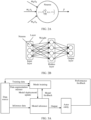
- the neural network includes an input layer, a hidden layer, and an output layer. Refer to FIG.
- the input layer of the neural network performs neuron processing on received input information, and transfers a processing result to an intermediate hidden layer.
- the hidden layer performs calculation on the received processing result to obtain a calculation result.
- the hidden layer transfers the calculation result to the output layer or the adj acent hidden layer.
- the output layer obtains an output result of the neural network.
- One neural network may include one hidden layer, or include a plurality of hidden layers that are sequentially connected. This is not limited.
- the neural network in this disclosure is, for example, a deep neural network (deep neural network, DNN).
- the DNN may include a feedforward neural network (feedforward neural network, FNN), a convolutional neural network (convolutional neural network, CNN), and a recurrent neural network (recurrent neural network, RNN).
- feedforward neural network feedforward neural network
- CNN convolutional neural network
- RNN recurrent neural network
- A3 Training data and inference data
- the training data may include the input of the AI model, or include the input and target output (a label) of the AI model, and is used for AI model training.
- the training data includes a plurality of training samples, and each training sample is one time of input of the neural network.
- the training data may also be understood as a set of training samples, or referred to as a training dataset.
- the training dataset is one of important parts of machine learning. Model training essentially is to learn of some features of the training data, so that the output is as close as possible to the target output of the AI model. For example, a difference between the output and the target output of the AI model is as small as possible.
- a loss function may be defined.
- the loss function describes a difference between an output value and a target output value of the AI model.
- This disclosure does not limit a specific form of the loss function.
- the training process of the AI model is a process in which a parameter of the AI model is adjusted, so that a value of the loss function is less than a threshold, or the value of the loss function meets a target requirement.
- the AI model is a neural network, and adjusting a parameter of the neural network includes adjusting at least one of the following parameters: a quantity of layers of the neural network, a width, a weight of a neuron, or a parameter in an activation function of the neuron.
- the inference data may be used as input of the trained AI model, and is used for AI model inference.
- the inference data is input to the AI model, and it may be obtained that corresponding output is an inference result.
- the AI model design mainly includes a data collection phase (for example, collecting the training data and/or the inference data), a model training phase, and a model inference phase. Further, an inference result application phase may be further included.
- FIG. 3A shows an AI application framework.
- a data source data source
- the training data training data
- the AI model represents a mapping relationship between input and output of the model. Obtaining the AI model through learning by a model training host is equivalent to obtaining the mapping relationship between the input and the output of the model through learning by using the training data.
- the AI model that has been trained in the model training phase is used to perform inference based on the inference data provided by the data source, to obtain an inference result.
- This phase may also be understood as follows:
- the inference data is input to the AI model, and output is obtained by using the AI model, where the output is the inference result.
- the inference result may indicate a configuration parameter used (acted) by an actor object, and/or an operation performed by the actor object.
- the inference result is released in the inference result application phase.
- the inference result may be uniformly planned by an actor (actor) entity.
- the actor entity may send the inference result to one or more actor objects (for example, a core network device, an access network device, or a terminal device) for action.
- the actor entity may further feed back performance of the model to the data source, to facilitate subsequent update training of the model.
- the phases shown in FIG. 3A may be implemented by a same network element.
- one network element may be responsible for data collection, model training, model inference, and inference result release.
- different phases may be implemented by different network elements or nodes.
- a node that performs the data collection phase and a node that performs the model training phase are different.
- a large amount of training data is required for model training.
- air interface overheads are caused.
- a larger amount of transmitted training data indicates higher air interface overheads.
- the data source in FIG. 3A may provide a relatively small amount of training data for the model training host.
- the model training host may generate, based on the small amount of the training data provided by the data source and a data augmentation manner of the small amount of the training data, training data that is actually used for model training, to implement model training. It may be understood that the small amount of the training data is relative to the training data used for model training, and does not mean that a data amount of the training data is small, in other words, the data amount of the training data is less than a data amount of the training data used for model training.
- the data augmentation manner of the small amount of the training data may be provided by the data source, or the data augmentation manner of the small amount of the training data may be a predefined manner that can be used to perform augmentation processing on the small amount of the training data.
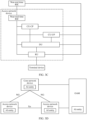
- an access network device includes a near-real-time radio access network intelligent controller (RAN intelligent controller, RIC) module, configured to perform model learning and/or inference.
- RAN intelligent controller RIC
- the near-real-time RIC may obtain information on a network side and/or a terminal side from at least one of a CU, a DU, and an RU.
- the information may include a small amount of training data, indication information of a data augmentation manner of the small amount of the training data, or inference data.
- the near-real-time RIC may be configured to: determine, based on the small amount of the training data and the data augmentation manner of the small amount of the training data, training data used for model training, and perform model training.
- the near-real-time RIC may further perform inference by using a trained model.
- the near-real-time RIC may submit an inference result to at least one of the CU, the DU, and the RU.
- the CU and the DU may exchange the inference result.
- the DU and the RU may exchange the inference result.
- the near-real-time RIC submits the inference result to the DU
- the DU submits the inference result to the RU.
- an access network device may include a non-real-time RIC (where optionally, the non-real-time RIC may be located in OAM or a core network device), configured to perform model learning and inference.
- the non-real-time RIC may obtain information on a network side and/or a terminal side from at least one of a CU, a DU, and an RU.
- the information may include a small amount of training data, indication information of a data augmentation manner of the small amount of the training data, or inference data.
- the non-real-time RIC is configured to: determine, based on the small amount of the training data and the data augmentation manner of the small amount of the training data, training data used for model training, and perform model training.
- the non-real-time RIC may further perform inference by using a trained model.
- the non-real-time RIC may submit an inference result to at least one of the CU, the DU, and the RU.
- the CU and the DU may exchange the inference result.
- the DU and the RU may exchange the inference result.
- the non-real-time RIC submits the inference result to the DU, and the DU submits the inference result to the RU.
- an access network device includes a near-real-time RIC, and a non-real-time RIC is located outside the access network device (where optionally, the non-real-time RIC may be located in OAM or a core network device).
- the non-real-time RIC may be configured to perform model learning and/or inference; and/or same as the first possible implementation, the near-real-time RIC may be configured to perform model learning and/or inference; and/or the near-real-time RIC may obtain AI model information from the non-real-time RIC, obtain information on a network side and/or a terminal side from at least one of a CU, a DU, and an RU, and obtain an inference result by using the information and the AI model information.
- the near-real-time RIC may submit the inference result to at least one of the CU, the DU, and the RU.
- the CU and the DU may exchange the inference result.
- the DU and the RU may exchange the inference result.
- the near-real-time RIC submits the inference result to the DU
- the DU submits the inference result to the RU.
- the near-real-time RIC is configured to: determine, based on a small amount of training data and a data augmentation manner of the small amount of the training data, training data used for model training, perform model training, and perform inference by using a trained model.
- the non-real-time RIC is configured to: determine, based on a small amount of training data and a data augmentation manner of the small amount of the training data, training data used for model training, perform model training, and perform inference by using a trained model.
- the non-real-time RIC is configured to: determine, based on a small amount of training data and a data augmentation manner of the small amount of the training data, training data used for model training, perform model training, and submit a trained model to the near-real-time RIC.
- the near-real-time RIC performs inference by using the trained model.
- FIG. 3C is an example diagram of a network architecture to which a method provided in this disclosure can be applied.
- a CU is separated into a CU-CP and a CU-UP.
- FIG. 3D is an example diagram of a network architecture to which a method provided in this disclosure can be applied.
- an access network device includes one or more AI entities, and a function of the AI entity is similar to that of the foregoing near-real-time RIC.
- OAM includes one or more AI entities, and a function of the AI entity is similar to that of the foregoing non-real-time RIC.
- a core network device includes one or more AI entities, and a function of the AI entity is similar to that of the foregoing non-real-time RIC.
- the OAM and the core network device each include an AI entity, models obtained through training by the AI entities of the OAM and the core network device are different, and/or models used for inference are different.
- the models are different in terms of at least one of the following: a structure parameter of the model (for example, a quantity of layers and/or a weight of the model), an input parameter of the model, or an output parameter of the model.
- a structure parameter of the model for example, a quantity of layers and/or a weight of the model
- an input parameter of the model for example, a quantity of layers and/or a weight of the model
- an output parameter of the model for example, a quantity of layers and/or a weight of the model
- FIG. 3E is an example diagram of a network architecture to which a method provided in this disclosure can be applied.
- an access network device is separated into a CU and a DU.
- the CU may include an AI entity, and a function of the AI entity is similar to that of the foregoing near-real-time RIC.
- the DU may include an AI entity, and a function of the AI entity is similar to that of the foregoing near-real-time RIC.
- the CU and the DU each include an AI entity, models obtained through training by the AI entities of the CU and the DU are different, and/or models used for inference are different.
- 3E may be further separated into a CU-CP and a CU-UP.
- one or more AI models may be deployed in the CU-CP; and/or one or more AI models may be deployed in the CU-UP.
- OAM of the access network device and OAM of the core network device may be separately deployed.
- one parameter or a plurality of parameters may be obtained through inference by using one model.
- Learning processes of different models may be deployed on different devices or nodes, or may be deployed on a same device or node.
- Inference processes of different models may be deployed on different devices or nodes, or may be deployed on a same device or node.
- FIG. 4 shows a communication method.
- a first node corresponds to the foregoing node that performs the data collection phase, or the first node corresponds to a node that can forward or manage data collected in the foregoing data collection phase, and a second node corresponds to the foregoing node that performs the model training phase.
- the method mainly includes the following steps.
- the second node obtains first data and first information from the first node, where the first information indicates a data augmentation manner of the first data.
- the first node may be a data collection node, and has a function of collecting (which may also be described as, for example, collecting or measuring) training data.
- the second node may obtain related data from one or more data collection nodes.
- the first node in S401 may be a node that can provide the first data and the first information in a plurality of data collection nodes.
- the first node may be a data management node, the data management node is connected to one or more data collection nodes, the data collection node has a function of collecting training data, and the data management node may manage the training data collected by the data collection node connected to the data management node.
- the second node may obtain related data from one or more data management nodes.
- the first node in S401 may be a node that can provide the first data and the first information in a plurality of data management nodes.
- Data collection nodes connected to different data management nodes may overlap or may not overlap. This is not limited in this disclosure.
- the second node is used to train a model, or is referred to as a model training host (model training host).
- the first node may be a terminal device, and the second node is an access network device, a CU of an access network device in a separation architecture, or a DU of the access network device in the separation architecture; the first node may be an access network device, a CU of an access network device in a separation architecture, or a DU of the access network device in the separation architecture, and the second node is a terminal device; the first node may be a terminal device, an access network device, a CU of an access network device in a separation architecture, or a DU of the access network device in the separation architecture, and the second node is an AI network element or a core network element; the first node may be a core network device, and the second node is an access network device, a CU of an access network device in a separation architecture, or a DU of the access network device in the separation architecture; or the first node may be a third-party node that can provide data (for example, the
- the first node may send the first data and the first information to the second node by using one piece of signaling, or may separately send the first data and the first information by using different signaling.
- the first data and the first information are distributed in different signaling, an association relationship may be established between the first data and the first information, in other words, the first information indicates the data augmentation manner of the first data.
- the first data may be a small amount of training data that is stored in or that can be obtained by the first node.
- the data augmentation manner of the first data may be understood as a data augmentation manner applicable to performing augmentation processing on the first data, or referred to as a data augmentation manner that matches the first data.
- the first node may add, to the first information, identifiers of all or some of data augmentation manners that match the first data, to indicate the data augmentation manner of the first data to the second node. Both the first node and the second node may determine a corresponding data augmentation manner based on the identifier of the data augmentation manner.
- the first node may add other information to the first information, to indicate the data augmentation manner of the first data to the second node. This is not limited in this disclosure.
- different data types match different data augmentation manners, or data in different application scenarios matches different data augmentation manners. It may be understood that the method does not exclude that different data types may match a same data augmentation manner. For example, a data augmentation manner that matches a first data type is different from a data augmentation manner that matches a second data type, and the data augmentation manner that matches the second data type is the same as a data augmentation manner that matches a third data type. This method does not exclude that data in different application scenarios matches a same data augmentation manner.
- a data augmentation manner that matches data in a first application scenario is the same as a data augmentation manner that matches data in a second application scenario, and the data augmentation manner that matches the data in the second application scenario is different from a data augmentation manner that matches data in a third application scenario.
- the application scenario herein may be understood as a model application scenario or an application field of the model.
- an available data augmentation manner includes at least one of the following: geometric transformation (for example, rotation, cropping, and/or scaling), color transformation, noise addition, or the like.
- the first data includes an image
- a data augmentation manner of the image includes rotation
- a subsequent first training dataset may include three new images obtained by performing 90-degree, 180-degree, and 270-degree rotation on the image.
- the first training dataset may further include the image in the first data.
- an available data augmentation manner includes synonym replacement, back translation, and/or the like.
- the first data includes a segment of Chinese, and a corresponding data augmentation manner is back translation.
- a segment of Chinese is translated into English, and then English is translated back into Chinese, so that a new segment of Chinese may be obtained.
- a first training dataset may include the new segment of Chinese, and optionally, the first training dataset may further include the segment of Chinese in the first data.
- an available data augmentation manner includes but is not limited to one or more of the following: channel flipping, channel interception, channel scaling, channel shift, noise addition, channel cross-replacement, virtual transmission, or data augmentation performed by using a generative AI model.
- channel flipping channel interception
- channel scaling channel scaling
- channel shift noise addition
- channel cross-replacement virtual transmission
- data augmentation manner applicable to the channel data.
- the channel flipping may mean that in one or more dimensions of time domain, delay domain, frequency domain, Doppler domain, antenna domain (or space domain), or angle domain (or beam domain), positions of a channel element with a lowest index and a channel element with a highest index are exchanged, positions of a channel element with a second lowest index and a channel element with a second highest index are exchanged, and so on.
- FIG. 5A shows a frequency domain channel including 72 subcarriers.
- the frequency domain channel in an order of subcarrier indexes from 1 to 72 is flipped in a frequency domain dimension, in other words, a new frequency domain channel shown in FIG. 5B may be generated in an order of subcarrier indexes from 72 to 1.
- the first data may include the frequency domain channel shown in FIG. 5A
- the first training dataset includes a new frequency domain channel shown in FIG. 5B
- the channel interception may mean that a plurality of consecutive channel elements with consecutive indexes are intercepted in one or more dimensions of time domain, delay domain, frequency domain, Doppler domain, antenna domain (or space domain), or angle domain (or beam domain). For example, if channel elements of 36 consecutive subcarriers starting from an index 11 to an index 46 are intercepted from the 72 subcarriers shown in FIG. 5A , a new frequency domain channel including the channel elements of the 36 subcarriers may be formed.
- the first data may include the frequency domain channel shown in FIG. 5A
- a first training dataset includes the new frequency domain channel including the channel elements of the 36 subcarriers.
- the channel scaling may mean that a plurality of channel elements are extracted at equal intervals based on indexes of channel elements in one or more dimensions of time domain, delay domain, frequency domain, Doppler domain, antenna domain (or space domain), or angle domain (or beam domain).
- the foregoing channel element is specifically a subcarrier. From the 72 subcarriers shown in FIG. 5A , subcarriers whose indexes are 10, 12, 14, ..., and 70 are extracted at every two indexes from subcarriers starting from a subcarrier 10 to a subcarrier 70, to form a new frequency domain channel including 30 subcarriers.
- a same quantity of channel elements are interpolated in every two channel elements with adjacent indexes based on indexes of channel elements.
- An interpolation method may be polynomial interpolation, linear interpolation, cubic interpolation, or the like. For example, if one piece of new channel data is inserted into every two subcarriers with adjacent indexes in the 72 subcarriers shown in FIG. SA, a new frequency domain channel including 143 subcarriers may be formed.
- the first data may include the frequency domain channel shown in FIG. 5A
- a first training dataset includes the new frequency domain channel including the 143 subcarriers.
- the channel shift may mean that in one or more dimensions of delay domain, Doppler domain, and angle domain (or beam domain), channel elements are shifted as a whole in a direction with a smaller index or a larger index, or is cyclically shifted.
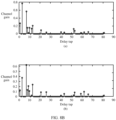
- FIG. 6A shows a delay domain channel including 81 delay taps (delay taps), and the delay domain channel is shifted as a whole for 10 delay taps in a direction with a larger index, so that a new delay domain channel including 91 delay taps shown in FIG. 6B may be obtained.
- the first data may include the delay domain channel shown in FIG. 6A
- the first training dataset includes the new delay domain channel shown in FIG. 6B
- the noise addition may mean that noise that complies with specific distribution is superimposed in one or more dimensions of time domain, delay domain, frequency domain, Doppler domain, antenna domain (or space domain), and angle domain (or beam domain).
- white Gaussian noise with an average value of 0 and a variance of 0.01 is superimposed, to obtain a new delay domain channel shown in FIG. 7 .
- the first data may include the delay domain channel shown in FIG. 6A
- the first training dataset includes the new delay domain channel shown in FIG. 7
- the channel cross-replacement may mean that a plurality of channel elements with asame index in two pieces of channel data are exchanged in one or more dimensions of delaydomain, Doppler domain, and angle domain (or beam domain).
- a delay domainchannel shown in (a) in FIG. 8A and a delay domain channel shown in (b) in FIG. 8A channelelements with the first 10 delay tap indexes of the two channels are exchanged.
- the first data may include the delay domain channel shown in FIG. 8A
- the first training dataset includes the new delay domain channel shown in FIG. 8B
- the virtual transmission may mean that, a plurality of virtual sending signals (data signals and/or reference signals) are obtained based on a preset manner or a random generation manner, and virtual received signals corresponding to the plurality of sending signals are obtained through calculation based on the plurality of sending signals and channel data.
- a plurality of virtual sending signals are obtained based on a preset manner or a random generation manner, and the plurality of virtual sending signals are pre-coded by using a precoding vector (or referred to as a precoding matrix or a beam vector), to obtain a plurality of pre-coded sending signals.
- Virtual received signals corresponding to the plurality of pre-coded sending signals are obtained through calculation based on the plurality of pre-coded sending signals and channel data.
- virtual received signals corresponding to all virtual sending signals may be generated based on one piece of channel data, or a virtual received signal corresponding to each virtual sending signal is generated based on each piece of channel data in a plurality of pieces of channel data, to obtain a plurality of groups of ⁇ virtual sending signals, virtual received signals, and channel data ⁇ .
- a virtual sending signal set S is preset, where S includes a virtual sending signals.
- a received signal set may be generated, and the received signal set includes a*b received signals, a and b are positive integers.
- the first data may include the foregoing one or more pieces of channel data
- the first training dataset includes a plurality of groups of ⁇ virtual sending signals, virtual received signals, and channel data ⁇ .
- a virtual sending signal set S and a precoding matrix set W are preset, where S includes a virtual sending signals, and W includes q precoding matrices, a and q are positive integers.
- a is equal to 1.
- a received signal set may be generated, and the received signal set includes a*b*q received signals.
- the first data may include the foregoing one or more pieces of channel data
- the first training dataset includes a plurality of groups of ⁇ virtual sending signals, precoding matrices, virtual received signals, and channel data ⁇ .
- a positive integer may be 1, 2, 3, 4, or a larger integer. This is not limited.
- Data augmentation is performed by using the generative AI model, for example, a generative AI model such as a generative adversarial network (generative adversarial network, GAN), to generate more training data whose distribution is the same as that of existing training data (namely, the foregoing first data).
- a generative AI model such as a generative adversarial network (generative adversarial network, GAN)
- GAN generative adversarial network
- the first training dataset includes the foregoing more training data, and optionally, may further include the first data.
- the first information may further include a parameter of the data augmentation manner, so that the second node specifically performs corresponding data augmentation processing on the first data based on the parameter of the data augmentation manner.
- a data augmentation manner corresponding to the foregoing channel data is used as an example.
- the first information may further include one or more of the following: some or all of information of the generative AI model; a dimension of data augmentation; at least two of a start index, a length, or an end index of the channel element in the channel interception; a granularity of the channel scaling, for example, a extraction interval, a quantity of channel elements for interpolation, or the interpolation method; a distance of the channel shift; noise distribution information; a pattern of the channel cross-replacement; information about the virtual sending signal and/or the precoding vector used in the virtual transmission (for example, a value and/or a length of the precoding vector), or the like; a format and/or a format conversion method of a channel in the dataset; a collection range corresponding to the first data, for example, a cell edge, a cell center, or a multipath delay range; or the like.
- the second node determines a first training dataset of the model based on the first data and the first information.
- the second node determines the first training dataset of the model based on the first data and the data augmentation manner of the first data.
- the data augmentation manner of the first data corresponds to the data augmentation manner indicated by the first information in S401.
- the first information indicates a plurality of data augmentation manners that match the first data.
- the second node may perform data augmentation processing on the first data based on some or all of data augmentation manners in the plurality of data augmentation manners, to obtain the first training dataset of the model.
- the second node may determine, based on a data augmentation manner supported by the second node, a model training requirement, and/or a model application scenario, an actually used data processing manner in the data augmentation manners indicated by the first information.
- the actually used data processing manner may include some or all of data augmentation manners in the data augmentation manners indicated by the first information, and then perform data augmentation processing on the first data based on the actually used data processing manner.
- the model training requirement and/or the model application scenario are/is considered, so that a first training dataset that meets the model training requirement and/or the model application scenario can be obtained.
- a capability of supporting the data augmentation manner of the second node is considered, so that effectiveness of data augmentation processing can be ensured.
- the first training dataset of the model may include the first data and new data obtained by performing data augmentation processing on the first data; or the first training dataset of the model may include only new data obtained by performing data augmentation processing on the first data. This is not limited in this disclosure.
- S403 The second node trains the model based on the first training dataset.
- the second node may use supervised learning or unsupervised learning. This is not limited.
- a related loss function is not limited, for example, may be determined by factors such as a structure type of the model, the first training dataset of the model, and/or the model application scenario.
- Some examples of the structure type of the model are as follows: a CNN, an RNN, and an FNN.
- the second node may further obtain second data from the first node, where the second data is used to perform update training on the model, or it may be understood as that the second node obtains more training data to perform update training on the model.
- An update training process may be applied to, but is not limited to a case in which performance of the model obtained through training based on the first training dataset does not meet a performance requirement.
- the performance requirement may also be referred to as reference performance.
- the performance requirement may be a preset performance indicator, or may be indicated by the first node to the second node.
- the first node sends, to the second node, information that indicates the performance requirement.
- the first node may determine the performance requirement based on performance of another historically trained model.
- the second node may determine whether the performance of the model obtained through training based on the first training dataset meets the performance requirement. When the performance of the model does not meet the performance requirement, the second node obtains the second data from the first node. Alternatively, the second node may send a model training result to the first node, where the model training result indicates the performance of the model obtained through training based on the first training dataset. The first node may determine whether the performance of the model meets the performance requirement, and send the second data to the second node when the performance of the model does not meet the performance requirement.
- FIG. 4 further shows the following optional steps S404 to S406.
- S404 The second node sends third information to the first node.
- the third information may indicate the model training result.
- the third information indicates the performance of the model obtained through training based on the first training dataset.
- the third information may include a result value of the loss function after model training is completed.
- the second node indicates, by using the third information, a result of the loss function after model training is completed, to reflect the performance of the model.
- the third information may specifically indicate test performance of the model obtained through training on a predefined or preconfigured test set.
- the third information includes a parameter value corresponding to the test performance.
- the third information includes a performance level corresponding to the test performance, where the performance level is, for example, good/poor, or qualified/unqualified.
- the third information includes indication information of the performance level corresponding to the test performance. For example, when the third information includes a first value, it indicates that the performance level corresponding to the test performance is good; or when the third information includes a second value, it indicates that the performance level corresponding to the test performance is poor.
- the third information may specifically indicate whether the model obtained through training meets a predefined or preconfigured performance requirement. For example, when the third information includes a third value, it indicates that the model obtained through training meets the predefined or preconfigured performance requirement; or when the third information includes a fourth value, it indicates that the model obtained through training does not meet the predefined or preconfigured performance requirement.
- the third information may specifically indicate a performance level that the model obtained through training meets in a plurality of predefined or preconfigured performance levels.
- the model meets a first performance level in the plurality of preconfigured performance levels
- the third information includes an identifier of the first performance level in the plurality of preconfigured performance levels.
- the third information indicates that the model does not meet the performance requirement, and/or the third information is used to request the second data.
- the third information may include a fourth value and indicates that the model obtained through training does not meet a predefined or preconfigured performance requirement; and/or the third information includes a first flag bit (or referred to as a first field), and a value of the first flag bit may be predefined, and indicates to request the second data.
- S405 The first node sends the second data to the second node.
- the first node may determine, based on the third information, that the model does not meet the performance requirement.
- the model is obtained through training based on the first training dataset.
- the second node performs update training on the model based on the second data and the first training dataset.
- the second node obtains a small amount of training data and a small quantity of data augmentation manners from the first node, and generates the training data actually used for model training. This can reduce overheads of training data transmission, and improve model training efficiency and performance.
- FIG. 9 shows a communication method.
- a first node corresponds to the foregoing node that performs the data collection phase, or the first node corresponds to a node that can forward or manage data collected in the foregoing data collection phase, and a second node corresponds to the foregoing node that performs the model training phase.
- the method mainly includes the following steps.
- S901 The second node sends second information to the first node.
- the second information indicates at least one of the following: a type of first data, where the type is, for example, one or more of the following types: channel data, received signal data, received signal strength data, received signal quality data, received signal power data, location data, moving track data, and interfering signal data.
- the location data or the moving track data is one or more of information authorized by a user, information obtained through desensitization, or information unbound from user privacy information.
- the type of the channel data may be specifically classified into: channel data in a specified format, time domain channel data, frequency domain channel data, delay domain channel data, space domain channel data, angle domain channel data, and the like.
- the type of the first data may be the image data or the language data shown in S401.
- a scenario corresponding to a first training dataset may also be understood as a model application scenario.
- the scenario corresponding to the first training dataset may be used to determine a collection range of the first data.
- the first data is data in the scenario corresponding to the first training dataset, or the first data may not be the data in the scenario corresponding to the first training dataset, but the first data can be converted into the data in the scenario corresponding to the first training dataset after data augmentation processing is performed on the first data in a related data augmentation manner (for example, indicated by first information).
- Examples of the scenario corresponding to the first training dataset are as follows: a scenario classified based on radio signal receiving strength, for example, a cell edge or a cell center; a scenario classified based on a radio channel environment, for example, a scenario with a large quantity of scatters or a scenario with a small quantity of scatters; a scenario classified based on a measured multipath delay range, for example, a scenario with a long multipath delay or a scenario with a short multipath delay; or an actual place such as a shopping mall or a high-speed railway.
- a scenario classified based on radio signal receiving strength for example, a cell edge or a cell center
- a scenario classified based on a radio channel environment for example, a scenario with a large quantity of scatters or a scenario with a small quantity of scatters
- a scenario classified based on a measured multipath delay range for example, a scenario with a long multipath delay or a scenario with a short multipath delay
- an actual place such as a shopping mall
- the second node may include, in the second information, indication information such as a size of a training dataset supported by the second node, a computing capability of the second node, or a storage capability of the second node, to indicate the first node to determine the data amount of the first data based on the foregoing indication information.
- indication information such as a size of a training dataset supported by the second node, a computing capability of the second node, or a storage capability of the second node, to indicate the first node to determine the data amount of the first data based on the foregoing indication information.
- the second information may also be understood as capability information of the second node, and indicates the first node to provide the first data and the data augmentation manner that meet the capability of the second node.
- the first node sends the first data and first information to the second node.
- the first node may determine the to-be-sent first data based on the second information. For example, when the second information includes information that indicates the data amount of the first data, the first node may determine, based on the second information, a data amount (or referred to as a size) of the to-be-sent first data; and/or when the second information includes information that indicates the data augmentation manner supported by the second node, the first node may determine, based on the second information, the data augmentation manner indicated by the first information.
- a data amount or referred to as a size
- the second node determines the first training dataset of the model based on the first data and the first information.
- S904 The second node trains the model based on the first training dataset.
- the second node may further obtain second data from the first node, where the second data is used to perform update training on the model, or it may be understood as that the second node obtains more training data to perform update training on the model.
- FIG. 9 further shows the following optional steps S905 to S907.
- S905 The second node sends third information to the first node.
- S906 The first node sends the second data to the second node.
- the first node may determine, based on the third information, that the model does not meet a performance requirement.
- the model is obtained through training based on the first training dataset.
- the second node performs update training on the model based on the second data and the first training dataset.
- the first node considers the capability of the second node, and provides proper training data and a proper data augmentation manner for the second node, so that the second node generates training data actually used for model training. This can reduce overheads of training data transmission, and improve model training efficiency and performance.
- FIG. 10 shows a communication method.
- a first node corresponds to the foregoing node that performs the data collection phase, or the first node corresponds to a node that can forward or manage data collected in the foregoing data collection phase, and a second node corresponds to the foregoing node that performs the model training phase.
- the method mainly includes the following steps.
- S1001 The second node sends second information to the first node.
- S1002 The first node sends first data to the second node.
- the second node sends fourth information to the first node, where the fourth information is used to request a data augmentation manner of the first data.
- S1003 and S1002 may be performed in no sequence. Alternatively, S1003 may be performed before S1002. Alternatively, S1002 is performed before S1003. For example, when S1002 is performed before S1003, a reason for performing S1003 is that a data amount of the first data cannot meet a data amount requirement for model training, and the second node may request the data augmentation manner of the first data from the first node by sending the fourth information.
- the fourth information includes indication information of a first data augmentation manner.
- the first data augmentation manner may be understood as a data augmentation manner that the second node intends (plans or expects) to use for the first data.
- the first node sends first information to the second node, where the first information indicates the data augmentation manner of the first data.
- the first node may further determine whether the first data augmentation manner is the data augmentation manner that matches the first data.
- the first node may include acknowledgment information in the first information, where the acknowledgment information indicates that the data augmentation manner of the first data includes the first data augmentation manner.
- the first node may include negative acknowledgment information and/or indication information of a second data augmentation manner in the first information and indicates that the data augmentation manner of the first data does not include the first data augmentation manner.
- the first information may include only the negative acknowledgment information, and the negative acknowledgment information indicates that the data augmentation manner of the first data does not include the first data augmentation manner.
- the second node may redetermine the data augmentation manner that the second node intends to use for the first data, and initiate, to the first node based on step S1003, a request for carrying the fourth information until the first node indicates that the data augmentation manner of the first data includes the data augmentation manner that the second node intends to use.
- the negative acknowledgment information indicates that the data augmentation manner of the first data does not include the first data augmentation manner.
- the second node may redetermine the data augmentation manner that the second node intends to use for the first data, and initiate, to the first node based on step S1003, a request for carrying the fourth information until the first node indicates that the data augmentation manner of the first data includes the data augmentation manner that the second node intends to use.
- S1006 The second node trains the model based on the first training dataset.
- the second node may further obtain second data from the first node, where the second data is used to perform update training on the model, or it may be understood as that the second node obtains more training data to perform update training on the model.
- FIG. 10 further shows the following optional steps S1007 to S1009.
- S1007 The second node sends third information to the first node.
- S1008 The first node sends the second data to the second node.
- the first node may determine, based on the third information, that the model does not meet a performance requirement.
- the model is obtained through training based on the first training dataset.
- the second node performs update training on the model based on the second data and the first training dataset.
- the second node after obtaining a small amount of training data provided by the first node, the second node obtains a matched data augmentation manner, and then generates training data actually used for model training. This can reduce overheads of training data transmission, and improve model training efficiency and performance.
- FIG. 11 shows model training effects of the solution 1, the solution 2, and the solution 3.
- model training is performed by using a large amount of training data.
- model training is performed based on a small amount of training data and a small quantity of data augmentation manners.
- model training is performed by using a small amount of training data.
- a horizontal coordinate represents a signal-to-noise ratio (signal-to-noise ratio, SNR)
- a vertical coordinate represents performance of a model.
- An error between an estimated channel and a real channel is represented by, for example, a normalized mean square error (normalized mean square error, NMSE).
- NMSE normalized mean square error
- a smaller NMSE indicates that the estimated channel is closer to the real channel, and indicates better performance of the model.
- a model obtained by training 50000 different channel samples is used.
- 1000 channel samples in the 5000 channel samples used in the solution 1 are used to generate 50000 pieces of training data in a data augmentation manner of noise addition, and a model obtained by training the 50000 pieces of training data is used.
- a model obtained by training 1000 different channel samples is used. It can be learned from FIG. 11 that performance of the model obtained through training in the solution 2 is approximate to performance of the model obtained through training in the solution 1.
- a proper data augmentation manner is used, so that performance similar to that of an AI model trained by using a large amount of training data can be obtained through training by using only a small amount of training data, to greatly reduce overheads of collecting, storing, and transmitting the training data.
- the first node and the second node may include a hardware structure and/or a software module, and implement the functions in a form of the hardware structure, the software module, or a combination of the hardware structure and the software module. Whether a function in the foregoing functions is performed by using the hardware structure, the software module, or the combination of the hardware structure and the software module depends on particular applications and design constraints of the technical solutions.
- the communication apparatus 1200 includes a processing module 1201 and a communication module 1202.
- the communication apparatus 1200 may be a first node, or may be a communication apparatus that is used in the first node or that is used in matching with the first node and that can implement a communication method performed on a first node side.
- the communication apparatus 1200 may be a second node, or may be a communication apparatus that is used in the second node or that is used in matching with the second node and that can implement a communication method performed on a second node side.
- the communication module may also be referred to as a transceiver module, a transceiver, a transceiver machine, a transceiver apparatus, or the like.
- the processing module may also be referred to as a processor, a processing board, a processing unit, a processing apparatus, or the like.
- the communication module is configured to perform a sending operation and a receiving operation on the first node side or the second node side in the foregoing methods.
- a component that is in the communication module and that is configured to implement a receiving function may be considered as a receiving unit
- a component that is in the communication module and that is configured to implement a sending function may be considered as a sending unit.
- the communication module includes the receiving unit and the sending unit.
- the processing module 1201 may be configured to implement a processing function of the first node in the embodiment shown in FIG. 4 , FIG. 9 , or FIG. 10
- the communication module 1202 may be configured to implement a receiving and sending function of the first node in the embodiment shown in FIG. 4 , FIG. 9 , or FIG. 10
- the communication apparatus may be understood with reference to the third aspect and the possible designs in the third aspect in the summary.
- the processing module 1201 may be configured to implement a processing function of the second node in the embodiment shown in FIG. 4 , FIG. 9 , or FIG. 10
- the communication module 1202 may be configured to implement a receiving and sending function of the second node in the embodiment shown in FIG. 4 , FIG. 9 , or FIG. 10
- the communication apparatus may be understood with reference to the fourth aspect and the possible designs in the fourth aspect in the summary.
- the communication module and/or the processing module may be implemented by using a virtual module.
- the processing module may be implemented by using a software functional unit or a virtual apparatus, and the communication module may be implemented by using a software function or a virtual apparatus.
- the processing module or the communication module may alternatively be implemented by using an entity apparatus.
- the apparatus is implemented by using a chip/chip circuit
- the communication module may be an input/output circuit and/or a communication interface, and performs an input operation (corresponding to the foregoing receiving operation) and an output operation (corresponding to the foregoing sending operation).
- the processing module is an integrated processor, a microprocessor, or an integrated circuit.
- Division into the modules in this disclosure is an example, is merely division into logical functions, and may be other division during actual implementation.
- functional modules in embodiments in this disclosure may be integrated into one processor, or each of the modules may exist alone physically, or two or more modules may be integrated into one module.
- the integrated module may be implemented in a form of hardware, or may be implemented in a form of a software functional module.
- the communication apparatus 1300 may be configured to implement a function of any network element in the communication system shown in FIG. 1A or FIG. 1B .
- the communication apparatus 1300 may include at least one processor 1310.
- the processor 1310 is coupled to a memory.
- the memory may be located in the apparatus, the memory may be integrated with the processor, or the memory may be located outside the apparatus.
- the communication apparatus 1300 may further include at least one memory 1320.
- the memory 1320 stores a computer program, a computer program or instructions, and/or data necessary for implementing any one of the foregoing embodiments.
- the processor 1310 may execute the computer program stored in the memory 1320, to complete the method in any one of the foregoing embodiments.
- Couplings in this disclosure are indirect couplings or communication connections between apparatuses, units, or modules, and may be electrical, mechanical, or in another form, and are used for information interaction between the apparatuses, the units, and the modules.
- the processor 1310 may operate in cooperation with the memory 1320 and the communication interface 1330.
- a specific connection medium between the processor 1310, the memory 1320, and the communication interface 1330 is not limited in this disclosure.
- the processor 1310, the memory 1320, and the communication interface 1330 are connected to each other via a bus 1340.
- the bus 1340 may be a peripheral component interconnect (peripheral component interconnect, PCI) bus, an extended industry standard architecture (extended industry standard architecture, EISA) bus, or the like.
- PCI peripheral component interconnect
- EISA extended industry standard architecture
- the bus may be classified into an address bus, a data bus, a control bus, and the like. For ease of representation, only one bold line is used to represent the bus in FIG. 13 , but this does not mean that there is only one bus or only one type of bus.
- the processor may be a general-purpose processor, a digital signal processor, an application-specific integrated circuit, a field programmable gate array or another programmable logic device, a discrete gate or transistor logic device, or a discrete hardware component.
- the processor can implement or perform the methods, steps, and logical block diagrams disclosed in this disclosure.
- the general-purpose processor may be a microprocessor or any conventional processor or the like. The steps of the methods disclosed with reference to this disclosure may be directly performed by a hardware processor, or may be performed by using a combination of hardware and a software module in the processor.
- the memory may be a non-volatile memory, such as a hard disk drive (hard disk drive, HDD) or a solid-state drive (solid-state drive, SSD), or may be a volatile memory (volatile memory), such as a random-access memory (random-access memory, RAM).
- the memory is any other medium that can carry or store expected program code in a form of an instruction or a data structure and that can be accessed by a computer, but is not limited thereto.
- the memory in this disclosure may alternatively be a circuit or any other apparatus that can implement a storage function, and is configured to store program instructions and/or data.
- the communication apparatus 1300 may be used in a second node.
- the communication apparatus 1300 may be the second node, or may be an apparatus that can support the second node and implement a function of the second node in any one of the foregoing embodiments.
- the memory 1320 stores a computer program (or instructions) and/or data for implementing the function of the second node in any one of the foregoing embodiments.
- the processor 1310 may execute the computer program stored in the memory 1320, to complete the method performed by the second node in any one of the foregoing embodiments.
- the communication interface in the communication apparatus 1300 may be configured to interact with a first node, and send information to the first node or receive information from the first node.
- the communication apparatus 1300 may be used in a first node.
- the communication apparatus 1300 may be the first node, or may be an apparatus that can support the first node and implement a function of the first node in any one of the foregoing embodiments.
- the memory 1320 stores a computer program (or instructions) and/or data for implementing the function of the first node in any one of the foregoing embodiments.
- the processor 1310 may execute the computer program stored in the memory 1320, to complete the method performed by the first node in any one of the foregoing embodiments.
- the communication interface in the communication apparatus 1300 may be configured to interact with a second node, and send information to the second node or receive information from the second node.
- the communication apparatus 1300 provided in this embodiment may be used in the second node to complete the method performed by the second node, or may be used in the first node to complete the method performed by the first node. Therefore, for technical effects that can be achieved by this embodiment, refer to the foregoing method examples. Details are not described herein again.
- this disclosure provides a communication system, including a second node and a first node.
- the second node and the first node may implement the communication methods provided in the embodiment shown in FIG. 4 , FIG. 9 , or FIG. 10 .
- All or a part of the technical solutions provided in this disclosure may be implemented by using software, hardware, firmware, or any combination thereof.
- software is used to implement the technical solutions, all or a part of the technical solutions may be implemented in a form of a computer program product.
- the computer program product includes one or more computer instructions.
- the computer may be a general-purpose computer, a dedicated computer, a computer network, a first node, a second node or another programmable apparatus.
- the computer instructions may be stored in a computer-readable storage medium or may be transmitted from a computer-readable storage medium to another computer-readable storage medium.
- the computer instructions may be transmitted from a website, computer, server, or data center to another website, computer, server, or data center in a wired (for example, a coaxial cable, an optical fiber, or a digital subscriber line (digital subscriber line, DSL)) or wireless (for example, infrared, radio, or microwave) manner.
- the computer-readable storage medium may be any usable medium accessible by the computer, or a data storage device, for example, a server or a data center, integrating one or more usable media.
- the usable medium may be a magnetic medium (for example, a floppy disk, a hard disk drive, or a magnetic tape), an optical medium (for example, a digital video disc (digital video disc, DVD)), a semiconductor medium, or the like.
- embodiments may be mutually referenced.
- methods and/or terms in method embodiments may be mutually referenced.
- functions and/or terms in apparatus embodiments may be mutually referenced.
- functions and/or terms in apparatus embodiments and method embodiments may be mutually referenced.
Landscapes
- Engineering & Computer Science (AREA)
- Theoretical Computer Science (AREA)
- Physics & Mathematics (AREA)
- Data Mining & Analysis (AREA)
- Artificial Intelligence (AREA)
- Evolutionary Computation (AREA)
- Software Systems (AREA)
- General Engineering & Computer Science (AREA)
- General Physics & Mathematics (AREA)
- Computing Systems (AREA)
- Mathematical Physics (AREA)
- Life Sciences & Earth Sciences (AREA)
- Health & Medical Sciences (AREA)
- Molecular Biology (AREA)
- General Health & Medical Sciences (AREA)
- Computational Linguistics (AREA)
- Biophysics (AREA)
- Biomedical Technology (AREA)
- Computer Vision & Pattern Recognition (AREA)
- Signal Processing (AREA)
- Computer Networks & Wireless Communication (AREA)
- Electromagnetism (AREA)
- Evolutionary Biology (AREA)
- Bioinformatics & Computational Biology (AREA)
- Bioinformatics & Cheminformatics (AREA)
- Medical Informatics (AREA)
- Mobile Radio Communication Systems (AREA)
Applications Claiming Priority (2)
| Application Number | Priority Date | Filing Date | Title |
|---|---|---|---|
| CN202111564623.8A CN116318481A (zh) | 2021-12-20 | 2021-12-20 | 一种通信方法及装置 |
| PCT/CN2022/140221 WO2023116655A1 (zh) | 2021-12-20 | 2022-12-20 | 一种通信方法及装置 |
Publications (2)
| Publication Number | Publication Date |
|---|---|
| EP4435679A1 true EP4435679A1 (de) | 2024-09-25 |
| EP4435679A4 EP4435679A4 (de) | 2025-03-05 |
Family
ID=86834601
Family Applications (1)
| Application Number | Title | Priority Date | Filing Date |
|---|---|---|---|
| EP22909967.6A Pending EP4435679A4 (de) | 2021-12-20 | 2022-12-20 | Kommunikationsverfahren und -vorrichtung |
Country Status (6)
| Country | Link |
|---|---|
| US (1) | US20240346384A1 (de) |
| EP (1) | EP4435679A4 (de) |
| JP (1) | JP7775567B2 (de) |
| KR (1) | KR20240125628A (de) |
| CN (1) | CN116318481A (de) |
| WO (1) | WO2023116655A1 (de) |
Families Citing this family (11)
| Publication number | Priority date | Publication date | Assignee | Title |
|---|---|---|---|---|
| US20240204894A1 (en) * | 2022-12-14 | 2024-06-20 | Electronics And Telecommunications Research Institute | Method and apparatus for augmenting channel data in communication system |
| CN119300053A (zh) * | 2023-07-10 | 2025-01-10 | 维沃移动通信有限公司 | 数据收集及处理方法、装置、通信设备及可读存储介质 |
| CN121942154A (zh) * | 2023-09-19 | 2026-04-28 | 华为技术有限公司 | 数据处理方法以及相关装置 |
| CN120234608A (zh) * | 2023-12-29 | 2025-07-01 | 华为技术有限公司 | 模型数据获取方法及装置、系统 |
| CN120390233A (zh) * | 2024-01-29 | 2025-07-29 | 华为技术有限公司 | 通信方法、装置及系统 |
| CN120786656A (zh) * | 2024-04-02 | 2025-10-14 | 华为技术有限公司 | 信息传输方法、装置及系统 |
| CN120856577A (zh) * | 2024-04-28 | 2025-10-28 | 华为技术有限公司 | 一种通信方法及相关装置 |
| KR20250173820A (ko) * | 2024-06-04 | 2025-12-11 | 삼성전자주식회사 | 채널 추정을 수행하기 위한 전자 장치, 방법, 및 저장 매체 |
| CN121174173A (zh) * | 2024-06-17 | 2025-12-19 | 华为技术有限公司 | 通信方法及装置 |
| CN121217722A (zh) * | 2024-06-25 | 2025-12-26 | 华为技术有限公司 | 数据传输方法以及相关装置 |
| WO2026081098A1 (zh) * | 2024-10-15 | 2026-04-23 | 北京小米移动软件有限公司 | 通信方法、第一节点、第二节点、系统、存储介质及产品 |
Family Cites Families (12)
| Publication number | Priority date | Publication date | Assignee | Title |
|---|---|---|---|---|
| US10496902B2 (en) * | 2017-09-21 | 2019-12-03 | International Business Machines Corporation | Data augmentation for image classification tasks |
| EP4462306B1 (de) * | 2018-05-18 | 2025-07-02 | Google Llc | Erlernen von datenerweiterungsrichtlinien |
| US11934944B2 (en) * | 2018-10-04 | 2024-03-19 | International Business Machines Corporation | Neural networks using intra-loop data augmentation during network training |
| JP2020140466A (ja) * | 2019-02-28 | 2020-09-03 | 富士通株式会社 | 訓練データ拡張装置、方法、及びプログラム |
| JP7336231B2 (ja) * | 2019-03-28 | 2023-08-31 | キヤノン株式会社 | 情報処理装置、情報処理方法およびプログラム |
| EP3789924A1 (de) * | 2019-09-09 | 2021-03-10 | Robert Bosch GmbH | Stochastische datenerweiterung für maschinenlernen |
| CN112529025B (zh) * | 2019-09-17 | 2025-09-12 | 华为技术有限公司 | 一种数据处理方法及装置 |
| WO2021084623A1 (ja) * | 2019-10-29 | 2021-05-06 | 富士通株式会社 | 劣化抑制プログラム、劣化抑制方法および情報処理装置 |
| CN111680520A (zh) * | 2020-04-30 | 2020-09-18 | 昆明理工大学 | 基于同义词数据增强的汉越神经机器翻译方法 |
| CN111967615B (zh) * | 2020-09-25 | 2024-05-28 | 北京百度网讯科技有限公司 | 基于特征抽取的多模型训练方法及设备、电子设备和介质 |
| CN113095045B (zh) * | 2021-04-20 | 2023-11-10 | 河海大学 | 一种基于逆向操作的中文数学应用题数据增强方法 |
| CN113298913A (zh) * | 2021-06-07 | 2021-08-24 | Oppo广东移动通信有限公司 | 数据增强方法、装置、电子设备及可读存储介质 |
-
2021
- 2021-12-20 CN CN202111564623.8A patent/CN116318481A/zh active Pending
-
2022
- 2022-12-20 EP EP22909967.6A patent/EP4435679A4/de active Pending
- 2022-12-20 JP JP2024537035A patent/JP7775567B2/ja active Active
- 2022-12-20 WO PCT/CN2022/140221 patent/WO2023116655A1/zh not_active Ceased
- 2022-12-20 KR KR1020247024032A patent/KR20240125628A/ko active Pending
-
2024
- 2024-06-19 US US18/747,834 patent/US20240346384A1/en active Pending
Also Published As
| Publication number | Publication date |
|---|---|
| WO2023116655A8 (zh) | 2023-11-02 |
| US20240346384A1 (en) | 2024-10-17 |
| KR20240125628A (ko) | 2024-08-19 |
| EP4435679A4 (de) | 2025-03-05 |
| JP7775567B2 (ja) | 2025-11-26 |
| WO2023116655A1 (zh) | 2023-06-29 |
| WO2023116655A9 (zh) | 2023-08-31 |
| JP2024547061A (ja) | 2024-12-26 |
| CN116318481A (zh) | 2023-06-23 |
Similar Documents
| Publication | Publication Date | Title |
|---|---|---|
| US20240346384A1 (en) | Communication method and apparatus | |
| EP4386620A1 (de) | Modelltestverfahren und -vorrichtung | |
| EP4391474A1 (de) | Kommunikationsverfahren und -vorrichtung | |
| EP4443939A1 (de) | Kommunikationsverfahren und -vorrichtung | |
| EP4447498A1 (de) | Kommunikationsverfahren und -vorrichtung | |
| EP4661464A1 (de) | Kommunikationsverfahren und -vorrichtung | |
| EP4615014A1 (de) | Verfahren und vorrichtung zur positionierung | |
| US20240171429A1 (en) | Communication method and apparatus | |
| CN117693021A (zh) | 一种波束管理方法 | |
| Wang et al. | Maximizing the connectivity of network slicing enabled Internet of Vehicle with differentiated services | |
| EP4572172A1 (de) | Kommunikationsverfahren und -vorrichtung | |
| CN121013109A (zh) | 一种通信方法和相关设备 | |
| WO2026067180A1 (zh) | 通信方法及通信装置 | |
| WO2026067158A1 (zh) | 一种通信方法和相关设备 | |
| WO2025167701A1 (zh) | 通信方法和通信装置 | |
| WO2025209305A1 (zh) | 信息传输方法、装置及系统 | |
| CN121485882A (zh) | 通信方法及通信装置 | |
| CN121283471A (zh) | 通信的方法和通信装置 | |
| WO2025261029A1 (zh) | 通信方法及相关装置 | |
| EP4725163A1 (de) | Konstellationszerlegung und probabilistische amplitudenformung auf zusammengesetzter bitebene und symbolebene | |
| CN120835309A (zh) | 通信方法、装置、芯片模组、存储介质及程序产品 | |
| Ouyang et al. | Queue‐aware energy minimisation through sparse beamforming in C‐RAN | |
| CN120935550A (zh) | 一种接收模式的识别方法、装置、网络设备和终端设备 | |
| CN120786690A (zh) | 通信方法及通信装置 |
Legal Events
| Date | Code | Title | Description |
|---|---|---|---|
| STAA | Information on the status of an ep patent application or granted ep patent |
Free format text: STATUS: THE INTERNATIONAL PUBLICATION HAS BEEN MADE |
|
| PUAI | Public reference made under article 153(3) epc to a published international application that has entered the european phase |
Free format text: ORIGINAL CODE: 0009012 |
|
| STAA | Information on the status of an ep patent application or granted ep patent |
Free format text: STATUS: REQUEST FOR EXAMINATION WAS MADE |
|
| 17P | Request for examination filed |
Effective date: 20240619 |
|
| AK | Designated contracting states |
Kind code of ref document: A1 Designated state(s): AL AT BE BG CH CY CZ DE DK EE ES FI FR GB GR HR HU IE IS IT LI LT LU LV MC ME MK MT NL NO PL PT RO RS SE SI SK SM TR |
|
| A4 | Supplementary search report drawn up and despatched |
Effective date: 20250204 |
|
| RIC1 | Information provided on ipc code assigned before grant |
Ipc: G06F 18/214 20230101ALI20250129BHEP Ipc: G06N 20/00 20190101AFI20250129BHEP |
|
| DAV | Request for validation of the european patent (deleted) | ||
| DAX | Request for extension of the european patent (deleted) |