EP4435674A2 - Verfahren und vorrichtung zum trainieren eines text-zu-bild-modells - Google Patents
Verfahren und vorrichtung zum trainieren eines text-zu-bild-modells Download PDFInfo
- Publication number
- EP4435674A2 EP4435674A2 EP24187863.6A EP24187863A EP4435674A2 EP 4435674 A2 EP4435674 A2 EP 4435674A2 EP 24187863 A EP24187863 A EP 24187863A EP 4435674 A2 EP4435674 A2 EP 4435674A2
- Authority
- EP
- European Patent Office
- Prior art keywords
- model
- text
- reward
- image
- feedback
- Prior art date
- Legal status (The legal status is an assumption and is not a legal conclusion. Google has not performed a legal analysis and makes no representation as to the accuracy of the status listed.)
- Pending
Links
Images




Classifications
-
- G—PHYSICS
- G06—COMPUTING OR CALCULATING; COUNTING
- G06N—COMPUTING ARRANGEMENTS BASED ON SPECIFIC COMPUTATIONAL MODELS
- G06N3/00—Computing arrangements based on biological models
- G06N3/004—Artificial life, i.e. computing arrangements simulating life
- G06N3/006—Artificial life, i.e. computing arrangements simulating life based on simulated virtual individual or collective life forms, e.g. social simulations or particle swarm optimisation [PSO]
-
- G—PHYSICS
- G06—COMPUTING OR CALCULATING; COUNTING
- G06N—COMPUTING ARRANGEMENTS BASED ON SPECIFIC COMPUTATIONAL MODELS
- G06N3/00—Computing arrangements based on biological models
- G06N3/02—Neural networks
- G06N3/08—Learning methods
- G06N3/092—Reinforcement learning
-
- G—PHYSICS
- G06—COMPUTING OR CALCULATING; COUNTING
- G06F—ELECTRIC DIGITAL DATA PROCESSING
- G06F40/00—Handling natural language data
- G06F40/20—Natural language analysis
- G06F40/279—Recognition of textual entities
-
- G—PHYSICS
- G06—COMPUTING OR CALCULATING; COUNTING
- G06N—COMPUTING ARRANGEMENTS BASED ON SPECIFIC COMPUTATIONAL MODELS
- G06N3/00—Computing arrangements based on biological models
- G06N3/02—Neural networks
- G06N3/04—Architecture, e.g. interconnection topology
-
- G—PHYSICS
- G06—COMPUTING OR CALCULATING; COUNTING
- G06N—COMPUTING ARRANGEMENTS BASED ON SPECIFIC COMPUTATIONAL MODELS
- G06N3/00—Computing arrangements based on biological models
- G06N3/02—Neural networks
- G06N3/04—Architecture, e.g. interconnection topology
- G06N3/045—Combinations of networks
-
- G—PHYSICS
- G06—COMPUTING OR CALCULATING; COUNTING
- G06N—COMPUTING ARRANGEMENTS BASED ON SPECIFIC COMPUTATIONAL MODELS
- G06N3/00—Computing arrangements based on biological models
- G06N3/02—Neural networks
- G06N3/04—Architecture, e.g. interconnection topology
- G06N3/0475—Generative networks
-
- G—PHYSICS
- G06—COMPUTING OR CALCULATING; COUNTING
- G06N—COMPUTING ARRANGEMENTS BASED ON SPECIFIC COMPUTATIONAL MODELS
- G06N3/00—Computing arrangements based on biological models
- G06N3/02—Neural networks
- G06N3/08—Learning methods
-
- G—PHYSICS
- G06—COMPUTING OR CALCULATING; COUNTING
- G06N—COMPUTING ARRANGEMENTS BASED ON SPECIFIC COMPUTATIONAL MODELS
- G06N3/00—Computing arrangements based on biological models
- G06N3/02—Neural networks
- G06N3/08—Learning methods
- G06N3/084—Backpropagation, e.g. using gradient descent
-
- G—PHYSICS
- G06—COMPUTING OR CALCULATING; COUNTING
- G06N—COMPUTING ARRANGEMENTS BASED ON SPECIFIC COMPUTATIONAL MODELS
- G06N3/00—Computing arrangements based on biological models
- G06N3/02—Neural networks
- G06N3/08—Learning methods
- G06N3/09—Supervised learning
-
- G—PHYSICS
- G06—COMPUTING OR CALCULATING; COUNTING
- G06T—IMAGE DATA PROCESSING OR GENERATION, IN GENERAL
- G06T11/00—Two-dimensional [2D] image generation
-
- G—PHYSICS
- G06—COMPUTING OR CALCULATING; COUNTING
- G06T—IMAGE DATA PROCESSING OR GENERATION, IN GENERAL
- G06T11/00—Two-dimensional [2D] image generation
- G06T11/60—Creating or editing images; Combining images with text
-
- G—PHYSICS
- G06—COMPUTING OR CALCULATING; COUNTING
- G06T—IMAGE DATA PROCESSING OR GENERATION, IN GENERAL
- G06T2207/00—Indexing scheme for image analysis or image enhancement
- G06T2207/20—Special algorithmic details
- G06T2207/20081—Training; Learning
Definitions
- the present disclosure relates to the technical field of reinforcement learning and computer vision, and specifically to a method for training a Text-to-Image model, an apparatus for training a Text-to-Image model, a computer-readable storage medium, and a computer program product.
- Artificial intelligence is the discipline of studying how computers can simulate certain thinking processes and intelligent behaviors of a human being (such as learning, reasoning, thinking, planning, etc.), and there are both hardware-level and software-level technologies.
- the artificial intelligence hardware technologies generally include technologies such as sensors, special artificial intelligence chips, cloud computing, distributed storage, big data processing, etc.
- the artificial intelligence software technologies mainly include computer vision technology, speech recognition technology, natural language processing technology, machine learning/deep learning, big data processing technology, knowledge graph technology and other major technological directions.
- a Text-to-Image Model refers to a model that generates a corresponding image based on input text, and recent studies are mainly based on Diffusion Models, which can generate artistic aesthetic images based on users' relatively vague natural language description.
- Diffusion Models which can generate artistic aesthetic images based on users' relatively vague natural language description.
- making the image output by the model aligning with the semantics and details of the input text and having as high artistry as possible is a research direction that many people pay attention to.
- the present disclosure provides a method for training a Text-to-Image model, an apparatus for training a Text-to-Image model, a computer-readable storage medium, and a computer program product.
- a method for training a Text-to-Image model comprising: obtaining a first Text-to-Image model and a pre-trained reward model, wherein the first Text-to-Image model is used to generate a corresponding image based on an input text, and the pre-trained reward model is used to score a data pair composed of the input text and the corresponding generated image; the method for training the Text-to-Image model further comprises: adjusting parameters of the first Text-to-Image model based on the pre-trained reward model and a reinforcement learning policy to obtain a second Text-to-Image model, wherein an accumulated reward obtained by the second Text-to-Image model in a generation sequence for implementing Text-to-Image satisfies a preset condition, and the accumulated reward is obtained based on a reward of each stage of the generation sequence.
- an apparatus for training a Text-to-Image model comprising: an obtaining module and an adjusting module.
- the obtaining module is configured to obtain a first Text-to-Image model and a pre-trained reward model, wherein the first Text-to-Image model generates a corresponding image based on an input text, and the pre-trained reward model scores a data pair composed of the input text and the corresponding generated image.
- the adjusting module is configured to adjust parameters of the first Text-to-Image model based on the pre-trained reward model and a reinforcement learning policy to obtain a second Text-to-Image model, wherein an accumulated reward obtained by the second Text-to-Image model in a generation sequence for implementing Text-to-Image satisfies a preset condition, and the accumulated reward is obtained based on a sum of each reward of the generation sequence.
- a non-transitory computer-readable storage medium that stores computer instructions, wherein the computer instructions are used to enable a computer to carry out the method of the present disclosure as provided above.
- a computer program product including computer program instructions, wherein the computer program instructions, when executed by a processor, implement the method of the present disclosure as provided above.
- the generation process of the Text-to-Image model can be optimized based on reinforcement learning, and the entire generation process is controlled using a reward signal, such that the model is optimized in the direction of a high accumulated reward.
- first, second and the like are used to describe various elements and are not intended to limit the positional relationship, timing relationship, or importance relationship of these elements, and such terms are only used to distinguish one element from another.
- first element and the second element may refer to the same instance of the element, while in some cases they may also refer to different instances based on the description of the context.
- FIG. 1 illustrates a schematic diagram of an example system 100 in which various methods and apparatuses described herein may be implemented in accordance with embodiments of the present disclosure.
- the system 100 includes one or more client devices 101, 102, 103, 104, 105, and 106, a server 120, and one or more communication networks 110 that couple the one or more client devices to the server 120.
- the client devices 101, 102, 103, 104, 105, and 106 may be configured to execute one or more applications.
- the server 120 may run one or more services or software applications that enable the execution of the method for training the Text-to-Image model provided by the embodiments of the present disclosure.
- the server 120 may further provide other services or software applications, which may include non-virtual environments and virtual environments.
- these services may be provided as web-based services or cloud services, such as to users of the client devices 101, 102, 103, 104, 105, and/or 106 under a Software as a Service (SaaS) model.
- SaaS Software as a Service
- the server 120 may include one or more components that implement functions performed by the server 120. These components may include software components, hardware components, or a combination thereof that are executable by one or more processors. A user operating the client devices 101, 102, 103, 104, 105, and/or 106 may sequentially utilize one or more client applications to interact with the server 120 to utilize the services provided by these components. It should be understood that a variety of different system configurations are possible, which may be different from the system 100. Therefore, FIG. 1 is an example of a system for implementing the various methods described herein and is not intended to be limiting.
- the client devices may provide interfaces that enable the user of the client devices to interact with the client devices.
- the client devices may also output information to the user via the interface.
- FIG. 1 depicts only six client devices, those skilled in the art will understand that the present disclosure may support any number of client devices.
- the client devices 101, 102, 103, 104, 105, and/or 106 may include various types of computer devices, such as portable handheld devices, general-purpose computers (such as personal computers and laptop computers), workstation computers, wearable devices, smart screen devices, self-service terminal devices, service robots, in-vehicle devices, gaming systems, thin clients, various messaging devices, sensors or other sensing devices, and the like.
- These computer devices may run various types and versions of software applications and operating systems, such as Microsoft Windows, Apple iOS, Unix-like operating systems, Linux or Linux-like operating systems (e.g., Google Chrome OS); or include various mobile operating systems, such as Microsoft Windows Mobile OS, iOS, Windows Phone, Android.
- the portable handheld devices may include cellular telephones, smart phones, tablet computers, personal digital assistants (PDA), and the like.
- the wearable devices may include head-mounted displays (such as smart glasses) and other devices.
- the gaming systems may include various handheld gaming devices, Internet-enabled gaming devices, and the like.
- the client devices can execute various different applications, such as various Internet related applications, communication applications (e.g., e-mail applications), Short Message Service (SMS) applications, and may use various communication protocols.
- communication applications e.g., e-mail applications
- SMS Short Message Service
- the network 110 may be any type of network well known to those skilled in the art, which may support data communication using any of a variety of available protocols (including but not limited to TCP/IP, SNA, IPX, etc.).
- one or more networks 110 may be a local area network (LAN), an Ethernet-based network, a token ring, a wide area network (WAN), an Internet, a virtual network, a virtual private network (VPN), an intranet, an external network, a blockchain network, a public switched telephone network (PSTN), an infrared network, a wireless network (e.g., Bluetooth, WiFi), and/or any combination of these and/or other networks.
- the server 120 may include one or more general-purpose computers, a dedicated server computer (e.g., a PC (personal computer) server, a UNIX server, a mid-end server), a blade server, a mainframe computer, a server cluster, or any other suitable arrangement and/or combination.
- the server 120 may include one or more virtual machines running a virtual operating system, or other computing architectures involving virtualization (e.g., one or more flexible pools of a logical storage device that may be virtualized to maintain virtual storage devices of a server).
- the server 120 may run one or more services or software applications that provide the functions described below.
- the computing unit in the server 120 may run one or more operating systems including any of the operating systems described above and any commercially available server operating system.
- the server 120 may also run any of a variety of additional server applications and/or intermediate layer applications, including a HTTP server, an FTP server, a CGI server, a Java server, a database server, etc.
- the server 120 may include one or more applications to analyze and merge data feeds and/or event updates received from the user of the client devices 101, 102, 103, 104, 105, and/or 106.
- the server 120 may also include one or more applications to display the data feeds and/or the real-time events via one or more display devices of the client devices 101, 102, 103, 104, 105, and/or 106.
- the server 120 may be a server of a distributed system, or a server incorporating a blockchain.
- the server 120 may also be a cloud server, or an intelligent cloud computing server or an intelligent cloud host with an artificial intelligence technology.
- the cloud server is a host product in the cloud computing service system used to overcome the defects of management difficulty and weak service expansibility that exist in the conventional physical host and Virtual Private Server (VPS) service.
- VPN Virtual Private Server
- the system 100 may also include one or more databases 130.
- these databases may be used to store data and other information.
- one or more of the databases 130 may be used to store information such as audio files and video files.
- the database 130 may reside in various locations.
- the database used by the server 120 may be local to the server 120, or may be remote from the server 120 and may communicate with the server 120 via a network-based or dedicated connection.
- the database 130 may be of a different type.
- the database used by the server 120 may be, for example, a relational database.
- One or more of these databases may store, update, and retrieve data to and from the database in response to a command.
- one or more of the databases 130 may also be used by an application to store application data.
- the database used by an application may be a different type of database, such as a key-value repository, an object repository, or a conventional repository supported by a file system.
- the system 100 of FIG. 1 may be configured and operated in various ways to enable application of various methods and devices described according to the present disclosure.
- FIG. 2 illustrates an interaction schematic diagram of each Text-to-Image model described in a plurality of embodiments of the present disclosure.
- the Text-to-Image Model (TIM) 200 refers to a model that generates a corresponding image based on input text, and recent studies mainly focus on Diffusion Models, which can generate relatively artistic aesthetic images (i.e., generate the corresponding generated image 202 based on the input text 201) based on users' relatively vague natural language description (i.e., the input text 201) (Prompt).
- Diffusion Models can generate relatively artistic aesthetic images (i.e., generate the corresponding generated image 202 based on the input text 201) based on users' relatively vague natural language description (i.e., the input text 201) (Prompt).
- to make the model-generated image 202 aligning with the semantics and details of the input text and having as high artistry as possible is a research direction that many people pay attention to.
- the input text 201 includes "colorful clouds surround a golden palace, a flock of birds, a Chinese fairy, and clothes with flying ribbons", that is, the input text 201 includes at least four entities, namely, clouds, palace, birds, and fairy.
- the entity attribute of the clouds and the palace is a color attribute (colorful clouds and a golden palace)
- the entity attribute of the birds is a quantity attribute (the entity of a plurality of bird form the entity of a flock of bird)
- the entity attribute of the Chinese fairy is a style attribute (Chinese fairy, clothes with flying ribbons), etc.
- the generated image 202 of the Text-to-Image model 200 only includes "colorful clouds surround a golden palace and a flock of birds", that is, the generated image 202 includes only three entities, namely, clouds, palaces and birds, however does not include the entity of the fairy, therefore the generated image 202 does not align with the number of entities in the input text 201. Therefore, for the user who uses the Text-to-Image model to generate an image, after assessing whether the generated image 202 of the Text-to-Image model 200 aligns with the input text 201 from the perspective of a human being, there are several directions in which details still need to be refined: 1) the number of entities; 2) the entity attributes; 3) the combination of multiple entities; 4) the background of the image; and 5) the style of the image. Generating an image having no error in details in each direction can enhance the technical capabilities of Text-to-Image-like products and improve user satisfaction.
- the present disclosure provides a method for training a Text-to-Image model.
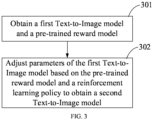
- FIG. 3 illustrates a flowchart of a method for training a Text-to-Image model according to embodiments of the present disclosure.
- the method for training a Text-to-Image model comprises: Step S301, obtaining a first Text-to-Image model and a pre-trained reward model, wherein the first Text-to-Image model is used to generate a corresponding image based on an input text, and the pre-trained reward model is used to score a data pair composed of the input text and the corresponding generated image.
- a reward model (RM) to score the generated images, and thus to generate a reward signal, which ranks or evaluates the generated images from a human perspective.
- a simple binary reward signal may be used, for example, using a "+" or "-" symbol to represent a reward or a penalty being given, that is, the score by the reward model is 0 or 1.
- the reward signal can be represented by an integer between 0 and 5, that is, the score by the reward model is an integer between 0 and 5, where 5 represents the highest reward, and 0 represents the lowest reward.
- the score by the reward model is an integer between 0 and 5, where 5 represents the highest reward, and 0 represents the lowest reward.
- evaluator 1 may score 5
- evaluator 2 may score 3 Therefore it is difficult for the model to distinguish whether the image is good or bad during learning.
- a relative ranking approach can be used to rank the quality of the results, for example, for the generated image A and the generated image B, evaluator 1 considers thatA> B, that is, evaluator 1 thinks that the generated image A is more consistent with the expectation than the generated image B, and evaluator 2 also considers that A > B, therefore the model can better distinguish the relatively high-quality image and inferior image among a plurality of generated images based on the relative ranking mode.
- the evaluation order of the reward model conforms to the general cognition of human beings.
- Step S302 adjusting the parameters of the first Text-to-Image model based on the pre-trained reward model and a reinforcement learning policy to obtain a second Text-to-Image model, wherein an accumulated reward obtained by the second Text-to-Image model in a generation sequence for implementing Text-to-Image satisfies a preset condition, and the accumulated reward is obtained based on a reward of each stage of the generation sequence.
- the reinforcement learning policy is the product of machine learning behaviorism, and the basic idea thereof is that an intelligent body obtains intelligence through a continuous interaction with the environment.
- the reinforcement learning policy is performed based on the environment (State), the subject (Actor), the behavior (Action), and the reward (Reward), where the environment is the current state, the subject is the object that interacts with the environment and performs the action, the behavior is the action performed by the subject, and the reward is the feedback given with respect to the specific behavior of the subject.
- the subject (Actor) is the Text-to-Image model of the current stage
- the environment (State) may be the input text and the generated image corresponding to the Text-to-Image model
- the behavior (Action) is the output noise corresponding to the Text-to-Image model
- the reward (Reward) may be designed as required, for example, if the product user feedback is more concerned, a reward based on the user feedback may be designed.
- the step of denoising the Text-to-Image model to generate an image is used as the reinforcement learning trajectory, and the reward signal is used to control the whole generation process, so that the model is optimized in the direction of a high accumulated reward.
- Errors that occur during the sequential execution of the model can be effectively reduced by using a first Text-to-Image model as the basis of the training, thereby improving the quality of the generated result.
- the initial model (the first Text-to-Image model) can better understand each input and the corresponding output, and perform a corresponding operation on the input.
- fine-tuning training may also be performed on the first Text-to-Image model by using a relatively high-quality data pair, thereby improving the overall performance of the model.
- the relatively high-quality data pair may be an additional Image-Text pair, for example, a manually labeled Image-Text pair.
- the preset conditions include one condition that the accumulated reward obtained by the second Text-to-Image model in the generation sequence for implementing the Text-to-Image is higher than the accumulated reward obtained by the first Text-to-Image model in the generation sequence for implementing the Text-to-Image.
- Text-to-Image model generally generates a final result after many times of environment (State)-behavior (Action), that is, there may be a plurality of input text and generated images.
- each behavior (Action) has a reward (Reward), that is, each output noise is scored, the sum of all the rewards, that is, the accumulated reward, is finally actually reflected to the result.
- the environment (State) in the reinforcement learning policy may have countless situations, and there may also be many feasible solutions under one environment (State).
- FIG. 4 illustrates a schematic diagram of a reinforcement learning policy in a method for training a Text-to-Image model according to embodiments of the present disclosure.
- the reinforcement learning policy includes a proximal policy optimization (PPO) algorithm.
- PPO proximal policy optimization
- the proximal policy optimization algorithm is an improved algorithm of policy gradients.
- the policy weight is updated based on a target function gradient and a step length, therefore, the updating process may have two common problems, that is, Overshooting and Undershooting, wherein Overshooting means that the updating misses the reward peak value and falls into a suboptimal policy region, and Undershooting means that taking an excessively small updating step length in the gradient direction causes slow convergence.
- the proximal policy optimization PPO algorithm solves this problem by setting a target divergence, and it is expected that each update is located in a certain interval around the target divergence. Wherein, the target divergence should be large enough to significantly change the policy, but also should be small enough to keep the update stable. After each update, the proximal policy optimization PPO algorithm checks the size of the update. If the final updated divergence exceeds 1.5 times the target divergence, the loss factor ⁇ is doubled in the next iteration to increase the punishment. On the contrary, if the update is too small, the loss factor ⁇ is halved to effectively expand the trust region.
- the proximal policy optimization PPO algorithm uses the behavior sub-model 403 and the evaluation sub-model 404, the behavior sub-model 403 is obtained based on the initialization of the first Text-to-Image model 401, and the evaluation sub-model 404 is obtained based on the initialization of the pre-trained reward model 402.
- the selection of the initial point can determine whether the algorithm converges to a certain extent, and when it converges, the initial point can determine how fast the learning converges and whether it can converge to a high-cost point or a low-cost point.
- An initialization which is too large may result in gradient explosion, and an initialization which is too small may result in gradient disappearance. Therefore, the policy may be trained using offline data (i.e., the data collected by a human presenter, a script policy, or other reinforcement learning intelligent agent) and be used to initialize a new reinforcement learning policy. This process makes the new reinforcement learning policy looks like it is pre-trained.
- the policy is used to initialize the subject (i.e., the behavior sub-model, Actor) - evaluation (i.e., the evaluation sub-model, Critic) network for fine tuning, where the pre-trained first Text-to-Image model 401 is used as the initial subject (Actor), and the pre-trained reward model 402 is used as the initial evaluation (Critic). Random exploration of the state space is avoided by using a prior information. The prior information helps the intelligent agent to understand which states of the environment are good and should be further explored. Meanwhile, the first Text-to-Image model 401 and the reward model 402 are simultaneously fine-tuned to enable the fine-tuned second Text-to-Image model 405 to consider the factor of the reward model in order to avoid detail problems.
- the subject i.e., the behavior sub-model, Actor
- Critic the evaluation sub-model
- the generation sequence comprises at least one stage, wherein, for each stage of the generation sequence, the behavior sub-model 403 generates the corresponding output noisy image based on the input text provided, and the evaluation sub-model 404 outputs the reward of the current stage based on the input text and the output noisy image of the current stage.
- two images Y1 and Y2 are generated based on the same input text X, where one is from the first Text-to-Image model, and the other one is from the Text-to-Image model of the current iteration through the reinforcement learning policy.
- the generated images of the two models above are compared to calculate a differential reward, which can also be considered as a penalty item since it can be positive or negative.
- This item is used to reward or punish the degree to which the generation of the reinforcement learning policy in each training batch deviates from the initial model (i.e., the first Text-to-Image model) to ensure that the model outputs a reasonable generated image. Removing this penalty item may cause the model to generate a gibberish patchwork image in the optimization to fool the reward model in order to provide a high reward value.
- the reward is a function that generates a scalar that represents the "goodness" of the agent that is in a particular state and takes a particular action.
- the reward of the current stage includes the relative entropy between the output of the behavior sub-model 403 in the previous stage prior to the current stage and the output of the behavior sub-model 403 in the current stage.
- the reward of the noisy image has only the latter item Kullback-Leible (KL) divergence with a loss (i.e., the KL divergence), and the KL divergence can be used to measure the degree of difference between two distributions. The smaller the difference, the smaller the KL divergence. When the two distributions are consistent, the KL divergence is 0.
- KL Kullback-Leible
- the reward model and the pre-trained model can be simultaneously fine-tuned to enable the generation model to consider the factor of the reward model in order to avoid detail problems.
- the reward of the current stage may also include the difference between the evaluation value of the previous stage prior to the current stage and the evaluation value of the current stage, wherein the evaluation value is scored by the pre-trained reward model 402 based on the provided input text and the corresponding output noisy image.
- the score of itself by the reward model can also be used as a reward; and the reward of each step in the sequence can be set as the score by the reward model.
- the reward model may also be directly replaced by a manually identified reward score. It can be understood that the reward model may be designed as required, for example, when the product user's feedback is more concerned, a reward based on the user feedback may be designed.
- the accumulated reward obtained in the generation sequence comprises a total score and a loss item, wherein the total score is obtained by the pre-trained reward model based on the initial input and the final output of the generation sequence, and the loss item is the product of the reward of the last stage of the generation sequence and the loss coefficient.
- ⁇ is the generation model parameter
- score is the score of the input text (initial input) and the generated image (final output) by the reward model
- a t , s t are the behavior (Action) and the environment (State) at moment t, that is, the output noise, the input text, and the output noisy image of the corresponding Text-to-Image model
- ⁇ SFT is the pre-trained first Text-to-Image model parameter
- ⁇ ⁇ ' is the Text-to-Image model parameter of the current iteration in the reinforcement learning policy
- ⁇ is the loss coefficient.
- This formula is preceded by a positive value, and the purpose of score is to make the total score accumulated larger and better in meeting the expectation; and the second item is a penalty item that enables the trained model not to deviate from the previously adjusted model, and otherwise, some results that do not meet the expectation may be output.
- the parameters of the second Text-to-Image model 405 are obtained by a back-propagation algorithm based on the accumulated reward in the generation sequence of the second Text-to-Image model 405.
- BP back-propagation
- the method can calculate the gradient of the loss function to each parameter in a neural network, and update the parameters through cooperation with an optimization method, and reduce the loss function.
- the reward function may be considered as a positive loss function, and the whole generation process is controlled by the reward signal, so that the model is optimized in the direction of a high accumulated reward.
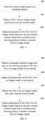
- FIG. 5 illustrates a flowchart of a method for training a Text-to-Image model according to embodiments of the present disclosure.
- the method for training a Text-to-Image model comprises:
- Step S501 obtaining a first Text-to-Image model and a pre-trained reward model, wherein the first Text-to-Image model is used to generate a corresponding image based on input text, and the pre-trained reward model is used to score a data pair composed of the input text and the corresponding generated image.
- Step S502 adjusting the parameters of the first Text-to-Image model based on the pre-trained reward model and a reinforcement learning policy to obtain a second Text-to-Image model, wherein the accumulated reward obtained by the second Text-to-Image model in a generation sequence for implementing the Text-to-Image satisfies a preset condition, and the accumulated reward is obtained based on the reward of each stage of the generation sequence.
- step S503 configured to train the reward model based on a feedback dataset.
- the pre-trained reward model is obtained by training based on feedback dataset, wherein the feedback dataset comprises a plurality of feedback data, and the plurality of feedback data comprise a data pair composed of the input text and the corresponding generated image, and a feedback state corresponding to the data pair, and wherein the feedback state is used to represent that the corresponding generated image which is generated relative to the same input text belongs to a positive feedback or a negative feedback. That is, the feedback data in the feedback dataset is actually a "input-output-evaluation" triple, wherein the feedback state is usually given based on human feedback.
- training the reward model comprises: training the reward model in a comparative learning manner based on a plurality of feedback data, such that the reward model outputs a first reward score for the data pair having a feedback state of positive feedback, and outputs a second reward score for the data pair having a feedback state of negative feedback, wherein the difference between the first reward score and the second reward score is used to represent the quality difference of the corresponding generated images.
- ⁇ is the reward model parameter
- x is the input text
- y w , y l are respectively an image with higher quality and an image with lower quality
- D RM is the dataset used by the reward model
- r is the reward model
- the output of the reward model is a scalar, which means the reward score of the input text and the output image by the model.
- the difference may be pulled to be between 0 and 1 by a sigmoid function ⁇ for every two differences.
- step 503 may be performed multiple times to achieve a better optimization effect of the reward model.
- the feedback dataset includes a plurality of feedback data from at least two different sources.
- the feedback dataset may include feedback data from a plurality of different sources. More data sources are introduced, and data is collected from multiple perspectives, such as user feedback and manual labeling.
- the optimized Text-to-Image model can add consideration of alignment factors such as a multi-entity combination and a painting style on the basis of quantity, attribute and background of interest.
- the plurality of feedback data include at least two of the data fed back by a user, manually labeled data, and manually compared data, wherein the data fed back by the user includes the feedback state based on the user behavior; the manually labeled data includes the feedback state based on the result of manual labeling; and the manually compared data includes the feedback state based on different versions of the generated images.
- D RM is the dataset used by the reward model that includes three parts: the user feedback, the manual label, and the manual comparison.
- the user feedback is generally related to the form of a product, for example, the data which the user may have interest in and like, or the behaviors of the user, such as splitting, or zooming, or commenting, and by determining these behaviors of the user, the drawing style may be taken into consideration;
- manual label generally involves professional annotators who help to label high quality images and inferior images, to distinguish good ones from bad ones;
- manual comparison is that different versions of the Text-to-Image model compare the data pair composed of the same input text and the generated image, so that improvements on the entity combination can be generated.
- FIG. 6 illustrates a flowchart of a method for training a Text-to-Image model according to embodiments of the present disclosure.
- the method for training a Text-to-Image model comprises:
- Step S601 obtaining a first Text-to-Image model and a pre-trained reward model, wherein the first Text-to-Image model is used to generate a corresponding image based on input text, and the pre-trained reward model is used to score a data pair composed of the input text and the corresponding generated image.
- Step S602 adjusting the parameters of the first Text-to-Image model based on the pre-trained reward model and a reinforcement learning policy to obtain a second Text-to-Image model, wherein the accumulated reward obtained by the second Text-to-Image model in a generation sequence for implementing the Text-to-Image satisfies a preset condition, and the accumulated reward is obtained based on the reward of each stage of the generation sequence.
- step S603 Prior to step S601, there is further included step S603, obtaining a manually labeled image-text pair as the training sample of the first Text-to-Image model to be trained; and step S604, updating the parameters of the first Text-to-Image model to be trained based on a back propagation algorithm to obtain the first Text-to-Image model that has gone through supervised training.
- the first Text-to-Image model can be obtained by means of pre-trained Text-to-Image model fine-tuning (Supervised Fine-Tuning, SFT), and when fine-tuning using the pre-trained Text-to-Image model using SFT, a standard supervised learning manner can be used, that is, manually labeled (input and output) text pairs are used as training samples, and a back propagation algorithm is used to update the parameters of the model. By this way, the model can better understand each input and the corresponding output, and perform the corresponding operation on the input.
- the pre-trained Text-to-Image model fine-tuning SFT may also effectively reduce errors that occur when the model is executed in sequence, thereby improving the quality of the generated result.
- the present disclosure further provides a Text-to-Image model, and the Text-to-Image model is obtained by training via the method for training the Text-to-Image model provided in the foregoing embodiment.
- FIG. 7 is a structural block diagram of an apparatus 700 for training a Text-to-Image model according to embodiments of the present disclosure.
- the apparatus 700 for training a Text-to-Image model comprises: An obtaining module 701, the obtaining module 701 is configured to obtain a first Text-to-Image model and a pre-trained reward model, wherein the first Text-to-Image model generates a corresponding image based on input text, and the pre-trained reward model scores a data pair composed of the input text and the corresponding generated image.
- a reward model (RM) to score the generated images to generate a reward signal, which ranks or evaluates the generated images from a human perspective.
- the discrimination sequence of the reward model is consistent with the general cognition of a human being.
- An adjusting module 702 the adjusting module 702 is configured to adjust the parameters of the first Text-to-Image model based on the pre-trained reward model and a reinforcement learning policy to obtain a second Text-to-Image model, wherein the accumulated reward obtained by the second Text-to-Image model in a generation sequence for implementing the Text-to-Image satisfies a preset condition, and the accumulated reward is obtained based on the sum of each reward of the generation sequence.
- the step of denoising the Text-to-Image model to generate an image is used as a reinforcement learning trajectory, and the reward signal is used to control the whole generation process, so that the model is optimized in the direction of a high accumulated reward.
- a fine-tuning training may also be performed on the first Text-to-Image model by using relatively high-quality data pair, thereby improving the overall performance of the model.
- the relatively high-quality data pair may be an additional image-text pair, for example, a manually labeled image-text pair.
- the preset conditions include one condition that the accumulated reward obtained by the second Text-to-Image model in the generation sequence for implementing the Text-to-Image is higher than the accumulated reward obtained by the first Text-to-Image model in the generation sequence for implementing the Text-to-Image.
- Text-to-Image model generally generates a final result after many times of environment (State)-behavior (Action), that is, there may be a plurality of input text and generated images, although each behavior (Action) has a reward (Reward), that is, each output noise is scored, and the sum of all the rewards is finally actually reflected to the result, that is, the accumulated reward.
- the environment (State) in the reinforcement learning policy may have countless situations, and there may also be many feasible solutions under one environment (State).
- the reinforcement learning policy includes a proximal policy optimization (PPO) algorithm.
- PPO proximal policy optimization
- the proximal policy optimization algorithm is an improved algorithm of policy gradients.
- the policy weight is updated based on a target function gradient and a step length, therefore, the updating process may have two common problems, that is, Overshooting and Undershooting, wherein Overshooting means that the updating misses the reward peak value and falls into a suboptimal policy region, and Undershooting means that taking an excessively small updating step length in the gradient direction causes slow convergence.
- the proximal policy optimization PPO algorithm solves this problem by setting a target divergence, and it is expected that each update is located in a certain interval around the target divergence. Wherein, the target divergence should be large enough to significantly change the policy, but also should be small enough to keep the update stable. After each update, the proximal policy optimization PPO algorithm checks the size of the update. If the final updated divergence exceeds 1.5 times the target divergence, the loss factor ⁇ is doubled in the next iteration to increase the punishment. On the contrary, if the update is too small, the loss factor ⁇ is halved to effectively expand the trust region.
- the proximal policy optimization PPO algorithm uses a behavior sub-model and an evaluation sub-model.
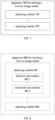
- FIG. 8 illustrates a structural block diagram of the apparatus 800 for training a Text-to-Image model according to embodiments of the present disclosure.
- the adjusting module 801 comprises:
- a behavior sub-module 8011 which is configured to initialize the behavior sub-model based on the first Text-to-Image model.
- an evaluation sub-module 8012 which is configured to initialize the evaluation sub-model based on the pre-trained reward model.
- the selection of the initial point can determine whether the algorithm converges to a certain extent, and when it converges, the initial point can determine how fast the learning converges and whether it can converge to a high-cost point or a low-cost point.
- An initialization which is too large may result in gradient explosion, and an initialization which is too small may result in gradient disappearance. Therefore, the policy may be trained using offline data (i.e., the data collected by a human presenter, a script policy, or other reinforcement learning intelligent agent) and be used to initialize a new reinforcement learning policy. This process makes the new reinforcement learning policy looks like it is pre-trained.
- the policy is used to initialize the subject (i.e., the behavior sub-model, Actor) - evaluation (i.e., the evaluation sub-model, Critic) network for fine tuning, where the pre-trained first Text-to-Image model is used as the initial subject (Actor), and the pre-trained reward model is used as the initial evaluation (Critic). Random exploration of the state space is avoided by using a prior information. The prior information helps the intelligent agent to understand which states of the environment are good and should be further explored. Meanwhile, the first Text-to-Image model and the reward model are simultaneously fine-tuned to enable the fine-tuned Text-to-Image model to consider the factor of the reward model in order to avoid detail problems.
- the subject i.e., the behavior sub-model, Actor
- Critic evaluation sub-model
- the adjusting module 802 is the same as the adjusting module in the foregoing embodiments and is not described herein.
- the generation sequence comprises at least one stage, wherein, for each stage of the generation sequence:
- the behavioral sub-module 8011 is further configured to generate a corresponding output noise image based on the input text being provided.
- the evaluation sub-module 8012 is further configured to output the reward of the current stage based on the input text and the output noise image of the current stage.
- two images Y1 and Y2 are generated based on the same input text X, where one is from the first Text-to-Image model, and the other one is from the Text-to-Image model of the current iteration through the reinforcement learning policy.
- the generated images of the two models above are compared to calculate a differential reward, which can also be considered as a penalty item since it can be positive or negative.
- This item is used to reward or punish the degree to which the generation of the reinforcement learning policy in each training batch deviates from the initial model (i.e., the first Text-to-Image model) to ensure that the model outputs a reasonable generated image. Removing this penalty item may cause the model to generate a gibberish patchwork image in the optimization to fool the reward model in order to provide a high reward value.
- the reward is a function that generates a scalar that represents the "goodness" of the agent that is in a particular state and takes a particular action.
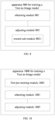
- FIG. 9 illustrates a structural block diagram of the apparatus 900 for training a Text-to-Image model according to embodiments of the present disclosure.
- the adjusting module 902 further comprises:
- the reward sub-module 9021 which is configured to generate an accumulated reward obtained in a generation sequence comprises a total score and a loss item, wherein the total score is obtained by a pre-trained reward model based on the initial input and the final output of the generation sequence, and the loss item is the product of the reward and the loss coefficient of the last stage of the generation sequence.
- ⁇ is the generation model parameter
- score is the score of the input text (initial input) and the generated image (final output) by the reward model
- a t ,s t are the behavior (Action) and the environment (State) at moment t, respectively, that is, the output noise, the input text, and the output noisy image of the corresponding Text-to-Image model
- ⁇ SFT is the pre-trained first Text-to-Image model parameter
- ⁇ ⁇ ' is the Text-to-Image model parameter of the current iteration in the reinforcement learning policy
- ⁇ is the loss coefficient.
- This formula is preceded by a positive value, and the purpose of score is to make the total score accumulated larger and better in meeting the expectation; and the second item is a penalty item that enables the trained model not to deviate from the previously adjusted model, and otherwise, some results that do not meet the expectation may be made.
- the obtaining module 901 is the same as the obtaining module in the foregoing embodiment, and details are not described herein.
- FIG. 10 illustrates a structural block diagram of the apparatus 1000 for training a Text-to-Image model according to some embodiments of the present disclosure.
- the apparatus 1000 for training the Text-to-Image model further comprises:
- the first pre-training module 1003 which is configured to train a reward model based on feedback dataset to obtain a pre-trained reward model, wherein the feedback dataset comprises a plurality of feedback data, and the plurality of feedback data comprise a data pair composed of the input text and the corresponding generated image and a feedback state corresponding to the data pair, wherein the feedback state is used to represent that the corresponding generated image which is generated relative to the same input text belongs to a forward feedback or a negative feedback.
- the pre-trained reward model is obtained by training based on feedback dataset, wherein the feedback dataset comprises a plurality of feedback data, and the plurality of feedback data comprise a data pair composed of the input text and the corresponding generated image, and a feedback state corresponding to the data pair, where the feedback state is used to represent that the corresponding generated image which is generated relative to the same input text belongs to a positive feedback or a negative feedback. That is, the feedback data in the feedback dataset is actually a "input-output-evaluation" triple, wherein the feedback state is usually given based on human feedback.
- ⁇ is the reward model parameter
- x is the input text
- y w , y l are respectively an image with higher quality and an image with lower quality
- D RM is the dataset used by the reward model
- r is the reward model
- the output of the reward model is a scalar, which means the reward score of the input text and the output image by the model.
- the difference may be pulled to be between 0 and 1 by a sigmoid function ⁇ for every two differences.
- the obtaining module 1001 and the adjusting module 1002 are the same as the obtaining module and the adjusting module in the foregoing embodiment, and are not described herein again.
- FIG. 11 illustrates a structural block diagram of the apparatus 1100 for training a Text-to-Image model according to some embodiments of the present disclosure. As shown in FIG. 11 , the apparatus 1100 for training the Text-to-Image model further comprises:
- the second pre-training module 1104, and the second pre-training module 1104 is configured to train the first Text-to-Image model to be trained based on a manually labeled image-text pair to obtain the first Text-to-Image model that has gone through supervised training.
- the first Text-to-Image model can be obtained by means of pre-trained Text-to-Image model fine-tuning (Supervised Fine-Tuning, SFT), and when fine tuning using the pre-trained Text-to-Image model fine-tuning SFT, a standard supervised learning method can be used, that is, manually labeled (input and output) text pairs are used as training samples, and a back propagation algorithm is used to update the parameters of the model. By this way, the model can better understand each input and the corresponding output, and perform the corresponding operation on the input.
- the pre-trained Text-to-Image model fine-tuning SFT may also effectively reduce errors that occur when the model is executed in sequence, thereby improving the quality of the generated result.
- the obtaining module 1101 and the adjusting module 1102 are the same as the obtaining module and the adjusting module in the foregoing embodiments, and details are not described herein.
- an electronic device a computer-readable storage medium, and a computer program product.
- FIG. 12 a structural block diagram of an electronic device 1200 that may be a server or client of the present disclosure is now described, which is an example of a hardware device that may be applied to aspects of the present disclosure.
- Electronic devices are intended to represent various forms of digital electronic computer devices, such as laptop computers, desktop computers, workstations, personal digital assistants, servers, blade servers, mainframe computers, and other suitable computers.
- the electronic devices may also represent various forms of mobile devices, such as personal digital processing, cellular telephones, smart phones, wearable devices, and other similar computing devices.
- the components shown herein, their connections and relationships, and their functions are merely as examples, and are not intended to limit the implementations of the disclosure described and/or claimed herein.
- the electronic device 1200 includes a computing unit 1201, which may perform various appropriate actions and processing according to a computer program stored in a read-only memory (ROM) 1202 or a computer program loaded into a random access memory (RAM) 1203 from a storage unit 1208.
- ROM read-only memory
- RAM random access memory
- various programs and data required by the operation of the electronic device 1200 may also be stored.
- the computing unit 1201, the ROM 1202, and the RAM 1203 are connected to each other through a bus 1204.
- Input/output (I/O) interface 1205 is also connected to the bus 1204.
- a plurality of components in the electronic device 1200 are connected to a I/O interface 1205, including: an input unit 1206, an output unit 1207, a storage unit 1208, and a communication unit 1209.
- the input unit 1206 may be any type of device capable of inputting information to the electronic device 1200, the input unit 1206 may receive input digital or character information and generate a key signal input related to user setting and/or function control of the electronic device, and may include, but is not limited to, a mouse, a keyboard, a touch screen, a track pad, a trackball, a joystick, a microphone, and/or a remote control.
- the output unit 1207 may be any type of device capable of presenting information, and may include, but are not limited to, a display, a speaker, a video/audio output terminal, a vibrator, and/or a printer.
- the storage unit 1208 may include, but is not limited to, a magnetic disk and an optical disk.
- the communication unit 1209 allows the electronic device 1200 to exchange information/data with other devices over a computer network, such as the Internet, and/or various telecommunication networks, and may include, but is not limited to, a modem, a network card, an infrared communication device, a wireless communication transceiver and/or a chipset, such as a Bluetooth device, a 802.11 device, a WiFi device, a WiMAX device, a cellular communication device, and/or the like.
- the computing unit 1201 may be a variety of general and/or special purpose processing components with processing and computing capabilities. Some examples of the computing unit 1201 include, but are not limited to, a central processing unit (CPU), a graphics processing unit (GPU), various dedicated artificial intelligence (Al) computing chips, various computing units running machine learning model algorithms, a digital signal processor (DSP), and any suitable processor, controller, microcontroller, etc.
- the computing unit 1201 performs the various methods and processes described above, such as the method for training a Text-to-Image model provided in the foregoing embodiments.
- the method for training a Text-to-Image model provided in the foregoing embodiments may be implemented as a computer software program tangibly contained in a machine-readable medium, such as the storage unit 1208.
- part or all of the computer program may be loaded and/or installed onto the electronic device 1200 via the ROM 1202 and/or the communication unit 1209.
- the computing unit 1201 may be configured to perform the method for training a Text-to-Image model provided in the foregoing embodiments by any other suitable means (e.g., with the aid of firmware).
- Various embodiments of the systems and techniques described above herein may be implemented in a digital electronic circuit system, an integrated circuit system, a field programmable gate array (FPGA), an application specific integrated circuit (ASIC), a dedicated standard product (ASSP), a system of system on a chip system (SoC), a complex programmable logic device (CPLD), computer hardware, firmware, software, and/or combinations thereof.
- FPGA field programmable gate array
- ASIC application specific integrated circuit
- ASSP dedicated standard product
- SoC system of system on a chip system
- CPLD complex programmable logic device
- These various embodiments may include: implementation in one or more computer programs that may be executed and/or interpreted on a programmable system including at least one programmable processor, where the programmable processor may be a dedicated or universal programmable processor that may receive data and instructions from a storage system, at least one input device, and at least one output device, and transmit data and instructions to the storage system, the at least one input device, and the at least one output device.
- the programmable processor may be a dedicated or universal programmable processor that may receive data and instructions from a storage system, at least one input device, and at least one output device, and transmit data and instructions to the storage system, the at least one input device, and the at least one output device.
- the program code for implementing the method of the present disclosure may be written in any combination of one or more programming languages. These program code may be provided to a processor or controller of a general-purpose computer, a special purpose computer, or other programmable data processing device such that the program code, when executed by the processor or controller, causes the functions/operations specified in the flowchart and/or block diagram to be implemented.
- the program code may be executed entirely on the machine, partly on the machine, partly on the machine as a stand-alone software package and partly on the remote machine or entirely on the remote machine or server.
- a machine-readable medium may be a tangible medium, which may contain or store a program for use by or in connection with an instruction execution system, device, or device.
- the machine-readable medium may be a machine-readable signal medium or a machine-readable storage medium.
- the machine-readable medium may include, but is not limited to, electronic, magnetic, optical, electromagnetic, infrared, or semiconductor systems, apparatus, or devices, or any suitable combination of the foregoing.
- a machine-readable storage media may include an electrical connection based on one or more wires, a portable computer disk, a hard disk, a random access memory (RAM), a read-only memory (ROM), an erasable programmable read-only memory (EPROM or flash memory), an optical fiber, a portable compact disk read-only memory (CD-ROM), an optical storage device, a magnetic storage device, or any suitable combination of the foregoing.
- RAM random access memory
- ROM read-only memory
- EPROM or flash memory erasable programmable read-only memory
- CD-ROM portable compact disk read-only memory
- CD-ROM compact disk read-only memory
- magnetic storage device or any suitable combination of the foregoing.
- the systems and techniques described herein may be implemented on a computer having: a display device (e.g., a CRT (cathode ray tube) or an LCD (liquid crystal display) monitor) for displaying information to a user; and a keyboard and pointing device (e.g., a mouse or trackball) by which a user may provide input to the computer.
- a display device e.g., a CRT (cathode ray tube) or an LCD (liquid crystal display) monitor
- a keyboard and pointing device e.g., a mouse or trackball
- Other types of devices may also be used to provide interaction with a user; for example, the feedback provided to the user may be any form of perception feedback (e.g., visual feedback, auditory feedback, or tactile feedback); and the input from the user may be received in any form, including acoustic input, voice input, or haptic input.
- the systems and techniques described herein may be implemented in a computing system including a back-end component(e.g., as a data server), or a computing system including a middleware component (e.g., an application server), or a computing system including a front-end component (e.g., a user computer with a graphical user interface or a web browser, the user may interact with implementations of the systems and techniques described herein through the graphical user interface or the web browser), or in a computing system including any combination of such back-end components, middleware components, or front-end components.
- the components of the system may be interconnected by digital data communication (e.g., a communications network) in any form or medium. Examples of communication networks include a local area network (LAN), a wide area network (WAN), the Internet, and a blockchain network.
- LAN local area network
- WAN wide area network
- the Internet and a blockchain network.
- the computer system may include a client and a server.
- Clients and servers are generally remote from each other and typically interact through a communication network.
- the relationship between clients and servers is generated by computer programs running on respective computers and having a client-server relationship to each other.
- the server may be a cloud server, or may be a server of a distributed system, or a server incorporating a blockchain.
Landscapes
- Engineering & Computer Science (AREA)
- Theoretical Computer Science (AREA)
- Physics & Mathematics (AREA)
- General Physics & Mathematics (AREA)
- General Health & Medical Sciences (AREA)
- Health & Medical Sciences (AREA)
- Artificial Intelligence (AREA)
- General Engineering & Computer Science (AREA)
- Computational Linguistics (AREA)
- Computing Systems (AREA)
- Software Systems (AREA)
- Molecular Biology (AREA)
- Data Mining & Analysis (AREA)
- Biophysics (AREA)
- Biomedical Technology (AREA)
- Mathematical Physics (AREA)
- Evolutionary Computation (AREA)
- Life Sciences & Earth Sciences (AREA)
- Audiology, Speech & Language Pathology (AREA)
- Electrically Operated Instructional Devices (AREA)
- Image Analysis (AREA)
- Processing Or Creating Images (AREA)
- Information Retrieval, Db Structures And Fs Structures Therefor (AREA)
- Machine Translation (AREA)
Applications Claiming Priority (1)
| Application Number | Priority Date | Filing Date | Title |
|---|---|---|---|
| CN202310845680.6A CN116894880B (zh) | 2023-07-11 | 2023-07-11 | 一种文生图模型的训练方法、模型、装置及电子设备 |
Publications (2)
| Publication Number | Publication Date |
|---|---|
| EP4435674A2 true EP4435674A2 (de) | 2024-09-25 |
| EP4435674A3 EP4435674A3 (de) | 2025-01-08 |
Family
ID=88314407
Family Applications (1)
| Application Number | Title | Priority Date | Filing Date |
|---|---|---|---|
| EP24187863.6A Pending EP4435674A3 (de) | 2023-07-11 | 2024-07-10 | Verfahren und vorrichtung zum trainieren eines text-zu-bild-modells |
Country Status (5)
| Country | Link |
|---|---|
| US (1) | US20240362493A1 (de) |
| EP (1) | EP4435674A3 (de) |
| JP (1) | JP7803032B2 (de) |
| KR (1) | KR20240105330A (de) |
| CN (1) | CN116894880B (de) |
Cited By (1)
| Publication number | Priority date | Publication date | Assignee | Title |
|---|---|---|---|---|
| CN119379866A (zh) * | 2024-12-30 | 2025-01-28 | 浙江大学 | 一种基于扩散模型的文本增强图像生成方法 |
Families Citing this family (17)
| Publication number | Priority date | Publication date | Assignee | Title |
|---|---|---|---|---|
| CN117475032B (zh) * | 2023-10-24 | 2025-06-06 | 北京百度网讯科技有限公司 | 文生图模型、超网络的生成方法及装置 |
| CN117315094B (zh) * | 2023-11-02 | 2025-02-11 | 北京百度网讯科技有限公司 | 图片生成方法、修饰关系模型生成方法、装置和设备 |
| CN117668297A (zh) * | 2023-12-05 | 2024-03-08 | 浙江阿里巴巴机器人有限公司 | 视频生成方法、电子设备及计算机可读存储介质 |
| CN117493587B (zh) * | 2023-12-28 | 2024-04-09 | 苏州元脑智能科技有限公司 | 一种文章生成的方法、装置、设备及介质 |
| WO2025184777A1 (en) * | 2024-03-04 | 2025-09-12 | Beijing Youzhuju Network Technology Co., Ltd. | Method, device and product for managing a reward |
| US20250307307A1 (en) * | 2024-03-29 | 2025-10-02 | Adeia Imaging Llc | Search engine optimization for vector-based image search |
| CN118036757B (zh) * | 2024-04-15 | 2024-07-16 | 清华大学 | 大语言模型训练方法及装置 |
| CN119516419B (zh) * | 2024-05-27 | 2026-01-13 | 北京百度网讯科技有限公司 | 文生视频模型训练方法、基于文本生成视频的方法和装置 |
| CN118736038A (zh) * | 2024-06-14 | 2024-10-01 | 北京衔远有限公司 | 图像生成方法、装置、电子设备及可读存储介质 |
| CN118799449A (zh) * | 2024-06-14 | 2024-10-18 | 湖北泰跃卫星技术发展股份有限公司 | 在农业人工智能领域中文生图模型的控制参数微调方法 |
| CN119167940B (zh) * | 2024-08-01 | 2025-12-02 | 浙江大学 | 基于场景图的文生图大模型提示词优化方法、电子设备、介质 |
| CN118643621B (zh) * | 2024-08-16 | 2024-12-06 | 材料科学姑苏实验室 | 一种设备参数调整方法、装置、电子设备及存储介质 |
| CN119516016B (zh) * | 2024-10-25 | 2025-09-30 | 北京百度网讯科技有限公司 | 文生图大模型的训练和文生图方法、装置、设备和介质 |
| CN119441530B (zh) * | 2024-10-29 | 2025-10-28 | 清华大学 | 应用于定制化文生图模型的课程多奖励强化学习方法和装置 |
| CN119785140B (zh) * | 2024-12-11 | 2025-10-31 | 上海交通大学 | 基于中文语境文生图场景下人像生成质量分区优化系统 |
| CN119672696A (zh) * | 2025-02-18 | 2025-03-21 | 北京大学 | 一种基于用户偏好的文生视频扩散模型的训练方法及装置 |
| CN120449938B (zh) * | 2025-04-28 | 2026-02-03 | 北京思普艾斯科技有限公司 | 多模态大模型的知识蒸馏方法、系统、设备及存储介质 |
Family Cites Families (85)
| Publication number | Priority date | Publication date | Assignee | Title |
|---|---|---|---|---|
| US9626594B2 (en) * | 2015-01-21 | 2017-04-18 | Xerox Corporation | Method and system to perform text-to-image queries with wildcards |
| US12142027B1 (en) * | 2017-07-26 | 2024-11-12 | Vizit Labs, Inc. | Systems and methods for automatic image generation and arrangement using a machine learning architecture |
| US10332035B1 (en) * | 2018-08-29 | 2019-06-25 | Capital One Services, Llc | Systems and methods for accelerating model training in machine learning |
| US11488063B2 (en) * | 2019-03-05 | 2022-11-01 | Honeywell International Inc. | Systems and methods for cognitive services of a connected FMS or avionics SaaS platform |
| US11210477B2 (en) * | 2019-05-09 | 2021-12-28 | Adobe Inc. | Systems and methods for transferring stylistic expression in machine translation of sequence data |
| CN111985601A (zh) | 2019-05-21 | 2020-11-24 | 富士通株式会社 | 用于增量学习的数据识别方法 |
| CN110390108B (zh) * | 2019-07-29 | 2023-11-21 | 中国工商银行股份有限公司 | 基于深度强化学习的任务型交互方法和系统 |
| US11775817B2 (en) * | 2019-08-23 | 2023-10-03 | Adobe Inc. | Reinforcement learning-based techniques for training a natural media agent |
| US11645498B2 (en) * | 2019-09-25 | 2023-05-09 | International Business Machines Corporation | Semi-supervised reinforcement learning |
| US11526814B2 (en) * | 2020-02-12 | 2022-12-13 | Wipro Limited | System and method for building ensemble models using competitive reinforcement learning |
| US20200401891A1 (en) * | 2020-09-04 | 2020-12-24 | Intel Corporation | Methods and apparatus for hardware-aware machine learning model training |
| DE102020126554A1 (de) * | 2020-10-09 | 2022-04-14 | Carl Zeiss Microscopy Gmbh | Mikroskopiesystem und verfahren zum überprüfen von eingabedaten |
| CN114816395A (zh) * | 2021-01-28 | 2022-07-29 | 华为云计算技术有限公司 | 一种页面布局方法及装置 |
| CN113516250B (zh) * | 2021-07-13 | 2023-11-03 | 北京百度网讯科技有限公司 | 一种联邦学习方法、装置、设备以及存储介质 |
| US12067646B2 (en) | 2021-09-07 | 2024-08-20 | Google Llc | Cross-modal contrastive learning for text-to-image generation based on machine learning models |
| US20230106474A1 (en) * | 2021-09-24 | 2023-04-06 | Nutanix, Inc. | Data-driven evaluation of training action space for reinforcement learning |
| US20230117768A1 (en) * | 2021-10-15 | 2023-04-20 | Kiarash SHALOUDEGI | Methods and systems for updating optimization parameters of a parameterized optimization algorithm in federated learning |
| US20230153606A1 (en) * | 2021-11-12 | 2023-05-18 | Nec Laboratories America, Inc. | Compositional text-to-image synthesis with pretrained models |
| US20230222676A1 (en) * | 2022-01-07 | 2023-07-13 | International Business Machines Corporation | Image registration performance assurance |
| US12056036B2 (en) * | 2022-04-18 | 2024-08-06 | Capital One Services, Llc | Systems and methods for inactivity-based failure to complete task notifications |
| US20250200379A1 (en) * | 2022-06-07 | 2025-06-19 | Deepmind Technologies Limited | Hierarchical reinforcement learning at scale |
| US12499662B2 (en) * | 2022-07-13 | 2025-12-16 | Google Llc | Dynamic training of models |
| US20240169662A1 (en) * | 2022-11-23 | 2024-05-23 | Google Llc | Latent Pose Queries for Machine-Learned Image View Synthesis |
| US12494005B2 (en) * | 2022-12-19 | 2025-12-09 | Google Llc | Techniques for generating dynamic content |
| US12597236B2 (en) * | 2022-12-27 | 2026-04-07 | International Business Machines Corporation | Fine-tuning joint text-image encoders using reprogramming |
| CN116051668B (zh) * | 2022-12-30 | 2023-09-19 | 北京百度网讯科技有限公司 | 文生图扩散模型的训练方法和基于文本的图像生成方法 |
| GB2629890A (en) * | 2023-02-15 | 2024-11-13 | Deepmind Tech Ltd | Controlling agents using sub-goals generated by language model neural networks |
| US11995803B1 (en) * | 2023-02-28 | 2024-05-28 | Castle Global, Inc. | Training and deployment of image generation models |
| US20240330669A1 (en) * | 2023-03-01 | 2024-10-03 | Adobe Inc. | Reinforced learning approach to generate training data |
| US20240297957A1 (en) * | 2023-03-01 | 2024-09-05 | Snap Inc. | Aspect ratio conversion for automated image generation |
| US12405876B2 (en) * | 2023-03-08 | 2025-09-02 | International Business Machines Corporation | Proactively identifying errors in technical documentation code |
| US20240320873A1 (en) * | 2023-03-20 | 2024-09-26 | Adobe Inc. | Text-based image generation using an image-trained text |
| US12586259B2 (en) * | 2023-03-20 | 2026-03-24 | Adobe Inc. | Image generation using a text and image conditioned machine learning model |
| US20240320789A1 (en) * | 2023-03-20 | 2024-09-26 | Adobe Inc. | High-resolution image generation |
| US12561905B2 (en) * | 2023-03-21 | 2026-02-24 | Google Llc | Optimizing generative machine-learned models for subject-driven text-to-3D generation |
| US12298948B2 (en) * | 2023-04-14 | 2025-05-13 | Software Gmbh | Systems and/or methods for reinforced data cleaning and learning in machine learning inclusive computing environments |
| US12475621B2 (en) * | 2023-04-20 | 2025-11-18 | Snap Inc. | Product image generation based on diffusion model |
| CN116977459A (zh) * | 2023-05-25 | 2023-10-31 | 腾讯科技(深圳)有限公司 | 图片生成模型的确定方法及装置、图片生成方法及装置 |
| CN119378706A (zh) * | 2023-07-27 | 2025-01-28 | 戴尔产品有限公司 | 用于生成机器学习模型的方法、电子设备、程序产品 |
| US20250053784A1 (en) * | 2023-08-09 | 2025-02-13 | Robert Bosch Gmbh | System and method for generating unified goal representations for cross task generalization in robot navigation |
| US20250054210A1 (en) * | 2023-08-11 | 2025-02-13 | Ivan Babanin | Generation and management of personalized images using machine learning technologies |
| US20250095226A1 (en) * | 2023-09-15 | 2025-03-20 | Adobe Inc. | Image generation with adjustable complexity |
| US20250095256A1 (en) * | 2023-09-20 | 2025-03-20 | Adobe Inc. | In-context image generation using style images |
| US20250104399A1 (en) * | 2023-09-25 | 2025-03-27 | Adobe Inc. | Data attribution for diffusion models |
| US20250111139A1 (en) * | 2023-10-02 | 2025-04-03 | Adobe Inc. | Design document generation from text |
| US20250117967A1 (en) * | 2023-10-06 | 2025-04-10 | Adobe Inc. | Upside-down reinforcement learning for image generation models |
| US20250124256A1 (en) * | 2023-10-13 | 2025-04-17 | Google Llc | Efficient Knowledge Distillation Framework for Training Machine-Learned Models |
| US12411879B2 (en) * | 2023-10-24 | 2025-09-09 | Sri International | Instruction-guided visual embeddings and feedback-based learning in large vision-language models |
| US20250157106A1 (en) * | 2023-11-09 | 2025-05-15 | Meta Platforms, Inc. | Style tailoring latent diffusion models for human expression |
| US20250225780A1 (en) * | 2024-01-08 | 2025-07-10 | Snap Inc. | Neural network tuning using text encoder |
| CN120336450A (zh) * | 2024-01-12 | 2025-07-18 | 戴尔产品有限公司 | 用于训练问答系统的方法、设备、介质和程序产品 |
| GB2637328A (en) * | 2024-01-18 | 2025-07-23 | Sony Interactive Entertainment Inc | Method, computer program and apparatus for training an autonomous agent |
| US20250239059A1 (en) * | 2024-01-23 | 2025-07-24 | Adobe Inc. | Weakly-supervised referring expression segmentation |
| US20250390352A1 (en) * | 2024-02-08 | 2025-12-25 | Qomplx Llc | AI Serving Hardware and Software Frontier Enhancements |
| US20250259073A1 (en) * | 2024-02-14 | 2025-08-14 | Deepmind Technologies Limited | Reinforcement learning through preference feedback |
| US20250265472A1 (en) * | 2024-02-21 | 2025-08-21 | Nvidia Corporation | Diffusion-reward adversarial imitation learning |
| US20250278928A1 (en) * | 2024-02-29 | 2025-09-04 | Lemon Inc. | Filtering image-text data using a fine-tuned machine learning model |
| WO2025189013A1 (en) * | 2024-03-06 | 2025-09-12 | Google Llc | Training neural networks through reinforcement learning using multi-objective reward neural networks |
| US20250292098A1 (en) * | 2024-03-15 | 2025-09-18 | Google Llc | Posterior Preference Optimization |
| US12443980B1 (en) * | 2024-03-15 | 2025-10-14 | Amazon Technologies, Inc. | Text and image based prompt generation |
| US20250298815A1 (en) * | 2024-03-20 | 2025-09-25 | Adobe Inc. | Prompt personalization for generative models |
| US20250308083A1 (en) * | 2024-03-26 | 2025-10-02 | Adobe Inc. | Reference image structure match using diffusion models |
| US20250315428A1 (en) * | 2024-04-05 | 2025-10-09 | Google Llc | Machine-Learning Collaboration System |
| US20250322557A1 (en) * | 2024-04-11 | 2025-10-16 | Adobe Inc. | Style kits generation and customization |
| US20250322255A1 (en) * | 2024-04-15 | 2025-10-16 | Microsoft Technology Licensing, Llc | Training a Student Model based on Agent-Generated Examples and Direct Application of Preferences |
| US12340557B1 (en) * | 2024-11-14 | 2025-06-24 | Vizit Labs, Inc. | Systems and methods for contextual machine learning prompt generation |
| US12579705B2 (en) * | 2024-04-23 | 2026-03-17 | Google Llc | Generative model fine-tuning based on performance and quality |
| US20250342363A1 (en) * | 2024-05-02 | 2025-11-06 | Horizon Robotics Inc. | Method, apparatus and electronic device for training a reinforcement learning model |
| GB2640912A (en) * | 2024-05-09 | 2025-11-12 | Vodafone Group Services Ltd | Training generative artificial intelligence models |
| US20250348788A1 (en) * | 2024-05-10 | 2025-11-13 | Google Llc | Machine Learned Models For Generative User Interfaces |
| US20250348731A1 (en) * | 2024-05-10 | 2025-11-13 | Salesforce, Inc. | Systems and methods for function-calling agent models |
| US20250348753A1 (en) * | 2024-05-13 | 2025-11-13 | Gdm Holding Llc | Text-to-vision generation with prompt modification and scoring |
| US20250355958A1 (en) * | 2024-05-14 | 2025-11-20 | Google Llc | On-Demand Generative Response Simplification |
| US20250352907A1 (en) * | 2024-05-16 | 2025-11-20 | Qomplx Llc | System and method for ai-driven multi-modal content generation and immersive interaction experiences |
| US20250356223A1 (en) * | 2024-05-16 | 2025-11-20 | Google Llc | Machine-Learning Systems and Methods for Conversational Recommendations |
| US20250356204A1 (en) * | 2024-05-16 | 2025-11-20 | Ebay Inc. | Llm reward generation for ml risk prediction |
| US20250356256A1 (en) * | 2024-05-20 | 2025-11-20 | Google Llc | Error-Resistant Insight Summarization Using Generative AI |
| US20250363349A1 (en) * | 2024-05-22 | 2025-11-27 | Salesforce, Inc. | Systems and methods for multivariate time series forecasting |
| US20250363381A1 (en) * | 2024-05-22 | 2025-11-27 | Gdm Holding Llc | Multi-turn reinforcement learning for generative machine learning models |
| US20250363380A1 (en) * | 2024-05-22 | 2025-11-27 | Salesforce, Inc. | Systems and methods for reinforcement learning networks with iterative preference learning |
| US20250378682A1 (en) * | 2024-06-07 | 2025-12-11 | Robert Bosch Gmbh | Minimalist multi-modal approach to few-shot class-incremental learning |
| US20250378620A1 (en) * | 2024-06-11 | 2025-12-11 | Snap Inc. | Texture generation using prompts |
| US20250328568A1 (en) * | 2024-06-28 | 2025-10-23 | Google Llc | Content-Based Feedback Recommendation Systems and Methods |
| CN119271781A (zh) * | 2024-09-27 | 2025-01-07 | 北京百度网讯科技有限公司 | 信息处理方法、装置、电子设备和存储介质 |
| US20250299061A1 (en) * | 2025-06-05 | 2025-09-25 | Intel Corporation | Multi-modality reinforcement learning in logic-rich scene generation |
-
2023
- 2023-07-11 CN CN202310845680.6A patent/CN116894880B/zh active Active
-
2024
- 2024-06-18 JP JP2024097977A patent/JP7803032B2/ja active Active
- 2024-06-18 KR KR1020240078785A patent/KR20240105330A/ko active Pending
- 2024-07-10 EP EP24187863.6A patent/EP4435674A3/de active Pending
- 2024-07-11 US US18/770,122 patent/US20240362493A1/en active Pending
Cited By (1)
| Publication number | Priority date | Publication date | Assignee | Title |
|---|---|---|---|---|
| CN119379866A (zh) * | 2024-12-30 | 2025-01-28 | 浙江大学 | 一种基于扩散模型的文本增强图像生成方法 |
Also Published As
| Publication number | Publication date |
|---|---|
| EP4435674A3 (de) | 2025-01-08 |
| KR20240105330A (ko) | 2024-07-05 |
| CN116894880A (zh) | 2023-10-17 |
| US20240362493A1 (en) | 2024-10-31 |
| JP7803032B2 (ja) | 2026-01-21 |
| JP2024123108A (ja) | 2024-09-10 |
| CN116894880B (zh) | 2024-11-29 |
Similar Documents
| Publication | Publication Date | Title |
|---|---|---|
| EP4435674A2 (de) | Verfahren und vorrichtung zum trainieren eines text-zu-bild-modells | |
| JP7316453B2 (ja) | オブジェクト推薦方法及び装置、コンピュータ機器並びに媒体 | |
| CN116501960B (zh) | 内容检索方法、装置、设备及介质 | |
| US12585885B2 (en) | Dialogue model training method | |
| CN116541536A (zh) | 知识增强的内容生成系统、数据生成方法、设备和介质 | |
| CN113590782B (zh) | 推理模型的训练方法、推理方法及装置 | |
| CN113642740B (zh) | 模型训练方法及装置、电子设备和介质 | |
| EP4553759A2 (de) | Bildbearbeitungsverfahren, vorrichtung und speichermedium | |
| WO2023221422A1 (zh) | 用于文本识别的神经网络及其训练方法、文本识别的方法 | |
| WO2023231350A1 (zh) | 利用整数规划求解器实现的任务处理方法、设备和介质 | |
| CN114881170B (zh) | 用于对话任务的神经网络的训练方法和对话任务处理方法 | |
| US20250013676A1 (en) | Method for information processing based on large language model | |
| CN116306862A (zh) | 用于文本处理神经网络的训练方法、装置和介质 | |
| CN116450944A (zh) | 基于推荐模型的资源推荐方法、装置、电子设备和介质 | |
| CN118468821A (zh) | 文本生成模型的训练方法及文本生成方法 | |
| US20250061305A1 (en) | Training method for a deep learning model | |
| US20250004771A1 (en) | Generating instruction data | |
| CN117390445A (zh) | 大语言模型的训练方法、文本处理方法、装置和设备 | |
| CN115713071A (zh) | 用于处理文本的神经网络的训练方法和处理文本的方法 | |
| CN115982583A (zh) | 预训练语言模型的训练方法、装置、设备和介质 | |
| CN115564992A (zh) | 图像分类方法和图像分类模型的训练方法 | |
| CN115578451A (zh) | 图像处理方法、图像处理模型的训练方法和装置 | |
| US20240411979A1 (en) | Determining the similarity of text processing tasks | |
| US20260045252A1 (en) | Training for a multimodal speech language large model | |
| CN119719284B (zh) | 推荐问题生成模型的训练方法、推荐问题生成方法及装置 |
Legal Events
| Date | Code | Title | Description |
|---|---|---|---|
| PUAI | Public reference made under article 153(3) epc to a published international application that has entered the european phase |
Free format text: ORIGINAL CODE: 0009012 |
|
| STAA | Information on the status of an ep patent application or granted ep patent |
Free format text: STATUS: REQUEST FOR EXAMINATION WAS MADE |
|
| 17P | Request for examination filed |
Effective date: 20240710 |
|
| AK | Designated contracting states |
Kind code of ref document: A2 Designated state(s): AL AT BE BG CH CY CZ DE DK EE ES FI FR GB GR HR HU IE IS IT LI LT LU LV MC ME MK MT NL NO PL PT RO RS SE SI SK SM TR |
|
| PUAL | Search report despatched |
Free format text: ORIGINAL CODE: 0009013 |
|
| AK | Designated contracting states |
Kind code of ref document: A3 Designated state(s): AL AT BE BG CH CY CZ DE DK EE ES FI FR GB GR HR HU IE IS IT LI LT LU LV MC ME MK MT NL NO PL PT RO RS SE SI SK SM TR |
|
| RIC1 | Information provided on ipc code assigned before grant |
Ipc: G06N 3/09 20230101ALN20241203BHEP Ipc: G06N 3/084 20230101ALN20241203BHEP Ipc: G06F 40/279 20200101ALI20241203BHEP Ipc: G06N 3/006 20230101ALI20241203BHEP Ipc: G06N 3/092 20230101AFI20241203BHEP |