EP4435522A1 - Grüner fluoreszenztoner, entwickler für elektrostatische bilder, tonerkartusche, prozesskartusche, bilderzeugungsvorrichtung, bilderzeugungsverfahren und bedrucktes material - Google Patents
Grüner fluoreszenztoner, entwickler für elektrostatische bilder, tonerkartusche, prozesskartusche, bilderzeugungsvorrichtung, bilderzeugungsverfahren und bedrucktes material Download PDFInfo
- Publication number
- EP4435522A1 EP4435522A1 EP24158337.6A EP24158337A EP4435522A1 EP 4435522 A1 EP4435522 A1 EP 4435522A1 EP 24158337 A EP24158337 A EP 24158337A EP 4435522 A1 EP4435522 A1 EP 4435522A1
- Authority
- EP
- European Patent Office
- Prior art keywords
- pigment
- image
- toner
- green
- fluorescent
- Prior art date
- Legal status (The legal status is an assumption and is not a legal conclusion. Google has not performed a legal analysis and makes no representation as to the accuracy of the status listed.)
- Granted
Links
Images

Classifications
-
- G—PHYSICS
- G03—PHOTOGRAPHY; CINEMATOGRAPHY; ANALOGOUS TECHNIQUES USING WAVES OTHER THAN OPTICAL WAVES; ELECTROGRAPHY; HOLOGRAPHY
- G03G—ELECTROGRAPHY; ELECTROPHOTOGRAPHY; MAGNETOGRAPHY
- G03G9/00—Developers
- G03G9/08—Developers with toner particles
-
- G—PHYSICS
- G03—PHOTOGRAPHY; CINEMATOGRAPHY; ANALOGOUS TECHNIQUES USING WAVES OTHER THAN OPTICAL WAVES; ELECTROGRAPHY; HOLOGRAPHY
- G03G—ELECTROGRAPHY; ELECTROPHOTOGRAPHY; MAGNETOGRAPHY
- G03G9/00—Developers
- G03G9/08—Developers with toner particles
- G03G9/09—Colouring agents for toner particles
- G03G9/0926—Colouring agents for toner particles characterised by physical or chemical properties
-
- C—CHEMISTRY; METALLURGY
- C09—DYES; PAINTS; POLISHES; NATURAL RESINS; ADHESIVES; COMPOSITIONS NOT OTHERWISE PROVIDED FOR; APPLICATIONS OF MATERIALS NOT OTHERWISE PROVIDED FOR
- C09K—MATERIALS FOR MISCELLANEOUS APPLICATIONS, NOT PROVIDED FOR ELSEWHERE
- C09K11/00—Luminescent, e.g. electroluminescent, chemiluminescent materials
- C09K11/06—Luminescent, e.g. electroluminescent, chemiluminescent materials containing organic luminescent materials
-
- G—PHYSICS
- G03—PHOTOGRAPHY; CINEMATOGRAPHY; ANALOGOUS TECHNIQUES USING WAVES OTHER THAN OPTICAL WAVES; ELECTROGRAPHY; HOLOGRAPHY
- G03G—ELECTROGRAPHY; ELECTROPHOTOGRAPHY; MAGNETOGRAPHY
- G03G15/00—Apparatus for electrographic processes using a charge pattern
- G03G15/06—Apparatus for electrographic processes using a charge pattern for developing
- G03G15/08—Apparatus for electrographic processes using a charge pattern for developing using a solid developer, e.g. powder developer
-
- G—PHYSICS
- G03—PHOTOGRAPHY; CINEMATOGRAPHY; ANALOGOUS TECHNIQUES USING WAVES OTHER THAN OPTICAL WAVES; ELECTROGRAPHY; HOLOGRAPHY
- G03G—ELECTROGRAPHY; ELECTROPHOTOGRAPHY; MAGNETOGRAPHY
- G03G9/00—Developers
- G03G9/08—Developers with toner particles
- G03G9/087—Binders for toner particles
- G03G9/08742—Binders for toner particles comprising macromolecular compounds obtained otherwise than by reactions only involving carbon-to-carbon unsaturated bonds
- G03G9/08755—Polyesters
-
- G—PHYSICS
- G03—PHOTOGRAPHY; CINEMATOGRAPHY; ANALOGOUS TECHNIQUES USING WAVES OTHER THAN OPTICAL WAVES; ELECTROGRAPHY; HOLOGRAPHY
- G03G—ELECTROGRAPHY; ELECTROPHOTOGRAPHY; MAGNETOGRAPHY
- G03G9/00—Developers
- G03G9/08—Developers with toner particles
- G03G9/09—Colouring agents for toner particles
-
- G—PHYSICS
- G03—PHOTOGRAPHY; CINEMATOGRAPHY; ANALOGOUS TECHNIQUES USING WAVES OTHER THAN OPTICAL WAVES; ELECTROGRAPHY; HOLOGRAPHY
- G03G—ELECTROGRAPHY; ELECTROPHOTOGRAPHY; MAGNETOGRAPHY
- G03G9/00—Developers
- G03G9/08—Developers with toner particles
- G03G9/09—Colouring agents for toner particles
- G03G9/0906—Organic dyes
-
- G—PHYSICS
- G03—PHOTOGRAPHY; CINEMATOGRAPHY; ANALOGOUS TECHNIQUES USING WAVES OTHER THAN OPTICAL WAVES; ELECTROGRAPHY; HOLOGRAPHY
- G03G—ELECTROGRAPHY; ELECTROPHOTOGRAPHY; MAGNETOGRAPHY
- G03G9/00—Developers
- G03G9/08—Developers with toner particles
- G03G9/09—Colouring agents for toner particles
- G03G9/0906—Organic dyes
- G03G9/091—Azo dyes
-
- G—PHYSICS
- G03—PHOTOGRAPHY; CINEMATOGRAPHY; ANALOGOUS TECHNIQUES USING WAVES OTHER THAN OPTICAL WAVES; ELECTROGRAPHY; HOLOGRAPHY
- G03G—ELECTROGRAPHY; ELECTROPHOTOGRAPHY; MAGNETOGRAPHY
- G03G9/00—Developers
- G03G9/08—Developers with toner particles
- G03G9/09—Colouring agents for toner particles
- G03G9/0906—Organic dyes
- G03G9/0914—Acridine; Azine; Oxazine; Thiazine-;(Xanthene-) dyes
-
- G—PHYSICS
- G03—PHOTOGRAPHY; CINEMATOGRAPHY; ANALOGOUS TECHNIQUES USING WAVES OTHER THAN OPTICAL WAVES; ELECTROGRAPHY; HOLOGRAPHY
- G03G—ELECTROGRAPHY; ELECTROPHOTOGRAPHY; MAGNETOGRAPHY
- G03G9/00—Developers
- G03G9/08—Developers with toner particles
- G03G9/09—Colouring agents for toner particles
- G03G9/0906—Organic dyes
- G03G9/0918—Phthalocyanine dyes
-
- G—PHYSICS
- G03—PHOTOGRAPHY; CINEMATOGRAPHY; ANALOGOUS TECHNIQUES USING WAVES OTHER THAN OPTICAL WAVES; ELECTROGRAPHY; HOLOGRAPHY
- G03G—ELECTROGRAPHY; ELECTROPHOTOGRAPHY; MAGNETOGRAPHY
- G03G9/00—Developers
- G03G9/08—Developers with toner particles
- G03G9/09—Colouring agents for toner particles
- G03G9/0906—Organic dyes
- G03G9/092—Quinacridones
-
- G—PHYSICS
- G03—PHOTOGRAPHY; CINEMATOGRAPHY; ANALOGOUS TECHNIQUES USING WAVES OTHER THAN OPTICAL WAVES; ELECTROGRAPHY; HOLOGRAPHY
- G03G—ELECTROGRAPHY; ELECTROPHOTOGRAPHY; MAGNETOGRAPHY
- G03G9/00—Developers
- G03G9/08—Developers with toner particles
- G03G9/09—Colouring agents for toner particles
- G03G9/0928—Compounds capable to generate colouring agents by chemical reaction
-
- G—PHYSICS
- G03—PHOTOGRAPHY; CINEMATOGRAPHY; ANALOGOUS TECHNIQUES USING WAVES OTHER THAN OPTICAL WAVES; ELECTROGRAPHY; HOLOGRAPHY
- G03G—ELECTROGRAPHY; ELECTROPHOTOGRAPHY; MAGNETOGRAPHY
- G03G9/00—Developers
- G03G9/08—Developers with toner particles
- G03G9/10—Developers with toner particles characterised by carrier particles
- G03G9/107—Developers with toner particles characterised by carrier particles having magnetic components
-
- C—CHEMISTRY; METALLURGY
- C09—DYES; PAINTS; POLISHES; NATURAL RESINS; ADHESIVES; COMPOSITIONS NOT OTHERWISE PROVIDED FOR; APPLICATIONS OF MATERIALS NOT OTHERWISE PROVIDED FOR
- C09K—MATERIALS FOR MISCELLANEOUS APPLICATIONS, NOT PROVIDED FOR ELSEWHERE
- C09K2211/00—Chemical nature of organic luminescent or tenebrescent compounds
- C09K2211/10—Non-macromolecular compounds
Definitions
- the present disclosure relates to a fluorescent green toner, an electrostatic image developer, a toner cartridge, a process cartridge, an image forming apparatus, an image forming method, and a printed material
- Japanese Unexamined Patent Application Publication No. 2012-189989 discloses an electrostatic image developing green toner that includes at least a binder resin and a coloring agent, the coloring agent including C. I. Solvent Green 5 and a coloring agent compound X that is a phthalocyanine pigment, wherein the content of C. I. Solvent Green 5 is 5% by mass or more and 50% by mass or less of the total amount of the coloring agent.
- Japanese Unexamined Patent Application Publication No. 2021-127433 discloses resin particles that include a fluorescent coloring agent and a coloring pigment, wherein the resin particles and the fluorescent coloring agent have different hue angles, and the integral of the spectral reflectance (%) of the coloring pigment over wavelengths of A (nm) ⁇ 30 nm is 2,500 or more, where A represents a wavelength (nm) at which a fluorescent peak of the spectral reflectance of the fluorescent coloring agent occurs.
- a fluorescent green toner with which images excellent in terms of lightness and chroma may be formed, compared with a fluorescent green toner including toner particles including a fluorescent yellow dye Sy, a peak wavelength of a spectral reflectance of the fluorescent yellow dye Sy being at 500 nm or more and 550 nm or less, a yellow pigment Py, and at least one pigment Pgc selected from the group consisting of a green pigment and a cyan pigment, wherein CSy/(CPy + CPgc) is less than 0.01 or more than 0.3, or (CSy + CPy)/CPgc is less than 0.3 or more than 1.5, where CSy, CPy, and CPgc represent contents of the fluorescent yellow dye Sy, the yellow pigment Py, and the pigment Pgc in the toner particles, respectively.
- a fluorescent green toner including toner particles including a fluorescent yellow dye Sy, a peak wavelength of a spectral reflectance of the fluorescent yellow dye Sy being at 500 nm or more and 550 nm or less; a yellow pigment Py; and at least one pigment Pgc selected from the group consisting of a green pigment and a cyan pigment, wherein CSy/(CPy + CPgc) is 0.01 or more and 0.3 or less, and (CSy + CPy)/CPgc is 0.3 or more and 1.5 or less, where CSy, CPy, and CPgc represent contents of the fluorescent yellow dye Sy, the yellow pigment Py, and the pigment Pgc in the toner particles, respectively.
- the CSy/(CPy + CPgc) may be 0.05 or more and 0.2 or less, and the (CSy + CPy)/CPgc may be 0.45 or more and 1.0 or less.
- the content CSy of the fluorescent yellow dye Sy may be 0.1% by mass or more and 2.0% by mass or less
- the content CPy of the yellow pigment Py may be 1.5% by mass or more and 5.0% by mass or less
- the content CPgc of the pigment Pgc may be 3.0% by mass or more and 10.0% by mass or less.
- the content CSy of the fluorescent yellow dye Sy may be 0.1% by mass or more and 1.5% by mass or less
- the content CPy of the yellow pigment Py may be 3.0% by mass or more and 5.0% by mass or less
- the content CPgc of the pigment Pgc may be 5.0% by mass or more and 8.0% by mass or less.
- RSy represents a spectral reflectance of the fluorescent yellow dye Sy at a peak wavelength X
- RPy represents a spectral reflectance of the yellow pigment Py at the wavelength X
- RPgc represents a spectral reflectance of the pigment Pgc at the wavelength X.
- the pigment Pgc may be a green pigment
- the fluorescent yellow dye Sy may be C. I. Solvent Green 5 or C. I. Solvent Yellow 98
- the green pigment may be C. I. Pigment Green 36 or C. I. Pigment Green 7.
- an electrostatic image developer including the fluorescent green toner according to any one of the first to seventh aspects.
- a toner cartridge detachably attachable to an image forming apparatus, the toner cartridge including the fluorescent green toner according to any one of the first to seventh aspects.
- a process cartridge detachably attachable to an image forming apparatus including a developing unit that includes the electrostatic image developer according to the eighth aspect and develops an electrostatic image formed on a surface of an image holding member with the electrostatic image developer to form a toner image.
- an image forming apparatus including an image holding member; a charging unit that charges a surface of the image holding member; an electrostatic image formation unit that forms an electrostatic image on the charged surface of the image holding member; a developing unit that includes the electrostatic image developer according to the eighth aspect and develops the electrostatic image formed on the surface of the image holding member with the electrostatic image developer to form a toner image; a transfer unit that transfers the toner image formed on the surface of the image holding member onto a surface of a recording medium; and a fixing unit that fixes the toner image transferred on the surface of the recording medium.
- an image forming method including: charging a surface of an image holding member; forming an electrostatic image on the charged surface of the image holding member; developing the electrostatic image formed on the surface of the image holding member with the electrostatic image developer according to the eighth aspect to form a toner image; transferring the toner image formed on the surface of the image holding member onto a surface of a recording medium; and fixing the toner image transferred on the surface of the recording medium.
- an image forming apparatus including: first to sixth electrophotographic image forming units that each form a corresponding one of pink, yellow, magenta, cyan, black, and green images, wherein one of the first to sixth image forming units which forms a green image includes the electrostatic image developer according to the eighth aspect.
- an image forming method including first to sixth electrophotographic image formation steps each including forming a corresponding one of pink, yellow, magenta, cyan, black, and green images, wherein, in the image formation step including forming a green image, the electrostatic image developer according to the eighth aspect is used.
- a printed material including: a recording medium; and an image formed on a surface of the recording medium using the fluorescent green toner according to any one of the first to seventh aspects.
- a fluorescent green toner with which images excellent in terms of lightness and chroma may be formed, compared with a fluorescent green toner including toner particles including a fluorescent yellow dye Sy, a peak wavelength of a spectral reflectance of the fluorescent yellow dye Sy being at 500 nm or more and 550 nm or less, a yellow pigment Py, and at least one pigment Pgc selected from the group consisting of a green pigment and a cyan pigment, wherein CSy/(CPy + CPgc) is less than 0.01 or more than 0.3, or (CSy + CPy)/CPgc is less than 0.3 or more than 1.5, may be provided.
- a fluorescent green toner with which images excellent in terms of lightness and chroma may be formed, compared with a case where CSy/(CPy + CPgc) is less than 0.05 or more than 0.2, or (CSy + CPy)/CPgc is less than 0.45 or more than 1.0, may be provided.
- a fluorescent green toner with which images excellent in terms of lightness and chroma may be formed, compared with a case where the content CSy of the fluorescent yellow dye Sy is more than 1.5% by mass, the content CPy of the yellow pigment Py is less than 3.0% by mass or more than 5.0% by mass, or the content CPgc of the pigment Pgc is less than 5.0% by mass or more than 8.0% by mass, may be provided.
- a fluorescent green toner with which images excellent in terms of lightness and chroma may be formed, compared with a case where 0.65RSy > RPy, or 0.55RSy > RPgc, where RSy represents a spectral reflectance of the fluorescent yellow dye Sy at a peak wavelength X, RPy represents a spectral reflectance of the yellow pigment Py at the wavelength X, and RPgc represents a spectral reflectance of the pigment Pgc at the wavelength X, may be provided.
- a fluorescent green toner with which images excellent in terms of lightness and chroma may be formed, compared with a case where 0.8RPy ⁇ RPgc ⁇ 1.2RPy is not satisfied, may be provided.
- a fluorescent green toner with which images excellent in terms of lightness and chroma may be formed, compared with a case where the pigment Pgc is a cyan pigment, may be provided.
- a printed material that includes an image formed using a fluorescent green toner with which images excellent in terms of lightness and chroma may be formed, compared with a fluorescent green toner including toner particles including a fluorescent yellow dye Sy, a peak wavelength of a spectral reflectance of the fluorescent yellow dye Sy being at 500 nm or more and 550 nm or less, a yellow pigment Py, and at least one pigment Pgc selected from the group consisting of a green pigment and a cyan pigment, wherein CSy/(CPy + CPgc) is less than 0.01 or more than 0.3, or (CSy + CPy)/CPgc is less than 0.3 or more than 1.5, may be provided.
- a numerical range expressed using “to” means the range that includes the values described before and after “to” as the minimum and maximum values, respectively.
- the upper or lower limit of a numerical range may be replaced with the upper or lower limit of another numerical range, respectively.
- the upper or lower limit of a numerical range may also be replaced with a value described in Examples below.
- step refers not only to an individual step but also to a step that is not distinguishable from other steps but achieves the intended purpose of the step.
- the structure of the exemplary embodiment is not limited to the structure illustrated in the drawing.
- the sizes of the members illustrated in the attached drawing are conceptual and do not limit the relative relationship among the sizes of the members.
- Each of the components described in the present disclosure may include a plurality of types of substances that correspond to the component.
- the content of the component in the composition is the total content of the substances in the composition unless otherwise specified.
- Each of the components described in the present disclosure may include a plurality of types of particles that correspond to the component.
- the size of particles of the component is the size of particles of a mixture of the plurality of particles included in the composition unless otherwise specified.
- (meth) acryl refers to both “acryl” and “methacryl”
- (meth)acrylate refers to both “acrylate” and “methacrylate”.
- fluorescent green toner In the present disclosure, “fluorescent green toner”, “electrostatic image developer”, and “electrostatic image developing carrier” are also referred to as “green toner”, “developer”, and “carrier”, respectively.
- the fluorescent green toner according to this exemplary embodiment is a fluorescent green toner including toner particles including a fluorescent yellow dye Sy, a peak wavelength of a spectral reflectance of the fluorescent yellow dye Sy being at 500 nm or more and 550 nm or less, a yellow pigment Py, and at least one pigment Pgc selected from the group consisting of a green pigment and a cyan pigment, wherein CSy/(CPy + CPgc) is 0.01 or more and 0.3 or less, and (CSy + CPy)/CPgc is 0.3 or more and 1.5 or less, where CSy, CPy, and CPgc represent contents of the fluorescent yellow dye Sy, the yellow pigment Py, and the pigment Pgc in the toner particles, respectively.
- pigment Pgc selected from the group consisting of a green pigment and a cyan pigment
- the peak wavelength of the spectral reflectance of a dye or pigment is determined by the following method.
- Toner particles that include only the dye or pigment, which is to be analyzed, as a coloring agent are prepared.
- a toner that includes the toner particles is prepared.
- the following description may be referred for details of the components of the toner particles which are other than a coloring agent and the external additive that are used in the production of the sample toner and the method for producing the toner.
- the sample toner may be prepared using, for example, the toner production method described in Example 1, except that only the dye or pigment that is to be analyzed is used as a coloring agent.
- a modification of an image forming apparatus "Revoria Press PC1 120" produced by FUJIFILM Business Innovation Corp. is prepared.
- the sample toner is charged into a magenta developer.
- a blank image having an area coverage of 0% is formed on 100 OS coated paper sheets "OS Coat 127" produced by Oji Paper Co., Ltd. at a temperature of 22°C and a humidity of 55%RH.
- a solid image having an area coverage of 100% (toner deposition density: 4.0 g/m 2 ) is formed on an OS coated paper sheet using the sample toner.
- the spectral reflectance of the solid image in the visible region is measured using a reflection spectrodensitometer "X-Rite 939" (aperture diameter: 4 mm) produced by X-Rite, Inc. at 10 positions randomly selected from the image.
- the peak wavelength is determined on the basis of the spectral reflectance measured.
- the fluorescent green toner according to this exemplary embodiment includes toner particles including a fluorescent yellow dye Sy, a peak wavelength of a spectral reflectance of the fluorescent yellow dye Sy being at 500 nm or more and 550 nm or less, a yellow pigment Py, and at least one pigment Pgc selected from the group consisting of a green pigment and a cyan pigment.
- Such a toner is capable of producing a shade of yellow with high chroma and high lightness. Furthermore, using the shade of yellow with high chroma and high lightness and at least one pigment Pgc selected from the group consisting of a green pigment and a cyan pigment which have a peak wavelength close to the peak emission wavelength of the fluorescent yellow dye in combination with each other in specific amounts limits a reduction in lightness and makes it easy to achieve an intended color gamut excellent in terms of lightness and chroma.
- images excellent in terms of lightness and chroma may be formed using the fluorescent green toner according to this exemplary embodiment.
- fluorescent pigment and “fluorescent dye” refer to a pigment and a dye that emit light upon receiving light energy from the outside, respectively
- nonfluorescent pigment and “nonfluorescent dye” refer to a pigment and a dye that do not emit light upon receiving light energy from the outside, respectively.
- a fluorescent pigment and a fluorescent dye produce a shade by light reflection and light emission
- a nonfluorescent pigment and a nonfluorescent dye produce a shade only by light reflection.
- pigment refers to a nonfluorescent pigment.
- the toner particles include a fluorescent yellow dye Sy, a peak wavelength of a spectral reflectance of the fluorescent yellow dye Sy being at 500 nm or more and 550 nm or less, a yellow pigment Py, and at least one pigment Pgc selected from the group consisting of a green pigment and a cyan pigment.
- the toner particles include a binder resin and a release agent, in addition to the fluorescent yellow dye Sy, the yellow pigment Py, and the pigment Pgc.
- the toner particles may further include additives as needed.
- the fluorescent yellow dye Sy is not limited and may be any fluorescent yellow dye the spectral reflectance of which has a peak wavelength of 500 nm or more and 550 nm or less.
- the peak wavelength of the spectral reflectance of the fluorescent yellow dye Sy is preferably 510 nm or more and 530 nm or less in order to increase the likelihood of formation of images having high chroma and high lightness.
- fluorescent yellow dye Sy examples include C. I. Solvent Green 5, C. I. Solvent Yellow 98, and C. I. Solvent Yellow 160:1.
- C. I. Solvent Green 5 and C. I. Solvent Yellow 98 are preferable in order to increase the likelihood of formation of images having high chroma and high lightness.
- the yellow pigment Py is not limited.
- the spectral reflectance of the yellow pigment Py in a visible region of 520 nm or more is more preferably 70% or more.
- the yellow pigment Py may be selected from the yellow pigments known in the related art as needed.
- yellow pigments examples include chrome yellow, zinc yellow, yellow iron oxide, cadmium yellow, chrome yellow, Hansa Yellow, Hansa Yellow 10G, Benzidine Yellow G, Benzidine Yellow GR, threne yellow, quinoline yellow, Permanent Yellow NCG, C. I. Pigment Yellow 17, C. I. Pigment Yellow 74, C. I. Pigment Yellow 93, C. I. Pigment Yellow 97, C. I. Pigment Yellow 154, C. I. Pigment Yellow 155, C. I. Pigment Yellow 180, and C. I. Pigment Yellow 185.
- C. I. Pigment Yellow 74, C. I. Pigment Yellow 180, and C. I. Pigment Yellow 185 are preferable in order to increase the likelihood of formation of images having high chroma and high lightness, and C. I. Pigment Yellow 74 and C. I. Pigment Yellow 180 are particularly preferable.
- the pigment Pgc is not limited and may be any green or cyan pigment.
- the peak wavelength of the spectral reflectance of the green pigment used as a pigment Pgc is preferably 480 nm or more and 530 nm or less and is more preferably 490 nm or more and 520 nm or less.
- the peak wavelength of the spectral reflectance of the cyan pigment used as a pigment Pgc is preferably 450 nm or more and 490 nm or less and is more preferably 460 nm or more and 480 nm or less.
- the above green pigment may be selected appropriately from the green pigments known in the related art.
- green pigments examples include chromium oxide, chrome green, Malachite Green Lake, Final Yellow Green G, C. I. Pigment Green 7, and C. I. Pigment Green 36.
- C. I. Pigment Green 36 and C. I. Pigment Green 7 are preferable in order to increase the likelihood of formation of images having high chroma and high lightness.
- the cyan pigment may be selected appropriately from the cyan pigments known in the related art.
- cyan pigments examples include Prussian blue, cobalt blue, alkali blue lake, Victoria blue lake, Fast Sky Blue, Indanthrene Blue BC, aniline blue, ultramarine blue, Calco Oil Blue, methylene blue chloride, phthalocyanine blue, phthalocyanine green, Malachite green oxalate, C. I. Pigment Blue 15:1, and C. I. Pigment Blue 15:3.
- C. I. Pigment Blue 15:3 is preferable in order to increase the likelihood of formation of images having high chroma and high lightness.
- CSy/(CPy + CPgc) is 0.01 or more and 0.3 or less, and (CSy + CPy)/CPgc is 0.3 or more and 1.5 or less, where CSy, CPy, and CPgc represent the contents of the fluorescent yellow dye Sy, the yellow pigment Py, and the pigment Pgc in the toner particles, respectively.
- images having high chroma and high lightness may be formed using the fluorescent green toner.
- the number of types of the fluorescent yellow dye Sy, the yellow pigment Py, or the pigment Pgc may be only one or two or more. In the case where two or more types of pigments are used, the total content of the pigments satisfies the above relationship.
- CSy/(CPy + CPgc) is preferably 0.05 or more and 0.2 or less.
- (CSy + CPy)/CPgc is preferably 0.45 or more and 1.0 or less.
- CSy/(CPy + CPgc) be 0.05 or more and 0.2 or less and (CSy + CPy)/CPgc be 0.45 or more and 1.0 or less.
- the content CSy of the fluorescent yellow dye Sy, the content CPy of the yellow pigment Py, and the content CPgc of the pigment Pgc are determined in the following manner.
- the toner is dissolved in an organic solvent, such as ethyl acetate.
- the content of a dye is calculated on the basis of the peak intensity measured by liquid chromatography.
- the content of a pigment can also be calculated by dissolving the toner in an organic solvent and separating a pigment insoluble in the solvent.
- the content CSy of the fluorescent yellow dye Sy be 0.1% by mass or more and 2.0% by mass or less
- the content CPy of the yellow pigment Py be 1.5% by mass or more and 5.0% by mass or less
- the content CPgc of the pigment Pgc be 3.0% by mass or more and 10.0% by mass or less.
- the content CSy of the fluorescent yellow dye Sy be 0.1% by mass or more and 1.5% by mass or less
- the content CPy of the yellow pigment Py be 3.0% by mass or more and 5.0% by mass or less
- the content CPgc of the pigment Pgc be 5.0% by mass or more and 8.0% by mass or less.
- the content CSy of the fluorescent yellow dye Sy, the content CPy of the yellow pigment Py, and the content CPgc of the pigment Pgc fall within the respective ranges, it may become easy to form images having further high chroma and further high lightness.
- the fluorescent green toner it is preferable that 0.65RSy ⁇ RPy and 0.55RSy ⁇ RPgc, where RSy represents the spectral reflectance of the fluorescent yellow dye Sy at a peak wavelength X, RPy represents the spectral reflectance of the yellow pigment Py at the wavelength X, and RPgc represents the spectral reflectance of the pigment Pgc at the wavelength X.
- the spectral reflectance values RSy and RPy satisfy 0.65RSy ⁇ RPy ⁇ 1.0RSy. It is further preferable that 0.70RSy ⁇ RPy ⁇ 1.0RSy. It is more preferable that the spectral reflectance values RSy and RPgc satisfy 0.55RSy ⁇ RPgc ⁇ 1.0RSy. It is further preferable that 0.60RSy ⁇ RPgc ⁇ 1.0RSy.
- spectral reflectance values RPy and RPgc satisfy 0.8RPy ⁇ RPgc ⁇ 1.2RPy and preferably satisfy 0.9RPy ⁇ RPgc ⁇ 1.1RPy, it may become easy to form images having further high chroma and further high lightness.
- the pigment Pgc be a green pigment
- the fluorescent yellow dye Sy be C. I. Solvent Green 5 or C. I. Solvent Yellow 98
- the green pigment be C. I. Pigment Green 36 or C. I. Pigment Green 7.
- the pigment Pgc is a green pigment and the fluorescent yellow dye Sy and the green pigment are each selected from the above pigments, it may become easy to form images having further high chroma and further high lightness.
- the toner particles may include a coloring agent other than the fluorescent yellow dye Sy, the yellow pigment Py, or the pigment Pgc.
- the content of the coloring agent other than the fluorescent yellow dye Sy, the yellow pigment Py, or the pigment Pgc is preferably 20% by mass or less, is more preferably 10% by mass or less, and is particularly preferably 0% by mass of the total amount of the coloring agent.
- binder resin examples include vinyl resins that are homopolymers of the following monomers or copolymers of two or more monomers selected from the following monomers: styrenes, such as styrene, para-chlorostyrene, and ⁇ -methylstyrene; (meth)acrylates, such as methyl acrylate, ethyl acrylate, n-propyl acrylate, n-butyl acrylate, lauryl acrylate, 2-ethylhexyl acrylate, methyl methacrylate, ethyl methacrylate, n-propyl methacrylate, lauryl methacrylate, and 2-ethylhexyl methacrylate; ethylenically unsaturated nitriles, such as acrylonitrile and methacrylonitrile; vinyl ethers, such as vinyl methyl ether and vinyl isobutyl ether; vinyl ketones, such as vinyl methyl ketone
- binder resin further include non-vinyl resins, such as epoxy resins, polyester resins, polyurethane resins, polyamide resins, cellulose resins, polyether resins, and modified rosins; a mixture of the non-vinyl resin and the vinyl resin; and a graft polymer produced by polymerization of the vinyl monomer in the presence of the non-vinyl resin.
- non-vinyl resins such as epoxy resins, polyester resins, polyurethane resins, polyamide resins, cellulose resins, polyether resins, and modified rosins
- a mixture of the non-vinyl resin and the vinyl resin such as epoxy resins, polyester resins, polyurethane resins, polyamide resins, cellulose resins, polyether resins, and modified rosins
- a mixture of the non-vinyl resin and the vinyl resin such as a graft polymer produced by polymerization of the vinyl monomer in the presence of the non-vinyl resin.
- the above binder resins may be used alone or in combination of two or more.
- a polyester resin may be suitably used as a binder resin.
- polyester resin examples include the polyester resins known in the related art.
- polyester resin examples include condensation polymers of a polyvalent carboxylic acid and a polyhydric alcohol.
- the polyester resin may be a commercially available one or a synthesized one.
- polyvalent carboxylic acid examples include aliphatic dicarboxylic acids, such as oxalic acid, malonic acid, maleic acid, fumaric acid, citraconic acid, itaconic acid, glutaconic acid, succinic acid, alkenyl succinic acid, adipic acid, and sebacic acid; alicyclic dicarboxylic acids, such as cyclohexanedicarboxylic acid; aromatic dicarboxylic acids, such as terephthalic acid, isophthalic acid, phthalic acid, and naphthalenedicarboxylic acid; anhydrides of these dicarboxylic acids; and lower (e.g., 1 to 5 carbon atoms) alkyl esters of these dicarboxylic acids.
- aromatic dicarboxylic acids may be used.
- Trivalent or higher carboxylic acids having a crosslinked structure or a branched structure may be used as a polyvalent carboxylic acid in combination with the dicarboxylic acids.
- Examples of the trivalent or higher carboxylic acids include trimellitic acid, pyromellitic acid, anhydrides of these carboxylic acids, and lower (e.g., 1 to 5 carbon atoms) alkyl esters of these carboxylic acids.
- the above polyvalent carboxylic acids may be used alone or in combination of two or more.
- polyhydric alcohol examples include aliphatic diols, such as ethylene glycol, diethylene glycol, triethylene glycol, propylene glycol, butanediol, hexanediol, and neopentyl glycol; alicyclic diols, such as cyclohexanediol, cyclohexanedimethanol, and hydrogenated bisphenol A; and aromatic diols, such as bisphenol A-ethylene oxide adduct and bisphenol A-propylene oxide adduct.
- aromatic diols and alicyclic diols may be used. In particular, aromatic diols may be used.
- Trihydric or higher alcohols having a crosslinked structure or a branched structure may be used as a polyhydric alcohol in combination with the diols.
- examples of the trihydric or higher alcohols include glycerin, trimethylolpropane, and pentaerythritol.
- the above polyhydric alcohols may be used alone or in combination of two or more.
- the glass transition temperature Tg of the polyester resin is preferably 50°C or more and 80°C or less and is more preferably 50°C or more and 65°C or less.
- the glass transition temperature of the polyester resin is determined from a differential scanning calorimetry (DSC) curve obtained by DSC. More specifically, the glass transition temperature of the polyester resin is determined from the "extrapolated glass-transition-starting temperature" according to a method for determining glass transition temperature which is described in JIS K 7121:1987 "Testing Methods for Transition Temperatures of Plastics".
- the weight average molecular weight Mw of the polyester resin is preferably 5,000 or more and 1,000,000 or less and is more preferably 7,000 or more and 500,000 or less.
- the number average molecular weight Mn of the polyester resin may be 2,000 or more and 100,000 or less.
- the molecular weight distribution index Mw/Mn of the polyester resin is preferably 1.5 or more and 100 or less and is more preferably 2 or more and 60 or less.
- the weight average molecular weight and number average molecular weight of the polyester resin are determined by gel permeation chromatography (GPC). Specifically, the molecular weights of the polyester resin are determined by GPC using a "HLC-8120GPC” produced by Tosoh Corporation as measuring equipment, a column “TSKgel SuperHM-M (15 cm)” produced by Tosoh Corporation, and a THF solvent. The weight average molecular weight and number average molecular weight of the polyester resin are determined on the basis of the results of the measurement using a molecular-weight calibration curve based on monodisperse polystyrene standard samples.
- GPC gel permeation chromatography
- the polyester resin may be produced by any suitable production method known in the related art. Specifically, the polyester resin may be produced by, for example, a method in which polymerization is performed at 180°C or more and 230°C or less, the pressure inside the reaction system is reduced as needed, and water and alcohols that are generated by condensation are removed.
- a solvent having a high boiling point may be used as a dissolution adjuvant in order to dissolve the raw materials.
- the condensation polymerization reaction is performed while the dissolution adjuvant is distilled away.
- a condensation reaction of the monomers with an acid or alcohol that is to undergo a polycondensation reaction with the monomers may be performed in advance and subsequently polycondensation of the resulting polymers with the other components may be performed.
- the content of the binder resin in the entire toner particles is preferably 40% by mass or more and 95% by mass or less, is more preferably 50% by mass or more and 90% by mass or less, and is further preferably 60% by mass or more and 85% by mass or less.
- release agent examples include, but are not limited to, hydrocarbon waxes; natural waxes, such as a carnauba wax, a rice bran wax, and a candelilla wax; synthetic or mineral-petroleum-derived waxes, such as a montan wax; and ester waxes, such as a fatty-acid ester wax and a montanate wax.
- a hydrocarbon wax is preferably used, and a paraffin wax or a polyethylene wax is more preferably used.
- the melting temperature of the release agent is preferably 50°C or more and 110°C or less and is more preferably 60°C or more and 100°C or less.
- the above melting temperature is determined from the "melting peak temperature” according to a method for determining melting temperature which is described in JIS K 7121:1987 “Testing Methods for Transition Temperatures of Plastics” using a differential scanning calorimetry (DSC) curve obtained by DSC.
- DSC differential scanning calorimetry
- the size of domains of the release agent included in the toner particles is preferably 40% or less, is more preferably 25% or less, and is particularly preferably 5% or more and 15% or less of the size of the toner particles.
- the size of domains of the release agent is determined by observation of a cross section of the toner particles.
- the method for observing a cross section of the toner particles is as described below.
- a toner particle (or a toner particle including an external additive adhered thereon) is mixed with an epoxy resin so as to be buried in the epoxy resin.
- the epoxy resin is then solidified.
- the resulting solid is cut with an ultramicrotome apparatus "Ultracut UCT" produced by Leica Biosystems into a thin specimen having a thickness of 80 nm or more and 130 nm or less.
- the thin specimen is stained with ruthenium tetroxide in a desiccator at 30°C for 3 hours.
- a transmission image-mode STEM observation image (acceleration voltage: 30 kV, magnification: 20,000 times) of the stained thin specimen is captured with an ultra-high-resolution field-emission scanning electron microscope (FE-SEM) "S-4800" produced by Hitachi High-Tech Corporation.
- FE-SEM field-emission scanning electron microscope
- a binder resin (crystalline resin and amorphous resin) and a release agent are distinguished from one another on the basis of contrast and shape.
- the binder resin other than the release agent includes a number of double bond portions and stained with ruthenium tetroxide, a release agent portion and a resin portion other than the release agent can be distinguished from each other.
- ruthenium staining a release agent is stained most slightly, a crystalline resin (e.g., a crystalline polyester resin) is stained second most slightly, and an amorphous resin (e.g., an amorphous polyester resin) is stained most intensely.
- a release agent appears as white, an amorphous resin appears as black, and a crystalline resin appears as light gray. Domains of the release agent can be distinguished from the others in the above-described manner.
- the size of domains of the release agent is measured by the following method.
- domains of the release agent which have a size of 0.5 ⁇ m or more are selected from each toner particle.
- the maximum sizes of the domains are measured, and the arithmetic average thereof is calculated.
- the above measurement is done for 100 toner particles, and the arithmetic average of the maximum sizes of the 100 toner particles is calculated and used as "size of domains of the release agent".
- the content of the release agent is preferably 1% by mass or more and 20% by mass or less, is more preferably 2% by mass or more and 20% by mass or less, and is further preferably 3% by mass or more and 15% by mass or less of the total mass of the toner particles.
- additives known in the related art such as a magnetic substance, a charge-controlling agent, and an inorganic powder. These additives may be added to the toner particles as internal additives.
- the toner particles may have a single-layer structure or a "core-shell" structure constituted by a core (i.e., core particle) and a coating layer (i.e., shell layer) covering the core.
- the core-shell structure of the toner particles may be constituted by, for example, a core including a binder resin and, as needed, other additives such as a coloring agent and a release agent and by a coating layer including a binder resin.
- the volume average diameter D50v of the toner particles is preferably 2 ⁇ m or more and 10 ⁇ m or less and is more preferably 4 ⁇ m or more and 8 ⁇ m or less.
- the various average particle sizes and various particle size distribution indices of the toner particles are measured using "COULTER MULTISIZER II” produced by Beckman Coulter, Inc. with an electrolyte “ISOTON-II” produced by Beckman Coulter, Inc. in the following manner.
- a sample to be measured (0.5 mg or more and 50 mg or less) is added to 2 ml of a 5-mass% aqueous solution of a surfactant (e.g., sodium alkylbenzene sulfonate) that serves as a dispersant.
- a surfactant e.g., sodium alkylbenzene sulfonate
- the resulting mixture is added to 100 ml or more and 150 ml or less of an electrolyte.
- the resulting electrolyte containing the sample suspended therein is subjected to a dispersion treatment for 1 minute using an ultrasonic disperser, and the distribution of the diameters of particles having a diameter of 2 ⁇ m or more and 60 ⁇ m or less is measured using COULTER MULTISIZER II with an aperture having a diameter of 100 ⁇ m.
- the number of the particles sampled is 50,000.
- the particle diameter distribution measured is divided into a number of particle diameter ranges (i.e., channels). For each range, in ascending order in terms of particle diameter, the cumulative volume and the cumulative number are calculated and plotted to draw cumulative distribution curves. Particle diameters at which the cumulative volume and the cumulative number reach 16% are considered to be the volume particle diameter D16v and the number particle diameter D16p, respectively. Particle diameters at which the cumulative volume and the cumulative number reach 50% are considered to be the volume average particle diameter D50v and the number average particle diameter D50p, respectively. Particle diameters at which the cumulative volume and the cumulative number reach 84% are considered to be the volume particle diameter D84v and the number particle diameter D84p, respectively.
- the volume particle size distribution index (GSDv) is calculated as (D84v/D16v) 1/2 and the number particle size distribution index (GSDp) is calculated as (D84p/D16p) 1/2 .
- the toner particles preferably have an average circularity of 0.94 or more and 1.00 or less.
- the average circularity of the toner particles is more preferably 0.95 or more and 0.98 or less.
- the average circularity of the toner particles is determined as [Equivalent circle perimeter]/[Perimeter] (i.e., [Perimeter of a circle having the same projection area as the particles]/[Perimeter of the projection image of the particles). Specifically, the average circularity of the toner particles is determined by the following method.
- the toner particles to be measured are sampled by suction so as to form a flat stream.
- a static image of the particles is taken by instantaneously flashing a strobe light.
- the image of the particles is analyzed with a flow particle image analyzer "FPIA-3000" produced by Sysmex Corporation.
- the number of samples used for determining the average circularity of the toner particles is 3,500.
- the toner i.e., the developer
- the toner is dispersed in water containing a surfactant and then subjected to an ultrasonic wave treatment in order to remove the external additive from the toner particles.
- Examples of the external additive include inorganic particles.
- Examples of the inorganic particles include SiO 2 particles, TiO 2 particles, Al 2 O 3 particles, CuO particles, ZnO particles, SnO 2 particles, CeO 2 particles, Fe 2 O 3 particles, MgO particles, BaO particles, CaO particles, K 2 O particles, Na 2 O particles, ZrO 2 particles, CaO ⁇ SiO 2 particles, K 2 O ⁇ (TiO 2 ) n particles, Al 2 O 3 ⁇ 2SiO 2 particles, CaCO 3 particles, MgCO 3 particles, BaSO 4 particles, and MgSO 4 particles.
- the surfaces of the inorganic particles used as an external additive may be subjected to a hydrophobic treatment.
- the hydrophobic treatment is performed by, for example, immersing the inorganic particles in a hydrophobizing agent.
- the hydrophobizing agent include, but are not limited to, a silane coupling agent, a silicone oil, a titanate coupling agent, and aluminum coupling agent. These hydrophobizing agents may be used alone or in combination of two or more.
- the amount of the hydrophobizing agent is commonly, for example, 1 part by mass or more and 10 parts by mass or less relative to 100 parts by mass of the inorganic particles.
- Examples of the external additive further include particles of a resin, such as polystyrene, polymethyl methacrylate, or a melamine resin; and particles of a cleaning lubricant, such as a metal salt of a higher fatty acid, such as zinc stearate, or a fluorine-contained resin.
- a resin such as polystyrene, polymethyl methacrylate, or a melamine resin
- a cleaning lubricant such as a metal salt of a higher fatty acid, such as zinc stearate, or a fluorine-contained resin.
- the amount of the external additive used is preferably 0.01% by mass or more and 5% by mass or less and is more preferably 0.01% by mass or more and 2.0% by mass or less of the amount of the toner particles.
- the reflectance measured at a reflection peak of the spectral reflection spectrum of the solid image is preferably 70% or more.
- the fluorescent green toner according to this exemplary embodiment is produced by, after the preparation of the toner particles, depositing an external additive on the surfaces of the toner particles.
- the toner particles may be prepared by any dry process, such as knead pulverization, or any wet process, such as aggregation coalescence, suspension polymerization, or dissolution suspension.
- a method for preparing the toner particles is not limited thereto, and any suitable method known in the related art may be used. Among these methods, aggregation coalescence may be used in order to prepare the toner particles.
- a production method including:
- the resin particle dispersion liquid is prepared by, for example, dispersing particles of a resin that serves as a binder resin in a dispersion medium using a surfactant.
- Examples of the dispersion medium used for preparing the resin particle dispersion liquid include aqueous media.
- aqueous media examples include water, such as distilled water and ion-exchange water; and alcohols. These aqueous media may be used alone or in combination of two or more.
- the surfactant examples include anionic surfactants, such as sulfate surfactants, sulfonate surfactants, and phosphate surfactants; cationic surfactants, such as amine salt surfactants and quaternary ammonium salt surfactants; and nonionic surfactants, such as polyethylene glycol surfactants, alkylphenol ethylene oxide adduct surfactants, and polyhydric alcohol surfactants.
- anionic surfactants such as sulfate surfactants, sulfonate surfactants, and phosphate surfactants
- cationic surfactants such as amine salt surfactants and quaternary ammonium salt surfactants
- nonionic surfactants such as polyethylene glycol surfactants, alkylphenol ethylene oxide adduct surfactants, and polyhydric alcohol surfactants.
- the nonionic surfactants may be used in combination with the anionic surfactants and the cationic surfactants.
- surfactants may be used alone or in combination of two or more.
- the resin particles can be dispersed in a dispersion medium by any suitable dispersion method commonly used in the related art in which, for example, a rotary-shearing homogenizer, a ball mill, a sand mill, or a dyno mill that includes media is used.
- a rotary-shearing homogenizer for example, a ball mill, a sand mill, or a dyno mill that includes media is used.
- the resin particles may be dispersed in the dispersion medium by phase-inversion emulsification.
- Phase-inversion emulsification is a method in which the resin to be dispersed is dissolved in a hydrophobic organic solvent in which the resin is soluble, a base is added to the resulting organic continuous phase (i.e., O phase) to perform neutralization, and subsequently an aqueous medium (i.e., W phase) is charged in order to perform phase inversion from W/O to O/W and disperse the resin in the aqueous medium in the form of particles.
- the volume average size of the resin particles dispersed in the resin particle dispersion liquid is preferably, for example, 0.01 ⁇ m or more and 1 ⁇ m or less, is more preferably 0.08 ⁇ m or more and 0.8 ⁇ m or less, and is further preferably 0.1 ⁇ m or more and 0.6 ⁇ m or less.
- the volume average size of the resin particles is determined in the following manner.
- the particle diameter distribution of the resin particles is obtained using a laser-diffraction particle-size-distribution measurement apparatus, such as "LA-700" produced by HORIBA, Ltd.
- the particle diameter distribution measured is divided into a number of particle diameter ranges (i.e., channels).
- the cumulative volume is calculated and plotted to draw a cumulative distribution curve.
- a particle diameter at which the cumulative volume reaches 50% is considered to be the volume particle diameter D50v.
- the volume average sizes of particles included in the other dispersion liquids are also determined in the above-described manner.
- the content of the resin particles included in the resin particle dispersion liquid is preferably 5% by mass or more and 50% by mass or less and is more preferably 10% by mass or more and 40% by mass or less.
- the method for preparing the release agent particle dispersion liquid is the same as the method for preparing the resin particle dispersion liquid.
- the content of the release agent particles in the release agent particle dispersion liquid is preferably 5% by mass or more and 50% by mass or less and is more preferably 10% by mass or more and 40% by mass or less.
- the dye-colored particle dispersion liquid is prepared by, for example, mixing the fluorescent yellow dye Sy with a resin while heating is performed, pulverizing the resulting mixture to form colored particles, and dispersing the colored particles in a dispersion medium with a surfactant.
- the resin mixed with the fluorescent yellow dye Sy while heated is a resin that serves as a binder resin.
- pulverizing machines known in the related art, such as Banbury mixer or a jet mill, may be used. A plurality of pulverizing machines may be used in combination.
- Examples of the dispersion medium used for the dye-colored particles include an aqueous medium.
- aqueous medium examples include water, such as distilled water or ion-exchange water, and an alcohol.
- water such as distilled water or ion-exchange water
- alcohol an alcohol.
- the above aqueous media may be used alone or in combination of two or more.
- the surfactant examples include anionic surfactants, such as sulfate surfactants, sulfonate surfactants, and phosphate surfactants; cationic surfactants, such as amine salt surfactants and quaternary ammonium salt surfactants; and nonionic surfactants, such as polyethylene glycol surfactants, alkylphenol ethylene oxide adduct surfactants, and polyhydric alcohol surfactants.
- anionic surfactants such as sulfate surfactants, sulfonate surfactants, and phosphate surfactants
- cationic surfactants such as amine salt surfactants and quaternary ammonium salt surfactants
- nonionic surfactants such as polyethylene glycol surfactants, alkylphenol ethylene oxide adduct surfactants, and polyhydric alcohol surfactants.
- the nonionic surfactants may be used in combination with the anionic surfactants and the cationic surfactants.
- surfactants may be used alone or in combination of two or more.
- Examples of the method for dispersing the dye-colored particles in the dispersion medium include a dispersion method in which a rotary-shearing homogenizer, a ball mill, a sand mill, a dyno mill, or Key Mill that includes media, or the like is used.
- the volume average size of the dye-colored particles included in the dye-colored particle dispersion liquid is preferably, for example, 0.05 ⁇ m or more and 5 ⁇ m or less and is more preferably 0.1 ⁇ m or more and 2 ⁇ m or less.
- the size of the dye-colored particles can be adjusted by changing, for example, the method of the dispersion treatment and the amount of time during which the dispersion treatment is performed.
- the content of the dye-colored particles included in the dye-colored particle dispersion liquid is preferably 5% by mass or more and 50% by mass or less and is more preferably 10% by mass or more and 40% by mass or less.
- the pigment dispersion liquids are prepared by, for example, dispersing the yellow pigment Py and the pigment Pgc in respective dispersion media with a surfactant.
- Examples of the dispersion medium used for preparing the pigment dispersion liquids include an aqueous medium.
- aqueous medium examples include water, such as distilled water or ion-exchange water, and an alcohol.
- water such as distilled water or ion-exchange water
- alcohol an alcohol.
- the above aqueous media may be used alone or in combination of two or more.
- the surfactant examples include anionic surfactants, such as sulfate surfactants, sulfonate surfactants, and phosphate surfactants; cationic surfactants, such as amine salt surfactants and quaternary ammonium salt surfactants; and nonionic surfactants, such as polyethylene glycol surfactants, alkylphenol ethylene oxide adduct surfactants, and polyhydric alcohol surfactants.
- anionic surfactants such as sulfate surfactants, sulfonate surfactants, and phosphate surfactants
- cationic surfactants such as amine salt surfactants and quaternary ammonium salt surfactants
- nonionic surfactants such as polyethylene glycol surfactants, alkylphenol ethylene oxide adduct surfactants, and polyhydric alcohol surfactants.
- the nonionic surfactants may be used in combination with the anionic surfactants and the cationic surfactants.
- surfactants may be used alone or in combination of two or more.
- Examples of the method for dispersing the yellow pigment Py and the pigment Pgc in the respective dispersion media include a dispersion method in which a rotary-shearing homogenizer, a ball mill, a sand mill, a dyno mill, or Key Mill that includes media, or the like is used.
- the volume average particle sizes of the yellow pigment Py and the pigment Pgc are preferably, for example, 50 nm or more and 800 nm or less, are more preferably 150 nm or more and 600 nm or less, and are further preferably 250 nm or more and 400 nm or less.
- the sizes of particles of the yellow pigment Py and the pigment Pgc can be adjusted by changing, for example, the method of the dispersion treatment and the amount of time during which the dispersion treatment is performed.
- the contents of the yellow pigment Py and the pigment Pgc in the respective pigment dispersion liquids are preferably 5% by mass or more and 50% by mass or less and are more preferably 10% by mass or more and 40% by mass or less.
- the resin particle dispersion liquid is mixed with a dispersion liquid including a fluorescent pigment having a hydrophilic radical, a dispersion liquid containing a pigment including a halogen atom, and the release agent particle dispersion liquid.
- a dispersion liquid including a fluorescent pigment having a hydrophilic radical a dispersion liquid containing a pigment including a halogen atom
- the release agent particle dispersion liquid in the resulting mixed dispersion liquid, heteroaggregation of the resin particles, the fluorescent pigment having a hydrophilic radical, the pigment including a halogen atom, and the release agent particles is performed to form aggregated particles that include the resin particles, the fluorescent pigment having a hydrophilic radical, the pigment including a halogen atom, and the release agent particles and that have a diameter close to that of the intended toner particles.
- a coagulant is added to the mixed dispersion liquid, and the pH of the mixed dispersion liquid is controlled to be acidic (e.g., pH of 2 or more and 5 or less).
- a dispersion stabilizer may be added to the mixed dispersion liquid as needed.
- the mixed dispersion liquid is heated to a temperature close to the glass transition temperature of the resin particles (specifically, e.g., [Glass transition temperature of the resin particles - 30°C] or more and [the Glass transition temperature - 10°C] or less), and thereby the particles dispersed in the mixed dispersion liquid are caused to aggregate together to form aggregated particles.
- the above coagulant may be added to the mixed dispersion liquid at room temperature (e.g., 25°C) while the mixed dispersion liquid is stirred using a rotary-shearing homogenizer. Then, the pH of the mixed dispersion liquid is controlled to be acidic (e.g., pH of 2 or more and 5 or less), and a dispersion stabilizer may be added to the mixed dispersion liquid as needed. Subsequently, the mixed dispersion liquid is heated in the above-described manner.
- room temperature e.g. 25°C
- a dispersion stabilizer may be added to the mixed dispersion liquid as needed.
- the coagulant examples include surfactants, inorganic metal salts, and divalent or higher metal complexes that have a polarity opposite to that of the surfactant included in the mixed dispersion liquid.
- a metal complex as a coagulant reduces the amount of surfactant used and, as a result, charging characteristics may be enhanced.
- An additive capable of forming a complex or a bond similar to a complex with the metal ions contained in the coagulant may optionally be used in combination with the coagulant.
- An example of the additive is a chelating agent.
- inorganic metal salts examples include metal salts, such as calcium chloride, calcium nitrate, barium chloride, magnesium chloride, zinc chloride, aluminum chloride, and aluminum sulfate; and inorganic metal salt polymers, such as polyaluminum chloride, polyaluminum hydroxide, and calcium polysulfide.
- the chelating agent may be a water-soluble chelating agent.
- a chelating agent include oxycarboxylic acids, such as tartaric acid, citric acid, and gluconic acid; and aminocarboxylic acids, such as iminodiacetic acid (IDA), nitrilotriacetic acid (NTA), and ethylenediaminetetraacetic acid (EDTA).
- IDA iminodiacetic acid
- NTA nitrilotriacetic acid
- EDTA ethylenediaminetetraacetic acid
- the amount of the chelating agent used is preferably 0.01 parts by mass or more and 5.0 parts by mass or less and is more preferably 0.1 parts by mass or more and less than 3.0 parts by mass relative to 100 parts by mass of the resin particles.
- the aggregated particle dispersion liquid in which the aggregated particles are dispersed is heated to, for example, a temperature equal to or higher than the glass transition temperature of the resin particles (e.g., [Glass transition temperature of the resin particles + 10°C] or more and [the Glass transition temperature + 30°C] or less) in order to perform fusion and coalescence of the aggregated particles and form toner particles.
- a temperature equal to or higher than the glass transition temperature of the resin particles e.g., [Glass transition temperature of the resin particles + 10°C] or more and [the Glass transition temperature + 30°C] or less
- the toner particles are produced through the above-described steps.
- the toner particles may be produced by, subsequent to the preparation of the aggregated particle dispersion liquid in which the aggregated particles are dispersed, mixing the aggregated particle dispersion liquid with a resin particle dispersion liquid in which resin particles are dispersed and causing aggregation such that the resin particles are adhered onto the surfaces of the aggregated particles to form second aggregated particles; and heating a second aggregated particle dispersion liquid in which the second aggregated particles are dispersed to cause fusion and coalescence of the second aggregated particles and form toner particles having a core-shell structure.
- the toner particles included in the dispersion liquid are subjected to any suitable cleaning step, solid-liquid separation step, and drying step that are known in the related art in order to obtain dried toner particles.
- the cleaning step the toner particles may be subjected to displacement washing using ion-exchange water to a sufficient degree from the viewpoint of electrification characteristics.
- a solid-liquid separation method used in the solid-liquid separation step include suction filtration and pressure filtration from the viewpoint of productivity.
- a drying method used in the drying step include freeze-drying, flash drying, fluidized drying, and vibrating fluidized drying from the viewpoint of productivity.
- the toner according to this exemplary embodiment is produced by, for example, adding an external additive to the dried toner particles and mixing the resulting toner particles using a V-blender, a HENSCHEL mixer, a Lodige mixer, or the like.
- coarse toner particles may be removed using a vibrating screen classifier, a wind screen classifier, or the like.
- An electrostatic image developer according to this exemplary embodiment includes at least the green toner according to this exemplary embodiment.
- the electrostatic image developer according to this exemplary embodiment may be a single component developer including only the green toner according to this exemplary embodiment or may be a two-component developer that is a mixture of the green toner and a carrier.
- the type of the carrier is not limited, and any suitable carrier known in the related art may be used.
- the carrier include a coated carrier prepared by coating the surfaces of cores including magnetic powder particles with a resin; a magnetic-powder-dispersed carrier prepared by dispersing and mixing magnetic powder particles in a matrix resin; and a resin-impregnated carrier prepared by impregnating a porous magnetic powder with a resin.
- the magnetic-powder-dispersed carrier and the resin-impregnated carrier may also be prepared by coating the surfaces of particles constituting the carrier, that is, core particles, with a resin.
- magnétique powder examples include powders of magnetic metals, such as iron, nickel, and cobalt; and powders of magnetic oxides, such as ferrite and magnetite.
- coat resin and the matrix resin examples include polyethylene, polypropylene, polystyrene, poly(vinyl acetate), poly(vinyl alcohol), poly(vinyl butyral), poly(vinyl chloride), poly(vinyl ether), poly(vinyl ketone), a vinyl chloride-vinyl acetate copolymer, a styrene-acrylic acid ester copolymer, a straight silicone resin including an organosiloxane bond and the modified products thereof, a fluorine resin, polyester, polycarbonate, a phenolic resin, and an epoxy resin.
- the coat resin and the matrix resin may optionally include additives, such as conductive particles.
- the conductive particles include particles of metals, such as gold, silver, and copper; and particles of carbon black, titanium oxide, zinc oxide, tin oxide, barium sulfate, aluminum borate, and potassium titanate.
- the surfaces of the cores can be coated with a resin by, for example, using a coating-layer forming solution prepared by dissolving the coat resin and various types of additives (used as needed) in a suitable solvent.
- a coating-layer forming solution prepared by dissolving the coat resin and various types of additives (used as needed) in a suitable solvent.
- the type of the solvent is not limited and may be selected with consideration of the type of the resin used, ease of applying the coating-layer forming solution, and the like.
- a method for coating the surfaces of the cores with the coat resin include an immersion method in which the cores are immersed in the coating-layer forming solution; a spray method in which the coating-layer forming solution is sprayed onto the surfaces of the cores; a fluidized-bed method in which the coating-layer forming solution is sprayed onto the surfaces of the cores while the cores are floated using flowing air; and a kneader-coater method in which the cores of the carrier are mixed with the coating-layer forming solution in a kneader coater and subsequently the solvent is removed.
- the image forming apparatus includes an image holding member; a charging unit that charges the surface of the image holding member; an electrostatic image formation unit that forms an electrostatic image on the charged surface of the image holding member; a developing unit that includes an electrostatic image developer and develops the electrostatic image formed on the surface of the image holding member with the electrostatic image developer to form a toner image; a transfer unit that transfers the toner image formed on the surface of the image holding member onto the surface of a recording medium; and a fixing unit that fixes the toner image onto the surface of the recording medium.
- the electrostatic image developer is the electrostatic image developer according to this exemplary embodiment.
- the image forming apparatus uses an image forming method (image forming method according to this exemplary embodiment) including charging the surface of the image holding member; forming an electrostatic image on the charged surface of the image holding member; developing the electrostatic image formed on the surface of the image holding member with the electrostatic image developer according to this exemplary embodiment to form a toner image; transferring the toner image formed on the surface of the image holding member onto the surface of a recording medium; and fixing the toner image onto the surface of the recording medium.
- image forming method image forming method according to this exemplary embodiment
- the image forming apparatus may be any image forming apparatus known in the related art, such as a direct-transfer image forming apparatus in which a toner image formed on the surface of an image holding member is directly transferred to a recording medium; an intermediate-transfer image forming apparatus in which a toner image formed on the surface of an image holding member is transferred onto the surface of an intermediate transfer body in the first transfer step and the toner image transferred on the surface of the intermediate transfer body is transferred onto the surface of a recording medium in the second transfer step; an image forming apparatus including a cleaning unit that cleans the surface of the image holding member subsequent to the transfer of the toner image before the image holding member is again charged; and an image forming apparatus including a staticerasing unit that erases static by irradiating the surface of an image holding member with staticerasing light subsequent to the transfer of the toner image before the image holding member is again charged.
- a direct-transfer image forming apparatus in which a toner image formed on the surface of an image holding member is directly transferred to a recording medium
- the transfer unit may be constituted by, for example, an intermediate transfer body to which a toner image is transferred, a first transfer subunit that transfers a toner image formed on the surface of the image holding member onto the surface of the intermediate transfer body in the first transfer step, and a second transfer subunit that transfers the toner image transferred on the surface of the intermediate transfer body onto the surface of a recording medium in the second transfer step.
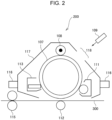
- a portion including the developing unit may have a cartridge structure (i.e., process cartridge) detachably attachable to the image forming apparatus.
- a process cartridge is a process cartridge including the electrostatic image developer according to this exemplary embodiment and the developing unit.
- a sextuple tandem image forming apparatus that includes six image forming units arranged in series is described below as an example of the image forming apparatus according to this exemplary embodiment.
- the tandem image forming apparatus is not limited to this; the image forming apparatus according to this exemplary embodiment may be a quintuple tandem image forming apparatus that includes five image forming units arranged in series or a quadruple tandem image forming apparatus that includes four image forming units arranged in series.
- Fig. 1 schematically illustrates the image forming apparatus according to this exemplary embodiment.
- Fig. 1 illustrates a sextuple tandem, intermediate transfer-type image forming apparatus
- the image forming apparatus illustrated in Fig. 1 includes first to sixth image formation units 10P, 10Y, 10M, 10C, 10K, and 10G, which are electrophotographic image forming units that form pink (P), yellow (Y), magenta (M), cyan (C), black (K), and green (G) images, respectively, on the basis of color separation image data.
- the image formation units (hereinafter, referred to simply as "units") 10P, 10Y, 10M, 10C, 10K, and 10G are horizontally arranged in parallel at a predetermined distance from one another.
- the units 10P, 10Y, 10M, 10C, 10K, and 10G may be process cartridges detachably attachable to the image forming apparatus.
- An intermediate transfer belt (an example of the intermediate transfer body) 20 runs below and extends over the units 10P, 10Y, 10M, 10C, 10K, and 10G so as to pass through the units.
- the intermediate transfer belt 20 is wound around a drive roller 22, a support roller 23, and a counter roller 24 arranged to contact with the inner surface of the intermediate transfer belt 20 and runs in the direction from the first unit 10P to the sixth unit 10G.
- An intermediate transfer body-cleaning device 21 is disposed so as to contact with the image holding memberside surface of the intermediate transfer belt 20 and to face the drive roller 22.
- Developing devices i.e., examples of developing units 4P, 4Y, 4M, 4C, 4K, and 4G of the units 10P, 10Y, 10M, 10C, 10K, and 10G are supplied with pink, yellow, magenta, cyan, black, and green toners stored in toner cartridges 8P, 8Y, 8M, 8C, 8K, and 8G, respectively.
- first to sixth units 10P, 10Y, 10M, 10C, 10K, and 10G have the same structure and the same action, the following description is made with reference to, as a representative, the sixth unit 10G that forms a green image.
- the sixth unit 10G includes a photosensitive member 1G serving as an image holding member.
- the following components are disposed around the photosensitive member 1G sequentially in the counterclockwise direction: a charging roller (example of the charging unit) 2G that charges the surface of the photosensitive member 1G at a predetermined potential; an exposure device (example of the electrostatic image formation unit) 3G that forms an electrostatic image by irradiating the charged surface of the photosensitive member 1G with a laser beam based on a color separated image signal; a developing device (example of the developing unit) 4G that develops the electrostatic image by supplying a toner to the electrostatic image; a first transfer roller (example of the first transfer subunit) 5G that transfers the developed toner image to the intermediate transfer belt 20; and a photosensitive-member cleaning device (example of the cleaning unit) 6G that removes a toner remaining on the surface of the photosensitive member 1G after the first transfer.
- a charging roller example of the charging unit 2G
- the first transfer roller 5G is disposed so as to contact with the inner surface of the intermediate transfer belt 20 and to face the photosensitive member 1G.
- Each of the first transfer rollers 5Y, 5P, 5M, 5C, 5G, and 5K of the respective units is connected to a bias power supply (not illustrated) that applies a first transfer bias to the first transfer rollers.
- Each bias power supply varies the transfer bias applied to the corresponding first transfer roller on the basis of the control by a controller (not illustrated).
- the surface of the photosensitive member 1G is charged at a potential of -600 to -800 V by the charging roller 2G.
- the photosensitive member 1G is formed by stacking a photosensitive layer on a conductive substrate (e.g., volume resistivity at 20°C: 1 ⁇ 10 -6 ⁇ cm or less).
- the photosensitive layer is normally of high resistance (comparable with the resistance of ordinary resins), but, upon being irradiated with the laser beam, the specific resistance of the portion irradiated with the laser beam varies.
- the exposure device 3G irradiates the surface of the charged photosensitive member 1G with the laser beam on the basis of the image data of the green image sent from the controller (not illustrated). As a result, an electrostatic image of green image pattern is formed on the surface of the photosensitive member 1G.
- electrostatic image refers to an image formed on the surface of the photosensitive member 1G by charging, the image being a "negative latent image” formed by irradiating a portion of the photosensitive layer with a laser beam emitted by the exposure device 3G to reduce the specific resistance of the irradiated portion such that the charges on the irradiated surface of the photosensitive member 1G discharge while the charges on the portion that is not irradiated with the laser beam remain.
- the electrostatic image which is formed on the photosensitive member 1G as described above, is sent to the predetermined developing position by the rotating photosensitive member 1G.
- the electrostatic image on the photosensitive member 1G is developed and visualized in the form of a toner image by the developing device 4G at the developing position.
- the developing device 4G includes an electrostatic image developer including, for example, at least, a green toner and a carrier.
- the green toner is stirred in the developing device 4G to be charged by friction and supported on a developer roller (example of the developer support), carrying an electric charge of the same polarity (i.e., negative) as the electric charge generated on the photosensitive member 1G.
- the green toner is electrostatically adhered to the erased latent image portion on the surface of the photosensitive member 1G as the surface of the photosensitive member 1G passes through the developing device 4G.
- the photosensitive member 1G on which the green toner image is formed keeps rotating at the predetermined rate, thereby transporting the toner image developed on the photosensitive member 1G to the predetermined first transfer position.
- first transfer bias is applied to the first transfer roller 5G so as to generate an electrostatic force on the toner image in the direction from the photosensitive member 1G toward the first transfer roller 5G.
- the transfer bias applied has the opposite polarity (+) to that of the toner (-) and controlled to be, for example, in the sixth unit 10G, +10 ⁇ A by a controller (not illustrated).
- the photosensitive member 1G keeps rotating and is brought into contact with a cleaning blade included in the photosensitive member cleaning device 6G.
- the toner particles remaining on the photosensitive member 1G are removed by the photosensitive-member cleaning device 6G and then collected.
- the intermediate transfer belt 20 is successively transported through the first to sixth image forming units 10P, 10Y, 10M, 10C, 10K, and 10G while toner images of the respective colors are stacked on top of another.
- the resulting intermediate transfer belt 20 on which toner images of six colors are multiple-transferred in the first to sixth units is then transported to a second transfer section including a counter roller 24 contacting with the inner surface of the intermediate transfer belt 20 and a second transfer roller (example of the second transfer subunit) 26 disposed on the image-carrier-side of the intermediate transfer belt 20.
- a recording paper (example of the recording medium) P is fed by a feed mechanism into a narrow space between the second transfer roller 26 and the intermediate transfer belt 20 that contact with each other at the predetermined timing.
- the second transfer bias is then applied to the counter roller 24.
- the transfer bias applied here has the same polarity (-) as that of the toner (-) and generates an electrostatic force on the toner image in the direction from the intermediate transfer belt 20 toward the recording paper P.
- the intensity of the second transfer bias applied is determined on the basis of the resistance of the second transfer section which is detected by a resistance detector (not illustrated) that detects the resistance of the second transfer section and controlled by changing voltage.
- the intermediate transfer belt 20 keeps running and is brought into contact with a cleaning blade included in the intermediate transfer body cleaning device 21.
- the toner particles remaining on the intermediate transfer belt 20 are removed by the intermediate transfer body cleaning device 21 and then collected.
- the recording paper P on which the toner image is transferred is transported into a nip part of the fixing device (example of the fixing unit) 28 at which a pair of fixing rollers contact with each other.
- the toner image is fixed to the recording paper P to form a fixed image.
- Examples of the recording paper P to which a toner image is transferred include plain paper used in electrophotographic copiers, printers, and the like. Instead of the recording paper P, OHP films and the like may be used as a recording medium.
- the surface of the recording paper P may be smooth in order to enhance the smoothness of the surface of the fixed image.
- Examples of such a recording paper include coated paper produced by coating the surface of plain paper with resin or the like and art paper for printing.
- a process cartridge according to this exemplary embodiment is described below.
- the process cartridge according to this exemplary embodiment includes a developing unit that includes the electrostatic image developer according to this exemplary embodiment and develops an electrostatic image formed on the surface of an image holding member with the electrostatic image developer to form a toner image.
- the process cartridge according to this exemplary embodiment is detachably attachable to an image forming apparatus.
- the structure of the process cartridge according to this exemplary embodiment is not limited to the above-described one.
- the process cartridge may further include, in addition to the developing unit, at least one unit selected from an image holding member, a charging unit, an electrostatic image formation unit, a transfer unit, etc.
- Fig. 2 schematically illustrates the process cartridge according to this exemplary embodiment.
- a process cartridge 200 illustrated in Fig. 2 includes, for example, a photosensitive member 107 (example of the image holding member), a charging roller 108 (example of the charging unit) disposed on the periphery of the photosensitive member 107, a developing device 111 (example of the developing unit), and a photosensitive-member cleaning device 113 (example of the cleaning unit), which are combined into one unit using a housing 117 to form a cartridge.
- the housing 117 has an aperture 118 for exposure.
- a mounting rail 116 is disposed on the housing 117.
- Reference numeral 109 denotes an exposure device (example of the electrostatic image formation unit)
- Reference numeral 112 denotes a transfer device (example of the transfer unit)
- Reference numeral 115 denotes a fixing device (example of the fixing unit)
- the Reference numeral 300 denotes recording paper (example of the recording medium).
- a toner cartridge according to this exemplary embodiment is described below.
- the toner cartridge according to this exemplary embodiment is a toner cartridge that includes the fluorescent green toner according to this exemplary embodiment and is detachably attachable to an image forming apparatus.
- the toner cartridge includes a replenishment toner that is to be supplied to the developing unit disposed inside an image forming apparatus.
- the image forming apparatus illustrated in Fig. 1 is an image forming apparatus that includes the toner cartridges 8Y, 8P, 8M, 8C, 8G, and 8K detachably attached to the image forming apparatus.
- Each of the developing devices 4Y, 4P, 4M, 4C, 4G, and 4K is connected to a specific one of the toner cartridges which corresponds to the color of the developing device with a toner supply pipe (not illustrated).
- the toner cartridge 8G is an example of the toner cartridge according to this exemplary embodiment and includes the green toner according to this exemplary embodiment.
- the toner cartridges 8P, 8Y, 8M, 8C, and 8K include pink, yellow, magenta, cyan, and black toners, respectively.
- the printed material according to this exemplary embodiment includes a recording medium and an image formed on the surface of the recording medium using the fluorescent green toner according to this exemplary embodiment.
- the printed material according to this exemplary embodiment is produced using the above-described image forming apparatus or method according to this exemplary embodiment.
- the image formed using the fluorescent green toner according to this exemplary embodiment may be any image (i.e., fixed image) formed using at least the fluorescent green toner according to this exemplary embodiment. Therefore, the image formed using the fluorescent green toner according to this exemplary embodiment may be an image formed using only the fluorescent green toner according to this exemplary embodiment or an image formed using the fluorescent green toner according to this exemplary embodiment and a toner of another color.
- the printed material according to this exemplary embodiment includes at least an image formed on the surface of a recording medium using the fluorescent green toner according to this exemplary embodiment and may further include an image formed using a toner having a shade different from that of the fluorescent green toner according to this exemplary embodiment (e.g., the above pink, yellow, magenta, cyan, or black toner).
- a toner having a shade different from that of the fluorescent green toner according to this exemplary embodiment e.g., the above pink, yellow, magenta, cyan, or black toner.
- the recording medium included in the printed material according to this exemplary embodiment may be a recording paper sheet P, an OHP film, or the like.
- Synthesis, treatment, production, and the like are conducted at room temperature (25°C ⁇ 3°C) unless otherwise specified.
- a pigment particle dispersion liquid (1) is prepared.
- a pigment particle dispersion liquid (2) is prepared.
- the above materials are charged into a flask equipped with a stirrer, a nitrogen introduction tube, a temperature sensor, and a fractionating column. After the temperature of the resulting mixture has been increased to 220°C over 1 hour, 1 part of titanium tetraethoxide relative to 100 parts of the materials is charged into the flask. While the product water is distilled away, the temperature is increased to 230°C over 30 minutes. After the dehydration condensation reaction has been continued for 1 hour at the above temperature, the reaction product is cooled. Hereby, a polyester resin having a weight average molecular weight of 18,000 and a glass transition temperature of 60°C is prepared.
- a mixed solvent Into a container equipped with a temperature control unit and a nitrogen purge unit, 40 parts of ethyl acetate and 25 parts of 2-butanol are charged in order to prepare a mixed solvent. To the mixed solvent, 100 parts of the polyester resin is gradually added in order to form a solution. To the solution, a 10-mass% aqueous ammonia solution is added in an amount that corresponds to three times the acid value of the resin in terms of molar ratio, and the resulting mixture is stirred for 30 minutes. Subsequently, the inside of the container is purged with dry nitrogen. While the temperature is kept at 40°C and the liquid mixture is stirred, 400 parts of ion-exchange water is added dropwise to the container at a rate of 2 part/min.
- a resin particle dispersion liquid (1) is prepared.
- a release agent particle dispersion liquid (1) (solid content: 20% by mass), in which release agent particles having a volume average size of 200 nm are dispersed, is prepared.
- the above materials are charged into a round-bottomed, stainless steel flask. After the pH has been adjusted to 3.5 by the addition of 0.1 N (mol/L) nitric acid, 30 parts of an aqueous nitric acid solution having a polyaluminum chloride concentration of 10% by mass is added to the flask. The resulting mixture is dispersed with a homogenizer "ULTRA-TURRAX T50" produced by IKA at a liquid temperature of 30°C and subsequently heated to 45°C in an oil bath for heating. Then, holding is performed for 30 minutes. Subsequently, 50 parts of the resin particle dispersion liquid (1) is added to the flask, and holding is performed for 1 hour.
- toner particles (1) are prepared.
- the volume average size of the toner particles (1) is 5.8 ⁇ m.
- the volume average particle size of the fluorescent green toner (1) is 5.8 ⁇ m.
- a developer i.e., electrostatic image developer (1) is prepared by mixing 8 parts of the fluorescent green toner (1) with 92 parts of a carrier (1) prepared by the following method using a V-blender.
- the above materials except the ferrite particles are dispersed with a sand mill to form a dispersion liquid.
- the dispersion liquid and the ferrite particles are charged into a degassing vacuum kneader. Then, while stirring is performed, the pressure is reduced and drying is performed.
- a carrier (1) is prepared.
- a dye-colored particle dispersion liquid, a yellow pigment particle dispersion liquid, and a green pigment particle dispersion liquid are prepared as in Example 1, except that the fluorescent yellow dye Sy, the yellow pigment Py, and the green pigment Pgc used in the preparation of the dye-colored particle dispersion liquid (1), the yellow pigment particle dispersion liquid (1), and the green pigment particle dispersion liquid (1), respectively, are each changed to one of the dyes and pigments listed in Tables 1 and 2 as needed.
- Toner particles of Examples 2 to 26 and Comparative Examples 1 to 5 are prepared by using the dispersion liquids prepared above and adjusting the amounts of the dispersion liquids.
- Toners are prepared using the respective toner particle samples as in Example 1. Furthermore, developers of Examples 2 to 26 and Comparative Examples 1 to 5 are prepared using the respective toners.
- a modification of an image forming apparatus "Revoria Press PC1120" produced by FUJIFILM Business Innovation Corp. is prepared.
- the green developer 1 is charged into a magenta developer.
- a blank image having an area coverage of 0% is formed on 100 OS coated paper sheets "OS Coat 127" produced by Oji Paper Co., Ltd. at a temperature of 22°C and a humidity of 55%RH.
- a solid image having an area coverage of 100% (toner deposition density: 4.0 g/m 2 ) is formed on an OS coated paper sheet using the fluorescent green toner.
- the peak value of the spectral reflectance of the solid image is also measured.
- the color difference ⁇ E is determined using the solid image prepared in Evaluation (1) above.
- the color difference ⁇ E between the solid image and Color Sample TOKA FLASH VIVA DX 650 produced by T&K TOKA is calculated using the following formula.
- Li, ai, and bi represent the L*, a*, and b* values of Color Sample TOKA FLASH VIVA DX 650
- L 2 , a 2 , and b 2 represent the L*, a*, and b* values of the solid image prepared in Examples.
- the L*, a*, and b* values of Color Sample TOKA FLASH VIVA DX 650 are 77.7, -69.0, and 65.9, respectively.
- the color differences ⁇ E between the images formed using the toners prepared in Examples and Color Sample TOKA FLASH VIVA DX 650 may be reduced.
- a fluorescent green toner with which images excellent in terms of lightness and chroma may be formed, compared with a fluorescent green toner including toner particles including a fluorescent yellow dye Sy, a peak wavelength of a spectral reflectance of the fluorescent yellow dye Sy being at 500 nm or more and 550 nm or less, a yellow pigment Py, and at least one pigment Pgc selected from the group consisting of a green pigment and a cyan pigment, wherein CSy/(CPy + CPgc) is less than 0.01 or more than 0.3, or (CSy + CPy)/CPgc is less than 0.3 or more than 1.5, may be provided.
- a fluorescent green toner with which images excellent in terms of lightness and chroma may be formed, compared with a case where CSy/(CPy + CPgc) is less than 0.05 or more than 0.2, or (CSy + CPy)/CPgc is less than 0.45 or more than 1.0, may be provided.
- a fluorescent green toner with which images excellent in terms of lightness and chroma may be formed, compared with a case where the content CSy of the fluorescent yellow dye Sy is less than 0.1% by mass or more than 2.0% by mass or the content CPy of the yellow pigment Py is less than 1.5% by mass or more than 5.0% by mass, may be provided.
- a fluorescent green toner with which images excellent in terms of lightness and chroma may be formed, compared with a case where the content CSy of the fluorescent yellow dye Sy is more than 1.5% by mass, the content CPy of the yellow pigment Py is less than 3.0% by mass or more than 5.0% by mass, or the content CPgc of the pigment Pgc is less than 5.0% by mass or more than 8.0% by mass, may be provided.
- a fluorescent green toner with which images excellent in terms of lightness and chroma may be formed, compared with a case where 0.65RSy > RPy, or 0.55RSy > RPgc, where RSy represents a spectral reflectance of the fluorescent yellow dye Sy at a peak wavelength X, RPy represents a spectral reflectance of the yellow pigment Py at the wavelength X, and RPgc represents a spectral reflectance of the pigment Pgc at the wavelength X, may be provided.
- a fluorescent green toner with which images excellent in terms of lightness and chroma may be formed, compared with a case where 0.8RPy ⁇ RPgc ⁇ 1.2RPy is not satisfied, may be provided.
- a fluorescent green toner with which images excellent in terms of lightness and chroma may be formed, compared with a case where the pigment Pgc is a cyan pigment, may be provided.
- an electrostatic image developer a toner cartridge, a process cartridge, an image forming apparatus, or an image forming method that includes a fluorescent green toner with which images excellent in terms of lightness and chroma may be formed, compared with a fluorescent green toner including toner particles including a fluorescent yellow dye Sy, a peak wavelength of a spectral reflectance of the fluorescent yellow dye Sy being at 500 nm or more and 550 nm or less, a yellow pigment Py, and at least one pigment Pgc selected from the group consisting of a green pigment and a cyan pigment, wherein CSy/(CPy + CPgc) is less than 0.01 or more than 0.3, or (CSy + CPy)/CPgc is less than 0.3 or more than 1.5, may be provided.
- a printed material that includes an image formed using a fluorescent green toner with which images excellent in terms of lightness and chroma may be formed, compared with a fluorescent green toner including toner particles including a fluorescent yellow dye Sy, a peak wavelength of a spectral reflectance of the fluorescent yellow dye Sy being at 500 nm or more and 550 nm or less, a yellow pigment Py, and at least one pigment Pgc selected from the group consisting of a green pigment and a cyan pigment, wherein CSy/(CPy + CPgc) is less than 0.01 or more than 0.3, or (CSy + CPy)/CPgc is less than 0.3 or more than 1.5, may be provided.
Landscapes
- Physics & Mathematics (AREA)
- General Physics & Mathematics (AREA)
- Chemical & Material Sciences (AREA)
- Chemical Kinetics & Catalysis (AREA)
- General Chemical & Material Sciences (AREA)
- Spectroscopy & Molecular Physics (AREA)
- Engineering & Computer Science (AREA)
- Materials Engineering (AREA)
- Organic Chemistry (AREA)
- Developing Agents For Electrophotography (AREA)
Applications Claiming Priority (1)
| Application Number | Priority Date | Filing Date | Title |
|---|---|---|---|
| JP2023049077A JP2024137528A (ja) | 2023-03-24 | 2023-03-24 | 蛍光グリーントナー、静電荷像現像剤、トナーカートリッジ、プロセスカートリッジ、画像形成装置、画像形成方法、及び印刷物 |
Publications (2)
| Publication Number | Publication Date |
|---|---|
| EP4435522A1 true EP4435522A1 (de) | 2024-09-25 |
| EP4435522B1 EP4435522B1 (de) | 2025-12-17 |
Family
ID=89984771
Family Applications (1)
| Application Number | Title | Priority Date | Filing Date |
|---|---|---|---|
| EP24158337.6A Active EP4435522B1 (de) | 2023-03-24 | 2024-02-19 | Grüner fluoreszenztoner, entwickler für elektrostatische bilder, tonerkartusche, prozesskartusche, bilderzeugungsvorrichtung, bilderzeugungsverfahren und bedrucktes material |
Country Status (4)
| Country | Link |
|---|---|
| US (1) | US20240319627A1 (de) |
| EP (1) | EP4435522B1 (de) |
| JP (1) | JP2024137528A (de) |
| CN (1) | CN118689053A (de) |
Citations (3)
| Publication number | Priority date | Publication date | Assignee | Title |
|---|---|---|---|---|
| US20120219892A1 (en) * | 2011-02-25 | 2012-08-30 | Konica Minolta Business Technologies, Inc. | Green toner for developing static latent image and full color image forming method |
| US20210253750A1 (en) * | 2020-02-17 | 2021-08-19 | Fujifilm Business Innovation Corp. | Resin particle |
| EP3882708A1 (de) * | 2020-03-18 | 2021-09-22 | Xerox Corporation | Fluoreszierende grüne toner mit verbesserter helligkeit |
-
2023
- 2023-03-24 JP JP2023049077A patent/JP2024137528A/ja active Pending
-
2024
- 2024-02-19 CN CN202410183961.4A patent/CN118689053A/zh active Pending
- 2024-02-19 EP EP24158337.6A patent/EP4435522B1/de active Active
- 2024-02-20 US US18/582,078 patent/US20240319627A1/en active Pending
Patent Citations (5)
| Publication number | Priority date | Publication date | Assignee | Title |
|---|---|---|---|---|
| US20120219892A1 (en) * | 2011-02-25 | 2012-08-30 | Konica Minolta Business Technologies, Inc. | Green toner for developing static latent image and full color image forming method |
| JP2012189989A (ja) | 2011-02-25 | 2012-10-04 | Konica Minolta Business Technologies Inc | 静電荷像現像用グリーントナー |
| US20210253750A1 (en) * | 2020-02-17 | 2021-08-19 | Fujifilm Business Innovation Corp. | Resin particle |
| JP2021127433A (ja) | 2020-02-17 | 2021-09-02 | 富士フイルムビジネスイノベーション株式会社 | 樹脂粒子 |
| EP3882708A1 (de) * | 2020-03-18 | 2021-09-22 | Xerox Corporation | Fluoreszierende grüne toner mit verbesserter helligkeit |
Also Published As
| Publication number | Publication date |
|---|---|
| EP4435522B1 (de) | 2025-12-17 |
| CN118689053A (zh) | 2024-09-24 |
| JP2024137528A (ja) | 2024-10-07 |
| US20240319627A1 (en) | 2024-09-26 |
Similar Documents
| Publication | Publication Date | Title |
|---|---|---|
| JP7467973B2 (ja) | 樹脂粒子 | |
| EP4411480A1 (de) | Toner zur entwicklung elektrostatischer ladungsbilder, entwickler, tonerkartusche, prozesskartusche, bilderzeugungsvorrichtung und bilderzeugungsverfahren | |
| EP4095608A1 (de) | Toner zur entwicklung elektrostatischer bilder | |
| EP4283401A1 (de) | Grüntoner zur entwicklung elektrostatischer ladungsbilder, entwickler, tonerkartusche, prozesskartusche, bilderzeugungsvorrichtung und bilderzeugungsverfahren | |
| EP4435522B1 (de) | Grüner fluoreszenztoner, entwickler für elektrostatische bilder, tonerkartusche, prozesskartusche, bilderzeugungsvorrichtung, bilderzeugungsverfahren und bedrucktes material | |
| US12436477B2 (en) | Electrostatic image developing toner, electrostatic image developer, and toner cartridge | |
| US11188004B2 (en) | Electrostatic image developing toner, electrostatic image developer, toner cartridge, process cartridge, image forming apparatus, and image forming method | |
| EP4095610A1 (de) | Toner zur entwicklung elektrostatischer bilder, entwickler für elektrostatische bilder, tonerkartusche, prozesskartusche, bilderzeugungsverfahren und bilderzeugungsvorrichtung | |
| US11067913B1 (en) | Electrostatic image developing toner, electrostatic image developer, toner cartridge, process cartridge, image forming apparatus, and image forming method | |
| CN116774543A (zh) | 静电荷像显影用载体及其制造方法、显影剂及其应用 | |
| EP4488763B1 (de) | Tonerset, entwicklerset für elektrostatische bilder, tonerkartuschenset, prozesskartusche, bilderzeugungsvorrichtung, bilderzeugungsverfahren und druckmaterial | |
| EP4495695A1 (de) | Tonerset, entwicklerset für elektrostatische bilder, tonerkartuschenset, prozesskartusche, bilderzeugungsvorrichtung, bilderzeugungsverfahren und druckmaterial | |
| US20210088921A1 (en) | Electrostatic-image developing toner, electrostatic-image developer, toner cartridge, process cartridge, image forming apparatus, and image forming method | |
| US12436478B2 (en) | Toner for developing electrostatic charge image, electrostatic charge image developer, toner cartridge, process cartridge, and image forming apparatus | |
| EP4530726A1 (de) | Tonerset zur entwicklung elektrostatischer bilder, entwicklerset für elektrostatische bilder, tonerkartuschenset, prozesskartusche, bilderzeugungsvorrichtung und bilderzeugungsverfahren | |
| EP4332682A1 (de) | Toner zur entwicklung elektrostatischer ladungsbilder, entwickler für elektrostatische ladungsbilder, tonerkartusche, prozesskartusche und bilderzeugungsvorrichtung | |
| EP4628991A2 (de) | Toner zur entwicklung elektrostatischer ladungsbilder, entwickler, tonerkartusche, prozesskartusche, bilderzeugungsvorrichtung und bilderzeugungsverfahren | |
| EP4372032B1 (de) | Verfahren zur herstellung von harzpartikeln und verfahren zur herstellung von tonern | |
| JP2021135469A (ja) | 静電荷像現像用キャリア、静電荷像現像剤、プロセスカートリッジ、画像形成装置及び画像形成方法 | |
| EP4332680A1 (de) | Toner zur entwicklung elektrostatischer ladungsbilder, entwickler für elektrostatische ladungsbilder, tonerkartusche, prozesskartusche und bilderzeugungsvorrichtung | |
| EP4485080A1 (de) | Pigment enthaltende polyester-harzteilchen, bilderzeugungsgerät und verfahren | |
| JP7815998B2 (ja) | 静電荷像現像用グリーントナー、静電荷像現像剤、トナーカートリッジ、プロセスカートリッジ、画像形成装置及び画像形成方法 | |
| US12393132B2 (en) | Green toner for electrostatic charge image development, electrostatic charge image developer, toner cartridge, process cartridge, image forming apparatus, and image forming method | |
| US12181834B2 (en) | Electrostatic image developing toner set and electrostatic image developer set | |
| US20230384700A1 (en) | Fluorescent green toner, electrostatic charge image developer, toner cartridge, process cartridge, image forming apparatus, and image forming method |
Legal Events
| Date | Code | Title | Description |
|---|---|---|---|
| PUAI | Public reference made under article 153(3) epc to a published international application that has entered the european phase |
Free format text: ORIGINAL CODE: 0009012 |
|
| STAA | Information on the status of an ep patent application or granted ep patent |
Free format text: STATUS: THE APPLICATION HAS BEEN PUBLISHED |
|
| AK | Designated contracting states |
Kind code of ref document: A1 Designated state(s): AL AT BE BG CH CY CZ DE DK EE ES FI FR GB GR HR HU IE IS IT LI LT LU LV MC ME MK MT NL NO PL PT RO RS SE SI SK SM TR |
|
| STAA | Information on the status of an ep patent application or granted ep patent |
Free format text: STATUS: REQUEST FOR EXAMINATION WAS MADE |
|
| 17P | Request for examination filed |
Effective date: 20250318 |
|
| GRAP | Despatch of communication of intention to grant a patent |
Free format text: ORIGINAL CODE: EPIDOSNIGR1 |
|
| STAA | Information on the status of an ep patent application or granted ep patent |
Free format text: STATUS: GRANT OF PATENT IS INTENDED |
|
| GRAJ | Information related to disapproval of communication of intention to grant by the applicant or resumption of examination proceedings by the epo deleted |
Free format text: ORIGINAL CODE: EPIDOSDIGR1 |
|
| STAA | Information on the status of an ep patent application or granted ep patent |
Free format text: STATUS: REQUEST FOR EXAMINATION WAS MADE |
|
| GRAP | Despatch of communication of intention to grant a patent |
Free format text: ORIGINAL CODE: EPIDOSNIGR1 |
|
| STAA | Information on the status of an ep patent application or granted ep patent |
Free format text: STATUS: GRANT OF PATENT IS INTENDED |
|
| INTG | Intention to grant announced |
Effective date: 20250620 |
|
| INTC | Intention to grant announced (deleted) | ||
| INTG | Intention to grant announced |
Effective date: 20250709 |
|
| GRAS | Grant fee paid |
Free format text: ORIGINAL CODE: EPIDOSNIGR3 |
|
| GRAA | (expected) grant |
Free format text: ORIGINAL CODE: 0009210 |
|
| STAA | Information on the status of an ep patent application or granted ep patent |
Free format text: STATUS: THE PATENT HAS BEEN GRANTED |
|
| AK | Designated contracting states |
Kind code of ref document: B1 Designated state(s): AL AT BE BG CH CY CZ DE DK EE ES FI FR GB GR HR HU IE IS IT LI LT LU LV MC ME MK MT NL NO PL PT RO RS SE SI SK SM TR |
|
| REG | Reference to a national code |
Ref country code: CH Ref legal event code: F10 Free format text: ST27 STATUS EVENT CODE: U-0-0-F10-F00 (AS PROVIDED BY THE NATIONAL OFFICE) Effective date: 20251217 Ref country code: GB Ref legal event code: FG4D |
|
| REG | Reference to a national code |
Ref country code: DE Ref legal event code: R096 Ref document number: 602024001664 Country of ref document: DE |