EP4435408B1 - Automatische optische spektroskopievorrichtung zur wasseranalyse - Google Patents
Automatische optische spektroskopievorrichtung zur wasseranalyse Download PDFInfo
- Publication number
- EP4435408B1 EP4435408B1 EP23162941.1A EP23162941A EP4435408B1 EP 4435408 B1 EP4435408 B1 EP 4435408B1 EP 23162941 A EP23162941 A EP 23162941A EP 4435408 B1 EP4435408 B1 EP 4435408B1
- Authority
- EP
- European Patent Office
- Prior art keywords
- optical
- microspectrometer
- light
- detector
- designed
- Prior art date
- Legal status (The legal status is an assumption and is not a legal conclusion. Google has not performed a legal analysis and makes no representation as to the accuracy of the status listed.)
- Active
Links
Images

Classifications
-
- G—PHYSICS
- G01—MEASURING; TESTING
- G01N—INVESTIGATING OR ANALYSING MATERIALS BY DETERMINING THEIR CHEMICAL OR PHYSICAL PROPERTIES
- G01N21/00—Investigating or analysing materials by the use of optical means, i.e. using sub-millimetre waves, infrared, visible or ultraviolet light
- G01N21/17—Systems in which incident light is modified in accordance with the properties of the material investigated
- G01N21/25—Colour; Spectral properties, i.e. comparison of effect of material on the light at two or more different wavelengths or wavelength bands
- G01N21/31—Investigating relative effect of material at wavelengths characteristic of specific elements or molecules, e.g. atomic absorption spectrometry
-
- G—PHYSICS
- G01—MEASURING; TESTING
- G01J—MEASUREMENT OF INTENSITY, VELOCITY, SPECTRAL CONTENT, POLARISATION, PHASE OR PULSE CHARACTERISTICS OF INFRARED, VISIBLE OR ULTRAVIOLET LIGHT; COLORIMETRY; RADIATION PYROMETRY
- G01J3/00—Spectrometry; Spectrophotometry; Monochromators; Measuring colours
- G01J3/02—Details
-
- G—PHYSICS
- G01—MEASURING; TESTING
- G01J—MEASUREMENT OF INTENSITY, VELOCITY, SPECTRAL CONTENT, POLARISATION, PHASE OR PULSE CHARACTERISTICS OF INFRARED, VISIBLE OR ULTRAVIOLET LIGHT; COLORIMETRY; RADIATION PYROMETRY
- G01J3/00—Spectrometry; Spectrophotometry; Monochromators; Measuring colours
- G01J3/02—Details
- G01J3/0256—Compact construction
-
- G—PHYSICS
- G01—MEASURING; TESTING
- G01J—MEASUREMENT OF INTENSITY, VELOCITY, SPECTRAL CONTENT, POLARISATION, PHASE OR PULSE CHARACTERISTICS OF INFRARED, VISIBLE OR ULTRAVIOLET LIGHT; COLORIMETRY; RADIATION PYROMETRY
- G01J3/00—Spectrometry; Spectrophotometry; Monochromators; Measuring colours
- G01J3/02—Details
- G01J3/0272—Handheld
-
- G—PHYSICS
- G01—MEASURING; TESTING
- G01J—MEASUREMENT OF INTENSITY, VELOCITY, SPECTRAL CONTENT, POLARISATION, PHASE OR PULSE CHARACTERISTICS OF INFRARED, VISIBLE OR ULTRAVIOLET LIGHT; COLORIMETRY; RADIATION PYROMETRY
- G01J3/00—Spectrometry; Spectrophotometry; Monochromators; Measuring colours
- G01J3/02—Details
- G01J3/0291—Housings; Spectrometer accessories; Spatial arrangement of elements, e.g. folded path arrangements
-
- G—PHYSICS
- G01—MEASURING; TESTING
- G01J—MEASUREMENT OF INTENSITY, VELOCITY, SPECTRAL CONTENT, POLARISATION, PHASE OR PULSE CHARACTERISTICS OF INFRARED, VISIBLE OR ULTRAVIOLET LIGHT; COLORIMETRY; RADIATION PYROMETRY
- G01J3/00—Spectrometry; Spectrophotometry; Monochromators; Measuring colours
- G01J3/12—Generating the spectrum; Monochromators
- G01J3/18—Generating the spectrum; Monochromators using diffraction elements, e.g. grating
-
- G—PHYSICS
- G01—MEASURING; TESTING
- G01J—MEASUREMENT OF INTENSITY, VELOCITY, SPECTRAL CONTENT, POLARISATION, PHASE OR PULSE CHARACTERISTICS OF INFRARED, VISIBLE OR ULTRAVIOLET LIGHT; COLORIMETRY; RADIATION PYROMETRY
- G01J3/00—Spectrometry; Spectrophotometry; Monochromators; Measuring colours
- G01J3/28—Investigating the spectrum
- G01J3/44—Raman spectrometry; Scattering spectrometry ; Fluorescence spectrometry
- G01J3/4406—Fluorescence spectrometry
-
- G—PHYSICS
- G01—MEASURING; TESTING
- G01N—INVESTIGATING OR ANALYSING MATERIALS BY DETERMINING THEIR CHEMICAL OR PHYSICAL PROPERTIES
- G01N21/00—Investigating or analysing materials by the use of optical means, i.e. using sub-millimetre waves, infrared, visible or ultraviolet light
- G01N21/62—Systems in which the material investigated is excited whereby it emits light or causes a change in wavelength of the incident light
- G01N21/63—Systems in which the material investigated is excited whereby it emits light or causes a change in wavelength of the incident light optically excited
- G01N21/64—Fluorescence; Phosphorescence
- G01N21/6486—Measuring fluorescence of biological material, e.g. DNA, RNA, cells
-
- G—PHYSICS
- G01—MEASURING; TESTING
- G01N—INVESTIGATING OR ANALYSING MATERIALS BY DETERMINING THEIR CHEMICAL OR PHYSICAL PROPERTIES
- G01N33/00—Investigating or analysing materials by specific methods not covered by groups G01N1/00 - G01N31/00
- G01N33/18—Water
-
- G—PHYSICS
- G01—MEASURING; TESTING
- G01N—INVESTIGATING OR ANALYSING MATERIALS BY DETERMINING THEIR CHEMICAL OR PHYSICAL PROPERTIES
- G01N33/00—Investigating or analysing materials by specific methods not covered by groups G01N1/00 - G01N31/00
- G01N33/18—Water
- G01N33/1886—Water using probes, e.g. submersible probes, buoys
-
- G—PHYSICS
- G01—MEASURING; TESTING
- G01N—INVESTIGATING OR ANALYSING MATERIALS BY DETERMINING THEIR CHEMICAL OR PHYSICAL PROPERTIES
- G01N21/00—Investigating or analysing materials by the use of optical means, i.e. using sub-millimetre waves, infrared, visible or ultraviolet light
- G01N21/17—Systems in which incident light is modified in accordance with the properties of the material investigated
- G01N21/25—Colour; Spectral properties, i.e. comparison of effect of material on the light at two or more different wavelengths or wavelength bands
- G01N21/31—Investigating relative effect of material at wavelengths characteristic of specific elements or molecules, e.g. atomic absorption spectrometry
- G01N21/314—Investigating relative effect of material at wavelengths characteristic of specific elements or molecules, e.g. atomic absorption spectrometry with comparison of measurements at specific and non-specific wavelengths
- G01N2021/317—Special constructive features
- G01N2021/3174—Filter wheel
-
- G—PHYSICS
- G01—MEASURING; TESTING
- G01N—INVESTIGATING OR ANALYSING MATERIALS BY DETERMINING THEIR CHEMICAL OR PHYSICAL PROPERTIES
- G01N21/00—Investigating or analysing materials by the use of optical means, i.e. using sub-millimetre waves, infrared, visible or ultraviolet light
- G01N21/17—Systems in which incident light is modified in accordance with the properties of the material investigated
- G01N21/47—Scattering, i.e. diffuse reflection
- G01N2021/4704—Angular selective
- G01N2021/4709—Backscatter
-
- G—PHYSICS
- G01—MEASURING; TESTING
- G01N—INVESTIGATING OR ANALYSING MATERIALS BY DETERMINING THEIR CHEMICAL OR PHYSICAL PROPERTIES
- G01N21/00—Investigating or analysing materials by the use of optical means, i.e. using sub-millimetre waves, infrared, visible or ultraviolet light
- G01N21/17—Systems in which incident light is modified in accordance with the properties of the material investigated
- G01N21/47—Scattering, i.e. diffuse reflection
- G01N21/4738—Diffuse reflection, e.g. also for testing fluids, fibrous materials
- G01N2021/4764—Special kinds of physical applications
- G01N2021/4769—Fluid samples, e.g. slurries, granulates; Compressible powdery of fibrous samples
-
- G—PHYSICS
- G01—MEASURING; TESTING
- G01N—INVESTIGATING OR ANALYSING MATERIALS BY DETERMINING THEIR CHEMICAL OR PHYSICAL PROPERTIES
- G01N21/00—Investigating or analysing materials by the use of optical means, i.e. using sub-millimetre waves, infrared, visible or ultraviolet light
- G01N21/62—Systems in which the material investigated is excited whereby it emits light or causes a change in wavelength of the incident light
- G01N21/63—Systems in which the material investigated is excited whereby it emits light or causes a change in wavelength of the incident light optically excited
- G01N2021/635—Photosynthetic material analysis, e.g. chrorophyll
-
- G—PHYSICS
- G01—MEASURING; TESTING
- G01N—INVESTIGATING OR ANALYSING MATERIALS BY DETERMINING THEIR CHEMICAL OR PHYSICAL PROPERTIES
- G01N21/00—Investigating or analysing materials by the use of optical means, i.e. using sub-millimetre waves, infrared, visible or ultraviolet light
- G01N21/17—Systems in which incident light is modified in accordance with the properties of the material investigated
- G01N21/47—Scattering, i.e. diffuse reflection
- G01N21/4738—Diffuse reflection, e.g. also for testing fluids, fibrous materials
- G01N21/474—Details of optical heads therefor, e.g. using optical fibres
-
- G—PHYSICS
- G01—MEASURING; TESTING
- G01N—INVESTIGATING OR ANALYSING MATERIALS BY DETERMINING THEIR CHEMICAL OR PHYSICAL PROPERTIES
- G01N21/00—Investigating or analysing materials by the use of optical means, i.e. using sub-millimetre waves, infrared, visible or ultraviolet light
- G01N21/17—Systems in which incident light is modified in accordance with the properties of the material investigated
- G01N21/47—Scattering, i.e. diffuse reflection
- G01N21/49—Scattering, i.e. diffuse reflection within a body or fluid
- G01N21/53—Scattering, i.e. diffuse reflection within a body or fluid within a flowing fluid, e.g. smoke
-
- G—PHYSICS
- G01—MEASURING; TESTING
- G01N—INVESTIGATING OR ANALYSING MATERIALS BY DETERMINING THEIR CHEMICAL OR PHYSICAL PROPERTIES
- G01N2201/00—Features of devices classified in G01N21/00
- G01N2201/02—Mechanical
- G01N2201/021—Special mounting in general
- G01N2201/0212—Liquid borne; swimming apparatus
-
- G—PHYSICS
- G01—MEASURING; TESTING
- G01N—INVESTIGATING OR ANALYSING MATERIALS BY DETERMINING THEIR CHEMICAL OR PHYSICAL PROPERTIES
- G01N2201/00—Features of devices classified in G01N21/00
- G01N2201/02—Mechanical
- G01N2201/021—Special mounting in general
- G01N2201/0218—Submersible, submarine
-
- G—PHYSICS
- G01—MEASURING; TESTING
- G01N—INVESTIGATING OR ANALYSING MATERIALS BY DETERMINING THEIR CHEMICAL OR PHYSICAL PROPERTIES
- G01N2201/00—Features of devices classified in G01N21/00
- G01N2201/02—Mechanical
- G01N2201/022—Casings
Definitions
- the invention relates to devices for performing in-situ monitoring of water by means of spectroscopy.
- the measurements can be performed in invasive, intrusive, or in-situ configuration, when sensor is inserted inside the water and operated within.
- a sample can be taken in a vial to the lab where it is analyzed with different methods.
- the second method is much more popular for now as it is the cheapest and most precise.
- sample removal approach delays the results and cannot be used in a data-driven farming due to the low sampling rate - typically, once in couple of days.
- optical sensors For invasive measurements, some sensor types are more suitable than others, with one of the better solutions being optical sensors. Naturally, there are a lot of existing optical sensors for measurement of water parameters, like chlorophyll, cyanobacteria concentration. However, they operate in a single wavelength configuration or use a fixed configuration of some type of optical system involving VIS photometers.
- an underwater imaging spectrometer in-situ measurement system comprising a frame; a sensor assembly, arranged on one side of the frame; the sensor assembly comprising irradiance sensor and radiance sensor; the device further comprising a camera assembly, wherein a camera is attached to the irradiance sensor or the radiance sensor and arranged on the frame; the irradiance sensor, the radiance sensor and the camera are all arranged on the same horizontal plane.
- controllable buoys and networked buoy systems comprising floating buoys with sensors and energy harvesting capabilities.
- the buoys are configured to control their buoyancy and motion, and to organize communication in a distributed fashion.
- the buoys have tethered underwater vehicles with a smart spooling system that allows the vehicles to dive deep underwater while remaining in communication and connection with the buoys.
- a fiber buoy for online monitoring of water quality comprising a solar cell panel, a power supply module, a support, a navigation mark lamp, an antenna, a light source, a fiber coupler, a connecting fiber, a fiber sensing head, a reflection end surface, an optical switch, a spectrometer module and a GPRS module.
- the solar cell panel is connected with the battery module, the solar cell panel and the battery module are arranged on the support, and the navigation mark lamp and the antenna are arranged at the top of the support.
- the output end of the light source is connected with the fiber coupler, the fiber coupler is connected with one end of the sensing head, and the other end of the sensing head plates a high reflection film on the end surface of the fiber to form the reflection end surface.
- the optical system unit comprises a composite light source with two light sources: one light source is an LED array composed of LED light sources emitting light at different visible wavelengths, and another light source is composed of ultraviolet LED light sources and near-infrared laser diode light sources.
- the optical system unit further comprises a photodetector for detecting fluorescent or scattered light from a sample. The light from the sample is collected by a lens and passed through one of two bandpass filters or a blank in a rotatable filter wheel arranged between the lens and the photodetector.
- the computer controls the light source to emit different wavelengths of light to irradiate water body to be detected by the control and data acquiring unit and triggers substances of the water body to be detected to emit fluorescent and scattered light signals.
- the main disadvantage of the known solutions is insufficient variability, which may be impacted by other pollutants that are fluorescent in the same spectral range; limitation of the system not allowing to distinguish between overlapping peaks from different water components; loss of information due to the excitation diodes being in the range of detection of the detector; insufficient flexibility of the system not allowing to use the system for measuring wide variety of parameters, or relative complexity of construction; as well as inability to use the same detection system for both absorption and phosphorescence measurements
- the goal of the invention is to overcome the drawbacks of the prior art and to provide a simple and effective optical spectroscopy device for water analysis, which would allow to obtain significantly large set of data specific to common pollutants and components of water.
- the set goal is achieved by providing an optical spectroscopy device for water analysis as defined in claim 1, a system comprising the optical spectroscopy device as defined in claim 6, and a floating construction comprising the system as defined in claim 9.
- the optical spectroscopy device comprises: an optical microspectrometer; and a waterproof casing designed to withstand underwater environment; the casing having at least one portion, which is transparent to the wavelengths of light being measured; the microspectrometer comprising a light source; a detector configured to detect and measure a spectral signal emitted, transmitted, or reflected by a sample; optical components comprising optical lenses and optical filters; and a means for controllable positioning of the optical lenses and the optical filters in front of the microspectrometer's detector; wherein the optical filters comprise a 390-410 nm high pass filter, a 490-510 nm high pass filter, and a 590-610 nm high pass filter; wherein the light source is a light source or a set of light sources, designed to emit light in the ranges
- the means for controllable positioning of the optical filters may comprise a motorized optical filter wheel or plate with a series of filter slots on the filter wheel or plate.
- the optical spectroscopy device for water analysis is configured to be connected to a power source, which may be a rechargeable battery.
- a power source which may be a rechargeable battery.
- the rechargeable battery may be accommodated in the waterproof casing together with the optical microspectrometer, or be located outside of the casing of the optical microspectrometer.
- the optical components of the device may further comprise at least one mirror for directing the light to the microspectrometer.
- the device may further comprise a monochromator, having a grating or prism designed to disperse the light into its component wavelengths, and a slit designed to allow only a specific wavelength range to pass through; the microspectrometer is further designed to direct the monochromatic light onto the sample and measure by the microspectrometer's detector the light scattered or emitted by the sample.
- the waterproof casing is further designed to accommodate a wireless communication module that allows the submersible optical spectroscopy device for water analysis to communicate wirelessly with a remote device; wherein the means for controllable positioning of the optical filters is configured to be remotely operable using a wireless communication system.
- the sensor further comprises one or more sensors or feedback mechanisms, configured to provide information about the position and status of the optical filters, and transmit that information back to the remote device, to enable real-time monitoring and control.
- the invention also provides a system comprising the optical spectroscopy device and a part configured to be located fully or partially above the surface of the water, the part provided with a detector and configured to measure ambient illumination of the water by means of the detector, wherein the part and the spectroscopy device are electrically connected.
- the invention also provides a floating construction comprising the system.
- the floating construction (which may be a floating fish or bivalve farm, a buoy, a watercraft, a platform, a floating dock, or a pontoon) further comprises a processing unit configured to receive and interpret commands from the remote device, and execute them by sending a signal to the means for controllable positioning of the optical lenses and the optical filters to adjust the position of the optical lenses and the optical filters; a communication system configured to allow the processing unit to receive data from the submersible optical spectroscopy device for water analysis, and transmit that data to a remote location for further processing or analysis. It may optionally comprise also a memory adapted to allow the processing unit to store data collected by the submersible optical spectroscopy device for water analysis, for later retrieval and analysis.
- Figures 1 and 2 show the submersible optical spectroscopy device 1 for water analysis, which comprises: an optical microspectrometer 2; and a waterproof casing 3 designed to withstand underwater environment and accommodate the microspectrometer 2.
- the casing 3 having at least one portion 4, which is transparent to the wavelengths of light being measured.
- the microspectrometer 2 comprises a light source 5; a detector 6 configured to detect and measure the spectral signal emitted, transmitted, or reflected by a sample; optical components comprising optical lenses 7 and optical filters 8; and a means 9 for controllable positioning of the optical lenses 7 and optical filters 8 in front of microspectrometer's detector 6.
- the optical filters 8 comprise a 390-410 nm high pass filter, a 490-510 nm high pass filter, and a 590-610 nm high pass filter.
- the light source 5 is a light source or a set of light sources, designed to emit light in the ranges 360-380 nm, 440-460 nm, and 570-590 nm, providing the illumination needed to excite the sample and generate a spectral signal.
- the microspectrometer 2 is designed to be accommodated within the casing 3, so that the detector 6 is positioned behind the transparent portion 4 of the casing 3 to be capable to be exposed to the light signal being measured.
- the means 9 for controllable positioning of the optical lenses 7 and optical filters 8 further comprise an empty slot 10 for absorbance measurements.
- the means 9 for controllable positioning of the optical lenses and filters may comprise a motorized optical filter wheel or a plate with a series of filter slots on the filter wheel or plate.
- the motorized optical filter wheel or a plate is designed to be controlled by a processing unit, which sends commands to the motor to move the wheel or the plate to the desired position.
- the speed and precision of the motor can be adjusted to ensure accurate and repeatable positioning of the lenses 7 and the filters 8.
- the device 1 is configured to be connected to a power source, which may be a rechargeable battery.
- a power source which may be a rechargeable battery.
- the rechargeable battery may be accommodated in the waterproof casing 3 together with the optical microspectrometer 2, or be located outside of the casing 3 of the optical microspectrometer 2.
- the optical components of the device 1 may further comprise at least one mirror for directing the light to the detector 6.
- the device may further comprise a monochromator, having a grating or prism designed to disperse the light into its component wavelengths, and a slit designed to allow only a specific wavelength range to pass through.
- the microspectrometer 2 may be further designed to direct the monochromatic light onto the sample and measure by the microspectrometer's detector the light scattered or emitted by the sample.
- the waterproof casing 3 further designed to accommodate a wireless communication module that allows the device 1 to communicate wirelessly with a remote device; wherein the means 9 for controllable positioning of the optical lenses and filters is configured to be remotely operable using a wireless communication system.
- the device 1 further comprises one or more sensors or feedback mechanisms, configured to provide information about the position and status of the optical lenses 7 and filters 8, and transmit that information back to the remote device, to enable real-time monitoring and control.
- the invention also provides for a floating construction (which may be a floating fish or bivalve farm, a buoy, a watercraft, a platform, a floating dock, or a pontoon), comprising: the submersible optical water quality device 1, attached to the floating construction below the surface of water; a processing unit configured to receive and interpret commands from the remote device, and execute them by sending a signal to the means 9 for controllable positioning of the optical lenses and filters to adjust the position of the optical lenses and filters; a communication system configured to allow the processing unit to receive data from the submersible optical spectroscopy device 1 for water analysis, and transmit that data to a remote location for further processing or analysis. It may optionally comprise also a memory adapted to allow the processing unit to store data collected by the device 1, for later retrieval and analysis.
- the device allows to effectively determine relative concentrations of chlorophyll and phycocyanin in the measurement environment. It allows to measure different types of excitations, such as the primary excitation to get a base measurement of any photoluminescent compounds found in water, including any dissolved organic matter (DOM) and chlorophyll; the chlorophyll absorption maximum, allowing for direct detection of chlorophyll and the phycocyanin.
- Each excitation source can be combined with one of the device's optical filters 7 to remove excitation light from the detectable signal.
- absorption can be measured as well - during daylight by taking a sunlight reference spectrum with the additional spectrometer above the surface of water or by a calibrated light source during night time.
- the empty space in the means 9 allows to perform these measurements without direct excitation from the light source 5.
- background light such as a sunlight, floodlight, or a calibration source can be used.
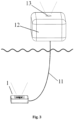
- the spectroscopy device 1 for water analysis may comprise a submersible part and a part 12 located fully or partially above the surface of water ( Fig. 3 ).
- the above water part 12 can be used for the collection of reference spectrum of the sun and be connected to the same data processing unit as the submersible spectroscopy device 1 for water analysis.
- the above water part 12 can have the same elements as the underwater one, but without filters and LEDs and be configured to monitor ambient illumination above the water through a detector 13 simultaneously with underwater spectral measurement by the submersible part of the device 1.
- the submersible and above water parts of the device can be electrically connected by a cable 11.
- the 390-410 nm high pass filter is used in combination with 360-380 nm LED diode to evaluate overall shape of DOM maximum present in any liquid containing organics. In addition, presence of oils and oil products can be detected with this combination.
- the 490-510 nm high pass filter is used in combination with 360-380 nm LED diode to exclude most intense part of DOM and increase the sensitivity of its yellow part.
- the 590-610 nm high pass filter is used in combination with 360-380 nm LED diode to distinguish chlorophyll peak in the red region, as well as see the presence of any organic pigments that are participating in photosynthesis processes in plants.
- the 440-460 nm LED diode is used in two correlative measurements - with 590-610 nm high pass filter and 490-510 nm high pass filter - former is used to detect only chlorophyll maximum and the latter is used to see the DOM peak impact on chlorophyll signal.
- the 590-610 nm high pass filter is used in combination with 570-590 nm LED diode to detect phycocyanin present in cyanobacteria.
- the spectrometer can be used without filters and LEDs to perform an absorption measurement using the light from the atmosphere. The spectrum can be taken simultaneously on two spectrometers - one inside the submerged part, and one above the surface of water. By signal filtering and subtraction, it is possible to measure the absorption only by the water, thus detecting presence of compounds such as pheophorbide and pheophytin.
- the spectroscopy device 1 for water analysis comprises the detector 6, measuring the spectral signal under water and the detector 13 measuring the spectral signal above the water; a processing unit operatively connected to the detectors 6 and 13, wherein the processing unit is configured to: (i) control the detector 6 and the detector 13 to measure spectra simultaneously to exclude the effects of any fast-changing light conditions; (ii) determine an optimal exposure time for the detector 13 based on the measured above water light spectra; (iii) adjust the exposure time of the detector 6 to match the determined optimal exposure time of the detector 13; (iv) obtain intensity values for each pixel of the measured spectra from the detector 6 and the detector 13; (v) apply correction coefficients C 1n and C 2n to the intensity values of each pixel of the measured spectra, wherein the correction coefficients account for spectral sensitivity, light intensity sensitivity, readout electronics non-linearity, and, optionally, any other non-linear device-specific effects; (vi) calculate a resulting ab
- the claimed invention ensures data precision even in conditions where many overlapping signals are present.
- the use of phosphorescence and absorption datasets also increase the flexibility of the setup for measurement of wide variety of components.
- the data obtained can then be used to rapidly address public health hazards, locate failures in filtration systems, react on sudden changes in quality due to the oil spills and make predictions on upcoming phytoplankton blooms, adjust the amount of food provided to fish stock.
Landscapes
- Physics & Mathematics (AREA)
- Spectroscopy & Molecular Physics (AREA)
- General Physics & Mathematics (AREA)
- Health & Medical Sciences (AREA)
- Life Sciences & Earth Sciences (AREA)
- Chemical & Material Sciences (AREA)
- Immunology (AREA)
- Analytical Chemistry (AREA)
- Biochemistry (AREA)
- General Health & Medical Sciences (AREA)
- Pathology (AREA)
- Engineering & Computer Science (AREA)
- Food Science & Technology (AREA)
- Medicinal Chemistry (AREA)
- Biomedical Technology (AREA)
- Molecular Biology (AREA)
- Nuclear Medicine, Radiotherapy & Molecular Imaging (AREA)
- Investigating Or Analysing Materials By Optical Means (AREA)
Claims (9)
- Ein spektroskopisches Gerät (1) zur Wasseranalyse, der sich aus folgenden Bestandeilen zusammensetzt: einem optischen Mikrospektrometer (2), einem wasserdichten Gehäuse (3), das so beschaffen ist, dass es einer Unterwasserumgebung standhält, wobei das Gehäuse (3) mindestens einen Abschnitt (4) aufweist, der für die Wellenlängen des zu messenden Lichts transparent ist; das Mikrospektrometer (2) enthält eine Lichtquelle (5), einen Detektor (6), der so ausgelegt ist, dass er ein von einer Probe ausgestrahltes, durchgelassenes oder reflektiertes Spektralsignal erfasst und misst; optische Komponenten, die optische Linsen (7) und optische Filter (8) enthalten; und ein Steuergerät (9) zur Positionierung der optischen Linsen (7) und der optischen Filter (8) vor dem Detektor (6) des Mikrospektrometers. Die optischen Filter (8) enthalten einen Hochpassfilter mit 390-410 nm, einen Hochpassfilter mit 490-510 nm und einen Hochpassfilter mit 590-610 nm. Die Lichtquelle (5) ist eine Lichtquelle oder ein Satz von Lichtquellen, die dafür ausgelegt sind, Licht in den Bereichen 360-380 nm, 440-460 nm und 570-590 nm auszustrahlen. Das Mikrospektrometer (2) ist so konzipiert, dass es in dem Gehäuse (3) untergebracht werden kann, so dass der Detektor (6) hinter dem transparenten Teil (4) des Gehäuses (3) angeordnet ist, um dem zu messenden Spektralsignal ausgesetzt werden zu können.
- Gerät (1) gemäß Patentanspruch 1, wobei das Steuergerät (9) zur Positionierung der optischen Linsen und der optischen Filter ein angetriebenes optisches Filterrad oder eine optische Filterplatte mit einer Reihe von Filterschlitzen auf dem Filterrad oder der Filterplatte enthalten.
- Gerät (1) gemäß einem der vorhergehenden Patentansprüche umfasst ferner eine Energiequelle, wobei die Energiequelle einen wiederaufladbaren Akku enthält.
- Gerät (1) gemäß Patentanspruch 1, wobei die optischen Komponenten ferner mindestens einen Spiegel umfassen, um das Licht auf das Mikrospektrometer zu lenken.
- Gerät (1) gemäß Patentanspruch 1, wobei das Mikrospektrometer (2) ferner einen Monochromator mit einem Gitter oder Prisma enthält, der dafür ausgelegt ist, das Licht in seine einzelnen Wellenlängen aufzuteilen, sowie einen Spalt, der so gestaltet ist, dass er nur einen bestimmten Wellenlängenbereich durchlässt. Das Mikrospektrometer (2) ist ferner so beschaffen, dass es das monochromatische Licht auf die Probe richtet und mit dem Detektor (6) des Mikrospektrometers das von der Probe gestreute oder ausgestrahlte Licht misst.
- Ein System, das aus dem spektroskopischen Gerät (1) gemäß Anspruch 1 und einem Teil (12) besteht, das so konfiguriert ist, dass es sich ganz oder teilweise über der Wasseroberfläche befindet. Das Teil (12) ist dabei mit einem Detektor (13) ausgestattet und so eingestellt, dass es die Umgebungsbeleuchtung über dem Wasser mit Hilfe des Detektors (13) misst. Das Teil (12) und das spektroskopische Gerät (1) sind elektrisch miteinander verbunden.
- System gemäß Patentanspruch 6, wobei das wasserdichte Gehäuse (3) ferner so gestaltet ist, dass es ein drahtloses Kommunikationsmodul aufnimmt, das es dem Gerät (1) ermöglicht, drahtlos mit einem entfernten anderen Gerät zu kommunizieren. Das Steuergerät (9) zur Positionierung der optischen Linsen und der optischen Filter ist dabei so eingestellt, dass es unter Verwendung eines drahtlosen Kommunikationssystems aus der Ferne bedient werden kann.
- System gemäß Patentanspruch 7 bestehend des Weiteren aus einem oder mehreren Sensoren oder Rückkopplungsmechanismen, die dafür vorgesehen sind, Informationen über die Position und den Zustand der optischen Linsen (7) und der optischen Filter (8) zu liefern und diese Informationen an das Ferngerät zurücksenden, um eine Überwachung und Steuerung in Echtzeit zu ermöglichen.
- Schwimmende Konstruktion, bestehend aus: dem System gemäß Patentanspruch 7 oder 8; einer Verarbeitungseinheit, die so konfiguriert ist, dass sie Befehle vom Ferngerät empfängt, interpretiert und ausführt, indem sie ein Signal an das Steuergerät zur Positionierung der optischen Linsen (7) und der optischen Filter (8) sendet, um diese einzustellen; einem Kommunikationssystem, das so konfiguriert ist, dass es der Verarbeitungseinheit ermöglicht, Daten vom Gerät (1) zu empfangen und diese Daten zur weiteren Verarbeitung oder Analyse per Fernübertragung zu übermitteln; einem optionalen Speicher, der so angepasst ist, dass er es der Verarbeitungseinheit ermöglicht, vom Gerät (1) gesammelte Daten zu speichern, um sie später abzurufen und zu analysieren.
Priority Applications (1)
| Application Number | Priority Date | Filing Date | Title |
|---|---|---|---|
| EP23162941.1A EP4435408B1 (de) | 2023-03-20 | 2023-03-20 | Automatische optische spektroskopievorrichtung zur wasseranalyse |
Applications Claiming Priority (1)
| Application Number | Priority Date | Filing Date | Title |
|---|---|---|---|
| EP23162941.1A EP4435408B1 (de) | 2023-03-20 | 2023-03-20 | Automatische optische spektroskopievorrichtung zur wasseranalyse |
Publications (3)
| Publication Number | Publication Date |
|---|---|
| EP4435408A1 EP4435408A1 (de) | 2024-09-25 |
| EP4435408B1 true EP4435408B1 (de) | 2025-01-22 |
| EP4435408C0 EP4435408C0 (de) | 2025-01-22 |
Family
ID=85704899
Family Applications (1)
| Application Number | Title | Priority Date | Filing Date |
|---|---|---|---|
| EP23162941.1A Active EP4435408B1 (de) | 2023-03-20 | 2023-03-20 | Automatische optische spektroskopievorrichtung zur wasseranalyse |
Country Status (1)
| Country | Link |
|---|---|
| EP (1) | EP4435408B1 (de) |
Family Cites Families (5)
| Publication number | Priority date | Publication date | Assignee | Title |
|---|---|---|---|---|
| ATE166151T1 (de) | 1992-08-14 | 1998-05-15 | John F Blais Jr | Spektrometer mit drehbarem biegsamem filter |
| CN104807759A (zh) | 2014-01-24 | 2015-07-29 | 中国计量学院 | 一种水质在线监测的光纤浮标 |
| WO2015187743A1 (en) | 2014-06-02 | 2015-12-10 | California Institute Of Technology | Controllable buoys and networked buoy systems |
| CN104730054B (zh) * | 2015-04-10 | 2018-08-21 | 中国科学院烟台海岸带研究所 | 一种一体化探头式光电水质多参数在线测量系统 |
| CN213600570U (zh) | 2020-10-21 | 2021-07-02 | 莱森光学(深圳)有限公司 | 水下成像光谱仪原位测量系统 |
-
2023
- 2023-03-20 EP EP23162941.1A patent/EP4435408B1/de active Active
Also Published As
| Publication number | Publication date |
|---|---|
| EP4435408A1 (de) | 2024-09-25 |
| EP4435408C0 (de) | 2025-01-22 |
Similar Documents
| Publication | Publication Date | Title |
|---|---|---|
| US7198755B2 (en) | Multichannel fluorosensor | |
| Zeng et al. | Development of in situ sensors for chlorophyll concentration measurement | |
| Bacon et al. | Miniature spectroscopic instrumentation: applications to biology and chemistry | |
| US6836332B2 (en) | Instrument and method for testing fluid characteristics | |
| Biswas et al. | Recent developments in smartphone spectrometer sample analysis | |
| US8970841B2 (en) | Spectral and temporal laser fluorescence analysis such as for natural aquatic environments | |
| US9618449B2 (en) | Optical analysis of emissions from stimulated liquids | |
| US20040179196A1 (en) | Light emitting diode (LED) array for excitation emission matrix (EEM) fluorescence spectroscopy | |
| Hart et al. | Light emitting diode excitation emission matrix fluorescence spectroscopy | |
| Chekalyuk et al. | Next generation Advanced Laser Fluorometry (ALF) for characterization of natural aquatic environments: new instruments | |
| US7416701B2 (en) | Calibrator for fluorosensor | |
| Power et al. | A novel low-cost plug-and-play multi-spectral LED based fluorometer, with application to chlorophyll detection | |
| Das et al. | Fluorescence-based accurate estimation of chlorophyll in tea leaves using smartphone | |
| EP4435408B1 (de) | Automatische optische spektroskopievorrichtung zur wasseranalyse | |
| CN210571971U (zh) | 一种用于水环境污染监测的便携式激光拉曼荧光计系统和水环境污染监测装置 | |
| CN110132922A (zh) | 一种叶绿素浓度的快速在线检测方法 | |
| Park et al. | A low-cost fluorometer applied to the Gulf of Saint Lawrence Rhodamine Tracer Experiment | |
| CN102830071B (zh) | 一种土壤总含磷量检测装置以及方法 | |
| CN208334198U (zh) | 海水藻类赤潮及其毒性检测光学原位传感器 | |
| RU237514U1 (ru) | Флуориметр | |
| CN218412255U (zh) | 一种探测端及检测设备 | |
| RU201361U1 (ru) | Портативный флуориметр | |
| TWI847724B (zh) | 用於校準微弱螢光光譜測量值的方法和裝置與其電腦可讀媒介的編碼方法 | |
| RU2652528C1 (ru) | Флуориметр с многоканальной системой возбуждения на светодиодах | |
| Ciaccheri et al. | Optical Spectroscopy for Fingerprinting Food: A Photonic Tasting |
Legal Events
| Date | Code | Title | Description |
|---|---|---|---|
| PUAI | Public reference made under article 153(3) epc to a published international application that has entered the european phase |
Free format text: ORIGINAL CODE: 0009012 |
|
| STAA | Information on the status of an ep patent application or granted ep patent |
Free format text: STATUS: REQUEST FOR EXAMINATION WAS MADE |
|
| 17P | Request for examination filed |
Effective date: 20230327 |
|
| AK | Designated contracting states |
Kind code of ref document: A1 Designated state(s): AL AT BE BG CH CY CZ DE DK EE ES FI FR GB GR HR HU IE IS IT LI LT LU LV MC ME MK MT NL NO PL PT RO RS SE SI SK SM TR |
|
| GRAP | Despatch of communication of intention to grant a patent |
Free format text: ORIGINAL CODE: EPIDOSNIGR1 |
|
| STAA | Information on the status of an ep patent application or granted ep patent |
Free format text: STATUS: GRANT OF PATENT IS INTENDED |
|
| RIC1 | Information provided on ipc code assigned before grant |
Ipc: G01N 21/63 20060101ALN20241029BHEP Ipc: G01N 21/47 20060101ALN20241029BHEP Ipc: G01N 21/53 20060101ALN20241029BHEP Ipc: G01J 3/44 20060101ALI20241029BHEP Ipc: G01J 3/18 20060101ALI20241029BHEP Ipc: G01J 3/02 20060101ALI20241029BHEP Ipc: G01N 33/18 20060101ALI20241029BHEP Ipc: G01N 21/64 20060101ALI20241029BHEP Ipc: G01N 21/31 20060101AFI20241029BHEP |
|
| GRAS | Grant fee paid |
Free format text: ORIGINAL CODE: EPIDOSNIGR3 |
|
| INTG | Intention to grant announced |
Effective date: 20241114 |
|
| GRAA | (expected) grant |
Free format text: ORIGINAL CODE: 0009210 |
|
| STAA | Information on the status of an ep patent application or granted ep patent |
Free format text: STATUS: THE PATENT HAS BEEN GRANTED |
|
| AK | Designated contracting states |
Kind code of ref document: B1 Designated state(s): AL AT BE BG CH CY CZ DE DK EE ES FI FR GB GR HR HU IE IS IT LI LT LU LV MC ME MK MT NL NO PL PT RO RS SE SI SK SM TR |
|
| REG | Reference to a national code |
Ref country code: GB Ref legal event code: FG4D |
|
| REG | Reference to a national code |
Ref country code: CH Ref legal event code: EP |
|
| REG | Reference to a national code |
Ref country code: IE Ref legal event code: FG4D |
|
| REG | Reference to a national code |
Ref country code: DE Ref legal event code: R096 Ref document number: 602023001728 Country of ref document: DE |
|
| U01 | Request for unitary effect filed |
Effective date: 20250131 |
|
| U07 | Unitary effect registered |
Designated state(s): AT BE BG DE DK EE FI FR IT LT LU LV MT NL PT RO SE SI Effective date: 20250220 |
|
| U20 | Renewal fee for the european patent with unitary effect paid |
Year of fee payment: 3 Effective date: 20250227 |
|
| PG25 | Lapsed in a contracting state [announced via postgrant information from national office to epo] |
Ref country code: RS Free format text: LAPSE BECAUSE OF FAILURE TO SUBMIT A TRANSLATION OF THE DESCRIPTION OR TO PAY THE FEE WITHIN THE PRESCRIBED TIME-LIMIT Effective date: 20250422 |
|
| PG25 | Lapsed in a contracting state [announced via postgrant information from national office to epo] |
Ref country code: PL Free format text: LAPSE BECAUSE OF FAILURE TO SUBMIT A TRANSLATION OF THE DESCRIPTION OR TO PAY THE FEE WITHIN THE PRESCRIBED TIME-LIMIT Effective date: 20250122 |
|
| PG25 | Lapsed in a contracting state [announced via postgrant information from national office to epo] |
Ref country code: ES Free format text: LAPSE BECAUSE OF FAILURE TO SUBMIT A TRANSLATION OF THE DESCRIPTION OR TO PAY THE FEE WITHIN THE PRESCRIBED TIME-LIMIT Effective date: 20250122 |
|
| PG25 | Lapsed in a contracting state [announced via postgrant information from national office to epo] |
Ref country code: IS Free format text: LAPSE BECAUSE OF FAILURE TO SUBMIT A TRANSLATION OF THE DESCRIPTION OR TO PAY THE FEE WITHIN THE PRESCRIBED TIME-LIMIT Effective date: 20250522 Ref country code: NO Free format text: LAPSE BECAUSE OF FAILURE TO SUBMIT A TRANSLATION OF THE DESCRIPTION OR TO PAY THE FEE WITHIN THE PRESCRIBED TIME-LIMIT Effective date: 20250422 |
|
| PG25 | Lapsed in a contracting state [announced via postgrant information from national office to epo] |
Ref country code: HR Free format text: LAPSE BECAUSE OF FAILURE TO SUBMIT A TRANSLATION OF THE DESCRIPTION OR TO PAY THE FEE WITHIN THE PRESCRIBED TIME-LIMIT Effective date: 20250122 |
|
| PG25 | Lapsed in a contracting state [announced via postgrant information from national office to epo] |
Ref country code: GR Free format text: LAPSE BECAUSE OF FAILURE TO SUBMIT A TRANSLATION OF THE DESCRIPTION OR TO PAY THE FEE WITHIN THE PRESCRIBED TIME-LIMIT Effective date: 20250423 |
|
| PG25 | Lapsed in a contracting state [announced via postgrant information from national office to epo] |
Ref country code: SM Free format text: LAPSE BECAUSE OF FAILURE TO SUBMIT A TRANSLATION OF THE DESCRIPTION OR TO PAY THE FEE WITHIN THE PRESCRIBED TIME-LIMIT Effective date: 20250122 |
|
| PG25 | Lapsed in a contracting state [announced via postgrant information from national office to epo] |
Ref country code: MC Free format text: LAPSE BECAUSE OF FAILURE TO SUBMIT A TRANSLATION OF THE DESCRIPTION OR TO PAY THE FEE WITHIN THE PRESCRIBED TIME-LIMIT Effective date: 20250122 |
|
| PG25 | Lapsed in a contracting state [announced via postgrant information from national office to epo] |
Ref country code: CZ Free format text: LAPSE BECAUSE OF FAILURE TO SUBMIT A TRANSLATION OF THE DESCRIPTION OR TO PAY THE FEE WITHIN THE PRESCRIBED TIME-LIMIT Effective date: 20250122 |
|
| PG25 | Lapsed in a contracting state [announced via postgrant information from national office to epo] |
Ref country code: SK Free format text: LAPSE BECAUSE OF FAILURE TO SUBMIT A TRANSLATION OF THE DESCRIPTION OR TO PAY THE FEE WITHIN THE PRESCRIBED TIME-LIMIT Effective date: 20250122 |
|
| PLBE | No opposition filed within time limit |
Free format text: ORIGINAL CODE: 0009261 |
|
| STAA | Information on the status of an ep patent application or granted ep patent |
Free format text: STATUS: NO OPPOSITION FILED WITHIN TIME LIMIT |
|
| 26N | No opposition filed |
Effective date: 20251023 |
|
| PG25 | Lapsed in a contracting state [announced via postgrant information from national office to epo] |
Ref country code: IE Free format text: LAPSE BECAUSE OF NON-PAYMENT OF DUE FEES Effective date: 20250320 |
|
| U20 | Renewal fee for the european patent with unitary effect paid |
Year of fee payment: 4 Effective date: 20260128 |