EP4435126A1 - Alloy, alloy member, device, and alloy production method - Google Patents
Alloy, alloy member, device, and alloy production method Download PDFInfo
- Publication number
- EP4435126A1 EP4435126A1 EP22895410.3A EP22895410A EP4435126A1 EP 4435126 A1 EP4435126 A1 EP 4435126A1 EP 22895410 A EP22895410 A EP 22895410A EP 4435126 A1 EP4435126 A1 EP 4435126A1
- Authority
- EP
- European Patent Office
- Prior art keywords
- alloy
- mass
- content
- less
- phase
- Prior art date
- Legal status (The legal status is an assumption and is not a legal conclusion. Google has not performed a legal analysis and makes no representation as to the accuracy of the status listed.)
- Pending
Links
Images



Classifications
-
- C—CHEMISTRY; METALLURGY
- C22—METALLURGY; FERROUS OR NON-FERROUS ALLOYS; TREATMENT OF ALLOYS OR NON-FERROUS METALS
- C22C—ALLOYS
- C22C23/00—Alloys based on magnesium
-
- C—CHEMISTRY; METALLURGY
- C22—METALLURGY; FERROUS OR NON-FERROUS ALLOYS; TREATMENT OF ALLOYS OR NON-FERROUS METALS
- C22C—ALLOYS
- C22C1/00—Making non-ferrous alloys
- C22C1/02—Making non-ferrous alloys by melting
-
- C—CHEMISTRY; METALLURGY
- C22—METALLURGY; FERROUS OR NON-FERROUS ALLOYS; TREATMENT OF ALLOYS OR NON-FERROUS METALS
- C22C—ALLOYS
- C22C23/00—Alloys based on magnesium
- C22C23/02—Alloys based on magnesium with aluminium as the next major constituent
-
- C—CHEMISTRY; METALLURGY
- C22—METALLURGY; FERROUS OR NON-FERROUS ALLOYS; TREATMENT OF ALLOYS OR NON-FERROUS METALS
- C22C—ALLOYS
- C22C23/00—Alloys based on magnesium
- C22C23/04—Alloys based on magnesium with zinc or cadmium as the next major constituent
-
- C—CHEMISTRY; METALLURGY
- C22—METALLURGY; FERROUS OR NON-FERROUS ALLOYS; TREATMENT OF ALLOYS OR NON-FERROUS METALS
- C22C—ALLOYS
- C22C23/00—Alloys based on magnesium
- C22C23/06—Alloys based on magnesium with a rare earth metal as the next major constituent
-
- C—CHEMISTRY; METALLURGY
- C22—METALLURGY; FERROUS OR NON-FERROUS ALLOYS; TREATMENT OF ALLOYS OR NON-FERROUS METALS
- C22F—CHANGING THE PHYSICAL STRUCTURE OF NON-FERROUS METALS AND NON-FERROUS ALLOYS
- C22F1/00—Changing the physical structure of non-ferrous metals or alloys by heat treatment or by hot or cold working
- C22F1/06—Changing the physical structure of non-ferrous metals or alloys by heat treatment or by hot or cold working of magnesium or alloys based thereon
Definitions
- the present disclosure relates to a Mg-Li alloy, an alloy member, an instrument, and a method of manufacturing an alloy member.
- Alloy members made of magnesium alloys are lightweight and have excellent vibration-damping properties and specific strength and are therefore used in various instruments.
- magnesium-lithium alloys Mg-Li alloys
- PTL 1 discloses magnesium-lithium alloys having a lithium content in a range of 8 mass% or more and 11 mass% or less.
- Patent Literature Japanese Patent Laid-Open No. 2004-156089
- a first aspect for solving the above problem is an alloy containing Mg and Li, where the sum of the content of Mg and the content of Li is 90 mass% or more, wherein the content of Li is in a range of higher than 11 mass% and 13.5 mass% or less, the alloy contains one or more elements selected from a first group consisting of Ge, Mn, and Si, and the alloy has an ⁇ -phase at 25°C.
- a second aspect for solving the above problem is an alloy containing Mg and Li, where the sum of the content of Mg and the content of Li is 90 mass% or more, wherein the content of Li in the alloy is in a range of 5.34 mass% or more and 11 mass% or less, the alloy contains one or more elements selected from a first group consisting of Ge, Mn, and Si, and the alloy satisfies y > 0.3736x2 - 24.053x + 217.79, where y (%) is the proportion of an ⁇ -phase when the temperature of the alloy is 25°C, and x (mass%) is the content of Li.
- a third aspect for solving the above problem is a method of manufacturing an alloy, comprising a providing step of providing raw materials that include Mg and Li and include one or more elements selected from a first group consisting of Ge, Mn, and Si, where the sum of the content of Mg and the content of Li is 90 mass% or more; a heating step of heating the raw materials to 600°C or more to melt the raw materials; and a cooling step of cooling and solidifying the molten raw materials, wherein in the cooling step, the cooling rate from the start of solidification of the molten raw materials to 100°C is 100°C/min or less.
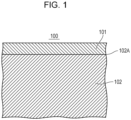
- Fig. 1 is a schematic view of an alloy member according to a first embodiment and is a cross-sectional view along the stacking direction.
- the alloy member 100 is a magnesium-lithium alloy member (Mg-Li alloy member).
- the alloy member includes a base material 102 and a coat 101 provided on the base material 102.
- the coat 101 is provided for protecting a first surface 102A of the base material and can be made of, for example, magnesium phosphate or a material including magnesium fluoride.
- a coating film such as a primer or a overcoating layer may be provided on the coat 101 depending on the user's purpose. Examples of the coating film include a heat-shielding film having a heat-shielding function.
- the coat 101 may not be provided. Accordingly, in the present disclosure, an aspect not including the coat 101 is also referred to as a Mg-Li alloy member.
- the shape of the base material 102 is not particularly limited as long as the base material 102 has the first surface 102A.
- the shape is not limited to a hexahedron such as a rectangular parallelepiped or cube shown in Fig. 1 and may be a cylinder, a sphere, a prism, a pyramid, or a tube. Since the first surface 102A may be any surface, the location is not particularly limited.
- the base material 102 includes a magnesium-lithium alloy (Mg-Li alloy).
- Mg-Li alloy refers to an alloy containing Mg and Li, where the sum of the content of Mg and the content of Li is 90 mass% or more.
- the specific gravity can be easily adjusted to 1.60 or less.
- the Mg-Li alloy is a lightweight metal material and is lightweight and has excellent vibration-damping properties and specific strength compared to Mg alloys not containing Li. Having excellent vibration-damping properties means that vibrations can be quickly converged by quickly converting vibration energy into thermal energy.
- the specific strength is tensile strength per density, and the higher the specific strength, the lighter the member can be. In contrast, when the sum of the contents of Mg and Li is less than 90 mass%, the specific gravity exceeds 1.60, and a reduction in weight becomes difficult. A more preferable specific gravity is 1.50 or less.
- Mg-Li alloys have different crystal structures depending on the content of Li. The structures will be described based on the phase diagram described in a literature " Collection of binary alloy phase diagrams", edited and written by Seizo Nagasaki and Makoto Hirabayashi, Publisher: Agne Gijutsu Center, ISBN-13: 978-4900041882, Issued date: 2001/01 . According to this phase diagram, it is known that in a Mg-Li alloy, a single phase region of an ⁇ -phase, a single phase region of a ⁇ -phase, and a eutectic region having both an ⁇ -phase and a ⁇ -phase are present.
- the ⁇ -phase has a lot of Mg and is also called a close-packed hexagonal phase, and the crystal structure thereof is an hcp (hexagonal close-packed) structure.
- the ⁇ -phase has a lot of Li and is also called a body centered cubic phase, and the crystal structure thereof is a bcc (body-centered cubic) structure.
- Mg-Li alloys have a problem that when the content of Li is 11 mass% or more and a single ⁇ -phase is present, corrosion progresses rapidly only by being left in an environment of room temperature (e.g., 25°C) for a long time. Therefore, it is necessary to improve the corrosion resistance of Mg-Li alloys.
- the inventor of the present application has diligently studied and, as a result, found a means for increasing the content proportion of the ⁇ -phase than before. Specifically, the inventor found a means in which a specific element is added to a Mg-Li alloy, and during cooling after melt synthesis, the molten raw materials are annealed from the start of solidification to 100°C which is just below the recrystallization temperature.
- the specific element that is contained in the Mg-Li alloy is one or more elements selected from a first group consisting of Ge, Mn, and Si. Although the detailed mechanism has not been fully elucidated, it is believed from the experimental results including Examples described later that these elements of the first group play a role in generating an ⁇ -phase.
- the content of Ge in the Mg-Li alloy is preferably 0.3 mass% or less.
- the content of Ge is 0.3 mass% or less, the corrosion resistance is particularly improved.
- the content of Ge exceeds 0.3 mass%, there is a risk of segregation of Ge oxide in the grain boundary of the Mg-Li alloy.
- the content of Ge is more preferably in a range of 0.01 mass% or more and 0.1 mass% or less.
- the content of Mn in the Mg-Li alloy is preferably 2 mass% or less.
- the toughness is improved.
- the corrosion resistance may be the same as when Mn is not contained.
- the content of Mn is more preferably 1.5 mass% or less.
- the content of Mn is further preferably in a range of 0.1 mass% or more and 1.1 mass% or less.
- the content of Si in the Mg-Li alloy is preferably 0.5 mass% or less.
- the corrosion resistance is particularly improved.
- the content of Si exceeds 0.5 mass%, the corrosion resistance may be the same as when Si is not contained.
- the content of Si is more preferably less than 0.1 mass%.
- the content of Si is further preferably in a range of 0.01 mass% or more and 0.03 mass% or less.
- the Mg-Li alloy of the first embodiment preferably contains two or more elements of the first group in the viewpoint of more easily generating an ⁇ -phase and more preferably contains all of the three elements.
- the content of Ge is preferably the highest among these three elements.
- the content of Si is preferably the lowest among the three elements.
- the content of Li in the Mg-Li alloy is in a range of higher than 11 mass% and 13.5 mass% or less.
- one or more elements selected from the first group and the raw materials of the Mg-Li alloy with the above-mentioned Li content are melt-synthesized, and during the subsequent cooling, the cooling rate from the start of solidification of the molten raw materials to 100°C which is just below the recrystallization temperature is adjusted to 100°C/min or less. By going through such a process, a Mg-Li alloy having an ⁇ -phase at 25°C can be obtained.
- a more preferable cooling rate is 50°C/min or less, and a further preferable cooling rate is 25°C/min or less. Since the obtained Mg-Li alloy of the first embodiment has an ⁇ -phase at 25°C despite the composition region with a relatively high Li content of higher than 11 mass% and 13.5 mass% or less, corrosion can be suppressed more than before.
- the proportion of the ⁇ -phase in the Mg-Li alloy of the first embodiment at 25°C is preferably 8% or more.
- the proportion of the ⁇ -phase is 8% or more, the corrosion resistance is particularly improved. More preferable proportion of the ⁇ -phase is 20% or more, and further preferable proportion of the ⁇ -phase is 30% or more.
- the abundance rate of the ⁇ -phase can be measured by an X-ray diffraction method.
- the measurement can be performed by the following procedure. Firstly, a diffraction pattern of the Mg-Li alloy is obtained by a 2 ⁇ - ⁇ method in a 2 ⁇ range of 20° or more and 100° or less, and the background is removed. Subsequently, the peaks in the diffraction pattern from which the background has been removed are separated to peaks derived from the ⁇ -phase and peaks derived from the ⁇ -phase.
- the abundance rate of the ⁇ -phase is calculated using the cps (count per second) value of each diffraction peak by an expression of (total of all cps values showing ⁇ -phase)/ ⁇ (total of all cps values showing ⁇ -phase) + (total of all cps values showing ⁇ -phase) ⁇ .
- Identification of the peaks in a diffraction pattern into ⁇ -phase-derived peaks and ⁇ -phase-derived peaks can be performed by referring to known powder X-ray diffraction data.
- the Mg-Li alloy of the first embodiment preferably further contains one or more elements selected from a second group consisting of Al, Zn, Zr, Ca, and Be. These elements of the second group have been experimentally confirmed by the inventor to be less likely to inhibit generation of an ⁇ -phase even if they are present in the Mg-Li alloy.
- the sum of the contents of one or more elements selected from the second group is preferably 0.01 mass% or more and 7 mass% or less. When the sum of the contents of one or more elements selected from the second group is in the above range, at least one of the corrosion resistance, fracture strength, ductility, and toughness is improved.
- the content of Al in the Mg-Li alloy is preferably 5 mass% or less.
- the content of Al is 5 mass% or less, the fracture strength is improved.
- the content of Al exceeds 5 mass%, although the mechanism is unknown, the process window becomes narrower, and a risk of inhibiting the effect of generating an ⁇ -phase by elements of the first group is caused.
- a more preferable content of Al is in a range of 0.1 mass% or more and 4 mass% or less.
- the content of Zn in the Mg-Li alloy is preferably 2 mass% or less.
- the content of Zn is 2 mass% or less, the ductility is improved.
- the content of Zn exceeds 2 mass%, although the mechanism is unknown, the process window becomes narrower, and a risk of inhibiting the effect of generating an ⁇ -phase by elements of the first group is caused.
- a more preferable content of Zn is 0.1 mass% or more and 1 mass% or less.
- the content of Zr in the Mg-Li alloy is preferably 0.7 mass% or less.
- the toughness is improved.
- the content of Zr exceeds 0.5 mass%, the toughness may be the same as when Zr is not contained.
- a more preferable content of Zr is in a range of 0.1 mass% and 0.5 mass% or less.
- the content of Ca in the Mg-Li alloy is preferably 0.3 mass% or less.
- the corrosion resistance is improved.
- the content of Ca exceeds 0.3 mass%, the corrosion resistance may be the same as when Ca is not contained.
- a more preferable content of Ca is in a range of 0.01 mass% or more and 0.15 mass% or less.
- the content of Be in the Mg-Li alloy is preferably 0.1 mass% or less.
- the toughness is improved.
- the toughness may be the same as when Be is not contained.
- a more preferable content of Be is in a range of 0.01 mass% or more and 0.05 mass% or less.
- the Mg-Li alloy of the first embodiment may contain a metal element other than the above-mentioned elements in a range within which the characteristics do not vary.
- a metal element such as a metal, inevitable impurities that cannot be avoided during manufacturing are also included.
- the inevitable impurities include Fe and Cu.
- the content of the inevitable impurities in the Mg-Li alloy is 1 mass% or less.
- the Mg-Li alloy of the first embodiment has an ⁇ -phase at 25°C, even if the Li content is higher than 11 mass%, and therefore is lightweight and has excellent corrosion resistance.
- Method of manufacturing alloy member The method of manufacturing the Mg-Li alloy of the first embodiment is not particularly limited as long as the method includes a means of melt-synthesizing the raw materials, and during the subsequent cooling, adjusting the cooling rate from the start of solidification of the molten raw materials to 100°C to 100°C/min or less.
- An example of a preferable manufacturing method will now be described.
- raw materials of the Mg-Li alloy are provided (providing step). Specifically, raw materials including Mg, Li, and one or more elements selected from a first group consisting of Ge, Mn, and Si are provided such that a desired composition is obtained and that the sum of the content of Mg and the content of Li is 90 mass% or more. On this occasion, the content of Li is higher than 11 mass% and 13.5 mass% or less.
- the purity of the raw materials is, for example, 4 N, and commercially available high-purity metals can be used.
- the form of the metals is not particularly limited, and a desirable form can be selected from, for example, an ingot, a chip, a flake, a powder, a shot, and a pellet.
- the metals not only a single metallic element but also an alloy consisting of multiple metal elements may be used.
- a raw material of one or more elements selected from a second group consisting of Al, Zn, Zr, Ca, and Be may be provided as needed.
- these raw materials are heated and molted (heating step). Specifically, these raw materials are put in a crucible and are heated to 600°C or more and molten.
- the temperature may be a temperature higher than the melting points of these raw materials and is preferably 700°C or more and more preferably 800°C or more.
- the method for heating is not particularly limited, and, for example, high frequency induction heating or electromagnetic induction stirring can be adopted.
- the atmosphere during heating is preferably an inert atmosphere in order to prevent oxidation of the alloy.
- the heating is preferably performed in an argon gas atmosphere.
- the rate of raising temperature to the melting temperature is not particularly limited. A temperature may be retained for a certain time during the heating and melting, and the retention time can be appropriately selected according to the desired shape.
- the molten raw materials are cooled and solidified (cooling step).
- the cooling rate is controlled such that the cooling rate from the start of solidification of the molten raw materials to 100°C which is just below the recrystallization temperature is 100°C/min or less.
- the above-mentioned cooling rate is an average cooling rate when the molten raw materials are cooled from the start of solidification to just below the recrystallization temperature of 100°C.
- the Mg-Li alloy of the first embodiment can be obtained by going through the following steps.
- a more preferable cooling rate in the cooling step is 50°C/min or less, and a further preferable cooling rate is 25°C/min or less.
- the cooling is preferably performed at a rate of 100°C/min or less.
- the cooling rate in a range of 200°C or less is preferably lower than that in a temperature range of higher than 200°C.
- a Mg-Li alloy with a single ⁇ -phase is obtained by performing cooling at a speed higher than 100°C/min using a rapid cooling method such as gas quick cooling or water quenching in the cooling.
- machining may be performed in order to form the obtained Mg-Li alloy into a desired shape.
- wrap processing, cutting processing, barrel processing, or the like is appropriately selected according to need.
- the obtained Mg-Li alloy may be washed.
- the washing can remove metal chips, dust, oil stains, deteriorated layers, and so on due to machining such as cutting processing. Accordingly, it is possible to use a common cleansing method such as washing with an acid or an alkali, washing using a surfactant, brush cleaning, or ultrasonic cleaning. After the cleaning, drying may be performed as needed.
- the obtained Mg-Li alloy may be used as a base material, and a coat may be provided on the base material.
- the method for providing a coat is not particularly limited and can be selected appropriately according to the coat to be provided.
- the coat is made of magnesium fluoride, a known anodization process or chemical conversion treatment using a known treatment solution can be used.
- the coat is made of magnesium phosphate, chemical conversion treatment using a known treatment solution can be used.
- the content of Li in the Mg-Li alloy is in a range of 5.34 mass% or more and 11 mass% or less.
- one or more elements selected from the first group and raw materials of the Mg-Li alloy with the above Li content are molt-synthesized, and during the subsequent cooling, the cooling rate from the start of solidification of the molten raw materials to 100°C is adjusted to 100°C/min or less.
- a more preferable cooling rate is 50°C/min or less, and a further preferable cooling rate is 25°C/min or less. Since the obtained Mg-Li alloy of the second embodiment has a larger amount of ⁇ -phase than before at 25°C in a composition region in which the Li content is 5.34 mass% or more and 11 mass% or less, corrosion can be more suppressed.
- phase diagram described in a literature " Collection of binary alloy phase diagrams”, edited and written by Seizo Nagasaki and Makoto Hirabayashi, Publisher: Agne Gijutsu Center, ISBN-13: 978-4900041882, Issued date: 2001/01 will be described again.
- the Li concentration in an equilibrium state at 25°C is read as 16.5 atm% (5.34 mass%).
- the abundance rate of the ⁇ -phase in an equilibrium state at 25°C in this concentration or less is 100%.
- the Li concentration in an equilibrium state at 25°C is read as 30.0 atm% (10.9 mass%).
- the ⁇ -phase disappears to become only a ⁇ -phase. That is, the abundance rate of the ⁇ -phase in this concentration or more is 0%.
- a Li concentration in the middle between the two Li concentrations read above is 7.96 mass%, and the abundance rate of the ⁇ -phase in the equilibrium state at 25°C at this concentration is 50%.
- this curve represents the Li concentration and the abundance rate of the ⁇ -phase in an equilibrium state at 25°C in a known Mg-Li alloy.
- the Mg-Li alloy of the second embodiment satisfies the expression (2) below, where y is the abundance rate of an ⁇ -phase, and x is mass% of Li: y > 0.3736 x 2 ⁇ 24.053 x + 217.79
- the Mg-Li alloy of the second embodiment has a larger amount of ⁇ -phase than before in a composition region in which the Li content is 5.34 mass% or more and 11 mass% or less, corrosion can be more suppressed.
- Method of manufacturing alloy member The method of manufacturing a Mg-Li alloy member of the second embodiment differs from that of the first embodiment in the providing step. The method of manufacturing a Mg-Li alloy member of the second embodiment will now be described focusing on the differences from the first embodiment.
- the providing step of providing raw materials of the Mg-Li alloy will be described. Specifically, raw materials including Mg, Li, and one or more elements selected from a first group consisting of Ge, Mn, and Si are provided such that a desired composition is obtained and that the sum of the content of Mg and the content of Li is 90 mass% or more. On this occasion, the content of Li is 5.34 mass% or more and 11 mass% or less.
- the purity of the raw materials is, for example, 4 N, and commercially available high-purity metals can be used.
- the form of the metals is not particularly limited, and a desirable form can be selected from, for example, an ingot, a chip, a flake, a powder, a shot, and a pellet.
- the metals not only a single metallic element but also an alloy consisting of multiple metal elements may be used.
- a raw material of one or more elements selected from a second group consisting of Al, Zn, Zr, Ca, and Be may be provided as needed.
- a cooling step of cooling and solidifying the molten raw materials will be described. Specifically, as in the first embodiment, the cooling rate is controlled such that the cooling rate from the start of solidification of the molten raw materials to 100°C is 100°C/min or less.
- the cooling rate is controlled such that the cooling rate from the start of solidification of the molten raw materials to 100°C is 100°C/min or less.
- a more preferable cooling rate in the cooling step is 50°C/min or less, and a further preferable cooling rate is 25°C/min or less.
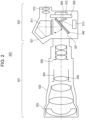
- Fig. 2 shows a structure of a single lens reflex digital camera 600 which is an image picture apparatus as an example of an instrument that is a third embodiment of the present disclosure.
- the lens barrel 601 is a so-called interchangeable lens that can be attached to and detached from the camera body 602.
- the light from an object passes through an optical system consisting of multiple lenses 603, 605, and so on as an example of components placed on the optical axis of a photographic optical system in the housing of the lens barrel 601, and an image sensor receives the light to take a photograph.
- the lenses are supported by an inner barrel 604 movably relative to the outer barrel of the lens barrel 601 for focusing and zooming.
- the light from an object is reflected by a main mirror 607 as an example of components in the housing 621 of the camera body and passes through the prism 611, and the captured image is the displayed to the photographer through a finder lens 612.
- the main mirror 607 is, for example, a half mirror, and the light passed through the main mirror is reflected by a sub-mirror 608 to the direction of an AF (autofocus) unit 613, and this reflected light is used for, for example, distance measurement.
- the main mirror 607 is attached by adhesion or the like to and supported by a main mirror holder 640.
- the main mirror 607 and the sub-mirror 608 are moved to the outside of the optical path when photographing by a driving mechanism (not shown), the shutter 609 is opened, and a photographic light image incident from the lens barrel 601 is formed on the image sensor 610.
- the diaphragm 606 is constructed so that the brightness and depth of focus during photographing can be changed by changing the aperture area.
- the alloy member 100 can be used in at least part of the housings 620, 621.
- the housings 620, 621 may be made of only the Mg-Li alloy member, or the alloy member 100 may be provided with a coating film. Since the Mg-Li alloy of the present disclosure is lightweight and has excellent corrosion resistance, it is possible to provide an image pickup apparatus of which the weight is lighter and the corrosion resistance is more excellent compared to existing image pickup apparatuses.
- the image pickup apparatus has been described using a single lens reflex digital camera as an example, the present disclosure is not limited thereto, and the image pickup apparatus may be a smartphone or a compact digital camera.
- Fig. 3 shows a configuration of a personal computer which is an electronic instrument as an example of an instrument that is a fourth embodiment of the present disclosure.
- the personal computer 800 includes a display part 801 and a body part 802.
- an electronic component 830 which is an example of the components provided in the housing, is installed.
- the alloy member 100 can be used in at least part of the housing 820 of the body part 802.
- the housing 820 may be made of only the Mg-Li alloy member, or the alloy member 100 may be provided with a coating film. Since the Mg-Li alloy of the present disclosure is lightweight and has excellent corrosion resistance, it is possible to provide a personal computer of which the weight is lighter and the corrosion resistance is more excellent compared to existing personal computers.
- the electronic instrument has been described using the personal computer 800 as an example, the present disclosure is not limited thereto, and the electronic instrument may be a smartphone or a tablet.
- Fig. 4 is a drone as an example of a mobile object that is a fifth embodiment of the present disclosure.
- the drone 700 includes a plurality of driving parts 701 and a main body 702 connected to the driving parts 701. Inside the main body 702, there is a drive circuit (not shown), which is an example of components.
- the driving parts 701 include, for example, propellers.
- the main body 702 may be connected to leg parts 703 or may be configured to connect a camera 704.
- the alloy member 100 can be used in at least part of housing 710 of the main body 702 and the leg parts 703.
- the housing 710 may be made of only the Mg-Li alloy member, or the alloy member 100 may be provided with a coating film. Since the Mg-Li alloy of the present disclosure has excellent vibration-damping properties and corrosion resistance, it is possible to provide a drone having more excellent vibration-damping properties and corrosion resistance compared to existing drones.
- the mobile object has been described using the drone 700 as an example, the present disclosure is not limited thereto, and the mobile object may be an automobile or an airplane.
- the background was removed from the obtained diffraction pattern.
- the peaks of the diffraction pattern from which the background was removed were separated to peaks derived from the ⁇ -phase and peaks derived from the ⁇ -phase.
- the abundance rate of the ⁇ -phase was calculated using the cps (count per second) value of each diffraction peak by an expression of (total of all cps values showing ⁇ -phase)/ ⁇ (total of all cps values showing ⁇ -phase) + (total of all cps values showing ⁇ -phase) ⁇ .
- the produced cylindrical billet with a diameter of 60 mm was cut into a plate shape of 20 mm ⁇ 50 mm ⁇ 2 mm in size and was used as a sample.
- the measuring surface of 20 mm ⁇ 50 mm of the sample was subjected to final polishing of #2000 using a polishing machine and was evaluated by an X-ray diffraction method.
- the specific gravity was measured by an Archimedes method. Specifically, a cylinder with a diameter of 10 mm and a length of 10 mm was produced from the produced billet and was immersed in water, and measurement was performed. The measurement was three times with the same sample, and the average thereof was defined as the value of specific gravity.
- a produced cylindrical billet with a diameter of 60 mm was cut in a direction perpendicular to the length direction to a thickness of 15 mm to produce a plate-like sample.
- the plate-like sample was left in the air in an atmosphere of 25°C ⁇ 2°C for 3 months and was then visually observed to verify whether the initial metallic color was maintained or not.
- a sample that maintained the metallic color on the entire surface was defined as A
- a sample that at least partially maintained the metallic color was defined as B or C
- a sample that could not maintain the metallic color was defined as D.
- Example 1-1 Metal pieces of elements of the respective raw materials with a purity of 4 N were provided so as to give a composition of Mg-11.5%Li-0.25%Ge-3.4%AI-0.18%Mn-0.04%Be-0.02%Si.
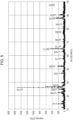
- Fig. 5 is a graph showing the results of 2 ⁇ - ⁇ measurement in Example 1-1.
- Example 1-2 differs from Example 1-1 in the composition.
- An alloy member of Example 1-2 was obtained as in Example 1-1 except that the composition in Example 1-2 was Mg-12.3%Li-0.29%Ge-2.9%AI-0.09%Mn-0.023%Si-0.15%Ca.
- the abundance rate of the ⁇ -phase was 22.2%.
- the specific gravity was 1.43.
- the evaluation was rated A because the metallic color was maintained.
- Example 1-3 differs from Example 1-1 in the composition.
- An alloy member of Example 1-3 was obtained as in Example 1-1 except that the composition in Example 1-3 was Mg-11.0%Li-2.2%AI-1.0%Zn-1.1%Mn-0.015%Si.
- the abundance rate of the ⁇ -phase was 30.8%.
- the specific gravity was 1.42.
- the evaluation was rated A because the metallic color was maintained.
- Example 1-4 differs from Example 1-1 in the composition.
- An alloy member of Example 1-4 was obtained as in Example 1-1 except that the composition in Example 1-4 was Mg-11.9%Li-3.9%Al-1.0%Zn-0.006%Mn-0.01%Si.
- the abundance rate of the ⁇ -phase was 2.7%.
- the specific gravity was 1.45.
- the evaluation was rated C because a partial change to black was observed.
- Example 1-5 differs from Example 1-1 in the composition.
- An alloy member of Example 1-5 was obtained as in Example 1-1 except that the composition in Example 1-5 was Mg-12.2%Li-3.0%Zn-0.41%Zr-0.01%Si.
- Example 1-6 differs from Example 1-1 in the composition.
- An alloy member of Example 1-6 was obtained as in Example 1-1 except that the composition in Example 1-6 was Mg-13.45%Li-5.54%AI-0.41%Ca-0.3%Mn.
- the abundance rate of the ⁇ -phase was 3.4%.
- the specific gravity was 1.40.
- the evaluation was rated C because a partial change to black was observed.
- Example 2-1 metal pieces of elements of the respective raw materials with a purity of 4 N were provided so as to give a composition of Mg-8.9%Li-3.9%AI-0.8%Zn-0.02%Mn-0.19%Si.
- Example 2-2 differs from Example 2-1 in the composition.
- An alloy member of Example 2-2 was obtained as in Example 2-1 except that the composition in Example 2-2 was Mg-9.0%Li-4.1%AI-1.1%Zn-0.009%Mn-0.015%Si.
- the abundance rate of the ⁇ -phase was 47.0%.
- the specific gravity was 1.52.
- the evaluation was rated A because the metallic color was maintained.
- Example 2-3 differs from Example 2-1 in the composition.
- An alloy member of Example 2-3 was obtained as in Example 2-1 except that the composition in Example 2-3 was Mg-7.0%Li-6.9%AI-0.8%Zn-0.015%Si.
- the abundance rate of the ⁇ -phase was 98.7%.
- the specific gravity was 1.60.
- the evaluation was rated A because the metallic color was maintained.
- Fig. 6 is a graph showing Li concentration on the horizontal axis and abundance rate of ⁇ -phase on the vertical axis in
- the rate of the ⁇ -phase at 25°C satisfied the relationship of the expression (2): y > 0.3736x2 - 24.053x + 217.79.
- All of the alloy members of Examples 2-1 to 2-3 had a specific gravity of 1.60 or less, which was a higher value compared to Examples 1-1 to 1-6, but the alloy members were lightweight.
Landscapes
- Chemical & Material Sciences (AREA)
- Engineering & Computer Science (AREA)
- Materials Engineering (AREA)
- Mechanical Engineering (AREA)
- Metallurgy (AREA)
- Organic Chemistry (AREA)
- Physics & Mathematics (AREA)
- Thermal Sciences (AREA)
- Crystallography & Structural Chemistry (AREA)
- Powder Metallurgy (AREA)
- Continuous Casting (AREA)
Abstract
Description
- The present disclosure relates to a Mg-Li alloy, an alloy member, an instrument, and a method of manufacturing an alloy member.
- Alloy members made of magnesium alloys are lightweight and have excellent vibration-damping properties and specific strength and are therefore used in various instruments. In recent years, there has been a demand for further weight reduction of instruments, and magnesium-lithium alloys (Mg-Li alloys), which have a lower specific gravity than magnesium alloys, are attracting attention. PTL 1 discloses magnesium-lithium alloys having a lithium content in a range of 8 mass% or more and 11 mass% or less.
- Citation List: Patent Literature, PTL 1:
Japanese Patent Laid-Open No. 2004-156089 - Technical Problem: The higher the Li content, the lighter the magnesium-lithium alloy becomes, but a large content of Li has a problem of reducing corrosion resistance.
- Solution to Problem: A first aspect for solving the above problem is an alloy containing Mg and Li, where the sum of the content of Mg and the content of Li is 90 mass% or more, wherein the content of Li is in a range of higher than 11 mass% and 13.5 mass% or less, the alloy contains one or more elements selected from a first group consisting of Ge, Mn, and Si, and the alloy has an α-phase at 25°C.
- A second aspect for solving the above problem is an alloy containing Mg and Li, where the sum of the content of Mg and the content of Li is 90 mass% or more, wherein the content of Li in the alloy is in a range of 5.34 mass% or more and 11 mass% or less, the alloy contains one or more elements selected from a first group consisting of Ge, Mn, and Si, and the alloy satisfies y > 0.3736x2 - 24.053x + 217.79, where y (%) is the proportion of an α-phase when the temperature of the alloy is 25°C, and x (mass%) is the content of Li.
- A third aspect for solving the above problem is a method of manufacturing an alloy, comprising a providing step of providing raw materials that include Mg and Li and include one or more elements selected from a first group consisting of Ge, Mn, and Si, where the sum of the content of Mg and the content of Li is 90 mass% or more; a heating step of heating the raw materials to 600°C or more to melt the raw materials; and a cooling step of cooling and solidifying the molten raw materials, wherein in the cooling step, the cooling rate from the start of solidification of the molten raw materials to 100°C is 100°C/min or less.
- Advantageous Effects of Invention: According to the present disclosure, it is possible to provide a magnesium-lithium alloy containing an α-phase, being lightweight, and having excellent corrosion resistance, even if the Li content is higher than 11 mass%.
- It is possible to provide a magnesium-lithium alloy that is lightweight, has excellent corrosion resistance, and has a higher α-phase content than before in a Li content in a range of 5.34 mass% or more and 11 mass% or less.
-
-
Fig. 1 is a schematic diagram of an alloy member according to a first embodiment. -
Fig. 2 is a schematic diagram of an instrument according to a third embodiment. -
Fig. 3 is a schematic diagram of an instrument according to a fourth embodiment. -
Fig. 4 is a schematic diagram of an instrument according to a fifth embodiment. -
Fig. 5 is a graph showing the results of 2θ-θ measurement in Example 1-1. -
Fig. 6 is a graph showing abundance rates of α-phases in Examples. - Embodiments of the present disclosure will now be described.
- (First embodiment), [Alloy member]:
Fig. 1 is a schematic view of an alloy member according to a first embodiment and is a cross-sectional view along the stacking direction. - The
alloy member 100 is a magnesium-lithium alloy member (Mg-Li alloy member). The alloy member includes abase material 102 and acoat 101 provided on thebase material 102. Thecoat 101 is provided for protecting afirst surface 102A of the base material and can be made of, for example, magnesium phosphate or a material including magnesium fluoride. In addition, a coating film such as a primer or a overcoating layer may be provided on thecoat 101 depending on the user's purpose. Examples of the coating film include a heat-shielding film having a heat-shielding function. However, depending on the purpose of use, thecoat 101 may not be provided. Accordingly, in the present disclosure, an aspect not including thecoat 101 is also referred to as a Mg-Li alloy member. - The shape of the
base material 102 is not particularly limited as long as thebase material 102 has thefirst surface 102A. The shape is not limited to a hexahedron such as a rectangular parallelepiped or cube shown inFig. 1 and may be a cylinder, a sphere, a prism, a pyramid, or a tube. Since thefirst surface 102A may be any surface, the location is not particularly limited. - The
base material 102 includes a magnesium-lithium alloy (Mg-Li alloy). In the present disclosure, the Mg-Li alloy refers to an alloy containing Mg and Li, where the sum of the content of Mg and the content of Li is 90 mass% or more. When the sum of the content of Mg and the content of Li is 90 mass% or more, the specific gravity can be easily adjusted to 1.60 or less. The Mg-Li alloy is a lightweight metal material and is lightweight and has excellent vibration-damping properties and specific strength compared to Mg alloys not containing Li. Having excellent vibration-damping properties means that vibrations can be quickly converged by quickly converting vibration energy into thermal energy. The specific strength is tensile strength per density, and the higher the specific strength, the lighter the member can be. In contrast, when the sum of the contents of Mg and Li is less than 90 mass%, the specific gravity exceeds 1.60, and a reduction in weight becomes difficult. A more preferable specific gravity is 1.50 or less. - It is known that Mg-Li alloys have different crystal structures depending on the content of Li. The structures will be described based on the phase diagram described in a literature "Collection of binary alloy phase diagrams", edited and written by Seizo Nagasaki and Makoto Hirabayashi, Publisher: Agne Gijutsu Center, ISBN-13: 978-4900041882, Issued date: 2001/01. According to this phase diagram, it is known that in a Mg-Li alloy, a single phase region of an α-phase, a single phase region of a β-phase, and a eutectic region having both an α-phase and a β-phase are present. The α-phase has a lot of Mg and is also called a close-packed hexagonal phase, and the crystal structure thereof is an hcp (hexagonal close-packed) structure. The β-phase has a lot of Li and is also called a body centered cubic phase, and the crystal structure thereof is a bcc (body-centered cubic) structure. When the content of Li at 25°C is lower than 5.34 mass%, only the α-phase is present. When the content of Li at 25°C is 5.34 mass% or more and 11 mass% or less, a mixed phase of the α-phase and the β-phase is present. When the content of Li at 25°C exceeds 11 mass%, only the β-phase is present.
- The higher the content of Li, the lighter the Mg-Li alloy becomes. Accordingly, it is desirable that the content of Li is higher. However, known Mg-Li alloys have a problem that when the content of Li is 11 mass% or more and a single β-phase is present, corrosion progresses rapidly only by being left in an environment of room temperature (e.g., 25°C) for a long time. Therefore, it is necessary to improve the corrosion resistance of Mg-Li alloys.
- Accordingly, the inventor of the present application has diligently studied and, as a result, found a means for increasing the content proportion of the α-phase than before. Specifically, the inventor found a means in which a specific element is added to a Mg-Li alloy, and during cooling after melt synthesis, the molten raw materials are annealed from the start of solidification to 100°C which is just below the recrystallization temperature.
- The specific element that is contained in the Mg-Li alloy is one or more elements selected from a first group consisting of Ge, Mn, and Si. Although the detailed mechanism has not been fully elucidated, it is believed from the experimental results including Examples described later that these elements of the first group play a role in generating an α-phase.
- The content of Ge in the Mg-Li alloy is preferably 0.3 mass% or less. When the content of Ge is 0.3 mass% or less, the corrosion resistance is particularly improved. In contrast, when the content of Ge exceeds 0.3 mass%, there is a risk of segregation of Ge oxide in the grain boundary of the Mg-Li alloy. In the viewpoint of improving toughness, the content of Ge is more preferably in a range of 0.01 mass% or more and 0.1 mass% or less.
- The content of Mn in the Mg-Li alloy is preferably 2 mass% or less. When the content of Mn is 2 mass% or less, the toughness is improved. In contrast, when the content of Mn exceeds 2 mass%, the corrosion resistance may be the same as when Mn is not contained. The content of Mn is more preferably 1.5 mass% or less. The content of Mn is further preferably in a range of 0.1 mass% or more and 1.1 mass% or less.
- The content of Si in the Mg-Li alloy is preferably 0.5 mass% or less. When the content of Si is 0.5 mass% or less, the corrosion resistance is particularly improved. In contrast, when the content of Si exceeds 0.5 mass%, the corrosion resistance may be the same as when Si is not contained. The content of Si is more preferably less than 0.1 mass%. The content of Si is further preferably in a range of 0.01 mass% or more and 0.03 mass% or less.
- The Mg-Li alloy of the first embodiment preferably contains two or more elements of the first group in the viewpoint of more easily generating an α-phase and more preferably contains all of the three elements. In addition, in the same viewpoint, the content of Ge is preferably the highest among these three elements. In the same viewpoint, the content of Si is preferably the lowest among the three elements.
- In the first embodiment, the content of Li in the Mg-Li alloy is in a range of higher than 11 mass% and 13.5 mass% or less. In the first embodiment, one or more elements selected from the first group and the raw materials of the Mg-Li alloy with the above-mentioned Li content are melt-synthesized, and during the subsequent cooling, the cooling rate from the start of solidification of the molten raw materials to 100°C which is just below the recrystallization temperature is adjusted to 100°C/min or less. By going through such a process, a Mg-Li alloy having an α-phase at 25°C can be obtained. In the viewpoint of more easily developing an α-phase, a more preferable cooling rate is 50°C/min or less, and a further preferable cooling rate is 25°C/min or less. Since the obtained Mg-Li alloy of the first embodiment has an α-phase at 25°C despite the composition region with a relatively high Li content of higher than 11 mass% and 13.5 mass% or less, corrosion can be suppressed more than before.
- The proportion of the α-phase in the Mg-Li alloy of the first embodiment at 25°C is preferably 8% or more. When the proportion of the α-phase is 8% or more, the corrosion resistance is particularly improved. More preferable proportion of the α-phase is 20% or more, and further preferable proportion of the α-phase is 30% or more.
- The abundance rate of the α-phase can be measured by an X-ray diffraction method. Specifically, for example, the measurement can be performed by the following procedure. Firstly, a diffraction pattern of the Mg-Li alloy is obtained by a 2θ-θ method in a 2θ range of 20° or more and 100° or less, and the background is removed. Subsequently, the peaks in the diffraction pattern from which the background has been removed are separated to peaks derived from the α-phase and peaks derived from the β-phase. The abundance rate of the α-phase is calculated using the cps (count per second) value of each diffraction peak by an expression of (total of all cps values showing α-phase)/{(total of all cps values showing α-phase) + (total of all cps values showing β-phase)}. Identification of the peaks in a diffraction pattern into α-phase-derived peaks and β-phase-derived peaks can be performed by referring to known powder X-ray diffraction data.
- The Mg-Li alloy of the first embodiment preferably further contains one or more elements selected from a second group consisting of Al, Zn, Zr, Ca, and Be. These elements of the second group have been experimentally confirmed by the inventor to be less likely to inhibit generation of an α-phase even if they are present in the Mg-Li alloy. Here, the sum of the contents of one or more elements selected from the second group is preferably 0.01 mass% or more and 7 mass% or less. When the sum of the contents of one or more elements selected from the second group is in the above range, at least one of the corrosion resistance, fracture strength, ductility, and toughness is improved.
- The content of Al in the Mg-Li alloy is preferably 5 mass% or less. When the content of Al is 5 mass% or less, the fracture strength is improved. In contrast, when the content of Al exceeds 5 mass%, although the mechanism is unknown, the process window becomes narrower, and a risk of inhibiting the effect of generating an α-phase by elements of the first group is caused. A more preferable content of Al is in a range of 0.1 mass% or more and 4 mass% or less.
- The content of Zn in the Mg-Li alloy is preferably 2 mass% or less. When the content of Zn is 2 mass% or less, the ductility is improved. In contrast, when the content of Zn exceeds 2 mass%, although the mechanism is unknown, the process window becomes narrower, and a risk of inhibiting the effect of generating an α-phase by elements of the first group is caused. A more preferable content of Zn is 0.1 mass% or more and 1 mass% or less.
- The content of Zr in the Mg-Li alloy is preferably 0.7 mass% or less. When the content of Zr is 0.5 mass% or less, the toughness is improved. In contrast, when the content of Zr exceeds 0.5 mass%, the toughness may be the same as when Zr is not contained. A more preferable content of Zr is in a range of 0.1 mass% and 0.5 mass% or less.
- The content of Ca in the Mg-Li alloy is preferably 0.3 mass% or less. When the content of Ca is 0.3 mass% or less, the corrosion resistance is improved. In contrast, when the content of Ca exceeds 0.3 mass%, the corrosion resistance may be the same as when Ca is not contained. A more preferable content of Ca is in a range of 0.01 mass% or more and 0.15 mass% or less.
- The content of Be in the Mg-Li alloy is preferably 0.1 mass% or less. When the content of Be is 0.1 mass% or less, the toughness is improved. In contrast, when the content of Be exceeds 0.1 mass%, the toughness may be the same as when Be is not contained. A more preferable content of Be is in a range of 0.01 mass% or more and 0.05 mass% or less.
- In addition, the Mg-Li alloy of the first embodiment may contain a metal element other than the above-mentioned elements in a range within which the characteristics do not vary. As such a metal, inevitable impurities that cannot be avoided during manufacturing are also included. Examples of the inevitable impurities include Fe and Cu. The content of the inevitable impurities in the Mg-Li alloy is 1 mass% or less.
- As described above, the Mg-Li alloy of the first embodiment has an α-phase at 25°C, even if the Li content is higher than 11 mass%, and therefore is lightweight and has excellent corrosion resistance.
- [Method of manufacturing alloy member]: The method of manufacturing the Mg-Li alloy of the first embodiment is not particularly limited as long as the method includes a means of melt-synthesizing the raw materials, and during the subsequent cooling, adjusting the cooling rate from the start of solidification of the molten raw materials to 100°C to 100°C/min or less. An example of a preferable manufacturing method will now be described.
- Firstly, raw materials of the Mg-Li alloy are provided (providing step). Specifically, raw materials including Mg, Li, and one or more elements selected from a first group consisting of Ge, Mn, and Si are provided such that a desired composition is obtained and that the sum of the content of Mg and the content of Li is 90 mass% or more. On this occasion, the content of Li is higher than 11 mass% and 13.5 mass% or less. The purity of the raw materials is, for example, 4 N, and commercially available high-purity metals can be used. The form of the metals is not particularly limited, and a desirable form can be selected from, for example, an ingot, a chip, a flake, a powder, a shot, and a pellet. As the metals, not only a single metallic element but also an alloy consisting of multiple metal elements may be used. On this occasion, a raw material of one or more elements selected from a second group consisting of Al, Zn, Zr, Ca, and Be may be provided as needed.
- Subsequently, these raw materials are heated and molted (heating step). Specifically, these raw materials are put in a crucible and are heated to 600°C or more and molten. The temperature may be a temperature higher than the melting points of these raw materials and is preferably 700°C or more and more preferably 800°C or more. The method for heating is not particularly limited, and, for example, high frequency induction heating or electromagnetic induction stirring can be adopted. The atmosphere during heating is preferably an inert atmosphere in order to prevent oxidation of the alloy. For example, the heating is preferably performed in an argon gas atmosphere. The rate of raising temperature to the melting temperature is not particularly limited. A temperature may be retained for a certain time during the heating and melting, and the retention time can be appropriately selected according to the desired shape.
- Subsequently, the molten raw materials are cooled and solidified (cooling step). Specifically, in the first embodiment, the cooling rate is controlled such that the cooling rate from the start of solidification of the molten raw materials to 100°C which is just below the recrystallization temperature is 100°C/min or less. The above-mentioned cooling rate is an average cooling rate when the molten raw materials are cooled from the start of solidification to just below the recrystallization temperature of 100°C. The Mg-Li alloy of the first embodiment can be obtained by going through the following steps.
- In the viewpoint of more easily developing an α-phase, a more preferable cooling rate in the cooling step is 50°C/min or less, and a further preferable cooling rate is 25°C/min or less. In the whole period of the cooling step of cooling the molten raw materials from the start of solidification to 100°C, the cooling is preferably performed at a rate of 100°C/min or less. In addition, the cooling rate in a range of 200°C or less is preferably lower than that in a temperature range of higher than 200°C. A Mg-Li alloy with a single β-phase is obtained by performing cooling at a speed higher than 100°C/min using a rapid cooling method such as gas quick cooling or water quenching in the cooling.
- In addition, machining may be performed in order to form the obtained Mg-Li alloy into a desired shape. In the machining, wrap processing, cutting processing, barrel processing, or the like is appropriately selected according to need. The obtained Mg-Li alloy may be washed. The washing can remove metal chips, dust, oil stains, deteriorated layers, and so on due to machining such as cutting processing. Accordingly, it is possible to use a common cleansing method such as washing with an acid or an alkali, washing using a surfactant, brush cleaning, or ultrasonic cleaning. After the cleaning, drying may be performed as needed.
- The obtained Mg-Li alloy may be used as a base material, and a coat may be provided on the base material. The method for providing a coat is not particularly limited and can be selected appropriately according to the coat to be provided. When the coat is made of magnesium fluoride, a known anodization process or chemical conversion treatment using a known treatment solution can be used. When the coat is made of magnesium phosphate, chemical conversion treatment using a known treatment solution can be used.
- (Second embodiment), [Alloy member]: In the Mg-Li alloy of the second embodiment, the content of Li is different from that in the first embodiment. The Mg-Li alloy of the second embodiment will now be described focusing on the differences from the first embodiment.
- In the second embodiment, the content of Li in the Mg-Li alloy is in a range of 5.34 mass% or more and 11 mass% or less. In the second embodiment, one or more elements selected from the first group and raw materials of the Mg-Li alloy with the above Li content are molt-synthesized, and during the subsequent cooling, the cooling rate from the start of solidification of the molten raw materials to 100°C is adjusted to 100°C/min or less. By going through such a process, a Mg-Li alloy having higher proportion of the α-phase at 25°C than before can be obtained. In the viewpoint of more easily developing an α-phase, a more preferable cooling rate is 50°C/min or less, and a further preferable cooling rate is 25°C/min or less. Since the obtained Mg-Li alloy of the second embodiment has a larger amount of α-phase than before at 25°C in a composition region in which the Li content is 5.34 mass% or more and 11 mass% or less, corrosion can be more suppressed.
- Here, the phase diagram described in a literature "Collection of binary alloy phase diagrams", edited and written by Seizo Nagasaki and Makoto Hirabayashi, Publisher: Agne Gijutsu Center, ISBN-13: 978-4900041882, Issued date: 2001/01 will be described again.
- According to this phase diagram, in the boundary (dotted line in a low temperature range) between a single phase region of an α-phase and a eutectic region having both an α-phase and a β-phase, the Li concentration in an equilibrium state at 25°C is read as 16.5 atm% (5.34 mass%). When Li is contained in a concentration of this concentration or more relative to Mg, generation of a β-phase starts. The abundance rate of the α-phase in an equilibrium state at 25°C in this concentration or less is 100%.
- Subsequently, in the boundary (dotted line in a low temperature range) between a eutectic region having both an α-phase and a β-phase and a single phase region of a β-phase, the Li concentration in an equilibrium state at 25°C is read as 30.0 atm% (10.9 mass%). When Li is contained in this concentration or more relative to Mg, the α-phase disappears to become only a β-phase. That is, the abundance rate of the α-phase in this concentration or more is 0%.
- A Li concentration in the middle between the two Li concentrations read above is 7.96 mass%, and the
abundance rate of the α-phase in the equilibrium state at 25°C at this concentration is 50%. When connecting these three Li concentrations and the tree-point approximate curve of the α-phase abundance rate, the curve can be represented by the expression (1) below, where y is the abundance rate of an α-phase, and x is mass% of Li:
- That is, this curve represents the Li concentration and the abundance rate of the α-phase in an equilibrium state at 25°C in a known Mg-Li alloy.
- The Mg-Li alloy of the second embodiment satisfies the expression (2) below, where y is the abundance rate of an α-phase, and x is mass% of Li:

- Accordingly, since the Mg-Li alloy of the second embodiment has a larger amount of α-phase than before in a composition region in which the Li content is 5.34 mass% or more and 11 mass% or less, corrosion can be more suppressed.
- [Method of manufacturing alloy member]: The method of manufacturing a Mg-Li alloy member of the second embodiment differs from that of the first embodiment in the providing step. The method of manufacturing a Mg-Li alloy member of the second embodiment will now be described focusing on the differences from the first embodiment.
- The providing step of providing raw materials of the Mg-Li alloy will be described. Specifically, raw materials including Mg, Li, and one or more elements selected from a first group consisting of Ge, Mn, and Si are provided such that a desired composition is obtained and that the sum of the content of Mg and the content of Li is 90 mass% or more. On this occasion, the content of Li is 5.34 mass% or more and 11 mass% or less. The purity of the raw materials is, for example, 4 N, and commercially available high-purity metals can be used. The form of the metals is not particularly limited, and a desirable form can be selected from, for example, an ingot, a chip, a flake, a powder, a shot, and a pellet. As the metals, not only a single metallic element but also an alloy consisting of multiple metal elements may be used. On this occasion, a raw material of one or more elements selected from a second group consisting of Al, Zn, Zr, Ca, and Be may be provided as needed.
- Subsequently, a cooling step of cooling and solidifying the molten raw materials will be described. Specifically, as in the first embodiment, the cooling rate is controlled such that the cooling rate from the start of solidification of the molten raw materials to 100°C is 100°C/min or less. By going through the above steps, a Mg-Li alloy of the second embodiment can be obtained.
- In the viewpoint of more easily developing an α-phase, a more preferable cooling rate in the cooling step is 50°C/min or less, and a further preferable cooling rate is 25°C/min or less.
- (Third embodiment), [Optical instrument/image pickup apparatus]:
Fig. 2 shows a structure of a single lens reflexdigital camera 600 which is an image picture apparatus as an example of an instrument that is a third embodiment of the present disclosure. InFig. 2 , although thecamera body 602 and thelens barrel 601, which is an optical instrument, are combined, thelens barrel 601 is a so-called interchangeable lens that can be attached to and detached from thecamera body 602. - The light from an object passes through an optical system consisting of
multiple lenses lens barrel 601, and an image sensor receives the light to take a photograph. Here, the lenses are supported by aninner barrel 604 movably relative to the outer barrel of thelens barrel 601 for focusing and zooming. - In an observation period before photographing, the light from an object is reflected by a
main mirror 607 as an example of components in thehousing 621 of the camera body and passes through theprism 611, and the captured image is the displayed to the photographer through afinder lens 612. Themain mirror 607 is, for example, a half mirror, and the light passed through the main mirror is reflected by a sub-mirror 608 to the direction of an AF (autofocus)unit 613, and this reflected light is used for, for example, distance measurement. Themain mirror 607 is attached by adhesion or the like to and supported by amain mirror holder 640. Themain mirror 607 and the sub-mirror 608 are moved to the outside of the optical path when photographing by a driving mechanism (not shown), theshutter 609 is opened, and a photographic light image incident from thelens barrel 601 is formed on theimage sensor 610. Thediaphragm 606 is constructed so that the brightness and depth of focus during photographing can be changed by changing the aperture area. - The
alloy member 100 can be used in at least part of thehousings housings alloy member 100 may be provided with a coating film. Since the Mg-Li alloy of the present disclosure is lightweight and has excellent corrosion resistance, it is possible to provide an image pickup apparatus of which the weight is lighter and the corrosion resistance is more excellent compared to existing image pickup apparatuses. - Although the image pickup apparatus has been described using a single lens reflex digital camera as an example, the present disclosure is not limited thereto, and the image pickup apparatus may be a smartphone or a compact digital camera.
- (Fourth embodiment) [Electronic instrument]:
Fig. 3 shows a configuration of a personal computer which is an electronic instrument as an example of an instrument that is a fourth embodiment of the present disclosure. InFig. 3 , thepersonal computer 800 includes adisplay part 801 and abody part 802. In the inside of the housing 820 of thebody part 802, an electronic component 830, which is an example of the components provided in the housing, is installed. Thealloy member 100 can be used in at least part of the housing 820 of thebody part 802. The housing 820 may be made of only the Mg-Li alloy member, or thealloy member 100 may be provided with a coating film. Since the Mg-Li alloy of the present disclosure is lightweight and has excellent corrosion resistance, it is possible to provide a personal computer of which the weight is lighter and the corrosion resistance is more excellent compared to existing personal computers. - Although the electronic instrument has been described using the
personal computer 800 as an example, the present disclosure is not limited thereto, and the electronic instrument may be a smartphone or a tablet. - (Fifth embodiment) [Mobile object]:
Fig. 4 is a drone as an example of a mobile object that is a fifth embodiment of the present disclosure. Thedrone 700 includes a plurality of drivingparts 701 and amain body 702 connected to the drivingparts 701. Inside themain body 702, there is a drive circuit (not shown), which is an example of components. The drivingparts 701 include, for example, propellers. As inFig. 4 , themain body 702 may be connected toleg parts 703 or may be configured to connect acamera 704. Thealloy member 100 can be used in at least part of housing 710 of themain body 702 and theleg parts 703. The housing 710 may be made of only the Mg-Li alloy member, or thealloy member 100 may be provided with a coating film. Since the Mg-Li alloy of the present disclosure has excellent vibration-damping properties and corrosion resistance, it is possible to provide a drone having more excellent vibration-damping properties and corrosion resistance compared to existing drones. - Although the mobile object has been described using the
drone 700 as an example, the present disclosure is not limited thereto, and the mobile object may be an automobile or an airplane. - The present disclosure will now be described by referring to Examples. First of all, a method for evaluating an alloy member will be described.
- [Method for evaluating alloy member]: (Measurement of abundance rate of α-phase) The abundance rate of the α-phase was measured by an X-ray diffraction method in an environment of 25°C. The X-ray diffractometer used was Ultima IV manufactured by Rigaku Corporation. The bulb used was a Cu bulb, and the measurement wavelength λ was set to 1.5418 Å. The tube voltage was 40 kV, and the tube current was set to 40 mA. Firstly, a diffraction pattern was obtained by a 2θ-θ method in a 2θ range of 20° or more and 100° or less. The step width was 0.02°, and the scanning speed was 2°/min (accumulated twice). Subsequently, the background was removed from the obtained diffraction pattern. The peaks of the diffraction pattern from which the background was removed were separated to peaks derived from the α-phase and peaks derived from the β-phase. The abundance rate of the α-phase was calculated using the cps (count per second) value of each diffraction peak by an expression of (total of all cps values showing α-phase)/{(total of all cps values showing α-phase) + (total of all cps values showing β-phase)}.
- In the measurement, the produced cylindrical billet with a diameter of 60 mm was cut into a plate shape of 20 mm × 50 mm × 2 mm in size and was used as a sample. The measuring surface of 20 mm × 50 mm of the sample was subjected to final polishing of #2000 using a polishing machine and was evaluated by an X-ray diffraction method.
- (Measurement of specific gravity) The specific gravity was measured by an Archimedes method. Specifically, a cylinder with a diameter of 10 mm and a length of 10 mm was produced from the produced billet and was immersed in water, and measurement was performed. The measurement was three times with the same sample, and the average thereof was defined as the value of specific gravity.
- (Corrosion resistance measurement) A produced cylindrical billet with a diameter of 60 mm was cut in a direction perpendicular to the length direction to a thickness of 15 mm to produce a plate-like sample. The plate-like sample was left in the air in an atmosphere of 25°C ± 2°C for 3 months and was then visually observed to verify whether the initial metallic color was maintained or not. A sample that maintained the metallic color on the entire surface was defined as A, a sample that at least partially maintained the metallic color was defined as B or C, and a sample that could not maintain the metallic color was defined as D.
- [Manufacturing and evaluation of alloy member]: (Example 1-1) Firstly, metal pieces of elements of the respective raw materials with a purity of 4 N were provided so as to give a composition of Mg-11.5%Li-0.25%Ge-3.4%AI-0.18%Mn-0.04%Be-0.02%Si.
- Subsequently, these raw materials were placed in an iron crucible. The crucible was heated at the highest temperature of 800°C in an argon gas atmosphere to melt the raw materials. The raw materials were maintained at 800°C for 1 hour and then cooled. The cooling was annealing, and the cooling rate from 594°C at which solidification started to 100°C was set to 15°C/min. In particular, the cooling rate from 200°C to 100°C was set to 10°C/min. The cooling was accomplished to obtain an alloy member of Example 1-1 as a cylindrical billet with a diameter of 60 mm.
- Subsequently, samples for performing each measurement were produced from the obtained cylindrical billet, and each measurement was performed. As a result, in the alloy member of Example 1-1, the abundance rate of the α-phase was 35.4%. The specific gravity was 1.43. In the corrosion resistance measurement, the evaluation was rated A because the metallic color was maintained.
Fig. 5 is a graph showing the results of 2θ-θ measurement in Example 1-1. - (Example 1-2) Example 1-2 differs from Example 1-1 in the composition. An alloy member of Example 1-2 was obtained as in Example 1-1 except that the composition in Example 1-2 was Mg-12.3%Li-0.29%Ge-2.9%AI-0.09%Mn-0.023%Si-0.15%Ca.
- In the alloy member of Example 1-2, the abundance rate of the α-phase was 22.2%. The specific gravity was 1.43. In the corrosion resistance measurement, the evaluation was rated A because the metallic color was maintained.
- (Example 1-3) Example 1-3 differs from Example 1-1 in the composition. An alloy member of Example 1-3 was obtained as in Example 1-1 except that the composition in Example 1-3 was Mg-11.0%Li-2.2%AI-1.0%Zn-1.1%Mn-0.015%Si.
- In the alloy member of Example 1-3, the abundance rate of the α-phase was 30.8%. The specific gravity was 1.42. In the corrosion resistance measurement, the evaluation was rated A because the metallic color was maintained.
- (Example 1-4) Example 1-4 differs from Example 1-1 in the composition. An alloy member of Example 1-4 was obtained as in Example 1-1 except that the composition in Example 1-4 was Mg-11.9%Li-3.9%Al-1.0%Zn-0.006%Mn-0.01%Si.
- In the alloy member of Example 1-4, the abundance rate of the α-phase was 2.7%. The specific gravity was 1.45. In the corrosion resistance measurement, the evaluation was rated C because a partial change to black was observed.
- (Example 1-5) Example 1-5 differs from Example 1-1 in the composition. An alloy member of Example 1-5 was obtained as in Example 1-1 except that the composition in Example 1-5 was Mg-12.2%Li-3.0%Zn-0.41%Zr-0.01%Si.
- In the alloy member of Example 1-5, the abundance rate of the α-phase was 8.1%. The specific gravity was 1.45. In the corrosion resistance measurement, the evaluation was rated B because a slight change to black was observed.
- (Example 1-6) Example 1-6 differs from Example 1-1 in the composition. An alloy member of Example 1-6 was obtained as in Example 1-1 except that the composition in Example 1-6 was Mg-13.45%Li-5.54%AI-0.41%Ca-0.3%Mn.
- In the alloy member of Example 1-6, the abundance rate of the α-phase was 3.4%. The specific gravity was 1.40. In the corrosion resistance measurement, the evaluation was rated C because a partial change to black was observed.
- (Example 2-1) Firstly, metal pieces of elements of the respective raw materials with a purity of 4 N were provided so as to give a composition of Mg-8.9%Li-3.9%AI-0.8%Zn-0.02%Mn-0.19%Si.
- Subsequently, these raw materials were placed in an iron crucible. The crucible was heated at the highest temperature of 800°C in an argon gas atmosphere to melt the raw materials. The raw materials were maintained at 800°C for 1 hour and then cooled. The cooling was annealing, and the cooling rate from 600°C at which solidification started to 100°C which was just below the recrystallization temperature was set to 20°C/min. In particular, the cooling rate from 200°C to 100°C was set to 15°C/min. The cooling was accomplished to obtain an alloy member of Example 2-1 as a cylindrical billet with a diameter of 160 mm.
- Subsequently, samples for performing each measurement were produced from the obtained cylindrical billet, and each measurement was performed. As a result, in the alloy member of Example 2-1, the abundance rate of the α-phase was 79.5%. The specific gravity was 1.51. In the corrosion resistance measurement, the evaluation was rated A because the metallic color was maintained.
- (Example 2-2) Example 2-2 differs from Example 2-1 in the composition. An alloy member of Example 2-2 was obtained as in Example 2-1 except that the composition in Example 2-2 was Mg-9.0%Li-4.1%AI-1.1%Zn-0.009%Mn-0.015%Si.
- In the alloy member of Example 2-2, the abundance rate of the α-phase was 47.0%. The specific gravity was 1.52. In the corrosion resistance measurement, the evaluation was rated A because the metallic color was maintained.
- (Example 2-3) Example 2-3 differs from Example 2-1 in the composition. An alloy member of Example 2-3 was obtained as in Example 2-1 except that the composition in Example 2-3 was Mg-7.0%Li-6.9%AI-0.8%Zn-0.015%Si.
- In the alloy member of Example 2-3, the abundance rate of the α-phase was 98.7%. The specific gravity was 1.60. In the corrosion resistance measurement, the evaluation was rated A because the metallic color was maintained.
- The above evaluation results are shown in Table 1.
Fig. 6 is a graph showing Li concentration on the horizontal axis and abundance rate of α-phase on the vertical axis in -
Table 1 Alloy composition (mass%) α-phase rate Specific gravity Corrosion resistance Li Al Zn Mn Zr Ca Ge Be Si Example 1-1 11.5 3.4 0.18 0.25 0.04 0.02 35.4% 1.43 A Example 1-2 12.3 2.9 0.09 0.15 0.29 0.023 22.2% 1.43 A Example 1-3 11.0 2.2 1.0 1.1 0.015 30.8% 1.42 A Example 1-4 11.9 3.9 1.0 0.006 0.01 2.7% 1.45 C Example 1-5 12.2 3.0 0.41 0.01 8.1% 1.45 B Example 1-6 13.45 5.54 0.3 0.41 3.4% 1.40 C Example 2-1 8.9 3.9 0.8 0.02 0.19 79.5% 1.51 A Example 2-2 9.0 4.1 1.1 0.009 0.015 47.0% 1.52 A Example 2-3 7.0 6.9 0.8 0.015 98.7% 1.60 A - According to Table 1, all of the alloy members of Examples 1-1 to 1-6 in which the content of Li was in a range of higher than 11 mass% and 13.5 mass% or less had an α-phase at 25°C and had good corrosion resistance rated A or B. In particular, in Examples 1-1 to 1-3 in which the abundance rate of the α-phase was 20% or more, the corrosion resistance was particularly good rated A. All of the alloy members of Examples 1-1 to 1-6 had a specific gravity of smaller than 1.50 and were particularly lightweight.
- The alloy members of Examples 2-1 to 2-3 in which the content of Li was in a range of 5.34 mass% or more and 11 mass% or less had particularly good corrosion resistance rated A. In all of the alloy members of Examples 2-1 to 2-3, the rate of the α-phase at 25°C satisfied the relationship of the expression (2): y > 0.3736x2 - 24.053x + 217.79. All of the alloy members of Examples 2-1 to 2-3 had a specific gravity of 1.60 or less, which was a higher value compared to Examples 1-1 to 1-6, but the alloy members were lightweight.
- As described above, according to the present disclosure, it is possible to provide a Mg-Li alloy member that is less likely to corrode and can obtain an effect of reducing weight.
- The present invention is not limited to the embodiments described above, and various changes and modifications can be made without departing from the spirit and scope of the present invention. Accordingly, in order to inform the public about the scope of the present invention, the following claims are appended.
- This application claims the benefit of
Japanese Patent Application No. 2021-188734 filed November 19, 2021 -
- 100 alloy member
- 101 coat
- 102 base material
- 600 single lens reflex digital camera (instrument)
- 601 lens barrel (instrument)
- 700 drone (instrument)
- 800 personal computer (instrument)
Claims (20)
- An alloy comprising Mg and Li, where the sum of the content of Mg and the content of Li is 90 mass% or more, whereinthe content of Li is in a range of higher than 11 mass% and 13.5 mass% or less,the alloy contains one or more elements selected from a first group consisting of Ge, Mn, and Si, andthe alloy has an α-phase at 25°C.
- The alloy according to Claim 1, wherein the content of Ge is 0.3 mass% or less.
- The alloy according to Claim 1 or 2, wherein the content of Mn is 2 mass% or less.
- The alloy according to any one of Claims 1 to 3, wherein the content of Si is 0.5 mass% or less.
- The alloy according to any one of Claims 1 to 4, wherein proportion of the α-phase in the alloy at 25°C is 8% or more.
- The alloy according to any one of Claims 1 to 4, wherein proportion of the α-phase in the alloy at 25°C is 20% or more.
- The alloy according to any one of Claims 1 to 6, whereinthe alloy further contains one or more elements selected from a second group consisting of Al, Zn, Zr, Ca, and Be, andthe sum of contents of elements of the second group is 0.01 mass% or more and 7 mass% or less.
- The alloy according to Claim 7, whereinthe content of Al is 5 mass% or less,the content of Zn is 2 mass% or less,the content of Zr is 0.7 mass% or less,the content of Ca is 0.3 mass% or less, andthe content of Be is 0.1 mass% or less.
- An alloy comprising Mg and Li, where the sum of the content of Mg and the content of Li is 90 mass% or more, whereinthe content of Li in the alloy is in a range of 5.34 mass% or more and 11 mass% or less,the alloy contains one or more elements selected from a first group consisting of Ge, Mn, and Si, andthe alloy satisfies y > 0.3736x2 - 24.053x + 217.79, where y (%) is proportion of an α-phase when temperature of the alloy is 25°C, and x (mass%) is the content of Li.
- The alloy according to Claim 9, wherein the content of Ge is 0.3 mass% or less.
- The alloy according to Claim 9 or 10, wherein the content of Mn is 2 mass% or less.
- The alloy according to any one of Claims 9 to 11, wherein the content of Si is 0.5 mass% or less.
- The alloy according to any one of Claims 9 to 12, further comprising one or more elements selected from a second group consisting of Al, Zn, Zr, Ca, and Be, wherein
the sum of contents of elements of the second group is 0.01 mass% or more and 7 mass% or less. - The alloy according to Claim 13, whereinthe content of Al is 5 mass% or less,the content of Zn is 2 mass% or less,the content of Zr is 0.7 mass% or less,the content of Ca is 0.3 mass% or less, andthe content of Be is 0.1 mass% or less.
- An alloy member comprising the alloy according to any one of Claims 1 to 14.
- An alloy member comprising:a base material; anda coat provided on the base material, wherein The base material includes the alloy according to any one of Claims 1 to 14.
- The alloy member according to Claim 16, wherein the coat includes magnesium fluoride or magnesium phosphate.
- An instrument comprising:a housing; anda component provided in the housing, whereinthe housing includes the alloy member according to any one of Claims 15 to 17.
- A method of manufacturing an alloy, comprising:a providing step of providing raw materials that include Mg and Li and include one or more elements selected from a first group consisting of Ge, Mn, and Si, where the sum of the content of Mg and the content of Li is 90 mass% or more;a heating step of heating the raw materials to 600°C or more to melt the raw materials; anda cooling step of cooling and solidifying the molten raw materials, whereinin the cooling step, the cooling rate from start of solidification of the molten raw materials to 100°C is 100°C/min or less.
- The method of manufacturing an alloy according to Claim 19, wherein in the cooling step, the cooling rate from start of solidification of the molten raw materials to 100°C is 50°C/min or less.
Applications Claiming Priority (2)
| Application Number | Priority Date | Filing Date | Title |
|---|---|---|---|
| JP2021188734A JP2023075682A (en) | 2021-11-19 | 2021-11-19 | Alloy, alloy member, device, and alloy production method |
| PCT/JP2022/040375 WO2023090127A1 (en) | 2021-11-19 | 2022-10-28 | Alloy, alloy member, device, and alloy production method |
Publications (2)
| Publication Number | Publication Date |
|---|---|
| EP4435126A1 true EP4435126A1 (en) | 2024-09-25 |
| EP4435126A4 EP4435126A4 (en) | 2026-02-25 |
Family
ID=86396761
Family Applications (1)
| Application Number | Title | Priority Date | Filing Date |
|---|---|---|---|
| EP22895410.3A Pending EP4435126A4 (en) | 2021-11-19 | 2022-10-28 | ALLOY, ALLOY ELEMENT, DEVICE AND ALLOY MANUFACTURING PROCESS |
Country Status (5)
| Country | Link |
|---|---|
| US (1) | US20240279781A1 (en) |
| EP (1) | EP4435126A4 (en) |
| JP (1) | JP2023075682A (en) |
| CN (1) | CN118234881A (en) |
| WO (1) | WO2023090127A1 (en) |
Families Citing this family (1)
| Publication number | Priority date | Publication date | Assignee | Title |
|---|---|---|---|---|
| WO2024043272A1 (en) * | 2022-08-24 | 2024-02-29 | パナソニックIpマネジメント株式会社 | Lithium primary battery |
Family Cites Families (10)
| Publication number | Priority date | Publication date | Assignee | Title |
|---|---|---|---|---|
| JPH04176839A (en) * | 1990-11-08 | 1992-06-24 | Aluminum Co Of America <Alcoa> | Magnesium based alloy |
| JPH0941066A (en) * | 1995-08-01 | 1997-02-10 | Mitsui Mining & Smelting Co Ltd | Cold press workable magnesium alloy |
| JP3852769B2 (en) | 2002-11-06 | 2006-12-06 | 三菱製鋼株式会社 | Room temperature formable magnesium alloy with excellent corrosion resistance |
| JP6794264B2 (en) * | 2015-01-27 | 2020-12-02 | 株式会社三徳 | Magnesium-lithium alloy, rolled materials and molded products |
| WO2018021360A1 (en) * | 2016-07-26 | 2018-02-01 | 株式会社三徳 | Magnesium-lithium alloy, and magnesium air battery |
| CN107723544A (en) * | 2016-08-11 | 2018-02-23 | 叶秀兰 | A kind of magnesium alloy and its manufacture method |
| JP7362267B2 (en) * | 2018-04-23 | 2023-10-17 | キヤノン株式会社 | Magnesium-lithium alloys, optical equipment, imaging devices, electronic equipment, and mobile objects |
| WO2021241251A1 (en) * | 2020-05-29 | 2021-12-02 | キヤノン株式会社 | Alloy member, article, and method for manufacturing alloy member |
| JP7376099B2 (en) | 2020-06-04 | 2023-11-08 | 株式会社山田製作所 | Plug-in joint fittings and plug-in joints |
| JP2022133238A (en) * | 2021-03-01 | 2022-09-13 | キヤノン株式会社 | Alloy member, sliding member, equipment, and method of producing alloy member |
-
2021
- 2021-11-19 JP JP2021188734A patent/JP2023075682A/en active Pending
-
2022
- 2022-10-28 CN CN202280075674.0A patent/CN118234881A/en active Pending
- 2022-10-28 EP EP22895410.3A patent/EP4435126A4/en active Pending
- 2022-10-28 WO PCT/JP2022/040375 patent/WO2023090127A1/en not_active Ceased
-
2024
- 2024-05-01 US US18/652,667 patent/US20240279781A1/en active Pending
Also Published As
| Publication number | Publication date |
|---|---|
| EP4435126A4 (en) | 2026-02-25 |
| US20240279781A1 (en) | 2024-08-22 |
| CN118234881A (en) | 2024-06-21 |
| JP2023075682A (en) | 2023-05-31 |
| WO2023090127A1 (en) | 2023-05-25 |
Similar Documents
| Publication | Publication Date | Title |
|---|---|---|
| Zhou et al. | Laser powder bed fusion of Al–10 wt% Ce alloys: microstructure and tensile property | |
| US20220298609A1 (en) | Magnesium-lithium-based alloy | |
| JP6794264B2 (en) | Magnesium-lithium alloy, rolled materials and molded products | |
| KR101695115B1 (en) | High-strength titanium-copper alloy | |
| US20240279781A1 (en) | Alloy, alloy member, instrument, and method of manufacturing alloy | |
| CN103710580A (en) | High-strength aluminum alloy extruded material and method for manufacturing the same | |
| JP2017186597A (en) | Aluminum alloy blank for magnetic disk and aluminum alloy substrate for magnetic disk | |
| WO2021241251A1 (en) | Alloy member, article, and method for manufacturing alloy member | |
| US11840749B2 (en) | Magnesium-lithium-based alloy | |
| JP5152775B2 (en) | Magnesium alloy material and method for producing the same | |
| JP2021188118A (en) | Alloy member, article and production of alloy member | |
| JP2024165297A (en) | Alloy, alloy member, equipment, and method for manufacturing alloy | |
| JP2023126138A (en) | Alloy parts, equipment, and methods for manufacturing alloy parts | |
| WO2021241250A1 (en) | Alloy member, article, and manufacturing method of alloy member | |
| JP2023174228A (en) | Alloys, alloy members, equipment, and alloy manufacturing methods. | |
| US20230272548A1 (en) | Alloy member, apparatus, and method for manufacturing alloy member | |
| Muthukumar et al. | Influence of Silicon Addition on the Microstructure and Mechanical Properties of WE43 Alloy | |
| CN116657220A (en) | Alloy component, device and method for producing an alloy component | |
| CN122070385A (en) | Alloy member, apparatus, and method for manufacturing alloy member | |
| US20250369079A1 (en) | Alloy member, bonded body, apparatus, method for manufacturing alloy member, and method for manufacturing bonded body | |
| WO2025089197A1 (en) | Alloy member, apparatus, and method for producing alloy member | |
| WO2026105837A1 (en) | Anti-corrosion film and method for producing same | |
| JP2021188117A (en) | Alloy member, article and production of alloy member | |
| JP4378987B2 (en) | Aluminum for precision equipment cover case | |
| JP2024042986A (en) | Alloy member, device, and method for manufacturing alloy member |
Legal Events
| Date | Code | Title | Description |
|---|---|---|---|
| STAA | Information on the status of an ep patent application or granted ep patent |
Free format text: STATUS: THE INTERNATIONAL PUBLICATION HAS BEEN MADE |
|
| PUAI | Public reference made under article 153(3) epc to a published international application that has entered the european phase |
Free format text: ORIGINAL CODE: 0009012 |
|
| STAA | Information on the status of an ep patent application or granted ep patent |
Free format text: STATUS: REQUEST FOR EXAMINATION WAS MADE |
|
| 17P | Request for examination filed |
Effective date: 20240619 |
|
| AK | Designated contracting states |
Kind code of ref document: A1 Designated state(s): AL AT BE BG CH CY CZ DE DK EE ES FI FR GB GR HR HU IE IS IT LI LT LU LV MC ME MK MT NL NO PL PT RO RS SE SI SK SM TR |
|
| DAV | Request for validation of the european patent (deleted) | ||
| DAX | Request for extension of the european patent (deleted) | ||
| RIC1 | Information provided on ipc code assigned before grant |
Ipc: C22C 23/00 20060101AFI20251027BHEP Ipc: C22F 1/06 20060101ALI20251027BHEP Ipc: C22C 1/02 20060101ALI20251027BHEP Ipc: C22C 23/02 20060101ALI20251027BHEP Ipc: C22C 23/04 20060101ALI20251027BHEP Ipc: C22C 23/06 20060101ALI20251027BHEP |
|
| A4 | Supplementary search report drawn up and despatched |
Effective date: 20260123 |
|
| RIC1 | Information provided on ipc code assigned before grant |
Ipc: C22C 23/00 20060101AFI20260119BHEP Ipc: C22F 1/06 20060101ALI20260119BHEP Ipc: C22C 1/02 20060101ALI20260119BHEP Ipc: C22C 23/02 20060101ALI20260119BHEP Ipc: C22C 23/04 20060101ALI20260119BHEP Ipc: C22C 23/06 20060101ALI20260119BHEP |