EP4434764A1 - Adhesive composition, organic fiber, organic fiber/rubber composite material, rubber article, and tire - Google Patents
Adhesive composition, organic fiber, organic fiber/rubber composite material, rubber article, and tire Download PDFInfo
- Publication number
- EP4434764A1 EP4434764A1 EP22895316.2A EP22895316A EP4434764A1 EP 4434764 A1 EP4434764 A1 EP 4434764A1 EP 22895316 A EP22895316 A EP 22895316A EP 4434764 A1 EP4434764 A1 EP 4434764A1
- Authority
- EP
- European Patent Office
- Prior art keywords
- adhesive composition
- group
- organic fiber
- mass
- compound
- Prior art date
- Legal status (The legal status is an assumption and is not a legal conclusion. Google has not performed a legal analysis and makes no representation as to the accuracy of the status listed.)
- Pending
Links
- 239000000203 mixture Substances 0.000 title claims abstract description 353
- 230000001070 adhesive effect Effects 0.000 title claims abstract description 295
- 239000000853 adhesive Substances 0.000 title claims abstract description 294
- 229920001971 elastomer Polymers 0.000 title claims abstract description 155
- 239000005060 rubber Substances 0.000 title claims abstract description 155
- 239000002131 composite material Substances 0.000 title claims abstract description 46
- 239000000835 fiber Substances 0.000 title claims description 173
- 150000001875 compounds Chemical class 0.000 claims abstract description 163
- 229920000126 latex Polymers 0.000 claims abstract description 126
- HRPVXLWXLXDGHG-UHFFFAOYSA-N Acrylamide Chemical group NC(=O)C=C HRPVXLWXLXDGHG-UHFFFAOYSA-N 0.000 claims abstract description 107
- 125000002091 cationic group Chemical group 0.000 claims abstract description 88
- 125000003178 carboxy group Chemical group [H]OC(*)=O 0.000 claims abstract description 74
- 150000001993 dienes Chemical class 0.000 claims abstract description 55
- GHMLBKRAJCXXBS-UHFFFAOYSA-N resorcinol Chemical compound OC1=CC=CC(O)=C1 GHMLBKRAJCXXBS-UHFFFAOYSA-N 0.000 claims abstract description 37
- 229960001755 resorcinol Drugs 0.000 claims abstract description 36
- -1 isocyanate compound Chemical class 0.000 claims description 108
- 239000000178 monomer Substances 0.000 claims description 106
- IQPQWNKOIGAROB-UHFFFAOYSA-N isocyanate group Chemical group [N-]=C=O IQPQWNKOIGAROB-UHFFFAOYSA-N 0.000 claims description 80
- 150000003839 salts Chemical class 0.000 claims description 61
- 238000002156 mixing Methods 0.000 claims description 44
- 229910052751 metal Inorganic materials 0.000 claims description 43
- 239000002184 metal Substances 0.000 claims description 43
- 125000004435 hydrogen atom Chemical group [H]* 0.000 claims description 42
- 229920001228 polyisocyanate Polymers 0.000 claims description 41
- 239000005056 polyisocyanate Substances 0.000 claims description 41
- 229920005610 lignin Polymers 0.000 claims description 37
- 229920002554 vinyl polymer Polymers 0.000 claims description 37
- 239000012790 adhesive layer Substances 0.000 claims description 35
- 235000013824 polyphenols Nutrition 0.000 claims description 35
- 125000000391 vinyl group Chemical group [H]C([*])=C([H])[H] 0.000 claims description 35
- 150000008442 polyphenolic compounds Chemical class 0.000 claims description 34
- 239000000047 product Substances 0.000 claims description 34
- 239000002981 blocking agent Substances 0.000 claims description 33
- 229920001577 copolymer Polymers 0.000 claims description 32
- 125000000129 anionic group Chemical group 0.000 claims description 30
- 125000002887 hydroxy group Chemical group [H]O* 0.000 claims description 28
- ISWSIDIOOBJBQZ-UHFFFAOYSA-N phenol group Chemical group C1(=CC=CC=C1)O ISWSIDIOOBJBQZ-UHFFFAOYSA-N 0.000 claims description 21
- 125000003118 aryl group Chemical group 0.000 claims description 16
- 229920005862 polyol Polymers 0.000 claims description 13
- 125000000524 functional group Chemical group 0.000 claims description 12
- 239000007795 chemical reaction product Substances 0.000 claims description 10
- 239000012948 isocyanate Substances 0.000 claims description 10
- 229920001864 tannin Polymers 0.000 claims description 10
- 239000001648 tannin Substances 0.000 claims description 10
- 235000018553 tannin Nutrition 0.000 claims description 10
- UPMLOUAZCHDJJD-UHFFFAOYSA-N 4,4'-Diphenylmethane Diisocyanate Chemical compound C1=CC(N=C=O)=CC=C1CC1=CC=C(N=C=O)C=C1 UPMLOUAZCHDJJD-UHFFFAOYSA-N 0.000 claims description 8
- TUSDEZXZIZRFGC-UHFFFAOYSA-N 1-O-galloyl-3,6-(R)-HHDP-beta-D-glucose Natural products OC1C(O2)COC(=O)C3=CC(O)=C(O)C(O)=C3C3=C(O)C(O)=C(O)C=C3C(=O)OC1C(O)C2OC(=O)C1=CC(O)=C(O)C(O)=C1 TUSDEZXZIZRFGC-UHFFFAOYSA-N 0.000 claims description 6
- 239000001263 FEMA 3042 Substances 0.000 claims description 6
- LRBQNJMCXXYXIU-PPKXGCFTSA-N Penta-digallate-beta-D-glucose Natural products OC1=C(O)C(O)=CC(C(=O)OC=2C(=C(O)C=C(C=2)C(=O)OC[C@@H]2[C@H]([C@H](OC(=O)C=3C=C(OC(=O)C=4C=C(O)C(O)=C(O)C=4)C(O)=C(O)C=3)[C@@H](OC(=O)C=3C=C(OC(=O)C=4C=C(O)C(O)=C(O)C=4)C(O)=C(O)C=3)[C@H](OC(=O)C=3C=C(OC(=O)C=4C=C(O)C(O)=C(O)C=4)C(O)=C(O)C=3)O2)OC(=O)C=2C=C(OC(=O)C=3C=C(O)C(O)=C(O)C=3)C(O)=C(O)C=2)O)=C1 LRBQNJMCXXYXIU-PPKXGCFTSA-N 0.000 claims description 6
- 229930003935 flavonoid Natural products 0.000 claims description 6
- 235000017173 flavonoids Nutrition 0.000 claims description 6
- 150000002215 flavonoids Chemical class 0.000 claims description 6
- 239000011256 inorganic filler Substances 0.000 claims description 6
- 229910003475 inorganic filler Inorganic materials 0.000 claims description 6
- 229920002258 tannic acid Polymers 0.000 claims description 6
- LRBQNJMCXXYXIU-NRMVVENXSA-N tannic acid Chemical compound OC1=C(O)C(O)=CC(C(=O)OC=2C(=C(O)C=C(C=2)C(=O)OC[C@@H]2[C@H]([C@H](OC(=O)C=3C=C(OC(=O)C=4C=C(O)C(O)=C(O)C=4)C(O)=C(O)C=3)[C@@H](OC(=O)C=3C=C(OC(=O)C=4C=C(O)C(O)=C(O)C=4)C(O)=C(O)C=3)[C@@H](OC(=O)C=3C=C(OC(=O)C=4C=C(O)C(O)=C(O)C=4)C(O)=C(O)C=3)O2)OC(=O)C=2C=C(OC(=O)C=3C=C(O)C(O)=C(O)C=3)C(O)=C(O)C=2)O)=C1 LRBQNJMCXXYXIU-NRMVVENXSA-N 0.000 claims description 6
- 235000015523 tannic acid Nutrition 0.000 claims description 6
- 229940033123 tannic acid Drugs 0.000 claims description 6
- 239000004721 Polyphenylene oxide Substances 0.000 claims description 5
- 229910021645 metal ion Inorganic materials 0.000 claims description 5
- 229920001225 polyester resin Polymers 0.000 claims description 5
- 239000004645 polyester resin Substances 0.000 claims description 5
- 229920000570 polyether Polymers 0.000 claims description 5
- 239000002657 fibrous material Substances 0.000 abstract description 18
- 235000002639 sodium chloride Nutrition 0.000 description 66
- WSFSSNUMVMOOMR-UHFFFAOYSA-N Formaldehyde Chemical compound O=C WSFSSNUMVMOOMR-UHFFFAOYSA-N 0.000 description 47
- 238000000034 method Methods 0.000 description 46
- 239000000463 material Substances 0.000 description 36
- 229920005989 resin Polymers 0.000 description 35
- 239000011347 resin Substances 0.000 description 35
- 239000007787 solid Substances 0.000 description 35
- XLYOFNOQVPJJNP-UHFFFAOYSA-N water Substances O XLYOFNOQVPJJNP-UHFFFAOYSA-N 0.000 description 35
- 239000004816 latex Substances 0.000 description 33
- 229920002401 polyacrylamide Polymers 0.000 description 33
- PPBRXRYQALVLMV-UHFFFAOYSA-N Styrene Chemical compound C=CC1=CC=CC=C1 PPBRXRYQALVLMV-UHFFFAOYSA-N 0.000 description 30
- 229920000642 polymer Polymers 0.000 description 30
- NIXOWILDQLNWCW-UHFFFAOYSA-M Acrylate Chemical compound [O-]C(=O)C=C NIXOWILDQLNWCW-UHFFFAOYSA-M 0.000 description 28
- 239000002585 base Substances 0.000 description 28
- 239000011248 coating agent Substances 0.000 description 28
- 238000000576 coating method Methods 0.000 description 28
- 239000000126 substance Substances 0.000 description 23
- KAKZBPTYRLMSJV-UHFFFAOYSA-N Butadiene Chemical group C=CC=C KAKZBPTYRLMSJV-UHFFFAOYSA-N 0.000 description 21
- 239000007864 aqueous solution Substances 0.000 description 20
- 239000002245 particle Substances 0.000 description 19
- 238000004132 cross linking Methods 0.000 description 18
- 230000000694 effects Effects 0.000 description 17
- KGIGUEBEKRSTEW-UHFFFAOYSA-N 2-vinylpyridine Chemical compound C=CC1=CC=CC=N1 KGIGUEBEKRSTEW-UHFFFAOYSA-N 0.000 description 16
- 230000000052 comparative effect Effects 0.000 description 16
- 239000007788 liquid Substances 0.000 description 16
- 229920003048 styrene butadiene rubber Polymers 0.000 description 16
- 238000006243 chemical reaction Methods 0.000 description 15
- 239000003795 chemical substances by application Substances 0.000 description 15
- 239000000123 paper Substances 0.000 description 15
- 238000006116 polymerization reaction Methods 0.000 description 15
- 230000008569 process Effects 0.000 description 15
- VTYYLEPIZMXCLO-UHFFFAOYSA-L Calcium carbonate Chemical compound [Ca+2].[O-]C([O-])=O VTYYLEPIZMXCLO-UHFFFAOYSA-L 0.000 description 14
- 229920001732 Lignosulfonate Polymers 0.000 description 14
- 238000001035 drying Methods 0.000 description 14
- 230000006870 function Effects 0.000 description 13
- 238000004073 vulcanization Methods 0.000 description 13
- 238000010438 heat treatment Methods 0.000 description 12
- 229920001778 nylon Polymers 0.000 description 12
- 125000001302 tertiary amino group Chemical group 0.000 description 12
- HEMHJVSKTPXQMS-UHFFFAOYSA-M Sodium hydroxide Chemical compound [OH-].[Na+] HEMHJVSKTPXQMS-UHFFFAOYSA-M 0.000 description 11
- QUEICCDHEFTIQD-UHFFFAOYSA-N buta-1,3-diene;2-ethenylpyridine;styrene Chemical compound C=CC=C.C=CC1=CC=CC=C1.C=CC1=CC=CC=N1 QUEICCDHEFTIQD-UHFFFAOYSA-N 0.000 description 11
- 238000013007 heat curing Methods 0.000 description 11
- LFQSCWFLJHTTHZ-UHFFFAOYSA-N Ethanol Chemical compound CCO LFQSCWFLJHTTHZ-UHFFFAOYSA-N 0.000 description 10
- 239000004677 Nylon Substances 0.000 description 10
- 239000002318 adhesion promoter Substances 0.000 description 10
- 125000002947 alkylene group Chemical group 0.000 description 10
- 239000003995 emulsifying agent Substances 0.000 description 10
- 238000011156 evaluation Methods 0.000 description 10
- KFZMGEQAYNKOFK-UHFFFAOYSA-N Isopropanol Chemical compound CC(C)O KFZMGEQAYNKOFK-UHFFFAOYSA-N 0.000 description 9
- OKKJLVBELUTLKV-UHFFFAOYSA-N Methanol Chemical group OC OKKJLVBELUTLKV-UHFFFAOYSA-N 0.000 description 9
- NINIDFKCEFEMDL-UHFFFAOYSA-N Sulfur Chemical compound [S] NINIDFKCEFEMDL-UHFFFAOYSA-N 0.000 description 9
- MTHSVFCYNBDYFN-UHFFFAOYSA-N diethylene glycol Chemical compound OCCOCCO MTHSVFCYNBDYFN-UHFFFAOYSA-N 0.000 description 9
- 229920001568 phenolic resin Polymers 0.000 description 9
- 239000002904 solvent Substances 0.000 description 9
- 239000002023 wood Substances 0.000 description 9
- KXGFMDJXCMQABM-UHFFFAOYSA-N 2-methoxy-6-methylphenol Chemical compound [CH]OC1=CC=CC([CH])=C1O KXGFMDJXCMQABM-UHFFFAOYSA-N 0.000 description 8
- LYCAIKOWRPUZTN-UHFFFAOYSA-N Ethylene glycol Chemical compound OCCO LYCAIKOWRPUZTN-UHFFFAOYSA-N 0.000 description 8
- 238000010494 dissociation reaction Methods 0.000 description 8
- 230000005593 dissociations Effects 0.000 description 8
- JBKVHLHDHHXQEQ-UHFFFAOYSA-N epsilon-caprolactam Chemical compound O=C1CCCCCN1 JBKVHLHDHHXQEQ-UHFFFAOYSA-N 0.000 description 8
- 239000001257 hydrogen Substances 0.000 description 8
- 229910052739 hydrogen Inorganic materials 0.000 description 8
- 239000005011 phenolic resin Substances 0.000 description 8
- 150000003077 polyols Chemical class 0.000 description 8
- 125000002924 primary amino group Chemical group [H]N([H])* 0.000 description 8
- 125000000467 secondary amino group Chemical group [H]N([*:1])[*:2] 0.000 description 8
- 229910052717 sulfur Inorganic materials 0.000 description 8
- 239000011593 sulfur Substances 0.000 description 8
- 241000196324 Embryophyta Species 0.000 description 7
- RSWGJHLUYNHPMX-ONCXSQPRSA-N abietic acid Chemical compound C([C@@H]12)CC(C(C)C)=CC1=CC[C@@H]1[C@]2(C)CCC[C@@]1(C)C(O)=O RSWGJHLUYNHPMX-ONCXSQPRSA-N 0.000 description 7
- 229910000019 calcium carbonate Inorganic materials 0.000 description 7
- 239000012986 chain transfer agent Substances 0.000 description 7
- 230000007613 environmental effect Effects 0.000 description 7
- 238000007654 immersion Methods 0.000 description 7
- 238000004519 manufacturing process Methods 0.000 description 7
- LSNNMFCWUKXFEE-UHFFFAOYSA-M Bisulfite Chemical compound OS([O-])=O LSNNMFCWUKXFEE-UHFFFAOYSA-M 0.000 description 6
- 239000004952 Polyamide Substances 0.000 description 6
- 229920000265 Polyparaphenylene Polymers 0.000 description 6
- 150000001412 amines Chemical class 0.000 description 6
- KVBYPTUGEKVEIJ-UHFFFAOYSA-N benzene-1,3-diol;formaldehyde Chemical compound O=C.OC1=CC=CC(O)=C1 KVBYPTUGEKVEIJ-UHFFFAOYSA-N 0.000 description 6
- UAOMVDZJSHZZME-UHFFFAOYSA-N diisopropylamine Chemical compound CC(C)NC(C)C UAOMVDZJSHZZME-UHFFFAOYSA-N 0.000 description 6
- DYUWTXWIYMHBQS-UHFFFAOYSA-N n-prop-2-enylprop-2-en-1-amine Chemical compound C=CCNCC=C DYUWTXWIYMHBQS-UHFFFAOYSA-N 0.000 description 6
- 229920002647 polyamide Polymers 0.000 description 6
- 229920000728 polyester Polymers 0.000 description 6
- 239000002244 precipitate Substances 0.000 description 6
- 238000002360 preparation method Methods 0.000 description 6
- 239000000243 solution Substances 0.000 description 6
- RMVRSNDYEFQCLF-UHFFFAOYSA-N thiophenol Chemical compound SC1=CC=CC=C1 RMVRSNDYEFQCLF-UHFFFAOYSA-N 0.000 description 6
- DVKJHBMWWAPEIU-UHFFFAOYSA-N toluene 2,4-diisocyanate Chemical compound CC1=CC=C(N=C=O)C=C1N=C=O DVKJHBMWWAPEIU-UHFFFAOYSA-N 0.000 description 6
- 229920000459 Nitrile rubber Polymers 0.000 description 5
- OFOBLEOULBTSOW-UHFFFAOYSA-N Propanedioic acid Natural products OC(=O)CC(O)=O OFOBLEOULBTSOW-UHFFFAOYSA-N 0.000 description 5
- 239000002253 acid Substances 0.000 description 5
- 239000003513 alkali Substances 0.000 description 5
- 229910052783 alkali metal Inorganic materials 0.000 description 5
- 229920002770 condensed tannin Polymers 0.000 description 5
- 238000010411 cooking Methods 0.000 description 5
- 230000007423 decrease Effects 0.000 description 5
- 229920001461 hydrolysable tannin Polymers 0.000 description 5
- 229920005611 kraft lignin Polymers 0.000 description 5
- 239000010410 layer Substances 0.000 description 5
- WSFSSNUMVMOOMR-NJFSPNSNSA-N methanone Chemical compound O=[14CH2] WSFSSNUMVMOOMR-NJFSPNSNSA-N 0.000 description 5
- 229920001084 poly(chloroprene) Polymers 0.000 description 5
- 239000000843 powder Substances 0.000 description 5
- 238000012546 transfer Methods 0.000 description 5
- YAJYJWXEWKRTPO-UHFFFAOYSA-N 2,3,3,4,4,5-hexamethylhexane-2-thiol Chemical compound CC(C)C(C)(C)C(C)(C)C(C)(C)S YAJYJWXEWKRTPO-UHFFFAOYSA-N 0.000 description 4
- GRFNBEZIAWKNCO-UHFFFAOYSA-N 3-pyridinol Chemical compound OC1=CC=CN=C1 GRFNBEZIAWKNCO-UHFFFAOYSA-N 0.000 description 4
- VVJKKWFAADXIJK-UHFFFAOYSA-N Allylamine Chemical compound NCC=C VVJKKWFAADXIJK-UHFFFAOYSA-N 0.000 description 4
- QGZKDVFQNNGYKY-UHFFFAOYSA-N Ammonia Chemical compound N QGZKDVFQNNGYKY-UHFFFAOYSA-N 0.000 description 4
- IJGRMHOSHXDMSA-UHFFFAOYSA-N Atomic nitrogen Chemical compound N#N IJGRMHOSHXDMSA-UHFFFAOYSA-N 0.000 description 4
- OCUCCJIRFHNWBP-IYEMJOQQSA-L Copper gluconate Chemical compound [Cu+2].OC[C@@H](O)[C@@H](O)[C@H](O)[C@@H](O)C([O-])=O.OC[C@@H](O)[C@@H](O)[C@H](O)[C@@H](O)C([O-])=O OCUCCJIRFHNWBP-IYEMJOQQSA-L 0.000 description 4
- RWSOTUBLDIXVET-UHFFFAOYSA-N Dihydrogen sulfide Chemical class S RWSOTUBLDIXVET-UHFFFAOYSA-N 0.000 description 4
- UFHFLCQGNIYNRP-UHFFFAOYSA-N Hydrogen Chemical compound [H][H] UFHFLCQGNIYNRP-UHFFFAOYSA-N 0.000 description 4
- LRHPLDYGYMQRHN-UHFFFAOYSA-N N-Butanol Chemical compound CCCCO LRHPLDYGYMQRHN-UHFFFAOYSA-N 0.000 description 4
- 150000001242 acetic acid derivatives Chemical class 0.000 description 4
- YRKCREAYFQTBPV-UHFFFAOYSA-N acetylacetone Chemical compound CC(=O)CC(C)=O YRKCREAYFQTBPV-UHFFFAOYSA-N 0.000 description 4
- 230000032683 aging Effects 0.000 description 4
- 125000001931 aliphatic group Chemical group 0.000 description 4
- 150000001408 amides Chemical group 0.000 description 4
- 150000001414 amino alcohols Chemical class 0.000 description 4
- 125000003277 amino group Chemical group 0.000 description 4
- ROOXNKNUYICQNP-UHFFFAOYSA-N ammonium persulfate Chemical compound [NH4+].[NH4+].[O-]S(=O)(=O)OOS([O-])(=O)=O ROOXNKNUYICQNP-UHFFFAOYSA-N 0.000 description 4
- NEHMKBQYUWJMIP-UHFFFAOYSA-N chloromethane Chemical compound ClC NEHMKBQYUWJMIP-UHFFFAOYSA-N 0.000 description 4
- VEZUQRBDRNJBJY-UHFFFAOYSA-N cyclohexanone oxime Chemical compound ON=C1CCCCC1 VEZUQRBDRNJBJY-UHFFFAOYSA-N 0.000 description 4
- 239000008367 deionised water Substances 0.000 description 4
- 229910021641 deionized water Inorganic materials 0.000 description 4
- DMBHHRLKUKUOEG-UHFFFAOYSA-N diphenylamine Chemical compound C=1C=CC=CC=1NC1=CC=CC=C1 DMBHHRLKUKUOEG-UHFFFAOYSA-N 0.000 description 4
- YDEXUEFDPVHGHE-GGMCWBHBSA-L disodium;(2r)-3-(2-hydroxy-3-methoxyphenyl)-2-[2-methoxy-4-(3-sulfonatopropyl)phenoxy]propane-1-sulfonate Chemical compound [Na+].[Na+].COC1=CC=CC(C[C@H](CS([O-])(=O)=O)OC=2C(=CC(CCCS([O-])(=O)=O)=CC=2)OC)=C1O YDEXUEFDPVHGHE-GGMCWBHBSA-L 0.000 description 4
- 239000002655 kraft paper Substances 0.000 description 4
- XUWHAWMETYGRKB-UHFFFAOYSA-N piperidin-2-one Chemical compound O=C1CCCCN1 XUWHAWMETYGRKB-UHFFFAOYSA-N 0.000 description 4
- 239000003505 polymerization initiator Substances 0.000 description 4
- USHAGKDGDHPEEY-UHFFFAOYSA-L potassium persulfate Chemical compound [K+].[K+].[O-]S(=O)(=O)OOS([O-])(=O)=O USHAGKDGDHPEEY-UHFFFAOYSA-L 0.000 description 4
- 150000003242 quaternary ammonium salts Chemical class 0.000 description 4
- 230000003014 reinforcing effect Effects 0.000 description 4
- 238000007711 solidification Methods 0.000 description 4
- 230000008023 solidification Effects 0.000 description 4
- 125000001424 substituent group Chemical group 0.000 description 4
- 150000005846 sugar alcohols Polymers 0.000 description 4
- 150000003467 sulfuric acid derivatives Chemical class 0.000 description 4
- 229920006174 synthetic rubber latex Polymers 0.000 description 4
- 229920001187 thermosetting polymer Polymers 0.000 description 4
- OHLKMGYGBHFODF-UHFFFAOYSA-N 1,4-bis(isocyanatomethyl)benzene Chemical compound O=C=NCC1=CC=C(CN=C=O)C=C1 OHLKMGYGBHFODF-UHFFFAOYSA-N 0.000 description 3
- KGRVJHAUYBGFFP-UHFFFAOYSA-N 2,2'-Methylenebis(4-methyl-6-tert-butylphenol) Chemical compound CC(C)(C)C1=CC(C)=CC(CC=2C(=C(C=C(C)C=2)C(C)(C)C)O)=C1O KGRVJHAUYBGFFP-UHFFFAOYSA-N 0.000 description 3
- QTWJRLJHJPIABL-UHFFFAOYSA-N 2-methylphenol;3-methylphenol;4-methylphenol Chemical compound CC1=CC=C(O)C=C1.CC1=CC=CC(O)=C1.CC1=CC=CC=C1O QTWJRLJHJPIABL-UHFFFAOYSA-N 0.000 description 3
- 125000003903 2-propenyl group Chemical group [H]C([*])([H])C([H])=C([H])[H] 0.000 description 3
- IGFHQQFPSIBGKE-UHFFFAOYSA-N 4-nonylphenol Chemical compound CCCCCCCCCC1=CC=C(O)C=C1 IGFHQQFPSIBGKE-UHFFFAOYSA-N 0.000 description 3
- CSCPPACGZOOCGX-UHFFFAOYSA-N Acetone Chemical compound CC(C)=O CSCPPACGZOOCGX-UHFFFAOYSA-N 0.000 description 3
- 240000007185 Albizia julibrissin Species 0.000 description 3
- 235000011468 Albizia julibrissin Nutrition 0.000 description 3
- VEXZGXHMUGYJMC-UHFFFAOYSA-M Chloride anion Chemical compound [Cl-] VEXZGXHMUGYJMC-UHFFFAOYSA-M 0.000 description 3
- JOYRKODLDBILNP-UHFFFAOYSA-N Ethyl urethane Chemical compound CCOC(N)=O JOYRKODLDBILNP-UHFFFAOYSA-N 0.000 description 3
- 244000043261 Hevea brasiliensis Species 0.000 description 3
- 239000005062 Polybutadiene Substances 0.000 description 3
- ZLMJMSJWJFRBEC-UHFFFAOYSA-N Potassium Chemical compound [K] ZLMJMSJWJFRBEC-UHFFFAOYSA-N 0.000 description 3
- LSNNMFCWUKXFEE-UHFFFAOYSA-N Sulfurous acid Chemical compound OS(O)=O LSNNMFCWUKXFEE-UHFFFAOYSA-N 0.000 description 3
- DKGAVHZHDRPRBM-UHFFFAOYSA-N Tert-Butanol Chemical compound CC(C)(C)O DKGAVHZHDRPRBM-UHFFFAOYSA-N 0.000 description 3
- 239000000654 additive Substances 0.000 description 3
- 239000002168 alkylating agent Substances 0.000 description 3
- 229940100198 alkylating agent Drugs 0.000 description 3
- 125000003368 amide group Chemical group 0.000 description 3
- 239000004760 aramid Substances 0.000 description 3
- 229920003235 aromatic polyamide Polymers 0.000 description 3
- 239000003153 chemical reaction reagent Substances 0.000 description 3
- 229930003836 cresol Natural products 0.000 description 3
- 239000003431 cross linking reagent Substances 0.000 description 3
- 125000004985 dialkyl amino alkyl group Chemical group 0.000 description 3
- 150000001990 dicarboxylic acid derivatives Chemical class 0.000 description 3
- 125000005442 diisocyanate group Chemical group 0.000 description 3
- 239000000945 filler Substances 0.000 description 3
- 150000004675 formic acid derivatives Chemical class 0.000 description 3
- 150000003840 hydrochlorides Chemical class 0.000 description 3
- 125000005462 imide group Chemical group 0.000 description 3
- 239000003999 initiator Substances 0.000 description 3
- 230000003993 interaction Effects 0.000 description 3
- XEEYBQQBJWHFJM-UHFFFAOYSA-N iron Substances [Fe] XEEYBQQBJWHFJM-UHFFFAOYSA-N 0.000 description 3
- 150000002513 isocyanates Chemical class 0.000 description 3
- 150000003951 lactams Chemical class 0.000 description 3
- 125000000325 methylidene group Chemical group [H]C([H])=* 0.000 description 3
- 150000002762 monocarboxylic acid derivatives Chemical class 0.000 description 3
- WHIVNJATOVLWBW-UHFFFAOYSA-N n-butan-2-ylidenehydroxylamine Chemical compound CCC(C)=NO WHIVNJATOVLWBW-UHFFFAOYSA-N 0.000 description 3
- QNILTEGFHQSKFF-UHFFFAOYSA-N n-propan-2-ylprop-2-enamide Chemical compound CC(C)NC(=O)C=C QNILTEGFHQSKFF-UHFFFAOYSA-N 0.000 description 3
- 229920003052 natural elastomer Polymers 0.000 description 3
- 229920001194 natural rubber Polymers 0.000 description 3
- 229920006173 natural rubber latex Polymers 0.000 description 3
- 150000007524 organic acids Chemical class 0.000 description 3
- 235000005985 organic acids Nutrition 0.000 description 3
- 150000002923 oximes Chemical class 0.000 description 3
- 150000002989 phenols Chemical class 0.000 description 3
- 229920001515 polyalkylene glycol Polymers 0.000 description 3
- 229920002857 polybutadiene Polymers 0.000 description 3
- 239000011591 potassium Substances 0.000 description 3
- 229910052700 potassium Inorganic materials 0.000 description 3
- 230000001737 promoting effect Effects 0.000 description 3
- 238000004537 pulping Methods 0.000 description 3
- 125000001453 quaternary ammonium group Chemical group 0.000 description 3
- 159000000000 sodium salts Chemical class 0.000 description 3
- GEHJYWRUCIMESM-UHFFFAOYSA-L sodium sulfite Chemical compound [Na+].[Na+].[O-]S([O-])=O GEHJYWRUCIMESM-UHFFFAOYSA-L 0.000 description 3
- BDHFUVZGWQCTTF-UHFFFAOYSA-M sulfonate Chemical compound [O-]S(=O)=O BDHFUVZGWQCTTF-UHFFFAOYSA-M 0.000 description 3
- 238000006277 sulfonation reaction Methods 0.000 description 3
- 239000000725 suspension Substances 0.000 description 3
- 230000002194 synthesizing effect Effects 0.000 description 3
- 150000003512 tertiary amines Chemical class 0.000 description 3
- 239000002699 waste material Substances 0.000 description 3
- 239000001124 (E)-prop-1-ene-1,2,3-tricarboxylic acid Substances 0.000 description 2
- MYRTYDVEIRVNKP-UHFFFAOYSA-N 1,2-Divinylbenzene Chemical compound C=CC1=CC=CC=C1C=C MYRTYDVEIRVNKP-UHFFFAOYSA-N 0.000 description 2
- RTTZISZSHSCFRH-UHFFFAOYSA-N 1,3-bis(isocyanatomethyl)benzene Chemical compound O=C=NCC1=CC=CC(CN=C=O)=C1 RTTZISZSHSCFRH-UHFFFAOYSA-N 0.000 description 2
- VGHSXKTVMPXHNG-UHFFFAOYSA-N 1,3-diisocyanatobenzene Chemical compound O=C=NC1=CC=CC(N=C=O)=C1 VGHSXKTVMPXHNG-UHFFFAOYSA-N 0.000 description 2
- ALQLPWJFHRMHIU-UHFFFAOYSA-N 1,4-diisocyanatobenzene Chemical compound O=C=NC1=CC=C(N=C=O)C=C1 ALQLPWJFHRMHIU-UHFFFAOYSA-N 0.000 description 2
- PMBXCGGQNSVESQ-UHFFFAOYSA-N 1-Hexanethiol Chemical compound CCCCCCS PMBXCGGQNSVESQ-UHFFFAOYSA-N 0.000 description 2
- LFSYUSUFCBOHGU-UHFFFAOYSA-N 1-isocyanato-2-[(4-isocyanatophenyl)methyl]benzene Chemical compound C1=CC(N=C=O)=CC=C1CC1=CC=CC=C1N=C=O LFSYUSUFCBOHGU-UHFFFAOYSA-N 0.000 description 2
- LTMRRSWNXVJMBA-UHFFFAOYSA-L 2,2-diethylpropanedioate Chemical compound CCC(CC)(C([O-])=O)C([O-])=O LTMRRSWNXVJMBA-UHFFFAOYSA-L 0.000 description 2
- CDULGHZNHURECF-UHFFFAOYSA-N 2,3-dimethylaniline 2,4-dimethylaniline 2,5-dimethylaniline 2,6-dimethylaniline 3,4-dimethylaniline 3,5-dimethylaniline Chemical group CC1=CC=C(N)C(C)=C1.CC1=CC=C(C)C(N)=C1.CC1=CC(C)=CC(N)=C1.CC1=CC=C(N)C=C1C.CC1=CC=CC(N)=C1C.CC1=CC=CC(C)=C1N CDULGHZNHURECF-UHFFFAOYSA-N 0.000 description 2
- SMZOUWXMTYCWNB-UHFFFAOYSA-N 2-(2-methoxy-5-methylphenyl)ethanamine Chemical compound COC1=CC=C(C)C=C1CCN SMZOUWXMTYCWNB-UHFFFAOYSA-N 0.000 description 2
- JAHNSTQSQJOJLO-UHFFFAOYSA-N 2-(3-fluorophenyl)-1h-imidazole Chemical compound FC1=CC=CC(C=2NC=CN=2)=C1 JAHNSTQSQJOJLO-UHFFFAOYSA-N 0.000 description 2
- NIXOWILDQLNWCW-UHFFFAOYSA-N 2-Propenoic acid Natural products OC(=O)C=C NIXOWILDQLNWCW-UHFFFAOYSA-N 0.000 description 2
- GJYCVCVHRSWLNY-UHFFFAOYSA-N 2-butylphenol Chemical compound CCCCC1=CC=CC=C1O GJYCVCVHRSWLNY-UHFFFAOYSA-N 0.000 description 2
- ISPYQTSUDJAMAB-UHFFFAOYSA-N 2-chlorophenol Chemical compound OC1=CC=CC=C1Cl ISPYQTSUDJAMAB-UHFFFAOYSA-N 0.000 description 2
- PMNLUUOXGOOLSP-UHFFFAOYSA-N 2-mercaptopropanoic acid Chemical compound CC(S)C(O)=O PMNLUUOXGOOLSP-UHFFFAOYSA-N 0.000 description 2
- SDXAWLJRERMRKF-UHFFFAOYSA-N 3,5-dimethyl-1h-pyrazole Chemical compound CC=1C=C(C)NN=1 SDXAWLJRERMRKF-UHFFFAOYSA-N 0.000 description 2
- HVBSAKJJOYLTQU-UHFFFAOYSA-N 4-aminobenzenesulfonic acid Chemical compound NC1=CC=C(S(O)(=O)=O)C=C1 HVBSAKJJOYLTQU-UHFFFAOYSA-N 0.000 description 2
- NSPMIYGKQJPBQR-UHFFFAOYSA-N 4H-1,2,4-triazole Chemical compound C=1N=CNN=1 NSPMIYGKQJPBQR-UHFFFAOYSA-N 0.000 description 2
- 229920000178 Acrylic resin Polymers 0.000 description 2
- 239000004925 Acrylic resin Substances 0.000 description 2
- 239000004953 Aliphatic polyamide Substances 0.000 description 2
- NLXLAEXVIDQMFP-UHFFFAOYSA-N Ammonia chloride Chemical compound [NH4+].[Cl-] NLXLAEXVIDQMFP-UHFFFAOYSA-N 0.000 description 2
- UIERETOOQGIECD-UHFFFAOYSA-N Angelic acid Natural products CC=C(C)C(O)=O UIERETOOQGIECD-UHFFFAOYSA-N 0.000 description 2
- XKRFYHLGVUSROY-UHFFFAOYSA-N Argon Chemical compound [Ar] XKRFYHLGVUSROY-UHFFFAOYSA-N 0.000 description 2
- CURLTUGMZLYLDI-UHFFFAOYSA-N Carbon dioxide Chemical compound O=C=O CURLTUGMZLYLDI-UHFFFAOYSA-N 0.000 description 2
- 229920003043 Cellulose fiber Polymers 0.000 description 2
- ZNZYKNKBJPZETN-WELNAUFTSA-N Dialdehyde 11678 Chemical compound N1C2=CC=CC=C2C2=C1[C@H](C[C@H](/C(=C/O)C(=O)OC)[C@@H](C=C)C=O)NCC2 ZNZYKNKBJPZETN-WELNAUFTSA-N 0.000 description 2
- ROSDSFDQCJNGOL-UHFFFAOYSA-N Dimethylamine Chemical compound CNC ROSDSFDQCJNGOL-UHFFFAOYSA-N 0.000 description 2
- 235000011511 Diospyros Nutrition 0.000 description 2
- VGGSQFUCUMXWEO-UHFFFAOYSA-N Ethene Chemical compound C=C VGGSQFUCUMXWEO-UHFFFAOYSA-N 0.000 description 2
- 239000005977 Ethylene Substances 0.000 description 2
- VZCYOOQTPOCHFL-OWOJBTEDSA-N Fumaric acid Chemical compound OC(=O)\C=C\C(O)=O VZCYOOQTPOCHFL-OWOJBTEDSA-N 0.000 description 2
- DHMQDGOQFOQNFH-UHFFFAOYSA-N Glycine Chemical compound NCC(O)=O DHMQDGOQFOQNFH-UHFFFAOYSA-N 0.000 description 2
- OAKJQQAXSVQMHS-UHFFFAOYSA-N Hydrazine Chemical compound NN OAKJQQAXSVQMHS-UHFFFAOYSA-N 0.000 description 2
- YZCKVEUIGOORGS-UHFFFAOYSA-N Hydrogen atom Chemical compound [H] YZCKVEUIGOORGS-UHFFFAOYSA-N 0.000 description 2
- QIGBRXMKCJKVMJ-UHFFFAOYSA-N Hydroquinone Chemical compound OC1=CC=C(O)C=C1 QIGBRXMKCJKVMJ-UHFFFAOYSA-N 0.000 description 2
- RRHGJUQNOFWUDK-UHFFFAOYSA-N Isoprene Chemical compound CC(=C)C=C RRHGJUQNOFWUDK-UHFFFAOYSA-N 0.000 description 2
- SUZRRICLUFMAQD-UHFFFAOYSA-N N-Methyltaurine Chemical compound CNCCS(O)(=O)=O SUZRRICLUFMAQD-UHFFFAOYSA-N 0.000 description 2
- FZERHIULMFGESH-UHFFFAOYSA-N N-phenylacetamide Chemical compound CC(=O)NC1=CC=CC=C1 FZERHIULMFGESH-UHFFFAOYSA-N 0.000 description 2
- 239000004698 Polyethylene Substances 0.000 description 2
- WCUXLLCKKVVCTQ-UHFFFAOYSA-M Potassium chloride Chemical compound [Cl-].[K+] WCUXLLCKKVVCTQ-UHFFFAOYSA-M 0.000 description 2
- YZCKVEUIGOORGS-IGMARMGPSA-N Protium Chemical compound [1H] YZCKVEUIGOORGS-IGMARMGPSA-N 0.000 description 2
- 240000003152 Rhus chinensis Species 0.000 description 2
- 235000014220 Rhus chinensis Nutrition 0.000 description 2
- VYPSYNLAJGMNEJ-UHFFFAOYSA-N Silicium dioxide Chemical compound O=[Si]=O VYPSYNLAJGMNEJ-UHFFFAOYSA-N 0.000 description 2
- FAPWRFPIFSIZLT-UHFFFAOYSA-M Sodium chloride Chemical compound [Na+].[Cl-] FAPWRFPIFSIZLT-UHFFFAOYSA-M 0.000 description 2
- KKEYFWRCBNTPAC-UHFFFAOYSA-N Terephthalic acid Chemical compound OC(=O)C1=CC=C(C(O)=O)C=C1 KKEYFWRCBNTPAC-UHFFFAOYSA-N 0.000 description 2
- MOYAFQVGZZPNRA-UHFFFAOYSA-N Terpinolene Chemical compound CC(C)=C1CCC(C)=CC1 MOYAFQVGZZPNRA-UHFFFAOYSA-N 0.000 description 2
- 244000269722 Thea sinensis Species 0.000 description 2
- GWEVSGVZZGPLCZ-UHFFFAOYSA-N Titan oxide Chemical compound O=[Ti]=O GWEVSGVZZGPLCZ-UHFFFAOYSA-N 0.000 description 2
- 239000007983 Tris buffer Substances 0.000 description 2
- XTXRWKRVRITETP-UHFFFAOYSA-N Vinyl acetate Chemical compound CC(=O)OC=C XTXRWKRVRITETP-UHFFFAOYSA-N 0.000 description 2
- NJSSICCENMLTKO-HRCBOCMUSA-N [(1r,2s,4r,5r)-3-hydroxy-4-(4-methylphenyl)sulfonyloxy-6,8-dioxabicyclo[3.2.1]octan-2-yl] 4-methylbenzenesulfonate Chemical compound C1=CC(C)=CC=C1S(=O)(=O)O[C@H]1C(O)[C@@H](OS(=O)(=O)C=2C=CC(C)=CC=2)[C@@H]2OC[C@H]1O2 NJSSICCENMLTKO-HRCBOCMUSA-N 0.000 description 2
- PXAJQJMDEXJWFB-UHFFFAOYSA-N acetone oxime Chemical compound CC(C)=NO PXAJQJMDEXJWFB-UHFFFAOYSA-N 0.000 description 2
- 150000007513 acids Chemical class 0.000 description 2
- 229940091181 aconitic acid Drugs 0.000 description 2
- WNLRTRBMVRJNCN-UHFFFAOYSA-N adipic acid Chemical compound OC(=O)CCCCC(O)=O WNLRTRBMVRJNCN-UHFFFAOYSA-N 0.000 description 2
- 238000004220 aggregation Methods 0.000 description 2
- 230000002776 aggregation Effects 0.000 description 2
- 150000001298 alcohols Chemical class 0.000 description 2
- 125000002723 alicyclic group Chemical group 0.000 description 2
- 229920003231 aliphatic polyamide Polymers 0.000 description 2
- 125000000217 alkyl group Chemical group 0.000 description 2
- XXROGKLTLUQVRX-UHFFFAOYSA-N allyl alcohol Chemical compound OCC=C XXROGKLTLUQVRX-UHFFFAOYSA-N 0.000 description 2
- XYLMUPLGERFSHI-UHFFFAOYSA-N alpha-Methylstyrene Chemical compound CC(=C)C1=CC=CC=C1 XYLMUPLGERFSHI-UHFFFAOYSA-N 0.000 description 2
- 229910021529 ammonia Inorganic materials 0.000 description 2
- 229910001870 ammonium persulfate Inorganic materials 0.000 description 2
- 150000003863 ammonium salts Chemical class 0.000 description 2
- 239000003945 anionic surfactant Substances 0.000 description 2
- QVGXLLKOCUKJST-UHFFFAOYSA-N atomic oxygen Chemical compound [O] QVGXLLKOCUKJST-UHFFFAOYSA-N 0.000 description 2
- TZCXTZWJZNENPQ-UHFFFAOYSA-L barium sulfate Chemical compound [Ba+2].[O-]S([O-])(=O)=O TZCXTZWJZNENPQ-UHFFFAOYSA-L 0.000 description 2
- KCXMKQUNVWSEMD-UHFFFAOYSA-N benzyl chloride Chemical compound ClCC1=CC=CC=C1 KCXMKQUNVWSEMD-UHFFFAOYSA-N 0.000 description 2
- 229940073608 benzyl chloride Drugs 0.000 description 2
- HIFVAOIJYDXIJG-UHFFFAOYSA-N benzylbenzene;isocyanic acid Chemical class N=C=O.N=C=O.C=1C=CC=CC=1CC1=CC=CC=C1 HIFVAOIJYDXIJG-UHFFFAOYSA-N 0.000 description 2
- 230000001588 bifunctional effect Effects 0.000 description 2
- GZUXJHMPEANEGY-UHFFFAOYSA-N bromomethane Chemical compound BrC GZUXJHMPEANEGY-UHFFFAOYSA-N 0.000 description 2
- WQAQPCDUOCURKW-UHFFFAOYSA-N butanethiol Chemical compound CCCCS WQAQPCDUOCURKW-UHFFFAOYSA-N 0.000 description 2
- 229920005549 butyl rubber Polymers 0.000 description 2
- 150000001718 carbodiimides Chemical class 0.000 description 2
- 239000006229 carbon black Substances 0.000 description 2
- 125000002915 carbonyl group Chemical group [*:2]C([*:1])=O 0.000 description 2
- 150000001735 carboxylic acids Chemical class 0.000 description 2
- 150000001768 cations Chemical class 0.000 description 2
- 210000002421 cell wall Anatomy 0.000 description 2
- 239000001913 cellulose Substances 0.000 description 2
- 229920002678 cellulose Polymers 0.000 description 2
- 239000004568 cement Substances 0.000 description 2
- GTZCVFVGUGFEME-IWQZZHSRSA-N cis-aconitic acid Chemical compound OC(=O)C\C(C(O)=O)=C\C(O)=O GTZCVFVGUGFEME-IWQZZHSRSA-N 0.000 description 2
- 238000013329 compounding Methods 0.000 description 2
- 238000009833 condensation Methods 0.000 description 2
- 230000005494 condensation Effects 0.000 description 2
- 238000006482 condensation reaction Methods 0.000 description 2
- 229940108925 copper gluconate Drugs 0.000 description 2
- 230000018044 dehydration Effects 0.000 description 2
- 238000006297 dehydration reaction Methods 0.000 description 2
- 238000009792 diffusion process Methods 0.000 description 2
- 229940043279 diisopropylamine Drugs 0.000 description 2
- BEPAFCGSDWSTEL-UHFFFAOYSA-N dimethyl malonate Chemical compound COC(=O)CC(=O)OC BEPAFCGSDWSTEL-UHFFFAOYSA-N 0.000 description 2
- 238000007598 dipping method Methods 0.000 description 2
- WNAHIZMDSQCWRP-UHFFFAOYSA-N dodecane-1-thiol Chemical compound CCCCCCCCCCCCS WNAHIZMDSQCWRP-UHFFFAOYSA-N 0.000 description 2
- 238000004043 dyeing Methods 0.000 description 2
- 235000013399 edible fruits Nutrition 0.000 description 2
- 239000000839 emulsion Substances 0.000 description 2
- 239000003623 enhancer Substances 0.000 description 2
- 150000002148 esters Chemical class 0.000 description 2
- 230000009477 glass transition Effects 0.000 description 2
- 150000004676 glycans Chemical class 0.000 description 2
- LEQAOMBKQFMDFZ-UHFFFAOYSA-N glyoxal Chemical group O=CC=O LEQAOMBKQFMDFZ-UHFFFAOYSA-N 0.000 description 2
- 125000000623 heterocyclic group Chemical group 0.000 description 2
- 150000004678 hydrides Chemical class 0.000 description 2
- 125000002768 hydroxyalkyl group Chemical group 0.000 description 2
- 229920000831 ionic polymer Polymers 0.000 description 2
- 229910052742 iron Inorganic materials 0.000 description 2
- 235000019357 lignosulphonate Nutrition 0.000 description 2
- XMGQYMWWDOXHJM-UHFFFAOYSA-N limonene Chemical compound CC(=C)C1CCC(C)=CC1 XMGQYMWWDOXHJM-UHFFFAOYSA-N 0.000 description 2
- 238000002844 melting Methods 0.000 description 2
- 230000008018 melting Effects 0.000 description 2
- 229940050176 methyl chloride Drugs 0.000 description 2
- LVHBHZANLOWSRM-UHFFFAOYSA-N methylenebutanedioic acid Natural products OC(=O)CC(=C)C(O)=O LVHBHZANLOWSRM-UHFFFAOYSA-N 0.000 description 2
- 239000003094 microcapsule Substances 0.000 description 2
- 230000004048 modification Effects 0.000 description 2
- 238000012986 modification Methods 0.000 description 2
- TXXHDPDFNKHHGW-UHFFFAOYSA-N muconic acid Chemical compound OC(=O)C=CC=CC(O)=O TXXHDPDFNKHHGW-UHFFFAOYSA-N 0.000 description 2
- WFKDPJRCBCBQNT-UHFFFAOYSA-N n,2-dimethylprop-2-enamide Chemical compound CNC(=O)C(C)=C WFKDPJRCBCBQNT-UHFFFAOYSA-N 0.000 description 2
- ZQUVDXMUKIVNOW-UHFFFAOYSA-N n,n'-diphenylmethanimidamide Chemical compound C=1C=CC=CC=1NC=NC1=CC=CC=C1 ZQUVDXMUKIVNOW-UHFFFAOYSA-N 0.000 description 2
- 229940088644 n,n-dimethylacrylamide Drugs 0.000 description 2
- YLGYACDQVQQZSW-UHFFFAOYSA-N n,n-dimethylprop-2-enamide Chemical compound CN(C)C(=O)C=C YLGYACDQVQQZSW-UHFFFAOYSA-N 0.000 description 2
- OMNKZBIFPJNNIO-UHFFFAOYSA-N n-(2-methyl-4-oxopentan-2-yl)prop-2-enamide Chemical compound CC(=O)CC(C)(C)NC(=O)C=C OMNKZBIFPJNNIO-UHFFFAOYSA-N 0.000 description 2
- 229910052757 nitrogen Inorganic materials 0.000 description 2
- IXQGCWUGDFDQMF-UHFFFAOYSA-N o-Hydroxyethylbenzene Natural products CCC1=CC=CC=C1O IXQGCWUGDFDQMF-UHFFFAOYSA-N 0.000 description 2
- XNGIFLGASWRNHJ-UHFFFAOYSA-N o-dicarboxybenzene Natural products OC(=O)C1=CC=CC=C1C(O)=O XNGIFLGASWRNHJ-UHFFFAOYSA-N 0.000 description 2
- KZCOBXFFBQJQHH-UHFFFAOYSA-N octane-1-thiol Chemical compound CCCCCCCCS KZCOBXFFBQJQHH-UHFFFAOYSA-N 0.000 description 2
- 239000003960 organic solvent Substances 0.000 description 2
- 239000001301 oxygen Substances 0.000 description 2
- 229910052760 oxygen Inorganic materials 0.000 description 2
- NRNCYVBFPDDJNE-UHFFFAOYSA-N pemoline Chemical compound O1C(N)=NC(=O)C1C1=CC=CC=C1 NRNCYVBFPDDJNE-UHFFFAOYSA-N 0.000 description 2
- 238000005191 phase separation Methods 0.000 description 2
- 239000011120 plywood Substances 0.000 description 2
- 229920005906 polyester polyol Polymers 0.000 description 2
- 229920000573 polyethylene Polymers 0.000 description 2
- 229920000139 polyethylene terephthalate Polymers 0.000 description 2
- 239000005020 polyethylene terephthalate Substances 0.000 description 2
- 230000000379 polymerizing effect Effects 0.000 description 2
- 229920006389 polyphenyl polymer Polymers 0.000 description 2
- 229920001282 polysaccharide Polymers 0.000 description 2
- 239000005017 polysaccharide Substances 0.000 description 2
- 229920001296 polysiloxane Polymers 0.000 description 2
- 159000000001 potassium salts Chemical class 0.000 description 2
- ODLMAHJVESYWTB-UHFFFAOYSA-N propylbenzene Chemical compound CCCC1=CC=CC=C1 ODLMAHJVESYWTB-UHFFFAOYSA-N 0.000 description 2
- 238000010298 pulverizing process Methods 0.000 description 2
- UBQKCCHYAOITMY-UHFFFAOYSA-N pyridin-2-ol Chemical compound OC1=CC=CC=N1 UBQKCCHYAOITMY-UHFFFAOYSA-N 0.000 description 2
- HNJBEVLQSNELDL-UHFFFAOYSA-N pyrrolidin-2-one Chemical compound O=C1CCCN1 HNJBEVLQSNELDL-UHFFFAOYSA-N 0.000 description 2
- 230000009257 reactivity Effects 0.000 description 2
- 239000012779 reinforcing material Substances 0.000 description 2
- CXMXRPHRNRROMY-UHFFFAOYSA-N sebacic acid Chemical compound OC(=O)CCCCCCCCC(O)=O CXMXRPHRNRROMY-UHFFFAOYSA-N 0.000 description 2
- 238000000926 separation method Methods 0.000 description 2
- 238000007493 shaping process Methods 0.000 description 2
- 235000010265 sodium sulphite Nutrition 0.000 description 2
- 239000012265 solid product Substances 0.000 description 2
- 238000001179 sorption measurement Methods 0.000 description 2
- 238000003756 stirring Methods 0.000 description 2
- KZNICNPSHKQLFF-UHFFFAOYSA-N succinimide Chemical compound O=C1CCC(=O)N1 KZNICNPSHKQLFF-UHFFFAOYSA-N 0.000 description 2
- LSNNMFCWUKXFEE-UHFFFAOYSA-L sulfite Chemical class [O-]S([O-])=O LSNNMFCWUKXFEE-UHFFFAOYSA-L 0.000 description 2
- 229920003051 synthetic elastomer Polymers 0.000 description 2
- 229920003002 synthetic resin Polymers 0.000 description 2
- 239000000057 synthetic resin Substances 0.000 description 2
- 239000005061 synthetic rubber Substances 0.000 description 2
- XOAAWQZATWQOTB-UHFFFAOYSA-N taurine Chemical compound NCCS(O)(=O)=O XOAAWQZATWQOTB-UHFFFAOYSA-N 0.000 description 2
- HJUGFYREWKUQJT-UHFFFAOYSA-N tetrabromomethane Chemical compound BrC(Br)(Br)Br HJUGFYREWKUQJT-UHFFFAOYSA-N 0.000 description 2
- VZGDMQKNWNREIO-UHFFFAOYSA-N tetrachloromethane Chemical compound ClC(Cl)(Cl)Cl VZGDMQKNWNREIO-UHFFFAOYSA-N 0.000 description 2
- CWERGRDVMFNCDR-UHFFFAOYSA-N thioglycolic acid Chemical compound OC(=O)CS CWERGRDVMFNCDR-UHFFFAOYSA-N 0.000 description 2
- UMGDCJDMYOKAJW-UHFFFAOYSA-N thiourea Chemical compound NC(N)=S UMGDCJDMYOKAJW-UHFFFAOYSA-N 0.000 description 2
- RUELTTOHQODFPA-UHFFFAOYSA-N toluene 2,6-diisocyanate Chemical compound CC1=C(N=C=O)C=CC=C1N=C=O RUELTTOHQODFPA-UHFFFAOYSA-N 0.000 description 2
- GTZCVFVGUGFEME-UHFFFAOYSA-N trans-aconitic acid Natural products OC(=O)CC(C(O)=O)=CC(O)=O GTZCVFVGUGFEME-UHFFFAOYSA-N 0.000 description 2
- VZCYOOQTPOCHFL-UHFFFAOYSA-N trans-butenedioic acid Natural products OC(=O)C=CC(O)=O VZCYOOQTPOCHFL-UHFFFAOYSA-N 0.000 description 2
- LDHQCZJRKDOVOX-UHFFFAOYSA-N trans-crotonic acid Natural products CC=CC(O)=O LDHQCZJRKDOVOX-UHFFFAOYSA-N 0.000 description 2
- 150000003628 tricarboxylic acids Chemical class 0.000 description 2
- 229920003169 water-soluble polymer Polymers 0.000 description 2
- YHQGMYUVUMAZJR-UHFFFAOYSA-N α-terpinene Chemical compound CC(C)C1=CC=C(C)CC1 YHQGMYUVUMAZJR-UHFFFAOYSA-N 0.000 description 2
- PFTAWBLQPZVEMU-DZGCQCFKSA-N (+)-catechin Chemical compound C1([C@H]2OC3=CC(O)=CC(O)=C3C[C@@H]2O)=CC=C(O)C(O)=C1 PFTAWBLQPZVEMU-DZGCQCFKSA-N 0.000 description 1
- JPFCOVZKLAXXOE-XBNSMERZSA-N (3r)-2-(3,5-dihydroxy-4-methoxyphenyl)-8-[(2r,3r,4r)-3,5,7-trihydroxy-2-(4-hydroxyphenyl)-3,4-dihydro-2h-chromen-4-yl]-3,4-dihydro-2h-chromene-3,5,7-triol Chemical compound C1=C(O)C(OC)=C(O)C=C1C1[C@H](O)CC(C(O)=CC(O)=C2[C@H]3C4=C(O)C=C(O)C=C4O[C@@H]([C@@H]3O)C=3C=CC(O)=CC=3)=C2O1 JPFCOVZKLAXXOE-XBNSMERZSA-N 0.000 description 1
- JHNRZXQVBKRYKN-VQHVLOKHSA-N (ne)-n-(1-phenylethylidene)hydroxylamine Chemical compound O\N=C(/C)C1=CC=CC=C1 JHNRZXQVBKRYKN-VQHVLOKHSA-N 0.000 description 1
- JWTGRKUQJXIWCV-UHFFFAOYSA-N 1,2,3-trihydroxypropyl 2-methylprop-2-enoate Chemical compound CC(=C)C(=O)OC(O)C(O)CO JWTGRKUQJXIWCV-UHFFFAOYSA-N 0.000 description 1
- NNOZGCICXAYKLW-UHFFFAOYSA-N 1,2-bis(2-isocyanatopropan-2-yl)benzene Chemical compound O=C=NC(C)(C)C1=CC=CC=C1C(C)(C)N=C=O NNOZGCICXAYKLW-UHFFFAOYSA-N 0.000 description 1
- PAAZPARNPHGIKF-UHFFFAOYSA-N 1,2-dibromoethane Chemical compound BrCCBr PAAZPARNPHGIKF-UHFFFAOYSA-N 0.000 description 1
- MTZUIIAIAKMWLI-UHFFFAOYSA-N 1,2-diisocyanatobenzene Chemical class O=C=NC1=CC=CC=C1N=C=O MTZUIIAIAKMWLI-UHFFFAOYSA-N 0.000 description 1
- ZTNJGMFHJYGMDR-UHFFFAOYSA-N 1,2-diisocyanatoethane Chemical compound O=C=NCCN=C=O ZTNJGMFHJYGMDR-UHFFFAOYSA-N 0.000 description 1
- BPXVHIRIPLPOPT-UHFFFAOYSA-N 1,3,5-tris(2-hydroxyethyl)-1,3,5-triazinane-2,4,6-trione Chemical compound OCCN1C(=O)N(CCO)C(=O)N(CCO)C1=O BPXVHIRIPLPOPT-UHFFFAOYSA-N 0.000 description 1
- AZYRZNIYJDKRHO-UHFFFAOYSA-N 1,3-bis(2-isocyanatopropan-2-yl)benzene Chemical compound O=C=NC(C)(C)C1=CC=CC(C(C)(C)N=C=O)=C1 AZYRZNIYJDKRHO-UHFFFAOYSA-N 0.000 description 1
- WZCQRUWWHSTZEM-UHFFFAOYSA-N 1,3-phenylenediamine Chemical compound NC1=CC=CC(N)=C1 WZCQRUWWHSTZEM-UHFFFAOYSA-N 0.000 description 1
- AGJCSCSSMFRMFQ-UHFFFAOYSA-N 1,4-bis(2-isocyanatopropan-2-yl)benzene Chemical compound O=C=NC(C)(C)C1=CC=C(C(C)(C)N=C=O)C=C1 AGJCSCSSMFRMFQ-UHFFFAOYSA-N 0.000 description 1
- CDMDQYCEEKCBGR-UHFFFAOYSA-N 1,4-diisocyanatocyclohexane Chemical compound O=C=NC1CCC(N=C=O)CC1 CDMDQYCEEKCBGR-UHFFFAOYSA-N 0.000 description 1
- CBCKQZAAMUWICA-UHFFFAOYSA-N 1,4-phenylenediamine Chemical compound NC1=CC=C(N)C=C1 CBCKQZAAMUWICA-UHFFFAOYSA-N 0.000 description 1
- SBJCUZQNHOLYMD-UHFFFAOYSA-N 1,5-Naphthalene diisocyanate Chemical compound C1=CC=C2C(N=C=O)=CC=CC2=C1N=C=O SBJCUZQNHOLYMD-UHFFFAOYSA-N 0.000 description 1
- ATOUXIOKEJWULN-UHFFFAOYSA-N 1,6-diisocyanato-2,2,4-trimethylhexane Chemical compound O=C=NCCC(C)CC(C)(C)CN=C=O ATOUXIOKEJWULN-UHFFFAOYSA-N 0.000 description 1
- QGLRLXLDMZCFBP-UHFFFAOYSA-N 1,6-diisocyanato-2,4,4-trimethylhexane Chemical compound O=C=NCC(C)CC(C)(C)CCN=C=O QGLRLXLDMZCFBP-UHFFFAOYSA-N 0.000 description 1
- 229940008841 1,6-hexamethylene diisocyanate Drugs 0.000 description 1
- VXNZUUAINFGPBY-UHFFFAOYSA-N 1-Butene Chemical compound CCC=C VXNZUUAINFGPBY-UHFFFAOYSA-N 0.000 description 1
- LTIKIBFTASQKMM-UHFFFAOYSA-N 1-[bis(4-isocyanatophenyl)methyl]-4-isocyanatobenzene Chemical compound C1=CC(N=C=O)=CC=C1C(C=1C=CC(=CC=1)N=C=O)C1=CC=C(N=C=O)C=C1 LTIKIBFTASQKMM-UHFFFAOYSA-N 0.000 description 1
- ZQXIMYREBUZLPM-UHFFFAOYSA-N 1-aminoethanethiol Chemical compound CC(N)S ZQXIMYREBUZLPM-UHFFFAOYSA-N 0.000 description 1
- OEVVKKAVYQFQNV-UHFFFAOYSA-N 1-ethenyl-2,4-dimethylbenzene Chemical compound CC1=CC=C(C=C)C(C)=C1 OEVVKKAVYQFQNV-UHFFFAOYSA-N 0.000 description 1
- NVZWEEGUWXZOKI-UHFFFAOYSA-N 1-ethenyl-2-methylbenzene Chemical compound CC1=CC=CC=C1C=C NVZWEEGUWXZOKI-UHFFFAOYSA-N 0.000 description 1
- JZHGRUMIRATHIU-UHFFFAOYSA-N 1-ethenyl-3-methylbenzene Chemical compound CC1=CC=CC(C=C)=C1 JZHGRUMIRATHIU-UHFFFAOYSA-N 0.000 description 1
- JIABEENURMZTTI-UHFFFAOYSA-N 1-isocyanato-2-[(2-isocyanatophenyl)methyl]benzene Chemical class O=C=NC1=CC=CC=C1CC1=CC=CC=C1N=C=O JIABEENURMZTTI-UHFFFAOYSA-N 0.000 description 1
- ICLCCFKUSALICQ-UHFFFAOYSA-N 1-isocyanato-4-(4-isocyanato-3-methylphenyl)-2-methylbenzene Chemical group C1=C(N=C=O)C(C)=CC(C=2C=C(C)C(N=C=O)=CC=2)=C1 ICLCCFKUSALICQ-UHFFFAOYSA-N 0.000 description 1
- RQBUVIFBALZGPC-UHFFFAOYSA-N 1-isocyanato-4-(4-isocyanatophenyl)benzene Chemical group C1=CC(N=C=O)=CC=C1C1=CC=C(N=C=O)C=C1 RQBUVIFBALZGPC-UHFFFAOYSA-N 0.000 description 1
- TUYPUNQWRBMHBZ-UHFFFAOYSA-N 1-methoxyethenyl acetate Chemical compound COC(=C)OC(C)=O TUYPUNQWRBMHBZ-UHFFFAOYSA-N 0.000 description 1
- XLPJNCYCZORXHG-UHFFFAOYSA-N 1-morpholin-4-ylprop-2-en-1-one Chemical compound C=CC(=O)N1CCOCC1 XLPJNCYCZORXHG-UHFFFAOYSA-N 0.000 description 1
- QEDJMOONZLUIMC-UHFFFAOYSA-N 1-tert-butyl-4-ethenylbenzene Chemical compound CC(C)(C)C1=CC=C(C=C)C=C1 QEDJMOONZLUIMC-UHFFFAOYSA-N 0.000 description 1
- SYENVBKSVVOOPS-UHFFFAOYSA-N 2,2-bis(hydroxymethyl)butyl prop-2-enoate Chemical compound CCC(CO)(CO)COC(=O)C=C SYENVBKSVVOOPS-UHFFFAOYSA-N 0.000 description 1
- VGVRPFIJEJYOFN-UHFFFAOYSA-N 2,3,4,6-tetrachlorophenol Chemical class OC1=C(Cl)C=C(Cl)C(Cl)=C1Cl VGVRPFIJEJYOFN-UHFFFAOYSA-N 0.000 description 1
- JKTAIYGNOFSMCE-UHFFFAOYSA-N 2,3-di(nonyl)phenol Chemical compound CCCCCCCCCC1=CC=CC(O)=C1CCCCCCCCC JKTAIYGNOFSMCE-UHFFFAOYSA-N 0.000 description 1
- PXJJKVNIMAZHCB-UHFFFAOYSA-N 2,5-diformylfuran Chemical compound O=CC1=CC=C(C=O)O1 PXJJKVNIMAZHCB-UHFFFAOYSA-N 0.000 description 1
- LCPVQAHEFVXVKT-UHFFFAOYSA-N 2-(2,4-difluorophenoxy)pyridin-3-amine Chemical compound NC1=CC=CN=C1OC1=CC=C(F)C=C1F LCPVQAHEFVXVKT-UHFFFAOYSA-N 0.000 description 1
- PSYGHMBJXWRQFD-UHFFFAOYSA-N 2-(2-sulfanylacetyl)oxyethyl 2-sulfanylacetate Chemical compound SCC(=O)OCCOC(=O)CS PSYGHMBJXWRQFD-UHFFFAOYSA-N 0.000 description 1
- OEPOKWHJYJXUGD-UHFFFAOYSA-N 2-(3-phenylmethoxyphenyl)-1,3-thiazole-4-carbaldehyde Chemical compound O=CC1=CSC(C=2C=C(OCC=3C=CC=CC=3)C=CC=2)=N1 OEPOKWHJYJXUGD-UHFFFAOYSA-N 0.000 description 1
- IPRSYPLQDZLFFB-UHFFFAOYSA-N 2-(butylamino)ethanesulfonic acid Chemical compound CCCCNCCS(O)(=O)=O IPRSYPLQDZLFFB-UHFFFAOYSA-N 0.000 description 1
- 229920000536 2-Acrylamido-2-methylpropane sulfonic acid Polymers 0.000 description 1
- XNWFRZJHXBZDAG-UHFFFAOYSA-N 2-METHOXYETHANOL Chemical compound COCCO XNWFRZJHXBZDAG-UHFFFAOYSA-N 0.000 description 1
- XHZPRMZZQOIPDS-UHFFFAOYSA-N 2-Methyl-2-[(1-oxo-2-propenyl)amino]-1-propanesulfonic acid Chemical compound OS(=O)(=O)CC(C)(C)NC(=O)C=C XHZPRMZZQOIPDS-UHFFFAOYSA-N 0.000 description 1
- UIERETOOQGIECD-ARJAWSKDSA-M 2-Methyl-2-butenoic acid Natural products C\C=C(\C)C([O-])=O UIERETOOQGIECD-ARJAWSKDSA-M 0.000 description 1
- POAOYUHQDCAZBD-UHFFFAOYSA-N 2-butoxyethanol Chemical compound CCCCOCCO POAOYUHQDCAZBD-UHFFFAOYSA-N 0.000 description 1
- BQBSIHIZDSHADD-UHFFFAOYSA-N 2-ethenyl-4,5-dihydro-1,3-oxazole Chemical compound C=CC1=NCCO1 BQBSIHIZDSHADD-UHFFFAOYSA-N 0.000 description 1
- YQUDMNIUBTXLSX-UHFFFAOYSA-N 2-ethenyl-5-ethylpyridine Chemical compound CCC1=CC=C(C=C)N=C1 YQUDMNIUBTXLSX-UHFFFAOYSA-N 0.000 description 1
- ZNQVEEAIQZEUHB-UHFFFAOYSA-N 2-ethoxyethanol Chemical compound CCOCCO ZNQVEEAIQZEUHB-UHFFFAOYSA-N 0.000 description 1
- RFMXKZGZSGFZES-UHFFFAOYSA-N 2-ethyl-2-(hydroxymethyl)propane-1,3-diol;2-sulfanylacetic acid Chemical compound OC(=O)CS.OC(=O)CS.OC(=O)CS.CCC(CO)(CO)CO RFMXKZGZSGFZES-UHFFFAOYSA-N 0.000 description 1
- LDCWGVLBCJEQMT-UHFFFAOYSA-N 2-methyl-n-(2-methylprop-2-enyl)prop-2-en-1-amine Chemical compound CC(=C)CNCC(C)=C LDCWGVLBCJEQMT-UHFFFAOYSA-N 0.000 description 1
- ISUXQQTXICTKOV-UHFFFAOYSA-N 2-methylpentane-2-thiol Chemical compound CCCC(C)(C)S ISUXQQTXICTKOV-UHFFFAOYSA-N 0.000 description 1
- VXDHQYLFEYUMFY-UHFFFAOYSA-N 2-methylprop-2-en-1-amine Chemical compound CC(=C)CN VXDHQYLFEYUMFY-UHFFFAOYSA-N 0.000 description 1
- MEEKGULDSDXFCN-UHFFFAOYSA-N 2-pentylphenol Chemical compound CCCCCC1=CC=CC=C1O MEEKGULDSDXFCN-UHFFFAOYSA-N 0.000 description 1
- AGBXYHCHUYARJY-UHFFFAOYSA-N 2-phenylethenesulfonic acid Chemical compound OS(=O)(=O)C=CC1=CC=CC=C1 AGBXYHCHUYARJY-UHFFFAOYSA-N 0.000 description 1
- OFQCJVVJRNPSET-UHFFFAOYSA-N 3,5-dimethyl-4-nitro-1h-pyrazole Chemical compound CC1=NNC(C)=C1[N+]([O-])=O OFQCJVVJRNPSET-UHFFFAOYSA-N 0.000 description 1
- FOGYNLXERPKEGN-UHFFFAOYSA-N 3-(2-hydroxy-3-methoxyphenyl)-2-[2-methoxy-4-(3-sulfopropyl)phenoxy]propane-1-sulfonic acid Chemical compound COC1=CC=CC(CC(CS(O)(=O)=O)OC=2C(=CC(CCCS(O)(=O)=O)=CC=2)OC)=C1O FOGYNLXERPKEGN-UHFFFAOYSA-N 0.000 description 1
- BXAAQNFGSQKPDZ-UHFFFAOYSA-N 3-[1,2,2-tris(prop-2-enoxy)ethoxy]prop-1-ene Chemical compound C=CCOC(OCC=C)C(OCC=C)OCC=C BXAAQNFGSQKPDZ-UHFFFAOYSA-N 0.000 description 1
- WOZHZOLFFPSEAM-UHFFFAOYSA-N 3-butene-1,2,3-tricarboxylic acid Chemical compound OC(=O)CC(C(O)=O)C(=C)C(O)=O WOZHZOLFFPSEAM-UHFFFAOYSA-N 0.000 description 1
- DPZYLEIWHTWHCU-UHFFFAOYSA-N 3-ethenylpyridine Chemical compound C=CC1=CC=CN=C1 DPZYLEIWHTWHCU-UHFFFAOYSA-N 0.000 description 1
- DKIDEFUBRARXTE-UHFFFAOYSA-N 3-mercaptopropanoic acid Chemical compound OC(=O)CCS DKIDEFUBRARXTE-UHFFFAOYSA-N 0.000 description 1
- JLBJTVDPSNHSKJ-UHFFFAOYSA-N 4-Methylstyrene Chemical compound CC1=CC=C(C=C)C=C1 JLBJTVDPSNHSKJ-UHFFFAOYSA-N 0.000 description 1
- DYXNQVLCTOFNRG-UHFFFAOYSA-N 4-benzyl-3,5-dimethyl-1h-pyrazole Chemical compound CC1=NNC(C)=C1CC1=CC=CC=C1 DYXNQVLCTOFNRG-UHFFFAOYSA-N 0.000 description 1
- RISOHYOEPYWKOB-UHFFFAOYSA-N 4-bromo-3,5-dimethyl-1h-pyrazole Chemical compound CC1=NNC(C)=C1Br RISOHYOEPYWKOB-UHFFFAOYSA-N 0.000 description 1
- KFDVPJUYSDEJTH-UHFFFAOYSA-N 4-ethenylpyridine Chemical compound C=CC1=CC=NC=C1 KFDVPJUYSDEJTH-UHFFFAOYSA-N 0.000 description 1
- CEZWFBJCEWZGHX-UHFFFAOYSA-N 4-isocyanato-n-(oxomethylidene)benzenesulfonamide Chemical class O=C=NC1=CC=C(S(=O)(=O)N=C=O)C=C1 CEZWFBJCEWZGHX-UHFFFAOYSA-N 0.000 description 1
- NTDQQZYCCIDJRK-UHFFFAOYSA-N 4-octylphenol Chemical compound CCCCCCCCC1=CC=C(O)C=C1 NTDQQZYCCIDJRK-UHFFFAOYSA-N 0.000 description 1
- JTHGIRIGZAGNOX-UHFFFAOYSA-N 4-pentan-2-ylphenol Chemical compound CCCC(C)C1=CC=C(O)C=C1 JTHGIRIGZAGNOX-UHFFFAOYSA-N 0.000 description 1
- ZUTYZAFDFLLILI-UHFFFAOYSA-N 4-sec-Butylphenol Chemical compound CCC(C)C1=CC=C(O)C=C1 ZUTYZAFDFLLILI-UHFFFAOYSA-N 0.000 description 1
- QHPQWRBYOIRBIT-UHFFFAOYSA-N 4-tert-butylphenol Chemical compound CC(C)(C)C1=CC=C(O)C=C1 QHPQWRBYOIRBIT-UHFFFAOYSA-N 0.000 description 1
- VJOWMORERYNYON-UHFFFAOYSA-N 5-ethenyl-2-methylpyridine Chemical compound CC1=CC=C(C=C)C=N1 VJOWMORERYNYON-UHFFFAOYSA-N 0.000 description 1
- XKVUYEYANWFIJX-UHFFFAOYSA-N 5-methyl-1h-pyrazole Chemical compound CC1=CC=NN1 XKVUYEYANWFIJX-UHFFFAOYSA-N 0.000 description 1
- QHRSESMSOJZMCO-UHFFFAOYSA-N 5-methyl-3-phenyl-1h-pyrazole Chemical compound N1C(C)=CC(C=2C=CC=CC=2)=N1 QHRSESMSOJZMCO-UHFFFAOYSA-N 0.000 description 1
- 244000215068 Acacia senegal Species 0.000 description 1
- DLFVBJFMPXGRIB-UHFFFAOYSA-N Acetamide Chemical compound CC(N)=O DLFVBJFMPXGRIB-UHFFFAOYSA-N 0.000 description 1
- WDJHALXBUFZDSR-UHFFFAOYSA-N Acetoacetic acid Natural products CC(=O)CC(O)=O WDJHALXBUFZDSR-UHFFFAOYSA-N 0.000 description 1
- 229920002972 Acrylic fiber Polymers 0.000 description 1
- NLHHRLWOUZZQLW-UHFFFAOYSA-N Acrylonitrile Chemical compound C=CC#N NLHHRLWOUZZQLW-UHFFFAOYSA-N 0.000 description 1
- 241000609240 Ambelania acida Species 0.000 description 1
- QGZKDVFQNNGYKY-UHFFFAOYSA-O Ammonium Chemical compound [NH4+] QGZKDVFQNNGYKY-UHFFFAOYSA-O 0.000 description 1
- 235000017166 Bambusa arundinacea Nutrition 0.000 description 1
- 235000017491 Bambusa tulda Nutrition 0.000 description 1
- 239000004342 Benzoyl peroxide Substances 0.000 description 1
- OMPJBNCRMGITSC-UHFFFAOYSA-N Benzoylperoxide Chemical compound C=1C=CC=CC=1C(=O)OOC(=O)C1=CC=CC=C1 OMPJBNCRMGITSC-UHFFFAOYSA-N 0.000 description 1
- GAWIXWVDTYZWAW-UHFFFAOYSA-N C[CH]O Chemical group C[CH]O GAWIXWVDTYZWAW-UHFFFAOYSA-N 0.000 description 1
- KXDHJXZQYSOELW-UHFFFAOYSA-N Carbamic acid Chemical class NC(O)=O KXDHJXZQYSOELW-UHFFFAOYSA-N 0.000 description 1
- OKTJSMMVPCPJKN-UHFFFAOYSA-N Carbon Chemical compound [C] OKTJSMMVPCPJKN-UHFFFAOYSA-N 0.000 description 1
- 229920000049 Carbon (fiber) Polymers 0.000 description 1
- 229920002134 Carboxymethyl cellulose Polymers 0.000 description 1
- 235000014036 Castanea Nutrition 0.000 description 1
- 241001070941 Castanea Species 0.000 description 1
- 241000218631 Coniferophyta Species 0.000 description 1
- 229920000742 Cotton Polymers 0.000 description 1
- JPVYNHNXODAKFH-UHFFFAOYSA-N Cu2+ Chemical compound [Cu+2] JPVYNHNXODAKFH-UHFFFAOYSA-N 0.000 description 1
- SJIXRGNQPBQWMK-UHFFFAOYSA-N DEAEMA Natural products CCN(CC)CCOC(=O)C(C)=C SJIXRGNQPBQWMK-UHFFFAOYSA-N 0.000 description 1
- XBPCUCUWBYBCDP-UHFFFAOYSA-N Dicyclohexylamine Chemical compound C1CCCCC1NC1CCCCC1 XBPCUCUWBYBCDP-UHFFFAOYSA-N 0.000 description 1
- BWGNESOTFCXPMA-UHFFFAOYSA-N Dihydrogen disulfide Chemical compound SS BWGNESOTFCXPMA-UHFFFAOYSA-N 0.000 description 1
- 241000723267 Diospyros Species 0.000 description 1
- 244000236655 Diospyros kaki Species 0.000 description 1
- 102000004190 Enzymes Human genes 0.000 description 1
- 108090000790 Enzymes Proteins 0.000 description 1
- BRLQWZUYTZBJKN-UHFFFAOYSA-N Epichlorohydrin Chemical compound ClCC1CO1 BRLQWZUYTZBJKN-UHFFFAOYSA-N 0.000 description 1
- 240000008620 Fagopyrum esculentum Species 0.000 description 1
- 235000009419 Fagopyrum esculentum Nutrition 0.000 description 1
- 108010022355 Fibroins Proteins 0.000 description 1
- 241001147665 Foraminifera Species 0.000 description 1
- 239000004471 Glycine Substances 0.000 description 1
- 229920000084 Gum arabic Polymers 0.000 description 1
- 241000238631 Hexapoda Species 0.000 description 1
- 240000000797 Hibiscus cannabinus Species 0.000 description 1
- VEXZGXHMUGYJMC-UHFFFAOYSA-N Hydrochloric acid Chemical group Cl VEXZGXHMUGYJMC-UHFFFAOYSA-N 0.000 description 1
- 239000005058 Isophorone diisocyanate Substances 0.000 description 1
- HETCEOQFVDFGSY-UHFFFAOYSA-N Isopropenyl acetate Chemical compound CC(=C)OC(C)=O HETCEOQFVDFGSY-UHFFFAOYSA-N 0.000 description 1
- QNAYBMKLOCPYGJ-REOHCLBHSA-N L-alanine Chemical compound C[C@H](N)C(O)=O QNAYBMKLOCPYGJ-REOHCLBHSA-N 0.000 description 1
- 235000019738 Limestone Nutrition 0.000 description 1
- 229920000433 Lyocell Polymers 0.000 description 1
- FYYHWMGAXLPEAU-UHFFFAOYSA-N Magnesium Chemical compound [Mg] FYYHWMGAXLPEAU-UHFFFAOYSA-N 0.000 description 1
- PEEHTFAAVSWFBL-UHFFFAOYSA-N Maleimide Chemical compound O=C1NC(=O)C=C1 PEEHTFAAVSWFBL-UHFFFAOYSA-N 0.000 description 1
- WSTYNZDAOAEEKG-UHFFFAOYSA-N Mayol Natural products CC1=C(O)C(=O)C=C2C(CCC3(C4CC(C(CC4(CCC33C)C)=O)C)C)(C)C3=CC=C21 WSTYNZDAOAEEKG-UHFFFAOYSA-N 0.000 description 1
- CERQOIWHTDAKMF-UHFFFAOYSA-N Methacrylic acid Chemical compound CC(=C)C(O)=O CERQOIWHTDAKMF-UHFFFAOYSA-N 0.000 description 1
- WRQNANDWMGAFTP-UHFFFAOYSA-N Methylacetoacetic acid Chemical compound COC(=O)CC(C)=O WRQNANDWMGAFTP-UHFFFAOYSA-N 0.000 description 1
- TXXHDPDFNKHHGW-CCAGOZQPSA-N Muconic acid Natural products OC(=O)\C=C/C=C\C(O)=O TXXHDPDFNKHHGW-CCAGOZQPSA-N 0.000 description 1
- WHNWPMSKXPGLAX-UHFFFAOYSA-N N-Vinyl-2-pyrrolidone Chemical compound C=CN1CCCC1=O WHNWPMSKXPGLAX-UHFFFAOYSA-N 0.000 description 1
- WWEXBGFSEVKZNE-UHFFFAOYSA-N N=C=O.N=C=O.C1=CC=CC2=CC=CC=C21 Chemical class N=C=O.N=C=O.C1=CC=CC2=CC=CC=C21 WWEXBGFSEVKZNE-UHFFFAOYSA-N 0.000 description 1
- CCFQKJBRMQOAFR-UHFFFAOYSA-N N=C=O.N=C=O.CCC1=CC=CC=C1CC Chemical compound N=C=O.N=C=O.CCC1=CC=CC=C1CC CCFQKJBRMQOAFR-UHFFFAOYSA-N 0.000 description 1
- VEQPNABPJHWNSG-UHFFFAOYSA-N Nickel(2+) Chemical compound [Ni+2] VEQPNABPJHWNSG-UHFFFAOYSA-N 0.000 description 1
- 229910019142 PO4 Inorganic materials 0.000 description 1
- 244000046052 Phaseolus vulgaris Species 0.000 description 1
- 235000010627 Phaseolus vulgaris Nutrition 0.000 description 1
- 244000082204 Phyllostachys viridis Species 0.000 description 1
- 235000015334 Phyllostachys viridis Nutrition 0.000 description 1
- 235000008331 Pinus X rigitaeda Nutrition 0.000 description 1
- 235000011613 Pinus brutia Nutrition 0.000 description 1
- 241000018646 Pinus brutia Species 0.000 description 1
- 229920001744 Polyaldehyde Polymers 0.000 description 1
- 239000002202 Polyethylene glycol Substances 0.000 description 1
- 229920001991 Proanthocyanidin Polymers 0.000 description 1
- 229920001131 Pulp (paper) Polymers 0.000 description 1
- WTKZEGDFNFYCGP-UHFFFAOYSA-N Pyrazole Chemical compound C=1C=NNC=1 WTKZEGDFNFYCGP-UHFFFAOYSA-N 0.000 description 1
- JUJWROOIHBZHMG-UHFFFAOYSA-N Pyridine Chemical group C1=CC=NC=C1 JUJWROOIHBZHMG-UHFFFAOYSA-N 0.000 description 1
- 235000017343 Quebracho blanco Nutrition 0.000 description 1
- 229920000297 Rayon Polymers 0.000 description 1
- 241000065615 Schinopsis balansae Species 0.000 description 1
- CDBYLPFSWZWCQE-UHFFFAOYSA-L Sodium Carbonate Chemical compound [Na+].[Na+].[O-]C([O-])=O CDBYLPFSWZWCQE-UHFFFAOYSA-L 0.000 description 1
- DWAQJAXMDSEUJJ-UHFFFAOYSA-M Sodium bisulfite Chemical compound [Na+].OS([O-])=O DWAQJAXMDSEUJJ-UHFFFAOYSA-M 0.000 description 1
- 239000002174 Styrene-butadiene Substances 0.000 description 1
- 244000223014 Syzygium aromaticum Species 0.000 description 1
- 235000016639 Syzygium aromaticum Nutrition 0.000 description 1
- 244000299461 Theobroma cacao Species 0.000 description 1
- 235000009470 Theobroma cacao Nutrition 0.000 description 1
- XSQUKJJJFZCRTK-UHFFFAOYSA-N Urea Natural products NC(N)=O XSQUKJJJFZCRTK-UHFFFAOYSA-N 0.000 description 1
- 238000005411 Van der Waals force Methods 0.000 description 1
- BZHJMEDXRYGGRV-UHFFFAOYSA-N Vinyl chloride Chemical compound ClC=C BZHJMEDXRYGGRV-UHFFFAOYSA-N 0.000 description 1
- 241000219094 Vitaceae Species 0.000 description 1
- HVVWZTWDBSEWIH-UHFFFAOYSA-N [2-(hydroxymethyl)-3-prop-2-enoyloxy-2-(prop-2-enoyloxymethyl)propyl] prop-2-enoate Chemical compound C=CC(=O)OCC(CO)(COC(=O)C=C)COC(=O)C=C HVVWZTWDBSEWIH-UHFFFAOYSA-N 0.000 description 1
- RUDUCNPHDIMQCY-UHFFFAOYSA-N [3-(2-sulfanylacetyl)oxy-2,2-bis[(2-sulfanylacetyl)oxymethyl]propyl] 2-sulfanylacetate Chemical compound SCC(=O)OCC(COC(=O)CS)(COC(=O)CS)COC(=O)CS RUDUCNPHDIMQCY-UHFFFAOYSA-N 0.000 description 1
- 239000000205 acacia gum Substances 0.000 description 1
- 235000010489 acacia gum Nutrition 0.000 description 1
- 229960001413 acetanilide Drugs 0.000 description 1
- HDYRYUINDGQKMC-UHFFFAOYSA-M acetyloxyaluminum;dihydrate Chemical compound O.O.CC(=O)O[Al] HDYRYUINDGQKMC-UHFFFAOYSA-M 0.000 description 1
- 150000003926 acrylamides Chemical class 0.000 description 1
- 150000001252 acrylic acid derivatives Chemical class 0.000 description 1
- 230000009471 action Effects 0.000 description 1
- 230000010933 acylation Effects 0.000 description 1
- 238000005917 acylation reaction Methods 0.000 description 1
- 230000000996 additive effect Effects 0.000 description 1
- 239000001361 adipic acid Substances 0.000 description 1
- 235000011037 adipic acid Nutrition 0.000 description 1
- 235000004279 alanine Nutrition 0.000 description 1
- 150000001336 alkenes Chemical class 0.000 description 1
- 125000005907 alkyl ester group Chemical group 0.000 description 1
- 150000005215 alkyl ethers Chemical class 0.000 description 1
- 150000001350 alkyl halides Chemical class 0.000 description 1
- 229940037003 alum Drugs 0.000 description 1
- RREGISFBPQOLTM-UHFFFAOYSA-N alumane;trihydrate Chemical compound O.O.O.[AlH3] RREGISFBPQOLTM-UHFFFAOYSA-N 0.000 description 1
- 229910052782 aluminium Inorganic materials 0.000 description 1
- WNROFYMDJYEPJX-UHFFFAOYSA-K aluminium hydroxide Chemical compound [OH-].[OH-].[OH-].[Al+3] WNROFYMDJYEPJX-UHFFFAOYSA-K 0.000 description 1
- DIZPMCHEQGEION-UHFFFAOYSA-H aluminium sulfate (anhydrous) Chemical compound [Al+3].[Al+3].[O-]S([O-])(=O)=O.[O-]S([O-])(=O)=O.[O-]S([O-])(=O)=O DIZPMCHEQGEION-UHFFFAOYSA-H 0.000 description 1
- 229940009827 aluminum acetate Drugs 0.000 description 1
- 235000019270 ammonium chloride Nutrition 0.000 description 1
- UIERETOOQGIECD-ARJAWSKDSA-N angelic acid Chemical compound C\C=C(\C)C(O)=O UIERETOOQGIECD-ARJAWSKDSA-N 0.000 description 1
- LNTHITQWFMADLM-UHFFFAOYSA-N anhydrous gallic acid Natural products OC(=O)C1=CC(O)=C(O)C(O)=C1 LNTHITQWFMADLM-UHFFFAOYSA-N 0.000 description 1
- 239000012874 anionic emulsifier Substances 0.000 description 1
- 150000001450 anions Chemical class 0.000 description 1
- 239000003963 antioxidant agent Substances 0.000 description 1
- 230000003078 antioxidant effect Effects 0.000 description 1
- 235000006708 antioxidants Nutrition 0.000 description 1
- 239000003125 aqueous solvent Substances 0.000 description 1
- 229910052786 argon Inorganic materials 0.000 description 1
- 239000012298 atmosphere Substances 0.000 description 1
- 239000010905 bagasse Substances 0.000 description 1
- 239000011425 bamboo Substances 0.000 description 1
- 230000008901 benefit Effects 0.000 description 1
- 235000019400 benzoyl peroxide Nutrition 0.000 description 1
- 235000021028 berry Nutrition 0.000 description 1
- 229920001222 biopolymer Polymers 0.000 description 1
- 230000015572 biosynthetic process Effects 0.000 description 1
- DQXBYHZEEUGOBF-UHFFFAOYSA-N but-3-enoic acid;ethene Chemical compound C=C.OC(=O)CC=C DQXBYHZEEUGOBF-UHFFFAOYSA-N 0.000 description 1
- IAQRGUVFOMOMEM-UHFFFAOYSA-N butene Natural products CC=CC IAQRGUVFOMOMEM-UHFFFAOYSA-N 0.000 description 1
- 125000000484 butyl group Chemical group [H]C([*])([H])C([H])([H])C([H])([H])C([H])([H])[H] 0.000 description 1
- 229910052799 carbon Inorganic materials 0.000 description 1
- 239000001569 carbon dioxide Substances 0.000 description 1
- 229910002092 carbon dioxide Inorganic materials 0.000 description 1
- 239000004917 carbon fiber Substances 0.000 description 1
- 150000004649 carbonic acid derivatives Chemical class 0.000 description 1
- 235000010948 carboxy methyl cellulose Nutrition 0.000 description 1
- 239000000679 carrageenan Substances 0.000 description 1
- 235000010418 carrageenan Nutrition 0.000 description 1
- 229920001525 carrageenan Polymers 0.000 description 1
- 229940113118 carrageenan Drugs 0.000 description 1
- ADRVNXBAWSRFAJ-UHFFFAOYSA-N catechin Natural products OC1Cc2cc(O)cc(O)c2OC1c3ccc(O)c(O)c3 ADRVNXBAWSRFAJ-UHFFFAOYSA-N 0.000 description 1
- 235000005487 catechin Nutrition 0.000 description 1
- 229920006317 cationic polymer Polymers 0.000 description 1
- 229920006184 cellulose methylcellulose Polymers 0.000 description 1
- 239000011153 ceramic matrix composite Substances 0.000 description 1
- 230000008859 change Effects 0.000 description 1
- 238000010382 chemical cross-linking Methods 0.000 description 1
- 238000012710 chemistry, manufacturing and control Methods 0.000 description 1
- 229910001430 chromium ion Inorganic materials 0.000 description 1
- 229950001002 cianidanol Drugs 0.000 description 1
- OOCCDEMITAIZTP-UHFFFAOYSA-N cinnamyl alcohol Chemical compound OCC=CC1=CC=CC=C1 OOCCDEMITAIZTP-UHFFFAOYSA-N 0.000 description 1
- HNEGQIOMVPPMNR-IHWYPQMZSA-N citraconic acid Chemical compound OC(=O)C(/C)=C\C(O)=O HNEGQIOMVPPMNR-IHWYPQMZSA-N 0.000 description 1
- 229940018557 citraconic acid Drugs 0.000 description 1
- 239000004927 clay Substances 0.000 description 1
- 229910052570 clay Inorganic materials 0.000 description 1
- 238000005354 coacervation Methods 0.000 description 1
- 239000000084 colloidal system Substances 0.000 description 1
- 230000006835 compression Effects 0.000 description 1
- 238000007906 compression Methods 0.000 description 1
- 239000007859 condensation product Substances 0.000 description 1
- 238000001816 cooling Methods 0.000 description 1
- 229910001431 copper ion Inorganic materials 0.000 description 1
- 229910000365 copper sulfate Inorganic materials 0.000 description 1
- 238000009145 copper supplementation Methods 0.000 description 1
- ARUVKPQLZAKDPS-UHFFFAOYSA-L copper(II) sulfate Chemical compound [Cu+2].[O-][S+2]([O-])([O-])[O-] ARUVKPQLZAKDPS-UHFFFAOYSA-L 0.000 description 1
- OPQARKPSCNTWTJ-UHFFFAOYSA-L copper(ii) acetate Chemical compound [Cu+2].CC([O-])=O.CC([O-])=O OPQARKPSCNTWTJ-UHFFFAOYSA-L 0.000 description 1
- QYCVHILLJSYYBD-UHFFFAOYSA-L copper;oxalate Chemical compound [Cu+2].[O-]C(=O)C([O-])=O QYCVHILLJSYYBD-UHFFFAOYSA-L 0.000 description 1
- LDHQCZJRKDOVOX-NSCUHMNNSA-N crotonic acid Chemical compound C\C=C\C(O)=O LDHQCZJRKDOVOX-NSCUHMNNSA-N 0.000 description 1
- 239000011642 cupric gluconate Substances 0.000 description 1
- 235000019856 cupric gluconate Nutrition 0.000 description 1
- HPXRVTGHNJAIIH-UHFFFAOYSA-N cyclohexanol Chemical compound OC1CCCCC1 HPXRVTGHNJAIIH-UHFFFAOYSA-N 0.000 description 1
- 125000000113 cyclohexyl group Chemical group [H]C1([H])C([H])([H])C([H])([H])C([H])(*)C([H])([H])C1([H])[H] 0.000 description 1
- UOQACRNTVQWTFF-UHFFFAOYSA-N decane-1,10-dithiol Chemical compound SCCCCCCCCCCS UOQACRNTVQWTFF-UHFFFAOYSA-N 0.000 description 1
- 239000013530 defoamer Substances 0.000 description 1
- 230000006866 deterioration Effects 0.000 description 1
- 230000002542 deteriorative effect Effects 0.000 description 1
- 150000004985 diamines Chemical class 0.000 description 1
- 150000001991 dicarboxylic acids Chemical class 0.000 description 1
- KORSJDCBLAPZEQ-UHFFFAOYSA-N dicyclohexylmethane-4,4'-diisocyanate Chemical compound C1CC(N=C=O)CCC1CC1CCC(N=C=O)CC1 KORSJDCBLAPZEQ-UHFFFAOYSA-N 0.000 description 1
- 229920003244 diene elastomer Polymers 0.000 description 1
- 125000002897 diene group Chemical group 0.000 description 1
- 235000014113 dietary fatty acids Nutrition 0.000 description 1
- DENRZWYUOJLTMF-UHFFFAOYSA-N diethyl sulfate Chemical compound CCOS(=O)(=O)OCC DENRZWYUOJLTMF-UHFFFAOYSA-N 0.000 description 1
- 229940008406 diethyl sulfate Drugs 0.000 description 1
- IOMDIVZAGXCCAC-UHFFFAOYSA-M diethyl-bis(prop-2-enyl)azanium;chloride Chemical compound [Cl-].C=CC[N+](CC)(CC)CC=C IOMDIVZAGXCCAC-UHFFFAOYSA-M 0.000 description 1
- HPNMFZURTQLUMO-UHFFFAOYSA-N diethylamine Chemical compound CCNCC HPNMFZURTQLUMO-UHFFFAOYSA-N 0.000 description 1
- 229940075557 diethylene glycol monoethyl ether Drugs 0.000 description 1
- FVCOIAYSJZGECG-UHFFFAOYSA-N diethylhydroxylamine Chemical compound CCN(O)CC FVCOIAYSJZGECG-UHFFFAOYSA-N 0.000 description 1
- 238000010790 dilution Methods 0.000 description 1
- 239000012895 dilution Substances 0.000 description 1
- 239000000539 dimer Substances 0.000 description 1
- VAYGXNSJCAHWJZ-UHFFFAOYSA-N dimethyl sulfate Chemical compound COS(=O)(=O)OC VAYGXNSJCAHWJZ-UHFFFAOYSA-N 0.000 description 1
- YRHAJIIKYFCUTG-UHFFFAOYSA-M dimethyl-bis(prop-2-enyl)azanium;bromide Chemical compound [Br-].C=CC[N+](C)(C)CC=C YRHAJIIKYFCUTG-UHFFFAOYSA-M 0.000 description 1
- WEHWNAOGRSTTBQ-UHFFFAOYSA-N dipropylamine Chemical compound CCCNCCC WEHWNAOGRSTTBQ-UHFFFAOYSA-N 0.000 description 1
- VDQVEACBQKUUSU-UHFFFAOYSA-M disodium;sulfanide Chemical compound [Na+].[Na+].[SH-] VDQVEACBQKUUSU-UHFFFAOYSA-M 0.000 description 1
- 239000006185 dispersion Substances 0.000 description 1
- 150000002019 disulfides Chemical class 0.000 description 1
- 229930004069 diterpene Natural products 0.000 description 1
- 125000000567 diterpene group Chemical group 0.000 description 1
- 239000000975 dye Substances 0.000 description 1
- 239000003792 electrolyte Substances 0.000 description 1
- 239000002001 electrolyte material Substances 0.000 description 1
- 238000010894 electron beam technology Methods 0.000 description 1
- 238000007720 emulsion polymerization reaction Methods 0.000 description 1
- 238000003912 environmental pollution Methods 0.000 description 1
- 238000006735 epoxidation reaction Methods 0.000 description 1
- 239000003822 epoxy resin Substances 0.000 description 1
- 230000032050 esterification Effects 0.000 description 1
- 238000005886 esterification reaction Methods 0.000 description 1
- RTZKZFJDLAIYFH-UHFFFAOYSA-N ether Substances CCOCC RTZKZFJDLAIYFH-UHFFFAOYSA-N 0.000 description 1
- XYIBRDXRRQCHLP-UHFFFAOYSA-N ethyl acetoacetate Chemical compound CCOC(=O)CC(C)=O XYIBRDXRRQCHLP-UHFFFAOYSA-N 0.000 description 1
- UHESRSKEBRADOO-UHFFFAOYSA-N ethyl carbamate;prop-2-enoic acid Chemical compound OC(=O)C=C.CCOC(N)=O UHESRSKEBRADOO-UHFFFAOYSA-N 0.000 description 1
- 125000001495 ethyl group Chemical group [H]C([H])([H])C([H])([H])* 0.000 description 1
- DNJIEGIFACGWOD-UHFFFAOYSA-N ethyl mercaptane Natural products CCS DNJIEGIFACGWOD-UHFFFAOYSA-N 0.000 description 1
- 239000005038 ethylene vinyl acetate Substances 0.000 description 1
- 238000000605 extraction Methods 0.000 description 1
- 239000004744 fabric Substances 0.000 description 1
- 239000000194 fatty acid Substances 0.000 description 1
- 229930195729 fatty acid Natural products 0.000 description 1
- 150000004665 fatty acids Chemical class 0.000 description 1
- 239000008394 flocculating agent Substances 0.000 description 1
- SLGWESQGEUXWJQ-UHFFFAOYSA-N formaldehyde;phenol Chemical compound O=C.OC1=CC=CC=C1 SLGWESQGEUXWJQ-UHFFFAOYSA-N 0.000 description 1
- 238000010528 free radical solution polymerization reaction Methods 0.000 description 1
- 239000001530 fumaric acid Substances 0.000 description 1
- 235000013376 functional food Nutrition 0.000 description 1
- RPOCFUQMSVZQLH-UHFFFAOYSA-N furan-2,5-dione;2-methylprop-1-ene Chemical group CC(C)=C.O=C1OC(=O)C=C1 RPOCFUQMSVZQLH-UHFFFAOYSA-N 0.000 description 1
- 229940074391 gallic acid Drugs 0.000 description 1
- 235000004515 gallic acid Nutrition 0.000 description 1
- 229940015043 glyoxal Drugs 0.000 description 1
- 235000021021 grapes Nutrition 0.000 description 1
- 230000005484 gravity Effects 0.000 description 1
- 239000010440 gypsum Substances 0.000 description 1
- 229910052602 gypsum Inorganic materials 0.000 description 1
- 150000002366 halogen compounds Chemical class 0.000 description 1
- 239000001307 helium Substances 0.000 description 1
- 229910052734 helium Inorganic materials 0.000 description 1
- SWQJXJOGLNCZEY-UHFFFAOYSA-N helium atom Chemical compound [He] SWQJXJOGLNCZEY-UHFFFAOYSA-N 0.000 description 1
- 235000008216 herbs Nutrition 0.000 description 1
- RRAMGCGOFNQTLD-UHFFFAOYSA-N hexamethylene diisocyanate Chemical compound O=C=NCCCCCCN=C=O RRAMGCGOFNQTLD-UHFFFAOYSA-N 0.000 description 1
- 150000002430 hydrocarbons Chemical group 0.000 description 1
- 230000007062 hydrolysis Effects 0.000 description 1
- 238000006460 hydrolysis reaction Methods 0.000 description 1
- WGCNASOHLSPBMP-UHFFFAOYSA-N hydroxyacetaldehyde Natural products OCC=O WGCNASOHLSPBMP-UHFFFAOYSA-N 0.000 description 1
- 230000033444 hydroxylation Effects 0.000 description 1
- 238000005805 hydroxylation reaction Methods 0.000 description 1
- 238000007031 hydroxymethylation reaction Methods 0.000 description 1
- 150000003949 imides Chemical class 0.000 description 1
- 239000012535 impurity Substances 0.000 description 1
- 239000011261 inert gas Substances 0.000 description 1
- 125000003010 ionic group Chemical group 0.000 description 1
- 150000002500 ions Chemical class 0.000 description 1
- FBAFATDZDUQKNH-UHFFFAOYSA-M iron chloride Chemical compound [Cl-].[Fe] FBAFATDZDUQKNH-UHFFFAOYSA-M 0.000 description 1
- LDHQCZJRKDOVOX-IHWYPQMZSA-N isocrotonic acid Chemical compound C\C=C/C(O)=O LDHQCZJRKDOVOX-IHWYPQMZSA-N 0.000 description 1
- NIMLQBUJDJZYEJ-UHFFFAOYSA-N isophorone diisocyanate Chemical compound CC1(C)CC(N=C=O)CC(C)(CN=C=O)C1 NIMLQBUJDJZYEJ-UHFFFAOYSA-N 0.000 description 1
- 238000010030 laminating Methods 0.000 description 1
- 235000021374 legumes Nutrition 0.000 description 1
- 239000006028 limestone Substances 0.000 description 1
- 239000011344 liquid material Substances 0.000 description 1
- 229940018564 m-phenylenediamine Drugs 0.000 description 1
- 229920002521 macromolecule Polymers 0.000 description 1
- 239000011777 magnesium Substances 0.000 description 1
- 229910052749 magnesium Inorganic materials 0.000 description 1
- 239000000395 magnesium oxide Substances 0.000 description 1
- CPLXHLVBOLITMK-UHFFFAOYSA-N magnesium oxide Inorganic materials [Mg]=O CPLXHLVBOLITMK-UHFFFAOYSA-N 0.000 description 1
- AXZKOIWUVFPNLO-UHFFFAOYSA-N magnesium;oxygen(2-) Chemical compound [O-2].[Mg+2] AXZKOIWUVFPNLO-UHFFFAOYSA-N 0.000 description 1
- VZCYOOQTPOCHFL-UPHRSURJSA-N maleic acid Chemical compound OC(=O)\C=C/C(O)=O VZCYOOQTPOCHFL-UPHRSURJSA-N 0.000 description 1
- 239000011976 maleic acid Substances 0.000 description 1
- 230000007246 mechanism Effects 0.000 description 1
- HNEGQIOMVPPMNR-NSCUHMNNSA-N mesaconic acid Chemical compound OC(=O)C(/C)=C/C(O)=O HNEGQIOMVPPMNR-NSCUHMNNSA-N 0.000 description 1
- 125000005641 methacryl group Chemical group 0.000 description 1
- FQPSGWSUVKBHSU-UHFFFAOYSA-N methacrylamide Chemical compound CC(=C)C(N)=O FQPSGWSUVKBHSU-UHFFFAOYSA-N 0.000 description 1
- VNWKTOKETHGBQD-UHFFFAOYSA-N methane Chemical compound C VNWKTOKETHGBQD-UHFFFAOYSA-N 0.000 description 1
- 125000001434 methanylylidene group Chemical group [H]C#[*] 0.000 description 1
- 125000000956 methoxy group Chemical group [H]C([H])([H])O* 0.000 description 1
- AYLRODJJLADBOB-QMMMGPOBSA-N methyl (2s)-2,6-diisocyanatohexanoate Chemical compound COC(=O)[C@@H](N=C=O)CCCCN=C=O AYLRODJJLADBOB-QMMMGPOBSA-N 0.000 description 1
- 229940102396 methyl bromide Drugs 0.000 description 1
- 125000002496 methyl group Chemical group [H]C([H])([H])* 0.000 description 1
- HNEGQIOMVPPMNR-UHFFFAOYSA-N methylfumaric acid Natural products OC(=O)C(C)=CC(O)=O HNEGQIOMVPPMNR-UHFFFAOYSA-N 0.000 description 1
- 244000005700 microbiome Species 0.000 description 1
- 239000002480 mineral oil Substances 0.000 description 1
- 235000010446 mineral oil Nutrition 0.000 description 1
- 239000011259 mixed solution Substances 0.000 description 1
- PJUIMOJAAPLTRJ-UHFFFAOYSA-N monothioglycerol Chemical compound OCC(O)CS PJUIMOJAAPLTRJ-UHFFFAOYSA-N 0.000 description 1
- DZCCLNYLUGNUKQ-UHFFFAOYSA-N n-(4-nitrosophenyl)hydroxylamine Chemical compound ONC1=CC=C(N=O)C=C1 DZCCLNYLUGNUKQ-UHFFFAOYSA-N 0.000 description 1
- DNYZBFWKVMKMRM-UHFFFAOYSA-N n-benzhydrylidenehydroxylamine Chemical compound C=1C=CC=CC=1C(=NO)C1=CC=CC=C1 DNYZBFWKVMKMRM-UHFFFAOYSA-N 0.000 description 1
- SWPMNMYLORDLJE-UHFFFAOYSA-N n-ethylprop-2-enamide Chemical compound CCNC(=O)C=C SWPMNMYLORDLJE-UHFFFAOYSA-N 0.000 description 1
- 230000007935 neutral effect Effects 0.000 description 1
- 229910001453 nickel ion Inorganic materials 0.000 description 1
- 229910017464 nitrogen compound Inorganic materials 0.000 description 1
- 150000002830 nitrogen compounds Chemical class 0.000 description 1
- DDLUSQPEQUJVOY-UHFFFAOYSA-N nonane-1,1-diamine Chemical compound CCCCCCCCC(N)N DDLUSQPEQUJVOY-UHFFFAOYSA-N 0.000 description 1
- 239000002736 nonionic surfactant Substances 0.000 description 1
- 239000004745 nonwoven fabric Substances 0.000 description 1
- 229920003986 novolac Polymers 0.000 description 1
- 239000007800 oxidant agent Substances 0.000 description 1
- QWFQZTFNZZNHLR-UHFFFAOYSA-N pent-4-ene-1,2,4-tricarboxylic acid Chemical compound OC(=O)CC(C(O)=O)CC(=C)C(O)=O QWFQZTFNZZNHLR-UHFFFAOYSA-N 0.000 description 1
- 150000002978 peroxides Chemical class 0.000 description 1
- JRKICGRDRMAZLK-UHFFFAOYSA-L peroxydisulfate Chemical compound [O-]S(=O)(=O)OOS([O-])(=O)=O JRKICGRDRMAZLK-UHFFFAOYSA-L 0.000 description 1
- 235000021317 phosphate Nutrition 0.000 description 1
- 150000003013 phosphoric acid derivatives Chemical class 0.000 description 1
- 230000000704 physical effect Effects 0.000 description 1
- 238000009832 plasma treatment Methods 0.000 description 1
- 229920001200 poly(ethylene-vinyl acetate) Polymers 0.000 description 1
- 229920006128 poly(nonamethylene terephthalamide) Polymers 0.000 description 1
- 229920006122 polyamide resin Polymers 0.000 description 1
- 229920000647 polyepoxide Polymers 0.000 description 1
- 229920001223 polyethylene glycol Polymers 0.000 description 1
- 229920001195 polyisoprene Polymers 0.000 description 1
- 229920001470 polyketone Polymers 0.000 description 1
- 239000005518 polymer electrolyte Substances 0.000 description 1
- 239000002861 polymer material Substances 0.000 description 1
- 239000005077 polysulfide Substances 0.000 description 1
- 229920001021 polysulfide Polymers 0.000 description 1
- 150000008117 polysulfides Polymers 0.000 description 1
- 239000001103 potassium chloride Substances 0.000 description 1
- 235000011164 potassium chloride Nutrition 0.000 description 1
- 150000003141 primary amines Chemical group 0.000 description 1
- FZYCEURIEDTWNS-UHFFFAOYSA-N prop-1-en-2-ylbenzene Chemical compound CC(=C)C1=CC=CC=C1.CC(=C)C1=CC=CC=C1 FZYCEURIEDTWNS-UHFFFAOYSA-N 0.000 description 1
- UIIIBRHUICCMAI-UHFFFAOYSA-N prop-2-ene-1-sulfonic acid Chemical compound OS(=O)(=O)CC=C UIIIBRHUICCMAI-UHFFFAOYSA-N 0.000 description 1
- KCTAWXVAICEBSD-UHFFFAOYSA-N prop-2-enoyloxy prop-2-eneperoxoate Chemical compound C=CC(=O)OOOC(=O)C=C KCTAWXVAICEBSD-UHFFFAOYSA-N 0.000 description 1
- HJWLCRVIBGQPNF-UHFFFAOYSA-N prop-2-enylbenzene Chemical compound C=CCC1=CC=CC=C1 HJWLCRVIBGQPNF-UHFFFAOYSA-N 0.000 description 1
- BDERNNFJNOPAEC-UHFFFAOYSA-N propan-1-ol Chemical compound CCCO BDERNNFJNOPAEC-UHFFFAOYSA-N 0.000 description 1
- 125000001436 propyl group Chemical group [H]C([*])([H])C([H])([H])C([H])([H])[H] 0.000 description 1
- 230000001681 protective effect Effects 0.000 description 1
- 235000018102 proteins Nutrition 0.000 description 1
- 108090000623 proteins and genes Proteins 0.000 description 1
- 102000004169 proteins and genes Human genes 0.000 description 1
- 150000003217 pyrazoles Chemical class 0.000 description 1
- WHMDPDGBKYUEMW-UHFFFAOYSA-N pyridine-2-thiol Chemical compound SC1=CC=CC=N1 WHMDPDGBKYUEMW-UHFFFAOYSA-N 0.000 description 1
- 239000007870 radical polymerization initiator Substances 0.000 description 1
- 239000002994 raw material Substances 0.000 description 1
- 239000002964 rayon Substances 0.000 description 1
- 238000007670 refining Methods 0.000 description 1
- 238000011160 research Methods 0.000 description 1
- 229920003987 resole Polymers 0.000 description 1
- 238000007142 ring opening reaction Methods 0.000 description 1
- 238000005096 rolling process Methods 0.000 description 1
- 238000013040 rubber vulcanization Methods 0.000 description 1
- 150000003333 secondary alcohols Chemical class 0.000 description 1
- 238000004062 sedimentation Methods 0.000 description 1
- 150000004760 silicates Chemical class 0.000 description 1
- 239000000377 silicon dioxide Substances 0.000 description 1
- 239000011780 sodium chloride Substances 0.000 description 1
- 235000010267 sodium hydrogen sulphite Nutrition 0.000 description 1
- CHQMHPLRPQMAMX-UHFFFAOYSA-L sodium persulfate Substances [Na+].[Na+].[O-]S(=O)(=O)OOS([O-])(=O)=O CHQMHPLRPQMAMX-UHFFFAOYSA-L 0.000 description 1
- 239000001488 sodium phosphate Substances 0.000 description 1
- 229910000162 sodium phosphate Inorganic materials 0.000 description 1
- 229910052979 sodium sulfide Inorganic materials 0.000 description 1
- AKHNMLFCWUSKQB-UHFFFAOYSA-L sodium thiosulfate Chemical compound [Na+].[Na+].[O-]S([O-])(=O)=S AKHNMLFCWUSKQB-UHFFFAOYSA-L 0.000 description 1
- 235000019345 sodium thiosulphate Nutrition 0.000 description 1
- HIEHAIZHJZLEPQ-UHFFFAOYSA-M sodium;naphthalene-1-sulfonate Chemical compound [Na+].C1=CC=C2C(S(=O)(=O)[O-])=CC=CC2=C1 HIEHAIZHJZLEPQ-UHFFFAOYSA-M 0.000 description 1
- 239000002195 soluble material Substances 0.000 description 1
- 238000005507 spraying Methods 0.000 description 1
- 238000003892 spreading Methods 0.000 description 1
- 230000007480 spreading Effects 0.000 description 1
- 229910001220 stainless steel Inorganic materials 0.000 description 1
- 239000010935 stainless steel Substances 0.000 description 1
- 238000003860 storage Methods 0.000 description 1
- 230000035882 stress Effects 0.000 description 1
- 150000003440 styrenes Chemical class 0.000 description 1
- 125000003011 styrenyl group Chemical group [H]\C(*)=C(/[H])C1=C([H])C([H])=C([H])C([H])=C1[H] 0.000 description 1
- 229960002317 succinimide Drugs 0.000 description 1
- IIACRCGMVDHOTQ-UHFFFAOYSA-N sulfamic acid Chemical class NS(O)(=O)=O IIACRCGMVDHOTQ-UHFFFAOYSA-N 0.000 description 1
- 229950000244 sulfanilic acid Drugs 0.000 description 1
- 239000013589 supplement Substances 0.000 description 1
- 230000001629 suppression Effects 0.000 description 1
- 239000004094 surface-active agent Substances 0.000 description 1
- 238000010557 suspension polymerization reaction Methods 0.000 description 1
- 238000003786 synthesis reaction Methods 0.000 description 1
- 229920001059 synthetic polymer Polymers 0.000 description 1
- 239000000454 talc Substances 0.000 description 1
- 229910052623 talc Inorganic materials 0.000 description 1
- 229960003080 taurine Drugs 0.000 description 1
- KUCOHFSKRZZVRO-UHFFFAOYSA-N terephthalaldehyde Chemical compound O=CC1=CC=C(C=O)C=C1 KUCOHFSKRZZVRO-UHFFFAOYSA-N 0.000 description 1
- MHSKRLJMQQNJNC-UHFFFAOYSA-N terephthalamide Chemical compound NC(=O)C1=CC=C(C(N)=O)C=C1 MHSKRLJMQQNJNC-UHFFFAOYSA-N 0.000 description 1
- 229920006027 ternary co-polymer Polymers 0.000 description 1
- 150000003509 tertiary alcohols Chemical class 0.000 description 1
- 238000012360 testing method Methods 0.000 description 1
- 150000000000 tetracarboxylic acids Chemical class 0.000 description 1
- GEKDEMKPCKTKEC-UHFFFAOYSA-N tetradecane-1-thiol Chemical compound CCCCCCCCCCCCCCS GEKDEMKPCKTKEC-UHFFFAOYSA-N 0.000 description 1
- 229920005992 thermoplastic resin Polymers 0.000 description 1
- 229940035024 thioglycerol Drugs 0.000 description 1
- 125000003396 thiol group Chemical group [H]S* 0.000 description 1
- NJRXVEJTAYWCQJ-UHFFFAOYSA-N thiomalic acid Chemical compound OC(=O)CC(S)C(O)=O NJRXVEJTAYWCQJ-UHFFFAOYSA-N 0.000 description 1
- RYYWUUFWQRZTIU-UHFFFAOYSA-K thiophosphate Chemical compound [O-]P([O-])([O-])=S RYYWUUFWQRZTIU-UHFFFAOYSA-K 0.000 description 1
- NBOMNTLFRHMDEZ-UHFFFAOYSA-N thiosalicylic acid Chemical compound OC(=O)C1=CC=CC=C1S NBOMNTLFRHMDEZ-UHFFFAOYSA-N 0.000 description 1
- 229940103494 thiosalicylic acid Drugs 0.000 description 1
- UIERETOOQGIECD-ONEGZZNKSA-N tiglic acid Chemical compound C\C=C(/C)C(O)=O UIERETOOQGIECD-ONEGZZNKSA-N 0.000 description 1
- UAXOELSVPTZZQG-UHFFFAOYSA-N tiglic acid Natural products CC(C)=C(C)C(O)=O UAXOELSVPTZZQG-UHFFFAOYSA-N 0.000 description 1
- 229910001432 tin ion Inorganic materials 0.000 description 1
- HPGGPRDJHPYFRM-UHFFFAOYSA-J tin(iv) chloride Chemical compound Cl[Sn](Cl)(Cl)Cl HPGGPRDJHPYFRM-UHFFFAOYSA-J 0.000 description 1
- 239000004408 titanium dioxide Substances 0.000 description 1
- 150000003852 triazoles Chemical class 0.000 description 1
- ZIBGPFATKBEMQZ-UHFFFAOYSA-N triethylene glycol Chemical compound OCCOCCOCCO ZIBGPFATKBEMQZ-UHFFFAOYSA-N 0.000 description 1
- RYFMWSXOAZQYPI-UHFFFAOYSA-K trisodium phosphate Chemical compound [Na+].[Na+].[Na+].[O-]P([O-])([O-])=O RYFMWSXOAZQYPI-UHFFFAOYSA-K 0.000 description 1
- AVWRKZWQTYIKIY-UHFFFAOYSA-N urea-1-carboxylic acid Chemical compound NC(=O)NC(O)=O AVWRKZWQTYIKIY-UHFFFAOYSA-N 0.000 description 1
- NLVXSWCKKBEXTG-UHFFFAOYSA-N vinylsulfonic acid Chemical compound OS(=O)(=O)C=C NLVXSWCKKBEXTG-UHFFFAOYSA-N 0.000 description 1
- 239000004636 vulcanized rubber Substances 0.000 description 1
- 238000005406 washing Methods 0.000 description 1
- 238000003809 water extraction Methods 0.000 description 1
- 238000004804 winding Methods 0.000 description 1
- UHVMMEOXYDMDKI-JKYCWFKZSA-L zinc;1-(5-cyanopyridin-2-yl)-3-[(1s,2s)-2-(6-fluoro-2-hydroxy-3-propanoylphenyl)cyclopropyl]urea;diacetate Chemical compound [Zn+2].CC([O-])=O.CC([O-])=O.CCC(=O)C1=CC=C(F)C([C@H]2[C@H](C2)NC(=O)NC=2N=CC(=CC=2)C#N)=C1O UHVMMEOXYDMDKI-JKYCWFKZSA-L 0.000 description 1
- LTVDFSLWFKLJDQ-UHFFFAOYSA-N α-tocopherolquinone Chemical compound CC(C)CCCC(C)CCCC(C)CCCC(C)(O)CCC1=C(C)C(=O)C(C)=C(C)C1=O LTVDFSLWFKLJDQ-UHFFFAOYSA-N 0.000 description 1
- DGVVWUTYPXICAM-UHFFFAOYSA-N β‐Mercaptoethanol Chemical compound OCCS DGVVWUTYPXICAM-UHFFFAOYSA-N 0.000 description 1
Images
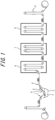
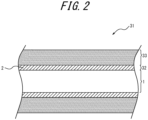
Classifications
-
- C—CHEMISTRY; METALLURGY
- C09—DYES; PAINTS; POLISHES; NATURAL RESINS; ADHESIVES; COMPOSITIONS NOT OTHERWISE PROVIDED FOR; APPLICATIONS OF MATERIALS NOT OTHERWISE PROVIDED FOR
- C09J—ADHESIVES; NON-MECHANICAL ASPECTS OF ADHESIVE PROCESSES IN GENERAL; ADHESIVE PROCESSES NOT PROVIDED FOR ELSEWHERE; USE OF MATERIALS AS ADHESIVES
- C09J109/00—Adhesives based on homopolymers or copolymers of conjugated diene hydrocarbons
- C09J109/06—Copolymers with styrene
- C09J109/08—Latex
-
- C—CHEMISTRY; METALLURGY
- C08—ORGANIC MACROMOLECULAR COMPOUNDS; THEIR PREPARATION OR CHEMICAL WORKING-UP; COMPOSITIONS BASED THEREON
- C08L—COMPOSITIONS OF MACROMOLECULAR COMPOUNDS
- C08L97/00—Compositions of lignin-containing materials
- C08L97/005—Lignin
-
- B—PERFORMING OPERATIONS; TRANSPORTING
- B60—VEHICLES IN GENERAL
- B60C—VEHICLE TYRES; TYRE INFLATION; TYRE CHANGING; CONNECTING VALVES TO INFLATABLE ELASTIC BODIES IN GENERAL; DEVICES OR ARRANGEMENTS RELATED TO TYRES
- B60C1/00—Tyres characterised by the chemical composition or the physical arrangement or mixture of the composition
-
- B—PERFORMING OPERATIONS; TRANSPORTING
- B60—VEHICLES IN GENERAL
- B60C—VEHICLE TYRES; TYRE INFLATION; TYRE CHANGING; CONNECTING VALVES TO INFLATABLE ELASTIC BODIES IN GENERAL; DEVICES OR ARRANGEMENTS RELATED TO TYRES
- B60C9/00—Reinforcements or ply arrangement of pneumatic tyres
- B60C9/0042—Reinforcements made of synthetic materials
-
- C—CHEMISTRY; METALLURGY
- C08—ORGANIC MACROMOLECULAR COMPOUNDS; THEIR PREPARATION OR CHEMICAL WORKING-UP; COMPOSITIONS BASED THEREON
- C08G—MACROMOLECULAR COMPOUNDS OBTAINED OTHERWISE THAN BY REACTIONS ONLY INVOLVING UNSATURATED CARBON-TO-CARBON BONDS
- C08G18/00—Polymeric products of isocyanates or isothiocyanates
- C08G18/06—Polymeric products of isocyanates or isothiocyanates with compounds having active hydrogen
- C08G18/28—Polymeric products of isocyanates or isothiocyanates with compounds having active hydrogen characterised by the compounds used containing active hydrogen
- C08G18/40—High-molecular-weight compounds
- C08G18/64—Macromolecular compounds not provided for by groups C08G18/42 - C08G18/63
- C08G18/6492—Lignin containing materials; Wood resins; Wood tars; Derivatives thereof
-
- C—CHEMISTRY; METALLURGY
- C08—ORGANIC MACROMOLECULAR COMPOUNDS; THEIR PREPARATION OR CHEMICAL WORKING-UP; COMPOSITIONS BASED THEREON
- C08G—MACROMOLECULAR COMPOUNDS OBTAINED OTHERWISE THAN BY REACTIONS ONLY INVOLVING UNSATURATED CARBON-TO-CARBON BONDS
- C08G18/00—Polymeric products of isocyanates or isothiocyanates
- C08G18/06—Polymeric products of isocyanates or isothiocyanates with compounds having active hydrogen
- C08G18/70—Polymeric products of isocyanates or isothiocyanates with compounds having active hydrogen characterised by the isocyanates or isothiocyanates used
- C08G18/72—Polyisocyanates or polyisothiocyanates
- C08G18/74—Polyisocyanates or polyisothiocyanates cyclic
- C08G18/76—Polyisocyanates or polyisothiocyanates cyclic aromatic
- C08G18/7657—Polyisocyanates or polyisothiocyanates cyclic aromatic containing two or more aromatic rings
- C08G18/7664—Polyisocyanates or polyisothiocyanates cyclic aromatic containing two or more aromatic rings containing alkylene polyphenyl groups
- C08G18/7671—Polyisocyanates or polyisothiocyanates cyclic aromatic containing two or more aromatic rings containing alkylene polyphenyl groups containing only one alkylene bisphenyl group
-
- C—CHEMISTRY; METALLURGY
- C08—ORGANIC MACROMOLECULAR COMPOUNDS; THEIR PREPARATION OR CHEMICAL WORKING-UP; COMPOSITIONS BASED THEREON
- C08G—MACROMOLECULAR COMPOUNDS OBTAINED OTHERWISE THAN BY REACTIONS ONLY INVOLVING UNSATURATED CARBON-TO-CARBON BONDS
- C08G18/00—Polymeric products of isocyanates or isothiocyanates
- C08G18/06—Polymeric products of isocyanates or isothiocyanates with compounds having active hydrogen
- C08G18/70—Polymeric products of isocyanates or isothiocyanates with compounds having active hydrogen characterised by the isocyanates or isothiocyanates used
- C08G18/72—Polyisocyanates or polyisothiocyanates
- C08G18/80—Masked polyisocyanates
- C08G18/8061—Masked polyisocyanates masked with compounds having only one group containing active hydrogen
- C08G18/807—Masked polyisocyanates masked with compounds having only one group containing active hydrogen with nitrogen containing compounds
- C08G18/8077—Oximes
-
- C—CHEMISTRY; METALLURGY
- C08—ORGANIC MACROMOLECULAR COMPOUNDS; THEIR PREPARATION OR CHEMICAL WORKING-UP; COMPOSITIONS BASED THEREON
- C08L—COMPOSITIONS OF MACROMOLECULAR COMPOUNDS
- C08L75/00—Compositions of polyureas or polyurethanes; Compositions of derivatives of such polymers
- C08L75/04—Polyurethanes
-
- C—CHEMISTRY; METALLURGY
- C09—DYES; PAINTS; POLISHES; NATURAL RESINS; ADHESIVES; COMPOSITIONS NOT OTHERWISE PROVIDED FOR; APPLICATIONS OF MATERIALS NOT OTHERWISE PROVIDED FOR
- C09J—ADHESIVES; NON-MECHANICAL ASPECTS OF ADHESIVE PROCESSES IN GENERAL; ADHESIVE PROCESSES NOT PROVIDED FOR ELSEWHERE; USE OF MATERIALS AS ADHESIVES
- C09J119/00—Adhesives based on rubbers, not provided for in groups C09J107/00 - C09J117/00
- C09J119/02—Latex
-
- C—CHEMISTRY; METALLURGY
- C09—DYES; PAINTS; POLISHES; NATURAL RESINS; ADHESIVES; COMPOSITIONS NOT OTHERWISE PROVIDED FOR; APPLICATIONS OF MATERIALS NOT OTHERWISE PROVIDED FOR
- C09J—ADHESIVES; NON-MECHANICAL ASPECTS OF ADHESIVE PROCESSES IN GENERAL; ADHESIVE PROCESSES NOT PROVIDED FOR ELSEWHERE; USE OF MATERIALS AS ADHESIVES
- C09J139/00—Adhesives based on homopolymers or copolymers of compounds having one or more unsaturated aliphatic radicals, each having only one carbon-to-carbon double bond, and at least one being terminated by a single or double bond to nitrogen or by a heterocyclic ring containing nitrogen; Adhesives based on derivatives of such polymers
- C09J139/04—Homopolymers or copolymers of monomers containing heterocyclic rings having nitrogen as ring member
- C09J139/08—Homopolymers or copolymers of vinyl-pyridine
-
- C—CHEMISTRY; METALLURGY
- C09—DYES; PAINTS; POLISHES; NATURAL RESINS; ADHESIVES; COMPOSITIONS NOT OTHERWISE PROVIDED FOR; APPLICATIONS OF MATERIALS NOT OTHERWISE PROVIDED FOR
- C09J—ADHESIVES; NON-MECHANICAL ASPECTS OF ADHESIVE PROCESSES IN GENERAL; ADHESIVE PROCESSES NOT PROVIDED FOR ELSEWHERE; USE OF MATERIALS AS ADHESIVES
- C09J175/00—Adhesives based on polyureas or polyurethanes; Adhesives based on derivatives of such polymers
- C09J175/04—Polyurethanes
-
- D—TEXTILES; PAPER
- D02—YARNS; MECHANICAL FINISHING OF YARNS OR ROPES; WARPING OR BEAMING
- D02G—CRIMPING OR CURLING FIBRES, FILAMENTS, THREADS, OR YARNS; YARNS OR THREADS
- D02G3/00—Yarns or threads, e.g. fancy yarns; Processes or apparatus for the production thereof, not otherwise provided for
- D02G3/44—Yarns or threads characterised by the purpose for which they are designed
- D02G3/48—Tyre cords
-
- D—TEXTILES; PAPER
- D06—TREATMENT OF TEXTILES OR THE LIKE; LAUNDERING; FLEXIBLE MATERIALS NOT OTHERWISE PROVIDED FOR
- D06M—TREATMENT, NOT PROVIDED FOR ELSEWHERE IN CLASS D06, OF FIBRES, THREADS, YARNS, FABRICS, FEATHERS OR FIBROUS GOODS MADE FROM SUCH MATERIALS
- D06M11/00—Treating fibres, threads, yarns, fabrics or fibrous goods made from such materials, with inorganic substances or complexes thereof; Such treatment combined with mechanical treatment, e.g. mercerising
- D06M11/73—Treating fibres, threads, yarns, fabrics or fibrous goods made from such materials, with inorganic substances or complexes thereof; Such treatment combined with mechanical treatment, e.g. mercerising with carbon or compounds thereof
- D06M11/76—Treating fibres, threads, yarns, fabrics or fibrous goods made from such materials, with inorganic substances or complexes thereof; Such treatment combined with mechanical treatment, e.g. mercerising with carbon or compounds thereof with carbon oxides or carbonates
-
- D—TEXTILES; PAPER
- D06—TREATMENT OF TEXTILES OR THE LIKE; LAUNDERING; FLEXIBLE MATERIALS NOT OTHERWISE PROVIDED FOR
- D06M—TREATMENT, NOT PROVIDED FOR ELSEWHERE IN CLASS D06, OF FIBRES, THREADS, YARNS, FABRICS, FEATHERS OR FIBROUS GOODS MADE FROM SUCH MATERIALS
- D06M13/00—Treating fibres, threads, yarns, fabrics or fibrous goods made from such materials, with non-macromolecular organic compounds; Such treatment combined with mechanical treatment
- D06M13/10—Treating fibres, threads, yarns, fabrics or fibrous goods made from such materials, with non-macromolecular organic compounds; Such treatment combined with mechanical treatment with compounds containing oxygen
- D06M13/184—Carboxylic acids; Anhydrides, halides or salts thereof
- D06M13/1845—Aromatic mono- or polycarboxylic acids
-
- D—TEXTILES; PAPER
- D06—TREATMENT OF TEXTILES OR THE LIKE; LAUNDERING; FLEXIBLE MATERIALS NOT OTHERWISE PROVIDED FOR
- D06M—TREATMENT, NOT PROVIDED FOR ELSEWHERE IN CLASS D06, OF FIBRES, THREADS, YARNS, FABRICS, FEATHERS OR FIBROUS GOODS MADE FROM SUCH MATERIALS
- D06M13/00—Treating fibres, threads, yarns, fabrics or fibrous goods made from such materials, with non-macromolecular organic compounds; Such treatment combined with mechanical treatment
- D06M13/322—Treating fibres, threads, yarns, fabrics or fibrous goods made from such materials, with non-macromolecular organic compounds; Such treatment combined with mechanical treatment with compounds containing nitrogen
- D06M13/395—Isocyanates
-
- D—TEXTILES; PAPER
- D06—TREATMENT OF TEXTILES OR THE LIKE; LAUNDERING; FLEXIBLE MATERIALS NOT OTHERWISE PROVIDED FOR
- D06M—TREATMENT, NOT PROVIDED FOR ELSEWHERE IN CLASS D06, OF FIBRES, THREADS, YARNS, FABRICS, FEATHERS OR FIBROUS GOODS MADE FROM SUCH MATERIALS
- D06M15/00—Treating fibres, threads, yarns, fabrics, or fibrous goods made from such materials, with macromolecular compounds; Such treatment combined with mechanical treatment
- D06M15/01—Treating fibres, threads, yarns, fabrics, or fibrous goods made from such materials, with macromolecular compounds; Such treatment combined with mechanical treatment with natural macromolecular compounds or derivatives thereof
-
- D—TEXTILES; PAPER
- D06—TREATMENT OF TEXTILES OR THE LIKE; LAUNDERING; FLEXIBLE MATERIALS NOT OTHERWISE PROVIDED FOR
- D06M—TREATMENT, NOT PROVIDED FOR ELSEWHERE IN CLASS D06, OF FIBRES, THREADS, YARNS, FABRICS, FEATHERS OR FIBROUS GOODS MADE FROM SUCH MATERIALS
- D06M15/00—Treating fibres, threads, yarns, fabrics, or fibrous goods made from such materials, with macromolecular compounds; Such treatment combined with mechanical treatment
- D06M15/01—Treating fibres, threads, yarns, fabrics, or fibrous goods made from such materials, with macromolecular compounds; Such treatment combined with mechanical treatment with natural macromolecular compounds or derivatives thereof
- D06M15/17—Natural resins, resinous alcohols, resinous acids, or derivatives thereof
-
- D—TEXTILES; PAPER
- D06—TREATMENT OF TEXTILES OR THE LIKE; LAUNDERING; FLEXIBLE MATERIALS NOT OTHERWISE PROVIDED FOR
- D06M—TREATMENT, NOT PROVIDED FOR ELSEWHERE IN CLASS D06, OF FIBRES, THREADS, YARNS, FABRICS, FEATHERS OR FIBROUS GOODS MADE FROM SUCH MATERIALS
- D06M15/00—Treating fibres, threads, yarns, fabrics, or fibrous goods made from such materials, with macromolecular compounds; Such treatment combined with mechanical treatment
- D06M15/19—Treating fibres, threads, yarns, fabrics, or fibrous goods made from such materials, with macromolecular compounds; Such treatment combined with mechanical treatment with synthetic macromolecular compounds
- D06M15/21—Macromolecular compounds obtained by reactions only involving carbon-to-carbon unsaturated bonds
- D06M15/285—Macromolecular compounds obtained by reactions only involving carbon-to-carbon unsaturated bonds of unsaturated carboxylic acid amides or imides
-
- D—TEXTILES; PAPER
- D06—TREATMENT OF TEXTILES OR THE LIKE; LAUNDERING; FLEXIBLE MATERIALS NOT OTHERWISE PROVIDED FOR
- D06M—TREATMENT, NOT PROVIDED FOR ELSEWHERE IN CLASS D06, OF FIBRES, THREADS, YARNS, FABRICS, FEATHERS OR FIBROUS GOODS MADE FROM SUCH MATERIALS
- D06M15/00—Treating fibres, threads, yarns, fabrics, or fibrous goods made from such materials, with macromolecular compounds; Such treatment combined with mechanical treatment
- D06M15/19—Treating fibres, threads, yarns, fabrics, or fibrous goods made from such materials, with macromolecular compounds; Such treatment combined with mechanical treatment with synthetic macromolecular compounds
- D06M15/37—Macromolecular compounds obtained otherwise than by reactions only involving carbon-to-carbon unsaturated bonds
- D06M15/564—Polyureas, polyurethanes or other polymers having ureide or urethane links; Precondensation products forming them
-
- D—TEXTILES; PAPER
- D06—TREATMENT OF TEXTILES OR THE LIKE; LAUNDERING; FLEXIBLE MATERIALS NOT OTHERWISE PROVIDED FOR
- D06M—TREATMENT, NOT PROVIDED FOR ELSEWHERE IN CLASS D06, OF FIBRES, THREADS, YARNS, FABRICS, FEATHERS OR FIBROUS GOODS MADE FROM SUCH MATERIALS
- D06M15/00—Treating fibres, threads, yarns, fabrics, or fibrous goods made from such materials, with macromolecular compounds; Such treatment combined with mechanical treatment
- D06M15/693—Treating fibres, threads, yarns, fabrics, or fibrous goods made from such materials, with macromolecular compounds; Such treatment combined with mechanical treatment with natural or synthetic rubber, or derivatives thereof
-
- C—CHEMISTRY; METALLURGY
- C08—ORGANIC MACROMOLECULAR COMPOUNDS; THEIR PREPARATION OR CHEMICAL WORKING-UP; COMPOSITIONS BASED THEREON
- C08G—MACROMOLECULAR COMPOUNDS OBTAINED OTHERWISE THAN BY REACTIONS ONLY INVOLVING UNSATURATED CARBON-TO-CARBON BONDS
- C08G2170/00—Compositions for adhesives
- C08G2170/80—Compositions for aqueous adhesives
-
- D—TEXTILES; PAPER
- D06—TREATMENT OF TEXTILES OR THE LIKE; LAUNDERING; FLEXIBLE MATERIALS NOT OTHERWISE PROVIDED FOR
- D06M—TREATMENT, NOT PROVIDED FOR ELSEWHERE IN CLASS D06, OF FIBRES, THREADS, YARNS, FABRICS, FEATHERS OR FIBROUS GOODS MADE FROM SUCH MATERIALS
- D06M2101/00—Chemical constitution of the fibres, threads, yarns, fabrics or fibrous goods made from such materials, to be treated
- D06M2101/16—Synthetic fibres, other than mineral fibres
- D06M2101/30—Synthetic polymers consisting of macromolecular compounds obtained otherwise than by reactions only involving carbon-to-carbon unsaturated bonds
- D06M2101/38—Polyurethanes
-
- D—TEXTILES; PAPER
- D06—TREATMENT OF TEXTILES OR THE LIKE; LAUNDERING; FLEXIBLE MATERIALS NOT OTHERWISE PROVIDED FOR
- D06M—TREATMENT, NOT PROVIDED FOR ELSEWHERE IN CLASS D06, OF FIBRES, THREADS, YARNS, FABRICS, FEATHERS OR FIBROUS GOODS MADE FROM SUCH MATERIALS
- D06M2200/00—Functionality of the treatment composition and/or properties imparted to the textile material
- D06M2200/50—Modified hand or grip properties; Softening compositions
-
- D—TEXTILES; PAPER
- D10—INDEXING SCHEME ASSOCIATED WITH SUBLASSES OF SECTION D, RELATING TO TEXTILES
- D10B—INDEXING SCHEME ASSOCIATED WITH SUBLASSES OF SECTION D, RELATING TO TEXTILES
- D10B2331/00—Fibres made from polymers obtained otherwise than by reactions only involving carbon-to-carbon unsaturated bonds, e.g. polycondensation products
- D10B2331/04—Fibres made from polymers obtained otherwise than by reactions only involving carbon-to-carbon unsaturated bonds, e.g. polycondensation products polyesters, e.g. polyethylene terephthalate [PET]
-
- D—TEXTILES; PAPER
- D10—INDEXING SCHEME ASSOCIATED WITH SUBLASSES OF SECTION D, RELATING TO TEXTILES
- D10B—INDEXING SCHEME ASSOCIATED WITH SUBLASSES OF SECTION D, RELATING TO TEXTILES
- D10B2505/00—Industrial
- D10B2505/02—Reinforcing materials; Prepregs
- D10B2505/022—Reinforcing materials; Prepregs for tyres
Definitions
- This disclosure relates to an adhesive composition, an organic fiber, an organic fiber-rubber composite material, a rubber article, and a tire.
- organic fibers such as tire cords made of nylon fibers, polyester fibers and the like are conventionally adhered to a rubber composition such as a rubber composition for tires to form an organic fiber-rubber composite.
- a method of coating organic fibers with an adhesive composition, embedding them in a rubber composition, and vulcanizing them together with the rubber composition has been widely used for the adhesion.
- a solvent is generally used to adjust the viscosity of the adhesive composition, and it is preferable to use water, which has little environmental load, as the solvent because the solvent evaporates in the process. Further, when coating the organic fiber with the adhesive composition by immersion, it is necessary to reduce the viscosity of the adhesive composition to a low viscosity so that the adhesive composition can be applied by immersion.
- Components contained in an aqueous adhesive composition with water-based properties are generally required to have a polar molecular structure.
- the polarity of a polymer material such as rubber or an organic fiber base material as an adherend is low, and if the difference between the polarity of the surface of the rubber or organic fiber base material or the like and the polarity of the components contained in the adhesive composition is large, it is difficult to adhere one to the other.
- the components contained in the aqueous adhesive composition must have polarity due to their water-based properties, the polarity should be controlled so that the adhesiveness will not be deteriorated due to the difference with the polarity of the adherend, so that the aqueous adhesive composition can be used as an adhesive composition for rubber articles. Therefore, an aqueous adhesive composition having functions that simultaneously solve the contradictions is suitably used.
- An organic fiber cord 1 is unwound from an unwinding roll, conveyed by a roll, and runs into an immersion bathtub (dipping tub) 3 containing an adhesive composition 2, and the organic fiber cord 1 is immersed in the adhesive composition 2.
- An organic fiber cord 4 coated with the adhesive composition 2 is withdrawn from the immersion bathtub 3, and drawing rolls 5 remove the excess adhesive composition 2.
- the organic fiber cord 4 coated with the adhesive composition 2 is further conveyed by rolls and subjected to drying in a drying zone 6, heat curing of the resin with tension applied to stretch the cord in a hot zone 7, heat curing of the resin with the tension accurately adjusted and normalized so as to achieve desired high elongation physical properties in a normalizing zone 8, and air-cooling outside the zones, and then is wound up by a winding roll. In this way, the organic fiber is coated with the adhesive composition.
- a RFL (resorcin-formaldehyde-latex) adhesive composition obtained by aging a mixed solution containing resorcin, formaldehyde and rubber latex, or an adhesive composition obtained by mixing a specific adhesion promoter with the RFL adhesive composition has been used as the adhesive composition (see US 2128229 Specification (PTL 1), JP 2005-263887 A (PTL 2), JP 2006-37251 A (PTL 3), and JP H09-12997 A (PTL 4)).
- an adhesive composition containing a water-dispersible rubber latex component, and an aqueous phenolic resin obtained by mixing and aging water-soluble resorcin and formaldehyde (PTL 1) has a function of achieving both adhesion to rubber as an adherend, and adhesion to the surface of a base material with low polarity such as an organic fiber, and the adhesive composition is widely used in the world.
- the rubber latex component adheres to the adherend rubber side by co-vulcanization
- the phenolic resin component that is a condensate of resorcin and formaldehyde and has adhesiveness to an organic fiber base material adheres to the adherend base material side.
- Resorcin provides a phenolic condensed resin which is a resin-type one having high adhesiveness to an adherend, and at the same time, it can provide a resin component having high adhesiveness to the organic fiber base material side because a polar functional group introduced into the phenol ring to obtain water solubility is a hydroxyl group that has relatively low polarity and hardly causes steric hindrance.
- the RFL adhesive composition is obtained by mixing and aging resorcin, formaldehyde, and rubber latex using rosin acid or the like as an emulsifier for polymerization, in the presence of a basic composition. It is presumed that, by this process, the water-soluble resorcin and the formaldehyde condense in a resol-type condensation reaction in the presence of the base (see PTL 2), while addition condensation occurring between the rosin acid on the latex surface and a methylol group at the terminal of resol-type phenol-formaldehyde addition condensation product (see Koichi Hakata, Network Polymer, Vol. 31, No. 5, p.252, (2010) (NPL 1 )).
- This aging causes the latex to cross-link with the resol-type resorcin-formaldehyde condensate via the rosin acid to enhance the adhesion, and the latex is composited with the aqueous resin to form an encapsulated protective colloid.
- the rubber stickiness of the latex is suppressed, so that stain due to the adhesion of the adhesive composition to the device is reduced.
- an aqueous, that is, water-dispersible or water-soluble, adhesion promoter has been used as an adhesion promoter to be added to the RFL adhesive composition so that the aqueous adhesive composition improves the adhesion to the surface of a base material with low polarity such as an organic fiber cord material.
- (Blocked) isocyanate such as methylene diphenyl diisocyanate with a particle size of 0.01 ⁇ m to 0.50 ⁇ m (see PTL 3), and water-dispersed particles of water-insoluble phenolic/novolak-type resin such as cresol novolak-type polyfunctional epoxy resin (see PTL 4) and the like have been used as the water-dispersible adhesion promoter.
- a sodium hydroxide solution of novolak-type condensate obtained by novolak reaction of resorcin and formaldehyde (see WO 9713818 A1 (PTL 5)), a phenolic resin that dissolves in water in the presence of basic substances such as ammonium solutions of novolak-type condensates of chlorophenols and formaldehyde, an aqueous urethane compound having a (thermal dissociative blocked) isocyanate group and a self-soluble group (see JP 2011-241402 A (PTL 6)), a methylolated homoacrylamide polymer (see JP S56-067379 A (PTL 7)) or the like, as the adhesion promoter containing a water-soluble group, be mixed with resorcin-formaldehyde-latex and incorporated into the RFL adhesive composition.
- PTL 5 sodium hydroxide solution of novolak-type condensate obtained by novolak reaction of resor
- an adhesive composition containing rubber latex and lignin resin (see WO 2018003572 A1 (PTL 8)), and an aqueous adhesive composition based on rubber latex and polyphenol such as flavonoid and aromatic polyaldehyde (see WO 2013017421 A1 (PTL 9) and JP 2016-528337 A (PTL 10)) are known as adhesive compositions containing no resorcin or formaldehyde.
- an aqueous adhesive composition containing a water-soluble polyacrylamide-based resin and synthetic resin-based emulsion or rubber-based latex has been proposed as a material that does not emit formaldehyde.
- the water-soluble polyacrylamide-based resin has a structure in which a branched structure is introduced by the effect of chain transfer substituent, so that it is presumed to have many contact points especially with a base material such as wood and paper, which improves affinity and adhesion.
- NPL 1 Koichi Hakata, Network Polymer, Vol. 31, No. 5, p.252, (2010 )
- Such an adhesive composition containing no resorcin or formalin tends to have poor adhesiveness because the coating surface of the adhesive is roughened due to adhesion to the device. Further, since cross-linking between a latex component and a resorcin-formaldehyde condensate cannot be achieved, there is a problem in that the adhesiveness between an organic fiber and a coated rubber composition is lower than that of a conventional RFL adhesive composition.
- the above-described resorcin-free adhesive composition also has a problem that the cord strength of an organic fiber cord coated with the adhesive composition is reduced.
- the adhesive composition of the present disclosure comprises
- the (B) compound containing an acrylamide structure having a cationic group and/or a carboxyl group is a copolymer containing (a) (meth)acrylamide and (b) a vinyl monomer having a cationic group, and/or a copolymer of (a) (meth)acrylamide and (c) a vinyl monomer having a carboxyl group, where these copolymers preferably optionally contain (d) another polymerizable monomer that is copolymerizable.
- the (C) aqueous compound having a (thermal dissociative blocked) isocyanate group is preferably (C-1) a water-dispersible (thermal dissociative blocked) isocyanate compound that contains an addition product of polyisocyanate having an aromatic ring and a blocking agent having at least one active hydrogen group.
- the (C-1) water-dispersible (thermal dissociative blocked) isocyanate compound that contains an addition product of polyisocyanate having an aromatic ring and a blocking agent having at least one active hydrogen group is more preferably a block body of methylene diphenyl diisocyanate.
- the (C) aqueous compound having a (thermal dissociative blocked) isocyanate group is also preferably (C-2) an aqueous urethane compound having a (thermal dissociative blocked) isocyanate group.
- the (C-2) aqueous urethane compound having a (thermal dissociative blocked) isocyanate group is a reaction product obtained by mixing ( ⁇ ), ( ⁇ ), ( ⁇ ) and ( ⁇ ) and reacting them, where
- (C-2) aqueous urethane compound having a (thermal dissociative blocked) isocyanate group is preferably represented by the following general formula (1), [where
- the (D) polyphenol is preferably a plant-derived compound having a plurality of phenolic hydroxy groups in molecule. It is more preferably lignin, tannin, tannic acid, flavonoid, or a derivative thereof.
- the (E) polyvalent metal salt is preferably a divalent or higher metal ion salt.
- the (E) polyvalent metal salt is preferably a polyvalent metal salt inorganic filler or mordant.
- the adhesive composition of the present disclosure can be free of resorcin.
- the surface of a resin base material is coated with an adhesive layer of the adhesive composition of the present disclosure described above.
- the organic fiber of the present disclosure is preferably a cord obtained by twisting a plurality of filaments, where it is more preferable that the cord obtained by twisting a plurality of filaments includes second twisting and first twisting, the fiber thickness of the cord obtained by twisting is 100 dtex to 5000 dtex, the number of first twists is 10 times/10 cm to 50 times/10 cm, and the number of second twists is 10 times/10 cm to 50 times/10 cm, and it is still more preferable that the adhesive layer is 0.5 % by mass to 6.0 % by mass of the mass of the cord in terms of dry mass.
- the organic fiber of the present disclosure is preferably made of polyester resin.
- the organic fiber-rubber composite of the present disclosure is a composite of organic fiber and rubber, where the surface of the organic fiber is coated with the adhesive composition of the present disclosure described above.
- the rubber article of the present disclosure uses the organic fiber-rubber composite of the present disclosure described above.
- the tire of the present disclosure uses the organic fiber-rubber composite of the present disclosure described above.
- an adhesive composition that can ensure desired adhesiveness without using resorcin and does not impair workability in use, as well as an organic fiber material, a rubber article, an organic fiber-rubber composite, and a tire using the adhesive composition.
- An adhesive composition of the present disclosure contains (A) rubber latex having unsaturated diene and (B) a compound containing an acrylamide structure having a cationic group and/or a carboxyl group.
- the adhesive composition of the present disclosure by having the above configuration, good adhesion, especially good adhesion between an organic fiber and a coated rubber composition can be secured without using resorcin.
- the (A) rubber latex having unsaturated diene contributes to improving the adhesiveness.
- the (B) compound containing an acrylamide structure having a cationic group and/or a carboxyl group it is possible to suppress the adhesion of the adhesive composition to a roll or the like, especially in a process of coating an organic fiber with the adhesive composition and drying and heat curing, by suppressing the stickiness of the rubber latex measured as the mechanical stability under shear strain of an adhesive liquid, so that the workability is good.
- the adhesive composition of the present disclosure it is possible to obtain desired adhesiveness without using resorcin and also to ensure good workability in use. Further, according to the adhesive composition of the present disclosure, it is possible to lower the environmental load because there is no need to use resorcin.
- the adhesive composition of the present disclosure can be free of resorcin. Further, the adhesive composition of the present disclosure preferably contains no formaldehyde.
- the adhesive composition of the present disclosure is particularly useful when applied to the organic fiber cord described below.
- the adhesive composition of the present disclosure contains (A) rubber latex having unsaturated diene.
- Examples of the (A) rubber latex having unsaturated diene include synthetic rubber latex having unsaturated diene, and natural rubber latex.
- the synthesis rubber latex having unsaturated diene in the adhesive composition of the present disclosure means synthetic rubber latex containing unsaturated diene that is vulcanizable with sulfur.
- the (A) rubber latex having unsaturated diene contained in the adhesive composition is a component for adhering an adhesive layer of the adhesive composition to a coated rubber composition that is an adherend thereof.
- the rubber latex having unsaturated diene is compatible with a rubber polymer contained in the coated rubber composition as an adherend, and rubber co-vulcanization adhesion is formed by co-vulcanization of unsaturated diene moieties.
- the (A) rubber latex having unsaturated diene is not limited, and examples thereof include synthetic rubber latex such as styrene-butadiene copolymer rubber latex, vinylpyridine-styrene-butadiene copolymer rubber latex, carboxyl group-modified styrene-butadiene copolymer rubber latex, nitrile rubber latex, and chloroprene rubber latex. These may be used alone or in combination of two or more.
- vinylpyridine-styrene-butadiene copolymer rubber latex is preferred.
- the reason is as follows.
- Vinylpyridine-styrene-butadiene copolymer rubber latex is rubber latex which has been widely used in adhesive compositions and also in articles such as tires. In the adhesive composition of the present disclosure, it provides a good bond between the adhesive layer and rubber as an adherend and has the advantage of being relatively soft and flexible, thereby achieving organic fiber cord deformation without splitting the adhesive layer.
- the content (solid content) of the (A) rubber latex having unsaturated diene in the total solid content of the adhesive composition of the present disclosure is not particularly limited. It is preferably 25 % by mass or more, more preferably 40 % by mass or more, and still more preferably 50 % by mass or more. Further, the content of the (A) rubber latex having unsaturated diene is preferably 99.5 % by mass or less, more preferably 95 % by mass or less, and still more preferably 90 % by mass or less. The reason is as follows.
- the content of the (A) rubber latex having unsaturated diene is 25 % by mass or more, the compatibility between rubber polymers of the coated rubber composition and the rubber latex contained in the adhesive composition becomes more appropriate, and the adhesion state of coated rubber in the organic fiber-rubber composite improves.
- the content of the (A) rubber latex having unsaturated diene is 99.5 % by mass or less, the amount of coating component that suppresses the stickiness of latex contained as another component in the adhesive composition can be ensured at a relatively constant level or more compared to rubber cement. Therefore, in a process of coating a fiber material to be adhered with the adhesive composition, it is possible to suppress the adhesive composition from adhering to the device as illustrated in FIG. 1 . Further, in this case, the problem that the surface of the coated adhesive composition roughens and the adhesiveness to a coated rubber composition deteriorates hardly occurs, which improves the adhesiveness.
- the (A) rubber latex having unsaturated diene can be obtained, for example, by dissolving an emulsifier such as potassium rosinate in water, then adding a mixture of monomers to the mixture, further adding an electrolyte such as sodium phosphate and peroxides and the like as a polymerization initiator, performing polymerization, and then, after reaching a predetermined conversion rate, adding a charge transfer agent, stopping the polymerization, and removing the residual monomers. Further, it is preferable to use a chain transfer agent during the polymerization.
- the emulsifier may be at least one selected from anionic surfactants such as an alkali metal salt of a fatty acid, an alkali metal salt of rosin acid, a formaldehyde-condensed sodium naphthalene sulfonate, a sulfate ester of a higher alcohol, an alkylbenzene sulfonate and an aliphatic sulfonate, or nonionic surfactants such as alkyl ester, alkyl ether, and alkylphenyl ether types of polyethylene glycol.
- anionic surfactants such as an alkali metal salt of a fatty acid, an alkali metal salt of rosin acid, a formaldehyde-condensed sodium naphthalene sulfonate, a sulfate ester of a higher alcohol, an alkylbenzene sulfonate and an aliphatic sulfonate, or nonionic surfact
- a metal salt of rosin acid especially an alkali metal salt of rosin acid. It can be used alone, that is, in only one type, or in combination with other emulsifiers in two or more types.
- the rosin acid is a mixture of resin acids with similar chemical structures, mainly composed of tricyclic diterpenes obtained from pine resin and the like. These resin acids have three ring structures, two double bonds, and one carboxyl group, and they have functional groups with high reactivity, such as the double bond portion reacting with unsaturated carboxylic acids, or esterification at the methylol end of resol phenolic resin and the carboxyl group portion.
- the amount of such an emulsifier used is usually 0.1 parts by mass to 8 parts by mass, preferably 1 part by mass to 5 parts by mass, with respect to 100 parts by mass of all monomers used in latex polymerization.
- the polymerization initiator includes a water-soluble initiator such as potassium persulfate, sodium persulfate and ammonium persulfate, a redox-based initiator, or an oil-soluble initiator such as benzoyl peroxide.
- a water-soluble initiator such as potassium persulfate, sodium persulfate and ammonium persulfate
- a redox-based initiator such as benzoyl peroxide.
- an oil-soluble initiator such as benzoyl peroxide.
- alkyl mercaptan is preferable, and n-octyl mercaptan and t-dodecyl mercaptan are more preferable. Among the above, it is preferable to use t-dodecyl mercaptan.
- the amount of such a chain transfer agent used is usually 0.01 parts by mass to 5 parts by mass, preferably 0.1 parts by mass to 3 parts by mass, with respect to 100 parts by mass of all monomers used in latex polymerization.
- general-purpose additives such as an antioxidant like hindered phenols, a silicone-based, higher alcohol-based or mineral oil-based defoamer, a reaction terminator, and an antifreezing agent may be used for the latex, if necessary.
- the vinylpyridine-styrene-butadiene copolymer rubber latex is a ternary copolymer of a vinylpyridine-based monomer, a styrene-based monomer, and a conjugated diene-based butadiene monomer, and these monomers may be further added with other copolymerizable monomers.
- the vinylpyridine-based monomer includes vinylpyridine and substituted vinylpyridine in which a hydrogen atom in the vinylpyridine is substituted with a substituent.
- Examples of such a vinylpyridine-based monomer include 2-vinylpyridine, 3-vinylpyridine, 4-vinylpyridine, 2-methyl-5-vinylpyridine, and 5-ethyl-2-vinylpyridine, among which 2-vinylpyridine is preferable.
- These vinylpyridine-based monomers may be used alone or in combination of two or more.
- the styrene-based monomer includes styrene and substituted styrene in which a hydrogen atom in the styrene is substituted with a substituent.
- examples of the styrene-based monomer include styrene, ⁇ -methylstyrene, 2-methylstyrene, 3-methylstyrene, 4-methylstyrene, 2,4-diinopropylstyrene, 2,4-dimethylstyrene, 4-t-butylstyrene, and hydroxymethylstyrene, among which styrene is preferable. These styrene-based monomers may be used alone or in combination of two or more.
- the vinylpyridine-styrene-butadiene copolymer rubber latex can be synthesized with a known method, and specific examples thereof include a method described in JP H09-78045 A according to studies by the inventors of the present disclosure. With these methods, it is possible to have various compositions and intra-particle structures such as copolymers with uniform or different composition ratios within one particle of the vinylpyridine-styrene-butadiene copolymer rubber latex.
- the vinylpyridine-styrene-butadiene copolymer rubber latex may be a commercially available product of a copolymer with a uniform composition monomer mixture ratio in one particle, and examples thereof include Nipol 2518 manufactured by Zeon Corporation, PYRATEX manufactured by NIPPON A&L INC. Further, examples of a commercially available product of a copolymer with different composition monomer mixture ratios in one particle include V0658 manufactured by JSR Corporation. All of these can be used as the (A) rubber latex having unsaturated diene of the adhesive composition of the present disclosure.
- the monomer ratio of vinylpyridine: styrene: butadiene is not particularly limited.
- the copolymers constituting the vinylpyridine-styrene-butadiene copolymer particles it is preferable to include a copolymer obtained by polymerizing a monomer mixture consisting of 5 % by mass to 20 % by mass of vinylpyridine, 10 % by mass to 40 % by mass of styrene, and 45 % by mass to 75% by mass of butadiene. The reason is as follows.
- the content of vinylpyridine is 5 % by mass or more, there is an appropriate amount of pyridine moiety that has a vulcanization promoting effect in the rubber component, and the adhesiveness of the entire adhesive layer further improves as the degree of cross-linking is increased by sulfur.
- the content of vinylpyridine is 20 % by mass or less, it is possible to obtain a hard adhesive without the degree of cross-linking of the rubber being overvulcanized.
- the content of styrene is 10 % by mass or more, the strength of the latex particles and the adhesive layer is sufficient, and the adhesiveness is further improved.
- the adhesiveness is ensured with appropriate co-vulcanization properties between the adhesive layer and the rubber as an adherend.
- the content of butadiene is 45 % by mass or more, it is possible to form cross-links more sufficiently.
- the content of butadiene is 75 % by mass or less, durability in terms of volume and modulus change can be ensured satisfactorily with moderate cross-linking.
- the composition ratio of the monomer mixture of vinylpyridine: styrene: butadiene may be preferably, for example, 15: 15: 70.
- the (A) rubber latex having unsaturated diene may be natural rubber latex, in addition to synthetic rubber latex having unsaturated diene.
- the natural rubber latex is not particularly limited, and examples thereof include field latex, ammonia-treated latex, centrifuged concentrated latex, deproteinized latex treated with surfactants and enzymes, and combinations thereof. Among the above, it is preferable to use field latex.
- the adhesive composition of the present disclosure contains (B) a compound containing an acrylamide structure having a cationic group and/or a carboxyl group.
- the (B) compound containing an acrylamide structure having a cationic group and/or a carboxyl group is preferably a copolymer containing (a) (meth)acrylamide and (b) a vinyl monomer having a cationic group, and/or a copolymer of (a) (meth)acrylamide and (c) a vinyl monomer having a carboxyl group, or a modified product thereof.
- it may contain (d) another polymerizable monomer that is copolymerizable.
- the (a) (meth)acrylamide refers to acrylamide and methacrylamide (note that (meth)acryl is the same as acryl and/or methacryl, and will be abbreviated in the same manner below).
- the "acrylamide structure” can be obtained from a structure obtained by polymerizing an acrylamide component mainly composed of the (a) (meth)acrylamide.
- the (meth)acrylamide can be used alone or in combination of two types. Acrylamide is preferably used alone from the viewpoint of economic efficiency.
- the content ratio of the (a) (meth)acrylamide is, for example, 50 mol% or more, preferably 60 mol% or more, and is, for example, 99 mol% or less, preferably 97 mol% or less, with respect to all monomers of acrylamide-based polymer.
- the adhesive strength due to cohesive force such as hydrogen bonding due to amide moiety is reduced, and when it exceeds 99 mol%, the ion amount of water-soluble resin is insufficient, resulting in insufficient adhesion to a base material such as adhered fiber.
- Examples of the (b) vinyl monomer having a cationic group include vinyl monomers having a primary amino group, a secondary amino group, a tertiary amino group, or quaternary ammonium salts.
- Examples of the vinyl monomer having a primary amino group include 2-propenylamine, 2-methyl-2-propenylamine; inorganic acid salts such as hydrochlorides or sulfates of these primary amino-based monomers; and organic acid salts such as formates or acetates of these primary amino-based monomers.
- Examples of the vinyl monomer having a secondary amino group include di(2-propenyl)amine (diallylamine), di(2-methyl-2-propenyl)amine; inorganic acid salts such as hydrochlorides or sulfates of these secondary amino-based monomers; and organic acid salts such as formates or acetates of these secondary amino-based monomers.
- Examples of the vinyl monomer having a tertiary amino group include dialkylaminoalkyl (meth)acrylates such as N,N-dimethylaminoethyl (meth)acrylate, N,N-diethylaminoethyl (meth)acrylate, and N,N-dimethylaminopropyl (meth)acrylate; dialkylaminoalkyl (meth)acrylamides such as N,N-dimethylaminoethyl (meth)acrylamide, N,N-diethylaminoethyl (meth)acrylamide, N,N-dimethylaminopropyl (meth)acrylamide, and N,N-diethylaminopropyl (meth)acrylamide; tertiary amine-based monomers such as allylamine, diallylamine, and vinylpyridine; inorganic acid salts such as hydrochlorides or sulfates of these tertiary amine-based mono
- the vinyl monomer having quaternary ammonium salts is a cationic copolymerizable monomer having a quaternary ammonium group and having an ethylenic double bond.
- examples thereof include a vinyl monomer of a quaternary ammonium salt obtained by reacting the vinyl monomer having a tertiary amino group with an alkylating agent (a quaternary compound of a tertiary amino-based monomer), and a quaternary compound obtained by quaternizing a tertiary amino group of a diallylamine derivative monomer.
- alkylating agent a quaternary compound of a tertiary amino-based monomer
- quaternary compound obtained by quaternizing a tertiary amino group of a diallylamine derivative monomer can be used alone or in combination of two or more.
- examples of the alkylating agent for quaternizing the tertiary amino group of the polymerizable monomer having a tertiary amino group include alkyl halides such as methyl chloride and methyl bromide; aralkyl halides such as benzyl chloride; and quaternary compounds using dimethyl sulfate, diethyl sulfate, epichlorohydrin, glycidyltrialkylammonium chloride, 3-chloro-2-hydroxypropyltrimethylammonium chloride, and the like.
- quaternary compounds of a tertiary amino-based monomer a quaternary compound of dialkylaminoalkyl (meth)acrylamide is preferred.
- alkylating agent for quaternizing include quaternary compounds using methyl chloride or benzyl chloride.
- Examples of the quaternary compound of a diallylamine derivative monomer include diallyldimethylammonium chloride, diallyldimethylammonium bromide, diallyldiethylammonium chloride, diallyldibutylammonium chloride, and diallylmethylethylammonium chloride.
- diallyldimethylammonium chloride is preferred.
- the above-mentioned vinyl monomers having a primary amino group, a secondary amino group, a tertiary amino group, or quaternary ammonium salts can be used alone or in combination of two or more.
- the content ratio of the (b) vinyl monomer having a cationic group is, for example, 0.01 mol% or more, preferably 0.5 mol% or more, and is, for example, 20 mol% or less, preferably 10 mol% or less, with respect to all monomers of the acrylamide-based polymer.
- the content ratio of the vinyl monomer having a cationic group is 0.01 mol% or more, it is adsorbed by coacervation to the surface of latex particles dispersed in water by an anionic surfactant and coated on the surface, thereby suppressing the stickiness of latex.
- the content ratio is preferably 0.5 mol% or more.
- the content ratio of the vinyl monomer having a cationic group is 20 mol% or less, the aggregability between particles is increased, which is not preferable.
- the content ratio of the vinyl monomer having a cationic group is 10 mol% or less, the degree of polymerization during production hardly shortens, which is preferable.
- the (c) vinyl monomer having a carboxyl group is not particularly limited as long as it is a vinyl monomer having a carboxyl group in molecule.
- examples thereof include an unsaturated monocarboxylic acid, an unsaturated dicarboxylic acid, an unsaturated tricarboxylic acid, an unsaturated tetracarboxylic acid, and salts thereof.
- an unsaturated monocarboxylic acid such as (meth)acrylic acid, angelic acid, tiglic acid, crotonic acid, and isocrotonic acid
- an unsaturated dicarboxylic acid such as maleic acid, fumaric acid, itaconic acid, aconitic acid, mesaconic acid, muconic acid, and citraconic acid
- a 3-butene-1,2,3-tricarboxylic acid an unsaturated tricarboxylic acid such as 4-pentene-1,2,4-tricarboxylic acid and aconitic acid
- alkali metal salts such as sodium salts, potassium salts, or ammonium salts of these various organic acids.
- these vinyl monomers having a carboxyl group in molecule of unsaturated carboxylic acids and salts thereof can be used alone or in combination of two or more.
- an unsaturated monocarboxylic acid and an unsaturated dicarboxylic acid specifically, acrylic acid, 2-acrylamide-N-glycolic acid, itaconic acid and its salts are preferred from the viewpoint of polymerizability and cost, and an acrylic acid or its sodium salt is particularly preferred.
- the content ratio of the (c) vinyl monomer having a carboxyl group is, for example, 0.01 mol% or more, preferably 0.5 mol% or more, and is, for example, 20 mol% or less, preferably 10 mol% or less, with respect to all monomers of the acrylamide-based polymer.
- anionic polymerizable monomer When anionic polymerizable monomer is contained in an amount of 0.01 mol% or more with respect to all monomers, polyamide adsorbed to latex has dispersibility due to the anionic group, which increases the effect of suppressing stickiness.
- the number of carboxyl groups is increased, the acidity increases in the rubber vulcanization, and the sulfur cross-linking reaction of rubber latex decreases when the acidity is strong, so that cross-linking of the adhesive layer tends to decrease.
- the (B) compound containing an acrylamide structure having a cationic group and/or a carboxyl group used in the present disclosure may be a copolymer containing (d) another polymerizable monomer that is copolymerizable from the viewpoint of processability.
- Examples of the other polymerizable monomer include N-substituted lower alkyl acrylamide other than (meth)acrylamide such as N-ethyl acrylamide, N,N-dimethyl acrylamide, and N-isopropylacrylamide; N,N-dialkyl (meth)acrylamide such as N,N-dimethyl (meth)acrylamide, N,N-diethyl (meth)acrylamide, and N,N-diisopropyl (meth)acrylamide; alkylene bis(meth)acrylamide such as methylene bis(meth)acrylamide and ethylene bis(meth)acrylamide; allyl (meth)acrylamide; and a N-substituted acrylamide-based monomer such as N,N'-dimethylacrylamide, diacetone acrylamide, and isopropylacrylamide.
- N-substituted lower alkyl acrylamide other than (meth)acrylamide such as N-ethyl acrylamide
- Examples of another polymerizable monomer that is copolymerizable and contains an imide group include diacryloylimide.
- alkyl (meth)acrylate and hydroxyalkyl (meth)acrylate can be suitably used as the other polymerizable monomer.
- Examples of another polymerizable monomer that contains no amide group or imide group include alkyl (meth)acrylate such as methyl (meth)acrylate, ethyl (meth)acrylate, propyl (meth)acrylate, butyl (meth)acrylate, 2-ethylhexyl (meth)acrylate, and cyclohexyl (meth)acrylate; (meth)acrylate having a hydroxyl group such as hydroxyalkyl (meth)acrylate such as hydroxyethyl (meth)acrylate and hydroxypropyl (meth)acrylate, and glycerol mono(meth)acrylate; polyalkylene glycol mono(meth)acrylate such as diethylene glycol(meth)acrylate and methoxypolyethylene glycol(meth)acrylate; polyalkylene glycol di(meth)acrylate such as ethylene glycol di(meth)acrylate and diethylene glycol di(meth)acrylate; polyalkylene
- a cross-linking monomer containing an amide group such as a N-substituted acrylamide-based monomer such as methylene bis(meth)acrylamide, ethylene bis(meth)acrylamide, allyl (meth)acrylamide, N,N'-dimethyl acrylamide, diacetone acrylamide, and isopropylacrylamide; a cross-linking monomer containing an imide group such as diacryloylimide; a nitrogen-free bifunctional cross-linking monomer such as divinylbenzene, ethylene glycol di(meth)acrylate, diethylene glycol di(meth)acrylate, triethylene glycol di(meth)
- N,N-dialkyl (meth)acrylamide and alkylene bis(meth)acrylamide are more preferably used, and N,N-dimethylacrylamide and methylene bis(meth)acrylamide are particularly preferably used.
- Monomers used in the copolymer containing (d) another polymerizable monomer that is copolymerizable are not limited to the monomers exemplified above.
- the (d) another polymerizable monomer that is copolymerizable is an optional component, and the amount used is not particularly limited. However, it is approximately 0.01 mol% or more and preferably 0.1 mol% to 40 mol%. For example, it is 0.01 mol% or more and preferably 0.1 mol% or more, and for example, it is 30 mol% or less and preferably 20 mol% or less.
- the (B) compound containing an acrylamide structure having a cationic group and/or a carboxyl group may be further modified. It may be a cross-linked modified product obtained by adding a hydrazide compound such as hydrazine, a modified product in which a part of the acrylamide structure derived from (a) (meth)acrylamide is modified into a cationic group by Mannich modification of polyacrylamide, a modified product of cationic polyacrylamide modified with glyoxal or other formaldehyde-based cross-linking agents such as glyoxalated polyacrylamide, or the like.
- a hydrazide compound such as hydrazine
- a modified product in which a part of the acrylamide structure derived from (a) (meth)acrylamide is modified into a cationic group by Mannich modification of polyacrylamide a modified product of cationic polyacrylamide modified with glyoxal or other formaldehyde-based cross-linking agents such
- the (B) compound containing an acrylamide structure having a cationic group and/or a carboxyl group is a copolymer containing (a) (meth)acrylamide and (b) a vinyl monomer having a cationic group, and/or a copolymer of (a) (meth)acrylamide and (c) a vinyl monomer having a carboxyl group, or a modified product thereof.
- an example of a compound containing a copolymer of (a) (meth) acrylamide and (b) a vinyl monomer having a cationic group is a cationic polyacrylamide
- an example of a compound containing a copolymer of (a) (meth) acrylamide and (c) a vinyl monomer having a carboxyl group is an anionic polyacrylamide containing a carboxyl group
- a vinyl monomer having a carboxyl group is an amphoteric polyacrylamide containing a carboxyl group.
- (B) compounds containing an acrylamide structure having a cationic group and/or a carboxyl group can be obtained, for example, by reacting cationic polyacrylamide, anionic polyacrylamide containing a carboxyl group, or amphoteric polyacrylamide with a known method.
- the production method is not particularly limited, it can be obtained by copolymerizing a mixture of (meth)acrylamide and a cationic vinyl monomer and/or an anionic vinyl-based monomer having a carboxyl group by aqueous solution polymerization, emulsion polymerization using water and an organic solvent, suspension polymerization, or the like.
- the production can be performed with various conventionally known methods such as simultaneous polymerization and continuous dropping polymerization.
- the copolymer can be produced by charging the mixture of monomers and water, adding a known radical polymerization initiator such as persulfate such as potassium persulfate and ammonium persulfate or a redox-based polymerization initiator, further adding a chain transfer agent as necessary, and performing polymerization at about 15 °C to 100 °C for 0.1 to several hours under stirring.
- a known polymerization terminator such as sodium thiosulfate or sodium sulfite.
- chain transfer agent examples include isopropyl alcohol and mercaptos (e.g., mercaptoethanol, thiourea, thioglycolic acid, mercaptopropionic acid, thiosalicylic acid, thiolactic acid, aminoethanethiol, thioglycerol, and thiomalic acid).
- the amount of such a chain transfer agent used is usually 0.01 parts by mass to 5 parts by mass and preferably 0.1 parts by mass to 3 parts by mass, with respect to 100 parts by mass of the total monomer weight of the (B) compound containing an acrylamide structure having a cationic group and/or a carboxyl group.
- the (B) compound containing an acrylamide structure having a cationic group and/or a carboxyl group of the present disclosure thus obtained can be obtained in the form of an aqueous solution or aqueous dispersion product.
- a compound containing an acrylamide structure obtained in a gel form may be mechanically pulverized and then redispersed in water before use.
- an aqueous solution is preferred.
- the weight average molecular weight of the (B) compound containing an acrylamide structure having a cationic group and/or a carboxyl group thus obtained is, for example, 1 million or more, preferably 2 million or more, and further preferably 2 million or more, and is, for example, 15 million or less, preferably 10 million or less, and further preferably 8 million or less.
- the weight average molecular weight of the acrylamide-containing compound is 1 million or more, aggregation of the rubber latex particles can be more reliably suppressed, and when the weight average molecular weight of the acrylamide-containing compound is 150 million or less, there is no problem in that the acrylamide-containing compound is cross-linked and gelatinized.
- the liquid can be easily used because the storage, transfer and the like in a liquid state can be easily achieved.
- the (B) compound containing an acrylamide structure having a cationic group and/or a carboxyl group may be a commercially available anionic, cationic, or amphoteric polyacrylamide product.
- papermaking chemicals such as a yield improver, a filterability improver, and a paper strength enhancer, which are internal additives for paper, can be used.
- a copolymerized polyacrylamide of the papermaking chemical can obtain a function of imparting strength to a paper product by being fixed (adsorbed) to pulp.
- the addition of a paper strength enhancer improves the adhesive strength between cellulose fibers that make up paper during papermaking ( Yasushi Takahata, Utilization of Synthetic Polymer in the Paper Industry. Part I, JAPAN TAPPI JOURNAL, 1973, Vol. 27, No. 12, p. 607 ).
- An amide group of a polyacrylamide resin is highly reactive and has a strong affinity with filler because of hydrogen bond, van der Waals force, and the like, so that the cohesive strength is excellent. Therefore, the amide moiety is a moiety that improves the paper strength.
- the adhesive composition of the present disclosure can also have the effect of improving the cohesive failure resistance in an adhesive layer between adhered fiber filaments, which is preferable.
- a polyacrylamide-based resin When a polyacrylamide-based resin has a structure in which a branched structure is introduced through the action of a chain transfer substituent, it has many contact points with a base material such as fiber, which is considered to improve the affinity and adhesion and provide excellent adhesive performance. Further, despite its relatively high molecular weight, it is considered that, with the branched structure, the product has a high solid content and low viscosity, has excellent workability and drying properties, and exhibits a variety of distinctive performances without deteriorating the cohesive strength.
- ionic groups of anionic group and cationic group function as fixing sites to pulp fibers. Due to the anionic nature of carboxyl group of anionic group, when (E) a polyvalent metal salt such as aluminum sulfate is added, the polyvalent metal salt functions as a fixing agent and fixes well to fibers. Cationic polymer electrolytes generally have inferior thermal stability compared to anionic and nonionic polymers, and because of their cationic nature, they are used as flocculants and for fixing on paper ( Seishi MACHIDA, Some Problems on the Water-Soluble Polymers, SSOCJ Journal, 1975, Vol. 33, No. 3, p. 156 ).
- polyamide having an anionic group and a cationic group has an isoelectric point in a surface state with amphoteric properties of cationic group and anionic group due to hydrolysis of some amide bonds on the surface of polyamide resin or the like that is a nylon fiber material as an adherend in an example of the present disclosure.
- amphoteric polyamide that has an isoelectric point near neutrality as a fixing agent on fiber surface for a compound that dyes or fixes to the surface. Further, the stickiness of latex can be suppressed by coating an anionic emulsifier of rubber latex with the cationic group of the amphoteric polyacrylamide, and dispersing it with the anionic group of the amphoteric polyamide.
- resorcin and formaldehyde form a resole-type resorcin-formaldehyde condensate among rubber latex particles dispersed in an aqueous solvent, thereby obtaining adhesion to a fiber surface required for a fiber adhesive composition and workability in processes due to the following three effects (i), (ii), and (iii).
- a methylol group contained in the resole-type resorcin-formaldehyde condensate interacts with a hydroxyl group and the like in the resin to which it is adhered, thereby increasing its fixation to the fiber surface.
- a methylol group of the resol-type resorcin-formaldehyde condensate is added to a rosinate or the like used as an emulsifier and co-condensed on the surface of rubber latex in the adhesive composition.
- a rosinate or the like used as an emulsifier and co-condensed on the surface of rubber latex in the adhesive composition.
- the mechanism of the adhesive composition of the present disclosure is different from that of the conventional adhesive composition containing resorcin and formaldehyde
- the purpose of the adhesive composition of the present disclosure is to obtain effects that can substitute the above effects required for a fiber adhesive composition. That is, by adding the (B) compound containing an acrylamide structure having a cationic group and/or a carboxyl group, the adhesive strength of an adhesive layer between fiber filaments and the fixing properties on fiber surface are improved, and the adhesion between the adhesive and the adhered fiber can be improved, as described above.
- the (B) compound containing an acrylamide structure having a cationic group and/or a carboxyl group coats the surface of the rubber latex having unsaturated diene because of the surface adsorption function of the (B) compound to form a composite with the rubber latex having unsaturated diene.
- This coating can provide an effect of suppressing the stickiness of the rubber latex having unsaturated diene.
- these cationic polyacrylamides When using these cationic polyacrylamides, care must be taken to avoid an increase in viscosity due to polymer aggregation and poor adsorption due to positive conversion of zeta potential if too many cationic groups are added. However, these cationic polyacrylamides are preferable in terms of the ability to fix themselves to the surface of latex or fiber base materials.
- anionic polyacrylamide it should be noted that its ability to fix itself is relatively low at pH 7 or higher, but anionic polyacrylamide is preferable in terms of improving the dispersibility due to the repulsive force between rubber latex particles to suppress stickiness.
- amphoteric polyacrylamide has the function of fixing to rubber latex and imparting repulsive force to rubber latex, and it also has the function of self-fixing even if there are too many cationic groups, so that the viscosity of the liquid hardly increases. Further, when an anionic group and a cationic group form an ionic complex within the molecule, the spreading of amphoteric polyacrylamide polymer chain is suppressed, and the polymer chains are accumulated more densely within a certain volume, resulting in an increase in cohesive failure resistance of the adhesive composition layer, which tends to increase the adhesive strength.
- the adhesive composition of the present disclosure containing the (B) compound containing an acrylamide structure having a cationic group and/or a carboxyl group suppresses the stickiness of rubber latex that is measured as the mechanical stability of the adhesive liquid under shear strain, thereby suppressing the adhesion of the adhesive composition to a roll or the like in a process of coating an organic fiber cord with the adhesive composition and drying and heat curing, so that the workability is good.
- the adhesive composition layer is cured because of the cross-linking reaction of methylol group in the case of a conventional adhesive composition containing resorcin and formaldehyde.
- the adhesiveness is improved because of charge interactions with polyacrylamide or dehydration condensation reaction.
- the adhesive composition of the present disclosure can be chemically cross-linked by a sulfur cross-linking reaction during vulcanization of the (A) rubber latex having unsaturated diene.
- the adhesive composition contains (C) an aqueous compound having a (thermal dissociative blocked) isocyanate group
- the blocking agent of the (thermal dissociative blocked) isocyanate group of the (C) component dissociates
- the (B) compound containing an acrylamide structure having a cationic group and/or a carboxyl group chemically cross-links with the isocyanate group (NCO group) component, thereby improving the adhesion between an organic fiber and a coated rubber composition and the heat resistance.
- the content of the (B) compound containing an acrylamide structure having a cationic group and/or a carboxyl group in the total solid content of the adhesive composition of the present disclosure is not particularly limited, but it is preferably 0.1 % by mass or more and preferably 25 % by mass or less. It is more preferably 0.2 % by mass or more and 15 % by mass or less, and still more preferably 0.4 % by mass or more and 8 % by mass or less.
- the content of the (B) compound containing an acrylamide structure having a cationic group and/or a carboxyl group is 0.05 % by mass or more, its function as an emulsifier leads to an effect of reducing the stickiness of rubber latex by coating on the rubber latex having unsaturated diene, and the effect becomes stable when the content is 0.2 % by mass or more.
- the content of the (B) compound containing an acrylamide structure having a cationic group and/or a carboxyl group is 25 % by mass or more, the amount of (B) contained in the adhesive liquid is too large.
- the content of the (B) compound containing an acrylamide structure having a cationic group and/or a carboxyl group is 15 % by mass or less, the ratio of a resin component serving as the skeleton of the adhesive layer with respect to a thermoplastic resin component without cross-linking reactive group such as polyacrylamide is too large, which may deteriorate the heat resistance of the adhesive layer.
- the (B) compound containing an acrylamide structure having a cationic group and/or a carboxyl group of the present disclosure appropriately functions as an agent that improves the adhesion of coating on rubber latex, the adhesion on a fiber resin surface, or the adhesion between components blended in the adhesive composition, and the amount of sulfur cross-linking or other cross-linking components in other rubber latex can be ensured.
- the addition of the polyacrylamide deteriorates the strength and the heat resistance as compared to a conventional thermosetting compound obtained by condensing resorcin and formaldehyde.
- a conventional thermosetting compound obtained by condensing resorcin and formaldehyde Although there are examples such as the one in JP 4810823 B (PTL 11), the number of the examples is small. Therefore, it is necessary to study the composition also containing other components such as a cross-linking agent, as in the present disclosure.
- the (C) aqueous compound having a (thermal dissociative blocked) isocyanate group functions as a cross-linking agent and contributes to improving the adhesiveness between an organic fiber and a coated rubber composition, for example.
- the (D) polyphenol has a function of improving the affinity between the adhesive composition and the organic fiber surface. As a result, the adhesiveness between an organic fiber and a coated rubber composition can be improved.
- the (E) polyvalent metal salt has a function of improving fixation to the carboxyl group of the (B) compound containing an acrylamide structure having a cationic group and/or a carboxyl group, and to the anionic group such as a hydroxyl group on the surface of the adhered organic fiber. As a result, the adhesiveness between an organic fiber and a coated rubber composition can be improved.
- aqueous of the (C) aqueous compound having a (thermal dissociative blocked) isocyanate group indicates that it is water-soluble or water-dispersible.
- the "water-soluble” does not necessarily mean completely water-soluble, but also means that it is partially water-soluble, and it also means that phase separation will not occur in an aqueous solution of the adhesive composition.
- the (C) aqueous compound having a (thermal dissociative blocked) isocyanate group is preferably (C-1) a water-dispersible (thermal dissociative blocked) isocyanate compound that contains an addition product of polyisocyanate having an aromatic ring and a blocking agent having at least one active hydrogen group (hereinafter, also simply referred to as "(C-1) component").
- C-1 a water-dispersible (thermal dissociative blocked) isocyanate compound that contains an addition product of polyisocyanate having an aromatic ring and a blocking agent having at least one active hydrogen group
- the thermal dissociative blocking agent is not particularly limited if it is a blocking agent compound that protects the isocyanate group from any chemical reaction where the blocking agent can be dissociated by heat treatment as necessary to restore the isocyanate group. Specifically, it is preferably a thermal dissociation temperature at which the cross-linking reactivity of the isocyanate group, which is blocked by the thermal dissociative blocking agent and suppressed, can be recovered at the temperature of the heat treatment for heat curing after coating and drying the adhesive liquid in the process illustrated in FIG. 1 .
- the blocking agent examples include alcohol, phenol, active methylene, oxime, lactam, and amine. Specific examples thereof include, but are not limited to, lactams such as ⁇ -caprolactam, ⁇ -valerolactam, and ⁇ -butyrolactam; phenols such as phenol, cresol, ethylphenol, butylphenol, octylphenol, nonylphenol, dinonylphenol, thiophenol, chlorphenol, and amylphenol; oximes such as methylethylketoxime, acetone oxime, acetophenone oxime, benzophenone oxime, and cyclohexanone oxime; alcohols such as methanol, ethanol, butanol, isopropyl alcohol, butyl alcohol, and cyclohexanol; malonic acid dialkyl esters such as dimethyl malonate and diethyl malonate; active methylenes such as methyl acetoacetate
- the blocking agent is preferably phenol, ⁇ -caprolactam and ketoxime, which facilitates to obtain stable heat curing of the adhesive composition by thermal dissociation by heating.
- the (C-1) component includes aromatic polyisocyanates or aromatic aliphatic polyisocyanates.
- aromatic isocyanates include phenylene diisocyanates such as m-phenylene diisocyanate and p-phenylene diisocyanate; tolylene diisocyanates such as 2,4-tolylene diisocyanate and 2,6-tolylene diisocyanate (TDI); diphenylmethane diisocyanates such as 2,4'-diphenylmethane diisocyanate, 4,4'-diphenylmethane diisocyanate (MDI), dialkyldiphenylmethane diisocyanate, and tetraalkyldiphenylmethane diisocyanate; polymethylene polyphenyl polyisocyanate (polymeric MDI); m- or p-isocyanatophenylsulfonyl isocyanates; diisocyanatobiphenyls such as 4,
- aromatic aliphatic polyisocyanates examples include xylylene diisocyanates such as m-xylylene diisocyanate, p-xylylene diisocyanate (XDI), and tetramethylxylylene diisocyanate; diethylbenzene diisocyanate; and ⁇ , ⁇ , ⁇ , ⁇ -tetramethylxylylene diisocyanate (TMXDI).
- Modified products such as carbodiimide, polyol and allophanate of the polyisocyanates are also included.
- aromatic isocyanate is preferable, tolylene diisocyanate (TDI), diphenylmethane diisocyanate (MDI) or polymethylene polyphenyl polyisocyanate (polymeric MDI) are more preferable, and diphenylmethane diisocyanates (MDI) are particularly preferable, from the viewpoint of the cord focusing properties of the adhesive composition.
- TDI tolylene diisocyanate
- MDI diphenylmethane diisocyanate
- polymeric MDI polymethylene polyphenyl polyisocyanate
- MDI diphenylmethane diisocyanates
- the (C-1) component is a block body of methylene diphenyl isocyanates, especially a block body of methylene diphenyl diisocyanate (diphenylmethane diisocyanate), better adhesion can be obtained between an organic fiber and a coated rubber composition when the adhesive composition is used on organic fibers.
- the (C) aqueous compound having a (thermal dissociative blocked) isocyanate group is more preferably (C-2) an aqueous urethane compound having a (thermal dissociative blocked) isocyanate group (hereinafter, also simply referred to as "(C-2) component").
- C-2 an aqueous urethane compound having a (thermal dissociative blocked) isocyanate group
- This case provides better adhesion between an organic fiber and a coated rubber composition when the adhesive composition is used on organic fibers.
- the details of the (C-2) component will be described later.
- the content (solid content) of the (C) aqueous compound having a (thermal dissociative blocked) isocyanate group in the total solid content of the aqueous adhesive composition is not particularly limited. However, it is preferably 5 % by mass or more, more preferably 10 % by mass or more, and still more preferably 15 % by mass or more. Further, the content of the (C) aqueous compound having a (thermal dissociative blocked) isocyanate group is preferably 70 % by mass or less, more preferably 60 % by mass or less, still more preferably 45 % by mass or less, and particularly preferably 35 % by mass or less. The reason is as follows.
- the content of the (C) aqueous compound having a (thermal dissociative blocked) isocyanate group is 5 % by mass or more, the adhesion between an organic fiber and a coated rubber composition can be improved.
- the content of the (C) aqueous compound having a (thermal dissociative blocked) isocyanate group is 70 % by mass or less, it is possible to relatively secure a certain amount or more of other components such as rubber latex blended in the adhesive composition, which improves the adhesiveness to rubber as an adherend.
- a sea-island structure is formed in which rubber latex particles (like islands) are dispersed in a phenolic resin (like the sea) in which the resorcin and formaldehyde are co-condensed, thereby obtaining good adhesion between an organic fiber and a phenolic resin covering the organic fiber surface.
- the (C) aqueous compound having a (thermal dissociative blocked) isocyanate group acts as an adhesion promoter because of the following two functional effects (x) and (y), instead of the phenolic resin in which the resorcin and formaldehyde are co-condensed.
- the (C) aqueous compound having a (thermal dissociative blocked) isocyanate group contributes to good adhesion between an organic fiber and a coated rubber composition.
- a polyester synthetic resin material such as polyethylene terephthalate, which is widely used as an organic fiber, contains a flat linear polymer chain.
- the surface of the polymer chain or the gaps of the polymer chain has a ⁇ -electron atmosphere derived from the aromatics and the like contained in the polymer chain.
- polyester has a particularly small number of hydroxyl groups on the surface as compared with 6,6-nylon.
- an adhesive composition used for an organic fiber made of polyester has contained molecules having a planar structure having an aromatic ring with aromatic ⁇ electrons on the side surface (a part that easily diffuses into the organic fiber) as an adhesion promoter for the purposes that the adhesive composition is dispersed into the gaps of the organic fiber polymer chain to obtain sufficient adhesiveness, and that an adhesive layer of the adhesive composition adheres to the organic fiber polymer chain surface.
- a covalent bond is formed by isocyanate cross-linking between a hydroxyl group of the (B) compound containing an acrylamide structure having a cationic group and/or a carboxyl group contained in the adhesive composition, and isocyanate from which a blocking agent has been dissociated by heat treatment, and this can strengthen the adhesion by the adhesive composition, as described above.
- the particle size of the (C-1) component is preferably 0.01 ⁇ m to 0.50 ⁇ m as described above. This is because when the particle size of the (C-1) component is 0.50 ⁇ m or less, the problem that the (C-1) component precipitates in liquid to cause non-uniform diffusion in the adhesive layer is less likely to occur as the particle size decreases. On the other hand, when it is (C-2) an aqueous urethane compound having a (thermal dissociative blocked) isocyanate group, the water solubility is increased. As a result, the components in the adhesive composition liquid hardly precipitate, non-uniform diffusion of the components hardly occurs even if it is stored stationary, and the adhesion state is stable over time, which is preferable.
- the thermal dissociative blocking agent of the (C-2) component is not particularly limited if it is a blocking agent compound that protects the isocyanate group from any chemical reaction where the blocking agent can be dissociated by heat treatment as necessary to restore the isocyanate group.
- Specific examples of the thermal dissociative blocking agent include the same compounds mentioned above as the blocking agent for the (C-1) component.
- phenols such as phenol, thiophenol, chlorphenol, cresol, resorcinol, p-sec-butylphenol, p-tertbutylphenol, p-sec-amylphenol, p-octylphenol, and p-nonylphenol
- secondary or tertiary alcohols such as isopropyl alcohol and tert-butyl alcohol
- aromatic secondary amines such as diphenylamine and xylidine
- phthalic acid imides lactams such as ⁇ -valerolactam
- caprolactams such as ⁇ -caprolactam
- malonic acid dialkyl esters such as diethyl malonate and dimethyl malonate, active methylene compounds such as acetylacetone and acetoacetic acid alkyl ester
- oximes such as acetone oxime, methyl ethyl ketoxime, and cyclohexanone oxime
- phenol, ⁇ -caprolactam and ketoxime which facilitates stable heat curing of the adhesive composition by thermal dissociation by heating, can be suitably used.
- aqueous of the aqueous urethane compound indicates that it is water-soluble or water-dispersible.
- the water-soluble does not necessarily mean completely water-soluble, but also means that it is partially water-soluble, and it also means that phase separation will not occur in the aqueous solution of the adhesive composition.
- the urethane compound of the aqueous urethane compound is a compound having a covalent bond formed between nitrogen of an amine and carbon of a carbonyl group, and it refers to a compound represented by the following general formula (3).
- R and R' represent a hydrocarbon group.
- the molecular weight of the (C-2) aqueous urethane compound having a (thermal dissociative blocked) isocyanate group is not particularly limited if the compound is water-based. However, the number average molecular weight is preferably 1,500 to 100,000. The number average molecular weight is particularly preferably 9,000 or less.
- a method of synthesizing the (C-2) component is not particularly limited, and a known method such as the method described in JP S63-51474 A may be used.
- a preferred embodiment of the (C-2) component is a reaction product obtained by mixing ( ⁇ ), ( ⁇ ), ( ⁇ ) and ( ⁇ ) at a specified mixing ratio and reacting them, where ( ⁇ ) is an organic polyisocyanate compound having 3 or more and 5 or less functional groups and having a number average molecular weight of 2,000 or less, ( ⁇ ) is a compound having 2 or more and 4 or less active hydrogen groups and having a number average molecular weight of 5,000 or less, ( ⁇ ) is a thermal dissociative blocking agent, and ( ⁇ ) is a compound having at least one active hydrogen group and at least one anionic, cationic, or nonionic hydrophilic group, and when the molecular weight of the isocyanate group (-NCO) is 42, the composition ratio of the (thermal dissociative blocked) isocyanate group in the reaction product is 0.5 % by mass or more and 11 % by mass or less.
- the (C-2) component has both a (thermal dissociative blocked) isocyanate group moiety and a hydrophilic moiety having a hydrophilic group, so that the self-water solubility of the urethane compound is increased.
- the mixing ratio of ( ⁇ ) is 40 % by mass or more and 85 % by mass or less, the mixing ratio of ( ⁇ ) is 5 % by mass or more and 35 % by mass or less, the mixing ratio of ( ⁇ ) is 5 % by mass or more and 35 % by mass or less, and the mixing ratio of ( ⁇ ) is 5 % by mass or more and 35 % by mass or less with respect to the total amount of ( ⁇ ), ( ⁇ ), ( ⁇ ) and ( ⁇ ).
- the ( ⁇ ) organic polyisocyanate compound having 3 or more and 5 or less functional groups and having a number average molecular weight of 2,000 or less is not particularly limited. However, it is preferably an aromatic polyisocyanate compound and an oligomer thereof, and it may be other aliphatic, alicyclic, or heterocyclic polyisocyanate compound and an oligomer thereof. This is because the (C-2) component obtained as a reaction product after reacting the ( ⁇ ) organic polyisocyanate compound having 3 or more and 5 or less functional groups and having a number average molecular weight of 2,000 or less as described above is easier to disperse into the gaps of the organic fiber polymer chain.
- aliphatic polyisocyanate compound examples include, as an aliphatic polyisocyanate compound, ethylene diisocyanate, 1,4-tetramethylene diisocyanate, 1,6-hexamethylene diisocyanate, 1,12-dodecane diisocyanate, 2,2,4-trimethylhexamethylene diisocyanate, 2,4,4-trimethylhexamethylene diisocyanate, dimer acid diisocyanate, and lysine diisocyanate, as an alicyclic polyisocyanate compound, cyclobutane-1,3-diisocyanate, cyclohexane-1,3-diisocyanate, cyclohexane-1,4-diisocyanate, isophorone diisocyanate, 4,4'-methylenebis (cyclohexylisocyanate), methylcyclohexane-2,4-diisocyanate, methylcyclohexane-2,6-d
- an aromatic polyisocyanate compound is preferable, and methylenediphenyl polyisocyanate, polyphenylene polymethylene polyisocyanate and the like are particularly preferable.
- Polyphenylene polymethylene polyisocyanate having a number average molecular weight of 2,000 or less is preferable, and polyphenylene polymethylene polyisocyanate having a number average molecular weight of 1,000 or less is particularly preferable.
- the (C-2) component obtained as a reaction product after reacting the ( ⁇ ) organic polyisocyanate compound having 3 or more and 5 or less functional groups and having a number average molecular weight of 2,000 or less as described above is easier to disperse into the gaps of the organic fiber polymer chain.
- the ( ⁇ ) compound having 2 or more and 4 or less active hydrogen groups and having a number average molecular weight of 5,000 or less is not particularly limited. Specific examples thereof include compounds selected from the group consisting of the following (i) to (vii),
- the active hydrogen group refers to a group containing hydrogen that becomes active hydrogen (atomic hydrogen (hydrogen radical) and hydride ion (hydride)) when placed under suitable conditions.
- active hydrogen group include an amino group and a hydroxyl group.
- the compound having at least one active hydrogen group and at least one anionic hydrophilic group of the "( ⁇ ) compound having at least one active hydrogen group and at least one anionic, cationic, or nonionic hydrophilic group” is not particularly limited.
- examples thereof include aminosulfonic acids such as taurine, N-methyltaurine, N-butyltaurine and sulfanilic acid, and aminocarboxylic acids such as glycine and alanine.
- a method of synthesizing the (C-2) component by mixing and reacting the above-described ( ⁇ ), ( ⁇ ), ( ⁇ ) and ( ⁇ ) is not particularly limited, and a known method such as the method described in JP S63-51474 A may be used.
- Another preferred embodiment of the (C-2) component is a reaction product obtained by mixing ( ⁇ ), ( ⁇ ), ( ⁇ ), ( ⁇ ) and ( ⁇ ) at a specified mixing ratio and reacting them, where ( ⁇ ) is an organic polyisocyanate compound having 3 or more and 5 or less functional groups and having a number average molecular weight of 2,000 or less, ( ⁇ ) is a compound having 2 or more and 4 or less active hydrogen groups and having a number average molecular weight of 5,000 or less, ( ⁇ ) is a thermal dissociative blocking agent, ( ⁇ ) is a compound having at least one active hydrogen group and at least one anionic, cationic, or nonionic hydrophilic group, and ( ⁇ ) is a compound containing an active hydrogen group other than ( ⁇ ), ( ⁇ ), ( ⁇ ) and ( ⁇ ), and when the molecular weight of the isocyanate group (-NCO) is 42, the composition ratio of the (thermal dissociative blocked) isocyanate group in the reaction product is 0.5 % by mass or more and 11 % by mass or
- the (C-2) component has both a (thermal dissociative blocked) isocyanate group moiety and a hydrophilic moiety having a hydrophilic group, so that the self-water solubility of the urethane compound is increased.
- the mixing ratio of ( ⁇ ) is 40 % by mass or more and less than 85 % by mass, the mixing ratio of ( ⁇ ) is 5 % by mass or more and 35 % by mass or less, the mixing ratio of ( ⁇ ) is 5 % by mass or more and 35 % by mass or less, the mixing ratio of ( ⁇ ) is 5 % by mass or more and 35 % by mass or less, and the mixing ratio of ( ⁇ ) is more than 0 % by mass and 45 % by mass or less with respect to the total amount of ( ⁇ ), ( ⁇ ), ( ⁇ ), ( ⁇ ) and ( ⁇ ).
- the ( ⁇ ) organic polyisocyanate compound having 3 or more and 5 or less functional groups and having a number average molecular weight of 2,000 or less, the ( ⁇ ) compound having 2 or more and 4 or less active hydrogen groups and having a number average molecular weight of 5,000 or less, the ( ⁇ ) thermal dissociative blocking agent, and the ( ⁇ ) compound having at least one active hydrogen group and at least one anionic, cationic, or nonionic hydrophilic group, except for the mixing ratio, are as described in the above ⁇ Preferred embodiment of (C-2) aqueous urethane compound having a (thermal dissociative blocked) isocyanate group>>.
- a method of synthesizing the (C-2) component by mixing and reacting the above-described ( ⁇ ), ( ⁇ ), ( ⁇ ), ( ⁇ ) and ( ⁇ ) is not particularly limited, and a known method such as the method described in JP S63-51474 A may be used.
- the organic polyisocyanate compound of A which is a residue of an organic polyisocyanate compound from which an active hydrogen group has been eliminated, preferably contains an aromatic ring.
- the (C-2) component is easier to disperse into the gaps of the organic fiber polymer chain.
- polyphenylene polymethylene polyisocyanate having a number average molecular weight of 6,000 or less is preferable, and polyphenylene polymethylene polyisocyanate having a number average molecular weight of 4,000 or less is particularly preferable.
- the polyol compound having 2 or more and 4 or less hydroxyl groups and having a number average molecular weight of 5,000 or less of X which is a residue of a polyol compound having 2 or more and 4 or less hydroxyl groups and having a number average molecular weight of 5,000 or less from which an active hydrogen group has been eliminated, is not particularly limited. Specific examples thereof include compounds selected from the group consisting of the following (i) to (vi),
- the (C-2) component is not particularly limited, and commercially available products such as ELASTRON BN27, BN77, and BN11 manufactured by DKS Co. Ltd. can be used, among which ELASTRON BN77 is preferred.
- An embodiment of the adhesive composition of the present disclosure can also contain (D) polyphenol in addition to the (A) rubber latex having unsaturated diene and the (B) compound containing an acrylamide structure having a cationic group and/or a carboxyl group.
- the (D) polyphenol is preferably a plant-derived compound having a plurality of phenolic hydroxy groups in molecule. This case provides better adhesion between an organic fiber and a coated rubber composition when the adhesive composition is used on organic fibers.
- Specific examples of the (D) polyphenol include lignin, tannin, tannic acid, flavonoid, and derivatives thereof. This case also provides better adhesion between an organic fiber and a coated rubber composition when the adhesive composition is used on organic fibers.
- the (D) polyphenol is preferably lignin or a derivative thereof.
- Lignin along with polysaccharides such as cellulose, is a major component of plant cell walls.
- Lignin includes, for example, functional groups such as a hydroxyl group, a methoxy group, a carbonyl group and a carboxyl group, and particularly, the phenolic hydroxy group can interact with a substance having a cationic group because it is highly reactive.
- Lignin is a polymer with a structure based on phenylpropane, but its molecular structure has not yet been completely elucidated because lignin has a variety of molecular structures and it is a huge biopolymer with a three-dimensional network structure.
- lignin Since natural lignin forms a strong composite material with polysaccharides such as cellulose in plant cell walls, it is extremely difficult to isolate natural lignin without modifying its chemical structure.
- Various industrial separation methods are used to extract lignin from materials such as wood. Examples of the lignin obtained after separation include sulfonic acid lignin, kraft lignin, soda lignin, and steam-blasted lignin.
- lignin obtained on a large scale from pulp waste liquid of chemical pulping in the paper pulp manufacturing process that is, lignosulfonates or kraft lignin, is a well-known material from the viewpoint of availability and economy.
- lignins examples include lignin modified by hydroxymethylation, epoxidation, denitrification, acylation or hydroxylation, diethanolamine-modified lignin, enzyme-modified lignin, laccase-modified lignin, urea-modified lignin, lignosulfonate, alkali cellulose-method lignin, alkali granite-method lignin, and polyethylene glycol-added lignin.
- the kraft lignin is lignin obtained with a chemical pulping method (high-temperature and high-pressure reaction) called kraft cooking method that is a high-temperature and high-pressure reaction, where wood chips of broadleaf trees, conifers, miscellaneous trees, bamboo, kenaf, bagasse and the like as raw material wood are put into a digester together with a cooking solution made of sodium hydroxide/sodium sulfide and the like. Acid and/or carbon dioxide is added to the kraft waste liquid obtained after kraft cooking to precipitate dissolved lignin modified products, and then the obtained precipitate is dehydrated and washed to obtain the kraft lignin.
- kraft cooking method that is a high-temperature and high-pressure reaction, where wood chips of broadleaf trees, conifers, miscellaneous trees, bamboo, kenaf, bagasse and the like as raw material wood are put into a digester together with a cooking solution made of sodium hydroxide/sodium sul
- the precipitate after dehydration and washing can be subjected to refining where an organic solvent such as alcohol or acetone is added to dissolve the precipitate to separate insoluble impurities and then drying is performed, or to modification where various functional groups are introduced as necessary.
- the kraft lignin may be a commercially available product, among which the reagent "Lignin, alkali, kraft” ( CAS Number: 8068-05-1 ) manufactured by Sigma-Aldrich Co. LLC is preferred.
- the sulfonic acid lignin is lignin sulfonic acid and its salts obtained from the waste liquid and the like eluted from sulfite pulp, and particularly preferred examples thereof include calcium lignin sulfonate, sodium lignin sulfonate, potassium lignin sulfonate, and magnesium lignin sulfonate. Among the above, sodium lignin sulfonate and the like are preferred.
- These sulfonic acid lignins are available as commercial products.
- a lignin sulfonate or a modified lignin sulfonate may be the SAN X series manufactured by Nippon Paper Industries Co., Ltd.
- Examples of a high value-added lignin sulfonate include a high-purity product, and a partially de(low) sulfonated lignin sulfonate whose degree of sulfonation has been reduced by heating a lignin sulfonate in an alkaline aqueous solution using sodium hydroxide or ammonia in the presence of an oxidizing agent such as oxygen (for example, see JP 2016-135834 A ).
- a high-purity lignin sulfonate or modified lignin sulfonate may be the PEARLLEX series manufactured by Nippon Paper Industries Co.
- a partially desulfonated lignin sulfonic acid may be the VANILLEX series manufactured by Nippon Paper Industries Co.
- the reagent "Lignin (alkali)" ( CAS Number: 8061-51-6 , solid powder) manufactured by Tokyo Chemical Industry Co., Ltd. (TCI) that is a partially de(low) sulfonated lignin sulfonate with a reduced degree of sulfonation is preferred.
- the tannin is a group of polyphenolic compounds that are present in a wide range of plants, not only in woody trees, but also in fruits, leaves and seeds, such as grapes, persimmons, berries, cloves, legumes, medicinal herbs, tea leaves and cocoa beans. Tannin molecules generally contain a large number of hydroxyl groups and often also carboxyl groups and tend to form strong complexes and composites with a wide range of macromolecules.
- the tannin includes tannic acid, proanthocyanidin, flavonoid, gallic acid ester, catechin, and the like, and it also includes salts thereof and derivatives thereof such as modified products.
- the flavonoid is ubiquitous in the leaves, stems, and barks of plants and is a substance generally called tannin that includes hydrolyzable tannin and condensed tannin.
- the identification of these tannins is as follows. When it is boiled in dilute hydrochloric acid, condensed tannin forms insoluble precipitates, and hydrolyzable tannin hydrolyzes to form water-soluble substances.
- the tannin is water-soluble and can be obtained by extraction from plant materials such as wood, bark, leaves, fruits, pods, and insect galls by hot water extraction or other methods.
- hydrolyzable tannin can be obtained from the wood of chestnuts and nuts, the bark of oak, tea leaves, nutgalls, and gallnuts
- condensed tannin can be obtained from the wood of quebracho, the bark of mimosa, and the seeds of persimmon and buckwheat.
- the hydrolyzable tannin is preferably the reagent "Tannic acid” (CAS Number: 1401-55-4-6 , solid powder) manufactured by NACALAI TESQUE, INC., which is a tannic acid obtained from nutgalls and the like, and the condensed tannin is preferably the product "Mimosa” (solid powder) manufactured by Kawamura Corporation, which is obtained from the bark of mimosa.
- the content (solid content) of the (D) polyphenol in the total solid content of the aqueous adhesive composition is not particularly limited. However, it is preferably 1 % by mass or more, more preferably 1.5 % by mass or more, and even more preferably 3 % by mass or more. Further, the content of the (D) polyphenol is preferably 50 % by mass or less, more preferably 30 % by mass or less, even more preferably 25 % by mass or less, and particularly preferably 20 % by mass or less. The reason is as follows. When the content of the (D) polyphenol is 0.5 % by mass or more, the adhesiveness between an organic fiber and a coated rubber composition can be improved. When the content of the (D) polyphenol is 50 % by mass or less, it is possible to relatively secure a certain amount or more of other components such as rubber latex blended in the adhesive composition, which improves the adhesiveness to rubber as an adherend.
- One embodiment of the adhesive composition of the present disclosure may also contain (E) a polyvalent metal salt in addition to the (A) rubber latex having unsaturated diene and the (B) compound containing an acrylamide structure having a cationic group and/or a carboxyl group.
- the (E) polyvalent metal salt is a component for promoting fixation to a surface when adhering an adhesive layer of the adhesive composition to an organic fiber as an adherend.
- the polyvalent metal salt is adsorbed as cation to an anionic group such as a hydroxyl group on the surface of the organic fiber as an adherend, and it can realize interactions between the polyacrylamide contained in the adhesive composition and an amide moiety having hydrogen bonding force or an anionic group contained therein.
- the adhesive composition of the present disclosure containing the (E) polyvalent metal salt can, for example, provide good adhesion between an organic fiber cord and a coated rubber composition.
- the (E) polyvalent metal salt is not limited, and as described above, a divalent or higher metal ion salt that can be fixed on an organic fiber surface can be used.
- a divalent or higher metal ion salt that can be fixed on an organic fiber surface can be used.
- an inorganic filler used as a fixing agent for paper fibers in a papermaking chemical, a mordant used as a dyeing chemical for fibers, or the like can be preferably used. These may be used alone or in combination of two or more.
- the (E) polyvalent metal salt is an inorganic filler used as a fixing agent for paper fibers in a papermaking chemical
- specific examples thereof include calcium carbonate, clay, talc, gypsum, titanium dioxide, synthetic silicates, aluminum trihydrate, barium sulfate, and magnesium oxide.
- calcium carbonate that can be used under neutral to weakly alkaline conditions with a pH of about 6.0 to 8.5 is preferred.
- mordant used as a dyeing chemical for fibers examples include tetracoordinated or hexacoordinated polyvalent metal ions, and specifically, inorganic salts of aluminum ions, iron ions, chromium ions, copper ions, tin ions and nickel ions that are iron chloride, tin chloride, alum, copper sulfate, copper acetate, copper oxalate, copper gluconate, aluminum acetate, or natural mordants such as mordants made with iron or lye containing these polyvalent metal ions.
- copper gluconate that is an additive for nutritionally functional food for copper supplementation is used.
- the (E) polyvalent metal salt is an inorganic filler
- a liquid obtained by pulverizing a polyvalent metal salt and dispersing or dissolving it in water is added to the adhesive composition of the present disclosure.
- a filler having an average particle size of 0.1 ⁇ m to 30 ⁇ m such as heavy calcium carbonate obtained by pulverizing limestone, or chalk from light calcium carbonate or marine microorganisms like foraminifera, can be stirred and dispersed in water to obtain a suspension of 5 % by mass to 30 % by mass, and the suspension can be used.
- the mordant can be used as an aqueous solution of about 0.01 % by mass to 5 % by mass obtained by dissolving the mordant in water with stirring.
- the mordant is mixed with the (B) compound containing an acrylamide structure having a cationic group and/or a carboxyl group and the (D) polyphenol, fine polyion complexes may be formed in the mixed aqueous solution, and it is preferable to appropriately adjust the amount of the mordant by reducing the amount added or reducing the concentration so that sedimentation does not occur.
- the content (solid content) of the (E) polyvalent metal salt in the total solid content of the adhesive composition is not particularly limited. However, it is preferably 0.01 % by mass or more, more preferably 0.05 % by mass or more, and even more preferably 0.1 % by mass or more. Further, the content of the (E) polyvalent metal salt is preferably 3 % by mass or less, more preferably 2 % by mass or less, and even more preferably 1.5 % by mass or less. The reason is as follows. When the content of the (E) polyvalent metal salt is 0.01 % by mass or more, the adhesion between an organic fiber and a coated rubber composition can be improved. When the content of the (E) polyvalent metal salt is 3 % by mass or less, an increase in the viscosity caused by the cohesive effect of the adhesive composition due to the polyvalent metal salt can be suppressed.
- the (A) rubber latex having unsaturated diene and the (B) compound containing an acrylamide structure having a cationic group and/or a carboxyl group are mixed, and further, the (C) aqueous compound having a (thermal dissociative blocked) isocyanate group, the (D) polyphenol, and the (E) polyvalent metal salt can be mixed in any order.
- the preferred order of addition is: the (E) polyvalent metal salt, the (D) polyphenol, the (B) compound containing an acrylamide structure having a cationic group and/or a carboxyl group, the (A) rubber latex having unsaturated diene, and the (C) aqueous compound having a (thermal dissociative blocked) isocyanate group.
- the reason is as follows.
- the (E) polyvalent metal salt is mixed as a fixing agent for compounds having anionic groups, such as the (D) polyphenol and the (B) compound containing an acrylamide structure having a cationic group and/or a carboxyl group to form a polyion complex, so that it is easier to fix to an anionic group on the surface of an organic fiber as an adherend and an anionic group of an emulsifier on the surface of rubber latex.
- the mixing mass ratio [(A): (B)] (in terms of solid content) of the (A) rubber latex having unsaturated diene and the (B) compound containing an acrylamide structure having a cationic group and/or a carboxyl group is not particularly limited, but it is preferably in a range of 100: 0.1 to 100: 25 and more preferably in a range of 100: 0.2 to 100: 15.
- the reason is as follows.
- the mixing mass ratio is 100: 0.1 or more (when the ratio value is 1000 or less)
- a film of microcapsule of the (B) compound containing an acrylamide structure having a cationic group and/or a carboxyl group can be formed around the (A) rubber latex having unsaturated diene as a core, and it is possible to obtain an adhesive layer with sufficient strength.
- a film of microcapsule of the (B) compound containing an acrylamide structure having a cationic group and/or a carboxyl group formed around the (A) rubber latex having unsaturated diene as a core is not too thick, so that when a coated rubber composition, which is an adherend of an organic fiber, and the adhesive composition are co-vulcanized and adhered to each other, the coated rubber composition as the adherend and the (A) rubber latex having unsaturated diene are compatible with each other. As a result, the initial process of adhesion between the coated rubber composition as the adherend and the adhesive composition progresses smoothly.
- gum arabic, carrageenan, CMCs, organic salts, or an electrolyte material consisting of inorganic salts other than the (E) polyvalent metal salt, such as salts with cations that are monovalent like sodium chloride, potassium chloride and ammonium chloride, and salts with anions like sulfates, phosphates, carbonates and acetates, can be used.
- a liquid material that is water-soluble liquid and in which a film-forming material is less soluble than water such as an alcohols like ethanol or propanol, or water-soluble polymers like an isobutylene-maleic anhydride ring-opening copolymer salt, can also be used.
- a mixing mass ratio [(A): [(C)+(D)+(E)] (in terms of solid content) of the (A) rubber latex having unsaturated diene to compounds selected from the group consisting of the (C) aqueous compound having a (thermal dissociative blocked) isocyanate group, the (D) polyphenol and the (E) polyvalent metal salt is not particularly limited, but it is preferably in a range of 100: 5 to 100: 300, more preferably in a range of 100: 7 to 100: 150, and still more preferably in a range of 100: 10 to 100: 60.
- the reason is as follows.
- the mixing mass ratio is 100: 5 or more (when the ratio value is 20 or less)
- the ratio of the (A) rubber latex having unsaturated diene in the adhesive composition is not too large, an adhesive layer of the adhesive composition can maintain sufficient fracture resistance, and deterioration of adhesiveness under strain can be prevented.
- the mixing mass ratio is 100: 300 or less (when the ratio value is 1/3 or more)
- the ratio of the (A) rubber latex having unsaturated diene in the adhesive composition is not too low, so that when a coated rubber composition, which is an adherend of an organic fiber, and the adhesive composition are co-vulcanized and adhered to each other, the coated rubber composition as the adherend and the (A) rubber latex are compatible with each other.
- the adhesion between the coated rubber composition as the adherend and the adhesive composition is sufficiently improved.
- the (A) rubber latex having unsaturated diene, the (B) compound containing an acrylamide structure having a cationic group and/or a carboxyl group, the (C) aqueous compound having a (thermal dissociative blocked) isocyanate group, the (D) polyphenol, and the (E) polyvalent metal salt are preferably aqueous.
- water that causes less environmental pollution can be used as a solvent.
- an adhesive layer of the adhesive composition is coated on the surface of the resin base material, thereby obtaining an organic fiber material that has been subjected to adhesive treatment.
- the surface of the resin base material is coated with an adhesive layer of the adhesive composition.
- the resin base material is particularly preferably polyester resin, aromatic polyamide resin or acrylic resin, among which polyester resin is preferred. Further, the resin base material is preferably a cord obtained by twisting a plurality of filaments.
- the method of coating the surface of the resin base material with the adhesive composition may be a method of immersing the organic fiber cord in the adhesive composition, a method of applying the adhesive composition with a brush, a method of spraying the adhesive composition, or the like, and an appropriate method may be used as needed.
- the method of coating the surface of the resin base material with the adhesive composition is not particularly limited. However, when the surface of the resin base material is coated with the adhesive composition, the adhesive composition is preferably dissolved in various solvents to reduce the viscosity, because the coating is facilitated in this case. It is environmentally preferable that the solvent is mainly composed of water.
- the adhesive composition is preferably dissolved in various solvents to reduce the viscosity, because the coating is facilitated in this case. It is environmentally preferable that the solvent for reducing the viscosity of the adhesive composition is mainly composed of water.
- the solution concentration of the adhesive composition impregnated in the organic fiber is not particularly limited. However, it is preferably, in terms of solid content, 5.0 % by mass or more and 25.0 % by mass or less, and more preferably 7.5 % by mass or more and 20.0 % by mass or less with respect to the mass of the organic fiber.
- the adhesive layer in the organic fiber is preferably 0.5 % by mass to 6.0 % by mass of the mass of the cord in terms of dry mass.
- dry mass of the adhesive layer is within this range, suitable adhesiveness can be ensured.
- the organic fiber coated with the adhesive composition can be subjected to drying, heat treatment, and other treatment in the same manner as the organic fiber material described above.
- the organic fiber material in which the surface of an organic fiber is coated with the adhesive composition is, for example, dried at a temperature of 100 °C to 210 °C and then subjected to heat treatment.
- the heat treatment is preferably performed at a temperature equal to or higher than the glass transition temperature of the polymer of the resin base material, preferably a temperature of [the melting temperature of the polymer - 70 °C] or higher and [the melting temperature of the polymer - 10 °C] or lower.
- the reason this case is preferable is as follows. When the temperature is lower than the glass transition temperature of the polymer, the molecular mobility of the polymer is poor, and the adhesion-promoting components in the adhesive composition cannot interact with the polymer sufficiently. As a result, the bonding strength between the adhesive composition and the resin base material cannot be obtained.
- the resin base material may be pretreated by electron beam, microwave, corona discharge, plasma treatment, or the like.
- An organic fiber-rubber composite of the present disclosure is a composite of organic fiber and rubber, where the organic fiber is coated with the adhesive composition described above. In this case, good adhesiveness can be obtained without using resorcin, and an organic fiber-rubber composite with good environmental friendliness and workability can be obtained.
- the adhesive composition of the present disclosure is particularly excellent in adhesion between an organic fiber such as an organic fiber cord and a coated rubber composition.
- FIG. 2 schematically illustrates a cross section of an organic fiber cord-rubber composite, which is an example of the organic fiber-rubber composite of the present disclosure.
- an organic fiber-rubber composite 31 illustrated in FIG. 4 the outer surface in the outer diameter direction of an organic fiber cord 1 is coated with an adhesive layer 32 formed by an adhesive composition 2 of the present disclosure.
- the organic fiber cord 1 is further adhered to a coated rubber composition 33 located on the outer side in the outer diameter direction via the adhesive 32 of the adhesive composition 2 to form the organic fiber-rubber composite 31 of the present disclosure.
- a reinforcing material for rubber articles using the adhesive composition of the present disclosure may be a short fiber, a non-woven fabric, or the like.
- An organic fiber cord which is an example of the organic fiber, is used to supplement the strength of a rubber article such as a tire.
- the organic fiber cord is used as a reinforcing material
- spun organic fiber yarn is first twisted to obtain an organic fiber cord.
- the organic fiber cord is embedded in rubber that covers the organic fiber cord using an adhesive composition, and vulcanization is performed to adhere them to form an organic fiber-rubber composite.
- the organic fiber-rubber composite can be used as a reinforcing member of a rubber article such as a tire.
- the material of the organic fiber is not particularly limited, and fiber materials typified by aliphatic polyamide fiber such as polyester, 6-nylon, 6,6-nylon and 4,6-nylon, protein fiber such as artificial fibroin fiber, polyketone fiber, aromatic polyamide fiber typified by polynonamethylene terephthalamide and paraphenylene terephthalamide, acrylic fiber, carbon fiber, and cellulose fiber such as rayon and lyocell can be used.
- aliphatic polyamide fiber such as polyester, 6-nylon, 6,6-nylon and 4,6-nylon
- protein fiber such as artificial fibroin fiber
- polyketone fiber polyketone fiber
- aromatic polyamide fiber typified by polynonamethylene terephthalamide and paraphenylene terephthalamide
- acrylic fiber carbon fiber
- cellulose fiber such as rayon and lyocell
- the organic fiber cord is preferably an organic fiber cord obtained by twisting a plurality of single fiber filaments, especially for the purpose of reinforcing rubber articles such as tires or conveyor belts. Further, the organic fiber cord is preferably an organic fiber cord obtained by twisting second twisted single fiber filaments and first twisted single fiber filaments.
- the fiber thickness of the organic fiber cord is preferably in a range of 100 dtex or more and 5000 dtex or less.
- the number of twists is preferably 10 times/10 cm to 50 times/10 cm in the tire of the present disclosure
- the number of second twists is preferably 10 times/10 cm to 50 times/10 cm in the tire of the present disclosure.
- an organic fiber-rubber composite where the cord obtained by twisting a plurality of filaments is a 66-nylon tire cord having a twist structure of 1400 dtex/2, a second twist number of 39 times/10 cm and a first twist number of 39 times/10 cm, and the adhesive composition is adhered to the tire cord.
- the coated rubber composition of the organic fiber-rubber composite of the present disclosure preferably contains a rubber component and various compounding agents usually used in the rubber industry.
- the rubber component is not particularly limited, and examples thereof include natural rubber, conjugated diene-based synthetic rubber such as polyisoprene rubber (IR), polybutadiene rubber (BR), styrene-butadiene copolymer rubber (SBR), acrylonitrile-butadiene rubber (NBR), chloroprene rubber (CR) and butyl rubber (IIR), and ethylene-propylene copolymer rubber (EPM), ethylene-propylene-diene copolymer rubber (EPDM), and polysiloxane rubber.
- natural rubber and conjugated diene-based synthetic rubber are preferable. These rubber components may be used alone or in combination of two or more.
- the organic fiber-rubber composite of the present disclosure can be produced by coating an organic fiber, such as an organic fiber cord, with the adhesive composition of the present disclosure to form an adhesive layer, and co-vulcanizing and adhering the (A) rubber latex having unsaturated diene in the adhesive composition and the rubber component in the coated rubber composition that is an adherend of the organic fiber.
- the (A) rubber latex having unsaturated diene in the adhesive composition and the rubber component in the coated rubber composition that is an adherend of the organic fiber are co-vulcanized and adhered to each other.
- sulfur for example, sulfur, tylalium polysulfide compounds such as tetramethyltylalium disulfide and dipentamethylenetylalium tetrasulfide, organic vulcanizing agents such as 4,4-dithiomorpholin, p-quinone dioxime, p,p'-dibenzoquinone dioxime, and cyclic sulfur imide, and the like may be used.
- organic vulcanizing agents such as 4,4-dithiomorpholin, p-quinone dioxime, p,p'-dibenzoquinone dioxime, and cyclic sulfur imide, and the like may be used.
- sulfur for example, sulfur, tylalium polysulfide compounds such as tetramethyltylalium disulfide and dipentamethylenetylalium tetrasulfide, organic vulcanizing agents such as 4,4-dithiomorpholin, p-quinone
- various compounding agents such as a filler like carbon black, silica and aluminum hydroxide commonly used in the rubber industry, a vulcanization accelerator, an age resistor, and a softener may be appropriately added to the rubber component in the coated rubber composition.
- the adhesive composition of the present disclosure can obtain an adhesive effect even in an adhesive method where a vulcanizing agent contained in an adherend of a synthetic organic fiber material such as an organic fiber and/or an adherend of a coated rubber composition is transferred to the adhesive composition, and the adhesive composition is cross-linked by the transferred vulcanizing agent.
- the adhesive composition of the present disclosure uses the organic fiber-rubber composite of the present disclosure. As a result, good adhesiveness can be obtained without using resorcin, and a rubber article with good environmental friendliness and workability can be obtained.
- the rubber article of the present disclosure include a tire, a conveyor belt, a belt, a hose, and an air spring.
- the tire of the present disclosure uses the organic fiber-rubber composite of the present disclosure. As a result, good adhesiveness can be obtained without using resorcin, and a tire with good environmental friendliness and workability can be obtained.
- the organic fiber-rubber composite can be used, for example, as a carcass, a belt, a belt reinforcing layer, and a reinforcing layer around a belt such as a flipper.
- the tire of the present disclosure may be obtained by first shaping a tire using an unvulcanized rubber composition and then vulcanizing the tire, or by first shaping a tire using semi-vulcanized rubber yielded by a preliminary vulcanization process and then fully vulcanizing the tire.
- an organic fiber cord or the like that has been treated with the above-described adhesive composition can be used in any part of the tire, and other members are not particularly limited and may be known members.
- the tire of the present disclosure is preferably a pneumatic tire.
- the pneumatic tire may be filled with ordinary air or air with an adjusted partial pressure of oxygen, or may also be filled with an inert gas such as nitrogen, argon, or helium.
- the adhesive composition, organic fiber material, and organic fiber-rubber composite of the present disclosure described above can be applied to, in addition to the tire, all rubber articles such as a conveyor belt, a belt, a hose, and an air spring.
- vinylpyridine-styrene-butadiene copolymer latex was prepared and used in accordance with Comparative Example 1 described in JP H09-78045 A and used as the (A) rubber latex having unsaturated diene as follows.
- the following (B-1) to (B-4) were used as the (B) compound containing an acrylamide structure having a cationic group and/or a carboxyl group. They were diluted 10 times (diluted to 1/10 concentration) with deionized water to obtain aqueous solutions, and the aqueous solutions were used to prepare adhesive compositions.
- (D-1) that was a lignin sulfonate was used as the (D) polyphenol. Powdered polyphenol was dissolved in deionized water to obtain an aqueous solution with a solid content concentration of 5 % by mass, and the aqueous solution was used to prepare adhesive compositions.
- (D-1) Product name "Lignin (alkali)” ( CAS Number: 8061-51-6 ) manufactured by Tokyo Chemical Industry Co., Ltd. (TCI) that was a partially desulfonated lignin sulfonate with a reduced degree of sulfonation
- (E-1) a polyvalent metal salt serving as a mordant for organic fibers, or (E-2) a fixing agent for inorganic fillers was used as the (E) polyvalent metal salt, and their aqueous solutions were used to prepare adhesive compositions.
- the (A) rubber latex and water were blended (wet blending) as listed in Table 2 and mixed where the amount was adjusted to obtain a solid content concentration of 16.6 % by mass, and then the mixture was sufficiently stirred to obtain a latex adhesive composition (Comparative Example 1).
- the (A) rubber latex having unsaturated diene and the (C-1) aqueous compound having a (thermal dissociative blocked) isocyanate group were blended (wet blending) as listed in Table 2 and mixed where the amount was adjusted with water to obtain an adhesive composition solid content concentration of 16.6 % by mass, and then the mixture was sufficiently stirred to obtain a latex-aqueous urethane adhesive composition (Comparative Example 2).
- the (A) rubber latex having unsaturated diene and the (D) polyphenol were blended (wet blending) as listed in Table 2 and mixed where the amount was adjusted with water to obtain an adhesive composition solid content concentration of 16.6 % by mass, and then the mixture was sufficiently stirred to obtain a latex-polyphenol adhesive composition (Comparative Example 4).
- the (A) rubber latex having unsaturated diene and the (E) polyvalent metal salt were blended (wet blending) as listed in Table 2 and mixed where the amount was adjusted with water to obtain an adhesive composition solid content concentration of 16.6 % by mass, and then the mixture was sufficiently stirred to obtain a latex-polyphenol adhesive composition (Comparative Examples 5 and 6).
- the adhesive composition using the polyvalent metal salt of (E-2) calcium carbonate was a well-stirred suspension.
- each of predetermined water for dilution, (E) polyvalent metal salt, (D) polyphenol, (B) compound containing an acrylamide structure having a cationic group and/or a carboxyl group, (A) rubber latex having unsaturated diene, (C) aqueous compound having a (thermal dissociative blocked) isocyanate group were blended (wet blending) in the stated order and mixed to obtain an adhesive composition solid content concentration of 16.6 % by mass, and then the mixture was sufficiently stirred to obtain an adhesive composition as one embodiment of the present disclosure (Examples 1 to 21).
- Tire cords made of 66-nylon having a twist structure of 1400 dtex/2, a second twist number of 39 times/10 cm and a first twist number of 39 times/10 cm were used as organic fiber cords.
- the tire cord was immersed in the adhesive composition of each comparative example and example, where the concentration of the adhesive composition impregnated in the tire cord was adjusted to 3.3 % by mass with respect to the mass of the organic fiber cord.
- the tire cords coated with the adhesive composition of each comparative example and example were embedded in unvulcanized rubber compositions and co-vulcanization was performed at 160 °C for 20 minutes. Rubber compositions containing natural rubber, styrene-butadiene rubber, carbon black, vulcanizing chemicals and the like were used as the unvulcanized rubber compositions for coating.
- the mechanical stability (solidification rate) of each adhesive composition was determined with a method using a Maron mechanical stability tester for copolymer latex composition described in JIS K6392-1995 (Maron stability tester No.2312-II, manufactured by KUMAGAI RIKI KOGYO Co., Ltd.).
- the polyethylene terephthalate tire cord which was an organic fiber cord, was continuously treated for 2000 m in an immersion treatment machine for storing each adhesive composition.
- the amount of each adhesive composition adhered to the drawing roller was visually observed and evaluated in the following five levels.
- the adhesiveness of the adhesive composition of each comparative example and example was evaluated as follows.
- the tire cord-rubber composite obtained using each adhesive composition was peeled off from the tire cord-rubber composite, and the peeling resistance per tire cord was determined and used as the adhesive strength (N/piece).
- Table 2 lists the composition of the adhesive composition of each comparative example and example, and the workability evaluation and adhesiveness evaluation results thereof, respectively.
- the present disclosure it is possible to provide to an adhesive composition that can ensure desired adhesiveness without using resorcin and does not impair workability in use, as well as an organic fiber material, a rubber article, an organic fiber-rubber composite, and a tire using the adhesive composition. Therefore, the present disclosure can be used in the industrial fields of manufacturing rubber articles such as tires.
Landscapes
- Engineering & Computer Science (AREA)
- Chemical & Material Sciences (AREA)
- Textile Engineering (AREA)
- Organic Chemistry (AREA)
- Chemical Kinetics & Catalysis (AREA)
- Mechanical Engineering (AREA)
- Health & Medical Sciences (AREA)
- Medicinal Chemistry (AREA)
- Polymers & Plastics (AREA)
- Materials Engineering (AREA)
- Life Sciences & Earth Sciences (AREA)
- Wood Science & Technology (AREA)
- Adhesives Or Adhesive Processes (AREA)
- Treatments For Attaching Organic Compounds To Fibrous Goods (AREA)
Abstract
Description
- This disclosure relates to an adhesive composition, an organic fiber, an organic fiber-rubber composite material, a rubber article, and a tire.
- To reinforce a rubber article such as a tire, organic fibers such as tire cords made of nylon fibers, polyester fibers and the like are conventionally adhered to a rubber composition such as a rubber composition for tires to form an organic fiber-rubber composite. A method of coating organic fibers with an adhesive composition, embedding them in a rubber composition, and vulcanizing them together with the rubber composition has been widely used for the adhesion.
- In the process of coating the organic fiber with the adhesive composition, a solvent is generally used to adjust the viscosity of the adhesive composition, and it is preferable to use water, which has little environmental load, as the solvent because the solvent evaporates in the process. Further, when coating the organic fiber with the adhesive composition by immersion, it is necessary to reduce the viscosity of the adhesive composition to a low viscosity so that the adhesive composition can be applied by immersion.
- Components contained in an aqueous adhesive composition with water-based properties, which is water-soluble or water-dispersible, are generally required to have a polar molecular structure. On the other hand, the polarity of a polymer material such as rubber or an organic fiber base material as an adherend is low, and if the difference between the polarity of the surface of the rubber or organic fiber base material or the like and the polarity of the components contained in the adhesive composition is large, it is difficult to adhere one to the other. Therefore, although the components contained in the aqueous adhesive composition must have polarity due to their water-based properties, the polarity should be controlled so that the adhesiveness will not be deteriorated due to the difference with the polarity of the adherend, so that the aqueous adhesive composition can be used as an adhesive composition for rubber articles. Therefore, an aqueous adhesive composition having functions that simultaneously solve the contradictions is suitably used.
- Regarding the process of coating the organic fiber with the adhesive composition, an example of the process of immersing an organic fiber cord such as a tire cord in an adhesive composition will be described with reference to
FIG. 1 . - An
organic fiber cord 1 is unwound from an unwinding roll, conveyed by a roll, and runs into an immersion bathtub (dipping tub) 3 containing anadhesive composition 2, and theorganic fiber cord 1 is immersed in theadhesive composition 2. An organic fiber cord 4 coated with theadhesive composition 2 is withdrawn from theimmersion bathtub 3, and drawing rolls 5 remove the excessadhesive composition 2. Next, the organic fiber cord 4 coated with theadhesive composition 2 is further conveyed by rolls and subjected to drying in a drying zone 6, heat curing of the resin with tension applied to stretch the cord in a hot zone 7, heat curing of the resin with the tension accurately adjusted and normalized so as to achieve desired high elongation physical properties in a normalizing zone 8, and air-cooling outside the zones, and then is wound up by a winding roll. In this way, the organic fiber is coated with the adhesive composition. - Conventionally, a RFL (resorcin-formaldehyde-latex) adhesive composition obtained by aging a mixed solution containing resorcin, formaldehyde and rubber latex, or an adhesive composition obtained by mixing a specific adhesion promoter with the RFL adhesive composition has been used as the adhesive composition (see
US 2128229 Specification (PTL 1),JP 2005-263887 A JP 2006-37251 A JP H09-12997 A - As is well known, in the rubber industry, it has been found that an adhesive composition containing a water-dispersible rubber latex component, and an aqueous phenolic resin obtained by mixing and aging water-soluble resorcin and formaldehyde (PTL 1) has a function of achieving both adhesion to rubber as an adherend, and adhesion to the surface of a base material with low polarity such as an organic fiber, and the adhesive composition is widely used in the world. For the adhesion by the RFL adhesive composition, the rubber latex component adheres to the adherend rubber side by co-vulcanization, and the phenolic resin component that is a condensate of resorcin and formaldehyde and has adhesiveness to an organic fiber base material adheres to the adherend base material side.
- The reason why resorcin is preferably used is as follows. Resorcin provides a phenolic condensed resin which is a resin-type one having high adhesiveness to an adherend, and at the same time, it can provide a resin component having high adhesiveness to the organic fiber base material side because a polar functional group introduced into the phenol ring to obtain water solubility is a hydroxyl group that has relatively low polarity and hardly causes steric hindrance.
- The RFL adhesive composition is obtained by mixing and aging resorcin, formaldehyde, and rubber latex using rosin acid or the like as an emulsifier for polymerization, in the presence of a basic composition. It is presumed that, by this process, the water-soluble resorcin and the formaldehyde condense in a resol-type condensation reaction in the presence of the base (see PTL 2), while addition condensation occurring between the rosin acid on the latex surface and a methylol group at the terminal of resol-type phenol-formaldehyde addition condensation product (see Koichi Hakata, Network Polymer, Vol. 31, No. 5, p.252, (2010) (NPL 1)).
- This aging causes the latex to cross-link with the resol-type resorcin-formaldehyde condensate via the rosin acid to enhance the adhesion, and the latex is composited with the aqueous resin to form an encapsulated protective colloid. In the treatment of the adhesive composition by the device as illustrated in
FIG. 1 , the rubber stickiness of the latex is suppressed, so that stain due to the adhesion of the adhesive composition to the device is reduced. - Further, an aqueous, that is, water-dispersible or water-soluble, adhesion promoter has been used as an adhesion promoter to be added to the RFL adhesive composition so that the aqueous adhesive composition improves the adhesion to the surface of a base material with low polarity such as an organic fiber cord material.
- (Blocked) isocyanate such as methylene diphenyl diisocyanate with a particle size of 0.01 µm to 0.50 µm (see PTL 3), and water-dispersed particles of water-insoluble phenolic/novolak-type resin such as cresol novolak-type polyfunctional epoxy resin (see PTL 4) and the like have been used as the water-dispersible adhesion promoter.
- Further, it has been proposed that a sodium hydroxide solution of novolak-type condensate obtained by novolak reaction of resorcin and formaldehyde (see
WO 9713818 A1 JP 2011-241402 A JP S56-067379 A - In recent years, however, it has been required to reduce the use of resorcin, which has been used as a water-soluble component in the RFL adhesive composition, from the viewpoint of lowering the environmental load.
- To respond to the requirement, various adhesive compositions that uses resorcin-free polyphenols and uses water as a solvent have been studied and proposed.
- For example, an adhesive composition containing rubber latex and lignin resin (see
WO 2018003572 A1 (PTL 8)), and an aqueous adhesive composition based on rubber latex and polyphenol such as flavonoid and aromatic polyaldehyde (seeWO 2013017421 A1 (PTL 9) andJP 2016-528337 A - For an adhesive composition used for decorative plywood or the like made by laminating paper and a base material such as plywood, an aqueous adhesive composition containing a water-soluble polyacrylamide-based resin and synthetic resin-based emulsion or rubber-based latex has been proposed as a material that does not emit formaldehyde. The water-soluble polyacrylamide-based resin has a structure in which a branched structure is introduced by the effect of chain transfer substituent, so that it is presumed to have many contact points especially with a base material such as wood and paper, which improves affinity and adhesion. However, there are no specific examples of using rubber-based latex in an aqueous adhesive composition, and it is only specified that the peel adhesion strength can be improved by using ethylene-vinyl acetate-based copolymer emulsion to adhere corrugated cardboard, cotton cloth to a different type of base material such as a stainless-steel plate, polyethylene, and rigid PVC. Therefore, an aqueous adhesive composition that uses a water-soluble polyacrylamide-based resin and rubber-based latex and that adheres to a rubber adherend through rubber co-vulcanization has not been sufficiently studied.
-
- PTL 1:
US 2128229 Specification - PTL 2:
JP 2005-263887 A - PTL 3:
JP 2006-37251 A - PTL 4:
JP H09-12997 A - PTL 5:
WO 9713818 A1 - PTL 6:
JP 2011-241402 A - PTL 7:
JP S56-067379 A - PTL 8:
WO 2018003572 A1 - PTL 9:
WO 2013017421 A1 - PTL 10:
JP 2016-528337 A - PTL 11:
JP 4810823 B - NPL 1: Koichi Hakata, Network Polymer, Vol. 31, No. 5, p.252, (2010)
- However, when the above-described resorcin-free adhesive composition for organic fiber cords is used, the stickiness of rubber latex that is measured as the mechanical stability of the adhesive liquid under shear strain increases. As a result, in the process of coating the
organic fiber cord 1 with theadhesive composition 2 and drying and heat curing as illustrated inFIG. 1 , for example, much of theadhesive composition 2 adheres to the drawing rolls 5 and rolls in the drying zone 6 and the like, causing a new problem of poor workability in the process. - Such an adhesive composition containing no resorcin or formalin (the so-called "rubber cement") tends to have poor adhesiveness because the coating surface of the adhesive is roughened due to adhesion to the device. Further, since cross-linking between a latex component and a resorcin-formaldehyde condensate cannot be achieved, there is a problem in that the adhesiveness between an organic fiber and a coated rubber composition is lower than that of a conventional RFL adhesive composition.
- When producing an aqueous adhesive composition by mixing polyphenol that has been mixed with rubber latex with aromatic dialdehyde such as terephthalaldehyde or 2,5-furandicarboxaldehyde that has low solubility in water, as described in PTL 8, the aromatic dialdehyde is difficult to dissolve in water during production, resulting in unsatisfactory workability.
- The above-described resorcin-free adhesive composition also has a problem that the cord strength of an organic fiber cord coated with the adhesive composition is reduced.
- It could thus be helpful to provide an adhesive composition that can ensure desired adhesiveness without using resorcin and does not impair workability in use, as well as an organic fiber material, a rubber article, an organic fiber-rubber composite and a tire using the adhesive composition.
- To solve the above problems, we have conducted extensive research on the composition of an adhesive composition. As a result, we found that, by blending a compound containing an acrylamide structure having a cationic group and/or a carboxyl group together with predetermined rubber latex, it is possible to obtain an adhesive composition that can ensure desired adhesiveness without using resorcin and does not impair workability in use, thereby completing the present disclosure.
- That is, the adhesive composition of the present disclosure comprises
- (A) rubber latex having unsaturated diene, and
- (B) a compound containing an acrylamide structure having a cationic group and/or a carboxyl group, and
further comprises at least one compound selected from the group consisting of - (C) an aqueous compound having a (thermal dissociative blocked) isocyanate group,
- (D) polyphenol, and
- (E) a polyvalent metal salt.
- With the above configuration, excellent adhesiveness and mechanical stability can be achieved even without formalin or resorcin.
- In the adhesive composition of the present disclosure, the (B) compound containing an acrylamide structure having a cationic group and/or a carboxyl group is a copolymer containing (a) (meth)acrylamide and (b) a vinyl monomer having a cationic group, and/or a copolymer of (a) (meth)acrylamide and (c) a vinyl monomer having a carboxyl group, where
these copolymers preferably optionally contain (d) another polymerizable monomer that is copolymerizable. - In the adhesive composition of the present disclosure, the (C) aqueous compound having a (thermal dissociative blocked) isocyanate group is preferably (C-1) a water-dispersible (thermal dissociative blocked) isocyanate compound that contains an addition product of polyisocyanate having an aromatic ring and a blocking agent having at least one active hydrogen group.
- As used herein, the (C-1) water-dispersible (thermal dissociative blocked) isocyanate compound that contains an addition product of polyisocyanate having an aromatic ring and a blocking agent having at least one active hydrogen group is more preferably a block body of methylene diphenyl diisocyanate.
- In the adhesive composition of the present disclosure, the (C) aqueous compound having a (thermal dissociative blocked) isocyanate group is also preferably (C-2) an aqueous urethane compound having a (thermal dissociative blocked) isocyanate group.
- As used herein, the (C-2) aqueous urethane compound having a (thermal dissociative blocked) isocyanate group is a reaction product obtained by mixing (α), (β), (γ) and (δ) and reacting them, where
- (α) is an organic polyisocyanate compound having 3 or more and 5 or less functional groups and having a number average molecular weight of 2,000 or less,
- (β) is a compound having 2 or more and 4 or less active hydrogen groups and having a number average molecular weight of 5,000 or less,
- (γ) is a thermal dissociative blocking agent, and
- (δ) is a compound having at least one active hydrogen group and at least one anionic, cationic, or nonionic hydrophilic group, and
- (α), (β), (γ) and (δ) are mixed so that
- the mixing ratio of (α) is 40 % by mass or more and 85 % by mass or less,
- the mixing ratio of (β) is 5 % by mass or more and 35 % by mass or less,
- the mixing ratio of (γ) is 5 % by mass or more and 35 % by mass or less, and
- the mixing ratio of (δ) is 5 % by mass or more and 35 % by mass or less
- Further, the (C-2) aqueous urethane compound having a (thermal dissociative blocked) isocyanate group is preferably represented by the following general formula (1),

- A is a residue of an organic polyisocyanate compound from which an active hydrogen group has been eliminated,
- X is a residue of a polyol compound having 2 or more and 4 or less hydroxyl groups and having a number average molecular weight of 5,000 or less from which an active hydrogen group has been eliminated,
- Y is a residue of a thermal dissociative blocking agent from which an active hydrogen group has been eliminated,
- Z is a residue of a compound having at least one active hydrogen group and at least one salt-producing group or hydrophilic polyether chain, from which an active hydrogen group has been eliminated,
- n is an integer of 2 or more and 4 or less, and
- p + m is an integer of 2 or more and 4 or less (m ≥ 0.25)].
- In the adhesive composition of the present disclosure, the (D) polyphenol is preferably a plant-derived compound having a plurality of phenolic hydroxy groups in molecule. It is more preferably lignin, tannin, tannic acid, flavonoid, or a derivative thereof.
- In the adhesive composition of the present disclosure, the (E) polyvalent metal salt is preferably a divalent or higher metal ion salt.
- Further, in the adhesive composition of the present disclosure, the (E) polyvalent metal salt is preferably a polyvalent metal salt inorganic filler or mordant.
- The adhesive composition of the present disclosure can be free of resorcin.
- In the organic fiber of the present disclosure, the surface of a resin base material is coated with an adhesive layer of the adhesive composition of the present disclosure described above.
- The organic fiber of the present disclosure is preferably a cord obtained by twisting a plurality of filaments, where it is more preferable that the cord obtained by twisting a plurality of filaments includes second twisting and first twisting, the fiber thickness of the cord obtained by twisting is 100 dtex to 5000 dtex, the number of first twists is 10 times/10 cm to 50 times/10 cm, and the number of second twists is 10 times/10 cm to 50 times/10 cm, and it is still more preferable that the adhesive layer is 0.5 % by mass to 6.0 % by mass of the mass of the cord in terms of dry mass.
- In the organic fiber of the present disclosure, the organic fiber is preferably made of polyester resin.
- The organic fiber-rubber composite of the present disclosure is a composite of organic fiber and rubber, where the surface of the organic fiber is coated with the adhesive composition of the present disclosure described above.
- The rubber article of the present disclosure uses the organic fiber-rubber composite of the present disclosure described above.
- The tire of the present disclosure uses the organic fiber-rubber composite of the present disclosure described above.
- According to the present disclosure, it is possible to provide an adhesive composition that can ensure desired adhesiveness without using resorcin and does not impair workability in use, as well as an organic fiber material, a rubber article, an organic fiber-rubber composite, and a tire using the adhesive composition.
- In the accompanying drawings:
-
FIG. 1 schematically illustrates an example of a process of coating an organic fiber cord with an adhesive composition by immersion; and -
FIG. 2 schematically illustrates a cross section of an enlarged example of an organic fiber-rubber composite of the present disclosure. - The following describes an adhesive composition, an organic fiber material, a rubber article, an organic fiber-rubber composite and a tire of the present disclosure in detail based on their embodiments. These descriptions are for the purpose of exemplifying the present disclosure and do not limit the present disclosure in any way.
- In the present specification, the ends of a range are also included in the range unless otherwise specified.
- An adhesive composition of the present disclosure contains (A) rubber latex having unsaturated diene and (B) a compound containing an acrylamide structure having a cationic group and/or a carboxyl group.
- According to the adhesive composition of the present disclosure, by having the above configuration, good adhesion, especially good adhesion between an organic fiber and a coated rubber composition can be secured without using resorcin. In the adhesive composition of the present disclosure, the (A) rubber latex having unsaturated diene contributes to improving the adhesiveness. Further, by using the (B) compound containing an acrylamide structure having a cationic group and/or a carboxyl group, it is possible to suppress the adhesion of the adhesive composition to a roll or the like, especially in a process of coating an organic fiber with the adhesive composition and drying and heat curing, by suppressing the stickiness of the rubber latex measured as the mechanical stability under shear strain of an adhesive liquid, so that the workability is good.
- Therefore, according to the adhesive composition of the present disclosure, it is possible to obtain desired adhesiveness without using resorcin and also to ensure good workability in use. Further, according to the adhesive composition of the present disclosure, it is possible to lower the environmental load because there is no need to use resorcin.
- Therefore, the adhesive composition of the present disclosure can be free of resorcin. Further, the adhesive composition of the present disclosure preferably contains no formaldehyde.
- The adhesive composition of the present disclosure is particularly useful when applied to the organic fiber cord described below.
- The adhesive composition of the present disclosure contains (A) rubber latex having unsaturated diene.
- Examples of the (A) rubber latex having unsaturated diene include synthetic rubber latex having unsaturated diene, and natural rubber latex.
- The synthesis rubber latex having unsaturated diene in the adhesive composition of the present disclosure means synthetic rubber latex containing unsaturated diene that is vulcanizable with sulfur.
- In one embodiment of the present disclosure, the (A) rubber latex having unsaturated diene contained in the adhesive composition is a component for adhering an adhesive layer of the adhesive composition to a coated rubber composition that is an adherend thereof. The rubber latex having unsaturated diene is compatible with a rubber polymer contained in the coated rubber composition as an adherend, and rubber co-vulcanization adhesion is formed by co-vulcanization of unsaturated diene moieties. As a result, according to the adhesive composition of the present disclosure containing (A) rubber latex having unsaturated diene, it is possible to achieve good adhesion between, for example, an organic fiber cord and a coated rubber composition.
- The (A) rubber latex having unsaturated diene is not limited, and examples thereof include synthetic rubber latex such as styrene-butadiene copolymer rubber latex, vinylpyridine-styrene-butadiene copolymer rubber latex, carboxyl group-modified styrene-butadiene copolymer rubber latex, nitrile rubber latex, and chloroprene rubber latex. These may be used alone or in combination of two or more.
- Among the above, vinylpyridine-styrene-butadiene copolymer rubber latex is preferred. The reason is as follows. Vinylpyridine-styrene-butadiene copolymer rubber latex is rubber latex which has been widely used in adhesive compositions and also in articles such as tires. In the adhesive composition of the present disclosure, it provides a good bond between the adhesive layer and rubber as an adherend and has the advantage of being relatively soft and flexible, thereby achieving organic fiber cord deformation without splitting the adhesive layer.
- The content (solid content) of the (A) rubber latex having unsaturated diene in the total solid content of the adhesive composition of the present disclosure is not particularly limited. It is preferably 25 % by mass or more, more preferably 40 % by mass or more, and still more preferably 50 % by mass or more. Further, the content of the (A) rubber latex having unsaturated diene is preferably 99.5 % by mass or less, more preferably 95 % by mass or less, and still more preferably 90 % by mass or less. The reason is as follows. When the content of the (A) rubber latex having unsaturated diene is 25 % by mass or more, the compatibility between rubber polymers of the coated rubber composition and the rubber latex contained in the adhesive composition becomes more appropriate, and the adhesion state of coated rubber in the organic fiber-rubber composite improves. On the other hand, when the content of the (A) rubber latex having unsaturated diene is 99.5 % by mass or less, the amount of coating component that suppresses the stickiness of latex contained as another component in the adhesive composition can be ensured at a relatively constant level or more compared to rubber cement. Therefore, in a process of coating a fiber material to be adhered with the adhesive composition, it is possible to suppress the adhesive composition from adhering to the device as illustrated in
FIG. 1 . Further, in this case, the problem that the surface of the coated adhesive composition roughens and the adhesiveness to a coated rubber composition deteriorates hardly occurs, which improves the adhesiveness. - The (A) rubber latex having unsaturated diene can be obtained, for example, by dissolving an emulsifier such as potassium rosinate in water, then adding a mixture of monomers to the mixture, further adding an electrolyte such as sodium phosphate and peroxides and the like as a polymerization initiator, performing polymerization, and then, after reaching a predetermined conversion rate, adding a charge transfer agent, stopping the polymerization, and removing the residual monomers. Further, it is preferable to use a chain transfer agent during the polymerization.
- The emulsifier may be at least one selected from anionic surfactants such as an alkali metal salt of a fatty acid, an alkali metal salt of rosin acid, a formaldehyde-condensed sodium naphthalene sulfonate, a sulfate ester of a higher alcohol, an alkylbenzene sulfonate and an aliphatic sulfonate, or nonionic surfactants such as alkyl ester, alkyl ether, and alkylphenyl ether types of polyethylene glycol.
- Among these emulsifiers, it is preferable to contain a metal salt of rosin acid, especially an alkali metal salt of rosin acid. It can be used alone, that is, in only one type, or in combination with other emulsifiers in two or more types. The rosin acid is a mixture of resin acids with similar chemical structures, mainly composed of tricyclic diterpenes obtained from pine resin and the like. These resin acids have three ring structures, two double bonds, and one carboxyl group, and they have functional groups with high reactivity, such as the double bond portion reacting with unsaturated carboxylic acids, or esterification at the methylol end of resol phenolic resin and the carboxyl group portion.
- The amount of such an emulsifier used is usually 0.1 parts by mass to 8 parts by mass, preferably 1 part by mass to 5 parts by mass, with respect to 100 parts by mass of all monomers used in latex polymerization.
- Examples of the polymerization initiator includes a water-soluble initiator such as potassium persulfate, sodium persulfate and ammonium persulfate, a redox-based initiator, or an oil-soluble initiator such as benzoyl peroxide. Among the above, it is preferable to use potassium persulfate.
- Examples of the chain transfer agent include monofunctional alkyl mercaptans such as n-hexyl mercaptan, t-dodecyl mercaptan, n-dodecyl mercaptan, n-octyl mercaptan, n-tetradecyl mercaptan, and t-hexyl mercaptan; bifunctional mercaptans such as 1,10-decanedithiol and ethylene glycol dithioglycolate; trifunctional mercaptans such as 1,5,10-canditrithiol and trimethylolpropane tristhioglycolate; tetrafunctional mercaptans such as pentaerythritol tetrakisthioglycolate; disulfides; halogen compounds such as carbon tetrachloride, carbon tetrabromide, and ethylene bromide; and α-methylstyrene dimer, terpinolene, α-terpinene, dipentene, and allyl alcohol. These may be used alone or in combination of two or more.
- Among these chain transfer agents, alkyl mercaptan is preferable, and n-octyl mercaptan and t-dodecyl mercaptan are more preferable. Among the above, it is preferable to use t-dodecyl mercaptan.
- The amount of such a chain transfer agent used is usually 0.01 parts by mass to 5 parts by mass, preferably 0.1 parts by mass to 3 parts by mass, with respect to 100 parts by mass of all monomers used in latex polymerization.
- In addition to the above components, general-purpose additives such as an antioxidant like hindered phenols, a silicone-based, higher alcohol-based or mineral oil-based defoamer, a reaction terminator, and an antifreezing agent may be used for the latex, if necessary.
- The vinylpyridine-styrene-butadiene copolymer rubber latex is a ternary copolymer of a vinylpyridine-based monomer, a styrene-based monomer, and a conjugated diene-based butadiene monomer, and these monomers may be further added with other copolymerizable monomers.
- The vinylpyridine-based monomer includes vinylpyridine and substituted vinylpyridine in which a hydrogen atom in the vinylpyridine is substituted with a substituent. Examples of such a vinylpyridine-based monomer include 2-vinylpyridine, 3-vinylpyridine, 4-vinylpyridine, 2-methyl-5-vinylpyridine, and 5-ethyl-2-vinylpyridine, among which 2-vinylpyridine is preferable. These vinylpyridine-based monomers may be used alone or in combination of two or more.
- The styrene-based monomer includes styrene and substituted styrene in which a hydrogen atom in the styrene is substituted with a substituent. Examples of the styrene-based monomer include styrene, α-methylstyrene, 2-methylstyrene, 3-methylstyrene, 4-methylstyrene, 2,4-diinopropylstyrene, 2,4-dimethylstyrene, 4-t-butylstyrene, and hydroxymethylstyrene, among which styrene is preferable. These styrene-based monomers may be used alone or in combination of two or more.
- Examples of the conjugated diene-based butadiene monomer include aliphatic conjugated butadiene compounds such as 1,3-butadiene and 2-methyl-1,3-butadiene, among which 1,3-butadiene is preferable. These conjugated diene-based butadiene monomers may be used alone or in combination of two or more.
- The vinylpyridine-styrene-butadiene copolymer rubber latex can be synthesized with a known method, and specific examples thereof include a method described in
JP H09-78045 A - The vinylpyridine-styrene-butadiene copolymer rubber latex may be a commercially available product of a copolymer with a uniform composition monomer mixture ratio in one particle, and examples thereof include Nipol 2518 manufactured by Zeon Corporation, PYRATEX manufactured by NIPPON A&L INC. Further, examples of a commercially available product of a copolymer with different composition monomer mixture ratios in one particle include V0658 manufactured by JSR Corporation. All of these can be used as the (A) rubber latex having unsaturated diene of the adhesive composition of the present disclosure.
- In the vinylpyridine-styrene-butadiene copolymer rubber latex, the monomer ratio of vinylpyridine: styrene: butadiene is not particularly limited. However, among the copolymers constituting the vinylpyridine-styrene-butadiene copolymer particles, it is preferable to include a copolymer obtained by polymerizing a monomer mixture consisting of 5 % by mass to 20 % by mass of vinylpyridine, 10 % by mass to 40 % by mass of styrene, and 45 % by mass to 75% by mass of butadiene. The reason is as follows. When the content of vinylpyridine is 5 % by mass or more, there is an appropriate amount of pyridine moiety that has a vulcanization promoting effect in the rubber component, and the adhesiveness of the entire adhesive layer further improves as the degree of cross-linking is increased by sulfur. When the content of vinylpyridine is 20 % by mass or less, it is possible to obtain a hard adhesive without the degree of cross-linking of the rubber being overvulcanized. When the content of styrene is 10 % by mass or more, the strength of the latex particles and the adhesive layer is sufficient, and the adhesiveness is further improved. When the content of styrene is 40 % by mass or less, the adhesiveness is ensured with appropriate co-vulcanization properties between the adhesive layer and the rubber as an adherend. When the content of butadiene is 45 % by mass or more, it is possible to form cross-links more sufficiently. When the content of butadiene is 75 % by mass or less, durability in terms of volume and modulus change can be ensured satisfactorily with moderate cross-linking. The composition ratio of the monomer mixture of vinylpyridine: styrene: butadiene may be preferably, for example, 15: 15: 70.
- In the present disclosure, the (A) rubber latex having unsaturated diene may be natural rubber latex, in addition to synthetic rubber latex having unsaturated diene. The natural rubber latex is not particularly limited, and examples thereof include field latex, ammonia-treated latex, centrifuged concentrated latex, deproteinized latex treated with surfactants and enzymes, and combinations thereof. Among the above, it is preferable to use field latex.
- The adhesive composition of the present disclosure contains (B) a compound containing an acrylamide structure having a cationic group and/or a carboxyl group.
- The (B) compound containing an acrylamide structure having a cationic group and/or a carboxyl group is preferably a copolymer containing (a) (meth)acrylamide and (b) a vinyl monomer having a cationic group, and/or a copolymer of (a) (meth)acrylamide and (c) a vinyl monomer having a carboxyl group, or a modified product thereof.
- Optionally, it may contain (d) another polymerizable monomer that is copolymerizable.
- As used herein, the (a) (meth)acrylamide refers to acrylamide and methacrylamide (note that (meth)acryl is the same as acryl and/or methacryl, and will be abbreviated in the same manner below). In the (B) compound containing an acrylamide structure having a cationic group and/or a carboxyl group of the present disclosure, the "acrylamide structure" can be obtained from a structure obtained by polymerizing an acrylamide component mainly composed of the (a) (meth)acrylamide. The (meth)acrylamide can be used alone or in combination of two types. Acrylamide is preferably used alone from the viewpoint of economic efficiency.
- The content ratio of the (a) (meth)acrylamide is, for example, 50 mol% or more, preferably 60 mol% or more, and is, for example, 99 mol% or less, preferably 97 mol% or less, with respect to all monomers of acrylamide-based polymer. When the (a) (meth)acrylamide is less than 50 mol%, the adhesive strength due to cohesive force such as hydrogen bonding due to amide moiety is reduced, and when it exceeds 99 mol%, the ion amount of water-soluble resin is insufficient, resulting in insufficient adhesion to a base material such as adhered fiber.
- Examples of the (b) vinyl monomer having a cationic group include vinyl monomers having a primary amino group, a secondary amino group, a tertiary amino group, or quaternary ammonium salts.
- Examples of the vinyl monomer having a primary amino group include 2-propenylamine, 2-methyl-2-propenylamine; inorganic acid salts such as hydrochlorides or sulfates of these primary amino-based monomers; and organic acid salts such as formates or acetates of these primary amino-based monomers.
- Examples of the vinyl monomer having a secondary amino group include di(2-propenyl)amine (diallylamine), di(2-methyl-2-propenyl)amine; inorganic acid salts such as hydrochlorides or sulfates of these secondary amino-based monomers; and organic acid salts such as formates or acetates of these secondary amino-based monomers.
- Examples of the vinyl monomer having a tertiary amino group include dialkylaminoalkyl (meth)acrylates such as N,N-dimethylaminoethyl (meth)acrylate, N,N-diethylaminoethyl (meth)acrylate, and N,N-dimethylaminopropyl (meth)acrylate; dialkylaminoalkyl (meth)acrylamides such as N,N-dimethylaminoethyl (meth)acrylamide, N,N-diethylaminoethyl (meth)acrylamide, N,N-dimethylaminopropyl (meth)acrylamide, and N,N-diethylaminopropyl (meth)acrylamide; tertiary amine-based monomers such as allylamine, diallylamine, and vinylpyridine; inorganic acid salts such as hydrochlorides or sulfates of these tertiary amine-based monomers; and organic acid salts such as formates or acetates of these tertiary amine-based monomers. Among the above, N,N-dimethylaminoethyl (meth)acrylate is preferred as the vinyl monomer having a tertiary amino group in terms of polymerizability and cost.
- The vinyl monomer having quaternary ammonium salts is a cationic copolymerizable monomer having a quaternary ammonium group and having an ethylenic double bond. Examples thereof include a vinyl monomer of a quaternary ammonium salt obtained by reacting the vinyl monomer having a tertiary amino group with an alkylating agent (a quaternary compound of a tertiary amino-based monomer), and a quaternary compound obtained by quaternizing a tertiary amino group of a diallylamine derivative monomer. These quaternary ammonium-based monomers can be used alone or in combination of two or more.
- For the quaternary compound of a tertiary amino-based monomer, examples of the alkylating agent for quaternizing the tertiary amino group of the polymerizable monomer having a tertiary amino group include alkyl halides such as methyl chloride and methyl bromide; aralkyl halides such as benzyl chloride; and quaternary compounds using dimethyl sulfate, diethyl sulfate, epichlorohydrin, glycidyltrialkylammonium chloride, 3-chloro-2-hydroxypropyltrimethylammonium chloride, and the like.
- Among these quaternary compounds of a tertiary amino-based monomer, a quaternary compound of dialkylaminoalkyl (meth)acrylamide is preferred. Further, preferred examples of the alkylating agent for quaternizing include quaternary compounds using methyl chloride or benzyl chloride.
- Examples of the quaternary compound of a diallylamine derivative monomer include diallyldimethylammonium chloride, diallyldimethylammonium bromide, diallyldiethylammonium chloride, diallyldibutylammonium chloride, and diallylmethylethylammonium chloride.
- Among these quaternary compounds of a diallylamine derivative monomer, diallyldimethylammonium chloride is preferred.
- In the present disclosure, the above-mentioned vinyl monomers having a primary amino group, a secondary amino group, a tertiary amino group, or quaternary ammonium salts can be used alone or in combination of two or more.
- For primary to tertiary amino groups, dissociation of amino groups is suppressed at a pH of 7 or higher. On the other hand, if it contains a quaternary ammonium base, dissociation is possible even at a pH of 9 or higher, so that the cationic function can generally be maintained over a wide range of pH when mixed with latex having a pH of 10 or higher. Further, because the primary amine group has a higher hydrogen bonding force than tertiary and quaternary amines, the interactions with other components of the adhesive composition can be increased.
- The content ratio of the (b) vinyl monomer having a cationic group is, for example, 0.01 mol% or more, preferably 0.5 mol% or more, and is, for example, 20 mol% or less, preferably 10 mol% or less, with respect to all monomers of the acrylamide-based polymer.
- When the content ratio of the vinyl monomer having a cationic group is 0.01 mol% or more, it is adsorbed by coacervation to the surface of latex particles dispersed in water by an anionic surfactant and coated on the surface, thereby suppressing the stickiness of latex. From the same viewpoint, the content ratio is preferably 0.5 mol% or more. When the content ratio of the vinyl monomer having a cationic group is 20 mol% or less, the aggregability between particles is increased, which is not preferable. When the content ratio of the vinyl monomer having a cationic group is 10 mol% or less, the degree of polymerization during production hardly shortens, which is preferable.
- The (c) vinyl monomer having a carboxyl group is not particularly limited as long as it is a vinyl monomer having a carboxyl group in molecule. Examples thereof include an unsaturated monocarboxylic acid, an unsaturated dicarboxylic acid, an unsaturated tricarboxylic acid, an unsaturated tetracarboxylic acid, and salts thereof.
- Specific examples thereof include an unsaturated monocarboxylic acid such as (meth)acrylic acid, angelic acid, tiglic acid, crotonic acid, and isocrotonic acid; an unsaturated dicarboxylic acid such as maleic acid, fumaric acid, itaconic acid, aconitic acid, mesaconic acid, muconic acid, and citraconic acid; a 3-butene-1,2,3-tricarboxylic acid; an unsaturated tricarboxylic acid such as 4-pentene-1,2,4-tricarboxylic acid and aconitic acid; and alkali metal salts such as sodium salts, potassium salts, or ammonium salts of these various organic acids.
- In the present disclosure, these vinyl monomers having a carboxyl group in molecule of unsaturated carboxylic acids and salts thereof can be used alone or in combination of two or more. Among the above, an unsaturated monocarboxylic acid and an unsaturated dicarboxylic acid, specifically, acrylic acid, 2-acrylamide-N-glycolic acid, itaconic acid and its salts are preferred from the viewpoint of polymerizability and cost, and an acrylic acid or its sodium salt is particularly preferred.
- The content ratio of the (c) vinyl monomer having a carboxyl group is, for example, 0.01 mol% or more, preferably 0.5 mol% or more, and is, for example, 20 mol% or less, preferably 10 mol% or less, with respect to all monomers of the acrylamide-based polymer.
- When anionic polymerizable monomer is contained in an amount of 0.01 mol% or more with respect to all monomers, polyamide adsorbed to latex has dispersibility due to the anionic group, which increases the effect of suppressing stickiness. On the other hand, when the number of carboxyl groups is increased, the acidity increases in the rubber vulcanization, and the sulfur cross-linking reaction of rubber latex decreases when the acidity is strong, so that cross-linking of the adhesive layer tends to decrease.
- The (B) compound containing an acrylamide structure having a cationic group and/or a carboxyl group used in the present disclosure may be a copolymer containing (d) another polymerizable monomer that is copolymerizable from the viewpoint of processability.
- Examples of the other polymerizable monomer include N-substituted lower alkyl acrylamide other than (meth)acrylamide such as N-ethyl acrylamide, N,N-dimethyl acrylamide, and N-isopropylacrylamide; N,N-dialkyl (meth)acrylamide such as N,N-dimethyl (meth)acrylamide, N,N-diethyl (meth)acrylamide, and N,N-diisopropyl (meth)acrylamide; alkylene bis(meth)acrylamide such as methylene bis(meth)acrylamide and ethylene bis(meth)acrylamide; allyl (meth)acrylamide; and a N-substituted acrylamide-based monomer such as N,N'-dimethylacrylamide, diacetone acrylamide, and isopropylacrylamide.
- Examples of another polymerizable monomer that is copolymerizable and contains an imide group include diacryloylimide.
- Among the above, alkyl (meth)acrylate and hydroxyalkyl (meth)acrylate can be suitably used as the other polymerizable monomer.
- Examples of another polymerizable monomer that contains no amide group or imide group include alkyl (meth)acrylate such as methyl (meth)acrylate, ethyl (meth)acrylate, propyl (meth)acrylate, butyl (meth)acrylate, 2-ethylhexyl (meth)acrylate, and cyclohexyl (meth)acrylate; (meth)acrylate having a hydroxyl group such as hydroxyalkyl (meth)acrylate such as hydroxyethyl (meth)acrylate and hydroxypropyl (meth)acrylate, and glycerol mono(meth)acrylate; polyalkylene glycol mono(meth)acrylate such as diethylene glycol(meth)acrylate and methoxypolyethylene glycol(meth)acrylate; polyalkylene glycol di(meth)acrylate such as ethylene glycol di(meth)acrylate and diethylene glycol di(meth)acrylate; polyalkylene glycol monoether mono(meth)acrylate such as acrylate of a diethylene glycol monoethyl ether compound; epoxy acrylate; urethane acrylate; a nitrile compound-based monomer such as acryloylmorpholine and (meth)acrylonitrile; olefins such as vinyl acetate, vinyl chloride, vinylidene chloride, ethylene, propylene, and butene; substituted vinyl acetate such as isopropenyl acetate and 1-methoxyvinyl acetate; an aromatic vinyl monomer such as styrene, α-methylstyrene, vinyltoluene, vinylpyrrolidone, and vinyloxazoline; a sulfonic acid-based monomer having a vinyl group such as vinyl sulfonic acid, styrene sulfonic acid, 2-acrylamido-2-methylpropanesulfonic acid, (meth)allylsulfonic acid, and diacryloylimide; and salts such as alkali metal salts such as sodium salts and potassium salts of these various organic acids, or ammonium salts of these various organic acids.
- These other polymerizable monomers may be used alone or in combination of two or more. Among the above, from the viewpoint that when a branched structure is introduced by an elongation reaction during polymerization, a cured coating after heat treatment of the adhesive composition obtains high hardness and excellent adhesion to a base material, it is preferable to use a cross-linking monomer containing an amide group such as a N-substituted acrylamide-based monomer such as methylene bis(meth)acrylamide, ethylene bis(meth)acrylamide, allyl (meth)acrylamide, N,N'-dimethyl acrylamide, diacetone acrylamide, and isopropylacrylamide; a cross-linking monomer containing an imide group such as diacryloylimide; a nitrogen-free bifunctional cross-linking monomer such as divinylbenzene, ethylene glycol di(meth)acrylate, diethylene glycol di(meth)acrylate, triethylene glycol di(meth)acrylate, and allyl (meth)acrylate; and a nitrogen-free polyfunctional cross-linking monomer such as pentaerythritol triacrylate, trimethylolpropane acrylate, and tetraallyloxyethane.
- Among suitable monomers, N,N-dialkyl (meth)acrylamide and alkylene bis(meth)acrylamide are more preferably used, and N,N-dimethylacrylamide and methylene bis(meth)acrylamide are particularly preferably used.
- Monomers used in the copolymer containing (d) another polymerizable monomer that is copolymerizable are not limited to the monomers exemplified above.
- The (d) another polymerizable monomer that is copolymerizable is an optional component, and the amount used is not particularly limited. However, it is approximately 0.01 mol% or more and preferably 0.1 mol% to 40 mol%. For example, it is 0.01 mol% or more and preferably 0.1 mol% or more, and for example, it is 30 mol% or less and preferably 20 mol% or less.
- The (B) compound containing an acrylamide structure having a cationic group and/or a carboxyl group may be further modified. It may be a cross-linked modified product obtained by adding a hydrazide compound such as hydrazine, a modified product in which a part of the acrylamide structure derived from (a) (meth)acrylamide is modified into a cationic group by Mannich modification of polyacrylamide, a modified product of cationic polyacrylamide modified with glyoxal or other formaldehyde-based cross-linking agents such as glyoxalated polyacrylamide, or the like.
- The (B) compound containing an acrylamide structure having a cationic group and/or a carboxyl group is a copolymer containing (a) (meth)acrylamide and (b) a vinyl monomer having a cationic group, and/or a copolymer of (a) (meth)acrylamide and (c) a vinyl monomer having a carboxyl group, or a modified product thereof. Specifically, an example of a compound containing a copolymer of (a) (meth) acrylamide and (b) a vinyl monomer having a cationic group is a cationic polyacrylamide, an example of a compound containing a copolymer of (a) (meth) acrylamide and (c) a vinyl monomer having a carboxyl group is an anionic polyacrylamide containing a carboxyl group, and an example of a copolymer of a polymer containing (a) (meth) acrylamide and (b) a vinyl monomer having a cationic group, and (c) a vinyl monomer having a carboxyl group is an amphoteric polyacrylamide containing a carboxyl group.
- These (B) compounds containing an acrylamide structure having a cationic group and/or a carboxyl group can be obtained, for example, by reacting cationic polyacrylamide, anionic polyacrylamide containing a carboxyl group, or amphoteric polyacrylamide with a known method.
- For example, although the production method is not particularly limited, it can be obtained by copolymerizing a mixture of (meth)acrylamide and a cationic vinyl monomer and/or an anionic vinyl-based monomer having a carboxyl group by aqueous solution polymerization, emulsion polymerization using water and an organic solvent, suspension polymerization, or the like. The production can be performed with various conventionally known methods such as simultaneous polymerization and continuous dropping polymerization. For example, the copolymer can be produced by charging the mixture of monomers and water, adding a known radical polymerization initiator such as persulfate such as potassium persulfate and ammonium persulfate or a redox-based polymerization initiator, further adding a chain transfer agent as necessary, and performing polymerization at about 15 °C to 100 °C for 0.1 to several hours under stirring. The polymerization reaction is stopped by adding a known polymerization terminator such as sodium thiosulfate or sodium sulfite.
- Examples of the chain transfer agent include isopropyl alcohol and mercaptos (e.g., mercaptoethanol, thiourea, thioglycolic acid, mercaptopropionic acid, thiosalicylic acid, thiolactic acid, aminoethanethiol, thioglycerol, and thiomalic acid). The amount of such a chain transfer agent used is usually 0.01 parts by mass to 5 parts by mass and preferably 0.1 parts by mass to 3 parts by mass, with respect to 100 parts by mass of the total monomer weight of the (B) compound containing an acrylamide structure having a cationic group and/or a carboxyl group.
- The (B) compound containing an acrylamide structure having a cationic group and/or a carboxyl group of the present disclosure thus obtained can be obtained in the form of an aqueous solution or aqueous dispersion product. A compound containing an acrylamide structure obtained in a gel form may be mechanically pulverized and then redispersed in water before use. When used in the adhesive composition of the present disclosure, an aqueous solution is preferred.
- The weight average molecular weight of the (B) compound containing an acrylamide structure having a cationic group and/or a carboxyl group thus obtained is, for example, 1 million or more, preferably 2 million or more, and further preferably 2 million or more, and is, for example, 15 million or less, preferably 10 million or less, and further preferably 8 million or less. When the weight average molecular weight of the acrylamide-containing compound is 1 million or more, aggregation of the rubber latex particles can be more reliably suppressed, and when the weight average molecular weight of the acrylamide-containing compound is 150 million or less, there is no problem in that the acrylamide-containing compound is cross-linked and gelatinized.
- When the pH is usually about 3 to 9 and the viscosity is about 100 to 10000 m Pa·s in an aqueous solution of 10 wt% during the production, the liquid can be easily used because the storage, transfer and the like in a liquid state can be easily achieved.
- The (B) compound containing an acrylamide structure having a cationic group and/or a carboxyl group may be a commercially available anionic, cationic, or amphoteric polyacrylamide product. In particular, papermaking chemicals such as a yield improver, a filterability improver, and a paper strength enhancer, which are internal additives for paper, can be used.
- A copolymerized polyacrylamide of the papermaking chemical can obtain a function of imparting strength to a paper product by being fixed (adsorbed) to pulp. The addition of a paper strength enhancer improves the adhesive strength between cellulose fibers that make up paper during papermaking (Yasushi Takahata, Utilization of Synthetic Polymer in the Paper Industry. Part I, JAPAN TAPPI JOURNAL, 1973, Vol. 27, No. 12, p. 607). An amide group of a polyacrylamide resin is highly reactive and has a strong affinity with filler because of hydrogen bond, van der Waals force, and the like, so that the cohesive strength is excellent. Therefore, the amide moiety is a moiety that improves the paper strength. In the case of a compound containing an acrylamide structure having acrylamide such as (a) (meth)acrylamide, the adhesive composition of the present disclosure can also have the effect of improving the cohesive failure resistance in an adhesive layer between adhered fiber filaments, which is preferable.
- When a polyacrylamide-based resin has a structure in which a branched structure is introduced through the action of a chain transfer substituent, it has many contact points with a base material such as fiber, which is considered to improve the affinity and adhesion and provide excellent adhesive performance. Further, despite its relatively high molecular weight, it is considered that, with the branched structure, the product has a high solid content and low viscosity, has excellent workability and drying properties, and exhibits a variety of distinctive performances without deteriorating the cohesive strength.
- In addition, ionic groups of anionic group and cationic group function as fixing sites to pulp fibers. Due to the anionic nature of carboxyl group of anionic group, when (E) a polyvalent metal salt such as aluminum sulfate is added, the polyvalent metal salt functions as a fixing agent and fixes well to fibers. Cationic polymer electrolytes generally have inferior thermal stability compared to anionic and nonionic polymers, and because of their cationic nature, they are used as flocculants and for fixing on paper (Seishi MACHIDA, Some Problems on the Water-Soluble Polymers, SSOCJ Journal, 1975, Vol. 33, No. 3, p. 156).
- Further, polyamide having an anionic group and a cationic group has an isoelectric point in a surface state with amphoteric properties of cationic group and anionic group due to hydrolysis of some amide bonds on the surface of polyamide resin or the like that is a nylon fiber material as an adherend in an example of the present disclosure.
- Therefore, it is possible to study the use of amphoteric polyamide that has an isoelectric point near neutrality as a fixing agent on fiber surface for a compound that dyes or fixes to the surface. Further, the stickiness of latex can be suppressed by coating an anionic emulsifier of rubber latex with the cationic group of the amphoteric polyacrylamide, and dispersing it with the anionic group of the amphoteric polyamide.
- Conventionally, in an adhesive composition containing resorcin and formaldehyde, resorcin and formaldehyde form a resole-type resorcin-formaldehyde condensate among rubber latex particles dispersed in an aqueous solvent, thereby obtaining adhesion to a fiber surface required for a fiber adhesive composition and workability in processes due to the following three effects (i), (ii), and (iii).
- (i) The cohesive failure resistance is improved by improving the adhesive strength of an adhesive layer between fiber filaments to which the resole-type resorcin-formaldehyde condensate is adhered.
- At the same time, (ii) a methylol group contained in the resole-type resorcin-formaldehyde condensate interacts with a hydroxyl group and the like in the resin to which it is adhered, thereby increasing its fixation to the fiber surface.
- Further, (iii) a methylol group of the resol-type resorcin-formaldehyde condensate is added to a rosinate or the like used as an emulsifier and co-condensed on the surface of rubber latex in the adhesive composition. As a result, the stickiness of rubber latex is suppressed by coating by chemical cross-linking of formed phenolic resin.
- On the other hand, although the mechanism of the adhesive composition of the present disclosure is different from that of the conventional adhesive composition containing resorcin and formaldehyde, the purpose of the adhesive composition of the present disclosure is to obtain effects that can substitute the above effects required for a fiber adhesive composition. That is, by adding the (B) compound containing an acrylamide structure having a cationic group and/or a carboxyl group, the adhesive strength of an adhesive layer between fiber filaments and the fixing properties on fiber surface are improved, and the adhesion between the adhesive and the adhered fiber can be improved, as described above.
- Further, regarding the (iii) suppression of stickiness of rubber latex on the surface of rubber latex in the adhesive composition, the (B) compound containing an acrylamide structure having a cationic group and/or a carboxyl group coats the surface of the rubber latex having unsaturated diene because of the surface adsorption function of the (B) compound to form a composite with the rubber latex having unsaturated diene. This coating can provide an effect of suppressing the stickiness of the rubber latex having unsaturated diene.
- When using these cationic polyacrylamides, care must be taken to avoid an increase in viscosity due to polymer aggregation and poor adsorption due to positive conversion of zeta potential if too many cationic groups are added. However, these cationic polyacrylamides are preferable in terms of the ability to fix themselves to the surface of latex or fiber base materials. When using anionic polyacrylamide, it should be noted that its ability to fix itself is relatively low at pH 7 or higher, but anionic polyacrylamide is preferable in terms of improving the dispersibility due to the repulsive force between rubber latex particles to suppress stickiness.
- Among these, it is more preferable to use amphoteric polyacrylamide. The reason is as follows. Amphoteric polyacrylamide has the function of fixing to rubber latex and imparting repulsive force to rubber latex, and it also has the function of self-fixing even if there are too many cationic groups, so that the viscosity of the liquid hardly increases. Further, when an anionic group and a cationic group form an ionic complex within the molecule, the spreading of amphoteric polyacrylamide polymer chain is suppressed, and the polymer chains are accumulated more densely within a certain volume, resulting in an increase in cohesive failure resistance of the adhesive composition layer, which tends to increase the adhesive strength.
- As a result, the adhesive composition of the present disclosure containing the (B) compound containing an acrylamide structure having a cationic group and/or a carboxyl group suppresses the stickiness of rubber latex that is measured as the mechanical stability of the adhesive liquid under shear strain, thereby suppressing the adhesion of the adhesive composition to a roll or the like in a process of coating an organic fiber cord with the adhesive composition and drying and heat curing, so that the workability is good.
- In a process of coating an organic fiber cord surface and drying and heat curing, the adhesive composition layer is cured because of the cross-linking reaction of methylol group in the case of a conventional adhesive composition containing resorcin and formaldehyde. However, in the case of the (B) compound containing an acrylamide structure having a cationic group and/or a carboxyl group, the adhesiveness is improved because of charge interactions with polyacrylamide or dehydration condensation reaction.
- The adhesive composition of the present disclosure can be chemically cross-linked by a sulfur cross-linking reaction during vulcanization of the (A) rubber latex having unsaturated diene. When the adhesive composition contains (C) an aqueous compound having a (thermal dissociative blocked) isocyanate group, the blocking agent of the (thermal dissociative blocked) isocyanate group of the (C) component dissociates, and the (B) compound containing an acrylamide structure having a cationic group and/or a carboxyl group chemically cross-links with the isocyanate group (NCO group) component, thereby improving the adhesion between an organic fiber and a coated rubber composition and the heat resistance.
- The content of the (B) compound containing an acrylamide structure having a cationic group and/or a carboxyl group in the total solid content of the adhesive composition of the present disclosure is not particularly limited, but it is preferably 0.1 % by mass or more and preferably 25 % by mass or less. It is more preferably 0.2 % by mass or more and 15 % by mass or less, and still more preferably 0.4 % by mass or more and 8 % by mass or less.
- When the content of the (B) compound containing an acrylamide structure having a cationic group and/or a carboxyl group is 0.05 % by mass or more, its function as an emulsifier leads to an effect of reducing the stickiness of rubber latex by coating on the rubber latex having unsaturated diene, and the effect becomes stable when the content is 0.2 % by mass or more. On the other hand, when the content of the (B) compound containing an acrylamide structure having a cationic group and/or a carboxyl group is 25 % by mass or more, the amount of (B) contained in the adhesive liquid is too large.
- This is because, when the resin content in the voids between rubber latex particles is 25 % by mass or more, the amount of the (B) acrylamide coating having a cationic group and/or a carboxyl group that is fixed to the rubber latex increases, and the amount of rubber latex exposed on the adhesive layer surface to the adhered rubber component during vulcanization decreases.
- When the content of the (B) compound containing an acrylamide structure having a cationic group and/or a carboxyl group is 15 % by mass or less, the ratio of a resin component serving as the skeleton of the adhesive layer with respect to a thermoplastic resin component without cross-linking reactive group such as polyacrylamide is too large, which may deteriorate the heat resistance of the adhesive layer.
- When the content of the (B) compound containing an acrylamide structure having a cationic group and/or a carboxyl group is 8 % by mass, the (B) compound containing an acrylamide structure having a cationic group and/or a carboxyl group of the present disclosure appropriately functions as an agent that improves the adhesion of coating on rubber latex, the adhesion on a fiber resin surface, or the adhesion between components blended in the adhesive composition, and the amount of sulfur cross-linking or other cross-linking components in other rubber latex can be ensured.
- The addition of the polyacrylamide deteriorates the strength and the heat resistance as compared to a conventional thermosetting compound obtained by condensing resorcin and formaldehyde. Although there are examples such as the one in
JP 4810823 B - The adhesive composition of the present disclosure preferably further contains at least one compound selected from the group consisting of (C) an aqueous compound having a (thermal dissociative blocked) isocyanate group, (D) polyphenol, and (E) a polyvalent metal salt.
- In the adhesive composition of the present disclosure, the (C) aqueous compound having a (thermal dissociative blocked) isocyanate group functions as a cross-linking agent and contributes to improving the adhesiveness between an organic fiber and a coated rubber composition, for example.
- The (D) polyphenol has a function of improving the affinity between the adhesive composition and the organic fiber surface. As a result, the adhesiveness between an organic fiber and a coated rubber composition can be improved.
- The (E) polyvalent metal salt has a function of improving fixation to the carboxyl group of the (B) compound containing an acrylamide structure having a cationic group and/or a carboxyl group, and to the anionic group such as a hydroxyl group on the surface of the adhered organic fiber. As a result, the adhesiveness between an organic fiber and a coated rubber composition can be improved.
- Therefore, all of the (C) aqueous compound having a (thermal dissociative blocked) isocyanate group, (D) polyphenol, and (E) polyvalent metal salt contribute to improving the adhesiveness, for example, contribute to improving the adhesiveness between an organic fiber and a coated rubber composition.
- The (thermal dissociative blocked) isocyanate group of the (C) aqueous compound having a (thermal dissociative blocked) isocyanate group means a thermal dissociative blocked isocyanate group or an isocyanate group.
Specifically, the "(thermal dissociative blocked) isocyanate group" of the aqueous compound having a (thermal dissociative blocked) isocyanate group means a thermal dissociative blocked isocyanate group or isocyanate group, including - (i) a thermal dissociative blocked isocyanate group formed by the reaction of an isocyanate group with a thermal dissociative blocking agent for the isocyanate group,
- (ii) an isocyanate group where the isocyanate group has not reacted with a thermal dissociative blocking agent for the isocyanate group,
- (iii) an isocyanate group formed by dissociation of a thermal dissociative blocking agent from a thermal dissociative blocked isocyanate group, and
- (iv) an isocyanate group.
- The "aqueous" of the (C) aqueous compound having a (thermal dissociative blocked) isocyanate group indicates that it is water-soluble or water-dispersible. The "water-soluble" does not necessarily mean completely water-soluble, but also means that it is partially water-soluble, and it also means that phase separation will not occur in an aqueous solution of the adhesive composition.
- The (C) aqueous compound having a (thermal dissociative blocked) isocyanate group is preferably (C-1) a water-dispersible (thermal dissociative blocked) isocyanate compound that contains an addition product of polyisocyanate having an aromatic ring and a blocking agent having at least one active hydrogen group (hereinafter, also simply referred to as "(C-1) component"). This case provides better adhesion between an organic fiber and a coated rubber composition when the adhesive composition is used on organic fibers.
- For the (C-1) component, the active hydrogen group refers to a group containing hydrogen that becomes active hydrogen (atomic hydrogen (hydrogen radical) and hydride ion (hydride)) when placed under suitable conditions. Examples of the active hydrogen group include an amino group and a hydroxyl group.
- The thermal dissociative blocking agent is not particularly limited if it is a blocking agent compound that protects the isocyanate group from any chemical reaction where the blocking agent can be dissociated by heat treatment as necessary to restore the isocyanate group. Specifically, it is preferably a thermal dissociation temperature at which the cross-linking reactivity of the isocyanate group, which is blocked by the thermal dissociative blocking agent and suppressed, can be recovered at the temperature of the heat treatment for heat curing after coating and drying the adhesive liquid in the process illustrated in
FIG. 1 . - Examples of the blocking agent include alcohol, phenol, active methylene, oxime, lactam, and amine. Specific examples thereof include, but are not limited to, lactams such as ε-caprolactam, δ-valerolactam, and γ-butyrolactam; phenols such as phenol, cresol, ethylphenol, butylphenol, octylphenol, nonylphenol, dinonylphenol, thiophenol, chlorphenol, and amylphenol; oximes such as methylethylketoxime, acetone oxime, acetophenone oxime, benzophenone oxime, and cyclohexanone oxime; alcohols such as methanol, ethanol, butanol, isopropyl alcohol, butyl alcohol, and cyclohexanol; malonic acid dialkyl esters such as dimethyl malonate and diethyl malonate; active methylenes such as methyl acetoacetate, ethyl acetoacetate, and acetylacetone, mercaptans such as butyl mercaptan and dodecyl mercaptan; amides such as acetanilide and acetic acid amide; imides such as succinimide, phthalic acid imide, and maleic acid imide; sulfites such as sodium bisulfite; cellosolves such as methyl cellosolve, ethyl cellosolve and butyl cellosolve; pyrazoles such as pyrazole, 3,5-dimethylpyrazole, 3-methylpyrazole, 4-benzyl-3,5-dimethylpyrazole, 4-nitro-3,5-dimethylpyrazole, 4-bromo-3,5-dimethylpyrazole, and 3-methyl-5-phenylpyrazole; amines such as dimethylamine, diethylamine, di-n-propylamine, diisopropylamine, dicyclohexylamine, diphenylamine, xylidine, N,N-diethylhydroxyamine, N,N'-diphenylformamidine, 2-hydroxypyridine, 3-hydroxypyridine, and 2-mercaptopyridine; and triazoles such as 1,2,4-triazole. A mixture of two or more of these may be used.
- The blocking agent is preferably phenol, ε-caprolactam and ketoxime, which facilitates to obtain stable heat curing of the adhesive composition by thermal dissociation by heating.
- Specifically, the (C-1) component includes aromatic polyisocyanates or aromatic aliphatic polyisocyanates. Examples of the aromatic isocyanates include phenylene diisocyanates such as m-phenylene diisocyanate and p-phenylene diisocyanate; tolylene diisocyanates such as 2,4-tolylene diisocyanate and 2,6-tolylene diisocyanate (TDI); diphenylmethane diisocyanates such as 2,4'-diphenylmethane diisocyanate, 4,4'-diphenylmethane diisocyanate (MDI), dialkyldiphenylmethane diisocyanate, and tetraalkyldiphenylmethane diisocyanate; polymethylene polyphenyl polyisocyanate (polymeric MDI); m- or p-isocyanatophenylsulfonyl isocyanates; diisocyanatobiphenyls such as 4,4'-diisocyanatobiphenyl and 3,3'-dimethyl-4,4'-diisocyanatobiphenyl; and naphthalene diisocyanates such as 1,5-naphthylene diisocyanate. Examples of the aromatic aliphatic polyisocyanates include xylylene diisocyanates such as m-xylylene diisocyanate, p-xylylene diisocyanate (XDI), and tetramethylxylylene diisocyanate; diethylbenzene diisocyanate; and α,α,α,α-tetramethylxylylene diisocyanate (TMXDI). Modified products such as carbodiimide, polyol and allophanate of the polyisocyanates are also included.
- Among these polyisocyanates containing an aromatic ring in molecule, aromatic isocyanate is preferable, tolylene diisocyanate (TDI), diphenylmethane diisocyanate (MDI) or polymethylene polyphenyl polyisocyanate (polymeric MDI) are more preferable, and diphenylmethane diisocyanates (MDI) are particularly preferable, from the viewpoint of the cord focusing properties of the adhesive composition. When the (C-1) component is a block body of methylene diphenyl isocyanates, especially a block body of methylene diphenyl diisocyanate (diphenylmethane diisocyanate), better adhesion can be obtained between an organic fiber and a coated rubber composition when the adhesive composition is used on organic fibers.
- Further, the (C) aqueous compound having a (thermal dissociative blocked) isocyanate group is more preferably (C-2) an aqueous urethane compound having a (thermal dissociative blocked) isocyanate group (hereinafter, also simply referred to as "(C-2) component"). This case provides better adhesion between an organic fiber and a coated rubber composition when the adhesive composition is used on organic fibers. The details of the (C-2) component will be described later.
- The content (solid content) of the (C) aqueous compound having a (thermal dissociative blocked) isocyanate group in the total solid content of the aqueous adhesive composition is not particularly limited. However, it is preferably 5 % by mass or more, more preferably 10 % by mass or more, and still more preferably 15 % by mass or more. Further, the content of the (C) aqueous compound having a (thermal dissociative blocked) isocyanate group is preferably 70 % by mass or less, more preferably 60 % by mass or less, still more preferably 45 % by mass or less, and particularly preferably 35 % by mass or less. The reason is as follows. When the content of the (C) aqueous compound having a (thermal dissociative blocked) isocyanate group is 5 % by mass or more, the adhesion between an organic fiber and a coated rubber composition can be improved. When the content of the (C) aqueous compound having a (thermal dissociative blocked) isocyanate group is 70 % by mass or less, it is possible to relatively secure a certain amount or more of other components such as rubber latex blended in the adhesive composition, which improves the adhesiveness to rubber as an adherend.
- In a conventional adhesive composition containing resorcin and formaldehyde, a sea-island structure is formed in which rubber latex particles (like islands) are dispersed in a phenolic resin (like the sea) in which the resorcin and formaldehyde are co-condensed, thereby obtaining good adhesion between an organic fiber and a phenolic resin covering the organic fiber surface.
- On the other hand, in one preferred embodiment of the adhesive composition of the present disclosure, the (C) aqueous compound having a (thermal dissociative blocked) isocyanate group acts as an adhesion promoter because of the following two functional effects (x) and (y), instead of the phenolic resin in which the resorcin and formaldehyde are co-condensed.
As a result, in the adhesive composition, the (C) aqueous compound having a (thermal dissociative blocked) isocyanate group contributes to good adhesion between an organic fiber and a coated rubber composition. - (x) A functional effect where the aqueous compound is distributed at a position near the interface between an organic fiber and an adhesive layer of the adhesive composition, so that the adhesion between the organic fiber and the adhesive layer is promoted.
- (y) A functional effect where in the adhesive layer of the adhesive composition, a three-dimensional network structure is formed by cross-linking of the isocyanate group by the compound having a (thermal dissociative blocked) isocyanate group, so that the adhesive layer is reinforced.
- An example of the principles of the above-described (x) and (y), which are the two functional effects of the (C) aqueous compound having a (thermal dissociative blocked) isocyanate group as an adhesion promoter, in one embodiment of the adhesive composition of the present disclosure will be described in detail.
- A polyester synthetic resin material such as polyethylene terephthalate, which is widely used as an organic fiber, contains a flat linear polymer chain. The surface of the polymer chain or the gaps of the polymer chain has a π-electron atmosphere derived from the aromatics and the like contained in the polymer chain. Further, polyester has a particularly small number of hydroxyl groups on the surface as compared with 6,6-nylon.
- Therefore, conventionally, an adhesive composition used for an organic fiber made of polyester has contained molecules having a planar structure having an aromatic ring with aromatic π electrons on the side surface (a part that easily diffuses into the organic fiber) as an adhesion promoter for the purposes that the adhesive composition is dispersed into the gaps of the organic fiber polymer chain to obtain sufficient adhesiveness, and that an adhesive layer of the adhesive composition adheres to the organic fiber polymer chain surface.
- In an adhesive layer containing the component (C-1), a covalent bond is formed by isocyanate cross-linking between a hydroxyl group of the (B) compound containing an acrylamide structure having a cationic group and/or a carboxyl group contained in the adhesive composition, and isocyanate from which a blocking agent has been dissociated by heat treatment, and this can strengthen the adhesion by the adhesive composition, as described above.
- The particle size of the (C-1) component is preferably 0.01 µm to 0.50 µm as described above. This is because when the particle size of the (C-1) component is 0.50 µm or less, the problem that the (C-1) component precipitates in liquid to cause non-uniform diffusion in the adhesive layer is less likely to occur as the particle size decreases.
On the other hand, when it is (C-2) an aqueous urethane compound having a (thermal dissociative blocked) isocyanate group, the water solubility is increased. As a result, the components in the adhesive composition liquid hardly precipitate, non-uniform diffusion of the components hardly occurs even if it is stored stationary, and the adhesion state is stable over time, which is preferable. - The thermal dissociative blocking agent of the (C-2) component is not particularly limited if it is a blocking agent compound that protects the isocyanate group from any chemical reaction where the blocking agent can be dissociated by heat treatment as necessary to restore the isocyanate group. Specific examples of the thermal dissociative blocking agent include the same compounds mentioned above as the blocking agent for the (C-1) component. Preferable examples thereof include phenols such as phenol, thiophenol, chlorphenol, cresol, resorcinol, p-sec-butylphenol, p-tertbutylphenol, p-sec-amylphenol, p-octylphenol, and p-nonylphenol; secondary or tertiary alcohols such as isopropyl alcohol and tert-butyl alcohol; aromatic secondary amines such as diphenylamine and xylidine; phthalic acid imides; lactams such as δ-valerolactam; caprolactams such as ε-caprolactam; malonic acid dialkyl esters such as diethyl malonate and dimethyl malonate, active methylene compounds such as acetylacetone and acetoacetic acid alkyl ester; oximes such as acetone oxime, methyl ethyl ketoxime, and cyclohexanone oxime; and basic nitrogen compounds and acid sodium sulfites such as 3-hydroxypyridine, 1,2-pyrazole, 3,5-dimethylpyrazole, 1,2,4-triazole, diisopropylamine, and N,N'-diphenylformamidine.
- Among these blocking agents, phenol, ε-caprolactam and ketoxime, which facilitates stable heat curing of the adhesive composition by thermal dissociation by heating, can be suitably used.
- The "aqueous" of the aqueous urethane compound indicates that it is water-soluble or water-dispersible. The water-soluble does not necessarily mean completely water-soluble, but also means that it is partially water-soluble, and it also means that phase separation will not occur in the aqueous solution of the adhesive composition.
- The urethane compound of the aqueous urethane compound is a compound having a covalent bond formed between nitrogen of an amine and carbon of a carbonyl group, and it refers to a compound represented by the following general formula (3).
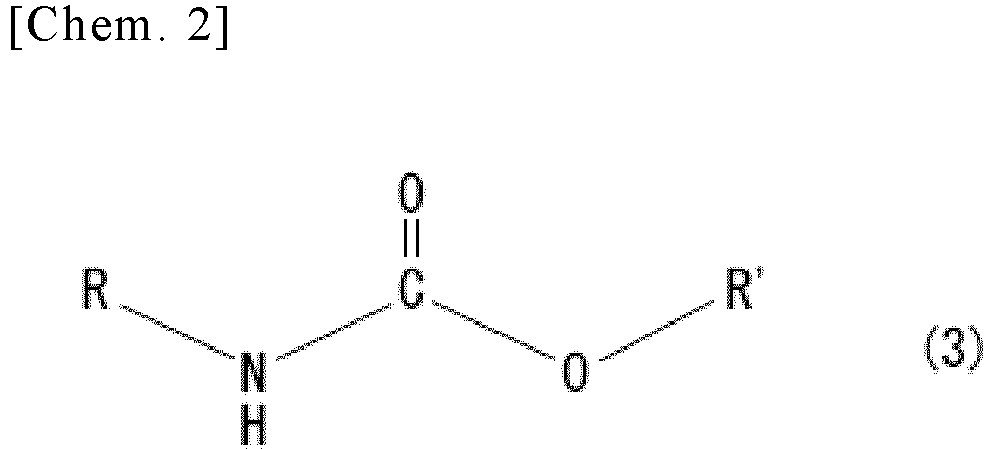
- In the formula (3), R and R' represent a hydrocarbon group.
- The molecular weight of the (C-2) aqueous urethane compound having a (thermal dissociative blocked) isocyanate group is not particularly limited if the compound is water-based. However, the number average molecular weight is preferably 1,500 to 100,000. The number average molecular weight is particularly preferably 9,000 or less.
- As described above, a method of synthesizing the (C-2) component is not particularly limited, and a known method such as the method described in
JP S63-51474 A - A preferred embodiment of the (C-2) component is a reaction product obtained by mixing (α), (β), (γ) and (δ) at a specified mixing ratio and reacting them, where (α) is an organic polyisocyanate compound having 3 or more and 5 or less functional groups and having a number average molecular weight of 2,000 or less, (β) is a compound having 2 or more and 4 or less active hydrogen groups and having a number average molecular weight of 5,000 or less, (γ) is a thermal dissociative blocking agent, and (δ) is a compound having at least one active hydrogen group and at least one anionic, cationic, or nonionic hydrophilic group, and when the molecular weight of the isocyanate group (-NCO) is 42, the composition ratio of the (thermal dissociative blocked) isocyanate group in the reaction product is 0.5 % by mass or more and 11 % by mass or less. This case provides better adhesion between an organic fiber and a coated rubber composition when the adhesive composition is used on organic fibers. In this case, the (C-2) component has both a (thermal dissociative blocked) isocyanate group moiety and a hydrophilic moiety having a hydrophilic group, so that the self-water solubility of the urethane compound is increased.
- The mixing ratio of (α) is 40 % by mass or more and 85 % by mass or less, the mixing ratio of (β) is 5 % by mass or more and 35 % by mass or less, the mixing ratio of (γ) is 5 % by mass or more and 35 % by mass or less, and the mixing ratio of (δ) is 5 % by mass or more and 35 % by mass or less with respect to the total amount of (α), (β), (γ) and (δ).
- The (α) organic polyisocyanate compound having 3 or more and 5 or less functional groups and having a number average molecular weight of 2,000 or less is not particularly limited. However, it is preferably an aromatic polyisocyanate compound and an oligomer thereof, and it may be other aliphatic, alicyclic, or heterocyclic polyisocyanate compound and an oligomer thereof. This is because the (C-2) component obtained as a reaction product after reacting the (α) organic polyisocyanate compound having 3 or more and 5 or less functional groups and having a number average molecular weight of 2,000 or less as described above is easier to disperse into the gaps of the organic fiber polymer chain.
- Specific examples thereof include, as an aliphatic polyisocyanate compound, ethylene diisocyanate, 1,4-tetramethylene diisocyanate, 1,6-hexamethylene diisocyanate, 1,12-dodecane diisocyanate, 2,2,4-trimethylhexamethylene diisocyanate, 2,4,4-trimethylhexamethylene diisocyanate, dimer acid diisocyanate, and lysine diisocyanate, as an alicyclic polyisocyanate compound, cyclobutane-1,3-diisocyanate, cyclohexane-1,3-diisocyanate, cyclohexane-1,4-diisocyanate, isophorone diisocyanate, 4,4'-methylenebis (cyclohexylisocyanate), methylcyclohexane-2,4-diisocyanate, methylcyclohexane-2,6-diisocyanate, and 1,3-(isocyanatomethyl) cyclohexane, as a heterocyclic polyisocyanate compound, tolylene diisocyanate adduct of 1,3,5-tris (2'-hydroxyethyl) isocyanuric acid, as an aromatic polyisocyanate compound, m-phenylene diisocyanate, p-phenylene diisocyanate, 2,4-tolylene diisocyanate, 2,6-tolylene diisocyanate, m-xylylene diisocyanate, p-xylylene diisocyanate, 2,4'-diphenylmethane diisocyanate, 4,4'-diphenylmethane diisocyanate, m-tetramethylxylylene diisocyanate, p-tetramethylxylylene diisocyanate, methine tris(4-phenylisocyanate), tris (4-isocyanatophenyl) methane, tris thiophosphate (4-isocyanatophenyl ester), 3-isopropenyl-α',α'-dimethylbenzyl isocyanate and oligomer mixtures thereof, and modified products such as carbodiimides, polyols and allophanates of these polyisocyanate compounds.
- Among the above, an aromatic polyisocyanate compound is preferable, and methylenediphenyl polyisocyanate, polyphenylene polymethylene polyisocyanate and the like are particularly preferable. Polyphenylene polymethylene polyisocyanate having a number average molecular weight of 2,000 or less is preferable, and polyphenylene polymethylene polyisocyanate having a number average molecular weight of 1,000 or less is particularly preferable. This is because the (C-2) component obtained as a reaction product after reacting the (α) organic polyisocyanate compound having 3 or more and 5 or less functional groups and having a number average molecular weight of 2,000 or less as described above is easier to disperse into the gaps of the organic fiber polymer chain.
- The (β) compound having 2 or more and 4 or less active hydrogen groups and having a number average molecular weight of 5,000 or less is not particularly limited. Specific examples thereof include compounds selected from the group consisting of the following (i) to (vii),
- (i) polyhydric alcohols having 2 or more and 4 or less hydroxyl groups and having a number average molecular weight of 5,000 or less,
- (ii) multivalent amines having 2 or more and 4 or less primary and/or secondary amino groups and having a number average molecular weight of 5,000 or less,
- (iii) amino alcohols having 2 or more and 4 or less primary and/or secondary amino groups and hydroxyl groups and having a number average molecular weight of 5,000 or less,
- (iv) polyester polyols having 2 or more and 4 or less hydroxyl groups and having a number average molecular weight of 5,000 or less,
- (v) polybutadiene polyols having 2 or more and 4 or less hydroxyl groups and having a number average molecular weight of 5,000 or less, and copolymers thereof with other vinyl monomers,
- (vi) polychloroprene polyols having 2 or more and 4 or less hydroxyl groups and having a number average molecular weight of 5,000 or less, and copolymers thereof with other vinyl monomers, and
- (vii) polyether polyols having 2 or more and 4 or less hydroxyl groups and having a number average molecular weight of 5,000 or less,
which is multivalent amine, C2-C4 alkylene oxide heavy adduct of polyhydric phenol and amino alcohols, C2-C4 alkylene oxide heavy adduct of C3 or higher polyhydric alcohols, C2-C4 alkylene oxide copolymer, or C3-C4 alkylene oxide polymer. - For the (C-2) component, the active hydrogen group refers to a group containing hydrogen that becomes active hydrogen (atomic hydrogen (hydrogen radical) and hydride ion (hydride)) when placed under suitable conditions. Examples of the active hydrogen group include an amino group and a hydroxyl group.
- The compound having at least one active hydrogen group and at least one anionic hydrophilic group of the "(δ) compound having at least one active hydrogen group and at least one anionic, cationic, or nonionic hydrophilic group" is not particularly limited. Examples thereof include aminosulfonic acids such as taurine, N-methyltaurine, N-butyltaurine and sulfanilic acid, and aminocarboxylic acids such as glycine and alanine.
- A method of synthesizing the (C-2) component by mixing and reacting the above-described (α), (β), (γ) and (δ) is not particularly limited, and a known method such as the method described in
JP S63-51474 A - Another preferred embodiment of the (C-2) component is a reaction product obtained by mixing (α), (β), (γ), (δ) and (ε) at a specified mixing ratio and reacting them, where (α) is an organic polyisocyanate compound having 3 or more and 5 or less functional groups and having a number average molecular weight of 2,000 or less, (β) is a compound having 2 or more and 4 or less active hydrogen groups and having a number average molecular weight of 5,000 or less, (γ) is a thermal dissociative blocking agent, (δ) is a compound having at least one active hydrogen group and at least one anionic, cationic, or nonionic hydrophilic group, and (ε) is a compound containing an active hydrogen group other than (α), (β), (γ) and (δ), and when the molecular weight of the isocyanate group (-NCO) is 42, the composition ratio of the (thermal dissociative blocked) isocyanate group in the reaction product is 0.5 % by mass or more and 11 % by mass or less. In this case, the (C-2) component has both a (thermal dissociative blocked) isocyanate group moiety and a hydrophilic moiety having a hydrophilic group, so that the self-water solubility of the urethane compound is increased.
- The mixing ratio of (α) is 40 % by mass or more and less than 85 % by mass, the mixing ratio of (β) is 5 % by mass or more and 35 % by mass or less, the mixing ratio of (γ) is 5 % by mass or more and 35 % by mass or less, the mixing ratio of (δ) is 5 % by mass or more and 35 % by mass or less, and the mixing ratio of (ε) is more than 0 % by mass and 45 % by mass or less with respect to the total amount of (α), (β), (γ), (δ) and (ε).
- As used herein, the (α) organic polyisocyanate compound having 3 or more and 5 or less functional groups and having a number average molecular weight of 2,000 or less, the (β) compound having 2 or more and 4 or less active hydrogen groups and having a number average molecular weight of 5,000 or less, the (γ) thermal dissociative blocking agent, and the (δ) compound having at least one active hydrogen group and at least one anionic, cationic, or nonionic hydrophilic group, except for the mixing ratio, are as described in the above <<Preferred embodiment of (C-2) aqueous urethane compound having a (thermal dissociative blocked) isocyanate group>>.
- A method of synthesizing the (C-2) component by mixing and reacting the above-described (α), (β), (γ), (δ) and (ε) is not particularly limited, and a known method such as the method described in
JP S63-51474 A - Yet another preferred embodiment of the (C-2) component is represented by the following general formula (1),

- A is a residue of an organic polyisocyanate compound from which an active hydrogen group has been eliminated,
- X is a residue of a polyol compound having 2 or more and 4 or less hydroxyl groups and having a number average molecular weight of 5,000 or less from which an active hydrogen group has been eliminated,
- Y is a residue of a thermal dissociative blocking agent from which an active hydrogen group has been eliminated,
- Z is a residue of a compound having at least one active hydrogen group and at least one salt-producing group or hydrophilic polyether chain, from which an active hydrogen group has been eliminated,
- n is an integer of 2 or more and 4 or less, and
- p + m is an integer of 2 or more and 4 or less (m ≥ 0.25)]. This case provides better adhesion between an organic fiber and a coated rubber composition when the adhesive composition is used on organic fibers. In this case, the (C-2) component has both a (thermal dissociative blocked) isocyanate group moiety and a hydrophilic moiety having a hydrophilic group, so that the self-water solubility of the urethane compound is increased.
- In the formula (1), the organic polyisocyanate compound of A, which is a residue of an organic polyisocyanate compound from which an active hydrogen group has been eliminated, preferably contains an aromatic ring. In this case, the (C-2) component is easier to disperse into the gaps of the organic fiber polymer chain.
- Specific examples thereof include, but are not limited to, methylenediphenyl polyisocyanate and polyphenylene polymethylene polyisocyanate. Polyphenylene polymethylene polyisocyanate having a number average molecular weight of 6,000 or less is preferable, and polyphenylene polymethylene polyisocyanate having a number average molecular weight of 4,000 or less is particularly preferable.
- In the formula (1), the polyol compound having 2 or more and 4 or less hydroxyl groups and having a number average molecular weight of 5,000 or less of X, which is a residue of a polyol compound having 2 or more and 4 or less hydroxyl groups and having a number average molecular weight of 5,000 or less from which an active hydrogen group has been eliminated, is not particularly limited. Specific examples thereof include compounds selected from the group consisting of the following (i) to (vi),
- (i) polyhydric alcohols having 2 or more and 4 or less hydroxyl groups and having a number average molecular weight of 5,000 or less,
- (ii) amino alcohols having 2 or more and 4 or less primary and/or secondary amino groups and hydroxyl groups and having a number average molecular weight of 5,000 or less,
- (iii) polyester polyols having 2 or more and 4 or less hydroxyl groups and having a number average molecular weight of 5,000 or less,
- (iv) polybutadiene polyols having 2 or more and 4 or less hydroxyl groups and having a number average molecular weight of 5,000 or less, and copolymers thereof with other vinyl monomers,
- (v) polychloroprene polyols having 2 or more and 4 or less hydroxyl groups and having a number average molecular weight of 5,000 or less, and copolymers thereof with other vinyl monomers, and
- (vi) polyether polyols having 2 or more and 4 or less hydroxyl groups and having a number average molecular weight of 5,000 or less,
which is multivalent amine, C2-C4 alkylene oxide heavy adduct of polyhydric phenol and amino alcohols, C2-C4 alkylene oxide heavy adduct of C3 or higher polyhydric alcohols, C2-C4 alkylene oxide copolymer, or C3-C4 alkylene oxide polymer. - The (C-2) component is not particularly limited, and commercially available products such as ELASTRON BN27, BN77, and BN11 manufactured by DKS Co. Ltd. can be used, among which ELASTRON BN77 is preferred.
- An embodiment of the adhesive composition of the present disclosure can also contain (D) polyphenol in addition to the (A) rubber latex having unsaturated diene and the (B) compound containing an acrylamide structure having a cationic group and/or a carboxyl group.
- The (D) polyphenol is preferably a plant-derived compound having a plurality of phenolic hydroxy groups in molecule. This case provides better adhesion between an organic fiber and a coated rubber composition when the adhesive composition is used on organic fibers. Specific examples of the (D) polyphenol include lignin, tannin, tannic acid, flavonoid, and derivatives thereof. This case also provides better adhesion between an organic fiber and a coated rubber composition when the adhesive composition is used on organic fibers.
- Although studies have been conducted for a long time to separate polyphenols such as lignin and tannin that are components in wood and bark and react them with formaldehyde to produce adhesives (for example, see
JP H07-53858 A - The (D) polyphenol is preferably lignin or a derivative thereof. Lignin, along with polysaccharides such as cellulose, is a major component of plant cell walls. Lignin includes, for example, functional groups such as a hydroxyl group, a methoxy group, a carbonyl group and a carboxyl group, and particularly, the phenolic hydroxy group can interact with a substance having a cationic group because it is highly reactive.
- Lignin is a polymer with a structure based on phenylpropane, but its molecular structure has not yet been completely elucidated because lignin has a variety of molecular structures and it is a huge biopolymer with a three-dimensional network structure.
- Since natural lignin forms a strong composite material with polysaccharides such as cellulose in plant cell walls, it is extremely difficult to isolate natural lignin without modifying its chemical structure. Various industrial separation methods are used to extract lignin from materials such as wood. Examples of the lignin obtained after separation include sulfonic acid lignin, kraft lignin, soda lignin, and steam-blasted lignin. Among these industrially handled lignin, lignin obtained on a large scale from pulp waste liquid of chemical pulping in the paper pulp manufacturing process, that is, lignosulfonates or kraft lignin, is a well-known material from the viewpoint of availability and economy.
- Examples of other lignins include lignin modified by hydroxymethylation, epoxidation, denitrification, acylation or hydroxylation, diethanolamine-modified lignin, enzyme-modified lignin, laccase-modified lignin, urea-modified lignin, lignosulfonate, alkali cellulose-method lignin, alkali granite-method lignin, and polyethylene glycol-added lignin.
- The kraft lignin is lignin obtained with a chemical pulping method (high-temperature and high-pressure reaction) called kraft cooking method that is a high-temperature and high-pressure reaction, where wood chips of broadleaf trees, conifers, miscellaneous trees, bamboo, kenaf, bagasse and the like as raw material wood are put into a digester together with a cooking solution made of sodium hydroxide/sodium sulfide and the like. Acid and/or carbon dioxide is added to the kraft waste liquid obtained after kraft cooking to precipitate dissolved lignin modified products, and then the obtained precipitate is dehydrated and washed to obtain the kraft lignin. Further, the precipitate after dehydration and washing can be subjected to refining where an organic solvent such as alcohol or acetone is added to dissolve the precipitate to separate insoluble impurities and then drying is performed, or to modification where various functional groups are introduced as necessary. The kraft lignin may be a commercially available product, among which the reagent "Lignin, alkali, kraft" (CAS Number: 8068-05-1) manufactured by Sigma-Aldrich Co. LLC is preferred.
- In the chemical pulping method of sulfite cooking method in which wood chips are reacted with a cooking solution of sulfurous acid and/or sulfites at high temperature and high pressure, the sulfonic acid lignin is lignin sulfonic acid and its salts obtained from the waste liquid and the like eluted from sulfite pulp, and particularly preferred examples thereof include calcium lignin sulfonate, sodium lignin sulfonate, potassium lignin sulfonate, and magnesium lignin sulfonate. Among the above, sodium lignin sulfonate and the like are preferred. These sulfonic acid lignins are available as commercial products. For example, a lignin sulfonate or a modified lignin sulfonate may be the SAN X series manufactured by Nippon Paper Industries Co., Ltd.
- Examples of a high value-added lignin sulfonate include a high-purity product, and a partially de(low) sulfonated lignin sulfonate whose degree of sulfonation has been reduced by heating a lignin sulfonate in an alkaline aqueous solution using sodium hydroxide or ammonia in the presence of an oxidizing agent such as oxygen (for example, see
JP 2016-135834 A - The tannin is a group of polyphenolic compounds that are present in a wide range of plants, not only in woody trees, but also in fruits, leaves and seeds, such as grapes, persimmons, berries, cloves, legumes, medicinal herbs, tea leaves and cocoa beans. Tannin molecules generally contain a large number of hydroxyl groups and often also carboxyl groups and tend to form strong complexes and composites with a wide range of macromolecules.
- The tannin includes tannic acid, proanthocyanidin, flavonoid, gallic acid ester, catechin, and the like, and it also includes salts thereof and derivatives thereof such as modified products. The flavonoid is ubiquitous in the leaves, stems, and barks of plants and is a substance generally called tannin that includes hydrolyzable tannin and condensed tannin. The identification of these tannins is as follows. When it is boiled in dilute hydrochloric acid, condensed tannin forms insoluble precipitates, and hydrolyzable tannin hydrolyzes to form water-soluble substances.
- The tannin, both hydrolyzable tannin and condensed tannin, is water-soluble and can be obtained by extraction from plant materials such as wood, bark, leaves, fruits, pods, and insect galls by hot water extraction or other methods. For example, hydrolyzable tannin can be obtained from the wood of chestnuts and nuts, the bark of oak, tea leaves, nutgalls, and gallnuts, and condensed tannin can be obtained from the wood of quebracho, the bark of mimosa, and the seeds of persimmon and buckwheat. Among the above, the hydrolyzable tannin is preferably the reagent "Tannic acid" (CAS Number: 1401-55-4-6, solid powder) manufactured by NACALAI TESQUE, INC., which is a tannic acid obtained from nutgalls and the like, and the condensed tannin is preferably the product "Mimosa" (solid powder) manufactured by Kawamura Corporation, which is obtained from the bark of mimosa.
- The content (solid content) of the (D) polyphenol in the total solid content of the aqueous adhesive composition is not particularly limited. However, it is preferably 1 % by mass or more, more preferably 1.5 % by mass or more, and even more preferably 3 % by mass or more. Further, the content of the (D) polyphenol is preferably 50 % by mass or less, more preferably 30 % by mass or less, even more preferably 25 % by mass or less, and particularly preferably 20 % by mass or less. The reason is as follows. When the content of the (D) polyphenol is 0.5 % by mass or more, the adhesiveness between an organic fiber and a coated rubber composition can be improved. When the content of the (D) polyphenol is 50 % by mass or less, it is possible to relatively secure a certain amount or more of other components such as rubber latex blended in the adhesive composition, which improves the adhesiveness to rubber as an adherend.
- One embodiment of the adhesive composition of the present disclosure may also contain (E) a polyvalent metal salt in addition to the (A) rubber latex having unsaturated diene and the (B) compound containing an acrylamide structure having a cationic group and/or a carboxyl group.
- The (E) polyvalent metal salt is a component for promoting fixation to a surface when adhering an adhesive layer of the adhesive composition to an organic fiber as an adherend. The polyvalent metal salt is adsorbed as cation to an anionic group such as a hydroxyl group on the surface of the organic fiber as an adherend, and it can realize interactions between the polyacrylamide contained in the adhesive composition and an amide moiety having hydrogen bonding force or an anionic group contained therein. As a result of this fixation promoting effect, the adhesive composition of the present disclosure containing the (E) polyvalent metal salt can, for example, provide good adhesion between an organic fiber cord and a coated rubber composition.
- The (E) polyvalent metal salt is not limited, and as described above, a divalent or higher metal ion salt that can be fixed on an organic fiber surface can be used. For example, an inorganic filler used as a fixing agent for paper fibers in a papermaking chemical, a mordant used as a dyeing chemical for fibers, or the like can be preferably used. These may be used alone or in combination of two or more.
- When the (E) polyvalent metal salt is an inorganic filler used as a fixing agent for paper fibers in a papermaking chemical, specific examples thereof include calcium carbonate, clay, talc, gypsum, titanium dioxide, synthetic silicates, aluminum trihydrate, barium sulfate, and magnesium oxide. Among the above, calcium carbonate that can be used under neutral to weakly alkaline conditions with a pH of about 6.0 to 8.5 is preferred.
- Examples of the mordant used as a dyeing chemical for fibers include tetracoordinated or hexacoordinated polyvalent metal ions, and specifically, inorganic salts of aluminum ions, iron ions, chromium ions, copper ions, tin ions and nickel ions that are iron chloride, tin chloride, alum, copper sulfate, copper acetate, copper oxalate, copper gluconate, aluminum acetate, or natural mordants such as mordants made with iron or lye containing these polyvalent metal ions. In the present disclosure, copper gluconate that is an additive for nutritionally functional food for copper supplementation is used.
- When the (E) polyvalent metal salt is an inorganic filler, for example, a liquid obtained by pulverizing a polyvalent metal salt and dispersing or dissolving it in water is added to the adhesive composition of the present disclosure. Taking calcium carbonate as an example, a filler having an average particle size of 0.1 µm to 30 µm, such as heavy calcium carbonate obtained by pulverizing limestone, or chalk from light calcium carbonate or marine microorganisms like foraminifera, can be stirred and dispersed in water to obtain a suspension of 5 % by mass to 30 % by mass, and the suspension can be used.
- The mordant can be used as an aqueous solution of about 0.01 % by mass to 5 % by mass obtained by dissolving the mordant in water with stirring. When the mordant is mixed with the (B) compound containing an acrylamide structure having a cationic group and/or a carboxyl group and the (D) polyphenol, fine polyion complexes may be formed in the mixed aqueous solution, and it is preferable to appropriately adjust the amount of the mordant by reducing the amount added or reducing the concentration so that sedimentation does not occur.
- The content (solid content) of the (E) polyvalent metal salt in the total solid content of the adhesive composition is not particularly limited. However, it is preferably 0.01 % by mass or more, more preferably 0.05 % by mass or more, and even more preferably 0.1 % by mass or more. Further, the content of the (E) polyvalent metal salt is preferably 3 % by mass or less, more preferably 2 % by mass or less, and even more preferably 1.5 % by mass or less. The reason is as follows. When the content of the (E) polyvalent metal salt is 0.01 % by mass or more, the adhesion between an organic fiber and a coated rubber composition can be improved. When the content of the (E) polyvalent metal salt is 3 % by mass or less, an increase in the viscosity caused by the cohesive effect of the adhesive composition due to the polyvalent metal salt can be suppressed.
- When producing the adhesive composition of the present disclosure, the (A) rubber latex having unsaturated diene and the (B) compound containing an acrylamide structure having a cationic group and/or a carboxyl group are mixed, and further, the (C) aqueous compound having a (thermal dissociative blocked) isocyanate group, the (D) polyphenol, and the (E) polyvalent metal salt can be mixed in any order.
- When the (E) polyvalent metal salt is contained, although not particularly limited, the preferred order of addition is: the (E) polyvalent metal salt, the (D) polyphenol, the (B) compound containing an acrylamide structure having a cationic group and/or a carboxyl group, the (A) rubber latex having unsaturated diene, and the (C) aqueous compound having a (thermal dissociative blocked) isocyanate group.
- The reason is as follows. The (E) polyvalent metal salt is mixed as a fixing agent for compounds having anionic groups, such as the (D) polyphenol and the (B) compound containing an acrylamide structure having a cationic group and/or a carboxyl group to form a polyion complex, so that it is easier to fix to an anionic group on the surface of an organic fiber as an adherend and an anionic group of an emulsifier on the surface of rubber latex.
- In the adhesive composition of the present disclosure, the mixing mass ratio [(A): (B)] (in terms of solid content) of the (A) rubber latex having unsaturated diene and the (B) compound containing an acrylamide structure having a cationic group and/or a carboxyl group is not particularly limited, but it is preferably in a range of 100: 0.1 to 100: 25 and more preferably in a range of 100: 0.2 to 100: 15.
- The reason is as follows. When the mixing mass ratio is 100: 0.1 or more (when the ratio value is 1000 or less), a film of microcapsule of the (B) compound containing an acrylamide structure having a cationic group and/or a carboxyl group can be formed around the (A) rubber latex having unsaturated diene as a core, and it is possible to obtain an adhesive layer with sufficient strength. When the mixing mass ratio is 100: 25 or less (when the ratio value is 4 or more), a film of microcapsule of the (B) compound containing an acrylamide structure having a cationic group and/or a carboxyl group formed around the (A) rubber latex having unsaturated diene as a core is not too thick, so that when a coated rubber composition, which is an adherend of an organic fiber, and the adhesive composition are co-vulcanized and adhered to each other, the coated rubber composition as the adherend and the (A) rubber latex having unsaturated diene are compatible with each other. As a result, the initial process of adhesion between the coated rubber composition as the adherend and the adhesive composition progresses smoothly.
- When mixing the (A) rubber latex having unsaturated diene and the (B) compound containing an acrylamide structure having a cationic group and/or a carboxyl group, a known water-soluble material that can strengthen the film of the (B) compound containing an acrylamide structure having a cationic group and/or a carboxyl group can be used in combination in common coacervate. For example, gum arabic, carrageenan, CMCs, organic salts, or an electrolyte material consisting of inorganic salts other than the (E) polyvalent metal salt, such as salts with cations that are monovalent like sodium chloride, potassium chloride and ammonium chloride, and salts with anions like sulfates, phosphates, carbonates and acetates, can be used. Further, a liquid material that is water-soluble liquid and in which a film-forming material is less soluble than water, such as an alcohols like ethanol or propanol, or water-soluble polymers like an isobutylene-maleic anhydride ring-opening copolymer salt, can also be used.
- In the adhesive composition of the present disclosure, a mixing mass ratio [(A): [(C)+(D)+(E)] (in terms of solid content) of the (A) rubber latex having unsaturated diene to compounds selected from the group consisting of the (C) aqueous compound having a (thermal dissociative blocked) isocyanate group, the (D) polyphenol and the (E) polyvalent metal salt is not particularly limited, but it is preferably in a range of 100: 5 to 100: 300, more preferably in a range of 100: 7 to 100: 150, and still more preferably in a range of 100: 10 to 100: 60.
- The reason is as follows. When the mixing mass ratio is 100: 5 or more (when the ratio value is 20 or less), the ratio of the (A) rubber latex having unsaturated diene in the adhesive composition is not too large, an adhesive layer of the adhesive composition can maintain sufficient fracture resistance, and deterioration of adhesiveness under strain can be prevented. When the mixing mass ratio is 100: 300 or less (when the ratio value is 1/3 or more), the ratio of the (A) rubber latex having unsaturated diene in the adhesive composition is not too low, so that when a coated rubber composition, which is an adherend of an organic fiber, and the adhesive composition are co-vulcanized and adhered to each other, the coated rubber composition as the adherend and the (A) rubber latex are compatible with each other. As a result, the adhesion between the coated rubber composition as the adherend and the adhesive composition is sufficiently improved.
- The (A) rubber latex having unsaturated diene, the (B) compound containing an acrylamide structure having a cationic group and/or a carboxyl group, the (C) aqueous compound having a (thermal dissociative blocked) isocyanate group, the (D) polyphenol, and the (E) polyvalent metal salt are preferably aqueous. In this case, water that causes less environmental pollution can be used as a solvent.
- By coating the adhesive composition with the composition described above on the surface of an organic fiber, such as an organic fiber made of polyester resin, aromatic polyamide resin, acrylic resin, or the like, and performing moderate heat treatment, an adhesive layer of the adhesive composition is coated on the surface of the resin base material, thereby obtaining an organic fiber material that has been subjected to adhesive treatment.
- In the organic fiber material of the present disclosure, the surface of the resin base material is coated with an adhesive layer of the adhesive composition. This can provide an organic fiber material with excellent durability while ensuring good environmental friendliness and workability. The resin base material is particularly preferably polyester resin, aromatic polyamide resin or acrylic resin, among which polyester resin is preferred. Further, the resin base material is preferably a cord obtained by twisting a plurality of filaments.
- The method of coating the surface of the resin base material with the adhesive composition may be a method of immersing the organic fiber cord in the adhesive composition, a method of applying the adhesive composition with a brush, a method of spraying the adhesive composition, or the like, and an appropriate method may be used as needed. The method of coating the surface of the resin base material with the adhesive composition is not particularly limited. However, when the surface of the resin base material is coated with the adhesive composition, the adhesive composition is preferably dissolved in various solvents to reduce the viscosity, because the coating is facilitated in this case. It is environmentally preferable that the solvent is mainly composed of water.
- When the organic fiber is coated with the adhesive composition, the adhesive composition is preferably dissolved in various solvents to reduce the viscosity, because the coating is facilitated in this case. It is environmentally preferable that the solvent for reducing the viscosity of the adhesive composition is mainly composed of water.
- The solution concentration of the adhesive composition impregnated in the organic fiber is not particularly limited. However, it is preferably, in terms of solid content, 5.0 % by mass or more and 25.0 % by mass or less, and more preferably 7.5 % by mass or more and 20.0 % by mass or less with respect to the mass of the organic fiber.
- The thickness of an adhesive layer of the adhesive composition is not particularly limited, but it is preferably 50 µm or less, and it is more preferably 0.5 µm or more and 30 µm or less.
- Especially when applying the organic fiber-rubber composite of the present disclosure to a tire, if the amount of the adhesive composition coated by the adhesive treatment is large, the adhesive durability under tire rolling tends to decrease. The reason is as follows. Due to the high rigidity of a fiber material, the adhesive composition at the interface of an adhered fiber material has relatively small deformation because the fiber material bears the stress due to strain. However, the deformation due to strain increases as the distance from the interface increases. Because the adhesive composition contains a large amount of thermosetting condensate as compared with the adhered rubber material, it is hard and brittle. As a result, the adhesive fatigue under repeated strain tends to increase. Therefore, the average thickness of the adhesive composition layer is preferably 50 µm or less. It is more preferably 0.5 µm or more and 30 µm or less.
- When the resin base material is a cord, the adhesive layer in the organic fiber is preferably 0.5 % by mass to 6.0 % by mass of the mass of the cord in terms of dry mass. When the dry mass of the adhesive layer is within this range, suitable adhesiveness can be ensured.
- The organic fiber coated with the adhesive composition can be subjected to drying, heat treatment, and other treatment in the same manner as the organic fiber material described above.
- The organic fiber material in which the surface of an organic fiber is coated with the adhesive composition is, for example, dried at a temperature of 100 °C to 210 °C and then subjected to heat treatment. The heat treatment is preferably performed at a temperature equal to or higher than the glass transition temperature of the polymer of the resin base material, preferably a temperature of [the melting temperature of the polymer - 70 °C] or higher and [the melting temperature of the polymer - 10 °C] or lower.
The reason this case is preferable is as follows. When the temperature is lower than the glass transition temperature of the polymer, the molecular mobility of the polymer is poor, and the adhesion-promoting components in the adhesive composition cannot interact with the polymer sufficiently. As a result, the bonding strength between the adhesive composition and the resin base material cannot be obtained. The resin base material may be pretreated by electron beam, microwave, corona discharge, plasma treatment, or the like. - An organic fiber-rubber composite of the present disclosure is a composite of organic fiber and rubber, where the organic fiber is coated with the adhesive composition described above. In this case, good adhesiveness can be obtained without using resorcin, and an organic fiber-rubber composite with good environmental friendliness and workability can be obtained. The adhesive composition of the present disclosure is particularly excellent in adhesion between an organic fiber such as an organic fiber cord and a coated rubber composition.
- The organic fiber-rubber composite of the present disclosure will be described in detail with reference to
FIG. 2 . -
FIG. 2 schematically illustrates a cross section of an organic fiber cord-rubber composite, which is an example of the organic fiber-rubber composite of the present disclosure. In an organic fiber-rubber composite 31 illustrated in FIG. 4, the outer surface in the outer diameter direction of anorganic fiber cord 1 is coated with anadhesive layer 32 formed by anadhesive composition 2 of the present disclosure. Theorganic fiber cord 1 is further adhered to acoated rubber composition 33 located on the outer side in the outer diameter direction via the adhesive 32 of theadhesive composition 2 to form the organic fiber-rubber composite 31 of the present disclosure. - In addition to the organic fiber cord-rubber composite, a reinforcing material for rubber articles using the adhesive composition of the present disclosure may be a short fiber, a non-woven fabric, or the like.
- An organic fiber cord, which is an example of the organic fiber, is used to supplement the strength of a rubber article such as a tire. When the organic fiber cord is used as a reinforcing material, spun organic fiber yarn is first twisted to obtain an organic fiber cord. Then, the organic fiber cord is embedded in rubber that covers the organic fiber cord using an adhesive composition, and vulcanization is performed to adhere them to form an organic fiber-rubber composite. The organic fiber-rubber composite can be used as a reinforcing member of a rubber article such as a tire.
- The material of the organic fiber is not particularly limited, and fiber materials typified by aliphatic polyamide fiber such as polyester, 6-nylon, 6,6-nylon and 4,6-nylon, protein fiber such as artificial fibroin fiber, polyketone fiber, aromatic polyamide fiber typified by polynonamethylene terephthalamide and paraphenylene terephthalamide, acrylic fiber, carbon fiber, and cellulose fiber such as rayon and lyocell can be used. Among the above, it is preferable to use polyester, 6-nylon, and 6,6-nylon, and it is particularly preferable to use 6,6-nylon.
- The material of the polyamide fiber is a polymer having an amide bond in the main chain, and more specifically, it is one where 80 % or more of the bonding mode of the repeating units in the main chain is an amide bonding mode. Examples of the polyamide include, but are not limited to, dicarboxylic acids such as adipic acid, sebacic acid and terephthalic acid, and those obtained by condensation of diamines, such as hexaethylenediamine, nonanediamine, methylpentadiamine, p-phenylenediamine and m-phenylenediamine, through an amide bonding reaction. The most typical aliphatic polyamide is 6,6-nylon.
- The organic fiber cord is preferably an organic fiber cord obtained by twisting a plurality of single fiber filaments, especially for the purpose of reinforcing rubber articles such as tires or conveyor belts. Further, the organic fiber cord is preferably an organic fiber cord obtained by twisting second twisted single fiber filaments and first twisted single fiber filaments.
- The fiber thickness of the organic fiber cord is preferably in a range of 100 dtex or more and 5000 dtex or less. Regarding the number of twists (times/10 cm), the number of first twists is preferably 10 times/10 cm to 50 times/10 cm in the tire of the present disclosure, and the number of second twists is preferably 10 times/10 cm to 50 times/10 cm in the tire of the present disclosure.
- Further, it is preferably an organic fiber-rubber composite where the cord obtained by twisting a plurality of filaments is a 66-nylon tire cord having a twist structure of 1400 dtex/2, a second twist number of 39 times/10 cm and a first twist number of 39 times/10 cm, and the adhesive composition is adhered to the tire cord.
- The coated rubber composition of the organic fiber-rubber composite of the present disclosure preferably contains a rubber component and various compounding agents usually used in the rubber industry. The rubber component is not particularly limited, and examples thereof include natural rubber, conjugated diene-based synthetic rubber such as polyisoprene rubber (IR), polybutadiene rubber (BR), styrene-butadiene copolymer rubber (SBR), acrylonitrile-butadiene rubber (NBR), chloroprene rubber (CR) and butyl rubber (IIR), and ethylene-propylene copolymer rubber (EPM), ethylene-propylene-diene copolymer rubber (EPDM), and polysiloxane rubber. Among the above, natural rubber and conjugated diene-based synthetic rubber are preferable. These rubber components may be used alone or in combination of two or more.
- The organic fiber-rubber composite of the present disclosure can be produced by coating an organic fiber, such as an organic fiber cord, with the adhesive composition of the present disclosure to form an adhesive layer, and co-vulcanizing and adhering the (A) rubber latex having unsaturated diene in the adhesive composition and the rubber component in the coated rubber composition that is an adherend of the organic fiber.
- Finally, for the organic fiber coated with the adhesive composition, the (A) rubber latex having unsaturated diene in the adhesive composition and the rubber component in the coated rubber composition that is an adherend of the organic fiber are co-vulcanized and adhered to each other.
- In the co-vulcanization of the rubber component in the coated rubber composition, for example, sulfur, tylalium polysulfide compounds such as tetramethyltylalium disulfide and dipentamethylenetylalium tetrasulfide, organic vulcanizing agents such as 4,4-dithiomorpholin, p-quinone dioxime, p,p'-dibenzoquinone dioxime, and cyclic sulfur imide, and the like may be used. Among the above, it is preferable to use sulfur. Further, various compounding agents such as a filler like carbon black, silica and aluminum hydroxide commonly used in the rubber industry, a vulcanization accelerator, an age resistor, and a softener may be appropriately added to the rubber component in the coated rubber composition.
- Needless to say, the adhesive composition of the present disclosure can obtain an adhesive effect even in an adhesive method where a vulcanizing agent contained in an adherend of a synthetic organic fiber material such as an organic fiber and/or an adherend of a coated rubber composition is transferred to the adhesive composition, and the adhesive composition is cross-linked by the transferred vulcanizing agent.
- The adhesive composition of the present disclosure uses the organic fiber-rubber composite of the present disclosure. As a result, good adhesiveness can be obtained without using resorcin, and a rubber article with good environmental friendliness and workability can be obtained. Examples of the rubber article of the present disclosure include a tire, a conveyor belt, a belt, a hose, and an air spring.
- The tire of the present disclosure uses the organic fiber-rubber composite of the present disclosure. As a result, good adhesiveness can be obtained without using resorcin, and a tire with good environmental friendliness and workability can be obtained.
- In the tire of the present disclosure, the organic fiber-rubber composite can be used, for example, as a carcass, a belt, a belt reinforcing layer, and a reinforcing layer around a belt such as a flipper.
- In accordance with the type of tire to be used, the tire of the present disclosure may be obtained by first shaping a tire using an unvulcanized rubber composition and then vulcanizing the tire, or by first shaping a tire using semi-vulcanized rubber yielded by a preliminary vulcanization process and then fully vulcanizing the tire. For the tire of the present disclosure, an organic fiber cord or the like that has been treated with the above-described adhesive composition can be used in any part of the tire, and other members are not particularly limited and may be known members. The tire of the present disclosure is preferably a pneumatic tire. The pneumatic tire may be filled with ordinary air or air with an adjusted partial pressure of oxygen, or may also be filled with an inert gas such as nitrogen, argon, or helium.
- The adhesive composition, organic fiber material, and organic fiber-rubber composite of the present disclosure described above can be applied to, in addition to the tire, all rubber articles such as a conveyor belt, a belt, a hose, and an air spring.
- The following describes the present disclosure in more detail with reference to examples, but the present disclosure is not limited to the following examples.
- In the following comparative examples and examples, vinylpyridine-styrene-butadiene copolymer latex was prepared and used in accordance with Comparative Example 1 described in
JP H09-78045 A - In a nitrogen-substituted autoclave having a capacity of 5 liters, 130 parts by mass of deionized water and 4.0 parts by mass of potassium rosinate as an emulsifier were charged and dissolved. A monomer mixture having a composition of 15 parts by mass of vinylpyridine monomer, 15 parts by mass of styrene and 70 parts by mass of butadiene, and 0.60 parts by mass of t-dodecyl mercaptan as a chain transfer agent were added to this and emulsified. Next, the temperature was raised to 50 °C, 0.5 parts by mass of potassium persulfate as a polymerization initiator was added, and polymerization was started. After the reaction rate of the monomer mixture reached 90 %, 0.1 parts by mass of hydroquinone was added to terminate the polymerization. Next, unreacted monomers were removed under reduced pressure to obtain vinylpyridine-styrene-butadiene copolymer latex having a solid content concentration of 41 % by mass.
- In each example, the following (B-1) to (B-4) were used as the (B) compound containing an acrylamide structure having a cationic group and/or a carboxyl group. They were diluted 10 times (diluted to 1/10 concentration) with deionized water to obtain aqueous solutions, and the aqueous solutions were used to prepare adhesive compositions.
- (B-1) Product name "HASIZE CP-300" manufactured by Harima Chemicals Group, Inc. (aqueous solution with a solid content concentration of 25 %) that was cationic polyacrylamide was used as a compound containing an acrylamide structure having a cationic group.
- (B-2) Product name "HARMIDE C-10" manufactured by Harima Chemicals Group, Inc. (aqueous solution with a solid content concentration of 10 %) that was anionic polyacrylamide was used as a compound containing an acrylamide structure having a carboxyl group.
- (B-3) Product name "DA4106" manufactured by SEIKO PMC CORPORATION (aqueous solution with a solid content concentration of 15 %) that was anionic polyacrylamide was used as a compound containing an acrylamide structure having a carboxyl group.
- (B-4) Product name "HARMIDE KS2" manufactured by Harima Chemicals Group, Inc. (aqueous solution with a solid content concentration of 20 %) that was amphoteric polyacrylamide was used as a compound containing an acrylamide structure having a cationic group and a carboxyl group.
- (B-5) Product name "DS4433" manufactured by SEIKO PMC CORPORATION (aqueous solution with a solid content concentration of 20 %) that was amphoteric polyacrylamide was used as a compound containing an acrylamide structure having a cationic group and a carboxyl group.
- The following (C-1) or (C-2) was used as it was as the (C) aqueous compound having a (thermal dissociative blocked) isocyanate group.
- (C-1) "DM-6400" manufactured by Meisei Chemical Works, Ltd. (blocking agent thermal dissociation temperature: about 130 °C, solid content concentration: 40 % by mass) that was a methyl ethyl ketoxime block-dimenylmethane diisocyanate compound
- (C-2) Product name "ELASTRON BN77" manufactured by DKS Co. Ltd. (F-2955D-1, blocking agent thermal dissociation temperature: about 160 °C, pH: 8.0, solid content concentration: 31 % by mass) that was an aqueous urethane compound having a (thermal dissociative blocked) isocyanate group
- The following (D-1) that was a lignin sulfonate was used as the (D) polyphenol. Powdered polyphenol was dissolved in deionized water to obtain an aqueous solution with a solid content concentration of 5 % by mass, and the aqueous solution was used to prepare adhesive compositions.
(D-1) Product name "Lignin (alkali)" (CAS Number: 8061-51-6) manufactured by Tokyo Chemical Industry Co., Ltd. (TCI) that was a partially desulfonated lignin sulfonate with a reduced degree of sulfonation - The following (E-1) a polyvalent metal salt serving as a mordant for organic fibers, or (E-2) a fixing agent for inorganic fillers was used as the (E) polyvalent metal salt, and their aqueous solutions were used to prepare adhesive compositions.
- (E-1) Product name "Copper (II) gluconate" manufactured by Tokyo Chemical Industry Co., Ltd. (TCI) (CAS Number: 527-09-3, solid powder, purity 97 % or more) was stirred and dissolved in deionized water to obtain a solid content concentration of 0.5 %, and the aqueous solution was used to prepare adhesive compositions.
- (E-2) Product name "Light calcium carbonate" manufactured by Toyo Denka Kogyo Co., Ltd. (solid powder, purity 98 % or more, apparent specific gravity 0.24,
moisture 1 % or less) was used as it was to prepare adhesive compositions. - The (A) rubber latex and water were blended (wet blending) as listed in Table 2 and mixed where the amount was adjusted to obtain a solid content concentration of 16.6 % by mass, and then the mixture was sufficiently stirred to obtain a latex adhesive composition (Comparative Example 1).
- The (A) rubber latex having unsaturated diene and the (C-1) aqueous compound having a (thermal dissociative blocked) isocyanate group were blended (wet blending) as listed in Table 2 and mixed where the amount was adjusted with water to obtain an adhesive composition solid content concentration of 16.6 % by mass, and then the mixture was sufficiently stirred to obtain a latex-aqueous urethane adhesive composition (Comparative Example 2).
- Further, the (A) rubber latex having unsaturated diene and the (C-2) aqueous compound having a (thermal dissociative blocked) isocyanate group were blended (wet blending) as listed in Table 2 and mixed where the amount was adjusted with water to obtain an adhesive composition solid content concentration of 16.6 % by mass, and then the mixture was sufficiently stirred to obtain a latex-aqueous urethane adhesive composition (Comparative Example 3).
- The (A) rubber latex having unsaturated diene and the (D) polyphenol were blended (wet blending) as listed in Table 2 and mixed where the amount was adjusted with water to obtain an adhesive composition solid content concentration of 16.6 % by mass, and then the mixture was sufficiently stirred to obtain a latex-polyphenol adhesive composition (Comparative Example 4).
- The (A) rubber latex having unsaturated diene and the (E) polyvalent metal salt were blended (wet blending) as listed in Table 2 and mixed where the amount was adjusted with water to obtain an adhesive composition solid content concentration of 16.6 % by mass, and then the mixture was sufficiently stirred to obtain a latex-polyphenol adhesive composition (Comparative Examples 5 and 6).
- The adhesive composition using the polyvalent metal salt of (E-2) calcium carbonate was a well-stirred suspension.
- As listed in Table 2, each of predetermined water for dilution, (E) polyvalent metal salt, (D) polyphenol, (B) compound containing an acrylamide structure having a cationic group and/or a carboxyl group, (A) rubber latex having unsaturated diene, (C) aqueous compound having a (thermal dissociative blocked) isocyanate group were blended (wet blending) in the stated order and mixed to obtain an adhesive composition solid content concentration of 16.6 % by mass, and then the mixture was sufficiently stirred to obtain an adhesive composition as one embodiment of the present disclosure (Examples 1 to 21).
- Tire cords made of 66-nylon having a twist structure of 1400 dtex/2, a second twist number of 39 times/10 cm and a first twist number of 39 times/10 cm were used as organic fiber cords.
- The tire cord was immersed in the adhesive composition of each comparative example and example, where the concentration of the adhesive composition impregnated in the tire cord was adjusted to 3.3 % by mass with respect to the mass of the organic fiber cord.
- Next, they were subjected to drying in a drying zone (160 °C, 60 seconds), resin heat curing with tension applied (33 N/piece) in a hot zone (23540 °C, 60 seconds), and heat curing with the tension released in a normalizing zone (235 °C, 60 seconds) in the stated order to obtain tire cords coated with the adhesive composition of each sample.
- The tire cords coated with the adhesive composition of each comparative example and example were embedded in unvulcanized rubber compositions and co-vulcanization was performed at 160 °C for 20 minutes. Rubber compositions containing natural rubber, styrene-butadiene rubber, carbon black, vulcanizing chemicals and the like were used as the unvulcanized rubber compositions for coating.
- The workability of the adhesive composition of each comparative example and example was evaluated as follows.
- The mechanical stability (solidification rate) of each adhesive composition was determined with a method using a Maron mechanical stability tester for copolymer latex composition described in JIS K6392-1995 (Maron stability tester No.2312-II, manufactured by KUMAGAI RIKI KOGYO Co., Ltd.).
- In brief, each adhesive composition was subjected to shear strain for 10 minutes at a compression load of 10 kg and a rotation speed of 1000 r/min using the rotor of the Maron mechanical stability tester, and then the solidification rate% was evaluated by the following expression with the amount of formed solid product. The value was rounded off to the first decimal place. A smaller value indicates better mechanical stability.
Solidification rate (%) = (dry mass of formed solid product)/(solid content mass of adhesive liquid under test) × 100 - The polyethylene terephthalate tire cord, which was an organic fiber cord, was continuously treated for 2000 m in an immersion treatment machine for storing each adhesive composition. The amount of each adhesive composition adhered to the drawing roller was visually observed and evaluated in the following five levels.
- Extra-large: a very large amount
- Large: a large amount
- Medium: a medium amount
- Small: a small amount
- Little: a very small amount
- The adhesiveness of the adhesive composition of each comparative example and example was evaluated as follows.
- By pulling the tire cord-rubber composite obtained using each adhesive composition at a rate of 300 mm/min, the tire cord was peeled off from the tire cord-rubber composite, and the peeling resistance per tire cord was determined and used as the adhesive strength (N/piece).
- For the tire cord peeled off from the tire cord-rubber composite, the adhesion state of the coated rubber was visually observed and scored according to Table 1 below.
-
Table 1 Score of adhesion state of coated rubber Adhesion area ratio of coated rubber to tire cord (organic fiber cord) State of cord filament A 80% or more and 100% or less Filament is not broken B 60% or more and less than 80% Filament is not broken C 40% or more and less than 60% Filament is not broken D 20% or more and less than 40% Filament is not broken E 0% or more and less than 20% Filament is not broken - The following Table 2 lists the composition of the adhesive composition of each comparative example and example, and the workability evaluation and adhesiveness evaluation results thereof, respectively.


- The results listed in Table 2 indicate that the adhesive composition of each Example has good workability and good adhesion between an organic fiber and a coated rubber composition.
- According to the present disclosure, it is possible to provide to an adhesive composition that can ensure desired adhesiveness without using resorcin and does not impair workability in use, as well as an organic fiber material, a rubber article, an organic fiber-rubber composite, and a tire using the adhesive composition. Therefore, the present disclosure can be used in the industrial fields of manufacturing rubber articles such as tires.
-
- 1
- organic fiber cord
- 2
- adhesive composition
- 3
- immersion bathtub (dipping tub)
- 4
- organic fiber cord coated with the adhesive composition
- 5
- drawing roll
- 6
- drying zone
- 7
- hot zone
- 8
- normalizing zone
- 31
- organic fiber-rubber composite
- 32
- adhesive layer of adhesive composition
- 33
- coated rubber composition
it is more preferable that, when the molecular weight of the isocyanate group (-NCO) is 42, the composition ratio of the (thermal dissociative blocked) isocyanate group in the reaction product is 0.5 % by mass or more and 11 % by mass or less.
Claims (20)
- An adhesive composition, comprising(A) rubber latex having unsaturated diene, and(B) a compound containing an acrylamide structure having either or both of a cationic group and a carboxyl group, and
further comprising at least one compound selected from the group consisting of(C) an aqueous compound having a (thermal dissociative blocked) isocyanate group,(D) polyphenol, and(E) a polyvalent metal salt. - The adhesive composition according to claim 1, whereinthe (B) compound containing an acrylamide structure having either or both of a cationic group and a carboxyl group is either or both of a copolymer containing (a) (meth)acrylamide and (b) a vinyl monomer having a cationic group, and a copolymer of (a) (meth)acrylamide and (c) a vinyl monomer having a carboxyl group, andthese copolymers optionally contain (d) another polymerizable monomer that is copolymerizable.
- The adhesive composition according to claim 1 or 2, wherein the (C) aqueous compound having a (thermal dissociative blocked) isocyanate group is (C-1) a water-dispersible (thermal dissociative blocked) isocyanate compound comprising an addition product of polyisocyanate having an aromatic ring and a blocking agent having at least one active hydrogen group.
- The adhesive composition according to claim 3, wherein the (C-1) water-dispersible (thermal dissociative blocked) isocyanate compound comprising an addition product of polyisocyanate having an aromatic ring and a blocking agent having at least one active hydrogen group is a block body of methylene diphenyl diisocyanate.
- The adhesive composition according to claim 1 or 2, wherein the (C) aqueous compound having a (thermal dissociative blocked) isocyanate group is (C-2) an aqueous urethane compound having a (thermal dissociative blocked) isocyanate group.
- The adhesive composition according to claim 5, wherein the aqueous urethane compound having a (thermal dissociative blocked) isocyanate group is a reaction product obtained by mixing (α), (β), (γ) and (δ) and reacting them, where(α) is an organic polyisocyanate compound having 3 or more and 5 or less functional groups and having a number average molecular weight of 2,000 or less,(β) is a compound having 2 or more and 4 or less active hydrogen groups and having a number average molecular weight of 5,000 or less,(γ) is a thermal dissociative blocking agent, and(δ) is a compound having at least one active hydrogen group and at least one anionic, cationic, or nonionic hydrophilic group, and(α), (β), (γ) and (δ) are mixed so thata mixing ratio of (α) is 40 % by mass or more and 85 % by mass or less,a mixing ratio of (β) is 5 % by mass or more and 35 % by mass or less,a mixing ratio of (γ) is 5 % by mass or more and 35 % by mass or less, anda mixing ratio of (δ) is 5 % by mass or more and 35 % by mass or less with respect to the total amount of (α), (β), (γ) and (δ), andwhen a molecular weight of an isocyanate group (-NCO) is 42, a composition ratio of a (thermal dissociative blocked) isocyanate group in the reaction product is 0.5 % by mass or more and 11 % by mass or less.
- The adhesive composition according to claim 5, wherein the (C-2) aqueous urethane compound having a (thermal dissociative blocked) isocyanate group is represented by the following general formula (1),
 A is a residue of an organic polyisocyanate compound from which an active hydrogen group has been eliminated,X is a residue of a polyol compound having 2 or more and 4 or less hydroxyl groups and having a number average molecular weight of 5,000 or less from which an active hydrogen group has been eliminated,Y is a residue of a thermal dissociative blocking agent from which an active hydrogen group has been eliminated,Z is a residue of a compound having at least one active hydrogen group and at least one salt-producing group or hydrophilic polyether chain, from which an active hydrogen group has been eliminated,n is an integer of 2 or more and 4 or less, andp + m is an integer of 2 or more and 4 or less, where m ≥ 0.25.
 - The adhesive composition according to claim 1 or 2, wherein the (D) polyphenol is a plant-derived compound having a plurality of phenolic hydroxy groups in molecule.
- The adhesive composition according to any one of claims 1 to 8, wherein the (D) polyphenol is lignin, tannin, tannic acid, flavonoid, or a derivative thereof.
- The adhesive composition according to claim 1 or 2, wherein the (E) polyvalent metal salt is a divalent or higher metal ion salt.
- The adhesive composition according to claim 1 or 2, wherein the (E) polyvalent metal salt is a polyvalent metal salt inorganic filler or mordant.
- The adhesive composition according to claim 1 or 2, comprising no resorcin.
- An organic fiber, wherein a surface of the organic fiber is coated with an adhesive layer of the adhesive composition according to claim 1 or 2.
- The organic fiber according to claim 13, wherein the organic fiber is a cord obtained by twisting a plurality of filaments.
- The organic fiber according to claim 14, wherein the cord obtained by twisting a plurality of filaments comprises second twisting and first twisting, the cord obtained by twisting has a fiber thickness of 100 dtex to 5000 dtex, and the number of twists is 10 times/10 cm to 50 times/10 cm for first twists and 10 times/10 cm to 50 times/10 cm for second twists.
- The organic fiber according to claim 15, wherein the adhesive layer is 0.5 % by mass to 6.0 % by mass of the mass of the cord in dry mass.
- The organic fiber according to claim 1 or 2, wherein the organic fiber is made of polyester resin.
- An organic fiber-rubber composite, which is a composite of an organic fiber and rubber, wherein a surface of the organic fiber is coated with the adhesive composition according to claim 1 or 2.
- A rubber article, using the organic fiber-rubber composite according to claim 18.
- A tire, using the organic fiber-rubber composite according to claim 18.
Applications Claiming Priority (2)
| Application Number | Priority Date | Filing Date | Title |
|---|---|---|---|
| JP2021187402 | 2021-11-17 | ||
| PCT/JP2022/038820 WO2023090030A1 (en) | 2021-11-17 | 2022-10-18 | Adhesive composition, organic fiber, organic fiber/rubber composite material, rubber article, and tire |
Publications (2)
| Publication Number | Publication Date |
|---|---|
| EP4434764A1 true EP4434764A1 (en) | 2024-09-25 |
| EP4434764A4 EP4434764A4 (en) | 2025-04-30 |
Family
ID=86396609
Family Applications (1)
| Application Number | Title | Priority Date | Filing Date |
|---|---|---|---|
| EP22895316.2A Pending EP4434764A4 (en) | 2021-11-17 | 2022-10-18 | ADHESIVE COMPOSITION, ORGANIC FIBER, RUBBER/ORGANIC FIBER COMPOSITE MATERIAL, RUBBER ARTICLE AND TIRE |
Country Status (5)
| Country | Link |
|---|---|
| US (1) | US20250136853A1 (en) |
| EP (1) | EP4434764A4 (en) |
| JP (1) | JPWO2023090030A1 (en) |
| CN (1) | CN118284675A (en) |
| WO (1) | WO2023090030A1 (en) |
Families Citing this family (2)
| Publication number | Priority date | Publication date | Assignee | Title |
|---|---|---|---|---|
| FR3110919B1 (en) * | 2020-05-28 | 2022-06-24 | Papeterie Zuber Rieder | METHOD FOR OBTAINING A FIBROUS PREPARATION FOR IMMERSION-RESISTANT OPAQUE PAPER |
| JP2025097819A (en) * | 2023-12-19 | 2025-07-01 | 株式会社ブリヂストン | Adhesive agent composition, organic fibrous material, rubber article, organic fiber-rubber composite, and tire |
Family Cites Families (24)
| Publication number | Priority date | Publication date | Assignee | Title |
|---|---|---|---|---|
| US2128229A (en) | 1935-03-23 | 1938-08-30 | Du Pont | Treatment of cellulosic materials and products resulting therefrom |
| US4300964A (en) | 1979-10-22 | 1981-11-17 | American Cyanamid Company | Adhesion of textile cords to rubber by dip coating using an N-methylol group containing polymer |
| US4448813A (en) * | 1982-09-20 | 1984-05-15 | The B. F. Goodrich Company | Preparation of cord for bonding to rubber |
| JPH0710957B2 (en) | 1986-08-21 | 1995-02-08 | 日本油脂株式会社 | Coating primer composition |
| JPH0753858A (en) | 1993-08-09 | 1995-02-28 | Mitsubishi Gas Chem Co Inc | Thermoplastic resin composition |
| JPH0912997A (en) | 1995-07-03 | 1997-01-14 | Bridgestone Corp | Adhesive composition |
| JP3559114B2 (en) | 1995-09-14 | 2004-08-25 | 株式会社ブリヂストン | Adhesive composition |
| US5863987A (en) | 1995-10-13 | 1999-01-26 | Bridgestone Corporation | Adhesive compositions and pneumatic tire |
| JP2000052307A (en) * | 1998-06-04 | 2000-02-22 | Mitsui Chemicals Inc | Method for manufacturing decorative laminated sheet |
| JP2001098245A (en) * | 1999-09-30 | 2001-04-10 | Bridgestone Corp | Adhesive composition, resin material, rubber article, and pneumatic tire |
| JP2005263887A (en) | 2004-03-17 | 2005-09-29 | Bridgestone Corp | Adhesive composition, method for producing the same, resin material, rubber member, and tire |
| JP2006037251A (en) | 2004-07-23 | 2006-02-09 | Teijin Techno Products Ltd | Treatment liquid for rubber/fiber adhesion and method for producing fiber material for rubber reinforcement |
| JP4810823B2 (en) | 2004-12-21 | 2011-11-09 | 荒川化学工業株式会社 | Water-based adhesive composition |
| JP2006274480A (en) * | 2005-03-29 | 2006-10-12 | Mitsubishi Paper Mills Ltd | Method for producing crimped postcard paper |
| JP4994609B2 (en) * | 2005-06-29 | 2012-08-08 | 三井化学株式会社 | Tackifier and adhesive composition for producing a wood composite material, and method for producing a wood composite material using the tackifier |
| JP2009046783A (en) * | 2007-08-21 | 2009-03-05 | Bridgestone Corp | Rubberized fiber material and pneumatic tire |
| EP2787244B1 (en) * | 2009-09-24 | 2017-02-01 | Gates Corporation | Rubber track |
| JP5584050B2 (en) * | 2010-08-17 | 2014-09-03 | 帝人株式会社 | Hybrid cord for reinforcing rubber and method for manufacturing the same |
| JP5785448B2 (en) | 2011-06-27 | 2015-09-30 | 株式会社ブリヂストン | Adhesive composition, resin material, rubber article, and pneumatic tire |
| FR2978769B1 (en) * | 2011-08-04 | 2013-09-27 | Michelin Soc Tech | AQUEOUS ADHESIVE COMPOSITION BASED ON POLYALDEHYDE AND POLYPHENOL |
| FR3008707B1 (en) | 2013-07-16 | 2017-11-10 | Michelin & Cie | AQUEOUS ADHESIVE COMPOSITION BASED ON BIOSOURCE ALDEHYDE AND POLYPHENOL |
| JP6521646B2 (en) | 2015-01-23 | 2019-05-29 | 日本製紙株式会社 | Method for producing lignin sulfonate |
| CN107429002B (en) * | 2015-03-06 | 2020-01-24 | 株式会社普利司通 | Rubber composition and tire using same |
| JPWO2018003572A1 (en) | 2016-06-30 | 2019-04-18 | ナガセケムテックス株式会社 | Adhesive for organic fiber and method of treating organic fiber |
-
2022
- 2022-10-18 US US18/702,798 patent/US20250136853A1/en active Pending
- 2022-10-18 CN CN202280076824.XA patent/CN118284675A/en active Pending
- 2022-10-18 JP JP2023561469A patent/JPWO2023090030A1/ja active Pending
- 2022-10-18 EP EP22895316.2A patent/EP4434764A4/en active Pending
- 2022-10-18 WO PCT/JP2022/038820 patent/WO2023090030A1/en not_active Ceased
Also Published As
| Publication number | Publication date |
|---|---|
| US20250136853A1 (en) | 2025-05-01 |
| CN118284675A (en) | 2024-07-02 |
| JPWO2023090030A1 (en) | 2023-05-25 |
| EP4434764A4 (en) | 2025-04-30 |
| WO2023090030A1 (en) | 2023-05-25 |
Similar Documents
| Publication | Publication Date | Title |
|---|---|---|
| JP7780456B2 (en) | Adhesive composition for organic fibers, organic fiber-rubber composite, and tire | |
| EP4434764A1 (en) | Adhesive composition, organic fiber, organic fiber/rubber composite material, rubber article, and tire | |
| EP4434763A1 (en) | Adhesive composition, organic fibrous material, rubber article, organic fiber/rubber composite, and tire | |
| CN116601253A (en) | Adhesive composition, rubber-organic fiber cord composite, and tire | |
| EP4563670A1 (en) | Adhesive composition, organic fibrous material, rubber article, organic fiber/rubber composite, and tire | |
| JP7773985B2 (en) | Rubber-resin adhesive composition, organic fiber cord-rubber composite, and tire | |
| WO2024122390A1 (en) | Adhesive agent composition, organic fiber, organic fiber-rubber composite material, rubber article, and tire | |
| JP7688021B2 (en) | Adhesive composition for organic fiber cord, organic fiber cord-rubber composite, and tire | |
| JP7763406B2 (en) | Adhesive composition, and resin material, rubber article, organic fiber-rubber composite, and tire using the same | |
| WO2022137908A1 (en) | Adhesive composition for organic fibers, organic fiber-rubber composite body, and tire | |
| WO2025134428A1 (en) | Adhesive agent composition, organic fibrous material, rubber article, organic fiber-rubber composite, and tire | |
| JP7798424B2 (en) | Adhesive composition for organic fibers, and organic fiber materials, rubber articles, organic fiber-rubber composites, and tires using the same | |
| JP2001234143A (en) | Rubber / fiber bonding agent, rubber reinforcing fiber cord, and method for producing same | |
| JP2021172945A (en) | Adhesive composition, rubber-organic fiber code complex and tire | |
| EP4438802A1 (en) | Rubber/fiber adhesion treating agent and synthetic fiber cord for rubber reinforcement using same | |
| TW202405110A (en) | Adhesive composition, rubber reinforcing material and articles | |
| EP4308661A1 (en) | Phloroglucinol acetaldehyde resins, methods of making, and uses in rubber compositions | |
| JPS62231085A (en) | Treatment of polyester fiber | |
| KR20070069549A (en) | Adhesive composition of polyethylene naphthalate fiber for rubber reinforcement | |
| JPH0442415B2 (en) |
Legal Events
| Date | Code | Title | Description |
|---|---|---|---|
| STAA | Information on the status of an ep patent application or granted ep patent |
Free format text: STATUS: THE INTERNATIONAL PUBLICATION HAS BEEN MADE |
|
| PUAI | Public reference made under article 153(3) epc to a published international application that has entered the european phase |
Free format text: ORIGINAL CODE: 0009012 |
|
| STAA | Information on the status of an ep patent application or granted ep patent |
Free format text: STATUS: REQUEST FOR EXAMINATION WAS MADE |
|
| 17P | Request for examination filed |
Effective date: 20240417 |
|
| AK | Designated contracting states |
Kind code of ref document: A1 Designated state(s): AL AT BE BG CH CY CZ DE DK EE ES FI FR GB GR HR HU IE IS IT LI LT LU LV MC ME MK MT NL NO PL PT RO RS SE SI SK SM TR |
|
| DAV | Request for validation of the european patent (deleted) | ||
| DAX | Request for extension of the european patent (deleted) | ||
| A4 | Supplementary search report drawn up and despatched |
Effective date: 20250327 |
|
| RIC1 | Information provided on ipc code assigned before grant |
Ipc: C09J 139/08 20060101ALI20250324BHEP Ipc: C09J 119/02 20060101ALI20250324BHEP Ipc: C08L 97/00 20060101ALI20250324BHEP Ipc: C08L 75/04 20060101ALI20250324BHEP Ipc: C08G 18/76 20060101ALI20250324BHEP Ipc: C08G 18/64 20060101ALI20250324BHEP Ipc: B60C 9/00 20060101ALI20250324BHEP Ipc: D06M 15/693 20060101ALI20250324BHEP Ipc: D06M 15/564 20060101ALI20250324BHEP Ipc: D06M 15/285 20060101ALI20250324BHEP Ipc: D06M 13/395 20060101ALI20250324BHEP Ipc: D06M 13/192 20060101ALI20250324BHEP Ipc: D06M 11/76 20060101ALI20250324BHEP Ipc: C09J 193/00 20060101ALI20250324BHEP Ipc: C09J 175/04 20060101ALI20250324BHEP Ipc: C09J 133/26 20060101ALI20250324BHEP Ipc: C09J 109/00 20060101ALI20250324BHEP Ipc: D02G 3/48 20060101ALI20250324BHEP Ipc: C09J 11/08 20060101ALI20250324BHEP Ipc: C09J 11/06 20060101ALI20250324BHEP Ipc: B60C 1/00 20060101AFI20250324BHEP |