EP4434522A2 - Heterocyclic p2y14 receptor antagonists - Google Patents
Heterocyclic p2y14 receptor antagonists Download PDFInfo
- Publication number
- EP4434522A2 EP4434522A2 EP24185703.6A EP24185703A EP4434522A2 EP 4434522 A2 EP4434522 A2 EP 4434522A2 EP 24185703 A EP24185703 A EP 24185703A EP 4434522 A2 EP4434522 A2 EP 4434522A2
- Authority
- EP
- European Patent Office
- Prior art keywords
- phenyl
- compound
- mmol
- nmr
- mhz
- Prior art date
- Legal status (The legal status is an assumption and is not a legal conclusion. Google has not performed a legal analysis and makes no representation as to the accuracy of the status listed.)
- Pending
Links
Images




Classifications
-
- A—HUMAN NECESSITIES
- A61—MEDICAL OR VETERINARY SCIENCE; HYGIENE
- A61P—SPECIFIC THERAPEUTIC ACTIVITY OF CHEMICAL COMPOUNDS OR MEDICINAL PREPARATIONS
- A61P25/00—Drugs for disorders of the nervous system
- A61P25/02—Drugs for disorders of the nervous system for peripheral neuropathies
-
- C—CHEMISTRY; METALLURGY
- C07—ORGANIC CHEMISTRY
- C07D—HETEROCYCLIC COMPOUNDS
- C07D205/00—Heterocyclic compounds containing four-membered rings with one nitrogen atom as the only ring hetero atom
- C07D205/02—Heterocyclic compounds containing four-membered rings with one nitrogen atom as the only ring hetero atom not condensed with other rings
- C07D205/04—Heterocyclic compounds containing four-membered rings with one nitrogen atom as the only ring hetero atom not condensed with other rings having no double bonds between ring members or between ring members and non-ring members
-
- C—CHEMISTRY; METALLURGY
- C07—ORGANIC CHEMISTRY
- C07D—HETEROCYCLIC COMPOUNDS
- C07D205/00—Heterocyclic compounds containing four-membered rings with one nitrogen atom as the only ring hetero atom
- C07D205/12—Heterocyclic compounds containing four-membered rings with one nitrogen atom as the only ring hetero atom condensed with carbocyclic rings or ring systems
-
- C—CHEMISTRY; METALLURGY
- C07—ORGANIC CHEMISTRY
- C07D—HETEROCYCLIC COMPOUNDS
- C07D207/00—Heterocyclic compounds containing five-membered rings not condensed with other rings, with one nitrogen atom as the only ring hetero atom
- C07D207/02—Heterocyclic compounds containing five-membered rings not condensed with other rings, with one nitrogen atom as the only ring hetero atom with only hydrogen or carbon atoms directly attached to the ring nitrogen atom
- C07D207/04—Heterocyclic compounds containing five-membered rings not condensed with other rings, with one nitrogen atom as the only ring hetero atom with only hydrogen or carbon atoms directly attached to the ring nitrogen atom having no double bonds between ring members or between ring members and non-ring members
- C07D207/08—Heterocyclic compounds containing five-membered rings not condensed with other rings, with one nitrogen atom as the only ring hetero atom with only hydrogen or carbon atoms directly attached to the ring nitrogen atom having no double bonds between ring members or between ring members and non-ring members with hydrocarbon radicals, substituted by hetero atoms, attached to ring carbon atoms
-
- C—CHEMISTRY; METALLURGY
- C07—ORGANIC CHEMISTRY
- C07D—HETEROCYCLIC COMPOUNDS
- C07D209/00—Heterocyclic compounds containing five-membered rings, condensed with other rings, with one nitrogen atom as the only ring hetero atom
- C07D209/02—Heterocyclic compounds containing five-membered rings, condensed with other rings, with one nitrogen atom as the only ring hetero atom condensed with one carbocyclic ring
-
- C—CHEMISTRY; METALLURGY
- C07—ORGANIC CHEMISTRY
- C07D—HETEROCYCLIC COMPOUNDS
- C07D209/00—Heterocyclic compounds containing five-membered rings, condensed with other rings, with one nitrogen atom as the only ring hetero atom
- C07D209/02—Heterocyclic compounds containing five-membered rings, condensed with other rings, with one nitrogen atom as the only ring hetero atom condensed with one carbocyclic ring
- C07D209/52—Heterocyclic compounds containing five-membered rings, condensed with other rings, with one nitrogen atom as the only ring hetero atom condensed with one carbocyclic ring condensed with a ring other than six-membered
-
- C—CHEMISTRY; METALLURGY
- C07—ORGANIC CHEMISTRY
- C07D—HETEROCYCLIC COMPOUNDS
- C07D211/00—Heterocyclic compounds containing hydrogenated pyridine rings, not condensed with other rings
- C07D211/04—Heterocyclic compounds containing hydrogenated pyridine rings, not condensed with other rings with only hydrogen or carbon atoms directly attached to the ring nitrogen atom
- C07D211/06—Heterocyclic compounds containing hydrogenated pyridine rings, not condensed with other rings with only hydrogen or carbon atoms directly attached to the ring nitrogen atom having no double bonds between ring members or between ring members and non-ring members
- C07D211/08—Heterocyclic compounds containing hydrogenated pyridine rings, not condensed with other rings with only hydrogen or carbon atoms directly attached to the ring nitrogen atom having no double bonds between ring members or between ring members and non-ring members with hydrocarbon or substituted hydrocarbon radicals directly attached to ring carbon atoms
- C07D211/18—Heterocyclic compounds containing hydrogenated pyridine rings, not condensed with other rings with only hydrogen or carbon atoms directly attached to the ring nitrogen atom having no double bonds between ring members or between ring members and non-ring members with hydrocarbon or substituted hydrocarbon radicals directly attached to ring carbon atoms with substituted hydrocarbon radicals attached to ring carbon atoms
-
- C—CHEMISTRY; METALLURGY
- C07—ORGANIC CHEMISTRY
- C07D—HETEROCYCLIC COMPOUNDS
- C07D211/00—Heterocyclic compounds containing hydrogenated pyridine rings, not condensed with other rings
- C07D211/04—Heterocyclic compounds containing hydrogenated pyridine rings, not condensed with other rings with only hydrogen or carbon atoms directly attached to the ring nitrogen atom
- C07D211/06—Heterocyclic compounds containing hydrogenated pyridine rings, not condensed with other rings with only hydrogen or carbon atoms directly attached to the ring nitrogen atom having no double bonds between ring members or between ring members and non-ring members
- C07D211/08—Heterocyclic compounds containing hydrogenated pyridine rings, not condensed with other rings with only hydrogen or carbon atoms directly attached to the ring nitrogen atom having no double bonds between ring members or between ring members and non-ring members with hydrocarbon or substituted hydrocarbon radicals directly attached to ring carbon atoms
- C07D211/18—Heterocyclic compounds containing hydrogenated pyridine rings, not condensed with other rings with only hydrogen or carbon atoms directly attached to the ring nitrogen atom having no double bonds between ring members or between ring members and non-ring members with hydrocarbon or substituted hydrocarbon radicals directly attached to ring carbon atoms with substituted hydrocarbon radicals attached to ring carbon atoms
- C07D211/34—Heterocyclic compounds containing hydrogenated pyridine rings, not condensed with other rings with only hydrogen or carbon atoms directly attached to the ring nitrogen atom having no double bonds between ring members or between ring members and non-ring members with hydrocarbon or substituted hydrocarbon radicals directly attached to ring carbon atoms with substituted hydrocarbon radicals attached to ring carbon atoms with hydrocarbon radicals, substituted by carbon atoms having three bonds to hetero atoms with at the most one bond to halogen, e.g. ester or nitrile radicals
-
- C—CHEMISTRY; METALLURGY
- C07—ORGANIC CHEMISTRY
- C07D—HETEROCYCLIC COMPOUNDS
- C07D211/00—Heterocyclic compounds containing hydrogenated pyridine rings, not condensed with other rings
- C07D211/04—Heterocyclic compounds containing hydrogenated pyridine rings, not condensed with other rings with only hydrogen or carbon atoms directly attached to the ring nitrogen atom
- C07D211/06—Heterocyclic compounds containing hydrogenated pyridine rings, not condensed with other rings with only hydrogen or carbon atoms directly attached to the ring nitrogen atom having no double bonds between ring members or between ring members and non-ring members
- C07D211/36—Heterocyclic compounds containing hydrogenated pyridine rings, not condensed with other rings with only hydrogen or carbon atoms directly attached to the ring nitrogen atom having no double bonds between ring members or between ring members and non-ring members with hetero atoms or with carbon atoms having three bonds to hetero atoms with at the most one bond to halogen, e.g. ester or nitrile radicals, directly attached to ring carbon atoms
- C07D211/60—Carbon atoms having three bonds to hetero atoms with at the most one bond to halogen, e.g. ester or nitrile radicals
- C07D211/62—Carbon atoms having three bonds to hetero atoms with at the most one bond to halogen, e.g. ester or nitrile radicals attached in position 4
-
- C—CHEMISTRY; METALLURGY
- C07—ORGANIC CHEMISTRY
- C07D—HETEROCYCLIC COMPOUNDS
- C07D211/00—Heterocyclic compounds containing hydrogenated pyridine rings, not condensed with other rings
- C07D211/04—Heterocyclic compounds containing hydrogenated pyridine rings, not condensed with other rings with only hydrogen or carbon atoms directly attached to the ring nitrogen atom
- C07D211/68—Heterocyclic compounds containing hydrogenated pyridine rings, not condensed with other rings with only hydrogen or carbon atoms directly attached to the ring nitrogen atom having one double bond between ring members or between a ring member and a non-ring member
- C07D211/70—Heterocyclic compounds containing hydrogenated pyridine rings, not condensed with other rings with only hydrogen or carbon atoms directly attached to the ring nitrogen atom having one double bond between ring members or between a ring member and a non-ring member with only hydrogen atoms, hydrocarbon or substituted hydrocarbon radicals, directly attached to ring carbon atoms
-
- C—CHEMISTRY; METALLURGY
- C07—ORGANIC CHEMISTRY
- C07D—HETEROCYCLIC COMPOUNDS
- C07D221/00—Heterocyclic compounds containing six-membered rings having one nitrogen atom as the only ring hetero atom, not provided for by groups C07D211/00 - C07D219/00
- C07D221/02—Heterocyclic compounds containing six-membered rings having one nitrogen atom as the only ring hetero atom, not provided for by groups C07D211/00 - C07D219/00 condensed with carbocyclic rings or ring systems
- C07D221/04—Ortho- or peri-condensed ring systems
-
- C—CHEMISTRY; METALLURGY
- C07—ORGANIC CHEMISTRY
- C07D—HETEROCYCLIC COMPOUNDS
- C07D221/00—Heterocyclic compounds containing six-membered rings having one nitrogen atom as the only ring hetero atom, not provided for by groups C07D211/00 - C07D219/00
- C07D221/02—Heterocyclic compounds containing six-membered rings having one nitrogen atom as the only ring hetero atom, not provided for by groups C07D211/00 - C07D219/00 condensed with carbocyclic rings or ring systems
- C07D221/22—Bridged ring systems
-
- C—CHEMISTRY; METALLURGY
- C07—ORGANIC CHEMISTRY
- C07D—HETEROCYCLIC COMPOUNDS
- C07D223/00—Heterocyclic compounds containing seven-membered rings having one nitrogen atom as the only ring hetero atom
- C07D223/02—Heterocyclic compounds containing seven-membered rings having one nitrogen atom as the only ring hetero atom not condensed with other rings
- C07D223/04—Heterocyclic compounds containing seven-membered rings having one nitrogen atom as the only ring hetero atom not condensed with other rings with only hydrogen atoms, halogen atoms, hydrocarbon or substituted hydrocarbon radicals, directly attached to ring carbon atoms
-
- C—CHEMISTRY; METALLURGY
- C07—ORGANIC CHEMISTRY
- C07D—HETEROCYCLIC COMPOUNDS
- C07D225/00—Heterocyclic compounds containing rings of more than seven members having one nitrogen atom as the only ring hetero atom
- C07D225/02—Heterocyclic compounds containing rings of more than seven members having one nitrogen atom as the only ring hetero atom not condensed with other rings
-
- C—CHEMISTRY; METALLURGY
- C07—ORGANIC CHEMISTRY
- C07D—HETEROCYCLIC COMPOUNDS
- C07D249/00—Heterocyclic compounds containing five-membered rings having three nitrogen atoms as the only ring hetero atoms
- C07D249/02—Heterocyclic compounds containing five-membered rings having three nitrogen atoms as the only ring hetero atoms not condensed with other rings
- C07D249/04—1,2,3-Triazoles; Hydrogenated 1,2,3-triazoles
- C07D249/06—1,2,3-Triazoles; Hydrogenated 1,2,3-triazoles with aryl radicals directly attached to ring atoms
-
- C—CHEMISTRY; METALLURGY
- C07—ORGANIC CHEMISTRY
- C07D—HETEROCYCLIC COMPOUNDS
- C07D255/00—Heterocyclic compounds containing rings having three nitrogen atoms as the only ring hetero atoms, not provided for by groups C07D249/00 - C07D253/00
- C07D255/02—Heterocyclic compounds containing rings having three nitrogen atoms as the only ring hetero atoms, not provided for by groups C07D249/00 - C07D253/00 not condensed with other rings
-
- C—CHEMISTRY; METALLURGY
- C07—ORGANIC CHEMISTRY
- C07D—HETEROCYCLIC COMPOUNDS
- C07D261/00—Heterocyclic compounds containing 1,2-oxazole or hydrogenated 1,2-oxazole rings
- C07D261/02—Heterocyclic compounds containing 1,2-oxazole or hydrogenated 1,2-oxazole rings not condensed with other rings
- C07D261/06—Heterocyclic compounds containing 1,2-oxazole or hydrogenated 1,2-oxazole rings not condensed with other rings having two or more double bonds between ring members or between ring members and non-ring members
- C07D261/08—Heterocyclic compounds containing 1,2-oxazole or hydrogenated 1,2-oxazole rings not condensed with other rings having two or more double bonds between ring members or between ring members and non-ring members with only hydrogen atoms, hydrocarbon or substituted hydrocarbon radicals, directly attached to ring carbon atoms
-
- C—CHEMISTRY; METALLURGY
- C07—ORGANIC CHEMISTRY
- C07D—HETEROCYCLIC COMPOUNDS
- C07D401/00—Heterocyclic compounds containing two or more hetero rings, having nitrogen atoms as the only ring hetero atoms, at least one ring being a six-membered ring with only one nitrogen atom
- C07D401/02—Heterocyclic compounds containing two or more hetero rings, having nitrogen atoms as the only ring hetero atoms, at least one ring being a six-membered ring with only one nitrogen atom containing two hetero rings
- C07D401/10—Heterocyclic compounds containing two or more hetero rings, having nitrogen atoms as the only ring hetero atoms, at least one ring being a six-membered ring with only one nitrogen atom containing two hetero rings linked by a carbon chain containing aromatic rings
-
- C—CHEMISTRY; METALLURGY
- C07—ORGANIC CHEMISTRY
- C07D—HETEROCYCLIC COMPOUNDS
- C07D401/00—Heterocyclic compounds containing two or more hetero rings, having nitrogen atoms as the only ring hetero atoms, at least one ring being a six-membered ring with only one nitrogen atom
- C07D401/14—Heterocyclic compounds containing two or more hetero rings, having nitrogen atoms as the only ring hetero atoms, at least one ring being a six-membered ring with only one nitrogen atom containing three or more hetero rings
-
- C—CHEMISTRY; METALLURGY
- C07—ORGANIC CHEMISTRY
- C07D—HETEROCYCLIC COMPOUNDS
- C07D403/00—Heterocyclic compounds containing two or more hetero rings, having nitrogen atoms as the only ring hetero atoms, not provided for by group C07D401/00
- C07D403/02—Heterocyclic compounds containing two or more hetero rings, having nitrogen atoms as the only ring hetero atoms, not provided for by group C07D401/00 containing two hetero rings
- C07D403/10—Heterocyclic compounds containing two or more hetero rings, having nitrogen atoms as the only ring hetero atoms, not provided for by group C07D401/00 containing two hetero rings linked by a carbon chain containing aromatic rings
-
- C—CHEMISTRY; METALLURGY
- C07—ORGANIC CHEMISTRY
- C07D—HETEROCYCLIC COMPOUNDS
- C07D413/00—Heterocyclic compounds containing two or more hetero rings, at least one ring having nitrogen and oxygen atoms as the only ring hetero atoms
- C07D413/02—Heterocyclic compounds containing two or more hetero rings, at least one ring having nitrogen and oxygen atoms as the only ring hetero atoms containing two hetero rings
- C07D413/10—Heterocyclic compounds containing two or more hetero rings, at least one ring having nitrogen and oxygen atoms as the only ring hetero atoms containing two hetero rings linked by a carbon chain containing aromatic rings
-
- C—CHEMISTRY; METALLURGY
- C07—ORGANIC CHEMISTRY
- C07D—HETEROCYCLIC COMPOUNDS
- C07D451/00—Heterocyclic compounds containing 8-azabicyclo [3.2.1] octane, 9-azabicyclo [3.3.1] nonane, or 3-oxa-9-azatricyclo [3.3.1.0<2,4>] nonane ring systems, e.g. tropane or granatane alkaloids, scopolamine; Cyclic acetals thereof
- C07D451/02—Heterocyclic compounds containing 8-azabicyclo [3.2.1] octane, 9-azabicyclo [3.3.1] nonane, or 3-oxa-9-azatricyclo [3.3.1.0<2,4>] nonane ring systems, e.g. tropane or granatane alkaloids, scopolamine; Cyclic acetals thereof containing not further condensed 8-azabicyclo [3.2.1] octane or 3-oxa-9-azatricyclo [3.3.1.0<2,4>] nonane ring systems, e.g. tropane; Cyclic acetals thereof
- C07D451/04—Heterocyclic compounds containing 8-azabicyclo [3.2.1] octane, 9-azabicyclo [3.3.1] nonane, or 3-oxa-9-azatricyclo [3.3.1.0<2,4>] nonane ring systems, e.g. tropane or granatane alkaloids, scopolamine; Cyclic acetals thereof containing not further condensed 8-azabicyclo [3.2.1] octane or 3-oxa-9-azatricyclo [3.3.1.0<2,4>] nonane ring systems, e.g. tropane; Cyclic acetals thereof with hetero atoms directly attached in position 3 of the 8-azabicyclo [3.2.1] octane or in position 7 of the 3-oxa-9-azatricyclo [3.3.1.0<2,4>] nonane ring system
- C07D451/06—Oxygen atoms
-
- C—CHEMISTRY; METALLURGY
- C07—ORGANIC CHEMISTRY
- C07F—ACYCLIC, CARBOCYCLIC OR HETEROCYCLIC COMPOUNDS CONTAINING ELEMENTS OTHER THAN CARBON, HYDROGEN, HALOGEN, OXYGEN, NITROGEN, SULFUR, SELENIUM OR TELLURIUM
- C07F9/00—Compounds containing elements of Groups 5 or 15 of the Periodic Table
- C07F9/02—Phosphorus compounds
- C07F9/547—Heterocyclic compounds, e.g. containing phosphorus as a ring hetero atom
- C07F9/6515—Heterocyclic compounds, e.g. containing phosphorus as a ring hetero atom having three nitrogen atoms as the only ring hetero atoms
- C07F9/6518—Five-membered rings
Definitions
- Extracellular nucleotides released by tissue and organs during stress or injury activate a class of cell-surface receptors (P2Rs) to boost the innate and adaptive immune responses (1-3).
- P2Rs cell-surface receptors
- This mechanism acts as a time-dependent component of the signaling purinome, along with the anti-inflammatory adenosine receptors (ARs, also termed P1 receptors), to protect the organism in various challenged circumstances.
- the P2Y 14 receptor (P2Y 14 R) responds to endogenous agonists uridine-5'-diphosphoglucose and uridine-5'-diphosphate to mediate inflammatory activity, in part by activating neutrophil motility (4-6).
- the P2Y 14 R belongs to the ⁇ -branch of rhodoposin-like G protein-coupled receptors (GPCRs).
- GPCRs rhodoposin-like G protein-coupled receptors
- Three subtypes of the P2YRs are preferentially coupled to inhibition of adenylate cyclase through guanine nucleotide inhibitory (G i ) protein: P2Y 12 R, P2Y 13 R and P2Y 14 R.
- G i guanine nucleotide inhibitory
- Selective P2Y 14 R antagonists are sought as potential agents for treating asthma, sterile inflammation of the kidney, diabetes and neurodegeneration (7-12). However, only a few antagonists are known, so there is a clear need for more competitive P2Y 14 R antagonists.
- Other subtypes of the P2YR family in general, e.g., P2Y 2 R and P2Y 6 R, are also associated with proinflammatory effects, and their antagonist
- Antagonists of the P2Y 14 R were first reported by Black and colleagues (58), and of the two classes of antagonists reported, naphthoic acids and pyrido[4,3- d ]pyrimidines, only the former appeared to be competitive antagonists. Thus, there is an unmet need for diverse competitive P2Y 14 R antagonists.
- the invention provides a compound of formula (I) or formula (II):
- the present invention further provides a compound of formula (III) wherein R 1 is CF 3 , R 2 is COOH, and R 3 is a 4-8 membered heterocyclic ring having at least one nitrogen atom.
- the present invention further provides a compound of formula (IV) or (V): wherein: R is:
- the invention also provides a method of antagonizing a P2Y 14 R receptor in a mammal in need thereof, comprising administering to the mammal an effective amount of a compound of the invention or a pharmaceutically acceptable salt thereof.
- the invention further provides a method of treating or preventing an inflammatory condition in a mammal in need thereof, comprising administering to the mammal an effective amount of a compound of the invention or a pharmaceutically acceptable salt thereof.
- the invention additionally provides a method of treating pain in a mammal in need thereof, comprising administering to the mammal an effective amount of a compound of the invention or a pharmaceutically acceptable salt thereof.
- the invention provides a compound of formula (I) or formula (II):
- R 1 is CF 3 .
- the compound is of formula (I).
- R 3 is selected from NH 2 , NHCOCH 3 , NHCOC 6 H 5 , NHCOC(CH 3 ) 3 ,
- R 3 is COOR 5 .
- R 3 is (C ⁇ C) n (CH 2 ) m R 6 or CONH(CH 2 ) q NH 2 .
- R 3 is selected from CONH(CH 2 ) 3 NH 2 , CH 2 CONH 2 , (CH 2 ) 3 NH 2 , and C ⁇ CCH 2 NH 2 .
- R 3 is selected from Br, (CH 2 ) 2 -CN, , and
- the compound is of formula (II).
- R 3 is selected from Br, (CH 2 ) 2 -CN,
- R 3 is
- R 2 is H.
- R 2 is COOR 12 , CH 2 CON(R n ) 2 , CHR 7 OCOR 8 , (CH 2 ) o NR 9 , tetrazolyl, CH 2 OPO(OH) 2 , or
- the compound is: wherein R 2 is COOH or COOCH 2 CON(CH 3 ) 2 .
- R 3 is selected from and
- R 3 is and wherein the configuration of the three chiral centers is (S,S,S).
- R 3 is selected from
- R 2 is H.
- R 2 is COOR 12 , CH 2 CON(R n ) 2 , CHR 7 OCOR 8 , (CH 2 ) o NR 9 , tetrazolyl, CH 2 OPO(OH) 2 , or
- the compound is: wherein the configuration about the three chiral centers is (S,S,S).
- the present invention further provides a compound of formula (III) wherein R 1 is CF 3 , R 2 is COOH, and R 3 is a 4-8 membered heterocyclic ring having at least one nitrogen atom, wherein the heterocyclic ring comprises 1, 2, or 3 rings, fused or linked at one or more atoms, and wherein the heterocyclic ring is saturated or unsaturated, and wherein the heterocyclic ring is optionally substituted with one or more of substituents selected from the group consisting of alkyl, alkoxy, and hydroxy.
- R 3 is:
- the present invention further provides a compound of formula (IV) or (V): wherein: R is sugar-triazolylalkyl moiety wherein the sugar moiety can a six membered sugar moiety, particularly an aldohexose, including allose, altrose, glucose, mannose, gulose, idose, galactose, or talose, including derivatives thereof, particularly acetyloxy derivatives thereof; for example,
- alkyl means a straight-chain or branched alkyl substituent containing from, for example, 1 to about 6 carbon atoms, preferably from 1 to about 4 carbon atoms, more preferably from 1 to 2 carbon atoms.
- substituents include methyl, ethyl, propyl, isopropyl, n-butyl, sec-butyl, isobutyl, tert-butyl, pentyl, isoamyl, hexyl, and the like.
- cycloalkyl means a cyclic alkyl substituent containing from, for example, about 3 to about 8 carbon atoms, preferably from about 4 to about 7 carbon atoms, and more preferably from about 4 to about 6 carbon atoms.
- substituents include cyclopropyl, cyclobutyl, cyclopentyl, cyclohexyl, cycloheptyl, cyclooctyl, and the like.
- the cyclic alkyl groups may be unsubstituted or further substituted with alkyl groups such as methyl groups, ethyl groups, and the like.
- tetrazolyl refers to a group of the formula:
- a range of the number of atoms in a structure is indicated (e.g., a C 1 -C 12 , C 1 -C 8 , C 1 -C 6 , C 1 -C 4 , or C 2 -C 12 , C 2 -C 8 , C 2 -C 6 , C 2 -C 4 alkyl, alkenyl, alkynyl, etc.), it is specifically contemplated that any sub-range or individual number of carbon atoms falling within the indicated range also can be used.
- any chemical group e.g., alkyl, alkylamino, etc.
- any chemical group e.g., alkyl, alkylamino, etc.
- any sub-range thereof e.g., 1-2 carbon atoms, 1-3 carbon atoms, 1-4 carbon atoms, 1-5 carbon atoms, 1-6 carbon atoms, 1-7 carbon atoms, 1-8 carbon atoms, 1-9 carbon atoms, 1-10 carbon atoms, 1-11 carbon
- 6-10 carbon atoms e.g., C 6 -C 10
- any chemical group e.g., aryl
- 6-10 carbon atoms 6-9 carbon atoms, 6-8 carbon atoms, 6-7 carbon atoms, 7-10 carbon atoms, 7-9 carbon atoms, 7-8 carbon atoms, 8-10 carbon atoms, and/or 8-9 carbon atoms, etc., as appropriate).
- the compound or salt of formula (I) or formula (II) can have at least one asymmetric carbon atom.
- the compound or salt can exist in the racemic form, in the form of its pure optical isomers, or in the form of a mixture wherein one isomer is enriched relative to the other.
- the inventive compounds when the inventive compounds have a single asymmetric carbon atom, the inventive compounds may exist as racemates, i.e., as mixtures of equal amounts of optical isomers, i.e., equal amounts of two enantiomers, or in the form of a single enantiomer.
- single enantiomer is intended to include a compound that comprises more than 50% of a single enantiomer (i.e., enantiomeric excess more than 60%, more than 70%, more than 80%, more than 90%, or up to 100% pure enantiomer).
- single diastereomer is intended to mean a compound that comprises more than 50% of a single diastereomer (i.e., diastereomeric excess more than 60%, more than 70%, more than 80%, more than 90%, or up to 100% pure diastereomer).
- phrases "pharmaceutically acceptable salt” is intended to include nontoxic salts synthesized from the parent compound which contains a basic or acidic moiety by conventional chemical methods. Generally, such salts can be prepared by reacting the free acid or base forms of these compounds with a stoichiometric amount of the appropriate base or acid in water or in an organic solvent, or in a mixture of the two. Generally, nonaqueous media such as ether, ethyl acetate, ethanol, isopropanol, or acetonitrile are preferred. Lists of suitable salts are found in Remington's Pharmaceutical Sciences, 18th ed., Mack Publishing Company, Easton, PA, 1990, p. 1445 , and Berge, S. M., at al., Journal of Pharmaceutical Science, 66, 1-19 (1977 ).
- Suitable bases include inorganic bases such as alkali and alkaline earth metal bases, e.g., those containing metallic cations such as sodium, potassium, magnesium, calcium and the like.
- suitable bases include sodium hydroxide, potassium hydroxide, sodium carbonate, and potassium carbonate.
- Suitable acids include inorganic acids such as hydrochloric acid, hydrobromic acid, hydroiodic acid, sulfuric acid, phosphoric acid, and the like, and organic acids such as p-toluenesulfonic, methanesulfonic acid, benzenesulfonic acid, oxalic acid, p-bromophenylsulfonic acid, carbonic acid, succinic acid, citric acid, benzoic acid, acetic acid, maleic acid, tartaric acid, fatty acids, long chain fatty acids, and the like.
- Preferred pharmaceutically acceptable salts of inventive compounds having an acidic moiety include sodium and potassium salts.
- Preferred pharmaceutically acceptable salts of inventive compounds having a basic moiety include hydrochloride and hydrobromide salts.
- the compounds of the present invention containing an acidic or basic moiety are useful in the form of the free base or acid or in the form of a pharmaceutically acceptable salt thereof.
- any salt of this invention is usually not of a critical nature, so long as the salt as a whole is pharmacologically acceptable and as long as the counterion does not contribute undesired qualities to the salt as a whole.
- solvates refers to a molecular complex wherein the solvent molecule, such as the crystallizing solvent, is incorporated into the crystal lattice.
- the solvent incorporated in the solvate is water, the molecular complex is called a hydrate.
- Pharmaceutically acceptable solvates include hydrates, alcoholates such as methanolates and ethanolates, acetonitrilates and the like. These compounds can also exist in polymorphic forms.
- the present invention further provides a pharmaceutical composition comprising a compound as described above and a pharmaceutically acceptable carrier.
- the present invention provides a pharmaceutical composition comprising a pharmaceutically acceptable carrier and an effective amount, e.g., a therapeutically effective amount, including a prophylactically effective amount, of one or more of the aforesaid compounds, or salts thereof, of the present invention.
- the pharmaceutically acceptable carrier can be any of those conventionally used and is limited only by chemico-physical considerations, such as solubility and lack of reactivity with the compound, and by the route of administration. It will be appreciated by one of skill in the art that, in addition to the following described pharmaceutical compositions; the compounds of the present invention can be formulated as inclusion complexes, such as cyclodextrin inclusion complexes, or liposomes.
- pharmaceutically acceptable carriers described herein for example, vehicles, adjuvants, excipients, or diluents, are well known to those who are skilled in the art and are readily available to the public. It is preferred that the pharmaceutically acceptable carrier be one which is chemically inert to the active compounds and one which has no detrimental side effects or toxicity under the conditions of use.
- compositions of the present invention are merely exemplary and are in no way limiting.
- Formulations suitable for oral administration can consist of (a) liquid solutions, such as an effective amount of the compound dissolved in diluents, such as water, saline, or orange juice; (b) capsules, sachets, tablets, lozenges, and troches, each containing a predetermined amount of the active ingredient, as solids or granules; (c) powders; (d) suspensions in an appropriate liquid; and (e) suitable emulsions.
- Liquid formulations may include diluents, such as water and alcohols, for example, ethanol, benzyl alcohol, and the polyethylene alcohols, either with or without the addition of a pharmaceutically acceptable surfactant, suspending agent, or emulsifying agent.
- Capsule forms can be of the ordinary hard- or soft-shelled gelatin type containing, for example, surfactants, lubricants, and inert fillers, such as lactose, sucrose, calcium phosphate, and cornstarch.
- Tablet forms can include one or more of lactose, sucrose, mannitol, corn starch, potato starch, alginic acid, microcrystalline cellulose, acacia, gelatin, guar gum, colloidal silicon dioxide, croscarmellose sodium, talc, magnesium stearate, calcium stearate, zinc stearate, stearic acid, and other excipients, colorants, diluents, buffering agents, disintegrating agents, moistening agents, preservatives, flavoring agents, and pharmacologically compatible carriers.
- Lozenge forms can comprise the active ingredient in a flavor, usually sucrose and acacia or tragacanth, as well as pastilles comprising the active ingredient in an inert base, such as gelatin and glycerin, or sucrose and acacia, emulsions, gels, and the like containing, in addition to the active ingredient, such carriers as are known in the art.
- a flavor usually sucrose and acacia or tragacanth
- pastilles comprising the active ingredient in an inert base, such as gelatin and glycerin, or sucrose and acacia, emulsions, gels, and the like containing, in addition to the active ingredient, such carriers as are known in the art.
- the compounds of the present invention can be made into aerosol formulations to be administered via inhalation.
- aerosol formulations can be placed into pressurized acceptable propellants, such as dichlorodifluoromethane, propane, nitrogen, and the like. They also may be formulated as pharmaceuticals for non-pressured preparations, such as in a nebulizer or an atomizer.
- Formulations suitable for parenteral administration include aqueous and non-aqueous, isotonic sterile injection solutions, which can contain anti-oxidants, buffers, bacteriostats, and solutes that render the formulation isotonic with the blood of the intended recipient, and aqueous and non-aqueous sterile suspensions that can include suspending agents, solubilizers, thickening agents, stabilizers, and preservatives.
- the compound can be administered in a physiologically acceptable diluent in a pharmaceutical carrier, such as a sterile liquid or mixture of liquids, including water, saline, aqueous dextrose and related sugar solutions, an alcohol, such as ethanol, isopropanol, or hexadecyl alcohol, glycols, such as propylene glycol or polyethylene glycol, glycerol ketals, such as 2,2-dimethyl-1,3-dioxolane-4-methanol, ethers, such as poly(ethyleneglycol) 400, an oil, a fatty acid, a fatty acid ester or glyceride, or an acetylated fatty acid glyceride with or without the addition of a pharmaceutically acceptable surfactant, such as a soap or a detergent, suspending agent, such as pectin, carbomers, methylcellulose, hydroxypropylmethylcellulose, or carboxymethylcellulose, or emulsifying agents and other pharmaceutical adj
- Oils which can be used in parenteral formulations include petroleum, animal, vegetable, or synthetic oils. Specific examples of oils include peanut, soybean, sesame, cottonseed, corn, olive, petrolatum, and mineral. Suitable fatty acids for use in parenteral formulations include oleic acid, stearic acid, and isostearic acid. Ethyl oleate and isopropyl myristate are examples of suitable fatty acid esters.
- Suitable soaps for use in parenteral formulations include fatty alkali metal, ammonium, and triethanolamine salts
- suitable detergents include (a) cationic detergents such as, for example, dimethyl dialkyl ammonium halides, and alkyl pyridinium halides, (b) anionic detergents such as, for example, alkyl, aryl, and olefin sulfonates, alkyl, olefin, ether, and monoglyceride sulfates, and sulfosuccinates, (c) nonionic detergents such as, for example, fatty amine oxides, fatty acid alkanolamides, and polyoxyethylene-polypropylene copolymers, (d) amphoteric detergents such as, for example, alkyl-beta-aminopropionates, and 2-alkyl-imidazoline quaternary ammonium salts, and (3) mixtures thereof.
- the parenteral formulations will typically contain from about 0.5 to about 25% by weight of the active ingredient in solution. Suitable preservatives and buffers can be used in such formulations. In order to minimize or eliminate irritation at the site of injection, such compositions may contain one or more nonionic surfactants having a hydrophile-lipophile balance (HLB) of from about 12 to about 17. The quantity of surfactant in such formulations ranges from about 5 to about 15% by weight. Suitable surfactants include polyethylene sorbitan fatty acid esters, such as sorbitan monooleate and the high molecular weight adducts of ethylene oxide with a hydrophobic base, formed by the condensation of propylene oxide with propylene glycol.
- HLB hydrophile-lipophile balance
- parenteral formulations can be presented in unit-dose or multi-dose sealed containers, such as ampoules and vials, and can be stored in a freeze-dried (lyophilized) condition requiring only the addition of the sterile liquid carrier, for example, water, for injections, immediately prior to use.
- sterile liquid carrier for example, water
- Extemporaneous injection solutions and suspensions can be prepared from sterile powders, granules, and tablets of the kind previously described.
- the compounds of the present invention may be made into injectable formulations.
- the requirements for effective pharmaceutical carriers for injectable compositions are well known to those of ordinary skill in the art. See Pharmaceutics and Pharmacy Practice, J. B. Lippincott Co., Philadelphia, Pa., Banker and Chalmers, eds., pages 238-250 (1982 ), and ASHP Handbook on Injectable Drugs, Toissel, 4th ed., pages 622-630 (1986 ).
- Topical formulations including those that are useful for transdermal drug release, are well-known to those of skill in the art and are suitable in the context of the invention for application to skin.
- Topically applied compositions are generally in the form of liquids, creams, pastes, lotions and gels. Topical administration includes application to the oral mucosa, which includes the oral cavity, oral epithelium, palate, gingival, and the nasal mucosa.
- the composition contains at least one active component and a suitable vehicle or carrier. It may also contain other components, such as an anti-irritant.
- the carrier can be a liquid, solid or semisolid.
- the composition is an aqueous solution.
- the composition can be a dispersion, emulsion, gel, lotion or cream vehicle for the various components.
- the primary vehicle is water or a biocompatible solvent that is substantially neutral or that has been rendered substantially neutral.
- the liquid vehicle can include other materials, such as buffers, alcohols, glycerin, and mineral oils with various emulsifiers or dispersing agents as known in the art to obtain the desired pH, consistency and viscosity.
- the compositions can be produced as solids, such as powders or granules. The solids can be applied directly or dissolved in water or a biocompatible solvent prior to use to form a solution that is substantially neutral or that has been rendered substantially neutral and that can then be applied to the target site.
- the vehicle for topical application to the skin can include water, buffered solutions, various alcohols, glycols such as glycerin, lipid materials such as fatty acids, mineral oils, phosphoglycerides, collagen, gelatin and silicone based materials.
- the compounds of the present invention may be made into suppositories by mixing with a variety of bases, such as emulsifying bases or water-soluble bases.
- bases such as emulsifying bases or water-soluble bases.
- Formulations suitable for vaginal administration may be presented as pessaries, tampons, creams, gels, pastes, foams, or spray formulas containing, in addition to the active ingredient, such carriers as are known in the art to be appropriate.
- the dose administered to a mammal, particularly, a human, in accordance with the present invention should be sufficient to effect the desired response.
- Such responses include reversal or prevention of the adverse effects of the disease for which treatment is desired or to elicit the desired benefit.
- dosage will depend upon a variety of factors, including the age, condition, and body weight of the human, as well as the source, particular type of the disease, and extent of the disease in the human.
- the size of the dose will also be determined by the route, timing and frequency of administration as well as the existence, nature, and extent of any adverse side-effects that might accompany the administration of a particular compound and the desired physiological effect. It will be appreciated by one of skill in the art that various conditions or disease states may require prolonged treatment involving multiple administrations.
- Suitable doses and dosage regimens can be determined by conventional range-finding techniques known to those of ordinary skill in the art. Generally, treatment is initiated with smaller dosages that are less than the optimum dose of the compound. Thereafter, the dosage is increased by small increments until the optimum effect under the circumstances is reached.
- the present inventive method typically will involve the administration of about 0.1 to about 300 mg of one or more of the compounds described above per kg body weight of the animal or mammal.
- the therapeutically effective amount of the compound or compounds administered can vary depending upon the desired effects and the factors noted above. Typically, dosages will be between 0.01 mg/kg and 250 mg/kg of the subject's body weight, and more typically between about 0.05 mg/kg and 100 mg/kg, such as from about 0.2 to about 80 mg/kg, from about 5 to about 40 mg/kg or from about 10 to about 30 mg/kg of the subject's body weight.
- unit dosage forms can be formulated based upon the suitable ranges recited above and the subject's body weight.
- the term "unit dosage form" as used herein refers to a physically discrete unit of therapeutic agent appropriate for the subject to be treated.
- dosages are calculated based on body surface area and from about 1 mg/m 2 to about 200 mg/m 2 , such as from about 5 mg/m 2 to about 100 mg/m 2 will be administered to the subject per day.
- administration of the therapeutically effective amount of the compound or compounds involves administering to the subject from about 5 mg/m 2 to about 50 mg/m 2 , such as from about 10 mg/m 2 to about 40 mg/m 2 per day. It is currently believed that a single dosage of the compound or compounds is suitable, however a therapeutically effective dosage can be supplied over an extended period of time or in multiple doses per day.
- unit dosage forms also can be calculated using a subject's body surface area based on the suitable ranges recited above and the desired dosing schedule.
- the invention provides a method of antagonizing a P2Y 14 R receptor in a mammal in need thereof, comprising administering to the mammal an effective amount of a compound of the invention or a pharmaceutically acceptable salt thereof.
- the invention provides a method of treating or preventing an inflammatory condition in a mammal in need thereof, comprising administering to the mammal an effective amount of a compound of the invention or a pharmaceutically acceptable salt thereof.
- the inflammatory condition is selected from the group consisting of asthma, cystic fibrosis, and sterile inflammation of the kidney.
- the invention provides a method of treating pain in a mammal in need thereof, comprising administering to the mammal an effective amount a compound of the invention or a pharmaceutically acceptable salt thereof.
- the invention provides a compound of the invention or a pharmaceutically acceptable salt thereof, for use in antagonizing a P2Y 14 R receptor in a mammal in need thereof.
- the invention provides a compound of the invention or a pharmaceutically acceptable salt thereof, for use in treating or preventing an inflammatory condition in a mammal in need thereof.
- the inflammatory condition is selected from the group consisting of asthma, cystic fibrosis, and sterile inflammation of the kidney.
- the invention provides a compound of the invention or a pharmaceutically acceptable salt thereof, for use in treating pain in a mammal in need thereof.
- Schemes 1A and 1B show synthesis of triazole-containing derivatives of the compound of formula (I) with acyl or acylamino substituents for R 3 .
- Scheme 2 shows synthesis of triazole-containing derivatives of the compound of formula (I) with acyl or acylamino substituents for R 3 .
- Scheme 3 shows synthesis of triazole-containing derivatives of the compound of formula (I) with cyclic groups for R 3 .
- Scheme 4 shows a synthesis of naphthalene-containing isoxazole derivative 32.
- Scheme 5 shows a synthesis of amide-containing isoxazole derivative 33.
- Reagents and Conditions (a) SOCl 2 , MeOH, rt, 15 h, 98%; (b) 4-(trifluoromethyl)benzoic acid, HATU, DIPEA, DMF, rt, 5 h, 70%; (c) B 2 pin 2 , PdCl 2 (dppf), KOAc, dioxane, 70 °C, 6 h, 65%; (d) Pd(PPh 3 ) 4 , K 2 CO 3 , DMF, 85 °C, 5 h, 45%; (e) KOH, MeOH, H 2 O, 50 °C, 3 h, 62%.
- Scheme 6 shows a synthesis of triazole-containing derivatives 34 - 36.
- Scheme 7 shows a synthesis of compounds 37a - 37c.
- Scheme 8 shows the preparation of 4-bromophenyl intermediates containing modified piperidine rings for Suzuki coupling.
- Reagents and conditions (a) Br 2 , AcOH, rt, 10 min, 30-62%; (b) Et 2 Zn, CH 2 I 2 , DCM, Ar, rt, overnight, 60-62%; (c) TMSCF 3 , NaI, THF, 65°C, overnight, 26%; (d) TFA, DCM, rt, 1 h, 75%; (e) (+) C-C (-) (4.5 V, 2 F/mol), MeOH, Et 4 NOTs, 95%; (f) NH 4 Cl, 100 °C, 73%; (g) i , dibromobenzene, magnesium, THF, sonication; ii , ketone, THF, 0 °C, 2 h; 42-86%; (h) H 2 SO 4 , 80 °C, 30 min, 15%. (i) K 2 CO 3 , PhCH 2 Br, DMF, 70 °C.
- Scheme 9 shows a general scheme for preparation of derivatives of the lead P2Y 14 R antagonist, piperidine 1, via Suzuki coupling followed by ester hydrolysis.
- Compound 63 is 3-(4-bromophenyl)pyrrolidine hydrochloride, starting material for 75.
- Reagents and conditions (a) Pd(PPh 3 ) 4 , K 2 CO 3 , DMF, MW, 150 °C, 30 min, 37-76%; (b) for substrate 56 and 57: Pd(PPh 3 ) 4 , aq. Na 2 CO 3 , DME-EtOH, 80 °C, 30 min, 25-40%; (c) MeOH, aq KOH, overnight, 42-76%.
- Scheme 10 shows a preparation of bridged piperidine analogues 114 and 116 containing a 2-azanorbornane moiety, 119 and 121 containing a lactam; and ring-opened 134 and 136 containing 1-amino-3-hydroxymethylcyclopentane, and 138 and 140 containing 1-amino-3-carboxylcyclopentane.
- the synthesis maintained absolute stereochemistry originating from chiral bicyclic precursor 176.
- Scheme 11 shows a preparation of analogues 115 and 117 with 2-azanorbornane, 120 and 122 with lactam, 135 and 137 with 1-amino-3-hydroxymethylcyclopentane, and 139 and 141 with 1-amino-3-carboxylcyclopentane with absolute stereochemistry from 192.
- Scheme 12 shows a preparation of N-acetyl 2-azanorbornane derivatives.
- Scheme 13 shows a preparation of nortropane derivatives from hydroxylated intermediate 127s.
- Reagents and conditions (a) H 2 , Pd/C, 150 psi, 7 h, 58%; (b) TFA, 90 °C, 2 h, 27%; (c) H 2 , Pd/C, 100 psi, 3 h, overall yield 19% from 127s.
- Scheme 14 shows a preparation of isonortropane derivatives, including both hydroxylated 131, 132 and nonhydroxylated 133 and 133s analogues.
- Reagents and conditions (a) DMF, Pd/C, H 2 (70 psi), overnight, 61%; (b) MeOH, Pd/C, H 2 (125 psi), overnight, 20%.
- Scheme 15 shows the preparation of isoquinuclidine derivatives from hydroxylated intermediate 206 .
- Reagents and conditions (a) H 2 , Pd/C, 150 psi, 7 h,; (b) TFA, 90 °C, 2 h,; (c) H 2 , Pd/C, 100 psi, 3 h.
- Scheme 16 shows a preparation of compounds 1c and 1d .
- Scheme 17 shows a preparation of phosphate 3b .
- PPTN analogues with ⁇ -D-glucose bridged with triazole were prepared via click reaction (Scheme 18).
- the azide 523 was obtained from substitution of bromo starting material 522 with sodium azide.
- PPTN analogues 525-527 modified with alkynes tethered at the N of piperidine were prepared by reacting PPTN with iodo-substituted alkynes.
- the click reaction between alkynes 525-527 and azide 523 was catalyzed by CuSO 4 /sodium ascorbate at 90 °C overnight and provided acetyl protected ligands 504, 506, and 507, which were further hydrolyzed to yield PPTN analogues 508 , 510 , and 511 with ⁇ -D-glucose bridged by various-length alkyltriazolyl linker, respectively.
- a Reagents and conditions (a) NaN 3 , DMF, rt, 2 h, 99%; (b) alkynyl iodide, K 2 CO 3 , DMF, rt, overnight, 43%; (c) 523, CuSO4.5H 2 O, sodium ascorbate, DMF/H 2 O (9:1), 90 °C, overnight, quantitative; (d) NaOH (3 M), MeOH, rt, overnight, 79%.
- Reagents and conditions (a) 2-vinyl-1,3-dioxolane, Bu 3 SnH, AIBN, benzene, 75 °C; (b) In(OTf) 3 , acetone, rt, overnight; (c) NaBH(OAc) 3 , HOAc, DCM, 0-5 °C, 2 h; (d) NaOH (3 M), MeOH, rt, overnight.
- Reagents and conditions (a) i) chloromethyl methyl ether, DIPEA, Bu 4 NI, DCM, 0 °C to rt, 48 h; ii ) dimethyltitanocene, toluene, 70 °C, 24 h; (b) 9-BBN-H, THF, reflux, 5 h; (c) 1-bromo-2-iodo-ethane, Pd(PPh 3 ) 4 , K 2 PO 4 , dioxane, 60 °C, 24 h; (d) 2 , K 2 CO 3 , DMF, rt, overnight; (e) HCl, MeOH, H 2 O, rt, overnight.
- Reagents and conditions (a) NaOH (3 M), MeOH, rt, overnight, (b) benzyl bromide, acetonitrile, reflux, 5 h; (c) 541 , Ag 2 O, TMSOTf, DMF, rt, 5 min; (d) i) H 2 , Pd/C, DMF, 5 h; ii ) NaOH (3 M), MeOH, rt, overnight
- Reagents and conditions (a) Ag 2 O, TMSOTf, DMF, rt, 5 min; (b) NaOH (3 M), MeOH, rt, overnight.
- Reagents and conditions (a) Na 2 CO 3 , Pd(PPh 3 ) 4 , DME-H 2 O (4:1), 85 °C, overnight; (b) 522 , Ag 2 O, TMSOTf, DMF, rt, 5 min; (c) NaOH (3 M), MeOH, rt, overnight.
- solubility using the pION method
- lipophilicity based on the HPLC retention time
- ADMET Absorption, distribution, metabolism, excretion and toxicology
- the potent 5-(hydroxymethyl)isoxazol-3-yl derivative 32 was first tested in a well-established mouse model of neuropathic pain caused by chronic constriction of the sciatic nerve (CCI) 32 at a dose of 10 ⁇ mol/ kg (4.9 mg/kg, i.p., Fig. 3 ). Previously, it was demonstrated that 1a , 1b , 3a and other P2Y 14 R antagonists of this series were effective in reducing chronic pain in this model and reached full reversal in some cases (Table S3, Supporting information).
- Eosinophil counts in the BALF were reduced following administration of reference antagonist 1a or several of the prodrugs.
- 37b and 37c significantly reduced eosinophils to a greater extent than the parent antagonists, which showed no significant reduction.
- Other immune cells showed no significant effect, except the lymphocyte count following administration of prodrug 37a trended higher than in vehicle control.
- Method C A mixture of compound 38 (1 eq), Pd(PPh 3 ) 4 (0.06 eq) and potassium carbonate (3 eq) in N,N -dimethylformamide was purged with nitrogen gas for 15 min, and then various aryl halides (1.2 eq) was added to the mixture. The mixture was stirred at 85 °C for 5 h, and then allowed to be cooled at room temperature. This mixture was partitioned ethyl acetate (5 mL) and water (10 mL).
- the aqueous layer was extracted with ethyl acetate (5 mL x 2), and the combined organic layer was washed with brine (3 mL), dried (MgSO 4 or Na 2 SO 4 ), filtered and evaporated under reduced pressure. The residue was purified by silica gel column chromatography to afford the compound as a white solid.
- Method D The mixture of compound 38 (1 eq) and aryl halide (1.2 eq) in dimethoxyethane/2M Na 2 CO 3 aqueous solution (10:1) was purged with nitrogen gas for 30 min, and then PdCl 2 (dppf) (0.1 eq) was added to the mixture. The mixture was stirred at 60 °C for 4 h. After cooling at room temperature, this mixture was partitioned ethyl acetate (5 mL) and water (10 mL).
- the aqueous layer was extracted with ethyl acetate (5 mL x 2), and then the combined organic layer was washed with brine (3 mL), dried (MgSO 4 or Na 2 SO 4 ), filtered and evaporated under reduced pressure. The residue was purified by silica gel column chromatography to afford the compound as a white solid.
- Method E A mixture of compound 38 (1 eq) and aryl bromide (1.2 eq) in DMF/H 2 O (10:1; 20 mM) was purged with nitrogen gas for 30 min, and then Pd(PPh 3 ) 4 (0.05 eq) and Na 2 CO 3 (3 eq) were added to the mixture, which was stirred for 1 h at 40-120 °C. The aqueous layer was extracted with ethyl acetate twice, and the combined organic layer was washed with brine, dried (MgSO 4 or Na 2 SO 4 ), filtered, and evaporated under reduced pressure. The residue was purified by silica gel column chromatography to afford the compound as white solids.
- Method F The mixture of compound 38 (1 eq), Pd(PPh 3 ) 4 (0.06 eq), potassium carbonate (3 eq) and various aryl halides (1.2 eq) in N,N -dimethylformamide was purged with nitrogen gas for 15 min. The mixture was stirred at 100 °C for 30-90 min in microwave. After microwave irradiation, and then allowed to be cooled at room temperature. This mixture was partitioned ethyl acetate (5 mL) and water (10 mL).
- reaction mixture was partitioned with ethyl acetate (100 mL) and aqueous saturated NH 4 Cl solution (50 mL), and then the aqueous layer was extracted with ethyl acetate (100 mL x 2). The combined organic layer was dried (Na 2 SO 4 ), filtered and evaporated under reduced pressure.
- Methyl 6-azido-4-bromopicolinate ( 74 ).
- Methyl 2-azido-6-bromoisonicotinate ( 75 ).
- Methyl 4-azido-6-bromopicolinate ( 76 ).
- reaction mixture was partitioned ethyl acetate (10 mL) and aqueous saturated NaHCO 3 solution (10 mL), and the aqueous phase was extracted with ethyl acetate (2 x 10 mL). The combined organic layers were dried over Na 2 SO 4 , filtered, and concentrated under pressure.
- N-Boc-7,7-difluoro-6-(4-bromophenyl)-3-azabicyclo[4.1.0]heptane ( 151 ).
- 150 169 mg, 0.5 mmol
- THF 3 mL
- TMSCF 3 369 ⁇ l, 710 mg, 2.5 mmol
- N -Boc-4-(4-bromophenyl)-2-methoxypiperidine ( 154 ).
- a solution of N -Boc-4-(4-bromophenyl)-piperidine 153 (625 mg, 1.84 mmol) and tetraethylammonium p -toluenesulfonate (200 mg, 0.667 mmol) in MeOH (10 mL).
- the solution was stirred at 0 °C while a constant voltage of 4.5 V was applied to the electrodes using an ElectraSyn 2.0 Electrochemistry Kit. After 2F/mol of electricity was passed through the solution, MeOH was removed. The residue was partitioned between dichloromethane and aqueous NaHCO 3 . The organic layer was dried over anhydrous Na 2 SO 4 .
- N-Boc-4-(4-bromophenyl)-1,2,3,4-tetrahydropyridine ( 155 ).
- the crude 154 (626.2 mg, 1.69 mmol) was mixed well with ammonium chloride (45.2 mg, 0.84 mmol) in a flask and dried under high vacuum for 2 h. The flask was filled with argon. The resulting mixture was stirred under vacuum in a 110 °C oil bath for 5 h.
- Method B A dry flask was vacuumed and then then charged with argon, 186 (18 mg, 0.034 mmol), tris(perfluorophenyl)borane (17.4 mg, 0.034 mmol), borane ammonia complex (10.0 mg, 0.34 mmol), and 1,2-dichloroethane (2 mL). The resulting solution was stirred at 75 °C for 48 h.
- method B was used to prepare 300 and 301.
- a dry flask was vacuumed and then then charged with argon, 102 (185 mg, 0.35 mmol), tris(perfluorophenyl)borane (179.2 mg, 0.35 mmol), borane ammonia complex (108 mg, 3.5 mmol), and 1,2-dichloroethane (20 mL).
- the resulting solution was stirred at 75 °C for 48 h.
- DCM and H 2 O were added.
- the mixture was basified with 6 N NaOH aqueous solution and extracted with dichloromethane three times. The organic layer was dried over anhydrous Na 2 SO 4 .
- N,N'- Dicyclohexylcarbodiimide (4.54 mg, 0.022 mmol) was added to a stirred solution of 213 (12.3 mg, 0.02 mmol), 7-(diethylamino)-4-(hydroxymethyl)coumarin (5.44 mg, 0.022 mmol), and 4-dimethylaminopyridine (2.7 mg, 0.022 mmol) in anhydrous DCM (1 mL) at 0 °C.
- This Example illustrates a method of preparing compounds of formula (III).
- the synthesis includes a Grignard reaction of ketone starting materials for the generation of bromophenyl intermediates, Suzuki coupling of bromophenyl intermediates with boronic acid pinacol ester to obtain the phenylnaphthalenecarboxylate core structure, hydrolysis of esters to free carboxylic acid, Boc/benzyl deprotection to free amine, and conversion of analogues to their related ligands, as illustrated herein.
- Compound 405 with azetidine was prepared via Suzuki coupling between commercially available 3-(4-bromophenyl)azetidine 421 and naphthalenyl boronic acid pinacol ester 422 followed by ester hydrolysis.
- a Reagents and conditions (a) 422, Na 2 CO 3 , Pd(PPh 3 ) 4 , DME-H 2 O (4:1), 80°C, overnight, 57%; (b) LiOH, THF-MeOH-H 2 O (3:1:1), rt, 3 h, 47%.
- This Example illustrates a method of preparation of PPTN analogues with 2-azaspiro[3.3]heptane, octahydrocyclopenta[c]pyrrole (B), 3-azabicyclo[3.1.1]heptane (C), 1-azacycloheptane (D), and azocane (E) were summarized in Scheme 2.
- reaction of ketones 424, 428, 432, 436, and 440 with in-situ generated Grignard reagent 4-bromophenylmagnesium bromide provided bromophenyl intermediates 425, 429, 433, 437, and 441, respectively.
- intermediate 429 is a racemic mixture of left-handed and right-handed helix enantiomers.
- Stereoselective Grignard reaction of 432 yielded enantiomer 433 with hydroxyl group and one-carbon bridge identified as trans to each other.
- a Reagents and conditions (a) 4-bromophenylmagnesium bromide (in-situ generated: dibromobenzene, magnesium, THF, sonication, rt, 2 h), THF, 0 °C, 4 h; (b) boronic acid pinacol ester 4 22, Na 2 CO 3 , Pd(PPh 3 ) 4 , DME-H 2 O (4:1), 85 °C, overnight; (c) LiOH, THF-MeOH-H 2 O (3:1:1), rt, 3 h; (d) TFA, DCM, rt, 1 h; (e) H 2 , Pd/C, DMF, 3 h; (f) H 2 , Pd/C, DMF, 5 h; (g) TFA, 90°C, 2 h; (h) NaBH 4 , THF, H 2 SO 4 , rt, 30 min;
- Antagonist purity was determined as ⁇ 95% using Agilent ZORBAX SB-Aq, 5 ⁇ m, 4.6 mm ⁇ 150 mm column attached to Agilent 1100 HPLC system.
- the HPLC traces for compounds tested in vivo (xxx) were included in Supporting Information.
- This example demonstrates some pharmacokinetic parameters a for compound 32 administered by intravenous and intraperitoneal routes.
- the results are set forth in Table 5.
- Table 5 Dose (mg/kg) C max (ng/mL) T max (h) AUC 0-last (h* ng/mL) AUC 0- ⁇ (h*ng/mL) T 1/2 (h) MRT last (h) Vd (mL/kg) Kel (1/h) F (%) Cl (mL/h/kg) i.v. (0.5) 359 0.083 234 238 0.689 0.703 2090 1.01 100 2110 i.p. (1.0) 88.4 2.0 650 700 7.23 6.24 14,900 0.096 139 1430 i.p.
- C max maximal concentration
- T max time at which maximal concentration observed
- AUC 0-last area under the plasma drug concentration-time curve up to the last quantifiable time-point
- AUC 0- ⁇ area under the plasma drug concentration-time curve to infinite time
- T 1/2 terminal half-life
- MRT last mean residence time
- Vd volume of distribution
- Kel elimination rate constant
- F biovailability
- Cl total body clearance.
- b IC 50 values from literature ( Yu, J. et al., J. Med. Chem. 2018, 61, 4860-4882 , Jung, Y. H. et al., J. Med. Chem. 2020, 63, 9563-9589 )
- This example demonstrates IC 50 values of hERG ion channel block by selected P2Y 14 R antagonists and positive control (cisapride) determined in a patch clamp assay. Value in parentheses indicates EC 50 value for stimulation of hERG channel activity. None of the compounds inhibited hERG, but one antagonist 20 stimulated hERG activity with an EC 50 of 18 ⁇ M.
- Table 8 Compound IC 50 /(EC 50 ), ⁇ M PPTN >30 114 MRS4738 >30 115 MRS4742 >30 116 MRS4743 >30 120 MRS4745 (18.1) 131 MRS4679 >30 134 MRS4748 >30 135 MRS4749 >30 Cisapride 0.019
- This example illustrates the preparation of prodrugs and the Plasma Protein Binding (PPB) of selected derivatives in three Species, including three active drugs and two prodrugs.
- PPB Plasma Protein Binding
- This example illustrates the evaluation of compound 114 in Chronic Constriction Injury Mouse Model of Neuropathic Pain.
- Compound 114 was evaluated in a validated model of chronic neuropathic pain in the mouse, i.e. following chronic constriction of the sciatic nerve (CCI). This compound was administered by the i.p. route (10 ⁇ mol/kg). The reversal of CCI-induced mechano-allodynia by the compound was nearly complete (89.3 ⁇ 10.1%) at 1 h post-injection, and significant partial protection was maintained through 3 h but was absent at 5 h ( Figure 6 ). No obvious side effects were observed in the mice.
- CCI sciatic nerve
- This example illustrates the antagonist potency of prodrugs 142 and 143.
- the carbamate prodrug 142 and the double prodrug 143 having carbamate and ester moieties were derived from the most potent antagonist 114.
- Prodrugs 142 and 143 were tested in the mouse asthma model in comparison to the HCl salt form of the parent drug 114.
- the N,N-dimethylamidomethyl ester prodrug 141 and the carbamate prodrug 142 reduced allergic inflammation more effectively than the parent drug 15.
- the double prodrug 143 displayed an even stronger potency, dramatically reducing the recruitment of neutrophils, eosinophils, and lymphocytes into the airway.
- the results are depicted in Fig. 7 . These promising results suggest that double prodrug 143 could be a candidate for further drug development and therapeutic treatment of asthma and other inflammatory diseases.
- Antagonist purity was determined as ⁇ 95% using Agilent ZORBAX SB-Aq, 5 ⁇ m, 4.6 mm ⁇ 150 mm column attached to Agilent 1100 HPLC system.
- the HPLC traces for compounds tested in vivo (xxxx) were included in Supporting Information.
- the invention provides the following aspects:
Landscapes
- Chemical & Material Sciences (AREA)
- Organic Chemistry (AREA)
- Health & Medical Sciences (AREA)
- General Health & Medical Sciences (AREA)
- Life Sciences & Earth Sciences (AREA)
- Biomedical Technology (AREA)
- Animal Behavior & Ethology (AREA)
- Neurosurgery (AREA)
- Chemical Kinetics & Catalysis (AREA)
- General Chemical & Material Sciences (AREA)
- Medicinal Chemistry (AREA)
- Nuclear Medicine, Radiotherapy & Molecular Imaging (AREA)
- Pharmacology & Pharmacy (AREA)
- Bioinformatics & Cheminformatics (AREA)
- Neurology (AREA)
- Engineering & Computer Science (AREA)
- Public Health (AREA)
- Veterinary Medicine (AREA)
- Biochemistry (AREA)
- Molecular Biology (AREA)
- Pharmaceuticals Containing Other Organic And Inorganic Compounds (AREA)
- Heterocyclic Carbon Compounds Containing A Hetero Ring Having Nitrogen And Oxygen As The Only Ring Hetero Atoms (AREA)
Abstract

Description
- This patent application claims the benefit of
United States Provisional Patent Application No. 63/138,581, filed January 18, 2021 - This invention was made with Government support under Grant Number ZIADK003116 awarded by the National Institutes of Health. The Government has certain rights in this invention.
- Extracellular nucleotides released by tissue and organs during stress or injury activate a class of cell-surface receptors (P2Rs) to boost the innate and adaptive immune responses (1-3). This mechanism acts as a time-dependent component of the signaling purinome, along with the anti-inflammatory adenosine receptors (ARs, also termed P1 receptors), to protect the organism in various challenged circumstances. The P2Y14 receptor (P2Y14R) responds to endogenous agonists uridine-5'-diphosphoglucose and uridine-5'-diphosphate to mediate inflammatory activity, in part by activating neutrophil motility (4-6). Structurally, the P2Y14R belongs to the δ-branch of rhodoposin-like G protein-coupled receptors (GPCRs). Three subtypes of the P2YRs are preferentially coupled to inhibition of adenylate cyclase through guanine nucleotide inhibitory (Gi) protein: P2Y12R, P2Y13R and P2Y14R. Selective P2Y14R antagonists are sought as potential agents for treating asthma, sterile inflammation of the kidney, diabetes and neurodegeneration (7-12). However, only a few antagonists are known, so there is a clear need for more competitive P2Y14R antagonists. Other subtypes of the P2YR family in general, e.g., P2Y2R and P2Y6R, are also associated with proinflammatory effects, and their antagonists are desired for providing anti-inflammatory activity (13, 14).
- Antagonists of the P2Y14R were first reported by Black and colleagues (58), and of the two classes of antagonists reported, naphthoic acids and pyrido[4,3-d]pyrimidines, only the former appeared to be competitive antagonists. Thus, there is an unmet need for diverse competitive P2Y14R antagonists.
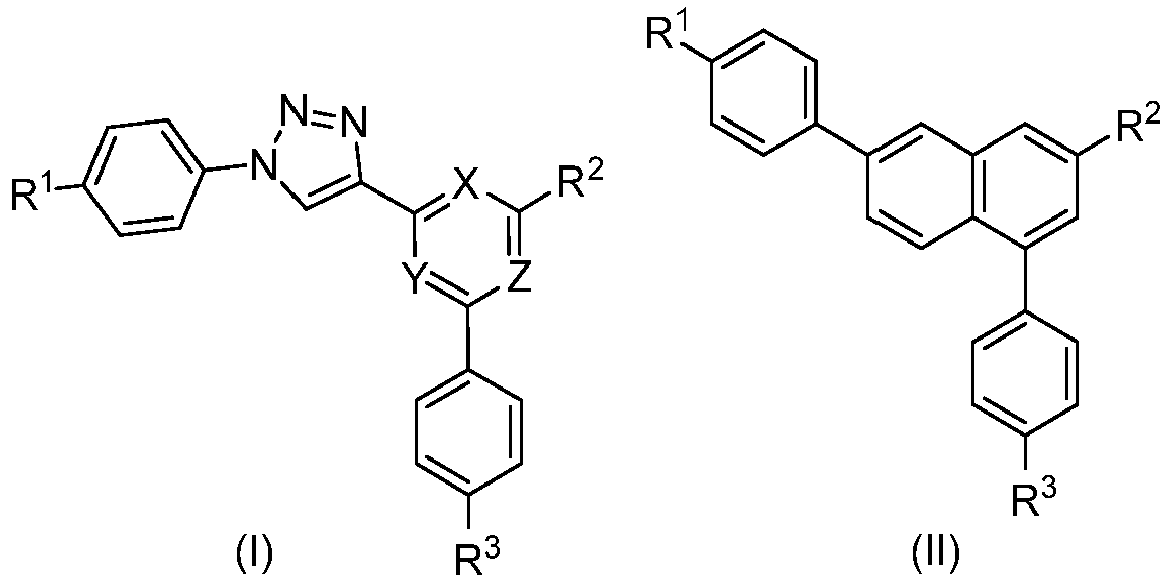
- The invention provides a compound of formula (I) or formula (II):

- wherein X, Y, and Z are, independently, CH or N,
- R1 is halo or CF3,
- R2 is selected from the group consisting of COOH, COOR12, CONHOH, CH2CON(R11)2, CHR7OCOR8, (CH2)oNR9, tetrazolyl, CH2OPO(OH)2 and
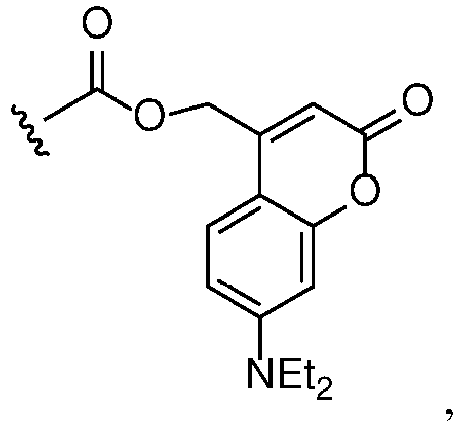





- R4 is H or COR6 wherein R6 is C1-C6 alkyl, C6-C10 aryl, or

- R5 is C1-C6 alkyl, C3-C8 cycloalkyl, or benzyl,
- R6 is NH2, or CONH2,
- R7-R9 are independently hydrogen or C1-C6 alkyl,
- R10 is H, C1-C10 alkylcarbonyl, or C1-C10 alkyloxycarbonyl,
- R11 is hydrogen or C1-C6 alkyl,
- R12 is C1-C6 alkyl, C3-C8 cycloalkyl, or benzyl, and
- m, o, and q are independently integers of 1 to about 10, and
- n is zero or an integer of 1 to about 10,
- The present invention further provides a compound of formula (III)

- The present invention further provides a compound of formula (IV) or (V):





- The invention also provides a method of antagonizing a P2Y14R receptor in a mammal in need thereof, comprising administering to the mammal an effective amount of a compound of the invention or a pharmaceutically acceptable salt thereof.
- The invention further provides a method of treating or preventing an inflammatory condition in a mammal in need thereof, comprising administering to the mammal an effective amount of a compound of the invention or a pharmaceutically acceptable salt thereof.
- The invention additionally provides a method of treating pain in a mammal in need thereof, comprising administering to the mammal an effective amount of a compound of the invention or a pharmaceutically acceptable salt thereof.
-
-
FIG. 1A-B show the inhibition of binding offluorescent antagonists FIG. 1A ) and at mP2Y14R (FIG. 2B) exhibited by four P2Y14R antagonist analogues in accordance with an aspect of the invention (mean ± SD, n=3-4 independent determinations, performed in triplicate). -
FIG. 2 shows reversal of CCI-induced mechano-allodynia in the mouse induced by compound 32 (10 µmol/kg, i.p.). Mean±SD is shown, n=3, ANOVA, *P<0.05 vs.Day 0 and † P<0.05 vs.day 7 post-injury. 32 was dissolved in 5% DMSO in water as vehicle, and a volume of 0.2 mL was injected. -
FIG. 3 shows the effects of P2Y14R antagonists and their prodrugs, namely 32, 37b, 3a, 37a, 1b, and 37c, compared toreference antagonist 1a, during allergen challenge reduces eosinophilic airway inflammation in a protease model of asthma. Effect on BALF leukocytes of i.p. injection of the P2Y14R antagonists 2 d post-challenge of ASP/OVA-sensitized mice. * P <0.05, ** P <0.01, *** P <0.001, **** P <0.0001 vs. vehicle by one-way ANOVA followed by Dunnett's test. -
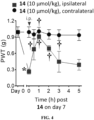
FIG. 4 shows the reversal of established mechano-allodynia in the CCI mouse model by compound 14 (10 µmol/kg, i.p.) at the time of peak pain, i.e. seven days post-injury. Mean±SD is shown, n=3, ANOVA, *P<0.05 vs.Day 0 and † P<0.05. The vehicle consisted of 5% aqueous DMSO (0.2 mL injected). -
FIG. 5 shows the structures ofreference compound 1a,compound 1b,compound 5, andfluorescent inhibitor 2. -
FIG. 6 shows that compound 114 (10 µmol/kg, i.p.) reversed the established mechano-allodynia in the CCI mouse model at the time of peak pain, i.e., seven days post-injury. Mean ± SD is shown, n=3, ANOVA, *P<0.05 vs.Day 0 and † P<0.05. The vehicle consisted of 5% aqueous DMSO (0.2 mL injected). -
FIG. 7A-E depict the activities ofP2Y14R antagonists 114 and its ester prodrug 141,carbamate prodrug 142, anddouble prodrug 143 in a mouse model of asthma (dose: 20 µmol/kg (9.8-12.2 mg/kg); concentration: 2 µmol/mL (2 mM) in 10% DMSO, 30% PEG-400, 60% H2O; administration: 10 µL/g of body weight). 7-Day sensitization with ovalbumin/aspergillus was followed by a single challenge (ovalbumin, aerosol) at day 14. Antagonists were given 30 min prior to challenge. Harvesting of cells and cell counting were on day 16. - In an aspect, the invention provides a compound of formula (I) or formula (II):

- wherein X, Y, Z are CH or N,
- R1 is halo or CF3,
- R2 is selected from the group consisting of COOH, COOR12, CONHOH, CH2CON(R11)2, CHR7OCOR8, (CH2)oNR9, tetrazolyl, CH2OPO(OH)2, and

- R3 is selected from the group consisting of NHR4, COOR5, (C≡C)n(CH2)mR6, CONH(CH2)qNH2, COCF3,


- R4 is H or COR6 wherein R6 is C1-C6 alkyl, C6-C10 aryl, or

- R5 is C1-C6 alkyl, C3-C8 cycloalkyl, or benzyl,
- R6 is NH2, or CONH2,
- R7-R9 are independently hydrogen or C1-C6 alkyl,
- R10 is H, C1-C10 alkylcarbonyl, or C1-C10 alkyloxycarbonyl,
- R11 is hydrogen or C1-C6 alkyl,
- R12 is C1-C6 alkyl, C3-C8 cycloalkyl, or benzyl, and
- m, o, and q are independently integers of 1 to about 10, and
- n is zero or an integer of 1 to about 10,
- In certain aspects, R1 is CF3.
- In certain aspects, the compound is of formula (I).
- In certain aspects of the compound of formula (I), R3 is selected from NH2, NHCOCH3, NHCOC6H5, NHCOC(CH3)3,

- In certain aspects, R3 is COOR5.
- In certain aspects, R3 is (CµC)n(CH2)mR6 or CONH(CH2)qNH2.
- In certain of these aspects, R3 is selected from CONH(CH2)3NH2, CH2CONH2, (CH2)3NH2, and C≡CCH2NH2.
- In certain aspects, R3 is selected from Br, (CH2)2-CN, ,



- In certain aspects, the compound is of formula (II).
- In certain aspects of formula (II), R3 is selected from Br, (CH2)2-CN,


- In certain particular aspects, R3 is

- In certain aspects, R2 is H.
- In certain aspects, R2 is COOR12, CH2CON(Rn)2, CHR7OCOR8, (CH2)oNR9, tetrazolyl, CH2OPO(OH)2, or

- In a particular aspect, the compound is:

- In certain aspects, R3 is selected from





- In certain particular aspects, R3 is

- In certain aspects, R3 is selected from


- In certain aspects, R2 is H.
- In certain aspects, R2 is COOR12, CH2CON(Rn)2, CHR7OCOR8, (CH2)oNR9, tetrazolyl, CH2OPO(OH)2, or

- In a particular aspect, the compound is:

- The present invention further provides a compound of formula (III)




- The present invention further provides a compound of formula (IV) or (V):

R is sugar-triazolylalkyl moiety wherein the sugar moiety can a six membered sugar moiety, particularly an aldohexose, including allose, altrose, glucose, mannose, gulose, idose, galactose, or talose, including derivatives thereof, particularly acetyloxy derivatives thereof; for example,



- Referring now to terminology used generically herein, the term "alkyl" means a straight-chain or branched alkyl substituent containing from, for example, 1 to about 6 carbon atoms, preferably from 1 to about 4 carbon atoms, more preferably from 1 to 2 carbon atoms. Examples of such substituents include methyl, ethyl, propyl, isopropyl, n-butyl, sec-butyl, isobutyl, tert-butyl, pentyl, isoamyl, hexyl, and the like.
- The term "cycloalkyl," as used herein, means a cyclic alkyl substituent containing from, for example, about 3 to about 8 carbon atoms, preferably from about 4 to about 7 carbon atoms, and more preferably from about 4 to about 6 carbon atoms. Examples of such substituents include cyclopropyl, cyclobutyl, cyclopentyl, cyclohexyl, cycloheptyl, cyclooctyl, and the like. The cyclic alkyl groups may be unsubstituted or further substituted with alkyl groups such as methyl groups, ethyl groups, and the like.
- The term "alkylcarbonyl," as used herein, refers to an alkyl group linked to a carbonyl group and further linked to a molecule via the carbonyl group, e.g., alkyl-C(=O)-. The term "alkoxycarbonyl," as used herein, refers to an alkoxy group linked to a carbonyl group and further linked to a molecule via the carbonyl group, e.g., alkyl-O-C(=O)-.
- The term "halo" or "halogen," as used herein, means a substituent selected from Group VIIA, such as, for example, fluorine, bromine, chlorine, and iodine.
- The term "tetrazolyl", as used herein, refers to a group of the formula:

- Whenever a range of the number of atoms in a structure is indicated (e.g., a C1-C12, C1-C8, C1-C6, C1-C4, or C2-C12, C2-C8, C2-C6, C2-C4 alkyl, alkenyl, alkynyl, etc.), it is specifically contemplated that any sub-range or individual number of carbon atoms falling within the indicated range also can be used. Thus, for instance, the recitation of a range of 1-8 carbon atoms (e.g., C1-C8), 1-6 carbon atoms (e.g., C1-C6), 1-4 carbon atoms (e.g., C1-C4), 1-3 carbon atoms (e.g., C1-C3), or 2-8 carbon atoms (e.g., C2-C8) as used with respect to any chemical group (e.g., alkyl, alkylamino, etc.) referenced herein encompasses and specifically describes 1, 2, 3, 4, 5, 6, 7, 8, 9, 10, 11, and/or 12 carbon atoms, as appropriate, as well as any sub-range thereof (e.g., 1-2 carbon atoms, 1-3 carbon atoms, 1-4 carbon atoms, 1-5 carbon atoms, 1-6 carbon atoms, 1-7 carbon atoms, 1-8 carbon atoms, 1-9 carbon atoms, 1-10 carbon atoms, 1-11 carbon atoms, 1-12 carbon atoms, 2-3 carbon atoms, 2-4 carbon atoms, 2-5 carbon atoms, 2-6 carbon atoms, 2-7 carbon atoms, 2-8 carbon atoms, 2-9 carbon atoms, 2-10 carbon atoms, 2-11 carbon atoms, 2-12 carbon atoms, 3-4 carbon atoms, 3-5 carbon atoms, 3-6 carbon atoms, 3-7 carbon atoms, 3-8 carbon atoms, 3-9 carbon atoms, 3-10 carbon atoms, 3-11 carbon atoms, 3-12 carbon atoms, 4-5 carbon atoms, 4-6 carbon atoms, 4-7 carbon atoms, 4-8 carbon atoms, 4-9 carbon atoms, 4-10 carbon atoms, 4-11 carbon atoms, and/or 4-12 carbon atoms, etc., as appropriate). Similarly, the recitation of a range of 6-10 carbon atoms (e.g., C6-C10) as used with respect to any chemical group (e.g., aryl) referenced herein encompasses and specifically describes 6, 7, 8, 9, and/or 10 carbon atoms, as appropriate, as well as any sub-range thereof (e.g., 6-10 carbon atoms, 6-9 carbon atoms, 6-8 carbon atoms, 6-7 carbon atoms, 7-10 carbon atoms, 7-9 carbon atoms, 7-8 carbon atoms, 8-10 carbon atoms, and/or 8-9 carbon atoms, etc., as appropriate).
- In any of the above aspects, the compound or salt of formula (I) or formula (II) can have at least one asymmetric carbon atom. When the compound or salt has at least one asymmetric carbon atom, the compound or salt can exist in the racemic form, in the form of its pure optical isomers, or in the form of a mixture wherein one isomer is enriched relative to the other. In particular, in accordance with the present invention, when the inventive compounds have a single asymmetric carbon atom, the inventive compounds may exist as racemates, i.e., as mixtures of equal amounts of optical isomers, i.e., equal amounts of two enantiomers, or in the form of a single enantiomer. As used herein, "single enantiomer" is intended to include a compound that comprises more than 50% of a single enantiomer (i.e., enantiomeric excess more than 60%, more than 70%, more than 80%, more than 90%, or up to 100% pure enantiomer).
- When the compound or salt has more than one chiral center, the compound or salt can therefore exist as a mixture of diastereomers or in the form of a single diastereomer. As used herein, "single diastereomer" is intended to mean a compound that comprises more than 50% of a single diastereomer (i.e., diastereomeric excess more than 60%, more than 70%, more than 80%, more than 90%, or up to 100% pure diastereomer).
- The phrase "pharmaceutically acceptable salt" is intended to include nontoxic salts synthesized from the parent compound which contains a basic or acidic moiety by conventional chemical methods. Generally, such salts can be prepared by reacting the free acid or base forms of these compounds with a stoichiometric amount of the appropriate base or acid in water or in an organic solvent, or in a mixture of the two. Generally, nonaqueous media such as ether, ethyl acetate, ethanol, isopropanol, or acetonitrile are preferred. Lists of suitable salts are found in Remington's Pharmaceutical Sciences, 18th ed., Mack Publishing Company, Easton, PA, 1990, p. 1445, and Berge, S. M., at al., Journal of Pharmaceutical Science, 66, 1-19 (1977).
- Suitable bases include inorganic bases such as alkali and alkaline earth metal bases, e.g., those containing metallic cations such as sodium, potassium, magnesium, calcium and the like. Non-limiting examples of suitable bases include sodium hydroxide, potassium hydroxide, sodium carbonate, and potassium carbonate. Suitable acids include inorganic acids such as hydrochloric acid, hydrobromic acid, hydroiodic acid, sulfuric acid, phosphoric acid, and the like, and organic acids such as p-toluenesulfonic, methanesulfonic acid, benzenesulfonic acid, oxalic acid, p-bromophenylsulfonic acid, carbonic acid, succinic acid, citric acid, benzoic acid, acetic acid, maleic acid, tartaric acid, fatty acids, long chain fatty acids, and the like. Preferred pharmaceutically acceptable salts of inventive compounds having an acidic moiety include sodium and potassium salts. Preferred pharmaceutically acceptable salts of inventive compounds having a basic moiety (e.g., a dimethylaminoalkyl group) include hydrochloride and hydrobromide salts. The compounds of the present invention containing an acidic or basic moiety are useful in the form of the free base or acid or in the form of a pharmaceutically acceptable salt thereof.
- It should be recognized that the particular counterion forming a part of any salt of this invention is usually not of a critical nature, so long as the salt as a whole is pharmacologically acceptable and as long as the counterion does not contribute undesired qualities to the salt as a whole.
- It is further understood that the above compounds and salts may form solvates, or exist in a substantially uncomplexed form, such as the anhydrous form. As used herein, the term "solvate" refers to a molecular complex wherein the solvent molecule, such as the crystallizing solvent, is incorporated into the crystal lattice. When the solvent incorporated in the solvate is water, the molecular complex is called a hydrate. Pharmaceutically acceptable solvates include hydrates, alcoholates such as methanolates and ethanolates, acetonitrilates and the like. These compounds can also exist in polymorphic forms.
- The present invention further provides a pharmaceutical composition comprising a compound as described above and a pharmaceutically acceptable carrier. The present invention provides a pharmaceutical composition comprising a pharmaceutically acceptable carrier and an effective amount, e.g., a therapeutically effective amount, including a prophylactically effective amount, of one or more of the aforesaid compounds, or salts thereof, of the present invention.
- The pharmaceutically acceptable carrier can be any of those conventionally used and is limited only by chemico-physical considerations, such as solubility and lack of reactivity with the compound, and by the route of administration. It will be appreciated by one of skill in the art that, in addition to the following described pharmaceutical compositions; the compounds of the present invention can be formulated as inclusion complexes, such as cyclodextrin inclusion complexes, or liposomes.
- The pharmaceutically acceptable carriers described herein, for example, vehicles, adjuvants, excipients, or diluents, are well known to those who are skilled in the art and are readily available to the public. It is preferred that the pharmaceutically acceptable carrier be one which is chemically inert to the active compounds and one which has no detrimental side effects or toxicity under the conditions of use.
- The choice of carrier will be determined in part by the particular active agent, as well as by the particular method used to administer the composition. Accordingly, there is a wide variety of suitable formulations of the pharmaceutical composition of the present invention. The following formulations for oral, aerosol, parenteral, subcutaneous, intravenous, intraarterial, intramuscular, interperitoneal, intrathecal, rectal, and vaginal administration are merely exemplary and are in no way limiting.
- Formulations suitable for oral administration can consist of (a) liquid solutions, such as an effective amount of the compound dissolved in diluents, such as water, saline, or orange juice; (b) capsules, sachets, tablets, lozenges, and troches, each containing a predetermined amount of the active ingredient, as solids or granules; (c) powders; (d) suspensions in an appropriate liquid; and (e) suitable emulsions. Liquid formulations may include diluents, such as water and alcohols, for example, ethanol, benzyl alcohol, and the polyethylene alcohols, either with or without the addition of a pharmaceutically acceptable surfactant, suspending agent, or emulsifying agent. Capsule forms can be of the ordinary hard- or soft-shelled gelatin type containing, for example, surfactants, lubricants, and inert fillers, such as lactose, sucrose, calcium phosphate, and cornstarch. Tablet forms can include one or more of lactose, sucrose, mannitol, corn starch, potato starch, alginic acid, microcrystalline cellulose, acacia, gelatin, guar gum, colloidal silicon dioxide, croscarmellose sodium, talc, magnesium stearate, calcium stearate, zinc stearate, stearic acid, and other excipients, colorants, diluents, buffering agents, disintegrating agents, moistening agents, preservatives, flavoring agents, and pharmacologically compatible carriers. Lozenge forms can comprise the active ingredient in a flavor, usually sucrose and acacia or tragacanth, as well as pastilles comprising the active ingredient in an inert base, such as gelatin and glycerin, or sucrose and acacia, emulsions, gels, and the like containing, in addition to the active ingredient, such carriers as are known in the art.
- The compounds of the present invention, alone or in combination with other suitable components, can be made into aerosol formulations to be administered via inhalation. These aerosol formulations can be placed into pressurized acceptable propellants, such as dichlorodifluoromethane, propane, nitrogen, and the like. They also may be formulated as pharmaceuticals for non-pressured preparations, such as in a nebulizer or an atomizer.
- Formulations suitable for parenteral administration include aqueous and non-aqueous, isotonic sterile injection solutions, which can contain anti-oxidants, buffers, bacteriostats, and solutes that render the formulation isotonic with the blood of the intended recipient, and aqueous and non-aqueous sterile suspensions that can include suspending agents, solubilizers, thickening agents, stabilizers, and preservatives. The compound can be administered in a physiologically acceptable diluent in a pharmaceutical carrier, such as a sterile liquid or mixture of liquids, including water, saline, aqueous dextrose and related sugar solutions, an alcohol, such as ethanol, isopropanol, or hexadecyl alcohol, glycols, such as propylene glycol or polyethylene glycol, glycerol ketals, such as 2,2-dimethyl-1,3-dioxolane-4-methanol, ethers, such as poly(ethyleneglycol) 400, an oil, a fatty acid, a fatty acid ester or glyceride, or an acetylated fatty acid glyceride with or without the addition of a pharmaceutically acceptable surfactant, such as a soap or a detergent, suspending agent, such as pectin, carbomers, methylcellulose, hydroxypropylmethylcellulose, or carboxymethylcellulose, or emulsifying agents and other pharmaceutical adjuvants.
- Oils, which can be used in parenteral formulations include petroleum, animal, vegetable, or synthetic oils. Specific examples of oils include peanut, soybean, sesame, cottonseed, corn, olive, petrolatum, and mineral. Suitable fatty acids for use in parenteral formulations include oleic acid, stearic acid, and isostearic acid. Ethyl oleate and isopropyl myristate are examples of suitable fatty acid esters. Suitable soaps for use in parenteral formulations include fatty alkali metal, ammonium, and triethanolamine salts, and suitable detergents include (a) cationic detergents such as, for example, dimethyl dialkyl ammonium halides, and alkyl pyridinium halides, (b) anionic detergents such as, for example, alkyl, aryl, and olefin sulfonates, alkyl, olefin, ether, and monoglyceride sulfates, and sulfosuccinates, (c) nonionic detergents such as, for example, fatty amine oxides, fatty acid alkanolamides, and polyoxyethylene-polypropylene copolymers, (d) amphoteric detergents such as, for example, alkyl-beta-aminopropionates, and 2-alkyl-imidazoline quaternary ammonium salts, and (3) mixtures thereof.
- The parenteral formulations will typically contain from about 0.5 to about 25% by weight of the active ingredient in solution. Suitable preservatives and buffers can be used in such formulations. In order to minimize or eliminate irritation at the site of injection, such compositions may contain one or more nonionic surfactants having a hydrophile-lipophile balance (HLB) of from about 12 to about 17. The quantity of surfactant in such formulations ranges from about 5 to about 15% by weight. Suitable surfactants include polyethylene sorbitan fatty acid esters, such as sorbitan monooleate and the high molecular weight adducts of ethylene oxide with a hydrophobic base, formed by the condensation of propylene oxide with propylene glycol. The parenteral formulations can be presented in unit-dose or multi-dose sealed containers, such as ampoules and vials, and can be stored in a freeze-dried (lyophilized) condition requiring only the addition of the sterile liquid carrier, for example, water, for injections, immediately prior to use. Extemporaneous injection solutions and suspensions can be prepared from sterile powders, granules, and tablets of the kind previously described.
- The compounds of the present invention may be made into injectable formulations. The requirements for effective pharmaceutical carriers for injectable compositions are well known to those of ordinary skill in the art. See Pharmaceutics and Pharmacy Practice, J. B. Lippincott Co., Philadelphia, Pa., Banker and Chalmers, eds., pages 238-250 (1982), andASHP Handbook on Injectable Drugs, Toissel, 4th ed., pages 622-630 (1986).
- Topical formulations, including those that are useful for transdermal drug release, are well-known to those of skill in the art and are suitable in the context of the invention for application to skin. Topically applied compositions are generally in the form of liquids, creams, pastes, lotions and gels. Topical administration includes application to the oral mucosa, which includes the oral cavity, oral epithelium, palate, gingival, and the nasal mucosa. In some aspects, the composition contains at least one active component and a suitable vehicle or carrier. It may also contain other components, such as an anti-irritant. The carrier can be a liquid, solid or semisolid. In aspects, the composition is an aqueous solution. Alternatively, the composition can be a dispersion, emulsion, gel, lotion or cream vehicle for the various components. In one aspect, the primary vehicle is water or a biocompatible solvent that is substantially neutral or that has been rendered substantially neutral. The liquid vehicle can include other materials, such as buffers, alcohols, glycerin, and mineral oils with various emulsifiers or dispersing agents as known in the art to obtain the desired pH, consistency and viscosity. It is possible that the compositions can be produced as solids, such as powders or granules. The solids can be applied directly or dissolved in water or a biocompatible solvent prior to use to form a solution that is substantially neutral or that has been rendered substantially neutral and that can then be applied to the target site. In aspects of the invention, the vehicle for topical application to the skin can include water, buffered solutions, various alcohols, glycols such as glycerin, lipid materials such as fatty acids, mineral oils, phosphoglycerides, collagen, gelatin and silicone based materials.
- Additionally, the compounds of the present invention may be made into suppositories by mixing with a variety of bases, such as emulsifying bases or water-soluble bases. Formulations suitable for vaginal administration may be presented as pessaries, tampons, creams, gels, pastes, foams, or spray formulas containing, in addition to the active ingredient, such carriers as are known in the art to be appropriate.
- The dose administered to a mammal, particularly, a human, in accordance with the present invention should be sufficient to effect the desired response. Such responses include reversal or prevention of the adverse effects of the disease for which treatment is desired or to elicit the desired benefit. One skilled in the art will recognize that dosage will depend upon a variety of factors, including the age, condition, and body weight of the human, as well as the source, particular type of the disease, and extent of the disease in the human. The size of the dose will also be determined by the route, timing and frequency of administration as well as the existence, nature, and extent of any adverse side-effects that might accompany the administration of a particular compound and the desired physiological effect. It will be appreciated by one of skill in the art that various conditions or disease states may require prolonged treatment involving multiple administrations.
- Suitable doses and dosage regimens can be determined by conventional range-finding techniques known to those of ordinary skill in the art. Generally, treatment is initiated with smaller dosages that are less than the optimum dose of the compound. Thereafter, the dosage is increased by small increments until the optimum effect under the circumstances is reached. The present inventive method typically will involve the administration of about 0.1 to about 300 mg of one or more of the compounds described above per kg body weight of the animal or mammal.
- The therapeutically effective amount of the compound or compounds administered can vary depending upon the desired effects and the factors noted above. Typically, dosages will be between 0.01 mg/kg and 250 mg/kg of the subject's body weight, and more typically between about 0.05 mg/kg and 100 mg/kg, such as from about 0.2 to about 80 mg/kg, from about 5 to about 40 mg/kg or from about 10 to about 30 mg/kg of the subject's body weight. Thus, unit dosage forms can be formulated based upon the suitable ranges recited above and the subject's body weight. The term "unit dosage form" as used herein refers to a physically discrete unit of therapeutic agent appropriate for the subject to be treated.
- Alternatively, dosages are calculated based on body surface area and from about 1 mg/m2 to about 200 mg/m2, such as from about 5 mg/m2 to about 100 mg/m2 will be administered to the subject per day. In particular aspects, administration of the therapeutically effective amount of the compound or compounds involves administering to the subject from about 5 mg/m2 to about 50 mg/m2, such as from about 10 mg/m2 to about 40 mg/m2 per day. It is currently believed that a single dosage of the compound or compounds is suitable, however a therapeutically effective dosage can be supplied over an extended period of time or in multiple doses per day. Thus, unit dosage forms also can be calculated using a subject's body surface area based on the suitable ranges recited above and the desired dosing schedule.
- In certain aspects, the invention provides a method of antagonizing a P2Y14R receptor in a mammal in need thereof, comprising administering to the mammal an effective amount of a compound of the invention or a pharmaceutically acceptable salt thereof.
- In certain aspects, the invention provides a method of treating or preventing an inflammatory condition in a mammal in need thereof, comprising administering to the mammal an effective amount of a compound of the invention or a pharmaceutically acceptable salt thereof.
- In these aspects, the inflammatory condition is selected from the group consisting of asthma, cystic fibrosis, and sterile inflammation of the kidney.
- In certain aspects, the invention provides a method of treating pain in a mammal in need thereof, comprising administering to the mammal an effective amount a compound of the invention or a pharmaceutically acceptable salt thereof.
- In certain aspects, the invention provides a compound of the invention or a pharmaceutically acceptable salt thereof, for use in antagonizing a P2Y14R receptor in a mammal in need thereof.
- In certain aspects, the invention provides a compound of the invention or a pharmaceutically acceptable salt thereof, for use in treating or preventing an inflammatory condition in a mammal in need thereof.
- In these aspects, the inflammatory condition is selected from the group consisting of asthma, cystic fibrosis, and sterile inflammation of the kidney.
- In certain aspects, the invention provides a compound of the invention or a pharmaceutically acceptable salt thereof, for use in treating pain in a mammal in need thereof.
- Schemes 1-14 depict exemplary syntheses of compounds of the invention.
- Schemes 1A and 1B show synthesis of triazole-containing derivatives of the compound of formula (I) with acyl or acylamino substituents for R3.


-
Scheme 2 shows synthesis of triazole-containing derivatives of the compound of formula (I) with acyl or acylamino substituents for R3.
- Reagents and conditions: (a) Pd(PPh3)4, K2CO3, DMF, 85 °C, 5 h, 27-55%; (b) PdCl2(dppf), dimethoxyethane: Na2CO3 (aq, 2M) = 10:1, 60 °C, 4 h, 73%; (c) Pd(PPh3)4, K2CO3, DMF:Water = 1:1, 90 °C, 12 h, 64%; (d) KOH, MeOH:H2O = 2:1, 50 °C, 39-88%; (e) TFA:THF = 2:1, rt, 0.5 h, 62-98%.
-
Scheme 3 shows synthesis of triazole-containing derivatives of the compound of formula (I) with cyclic groups for R3.
- Reagents and conditions: (a) Pd(PPh3)4, K2CO3, DMF, 85 °C, 5 h, 46-91%; (b) Pd(PPh3)4, K2CO3, DMF, µW, 100 °C, 0.5 h, 80-91%; (c) Pd(PPh3)4, K2CO3, DMF:water = 1:1, 90 °C, 12 h, 30-70%; (d) KOH, MeOH:H2O = 2:1, 50 °C, 43-74%; (e) TFA:THF = 2:1, rt, 0.5 h, 52-90%.
-
Scheme 4 shows a synthesis of naphthalene-containingisoxazole derivative 32.
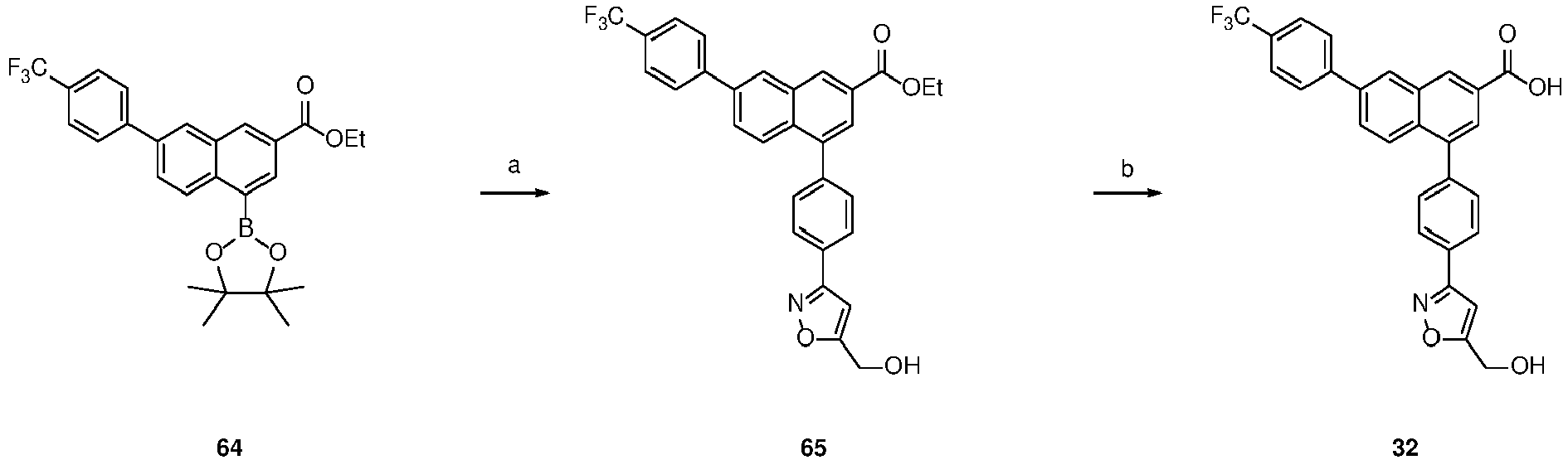
- Reagents and conditions: (a) Pd(PPh3)4, K2CO3, DMF, µW, 100 °C, 1.5 h, 50%; (b) KOH, MeOH:H2O = 2:1, 50 °C, 98%.
-
Scheme 5 shows a synthesis of amide-containing isoxazole derivative 33.
- Reagents and Conditions: (a) SOCl2, MeOH, rt, 15 h, 98%; (b) 4-(trifluoromethyl)benzoic acid, HATU, DIPEA, DMF, rt, 5 h, 70%; (c) B2pin2, PdCl2(dppf), KOAc, dioxane, 70 °C, 6 h, 65%; (d) Pd(PPh3)4, K2CO3, DMF, 85 °C, 5 h, 45%; (e) KOH, MeOH, H2O, 50 °C, 3 h, 62%.
-
Scheme 6 shows a synthesis of triazole-containing derivatives 34 - 36.

- Reagents and conditions: (a) SOCl2, MeOH, rt, 15 h, 40%; (b) tert-butyl nitrite, azidotrimethylsilane, acetonitrile, rt, 1 h, 37-65%; (c) 4-ethynyl-α,α,α-trifluorotoluene, CuSO4·5H2O, Na ascorbate, TBTA, tert-BuOH:H2O=1:1, rt, 45 min, 36-69%; (d) tert-butyl 4-(4-(4,4,5,5-tetramethyl-1,3,2-dioxaborolan-2-yl)phenyl)piperidine-1-carboxylate, Pd(PPh3)4, K2CO3, DMF, 85 °C, 4 h, 35-91%; (e) KOH, MeOH:H2O = 2:1, 50 °C, 5 h, 68-91%; (f) TFA:THF = 2:1, rt, 0.5 h, 60-65%.
-
Scheme 7 shows a synthesis ofcompounds 37a - 37c.

- Reagents and conditions: (a) 2-chloro-N,N-dimethylacetamide, K2CO3, DMF, 45 °C, 1 h, 70-72%; (b) TFA:THF = 2:1, rt, 0.5 h, 78%; (c) 2-chloro-N,N-dimethylacetamide, Cs2CO3, DMF, 45 °C, 1 h, 68%.
-
Scheme 8 shows the preparation of 4-bromophenyl intermediates containing modified piperidine rings for Suzuki coupling.

- Reagents and conditions: (a) Br2, AcOH, rt, 10 min, 30-62%; (b) Et2Zn, CH2I2, DCM, Ar, rt, overnight, 60-62%; (c) TMSCF3, NaI, THF, 65°C, overnight, 26%; (d) TFA, DCM, rt, 1 h, 75%; (e) (+) C-C (-) (4.5 V, 2 F/mol), MeOH, Et4NOTs, 95%; (f) NH4Cl, 100 °C, 73%; (g) i, dibromobenzene, magnesium, THF, sonication; ii, ketone, THF, 0 °C, 2 h; 42-86%; (h) H2SO4, 80 °C, 30 min, 15%. (i) K2CO3, PhCH2Br, DMF, 70 °C.
-
Scheme 9 shows a general scheme for preparation of derivatives of the lead P2Y14R antagonist,piperidine 1, via Suzuki coupling followed by ester hydrolysis. Compound 63 is 3-(4-bromophenyl)pyrrolidine hydrochloride, starting material for 75.

- Reagents and conditions: (a) Pd(PPh3)4, K2CO3, DMF, MW, 150 °C, 30 min, 37-76%; (b) for substrate 56 and 57: Pd(PPh3)4, aq. Na2CO3, DME-EtOH, 80 °C, 30 min, 25-40%; (c) MeOH, aq KOH, overnight, 42-76%.
-
Scheme 10 shows a preparation of bridgedpiperidine analogues 114 and 116 containing a 2-azanorbornane moiety, 119 and 121 containing a lactam; and ring-opened 134 and 136 containing 1-amino-3-hydroxymethylcyclopentane, and 138 and 140 containing 1-amino-3-carboxylcyclopentane. The synthesis maintained absolute stereochemistry originating from chiral bicyclic precursor 176.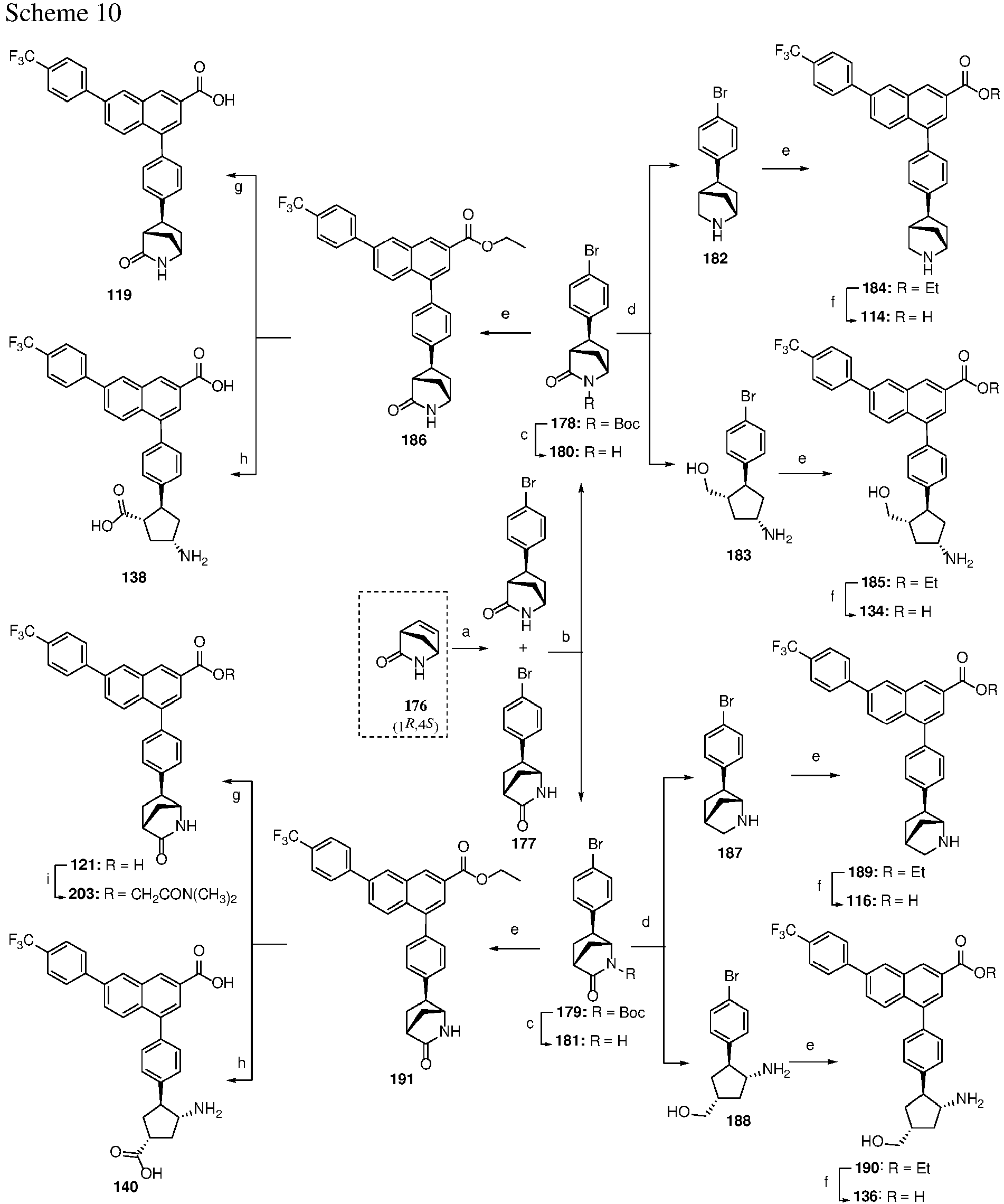
-
Scheme 11 shows a preparation of analogues 115 and 117 with 2-azanorbornane, 120 and 122 with lactam, 135 and 137 with 1-amino-3-hydroxymethylcyclopentane, and 139 and 141 with 1-amino-3-carboxylcyclopentane with absolute stereochemistry from 192. a
- a Reagents and conditions: (a) 1-Bromo-4-iodobenzene, (PPh3)2PdCl2, formic acid, TEA, THF, 65 °C overnight, quantitative; (b) TEA, DMAP, (Boc)2O, DCM, rt, overnight. 55% 194 and 41% 195; (c) TFA, DCM, rt, 1 h, 78-79%; (d) H3N-BH3, B(C6F5)3, BF3Et2O, DCE, 75 °C, 24 h, 51% 198 and 44% 199; (e) 164, Na2CO3, Pd(PPh3)4, DME-H2O (4:1), 85 °C, overnight, 68-93%; (f) LiOH, THF-MeOH-H2O (3:1:1), rt, 3 h, 44-66%; (g) LiOH, THF-MeOH-H2O (3:1:1), rt, 1.5 h, 40-62%; (h) LiOH, THF-MeOH-H2O (3:1:1), rt, overnight, 73-77%. (i) 2-chloro-N,N-dimethylacetamide, Cs2CO3, DMF, 45 °C, 2 h, 80%.
- Scheme 12 shows a preparation of N-acetyl 2-azanorbornane derivatives.

- Reagents and Conditions: (a) Acetic anhydride, TEA, DMF, rt. 30 min, 53%.
- Scheme 13 shows a preparation of nortropane derivatives from hydroxylated intermediate 127s.

- Reagents and conditions: (a) H2, Pd/C, 150 psi, 7 h, 58%; (b) TFA, 90 °C, 2 h, 27%; (c) H2, Pd/C, 100 psi, 3 h,
overall yield 19% from 127s. - Scheme 14 shows a preparation of isonortropane derivatives, including both hydroxylated 131, 132 and nonhydroxylated 133 and 133s analogues.

- Reagents and conditions: (a) DMF, Pd/C, H2 (70 psi), overnight, 61%; (b) MeOH, Pd/C, H2 (125 psi), overnight, 20%.
-
Scheme 15 shows the preparation of isoquinuclidine derivatives from hydroxylated intermediate 206.
- Reagents and conditions: (a) H2, Pd/C, 150 psi, 7 h,; (b) TFA, 90 °C, 2 h,; (c) H2, Pd/C, 100 psi, 3 h.
- Scheme 16 shows a preparation of compounds 1c and 1d.
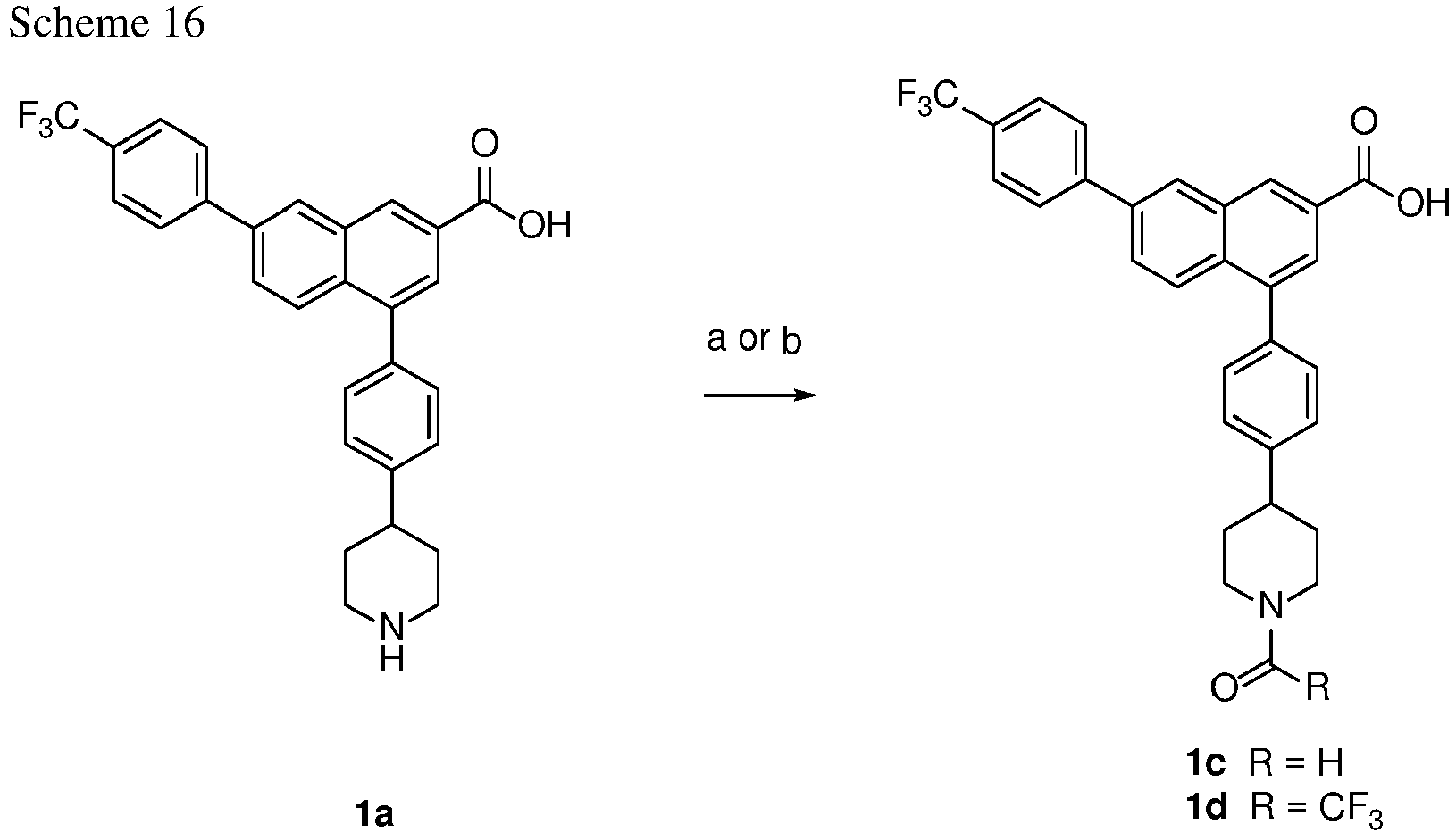
- Reagents and conditions: 1c: (a) acetic formic anhydride (from Ac2O:formic acid = 2:1, v/v), 0 °C for 3 h → room temperature for 12 h, 71%. 1d: (b) Trifluoroacetic anhydride, 0 °C for 1hr to rt for 2 hr.
- Scheme 17 shows a preparation of phosphate 3b.

- Reagents and Conditions: (a) LAH, THF, 0 °C, 1 h, 45%; (b) Di-tert-butyl N,N-diethylphosphoramidite, tetrazole, THF, rt, 1 h, then MCPBA, -78 °C, 84%; (c) TFA:THF = 2:1, rt, 2 h, 69%.
- PPTN analogues with β-D-glucose bridged with triazole were prepared via click reaction (Scheme 18). The azide 523 was obtained from substitution of bromo starting material 522 with sodium azide. PPTN analogues 525-527 modified with alkynes tethered at the N of piperidine were prepared by reacting PPTN with iodo-substituted alkynes. The click reaction between alkynes 525-527 and azide 523 was catalyzed by CuSO4/sodium ascorbate at 90 °C overnight and provided acetyl protected ligands 504, 506, and 507, which were further hydrolyzed to yield PPTN analogues 508, 510, and 511 with β-D-glucose bridged by various-length alkyltriazolyl linker, respectively.

- a Reagents and conditions: (a) NaN3, DMF, rt, 2 h, 99%; (b) alkynyl iodide, K2CO3, DMF, rt, overnight, 43%; (c) 523, CuSO4.5H2O, sodium ascorbate, DMF/H2O (9:1), 90 °C, overnight, quantitative; (d) NaOH (3 M), MeOH, rt, overnight, 79%.
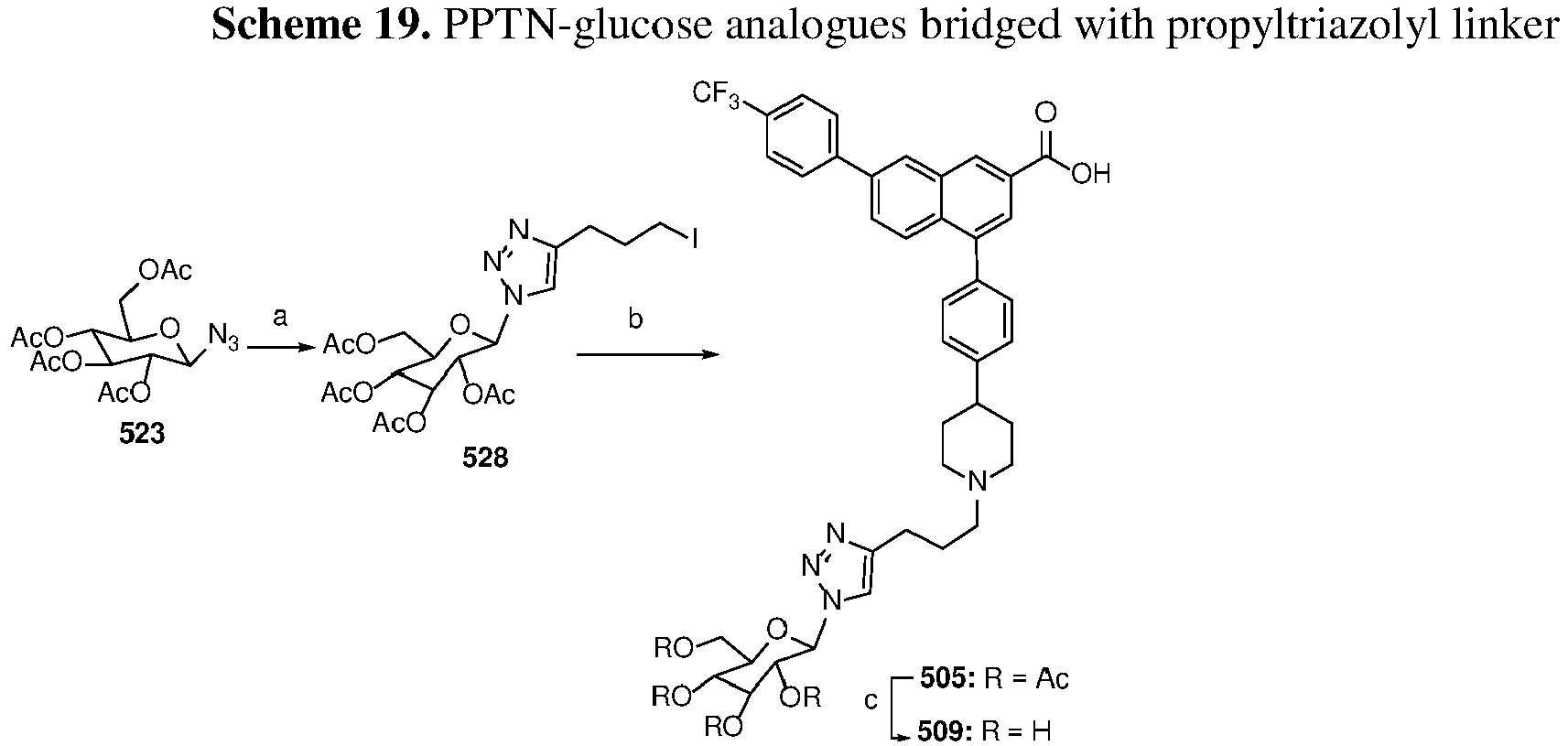
- Reagents and conditions: (a) 5-iodo-1-pentyne, CuSO4.5H2O, sodium ascorbate, DMF/H2O (9:1), 90 °C, overnight; (b) 502, K2CO3, DMF, rt, overnight; (c) NaOH (3 M), MeOH, rt, overnight.


- Reagents and conditions: (a) 2-vinyl-1,3-dioxolane, Bu3SnH, AIBN, benzene, 75 °C; (b) In(OTf)3, acetone, rt, overnight; (c) NaBH(OAc)3, HOAc, DCM, 0-5 °C, 2 h; (d) NaOH (3 M), MeOH, rt, overnight.

- Reagents and conditions: (a) i) chloromethyl methyl ether, DIPEA, Bu4NI, DCM, 0 °C to rt, 48 h; ii) dimethyltitanocene, toluene, 70 °C, 24 h; (b) 9-BBN-H, THF, reflux, 5 h; (c) 1-bromo-2-iodo-ethane, Pd(PPh3)4, K2PO4, dioxane, 60 °C, 24 h; (d) 2, K2CO3, DMF, rt, overnight; (e) HCl, MeOH, H2O, rt, overnight.


- a Reagents and conditions: (a) K2CO3, DMF, rt, overnight; (b) NaOH (3 M), MeOH, rt, overnight; (c) 522, Ag2O, TMSOTf, DMF, rt, 5 min; (d) NaOH (3 M), MeOH, rt, overnight.

- Reagents and conditions: (a) NaOH (3 M), MeOH, rt, overnight, (b) benzyl bromide, acetonitrile, reflux, 5 h; (c) 541, Ag2O, TMSOTf, DMF, rt, 5 min; (d) i) H2, Pd/C, DMF, 5 h; ii) NaOH (3 M), MeOH, rt, overnight


- Reagents and conditions: (a) Ag2O, TMSOTf, DMF, rt, 5 min; (b) NaOH (3 M), MeOH, rt, overnight.

- Reagents and conditions: (a) Na2CO3, Pd(PPh3)4, DME-H2O (4:1), 85 °C, overnight; (b) 522, Ag2O, TMSOTf, DMF, rt, 5 min; (c) NaOH (3 M), MeOH, rt, overnight.
- The following examples further illustrate the invention but, of course, should not be construed as in any way limiting its scope.
- The inhibition by the compounds in accordance with aspects of the invention of the binding of
fluorescent tracer 2 was measured in hP2Y14R-expressing CHO (references 1 and 2). - Therefore, several of the compounds (11, 19, 29, 32) were compared in affinity at hP2Y14R and mP2Y14R (
Figure 2 ) using the fluorescent binding procedures.2 - The solubility (using the pION method)2,25,26 and lipophilicity (based on the HPLC retention time)2,27 were determined for the 5-(hydroxymethyl)isoxazol-3-
yl compounds 29 and 35. - Absorption, distribution, metabolism, excretion and toxicology (ADMET) properties were determined for compound 32 (Tables 4 and 5), by the same methods as in Jung et al.2
- The potent 5-(hydroxymethyl)isoxazol-3-
yl derivative 32 was first tested in a well-established mouse model of neuropathic pain caused by chronic constriction of the sciatic nerve (CCI)32 at a dose of 10 µmol/ kg (4.9 mg/kg, i.p.,Fig. 3 ). Previously, it was demonstrated that 1a, 1b, 3a and other P2Y14R antagonists of this series were effective in reducing chronic pain in this model and reached full reversal in some cases (Table S3, Supporting information).2,7 A maximal 71.0±17.4% reversal of CCI-induced mechano-allodynia was observed 1 h post-injection of 32, and the degree of protection declined during the following 2 h and was not statistically significant at 3 or 5 h. No side effects were evident at this dose. - Selected compounds were examined for their ability to reduce eosinophils in the bronchoalveolar lavage fluid (BALF) in an ovalbumin/Aspergillus mouse asthma model.2,17,33
Compounds Fig. 4 ). Also, the correspondingprodrug derivatives 37a-37c oftriazole 3a, 5-(hydroxymethyl)isoxazole 32 and N-acetyl-piperidine 1b derivatives, respectively, were administered at the same dose. Eosinophil counts in the BALF were reduced following administration ofreference antagonist 1a or several of the prodrugs. In fact, 37b and 37c significantly reduced eosinophils to a greater extent than the parent antagonists, which showed no significant reduction. Other immune cells showed no significant effect, except the lymphocyte count following administration ofprodrug 37a trended higher than in vehicle control. - This example demonstrates synthesis of compounds, in accordance with aspects of the invention.
- Method A: A mixture of compound (1 eq) and potassium hydroxide (5 eq) in methanol:water (2:1) was stirred at 50 °C. This mixture was neutralized with 1N HCl until pH was 5-6. The slightly acidic mixture was evaporated under reduced pressure and purified by silica gel column chromatography (dichloromethane:methanol:acetic acid=95:5:0.1) or semipreparative HPLC (10 mM triethylammonium acetate buffer:acetonitrile=80:20 to 20:80 in 40 min) to afford the compound as a white solid.
- Method B: A solution of compound in trifluoroacetic acid:tetrahydrofuran (2:1) was stirred at room temperature. The solvent was evaporated with toluene under reduced pressure. The residue was purified by silica gel column chromatography (dichloromethane:methanol=95:5) or semipreparative HPLC (10 mM triethylammonium acetate buffer:acetonitrile=80:20 to 20:80 in 40 min) to afford the compound as a white solid.
- Method C: A mixture of compound 38 (1 eq), Pd(PPh3)4 (0.06 eq) and potassium carbonate (3 eq) in N,N-dimethylformamide was purged with nitrogen gas for 15 min, and then various aryl halides (1.2 eq) was added to the mixture. The mixture was stirred at 85 °C for 5 h, and then allowed to be cooled at room temperature. This mixture was partitioned ethyl acetate (5 mL) and water (10 mL). The aqueous layer was extracted with ethyl acetate (5 mL x 2), and the combined organic layer was washed with brine (3 mL), dried (MgSO4 or Na2SO4), filtered and evaporated under reduced pressure. The residue was purified by silica gel column chromatography to afford the compound as a white solid.
- Method D: The mixture of compound 38 (1 eq) and aryl halide (1.2 eq) in dimethoxyethane/2M Na2CO3 aqueous solution (10:1) was purged with nitrogen gas for 30 min, and then PdCl2(dppf) (0.1 eq) was added to the mixture. The mixture was stirred at 60 °C for 4 h. After cooling at room temperature, this mixture was partitioned ethyl acetate (5 mL) and water (10 mL). The aqueous layer was extracted with ethyl acetate (5 mL x 2), and then the combined organic layer was washed with brine (3 mL), dried (MgSO4 or Na2SO4), filtered and evaporated under reduced pressure. The residue was purified by silica gel column chromatography to afford the compound as a white solid.
- Method E: A mixture of compound 38 (1 eq) and aryl bromide (1.2 eq) in DMF/H2O (10:1; 20 mM) was purged with nitrogen gas for 30 min, and then Pd(PPh3)4 (0.05 eq) and Na2CO3 (3 eq) were added to the mixture, which was stirred for 1 h at 40-120 °C. The aqueous layer was extracted with ethyl acetate twice, and the combined organic layer was washed with brine, dried (MgSO4 or Na2SO4), filtered, and evaporated under reduced pressure. The residue was purified by silica gel column chromatography to afford the compound as white solids.
- Method F: The mixture of compound 38 (1 eq), Pd(PPh3)4 (0.06 eq), potassium carbonate (3 eq) and various aryl halides (1.2 eq) in N,N-dimethylformamide was purged with nitrogen gas for 15 min. The mixture was stirred at 100 °C for 30-90 min in microwave. After microwave irradiation, and then allowed to be cooled at room temperature. This mixture was partitioned ethyl acetate (5 mL) and water (10 mL). The aqueous layer was extracted with ethyl acetate (5 mL x 2), and the combined organic layer was washed with brine (3 mL), dried (Na2SO4), filtered, and evaporated under reduced pressure. The residue was purified by silica gel column chromatography to afford the compound as a white solid.
- 4-(4-(1-Formylpiperidin-4-yl)phenyl)-7-(4-(trifluoromethyl)phenyl)-2-naphthoic acid (1c).
- To a solution of acetic formic anhydride (1 mL from Ac2O and formic acid = 2:1, v/v) was slowly added compound 1a (10 mg, 0.019 mmol) at 0 °C. After complete addition, cooling was continued for 3 h, and the mixture was then stirred at rt for 12 h. The reaction mixture was evaporated under reduced pressure. The residue was purified by silica gel column chromatography (dichloromethane:methanol = 50:1) to afford compound 1c (7.0 mg, 71%) as a white solid; HPLC purity 98% (Rt = 14.62 min); 1H NMR (400 MHz, DMSO-d 6) δ 8.73 (s, 1H), 8.64 (s, 1H), 8.08-7.96 (m, 5H), 7.90-7.88 (m, 3H), 7.50-7.44 (m, 4H), 4.37-4.34 (m, 1H), 3.85-3.81 (m, 1H), 3.22-3.16 (m, 1H), 2.97-2.90 (m, 1H), 2.77-2.70 (m, 1H), 1.96-1.89 (m, 2H), 1.68-1.47 (m, 2H); MS (ESI, m/z) 504.2 [M+1]+; ESI-HRMS calcd. m/z for C30H25NO3F3 503.1787, found 504.1792 [M+1]+.
- 4-(4-(1-(2,2,2-trifluoroacetyl)piperidin-4-yl)phenyl)-7-(4-(trifluoromethyl)phenyl)-2-naphthoic acid (1d).
- To trifluoroacetic anhydride (100 µL) was slowly added compound 1a (10 mg, 0.019 mmol) at 0 °C. After complete addition, cooling was continued for 1 h, and the mixture was then stirred at rt for 2 h. The reaction mixture was evaporated under reduced pressure. The residue was purified by silica gel column chromatography (dichloromethane:methanol = 50:1) to afford compound 1d (10.0 mg, 92%) as a white solid; HPLC purity 99% (Rt = 16.92 min); 1H NMR (400 MHz, , CDCl3) δ 8.80 (s, 1H), 8.27 (s, 1H), 8.12-8.07 (m, 2H), 7.86-7.77 (m, 5H), 7.53 (d, J = 8.00 Hz, 2H), 7.39 (d, J = 8.00 Hz, 2H), 4.81-4.78 (m, 1H), 4.25-4.22 (m, 1H), 3.37-3.30 (m, 1H), 3.01-2.92 (m, 2H), 2.15-2.11 (m, 2H), 1.91-1.81 (m, 2H); MS (ESI, m/z) 570.1 [M-1]-, ESI-HRMS calcd. m/z for C31H22NO3F6 570.1504, found 570.1493 [M-1]-.
- (4'-(Piperidin-4-yl)-5-(4-(4-(trifluoromethyl)phenyl)-1H-1,2,3-triazol-1-yl)-[1,1'-biphenyl]-3-yl)methyl dihydrogen phosphate (3b).
- Method B: Yield 69%; HPLC purity 96% (Rt = 8.58 min); 1H NMR (400 MHz, DMSO-d 6) δ 9.20-9.19 (m, 1H), 8.05-8.03 (m, 2H), 7.96 (s, 1H), 7.85 (s, 1H), 7.79 (d, J = 8.00 Hz, 2H), 7.74 (s, 1H), 7.67 (d, J = 8.40 Hz, 2H), 7.34 (d, J = 7.60 Hz, 2H), 4.82 - 4.80 (m, 2H), 2.96 -2.92 (m, 2H), 2.66 - 2.58 (m, 3H), 1.71-1.67 (m, 2H), 1.56-1.49 (m, 2H); MS (ESI, m/z) 559.2 [M+1]+; ESI-HRMS calcd. m/z for C27H27N4O4F3P 559.1722, found 559.1716 [M+1]+.
- 4'-Amino-5-(4-(4-(trifluoromethyl)phenyl)-1H-1,2,3-triazol-1-yl)-[1,1'-biphenyl]-3-carboxylic acid (7).
- Method A: Yield 62%; HPLC purity 97% (Rt = 8.96 min); 1H NMR (400 MHz, CD3OD) δ 9.25 (s, 1H), 8.48 (s, 1H), 8.37 (s, 2H), 8.16 (d, J = 8.00 Hz, 2H), 7.79 (d, J = 8.00 Hz, 2H), 7.73 (d, J = 8.40 Hz, 2H), 7.62 (d, J = 8.40 Hz, 2H); MS (ESI, m/z) 425.1 [M+1]+; ESI-HRMS calcd. m/z for C22H16N4O2F3 425.1225, found 425.1221 [M+1]+.
- 4'-Acetamido-5-(4-(4-(trifluoromethyl)phenyl)-1H-1,2,3-triazol-1-yl)-[1,1'-biphenyl]-3-carboxylic acid (8).
- Method A: Yield 76%; HPLC purity 99% (Rt = 7.95 min); 1H NMR (400 MHz, CD3OD) δ 9.21 (s, 1H), 8.46 (s, 1H), 8.34 (d, J =7.20 Hz, 2H), 8.13 (d, J =8.00 Hz, 2H), 7.76 (d, J =8.40 Hz, 2H), 7.72 (s, 4H), 2.15 (s, 3H); MS (ESI, m/z) 467.1 [M+1]+; ESI-HRMS calcd. m/z for C24H18N4O3F3 467.1331, found 467.1330 [M+1]+.
- 4'-Benzamido-5-(4-(4-(trifluoromethyl)phenyl)-1H-1,2,3-triazol-1-yl)-[1,1'-biphenyl]-3-carboxylic acid (9).
- Method A: Yield 73%; HPLC purity 99% (Rt = 9.48 min); 1H NMR (400 MHz, DMSO-d 6) δ 9.70 (s, 1H), 8.41 (s, 1H), 8.29 (broad s, 2H), 8.21 (d, J = 7.60 Hz, 2H), 8.00-7.97 (m, 4H), 7.90-7.83 (m, 4H), 7.62-7.54 (m, 3H); MS (ESI, m/z) 529.1 [M+1]+; ESI-HRMS calcd. m/z for C29H20N4O3F3 529.1488, found 529.1489 [M+1]+.
- 4'-((tert-Butoxycarbonyl)amino)-5-(4-(4-(trifluoromethyl)phenyl)-1H-1,2,3-triazol-1-yl)-[1,1'-biphenyl]-3-carboxylic acid (10).
- Method A:
Yield 50%; HPLC purity 99% (Rt = 10.36 min); 1H NMR (400 MHz, CD3OD) δ 9.25 (s, 1H), 8.48 (s, 1H), 8.37-8.35 (m, 2H), 8.16 (d, J =8.40 Hz, 2H), 7.78 (d, J =8.00 Hz, 2H), 7.71 (d, J =8.40 Hz, 2H), 7.58 (d, J = 8.40 Hz, 2H), 1.54 (s, 9H); MS (ESI, m/z) 525.2 [M+1]+; ESI-HRMS calcd. m/z for C27H24N4O4F3 525.1750, found 525.1755 [M+1]+. - 4'-(Piperidine-4-carboxamido)-5-(4-(4-(trifluoromethyl)phenyl)-1H-1,2,3-triazol-1-yl)-[1,1'-biphenyl]-3-carboxylic acid (11).
- Method B: Yield 87%; HPLC purity 99% (Rt = 21.20 min); 1H NMR (400 MHz, DMSO-d 6) δ 8.03-8.01 (m, 4H), 7.83 (s, 1H), 7.68 (d, J =8.40 Hz, 2H), 7.30-7.25 (m, 5H), 2.70-2.68 (m, 2H), 2.23-2.20 (m, 2H), 2.00-1.93 (m, 1H), 1.44-1.27 (m, 4H); MS (ESI, m/z) 536.2 [M+Na]+; ESI-HRMS calcd. m/z for C28H25N5O3F3 536.1909, found 536.1913 [M+1]+.
- 4'-(1-(tert-Butoxycarbonyl)piperidine-4-carboxamido)-5-(4-(4-(trifluoromethyl)phenyl)-1H-1,2,3-triazol-1-yl)-[1,1'-biphenyl]-3-carboxylic acid (12).
- Method A: Yield 82%; HPLC purity 98% (Rt = 24.10 min); 1H NMR (400 MHz, DMSO-d 6) δ 9.73 (s, 1H), 8.43 (s, 1H), 8.38 (s, 1H), 8.27 (s, 1H), 8.20 (d, J =8.00 Hz, 2H), 7.90 (d, J =8.40 Hz, 2H), 7.91-7.77 (m, 4H), 4.05-3.97 (m, 2H), 2.92-2.75 (m, 3H), 1.85-1.76 (m, 2H), 1.56-1.45 (m, 2H), 1.41 (s, 9H); MS (ESI, m/z) 658.2 [M+Na]+; ESI-HRMS calcd. m/z for C33H32N5O5F3Na 658.2253, found 658.2256 [M+Na]+.
- 5-(4-(4-(Trifluoromethyl)phenyl)-1H-1,2,3-triazol-1-yl)-[1,1'-biphenyl]-3,4'-dicarboxylic acid (13).
- Method A: Yield 68%; HPLC purity 99% (Rt = 13.46 min); 1H NMR (400 MHz, DMSO-d 6) δ 9.77 (s, 1H), 8.56-8.53 (m, 2H), 8.36 (broad s, 1H), 8.20 (d, J =8.00 Hz, 2H), 8.11 (d, J =8.40 Hz, 2H), 8.00 (d, J =8.40 Hz, 2H), 7.91 (d, J =8.40 Hz, 2H); MS (ESI, m/z) 454.1 [M+1]+; ESI-HRMS calcd. m/z for C23H15N3O4F3 454.1015, found 454.1017 [M+1]+.
- 4'-((3-Aminopropyl)carbamoyl)-5-(4-(4-(trifluoromethyl)phenyl)-1H-1,2,3-triazol-1-yl)-[1,1'-biphenyl]-3-carboxylic acid (14).
- Method B: Yield 63%; HPLC purity 97% (Rt = 12.68 min); 1H NMR (400 MHz, DMSO-d 6) δ 9.73 (s, 1H), 8.55 (s, 1H), 8.51 (s, 1H), 8.37 (s, 1H), 8.23-8.20 (m, 4H), 8.00 (d, J =8.40 Hz, 2H), 7.90 (d, J =8.00 Hz, 2H), 3.51-3.46 (m, 2H), 3.00-2.99 (m, 2H), 1.93-1.90 (m, 2H); MS (ESI, m/z) 510.2 [M+1]+; ESI-HRMS calcd. m/z for C26H23N5O3F3 510.1753, found 510.1754 [M+1]+.
- 4'-Bromo-5-(4-(4-(trifluoromethyl)phenyl)-1H-1,2,3-triazol-1-yl)-[1,1'-biphenyl]-3-carboxylic acid (15).
- Method A: Yield 77%; HPLC purity 99% (Rt = 12.93 min); 1H NMR (400 MHz, CD3OD) δ 9.17 (s, 1H), 8.43 (s, 1H), 8.35 (s, 1H), 8.25 (s, 1H), 8.16 (d, J =8.00 Hz, 2H), 7.79 (d, J =8.00 Hz, 2H), 7.72 (d, J =8.00 Hz, 2H), 7.66 (d, J =8.40 Hz, 2H); MS (ESI, m/z) 488.0, 490.0 [M+1]+; ESI-HRMS calcd. m/z for C22H14N3O2F3Br 488.0221, found 488.0218 [M+1]+.
- 4'-(2-Amino-2-oxoethyl)-5-(4-(4-(trifluoromethyl)phenyl)-1H-1,2,3-triazol-1-yl)-[1,1'-biphenyl]-3-carboxylic acid (16).
- Method A: Yield 64%; HPLC purity 99% (Rt = 8.55 min); 1H NMR (400 MHz, CD3OD) δ 9.24 (s, 1H), 8.50 (s, 1H), 8.38 (s, 2H), 8.16 (d, J =8.00 Hz, 2H), 7.79-7.74 (m, 4H), 7.48 (d, J =7.60 Hz, 2H), 3.60 (s, 2H); MS (ESI, m/z) 467.1 [M+1]+; ESI-HRMS calcd. m/z for C24H18N4O3F3 467.1331, found 467.1332 [M+1]+.
- The mixture of compound 38 (30 mg, 0.063 mmol), Pd(PPh3)4 (4 mg, 0.003 mmol), and 2 M K2CO3 aqueous solution (90 µL, 0.180 mmol) in N,N-dimethylformamide:water (1:1, 3mL) was purged with nitrogen gas for 15 min, and then 3-(4-bromophenyl)propionitrile (16 mg, 0.076 mmol) was added to the mixture. The mixture was stirred at 90 °C for 12 h, and then allowed to be cooled at room temperature. This mixture was partitioned ethyl acetate (5 mL) and water (10 mL). The aqueous layer was extracted with ethyl acetate (5 mL x 2), and then the combined organic layer was washed with brine (3 mL), dried (MgSO4), filtered and evaporated under reduced pressure. The residue was purified by silica gel column chromatography (chloroform:methanol = 10:1) to afford the compound 17 (18 mg, 61%) as a white solid; HPLC purity 99% (Rt = 7.63 min); 1H NMR (400 MHz, CD3OD) δ 9.27 (s, 1H), 8.53 (s, 1H), 8.40 (m, 2H), 8.17 (d, J =8.00 Hz, 2H), 7.80-7.77 (m, 4H), 7.48 (d, J =8.00 Hz, 2H), 3.03 (t, J =7.20 Hz, 2H), 2.81 (t, J =7.20 Hz, 2H); MS (ESI, m/z) 463.1 [M+1]+; ESI-HRMS calcd. m/z for C25H18N4O2F3 463.1382, found 467.1381 [M+1]+.
- 4'-(3-Aminopropyl)-5-(4-(4-(trifluoromethyl)phenyl)-1H-1,2,3-triazol-1-yl)-[1,1'-biphenyl]-3-carboxylic acid (18).
- Method B: Yield 98%; HPLC purity 98% (Rt = 8.14 min); 1H NMR (400 MHz, CD3OD) δ 9.27 (s, 1H), 8.52 (s, 1H), 8.42 (s, 1H), 8.38 (s, 1H), 8.17 (d, J =7.60 Hz, 2H), 7.80-7.75 (m, 4H), 7.43 (d, J =8.00 Hz, 2H), 2.99 (t, J =7.60 Hz, 2H), 2.82 (t, J =7.60 Hz, 2H), 2.05-2.02 (m, 2H); MS (ESI, m/z) 467.2 [M+1]+; ESI-HRMS calcd. m/z for C25H22N4O2F3 467.1695, found 467.1689 [M+1]+.
- 4'-(3-Aminoprop-1-yn-1-yl)-5-(4-(4-(trifluoromethyl)phenyl)-1H-1,2,3-triazol-1-yl)-[1,1'-biphenyl]-3-carboxylic acid (19).
- Method B: Yield 62%; HPLC purity 97% (Rt = 10.49 min); 1H NMR (400 MHz, DMSO-d 6) δ 9.67 (s, 1H), 8.42 (s, 1H), 8.26 (s, 1H), 8.21 (d, J =8.00 Hz, 2H), 8.16 (s, 1H), 7.88 (d, J =8.40 Hz, 2H), 7.79 (d, J =8.00 Hz, 2H), 7.53 (d, J =8.00 Hz, 2H), 3.53 (s, 2H); MS (ESI, m/z) 463.1 [M+1]+; ESI-HRMS calcd. m/z for C25H18N4O2F3 463.1382, found 463.1380 [M+1]+.
- 4'-(3-((tert-Butoxycarbonyl)amino)propyl)-5-(4-(4-(trifluoromethyl)phenyl)-1H-1,2,3-triazol-1-yl)-[1,1'-biphenyl]-3-carboxylic acid (20).
- Method A: Yield 66%; HPLC purity 99% (Rt = 10.56 min); 1H NMR (400 MHz, CD3OD) δ 9.24 (s, 1H), 8.49 (s, 1H), 8.38-8.36 (m, 2H), 8.16 (d, J =8.00 Hz, 2H), 7.78 (d, J =8.00 Hz, 2H), 7.70 (d, J =8.40 Hz, 2H), 7.37 (d, J =8.00 Hz, 2H), 3.10 (t, J =7.20 Hz, 2H), 2.71 (t, J =7.20 Hz, 2H), 1.87-1.78 (m, 2H), 1.45 (s, 9H); MS (ESI, m/z) 589.2 [M+Na]+; ESI-HRMS calcd. m/z for C30H29N4O4F3Na 589.2039, found 589.2043 [M+1]+.
- 4'-(4-Hydroxybutyl)-5-(4-(4-(trifluoromethyl)phenyl)-1H-1,2,3-triazol-1-yl)-[1,1'-biphenyl]-3-carboxylic acid (21).
- Method A: Yield 39%; HPLC purity 99% (Rt = 7.40 min); 1H NMR (400 MHz, CD3OD) δ 9.25 (s, 1H), 8.50 (s, 1H), 8.38 (s, 2H), 8.16 (d, J =8.00 Hz, 2H), 7.79 (d, J =8.40 Hz, 2H), 7.70 (d, J =8.00 Hz, 2H), 7.37 (d, J =8.00 Hz, 2H), 3.59 (t, J =6.40 Hz, 2H), 2.72 (t, J =7.60 Hz, 2H), 1.78-1.71 (m, 2H), 1.64-1.57 (m, 2H); MS (ESI, m/z) 482.2 [M+1]+; ESI-HRMS calcd. m/z for C26H23N3O3F3 482.1692, found 482.1694 [M+1]+.
- 4'-(1-Aminocyclopropyl)-5-(4-(4-(trifluoromethyl)phenyl)-1H-1,2,3-triazol-1-yl)-[1,1'-biphenyl]-3-carboxylic acid (22).
- Method A: Yield 69%; HPLC purity 98% (Rt = 6.80 min); 1H NMR (400 MHz, CD3OD) δ 9.27 (s, 1H), 8.55-8.39 (m, 3H), 8.15 (broad s, 2H), 7.88 (broad s, 2H), 7.78 (broad s, 2H), 7.63 (broad s, 2H), 1.43-1.38 (m, 4H); MS (ESI, m/z) 465.2 [M+1]+; ESI-HRMS calcd. m/z for C25H20N4O2F3 465.1538, found 465.1539 [M+1]+.
- 4'-(1-(Aminomethyl)cyclopropyl)-5-(4-(4-(trifluoromethyl)phenyl)-1H-1,2,3-triazol-1-yl)-[1,1'-biphenyl]-3-carboxylic acid (23).
- Method B: Yield 52%; HPLC purity 97% (Rt = 10.85 min); 1H NMR (400 MHz, CD3OD) δ 9.08 (s, 1H), 8.38 (s, 1H), 8.30 (s, 1H), 8.16 (s, 1H), 8.09 (d, J =8.00 Hz, 2H), 7.77-7.73 (m, 4H), 7.55 (d, J =8.00 Hz, 2H), 3.22 (s, 2H), 1.09-1.06 (m, 4H); MS (ESI, m/z) 479.2 [M+1]+; ESI-HRMS calcd. m/z for C26H22N4O2F3 479.1695, found 479.1693 [M+1]+.
- 4'-(1-(((tert-Butoxycarbonyl)amino)methyl)cyclopropyl)-5-(4-(4-(trifluoromethyl)phenyl)-1H-1,2,3-triazol-1-yl)-[1,1'-biphenyl]-3-carboxylic acid (24).
- Method A: Yield 51%; HPLC purity 99% (Rt = 21.57 min); 1H NMR (400 MHz, CD3OD) δ 9.26 (s, 1H), 8.51 (s, 1H), 8.40-8.38 (m, 2H), 8.17 (d, J =8.00 Hz, 2H), 7.80 (d, J =8.00 Hz, 2H), 7.73 (d, J =8.00 Hz, 2H), 7.51 (d, J =8.00 Hz, 2H), 3.34 (s, 2H), 1.39-1.28 (m, 9H), 0.94-0.86 (m, 4H); MS (ESI, m/z) 601.2 [M+Na]+; ESI-HRMS calcd. m/z for C31H29N4O4F3Na 601.2039, found 601.2040 [M+Na]+.
- 4'-(1-Aminocyclobutyl)-5-(4-(4-(trifluoromethyl)phenyl)-1H-1,2,3-triazol-1-yl)-[1,1'-biphenyl]-3-carboxylic acid (25).
- Method B: Yield 65%; HPLC purity 99% (Rt = 8.69 min); 1H NMR (400 MHz, CD3OD) δ 9.27 (s, 1H), 8.55 (s, 1H), 8.45 (s, 1H), 8.41 (s, 1H), 8.16 (d, J =8.00 Hz, 2H), 7.93 (d, J =8.40 Hz, 2H), 7.79 (d, J = 8.40 Hz, 2H), 7.69 (d, J =8.40 Hz, 2H), 2.89-2.82 (m, 2H), 2.70-2.63 (m, 2H), 2.33-2.24 (m, 1H), 2.07-1.97 (m, 1H); MS (ESI, m/z) 479.3 [M+1]+; ESI-HRMS calcd. m/z for C26H22N4O2F3 479.1695, found 479.1696 [M+1]+.
- 4'-(1-((tert-Butoxycarbonyl)amino)cyclobutyl)-5-(4-(4-(trifluoromethyl)phenyl)-1H-1,2,3-triazol-1-yl)-[1,1'-biphenyl]-3-carboxylic acid (26).
- Method A: Yield 47%; HPLC purity 99% (Rt = 10.76 min); 1H NMR (400 MHz, CD3OD) δ 9.18 (s, 1H), 8.40-8.39 (m, 2H), 8.26 (s, 1H), 8.17 (d, J =8.00 Hz, 2H), 7.80-7.76 (m, 4H), 7.59 (d, J = 8.40 Hz, 2H), 2.60-2.46 (m, 4H), 2.16-2.07 (m, 1H), 1.99-1.88 (m, 1H), 1.40-1.25 (m, 9H); MS (ESI, m/z) 579.2 [M+1]+; ESI-HRMS calcd. m/z for C31H30N4O4F3 579.2219, found 579.2219 [M+1]+.
- 4'-(3-(Hydroxymethyl)oxetan-3-yl)-5-(4-(4-(trifluoromethyl)phenyl)-1H-1,2,3-triazol-1-yl)-[1,1'-biphenyl]-3-carboxylic acid (27).
- Method A: Yield 47%; HPLC purity 99% (Rt = 8.71 min); 1H NMR (400 MHz, CD3OD) δ 9.25 (s, 1H), 8.51 (s, 1H), 8.41 (s, 1H), 8.39 (s, 1H), 8.15 (d, J =8.40 Hz, 2H), 7.80-7.77 (m, 4H), 7.32 (d, J =8.00 Hz, 2H), 4.97 (d, J = 5.60 Hz, 2H), 4.89 (d, J = 6.00 Hz, 2H), 3.94 (s, 2H); MS (ESI, m/z) 496.2 [M+1]+; ESI-HRMS calcd. m/z for C26H21N3O4F3 496.1484, found 496.1488 [M+1]+.
- 4'-(Isoxazol-3-yl)-5-(4-(4-(trifluoromethyl)phenyl)-1H-1,2,3-triazol-1-yl)-[1,1'-biphenyl]-3-carboxylic acid (28).
- Method A: Yield 74%; HPLC purity 98% (Rt = 11.86 min); 1H NMR (400 MHz, CD3OD) δ 9.28 (s, 1H), 8.75 (s, 1H), 8.57 (s, 1H), 8.46 (s, 2H), 8.17 (d, J = 7.60 Hz, 2H), 8.05 (d, J =8.00 Hz, 2H), 7.94 (d, J = 8.40 Hz, 2H), 7.79 (d, J =8.00 Hz, 2H), 7.00 (s, 1H); MS (ESI, m/z) 477.1 [M+1]+; ESI-HRMS calcd. m/z for C25H16N4O3F3 477.1175, found 477.1177 [M+1]+.
- 4'-(5-(Hydroxymethyl)isoxazol-3-yl)-5-(4-(4-(trifluoromethyl)phenyl)-1H-1,2,3-triazol-1-yl)-[1,1'-biphenyl]-3-carboxylic acid (29).
- Method A: Yield 43%; HPLC purity 98% (Rt = 20.10 min); 1H NMR (400 MHz, DMSO-d 6) δ 9.77 (s, 1H), 8.57 (s, 1H), 8.54 (s, 1H), 8.36 (s, 1H), 8.20 (d, J =8.00 Hz, 2H), 8.08-8.01 (m, 4H), 7.91 (d, J = 8.00 Hz, 2H), 7.05 (s, 1H), 5.75 (t, J = 6.00 Hz, 1H), 4.64 (d, J = 6.00 Hz, 2H); MS (ESI, m/z) 507.1 [M+1]+; ESI-HRMS calcd. m/z for C26H18N4O4F3 507.1280, found 507.1271 [M+1]+.
- 4'-(5-(2-Hydroxyethyl)isoxazol-3-yl)-5-(4-(4-(trifluoromethyl)phenyl)-1H-1,2,3-triazol-1-yl)-[1,1'-biphenyl]-3-carboxylic acid (30).
- Method A: Yield 55%; HPLC purity 95% (Rt = 10.69 min); 1H NMR (400 MHz, DMSO-d 6) δ 9.74 (s, 1H), 8.51 (s, 1H), 8.46 (s, 1H), 8.35 (s, 1H), 8.20 (d, J =8.00 Hz, 2H), 8.03-7.98 (m, 4H), 7.90 (d, J = 8.00 Hz, 2H), 6.93 (s, 1H), 3.77 (t, J = 6.40 Hz, 2H), 2.97 (d, J =6.40 Hz, 2H); MS (ESI, m/z) 521.1 [M+1]+; ESI-HRMS calcd. m/z for C27H20N4O4F3 521.1437, found 521.1435 [M+1]+.
- 4'-(2H-Tetrazol-5-yl)-5-(4-(4-(trifluoromethyl)phenyl)-1H-1,2,3-triazol-1-yl)-[1,1'-biphenyl]-3-carboxylic acid (31).
- Method A: Yield 43%; HPLC purity 98% (Rt = 15.95 min); 1H NMR (400 MHz, CD3OD) δ 9.24 (s, 1H), 8.49 (s, 1H), 8.45 (s, 1H), 8.35 (s, 1H), 8.22-8.17 (m, 4H), 7.92 (d, J =8.40 Hz, 2H), 7.80 (d, J = 8.00 Hz, 2H); MS (ESI, m/z) 478.1 [M+1]+; ESI-HRMS calcd. m/z for C23H15N7O2F3 478.1239, found 478.1242 [M+1]+.
- 4-(4-(5-(Hydroxymethyl)isoxazol-3-yl)phenyl)-7-(4-(trifluoromethyl)phenyl)-2-naphthoic acid (32).
- Method A: Yield 93%; HPLC purity 98% (Rt = 12.07 min); 1H NMR (400 MHz, DMSO-d 6) δ 8.79 (s, 1H), 8.68 (s, 1H), 8.09-8.05 (m, 5H), 8.01-7.98 (m, 1H), 7.95 (m, 1H), 7.91-7.89 (m, 2H), 7.70 (d, J = 8.40 Hz, 2H), 7.04 (s, 1H), 5.80-5.73 (m, 1H), 4.66-4.63 (m, 2H); MS (ESI, m/z) 490.1 [M+1]+; ESI-HRMS calcd. m/z for C28H19NO4F3 490.1266, found 490.1269 [M+1]+.
- 4'-(5-(Hydroxymethyl)isoxazol-3-yl)-5-(4-(trifluoromethyl)benzamido)-[1,1'-biphenyl]-3-carboxylic acid (33).
- Method A: Yield 62%; HPLC purity 99% (Rt = 10.29 min); 1H NMR (400 MHz, CD3OD) δ 8.35 (broad s, 2H), 8.17-8.13 (m, 3H), 7.97 (d, J =8.40 Hz, 2H), 7.86-7.81 (m, 4H), 6.82 (s, 1H), 4.74 (s, 2H); MS (ESI, m/z) 483.1 [M+1]+; ESI-HRMS calcd. m/z for C25H18N2O5F3 483.1168, found 483.1170 [M+1]+.
- 4-(4-(Piperidin-4-yl)phenyl)-6-(4-(4-(trifluoromethyl)phenyl)-1H-1,2,3-triazol-1-yl)picolinic acid (34).
- Method B:
Yield 60%; HPLC purity 99% (Rt = 7.87 min); 1H NMR (400 MHz, DMSO-d 6) δ 9.55 (s, 1H), 8.31-8.26 (m, 4H), 7.91-7.85 (m, 4H), 7.47 (d, J =8.00 Hz, 2H), 3.68-3.65 (m, 1H), 3.02-2.88 (m, 4H), 1.95-1.83 (m, 4H); MS (ESI, m/z) 494.2 [M+1]+; ESI-HRMS calcd. m/z for C26H23N5O2F3 494.1804, found 494.1805 [M+1]+. - 2-(4-(Piperidin-4-yl)phenyl)-6-(4-(4-(trifluoromethyl)phenyl)-1H-1,2,3-triazol-1-yl)isonicotinic acid (35).
- Method B: Yield 65%; HPLC purity 95% (Rt = 10.72 min); 1H NMR (400 MHz, DMSO-d 6) δ 9.79 (s, 1H), 8.42 (s, 2H), 8.34-8.33 (m, 4H), 7.89 (d, J =8.00 Hz, 2H), 7.44 (d, J =8.00 Hz, 2H), 3.62-3.59 (m, 1H), 3.07-2.92 (m, 4H), 2.03-1.89 (m, 4H); MS (ESI, m/z) 494.2 [M+1]+; ESI-HRMS calcd. m/z for C26H23N5O2F3 494.1804, found 494.1805 [M+1]+.
- 6-(4-(Piperidin-4-yl)phenyl)-4-(4-(4-(trifluoromethyl)phenyl)-1H-1,2,3-triazol-1-yl)picolinic acid (36).
- Method B: Yield 65%; HPLC purity 99% (Rt = 11.24 min); 1H NMR (400 MHz, DMSO-d 6) δ 9.94 (s, 1H), 8.71 (s, 1H), 8.56 (s, 1H), 8.28 (d, J =7.20 Hz, 2H), 8.19 (d, J =7.60 Hz, 2H), 7.93 (d, J =7.20 Hz, 2H), 7.46 (d, J =7.20 Hz, 2H), 3.43-3.40 (m, 2H), 3.07-2.92 (m, 3H), 2.03-2.00 (m, 2H), 1.91-1.84 (m, 2H); MS (ESI, m/z) 494.2 [M+1]+; ESI-HRMS calcd. m/z for C26H23N5O2F3 494.1804, found 494.1808 [M+1]+.
- 2-(Dimethylamino)-2-oxoethyl 4'-(piperidin-4-yl)-5-(4-(4-(trifluoromethyl)phenyl)-1H-1,2,3-triazol-1-yl)-[1,1'-biphenyl]-3-carboxylate (37a).
- Method B: Yield 78%; HPLC purity 97% (Rt = 20.45 min); 1H NMR (400 MHz, CD3OD) δ 9.29 (s, 1H), 8.59 (s, 1H), 8.47 (s, 1H), 8.45 (s, 1H), 8.17 (d, J =8.00 Hz, 2H), 7.82-7.79 (m, 4H), 7.47 (d, J =8.00 Hz, 2H), 5.18 (s, 2H), 3.56-3.53 (m, 2H), 3.23-3.16 (s, 2H), 3.13 (s, 3H), 3.05-2.99 (m, 1H), 3.02 (s, 3H), 2.18-2.14 (m, 2H), 2.03-1.92 (m, 2H); MS (ESI, m/z) 578.3 [M+1]+; ESI-HRMS calcd. m/z for C31H31N5O3F3 578.2379, found 578.2390 [M+1]+.
- 2-(Dimethylamino)-2-oxoethyl 4-(4-(5-(hydroxymethyl)isoxazol-3-yl)phenyl)-7-(4-(trifluoromethyl)phenyl)-2-naphthoate (37b).
- To a solution of 32 (3.5 mg, 0.007 mmol) in DMF (1 mL) was added Cs2CO3 (3.0 mg, 0.010 mmol). 2-Chloro-N,N-dimethylacetamide (1.0 mg, 0.007 mmol) was added to the reaction mixture under N2 atmosphere, and the reaction was stirred at 45 °C for 1 h under N2 atmosphere. The reaction mixture was partitioned ethyl acetate (5 mL) and water (5 mL), and the aqueous phase was extracted with ethyl acetate (2 x 5 mL). The combined organic layers were dried over Na2SO4, filtered, and concentrated under pressure. The residue was purified by silica gel chromatography (chloroform:methanol = 30:1) to afford
compound 37b (2.7 mg, 68%) as a white solid; HPLC purity 99% (Rt = 17.73 min); 1H NMR (400 MHz, CD3OD) δ 8.85-8.84 (m, 1H), 8.45-8.44 (m, 1H), 8.08-7.97 (m, 7H), 7.81 (d, J =8.40 Hz, 2H), 7.66 (d, J =8.00 Hz, 2H), 6.88 (s, 1H), 5.14 (s, 2H), 4.76 (s, 2H), 3.12 (s, 3H), 3.00 (s, 3H); MS (ESI, m/z) 575.2 [M+1]+; ESI-HRMS calcd. m/z for C32H26N2O5F3 575.1794, found 575.1786 [M+1]+. - 2-(Dimethylamino)-2-oxoethyl 4-(4-(1-acetylpiperidin-4-yl)phenyl)-7-(4-(trifluoromethyl)phenyl)-2-naphthoate (37c).
-
Compound 1b (24 mg, 0.046 mmol) was converted tocompound 37c (20 mg, 72%) as a white solid, using a similar procedure to that used in the preparation of compound 87; HPLC purity 99% (Rt = 16.43 min); 1H NMR (400 MHz, CD3OD) δ 8.80 (s, 1H), 8.42 (s, 1H), 8.03-7.98 (m, 4H), 7.93-7.91 (m, 1H), 7.80 (d, J = 7.60 Hz, 2H), 7.47-7.43 (m, 4H), 5.14 (s, 2H), 4.75-4.72 (m, 1H), 4.12-4.08 (m, 1H), 3.27-3.24 (m, 1H), 3.12 (s, 3H), 3.00 (s, 3H), 2.95-2.92 (m, 1H), 2.81-2.75 (m, 1H), 2.18 (s, 3H), 2.04-1.97 (m, 2H), 1.84-1.68 (m, 2H); MS (ESI, m/z) 603.2 [M+1]+; ESI-HRMS calcd. m/z for C35H34N2O4F3 603.2471, found 603.2479 [M+1]+. - Methyl 4'-((tert-butoxycarbonyl)amino)-5-(4-(4-(trifluoromethyl)phenyl)-1H-1,2,3-triazol-1-yl)-[1,1'-biphenyl]-3-carboxylate (39).
- Method C: Yield 40%; 1H NMR (400 MHz, CDCl3) δ 8.40 (s, 1H), 8.33 (s, 1H), 8.29 (broad s, 2H), 8.06 (d, J =8.00 Hz, 2H), 7.74 (d, J =8.40 Hz, 2H), 7.64 (d, J =8.40 Hz, 2H), 7.52 (d, J =8.40 Hz, 2H), 4.01 (s, 3H), 1.54 (s, 9H); MS (ESI, m/z) 539.2 [M+1]+; ESI-HRMS calcd. m/z for C28H26N4O4F3 539.1906, found 539.1916 [M+1]+.
- Methyl 4'-amino-5-(4-(4-(trifluoromethyl)phenyl)-1H-1,2,3-triazol-1-yl)-[1,1'-biphenyl]-3-carboxylate (40).
- Method B: Yield 57%; 1H NMR (400 MHz, CDCl3) δ 8.38 (s, 1H), 8.32 (s, 1H), 8.26-8.24 (m, 2H), 8.06 (d, J =8.00 Hz, 2H), 7.74 (d, J =8.00 Hz, 2H), 7.54 (d, J =8.40 Hz, 2H), 6.81 (d, J =8.40 Hz, 2H), 4.00 (s, 3H); MS (ESI, m/z) 439.1 [M+1]+; ESI-HRMS calcd. m/z for C23H18N4O2F3 439.1382, found 439.1378 [M+1]+.
- Methyl 4'-acetamido-5-(4-(4-(trifluoromethyl)phenyl)-1H-1,2,3-triazol-1-yl)-[1,1'-biphenyl]-3-carboxylate (41).
- 40 (12 mg, 0.027 mmol) was dissolved in dichloromethane (1 mL) and degassed for 30 min with nitrogen gas. Acetic anhydride (3.2 µL, 0.033 mmol) was added to the reaction and was stirred for 2 h at room temperature. The reaction mixture was partitioned dichloromethane (10 mL) and saturated aqueous Na2CO3 solution (10 mL), and the aqueous phase was extracted with dichloromethane (10 mL x 2). The combined organic layers were dried over Na2SO4, filtered, and concentrated under pressure. The residue was purified by silica gel chromatography (hexane:ethyl acetate = 2:1) to afford compound 41 (10 mg, 76%) as a white solid; 1H NMR (400 MHz, CDCl3) δ 8.40 (s, 1H), 8.34 (s, 1H), 8.32-8.30 (m, 2H), 8.06 (d, J =8.00 Hz, 2H), 7.74 (d, J =8.40 Hz, 2H), 7.67 (s, 4H), 4.01 (s, 3H), 2.23 (s, 3H); MS (ESI, m/z) 481.2 [M+1]+; ESI-HRMS calcd. m/z for C25H20N4O3F3 481.1488, found 481.1487 [M+1]+.
- Methyl 4'-benzamido-5-(4-(4-(trifluoromethyl)phenyl)-1H-1,2,3-triazol-1-yl)-[1,1'-biphenyl]-3-carboxylate (42).
- 40 (12 mg, 0.027 mmol) was dissolved in dichloromethane (1 mL) at 0 °C. Triethylamine (4.2 µL, 0.030 mmol) and benzoyl chloride (3.2 µL, 0.027 mmol) were added, and the mixture was stirred for 18 h at room temperature. The reaction mixture was partitioned dichloromethane (10 mL) and water (10 mL), and the aqueous phase was extracted with dichloromethane (10 mL x 2). The combined organic layers were dried over Na2SO4, filtered, and concentrated under pressure. The residue was purified by silica gel chromatography (hexane:ethyl acetate = 3:1) to afford compound 42 (9 mg, 63%) as a white solid; 1H NMR (400 MHz, CDCl3) δ 8.41 (s, 1H), 8.37 (s, 1H), 8.33 (broad s, 2H), 8.10-8.05 (m, 2H), 7.94-7.90 (m, 3H), 7.82 (d, J =8.40 Hz, 2H), 7.75-7.72 (m, 3H), 7.61-7.45 (m, 3H), 4.02 (s, 3H); MS (ESI, m/z) 543.2 [M+1]+; ESI-HRMS calcd. m/z for C30H21N4O3F3 543.1644, found 543.1647 [M+1]+.
- tert-Butyl 4-((3'-(methoxycarbonyl)-5'-(4-(4-(trifluoromethyl)phenyl)-1H-1,2,3-triazol-1-yl)-[1,1'-biphenyl]-4-yl)carbamoyl)piperidine-1-carboxylate (43).
- To a solution of compounds 40 (27 mg, 0.061 mmol) in N,N-dimethylformamide (2 mL) were added Boc-Inp-OH (15 mg, 0.067 mmol), HATU (25 mg, 0.067 mmol) andN,N-diisopropylethylamine (13 µL, 0.080 mmol), and then this reaction mixture was stirred at room temperature for 2 h. The reaction mixture was partitioned ethyl acetate (5 mL) and water (5 mL), and the aqueous layer was extracted with ethyl acetate (5 mL x 2). The combined organic layer was washed brine (3 mL), dried over MgSO4, filtered and evaporated under reduced pressure. The residue was purified by silica gel column chromatography (hexane:ethyl acetate = 3:1) to afford compound 43 (37 mg, 94%) as a white solid; 1H NMR (400 MHz, CDCl3) δ 8.40 (s, 1H), 8.34-8.33 (m, 1H), 8.32-8.30 (m, 2H), 8.06 (d, J =8.40 Hz, 2H), 7.74 (d, J =8.00 Hz, 2H), 7.68 (s, 4H), 4.25-4.18 (m, 2H), 4.01 (s, 3H), 2.84-2.78 (m, 2H), 2.46-2.40 (m, 1H), 1.95-1.92 (m, 2H), 1.78-1.76 (m, 2H), 1.47 (s, 9H); MS (ESI, m/z) 672.2 [M+ Na]+; ESI-HRMS calcd. m/z for C34H34N5O5F3Na 672.2410, found 672.2413 [M+Na]+.
- 3'-(Methoxycarbonyl)-5'-(4-(4-(trifluoromethyl)phenyl)-1H-1,2,3-triazol-1-yl)-[1,1'-biphenyl]-4-carboxylic acid (44).
- Method C:
Yield 45%; 1H NMR (400 MHz, DMSO-d 6) δ 9.78 (s, 1H), 8.59-8.56 (m, 2H), 8.36 (s, 1H), 8.19 (d, J =8.00 Hz, 2H), 8.10 (d, J =8.40 Hz, 2H), 8.00 (d, J =8.40 Hz, 2H), 7.91 (d, J =8.40 Hz, 2H), 3.98 (s, 3H); MS (ESI, m/z) 468.1 [M+1]+; ESI-HRMS calcd. m/z for C24H17N3O4F3 468.1171, found 468.1169 [M+1]+. - Methyl 4'-((3-((tert-butoxycarbonyl)amino)propyl)carbamoyl)-5-(4-(4-(trifluoromethyl)phenyl)-1H-1,2,3-triazol-1-yl)-[1,1'-biphenyl]-3-carboxylate (45).
- Method C: Yield 68%; 1H NMR (400 MHz, CD3OD) δ 9.15 (s, 1H), 8.41 (s, 1H), 8.32 (s, 1H), 8.25 (s, 1H), 8.04 (d, J =8.00 Hz, 2H), 7.93 (d, J =8.40 Hz, 2H), 7.78 (d, J =8.40 Hz, 2H), 7.71 (d, J =8.00 Hz, 2H), 3.95 (s, 3H), 3.44 (t, J =6.80 Hz, 2H), 3.17-3.14 (m, 2H), 1.80-1.76 (m, 2H); MS (ESI, m/z) 646.2 [M+Na]+; ESI-HRMS calcd. m/z for C32H32N5O5F3Na 646.2253, found 646.2255 [M+Na]+.
- 4'-((3-((tert-Butoxycarbonyl)amino)propyl)carbamoyl)-5-(4-(4-(trifluoromethyl)phenyl)-1H-1,2,3-triazol-1-yl)-[1,1'-biphenyl]-3-carboxylic acid (46).
- Method A: Yield 77%; 1H NMR (400 MHz, CD3OD) δ 9.27 (s, 1H), 8.57 (s, 1H), 8.46 (s, 1H), 8.41 (s, 1H), 8.15 (d, J =8.00 Hz, 2H), 7.99 (d, J =7.60 Hz, 2H), 7.89 (d, J =8.00 Hz, 2H), 7.78 (d, J =8.00 Hz, 2H), 3.47-3.43 (m, 2H), 3.17-3.14 (m, 2H), 1.80-1.77 (m, 2H); MS (ESI, m/z) 610.2 [M+1]+; ESI-HRMS calcd. m/z for C31H31N5O5F3 610.2277, found 610.2270 [M+1]+.
- Methyl 4'-bromo-5-(4-(4-(trifluoromethyl)phenyl)-1H-1,2,3-triazol-1-yl)-[1,1'-biphenyl]-3-carboxylate (47).
- Method C: Yield 53%; 1H NMR (400 MHz, CDCl3) δ 8.40 (s, 1H), 8.35-8.32 (m, 3H), 8.06 (d, J =8.00 Hz, 2H), 7.74 (d, J =8.40 Hz, 2H), 7.65 (d, J =8.40 Hz, 2H), 7.57 (d, J =8.40 Hz, 2H), 4.02 (s, 3H); MS (ESI, m/z) 502.0, 504.0 [M+1]+; ESI-HRMS calcd. m/z for C23H16N3O2F3Br 502.0378, found 502.0382 [M+1]+.
- Methyl 4'-(2-amino-2-oxoethyl)-5-(4-(4-(trifluoromethyl)phenyl)-1H-1,2,3-triazol-1-yl)-[1,1'-biphenyl]-3-carboxylate (48).
- Method D: Yield 73%; 1H NMR (400 MHz, CDCl3) δ 8.41 (s, 1H), 8.36-8.33 (m, 3H), 8.06 (d, J =8.00 Hz, 2H), 7.75-7.69 (m, 2H), 7.50-7.44 (m, 2H), 7.16 (d, J =8.40 Hz, 2H), 4.02 (s, 3H), 3.67 (s, 2H); MS (ESI, m/z) 481.2 [M+1]+; ESI-HRMS calcd. m/z for C25H20N4O3F3 481.1488, found 481.1492 [M+1]+.
- Methyl 4'-(3-((tert-butoxycarbonyl)amino)propyl)-5-(4-(4-(trifluoromethyl)phenyl)-1H-1,2,3-triazol-1-yl)-[1,1'-biphenyl]-3-carboxylate (49).
- Method E: Yield 55%; 1H NMR (400 MHz, CDCl3) δ 8.40 (s, 1H), 8.35 (s, 1H), 8.33-8.31 (m, 2H), 8.06 (d, J =8.00 Hz, 2H), 7.74 (d, J =8.40 Hz, 2H), 7.62 (d, J =8.40 Hz, 2H), 7.33 (d, J =8.00 Hz, 2H), 4.01 (s, 3H), 3.20-3.18 (m, 2H), 2.72 (t, J =7.60 Hz, 2H), 1.90-1.82 (m, 2H), 1.45 (s, 9H); MS (ESI, m/z) 525.2 [M+1-tert-butyl]+.
- Methyl 4'-(3-((tert-butoxycarbonyl)amino)prop-1-yn-1-yl)-5-(4-(4-(trifluoromethyl)phenyl)-1H-1,2,3-triazol-1-yl)-[1,1'-biphenyl]-3-carboxylate (50).
- Method C: Yield 35%; 1H NMR (400 MHz, CD3OD) δ 9.24 (s, 1H), 8.51 (s, 1H), 8.40 (s, 1H), 8.34 (s, 1H), 8.13 (d, J =8.00 Hz, 2H), 7.78-7.74 (m, 4H), 7.56 (d, J =8.40 Hz, 2H), 4.10-4.08 (m, 2H), 4.00 (s, 3H), 1.48 (s, 9H); MS (ESI, m/z) 577.2 [M+1]+; ESI-HRMS calcd. m/z for C31H28N4O4F3 577.2063, found 577.2057 [M+1]+.
- Methyl 4'-(4-hydroxybutyl)-5-(4-(4-(trifluoromethyl)phenyl)-1H-1,2,3-triazol-1-yl)-[1,1'-biphenyl]-3-carboxylate (51).
- Method E: Yield 27%; 1H NMR (400 MHz, CDCl3) δ 8.48 (s, 1H), 8.40 (s, 1H), 8.32 (s, 2H), 8.06 (d, J =8.00 Hz, 2H), 7.74 (d, J =8.00 Hz, 2H), 7.62 (d, J =8.00 Hz, 2H), 7.33 (d, J =8.00 Hz, 2H), 4.01 (s, 3H), 3.72-3.68 (m, 2H), 2.73 (t, J =7.60 Hz, 2H), 1.80-1.72 (m, 2H), 1.68-1.58 (m, 2H); MS (ESI, m/z) 496.2 [M+1]+; ESI-HRMS calcd. m/z for C27H25N3O3F3 496.1848, found 496.1855 [M+1]+.
- 4'-(3-((tert-Butoxycarbonyl)amino)prop-1-yn-1-yl)-5-(4-(4-(trifluoromethyl)phenyl)-1H-1,2,3-triazol-1-yl)-[1,1'-biphenyl]-3-carboxylic acid (52).
- Method A: Yield 88%; 1H NMR (400 MHz, DMSO-d 6) δ 9.76 (s, 1H), 8.50 (d, J =6.40 Hz, 2H), 8.30 (s, 1H), 8.19 (d, J =8.00 Hz, 2H), 7.91-7.88 (m, 4H), 7.58 (d, J =8.40 Hz, 2H), 4.02 (s, 2H), 1.41 (s, 9H); MS (ESI, m/z) 563.2 [M+1]+; ESI-HRMS calcd. m/z for C30H26N4O4F3 563.1906, found 563.1897 [M+1]+.
- tert-Butyl (3-(4-bromobenzamido)propyl)carbamate (54a).
- 4-Bromobenzoic acid 53a (Scheme S2, Supporting information, 100 mg, 0.497 mmol) was converted to compound 54a (54 mg, 31%) as a white solid, using a similar procedure to that used in the preparation of compound 43; 1H NMR (400 MHz, CDCl3) δ 7.73 (d, J =8.00 Hz, 2H), 7.57 (d, J =8.40 Hz, 2H), 3.51-3.46 (m, 2H), 3.26-3.22 (m, 2H), 1.71-1.68 (m, 2H), 1.44 (s, 9H).
- tert-Butyl (3-(4-bromophenyl)prop-2-yn-1-yl)carbamate (54b).
- To a mixture of 1-bromo-4-iodobenzene 53b (Scheme S2, Supporting information, 300 mg, 1.06 mmol), PdCl2(PPh3)2 (37 mg, 0.053 mmol) and copper iodide (20 mg, 0.106 mmol) in THF were added triethylamine (295 µL, 2.12 mmol) and N-Boc-propargylamine (247 mg, 1.59 mmol) at room temperature under N2 atmosphere, and then this reaction mixture was stirred at room temperature for 12 h under N2 atmosphere. The reaction mixture was partitioned with ethyl acetate (100 mL) and aqueous saturated NH4Cl solution (50 mL), and then the aqueous layer was extracted with ethyl acetate (100 mL x 2). The combined organic layer was dried (Na2SO4), filtered and evaporated under reduced pressure. The residue was purified by silica gel column chromatography (hexane:ethyl acetate = 5:1) to afford the compound 54b (310 mg, 94%) as a white solid; 1H NMR (400 MHz, CDCl3) δ 7.45 (d, J =8.40 Hz, 2H), 7.28 (d, J =8.40 Hz, 2H), 4.16-4.15 (m, 2H), 1.48 (s, 9H).
- Methyl 4'-(1-((tert-butoxycarbonyl)amino)cyclopropyl)-5-(4-(4-(trifluoromethyl)phenyl)-1H-1,2,3-triazol-1-yl)-[1,1'-biphenyl]-3-carboxylate (55).
- Method E:
Yield 30%; 1H NMR (400 MHz, CDCl3) δ 8.39 (s, 1H), 8.35-8.30 (m, 3H), 8.06 (d, J =8.00 Hz, 2H), 7.74 (d, J =8.00 Hz, 2H), 7.63 (d, J =8.40 Hz, 2H), 7.34 (d, J =8.00 Hz, 2H), 4.01 (s, 3H), 1.46 (s, 9H), 1.35-1.30 (m, 4H); MS (ESI, m/z) 579.2 [M+1]+; ESI-HRMS calcd. m/z for C31H30N4O4F3 579.2219, found 579.2220 [M+1]+. - Methyl 4'-(1-aminocyclopropyl)-5-(4-(4-(trifluoromethyl)phenyl)-1H-1,2,3-triazol-1-yl)-[1,1'-biphenyl]-3-carboxylate (56).
- Method B: Yield 90%; 1H NMR (400 MHz, CD3OD) δ 9.29 (s, 1H), 8.56 (s, 1H), 8.49 (s, 1H), 8.41 (s, 1H), 8.17 (d, J =8.00 Hz, 2H), 7.90 (d, J =8.40 Hz, 2H), 7.80 (d, J =8.00 Hz, 2H), 7.64 (d, J =8.00 Hz, 2H), 4.02 (s, 3H), 1.43-1.40 (m, 4H); MS (ESI, m/z) 479.1 [M+1]+; ESI-HRMS calcd. m/z for C26H22N4O2F3 479.1695, found 479.1699 [M+1]+.
- Methyl 4'-(1-(((tert-Butoxycarbonyl)amino)methyl)cyclopropyl)-5-(4-(4-(trifluoromethyl)phenyl)-1H-1,2,3-triazol-1-yl)-[1,1'-biphenyl]-3-carboxylate (57).
- Method E:
Yield 30%; 1H NMR (400 MHz, CDCl3) δ 8.40 (s, 1H), 8.35-8.30 (m, 3H), 8.06 (d, J =8.40 Hz, 2H), 7.74 (d, J =8.40 Hz, 2H), 7.64 (d, J =8.00 Hz, 2H), 7.44 (d, J =8.00 Hz, 2H), 4.01 (s, 3H), 3.39-3.35 (m, 2H), 1.40 (s, 9H), 0.93-0.79 (m, 4H); MS (ESI, m/z) 615.2 [M+Na]+; ESI-HRMS calcd. m/z for C32H31N4O4F3Na 615.2195, found 615.2199 [M+Na]+. - Methyl 4'-(1-((tert-butoxycarbonyl)amino)cyclobutyl)-5-(4-(4-(trifluoromethyl)phenyl)-1H-1,2,3-triazol-1-yl)-[1,1'-biphenyl]-3-carboxylate (58).
- Method E: Yield 70%; 1H NMR (400 MHz, CDCl3) δ 8.40 (s, 1H), 8.38 (s, 1H), 8.33 (s, 2H), 8.06 (d, J =8.00 Hz, 2H), 7.74 (d, J =8.00 Hz, 2H), 7.68 (d, J =8.00 Hz, 2H), 7.57 (d, J =7.60 Hz, 2H), 4.01 (s, 3H), 2.63-2.44 (m, 4H), 2.20-2.09 (m, 1H), 1.97-1.85 (m, 1H), 1.47-1.29 (m, 9H); MS (ESI, m/z) 593.3 [M+1]+; ESI-HRMS calcd. m/z for C32H32N4O4F3 593.2376, found 593.2383 [M+1]+.
- Methyl 4'-(3-(hydroxymethyl)oxetan-3-yl)-5-(4-(4-(trifluoromethyl)phenyl)-1H-1,2,3-triazol-1-yl)-[1,1'-biphenyl]-3-carboxylate (59).
- Method E: Yield 44%; 1H NMR (400 MHz, CDCl3) δ 8.41 (s, 1H), 8.36 (s, 1H), 8.34 (s, 2H), 8.06 (d, J =8.00 Hz, 2H), 7.75-7.64 (m, 4H), 7.54 (d, J =8.00 Hz, 2H), 5.01 (d, J =5.60 Hz, 2H), 4.83 (d, J =5.60 Hz, 2H), 4.11 (d, J =5.60 Hz, 2H), 4.02 (s, 3H); MS (ESI, m/z) 510.2 [M+1]+; ESI-HRMS calcd. m/z for C27H23N3O4F3 510.1641, found 510.1640 [M+1]+.
- Methyl 4'-(isoxazol-3-yl)-5-(4-(4-(trifluoromethyl)phenyl)-1H-1,2,3-triazol-1-yl)-[1,1'-biphenyl]-3-carboxylate (60).
- Method F: Yield 91%; 1H NMR (400 MHz, acetone-d 6) δ 9.48 (s, 1H), 8.88 (d, J =1.60 Hz, 1H), 8.62-8.61 (m, 2H), 8.46-8.45 (m, 1H), 8.26 (d, J =8.00 Hz, 2H), 8.14 (d, J =8.40 Hz, 2H), 8.04 (d, J =8.40 Hz, 2H), 7.88 (d, J =8.00 Hz, 2H), 7.13 (d, J =1.60 Hz, 1H), 4.03 (s, 3H); MS (ESI, m/z) 491.1 [M+1]+; ESI-HRMS calcd. m/z for C26H18N4O3F3 491.1331, found 491.1328 [M+1]+.
- Methyl 4'-(5-(hydroxymethyl)isoxazol-3-yl)-5-(4-(4-(trifluoromethyl)phenyl)-1H-1,2,3-triazol-1-yl)-[1,1'-biphenyl]-3-carboxylate (61).
- Method E: Yield 46%; 1H NMR (400 MHz, CDCl3) δ 8.40 (s, 1H), 8.38 (s, 1H), 8.36-8.35 (m, 2H), 8.04 (d, J =8.40 Hz, 2H), 7.93 (d, J =8.00 Hz, 2H), 7.78 (d, J =8.40 Hz, 2H), 7.72 (d, J =8.00 Hz, 2H), 6.62 (s, 1H), 4.84 (s, 2H), 4.00 (s, 3H); MS (ESI, m/z) 521.2 [M+1]+; ESI-HRMS calcd. m/z for C27H20N4O4F3 521.1437, found 521.1430 [M+1]+.
- Methyl 4'-(5-(2-hydroxyethyl)isoxazol-3-yl)-5-(4-(4-(trifluoromethyl)phenyl)-1H-1,2,3-triazol-1-yl)-[1,1'-biphenyl]-3-carboxylate (62).
- Method F: Yield 80%; 1H NMR (400 MHz, DMSO-d 6) δ 9.76 (s, 1H), 8.58 (s, 1H), 8.54 (s, 1H), 8.35 (s, 1H), 8.18 (d, J =8.40 Hz, 2H), 8.04-8.00 (m, 4H), 7.90 (d, J =8.40 Hz, 2H), 6.94 (s, 1H), 3.97 (s, 3H), 3.77 (q, J =6.40 Hz, 2H), 2.97 (d, J =6.40 Hz, 2H); MS (ESI, m/z) 535.2 [M+1]+; ESI-HRMS calcd. m/z for C28H22N4O4F3 535.1593, found 535.1592 [M+1]+.
- Methyl 4'-(2H-tetrazol-5-yl)-5-(4-(4-(trifluoromethyl)phenyl)-1H-1,2,3-triazol-1-yl)-[1,1'-biphenyl]-3-carboxylate (63).
- Method C: Yield 53%; 1H NMR (400 MHz, CD3OD) δ 9.26 (s, 1H), 8.52 (s, 1H), 8.44 (s, 1H), 8.39 (s, 1H), 8.18 (d, J =8.40 Hz, 2H), 8.12 (d, J =8.40 Hz, 2H), 7.90 (d, J =8.40 Hz, 2H), 7.76 (d, J =8.40 Hz, 2H), 4.00 (s, 3H); MS (ESI, m/z) 492.1 [M+1]+; ESI-HRMS calcd. m/z for C24H17N7O2F3 492.1396, found 492.1399 [M+1]+.
- Ethyl 4-(4-(5-(hydroxymethyl)isoxazol-3-yl)phenyl)-7-(4-(trifluoromethyl)phenyl)-2-naphthoate (65).
- Method F:
Yield 50%; 1H NMR (400 MHz, DMSO-d 6) δ 8.81 (s, 1H), 8.71 (s, 1H), 8.09-8.05 (m, 5H), 7.99-7.97 (m, 1H), 7.94-7.93 (m, 1H), 7.89 (d, J =8.00 Hz, 2H), 7.68 (d, J =8.00 Hz, 2H), 7.04 (s, 1H), 5.77 (t, J =6.00 Hz, 1H), 4.66 (d, J =6.00 Hz, 2H), 4.41 (q, J =7.20 Hz, 2H), 1.38 (t, J =7.20 Hz, 3H); MS (ESI, m/z) 518.2 [M+1]+; ESI-HRMS calcd. m/z for C30H23NO4F3 518.1579, found 518.1582 [M+1]+. - Methyl 3-amino-5-bromobenzoate (66).
- 3-Bromo-5-aminobenzoic acid (65, 1.01 g, 4.62 mmol) was stirred in methanol (15 mL) with ice cooling, and the yellow solution was treated with thionyl chloride (4.00 mL, 55.0 mmol) dropwise over 20 min. The resulting mixture was warm up to room temperature and left stirring for 15 h. The reaction mixture was quenched with aqueous saturated NaHCO3 solution at 0 °C. The solvent was then removed under vacuum, and the residue was suspended in ethyl acetate (200 mL). The organic phase was washed with brine (100 mL), dried (Na2SO4) and concentrated in vacuo to afford the title compound 66 (1.08 g, 98%) as a yellow solid; 1H NMR (400 MHz, DMSO-d 6) δ 7.16 (dd, J =1.48, 2.12 Hz, 1H), 7.13 (t, J =1.64 Hz, 1H), 6.96 (t, J =2.00 Hz, 1H), 5.74 (s, 2H), 3.81 (s, 3H); MS (ESI, m/z) 231 [M+1]+; ESI-HRMS calcd. m/z for C8H8BrNO2 229.9817, found 229.9818 [M+1]+.
- Methyl 3-bromo-5-(4-(trifluoromethyl)benzamido)benzoate (67).
- To a solution of compounds 66 (70 mg, 0.304 mmol) in N,N-dimethylformamide (6 mL) were added 4-(Trifluoromethyl)benzoic acid (136 mg, 0.717 mmol), HATU (218 mg, 0.573 mmol) and N,N-diisopropylethylamine (250 µL, 1.43 mmol), and then this reaction mixture was stirred at room temperature for 5 h. The reaction mixture was partitioned ethyl acetate (20 mL) and water (10 mL), and the aqueous layer was extracted with ethyl acetate (20 mL x 2). The combined organic layer was washed brine (10 mL), dried over Na2SO4, filtered and evaporated under reduced pressure. The residue was purified by silica gel column chromatography (hexane:ethyl acetate=7:1) to afford compound 67 (86 mg, 70%) as a white solid; 1H NMR (400 MHz, CDCl3) δ 8.32-8.31 (m, 1H), 8.05-8.04 (m, 1H), 7.99-7.98 (m, 3H), 7.79 (d, J =8.40 Hz, 2H), 3.93 (s, 3H); MS (ESI, m/z) 402.0 [M+1]+; ESI-HRMS calcd. m/z for C16H12NO3F3Br 401.9953, found 401.9948 [M+1]+.
- Methyl 3-(4,4,5,5-tetramethyl-1,3,2-dioxaborolan-2-yl)-5-(4-(trifluoromethyl)benzamido)benzoate (68).
- To a solution of compound 67 (40 mg, 0.099 mmol) in 1,4-dioxane (3 mL) were added bis(pinacolato)diboron (63 mg, 0.248 mmol), PdCl2(dppf) (2.0 mg, 0.002 µmol) and potassium acetate (30 mg, 0.298 mmol), and then this reaction mixture was stirred at 70 °C for 6 h. The reaction mixture was partitioned ethyl acetate (20 mL) and water (10 mL), and the aqueous layer was extracted with ethyl acetate (10 mL x 2). The combined organic layer was washed brine (5 mL), dried over Na2SO4, filtered and evaporated under reduced pressure. The residue was purified by silica gel column chromatography (hexane:ethyl acetate=2:1) to afford compound 68 (29.0 mg, 65%) as a white solid; 1H NMR (400 MHz, CDCl3) δ 8.50 (s, 1H), 8.29 (s, 1H), 8.15 (s, 1H), 7.99 (d, J =8.00 Hz, 2H), 7.78 (d, J =8.40 Hz, 2H), 3.93 (s, 3H), 1.35 (s, 12H); MS (ESI, m/z) 450.2 [M+1]+; ESI-HRMS calcd. m/z for C22H24NO5F3B 450.1700, found 450.1701 [M+1]+.
- Methyl 4'-(5-(hydroxymethyl)isoxazol-3-yl)-5-(4-(trifluoromethyl)benzamido)-[1,1'-biphenyl]-3-carboxylate (69).
- Method C:
Yield 45%; 1H NMR (400 MHz, CD3OD) δ 8.44 (m, 1H), 8.36-8.35 (m, 1H), 8.17-8.13 (m, 3H), 7.98 (d, J =8.40 Hz, 2H), 7.87-7.82 (m, 4H), 6.83 (s, 1H), 4.74 (s, 2H), 3.97 (s, 3H); MS (ESI, m/z) 497.1 [M+1]+; ESI-HRMS calcd. m/z for C26H20N2O5F3 497.1324, found 497.1323 [M+1]+. - Methyl 2-amino-6-bromoisonicotinate (72).
- Compound 69 (200 mg, 0.922 mmol) was converted to compound 72 (83 mg, 40%) as a white solid, using a similar procedure to that used in the preparation of compound 66; 1H NMR (400 MHz, CD3OD) δ 7.13 (d, 1H), 7.00 (d, 1H), 3.89 (s, 3H); MS (ESI, m/z) 231.0 [M+1]+; ESI-HRMS calcd. m/z for C7H8BrN2O2 230.9769, found 230.9769 [M+1]+.
- Methyl 4-amino-6-bromopicolinate (73).
- Compound 70 (320 mg, 1.47 mmol) was converted to compound 73 (136 mg, 40%) as a white solid, using a similar procedure to that used in the preparation of compound 66; 1H NMR (400 MHz, DMSO-d 6) δ 7.23 (d, 1H), 6.79 (d, 1H), 3.81 (s, 3H); MS (ESI, m/z) 231.0 [M+1]+; ESI-HRMS calcd. m/z for C7H8BrN2O2 230.9769, found 230.9765 [M+1]+.
- Methyl 6-azido-4-bromopicolinate (74).
- Compound 71 (121 mg, 0.523 mmol) was dissolved in acetonitrile (4 mL) and cooled to 0 °C in an ice bathe. tert-Butyl nitrite (124 µL, 1.047 mmol) was added to the reaction mixture and stirred at 0 °C for 30 min. After that, azidotrimethylsilane (206 µL, 1.57 mmol) was added to the reaction mixture at 0 °C by dropwise. The resulting solution was stirred at room temperature for 12 h. The reaction mixture was concentrated under reduced pressure. The residue was purified by silica gel column chromatography (hexane:ethyl acetate=3:1) to afford compound 74 (50 mg, 37%) as a white solid; 1H NMR (400 MHz, CDCl3) δ 7.98 (s, 1H), 7.26 (s, 1H), 3.99 (s, 3H).
- Methyl 2-azido-6-bromoisonicotinate (75).
- Compound 72 (27 mg, 0.107 mmol) was converted to compound 75 (30 mg, 65%) as a white solid, using a similar procedure to that used in the preparation of compound 74; 1H NMR (400 MHz, CDCl3) δ 7.76 (d, 1H), 7.29 (d, 1H), 3.94 (s, 3H).
- Methyl 4-azido-6-bromopicolinate (76).
- Compound 73 (21 mg, 0.090 mmol) was converted to compound 76 (12 mg, 52%) as a white solid, using a similar procedure to that used in the preparation of compound 74; 1H NMR (400 MHz, CDCl3) δ 7.75 (broad s, 1H), 7.31 (broad s, 1H), 4.02 (s, 3H).
- Methyl 4-bromo-6-(4-(4-(trifluoromethyl)phenyl)-1H-1,2,3-triazol-1-yl)picolinate (77).
- To a solution of compound 74 (50 mg, 0.195 mmol) in tert-BuOH:water (5 mL, 1:1) were added 4-Ethynyl-α,α,α-trifluorotoluene (50 µL, 0.292 mmol) and Tris[(1-benzyl-1H-1,2,3-triazol-4-yl)methyl]amine (TBTA, 7 mg, 0.014 mmol). Subsequently, sodium ascorbate (58 mg, 0.292 mmol, freshly prepared 1 M aqueous solution) and CuSO4·5H2O (37 mg, 0.146 mmol, freshly prepared 7.5% aqueous solution) were added into the reaction mixture, and then this reaction mixture was stirred at room temperature for 1.5 h. The solvent of reaction mixture was evaporated under reduced pressure. The residue was purified by silica gel column chromatography (hexane:ethyl acetate=3:1) to afford compound 77 (30 mg, 36%) as a white solid; 1H NMR (400 MHz, CDCl3) δ 8.98 (s, 1H), 8.65 (d, 1H), 8.31 (d, 1H), 8.08 (d, J =8.00 Hz, 2H), 7.74 (d, J =8.00 Hz, 2H), 4.06 (s, 3H); MS (ESI, m/z) 427.0 [M+1]+; ESI-HRMS calcd. m/z for C16H11BrNaO2F3 427.0017, found 427.0013 [M+1]+.
- Methyl 2-bromo-6-(4-(4-(trifluoromethyl)phenyl)-1H-1,2,3-triazol-1-yl)isonicotinate (78).
- Compound 75 (27 mg, 0.107 mmol) was converted to compound 78 (30 mg, 65%) as a white solid, using a similar procedure to that used in the preparation of compound 77; 1H NMR (400 MHz, CD3OD) δ 9.28 (s, 1H), 8.65 (d, 1H), 8.20-8.18 (m, 3H), 7.79 (d, J =8.00 Hz, 2H), 4.03 (s, 3H); MS (ESI, m/z) 427.0 [M+1]+; ESI-HRMS calcd. m/z for C16H11BrN4O2F3 427.0017, found 427.0018 [M+1]+.
- Methyl 6-bromo-4-(4-(4-(trifluoromethyl)phenyl)-1H-1,2,3-triazol-1-yl)picolinate (79).
- Compound 76 (7.0 mg, 0.027 mmol) was converted to compound 79 (8.0 mg, 69%) as a white solid, using a similar procedure to that used in the preparation of compound 77; 1H NMR (400 MHz, CD3OD) δ 9.24 (s, 1H), 8.68 (s, 1H), 8.42 (s, 1H), 8.08 (d, J =8.00 Hz, 2H), 7.73 (d, J =8.00 Hz, 2H), 4.04 (s, 3H); MS (ESI, m/z) 427.0 [M+1]+; ESI-HRMS calcd. m/z for C16H11BrN4O2F3 427.0017, found 427.0022 [M+1]+.
- Methyl 4-(4-(1-(tert-butoxycarbonyl)piperidin-4-yl)phenyl)-6-(4-(4-(trifluoromethyl)phenyl)-1H-1,2,3-triazol-1-yl)picolinate (80).
- Method C: Yield 35%; 1H NMR (400 MHz, CDCl3) δ 9.05 (s, 1H), 8.67 (d, 1H), 8.41 (d, 1H), 8.10 (d, J =8.00 Hz, 2H), 7.78-7.73 (m, 4H), 7.41 (d, J =8.40 Hz, 2H), 4.35-4.21 (m, 2H), 2.90-2.79 (m, 3H), 1.93-1.89 (m, 2H), 1.75-1.63 (m, 2H), 1.49 (s, 9H); MS (ESI, m/z) 608.3 [M+1]+.
- Methyl 2-(4-(1-(tert-butoxycarbonyl)piperidin-4-yl)phenyl)-6-(4-(4-(trifluoromethyl)phenyl)-1H-1,2,3-triazol-1-yl)isonicotinate (81).
- Method C: Yield 63%; 1H NMR (400 MHz, CD3OD) δ 9.36 (s, 1H), 8.49 (s, 1H), 8.38 (s, 1H), 8.20-8.16 (m, 4H), 7.78 (d, J =8.40 Hz, 2H), 7.41 (d, J =8.40 Hz, 2H), 4.26-4.16 (m, 2H), 4.04 (s, 3H), 2.95-2.77 (m, 3H), 1.88-1.85 (m, 2H), 1.69-1.59 (m, 2H), 1.49 (s, 9H); MS (ESI, m/z) 608.3 [M+1]+; ESI-HRMS calcd. m/z for C32H33N5O4F3 608.2485, found 608.2492 [M+1]+.
- Methyl 6-(4-(1-(tert-butoxycarbonyl)piperidin-4-yl)phenyl)-4-(4-(4-(trifluoromethyl)phenyl)-1H-1,2,3-triazol-1-yl)picolinate (82).
- Method C: Yield 91%; 1H NMR (400 MHz, CD3OD) δ 9.44-9.36 (m, 1H), 8.57-8.46 (m, 2H), 8.15-8.10 (m, 4H), 7.81-7.76 (m, 2H), 7.40-7.35 (m, 2H), 4.24-4.21 (m, 2H), 4.04 (s, 3H), 2.88-2.77 (m, 3H), 1.86-1.84 (m, 2H), 1.65-1.62 (m, 2H), 1.49 (s, 9H); MS (ESI, m/z) 608.2 [M+1]+; ESI-HRMS calcd. m/z for C32H33N5O4F3 608.2485, found 608.2474 [M+1]+.
- 4-(4-(1-(tert-Butoxycarbonyl)piperidin-4-yl)phenyl)-6-(4-(4-(trifluoromethyl)phenyl)-1H-1,2,3-triazol-1-yl)picolinic acid (83).
- Method A: Yield 68%; 1H NMR (400 MHz, DMSO-d 6) δ 9.64 (s, 1H), 8.57 (s, 1H), 8.41 (s, 1H), 8.30 (d, J =8.00 Hz, 2H), 7.94 (d, J =8.40 Hz, 2H), 7.87 (d, J =8.00 Hz, 2H), 7.48 (d, J =8.40 Hz, 2H), 4.11-4.05 (m, 2H), 2.90-2.73 (m, 3H), 1.82-1.79 (m, 2H), 1.60-1.50 (m, 2H), 1.42 (s, 9H); MS (ESI, m/z) 594.2 [M+1]+; ESI-HRMS calcd. m/z for C31H31N5O4F3 594.2328, found 594.2320 [M+1]+.
- 2-(4-(1-(tert-Butoxycarbonyl)piperidin-4-yl)phenyl)-6-(4-(4-(trifluoromethyl)phenyl)-1H-1,2,3-triazol-1-yl)isonicotinic acid (84).
- Method A: Yield 91%; 1H NMR (400 MHz, CD3OD) δ 9.38 (s, 1H), 8.53 (s, 1H), 8.42 (s, 1H), 8.19 (t, J =8.40 Hz, 4H), 7.79 (d, J =8.40 Hz, 2H), 7.42 (d, J =8.00 Hz, 2H), 4.26-4.15 (m, 2H), 2.96-2.73 (m, 3H), 1.89-1.76 (m, 2H), 1.70-1.55 (m, 2H), 1.49 (s, 9H); MS (ESI, m/z) 616.3 [M+Na]+; ESI-HRMS calcd. m/z for C31H30N5O4F3Na 616.2148, found 616.2158 [M+Na]+.
- 6-(4-(1-(tert-Butoxycarbonyl)piperidin-4-yl)phenyl)-4-(4-(4-(trifluoromethyl)phenyl)-1H-1,2,3-triazol-1-yl)picolinic acid (85).
- Method A: Yield 77%; 1H NMR (400 MHz, CD3OD) δ 9.27 (s, 1H), 8.58-8.52 (m, 2H), 8.10 (m, 4H), 7.74 (d, J =7.60 Hz, 2H), 7.39 (broad s, 2H), 4.24-4.21 (m, 2H), 2.89-2.73 (m, 3H), 1.89-1.86 (m, 2H), 1.70-1.60 (m, 2H), 1.47 (s, 9H); MS (ESI, m/z) 594.2 [M+1]+; ESI-HRMS calcd. m/z for C31H31N5O4F3 594.2328, found 594.2318 [M+1]+.
- tert-Butyl 4-(3'-((2-(dimethylamino)-2-oxoethoxy)carbonyl)-5'-(4-(4-(trifluoromethyl)phenyl)-1H-1,2,3-triazol-1-yl)-[1,1'-biphenyl]-4-yl)piperidine-1-carboxylate (87).
- To a solution of 86 (166 mg, 0.280 mmol), which was synthesized according to literature procedures reported,1 in DMF (10 mL) was added K2CO3 (116 mg, 0.840 mmol). 2-Chloro-N,N-dimethylacetamide (68 mg, 0.560 mmol) was added to the reaction mixture under N2 atmosphere, and the reaction was stirred at 45 °C for 1 h under N2 atmosphere. The reaction mixture was partitioned ethyl acetate (10 mL) and water (10 mL), and the aqueous phase was extracted with ethyl acetate (2 x 10 mL). The combined organic layers were dried over Na2SO4, filtered, and concentrated under pressure. The residue was purified by silica gel chromatography (hexane:ethyl acetate = 3:1) to afford compound 87 (205 mg, 70%) as a white solid; 1H NMR (400 MHz, CDCl3) δ 8.43-8.41 (m, 2H), 8.38-8.36 (m, 2H), 8.05 (d, J =8.00 Hz, 2H), 7.73 (d, J =8.40 Hz, 2H), 7.65 (d, J =8.40 Hz, 2H), 7.34 (d, J =8.40 Hz, 2H), 5.05 (s, 2H), 3.76-3.72 (m, 2H), 3.07 (s, 3H), 3.02 (s, 3H), 2.87-2.77 (m, 2H), 2.76-2.67 (m, 1H), 1.89-1.83 (m, 2H), 1.72-1.62 (m, 2H), 1.49 (s, 9H); MS (ESI, m/z) 622.2 [M+1-tert-butyl]+.
- tert-Butyl 4-(3'-(hydroxymethyl)-5'-(4-(4-(trifluoromethyl)phenyl)-1H-1,2,3-triazol-1-yl)-[1,1'-biphenyl]-4-yl)piperidine-1-carboxylate (89).
- To a solution of 88 (35 mg, 0.058 mmol), which was synthesized according to literature procedures reported,1 in THF at 0 °C, 2 M lithium aluminum hydride solution in THF (2.6 mg, 0.070 mmol) was added dropwise over a period of 0.5 h under N2 atmosphere. After the addition was complete, the reaction mixture was stirred at 0 °C under N2 atmosphere for 1 h. The unreacted LAH was quenched with saturated aqueous NH4Cl and the reaction mixture was extracted with
dichloromethane 3 times. The combined organic extracts were dried with anhydrous Na2SO4, and the mixture was filtered through celite pad. The filtered mixture was concentrated in vacuum and chromatographed on silica gel with hexanes/ethyl acetate = 3:1 to afford 89 (15 mg, 45%) as a white solid; 1H NMR (400 MHz, CD3OD) δ 9.16 (s, 1H), 8.15 (d, J =8.00 Hz, 2H), 8.05 (s, 1H), 7.90 (s, 1H), 7.80-7.76 (m, 3H), 7.70 (d, J =8.40 Hz, 2H), 7.38 (d, J =8.40 Hz, 2H), 4.80 (s, 2H), 4.25-4.22 (m, 2H), 2.96-2.77 (m, 3H), 1.88-1.85 (m, 2H), 1.68-1.59 (m, 2H), 1.49 (s, 9H); MS (ESI, m/z) 579.2 [M+1]+; ESI-HRMS calcd. m/z for C32H34N4O3F3 579.2583, found 579.2588 [M+1]+. - tert-Butyl 4-(3'-(((di-tert-butoxyphosphoryl)oxy)methyl)-5'-(4-(4-(trifluoromethyl)phenyl)-1H-1,2,3-triazol-1-yl)-[1,1'-biphenyl]-4-yl)piperidine-1-carboxylate (90).
- A stirred solution of 89 (12 mg, 0.020 mmol) in dry THF (1.0 mL) was treated successively with tetrazole (17 mg, 0.242 mmol) and di-tert-butyl N,N-diethylphosphoramidite (115 µL, 0.414 mmol) at room temperature under N2 atmosphere. The resulting solution was stirred at room temperature for 1 h under N2 atmosphere, and the reaction mixture was cooled to -78 °C. 3-Chloroperbenzoic acid (MCPBA, contains 50%, 78 mg) was added, and the reaction mixture was warmed to 0 °C and stirred for 0.5 h. The reaction mixture was partitioned ethyl acetate (10 mL) and aqueous saturated NaHCO3 solution (10 mL), and the aqueous phase was extracted with ethyl acetate (2 x 10 mL). The combined organic layers were dried over Na2SO4, filtered, and concentrated under pressure. The residue was purified by silica gel chromatography (chloroform:methanol = 30:1) to afford compound 90 (13 mg, 84%) as a white solid; 1H NMR (400 MHz, CD3OD) δ 9.22 (s, 1H), 8.18-8.16 (m, 3H), 8.01 (s, 1H), 7.83-7.79 (m, 3H), 7.73 (d, J =8.40 Hz, 2H), 7.41 (d, J =8.40 Hz, 2H), 5.23-5.22 (m, 2H), 4.27-4.23 (m, 2H), 2.96-2.77 (m, 3H), 1.91-1.87 (m, 2H), 1.71-1.59 (m, 2H), 1.52-1.50 (m, 27H); MS (ESI, m/z) 793.3 [M+Na]+; ESI-HRMS calcd. m/z for C40H50N4O6F3PNa 793.3318, found 793.3303 [M+Na]+.
- 4-(4-(Pyrrolidin-3-yl)phenyl)-7-(4-(trifluoromethyl)phenyl)-2-naphthoic acid (105). Procedure A. Into a solution of 175 (15.7 mg, 0.032 mmol) in MeOH (2 mL) was added aq. potassium hydroxide (0.2 M, 1 mL). The resulting mixture was stirred at 50 °C overnight. The reaction was quenched and neutralized by 1 M HCl to
pH 6. Volatiles were evaporated, and the residue was purified by RP-HPLC (C18, A: ACN, B: 10 mM TEAA, 45% → 60% A in 40 min, flow rate = 5 mL/min, tR = 26 min) to give stereoisomeric mixture 105 as a white powder (8.6 mg, 58%): 1H NMR (400 MHz, DMSO) δ 8.48 (s, 1H), 8.41 (d, J = 2.0 Hz, 1H), 8.06 (d, J = 8.1 Hz, 2H), 7.98 (d, J = 1.5 Hz, 1H), 7.94 - 7.80 (m, 4H), 7.48 - 7.39 (m, 4H), 3.30 - 3.15 (m, 2H), 3.06 - 2.97 (m, 1H), 2.97 - 2.89 (m, 1H), 2.77 - 2.68 (m, 1H), 2.27 - 2.15 (m, 1H), 1.85 - 1.72 (m, 1H). HRMS m/z [M+H]+ for C28H23NO2F3 calculated 462.1681, found 462.1689. - 4-(4-(3-Methylpiperidin-4-yl)phenyl)-7-(4-(trifluoromethyl)phenyl)-2-naphthoic acid (106). Treatment of 165 (13.2 mg, 0.026 mmol) by using Procedure A gave stereoisomeric mixture 106 (5.4 mg, 42%) as a white powder: 1H NMR (400 MHz, methanol-d 4) δ 8.65 (s, 1H), 8.34 (d, J= 1.9 Hz, 1H), 8.02 - 7.92 (m, 4H), 7.84 - 7.74 (m, 3H), 7.48 - 7.36 (m, 4H), 3.61 - 3.36 (m, 2H), 3.25 - 2.54 (m, 4H), 2.31 - 2.07 (m, 1H), 1.34 - 1.29 (m, 1H), 1.20 - 1.13 (m, 3H). HRMS m/z [M+H]+ for C30H27NO2F3 calculated 490.1994, found 490.1990.
- 4-(4-(2-Methylpiperidin-4-yl)phenyl)-7-(4-(trifluoromethyl)phenyl)-2-naphthoic acid (107). Treatment of 166 (11 mg, 0.021 mmol) by using Procedure A gave stereoisomeric mixture 7 (8.0 mg, 76%) as a white powder: 1H NMR (400 MHz, methanol-d 4) δ 8.62 (s, 1H), 8.30 (d, J = 2.0 Hz, 1H), 8.03 (s, 1H), 7.96 - 7.91 (m, 2H), 7.77 (t, J = 9.3 Hz, 2H), 7.69 - 7.50 (m, 3H), 7.49 - 7.37 (m, 3H), 3.52 (t, J = 15.3 Hz, 1H), 3.45 - 3.25 (m, 1H), 3.25 - 3.10 (m, 1H), 3.09 - 2.98 (m, 1H), 2.22 - 2.04 (m, 2H), 1.90 - 1.62 (m, 1H), 1.41 (d, J = 6.5 Hz, 2.2H), 1.36 (d, J = 6.5 Hz, 0.8H), 0.97 - 0.84 (m, 1H). HRMS m/z [M+H]+ for C30H27NO2F3 calculated 490.1994, found 490.1996.
- 4-(4-(3-Azabicyclo[4.1.0]heptan-6-yl)phenyl)-7-(4-(trifluoromethyl)phenyl)-2-naphthoic acid (108). Treatment of 168 (8 mg, 0.0156 mmol) by using Procedure A gave diastereomeric mixture 108 (5.6 mg, 74%) as a white powder: 1H NMR (400 MHz, methanol-d 4) δ 8.75 - 8.70 (m, 1H), 8.40 (d, J = 1.9 Hz, 1H), 8.02 - 7.87 (m, 5H), 7.80 (d, J = 8.2 Hz, 2H), 7.58 (d, J = 8.1 Hz, 2H), 7.49 (d, J = 8.2 Hz, 2H), 3.85 (dd, J = 13.5, 7.8 Hz, 1H), 3.36 - 3.32 (m, 2H), 2.97 (ddd, J = 13.2, 9.4, 5.9 Hz, 1H), 2.51 - 2.40 (m, 2H), 1.75 - 1.64 (m, 1H), 1.37 (dd, J = 9.1, 5.6 Hz, 1H), 1.18 (t, J = 5.6 Hz, 1H). HRMS m/z [M+H]+ for C30H25NO2F3 calculated 488.1837, found 488.1840.
- 4-(4-(7,7-Difluoro-3-azabicyclo[4.1.0]heptan-6-yl)phenyl)-7-(4-(trifluoromethyl)phenyl)-2-naphthoic acid (109). Treatment of 169 (5.6 mg, 0.01 mmol) by using Procedure A gave diastereomeric mixture 109 (2.7 mg, 52%) as a white powder: 1H NMR (400 MHz, methanol-d 4) δ 8.63 (s, 1H), 8.37 (s, 1H), 8.02 (s, 1H), 7.96 (d, J = 8.1 Hz, 2H), 7.84 (d, J = 8.9 Hz, 1H), 7.78 (d, J = 8.1 Hz, 2H), 7.72 (d, J = 8.8 Hz, 1H), 7.54 (d, J = 7.7 Hz, 2H), 7.41 (d, J = 7.8 Hz, 2H), 3.82 (t, J = 11.6 Hz, 1H), 3.33 - 3.25 (m, 1H), 3.22 - 3.14 (m, 1H), 2.95 - 2.82 (m, 1H), 2.51 (d, J = 14.9 Hz, 1H), 2.38 (t, J = 11.0 Hz, 1H), 2.27 - 2.15 (m, 1H). HRMS m/z [M+H]+ for C30H23NO2F5 calculated 524.1649, found 524.1655.
- rac-4-(4-((1S,5R,6S)-2-Azabicyclo[4.1.0]heptan-5-yl)phenyl)-7-(4-(trifluoromethyl)phenyl)-2-naphthoic acid (110). Treatment of 170 (9.8 mg, 0.02 mmol) by using Procedure A gave racemate 110 (2.4 mg, 25%) as a white powder: 1H NMR (400 MHz, methanol-d 4) δ 8.56 (s, 1H), 8.35 (d, J = 2.0 Hz, 1H), 8.06 - 8.02 (m, 1H), 7.99 (d, J = 8.9 Hz, 3H), 7.86 - 7.76 (m, 3H), 7.57 (d, J = 8.1 Hz, 2H), 7.52 (d, J = 8.2 Hz, 2H), 3.26 (t, J = 6.6 Hz, 1H), 2.83 - 2.73 (m, 1H), 2.61 - 2.49 (m, 2H), 1.87 - 1.81 (m, 1H), 1.62 - 1.52 (m, 1H), 1.24 - 1.16 (m, 1H), 0.85 (ddd, J = 9.5, 7.3, 5.5 Hz, 1H), 0.67 - 0.59 (m, 1H). HRMS m/z [M+H]+ for C30H25NO2F3 calculated 488.1837, found 488.1831.
- rac-4-(4-((1R,5R,6R)-2-Azabicyclo[4.1.0]heptan-5-yl)phenyl)-7-(4-(trifluoromethyl)phenyl)-2-naphthoic acid (111). Treatment of 171 (15.4 mg, 0.03 mmol) by using Procedure A gave racemate 111 (0.16 mg, 1%) as a white powder: 1H NMR (400 MHz, methanol-d 4) δ 8.56 (s, 1H), 8.35 (s, 1H), 8.06 - 7.96 (m, 4H), 7.86 - 7.76 (m, 3H), 7.57 (d, J = 8.1 Hz, 1H), 7.52 (d, J = 8.1 Hz, 1H), 3.27 - 3.16 (m, 1H), 2.85 - 2.67 (m, 2H), 2.60 (s, 1H), 1.91 - 1.86 (m, 1H), 1.57 (d, J = 27.1 Hz, 1H), 1.25 (s, 1H), 0.89 (s, 1H), 0.73 - 0.62 (m, 1H). HRMS m/z [M+H]+ for C30H25NO2F3 calculated 488.1837, found 488.1833.
- rac-4-(4-((1S,4S,5S)-2-Azabicyclo[2.2.1]heptan-5-yl)phenyl)-7-(4-(trifluoromethyl)phenyl)-2-naphthoic acid (112). Treatment of 167 (9.3 mg, 0.018 mmol) by using Procedure A gave enantiomeric mixture 112 (4.1 mg, 47%) as a white powder: 1H NMR (400 MHz, DMSO) δ 8.46 (s, 1H), 8.39 (s, 1H), 8.04 (d, J = 8.0 Hz, 2H), 7.96 (s, 1H), 7.94 - 7.78 (m, 4H), 7.45 - 7.35 (m, 4H), 3.41 - 3.37 (m, 1H), 2.97 (dd, J = 9.1, 5.4 Hz, 1H), 2.79 (dd, J = 9.2, 3.5 Hz, 1H), 2.63 (d, J = 9.4 Hz, 1H), 2.43 - 2.35 (m, 1H), 2.00 (t, J = 10.8 Hz, 1H), 1.75 (dt, J = 12.3, 4.6 Hz, 1H), 1.64 - 1.57 (m, 1H), 1.37 (d, J = 9.6 Hz, 1H). HRMS m/z [M+H]+ for C30H25NO2F3 calculated 488.1837, found 488.1842.
- rac-4-(4-((1S,4S,5S)-2-Acetyl-2-azabicyclo[2.2.1]heptan-5-yl)phenyl)-7-(4-(trifluoromethyl)phenyl)-2-naphthoic acid (113). Into the solution of 112 (0.9 mg, 0.0019 mmol) and TEA (3.2 µL, 2.3 mg, 0.023 mmol) in DMF (0.5 mL) was added acetic anhydride (1.8 µL, 2 mg, 0.019 mmol). The solution was stirred at rt for 90 min. Water (10 µL, 10 mg, 0.56 mmol) was added and the reaction mixture was stirred for another 1 h. The reaction residue was purified by RP-HPLC (C18, A: ACN, B: 10 mM TEAA, 45% → 60% A in 40 min, flow rate = 5 mL/min, tR = 26 min) to give stereoisomeric mixture 113 as a white powder (0.5 mg, 53%): 1H NMR (400 MHz, methanol-d 4) δ 8.58 (s, 1H), 8.36 (d, J = 1.9 Hz, 1H), 8.05 - 7.96 (m, 4H), 7.83 (dd, J = 8.9, 2.1 Hz, 1H), 7.80 (d, J = 8.2 Hz, 2H), 7.51 (d, J = 8.1 Hz, 2H), 7.46 (d, J = 8.0 Hz, 2H), 4.69 (s, 0.4H), 4.46 (s, 0.6H), 3.60 (dd, J = 9.3, 3.4 Hz, 0.4H), 3.50 - 3.39 (m, 1H), 3.38 - 3.33 (m, 0.6H), 3.25 - 3.14 (m, 1H), 2.85 (d, J = 9.1 Hz, 1H), 2.31 (dt, J = 19.5, 10.3 Hz, 1H), 2.15 (s, 1.8H), 2.10 - 2.06 (m, 0.6H), 2.05 (s, 1.2H), 2.04 - 1.90 (m, 1.4H), 1.81 (d, J = 10.3 Hz, 0.6H), 1.71 (d, J = 10.5 Hz, 0.4H). HRMS m/z [M+H]+ for C32H27NO2F3 calculated 530.1943, found 530.1939.
- 4-(4-((1S,4S,5S)-2-Azabicyclo[2.2.1]heptan-5-yl)phenyl)-7-(4-(trifluoromethyl)phenyl)-2-naphthoic acid (114). Procedure B. LiOH (14.8 mg, 0.62 mmol) was added to a solution of 184 (12.7 mg, 0.025 mmol) in THF-H2O-MeOH (3:1:1, 2 mL). The resulting mixture was sonicated for 30 s and stirred at rt for 3 h. The reaction was quenched and neutralized by 1 M HCl. Volatiles were evaporated, and the residue was purified by RP-HPLC (C18, A: ACN, B: 10 mM TEAA, 45% → 60% A in 40 min, flow rate = 5 mL/min, tR = 28 min) to give 114 as a white powder (5.3 mg, 44%): 1H NMR (400 MHz, methanol-d 4) δ 8.74 (s, 1H), 8.42 (s, 1H), 8.04 - 7.95 (m, 4H), 7.95 - 7.88 (m, 1H), 7.80 (d, J = 8.0 Hz, 2H), 7.56 - 7.46 (m, 4H), 4.25 (s, 1H), 3.35 - 3.26 (m, 3H), 2.96 (s, 1H), 2.46 - 2.35 (m, 1H), 2.18 (d, J = 15.1 Hz, 1H), 2.11 (d, J = 11.7 Hz, 1H), 1.81 (d, J = 11.8 Hz, 1H). HRMS m/z [M+H]+ for C30H25NO2F3 calculated 488.1837, found 488.1846.
- 4-(4-((1R,4R,5R)-2-Azabicyclo[2.2.1]heptan-5-yl)phenyl)-7-(4-(trifluoromethyl)phenyl)-2-naphthoic acid (115). Treatment of 300 (7.56 mg, 0.0147 mmol) by using Procedure B gave 115 (3.9 mg, 54%) as a white powder: 1H NMR (400 MHz, methanol-d 4) δ 8.74 (s, 1H), 8.42 (s, 1H), 8.04 - 7.95 (m, 4H), 7.95 - 7.89 (m, 1H), 7.80 (d, J= 8.1 Hz, 2H), 7.56 - 7.46 (m, 4H), 4.25 (s, 1H), 3.32 - 3.26 (m, 3H), 2.96 (s, 1H), 2.40 (dd, J = 14.6, 9.4 Hz, 1H), 2.22 - 2.14 (m, 1H), 2.11 (d, J = 11.8 Hz, 1H), 1.81 (d, J = 11.7 Hz, 1H). HRMS m/z [M+H]+ for C30H25NO2F3 calculated 488.1837, found 488.1835.
- 4-(4-((1R,4R,6S)-2-Azabicyclo[2.2.1]heptan-6-yl)phenyl)-7-(4-(trifluoromethyl)phenyl)-2-naphthoic acid (116). Treatment of 189 (3.46 mg, 0.0067 mmol) by using Procedure B gave 116 (1 mg, 30%) as a white powder: 1H NMR (400 MHz, methanol-d 4) δ 8.77 (d, J = 1.5 Hz, 1H), 8.45 (d, J = 1.9 Hz, 1H), 8.02 (d, J = 7.3 Hz, 3H), 7.99 (d, J = 1.7 Hz, 1H), 7.95 (dd, J = 8.9, 2.0 Hz, 1H), 7.83 (d, J = 8.2 Hz, 2H), 7.57 (d, J = 8.2 Hz, 2H), 7.52 (d, J = 8.2 Hz, 2H), 4.25 (s, 1H), 3.48 (t, J = 7.6 Hz, 1H), 3.28 (d, J = 11.0 Hz, 1H), 3.22 - 3.16 (m, 1H), 2.95 (s, 1H), 2.29 - 2.17 (m, 2H), 2.14 (d, J = 11.8 Hz, 1H), 1.83 (d, J = 11.7 Hz, 1H). HRMS m/z [M+H]+ for C30H25NO2F3 calculated 488.1837, found 488.1844.
- 4-(4-((1S,4S,6R)-2-Azabicyclo[2.2.1]heptan-6-yl)phenyl)-7-(4-(trifluoromethyl)phenyl)-2-naphthoic acid (117). Treatment of 105 (23 mg, with 17% TEA;0.037 mmol) by using Procedure B gave 117 (6.5 mg, 36%) as a white powder: 1H NMR (400 MHz, methanol-d 4) δ 8.77 (d, J = 1.6 Hz, 1H), 8.45 (d, J = 2.0 Hz, 1H), 8.04 - 7.92 (m, 5H), 7.82 (d, J = 8.0 Hz, 2H), 7.56 (d, J = 8.0 Hz, 2H), 7.51 (d, J = 8.0 Hz, 2H), 4.24 (s, 1H), 3.47 (t, J = 7.6 Hz, 1H), 3.27 - 3.24 (m, 1H), 3.18 (d, J = 10.9 Hz, 1H), 2.94 (s, 1H), 2.27 - 2.18 (m, 2H), 2.13 (d, J = 12.0 Hz, 1H), 1.83 (d, J = 11.8 Hz, 1H). HRMS m/z [M+H]+ for C30H25NO2F3 calculated 488.1837, found 488.1837.
- 4-(4-((1S,4S,5S)-2-Acetyl-2-azabicyclo[2.2.1]heptan-5-yl)phenyl)-7-(4-(trifluoromethyl)phenyl)-2-naphthoic acid (118). Acetic anhydride (4 µL, 4.2 mg, 0.07 mmol) was added to a solution of 114 (3.5 mg, 0.007 mmol) and TEA (11.6 µL, 8.5 mg, 0.084 mmol) in DMF (0.5 mL). The solution was stirred at rt for 90 min. Water (10 µL, 10 mg, 0.56 mmol) was added and the reaction mixture was stirred for another 1 h. The reaction residue was purified by RP-HPLC (C18, A: ACN, B: 10 mM TEAA, 45% → 60% A in 40 min, flow rate = 5 mL/min, tR = 26 min) to give 118 as a white powder (3 mg, 81%): 1H NMR (400 MHz, methanol-d 4) δ 8.63 (s, 1H), 8.39 (d, J = 2.0 Hz, 1H), 8.06 - 7.98 (m, 4H), 7.87 (dd, J = 8.9, 2.0 Hz, 1H), 7.81 (d, J = 8.2 Hz, 2H), 7.52 (d, J = 8.3 Hz, 2H), 7.48 (d, J = 8.1 Hz, 2H), 4.71 (s, 0.5H), 4.47 (s, 0.5H), 3.62 (dd, J = 9.3, 3.4 Hz, 0.5H), 3.48 - 3.39 (m, 1H), 3.38 - 3.34 (m, 0.5H), 3.29 - 3.23 (m, 1H), 2.87 (d, J= 9.7 Hz, 1H), 2.40 - 2.26 (m, 1H), 2.17 (s, 1.5H), 2.11 - 2.07 (m, 0.5H), 2.06 (s, 1.5H), 2.03 - 1.90 (m, 1.5H), 1.82 (d, J= 10.4 Hz, 0.5H), 1.73 (d, J= 10.5 Hz, 0.5H). HRMS m/z [M+H]+ for C32H27NO2F3 calculated 530.1943, found 530.1945.
- 4-(4-((1S,4S,5S)-3-Oxo-2-azabicyclo[2.2.1]heptan-5-yl)phenyl)-7-(4-(trifluoromethyl)phenyl)-2-naphthoic acid (119). Treatment of 186 (5.3 mg, 0.01 mmol) by using Procedure B (reaction time, 90 min) gave 119 (3.1 mg, 62%) as a white powder: 1H NMR (400 MHz, methanol-d 4) δ 8.58 (s, 1H), 8.35 (d, J = 1.9 Hz, 1H), 8.05 - 7.96 (m, 4H), 7.87 - 7.81 (m, 1H), 7.79 (d, J = 8.1 Hz, 2H), 7.56 - 7.46 (m, 4H), 4.08 (s, 1H), 3.35 - 3.31 (m, 1H), 2.89 (d, J = 2.2 Hz, 1H), 2.32 (t, J = 10.5 Hz, 1H), 2.23 - 2.13 (m, 1H), 2.03 - 1.93 (m, 2H). HRMS m/z [M+H]+ for C30H23NO3F3 calculated 502.1630, found 502.1649.
- 4-(4-((1R,4R,5R)-3-Oxo-2-azabicyclo[2.2.1]heptan-5-yl)phenyl)-7-(4-(trifluoromethyl)phenyl)-2-naphthoic acid (120). Treatment of 302 (10.6 mg, 0.02 mmol) by using Procedure B (reaction time, 90 min) gave 120 (7.6 mg, 76%) as a white powder: 1H NMR (400 MHz, methanol-d 4) δ 8.63 (s, 1H), 8.37 (s, 1H), 8.04 - 7.96 (m, 4H), 7.86 (d, J = 8.9 Hz, 1H), 7.79 (d, J = 8.0 Hz, 2H), 7.51 (s, 4H), 4.08 (s, 1H), 3.34 (s, 1H), 2.89 (s, 1H), 2.33 (t, J = 10.8 Hz, 1H), 2.18 (d, J= 12.9 Hz, 1H), 1.98 (q, J= 9.9, 9.3 Hz, 2H). HRMS m/z [M+H]+ for C30H23NO3F3 calculated 502.1630, found 502.1634.
- 4-(4-((1R,4R,6S)-3-Oxo-2-azabicyclo[2.2.1]heptan-6-yl)phenyl)-7-(4-(trifluoromethyl)phenyl)-2-naphthoic acid (121). Treatment of 191 (5.3 mg, 0.01 mmol) by using Procedure B (reaction time, 90 min) gave 21 (2.02 mg, 40%) as a white powder: 1H NMR (400 MHz, methanol-d 4) δ 8.57 (s, 1H), 8.35 (d, J = 2.0 Hz, 1H), 8.05 - 7.96 (m, 4H), 7.86 - 7.76 (m, 3H), 7.53 (d, J = 8.3 Hz, 2H), 7.49 (d, J = 8.3 Hz, 2H), 4.00 (s, 1H), 3.38 (dd, J = 9.1, 5.2 Hz, 1H), 2.82 (dd, J = 3.9, 1.8 Hz, 1H), 2.26 (dt, J = 12.9, 4.6 Hz, 1H), 2.19 - 2.09 (m, 1H), 1.98 - 1.88 (m, 2H). HRMS m/z [M+H]+ for C30H23NO3F3 calculated 502.1630, found 502.1634.
- 4-(4-((1S,4S,6R)-3-Oxo-2-azabicyclo[2.2.1]heptan-6-yl)phenyl)-7-(4-(trifluoromethyl)phenyl)-2-naphthoic acid (122). Treatment of 307 (5.4 mg, 0.01 mmol) by using Procedure B (reaction time, 90 min) gave 122 (2.25 mg, 45%) as a white powder: 1H NMR (400 MHz, methanol-d 4) δ 8.59 (s, 1H), 8.36 (d, J = 1.9 Hz, 1H), 8.05 - 7.95 (m, 4H), 7.83 (dd, J = 8.9, 1.9 Hz, 1H), 7.79 (d, J = 8.1 Hz, 2H), 7.52 (d, J = 8.4 Hz, 2H), 7.49 (d, J = 8.3 Hz, 3H), 4.00 (s, 1H), 3.37 (dd, J = 9.1, 5.1 Hz, 1H), 2.82 (d, J = 3.8 Hz, 1H), 2.25 (dt, J = 13.0, 4.6 Hz, 1H), 2.19 - 2.09 (m, 1H), 2.01 - 1.88 (m, 2H). HRMS m/z [M+H]+ for C30H23NO3F3 calculated 502.1630, found 502.1628.
- 4-(4-((1R,3r,5S)-8-Benzyl-3-hydroxy-8-azabicyclo[3.2.1]octan-3-yl)phenyl)-7-(4-(trifluoromethyl)phenyl)-2-naphthoic acid (127s). Treatment of 172 (61.2 mg, 0.096 mmol) by using Procedure A gave 27s (48.3 mg, 83%) of sufficient purity to be used in next step: HRMS m/z [M+H]+ for C38H33NO3F3 calculated 608.2413, found 608.2421.
- 4-(4-((1R,3r,5S)-3-Hydroxy-8-azabicyclo[3.2.1]octan-3-yl)phenyl)-7-(4-(trifluoromethyl)phenyl)-2-naphthoic acid (127). Pd/C (5%, 30 mg) was added to a solution of 127s (42.5 mg, 0.07 mmol) in MeOH. The resulting mixture was stirred under H2 atmosphere (150 psi) at rt for 7 h. The Pd/C was filtered. Volatiles were evaporated, and the residue was purified by RP-HPLC (C18, A: ACN, B: 10 mM TEAA, 10% → 100% A in 40 min, flow rate = 5 mL/min, tR = 32 min) to give 27 as a white powder (20.9 mg, 58%): 1H NMR (400 MHz, MeOD) δ 8.64 (s, 1H), 8.32 (d, J = 1.9 Hz, 1H), 7.94 (d, J = 1.6 Hz, 1H), 7.86 (d, J = 8.1 Hz, 2H), 7.73 (dd, J = 12.1, 8.5 Hz, 3H), 7.62 (d, J = 8.2 Hz, 3H), 7.28 (d, J = 7.9 Hz, 2H), 4.23 - 4.17 (m, 2H), 2.69 (q, J = 9.1, 7.5 Hz, 2H), 2.59 (dd, J = 15.5, 3.5 Hz, 2H), 2.17 - 2.09 (m, 4H). HRMS m/z [M+H]+ for C31H27NO3F3 calculated 518.1943, found 518.1947.
- 4-(4-(8-Azabicyclo[3.2.1]oct-2-en-3-yl)phenyl)-7-(4-(trifluoromethyl)phenyl)-2-naphthoic acid (128). A solution of 127 (14.9 mg, 0.0288 mmol) in TFA (2 mL) was refluxed in a 90 °C oil bath for 1.5 h. Volatiles were evaporated, and the residue was purified by RP-HPLC (C18, A: ACN, B: 10 mM TEAA, 45% → 60% A in 40 min, flow rate = 5 mL/min, tR = 27 min) to give 128 as a white powder (3.9 mg, 27%): 1H NMR (400 MHz, MeOD) δ 8.69 (s, 1H), 8.35 (d, J = 1.8 Hz, 1H), 7.93 (q, J = 4.1 Hz, 4H), 7.85 (dd, J = 8.9, 1.9 Hz, 1H), 7.74 (d, J = 8.1 Hz, 2H), 7.61 (d, J = 7.9 Hz, 2H), 7.47 (d, J = 7.9 Hz, 2H), 6.51 (d, J = 5.7 Hz, 1H), 4.39 (t, J = 5.7 Hz, 1H), 4.36 - 4.32 (m, 1H), 3.28 - 3.18 (m, 1H), 2.75 (d, J = 18.0 Hz, 1H), 2.41 - 2.25 (m, 2H), 2.25 - 2.12 (m, 1H), 2.08 - 1.96 (m, 1H). HRMS m/z [M+H]+ for C31H25NO2F3 calculated 500.1837, found 500.1841.
- 4-(4-(3-Azabicyclo[3.2.1]octan-8-yl)phenyl)-7-(4-(trifluoromethyl)phenyl)-2-naphthoic acid (129). Pd/C (5%, 1 mg) was added to a solution of 128 (1 mg, 0.0019) in MeOH. The resulting mixture was stirred under H2 atmosphere (100 psi) at rt for 3 h. The Pd/C was filtered. Volatiles were evaporated, and the residue was purified by RP-HPLC (C18, A: ACN, B: 10 mM TEAA, 45% → 60% A in 40 min, flow rate = 5 mL/min, tR = 29 min) to give 129 as a white powder (0.88 mg, 92%): 1H NMR (400 MHz, MeOD) δ 8.75 (s, 1H), 8.44 (s, 1H), 8.05 - 7.96 (m, 4H), 7.96 - 7.90 (m, 1H), 7.81 (d, J = 8.1 Hz, 2H), 7.67 (d, J = 8.0 Hz, 2H), 7.55 (d, J = 8.1 Hz, 2H), 4.13 (s, 2H), 3.32 - 3.29 (m, 1H), 2.62 - 2.52 (m, 2H), 2.46 (d, J = 15.4 Hz, 2H), 2.09 - 2.00 (m, 4H). HRMS m/z [M+H]+ for C31H27NO2F3 calculated 502.1994, found 502.1998.
- 4-(4-((1R,5S,8r)-3-Benzyl-8-hydroxy-3-azabicyclo[3.2.1]octan-8-yl)phenyl)-7-(4-(trifluoromethyl)phenyl)-2-naphthoic acid (130). Treatment of 173 (5 mg, 0.008 mmol) by using Procedure A gave stereoisomeric mixture 130 (1.9 mg, 38%) as a white powder: 1H NMR (400 MHz, DMSO) δ 8.63 (s, 1H), 8.55 (s, 1H), 8.07 (d, J = 8.1 Hz, 2H), 7.98 - 7.92 (m, 3H), 7.88 (d, J = 8.2 Hz, 2H), 7.66 (d, J = 8.0 Hz, 2H), 7.50 (d, J = 7.9 Hz, 2H), 7.41 - 7.30 (m, 4H), 7.24 (t, J = 7.0 Hz, 1H), 5.13 (s, 1H), 3.58 (s, 2H), 2.93 (d, J = 9.6 Hz, 2H), 2.58 - 2.52 (m, 2H), 2.48 - 2.42 (m, 2H), 1.74 (q, J = 5.2 Hz, 2H), 1.46 - 1.39 (m, 2H). HRMS m/z [M+H]+ for C38H33NO3F3 calculated 608.2413, found 608.2421.
- 4-(4-((1R,5S,8r)-8-Hydroxy-3-azabicyclo[3.2.1]octan-8-yl)phenyl)-7-(4-(trifluoromethyl)phenyl)-2-naphthoic acid (131). Pd/C (5%, 30 mg) was added to a solution of 130 (16.5 mg, 0.027 mmol) in DMF (5 mL). The resulting mixture was stirred under H2 atmosphere (70 psi) at rt for 4 h. The Pd/C was filtered. Volatiles were evaporated, and the residue was purified by RP-HPLC (C18, A: ACN, B: 10 mM TEAA, 35% → 55% A in 40 min, flow rate = 5 mL/min, tR = 26 min) to give 131 as a white powder (12 mg, 85%): 1H NMR (400 MHz, MeOD) δ 8.77 (d, J = 1.7 Hz, 1H), 8.45 (d, J = 1.9 Hz, 1H), 8.08 - 7.97 (m, 4H), 7.94 (dd, J = 8.9, 1.9 Hz, 1H), 7.82 (d, J = 8.2 Hz, 2H), 7.77 (d, J = 8.2 Hz, 2H), 7.61 (d, J = 8.2 Hz, 2H), 3.93 (d, J = 12.0 Hz, 2H), 3.23 (dd, J = 12.4, 3.0 Hz, 2H), 2.84 (s, 2H), 1.94 - 1.80 (m, 4H). HRMS m/z [M+H]+ for C31H27NO3F3 calculated 518.1943, found 518.1942.
- 4-(4-((1R,5S,8r)-8-Hydroxy-3-methyl-3-azabicyclo[3.2.1]octan-8-yl)phenyl)-7-(4-(trifluoromethyl)phenyl)-2-naphthoic acid (132). Pd/C (5%, 3 mg) was added to a solution of 130 (2.8 mg, 0.0046 mmol) in MeOH (1 mL). The resulting mixture was stirred under H2 atmosphere (125 psi) at rt overnight. The Pd/C was filtered. Volatiles were evaporated, and the residue was purified by RP-HPLC (C18, A: ACN, B: 10 mM TEAA, 45% → 60% A in 40 min, flow rate = 5 mL/min, tR = 24 min) to give 132 as a white powder (0.46 mg, 19%): 1H NMR (400 MHz, MeOD) δ 8.78 (d, J = 1.5 Hz, 1H), 8.46 (d, J = 1.9 Hz, 1H), 8.08 - 7.99 (m, 4H), 7.95 (dd, J = 8.9, 2.0 Hz, 1H), 7.83 (d, J = 8.2 Hz, 2H), 7.78 (d, J = 8.1 Hz, 2H), 7.62 (d, J = 8.1 Hz, 2H), 3.88 (d, J = 11.9 Hz, 2H), 3.50 - 3.42 (m, 2H), 2.98 (s, 3H), 2.86 (s, 2H), 1.96 - 1.82 (m, 4H). HRMS m/z [M+H]+ for C32H29NO3F3 calculated 532.2100, found 532.2110.
- 4-(4-(3-Benzyl-3-azabicyclo[3.2.1]octan-8-yl)phenyl)-7-(4-(trifluoromethyl)phenyl)-2-naphthoic acid (133s). Treatment of 174 (5.3 mg, 0.0085 mmol) by using Procedure A gave 133s (2.3 mg, 45%) of sufficient purity to be used in next step: HRMS m/z [M+H]+ for C38H33NO2F3 calculated 592.2458, found 582.2464.
- 4-(4-(3-Azabicyclo[3.2.1]octan-8-yl)phenyl)-7-(4-(trifluoromethyl)phenyl)-2-naphthoic acid (133). Pd/C (5%, 1 mg) was added to a solution of 133s (1.1 mg, 0.0018 mmol) in MeOH/THF (1:1, 1 mL). The resulting mixture was stirred under H2 atmosphere (100 psi) at rt overnight. The Pd/C was filtered. Volatiles were evaporated, and the residue was purified by RP-HPLC (C18, A: ACN, B: 10 mM TEAA, 35% → 55% A in 40 min, flow rate = 5 mL/min, tR = 26 min) to give 133 as a white powder (0.62 mg, 69%): 1H NMR (400 MHz, MeOD) δ 8.76 (s, 1H), 8.45 (d, J = 2.0 Hz, 1H), 8.07 (d, J = 8.8 Hz, 1H), 8.03 - 7.98 (m, 3H), 7.94 (dd, J = 8.9, 1.9 Hz, 1H), 7.81 (d, J = 8.1 Hz, 2H), 7.65 - 7.58 (m, 4H), 3.42 - 3.36 (m, 2H), 3.36 - 3.32 (m, 2H), 3.09 (d, J = 12.5 Hz, 5H), 2.28 (t, J = 9.7 Hz, 2H), 2.02 (dd, J = 7.1, 1.8 Hz, 2H). HRMS m/z [M+H]+ for C31H27NO2F3 calculated 502.1994, found 502.1995.
- 4-(4-((1S,2S,4S)-4-Amino-2-(hydroxymethyl)cyclopentyl)phenyl)-7-(4-(trifluoromethyl)phenyl)-2-naphthoic acid (134). Treatment of 185 (16 mg, 0.03 mmol) by using Procedure B gave 134 (10 mg, 66%) as a white powder: 1H NMR (400 MHz, methanol-d 4) δ 8.57 (s, 1H), 8.34 (s, 1H), 8.01 (d, J = 2.5 Hz, 1H), 7.95 (t, J = 9.1 Hz, 3H), 7.76 (dd, J = 9.5, 4.5 Hz, 3H), 7.47 - 7.36 (m, 4H), 3.87 (d, J = 8.4 Hz, 1H), 3.64 (d, J = 10.8 Hz, 1H), 3.52 (d, J = 10.6 Hz, 1H), 2.54 (dd, J = 13.9, 7.1 Hz, 1H), 2.43 - 2.18 (m, 3H), 1.74 (q, J = 6.8 Hz, 1H). HRMS m/z [M+H]+ for C30H27NO3F3 calculated 506.1943, found 506.1948.
- 4-(4-((1R,2R,4R)-4-Amino-2-(hydroxymethyl)cyclopentyl)phenyl)-7-(4-(trifluoromethyl)phenyl)-2-naphthoic acid (135). Treatment of 301 (18.9 mg, 0.035 mmol) by using Procedure B gave 135 (12.5 mg, 71%) as a white powder: 1H NMR (400 MHz, methanol-d 4) δ 8.57 (s, 1H), 8.34 (s, 1H), 8.01 (d, J = 2.2 Hz, 1H), 7.94 (t, J = 9.7 Hz, 3H), 7.76 (t, J = 6.9 Hz, 3H), 7.46 - 7.41 (m, 2H), 7.38 (d, J = 8.0 Hz, 2H), 3.87 (d, J = 7.5 Hz, 1H), 3.63 (d, J = 10.8 Hz, 1H), 3.52 (dd, J = 11.0, 5.2 Hz, 1H), 3.23 (q, J = 9.5 Hz, 1H), 2.55 (dt, J = 14.7, 7.8 Hz, 1H), 2.41 - 2.19 (m, 3H), 1.73 (dt, J = 13.8, 7.1 Hz, 1H). HRMS m/z [M+H]+ for C30H27NO3F3 calculated 506.1943, found 506.1948.
- 4-(4-((1S,2R,4R)-2-Amino-4-(hydroxymethyl)cyclopentyl)phenyl)-7-(4-(trifluoromethyl)phenyl)-2-naphthoic acid (136). Treatment of 190 (12 mg, with impurity TEA) by using Procedure B gave 136 (2.5 mg, overall yield% from 188: 45%) as a white powder: 1H NMR (400 MHz, methanol-d 4) δ 8.56 (s, 1H), 8.33 (d, J = 2.0 Hz, 1H), 8.00 (d, J = 1.6 Hz, 1H), 7.97 (s, 3H), 7.76 (dd, J = 8.7, 7.0 Hz, 3H), 7.50 (d, J = 8.3 Hz, 2H), 7.47 (d, J = 8.3 Hz, 2H), 3.74 - 3.63 (m, 1H), 3.63 - 3.58 (m, 2H), 3.14 (q, J = 9.4 Hz, 1H), 2.58 - 2.40 (m, 2H), 2.18 - 2.02 (m, 2H), 1.56 (dt, J = 12.4, 8.9 Hz, 1H). HRMS m/z [M+H]+ for C30H27NO3F3 calculated 506.1943, found 506.1949.
- 4-(4-((1R,2S,4S)-2-Amino-4-(hydroxymethyl)cyclopentyl)phenyl)-7-(4-(trifluoromethyl)phenyl)-2-naphthoic acid (137). Treatment of 306 (19.2 mg, with 20% TEA; 0.03 mmol) by using Procedure B gave 137 (7.7 mg, 50%) as a white powder: 1H NMR (400 MHz, methanol-d 4) δ 8.64 (s, 1H), 8.37 (d, J = 2.0 Hz, 1H), 8.01 - 7.93 (m, 4H), 7.80 (td, J = 6.6, 3.1 Hz, 3H), 7.51 (s, 4H), 3.79 (td, J = 9.4, 6.8 Hz, 1H), 3.66 - 3.57 (m, 2H), 3.29 - 3.23 (m, 1H), 2.63 - 2.45 (m, 2H), 2.26 - 2.05 (m, 2H), 1.70 - 1.58 (m, 1H). HRMS m/z [M+H]+ for C30H27NO3F3 calculated 506.1943, found 506.1943.
- 4-(4-((1S,2S,4S)-4-Amino-2-carboxycyclopentyl)phenyl)-7-(4-(trifluoromethyl)phenyl)-2-naphthoic acid (138). Treatment of 186 (10.3 mg, 0.019 mmol) by using Procedure B (reaction time, overnight; RP-HPLC, A: ACN, B: 10 mM TEAA, 10% → 50% A in 40 min, flow rate = 5 mL/min, tR = 39 min) gave 138 (7.5 mg, 77%) as a white powder: 1H NMR (400 MHz, methanol-d 4) δ 8.57 (d, J = 1.6 Hz, 1H), 8.34 (d, J = 1.9 Hz, 1H), 8.01 (d, J = 1.6 Hz, 1H), 8.00 - 7.92 (m, 3H), 7.82 - 7.74 (m, 3H), 7.46 (s, 4H), 3.95 (dq, J = 6.2, 3.2, 2.8 Hz, 1H), 3.79 - 3.68 (m, 1H), 3.05 - 2.96 (m, 1H), 2.55 - 2.36 (m, 2H), 2.35 - 2.23 (m, 1H), 2.12 - 2.04 (m, 1H). HRMS m/z [M+H]+ for C30H25NO4F3 calculated 520.1736, found 520.1733.
- 4-(4-((1R,2R,4R)-4-Amino-2-carboxycyclopentyl)phenyl)-7-(4-(trifluoromethyl)phenyl)-2-naphthoic acid (139). Treatment of 302 (10.6 mg, 0.02 mmol) by using Procedure B (reaction time, overnight; RP-HPLC, A: ACN, B: 10 mM TEAA, 10% → 50% A in 40 min, flow rate = 5 mL/min, tR = 39 min) gave 139 (8.1 mg, 78%) as a white powder: 1H NMR (400 MHz, methanol-d 4) δ 8.58 (s, 1H), 8.35 (s, 1H), 8.04 - 7.95 (m, 4H), 7.85 - 7.76 (m, 3H), 7.51 - 7.46 (m, 4H), 3.95 (s, 1H), 3.79 - 3.70 (m, 1H), 3.02 (s, 1H), 2.55 - 2.37 (m, 2H), 2.36 - 2.24 (m, 1H), 2.09 (d, J = 14.5 Hz, 1H). HRMS m/z [M+H]+ for C30H25NO4F3 calculated 520.1736, found 520.1742.
- 4-(4-((1S,2R,4R)-2-Amino-4-carboxycyclopentyl)phenyl)-7-(4-(trifluoromethyl)phenyl)-2-naphthoic acid (140). Treatment of 191 (5.3 mg, 0.01 mmol) by using Procedure B (reaction time, overnight; RP-HPLC, A: ACN, B: 10 mM TEAA, 10% → 50% A in 40 min, flow rate = 5 mL/min, tR = 39 min) gave 140 (3.8 mg, 73%) as a white powder: 1H NMR (400 MHz, methanol-d 4) δ 8.59 (s, 1H), 8.35 (d, J = 2.0 Hz, 1H), 8.03 - 7.94 (m, 4H), 7.84 - 7.75 (m, 3H), 7.52 (d, J = 8.1 Hz, 2H), 7.48 (d, J = 8.1 Hz, 2H), 3.84 - 3.75 (m, 1H), 3.43 (q, J = 8.2 Hz, 1H), 3.15 - 3.08 (m, 1H), 2.58 (ddd, J = 11.7, 8.2, 3.0 Hz, 1H), 2.45 (dt, J = 15.0, 7.7 Hz, 1H), 2.26 (dt, J = 13.6, 9.1 Hz, 1H), 2.13 (dt, J = 13.9, 4.3 Hz, 1H). HRMS m/z [M+H]+ for C30H25NO4F3 calculated 520.1736, found 520.1733.
- 4-(4-((1R,2S,4S)-2-Amino-4-carboxycyclopentyl)phenyl)-7-(4-(trifluoromethyl)phenyl)-2-naphthoic acid (141). Treatment of 307 (5.5 mg, 0.01 mmol) by using Procedure B (reaction time, overnight; RP-HPLC, A: ACN, B: 10 mM TEAA, 10% → 50% A in 40 min, flow rate = 5 mL/min, tR = 39 min) gave 141 (2.8 mg, 54%) as a white powder: 1H NMR (400 MHz, methanol-d 4) δ 8.60 (s, 1H), 8.36 (d, J = 2.0 Hz, 1H), 8.03 - 7.94 (m, 4H), 7.85 - 7.75 (m, 3H), 7.53 (d, J = 8.0 Hz, 2H), 7.48 (d, J = 8.1 Hz, 2H), 3.79 (q, J = 7.0 Hz, 1H), 3.42 (q, J = 8.0 Hz, 1H), 3.18 - 3.09 (m, 1H), 2.63 - 2.53 (m, 1H), 2.45 (dt, J = 14.9, 7.8 Hz, 1H), 2.26 (dt, J = 13.6, 9.1 Hz, 1H), 2.18 - 2.10 (m, 1H). HRMS m/z [M+H]+ for C30H25NO4F3 calculated 520.1736, found 520.1730.
- 4-(4-Bromophenyl)-3-methylpiperidine (143). Procedure C. Bromine (0.5 mL) was added into a solution of 3-methyl-4-phenylpiperidine (142, 40 µL, 43.2 mg, 0.24 mmol) in acetic acid (1 mL). The resulting solution was stirred at rt for 10 min and then quenched with 2% aqueous sodium bisulfite solution to remove all the excess bromine added. The residue was basified with 6 N NaOH aqueous solution and extracted with dichloromethane three times. The organic layer was dried over anhydrous Na2SO4. Volatiles were evaporated, and the residue was purified by RP-HPLC (C18, A: ACN, B: 0.2% TFA, 30% → 60% A in 40 min, flow rate = 5 mL/min, tR = 25 min) to give 143 (18.6 mg, 30%) as clear solid. The 1H NMR spectrum with two groups of signals showed that the product is a mixture of diastereomers: 1H NMR (400 MHz, CDCl3) δ 7.42 (d, J = 7.7 Hz, 2H), 7.06 (d, J = 8.1 Hz, 0.8H), 7.02 (d, J = 8.1 Hz, 1.2H), 3.48 (s, 0.6H), 3.38 (s, 0.4H), 3.27 (s, 0.6H), 3.17 (s, 0.6H), 3.07 - 2.54 (m, 3H), 2.49 (dd, J = 13.7, 9.0 Hz, 1H), 2.20 - 1.93 (m, 2H), 1.07 (d, J = 5.7 Hz, 3H). MS m/z [M+H]+ for C12H17N79Br calculated 254.0, found 254.1.
- 4-(4-Bromophenyl)-2-methylpiperidine (145). Treatment of 2-methyl-4-phenylpiperidine (144, 40 µL, 43.2 mg, 0.24 mmol) with bromine by using Procedure C gave 145 (36.3 mg, 62%) as clear solid. The 1H NMR spectrum with two groups of signals showed that the product is a mixture of diastereomers: 1H NMR (400 MHz, CDCl3) δ 7.51 - 7.41 (m, 2H), 7.14 - 7.05 (m, 2H), 3.77 - 3.72 (m, 0.3H), 3.51 (d, J = 12.5 Hz, 0.7H), 3.28 - 3.21 (m, 1H), 3.09 - 2.96 (m, 1.3H), 2.83 - 2.71 (m, 0.7H), 2.29 - 2.18 (m, 0.3H), 2.11 - 1.92 (m, 2.7H), 1.91 - 1.76 (m, 1H), 1.48 (d, J = 6.6 Hz, 1H), 1.40 (d, J= 6.3 Hz, 2H). MS m/z [M+H]+ for C12H17N79Br calculated 254.0, found 254.1.
- rac-(1R,4R,5R)-5-(4-Bromophenyl)-2-azabicyclo[2.2.1]heptane (147). Treatment of 5-phenyl-2-azabicyclo[2.2.1]heptane 112a (38.9 mg, 0.22 mmol) with bromine by using Procedure C gave racemate 147 as clear solid (32.6 mg, 59%): 1H NMR (400 MHz, MeOD) δ 7.48 - 7.38 (m, 2H), 7.20 - 7.14 (m, 2H), 3.61 (s, 1H), 3.00 - 2.89 (m, 2H), 2.78 (dd, J = 9.9, 1.5 Hz, 1H), 2.58 - 2.52 (m, 1H), 2.09 (ddd, J = 12.2, 9.1, 2.6 Hz, 1H), 1.77 (ddd, J = 13.3, 5.4, 3.0 Hz, 1H), 1.73 - 1.66 (m, 1H), 1.56 - 1.47 (m, 1H). MS m/z [M+H]+ for C12H15N79Br calculated 252.0, found 252.0.
- 6-(4-Bromophenyl)-3-azabicyclo[4.1.0]heptane (149). A 25 mL round-bottom flask was flamed dried under argon and charged with 4-(4-bromophenyl)-1,2,3,6-tetrahydropyridine (148, 95.2 mg, 0.4 mmol) and CH2Cl2 (4 mL). Into the solution cooled in ice bath was added diethylzinc (1M in hexane, 1 mL, 1 mmol). The mixture was stirred at 0 °C for 30 min and then diiodomethane (161.1 µL, 535.7 mg, 2 mmol) was added. The resulting mixture was stirred at 0 °C for 1.5 h and then at rt overnight. The reaction was quenched with saturated NH4Cl solution and then basified with NaHCO3 solution and extracted with CH2Cl2 three times. The combined organic layer was dried with Na2SO4. The volatiles were evaporated, and the residue was column chromatographed (CH2Cl2/MeOH/TEA, 100:0:1→795:5:1) to give 149 as transparent oil (62.8 mg, 62%): 1H NMR (400 MHz, CDCl3) δ 7.38 (d, J = 8.1 Hz, 2H), 7.20 (d, J = 8.1 Hz, 2H), 5.96 (s, 1H), 3.57 (dd, J = 13.1, 6.5 Hz, 1H), 3.12 (d, J = 13.2 Hz, 1H), 3.07 - 2.92 (m, 1H), 2.77 - 2.66 (m, 1H), 2.26 - 2.05 (m, 2H), 1.33 (q, J = 7.3, 5.7 Hz, 1H), 1.06 (dd, J = 9.3, 5.2 Hz, 1H), 0.92 (t, J = 5.5 Hz, 1H). HRMS m/z [M+H]+ for C12H15 79BrN calculated 252.0388, found 252.0387.
- N-Boc-7,7-difluoro-6-(4-bromophenyl)-3-azabicyclo[4.1.0]heptane (151). To a solution of 150 (169 mg, 0.5 mmol) in THF (3 mL) in a pressure tube was added NaI (37.5 mg, 0.25 mmol) and TMSCF3 (369 µl, 710 mg, 2.5 mmol). The reaction vessel was sealed and heated at 65 °C overnight. The volatiles were evaporated, and the residue was column chromatographed (hexane/EtOAc, 90:10->85:15) to give 151 as a white solid (50.5 mg, 26%): 1H NMR (400 MHz, CDCl3) δ 7.48 (d, J = 8.3 Hz, 2H), 7.15 (d, J = 8.3 Hz, 2H), 4.26-4.09 (m, 1H), 3.99-3.66 (m, 1H), 3.55-3.42 (m, 1H), 3.37-3.12 (m, 2H), 2.29-2.09 (m, 1H), 2.08-1.89 (m, 1H), 1.48 (s, 9H); 19F NMR (376 MHz, CDCl3) δ -129.24 (dd, J = 153.0, 86.7 Hz, 1F), -145.25 (d, J= 154.0 Hz, 1F). HRMS m/z [M-t-butyl+2H]+ for C13H13 79BrF2NO2 calculated 332.0092, found 332.0103.
- 6-(4-Bromophenyl)-7,7-difluoro-3-azabicyclo[4.1.0]heptane (152). A TFA solution in THF (67%, 1.5 mL) was added to 151 (12.1 mg, 0.031 mmol) and the resulting mixture was stirred at rt for 0.5 h. Volatiles were evaporated, and the residue was purified by RP-HPLC (C18, A: ACN, B: 0.2% TFA, 30% → 60% A in 40 min, flow rate = 5 mL/min, tR = 28 min) to give 152 as clear solid (6.7 mg, 75%): 1H NMR (400 MHz, CDCl3) δ 7.52 (d, J = 6.8 Hz, 2H), 7.35 (d, J = 7.7 Hz, 2H), 4.08 - 3.72 (m, 1H), 3.42 - 3.12 (m, 2H), 3.04 - 2.80 (m, 1H), 2.53 - 2.12 (m, 3H). HRMS m/z [M+H]+ for C12H13 79BrF2N calculated 288.0199, found 288.0201.
- N-Boc-4-(4-bromophenyl)-2-methoxypiperidine (154). Into an ElectraSyn vial (20 mL, IKA, Wilmington, NC) equipped with two Pt plate electrodes without diaphragm or reference electrode was added a solution of N-Boc-4-(4-bromophenyl)-piperidine 153 (625 mg, 1.84 mmol) and tetraethylammonium p-toluenesulfonate (200 mg, 0.667 mmol) in MeOH (10 mL). The solution was stirred at 0 °C while a constant voltage of 4.5 V was applied to the electrodes using an ElectraSyn 2.0 Electrochemistry Kit. After 2F/mol of electricity was passed through the solution, MeOH was removed. The residue was partitioned between dichloromethane and aqueous NaHCO3. The organic layer was dried over anhydrous Na2SO4. The volatiles were evaporated to give crude 154 as a white powder (646 mg, 95%): 1H NMR (400 MHz, CDCl3) δ 7.45 - 7.37 (m, 2H), 7.07 (d, J = 8.2 Hz, 2H), 5.56 - 5.51 (m, 0.4H), 5.39 (s, 0.6H), 4.16 - 4.07 (m, 0.6H), 4.00 - 3.91 (m, 0.4H), 3.27 (s, 3H), 3.15 - 2.95 (m, 2H), 2.07 - 1.96 (m, 1H), 1.85 -1.56 (m, 3H), 1.49 (s, 9H).
- N-Boc-4-(4-bromophenyl)-1,2,3,4-tetrahydropyridine (155). The crude 154 (626.2 mg, 1.69 mmol) was mixed well with ammonium chloride (45.2 mg, 0.84 mmol) in a flask and dried under high vacuum for 2 h. The flask was filled with argon. The resulting mixture was stirred under vacuum in a 110 °C oil bath for 5 h. The residue was column chromatographed (hexane/ethyl acetate = 100:0 → 90:10) to give 155 as a white powder (419.4 mg, 73%): 1H NMR (400 MHz, CDCl3) δ 7.48 - 7.38 (m, 2H), 7.11 (d, J = 8.1 Hz, 2H), 7.10 - 7.04 (m, 0.4H), 6.94 (d, J = 8.5 Hz, 0.6H), 4.95 - 4.88 (m, 0.4H), 4.84 - 4.76 (m, 0.6H), 3.66 - 3.41 (m, 3H), 2.14 - 2.07 (m, 1H), 1.81 - 1.70 (m, 1H), 1.51 (s, 9H). HRMS m/z [M - t-butyl+2H]+ for C12H13N81BrO2 calculated 284.0109, found 284.0113.
- rac-(1S,5R,6S)-5-(4-Bromophenyl)-2-azabicyclo[4.1.0]heptane (156) and rac-(1R,5R,6R)-5-(4-bromophenyl)-2-azabicyclo[4.1.0]heptane (157). A 10 mL round-bottom flask was flamed dried under argon and charged with 155 (72 mg, 0.213 mmol) and CH2Cl2 (1.5 mL). Into the solution cooled in ice bath was added diethylzinc (1M in hexane, 0.532 mL, 0.532 mmol). The mixture was stirred at 0 °C for 30 min and then diiodomethane (85.8 µL, 285.2 mg, 1 mmol) was added. The resulting mixture was stirred at 0 °C for 1.5 h and then at rt overnight. The reaction was quenched with saturated NH4Cl solution and then basified with NaHCO3 solution and extracted with CH2Cl2 three times. The combined organic layer was dried with Na2SO4. The volatiles were evaporated, and the residue was column chromatographed (CH2Cl2/MeOH/TEA, 100:0:1→90:10:1) to give 156 as transparent solid (16.9 mg, 31%) in addition to 157 (15.8 mg, 29%). 156 has: 1H NMR (400 MHz, CDCl3) δ 7.49 - 7.44 (m, 2H), 7.29 - 7.24 (m, 2H), 3.17 (t, J = 7.3 Hz, 1H), 2.91 - 2.82 (m, 2H), 2.74 - 2.68 (m, 1H), 1.95 - 1.84 (m, 1H), 1.63 - 1.53 (m, 1H), 1.22 - 1.14 (m, 1H), 1.04 - 0.89 (m, 1H), 0.87 - 0.78 (m, 1H). HRMS m/z [M+H]+ for C12H15 79BrN calculated 252.0388, found 252.0390. 157 has: 1H NMR (400 MHz, CDCl3) δ 7.46 - 7.42 (m, 2H), 7.29 - 7.25 (m, 2H), 3.15 - 3.06 (m, 1H), 2.75 - 2.69 (m, 1H), 2.65 - 2.60 (m, 1H), 2.55 - 2.47 (m, 1H), 1.77 - 1.68 (m, 1H), 1.46 - 1.37 (m, 1H), 1.05 - 0.97 (m, 1H), 0.79 - 0.72 (m, 1H), 0.48 - 0.42 (m, 1H). HRMS m/z [M+H]+ for C12H15 79BrN calculated 252.0388, found 252.0385.
- (1R,3r,5S)-8-Benzyl-3-(4-bromophenyl)-8-azabicyclo[3.2.1]octan-3-ol (159). A mixture of 1,4-dibromobenzene (1.4 g, 6 mmol) and magnesium turnings (109.4 mg, 4.5 mmol) in THF (9 mL) was sonicated for 4 h. The solution was cooled to 0 °C. Into the Grignard reagent was added the solution of N-benzyl nortropinone 158 (646 mg, 3 mmol) in THF (15 mL). The resulting mixture was stirred at °C for 2 h. The residue was partitioned between ethyl acetate and aqueous NaHCO3. The organic layer was dried over anhydrous Na2SO4. Volatiles were evaporated, and the residue was column chromatographed (hexane/ethyl acetate = 100:0 --7 40:60) to give 159 as a white powder (1.08 g; 42% of the desired bromo-product in addition to 58% byproduct from debromination of product), which could be used for a Suzuki coupling without further purification. 59 has 1H NMR (400 MHz, CDCl3) δ 7.54 - 7.21 (m, 9H), 3.61 (s, 2H), 3.31 - 3.25 (m, 2H), 2.34 (dd, J = 14.5, 3.8 Hz, 2H), 2.25 - 2.19 (m, 2H), 2.10 - 2.01 (m, 2H), 1.79 (d, J = 2.1 Hz, 1H), 1.75 (d, J = 2.0 Hz, 1H). HRMS m/z [M+H]+ for C20H23 79BrNO calculated 372.0963, found 372.0960.
- (1R,5S,8r)-3-Benzyl-8-(4-bromophenyl)-3-azabicyclo[3.2.1]octan-8-ol (161). A mixture of 1,4-dibromobenzene (1.4 g, 6 mmol) and magnesium turnings (109 mg, 4.5 mmol) in THF (10 mL) was sonicated for 3 h. The solution was cooled to 0 °C. Into the Grignard reagent was added the solution of N-benzyl-3-azabicyclo[3.2.1]octan-8-one 160 (646 mg, 3 mmol) in THF (15 mL). The resulting mixture was stirred at 0 °C for 2 h. The residue was partitioned between ethyl acetate and aqueous NaHCO3. The organic layer was dried over anhydrous Na2SO4. Volatiles were evaporated, and the residue was column chromatographed (hexane/ethyl acetate = 90: 10 → 0: 100) to give 161 as a white powder (582.5 mg; 86% of the desired bromo-product in addition to 14% byproduct from debromination of product), which could be used for a Suzuki coupling without further purification. 161 has 1H NMR (400 MHz, CDCl3) δ 7.58 - 7.28 (m, 9H), 3.72 - 3.67 (m, 2H), 3.00 - 2.89 (m, 2H), 2.77 - 2.65 (m, 2H), 2.49 - 2.35 (m, 2H), 1.93 - 1.86 (m, 2H), 1.55 - 1.41 (m, 2H). HRMS m/z [M+H]+ for C20H23 79BrNO calculated 372.0963, found 372.0959.
- 3-Benzyl-8-(4-bromophenyl)-3-azabicyclo[3.2.1]octane (162). A solution of 161 (37 mg, 0.1 mmol) in concentrated sulfuric acid (1 mL) was stirred at 80 °C for 30 min. The reaction was cooled to rt and quenched with aqueous NaHCO3 solution. The residue was partitioned between ethyl acetate and aqueous NaHCO3. The organic layer was dried over anhydrous Na2SO4. Volatiles were evaporated, and the residue was purified with preparative-TLC (hexane/ethyl acetate/TEA = 80:20:1) to give 162 as a white powder (5.3 mg, 15%): 1H NMR (400 MHz, CD2Cl2) δ 7.50 - 7.13 (m, 9H), 3.31 (s, 2H), 2.97 (t, J = 4.4 Hz, 1H), 2.67 - 2.59 (m, 2H), 2.45 (dd, J = 10.8, 3.8 Hz, 2H), 2.35 (d, J = 10.8 Hz, 2H), 2.05 - 1.95 (m, 2H), 1.90 - 1.81 (m, 2H). HRMS m/z [M+H]+ for C20H23 79BrN calculated 356.1014 found 356.1014.
- Ethyl 4-(4-(3-methylpiperidin-4-yl)phenyl)-7-(4-(trifluoromethyl)phenyl)-2-naphthoate (165). Procedure D. A flame-dried microwave tube (5 mL) was charged with argon, 164 (20 mg, 0.042 mmol), 143 (10.6 mg, 0.042 mmol), tetrakis(triphenylphosphine)palladium(O) (9.6 mg, 0.0084 mmol), potassium carbonate (17.4 mg, 0.126 mmol) and DMF (1 mL). The resulting mixture was degassed with argon for 10 min and stirred at 150 °C for 30 min in microwave. The volatiles were evaporated, and the residue was column chromatographed (CH2Cl2/MeOH/TEA, 100:0:1→90:10:1) to give 165 (13.2 mg, 61%) of sufficient purity to be used in next step: HRMS m/z [M+H]+ for C32H31NO2F3 calculated 518.2307, found 518.2306.
- Ethyl 4-(4-(2-methylpiperidin-4-yl)phenyl)-7-(4-(trifluoromethyl)phenyl)-2-naphthoate (166): Treatment of 145 (10.6 mg, 0.042 mmol) by using Procedure D gave 166 (11 mg, 50%) of sufficient purity to be used in next step: HRMS m/z [M+H]+ for C32H31NO2F3 calculated 518.2307, found 518.2307.
- rac-Ethyl 4-(4-((1S,4S,5S)-2-azabicyclo[2.2.1]heptan-5-yl)phenyl)-7-(4-(trifluoromethyl)phenyl)-2-naphthoate (167). Treatment of 147 (8 mg, 0.032 mmol) by using Procedure D gave 167 (9.3 mg, 43%) of sufficient purity to be used in next step: HRMS m/z [M+H]+ for C32H29NO2F3 calculated 516.2150, found 516.2156.
- Ethyl 4-(4-(3-azabicyclo[4.1.0]heptan-6-yl)phenyl)-7-(4-(trifluoromethyl)phenyl)-2-naphthoate (168). Treatment of 149 (10.6 mg, 0.042 mmol) by using Procedure D gave 168 (8 mg, 37%) 1H NMR (400 MHz, CDCl3) δ 8.69 - 8.64 (m, 1H), 8.22 (d, J = 1.9 Hz, 1H), 8.06 - 8.00 (m, 2H), 7.82 (d, J = 8.1 Hz, 2H), 7.79 - 7.71 (m, 3H), 7.49 (d, J = 8.3 Hz, 2H), 7.45 (d, J = 8.3 Hz, 2H), 4.45 (q, J = 7.1 Hz, 2H), 3.68 - 3.56 (m, 1H), 3.23 - 3.13 (m, 1H), 3.05 - 2.98 (m, 1H), 2.82 - 2.65 (m, 1H), 2.35 (ddd, J = 13.6, 7.9, 5.3 Hz, 1H), 2.24 (dt, J = 14.4, 5.6 Hz, 1H), 1.54 - 1.39 (m, 4H), 1.23 - 1.09 (m, 1H), 1.00 (t, J = 5.4 Hz, 1H). HRMS m/z [M+H]+ for C32H29NO2F3 calculated 516.2150, found 516.2158.
- Ethyl 4-(4-(7,7-difluoro-3-azabicyclo[4.1.0]heptan-6-yl)phenyl)-7-(4-(trifluoromethyl)phenyl)-2-naphthoate (169). Treatment of 152 (6.7 mg, 0.023 mmol) by using Procedure D. 169 (5.6 mg, 44%) of sufficient purity to be used in next step: 1H NMR (400 MHz, CDCl3) δ 8.71 (d, J = 1.7 Hz, 1H), 8.25 (d, J = 1.9 Hz, 1H), 8.06 (d, J = 2.0 Hz, 1H), 7.86 - 7.76 (m, 4H), 7.72 - 7.66 (m, 4H), 7.52 - 7.48 (m, 2H), 4.48 (q, J = 7.1 Hz, 2H), 3.51 - 3.41 (m, 1H), 3.37 - 3.29 (m, 1H), 2.93 - 2.75 (m, 2H), 2.34 - 2.22 (m, 1H), 2.02 - 1.97 (m, 2H), 1.47 (t, J = 7.1 Hz, 3H). HRMS m/z [M+H]+ for C32H27NO2F5 calculated 552.1962, found 552.1962.
- rac-Ethyl 4-(4-((1S,5R,6S)-2-azabicyclo[4.1.0]heptan-5-yl)phenyl)-7-(4-(trifluoromethyl)phenyl)-2-naphthoate (170). A flame-dried flask (5 mL) was charged with argon, 164 (37.6 mg, 0.08 mmol), 156 (16.9 mg, 0.067 mmol), Tetrakis(triphenylphosphine)palladium(0) (15.5 mg, 0.0134 mmol), saturated sodium carbonate aqueous solution (169 µL) and DME/EtOH (85:15, 1 mL). The resulting mixture was degassed with argon for 10 min and stirred at 80 °C for 30 min. The volatiles were evaporated, and the residue was column chromatographed (CH2Cl2/MeOH/TEA, 100:0:1→795:5:1) to give 170 (9.8 mg, 25%) of sufficient purity to be used in next step: HRMS m/z [M+H]+ for C32H29NO2F3 calculated 516.2150, found 516.2148.
- rac-Ethyl 4-(4-((1R,5R,6R)-2-azabicyclo[4.1.0]heptan-5-yl)phenyl)-7-(4-(trifluoromethyl)phenyl)-2-naphthoate (170). A flame-dried flask (5 mL) was charged with argon, 164 (35.4 mg, 0.075 mmol), 157 (15.8 mg, 0.063 mmol), tetrakis(triphenylphosphine)palladium(0) (14.6 mg, 0.0126 mmol), saturated sodium carbonate aqueous solution (158 µL) and DME/EtOH (85:15, 1 mL). The resulting mixture was degassed with argon for 10 min and stirred at 80 °C for 30 min. The volatiles were evaporated, and the residue was column chromatographed (CH2Cl2/MeOH/TEA, 100:0:1→795:5:1) to give 71 (15.4 mg, 40%) of sufficient purity to be used in next step: HRMS m/z [M+H]+ for C32H29NO2F3 calculated 516.2150, found 516.2147.
- Ethyl 4-(4-((1R,3r,5S)-8-benzyl-3-hydroxy-8-azabicyclo[3.2.1]octan-3-yl)phenyl)-7-(4-(trifluoromethyl)phenyl)-2-naphthoate (172). Treatment of 159 (47 mg, 0.126 mmol) by using Procedure D gave 172 (61.2 mg, 76%) of sufficient purity to be used in next step: 1H NMR (400 MHz, CDCl3) δ 8.71 - 8.67 (m, 1H), 8.23 (d, J = 1.9 Hz, 1H), 8.06 (s, 1H), 7.85 - 7.79 (m, 3H), 7.79 - 7.76 (m, 2H), 7.68 (d, J = 8.2 Hz, 2H), 7.53 - 7.46 (m, 4H), 7.34 (d, J = 7.5 Hz, 2H), 7.30 - 7.18 (m, 2H), 4.48 - 4.43 (m, 2H), 3.67 (s, 2H), 3.35 (s, 2H), 2.52 (dd, J = 14.9, 3.5 Hz, 2H), 2.35 - 2.22 (m, 2H), 2.16 - 2.06 (m, 2H), 1.93 (d, J = 2.3 Hz, 1H), 1.90 (s, 1H), 1.48 - 1.44 (m, 3H). HRMS m/z [M+H]+ for C40H38NO3F3 calculated 636.272, found 636.2734.
- Ethyl 4-(4-((1R,5S,8r)-3-benzyl-8-hydroxy-3-azabicyclo[3.2.1]octan-8-yl)phenyl)-7-(4-(trifluoromethyl)phenyl)-2-naphthoate (173). Treatment of 161 (31.3 mg, 0.084 mmol) by using Procedure D gave 173 (32.8 mg, 61%) as a white powder: 1H NMR (400 MHz, CDCl3) δ 8.69 (d, J = 1.7 Hz, 1H), 8.23 (d, J = 2.0 Hz, 1H), 8.08 - 8.03 (m, 2H), 7.82 (d, J = 8.2 Hz, 2H), 7.79 - 7.72 (m, 3H), 7.67 (d, J = 8.0 Hz, 2H), 7.53 (d, J = 8.0 Hz, 2H), 7.43 (d, J = 7.5 Hz, 2H), 7.35 (t, J = 7.4 Hz, 2H), 7.31 - 7.21 (m, 1H), 4.47 (q, J = 7.1 Hz, 2H), 3.67 (s, 2H), 2.97 (d, J = 10.4 Hz, 2H), 2.71 (dd, J = 10.7, 3.5 Hz, 2H), 2.53 (s, 2H), 1.91 (q, J = 5.1 Hz, 2H), 1.80 (s, 1H), 1.62 - 1.53 (m, 2H), 1.46 (t, J = 7.1 Hz, 3H). HRMS m/z [M+H]+ for C40H37NO3F3 calculated 636.2726, found 636.2732.
- Ethyl 4-(4-(3-benzyl-3-azabicyclo[3.2.1]octan-8-yl)phenyl)-7-(4-(trifluoromethyl)phenyl)-2-naphthoate (174). Treatment of 162 (5.3 mg, 0.0144 mmol) by using Procedure D (column chromatography; hexane/ethyl acetate/TEA = 100:0:1 → 95:5:1) gave 174 (5.3 mg, 59%) of sufficient purity to be used in next step: HRMS m/z [M+H]+ for C40H37NO2F3 calculated 620.2771, found 620.2778.
- Ethyl 4-(4-(pyrrolidin-3-yl)phenyl)-7-(4-(trifluoromethyl)phenyl)-2-naphthoate (175). Treatment of 3-(4-bromophenyl)pyrrolidine hydrochloride 163 (11 mg, 0.042 mmol) by using Procedure D gave 75 (15.7 mg, 76%) of sufficient purity to be used in next step: HRMS m/z [M+H]+ for C30H27NO2F3 calculated 490.1994, found 490.1995.
- Regioisomeric mixture 177 of (1S,4S,SS)-5-(4-bromophenyl)-2-azabicyclo[2.2.1]heptan-3-one (180) and (1R,4R,6S)-6-(4-bromophenyl)-2-azabicyclo[2.2.1]heptan-3-one (181). Into a solution of (1R,4S)-2-azabicyclo[2.2.1]hept-5-en-3-one (176, 54.6 mg, 0.5 mmol), 1-bromo-4-iodobenzene (282.9 mg, 1 mmol), and (PPh3)2PdCl2 (35 mg, 0.05 mmol) in THF (3 mL) was added TEA (209 µL, 151.8 mg, 1.5 mmol) and then formic acid (22.6 µL, 27.6 mg, 0.6 mmol) dropwise. The resulting solution was stirred at 65 °C overnight. The volatiles were evaporated, and the residue was column chromatographed (hexane/ethyl acetate = 100:0 → 70:30) to give 177 as a white solid (158.7mg, quantitative): 1H NMR (400 MHz, CDCl3) δ 7.45 - 7.39 (m, 2H), 7.15 - 7.05 (m, 2H), 6.72 (s, 0.4H), 6.58 (s, 0.6H), 4.04 - 3.98 (m, 0.6H), 3.88 - 3.83 (m, 0.4H), 3.29 - 3.16 (m, 1H), 2.83 - 2.79 (m, 1H), 2.25 (ddd, J = 12.0, 8.9, 2.5 Hz, 0.6H), 2.15 (ddd, J = 13.0, 8.8, 2.3 Hz, 0.4H), 2.05 - 1.90 (m, 2H), 1.77 - 1.66 (m, 1H).
- tert-Butyl (1S,4S,5S)-5-(4-bromophenyl)-3-oxo-2-azabicyclo[.2.1]heptane-2-carboxylate (178) and tert-butyl (1R,4R,6S)-6-(4-bromophenyl)-3-oxo-2-azabicyclo[2.2.1]heptane-2-carboxylate (179). To a solution of 177 (138.5 mg, 0.52 mmol), TEA (253.7 µL, 184.2 mg, 1.82 mmol), DMAP (64 mg, 0.52 mmol) in CH2Cl2 (7 mL) was added (Boc)2O (340 mg, 1.56 mmol). The resulting solution was stirred at rt overnight. The volatiles were evaporated, and the residue was column chromatographed (hexane/EtOAc, 100:0→80:20) to give 178 (87.6, 46%) and 179 (68.5, 36%) as a white solids. 178 has: 1H NMR (400 MHz, CDCl3) δ 7.49 - 7.40 (m, 2H), 7.14 - 7.06 (m, 2H), 4.63 (t, J = 2.1 Hz, 1H), 3.37 (dd, J = 9.0, 5.2 Hz, 1H), 2.94 (q, J = 1.7 Hz, 1H), 2.38 (ddd, J = 13.3, 8.9, 2.5 Hz, 1H), 1.99 (ddt, J = 12.5, 7.5, 2.3 Hz, 2H), 1.75 (dt, J = 10.4, 1.5 Hz, 1H), 1.54 (s, 9H). HRMS m/z [M+Na]+ for C17H20 79BrNO3Na calculated 388.0524, found 388.0528. 179 has: 1H NMR (400 MHz, CDCl3) δ 7.49 - 7.44 (m, 2H), 7.16 - 7.12 (m, 2H), 4.51 - 4.44 (m, 1H), 3.37 - 3.30 (m, 1H), 2.95 (dd, J = 4.2, 2.0 Hz, 1H), 2.26 (ddd, J = 13.4, 8.8, 2.2 Hz, 1H), 2.15 (dt, J = 13.3, 4.8 Hz, 1H), 1.90 (dp, J = 10.4, 1.9 Hz, 1H), 1.65 (dt, J = 10.4, 1.5 Hz, 1H), 1.56 (s, 9H). HRMS m/z [M+Na]+ for C17H20 79BrNO3Na calculated 388.0524, found 388.0526.
- (1S,4S,5S)-5-(4-Bromophenyl)-2-azabicyclo[2.2.1]heptan-3-one (180). To a solution of 178 (559 mg, 1.53 mmol) in DCM (8 mL) was added TFA (8 mL). The resulting mixture was stirred at rt for 1 h. Toluene (1 mL) was added and the volatiles were evaporated. The residue was column chromatographed (hexane/EtOAc/TEA, 20:80:1→0:100:1) to give 180 (357 mg, 88%) as a white solid: 1H NMR (400 MHz, CDCl3) δ 7.47 - 7.39 (m, 2H), 7.16 - 7.07 (m, 2H), 6.42 (s, 1H), 4.01 (q, J = 1.9 Hz, 1H), 3.25 (dd, J = 9.1, 5.0 Hz, 1H), 2.82 (s, 1H), 2.25 (ddd, J = 12.0, 8.9, 2.5 Hz, 1H), 2.05 - 1.92 (m, 2H), 1.74 (dd, J = 9.9, 1.7 Hz, 1H). HRMS m/z [M+H]+ for C12H13 79BrNO calculated 266.0181, found 266.0178.
- (1R,4R,6S)-6-(4-Bromophenyl)-2-azabicyclo[2.2.1]heptan-3-one (181). To a solution of 179 (289 mg, 0.79 mmol) in DCM (4 mL) was added TFA (4 mL). The resulting mixture was stirred at rt for 1 h. Toluene (1 mL) was added and the volatiles were evaporated. The residue was column chromatographed (hexane/EtOAc/TEA, 20:80:1→0:100:1) to give 181 (200 mg, 95%) as a white solid: 1H NMR (400 MHz, CDCl3) 1H NMR (400 MHz, CDCl3) δ 7.47 - 7.38 (m, 2H), 7.18 - 7.07 (m, 2H), 3.89 - 3.83 (m, 1H), 3.24 - 3.15 (m, 1H), 2.81 - 2.75 (m, 1H), 2.19 - 1.97 (m, 2H), 1.97 - 1.87 (m, 1H), 1.75 - 1.67 (m, 1H). HRMS m/z [M+H]+ for C12H13 79BrNO calculated 266.0181, found 266.0185.
- (1S,4S,5S)-5-(4-Bromophenyl)-2-azabicyclo[2.2.1]heptane (182) and ((1S,2S,4S)-4-amino-2-(4-bromophenyl)cyclopentyl)methanol (183). Procedure E. A dry flask was vacuumed and then then charged with argon, 180 (53.2 mg, 0.2 mmol), tris(perfluorophenyl)borane (102.4 mg, 0.2 mmol), borane ammonia complex (61.7 mg, 2 mmol), boron trifluoride diethyl etherate (24.7 µL, 28.4 mg, 0.2 mmol), 1,2-dichloroethane (4 mL). The resulting solution was stirred at 75 °C for 24 h. DCM and H2O were added. The mixture was basified with 6 N NaOH aqueous solution and extracted with dichloromethane three times. The organic layer was dried over anhydrous Na2SO4. Volatiles were evaporated, and the residue was purified by RP-HPLC (C18, A: ACN, B: 0.2% TFA, 30% → 60% A in 40 min, flow rate = 5 mL/min) to give 182 (26.1 mg, 52%, tR = 27 min) in addition to 183 (26.2 mg, 48%, tR = 20 min). 182 has: 1H NMR (400 MHz, methanol-d 4) δ 7.46 (d, J = 8.0 Hz, 2H), 7.21 (d, J = 8.0 Hz, 2H), 4.17 (s, 1H), 3.18 - 3.13 (m, 3H), 2.79 (s, 1H), 2.33 (dd, J = 14.6, 9.2 Hz, 1H), 2.03 - 1.89 (m, 2H), 1.74 (d, J = 11.7 Hz, 1H). HRMS m/z [M+H]+ for C12H15N79Br calculated 252.0388, found 252.0386. 183 has: 1H NMR (400 MHz, methanol-d 4) δ 7.46 - 7.40 (m, 2H), 7.19 (d, J = 8.1 Hz, 2H), 3.84 (p, J = 6.3 Hz, 1H), 3.54 (dd, J = 10.8, 3.5 Hz, 1H), 3.43 (dd, J = 10.8, 5.3 Hz, 1H), 3.14 - 3.07 (m, 1H), 2.54 - 2.45 (m, 1H), 2.30 - 2.16 (m, 3H), 1.75 - 1.62 (m, 1H). HRMS m/z [M+H]+ for C12H17NO79Br calculated 270.0494, found 270.0493.
- Ethyl 4-(4-((1S,4S,5S)-2-Azabicyclo[2.2.1]heptan-5-yl)phenyl)-7-(4-(trifluoromethyl)phenyl)-2-naphthoate (184). Method A. Procedure F. To a vacuum dried mixture of 182 (13 mg, 0.052 mmol), 164 (24.46 mg, 0.052 mmol), Pd(PPh3)4 (6 mg, 0.0052 mmol), and Na2CO3 (8.2 mg, 0.077 mmol) was added sonicated 1,2-dimethoxyethane-water (4:1, 2 mL). The reaction mixture was degassed with argon for 10 min and then stirred at 80 °C overnight. Volatiles were evaporated, and the residue was column chromatographed (CH2Cl2/MeOH/TEA, 100:0:1→90:10:1) to give 184 (18.1 mg, 68%). Method B. A dry flask was vacuumed and then then charged with argon, 186 (18 mg, 0.034 mmol), tris(perfluorophenyl)borane (17.4 mg, 0.034 mmol), borane ammonia complex (10.0 mg, 0.34 mmol), and 1,2-dichloroethane (2 mL). The resulting solution was stirred at 75 °C for 48 h. DCM and H2O were added. The mixture was basified with 6 N NaOH aqueous solution and extracted with dichloromethane three times. The organic layer was dried over anhydrous Na2SO4. Volatiles were evaporated, and the residue was column chromatographed (CH2Cl2/MeOH/TEA, 100:0:1→90:10:1) to give 184 (7.87 mg, 45%) in addition to 185 (3.8, 21%). 184 has: 1H NMR (400 MHz, CDCl3) δ 8.68 (s, 1H), 8.23 (s, 1H), 8.02 - 7.94 (m, 2H), 7.85 - 7.79 (m, 3H), 7.76 (d, J = 8.3 Hz, 2H), 7.52 (d, J = 7.9 Hz, 2H), 7.31 (d, J = 8.0 Hz, 2H), 4.50 - 4.41 (m, 3H), 3.61 - 3.45 (m, 2H), 3.35 - 3.29 (m, 1H), 3.13 - 3.08 (m, 1H), 2.52 (ddd, J = 15.6, 8.7, 2.3 Hz, 1H), 2.29 - 2.16 (m, 2H), 1.97 (d, J = 12.1 Hz, 1H), 1.46 (t, J = 7.1 Hz, 3H). HRMS m/z [M+H]+ for C32H29NO2F3 calculated 516.2150, found 516.2145.
- Ethyl 4-(4-((1S,2S,4S)-4-amino-2-(hydroxymethyl)cyclopentyl)phenyl)-7-(4-(trifluoromethyl)phenyl)-2-naphthoate (185). Treatment of 183 (23.4 mg, 0.087 mmol) by using Procedure F gave 185 (37.7 mg, 81%) as a white powder: 1H NMR (400 MHz, CDCl3) δ 8.61 (s, 1H), 8.16 (s, 1H), 8.00 (d, J = 7.4 Hz, 2H), 7.83 - 7.66 (m, 5H), 7.40 (q, J = 8.0 Hz, 4H), 4.41 (q, J = 7.2 Hz, 2H), 3.83 (s, 1H), 3.72 - 3.67 (m, 1H), 3.52 (dd, J = 13.7, 6.8 Hz, 1H), 3.29 (dt, J = 24.5, 6.4 Hz, 1H), 2.74 (q, J = 7.3 Hz, 8H), 2.51 - 2.34 (m, 2H), 2.25 (t, J = 10.4 Hz, 1H), 2.12 (dt, J = 17.4, 9.2 Hz, 1H), 1.84 (d, J = 12.6 Hz, 1H), 1.41 (t, J = 7.2 Hz, 3H). HRMS m/z [M+H]+ for C32H31NO3F3 calculated 534.2256, found 534.2248.
- Ethyl 4-(4-((1S,4S,5S)-3-oxo-2-azabicyclo[2.2.1]heptan-5-yl)phenyl)-7-(4-(trifluoromethyl)phenyl)-2-naphthoate (186). Treatment of 180 (160 mg, 0.34 mmol) by using Procedure F (column chromatography; hexane/ethyl acetate = 50:50 → 0:100) gave 186 (168 mg, 93%) as a white powder: 1H NMR (400 MHz, CDCl3) δ 8.68 (s, 1H), 8.22 (d, J = 1.9 Hz, 1H), 8.07 - 8.00 (m, 2H), 7.81 (d, J = 8.2 Hz, 2H), 7.79 - 7.71 (m, 3H), 7.49 (d, J = 8.2 Hz, 2H), 7.43 (d, J = 8.1 Hz, 2H), 6.33 (s, 1H), 4.46 (q, J = 7.1 Hz, 2H), 4.10 (t, J = 3.5 Hz, 1H), 3.45 (dd, J = 8.9, 5.0 Hz, 1H), 2.99 (s, 1H), 2.35 (ddd, J = 11.8, 8.9, 2.4 Hz, 1H), 2.16 (ddd, J = 12.6, 5.0, 2.3 Hz, 1H), 2.11 - 2.01 (m, 1H), 1.96 - 1.89 (m, 1H), 1.45 (t, J = 7.1 Hz, 3H). HRMS m/z [M+H]+ for C32H27NO3F3 calculated 530.1943, found 530.1942.
- (1R,4R,6S)-6-(4-Bromophenyl)-2-azabicyclo[2.2.1]heptane (187) and ((1R,3R,4S)-3-amino-4-(4-bromophenyl)cyclopentyl)methanol (188). Treatment of 181 (26.6 mg, 0.1 mmol) by using Procedure E gave 187 (6.4 mg, 25%, tR = 27 min) and 188 (3.1 mg, 12%, tR = 20 min). 87 has: 1H NMR (400 MHz, methanol-d 4) δ 7.50 (dt, J = 8.3, 1.9 Hz, 2H), 7.27 - 7.18 (m, 2H), 4.08 (s, 1H), 3.30 - 3.24 (m, 1H), 3.20 (d, J = 10.8 Hz, 1H), 3.10 (d, J = 11.0 Hz, 1H), 2.85 (s, 1H), 2.16 - 2.06 (m, 1H), 2.05 - 1.92 (m, 2H), 1.73 (d, J = 11.8 Hz, 1H). HRMS m/z [M+H]+ for C12H15N79Br calculated 252.0388, found 252.0385. 188 has: 1H NMR (400 MHz, methanol-d 4) δ 7.52 (dt, J = 8.5, 2.0 Hz, 2H), 7.26 (dt, J = 8.5, 2.0 Hz, 2H), 3.64 (q, J = 8.2, 7.5 Hz, 1H), 3.56 (q, J = 2.3 Hz, 2H), 3.09 (q, J = 9.3 Hz, 1H), 2.51 - 2.36 (m, 2H), 2.14 - 2.03 (m, 1H), 1.97 (t, J = 10.8 Hz, 1H), 1.56 (td, J = 10.4, 7.3 Hz, 1H). HRMS m/z [M+H]+ for C12H17NO79Br calculated 270.0494, found 270.0489.
- Ethyl 4-(4-((1R,4R,6S)-2-azabicyclo[2.2.1]heptan-6-yl)phenyl)-7-(4-(trifluoromethyl)phenyl)-2-naphthoate (189). Treatment of 187 (3.0 mg, 0.012 mmol) by using Procedure F gave 189 (3.5 mg, 56%) of sufficient purity to be used in next step: 1H NMR (400 MHz, CDCl3) δ 8.67 (s, 1H), 8.21 (d, J = 1.9 Hz, 1H), 8.02 - 7.96 (m, 2H), 7.82 (d, J = 8.2 Hz, 2H), 7.79 - 7.72 (m, 3H), 7.49 - 7.43 (m, 2H), 7.37 (d, J = 8.1 Hz, 2H), 4.45 (q, J = 7.2 Hz, 2H), 4.24 (s, 1H), 3.94 (t, J = 7.4 Hz, 1H), 3.39 - 3.32 (m, 1H), 3.23 - 3.19 (m, 1H), 2.83 (s, 1H), 2.25 - 2.22 (m, 1H), 2.06 - 2.03 (m, 2H), 1.96 - 1.94 (m, 1H), 1.45 - 1.43 (m, 3H). HRMS m/z [M+H]+ for C32H29NO2F3 calculated 516.2150, found 516.2141.
- Ethyl 4-(4-((1S,2R,4R)-2-amino-4-(hydroxymethyl)cyclopentyl)phenyl)-7-(4-(trifluoromethyl)phenyl)-2-naphthoate (190). Treatment of 188 (3.1 mg, 0.011 mmol) by using Procedure F gave 190 (12 mg, with TEA) of sufficient purity to be used in next step: 1H NMR (400 MHz, CDCl3) δ 8.67 (s, 1H), 8.21 (d, J = 1.9 Hz, 1H), 8.02 - 7.97 (m, 2H), 7.81 (d, J = 8.0 Hz, 2H), 7.78 - 7.73 (m, 3H), 7.47 (d, J = 8.0 Hz, 2H), 7.40 (d, J = 8.0 Hz, 2H), 4.45 (q, J = 7.1 Hz, 2H). HRMS m/z [M+H]+ for C32H31NO3F3 calculated 534.2256, found 534.2263.
- Ethyl 4-(4-((1R,4R,6S)-3-oxo-2-azabicyclo[2.2.1]heptan-6-yl)phenyl)-7-(4-(trifluoromethyl)phenyl)-2-naphthoate (191). Treatment of 181 (5.3 mg, 0.02 mmol) by using Procedure F (column chromatography; hexane/ethyl acetate = 50:50 → 0:100) gave 191 (10.56 mg, 99.7%) as a white powder: 1H NMR (400 MHz, CDCl3) δ 8.69 (d, J = 1.7 Hz, 1H), 8.24 (d, J = 2.0 Hz, 1H), 8.07 - 7.99 (m, 2H), 7.82 (d, J = 8.2 Hz, 2H), 7.80 - 7.73 (m, 3H), 7.51 (d, J = 8.3 Hz, 2H), 7.40 (d, J = 8.0 Hz, 2H), 5.91 (s, 1H), 4.47 (q, J = 7.1 Hz, 2H), 4.02 (s, 1H), 3.39 (dd, J = 8.8, 5.3 Hz, 1H), 2.91 (d, J = 3.8 Hz, 1H), 2.32 - 2.17 (m, 2H), 2.08 - 2.03 (m, 1H), 1.93 - 1.88 (m, 1H), 1.45 (t, J = 7.1 Hz, 3H). HRMS m/z [M+H]+ for C32H27NO3F3 calculated 530.1943, found 530.1948.
- Regioisomeric mixture 193 of (1R,4R,5R)-5-(4-bromophenyl)-2-azabicyclo[2.2.1]heptan-3-one (196) and (1S,4S,6R)-6-(4-bromophenyl)-2-azabicyclo[2.2.1]heptan-3-one (197). Into a solution of (1S,4R)-2-azabicyclo[2.2.1]hept-5-en-3-one (192, 327 mg, 3 mmol), 1-bromo-4-iodobenzene (1.7 g, 6 mmol), and (PPh3)2PdCl2 (210 mg, 0.3 mmol) in THF (12 mL) was added TEA (1.2 mL, 910.7 mg, 9 mmol) and then formic acid (135.7 µL, 165.6 mg, 3.6 mmol) dropwise. The resulting solution was stirred at 65 °C overnight. The volatiles were evaporated, and the residue was column chromatographed (hexane/ethyl acetate = 70:30 → 0:100) to give 193 as a white solid (798 mg, quantitative) of sufficient purity to be used in next step: HRMS m/z [M+H]+ for C12H13NO79Br calculated 266.0181, found 266.0176.
- tert-Butyl (1R,4R,5R)-5-(4-bromophenyl)-3-oxo-2-azabicyclo[2.2.1]heptane-2-carboxylate (194) and tert-butyl (1S,4S,6R)-6-(4-bromophenyl)-3-oxo-2-azabicyclo[2.2.1]heptane-2-carboxylate (195). To a solution of 193 (798 mg, 3 mmol), TEA (1.46 mL, 1 g, 10.5 mmol), DMAP (366.5 mg, 3 mmol) in CH2Cl2 (25 mL) was added (Boc)2O (1.96 g, 9 mmol). The resulting solution was stirred at rt overnight. The volatiles were evaporated, and the residue was column chromatographed (hexane/EtOAc, 100:0→80:20) to give 194 (600 mg, 55%) and 195 (291 mg, 41%) as a white solids. 94 has: 1H NMR (400 MHz, CDCl3) δ 7.31 - 7.20 (m, 2H), 6.99 - 6.92 (m, 2H), 4.51 - 4.46 (m, 1H), 3.18 (dd, J = 9.1, 5.1 Hz, 1H), 2.78 - 2.73 (m, 1H), 2.24 (ddd, J = 13.2, 8.9, 2.3 Hz, 1H), 1.83 (ddt, J = 18.8, 10.6, 2.3 Hz, 2H), 1.64 - 1.56 (m, 1H), 1.38 (s, 9H). HRMS m/z [M+Na]+ for C17H20 79BrNO3Na calculated 388.0524, found 388.0526. 95 has: 1H NMR (400 MHz, CDCl3) δ 7.41 - 7.34 (m, 2H), 7.08 (d, J = 8.5 Hz, 2H), 4.39 (d, J = 2.2 Hz, 1H), 3.31 - 3.23 (m, 1H), 2.87 (dd, J = 3.9, 2.0 Hz, 1H), 2.17 (ddd, J = 13.3, 8.7, 2.0 Hz, 1H), 2.13 - 2.01 (m, 1H), 1.86 - 1.78 (m, 1H), 1.63 - 1.55 (m, 1H), 1.49 (s, 9H). HRMS m/z [M+Na]+ for C17H20 79BrNO3Na calculated 388.0524, found 388.0526. MS m/z [M-t-butyl+2H]+ for C13H13 81BrNO3 calculated 312.0, found 312.0.
- (1R,4R,5R)-5-(4-Bromophenyl)-2-azabicyclo[2.2.1]heptan-3-one (196). To a solution of 194 (600 mg, 1.638 mmol) in DCM (8 mL) was added TFA (8 mL). The resulting mixture was stirred at rt for 1 h. Toluene (1 mL) was added and the volatiles were evaporated. The residue was column chromatographed (hexane/EtOAc/TEA, 30:70:0.5→0:100:0.5) to give 196 (341.5 mg, 78%) as a white solid: 1H NMR (400 MHz, CDCl3) δ 7.47 - 7.42 (m, 2H), 7.15 - 7.11 (m, 2H), 5.78 (s, 1H), 4.02 (d, J = 2.8 Hz, 1H), 3.27 (dd, J = 9.1, 5.0 Hz, 1H), 2.84 (s, 1H), 2.26 (ddd, J = 12.0, 8.9, 2.5 Hz, 1H), 2.05 - 1.97 (m, 2H), 1.76 (dd, J = 9.9, 1.7 Hz, 1H). HRMS m/z [M+H]+ for C12H13 79BrNO calculated 266.0181, found 266.0183.
- (1S,4S,6R)-6-(4-Bromophenyl)-2-azabicyclo[2.2.1]heptan-3-one (197). To a solution of 195 (291 mg, 0.79 mmol) in DCM (4 mL) was added TFA (4 mL). The resulting mixture was stirred at rt for 1 h. Toluene (1 mL) was added and the volatiles were evaporated. The residue was column chromatographed (hexane/EtOAc/TEA, 30:70:0.5→0:100:0.5) to give 197 (167 mg, 79%) as a white solid: 1H NMR (400 MHz, CDCl3) δ 7.50 - 7.41 (m, 2H), 7.14 - 7.06 (m, 2H), 5.68 (s, 1H), 3.87 (s, 1H), 3.21 (dd, J = 9.0, 5.1 Hz, 1H), 2.84 (d, J = 4.0 Hz, 1H), 2.19 (ddd, J = 12.5, 8.7, 2.3 Hz, 1H), 2.07 - 1.94 (m, 2H), 1.78 - 1.70 (m, 1H). HRMS m/z [M+H]+ for C12H13 79BrNO calculated 266.0181, found 266.0180.
- (1R,4R,5R)-5-(4-Bromophenyl)-2-azabicyclo[2.2.1]heptane (198) and ((1R,2R,4R)-4-amino-2-(4-bromophenyl)cyclopentyl)methanol (199). Treatment of 196 (53.2 mg, 0.2 mmol) by using Procedure E gave 198 (25.7 mg, 51%, tR = 27 min) and 199 (23.7 mg, 44%, tR = 20 min). 198 has: 1H NMR (400 MHz, Methanol-d 4) δ 7.51 - 7.44 (m, 2H), 7.25 - 7.18 (m, 2H), 4.18 (s, 1H), 3.20 - 3.16 (m, 2H), 3.13 (t, J = 7.2 Hz, 1H), 2.80 (s, 1H), 2.36 - 2.25 (m, 1H), 2.05 - 1.91 (m, 2H), 1.73 (d, J = 11.7 Hz, 1H). HRMS m/z [M+H]+ for C12H15N79Br calculated 252.0388, found 252.0390. 199 has 1H NMR (400 MHz, methanol-d 4) δ 7.45 (d, J = 8.4 Hz, 2H), 7.24 - 7.17 (m, 2H), 3.84 (p, J = 6.5 Hz, 1H), 3.54 (dd, J = 10.7, 3.5 Hz, 1H), 3.43 (dd, J = 10.7, 5.3 Hz, 1H), 3.12 (q, J = 9.7 Hz, 1H), 2.50 (dt, J = 13.9, 7.6 Hz, 1H), 2.31 - 2.08 (m, 3H), 1.69 (ddd, J = 14.1, 8.8, 6.0 Hz, 1H). HRMS m/z [M+H]+ for C12H17NO79Br calculated 270.0494, found 270.0491.
- Ethyl 4-(4-((1R,4R,5R)-2-azabicyclo[2.2.1]heptan-5-yl)phenyl)-7-(4-(trifluoromethyl)phenyl)-2-naphthoate (300) and ethyl 4-(4-((1R,2R,4R)-4-amino-2-(hydroxymethyl)cyclopentyl)phenyl)-7-(4-(trifluoromethyl)phenyl)-2-naphthoate (301). Method A was used to prepare 300. Treatment of 198 (7.75 mg, 0.031 mmol) by using Procedure F gave 300 (7.6 mg, 48%) of sufficient purity to be used in next step. Also, method B was used to prepare 300 and 301. A dry flask was vacuumed and then then charged with argon, 102 (185 mg, 0.35 mmol), tris(perfluorophenyl)borane (179.2 mg, 0.35 mmol), borane ammonia complex (108 mg, 3.5 mmol), and 1,2-dichloroethane (20 mL). The resulting solution was stirred at 75 °C for 48 h. DCM and H2O were added. The mixture was basified with 6 N NaOH aqueous solution and extracted with dichloromethane three times. The organic layer was dried over anhydrous Na2SO4. Volatiles were evaporated, and the residue was column chromatographed (CH2Cl2/MeOH/TEA, 100:0:1→90:10:1) to give 300 (31 mg, 17%) in addition to 301 (46.7, 25%) of sufficient purity to be used in next step. 300 has: 1H NMR (400 MHz, chloroform-d) δ 8.68 (s, 1H), 8.23 (s, 1H), 8.05 - 7.98 (m, 2H), 7.82 (d, J = 8.2 Hz, 2H), 7.80 - 7.72 (m, 3H), 7.50 (dd, J = 8.1, 2.3 Hz, 2H), 7.36 (d, J = 7.7 Hz, 2H), 4.51 - 4.41 (m, 2H), 4.18 (s, 1H), 3.45 - 3.37 (m, 1H), 3.36 - 3.19 (m, 4H), 2.98 - 2.91 (m, 2H), 2.89 (s, 1H), 2.68 (dd, J = 14.4, 9.3 Hz, 1H), 1.48 - 1.42 (m, 4H). HRMS m/z [M+H]+ for C32H29NO2F3 calculated 516.2150, found 516.2142. 301 has HRMS m/z [M+H]+ for C32H31NO3F3 calculated 534.2256, found 534.2255.
- Ethyl 4-(4-((1R,4R,5R)-3-oxo-2-azabicyclo[2.2.1]heptan-5-yl)phenyl)-7-(4-(trifluoromethyl)phenyl)-2-naphthoate (302). Treatment of 196 (109.1 mg, 0.41 mmol) by using Procedure F (column chromatography; hexane/ethyl acetate = 50:50 → 0:100) gave 302 (211.8 mg, 98%) as a white powder: 1H NMR (400 MHz, CDCl3) δ 8.71 - 8.66 (m, 1H), 8.23 (d, J = 1.9 Hz, 1H), 8.07 - 8.00 (m, 2H), 7.83 (d, J = 8.1 Hz, 2H), 7.81 - 7.74 (m, 3H), 7.52 - 7.48 (m, 2H), 7.43 (d, J = 8.2 Hz, 2H), 5.59 (s, 1H), 4.46 (q, J = 7.1 Hz, 2H), 4.09 (s, 1H), 3.46 (dd, J = 8.7, 5.0 Hz, 1H), 3.00 (s, 1H), 2.35 (ddd, J = 11.7, 8.7, 2.3 Hz, 1H), 2.17 (ddd, J = 12.8, 5.1, 2.3 Hz, 1H), 2.11 - 2.05 (m, 1H), 1.93 (dd, J = 9.8, 1.6 Hz, 1H), 1.45 (t, J = 7.1 Hz, 3H). HRMS m/z [M+H]+ for C32H27NO3F3 calculated 530.1943, found 530.1939.
- (1S,4S,6R)-6-(4-Bromophenyl)-2-azabicyclo[2.2.1]heptane (303) and ((1S,3S,4R)-3-amino-4-(4-bromophenyl)cyclopentyl)methanol (304). Treatment of 97 (53.2 mg, 0.1 mmol) by using Procedure E gave 303 (11.2 mg, 22%, tR = 27 min) and 304 (14.7 mg, 27%, tR = 20 min). 303 has: 1H NMR (400 MHz, methanol-d 4) δ 7.53 - 7.48 (m, 2H), 7.23 - 7.18 (m, 2H), 4.08 (s, 1H), 3.26 (t, J = 7.5 Hz, 1H), 3.23 - 3.16 (m, 1H), 3.10 (d, J = 11.0 Hz, 1H), 2.85 (s, 1H), 2.11 (ddd, J = 11.6, 9.0, 2.4 Hz, 1H), 2.05 - 1.92 (m, 2H), 1.77 - 1.69 (m, 1H). HRMS m/z [M+H]+ for C12H15N79Br calculated 252.0388, found 252.0387. 304 has 1H NMR (400 MHz, methanol-d4 ) δ 7.54 - 7.49 (m, 2H), 7.26 (d, J = 8.3 Hz, 2H), 3.64 (q, J = 8.7 Hz, 1H), 3.56 (d, J = 5.6 Hz, 2H), 3.09 (q, J = 9.2 Hz, 1H), 2.50 - 2.39 (m, 2H), 2.09 (ddd, J = 13.6, 8.8, 4.6 Hz, 1H), 1.96 (dt, J = 13.7, 9.5 Hz, 1H), 1.62 - 1.50 (m, 1H). MS m/z [M+H]+ for C12H17NO79Br calculated 270.0, found 270.0.
- Ethyl 4-(4-((1S,4S,6R)-2-azabicyclo[2.2.1]heptan-6-yl)phenyl)-7-(4-(trifluoromethyl)phenyl)-2-naphthoate (305). Treatment of 303 (12.6 mg, 0.05 mmol) by using Procedure F gave 305 (23 mg, with 17% TEA; yield 74%) of sufficient purity to be used in next step: 1H NMR (400 MHz, CDCl3) δ 8.65 (s, 1H), 8.20 (d, J = 2.0 Hz, 1H), 8.02 - 7.93 (m, 2H), 7.80 (d, J = 8.2 Hz, 2H), 7.77 - 7.69 (m, 3H), 7.46 (d, J = 7.8 Hz, 2H), 7.36 (d, J = 7.9 Hz, 2H), 4.44 (q, J = 7.3 Hz, 2H), 4.23 (s, 1H), 3.83 (t, J = 7.4 Hz, 1H), 3.34 (dt, J = 10.8, 3.1 Hz, 1H), 3.23 - 3.16 (m, 1H), 2.86 (s, 1H), 2.23 (dd, J = 13.0, 8.9 Hz, 1H), 2.11- 1.96 (m, 3H), 1.47 - 1.41 (m, 3H). HRMS m/z [M+H]+ for C32H29NO2F3 calculated 516.2150, found 516.2145.
- Ethyl 4-(4-((1R,2S,4S)-2-amino-4-(hydroxymethyl)cyclopentyl)phenyl)-7-(4-(trifluoromethyl)phenyl)-2-naphthoate (306). Treatment of 304 (16 mg, 0.06 mmol) by using Procedure F gave 306 (19.2 mg, with 20% TEA; yield 48%) of sufficient purity to be used in next step: 1H NMR (400 MHz, CDCl3) δ 8.61 (s, 1H), 8.16 (d, J = 2.0 Hz, 1H), 8.02 - 7.89 (m, 2H), 7.84 - 7.66 (m, 5H), 7.41 (s, 4H), 4.49 - 4.36 (m, 2H), 3.75 (dt, J = 17.8, 4.6 Hz, 3H), 2.70 (s, 1H), 2.51 - 2.40 (m, 1H), 2.36 - 2.16 (m, 2H), 1.98 (d, J = 15.5 Hz, 1H), 1.47 - 1.41 (m, 3H). HRMS m/z [M+H]+ for C32H31NO3F3 calculated 534.2256, found 534.2258.
- Ethyl 4-(4-((1S,4S,6R)-3-oxo-2-azabicyclo[2.2.1]heptan-6-yl)phenyl)-7-(4-(trifluoromethyl)phenyl)-2-naphthoate (307). Treatment of 197 (5.3 mg, 0.02 mmol) by using Procedure F (column chromatography; hexane/ethyl acetate = 50:50 → 0:100) gave 307 (10.9 mg, quantitative) as a white powder: 1H NMR (400 MHz, CDCl3) δ 8.69 (s, 1H), 8.24 (d, J = 1.9 Hz, 1H), 8.07 - 7.99 (m, 2H), 7.82 (d, J = 8.2 Hz, 2H), 7.80 - 7.73 (m, 3H), 7.51 (d, J = 8.1 Hz, 2H), 7.40 (d, J = 7.9 Hz, 2H), 5.84 (s, 1H), 4.47 (q, J = 7.1 Hz, 2H), 4.02 (s, 1H), 3.39 (dd, J = 8.5, 5.6 Hz, 1H), 2.94 - 2.88 (m, 1H), 2.31 - 2.17 (m, 2H), 2.08 - 2.03 (m, 1H), 1.93 - 1.88 (m, 1H), 1.46 (t, J = 7.1 Hz, 3H). HRMS m/z [M+H]+ for C32H27NO3F3 calculated 530.1943, found 530.1945.
- Ethyl 4-(4-((1S,4S,SS)-2-(methylsulfonyl)-2-azabicyclo[2.2.1]heptan-5-yl)phenyl)-7-(4-(trifluoromethyl)phenyl)-2-naphthoate (202). Methanesulfonyl chloride (0.6 µL, 0.0075 mmol) was added into a solution of 184 (1.1 mg, 0.002 mmol) and N,N-Diisopropylethylamine (1.7 µL, 0.01 mmol) in DCM (0.5 mL). The resulting solution was stirred at rt for 3 h. Volatiles were removed and the residue was column chromatographed (hexane/EtOAc, 70:30→50:50) to give 202 (1.2 mg, quantitative): 1H NMR (400 MHz, Chloroform-d) δ 8.69 (s, 1H), 8.23 (d, J = 1.9 Hz, 1H), 8.06 - 7.99 (m, 2H), 7.83 (d, J = 8.1 Hz, 2H), 7.80 - 7.73 (m, 3H), 7.51 - 7.46 (m, 2H), 7.38 (d, J = 8.0 Hz, 2H), 4.46 (q, J = 7.1 Hz, 2H), 4.35 (s, 1H), 3.42 (dd, J = 8.7, 3.4 Hz, 1H), 3.31 (d, J = 8.8 Hz, 1H), 3.27 - 3.19 (m, 1H), 2.92 (s, 3H), 2.90 (s, 1H), 2.59 - 2.48 (m, 1H), 2.00 - 1.87 (m, 2H), 1.73 (d, J = 10.7 Hz, 1H), 1.45 (t, J = 7.1 Hz, 3H). HRMS m/z [M+H]+ for C33H31NO4F3 32S calculated 594.1926, found 594.1927.
- tert-Butyl (1S,4S,5S)-5-(4-bromophenyl)-2-azabicyclo[2.2.1]heptane-2-carboxylate (211). To a solution of 182 (23 mg, 0.09 mmol), TEA (44.5 µL, 32.3 mg, 0.32 mmol), DMAP (11 mg, 0.09 mmol) in CH2Cl2 (1 mL) was added (Boc)2O (59 mg, 0.27 mmol). The resulting solution was stirred at rt overnight. The volatiles were evaporated, and the residue was column chromatographed (hexane/EtOAc, 100:0→80:20) to give 211 (19.3, 61%): 1H NMR (400 MHz, Chloroform-d) δ 7.41 (d, J = 8.4 Hz, 2H), 7.07 (d, J = 8.1 Hz, 2H), 4.36 (s, 0.46H), 4.23 (s, 0.54H), 3.37 - 3.27 (m, 1H), 3.21 - 3.07 (m, 1H), 2.99 - 2.91 (m, 1H), 2.61 (s, 1H), 2.34 - 2.16 (m, 1H), 1.76 - 1.65 (m, 2H), 1.54 - 1.49 (m, 1H), 1.47 (s, 9H). HRMS m/z [M - t-butyl+2H]+ for C13H15 79BrNO2 calculated 296.0286, found 296.0284.
- tert-Butyl (1S,4S,5S)-5-(4-(3-(ethoxycarbonyl)-6-(4-(trifluoromethyl)phenyl)naphthalen-1-yl)phenyl)-2-azabicyclo[2.2.1]heptane-2-carboxylate (212). Treatment of 212 (19.3 mg, 0.055 mmol) by using Procedure F gave 212 (34 mg, quantitative): 1H NMR (400 MHz, Chloroform-d) δ 8.68 (d, J = 1.7 Hz, 1H), 8.23 (d, J = 2.0 Hz, 1H), 8.08 - 8.01 (m, 2H), 7.82 (d, J = 8.1 Hz, 2H), 7.79 - 7.74 (m, 3H), 7.48 (d, J = 7.9 Hz, 2H), 7.37 (d, J = 8.0 Hz, 2H), 4.51 - 4.39 (m, 2H), 4.44 (s, 0.47H), 4.32 (s, 0.53H), 3.45 - 3.35 (m, 1H), 3.24 (dd, J = 29.8, 9.7 Hz, 1H), 3.18 - 3.10 (m, 1H), 2.77 (s, 1H), 2.45 - 2.26 (m, 1H), 1.95 - 1.84 (m, 1H), 1.84 - 1.77 (m, 1H), 1.75 - 1.68 (m, 1H), 1.52 (s, 9H), 1.45 (t, J = 7.1 Hz, 3H).
- 4-(4-((1S,4S,5S)-2-(tert-Butoxycarbonyl)-2-azabicyclo[2.2.1]heptan-5-yl)phenyl)-7-(4-(trifluoromethyl)phenyl)-2-naphthoic acid (213). Treatment of 212 (34 mg, 0.055 mmol) by using Procedure B gave 213 (22.7 mg, 64%) as a white solid: 1H NMR (400 MHz, Methanol-d 4) δ 8.65 (d, J = 1.8 Hz, 1H), 8.29 (d, J = 1.9 Hz, 1H), 7.96 - 7.86 (m, 4H), 7.81 - 7.71 (m, 3H), 7.40 - 7.30 (m, 4H), 4.30 (d, J = 8.5 Hz, 1H), 3.39 - 3.33 (m, 1H), 3.19 (d, J = 9.6 Hz, 1H), 3.08 (t, J = 7.2 Hz, 1H), 2.69 (s, 1H), 2.31 - 2.18 (m, 1H), 1.91 - 1.82 (m, 1H), 1.82 - 1.76 (m, 1H), 1.70 - 1.60 (m, 1H), 1.50 (s, 9H).
- tert-Butyl (1S,4S,5S)-5-(4-(3-(hydroxycarbamoyl)-6-(4-(trifluoromethyl)phenyl)naphthalen-1-yl)phenyl)-2-azabicyclo[2.2.1]heptane-2-carboxylate (215). Carbonyldiimidazole (32 mg, 0.2 mmol) was added to a solution of 213 (5.9 mg, 0.01 mmol) in THF (1 mL). The resulting solution was stirred at rt overnight to give intermediate 214 (MS m/z [M+H]+ for C38H35N3O3F3 calculated 638.2, found 638.2). Into the reaction residue was added hydroxylamine hydrochloride (14 mg, 0.2 mmol) and the reaction mixture was stirred at rt for 2 h to give 215 (HRMS m/z [M - t-butyl+2H]+ for C31H26N2O4F3 calculated 547.1845, found 547.1840) as single product. 215 was acid-labile and decomposed during column chromatography.
- tert-Butyl (1S,4S,SS)-5-(4-(3-((2-(dimethylamino)-2-oxoethoxy)carbonyl)-6-(4-(trifluoromethyl)phenyl)naphthalen-1-yl)phenyl)-2-azabicyclo[2.2.1]heptane-2-carboxylate (217). To a solution of 213 (164 mg, 0.280 mmol) in DMF (10 mL) was added K2CO3 (116 mg, 0.840 mmol). 2-Chloro-N,N-dimethylacetamide (68 mg, 0.560 mmol) was added to the reaction mixture under N2 atmosphere, and the reaction was stirred at 45 °C for 1 h under N2 atmosphere. The reaction mixture was partitioned ethyl acetate (10 mL) and water (10 mL), and the aqueous phase was extracted with ethyl acetate (2 × 10 mL). The combined organic layers were dried over Na2SO4, filtered, and concentrated under pressure. The residue was purified by silica gel chromatography (hexane:ethyl acetate = 3:1) to afford compound 217 (170 mg, 90%) as a white solid; 1H NMR (400 MHz, methanol-d 4) δ 8.74 (s, 1H), 8.42 (s, 1H), 8.04 - 7.95 (m, 4H), 7.95 - 7.88 (m, 1H), 7.80 (d, J = 8.0 Hz, 2H), 7.56 - 7.46 (m, 4H), 5.06 (s, 2H), 4.25 (s, 1H), 3.35 - 3.26 (m, 3H), 2.98 (s, 6H), 2.96 (s, 1H), 2.46 - 2.35 (m, 1H), 2.18 (d, J = 15.1 Hz, 1H), 2.11 (d, J = 11.7 Hz, 1H), 1.81 (d, J = 11.8 Hz, 1H), 1.42 (s, 9H). HRMS m/z [M+H]+ for C39H40N2O5F3 calculated 673.1943, found 673.1945.
- 2-(Dimethylamino)-2-oxoethyl 4-(4-((1S,4S,SS)-2-azabicyclo[2.2.1]heptan-5-yl)phenyl)-7-(4-(trifluoromethyl)phenyl)-2-naphthoate (218). A TFA solution in THF (67%, 1.5 mL) was added to 217 (100.0 mg, 0.148 mmol) and the resulting mixture was stirred at rt for 0.5 h. The solvent was evaporated with toluene under reduced pressure. The residue was purified by silica gel column chromatography (dichloromethane:methanol = 95:5) to afford 218 (75 mg, 88%) the compound as a white solid. 1H NMR (400 MHz, methanol-d 4) δ 8.74 (s, 1H), 8.42 (s, 1H), 8.04 - 7.95 (m, 4H), 7.95 - 7.88 (m, 1H), 7.80 (d, J = 8.0 Hz, 2H), 7.56 - 7.46 (m, 4H), 5.06 (s, 2H), 4.25 (s, 1H), 3.35 - 3.26 (m, 3H), 2.98 (s, 6H), 2.96 (s, 1H), 2.46 - 2.35 (m, 1H), 2.18 (d, J = 15.1 Hz, 1H), 2.11 (d, J = 11.7 Hz, 1H), 1.81 (d, J = 11.8 Hz, 1H). HRMS m/z [M+H]+ for C34H32N2O3F3 calculated 573.1943, found 573.1945.
- (7-(Diethylamino)-2-oxo-2H-chromen-4-yl)methyl 4-(4-((1S,4S,5S)-2-azabicyclo[2.2.1]heptan-5-yl)phenyl)-7-(4-(trifluoromethyl)phenyl)-2-naphthoate (220). N,N'-Dicyclohexylcarbodiimide (4.54 mg, 0.022 mmol) was added to a stirred solution of 213 (12.3 mg, 0.02 mmol), 7-(diethylamino)-4-(hydroxymethyl)coumarin (5.44 mg, 0.022 mmol), and 4-dimethylaminopyridine (2.7 mg, 0.022 mmol) in anhydrous DCM (1 mL) at 0 °C. After 10 min stirring at 0 °C, the reaction mixture was warmed to rt and stirred at rt overnight to give 219 (HRMS m/z [M - t-butyl+2H]+ for C45H40N2O6F3 calculated 761.2838, found 761.2847). Into the reaction mixture was added TFA (1 mL). The resulting mixture was stirred at rt for 1 h. Toluene (1 mL) was added to mixture and the volatiles were removed. The residue was column chromatographed (DCM/MeOH/TEA, 100:0: 1-80:20: 1) to give 220 (14 mg, 98%): 1H NMR (400 MHz, Chloroform-d) δ 8.76 (s, 1H), 8.28 (d, J = 2.0 Hz, 1H), 8.09 - 8.01 (m, 2H), 7.86 - 7.80 (m, 3H), 7.76 (d, J = 7.7 Hz, 2H), 7.50 (d, J = 7.9 Hz, 2H), 7.41 - 7.36 (m, 3H), 6.61 (dd, J = 9.0, 2.6 Hz, 1H), 6.54 (d, J = 2.6 Hz, 1H), 6.32 (s, 1H), 5.55 (s, 2H), 4.14 (s, 1H), 3.42 (q, J= 7.1 Hz, 4H), 3.30 (q, J = 6.9 Hz, 2H), 3.20 (d, J = 10.3 Hz, 1H), 2.90 (d, J = 3.3 Hz, 1H), 2.68 (dd, J = 14.1, 9.2 Hz, 1H), 1.98 - 1.88 (m, 3H), 1.22 (t, J = 7.1 Hz, 6H). HRMS m/z [M+H]+ for C44H40N2O4F3 calculated 717.2940, found 717.2944.
- This example demonstrates inhibition of fluorescent antagonist (2) binding in hP2Y14R-expressing CHO cells (X, Y, Z = CH, unless noted). The results are set forth in Tables 1 and 2.
Table 1 

Compound Structurea = IC50, hP2Y14R (µM, mean±SEM) cLogPc Comparative compounds 1ab 
0.00796±0.0035 6.18 1bb 
0.0276±0.0043 6.47 1c 
0.0366±0.0109 5.99 1d 
3ab 
0.0317±0.0080 4.64 3b 
60.5±6.9 3.89 5b R-CONH2 0.269±0.121 3.63 6b 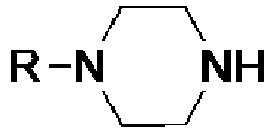
0.233±0.026 3.95 Phenyl-CO or NH 7 R-NH2 1.48±0.16 4.03 8 R-NH-Ac 0.811±0.095 4.07 c R-NH-CO-phenyl 1.86±0.54 5.19 10 R-NH-Boc 3.16±0.31 4.98 11 
0.197±0.029 3.85 12 
22.5±3.7 4.85 13 R-COOH 0.632±0.023 3.88 14 R-CONH(CH2)3NH2 0.588±0.043 0.92 Phenyl-halo or acyclic 15 R-Br >10 4.71 16 R-CH2CONH2 1.29±0.32 3.65 17 R-(CH2)2-CN 17.8±2.9 4.74 18 R-(CH2)3-NH2 0.292±0.067 1.60 19 R-C□CCH2-NH2 0.308±0.063 1.47 20 R-(CH2)3-NH-Boc 42.5±27.0 5.37 21 R-(CH2)4-OH 9.22±1.22 4.84 Phenyl-cyclic 22 
14.1±0.9 1.36 23 
8.91± 0.75 1.57 24 
18.8±2.0 5.41 25 
2.00±0.18 1.70 26 
>10 5.41 27 
2.86±0.44 4.73 28 
2.23±0.38 4.98 29 
0.296±0.013 4.44 30 
0.389±0.042 4.59 31 
0.895±0.122 3.65 Alternative scaffolds 32 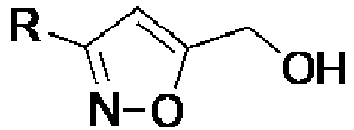
0.0150±0.0044 5.77 33 
7.40±1.05 4.36 Aza-scan of 3a 34 
1.69±0.28 4.16 35 
4.90±0.54 4.10 36 
2.92±0.31 4.01 a. p-Phenyl substituted, unless noted. IC50 values are mean ± SEM for 3-4 separate determinations, unless noted.
b. Reported in Yu et al.1, Jung et al.2 and Mufti et al.7
c. cLogP calculated using ALOGPS 2.1 program (www.vcclab.org/lab/alogps/).57Table 2 
No. R= IC50 (nM) Solubility (µg/mL) Log D7.4 e cLog Pc pH 4 pH 7.4 1 
7.96±0.35 1.10±0.07 0.36±0.03 1.86±0.02 6.18 4 
20.0±4.4 1.50±0.04 0.55±0.02 4.18±0.85f 6.32 105 b 
31.5±4.2 1.32±0.11 0.47±0.08 1.89±0.07f 5.79 106 
20.9±3.6 1.36±0.21 0.03±0.02 2.79±0.09f 6.48 107 
17.8±2.0 0.31±0.04 0.16±0.03 2.05±0.11f 6.55 108 b 
45.5±7.2 1.32±0.17 0.17±0.01 2.44±0.06f 5.99 109 b 
211±36 1.13±0.34 0.25±0.01 2.71±0.33f 5.97 110 b 
42.4±11.7 0.10±0.03 0.51±0.23 2.59±0.20f 5.67 111 b 
61.8±14.1 0.24±0.02 0.05±0.04 1.75±0.06f 5.67 112 b 
5.90±0.70 2.73±0.33 0.47±0.06 1.95+0.01f 5.95 113 b 
20.4±2.4 0.13±0.04 2.53±0.43 0.921±0.034 6.48 114 
3.11±0.62 1.22±0.05 0.77±0.21 1.92±0.09 5.95 115 
8.62±2.11 1.22±0.05g 0.77±0.21g 1.92±0.09g 5.95 116 
9.8±0.3 1.45±0.05 0.40±0.13 2.11±0.06 5.90 142 
64.1±18.8 0±0.03g 1.86±0.05g 0.545±0 6.48 117 
25.9±7.6 1.45±0.05g 0.40±0.13g 2.11±0.06g 5.90 118 
107±13 0±0.03 1.86±0.05 0.921±0.034 6.48 119 
101±70 0.31±0.14g 3.42±0.46g 0.490±0.030g 5.99 120 
39.5±9.8 0.31±0.14 3.42±0.46 0.490±0.030 5.99 121 
37.3±6.0 0.71±0.15 2.93±0.33 0.508±0.026 5.91 122 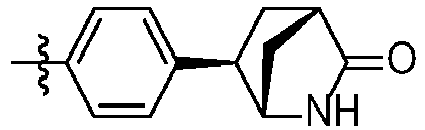
58.6±12.9 0.71±0.15g 2.93±0.33g 0.508±0.026g 5.91 123 
497±92 ND ND ND 5.70 125 a 
114±42 2.66±0.29 2.19±0.10 0.74±0.05 5.14 125 b 
15.6±7.0 1.55±0.11 0.74±0.06 0.96±0.02 5.14 125 c 
23.9±4.4 2.95±0.07 0.47±0.08 1.94±0.02 6.20 126 b 
25.1±3.9 0.80±0.05 0.49±0.06 1.74±0.02 6.22 127 
117±38 1.83±0.28 0.75±0.03 1.16±0.08f 5.02 128 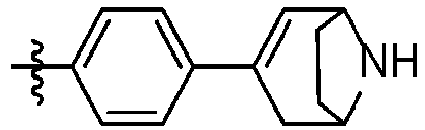
34.9±3.8 2.36±0.01 0.35±0.04 2.33±0.04f 6.02 129 
38.3±2.0 0.38±0.04 0.13±0.00 2.33±0.09f 6.27 130 
466±100 0.48±0.03 0.14±0.01 3.26±0.01f 7.61 131 
21.3±1.1 2.32±0.25 0.54±0.09 1.20+0.01f 5.12 132 
44.6 ±1.7 1.81±0.05 0.88±0.09 1.37±0.02f 6.41 133 
696±100 0.32±0.01 0.16±0.01 2.97±0.02f 6.17 142 
114±42 2.66±0.29 2.19±0.10 0.74±0.05 5.14 134 
10.8±2.1 4.97±0.11g 0.66±0.02g 0.957±0.046g 2.33 135 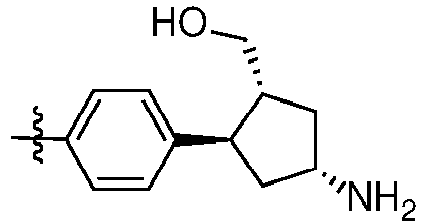
12.6±1.9 4.97±0.11 0.66±0.02 0.957±0.046 2.33 136 
100±19 3.74±0.09 0.93±0.20 1.06±0.05 2.35 137 
125±45 3.74±0.09g 0.93±0.20g 1.06±0.05g 2.35 138 
49.6±13.5 1.05±0.20g 5.52±0.21g -0.568±0.038g 2.26 139 
102±25 1.05±0.20 5.52±0.21 -0.568±0.038 2.26 140 
165±51 0.34±0.07 3.92±0.10 -0.478±0.050 2.31 141 
269±83 0.34±0.07g 3.92±0.10g -0.478±0.050g 2.31 201 d 
8900± 1160 ND ND ND 6.73 508 
15.7±2.5 ND ND ND 4.74 a IC50 for inhibition of hP2Y14R antagonist binding, determined using flow cytometry of whole hP2Y14R-CHO cells in the presence of a fixed concentration (20 nM) of fluorescent hP2Y14R antagonist 3 (mean±SEM, n = 3 - 6).
b Racemate.
c cLogP calculated using ALOGPS 2.1 program (www.vcclab.org/lab/alogps/).16
d Upon prolonged storage, some decomposition was observed.
e HPLC-based lipophilicity. HPLC column: Agilent Eclipse XDB-C18 (5 µm); Mobile phase: A: Acetonitrile, B: 10 mM TEAA, 10%-100% A in 20 min; Flow rate: 1 mL/min.
f Log D7.4 Calculated from retention factor difference between ligands and 1 (k = 3.41).
ND, not determined.
g Data taken from compound's enantiomer. - This Example illustrates a method of preparing compounds of formula (III). The synthesis includes a Grignard reaction of ketone starting materials for the generation of bromophenyl intermediates, Suzuki coupling of bromophenyl intermediates with boronic acid pinacol ester to obtain the phenylnaphthalenecarboxylate core structure, hydrolysis of esters to free carboxylic acid, Boc/benzyl deprotection to free amine, and conversion of analogues to their related ligands, as illustrated herein. Compound 405 with azetidine was prepared via Suzuki coupling between commercially available 3-(4-bromophenyl)azetidine 421 and naphthalenyl boronic acid pinacol ester 422 followed by ester hydrolysis.
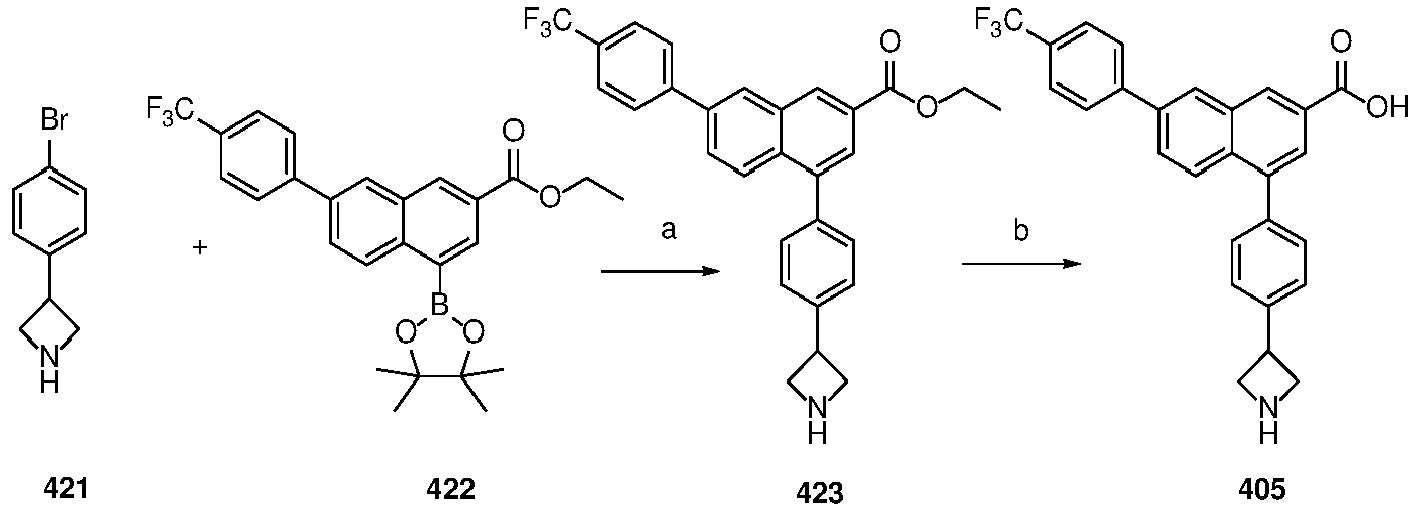
- This Example illustrates a method of preparation of PPTN analogues with 2-azaspiro[3.3]heptane, octahydrocyclopenta[c]pyrrole (B), 3-azabicyclo[3.1.1]heptane (C), 1-azacycloheptane (D), and azocane (E) were summarized in
Scheme 2. In a one-pot reaction, treatment of ketones 424, 428, 432, 436, and 440 with in-situ generated Grignard reagent 4-bromophenylmagnesium bromide provided bromophenyl intermediates 425, 429, 433, 437, and 441, respectively. Derived from a racemic starting material 428, intermediate 429 is a racemic mixture of left-handed and right-handed helix enantiomers. Stereoselective Grignard reaction of 432 yielded enantiomer 433 with hydroxyl group and one-carbon bridge identified as trans to each other. - The Suzuki coupling of naphthalenyl boronic acid pinacol ester 422 with the 4-(4-bromo-phenyl) intermediates 425, 429, 433, 437, and 441 gave their corresponding esters of analogues 426, 430, 434, 438, and 442. The ester hydrolysis of 426, 430, 434, 438, and 442 provided the derivatives 427, 431, 435, 439, and 443. Boc deprotection of 427 with TFA in DCM offered product 408 in addition to unexpected dehydrated product 407. Compound 408 was unstable in the reaction residue in the presence of methanol and partially reacted with methanol and methanol-d4 to give O-methylated ligand 409. Thus, methanol should be avoided if methylated by-product is not needed. Similarly, boc deprotection of 443 gave product 420 and dehydrated compound 419. Nevertheless, boc deprotection of 439 meanwhile dehydrated the hydroxyl group to yield alkene mixture 417. Boc deprotection of compound 435 simply gave ligand 415. Pd-catalyzed debenzylation of 431 with H2 afforded ligand 411, which was further dehydrated by refluxing in TFA to give 412. Reduction of 407, 412, 417, and 419 by Pd-catalyzed hydrogenation offered PPTN analogues 406 with 2-azaspiro[3.3]heptane, 413 with octahydrocyclopenta[c]pyrrole (B), 416 with 1-azacycloheptane (D), and 418 with azocane (E), respectively. Stereoselective deoxygenation of 415 with sodium borohydride in sulfuric acid afforded 414. Thus, hygroscopic sulfuric acid was employed to readily generate tertiary benzylic carbocation, which was further reduced by sodium borohydride to yield deoxygenated product.


- aReagents and conditions: (a) 4-bromophenylmagnesium bromide (in-situ generated: dibromobenzene, magnesium, THF, sonication, rt, 2 h), THF, 0 °C, 4 h; (b) boronic acid pinacol ester 422, Na2CO3, Pd(PPh3)4, DME-H2O (4:1), 85 °C, overnight; (c) LiOH, THF-MeOH-H2O (3:1:1), rt, 3 h; (d) TFA, DCM, rt, 1 h; (e) H2, Pd/C, DMF, 3 h; (f) H2, Pd/C, DMF, 5 h; (g) TFA, 90°C, 2 h; (h) NaBH4, THF, H2SO4, rt, 30 min;
- General Information. Materials and Methods. All chemicals and anhydrous solvents were obtained directly from commercial sources. All reactions were carried out under argon atmosphere using anhydrous solvents unless specified otherwise. Room temperature (rt) refers to 25 ± 5 °C. Silica-gel precoated with F254 on aluminum plates were used for TLC. The spots were examined under ultraviolet light at 254 nm and further visualized by anisaldehyde or cerium ammonium molybdate stain solution. Column chromatography was performed on silica gel (40-63 µm, 60 Å). NMR spectra were recorded on a
Bruker 400 MHz spectrometer. Chemical shifts are given in ppm (δ), calibrated to the residual solvent signal peaks of CDCl3 (7.26 ppm), CD3OD (3.31 ppm), or DMSO-d 6 (2.50 ppm) for 1H NMR with coupling constant (J) values reported in Hz. High resolution mass (HRMS) measurements were performed on a proteomics optimized Q-TOF-2 (Micromass-Waters). The RP-HPLC was performed usingPhenomenex Luna 5 µm C18(2)100A, AXIA, 21.2 mm × 250 mm column. Antagonist purity was determined as ≥ 95% using Agilent ZORBAX SB-Aq, 5 µm, 4.6 mm × 150 mm column attached to Agilent 1100 HPLC system. The HPLC traces for compounds tested in vivo (xxx) were included in Supporting Information. - 4-(4-(Azetidin-3-yl)phenyl)-7-(4-(trifluoromethyl)phenyl)-2-naphthoic acid (405). Procedure A. LiOH (7.4 mg, 0.3 mmol) was added to a solution of 423 (6.25 mg, 0.013 mmol) in THF-H2O-MeOH (3:1:1, 1 mL). The resulting mixture was sonicated for 30 s and stirred at rt for 3 h. The reaction was quenched and neutralized by 1 M HCl. Volatiles were evaporated, and the residue was purified by RP-HPLC (C18, A: ACN, B: 10 mM TEAA, 45% → 60% A in 40 min, flow rate = 5 mL/min, tR = 17.2 min) to give 405 as a white powder (2.73 mg, 47%): 1H NMR (400 MHz, MeOD) δ 8.76 (s, 1H), 8.44 (d, J = 2.0 Hz, 1H), 8.04 - 7.96 (m, 4H), 7.93 (dd, J = 8.8, 1.9 Hz, 1H), 7.81 (d, J = 8.1 Hz, 2H), 7.60 (s, 4H), 4.53 - 4.31 (m, 5H). HRMS m/z [M+H]+ for C27H21NO2F3 calculated 448.1524, found 448.1520.
- 4-(4-(2-Azaspiro[3.3]heptan-6-yl)phenyl)-7-(4-(trifluoromethyl)phenyl)-2-naphthoic acid (406). Procedure B. Pd/C (10%, 3 mg) was added to a solution of 407 (0.0016 mmol) in DMF (0.3 mL). The resulting mixture was bubbled with H2 at rt for 5 h. The Pd/C was filtered. Volatiles were evaporated, and the residue was purified by RP-HPLC (C18, A: ACN, B: 10 mM TEAA, 45% → 60% A in 40 min, flow rate = 5 mL/min, tR = 20 min) to give 406 as a white powder (0.4 mg, 51%): 1H NMR (400 MHz, MeOD) δ 8.74 (s, 1H), 8.43 (d, J = 2.0 Hz, 1H), 8.01 (dd, J = 8.7, 3.6 Hz, 3H), 7.96 - 7.89 (m, 2H), 7.81 (d, J = 8.1 Hz, 2H), 7.48 (d, J = 8.0 Hz, 2H), 7.42 (d, J = 8.0 Hz, 2H), 4.30 (s, 2H), 4.07 (s, 2H), 3.62 - 3.60 (m, 1H), 2.83 - 2.75 (m, 2H), 2.51 (td, J = 9.7, 2.9 Hz, 2H). HRMS m/z [M+H]+ for C30H25NO2F3 calculated 488.1837, found 488.1833.
- 4-(4-(2-Azaspiro[3.3]hept-5-en-6-yl)phenyl)-7-(4-(trifluoromethyl)phenyl)-2-naphthoic acid (407), 4-(4-(6-Hydroxy-2-azaspiro[3.3]heptan-6-yl)phenyl)-7-(4-(trifluoromethyl)phenyl)-2-naphthoic acid (408), and 4-(4-(6-Methoxy-2-azaspiro[3.3]heptan-6-yl)phenyl)-7-(4-(trifluoromethyl)phenyl)-2-naphthoic acid and 4-(4-(6-(methoxy-d3)-2-azaspiro[3.3]heptan-6-yl)phenyl)-7-(4-(trifluoromethyl)phenyl)-2-naphthoic acid (6:4, 409). A TFA solution in THF (67%, 4.5 mL) was added to 427 (all residue from hydrolysis of 426, 0.057 mmol). The resulting mixture was stirred at rt for 1 h. The stir bar was washed with MeOH. Volatiles were evaporated, and the residue was dissolved in MeOD for crude NMR. MeOD was removed and the residue was purified by RP-HPLC (C18, A: ACN, B: 10 mM TEAA, 45% → 60% A in 40 min, flow rate = 5 mL/min) to give 407 (1.8 mg, 7%, tR = 42.4 min), 408 (2.54 mg, 9%, tR = 33.0 min), and 409 (10.5 mg, 36%, tR = 40.6 min). 407 has: 1H NMR (400 MHz, MeOD) δ 8.76 (s, 1H), 8.43 (d, J = 1.9 Hz, 1H), 8.04 - 7.97 (m, 4H), 7.97 - 7.91 (m, 1H), 7.81 (d, J = 8.1 Hz, 2H), 7.62 (d, J = 7.9 Hz, 2H), 7.56 (d, J = 8.0 Hz, 2H), 6.55 (s, 1H), 4.42 - 4.31 (m, 4H), 3.20 (s, 2H). HRMS m/z [M+H]+ for C30H23NO2F3 calculated 486.1681, found 486.1682. 408 has: 1H NMR (400 MHz, MeOD) δ 8.72 (s, 1H), 8.41 (d, J = 1.9 Hz, 1H), 7.99 (d, J = 8.7 Hz, 4H), 7.90 (dd, J = 8.9, 1.9 Hz, 1H), 7.80 (d, J = 8.1 Hz, 2H), 7.62 (d, J = 8.0 Hz, 2H), 7.54 (d, J = 7.9 Hz, 2H), 4.30 (s, 2H), 4.09 (s, 2H), 2.94 (d, J = 13.0 Hz, 2H), 2.66 (d, J = 12.5 Hz, 2H). HRMS m/z [M+H]+ for C30H25NO3F3 calculated 504.1787, found 504.1796. 409 has: 1H NMR (600 MHz, MeOD) δ 8.77 - 8.74 (m, 1H), 8.44 (d, J = 1.9 Hz, 1H), 8.05 - 8.00 (m, 4H), 7.94 (dd, J = 8.8, 2.0 Hz, 1H), 7.83 (d, J = 8.2 Hz, 2H), 7.63 - 7.55 (m, 4H), 4.27 (s, 2H), 4.08 (s, 2H), 3.07 (s, 2H), 2.91 - 2.84 (m, 2H), 2.80 - 2.74 (m, 2H). HRMS m/z [M+H]+ for C31H27NO3F3 calculated 518.1943, found 518.1939; for C31H24D3NO3F3 calculated 521.2117, found 521.2126.
- rac-4-(4-((3aR,6aR)-5-hydroxyoctahydrocyclopenta[c]pyrrol-5-yl)phenyl)-7-(4-(trifluoromethyl)phenyl)-2-naphthoic acid (411). Pd/C (10%, 53 mg) was added to a solution of 431 (10.7 mg, 0.0177 mmol) in DMF (5 mL). The resulting mixture was bubbled with H2 at rt for 5 h. The Pd/C was filtered. The filtrate was purified by RP-HPLC (C18, A: ACN, B: 10 mM TEAA, 30% -> 50% A in 40 min, flow rate = 5 mL/min, tR = 35 min) to give 411 as a white powder (3.18 mg, 35% overall yield from 430): 1H NMR (400 MHz, MeOD) δ 8.75 (s, 1H), 8.43 (d, J= 2.0 Hz, 1H), 8.05 - 7.96 (m, 4H), 7.93 (dd, J = 9.0, 2.0 Hz, 1H), 7.81 (d, J = 8.1 Hz, 2H), 7.69 (d, J = 8.2 Hz, 2H), 7.54 (d, J = 8.0 Hz, 2H), 3.56 - 3.46 (m, 2H), 2.98 (t, J = 11.2 Hz, 2H), 2.76 - 2.65 (m, 1H), 2.60 - 2.45 (m, 2H), 2.22 (dd, J = 12.6, 5.4 Hz, 1H), 2.06 - 1.95 (m, 2H). HRMS m/z [M+H]+ for C31H27NO3F3 calculated 518.1943, found 518.1944.
- rac-4-(4-((3aR,6aR)-1,2,3,3a,4,6a-Hexahydrocyclopenta[c]pyrrol-5-yl)phenyl)-7-(4-(trifluoromethyl)phenyl)-2-naphthoic acid (412). A solution of 411 (0.012 mmol, crude reaction residue without HPLC purification) in TFA (2 mL) was refluxed in a 90 °C oil bath for 2 h. Volatiles were evaporated, and the residue was purified by RP-HPLC (C18, A: ACN, B: 10 mM TEAA, 45% -> 60% A in 40 min, flow rate = 5 mL/min, tR = 21 min) to give 412 as a white powder (1.9 mg, 33% overall yield from 431): 1H NMR (400 MHz, MeOD) δ 8.75 (s, 1H), 8.43 (d, J = 2.0 Hz, 1H), 8.07 - 7.96 (m, 4H), 7.94 (dd, J = 8.9, 2.0 Hz, 1H), 7.81 (d, J = 8.1 Hz, 2H), 7.68 (d, J = 8.1 Hz, 2H), 7.53 (d, J = 8.0 Hz, 2H), 6.61 (s, 1H), 3.62 (d, J = 3.3 Hz, 1H), 3.53 (dd, J = 10.2, 6.5 Hz, 1H), 3.26 - 3.15 (m, 1H), 3.04 (d, J = 7.0 Hz, 2H), 2.99 (dd, J = 14.4, 6.0 Hz, 1H), 2.68 - 2.55 (m, 1H), 2.40 (dq, J = 11.9, 5.9 Hz, 1H). HRMS m/z [M+H]+ for C31H25NO2F3 calculated 500.1837, found 500.1834.
- rac-4-(4-((3aR,6aR)-Octahydrocyclopenta[c]pyrrol-5-yl)phenyl)-7-(4-(trifluoromethyl)phenyl)-2-naphthoic acid (413). Treatment of 412 (0.021 mmol, crude reaction residue without HPLC purification) by using Procedure B gave 413 (0.57 mg, 5% overall yield from 431) as a white powder: 1H NMR (400 MHz, MeOD) δ 8.74 (s, 1H), 8.42 (d, J = 1.9 Hz, 1H), 8.06 - 7.95 (m, 4H), 7.93 (d, J = 8.4 Hz, 1H), 7.81 (d, J = 8.0 Hz, 2H), 7.49 (s, 4H), 4.01 (d, J = 9.2 Hz, 1H), 3.48 (p, J = 6.4 Hz, 2H), 3.03 - 2.86 (m, 2H), 2.59 (dd, J = 12.8, 6.4 Hz, 1H), 2.47 - 2.29 (m, 2H), 2.17 - 1.98 (m, 2H), 1.64 (q, J = 11.0 Hz, 1H). HRMS m/z [M+H]+ for C31H27NO2F3 calculated 502.1994, found 502.1986.
- 4-(4-((1R,5S,6r)-3-Azabicyclo[3.1.1]heptan-6-yl)phenyl)-7-(4-(trifluoromethyl)phenyl)-2-naphthoic acid (414). Concentrated sulfuric acid (95-98%, 0.9 mL) was added to a mixture of 415 (9 mg, 0.015 mmol) and NaBH4 (5.7 mg, 0.15 mmol) in THF (0.1 mL) under argon (caution, running the reaction under argon is required to avoid fire/explosion). The resulting solution was stirred at rt for 30 min. The mixture was basified with cold 6 N NaOH aqueous solution and extracted with ethyl acetate three times. The organic layer was dried over anhydrous Na2SO4. Volatiles were evaporated, and the residue was purified by RP-HPLC (C18, A: ACN, B: 10 mM TEAA, 35% → 55% A in 40 min, flow rate = 5 mL/min, tR = 38.8 min) to give 414 as a white powder (0.8 mg, 11%): 1H NMR (400 MHz, MeOD) δ 8.76 (s, 1H), 8.44 (d, J = 2.0 Hz, 1H), 8.07 - 7.96 (m, 4H), 7.96 - 7.90 (m, 1H), 7.81 (d, J = 8.1 Hz, 2H), 7.56 (d, J = 7.8 Hz, 2H), 7.38 (d, J = 7.7 Hz, 2H), 4.09 (q, J = 9.6 Hz, 1H), 3.62 (t, J = 7.2 Hz, 1H), 3.42 - 3.33 (m, 3H), 3.23 (dd, J = 16.7, 7.1 Hz, 2H), 2.74 (q, J = 9.1 Hz, 1H), 2.33 (q, J = 10.5 Hz, 1H). HRMS m/z [M+H]+ for C30H24F3NO2 calculated 488.1837, found 488.1829.
- 4-(4-((1R,5S,6r)-6-Hydroxy-3-azabicyclo[3.1.1]heptan-6-yl)phenyl)-7-(4-(trifluoromethyl)phenyl)-2-naphthoic acid (415). Procedure C. A TFA solution in THF (67%, 2 mL) was added to 435 (0.022 mmol, reaction residue). The resulting mixture was stirred at rt for 1 h. Volatiles were evaporated, and the residue was purified by RP-HPLC (C18, A: ACN, B: 10 mM TEAA, 35% → 55% A in 40 min, flow rate = 5 mL/min, tR = 27.7 min) to give 415 (4.6 mg, 42%) as a white solid: 1H NMR (400 MHz, DMSO) δ 8.76 (s, 1H), 8.65 (d, J = 2.0 Hz, 1H), 8.06 (t, J = 8.2 Hz, 3H), 7.98 (d, J = 8.9 Hz, 1H), 7.92 - 7.85 (m, 3H), 7.73 (d, J = 7.9 Hz, 2H), 7.59 (d, J = 7.8 Hz, 2H), 3.69 (d, J = 11.7 Hz, 2H), 3.47 (d, J = 11.9 Hz, 2H), 2.89 (d, J = 4.5 Hz, 2H), 1.71 (s, 2H). HRMS m/z [M+H]+ for C30H25NO3F3 calculated 504.1787, found 504.1793.
- 4-(4-(Azepan-4-yl)phenyl)-7-(4-(trifluoromethyl)phenyl)-2-naphthoic acid (416). Treatment of 417 (0.038 mmol, crude reaction residue without HPLC purification) by using Procedure B gave 416 (4 mg, 22% overall yield from 438) as a white powder: 1H NMR (400 MHz, MeOD) δ 8.77 - 8.72 (m, 1H), 8.42 (d, J = 1.9 Hz, 1H), 8.05 - 7.95 (m, 4H), 7.92 (dd, J = 8.9, 1.9 Hz, 1H), 7.81 (d, J = 8.1 Hz, 2H), 7.48 (q, J = 8.1 Hz, 4H), 3.54 - 3.35 (m, 4H), 3.02 (t, J = 10.9 Hz, 1H), 2.22 (d, J = 15.9 Hz, 4H), 2.09 - 1.86 (m, 2H). HRMS m/z [M+H]+ for C30H27NO2F3 calculated 490.1994, found 490.1992.
- Mixture of 4-(4-(2,3,6,7-Tetrahydro-1H-azepin-4-yl)phenyl)-7-(4-(trifluoromethyl)phenyl)-2-naphthoic acid and 4-(4-(2,5,6,7-tetrahydro-1H-azepin-4-yl)phenyl)-7-(4-(trifluoromethyl)phenyl)-2-naphthoic acid (417). Treatment of 439 (all residue from hydrolysis of 438, 0.057 mmol) by using Procedure C gave 417 (5.08 mg, 18%) as a mixture of two constitutional isomers (1:1): 1H NMR (400 MHz, MeOD) δ 8.76 (d, J = 2.8 Hz, 1H), 8.43 (d, J = 2.4 Hz, 1H), 8.05 - 7.97 (m, 4H), 7.97 - 7.90 (m, 1H), 7.81 (d, J = 8.1 Hz, 2H), 7.66 - 7.49 (m, 4H), 6.35 (t, J = 6.2 Hz, 0.5H), 6.21 (t, J = 6.5 Hz, 0.5H), 3.99 (d, J = 6.5 Hz, 1H), 3.59 - 3.49 (m, 1H), 3.48 - 3.41 (m, 1H), 3.39 - 3.32 (m, 1H), 3.14 - 3.05 (m, 1H), 3.06 - 2.99 (m, 1H), 2.74 (d, J = 5.5 Hz, 1H), 2.14 (d, J = 5.7 Hz, 1H). HRMS m/z [M+H]+ for C30H25NO2F3 calculated 488.1837, found 488.1835.
- 4-(4-(1,2,3,4,7,8-Hexahydroazocin-5-yl)phenyl)-7-(4-(trifluoromethyl)phenyl)-2-naphthoic acid (419) and 4-(4-(5-hydroxyazocan-5-yl)phenyl)-7-(4-(trifluoromethyl)phenyl)-2-naphthoic acid (420). Treatment of 443 (all residue from hydrolysis of 442, 0.049 mmol) by using Procedure C gave 419 (4.52 mg, 18%) in addition to 420 (4.67 mg, 18%). 419 has: 1H NMR (400 MHz, MeOD) δ 8.72 (s, 1H), 8.40 (d, J = 2.0 Hz, 1H), 8.03 - 7.95 (m, 5H), 7.90 (dd, J = 9.0, 2.0 Hz, 1H), 7.78 (d, J = 8.1 Hz, 3H), 7.66 (d, J = 8.0 Hz, 3H), 7.51 (d, J = 8.0 Hz, 2H), 6.28 (t, J = 8.3 Hz, 1H), 3.35 - 3.28 (m, 2H), 3.25 - 3.21 (m, 2H), 2.90 (t, J = 6.3 Hz, 2H), 2.72 (dd, J = 12.0, 7.5 Hz, 2H), 2.08 (s, 2H). HRMS m/z [M+H]+ for C31H26NO2F3 calculated 502.1994, found 502.2001. 20 has: 1H NMR (400 MHz, MeOD) δ 8.75 (s, 1H), 8.42 (d, J = 1.9 Hz, 1H), 8.00 - 7.94 (m, 4H), 7.91 (dd, J = 8.9, 1.9 Hz, 1H), 7.78 (d, J = 8.1 Hz, 2H), 7.70 (d, J = 8.4 Hz, 2H), 7.65 (d, J = 8.5 Hz, 2H), 3.85 (dt, J = 13.3, 7.0 Hz, 2H), 3.41 (dt, J = 12.5, 6.7 Hz, 2H), 2.70 (dt, J = 13.5, 6.8 Hz, 2H), 2.47 (dt, J = 13.5, 6.7 Hz, 2H), 2.35 (dp, J = 13.7, 6.8 Hz, 2H), 2.24 (dq, J = 13.5, 6.8 Hz, 2H). HRMS m/z [M - OH-]+ for C31H27NO2F3 calculated 502.1994, found 502.1993.Ethyl 4-(4-(azetidin-3-yl)phenyl)-7-(4-(trifluoromethyl)phenyl)-2-naphthoate (423). Procedure D. To a vacuum dried mixture of 421 (5.8 mg, 0.023 mmol), 422 (11 mg, 0.023 mmol), Pd(PPh3)4 (2.7 mg, 0.0023 mmol), and Na2CO3 (6 mg, 0.057 mmol) was added sonicated 1,2-dimethoxyethane-water (4:1, 1 mL). The reaction mixture was degassed with argon for 10 min and then stirred at 80°C overnight. Volatiles were evaporated, and the residue was column chromatographed (CH2Cl2/MeOH/TEA, 100:0:1→90:10:1) to give 423 (6.25 mg, 57%): 1H NMR (400 MHz, CDCl3) δ 8.68 (s, 1H), 8.22 (d, J = 1.9 Hz, 1H), 8.01 (d, J = 1.7 Hz, 1H), 7.97 (d, J = 8.8 Hz, 1H), 7.86 - 7.77 (m, 3H), 7.75 (d, J = 8.3 Hz, 2H), 7.61 (d, J = 7.9 Hz, 2H), 7.55 (d, J = 8.0 Hz, 2H), 4.57 - 4.41 (m, 5H), 3.15 (q, J = 7.3 Hz, 2H), 1.44 (td, J = 7.2, 4.1 Hz, 3H). HRMS m/z [M+H]+ for C32H29NO2F3 calculated 516.2150, found 516.2145. HRMS m/z [M+H]+ for C29H25NO2F3 calculated 476.1837, found 476.1837.
- tert-Butyl 6-(4-bromophenyl)-6-hydroxy-2-azaspiro[3.3]heptane-2-carboxylate (425). Procedure E. A mixture of 1,4-dibromobenzene (2.9 g, 12.5 mmol) and magnesium turnings (60.8 mg, 2.5 mmol) in THF (5 mL) was sonicated for 2 h. The solution was cooled to 0 °C. Into the Grignard reagent was added the solution of 424 (105.6 mg, 0.5 mmol) in THF (10 mL). The resulting mixture was stirred at 0 °C to rt overnight. The residue was partitioned between ethyl acetate and aqueous NaHCO3. The organic layer was dried over anhydrous Na2SO4. Volatiles were evaporated, and the residue was column chromatographed (hexane/ethyl acetate = 80:20 → 40:60) to give 425 (72.3 mg; 39%): 1H NMR (400 MHz, CDCl3) δ 7.50 - 7.44 (m, 2H), 7.29 - 7.24 (m, 2H), 4.05 (s, 2H), 3.78 (s, 2H), 2.72 - 2.66 (m, 2H), 2.52 (d, J = 12.7 Hz, 2H), 1.41 (s, 9H). HRMS m/z [M - t-butyl+2H]+ for C13H15N79BrO3 calculated 312.0235, found 312.0234.
- tert-Butyl 6-(4-(3-(ethoxycarbonyl)-6-(4-(trifluoromethyl)phenyl)naphthalen-1-yl)phenyl)-6-hydroxy-2-azaspiro[3.3]heptane-2-carboxylate (426). Treatment of 425 (25.6 mg, 0.07 mmol) by using Procedure D gave 426 (36.12 mg, 82%): 1H NMR (400 MHz, CDCl3) δ 8.68 (s, 1H), 8.22 (d, J = 1.8 Hz, 1H), 8.06 - 7.96 (m, 2H), 7.81 (d, J = 8.1 Hz, 2H), 7.76 (td, J = 6.8, 3.3 Hz, 3H), 7.57 (d, J = 8.0 Hz, 2H), 7.52 (d, J = 8.1 Hz, 2H), 4.46 (q, J = 7.1 Hz, 2H), 4.13 (s, 2H), 3.90 (s, 2H), 2.87 (d, J = 12.8 Hz, 2H), 2.64 (d, J = 12.6 Hz, 2H), 1.44 (d, J = 9.7 Hz, 12H). HRMS m/z [M+Na]+ for C37H36NO5F3Na calculated 654.2443, found 654.2446.
- 4-(4-(2-(tert-Butoxycarbonyl)-6-hydroxy-2-azaspiro[3.3]heptan-6-yl)phenyl)-7-(4-(trifluoromethyl)phenyl)-2-naphthoic acid (427). Treatment of 426 (36 mg, 0.057 mmol) by using Procedure A (without HPLC purification) gave 427 of sufficient purity to be used in next step: 1H NMR (400 MHz, MeOD) δ 8.50 (s, 1H), 8.21 (s, 1H), 7.91 - 7.80 (m, 4H), 7.67 (dd, J = 14.7, 9.8 Hz, 3H), 7.52 - 7.45 (m, 2H), 7.37 (t, J = 5.3 Hz, 2H), 3.98 (s, 2H), 3.76 (s, 2H), 2.73 (d, J = 12.1 Hz, 2H), 2.52 - 2.45 (m, 2H), 1.32 (d, J = 3.8 Hz, 9H). HRMS m/z [M+Na]+ for C35H32NO5F3Na calculated 626.2130, found 626.2136.
- rac-(3aR,6aR)-2-Benzyl-5-(4-bromophenyl)octahydrocyclopenta[c]pyrrol-5-ol (29). Treatment of 428 (125.9 mg, 0.5 mmol) by using Procedure E (column chromatography; DCM/MeOH, 100:0→95:5) gave 429 (101.18 mg, 54%): 1H NMR (400 MHz, CDCl3) δ 7.48 - 7.40 (m, 2H), 7.40 - 7.20 (m, 7H), 3.94 - 3.78 (m, 2H), 2.88 (dq, J = 9.6, 4.5 Hz, 2H), 2.80 (s, 1H), 2.50 (tdt, J = 16.7, 11.3, 8.9 Hz, 3H), 2.29 (dd, J = 12.7, 7.1 Hz, 1H), 2.18 (dtd, J = 16.1, 11.4, 5.6 Hz, 1H), 1.97 (dd, J = 12.6, 4.7 Hz, 1H), 1.76 - 1.61 (m, 2H). HRMS m/z [M+H]+ for C20H23NO79Br calculated 372.0963, found 372.0966.
- rac-Ethyl 4-(4-((3aR,6aR)-2-benzyl-5-hydroxyoctahydrocyclopenta[c]pyrrol-5-yl)phenyl)-7-(4-(trifluoromethyl)phenyl)-2-naphthoate (30). Treatment of 429 (26.1 mg, 0.07 mmol) by using Procedure D gave 430 (33.7 mg, 76%): 1H NMR (400 MHz, CDCl3) δ 8.65 (s, 1H), 8.20 (d, J = 1.9 Hz, 1H), 8.04 - 7.95 (m, 2H), 7.79 (d, J = 8.2 Hz, 2H), 7.76 - 7.68 (m, 3H), 7.60 (d, J = 8.1 Hz, 2H), 7.54 (d, J = 7.4 Hz, 2H), 7.48 (d, J = 8.0 Hz, 2H), 7.36 (dt, J = 13.7, 7.2 Hz, 3H), 4.44 (q, J = 7.1 Hz, 2H), 4.14 (s, 2H), 3.32 - 3.17 (m, 2H), 2.99 - 2.76 (m, 3H), 2.57 - 2.42 (m, 2H), 2.20 (dd, J = 12.6, 5.2 Hz, 1H), 1.94 (dt, J = 17.9, 12.1 Hz, 2H), 1.44 (t, J = 7.1 Hz, 3H). HRMS m/z [M+H]+ for C40H37NO3F3 calculated 636.2726, found 636.2724.
- rac-4-(4-((3aR,6aR)-2-Benzyl-5-hydroxyoctahydrocyclopenta[c]pyrrol-5-yl)phenyl)-7-(4-(trifluoromethyl)phenyl)-2-naphthoic acid (31). Treatment of 430 (33.7 mg, 0.053 mmol) by using Procedure A (without HPLC purification) gave 431 of sufficient purity to be used in next step: 1H NMR (400 MHz, MeOD) δ 8.59 (s, 1H), 8.30 (s, 1H), 8.00 (s, 1H), 7.92 (dd, J = 8.5, 5.3 Hz, 3H), 7.74 (d, J = 7.5 Hz, 3H), 7.65 (dd, J = 15.8, 6.5 Hz, 4H), 7.51 - 7.39 (m, 5H), 4.62 - 4.50 (m, 2H), 3.54 (d, J = 12.9 Hz, 2H), 3.22 (q, J = 13.9 Hz, 2H), 2.94 - 2.66 (m, 2H), 2.47 (dd, J = 13.2, 7.1 Hz, 1H), 2.18 (dd, J = 12.8, 5.0 Hz, 1H), 1.97 (q, J = 11.3 Hz, 2H). HRMS m/z [M+H]+ for C38H33NO3F3 calculated 608.2413, found 608.2408.
- tert-Butyl (1R,5S,6r)-6-(4-bromophenyl)-6-hydroxy-3-azabicyclo[3.1.1]heptane-3-carboxylate (433). Treatment of 432 (105.65 mg, 0.5 mmol) by using Procedure E gave 33 (99.36 mg, 54%): 1H NMR (400 MHz, CDCl3) δ 7.50 (dd, J = 8.7, 2.3 Hz, 2H), 7.39 (d, J = 8.5 Hz, 2H), 3.82 - 3.66 (m, 4H), 2.82 - 2.76 (m, 1H), 2.71 - 2.63 (m, 1H), 1.55 (dt, J = 11.4, 6.2 Hz, 1H), 1.45 (d, J = 2.5 Hz, 9H), 1.33 (d, J = 10.1 Hz, 1H). HRMS m/z [M - t-butyl+2H]+ for C13H15N79BrO3 calculated 312.0235, found 312.0234.
- tert-Butyl (1R,5S,6r)-6-(4-(3-(ethoxycarbonyl)-6-(4-(trifluoromethyl)phenyl)naphthalen-1-yl)phenyl)-6-hydroxy-3-azabicyclo[3.1.1]heptane-3-carboxylate (434). Treatment of 433 (25.8 mg, 0.07 mmol) by using Procedure D gave 434 (41 mg, 93%): 1H NMR (400 MHz, CDCl3) δ 8.69 (d, J = 1.6 Hz, 1H), 8.23 (d, J = 1.9 Hz, 1H), 8.07 - 8.01 (m, 2H), 7.81 (d, J = 8.2 Hz, 2H), 7.79 - 7.73 (m, 3H), 7.71 (d, J = 8.0 Hz, 2H), 7.56 (d, J = 8.0 Hz, 2H), 4.45 (q, J = 7.1 Hz, 2H), 3.94 - 3.77 (m, 4H), 3.02 - 2.94 (m, 1H), 2.88 (d, J = 6.7 Hz, 1H), 1.74 (dt, J = 11.4, 6.1 Hz, 1H), 1.52 (s, 9H), 1.48 - 1.40 (m, 4H). HRMS m/z [M - Boc - O]+ for C32H27NO2F3 calculated 514.1994, found 514.2001.
- 4-(4-((1R,5S,6r)-3-(tert-Butoxycarbonyl)-6-hydroxy-3-azabicyclo[3.1.1]heptan-6-yl)phenyl)-7-(4-(trifluoromethyl)phenyl)-2-naphthoic acid (435). Treatment of 434 (41 mg, 0.065 mmol) by using Procedure A (without HPLC purification) gave 435 of sufficient purity to be used in next step: 1H NMR (400 MHz, MeOD) δ 8.58 (s, 1H), 8.31 (d, J = 1.9 Hz, 1H), 8.04 (d, J = 1.6 Hz, 1H), 7.97 (dd, J = 8.6, 3.2 Hz, 3H), 7.81 - 7.74 (m, 3H), 7.72 (d, J = 7.9 Hz, 2H), 7.53 (t, J = 6.6 Hz, 2H), 3.84 - 3.69 (m, 4H), 2.96 - 2.82 (m, 2H), 1.69 (dt, J = 11.1, 6.0 Hz, 1H), 1.36 (d, J = 9.7 Hz, 1H). MS m/z [M - Boc - O]+ for C30H23NO2F3 calculated 486.2, found 486.2.
- tert-Butyl 4-(4-bromophenyl)-4-hydroxyazepane-1-carboxylate (437). Treatment of 436 (106.65 mg, 0.5 mmol) by using Procedure E gave 37 (135 mg, 73%): 1H NMR (400 MHz, CDCl3) δ 7.45 (d, J = 8.0 Hz, 2H), 7.32 (d, J = 8.3 Hz, 2H), 3.92 - 3.47 (m, 2H), 3.32 (d, J = 11.3 Hz, 2H), 2.27 - 1.67 (m, 7H), 1.47 (d, J = 4.1 Hz, 9H).
- tert-Butyl 4-(4-(3-(ethoxycarbonyl)-6-(4-(trifluoromethyl)phenyl)naphthalen-1-yl)phenyl)-4-hydroxyazepane-1-carboxylate (438). Treatment of 437 (38.9 mg, 0.105 mmol) by using Procedure D gave 438 (36.4 mg, 82%): 1H NMR (400 MHz, CDCl3) δ 8.67 (s, 1H), 8.22 (s, 1H), 8.03 (d, J = 9.4 Hz, 2H), 7.81 (d, J = 8.1 Hz, 2H), 7.74 (d, J = 8.0 Hz, 3H), 7.62 (d, J = 8.1 Hz, 2H), 7.55 - 7.45 (m, 2H), 4.46 (q, J = 7.1 Hz, 2H), 3.93 - 3.53 (m, 2H), 3.45 - 3.34 (m, 2H), 2.35 - 2.05 (m, 3H), 1.99 - 1.68 (m, 4H), 1.51 (s, 9H), 1.45 (t, J = 7.2 Hz, 3H). HRMS m/z [M + Na]+ for C37H38NO5F3Na calculated 656.2600, found 656.2589.
- 4-(4-(1-(tert-Butoxycarbonyl)-4-hydroxyazepan-4-yl)phenyl)-7-(4-(trifluoromethyl)phenyl)-2-naphthoic acid (439). Treatment of 438 (36.4 mg, 0.057 mmol) by using Procedure A (without HPLC purification) gave 439 of sufficient purity to be used in next step: 1H NMR (400 MHz, MeOD) δ 8.34 (s, 1H), 8.08 (s, 1H), 7.80 (s, 1H), 7.74 (d, J = 8.1 Hz, 3H), 7.55 (d, J = 8.0 Hz, 3H), 7.39 (d, J = 8.1 Hz, 2H), 7.25 (d, J = 7.2 Hz, 2H), 3.46 (s, 2H), 3.23 - 3.16 (m, 2H), 2.16 - 1.51 (m, 6H), 1.27 (s, 9H). MS m/z [M - Boc - O]+ for C30H25NO2F3 calculated 488.1837, found 488.1840.
- tert-Butyl 5-(4-bromophenyl)-5-hydroxyazocane-1-carboxylate (441). Treatment of 440 (113.65 mg, 0.5 mmol) by using Procedure E gave 441 (155 mg, 81%): 1H NMR (400 MHz, CDCl3) δ 7.44 - 7.39 (m, 2H), 7.37 - 7.32 (m, 2H), 3.46 - 3.24 (m, 4H), 2.06 - 1.77 (m, 6H), 1.58 - 1.45 (m, 2H), 1.44 (s, 9H). HRMS m/z [M - t-butyl+H - OH-]+ for C14H17N79BrO2 calculated 310.0443, found 310.0437.
- tert-Butyl 5-(4-(3-(ethoxycarbonyl)-6-(4-(trifluoromethyl)phenyl)naphthalen-1-yl)phenyl)-5-hydroxyazocane-1-carboxylate (442). Treatment of 441 (26.9 mg, 0.07 mmol) by using Procedure D gave 442 (35.5 mg, 78%): 1H NMR (400 MHz, CDCl3) δ 8.68 (s, 1H), 8.22 (d, J = 1.9 Hz, 1H), 8.07 - 8.00 (m, 2H), 7.81 (d, J = 8.1 Hz, 2H), 7.78 - 7.71 (m, 3H), 7.66 (d, J = 8.1 Hz, 2H), 7.54 - 7.47 (m, 2H), 4.46 (q, J = 7.1 Hz, 2H), 3.56 - 3.37 (m, 5H), 2.27 - 2.06 (m, 2H), 2.00 (d, J = 14.6 Hz, 4H), 1.71 (s, 2H), 1.50 (s, 9H), 1.45 (t, J = 7.1 Hz, 3H). MS m/z [M - Boc - O]+ for C33H31NO2F3 calculated 530.2, found 530.2.
- 4-(4-(1-(tert-Butoxycarbonyl)-5-hydroxyazocan-5-yl)phenyl)-7-(4-(trifluoromethyl)phenyl)-2-naphthoic acid (443). Treatment of 442 (32 mg, 0.049 mmol) by using Procedure A (without HPLC purification) gave 443 of sufficient purity to be used in next step: 1H NMR (400 MHz, MeOD) δ 8.57 (s, 1H), 8.32 - 8.28 (m, 1H), 8.05 - 8.01 (m, 1H), 7.96 (d, J = 8.3 Hz, 3H), 7.82 - 7.73 (m, 3H), 7.67 (d, J = 7.9 Hz, 2H), 7.46 (d, J = 7.9 Hz, 2H), 3.56 (q, J = 11.3 Hz, 2H), 3.45 - 3.28 (m, 2H), 2.27 - 1.87 (m, 6H), 1.67 - 1.53 (m, 2H), 1.49 (s, 9H). MS m/z [M - Boc - O]+ for C31H27NO2F3 calculated 502.1994, found 502.1990.
- This Example illustrates the affinity of compounds of formula (III). The affinity was determined using a whole cell fluorescent binding assay, which was shown to underestimate the actual affinity.
No. MRS # R= IC50 (nM) 4-membered rings 405 MRS4827 
65.9±19.3 406 MRS4838 
46.6±7.1 407 MRS4821 
9.69±3.56 408 MRS4820 
20.8±5.6 409 MRS4829 
46.5±10.0 5-membered rings 410 MRS4664d 
31.5±4.2 411 MRS4822a 
9.48±1.66 412 MRS4823a 
16.6±3.2 413 MRS4824a 
32.0±11.2 6-membered rings 421 PPTNd 
7.96±0.35 422 MRS4608d 
20.0±4.4 423 MRS4738d 
3.11±0.62 424 MRS4837 
524±104 425 MRS4833 
5.92±0.55 7-membered rings 426 MRS4826 
9.58±5.14 427 MRS4825b 
11.9±3.6 
8-membered rings 428 MRS4835 
TBD 429 MRS4832 
58.4±16.4 430 MRS4831 
1780±440 - This example demonstrates the species dependence of binding of various P2Y14R antagonists, as determined in a fluorescent antagonist binding assay in whole cells (N = 3-4). As is apparent from the results set forth in Table 2,
compound 29 had slightly enhanced affinity (IC50 184 nM) at the mP2Y14R vs the human homologue, while 11, 19 and 32 had nearly the same affinity in the two species. Desirably, receptor affinity is maintained across species, facilitating performance in in vivo preclinical testing in small animals, with the mouse being the most commonly used species in initial evaluation.Table 2 Compound mP2Y14R, IC50 (nM)a hP2Y14R, IC50 (nM)a 1b b 29.7±9.3 27.6±4.3 3a b142±58 31.7±8.0 4 b 384±88 169±42 5 b 902±344 269±121 6 b 499±57 233±26 11 155±79 197±29 19 375±175 308±63 29 184±24 296±13 32 18.6±8.4 15.0±4.4 a Fluorescent binding assays using 2 (20 nM, for a 45 min incubation) as tracer. The hP2Y14R was stably expressed in CHO cells, and the mP2Y14R was stably expressed in HEK293 cells.
b Data from Jung et al.2 and Mufti et al.7 - This example demonstrates some properties of
amidomethyl ester prodrugs 37a-c.a The results are set forth in Table 3. The triazole-containingcompound 37a was the most rapidly cleaved, while the naphthalene-containingcompounds Table 3 Compound (molecular charge, pH 7) MW, TPSA (Å2) cLogPb Parent drug t 1/2 (min, mean±SEM) for esterase cleavage c37a (+1) 577.2, 86.6 4.59 3a 20.2±1.9 37b (uncharged) 574.6, 88.4 5.65 32 >72 (32.6±0.9%)d 37c (uncharged) 602.7, 66.9 6.27 1b >72 (27.2±0.3%)d a. Structures are shown in Scheme 7.
b. cLogP calculated using ALOGPS 2.1 program (www.vcclab.org/lab/alogps/).57 ND, not determined.
c. At pH 7.3 in aqueous medium in the presence of PLE.
d. Percent cleavage at 72 h in parentheses. - This examples demonstrates some in vitro and in vivo ADMET data for
compound 32 compared to known P2Y14R antagonist 5.a The compound was stable in simulated gastric and intestinal fluids, in plasma of three species, and in human and mouse liver microsomes.Table 4 Test 5 b 32 Simulated intestinal fluid (t1/2, min) >240 >240 Simulated gastric fluid (t1/2, min) >240 161 CYP1A2 (IC50, µM) >30 >30 CYP2C9 (IC50, µM) >30 10.4 CYP2C19 (IC50, µM) >30 >30 CYP2D6 (IC50, µM) >30 >30 CYP3A4 (IC50, µM) >30 >30 Plasma stability (3 species)d (t1/2, min) >240 (h); >240 (r); >240 (m) TBD (h); >240 (r); >240 (m) Microsomal stability (t1/2, min) 145 (m), 108 (r), 145 (h) >240 (h), 47.7 (r), >240 (m) hERG, IC50 (µM) 0.166 (fluorescent) >30 (patch clamp) t1/2 (h)e 0.20 0.689 aqueous solubilityc (pH 7.4, µg/mL) 138±4 7.63±1.93 aqueous solubilityc (pH 4.0, µg/mL) ND 0.14±0.02 a Procedures are in Yu et al.1
b Data determined in Yu et al.1
c Mean ± SD, pION method.
d Species tested for plasma stability were human, rat and mouse; species as indicated for microsomal stability.
e Method noted in parentheses.
e By i.v. administration in rat: 0.5 mg/kg dose. See Table 5 for complete results.
ND, not determined. - This example demonstrates some pharmacokinetic parametersa for
compound 32 administered by intravenous and intraperitoneal routes. The results are set forth in Table 5.Table 5 Dose (mg/kg) Cmax (ng/mL) Tmax (h) AUC0-last (h* ng/mL) AUC0-∞ (h*ng/mL) T1/2 (h) MRTlast (h) Vd (mL/kg) Kel (1/h) F (%) Cl (mL/h/kg) i.v. (0.5) 359 0.083 234 238 0.689 0.703 2090 1.01 100 2110 i.p. (1.0) 88.4 2.0 650 700 7.23 6.24 14,900 0.096 139 1430 i.p. (3.0) 315 2.0 2060 2120 4.68 5.68 9570 0.148 147 1420 i.p. (10) 786 4.0 4900 4920 2.98 5.02 8730 0.233 105 2030 a In healthy adult male Wistar rats; with 3 per group. Abbreviations: Cmax, maximal concentration; Tmax, time at which maximal concentration observed; AUC0-last, area under the plasma drug concentration-time curve up to the last quantifiable time-point; AUC0-∞, area under the plasma drug concentration-time curve to infinite time; T1/2, terminal half-life; MRTlast, mean residence time; Vd, volume of distribution; Kel, elimination rate constant; F, biovailability; Cl, total body clearance. - This example demonstrates a binding comparison of various P2Y14R antagonists at mP2Y14R and hP2Y14R. The results are set forth in Table 6.
Table 6 Compound mP2Y14R, IC50 (nM)a hP2Y14R, IC50 (nM)a 100 b PPTN 21.6±7.0 7.96±0.35 102a b 142±58 31.7±8.0 114 33.9±4.6 3.11±0.62 117 25.9±7.6 118 102±39 107±13 120 26.2±10.7 39.5±9.8 121 42.9±7.0 37.3±6.0 131 15.5±3.3 21.3±1.1 134 17.9±2.6 10.8±2.1 137 125±45 138 40.9±6.3 49.6±13.5 a IC50 for inhibition of fluorescent hP2Y14R antagonist (3) binding was determined as in Table 1. IC50 for inhibition of mP2Y14R binding was determined using flow cytometry of whole mP2Y14R-HEK cells in the presence of a fixed concentration (200 nM) of 3 (mean±SEM, n = 3 - 6).
b IC50 values from literature (Yu, J. et al., J. Med. Chem. 2018, 61, 4860-4882, Jung, Y. H. et al., J. Med. Chem. 2020, 63, 9563-9589) - This example demonstrates ADMET values for two P2Y14R antagonists in this study, compared to
reference quinuclidine 4.Table 7 Test 4 a 114 121 Simulated intestinal fluid (% remaining at 120 min) 99.7 99.1 100 Simulated gastric fluid (% remaining at 120 min) 74.2 100e 59.3 CYP1A2 (IC50, µM) 8.69 >30 >30 CYP2C9 (IC50, µM) >30 >30 >30 CYP2C19 (IC50, µM) >30 >30 >30 CYP2D6 (IC50, µM) >30 >30 >30 CYP3A4 (IC50, µM) 3.29 >30 >30 Plasma stability (3 species)c (% remaining at 120 min) 100 (h); 79.9 (r); 100 (m) 82.8 (r); 100 (m) 74.7 (r); 74.1 (m) Microsomal stability (t1/2, min) 67.2 (m), 80.0 (r), >240 (h) 243 (m), 91.0 (r), 280 (h) >1000 (m), 89.4 (r), 851 (h) hERG, IC50 (µM) 16.4 >30 >30 HepG2 cell toxicity, IC50 (µM) 21.6 11.0 9.34 t1/2 (h), administration moded 5.1 (1 mg/kg, i.p.); 3.46 (i.v.) 8.94; 7.24 4.59; 2.11 aqueous solubilityb (pH 7.4, µg/mL) 0.44±0.06 aqueous solubilityc (pH 4.0, µg/mL) 14.3±0.5 a Data determined in Jung, Y. H. et al., J. Med. Chem. 2020, 63, 9563-9589
b Mean ± SD, pION method.
e Species tested for plasma stability were human, rat and mouse; species as indicated for microsomal stability.
d By i.v. administration: 0.5 mg/kg dose.
e hERG inhibition was measured using a fluorescent method. Aqueous acid stability was determined by NMR. - This example demonstrates IC50 values of hERG ion channel block by selected P2Y14R antagonists and positive control (cisapride) determined in a patch clamp assay. Value in parentheses indicates EC50 value for stimulation of hERG channel activity. None of the compounds inhibited hERG, but one
antagonist 20 stimulated hERG activity with an EC50 of 18 µM.Table 8 Compound IC50/(EC50), µM PPTN >30 114 MRS4738 >30 115 MRS4742 >30 116 MRS4743 >30 120 MRS4745 (18.1) 131 MRS4679 >30 134 MRS4748 >30 135 MRS4749 >30 Cisapride 0.019 - This example illustrates the preparation of prodrugs and the Plasma Protein Binding (PPB) of selected derivatives in three Species, including three active drugs and two prodrugs.
-
Scheme 6. Preparation of Amidomethyl Esters of 114, 121 and 138, as well as Reported Ester of 1, i.e. 147,13 and the Double Prodrug of 115, i.e. 143 a
- The results obtained are set forth in Table 9.
Table 9. Plasma Protein Binding (PPB) of selected derivatives Compound Mouse, % bound (±SD), or % remaining Rat, % bound (±SD), or % remaining Human, % bound (±SD) Active drugs 114 99.76±0.03 99.79±0.02 87.98±10.29 121 99.74±0.04 96.18±0.32 98.89±0.50 138 100.00±0 100.00±0 100.00±0 Ester prodrugs 141 0% a 0.72±0.04% a 99.70±0.07 145 0% a 0% a 99.79±0.18 - This example illustrates the evaluation of
compound 114 in Chronic Constriction Injury Mouse Model of Neuropathic Pain. -
Compound 114 was evaluated in a validated model of chronic neuropathic pain in the mouse, i.e. following chronic constriction of the sciatic nerve (CCI). This compound was administered by the i.p. route (10 µmol/kg). The reversal of CCI-induced mechano-allodynia by the compound was nearly complete (89.3±10.1%) at 1 h post-injection, and significant partial protection was maintained through 3 h but was absent at 5 h (Figure 6 ). No obvious side effects were observed in the mice. - This example illustrates the antagonist potency of
prodrugs - The
carbamate prodrug 142 and thedouble prodrug 143 having carbamate and ester moieties were derived from the mostpotent antagonist 114.Prodrugs parent drug 114. The N,N-dimethylamidomethyl ester prodrug 141 and thecarbamate prodrug 142 reduced allergic inflammation more effectively than theparent drug 15. Intriguingly, thedouble prodrug 143 displayed an even stronger potency, dramatically reducing the recruitment of neutrophils, eosinophils, and lymphocytes into the airway. The results are depicted inFig. 7 . These promising results suggest thatdouble prodrug 143 could be a candidate for further drug development and therapeutic treatment of asthma and other inflammatory diseases. - General Information. Materials and Methods. All chemicals and anhydrous solvents were obtained directly from commercial sources. All reactions were carried out under argon atmosphere using anhydrous solvents unless specified otherwise. Room temperature (rt) refers to 25 ± 5 °C. Silica-gel precoated with F254 on aluminum plates were used for TLC. The spots were examined under ultraviolet light at 254 nm and further visualized by anisaldehyde or cerium ammonium molybdate stain solution. Column chromatography was performed on silica gel (40-63 µm, 60 Å). NMR spectra were recorded on a
Bruker 400 MHz spectrometer. Chemical shifts are given in ppm (δ), calibrated to the residual solvent signal peaks of CDCl3 (7.26 ppm), CD3OD (3.31 ppm), or DMSO-d 6 (2.50 ppm) for 1H NMR with coupling constant (J) values reported in Hz. High resolution mass (HRMS) measurements were performed on a proteomics optimized Q-TOF-2 (Micromass-Waters). The RP-HPLC was performed usingPhenomenex Luna 5 µm C18(2)100A, AXIA, 21.2 mm × 250 mm column. Antagonist purity was determined as ≥95% using Agilent ZORBAX SB-Aq, 5 µm, 4.6 mm × 150 mm column attached to Agilent 1100 HPLC system. The HPLC traces for compounds tested in vivo (xxxx) were included in Supporting Information. - (2R,3R,4S,5R,6R)-2-(Acetoxymethyl)-6-azidotetrahydro-2H-pyran-3,4,5-triyl triacetate (523). A mixture of 522 (205.6 mg, 0.5 mmol) and sodium azide (65 mg, 1 mmol) in DMF (4 mL) was stirred at rt for 2 h. The volatiles were evaporated, and the residue was extracted with DCM three times. The combined organic layer was dried with Na2SO4 to give 23 as a white powder (184.7 mg, 99%): 1H NMR (400 MHz, CDCl3) δ 5.14 (t, J = 9.5 Hz, 1H), 5.01 (t, J = 9.7 Hz, 1H), 4.86 (t, J = 9.2 Hz, 1H), 4.59 (d, J = 8.9 Hz, 1H), 4.18 (dd, J = 12.5, 4.8 Hz, 1H), 4.07 (dd, J = 12.5, 2.3 Hz, 1H), 3.74 (ddd, J = 10.1, 4.8, 2.3 Hz, 1H), 2.00 (s, 3H), 1.98 (s, 3H), 1.94 (s, 3H), 1.91 (s, 3H). HRMS m/z [M+Na]+ for C14H19N3O9Na calculated 396.1019, found 396.1017.
- 4-(4-(1-(Hex-5-yn-1-yl)piperidin-4-yl)phenyl)-7-(4-(trifluoromethyl)phenyl)-2-naphthoic acid (525). A mixture of 502 (11.9 mg, 0.025 mmol), 6-Iodo-1-hexyne (7.3 µL, 11.4 mg, 0.055 mmol), and K2CO3 (13.8 mg, 0.1 mmol) in DMF (1 mL) was stirred at rt overnight. THF-H2O-MeOH (3:1:1, 1 mL) and LiOH (7.4 mg, 0.31 mmol) were added into the solution. The resulting mixture was sonicated for 30 s and stirred at rt for 2 h to hydrolyze the ester byproduct to give product. The reaction was neutralized by 1 M HCl. The volatiles were evaporated, and the residue was column chromatographed (DCM/MeOH/AcOH, 100:0:0.1→95:5:0.1) to give 525 (6 mg, 43%): 1H NMR (400 MHz, MeOD) δ 8.69 (d, J = 1.7 Hz, 1H), 8.38 (d, J= 1.9 Hz, 1H), 7.97 - 7.93 (m, 4H), 7.86 (dd, J = 8.8, 1.9 Hz, 1H), 7.76 (d, J = 8.1 Hz, 2H), 7.47 (t, J = 6.8 Hz, 4H), 3.71 (d, J = 12.1 Hz, 2H), 3.25 - 3.11 (m, 4H), 3.09 - 2.98 (m, 1H), 2.33 - 2.28 (m, 2H), 2.22 (d, J = 13.9 Hz, 2H), 2.07 (d, J = 13.0 Hz, 2H), 1.94 (d, J = 10.8 Hz, 3H), 1.62 (t, J = 7.6 Hz, 2H); HRMS m/z [M+H]+ for C35H33NO2F3 calculated 556.2463, found 556.2466.
- 4-(4-(1-(4-(1-((2R,3R,4S,5R,6R)-3,4,5-Triacetoxy-6-(acetoxymethyl)tetrahydro-2H-pyran-2-yl)-1H-1,2,3-triazol-4-yl)butyl)piperidin-4-yl)phenyl)-7-(4-(trifluoromethyl)phenyl)-2-naphthoic acid (504). Sodium ascorbate (5.9 mg, 0.03 mmol) was added into a mixture of 525 (8.3 mg, 0.015 mmol), 523 (11.2 mg, 0.03 mmol), and CuSO4.5H2O (3.7 mg, 0.015 mmol) in DMF/H2O (9:1, 2 mL). the resulting mixture was stirred at 90 °C overnight. The volatiles were evaporated, and the residue was column chromatographed (DCM/MeOH/AcOH, 100:0:0.2->90:10:0.2) to give 504 (13 mg, quantitative): 1H NMR (400 MHz, MeOD) δ 8.63 (s, 1H), 8.32 (s, 1H), 8.09 (s, 1H), 7.89 (q, J = 14.2 Hz, 4H), 7.72 (d, J = 7.8 Hz, 3H), 7.35 (s, 4H), 6.07 (d, J = 8.1 Hz, 1H), 5.50 (td, J = 16.9, 8.2 Hz, 2H), 5.22 (t, J = 9.3 Hz, 1H), 4.28 (dd, J = 12.4, 4.6 Hz, 1H), 4.20 (d, J = 9.8 Hz, 1H), 4.12 (d, J = 12.4 Hz, 1H), 3.66 (s, 2H), 3.21 - 3.06 (m, 4H), 2.99 - 2.89 (m, 1H), 2.79 (s, 2H), 2.09 (s, 4H), 2.00 (d, J = 5.7 Hz, 6H), 1.95 (d, J = 2.5 Hz, 6H), 1.81 (s, 4H). HRMS m/z [M+H]+ for C49H52N4O11F3 calculated 929.3585, found 929.3578.
- 7-(4-(Trifluoromethyl)phenyl)-4-(4-(1-(4-(1-((2R,3R,4S,SS,6R)-3,4,5-trihydroxy-6-(hydroxymethyl)tetrahydro-2H-pyran-2-yl)-1H-1,2,3-triazol-4-yl)butyl)piperidin-4-yl)phenyl)-2-naphthoic acid (508). NaOH (3 M, 1 mL) was added into a solution of 504 (13 mg, 0.015 mmol) in MeOH (2 mL). The solution was stirred at rt overnight. Volatiles were evaporated, and the residue was purified by RP-HPLC (C18, A: ACN, B: 10 mM TEAA, 35% → 60% A in 40 min, flow rate = 5 mL/min, tR = 24.9 min) to give 508 as a white powder (9 mg, 79% overall yield from 525): 1H NMR (400 MHz, DMSO) δ 8.61 (s, 1H), 8.52 (s, 1H), 8.02 (d, J = 8.4 Hz, 3H), 7.89 (d, J = 15.3 Hz, 3H), 7.83 (d, J = 8.1 Hz, 2H), 7.40 (d, J = 2.8 Hz, 4H), 5.42 (d, J = 9.3 Hz, 1H), 3.75 - 3.61 (m, 2H), 3.43 - 3.13 (m, 4H), 2.99 (d, J = 10.5 Hz, 2H), 2.62 (t, J = 7.4 Hz, 2H), 2.58 - 2.52 (m, 1H), 2.34 (s, 2H), 2.02 (t, J = 11.4 Hz, 2H), 1.84 - 1.78 (m, 2H), 1.70 (d, J = 11.8 Hz, 2H), 1.60 (d, J = 7.3 Hz, 2H), 1.51 (s, 2H). HRMS m/z [M+H]+ for C41H44N4O7F3 calculated 761.3162, found 761.3154.
- The invention provides the following aspects:
- 1. A compound of formula (I) or formula (II):

- wherein X, Y, Z are CH or N,
- R1 is halo or CF3,
- R2 is selected from COOH, COOR12, CONHOH, CH2CON(R11)2, CHR7OCOR8, (CH2)oNR9, tetrazolyl, CH2OPO(OH)2, and

- R3 is selected from NHR4, COOR5, (C=C)n(CH2)mR6, CONH(CH2)qNH2, COCF3,





- R4 is H or COR6 wherein R6 is C1-C6 alkyl, C6-C10 aryl, or

- R5 is C1-C6 alkyl, C3-C8 cycloalkyl, or benzyl,
- R6 is NH2, or CONH2,
- R7-R9 are independently hydrogen or C1-C6 alkyl,
- R10 is H, C1-C10 alkylcarbonyl, or C1-C10 alkyloxycarbonyl,
- R11 is hydrogen or C1-C6 alkyl,
- R12 is C1-C6 alkyl, C3-C8 cycloalkyl, or benzyl,
- m, o, and q are independently integers of 1 to about 10, and
- n is zero or an integer of 1 to about 10,
- or a pharmaceutically acceptable salt thereof, or stereoisomers thereof.
- R4 is H or COR6 wherein R6 is C1-C6 alkyl, C6-C10 aryl, or
- 2. The compound or salt or stereoisomers thereof of
aspect 1, wherein R1 is CF3. - 3. The compound or salt or stereoisomers thereof of
aspect - 4. The compound or salt or stereoisomers thereof of any one of aspects 1-3, wherein R3 is selected from NH2, NHCOCH3, NHCOC6H5, NHCOC(CH3)3,


- 5. The compound or salt or stereoisomers thereof of any one of aspects 1-3, wherein R3 is COOR5.
- 6. The compound or salt or stereoisomers thereof of any one of aspects 1-3, wherein R3 is (C≡C)n(CH2)mR6 or CONH(CH2)qNH2.
- 7. The compound or salt or stereoisomers thereof of
aspect 6, wherein R3 is selected from CONH(CH2)3NH2, CH2CONH2, (CH2)3NH2, and C≡CCH2NH2. - 8. The compound or salt or stereoisomers thereof of any one of aspects 1-3, wherein R3 is selected from Br, (CH2)2-CN,


- 9. The compound or salt or stereoisomers thereof of
aspect - 10. The compound or salt or stereoisomers thereof of
aspect 9, wherein R3 is selected from Br, (CH2)2-CN,

- 11. The compound or salt or stereoisomers thereof of
aspect 9, wherein R3 is
- 11. The compound or salt or stereoisomers thereof of any one of aspects 1-10, wherein R2 is H.
- 12. The compound or salt or stereoisomers thereof of any one of aspects 1-10, wherein R2 is COOR12, CH2CON(R11)2, CHR7OCOR8, (CH2)oNR9, tetrazolyl, CH2OPO(OH)2, or

- 13. The compound or salt or stereoisomers thereof of
aspect 1, wherein the compound is:
- 14. The compound or salt or stereoisomers thereof of
aspect 9, wherein R3 is selected from



- 15. The compound or salt or stereoisomers thereof of aspect 14, wherein R3 is

- 16. The compound or salt or stereoisomers thereof of
aspect 9, wherein R3 is selected from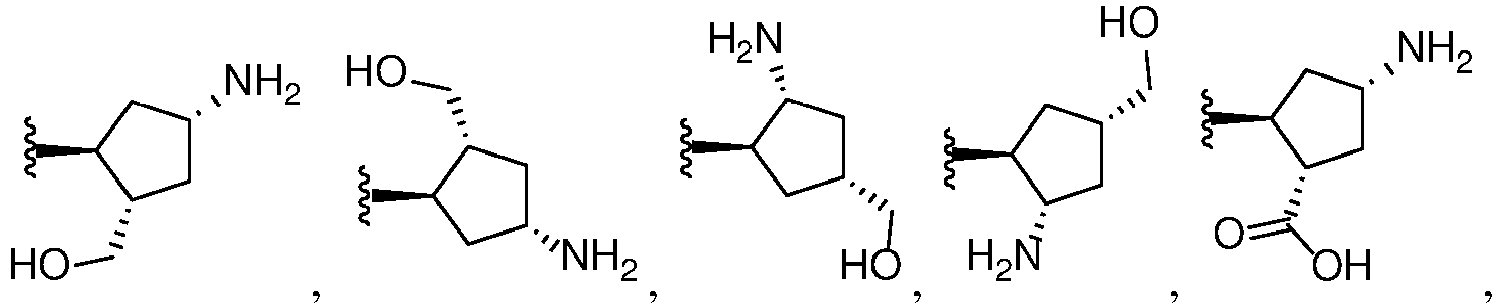

- 17. The compound or salt or stereoisomers thereof of any one of aspects 14-16, wherein R2 is H.
- 18. The compound or salt or stereoisomers thereof of any one of aspects 14-16, wherein R2 is COOR12, CH2CON(R11)2, CHR7OCOR8, (CH2)oNR9, tetrazolyl, CH2OPO(OH)2, or

- 19. The compound or salt or stereoisomers thereof of
aspect 1, wherein the compound is:
- 20. A pharmaceutical composition comprising a compound or salt or stereoisomers thereof of any one of aspects 1-19 and a pharmaceutically acceptable carrier.
- 21. A compound or salt or stereoisomers thereof of any one of aspects 1-19, for use in antagonizing a P2Y14R receptor in a mammal in need thereof.
- 22. A compound or salt or stereoisomers thereof of any one of aspects 1-19, for use in treating or preventing an inflammatory condition in a mammal in need thereof.
- 23. The compound for use according to aspect 22 wherein the inflammatory condition is selected from the group consisting of asthma, cystic fibrosis, and sterile inflammation of the kidney.
- 24. A compound or salt or stereoisomers thereof of any one of aspects 1-19, for use in treating pain in a mammal in need thereof.
- 25. A method of antagonizing a P2Y14R receptor in a mammal in need thereof, comprising administering to the mammal an effective amount of a compound or salt or stereoisomers thereof of any one of aspects 1-19.
- 26. A method of treating or preventing an inflammatory condition in a mammal in need thereof, comprising administering to the mammal an effective amount of a compound or salt or stereoisomers thereof of any one of aspects 1-19.
- 27. The method according to aspect 26, wherein the inflammatory condition is selected from the group consisting of asthma, cystic fibrosis, and sterile inflammation of the kidney.
- 28. A method of treating pain in a mammal in need thereof, comprising administering to the mammal an effective amount of a compound or salt or stereoisomers thereof of any one of aspects 1-19.
- 28. The method according to aspect 27, wherein the inflammatory condition is selected from the group consisting of asthma, cystic fibrosis, and sterile inflammation of the kidney.
- 29. A method of treating pain in a mammal in need thereof, comprising administering to the mammal an effective amount of a compound or salt or stereoisomers thereof of any one of aspects 1-20.
-
- 1. Yu, J.; Ciancetta, A.; Dudas, S.; Duca, S.; Lottermoser, J.; Jacobson, K.A. Structure-guided modification of heterocyclic antagonists of the P2Y14 receptor. J. Med. Chem. 2018, 61, 4860-4882, doi: 10.1021/acs.jmedchem.8b00168.
- 2. Jung, Y. H.; Yu, J.; Wen, Z.; Salmaso, V.; Phung, N. B.; Karcz, T.; Chen, Z.; Duca, S.; Bennett, J. M.; Dudas, S.; Cook, D. N.; Salvemini, D.; Gao, Z. G.; Jacobson, K. A. Exploration of alternative scaffolds for P2Y14 receptor antagonists containing a biaryl core. J. Med. Chem. 2020, 63, 9563-9589.
- 3. Battistone, M. A.; Mendelsohn, A. C.; Spallanzani, R. G.; Allegretti, A. S.; Liberman, R. N.; Sesma, J.; Kalim, S.; Wall, S. M.; Bonventre, J. V.; Lazarowski, E. R.; Brown, D.; Breton, S. Pro-inflammatory P2Y14 receptor inhibition protects against ischemic acute kidney injury in mice. J. Clin. Invest. 2020, 130, 3734-3749.
- 4. Xu, J.; Morinaga, H.; Oh, D.; Li, P.; Chen, A.; Talukdar, S.; Lazarowski, E.; Olefsky, J. M.; Kim, J. J. GPR105 ablation prevents inflammation and improves insulin sensitivity in mice with diet-induced obesity. J. Immunol. 2012, 189(4), 1992-1999.
- 5. Jain, S.; Jacobson, K. A. Adipocyte specific ablation of P2Y14R improves glucose metabolism in mice with diet-induced obesity. American Diabetes Assoc., 80th Scientific Session, Abstract, 2020.
- 6. Karcz, T. P.; Whitehead, G. S.; Nakano, H.; Williams, J. G.; Deterding, L. J.; Jacobson, K. A.; Cook, D. N. UDP-glucose and P2Y14 receptor amplify allergen-induced airway eosinophilia. Submitted.
- 7. Mufti, F.; Jung, Y. H.; Giancotti, L. A.; Yu, J.; Chen, Z..; Phung, N. B.; Jacobson, K. A.; Salvemini, D. P2Y14 receptor antagonists reverse chronic neuropathic pain in a mouse model. ACS Med. Chem. Lett. 2020, 11, 1281-1286.
- 8. Lin, J.; Liu, F.; Zhang, Y-Y.; Song, N.; Liu, M-K.; Fang, X-y.; Liao, D-Q.; Zhou, C.;Wang, H.; Shen, J-F. P2Y14 receptor is functionally expressed in satellite glial cells and mediates interleukin-1β and chemokine CCL2 secretion. J. Cell. Physiol. 2019, 234, 21199- 21210.
- 9. Jacobson, K. A.; Delicado, E. G.; Gachet, C.; Kennedy, C.; von Kiigelgen, I.; Li, B.; Miras-Portugal, T.; Novak, I.; Schöneberg, T.; Perez-Sen, R.; Thor, D.; Wu, B.; Yang, Z.; Müller, C. E. Update of P2Y receptor pharmacology: IUPHAR review:"27". Br. J. Pharmacol. 2020, 177, 2413-2433.
- 10. Kinoshita, M.; Nasu-Tada, K.; Fujishita, K.; Sato, K.; Koizumi, S. Secretion of matrix metalloproteinase-9 from astrocytes by inhibition of tonic P2Y14-receptor-mediated signal(s). Cell. Mol. Neurobiol. 2013, 33, 47-58. DOI: 10.1007/s10571-012-9869-4
- 11. Zhang, Z.; Hao, K.; Li, H.; Lu, R.; Liu, C.; Zhou, M.; Li, B.; Meng, Z.; Hu, Q.; Jiang, C. Design, synthesis and anti-inflammatory evaluation of 3-amide benzoic acid derivatives as novel P2Y14 receptor antagonists. Eur. J. Med. Chem. 2019, 181, 111564.
- 12. Hamel, M.; Henault, M.; Hyjazie, H.; Morin, N.; Bayly, C.; Skorey, K.; Therien, A.G.; Mancini, J.; Brideau, C.; Kargman, S. Discovery of novel P2Y14 agonist and antagonist using conventional and nonconventional methods. J. Biomol. Screening 2011, 16(9), 1098-1105.
- 13. Wang, W.; Liu, C.; Li, H.; Tian, S.; Liu, Y.; Wang, N.; Yan, D.; Li, H.; Hu, Q. Discovery of novel and potent P2Y14R antagonists via structure-based virtual screening for the treatment of acute gouty arthritis. J. Adv. Res. 2020, 23, 133-142. doi: https://doi.org/10.1016/j.jare.2020.02.007
- 14. Junker, A.; Balasubramanian, R.; Ciancetta, A.; Uliassi, E.; Kiselev, E.; Martiriggiano, C.; Trujillo, K.; Mtchedlidze, G.; Birdwell, L.; Brown, K. A.; Harden, T. K.; Jacobson, K. A. Structure-based design of 3-(4-aryl-1H-1,2,3-triazol-1-yl)-biphenyl derivatives as P2Y14 receptor antagonists. J. Med. Chem. 2016, 59, 6149-6168.
- 15. Zhang, K.; Zhang, J.; Gao, Z. G.; Paoletta, S.; Zhang, D.; Han, G. W.; Li, T.; Ma, L.; Zhang, W.; Müller, C. E.; Yang, H.; Jiang, H.; Cherezov, V.; Katritch, V.; Jacobson, K. A.; Stevens, R. C.; Wu, B.; Zhao, Q. Agonist-bound structure of the human P2Y12R receptor. Nature 2014, 509, 119-122.
- 16. Kiselev, E.; Barrett, M.; Katritch, V.; Paoletta, S.; Weitzer, C. D.; Hammes, E.; Yin, A. L.; Zhao, Q.; Stevens, R. C.; Harden, T. K.; Jacobson, K. A. Exploring a 2-naphthoic acid template for the structure-based design of P2Y14 receptor antagonist molecular probes. ACS Chem. Biol. 2014, 9, 2833-2842.
- 17. Barrett, M. O.; Sesma, J. I.; Ball, C. B.; Jayasekara, P. S.; Jacobson, K. A.; Lazarowski, E. R.; Harden, T. K. A selective high affinity antagonist of the P2Y14 receptor inhibits UDP-glucose-stimulated chemotaxis of human neutrophils. Mol. Pharmacol. 2013, 84, 41-49.
- 18._Robichaud, J.; Fournier, J.-F.; Gagné, S.; Gauthier, J. Y.; Hamel, M.; Han, Y.; Hénault, M.; Kargman, S.; Levesque, J. F.; Mamane, Y.; Mancini, J.; Morin, N.; Mulrooney, E.; Wu, J.; Black, W. C. Applying the pro-drug approach to afford highly bioavailable antagonists of P2Y14. Bioorg. Med. Chem. Lett. 2011, 27(14), 4366-4368.
- 19. Mazák, K.; Noszál, B. Physicochemical properties of zwitterionic drugs in therapy. .
- 20. Sabbadin, D.; Ciancetta, A.; Moro, S. Bridging molecular docking to membrane molecular dynamics to investigate GPCR-ligand recognition: The human A2A adenosine receptor as a key study. J. Chem. Inf. Model. 2014, 54 (1), 169-183.
- 21. Strupczewski, J. T.; Allen, R. C.; Gardner, B. A.; Schmid, B. L.; Stache, U.; Glamkowski, E. J.; Jones, M. C.; Ellis, D. B.; Huger, F. P.; Dunn, R. W. Synthesis and neuroleptic activity of 3-(1-substituted-4-piperidinyl)-1,2-benzisoxazoles, J. Med. Chem. 1985, 28, 761-769.
- 22. Ballesteros, J. A.; Weinstein, H. Integrated methods for the construction of three dimensional models and computational probing of structure function relations in G protein-coupled receptors. Methods Neurosci. 1995, 25, 366-428.
- 23. Pennington, L. D.; Moustakas, D. T. The necessary nitrogen atom: A versatile high-impact design element for multiparameter optimization. J. Med. Chem. 2017, 60(9), 3552-3579.
- 24. Gardell, S.J.; Hopf, M.; Khan, A.; Dispagna M, Hampton Sessions. E.; Falter, R.; Kapoor, N.; Brooks, J.; Culver, J.; Petucci, C; Ma, C. T.; Cohen, S. E.; Tanaka, J.; Burgos, E. S.; Hirschi, J. S.; Smith, S. R.; Sergienko, E.; Pinkerton, A. B. Boosting NAD+ with a small molecule that activates NAMPT. Nat. Commun. 2019, 10, 3241.
- 25. Kiselyuk, A. S. HNF4 alpha bioactive ligands discovered by a high- throughput screen for modulators of the human insulin promoter. (Doctoral dissertation, pp. 65). University of California, San Diego, 2011. (https://escho!arship.org/content/qt64k4q3gr/qt64k4q3gr.pdf )
- 26. Yan, Z.; Caldwell, G. Optimization in Drug Discovery: In Vitro Methods (pp. 58). Humana Press.
- 27. Valk6, K.; Application of high-performance liquid chromatography based measurements of lipophilicity to model biological distribution. J. Chromatogr. A 2004, 1037, 299-310.
- 28. Besnard, J.; Ruda, G. F.; Setola, V.; Abecassis, K.; Rodriguiz, R. M.; Huang, X. P.; Norval, S.; Sassano, M. F.; Shin, A. I.; Webster, L. A.; Simeons, F. R.; Stojanovski, L.; Prat, A.; Seidah, N. G.; Constam, D. B.; Bickerton, G. R.; Read, K. D.; Wetsel, W. C.; Gilbert, I. H.; Roth, B. L.; Hopkins, A. L. Automated design of ligands to polypharmacological profiles. Nature 2012, 492, 215-220.
- 29. Wible, B. A.; Hawryluk, P.; Ficker, E.; Kuryshev, Y. A.; Kirsch, G.; Brown, A. M. HERG-Lite: a novel comprehensive high-throughput screen for drug-induced hERG risk. J. Pharmacol. Toxicol. Methods 2005, 52(1), 136-145.
- 30. Piper, D. R.; Duff, S. R.; Eliason, H. C.; Frazee, W. J.; Frey, E. A.; Fuerstenau-Sharp, M.; Jachec, C.; Marks, B. D.; Pollok, B. A.; Shekhani, M. S.; Thompson, D. V.; Whitney, P.; Vogel, K. W.; Hess, S. D. Development of the predictor HERG fluorescence polarization assay using a membrane protein enrichment approach. Assay Drug Dev. Technol. 2008, 6, 213-223, DOI: 10.1089/adt.2008.137
- 31. Perez C, Daniel KB, Cohen SM. Evaluating prodrug strategies for esterase-triggered release of alcohols. ChemMedChem, 2013, 8, 1662-1667. doi: 10.1002/cmdc.201300255.
- 32. Bennett, G. J.; Xie, Y. K. A peripheral mononeuropathy in rat that produces disorders of pain sensation like those seen in man. Pain 1988, 33, 87-107.
- 33. Whitehead, G. S.; Thomas, S. Y.; Shalaby, K. H.; Nakano, K.; Moran, T. P.; Ward, J. M.; Flake, G. P.; Nakano, H.; Cook, D. N. TNF is required for TLR ligand-mediated but not protease-mediated allergic airway inflammation. J. Clin. Invest. 2017, 127, 3313-3326.
- 34. Mignani, S.; Rodrigues, J.; Tomas, H.; Jalal, R.; Singh, P. P.; Majoral, J.-P.; Vishwakarma, R. A. Present drug-likeness filters in medicinal chemistry during the hit and lead optimization process: how far can they be simplified? Drug Disc. Today, 2018, 23(3), 605-615.
- 35. Dalvie, D. K.; Kalgutkar, A. S.; Khojasteh-Bakht, S. C.; Obach, R. S.; O'Donnell, J. P. Biotransformation reactions of five-membered aromatic heterocyclic rings. Chem. Res. Toxicol. 2002, 15(3), 269-299. https://doi.org/10.1021/tx015574b
- 36. Zhu, J.; Mo, J.; Lin, H.; Chen, Y.; Sun, H. The recent progress of isoxazole in medicinal chemistry. Bioorg. Med. Chem. 2018, 26(12), 3065-3075.
- 37. Sun, H.; Shi, M.; Zhang, W.; Zheng, Y.-M.; Xu, Y.-Z.; Shi, J.-J.; Liu, T.; Gunosewoyo, H.; Pang, T.; Gao, Z. B.; Yang, F.; Tang, J.; Yu, L.-F. Development of novel alkoxyisoxazoles as sigma-1 receptor antagonists with antinociceptive efficacy. J. Med. Chem. 2016, 59, 6329-6343.
- 38. Ratnatilaka Na Bhuket, P.; Jithavech, P.; Ongpipattanakul, B.; Rojsitthisak, P. Interspecies differences in stability kinetics and plasma esterases involved in hydrolytic activation of curcumin diethyl disuccinate, a prodrug of curcumin. RSC Advances, 2019, 9(8), 4626-4634.
- 39. Schrödinger Release 2019-3: Maestro, Schrödinger, LLC, New York, NY, 2019.
- 40. Sastry, G. M.; Adzhigirey, M.; Day, T.; Annabhimoju, R.; Sherman, W. Protein and ligand preparation: Parameters, protocols, and influence on virtual screening enrichments. J. Comput. Aided Mol. Des. 2013, 27 (3), 221-234.
- 41. Harder, E.; Damm, W.; Maple, J.; Wu, C.; Reboul, M.; Xiang, J. Y.; Wang, L.; Lupyan, D.; Dahlgren, M. K.; Knight, J. L.; Kaus, J. W.; Cerutti, D. S.; Krilov, G.; Jorgensen, W. L.; Abel, R.; Friesner. R. A. OPLS3: A force field providing broad coverage of drug-like small molecules and proteins. J. Chem. Theory Comput. 2016, 12 (1), 281-296.
- 42. Friesner, R. A.; Banks, J. L.; Murphy, R. B.; Halgren, T. A.; Klicic, J. J.; Mainz, D. T.; Repasky, M. P.; Knoll, E. H.; Shelley, M.; Perry, J. K.; Shaw, D. E.; Francis, P.; Shenkin, P. S. Glide: A new approach for rapid, accurate docking and scoring. 1. Method and assessment of docking accuracy. J. Med. Chem. 2004, 47 (7), 1739-1749.
- 43. Doerr, S.; Harvey, M. J.; Noé, F.; De Fabritiis, G. HTMD: High-throughput molecular dynamics for molecular discovery. J. Chem. Theory Comput. 2016, 12 (4), 1845-1852.
- 44. Humphrey, W.; Dalke, A.; Schulten, K. VMD: Visual molecular dynamics. J. Mol. Graph. 1996, 14 (1), 33-38, 27.
- 45. Lomize, M. A.; Pogozheva, I. D.; Joo, H.; Mosberg, H. I.; Lomize, A. L. OPM Database and PPM web server: Resources for positioning of proteins in membranes. Nucleic Acids Res. 2012, 40 (Database issue), D370-6.
- 46. Jorgensen, W. L.; Chandrasekhar, J.; Madura, J. D.; Impey, R. W.; Klein, M. L. Comparison of simple potential functions for simulating liquid water. J. Chem. Phys. 1983, 79 (2), 926.
- 47. Harvey, M. J.; Giupponi, G.; Fabritiis, G. D. ACEMD: Accelerating biomolecular dynamics in the microsecond time scale. J. Chem. Theory Comput. 2009, 5 (6), 1632-1639.
- 48. Best, R. B.; Zhu, X.; Shim, J.; Lopes, P. E. M.; Mittal, J.; Feig, M.; Mackerell, A. D. Optimization of the additive CHARMM all-atom protein force field targeting improved sampling of the backbone ϕ, ψ and side-chain χ1 and χ2 dihedral angles. J. Chem. Theory Comput. 2012, 8 (9), 3257-3273.
- 49. Klauda, J. B.; Venable, R. M.; Freites, J. A.; O'Connor, J. W.; Tobias, D. J.; Mondragon-Ramirez, C.; Vorobyov, I.; MacKerell, A. D.; Pastor, R. W. Update of the CHARMM all-atom additive force field for lipids: Validation on six lipid types. J. Phys. Chem. B 2010, 114 (23), 7830-7843.
- 50. Vanommeslaeghe, K.; MacKerell, A. D. Automation of the CHARMM general force field (CGenFF) I: Bond perception and atom typing. J. Chem. Inf. Model. 2012, 52 (12), 3144-3154.
- 51. Vanommeslaeghe, K.; Raman, E. P.; MacKerell, A. D. Automation of the CHARMM general force field (CGenFF) II: Assignment of bonded parameters and partial atomic charges. J. Chem. Inf. Model. 2012, 52 (12), 3155-3168.
- 52. CHARMM General Force Field (CGenFF) program, https://cgcnff.umaryland.cdu/
- 53. Kräutler, V.; van Gunsteren, W. F.; Hünenberger, P. H. A fast SHAKE algorithm to solve distance constraint equations for small molecules in molecular dynamics simulations. J. Comput. Chem. 2001, 22 (5), 501-508.
- 54. Essmann, U.; Perera, L.; Berkowitz, M. L.; Darden, T.; Lee, H.; Pedersen, L. G. A smooth particle mesh Ewald method. J. Chem. Phys. 1995, 103 (19), 8577.
- 55. Phillips, J. C.; Braun, R.; Wang, W.; Gumbart, J.; Tajkhorshid, E.; Villa, E.; Chipot, C.; Skeel, R. D.; Kalé, L.; Schulten, K. Scalable molecular dynamics with NAMD. J. Comput. Chem. 2005, 26 (16), 1781-1802.
- 56. Williams, T.; Kelley, C. Gnuplot 5.0, http://www.gnuplot.info
- 57. Tetko, I. V.; Tanchuk, V. Y. Application of associative neural networks for prediction of lipophilicity in ALOGPS 2.1 program, J. Chem. Inf. Comput. Sci. 2002, 42, 1136-1145.
- 58. Gauthier, J. Y.; Belley, M.; Deschênes, D.; Fournier, J. F.; Gagné, S.; Gareau, Y.; Hamel, M.; Hénault, M.; Hyjazie, H.; Kargman, S.; Lavallée, G.; Levesque, J. F.; Li, L.; Mamane, Y.; Mancini, J.; Morin, N.; Mulrooney, E.; Robichaud, J.; Thérien, M.; Tranmer, G.; Wang, Z.; Wu, J.; Black, W. C. The identification of 4,7-disubstituted naphthoic acid derivatives as UDP-competitive antagonists of P2Y14. Bioorg. Med. Chem. Lett. 2011, 21, 2836-2839.
- All references, including publications, patent applications, and patents, cited herein are hereby incorporated by reference to the same extent as if each reference were individually and specifically indicated to be incorporated by reference and were set forth in its entirety herein.
- The use of the terms "a" and "an" and "the" and "at least one" and similar referents in the context of describing the invention (especially in the context of the following claims) are to be construed to cover both the singular and the plural, unless otherwise indicated herein or clearly contradicted by context. The use of the term "at least one" followed by a list of one or more items (for example, "at least one of A and B") is to be construed to mean one item selected from the listed items (A or B) or any combination of two or more of the listed items (A and B), unless otherwise indicated herein or clearly contradicted by context. The terms "comprising," "having," "including," and "containing" are to be construed as open-ended terms (i.e., meaning "including, but not limited to,") unless otherwise noted. Recitation of ranges of values herein are merely intended to serve as a shorthand method of referring individually to each separate value falling within the range, unless otherwise indicated herein, and each separate value is incorporated into the specification as if it were individually recited herein. All methods described herein can be performed in any suitable order unless otherwise indicated herein or otherwise clearly contradicted by context. The use of any and all examples, or exemplary language (e.g., "such as") provided herein, is intended merely to better illuminate the invention and does not pose a limitation on the scope of the invention unless otherwise claimed. No language in the specification should be construed as indicating any non-claimed element as essential to the practice of the invention.
- Preferred aspects of this invention are described herein, including the best mode known to the inventors for carrying out the invention. Variations of those preferred aspects may become apparent to those of ordinary skill in the art upon reading the foregoing description. The inventors expect skilled artisans to employ such variations as appropriate, and the inventors intend for the invention to be practiced otherwise than as specifically described herein. Accordingly, this invention includes all modifications and equivalents of the subject matter recited in the claims appended hereto as permitted by applicable law. Moreover, any combination of the above-described elements in all possible variations thereof is encompassed by the invention unless otherwise indicated herein or otherwise clearly contradicted by context.
Claims (15)
- A compound of formula (II):
 wherein R1 is halo or CF3,R2 is selected from the group consisting of COOH, COOR12, CONHOH, CH2CON(R11)2, CHR7OCOR8, (CH2)oNR9, tetrazolyl, CH2OPO(OH)2, and
 R3 is selected from the group consisting of NHR4, COOR5, (C≡C)n(CH2)mR6, CONH(CH2)qNH2, COCF3,


 R4 is H or COR6 wherein R6 is C1-C6 alkyl, C6-C10 aryl, or
 R5 is C1-C6 alkyl, C3-C8 cycloalkyl, or benzyl,R6 is NH2, or CONH2,R7-R9 are independently hydrogen or C1-C6 alkyl,R10 is H, C1-C10 alkylcarbonyl, or C1-C10 alkyloxycarbonyl,R11 is hydrogen or C1-C6 alkyl,R12 is C1-C6 alkyl, C3-C8 cycloalkyl, or benzyl,m, o, and q are independently integers of 1 to about 10, andn is zero or an integer of 1 to about 10; ora compound of formula (III)
 or a pharmaceutically acceptable salt thereof, or a stereoisomer thereof.
 - The compound, salt, or stereoisomer of claim 1, wherein R1 is CF3.
- The compound, salt, or stereoisomer of claim 1 or 2, wherein the compound is of formula (II).
- The compound, salt, or stereoisomer of any one of claims 1-3, wherein R2 is H.
- The compound, salt, or stereoisomer of any one of claims 1-3, wherein R2 is COOR12, CH2CON(R11)2, CHR7OCOR8, (CH2)oNR9, tetrazolyl, CH2OPO(OH)2, or

- The compound, salt, or stereoisomer of claim 1, wherein R3 is selected from the group consisting of


- The compound, salt, or stereoisomer of claim 6, wherein R3 is

- The compound, salt, or stereoisomer of claim 6, wherein R3 is selected from the group consisting of


- The compound, salt, or stereoisomer of any one of claims 6-8, wherein R2 is H.
- The compound, salt, or stereoisomer of any one of claims 6-8, wherein R2 is COOR12, CH2CON(R11)2, CHR7OCOR8, (CH2)oNR9, tetrazolyl, CH2OPO(OH)2, or

- A pharmaceutical composition comprising a compound, salt, or stereoisomer of any one of claims 1-10 and a pharmaceutically acceptable carrier.
- A compound, salt, or stereoisomer of any one of claims 1-10, or the pharmaceutical composition of claim 11, for use in antagonizing a P2Y14R receptor in a mammal in need thereof.
- A compound, salt, or stereoisomer of any one of claims 1-10, or the pharmaceutical composition of claim 11, for use in treating or preventing an inflammatory condition in a mammal in need thereof.
- The compound, salt, or stereoisomer for use according to claim 13, wherein the inflammatory condition is selected from the group consisting of asthma, cystic fibrosis, and sterile inflammation of the kidney.
- A compound, salt, or stereoisomer of any one of claims 1-10, or the pharmaceutical composition of claim 11, for use in treating pain in a mammal in need thereof.
Applications Claiming Priority (3)
| Application Number | Priority Date | Filing Date | Title |
|---|---|---|---|
| US202163138581P | 2021-01-18 | 2021-01-18 | |
| EP22701105.3A EP4277895A1 (en) | 2021-01-18 | 2022-01-05 | Heterocyclic p2y 14 receptor antagonists |
| PCT/US2022/011226 WO2022155037A1 (en) | 2021-01-18 | 2022-01-05 | Heterocyclic p2y 14 receptor antagonists |
Related Parent Applications (1)
| Application Number | Title | Priority Date | Filing Date |
|---|---|---|---|
| EP22701105.3A Division EP4277895A1 (en) | 2021-01-18 | 2022-01-05 | Heterocyclic p2y 14 receptor antagonists |
Publications (2)
| Publication Number | Publication Date |
|---|---|
| EP4434522A2 true EP4434522A2 (en) | 2024-09-25 |
| EP4434522A3 EP4434522A3 (en) | 2025-03-19 |
Family
ID=80050841
Family Applications (2)
| Application Number | Title | Priority Date | Filing Date |
|---|---|---|---|
| EP22701105.3A Withdrawn EP4277895A1 (en) | 2021-01-18 | 2022-01-05 | Heterocyclic p2y 14 receptor antagonists |
| EP24185703.6A Pending EP4434522A3 (en) | 2021-01-18 | 2022-01-05 | Heterocyclic p2y14 receptor antagonists |
Family Applications Before (1)
| Application Number | Title | Priority Date | Filing Date |
|---|---|---|---|
| EP22701105.3A Withdrawn EP4277895A1 (en) | 2021-01-18 | 2022-01-05 | Heterocyclic p2y 14 receptor antagonists |
Country Status (6)
| Country | Link |
|---|---|
| US (1) | US20240150290A1 (en) |
| EP (2) | EP4277895A1 (en) |
| CN (1) | CN116964034A (en) |
| AU (1) | AU2022207045A1 (en) |
| CA (1) | CA3208662A1 (en) |
| WO (1) | WO2022155037A1 (en) |
Family Cites Families (2)
| Publication number | Priority date | Publication date | Assignee | Title |
|---|---|---|---|---|
| WO2009070873A1 (en) * | 2007-12-04 | 2009-06-11 | Merck Frosst Canada Ltd. | Substituted 2-naphthoic acids as antagonists of gpr105 activity |
| EP3749651A1 (en) * | 2018-02-09 | 2020-12-16 | The United States of America, as represented by the Secretary, Department of Health and Human Services | Heterocyclic p2y14 receptor antagonists |
-
2022
- 2022-01-05 AU AU2022207045A patent/AU2022207045A1/en not_active Abandoned
- 2022-01-05 US US18/272,435 patent/US20240150290A1/en active Pending
- 2022-01-05 CA CA3208662A patent/CA3208662A1/en active Pending
- 2022-01-05 WO PCT/US2022/011226 patent/WO2022155037A1/en not_active Ceased
- 2022-01-05 CN CN202280020636.5A patent/CN116964034A/en active Pending
- 2022-01-05 EP EP22701105.3A patent/EP4277895A1/en not_active Withdrawn
- 2022-01-05 EP EP24185703.6A patent/EP4434522A3/en active Pending
Non-Patent Citations (61)
| Title |
|---|
| "ASHP Handbook on Injectable Drugs", 1986, pages: 622 - 630 |
| "Optimization of the additive CHARMM all-atom protein force field targeting improved sampling of the backbone cp, and side-chain y and χ dihedral angles", J. CHEM. THEORY COMPUT., vol. 8, no. 9, 2012, pages 3257 - 3273 |
| "Pharmaceutics and Pharmacy Practice", 1982, J. B. LIPPINCOTT CO., pages: 238 - 250 |
| "Remington's Pharmaceutical Sciences", 1990, MACK PUBLISHING COMPANY, pages: 1445 |
| ABEL, R.FRIESNER. R. A.: "OPLS3: A force field providing broad coverage of drug-like small molecules and proteins", J. CHEM. THEORY COMPUT., vol. 12, no. 1, 2016, pages 281 - 296 |
| BALLESTEROS, J. A.WEINSTEIN, H: "Integrated methods for the construction of three dimensional models and computational probing of structure function relations in G protein-coupled receptors", METHODS NEUROSCI., vol. 25, 1995, pages 366 - 428, XP009139377, DOI: 10.1016/S1043-9471(05)80049-7 |
| BARRETT, M. O.SESMA, J. I.BALL, C. B.JAYASEKARA, P. S.JACOBSON, K. A.LAZAROWSKI, E. R.HARDEN, T. K.: "A selective high affinity antagonist of the P2Y receptor inhibits UDP-glucose-stimulated chemotaxis of human neutrophils", MOL. PHARMACOL., vol. 84, 2013, pages 41 - 49, XP055347174, DOI: 10.1124/mol.113.085654 |
| BATTISTONE, M. A.MENDELSOHN, A. C.SPALLANZANI, R. G.ALLEGRETTI, A. SLIBERMAN, R. N.SESMA, J.KALIM, S.WALL, S. M.BONVENTRE, J. V.LA: "Pro-inflammatory P2Y receptor inhibition protects against ischemic acute kidney injury in mice", J. CLIN. INVEST., vol. 130, 2020, pages 3734 - 3749 |
| BENNETT, G. JXIE, Y. K.: "A peripheral mononeuropathy in rat that produces disorders of pain sensation like those seen in man", PAIN, vol. 33, 1988, pages 87 - 107, XP024378950, DOI: 10.1016/0304-3959(88)90209-6 |
| BERGE, S. M., JOURNAL OF PHARMACEUTICAL SCIENCE, vol. 66, 1977, pages 1 - 19 |
| CHARMM GENERAL FORCE FIELD (CGENFF) PROGRAM, Retrieved from the Internet <URL:https://cgenff.umaryland.edu> |
| DALVIE, D. K.KALGUTKAR, A. S.KHOJASTEH-BAKHT, S. C.OBACH, R. S.O'DONNELL, J. P.: "Biotransformation reactions of five-membered aromatic heterocyclic rings", CHEM. RES. TOXICOL., vol. 15, no. 3, 2002, pages 269 - 299, XP055239789, DOI: 10.1021/tx015574b |
| DOERR, S.HARVEY, M. J.NOÉ, F.DE FABRITIIS: "G. HTMD: High-throughput molecular dynamics for molecular discovery", J. CHEM. THEORY COMPUT., vol. 12, no. 4, 2016, pages 1845 - 1852 |
| ESSMANN, U.PERERA, L.BERKOWITZ, M. L.DARDEN, T.LEE, H.PEDERSEN, L. G.: "A smooth particle mesh Ewald method", J. CHEM. PHYS., vol. 103, no. 19, 1995, pages 8577, XP055441882, DOI: 10.1063/1.470117 |
| FRIESNER, R. A.BANKS, J. L.MURPHY, R. B.HALGREN, T. A.KLICIC, J. J.MAINZ, D. T.REPASKY, M. P.KNOLL, E. H.SHELLEY, M.PERRY, J. K.: "Glide: A new approach for rapid, accurate docking and scoring. 1. Method and assessment of docking accuracy", J. MED. CHEM., vol. 47, no. 7, 2004, pages 1739 - 1749, XP002592019, DOI: 10.1021/JM0306430 |
| GARDELL, S.J.; HOPF, M.; KHAN, A.; DISPAGNA M, HAMPTON SESSIONS. E.; FALTER, R.;KAPOOR, N.; BROOKS, J.; CULVER, J.; PETUCCI, C; MA: "Boosting NAD+ with a small molecule that activates NAMPT", NAT. COMMUN., vol. 10, 2019, pages 3241, XP055712364, DOI: 10.1038/s41467-019-11078-z |
| GAUTHIER, J. Y.; BELLEY, M.; DESCHÊNES, D.; FOURNIER, J. F.; GAGNÉ, S.; GAREAU, Y.;HAMEL, M.; HÉNAULT, M.; HYJAZIE, H.; KARGMAN, S: "The identification of 4,7-disubstituted naphthoic acid derivatives as UDP-competitive antagonists of P2Y14", BIOORG. MED. CHEM. LETT., vol. 21, 2011, pages 2836 - 2839, XP028208731, DOI: 10.1016/j.bmcl.2011.03.081 |
| HAMEL, M.HENAULT, M.HYJAZIE, H.MORIN, N.BAYLY, C.SKOREY, K.THERIEN, A.G.MANCINI, J.BRIDEAU, C.KARGMAN, S: "Discovery of novel P2Y agonist and antagonist using conventional and nonconventional methods", J. BIOMOL. SCREENING, vol. 16, no. 9, 2011, pages 1098 - 1105, XP055347326, DOI: 10.1177/1087057111415525 |
| HARVEY, M. J.GIUPPONI, G.FABRITIIS, G. D: "ACEMD: Accelerating biomolecular dynamics in the microsecond time scale", J. CHEM. THEORY COMPUT., vol. 5, no. 6, 2009, pages 1632 - 1639 |
| HUMPHREY, W.; DALKE, A.; SCHULTEN, K.: "VMD: Visual molecular dynamics. J.", MOL. GRAPH., vol. 14, no. 1, 1996, pages 33 - 38, XP055140690, DOI: 10.1016/0263-7855(96)00018-5 |
| JACOBSON, K. A.; DELICADO, E. G.; GACHET, C.; KENNEDY, C.; VON KIIGELGEN, I.; LI,B.; MIRAS-PORTUGAL, T.; NOVAK, I.; SCHONEBERG, T.: "Update of P2Y receptor pharmacology: IUPHAR review:''27", BR. J. PHARMACOL., vol. 177, 2020, pages 2413 - 2433, XP071094126, DOI: 10.1111/bph.15005 |
| JAIN, S.JACOBSON, K. A.: "Adipocyte specific ablation of P2Y R improves glucose metabolism in mice with diet-induced obesity", AMERICAN DIABETES ASSOC., 80TH SCIENTIFIC SESSION, ABSTRACT, 2020 |
| JORGENSEN, W. L.CHANDRASEKHAR, J.MADURA, J. D.IMPEY, R. WKLEIN, M. L: "Comparison of simple potential functions for simulating liquid water", J. CHEM. PHYS., vol. 79, no. 2, 1983, pages 926 |
| JUNG, Y. HYU, J.WEN, Z.SALMASO, V.PHUNG, N. B.KARCZ, T.CHEN, Z.DUCA, SBENNETT, J. M.DUDAS, S.: "Exploration of alternative scaffolds for P2Y receptor antagonists containing a biaryl core", J. MED. CHEM., vol. 63, 2020, pages 9563 - 9589, XP055905973, DOI: 10.1021/acs.jmedchem.0c00745 |
| JUNKER, A.BALASUBRAMANIAN, R.CIANCETTA, A.ULIASSI, EKISELEV, E.MARTIRIGGIANO, C.TRUJILLO, KMTCHEDLIDZE, G.BIRDWELL, L.BROWN, K. A.: "Structure-based design of 3-(4-aryl-1H-1,2,3-triazol-1-yl)-biphenyl derivatives as P2Y receptor antagonists", J. MED. CHEM., vol. 59, 2016, pages 6149 - 6168 |
| KARCZ, T. P.WHITEHEAD, G. SNAKANO, H.WILLIAMS, J. G.DETERDING, L. J.JACOBSON, K. ACOOK, D. N.: "UDP-glucose and P2Y receptor amplify allergen-induced airway eosinophilia", SUBMITTED |
| KINOSHITA, M.NASU-TADA, K.FUJISHITA, K.SATO, K.KOIZUMI, S: "Secretion of matrix metalloproteinase-9 from astrocytes by inhibition of tonic P2Y -receptor-mediated signal(s", CELL. MOL. NEUROBIOL., vol. 33, 2013, pages 47 - 58, XP035154138, DOI: 10.1007/s10571-012-9869-4 |
| KISELEV, E.BARRETT, M.KATRITCH, V.PAOLETTA, SWEITZER, C. D.HAMMES, E.YIN, A. L.ZHAO, Q.STEVENS, R. C.HARDEN, T. K.: "Exploring a 2-naphthoic acid template for the structure-based design of P2Y receptor antagonist molecular probes", ACS CHEM. BIOL., vol. 9, 2014, pages 2833 - 2842, XP055625193, DOI: 10.1021/cb500614p |
| KISELYUK, A. S: "Doctoral dissertation", 2011, UNIVERSITY OF CALIFORNIA, article "HNF4 alpha bioactive ligands discovered by a high- throughput screen for modulators of the human insulin promoter", pages: 65 |
| KLAUDA, J. B.VENABLE, R. M.FREITES, J. A.O'CONNOR, J. W.TOBIAS, D. JMONDRAGON-RAMIREZ, C.VOROBYOV, I.MACKERELL, A. D.PASTOR, R. W.: "Update of the CHARMM all-atom additive force field for lipids: Validation on six lipid types", J. PHYS. CHEM. B, vol. 114, no. 23, 2010, pages 7830 - 7843, XP055323592, DOI: 10.1021/jp101759q |
| KRÄUTLER, V.; VAN GUNSTEREN, W. F.; HÜNENBERGER, P. H.: "A fast SHAKE algorithm to solve distance constraint equations for small molecules in molecular dynamics simulations", J. COMPUT. CHEM., vol. 22, no. 5, 2001, pages 501 - 508 |
| LIN, J.LIU, F.ZHANG, Y-Y.SONG, N.LIU, M-K.FANG, X-Y.LIAO, D-Q.ZHOU, C.WANG, H.SHEN, J-F: "P2Y receptor is functionally expressed in satellite glial cells and mediates interleukin-1β and chemokine CCL2 secretion", J. CELL. PHYSIOL., vol. 234, 2019, pages 21199 - 21210, XP071324281, DOI: 10.1002/jcp.28726 |
| LOMIZE, M. A.POGOZHEVA, I. D.JOO, H.MOSBERG, H. I.LOMIZE, A. L.: "OPM Database and PPM web server: Resources for positioning of proteins in membranes", NUCLEIC ACIDS RES., vol. 40, 2012, pages 370 - 6 |
| MAZÁK, K.NOSZÁL, B.: "Physicochemical properties of zwitterionic drugs in therapy", CHEMMEDCHEM, vol. 15, 2020, pages 1102 - 1 |
| MIGNANI, S.; RODRIGUES, J.; TOMAS, H.; JALAL, R.; SINGH, P. P.; MAJORAL, J.-P.;VISHWAKARMA, R. A.: "Present drug-likeness filters in medicinal chemistry during the hit and lead optimization process: how far can they be simplified?", DRUG DISC. TODAY, vol. 23, no. 3, 2018 |
| MUFTI, FJUNG, Y. H.GIANCOTTI, L. A.YU, J.CHEN, Z.PHUNG, N. B.JACOBSON, K. A.SALVEMINI, D: "P2Y receptor antagonists reverse chronic neuropathic pain in a mouse model.", ACS MED. CHEM. LETT., vol. 11, 2020, pages 1281 - 1286, XP055905980, DOI: 10.1021/acsmedchemlett.0c00115 |
| NORVAL, S.SASSANO, M. F.SHIN, A. I.WEBSTER, L. A.SIMEONS, F. R.STOJANOVSKI, L.PRAT, A.SEIDAH, N. G.CONSTAM, D. BBICKERTON, G. R.: "Automated design of ligands to polypharmacological profiles.", NATURE, vol. 492, 2012, pages 215 - 220, XP093057269, DOI: 10.1038/nature11691 |
| PENNINGTON, L. D.MOUSTAKAS, D. T.: "The necessary nitrogen atom: A versatile high-impact design element for multiparameter optimization", J. MED. CHEM., vol. 60, no. 9, 2017, pages 3552 - 3579, XP055542615, DOI: 10.1021/acs.jmedchem.6b01807 |
| PEREZ CDANIEL KBCOHEN SM: "Evaluating prodrug strategies for esterase-triggered release of alcohols", CHEMMEDCHEM, vol. 8, 2013, pages 1662 - 1667 |
| PHILLIPS, J. C.BRAUN, R.WANG, W.GUMBART, J.TAJKHORSHID, E.VILLA, E.CHIPOT, C.SKEEL, R. D.KALÉ, L.SCHULTEN, K.: "Scalable molecular dynamics with NAMD", J. COMPUT. CHEM., vol. 26, no. 16, 2005, pages 1781 - 1802, XP055484133, DOI: 10.1002/jcc.20289 |
| RATNATILAKA NA BHUKET, PJITHAVECH, P.ONGPIPATTANAKUL, B.ROJSITTHISAK, P.: "Interspecies differences in stability kinetics and plasma esterases involved in hydrolytic activation of curcumin diethyl disuccinate, a prodrug of curcumin", RSC ADVANCES, vol. 9, no. 8, 2019, pages 4626 - 4634 |
| ROBICHAUD, J.; FOURNIER, J.-F.; GAGNÉ, S.; GAUTHIER, J. Y.; HAMEL, M.; HAN, Y.;HÉNAULT, M.; KARGMAN, S.; LEVESQUE, J. F.; MAMANE, : "Applying the pro-drug approach to afford highly bioavailable antagonists of P2Y .", BIOORG. MED. CHEM. LETT., vol. 21, no. 14, 2011, pages 4366 - 4368, XP028234417, DOI: 10.1016/j.bmcl.2010.12.113 |
| SABBADIN, D.CIANCETTA, A.MORO, S.: "Bridging molecular docking to membrane molecular dynamics to investigate GPCR-ligand recognition: The human A adenosine receptor as a key study", J. CHEM. INF. MODEL., vol. 54, no. 1, 2014, pages 169 - 183 |
| SASTRY, G. M.ADZHIGIREY, MDAY, T.ANNABHIMOJU, R.SHERMAN, W.: "Protein and ligand preparation: Parameters, protocols, and influence on virtual screening enrichments", J. COMPUT. AIDED MOL. DES., vol. 27, no. 3, 2013, pages 221 - 234 |
| SCHRODINGER RELEASE 2019-3: MAESTRO, SCHRÖDINGER, LLC, NEW YORK, NY, 2019 |
| STRUPCZEWSKI, J. T.ALLEN, R. C.GARDNER, B. A.SCHMID, B. L.STACHE, U.GLAMKOWSKI, E. J.JONES, M. C.ELLIS, D. B.HUGER, F. P.DUNN, R. : "Synthesis and neuroleptic activity of 3-(1-substituted-4-piperidinyl)-1,2-benzisoxazoles", J. MED. CHEM., vol. 1985, no. 28, pages 761 - 769 |
| SUN, H.SHI, M.ZHANG, W.ZHENG, Y.-M.XU, Y.-Z.SHI, J.-J.LIU, T.GUNOSEWOYO, H.PANG, T.GAO, Z. B.: "Development of novel alkoxyisoxazoles as sigma-1 receptor antagonists with antinociceptive efficacy", J. MED. CHEM., vol. 59, 2016, pages 6329 - 6343 |
| TETKO, I. V.TANCHUK, V. Y: "Application of associative neural networks for prediction of lipophilicity in ALOGPS 2.1 program", J. CHEM. INF. COMPUT. SCI., vol. 42, 2002, pages 1136 - 1145 |
| VALKÓ, K.: "Application of high-performance liquid chromatography based measurements of lipophilicity to model biological distribution", J. CHROMATOGR. A, vol. 1037, 2004, pages 299 - 310, XP004507002, DOI: 10.1016/j.chroma.2003.10.084 |
| VANOMMESLAEGHE, K.MACKERELL, A. D.: "Automation of the CHARMM general force field (CGenFF) I: Bond perception and atom typing", J. CHEM. INF. MODEL., vol. 52, no. 12, 2012, pages 3144 - 3154 |
| VANOMMESLAEGHE, K.RAMAN, E. P.MACKERELL, A. D.: "Automation of the CHARMM general force field (CGenFF) II: Assignment of bonded parameters and partial atomic charges", J. CHEM. INF. MODEL., vol. 52, no. 12, 2012, pages 3155 - 3168 |
| WANG, W.LIU, C.LI, H.TIAN, S.LIU, Y.WANG, N.YAN, D.LI, H.HU, Q.: "Discovery of novel and potent P2Y R antagonists via structure-based virtual screening for the treatment of acute gouty arthritis.", J. ADV. RES., vol. 23, 2020, pages 133 - 142, XP086081478, DOI: 10.1016/j.jare.2020.02.007 |
| WHITEHEAD, G. S.THOMAS, S. Y.SHALABY, K. H.NAKANO, K.MORAN, T. P.WARD, J. M.FLAKE, G. P.NAKANO, H.COOK, D. N: "TNF is required for TLR ligand-mediated but not protease-mediated allergic airway inflammation", J. CLIN. INVEST., vol. 127, 2017, pages 3313 - 3326 |
| WHITNEY, P.VOGEL, K. W.HESS, S. D.: "Development of the predictor HERG fluorescence polarization assay using a membrane protein enrichment approach", ASSAY DRUG DEV. TECHNOL., vol. 6, 2008, pages 213 - 223, XP055609997, DOI: 10.1089/adt.2008.137 |
| WIBLE, B. A.; HAWRYLUK, P.; FICKER, E.; KURYSHEV, Y. A.; KIRSCH, G.; BROWN, A.: " HERG-Lite: a novel comprehensive high-throughput screen for drug-induced hERG risk.", J. PHARMACOL. TOXICOL. METHODS, vol. 52, no. 1, 2005, pages 136 - 145, XP004985400, DOI: 10.1016/j.vascn.2005.03.008 |
| WILLIAMS, T.KELLEY, C., GNUPLOT, vol. 5, Retrieved from the Internet <URL:http://www.gnuplot.info> |
| XU, J.MORINAGA, H.OH, D.LI, P.CHEN, A.TALUKDAR, S.LAZAROWSKI, E.OLEFSKY, J. M.KIM, J. J.: "GPR105 ablation prevents inflammation and improves insulin sensitivity in mice with diet-induced obesity", J. IMMUNOL., vol. 189, no. 4, 2012, pages 1992 - 1999 |
| YU, J.CIANCETTA, A.DUDAS, S.DUCA, S.LOTTERMOSER, J.JACOBSON, K.A.: "Structure-guided modification of heterocyclic antagonists of the P2Y receptor", J. MED. CHEM., vol. 61, 2018, pages 4860 - 4882, XP002791818, DOI: 10.1021/acs.jmedchem.8b00168 |
| ZHANG, K.; ZHANG, J.; GAO, Z. G.; PAOLETTA, S.; ZHANG, D.; HAN, G. W.; LI, T.; MA,L.; ZHANG, W.; MIILLER, C. E.; YANG, H.; JIANG, : "Q. Agonist-bound structure of the human P2Y R receptor", NATURE, vol. 509, 2014, pages 119 - 122, XP055200854, DOI: 10.1038/nature13288 |
| ZHANG, Z.HAO, K.LI, H.LU, R.LIU, C.ZHOU, MLI, B.MENG, Z.HU, Q.JIANG, C.: "Design, synthesis and anti-inflammatory evaluation of 3-amide benzoic acid derivatives as novel P2Y receptor antagonists", EUR. J. MED. CHEM., vol. 181, 2019, pages 111564, XP085857433, DOI: 10.1016/j.ejmech.2019.111564 |
| ZHU, J.MO, J.LIN, H.CHEN, Y.SUN, H.: "The recent progress of isoxazole in medicinal chemistry", BIOORG. MED. CHEM., vol. 26, no. 12, 2018, pages 3065 - 3075, XP085408648, DOI: 10.1016/j.bmc.2018.05.013 |
Also Published As
| Publication number | Publication date |
|---|---|
| US20240150290A1 (en) | 2024-05-09 |
| CN116964034A (en) | 2023-10-27 |
| EP4277895A1 (en) | 2023-11-22 |
| CA3208662A1 (en) | 2022-07-21 |
| EP4434522A3 (en) | 2025-03-19 |
| AU2022207045A1 (en) | 2023-08-10 |
| WO2022155037A1 (en) | 2022-07-21 |
Similar Documents
| Publication | Publication Date | Title |
|---|---|---|
| EP1492789B1 (en) | Tropane derivatives as ccr5 modulators | |
| EP3675848B1 (en) | Spirocycle compounds and methods of making and using same | |
| US7790740B2 (en) | Imidazopyridine substituted tropane derivatives with CCR5 receptor antagonist activity for the treatment of HIV and inflammation | |
| JP6746613B2 (en) | Urea derivative or its pharmacologically acceptable salt | |
| HUP0102404A2 (en) | N-acyl cyclic amine derivatives, process for producing them and pharmaceutical compositions containing them | |
| KR102863667B1 (en) | (2-acetamidyl)thio-beta-D-galactopyranoside derivatives | |
| WO2002004402A1 (en) | Ester derivatives | |
| US7579471B2 (en) | Tropane derivatives useful in therapy | |
| US20230365511A1 (en) | Antiviral Pyrazolopiridinone Compounds | |
| TW202515851A (en) | Keap1 inhibitors and uses thereof | |
| KR20250152075A (en) | macrocyclic alpha4beta7 integrin inhibitor | |
| US11584736B2 (en) | Heterocyclic P2Y14 receptor antagonists | |
| US20240150290A1 (en) | Heterocyclic p2y14 receptor antagonists | |
| KR102962530B1 (en) | Antiviral pyrazolopyridinone compounds | |
| NL1027301C2 (en) | New tropane derivatives, useful to treat e.g. retrovirus infections, inflammatory diseases, multiple sclerosis, rheumatoid arthritis and graft rejection, are chemokine-5 receptor modulators | |
| CN1880319B (en) | Tropane derivatives as CCR5 modulators | |
| KR20260069796A (en) | Antiviral pyrazolopyridinone compounds | |
| NZ626473A (en) | Novel dihydropyrimidinoisoquinolinones and pharmaceutical compositions thereof for the treatment of inflammatory disorders |
Legal Events
| Date | Code | Title | Description |
|---|---|---|---|
| PUAI | Public reference made under article 153(3) epc to a published international application that has entered the european phase |
Free format text: ORIGINAL CODE: 0009012 |
|
| STAA | Information on the status of an ep patent application or granted ep patent |
Free format text: STATUS: REQUEST FOR EXAMINATION WAS MADE |
|
| 17P | Request for examination filed |
Effective date: 20240701 |
|
| AC | Divisional application: reference to earlier application |
Ref document number: 4277895 Country of ref document: EP Kind code of ref document: P |
|
| AK | Designated contracting states |
Kind code of ref document: A2 Designated state(s): AL AT BE BG CH CY CZ DE DK EE ES FI FR GB GR HR HU IE IS IT LI LT LU LV MC MK MT NL NO PL PT RO RS SE SI SK SM TR |
|
| REG | Reference to a national code |
Ref country code: DE Ref legal event code: R079 Free format text: PREVIOUS MAIN CLASS: A61K0031440000 Ipc: C07D0211180000 |
|
| RIC1 | Information provided on ipc code assigned before grant |
Ipc: A61K 31/44 20060101ALI20241119BHEP Ipc: A61K 31/4192 20060101ALI20241119BHEP Ipc: A61P 3/10 20060101ALI20241119BHEP Ipc: A61P 25/00 20060101ALI20241119BHEP Ipc: A61P 29/00 20060101ALI20241119BHEP Ipc: C07D 403/10 20060101ALI20241119BHEP Ipc: C07D 261/08 20060101ALI20241119BHEP Ipc: C07D 255/02 20060101ALI20241119BHEP Ipc: C07D 223/04 20060101ALI20241119BHEP Ipc: C07D 211/70 20060101ALI20241119BHEP Ipc: C07D 211/34 20060101ALI20241119BHEP Ipc: C07D 209/02 20060101ALI20241119BHEP Ipc: C07D 205/04 20060101ALI20241119BHEP Ipc: C07D 249/06 20060101ALI20241119BHEP Ipc: C07D 211/18 20060101AFI20241119BHEP |
|
| PUAL | Search report despatched |
Free format text: ORIGINAL CODE: 0009013 |
|
| AK | Designated contracting states |
Kind code of ref document: A3 Designated state(s): AL AT BE BG CH CY CZ DE DK EE ES FI FR GB GR HR HU IE IS IT LI LT LU LV MC MK MT NL NO PL PT RO RS SE SI SK SM TR |
|
| RIC1 | Information provided on ipc code assigned before grant |
Ipc: A61K 31/44 20060101ALI20250212BHEP Ipc: A61K 31/4192 20060101ALI20250212BHEP Ipc: A61P 3/10 20060101ALI20250212BHEP Ipc: A61P 25/00 20060101ALI20250212BHEP Ipc: A61P 29/00 20060101ALI20250212BHEP Ipc: C07D 403/10 20060101ALI20250212BHEP Ipc: C07D 261/08 20060101ALI20250212BHEP Ipc: C07D 255/02 20060101ALI20250212BHEP Ipc: C07D 223/04 20060101ALI20250212BHEP Ipc: C07D 211/70 20060101ALI20250212BHEP Ipc: C07D 211/34 20060101ALI20250212BHEP Ipc: C07D 209/02 20060101ALI20250212BHEP Ipc: C07D 205/04 20060101ALI20250212BHEP Ipc: C07D 249/06 20060101ALI20250212BHEP Ipc: C07D 211/18 20060101AFI20250212BHEP |
|
| STAA | Information on the status of an ep patent application or granted ep patent |
Free format text: STATUS: EXAMINATION IS IN PROGRESS |