EP4434334A1 - Fish characteristic determination system, fish characteristic determination method and program - Google Patents
Fish characteristic determination system, fish characteristic determination method and program Download PDFInfo
- Publication number
- EP4434334A1 EP4434334A1 EP23163855.2A EP23163855A EP4434334A1 EP 4434334 A1 EP4434334 A1 EP 4434334A1 EP 23163855 A EP23163855 A EP 23163855A EP 4434334 A1 EP4434334 A1 EP 4434334A1
- Authority
- EP
- European Patent Office
- Prior art keywords
- fish
- parameter
- length
- condition factor
- equation
- Prior art date
- Legal status (The legal status is an assumption and is not a legal conclusion. Google has not performed a legal analysis and makes no representation as to the accuracy of the status listed.)
- Pending
Links
- 241000251468 Actinopterygii Species 0.000 title claims abstract description 408
- 238000000034 method Methods 0.000 title claims description 15
- 238000004364 calculation method Methods 0.000 claims abstract description 47
- 238000012545 processing Methods 0.000 claims abstract description 37
- XLYOFNOQVPJJNP-UHFFFAOYSA-N water Substances O XLYOFNOQVPJJNP-UHFFFAOYSA-N 0.000 claims abstract description 36
- 230000009182 swimming Effects 0.000 claims abstract description 13
- 238000004590 computer program Methods 0.000 claims description 2
- 235000019688 fish Nutrition 0.000 description 356
- 230000006870 function Effects 0.000 description 50
- 230000037396 body weight Effects 0.000 description 20
- 238000005259 measurement Methods 0.000 description 18
- 230000000694 effects Effects 0.000 description 12
- 238000010586 diagram Methods 0.000 description 8
- 238000003384 imaging method Methods 0.000 description 8
- 230000012010 growth Effects 0.000 description 7
- 238000004891 communication Methods 0.000 description 4
- 230000008569 process Effects 0.000 description 4
- 238000009360 aquaculture Methods 0.000 description 3
- 244000144974 aquaculture Species 0.000 description 3
- 230000008859 change Effects 0.000 description 3
- 239000000284 extract Substances 0.000 description 3
- 239000004973 liquid crystal related substance Substances 0.000 description 3
- 230000004044 response Effects 0.000 description 3
- 241000269821 Scombridae Species 0.000 description 2
- 241001504592 Trachurus trachurus Species 0.000 description 2
- 230000003247 decreasing effect Effects 0.000 description 2
- 235000013601 eggs Nutrition 0.000 description 2
- 235000020640 mackerel Nutrition 0.000 description 2
- 238000004519 manufacturing process Methods 0.000 description 2
- 238000010197 meta-analysis Methods 0.000 description 2
- 238000012986 modification Methods 0.000 description 2
- 230000004048 modification Effects 0.000 description 2
- 241000894007 species Species 0.000 description 2
- 238000012800 visualization Methods 0.000 description 2
- 230000005540 biological transmission Effects 0.000 description 1
- 238000001444 catalytic combustion detection Methods 0.000 description 1
- 230000007423 decrease Effects 0.000 description 1
- 238000013507 mapping Methods 0.000 description 1
- 239000002184 metal Substances 0.000 description 1
- 230000009645 skeletal growth Effects 0.000 description 1
- 239000002023 wood Substances 0.000 description 1
Images




Classifications
-
- A—HUMAN NECESSITIES
- A01—AGRICULTURE; FORESTRY; ANIMAL HUSBANDRY; HUNTING; TRAPPING; FISHING
- A01K—ANIMAL HUSBANDRY; AVICULTURE; APICULTURE; PISCICULTURE; FISHING; REARING OR BREEDING ANIMALS, NOT OTHERWISE PROVIDED FOR; NEW BREEDS OF ANIMALS
- A01K61/00—Culture of aquatic animals
- A01K61/90—Sorting, grading, counting or marking live aquatic animals, e.g. sex determination
Definitions
- the present invention relates to a fish characteristic determination system for determining a characteristic of a fish swimming in water, a fish characteristic determination method for determining the characteristic of the fish swimming in water, and a program for making a computer that executes a function for determining the characteristic of the fish swimming in water.
- Condition factor of the fish in the fish cage is an important factor in improving productivity, along with fish length (e.g., fork length) and body weight.
- Fish length (fork length) is a major indicator of fish skeletal growth, and body weight is a direct indicator of fish shipping plans.
- Condition factor is a major indicator of fish fleshiness.
- the visualization of such characteristics has been done by a user of the fish cage by actually measuring the length and weight of the fish in the fish cage. Specifically, the user pulls up the net of the fish cage to catch the fish, anesthetizes the caught fish, measures the length and weight of each fish, and calculates the condition factor of the fish from these measurements. The measured fish are returned to the fish cage. Such work is done on about 100 fish in the cage. This work is rather cumbersome and hard.
- the present invention aims to provide a fish characteristic determination system, a fish characteristic determination method and a program that can accurately calculate the condition factor of the fish.
- a first aspect of the present invention relates to a fish characteristic determination system for determining a characteristic of a fish swimming in water.
- the system includes a camera system, a fish length calculation unit, and a condition factor calculation unit.
- the camera system is configured to acquire an image of the fish.
- the fish length calculation unit is configured to calculate a length of the fish by processing the image of the fish.
- the condition factor calculation unit is configured to calculate a condition factor of the fish from the calculated length.
- the condition factor is calculated from an exponential function of the length.
- condition factor of the fish is calculated from the exponential function of length of the fish. Therefore, the condition factor of the fish is accurately calculated.
- condition factor CF of fish is accurately calculated by adjusting the first and second parameters.
- the second parameter (c) may change with time of year at which the fish swims or a temperature of the water in which the fish swims.
- condition factor of the fish also varies according to their predation activity which changes depending on the temperature of the water in which they swim and the time of year. Therefore, by changing the second parameter (c) of the above equation with the time of year in which the fish swim or the temperature of the water in which the fish swim, the accuracy of the condition factor of fish calculated from the above equation is enhanced.
- the first parameter (b) may be the same regardless of time of the year at which the fish swims or a temperature of the water in which the fish swims.
- the first parameter (b) is multiplied by the length L of the fish to adjust the degree of fattening based on the length L (skeleton).
- the first parameter (b) is the same as long as the relationship between the length of the fish and the condition factor is adjusted, in view of the relationship between the time of year when the fish swims and the temperature of the water in which the fish swims. Therefore, as described above, by setting the first parameter (b) of the above equation to be the same regardless of the time of the year at which the fish swims or the temperature of the water in which the fish swims, the condition factor of the fish is accurately calculated from the above equation.
- the above exponential function have only one parameter (c) that changes with a time of year at which the fish swims or a temperature of the water in which the fish swims.
- the condition factor of the fish can be accurately calculated according to the time of year at which the fish swims or the temperature of the water in which the fish swims.
- the first parameter (b) and the second parameter (c) may be predetermined for a given fish species.
- the fattening of fish can be different for each fish species. Therefore, the first parameter (b) and the second parameter (c) may be predetermined for a given fish species, so that the condition factor of fish of the given fish species can be accurately calculated.
- first parameter (b) and the second parameter (c) is predetermined for a given fish seed.
- the fattening of fish is different for each fish seed.
- the fattening of fish depends on whether it is natural or artificial seed, and the fattening of fish depends on production area or lot of artificial seed. Therefore, as described above, the first parameter (b) and the second parameter (c) are predetermined for a given fish seed, so that the condition factor of fish is accurately calculated.
- the first parameter (b) when the base (a) of the exponential function is more than 1, the first parameter (b) may be positive, and when the base (a) of the exponential function is less than 1, the first parameter (b) may be negative. That is, the exponential function is an increasing function.
- the degree of fattening of fish according to the length of fish can be defined by this exponential function. Therefore, the condition factor of fish can be accurately calculated from this exponential function.
- the fish characteristic determination system may further include a fish cage in which the fish swims.
- the condition factor of fish cultured in the fish cage can be calculated with high accuracy.
- the fish swimming in the fish cage may be raised from an artificial fish seed.
- characteristic of fish in the fish cage can be more uniform than in the case of natural fish seed.
- the parameters of the exponential function can be set to suit the fish swimming in the fish cage, and the condition factor of fish in the fish cage can be accurately calculated.
- a second aspect of the present invention relates to a fish characteristic determination method for determining a characteristic of a fish swimming in water.
- the method according to the present embodiment includes acquiring an image of the fish, calculating a length of the fish by processing the image of the fish, and calculating a condition factor of the fish from the calculated length.
- the condition factor is calculated from an exponential function of the length.
- the same effect as the fish characteristic determination system according to the first aspect can be achieved.
- a third aspect of the present invention relates to a computer program comprising instructions which, when executed by a computer, cause the computer to carry out the method according to the second aspect.
- the same effect as the fish characteristic determination system according to the first aspect can be achieved.
- a fish characteristic determination system As described above, according to the present invention, a fish characteristic determination system, a fish characteristic determination method, and a program capable of accurately calculating the condition factor of fish can be provided.
- the present invention is applied to a fish characteristic determination system that images fish in a fish cage by placing a boat alongside the fish cage.
- the present invention is not in any way limited to the following embodiment
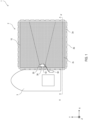
- Fig. 1 is a plan view showing a configuration of a fish characteristic determination system (1).
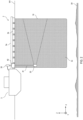
- Fig. 2 is a cross-sectional view of the fish characteristic determination system (1) of Fig. 1 cut at position A-A'.
- the fish characteristic determination system (1) is equipped with a raft (2) installed at sea.
- the raft (2) is anchored to seabed (B1) by ropes, etc. (not shown), such that horizontal movement is restricted.
- the raft (2) is equipped with a raft frame (2a) made of wood, metal pipes, etc., multiple floats (2b) for floating the raft frame (2a) on the sea, and a net (2c) for housing fish.
- the raft frame (2a) has an approximately rectangular shape in plan view.
- the multiple floats (2b) are installed on a lower surface of the raft frame (2a) along an outer circumference of the raft frame (2a). Buoyancy of the multiple floats (2b) causes the raft frame (2a) to float on sea surface (W1).
- the net (2c) is set in an area inside the raft frame (2a). As shown in Fig. 2 , the net (2c) hangs in a rectangular shape to a given depth. The upper end of the net (2c) extends to the height of an upper surface of the raft frame (2a).
- the net (2c) is composed of two sides facing in the X-axis direction, two sides facing in the Y-axis direction, and a bottom surface connected to each other.
- the area surrounded by the net (2c) has an open top surface. As shown in Fig. 2 , the net (2c) hangs down to near the seabed (B 1).
- the area enclosed by the net (2c) constitutes a fish cage (10).
- Fish for aquaculture are transferred to the fish cage (10). As shown in Figs. 1 and 2 , a boat (3) is laid alongside a negative X-axis side of the raft (2). Fish for aquaculture are housed in an inboard cage (not shown) of the boat (3). Fish housed in the inboard cage are transferred from the inboard cage to the fish cage (10) using nets, etc.
- a user of the fish characteristic determination system (1) measures length, weight and condition factor (CF) of the fish in the fish cage (10) to confirm growth of the fish being farmed in the fish cage (10).
- the user uses a camera system (20) to image the fish in the fish cage (10).
- the camera system (20) is connected to a relay (30) via a cable (41).
- the relay (30) is installed on a float (42) floating on the sea surface (W1).
- the relay (30) is connected to a processing unit (50) on the boat (3).
- the image captured by the camera system (20) is transmitted to a processing unit (50) via the cable (41) and the relay (30).
- the user sinks the camera system (20) from the boat (3) into the fish cage (10), and then activates a program for fish characteristic determination installed in the processing unit (50).
- the image captured by the camera system (20) is transmitted to the processing unit (50) and processed by the processing unit (50).
- This processing determines the length, condition factor (CF) and weight of the fish in the fish cage (10).
- the determination processing of fish characteristic by the processing unit (50) is described later with reference to Figs. 4 to 6 .
- the camera system (20) may be installed in the fish cage (10) in advance.
- the float (42) may be fixed to the raft frame (2a), and the camera system (20) may be installed in the fish cage (10) in advance.
- the user may cable the relay (30) at offshore to the processing unit (50) in the boat (3) after the boat (3) is laid alongside the fish cage (10) as shown in Fig. 2 .
- the relay (30) may have a radio transmission function capable of communicating with a land-based network via an access point.
- the user can receive on land the images captured by the camera system (20) at the processing unit (50) by connecting the processing unit (50) to the relay (30) without going to the fish cage (10) on the boat (3). Therefore, the growth of the fish in the fish cage (10) can be confirmed on land.
- Fig. 3 is a diagram showing a configuration of the camera system (20).
- the camera system (20) includes two cameras (21), (22).
- the two cameras (21), (22) are arranged side by side in the Y-axis direction at a given interval. That is, the two cameras (21), (22) constitute a stereo camera.
- the two cameras (21), (22) have parallax corresponding to the position difference (i.e., the interval) in the Y-axis direction. With this parallax, a distance to the same object contained in each captured image of the two cameras (21), (22) can be calculated.
- the two cameras (21), (22) are respectively equipped with lenses (21a), (22a) of a given viewing angle and image sensors (21b), (22b) in which the image of a captured area is formed by the lenses (21a), (22a).
- outermost rays of the captured area (range of viewing angle) of the lenses (21a), (22a) are schematically shown as solid lines.
- Each of the lenses (21a), (22a) may not necessarily be composed of one lens but may be composed of several lenses combined.
- the image sensors (21b) and (22b) may be color image sensors such as CMOS image sensors and CCDs.
- the lenses (21a) and (22a) are oriented in almost the same direction. More specifically, the direction in which the lenses (21a) and (22a) are oriented is horizontal. However, not limited to this, the direction in which the lenses (21a) and (22a) are oriented may slightly deviate.
- Fig. 4 is a block diagram showing a configuration of the processing unit (50).
- Fig. 4 includes the camera system (20) that communicates with the processing unit (50).
- the processing unit (50) includes a control unit (101), a storage unit (102), a communication circuit (103), a display unit (104), a display processing circuit (105), an operation unit (106), and an operation processing circuit (107).
- the processing unit (50) may consist of a personal computer. Alternatively, the processing unit (50) may consist of a dedicated machine.
- the control unit (101) is equipped with an arithmetic processing circuit such as a Central Processing Unit (CPU) and executes control processing for fish characteristic determination by a program stored in the storage unit (102).
- the storage unit (102) is equipped with a storage media such as Read Only Memory (ROM), Random Access Memory (RAM) and hard disk.
- the storage unit (102) stores a program for implementing fish characteristic determination processing.
- the communication circuit (103) communicates with the camera system (20) in response to control from the control unit (101). As described above, the communication circuit (103) acquires captured images from the two cameras (21) and (22) of the camera system (20) in response to control from the control unit (101). The communication circuit (103) outputs the acquired images to the control unit (101).
- the display unit (104) is equipped with a display such as a liquid crystal display.
- the display processing circuit (105) causes the display unit (104) to display an image according to control from the control unit (101).
- the operation unit (106) is provided with input means such as an operation key and a mouse.
- the operation processing circuit (107) outputs a signal corresponding to the operation on the operation unit (106) to the control unit (101) in response to the control from the control unit (101).
- the display unit (104) and the operation unit (106) may consist of a liquid crystal panel with a touch panel superimposed on the liquid crystal display.
- functions of a fish length calculation unit (101a), a condition factor calculation unit (101b) and a fish weight calculation unit (101c) are given to the control unit (101) by a program stored in the storage unit (102).
- the fish length calculation unit (101a) analyzes and processes the image acquired by the camera system (20) to detect an area of the fish in the image, and further calculates the length (L) of the fish in the area based on the parallax between the cameras (21) and (22).
- the fork length is calculated as the length (L) of the fish.
- the calculated length (L) of the fish is not limited to this and may be any other length for which the length of the fish can be specified.
- the condition factor calculation unit (101b) calculates the condition factor (CF) of the fish from the length (L) of the fish calculated by the fish length calculation unit (101a). A calculation method of the condition factor (CF) is explained later.
- the fish weight calculation unit (101c) calculates the body weight (W) of the fish by applying the condition factor (CF) calculated by the condition factor calculation unit (101b) and the length (L) of the fish calculated by the fish length calculation unit (101a) to the above equation (2). That is, the fish weight calculation unit (101c) calculates the body weight of the fish from a multiplication of the condition factor (CF) calculated by the condition factor calculation unit (101b) and the length (L) of the fish calculated by the fish length calculation unit (101a).
- the control unit (101) makes the display unit (104) display the calculation results of the fish length calculation unit (101a), the condition factor calculation unit (101b) and the fish weight calculation unit (101c). For example, from the length (L), condition factor (CF) and body weight (W) from multiple fish obtained from images during an imaging period, the control unit (101) calculates a mean value, a median value or a mode value, and displays the calculated value on the display unit (104). Alternatively, the control unit (101) may generate histograms from the length (L), condition factor (CF) and body weight (W) of the multiple fish acquired during the imaging period, respectively, and display the generated histograms on the display unit (104). These displays enable the user to grasp growth condition (fish length (L), condition factor (CF) and weight (W)) of the fish in the fish cage (10).
- the length (L) of the fish calculated from the captured image of the camera system (20) is first applied to the above equation (1) to calculate the weight (W) of the fish.
- the calculated weight (W) is then applied to the above equation (2) to calculate the condition factor (CF) of the fish.
- condition factor (CF) of fish is executed in the condition factor calculation unit (101b). That is, the larger the length (L) of fish, the higher the fish potential for fattening.
- the condition factor (CF) of fish can be accurately calculated by an exponential function of the length of fish.
- condition factor (CF) of the fish also varies according to their predation activity which changes depending on the temperature of the water in which they swim and the time of year.
- the temperature of the water varies according to a time of year, such as the months and the seasons. Therefore, depending on the temperature of the water in which the fish swim and/or the time of year, the fat of the fish also varies. Therefore, by adjusting the above exponential function according to the temperature of the water in which the fish swim and/or the time of year, the accuracy of calculating the condition factor (CF) of the fish can be further improved.
- the weight of the fish can vary from seed to seed.
- fattening of fish can vary depending on whether it is a natural seed or an artificial seed, or depending on where the artificial seed comes from (where the parents come from) and the lot (for example, a group of eggs laid by a single spawning). Therefore, by adjusting the above exponential function for each fish seed, the accuracy of calculating the condition factor (CF) of fish can be further improved.
- the exponential function of the fish length (L) (fork length) is used to calculate the condition factor (CF) of fish, and further, a first and a second parameter are included in this exponential function.
- the first parameter is a parameter multiplied by the fish length (L)
- the second parameter is a parameter for adjusting the condition factor (CF) according to the temperature of the water and/or the time of year. The values of these parameters are then changed according to the seed of the fish housed in the fish cage (10).
- condition factor calculation unit (101b) calculates the condition factor (CF) of the fish from following equation (3).
- CF e b ⁇ L + c
- (b) is the first parameter described above and (c) is the second parameter described above. These parameters are stored in advance in the storage unit (102) as part of the program described above. These parameters are also stored in the storage unit (102) for each fish species.
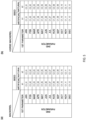
- Fig. 5(a) and Fig. 5(b) are diagrams showing a configuration of parameter information (first parameter (b), and second parameter (c)) stored in the storage unit (102).
- Fig. 5(a) and Fig. 5(b) show the parameter information for mackerel and horse mackerel, respectively.
- the second parameter (b) is set for each month of the year.
- the values of the first parameter (b) and the second parameter (c) are changed depending on whether the seed is artificial or natural.
- Artificial seeds are eggs and young fish that users purchased from seed centers and other sources and that are now cultivated in the fish cage (10).
- Natural seeds are young fish and fish that users captured from fishing grounds and that are now cultivated in cages. It is assumed here that fish of the same seed are mainly cultivated in the same fish cage (10).
- parameter information of the same configuration is also stored in the storage unit (102).
- the first parameter (b) and the second parameter (c) included in the parameter information are adjusted to obtain an optimum value for each fish species.
- a creator of the parameter information adjusts the first parameter (b) and the second parameter (c) of each month for each fish species and seed so that the condition factor (CF) calculated by the above equation (3) best fits actual measured condition factor of fish, and provides the adjusted first parameter (b) and the adjusted second parameter (c) of each month to the user along with the above program.
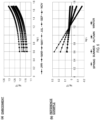
- Fig. 6(a) is a graph showing an example of waveforms of an exponential function for calculation of a condition factor when first and second parameters are optimized.
- the graph shows the waveforms of the above equation (3) when the first parameter (b) and the second parameter (c) are optimized.
- Fig. 6(a) shows six graphs corresponding to January, March, May, July, September and November, respectively.
- the exponential function of equation (3) is an increasing function by optimizing the first parameter (b) and the second parameter (c).
- the first parameter (b) is set to a positive value.
- the condition factor (CF) for the same length (L) is highest in March and lowest in September.
- the temperature in the water is too high, so predation activity stagnates. This is why September has the lowest condition factor (CF).
- Predation activity also stagnates during the cold season but is highest after the cold season. Therefore, March has the highest condition factor (CF).
- a graph of a formula for calculating the condition factor (CF) described in the following prior literature is shown in Fig. 6(b) .
- Equation (4) is a decreasing function. Equation (4) is defined for wild fish that are freely mobile according to the season. Therefore, equation (4) is not suitable for the calculation of the condition factor (CF) of farmed fish restrained in the fish cage (10). For this reason, equation (4) is a decreasing function as shown in Fig. 6(b) , which is significantly different from the waveforms of the exponential function (increasing function) in equation (3).
- Fig. 7(a) is a graph showing, for a given fish species, a relationship between the condition factor (CF) (embodiment) according to equation (3) when the first parameter (b) and the second parameter (c) are optimized for a given fish species, and a measured condition factor (CF) (measurement data from catch).
- CF condition factor
- the length (L) (fork length) of a fish is calculated by imaging each fish with the camera system (20), and the calculated length (L) is applied to equation (3) above to calculate the condition factor (CF) (embodiment: vertical axis) of the fish.
- the fish is actually caught and measured to obtain length (L) and body weight (W), and the obtained length (L) and body weight (W) are applied to equation (2) above to calculate the condition factor (CF) (measurement data from catch: horizontal axis).
- This task is performed for the number of plots in Fig. 7(a) .
- Each plot corresponds to one fish.
- a plot for a fish is placed at the intersection of the condition factor (CF) (embodiment: vertical axis) obtained from equation (3) and the condition factor (CF) (measurement data from catch: horizontal axis) obtained from actual measurement for that fish.
- Each plot is obtained at different time of year and for different fish seed.
- the seeds are divided into two types: artificial and natural.
- the first parameter (b) and the second parameter (c) of equation (3) are optimized, and the condition factor (CF) of the fish corresponding to each plot is obtained from equation (3).
- Fig. 7(a) three approximate lines are shown by dashed lines.
- the approximate line in the middle is the approximate line when the condition factor (CF) (embodiment) and the condition factor (CF) (measurement data from catch) match.
- the approximate line in the upper side is the approximate line when the condition factor (CF) (embodiment) is slightly higher than the condition factor (CF) (measurement data from catch), and the approximate line in the lower side is the approximate line when the condition factor (CF) (embodiment) is slightly lower than the condition factor (CF) (measurement data from catch).
- (H) is the height of the fish.
- the height H of the fish is further added to calculate the weight W of the fish, and in contrast to the equation (1) above, the thickness of the fish, that is, how fat the fish is, is not added to the calculation of the weight W.
- condition factor (CF) of the fish is calculated by applying the length (L) of the fish acquired from the captured image of the camera system (20) to equation (6).
- Fig. 7(b) and Fig. 7(c) are graphs showing a relationship between the measured condition factor (CF) (measurement data from catch) and the calculated condition factor (CF) (comparison example) according to equation (6) above when each parameter of equation (6) is optimized for a given fish species.
- CF measured condition factor
- CF calculated condition factor
- the length (L) (fork length) and body height (H) of each fish are calculated by imaging each fish with the camera system (20), and the calculated length (L) and body height (H) are applied to equation (6) above to calculate the condition factor (CF) (comparison example: vertical axis) of the fish. Furthermore, the fish is actually caught and measured to obtain length (L) and body weight (W), and the obtained length (L) and body weight (W) are applied to equation (2) above to calculate the condition factor (CF) (measurement data from catch: horizontal axis). This task is performed for the number of plots in Fig. 7(b) and Fig. 7(c) . Each plot corresponds to one fish. A plot for a fish is placed at the intersection of the condition factor (CF) (comparison example: vertical axis) obtained from equation (6) and the condition factor (CF) (measurement data from catch: horizontal axis) obtained from actual measurement for that fish.
- CF condition factor
- each plot is obtained at different time of year for different fish seed.
- the seeds are divided into two types: artificial and natural.
- each parameter of equation (6) above is optimized, and the condition factor (CF) of the fish corresponding to each plot is obtained from equation (6).
- each parameter of equation (6) above was optimized with the assumption that the condition factor (CF) was less than 20 and with the assumption that the condition factor (CF) was 20 or more, and two versions of equation (6) were set. Then, the condition factor (CF) (comparison example) of each fish was calculated by applying the length (L) and the body height (H) of each fish acquired from the captured image of the camera system (20) to these two versions of equation (6), respectively.
- Fig. 7(b) shows the results using equation (6) adjusted on the assumption that the condition factor (CF) is less than 20, and Fig. 7(c) shows the results using equation (6) adjusted on the assumption that the condition factor CF is 20 or more.
- Fig. 8 is a flowchart showing a determination process of fish characteristic.
- the processing of Fig. 8 is executed in the control unit (101) of Fig. 4 .
- the processing of steps (S103), (S104) and (S105) is executed by the functions of the fish length calculation unit (101a), the condition factor calculation unit (101b) and the fish weight calculation unit (101c), respectively.
- the control unit (101) acquires the image from the camera system (20) (two cameras (21), (22)), at step (S101) and extracts the image of the fish from the acquired image, at step (S102). From the extracted image of the fish, the control unit (101) calculates the length (L) (fork length) of the fish based on the parallax between the two cameras (21) and (22), at step (S103) and applies the calculated length (L) to the above equation (3) to calculate the condition factor (CF) of the fish, at step (S104).
- the first parameter (b) and the second parameter (c) are optimized according to the time of year, fish species, and seed of the fish housed in the fish cage (10) to be measured.
- the user inputs the fish species and seed of the fish housed in the fish cage (10) via the operation unit (106) of Fig. 4 before the start of the processing of Fig. 8 .
- the current time is acquired by a date and time measurement function in the control unit (101) in Fig. 4 .
- the control unit (101) refers to the parameter information corresponding to the inputted fish species among the parameter information (see Figs. 5(a), 5(b) ) stored in the storage unit (102), and extracts values of the first parameter (b) and second parameter (c) corresponding to the inputted seed and the current time from the parameter information. Then, the control unit (101) sets the values of the extracted first parameter (b) and second parameter (c) in the equation (3).
- the condition factor (CF) is calculated using the optimized equation (3).
- the control unit (101) applies the calculated condition factor (CF) and the length (L) of the fish calculated, at steps (S103) and (S104) to the above equation (2) to calculate the body weight (W) of the fish, at step (S105).
- the control unit (101) stores the calculated length (L), the condition factor (CF) and the body weight (W) in the storage unit (102) for each fish, at step (S106).
- the control unit (101) repeatedly executes the processing of steps (S101) to (S106) until the length (L), the condition factor (CF) and the body weight (W) are acquired for a given number of fish (e.g., 100 fish), at step (S107: NO). During this process, the control unit (101) avoids acquiring the length (L), the condition factor (CF) and the body weight (W) for the same fish in duplicate by tracking the fish included in the imaging viewing angle of the camera system (20).
- the control unit (101) causes the display unit (104) to display the calculation result for these fish, at step (S108).
- a histogram for each of the length (L), the condition factor (CF) and the body weight (W) of fish may be displayed in the display unit (104). This enables the user to accurately grasp the growth condition (fish length (L), condition factor (CF) and weight (W) of fish in the fish cage (10).
- the fish characteristic determination system (1) is equipped with the camera system (20) configured to acquire the image of the fish, the fish length calculation unit (101a) configured to calculate the length (L) of the fish by processing the image of the fish, and the condition factor calculation unit (101b) configured to calculate the condition factor (CF) of the fish from the calculated length (L).
- the condition factor (CF) is calculated from an exponential function of the length (L).
- the condition factor (CF) of fish can be calculated with high accuracy.
- the exponential function may be expressed as equation (3) above.
- equation (3) as the exponential function, as shown in Fig. 7(a) , by adjusting the first parameter (b) and the second parameter (c), the condition factor CF of fish can be calculated with high accuracy.
- the second parameter (c) of equation (3) may change with the time of year at which the fish swims. As shown above, fish change their predation activity depending on the temperature of the water in which the fish swim. Also, the temperature of the water in which the fish swim changes depending on the time of year. Therefore, by changing the second parameter (c) of equation (3) with the time of year in which the fish swim, the accuracy of the condition factor (CF) of the fish calculated from equation (3) can be enhanced.
- the first parameter (b) of equation (3) may be the same regardless of the time of year at which the fish swims. As shown above, the larger the length (L) of the fish, the higher the potential for fattening. This is based on the fish's skeleton, not on a degree of predation activity such as time of year or temperature of the water. On the other hand, the first parameter (b) in equation (3) is multiplied by the length (L) of the fish and is a parameter for adjusting the degree of fattening based on the length (L) (skeleton).
- the first parameter (b) may be the same as long as the relationship between the length of the fish and the condition factor (CF) is adjusted, in view of the relationship between the time of year when the fish swims and the temperature of the water in which the fish swims. Therefore, by setting the first parameter (b) of the above equation (3) to be the same regardless of the time of year at which the fish swims, the condition factor (CF) of the fish can be accurately calculated from the above equation (3).
- the first parameter (b) and the second parameter (c) are predetermined for a given fish species.
- the fattening of fish can vary from species to species. Therefore, the first parameter (b) and the second parameter (c) are predetermined for a given fish species, so that the condition factor (CF) of fish of a given fish species can be accurately calculated.
- the first parameter (b) and the second parameter (c) are predetermined for a given fish seed.
- the fattening of fish can be different for each fish seed. For example, the fattening of fish depends on whether it is natural or artificial seed. Therefore, as shown in Fig. 5(a) and Fig. 5(b) , the first parameter (b) and the second parameter (c) are predetermined for a given fish seed, so that the condition factor (CF) of fish can be accurately calculated.
- the first parameter (b) is set positive when the base (e) of the exponential function of equation (3) is more than 1. That is, the exponential function of equation (3) is an increasing function. Thus, the degree of fattening of fish according to the fish length (L) can be defined by this exponential function. Therefore, from this exponential function, the condition factor (CF) of fish can be accurately calculated.
- the fish characteristic determination system (1) may further include the fish cage (10) in which the fish swims.
- the condition factor (CF) of fish cultured in the fish cage (10) can be calculated with high accuracy.
- the fish swimming in the fish cage (10) is preferably raised from artificial fish seed. This makes it easier for the growth characteristic of the fish in the fish cage (10) to be uniform compared to the case of natural fish seed, as described above.
- the parameters of the exponential function can be set to suit the fish swimming in the fish cage (10), and the condition factor (CF) of the fish in the fish cage (10) can be calculated with high accuracy.
- the present invention is not limited to the above embodiment.
- the embodiment of the present invention can be changed in various ways other than the above configuration.
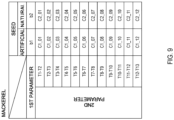
- the second parameter (c) of equation (3) is set (optimized) for each time of year (month) as shown in Fig. 5(a) and Fig. 5(b) , but as shown in Fig. 9 , the second parameter (c) of equation (3) may be set (optimized) for each temperature of the water in which the fish swims.
- T1-T2 indicates the temperature range between temperatures T1 and T2
- T2-T3 indicates the temperature range between temperatures T2 and T3.
- T3-T4 the temperature range is similarly indicated.
- the temperature of the water changes the activity of fish predation. Therefore, by setting (optimizing) the second parameter (c) of equation (3) for each temperature of the water in which fish swim, the condition factor (CF) of fish can also be calculated with high accuracy from equation (3).
- the control unit (101) extracts the value of the second parameter (c) corresponding to the inputted temperature from the parameter information (parameter information of the corresponding fish species) in Fig. 9 and sets it to the equation (3).
- the type of seeds in the parameter information is classified into two types: artificial seeds and natural seeds, but the type of seeds in the parameter information is not limited to this.
- the artificial seeds in the parameter information may be further classified according to a production area (source) of the parent fish.
- the artificial seeds in the parameter information may be classified according to other items such as lots and producers.
- the Napier's constant e is used as the base of equation (3), but the base of equation (3) may be any another number. Even when a number other than the Napier's constant e is used as the base of equation (3), equation (3) may be an increasing function as shown in Fig. 6(a) , as long as the first parameter (b) and the second parameter (c) are optimized according to the time of year (or water temperature) and seed. In this case, if the base of equation (3) is more than 1, as above, the first parameter (b) may be set to a positive value, and if the base of equation (3) is less than 1, the first parameter (b) may be set to a negative value. This makes equation (3) an increasing function as in Fig. 6(a) .
- the body weight (W) of the fish is calculated by applying the condition factor (CF) calculated by equation (3) and the fish length (L) to equation (2), but the calculation of the body weight (W) of the fish may be omitted.
- the above equation (3) is used as the formula of the exponential function for calculating the condition factor (CF) of the fish, but the formula of the exponential function for calculating the condition factor (CF) is not limited to this.
- the following equation may be used as the formula for calculating the condition factor (CF).
- body height (H) is included as a variable, and a third parameter (d) that is multiplied by this variable, is added, compared with equation (3) above.
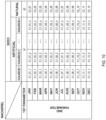
- the third parameter (d) along with the first parameter (b) and the second parameter (c) is optimized for each fish species, seed and time of year (or water temperature).
- the condition factor (CF) can be calculated with high accuracy, as in the above embodiment.
- the camera system (20) is a configuration of a stereo camera including the two cameras (21, 22) but the camera system (20) may be a configuration including only one camera.
- a means for calculating a distance to the fish on the image acquired by the camera may be further placed in the camera system (20).
- an ultrasonic transducer that transmits and receives ultrasonic waves to and from an imaging area of the camera may be used as this means. From echo data of this device, the distance to the fish on the captured image of the camera is calculated. From this distance and the size of the fish on the camera's image, the length (L) (fork length, etc.) of the fish is calculated.
- the camera system (20) may be a time-of-flight (TOF) camera.
- TOF time-of-flight
- a distance image is acquired by mapping a distance to an object included in the imaging field of the TOF camera in terms of pixels of the imaging element of the TOF camera. From this distance image, an area with approximately the same distance and corresponding to a fish shape is extracted as a fish area. Then, the length (L) of the fish is calculated from the distance of this area on the distance image (for example, an average value of the distances of this area) and the length of this area (the width in the length direction of the fish).
- the fish length calculation unit (101a), the condition factor calculation unit (101b) and the fish weight calculation unit (101c) are realized as the functions of the control unit (101) given by the program stored in the storage unit (102), but these need not necessarily be realized as the functions given by the program stored in the storage unit (102).
- one or more of these functions may consist of a field-programmable gate array (FPGA) or hardware with integrated logic circuits.
- the fish characteristic determination system (1) is not limited to the configuration shown in Fig. 1 .
- the X-axis and Y-axis widths and the Z-axis depth of the fish cage (10) may be changed accordingly.
- the net (2c) may not necessarily hang in a rectangular shape but may hang in an arc shape.
Landscapes
- Life Sciences & Earth Sciences (AREA)
- Zoology (AREA)
- Environmental Sciences (AREA)
- Marine Sciences & Fisheries (AREA)
- Animal Husbandry (AREA)
- Biodiversity & Conservation Biology (AREA)
- Length Measuring Devices By Optical Means (AREA)
- Farming Of Fish And Shellfish (AREA)
- Image Analysis (AREA)
- Image Processing (AREA)
Abstract
A fish characteristic determination system for determining a characteristic of a fish swimming in water is provided. The system includes a camera system (20), a fish length calculation unit (101a), and a condition factor calculation unit (101b). The camera system (20) is configured to acquire an image of the fish. The fish length calculation unit (101a) is configured to calculate a length of the fish by processing the image of the fish. The condition factor calculation unit (101b) is configured to calculate a condition factor of the fish from the calculated length. The condition factor is calculated from an exponential function of the length.
Description
- The present invention relates to a fish characteristic determination system for determining a characteristic of a fish swimming in water, a fish characteristic determination method for determining the characteristic of the fish swimming in water, and a program for making a computer that executes a function for determining the characteristic of the fish swimming in water.
- Industrial aquaculture requires visualization of a characteristic of a fish in a fish cage to improve productivity. Condition factor of the fish in the fish cage is an important factor in improving productivity, along with fish length (e.g., fork length) and body weight. Fish length (fork length) is a major indicator of fish skeletal growth, and body weight is a direct indicator of fish shipping plans. Condition factor is a major indicator of fish fleshiness.
- Traditionally, the visualization of such characteristics has been done by a user of the fish cage by actually measuring the length and weight of the fish in the fish cage. Specifically, the user pulls up the net of the fish cage to catch the fish, anesthetizes the caught fish, measures the length and weight of each fish, and calculates the condition factor of the fish from these measurements. The measured fish are returned to the fish cage. Such work is done on about 100 fish in the cage. This work is rather cumbersome and hard.
- Contrarily, in recent years, cameras have been used to acquire images of the fish in the fish cage, which are then processed to obtain the length (fork length) and body height of the fish. For example, the length L of the fish acquired from the camera image is applied to following equation (1) to calculate the weight W of the fish. In the following equations, the unit of length L is "centimeter (cm)", and the unit of weight W is "gram (g)".

- The calculated weight is then applied to following equation (2) to calculate the condition factor CF of the fish.

- Such calculation method is described, for example, in Froese R (2006) "Cube law, condition factor and weight - length relationships: history, meta-analysis and recommendations," J Appl Ichthyol 22 (2006), 241 -253.
- However, in the above equation (1), thickness of the fish, that is, a degree of fattening of the fish, is not taken into account, making it difficult to calculate the weight of the fish with high accuracy. Therefore, the accuracy of calculating the condition factor of the fish based on the above equation (2) also decreases. On the other hand, if the condition factor of fish can be accurately calculated, the weight of fish can be accurately calculated from the above equation (2).
- In view of such issues, the present invention aims to provide a fish characteristic determination system, a fish characteristic determination method and a program that can accurately calculate the condition factor of the fish.
- In accordance with an embodiment, a first aspect of the present invention relates to a fish characteristic determination system for determining a characteristic of a fish swimming in water. The system, according to the first aspect, includes a camera system, a fish length calculation unit, and a condition factor calculation unit. The camera system is configured to acquire an image of the fish. The fish length calculation unit is configured to calculate a length of the fish by processing the image of the fish. The condition factor calculation unit is configured to calculate a condition factor of the fish from the calculated length. The condition factor is calculated from an exponential function of the length.
- The larger the length of the fish, greater is the potential of getting a fattier fish. As described above, according to the fish characteristic determination system in this aspect, the condition factor of the fish is calculated from the exponential function of length of the fish. Therefore, the condition factor of the fish is accurately calculated.
- In the fish characteristic determination system according to the present embodiment, the exponential function may be expressed as CF = ab × L + c, where CF is the condition factor, L is the length, a is the base of the exponential function, b is a first parameter, and c is a second parameter.
- Using this equation as the exponential function, the condition factor CF of fish is accurately calculated by adjusting the first and second parameters.
- Here, the second parameter (c) may change with time of year at which the fish swims or a temperature of the water in which the fish swims.
- The condition factor of the fish also varies according to their predation activity which changes depending on the temperature of the water in which they swim and the time of year. Therefore, by changing the second parameter (c) of the above equation with the time of year in which the fish swim or the temperature of the water in which the fish swim, the accuracy of the condition factor of fish calculated from the above equation is enhanced.
- Moreover, the first parameter (b) may be the same regardless of time of the year at which the fish swims or a temperature of the water in which the fish swims.
- As described above, the larger the length of the fish, the higher is the potential for fattening. This is based on the skeleton of the fish, not on a degree of predation activity such as time of the year or temperature of the water. On the other hand, the first parameter (b) is multiplied by the length L of the fish to adjust the degree of fattening based on the length L (skeleton). For this reason, the first parameter (b) is the same as long as the relationship between the length of the fish and the condition factor is adjusted, in view of the relationship between the time of year when the fish swims and the temperature of the water in which the fish swims. Therefore, as described above, by setting the first parameter (b) of the above equation to be the same regardless of the time of the year at which the fish swims or the temperature of the water in which the fish swims, the condition factor of the fish is accurately calculated from the above equation.
- Therefore, the above exponential function have only one parameter (c) that changes with a time of year at which the fish swims or a temperature of the water in which the fish swims. With this, as described above, the condition factor of the fish can be accurately calculated according to the time of year at which the fish swims or the temperature of the water in which the fish swims.
- Here, the first parameter (b) and the second parameter (c) may be predetermined for a given fish species.
- The fattening of fish can be different for each fish species. Therefore, the first parameter (b) and the second parameter (c) may be predetermined for a given fish species, so that the condition factor of fish of the given fish species can be accurately calculated.
- Moreover, the first parameter (b) and the second parameter (c) is predetermined for a given fish seed.
- The fattening of fish is different for each fish seed. For example, the fattening of fish depends on whether it is natural or artificial seed, and the fattening of fish depends on production area or lot of artificial seed. Therefore, as described above, the first parameter (b) and the second parameter (c) are predetermined for a given fish seed, so that the condition factor of fish is accurately calculated.
- According to the first aspect, when the base (a) of the exponential function is more than 1, the first parameter (b) may be positive, and when the base (a) of the exponential function is less than 1, the first parameter (b) may be negative. That is, the exponential function is an increasing function.
- Thus, the degree of fattening of fish according to the length of fish can be defined by this exponential function. Therefore, the condition factor of fish can be accurately calculated from this exponential function.
- The fish characteristic determination system according to this aspect may further include a fish cage in which the fish swims. Thus, the condition factor of fish cultured in the fish cage can be calculated with high accuracy.
- Here, the fish swimming in the fish cage may be raised from an artificial fish seed. In this case, characteristic of fish in the fish cage can be more uniform than in the case of natural fish seed. Thus, the parameters of the exponential function can be set to suit the fish swimming in the fish cage, and the condition factor of fish in the fish cage can be accurately calculated.
- In accordance with an embodiment, a second aspect of the present invention relates to a fish characteristic determination method for determining a characteristic of a fish swimming in water. The method according to the present embodiment includes acquiring an image of the fish, calculating a length of the fish by processing the image of the fish, and calculating a condition factor of the fish from the calculated length. The condition factor is calculated from an exponential function of the length.
- According to the fish characteristic determination method, according to the present embodiment, the same effect as the fish characteristic determination system according to the first aspect can be achieved.
- In accordance with an embodiment, a third aspect of the present invention relates to a computer program comprising instructions which, when executed by a computer, cause the computer to carry out the method according to the second aspect.
- According to the present embodiment, the same effect as the fish characteristic determination system according to the first aspect can be achieved.
- As described above, according to the present invention, a fish characteristic determination system, a fish characteristic determination method, and a program capable of accurately calculating the condition factor of fish can be provided.
- The effect or significance of the present invention will be further clarified by the description of the following embodiments. However, the following embodiments are only examples when implementing the present invention, and the present invention is not in any way limited to those described in the following embodiments.
-
Fig. 1 is a plan view showing a configuration of a fish characteristic determination system, according to an embodiment; -
Fig. 2 is a cross-sectional view showing the configuration of the fish characteristic determination system, according to an embodiment; -
Fig. 3 is a diagram showing a configuration of a camera system, according to an embodiment; -
Fig. 4 is a block diagram showing a configuration of a processing unit, according to an embodiment; -
Fig. 5(a) and Fig. 5(b) are diagrams showing a configuration of parameter information, according to an embodiment; -
Fig. 6(a) is a graph showing an example of waveforms of an exponential function for calculation of a condition factor when first and second parameters are optimized, according to an embodiment; -
Fig. 6(b) is a graph showing an example of waveforms of a function for calculation of the condition factor, according to a reference example; -
Fig. 7(a) is a graph showing, for a given fish species, a relationship between the condition factor calculated by a formula in which the first and second parameters are optimized, and an actual measurement of the condition factor (measurement data from catch), according to an embodiment; -
Figs. 7(b) - 7(c) are graphs showing, for a given fish species, a relationship between the condition factor calculated by a formula in which the parameters are optimized according to a comparison example, and an actual measurement of the condition factor (measurement data from catch), according to an embodiment; -
Fig. 7(d) is a graph in which the plots fromFig. 7(a) coming from fish of natural seeds are removed and only the plots coming from fish of artificial seeds are left, according to an embodiment; -
Fig. 8 is a flowchart showing a determination process of fish characteristic, according to an embodiment; -
Fig. 9 is a diagram showing a configuration of parameter information, according to a modification; and -
Fig. 10 is a diagram showing the configuration of parameter information according to another modification. - Embodiments of the invention will be described below with reference to the drawings. For convenience, XYZ axes perpendicular to each other are added to the drawings as appropriate. The X and Y axes are horizontal, and the Z axis is vertical.
- In the following embodiment, the present invention is applied to a fish characteristic determination system that images fish in a fish cage by placing a boat alongside the fish cage. However, the present invention is not in any way limited to the following embodiment
-
Fig. 1 is a plan view showing a configuration of a fish characteristic determination system (1).Fig. 2 is a cross-sectional view of the fish characteristic determination system (1) ofFig. 1 cut at position A-A'. - Referring to
Figs. 1 and2 , the fish characteristic determination system (1) is equipped with a raft (2) installed at sea. The raft (2) is anchored to seabed (B1) by ropes, etc. (not shown), such that horizontal movement is restricted. - The raft (2) is equipped with a raft frame (2a) made of wood, metal pipes, etc., multiple floats (2b) for floating the raft frame (2a) on the sea, and a net (2c) for housing fish. The raft frame (2a) has an approximately rectangular shape in plan view. The multiple floats (2b) are installed on a lower surface of the raft frame (2a) along an outer circumference of the raft frame (2a). Buoyancy of the multiple floats (2b) causes the raft frame (2a) to float on sea surface (W1).
- The net (2c) is set in an area inside the raft frame (2a). As shown in
Fig. 2 , the net (2c) hangs in a rectangular shape to a given depth. The upper end of the net (2c) extends to the height of an upper surface of the raft frame (2a). The net (2c) is composed of two sides facing in the X-axis direction, two sides facing in the Y-axis direction, and a bottom surface connected to each other. The area surrounded by the net (2c) has an open top surface. As shown inFig. 2 , the net (2c) hangs down to near the seabed (B 1). The area enclosed by the net (2c) constitutes a fish cage (10). - Fish for aquaculture are transferred to the fish cage (10). As shown in
Figs. 1 and2 , a boat (3) is laid alongside a negative X-axis side of the raft (2). Fish for aquaculture are housed in an inboard cage (not shown) of the boat (3). Fish housed in the inboard cage are transferred from the inboard cage to the fish cage (10) using nets, etc. - A user of the fish characteristic determination system (1) measures length, weight and condition factor (CF) of the fish in the fish cage (10) to confirm growth of the fish being farmed in the fish cage (10). To this end, the user uses a camera system (20) to image the fish in the fish cage (10). As shown in
Fig. 2 , the camera system (20) is connected to a relay (30) via a cable (41). The relay (30) is installed on a float (42) floating on the sea surface (W1). The relay (30) is connected to a processing unit (50) on the boat (3). The image captured by the camera system (20) is transmitted to a processing unit (50) via the cable (41) and the relay (30). - When checking the growth of the fish, the user sinks the camera system (20) from the boat (3) into the fish cage (10), and then activates a program for fish characteristic determination installed in the processing unit (50). Thus, the image captured by the camera system (20) is transmitted to the processing unit (50) and processed by the processing unit (50). This processing determines the length, condition factor (CF) and weight of the fish in the fish cage (10). The determination processing of fish characteristic by the processing unit (50) is described later with reference to
Figs. 4 to 6 . - The camera system (20) may be installed in the fish cage (10) in advance. For example, in the configuration of
Figs. 1 and2 , the float (42) may be fixed to the raft frame (2a), and the camera system (20) may be installed in the fish cage (10) in advance. In this case, the user may cable the relay (30) at offshore to the processing unit (50) in the boat (3) after the boat (3) is laid alongside the fish cage (10) as shown inFig. 2 . - In addition, if the camera system (20) is thus fixed to the fish cage (10), the relay (30) may have a radio transmission function capable of communicating with a land-based network via an access point. Thus, the user can receive on land the images captured by the camera system (20) at the processing unit (50) by connecting the processing unit (50) to the relay (30) without going to the fish cage (10) on the boat (3). Therefore, the growth of the fish in the fish cage (10) can be confirmed on land.
-
Fig. 3 is a diagram showing a configuration of the camera system (20). The camera system (20) includes two cameras (21), (22). The two cameras (21), (22) are arranged side by side in the Y-axis direction at a given interval. That is, the two cameras (21), (22) constitute a stereo camera. The two cameras (21), (22) have parallax corresponding to the position difference (i.e., the interval) in the Y-axis direction. With this parallax, a distance to the same object contained in each captured image of the two cameras (21), (22) can be calculated. - The two cameras (21), (22) are respectively equipped with lenses (21a), (22a) of a given viewing angle and image sensors (21b), (22b) in which the image of a captured area is formed by the lenses (21a), (22a). In
Fig. 3 , outermost rays of the captured area (range of viewing angle) of the lenses (21a), (22a) are schematically shown as solid lines. - Each of the lenses (21a), (22a) may not necessarily be composed of one lens but may be composed of several lenses combined. The image sensors (21b) and (22b) may be color image sensors such as CMOS image sensors and CCDs. The lenses (21a) and (22a) are oriented in almost the same direction. More specifically, the direction in which the lenses (21a) and (22a) are oriented is horizontal. However, not limited to this, the direction in which the lenses (21a) and (22a) are oriented may slightly deviate.
-
Fig. 4 is a block diagram showing a configuration of the processing unit (50). For convenience,Fig. 4 includes the camera system (20) that communicates with the processing unit (50). - The processing unit (50) includes a control unit (101), a storage unit (102), a communication circuit (103), a display unit (104), a display processing circuit (105), an operation unit (106), and an operation processing circuit (107). The processing unit (50) may consist of a personal computer. Alternatively, the processing unit (50) may consist of a dedicated machine.
- The control unit (101) is equipped with an arithmetic processing circuit such as a Central Processing Unit (CPU) and executes control processing for fish characteristic determination by a program stored in the storage unit (102). The storage unit (102) is equipped with a storage media such as Read Only Memory (ROM), Random Access Memory (RAM) and hard disk. The storage unit (102) stores a program for implementing fish characteristic determination processing.
- The communication circuit (103) communicates with the camera system (20) in response to control from the control unit (101). As described above, the communication circuit (103) acquires captured images from the two cameras (21) and (22) of the camera system (20) in response to control from the control unit (101). The communication circuit (103) outputs the acquired images to the control unit (101).
- The display unit (104) is equipped with a display such as a liquid crystal display. The display processing circuit (105) causes the display unit (104) to display an image according to control from the control unit (101). The operation unit (106) is provided with input means such as an operation key and a mouse. The operation processing circuit (107) outputs a signal corresponding to the operation on the operation unit (106) to the control unit (101) in response to the control from the control unit (101). The display unit (104) and the operation unit (106) may consist of a liquid crystal panel with a touch panel superimposed on the liquid crystal display.
- In this embodiment, functions of a fish length calculation unit (101a), a condition factor calculation unit (101b) and a fish weight calculation unit (101c) are given to the control unit (101) by a program stored in the storage unit (102).
- The fish length calculation unit (101a) analyzes and processes the image acquired by the camera system (20) to detect an area of the fish in the image, and further calculates the length (L) of the fish in the area based on the parallax between the cameras (21) and (22). In this embodiment, the fork length is calculated as the length (L) of the fish. However, the calculated length (L) of the fish is not limited to this and may be any other length for which the length of the fish can be specified.
- The condition factor calculation unit (101b) calculates the condition factor (CF) of the fish from the length (L) of the fish calculated by the fish length calculation unit (101a). A calculation method of the condition factor (CF) is explained later.
- The fish weight calculation unit (101c) calculates the body weight (W) of the fish by applying the condition factor (CF) calculated by the condition factor calculation unit (101b) and the length (L) of the fish calculated by the fish length calculation unit (101a) to the above equation (2). That is, the fish weight calculation unit (101c) calculates the body weight of the fish from a multiplication of the condition factor (CF) calculated by the condition factor calculation unit (101b) and the length (L) of the fish calculated by the fish length calculation unit (101a).
- The control unit (101) makes the display unit (104) display the calculation results of the fish length calculation unit (101a), the condition factor calculation unit (101b) and the fish weight calculation unit (101c). For example, from the length (L), condition factor (CF) and body weight (W) from multiple fish obtained from images during an imaging period, the control unit (101) calculates a mean value, a median value or a mode value, and displays the calculated value on the display unit (104). Alternatively, the control unit (101) may generate histograms from the length (L), condition factor (CF) and body weight (W) of the multiple fish acquired during the imaging period, respectively, and display the generated histograms on the display unit (104). These displays enable the user to grasp growth condition (fish length (L), condition factor (CF) and weight (W)) of the fish in the fish cage (10).
- However, in the conventional calculation method, the length (L) of the fish calculated from the captured image of the camera system (20) is first applied to the above equation (1) to calculate the weight (W) of the fish. The calculated weight (W) is then applied to the above equation (2) to calculate the condition factor (CF) of the fish.
- Since the above equation (1) does not take into account the thickness of the fish, that is, how fat the fish is, it is difficult to calculate the weight (W) of the fish with high accuracy. For this reason, the condition factor (CF) of the fish calculated by applying this weight W to the above equation (2) is also low in accuracy.
- Therefore, in the present embodiment, a new calculation method of the condition factor (CF) of fish is executed in the condition factor calculation unit (101b). That is, the larger the length (L) of fish, the higher the fish potential for fattening. The condition factor (CF) of fish can be accurately calculated by an exponential function of the length of fish.
- In addition, the condition factor (CF) of the fish also varies according to their predation activity which changes depending on the temperature of the water in which they swim and the time of year. The temperature of the water varies according to a time of year, such as the months and the seasons. Therefore, depending on the temperature of the water in which the fish swim and/or the time of year, the fat of the fish also varies. Therefore, by adjusting the above exponential function according to the temperature of the water in which the fish swim and/or the time of year, the accuracy of calculating the condition factor (CF) of the fish can be further improved.
- Furthermore, the weight of the fish can vary from seed to seed. For example, fattening of fish can vary depending on whether it is a natural seed or an artificial seed, or depending on where the artificial seed comes from (where the parents come from) and the lot (for example, a group of eggs laid by a single spawning). Therefore, by adjusting the above exponential function for each fish seed, the accuracy of calculating the condition factor (CF) of fish can be further improved.
- In view of the above, in this embodiment, the exponential function of the fish length (L) (fork length) is used to calculate the condition factor (CF) of fish, and further, a first and a second parameter are included in this exponential function. The first parameter is a parameter multiplied by the fish length (L), and the second parameter is a parameter for adjusting the condition factor (CF) according to the temperature of the water and/or the time of year. The values of these parameters are then changed according to the seed of the fish housed in the fish cage (10).
- Specifically, the condition factor calculation unit (101b) calculates the condition factor (CF) of the fish from following equation (3).

- In this equation, (b) is the first parameter described above and (c) is the second parameter described above. These parameters are stored in advance in the storage unit (102) as part of the program described above. These parameters are also stored in the storage unit (102) for each fish species.
-
Fig. 5(a) and Fig. 5(b) are diagrams showing a configuration of parameter information (first parameter (b), and second parameter (c)) stored in the storage unit (102). -
Fig. 5(a) and Fig. 5(b) show the parameter information for mackerel and horse mackerel, respectively. Here, the second parameter (b) is set for each month of the year. Also, the values of the first parameter (b) and the second parameter (c) are changed depending on whether the seed is artificial or natural. Artificial seeds are eggs and young fish that users purchased from seed centers and other sources and that are now cultivated in the fish cage (10). Natural seeds are young fish and fish that users captured from fishing grounds and that are now cultivated in cages. It is assumed here that fish of the same seed are mainly cultivated in the same fish cage (10). For fish species other than mackerel and horse mackerel, parameter information of the same configuration is also stored in the storage unit (102). - The first parameter (b) and the second parameter (c) included in the parameter information are adjusted to obtain an optimum value for each fish species. A creator of the parameter information adjusts the first parameter (b) and the second parameter (c) of each month for each fish species and seed so that the condition factor (CF) calculated by the above equation (3) best fits actual measured condition factor of fish, and provides the adjusted first parameter (b) and the adjusted second parameter (c) of each month to the user along with the above program.
-
Fig. 6(a) is a graph showing an example of waveforms of an exponential function for calculation of a condition factor when first and second parameters are optimized. The graph shows the waveforms of the above equation (3) when the first parameter (b) and the second parameter (c) are optimized. -
Fig. 6(a) shows six graphs corresponding to January, March, May, July, September and November, respectively. As shown inFig. 6(a) , the exponential function of equation (3) is an increasing function by optimizing the first parameter (b) and the second parameter (c). Here, since the base (e) of equation (3) is greater than one, the first parameter (b) is set to a positive value. In the 6 months illustrated inFig. 6(a) , the condition factor (CF) for the same length (L) is highest in March and lowest in September. In July and September, the temperature in the water is too high, so predation activity stagnates. This is why September has the lowest condition factor (CF). Predation activity also stagnates during the cold season but is highest after the cold season. Therefore, March has the highest condition factor (CF). - As a reference example, a graph of a formula for calculating the condition factor (CF) described in the following prior literature is shown in
Fig. 6(b) . - Froese R (2006) "Cube law, condition factor and weight-length relationships: history, meta-analysis and recommendations," J Appl Ichthyol 22 (2006), 241-253
- In this reference example, the condition factor (CF) is calculated by the following formula:

- Parameters (m) and (n) in equation (4) are optimized according to the season (time of year). As shown in
Fig. 6(b) , equation (4) is a decreasing function. Equation (4) is defined for wild fish that are freely mobile according to the season. Therefore, equation (4) is not suitable for the calculation of the condition factor (CF) of farmed fish restrained in the fish cage (10). For this reason, equation (4) is a decreasing function as shown inFig. 6(b) , which is significantly different from the waveforms of the exponential function (increasing function) in equation (3). -
Fig. 7(a) is a graph showing, for a given fish species, a relationship between the condition factor (CF) (embodiment) according to equation (3) when the first parameter (b) and the second parameter (c) are optimized for a given fish species, and a measured condition factor (CF) (measurement data from catch). - Here, the length (L) (fork length) of a fish is calculated by imaging each fish with the camera system (20), and the calculated length (L) is applied to equation (3) above to calculate the condition factor (CF) (embodiment: vertical axis) of the fish. The fish is actually caught and measured to obtain length (L) and body weight (W), and the obtained length (L) and body weight (W) are applied to equation (2) above to calculate the condition factor (CF) (measurement data from catch: horizontal axis). This task is performed for the number of plots in
Fig. 7(a) . Each plot corresponds to one fish. A plot for a fish is placed at the intersection of the condition factor (CF) (embodiment: vertical axis) obtained from equation (3) and the condition factor (CF) (measurement data from catch: horizontal axis) obtained from actual measurement for that fish. - Each plot is obtained at different time of year and for different fish seed. Here, the seeds are divided into two types: artificial and natural. For each seed and time of year, the first parameter (b) and the second parameter (c) of equation (3) are optimized, and the condition factor (CF) of the fish corresponding to each plot is obtained from equation (3).
- In
Fig. 7(a) , three approximate lines are shown by dashed lines. The approximate line in the middle is the approximate line when the condition factor (CF) (embodiment) and the condition factor (CF) (measurement data from catch) match. The approximate line in the upper side is the approximate line when the condition factor (CF) (embodiment) is slightly higher than the condition factor (CF) (measurement data from catch), and the approximate line in the lower side is the approximate line when the condition factor (CF) (embodiment) is slightly lower than the condition factor (CF) (measurement data from catch). - For comparison, a relationship between the condition factor (CF) (comparison example) and the actual value of the condition factor (CF) (measurement data from catch), when the body weight (W) of fish is determined by the following formula, is obtained.

- In equation (5), (H) is the height of the fish. In equation (5), compared with equation (1) above, the height H of the fish is further added to calculate the weight W of the fish, and in contrast to the equation (1) above, the thickness of the fish, that is, how fat the fish is, is not added to the calculation of the weight W.
- The following equation is derived from equation (5) and equation (2) above.

- In the comparison example, the condition factor (CF) of the fish is calculated by applying the length (L) of the fish acquired from the captured image of the camera system (20) to equation (6).
-
Fig. 7(b) and Fig. 7(c) are graphs showing a relationship between the measured condition factor (CF) (measurement data from catch) and the calculated condition factor (CF) (comparison example) according to equation (6) above when each parameter of equation (6) is optimized for a given fish species. InFig. 7(b) and Fig. 7(c) , three approximate lines like those inFig. 7(a) are also shown by dashed lines. - In the comparison example, the length (L) (fork length) and body height (H) of each fish are calculated by imaging each fish with the camera system (20), and the calculated length (L) and body height (H) are applied to equation (6) above to calculate the condition factor (CF) (comparison example: vertical axis) of the fish. Furthermore, the fish is actually caught and measured to obtain length (L) and body weight (W), and the obtained length (L) and body weight (W) are applied to equation (2) above to calculate the condition factor (CF) (measurement data from catch: horizontal axis). This task is performed for the number of plots in
Fig. 7(b) and Fig. 7(c) . Each plot corresponds to one fish. A plot for a fish is placed at the intersection of the condition factor (CF) (comparison example: vertical axis) obtained from equation (6) and the condition factor (CF) (measurement data from catch: horizontal axis) obtained from actual measurement for that fish. - As in
Fig. 7(a) , each plot is obtained at different time of year for different fish seed. Here, the seeds are divided into two types: artificial and natural. For each seed and time of year, each parameter of equation (6) above is optimized, and the condition factor (CF) of the fish corresponding to each plot is obtained from equation (6). - In addition, in the comparison example, each parameter of equation (6) above was optimized with the assumption that the condition factor (CF) was less than 20 and with the assumption that the condition factor (CF) was 20 or more, and two versions of equation (6) were set. Then, the condition factor (CF) (comparison example) of each fish was calculated by applying the length (L) and the body height (H) of each fish acquired from the captured image of the camera system (20) to these two versions of equation (6), respectively.
-
Fig. 7(b) shows the results using equation (6) adjusted on the assumption that the condition factor (CF) is less than 20, andFig. 7(c) shows the results using equation (6) adjusted on the assumption that the condition factor CF is 20 or more. - As shown in
Fig. 7(b) and Fig. 7(c) , in the comparison example, many of the plots deviated significantly from the middle approximate line, regardless of which formula is used. In contrast, in the embodiment, as shown inFig. 7(a) , most of the plots converged near the middle approximate line and fell within a range of the upper and lower approximate lines. From this, it is confirmed that equation (3) above is extremely effective for calculating the condition factor (CF). - When the plots of fish from natural seeds are excluded from the results in
Fig. 7(a) and only the plots of fish from artificial seeds are left, most of these plots are close to the middle approximate line as shown inFig. 7(d) . This is probably because a growth characteristic of fish from artificial seeds is more uniform than that of fish from natural seeds. From this, it can be said that equation (3) above is more preferable when fish from artificial seeds are grown in the fish cage (10). -
Fig. 8 is a flowchart showing a determination process of fish characteristic. - The processing of
Fig. 8 is executed in the control unit (101) ofFig. 4 . The processing of steps (S103), (S104) and (S105) is executed by the functions of the fish length calculation unit (101a), the condition factor calculation unit (101b) and the fish weight calculation unit (101c), respectively. - When the fish characteristic determination processing is started, the control unit (101) acquires the image from the camera system (20) (two cameras (21), (22)), at step (S101) and extracts the image of the fish from the acquired image, at step (S102). From the extracted image of the fish, the control unit (101) calculates the length (L) (fork length) of the fish based on the parallax between the two cameras (21) and (22), at step (S103) and applies the calculated length (L) to the above equation (3) to calculate the condition factor (CF) of the fish, at step (S104).
- In the equation (3), the first parameter (b) and the second parameter (c) are optimized according to the time of year, fish species, and seed of the fish housed in the fish cage (10) to be measured.
- More specifically, the user inputs the fish species and seed of the fish housed in the fish cage (10) via the operation unit (106) of
Fig. 4 before the start of the processing ofFig. 8 . The current time is acquired by a date and time measurement function in the control unit (101) inFig. 4 . The control unit (101) refers to the parameter information corresponding to the inputted fish species among the parameter information (seeFigs. 5(a), 5(b) ) stored in the storage unit (102), and extracts values of the first parameter (b) and second parameter (c) corresponding to the inputted seed and the current time from the parameter information. Then, the control unit (101) sets the values of the extracted first parameter (b) and second parameter (c) in the equation (3). In step S104, the condition factor (CF) is calculated using the optimized equation (3). - The control unit (101) applies the calculated condition factor (CF) and the length (L) of the fish calculated, at steps (S103) and (S104) to the above equation (2) to calculate the body weight (W) of the fish, at step (S105). The control unit (101) stores the calculated length (L), the condition factor (CF) and the body weight (W) in the storage unit (102) for each fish, at step (S106).
- The control unit (101) repeatedly executes the processing of steps (S101) to (S106) until the length (L), the condition factor (CF) and the body weight (W) are acquired for a given number of fish (e.g., 100 fish), at step (S107: NO). During this process, the control unit (101) avoids acquiring the length (L), the condition factor (CF) and the body weight (W) for the same fish in duplicate by tracking the fish included in the imaging viewing angle of the camera system (20).
- Thus, when the length (L), the condition factor (CF) and the body weight (W) are obtained for a given number of fish, at step (S107: YES), the control unit (101) causes the display unit (104) to display the calculation result for these fish, at step (S108). This displays, for example, a mean, median or mode of the length (L), the condition factor (CF) and the body weight (W) for these given number of fish. Alternatively, a histogram for each of the length (L), the condition factor (CF) and the body weight (W) of fish may be displayed in the display unit (104). This enables the user to accurately grasp the growth condition (fish length (L), condition factor (CF) and weight (W) of fish in the fish cage (10).
- According to the above embodiment, the following effects can be achieved.
- As shown in
Fig. 4 , the fish characteristic determination system (1) is equipped with the camera system (20) configured to acquire the image of the fish, the fish length calculation unit (101a) configured to calculate the length (L) of the fish by processing the image of the fish, and the condition factor calculation unit (101b) configured to calculate the condition factor (CF) of the fish from the calculated length (L). As shown in equation (3) above, the condition factor (CF) is calculated from an exponential function of the length (L). Thus, as shown inFig. 7(a) , the condition factor (CF) of fish can be calculated with high accuracy. - Here, the exponential function may be expressed as equation (3) above. Using equation (3) as the exponential function, as shown in
Fig. 7(a) , by adjusting the first parameter (b) and the second parameter (c), the condition factor CF of fish can be calculated with high accuracy. - As shown in
Fig. 5(a) and Fig. 5(b) , the second parameter (c) of equation (3) may change with the time of year at which the fish swims. As shown above, fish change their predation activity depending on the temperature of the water in which the fish swim. Also, the temperature of the water in which the fish swim changes depending on the time of year. Therefore, by changing the second parameter (c) of equation (3) with the time of year in which the fish swim, the accuracy of the condition factor (CF) of the fish calculated from equation (3) can be enhanced. - Further, as shown in
Fig. 5 (a) and Fig. 5(b) , the first parameter (b) of equation (3) may be the same regardless of the time of year at which the fish swims. As shown above, the larger the length (L) of the fish, the higher the potential for fattening. This is based on the fish's skeleton, not on a degree of predation activity such as time of year or temperature of the water. On the other hand, the first parameter (b) in equation (3) is multiplied by the length (L) of the fish and is a parameter for adjusting the degree of fattening based on the length (L) (skeleton). For this reason, the first parameter (b) may be the same as long as the relationship between the length of the fish and the condition factor (CF) is adjusted, in view of the relationship between the time of year when the fish swims and the temperature of the water in which the fish swims. Therefore, by setting the first parameter (b) of the above equation (3) to be the same regardless of the time of year at which the fish swims, the condition factor (CF) of the fish can be accurately calculated from the above equation (3). - As shown in equation (3), in the exponential function of equation (3), there is only one parameter (second parameter c) that changes with the time of year at which the fish swims. With this, as described above, the condition factor (CF) of the fish can be accurately calculated according to the time of year at which the fish swims.
- As shown in
Fig. 5(a) and Fig. 5(b) , the first parameter (b) and the second parameter (c) are predetermined for a given fish species. The fattening of fish can vary from species to species. Therefore, the first parameter (b) and the second parameter (c) are predetermined for a given fish species, so that the condition factor (CF) of fish of a given fish species can be accurately calculated. - The first parameter (b) and the second parameter (c) are predetermined for a given fish seed. The fattening of fish can be different for each fish seed. For example, the fattening of fish depends on whether it is natural or artificial seed. Therefore, as shown in
Fig. 5(a) and Fig. 5(b) , the first parameter (b) and the second parameter (c) are predetermined for a given fish seed, so that the condition factor (CF) of fish can be accurately calculated. - The first parameter (b) is set positive when the base (e) of the exponential function of equation (3) is more than 1. That is, the exponential function of equation (3) is an increasing function. Thus, the degree of fattening of fish according to the fish length (L) can be defined by this exponential function. Therefore, from this exponential function, the condition factor (CF) of fish can be accurately calculated.
- As shown in
Figs. 1 and2 , the fish characteristic determination system (1) may further include the fish cage (10) in which the fish swims. With this, the condition factor (CF) of fish cultured in the fish cage (10) can be calculated with high accuracy. - Here, the fish swimming in the fish cage (10) is preferably raised from artificial fish seed. This makes it easier for the growth characteristic of the fish in the fish cage (10) to be uniform compared to the case of natural fish seed, as described above. Thus, the parameters of the exponential function can be set to suit the fish swimming in the fish cage (10), and the condition factor (CF) of the fish in the fish cage (10) can be calculated with high accuracy.
- The present invention is not limited to the above embodiment. In addition, the embodiment of the present invention can be changed in various ways other than the above configuration.
- For example, in the above embodiment, the second parameter (c) of equation (3) is set (optimized) for each time of year (month) as shown in
Fig. 5(a) and Fig. 5(b) , but as shown inFig. 9 , the second parameter (c) of equation (3) may be set (optimized) for each temperature of the water in which the fish swims. InFig. 9 , T1-T2 indicates the temperature range between temperatures T1 and T2, and T2-T3 indicates the temperature range between temperatures T2 and T3. After T3-T4, the temperature range is similarly indicated. - As noted above, the temperature of the water changes the activity of fish predation. Therefore, by setting (optimizing) the second parameter (c) of equation (3) for each temperature of the water in which fish swim, the condition factor (CF) of fish can also be calculated with high accuracy from equation (3).
- However, in this case, when calculating the condition factor (CF) of fish, it is necessary to further measure the temperature of the water in the fish cage (10) and input it to the processing unit (50). The control unit (101) extracts the value of the second parameter (c) corresponding to the inputted temperature from the parameter information (parameter information of the corresponding fish species) in
Fig. 9 and sets it to the equation (3). - In the above embodiment, as shown in
Fig. 5(a) and Fig. 5(b) , the type of seeds in the parameter information is classified into two types: artificial seeds and natural seeds, but the type of seeds in the parameter information is not limited to this. For example, as shown inFig. 10 , the artificial seeds in the parameter information may be further classified according to a production area (source) of the parent fish. In addition, the artificial seeds in the parameter information may be classified according to other items such as lots and producers. - In the above embodiment, the Napier's constant e is used as the base of equation (3), but the base of equation (3) may be any another number. Even when a number other than the Napier's constant e is used as the base of equation (3), equation (3) may be an increasing function as shown in
Fig. 6(a) , as long as the first parameter (b) and the second parameter (c) are optimized according to the time of year (or water temperature) and seed. In this case, if the base of equation (3) is more than 1, as above, the first parameter (b) may be set to a positive value, and if the base of equation (3) is less than 1, the first parameter (b) may be set to a negative value. This makes equation (3) an increasing function as inFig. 6(a) . - In the above embodiment, at step (S105) of
Fig. 8 , the body weight (W) of the fish is calculated by applying the condition factor (CF) calculated by equation (3) and the fish length (L) to equation (2), but the calculation of the body weight (W) of the fish may be omitted. - In the above embodiment, the above equation (3) is used as the formula of the exponential function for calculating the condition factor (CF) of the fish, but the formula of the exponential function for calculating the condition factor (CF) is not limited to this. For example, the following equation may be used as the formula for calculating the condition factor (CF).

- In equation (7), body height (H) is included as a variable, and a third parameter (d) that is multiplied by this variable, is added, compared with equation (3) above. In this case, the third parameter (d) along with the first parameter (b) and the second parameter (c) is optimized for each fish species, seed and time of year (or water temperature). Thus, the condition factor (CF) can be calculated with high accuracy, as in the above embodiment.
- Also, in the above embodiment, the camera system (20) is a configuration of a stereo camera including the two cameras (21, 22) but the camera system (20) may be a configuration including only one camera. In this case, a means for calculating a distance to the fish on the image acquired by the camera may be further placed in the camera system (20). For example, an ultrasonic transducer that transmits and receives ultrasonic waves to and from an imaging area of the camera may be used as this means. From echo data of this device, the distance to the fish on the captured image of the camera is calculated. From this distance and the size of the fish on the camera's image, the length (L) (fork length, etc.) of the fish is calculated.
- Alternatively, the camera system (20) may be a time-of-flight (TOF) camera. In this case, a distance image is acquired by mapping a distance to an object included in the imaging field of the TOF camera in terms of pixels of the imaging element of the TOF camera. From this distance image, an area with approximately the same distance and corresponding to a fish shape is extracted as a fish area. Then, the length (L) of the fish is calculated from the distance of this area on the distance image (for example, an average value of the distances of this area) and the length of this area (the width in the length direction of the fish).
- In the above embodiment, the fish length calculation unit (101a), the condition factor calculation unit (101b) and the fish weight calculation unit (101c) are realized as the functions of the control unit (101) given by the program stored in the storage unit (102), but these need not necessarily be realized as the functions given by the program stored in the storage unit (102). For example, one or more of these functions may consist of a field-programmable gate array (FPGA) or hardware with integrated logic circuits.
- The fish characteristic determination system (1) is not limited to the configuration shown in
Fig. 1 . The X-axis and Y-axis widths and the Z-axis depth of the fish cage (10) may be changed accordingly. The net (2c) may not necessarily hang in a rectangular shape but may hang in an arc shape. - Embodiments of the present invention may be modified in various ways within the scope of the claims.
Claims (13)
- A fish characteristic determination system for determining a characteristic of a fish swimming in water, the system comprising:a camera system (20) configured to acquire an image of the fish;a fish length calculation unit (101a) configured to calculate a length of the fish by processing the image of the fish; anda condition factor calculation unit (101b) configured to calculate a condition factor of the fish from the calculated length, wherein the condition factor is calculated from an exponential function of the length.
- The system of claim 1, wherein the exponential function is of the form CF=ab.L+c, where (CF) is the condition factor, (L) is the length, (a) is the base of the exponential function, (b) is a first parameter and (c) is a second parameter.
- The system of claim 2, wherein the second parameter (c) changes with a time of year at which the fish swims or a temperature of the water in which the fish swims.
- The system of claim 2 or 3, wherein the first parameter (b) is the same regardless of a time of year at which the fish swims or a temperature of the water in which the fish swims.
- The system of any of claims 2 to 4, wherein in the exponential function, there is only one parameter (c) that changes with a time of year at which the fish swims or a temperature of the water in which the fish swims.
- The system of any of claims 2 to 5, wherein the first parameter (b) and the second parameter (c) are predetermined for a given fish species.
- The system of any of claims 2 to 6, wherein the first parameter (b) and the second parameter (c) are predetermined for a given fish seed.
- The system of any of claims 2 to 7, whereinwhen the base (a) of the exponential function is more than 1, the first parameter (b) is positive, andwhen the base (a) of the exponential function is less than 1, the first parameter (b) is negative.
- The system of any one of the preceding claims, wherein the exponential function is an increasing function.
- The system of any of the preceding claims, further comprising:
a fish cage (10) in which the fish swims. - The system of claim 10, wherein the fish swimming in the fish cage (10) is raised from an artificial fish seed.
- A fish characteristic determination method for determining a characteristic of a fish swimming in water, the method comprising:acquiring an image of the fish;calculating a length of the fish by processing the image of the fish; andcalculating a condition factor of the fish from the calculated length, wherein the condition factor is calculated from an exponential function of the length.
- A computer program comprising instructions which, when the program is executed by a computer, cause the computer to carry out the method of claim 12.
Priority Applications (3)
| Application Number | Priority Date | Filing Date | Title |
|---|---|---|---|
| EP23163855.2A EP4434334A1 (en) | 2023-03-23 | 2023-03-23 | Fish characteristic determination system, fish characteristic determination method and program |
| CL2024000722A CL2024000722A1 (en) | 2023-03-23 | 2024-03-11 | Fish characteristics determination system, method and program. |
| JP2024039484A JP2024137801A (en) | 2023-03-23 | 2024-03-13 | Fish characteristic determination system, fish characteristic determination method, and program |
Applications Claiming Priority (1)
| Application Number | Priority Date | Filing Date | Title |
|---|---|---|---|
| EP23163855.2A EP4434334A1 (en) | 2023-03-23 | 2023-03-23 | Fish characteristic determination system, fish characteristic determination method and program |
Publications (1)
| Publication Number | Publication Date |
|---|---|
| EP4434334A1 true EP4434334A1 (en) | 2024-09-25 |
Family
ID=85726818
Family Applications (1)
| Application Number | Title | Priority Date | Filing Date |
|---|---|---|---|
| EP23163855.2A Pending EP4434334A1 (en) | 2023-03-23 | 2023-03-23 | Fish characteristic determination system, fish characteristic determination method and program |
Country Status (3)
| Country | Link |
|---|---|
| EP (1) | EP4434334A1 (en) |
| JP (1) | JP2024137801A (en) |
| CL (1) | CL2024000722A1 (en) |
Citations (2)
| Publication number | Priority date | Publication date | Assignee | Title |
|---|---|---|---|---|
| WO2010142413A1 (en) * | 2009-06-08 | 2010-12-16 | Marel Hf | A system and method for sorting of items prior to processing |
| US20210368748A1 (en) * | 2020-05-28 | 2021-12-02 | X Development Llc | Analysis and sorting in aquaculture |
-
2023
- 2023-03-23 EP EP23163855.2A patent/EP4434334A1/en active Pending
-
2024
- 2024-03-11 CL CL2024000722A patent/CL2024000722A1/en unknown
- 2024-03-13 JP JP2024039484A patent/JP2024137801A/en active Pending
Patent Citations (2)
| Publication number | Priority date | Publication date | Assignee | Title |
|---|---|---|---|---|
| WO2010142413A1 (en) * | 2009-06-08 | 2010-12-16 | Marel Hf | A system and method for sorting of items prior to processing |
| US20210368748A1 (en) * | 2020-05-28 | 2021-12-02 | X Development Llc | Analysis and sorting in aquaculture |
Non-Patent Citations (3)
| Title |
|---|
| FROESE R: "Cube law, condition factor and weight - length relationships: history, meta-analysis and recommendations", J APPL ICHTHYOL, vol. 22, 2006, pages 241 - 253 |
| FROESE R: "Cube law, condition factor and weight-length relationships: history, meta-analysis and recommendations", J APPL ICHTHYOL, vol. 22, 2006, pages 241 - 253 |
| LÓPEZ-RIVEROS CÉSAR A ET AL: "Precision biometrics data of Atlantic salmon (Salmo salar L.) in commercial grow-out sea-cages: Manual sampling and infrared diode frames compared to processing plant", AQUACULTURAL ENGENEERING, ELSEVIER SCIENCE PUBLISHERS LTD, AMSTERDAM NL, vol. 95, 8 July 2021 (2021-07-08), XP086842135, ISSN: 0144-8609, [retrieved on 20210708], DOI: 10.1016/J.AQUAENG.2021.102179 * |
Also Published As
| Publication number | Publication date |
|---|---|
| CL2024000722A1 (en) | 2024-08-30 |
| JP2024137801A (en) | 2024-10-07 |
Similar Documents
| Publication | Publication Date | Title |
|---|---|---|
| Costa et al. | Extracting fish size using dual underwater cameras | |
| Martignac et al. | The use of acoustic cameras in shallow waters: new hydroacoustic tools for monitoring migratory fish population. A review of DIDSON technology | |
| Benoit-Bird et al. | Extreme diel horizontal migrations by a tropical nearshore resident micronekton community | |
| Tulldahl et al. | Classification of aquatic macrovegetation and substrates with airborne lidar | |
| Johannesen et al. | How caged salmon respond to waves depends on time of day and currents | |
| Biber et al. | Investigating the association of fish abundance and biomass with cold-water corals in the deep Northeast Atlantic Ocean using a generalised linear modelling approach | |
| Beddow et al. | Predicting salmon biomass remotely using a digital stereo-imaging technique | |
| WO2019017132A1 (en) | Growth state measurement apparatus and growth state measurement method | |
| Omori et al. | The use of underwater camera in studies of vertical distribution and swimming behaviour of a sergestid shrimp, Sergia lucens | |
| Jongjaraunsuk et al. | Weight estimation of Asian sea bass (Lates calcarifer) comparing whole body with and without fins using computer vision technique | |
| EP4434334A1 (en) | Fish characteristic determination system, fish characteristic determination method and program | |
| Esselman et al. | A transferable approach for quantifying benthic fish sizes and densities in annotated underwater images | |
| Koprowski et al. | Mobile sailing robot for automatic estimation of fish density and monitoring water quality | |
| Feldens et al. | Can black coral forests be detected using multibeam echosounder “multi-detect” data? | |
| KR102100664B1 (en) | System for measuring cultured fish and method thereof | |
| Walker et al. | Assessing the use of a camera system within an autonomous underwater vehicle for monitoring the distribution and density of sea scallops (Placopecten magellanicus) in the Mid-Atlantic Bight | |
| Hamano et al. | Development of a new monitoring methodology for counting bluefin tuna in net pens | |
| WO2008009773A1 (en) | Morphometric image analysis device for establishing feeding strategies for use in aquaculture | |
| Wellington et al. | First record of Odontaspis ferox (Risso, 1810) in the temperate south-eastern Indian Ocean from in situ observations in a deep-water canyon using baited video. | |
| Partama et al. | Application of Simple Refraction Correction Method for Shallow Coastal Bathymetric Mapping Based on UAV-Photogrammetry | |
| Redman et al. | Lake Michigan Offshore Reef Bathymetric Mapping July 1, 2017–June 30, 2018 | |
| KR102626586B1 (en) | Automatic measuring device and automatic measuring method of fish mass | |
| JP7745033B1 (en) | Method for cultivating aquaculture targets and system for cultivating and managing aquaculture targets | |
| Manley | Diel movement patterns and behaviors of leopard sharks, Triakis semifasciata, at Santa Catalina Island, California | |
| Lebourges-Dhaussy | How many fish in the sea and where? |
Legal Events
| Date | Code | Title | Description |
|---|---|---|---|
| PUAI | Public reference made under article 153(3) epc to a published international application that has entered the european phase |
Free format text: ORIGINAL CODE: 0009012 |
|
| STAA | Information on the status of an ep patent application or granted ep patent |
Free format text: STATUS: THE APPLICATION HAS BEEN PUBLISHED |
|
| AK | Designated contracting states |
Kind code of ref document: A1 Designated state(s): AL AT BE BG CH CY CZ DE DK EE ES FI FR GB GR HR HU IE IS IT LI LT LU LV MC ME MK MT NL NO PL PT RO RS SE SI SK SM TR |
|
| STAA | Information on the status of an ep patent application or granted ep patent |
Free format text: STATUS: REQUEST FOR EXAMINATION WAS MADE |
|
| 17P | Request for examination filed |
Effective date: 20250218 |