EP4432401A1 - Conductive agent slurry for secondary battery electrode, secondary battery electrode including same, and secondary battery - Google Patents
Conductive agent slurry for secondary battery electrode, secondary battery electrode including same, and secondary battery Download PDFInfo
- Publication number
- EP4432401A1 EP4432401A1 EP22911591.0A EP22911591A EP4432401A1 EP 4432401 A1 EP4432401 A1 EP 4432401A1 EP 22911591 A EP22911591 A EP 22911591A EP 4432401 A1 EP4432401 A1 EP 4432401A1
- Authority
- EP
- European Patent Office
- Prior art keywords
- conductive material
- based compound
- secondary battery
- cellulose
- material slurry
- Prior art date
- Legal status (The legal status is an assumption and is not a legal conclusion. Google has not performed a legal analysis and makes no representation as to the accuracy of the status listed.)
- Pending
Links
Images
Classifications
-
- H—ELECTRICITY
- H01—ELECTRIC ELEMENTS
- H01M—PROCESSES OR MEANS, e.g. BATTERIES, FOR THE DIRECT CONVERSION OF CHEMICAL ENERGY INTO ELECTRICAL ENERGY
- H01M4/00—Electrodes
- H01M4/02—Electrodes composed of, or comprising, active material
- H01M4/13—Electrodes for accumulators with non-aqueous electrolyte, e.g. for lithium-accumulators; Processes of manufacture thereof
-
- H—ELECTRICITY
- H01—ELECTRIC ELEMENTS
- H01M—PROCESSES OR MEANS, e.g. BATTERIES, FOR THE DIRECT CONVERSION OF CHEMICAL ENERGY INTO ELECTRICAL ENERGY
- H01M4/00—Electrodes
- H01M4/02—Electrodes composed of, or comprising, active material
- H01M4/62—Selection of inactive substances as ingredients for active masses, e.g. binders, fillers
- H01M4/624—Electric conductive fillers
- H01M4/625—Carbon or graphite
-
- C—CHEMISTRY; METALLURGY
- C01—INORGANIC CHEMISTRY
- C01B—NON-METALLIC ELEMENTS; COMPOUNDS THEREOF; METALLOIDS OR COMPOUNDS THEREOF NOT COVERED BY SUBCLASS C01C
- C01B32/00—Carbon; Compounds thereof
- C01B32/15—Nano-sized carbon materials
- C01B32/158—Carbon nanotubes
- C01B32/168—After-treatment
- C01B32/174—Derivatisation; Solubilisation; Dispersion in solvents
-
- H—ELECTRICITY
- H01—ELECTRIC ELEMENTS
- H01M—PROCESSES OR MEANS, e.g. BATTERIES, FOR THE DIRECT CONVERSION OF CHEMICAL ENERGY INTO ELECTRICAL ENERGY
- H01M10/00—Secondary cells; Manufacture thereof
- H01M10/05—Accumulators with non-aqueous electrolyte
- H01M10/052—Li-accumulators
- H01M10/0525—Rocking-chair batteries, i.e. batteries with lithium insertion or intercalation in both electrodes; Lithium-ion batteries
-
- H—ELECTRICITY
- H01—ELECTRIC ELEMENTS
- H01M—PROCESSES OR MEANS, e.g. BATTERIES, FOR THE DIRECT CONVERSION OF CHEMICAL ENERGY INTO ELECTRICAL ENERGY
- H01M4/00—Electrodes
- H01M4/02—Electrodes composed of, or comprising, active material
- H01M4/13—Electrodes for accumulators with non-aqueous electrolyte, e.g. for lithium-accumulators; Processes of manufacture thereof
- H01M4/133—Electrodes based on carbonaceous material, e.g. graphite-intercalation compounds or CFx
-
- H—ELECTRICITY
- H01—ELECTRIC ELEMENTS
- H01M—PROCESSES OR MEANS, e.g. BATTERIES, FOR THE DIRECT CONVERSION OF CHEMICAL ENERGY INTO ELECTRICAL ENERGY
- H01M4/00—Electrodes
- H01M4/02—Electrodes composed of, or comprising, active material
- H01M4/13—Electrodes for accumulators with non-aqueous electrolyte, e.g. for lithium-accumulators; Processes of manufacture thereof
- H01M4/134—Electrodes based on metals, Si or alloys
-
- H—ELECTRICITY
- H01—ELECTRIC ELEMENTS
- H01M—PROCESSES OR MEANS, e.g. BATTERIES, FOR THE DIRECT CONVERSION OF CHEMICAL ENERGY INTO ELECTRICAL ENERGY
- H01M4/00—Electrodes
- H01M4/02—Electrodes composed of, or comprising, active material
- H01M4/13—Electrodes for accumulators with non-aqueous electrolyte, e.g. for lithium-accumulators; Processes of manufacture thereof
- H01M4/136—Electrodes based on inorganic compounds other than oxides or hydroxides, e.g. sulfides, selenides, tellurides, halogenides or LiCoFy
-
- H—ELECTRICITY
- H01—ELECTRIC ELEMENTS
- H01M—PROCESSES OR MEANS, e.g. BATTERIES, FOR THE DIRECT CONVERSION OF CHEMICAL ENERGY INTO ELECTRICAL ENERGY
- H01M4/00—Electrodes
- H01M4/02—Electrodes composed of, or comprising, active material
- H01M4/36—Selection of substances as active materials, active masses, active liquids
- H01M4/38—Selection of substances as active materials, active masses, active liquids of elements or alloys
- H01M4/386—Silicon or alloys based on silicon
-
- H—ELECTRICITY
- H01—ELECTRIC ELEMENTS
- H01M—PROCESSES OR MEANS, e.g. BATTERIES, FOR THE DIRECT CONVERSION OF CHEMICAL ENERGY INTO ELECTRICAL ENERGY
- H01M4/00—Electrodes
- H01M4/02—Electrodes composed of, or comprising, active material
- H01M4/36—Selection of substances as active materials, active masses, active liquids
- H01M4/48—Selection of substances as active materials, active masses, active liquids of inorganic oxides or hydroxides
-
- H—ELECTRICITY
- H01—ELECTRIC ELEMENTS
- H01M—PROCESSES OR MEANS, e.g. BATTERIES, FOR THE DIRECT CONVERSION OF CHEMICAL ENERGY INTO ELECTRICAL ENERGY
- H01M4/00—Electrodes
- H01M4/02—Electrodes composed of, or comprising, active material
- H01M4/36—Selection of substances as active materials, active masses, active liquids
- H01M4/58—Selection of substances as active materials, active masses, active liquids of inorganic compounds other than oxides or hydroxides, e.g. sulfides, selenides, tellurides, halogenides or LiCoFy; of polyanionic structures, e.g. phosphates, silicates or borates
-
- H—ELECTRICITY
- H01—ELECTRIC ELEMENTS
- H01M—PROCESSES OR MEANS, e.g. BATTERIES, FOR THE DIRECT CONVERSION OF CHEMICAL ENERGY INTO ELECTRICAL ENERGY
- H01M4/00—Electrodes
- H01M4/02—Electrodes composed of, or comprising, active material
- H01M4/36—Selection of substances as active materials, active masses, active liquids
- H01M4/58—Selection of substances as active materials, active masses, active liquids of inorganic compounds other than oxides or hydroxides, e.g. sulfides, selenides, tellurides, halogenides or LiCoFy; of polyanionic structures, e.g. phosphates, silicates or borates
- H01M4/583—Carbonaceous material, e.g. graphite-intercalation compounds or CFx
- H01M4/587—Carbonaceous material, e.g. graphite-intercalation compounds or CFx for inserting or intercalating light metals
-
- H—ELECTRICITY
- H01—ELECTRIC ELEMENTS
- H01M—PROCESSES OR MEANS, e.g. BATTERIES, FOR THE DIRECT CONVERSION OF CHEMICAL ENERGY INTO ELECTRICAL ENERGY
- H01M4/00—Electrodes
- H01M4/02—Electrodes composed of, or comprising, active material
- H01M4/62—Selection of inactive substances as ingredients for active masses, e.g. binders, fillers
- H01M4/621—Binders
- H01M4/622—Binders being polymers
-
- H—ELECTRICITY
- H01—ELECTRIC ELEMENTS
- H01M—PROCESSES OR MEANS, e.g. BATTERIES, FOR THE DIRECT CONVERSION OF CHEMICAL ENERGY INTO ELECTRICAL ENERGY
- H01M4/00—Electrodes
- H01M4/02—Electrodes composed of, or comprising, active material
- H01M4/62—Selection of inactive substances as ingredients for active masses, e.g. binders, fillers
- H01M4/624—Electric conductive fillers
-
- Y—GENERAL TAGGING OF NEW TECHNOLOGICAL DEVELOPMENTS; GENERAL TAGGING OF CROSS-SECTIONAL TECHNOLOGIES SPANNING OVER SEVERAL SECTIONS OF THE IPC; TECHNICAL SUBJECTS COVERED BY FORMER USPC CROSS-REFERENCE ART COLLECTIONS [XRACs] AND DIGESTS
- Y02—TECHNOLOGIES OR APPLICATIONS FOR MITIGATION OR ADAPTATION AGAINST CLIMATE CHANGE
- Y02E—REDUCTION OF GREENHOUSE GAS [GHG] EMISSIONS, RELATED TO ENERGY GENERATION, TRANSMISSION OR DISTRIBUTION
- Y02E60/00—Enabling technologies; Technologies with a potential or indirect contribution to GHG emissions mitigation
- Y02E60/10—Energy storage using batteries
Definitions
- the present disclosure relates to a conductive material slurry for a secondary battery electrode, a secondary battery electrode including the same, and a secondary battery, and more specifically, a conductive material slurry for a secondary battery electrode with a small average particle size while having low viscosity and low sheet resistance, a secondary battery electrode including the same, and a secondary battery.
- lithium secondary batteries are being most actively developed as high-performance batteries with the highest energy density among currently commercialized secondary batteries.
- the conductive material is a material which is used to easily move electrons between an electrode active material and another electrode active material or between an electrode active material and a current collector and is being developed mainly focusing on carbon-based materials.
- the conductive material slurry is a solution in which such a conductive material is dispersed in a solvent, and it becomes a material constituting an electrode slurry together with an electrode active material and a binder at a later stage.
- secondary batteries have recently entered the medium and large-sized battery market, such as electric vehicles and an energy storage system (ESS), their importance is increasing, and studies on the increase of theoretical capacity are in progress.
- the anode of a commercially available lithium secondary battery is graphite, and graphite having a layered structure shows excellent cycle characteristics. Since the potential when lithium ions are inserted into graphite is close to the equilibrium potential of lithium, there is no particular difference in the output voltage compared to when a lithium metal is used. However, the commonly known theoretical capacity is 372 mAh/g, which has the limit of electric capacity.
- silicon-based materials are expected as a next-generation electrode that can replace a graphite-based anode.
- Silicon which has the highest theoretical capacity (4,200 mAh/g) as an anode material for lithium secondary batteries, has advantages in that it has a low potential difference with lithium, is environmentally friendly, and has abundant reserves.
- silicon since silicon is an insulator, it has a disadvantage in that it is unfavorable in terms of durability and thus causes the electric capacity to decrease. In order to overcome this disadvantage, the need to improve the conductivity of the silicon active material or the need for a conductive material has been highlighted.
- Carbon nanotubes are rapidly emerging as a main material for conductive materials.
- Carbon nanotubes have a nano-sized diameter and a cylindrical shape, in which carbon atoms are arranged in a spiral shape, and have an sp 2 bonding structure. Based on such structure, carbon nanotubes have received attention as a material with excellent physical properties, such as excellent electrical properties, strength, resilience, and thermal conductivity, and are being studied as new materials in various fields.
- carbon nanotubes can increase energy density and improve lifespan compared to carbon in the existing powder form, and can also reduce the size of batteries. In particular, these advantages can act as a greater advantage in batteries for electric vehicles that require high capacity, rapid charging/discharging, etc.
- carbon nanotubes are indicated as having a serious problem in that they have low solubility and dispersibility.
- carbon nanotubes exist in a bundle or agglomerate structure in a solution due to strong Van-der Waals attraction. Therefore, the necessity and importance of a technology for dispersing these carbon nanotubes is increasing in the development of a conductive material slurry.
- the first technique is to increase water dispersibility by acid-treatment of the surface of the carbon nanotubes.
- This technique has a problem in that electrical conductivity is reduced due to the generation of a defect on the surface.
- the second technique is to add a surfactant in the carbon nanotubes and disperse them in a solvent. This technique may be efficient in preparing a low-content carbon nanotube slurry, but it has a problem in that when the content of carbon nanotubes increases, a surfactant that exceeds the content of carbon nanotubes must be added, thereby resulting in an increase in viscosity and a decrease in electrical conductivity.
- an object of the present disclosure is to provide a conductive material slurry for a secondary battery electrode having low viscosity and low sheet resistance by using a cellulose-based compound and a conductive polymer as a dispersant for dispersing the conductive material.
- Another object of the present disclosure is to provide a conductive material slurry for a secondary battery electrode having a small average particle size.
- Still another object of the present disclosure is to use a cellulose-based compound and a conductive polymer as a dispersant for dispersing the conductive material so as to reduce the number of high-pressure dispersions in the process of preparing a conductive material slurry for a secondary battery electrode, thereby providing a conductive material slurry for the secondary battery electrode with reduced manufacturing time.
- Still another object of the present disclosure is to provide a secondary battery electrode which includes a conductive material slurry for the secondary battery electrode.
- Still another object of the present disclosure is to provide a secondary battery including the secondary battery electrode.
- a conductive material slurry for a secondary battery electrode for achieving the above objects includes a conductive material and a dispersant for dispersing the conductive material.
- the dispersant includes a cellulose-based compound and a conductive polymer.
- the content of the conductive material is more than 0 wt% and 2.5 wt% or less based on the total weight of the conductive material slurry for a secondary battery electrode.
- a secondary battery electrode for achieving the above objects includes an electrode active material, a conductive material, and a dispersant.
- the dispersant includes a cellulose-based compound and a conductive polymer.
- the content of the conductive material is more than 0 wt% and 2.5 wt% or less based on the total weight of the conductive material slurry for a secondary battery electrode.
- a secondary battery electrode which includes an electrode active material; a conductive material; and a dispersant; wherein the dispersant includes a cellulose-based compound and a conductive polymer, and wherein the content of the conductive material is 28 wt% or more and 67 wt% or less based on the total weight of the conductive material and the dispersant.
- a secondary battery according to another embodiment of the present disclosure for achieving the above object includes the secondary battery electrode.
- a conductive material slurry for a secondary battery electrode having the effects of low viscosity and low sheet resistance by sufficiently dispersing a conductive material having low solubility and low dispersibility in the slurry for a secondary battery electrode.
- the manufacturing time can be shortened by reducing the number of high-pressure dispersions in the process of manufacturing the conductive material slurry for a secondary battery electrode.
- the conductive material slurry for a secondary battery electrode according to the present disclosure includes a conductive material and a dispersant for dispersing the conductive material, and the dispersant includes a cellulose-based compound and a conductive polymer.
- the conductive material slurry for a secondary battery electrode according to the present disclosure includes a conductive material and a dispersant for dispersing the conductive material.
- the conductive material according to the present disclosure can supplement the conductivity of the active material in the cathode or anode of a secondary battery.
- the conductive material is a material forming a path through which electrons can move, and it may be a carbon-based material having excellent electrical conductivity.
- the conductive material according to the present disclosure may be any one selected from the group consisting of graphene, a single-walled carbon nanotube (SWCNT), a multi-walled carbon nanotube (MWCNT), and a combination thereof, and more specifically, it may be any one selected from the group consisting of graphene, a single-walled carbon nanotube, and a combination thereof.
- the graphene is a two-dimensional single layer separated from graphite in which carbon layers having hexagonal rings are stacked, and may have a thickness of 0.2 nm to 5.0 nm.
- the single-walled carbon nanotube is a linear carbon body and connects an electrode active material with an electrode active material or an electrode active material with a current collector at a distance much longer than a powder, and can significantly contribute to improving conductivity by easily forming a network structure.
- the single-walled carbon nanotube which is generally used as a conductive material for secondary batteries, may have a thickness of, for example, 1 nm to 2 nm, and a length of 2 ⁇ m to 50 ⁇ m, and a BET specific surface area corresponding to 300 m 2 /g or more.
- the conventional single-walled carbon nanotubes had a problem in that they form an agglomerate in the conductive material slurry for a secondary battery electrode thus making it difficult to disperse them in a solvent.
- the dispersant according to the present disclosure can include a cellulose-based compound and a conductive polymer.
- the cellulose-based compound according to the present disclosure may be any one selected from the group consisting of cellulose, carboxymethylcellulose, a sodium salt of carboxymethylcellulose, hydroxyethylcellulose, and a potassium salt of carboxymethylcellulose, and specifically, a sodium salt of carboxymethylcellulose.
- the cellulose-based compound may commonly include a glucose ring molecular structure and a substituent in an equatorial direction bound to the glucose ring.
- the glucose ring molecular structure exhibits hydrophobicity and can bind to the surface of the conductive material
- the substituent in the equatorial direction includes a hydrophilic functional group and thus can have a hydrogen bonding with water.
- the substituent in the equatorial direction of the cellulose-based compound is a hydroxy group, it may show a form being packed by a hydrogen bonding with the hydroxy group bonded to a glucose ring of another cellulose-based compound. Therefore, since the cellulose-based compound has a rigid property, it may be used as a dispersion stabilizer for conductive materials, and specifically, as a dispersion stabilizer for carbon nanotubes.
- the degree of etherification (DE) of the cellulose-based compound according to the present disclosure may be in the range of 0.6 to 1.2, specifically 0.6 to 1.0, and more specifically 0.7 to 0.9.
- the degree of etherification means the degree in which three -OR groups present in one repeating unit in the cellulose-based compound are substituted with ether groups.
- the present disclosure uses both the cellulose-based compound and the conductive polymer as a dispersant.
- the conductive polymer according to an embodiment of the present disclosure may be any one selected from the group consisting of a polypyrrole-based compound, a polythiophene-based compound, a polyphenylene sulfide-based compound, and a polyaniline-based compound.
- the conductive polymer is a polymer compound having electrical conductivity at a level similar to that of a metal conductor by including a conjugation structure, and can exhibit high electrical conductivity by doping the polymer with an electron acceptor or electron donor.
- the weight average molecular weight of the conductive polymer may be 50,000 g/mol to 200,000 g/mol, specifically 70,000 g/mol to 150,000 g/mol, and more specifically 90,000 g/mol to 130,000 g/mol.
- the technical spirit of the present disclosure is not limited to the weight average molecular weight of the conductive polymer.
- the conductive polymer according to another embodiment of the present disclosure may include a first ionomer and a second ionomer, and specifically may be a mixture of the first ionomer and the second ionomer.
- the first ionomer may be different from the second ionomer.
- the first ionomer may be a polymer compound including a ring molecular structure conjugated with repeating units
- the second ionomer may be a polymer compound including a cation exchange group.
- the first ionomer may exhibit electrical conductivity by including a conjugated ring molecular structure.
- the first ionomer may be any one selected from the group consisting of a polypyrrole-based compound, a polythiophene-based compound, a polyphenylene sulfide-based compound, and a polyaniline-based compound.
- the cation exchange group of the second ionomer may be any one selected from the group consisting of a sulfonic acid group, a carboxyl group, a hydroxy group, and a combination thereof.
- the conjugated ring molecular structure exhibits a positive charge
- hydrogen ions of the cation exchange group are removed to exhibit a negative charge.
- the first ionomer having these characteristics can increase the electrical conductivity of the conductive material slurry for a secondary battery electrode
- the second ionomer can realize low viscosity of the conductive material slurry for the secondary battery electrode by combining a cation exchange group with water.
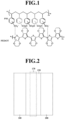
- FIG. 1 is a diagram showing the chemical formula of PEDOT:PSS, which is one of the conductive polymers applicable to a conductive material slurry for a secondary battery electrode according to an embodiment of the present disclosure.
- PEDOT(poly(3,4-ethylenedioxythiophene)) corresponding to the first ionomer has a positive charge due to the conjugated polythiophene structure
- PSS(poly(styrenesulfonate)) corresponding to the second ionomer has a negative charge due to the removal of hydrogen ions from the sulfonic acid group.
- the conjugated polythiophene structure can increase electrical conductivity of the conductive material slurry for a secondary battery electrode, and the sulfonic acid group can combine with water (solvent) to lower the viscosity of the conductive material slurry for a secondary battery electrode.
- the present disclosure uses both the cellulose-based compound and the conductive polymer as dispersants.
- the weight ratio (conductive material: dispersant) of the conductive material and the dispersant according to the present disclosure may be 1:1 to 1:2, and specifically 1: 1.5 to 1:2.
- the weight of the dispersant is out of the above numerical range based on the weight of the conductive material, an aggregate structure is formed in the conductive material slurry for a secondary battery electrode due to the strong van der Waals attraction of the conductive material, thereby resulting in a rapid increase of viscosity.
- the cellulose-based compound according to the present disclosure may include a first cellulose-based compound having a weight average molecular weight of 400,000 g/mol or less.
- the weight average molecular weight of the first cellulose-based compound may be more than 100,000 g/mol and 400,000 g/mol or less, and more specifically, 100,000 g/mol to 200,000 g/mol.
- the first cellulose-based compound having a weight average molecular weight of 400,000 g/mol or less is used, it is possible to reduce the viscosity of the conductive material slurry for a secondary battery electrode and easily improve the dispersibility of the conductive material.
- the weight ratio of the first cellulose-based compound and the conductive polymer may be 1:0.25 to 1:2, specifically 1: 1 to 1: 2, and more specifically 1: 1.5 to 1:2.
- the weight ratio of the first cellulose-based compound and the conductive polymer is out of the above numerical range, at least one of the viscosity and sheet resistance of the conductive material slurry for a secondary battery electrode may increase rapidly.
- the cellulose-based compound according to the present disclosure may include a second cellulose-based compound having a weight average molecular weight of 100,000 g/mol or less.
- the weight average molecular weight of the second cellulose-based compound may be specifically 10,000 g/mol to 100,000 g/mol, and more specifically 50,000 g/mol to 90,000 g/mol.
- the weight average molecular weight of the cellulose-based compound becomes small, it has advantages in that the conductive material can be better dispersed in the solvent, and the viscosity of the conductive material slurry can be lowered.
- the weight ratio of the second cellulose-based compound and the conductive polymer may be 1: 0.25 to 1: 2, specifically 1: 1 to 1: 2, and more specifically 1: 1.5 to 1:2.
- the weight ratio of the second cellulose-based compound and the conductive polymer is out of the above numerical range, at least one of the viscosity and sheet resistance of the conductive material slurry for a secondary battery electrode may increase rapidly.
- the conductive material slurry for a secondary battery electrode according to the present disclosure may further include a solvent that is mixed with the conductive material and the dispersant.
- the solvent may include an aqueous solvent, and more specifically may include water.
- the content of the conductive material according to the present disclosure may be more than 0 wt% and 2.5 wt% or less, specifically 0.5 wt% to 2 wt%, and more specifically 0.5 to 1.5 wt% based on the total weight of the conductive material slurry for a secondary battery electrode.
- the content of the conductive material is less than the above numerical range, the conductivity of the electrode active material in the secondary battery may not be supplemented, whereas when the content of the conductive material exceeds the above numerical range, the dispersibility of the conductive material in the solvent may be deteriorated.
- a secondary battery electrode includes an electrode active material, a conductive material, and a dispersant.
- the dispersant includes a cellulose-based compound and a conductive polymer. The aforementioned parts and repeated descriptions are briefly described or omitted.
- the electrode active material according to the present disclosure may be any one selected from the group consisting of natural graphite, artificial graphite, expanded graphite, carbon fiber, carbon black, a carbon nanotube, fullerene, activated carbon, a silicon particle, silicon oxide, a silicon alloy, a metal compound, a metal-carbon composite, and a lithium-containing nitride.
- the metal-carbon composite is defined as a compound in which a cluster or thin film layer of a metal or metal oxide is formed on the surface of a carbon active material
- a lithium-including nitride is defined as a nitride including lithium.
- the cellulose-based compound may be any one selected from the group consisting of cellulose, carboxymethylcellulose, a sodium salt of carboxymethylcellulose, hydroxyethylcellulose, and a potassium salt of carboxymethylcellulose.
- the conductive polymer may include a first ionomer and a second ionomer, and specifically may be a mixture of the first ionomer and the second ionomer, and the first ionomer may be different from the second ionomer.
- the secondary battery electrode according to another embodiment of the present disclosure may further include a binder which serves to bind the electrode active material and the conductive material to a metal current collector.
- the binder according to the present disclosure may correspond to any one selected from the group consisting of a vinylidene fluoride/hexafluoropropylene copolymer, polyvinylidene fluoride, polyacrylonitrile, polymethyl methacrylate, polytetrafluoroethylene, styrene-butadiene rubber, and a mixture thereof.
- a vinylidene fluoride/hexafluoropropylene copolymer polyvinylidene fluoride, polyacrylonitrile, polymethyl methacrylate, polytetrafluoroethylene, styrene-butadiene rubber, and a mixture thereof.
- the technical spirit of the present disclosure is not limited thereto, and any material combining the conductive material and the electrode active material may be applicable.
- carboxymethyl cellulose which is added as a binder in order to supplement the low viscosity characteristic of the styrene-butadiene rubber, has the characteristic in that it has a very high molecular weight by having a weight average molecular weight of about 1,500,000 g/mol, unlike the cellulose-based compound according to the present disclosure. Therefore, the cellulose-based compound used as a binder is different from the cellulose-based compound according to the present disclosure in terms of purpose, use, etc.
- the secondary battery electrode according to the present disclosure may be manufactured by applying the slurry for a secondary battery electrode on a substrate and performing a drying process or annealing process therefor.
- the substrate may correspond to, for example, an anode current collector.
- Another embodiment of the present disclosure is a secondary battery including the secondary battery electrode.
- FIG. 2 is a cross-sectional view showing a secondary battery according to an embodiment of the present disclosure.
- the secondary battery may include a cathode 100 and an anode 200 spaced apart from each other and an electrolyte 150 provided therebetween for the movement of ions.
- a separator 170 may be further provided to allow the movement of the electrolyte 150 or the movement of ions through the electrolyte 150 while physically separating these electrodes. In some cases, the separator 170 may not be provided.
- the cathode 100 may include a predetermined electrode material for the cathode.
- the cathode 100 may include a cathode active material, a first binder, and a first conductive material.
- the cathode active material, the first binder, and the first conductive material may constitute one cathode active material layer (or a mixture).
- the cathode 100 may be provided with a cathode current collector bound to the cathode active material layer. In this case, the cathode active material layer may be disposed between the cathode current collector and the electrolyte 150.
- the anode 200 may include a predetermined electrode material for the anode.
- the anode 200 may include an anode active material, a second binder, and a second conductive material.
- the anode active material, the second binder, and the second conductive material may constitute one anode active material layer (or a mixture).
- the anode 200 may be provided with an anode current collector bound to the anode active material layer. In this case, the anode active material layer may be disposed between the anode current collector and the electrolyte 150.
- At least one of the cathode 100 and the anode 200 may be manufactured by applying the conductive material slurry for a secondary battery electrode according to an embodiment of the present disclosure.
- a secondary battery according to an embodiment of the present disclosure may be, for example, a lithium secondary battery, but may also be other batteries.
- Conductive material slurries for a secondary battery electrode including the compositions according to Table 1 were prepared.
- the prepared pre-dispersed SWCNT solution was added into a high-pressure disperser (MN400BF, Micronox) and was subjected to high-pressure dispersion at 700 bar and 5 pass (impossible for Comparative Examples 1 to 7) to finally prepare a SWCNT slurry.
- MN400BF high-pressure disperser
- the viscosity of the conductive material slurry for a secondary battery electrode and the sheet resistance of the film prepared from the slurry were evaluated by the following method.
- Viscosity is a value measured at Cone 2, ⁇ 40 mm, 50 s -1 , and 23°C using an HR-2 Viscometer (TA Instruments).
- the conductive material slurry for a secondary battery electrode according to the preparation example was dried in an oven at 90°C.
- the sheet resistance was the measured value of a dried film (Film; specimen size: 10 cm ⁇ 15 cm) having a thickness of 7 ⁇ m using a 4-point probe equipment (MCP-T700). [Table 2].
- Comparative Examples 1 to 3 in Table 2 it was confirmed that when only one type of CMC or only one type of conductive polymer was used as a dispersant, it was impossible to go through with the Pass progress due to the excessively high viscosity of the conductive material slurry.
- Comparative Examples 4 to 7 it was confirmed that even if a conductive polymer and CMC were used as a dispersant, when the content of SWCNT exceeded 2.5 wt%, the viscosity of the conductive material slurry was excessively high; therefore, it was impossible to go through with the Pass progress.
- Examples 1 to 12 are examples when the content of SWCNT is in the range of 0.1 wt% to 1.5 wt%. Referring to the trends of Examples 1 and 2, Examples 3 to 5, Examples 6 to 8, and Examples 9 to 11, it can be confirmed that the conductive material slurries using CMC having a weight average molecular weight of 100,000 g/mol or less could realize lower viscosity and low sheet resistance of the film, compared to the conductive material slurries using CMC having a different weight average molecular weight.
- the prepared pre-dispersed graphene solution was added into a high-pressure disperser (MN400BF, Micronox), and was subjected to high-pressure dispersion at 700 bar and 5 pass (impossible for Comparative Examples 8 to 14) to finally prepare a graphene slurry.
- MN400BF high-pressure disperser
- 7 bar and 5 pass impossible for Comparative Examples 8 to 14
- Examples 42 to 53 are examples when the graphene content is in the range of 0.1 wt% to 1.5 wt%. Referring to the trends of Examples 42 and 43, Examples 44 to 46, Examples 47 and 48, and Examples 49 to 52, respectively, it can be confirmed that the conductive material slurry using CMC having a weight average molecular weight of 100,000 g/mol or less can realize lower viscosity and low sheet resistance of the film, compared to the conductive material slurry using CMC having a different weight average molecular weight.
- the conductive material slurry using CMC of 400,000 g/mol or less can realize a relatively low viscosity and sheet resistance of the film compared to the conductive material slurry using CMC of a different molecular weight range.
Landscapes
- Chemical & Material Sciences (AREA)
- Chemical Kinetics & Catalysis (AREA)
- Electrochemistry (AREA)
- General Chemical & Material Sciences (AREA)
- Engineering & Computer Science (AREA)
- Materials Engineering (AREA)
- Inorganic Chemistry (AREA)
- Nanotechnology (AREA)
- Organic Chemistry (AREA)
- Manufacturing & Machinery (AREA)
- Battery Electrode And Active Subsutance (AREA)
Abstract
Description
- The present disclosure relates to a conductive material slurry for a secondary battery electrode, a secondary battery electrode including the same, and a secondary battery, and more specifically, a conductive material slurry for a secondary battery electrode with a small average particle size while having low viscosity and low sheet resistance, a secondary battery electrode including the same, and a secondary battery.
- In accordance with the rapid development of the electronics, communication, and computer industries, electric vehicles, mobile phones, laptop computers, etc. are making remarkable progress, and high energy density and stable output of batteries are required as a power source to drive portable electronic devices. In particular, lithium secondary batteries are being most actively developed as high-performance batteries with the highest energy density among currently commercialized secondary batteries.
- First, the conductive material is a material which is used to easily move electrons between an electrode active material and another electrode active material or between an electrode active material and a current collector and is being developed mainly focusing on carbon-based materials. The conductive material slurry is a solution in which such a conductive material is dispersed in a solvent, and it becomes a material constituting an electrode slurry together with an electrode active material and a binder at a later stage. As secondary batteries have recently entered the medium and large-sized battery market, such as electric vehicles and an energy storage system (ESS), their importance is increasing, and studies on the increase of theoretical capacity are in progress.
- The anode of a commercially available lithium secondary battery is graphite, and graphite having a layered structure shows excellent cycle characteristics. Since the potential when lithium ions are inserted into graphite is close to the equilibrium potential of lithium, there is no particular difference in the output voltage compared to when a lithium metal is used. However, the commonly known theoretical capacity is 372 mAh/g, which has the limit of electric capacity.
- Therefore, as an anode material having high specific capacity and excellent cycle performance, silicon-based materials are expected as a next-generation electrode that can replace a graphite-based anode. Silicon, which has the highest theoretical capacity (4,200 mAh/g) as an anode material for lithium secondary batteries, has advantages in that it has a low potential difference with lithium, is environmentally friendly, and has abundant reserves. However, since silicon is an insulator, it has a disadvantage in that it is unfavorable in terms of durability and thus causes the electric capacity to decrease. In order to overcome this disadvantage, the need to improve the conductivity of the silicon active material or the need for a conductive material has been highlighted.
- Among them, carbon nanotubes (CNTs) are rapidly emerging as a main material for conductive materials. Carbon nanotubes have a nano-sized diameter and a cylindrical shape, in which carbon atoms are arranged in a spiral shape, and have an sp2 bonding structure. Based on such structure, carbon nanotubes have received attention as a material with excellent physical properties, such as excellent electrical properties, strength, resilience, and thermal conductivity, and are being studied as new materials in various fields.
- As a conductive material for secondary batteries, carbon nanotubes can increase energy density and improve lifespan compared to carbon in the existing powder form, and can also reduce the size of batteries. In particular, these advantages can act as a greater advantage in batteries for electric vehicles that require high capacity, rapid charging/discharging, etc.
- However, despite the excellent advantages, carbon nanotubes are indicated as having a serious problem in that they have low solubility and dispersibility. In particular, carbon nanotubes exist in a bundle or agglomerate structure in a solution due to strong Van-der Waals attraction. Therefore, the necessity and importance of a technology for dispersing these carbon nanotubes is increasing in the development of a conductive material slurry.
- There are two major conventional techniques for dispersing carbon nanotubes in a solvent. The first technique is to increase water dispersibility by acid-treatment of the surface of the carbon nanotubes. However, although this technique can increase the dispersibility in a solvent, it has a problem in that electrical conductivity is reduced due to the generation of a defect on the surface. The second technique is to add a surfactant in the carbon nanotubes and disperse them in a solvent. This technique may be efficient in preparing a low-content carbon nanotube slurry, but it has a problem in that when the content of carbon nanotubes increases, a surfactant that exceeds the content of carbon nanotubes must be added, thereby resulting in an increase in viscosity and a decrease in electrical conductivity.
- In order to solve the above problems, an object of the present disclosure is to provide a conductive material slurry for a secondary battery electrode having low viscosity and low sheet resistance by using a cellulose-based compound and a conductive polymer as a dispersant for dispersing the conductive material.
- Another object of the present disclosure is to provide a conductive material slurry for a secondary battery electrode having a small average particle size.
- Still another object of the present disclosure is to use a cellulose-based compound and a conductive polymer as a dispersant for dispersing the conductive material so as to reduce the number of high-pressure dispersions in the process of preparing a conductive material slurry for a secondary battery electrode, thereby providing a conductive material slurry for the secondary battery electrode with reduced manufacturing time.
- Still another object of the present disclosure is to provide a secondary battery electrode which includes a conductive material slurry for the secondary battery electrode.
- Still another object of the present disclosure is to provide a secondary battery including the secondary battery electrode.
- The objects of the present disclosure are not limited to those mentioned above, and other objects and advantages of the present disclosure not mentioned above can be understood by the following description and will be more clearly understood by the examples of the present disclosure. Additionally, it will also be readily apparent that the objects and advantages of the present disclosure may be realized by the means and combinations thereof indicated in the claims.
- A conductive material slurry for a secondary battery electrode according to an embodiment of the present disclosure for achieving the above objects includes a conductive material and a dispersant for dispersing the conductive material. The dispersant includes a cellulose-based compound and a conductive polymer. The content of the conductive material is more than 0 wt% and 2.5 wt% or less based on the total weight of the conductive material slurry for a secondary battery electrode.
- A secondary battery electrode according to another embodiment of the present disclosure for achieving the above objects includes an electrode active material, a conductive material, and a dispersant. The dispersant includes a cellulose-based compound and a conductive polymer. The content of the conductive material is more than 0 wt% and 2.5 wt% or less based on the total weight of the conductive material slurry for a secondary battery electrode.
- According to another aspect of the present disclosure, it is possible to provide a secondary battery electrode which includes an electrode active material; a conductive material; and a dispersant; wherein the dispersant includes a cellulose-based compound and a conductive polymer, and wherein the content of the conductive material is 28 wt% or more and 67 wt% or less based on the total weight of the conductive material and the dispersant.
- A secondary battery according to another embodiment of the present disclosure for achieving the above object includes the secondary battery electrode.
- According to one aspect of the present disclosure, it is possible to provide a conductive material slurry for a secondary battery electrode having the effects of low viscosity and low sheet resistance by sufficiently dispersing a conductive material having low solubility and low dispersibility in the slurry for a secondary battery electrode. Additionally, according to another aspect of the present disclosure, the manufacturing time can be shortened by reducing the number of high-pressure dispersions in the process of manufacturing the conductive material slurry for a secondary battery electrode.
- In addition to the above effects, specific effects of the present disclosure will be described together while describing specific details for carrying out the present disclosure.
-
-
FIG. 1 is a diagram showing the chemical formula of PEDOT:PSS, which is one of the conductive polymers applicable to a conductive material slurry for a secondary battery electrode according to an embodiment of the present disclosure. -
FIG. 2 is a cross-sectional view showing a secondary battery according to an embodiment of the present disclosure. - Hereinafter, each of the constitutions of the present disclosure will be described in detail so that those skilled in the art can easily practice the same, but these are merely exemplary embodiments, and the scope of rights of the present disclosure is not limited thereto.
- The conductive material slurry for a secondary battery electrode according to the present disclosure includes a conductive material and a dispersant for dispersing the conductive material, and the dispersant includes a cellulose-based compound and a conductive polymer.
- Hereinafter, the constitutions of the present disclosure will be described in more detail.
- The conductive material slurry for a secondary battery electrode according to the present disclosure includes a conductive material and a dispersant for dispersing the conductive material.
- The conductive material according to the present disclosure can supplement the conductivity of the active material in the cathode or anode of a secondary battery. Specifically, the conductive material is a material forming a path through which electrons can move, and it may be a carbon-based material having excellent electrical conductivity.
- The conductive material according to the present disclosure may be any one selected from the group consisting of graphene, a single-walled carbon nanotube (SWCNT), a multi-walled carbon nanotube (MWCNT), and a combination thereof, and more specifically, it may be any one selected from the group consisting of graphene, a single-walled carbon nanotube, and a combination thereof. The graphene is a two-dimensional single layer separated from graphite in which carbon layers having hexagonal rings are stacked, and may have a thickness of 0.2 nm to 5.0 nm. The single-walled carbon nanotube is a linear carbon body and connects an electrode active material with an electrode active material or an electrode active material with a current collector at a distance much longer than a powder, and can significantly contribute to improving conductivity by easily forming a network structure.
- The single-walled carbon nanotube, which is generally used as a conductive material for secondary batteries, may have a thickness of, for example, 1 nm to 2 nm, and a length of 2 µm to 50 µm, and a BET specific surface area corresponding to 300 m2/g or more. For this reason, the conventional single-walled carbon nanotubes had a problem in that they form an agglomerate in the conductive material slurry for a secondary battery electrode thus making it difficult to disperse them in a solvent. In order to solve the difficulty of dispersibility at once, the dispersant according to the present disclosure can include a cellulose-based compound and a conductive polymer.
- The cellulose-based compound according to the present disclosure may be any one selected from the group consisting of cellulose, carboxymethylcellulose, a sodium salt of carboxymethylcellulose, hydroxyethylcellulose, and a potassium salt of carboxymethylcellulose, and specifically, a sodium salt of carboxymethylcellulose.
- The cellulose-based compound may commonly include a glucose ring molecular structure and a substituent in an equatorial direction bound to the glucose ring. Specifically, the glucose ring molecular structure exhibits hydrophobicity and can bind to the surface of the conductive material, and the substituent in the equatorial direction includes a hydrophilic functional group and thus can have a hydrogen bonding with water. In particular, when the substituent in the equatorial direction of the cellulose-based compound is a hydroxy group, it may show a form being packed by a hydrogen bonding with the hydroxy group bonded to a glucose ring of another cellulose-based compound. Therefore, since the cellulose-based compound has a rigid property, it may be used as a dispersion stabilizer for conductive materials, and specifically, as a dispersion stabilizer for carbon nanotubes.
- The degree of etherification (DE) of the cellulose-based compound according to the present disclosure may be in the range of 0.6 to 1.2, specifically 0.6 to 1.0, and more specifically 0.7 to 0.9. The degree of etherification means the degree in which three -OR groups present in one repeating unit in the cellulose-based compound are substituted with ether groups.
- When only the cellulose-based compound is used as a dispersant, there is a problem in that the viscosity of the slurry of a conductive material for a secondary battery electrode becomes excessively high and the sheet resistance becomes relatively high. In order to solve this problem, the present disclosure uses both the cellulose-based compound and the conductive polymer as a dispersant.
- The conductive polymer according to an embodiment of the present disclosure may be any one selected from the group consisting of a polypyrrole-based compound, a polythiophene-based compound, a polyphenylene sulfide-based compound, and a polyaniline-based compound. Specifically, the conductive polymer is a polymer compound having electrical conductivity at a level similar to that of a metal conductor by including a conjugation structure, and can exhibit high electrical conductivity by doping the polymer with an electron acceptor or electron donor. For example, the weight average molecular weight of the conductive polymer may be 50,000 g/mol to 200,000 g/mol, specifically 70,000 g/mol to 150,000 g/mol, and more specifically 90,000 g/mol to 130,000 g/mol. However, the technical spirit of the present disclosure is not limited to the weight average molecular weight of the conductive polymer.
- The conductive polymer according to another embodiment of the present disclosure may include a first ionomer and a second ionomer, and specifically may be a mixture of the first ionomer and the second ionomer. The first ionomer may be different from the second ionomer.
- Specifically, the first ionomer may be a polymer compound including a ring molecular structure conjugated with repeating units, and the second ionomer may be a polymer compound including a cation exchange group. The first ionomer may exhibit electrical conductivity by including a conjugated ring molecular structure.
- More specifically, the first ionomer may be any one selected from the group consisting of a polypyrrole-based compound, a polythiophene-based compound, a polyphenylene sulfide-based compound, and a polyaniline-based compound. The cation exchange group of the second ionomer may be any one selected from the group consisting of a sulfonic acid group, a carboxyl group, a hydroxy group, and a combination thereof.
- In the first ionomer, the conjugated ring molecular structure exhibits a positive charge, and in the second ionomer, hydrogen ions of the cation exchange group are removed to exhibit a negative charge. The first ionomer having these characteristics can increase the electrical conductivity of the conductive material slurry for a secondary battery electrode, and the second ionomer can realize low viscosity of the conductive material slurry for the secondary battery electrode by combining a cation exchange group with water.
- Hereinafter, for the convenience of description, it will be described with reference to
FIG. 1 . -
FIG. 1 is a diagram showing the chemical formula of PEDOT:PSS, which is one of the conductive polymers applicable to a conductive material slurry for a secondary battery electrode according to an embodiment of the present disclosure. - Referring to
FIG. 1 , it can be seen that PEDOT(poly(3,4-ethylenedioxythiophene)) corresponding to the first ionomer has a positive charge due to the conjugated polythiophene structure, and it can be seen that PSS(poly(styrenesulfonate)) corresponding to the second ionomer has a negative charge due to the removal of hydrogen ions from the sulfonic acid group. The conjugated polythiophene structure can increase electrical conductivity of the conductive material slurry for a secondary battery electrode, and the sulfonic acid group can combine with water (solvent) to lower the viscosity of the conductive material slurry for a secondary battery electrode. - When the conductive polymer is used alone as a dispersant, there is a problem in that the viscosity of the slurry of the conductive material for a secondary battery electrode becomes excessively high. In order to solve this problem, the present disclosure uses both the cellulose-based compound and the conductive polymer as dispersants.
- The weight ratio (conductive material: dispersant) of the conductive material and the dispersant according to the present disclosure may be 1:1 to 1:2, and specifically 1: 1.5 to 1:2. When the weight of the dispersant is out of the above numerical range based on the weight of the conductive material, an aggregate structure is formed in the conductive material slurry for a secondary battery electrode due to the strong van der Waals attraction of the conductive material, thereby resulting in a rapid increase of viscosity.
- The cellulose-based compound according to the present disclosure may include a first cellulose-based compound having a weight average molecular weight of 400,000 g/mol or less. Specifically, the weight average molecular weight of the first cellulose-based compound may be more than 100,000 g/mol and 400,000 g/mol or less, and more specifically, 100,000 g/mol to 200,000 g/mol. When the first cellulose-based compound having a weight average molecular weight of 400,000 g/mol or less is used, it is possible to reduce the viscosity of the conductive material slurry for a secondary battery electrode and easily improve the dispersibility of the conductive material.
- The weight ratio of the first cellulose-based compound and the conductive polymer (first cellulose-based compound: conductive polymer) may be 1:0.25 to 1:2, specifically 1: 1 to 1: 2, and more specifically 1: 1.5 to 1:2. When the weight ratio of the first cellulose-based compound and the conductive polymer is out of the above numerical range, at least one of the viscosity and sheet resistance of the conductive material slurry for a secondary battery electrode may increase rapidly.
- The cellulose-based compound according to the present disclosure may include a second cellulose-based compound having a weight average molecular weight of 100,000 g/mol or less. The weight average molecular weight of the second cellulose-based compound may be specifically 10,000 g/mol to 100,000 g/mol, and more specifically 50,000 g/mol to 90,000 g/mol.
- As the weight average molecular weight of the cellulose-based compound becomes small, it has advantages in that the conductive material can be better dispersed in the solvent, and the viscosity of the conductive material slurry can be lowered.
- The weight ratio of the second cellulose-based compound and the conductive polymer (second cellulose-based compound: conductive polymer) may be 1: 0.25 to 1: 2, specifically 1: 1 to 1: 2, and more specifically 1: 1.5 to 1:2. When the weight ratio of the second cellulose-based compound and the conductive polymer is out of the above numerical range, at least one of the viscosity and sheet resistance of the conductive material slurry for a secondary battery electrode may increase rapidly.
- The conductive material slurry for a secondary battery electrode according to the present disclosure may further include a solvent that is mixed with the conductive material and the dispersant. The solvent may include an aqueous solvent, and more specifically may include water.
- The content of the conductive material according to the present disclosure may be more than 0 wt% and 2.5 wt% or less, specifically 0.5 wt% to 2 wt%, and more specifically 0.5 to 1.5 wt% based on the total weight of the conductive material slurry for a secondary battery electrode. When the content of the conductive material is less than the above numerical range, the conductivity of the electrode active material in the secondary battery may not be supplemented, whereas when the content of the conductive material exceeds the above numerical range, the dispersibility of the conductive material in the solvent may be deteriorated.
- A secondary battery electrode according to another embodiment of the present disclosure includes an electrode active material, a conductive material, and a dispersant. The dispersant includes a cellulose-based compound and a conductive polymer. The aforementioned parts and repeated descriptions are briefly described or omitted.
- The electrode active material according to the present disclosure may be any one selected from the group consisting of natural graphite, artificial graphite, expanded graphite, carbon fiber, carbon black, a carbon nanotube, fullerene, activated carbon, a silicon particle, silicon oxide, a silicon alloy, a metal compound, a metal-carbon composite, and a lithium-containing nitride. In this specification, the metal-carbon composite is defined as a compound in which a cluster or thin film layer of a metal or metal oxide is formed on the surface of a carbon active material, and a lithium-including nitride is defined as a nitride including lithium.
- The cellulose-based compound may be any one selected from the group consisting of cellulose, carboxymethylcellulose, a sodium salt of carboxymethylcellulose, hydroxyethylcellulose, and a potassium salt of carboxymethylcellulose.
- The conductive polymer may include a first ionomer and a second ionomer, and specifically may be a mixture of the first ionomer and the second ionomer, and the first ionomer may be different from the second ionomer.
- The secondary battery electrode according to another embodiment of the present disclosure may further include a binder which serves to bind the electrode active material and the conductive material to a metal current collector.
- The binder according to the present disclosure may correspond to any one selected from the group consisting of a vinylidene fluoride/hexafluoropropylene copolymer, polyvinylidene fluoride, polyacrylonitrile, polymethyl methacrylate, polytetrafluoroethylene, styrene-butadiene rubber, and a mixture thereof. However, the technical spirit of the present disclosure is not limited thereto, and any material combining the conductive material and the electrode active material may be applicable.
- Meanwhile, carboxymethyl cellulose, which is added as a binder in order to supplement the low viscosity characteristic of the styrene-butadiene rubber, has the characteristic in that it has a very high molecular weight by having a weight average molecular weight of about 1,500,000 g/mol, unlike the cellulose-based compound according to the present disclosure. Therefore, the cellulose-based compound used as a binder is different from the cellulose-based compound according to the present disclosure in terms of purpose, use, etc.
- The secondary battery electrode according to the present disclosure may be manufactured by applying the slurry for a secondary battery electrode on a substrate and performing a drying process or annealing process therefor. The substrate may correspond to, for example, an anode current collector.
- Another embodiment of the present disclosure is a secondary battery including the secondary battery electrode.
-
FIG. 2 is a cross-sectional view showing a secondary battery according to an embodiment of the present disclosure. - Referring to
FIG. 2 , the secondary battery according to an embodiment of the present disclosure may include acathode 100 and ananode 200 spaced apart from each other and anelectrolyte 150 provided therebetween for the movement of ions. Between thecathode 100 and theanode 200, aseparator 170 may be further provided to allow the movement of theelectrolyte 150 or the movement of ions through theelectrolyte 150 while physically separating these electrodes. In some cases, theseparator 170 may not be provided. - The
cathode 100 may include a predetermined electrode material for the cathode. Thecathode 100 may include a cathode active material, a first binder, and a first conductive material. The cathode active material, the first binder, and the first conductive material may constitute one cathode active material layer (or a mixture). Thecathode 100 may be provided with a cathode current collector bound to the cathode active material layer. In this case, the cathode active material layer may be disposed between the cathode current collector and theelectrolyte 150. - The
anode 200 may include a predetermined electrode material for the anode. Theanode 200 may include an anode active material, a second binder, and a second conductive material. The anode active material, the second binder, and the second conductive material may constitute one anode active material layer (or a mixture). Theanode 200 may be provided with an anode current collector bound to the anode active material layer. In this case, the anode active material layer may be disposed between the anode current collector and theelectrolyte 150. - At least one of the
cathode 100 and theanode 200 may be manufactured by applying the conductive material slurry for a secondary battery electrode according to an embodiment of the present disclosure. A secondary battery according to an embodiment of the present disclosure may be, for example, a lithium secondary battery, but may also be other batteries. - Hereinafter, embodiments of the present disclosure will be described in detail so that those skilled in the art can easily practice the same, but these are merely embodiments, and the scope of the present disclosure is not limited by the following.
- Conductive material slurries for a secondary battery electrode including the compositions according to Table 1 were prepared.
- After adding 950 g of distilled water into a round bottom flask, 50 g of CMC was added thereto, and the mixture was stirred at room temperature for 2 hours to prepare a 5 wt% CMC aqueous solution. SWCNT, the CMC aqueous solution, a conductive polymer (excluding Comparative Examples 1 and 2), and distilled water were added into a beaker and stirred at 1,000 rpm for 60 minutes using a high-speed stirrer to prepare 500 g of a pre-dispersed SWCNT solution. The prepared pre-dispersed SWCNT solution was added into a high-pressure disperser (MN400BF, Micronox) and was subjected to high-pressure dispersion at 700 bar and 5 pass (impossible for Comparative Examples 1 to 7) to finally prepare a SWCNT slurry.
- Meanwhile, in Tables 1, 3, 5, 7, and 9, the remaining content is defined by distilled water.
[Table 1] Sample (Unit: wt%) SWCNT CMC1) CMC2) CMC3) PEDOT:PSS4) Dispersant Ratio (% relative to CNT) PEDOT: PSS Ratio (% relative to CMC) Compara tive Example 1 2.5 3.75 0 0 0 150 - Compara tive Example 2 2.5 0 3.75 0 0 150 - Compara tive Example 3 2.5 0 0 0 3.75 150 - Compara tive Example 4 2.7 0 2.025 0 2.025 150 100 Compara tive Example 5 2.7 0 1.35 0 2.7 150 200 Compara tive Example 6 2.7 2.025 0 0 2.025 150 100 Compara tive Example 7 2.7 1.35 0 0 2.7 150 200 Example 1 0.1 0 0.075 0 0.075 150 100 Example 2 0.1 0.075 0 0 0.075 150 100 Example 3 0.5 0 0.375 0 0.375 150 100 Example 4 0.5 0.375 0 0 0.375 150 100 Example 5 0.5 0 0 0.375 0.375 150 100 Example 6 1 0 0.75 0 0.75 150 100 Example 7 1 0.75 0 0 0.75 150 100 Example 8 1 0 0 0.75 0.75 150 100 Example 9 1.5 0 1.125 0 1.125 150 100 Example 10 1.5 1.125 0 0 1.125 150 100 Example 11 1.5 0 0 1.125 1.125 150 100 Example 12 1.5 0 0.9 0 1.35 150 150 1) CMC with a weight average molecular weight of more than 100,000 g/mol and 400,000 g/mol or less 2) CMC with a weight average molecular weight of 100,000 g/mol or less 3) CMC with a weight average molecular weight more than 400,000 g/mol 4) a polymer, in which PEDOT and PSS are mixed in a 1:2 weight ratio and which has a weight average molecular weight of 100,000 g/mol In this specification, the above items 1) to 4) are defined as being identical in the tables below. - In this specification, the viscosity of the conductive material slurry for a secondary battery electrode and the sheet resistance of the film prepared from the slurry were evaluated by the following method.
- Viscosity is a value measured at Cone 2, Φ40 mm, 50 s-1, and 23°C using an HR-2 Viscometer (TA Instruments).
- After coating the conductive material slurry for a secondary battery electrode according to the preparation example on a bare film using an applicator, it was dried in an oven at 90°C. The sheet resistance was the measured value of a dried film (Film; specimen size: 10 cm × 15 cm) having a thickness of 7 µm using a 4-point probe equipment (MCP-T700).
[Table 2]. Sample Viscosity (cP) Sheet Resistance (Ω/sq) Comparative Example 1 Unable to proceed with Pass - Comparative Example 2 Unable to proceed with Pass - Comparative Example 3 Unable to proceed with Pass - Comparative Example 4 Unable to proceed with Pass - Comparative Example 5 Unable to proceed with Pass - Comparative Example 6 Unable to proceed with Pass - Comparative Example 7 Unable to proceed with Pass - Example 1 120 1.36 Example 2 300 1.52 Example 3 360 1.32 Example 4 510 1.50 Example 5 830 2.10 Example 6 1,020 1.33 Example 7 1,400 1.54 Example 8 1,850 2.06 Example 9 1,310 1.34 Example 10 1,730 1.55 Example 11 2,330 2.10 Example 12 1,200 1.21 - Referring to Comparative Examples 1 to 3 in Table 2, it was confirmed that when only one type of CMC or only one type of conductive polymer was used as a dispersant, it was impossible to go through with the Pass progress due to the excessively high viscosity of the conductive material slurry. Referring to Comparative Examples 4 to 7, it was confirmed that even if a conductive polymer and CMC were used as a dispersant, when the content of SWCNT exceeded 2.5 wt%, the viscosity of the conductive material slurry was excessively high; therefore, it was impossible to go through with the Pass progress.
- Examples 1 to 12 are examples when the content of SWCNT is in the range of 0.1 wt% to 1.5 wt%. Referring to the trends of Examples 1 and 2, Examples 3 to 5, Examples 6 to 8, and Examples 9 to 11, it can be confirmed that the conductive material slurries using CMC having a weight average molecular weight of 100,000 g/mol or less could realize lower viscosity and low sheet resistance of the film, compared to the conductive material slurries using CMC having a different weight average molecular weight.
[Table 3] Sample (Unit: wt%) SWCNT CMC1) CMC2) CMC3) PEDOT:PS S4) Dispersan t Ratio (% relative to CNT) PEDOT: PSS Ratio (% relative to CMC) Example 13 2.5 0 3.2608 0 0.4892 150 15 Example 14 2.5 0 3 0 0.75 150 25 Example 15 2.5 0 1.875 0 1.875 150 100 Example 16 2.5 0 1.5 0 2.25 150 150 Example 17 2.5 0 1.25 0 2.5 150 200 Example 18 2.5 0 1.0714 0 2.6786 150 250 Example 19 2.5 0 3.125 0 3.125 250 100 Example 20 2.5 0 2.5 0 2.5 200 100 Example 21 2.5 0 1.25 0 1.25 100 100 Example 22 2.5 0 0.625 0 0.625 50 100 Example 23 2.5 3.2608 0 0 0.4892 150 15 Example 24 2.5 3 0 0 0.75 150 25 Example 25 2.5 1.875 0 0 1.875 150 100 Example 26 2.5 1.5 0 0 2.25 150 150 Example 27 2.5 1.25 0 0 2.5 150 200 Example 28 2.5 1.0714 0 0 2.6786 150 250 Example 29 2.5 3.125 0 0 3.125 250 100 Example 30 2.5 2.5 0 0 2.5 200 100 Example 31 2.5 1.25 0 0 1.25 100 100 Example 32 2.5 0.625 0 0 0.625 50 100 [Table 4] Sample Viscosity (cP) Sheet Resistance (Ω/sq) Example 13 2,850 1.78 Example 14 2,440 1.50 Example 15 1,910 1.34 Example 16 1,820 1.22 Example 17 1,700 1.20 Example 18 2,300 1.44 Example 19 2,000 2.00 Example 20 1,650 1.32 Example 21 2,060 1.35 Example 22 3,000 1.76 Example 23 3,060 2.00 Example 24 2,900 1.73 Example 25 2,680 1.57 Example 26 2,600 1.44 Example 27 2,540 1.33 Example 28 2,880 1.61 Example 29 2,700 2.26 Example 30 2,580 1.50 Example 31 2,600 1.45 Example 32 3,400 1.95 - Referring to Examples 13 to 18 in which the content of SWCNT is 2.5 wt% based on the total weight of the conductive material slurry in Tables 3 and 4, it can be confirmed that when the weight ratio of CMC having a weight average molecular weight of 100,000 g/mol or less and the conductive polymer (CMC:conductive polymer) is in the range of 1:0.25 to 1:2, the low viscosity of the optimized conductive material slurry and the low sheet resistance of the film can be realized.
- Referring to Examples 19 to 22 including CMC having a weight average molecular weight of 100,000 g/mol or less in Tables 3 and 4, it can be confirmed that as the weight ratio of CNT and dispersant (CNT:dispersant) approaches closer to 1:1 to 1:2, the low viscosity of the optimized conductive material slurry and the low sheet resistance of the film can be realized.
- Referring to Examples 23 to 28 in Tables 3 and 4, it can be confirmed that when the weight ratio of CMC, which has a weight average molecular weight of more than 100,000 g/mol and 400,000 g/mol or less, and a conductive polymer (CMC:conductive polymer) is in the range of 1 :0.25 to 1:2, the low viscosity of the optimized conductive material slurry and the low sheet resistance of the film can be realized.
- Referring to Examples 29 to 32 in Tables 3 and 4, it can be seen that the viscosities of the conductive material slurry and the sheet resistance of the film become lowest when the weight ratio of CNT to dispersant (CNT:dispersant) is in the range of 1:1 to 1:2.
[Table 5] Sample (Unit: wt%) SWCNT CMC1) CMC2) CMC3) PEDOT:PS S4) Dispersant Ratio (% relative to CNT) PEDOT: PSS Ratio (% relative to CMC) Example 33 2.5 0 0 3.2608 0.4892 150 15 Example 34 2.5 0 0 3 0.75 150 25 Example 35 2.5 0 0 1.875 1.875 150 100 Example 36 2.5 0 0 1.25 2.5 150 200 Example 37 2.5 0 0 1.0714 2.6786 150 250 Example 38 2.5 0 0 3.125 3.125 250 100 Example 39 2.5 0 0 2.5 2.5 200 100 Example 40 2.5 0 0 1.25 1.25 100 100 Example 41 2.5 0 0 0.625 0.625 50 100 [Table 6] Sample Viscosity (cP) Sheet Resistance (Ω/sq) Example 33 3,400 3.00 Example 34 3,250 2.43 Example 35 3,030 2.05 Example 36 2,870 1.87 Example 37 3,080 2.38 Example 38 3,210 2.87 Example 39 2,990 2.20 Example 40 3,080 1.97 Example 41 3,900 2.65 - Referring to Examples 33 to 41 in Tables 5 and 6, it was confirmed that when CMC having a weight average molecular weight of more than 400,000 g/mol is used, the viscosity of the conductive material slurry and the sheet resistance of the film were excessively increased.
- Referring to Examples 33 to 37 in Tables 5 and 6, it was confirmed that although the viscosity and sheet resistance were high, as the weight ratio of CMC having a weight average molecular weight exceeding 400,000 g/mol and the conductive polymer (CMC:conductive polymer) was approaching closer to 1:0.25 to 1:0.25, the low viscosity of the conductive material slurry and the low sheet resistance of the film could be realized. Referring to Examples 38 to 41, it can be confirmed that the low viscosity of the conductive material slurry and the low sheet resistance of the film are implemented within the range where the weight ratio of CNT to a dispersant (CNT:dispersant) is 1: 1 to 1 :2.
- Upon review of the trends of Tables 1 to 6, it is possible to derive that the conductive material slurry using CMC of 400,000 g/mol or less realize a relatively low viscosity and sheet resistance of the film compared to the conductive material slurry using CMC with a different molecular weight range.
- After adding 950 g of distilled water into a round bottom flask, 50 g of CMC was added thereto, and the mixture was stirred at room temperature for 2 hours to prepare a 5 wt% CMC aqueous solution. Graphene, the CMC aqueous solution, a conductive polymer (excluding Comparative Examples 8 and 9), and distilled water were added into a beaker and stirred at 1,000 rpm for 60 minutes using a high-speed stirrer to prepare 500 g of a pre-dispersed graphene solution. The prepared pre-dispersed graphene solution was added into a high-pressure disperser (MN400BF, Micronox), and was subjected to high-pressure dispersion at 700 bar and 5 pass (impossible for Comparative Examples 8 to 14) to finally prepare a graphene slurry.
[Table 7] Sample (Unit: wt%) Graphene CMC1) CMC2) CMC3) PEDOT:PSS4) Dispersant Ratio (% relative to Graphene) PEDOT: PSS Ratio (% relative to CMC) Comparati ve Example 8 2.5 3.75 0 0 0 150 - Comparati ve Example 9 2.5 0 3.75 0 0 150 - Comparati ve Example 10 2.5 0 0 0 3.75 150 - Comparati ve Example 11 2.7 0 2.025 0 2.025 150 100 Comparati ve Example 12 2.7 0 1.35 0 2.7 150 200 Comparati ve Example 13 2.7 2.025 0 0 2.025 150 100 Comparati ve Example 14 2.7 1.35 0 0 2.7 150 200 Example 42 0.1 0 0.075 0 0.075 150 100 Example 43 0.1 0.075 0 0 0.075 150 100 Example 44 0.5 0 0.375 0 0.375 150 100 Example 45 0.5 0.375 0 0 0.375 150 100 Example 46 0.5 0 0 0.375 0.375 150 100 Example 47 1 0 0.75 0 0.75 150 100 Example 48 1 0.75 0 0 0.75 150 100 Example 49 1 0 0 0.75 0.75 150 100 Example 50 1.5 0 1.125 0 1.125 150 100 Example 51 1.5 1.125 0 0 1.125 150 100 Example 52 1.5 0 0 1.125 1.125 150 100 Example 53 1.5 0 0.9 0 1.35 150 150 [Table 8] Sample Viscosity (cP) Sheet Resistance (Ω/sq) Comparative Example 8 Unable to proceed with Pass - Comparative Example 9 Unable to proceed with Pass - Comparative Example 10 Unable to proceed with Pass - Comparative Example 11 Unable to proceed with Pass - Comparative Example 12 Unable to proceed with Pass - Comparative Example 13 Unable to proceed with Pass - Comparative Example 14 Unable to proceed with Pass - Example 42 65 18 Example 43 100 24 Example 44 130 17 Example 45 220 25 Example 46 400 27 Example 47 280 18 Example 48 410 24 Example 49 910 29 Example 50 770 18 Example 51 1,000 23 Example 52 1,870 29 Example 53 700 16 - Referring to Tables 7 and 8 above and referring to Comparative Examples 8 to 10, it was confirmed that when only one type of CMC or one type of conductive polymer was used as a dispersant, the viscosity of the conductive material slurry became excessively high, thus making it impossible to go through with the Pass progress. Referring to Comparative Examples 11 to 14, it was confirmed that even if the conductive polymer and CMC were used as a dispersant, when the graphene content exceeded 2.5 wt%, the viscosity of the conductive material slurry became excessively high, thus making it impossible to go through with the Pass progress.
- Examples 42 to 53 are examples when the graphene content is in the range of 0.1 wt% to 1.5 wt%. Referring to the trends of Examples 42 and 43, Examples 44 to 46, Examples 47 and 48, and Examples 49 to 52, respectively, it can be confirmed that the conductive material slurry using CMC having a weight average molecular weight of 100,000 g/mol or less can realize lower viscosity and low sheet resistance of the film, compared to the conductive material slurry using CMC having a different weight average molecular weight.
[Table 9] Sample (Unit: wt%) Graphene CMC1) CMC2) CMC3) PEDOT:PSS4) Dispersant Ratio (% relative to Graphene) PEDOT: PSS Ratio (% relative to CMC) Example 54 2.5 0 3.2608 0 0.4892 150 15 Example 55 2.5 0 3 0 0.75 150 25 Example 56 2.5 0 1.875 0 1.875 150 100 Example 57 2.5 0 1.5 0 2.25 150 150 Example 58 2.5 0 1.25 0 2.5 150 200 Example 59 2.5 0 1.0714 0 2.6786 150 250 Example 60 2.5 0 3.125 0 3.125 250 100 Example 61 2.5 0 2.5 0 2.5 200 100 Example 62 2.5 0 1.25 0 1.25 100 100 Example 63 2.5 0 0.625 0 0.625 50 100 Example 64 2.5 3.2608 0 0 0.4892 150 15 Example 65 2.5 3 0 0 0.75 150 25 Example 66 2.5 1.875 0 0 1.875 150 100 Example 67 2.5 1.5 0 0 2.25 150 150 Example 68 2.5 1.25 0 0 2.5 150 200 Example 69 2.5 1.0714 0 0 2.6786 150 250 Example 70 2.5 3.125 0 0 3.125 250 100 Example 71 2.5 2.5 0 0 2.5 200 100 Example 72 2.5 1.25 0 0 1.25 100 100 Example 73 2.5 0.625 0 0 0.625 50 100 [Table 10] Sample Viscosity (cP) Sheet Resistance (Ω/sq) Example 54 1,330 23 Example 55 1,100 20 Example 56 910 18 Example 57 800 16 Example 58 760 15 Example 59 1,430 20 Example 60 1,450 23 Example 61 690 17 Example 62 770 18 Example 63 1,520 19 Example 64 1,550 27 Example 65 1,290 25 Example 66 1,110 22 Example 67 1,000 20 Example 68 910 19 Example 69 1,890 22 Example 70 1,770 26 Example 71 860 20 Example 72 1,150 21 Example 73 1,850 24 - Referring to Examples 54 to 59 in Tables 9 and 10 above in which the content of graphene is 2.5 wt% based on the total weight of the conductive material slurry, it can be confirmed that when the weight ratio of CMC having a weight average molecular weight of 100,000 g/mol or less and the conductive polymer (CMC:conductive polymer) is 1:0.25 to 1:2, a low viscosity of the optimized conductive material slurry and a low sheet resistance of the film can be realized.
- Referring to Examples 60 to 63 in Tables 9 and 10 above in which CMC having a weight average molecular weight of 100,000 g/mol or less is included, it can be confirmed that as the weight ratio of graphene and the dispersant (graphene:dispersant) approaches closer to 1: 1 to 1: 2, lower viscosity of the optimized conductive material slurry and low sheet resistance of the film can be realized..
- Referring to Examples 64 to 69 in Tables 9 and 10 above in which CMC having a weight average molecular weight exceeding 100,000 g/mol and 400,000 g/mol or less is 1:0.25 to 1:2, it can be confirmed that when the weight ratio of CMC having a weight average molecular weight exceeding 100,000 g/mol and 400,000 g/mol or less and the conductive polymer (CMC:conductive polymer) is 1:0.25 to 1:2, the low viscosity of the optimized conductive material slurry and the low sheet resistance of the film can be realized.
- Referring to Examples 70 to 73 in Tables 9 and 10 above in which CMC having a weight average molecular weight exceeding 100,000 g/mol and 400,000 g/mol or less is included, it can be confirmed that when the weight ratio of graphene and the dispersant (graphene:dispersant) is in the range of 1: 1 to 1 1:2, the viscosity of the conductive material slurry and the sheet resistance of the film can be lowest.
[Table 11] Sample (Unit: wt%) Graphene CMC1) CMC2) CMC3) PEDOT:PSS4) Dispersant Ratio (% relative to Graphene) PEDOT: PSS Ratio (% relative to CMC) Example 74 2.5 0 0 3.2608 0.4892 150 15 Example 75 2.5 0 0 3 0.75 150 25 Example 76 2.5 0 0 1.875 1.875 150 100 Example 77 2.5 0 0 1.25 2.5 150 200 Example 78 2.5 0 0 1.0714 2.6786 150 250 Example 79 2.5 0 0 3.125 3.125 250 100 Example 80 2.5 0 0 2.5 2.5 200 100 Example 81 2.5 0 0 1.25 1.25 100 100 Example 82 2.5 0 0 0.625 0.625 50 100 [Table 12] Sample Viscosity (cP) Sheet Resistance (Ω/sq) Example 74 2,200 34 Example 75 1,860 32 Example 76 1,800 27 Example 77 1,850 26 Example 78 2,000 24 Example 79 2,120 30 Example 80 1,790 26 Example 81 1,930 26 Example 82 2,220 28 - Referring to Examples 74 to 82 in Tables 11 and 12 above, it could be confirmed that when CMC having a weight average molecular weight exceeding 400,000 g/mol, the viscosity of the conductive material slurry and the sheet resistance of the film were excessively increased.
- Referring to Examples 74 to 78 in Tables 11 and 12 above, it could be confirmed that although the viscosity and sheet resistance were high, as the weight ratio of CMC having a weight average molecular weight exceeding 400,000 g/mol and the conductive polymer (CMC:conductive polymer) approached closer to a range of 1:0.25. to 1:2, it was confirmed that the low viscosity of the conductive material slurry and the low sheet resistance of the film could be realized. Referring to Examples 79 to 82, when the weight ratio of graphene and the dispersant (graphene:dispersant) was in the range of 1:1 to 1:2, the low viscosity of the conductive material slurry and the low sheet resistance of the film could be realized.
- Upon review of the trends in Tables 7 to 12 above, it can be inferred that the conductive material slurry using CMC of 400,000 g/mol or less can realize a relatively low viscosity and sheet resistance of the film compared to the conductive material slurry using CMC of a different molecular weight range.
- After adding 950 g of distilled water into a round bottom flask, 50 g of CMC was added thereto, and the mixture was stirred at room temperature for 2 hours to prepare a 5 wt% CMC aqueous solution. MWCNT, the CMC aqueous solution, a conductive polymer, and distilled water were added into a beaker and stirred at 1,000 rpm for 60 minutes using a high-speed stirrer to prepare 500 g of a pre-dispersed MWCNT solution. The prepared pre-dispersed MWCNT solution was added into a high-pressure disperser (MN400BF, Micronox), and was subjected to high-pressure dispersion at 700 bar and 5 pass to finally prepare a MWCNT slurry.
[Table 13] Sample (Unit: wt%) MWCNT CMC1) CMC2) CMC3) PEDOT:PSS4) Dispersant Ratio (% relative to CNT) PEDOT: PSS Ratio (% relative to CMC) Example 83 1 0 0.75 0 0.75 150 100 Example 84 2.5 0 1.875 0 1.875 150 100 Example 85 2.5 0 1.5 0 2.25 150 150 Example 86 2.5 0 1.25 0 2.5 150 200 Example 87 2.5 0 2.5 0 2.5 200 100 Example 88 2.5 0 1.25 0 1.25 100 100 [Table 14] Sample Viscosity (cP) Sheet Resistance (Ω/sq) Example 83 350 50 Example 84 750 48 Example 85 700 45 Example 86 625 43 Example 87 700 54 Example 88 840 53 - Referring to Tables 13 and 14, unlike Tables 1 to 12 above, it could be confirmed that when MWCNT was used as the conductive material, not only the viscosity of the conductive material slurry was excessively increased, but also the sheet resistance was excessively increased.
- Although the preferred embodiments of the present disclosure have been described in detail above, the scope of the present disclosure is not limited thereto, and various modifications and improvements by those skilled in the art using the basic concept of the present disclosure defined in the following claims are also present also fall within the scope of the right of the present disclosure.
Claims (19)
- A conductive material slurry for a secondary battery electrode comprising a conductive material and a dispersant that disperses the conductive material,wherein the dispersant comprises a cellulose compound and a conductive polymer; andwherein the amount of the conductive material exceeds 0 wt% and 2.5 wt% or less based on the total weight of the conductive material slurry for a secondary battery electrode.
- The conductive material slurry of claim 1, wherein the conductive material is any one selected from the group consisting of graphene, a single-walled carbon nanotube, and a combination thereof.
- The conductive material slurry of claim 1, wherein the cellulose-based compound is any one selected from the group consisting of cellulose, carboxymethyl cellulose, a sodium salt of carboxymethyl cellulose, hydroxyethyl cellulose, and a potassium salt of carboxymethyl cellulose.
- The conductive material slurry of claim 1, wherein the conductive polymer is any one selected from the group consisting of a polypyrrole-based compound, a polythiophene-based compound, a polyphenylene sulfide-based compound, and a polyaniline-based compound.
- The conductive material slurry of claim 1,wherein the conductive polymer comprises a first ionomer and a second ionomer; andwherein the first ionomer is different from the second ionomer.
- The conductive material slurry of claim 5,
wherein the first ionomer is a polymer compound comprising a cyclic molecular structure conjugated with repeating units, and the second ionomer is a polymer compound comprising a cation exchange group. - The conductive material slurry of claim 6, wherein the first ionomer is any one selected from the group consisting of a polypyrrole-based compound, a polythiophene-based compound, a polyphenylene sulfide-based compound, and a polyaniline-based compound.
- The conductive material slurry of claim 6, wherein the cation exchange group is any one selected from the group consisting of a sulfonic acid group, a carboxyl group, a hydroxy group, and a combination thereof.
- The conductive material slurry of claim 1, wherein the weight ratio of the conductive material and the dispersant (conductive material: dispersant) is 1: 1 to 1:2.
- The conductive material slurry of claim 1, wherein the cellulose-based compound comprises a first cellulose-based compound having a weight average molecular weight of 400,000 g/mol or less.
- The conductive material slurry of claim 10, wherein the weight ratio of the first cellulose-based compound and the conductive polymer (first cellulose-based compound: conductive polymer) is 1:0.25 to 1:2.
- The conductive material slurry of claim 1, wherein the cellulose-based compound comprises a second cellulose-based compound having a weight average molecular weight of 100,000 g/mol or less.
- The conductive material slurry of claim 12, wherein the weight ratio of the second cellulose-based compound and the conductive polymer (second cellulose-based compound: conductive polymer) is 1:0.25 to 1:2.
- The conductive material slurry of claim 1, further comprising a solvent to be mixed with the conductive material and the dispersant.
- A secondary battery electrode, comprising:an electrode active material;a conductive material; anda dispersant,wherein the dispersant comprises a cellulose-based compound and a conductive polymer; andwherein the content of the conductive material is 28 wt% or more and 67 wt% or less based on the total weight of the conductive material and the dispersant.
- The secondary battery electrode of claim 15, wherein the electrode active material is any one selected from the group consisting of natural graphite, artificial graphite, expanded graphite, carbon fiber, carbon black, a carbon nanotube, fullerene, activated carbon, a silicon particle, a silicon oxide, a silicon alloy, a metal compound, a metal-carbon composite, and a lithium-containing nitride.
- The secondary battery electrode of claim 15, wherein the cellulose-based compound is any one selected from the group consisting of cellulose, carboxymethylcellulose, a sodium salt of carboxymethylcellulose, hydroxyethylcellulose, and a potassium salt of carboxymethylcellulose.
- The secondary battery electrode of claim 15,wherein the conductive polymer comprises a first ionomer and a second ionomer, andwherein the first ionomer is different from the second ionomer.
- A secondary battery comprising the secondary battery electrode according to claim 15.
Applications Claiming Priority (2)
| Application Number | Priority Date | Filing Date | Title |
|---|---|---|---|
| KR1020210186382A KR20230096667A (en) | 2021-12-23 | 2021-12-23 | Conductive material slurry for electrode of secondary battery, electrode of secondary battery comprising the same and secondary battery |
| PCT/KR2022/016907 WO2023120953A1 (en) | 2021-12-23 | 2022-11-01 | Conductive agent slurry for secondary battery electrode, secondary battery electrode including same, and secondary battery |
Publications (2)
| Publication Number | Publication Date |
|---|---|
| EP4432401A1 true EP4432401A1 (en) | 2024-09-18 |
| EP4432401A4 EP4432401A4 (en) | 2025-05-14 |
Family
ID=86902905
Family Applications (1)
| Application Number | Title | Priority Date | Filing Date |
|---|---|---|---|
| EP22911591.0A Pending EP4432401A4 (en) | 2021-12-23 | 2022-11-01 | Conductive agent slurry for secondary battery electrode, secondary battery electrode including same, and secondary battery |
Country Status (5)
| Country | Link |
|---|---|
| US (1) | US20240339623A1 (en) |
| EP (1) | EP4432401A4 (en) |
| KR (1) | KR20230096667A (en) |
| CN (1) | CN118435389A (en) |
| WO (1) | WO2023120953A1 (en) |
Families Citing this family (1)
| Publication number | Priority date | Publication date | Assignee | Title |
|---|---|---|---|---|
| KR20250080997A (en) * | 2023-11-29 | 2025-06-05 | 주식회사 동진쎄미켐 | Conductive material slurry, cathode and secondary battery comprising the same |
Family Cites Families (5)
| Publication number | Priority date | Publication date | Assignee | Title |
|---|---|---|---|---|
| JP2013054599A (en) * | 2011-09-05 | 2013-03-21 | Oji Holdings Corp | Conductor, conductive sheet and touch panel |
| KR20140140980A (en) * | 2013-05-30 | 2014-12-10 | 주식회사 엘지화학 | Electrode for lithium secondary battery and lithium secondary battery comprising the same |
| KR102690388B1 (en) * | 2018-01-31 | 2024-08-01 | 주식회사 엘지에너지솔루션 | Conductive material dispersion and method for preparing negative electrode slurry |
| US20210005893A1 (en) * | 2018-03-02 | 2021-01-07 | Jong Eun Kim | Cellulose-templated conductive polymer containing binder for active material compositions and lithium ion batteries prepared therefrom |
| JP6860740B1 (en) * | 2020-04-27 | 2021-04-21 | 東洋インキScホールディングス株式会社 | A carbon nanotube dispersion liquid, a composition for a secondary battery electrode using the carbon nanotube dispersion liquid, an electrode film, and a secondary battery. |
-
2021
- 2021-12-23 KR KR1020210186382A patent/KR20230096667A/en active Pending
-
2022
- 2022-11-01 WO PCT/KR2022/016907 patent/WO2023120953A1/en not_active Ceased
- 2022-11-01 CN CN202280083613.9A patent/CN118435389A/en active Pending
- 2022-11-01 EP EP22911591.0A patent/EP4432401A4/en active Pending
-
2024
- 2024-06-18 US US18/746,908 patent/US20240339623A1/en active Pending
Also Published As
| Publication number | Publication date |
|---|---|
| US20240339623A1 (en) | 2024-10-10 |
| WO2023120953A1 (en) | 2023-06-29 |
| KR20230096667A (en) | 2023-06-30 |
| CN118435389A (en) | 2024-08-02 |
| EP4432401A4 (en) | 2025-05-14 |
Similar Documents
| Publication | Publication Date | Title |
|---|---|---|
| Xu et al. | Research progress on coating structure of silicon anode materials for lithium‐ion batteries | |
| Wang et al. | Recent progress in carbonyl-based organic polymers as promising electrode materials for lithium-ion batteries (LIBs) | |
| Nirmale et al. | A review on cellulose and lignin based binders and electrodes: Small steps towards a sustainable lithium ion battery | |
| Shi et al. | Nanostructured conductive polymers for advanced energy storage | |
| Simotwo et al. | Polyaniline-based electrodes: recent application in supercapacitors and next generation rechargeable batteries | |
| Zhang et al. | Progress of electrochemical capacitor electrode materials: A review | |
| Cheng et al. | Flexible asymmetric supercapacitors with high energy and high power density in aqueous electrolytes | |
| EP2022123B1 (en) | Electrochemical energy storage device with high capacity and high power using conductive polymer composite | |
| JP2012501515A (en) | Composite electrode material, battery electrode including the material, and lithium battery having the electrode | |
| US20130004657A1 (en) | Enhanced Electrode Composition For Li ion Battery | |
| US20110171371A1 (en) | Enhanced Electrode Composition for Li ion Battery | |
| Vu et al. | Hybrid carbon nanofiller/polymer composites as self-healable current collector electrodes for use in high-performance flexible metal-free supercapacitors | |
| KR20150077321A (en) | Conducting material composition, slurry composition for forming electrode of lithium rechargeable battery and lithium rechargeable battery using the same | |
| WO2013085509A1 (en) | Electrode composition for li ion battery | |
| KR102388203B1 (en) | Anode material with graphene-mxene-silicon of secondary battery and the method thereof | |
| US12412900B2 (en) | Conductor pre-dispersion slurry for secondary battery electrode, preparation method therefor, electrode manufactured by applying conductor pre-dispersion slurry, and secondary battery comprising same electrode | |
| Zia et al. | Advancements in binary and ternary transition metal-based composites for high-performance supercapacitors: a comprehensive review | |
| US20230238509A1 (en) | Manufacture of electrodes for energy storage devices | |
| WO2013066593A1 (en) | Electrode composition for an electrode | |
| Singh et al. | MXene-based suspension electrode with improved energy density for electrochemical flow capacitors | |
| US20240339623A1 (en) | Conductive agent slurry for secondary battery electrode, secondary battery electrode including same, and secondary battery | |
| Rehman et al. | Transition Metal Dichalcogenides, Conducting Polymers, and Their Nanocomposites as Supercapacitor Electrode Materials | |
| KR101484163B1 (en) | nano carbon materials having multiple hydrogen bonding motifs for electrode in supercapacitors | |
| Gusain et al. | Conducting polymeric nanocomposite for supercapattery | |
| CN120727806A (en) | A composite silicon negative electrode material and its preparation method and application |
Legal Events
| Date | Code | Title | Description |
|---|---|---|---|
| STAA | Information on the status of an ep patent application or granted ep patent |
Free format text: STATUS: THE INTERNATIONAL PUBLICATION HAS BEEN MADE |
|
| PUAI | Public reference made under article 153(3) epc to a published international application that has entered the european phase |
Free format text: ORIGINAL CODE: 0009012 |
|
| STAA | Information on the status of an ep patent application or granted ep patent |
Free format text: STATUS: REQUEST FOR EXAMINATION WAS MADE |
|
| 17P | Request for examination filed |
Effective date: 20240613 |
|
| AK | Designated contracting states |
Kind code of ref document: A1 Designated state(s): AL AT BE BG CH CY CZ DE DK EE ES FI FR GB GR HR HU IE IS IT LI LT LU LV MC ME MK MT NL NO PL PT RO RS SE SI SK SM TR |
|
| DAV | Request for validation of the european patent (deleted) | ||
| DAX | Request for extension of the european patent (deleted) | ||
| A4 | Supplementary search report drawn up and despatched |
Effective date: 20250411 |
|
| RIC1 | Information provided on ipc code assigned before grant |
Ipc: H01M 10/0525 20100101ALI20250407BHEP Ipc: C01B 32/174 20170101ALI20250407BHEP Ipc: H01M 4/13 20100101ALI20250407BHEP Ipc: H01M 4/62 20060101AFI20250407BHEP |