EP4432255A1 - Verfahren zur schätzung eines inter-bit-abstandes im zusammenhang mit einem fingerabdruck - Google Patents
Verfahren zur schätzung eines inter-bit-abstandes im zusammenhang mit einem fingerabdruck Download PDFInfo
- Publication number
- EP4432255A1 EP4432255A1 EP23216780.9A EP23216780A EP4432255A1 EP 4432255 A1 EP4432255 A1 EP 4432255A1 EP 23216780 A EP23216780 A EP 23216780A EP 4432255 A1 EP4432255 A1 EP 4432255A1
- Authority
- EP
- European Patent Office
- Prior art keywords
- class
- distance
- inter
- block
- pixels
- Prior art date
- Legal status (The legal status is an assumption and is not a legal conclusion. Google has not performed a legal analysis and makes no representation as to the accuracy of the status listed.)
- Granted
Links
Images

Classifications
-
- G—PHYSICS
- G06—COMPUTING OR CALCULATING; COUNTING
- G06V—IMAGE OR VIDEO RECOGNITION OR UNDERSTANDING
- G06V40/00—Recognition of biometric, human-related or animal-related patterns in image or video data
- G06V40/10—Human or animal bodies, e.g. vehicle occupants or pedestrians; Body parts, e.g. hands
- G06V40/12—Fingerprints or palmprints
- G06V40/1365—Matching; Classification
- G06V40/1376—Matching features related to ridge properties or fingerprint texture
-
- G—PHYSICS
- G06—COMPUTING OR CALCULATING; COUNTING
- G06V—IMAGE OR VIDEO RECOGNITION OR UNDERSTANDING
- G06V10/00—Arrangements for image or video recognition or understanding
- G06V10/70—Arrangements for image or video recognition or understanding using pattern recognition or machine learning
- G06V10/764—Arrangements for image or video recognition or understanding using pattern recognition or machine learning using classification, e.g. of video objects
- G06V10/765—Arrangements for image or video recognition or understanding using pattern recognition or machine learning using classification, e.g. of video objects using rules for classification or partitioning the feature space
-
- G—PHYSICS
- G06—COMPUTING OR CALCULATING; COUNTING
- G06V—IMAGE OR VIDEO RECOGNITION OR UNDERSTANDING
- G06V10/00—Arrangements for image or video recognition or understanding
- G06V10/70—Arrangements for image or video recognition or understanding using pattern recognition or machine learning
- G06V10/77—Processing image or video features in feature spaces; using data integration or data reduction, e.g. principal component analysis [PCA] or independent component analysis [ICA] or self-organising maps [SOM]; Blind source separation
- G06V10/776—Validation; Performance evaluation
-
- G—PHYSICS
- G06—COMPUTING OR CALCULATING; COUNTING
- G06V—IMAGE OR VIDEO RECOGNITION OR UNDERSTANDING
- G06V10/00—Arrangements for image or video recognition or understanding
- G06V10/70—Arrangements for image or video recognition or understanding using pattern recognition or machine learning
- G06V10/82—Arrangements for image or video recognition or understanding using pattern recognition or machine learning using neural networks
-
- G—PHYSICS
- G06—COMPUTING OR CALCULATING; COUNTING
- G06V—IMAGE OR VIDEO RECOGNITION OR UNDERSTANDING
- G06V40/00—Recognition of biometric, human-related or animal-related patterns in image or video data
- G06V40/10—Human or animal bodies, e.g. vehicle occupants or pedestrians; Body parts, e.g. hands
- G06V40/12—Fingerprints or palmprints
- G06V40/1347—Preprocessing; Feature extraction
- G06V40/1359—Extracting features related to ridge properties; Determining the fingerprint type, e.g. whorl or loop
Definitions
- the present invention relates to the field of processing applied to images showing fingerprints.
- Methods are known for identifying or authenticating an individual using his fingerprints, these methods comprising the following steps.
- a test image showing a test fingerprint of an individual is acquired, and this image is compared with a reference image showing a reference fingerprint, so as to verify a match between the test fingerprint and the reference fingerprint. If such a match is found, then it is considered that the individual has been previously enrolled.
- an inter-ridge distance is a distance between two ridges of a fingerprint.
- the inter-ridge distance is estimated from the proof image and taking into account the resolution of the proof image (usually expressed in pixels per inch, abbreviated as dpi).
- an inter-peak distance can be estimated inaccurately with these methods, especially when the proof image includes a parasitic signal.
- a proof image a photograph of a fingerprint left on a support, this photograph being acquired by a generic device, i.e. a device not specifically dedicated to the acquisition of fingerprints.
- a fingerprint appearing in an image of this type is commonly called a "latent" fingerprint.
- the support on which the latent print was left may have parasitic patterns likely to compromise the accuracy of the estimation carried out by the aforementioned methods.
- An aim of the invention is to estimate an inter-peak distance in an image showing a fingerprint accurately even in the case where the image includes a parasitic signal.
- a method for processing a proof image showing a proof fingerprint comprising the following computer-implemented steps: generating a classification map from the proof image, the classification map comprising, for each block forming part of a plurality of blocks of the proof image and for each class of a plurality of classes of distances in pixels, a score associated with the block and the class, the score associated with the block and the class being indicative of a probability of existence in the proof image of a segment passing through the block and the length of which in pixels constitutes an inter-ridge distance of the fingerprint included in the class; generating a map of local inter-ridge distances from the classification map, the map of local inter-ridge distances comprising, for each block of the plurality of blocks, a local inter-ridge distance in pixels estimated for the block; estimating an average inter-ridge distance in pixels of the test fingerprint from the local inter-ridge distance map and a class of interest forming part of the plurality of pixel distance classes, the estimation comprising a selection, from the local inter-ridge distance
- the method may also include the following features, taken alone or in combination whenever this makes technical sense.
- the estimated local inter-ridge distance in pixels for a block is calculated from the following data: a first score indicative of a maximum probability of existence among the scores associated with the block, the first score being associated with a first class forming part of the plurality of distance classes, and a first pixel distance value included in the first class.
- the estimated local inter-ridge distance in pixels for a block is calculated from the following data: a second score associated with a second class, the second class being adjacent to the first class in the plurality of pixel distance classes, and a second pixel distance value included in the second class.
- the estimated local inter-ridge distance in pixels for a block is calculated from the following data: a third score associated with a third class, the third class being adjacent to the first class in the plurality of distance classes in pixels, and the third class being distinct from the second class, and a third distance value in pixels included in the third class.
- the estimated local inter-ridge distance in pixels for a block is calculated as an average of the first distance value, the second distance value and the third distance value, respectively weighted by the first score, the second score and the third score.
- the method further comprises steps of: generating a preliminary classification map from the test image, the preliminary classification map comprising, for each block of a set of blocks covering the entire test image and for each class of the plurality of classes of distances in pixels, a preliminary score associated with the block and the class, the preliminary score associated with the block and the class being indicative of a probability of existence in the test image of a segment passing through the block and whose length in pixels constitutes an inter-ridge distance of the fingerprint included in the class; from the test image, generating a binary mask estimating, for each block of the set of blocks, whether or not the block shows a fingerprint; applying the binary mask to the preliminary classification map so as to generate the classification map, the plurality of blocks being restricted to each block that the binary mask estimates shows a fingerprint.
- the generation of the preliminary classification map is implemented by a first neural network
- the generation of the binary mask is implemented by a second neural network operating in parallel with the first neural network.
- the application of the binary mask to the preliminary classification map comprises a Hadamard product between the preliminary classification map and the binary mask.
- the method further comprises extracting features from the test image by a neural network without a normalization layer, the classification map being derived from the extracted features.
- the local inter-peak distances of interest selected according to the proximity criterion with the class of interest are local inter-peak distances included in an interval having limits determined from a distance value included in the reference class, the interval forming a neighborhood around the distance value.
- the method comprises steps of: calculating a histogram from the classification map, the histogram comprising, for each class forming part of the plurality of pixel distance classes, an aggregated score obtained by aggregating the scores associated with the class; and detecting at least one local maximum of the histogram, the class of interest being associated with a local maximum detected in the histogram.
- a plurality of local maxima are detected in the histogram, each local maximum being associated with a class of interest forming part of the plurality of classes of distances in pixels, and the estimation step is implemented for each class of interest, so as to produce a plurality of average inter-peak distances in pixels.
- the method further comprises the steps of: obtaining a reference inter-ridge distance in pixels relating to a reference fingerprint shown in a reference image; resizing the proof image into a resized proof image such that the average inter-ridge distance in pixels corresponds to the reference inter-ridge distance; controlling a comparison between the resized proof image and the reference image, so as to verify a correspondence between the proof fingerprint and the reference fingerprint.
- the plurality of local maxima comprises a main local maximum and a secondary local maximum less than the main local maximum; the plurality of average inter-peak distances in pixels comprises a main distance calculated from the main local maximum and a secondary distance calculated from the secondary local maximum, and the method further comprising: a first implementation of the steps of resizing and controlling comparison from the main distance, and after the first implementation, a second implementation of the steps of resizing and controlling comparison from the secondary distance in place of the main distance, preferably provided that the first implementation resulted in a result indicating the test fingerprint and the reference fingerprint do not match.
- each block is a pixel of the image.
- the plurality of distance classes adhere to the following rule: the higher a class of the plurality of distance classes has a median value, the larger the class has a size.
- Also provided is a computer program product comprising program code instructions for carrying out the steps of the foregoing method, when this program is executed by a computer.
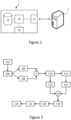
- an image processing device 1 comprises a processor 10, a communication interface 12 and a memory 14.
- the processor 10 is configured to implement certain steps of an image processing method that will be described later.
- the processor 10 can have any structure.
- the processor comprises one or more cores, each core being configured to execute the code instructions of a program so as to implement the aforementioned steps. It will be seen later that this program uses neural networks.
- the communication interface 12 is adapted to allow the image processing device 1 to receive images to be processed and to communicate with a server 2.
- the interface communication protocol 12 is of any type. For example, it is wired (Ethernet) or wireless radio type using any communication protocol (Wi-Fi, Bluetooth, etc.).
- the memory 14 is adapted to store data manipulated or produced by the processor 10.
- the memory 14 is of any type.
- the memory 14 comprises a volatile memory for storing data temporarily, and a non-volatile memory for storing data persistently, that is to say in a manner which retains the data when the non-volatile memory is powered down.
- the memory 14 is in particular adapted to store an image received by the processing device 1, and intended to be processed by the processor.
- the image processing device 1 may also comprise an image sensor 16 showing fingerprints.
- the sensor may optionally comprise a transparent surface serving as a support for a finger, so as to stabilize the finger and thus clearly show a fingerprint of the finger in an image provided by the sensor.
- Server 2 stores a database comprising reference images showing reference fingerprints relating to previously enrolled reference individuals.
- the processing device 1 is configured to implement processing based on a plurality of N classes of predefined pixel distances.
- Each of the N classes includes a set of pixel distance values specific to it, this set of values being defined in advance.
- distances are expressed in pixels, not in a unit of length (such as inches or meters) or in a unit dependent on a unit of length (as is the case with resolution, usually expressed in pixels/inch, abbreviated as dpi).
- dpi resolution, usually expressed in pixels/inch, abbreviated as dpi.
- Each class has a size that characterizes the amount of pixel distance values included in the class. Additionally, each class has a median pixel distance value.
- the classes are ordered according to their respective median values.
- the plurality of N classes includes two extreme classes, and possibly N-2 intermediate classes if N>2.
- Each intermediate class has two classes adjacent to it within the plurality of N classes.
- each extreme class has only one class adjacent to it.
- classes are assigned respective indices ranging from 1 to N, in order of median value.
- an intermediate class with index i is adjacent to classes with indices i-1 and i+1.
- the classes are contiguous, in the sense that for any i ranging from 1 to N-1 the upper bound of the class with index i is equal to the lower bound of the class with index i+1.
- the respective intervals of the classes placed end to end cover a continuous interval, without strong redundancy (except for the bounds in the case where the intervals are closed).
- the plurality of N classes complies with the following rule: the higher the median value of a class, the larger the class size.
- the class with index i+1 has a size greater than the size of the class with index i.
- each pixel distance class is an interval of pixel distance values.
- This interval includes a lower bound (minimum pixel distance value) and an upper bound (maximum pixel distance value).
- the size of a class is the length of the interval (from the lower bound to the upper bound).
- the median value of the class is, in this embodiment, the central value of the interval, i.e. a value that is equidistant from the lower bound and the upper bound.
- Class Index Values included in the class (expressed in pixels)
- Class size (expressed in pixels) 1 [10, 11] 1 2 [11, 12.1] 11.1 3 [12.1, 13.31] 1.21 4 [13.31, 14.64] 1.33 5 [14.64,16.11] 1.47
- This plurality of 5 classes covers an overall interval from 10 to 16.11 pixels. This interval makes sense because it covers a range of inter-ridge distances in pixels measurable in a fingerprint image bank having various resolutions (about 500 dpi to about 1000 dpi).
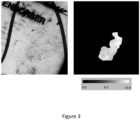
- a method implemented by the device 1 comprises the following steps.
- the processing device 1 receives a test image showing a test fingerprint of an individual.
- the qualifier “test” is simply intended to establish a distinction between the received image and the reference images stored by the server.
- fingerprints shown in images acquired by a dedicated image sensor called “tenprint” in English
- latent fingerprints
- the proof image may have been acquired by the image sensor (if present) or by another image sensor, in which case the proof fingerprint is of type tenprint.
- the proof image may be received via the communication interface, and be latent.
- the proof image comprises a plurality of pixels forming a two-dimensional grid. Each pixel has a specific position in this grid, as well as light information.
- the color information is of any type: single-component (gray level), three-component (red, green, blue for example), etc.
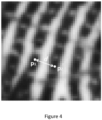
- FIG 3 shows on the left an example of a test image showing a latent fingerprint that can be processed by device 1. It can be seen that the latent fingerprint does not cover the entire image, and is even only partially visible.
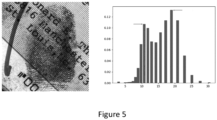
- a fingerprint is a pattern drawn by ridges formed on an individual's finger. As already mentioned in the introduction, two adjacent ridges are separated by an inter-ridge distance. The inter-ridge distances are different from one fingerprint to another.
- the resolution of the test image is not known by the processing device 1.
- the processor 10 implements the following steps from the test image.
- the processor extracts features from the test image using an extraction neural network.
- the extracted features are generally referred to in the literature as “feature maps”.
- a neural network comprises a succession of layers. Each layer comprises neurons taking their inputs from neurons in the previous layer. Layers with various functions are known. In particular, a normalization layer is known to normalize data that it takes as input, so as to limit dispersion in the output data of the neural network.
- the extraction neural network may be convolutional, in which case at least one of the layers of the neural network is a convolutional layer.
- the extraction neural network has the particularity of being devoid of a normalization layer. We will see later that this absence of a normalization layer constitutes an advantage, contrary to what one might think at first glance.
- the processor 10 In a step 106, the processor 10 generates a preliminary classification map from the test image. More specifically, the preliminary classification map is generated by the processor 10 using a classification neural network taking as input the features extracted by the extraction neural network, the classification neural network having been the subject of prior training.
- the classification neural network performs a classification function on the N classes of inter-ridge distances in pixels discussed previously, and the classification map reflects the result of this classification.
- the preliminary classification map includes, for each block of a set of blocks covering the entire test image and for each class making up the plurality N of classes, a preliminary score associated with the block and the class.
- a "block" of an image constitutes a region of the image in one piece and comprising one or more pixels of the image.
- each block considered is in reality a pixel of the proof image.
- the set of blocks covering the entire image is the set of pixels of the proof image, so that the number of preliminary scores is equal to N multiplied by the number of pixels in the test image.
- the preliminary score p i associated with a block and the index class i is indicative of a probability of existence, in the test image, of a segment passing through the block and whose length constitutes an inter-ridge distance of the fingerprint included in the index class i.
- the preliminary score p i associated with a block and the index class i is directly the probability of existence as defined above.
- the preliminary score p i then has a value between 0 and 1.
- the higher the value of the preliminary score the higher the probability of existence.
- the preliminary score p i may be indicative of such a probability of existence, without being directly presented in the form of this probability. Indeed, the preliminary score may be data from which such a probability of existence can be deduced.
- the operation performed by the classification neural network is to partition the test image into blocks, and to assign to each block a discrete distribution of N scores p 1 , ..., p N respectively associated with the index classes ranging from 1 to N.
- These scores p i indicate which are the inter-peak distance values most likely shown by the corresponding block.
- the fingerprint does not cover the entire image, but is only visible in part of the image (this is notably the case in the image shown on the left of the figure 3 ).
- the proof fingerprint may be visible only in some blocks of the proof image, which are conventionally called "interest blocks", while the other blocks of the proof image do not provide any relevant information about the proof fingerprint.
- the starting block set covering the entire image, comprises a plurality of interest blocks, this plurality of interest blocks forming a subset of the starting block set.
- the processor 10 generates in a step 108 a binary mask estimating, for each block of the set of blocks, whether the block is a block of interest (i.e. a block showing a fingerprint) or not (i.e. a block not showing a fingerprint).
- the binary mask is generated by a semantic segmentation neural network taking as input the features extracted by the extraction neural network, the semantic segmentation neural network that has been previously trained.
- the semantic segmentation neural network works in parallel with the classification neural network.
- the binary mask assigns the value 1 to each block of interest (considered to show a fingerprint), and the value 0 to the other blocks (considered to not show a fingerprint.
- the semantic segmentation neural network can implement the following substeps.
- the segmentation neural network In a first sub-step, the segmentation neural network generates a segmentation map from the features previously extracted from the test image.
- the segmentation map includes, for each block, a probability that the block shows a fingerprint. This probability has a value between 0 and 1.
- the segmentation neural network determines a threshold to apply to the segmentation map.
- the threshold is equal to the maximum probability of the segmentation map multiplied by a predefined coefficient strictly less than 1, for example 0.65.
- the segmentation neural network thresholds the segmentation map using the determined threshold, so as to produce the binary mask.
- any probability lower than the threshold is set to zero, while any probability higher than the threshold is set to 1.
- the processor applies the binary mask to the preliminary classification map so as to generate a masked classification map.
- the application of the binary mask to the preliminary classification map involves a Hadamard product between the preliminary classification map and the binary mask (this product being represented in the figure 2 by the X sign).
- the masked classification map comprises, for each block of interest and for each class of the plurality N of classes, a score associated with the block of interest and the class.
- the score associated with a block and a class is indicative of a probability of existence in the reference image of a segment passing through the block and whose length constitutes an inter-ridge distance of the fingerprint included in the class.
- the hidden classification map has similar content to the classification map generated by the classification neural network used upstream.
- Each score of the hidden classification map, which is associated with a given block of interest and class, is derived from the preliminary score associated with this block of interest and this class.
- each score in the hidden classification map which is associated with a given block of interest and class, is precisely the preliminary score associated with that block of interest and class.
- a preliminary score that is associated with a block of interest is also found as a score in the hidden classification map, without changing its value.
- the hidden classification map is restricted to interest blocks.
- the restriction can be made so that the masked classification map includes N scores p 1 , ..., p N only for the blocks of interest, i.e. the blocks that have been designated by the binary mask as showing a fingerprint.
- the number of scores contained in the masked classification map is less than the number of preliminary scores contained in the preliminary classification map.
- the scores relating to blocks of interest of the proof image are kept (only the block or blocks showing a fingerprint according to the binary mask), and the scores relating to the other blocks of the set of blocks covering the entire image are eliminated.
- the restriction to blocks of interest is achieved by forcing the value of any score relating to a block that is not a block of interest to a value indicating that the score is irrelevant, for example by forcing this value to zero.
- the processor can thus recognize an irrelevant score, and thus ignore it.
- the application of the binary mask can be considered as a filtering of the preliminary classification map allowing the processor to subsequently perform processing limited to the relevant scores. This makes it possible to reduce the hardware resources required for the subsequent implementation of the subsequent steps of the method. In addition, this restriction makes it possible to improve the accuracy of the estimation provided by the method due to the exclusion of areas that are not of interest.
- the processor 10 In a step 112, the processor 10 generates a local inter-ridge distance map from the hidden classification map.
- the local inter-ridge distance map includes, for each block of interest, a local inter-ridge distance in pixels estimated for the block of interest.
- the qualifier "local” is used to illustrate that a local inter-ridge distance is information associated with a block constituting only a portion of the proof image, and not more global information.
- An estimated local inter-ridge distance in pixels for a block is calculated from selective data from the masked classification map and the plurality of N classes.
- Selective data further include a value C k included in the index class k associated with the score p k .
- the value C k is the median value of the index class k.
- the data p k and C k allows to obtain a relevant local inter-ridge distance.
- the masked classification map indicates that if there exists in the test image a segment passing through the block considered and whose length constitutes an inter-ridge distance, then the most probable hypothesis is that this length is included in the index class k. This is reflected by the score p k indicating a maximum probability of existence. Taking into account this class allows a more precise distance estimation.
- the class(es) adjacent to the most relevant class with index k are preferably taken into account, and other classes are not taken into account. This has the advantage of further refining the estimation of the local inter-ridge distance.
- the local inter-ridge distance associated with the block considered can be calculated as follows: p k ⁇ 1 C k ⁇ 1 + p k C k + p k + 1 C k + 1 p k ⁇ 1 + p k + p k + 1
- the local inter-ridge distance is thus an average of the distances C k -1 , C k and C k -1 respectively weighted by the corresponding scores p k -1 , p k and p k +1 .
- an interpolation is performed to obtain output values that are part of a continuous and non-discrete space, which also contributes to refining the estimate made.
- the processor 10 selects at least one class of interest from the plurality of distance classes using the hidden classification map.
- Each class of interest may be selected by the processor 10 using steps 114, 116 which are as follows.
- the processor 10 calculates a histogram from the masked classification map.
- the histogram comprises, for each of the N pixel distance classes, an aggregated score obtained by aggregating the scores associated with the class, these scores being associated with the different blocks of interest retained in the masked classification map.
- the masked classification map contains NM scores, M being the number of blocks of interest identified by the binary mask, then the aggregated score for the index class i results from the aggregation of the M scores p i respectively associated with the M blocks of interest.
- N aggregated scores are produced during this step 114.
- a particularly inexpensive aggregation in hardware resources consists simply in summing the M scores p i respectively associated with the M blocks of interest to obtain the aggregated score of the index class i.
- Other types of aggregation could however be carried out instead of a summation in step 114.
- step 116 the processor 10 detects at least one score constituting a local maximum of the histogram.
- Each class of interest is a class associated with a score constituting a detected local maximum.
- the histogram calculated in step 114 may include a single local maximum or multiple local maxima.
- the figure 5 shows on the left another example of a proof image including spurious signals (oblique lines), and shows on the right the histogram obtained from this proof image.
- This histogram includes two local maxima: a main local maximum of high value (greater than 0.12) associated with a class of interest whose values are slightly less than 20 pixels, and a secondary local maximum of lower value (between 0.10 and 0.12) associated with another class whose values are slightly greater than 10 pixels.
- the processor 10 estimates an average inter-ridge distance of the test fingerprint from the local inter-ridge distance map and the selected class of interest.
- the estimation 118 comprises the following substeps.
- the local inter-ridge distance map includes M local inter-ridge distances in pixels respectively associated with the M blocks of interest previously retained in the masked classification map.
- the processor 10 selects distances of interest from among the M local inter-peak distances in pixels respectively associated with the M blocks of interest, based on a criterion of proximity to the class of interest.
- a local inter-peak distance whose value is close to the values of the class of interest is here selected.
- a local inter-peak distance whose value is far from the values of the class of interest is not selected.
- the distances of interest are the local inter-ridge distances in pixels having values included in an interval whose limits are determined from a distance value included in the class of interest.
- the interval is centered on the median value of the class of interest, and has a predefined length.
- the lower bound is equal to (100 - x)% of the median value of the class of interest
- the upper bound of the interval is equal to (100 + x)% of the median value of the class of interest, with x between 0 and 100, for example 35.
- the interval represents a bounded neighborhood around a value from the class of interest.
- the processor calculates an average between the distances of interest selected in the previous substep.
- the result of this averaging is the estimated average inter-ridge distance in pixels for the test fingerprint.
- This estimated average inter-peak distance in pixels is obtained without requiring prior knowledge of the resolution of the test image. Indeed, none of the steps 102, 104, 106, 108, 110, 112, 114, 116, 118 used such a resolution as a parameter; the method worked exclusively on distances expressed in pixels.
- the reference images stored by the server have a different resolution than the resolution of the proof image (the latter being unknown). In this event, comparing the proof image with the reference images would likely lead to missed detections or false positives.
- the device 1 obtains in a step 120 a reference inter-ridge distance, expressed in pixels, relating to a reference fingerprint shown in a reference image stored in the database.
- the processing device 1 can send a request to the server 2 via its communication interface 12, and the server 2 returns the reference inter-peak distance in pixels in response to the request.
- the reference inter-peak distance in pixels is calculated in advance, i.e. before sending the request to obtain it, for example when enrolling the reference image with the server 2.
- the server 2 can estimate this reference inter-peak distance upon receipt of the request, for example by means of steps 104 to 118 applied to a reference image stored by the server 2.
- a step 122 the processing device 1 resizes the proof image into a resized image, such that the estimated average proof inter-peak distance in pixels corresponds to the reference inter-peak distance in pixels.
- This resizing is typically a scaling, that is to say without a transformation not changing the aspect ratio of the proof image.
- the sizing step 122 may thus comprise the calculation of a scale factor as a ratio of the reference inter-ridge distance in pixels to the inter-ridge distance. estimated pixel average for the proof image, and apply this scale factor to the proof image to obtain the resized image.
- the proof image is resized so that the inter-peak distance in the proof image increases from 5 pixels to 10 pixels in the resized image, using a resizing factor of 2 (10 divided by 5).
- a step 124 the processor 10 commands a comparison between the resized proof image and the reference image, so as to verify a correspondence between the proof fingerprint and the reference fingerprint.
- the comparison is typically performed by the server 2.
- the processing device 1 can send to the server 2 a comparison request and the resized image.
- the resized image can for example be sent to the server in encrypted form for greater confidentiality.
- the processor 10 can in certain cases select not one but several classes of interest (in particular if several local maxima are detected in the histogram at step 116). This can occur in test images comprising multiple spatial frequencies, and in which the test fingerprint merges with other periodic signals, as for example in the example of the figure 5 discussed previously.
- step 118 is repeated for each class of interest, so as to produce several average distances in pixels respectively associated with the classes of interest.
- steps 122 and 124 are implemented first on the basis of the average distance in pixels associated with the class of interest for which a local maximum having the highest value among the detected local maxima has been found. If it is found that the resized image and the proof image do not match, then steps 122 and 124 are again implemented on the basis of another average distance. Thus, the different local maxima are successively tested in order of decreasing probability.
- the extraction neural network was preferably devoid of a normalization layer.
- the inventors discovered that the presence of normalization layers in the extraction neural network leads to biases in the estimation of the average distance in pixels, especially when the proof fingerprint is based on a noisy background. Indeed, textures appearing in the proof image around the proof fingerprint can disrupt the correct operation of the network on the fingerprint areas and result in an incorrect average distance (overestimated or underestimated excessively).
- FIG. 6a shows a series of results obtained with the normalization layer
- Figure 6b a series of results obtained without a normalization layer for the same footprint.
- the images on a white background, and with a gray border if applicable, are the input test images, and the images on a black background are the corresponding local distance maps obtained.
- the padding corresponds to the gray border around the white square containing the test fingerprint. It can be seen that the absence of a normalization layer allows for local distance maps that are much more resistant to injected noise.
- the inventors carried out comparative tests consisting of implementing comparisons between the proof image and the reference image (step 124) with and without prior resizing of the proof image. It was then checked to what extent the comparison results were erroneous or not (false positive or missed match). A gain in precision of approximately 14 points was observed when the resizing is implemented before comparison. In certain cases, the error goes from 17% to 2.2%, which represents almost 8 times less error.
Landscapes
- Engineering & Computer Science (AREA)
- Theoretical Computer Science (AREA)
- Multimedia (AREA)
- General Physics & Mathematics (AREA)
- Physics & Mathematics (AREA)
- Computer Vision & Pattern Recognition (AREA)
- Evolutionary Computation (AREA)
- Computing Systems (AREA)
- Medical Informatics (AREA)
- Software Systems (AREA)
- General Health & Medical Sciences (AREA)
- Databases & Information Systems (AREA)
- Health & Medical Sciences (AREA)
- Artificial Intelligence (AREA)
- Human Computer Interaction (AREA)
- Collating Specific Patterns (AREA)
- Image Analysis (AREA)
Applications Claiming Priority (1)
| Application Number | Priority Date | Filing Date | Title |
|---|---|---|---|
| FR2302490A FR3146740B1 (fr) | 2023-03-17 | 2023-03-17 | procédé d’estimation d’une distance inter-crêtes se rapportant à une empreinte digitale |
Publications (2)
| Publication Number | Publication Date |
|---|---|
| EP4432255A1 true EP4432255A1 (de) | 2024-09-18 |
| EP4432255B1 EP4432255B1 (de) | 2025-11-05 |
Family
ID=86764612
Family Applications (1)
| Application Number | Title | Priority Date | Filing Date |
|---|---|---|---|
| EP23216780.9A Active EP4432255B1 (de) | 2023-03-17 | 2023-12-14 | Verfahren zur schätzung eines inter-bit-abstandes im zusammenhang mit einem fingerabdruck |
Country Status (4)
| Country | Link |
|---|---|
| US (1) | US12361748B2 (de) |
| EP (1) | EP4432255B1 (de) |
| AU (1) | AU2024200109B2 (de) |
| FR (1) | FR3146740B1 (de) |
Family Cites Families (7)
| Publication number | Priority date | Publication date | Assignee | Title |
|---|---|---|---|---|
| KR100607580B1 (ko) * | 2004-09-23 | 2006-08-02 | (주)니트 젠 | 지문 특징데이터 추출알고리즘에 있어서의 방향 필터링방법 |
| US8634606B2 (en) * | 2004-12-07 | 2014-01-21 | Mitsubishi Electric Research Laboratories, Inc. | Method and system for binarization of biometric data |
| JP4776385B2 (ja) * | 2006-01-31 | 2011-09-21 | セコム株式会社 | 指紋画像生成装置 |
| EP2600307B1 (de) * | 2010-07-29 | 2020-12-02 | Fujitsu Limited | Vorrichtung zur aufzeichnung von biometrischen informationen, biometrisches authentifizierungsverfahren und computerprogramm für biometrische authentifizierung |
| US11263432B2 (en) * | 2015-02-06 | 2022-03-01 | Veridium Ip Limited | Systems and methods for performing fingerprint based user authentication using imagery captured using mobile devices |
| US10198612B1 (en) * | 2015-07-29 | 2019-02-05 | Morphotrust Usa, Llc | System and method for scaling biometric images |
| CN106503609B (zh) * | 2015-09-08 | 2019-07-16 | 腾讯科技(深圳)有限公司 | 指纹纹线点的识别方法及装置 |
-
2023
- 2023-03-17 FR FR2302490A patent/FR3146740B1/fr active Active
- 2023-12-14 EP EP23216780.9A patent/EP4432255B1/de active Active
-
2024
- 2024-01-05 US US18/405,403 patent/US12361748B2/en active Active
- 2024-01-08 AU AU2024200109A patent/AU2024200109B2/en active Active
Non-Patent Citations (2)
| Title |
|---|
| CHUN-XIAO REN ET AL: "Fingerprint Scaling", 15 September 2008, TOPICS IN CRYPTOLOGY - CT-RSA 2020 : THE CRYPTOGRAPHERS' TRACK AT THE RSA CONFERENCE 2020, SAN FRANCISCO, CA, USA, FEBRUARY 24-28, 2020, CORNELL UNIVERSITY LIBRARY, 201 OLIN LIBRARY CORNELL UNIVERSITY ITHACA, NY 14853, PAGE(S) 474 - 481, XP019105656 * |
| REN CHUNXIAO ET AL: "A Framework of Fingerprint Scaling", vol. 11, no. 3, 1 March 2013 (2013-03-01), pages 1547 - 1559, XP093081443, ISSN: 2302-4046, Retrieved from the Internet <URL:http://journal.esperg.com/index.php/tijee/article/viewFile/2124/2610> [retrieved on 20230912], DOI: 10.11591/telkomnika.v11i3.2304 * |
Also Published As
| Publication number | Publication date |
|---|---|
| EP4432255B1 (de) | 2025-11-05 |
| US20240312246A1 (en) | 2024-09-19 |
| US12361748B2 (en) | 2025-07-15 |
| FR3146740B1 (fr) | 2025-02-21 |
| AU2024200109B2 (en) | 2025-01-23 |
| AU2024200109A1 (en) | 2024-10-03 |
| FR3146740A1 (fr) | 2024-09-20 |
Similar Documents
| Publication | Publication Date | Title |
|---|---|---|
| BE1025503B1 (fr) | Procede de segmentation de ligne | |
| EP2561479A1 (de) | Verfahren zur überwachung des erscheinungsbildes einer reifenfläche | |
| EP3234913A1 (de) | Verfahren zur erkennung eines defekts auf einer oberfläche eines reifens | |
| FR2913791A1 (fr) | Appareil et procede d'elimination de bruits lies a des caracteres | |
| EP4432255B1 (de) | Verfahren zur schätzung eines inter-bit-abstandes im zusammenhang mit einem fingerabdruck | |
| EP4432256B1 (de) | Verfahren mit inter-pixel-abständen im zusammenhang mit fingerabdrücken | |
| EP3195259B1 (de) | Verfahren zur identifizierung der anisotropie der textur eines digitalen bildes | |
| EP1646967B1 (de) | Verfahren zur messung des naheverhältnisses zweier konturen und system zur automatischen zielidentifikation | |
| EP2491517A1 (de) | Verfahren und system zur beurteilung der testdatenklasse in einem grossen datenraum | |
| EP3545496B1 (de) | Verfahren zur charakterisierung der anisotropie der textur eines digitalen bildes | |
| EP3945450B1 (de) | Grafischecodelesung | |
| EP4403949A1 (de) | Verfahren zur entschachtelung von radarimpulsen | |
| EP3491582B1 (de) | Verfahren zum vergleichen von objekten, die in der nähe voneinander positioniert sind, und zugehörige vorrichtung | |
| CN120807367B (zh) | 一种去雾图像生成方法及装置 | |
| WO2013135977A1 (fr) | Système pour déterminer l'identification d'un appareil photographique a partir d'une photographie et procédé mis en oeuvre dans un tel système | |
| FR3150622A3 (fr) | Procédé de traitement d’une image d’épreuve, dispositif informatique et programme d’ordinateur associés. | |
| FR3151109A1 (fr) | Méthode de tatouage numérique d’une image, méthode d’extraction d’un tatouage numérique et méthode de détection de falsification d’une image tatouée | |
| EP4136565A1 (de) | Verfahren zur erkennung eines angriffs durch darstellung von fingerabdrücken | |
| WO2018015654A1 (fr) | Procede et dispositif d'aide a la navigation d'un vehicule | |
| WO2021078712A1 (fr) | Procede de determination de l'etat d'un systeme et dispositif mettant en œuvre lesdits procedes | |
| WO2014009548A1 (fr) | Procede d'elaboration d'un discriminateur multiclasse |
Legal Events
| Date | Code | Title | Description |
|---|---|---|---|
| PUAI | Public reference made under article 153(3) epc to a published international application that has entered the european phase |
Free format text: ORIGINAL CODE: 0009012 |
|
| STAA | Information on the status of an ep patent application or granted ep patent |
Free format text: STATUS: REQUEST FOR EXAMINATION WAS MADE |
|
| 17P | Request for examination filed |
Effective date: 20231214 |
|
| AK | Designated contracting states |
Kind code of ref document: A1 Designated state(s): AL AT BE BG CH CY CZ DE DK EE ES FI FR GB GR HR HU IE IS IT LI LT LU LV MC ME MK MT NL NO PL PT RO RS SE SI SK SM TR |
|
| RAP1 | Party data changed (applicant data changed or rights of an application transferred) |
Owner name: IDEMIA PUBLIC SECURITY FRANCE |
|
| P01 | Opt-out of the competence of the unified patent court (upc) registered |
Free format text: CASE NUMBER: APP_14771/2025 Effective date: 20250326 |
|
| GRAP | Despatch of communication of intention to grant a patent |
Free format text: ORIGINAL CODE: EPIDOSNIGR1 |
|
| STAA | Information on the status of an ep patent application or granted ep patent |
Free format text: STATUS: GRANT OF PATENT IS INTENDED |
|
| INTG | Intention to grant announced |
Effective date: 20250620 |
|
| GRAS | Grant fee paid |
Free format text: ORIGINAL CODE: EPIDOSNIGR3 |
|
| GRAA | (expected) grant |
Free format text: ORIGINAL CODE: 0009210 |
|
| STAA | Information on the status of an ep patent application or granted ep patent |
Free format text: STATUS: THE PATENT HAS BEEN GRANTED |
|
| AK | Designated contracting states |
Kind code of ref document: B1 Designated state(s): AL AT BE BG CH CY CZ DE DK EE ES FI FR GB GR HR HU IE IS IT LI LT LU LV MC ME MK MT NL NO PL PT RO RS SE SI SK SM TR |
|
| REG | Reference to a national code |
Ref country code: CH Ref legal event code: F10 Free format text: ST27 STATUS EVENT CODE: U-0-0-F10-F00 (AS PROVIDED BY THE NATIONAL OFFICE) Effective date: 20251105 Ref country code: GB Ref legal event code: FG4D Free format text: NOT ENGLISH |
|
| REG | Reference to a national code |
Ref country code: DE Ref legal event code: R096 Ref document number: 602023008298 Country of ref document: DE |
|
| REG | Reference to a national code |
Ref country code: IE Ref legal event code: FG4D Free format text: LANGUAGE OF EP DOCUMENT: FRENCH |
|
| PGFP | Annual fee paid to national office [announced via postgrant information from national office to epo] |
Ref country code: DE Payment date: 20251126 Year of fee payment: 3 |
|
| PGFP | Annual fee paid to national office [announced via postgrant information from national office to epo] |
Ref country code: AT Payment date: 20260113 Year of fee payment: 3 |
|
| PGFP | Annual fee paid to national office [announced via postgrant information from national office to epo] |
Ref country code: FR Payment date: 20251217 Year of fee payment: 3 |
|
| REG | Reference to a national code |
Ref country code: NL Ref legal event code: MP Effective date: 20251105 |